
XIV. ULUSLARARASI TÜRK ORTODONTİ DERNEĞİ SEMPOZYUMU
|
|
|
- Eren Gökçek
- 10 yıl önce
- İzleme sayısı:
Transkript
1
2

3 0-04 Kasım 05 November 0-04, 05 XIV. ULUSLARARASI TÜRK ORTODONTİ DERNEĞİ SEMPOZYUMU XIV. International Symposium of the Turkish Orthodontic Society Program ve Özetler Programme and Abstracts
4 XIV. Uluslararası Türk Ortodonti Derneği Sempozyumu 0-04 Kasım 05 ESKİŞEHİR

5 XIV. International Symposium of Turkish Orthodontic Society November 0-04, 05 ESKISEHIR
6 XIV. Uluslararası Türk Ortodonti Derneği Sempozyumu 0-04 Kasım 05 ESKİŞEHİR

7 XIV. International Symposium of Turkish Orthodontic Society November 0-04, 05 ESKISEHIR İÇİNDEKİLER CONTENT Türk Ortodonti Derneği Başkanı ndan Turkish Orthodontic Society President s Welcome III Sempozyum Başkanı ndan Symposium President s Welcome IV Bilimsel Program Scientific Programme V Sempozyum Sonrası Kurs Programı Post-Symposium Course Programme X Poster Bildiriler Listesi Poster Presentations List XI Davetli Konuşmacılar Invited Speakers Sözlü Bildiriler Oral Presentations 9 Poster Bildiriler Poster Presentations 45 Yazar İndeksi Author Index 37 I
8 XIV. Uluslararası Türk Ortodonti Derneği Sempozyumu 0-04 Kasım 05 ESKİŞEHİR Düzenleyen /Organized by Türk Ortodonti Derneği Sempozyum Başkanı / President of Symposium Prof. Dr. Ali Osman BENGİ Türk Ortodonti Derneği Başkanı / Turkish Orthodontic Society President Prof. Dr. Serdar ÜŞÜMEZ Bilimsel Kurul / Scientific Committee Neslihan ÜÇÜNCÜ - Başkan Okan AKÇAM Ayça ARMAN-ÖZÇIRPICI İsmail CEYLAN Hülya KILIÇOĞLU Aslıhan Mediha ERDİNÇ Lale TANER Serdar TOROĞLU Tamer TÜRK Tancan UYSAL Organizasyon ve Teknik Komite / Organization & Technical Committee Ahu ACAR Serhat ÖZSOY İlhan Metin DAĞSUYU Sosyal Komite / Social Committee Müge AKSU Sıddık MALKOÇ Sabri İlhan RAMOĞLU Genel Sekreter / Secretary General Ayşe Tuba ALTUĞ Genel Sekreter Yardımcıları / Assistant Secretary General Nazlı KARACA Aslı ŞENOL Davetli Konuşmacılar / Invited Speakers Toros ALCAN Sibel BİREN Tamer BÜYÜKYILMAZ Nazan KÜÇÜKKELEŞ Mehmet MANİSALI Erhan ÖZDİLER Ömür POLAT ÖZSOY Tülin TANER Sempozyum Sekreterya / Symposium Secreteriat Valör Kongre Organizasyonları Valör Congress Organizations II
9 Türk Ortodonti Derneği Başkanı ndan Turkish Orthodontic Society President s Welcome Değerli Meslektaşlarım, XIV. International Symposium of Turkish Orthodontic Society November 0-04, 05 ESKISEHIR Türk Ortodonti Derneği nin 4. Uluslararası Sempozyumu için -4 Kasım 05 tarihlerinde son yılların en çok ilgi çeken şehirlerinden biri olan Eskişehir de bir araya gelecek olmaktan büyük mutluluk duyuyoruz. Bu yılki sempozyumun ana teması Estetik ve Ortodonti ve hedefimiz sizlere klinik içeriği her sene artan doyurucu bir bilimsel program sunmak olacak. Program kapsamında estetik başlığı altında ortognatik cerrahiden lingual tedaviye ve mini vidalardan botoks uygulamalarına kadar ilgi çekici pek çok konuda değerli konuşmacıları dinleyecek ve ayrıca güncel mesleki sorunlarımızı da konuşmaya fırsat bulacağız. Eskişehir in en yeni ve güzel otellerinden olan Rixos ta gerçekleştirilecek bu sempozyumda bir yandan bilgilenirken bir yandan da hepimizin merak ettiği Eskişehir in kendine özgü doku ve tatlarını keşfetme şansı bulacaksınız. Programın hazırlanmasında emeği geçen Yönetim Kurulu ve Organizasyon ekibindeki değerli arkadaşlarıma, Valör Turizm Firmasına ve sempozyumumuzu destekleyen değerli ortodonti firmalarına teşekkür ederim. Yönetim Kurulu adına tüm katılımcılara hep birlikte öğreneceğimiz, eğleneceğimiz ve yeni projeler ve artmış bir motivasyonla evlerimize döneceğimiz güzel bir sempozyum diliyorum. Prof. Dr. Serdar ÜŞÜMEZ Türk Ortodonti Derneği Başkanı Dear Colleagues, We are happy to welcome you in one of the top local travel destinations of recent years, Eskişehir, for the 4th International Symposium of The Turkish Orthodontic Society. The main topic of the symposium is Esthetics and Orthodontics and we are aiming to present you a satisfactory scientific program with clinical content which is increasing every year. We will be able to listen valuable contributors on topics from orthognathic surgery to lingual orthodontics and from mini screws to clinical Botox applications. As usual we will also find some time to discuss issues related to our profession within the country. The meeting will be held at Rixos, one of the newest locations of the city and we hope that you will be able to spare some time to enjoy specific tastes and textures of this exciting Eskişehir. I would like to thank my friends in the council and the organizing committee as well as Valör and our sponsors for their valuable efforts and support. On behalf of the council I wish all participants an enlightening, entertaining symposium which will motivate us to be an even better orthodontist and professional. Prof. Dr. Serdar ÜŞÜMEZ President of Turkish Orthodontic Society III
10 XIV. Uluslararası Türk Ortodonti Derneği Sempozyumu 0-04 Kasım 05 ESKİŞEHİR Sempozyum Başkanı ndan Symposium President s Welcome Çok Kıymetli Meslektaşlarım, Türk Ortodonti Derneği nin artık gelenekselleşmiş olan bir yıl kongre bir yıl sempozyum serisinin bu yıl 4. sünü gerçekleştirme mutluluğunu yaşıyoruz. Sempozyumun bu yılki adresi ise tarihi, sosyal ve turistik değerleri ve büyük şehirlerden rahatlıkla ulaşılabilir olması özelliğiyle Eskişehir. Bilimsel programda gerek ülkemizden gerek yurtdışından tanınmış meslektaşlarımız bizlerle birlikte olacak ve hem klinik hem de akademik bilgi ve tecrübelerini paylaşacaklar. Bu seneki bilimsel programın en dikkat çekici yönlerinden birisi de hiç şüphesiz ortodonti konularının bazı tamamlayıcı konular ve sosyal konuşmacılar ile zenginleştirilmiş olması. Böylece bir yandan klasik bilgilerimizi güncellerken bir yandan da klinik uygulamalarımızı zenginleştirecek yeni ufuklar edinmiş olacağız. Özellikle büyük şehirlerin dışında gerçekleştirilen bu tip toplantıların en büyük özelliklerinden birisi de hiç şüphesiz hem ziyaret edilen şehrin daha iyi tanınmasına hem de sağladıkları daha samimi ortam ile sosyal ve bilimsel etkileşimlerin daha verimli olmasına imkân tanımaları. Bu sebeple tercih edilen lokasyonun hem bir sonbahar kaçamağı yapmak isteyen serbest ortodontist meslektaşlarım hem de etkileşimli bir bilimsel ortam arayan akademisyen arkadaşlarım için mükemmel bir fırsat olacağını düşünüyorum. Bu vesileyle organizasyonda tüm emeği geçenlere ve sponsor firmalara teşekkür ediyor ve hepinizi -4 Kasım 05 tarihlerinde Eskişehir de görmeyi diliyorum. Prof. Dr. Ali Osman BENGİ Sempozyum Başkanı Dear Colleagues, We experience the happiness of organizing 4th International Symposium of Turkish Orthodontic Society, our series of one year congress and one year symposium has became a tradition. Eskisehir will be the address of the Symposium this year, with its history, social and touristic values and its feature of being within reaching distance from the major cities. We will be together with our national and international well-known colleagues during the scientific program and they will share their knowledge and experiences with us. The subjects of the orthodontics are enriched with supplementary subjects and social speakers, this will be one the most remarkable aspects of the scientific program of this year. By this way we will update our classic knowledge and on the other side we will have new horizons that will enrich our clinical applications. Undoubtedly, one of the biggest features of the meetings that are organized outside the major cities is recognition of the city as well as the opportunity to be more efficient at social and scientific interaction. The preferred location will be a perfect opportunity forself-employed orthodontist colleagues who want to relax and for academician colleagues who want to interact in a scientific atmosphere. I would like to take this occasion to thank those who have contributed to this organization and sponsoring companies. Hope to see you in Eskisehir between and 4 November 05. Prof. Dr. Ali Osman BENGİ Symposium President IV
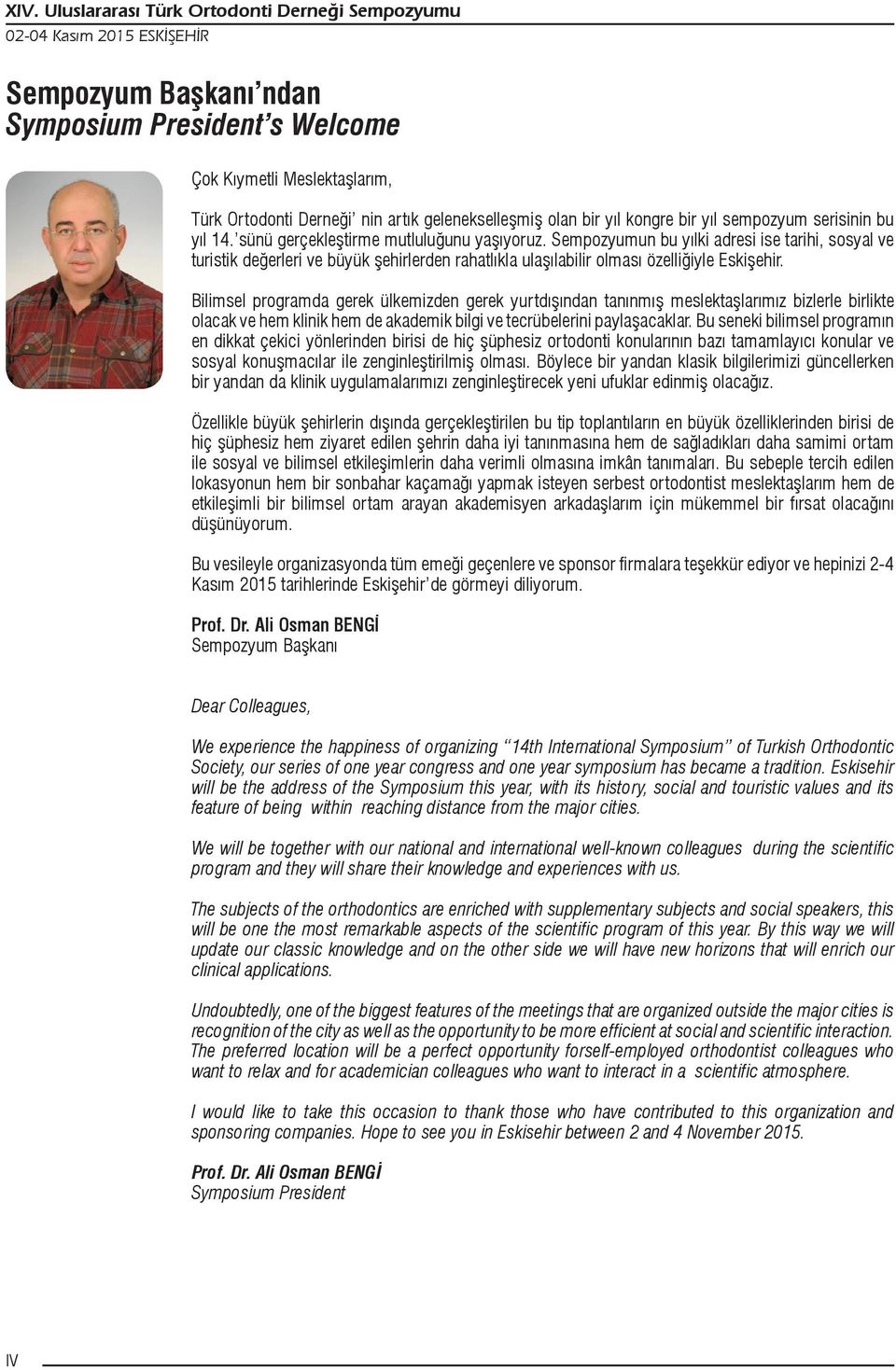
11 BİLİMSEL PROGRAM / SCIENTIFIC PROGRAMME 0 Kasım November 05 Pazartesi Monday Kayıt / Registration Açılış Konuşmaları / Opening Ceremony Oturum / Session Oturum Başkanları / Chairmen: Servet Doğan, Hasan Babacan Konferans: Ortodontik Tedavide Estetik Yaklaşımlar Conference: Esthetic Considerations in Orthodontic Treatment Sibel Biren XIV. International Symposium of Turkish Orthodontic Society November 0-04, 05 ESKISEHIR Konferans: Lingual Ortodontide Optimal Tedavi Sonuçlarının Elde Edilmesi Conference: Achievement of Optimal Treatment Outcome in Lingual Orthodontics Ömür Polat Özsoy Kahve Arası / Coffee Break Oturum / Session Oturum Başkanları / Chairmen: Zahir Altuğ, Ali Altuğ Bıçakçı Konferans: Ortodontik Tedavide Estetik Yaklaşımlar Conference: Esthetics and Orthodontics Tülin Taner Sözlü Bildiri / Oral Presentation S İndirekt Lingual Ortodonti ve Şeffaf Plak Teknikleriyle Yapılan Ortodontik Tedavilerde Hasta Konforu, Memnuniyeti, Tedavi Etkileri ve Tedavi Süresinin Karşılaştırılması Comparative Analysis of Patient Comfort, Satisfaction, Treatment Effects and Treatment Duration between Indirect Lingual Orthodontics and Orthodontic Treatment with Clear Aligner Emel Yeşil Şahin, Tülin Taner Sözlü Bildiri / Oral Presentation S İskeletsel Sınıf I Vakalarda Farklı Dik Yön Paternlerinin Gülümsemeye Etkisi The Effect of Different Vertical Patterns on Smile in Skeletal Class I Cases Neslihan Seyhan Cezairli, Mehmet Bayram.0-.0 Sözlü Bildiri / Oral Presentation S3 Farklı Tekniklerle Kesici Diş İntrüzyonun Gülümseme Estetiği Üzerine Etkileri Effects of Different Incisor Intrusion Techniques on Smile Aesthetics Fatih Kahraman, Nihat Kılıç Sözlü Bildiri / Oral Presentation S4 Çene Ucu Belirginliğinin Profil Estetiğine Etkisinin Değerlendirilmesi - Anket Çalışması Evaluation of the Effect of Chin Prominence to Profile Esthetics - A Survey Study Akın Buğra Pişiren, Ayça Arman Özçırpıcı V
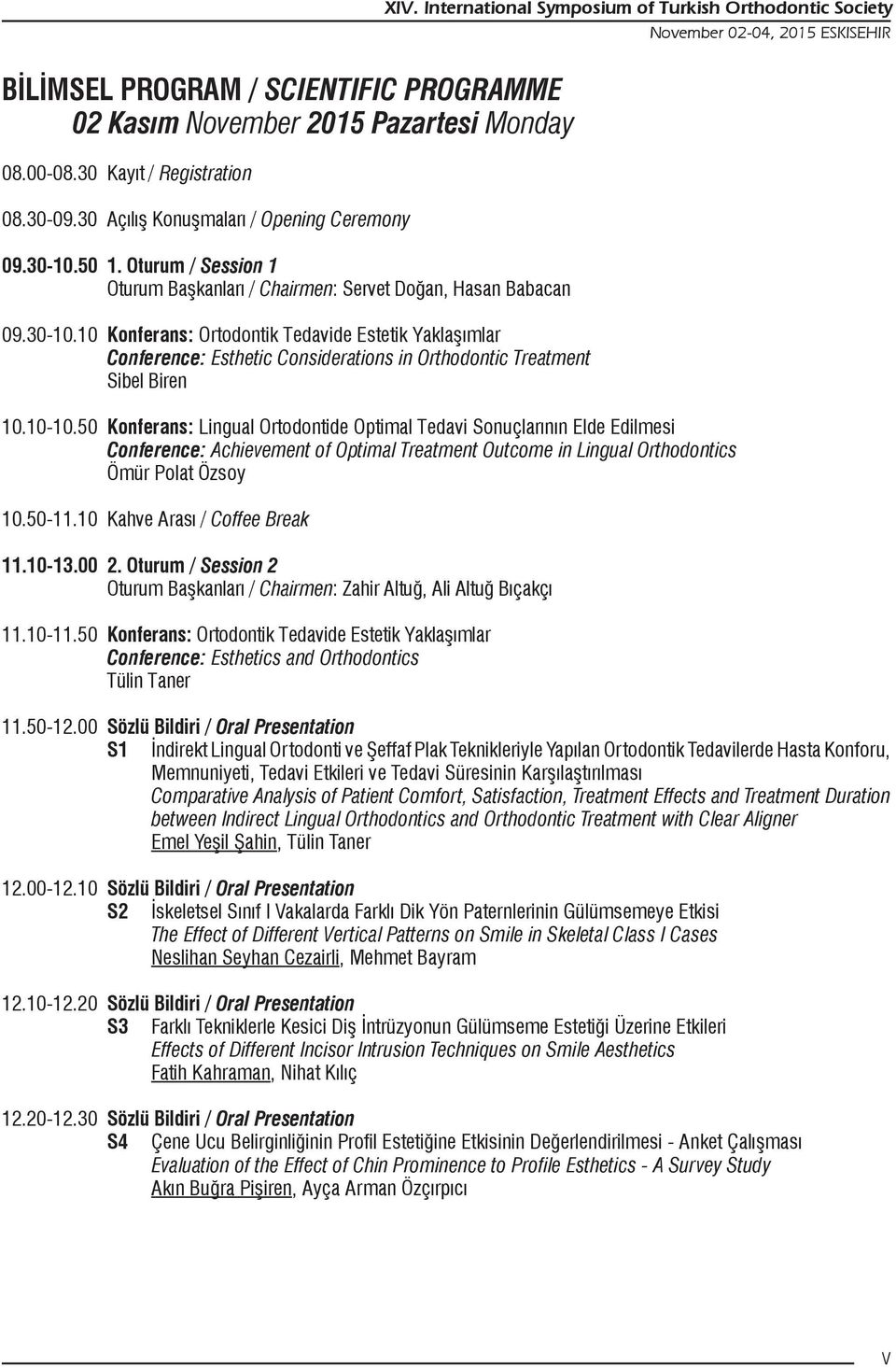
12 XIV. Uluslararası Türk Ortodonti Derneği Sempozyumu 0-04 Kasım 05 ESKİŞEHİR Sözlü Bildiri / Oral Presentation S5 İskeletsel Sınıf I, Sınıf II ve Sınıf III Malokluzyona Sahip Bireyler Arasında Fasiyal Profil Çekicilik Algısının Karşılaştırılması A Comparison of The Perception of Facial Profile Attractiveness Among Skeletal Class I, II and III Patients Mehmet Bayram, Ayşegül Gençcan Sözlü Bildiri / Oral Presentation S6 Hızlı Maksiller Genişletme Sonrası Yüzdeki Yumuşak Doku Değişikliklerinin 3 Boyutlu Stereofotogrametri ile Analizi Facial Soft-Tissue Changes After Rapid Maxillary Expansion Analyzed with 3-Dimensional Stereophotogrammetry Aslı Baysal, Mehmet Ali Öztürk, Ahmet Oğuz Şahan, Tancan Uysal Tartışma / Discussion Öğle Yemeği / Lunch Oturum / Session 3 Oturum Başkanları / Chairmen: İlken Kocadereli, Hakan Türkkahraman Konferans: Tedavi Kalitemizi Yükseltmek için Ne Yapalım? Conference: What Can We Do To Improve The Quality Of Our Treatment Outcome? Tamer Büyükyılmaz Sözlü Bildiri / Oral Presentation S7 Türkiye deki Üniversitelerde Tedavileri Tamamlanmış Ortodonti Hastalarının Tedavi Bitiş Kalitelerinin Amerikan Board Kriterlerine Göre Değerlendirilmesi Evaluation of The Quality of Finishing Treatment of Orthodontic Treatment Patients Treated in The University in Turkey with The American Board Criteria Hatice Akıncı Cansunar, Tancan Uysal Sözlü Bildiri / Oral Presentation S8 Süperkaygan Özellik Gösteren Elmas Benzeri Karbon Nanopartikülleri ile Kaplanmış Ortodontik Tel, Konvansiyonel Braket ve Kendinden Bağlanan Braket Kullanımının Diş Hareketinde Sürtünmeyi Azaltıcı Etkisinin Karşılaştırılmalı Olarak Değerlendirilmesi Comparative Evaluation of Decreasing Effect of Superlubricious Diamond-like Carbon Nanoparticles Coated Orthodontic Wire, Conventional and Self-ligating Brackets on Friction on Orthodontic Tooth Movement Desen Karabağlar, Kürşat Kazmanlı, Murat Baydoğan, Banu Çakırer Bakkalbaşı Sözlü Bildiri / Oral Presentation S9 Sınıf II Hastalarda Ortodontik Tedavi Süresi ve Peer Assessment Index Skorlarının Karşılaştırılması Comparison of Orthodontic Treatment Duration and Peer Assessment Index Scores of Class II Patients Eleni Malamou, Feyza Ülkür, Derya Germeç Çakan Sözlü Bildiri / Oral Presentation S0 Ortodontik Tedavi Gören Hastaların Anksiyete, Stres, Ağrı ve Hayat Kalitesi Üzerine Farklı Apareylerin Etkileri The Effects of Different Appliances on Anxiety, Stress, Pain and Quality of Life in Orthodontic Patients Meliha Osman, Zehra İleri, Arzu Hergüner VI
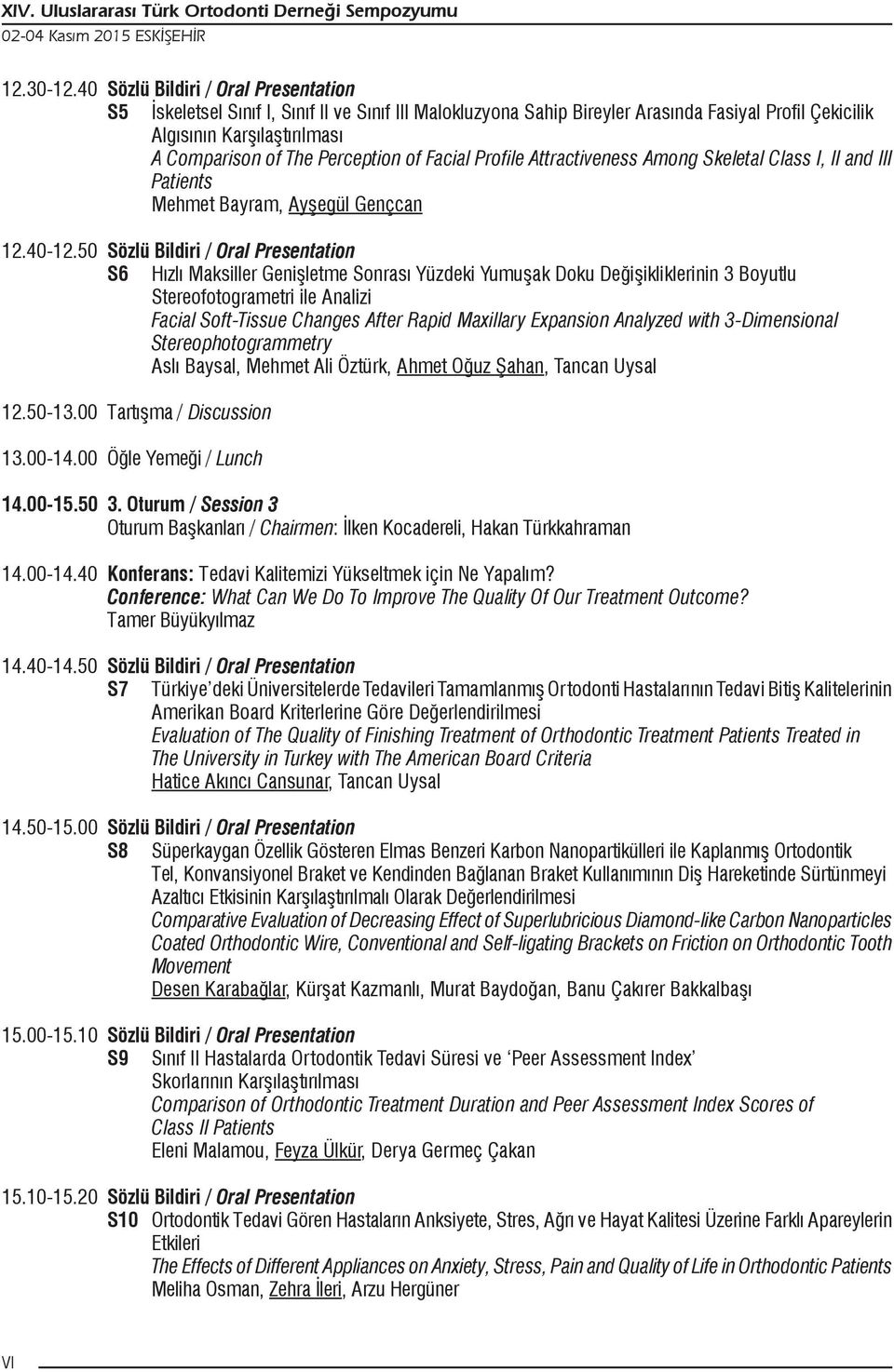
13 XIV. International Symposium of Turkish Orthodontic Society November 0-04, 05 ESKISEHIR Sözlü Bildiri / Oral Presentation S Ortodonti Hastalarının Bakış Açısından Tedavi Kalitesi Kavramının Değerlendirilmesi Assessment of Quality of Care Concepts From the Viewpoint of Orthodontic Patients Fatih Kazancı Sözlü Bildiri / Oral Presentation S Farklı Tipteki Hızlı Üst Çene Genişletme Apareylerinin Yüz Yumuşak Dokularına Olan Etkilerinin Üç Boyutlu Yüz Görüntüleme Yöntemi ile Değerlendirilmesi Assessment of The Effects of Different Rapid Maxillary Expansion Appliances on Facial Soft Tissues with A Three Dimensional Facial Imaging Technique Sedat Altındiş, Ebubekir Toy, Faruk Ayhan Başçiftçi Tartışma / Discussion Kahve Arası / Coffee Break Oturum / Session 4 Poster Oturumu (. Grup) / Poster Session ( st Group) 0.00 Gala Yemeği / Gala Dinner VII
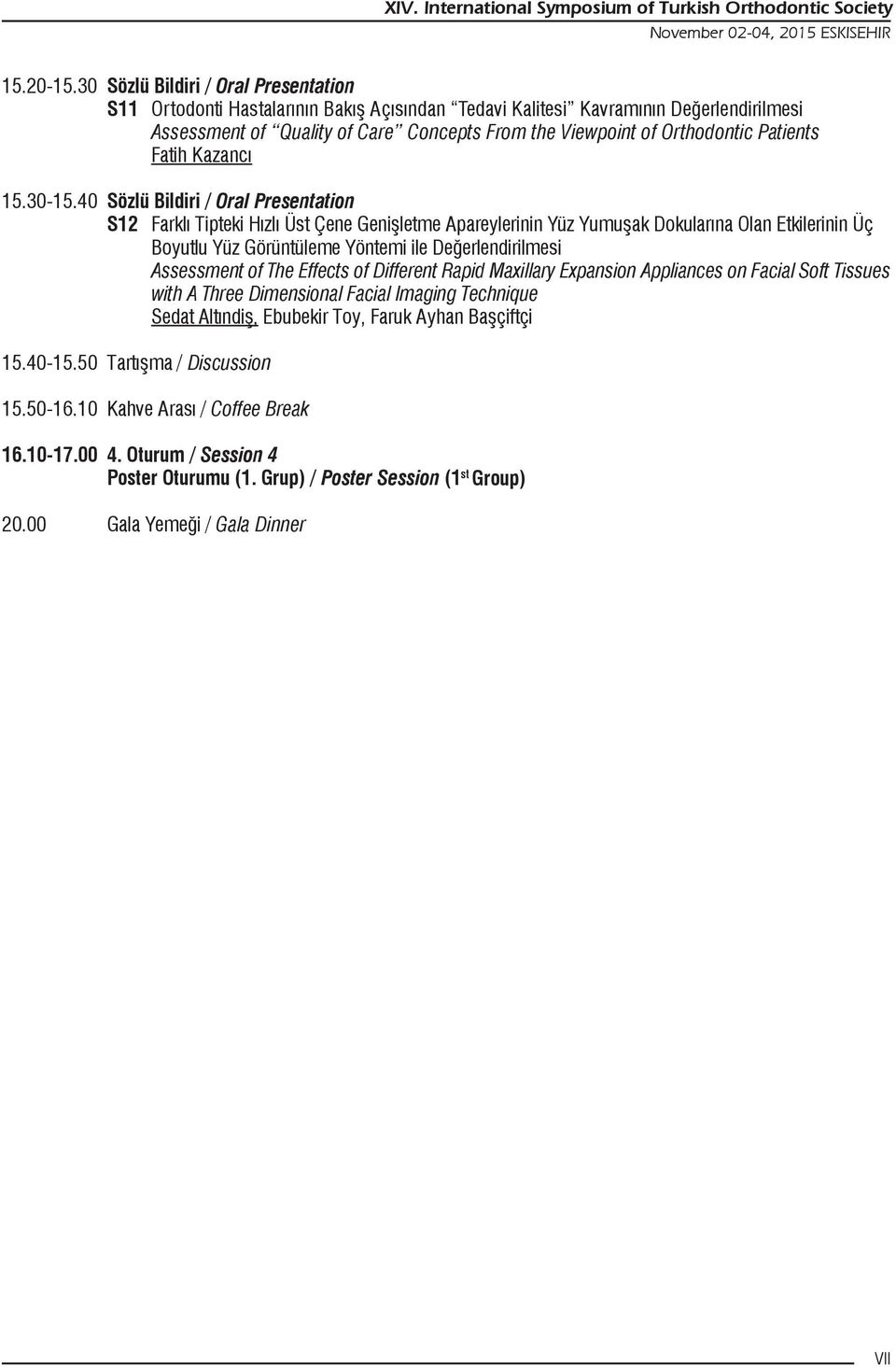
14 XIV. Uluslararası Türk Ortodonti Derneği Sempozyumu 0-04 Kasım 05 ESKİŞEHİR BİLİMSEL PROGRAM / SCIENTIFIC PROGRAMME 03 Kasım November 05 Salı Tuesday Oturum / Session 5 Oturum Başkanları / Chairmen: Metin Orhan, Oral Sökücü Konferans: Ortognatik Cerrahi ve Yüz Estetiği Conference: Orthognathic Surgery and Facial Esthetics Mehmet Manisalı Konferans: Şiddetli Sınıf II Olgularda Ortognatik Cerrahi Planlama Conference: Planning Severe Class II Cases to the Orthognatic Surgery Toros Alcan Sözlü Bildiri / Oral Presentation S3 Çift Çene Cerrahisi Uygulanan Klas III Hastalarda Uzun Dönem Yumuşak Doku Değişikliklerinin Değerlendirilmesi Evaluation of Long- Term Soft Tissue Changes After Bimaxillary Orthognathic Surgery in Class III Patients Halise Aydemir, Ruchengiz Efendiyeva, Hakan Karasu, Ufuk Toygar Memikoğlu Sözlü Bildiri / Oral Presentation S4 Yüz Asimetrisi Olgularında Tedavi Yaklaşımları Treatment Modalities in Facial Asymmetry Cases Ayşe Gülşen, Kemal Fındıkçıoğlu Tartışma / Discussion Kahve Arası / Coffee Break Oturum / Session 6 Oturum Başkanları / Chairmen: Ali İhya Karaman, Yıldız Öztürk.0-.0 Sözlü Bildiri / Oral Presentation S5 Çift Çene Ortognatik Cerrahi Ameliyatı Olan Hastalarda Kondil Pozisyonunda Meydana Gelen Değişimlerin Sanal Marker Yöntemi ile Üç Boyutlu Olarak Incelenmesi Three Dimensional Assessment of Condylar Positional Changes after Double Jaw Orthognathic Surgery Using Digital Marker Method Kadir Beycan, Ahu Acar Sözlü Bildiri / Oral Presentation S6 Sınıf III Ortognatik Cerrahi Hastalarında Maksillomandibüler Rotasyon ile Oklüzal Düzlem Değişimlerinin Uzun Dönem Stabilitesi Long-Term Postoperative Stability of Occlusal Plane Alteration with Maxillomandibular Rotation in Skeletal Class III Orthognatic Surgery Cases Yasemin Bahar Acar, Ahmet Hüseyin Acar, Necip Fazıl Erdem, Ahmet Nejat Erverdi, Kemal Uğurlu Sözlü Bildiri / Oral Presentation S7 Sınıf II Subdivizyon Maloklüzyona Sahip Hastalarda Yüz Yumuşak Doku Asimetrisinin 3 Boyutlu Değerlendirilmesi Three-Dimensional Evaluation of Facial Soft-Tissue Asymmetries in Patients with Class II Subdivision Malocclusions Aslı Baysal, Mehmet Soydinç, Mehmet Ali Öztürk, Tancan Uysal VIII
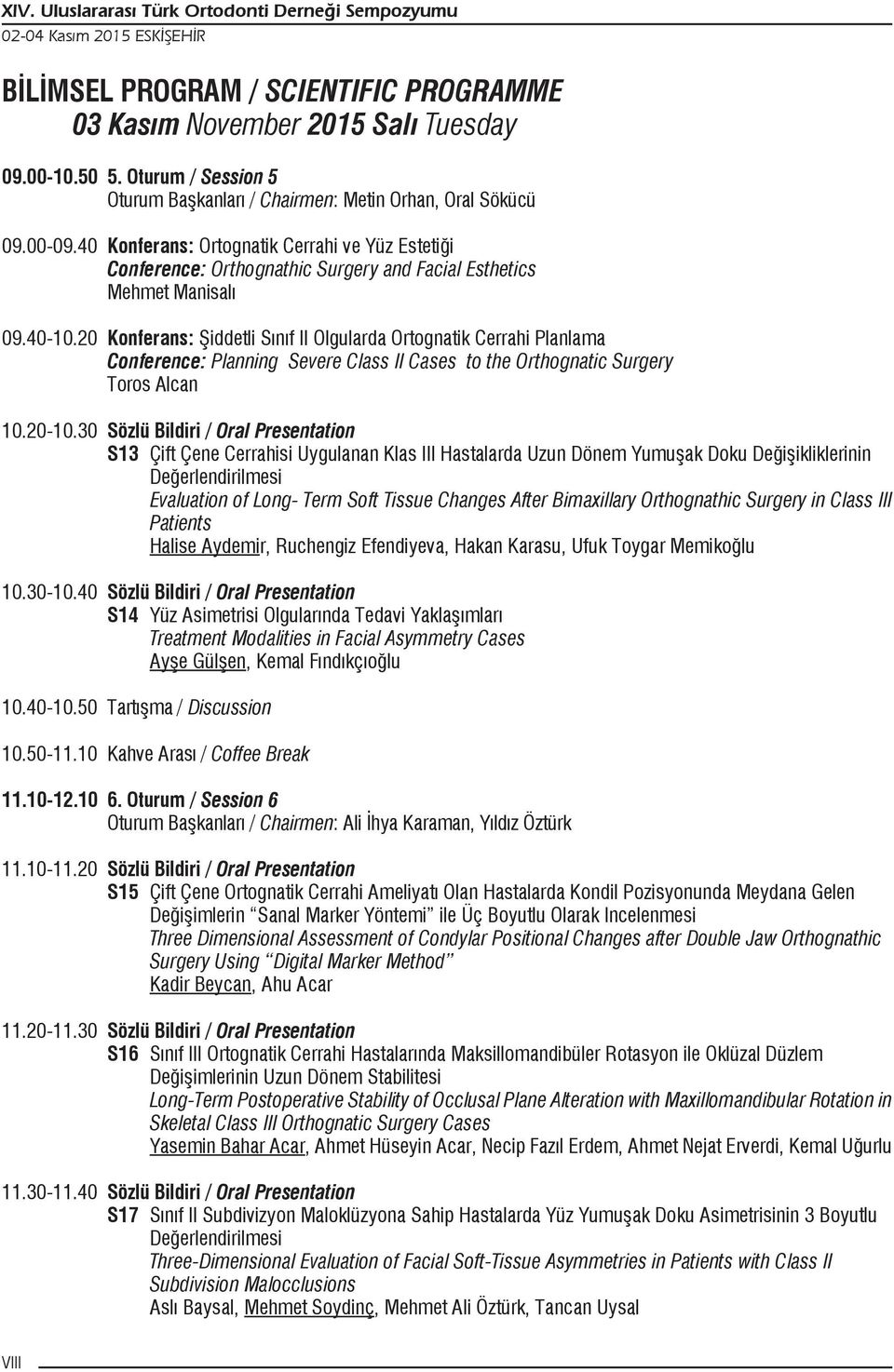
15 XIV. International Symposium of Turkish Orthodontic Society November 0-04, 05 ESKISEHIR Sözlü Bildiri / Oral Presentation S8 İskeletsel Sınıf III Yapıya Sahip Erişkin Bireylerin Kraniyofasiyal Yapılarının Sefalometrik ve Immünohistokimyasal Olarak Değerlendirilmesi Craniofacial Growth of Skeletal Class III Adult Patients Evaluated by Cephalometric and Immunohistochemical Analysis Ebru Küçükkaraca, Neslihan Üçüncü Sözlü Bildiri / Oral Presentation S9 Müteharrik Üst Ekspansiyon Apareylerinin Mandibular Arka Etkileri Effects of Maxillary Expansion Appliances on the Mandibular Arch Lale Taner, Mykerem Shaipi, Gamze Metin Gürsoy, Yağmur Çaylak Tartışma / Discussion Oturum / Session 7 Poster Oturumu (. Grup) / Poster Session ( nd Group) Öğle Yemeği / Lunch Oturum / Session 8 Oturum Başkanları / Chairmen: Faruk Ayhan Başçiftçi, Didem Nalbantgil Konferans: Botulinum Toksinin Ortodontide Kullanımı Conference: The Use of Botulinum Toxin in Orthodontics Erhan Özdiler Sözlü Bildiri / Oral Presentation S0 Üzüm Çekirdeğinin Sıçanlarda Premaksiller Sutur Kemikleşmesine Etkisi Effect of Grape Seed Extract on Bone Formation in The Expanded İnter-Premaxillary Suture in Rats Sertaç Aksakallı, Mehmet Şerif Aydın, Muhammet Birlik, Oguz Kazancıoğlu, Şeref Ezirganlı Sözlü Bildiri / Oral Presentation S Koruyucu Ozon Tedavisi Orthodontik Braketlerin Makaslama Bağlanma Dayanıklılığını Etkiler mi? Does Prophylactic Ozone Therapy Effect Shear Bond Strengths of Orthodontic Braces? Merve Göymen, Semih Özsevik, Derya Gürsel, Mehmet Ali Yavan, Burcu Bacaksız, Eren İşman Sözlü Bildiri / Oral Presentation S İstirahat Durumunda Dudak Pozisyonunun Tekrarlanabilirliği: 3 Boyutlu Yaklaşım Reproducibility of the Lip Position at Rest: A 3D Perspective Furkan Dindaroğlu, Gökhan Serhat Duran, Serkan Görgülü Sözlü Bildiri / Oral Presentation S3 Hareketli Ortodontik Aparey Kullanan Hastalarda Oral Candida Albicans Kolonizasyonunun Araştırılması Investigation of Oral Candida Albicans Colonization in Patients with Removable Orthodontic Appliances Therapy Fundagül Bilgiç, Melek İnci, Özlem Akıncı Sözer, Yazgı Ay, Halenur Onat Altan, Zeki Arslanoğlu Tartışma / Discussion Kapanış ve Ödüller / Closure & Rewards IX
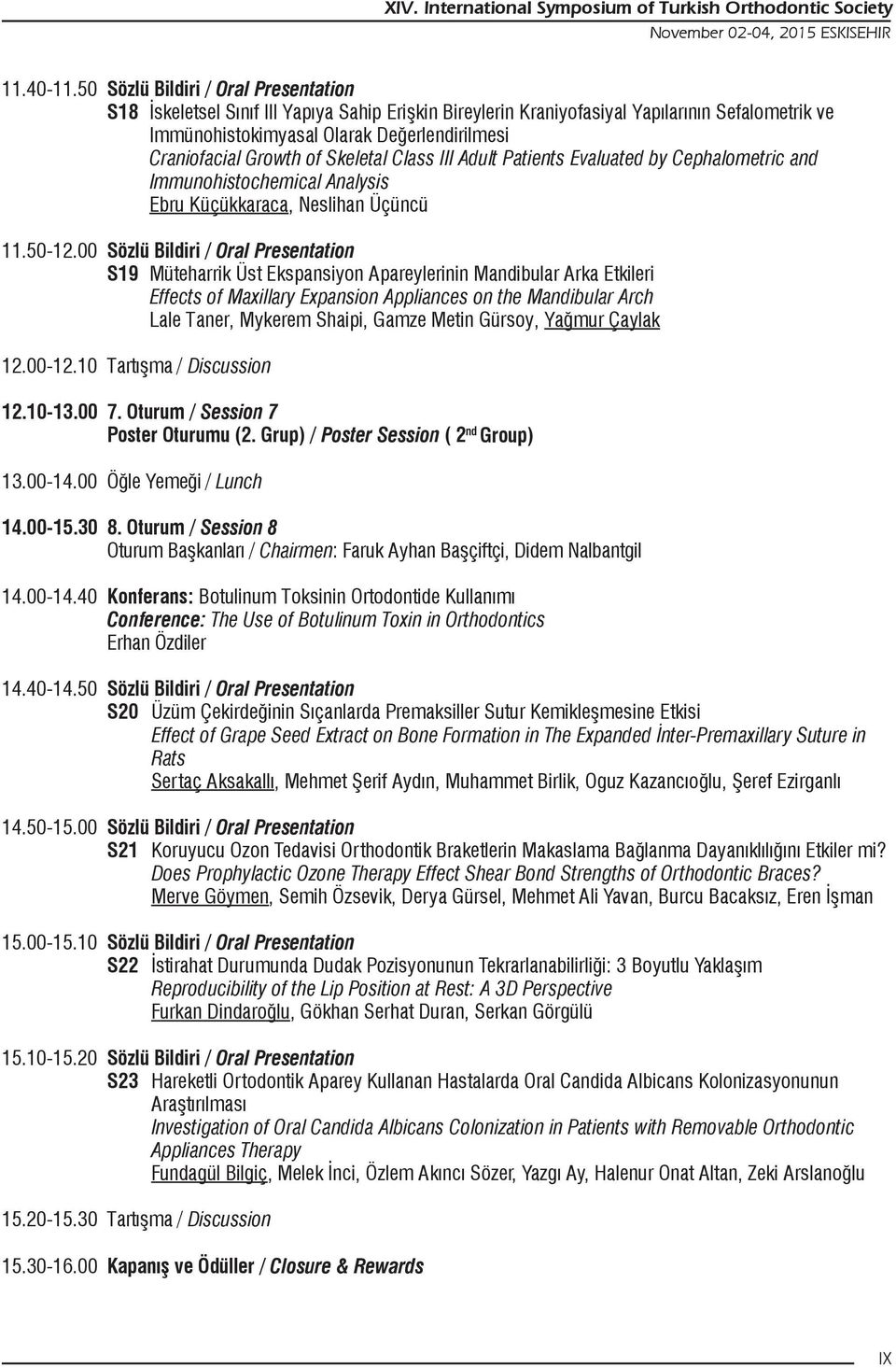
16 XIV. Uluslararası Türk Ortodonti Derneği Sempozyumu 0-04 Kasım 05 ESKİŞEHİR SEMPOZYUM SONRASI KURS / POST-SYMPOSIUM COURSE 04 Kasım November 05 Çarşamba Wednesday Oturum / Session Ortognatik Cerrahi Endikasyonu /Orthognathic Surgery Indication Cerrahi Destekli Maksiller Ekspansiyon / Surgically Assisted Maxillary Expansion Ortognatik Cerrahi Öncesi Diş Arklarının Hazırlanması / Preparation of Dental Arches Before Surgery Dişsel Kamuflajın Kaldırılması İçin Uygulamalar / Dental Decompensation Nazan Küçükkeleş Kahve Arası / Coffee Break Oturum / Session Ameliyatın Planlanması / Surgical Planning Yüz Arkı Transferi / Face Bow Transfer Splint Hazırlığı ve Dikkat Edilecek Noktalar / Surgical Splint Fabrication Cerrahi Planlamada 3D Uygulama / 3D Surgical Planning Nazan Küçükkeleş Öğle Yemeği / Lunch Oturum / Session 3 Ortognatik Planlamada Kilit Noktalar - Cerrahi Perspektif / Key Points in Orthognathic Planning - Surgical Perspective Yüz Asimetrisi - Cerrahi Yaklaşım / Facial Asymmetry - Surgical Approach Mehmet Manisalı Kahve Arası / Coffee Break Oturum / Session 4 Ortognatik Cerrahi ve Burun / Orthognatic Surgery and Nose Cerrahi Teknikler / Surgical Interventions Mehmet Manisalı X
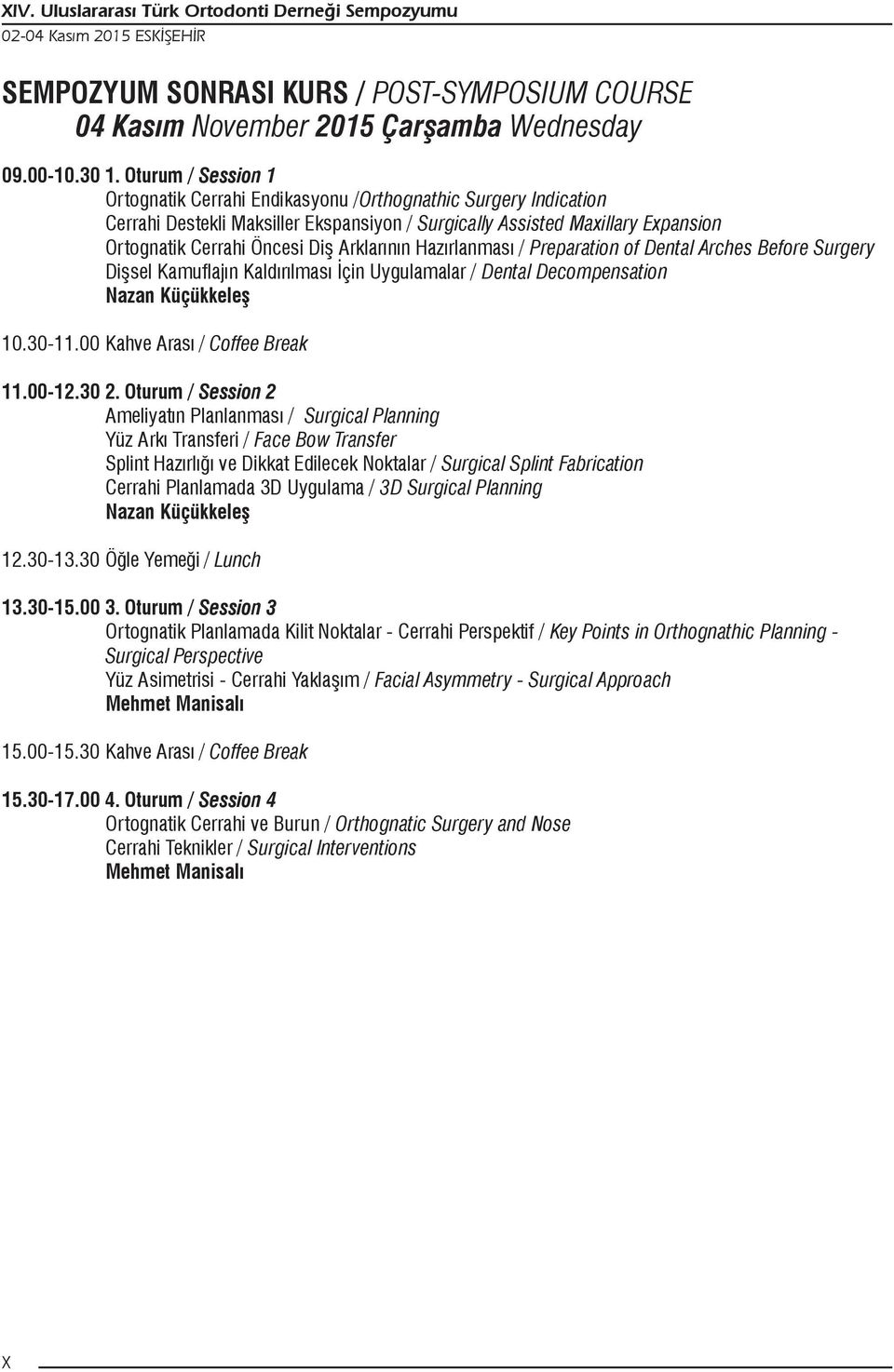
17 POSTER BİLDİRİLER LİSTESİ / POSTER 0 Kasım November 05 Pazartesi Monday 6:00-7:00. Grup / st Group XIV. International Symposium of Turkish Orthodontic Society November 0-04, 05 ESKISEHIR P P P3 P4 P5 P6 P7 P8 P9 P0 P P P3 P4 P5 P6 P7 P8 P9 P0 P Hemifasyal Mikrosomi ye Bağlı Şiddetli Çene Yüz Asimetrisi Olan Bir Hastanın Bilgisayar Destekli Cerrahi Tedavisi ve Stereofotogrametrik İncelenmesi Computer-Aided Surgical Planning and Stereophotogrammetric Evaluation of A Patient with Severe Maxillofacial Asymmetry Due to Hemifacial Microsomia Kadir Beycan, Nazan Küçükkeleş, Zeki Güzel, Pınar Aktop Bilateral Maksiller Lateral Eksikliği Olan İskeletsel Sınıf III Malokluzyonda Ortodontik Kamuflaj Ve Multidisipliner Tedavi Yaklaşımı Othodontic Camouflage and Multidisciplinary Treatment Approach of a Skeletal Class III Malocclusion with Bilaterally Missing Maxillary Lateral Incisors Hatice Kübra Olkun, Gülşilay Sayar Torun, Benin Dikmen İskeletsel Sınıf II Maloklüzyonu Olan Bir Hastanın Sabit Fonksiyonel Apareyler Kullanılarak Tedavisi ve 3 Senelik Takibi Fixed Functional Treatment of A Patient with Skeletal Class II Malocclusion and 3-Year Follow-Up Kadir Beycan, Banu Çakırer Bakkalbaşı Nazal Septum Deviasyonlarının İskeletsel ve Dental Etkilerinin Posteroanterior Sefalometrik Radyograflarla Değerlendirilmesi Assessment of the Skeletal and Dental Effects of Nasal Septum Deviations Using Posteroanterior Cephalometric Radiographs Bircan Bektaş, Süleyman Kutalmış Büyük, Yasin Atakan Benkli, Serkan Özkan Transpalatal Ark Kullanımı Sırasında Oluşan Yumuşak Doku İrritasyonu:İki Olgu Sunumu Soft Tissue Irritation During The Use of Transpalatal Arch: Two Case Reports Canan Yerlikaya, Özlem Sancaktar Orthodontic Correction of Generalized Teeth Spacing Aiman Elhadi Elmabruk, Derya Çakan Germeç Pekiştirme Döneminde Üst Çene Hawley Apareyi Nedeni ile Gelişen Ön Açık Kapanış: Olgu Sunumu Anterior Openbite Development Due to Upper Hawley Retainer During Retention Phase: A Case Report Mehmet Bayram Ağız Solunumu Yapan Ortodonti Hastalarında Alt Yüzdeki Yumuşak Doku Kalınlıklarının Değerlendirilmesi Evaluation of the Soft Tissue Thickness at Lower Anterior Face in Mouth Breathing Orthodontic Patients Akif Arslan, Süleyman Kutalmış Büyük, Yasin Atakan Benkli, Hasene Betül Uzer Orthodontic Management of Generlized Teeth Spacing Aiman Elhadi Elmabruk, Derya Cakan Germec Okluzal Kantın Minivida Desteğiyle Düzeltilmesi Occlusal Cant Correction Using Miniscrew Support Zeynep Uzun, Ali Kiki Maxiller Lateral Keser Diş Eksikliği olan Ortodonti Hastalarında Dişsel ve İskeletsel Etkilerin Değerlendirilmesi Evaluation of the Skeletal and Dental Effects in Orthodontic Patients with Maxillary Lateral Incisor Agenesis S. Kutalmış Büyük, Serkan Özkan, Yasin Atakan Benkli, Akif Arslan Dentoalveoler Distraksiyon Osteogenezis Boyunca Üst Çene Köpek Dişlerinin Pulpa Akımındaki Değişimi Changes in Pulp Blood Flow of Maxillary Canines During Dentoalveolar Distraction Osteogenesis Fidan Alakuş Sabuncuoğlu, Şeyda Erşahan, Ergül Ertürk Seramik Braketlerin Er:YAG Lazer ile Sökümü Debonding of Ceramic Brackets by Er:YAG Laser Şeyda Erşahan, Fidan Alakuş Sabuncuoğlu, Ergül Ertürk Farklı Yüzey Tedavilerinin Minede Ortodontik Braketlerin Makaslama Bağlama Kuvveti Üzerine Etkisi Effect of Different Surface Treatments on The Shear Bond Strength of Orthodontic Brackets to Enamel Fidan Alakuş Sabuncuoğlu, Şeyda Erşahan, Ergül Ertürk Seramik Ortodontik Braketlerin Farklı Güçte Nd:YAG Lazer ile Sökümü Different Power Nd:YAG Laser for Debonding Ceramic Orthodontic Brackets Şeyda Erşahan, Fidan Alakuş Sabuncuoğlu, Ergül Ertürk Ortodontik Tedavinin Başlangıç Aşaması Sırasındaki Ağrı - Farklı Yaş Gruplarının Karşılaştırılması Pain During The Initial Phase of Orthodontic Treatment - A Comparison of Different Age Groups Fidan Alakuş Sabuncuoğlu, Şeyda Erşahan, Ergül Ertürk Ortodontik Tedavinin Başlangıç Aşamasındaki Diş Ağrısının Değerlendirilmesinde İki Ağrı Skalasının Karşılaştırılması A Comparison of Two Pain Scales in the Assessment of Dental Pain during Initial Phase of Orthodontic Treatment Şeyda Erşahan, Fidan Alakuş Sabuncuoğlu, Ergül Ertürk Anterior Açık Kapanış ve Polidiastemaya Sahip Hastanın Ortodontik Tedavisi: Olgu Sunumu Orthodontic Treatment of A Patient with An Anterior Open Bite and Polydiastema: A Case Report Fidan Alakuş Sabuncuoğlu, Ergül Ertürk Supernumere Diş Nedeniyle Gömülü Kalan Maksiller Kesicinin Ortodontik Tedavisi: Olgu Sunumu Orthodontic Treatment of An Impacted Maxillary Incisor Associated with A Supernumerary Tooth:A Case Report Ece Çetin, İlken Kocadereli Ortodontik Tedavi Sırasında Beyaz Nokta Lezyonları ve Çürüklerin Görülme Prevelansı Prevalence of White Spot Lesions and Caries During The Orthodontic Treatment Fidan Alakuş Sabuncuoğlu, Şeyda Erşahan, Ergül Ertürk Asimetrik Servikal Headgear İle Tek Taraflı Molar Distalizasyonu: Olgu Sunumu Unilateral Molar Distalization with Asymmetric Cervical Headgear: A Case Report Türkan Sezen, Hasan Kamak XI
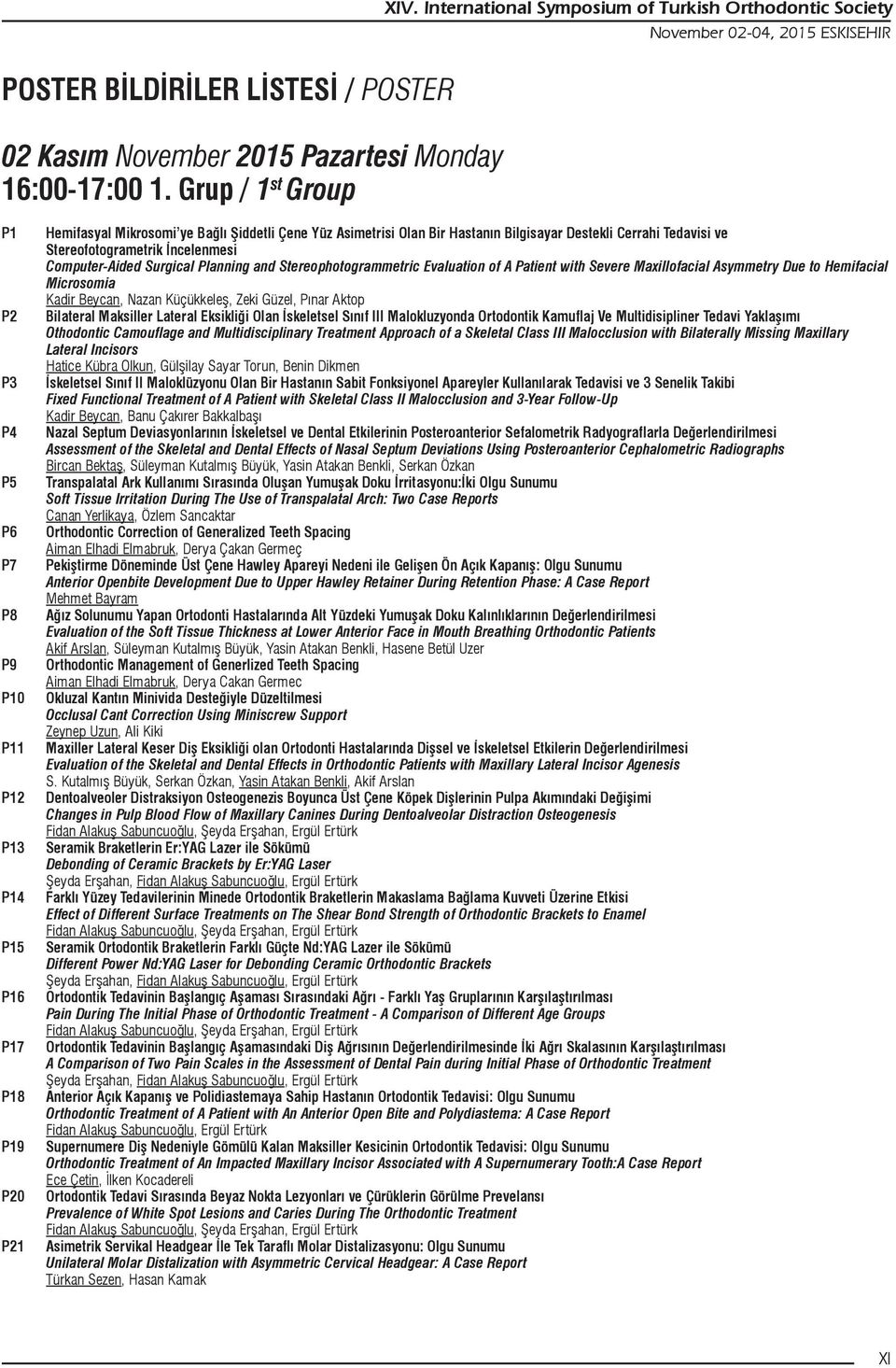
18 XIV. Uluslararası Türk Ortodonti Derneği Sempozyumu 0-04 Kasım 05 ESKİŞEHİR P P3 P4 P5 P6 P7 P8 P9 P30 P3 P3 P33 P34 P35 P36 P37 P38 P39 P40 P4 P4 P43 P44 XII Maksiller Darlığa Eşlik Eden Anterior Açık Kapanış Olgusunun Akrilik Splint RME ve Vertikal Çenelik Uygulaması ile Efektif Tedavisi (Vaka Raporu) Effective Treatment of Anterior Open Bite Accompanying Transverse Maxillary Deficiency with Acrylic Splint RME and Vertical Chin-cap (Case Report) Sibel Akbulut, Feyza Holoğlu, Ali Altuğ Bıçakçı Vaka Raporu: Gömülü Dişlerin Ortodontik Tedavisi Ortodontic Treatment of A Patient with Multiple Impacted Teeth: A Case Report Şevki Şahin, Alev Aksoy Marfan Sendromuna Sahip Bir Hastada Sınıf II Malokluzyonun Ortodontik Tedavisi: Vaka Raporu Orthodontic Treatment of Class II Malocclusion in A Patient with Marfan Syndrome: A Case Report Eyyüp Cihan, Sertaç Aksakallı Sınıf Malokluzyonlu Bireylerde Modifiye EVAA ve Aktivatör Aygıtlarının Tedavi Etkilerinin Değerlendirilmesi Effects of Activator Treatment and Modified EVAA Appliances in Class Malocclusion Eda Özeşer, Deniz Uzuner, Nilüfer Darendeliler Bilateral Dudak Damak Yarıklı Hastada Preoperatif Ortopedik Tedavi: Bir Vaka Sunumu Preoperative Orthopedic Treatment of Bilateral Cleft Lip and Palate: A Case Report Tuba Köse, Ali Kiki Kanin Retraksiyonu Sırasında İnsan Pulpa Kan Akımındaki Değişiklikler Changes in Human Pulp Blood Flow During Canine Retraction Fidan Alakuş Sabuncuoğlu, Şeyda Erşahan, Ergül Ertürk Üç Boyutlu Cerrahi Planlama ile Hemifasyal Mikrosomi si Olan Bir Hastanın Tedavisi ve Postoperatif Tedavi Sonuçlarının Steryofotogrametri ile Gösterilmesi Three-Dimensional Surgical Planning of A Hemifacial Microsomia Patient and Post-Operative Treatment Results Via Stereophotogrammetry Kadir Beycan, Nazan Küçükkeleş, Zeki Güzel Vertikal Alveoler Defektin Archwise Distraksiyon ile Kapatılması ve Tedavi Sonuçlarının Belirtilmesi Archwise Distraction of Vertical Alveolar Defect and Final Treatment Results Kadir Beycan, Nejat Erverdi, Nazan Küçükkeleş, Kemal Uğurlu, Rıfat Gözneli Uzun Kollu Transpalatal Ark ile Gömülü Maksiller Kanin Dişi Sürdürülen Hastanın Tedavi Öncesi ve Sonrası Gülümseme Estetiğinin Değerlendirilmesi: Vaka Raporu The Traction of A Patient s Impacted Maxillary Permanent Canine by Modified Transpalatal Arch and Assessment of Patient s Initial and Final Smile Esthetics: Case Report Ekrem Oral, Eren Gürses, Ahmet Yağcı Mini Vida Destekli Keleş Slider Apareyi ile Yapılan Molar Distalizasyonu: Vaka Raporu Molar Distalization Using Mini-Screw Supported Keleş Slider Appliance: A Case Report Refika Saliha Olkun, Erdem Ayyıldız İki Parçalı Le Fort I Cerrahisi ve Mandibuler Set-Back ile Iskeletsel Sınıf III Maloklüzyonun Bilgisayar Ortamında Cerrahi Planlaması ve Tedavi Sonuçlarının Steryofotogrametrik Değerlendirilmesi Computer-Aided Surgical Planning and Stereophotogrammetric Evaluation of Skeletal Cl III Malocclusion Treated with -Piece Le Fort I Surgery and Mandibular Setback Kadir Beycan, Nazan Küçükkeleş, Kemal Uğurlu Trombositten Zengin ve Fakir Plazmanın Ortodontik Diş Hareketi Üzerindeki Etkilerinin Deneysel Olarak Araştırılması An Experimental Investigation of Effects of Platelet Rich and Platelet Poor Plasma on Orthodontic Tooth Movement Sibel Akbulut, Ahmet Yağcı Gömülü Santral Dişli Hastada İnterdisipliner Yaklaşım: Bir Vaka Raporu Interdisciplinary Treatment of a Patient with Impacted Maxillary Incisor: A Case Report Şebnem Deniz, Hakan Muhammet Türkkahraman, Süha Serhat Türkaslan Anterior Bölgede Bolton Uyumsuzluğu Bulunan Hastanın Multidisipliner Tedavisi: Olgu Sunumu Multidisciplinary Treatment of The Patient Who Has Anterior Bolton Discrepancy: Case Report Eren Gürses, Filiz Yağcı, Ekrem Oral, Ahmet Yağcı Kronik Periodontitisli Bir Hastanın İnterdisipliner Yaklaşımla Ortodontik Tedavisi: Olgu Sunumu Interdisciplinary Orthodontic Treatment of a Patient with Moderate Chronic Periodontitis: A Case Report Pınar Kutlu, Vahdi Umut Bengi, Serkan Görgülü Süpernümerer Diş: Mesiodens Supernumerary Tooth: Mesiodens Serkan Görgülü, Pınar Kutlu, Eda Arat Maden Maksiller Lateral Diş Eksikliğinde Geçici Estetik Tedavi Yaklaşımı Immediate Esthetic Treatment Approach in Maxillar Lateral Teeth Agenesis Feyza Holoğlu, Bilal Holoğlu, Ali Altuğ Bıçakçı, Nihat Akbulut Farklı Dik Yön Büyüme Yönü Olan Ortodonti Hastalarında Yumuşak Doku Profilinin Değerlendirilmesi Evaluation of The Soft Tissue Profile in Orthodontic Patients with Different Vertical Growth Patterns S. Kutalmış Büyük, Nuri Mert Topbaşı, Yasin Atakan Benkli Gömülü Maksiller Santral Dişe Multidisipliner Yaklaşım: Bir Vaka Raporu Multidisiplinary Approach in Obtaining Impacted Maxillary Central Teeth: A Case Report Şebnem Deniz, Alev Aksoy, Bilge Çadır Palatal Minivida Destekli Molar Distalizasyonu Apareyinin İskeletsel ve Dentoalveolar Yapılar Üzerine Etkilerinin Üç Boyutlu İncelenmesi Three Dimensional Evaluation of Dentoalveolar and Skeletal Effects of Palatal Mini Screw Assisted Distalization Appliance Gökhan Serhat Duran, Serkan Görgülü, Furkan Dindaroğlu Anb Açısı ve Wits Ölçümü Arasındaki Uyumsuzluğun Türk Toplumunda Değerlendirilmesi Inconsistency Between Anb Angle and Wits Appraisal in the Turkish Population Gökhan Serhat Duran, Furkan Dindaroğlu, Serkan Görgülü Fonksiyonel Ortopedik Tedavi Amacıyla Kullanılan Maksillatör Apareyinin Kas Aktivitesine Olan Etkisinin Elektromiyografi Yöntemi ile İncelenmesi (Olgu Sunumu) Analysis of the Impact of the EMG muscle activity of Maksillator Appliance used for Functional Orthopedic Treatment (A Case Report) Bülent Çatalbaş, Hasan Kamak, Onur Görcek Sagittal Yön İskeletsel Anomalilerin Farengeal Havayolu ve Nazal Kavite Hacmi Üzerine Etkilerinin Üç Boyutlu Olarak Değerlendirilmesi Three Dimensional Evaluation of The Effects of Sagittal Skeletal Anomalies on Pharyngeal Airway and Nasal Cavity Volume Pınar Kutlu, Serkan Görgülü
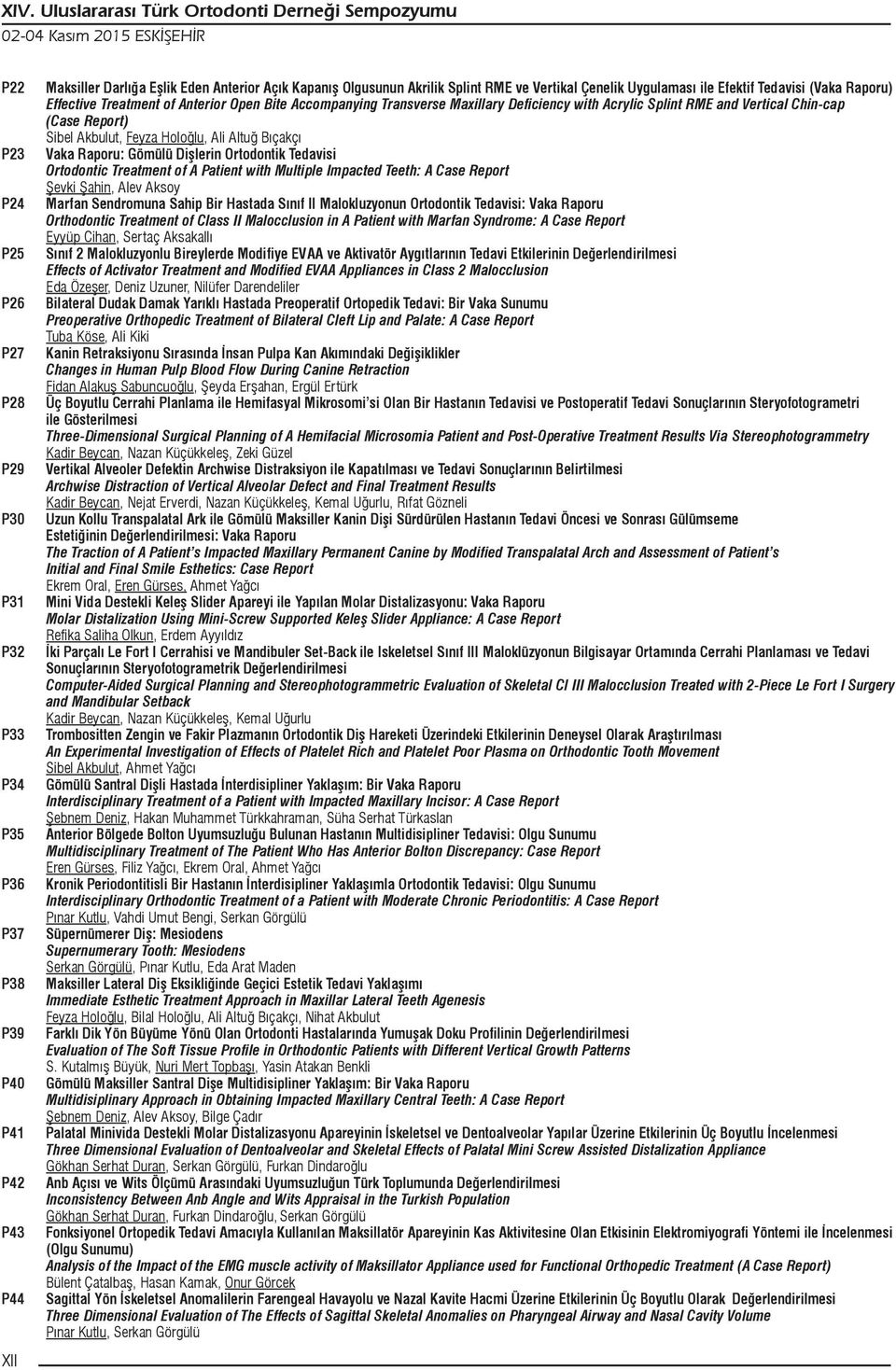
19 XIV. International Symposium of Turkish Orthodontic Society November 0-04, 05 ESKISEHIR P45 P46 P47 P48 P49 P50 P5 P53 P54 P55 P56 P57 P58 P59 P60 P6 P6 P64 P65 P66 P67 P68 P69 P70 P7 Anterior Cross Bite ve Şiddetli Yer Darlığı Olan Hastanın Çekimsiz Sabit Ortodontik Teknik ile Tedavisi: Olgu Sunumu Treatment of The Patient with Anterior Cross Bite and Severe Crowding by Using Fixed Orthodontic Technique without Extraction: Case Report Hakan Dağ, Mehmet Kaplan, Mehmet Uğur Oflaz, Serkan Görgülü Multidisipliner bir Ortodontik Tedavi Vakası:Ortodonti, Periodontoloji, İmplant ve Protez A Multidisciplinary Orthodontic Case: Orthodontics, Periodontics, Implant and Prosthodontics Fatma Yıldırım, Ahu Topkara, Erol Akın, Utku Gaye Dikme Güveli Mini-Vida Destekli Modifiye Fan Type Maksiller Genişletme Mini-Screw Supported Modified Fan Type Maxillary Expansion Orhan Aksoy, Onur Yılmaz, Erol Akın, Ahu Topkara Vertikal Büyüyen Ön Çapraşıklığa Açık ve Çapraz Kapanışa Sahip Geç Adolesan Vakanın Tedavisi Treatment of a Vertical Growing Late Adolescent with Anterior Crowding Open-Bite and Cross-Bite Selin Koramaz, Orhan Aksoy, Ahu Topkara, Muhammet Gürcan Horizontal Büyüyen Sınıf III Adolesan Vakanın Sabit Ortodontik Apareyle Tedavisi Fixed Orthodontic Appliance Therapy of a Horizontal Growing Class III Adolescent Muhammet Gürcan, Orhan Aksoy, Ahu Topkara, Selin Koramaz Ortodontik Tedavinin Seviyeleme Aşamasında Ağrı, Anksiyete ve Kortizol Düzeylerinin Değerlendirilmesi Assessment of Pain, Anxiety and Cortisol Levels During Initial Aligning Phase of Fixed Orthodontic Treatment Alev Aksoy, Mine Gecgelen Cesur, Birsen Dagdeviren, Yasemin Alpagan, Gizem Karacın, Fatih Gültekin Osteopetrozisli Bir Hastanın Klinik ve Dental Özellikleri - Vaka Raporu Clinical Features and Dental Characteristics of An Osteopetrosis Patient - Case Report Sümeyya Şin, Kadir Beycan Kondiler Rehberliğin Farklı Büyüme Paternine Sahip Bireylere Ait Panoramik ve Sefalometrik Radyograflarda Karşılaştırmalı Olarak İncelenmesi Condylar Guidance: Correlation Between Panoramic and Cephalometric Radiograph in Subjects with Different Growth Patterns Hatice Akıncı Cansunar, Mahmut Tankuş Hemifasiyal Mikrosomili Bir Hastanın Bilgisayar Destekli Cerrahi Tedavisi ve Postoperatif 3dmd Analizi - Vaka Raporu Computer-Aided Treatment of A Patient with Hemifacial Microsomia (HM) and Postoperative 3dMD Analysis - Case Report Sümeyya Şin, Kadir Beycan, Nazan Küçükkeleş, Kemal Uğurlu, Melis Alyan Yılmaz Mandibuler Prognatiye Bağlı İskeletsel Sınıf III Olguda Face Mask Kullanımının Etkileri: Olgu Sunumu Effects of Face Mask on Skeletal Class III with Prognathic Mandibula: Case Report Hakan Dağ, Mehmet Kaplan, Mehmet Uğur Oflaz, Serkan Görgülü Derinde Gömülü Maksiller Kaninin Minivida Ankrajı Kullanılarak Cerrahi-Ortodonti İşbirliği ile Traksiyonu: Olgu Sunumu Surgical-Orthodontic Traction of A Deeply Impacted Maxillary Canine Using Miniscrew Anchorage: A Case Report Mehmet Bayram MBT Teknik Kullanılarak Yapılan Sabit Ortodontik Tedavi: Vaka Raporu Fixed Orthodontic Treatment Using MBT Tecnique: Case Report Hatice Kübra Olkun, Gülşilay Sayar Torun Sınıf II Maloklüzyonun Bukkal Kök Arasi Bölgesine Uygulanan Minivida İle Ortodontik Tedavisi -Vaka Raporu Orthodontic Treatment of Class II Malocclusion Using Miniscrew Anchorage in The Buccal Interradicular Region Case Report Deniz Erda Çelakıl, Murat Tozlu Şiddetli Çapraşıklığın Periodontal Olarak Hızlandırılmış Osteojenik Ortodonti İle Tedavisi - Vaka Sunumu Treatment of Severe Crowding by Periodontally Accelerated Osteogenic Orthodontics with Piezosurgery: Case Report Deniz Erda Çelakıl, Feyza Ülkür, Gökser Çakar Ortodontik Tedavi Sonrası Devital ve Ofis Tipi Beyazlatma ile Anterior Kompozit Lamina Veneer Uygulaması Aesthetic Management of Anterior Teeth with Direct Composite Veneers and Vital and Non-Vital In-Office Bleaching After Fixed Orthodontic Treatment: A Case Report Engin Fırat Cakan, Fatma Yıldırım, Ahu Topkara, Onur Yılmaz Maksiller Retrognatiye Bağlı İskeletsel Sınıf III Olguda Face Mask Kullanımın Etkileri: Olgu Sunumu( Yıllık Takip) Effects of Face Mask on Skeletal Class III with Retrognatic Maxilla: Case Report( Years of Follow Up) Hakan Dağ, Mehmet Kaplan, Feridun Dişçioğlu, Ali Karaca, Serkan Görgülü Sınıf I Maloklüzyon Açık Kapanışlı Olgunun Alt Keser Diş Çekimi İle Tedavisi: Olgu Sunumu Mandibular İncisor Extraction Treatment of a Class I Malocclusion with Open Bite: Case Report Serpil Şahin Yakıcı, Pınar Kutlu, Serkan Görgülü Sezeryanla Doğan Genç Erişkinlerin Kraniofasiyel Morfoloji ve Fasiyel Yumuşak Doku Kalınlıklarının Değerlendirilmesi Evaluation of the Craniofacial Morphology and Facial Soft Tissue Thickness of Adolescents Born by Cesarean Section Yasin Atakan Benkli, S. Kutalmış Büyük, Hasene Betül Uzer, Ekrem Oral Sınıf II Malokluzyona Sahip Büyüyen Bireylerde Forsus Apareyinin Dentoalveoler Etkisinin Değerlendirilmesi Dentoalveolar Treatment Effects of Forsus to Correct Class II Maloclusion in Growing Patients Elif Çankaya Uludağ, Mehmet Çağrı Ulusoy Konik Şekilli Üst Lateral Kesici Dişe Sahip Sınıf II Bir Olgunun Disiplinler Arası Tedavi Sonuçları Interdisciplinary Treatment Results of A Class II Patient with A Peg Shaped Upper Lateral Incisor Mehmet Bayram İskeletsel Sınıf III Bir Hastanın Multidisipliner Tedavisi: Vaka Raporu Multidisciplinary Treatment of a Skeletal Class III Patient: A Case Report Ekrem Oral, Nisa Gül, Gökmen Kurt, Faruk İzzet Uçar, Nazire Nurdan Çakır, Alper Alkan İskeletsel Sınıf I Türk Bireylerde Spontane Gülümseme Komponentlerinin Norm Değerleri The Norms of The Spontaneous Smile Components in Skeletal Class I Turkish Subjects Mehmet Bayram, Neslihan Seyhan Cezairli Şiddetli Sınıf III Hastanın Ortognatik Cerrahi Destekli Tedavisi: Vaka Raporu Surgical Treatment of Severe Class III Malocclusion: A Case Report Mustafa Murat Erüz, Ahmet Yağcı Palatal Mini-Vida Destekli Molar Dİstalizasyonu- Benefit Sistem Palatal Mini-Screw Anchoraged Molar Distalisation-Benefit System Serhan Okutan, Hülya Kılıçoğlu İskeletsel Sınıf II Maloklüzyon Tedavisinde Sabit Fonksiyonel Apareyin Miniplak Ankrajı ile Birlikte Kullanımı: Olgu Sunumu Usage of Miniplate Anchorage with Fixed Functional Appliance in Skeletal Class II Treatment: A Case Report Veda Boynueğri, Mehmet Bayram, Tuba Ünal, Mevlüt Çelikoğlu XIII
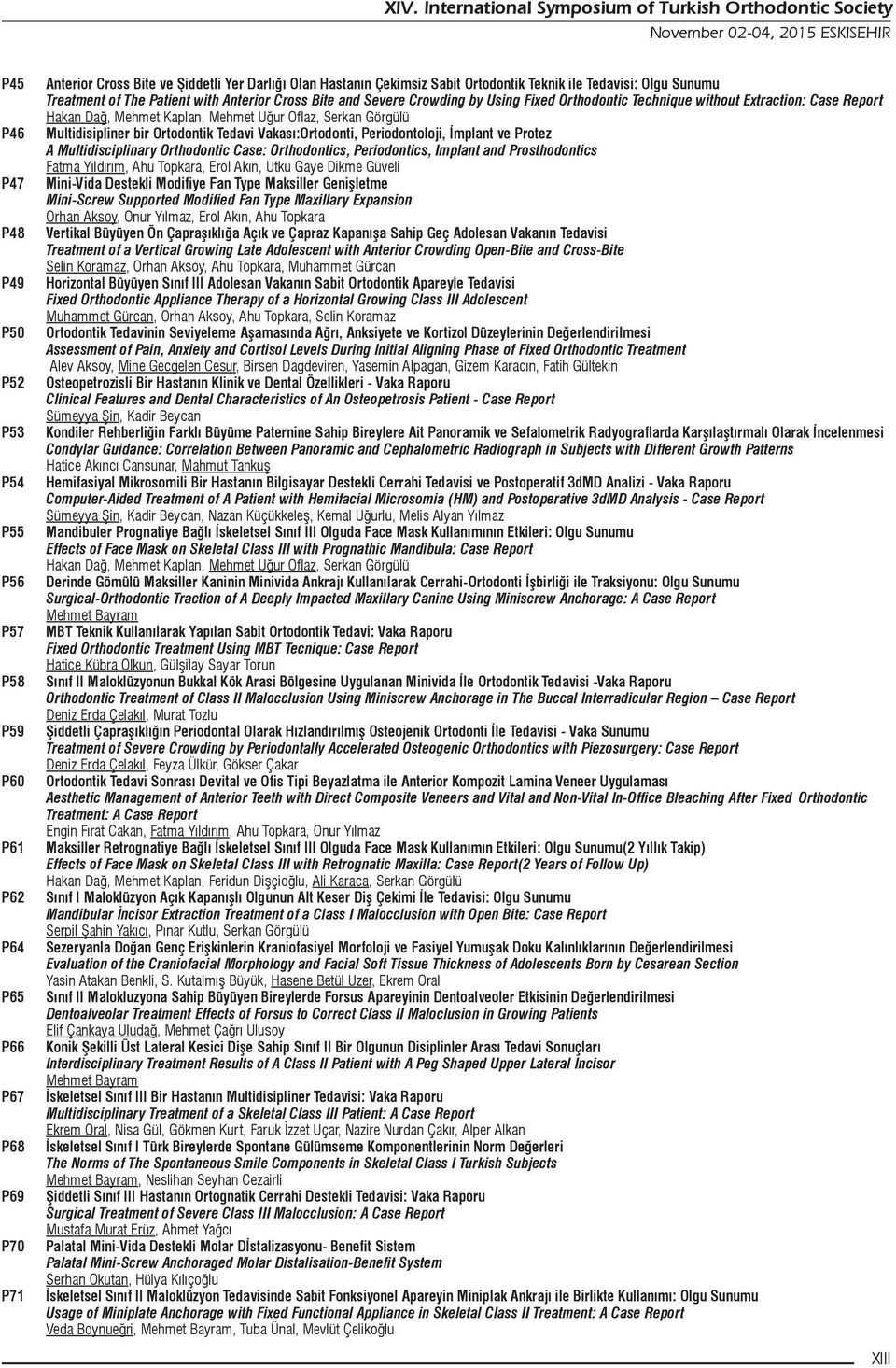
20 XIV. Uluslararası Türk Ortodonti Derneği Sempozyumu 0-04 Kasım 05 ESKİŞEHİR P7 P73 P74 P75 P76 P77 P78 P79 P80 P8 P8 P83 P84 P85 P86 P87 P88 P89 P90 P9 P9 P93 XIV Şiddetli Yer Darlığı Olan İskeletsel Sınıf II Malokluzyonun Çekimsiz Sabit Ortodontik Tedavisi: Olgu Sunumu Fixed Orthodontic Treatment of Skeletal Class II Malocclusion with Severe Crowding Without Extraction: Case Report Hakan Dağ, Mehmet Kaplan, Feridun Dişçioğlu, Mehmet Uğur Oflaz, Serkan Görgülü Maksiller Anterior Estetik İçin Multidisipliner Yaklaşım: Vaka Sunumu Multidisciplinary Approach for Maxillary Anterior Aesthetic: Case Report Aytuğ Özbek, Hüseyin Alkış, Kemal Çavdarlı Ebeveynlerin Simetri Algılarındaki Değişimin Ortognatik Cerrahi Hastalarının Stereofotogrametrik Kayıtları Kullanılarak Belirlenmesi: Pilot Çalışma Determination of Changes in Asymmetries Perception of Parents, Using Stereophotogrammetric Records of Orthognathic Surgery Patients: A Pilot Study İrem Günay, Bülent Çatalbaş, Mustafa Ersöz Mezenkimal Kök Hücrelerin Sıçan Dişlerinin Sağlıklı Periodontal Ligamentlerine Aktarımında Yeni Bir Yöntem: Pilot Çalışma A New Transfer Method of Mesenchymal Stem Cells to The Healthy Periodontal Ligament of Rat Teeth: A Preliminary Study Nisa Gül, Gökmen Kurt, Yusuf Baran, Melis Kartal Yandım, Aysun Adan Gökbulut, Mehmet Fatih Sönmez Hassasiyet Giderici, ACP ve CPP-ACP ile Birlikte Karbamid Peroksit Kullanılarak Yapılan Beyazlatma İşlemlerinin Braket Bağlanma Dayanıklılığı Üzerine Etkileri Effects of Carbamide Peroxide Bleaching with Desensitizer, ACP and CPP-ACP on the Shear Bond Strength of Brackets Nisa Gül, Gökmen Kurt, Yakup Üstün, Aslı Baysal, Şirin Hale Saka Çift Taraflı Konjenital Maksiller Lateral Kesicileri Eksik Hastanın Tedavi Öncesi ve Sonrası Gülümseme Estetiğinin Değerlendirilmesi: Vaka Raporu Initial and Final Smile Esthetics Assessment of A Patient with Bilaterally Congenitally Missing Maxillary Lateral İncisors: A Case Report Ekrem Oral, Abdullah Ekizer, Gökhan Türker Hızlı Maksiller Genişleme ve Yüz Maskesinin Kombine Kullanımı ile Tedavi Edilen Bir Hastanın Hava Yolu Hacminde Meydana Gelen Üç Boyutlu Değişiklikler Three-Dimensional Alterations in Airway Volume in A Patient Treated with Combined Use of Rapid Maxillary Expansion and Facemask Ersin Yıldırım, Mustafa Erkan, Şeniz Karaçay, Berkay Tolga Süer Sınıf III Malokluzyona Sahip Bir Hastanın RME ve Yüz Maskesi Kullanılarak Yapılan Kamuflaj Tedavisi Camouflage Treatment of A Class III Malocclusion with Rapid Maxillary Expansion and Facemask Therapy Koray Halıcıoğlu, Gülcan Köse Koçal, Ebru Akgül Üst Çene Yetersizliği Olan Hastanın Çift Çene Cerrahi ile Birlikte Ortodontik Tedavisi Combined Orthodontic and Bimaxillary Surgical Treatment of A Patient with Maxillary Deficiency Celal Irgın, Tülay Özkan, Furkan Erol Karabekmez Sınıf III Malokluzyon ve Şiddetli Asimetriye Sahip Hastanın Ortognatik Cerrahi ile Tedavisi: Olgu Sunumu Orthognathic Treatment of A Patient with Class III Malocclusion and Severe Asymmetry: Case Report Hande Görücü Coşkuner, İlken Kocadereli, Ersoy Konaş Herbst Aygıtı ile Kademeli ve Maksimum Mandibular Aktivasyonun Kök Rezorbsiyonuna Etkisi Effects of Step by Step and Maximum Mandibular Advancement of Herbst Appliance on Root Resorption Nisa Gül, Gökmen Kurt, Taner Öztürk İskeletsel Sınıf III Anomaliye Sahip Bir Vakada Ortopedik Tedavi Yaklaşımı Orthopedic Treatment Approach in A Case with Skeletal Class III Malocclusion Furkan Ali Karakoyunlu, Enes Tan, Erhan İbrahim Gelgör İskeletsel Sınıf III Maloklüzyona ve Dik Yön Büyümesine Sahip Bir Olguda RME ve Nanda Tipi Yüz Maskesinin Etkinliği: Vaka Raporu Activity of RME and Nanda Type Face Mask in A Case Which Has Skeletal Class III Malocclusion and Vertical Direction Growth Pattern: Case Report Furkan Ali Karakoyunlu, Hakan Keklik, Erhan İbrahim Gelgör Marfan Sendromu: Vaka Raporu ve Literatür Derlemesi Marfan Syndrome: A Case Report and A Literature Review Esra Yüksel, Serpil Çokakoğlu Sınıf II Bölüm ve Bölüm Bireylerde Temporomandibuler Eklem Pozisyonu ve Boyutlarının 3 Boyutlu Olarak Değerlendirilmesi 3-Dimensional Sssessment of The Temporomandibular Joint Position and Dimensions in Class II Division and Division Hande Görücü Coşkuner, Semra Ciğer Sınıf II Division Hastanın Erken Dönem Ortodontik Tedavisi: Olgu Sunumu Early Treatment of A Patient With Class II Division Malocclusion: A Case Report Ayşe Ezgi Dündar, Hande Görücü Coşkuner, Tülin Taner Sınıf II Divizyon Malokluzyonlu Hastalarda 3 Farklı Tedavi Yönteminin Yumuşak Doku Üzerindeki Etkileri: Fonksiyonel Aparey, Pendulum Apareyi ve Maksiller Premolar Çekimi Soft Tissue Effects of Three Different Treatment Modalities in Class II Division Malocclusion Patients: Functional Appliance, Pendulum Appliance and Two Maxillary Premolar Extraction Ezgi Atik, Bengisu Akarsu Güven, İlken Kocadereli Sınıf II Subdivizyon ve Sınıf III Subdivizyon Hastalarda Mandibular Asimetri Mandibular Asymetry in Class II and Class III Subdivision Patient Ahmet Vural, Merve Erol, Mehmet Emre Yılmaz, Faruk Ayhan Başçiftçi Dişsel Sınıf II Maloklüzyon ve Derin Kapanışın İki Aşamalı Ortodontik Tedavisi: Olgu Sunumu Two-Phase Orthodontic Treatment of Dental Class II Malocclusion with Deepbite: A Case Report Buket Pala Mutlu, Mehmet Bayram Ortodontik Tedavi Görmüş Hastalarda Üst Keser Eğimlerinin Panoramik ve Sefalometrik Radyograf ile Değerlendirilmesi Panoramic and Cephalometric Evaluation of Mesiodistal Axial Inclinations of Maxillary Anterior Teeth in Orthodontically Treated Subjects İfakat Zeynep Seyman, Mehmet Tuğran, Burcu Kılınç, Abdullah Demir Sınıf II Divizyon Malokluzyonda Pasif ve İkili Kendinden Bağlamalı Braket Sistemlerinin Üst Santral Kesici ve Üst Kanin Dişlerdeki Tork Etkilerinin Karşılaştırılması: Bir Typodont ve CBCT Çalışması A Comparison of Torque Effects of Passive and Dual Self Ligating Bracket Systems on Upper Central Incisor and Upper Canine Teeth in Class II Division Malocclusion: A Typodont and CBCT Study Sabahat Yazıcıoğlu, Semiha Arslan, A. Alper Öz, A. Zeynep Öz, Nursel Arıcı, Mete Özer, Selim Arıcı Molar Distalization with Zygomatic Anchorage - A Case Report Vesna Vukobrat Pekel, Nor Shahab, Nejat Erverdi, Kadir Beycan, Sertaç Aktop
21 XIV. International Symposium of Turkish Orthodontic Society November 0-04, 05 ESKISEHIR P94 P95 P96 P97 P98 P99 P00 P0 P0 P03 P04 P05 P06 P07 P08 P09 P0 P P P3 P4 P5 P6 P7 Farklı Dik Yön Paternine Sahip Bireylerde Spontane Gülümsemede Bukkal Koridorların Karşılaştırılması Comparison of Buccal Corridors on Spontaneous Smiling in Subjects with Different Vertical Patterns Neslihan Seyhan Cezairli, Mehmet Bayram Şiddetli Ön Açık Kapanışa Sahip Bir Hastanın Cerrahi Olmayan Ortodontik Tedavisi: Vaka Raporu Non-Surgical Treatment of A Patient with Excessive Open Bite: A Case Report Eyüp Burak Küçük, Sıddık Malkoç, Abdullah Kaya Braketlere Bağlı Beyaz Nokta Lezyonuna Mikro-Abrazyon Uygulanması: Olgu Raporu Postorthodontic White Spote Lesion Treatmet with Microabrasion: A Case Report Kamile Gamze Yazıcı, Enver Yetkiner Sendromik Olmayan Hipodonti Olgularında PAX9 Genindeki Mutasyon ve Polimorfizmlerin Değerlendirilmesi Evaluation of Mutation and Polymorphisms in PAX9 Gene in Nonsyndromic Hypodontia Cases Özlem Nasibe Özkepir, Ayşe Tuba Altuğ, Haldun Doğan, Serdar Ceylaner, Gülay Ceylaner Mandibular Asimetriye Sahip Hastanın Ortognatik Cerrahi ile Tedavisi Orthognatic Surgical Treatment of a Patient with Asymmetry Mandible Nursezen Kavasoğlu, Seyit Hekimoğlu, Güvenç Başaran, İbrahim Vargel Sınıf III Malokluzyona Sahip Yetişkin Bireyin Cerrahi Tedavisi: Olgu Sunumu Surgical Treatment of an Adult with Class III Malocclusion: A Case Report Gökhan Serhat Duran, Serkan Görgülü, Muhitdin Eski Ortodontik Maloklüzyonların Derecesinin Estetik Gelimelere Etkisi Effects of Complexity of Orthodontic Malocclusion in Esthetic Improvements Mehmet Akın, Leyla Çime Porselen Yüzey Pürüzlülüğüne Debonding Metodlarının Etkisi Effects of Debonding Methods on Porcelain Surface Roughness Leyla Çime, Mehmet Akın Mandibular Retrognatiye Bağlı Sınıf II Div Maloklüzyona Sahip Hastalarda Twinblok ve RME li Twinblok Apareylerinin Yumuşak Dokular Üzerine Etkileri Soft Tissue Effects of Twin Block and Twin Block with RME Appliances in Patients with Class II Division with Mandibular Retrognathia Mehmet Akın, Zehra İleri, Ayşen Eker, Kemal Feriz, Onur Öztürk Sınıf II Bölüm I Derin Örtülü Kapanış Malokluzyonunun Sabit Ballester Plağı İle Tedavisi: Vaka Raporu Treatment of Class II Div I Deepbite Malocclusion Via Fixed Ballester Appliance: A Case Report Fulya Merve Yaz, Müge Aksu Sabit Tedavi Gören Ortodonti Hastalarında Entamoeba Gingivalis ve Trichomonas Tenax Varlığının Araştırılması The Investigation of Entamoeba Gingivalis and Trichomonas Tenax in A Group of Patients with Fixed Orthodontic Appliances Özlem Akıncı Sözer, Fundagül Bilgiç, Özlem Aycan Kaya, Cahide Ağlarcı, Sertaç Aksakallı Fonksiyonel Tedavi Gören Ortodonti Hastalarında Entamoeba Gingivalis ve Trichomonas Tenax Gözlemlenmesi Observation of Entamoeba Gingivalis and Trichomonas Tenax in Functional Orthodontic Patients Özlem Akıncı Sözer, Fundagül Bilgiç, Eyüp Burak Küçük, Özlem Aycan Kaya, Hatice Akıncı Cansunar Ortodontide Lazer ile Mine Pürüzlendirmesi ve Debonding: Olgu Sunumu Laser Etch and Debonding in Orthodontics: Case Reports Yasemin Aydın Özçoban, Sertaç Aksakallı, Merve Sucu, Burçak Kara Open Bite Maloklüzyonunun Daimi Dişlenme Döneminde Modifiye Kim Mekaniği İle Tedavi Edilmesi: Olgu Sunumu Treatment of Open Bite Maloclusion with Modified Kim Mechanics on Permanent Dentition: A Case Report Merve Sucu, Muhammet Birlik Piezocision Destekli Kanin Distalizasyonu Sonrası Transversal Değişimler Oluyor mu? Is There Any Maxillary Transversal Change After Piezocision Assisted Canine Distalization? Sertac Aksakallı, Berra Calik, Burcak Kara Geniş Bir Dentigeröz Kist İçinde Yer Alan Gömülü Dişin Ortodontik ve Cerrahi Tedavisi: Bir Vaka Raporu Orthodontic and Surgical Treatment of An Impacted Tooth in A Large Dentigerous Cyst: A Case Report Abdullah Alper Öz, Bora Özden, Aslıhan Zeynep Öz, Burcu Baş İki Farklı LED Işık Kaynağı ve Farklı Uygulama Süreleri ile Yapıştırılan Metal Braketlerin Klinik Başarısı ve İn Vitro Bağlanma Dayanıklılığı In Vitro Bond Strengths and Clinical Failure Rates of Metal Brackets Bonded with Different LED Units and Curing Times Abdullah Alper Öz, Aslıhan Zeynep Öz, Selim Arıcı Ortodontik Tedavi İçin Başvuran Hastaların Beklentileri, Farkındalıkları ve Hasta ile Hekimin IOTN Değerlendirilmelerinin Karşılaştırılması Expectations and Awareness of Patients Referred for Orthodontic Treatment and Comparison of Patient and Physician s IOTN Assessment Rabia Aksakal, Özlem Sancaktar, Firdevs Günay, Vesile Çilesiz, Abdullah Alper Öz Farklı Büyüme Paternine Sahip Hastalarda Kondiler Rehberlik ve Anterior Rehberlik Arasında Bir Korelasyon Var mıdır? Is There a Correlation Between The Condylar Guidance and Anterior Guidance in Different Growth Patterns Subject? Hatice Akıncı Cansunar, Burcu Ektiren İskeletsel Sınıf I,Sınf II,Sınıf III Maloklüzyonlardaki Üst Dudak, Alt Dudak, Total Alt Yüz Uzunluğu ve Nazal Projeksiyon Açısının Değerlendirilmesi The Evaluation of the Upper Lip, Lower Lip, Total Length of the Lower Face and Nasal Projection Angle in the Skeletal Class I, Class II, Class III Malocclusions Esra Yılmaz, Gizem Yurttadur, Faruk Ayhan Başçiftçi, Mehmet Akın Ergenlik Dönemi Bireylerde Uygulanan Farklı Sınıf II Tedavi Yöntemleri Sonrasında Meydana Gelen Hava Yolu Değişiklikleri Air Way Changes After Different Class II Treatment Modalities in Adolescents Özlem Sancaktar, Vesile Çilesiz, Firdevs Günay, Abdullah Alper Öz İskeletsel Sınıf II Malokluzyonun Cast Splint Herbst Apareyi ve Sabit Ortodontik Mekanikler ile Tedavisi-Vaka Raporu Treatment of Skeletal Class II Malocclusion by Cast Splint Herbst Appliance and Fixed Orthodontic Treatment Mechanics - Case Report Cemre Şensoy, Aris Panagiotou, Yasemin Bahar Çiftçi Interdisciplinar Treatment of Congenitally Missing Maxillary Lateral Incisors-Case Report Interdisciplinar Treatment of Congenitally Missing Maxillary Lateral Incisors-Case Report Cemre Şensoy, Yasemin Bahar Çiftçi Sefalometri Ölçümlerinde Kullanılan Ortodontik Uygulamaların Güvenilirliğinin Değerlendirilmesi Assessment of Reliability of An Orthodontic APP for Cephalometrics Sertaç Aksakallı, Erhan Görükmez, Sabri İlhan Ramoğlu XV
22 XIV. Uluslararası Türk Ortodonti Derneği Sempozyumu 0-04 Kasım 05 ESKİŞEHİR P8 P9 P0 P P P3 P4 P5 P6 P7 P8 P9 P30 P3 P3 P33 P34 P35 P36 P37 P38 P39 P40 P4 P4 Geç Adölesan İskeletsel Sınıf 3 Hastada İskeletsel Ankrajla Yüz Maskesi Tedavisi: Vaka Raporu Face-Mask Treatment with Skeletal Anchorage in Late Adolescent Skeletal Class III Patient:A Case Report Muhammed Hilmi Büyükçavuş, Zafer Sarı İskeletsel Sınıf III Malokluzyonun Modifiye Mini Maksiller Protraksiyon Aygıtı ile Tedavisi: Vaka Raporu Treatment of a Class III Malocclusion with Modified Mini Maxillary Protraction Appliance: Case Report Yasemin Yangıncı, Ayşe Tuba Altuğ Ortodontik Tedaviye Yardımcı Apikale Pozisyone Flep: İki Olgu Sunumu Apically Positioned Flap As An Aid to Orthodontic Treatment: Two Cases Report Hakan Dağ, Feridun Dişçioğlu, Özlem Şebnem Güler, Mehmet Kaplan, Serkan Görgülü Çift Taraflı Dudak-Damak Yarığı Olan Bir Bebekte Nazo-Alveoler Şekillendirme Naso-Alveoler Molding Method in Bilateral Cleft Lip and Palate Patient Gökay Üstdal, Fundagül Bilgiç, Özlem Akıncı Sözer İskeletsel Ön Açık Kapanış Tedavisinde Miniplak Kullanımıyla Molar İntrüzyonu: Olgu Sunumu Molar Intrusion with Miniplate Anchorage in Skeletal Open-bite Treatment: A Case Report Ezgi Atik, Tülin Taner Üst Çene Ekspansiyon Apareylerinin Etkileri The Effects of Maxillary Expansion Appliances Lale Taner, Gamze Metin Gürsoy, Mykerem Shaipi, Derin Sarısu Ön Açık Kapanışın Kortikotomi Destekli Molar İntrüzyonu Yapılarak Tedavisi: Vaka Raporu Treatment of Anterior Openbite with Corticotomy Supported Molar Intrusion: Case Report Kübra Gülnur Topsakal, Abdullah Ekizer, Zeynep Burçin Gönen Tek Taraflı Dudak-Damak Yarığı Olan Bir Bebeğin Maksiller Ortopedik Tedavisi Maxillary Orthopedic Treatment Method of A Patient with Unilateral Cleft Lip and Palate Hakkı Yılmaz, Fundagül Bilgiç, Eyüp Burak Küçük Bilateral ve Unilateral Servikal Headgear Kullanımı ile Asimetrik Sınıf II Molar İlişkinin Düzeltilmesi Correction of Asymmetrical Class II Molar Relationship by Using Bilateral and Unilateral Cervical Headgear Murat Çelikdelen, Ahmet Kemal Kocacık, Nesime Özdemir, Fatih Çelebi Premaksilla Kırığının Ortodontik Yaklaşımla Tedavisi: Bir Vaka Raporu Correction of The Premaxillary Fracture with An Orthodontic Approach: A Case Report Mustafa Ersöz, Hatice Akıncı Cansunar, Mustafa Kırtay Üst Çene Yetersizliği ve Ön Açık Kapanışın Yumuşak Doku Paradigmasına Göre Multisegmental LeFort-I ile Ortognatik Tedavisi Orthognatic Treatment with Multisegmental LeFort I Osteotomy of Maxillary Deficiency and Anterior Open Bite Based on Soft Tissue Paradigm Celal Irgın, Burak Sarıoğlu, Furkan Erol Karabekmez Transpoze Maksiller Kaninin Ortodontik Mekaniklerle Yerine Alınması Correcting Transposed Maxillary Canine to Normal Position with Orthodontic Mechanics Celal Irgın, Betül Duran Yılmaz Ortodonti Pratiğinde Yumuşak Doku Lazerlerinin Kullanımı: Olgu Sunumları Use of Soft Tissue Lasers in Orthodontic Practice: Case Reports Berra Çalık, Eyyüp Cihan, Sabri İlhan Ramoğlu Horizontal Olarak Gömülü Kanin Diş Çekimi Sonrası Oluşan Yumuşak ve Sert Doku Defektinin Ortodontik Tedavisi Orthodontic Treatment of A Combined Bone and Soft Tissue Defect Caused by Extraction of Horizontally Impacted Upper Canine Koray Halıcıoğlu, Ebru Akgül, Gülcan Köse Koçal Ortodontik Bonding Sırasında Pulpa Alanında Oluşan Isı Değişimlerinin Termal Görüntülenmesi Thermal Imaging of Temperature Changes at the Pulpal Area During Orthodontic Bonding Gökmen Kurt, Nisa Gül, Özgür Er, Gülşen Çakmak, Emre Bendeş, Veysel Aslantaş Distal Artrogripozis Tip 8 Sendromlu Bir Hastada Yüz Maskesi Uygulaması: Olgu Sunumu Face Mask Therapy of A Patient with Distal Arthrogryposis Type 8 Syndrome: A Case Report Irmak Partal, Tülin Taner Farklı Braket Tipi ve Ark Teli Uygulamalarının Kanin Distalizasyonuna Etkilerinin Klinik Olarak Karşılaştırılması A Clinical Comparison of The Effects of Practices of Different Bracket Types and Archwire Combinations on Canine Distalization Filiz Alaşalvar, İlken Kocadereli Bilateral Dudak Damaklı Yeni Doğanda Nazal Şekillendirme Nasal Molding in a Newborn with Bilateral Cleft Lip Hilal Karamehmetoğlu, Betül Uyan, Berza Yılmaz Şen Isparta da Süpernümerer Diş Görülme Sıklığı ve Vaka Örneği The Prevalence of Supernumerary Teeth In Isparta and A Sample Case Veysel Güner, Serpil Çokakoğlu Facemask Treatment Combined with Alt-Ramec Protocol in A Class III Malocclusion:A Case Report Abdallah Monir Alshaer, H. Nuray Yılmaz Sendromik Olmayan Çoklu Süpernumere Dişin Multidisipliner Tedavisi: Vaka Raporu Multidiscipliner Treatment of Non-syndromic Multiple Supernumerary Teeth:A Case Report Ece Çetin, Hakan El Periodontal Travmaya Sebep Olan Ön Çapraz Kapanışın Tasarlanan Bir Aparey İle Tedavisi - Vaka Raporu Treatment of Periodontal Trauma Causing Anterior Crossbite with A Designed Appliance - Case Report Şahin Barış, Emel Engin Çakıroğlu, Serdar Toroğlu Sınıf Bölüm Kapanış Bozukluğunun Multi-P Aygıtı ile Erken Dönem Tedavisi: Vaka Raporu Early Treatment of a Class Division Malocclusion with the Multi-P Positioner: Case Report Cansu Düzgün, Nazife İşler, Serdar Toroğlu İskeletsel Sınıf ııı Hastada İskeletsel Ankrajlı Sınıf III Elastikle Üst Çene Protraksiyon Tedavisi Maxillary Protraction Using Skelatal Anchorage and Intermaxillary Elastics in Skelatal Class III Patient Gülçin İnal Kalkan, Öktem Kolsuz, Serdar Toroğlu AWDA Uygulanan Dudak-Damak Yarıklı Hastanın Erken Dönem Tedaviİ Değerlendirmesi (Ön Rapor) Early Treatment Evaluation of AWDA in Cleft Lip and Palate Patient (Working Paper) Duygu Tatoğlu, Ayşe Burcu Altan, Fatih Mehmet Coşkunses, Ülkem Cilasun, Ali İhya Karaman XVI
23 XIV. International Symposium of Turkish Orthodontic Society November 0-04, 05 ESKISEHIR P43 P44 P45 P46 P47 P48 P49 P50 P5 P5 P53 P54 P55 P56 P57 P58 P59 P60 P6 P6 P63 Sınıf I Ön Açık Kapanış Malokluzyonunun Ekstrüzyon Mekanikleri İle Çekimsiz Tedavisi: Olgu Sunumu Non-Extraction Treatment of Class I Anterior Open-Bite Malocclusion with Extrusion Mechanics: A Case Report Kezban Celikan, Mehmet Bayram Ortodontik Tedavi Öncesi 3.Molarlar Çekilmeli mi?: Vaka Raporu Should 3rd Molars Be Removed Before Orthodontic Treatment?: Case Report Hatice Kübra Olkun, Sıla Mermut Gökçe Transpoze Pozisyonda Gömülü Mandibular Kanin Dişinin Ortodontik Tedavisi: Olgu Sunumu Orthodontic Treatment of an Impacted and Transposed Mandibular Canine: A Case Report Kezban Celikan, Mehmet Bayram Ortodonti Literatüründe Konik Işınlı Bilgisayarlı Tomografi: Yayınlanmış Klinik Çalışmaların Analizi Cone Beam Computed Tomography In Orthodontic Literature: Analysis of Published Clinical Trials Aslı Baysal, Tancan Uysal, Sibel Palacı, Mehmet Akif Dinçer Aşırı Linguale Eğimli Ektopik Alt Kanin Dişin Doğrultulması - Vaka Raporu Uprighting of Lingually Inclined Ectopic Lower Canine - Case Report Elvan Önem, Hanife Nuray Yılmaz Gömülü Mandibular 0 Yaş Dişinin Süpernümerer Bir Dişle Füzyonu: Vaka Raporu Fusion of Impacted Mandibular Third Molar with Supernumerary Tooth: Case Report Hatice Kübra Olkun, Sıla Mermut Gökçe Sirkumferansiyel Suprakrestal Fiberotomi Uygulanan Kanin Dişin Ortodontik Olarak Ekstrüzyonu - Vaka Raporu Orthodontic Extrusion of A Canine With The Help of Circumferential Supracrestal Fiberotomy - Case Report Elvan Önem, Hanife Nuray Yılmaz, Kemal Naci Köse Türk Bireylerde Sfeno-Oksipital Sinkondroz Füzyon Zamanının Konik Işınlı Bilgisayarlı Tomografi ile Tayini Analysis of Closure Time of The Spheno-Occipital Synchondrosis in Turkish Subjects Using Cone-Beam Computed Tomography Ayşe Burcu Altan, Hüsniye Demirtürk Kocasaraç, Marcel Noujeim, Ali İhya Karaman High Angle Büyüme Modeli, Ön Açık Kapanış ve İskeletsel Sınıf III Malokluzyona Sahip Bir Hastada Uygulanan Bialar Yüz Maskesi Etkilerinin Sefalometrik Olarak Değerlendirilmesi-Vaka Raporu Comparison of Cephalometric Measurements Before and After The Application of Bialar Facemask on Patients with High Angle Growth Pattern, Anterior Open Bite and Skeletal Class III Malocclusions-Case Report Burcu Kılıç, Hanife Nuray Yılmaz Unilateral Brodie-bite Kapanışın Ortodontik Tedavisi:Vaka Raporu Orthodontic Treatment of Unilateral Brodie-bite Malocclusion:A Case Report Ece Çetin, İlken Kocadereli Asimetrik Hızlı Maksiller Genişletme Sonrası Oluşan Dişsel-İskeletsel Değişikliklerin Konik Işınlı Bilgisayarlı Tomografi İle Değerlendirilmesi Cone-Beam Computed Tomography Evaluation of Dentoskeletal Changes After Asymmetric Rapid Maxillary Expansion Zeliha Müge Baka, Mehmet Akın, Faruk İzzet Uçar, Zehra İleri Tek Taraflı Maksiller Lateral Kesici Dişin Konjenital Eksikliğinde Mezialize Olmuş Segmentin MGBM Tekniği ile Distalizasyonu - Vaka Raporu Distalization with MGBM Technique for Treatment of Mesialized Segment to Open Space for A Congenitally Missing Maxillary Lateral İncisor Tooth - Case Report Burcu Kılıç, Hanife Nuray Yılmaz Sınıf II Divizyon I Malokluzyonun Herbst Apareyi ile Tedavisinin Erken Dönem Sonuçları - Vaka raporu Early Results of the Herbst Appliance on Treatment of Class II Division I Malocclusion - Case Report Burcu Kılıç, Nazan Küçükkeleş, Hanife Nuray Yılmaz Pilli Işık Ünitelerinde Pildeki Kullanım Esnasındaki Voltaj Azalmasına Bağlı Olarak Değişen Işık Yoğunluğunun ve Harcanan Elektriksel Güç Değişimlerinin Değerlendirilmesi Evaluation of the Light Intensity and Consumed Electrical Power Changes of Battery Powered Light Curing Units Regarding the Voltage Drop During the Usage Serkan Özkan, Yeşim Yasemin Göllerli Çok Sayıda Süt Dişi Kaybı Mevcut Olan Vakaya Pedodonti - Ortodonti İşbirliği ile Erken Tedavi Yaklaşımı - Olgu Sunumu Early Treatment Approach of a Patient who Lost a Number of Deciduous Teeth by Pedodontic-Orthodontic Intervention - Case Report Müzeyyen Büşra Özdemiray, Cansu Koçyiğit, Ayşegül Köklü Post-Peak Büyüme Gelişim Aşamasındaki Hastada Kamuflaj Tedavisi-Vaka Raporu Camouflage Treatment of A Post-peak Class III Patient-Case Report Fatma Aslı Oğuz, Yasemin Bahar Acar Sınıf III Malokluzyona Sahip Hastalarda Çift Çene Ortognatik Cerrahi Sonrası Yumuşak Doku Kalınlığı Değişikliklerinin İncelenmesi Soft Tissue Thickness Changes After Correcting Class III Malocclusion with Bimaxillar Surgery Gizem Akgün, Abdullah Ekizer İskeletsel Klas III Olguda Kombine Ortodontik Cerrahi Tedavi Combined Orthodontic-Surgical Treatment in Skeletal Class III Case Nazlı Karaca, Tülin Ufuk Toygar Memikoğlu, Hakan Karasu İskeletsel Sınıf III Maloklüzyona Sahip Bir Bireyin Adölesan Dönemden Erişkin Döneme Uzanan Tedavisi: Olgu Sunumu The Treatment of A Skeletal Class III Subject From Adolescence Through Adulthood: Case Report Gökçe Kılıç, Ayçin Selçuk Şahin, Murat Osmanlı, Orhan İsmayilov, Burak Mahir Maho, Mikail Kadirov, Ayşe Tuba Altuğ, Hakan Alpay Karasu Ömür Boyu Estetik Bir Gülüş İçin An Esthetic Smile for Lifetime Feyza Holoğlu, Hülya Yardımcı, Mehmet Murat Taşkan Daimi İkinci Molar Dişlerin Ektopik Erüpsiyonunun, Gömüklülüğünün, Retansiyonun ve Agenezisinin Prevalansı Prevalence of Ectopic Eruption, Impaction, Retention and Agenesis of the Permanent Second Molars Koray Halıcıoğlu, Ebru Akgül, Gülcan Köse Koçal XVII
24 XIV. Uluslararası Türk Ortodonti Derneği Sempozyumu 0-04 Kasım 05 ESKİŞEHİR 03 Kasım November 05 Salı Tuesday :0-3:00. Grup / nd Group P64 P65 P66 P67 P68 P69 P70 P7 P7 P73 P74 P75 P76 P77 P78 P79 P80 P8 P8 P83 P84 P85 P86 Açık Kapanış ve Maksiller Darlığın Zigomatik Ankraj ve Kortikotomi Destekli MİDME İle Tedavisi: Olgu Sunumu Treatment of Open-bite and Transversal Maxillary Deficiency with Zygomatic Anchorage and Corticotomy Assisted MISME: Case Report Hande Pamukçu, Ayça Arman Özçırpıcı, İbrahim Ufuk Ateş İskeletsel Sınıf III Anomaliye Sahip Türk Bireylerde Konjenital Diş Eksikliği Prevelansı ve Paterni Prevalence and Pattern of Tooth Agenesis in Skeletal Class III Malocclusion in Turkey Musa Bulut, Gülay Dumanlı Gök, Sevil Kulabaş, Bayram Çörekçi Correction of Skeletal Class II Discrepancy Using HCIIC (Hybrid Class ll Corrector) In Growing Patient Aiman Elhadi Elmabruk, Murat Tozlu Üst Çene Lateral Kesici-Kanin Diş Transpozisyonunda Çekimsiz Sabit Ortodontik Tedavi Yaklaşımı: Olgu Sunumu Non-Extraction Fixed Orthodontic Treatment Approach of Maxillary Lateral Incisor-Canine Transposition: A Case Report Özer Alkan, Yeşim Kaya Dişsel Ön Açık Kapanışın SPUR Apareyi ile Tedavisi: Olgu Sunumu Dental Anterior Open Bite Treatment with SPUR Appliance: A Case Report Özer Alkan, Betül Yüzbaşıoğlu Ertuğrul, Yeşim Kaya Gingival Biyotipinin Belirlenmesinde Kullanılan İki Ölçüm Tekniğinin Güvenirliklerinin Karşılaştırılması Comparison of Reliability between Two Techniques Used to Determine Gingival Biotype Özer Alkan, Yeşim Kaya, Eylem Ayhan Alkan, Sıddık Keskin Altuğ Tip Minimaksiller Protraksiyon Aygıtı ile İskeletsel Sınıf III Malokluzyonun Tedavisi: Olgu Sunumu Treatment of a Skeletal Class III Malocclusion with Altuğ Type Minimaxillary Protraction Appliance: Case Report Nagihan Ceylan Eser, Ayşe Tuba Altuğ Ankara Üniversitesi Diş Hekimliği Fakültesi Ortodonti Kliniği nde Diş Hekimlerinin Sıklıkla Temas Ettikleri Yüzeyler ve Dental Aletlerin Sterilizasyon Öncesi Temizliğinde Kullanılan Dezenfektanın Mikrobiyal Yükünün İncelenmesi Investigation of Microbial Load of Surfaces that Dentists Frequently Contact with and Pre-sterilization Disinfectant for Dental Instruments at Ankara University, Faculty of Dentistry, Orthodontic Clinic Müzeyyen Büşra Özdemiray, Müjde Eryılmaz, Ayşe Tuba Altuğ Farklı Maloklüzyona Sahip Bireylerde Üst Çene Anterior Bölgedeki Gingival Biyotipin Değerlendirilmesi Evaluation of Anterior Maxillary Gingival Biotype in The Individuals with Different Malocclusions Özer Alkan, Yeşim Kaya, Eylem Ayhan Alkan, Sıddık Keskin Ortodontik Örtücü Materyallerin Fluorid Salma Kapasitesi ve Reşarj Potansiyeli Fluoride Releasing Capacity and Recharge Potential of Orthodontic Sealants Sabiha Ece Yücel, Derya Germeç Çakan, Esra Can Sabit Ortodontik Tel Tedavilerini Hızlandırıcı Yeni Bir Yöntem ve Aygıt: HOT Aygıtı A New Method and Device to Speed up Orthodontic Treatments: HOT Device Sedef Sera Hepdarcan, Murat Tozlu İnce Gingival Biyotipe Sahip Bireyin Ortodontik Tedavi Öncesinde Mukogingival Cerrahi ile Tedavisi: Olgu Sunumu Treatment of An İndividual with Thin Gingival Biotype by Mucogingival Surgery Before Orthodontic Treatment: A Case Report Eylem Ayhan Alkan, Özer Alkan, Fatih Kazancı, Yeşim Kaya, Emre Gürkan Eroğlu Çapraz Kapanıştaki Üst Çene Lateral Dişlerin Farklı Bir Yaklaşımla Seviyelenmesi: İki Olgu Sunumu A Different Approach for Leveling The Maxillary Lateral Teeth in Cross Bite:Two Case Reports Özer Alkan, Yeşim Kaya, Saadet Çınarsoy, Gönül Özdemir Keser Eğimlerindeki Değişimlerin Overbite Miktarına Etkisi Influence of Changes in Incisor Inclination on the Amount of Overbite Mehmet Emre Metin, Faruk İzzet Uçar, Zeliha Muge Baka, Ahmet Kırlı Üst Kanin ve Lateral Diş Transpozisyonuna Sahip Bir Hastanın Multıdısıplıner Tedavisi:Vaka Raporu A Multidisciplinary Treatment of A Patient with The Transposition of Maxillary Canine and Lateral Incisor: Case Report Yağmur Lena, Ersin Mutlu, Gökhan Önçağ, Hande Kemaloğlu Mandibular Molar Dişlerin Eksen Eğimlerinin Düzeltiminin Ramusa Yerleştirilen Mini-Plak Ankraj Desteğiyle Sağlanması: Olgu Sunumu Uprighting of Mandibular Molars Using Mini-Plate Anchorage Fixed on Ramus: Case Report Duygu Güneş, Ali İhya Karaman Şiddetli Maksiller Yetersizliği Bulunan Hastanın Rijid Eksternal Distraksiyon Aygıtı ile Tedavisi - Kısa Dönem Sonuçları Treatment of Severe Maxillary Deficiency Patient with Rigid External Distraction Device - Short Term Results Ebru Akgül, Furkan Erol Karabekmez, Bayram Çörekçi Dişsel Sınıf I Bölüm Malokluzyona Sahip Bir Hastanın Damon Sistem ile Tedavisi:Olgu Sunumu Treatment of Dental Class II Division Malocclusion with Damon System: A Case Report Özge Çelik, Sıddık Malkoç Vertikal Holding ile Kombine Dil Paravanası Apareyi Kullanılarak Ön Açık Kapanışın Tedavisi: Vaka Raporu Open Bite Treatment by Means of Habit Breaker Combined with Vertical Holding Appliance:Case Report Fatih Çelebi, Sibel Akbulut, Murat Çelikdelen Palatinal Destekli Molar Distalizasyonu Tedavi Sonuçlarının Üç Boyutlu Model Analizi ile Değerlendirilmesi: Bir Olgu Sunumu Three-Dimensional Dental Model Analysis of Treatment Outcomes of Palatal Anchorage for Molar Distalization: A Case Report Murat Aksoy, Sıddık Malkoç, Mahmut Tankuş, Mehmet Avcı İskeletsel Sınıf III ve Açık Kapanışa Sahip Hastanın Ortodontik ve Cerrahi Tedavisi: 6 yıllık Takip Vaka Raporu Orthodontic and Surgical Treatment of Skleletal Class III Openbite Case: 6 Year Followup. A Case Report Mihri Amasyalı, Gürkan R. Bayar, Metin Şençimen Asimetrik Ön Açık Kapanışın Mini Vida Uygulaması ile Tedavisi-Vaka Raporu Treatment of Asymetric Anterior Openbite with Mini-Screw Fatma Aslı Oğuz, Hanife Nuray Yılmaz Premaksilla Kaybı Olan Çift Taraflı Dudak Damak Yarıklı Yetişkin Bireyde İnternal Distraktör ile Maksiller Distraksiyon Osteogenezi Maxillary Distraction Osteogenesis of an Adult With Bilateral Cleft Lip and Palate with Missing Premaxilla Using an Intraoral Distractor Sıla Bilgin, Burçak Kaya, Taner Köroğlu, Burak Bayram XVIII
25 XIV. International Symposium of Turkish Orthodontic Society November 0-04, 05 ESKISEHIR P87 P88 P89 P90 P9 P9 P93 P94 P95 P96 P97 P98 P99 P00 P0 P0 P03 P04 P05 P06 P07 P08 P09 Şiddetli Sınıf III Malokluzyonun Ortodontik Tedavi Öncesi Cerrahisi-Vaka Raporu Treatment of Severe Skeletal Class III Malocclusion with Orthognatic Surgery-First Approach-Case Report Fatma Aslı Oğuz, Yasemin Bahar Acar, Burcu Kılıç, Mehmet Yazar Sınıf II Divizyon I Malokluzyona Sahip Otistik Hastanın Forsus Aygıtı ile Tedavisi - Vaka Raporu Treatment of Autistic Class II Patient with Forsus Device-Case Report Fatma Aslı Oğuz, Banu Çakırer Sınıf II Maloklüzyonun Minivida Destekli Mekanikler ile Tedavisi - Olgu Sunumu Treatment of Class II Malocclusion with Miniscrew Assisted Mechanics - Case Report Meltem Mutlu, Murat Tozlu Hızlı Üst Çene Genişletmesi Yapılan Hastalarda Palatinal Rugalar Arası Mesafenin Tranversal Olarak İncelenmesi Investigation of Distance Between Palatinal Rugaes by Transversally in Patients with Rapid Maksillary Expansion Mucahid Yildirim, Ayse Menzek, Zehra İleri Tek Taraflı Kortikotomi Desteği ile Gerçek Tek Taraflı Posterior Çapraz Kapanışın Düzeltilmesi: Vaka Raporu Correction of True Posterior Crossbite with Expansion Followed by of Unilateral Corticotomy: Case Reports Gülden Karabiber, Hanife Nuray Yılmaz, Tuna Akdoğan, Faysal Uğurlu Meziodens Nedeni ile Gömülü Kalan Üst Santral Dişin Hareketli Aparey ile Sürdürülmesi: Olgu Sunumu Forced Eruption of Impacted Upper Central Incisor Due to Mesiodence with The Help of Removable Appliance: A Case Report Gülden Karabiber, Hanife Nuray Yılmaz, Hasan Garip Üst Keser Dişlerdeki Düzensizliklerin Erken Dönem Tedavisi - ( Vaka) Correction of Upper Incisors Disorders with Early Treatment-( Case) Gülden Karabiber, Hanife Nuray Yılmaz Keleş Slider Uygulanan Hastada Keser Diş Eğimleri, Vertikal Boyut ve Yumuşak Dokuda Meydana Gelen Değişikliklerin Değerlendirilmesi-Vaka Raporu Determination of Changes in Upper Incisors, Vertical Pattern and Soft Tissue Following the Treatment of Keleş Slider Device- Case Report Burcu Kılıç, Sibel Biren Spondiloepifizyal Displazide (SED) Ortodontik Tedavi Yaklaşımı: Olgu Sunumu Treatment Approach of Spondyloepiphyseal Dysplasia (SED):Case Report Gülden Karabiber, Banu Çakırer Önleyici Yöntemlerle Kombine Kullanılan Ortodontik Örtücünün Demineralizasyonu Önleyici Etkisi Demineralization Inhibition Effect of an Orthodontic Sealant Combined with Preventive Measures Sabiha Ece Yücel, Derya Germeç Çakan, Esra Can İskeletsel Sınıf III Maloklüzyon ve Asimetrinin Ortognatik - Ortodontik Tedavisinin Uzun Dönem Stabilitesi- Vaka Raporu Long-Term Stability of Surgical-Orthodontic Treatment of the Skeletal Class III Malocclusion with Mild Asymmetry- A Case Report Seden Akan Bayhan, İlken Kocadereli, Gökhan Tunçbilek İskeletsel Ve Dental Kompleks Problemlere Sahip Olan Hastanın İnterdisipliner Tedavisi: Vaka Sunumu Interdisiplinary Treatment of A Patient with Complex Skeletal and Dental Problems: Case Report Didem Nalbantgil, Feyza Ülkür, Nuray Çapa, Ersin Ülkür Mesiodensle İlişkili Gömülü Maksiler Santral Diş Tedavisinde Farklı Bir Yaklaşım: Vaka Raporu A Different Orthodontic Treatment Approach of A Patient with Impacted Maksillary Central Incisor Associated with Mesiodens: A Case Report Feyza Gedik Mini Vida Destekli Ez Slider İle Maksiller Dental Arkın Distalizasyonu: Olgu Sunumu Distalization Of Maxillary Dental Arch With The Miniscrew Supported Ez Slider: A Case Report Aslı Şenol, İlayda Çalı, Özge Uslu Akçam, Okan Akçam Sendromik Olmayan Süpernümerer Diş Olgularında Kraniyofasiyal Özelliklerin Değerlendirilmesi - Pilot Çalışma Evaluation of Craniofacial Characteristics in Cases with Non-Syndromic Supernumerary Teeth Pilot Study Can Arslan, Ferdiye Küçük, Ayşe Tuba Altuğ, Firdevs Tulga Öz Class III Treatment with Intermaxillary Elastics and Skeletal Anchorage: A Case Report Sanaz Sadry, Muhammed Hakan Türkkahraman, Yavuz Fındık Fasiyal Asimetri ve İleri Derecede İskeletsel Sınıf III Maloklüzyona Sahip Olgunun Ortodontik ve Cerrahi Tedavisi Orthodontic And Surgical Treatment of A Case with Severe Skeletal Class III Malocclusion and Facial Asymmetry Elif Merve Mavi, Mehmet Okan Akçam, Ayşe Tuba Altuğ, Özlem Bilgili, Ayşegül Mine Tüzüner Öncül, Abbascan Kortmaz, Özün Karaahmetoğlu Alternate Rapid Maksiller Ekspansiyon ve Konstriksiyon Protokolüyle Kombine İskeletsel Ankrajlı Maksiller Protraksiyon: Bir Olgu Sunumu Skeletal Anchoraged Protraction of The Maxilla Combined with Alternate Rapid Maxillary Expansions and Constrictions Protocol: A Case Report Arzu Erdoğan Kekül, Mehmet Bayram, Mevlüt Çelikoğlu Maksiller Retrüzyon, İskeletsel ve Dişsel Sınıf III Özelliğe Sahip Genç Erişkin Hastanın Çekimsiz Tedavisi Non-extraction Treatment of a Skeletally Class III Adolescent Patient Presenting Maxillary Retrusion and Posterior Crossbite Abdelrahman Sameer Sawafta, Ayşe Tuba Altuğ Mandibular Simfizis Morfolojisinin Farklı İskeletsel Maloklüzyonlarda Değerlendirilmesi ve Nazofaringeal Yapılar ile İlişkisi Evaluation of Mandibular Symphyseal Morphology in Different Skeletal Malocclusions and Its Correlation with Nasopharyngeal Structures Ayşe Gül Torğut, Seden Akan Bayhan İskeletsel Sınıf III Malokluzyona Sahip Erişkin Bireyin Tedavisi ve Yıllık Takibi: Olgu Sunumu Treatment and Year Follow Up of An Adult Patient with Skeletal Class III Malocclusion: Case Report Emre Cesur, Ayşe Bahat Yalvaç, Ayşe Tuba Altuğ, Özün Karaahmetoğlu, Kevser Tütüncüler, Sibel Turgut, Ayşegül Tüzüner Öncül Uzun Süreli Seviyeleme Yapılamayan Alt Keser Çapraşıklığının Piezoinsizyon Yöntemi ile Düzeltilmesi Correction of Persistant Lower Anterior Crowding by Piezocision - Case Report Cemre Şensoy, Yasemin Bahar Çiftçi Karışık Dişlenme Döneminde Hızlı Çene Genişletme (RPE) ve Reverse Headgear Kombine Uygulamalarının Dental Ark Boyuna Etkisi Effect of Combined Rapid Maxillary Expansion and Reverse Headgear Application on Dental Arch Length in Mixed Dentition Duygu Öztürk, Selin Kale Varlık, Fatma Deniz Uzuner XIX
26 XIV. Uluslararası Türk Ortodonti Derneği Sempozyumu 0-04 Kasım 05 ESKİŞEHİR P0 P P P3 P4 P5 P6 P7 P8 P9 P0 P P P3 P4 P5 P6 P7 P8 P9 P30 P3 P3 P33 P34 Türk Ortodontistlerinin Uyguladıkları Retansiyon Protokolü İle İlgili Anket Çalışması Retention Protocol of Turkish Orthodontists: Surveys Aylin Paşaoğlu, Isıl Aras, Aynur Aras Reverse Headgear in Fasiyal Asimetriye Olan Etkisi The Effects of Reverse Headgear on Facial Asymmetry Faruk İzzet Uçar, Sevtap Alp, Zeliha Muge Baka, Ahmet Kubilay Eroğlu Transpoze Gömülü Bir Dişin Ortodontik Olarak Sürdürülmesi Orthodontic Eruption of a Transposed Impacted Tooth Ahmet Karaman, Fatih Kazancı, Özer Alkan Labial ve Lingual Ortodontik Apareylerin Tedavi Etkinliklerinin American Board Of Orthodontics (ABO) Objektif Değerlendirme Sistemi (ODS) Kullanılarak Karşılaştırılması: Ön Çalışma Treatment Outcomes of Lingual and Labial Appliances Compared with the American Board of Orthodontics (ABO) Objective Grading System (OGS): A Preliminary Study Banu Sağlam Aydınatay, Kübra Yıldırım, Ayshan Kölemen, Tülin Taner Ortodontik Tedavi İhtiyacı Olan Hastaların Dental Değerlendirilmesi: Panoramik Radyografik Çalışma Dental Evaluation of Patients Needed Orthodontic Treatment: A Panoramic Radiographic Study Eren İşman, Merve Göymen, Fatih Zopcuk, Aytaç Ağca, Tolga Topçuoğlu Yüz Maskesi ile Birlikte Molar Distalizasyonu Tedavisi: Vaka Raporu Treatment with Combined Facemask and Molar Distalization: Case Report Hasibe Başer, Abdullah Ekizer, Kübra Gülnur Topsakal Çapraşıklık ve Laterognatiye Sahip Bir Hastada Farklı Bir Tedavi Yaklaşımı: Vaka Raporu A Different Orthodontic Treatment Approach of A Patient with Dental Crowding and Laterognathizm: A Case Report Mehmet Gedik, Tamer Türk Treatment of Class III with The Use of Newly Designed Miniscrew Supported Appliance Talal Alhajali, Murat Tozlu Ortodontide Botulinum Toksin Uygulamaları Botulinum Toxin Applications in Orthodontics Fatih Cengiz, Merve Göymen Fonksiyonel Ortodontik Tedavi Gören Hastada Milwaukee Apareyinin Etkileri The Effect of Milwaukee Brace on Orthodontic Patient During Functional Orthodontic Treatment Seher Yeşildal, Oral Sökücü Tek Taraflı Dudak Damak Yarığına Sahip Bir Bebeğin Cerrahi Öncesi Nazoalveoler Şekillendirme ile Tedavisi- Bir Vaka Raporu Presurgical Nasoalveolar Molding of A Unilateral Cleft Lip and Plate İnfant. A Case Report Begüm Tunasoylu, Yazgı Ay, Heval Selman Özkan, Törün Özer Forsus Apareyinin Molar Dişlerin Angulasyonu Üzerindeki Etkisinin Değerlendirilmesi Assessment of the Effect of Forsus Fatigue Resistance Device on Molars Angulation Merve Fidanboy, Elif Ergin, Zeliha Müge Baka, Zehra Ileri, Faruk Ayhan Başçiftçi Sınıf III Malokluzyona Sahip Erişkin Hastanin Ortognatik Cerrahi Tedavisi: Vaka Raporu Orthognathic Surgical Treatment of An Adult Patient With Class III Malocclusion: Case Report Hüseyin Alkış, Veli Kıfıl, Gökhan Özyer, Yavuz Fındık, Timuçin Baykul, Asım Aydın Çekimli ve Çekimsiz Vakalarda Diş Boyutlarının Karşılaştırılması Comparision of Tooth Size Between Extracted and Nonextracted Cases Fatih Çelebi, Nesime Özdemir, Hülya Yardımcı, Ahmet Kemal Kocacık Sınıf II Fonksiyonel Tedavisinin Servikal Vertebra Gelişim Aşamalarına Göre İskeletsel ve Dental Etkilerinin Değerlendirilmesi The Skeletal and Dental Effects of Class II Functional Therapy Depending on Sevical Vertebral Maturation Sema Koyuncu, Faruk İzzet Uçar, Zehra İleri, Mehmet Akın, Ömer Polat Sınıf Bölüm Anomaliye Sahip Türk Bireylerde Konjenital Diş Eksikliği Prevelansı ve Paterni Prevelance and Patterns of Tooth Agenesis in Angle Class II Division Malocclusion in Turkish Sevil Kulabaş, Gülay Dumanlı Gök, Musa Bulut, Bayram Çörekçi Şiddetli Sınıf II deformitenin Ortodontik ve Cerrahi Tedavisi Combined Orthodontic and Surgical Treatment of Severe Class II Deformity Fatma Gülhan, Muhammed Hakan Türkkahraman, Timuçin Baykul, Mustafa Asım Aydın Konjenital Lateral Kesici Diş Eksikliği Bulunan İskeletsel Sınıf III Hastanın Kamuflaj Tedavisi: Olgu Sunumu Camouflage Treatment of A Skeletal Class III Patient with Congenitally Missing Lateral Incisor: A Case Report Ayşegül Gençcan, Mehmet Bayram Essix-Kaideli Yeni Bir Modifiye Twinblok Apareyi ile İskeletsel Sınıf II Maloklüzyonun Tedavisi: Olgu Sunumu Treatment of Skeletal Class II Malocclusion with A New Essix-Based Modified Twinblok Appliance: A Case Report Ayşegül Gençcan, Mehmet Bayram Polidiastema Hastasının Minivida Destekli Mekanikler ile Tedavisi- Olgu Sunumu Treatment of Polidiastema Casewith Miniscrew Assisted Mechanics Case Report Meltem Mutlu, Murat Tozlu İskeletsel Sınıf III Özellikli Hastanın Ortodontik ve Ortognatik Cerrahi Tedavi Yaklaşımı - Vaka Raporu The Orthodontic and Orthognathic Treatment of Skeletally Class III Patient- Case Report Meltem Mutlu, Feyza Ülkür, Ersin Ülkür Posterior Dişlerdeki Kapanış Problemlerinin Minivida Destekli Mekanikler ile Tedavisi- Olgu Sunumu Treatment of Bite Problems with Miniscrew Assisted Mechanics Case Report Meltem Mutlu, Murat Tozlu Dişsel Sınıf II Hastada Minivida Destekli Çift Taraflı Molar Distalizasyonu Bilateral Miniscrew Supported Molar Distalization on Dental Class II Patient Sedef Sera Hepdarcan, Murat Tozlu Minivida Destekli Memory Distalizer ile Üst Molar Distalizasyonu: Vaka Raporu Upper Molar Distalization with Miniscrew Supported Memory Distalizer: A Case Report Doğan Kılkış, Metin Nur To Evaluate Skeletal and Dental Effects of A Newly Designed Miniscrew Supported Class III Corrector on Class III Growing Patients Talal Mohamed Alhajali, Murat Tozlu XX
27 XIV. International Symposium of Turkish Orthodontic Society November 0-04, 05 ESKISEHIR P35 Connecticut İntrüzyon Arklarıyla Kesici Dişlerin İntrüzyonu: Bir Olgu Sunumu Intrusion of Incisors with Connecticut Intrusion Arches: A Case Report Fatih Kahraman, Nihat Kılıç P36 Sınıf II Malokluzyonun Tedavisinde Herbst Apareyi - Vaka Raporu Herbst Appliance in Class II Malocclusion Treatment - Case Report Celal Irgın, Gözde Ütkür P37 Herbst Apareyi İle Tedavi Edilen Vakanın Kısa Dönem Sert Ve Yumuşak Doku Değişimlerinin Sonuçları - Vaka Raporu The Results of Short Term Changes on Soft and Hard Tissue of A Case Which Treated with Herbst Appliance- Case Report Celal Irgın, Çağla Şahin P38 Aşırı İskeletsel sınıf III Olgunun Ortodontik Tedavi İle Kombine Çift Çene Ortognatik Cerrahisi: 4 Ay Retansyon Sonra Estetik ve Stabilite Değerlendirme Orthodontic Treatment Combined with Double Jaw Orthognatic Surgery of Severe Skeletal Class III Case: Esthetics and Stability Evaluation after 4 months of Retention Abdelrahman Sameer Sawafta, Saimir Hoxha, Ayşegüi Köklü P39 Dişsel Sınıf II Divizyon Malokluzyona Sahip Hastanın Monoblok ve Sabit Ortodontik Apareyler ile Tedavisi Sonrası Yıllık Takibi: Olgu Sunumu Treatment of Dental Class II Division Malocclusion with Monoblock and Fixed Orthodontic Appliances After Year Follow-Up: A Case Report Hakan Keklik, Türkan Sezen, Hasan Kamak P40 3 Farklı Ağız Gargarasının Sabit Ortodontik Tedavi Hastalarının Dişeti Sağlığı Üzerindeki Antibakteriyel ve Klinik Etkilerinin Değerlendirilmesi Investigation of The Antibacterial and Clinical Effects of Three Different Mouthwashes on Gingival Health of Fixed Orthodontic Treatment Patients Gülen Kamak, Erdem Ayyıldız, Hakan Keklik P4 İskeletsel Sınıf III Malokluzyona Sahip Hastanın Ortodontik Ve Cerrahi Kombine Tedavisi:Vaka Raporu Combined Orthodontic and Surgical Approach in the Correction of a Class III Skeletal Malocclusion: A Case Report Hüseyin Alkış, Gayem Eroğlu Albayrak, Veli Kıfıl, Yavuz Fındık, Timuçin Baykul, M. Asım Aydın P4 Sınıf III İskeletsel Açık Kapanışın Ortognatik Cerrahi İle Tedavisi: Vaka Raporu Orthognathic Surgical Treatment of Class III - Open Bite Malocclusion: A Case Report Hüseyin Alkış, Gökhan Özyer, Veli Kıfıl, Yavuz Fındık, Timuçin Baykul, M. Asım Aydın P43 Hızlı Üst Çene Genişletme Prosedüründe Dental Pulpa Kaynaklı Kök Hücreleri ile Birlikte Düşük Doz Lazer Terapisinin Yeni Kemik Oluşumuna Etkisi Dental Pulp Stem Cells Combined with Low-Level Laser Therapy Accelerates New Bone Regeneration in the Rapid Maxillary Expansion Procedure Muharrem Şerif Erdoğan, Muhammed İsa Kara, İhsan Sami Güvenç, Emrullah Özen, Hakan Darıcı, Selin Ursavaş P44 Sınıf III Maloklüzyonlarda Maksiller İlerletme İçin İskeletsel Ankraj Kullanımı Sistematik Derleme Skeletal Anchored For Maxillary Protraction In Class III Malocclusions - A Systematic Review Hatice Akıncı Cansunar, Simge Boyar, Ezgi Çakır P45 Mini Vida Destekli İki Farklı Ekspansiyon Apareyinin Etkilerinin Karşılaştırılması Comparison of The Effects Two Different Mini-Screw Supported Maxillary Expansion Appliances Alev Yılmaz, Yonca Sungur, Ayça Arman Özçırpıcı P46 Ortodontik Diş Hareketinde Düşük Doz Lazer Tedavisinin Etkisi- Sistematik Derleme Effect of Low-level Laser Therapy on Orthodontic Tooth Movement- a Systematic Review Gonca Seçme, Ebubekir Toy, Ezgi Çakır P47 İskeletsel Sınıf III Maloklüzyonun Alt-RAMEC ve Yüz Maskesi ile Tedavisinin Sefalometrik ve Stereofotogrametrik Değerlendirmesi - Olgu Sunumu The Cephalometric and Stereophotogrammetric Evaluations of Alt-RAMEC and Face Mask Treatment in Skeletal Class III Malocclusion - Case Report Tuğba Üstün, Hanife Nuray Yılmaz, Nazan Küçükkeleş P48 Sınıf II Bölüm Maloklüzyonun Keleş Molar Slider ile Tedavisinin Değerlendirilmesi Evaluation of The Effects of Keles Molar Slider in Class II Division Malocclusion Tuğba Üstün, Hanife Nuray Yılmaz P49 Ortognatik Cerrahi ile Estetik Sonucun ve Hasta Memnuniyetinin Arttırılması: Olgu Sunumu Improving The Esthetic Outcome and Patient Satisfaction with Orthognatic Surgery: A Case Report Bahadır Kan, Hilal Kan, Pınar Çelik Topçu, Ülkem Cilasun P50 Tek Taraflı Dudak Damak Yarıklı Bir Bebeğin Nasoalveolar Molding Sonuçlarının 3 Boyutlu Görüntü Tekniği Kullanılarak Değerlendirilmesi: Bir Olgu Sunumu Evaluation of Nasoalveolar Molding Outcomes of an İnfant with Unilateral Cleft Lip and Palate Using 3-Dimensional İmage Technique: A Case Report Mehmet Avcı, Mahmut Tankuş, Murat Aksoy, Mustafa Ersöz P5 Hyrax İle Hızlı Üst Çene Genişletme Sonrası Mevcut Ön Açık Kapanışın Spontan Olarak Düzelmesi Spontaneous Correction of Anterior Open-Bite After Rapid Maxillary Expansion with Hyrax Tuğba Üstün, Yasemin Bahar Acar, Nejat Erverdi P5 Lip Bumper ve Üç Yönlü Ekspansiyon Vidası Kullanılarak Sınıf II Çekimsiz Tedavi: Olgu Sunumu Class II Non-Extraction Treatment Using Lip Bumper and Three Dimensional Expansion Screw: A Case Report Ebubekir Toy, Ezgi Çakır P53 Sınıf II Subdivizyon Anomalisi Olan Hastanın Cerrahi Destekli Ortodontik Tedavisi: Olgu Sunumu Surgically Assisted Orthodontic Treatment of Patient with Class II Subdivision Anomally: A Case Report Ezgi Çakır, Sıddık Malkoç, Ümit Yolcu P54 Şiddetli Maksiller Çapraşıklığın Damon Self-Ligating Sistem İle Çekimsiz Tedavisi: Olgu Sunumu Non-Extraction Treatment of Severe Maxillary Crowding with Damon System: a Case Report Ezgi Çakır, Mustafa Ersöz P55 Yarık Dudak ve Alveolar Segmentli Bir Hastanın Multidisipliner Tedavisi: Olgu Sunumu Multidisciplinary Approach in A Patient with Cleft Lip and Alveolus: A Case Report Ayşegül Gençcan, Ruhi Nalçacı, Mevlüt Çelikoğlu, Yavuz Tolga Korkmaz, Subutay Han Altıntaş P56 Twin Block ve Sabit Ortodontik Tedavi Kombinasyonu ile Sınıf II Vaka Tedavisi: Olgu Sunumu Class II Malocclusion Treatment Using Combined Twin Block and Fixed Orthodontic Appliances: Case Report Aycan Yalçın, Tuğçe Altaş, Aynur Aras XXI
28 XIV. Uluslararası Türk Ortodonti Derneği Sempozyumu 0-04 Kasım 05 ESKİŞEHİR P57 Büyüme Dönemindeki İskeletsel Sınıf Iıı Hastalar İçin Sabit Tedavi Yaklaşımları: İki Olgu Sunumu Fixed Treatment Approches for Skeletal Class III Patients Who Are in Growing Period: Two Cases Reports Canan Yerlikaya, Sabahat Yazıcıoğlu P58 Asitleme Maskesi Kullanarak veya Kullanmayarak İndirek Teknikle Yapıştırılmış Braketlerin Sıyırma Kuvvetine Gösterdikleri Direncin ve Beyaz Opak Lezyon Oluşumunun Karşılaştırılmalı Değerlendirilmesi Comparative Evaluation of White Spot Lesion Formation and Shear Bond Strength of Braces Bonded Indirectly with and without Etching Masks Elvan Önem, Aristeidis Panagiotou, Banu Çakırer P59 T-Cap Sistemi ile Molar Distalizasonu Molar Distalization with T-Cap System Alp Doruk Birli, Murat Tozlu P60 Maksiller Retrognati ile Karakterize İskeletsel Sınıf III Anomalinin Üst Dudak Yastığı İlave Edilmiş K-Pendulum ile Tedavisi - Vaka Sunumu Treatment of Class III Malocclusion Associated with Maxillary Retrognathia by Pendulum K with Lip Pads: A Case Report Zeynep Çakar, Hatice Gökalp P6 Adolesan Dönemde Hareketli Herbst Apareyi ile Sınıf II Bölüm tedavisi: Olgu Sunumu Removable Herbst Apparatus with Class II Division Treatment of Adolescent Patient: A Case Report İrem Günay, Murat Çağlaroğlu P6 Premolar Diş Çekimi Yapılmış Hastalara Hızlı Üst Çene Genişletmesi veya Fonksiyonel Tedavi Uygulanma Sıklığının Değerlendirilmesi Estimation of Frequency of Rapid Maxillary Expansion or Functional Treatment in Premolar Tooth Extraction Patients Ezgi Çakır, Pelin Acar, Ebubekir Toy P63 Unilateral Dudak Damak Yarığı Olan Hastalarda Median Palatal Sutur Varlığının Değerlendirilmesi Evaluation of Presence of Median Palatal Suture in Patients with Unilateral Cleft Lip and Palate Ezgi Çakır, Numan Dedeoğlu, Pelin Acar, Ebubekir Toy P64 Gummy Smile Tedavisinde Multidisipliner Yaklaşım: Olgu Sunumu Multidisciplinary Approach in The Treatment of Gummy Smile: Case Report Feridun Dişçioğlu, Mehmet Kaplan, Hakan Dağ P65 Manuel Dril Frez ile Yapılan Transmukozal Dekortikasyon İşleminin Diş Hareketine Etkileri Effects of Transmucosal Decortication on Tooth Movement Nigora Azimova, Fulya Özdemir, Murat Tozlu P66 Hasta Kooperasyonu ve Ankraj Kaybının Ortodontik Tedavinin Seyrine Etkisi The Effect of Patient Cooperation and Losing Anchorage on Orthodontic Treatment Progress Ersan İlsay Karadeniz, Burak Gülnar, Mehmet Bayram P67 İskeletsel Sınıf III Hastanın Ortognatik Cerrahi Tedavisi Orthognatic Surgery Treatment of Skeletal Class III Patient Ruşen Özdoğan, Nursezen Kavasoğlu, Güvenç Başaran, İbrahim Vargel P68 Çift Taraflı Çapraz Kapanışa Sahip Erişkin Hastanın Cerrahi Destekli Hızlı Üst Çene Genişletmesi ile Ortodontik Tedavisi: Olgu Sunumu Orthodontic Treatment of an Adult Patient with Surgically Assisted Rapid Maxillary Expansion: Case Report Oğuzhan Akkaya, Hüseyin Alkış, Yavuz Fındık, Ümmügülsüm Alkış P69 İskeletsel Sınıf lll Malokluzyona Sahip Erişkin Hastanın Ortodontik-Ortognatik Cerrahi Tedavisi Orthodontic-Orthognatic Surgery Treatment an Adult Patient with Skeletal Class lll Malocclusion Çiçek Yılmaz, Hasan Kamak, Umut Tekin 70 İskeletsel Sınıf III Malokluzyona Sahip Hastalarda Çift Çene Ortognatik Cerrahi Tedavi Sonrasında Faringeal Havayolu Değişikliklerinin Değerlendirilmesi The Evulation of Pharyngeal Airway Changes After Bimaxillary Orthognathic Surgery Treatment in Patients with Skeletal Class III Malocclusions Bekir Lale, Gökhan Türker, İbrahim Yavuz P7 Şiddetli Sınıf III Malokluzyon ve Ön Açık Kapanışı Bulunan Hastada İskelet Protez Yardımıyla Gömülü Dişlerin Sürdürülmesi ve Ortognatik Cerrahi-Vaka Raporu Forced Eruption of Impacted Teeth with the Help of Removable Partial Denture and Orthognathic Surgery for Severe Class III Malocclusion and Anterior Openbite-Case Report Hanife Nuray Yılmaz, Toros Alcan, Tamer Koldaş P7 Dudak Damak Yarıklı Erişkin Hastada İnterdisipliner Tedavi-Vaka Raporu Interdisciplinary Treatment of An Adult with Cleft Lip and Palate-Case Report Hanife Nuray Yılmaz, Selin Yıldırım, Arzu Arı Demirkaya P73 Bir Tarafı Monoblok Diğer Tarafı Frankel Benzeri Hibrit Fonksiyonel Apareyle Alt Çene Asimetrisi Olan Hastanın Tedavisinin Kısa Dönem Etkileri: Vaka Raporu Short Term Treatment Effect of The Appliance, One Side Monoblock and The Other Side Frankel Type Who Has Mandibular Chin Asymmetry: Case Report Gülay Dumanlı Gök, Bayram Çörekçi P74 Çift Çene Ortognatik Cerrahi Ameliyatı Olan Hastalarda Interkondiler, Intergonial ve Interkoronoid Genişlikte Meydana Gelen Değişikliklerin Üç Boyutlu Olarak Incelenmesi Three Dimensional Assessment of Intercondylar, Intergonial and Intercoronoid width Changes After Double Jaw Orthognathic Surgery Kadir Beycan, Ahu Acar P75 Mandibular Asimetrinin Ortognatik Cerrahi ile Tedavisi: Vaka Raporu Orthognathic Surgical Treatment of Mandibular Asymmetry: A Case Report Selin Öğreten Tunçay, Neslihan Ebru Şenışık P76 Tek Taraflı Konjenital Maksiller Lateral Kesicisi Eksik Hastanın Multidisipliner Tedavi Sonrası Gülümseme ve Yumuşak Doku Estetiğinin Değerlendirilmesi: Vaka Raporu Soft Tissue and Smile Aesthetics Assessment of A Patient with Unilaterally Congenitally Missing Maxillary Lateral Incisor After Multidisciplinary Treatment: A Case Report Filiz Yağcı, Gökhan Türker, Gülşen Çakmak, Ahmet Yağcı P77 Interdisciplinary Treatment of a Patient with Cleft Lip, Impacted Canine and Anterior Cross-Bite Gayem Eroğlu Albayrak, Ruhi Nalçacı, Esra Bolat P78 Yüz Maskesi Uygulanan Hastalarda Meydana Gelen Yumuşak Doku Değişikliklerinin Analizi Soft Tissue Thickness Changes After Reverse Headgear Application Gökhan Çoban, Abdullah Ekizer XXII
29 XIV. International Symposium of Turkish Orthodontic Society November 0-04, 05 ESKISEHIR P79 P80 P8 İskeletsel Sınıf III Anomalinin Cerrahi ve Ortodontik Tedavisi: Olgu Sunumu Skeletal Class III Malocclusion Surgical & Orthodontic Treatment: Case Report Ayşe Tuba Altuğ, Özlem Bilgili, Aslı Şenol, Hakan Karasu, Orhan İsmayılov, Burak Mahir Maho Direkt Minivida Ankrajıyla Mandibular İkinci Molar Dişin Diklestirilmesi: Olgu Sunumu Second Molar Uprighting Using Direct Miniscrew Anchorage: Case Report Abdülkadir Işık, Enver Yetkiner Transpoze Kanin ve Konjenital Diş Eksikliğinin Tedavisi: Bir Vaka Raporu Treatment of the Transposition of Canine and Congenitally Missing Teeth: A Case Report Hatice Akıncı Cansunar, Emine Toptan, Yasin Camili, Sıddık Malkoç 8 Dental Travma Sonrası Üst Sağ ve Sol Santral Dişlerde Oluşan Malformasyonlar Malformed Upper Right and Left Central Incisors after Dental Trauma to Primary Teeth Hatice Akıncı Cansunar, Farrokh Hassanzadeh, Mustafa Ersöz P83 P84 P85 P86 P87 P88 Büyüme Gelişim Dönemi Sonlanmış Hastada Modifiye Akrilik Bonded RME Apareyi ile Laterognati Düzeltimi The Treatment of A Adolescent Patient with Laterognati by Using Modified Acrylic Bonded RME Appliance: Case Report Emine Melis Koçak, Bayram Çörekçi İskeletsel Sınıf III Malokluzyonu Olan Hastanın Ortodontik ve Ortognatik Cerrahi Tedavi Yaklaşımı - Vaka Raporu Orthodontic and Orthognathic Treatment of A Skeletally Class III Patient - Case Report Ahmet Yağcı, Meltem Öner Ortodontide Hızlı Diş Hareketi (Pilot Çalışma). Bölüm 5: Periodontal Ligament Distraksiyonu Accelerated Tooth Movement in Orthodontics (Pilot Study). Part 5: Periodontal Ligament Distraction Hande Usta, Nilüfer Özkan, Nursel Arıcı, Selim Arıcı Daimi Dentisyon Döneminde Basit Ön Çapraz Kapanışın ve Çapraşıklığın Müteharrik Aparey Kullanılarak Tedavisi - Vaka Raporu Removable Appliance Treatment of Simple Anterior Crossbite and Moderate Crowding in Permanent Dentition - Case Report Kadir Beycan, Ahu Acar İskeletsel Sınıf III Özellikli Hastanın Ortodontik ve Bimaksiller Ortognatik Cerrahi Tedavi Yaklaşımı - Vaka Raporu Combined Orthodontic-Bimaxillary Orthognathic Surgical Treatment of A Skeletal Class III Patient - Case Report Nurver Karslı, Büşra Özdemiray, Özün Karaahmetoğlu, Abbascan Korkmaz, Sibel Turgut, Kevser Tütüncüler, Mine Alkaya, Ayşe Tuba Altuğ, Ayşegül Tüzüner Öncül Batı İç Anadolu Bölgesindeki Bireylerde Gömülü Üst Kanin Dişlerin Konik Hüzmeli Bilgisayarlı Tomografi Yardımıyla Değerlendirilmesi Evaluation of The Impacted Upper Canines with The Aid of Cone Beam Computed Tomography (CBCT) in West Inner Anatolia Rıdvan Okşayan, İlhan Metin Dağsuyu, Banu Kahraman, Gülsen Kaçira Keskin, Gamze Çağla Hece, Özlem İnce P89 Non Surgical Orthodontic Treatment of A Skeletal Class Ill Malocclusion - A Multidisciplinary Case Report Nasim Mesgarzadeh, Feyza Ulkur, Didem Nalbantgil P90 P9 P9 P93 P94 P95 P96 P97 P98 P99 P300 P30 P30 P303 Rapid Maxillary Expansion in A Young Adult Using Bone-Borne and Tissue Borne Expander Nasim Mesgarzadeh, Murat Tozlu Derin Kapanışın Tedavisinde CTA ve MiniVida Ankrajlı Sistem Etkinliklerinin Üç Boyutlu Sefalometrik Analizle Karşılaştırılması Three Dimensional Cephalometric Comparisons of CTA and MiniScrew Anchoraged Intrusion System Used for Treatment of Deep Overbite Fatih Kahraman, Nihat Kılıç, İlhan Metin Dağsuyu Fixed Mini İmplant Assisted Orthodontic-Orthopedic Appliance For Cross Bite Correction and Mandibular Functional Therapy Nasim Mesgarzadeh, Murat Tozlu Ortodontide Hızlı Diş Hareketi (Pilot çalışma). Bölüm 4: Mikro Osteoperforasyon Accelerated Tooth Movement in Orthodontics (Pilot Study). Part 4: Micro Osteoperforation Tuğba Haliloğlu Özkan, Nursel Arıcı, Selim Arıcı, Erman Canlı İskeletsel Sınıf II Malokluzyona Sahip Bir Hastanın Ortodontik-Cerrahi Tedavisi - Bir Olgu Sunumu Orthodontic-Surgical Treatment of a Patient with Skeletally Class II Malocclusion - A Case Report Zeliha Müge Baka, Zehra İleri, Faruk Ayhan Başçiftçi, Doğan Dolanmaz Ortodontide Hızlı Diş Hareketi (Pilot Çalışma). Bölüm : Kendinden Bağlamalı Braketler Accelerated Tooth Movement in Orthodontics (A Pilot Study). Chapter : Self-Ligating Brackets Semiha Arslan, Nursel Arıcı, Selim Arıcı MiniVida Ankrajlı Sistem ve Connecticut İntrüzyon Arkı (CTA) ile Kesici Dişlerin İntrüzyonu: Bir Olgu Sunumu Incisor Intrusions with MiniScrew Anchored System and Connecticut Intrusion Arch (CTA): A Case Report Fatih Kahraman, Nihat Kılıç Kilroy Spring ile Palatinalde Gömülü Maksiller Kanin Sürdürülmesi: Olgu Sunumu The Use of Kilroy Spring for Eruption of Palatally Impacted Maxillary Canine: Case Report Derya Baykal, Aynur Aras Ortodontide Hızlı Diş Hareketi (Pilot Çalışma). Bölüm : Kaplanmış Ark Telleri Accelerated Tooth Movement in Orthodontics (Pilot Study). Part : Coated ArchWire Erman Canlı, Nursel Arıcı, Selim Arıcı İskeletsel Sınıf 3 Erişkin Hastanın Kamuflaj Tedavisi ve İki Yıllık CBCT Takibi Camouflage Treatment of Skeletal Class 3 Adult Patient and Two Year Follow Up with CBCT Koray Halıcıoğlu, Gülay Dumanlı Gök Agresif Periodontitisi Olan Hastada Ortodontik Tedavi - Vaka Raporu Orthodontic Treatment of A Patient with Aggressive Periodontitis A Case Report Duygu Kolip, Hanife Nuray Yılmaz, Zeynep Ahu Acar, Dilek Gürbüz Mamaklıoğlu, Başak Doğan Ortognatik Cerrahi Geçirecek Hastalarda Oklüzal Stabilizasyon Splintinin Çiğneme Kaslarinin Elektromiyografik Aktivitesine Etkisinin İncelenmesi Effect of Occlusal Stabilization Splints on Electromyographic Activity of Masticatory Muscles of Patients Undergoing Orthognathic Surgery Deniz Erda Çelakıl, Tamer Çelakıl, Feyza Ülkür, Fulya Özdemir Mini-İmplant Destekli EZ SLIDER ile Molar Distalizasyonu: Vaka Raporu Molar Distalization with Mini Implant Supported EZ SLIDER: Case Report Ali İhya Karaman, Ayşe Burcu Altan, İrem Çiçekli Yüz Maskesi Tedavisi Sonrası Üst Premolar Dişlerin Çekimi - Vaka Raporu Upper Premolar Extraction Following Face Mask Treatment - A Case Report Duygu Kolip, Hanife Nuray Yılmaz, Nazan Küçükkeleş XXIII
30 XIV. Uluslararası Türk Ortodonti Derneği Sempozyumu 0-04 Kasım 05 ESKİŞEHİR P304 P305 P306 P307 P308 P309 P30 P3 P3 P33 P34 P35 P36 P37 P38 P39 P30 P3 P3 P33 P34 P35 Gömülü Bir Santralin Ortodontik Olarak Yönlendirilmesi Orthodontic Positioning of An Impacted Central Seher Yeşildal, Oral Sökücü, Güzin Bilgin High Positioned Canines Extrusion to Occlüsal Plane with Butterfly Mechanic: Case Report Nurbengü Yılmaz, Hasan Babacan Sınıf II Bölüm I Anomaliye Sahip Türk Bireylerde Konjenital Diş Eksikliği Prevalansı ve Paterni Prevalence and Patterns of Tooth Agenesis in Angle Class II Division Malocclusion in Turkish Gülay Dumanlı Gök, Sevil Kulabaş, Musa Bulut, Bayram Çörekçi Gülümsemenin Dudak Asimetrisi Üzerindeki Etkisi Effects of Smiling on the Lip Asymmetry Ege Doğan, Aycan Yalçın, Meltem Gediz, Servet Doğan Dental Angle Sınıf ll Malokluzyona Sahip Hastanın Pendex ile Tedavisi: Olgu Sunumu A Patient has Dental Angle Class ll Malocclusion with pendex treatment: Case Report Çiçek Yılmaz, Murat Çağlaroğlu, Umut Tekin Sınıf III Vakalarda Kamuflaj Tedavisi Camouflage Therapy in Class III Cases Serap Titiz, Işıl Aras, Hakan Bulut Kemik Destekli ve Diş-Doku Destekli Molar Distalizasyon Apareylerinin 3 Boyutlu Olarak Karşılaştırılması The Three-Dimensional Comparison of Tooth-Tissue-Borne and Bone-Borne Molar Distalization Appliances Mustafa Yasin Yeter, İsmail Ceylan, İlhan Metin Dağsuyu, Akif Sümbül, Abdülvahit Erdem Ortodontide Hızlı Diş Hareketi (Pilot Çalışma). Bölüm 3: Piezoinsizyon Accelerated Tooth Movement in Ortohodontıcs (Pilot Study). Part 3: Piezocision Feyza Gedik, Nilüfer Özkan, Nursel Arıcı, Selim Arıcı Dişsel Sınıf II Divizyon II Maloklüzyonlu Hastanın Twin-Block Apareyi ile Tedavisi ve Tedavi Sonrası Yumuşak Doku Özelliklerinin Estetik Açıdan Değerlendirilmesi: Vaka Raporu Twin-Block Treatment of A Patient with Dental Class II Division II Malocclusion and Assessment of Initial and Final Soft Tissue Esthetics: A Case Report Ekrem Oral, Gökhan Çoban, Abdullah Ekizer Fonksiyonel Sınıf III Vakalarının Mixed Dentisyonda 4x Mekaniği İle Tedavisi Treatment of Functional Cl III Cases with 4x Mechanics in Mixed Dentition Serap Titiz, Işıl Aras İskeletsel Sınıf III Maloklüzyona Sahip Bir Hastada Y Plate Kullanımının Etkinliği: Olgu Raporu The Efficiency of Y Plate in a Patient with Skeletally Class III Malocclusion Furkan Ali Karakoyunlu, Bülent Çatalbaş Makroglosi Nedeniyle Yapılan Dil Küçültme Operasyonunun Beş Yıllık Takibi-Vaka Raporu Five-Year-Follow Up of A Midline Glossectomy for Macroglossia-Case Report Hanife Nuray Yılmaz, Ahu Acar, Kemal Uğurlu Maksiller Kanin Gömüklüğü Etiyolojisinin Değerlendirilmesi The Evaluation of The Etiology Behind Impacted Maxillary Canines Gülyar Güler, Ayşe Burcu Koçoğlu Altan, Hüsniye Demirtürk Kocasaraç, Ali İhya Karaman Maksiller Sinüs Hacmi ile Çenelerin Sagittal Yön İlişkisi ve Büyüme Yönü Arasındaki İlişkilerin Değerlendirilmesi Evaluation of The Relationships Between The Maxillary Sinus Dimensions and Sagittal and Vertical Relationships of the Jaws Ayşe Burcu Altan, Seval Bayrak, Merve Öztürk, Hüsniye Demirtürk Kocasaraç Gingivektomi Uygulamasının Diş Hekimliği Öğrencilerinin Estetik Algısı Üzerindeki Etkisi Aesthetic Impact of Gingival Plastic Surgery from The Dentistry Students Perspective Erdem Ayyıldız, Enes Tan, Hakan Keklik, Zülfikar Demirtağ, Ahmet Arif Çelebi, Matheus Melo Pithon The Orthodontic and Orthognathic Treatment of A Skeletally Class III Patient- A Multidisciplinary Case Report Nasim Mesgarzadeh, Feyza Ülkür, Ersin Ülkür Geç Adölesan Dönemdeki İskeletsel ve Dişsel Malokluzyona Sahip Bireyin Kompanzasyon Tedavisi Late Adolescent Term Compensation Treatment of Skeletal and Dental Class III Malocclusion Eren İşman, Merve Göymen, Fatih Zopcuk, Rıdvan Okşayan Diş Hekimliği Öğrencilerinin Perspektifinden Dişeti Gülümseme Estetiği Perception of Gummy Smile Aesthetics from The Dentistry Students Perspective Enes Tan, Erdem Ayyıldız, Hakan Keklik, Ahmet Arif Çelebi, Zülfikar Demirtağ, Matheus Melo Pithon Maksiller Santral Dişler Arasındaki Karanlık Alanın Diş Hekimliği Öğrencileri Tarafından Değerlendirilmesi Evaluation of Black Spaces Between Maxillary Central Incisors by Dentistry Students Perspective Erdem Ayyıldız, Enes Tan, Hakan Keklik, Ahmet Arif Çelebi, Matheus Melo Pithon Farklı İskeletsel Anomalilere Sahip Erişkin Hastalarda Alveoler Yapıların Değerlendirilmesi The Evaluation of Alveolar Structures in Adult Patients with Different Vertical Skeletal Anomalies Hasan Kamak, Gülen Kamak, Hakan Keklik Üç Boyutlu Ortodontik Tedavi Planlaması Three-Dimensional Orthodontic Treatment Planning İlhan Metin Dağsuyu, Rıdvan Okşayan, Fatih Kahraman, Ece Erder Damak Yarığına Bağlı Olarak Maksillanın Geride Konumlandığı Bir Bireyin Rigid External Distraction (Red) İle Tedavisi: Vaka Raporu Rigid External Distraction (Red) Treatment of A Patient with Cleft Palate Induced Maxillary Deficiency: Case Report Ayşe Tuba Altuğ, Aslı Şenol, Can Arslan, Ayşegül Tüzüner Öncül, Merve Kadıoğlu, Özün Karaahmetoğlu XXIV
31 XIV. International Symposium of Turkish Orthodontic Society November 0-04, 05 ESKISEHIR DAVETLİ KONUŞMACILAR INVITED SPEAKERS
32 XIV. Uluslararası Türk Ortodonti Derneği Sempozyumu 0-04 Kasım 05 ESKİŞEHİR
33 XIV. International Symposium of Turkish Orthodontic Society November 0-04, 05 ESKISEHIR Toros ALCAN Özgeçmiş / CV Toros Alcan 966 yılında İstanbul da doğdu. Boğazic i U niversitesi, Fen ve Edebiyat Faku ltesi Biyoloji Bo lu mu ne ( ) devam ettikten sonra 986 yılında Marmara U niversitesi Dis hekimliği Faku ltesi ne gec is yaptı ve 99 yılında mezun oldu. Marmara U niversitesi Dis hekimliği Faku ltesi, Ortodonti Anabilim Dalı nda doktora eğitimini 998 yılında tamamladı ve aynı yıl yardımcı doc ent olarak atandı. 009 yılında doc ent olan Dr. Alcan 0 yılına kadar tam zamanlı o ğretim go revlisi olarak c alıs mıs tır.katıldığı birc ok kursun yanı sıra, İspanya, İtalya ve İstanbul da, yıl su ren Roth / Williams Mezuniyet Sonrası Eğitim Kursu na ve Los Angeles, Santa Barbara da, Arnett Ortodonti ve Ortognatik Cerrahi Kursu nu tamamladı. Dr. Domingo Martin, Dr. Renato Cocconi, Dr. Marco Rosa, Dr. Inaki Gamborena, ve Dr. Williams Arnett le birlikte yu ru tu len ortak kurslarda birlikte c alıs tı.dr. Korkmaz Sayınsu ile birlikte Ortodonti ve ortognatik cerrahi konusunda uzmanlas mıs Akord Eğitim ve Danıs manlık Şirketi ni kurdu. Dr. Alcan, Dr. Sayınsu birlikte, Ortognatik Cerrahi Hazırlık, Arnett Yo ntemi, Roth / Williams Felsefesi, Kendinden bağlamalı sistemler, Ortodonti ve Ortognatik Cerrahi 3D Go ru ntu leme ve Biomodelling, Multidisipliner Tedavi Yaklas ımları gibi birc ok kurs ve ato lye c alıs maları du zenledi. Dr. Alcan, 003 yılında Doc. Dr. C. Ceylanoğlu ve Dt. A. Baydar ile birlikte İstanbul da kurduğu Allianoi Ağız ve Dis Sağlığı Kliniği nin Avrupa ve Asya yakalarında bulunan s ubelerinde hasta kabul etmekte ve İstanbul U niversitesi Cerrahpas a Tıp Faku ltesi Ağız, C ene ve Yu z Cerrahisi Anabilim Dalı ile Plastik, Rekonstru ktif ve Estetik Cerrahi Anabilim Dalında ve Erivan Devlet U niversitesi Tıp Faku ltesi Ortodonti Anabilim Dalında, dersler ve seminerler vermeye devam etmektedir. Dr. Alcan Tu rk Dudak Damak Yarıkları Derneği kurucu u yesi ve saymanı, Tu rk Ortodonti Derneği, The European Orthodontic Society, World Federation of Orthodontists, American Association of Orthodontists ve Armenian Orthodontic Association u yesidir. Dr. Toros Alcan was born in 966. He studied in Bosphorus University (Istanbul 986, Basic Sciences, Biology) and graduated from Marmara University, Faculty of Dentistry (Istanbul 99, DDS). He continued his studies at Department of Orthodontics of Marmara University Faculty of Dentistry, and passed his doctoral examination and has awarded with the degree of PhD in May 998. He became full time assistant professor as an under and postgraduate lecturer at the same year. He became associate professor in 009. He quitted from being a full time teacher in 0. Besides he attended several courses, he also attended years Roth/Williams Postgraduate Course in Spain, Italy, Istanbul, Arnett Orthodontics, and Orthognathic Surgery Course in Santa Barbara (LA). He has cooperated with Dr. Domingo Martin, Dr. Renato Cocconi, Dr. Marco Rosa, Dr. Inaki Gamborena, and Dr. Williams Arnett and conducted joint courses. Together with Dr. Korkmaz Sayınsu, he founded Akord Training and Consulting Company specialized in orthodontics and orthognatic surgery. Dr. Alcan has given courses and workshops, together with Dr. Sayınsu, such as Preparation for Orthognatic Surgery, the Arnett Method, Roth/Williams Philosophy, Self- ligating bracket systems, 3D Imaging and Biomodelling in Orthodontics and Orthognathic Surgery, Multidisciplinary Treatment Approaches, etc. Dr. Alcan founded Allianoi Multidisciplinary Private Dental Polyclinics in Istanbul with C. Ceylanoglu DDS PhD and A. Baydar DDS in 003 where all dental disciplines practice with the multidisciplinary approach. He continues his private practice, in both European and Asian branches. He is currently visiting and consulting Professor at The Department of Plastic, Reconstructive, and Esthetic Surgery of the Istanbul University CMF and Department of Orthodontics of Yerevan State Medical University, Faculty of Stomatology, Dr. Alcan is founding member of Turkish Association for Cleft Lip & Palate, member of Turkish Orthodontic Society, The European Orthodontic Society, World Federation of Orthodontists, American Association of Orthodontists and Armenian Orthodontic Association. 3
34 XIV. Uluslararası Türk Ortodonti Derneği Sempozyumu 0-04 Kasım 05 ESKİŞEHİR Konuşma Özeti / Abstract Şiddetli Sınıf II Olgularda Ortognatik Cerrahi Planlama Bu konus mada, s iddetli sınıf II olguların ortognatik cerrahi planlamasında izlediğimiz yaklas ım ve uyguladığımız yo ntemlerin, profil, oklu zyon ve hava yolu u zerindeki etkileri o rnek olgularla anlatılacaktır. Planning Severe Class II Cases to the Orthognatic Surgery The effects of our approach and the methods on planning severe class II cases to orthognatic surgery on profile, occlusion and airway will be discussed with sample cases. 4
35 XIV. International Symposium of Turkish Orthodontic Society November 0-04, 05 ESKISEHIR Sibel BİREN Özgeçmiş / CV Sibel Biren Marmara U niversitesi Dis hekimliği Faku ltesi Ortodonti Anabilim dalında Profeso r olarak c alıs maktadır. Ankara U niversitesi Dis hekimliği Faku ltesinden mezun olduktan sonra Marmara U niversitesi Dis hekimliğinde Ortodonti doktorası yapmıs tır.tu rk Ortodonti Derneği, Europian Orthodontic Society ve World Federation of Orthodontics u yesidir.fonksiyonel tedaviler, orthognatik cerrahi ve kapaklı braketler konularında c alıs maktadır. Sibel Biren is a Professor at the Department of Orthodontics, University of Marmara, İstanbul. She obtained her dental degree from the University of Ankara, and got her orthodontic training at the University of Marmara. She is a member of the Turkish Orthodontic Society, Europian Orthodontic Society and World Federation of Orthodontics. Her special areas of interest are functional treatment, orthognathic surgery and self-ligating appliances. 5
36 XIV. Uluslararası Türk Ortodonti Derneği Sempozyumu 0-04 Kasım 05 ESKİŞEHİR Konuşma Özeti / Abstract Ortodontik Tedavide Estetik Yaklaşımlar Ortodontik tedavi olmak ic in bas vuran hastaların temel amacı dis lerinin du zeltilmesi ve bununla birlikte daha du zgu n bir yu z estetiğine kavus maktır. Tedavi hedeflerine ulas mak ic in ortodontistlerin elinde c ok farklı tedavi sec enekleri bulunmaktadır. Daha o nceki yıllarda ortodontik tedavi planında sadece dental maloklu zyonların du zeltilmesi hedefleniyordu, fakat dental du zeyde yapılan her tedavi s eklinin yu z ve yu z estetiği u zerinde olumlu ya da olumsuz etkisi olduğunu unutmamak gerekir. Bas arılı tedavi kriterlerinden birisi de, gu zel bir yu z estetiği sağlamak olduğuna go re tedavi planı yapılırken mutlaka ayrıntılı bir yu z analizinin yapılması en o nemli kriterlerden biri olmalıdır. Esthetic Considerations in Orthodontic Treatment The patients primary reason for seeking orthodontic treatment is to improve his or her dental and /or facial esthetics. Orthodontists have many treatment options for reaching his or her treatment goals.through the years orthodontic treatment planning has focused on the correcting dental malocclusions only,but it should be remembered that each treatment choice always has an effect on the face and facial esthetics. If good facial esthetics is one of our criteria for treatment success, than comprehensive facial analysis plays an important factor in our treatment plan. 6
37 XIV. International Symposium of Turkish Orthodontic Society November 0-04, 05 ESKISEHIR Tamer BÜYÜKYILMAZ Özgeçmiş / CV Ege U niversitesi Dis hekimliği Faku ltesi nden mezun olmus tur. Ortodonti de uzmanlık, yu ksek lisans ve doktorasını Oslo U niversitesi nde tamamlamıs tır. Avrupa Ortodonti yetkinlik sınavını gec mis tir. Avrupa Angle Topluluğu aktif u yesidir. Halen Adana da o zel kliniğinde c alıs malarını su rdu rmekte, ulusal ve uluslararası toplantılarda konus malar yapmaktadır. Dr. Tamer Büyükyılmaz DDS, MSD, PhD, graduated from the Ege University, Faculty of Dentistry, attended the postgraduate program at the Department of Orthodontics, University of Oslo where he got his specialty education, master degree and PhD. He is currently in private practice in Adana, Turkey. He is an active member of the Angle Society of Europe, European Board of Orthodontists and has lectured in national and international orthodontic programs. 7
38 XIV. Uluslararası Türk Ortodonti Derneği Sempozyumu 0-04 Kasım 05 ESKİŞEHİR Konuşma Özeti / Abstract Tedavi Kalitemizi Yükseltmek Ne Yapalım? Doğru bir ortodontik tedaviye ulas manın yolu herhangi bir tedavi felsefesini takip etmek yerine doğru tanı koymaktan gec mektedir. Estetik değerlendirmelerimizde en belirleyici unsurlardan bir tanesi, konus urken ve gu lerken go ru nen, u st kesici miktarıdır. Tedavi planlamalarımızın bas langıcında, ideal bir u st kesici go ru nu mu nu n belirlenmesi o nemli olup sonrasında bu hedefe ulas mak ic in uygun tedavi mekanikleri sec ilebilir. Bu sunuda, hos ve sağlıklı go ru nen gu lu s leri yaratabilmek ic in dis leri, dikey, yatay ve o n-arka yo nde ideal konumlarına getirmenin o nemi vurgulanacaktır. Ayrıca, yu ze ve dis lere ait kalıcı mu kemmelliğe ulas mak ic in kullandığımız tedavi mekaniklerinin ve bazı anahtar noktaların o nemi tartıs ılacaktır. What Can We Do to Improve The Quality of Our Treatments? The key to appropriate treatment is still diagnosis rather than a reliance on a particular treatment philosophy. The amount of upper incisor display during smile and conversation is one of the most decisive components in aesthetic judgment. It is important to envision an ideal position for the upper incisors at the start of treatment planning. Then, for many cases the treatment mechanics can be planned accordingly. This lecture will emphasize the importance of bringing the teeth in their ideal vertical, transverse and sagittal positions to create pleasing, healthy smiles. The role of different treatment mechanics and some keys to long-lasting facial and dental excellence will also be discussed. 8
39 XIV. International Symposium of Turkish Orthodontic Society November 0-04, 05 ESKISEHIR Nazan KÜÇÜKKELEŞ Özgeçmiş / CV Doktorasını 989 yılında Marmara U niversitesi Dis hekimliği Faku ltesi Ortodonti Anabilim Dalı nda yapan Dr. Ku c u kkeles akademik kariyerine aynı faku ltede devam etti ve 00 yılında Profeso r oldu. C alıs macı aynı yıl dekan yardımcısı olarak atanarak bir do nem bu go revi yu ru ttu yılları arasında Ortodonti Anabilim Dalı Bas kanlığı go revini, yılları arasında Tu rk Ortodonti Dergisi Edito rlu ğu nu, 00-0 yılları arasında Tu rk Ortodonti Derneği Bas kanlığı nı yu ru ttu. Yerli ve yabancı dergilerde pek c ok yayını ve uluslararası dergilerde edito rlu ğu bulunan c alıs macı 0 yılı as kın bir su redir c es itli Avrupa u lkelerinde kurslar vermektedir. Angle Society of Europe ın aktif u yesidir. 5 yılı as kın bir su redir Sınıf III malokluzyonun tedavisine ilis kin klinik c alıs malar yapmakta olup, diğer ilgi alanları; ortognatik cerrahi, vertikal anomaliler ve lingual tekniktir. Bir dis hekimi ile evlidir ve oğlu oral cerrahdır. She has done her PhD in in Orthodontic Department of Marmara University in Istanbul where she became a professor and the vice dean in year 00. She chaired the Orthodontic Department in and executed the editor in chief position of Turkish Journal of Orthodontics in She has many publications and presentations and giving courses in european countries since over 0 years She is an active member of European Society of Orthodontics. She has been studying on treatment protocoles of true Class III since 5 years. Her other topics are ; orthogtnathic surgery, vertical anomalies, lingual technique. She is married to a dentist and has a son who is an oral surgeon. 9
40 XIV. Uluslararası Türk Ortodonti Derneği Sempozyumu 0-04 Kasım 05 ESKİŞEHİR Kurs Konuları / Course Topics Ortognatik Cerrahi Endikasyonu Orthognathic Surgery Indication Cerrahi Destekli Maksiller Ekspansiyon Surgically Assisted Maxillary Expansion Ortognatik Cerrahi Öncesi Dis Arklarının Hazırlanması Preparation of Dental Arches Before Surgery Dis sel Kamuflajın Kaldırılması İc in Uygulamalar Dental Decompensation Ameliyatın Planlanması Surgical Planning Yu z Arkı Transferi Face Bow Transfer Splint Hazırlığı ve Dikkat Edilecek Noktalar Surgical Splint Fabrication Cerrahi Planlamada 3D Uygulama 3D Surgical Planning 0
41 XIV. International Symposium of Turkish Orthodontic Society November 0-04, 05 ESKISEHIR Mehmet MANİSALI Özgeçmiş / CV Mehmet Manisali 958 tarihinde İstanbul da doğdu. Lise eğitimini 977 de İstanbul İngiliz lisesinde tamamladı. Dis hekimliği eğitimini İngiltere de Bristol U niversitesi nde 98 de tamamladı ve ardından Londra u niversitesinden Masters u nvani aldı. Yine aynı u niversiteden 99 de tıp doktoru diplomasını aldı. 000 yılında maxillofasiyel cerrahi dalında uzman oldu ve Londra u niversitesine bağlı St.George s hastanesinde calıs maya bas ladı ve halen bu hastanede calıs maya devam etmektedir. Özel ilgi alanları; yu z travması, ortognatik cerrahi, yu z estetik cerrahisi,orbita cerrahisi ve deri kanseri tedavisidir. Mehmet Manisali was born in in Istanbul in 958. He finished English High school in Istanbul in 977. Having qualified from Bristol University Dental school in 98 he then obtained a Masters degree in University of London. He completed his medical studies in the same university in 99.In year 000 he became a specialist in maxillofacial surgery and was appointed as a consultant to St.George s Hospital, University of London and Croydon University Hospital.His main areas of interest are management of facial trauma,facial aesthetic surgery including orthognathic surgery,surgery of the orbit and management of facial skin cancer.
42 XIV. Uluslararası Türk Ortodonti Derneği Sempozyumu 0-04 Kasım 05 ESKİŞEHİR Konuşma Özeti / Abstract Ortognatik Cerrahi ve Yüz Estetiği C ene ucuna yapılan giris imler ortognatik cerrahinin gerc ek bir estetik tamamlayıcısıdır. Bu giris imler mu mku n olduğunca ortognatik cerrahi ile aynı zamanda yapılmak istensede bazı olgularda ikincil olarak yapma zorunluluğu olabilir. Bas ta yapılacak iyi bir analiz hem zamanlama hem de teknik sec imi konusunda o nemlidir. Bu bo lgeye değis iklik getiren temel cerrahi uygulamalar, genioplasi, implantlar ve yumus ak doku manipulasyonlarıdır. Bu sunum tekniklerin sec imi ve uygulamalarına değinecektir. Orthognathic Surgery and Facial Esthetics Surgical procedures carried out for the chin truly completes the aesthetic finesse in orthognathic surgery. Whilst chin procedures are often carried out at the same time as the orthognathic surgery occasionally they may be performed as secondary procedures. A thorough analysis at the outset is critical for selection of correct surgical technique as well as timing and sequencing. The principle surgical techniques that alter this area are genioplasy,implant augmentation and soft tissue manipulations. This presentation deals with choice of appropriate surgical techniques and their applications. Kurs Konuları / Course Topics Ortognatik Planlamada Kilit Noktalar - Cerrahi Perspektif Key Points in Orthognathic Planning - Surgical Perspective Yu z Asimetrisi - Cerrahi Yaklas ım Facial Asymmetry - Surgical Approach Ortognatik Cerrahi ve Burun Orthognatic Surgery and Nose Cerrahi Teknikler Surgical Interventions
43 XIV. International Symposium of Turkish Orthodontic Society November 0-04, 05 ESKISEHIR Erhan ÖZDİLER Özgeçmiş / CV Prof. Dr. F. Erhan ÖZDİLER, 957 yılnda Ankara da doğmus tur. İlk ve orta eğitimini Ankara Kurtulus ilk okulu ve lisesinde tamamlamıs tır. 98 yılında A.U. Dis Hekimliği Faku ltesi ni bitirmis tir. Aynı yıl kendi faku ltesinde Ortodonti Anabilim Dalı nda doktora c alıs masına bas lamıs tır. Sfeno-Oksipital Sinkondrozis Faaliyetine Bağlı Kranial Değis iklikler ve Yu z İskeletinin Bu yu me Modeli Arasındaki İlis kiler konulu tez c alıs masını 987 de tamamlamıs tır. 988 yılında İstanbul Gu mu s suyu Asker Hastanesi nde askerlik go revini yaptıktan sonra Ankara U niversitesi Dis Hek. Fak. Ortodonti Anabilim Dalı nda akademik hayatını devam ettirmis tir. Dr. ÖZDİLER, 99 yılında Yard. Doc, 994 de Doc. ve 000 yılında Prof. olmus tur ve yıllarında TOD bilimsel dergi edito rlu ğu ve TOD bas kan yardımcılığı go revlerini yapmıs tır. Halen A.U. Dis Hek. Fak Dergi edito rlu ğu yanı sıra 6 adet meslek dergisinin danıs ma kurulu u yesidir. 988 yılında,klinikum rechts der Isar der Technischen Universitaet Mu nchen de misafir Dr. olarak c alıs mıs tır.04 yılında Kazakistan Ahmet Yesevi U niversitesi Dis hekimliği faku ltesinde dersler vermis tir. Son olarak 05 yılında Tu bitak destekli Tu rk- Alman bilim yılı c erc evesinde sempozyum bas kanlığı yapmıs tır. kitap yazarlığı, kitap edito rlu ğu, kitap bo lu m yazarlığı, 56 aras tırma makalesi, 46 kongre bildirisi, 5 Doktora danıs manlığı olmak u zere toplam 07 adet bilimsel yayını bulunmaktadır. Prof. Dr. F. Erhan ÖZDİLER was born in Ankara, in 957. He graduated from Ankara Kurtuluş Primary School and High School. In 98, he graduated from Ankara University Faculty of Dentistry. The same year he became phd student in Ankara University, Faculty of Dentistry, Department of Orthodontics. He finished his thesis in 987, which was The Relation Between Growth Model of Facial Skeleton and The Cranial Changes According to Spheno-Occipital Syncondrosis Activity. After doing his military service in İstanbul Gümüşsuyu Military Hospital, he continued his studies in Ankara University, Faculty of Dentistry, Department of Orthodontics. Dr ÖZDİLER became assistant professor in 99, associate professor in 994 and professor in year 000. Between the years and he served as editor of Turkish Orthodontic Society (TOD) scientific journal, and as vice-president in TOD. Recently he is the editor of Ankara University Dentistry Faculty s Journal besides being a member of advisory committee in 6 journals about profession. In 988, he worked as a guest Doctor in Klinikum rechts der Isar der Technischen Universitat München. In 04 he gave lectures in Kazakshtan, Ahmet Yesevi University, Faculty of Dentistry. Lastly he was the head of Turkish-German science year symposium which was fund by Tübitak in 05. Including being the author of book, editor of books, writer of chapter in book, has 56 research articles, 46 congress edicts and was the consultant of 5 doctorate thesis, he has 07 scientific publications in total. 3
44 XIV. Uluslararası Türk Ortodonti Derneği Sempozyumu 0-04 Kasım 05 ESKİŞEHİR Konuşma Özeti / Abstract Botulinum Toksinin Ortodontide Kullanımı Terapo tik amac lı uygulanan ve mikrobiyal bir protein olan botulinum toksin c alıs maları gec mis ten bugu ne ciddi bir gelis im go stermis tir. Botulinum toksini, presinaptik kolinerjik sinir uc larına geri do nu s u msu z olarak bağlandıktan sonra, asetilkolin salınımını engelleyerek uzun su reli kas gevs emesine neden olur. Bu kas gevs emesi sinir uc ları rejenerasyonu tamamlanana kadar su rer. Gu nu mu zde botox kullanımı, dis hekimliği ac ısından ele alındığında, c iğneyici kas (m. masseter, m. temporalis, m. pterygoidei med. ve lat.) hipertrofileri ve hiperaktiviteleri, bruksizm, c ene-yu z bo lgesi distonileri, distonilere bağlı TME dislokasyonları, postoperativ mimik kas problemlerinin du zeltilmesinde, gummy smile eliminasyonunda, ortognatik cerrahi sonrası m. geniohiyoideus un inaktive edilmesinde endikedir. Tedavi edici etkilerinin olumlu olması, konvansiyonel tedavileri destekleyici nitelikte olması, tedavi alternatifleri sunması botulinum toksin uygulamalarını oldukc a avantajlı kılar. Ancak ister kozmetik ister tedavi amac lı uygulamalarda bas arılı sonuc ların elde edilmesi, toksinin o zelliklerinin iyi bilinmesi ve doğru s ekilde kullanılması durumunda mu mku n olacaktır. Dis hekimlerinin de rutinine girmis olan ve uygulama sıklığı gu n gec tikc e artan botoks daha az invaziv bir yo ntem olması nedeni ile tercih sebebidir. Biz ortodontist olarak dental, iskeletsel, yumus ak doku tedavilerine destekleyici botulinum toksini ve dermal dolgu gibi bir takım uygulamalarla daha bas arılı ve estetik sonuc lar elde etmekteyiz. Sunumumda botoksun dis hekimliği uygulamalarındaki yeri ve o nemi vakalarla sunulacaktır. The Use of Botulinum Toxin in Orthodontics Studies about the Botulinum Toxin, which is a microbial protein and used for therapeutic reasons, has been showing a serious development for years. After Botilinum toxin gets bound to presinaptic cholinergic nerves irreversibly, the release of asetilcolin is inhibited and this results with the long time relaxation of the muscles. This relaxation lasts until the nerve endings are regenerated. Recently, the usage of botox in dentistry includes; the hypertrophies or hyperactivities of the mastication muscles ( m. massater, m. Temporalis, m. Pterygoideus medialis and lateralis), bruxism, dystonies of maxillo-facial region, TMJ dislocations according to dystonies, postoperative facial expression muscles corrections, elemination of gummy smile and the inactivation of m.geniohyoideus after orthognathic surgery. The botilinum toxin usage is highly advantageous as it shows positive treatment effects, supports conventional treatments and offers treatment alternatives. Whether botilinum toxin is used for esthetic or treatment; the sucess of the application depends on the good knowledge about the toxin and the correct usage. The Botox is routinely used by dentists and the application sequence increases every passing day. It is more preferrable as the procedure is less invasive. As an Orthodontist, we achieve more sucessful and esthetic results with the usage of botilinum toxin or dermal filling as a support to dental, skeletal or soft tissue treatments. In this presentation, the application, importance and place of the botox in dental practice will be mentioned. 4
45 XIV. International Symposium of Turkish Orthodontic Society November 0-04, 05 ESKISEHIR Ömür POLAT ÖZSOY Özgeçmiş / CV Dr. Ömu r Polat Özsoy, dis hekimliği eğitimini Hacettepe U niversitesi nde ve Ortodonti eğitimini Selc uk U niversitesinde tamamlamıs tır. 004 yılından beri Bas kent U niversitesi Dis Hekimliği Faku ltesi Ortodonti Anabilim Dalı nda o ğretim u yesi olarak c alıs maktadır. World Federation of Orthodontics, European Orthodontic Society ve İtayan Ortodonti Derneğinin u yesi olup, bas ta American Journal of Orthodontics and Dentofacial Orthopedics, Angle Orthodontist ve European Journal Orthodontics olmak u zere birc ok dergide hakemlik yapmaktadır. Dr. Polat Özsoy; ortodontide ağrı, iskeletsel ankraj, lingual ortodonti ve indirek bonding konularıyla ilgilenmektedir. Professor Ömur Polat Özsoy received her Dental Degree from Hacettepe University and Specialty Degree in Orthodontics from Selcuk University. She has been teaching and practicing at Baskent University since 004. She is an active member of a number of professional organizations including World Federation of Orthodontics, European Orthodontic Society and Societa Italiana di Ortodonzia. Dr. Ozsoy serves as an associate editor in Turkish Journal of Orthodontics and a reviewer to many national and international journals like American Journal of Orthodontics and Dentofacial Orthopedics, Angle Orthodontist and European Journal Orthodontics. Her academic interests include pain in orthodontics, skeletal anchorage, lingual orthodontics and indirect bonding. 5
46 XIV. Uluslararası Türk Ortodonti Derneği Sempozyumu 0-04 Kasım 05 ESKİŞEHİR Konuşma Özeti / Abstract Lingual Ortodontide Optimal Tedavi Sonuçlarının Elde Edilmesi Eris kin hastaların ortodontik tedavi talepleri arttıkc a estetik ortodontik tedavi yo ntemlerine de ihtiyac duyulmaktadır. Porselen braketler ve s effaf plaklar ile yapılan ortodontik tedaviler hastaların ihtiyac larını kısmen de olsa kars ılasa da o zellikle estetik bir go ru ntu ye ulas mak ic in yapılan tedavi su recinde kullanılan aygıtların dis lerin arka yu zlerinde kullanılması, bu dezavantajı kaldırmaya yo nelik gelis tirilmis bir konseptir. 970 lerden beri lingual ortodonti uygulanmakta olmasına rağmen, apareylerin gelis im hızı ve uygulanma oranı bukkal ortodontideki kadar yu ksek bir ivme kazanmamıs tır. Lingual ortodontide bas arı ic in o ncelikle hasta sec imi o nem tas ımaktadır. Lingual apareylerin biyomekaniğinin bilinmesi ve hastanın ihtiyacına go re dikkatli aparey sec imi optimal hasta tedavisi ic in anahtar fakto rlerdir. Son yıllarda kullanımı artan kis iye o zel lingual aparey u retimi ile karmas ık olguların komplikasyonsuz tedavileri mu mku n olmaktadır. Achievement of Optimal Treatment Outcome in Lingual Orthodontis With the increasing demands for orthodontic treatment by adult patients, a request for esthetic alternatives to conventional orthodontic appliances has begun. This demand brought aesthetic concerns to the profession. Though the use of porcelain brackets and clear aligners partially meet these expectations, the idea of bonding the brackets on the lingual surfaces of the teeth provide the true esthetics needed for orthodontic patients. Lingual bracket systems have been in use over the last 30 years however the rate of acceptance by the profession is not as high as of labial appliances. Patient selection is of outmost importance for success in lingual orthodontics. Moreover, knowledge in lingual biomechanics and careful appliance selection are also among the fundemental factors for optimal treatment results. In recent years, the development of customized lingual brackets and computerized archwire fabrication resulted in a decrease of complications related to lingual orthodontics. 6
47 XIV. International Symposium of Turkish Orthodontic Society November 0-04, 05 ESKISEHIR Tülin TANER Özgeçmiş / CV Hacettepe U niversitesi Dis hekimliği Faku ltesi Dekan Yardımcısı ve Ortodonti AnaBilim Dalı Bas kanıdır. 007 yılında Profeso r olarak atanmıs tır yılları arasında Hacettepe U niversitesi Dis hekimliği Faku ltesi nde Ortodonti Doktorasını yapmıs tır. Doktora tez konusu Dis Klinik Kron Fasiyolingual Eksen Eğimlerinin Normal Okluzyonlu ve Tedavi Go rmu s Bireylerde Kars ılas tırılarak İncelenmesi dir ve yılları arasında Tu rk Ortodonti Derneği Yo netim Kurulu u yeliği yapmıs tır. Ulusal ve uluslararası dergilerde yayınlanmıs 69 yayını ve ulusal ve uluslararası kongrelerde sunulmus 88 bildirisi, vardır. Davetli konus macı olarak bilimsel toplantılarda 8 konferans vermis tir, bu konferansların tanesinin bas lığı Obstru ktif Uyku Apnesi konusundadır. Erken Ortodontik Tedavi (008) adlı c eviri kitabının edito ru du r. Birinci basamak sağlık c alıs anlarına yo nelik okul c ağı c ocuk sağlığına yaklas ım pratik rehber el kitabında Ağız Dis Sağlığı (005), Nasal Physiology and Nasal Pathophysiology of Nasal Disorders (03) kitabında Physiologic and Dentofacial Effects of Mouth Breathing Compared to Nasal Breathing ve Dudak Damak Yarıkları (05) kitabında Karma Dis lenme Do neminde Ortodontik Tedaviler bo lu mlerinin yazarıdır. Bas lıca c alıs ma alanları, Eris kin Ortodontisi, Ortognatik Tedavi, Estetik Ortodontik ve Obstru ktif Uyku Apnesi tedavileridir. She has been Vice Dean and Head of Orthodontics Department at Faculty of Dentistry, Hacettepe University since 0. She was assigned as a Professor on 007. She had the PhD degree with her study titled Normal faciolingual inclination of tooth crowns compared with treatment groups of standard and pretorqued brackets in 995. She worked as a member of Turkish Orthodontic Society Board of Directors between and years. She has 69 articles published in national and international journals, 88 lectures presented in international and national congresses and symposiums, 8 conferences given as an invited speaker mainly on the topic of Obstructive Sleep Apnea. She is the editor of the Turkish translation of the book Clinical Success in Early Orthodontic Treatment (008). She is the author of the chapters Oral and Dental Health in Handbook of Health Approach to School Children (005), Physiologic and Dentofacial Effects of Mouth Breathing Compared to Nasal Breathing in Nasal Physiology and Nasal Pathophysiology of Nasal Disorders (03) and Orthodontic Treatment in Mixed Dentition in Cleft Lip and Palate (05) books. Her special interest areas are Adult Orthodontics, Orthognathic Surgery, Esthetic Orthodontic and Obstructive Sleep Apnea Treatments. 7
48 XIV. Uluslararası Türk Ortodonti Derneği Sempozyumu 0-04 Kasım 05 ESKİŞEHİR Konuşma Özeti / Abstract Estetik ve Ortodonti Ortodontik tedavinin hedefleri periodontal sağlıkla beraber fonksiyonel, estetik ve stabil dental oklu zyonun sağlanmasının yanısıra yu z simetrisi ve oranlarının korunması veya gelis tirilmesidir. Ancak ortodonti hastalarının c oğunluğunun ortodontik tedavi ic in bas vurma nedenleri dis ve yu z estetiğinin sağlanması amacıyla olmaktadır. Son yıllarda estetik yu z gu zelliğine artan ilgi ortodontik tedavi ihtiyacını o zellikle eris kin hasta grubunda artırmıs tır. Ortodontik tedavi arayıs ında olan eris kinlerin sayısı arttıkc a estetik ortodontik apareylere olan ihtiyac da artmıs tır. Bu sunumun amacı estetik ortodontik tedavi kriterleri, ortodontik tedavi yo ntemlerinin dis ve yu z estetiği u zerine etkileri, interdisipliner tedavi o rnekleri ve estetik ortodontik tedavi yo ntemleri konularında bilgiler vermektir. Esthetics and Orthodontics The goals of orthodontic treatment are obtaining functional, esthetic and stable dental occlusion, maintaining or improving symmetry and proportions of facial esthetics in conjuction with maintaining periodontal health. However, the majority of orthodontic patients seek orthodontic treatment for improvement of their esthetic appearance. In recent years, increasing demand for having beautiful facial esthetics increased the orthodontic treatment need especially among adult patients. As the number of adult orthodontic patients increases, the need for esthetic orthodontic appliances increases. The purpose of this presentation is to give information about the criteria of esthetic orthodontic treatment, effects of orthodontic treatment techniques on dentofacial esthetics, interdisciplinary case examples and esthetic orthodontic appliances. 8
49 XIV. International Symposium of Turkish Orthodontic Society November 0-04, 05 ESKISEHIR SÖZLÜ BİLDİRİLER ORAL PRESENTATIONS 9
50 XIV. Uluslararası Türk Ortodonti Derneği Sempozyumu 0-04 Kasım 05 ESKİŞEHİR
51 XIV. International Symposium of Turkish Orthodontic Society November 0-04, 05 ESKISEHIR S İndirekt Lingual Ortodonti ve Şeffaf Plak Teknikleriyle Yapılan Ortodontik Tedavilerde Hasta Konforu, Memnuniyeti, Tedavi Etkileri ve Tedavi Süresinin Karşılaştırılması Emel Yes il Şahin, Tu lin Taner Hacettepe Üniversitesi, Diş Hekimliği Fakültesi, Ankara Amaç: C alıs mamızın amacı, bu yu mesini tamamlamıs bireylerde estetik iki yo ntem olan lingual ortodonti ve s effaf plak teknikleriyle yapılan tedavilerde hasta konforu, memnuniyeti, tedavi etkileri ve tedavi su resinin kars ılas tırılmasıdır. Gereç ve Yöntem: C alıs mamızda.grupta 5 birey lingual braketlerle,. grupta 5 birey s effaf plaklarla tedavi edilmis tir. Ortodontik tedavi o ncesi ve sonrası alınan lateral sefalometrik ve panoramik filmlerde iskeletsel, dis sel, yumus ak doku o lc u mleri yapılmıs ve ortodontik modeller u zerinde dental ark boyutu değis imleri incelenmis tir. Tedavi o ncesinde (T0), hasta konforu değerlendirmeleri (ağrı; VAS, dil yaralanması; Tongue soreness scores, ağız hijyeni; Lo e and Silness plak ve gingival indeksi, konus ma bozuklukları; nazometre ve dijital sonografi) yapılmıs tır. Tedavi bas langıcından hemen sonra (T), 48 saat sonra (T), hafta sonra (T3), ve ay sonra (T4) hasta konforu (ağrı, dil yaralanması, ağız hijyeni, konus ma bozuklukları) ve hasta memnuniyeti değerlendirilmis, tedavi bitiminden hafta o nce (T5), ve tedavi bitiminde (T6) hasta konforu ve memnuniyeti o lc u mleri tekrarlanmıs tır. Sonuç: C alıs mamızın sonucunda lingual ve s effaf plak yo ntemleri arasında tedavi etkileri, tedavi su resi, hasta konforu ve memnuniyeti ac ısından belirgin farklılıklar olmadığı, c alıs maya katılan bireylerin her iki tedavi yo nteminden de memnun kaldıkları belirlenmis tir. Comparative Analysis of Patient Comfort, Satisfaction, Treatment Effects and Treatment Duration between Indirect Lingual Orthodontics and Orthodontic Treatment with Clear Aligner Emel Yes il Şahin, Tu lin Taner Hacettepe University, Faculty of Dentistry, Ankara Aim: The aim of our study is to compare the treatment effects, treatment duration, patient comfort and patient satisfaction between lingual orthodontics and orthodontic treatment with clear aligner. Material & Method: In this study, 5 patients underwent orthodontic treatment with lingual braces and 5 patients underwent orthodontic treatment with clear aligners. The skeletal, dental, soft tissue measurements were made on the lateral cephalometric radiographs and panoramic radiographs taken before and after orthodontic treatment. Dental arch changes were examined on the dental cast models. Before treatment (T0), patient comfort measurements (pain; VAS, tongue soreness; Tongue soreness scores, oral hygiene; Löe and Silness plaque and gingival index, speech disorders; nasometer and digital sonography) were performed. Immediately after the start of treatment (T), after 48 hours (T), after week (T3), and one month later (T4) patient comfort (pain, tongue soreness, oral hygiene, speech disorders), and patient satisfaction was evaluated. week before the end of treatment (T5) and at the end of treatment (T6) measurements of patient comfort and satisfaction were repeated. Conclusion: As a result of our study, there was no significantly difference in terms of treatment effects, treatment duration, patient comfort and satisfaction between lingual and clear aligner methods. It was determined that all individuals participating in the study satisfied from both treatments.
52 XIV. Uluslararası Türk Ortodonti Derneği Sempozyumu 0-04 Kasım 05 ESKİŞEHİR S İskeletsel Sınıf I Vakalarda Farklı Dik Yön Paternlerinin Gülümsemeye Etkisi Neslihan Seyhan Cezairli, Mehmet Bayram Karadeniz Teknik Üniversitesi, Diş Hekimliği Fakültesi, Ortodonti Anabilim Dalı, Trabzon Amaç: Bu c alıs manın amacı, iskeletsel Sınıf I maloklu zyona sahip bireylerde farklı dik yo n paternlerinin gu lu mseme o zellikleri u zerine etkisinin, ortodontik tedavi ihtiyacı olmayan bireylerle kars ılas tırılarak değerlendirilmesidir. Gereç ve Yöntem: Normal sagittal iskeletsel paterne sahip 90 bireyden olus an c alıs ma grubu, vertikal gelis im paternine go re 3 gruba ayrıldı; hipodiverjan, normodiverjan ve hiperdiverjan gruplar. Kontrol grubu ortodontik tedaviye ihtiyacı olmayan 30 bireyden olus turuldu. Kayıtlardan maksimum dis ve dis etinin go ru ndu ğu spontane gu lu mseme kareleri sec ildi ve bu gu lu mseme kareleri u zerinde İmage J programı yardımıyla o lc u m yapıldı. Gruplar arasında gu lu mseme komponentlerindeki değis iklikler, ANOVA ve Post hoc Tukey (Tukey HSD) testi kullanılarak değerlendirildi. Bulgular: Maksiller kesici go ru nu mu (p<0.05), u st kesici kenarın alt dudağa uzaklığı o lc u mu (p<0.0), gu lu mseme yu ksekliği (p<0.00) ve gu lu mseme alanı (p<0.0) o lc u mleri hipodiverjan bireylerde istatistiksel olarak anlamlı oranda daha az bulundu. Go ru nen dentisyon genis liği (p<0.0) ve ic komissural genis lik (p<0.05), hiperdiverjan bireylerde kontrol grubuna go re istatistiksel olarak anlamlı oranda daha az bulundu. Bukkal koridor uzunlukları (p<0.00) hiperdiverjan bireylerde istatistiksel olarak anlamlı oranda daha az bulundu. Gu lu mseme indeksi (p<0.00) ise hipodiverjan bireylerde istatistiksel olarak anlamlı oranda daha fazla bulundu. Sonuç: Sonuc olarak dik yo n paterni ve cinsiyet gu lu mseme komponentlerini etkilemektedir. Hiperdiverjan bireyler, hipodiverjan bireylere go re daha vertikal bir gu lu msemeye sahiptir. Daha c ekici bir gu lu mseme ic in tedavi planı yapılırken dik yo n paterninin gu lu mseme o zellikleri u zerindeki etkisi dikkate alınmalıdır. The Effect of Different Vertical Patterns on Smile in Skeletal Class I Cases Neslihan Seyhan Cezairli, Mehmet Bayram Karadeniz Technical University, Faculty of Dentistry, Department of Orthodontics, Trabzon Aim: The aim of this study was to evaluate the effect of different vertical patterns on smile characteristics in skeletal Class I malocclusions by comparing subjects who no need of orthodontic treatment. Material & Method: The study sample consisted of 90 subjects with a normal sagittal skeletal pattern divided into three groups according to vertical growth pattern: hypodivergent, normodivergent and hyperdivergent groups. The control group consisted of 30 subjects with no need of orthodontic treatment. The spontaneous smile frames of subjects with maximum visibility of teeth and gingivae were recorded and analyzed with the help of the Image J program. Analysis of variance (ANOVA) and post hoc Tukey (Tukey HSD) were performed to evaluate the changes with smile components among groups. Results: Maximum incisor exposure (p<0.05), maxillary incisal edges to lower lip (p<0.0), smile height (p<0.00) and smile area (p<0.0) measurements were found to be significantly reduced in the hypodivergent subjects. Visible dental width (p<0.0) and inter innercommissural width (p<0.05) was found to be significantly decreased in the hyperdivergent subjects in comparison to control group. Buccal corridor (p<0.00) measurements was found to be significantly lower in the hyperdivergent subjects. Smile index (p<0.00) was found to be significantly higher in the hypodivergent subjects. Conclusion: As a result, vertical pattern and gender affect smile components. Hyperdivergent subjects have more vertical smile than hypodivergent subjects. To obtain a more attractive smile, the effect of different vertical patterns on smile characteristics should be considered during orthodontic treatment planning.
53 XIV. International Symposium of Turkish Orthodontic Society November 0-04, 05 ESKISEHIR S3 Farklı Tekniklerle Kesici Diş İntrüzyonun Gülümseme Estetiği Üzerine Etkileri Fatih Kahraman, Nihat Kılıc Atatürk Üniversitesi, Diş Hekimliği Fakültesi, Ortodonti Anabilim Dalı, Erzurum Amaç: Bu c alıs manın amacı dis eti gu lu msemesine ve derin o rtu lu kapanıs a sahip bireylerde, Connecticut intrizyon arkı (CTA) veya MiniVida ankrajı ile sağlanan kesici dis lerin intru zyonunun gu lu mseme estetiğine etkilerinin incelenmesidir. Gereç ve Yöntem: Aras tırmamıza, postpubertal do nemde, derin o rtu lu kapanıs ı ( overbite>=4 mm) ile dis eti gu lu msemesi (dis eti miktarı>= mm) bulanan toplam 34 hasta dahil edilmis tir. Hastalar, u st kesici intru zyonunda kullanılan CTA veya MiniVida ankrajlı sistemle (MAIS) yapılan intru zyon tekniklerine go re rastgele s ekilde iki gruba ayrılmıs tır. Her iki grupta alt kesici dis lerin CTA ile intru zyonu gerc ekles tirilerek tedavileri tamamlanmıs tır. İntru zyon o ncesinde ve sonrasında posed smile da standardize fotoğraf kayıtları alınmıs tır. Tu m kayıtlar Dolphin Imaging programına aktarılarak gu lu mseme analizi yapılmıs tır. Bulgular: Her iki teknikte de dis eti go ru ntu su nde, braket dis eti mesafesinde, kesici dis go ru nu mu nde anlamlı s ekilde azalma meydana gelmis tir (p<0.00). U st kesici dis in kesici kenarı-alt dudak arası mesafede ise anlamlı s ekilde artıs meydana gelmis tir (p<0.05). Interlabial mesafe her iki grupta azalmıs olup, bu azalma istatistiksel olarak anlamlı s ekilde sadece MiniVida grubunda olmus tur (p<0.0). Tu m o lc u mlerde meydana gelen değis imler yo nu yle gruplar arasında anlamlı bir fark bulunmamıs tır (p>0.05). Sonuç: Her iki kesici intru zyon yo ntemi gu lu mseme estetiği u zerine olumlu katkılar sağlayabilir. Effects of Different Incisor Intrusion Techniques on Smile Aesthetics Fatih Kahraman, Nihat Kılıc Ataturk Universty, Dentistry of Faculty, Department of Orthodontics, Erzurum Aim: Aim of this present research was to investigate smiling aesthetics of the person having gummy smile and deepbite treated with Connecticut intrusion arch (CTA) or MiniScrew anchored system. Material & Method: The study was carried out on 34 patients with post-pubertal age, deep overbite (overbite>=4 mm) and gummy smile (gummy>= mm). The subjects divided randomly into two groups. CTA and MiniScrew anchoraged intrusion system (MAIS). Maxillary incisors intruded with one of the following intrusion technique: CTA or MiniScrew anchored system. Lower incisors were intruded with CTA arch in both groups. Standardized photos were obtained during posed smile and they were evaluated with smile analysis using Dolphin Imaging software. Results: Gingival display, brace-gingival distance, incisor exposure were decreased (p<0.00) and lower lip to incisor distance was increased significantly in both groups (p<0.05). Interlabial gap is decreased significantly in only MiniScrew group (p<0.0). No statistically significant difference was observed in the changes in all measurements between the groups (p>0.05). Conclusion: Both intrusion techniques can produced favorable effects on smile aesthetics. 3
54 XIV. Uluslararası Türk Ortodonti Derneği Sempozyumu 0-04 Kasım 05 ESKİŞEHİR S4 Çene Ucu Belirginliğinin Profil Estetiğine Etkisinin Değerlendirilmesi - Anket Çalışması Akın Buğra Pis iren, Ayc a Arman Özc ırpıcı Başkent Üniversitesi, Diş Hekimliği Fakültesi, Ortodonti Ana Bilim Dalı, Ankara Amaç: Cinsiyetler arası c ene ucu belirginliğinin profil estetiği algısına olan etkisinin, ortodontistler, ağız dis ve c ene cerrahları, plastik cerrahlar, ortognatik cerrahi operasyonu gec irmis bireyler ve meslek dıs ı bireyler tarafından değerlendirilmesi u zerine yapılmıs anket c alıs masıdır. Gereç ve Yöntem: Elektronik ortamda hazırlanan bu c alıs maya, yukarıda belirtilen bes farklı gruptan toplam 73 kis i katılmıs tır. İskeletsel sınıf değerler go steren, dik yo n değerleri normal sınırlar ic erisinde olan, bir adet kadın ve bir adet erkek profil fotoğrafı photoshop programı yardımı ile modifiye edilerek yumus ak doku değerlerinin idealize edilmesi sağlanmıs tır. Ricketts in E doğrusuna go re ideal değerler go steren kadın ve erkek profil fotoğraflarında c ene ucu bo lgesi, anteroposterior yo nde ikis er milimetre aralıklarla 0 milimetreye kadar posteriora ve 8 milimetreye kadar da anteriora hareket ettirilmis tir. Katılımcılardan kadın ve erkek profil fotoğrafını ve aynı zamanda kendi profillerini de değerlendirmeleri istenmis tir. C alıs mada c ene ucu algısının daha rahat değerlendirilebilmesi ic in fotoğraflar siyah-beyaz hazırlanmıs tır. Veriler, SPSS 0.0 paket programı ile değerlendirilmis tir. Profil puanlamalarında ise Kruskall-Wallis H testi uygulanmıs tır. Bulgular: Elde edilen bulgular sonucunda, kis isel değerlendirme puanlamasında, plastik cerrahi ve ağız dis c ene hastalıkları cerrahisi grubu, diğer gruplara oranla istatistiksel olarak anlamlı du zeyde daha yu ksek puanlamada bulunmus tur (p<0,05). Her iki cinsiyette de c ene ucu o nde olan profiller, c ene ucu geride olan profillere oranla daha yu ksek oranda du zeltilme ihtiyacı duyulmus tur (p<0,00). Sonuç: Her iki cinsiyette de belirgin c ene ucuna sahip profiller, retruziv profillere oranla daha fazla c ene ucuna mu dahale ihtiyacı go stermis tir. İdeal profili farketme konusunda her iki cinsiyette de ortodontistler diğer gruplara oranla daha bas arılıdır. Evaluation of the Effect of Chin Prominence to Profile Esthetics - A Survey Study Akın Buğra Pis iren, Ayc a Arman Özc ırpıcı Baskent University, Faculty of Dentistry, Department of Orthodontics, Ankara Aim: A survey was conducted among, orthodontists, oral maxillofacial surgeons, plastic surgeons, patients who had undergone orthognatic surgery and lay people in order to evaluate the effect of chin prominence to profile esthetics. Material & Method: This study is electronically performed and applied to 73 people from 5 groups mentioned above. One male and one female profile photos with skeletal class relationship and normal vertical values were idealized in soft tissue values via photoshop program. The chin was moved 0 mm posteriorly and 8 mm anteriorly with mm increments on profile photos of males and females showing ideal values according to the E-lines of Ricketts. Participants were asked to evaluate the female profile photos and male photos and they were asked for to evaluate their own profile. This study is applied in black-white format to assess the chin perception properly. Datas were evaluated in SPSS 0.0 program. Kruskall-Wallis H test was performed during the profile rating. Results: According to the results, in the self-assesment scores, plastic surgeons and maxillofacial surgeons demostrated higher scores than other groups (p<0,05). The profiles with protruded chins were assessed to require more correction than the profiles with retruded chin in both genders(p<0,00). Conclusion: The profiles with protruded chin required more intervention than the profiles with retruded chin. Orthodontists were much successful than other groups in realizing the ideal profile in both genders. 4
55 XIV. International Symposium of Turkish Orthodontic Society November 0-04, 05 ESKISEHIR S5 İskeletsel Sınıf I, Sınıf II ve Sınıf III Malokluzyona Sahip Bireyler Arasında Fasiyal Profil Çekicilik Algısının Karşılaştırılması Mehmet Bayram, Ays egu l Genc can Karadeniz Teknik Üniversitesi, Diş Hekimliği Fakültesi, Ortodonti Anabilim Dalı, Trabzon Amaç: Bu c alıs manın amacı iskeletsel Sınıf I, Sınıf II ve Sınıf III malokluzyona sahip bireyler arasında fasiyal profil c ekicilik algısını kars ılas tırmaktır. Gereç ve Yöntem: Dengeli yu z yumus ak dokularına sahip hasta fotoğraflarından bir bayan ve bir erkek fasiyal profil silueti olus turuldu. Siluet go ru ntu leri, 5 adet farklı derecelerde retrognatik ve prognatik profil elde etmek ic in değis tirildi. Maniple edilen profil siluetleri, bir bilgisayar yazılımı kullanılarak alt dudak ve c ene ucu pozisyonunun 3 er mm aralıklarla -6 mm den +6 mm ye kadar değis tirilmesi ile olus turuldu. Toplam 0 birey (5-30 yıl), sagittal iskeletsel maloklu zyon tipine go re Sınıf I, Sınıf II ve Sınıf III olmak u zere u c gruba ayrıldı. Her bir grup 40 bireyden (0 kız, 0 erkek) olus turuldu. Bu bireylerin olus turulan profil siluetlerini en c ok c ekici olandan en az c ekici olana doğru sıralama yapması istendi. Grupların tercihlerini kars ılas tırmak ic in elde edilen veriler varyans analizi (tek yo nlu ANOVA) kullanılarak analiz edildi. Bulgular: Sınıf I bireyler, en yu ksek skoru normal bayan profiline (0 mm) ve -3 mm retrognatik erkek profiline verirken (p<0.00), Sınıf II bireyler en yu ksek skoru -3 mm retrognatik bayan profiline ve -3 mm retrognatik erkek profiline vermis lerdir (p<0.00). Sınıf III bireyler ise en yu ksek skoru -3 mm retrognatik bayan profiline ve normal erkek (0 mm) profiline vermis lerdir (p<0.00). Sonuç: Bu c alıs manın sonuc ları bireylerin sahip oldukları sagittal iskeletsel maloklu zyon tipinin, fasiyal profil c ekicilik algılamasındaki tercihlerini etkilediğini go stermektedir. A Comparison of The Perception of Facial Profile Attractiveness Among Skeletal Class I, II and III Patients Mehmet Bayram, Ays egu l Genc can Karadeniz Technical University, Faculty of Dentistry, Department of Orthodontics, Trabzon Aim: The purpose of this investigation was to compare the perception of facial profile attractiveness among subjects with skeletal Class I, Class II and Class III malocclusion. Material & Method: Facial profile silhouettes of a female and a male were created by photographs of patients with well-balanced facial soft-tissue. Silhouette images were manipulated to obtain five images demonstrating different degrees of retrognathic and prognathic profile. Manipulated profile silhouettes were created with the alteration of lower lip and chin position in 3 mm increments from -6 mm to +6 mm with using software. A total of 0 subjects (5-30 years) were divided into three groups according to sagittal skeletal malocclusion type as Class I, Class II and Class III. Each group was comprised of 40 subjects (0 female, 0 male). These subjects were asked to rank the profile silhouettes from the most to the least attractive. Data were analyzed with using analysis of variance (one-way ANOVA) to compare the preferences of the groups. Results: Class I subjects assigned the highest score to normal female profile and -3 mm retrognathic male profile (p<0.00), while Class II subjects assigned the highest score to -3 mm retrognathic female profile and -3 mm retrognathic male profile (p<0.00). Class III subjects assigned the highest score to -3 mm retrognathic female profile and normal male profile (p<0.00). Conclusion: The results of this study demonstrated that the preferences of the raters on the perception of facial profile attractiveness can be affected by the owned sagittal skeletal malocclusion type. 5
56 XIV. Uluslararası Türk Ortodonti Derneği Sempozyumu 0-04 Kasım 05 ESKİŞEHİR S6 Hızlı Maksiller Genişletme Sonrası Yüzdeki Yumuşak Doku Değişikliklerinin 3 Boyutlu Stereofotogrametri ile Analizi Aslı Baysal, Mehmet Ali Öztu rk, Ahmet Oğuz Şahan, Tancan Uysal İzmir Katip Çelebi Üniversitesi, Diş Hekimliği Fakültesi,Ortodonti Anabilim Dalı, İzmir Amaç: Bu prospektif klinik c alıs manın amacı, hızlı maksiller genis letme (RME) sonrası yu zdeki yumus ak doku değis imlerini u c boyutlu olarak değerlendirmek ve bu değis imleri tedavi go rmemis kontrol grubuyla kars ılas tırmaktır. Gereç ve Yöntem: Ortodontik tedavi planlamaları gereği hızlı maksiller genis letme uygulanması gereken hastalar, her biri on yedi hastadan olus an iki ayrı gruba rastgele ayrıldı. Birinci grupta (ortalama yas : 3,4±, yıl) genis letme, bonded akrilik genis letme apareyi kullanılarak uygulandı. İkinci gruptaki bireylere bas langıc ta hic bir tedavi uygulanmadı ve kontrol grubu olarak olus turuldu (ortalama yas :,8±,3 yıl). Tedavi o ncesi (T0) ve tedavi sonrası (T) alınan posteroanterior sefalogramlar ile iskeletsel yapıdaki değis imler, u c boyutlu yu z go ru ntu leri ile de yumus ak dokularda meydana gelen değis imler değerlendirmeye alındı. MANOVA, t-testi ve lineer regresyon analizleri istatistiksel değerlendirme ic in kullanıldı. İstatistiksel anlamlılık du zeyi p<0.05 olarak belirlendi. Bulgular: Alar tabanın en dıs noktaları arasındaki uzaklık, tedavi grubunda daha bu yu k bulundu (p=.00). Pogonion yumus ak doku noktası genis letme uygulanan grupta, kontrol grubuna go re daha posteriorda konumlanmıs tır(p=.0) Sonuç: RME tedavisi sonrası, tedavi grubunda kontrol grubuyla kars ılas tırıldığında o nemli sert doku değis iklikleri go zlendi. Tedavi go ren grupta alar tabanın daha genis olması dıs ında, gruplar arasındaki yumus ak doku değis imleri birbirine benzerlik go stermektedir. İskeletsel değis iklikler ile yumus ak doku değis imleri arasında zayıf korelasyon bulunmus tur. Facial Soft-Tissue Changes After Rapid Maxillary Expansion Analyzed with 3-Dimensional Stereophotogrammetry Aslı Baysal, Mehmet Ali Öztu rk, Ahmet Oğuz Şahan, Tancan Uysal İzmir Katip Celebi University, Faculty of Dentistry, Department of Orhodontics, İzmir Aim: The aim of this prospective clinical trial is three-dimensional evaluation of soft tissue facial changes following rapid maxillary expansion (RME) and to compare these changes with an untreated control group. Material & Method: Patients who need RME as a part of their orthodontic treatment were randomly divided into two groups of 7 patients each. In the first group (mean age= 3.4±. years), expansion was performed using a bonded acrylic splint expander. The second group received no treatment initially and served as control goup (mean age=.8±.3 years). Pretreatment (T0) and post-treatment (T) posteroanterior cephalograms were used to evaluate skeletal changes and soft tissue changes were evaluated using three-dimensional facial images. MANOVA, t-test and linear regression analyses were used for statistical evaluation. Statistical significance was set at p<0.05. Results: The linear distance between the most outer points of alar base was found to be greater in the treatment group (p=.00). Pogonion soft tissue point (p=.0) located more posteriorly in the expansion group compared with the control group. Conclusion: After RME therapy, significant hard tissue changes were observed in treatment group compared to control group. The soft tissue changes between the groups were similar, except for the alar base, which becomes wider in the treatment group. Weak correlations were found between the skeletal and soft tissue changes. 6
57 XIV. International Symposium of Turkish Orthodontic Society November 0-04, 05 ESKISEHIR S7 Türkiye deki Üniversitelerde Tedavileri Tamamlanmış Ortodonti Hastalarının Tedavi Bitiş Kalitelerinin Amerikan Board Kriterlerine Göre Değerlendirilmesi Hatice Akıncı Cansunar, Tancan Uysal İnönü Üniversitesi, Diş Hekimliği Fakültesi, Ortodonti Anabilim Dalı, Malatya,Türkiye İzmir Katip Çelebi Üniversitesi, Diş Hekimliği Fakültesi, Ortodonti Anabilim Dalı, İzmir, Türkiye Amaç: Bu c alıs manın amacı u niversitelerde tedavileri tamamlanmıs ortodonti hastalarının tedavi bitis kalitesinin Amerikan Board kriterlerine (ABO) go re değerlendirilmesidir. Gereç ve Yöntem: Dokuz farklı u niversite kliniğinin ars ivlerinden tedavileri tamamlanmıs 693 o rnek (853 kız ve 840 erkek, ortalama yas 6,3±4, yıl) sec ildi. Veri gizliliği sağlandığından ve kars ılas tırmalarda akademik etik kuralları go z o nu nde bulundurulduğundan dolayı c alıs manın ic inde u niversite isimleri rastgele harflerle go sterildi. Tedavi bitis kalitesini değerlendirmek ic in ABO-objektif değerlendirme sistemi (OGS) indeksi kullanıldı ve skorları elde etmek ic in tedavi sonrası panoramik ro ntgenler ile alc ı modeller kullanıldı. Bu değerlendirmeler sekiz parametre ic ermektedir: Sıralanma, marjinal kenar yu ksekliği, bukkolingual eğim, oklu zal ilis ki, oklu zal kontak, overjet, interproksimal kontak ve ko k angulasyonu. Tu m vakaların değerlendirilmesi yalnızca bir aras tırmacı tarafından yapıldı. Bağımsız değis kenler ic in OGS gruplarının değerlendirilirken ANOVA testi kullanıldı. Bulgular: U niversitelerdeki vakaların %6 ni bas arılı vakalar, %9 unu belirsiz vakalar ve kalan % 9 unu bas arısız vakalar olus turmus tur. Vakaların bitis kalitesi bakımından u niversiteler arasında istatistiksel olarak anlamlı farklılık vardır (p<0.05). Tedavi sonuc ları belirlenirken overjet en bu yu k etkiyi sağlarken, ko k angulasyonu en az etkiyi sağlamıs tır. Sonuç: Farklı u niversiteler arasında tedavi kalitesi ac ısından farklar vardır. U niversitelerde tedavi edilen vakaların yalnızca % 9 luk kısmı bas arısız olarak tedavi edilmis tir. Evaluation of The Quality of Finishing Treatment of Orthodontic Treatment Patients Treated in The University in Turkey with The American Board Criteria Hatice Akıncı Cansunar, Tancan Uysal Inonu University, Faculty of Dentistry, Department of Orthodontics, Malatya, Turkey Izmir Katip Çelebi University, Faculty of Dentistry, Department of Orthodontics, Izmir, Turkey Aim: The aim of this study is to evaluate of the quality of finishing treatment of orthodontic treatment patients treated in the university with the American board criteria (ABO). Material & Method: The total sample contained 693 finished patients who received comprehensive treatment in the full permanent dentition (853 females and 840 males, mean age=6.3±4. years), from the archives of different 9 university orthodontic clinics. Data confidentiality was provided and comparisons were also taken into consideration due to the ethical rules of academic university names which random letters shown in the thesis. Post-treatment records including dental casts and panoramic radiographs were used to determine the ABO-OGS scores which are evaluated the quality of finishing treatment. This system encloses eight criteria that are evaluated by using a numeric measure: alignment, marginal ridge height, buccolingual inclination, occlusal relationship, occlusal contact, overjet, interproximal contact, and root angulation. Only one investigator evaluated all cases. For testing independency, comparisons of the OGS groups were done by employing one-way ANOVA. Results: The cases in clinics of universities have 6% percentage passing cases, 9% percentage undermined cases and 9% percentage failed cases. There is a significant differences in the the quality of finishing treatment between the universities (p<0.05). When determining treatment outcomes overjet has the biggest effect and root angulation has the lowest effect on the results. Conclusion: There are differences in the the quality of finishing treatment between the different universities. The cases treated in universities have only 9% percentage failed cases. 7
58 XIV. Uluslararası Türk Ortodonti Derneği Sempozyumu 0-04 Kasım 05 ESKİŞEHİR S8 Süperkaygan Özellik Gösteren Elmas Benzeri Karbon Nanopartikülleri ile Kaplanmış Ortodontik Tel, Konvansiyonel Braket ve Kendinden Bağlanan Braket Kullanımının Diş Hareketinde Sürtünmeyi Azaltıcı Etkisinin Karşılaştırılmalı Olarak Değerlendirilmesi Desen Karabağlar, Ku rs at Kazmanlı, Murat Baydoğan, Banu C akırer Bakkalbas ı Marmara Üniversitesi, Diş Hekimliği Fakültesi, Ortodonti Ana Bilim Dalı, İstanbul İstanbul Teknik Üniversitesi Kimya ve Metalurji Fakültesi, Metalurji ve Malzeme Mühendisliği Bölümü, İstanbul Amaç: Su perkaygan o zellik go steren elmas benzeri karbon (DLC) ile kaplanmıs ortodontik tel, konvansiyonel braket ve kendinden bağlanan braket kullanımının dis hareketinde su rtu nmeyi azaltıcı etkisinin kars ılas tırılmalı olarak değerlendirilmesidir. Gereç ve Yöntem: C alıs mamızda, 60 adet konvansiyonel, 60 adet kendinden bağlanan u st sağ keser braket ve 0 adet.08 inc yuvarlak paslanmaz c elik tel kullanılmıs tır. Braketlerin tamamı.0 x.08 inc oluk genis liğinde olup, tork ve 5 angulasyon değerine sahiptir. Numuneler, kaplanacak ve kaplanmayacak olmak u zere es it gruba ayrılmıs tır. Plazma destekli kimyasal buhar biriktirme yo ntemi (PECVD) kullanılarak numuneler elmas benzeri karbon (DLC) ile kaplanmıs tır. Kaplanan ve kaplanmayan numuneler, tu m kombinasyonlarda ve 0, 5 ve 0 angulasyonlarda Autograph Shimadzu AGS-J cihazında hazırlanan du zenekte su rtu nme testine tabi tutulmus tur. Her test 5 kez tekrarlanmıs tır. Kaplamanın karakterizasyonu Raman spektroskopisi, kaplama kalınlığı o lc u mu SEM(Scanning electron microscope) analizi ile yapılmıs tır. Bulgular: Yapılan testler sonucunda, kaplamasız konvansiyonel yada kendinden bağlanan braket-ark teli c ifti kullanıldığında elde edilen statik su rtu nme kuvveti değerleri, braket ve ark teli u zerinde DLC kaplama materyali varlığında elde edilen değerlere go re tu m derecelerde istatistiksel olarak anlamlı derecede yu ksek bulunmus tur (p=0,009). DLC kaplama materyali ile kaplı kendinden bağlanan braket ve tel kullanıldığında sistemdeki en du s u k sonuc lara ulas ılmıs tır (0,074±0,009N; p=0,0). Raman spektrometresi ile DLC kaplama onaylanmıs tır. SEM analizi sonucu kaplama kalınlığı μm olarak tespit edilmis tir. Sonuç: DLC nin konvansiyonel veya kendinden bağlanan braket ve tel u zerinde aynı anda kullanımı, statik su rtu nme kuvveti değerlerinde o nemli du s u s lere sebep olmus tur. Comparative Evaluation of Decreasing Effect of Superlubricious Diamond-like Carbon Nanoparticles Coated Orthodontic Wire, Conventional and Self-ligating Brackets on Friction on Orthodontic Tooth Movement Desen Karabağlar, Ku rs at Kazmanlı, Murat Baydoğan, Banu C akırer Bakkalbas ı Marmara University, Faculty of Dentistry, Department of Orthodontics, Istanbul Istanbul Technical University, Chemical and Metalurgical Engineering Faculty, Department of Metalurgical and Materials Engineering, Istanbul Aim: The aim of this study was to comparatively evaluate the effect of superlubricious diamond like carbon (DLC) coating on archwire, conventional brackets and self-ligating brackets on the friction during orthodontic tooth movement. Material & Method: In our study, 60 conventional and 60 self-ligating upper right central incisor brackets and 0 pieces of.08 inch round stainles steel archwires were used. Brackets were chosen to have.0x.08 slot size, torque and 5 angulation. Materials were divided into two groups as coated and uncoated. Plasma enhanced chemical vapor deposition technique (PECVD) was used to coat the materials. Coated and uncoated samples were tested in all combinations and with 0, 5 and 0 angulations by using Autograph Shimadzu AGS-J testing machine, as simulating archwire functioning. Tests were performed five times with renewed calibration. Characterization of the coating was analyzed by Raman spectrometer and thickness of the coating was measured by SEM (Scanning electron microscope). Results: Static frictional force in uncoated conventional or self-ligating bracket and archwire couple has been founded to be higher than DLC coated bracket and archwire couples (p=0,009). Lowest static frictional forces were achieved when DLC coated self-ligating bracket and archwire combination was used (0,074±0,009N; p=0,0). Raman spectra validated the DLC formation on samples. SEM analysis of the coated samples showed μm coating thickness. Conclusion: Using DLC coated conventional or self-ligating brackets and archwire couples resulted in highly significant decrease on static frictional force in orthodontics. 8
59 XIV. International Symposium of Turkish Orthodontic Society November 0-04, 05 ESKISEHIR S9 Sınıf II Hastalarda Ortodontik Tedavi Süresi ve Peer Assessment Index Skorlarının Karşılaştırılması Eleni Malamou, Feyza U lku r, Derya Germec C akan Serbest Çalışan, Ortodontist Yeditepe Üniversitesi, Dişhekimliği Fakültesi, Ortodonti Anabilim Dalı, İstanbul Amaç: Bu retrospektif c alıs manın amacı, Sınıf II maloklu zyonlu hastalarda c ekimli ve c ekimsiz tedavinin su resini ve okluzal etkinliğini kars ılas tırmaktır. Gereç ve Yöntem: C alıs ma kapsamında Yeditepe U niversitesi Ortodonti Anabilim Dalı ars ivinde bulunan 57 Sınıf II maloklu zyonlu hastanın kayıtları değerlendirmeye alındı. Hastalar tedavi s ekillerine go re iki gruba ayrıldı. C ekimsiz grupta yas ortalaması.5±.5 yıl olan 8 hasta (4 kadın, 39 erkek) bulunurken, c ekimli grupta yas ortalaması 4.5±3.7 yıl olan 76 hasta (5 kadın, 5 erkek) bulunmaktaydı. Tedavi o ncesi ve sonrası dental modeller Peer Assessment Index (PAR) kullanılarak değerlendirildi ve tedavi su releri kaydedildi. Bas langıc PAR (bpar), sonuc PAR (spar), PAR farkı (farkpar), PAR yu zdesindeki azalma (yu zdepar) ve tedavi etkinlik indeksi (TEİ) hesaplandı. Tedavi o ncesine ait sefalometrik o lc u mler yapıldı. Veriler istatistiksel olarak değerlendirildi. Bulgular: Her iki grupta da, ortalama spar skorları bpar skorlarından istatistiksel olarak anlamlı derecede du s u k bulundu (p<0.00). Gruplar arasında farkpar, yu zdepar, TEİ ve tedavi su resi ac ısından fark go zlenmedi (p>0.05). Bununla birlikte, c ekimli grubun spar skoru c ekimsiz grubunkinden anlamlı du zeyde yu ksek bulundu (p<0.05). C ekimli grupta, kızlarla kars ılas tırıldığında, erkeklerin tedavi su releri daha uzun ve bpar skorları daha yu ksekti (p<0.05). Korelasyon değerlendirmesi, bpar ile spar ve bpar ile yu zdepar arasında anlamlı ve pozitif bir ilis ki ortaya koydu. Diğer yandan, PAR skorları ile sefalometrik o lc u mler arasında bir ilis ki bulunamadı. Sonuç: Sınıf II maloklu zyonun c ekimli ve c ekimsiz tedavisi benzer oklu zal sonuc lar olus turarak aynı du zeyde etkili bulunmus tur. Tedavi su resi ac ısından c ekimli ve c ekimsiz tedaviler arasında fark yoktur. Maloklu zyonun bas langıc taki s iddeti tedai sonucunu etkilemekle birlikte bunun tedavi su resi u zerinde etkisi yoktur. Comparison of Orthodontic Treatment Duration and Peer Assessment Index Scores of Class II Patients Eleni Malamou, Feyza U lku r, Derya Germec C akan Orthodontist, Private Practice Yeditepe University, Faculty of Dentistry, Department of Orthodontics, Istanbul Aim: The purpose of this retrospective study was to evaluate treatment duration and occlusal effectiveness of nonextraction and extraction treatment protocol in patients with Class II malocclusion. Material & Method: The records of 57 Class II patients were collected from the archieve of Orthodontic Department of Yeditepe University. The patients were allocated into two groups regarding treatment modality. The nonextraction group was composed of 8 patients (4 females, 39 males) and the extraction group was composed of 76 patients (5 females, 5 males). Pre- and post-treatment dental models were evaluated using Peer Assessment Rating Index (PAR) and the treatment duration was noted. Initial PAR (ipar), final PAR (fpar), PAR difference (DifPAR), percentage PAR reduction (PcPAR) and treatment efficiency index (TEI) were calculated. Pretreatment cephalometric measurements were performed. Results: In both groups, mean fpar scores were statistically significantly lower than the mean ipar scores (p<0.00). There was no statistically significant difference between groups in DifPAR, PcPAR, TEI and treatment duration (p>0.05). However, fpar of the extraction group were statistically higher than nonextraction group (p<0.05). In extraction group, the males showed higher treatment duration and ipar scores than females (p<0.05). There was a positive correlation between ipar and fpar as well as PcPAR. No significant correlations were revealed between cephalometric variables and PAR scores. Conclusion: Nonextraction and extraction treatment of Class II malocclusion showed similar occlusal improvement, treatment efficiency and duration. The initial severity of the malocclusion seems to affect the final outcome but has no influence on treatment duration. 9
60 XIV. Uluslararası Türk Ortodonti Derneği Sempozyumu 0-04 Kasım 05 ESKİŞEHİR S0 Ortodontik Tedavi Gören Hastaların Anksiyete, Stres, Ağrı ve Hayat Kalitesi Üzerine Farklı Apareylerin Etkileri Meliha Osman, Zehra İleri, Arzu Hergu ner Selçuk Üniversitesi, Diş Hekimliği Fakültesi, Ortodonti Anabilim Dalı, Konya, Türkiye Konya Eğitim ve Araştırma Hastanesi, Çocuk ve Ergen Psikiyatrisi Bölümü, Konya, Türkiye Amaç: Bu tez c alıs masının amacı ağız dıs ı ve ağız ic i hareketli ve ağız ic i sabit apareyler gibi farklı ortodontik apareyler ile tedavi go ren hastaların, tedavi esnasındaki anlık ve su rekli anksiyete (STAI), stres (kortizol) ve ağrı (VAS ve VRS-4) du zeylerini belirlemek, bu ortodontik apareylerin hayat kalitesi (OHIP-4) u zerine etkilerini aras tırmaktır. Gereç ve Yöntem: Bu c alıs maya karma veya daimi dentisyonda, farklı ortodontik apareylerle tedavi olan (sabit tedavi grubu, headgear grubu ve twinblok grubu) 45 hasta ve tedavi go rmeyen 5 birey dahil edildi. Tu m tedavi grupları ic in veri toplama is lemi apareylerin uygulandığı ilk gu n (T), tedavinin 7. gu nu nde (T), tedavinin 4. gu nu nde (T3) ve 3. ayında (T4) gerc ekles tirildi. Kontrol grubunda go zlem su recinin bas ında (T) ve sonunda (T4) olmak u zere kez kayıt alındı. Bulgular: Tedavi gruplarının hepsinde, tedavi su resince kortizol seviyelerinde, anlık ve su rekli anksiyete seviyelerinde, hayat kalitesi ve ağrı seviyelerinde anlamlı değis iklikler go zlenmis tir. Tu m tedavi gruplarında en s iddetli ağrı tedavinin 7. gu nu nde go zlenmis tir. En yu ksek anlık ve su rekli anksiyetenin tedaviye bas lamadan o nce olduğu ve o zellikle tedavinin 4. gu nu nde anlamlı s ekilde azaldığı go zlenmis tir. Sonuç: Farklı ortodontik aparey uygulamalarından sonra 7. gu nde en yu ksek ağrı hissedilirken, bu ağrı ve rahatsızlıklara ilk 4 gu n ic inde adaptasyon gelis mektedir. The Effects of Different Appliances on Anxiety, Stress, Pain and Quality of Life in Orthodontic Patients Meliha Osman, Zehra İleri, Arzu Hergu ner Selçuk University, Faculty of Dentistry, Department of Orthodontics, Konya, Turkey Konya Education and Research Hospital, Department of Child and Adolescent Psychiatry, Konya, Turkey Aim: The purpose of this PhD thesis was to evaluate anxiety, stress, pain and quality of life levels in orthodontic patients used extraoral, intraoral removable and fixed orthodontic appliances and to determine and compare stress hormone levels (cortisol), state and trait anxiety levels (STAI), pain (VAS and VRS-4) and quality of life levels (OHIP-4) before and during treatment. Material & Method: The study includes 45 patients in mixed or permanent dentition treated with different orthodontic appliances (fixed orthodontic appliance group, headgear group and twinblock group) and 5 individuals without treatment. Data collection for treatment groups was performed at the day of the application of the appliance (T), at the 7th day (T) and the 4th day (T3) and 3 months after beginning the treatment (T4). Data collection for control group was performed two times during study period, at the beginning (T) and 3 months later (T4). Results: Significant changes in cortisol levels, state and trait anxiety levels, OHIP-4 and pain scores were observed in different stages of treatment in all treatment groups. The most severe pain complaints were observed at the 7th day of the treatment in all of groups. The highest trait and state anxiety were observed before the beginning of treatment and significant decrease was observed especially at the 4th day after the beginning of treatment. Conclusion: After the application of different orthodontic appliances, highest pain sensation is in the 7th day. Adaptation to pain and discomfort is established within the first 4 days. 30
61 XIV. International Symposium of Turkish Orthodontic Society November 0-04, 05 ESKISEHIR S Ortodonti Hastalarının Bakış Açısından Tedavi Kalitesi Kavramının Değerlendirilmesi Fatih Kazancı Yüzüncü Yıl Üniversitesi, Diş Hekimliği Fakültesi, Ortodonti Anabilim Dalı, Van Amaç: Bu sunumun amacı ortodontik tedaviye yeni bas layacak hastalar ile kliniğimizde 6 aydır ortodontik tedavi go ren hastaların bakıs ac ısından Tedavi Kalitesi kavramının irdelenmesidir. Gereç ve Yöntem: Kliniğimizde sabit ortodontik tedaviye yeni bas layacak 50 hastaya ve 6 aydır sabit ortodontik tedavi go ren 50 hastaya Tedavi Kalitesi kavramının değerlendirilmesi ic in hazırlanan bir anket uygulandı. Bulgular: Her iki hasta grubu da (yapılacak/yapılan) sabit ortodontik tedavinin kaliteli olmasını istediklerini belirtmelerine rağmen 6 aydır tedavi go ren hastaların bazılarının tedavilerinin kalitesinden memnun olmadığı yo nlerin de olduğu go ru ldu. Ayrıca tu m hastalar tedavi kalitesini etkileyen c es itli fakto rler sıraladı. Sonuç: Ortodontik tedavinin bas arısı ve hastaların memnuniyeti kaliteli bir tedavi hizmeti sunulmasına bağlıdır. Tedavi kalite du zeyinin iyiles tirilmesi ic in mevcut kalite du zeyinin o lc u lmesi ve tedavi kalitesini etkileyen fakto rlerin bilinmesi o nemlidir. Tedavi Kalitesi değerlendirilirken bu tedaviden birincil olarak etkilenen hastaların du s u nceleri de go z o nu nde bulundurulmalıdır. Assessment of Quality of Care Concepts From the Viewpoint of Orthodontic Patients Fatih Kazancı Yüzüncü Yıl University, Faculty of Dentistry, Department of Orthodontics, Van Aim: The purpose of this presentation is to examine Quality of Care Concepts from the viewpoint of patients who will start an orthodontic treatment and who are still in an orthodontic treatment for 6 months. Material & Method: A questionnaire that prepared for the evaluation of the concept of Quality of Care applied to 50 patients who would start a fixed orthodontic treatment and 50 patients who were in a fixed orthodontic treatment for 6 months. Results: Both patient groups want a quality fixed orthodontic treatment but some treated patients pointed out dissatisfaction from their quality of treatment. All patients also listed various factors affecting the quality of treatment. Conclusion: The success and satisfaction of patients with orthodontic treatment depends on the quality of offered treatment services. To improve the treatment quality level, measuring the current quality level and knowledge of the factors affecting the quality of treatment is important. When assessing Quality of Care,the thoughts of the patients who are primarily affected from the treatment should be taken into consideration. 3
62 XIV. Uluslararası Türk Ortodonti Derneği Sempozyumu 0-04 Kasım 05 ESKİŞEHİR S Farklı Tipteki Hızlı Üst Çene Genişletme Apareylerinin Yüz Yumuşak Dokularına Olan Etkilerinin Üç Boyutlu Yüz Görüntüleme Yöntemi ile Değerlendirilmesi Sedat Altındis, Ebubekir Toy, Faruk Ayhan Bas c iftc i 3 Özel muayenehane, Kayseri, Türkiye İnönü Üniversitesi, Diş Hekimliği Fakültesi, Ortodonti Ana Bilim Dalı, Malatya, Türkiye 3 Selçuk Üniversitesi, Diş Hekimliği Fakültesi, Ortodonti Ana Bilim Dalı, Konya, Türkiye Amaç: Bu prospektif c alıs manın amacı, u c farklı hızlı u st c ene genis letme (HU C G) apareyinin, yu z yumus ak dokularına olan u c boyutlu etkilerinin değerlendirilmesidir. Gereç ve Yöntem: HU C G ihtiyacı olan 4 c ocuk (8 erkek ve 4 kız) c alıs maya dâhil edilmis tir. Hastalar rastgele u c es it gruba ayrılmıs tır: Bantlı HU C G (ortalama yas,7 yıl), akrilik splintli HU C G (ortalama yas,4 yıl ) ve modifiye akrilik splintli HU C G (ortalama yas,5 yıl). Her hasta ic in tedavi o ncesi (T) ve 3 aylık retansiyon periyodu sonrasında (T) 3dMD sistemi ile u c boyutlu fotoğraflar alınmıs tır. U c boyutlu hasta fotoğrafları u zerinden c izgisel, ac ısal ve hacimsel o lc u mler yapılmıs tır. İstatistiksel analiz ic in, bağımlı o rneklemler t-testi ve tek yo nlu varyans analizi testi kullanılmıs tır. Bulgular: Her u c HU C G apareyinin yu z yumus ak dokularına olan etkileri kars ılas tırıldığında aralarında anlamlı bir fark go ru lmemis tir (p>0,05). Ağız genis liği ve burun genis liği her u c grupta da istatistiksel olarak anlamlı bir artıs go stermis tir. Akrilik splintli apareylerin total yu z yu ksekliği artıs ına olan etkisi bantlı apareye go re daha az olsa da, apareyler arasında istatistiksel olarak anlamlı bir fark bulunmamaktadır (p>0,05). Modifiye akrilik splintli apareyin u st dudağa etkisi, hacimsel o lc u mlere go re, istatistiksel olarak anlamlı du zeydedir (p<0.0). Sonuç: Yu z yumus ak dokuları u zerinde, her u c HU C G apareyinin etkileri arasında anlamlı bir fark go ru lmemis tir. Modifiye akrilik splintli aparey u st dudağı daha o nde konumlandıran bir etki olus turmus tur. 3dMD yu z go ru ntu leme sistemi ile yu z yumus ak dokularındaki değis imler kolay, tekrarlanabilir ve etkin bir s ekilde o lc u lebilmektedir. Assessment of The Effects of Different Rapid Maxillary Expansion Appliances on Facial Soft Tissues with A Three Dimensional Facial Imaging Technique Sedat Altındis, Ebubekir Toy, Faruk Ayhan Bas c iftc i 3 Private practice, Kayseri, Turkey İnönü University Faculty of Dentistry, Department of Orthodontics, Malatya, Turkey 3 Selçuk University Faculty of Dentistry, Department of Orthodontics, Konya, Turkey Aim: The purpose of this prospective study was to determine three dimensional (3D) effects of three different rapid maxillary expansion (RME) appliances on facial soft tissues. Material & Method: Forty-two children (8 males, 4 females) who required RME treatment were included in this study. Patients were randomly divided into three equal groups: Banded RME (mean age:.7 years), acrylic splint RME (mean age:.4 years) and modified acrylic splint RME (mean age:.5 years). For each patient, 3D images were obtained before treatment (T) and at the end of the three-month retention (T) with 3dMD system. Linear, angular and volumetric analysis were made on the 3D photographs. For statistical analysis, the dependent sample t-test, and a one-way ANOVA test were used. Results: When three RME appliances were compared to the effects on the facial soft tissues, there were no significant differences among them (p>0.05). The mouth width and nasal width showed a significant increase in all groups. Although the effect of the acrylic splint RME appliances on total face height was less than that of the banded RME, there was no significant difference between the appliances (p>0.05). The effect of the modified acrylic splint appliance on the upper lip was significant according to the volumetric measurements (p<0.0). Conclusion: There were no significant differences among the effects of three RME appliances on the facial soft tissues. Modified acrylic splint RME produced more protrusive effect on the upper lip. The changes in the facial soft tissues may be easily, reproducibly and efficiently measured with 3dMD imaging system. 3
63 XIV. International Symposium of Turkish Orthodontic Society November 0-04, 05 ESKISEHIR S3 Çift Çene Cerrahisi Uygulanan Klas III Hastalarda Uzun Dönem Yumuşak Doku Değişikliklerinin Değerlendirilmesi Halise Aydemir, Ruchengiz Efendiyeva, Hakan Karasu 3, Ufuk Toygar Memikoğlu 4 Turgut Özal Üniversitesi Hastanesi, Ağız ve Diş Sağlığı Bölümü, Ankara Serbest Ortodontist, Akdeniz Ağız ve Diş Sağlığı Merkesi, Mersin 3 Ankara Üniversitesi, Diş Hekimliği Fakültesi Çene Cerrahisi Anabilim Dalı, Ankara 4 Ankara Üniversitesi, Diş Hekimliği Fakültesi Ortodonti Anabilim Dalı, Ankara Amaç: C ift c ene cerrahisi uygulanan Klas III hastalarda kısa ve uzun do nem yumus ak doku değis imlerini sert dokularda meydana gelen değis iklikler ve zaman dilimleri arasındaki sonuc ları kars ılas tırarak değerlendirmektir. Gereç ve Yöntem: C ift c ene cerrahisi ile tedavi edilen 6 Klas III eris kin birey c alıs maya dahil edilmis tir. Sefalometrik kayıtlar ameliyat o ncesi (T); ameliyat sonrasında 5 ay (T),.4 yıl (T3), 3 yıl (T4) ve 5 yıl (T5)alınmıs tır. Bulgular: İskeletsel parametrelerde belirgin relaps go ru lmemis tir. Over-jet belirgin olarak T4-T3 zaman aralığında azalmıs tır (P<.0). T4-T3 zamanları arasında Sn-HR, ULA-HR, LLA-HR, B-B^ (P<.0); B^-HR (P<.05) değerlerinde belirgin artıs olmus tur. T5-T4 zamanları arasında yumus ak doku parametrelerinde belirgin değis im olmamıs tır. Sonuç: İskeletsel olarak stabil Klas III c ift c ene ameliyat hastalarında yumus ak dokularda vertikal relaps ameliyat sonrası ilk u c yıl ic inde gerc ekles mektedir. Evaluation of Long- Term Soft Tissue Changes After Bimaxillary Orthognathic Surgery in Class III Patients Halise Aydemir, Ruchengiz Efendiyeva, Hakan Karasu 3, Ufuk Toygar Memikoğlu 4 Turgut Özal University, Oral and Health Care Centre, Ankara Private Parctice, Akdeniz Oral and Dental Health Care centre, Mersin 3 Ankara University, Faculty of Dentistry, Department of Maxillofacial Surgery, Ankara 4 Ankara University, Faculty of Dentistry, Department of Orthodontics, Ankara Aim: To assess soft tissues in the short and long term after bimaxillary surgery in Class III patients by comparing the hard tissue changes and results between time periods. Material & Method: Twenty-six Class III adult patients treated with bimaxillary surgery were included in the study. Cephalometric records were taken, before surgery (T), after 5 months (T),.4 years (T3), 3 years (T4) and 5 years (T5) post-surgery. Results: There was no significant relapse in skeletal parameters. Overjet significantly reduced between T4-T3 time intervals (P<.0). There were significant increases in Sn-HR, ULA-HR, LLA-HR, B-B^ (P<.0); B^-HR (P<.05) between T4-T3. There was no significant change in the soft tissue parameters between T5-T4 time intervals. Conclusion: Soft tissue vertical relapse occurs in skeletally stabile Class III bimaxillary surgery patients in the first three years post-surgery. 33
64 XIV. Uluslararası Türk Ortodonti Derneği Sempozyumu 0-04 Kasım 05 ESKİŞEHİR S4 Yüz Asimetrisi Olgularında Tedavi Yaklaşımları Ays e Gu ls en, Kemal Fındıkc ıoğlu Gazi Üniversitesi, Tıp Fakültesi Hastanesi, Plastik Rekonstrüktif ve Estetik Cerrahi Anabilim Dalı, Ankara Bu c alıs manın amacı c ok c es itli nedenlerle gelis mis yu z asimetrilerinin ortognatik tedavilerinde kullanılabilecek tedavi sec eneklerini sunmaktır. Yu z asimetrileri, genetik olarak ( multiple neuofibramatosis, hemifacial microsomia, yu z yarıkları vb) ve c evresel fakto rler (travma, fonksiyonel deviasyon vb) gibi nedenlerle gelis en u c boyutlu bir anomalidir. Anomalinin s iddeti etkilenen dis, kas ve kemik ve dermal dokularını ic erip ic ermemesine go re ve/veya yu zu n alt, orta, u st bo lu mlerini ic erip ic ermemesine go re hafif du zeyden s iddetli du zeye kadar değis iklik go sterir. Bu olguların tedavi planı ise gene deformasyonun miktarına, etkilenen doku aralığına ve hastanın bu yu me do nemine go re farklılas maktadır. Amac o ncelikle fonksiyonel olmakla u zere estetik harmoniyi kazanmaktır. Bu c alıs mada, fonksiyonel olarak gelis mis c es itli asimetri olguları ile travmaya ikincil olarak gelis en ankiloza bağlı kondiler hipolazi olguları, etiyolojisi belli olmayan ve bu yu menin tamamlanmasından sonra ortaya c ıkan kondiler hiperplazi olgusu, konjenital hemifasiyal miksomiya olguları ve Tessier 7 no lu yu z yarığına bağlı yu z asimetrileri olgularında uygulanmıs konvansiyonel ya da distraksiyon osteogenesis yo ntemleri ile yapılmıs tek veya c ift c ene cerrahi tedavileri ve ilave yumus ak doku ogmentasyon teknikleri ile elde edilen simetri tedavi sec enekleri sunulmus tur. Treatment Modalities in Facial Asymmetry Cases Ays e Gu ls en, Kemal Fındıkc ıoğlu Gazi University, Medical Faculty, Department of Plastic Reconstructive and Aesthetic Surgery, Ankara The aim of this study is to present the treatment options which could be used in the facial asymmetries developed due to the various factors. The facial asymmetry is a three dimensional anomaly developed because of the genetically (multiple neuofibramatosis, hemifacial microsomia, facial clefts etc) and environmental factors (trauma, functional deviations etc). The severity of anomaly depends on if it includes the dental, dermal, muscle and bony tissues or not, and/or depends on if it includes the most parts of the face or not; and may be mild or very severe. The treatment of the facial asymmetry cases varies according to the severity of the deformation, the defect tissues and to the growth period of the patient. The aim is to obtain the correct function and the facial harmony. In this study, the treatment options like the conventional or distraction osteogenesis surgeries and soft tissue augmentations were presented in the facial asymmetry cases developed due to the functionally or to the trauma with hypoplastic condyle following TMj ankylosis, to the condylary hyperplasia that occurred after the growth period, to the hemifacial microsomia and to the Tessier cleft no 7. 34
65 XIV. International Symposium of Turkish Orthodontic Society November 0-04, 05 ESKISEHIR S5 Çift Çene Ortognatik Cerrahi Ameliyatı Olan Hastalarda Kondil Pozisyonunda Meydana Gelen Değişimlerin Sanal Marker Yöntemi ile Üç Boyutlu Olarak Incelenmesi Kadir Beycan, Ahu Acar Marmara Üniversitesi, Diş Hekimliği Fakültesi, Ortodonti Ana Bilim Dalı, İstanbul, Türkiye Amaç: Bu c alıs madaki amacımız Sanal Marker Yo ntemi nin tanıtılması ve iki farklı tipte ortognatik cerrahi operasyonu gec iren Sınıf III hastaların mandibula kondil pozisyonunda meydana gelen değis ikliklerin Sanal Marker Yo ntemi ile u c boyutlu olarak incelenmesidir. Gereç ve Yöntem: Bu c alıs mada ortognatik c ene ameliyatı gec irmis olan Sınıf III bireyden cerrahi o ncesi ve cerrahi sonrası 3-6 aylık do nemde alınmıs olan Konik Is ınlı Bilgisayarlı Tomografi (KIBT) verileri kullanılmıs tır. Maksiller ilerletme-go mme ve mandibuler setback uygulanan olgular Grup I, maksiller ilerletme ve mandibuler setback uygulanan olgular Grup II olarak tanımlanmıs tır. U c boyutlu (3B) KIBT go ru ntu leri kafa kaidesi u zerinde c akıs tırılmıs, kondil pozisyonunda meydana gelen değis iklikler sanal marker lar kullanılarak tespit edilmis tir. Kondil pozisyonunda ameliyata bağlı olarak ortaya c ıkan değis iklikler istatistiksel olarak değerlendirilmis tir. Bulgular: Mandibuler setback cerrahisi sonrası yapılan 3B incelemede her iki grupta da kondillerde anlamlı bir deplasman olus madığı (< mm) ve kondillerin doğru bir s ekilde konumlandırıldığı tespit edilmis tir. Sonuç: Sanal Marker Yo ntemi ortognatik cerrahi sonrası olus an kondil deplasmanının belirlenmesinde kullanılabilecek hassas bir yo ntemdir. Three Dimensional Assessment of Condylar Positional Changes after Double Jaw Orthognathic Surgery Using Digital Marker Method Kadir Beycan, Ahu Acar Marmara University, Faculty of Dentistry, Department of Orthodontics, Istanbul, Turkey Aim: The aim of this study was to introduce the Digital Marker Method for 3-dimensional evaluation of postoperative condylar positional changes after orthognathic surgery for Class III patients undergoing two different surgical protocols. Material & Method: Twenty one patients were divided into two groups (0 patients (Group I) who had combined maxillary advancement, maxillary impaction and mandibular setback surgery, and patients (Group II) who had combined maxillary advancement and mandibular setback surgery). Cone beam computed tomography (CBCT) scans taken pre-surgery, and at 3-6 months post-surgery were available. A cranial base superimposition method was used for registration, and the Digital Marker Method was applied to assess the overall changes between pre-surgery and 3-6 months post-surgery. Results: Within 3 to 6 months after surgery, changes in the position of the condyles were minimal (< mm). Condylar positions were maintained during surgery. Conclusion: The Digital Marker Method was a precise and practical method of evaluating postsurgical condylar positional changes after orthognathic surgery. 35
66 XIV. Uluslararası Türk Ortodonti Derneği Sempozyumu 0-04 Kasım 05 ESKİŞEHİR S6 Sınıf III Ortognatik Cerrahi Hastalarında Maksillomandibüler Rotasyon ile Oklüzal Düzlem Değişimlerinin Uzun Dönem Stabilitesi Yasemin Bahar Acar, Ahmet Hu seyin Acar, Necip Fazıl Erdem 3, Ahmet Nejat Erverdi, Kemal Uğurlu 4 Marmara Üniversitesi Diş hekimliği Fakültesi, Ortodonti Ana Bilim Dalı, İstanbul Bezmialem Vakıf Üniversitesi Diş hekimliği Fakültesi, Ağız,Diş ve Çene Cerrahisi Ana Bilim Dalı, İstanbul 3 Marmara Üniversitesi Diş hekimliği Fakültesi, Ağız,Diş ve Çene Cerrahisi Ana Bilim Dalı, İstanbul 4 Serbest Amaç: Ortodontik tedavi planlamasında, oklu zal du zlemin (OD) kontrolu, klinik bas arı ic in her zaman o nemli bir konu olmus tur. Bu c alıs manın amacı, ortognatik cerrahi hastalarında oklu zal du zlemin cerrahi olarak manipu le edilmesinin uzun do nem stabilitesini değerlendirmektir. Gereç ve Yöntem: Bu retrospektif c alıs ma ic in ars ivimizdeki ortognatik cerrahi hastaları aras tırılmıs tır. C alıs ma grubu, tu m kayıtları eksiksiz olan, anlamlı bir o rnek sayısı olus turan ve cerrahisi maksillomandibuler rotasyon (>=- ) ile planlanmıs 5 adet (9 kız, 6 erkek) uzun yu z tipi ve Sınıf III maloklu zyona sahip hastanın tedavi o ncesi (T0), cerrahi-sonrası (T) ve uzun-do nem (T) kayıtlarından olus turulmus tur. Hastaların cerrahi sırasındaki yas ortalamaları 3,5 yıldır. Uzun-do nem kayıtları ortalama 3,9 yıl (minimum 3, maksimum 6 yıl) sonra alınmıs tır. Ölc u mler, dijital lateral sefalogramlarda, aynı aras tırmacı tarafından NemoStudio NX Pro v.0.4. programı kullanılarak yapılmıs tır. Bulgular: Cerrahi sonrası ortalama OD değis imi -3,4 dir. Cerrahi sonrası istatistiksel anlamlılık go steren değis imler gonial ac ı (-5,3 ), mandibuler du zlem ac ısı (-3,4 ), palatal du zlem-sn ac ısı (-,5 ), ve maksiller derinlik ac ısıdır (-, ). Palatal du zlem en c ok anterior maksiller go mme ile değis mis tir: A-noktası 3, mm yukarı hareket ederken posterior maksillada ve molar dis te o nemli bir hareket olmamıs tır (0,5mm). T o lc u mleri ise cerrahi değis imlerin uzun do nemde stabil olduğunu go stermis ve literatu rdeki c alıs malarla benzerlik go stermis tir. Sonuç: Bu c alıs ma, maksillomandibuler rotasyon ile planlanmıs ortognatik cerrahilerin high angle Sınıf III hastalarda ortalama 47 ay gibi uzun bir retansiyon do nemi sonrasında da kalıcı sonuc lar verdiğini go stermektedir. 36 Long-Term Postoperative Stability of Occlusal Plane Alteration with Maxillomandibular Rotation in Skeletal Class III Orthognatic Surgery Cases Yasemin Bahar Acar, Ahmet Hu seyin Acar, Necip Fazıl Erdem 3, Ahmet Nejat Erverdi, Kemal Uğurlu 4 Marmara University, Dental Faculty, Department of Orthodontics, İstanbul Bezmialem Vakıf University, Dental Faculty, Oral and Maxillofacial Surgery Department, İstanbul 3 Marmara University, Dental Faculty, Oral and Maxillofacial Surgery Department, İstanbul 4 Private practice Aim: The management of occlusal plane (OP) is always an important issue in orthodontic treatment planning. The aim of the present study is to evaluate the long-term post-operative stability of occlusal plane changes in orthognathic surgery patients. Material & Method: In this retrospective study, our archive was searched for full records of patients with decompensation treatment and double jaw orthognathic surgery. Study group consists of pre-treatment (T0), post-surgery (T) and post-retention (T) records of 5 adult patients (9 female, 6 male) with skeletal Class III malocclusion and had a counter-clockwise rotation of maxillomandibular complex with an OP change of >= -. Mean age at surgery was 3,5 years and mean retention period was 3,9 years (minimum 3, maximum 6 years). Tracings were performed on digital lateral cephalograms by one investigator using NemoStudio NX Pro v Results: Average surgical decrease in OP angulation was 3,4 with double jaw surgery. Postsurgical changes that were statistically significant included gonial angle (-5,3 ), mandibular plane angle (-3,4 ), palatal plane-sn angle (-,5 ), and maxillary depth (-, ). Maxillary OP was mostly affected by the anterior impaction (maxilla was moved 3, mm superiorly at A-point) while posterior maxilla did not move significantly (0,5 mm). Post-retension measurements showed stability of surgical changes in long-term, and compared well with skeletal stability reported in literature following double jaw surgery with rotation of maxillomandibular complex. Conclusion: This study is valuable to show post-operative skeletal stability of occlusal plane alteration in high angle Class III patients with an average of 47 months of retension.
67 XIV. International Symposium of Turkish Orthodontic Society November 0-04, 05 ESKISEHIR S7 Sınıf II Subdivizyon Maloklüzyona Sahip Hastalarda Yüz Yumuşak Doku Asimetrisinin 3 Boyutlu Değerlendirilmesi Aslı Baysal, Mehmet Soydinc, Mehmet Ali Öztu rk, Tancan Uysal İzmir Katip Çelebi Üniversitesi, Diş Hekimliği Fakültesi, Ortodonti Anabilim Dalı, İzmir Amaç: Bu c alıs manın amacı, Sınıf II subdivizyon maloklu zyona sahip hastalarda yu z yumus ak doku asimetrisini u c boyutlu (3D) stereofotogrametrik go ru ntu ler kullanarak nicel olarak değerlendirmektir. Gereç ve Yöntem: C alıs ma grubu Sınıf II Subdivizyon malokluzyona sahip 35 hastadan (5 kız, 0 erkek; ort. yas 4,6 yıl) ve kontrol grubu normal okluzyona sahip 35 hastadan (4 kız, erkek; ort. yas 5, yıl) olus turuldu. Yu z yumus ak dokularının stereofotogrametrik go ru ntu leri 3dMD Face go ru ntu leme sistemi (3dMD, Ltd, GA, ABD) kullanılarak elde edildi. Orijinal go ru ntu den bir ayna go ru ntu su hazırlanıp orijinal go ru ntu nu n u zerine c akıs tırılarak simetrik yu z olus turuldu ve ideal du zlem belirlendi. Orijinal yu z bu du zlem kullanılarak sağ ve sol yu z olmak u zere iki parc aya ayrıldı. Her bir yarım yu z go ru ntu su kendi ayna go ru ntu su ile birles tirilerek sağ ve sol tam yu z go ru ntu su elde edildi. Asimetri ortalama kareko k değeri (RMS) ve tam yu zler arasındaki hacim farkları kullanılarak değerlendirildi. İstatistiksel analiz ic in MANOVA ve ki-kare testleri kullanıldı. Bulgular: Gruplar arasında RMS (p<0,00) ve total hacim farkı (p=0,008) ac ısından istatiksel olarak anlamlı farklılık bulunmus tur. Hacim farkı, subdivizyon grubunda 6.8±. cc ve kontrol grubunda 6.0±9.7 cc.dir. Sınıf II tarafındaki yarım yu z hacmi, Sınıf I taraftakinden daha du s u ktu r ve aradaki fark istatistiksel olarak anlamlı bulunmus tur (p=0,08). Sonuç: Yumus ak doku asimetri değerleri Sınıf II subdivizyon ve kontrol grubunda farklılıklar go stermektedir. Klinisyenler Sınıf II subdivizyonmaloklu zyona sahip hastaların tes his ve tedavi planlamasında yu z asimetrisini go z o nu nde bulundurmalıdır. Three-Dimensional Evaluation of Facial Soft-Tissue Asymmetries in Patients with Class II Subdivision Malocclusions Aslı Baysal, Mehmet Soydinc, Mehmet Ali Öztu rk, Tancan Uysal İzmir Katip Çelebi University, Faculty of Dentistry, Department of Ortodontics, İzmir Aim: The aim of this study was to quantitatively evaluate the facial soft-tissue asymmetry in patients with Class II subdivision malocclusion using three dimensional (3D) stereophotogrammetric image Material & Method: The study group comprise 35 subjects (5 male, 0 female; mean age=4.6 years) with Class II subdivision malocclusions and the control group consisted 35 subjects ( male, 4 female; mean age=5. years) with normal occlusions. 3dMD Face System (3dMD, Ltd, GA, ABD) was used to capture the stereophotogrammetric facial images. A mirror image was generated and superimposed on the original image to create a symmetric face and to establish the ideal midsagittal plane. Original face divided into two parts (left and right) according to established midsagittal plane. Each half facial image and its mirror image combined to obtain the total face; right and left. The asymmetry was evaluated using root mean square (RMS) values and volume difference between total faces. The MANOVA and Chi-Square tests was used for statistical analysis. Results: Statistically significant differences was found between the groups regarding the RMS (p=.000) and absolute volume difference (p=.008). Volume difference was 6.8±. cc in subdivision group and 6.0±9.7 cc in control group. The half face volume of the Class II side was smaller than the Class I side, and the difference was found to be statistically significant (p=0,08). Conclusion: Soft tissue asymmetry values were different between Class II subdivision and control groups. Clinicians should consider the facial asymmetry in the diagnosis and treatment planning of Class II subdivision patients. 37
68 XIV. Uluslararası Türk Ortodonti Derneği Sempozyumu 0-04 Kasım 05 ESKİŞEHİR S8 İskeletsel Sınıf III Yapıya Sahip Erişkin Bireylerin Kraniyofasiyal Yapılarının Sefalometrik ve Immünohistokimyasal Olarak Değerlendirilmesi Ebru Ku c u kkaraca, Neslihan U c u ncu Gazi Üniversitesi, Diş Hekimliği Fakültesi, Ortodonti Anabilim Dalı, Ankara Amaç: Bu aras tırmada; iskeletsel sınıf III yapıya sahip bireylerin kraniyofasiyal bu yu melerinin sefalometrik ve immu nohistokimyasal yo ntemlerle incelenip sınıf I bireylerle kars ılas tırılması amac lanmıs tır. Gereç ve Yöntem: Aras tırmanın materyali, Gazi U niversitesi Dis Hekimliği Faku ltesi Ortodonti Anabilim Dalı na bas vurmus olan sınıf I ve sınıf III toplam 39 bireye ait lateral sefalometrik filmlerinden ve bu bireylerden alınan maksillar ve mandibular kemik o rneklerinden olus mus tur. Cinsiyet gruplarına go re sınıf III ve sınıf I bireyler arasındaki farklar istatistiksel olarak değerlendirilmis tir. İmmu nohistokimyasal analizle ise sınıf I ve sınıf III bireylerdeki TGF-β, IGF-, OSC ve OPN seviyeleri kars ılas tırılmıs tır. Bulgular: C alıs mamızda; anterior ve posterior kraniyal kaide boyutları ac ısından sınıf I ve sınıf III bireyler arasında o nemli bir fark go zlenmemis tir. Kraniyal kaide ac ısı sınıf III bireylerde sınıf I bireylere go re daha ku c u k bulunmus tur. Maksillanın efektif boyutu (Co-A) sınıf III bireylerde sınıf I bireylere go re o nemli miktarda ku c u k bulunmus tur. Sınıf I ve sınıf III erkek bireylerde kraniyofasiyal ve o zellikle mandibular boyutlar kızlardan daha bu yu k bulunmus tur. Sınıf III bireylerde maksiller keserler protru ziv, mandibular keserler retruziv bulunmus tur. İmmu nohistokimyasal analiz bulgularına go re sınıf III erkek ve kız bireylerde sınıf I bireylere go re OSC ve OPN değerleri daha yu ksek, TGF-β daha du s u k bulunurken IGF- değerleri benzer bulunmus tur. Sonuç: Sonuc olarak; sınıf III anomaliye sahip bireylerde sınıf I bireylere go re maksillar boyutlar daha ku c u k mandibular boyutlar ise daha bu yu k bulunmus tur. Dentoalveolar kompenzasyon gerc ekles mekte ancak yeterli olmamaktadır. Sınıf I ve sınıf III bireylerde bu yu me ve mineralizasyon fakto rlerinin seviyeleri ac ısından farklar mevcuttur. Craniofacial Growth of Skeletal Class III Adult Patients Evaluated by Cephalometric and Immunohistochemical Analysis Ebru Ku c u kkaraca, Neslihan U c u ncu Gazi University, Faculty of Dentistry, Department of Orthodontics, Ankara Objective: to compare skeletal class I patients with skeletal class III patients in terms of craniofacial growth with cephalometric films and immunohistochemical methods. Material & Method: The study material consists of the lateral cephalometric films and maxillary-mandibular bones taken from 39 untreated patients with classi and classiii malocclusion who were admitted for orthodontic treatment to Gazi University Faculty of Dentistry.The differences between the sex groups of classi and class III patients are statistically evaluated.tgf-β, IGF-, OSC and OPN levels of class III and classi patients are compared with immunohistochemical analysis. Results: In this study, no significant difference is observed between classi and classiii patients in terms of anterior and posterior cranial base length.cranial base angle is found to be lower in classiii patients than class I patients.co-a is also found to be significantly lower in classiii patients than classi patients.craniofacial and mandibular sizes are discovered to be larger at class I and classiii male patients than female patients.protrusion of maxillary incisor and retrusion of mandibular incisor is also observed in class III patients. Immunohistochemical analysis also revealed that classiii male and female patients have higher OSC and OPN and lower TGF-β levels than classi male and female patients.igf- values are found to be the same. Conclusion: Maxillary sizes are found to be smaller and mandibular sizes are observed to be larger in classiii patients than classi patients.dentoalveolar compensation is observed although not sufficient.differences are also observed between classi and class III patients in terms of the growth and mineralization factor levels. 38
69 XIV. International Symposium of Turkish Orthodontic Society November 0-04, 05 ESKISEHIR S9 Müteharrik Üst Ekspansiyon Apareylerinin Mandibular Arka Etkileri Lale Taner, Mykerem Shaipi, Gamze Metin Gu rsoy, Yağmur C aylak Gazi Üniversitesi, Diş Hekimliği Fakültesi, Ortodonti Anabilim Dalı, Ankara Amaç: Mu teharrik aparey ile u st ekspansiyon tedavisi uygulanan hastaların alt dentoalveolar ve iskeletsel yapılarında meydana gelen değis ikliklerin incelenmesidir. Gereç ve Yöntem: Gazi U niversitesi Dis Hekimliği Faku ltesi Ortodonti AD da mu teharrik u st ekspansiyon tedavisi sırasında mandibulada ortodontik tedavi go rmeyen, 8 yıl 8 ay- yıl 9 ay yas aralığında, rastgele sec ilen Angle sınıf II div. maloklu zyona sahip 5 hasta dahil edilmis tir. Dahil edilme kriteri olarak her bir hastanın tedavi bas ı ve sonu lateral sefalometrik filmleri ve alc ı modellerinin bulunması kos ulu aranmıs tır. Sefalometrik olarak SNA, SNB, ANB, SN-GoGn ve SN-SGn o lc u mleri yapılırken sağ ve sol mandibular kanin cusp tepeleri (MKC) arası mesafe, mandibular kanin palatinal gingival marjinleri (MKP) arası mesafe, mandibular molar mesiobukkal tu berku l tepeleri (MMT) arası mesafe, mandibular molar palatinal gingival marjinleri (MMP) arası mesafeler ve transvers sapma model u zerinde o lc u lmu s tu r. İstatistiksel olarak tedavi bas ı ve sonu değerleri arasındaki farklılıklar Wilcoxon test ile değerlendirilirken Pearson Correlation test ile korelasyon değerlendirilmesi yapılmıs tır. Bulgular: SNB ac ısı, MKC, MKP, MMT ve transvers sapma o lc u mleri tedavi sonunda anlamlı derecede artıs go sterirken SN- GoGn, SN-SGn, ANB, SNA ac ılarında ve MMP arası mesafede anlamlı derecede farklılık bulunmamıs tır. MKC ile MKP arasında ve MMT ile MMP arasında anlamlı pozitif korelasyon tespit edilmis tir. Sonuç: U st ekspansiyon tedavisinin alt dentisyonda ortodontik herhangi bir mu dahalede bulunulmamasına rağmen kanin bo lgede hem kron hem de gingival seviyede spontan ekspansiyon etkisi yaratmakta ancak bu etki molar bo lgede sadece kronal seviyede kalmaktadır. hem kanin bo lgesinde hem de molar bo lgede kron seviyesindeki ekspansiyonun doğru orantılı olarak gingival seviyeye yansımaktadır. Mandibula sagittal yo nde o nemli du zeyde bu yu rken vertikal olarak herhangi bir değis iklik olus mamıs tır. Effects of Maxillary Expansion Appliances on the Mandibular Arch Lale Taner, Mykerem Shaipi, Gamze Metin Gu rsoy, Yağmur C aylak Gazi University, Faculty of Dentistry, Department of Orthodontics, Ankara Aim: The aim of this study was to investigate the changes on the lower dentoalveolar and skeletal structures of patients treated with removable maxillary expansion appliances (RMEA). Material & Method: Randomly selected 5 samples with Class II div malocclusion in the age range of 8 years 8 months to years 9 months treated with RMEA, no orthodontic treatment on the mandibular arch, dental casts (DC) and lateral cephalograms (LC) present at the beginning and end of treatment were included. The following measurements were performed on the LC and DC, respectively; SNA, SNB, ANB, SN-GoGn, SN-SGn, and intercanin distances between the tip of cups (CCT), intermolar distances between the tip of cusps (MCT), intercanin distances between the gingival margins (CGM), intermolar distances between the gingival margins (MGM), and tranverse discrepancy (TD). Statistically significant differences were analyzed with the Wilcoxon test and Correlation was done by Pearson Correlation test. Results: SNB angle, CCT, CGM, MCT and TD measurements significantly increased after treatment. There were no significant differences at the SN-GoGn, SN-SGn, ANB, SNA angles and at the distance between MGM. Conclusion: Although no orthodontic intervention was done in the lower dentition but solely upper expansion treatment, spontaneous expansion effect was observed both at the crown and gingival levels in the canine region. This effect remained only at the coronal level in the molar region. The expansion at the crown level was directly correlated with the gingival level. While the mandible grew significantly in the sagittal direction there have been no changes in the vertical direction. 39
70 XIV. Uluslararası Türk Ortodonti Derneği Sempozyumu 0-04 Kasım 05 ESKİŞEHİR S0 Üzüm Çekirdeğinin Sıçanlarda Premaksiller Sutur Kemikleşmesine Etkisi Sertac Aksakallı, Mehmet Serif Aydin, Muhammet Birlik, Oguz Kazancioglu 3, Seref Ezirganli 3 Bezmialem Vakif Universitesi Diş Hek. Fak. Ortodonti AD. Bezmialem Vakif Universitesi Tıp Fak. Histoloji AD. 3 Bezmialem Vakif Universitesi Diş Hek. Fak. Ağız Diş Cene Hast. ve Cerrahisi AD. Amaç: Midpalatal suturun genis letmesi is lemi sıklıkla uygulanmaktadır. Genis lemis suturda, retansiyondan sonra bile daralma riski vardır. Bu c alıs madaki amac larımız, u zu m c ekirdeği ekstresinin genis lemis suturdaki kemik olus umunu hızlandırma ve retansiyon su resini azaltabilme etkisini incelemektir. Gereç ve Yöntem: 0 sıc an gruba ayrıldı, kontrol (Grup C) ve deney grubu (Grup GS) olarak. İki gruba da u st c ene genis letmesi uygulanıp Grup GS ye u zu m c ekirdeği ekstresi verildi. Ekstratlar, genis letme sonrasında orogastrik tu ple sistemik olarak uygulandı. Sıc anların u st c enesine genis letme amac lı spring teller yerles tirildi. 5 gu n sonra springler c ıkarıldı ve retainer teller takıldı. gu nlu k retansiyon uygulandı. Bulgular: Yeni kemik olus umu yu zdesi ve kemik olusum alanları acısından anlamlı farklar tespit edildi. Grup GS nin kemik olus umuna anlamlı derecede arttırıcı etkisi bulundu. Sonuç: Intermaksiller suturda ortopedik genis letmenin erken safhalarında u zu m c ekirdeği ekstresinin kullanımı kemik olus umunu arttırmıs ve retansiyon icin harcanan surenin kısaltılmasını saglamıstır. Effect of Grape Seed Extract on Bone Formation in The Expanded İnter-Premaxillary Suture in Rats Sertac Aksakallı, Mehmet Serif Aydin, Muhammet Birlik, Oguz Kazancioglu 3, Seref Ezirganli 3 Bezmialem Vakif University Faculty of Dentistry Department of Orthodontics Bezmialem Vakif University Faculty of Medicine Department of Histology 3 Bezmialem Vakif University Faculty of Dentistry Department of Oral Surgery Aim: Maxillary expansion of the median palatal suture is a common procedure in orthodontics. Even after retention, there is a strong tendency to relapse in the expanded suture. Our objectives were to accelerate the bone formation processes in the expanded suture and to reduce the required retention time by using grape seed extract (GS), which can potentially stimulate bone formation. Material & Method: Twenty rats were divided into two groups (n=0). The expansion only group was defined as the control group (Group C). The other group was defined as the expansion plus grape seed extract group (Group GS). In Group GS, GS was administered systemically via orogastric tubes after the expansion period. The springs were placed and activated to deliver a force. After 5 days, the springs were removed and replaced with short lengths of rectangular retaining wire. Tooth separation was maintained for days. Results: We observed significant differences in the percentage of newly formed bone (p<0.05) and bone area (p<0.05) between the two groups. For the parameters investigated, Group GS had better results than Group C. Conclusion: Systemic administration of GS during the early stages of the orthopedic expansion of the intermaxillary suture areas can stimulate bone formation and decrease the time needed for retention. 40
71 XIV. International Symposium of Turkish Orthodontic Society November 0-04, 05 ESKISEHIR S Koruyucu Ozon Tedavisi Orthodontik Braketlerin Makaslama Bağlanma Dayanıklılığını Etkiler mi? Merve Go ymen, Semih Özsevik, Derya Gu rsel, Mehmet Ali Yavan, Burcu Bacaksız, Eren İs man Gaziantep Üniversitesi, Dişhekimliği Fakültesi, Ortodonti Anabilim Dalı, Gaziantep Gaziantep Üniversitesi, Dişhekimliği Fakültesi, Restoratif Diş Tedavisi Anabilim Dalı, Gaziantep Amaç: Bu c alıs manın amacı ozon tedavisi sonrası ortodontik braketlerin makaslama bağlanma dayanıklılığının (SBS), asit ve erbium, chromium:yttrium-scandium-gallium-garnet (Er,Cr:YSGG) lazer uygulamasıyla kars ılas tırılmasıdır. Gereç ve Yöntem: 48 c ekilmis premolar dis 4 gruba ayrıldı. (n=) Grup : 37% orthofosforik asit, Grup : Er,Cr:YSSG lazer, Grup 3: 30 s ozon uygulaması + 37% orthofosforik asit, ve Grup 4: ozon uygulaması+ Er,Cr:YSSG lazer. Sonrasında her gruba aynı primer ve kompozit resin kullanılarak braketler yapıs tırıldı. Termosiklus uygulaması sonrası ise (5 C den 55 C e, 5000 kere) tu m o rnekler mm/dk hızla bağlanma dayanımı testine tutuldu. Tu m o rnekler ic in ARI skorlaması yapıldı. Bulgular: Ortalama SBS değerleri; grup : 7,57 MPa, grup : 7,7 MPa, grup 3: 8,48 MPa ve grup 4: 8,9 MPa idi. Gruplar arası fark istatistiksel olarak anlamlı değildi. (p>0,05) Gruplara ait ARI skorları değerleri arasında da anlamlı farklılık yoktu. (p=0,6 p>0,05) Sonuç: Braket yapıs tırılması o ncesi ozon uygulanması ya da Er,Cr:YSSG lazerle pu ru zlendirme is leminin SBS değerlerini etkilemediği go ru lmu s tu r. Does Prophylactic Ozone Therapy Effect Shear Bond Strengths of Orthodontic Braces? Merve Go ymen, Semih Özsevik, Derya Gu rsel, Mehmet Ali Yavan, Burcu Bacaksız, Eren İs man Gaziantep University, Dentistry Faculty, Orthodontics Department, Gaziantep Gaziantep University, Dentistry Faculty, Restorative Dentistry Department, Gaziantep Aim: The aim of this in vitro study was to compare the shear bond strength (SBS) of orthodontic brackets to bonded to enamel etched by acid or erbium, chromium:yttrium-scandium-gallium-garnet (Er,Cr:YSGG) laser irradiation after ozone treatment. Material & Method: 48 sound premolars were randomly assigned into four groups (n=) and the following treatments were applied to enamel: Group : etched with 37% orthophosphoric acid, Group : etched with Er,Cr:YSSG laser, Group 3: 30 s ozone application+etched with 37% orthophosphoric acid, and Group 4: Ozone application + etched with Er,Cr:YSGG laser. Then, same primer was applied to all samples and brackets were bonded with same composite resin. After thermocycling from 5 to 55 C 5000 times, all samples were tested for SBS using a universal testing machine at a crosshead speed of mm/min. Bond failure sites were classified using a modified adhesive remnant index (ARI) system. Results: The mean values of SBS results were group : 7,57 MPa, group : 7,7 MPa, group 3: 8,48 MPa and group 4: 8,9 MPa. No significant differences were found between groups (p>0,05). The ARI scores of groups showed that the difference between groups was not statistically significant (p=0,6 p>0,05). Conclusion: Ozone application before to brace bonding and Er,Cr:YSSG laser irradiation as etching doesn t affect the SBS. 4
72 XIV. Uluslararası Türk Ortodonti Derneği Sempozyumu 0-04 Kasım 05 ESKİŞEHİR S İstirahat Durumunda Dudak Pozisyonunun Tekrarlanabilirliği: 3 Boyutlu Yaklaşım Furkan Dindaroğlu, Go khan Serhat Duran, Serkan Go rgu lu 3 Ege Üniversitesi, Diş Hekimliği Fakültesi, Ortodonti Anabilim Dalı, İzmir Etimesgut Askeri Hastahanesi, Ankara 3 Gülhane Askeri Tıp Akademisi, Diş Hekimliği Bilimleri Merkezi, Ortodonti Anabilim Dalı, Ankara Amaç: Bu c alıs mada istirahat pozisyonunun tekrarlanabilirliği, 3B stereofotogrametri go ru ntu leri ve tersine mu hendislik yazılımları kullanılarak 3 boyutlu olarak değerlendirilmis tir. Gereç ve Yöntem: Bu c alıs ma yetis kin bir hastaya ait 3dMDflex ile alınan toplam 60 adet u c boyutlu stereofotogrametri go ru ntu leri u zerinde yu ru tu lmu s tu r. 30 adet go ru ntu aynı gu n ic inde (T0) ve her seansta 0 adet olmak u zere toplam 3 seansta alınmıs tır. Diğer 30 adet go ru ntu (T) ise 6 hafta sonra aynı s ekilde elde edilmis tir. Go ru ntu lerin birbiri u zerinde c akıs tırılması, u st ve alt dudağın segmentasyonu ve 3 boyutlu deviasyon analizleri Geomagic Control (3D Systems, USA) yazılımı ile yapılmıs tır. İstatistiksel analiz ic in Shapiro-Wilk testi, es les tirilmis o rneklemler t testi, Bland Altman yo ntemi ve Wilcoxon is aret testi kullanılmıs tır. İstatistiksel anlamlılık p<0.05 olarak belirlenmis tir. Bulgular: T0 do neminde u st dudakta meydana gelen deviasyon 0.6 mm ile.39 mm arasındadır. Ortalama deviasyon 0.5 ±0. mm dir. Alt dudakta ortalama deviasyon 0.34 ± 0.7 mm dir. Deviasyon -.96 ile.97 mm arasındadır. T0 ve T do nemlerinde alt ve u st dudakta meydana gelen ortalama pozitif (sırasıyla, p=0.633 ve p=0.7) ve ortalama negatif (p=0.77 ve p=0.84) deviasyon miktarları arasında anlamlı farklılık yoktur. Sonuç: C alıs ma sonuc larına go re istirahat pozisyonu hem aynı gu n ic erisinde hem de farklı seanlar arasında ku c u k bir aralıkta tekrar edilebilmektedir. Reproducibility of the Lip Position at Rest: A 3D Perspective Furkan Dindaroğlu, Go khan Serhat Duran, Serkan Go rgu lu 3 Ege University, School of Dentistry, Department of Orthodontics, İzmir Etimesgut Military Hospital,Ankara 3 Gülhane Military Medical Academy, Dental Sciences Center, Department of Orthodontics, Ankara Aim: The present study evaluated the reproducibility of the lip position at rest in three dimensions using reverse engineering software and stereophotogrammetric images. Material & Method: 3dMDflex was used to obtain 60 3D stereophotogrammetric images from the same participant. Thirty images (T0) were obtained in three sessions within the same day, and the procedure was repeated six weeks later for thirty more images (T). The surface-base registration, the segmentation of upper and lower lips and 3d deviation analysis were performed using Geomagic Control (3D Systems, USA) software. Shapiro-Wilk Test, paired sample t-test, Bland-Altman plot, and Wilcoxon signed-rank test were used for statistical analysis at a significance level of p < Results: The deviation of the upper lip at T0 was between 0.6 mm and.39 mm. The mean total deviation was 0.5 ± 0. mm. The mean deviation of the lower lip was 0.34 ± 0.7 mm. The deviation was observed between -.96 mm and.97 mm. When the mean positive (p=0.633 and p=0.7, respectively) and the mean negative (p=0.77 and p=0.84, respectively) deviations of both upper and lower lips analyzed, there was no significant difference between the T0 and T time points. Conclusion: The results demonstrated that the rest position could be reproduced within a small range both on the same day and between the sessions. 4
73 XIV. International Symposium of Turkish Orthodontic Society November 0-04, 05 ESKISEHIR S3 Hareketli Ortodontik Aparey Kullanan Hastalarda Oral Candida Albicans Kolonizasyonunun Araştırılması Fundagu l Bilgic, Melek İnci, Özlem Akıncı So zer, Yazgı Ay 3, Halenur Onat Altan 4, Zeki Arslanoğlu 4 Mustafa Kemal Üniversitesi, Diş Hekimliği Fakültesi, Ortodonti Ana Bilim Dalı, Hatay Mustafa Kemal Üniversitesi, Tıp Fakültesi, Mikrobiyoloji Ana Bilim Dalı, Hatay 3 Adnan Menderes Üniversitesi, Diş Hekimliği Fakültesi, Ortodonti Ana Bilim Dalı, Aydın 4 Mustafa Kemal Üniversitesi, Diş Hekimliği Fakültesi, Pedodonti Ana Bilim Dalı, Hatay Amaç: Bu c alıs manın amacı hareketli fonksiyonel tedavi o ncesi ve sonrasında, hastaların ağız mukozasındaki Candida albicans kolonizasyonunu aras tırmaktır. Gereç ve Yöntem: C alıs mamız, deney ve kontrol grubu olmak u zere iki gruptan olus maktadır. Hareketli fonksiyonel aparey ile tedavi edilecek deney grubu 34 hastadan, herhangi bir ortodontik tedavi uygulanmayan kontrol grubu ise 6 hastadan olus maktadır. Hareketli aparey kullanan hastalardan, aparey uygulanmadan o nce, aparey takıldıktan ay sonra ve 3 ay sonra o rnek alındı. Hastalar 0 ml PBS (phosphate buffered saline) ile dk. ağızlarını c alkaladıktan sonra oral yıkama sıvıları toplandı. Bu sıvılar 700 g de 0 dk. santrifu j edildi. Örneklerin kloramfenikollu Sabouraud dextrose agara (Merck, Almanya) ekimleri yapıldı ve 37 C de 48 saat su reyle inku be edildi. Tedavi o ncesi,. ay ve 3. ay sonrasında alınan veriler arasında anlamlı bir farklılık olup olmadığını anlamak ic in Friedman testi uygulandı. Bulgular: Deney grubunda, tedavi bas langıcında, c alıs manın. ayında ve 3. ayında elde edilen veriler arasında anlamlı bir fark olmadığı saptandı (p>0,05). Sonuç: C alıs mamızın sonucunda, hareketli fonksiyonel tedavi sırasında hastaların oral candida albicans kolonizasyonunda herhangi bir değis iklik olmadığını tespit ettik. Investigation of Oral Candida Albicans Colonization in Patients with Removable Orthodontic Appliances Therapy Fundagu l Bilgic, Melek İnci, Özlem Akıncı So zer, Yazgı Ay 3, Halenur Onat Altan 4, Zeki Arslanoğlu 4 Mustafa Kemal University, Dentistry School, Orthodontics of the Department, Hatay Mustafa Kemal University, Medical School, Microbiology of the Department, Hatay 3 Adnan Menderes University, Dentistry School, Orthodontics of the Department, Aydın 4 Mustafa Kemal University, Dentistry School, Pediatric Dentistry of the Department, Hatay Aim: The aim of this study was to investigated the oral candida albicans colonization in a group patients during removable functional treatment. Material & Method: This study consisted of two groups, experimental (34 subjects) and control group (6 subjects). The experimental group comprised 34 patients being treated with the removable orthodontic appliances, while the control group who didn t applied orthodontic treatment consisted of 6 patients. Samples were taken from the experimental group patients before treatment, after month and 3 months of treatment. The oral rinses were collected after the patients rinsed their mouths with 0 ml PBS (phosphate buffered saline) for min. The oral rinses were centrifuged at 700 g, for 0 min. Samples were inoculated to Sabouraud dextrose agar with chloramphenicol (Merck, Germany) and incubated at 37 C for 48 hours. Friedman test was applied to determine whether there was a significant difference between the data taken before treatment, after month and 3 months of treatment. Results: In the experimental group, there were no significant differences between pretreatment, month and 3 month values. (p>0,05). Conclusion: In our study, there were no significant changes noted in oral candida albicans colonization of patients during removable functional treatment. 43
74 XIV. Uluslararası Türk Ortodonti Derneği Sempozyumu 0-04 Kasım 05 ESKİŞEHİR
75 XIV. International Symposium of Turkish Orthodontic Society November 0-04, 05 ESKISEHIR POSTER BİLDİRİLER POSTER PRESENTATIONS 45
76 XIV. Uluslararası Türk Ortodonti Derneği Sempozyumu 0-04 Kasım 05 ESKİŞEHİR
77 XIV. International Symposium of Turkish Orthodontic Society November 0-04, 05 ESKISEHIR P Hemifasyal Mikrosomi ye Bağlı Şiddetli Çene Yüz Asimetrisi Olan Bir Hastanın Bilgisayar Destekli Cerrahi Tedavisi ve Stereofotogrametrik İncelenmesi Kadir Beycan, Nazan Ku c u kkeles, Zeki Gu zel, Pınar Aktop 3 Marmara Üniversitesi, Diş Hekimliği Fakültesi, Ortodonti Ana Bilim Dalı, İstanbul Plastik cerrah, İstanbul 3 Ortodontist, İstanbul Amaç: Bu vaka raporu Hemifasyal Mikrosomi ye bağlı s iddetli c ene yu z deformitesi ve asimetrisi olan bir hastanın u c boyutlu (3B) cerrahi planlama protokolu kullanılarak tedavi edilme su recini anlatmaktadır. Gereç ve Yöntem: Sağ ramus bo lgesinde yetersiz gelis im go ru len 8 yas ındaki bayan hastanın ağız ic i muayenesinde sağda Sınıf II, solda Sınıf III dis sel ilis ki mevcuttu. Ekstra oral muayenesinde hastanın asimetrik bir yu ze, asimetrik gu lme hattına ve konveks bir profile sahip olduğu belirlendi. Sefalometri analizi isketsel Sınıf II ilis ki ve dikey boyutta azalma olduğunu go sterdi. Tedavi planı ortodontik hazırlığı takiben asimetrik maksiller go mme ve ilerletme ve ilave asimetrik mandibular ilerletmeden olus an c ift c ene cerrahisiydi. Cerrahi o ncesi Konik Is ınlı Bilgisayarlı Tomografi (KIBT) ve sayısal dis modelleri kullanılarak hassas kafa modeli olus turuldu. İskeletsel asimetri analiz edildi ve 3B model cerrahisi bilgisayar ortamında gerc ekles tirildi ve cerrahi ara splint stereolitografi ile u retildi. Postoperatif tedavi sonuc ları steryofotogrametri ile değerlendirildi. Bulgular: Tedavi sonunda fasiyal asimetri ve maloklu zyonu da ic eren iskeletsel bozukluk anlamlı bir s ekilde du zeltildi, mandibular asimetri ve oklu zal kant tedavi edildi, dis sel ve iskeletsel Sınıf I ilis ki sağlandı, keser eğimleri du zeltildi. Stereofotogrametrik bulgular fasiyal yumus ak doku u zerinde c arpıcı bir du zelmenin olduğunu go stermektedir. Sonuç: Kompleks maksillofasyal deformiteleri ve asimetrileri olan hastaların tedavisinde yeni tekniklerin kullanılmasıyla ortodontik ve ortognatik cerrahinin daha verimli hale getirildiği go ru lmektedir. Computer-Aided Surgical Planning and Stereophotogrammetric Evaluation of A Patient with Severe Maxillofacial Asymmetry Due to Hemifacial Microsomia Kadir Beycan, Nazan Ku c u kkeles, Zeki Gu zel, Pınar Aktop 3 Marmara University, Faculty of Dentistry, Department of Orthodontics, Istanbul Plastic Surgeon, Istanbul 3 Orthodontist, Istanbul Aim: To present the treatment procedure in a patient with severe maxillofacial deformity due to Hemifacial Microsomia treated with three-dimensional (3D) surgical planning and treatment protocol. Material & Method: A 8-year-old female, with an underdeveloped right ramus, had dental Cl II relationship on the right side and Cl III molar and canine relationships on the left side. She had an asymmetrical face with an underdeveloped right side, asymmetric canting smile line, and convex profile. The cephalometric analysis showed Class II skeletal relationship and low angle vertical pattern. The treatment plan was double jaw surgery comprising differential maxillary impaction and advancement and mandibular asymmetric advancement following orthodontic preparation. Before surgery a Cone-beam Computed Tomography (CBCT) image and digital dental models were obtained and precise skull model was created. Skeletal asymmetry was analysed and quantified and surgery was simulated in a computer. A 3D intermediate surgical splint was fabricated via stereolitography and the surgery plan was transferred to the patient. Post-operative treatment results were evaluated using stereophotogrammetry. Results: After treatment, the skeletal discrepancies, including the facial asymmetry and malocclusion, were significantly improved, the mandibular asymmetry and cant of the occlusal plane were corrected. An aesthetic profile with significant facial symmetry was obtained together with a favourable occlusal result with acceptable interdigitation and incisor relationship. Stereophotogrammetric post-operative treatment results showed significant improvement on facial soft tissue. Conclusion: Orthognathic surgery together with new techniques makes orthodontic treatment and orthognathic surgery more efficient for the patients with complex maxillofacial deformities and asymmetries. 47
78 XIV. Uluslararası Türk Ortodonti Derneği Sempozyumu 0-04 Kasım 05 ESKİŞEHİR P Bilateral Maksiller Lateral Eksikliği Olan İskeletsel Sınıf III Malokluzyonda Ortodontik Kamuflaj Ve Multidisipliner Tedavi Yaklaşımı Hatice Ku bra Olkun, Gu ls ilay Sayar Torun, Benin Dikmen İstanbul Medipol Üniversitesi, Ortodonti Ana Bilim Dalı, İstanbul İstanbul Medipol Üniversitesi, Restoratif Diş Tedavisi Ana Bilim Dalı, İstanbul Amaç: Bu olgu sunumunda, c ift taraflı konjenital lateral eksikliği olan iskeletsel ac ık kapanıs a sahip sınıf III hastada alt. premolarların c ekimi ve u st kaninlere lateral formu verilmesi ile gerc ekles tirilen multidisipliner bir tedavi sunulmus tur. Gereç ve Yöntem: 3 yas ındaki erkek hasta, estetik go ru nu m ve fonksiyonel yetersizlik nedeniyle kliniğimize bas vurmus tur. Ağız ic i muayenesinde, bilateral sınıf I kanin ve molar ilis ki ile birlikte -3 mm overbite ve -3 mm overjet go ru lmu s tu r. Ağız dıs ı muayenesinde, profilin konkav ve fasiyal asimetri olduğu tespit edilmis tir. Sefalometrik incelemesinde SNA:79 SNB:80 ANB:- GoGNSN:39 UI/PP: IMPA:89 olarak o lc u lmu s tu r. İskeletsel Sınıf III, dis sel Sınıf I olan vakanın ortodontik tedavi planlamasında; c ekimli sabit tedavi uygun go ru lmu s tu r. U st kaninlerin mezializasyonu ile lateral yerine getirilmesine, u st. premoların mezializasyonu ile kanin yerine getirilmesine ve alt sağ-sol. premolarların c ekimine karar verilmis tir. Ortodontik tedavi bitiminde debonding sonrasında kaninlere ve premolarlara direkt kompozit rezin restorasyon uygulanmıs tır. Bulgular: 9 aylık tedavi sonunda alınan sefalometrik filmde SNA:80 SNB:80 ANB:0 GoGNSN:37 UI/PP: IMPA:78 olarak o lc u lmu s tu r. İdeal overjet ve overbite ile birlikte estetik bir go ru ntu elde edilmis tir. Sonuç: Bu olguda bilateral konjenital eksik lateral dis lerin tedavisinde, ortodontik bos luk kapatma ve estetik dis hekimliği teknikleri kombine edilerek estetik ve fonksiyonel bir okluzyonun sağlanabileceği go sterilmis tir. Othodontic Camouflage and Multidisciplinary Treatment Approach of a Skeletal Class III Malocclusion with Bilaterally Missing Maxillary Lateral Incisors Hatice Ku bra Olkun, Gu ls ilay Sayar Torun, Benin Dikmen Istanbul Medipol University, Department of Orthodontics, Istanbul, Turkey Istanbul Medipol University, Department of Restorative Dentistry, Istanbul, Turkey Aim: This case report describes a multidisciplinary treatment of a skeletal class III and open-bite malocclusion case with bilaterally missing maxillary laterals. Orthodontic treatment was achieved space closure and recontouring of maxillary canines. Mandibular first premolars was extracted according to the treatment plan. Material & Method: 3 years old male patient with the chief complaint of esthetic appearance and functional inability was reffered to our clinic. Intraoral examination showed that, he had bilaterally Class I canine and molar relationships with an amount of -3mm overbite and -3 mm overjet. Extraoral examination showed that,he had concave profile and facial asymmetry. Based on the evaluation of lateral cephalometric analysis, the following values were obtained: SNA:79 SNB:80 ANB:- GoGNSN:39 UI/PP: IMPA:89. Orthodontic treatment plan was included the extraction of mandibular first premolars, mesialisation and recontouring of canines and premolars. After debonding, direct composite resin restoration was applied to maxillary canines and maxillary premolars. Results:Treatment was lasted 9 months and the analysis of the post-treatment cephalometric radiography was showed the following values: SNA:80 SNB:80 ANB:0 GoGNSN:37 UI/PP: IMPA:78. Ideal overjet and overbite was obtained. Conclusion: An esthetic and functional occlusion can be achieved in patients with missing lateral incisors by combinating orthodontic space closure with esthetic dentistry techniques. 48
79 XIV. International Symposium of Turkish Orthodontic Society November 0-04, 05 ESKISEHIR P3 İskeletsel Sınıf II Maloklüzyonu Olan Bir Hastanın Sabit Fonksiyonel Apareyler Kullanılarak Tedavisi ve 3 Senelik Takibi Kadir Beycan, Banu C akırer Bakkalbas ı Marmara Üniversitesi, Diş Hekimliği Fakültesi, Ortodonti Ana Bilim Dalı, İstanbul Amaç: Bu vaka raporunda iskeletsel Sınıf II maloklu zyonu olan bir hastanın sabit fonksiyonel apareyler kullanılarak tedavi edilme su reci ve 3 senelik takibi anlatılmaktadır. Birey ve Yöntem: C apras ıklık s ikayeti olan 3 yas ındaki erkek hasta simetrik bir yu ze, yeterli dudak kapanıs ına, normal gu lme hattına, belirgin olmayan c ene ucuna, retru ziv alt dudak projeksiyona ve konveks bir profile sahipti. Ağız ic i muayenesinde Sınıf II kanin ve molar ilis kisine sahip olduğu go ru ldu. Maksiller darlık belirgindi. Sefalometri analizi mandibular retrognati, isketsel Sınıf II ilis ki, du s u k dikey boyut ve prokline u st dis lerin olduğunu go sterdi. Hızlı maksiller genis letmeyi takiben alt ve u st dis arkları seviyelendi, c eneler arası ilis ki sabit fonksionel apareyler kullanılarak tedavi edildi. Bulgular: Tedavi sonunda Sınıf I iskeletsel ve dis sel ilis ki elde edildi, c apras ıklık giderildi, normal overjet ve kapanıs ilis kisi sağlandı. U c senelik hasta takibi sonunda elde edilen pozitif bulguların korunduğu go zlemlendi. Sonuç: Bu vaka raporu iskeletsel Sınıf II maloklu zyonun sabit fonksiyonel apareyler kullanılarak bas arılı bir s ekilde tedavi edilebileceğini go stermektedir. Fixed Functional Treatment of A Patient with Skeletal Class II Malocclusion and 3-Year Follow-Up Kadir Beycan, Banu C akırer Bakkalbas ı Marmara University, Faculty of Dentistry, Department of Orthodontics, Istanbul Aim: This case report presents the treatment process and 3-year follow-up of a patient with skeletal Class II malocclusion who was treated with fixed functional appliances. Subject & Method: A 3-year-old male patient with a chief complaint of crowding, had a symmetrical face, competent lips, normal smile line with a flat smile arc, convex profile, retrusive lower lip and chin. Intraoral examination showed that he had Cl II canine and molar relationships. Maxillary constriction was significant. The cephalometric analysis showed Class II skeletal relationship with low angle vertical pattern and mandibular retrognathy. Upper incisors were proroclined. The aim was to correct the skeletal and dental relationships with fixed functional appliances following rapid maxillary expansion (RME). After RME, upper and lower arches were aligned and jaw relationship was corrected using fixed functional appliances. Results: At the end of treatment Class I skeletal and dental relationships were obtained, crowding was resolved, normal overjet and overbite were obtained. Results were maintained during three-year follow-up period. Conclusion: This case report showed that fixed functional appliance treatment successfully aided in the correction of the skeletal Cl II malocclusion. 49
80 XIV. Uluslararası Türk Ortodonti Derneği Sempozyumu 0-04 Kasım 05 ESKİŞEHİR P4 Nazal Septum Deviasyonlarının İskeletsel ve Dental Etkilerinin Posteroanterior Sefalometrik Radyograflarla Değerlendirilmesi Bircan Bektas, Su leyman Kutalmıs Bu yu k, Yasin Atakan Benkli, Serkan Özkan Ordu Üniversitesi, Diş Hekimliği Fakültesi, Ortodonti Ana Bilim Dalı,Ordu,Türkiye Amaç: Bu c alıs manın amacı nazal septum deviasyonu olan hastalarda yatay yo ndeki dentoiskeletsel o lc u mleri posteroanterior radyograflar kullanarak değerlendirmektir. Gereç ve Yöntem: 50 ortodontik hastadan (7 kız ve 3 erkek; yas ortalaması: 5.05±.7 yıl) olus an bu c alıs ma nazal septum deviasyonu varlığına go re iki gruba ayrılmıs tır: nasal septum deviasyonu olan (5 hasta; 5 kız ve 0 erkek) ve nazal septum deviasyonu olmayan kontrol grubu (5 hasta; kız ve 3 erkek). İskeletsel ve dental yatay yo n o lc u mleri postero-anterior sefalometrik radyograflar kullanılarak hesaplanmıs tır. Gruplar arası farklılıklar independent t testiyle analiz edilmis tir. Bulgular: Nazal septum deviasyonu olan grupta lateroorbital genis lik, maksiller genis lik, nazal genis lik ve u st molarlar arası genis lik nazal septum deviasyonu olmayan kontrol grubu ile kars ılas tırıldığında istatistiksel olarak daha dar bulunmus tur (P<0.05). Sonuç: Nazal septum deviasyon grubu lateroorbital genis lik, maksiller genis lik, nazal genis lik ve u st molarlar arası genis lik değerlerinde kontrol grubu ile kars ılas tırıldığında istatistiksel olarak daha ku c u k değerlere sahiptir. Nazal septum deviasyon hastaları nazal septum deviasyonu olmayan kontrol grubu ile kars ılas tırıldığında iskeletsel ve dental anomaliler go stermektedir. Assessment of the Skeletal and Dental Effects of Nasal Septum Deviations Using Posteroanterior Cephalometric Radiographs Bircan Bektas, Su leyman Kutalmıs Bu yu k, Yasin Atakan Benkli, Serkan Özkan Ordu University, Faculty of Dentistry, Department of Orthodontics, Ordu, Turkey Aim: The aim of this study was to evaluate transvers dentoskeletal measurements in nasal septum deviation patients using postero-anterior cephalometric radiographs. Material & Method: This study consisted of 50 orthodontic patients (7 female and 3 male; mean age=5.05±.7 years) divided into two groups according to the nasal septum deviations presence: nasal septum deviation group (5 patients: 5 female and 0 male) and without nasal septum deviation control group (5 patients: female and 3 male). Transversal skeletal and dental measurements were calculated on postero-anterior cephalometric radiographs. Group differences were analyzed using independent t test. Results: The lateroorbitale width, maxillare width, nasal width and upper intermolar width were statistically significantly narrower in group in the nasal septum deviation group than in the without nasal septum deviation control group (P<0.05). Conclusion: Nasal septum deviation group showed statistically significantly smaller values for lateroorbitale width, maxillare width, nasal width and upper intermolar width compared with the control group. Nasal septum deviation patients show skeletal and dental anomalies in comparison to without nasal septum deviation controls. 50
81 XIV. International Symposium of Turkish Orthodontic Society November 0-04, 05 ESKISEHIR P5 Transpalatal Ark Kullanımı Sırasında Oluşan Yumuşak Doku İrritasyonu:İki Olgu Sunumu Canan Yerlikaya, Özlem Sancaktar Ondokuz Mayıs Üniversitesi, Diş Hekimliği Fakültesi, Ortodonti Anabilim Dalı, Samsun Transpalatal arklar hem daimi hem karıs ık dis lenme do neminde ortodontik tedavide rutin olarak kullanılmaktadır. Transpalatal arklarla ilgili kars ılas ılan en sık komplikasyon yumus ak doku irritasyonudur. Transpalatal ark palatal mukozaya yakın yerles tirilirse palatal dokuya go mu lebilir,ağrı ve rahatsızlığa sebep olabilir. Bu durumda transplatal ark, doku iyiles mesi ic in uzaklas tırılmalıdır. Kliniğimize bas vuran 6 yas ında kız hastada sınıf- malokluzyon tes his edilmis tir.hastada alt ve u st.premolar dis lerin c ekimi planlanmıs tır. Ankraj amacıyla yerles tirilen transpalatal arkın tedavi sırasında yumus ak doku irritasyonu olus turduğu tespit edilmis tir. Diğer vakamız 5 yas ında kız hastadır. Hastada anterior ac ık kapanıs ve sınıf-3 malokluzyon mevcuttur. Hastada anterior ac ık kapanıs ın tedavisi ic in zygoma ankarajı ile molar dis lerin go mu lmesi planlanmıs tır. Molar dis lere yerles tirilen transpalatal arkın yumus ak doku irritasyonuna sebep olduğu go zlemlenmis tir. Soft Tissue Irritation During The Use of Transpalatal Arch: Two Case Reports Canan Yerlikaya, Özlem Sancaktar Ondokuz Mayıs University, Faculty of Dentistry, Orthodontic Department, Samsun Transpalatal arches are routinely used in orthodontic treatment in both the permanent and mixed dentition. The most common problem encountered with the use of transpalatal arch is soft tissue irritation. If the transpalatal arch comes close to the palate,the transpalatal arch may become embedded in the palatal tissue causing pain and discomfort. The transpalatal arch must be removed to allow for the healing of the tissue. 6 years old girl who has class maloclussion admitted to our clinic. We planned the extraction of maxiller and mandibular first premolars. It has been noticed that the transpalatal arch used for anchorge during the treatment causes soft tissue irritation. Our other case is a 5-year-old girl. She has an open-bite class 3 malocclusion. For the anterior open-bite we planned to intruze the molar teeth using zygoma anchorge. We noticed that the transpalatal arch soldered to the molar teeth caused soft tissue irritation. 5
82 XIV. Uluslararası Türk Ortodonti Derneği Sempozyumu 0-04 Kasım 05 ESKİŞEHİR P6 Orthodontic Correction of Generalized Teeth Spacing Aiman Elhadi Elmabruk, Derya C akan Germec Yeditepe University, Faculty of Dentistry, Department of Orthodontics, İstanbul, Turkey Teeth spacing is a dental anomaly characterized by interdental spaces and lack of contact points between teeth. When spacing concerns both anterior and posterior teeth it is generalized, in contrast to localized spacing when only two or four teeth are involved. The causes of generalized spacing may be hereditary, acquired or even functional. The most important ones are tooth size - alveolar arch size discrepancies, large teeth, incorrect tongue position and function, and congenitally missing teeth. In this clinical case report, 8 years old male patient was referred to orthodontic department in Yeditepe university faculty of Dentsitry. After complete case study including cephalometric tracing and model set-up, Orthodontic treatment started in order to completely close the upper anterior spacing by mesialization of the posterior teeth with the help of miniscrews In the lower arch, implant spaces are opened in premolar area ( implant each side) with the help of the open coil 5
83 XIV. International Symposium of Turkish Orthodontic Society November 0-04, 05 ESKISEHIR P7 Pekiştirme Döneminde Üst Çene Hawley Apareyi Nedeni ile Gelişen Ön Açık Kapanış: Olgu Sunumu Mehmet Bayram Karadeniz Teknik Üniversitesi, Diş Hekimliği Fakültesi, Ortodonti Anabilim Dalı, Trabzon Amaç: Bu posterin amacı pekis tirme do neminde u st c ene Hawley apareyi nedeni ile o n ac ık kapanıs gelis en bir olguyu sunmaktır. Olgu: U st o n dis lerindeki c apras ıklık s ikâyeti ile kliniğimize yo nlendirilen 4 yas ındaki kız hasta, iskeletsel Sınıf I patern ile birlikte dis sel Sınıf II subdivizyon maloklu zyona sahipti. aylık c ekimsiz sabit ortodontik tedaviden sonra retansiyon amacıyla hastanın alt c enesine kanin-kanin arası sabit retainer, u st c enesine ise hareketli Hawley plağı uygulandı. Hasta birkac randevudan sonra uzun bir su re kontrol randevularına gelmedi. Hasta tedavi bitiminden 7 yıl sonra kontrole geldiğinde, klinik muayenede o n ac ık kapanıs saptandı. Ön ac ık kapanıs ın hastanın yutkunma sırasındaki dil pozisyonu nedeni ile meydana geldiği anlas ıldı. Hastanın Hawley apareyini yerinde tutabilmek ic in dil itimli yutkunma alıs kanlığı edindiği go zlemlendi. Dil itimli yutkunma sonucunda alt kesici dis lerde meydana gelen intru zyon ve protru zyonun o n ac ık kapanıs gelis imine katkıda bulunduğu belirlendi. Sonuç: Ortodontistler, retansiyon do neminde hareketli retainerların gereğinden fazla uzun su reli ve kontrolsu z kullanımı sonucu bazı yan etkilerle kars ılas abileceklerini unutmamalıdır. Anterior Openbite Development Due to Upper Hawley Retainer During Retention Phase: A Case Report Mehmet Bayram Karadeniz Technical University Faculty of Dentistry, Department of Orthodontics, Trabzon Aim: The aim of this poster is to report of anterior openbite development due to upper Hawley retainer during retention phase in a patient. Case: A 4-year-old girl was referred to our clinic for orthodontic treatment with a chief complaint of crowding in her upper anterior teeth. She had a Class I skeletal pattern with a Class II subdivision malocclusion. After months of nonextraction fixed orthodontic treatment, a lower canine-to-canine fixed retainer was bonded and a removable upper Hawley retainer was delivered for retention. After a few appointments, she did not come to control appointment for a long time. When she came to control about 7 years later after debonding, an anterior openbite was detected in clinical examination. It was understood that the development of anterior openbite was due to her tongue position during swallowing. It was observed that she had obtained the tongue thrusting habit in order to keep the Hawley appliance in place. It was found that the protrusion and intrusion of lower incisors occurred by reason of tongue thrusting contributed that the development of anterior openbite. Conclusion: Orthodontists should keep in mind that it may be faced with some side effects due to the using prolonged and without control of removable retainer during retention phase. 53
84 XIV. Uluslararası Türk Ortodonti Derneği Sempozyumu 0-04 Kasım 05 ESKİŞEHİR P8 Ağız Solunumu Yapan Ortodonti Hastalarında Alt Yüzdeki Yumuşak Doku Kalınlıklarının Değerlendirilmesi Akif Arslan, Su leyman Kutalmıs Bu yu k, Yasin Atakan Benkli, Hasene Betu l Uzer Ordu Üniversitesi Diş Hekimliği Fakültesi, Ortodonti Ana Bilim Dalı, Ordu, Turkey Amaç: Bu c alıs manın amacı ağız solunumu (MB) ve burun solunumu (NB) yapan ortodonti hastalarının yu z yumus ak doku kalınlık farklılıklarının lateral sefalometrik radyograflarla değerlendirilmesidir. Gereç ve Yöntem: Ağız solunumu yapan 8 ortodonti hastası (ortalama yas : 6,0±,64 yıl) ve burun solunumu yapan 8 ortodonti hastasının (ortalama yas :5,33±,83 yıl) fasiyal yumus ak doku değerleri lateral sefalometrik radyograflarla o lc u lmu s tu r. Gruplar yas, cinsiyet, ağız solunumu ve burun solunumuna go re ayrılmıs tır. C alıs mada 7 lineer anatomik o lc u m (subnasale, labrale superius, stomion, labrale inferius, labiomentale, pogonion ve gnathion) kullanılmıs tır. Bağımsız t testi kullanılarak gruplar arasında kars ılas tırma yapılmıs tır. Bulgular: Ağız solunumu ve burun solunumu yapan ortodonti hastalarının yumus ak doku kalınlıkları arasında farklılıklar tespit edilmis tir. Kadın bireylerde labrale superius (P=0,004), stomion (P=0,00) ve tu m bireylerde stomion (P=0,0), erkek bireylerde labiomentale (P=0,05) ve pogonion mesafesi (P=0,038) ağız solunumu yapan ortodonti hastalarında istatistiksel anlamda daha kalın bulunmus tur. Gnathion mesafesi (P=0,043) ağız solunumu yapan ortodonti hastalarında istatistiksel anlamda daha ince bulunmus tur. Sonuç: Bu c alıs manın bulguları ıs ığında, stomion mesafesi ağız solunumu yapan ortodonti hastalarında istatistiksel olarak daha kalın bulunmus iken, gnathion mesafesi ağız solunumu yapan ortodonti hastalarında istatistiksel olarak daha ince bulunmus tur. Evaluation of the Soft Tissue Thickness at Lower Anterior Face in Mouth Breathing Orthodontic Patients Akif Arslan, Su leyman Kutalmıs Bu yu k, Yasin Atakan Benkli, Hasene Betu l Uzer Ordu University Faculty of Dentistry, Department of Orthodontics, Ordu,Turkey Aim: The aim of this study was to evaluate the facial soft tissue thickness differences between of mouth breathing (MB) and nose breathing (NB) orthodontic patients with lateral cephalometric radiographs. Material & Method: Facial soft tissue landmarks values were measured in the lateral cephalometric radiographs of 8 mouth breathing orthodontic patients (mean age: 6,0±,64 years) compared with 8 nose breathing orthodontic patients (mean age: 5,33±,83 years). Groups were seperated by age, gender and NB and MB. 7 linear anatomic (subnasale, labrale superius, stomion, labrale inferius, labiomentale, pogonion, gnathion) measurements were used in this study. Independent t test was performed to compare the measurements between groups. Results: Facial soft tissue thickness values were varied in MB and NB orthodontic patients. Labrale superius for women (P=0,004), stomion for women (P=0,00) and total measurements for stomion (P=0,0), labiomentale for men (P=0,05) and pogonion for men (P=0,038) were statistically thicker in the MB orthodontic patients. Gnathion for total measurements (P=0,043) were statistically thinner in MB orthodontic patients Conclusion: Based on the results of the current study, the thickness of the stomion of MB orthodontic patients were determined statistically thicker compared with NB orthodontic patients. However, the thickness of the gnathion of MB orthodontic patients were determined statistically thinner compared with NB orthodontic patients. 54
85 XIV. International Symposium of Turkish Orthodontic Society November 0-04, 05 ESKISEHIR P9 Orthodontic Management of Generlized Teeth Spacing Aiman Elhadi Elmabruk, Derya Cakan Germec Yeditepe University, Orthodontics Department, Istanbul, Turkey Teeth spacing is a dental anomaly characterized by interdental spaces and lack of contact points between teeth. When spacing concerns both anterior and posterior teeth it is generalized, in contrast to localized spacing when only two or four teeth are involved. The causes of generalized spacing may be hereditary, acquired or even functional. The most important ones are tooth size - alveolar arch size discrepancies, large teeth, incorrect tongue position and function, and congenitally missing teeth. In this clinical case report, 8 years old male patient was referred to orthodontic department in Yeditepe university faculty of Dentsitry. After complete case study including cephalometric tracing and model set-up, Orthodontic treatment started in order to completely close the upper anterior spacing by mesialization of the posterior teeth with the help of miniscrews.in the lower arch, implant spaces are opened in premolar area ( implant each side) with the help of the open coil. 55
86 XIV. Uluslararası Türk Ortodonti Derneği Sempozyumu 0-04 Kasım 05 ESKİŞEHİR P0 Okluzal Kantın Minivida Desteğiyle Düzeltilmesi Zeynep Uzun, Ali Kiki Atatürk Üniversitesi Diş Hekimliği Fakültesi, Ortodonti Anabilim Dalı, Erzurum Amaç: Angle tarafından belirlenen oklu zyon c izgisi; dental ark ic indeki dis pozisyonlarını, ark formunu ve ark simetrisini referans almıs tır. Bu go ru s e go re mandibular bukkal oklu zal c izgi ile maksiller dental arkın santral fossasından gec en oklu zal c izgi c akıs tığında iyi bir oklu zal ilis kinin varlığından bahsedilebilir. Bu olgu bildiriminde sağ ve sol taraftaki dis lerin vertikal yo ndeki uyumsuzluğundan kaynaklanan oklu zal kantın cerrahi is lem yapılmadan mini vida desteği ve akrilik blok kombinasyonu ile du zeltilmesi sunulmus tur. Olgu: Atatu rk U niversitesi Dis Hekimliği Faku ltesi Ortodonti anabilimdalına bas vuran 8 yas ındaki bayan hastanın bas langıc tan itibaren var olan maksiller sol segmentteki go receli sarkıklık ve diğer segmentteki intruziv go ru ntu sabit tedavi sırasında iyice belirginles ti. Cerrahi is lem istemeyen hastada sarkıklık olan maksiller sol segmentin mini vida desteğiyle intru zyonuna ve sağ u st segmentin de akrilik blok- elastik kombinasyonu ile ekstru zyonuna karar verildi. Palatinalde birinci ve ikinci bu yu k azılar arasına, bukkalde ikinci ku c u k azı ve birinci bu yu k azı dis leri arasına iki adet mini vida yerles tirildi. İntru zyon etkisinin blok halinde olması ic in.06*.0 inc lik paslanmaz c elik tel sol u st kanin, birinci ve ikinci premolarlar ile birinci bu yu k azı dis lerinin oklu zallerinden gec ecek s ekilde ıs ıklı kompozit ile sabitlendi. Sağ u st ve sol alt segmentlerde ekstru zyon ic in akrilik bloklar yapıldı. Sonuç: Hastanın estetik beklentileri cerrahi is leme gerek kalmadan, minimal invaziv bir yo ntemle etkin bir s ekilde kars ılanmıs tır. Occlusal Cant Correction Using Miniscrew Support Zeynep Uzun, Ali Kiki Department of Orthodontics Atatürk University, Faculty of Dentistry, Erzurum Aim: Angle s line of occlusionis based on the position of the teeth within the dental arch, arch form and arch symmetry. Accordingly, if the buccal occlusal line of the mandibular dental arch is coincident with the line passing through the central fossae of the maxillary dental arch, this will indicate the presence of ideal occlusion. This case report presents nonsurgical correction of the occlusal cant that resulted from the vertical discrepancy between the right and left sides. Miniscrew and acrylic block combination was utilized. Case: Initial maxillary vertical discrepancy of a 8 years old female patient who referred to the Department of Orthodontics Atatürk University, Faculty of Dentistry, became more apparent during the fixed appliance treatment. Since the patient was opposed to surgery, intrusion of the maxillary dentition on the left and extrusion of the maxillary teeth on the right with the combined use of miniscrews and acrylic blocks was decided. Miniscrews were placed second molar on the palatal area,and between the second premolar and the first molar teeth and on the buccal area. In order to achieve a segmental intrusion effect, a stainless steel wire of.06*.0 inches was bonded on the occlusal surfaces of the maxillary canine, the premolars and the first molar teeth. Acrylic blocks were fabricated to alleviate the extrusion of the upper right and the lower left sides. Conclusion: This minimally invasive and effective approach answered patient s the aesthetic expectations without need of surgical treatment. 56
87 XIV. International Symposium of Turkish Orthodontic Society November 0-04, 05 ESKISEHIR P Maxiller Lateral Keser Diş Eksikliği olan Ortodonti Hastalarında Dişsel ve İskeletsel Etkilerin Değerlendirilmesi S. Kutalmıs Bu yu k, Serkan Özkan, Yasin Atakan Benkli, Akif Arslan Ordu Üniversitesi, Diş Hekimliği Fakültesi Ortodonti Anabilim Dalı, Ordu, Türkiye Amaç: Bu c alıs manın amacı maxiller lateral keser dis eksikliği olan ortodonti popu lasyonunda dis sel ve iskeletsel etkileri dis eksikliği olmayan kontrol grubu ile kars ılas tırmaktır. Gereç ve Yöntem: C alıs ma toplam 59 hastadan (34 bayan ve 5 erkek) olus maktadır ve bu hastalar 3 gruba ayrılmıs tır. Gruplar; tek taraflı maxiller lateral keser dis eksikliği olan hastalar (UMLIA) (6 hasta; 5 erkek ve bayan; ort yas : 4.94±.37), c ift taraflı maxiller lateral keser dis eksikliği olan hastalar (BLMIA) ( hasta; 8 erkek ve3 bayan; ort yas : 4.46±.53) ve dis eksikliği olmayan kontrol grubu ( hasta; erkek ve 0 bayan; ort yas : 5.8±.70) olmak u zere 3 gruba ayrılmıs tır. Alc ı modeller u zerinde transversal o lc u mler (maxiller ve mandibular interkanin, interpremolar, intermolar, interkanin alveolar, interpremolar alveolar, intermolar alveolar genis likler) yapılmıs tır. Kraniofasiyal iskeletsel o lc u mler postero-anterior ve lateral sefalometrik radyograflar u zerinde yapılmıs tır. İstatistiksel analiz tek yo nlu varyans analizi ve post hoc Tukey testleri ile yapılmıs tır. Bulgular: UMLIA ve BLMIA grupları maxiller iskeletsel apikal kaide (Mx - Mx), maksiller interkanin ve maksiller interkanin alveolar genis likleri istatistiksel olarak kontrol grubu ile kars ılas tırıldıklarında daha dar bulunmus tur (P<0.05). BMLIA grubunda Pogonion N perpendiku ler mesafesi kontrol grubu ile kars ılas tırıldığında istatistiksel olarak daha kısa bulunmus tur (P<0,05). Alt dudak UMLIA grubunda kontrol grubu ile kars ılas tırıldığında istatistiksel olarak daha retru ziv bulunmus tur (P<0,05). Ayrıca UMLIA ve BMLIA grupları istatistiksel olarak benzer dis sel, alveolar ve iskeletsel o zellikler go stermektedir (P<0,05). Sonuç: UMLIA ve BMLIA gruplarında maxiller interkanin, maxiller interkanin alveolar ve iskeletsel maxiller genis likler kontrol grubu kars ılas tırıldığında istatistiksel olarak anlamlı daha ku c u k değerlere sahiptir (P<0,05). Evaluation of the Skeletal and Dental Effects in Orthodontic Patients with Maxillary Lateral Incisor Agenesis S. Kutalmıs Bu yu k, Serkan Özkan, Yasin Atakan Benkli, Akif Arslan Ordu University, Faculty of Dentistry Department of Orthodontics, Ordu, Turkey Aim: The purpose of this study was to evaluate dental and skeletal effects in an orthodontic population and compare the findings with a matched control group without tooth agenesis. Material & Method: The study sample consisted of 59 patients (34 females and 5 males) divided into three groups as unilateral maxillary lateral incisor agenesis (UMLIA) group (6 patients; 5 males and females; 4.94 mean age:.37±years), bilateral maxillary lateral incisor agenesis (BMLIA) group ( patients; 8 males and 3 females; mean age: 4.46±.53 years) and control group ( patients; males and 0 females; 5,8 mean age:.70 ±years) without tooth agenesis. Transversal measurements (maxillary and mandibular intercanine, interpremolar, intermolar, intercanine alveolar, interpremolar alveolar, intermolar alveolar widths) were done on dental cast. Craniofacial skeletal measurements were made with postero-anterior and lateral cephalometric radiographs. Statistical testing was performed with the one-way variance analysis and post hoc Tukey tests. Results: UMLIA and BMLIA groups had statistically significantly narrower skeletal apical base of the maxilla (Mx Mx), and maxillary intercanine and intercanine alveolar widths compared with the control group (P<0.05). BMLIA group had also smaller Pogonion to N-Perpendicular distance compared with the control group (P<0.05). Lower lip were significantly more retrusive in UMLIA group compared with the control group (P<0.05). Moreover, UMLIA and BMLIA groups had statistically significantly similar dental, alveolar and skeletal features (P>0.05). Conclusion: The UMLIA and BMLIA groups showed statistically significantly smaller values for maxillary intercanine, maxillary intercanine alveolar and skeletal maxillare widths compared with the control group. 57
88 XIV. Uluslararası Türk Ortodonti Derneği Sempozyumu 0-04 Kasım 05 ESKİŞEHİR P Dentoalveoler Distraksiyon Osteogenezis Boyunca Üst Çene Köpek Dişlerinin Pulpa Akımındaki Değişimi Fidan Alakus Sabuncuoğlu, Şeyda Ers ahan, Ergu l Ertu rk Maraşal Çakmak Asker Hastanesi, Diş Servisi, Erzurum, Türkiye Beytepe Asker Hastanesi, Endodonti Bölümü, Ankara, Türkiye Amaç: Bu c alıs manın amacı, u st c ene ko pek dis lerinin pulpa kan akımının(pbf), distraksiyon osteogenezisin(dd) etkilerinin değerlendirilmesidir. Gereç ve Yöntem: Ortodontik tedavi go rmeyen 0 cerrahi olmayan kontrol bireyleri ve 0 DD uygulanan (c alıs ma grubu) bireylerin u st c ene ko pek dis in PBF o lc u mu nde lazer dopler flovmetre (LDF) kullanıldı. PBF; bas langıc, operasyon sonrası 4.gu n,7. gu n,distraksiyon, konsalidasyon sonu ve cerrahi olmayan kontrol grubunda da benzer periodlarda o lc u ldu. Veriler, anlamlılık seviyesi olarak t-test, Student s t-test ile analiz edildi. Bulgular: C alıs manın bulguları, bas langıc as amasında PBF değerlerinin gruplar arasında farklılık go stermemektedir. Kontrol grubunda PBF, zamanla değis iklik go stermemektedir. Fakat c alıs ma grubunda, cerrahi sonrası 4.gu n, PBF azalma go ru lmektedir. Distraksiyon sonunda derece artıs ıyla bas langıc seviyesine yakın seviye go zlendi. Sonuç: DD latent periyodu boyunca, kısa bir su rede olsa pulpa dokusunda azalma,perfu zyon olduğu iskemi as aması go zlendi. Kan akımının distraksiyon sonunda normale geri geldiği go zlendi. Changes in Pulp Blood Flow of Maxillary Canines During Dentoalveolar Distraction Osteogenesis Fidan Alakus Sabuncuoğlu, Şeyda Ers ahan, Ergu l Ertu rk Marasal Cakmak Military Hospital, Dental Center, Erzurum, Turkey Beytepe Military Hospital, Department of Endodontics, Ankara, Turkey Aim: The aim of this study was to assess the effects of dentoalveolar distraction osteogenesis (DD) on the pulpal blood flow (PBF) of maxillary canines. Material & Method: A laser Doppler flowmeter (LDF) was used to measure PBF in maxillary canines of 0 patients undergoing DD (study group) and 0 nonsurgical control subjects who received no orthodontic treatment. The PBF was measured at baseline, at 4 days and 7 days postoperatively, at the end of distraction and at the end of consolidation period and at similar intervals in nonsurgical control subjects. Data was analyzed using a paired t-test and Student s t-test, with the significance level set at Results: Study findings showed that baseline PBF values did not differ significantly between groups. PBF in the control group did not vary over time; however an initial decrease in PBF was observed at 4 days postoperatively in the study group. A gradual increase to near preoperative levels was then observed at the end of distraction. Conclusion: During the latency period of DD there appears to be a phase of ischemia where perfusion of the pulp tissue declines, but is of short duration. It appears that the blood flow return to normal at the end of distraction. 58
89 XIV. International Symposium of Turkish Orthodontic Society November 0-04, 05 ESKISEHIR P3 Seramik Braketlerin Er:YAG Lazer ile Sökümü Şeyda Ers ahan, Fidan Alakus Sabuncuoğlu, Ergu l Ertu rk Beytepe Asker Hastanesi, Endodonti Bölümü, Ankara, Türkiye Maraşal Çakmak Asker Hastanesi, Diş Servisi, Erzurum, Türkiye Amaç: Bu c alıs manın amacı seramik ortodontik braketlerin 3W gu cu nde Er:YAG lazer ile so ku mu ic in etkili bir yo ntem gelis tirmektir. Gereç ve Yöntem: Bu c alıs mada 0 yeni c ekilmis insan daimi alt kesici dis leri kullanıldı ve 0 luk rastgele iki gruba ayrıldı. I. grup kontrol grubu olup, lazer uygulaması yapılmadı. II. grup c alıs ma grubu olup, 3W gu cu ndeki Er:YAG lazer tarama metoduyla 5 saniye uygulandı. Dis ler sonra kuronları ac ığa c ıkacak s ekilde dikey bir pozisyonda self cure akriliğe go mu ldu. Polikristalin seramik raketler standart bir is lemle tu m dis lere yapıs tırıldı ve c alıs ma grubu o rnekleri bir Er:YAG lazer ile tarandı. Tu m dis ler sonra makaslama bağlanma dayanımı (SBS) testine tabii tutuldu. Her bir o rnek ic in artık adeziv indeksi (ARI) incelendi. İstatistikel analiz tek yo nlu varyans analizi ve Tukey kars ılas tırma testleri ile anlamlılık seviyesi 0.05 olacak s ekilde yapıldı. Bulgular: Her bir grup ic in ortalama makaslama test sonuc ları s o yledir: I, 3.4 ±.3; II, 8.47 ±0.7. I. grup (kontrol grubu) en yu ksek SBS değerlerini go sterirken, II. grup (3W lı Er:YAG lazer grubu) en du s u k SBS değerlerini go sterdi ve c alıs ma ve kontrol grupları arasında istatistiksel olarak anlamlı bir farklılık go zlendi. ARI skorlarının değerlendirilmesi I. grupta mine yu zeyinde daha fazla adezivin kaldığını go sterdi. Sonuç: Mevcut bulgular seramik ortodontik braketlerin so ku mu ic in uygun o zelliklerdeki Er:YAG lazerden faydalanmanın mu mku n olduğunu go stermektedir. Debonding of Ceramic Brackets by Er:YAG Laser Şeyda Ers ahan, Fidan Alakus Sabuncuoğlu, Ergu l Ertu rk Department of Endodontics, Beytepe Military Hospital, Ankara, Turkey Marasal Cakmak Military Hospital, Dental Center, Erzurum, Turkey Aim: The purpose of this study was to develop an effective method for debonding ceramic orthodontic brackets with 3W power Er:YAG laser. Material & Method: In this study 0 freshly extracted human permanent mandibular incisors were used and randomly divided into two groups of 0. Group I was the control group, with no laser application performed. Group II was the study group, with 3W power Er:YAG laser application for 5 seconds with the scanning method. The teeth were then embedded in self cure acrylic in a vertical position so that the crowns were exposed. Polycrystalline ceramic brackets were bonded to all teeth with a standard procedure and specimens of the study group were scanned with an Er:YAG laser. All teeth were then subjected to shear bond strength (SBS) test. The adhesive remnant index (ARI) was evaluated for each specimen. Statistical analysis was performed using one-way analysis of variance and the post hoc Tukey tests, with the significance level set at Results: Mean shear test values for each group were as follows: I, 3.4 ±.3; II, 8.47 ±0.7. While group I (control group) showed the highest SBS values, group II (Er:YAG laser with 3W group) showed the lowest SBS values and a statistically significant difference was observed between the study and control groups. The evaluation of ARI scores demonstrated more adhesive was left on the enamel surface with Group I. Conclusion: The current findings indicate that it is possible to benefit from Er:YAG laser with appropriate parameters for debonding ceramic orthodontic brackets. 59
90 XIV. Uluslararası Türk Ortodonti Derneği Sempozyumu 0-04 Kasım 05 ESKİŞEHİR P4 Farklı Yüzey Tedavilerinin Minede Ortodontik Braketlerin Makaslama Bağlama Kuvveti Üzerine Etkisi Fidan Alakus Sabuncuoğlu, Şeyda Ers ahan, Ergu l Ertu rk Maraşal Çakmak Asker Hastanesi, Diş Servisi, Erzurum, Türkiye Beytepe Asker Hastanesi, Endodonti Bölümü, Ankara,Türkiye Amaç: Farklı yu zey tedavi metodlarının ortodontik braket fraktu r ve makaslama bağlama kuvveti (SBS) etkisini kars ılas tırmak. Gereç ve Yöntem: 60 premolar sec ildi ve mine yu zeyi tedavi tipine go re rastgele 6 gruba ayrıldı (n=0). I, asitleme; II, Nd:YAG lazer; III, Nd:YAG lazer+asitleme; IV, Er:YAG lazer; V, Er:YAG+asitleme; VI, aliminyum oksit ile kumlama. Braketler adhesive rezin ile mine yu zeyine sabitlendi ve SBS testi uygulandı. Her bir o rnek ic in artık adhesive index (ARI), mikroskop altında bas arısızlık modları değerlendirildi. İstatiksel analizlerde, anlamlılık seviyesi 0.05olarak tek yo nlu varyans analizi ve post hoc Tukey testi uygulandı. Bulgular: Grup III u n değeri ile anlamlı bir farklılık olmaksızın en yu ksek SBS değeri Grup V de go zlendi. Kumlama grubu, en du s u k SBS değeri ile diğer gruplarla istatiksel olarak anlamlı farklılıklar go zlendi. C oğu grupta mine rezin yu zeyinde yu ksek oranda bas arısızlık vardı. (skore ). Sonuç: Bulunanlar lazer ve asitleme kombinasyonu sonuc ları yalnız asit, yalnız lazer uygulamasından daha fazla SBS ile sonuc landığını go stermektedir. Sonuc ta bu c alıs ma asitleme ye alternatif olarak, yalnız lazer irritasyon yada lazer ile asit kombinasyonunu tavsiye etmektedir. Effect of Different Surface Treatments on The Shear Bond Strength of Orthodontic Brackets to Enamel Fidan Alakus Sabuncuoğlu, Şeyda Ers ahan, Ergu l Ertu rk Marasal Cakmak Military Hospital, Dental Center, Erzurum, Turkey Beytepe Military Hospital, Department of Endodontics, Ankara, Turkey Aim: To compare the effects of different surface treatment methods on the shear bond strength (SBS) and fracture mode of orthodontic brackets. Material & Method: Sixty premolars were selected and randomly divided into six groups (n=0), according to the type of the enamel surface treatment: I, acid etching; II, Nd:YAG laser; III, Nd:YAG laser+acid-etching; IV, Er:YAG laser; V, Er:YAG+acidetching; VI, sandblasting with aluminum oxide. The brackets were fixed on the treated enamel surface with an adhesive resin and were subjected to SBS test. The adhesive remnant index (ARI) was then evaluated for each specimen. Failure modes were assessed quantitatively under a stereomicroscope. Statistical analysis was performed using one-way analysis of variance and the post hoc Tukey test, with the significance level set at Results: The highest SBS values were observed for group V, without any significant difference from the values for group III. The sandblasting group showed the lowest SBS values and a statistically significant difference was observed between sandblasting and the other groups. Most groups had a higher percentage of failures at the enamel-resin interface (score ). Conclusion: The current findings indicate that enamel surface treatment with laser and acid-etching combination results in a significantly higher shear bond strength than acid-etch alone or laser irradiation alone; thus this study recommend laser irradiation alone or combination with acid-etching as a viable treatment alternative to acid etching. 60
91 XIV. International Symposium of Turkish Orthodontic Society November 0-04, 05 ESKISEHIR P5 Seramik Ortodontik Braketlerin Farklı Güçte Nd:YAG Lazer ile Sökümü Şeyda Ers ahan, Fidan Alakus Sabuncuoğlu, Ergu l Ertu rk Beytepe Asker Hastanesi, Endodonti Bölümü, Ankara,Türkiye Maraşal Çakmak Asker Hastanesi, Diş Servisi, Erzurum, Türkiye Amaç: Bu c alıs manın amacı seramik ortodontik braketlerin iki farklı gu c te Nd:YAG lazer ile so ku mu ic in etkili bir yo ntem gelis tirmektir. Gereç ve Yöntem: Bu c alıs mada 30 yeni c ekilmis insan daimi u stc ene.ku c u k azı dis leri kullanıldı ve 0 luk rastgele u c gruba ayrıldı. I. grup kontrol grubu olup, lazer uygulaması yapılmadı. II. grup W gu cu ndeki Nd:YAG lazer tarama metoduyla 5 saniye uygulandı, III: 3W gu cu ndeki Er:YAG lazer tarama metoduyla 5 saniye uygulandı. Dis ler sonra kuronları ac ığa c ıkacak s ekilde dikey bir pozisyonda self cure akriliğe go mu ldu. Polikristalin seramik raketler standart bir is lemle tu m dis lere yapıs tırıldı ve grup II,III o rnekleri bir Nd:YAG lazer ile tarandı. Tu m dis ler makaslama bağlanma dayanımı (SBS) testine tabii tutuldu. Her bir o rnek ic in artık adeziv indeksi (ARI) incelendi. İstatistikel analiz tek yo nlu varyans analizi ve Tukey kars ılas tırma testleri ile anlamlılık seviyesi 0.05 olacak s ekilde yapıldı. Bulgular: Her bir grup ic in ortalama makaslama test sonuc ları s o yledir: I, 3.30 ±.05; II, 8.5 ±0.69; III, 5.97 ±0.77. I. grup (kontrol grubu) en yu ksek SBS değerlerini go sterirken, III. grup (3W lı Nd:YAG lazer grubu) en du s u k SBS değerlerini go sterdi ve grupları arasında istatistiksel olarak anlamlı bir farklılık go zlendi. İstatiksel analizler anlamlılık seviyesi 0.05 ile tek yo nlu varyans analizi ve Tukey testi kullanıldı. Sonuç: Mevcut bulgular seramik ortodontik braketlerin so ku mu ic in uygun o zelliklerdeki Nd:YAG lazerden faydalanmanın mu mku n olduğunu go stermektedir. Different Power Nd:YAG Laser for Debonding Ceramic Orthodontic Brackets Şeyda Ers ahan, Fidan Alakus Sabuncuoğlu, Ergu l Ertu rk Department of Endodontics, Beytepe Military Hospital, Ankara, Turkey Marasal Cakmak Military Hospital, Dental Center, Erzurum, Turkey Aim: The purpose of this study was to develop an effective method for debonding ceramic orthodontic brackets with two different power Nd:YAG laser. Material & Method: In this study 30 freshly extracted upper first premolar human teeth were used and randomly divided into three groups of 0. Group I was the control group, with no laser application performed; Group II, Nd:YAG laser with W for 5 seconds with the scanning method; Group III, Nd:YAG laser with 3W for 5 seconds with the scanning method. The teeth were embedded in self cure acrylic in a vertical position so that the crowns were exposed. Polycrystalline ceramic brackets were bonded to all teeth with a standard procedure and the teeth in group II and III were scanned with an Nd:YAG laser and then subjected to shear bond strength (SBS) test. Statistical analysis was performed using one-way analysis of variance and the post hoc Tukey tests, with the significance level set at Results: Mean shear bond values for each group were as follows: I, 3.30 ±.05; II, 8.5 ±0.69; III, 5.97 ±0.77. While group I (control group) showed the highest SBS values, group III (Nd:YAG laser with 3W group) showed the lowest SBS values and a statistically significant difference was observed between groups. The evaluation of ARI scores demonstrated more adhesive was left on the enamel surface with Group I. Conclusion: The current findings indicate that it is possible to benefit from Nd:YAG laser with appropriate parameters for debonding ceramic orthodontic brackets. 6
92 XIV. Uluslararası Türk Ortodonti Derneği Sempozyumu 0-04 Kasım 05 ESKİŞEHİR P6 Ortodontik Tedavinin Başlangıç Aşaması Sırasındaki Ağrı - Farklı Yaş Gruplarının Karşılaştırılması Fidan Alakus Sabuncuoğlu, Şeyda Ers ahan, Ergu l Ertu rk Maraşal Çakmak Asker Hastanesi, Diş Servisi, Erzurum, Türkiye Beytepe Asker Hastanesi, Endodonti Bölümü, Ankara,Türkiye Amaç: Bu c alıs manın amacı, ortodontik tedavinin bas langıc as amasındaki genc hastaların ağrı seviyelerinin ileri yas lı hastalarınki ile kars ılas tırılmasıdır. Gereç ve Yöntem: Bu c alıs ma 9 ile 50 yas arasındaki 45 hasta u zerinde gerc ekles tirildi. İki yas grubu incelendi: genc (8-5 yas, n = 3) ve ileri yas lı (40-50 yas, n = ). Dis lerin ortodontik seviyelenmesi ic in 0.08-inc slotlu o nceden ayarlanmıs edgewise braketlerde 0.06-inc su per elastik nikel-titanyum telleri kullanıldı. Sonuc bir go rsel analog skalası (VAS) ile bas langıc ta ve 8 o nceden belirlenmis takip noktasında değerlendirildi ( saat, 6 saat, saat, gu n, 3gu n, 7gu n, 5gu n, ay). Veriler, Friedman, Dunn ve Mann-Whitney testleri kullanılarak değerlendirildi ve anlamlılık seviyesi p < 0.05 de tespit edildi. Bulgular: VAS ta gruplar arasında VAS değis ikliklerini kars ılas tırırken, genc ve ileri yas lı hastalar arasında. saat ve. gu n haric (p > 0.05), tu m zaman dilimlerinde istatistiksel olarak anlamlı farklılıklar bulundu (p < 0.05). Ağrı her iki grup ic in de. saatte en s iddetli olup, c alıs ma boyunca azaldı ve sonra 30. gu nde bas langıc değerlerine ulas tı. İstatistiksel olarak anlamlı grup ic i farklılıklar her iki grup ic in de 6. ve. saat,. ve 3. gu nlerde bulundu (p < 0.05). Sonuç: Ortodontik tedavinin bas langıc as amasındaki ileri yas lı hastalar genc hastalar gibi benzer ağrı modeli deneyimledi, ancak genc hastalarınkinden daha yu ksek VAS değerlerine sahiptiler. Ayrıca, ağrının gec mesi ic in tahmin edilen zamanın 30 gu n veya daha fazla olması ileri yas lı hastalarda daha olasıdır. Pain During The Initial Phase of Orthodontic Treatment - A Comparison of Different Age Groups Fidan Alakus Sabuncuoğlu, Şeyda Ers ahan, Ergu l Ertu rk Marasal Cakmak Military Hospital, Dental Center, Erzurum, Turkey Beytepe Military Hospital, Department of Endodontics, Ankara, Turkey Aim: The aim of this study was to compare the pain levels of young patients during the initial phase of orthodontic treatment with those of older patients. Material & Method: This study was conducted on 45 patients between 9 and 50 years of age. Two age groups were examined: young (8-5 years, n=3) and older (40-50 years, n=) inch superelastic Ni-Ti wires in inch slot preadjusted edgewise appliances were used for orthodontic alignment of teeth. Outcome was assessed with a VAS at baseline and 8 prespecified follow-up points (h, 6h, h, d, 3d, 7d, 5 d, m). Data were evaluated using Friedman, Dunn and Mann-Whitney tests and the level of significance was set at p < Results: In VAS, comparing the changes in VAS between groups, statistically significant differences were found between young and older patients at all time-points (p < 0.05) except for hour and day (p > 0.05). Pain was most pronounced at th hour, decreased within the course of study and then reached to baseline values at day 30 for both groups. Statistically significant intragroup difference was found for hour 6 and, and day and 3 for both groups (p < 0.05). Conclusion: Older patients who underwent initial phase of orthodontic treatment experienced similar pain pattern as younger patients but had higher VAS scores than that of younger patients. Furthermore, older patients were more likely to estimate their times for pain recovery to be 30 days or more. 6
93 XIV. International Symposium of Turkish Orthodontic Society November 0-04, 05 ESKISEHIR P7 Ortodontik Tedavinin Başlangıç Aşamasındaki Diş Ağrısının Değerlendirilmesinde İki Ağrı Skalasının Karşılaştırılması Şeyda Ers ahan, Fidan Alakus Sabuncuoğlu, Ergu l Ertu rk Beytepe Asker Hastanesi, Endodonti Bölümü, Ankara,Türkiye Maraşal Çakmak Asker Hastanesi, Diş Servisi, Erzurum, Türkiye Amaç: Bu c alıs manın amacı bir grup ortodonti hastasında ortodontik tedavinin bas langıc seviyeleme as aması esnasındaki ağrıyı değerlendirmek ve ayrıca go rsel analog skala (VAS) ve yu z ifadesi skalası (FPS) olan ağrı o lc u m tekniklerini kars ılas tırmaktır. Gereç ve Yöntem: Ortodontik tedavinin bas langıc seviyeleme as aması uygulanan 9 ila 5 yas lardaki hastada kesitsel bir c alıs ma yu ru tu lmu s tu r. Hastalar ağrı hassasiyetleri ic in VAS ve FPS kullanılarak değerlendirilmis lerdir. Sonuc bas langıc ta ve 8 o nceden belirlenmis kontrol noktasında her iki skala kullanılarak değerlendirilmis tir (s, 6s, s, g, 3g, 7g, 5g, ay). Bulgular: Hastalar tarafından deneyimlenen ağrı, ilk ark telinin yerles tirilmesinden saat sonra bas lamıs,.gu nde en u st seviyeye c ıkmıs, ve takiben hafta ile ay arası zaman periyodunda neredeyse bas langıc değerine du s mu s tu r. Ortalama VAS değerleri bas langıc ta ve ayın sonunda, sırasıyla 0,0,3,6,9,9,0,0ve 0 dır. Ortalama FPS değerleri bas langıc ta ve ayın sonunda, sırasıyla 0,0,3,3,5,5,0,0 ve 0 dır. Her iki skala arasında tu m zaman dilimlerinde ortalama ağrı ac ısından herhangi bir farklılık bulunmamaktadır. Sonuç: Sonuc olarak, ağrı değerlendirme de VAS en gu venilir metod olarak du s u nu lmektedir. Fakat ortodontik tedavinin bas langıc seviyeleme as amasındaki ağrı derecesi belirlemede, birbirlerinin yerine FRS de kullanılabilinir.bu iki skala arasında tu m zaman dilimlerinde ortalama ağrı ac ısından herhangi bir anlamlı farklılık bulunmamasına kars ın, hastalar FPS nin kullanımını anlamakta VAS a go re daha zorluk c ekmis lerdir. Bu nedenle, ağrının değerlendirilmesinde VAS en gu venilir metot olarak du s u nu lmektedir. Fakat FPS de bir alternatif olarak ortodontik tedavi esnasındaki ağrının değerlendirilmesinde do nu s u mlu olarak kullanılabilir. A Comparison of Two Pain Scales in the Assessment of Dental Pain during Initial Phase of Orthodontic Treatment Şeyda Ers ahan, Fidan Alakus Sabuncuoğlu, Ergu l Ertu rk Department of Endodontics, Beytepe Military Hospital, Ankara, Turkey Marasal Cakmak Military Hospital, Dental Center, Erzurum, Turkey Aim: The aim of this study is to assess pain in a group of orthodontics patients during initial leveling and aligning phase of orthodontic treatment and also to compare pain measurement techniques, that is, visual analogue scale (VAS) and faces pain scale (FPS). Material & Method: A cross-sectional study was conducted on patients aged 9 to 5 years who had undergone initial leveling and aligning phase of orthodontic treatment. The patients were assessed for their pain sensitivity using VAS and FPS. Outcome was assessed with using both scales at baseline and 8 pre-specified follow-up points (h, 6h, h, d, 3d, 7d, 5d, m). Results: Pain experienced by the patients started h after initial arch wire placement, peaked after d, and subsequently declined approximately to baseline in -week to -month time period. Mean VAS values at baseline and at the end of month was 0,0,3,6,9,9,0,0 and 0, respectively. Mean FPS values at baseline and at the end of month was 0,0,3,3,5,5,0,0 and 0, respectively. There was no statistically significant difference between these two scales for mean average pain across all time points. Conclusion: Eventhough there was no statistically significant difference between these two scales for mean average pain across all time points, the patients had more difficulty understanding the use of FPS than that of VAS. Therefore, VAS is considered the most reliable method of pain assessment. But, as an alternative, FPS can be used interchangeably in assessment of pain during orthodontic treatment. 63
94 XIV. Uluslararası Türk Ortodonti Derneği Sempozyumu 0-04 Kasım 05 ESKİŞEHİR P8 Anterior Açık Kapanış ve Polidiastemaya Sahip Hastanın Ortodontik Tedavisi: Olgu Sunumu Fidan Alakus Sabuncuoğlu, Ergu l Ertu rk Maraşal Çakmak Asker Hastanesi, Diş Servisi, Erzurum, Türkiye Amaç: Diastemalar dis hekimliğinde oldukc a sık rastlanılan bir fenomendir. Diastemalara bağlı ko tu estetik, konus ma bozuklukları ve c iğneme etkinliğinde azalmalar go ru lmektedir. Anterior ac ık kapanıs ve polidiastemalar gu lu mseme estetiğini negatif yo nde etkilemektedir ve sıklıkla ortodontik tedavi gerektirmektedir. Bu vaka raporunun amacı, polidiastemalar ile ilis kili anterior ac ık kapanıs a sahip hastanın ortodontik tedavisini sunmaktır. Olgu: 34 yıl 6 ay kronolojik yas a sahip bayan hasta kliniğimize maksiller ve mandibular dis leri arasında bos luklar olması s ikayeti ile bas vurmus tur. Hasta iskeletsel Sınıf I ilis kiye (0 ANB ac ısı) sahiptir, overbite ı -3 mm ve overjeti.5 mm dir. Bolton analizinde herhangi bir sapma bulunmamıs tır. Alt ve u st dis lere Roth 0.08 braketler yapıs tırılıp 0.0 NiTi ark teller takılarak tedaviye bas lanmıs tır. Maksiller ve mandibular diastemalar moderate ankraj prensiplerine uygun bir s ekilde kapatılmıs ır. Tedavi 5 ay su rmu s tu r. Ortodontik tedaviden sonra implant ve sabit protez uygulanmıs tır. Sonuç: Uygun tedavi zamanlaması ve iyi bir hasta kooperasyonu ile sabit ortodontik tedavi yu z profilinde ve dentisyonda bas arılı değis imler ile sonuc lanmıs tır. Memnun edici estetik sonuc lar, ideal overjet ve overbite sağlanmıs tır. Orthodontic Treatment of A Patient with An Anterior Open Bite and Polydiastema: A Case Report Fidan Alakus Sabuncuoğlu, Ergu l Ertu rk Marasal Cakmak Military Hospital, Dental Center, Erzurum, Turkey Aim: The diastemas that is seen frequently in dentistry. It creates bad aesthetic appearance, speech disorders and reduced chewing function. An anterior open occlusal relationship and polydiastemas may negatively interfere with the harmony of the smile, often requiring orthodontic intervention. The purpose of this case report is to present the orthodontic treatment of a patient with an anterior open occlusal relationship associated with polydiastemas. Case: A 34-year, 6-month-old female with the complaining about spaces among maxillary and mandibulary teeth. She had a skeletal Class I relationship (ANB angle of 0 ) with a -3 mm overbite and.5 mm overjet. Bolton discrepancy was no existed. At the beginning, on the upper and lower arches, the Roth 0.08 brackets were bonded and 0.0 NiTi arch wires were placed. Maxillary and mandibular diastemas were closed with moderate anchorage. The orthodontics treatment lasted 5 months. After orthodontics treatment, implant and fixed prosthesis were applied. Conclusion: Fixed appliance theraphy with an appropriate treatment time and good patient cooperation can result in succesful changes in the facial profile and dentition. A satisfactory esthetic results, ideal overjet and overbite were achieved. 64
95 XIV. International Symposium of Turkish Orthodontic Society November 0-04, 05 ESKISEHIR P9 Supernumere Diş Nedeniyle Gömülü Kalan Maksiller Kesicinin Ortodontik Tedavisi: Olgu Sunumu Ece C etin, İlken Kocadereli Hacettepe Üniversitesi, Diş Hekimliği Fakültesi, Ortodonti Anabilim Dalı, Ankara Maksiller santral kesici dis lerin go mu lu kalma olasılıkları du s u k olmakla birlikte, ku c u k yas taki hastaların ve ailelerinin oldukc a rahatsızlık duyduğu bir durumdur. Obstruktif ve travmatik nedenlere bağlı olus abilmektedir. Yarattığı estetik olmayan go ru ntu ye bağlı olarak erken tes his mu mku n olabilmekle birlikte mu dahale zamanını belirlemek o nemlidir. Dis in su rme potansiyelinin yu ksek olduğu durumda dis in spontan eru psiyonu beklenebilmektedir.go mu lu kesicilerin spontan eru psiyonu 3 ay ile 3 yıla kadar değis en zaman aralığında gerc ekles ebilmektedir. Bu durum; su rme yolunun uzunluğu, kronolojik yas, arktaki mevcut yer durumu, ko k gelis im du zeyi, go mu lu dis in inklinasyonu ve ko k kurvatu ru, su pernumere dis in s ekli ve lokasyonu gibi c es itli fakto rlere bağlıdır. Su pernumere dis ler formlarına go re; odontoma, konik s ekilli, tu berku llu, supplemental olarak sınıflandırılmaktadır. Bu olgu sunumunda supplemental supernumere dis e bağlı go mu lu maksiller kesici dis e sahip bir hastanın tedavisi sunulmus tur. Orthodontic Treatment of An Impacted Maxillary Incisor Associated with A Supernumerary Tooth: A Case Report Ece C etin, İlken Kocadereli Hacettepe University, Faculty of Dentistry, Department of Orthodontics, Ankara Although the prevalence of impaction of the maxillary central incisor is low, its occurrence is disfiguring for young patients and their parents. The causes of this phenomenon can be divided into main groups: obstructive and traumatic causes. Along with it can be detectable easily because of its unesthetic appearance,the time of intervention is crucial.if the tooth has high potential to erupt, spontaneous eruption can be waited.the spontaneous eruption of incisor teeth can take 3 months to 3 years.several factors, such as degree of apical displacement, chronological age, maintenance of sufficient arch space, degree of root maturity, inclination and root curvature of the impacted tooth,form and location of the supernumerary tooth can influence the rate of spontaneous eruption.variations in form of supernumerary teeth consist of conical types, tuberculate types, supplemental teeth and odontomes.this case report describes the treatment of a patient has an impacted maxillary incisor associated with supplemental supernumerary tooth. 65
96 XIV. Uluslararası Türk Ortodonti Derneği Sempozyumu 0-04 Kasım 05 ESKİŞEHİR P0 Ortodontik Tedavi Sırasında Beyaz Nokta Lezyonları ve Çürüklerin Görülme Prevelansı Fidan Alakus Sabuncuoğlu, Şeyda Ers ahan, Ergu l Ertu rk Maraşal Çakmak Asker Hastanesi, Diş Servisi, Erzurum, Türkiye Beytepe Asker Hastanesi, Endodonti Bölümü, Ankara,Türkiye Amaç: Sabit ortodontik tedavi go ren hastalarda, beyaz nokta lezyonları ve c u ru klerin go ru lme sıklığını aras tırmaktır. Gereç ve Yöntem: Aras tırmamıza dahil edilen 63 birey, c alıs ma grubu (n:3) ve kontrol grubu (n:3) olmak u zere iki gruba ayrıldı. C alıs ma grubundaki hastalar, sabit ortodontik apareylerle tedavi edildi. Bu hastalara ortodontik tedavi o ncesi ve her kontrol muayenesinde ağız hijyen bakım terapisi verildi. Hastaların aynı zamanda yu ksek florlu dis macunu ve ağız gargaraları kullanmaları sağlandı. Diğer taraftan, kontrol grubu hastalarına, ortodontik aparey ve ağız bakım hijyeni uygulanmadı. C u ru k indeks prevelansı, c u ru k, eksik, dolgulu dis ler (DMFT) ile saptanırken, beyaz nokta lezyon (BNL) Gorelick indeksi ile tespit edildi. BNL ve c u ru kler ortodontik tedavi bas lamadan bir gu n o ncesi (T0) ve ortodontik tedavi sonrası (T) değerlendirildi. Veriler Wilcoxon Signed Ranks testleri ile analiz edildi. İstatistiksel anlamlılık P< 0.05 olarak tanımlandı. Bulgular: C alıs ma grubundaki hastalarda BNL ve DMFT değerleri kontrol grubu hastalara go re daha du s u k olarak bulundu (p<0,05). Kontrol grubunda, hastaların en du s u k BNL prevelansı %. iken, tedavi sonunda, bu değer %5,4 du r. C alıs ma grubunda, BNL ve DMFT değerlerinde T0 ve T arasında anlamlı bir farklılık yoktur (p>0,05). Sonuç: Mu kemmel ağız bakımı ic in hastaları eğitmek ve motive etmek, ortodontik tedavi sonucunda go ru lebilecek dekalsifikasyon riskini azaltma ac ısından o nemli bir konudur. Prevalence of White Spot Lesions and Caries During The Orthodontic Treatment Fidan Alakus Sabuncuoğlu, Şeyda Ers ahan, Ergu l Ertu rk Marasal Cakmak Military Hospital Dental Center, Erzurum, Turkey Beytepe Military Hospital, Department of Endodontics, Ankara,Turkey Aim: To investigate the incidence of white spot lesions (WSL) and caries prevalence in patients treated with fixed orthodontic appliances. Material & Method: 63 individuals who involved to our investigation were separated to two groups as study group (n:3) and control group (n:3). In the study group, patients were treated with fixed orthodontic appliances. The oral hygiene care therapy was provided to these patients before orthodontic treatment and at each control appointments. The patients were also required to use high fluoride toothpaste and fluoride mouth washes. On the other hand, the control group patients did not receive any orthodontic appliances and oral hygiene care therapy. Caries prevalence was detected by decayed, missing, and filled teeth index(dmft), while WSL was scored by Gorelick Index. WSL and caries were evaluated day before orthodontic treatment (T0) and at the end of orthodontic treatment (T). The data was statistically analyzed by Wilcoxon Signed Ranks and the statistical significance was defined as p<0,05. Results: The patients in the study group were found to have less WSL and DMFT score than the patients in the control group (p<0,05). While the lowest prevalence of WSL with patients in the control group was.%, this value was 5.4%. at the end of treatment. However, there was no statistically significant differences in WSL and DMFT scores of the study group (p>0,05). Conclusion: Educating and motivating the patients for excellent oral hygiene practice is an important issue to decrease the decalcification risk that may be a consequence of orthodontic treatment. 66
97 XIV. International Symposium of Turkish Orthodontic Society November 0-04, 05 ESKISEHIR P Asimetrik Servikal Headgear İle Tek Taraflı Molar Distalizasyonu: Olgu Sunumu Tu rkan Sezen, Hasan Kamak Kırıkkale Üniversitesi, Diş Hekimliği Fakültesi, Ortodonti Anabilim Dalı, Kırıkkale Bu c alıs manın amacı, iskeletsel sınıf I, dis sel sınıf II subdivizyon (tek taraflı sınıf II molar kapanıs a sahip) olan hastanın asimetrik servikal headgear (SHG) ile tedavisini ic eren olguyu sunmaktır. Kliniğimize 4 yıl aylık erkek hasta, c apras ıklık s ikayetiyle bas vurdu. Yapılan klinik ve radyografik değerlendirmede iskeletsel herhangi bir problem olmadığı, c eneler arası ilis kilerin normal olduğu, dis sel sınıf II subdivizyon anomali ve orta derecede c apras ıklık saptandı. Hastaya sabit tedavi ile birlikte asimetrik SHG uygulandı. Dis sel etki elde etmek ic in; ikinci molarlarında varlığı go z o nu nde bulundurularak, yaklas ık 600 gram kuvvet uygulandı ve hastaya gu nde en az 6 saat ağız dıs ı apareyini takması gerektiği bilgisi verildi. Facebow un ağız ic i kollarının, u st daimi birinci molarların tu pu ne yerles tirilerek, anterior da kesici dis lere -3 mm kadar uzaklıkta, orantılı olarak seyretmesi sağlandı. Ağız dıs ı kollarından; sağdaki kol kısaltıldı, soldaki kol ise uzun s ekilde bırakıldı ve c ok az miktarda yukarıya ac ılandırılarak, mu mku n olduğunca molar dis lerin direnc merkezinden gec mesi ve molar dis lerin paralel hareket etmesi sağlanmaya c alıs ıldı. Hastada orta dereceli anterior c apras ıklık du zeltildi. Normal değerinden hafif sapma go stermis olan overjet ve overbite ilis kileri du zeltildi. Unilateral SHG ile sınıf I molar ilis kinin bozulmadan, sınıf II molar ilis kinin du zeltilebileceği go zlemlendi. Ayrıca tek tarafta olus mus sınıf II kanin ilis ki de sınıf I ilis kiye getirildi. Bu c alıs manın sonucunda, hasta kooperasyonu sağlandığı takdirde sınıf II subdivizyon anomalinin unilateral SHG ile etkin s ekilde du zeltilebileceği sonucuna varılmıs tır. Unilateral Molar Distalization with Asymmetric Cervical Headgear: A Case Report Tu rkan Sezen, Hasan Kamak Kirikkale University, Faculty of Dentistry, Deparment of Orthodontics, Kirikkale The aim of this study is to present treatment with asymmetric cervical headgear in a patient with skeletal class I, dental class II subdivision (unilateral Class II molar relationship). A male patient, age 4 years months, with crowding was referred orthodontic treatment. In clinical and radiographic evaluation, the patient had normal intermaxillary relationship, dental class II subdivision malocclusion and moderate crowding. Asymmetric SHG was used to obtain dental effect which was provided to apply force about 600 grams for at least 6 hours, together with fixed appliances. Inner bows were placed the tubes of the upper first molars and face bow s anterior part was located -3 mm away from upper incisors. Right outer bow was shortened and left outer bow was not change. They were inclined upward in order to apply force on the resistance center of the upper first molars and provide parallel movement of the upper molars. In the patient with moderate anterior crowding was corrected. Overjet and overbite relationship which showed slight deviation from normal value was corrected. In treatment of class II molar relationship with unilateral SHG was observed without changing class I molar relationship. Furthermore, class II canine relationship on one side was corrected to class I relationship. 67
98 XIV. Uluslararası Türk Ortodonti Derneği Sempozyumu 0-04 Kasım 05 ESKİŞEHİR P Maksiller Darlığa Eşlik Eden Anterior Açık Kapanış Olgusunun Akrilik Splint RME ve Vertikal Çenelik Uygulaması ile Efektif Tedavisi (Vaka Raporu) Sibel Akbulut, Feyza Holoğlu, Ali Altuğ Bıc akc ı Gaziosmanpaşa Üniversitesi, Diş Hekimliği Fakültesi, Ortodonti Anabilim Dalı, Tokat, Türkiye Transversal yo n sorunları nedeniyle ortodontik olarak tedaviye ihtiyac duyan hastalar, artmıs dik yo n boyutlarına da sahip iseler, ortodontistler ac ısından tedavileri oldukc a gu c olan vakalar olarak kabul edilirler. Transversal yo n sorununu c o zmek u zere yapılan hızlı u st c ene genis letmesi (RME) sırasında destek alınan dis lerin palatinal tu berku llerde olus an sarkma, bu tip hastalarda vertikal boyut kontrolu nu zorlas tıran etkenlerdendir. 5 yas ındaki kız hasta kliniğimize u st o n iki dis inin fazla belirgin olması s ikâyeti ile bas vurdu. Yapılan sefalometrik değerlendirmede, hastanın artmıs vertikal yu z yu ksekliğine sahip iskeletsel sınıf vaka olduğu tespit edildi. Klinik olarak ise Angle sınıf molar ilis kiye sahip olan hastanın tek taraflı posterior c apraz kapanıs ı ve anterior ac ık kapanıs ı olduğu go ru ldu. Ayrıca hastanın sağ u st santral dis inde, o nceden yapılan kanal tedavisine bağlı olarak belirgin renklenme mevcuttu. Posterior bite blok etkiye sahip akrilik splint RME apareyi ile birlikte vertikal c enelik uygulaması ile tedavisine bas lanılan hastanın daha sonra sabit tedavisine gec ildi. Toplam 4 ay su ren tedavi sonucunda hastada sınıf molar ve kanin ilis ki, ideal overbite ve overjet elde edildi. Ortodontik tedavi sonrası nolu dis ine devital bleaching is lemi uygulanarak simetrik dis i ile aynı renk elde edildi. Tedavi sonrası 6. ayda kontrol ic in c ağrılan hastada, bas ta overbite olmak u zere elde edilen değis ikliklerin stabil olduğu go zlendi. Doğru bir tes his, uygun bir tedavi sec eneği ve beraberinde iyi bir hasta kooperasyonu ile artmıs dik yo n boyutlarına ve o n ac ık kapanıs a sahip transversal darlığı olan hastaların tedavilerinin bas arılı ve kalıcı bir s ekilde yapılabileceği bu vaka raporunda go sterilmis tir. Effective Treatment of Anterior Open Bite Accompanying Transverse Maxillary Deficiency with Acrylic Splint RME and Vertical Chin-cap (case report) Sibel Akbulut, Feyza Holoğlu, Ali Altuğ Bıc akc ı Gaziosmanpasa University, Faculty of Dentistry, Departmant of Orthodontics,Tokat Orthodontic patients with transverse maxillary deficiency accompanying increased vertical skeletal dimensions regarded as difficult cases to treat by orthodontists. Tipping of palatinal cusps downward during rapid maxillary expansion (RME) is one of the factors that make it difficult to control vertical height. A 5 year-old female patient referred to our clinic with a chef complaint of pronounced appearance of her upper anterior teeth. After cephalometric evaluation, it is detected that patient has increased vertical dimensions and skeletal class relationship. Clinically it was seen that she had unilateral posterior cross-bite, anterior open bite and Angle class molar relationship. In addition there was a significant coloration on the patient s upper right central tooth, depending on previous endodontic treatment. Patient s orthodontic treatment was started with applying acrylic splint RME appliance which has posterior bite block effect and vertical chin cap, and then fixed appliances were applied. At the end of 4 months of treatment, class molar and canine relationship with ideal overjet and overbite was achieved. After orthodontic treatment a non-vital bleaching process was applied to tooth and the same color with symmetrical tooth was acquired. In the control session 6 months after treatment, changes obtained with orthodontic treatment were found stable, including overbite. This case report has shown that treatment of patients with transverse maxillary stricture with anterior open bite and increased vertical dimension can be performed successfully and stably with correct diagnosis, an appropriate treatment option and a good cooperation. 68
99 XIV. International Symposium of Turkish Orthodontic Society November 0-04, 05 ESKISEHIR P3 Vaka Raporu: Gömülü Dişlerin Ortodontik Tedavisi Şevki Şahin, Alev Aksoy Süleyman Demirel Üniversitesi, Diş Hekimliği Fakültesi, Ortodonti Anabilim Dalı, Isparta Amaç: Go mu lu maksiler kanin dis ler dentoalveoler ve fasiyal problemlere yol ac an ortodontik bir anomalidir. Ortodontik ve cerrahi tedavi kombinasyonu go mu lu kanin dis i arkta ideal yerine getirmek ic in o nemlidir. Bu vaka raporu hatalı angulasyona sahip su rmemis dis lerin ilk ortodontik tedavi as amasını sunar. Gereç ve Yöntem: yas ında bayan hasta kliniğimize su rmemis dis lerinin olması s ikayetiyle bas vurdu.hasta simetrik bir yu ze ve ortognatik profile sahipti.panoromik radyografta nolu dis lerin su rmemis olduğu ve 4 nolu dis in ise eksen eğiminin yanlıs olduğu go ru ldu.lateral sefalometrik film hastanın normal bir bu yu me yo nu ne sahip olduğunu go sterdi.cerrahi olarak dis lerin u zeri ac ılmadan 6 niti arkteline gelene kadar ortodontik tedavi 4 ay su rdu.cerrahi operasyonla 3 4 nolu dis lere buton yapıs tırıldı.ilk olarak 4 numaralı dis e kuvvet uygulandı ve eksen eğimi du zeltildi.maksiller kanin dis in su rmesi ic in arkta yer ac ıldı. Bulgular: U st c enede go mu lu olan dis lerden sağ. premolar ds in eksen eğimi du zeltilerek su rdu ru ldu ve kanin dis in su rmesi c in ark ic inde gerekli olan yer ac ıldı. Sonuç:İlk olarak,.premolar dis in su rmesi ic in uygulanan ortodontik tedavi bas arılı oldu ve sınıf molar ilis ki sağlandı. Ortodontic Treatment of A Patient with Multiple Impacted Teeth: A Case Report Şevki Şahin, Alev Aksoy Suleyman Demirel University, Faculty of Denstiry, Department of Orthodontics, Isparta Aim: Impaction of maxillary canines is an orthodontic anomaly that causes facial and dentoalveolar system problems, A combination of surgery and orthodontics is important in bringing impacted teeth to their ideal position in the dental arch.this case report presents the first phase orthodontic treatment procedure of the patient with multiple wrong angulated and unerupted teeth. Material & Method: The years old female patient referred to our clinic with chief complaint of unerupted teeth.she had a symetric face,orthognatic profile.on the panoramic radiograph *3*4*5*3*4*5 were unerupted.4 had wrong angulation.the lateral cephalometric radiograph showed that she has a normal growth pattern.before the surgical exposition of *3*4 the orthodontic treatment lasted 4 months until 6* niti wires were used.gold chain buttons were attached to 3-4 teeth by surgical operation.ortodontic traction was applied to 4 teeth first and its angulation was corrected. Space was prepared for maxillary canine in the arch. Results: Unerupted first premolar s wrong angulation of longutidunal axis was corrected and ortodontically erupted. Unerupted maxillary canine s space was prepared in the arch. Class dental relationship was achieved Conclusion: The orthodontic treatment which was done for the eruption of the unerupted firs premolar teeth and to achieve a Class molar relationship was succesfull. 69
100 XIV. Uluslararası Türk Ortodonti Derneği Sempozyumu 0-04 Kasım 05 ESKİŞEHİR P4 Marfan Sendromuna Sahip Bir Hastada Sınıf II Malokluzyonun Ortodontik Tedavisi: Vaka Raporu Eyyu p Cihan, Sertac Aksakallı Bezmialem Vakıf Üniversitesi, Dişhekimliği Fakültesi, Ortodonti Anabilim Dalı, İstanbul Amaç: Marfan sendromu kalp, damar, akciğer, go zler, kemikler ve ligamentleri etkileyebilen otozomal dominant gec is li bir bağdoku hastalığıdır (, ). Semptomlar kis iden kis iye farklılık go stermekle beraber c oğu vakada yas la birlikte s iddetlenmektedir (, 3, 4). Literatu rde, Marfan sendromlu hastaların ortodontik tedavisine ilis kin az sayıda vaka raporu bulunmaktadır. Bu vaka raporu Marfan sendromlu bir hastanın ortodontik tedavi yaklas ımı ve sonuc larını go stermektedir. Gereç ve Yöntem: 00 yılında İstanbul U niversitesi C apa Tıp Faku ltesi Hastanesi nde marfan sendromu tes hisi konmus 4 yas ında kadın hasta kliniğimize u st dis lerinin o nde olduğu s ikayetiyle bas vurmus tur. Literatu rde marfan sendromlu hastalarda rapor edilen bulgularla uyumlu olarak, hastada iskeletsel Sınıf II malokluzyon, artmıs overjet ve artmıs palatal derinlik mevcuttu. Bu hastamızda u st birinci premolar dis lerin c ekimini ic eren alt-u st sabit ortodontik tedavi planlandı. Bulgular: ay sonunda Sınıf II molar, Sınıf I kanin ilis ki, normal overjet ve overbite elde edildi. U st keser ac ılarında normal değerlere ulas ıldı. Sonuç: Literatu rde Marfan sendromlu hastaların ortodontik tedavisine ilis kin az sayıda vaka raporu bulunmaktadır. Marfan sendromlu hastalarda profilaktik antibiyotik kullanımı gibi gerekli o nlemler alınarak dis c ekimi gibi cerrahi is lemler uygulanabilir. Marfan sendromlu hastalara, sağlıklı bireylerde olduğu gibi ortodontik tedavi uygulanabilir. Orthodontic Treatment of Class II Malocclusion in A Patient with Marfan Syndrome: A Case Report Eyyu p Cihan, Sertac Aksakallı Bezmialem Vakıf University, Faculty of Dentistry, Department of Orthodontics, İstanbul Aim: Marfan syndrome is an autosomal dominant heritable disorder of connective tissue that can affect the heart, blood vessels, lungs, eyes, bones and ligaments(, ). Symptoms may vary and they progress with age in most cases(, 3, 4). There are few case reports in the literature presenting orthodontic treatment of patients with Marfan syndrome. This report reveals orthodontic management and treatment results of a patient with Marfan syndrome. Material & Method: A 4 year-old female patient diagnosed with Marfan Syndrome at Istanbul University Medical School at 00 refered to the orthodontic clinic with a chief complaint of protruded upper incisors. In accordance with the classical oral findings reported in patients with Marfan syndrome, the patient had skeletal class II malocclusion, excessive overjet, deep palatal vault. According to cephalometric, model cast and clinical assesments, the treatment plan consisted of fixed orthodontic treatment with maxillary first premolar extraction. Results: At the end of the months, Class II molar, Class I canine relationship, ideal overjet and overbite with normally upper incisor inclinations were obtained. Conclusion: There are few reports in the literature that present orthodontic management of patients with Marfan syndrome. Surgical procedures ( such as tooth extraction) for patients with Marfan syndrome can be undertaken as long as appropriate precautions (such as prophylactic antibiotic therapy) are taken. Patients with Marfan syndrome can undergo orthodontic treatment, just as their healthy counterparts do. 70
101 XIV. International Symposium of Turkish Orthodontic Society November 0-04, 05 ESKISEHIR P5 Sınıf Malokluzyonlu Bireylerde Modifiye EVAA ve Aktivatör Aygıtlarının Tedavi Etkilerinin Değerlendirilmesi Eda Özes er, Deniz Uzuner, Nilu fer Darendeliler Ortodonti Ana Bilim Dalı, Diş Hekimliği Fakültesi, Gazi Üniversitesi, Ankara Amaç: C alıs manın amacı bu yu me do neminde mandibular kaynaklı iskeletsel sınıf anomaliye sahip bireylere uygulanan modifiye EVAA ve aktivator aygıtlarının tedavi etkilerini kars ılas tırmalı olarak değerlendirmektir. Gereç ve Yöntem: Bu retrospektif c alıs mada iskeletsel sınıf anomaliye(anb>4) sahip 6 bireye ait fonksiyonel tedavi bas ı ve sonu lateral sefalometrik radyograflar değerlendirilmeye alındı. Uygulanan fonksiyonel tedavi yo ntemine go re iki grup olus turuldu. Grup:EVAA grubu; u st c enede sabit ortodontik tedavi ile kombine modifiye EVAA aygıtı uygulanan (n=3, ortalama kronolojik yas, yıl 9 ay); Grup : aktivato r grubu (n=3, ortalama kronolojik yas, yıl 8 ay). Her iki grupta da bireyler CS3-CS4 servikal vertebral maturasyon evresinde olup optimal bu yu me yo nu ne (SN/GoGn 3±6) sahiptir. Her iki aygıt uygulamasının tedavi bas ısonu farklarının istatistik değerlendirilmesi, paired-t testi, iki grup arasındaki farkların değerlendirilmesi student-t testi ile yapıldı. Bulgular: Modifiye EVAA ve aktivato r uygulaması ile SNB( )(p<0,0),ve CoGn(mm) (p<0,00), (p<0,0), değerlerinde artıs, ANB( ) değerinde anlamlı azalma (p<0,00) saptandı. Aktivato r grubunda SN/GoGn ac ısındaki artıs ve -NA(mm) değerinde azalma anlamlı(p<0,05) bulundu. Her iki aygıt ile elde edilen tedavi sonuc ları değerlendirildiğinde;modifiye EVAA grubunda; Co- A(mm) boyutunda artıs, Maksillo-mandibular( ) ac ı değerinde azalma (p<0,05), SN/GoGn( ) ac ısındaki azalma ve -NA(mm) değerindeki artıs (p<0,0), -ANS-PNS( ) ve -NA( ) artıs, S-N(mm) artıs ı (p<0,00) aktivato r grubuna go re anlamlı bulundu. Sonuç: İskeletsel sınıf bireylere uygulanan Modifiye EVAA ve aktivato r apereylerinin alt c eneye etkisi benzer bulunmus tur. Ancak, sabit tedavi ile kombine kullanılabilen modifiye EVAA apereyi, u st keserlerin seviyelenmesi ve protruzyonuna imkan tanıdığı ic in toplam tedavi su resinin kısalmasını sağlayabilmektedir. Effects of Activator Treatment and Modified EVAA Appliances in Class Malocclusion Eda Özes er, Deniz Uzuner, Nilu fer Darendeliler Gazi University, Faculty of Dentistry, Department of Orthodontics, Ankara Aim: The aim of this study is to evaluate the effects of treatment by comparing activator and modified EVAA appliances in growing skeletal Class malocclusions with mandibular retrognathism. Material & Method: In this retrospective study, lateral cephalometric radiographs that were taken before and after the functional treatment of twenty-six adolescent patients with Class II malocclusions (ANB>4) were evaluated. In accordance to appliance design groups were constructed as Group ; modified EVAA combined with fixed orthodontic treatment on upper arch(n=3, mean age years 9 months) and Group ; activator group(n=3, mean age years 8 months)all patients were in the CS3- CS4 cervical vertebral maturation stage with optimal growth pattern (SN/GoGn 3±6). Statistical analyses were undertaken by using paired-t test for intra-group comparisons and t-test for differences between the groups. Results: A significant decrease in the ANB( )(p<0,00)and increases in the SNB( )(p<0,0) and CoGn(mm)(p<0,00) (p<0,0) values were observed in both groups after treatment. By the activator appliance, the increase in the SnGoGn and the decrease in the -NA (mm)(p<0,05) were found significant at the end of treatment.the increases in the CoA(p<0,05), -NA(mm) (p < 0,0) and -ANS-PNS( ),-NA( ) and S-N(mm)(p<0,00), the decreases in the maksillomandibular angle(p<0,05), SnGoGn(p<0,0) in the modified EVAA group were found to be significant compared to the activator group at the end of the treatment. Conclusion: The effects of the modified EVAA and activator treatment on the mandibula were similar. Whilst, modified EVAA combined with fixed treatment may reduce total treatment time by allowing the leveling and protrusion of upper incisors. 7
102 XIV. Uluslararası Türk Ortodonti Derneği Sempozyumu 0-04 Kasım 05 ESKİŞEHİR P6 Bilateral Dudak Damak Yarıklı Hastada Preoperatif Ortopedik Tedavi: Bir Vaka Sunumu Tuba Ko se, Ali Kiki Atatürk Üniversitesi Diş Hekimliği Fakültesi, Ortodonti Anabilim Dalı, Erzurum Amaç: Dudak-damak yarıkları, bas -boyun bo lgesinin sık go ru len konjenital malformasyonları arasındadır. Multidisipliner tedavi yaklas ımı gerektiren c ift taraflı dudak damak yarığına c oğunlukla ciddi nazal deformiteler de es lik eder.c ift taraflı dudak damak yarıklı bebeklerde posterior maksiller segmentler linguale kollabe olurken, premaksilla genelde protru ze durumdadır ve bazen de bir tarafa deviasyonu so z konusudur. Bu vaka raporunda,bilateral tam dudak damak yarıklı deformitenin nazoalveoler molding tekniği ile tedavisi sunuldu. Gereç ve Yöntem: Bilateral tam dudak-damak yarıklı, gu nlu k erkek bebek tedavi ic in kliniğimize getirildi.klinik muayenede premaksillanın protru ze ve sağa deviye olduğu go zlendi. Silikon esaslı materyal ile o lc u alınarak beslenme plağı yapıldı. gu n sonra premaksillanın repozisyonu ve kolumellanın uzatılması ic in nazoalveoler molding apareyi uygulandı.yumus ak akrilik eklenmesi ve sert akrilikten kaldırılması is lemleri ile premaksillanın orta hatta ve geriye alınması amac landı.tedavinin bas langıcından 9 hafta sonra premaksilla neredeyse olması gereken pozisyona getirilmis ti. Ardından, kolumellayı uzatmak ve nazal kartilajı kaldırmak ic in molding apareyine 0,7 mm yuvarlak c elik telden burun s ekillendirici parc a eklendi. Sonuç: Bilateral dudak damak yarıklı hastada 3,5 aylık tedavi sonunda nazoalveoler molding ile premaksillanın repozisyonu,ayrıca yeterli burun ucu projeksiyonu ve kolumellanın uzatılması sağlandı. Hasta dudak ameliyatı ic in hazırdı. Preoperative Orthopedic Treatment of Bilateral Cleft Lip and Palate: A Case Report Tuba Ko se, Ali Kiki Atatürk University, School of Dentistry, Department of Orthodontics, Erzurum, Turkey Aim: Cleft lip and/or palate deformities are one of the common congenital anomalies of the head and neck. Bilateral lip and palate cases which require multidisciplinary treatment approach are mostly accompanied by severe nasal deformities. In children with bilateral cleft, premaxillary segment is often displaced anteriorly and sometimes deviated to one side while the posterior maxillary segments are lingually collapsed behind it. In this case report, presurgical treatment of a bilateral cleft lip and palate (BCCLP) deformity with nasoalveolar molding (NAM) was presented. Material & Method: A two-days old male baby with BCCLP was referred to our clinic. In clinical examination it was noted that the premaxilla was protrusive and deviated to the right side. Firstly, impression was taken with a silicon based material and a plate for nutrition was fabricated. After days, a naso-alveolar molding appliance was applied for premaxillary reposition and for columellar lengthening. The premaxilla was brought into the correct position (through middle line and posterior) by adding and/or removing acrylic resin for 9 weeks. Following, in order to lengthen the columella and to elevate the nasal cartilage, a nose shaper apparatus (from 0.7 mm diameter stainless steel wire) was added for nasal molding. Conclusion: In a patient with bilateral cleft lip and palate, correct premaxillary position, nasal tip projection and columellar lengthening were achieved by nasoalveolar molding within 3.5 months of therapy. The patient was ready for surgery. 7
103 XIV. International Symposium of Turkish Orthodontic Society November 0-04, 05 ESKISEHIR P7 Kanin Retraksiyonu Sırasında İnsan Pulpa Kan Akımındaki Değişiklikler Fidan Alakus Sabuncuoğlu, Şeyda Ers ahan, Ergu l Ertu rk Maraşal Çakmak Asker Hastanesi, Diş Servisi, Erzurum, Türkiye Beytepe Asker Hastanesi, Endodonti Bölümü, Ankara, Türkiye Amaç: Bu prospektif c alıs manın amacı insanlarda maksiller kanin retraksiyonunun pulpa kan akımı (pulpal blood flow - PBF) u zerine etkilerini lazer Doppler flowmetre (LDF) ile kaydederek değerlendirmektir. Gereç ve Yöntem: C alıs ma grubunda, katılımcıya ait 4 maksiller kanin dis i ortalama 4 aylığına mini-implant destekli maksiller kanin retraksiyonuna gitti. Kanin retraksiyonu mini-implantları ankraj olarak kullanıp kapalı nikel-titanyum coil springlerle 00 g lık kuvvet uygulayarak bas latıldı. LDF o lc u mleri c alıs ma grubunda bas langıc ta (T0), retraksiyon sırasındaki 4. saatte (T), 3. gu nde (T), 7. gu nde (T3) ve. ayda (T4) ve retraksiyonun bitiminde (T5) ve kontrol bireylerinde benzer zaman dilimlerine kaydedildi. Data Friedman, Wilcoxon signed rank ve Mann-Whitney U testleri kullanılarak, 0.05 istatistiksel anlamlılık seviyesi ile analiz edildi. Bulgular: Kontrol grubunda PBF perfu zyon u nitelerinde (PU) c alıs ma boyunca anlamlı değis iklik olmadı. Buna kars ın, c alıs ma grubunda PBF T0 dan ( PU) T e ( PU, P < 0.00) anlamlı derecede arttı ve sonra T de ciddi derecede du s tu ve T ve T3 de ( ve PU, sırayla) T0 dan anlamlı derecede du s u k kaldı (P < 0.00). PBF T4 ve T5 de ( PU ve PU, sırayla) retraksiyondan once o lc u len değerlerine do ndu. Sonuç: Bu c alıs manın bulguları kısa do nemde pulpa dokusundaki hiperemik ve baskılayıcı cevaplara rağmen, PBF değerlerinin bir ay ic inde bas langıc değerlerine do nmesinin kanin retraksiyonu sırasında PBF de go zlenen değis ikliklerin geri do nu s u mlu olduğunu belirttiğini go stermektedir. Changes in Human Pulp Blood Flow During Canine Retraction Fidan Alakus Sabuncuoğlu, Şeyda Ers ahan, Ergu l Ertu rk Marasal Cakmak Military Hospital Dental Center, Erzurum, Turkey Beytepe Military Hospital, Endodontics Department, Ankara Aim: The aim of this prospective study was to evaluate the effects of maxillary canine retraction on pulpal blood flow (PBF) in humans as recorded by laser Doppler flowmetry (LDF). Material & Method: In the study group, 4 maxillary canines in participants underwent mini-implant-supported maxillary canine retraction for approximately 4 months. By using mini-implants as anchorage, canine retraction was initiated via closed nickel-titanium coil springs applying 00 g of force. LDF measurements were recorded at baseline (T0), at 4 hours (T), 3 days (T), 7 days (T3) and month (T4) during retraction and at the end of retraction (T5) in the study group and at similar time points in control subjects. Data was analysed using the Friedman, Wilcoxon signed rank and Mann-Whitney U tests, with the significance level set at Conclusion: No significant changes in PBF perfusion units (PU) were observed in the control group over the course of the study. However, PBF in the study group increased significantly from T0 ( PU) to T ( PU, P < 0.00) and then decreased severely at T and remained significantly lower than T0 at T and T3 ( and PU, respectively, P < 0.00). PBF returned to levels those measured prior to retraction at T4 and T5 ( PU and PU, respectively). The study findings demonstrated that, despite hyperaemic (or hypervascular) and regressive changes in pulpal tissue over the short-term, PBF values returned to initial levels within one month, indicating that changes observed in PBF during canine retraction are reversible. 73
104 XIV. Uluslararası Türk Ortodonti Derneği Sempozyumu 0-04 Kasım 05 ESKİŞEHİR P8 Üç Boyutlu Cerrahi Planlama ile Hemifasyal Mikrosomi si Olan Bir Hastanın Tedavisi ve Postoperatif Tedavi Sonuçlarının Steryofotogrametri ile Gösterilmesi Kadir Beycan, Nazan Ku c u kkeles, Zeki Gu zel Marmara Üniversitesi, Diş Hekimliği Fakültesi, Ortodonti Ana Bilim Dalı, İstanbul Plastik cerrah, İstanbul Amaç: Bu vaka raporu Hemifasyal Mikrosomi si olan bir hastanın u c boyutlu (3B) cerrahi planlama protokolu kullanılarak tedavi edilme su recini anlatmaktadır. Gereç ve Yöntem: C apras ıklık s ikayeti olan 9 yas ındaki erkek hasta asimetrik bir yu ze, yetersiz dudak kapanıs ına, normal gu lme hattına, retru ziv alt dudak ve c ene ucuyla beraber konveks bir profile sahipti. Dis sel maloklu zyonu Sınıf II idi. Sefalometri analizi isketsel Sınıf II ilis ki, artmıs dikey boyut, prokline alt ve retrokline u st dis lerin olduğunu go sterdi. Sağ ramustaki yetersizlik belirgindi. Amac iskeletsel ve dis sel ilis kinin c ene cerrahisi ile du zeltilmesiydi bu amac la alt birinci ku c u k azı dis lerinin dekompansasyon amac lı c ekilmesine karar verildi. Cerrahi o ncesi CBCT alındı ve sayısal dis modelleri elde edildi. Hassas kafa modeli sayısal dis modellerinin 3B-CBCT yu z modeline dahil edilmesiyle olus turuldu, 3B model cerrahisi bilgisayar ortamında yapıldı ve cerrahi ara splint hızlı prototipleme ile u retildi. Postoperatif tedavi sonuc ları steryofotogrametri ile değerlendirildi. Bulgular: Tedavi sonunda dis sel ve iskeletsel Sınıf I ilis ki elde edilmis, hasta profilinde c arpıcı bir du zelme sağlanmıs, asimetri tedavi edilmis tir. Sonuç: Kompleks dentofasyal deformiteleri olan hastaların tedavisinde yeni teknolojilerin kullanılmasıyla ortodontik ve ortognatik cerrahinin daha verimli bir s ekilde gerc ekles tirilmesi mu mku ndu r. Three-Dimensional Surgical Planning of A Hemifacial Microsomia Patient and Post-Operative Treatment Results Via Stereophotogrammetry Kadir Beycan, Nazan Ku c u kkeles, Zeki Gu zel Marmara University, Faculty of Dentistry, Department of Orthodontics, Istanbul Plastic Surgeon, Istanbul Aim: This case report presents the treatment procedure of a Hemifacial Microsomia patient treated with three-dimensional (3D) surgery treatment protocol. Material & Method: A 9-year-old male who had Hemifacial Microsomia complained of crowding, had an asymmetrical face with an underdeveloped right side, incompetent lips, non-consonant smile arch, convex profile, retrusive lower lip and chin. The patient s dental malocclusion was Class II. The cephalometric analysis showed Class II skeletal relationship, high angle vertical pattern with retroclined upper and proclined lower incisors. Right ramus had significant deficiency. The aim was to correct the skeletal and dental relationships with orthognathic surgery. So it was decided to perform the decompansation treatment which was comprised of extraction of lower first premolars. Before the surgery a CBCT image and digital dental models were obtained. Precise skull model was created by incorporating digital dental models into the 3D-CBCT model of the face and 3D model surgery was performed on computer and intermediate surgery splint was fabricated via rapid prototyping. Post-operative treatment results were evaluated using stereophotogrammetry. Results: At the end of the treatment, patient s dental and skeletal Class II relationship has improved to Class I, asymmetry and cant of the occlusal plane were corrected. An aesthetic profile with significant facial symmetry was obtained together with good interdigitation and incisor relationship. Conclusion: Orthognathic surgery combined with new technologies can make orthodontic treatment and orthognathic surgery more efficient for patients with complex dentofacial deformities. 74
105 XIV. International Symposium of Turkish Orthodontic Society November 0-04, 05 ESKISEHIR P9 Vertikal Alveoler Defektin Archwise Distraksiyon ile Kapatılması ve Tedavi Sonuçlarının Belirtilmesi Kadir Beycan, Nejat Erverdi, Nazan Ku c u kkeles, Kemal Uğurlu, Rıfat Go zneli 3 Marmara Üniversitesi, Diş Hekimliği Fakültesi, Ortodonti Ana Bilim Dalı, İstanbul Plastik cerrah, İstanbul 3 Marmara Üniversitesi, Diş Hekimliği Fakültesi, Protez Ana Bilim Dalı, İstanbul Amaç: Bu vaka raporunda bilateral dudak ve damak yarığı olan bir hastanın alveoler distraksiyon ile tedavi edilme su recinin anlatılması amac lanmıs tır. Gereç ve Yöntem: Daha o ncesinde c ift c ene ortognatik cerrahi ameliyatı gec irmis olan yas ındaki erkek hastanın dis sel Sınıf II ve isletsel sınıf III maloklu zyonu vardı, u st keser dis ler eksikti ve o n bo lgede alveoler vertikal defekt mevcuttu, u st kanin ve premolar dis lerde s iddetli dis eti c ekilmesinin olduğu go ru ldu ve bu dis lerin protetik restorasyonlar o ncesi c ekilmesine karar verildi. Tedavi planı fasiyal profil ve estetiği gelis tirme amac lı alveoler defektin rekonstru ksu yonu ve c eneler arası ilis kinin du zeltilmesiydi. İlk seviyelemeyi takiben, koms u segmentlerin distraksiyonu ile alveoler defekt kapatıldı. Altı aylık konsolidasyon do nemi sonrasında yeni olus an kemik ic erisine 5 adet implant yerles tirildi. U c aylık osseointegrasyon do nemini takiben hasta protez bo lu mu ne yo nlendirildi. Bulgular: Vertikal alveoler defekt bas arılı bir s ekilde kapatıldı, hasta profilinde olumlu değis imler sağlandı ve estetik gelis tirildi. Sonuç: Alveoler defektin onarılmasında AWDA distraksiyon yo nteminin efektif ve etkili olduğu go ru lmu s tu r. Archwise Distraction of Vertical Alveolar Defect and Final Treatment Results Kadir Beycan, Nejat Erverdi, Nazan Ku c u kkeles, Kemal Uğurlu, Rıfat Go zneli 3 Marmara University, Faculty of Dentistry, Department of Orthodontics, Istanbul Plastic Surgeon, Istanbul 3 Marmara University, Faculty of Dentistry, Department of Prosthodontics, Istanbul Aim: In this case report it was aimed to present the treatment procedure of a patient who had bilateral cleft of the lip and palate treated with archwise alveolar distraction. Material & Method: -year-old male patient who had previos double jaw surgery, had skeletal Cl III and dental Cl II malocclusion, upper incisors were missing and there was upper anterior alveolar vertical defect. Upper canines and premolars had severe gingival recession and they were planned to be extracted before prothetic restorations. The treatment plan was reconstruction of the alveolar defect and correction of the sagittal jaw relationship using the archwise distraction protocol to improve the patient s facial profile and appearance. After initial alignment, the anterior defect was closed through arch-wise distraction of the adjacent segments and five dental implants were placed in the newly regenerated bone on each side after 6-month retention period, then patient was referred to a prosthodontist for final restoration after a 3-month osseointegration period. Results: Vertical aveolar defect was closed successfully and patient s facial profile and aesthetic were improved. Conclusion: The use of the archwise distraction appliance (AWDA) was very effective and successful for the treatment of the alveolar defect. 75
106 XIV. Uluslararası Türk Ortodonti Derneği Sempozyumu 0-04 Kasım 05 ESKİŞEHİR P30 Uzun Kollu Transpalatal Ark ile Gömülü Maksiller Kanin Dişi Sürdürülen Hastanın Tedavi Öncesi ve Sonrası Gülümseme Estetiğinin Değerlendirilmesi: Vaka Raporu Ekrem Oral, Eren Gu rses, Ahmet Yağcı Erciyes Üniversitesi, Diş Hekimliği Fakültesi, Ortodonti Anabilim Dalı, Kayseri Amaç: Bu vaka raporunda palatinalde go mu lu kalmıs sol maksiller kanin dis in uzun kollu transpalatal ark (TPA) ile su rdu ru lmesi ve ortodontik tedavi sonrası gu lu mseme estetiğinde olus turduğu etkilerin sunumu amac lanmıs tır. Gereç ve Yöntem: Su rmemis dis s ikayetiyle kliniğimize bas vuran 3 yas ındaki kız hastanın klinik değerlendirmesinde sol maksiller su t kanin dis inin ağızda olduğu, daimi kanin dis inin ise yapılan radyolojik muayeneyle go mu lu kaldığı go ru lmu s tu r. Daha ileri tetkik ic in hastanın u st c enesinden volumetrik bilgisayarlı tomografi alınmıs tır ve dis in palatinalde go mu lu olduğu ve koms u dis lerde herhangi bir rezorpsiyona neden olmadığı tespit edilmis tir. Tedavi bas langıcında go mu lu daimi kanin dis e yer sağlamak amacıyla sol maksiller su t kanin dis c ekilmis tir ve daimi kanine zincirli buton uygulanmıs tır. Aynı seansta daha o nceden yerles tirilen uzun kollu TPA ile dis in traksiyonuna bas lanmıs tır. Toplam tedavi ay su rmu s tu r. Tedavi sonunda hastanın bas langıc ve bitim cephe gu lu mseme fotoğrafları Dolphin.8 Premium (Dolphin Imaging and Management Solutions, Chatsworth, CA, USA) programına yu klenmis ve kalibre edilmis tir. Fotoğraflar u zerine rehber c izgiler c izilerek dudak c izgisi, gu lu mseme arkı, gu lu mseme simetrisi (İnterpupiller, kommissural ve oklu zal c izgilerin birbirlerine paralellikleri), servikal c izgi, papiller c izgi, kontak noktaları c izgisi, insizal c izgi, bukkal koridorlar belirlenmis ve o lc u lmu s tu r. Bulgular: Yapılan o lc u mlerin sonunda hastanın tedavi sonrası gu lu msemesi daha estetik bulunmus tur. Sonuç: Hastanın go mu lu kanin dis i uzun kollu TPA ile 5 ay gibi kısa bir su rede ve koms u dis lere zarar verilmeden su rdu ru lmu s tu r. Go mu lu kanin dis inin su rdu ru lmesi daha dengeli ve kanin koruyuculu bir oklu zyon sağlanmasının yanında gu lu mseme estetiğine de olumlu yo nde katkı sağlamıs tır. The Traction of A Patient s Impacted Maxillary Permanent Canine by Modified Transpalatal Arch and Assessment of Patient s Initial and Final Smile Esthetics: Case Report Ekrem Oral, Eren Gu rses, Ahmet Yağcı Erciyes University, Faculty of Dentistry, Departments of Orthodontics, Kayseri, Turkey Aim: This case report presents the orthodontic treatment procedure of palatally impacted left maxillary permanent canine by modified transpalatal arch (TPA) and its impact at smile esthetics after treatment. Material & Method: The 3 years old female patient referred to our clinic with chief complaint of unerupted tooth. After the clinical and radiological examination, upper left deciduous canine was seen in the arch, the permanent canine was impacted. For advanced examination volumetric computed tomography was taken and seen that impacted canine was at the palatinal position and there were no resorption at adjacent teeth. At the start of the treatment, the deciduous canine was extracted for provide enough space for permanent impacted canine and eruption chain was applied. At the same seance traction of impacted canine started by previously applied modified TPA. Total treatment time was months. At the end of treatment initial and final front smile photos uploaded and calibrated at Dolphin.8 Premium Imaging Software (Dolphin Imaging and Management Solutions, Chatsworth, CA, USA). Guidelines were drawn on photos to determine and measure lip lines, smile arches, smile symmetries (to be parallel of interpupillary, commissural and occlusal lines), cervical lines, papillary lines, contact points lines, incisal lines, buccal corridors. Results: After the software measurements final smile was found more esthetic. Conclusion: Impacted canine was erupted rapidly in 5 months without harming to adjacent teeth. Erupting impacted canine provided more balanced and canine guided occlusion beside these improved smile esthetics. 76
107 XIV. International Symposium of Turkish Orthodontic Society November 0-04, 05 ESKISEHIR P3 Mini Vida Destekli Keleş Slider Apareyi ile Yapılan Molar Distalizasyonu: Vaka Raporu Refika Saliha Olkun, Erdem Ayyıldız Kırıkkale Üniversitesi, Diş Hekimliği Fakültesi, Ortodonti Ana Bilim Dalı, Kırıkkale Amaç: Sınıf II maloklu zyona sahip hastaların bu yu k c oğunluğunda gerekli olan maksiller molar distalizasyonu, birbirinden farklı pek c ok yo ntem kullanılarak yapılabilir. Son yıllarda ağız ic i sabit distalizasyon apareylerinin kullanımı artıs go stermis tir. Bu apareylerin en o nemli yan etkisi maksiller anterior bo lgede protruziv dis hareketine neden olmasıdır. Bu vaka raporunda keles slider apareyi protruziv dis hareketini o nlemek ic in palatinal bo lgeden mini-vida ile ankraj alınarak uygulanmıs tır. Olgu: Yas ındaki kız hasta kliniğimize c apras ıklık s ikayetiyle bas vurmus tur. Hasta MP3 cap gelis im do neminde, iskeletsel Sınıf I, dis sel sınıf II molar ilis kiye sahip, low angle eğilimli normodiverjan, retrokline u st keserlere sahiptir. Bas langıc overjet ve overbite sırasıyla:,5 mm ve,5 mm olarak o lc u lmu s tu r. Hastada mid-palatal suturun lateraline, insisiv foramenin posterioruna self-drilling mini-vida yerles tirilmis tir ve Keles Slider apareyi mini vida destekli uygulanmıs tır. Bulgular: 7 ay sonra hastada sağ ve sol tarafta sınıf I molar ilis ki sağlanmıs tır. Overjet ve overbite sırasıyla: 3 mm ve mm olarak o lc u lmu s tu r. Sonuç: Sınıf II malokluzyonda, mini vida destekli Keles Slider apareyi ile bas arılı ve o nceden tahmin edilen sonuc lar elde edilebilir. Molar Distalization Using Mini-Screw Supported Keleş Slider Appliance: A Case Report Refika Saliha Olkun, Erdem Ayyıldız Kırıkkale Unıversıty Faculty of Dentıstry, Department of Orthodontıcs, Kırıkkale Aim: Distalization of maxillary molars which is a commonly applied procedure in Class II malocclusions, can be achieved by means of various methods. Using fixed distalization appliances increased in recent years. The major side effect of the appliances is the protrusive dental movement of the maxillary anterior teeth. In this case report, Keles Slider appliances is used with mini-screw to avoid the protrusive movement of the anterior teeth. Case: A -year-old female patient whose chief complaint was crowding came seeking treatment. She was in the MP3 cap skeletal development stage, had skeletal Class I, low angle growth pattern, retroclined upper incisors. Inıtial overjet and overbite were,5 mm and,5 mm, respectively. A self- drilling mini- screw was inserted to the lateral of the mid-palatal suture and Keleş Slider appliance was applied with the mini-screw supported. Results: After 7 months, Class I molar relationship achieved in both sides. Overjet and overbite were 3 mm and mm, respectively. Conclusion: In Class II malocclusion, succesfull and predictable results can be obtained with the mini- screw supported Keleş Slider appliance. 77
108 XIV. Uluslararası Türk Ortodonti Derneği Sempozyumu 0-04 Kasım 05 ESKİŞEHİR P3 İki Parçalı Le Fort I Cerrahisi ve Mandibuler Set-Back ile Iskeletsel Sınıf III Maloklüzyonun Bilgisayar Ortamında Cerrahi Planlaması ve Tedavi Sonuçlarının Steryofotogrametrik Değerlendirilmesi Kadir Beycan, Nazan Ku c u kkeles, Kemal Uğurlu Marmara Üniversitesi, Diş Hekimliği Fakültesi, Ortodonti Ana Bilim Dalı, İstanbul Plastik cerrah, İstanbul Amaç: Bu vaka raporunda iki parc alı Le Fort I cerrahisi ve mandibuler set-back ile iskeletsel Sınıf III maloklu zyonun bilgisayar ortamında cerrahi planlama su recinin anlatılması ve tedavi sonuc larının steryofotogrametri ile değerlendirilmesi amac lanmıs tır. Gereç ve Yöntem: C apras ıklık s ikayeti olan 7 yas ındaki bayan hasta asimetrik bir yu ze, yeterli dudak kapanıs ına, normal gu lme hattına, retru ziv u st dudak ve belirgin c ene ucuyla beraber konkav bir profile sahipti. Dis sel maloklu zyonu Sınıf III ve u st ark boyu yetersizliği 3,4 mm ydi. Sefalometri analizi isketsel Sınıf III ilis ki, artmıs dikey boyut, prokline u st ve retrokline alt dis lerin olduğunu go sterdi. Amac iskeletsel ve dis sel ilis kinin İki parc alı Le Fort I cerrahisi ve mandibuler set-back ile du zeltilmesiydi, bu amac la tedavi bas ında u st birinci ku c u k azı dis leri c ekildi, alt ve u st ark seviyelendi, ameliyat o ncesi c ok parc alı cerrahin yapılabilmesi amacıyla u st ark u c parc aya bo lu ndu. Ortodontik hazırlığı takiben CBCT alındı ve sayısal dis modelleri elde edildi. İki parc alı Le Fort I cerrahisi bilgisayar ortamında planlandı ve cerrahi ara splint steryolitografi ile u retildi. Postoperatif tedavi sonuc ları steryofotogrametri ile değerlendirildi. Bulgular: Tedavi sonunda dis sel ve iskeletsel Sınıf I ilis ki elde edildi, hasta profilinde c arpıcı bir du zelme sağlandı, asimetri tedavi edildi ve s iddetli c apras ıklık giderildi. Sonuç: U c boyutlu cerrahi planlama Sınıf III maloklu zyonun iki parc alı Le Fort I cerrahisi ile tedavisi edilmesinde faydalı olmus tur. Bu raporu bilgisayar destekli cerrahi planlama gibi yeni teknolojilerin kullanılmasıyla ortodontik tedavinin ve ortognatik cerrahinin daha verimli ve efektif bir s ekilde gerc ekles tirilebileceğini go stermektedir. Computer-Aided Surgical Planning and Stereophotogrammetric Evaluation of Skeletal Cl III Malocclusion Treated with -Piece Le Fort I Surgery and Mandibular Setback Kadir Beycan, Nazan Ku c u kkeles, Kemal Uğurlu Marmara University, Faculty of Dentistry, Department of Orthodontics, Istanbul Plastic Surgeon, Istanbul Aim: This case report presents the three-dimensional (3D) surgical treatment of a patient with Cl III maloclusion who was treated with -piece maxillary Le Fort I surgery and mandibular setback. Material & Method: 7-years-old female patient who complained of crowding had asymmetrical face, competent lips, average smile line, concave profile, retrusive upper lip and prominent chin. The patient s dental malocclusion was Class III and upper arch length discrepancy was 3,4 mm. The cephalometric analysis showed Class III skeletal relationship, high angle vertical pattern with proclined upper and retroclined lower incisors. The aim was to correct the skeletal and dental relationships with -piece maxillary Le Fort I surgery and mandibular set-back. Upper first premolars were extracted and upper and lower arches were aligned, before surgery upper arch was segmented into three segments to allow multisegmental surgery. After orthodontic preparation, a CBCT image and digital dental models were obtained and -piece Le Fort I model surgery simulation was performed on computer and intermediate surgical splint was fabricated via stereolitography. Stereophotogrammetry was used to evaluate post-operative treatment results. Results: At the end of the treatment patient s dental and skeletal Class III relationship has improved to Class I and profile has improved significantly, asymmetry was corrected and severe crowding was resolved. Conclusion: 3D surgical planning and treatment protocol successfully aided in planning the -piece Le Fort I surgery for Cl III correction. This case report shows that new technologies such as 3D CBCT-based surgical planning can make orthodontic treatment and orthognathic surgery more efficient and effective. 78
109 XIV. International Symposium of Turkish Orthodontic Society November 0-04, 05 ESKISEHIR P33 Trombositten Zengin ve Fakir Plazmanın Ortodontik Diş Hareketi Üzerindeki Etkilerinin Deneysel Olarak Araştırılması Sibel Akbulut, Ahmet Yağcı Gaziosmanpaşa Üniversitesi, Diş Hekimliği Fakültesi, Ortodonti Anabilim Dalı, Tokat, Türkiye Erciyes Üniversitesi, Diş Hekimliği Fakültesi, Ortodonti Anabilim Dalı, Kayseri, Türkiye Amaç: C alıs manın amacı TZP, TFP uygulamaları ile bu plazma fraksiyonları ic erisindeki bu yu me fakto rlerinin ortodontik dis hareketi u zerine olan etkilerini değerlendirmektir. Gereç ve Yöntem: 6 adet wistar cinsi do nor sıc andan intrakardiyak olarak elde edilen tam kandan TZP ve TFP elde edilmis tir. Kalan 48 sıc an ise u c gruba ayrılmıs ve 4 gu n boyunca tu m gruplardaki u st sağ. molar ve kesici dis ler arasına 50 gr kuvvet uygulayacak kapalı sarmal yaylar uygulanarak, deneysel ortodontik dis hareketi olus turulmus tur.. grup sıc anlara herhangi bir enjeksiyon yapılmamıs tır.. grup sıc anlara u st. molar dis lerin bukkalinden submukozal olarak 0, ml TFP, 3. grup sıc anlara da 0, ml TZP enjeksiyonu, sadece aparey uygulandığı gu n tek doz olacak s ekilde uygulanmıs tır. Tu m gruplarda maksiller. molarkesici dis arasındaki mesafe, aparey uygulanmadan o nce ve sakrifizasyon sonrası o lc u lerek, ortodontik dis hareket miktarı tespit edilmis tir. Ayrıca, 3, 7 ve 4. gu nlerde sakrifiye edilen sıc anların u st. molar dis distal ko k mezial ve distal PDL bo lgeleri aktif osteoblast, osteoklast sayısı ile mezial-distal PDL mesafesi bakımından histolojik olarak incelenmis tir. Bulgular: TZP grubunda 3 ve 4. gu nlerde, kontrol grubuna kıyasla daha az dis hareketi tespit edilmis tir. Mezial PDL mesafesi, TZP ve TFP gruplarında 3 ve 7. gu nlerde kontrol grubuna kıyasla daha fazla bulunmus tur. Aktif osteoblast sayısının 4. gu nde TZP grubunda diğer gruplara go re daha az olduğu tespit edilirken, aktif osteoklast sayısı bakımından gruplar arası fark bulunamamıs tır. Sonuç: TZP nın ortodontik dis hareketini yavas lattığı/engellediği ve ortodontik dis hareketini hızlandırıcı bir yo ntem olarak kullanılamayacağı ortaya konmus tur. TFP nin ise ortodontik dis hareketi u zerine anlamlı bir etkisi tespit edilememis tir. An Experimental Investigation of Effects of Platelet Rich and Platelet Poor Plasma on Orthodontic Tooth Movement Sibel Akbulut, Ahmet Yağcı Gaziosmanpasa University, Faculty of Dentistry, Department of Orthodontics, Tokat, Turkey Erciyes University, Faculty of Dentistry, Department of Orthodontics, Kayseri, Turkey Aim: The aim of this study was to evaluate the effects of growth factors which PRP and PPP contains on orthodontic tooth movement in rats. Material & Method: PRP and PPP derived from 6 donor male wistar albino rats whole bloods with a proper tecnique. An other 48 rats divided into 3 groups and were fitted with a close coil spring directing a mesial force of 50 gr on the right maxillary first molar. First group had no injection. Second group had a single dose of 0, ml PPP and the third group had 0, ml PRP injection immediately after appliance insertion. Distance between maxillary molar and incisor is measured before appliance fitted and after the rats sacrified in all of the groups. The animals were killed at, 3, 7, 4 days post-appliance insertion and maxillary first molar distal root mesial and distal pdl regions examined for active osteoblast, osteoclast numbers and mesial- distal pdl distances histologically. Results: PRP group showed fewer tooth movement than control at day 3 and 4. Mesial pdl distances were higher at day 3 and 7 in PPP and PRP groups than control. While active osteoblast number was fewer in PRP group at day 4, active osteoclast number showed no significant differences. Conclusion: It was concluded thet PRP inhibits orthodontic tooth movement and it can not be used as an accelerating method for orthodontic tooth movement. Also no statistically significant effect of PPP on orthodontic tooth movement was detected in this study. 79
110 XIV. Uluslararası Türk Ortodonti Derneği Sempozyumu 0-04 Kasım 05 ESKİŞEHİR P34 Gömülü Santral Dişli Hastada İnterdisipliner Yaklaşım: Bir Vaka Raporu Şebnem Deniz, Hakan Muhammet Tu rkkahraman, Su ha Serhat Tu rkaslan Süleyman Demirel Üniversitesi, Diş Hekimliği Fakültesi, Ortodonti Anabilim Dalı, Isparta,Türkiye Süleyman Demirel Üniversitesi, Diş Hekimliği Fakültesi, Protez Anabilim Dalı, Isparta, Türkiye Amaç: Dis ler fonksiyonel lokasyonlarında su rme ve gelis im yetersizliği nedeniyle go mu lu kalabilirler.maksiller santral kesici dis ler sıklıkla go mu lu kalabilirler.cerrahi c ekim s iddetli dilasere kesicilerde ilk tedavi sec eneği olabilir.ortodontik bos luklar sonrasında restorasyon yapılması ic in ac ılabilir yada kapatılabilir.bu vakada amac go mu lu maksiller santral kesici dis in c ekim bos luğunun bas arılı bir s ekilde kapatılmasıdır. Gereç ve Yöntem:Dis lerindeki c apras ıklık s ikayeti ile kliniğimize bas vuran 5 yas ındaki kız hastaya ortodontik tedavi planlandı. Radyografik değerlendirmede maksiller sağ santral kesici dis in go mu lu olduğu belirlendi.intraoral muayenede sınıf I molar ve sınıf II kanin ilis kiler belirlendi.mandibular arkta moderate c apras ıklık vardı.ko tu pozisyonu nedeniyle maksiller santral kesici dis in c ekimi planlandı.santral dis bos luğuna lateral dis, lateral dis bos luğuna kanin dis i kaydırıldı.toplam tedavi 8 ay su rdu. Sonuç: Tedavi sonrasında maxiller anterior dis lere indirek komposit laminate kron uygulandı ve kabuledilebilir oklu zyonla estetik elde edildi. Interdisciplinary Treatment of a Patient with Impacted Maxillary Incisor: A Case Report Şebnem Deniz, Hakan Muhammet Tu rkkahraman, Su ha Serhat Tu rkaslan Süleyman Demirel University, Faculty of Dentistry, Department of Orthodontics Isparta, Turkey Süleyman Demirel University,Faculty of Dentistry, Department of Prosthodontics Isparta,Turkey Aim:Teeth can be impacted when they fail to erupt or develop into the proper functional location. Impaction of maxillary central incisors can be seen frequently. Several treatment options exist for these teeth. Surgical extraction used to be the first choice for treating the severely dilacerated incisor. The other two common treatment options are orthodontic space opening for future restorations or orthodontic space closure. The aim of report was to present the results of surgical extraction and successful orthodontic space closure in a case with impacted maxillary central incisor. Material & Method: Fixed orthodontic treatment was planned to 5 years old female patient who had referred to orthodontics department clinic with the chief complaint of her crooked teeth. Radiographic evaluation revealed impaction of maxillary right central incisor. Intraoral examination revealed Class I molar and Class II canine relationship. Moderate crowding existed in the mandibular arch. Surgical extraction of the impacted central incisor was planned because of its poor position. Absence of central incisor was replaced with lateral incisor, and lateral incisor was replaced with canine. Total treatment time was 8 months. Conclusion: After treatment, indirect composite laminate veneer crowns were applied to maxillary anterior teeth and acceptable occlusion and esthetics were achieved. 80
111 XIV. International Symposium of Turkish Orthodontic Society November 0-04, 05 ESKISEHIR P35 Anterior Bölgede Bolton Uyumsuzluğu Bulunan Hastanın Multidisipliner Tedavisi: Olgu Sunumu Eren Gu rses, Filiz Yağcı, Ekrem Oral, Ahmet Yağcı Erciyes Üniversitesi, Diş Hekimliği Fakültesi, Ortodonti Anabilim Dalı, Kayseri Amaç: U st anterior bo lgede Bolton eksikliği bulunan hastanın ortodontik tedavisi sonrası lateral dis lerine uygulanan restorasyonların gu lu mseme estetiği u zerine etkisinin değerlendirilmesi. Olgu: 4 yas ındaki kız hasta kliniğimize u st keser dis lerinde c apras ıklık nedeniyle bas vurmus tur. İntraoral muayenesinde sınıf I molar ve kanin ilis ki, normal overjet ve overbite miktarı olduğu go ru lmu s tu r. Tedavi o ncesi ortodontik veri toplanmıs ve gerekli analizler yapılmıs tır. Bunun sonucunda dis lerde boy-genis lik oran uyumsuzluğu ve anterior bo lgede bolton uyumsuzluğu tespit edilmis tir. Hastaya 0,0 inch Roth sistem braketler uygulandı ve tedavi 7 ayda tamamlandı. Tedavi sonunda hastanın bas langıc ve bitim cephe gu lu mseme fotoğrafları Dolphin.8 Premium (DolphinImagingand Management Solutions, Chatsworth, CA, USA) programına yu klenmis ve kalibre edilmis tir. Fotoğraflar u zerine rehber c izgiler c izilerek dudak c izgisi, gu lu mseme arkı, gu lu mseme simetrisi (İnterpupiller, kommissural ve oklu zal c izgilerin birbirlerine paralellikleri), servikal c izgi, papiller c izgi, kontak noktaları c izgisi,insizal c izgi, bukkal koridorlar belirlenmis ve o lc u lmu s tu r. Bulgular: Yapılan o lc u mlerin sonunda hastanın tedavi sonrası gu lu msemesi daha estetik bulunmus tur. Sonuç: Konservatif direk resin dolgular ve dis lerin konturlarının du zeltilmesi gibi is lemler dis lerin simetrik ve estetik olarak uyumlas masını sağlamaktadır. Ortodontik tedavi sonunda daha dengeli bir oklu zyonun sağlanması yanında lateral dis lere yapılan restorasyonlarla gu lu mseme estetiğine de olumlu yo nde katkı sağlanmıs tır. Multidisciplinary Treatment of The Patient Who Has Anterior Bolton Discrepancy: Case Report Eren Gu rses, Filiz Yağcı, Ekrem Oral, Ahmet Yağcı Erciyes University, Faculty of Dentistry, Department of Orthodontics, Kayseri, Turkey Aim: Aim of this case report represent the treatment of an adult patient who has bolton discrepancy at anterior region and evaluate multidisciplinary treatment s effect on smile esthetics. Case: A 4-year old girl patient, had applied with a chief complaint about crowding of upper incisors. Class I molar and canine relationship with normal overjet and overbite were noticed intraorally. All pretreatment data were collected and analyzed. The problems of the patient were tooth proportion discrepancies of maxillary incisors, bolton discrepancy of anterior region. The patient was undergone 0,0 inch Roth system along 7 months. At the end of treatment initial and final front smile photos uploaded and calibrated at Dolphin.8 Premium Imaging Software (Dolphin Imaging and Management Solutions, Chatsworth, CA, USA). Guidelines were drawn on photos to determine and measure lip lines, smile arches, smile symmetries (to be parallel of interpupillary, commissural and occlusal lines), cervical lines, papillary lines, contact points lines, incisal lines, buccal corridors. Results: After the software measurements final smile was found more esthetic. Conclusion: The use of conservative direct resin bonding, such as proximal build-ups and recontouring of teeth shape provided the symmetrical and esthetic arrangement of the teeth. Besides ensuring a more balanced occlusion at the end of orthodontic treatment, the esthetic smile with dental restoration to the lateral incisors has contributed positively. 8
112 XIV. Uluslararası Türk Ortodonti Derneği Sempozyumu 0-04 Kasım 05 ESKİŞEHİR P36 Kronik Periodontitisli Bir Hastanın İnterdisipliner Yaklaşımla Ortodontik Tedavisi: Olgu Sunumu Pınar Kutlu, Vahdi Umut Bengi, Serkan Go rgu lu Gülhane Askeri Tıp Akademisi, Ortodonti Ana Bilim Dalı, ANKARA Gülhane Askeri Tıp Akademisi, Periodontoloji Ana Bilim Dalı, ANKARA Amaç: Son yıllarda yetis kin bireylerde ortodontik tedaviye olan talebin artması ile beraber dentofasiyal estetik popu ler hale gelmis tir. Periodontitisli hastalarda periodontal destek dokularında meydana gelen yıkımlar, bir veya birden fazla dis i ic eren patolojik dis hareketlerinin olus masına neden olabilmektedir. Vaka sunumunda amacımız kronik periodontitisli bir hastada uygulanan sabit ortodontik tedavi sonuc larının go sterilmesidir. Olgu: 30 yas ında kronik periodontitisli bayan hasta maksiller anterior bo lgedeki c apras ıklık sebebi ile Gu lhane Askeri Tıp Akademisi Ortodonti Anabilim Dalına bas vurmus tur. İntraoral muayenede mm lik overjet ve overbite; sol tarafta sınıf I, sağ tarafta sınıf II molar kapanıs ilis kisi, U s eklinde maksiller ve mandibular dental arklar belirlenmis tir. Ortopantomograf ile sağ u st ikinci premolar, alt sağ ve sol u c u ncu molar dis lerin eksik olduğu; sefalometrik radyogram ile de alt ve u st keser dis lerin apikal kemik kaidesi ic erisinde uygun pozisyonda yerles tiği tespit edilmis tir. Periodontal tedavinin tamamlanmasının ardından sabit ortodontik tedaviye bas lanmıs tır. Ac ık sarmal yaylar ve c ift tel tekniği ile sağ ve sol u st lateral dis lerin ark ic inde uygun s ekilde konumlandırılması gerc ekles tirilmis tir. Ortodontik tedavi su resince minimal kuvvet kullanılmasına ve kontrollu dis hareketi elde edilmesine azami dikkat edilmis tir. Sabit ortodontik tedavi 4 ay ic inde tamamlanmıs tır. Pekis tirme amac lı, keser dis lerin palatinal yu zeyine yapıs tırılan pasif teller tercih edilmis tir. Sonuç: Sonuc olarak kronik periodontitisi olan hastalarda periodontal sağlığın devamı ve estetik sonuc lar elde edebilmek ic in kontrollu dis hareketi gerc ekles tirilebilir. Interdisciplinary Orthodontic Treatment of a Patient with Moderate Chronic Periodontitis: A Case Report Pınar Kutlu, Vahdi Umut Bengi, Serkan Go rgu lu Gülhane Military Medical Academy, Department of Orthodontics, ANKARA Gülhane Military Medical Academy, Department of Periodontology, ANKARA Aim: Recently, it has been greater focus on dentofacial aesthetics in the adult population with an increasing demand for orthodontic treatment. In patients with periodontitis, loss of periodontal supporting tissues can lead pathological teeth migration involving either a single tooth or a group of teeth. The purpose of this case report is to present the orthodontic treatment of a patient with moderate chronic periodontitis. Case: A thirty-year-old female patient with periodontal diseases who was suffering from maxillary anterior crowded was referred to the Gulhane Military Medical Academy, Department of Orthodontics. Intraoral examination revealed that patient had mm of overjet and overbite; on the left side of the occlusion class I and on the right side of the occlusion class II molar relationship,u shaped maxillary and mandibular arches. The orthopantomograph revealed that right second maxillary premolar, right and left mandibular third molar teeth were congenitally absent. Lateral cephalometric radiograph revealed that maxillary and mandibular incisor teeth were appropriate position in apical bone. In the treatment procedure, firstly periodontal therapy was completed. With open coil springs and twin wire technique, left and right maxillary second incisor teeth were replaced. During the orthodontic treatment, it is carefully considered to use minimal forces and to maintain controlled tooth movement. Fixed orthodontic treatment was completed in 4 months. Fixed retainers were preferred for reinforcement. Conclusion: In conclusion, it is considered that controlled orthodontic tooth movement can be performed in patients with moderate chronic periodontitis to achieve aesthetic results and maintain periodontal health. 8
113 XIV. International Symposium of Turkish Orthodontic Society November 0-04, 05 ESKISEHIR P37 Süpernümerer Diş: Mesiodens Serkan Go rgu lu, Pınar Kutlu, Eda Arat Maden Gülhane Askeri Tıp Akademisi, Ortodonti Ana Bilim Dalı, ANKARA Gümüşsuyu Askeri Hastanesi, Ağız Diş Sağlığı Merkezi, İSTANBUL Amaç: Su pernu merer dis ler, dis kavsi (su t veya daimi) ic erisinde normal dis sayısından daha fazla olan dis veya dis ler olarak tanımlanabilir. Su pernu mere dis maksiller santral keserler bo lgesinde yeralırsa mesiodens olarak isimlendirilir; erkek bireylerde daha sık go ru lmekle beraber, toplumda go ru lme sıklığı %0.5-. civarındadır.vaka sunumunda amacımız maksiller santral iki keser dis in arasında mesiodensi olan 4 yas ındaki bayan hastada uygulanan ortodontik tedavinin go sterilmesidir. Olgu: 4 yas ında bayan hasta u st iki santral dis inin arasındaki ku c u k ve dismorfik dis sebebiyle Gu lhane Askeri Tıp Akademisi Ortodonti AD na bas vurmus tur. Yapılan ağız ic i muayenesinde hastanın 4mm lik overjetinin ve normal sınırlarda overbitenın, U s eklinde asimetrik maksiller arkının olduğu go zlenmis tir. Ayrıca sol maksiller lateral dis ark dıs ında ve palatinal pozisyonda konumlanmıs tır. Hastanın sağ tarafında sınıf I,sol tarafında ise sınıf II molar kapanıs ilis kisi vardır. Panoramik radyogramda iki santral keser dis arasında konumlanmıs olan mesiodensin dismorfik, kısa ve konik bir ko ke sahip olduğu belirlenmis tir.tedavi planı mesiodensin c ekilmesi ve ardından so zkonusu bos luğun kapatılması bas lıkları altında s ekillendirilmis tir. Tedavinin ikinci adımı sol u st molar dis distalizasyonu olarak belirlenmis tir. Hem molar distalizasyonu hem de mesiodensin c ekilmesi ile 7 mm lik yer elde edilmis tir. Sabit ortodontik tedaviye devam edilmektedir. Sonuç: Su pernu merer dis lerin es lik etliği tu m olgularda ideal bir tedavi planı olus turmak zor olabilmektedir. Fakat mu mku n olduğunca tedavi yaklas ımlarında idealin hedeflenmesi ic in gayret sarfedilmelidir. Supernumerary Tooth: Mesiodens Serkan Go rgu lu, Pınar Kutlu, Eda Arat Maden Gülhane Military Medical Academy, Department of Orthodontics, ANKARA Gümüşsuyu Military Hospital, Oral and Dental Health Center, İSTANBUL Aim: Supernumerary teeth may be defined as any teeth or tooth substance in excess of the usual configuration of twenty deciduous and thirty two permanent teeth. When located in the maxillary central incisor region, a supernumerary tooth is called mesiodens and its prevalence has been estimated to be 0.5 to.% of the population with a preference of male. The purpose of this case report is to describe a 4 year old girl with mesiodens between two central incisors treated orthodontically. Case: A fourteen year old female patient suffering from a small dismorfing tooth between two central incisors was referred to the Gülhane Military Medical Academy, Department of Orthodontics. Intraoral examination revealed that normal bite, 4 mm of over-jet, U shaped asymmetric maxillary arch. Maxillary left second incisor tooth also was located out of the arch and positioned palatinaly. She had a class I molar relationship right side, class II molar relationship left side of the occlusion. The orthopantomograph showed that mesiodens have dysmorphic, short,conic shaped root. The treatment plan was designed to accomplish some clinical objectives such as the removal of the mesiodens and the orthodontic closure of the midline diastema. Second step of the treatment was left first maxillary molar distalization. Both mesiodens extraction and molar distalization, about 7 mm arch space was saved. Fixed orthodontic treatment still remains. Conclusion: It may be difficult to formulate an ideal treatment plan for all cases with supernumerary teeth but an effort can definitely be made. 83
114 XIV. Uluslararası Türk Ortodonti Derneği Sempozyumu 0-04 Kasım 05 ESKİŞEHİR P38 Maksiller Lateral Diş Eksikliğinde Geçici Estetik Tedavi Yaklaşımı Feyza Holoğlu, Bilal Holoğlu, Ali Altuğ Bıc akc ı, Nihat Akbulut 3 Gaziosmanpaşa Üniversitesi, Diş Hekimliği Fakültesi, Ortodonti Anabilim Dalı,Tokat Gaziosmanpaşa Üniversitesi, Diş Hekimliği Fakültesi, Protetik Diş Tedavisi Anabilim dalı,tokat 3 Gaziosmanpaşa Üniversitesi, Diş Hekimliği Fakültesi,Ağız,Diş ve Çene Cerrahisi Anabilim Dalı,Tokat Amaç: Bu olgu sunumunun amacı konjenital maksiller lateral dis eksikliği olan bir hastada multidisipliner bir yaklas ımla mini vidalar u zerine gec ici dis restorasyonu yapılarak estetik ve konforlu bir tedavi alternatifi sunmaktır. Gereç ve Yöntem: Maksiler lateral dis lerin konjenital eksikliği sebebiyle u st dis lerinin arasındaki bos lukların s ikayeti ile bas vuran bir hastada u st molar dis lerin headgear ile disatalizasyonu ve alt-u st sabit mekanik ile dis bos luklarının ac ılması ve mevcut bos lukların bu yu me gelis im tamamlandıktan sonra protetik rehabilitasyonun yapılması planlanmıs tır. Tedavinin tamamlandığı seans hastanın kronolojik yas ı yıl 5 aydı ve pubertası mp3u as amasındaydı. Hastaya alt c enede kanin-kanin dis ler arasına lingual retanier teli, u st c enede alc ı model u zerinde yapay lateral dis ler yerles tirilerek u zerine essix plak gelecek s ekilde hareketli pekis tirme plağı uygulanmıs tır. Hastanın. kontrol seansında hareketli aparey ic erisine yerles tirilen yapay dis lerin su rekli du s mesi nedeniyle ve hasta ic in daha konforlu ve estetik olabileceği du s u nu len sabit bir pekis tirme apareyi uygulanmıs tır. Bu amac la lateral dis lerin olduğu bo lgeye mini vidalar uygulanmıs ve u zerine kompozit restorasyon ile kuronları yapılmıs tır. Sonuç: Bu yu me gelis imi devam eden hastalarda daimi restorasyonları yapılana kadar, hareketli veya diğer sabit pekis tirme apareylere alternatif olarak mini vidalar u zerine uygulanan gec ici kompozit restorasyonların hasta ic in c ok daha estetik ve c ok daha konforlu olduğu du s u nu lmektedir. Immediate Esthetic Treatment Approach in Maxillar Lateral Teeth Agenesis Feyza Holoğlu, Bilal Holoğlu, Ali Altuğ Bıc akc ı, Nihat Akbulut 3 Gaziosmanpasa University, Faculty of Dentistry, Department of Orthodontics,Tokat Gaziosmanpasa University, Faculty of Dentistry, Department of Prosthodontics,Tokat 3 Gaziosmanpasa University, Faculty of Dentistry, Department of Oral and Maxillofacial Surgery,Tokat Aim: The aim of this case report was to suggest an esthetics and comfortable treatment alternative with multidisciplinary approach including immediate dental restorations on miniscrews for a patient who suffered from maxillary lateral agenesis. Material & Method: Upper molar distalization with headgear, preparing restoration spaces with fixed orthodontic treatment mechanics and finally prothetic rehabilitations of these spaces after completion of active growth were planned in a patient who suffered from maxillary lateral agenesis. In debonding phases, patient s chronological age was years 5 months and pubertal stage in mp3u. Fixed retantion prothocol was choosen for lower arch and essix plate containing artificial lateral teeth was applied in the upper jaw. When patient came to control appointment, it was interwieved that artificial lateral teeth left from the plate constantly. Therefore, fixed retantion appliance which was more comfortable and estetic choose was applied. Mini screws were inserted to the lateral spaces and the composite restorations were performed upon the head of screws. Conclusion: Until a permanent restoration, patients who are growing temporary composite restorations which were applied on mini screws considered to be an alternative due to the much more aesthetics and much more comfortable for patients instead of removeable or fixed retantion appliances. 84
115 XIV. International Symposium of Turkish Orthodontic Society November 0-04, 05 ESKISEHIR P39 Farklı Dik Yön Büyüme Yönü Olan Ortodonti Hastalarında Yumuşak Doku Profilinin Değerlendirilmesi S. Kutalmıs Bu yu k, Nuri Mert Topbas ı, Yasin Atakan Benkli Ordu Üniversitesi, Diş Hekimliği Fakültesi Ortodonti Anabilim Dalı, Ordu, Türkiye Amaç: Bu c alıs manın amacı farklı dik yo n bu yu me tipi olan ortodonti hastalarında Ricketts, Burstone, Steiner, Holdaway yumus ak doku referans doğrularını kullanarak yumus ak doku profilini değerlendirmektir. Gereç ve Yöntem: C alıs ma o rneği 90 hastadan olus maktadır (30 erkek ve 60 kız; Ortalama yas :6,±0,6 yıl). Hastaların lateral sefalometrik radyografları doğal bas pozisyonunda alınmıs tır. Radyograflar dijital olarak c izilmis tir ve Ricketts, Burstone, Steiner, Holdaway referans doğruları kullanılmıs tır. Yumus ak doku nasion (Ns), pronasale (Pn), subnasale (Sn), labial superius (Ls), labial inferius (Li) ve yumus ak doku pogonion (Pgs) mesafeleri referans doğrulara go re o lc u lmu s tu r. Veriler tek yo nlu varyans analizi ve post hoc LSD testleriyle analiz edilmis tir. Bulgular: Steiner S doğrusuna go re Subnasal mesafe low angle grupta daha retru ziv bulunmus tur (P<0.05). High angle grupta, alt dudaklar Burstone ve Holdaway H referans doğrularına go re low ve normal angle gruplardan daha protru siv bulunmus tur (P<0.05). Sonuç: Bu c alıs manın bulguları farklı yumus ak doku referans doğrularına go re farklı vertikal bu yu me paternli hastalarda anlamlı farklılık olduğunu go stermis tir. Evaluation of The Soft Tissue Profile in Orthodontic Patients with Different Vertical Growth Patterns S. Kutalmıs Bu yu k, Nuri Mert Topbas ı, Yasin Atakan Benkli Ordu University, Faculty of Dentistry, Department of Orthodontics, Ordu, Turkey Aim: The aim of this study was to evaluate the soft tissue profile using the soft tissue reference lines of Ricketts, Burstone, Steiner and Holdaway in orthodontic patients with different vertical growth patterns. Material & Method: The study sample consisted of 90 patients (30 male and 60 female; mean age: 6.±0.6 years). Lateral cephalometric radiographs of patients were taken in natural head position. Radiographs were taken digitally traced and four reference lines- Ricketts, Burstone, Steiner and Holdaway- were used. Soft tissue nasion (Ns), pronasale (Pn), subnasale (Sn), labial superius (Ls), labial inferius (Li) and soft tissue pogonion (Pgs) distances were performed according to references lines. The data were analyzed using one way analyses of variance and post hoc LSD tests. Results: Subnasale distance was more retrusive according to Steiner S line in the low angle group (P< 0.05). In the high angle group, lower lips were found more protrusive than in low and normal-angle groups according to Burstone reference line and Holdaway H reference line (P< 0.05). Conclusion: The findings of this study showed significant difference in different vertical growth patterns according to different soft tissue reference lines. 85
116 XIV. Uluslararası Türk Ortodonti Derneği Sempozyumu 0-04 Kasım 05 ESKİŞEHİR P40 Gömülü Maksiller Santral Dişe Multidisipliner Yaklaşım: Bir Vaka Raporu Şebnem Deniz, Alev Aksoy, Bilge C adır Süleyman Demirel Üniversitesi, Diş Hekimliği Fakültesi, Ortodonti Anabilim Dalı, Isparta, Türkiye Süleyman Demirel Üniversitesi, Diş Hekimliği Fakültesi, Ağız Diş Çene Hastalıkları Cerrahisi Anabilim Dalı,Isparta, Türkiye Amaç: Dis ler fonksiyonel lokasyonları ic erisinde su rme ve gelis im yetersizliği nedeniyle go mu lu kalabilirler. Maksiller kanin, maksiller santral kesici, mandibular ikinci premolarlar ve mandibular ikinci molarlar sıklıkla go mu lu kalabilirler. Bu go mu lu dis leri ac ığa c ıkaracak c es itli cerrahi prosedu rler tanımlanmıs tır. U c farklı teknik kullanılmıs tır ( Eksizyon, apikale pozisyone flap ve kapalı eru psiyon tekniği). Bu vakada hedef cerrahi operasyon ile go mu lu maksiller santral dis in su rdu ru lmesidir. Gereç ve Yöntem: Dis eksikliği s ikayeti ile kliniğimize bas vuran yas ındaki erkek hastaya ortodontik tedavi planlandı. Radrografik değerlendirmede maksiller santral kesici dis in go mu lu olduğu ve maksiller sol lateral dis in konjenital eksik olduğu belirlendi. İntraoral muayenede molar dis ler ve sağ kanin dis inin angel sınıf ilis kide olduğu, sol kanin dis in ise henu z su rememis olduğu go zlemlendi. Biz cerrahi operasyon ile santral dis in su rdu ru lmesini planladık. İlk olarak ortodontik tedavi uygulandı ve ardından cerrahi operasyon o ncesi 6x niti tel kullanıldı. ve 3 nolu dis lere cerrahi operasyon ile altın zincir butonlar yapıs tırıldı ve ortodontik kuvvetler uygulandı. Sonuç: Yanlıs konumlanmıs olan go mu lu sol kanin ve sol santral dis lerin ortodontik olarak aksı du zeltildi ve du zgu n olarak su rmesi sağlandı. Multidisiplinary Approach in Obtaining Impacted Maxillary Central Teeth: A Case Report Şebnem Deniz, Alev Aksoy, Bilge C adır Süleyman Demirel University, Faculty of Dentistry, Department of Orthodontics, Isparta, Turkey Süleyman Demirel University,Faculty of Dentistry, Department of Maxillofacial Surgery, Isparta, Turkey Aim: Teeth may become impacted when they fail to erupt or develop into the proper functional location().the most commonly impacted teeth were maxillary canines,maxillary central incisors,mandibulary second premolars, and mandibulary second molars.the various surgical procedures to uncover these impacted teeth have been described.three different techniques (excision,apically positioned flap and closed eruptıon technique) may be used to uncover the impacted tooth.()the aim of this case report was to be eruption of impacted maxilary central tooth with surgical operation. Material & Method: Fixed orthodontic treatment was planned to years old male who that refered to our clinic with the complaint deficiency of teeth.in the radiographic evaluation revealed maxillary central incisor was impacted and maxillary left lateral incisor tooth was congenitally absent.in the intraoral examination revealed molars and right canine were angle class I relationship,left canine just was unerupted.we planned eruption central tooth with surgical operation. firstly orthodontic treatment were applied and then were used 6x niti wire before the surgical operation. Gold chain bottons were attached to,3 teeth by surgical operation and ortodontic traction was applied. Conclusion: Unerupted left canine and left central tooth wrong angulation of longutidunal axis were corrected and ortodontically erupted. 86
117 XIV. International Symposium of Turkish Orthodontic Society November 0-04, 05 ESKISEHIR P4 Palatal Minivida Destekli Molar Distalizasyonu Apareyinin İskeletsel ve Dentoalveolar Yapılar Üzerine Etkilerinin Üç Boyutlu İncelenmesi Go khan Serhat Duran, Serkan Go rgu lu, Furkan Dindaroğlu 3 Etimesgut Asker Hastanesi, Etimesgut, Ankara Gülhane Askeri Tıp Akademisi,Ortodonti Anabilim Dalı, Etlik, Ankara, Türkiye 3 Ege Üniversitesi,Department Of Orthodontics, Bornova, İzmir Amaç: Bu prospektif c alıs manın amacı palatal minivida destekli molar distalizasyonu apareyinin iskeletsel ve dentoalveolar etkilerinin u c boyutlu incelenmesidir. Gereç ve Yöntem: C ift taraflı Sınıf II molar ilis kisine sahip yirmi bir hasta (yas ortalaması 3,6 yıl) hasta uyumuna ihtiyac duymayan, sabit ağız ic i aparey ile tedavi edilmis tir ve alt c eneye inceleme do neminde tedavi uygulanmamıs tır. Ortalama tedavi su resi 5,30 ±,46 aydır. Ankraj u nitesi olarak lokal anestezi altında palatal bo lgeye yerles tirilmis minivida kullanılmıs tır. Dental modeller ve lateral sefalometrik radyografiler aparey uygulanmadan hemen o nce (T0) ve apareyin so ku lmesini takiben (T) elde edilmis tir. T0 ve T do nemlerinde elde edilen maksiller modeller 3B dental tarayıcı ile taranarak tersine mu hendislik yazılım ile c akıs tırılmıs tır. Dis hareketlerinin belirlenmesi ic in tanımlayıcı istatistik değerleri belirlenmis tir. Gerc ekles en dis hareketlerinin birbirleri ile ilis kilerinin değerlendirilmesi amacıyla Spearman korelasyon analizi kullanılmıs tır Bulgular: U st sağ birinci molar dis te 4,57mm±.8mm distalizyon ile birlikte,4±5,6 distal yo nlu devrilme, sol birinci molar dis te 4,77mm±.47mm distalizasyon ile birlikte 0,6±5, distal yo nlu devrilme go zlenmis tir. Premolar dis lere kuvvet uygulanmamasına rağmen transeptal liflerin sayesinde kendiliğinden distalizasyon go zlenmis tir. Sonuç: Bu c alıs ma sonucunda hasta is birliğine ihtiyac duymadan ve ankraj kaybı go zlenmeden palatal minivida destekli distalizasyon apareyi ile maksiller molar dis lerde etkin bir s ekilde distalizasyon ve su per Sınıf I molar ilis kisi elde edilmis tir. Three Dimensional Evaluation of Dentoalveolar and Skeletal Effects of Palatal Mini Screw Assisted Distalization Appliance Go khan Serhat Duran, Serkan Go rgu lu, Furkan Dindaroğlu 3 Etimesgut Military Hospital, Etimesgut, Ankara Gülhane Military Medical Academy, Department of Orthodontics. Etlik,Ankara,Türkiye 3 Ege University,Department of Orthodontics, Bornova, İzmir Aim: The aim of this prospective study was to evaluate the three dimensional analysis skeletaland dentoalveolar effects of the distalization appliance supported with palatal screw Material & Method: Twentyone patients (mean age: 3,6 years) with bilateral Class II molar relationships were treated with a noncompliance, fixed intraoral appliance and received no treatment for the mandible during the examination period. Mean treatment time was 5,30 ±,46 months miniscrews placed to the anterior palatal region under local anesthesia were used as anchorage unit. Dental casts and lateral cephalometric radiographs were taken immediately before placement (T0) and after removal of the appliance (T). The maxillary casts obtained at T0 and T periods were scanned by using the 3D dental scanner and superimposed with best-fit method by engineering software. Descriptive statistics were performed for tooth movements. A Spearman rank correlation analysis was used to evaluate the relationship between tooth movements. Results: Upper right first molar had 4,57mm±.8mm of distalization with,4±5,6 degrees of distal tipping and left molar had 4,77mm±.47mm of distalization with 0,6±5, degrees of distal tipping. Premolars were also distalized simultaneously because of the transceptal fibers although no direct force were applied to these teeth. Conclusion: As a result of this study, palatal mini-screw assisted distalization appliance efficiently distalized maxillary molar teeth to a super Class I molar relationship without need of patient cooperation and anchorage loss. 87
118 XIV. Uluslararası Türk Ortodonti Derneği Sempozyumu 0-04 Kasım 05 ESKİŞEHİR P4 Anb Açısı ve Wits Ölçümü Arasındaki Uyumsuzluğun Türk Toplumunda Değerlendirilmesi Go khan Serhat Duran, Furkan Dindaroğlu 3, Serkan Go rgu lu Etimesgut Asker Hastanesi, Etimesgut, Ankara Gülhane Askeri Tıp Akademisi,Ortodonti Anabilim Dalı, Etlik, Ankara, Türkiye 3 Ege Üniversitesi,Department Of Orthodontics, Bornova, İzmir Amaç: Bu c alıs manın amacı sagittal yo n uyumsuzluklarının değerlendirilmesinde kullanılan Wits ve ANB o lc u mlerinin arasındaki uyumun bozulmasına neden olan sefalometrik parametrelerin lojistik regresyon yo ntemiyle aras tırılmasıdır Gereç ve Yöntem: Bu retrospektif c alıs ma GATA ortodonti anabilim dalı ars ivinden alınan 00 kız (yas ort; 5.5 yıl ve yas aralığı, yıl) ve 07 erkek (yas ortalaması, 5. yıl ve yas aralığı yıl) toplam 07 lateral sefalometrik film u zerinde yu ru tu lmu s tu r. Inconsistency varlığı ve yokluğuna go re lateral sefalometrik filmler gruba ayrılmıs tır ve istatiksel olarak logistic regression yo ntemi ile 3 model olus turularak bu c elis kiye neden olabilecek sefalometrik o lc u m parametreleri belirlenmis tir. Bulgular: We found SN-MP (OR=.09; p=0.09) as a predictor of the Inconsistency in model. Model de yine SN-MP (OR=.; p=0.06;) Inconsistency olus umunda etkili bulunmus tur. Model 3 te ise, OP-SN (OR=.07; p=0.0) was the predictor of the Inconsistency Sonuç: Tu rk popu lasyonunda ANB ve Wits o lc u mleri arasındaki uyumun bozulmasına neden olarak, artan mandibuler du zlem eğimi( SN-MP ) ve artan okluzal du zlem eğiminin (OP-SN ) etkili olduğu go ru lmektedir. Inconsistency Between Anb Angle and Wits Appraisal in the Turkish Population Go khan Serhat Duran, Furkan Dindaroğlu 3, Serkan Go rgu lu Etimesgut Military Hospital, Etimesgut, Ankara Gülhane Military Medical Academy, Department of Orthodontics. Etlik,Ankara,Türkiye 3 Ege University, Department of Orthodontics, Bornova, İzmir Aim: The aim of this study was to investigate the cephalometric parameters that impair the consistency between the Wits and ANB measurements, which are used in the evaluation of anteroposterior jaw relationships by logistic regression analysis in Turkish population. Material & Method: This retrospective study was conducted on a total of 07 lateral cephalometric radiographs of 00 females (mean age: 5.5 years; age range: years) and 07 males (mean age: 5. years; age range: years) obtained from the archives of the orthodontic department. Lateral cephalometric radiographs were divided into two groups according to the presence of inconsistency between ANB angle and Wits appraisal. The cephalometric parameters that would cause the inconsistency were defined using a logistic regression method with creating three different regression models. Results: We found SN-MP (OR=.09; p=0.09) as a predictor of the inconsistency in model. In model, SN-MP (OR=.; p=0.06) was also found to be effective on the development of the inconsistency. In model 3, OP-SN (OR=.07; p=0.0) was the predictor of the inconsistency. Conclusion: Increased incline of the mandibular plane (SN-MP ) and increased incline of the occlusal plane (OP-SN ) were the factors resulting in the impairment of the consistency between the ANB and Wits appraisals in the Turkish population. 88
119 XIV. International Symposium of Turkish Orthodontic Society November 0-04, 05 ESKISEHIR P43 Fonksiyonel Ortopedik Tedavi Amacıyla Kullanılan Maksillatör Apareyinin Kas Aktivitesine Olan Etkisinin Elektromiyografi Yöntemi ile İncelenmesi (Olgu Sunumu) Bu lent C atalbas, Hasan Kamak, Onur Go rcek Kırıkkale Üniversitesi, Diş Hekimliği Fakültesi, Ortodonti Anabilim Dalı, Kırıkkale Aras tırmamızda, fonksiyonel ortopedik tedavi amacıyla İskandinav u lkelerinde yaygın olarak kullanılan fakat u lkemizde fonksiyonel tedavide kullanılan apareyler arasında pek bilinmeyen Maksillato r apareyinin, dentofasial yapıda meydana getirdiği değis imi sefalometrik analiz ile, c iğneme kaslarında meydana getirdiği kas aktivite değis imlerini elektromiyografi (EMG) yo ntemi ile inceledik. Kliniğimize alt c enesinin ku c u k olması s ikayeti ile bas vuran 0 yıl aylık, pubertal bu yu me atılımının tepe noktasında olan, 7 ANB ve,9 mm overjete sahip iskeletsel sınıf II, dental sınıf ll divizyon vaka 0 ay boyunca Maksillato r apareyi ile tedavi edildi. Meydana gelen dentofasial değis imler, klinik değerlendirme, sefalometrik radyografi o lc u mleri ve EMG kayıtları ile tespit edildi. EMG o lc u mlerinde m.temporalis anterior, m.masseter ve m.digastricus venter anterior kasları, bilateral olarak 0. gu n,. ay, 3. ay ve 6. ayda apareyli ve apareysiz olmak u zere yu zey elektrot yo ntemi (bipolar aktif elektrotlar) ile incelendi. İstirahat, yutkunma ve maksimum ısırma sırasındaki kas aktiviteleri Neuro MEP kanallı EMG cihazı ve bilgisayar ile monito rize edildi. Cihaza uygun bilgisayar programı ile numerik değerler (μv) elde edildi. Sonuc olarak, maksillato r apareyi s iddetli iskeletsel sınıf II bir vakada dentofasial yapıda belirgin du zeltim sağlamaktadır. EMG o lc u mleri go z o nu ne alındığında, yutkunma değerlerinin azalması, mandibulanın yeni konumunda iken yutkunma sırasında daha az kas aktivitesine ihtiyac duyulduğunu ve yutkunmayı daha kolay yapılabildiği olarak yorumlanabilir. Maksimum ısırma değerlerinde. ayda o lc u len azalma sonrasında zamanla artıs olması ve 6. ayda bas langıc değerlerinin tekrar elde edilmesi, kasların eski aktivitelerini kazanması ve no romuskuler adaptasyonun gerc ekles mesi olarak yorumlanabilir. Analysis of the Impact of the EMG muscle activity of Maksillator Appliance used for Functional Orthopedic Treatment (A Case Report) Bu lent C atalbas, Hasan Kamak, Onur Go rcek Kırıkkale University, Faculty of Dentistry, Department of Orthodontics, Kırıkkale In our study, functional orthopedic therapy in the Nordic countries widely used in but our country little known Maksillator between the appliances used in functional treatment apparatus of, with cephalometric Dentofacial structure due to the changes brought by analysis, chewing muscles caused by muscle activity changes electromyography (EMG), we examined the method. Admitted with complaints to the small clinic to our lower jaw 0 years and month, with the peak of the pubertal growth spurt, 7 ANB and.9 mm overjet with skeletal Class II, Dental Class II division patients treated with Maksillat the apparatus for 0 months. Dentofacial changes are occurring, clinical evaluation, cephalometric radiographs were determined by measuring and EMG recordings. EMG measurements in m.temporalis anterior m.masset and m.digastricus venter anterior muscles bilaterally day 0, month, 3 months and 6 months including surface electrode method (bipolar active electrodes) were examined. Resting, maximum bite during swallowing and muscle activity was monitored by computer. As a result, maksillator appliance provide correct dentofacial structure marked a severe skeletal Class II cases. When EMG measurements, given the reduction in value of swallowing, the mandible during swallowing when the new position is less muscle activity can be interpreted as needed and can be made easier to swallow.. Increase the maximum value in biting time reduction, measured after 6 months and again to obtain the initial value of the month, gaining muscle and neuromuscular activity of the former can be interpreted as the realization of adaptation. 89
120 XIV. Uluslararası Türk Ortodonti Derneği Sempozyumu 0-04 Kasım 05 ESKİŞEHİR P44 Sagittal Yön İskeletsel Anomalilerin Farengeal Havayolu ve Nazal Kavite Hacmi Üzerine Etkilerinin Üç Boyutlu Olarak Değerlendirilmesi Pınar Kutlu, Serkan Go rgu lu Gülhane Askeri Tıp Akademisi, Ortodonti Ana Bilim Dalı, Ankara Amaç: Sagittal du zlemde o n-arka yo nde farklı iskeletsel anomaliye sahip hastalardan alınmıs olan bilgisayarlı tomografi ars iv go ru ntu leri u zerinde nazal kavite ve farengeal havayolu hacmi o lc u lerek, anomali ile havayolu hacmi arasındaki korelasyonun belirlenmesi hedeflenmis tir. Gereç ve Yöntem: 60 adet bilgisayarlı tomografi ars iv go ru ntu su (34 erkek, 6 kadın) u zerinde o lc u mler yapılmıs tır. Nazal kavite ve farengeal havayolu o lc u mleri ic in Simplant Master Crystal programı kullanılmıs tır. Simplant programı ile hem sagittal yo n iskeletsel anomali sınıflamasının yapılması, hem de havayolu boyutlarının belirlenmesi as amasında sefalometrik nokta kullanılmıs tır. Havayolu ve nazal kavite, segmente edildikten sonra tek tek hacim o lc u mleri gerc ekles tirilmis tir. Verilerin normal dağılımı Kolmogorov-Smirnov testi ile değerlendirilmis ; anomali sınıf I, sınıf II ve sınıf III gruplarında farenks ve nazal kavite hacim du zeylerinin kıyaslanmasında c ift yo nlu ANOVA testi kullanılmıs tır. Bulgular: Sınıf II anomali grubunda ortalama farengeal havayolu hacmi, sınıf I ve sınıf III anomali grubuna kıyasla azalmıs, sınıf III grubunda ise diğer tu m anomali gruplarına kıyasla yu ksek bulunmus tur. Sınıf II anomali grubunda ortalama nazal kavite hacmi, sınıf I ve sınıf III anomali grubuna kıyasla yu kselmis, sınıf III anomali grubunda ise diğer tu m anomali gruplarına kıyasla du s u k bulunmus tur. Tu m popu lasyonda, farengeal havayolu hacmi ile nazal kavite hacmi arasında negatif yo nde ilis ki saptanmıs tır. Sonuç: Havayolu ile ilgili yapılan hacimsel c alıs malar, ortodonti pratiğine yeni bir bakıs ac ısı kazandırmaktadır. Farklı maloklu zyona sahip hastaların tedavisinde farklı bir du s u nce tarzı gelis tirmemizi sağlamaktadır. Three Dimensional Evaluation of The Effects of Sagittal Skeletal Anomalies on Pharyngeal Airway and Nasal Cavity Volume Pınar Kutlu, Serkan Go rgu lu Gülhane Military Medical Academy, Department of Orthodontics, Ankara Aim: we aimed to find a correlation between anomaly and the airway volume, by measuring the nasal cavity and pharyngeal airway volume on archived sagittal plane computerized tomography images of patients with various anteroposterior skeletal anomalies. Material & Method: 60 patients (34 male, 6 female) with archived CT images were enrolled in the study. Simplant Master Crystal software were used for nasal cavity and pharyngeal airway volume measurements. Twelve cephalometric points were used for classification of sagittal skeletal anomalies and determining the dimension of the airway with Simplant Software. After segmentation of airway and nasal cavity, volume measurements were done one by one. Normal data distributions were evaluated by Kolmogorov Smirnov test. Two way ANOVA test was used to compare the pharynx and nasal cavity volumes of Class I, III and III anomaly groups. Results: Mean pharyngeal airway volume in Class II anomaly group is diminished compared to Class I and III anomaly groups and mean volume is highest in Class III group. Mean nasal cavity volume is found to be higher in Class II anomaly group compared to Class I and III groups while Class III anomaly group has the lowest mean volume. In whole population, it was found, there is a negative correlation between pharyngeal airway volume and nasal cavity volume. Conclusion: Volumetric studies related to the airline, brings a new perspective to the practice of orthodontics. In the treatment of patients with different malocclusion it allows us to develop a different way of thinking. 90
121 XIV. International Symposium of Turkish Orthodontic Society November 0-04, 05 ESKISEHIR P45 Anterior Cross Bite ve Şiddetli Yer Darlığı Olan Hastanın Çekimsiz Sabit Ortodontik Teknik ile Tedavisi: Olgu Sunumu Hakan Dağ, Mehmet Kaplan, Mehmet Uğur Oflaz, Serkan Go rgu lu Ankara Asker Hastanesi, Ankara Gülhane Askeri Tıp Akademisi, Ortodonti Ana Bilim Dalı, Ankara Amaç: Anterior cross bite ile birlikte s iddetli yer darlığı olan pubertal do nemdeki hastanın c ekimsiz sabit ortodontik tedavisinin sonuc larını sunmaktır. Gereç ve Yöntem: yas ında erkek hasta o n dis lerindeki c apraz kapanıs s ikâyetiyle kliniğimize bas vurdu. Yapılan muayenesinde anterior c apraz kapanıs ı olan hastanın ayrıca maksiler kanin dis lerinin su rmesi ic in yeterli yer olmadığı go ru ldu. Molar dis lerde sınıf I kapanıs olduğu go ru ldu. Maksillada orta hat mm sağda konumlandığı belirlendi. Hayes-Nance analizine go re u st c enede 3 mm yer darlığı tespit edildi. Sefalometrik analize go re u st keserlerin retru ze, alt keserlerin ise protru ze olduğu ve dik yo n oranlarının normal sınırlar arasında olduğu go ru ldu. Overjet -3 mm, overbite 4 mm olarak o lc u ldu. Öncelikle iskeletsel sınıf I anomaliye sahip olan hastaya premaksiller distraksiyon yapılması du s u nu ldu. Hastanın cerrahi tedavi sec eneğini kabul etmemesi nedeniyle damon sistem ile c ekimsiz sabit tedavi uygulanmasına karar verildi. Seviyeleme sonrası open coil kullanılarak canin dis lere yer hazırlandı. Kanin dis lerin hazırlanan yere spontan erupsiyonu nedeniyle yardımcı cerrahi tekniklere gerek olmaksızın sabit teknik ile kanin dis ler arka alındı, daha sonra class III elastikler yardımıyla cross bite giderilerek overjet elde edildi. Tedavi 3 ayda bitirildi. Bas langıc ve bitim sefalometrik o lc u mleri kars ılas tırıldı; değis imlerin daha c ok dento-alveoler olduğu go ru ldu. Sonuç: Bu olguda cerrahi tekniklere gerek olmaksızın anterior cross bite sabit ortodontik tedavi ile du zeltilebilmis tir. Treatment of The Patient with Anterior Cross Bite and Severe Crowding by Using Fixed Orthodontic Technique without Extraction: Case Report Hakan Dağ, Mehmet Kaplan, Mehmet Uğur Oflaz, Serkan Go rgu lu Ankara Military Hospital, Ankara Gulhane Military Medical Academy, Department of Orthodontics, Ankara Aim: Aim of this case is to present fixed othodontic treatment outcomes of the patient with anterior cross bite and severe crowding in pubertal period without extraction. Material & Method: A year old male patient consulted to department of orthodontic with the complaint of anterior cross bite. After examination it was seen that there was a dental class I malocclusion and anterior cross bite also there was not enough space for the maxillary canine eruption. Midline of the maxilla was positioned mm right. According to Hayes-Nance analysis 3 mm narrowness in the maxilla was detected. Overjet and overbite were -3 mm and 4 mm respectively. According to cephalometric analyses upper incisors were retrusive, lower incisors were protrusive and vertical dimension rate was in normal limits. Firstly premaxillary distraction was planned but the patient didn t accept the surgical treatment so we decided to apply a fixed orthodontic treatment without extraction by using damon system. After levelling space for upper canines was created by using open coil. By using fixed techniques, without the help of any assistant surgical techniques, canines were positioned backwards and the cross bite was overcome by the use of class III elastics and overjet was gained. The treatment was finished in 3 months. Cephalometric analysis before and after treatment were compared. It was seen that the changes were most likely to be dent alveolar. Conclusion: İn this case anterior cross bite could be corrected by using fixed orthodontic treatment without help of surgical techniques 9
122 XIV. Uluslararası Türk Ortodonti Derneği Sempozyumu 0-04 Kasım 05 ESKİŞEHİR P46 Multidisipliner bir Ortodontik Tedavi Vakası: Ortodonti, Periodontoloji, İmplant ve Protez Fatma Yıldırım, Ahu Topkara, Erol Akın, Utku Gaye Dikme Gu veli İstanbul Aydın Üniversitesi, Diş Hekimliği Fakültesi, Ortodonti Ana Bilim Dalı, İstanbul İstanbul Aydın Üniversitesi, Diş Hekimliği Fakültesi, Periodontoloji Ana Bilim Dalı, İstanbul Diastemalar; dis kaybı, kama lateral, su pernu merer dis, belirgin frenulum ve labial dental segmentin proklinasyonu gibi fizyolojik nedenlerle veya patolojik sebeplere bağlı olarak da sık go ru len ortodontik problemlerdir. Yetis kinlerde anterior diastemanın varlığı, sıklıkla estetik bir sorun olarak kabul edilir. Bu vakada, yetis kin bir hastada, dis kaybına ve belirgin labial frenuluma bağlı ortaya c ıkan diastemanın; ortodontik, periodontal, implant ve protetik is lemlerini ic eren multidisipliner bir tedavisi sunulacaktır. A Multidisciplinary Orthodontic Case: Orthodontics, Periodontics, Implant and Prosthodontics Fatma Yıldırım, Ahu Topkara, Erol Akın, Utku Gaye Dikme Gu veli İstanbul Aydın University, Faculty of Dentistry, Department of Orthodontics, İstanbul İstanbul Aydın University, Faculty of Dentistry, Department of Periodontics, İstanbul Diastemas are frequent orthodontic problems caused by multiple etiologies which can be physiologic and dentoalveolar like missing tooth, peg lateral, supernumerary teeth, prominent frenulum, proclination of the labial dental segment; or self-inflicted pathologies. The continuing presence of an anterior diastema in adults, has often been considered as an aesthetic problem. In this case, a multidisciplinary treatment of an adult patient who had a missing tooth and a prominent upper labial frenulum, which includes orthodontics, periodontics, implants, and prosthetics will be presented. 9
123 XIV. International Symposium of Turkish Orthodontic Society November 0-04, 05 ESKISEHIR P47 Mini-Vida Destekli Modifiye Fan Type Maksiller Genişletme Orhan Aksoy, Onur Yılmaz, Erol Akın, Ahu Topkara İstanbul Aydın Üniversitesi, Ortodonti Ana Bilim Dalı, İstanbul Maksillanın transversal darlığı gu nu mu zde sıklıkla kars ılas ılan bir klinik problemdir. Bu problemin c o zu mu ic in dis destekli (Hyrax tipi) veya dis -doku destekli (Haas tipi) birc ok geleneksel aparey bulunmaktadır. Fakat bu apareylerin; destek aldığı dis lere ağır kuvvetler uygulamasına bağlı olarak, dis leri devirme ve ekstru ze etme gibi istenmeyen yan etkileri ortaya c ıkmaktadır. Bu posterde; bu yu me-gelis imin peak do neminde ve premaksillada transversal darlığı olan yas ında erkek hastanın, dis desteğine gerek duymayan ve kuvveti direk bazal kemiğe iletmesi beklenen mini-vida destekli Fan Type hızlı u st c ene genis letmesi apareyi ile yapılan tedavisi sunulacaktır. Hastanın tedavisi devam etmektedir. Mini-Screw Supported Modified Fan Type Maxillary Expansion Orhan Aksoy, Onur Yılmaz, Erol Akın, Ahu Topkara İstanbul Aydın University, Faculty of Dentistry, Department of Orthodontics, İstanbul Transverse malocclusions due to maxillary width deficiency is relatively common clinical problem in children and adolescents. In these cases, traditionally, a tooth-borne (Hyrax type) or tooth-and-tissue borne (Hass type) appliances is used to expand the maxilla by indirect force transmittion to palatal bone. Due to these appliances deliver a large amount of force into the anchor teeth, make undesirable buccal movement or tipping and extrusion of posterior teeth, there is a need for a good anchorage support. In this poster, an -years-old boy who is in pubertal peak and has transvers premaxillary deficiency, with a mini-screw supported fan type maxillary expansion appliance. Mini-screw supported fan type maxillary expansion appliance used to deliver the expansion forces directly to basal bone to eliminate undesirable teeth effects. Patient is still on routine controls. 93
124 XIV. Uluslararası Türk Ortodonti Derneği Sempozyumu 0-04 Kasım 05 ESKİŞEHİR P48 Vertikal Büyüyen Ön Çapraşıklığa Açık ve Çapraz Kapanışa Sahip Geç Adolesan Vakanın Tedavisi Selin Koramaz, Orhan Aksoy, Ahu Topkara, Muhammet Gu rcan İstanbul Aydın Üniversitesi, Diş Hekimliği Fakültesi, Ortodonti Ana Bilim Dalı, İstanbul Rahat gu lu mseyemediği s ikayetiyle kliniğimize bas vuran 4 yıl, 8 ay lık kız hastanın intraoral muayenesi sınıf I dis sel ilis ki, anterior c apras ıklık, anterior c apraz ve ac ık kapanıs a sahip olduğunu; sefalometrik değerlendirmesi ise oldukc a vertikal bu yu yen iskeletsel sınıf II bir vaka olduğunu ortaya koymus tur. Kemiksel gelis im as aması RU (Radius union) olarak tespit edilen hastaya do rt birinci premolar (4, 4, 34, 44) c ekimli sabit ortodontik tedavi uygulanması planlanmıs, tedavi sonunda sınıf I ilis kide, normal overbite ve overjete sahip iyi bir oklu zyon sağlanmıs tır. Treatment of a Vertical Growing Late Adolescent with Anterior Crowding Open-Bite and Cross-Bite Selin Koramaz, Orhan Aksoy, Ahu Topkara, Muhammet Gu rcan İstanbul Aydın University, Faculty of Dentistry, Department of Orthodontics, İstanbul A 4 years, 8 months of age late adolescent patient came our clinic with complaining of the appearance of her smile. Intraoral and x-ray examinations revealed that she has a dental class I and skeletally fairly vertical growing class II relationships with anterior crowding, open-bite and cross-bite together. She was in RU (Radius union) stage of skeletal development. Four first premolar extraction was planned for her fixed orthodontic treatment. Class I occlusion with a good digitation and normal overjet and overbite relationships were provided at the end of the treatment. 94
125 XIV. International Symposium of Turkish Orthodontic Society November 0-04, 05 ESKISEHIR P49 Horizontal Büyüyen Sınıf III Adolesan Vakanın Sabit Ortodontik Apareyle Tedavisi Muhammet Gu rcan, Orhan Aksoy, Ahu Topkara, Selin Koramaz İstanbul Aydın Üniversitesi, Ortodonti Ana Bilim Dalı, İstanbul Alt dis lerinin o nde kapatması (c apraz kapanıs ) s ikayetiyle kliniğimize bas vuran 3 yıl, 7 ay lık erkek hastanın intraoral muayenesi sınıf III dis sel ilis ki, negatif overjet ve diastemalara sahip olduğunu; sefalometrik değerlendirmesi de horizontal bu yu yen iskeletsel sınıf III bir vaka olduğunu ortaya koymus tur. Hastada ağız dıs ı bir apareyin kullanılmaması, sabit ortodontik tedavi ve ağız ic i elastikler ile diastemaların kapatılarak kompansasyon yapılması planlanmıs tır. Tedavi sonunda sınıf I ilis kide, normal overbite ve overjete sahip iyi bir oklu zyon ve profil go ru nu mu sağlanmıs tır. Fixed Orthodontic Appliance Therapy of a Horizontal Growing Class III Adolescent Muhammet Gu rcan, Orhan Aksoy, Ahu Topkara, Selin Koramaz İstanbul Aydın University, Faculty of Dentistry, Department of Orthodontics, İstanbul A 3 years, 7 months of age adolescent patient came our clinic with complaining of his anterior crossbite. Intraoral and x-ray examinations revealed that he has a dental class III and skeletally horizontal growing class III relationships with negative overjet and diastemas. A fixed orthodontic treatment with intraoral elastics was planned to close the diastemas and compansate the malocclusion. No extraoral appliance therapy was used. Class I occlusion with a good digitation and normal overjet and overbite relationships with an acceptible profile were provided at the end of treatment. 95
126 XIV. Uluslararası Türk Ortodonti Derneği Sempozyumu 0-04 Kasım 05 ESKİŞEHİR P50 Ortodontik Tedavinin Seviyeleme Aşamasında Ağrı, Anksiyete ve Kortizol Düzeylerinin Değerlendirilmesi Alev Aksoy, Mine Gecgelen Cesur, Birsen Dagdeviren 3, Yasemin Alpagan, Gizem Karacın, Fatih Gu ltekin 3 Süleyman Demirel Üniversitesi, Diş Hekimliği Fakültesi, Ortodonti Anabilim Dalı, Isparta, Türkiye Adnan Menderes Üniversitesi, Diş Hekimliği Fakültesi, Ortodonti Anabilim Dalı, Aydın, Türkiye 3 Süleyman Demirel Üniversitesi, Tıp Fakültesi, Tıbbi Biyokimya Anabilim Dalı, Isparta, Türkiye Amaç: Bu c alıs manın amacı ortodontik apareylerin yerles tirilmesi sonrası ve ortodontik tedavinin seviyeleme as amasında, ağrı ve anksiyetenin psikolojik test arac ları (C ocuklar ic in Anlık-Su rekli Anksiyete Ölc eği, Go rsel Analog Skalası) ve fizyolojik test aracı (tu ku ru k kortizol du zeyi) ile değerlendirilmesidir. Gereç ve Yöntem: C alıs ma grubu yas ve cinsiyete go re gruba ayrılmıs tır. Grup de (5 kız, 5 erkek).06, 0.06x0.06 ve 0.6x0. inch, Grup de (5 kız, 5 erkek) 0.04, 0.06 ve 0.06x0.06 inch su perelastik NiTi ark telleri ortodontik tedavinin seviyeleme as amasında kullanılmıs tır. Molar bantlarının yerles tirilmesi, braket ve ark teli yerles tirilmesi, bondingten 7 gu n sonrası, ark teli değis imleri o ncesi ve sonrasında hastaların ağrı ve anksiyete o lc u mleri yapılmıs ve tu ku ru k o rnekleri toplanmıs tır. Bulgular: Bu c alıs manın sonuc ları gruplar arasında kortizol ve anksiyete du zeyleri ac ısından istatistiksel olarak anlamlı sonuc lar olmadığını go stermis tir (p>0.05). Anlık anksiyete du zeyleri bakımından Grup ve Grup de zamanlar arasında istatistiksel olarak anlamlı sonuc lar saptanmıs tır (p<0.0, p<0.05). Bant yerles tirildikten sonra hissedilen ağrı du zeyi diğer zamanlar ile kars ılas tırıldığında daha yu ksek bulunmus tur. Cinsiyet sabit ortodontik tedavi go ren hastalar tarafından algılanan ağrı hissini etkilemis tir. Sonuç: Bu c alıs madan elde edilen bulgular sabit ortodontik tedavinin hastaların anksiyete ve kortizol hormon seviyelerinde değis ikliklere neden olduğunu go stermis tir. Assessment of Pain, Anxiety and Cortisol Levels During Initial Aligning Phase of Fixed Orthodontic Treatment Alev Aksoy, Mine Gecgelen Cesur, Birsen Dagdeviren 3, Yasemin Alpagan, Gizem Karacın, Fatih Gu ltekin 3 Suleyman Demirel University, Faculty of Dentistry, Department of Orthodontics, Isparta, Turkey Adnan Menderes University, Faculty of Dentistry, Department of Orthodontics, Aydın, Turkey 3 Suleyman Demirel University, Faculty of Medicine, Department of Medical Biochemistry, Isparta, Turkey Aim: The aim of this study was to assess pain and anxiety by using both psychological testing instruments (State-Trait Anxiety Inventory for Children, Visual Analog Scales) and physiological testing instrument (salivary cortisol level) after placement of orthodontic appliances and during the initial aligning phase of orthodontic treatment. Material & Method: The study group was matched into groups according to age and gender. Group (5 female, 5 male) used 0.06, 0.06x0.06, and 0.6x0. inch; Group (5 female, 5 male) used 0.04, 0.06, and 0.06x0.06 inch superelastic NiTi archwires at the initial alignment phase of orthodontic treatment. Pain and anxiety assessments were made and saliva samples were collected from the patients before and after molar bands placement, bracket and initial archwire placement, 7 days after the initial bonding, and archwire replacements. Results: The results of this study showed that there were no statistically significant differences in cortisol and anxiety levels between the groups (p>0.05). There were statistically significant differences of state anxiety levels between the time points for Group (p<0.0) and Group (p<0.05). Pain levels were significantly greater after the band placement as compared to other time points. Gender had effect on the perceived pain experienced by patients undergoing fixed orthodontic treatment. Conclusion: The findings of this study showed that fixed orthodontic treatment leads to changes in patients anxiety and cortisol hormone levels. 96
127 XIV. International Symposium of Turkish Orthodontic Society November 0-04, 05 ESKISEHIR P5 Osteopetrozisli Bir Hastanın Klinik ve Dental Özellikleri - Vaka Raporu Su meyya Şin, Kadir Beycan Marmara Üniversitesi, Diş Hekimliği Fakültesi, Ortodonti Ana Bilim Dalı, İstanbul Amaç: Bu vaka raporunda Osteopetrozis tanılı bir hastanın dental, sefalometrik ve klinik bulgularının değerlendirilmesi amac lanmıs tır. Gereç ve Yöntem: 5 yas ında Osteopetrozis tanılı bayan hasta kliniğimize Gu ldu ğu nde dis lerinin go zu kmemesi ve c apras ıklık s ikayeti ile bas vurmus tu. Hastanın klinik muayenesinde asimetrik bir yu ze ve konveks bir profile sahip olduğu, istirahat pozisyonunda ve gu lu msemede yetersiz dis go ru nu s u nu n olduğu belirlenmis tir. İntraoral muayenesinde s iddetli c apras ıklık, malforme dis ler, minede hipoplazik alanlar, dis c u ru ğu insidansında artıs ve Sınıf III kanin ilis kisi go ru lmu s tu r. Sefalometri analizinde retrognatik maksillaya bağlı isketsel Sınıf III ilis ki, normal dikey boyut, retrokline u st ve prokline alt dis ler, korpus boyu yetersizliği ve artmıs gonial ac ı go zlemlenmis tir. Panoramik ro ntgende c ene kemiklerinde dansite artıs ı ve radyoopasite, kısa ko k olus umu, ko k formasyon problemleri ve lamina durada kalınlas ma olduğu belirlenmis tir. Osteopetrozisli hastalarda osteoklastik fonksiyon bozukluğuna bağlı kemiklerde sklerotik değis ikliklerin go ru ldu ğu rapor edilmis tir, bu sebeple c ene kemiklerinde, o zellikle de mandibulada osteomiyelit gelis me riski olduğu belirtilmis tir. Bu tip hastalarda fizyolojik olarak gelis en dis eru psiyonunun ve dis c ekimlerinin de dolas ım yetmezliği nedeniyle osteomiyelite neden olabileceği ifade edilmis tir. Sonuç: Osteopetrozis e sahip bireyler bilinen sefalometrik normların dıs ında değerlere sahiptir. Dis hekimleri en basit dis c ekimleri dahil olmak u zere, cerrahi prosedu rlerin tu mu nde herhangi bir olumsuz etki olus turmamak amacıyla hastayı uzman doktora yo nlendirmelidir. Clinical Features and Dental Characteristics of An Osteopetrosis Patient - Case Report Su meyya Şin, Kadir Beycan Marmara University, Faculty of Dentistry, Department of Orthodontics, İstanbul Aim: This case report aims to show the dental, cephalometric and clinical features of an osteopetrosis patient. Material & Method: A 5-year-old female who had osteopetrosis with the chief complaint of an inadequate tooth display was presented. Her clinical features included an asymmetrical face, a convex profile, inadequate tooth display at smile and rest positon. Intraoral examination showed severe crowding, malformed teeth, hypoplastic areas of enamel, increased incidence of dental caries and Class III canine relationships on both sides. The cephalometric analysis demonstrated Class III skeletal relationship due to retrognathic maxilla, a normal vertical height, retroclined upper and proclined lower incisors, increased gonial angle and lack of corpus length. Panoramic radiograph revealed increased jaw bone density and radiopacity, short roots, root formation problems and lamina dura thickening. It is reported that sclerotic bony changes are common in Osteopetrosis patients due to deficiency at osteoclast activity. Therefore jaw bones especially the mandible carry a higher risk of developing osteomyelitis. In these patients tooth extractions and even physiological eruption may lead to osteomyelitis due to blood circulation failure. Conclusion: Osteopetrosis patients fall outside the normal range in many dimensions. Dentists should refer osteopetrosis patients to a specialist even for the simplest tooth extraction to prevent the any adverse effects. 97
128 XIV. Uluslararası Türk Ortodonti Derneği Sempozyumu 0-04 Kasım 05 ESKİŞEHİR P53 Kondiler Rehberliğin Farklı Büyüme Paternine Sahip Bireylere Ait Panoramik ve Sefalometrik Radyograflarda Karşılaştırmalı Olarak İncelenmesi Hatice Akıncı Cansunar, Mahmut Tankus İnönü Üniversitesi, Diş Hekimliği Fakültesi, Ortodonti Anabilim Dalı, Malatya Amaç: Bu c alıs manın amacı farklı bu yu me paternine sahip bireylerde kondiler rehberliğin panoramik ve sefalometrik radyograflar arasındaki ilis kisini go stermektir. Gereç ve Yöntem: Kondiler rehberlik glenoid fossanın en derin noktası ile artiku ler eminensin en tepe noktası arası c izilmis tir. Radyografik olarak bu sagittal ac ının o lc u lebilmesi ic in sonrasında Frankfurt Horizontal Du zlemle yapılan ac ı hesaplanmıs tır. Panoramik ve sefalometrik radyograflar aynı seansta ve aynı cihazla kaydedilmis tir. Farklı bu yu me paternine sahip 50 farklı hastada kondiler rehberlik incelenmis tir. Örnekler 3 gruba ayrılmıs tır: Grup horizontal yo nde bu yu me gelis im go steren 50 bireyden, Grup normal bu yu me gelis im yo nu go steren 50 bireyden, Grup 3 vertikal yo nde bu yu me gelis im go steren 50 bireyden olus maktadır. Tek aras tırıcı tu m panoramik ve sefalometrik c izimleri yapmıs tır. Verilerin istatiksel analizi paired t-testi ile yapılmıs tır (α=0,05). Bulgular: Aynı hastaların panoramik radyografında sağ ve sol kondiler rehberliği arasında anlamlı fark yoktur (p>0,05). U c grupta kondiler rehberlikte anlamlı fark yoktur (p>0,05). Aynı hastaların panoramik ve sefalometrik radyograflarında kondiler rehberlikte anlamlı bir ilis ki vardır (p<0,05). Sonuç: Kondiler rehberlik ac ısı farklı bu yu me paternlerindeki bireylerde sefalometrik go ru ntu lerde olduğu gibi panoramik go ru ntu lerde de gu venli bir s ekilde hesaplanabilir. Condylar Guidance: Correlation Between Panoramic and Cephalometric Radiograph in Subjects with Different Growth Patterns Hatice Akıncı Cansunar, Mahmut Tankus Inonu University, Faculty of Dentistry, Department of Orthodontics, Malatya Aim: The aim this study was to determine the correlation of condylar guidance between panoramic and cephalometric radiograph in subject with different growth patterns Material & Method: The condylar guidance was constructed by joining the heights of curvature in the glenoid fossa and the corresponding articular eminence. This was then related to the constructed Frankfurt s horizontal plane to determine the radiographic angle of sagittal condylar guidance. Panoramic and cephalometric radiographic images were recored at the same time and with the same radiographic unit. The condylar guidance was determined in 50 subjects with different growth patterns. The subjects were divided into 3 groups: Group comprised 50 subjects with horizontal growth pattern, Group comprised 50 subjects with normal growth pattern and Group 3 comprised 50 subjects with vertical growth pattern. Only one researcher evaluated all the cases by panoramic and cephalometric radiograph. The data were subjected to statistical analysis by paired t-test (α=0.05). Results: There were no statistically significant differences between condylar guidance on left and right sides in panoramic radiography of the same patients (p>0.05). There were no statistically significant differences between condylar guidance in three groups (p>0.05). A significant correlation was found between condylar guidance in panoramic and cephalometric radiography of the same patients (p<0.05). Conclusion: Condylar guidance angle could be obtained in subject with different growth patterns by panoramic and cephalometric radiographic images reliably. 98
129 XIV. International Symposium of Turkish Orthodontic Society November 0-04, 05 ESKISEHIR P54 Hemifasiyal Mikrosomili Bir Hastanın Bilgisayar Destekli Cerrahi Tedavisi ve Postoperatif 3dmd Analizi - Vaka Raporu Su meyya Şin, Kadir Beycan, Nazan Ku c u kkeles, Kemal Uğurlu, Melis Alyan Yılmaz 3 Marmara Üniversitesi, Diş Hekimliği Fakültesi, Ortodonti Ana Bilim Dalı, İstanbul Plastik Cerrah, İstanbul 3 Ortodontist, İstanbul Amaç: Bu vaka raporunda bilgisayar destekli cerrahi ile tedavi edilen Hemifasiyal Mikrosomili bir hastanın tedavi su reci anlatılmaktadır. Gereç ve Yöntem: Hemifasiyal mikrosomi tanılı 9 yas ındaki bayan hasta fasiyal asimetri s ikayetiyle kliniğimize bas vurdu. Hastanın sağ kulak, dudak ve mandibulasında asimetriye, belirgin olmayan c ene ucuna ve konveks bir profile sahip olduğu belirlendi. Ağız ic i muayenesinde Sınıf I dis sel ilis ki, mm overjet, mm overbite go zlendi. Sefalometri analizinde hastanın iskeletsel Sınıf I ilis kiye sahip olduğu, maksilla ve mandibulanın retrognatik olduğu belirlendi. Hastanın ortodontik tedavisine bas landı, alt ve u st dis ler seviyelendi. C ekilmis olan 36 numaralı dis e ait olan bos luk T loop mekaniği ile kapatıldı. Ortodontik tedavi 4 ay su rdu ve cerrahi as amaya gec ildi. Bilgisayar destekli ameliyat planına go re maksilla mm o ne alındı. U st keser orta hattı 4,5 mm sol tarafa hareket ettirildi. U st sol c enede. molar hizasında 4,5 mm go mme ve 3,5 mm lateral translasyon (molarda) gerc ekles tirildi. U st sağ c enede. molar hizasında 8 mm sarkıtma (downfracture), mm mediale translasyon (molarda) gerc ekles tirildi. Ameliyat sonrası iskeletsel yapılardaki asimetri du zeltildi. 3dMD sistemi ile hastanın ameliyat o ncesi ve ameliyat sonrası 3B go ru ntu leri alındı ve analiz edildi. Bulgular: Tedavi sonunda fasiyal asimetri du zeltildi, normal gu lme hattı temin edildi. Sonuç: Hemifasiyal Mikrosomili bireylerde fasiyal asimetri ortognatik cerrahi ile bas arılı bir s ekilde tedavi edilebilmektedir. Computer-Aided Treatment of A Patient with Hemifacial Microsomia (HM) and Postoperative 3dMD Analysis - Case Report Su meyya Şin, Kadir Beycan, Nazan Ku c u kkeles, Kemal Uğurlu, Melis Alyan Yılmaz 3 Marmara University, Faculty of Dentistry, Department of Orthodontics, İstanbul Plastic Surgeon, İstanbul 3 Orthodontist, İstanbul Aim: This case report presents the treatment procedure of a Hemifacial Microsomia (HM) patient treated with computer-aided surgery. Material & Method: A 9-year-old female patient s chief complaint was facial asymmetry. She had an asymmetrical right ear, lip and mandible, retrusive chin and convex profile. Intraoral examination showed Class I dental relationship, mm overjet and normal overbite. Cephalometric analysis exhibited retrognathic maxilla and mandible and Class I skeletal relationship. The orthodontic treatment started and 36 was extracted and remaining space was closed by T-loop mechanics. Orthodontic treatment lasted 4 months prior to the surgery. According to computer-aided surgery plan, maxilla was advanced forward by mm, upper midline was shifted 4,5 mm to the left. At upper left molar region, 4,5 mm of impaction and 3,5 mm of lateral translation were performed. At upper right molar region 8 mm of downfracture and mm of medial translation were performed. After surgery preoperative and postoperative 3D images taken with 3dMD system were analyzed. Results: Asymmetry was corrected and normal smile line was obtained. Conclusion: Patients with HM can be treated successfully with orthognathic surgery. 99
130 XIV. Uluslararası Türk Ortodonti Derneği Sempozyumu 0-04 Kasım 05 ESKİŞEHİR P55 Mandibuler Prognatiye Bağlı İskeletsel Sınıf III Olguda Face Mask Kullanımının Etkileri: Olgu Sunumu Hakan Dağ, Mehmet Kaplan, Mehmet Uğur Oflaz, Serkan Go rgu lu Ankara Asker Hastanesi, Ankara Gülhane Askeri Tıp Akademisi, Ortodonti Ana Bilim Dalı, Ankara Amaç: Pubertal do nemdeki prognatik mandibulaya bağlı iskeletsel sınıf III olguda face mask ile yapılan tedavi sonuc larını sunmaktır. Gereç ve Yöntem: 3 yas ında erkek hasta c apraz kapanıs s ikayeti ile kliniğimize bas vurdu. Yapılan muayenesinde hastanın dis sel sınıf lll malokluzyonu ve anterior c apraz kapanıs ı olduğu go ru ldu. Hayes-Nance analizine go re alt c enede yer darlığı yokken, u st c enede ise 4 mm yer darlığı tespit edildi. Sefalometrik analize go re mandibuler prognatiye bağlı iskeletsel sınıf III olgu olduğu go ru ldu. Alt keserlerin retru ziv, u st keserlerin ise normal konumda olduğu tespit edildi. Vertikal yo n oranları değerlendirildiğinde hastanın kısa yu zlu olduğu go ru ldu. Overjet -4 mm, overbite ise 5 mm o lc u ldu. Ailesel o yku ile birlikte mandibuler prognati olmasına rağmen hastanın pubertal do nemde olması nedeniyle, ileride muhtemel ortognatik cerrahi ihtiyacını en aza indirmek amacıyla maksillanın protrakte edilmesine karar verildi. Protraksiyon ic in 9 ay boyunca gu nde ortalama 4 saat 400 gr kuvvet uygulandı. Maksillanın o ne hareketinin daha kolay olması ic in bonded tip rapid palatal ekspansiyon apareyinden yararlanıldı. Pekis tirme amacıyla aparey 3 ay boyunca gu nde 8 saat kullandırıldı. Sonrasında sadece u st arktaki c apras ıklık sabit ortodontik tedavi ile giderildi. bas langıc ve bitim sefalometrileri kars ılas tırıldı. Yapılan analize go re iskeletsel ve dentoalveoler değis iklikler elde edildiği go ru ldu. Sonuç: Mandibular prognatiye bağlı isekeletsel sınıf III olgularda pubertal do nemde kullanılacak face mask ile iskeletsel değis ikliklerin elde edilebileceği ve iyi bir estetik profil sağlanabileceği go sterilmis tir. Effects of Face Mask on Skeletal Class III with Prognathic Mandibula: Case Report Hakan Dağ, Mehmet Kaplan, Mehmet Uğur Oflaz, Serkan Go rgu lu Ankara Military Hospital, Ankara Gulhane Military Medical Academy, Department of Orthodontics, Ankara Aim: The aim of this study is to present the effects of face mask on skeletal class III patient with prognathic mandibula in pubertal period. Material & Method: A 3 year old male patient consulted to department of orthodontics with the complaint of anterior cross bite. After examination, dental class III malocclusion and anterior cross bite were detected. According to Hayes-Nance analysis there wasn t narrowness in the mandibula but 4 mm narrowness in the maxilla was measured. As regards to results of cephalometric analyses there was a low angle skelatal class III related prognathic mandibular. Upper incisors were normal position and lower incisors were retrusive. According to vertical dimension analysis the patient was hypodiverjant. Overjet and overbite were -4 mm and 5 mm respectively. It was decided to protract the maxilla in onder to minimize the possible ortognathic surgery need of the patient in the future although the patient had hereditary mandibular prognathi. Approximately 400 gr of force was applied to the patient sixteen hours every day for 9 months. To ease the movement of maxilla to the front bonded rapid palatal expansion was applied. For consolidation, the patient used the appliance 8 hours every day for 3 months. The cephalometric analysis of pre and post treatment was compared and the outcomes were skeletal and dent alveolar. Conclusion: It is proved that face mask can be effective in obtaining skeletal changes and an esthetic profile for the patients with skeletal class III patient with prognathic mandibula in pubertal period. 00
131 XIV. International Symposium of Turkish Orthodontic Society November 0-04, 05 ESKISEHIR P56 Derinde Gömülü Maksiller Kaninin Minivida Ankrajı Kullanılarak Cerrahi-Ortodonti İşbirliği ile Traksiyonu: Olgu Sunumu Mehmet Bayram Karadeniz Teknik Üniversitesi, Diş Hekimliği Fakültesi, Ortodonti Anabilim Dalı, Trabzon Amaç: Bu posterin amacı, lateral kesici ko ku ile yakın ilis ki ic erisinde ve derinde go mu lu olan maksiller kaninin minivida ankrajı kullanılarak cerrahi-ortodonti is birliği ile yapılan traksiyonunu sunmaktır. Olgu: Ön dis lerindeki c apras ıklık s ikâyeti ile ortodontik tedavi amacıyla kliniğimize yo nlendirilen 4 yas ındaki kız hasta, iskeletsel Sınıf I patern ile birlikte dengeli bir yu ze sahipti. Tedavi o ncesi panoramik radyografisinde sağ u st maksiller kaninin derinde ve lateral kesicinin ko ku ile yakın ilis kide go mu lu olduğu saptandı. Detaylı radyografik inceleme sonucunda lateral kesicinin ko ku nde ciddi bir rezorbsiyon olmadığı belirlendi. Tedavi planlamasında lateral kesici ko ku nu n zarar go rmemesi ic in o ncelikle maksiller go mu lu kaninin cerrahi-ortodonti is birliği ile traksiyonuna karar verildi. Sağ tarafta mandibuler birinci molar ve ikinci premolar dis ler arasına bir minivida uygulandı. Go mu lu kaninin traksiyonu ic in minivida ile go mu lu kaninden oral kaviteye uzanan ligatu r teli arasına kısa Sınıf II elastik uygulandı. 7 aylık traksiyon da dâhil toplam 30 ay su ren bir tedavi sonunda Sınıf I molar ve kanin ilis kide uygun bir oklu zyon elde edildi. Sonuç: Sonuc olarak lateral kesici ko ku ile yakın ilis ki ic erisinde ve derinde go mu lu olan maksiller kaninleri distale ve oklu zale doğru hareket ettirmek ic in minivida ankrajından yararlanılabilir. Surgical-Orthodontic Traction of A Deeply Impacted Maxillary Canine Using Miniscrew Anchorage: A Case Report Mehmet Bayram Karadeniz Technical University, Faculty of Dentistry, Department of Orthodontics, Trabzon Aim: The aim of this poster is to present the surgical-orthodontic traction of a deeply impacted maxillary canine in close association with the lateral incisor s root using a miniscrew in a patient. Case: A 4-year-old girl was referred to our clinic for orthodontic treatment with a chief complaint of crowding in her upper and lower anterior teeth. She had a Class I skeletal pattern with a well-balanced face. Initial panoramic radiograph revealed that the right maxillary canine was impacted at the level of the roof of the palate in close association with the lateral incisor s root. The detailed radiographic investigation disclosed no significant resorption of the root of the maxillary lateral incisor. In treatment plan, firstly, it was decided that the surgical-orthodontic traction of the impacted maxillary canine to avoid damaging the lateral incisor s root. A miniscrew was inserted between the right lower first molar and second premolar teeth in the mandible. For traction of impacted canine, a short Class II intraoral elastic was applied between the mini-screw and the braided ligature wire extended from the impacted canine to oral cavity. After 30 months of total treatment, including 7 months of traction, a proper occlusion with Class I molar and canine relationships was obtained. Conclusion: In conclusion, miniscrew anchorage could be utilized in the case with deeply impacted maxillary canine in close association with the lateral incisor s root to move it distally and occlusally. 0
132 XIV. Uluslararası Türk Ortodonti Derneği Sempozyumu 0-04 Kasım 05 ESKİŞEHİR P57 MBT Teknik Kullanılarak Yapılan Sabit Ortodontik Tedavi: Vaka Raporu Hatice Ku bra Olkun, Gu ls ilay Sayar Torun İstanbul Medipol Üniversitesi, Ortodonti Ana Bilim Dalı, İstanbul Amaç: Bu c alıs madaki amacımız high-angle bu yu me paternine sahip iskeletsel sınıf II hastada MBT sistem kullanılarak yapılan sabit ortodontik tedavinin sonuc larını değerlendirmektir. Gereç ve Yöntem: 4 yas ındaki erkek hastanın intraoral muayenesinde alt.premolarların konjenital eksikliği, sınıf I molar ilis ki ve sınıf II kanin ilis ki ile birlikte mm overbite ve 5mm overjet go ru lmu s tu r. Sefalometrik incelemesinde SNA:8 SNB:74 ANB:7 GOGNSN:39 UI/PP:09 IMPA:98 olarak o lc u lmu s tu r.u st.premolarların c ekimini ic eren tedavi planı yapılmıs tır. Tedavi mekaniği olarak MBT (McLaughlin Bennet Trevisi ) teknik sec ilmis,0. slot MBT braketler kullanılmıs tır. Tedavide alt ve u st c enede sırasıyla 0.04 HANT, HANT, SS, HANT, hooklu SS teller kullanılmıs tır. Tedavi su recinde kanin distalizasyonu laceback kullanılarak yapılırken keser retraksiyonu aktif tieback kullanılarak yapılmıs tır.hastaya ankraj amac lı oksipital headgear takılmıs tır. Bulgular: 9 aylık tedavi sonunda alınan sefalometrik filmde SNA:8, SNB:77, ANB:5 GOGNSN:38, UI/PP:4, IMPA:9 olarak o lc u lmu s tu r. Sonuç: Bu vakada alt-u st keser eğimlerinin du zelmesinde MBT sisteminin tip ve tork değerlerinin etkisi olduğu du s u nu lmektedir. MBT teknik sabit ortodontik tedavinin gerc ekles tirilmesinde kullanılabilecek o zel ve etkin bir mekaniktir. Fixed Orthodontic Treatment Using MBT Tecnique: Case Report Hatice Ku bra Olkun, Gu ls ilay Sayar Torun Istanbul Medipol University, Department of Orthodontics, Istanbul, Turkey Aim: The aim of this case report is to evaluate the results of fixed orthodontic treatment using MBT technique of a high-angle, skeletal class II patient. Material & Method:4 years old male patient s intraoral examination showed that he had missing lower second premolars,class I molar and class II canine relationships with an amount of mm overbite and 5 mm overjet. Based on the evaluation of lateral cephalometric analysis the following values were obtained: SNA:8 SNB:74 ANB:7 GOGNSN:39 UI/PP:09 IMPA:98. Treatment plan was included the extraction of upper first premolars and using 0. slot MBT (McLaughlin Bennet Trevisi ) technique HANT, HANT, SS, HANT, SS(with crimple hooks) wires were applied sequentially. Lacebacks were used for canine distalization and active tiebacks were used for incisor retraction. Occipital headgear was applied for anchorage. Results: Tratment was lasted 9 months and the analysis of the post-treatment lateral cephalometric radiography was showed the following values: SNA:8 SNB:78 ANB:4 GOGNSN:36 UI/PP:4 IMPA:9 Conclusion: In this case MBT system s tip and tork values seems to have an impact on correction of upper-lower incisor inclinations. MBT system is a special technique which can be used effectively for treating malocclusions. 0
133 XIV. International Symposium of Turkish Orthodontic Society November 0-04, 05 ESKISEHIR P58 Sınıf II Maloklüzyonun Bukkal Kök Arasi Bölgesine Uygulanan Minivida İle Ortodontik Tedavisi - Vaka Raporu Deniz Erda C elakıl, Murat Tozlu Yeditepe Üniversitesi, Diş Hekimliği Fakültesi, Ortodonti Anabilim Dalı, İstanbul Amaç: Bu vaka raporunun amacı Sınıf II maloklu zyona sahip hastanın molar distalizasyonu ic in bukkal ko k arası bo lgeye uygulanan mini vida yardımı ile tedavi sonucunun sunulmasıdır. Gereç ve Yöntem: 7 yas ındaki hasta c apras ıklık s ikayeti ile ortodonti kliniğine bas vurmus tur. Klinik incelemeler, sağ tarafta Sınıf II kanin ve molar ilis kisi, orta hat kayması ve hafif c apras ıklık bulunduğunu ortaya koymus tur. Sefalometrik incelemede hastanın iskeletsel Sınıf I maloklu zyon ve low angle bu yu me paternine sahip olduğu go zlenmis tir. Sağ u st malforme ikinci azı dis inin c ekimini takiben, dis ler sabit ortodontik tedavi ile seviyelenmis tir. U st keserlerin proklinasyonunu o nlemek amacıyla kanin braketinden minividaya ni-ti close coil ile 00gr kuvvet seviyeleme as amasında uygulanmıs tır. U st birinci molar ve ikinci premolar arasında kalan ko k arası bo lgesine uygulanan minivida ile hasta kooperasyonu gerekmeden bas arılı bir molar distalizasyonu gerc ekles mis tir. Bulgular: Ortodontik tedavi sonunda, c apras ıklık ve orta hat uyumsuzluğu giderilmis, Sınıf I kanin ve molar ilis kisi sağlanmıs tır. C ekilen u st ikinci molar yerine su ren u st u c u ncu molar dis, iyi bir interdijitasyon sağlamıs tır. Sonuç: Sınıf II maloklu zyonların konvansiyonel tedavi sec enekleriyle tedavisi yu ksek kooperasyon gerektirmektedir. Minividalar ile yeterli tedavi sonucu, basit ve hasta kooperasyonu gerektirmeyen du zeneklerle sağlanabilmektedir. Orthodontic Treatment of Class II Malocclusion Using Miniscrew Anchorage in The Buccal Interradicular Region Case Report Deniz Erda C elakıl, Murat Tozlu Yeditepe University, Faculty of Dentistry, Orthodontics Department, Istanbul Aim: The aim of this case report is to present the treatment outcome of a patient with Class II malocclusion using miniscrew anchorage in the buccal interradicular region for molar distalization. Material & Method: A 7 year-old girl referred to the orthodontic clinic with chief complaint of dental crowding. Clinical examinations revealed Class II molar and canine relationship on the right side, midline shift and mild dental crowding. Cephalometric evaluations showed that the patient had low angle growth tendency and skeletal Class I malocclusion. Following the extraction of malformed right upper second molar, teeth were levelled and aligned by means of fixed orthodontic treatment. To avoid proclination of the upper incisors, 00- gr force by ni-ti close coil spring was applied from canine bracket hook to the miniscrew during aligning stage. The miniscrew, which was placed to the right maxillary interradicular space between first molar and second premolar, provided successful distal movement of the molar without patient compliance. Results: At the end of the orthodontic treatment, dental crowding and midline shift were solved, Class I molar and canine relationship was achieved. Upper third molar, which erupted into upper second molar s place, showed satisfactory interdigitation. Conclusion: Orthodontic treatment of patients with Class II malocclusion who show poor compliance with conventional treatment modalities can be challenging. Miniscrews provide sufficient treatment effect with the use of a simple and straightforward device. 03
134 XIV. Uluslararası Türk Ortodonti Derneği Sempozyumu 0-04 Kasım 05 ESKİŞEHİR P59 Şiddetli Çapraşıklığın Periodontal Olarak Hızlandırılmış Osteojenik Ortodonti İle Tedavisi - Vaka Sunumu Deniz Erda C elakıl, Feyza U lku r, Go kser C akar Yeditepe Üniversitesi, Diş Hekimliği Fakültesi, Ortodonti Anabilim Dalı, İstanbul Yeditepe Ünivrrsitesi, Diş Hekimliği Fakültesi, Periodontoloji Anabilim Dalı, İstanbul Amaç: Bu vaka raporunun amacı, s iddetli anterior mandibular c apras ıklık ve Sınıf II maloklu zyona sahip hastanın periodontal olarak hızlandırılmıs osteojenik ortodonti (PHOO) ile tedavisinin sunumudur. Gereç ve Yöntem: 8 yas ındaki erkek hasta c apras ıklık nedeni ile ortodonti kliniğine bas vurmus tur. Klinik incelemelerde Sınıf II maloklu zyon, s iddetli c apras ıklık, artmıs overbite ve bukkal koridor varlığı ortaya konmus tur. Sefalometrik incelemede hastanın low angle bu yu me paterni ve iskeletsel Sınıf II maloklu zyonu rapor edilmis tir. PHOO, flep kaldırılarak piezocerrahi ile selektif bukkal alveolar dekortikasyon uygulaması ve greftlemeyi kapsamaktadır, ve periodontolog tarafından gerc ekles tirilmis tir. Ortodontik dis hareketi aynı gu n bas latılmıs tır. Alt dis lerin kapaklı braketler ile seviyeleme as aması 4 ay su rmu s tu r. Seviyelemeyi takiben, Sınıf II molar ilis ki intermaksiller elastik kullanımı ile tedavi edilmis tir. Bulgular: Ortodontik tedavi sonunda, c apras ıklık giderilmis, normal overbite ve Sınıf I molar ilis kisi sağlanmıs ve bukkal koridor projeksiyonu iyiles tirilmis tir. Alt dis lerin seviyelenme su resi periodontal giris im ile azalmıs tır. Sonuç: Piezocerrahi ile PHOO, ortodontik tedaviyi hızlandırıcı ve interkanin mesafeyi arttırırken ko k rezorpsiyonu riskini azaltan bir giris im olarak du s u nu lebilir. Treatment of Severe Crowding by Periodontally Accelerated Osteogenic Orthodontics with Piezosurgery: Case Report Deniz Erda C elakıl, Feyza U lku r, Go kser C akar Yeditepe University, Faculty of Dentistry, Orthodontics Department, İstanbul Yeditepe University, Faculty of Dentistry, Periodontology Department, İstanbul Aim: The aim of this case report is to present the treatment of a patient with Class II malocclusion and severe mandibular anterior crowding with periodontally accelerated osteogenic orthodontics (PAOO). Material & Method: 8 year-old male referred to the orthodontic clinic with chief complaint of dental crowding. Clinical examinations showed Class II malocclusion, dental crowding, increased overbite and buccal corridors. Cephalometric evaluations revealed that the patient had low angle growth tendency and skeletal Class I malocclusion. PAOO, consisting of full-thickness flap reflection, selective buccal alveolar decortication by piezosurgery and bone grafting, was performed by periodontologist and fixed orthodontic treatment was initiated right after. Alignment and levelling of the mandibular dentition with self-ligating brackets lasted 4 months. Following alignment, Class II molar relationship was corrected with use of intermaxillary elastics. Results: At the end of the orthodontic treatment, the dental crowding was corrected, proper overbite and Class I molar relationship were achieved and buccal corridors projection improved. The treatment time of mandibular dental arch significantly decreased due to the periodontal intervention. Conclusion: PAOO with piezosurgery is an effective treatment approach to accelerate orthodontic treatment and reduce the risk of root resorption while increasing the intercanine width. 04
135 XIV. International Symposium of Turkish Orthodontic Society November 0-04, 05 ESKISEHIR P60 Ortodontik Tedavi Sonrası Devital ve Ofis Tipi Beyazlatma ile Anterior Kompozit Lamina Veneer Uygulaması Engin Fırat Cakan, Fatma Yıldırım, Ahu Topkara, Onur Yılmaz İstanbul Aydın Üniversitesi, Diş Hekimliği Fakültesi, Restoratif Diş Tedavisi Ana Bilim Dalı, İstanbul İstanbul Aydın Üniversitesi, Diş Hekimliği Fakültesi, Ortodonti Ana Bilim Dalı, İstanbul Gu nu mu zde bireyler dıs go ru nu s lerine ve yu z estetiklerine gec mis zamanlara oranla daha fazla o nem vermektedir. Sosyal iletis imde kis i, yu zu ndeki ifade ile algılanır. Go zlerin bulunduğu yu zu n orta bo lu mu ve maksilla ve mandibulanın bulunduğu alt bo lu mu, ilk dikkat c eken noktalardır ve kis inin sosyal yas amı ic inde tartıs masız o nemli bir yer tutmaktadır. Bireylerin gu lu msemeleri o n dis leri go z o nu ne c ıkarır ve bu gu lu mseme yu zu n harmonisini bozar ya da gelis tirir. Bu nedenle yu z go ru nu mu nu n o nemli bir parc asını olus turan dis estetiği, o n planda yer almaktadır. Adeziv dis hekimliğinin gelis imi ve varıs noktası sonucunda estetik beklentilerin hekim tarafından sağlanması mu mku n hale gelmis tir. Dis hekimliğinde estetik amac lı yapılan tedavilerde esas amac, fonksiyonun kazandırılmasının yanı sıra, gu zel bir gu lu s dizaynının da ortaya konmasıdır. Dental giris imler sonrasında, o zellikle u st o n bo lge dis lerinin go ru nu mu hasta memnuniyeti ac ısından bu yu k o nem tas ımaktadır. U st c ene anterior bo lgedeki fonksiyonel ve estetik problemler ic in birc ok tedavi sec eneği bulunmaktadır; fakat ideal bir tedavi ic in multidisipliner tedavi yaklas ımları o nerilmektedir. Bu olgu sunumunda, Angle Sınıf I maloklu zyon ve c apras ıklığa sahip olan hastanın, u st c ene ortodontik tedavisini takiben, tedavi o ncesinde mevcut olan restorasyonlar sonucunda meydana gelen renklenme ve form bozukluklarının, devital ve ofis tipi beyazlatma uygulamaları kombine edilerek, direkt kompozit veneer uygulaması ile estetik rehabilitasyonu sunulacaktır. Aesthetic Management of Anterior Teeth with Direct Composite Veneers and Vital and Non-Vital In- Office Bleaching After Fixed Orthodontic Treatment: A Case Report Engin Fırat Cakan, Fatma Yıldırım, Ahu Topkara, Onur Yılmaz Istanbul Aydın University, Faculty of Dentistry, Department of Restorative Dentistry, İstanbul Turkey Istanbul Aydın University, Faculty of Dentistry, Department of Orthodontics, İstanbul Turkey In present time people consider about appearance and facial aesthetics according to the past times. Person in social communication is perceived by the expression on his/her face. The middle section of the face where eyes are and the lower section of the face where the maxilla and mandible are located, are the primary attention spots and have an undisputed important place in social life. Smile of individuals, reveals the anterior teeth and this disrupts or improves the harmony of the face. Therefore, dental aesthetics, which creates an important part of the facial appearance, is a prominent feature of overall aesthetic. As a result of the development of the adhesive dentistry, it became possible to provide the aesthetic expectations by the physicians. The main purpose of the aesthetic treatments in dentistry is to establish the design of a beautiful smile in addition to provide a good function. After dental procedures, especially the appearance of the upper anterior teeth is of great importance in terms of patient satisfaction. However, there are many types of treatment options available for functional and aesthetic problems in the upper anterior region, a multidisciplinary treatment approaches are recommended for an optimal treatment. In this case-report we aim to demonstrate an anterior aesthetic rehabilitation of a patient who had Angle Class I malocclusion with crowding. Discoloration of anterior teeth due to previous restorations, treated with direct composite veneer following vital and non-vital in-office bleaching after orthodontic treatment. 05
136 XIV. Uluslararası Türk Ortodonti Derneği Sempozyumu 0-04 Kasım 05 ESKİŞEHİR P6 Maksiller Retrognatiye Bağlı İskeletsel Sınıf III Olguda Face Mask Kullanımın Etkileri: Olgu Sunumu( Yıllık Takip) Hakan Dağ, Mehmet Kaplan, Feridun Dis c ioğlu 3, Ali Karaca, Serkan Go rgu lu Ankara Asker Hastanesi, Ankara Gülhane Askeri Tıp Akademisi, Ortodonti Ana Bilim Dalı, Ankara 3 Gülhane Askeri Tıp Akademisi, Periodontoloji Ana Bilim Dalı, Ankara Amaç: Retrognatik maksillaya bağlı ve anteriorda c apraz kapanıs ı olan iskeletsel sınıf III olguda face mask ile yapılan tedavi sonuc larını sunmaktır. Gereç ve Yöntem: 3 yas ında erkek hasta c apraz kapanıs s ikâyeti ile kliniğimize bas vurdu. Yapılan muayenesinde hastanın dis sel sınıf lll malokluzyonu ve anterior c apraz kapanıs ı olduğu go ru ldu. Hayes-Nance analizine go re u st c enede yer darlığı yokken, alt c enede ise 4 mm yer fazlalığı tespit edildi. Sefalometrik analize go re ise maksiller retrognatiye bağlı iskeletsel sınıf III malokluzyona sahip olan olguda, alt ve u st keserlerin protru ze olduğu ve kısa yu zlu olduğu go ru ldu. Overjet -3 mm, overbite ise 4 mm o lc u ldu. Transversal yetersizlik olmaması ve pubertal bu yu me atılımında olması nedeniyle hawley apareyi u zerinden face mask uygulanmasına karar verildi. Hastanın faz I periodontal terapisi periodontoloji kliniğinde yapıldı. Maksillayı protrakte edebilmek ic in yaklas ık 400 gr lık kuvvet uygulandı. 8 ay boyunca gu nde 8 saat kullanımı sonrası overjet elde edilerek c apraz kapanıs giderildi. Molar dis lerde sınıf I kapanıs sağlandı Pekis tirme amacıyla 3 ay boyunca gu nde 8 saat kullandırılarak tedavi bitirildi. Hasta sabit tedavi istemediği ic in alt arktaki diastemalar kapatılmadı. Bas langıc ve bitim sefalometrileri kars ılas tırıldı. Yapılan analize go re hem iskeletsel hem dento-alveolar değis iklikler elde edildi. Hastanın yıl sonra yapılan klinik muayenesinde herhangi bir relaps go ru lmedi. Sonuç: Maksiller retrognatiye bağlı iskeletsel sınıf III olgularda pubertal do nemde kullanılacak face mask ile iskeletsel değis ikliklerin elde edilebileceği ve iyi bir estetik profilin sağlanabileceği go sterilmis tir. Effects of Face Mask on Skeletal Class III with Retrognatic Maxilla: Case Report( Years of Follow Up) Hakan Dağ, Mehmet Kaplan, Feridun Dis c ioğlu 3, Ali Karaca, Serkan Go rgu lu Ankara Military Hospital, Ankara Gulhane Military Medical Academy, Department of Orthodontics, Ankara 3 Gulhane Military Medical Academy, Department of Periodontology, Ankara Aim: The aim of this study is to present the effects of face mask on skeletal class lll patient with retrognatic maxilla and anterior cross bite. Material & Method: A 3 years old male patient consulted to department of orthodontics with the complaint of anterior cross bite. After examination, dental class III malocclusion and anterior cross bite were detected. According to Hayes-Nance analysis there wasn t narrowness in the maxilla but 4 mm of excess in the mandibula measured. As regards to results of cephalometric analyses there was a low angle skeletal class III related retrognatic maxilla. Upper and lower incisors were protrusive. Overjet and overbite were -3 mm and 4 mm respectively There was no lack of transversal *****and the patient was during the pubertal period so it was decided to use face mask over hawley appliance. Phase I periodantal therapy of the patient was implied in peridontolgy clinic. Approximately 400 gr force applied for maxillary protraction Anterior cross bite was eliminated and overjet was obtained by using 8 hours per day for 8 months. In order to consolidate the patient used the mask 8 hours for three months. According to cephalometric analyses changes were both skeletal and dent alveolar. No relaps was discovered during the clinical examination two years later. Conclusion: It is proved that face mask can be effective in obtaining skeletal changes and an esthetic profile for the patients with skeletal class III patient with retrognatic maxilla in pubertal period. 06
137 XIV. International Symposium of Turkish Orthodontic Society November 0-04, 05 ESKISEHIR P6 Sınıf I Maloklüzyon Açık Kapanışlı Olgunun Alt Keser Diş Çekimi İle Tedavisi: Olgu Sunumu Serpil Şahin Yakıcı, Pınar Kutlu, Serkan Go rgu lu Gülhane Askeri Tıp Akademisi, Ortodonti Ana Bilim Dalı, Ankara Amaç: Ortodontik tedavi planlanmasındaki en kritik kararlardan biri dis c ekimi yapılıp yapılmayacağıdır.alt keser dis c ekimine karar vermedeki kriterler arasında c apras ıklığın ve dis protru zyonunun derecesi,overbite miktarı ve hastanın yas ı sayılabilir.olgu sunumunda amacımız 3 yas ında sınıf I maloklu zyonla beraber alt keser dis ler bo lgesinde belirgin yer darlığı ve keser protru zyonu olan bayan hastada alt keser dis c ekimi ile beraber uygulanan ortodontik tedavinin sunulmasıdır. Olgu: Hasta, dis lerinin o n tarafındaki ac ık kapanıs s ikayetiyle GATA Ortodonti AD na bas vurmus tur.ağız ic i muayenesinde 3mm overjet ve 4 mm openbite; c ift taraflı sınıf III eğilimli sınıf I molar ilis kisi belirlenmis tir.alt arkta 8mm,u st arkta 3mm yer darlığı o lc u lmu s tu r.sefalometrik değerlendirme sonucunda hastanın yu ksek ac ılı iskeletsel sınıf I olgu,alt keserlerin de protru ziv konumda yerles tiği belirlenmis tir.ortodontik tedavideki amacımız alt arktaki c apras ıklığın elimine edilmesi,overjetin korunarak openbiten du zeltilmesi ve bir alt keser dis c ekilmesi ile alt keserler bo lgesindeki go receli dis materyal fazlalığının kompanze edilmesi olarak belirlenmis tir. Sağ alt lateral dis in c ekilmesinden sonra ortodontik tedaviye alt ve u st arkın braketlenmesi ve seviyelenme safhası ile bas lanmıs tır.9 ay sonra tu m dis ler seviyelenmis ve c ekim bos luğu kapatılmıs tır.0.9x0.5 inch c elik teller ile torque du zenlemeleri yapılmıs tır.ortodontik tedavi 8 ayda tamamlanmıs tır. Sonuç: Alt arkta c apras ıklığın az olduğu sınır olgularda alt keser c ekimli tedavi efektif bir yo ntemdir. Mandibular İncisor Extraction Treatment of a Class I Malocclusion with Open Bite: Case Report Serpil Şahin Yakıcı, Pınar Kutlu, Serkan Go rgu lu Gülhane Military Medical Academy, Department of Orthodontics, Ankara Aim: One of the most critical decisions in orthodontic treatment planning is whether to extract teeth. Criteria for lower incisor extraction included degree of crowding, tooth protrusion and vertical overbite also age of patient. Case report is presented one mandibular incisor extraction treatment of a 3 year-old female patient with Class I malocclusion, shows a significant mandibular arch length deficiency and mandibular incisor teeth protrusion. Case: Patient who was suffering from anterior openbite was referred to the GATA, Department of Orthodontics.İntraoral examination revealed that 3 mm of overjet,4 mm of openbite.there was class I molar relationship bilaterally with class III tendency. The arch length deficiencies were 3 mm in the maxillary arch, 8 mm in the mandibular arch. Cephalometric evaluation showed that she had skeletal class I relationship with high angle pattern also mandibular incisor teeth were protrusive. The goals of orthodontic treatment for patient were to eliminate the dental crowding in the lower arch,maintain the overjet and improve the openbite, compensate for the relative excess mandibular tooth mass with the removal of one mandibular incisor. After the mandibular right lateral incisor was extracted, orthodontic treatment started with a fixed appliance in the lower and upper arches with alignment. After 9 months all teeth were aligned and the extraction space was closed.then 0.9x0.5 inch rectangular stainless steel wires were used for torque corrections.orthodontic treatment was completed in 8 months. Conclusion: Mandibular incisor extraction can be an effective treatment option in borderline cases with mild crowding in lower arch. 07
138 XIV. Uluslararası Türk Ortodonti Derneği Sempozyumu 0-04 Kasım 05 ESKİŞEHİR P64 Sezeryanla Doğan Genç Erişkinlerin Kraniofasiyel Morfoloji ve Fasiyel Yumuşak Doku Kalınlıklarının Değerlendirilmesi Yasin Atakan Benkli, S. Kutalmıs Bu yu k, Hasene Betu l Uzer, Ekrem Oral Ordu Üniversitesi, Diş Hekimliği Fakültesi, Ortodonti Anabilim Dalı, Ordu, Türkiye Erciyes Üniversitesi, Diş Hekimliği Fakültesi, Ortodonti Anabilim Dalı, Kayseri, Türkiye Amaç: Bu c alıs manın amacı sezeryan ile doğan genc eris kinler ile normal doğum ile doğan genc eris kinlerin kraniofasial morfolojilerini kars ılas tırmaktır. Gereç ve Yöntem: C alıs ma 68 hastadan olus maktadır (7 erkek ve 4 kız). Hastalar sezeryan ile doğan (34 hasta; 5 erkek ve 9 kız) ve normal doğan (34 hasta; erkek ve kız) olmak u zere ikiye ayrılmıs tır. Altı ac ısal o lc u m (ANB, SNA, SNB, SN-MP, N-SN-Pog, konveksite), do rt iskeletsel c izgisel o lc u m (N-Gn, S-N, ANS-Gn, N-ANS), on yumus ak doku o lc u mu (glabella-nasionrhinion-subnasale-labrale superius-stomion-labrale inferius-labiomentale-pogonion-gnathion) ve u c dis sel o lc u m (U-SN, IMPA, Keserler arası ac ı) sefalometrik olarak o lc u lmu s tu r. Veriler bağımsız o rneklem t testi ile analiz edilmis tir. Bulgular: U st o n yu z yu ksekliği, alt o n yu z yu ksekliği ve toplam o n yu z yu ksekliği normal doğan erkek grubunda kızlara go re yu ksek bulunmus tur (P<.05). Normal doğan kız grubu daha konveks bulunmus tur (P<.05). Normal doğan erkeklerde nasion, rhinion ve stomion yumus ak doku o lc u mleri kızlara go re istatistiksel olarak anlamlı derecede daha kalın bulunmus tur (P<.05). Bununla beraber labrale superius o lc u mu her iki erkek grubunda da yu ksek bulunmus tur (P<.05). Erkeklerde labrale superius ve pogonion o lc u mleri normal doğanlarda daha yu ksek bulunmus tur. Kadınlarda ise labrale inferius o lc u mu normal doğanlarda sezeryanla doğanlara go re daha yu ksek bulunmus tur ve gnathion o lc u mu sezeryanla doğan kadınlarda normal doğanlara go re daha yu ksektir. Sonuç: Sezeryanla doğan ve normal doğan genc eris kinler arasında kranio fasial ve yumus ak doku o lc u mlerinde o nemli farklıklar vardır. Evaluation of the Craniofacial Morphology and Facial Soft Tissue Thickness of Adolescents Born by Cesarean Section Yasin Atakan Benkli, S. Kutalmıs Bu yu k, Hasene Betu l Uzer, Ekrem Oral Ordu University, Faculty of Dentistry, Department of Orthodontics, Ordu, Turkey Erciyes University, Faculty of Dentistry, Department of Orthodontics, Kayseri, Turkey Aim: The purpose of this study was to assess the craniofacial morphology of adolescents born by cesarean section and to compare findings of with a matched control group with normal born adolescents. Material & Method: The study sample consisted of 68 patients(7 male-4 female) divided into groups as born by cesarean section group(34 patients;5 male-9 female) and normal born group(34 patients; male- female). Six angular measurements(anb, SNA, SNB, SN-MP, N-SN-Pog, convexity), 4 skeletal linear measurements(n-gn, S-N, ANS-Gn, N-ANS), 0 soft tissue(glabella-nasion-rhinion-subnasale-labrale superius-stomion-labrale inferius-labiomentale-pogonion-gnathion) and 3 dental(u-sn, IMPA, interincisal angle) measurements were done on cephalometric radiographs. The data were analyzed by independent t test. Results: Upper anterior facial height, lower anterior facial height and total anterior facial height values for male were higher in the normal born group compared with female(p<.05). The facial profile was significantly more convex for female in the normal born group(p<.05). Nasion, rhinion and stomion soft tissue thickness for male were found to be statistically significantly thicker in the normal born group compared with female(p<.05). Morever, labrale superius values for male were higher in both groups. The variables of the labrale superius and pogonion for male were found to be statistically significantly thicker in normal born group(p<.05). Labrale inferior values were higher in normal born group for female compared with born by cesarean section group, and gnathion values were higher in born by cesarean section group compared with normal born group for female(p<.05). Conclusion: Various craniofacial and soft tissue parameters were differed significantly between caesarean born and normal born adolescent. 08
139 XIV. International Symposium of Turkish Orthodontic Society November 0-04, 05 ESKISEHIR P65 Sınıf II Malokluzyona Sahip Büyüyen Bireylerde Forsus Apareyinin Dentoalveoler Etkisinin Değerlendirilmesi Elif C ankaya Uludağ, Mehmet C ağrı Ulusoy Gazi Üniversitesi, Diş Hekimliği Fakültesi, Ortodonti Anabilim Dalı, Ankara Amaç: C alıs mamızın amacı bu yu me gelis im do neminde Sınıf II malokluzyona sahip hastalarda, FFRD (Forsus Fatique Resistant Device) apareyinin dentoalveoler etkisinin retrospektif olarak değerlendirilmesidir. Gereç ve Yöntem: C alıs mada toplam 39 bireyin materyalleri kullanılmıs tır. Tedavi grubu, Forsus apareyi ile tedavi edilmis 0 hastadan (yas ortalaması 3,5 ±.8 yıl), kontrol grubu ise 9 tedavi edilmemis hastadan olus turulmus tur (yas ortalaması. ± 0.7 yıl). Hastaların bu yu me potansiyelleri el-bilek radyografilerinden belirlenmis tir. Lateral sefalogramlar tedavi grubunda Forsus apareyi uygulanmadan o nce ve c ıkarıldıktan sonra, kontrol grubunda ise takip bas ında ve sonunda alınmıs tır. Grup ic i tedavi bas ı ve sonu değis imler ve gruplar arası farklılıklar değerlendirilmis tir. Istatistiksel analiz SPSS (SPSS, 0.ver) yazılımı ile Paired t-test kullanılarak yapılmıs tır. Bulgular: Tedavi ve kontrol grubu arasında istatistiksel olarak anlamlı farklılıklar bulunmus tur. Forsus apareyinin tedavi ile meydana getirdiği dentoalveoler değis imler (-NA, -SN, overbite (p<0.05), -NA mm ve IMPA (p<0.0), -NB, -NB mm ve overjet (p<0.00) du zeyinde anlamlı bulunmus tur. Forsus grubunda overjet ortalama 3.9 ± 0.47 mm azalmıs tır. Alt keserlerde ortalama 5.0 ±.4 protru zyon meydana gelmis tir. U st keserlerde ortalama 4.0 ±.69 derece kadar retru zyon go ru lmu s tu r. Sonuç: C alıs mamızda forsusun dentoalveoler etkileri belirgin bir s ekilde go ru lmu s tu r ve bu yu me gelis im do nemindeki sınıf II malokluzyonlu hastaların tedavisinde etkin bir tedavi yo ntemi olarak belirlenmis tir. Dentoalveolar Treatment Effects of Forsus to Correct Class II Maloclusion in Growing Patients Elif C ankaya Uludağ, Mehmet C ağrı Ulusoy Gazi University, Faculty of Dentistry, Orthodontics Department, Ankara Aim: To assess dentoalveolar treatment effects by FFRD (Forsus Fatique Resistant Device) in growing patient with class II maloclusion in retrospective controlled clinical study. Material & Method: 0 Class II patients were treated with FFRD (mean age 3,5±.8 years) and compared with a matched sample of 9 untreated Class II subjects (mean age. ± 0.7 years). Lateral sefolagrams were taken before forsus appliances insertioned and removed. Data were analyzed with using SSPS 0. Version. Statistical comparisons were carried out with paired t test. Results: Significant differences were found between the treated and control groups. Dentoalveolar changes of treatment by Forsus appliance (-NA, -SN, Overbite (p<0.05), -NA mm and IMPA (p<0.0), -NB, -NB mm ve Overjet (p<0.00) were significantly effective. Overjet was improved by an average of 3.9 ± 0.47 mm respectively. The lower incisors were significantly (5.0 ±.4 ) proclined p<0.00) and upper incisors were significantly retruded (4.0 ±.69 ) (p<0.05). Conclusions: Forsus appliance had mainly dentoalveolar effects. Forsus protocol was effective in correcting class II malocclusion in growing patient. 09
140 XIV. Uluslararası Türk Ortodonti Derneği Sempozyumu 0-04 Kasım 05 ESKİŞEHİR P66 Konik Şekilli Üst Lateral Kesici Dişe Sahip Sınıf II Bir Olgunun Disiplinler Arası Tedavi Sonuçları Mehmet Bayram Karadeniz Teknik Üniversitesi, Diş Hekimliği Fakültesi, Ortodonti Anabilim Dalı, Trabzon Amaç: Bu posterin amacı konik s ekilli u st lateral kesici dis e sahip Sınıf II bir olgunun ortodonti ve restoratif dis tedavisi is birliği ile disiplinler arası gerc ekles tirilen tedavi sonuc larını sunmaktır. Olgu: U st o n dis lerinin go ru ntu su nden s ikâyetc i olarak ortodontik tedavi go rmek amacıyla kliniğimize yo nlendirilen 4 yas ındaki kız hasta, iskeletsel Sınıf I patern ve dental Sınıf II maloklu zyon ile birlikte konik s ekilli u st lateral kesici dis e sahipti. Tedavi planlamasında c ift taraflı u st molar distalizasyonunu takiben sabit ortodontik tedavi yapılmasına karar verildi. U st molar dis leri distalize etmek amacıyla iki adet minividadan destek alan bir aparey dizayn edildi ve uygulandı. Aktif ortodontik tedavi tamamlandıktan sonra konik s ekilli u st lateral kesici dis dental kompozit ile restore edilerek yeniden s ekillendirildi. Sefalometrik değerlendirme sonuc larına go re u st molarların ankraj kaybı olmadan paralel bir s ekilde hareket ettiği (4 mm) belirlendi. Toplam 0 aylık bir tedavi sonunda uygun bir overjet ve overbite ilis kisi ile birlikte Sınıf I molar ve kanin ilis kisi ve iyi bir yu z estetiği elde edildi. Bu interdisipliner tedavi yaklas ımı ile hastanın gu lu mseme estetiğinde de o nemli bir iyiles me sağlandı. Sonuç: Dis hekimliğinin diğer uzmanlık dalları ile is birliği ic erisinde gerc ekles tirilecek disiplinler arası tedavi yaklas ımları ile ortodonti hastalarında daha estetik sonuc lara ulas ılabilir. Interdisciplinary Treatment Results of A Class II Patient with A Peg Shaped Upper Lateral Incisor Mehmet Bayram Karadeniz Technical University, Faculty of Dentistry, Department of Orthodontics, Trabzon Aim: The aim of this poster was to present the interdisciplinary treatment of a Class II patient with an upper peg shaped lateral incisor in cooperation with orthodontics and restorative dentistry. Case: A 4-year-old girl was referred to our clinic for orthodontic treatment with a chief complaint of upper front teeth appearance. She had a Class I skeletal pattern and dental Class II malocclusion with an upper peg shaped lateral incisor. The treatment plan included distalization of the upper molars bilaterally followed by full fixed appliance therapy. An appliance supported by two miniscrews was designed and applied to deliver a distalizing force to the upper molars. After the completion of active orthodontic treatment, the upper peg shaped lateral incisor was restored and reshaped with dental composite material. According to the results of the cephalometric evaluation, a bodily distal molar movement (4 mm) with absolute anchorage was attained. After 0 months of total treatment, an improved facial esthetics and a Class I molar and canine relationships were achieved with proper overjet and overbite. A significant improvement in patient s smile esthetics was also gained by this interdisciplinary treatment approach. Conclusion: In orthodontic patients, more esthetic results may be achieved by interdisciplinary treatment modality in collaboration with other dental specialty. 0
141 XIV. International Symposium of Turkish Orthodontic Society November 0-04, 05 ESKISEHIR P67 İskeletsel Sınıf III Bir Hastanın Multidisipliner Tedavisi: Vaka Raporu Ekrem Oral, Nisa Gu l, Go kmen Kurt, Faruk İzzet Uc ar 3, Nazire Nurdan C akır 4, Alper Alkan 5 Erciyes Üniversitesi, Diş Hekimliği Fakültesi, Ortodonti Anabilim Dalı, Kayseri Yeni Yüzyıl Üniversitesi, Diş Hekimliği Fakültesi, Ortodonti Anabilim Dalı, İstanbul 3 Selçuk Üniversitesi, Diş Hekimliği Fakültesi, Ortodonti Anabilim Dalı, Konya 4 Erciyes Üniversitesi, Diş Hekimliği Fakültesi, Restoratif Diş Tedavisi Anabilim Dalı, Kayseri 5 Erciyes Üniversitesi, Diş Hekimliği Fakültesi, Ağız Diş ve Çene Cerrahisi Anabilim Dalı, Kayseri Amaç: Bu vaka raporunun amacı iskeletsel Sınıf III anomaliye ve dis boyut uyumsuzluğuna sahip bir erkek hastanın ortognatik cerrahi ile multidisipliner tedavisini sunmaktır. Gereç ve Yöntem: Kliniğimize alt c enesinin o nde olması s ikayetiyle bas vuran 7 yas ındaki erkek hastanın klinik ve radyolojik muayenesi sonucunda du z profile, birinci molar dis lerde sınıf III ilis kiye, 0 mm overjet ve overbite a, retru ze ve retrokline alt keserlere sahip olduğu belirlenmis tir. Hastanın sefalometrik değerlendirmesinde SNA ac ısı;78,8, SNB ac ısı;80,8, ANB ac ısı;- derece olarak o lc u lmu s tu r ve vertikal değerleri artmıs tır. Hasta maksiller kama lateral keserlere sahiptir. Dekompansasyon sonrası yapılan sefalometrik o ngo ru ye ve model cerrahisine go re hastanın cerrahi olarak u st c enesinin 5,5 mm ilerletilmesi, alt c enesinin ise 5 mm geriye alınması planlanmıs tır. Ortognatik cerrahi sonrası sağ tarafta meydana gelen sınıf II molar ilis kiyi du zeltmek ic in hastanın u st sağ dentisyonu minividayla intraoral olarak 4 mm distalize edilmis tir. Debonding sonrası kama laterallerin mesial ve distalindeki bos lukların kapatılması ic in hasta restoratif dis tedavisi bo lu mu ne yo nlendirilmis ve bos luklar direk kompozit rezin uygulaması ile restore edilmis tir. Hastanın cerrahi o ncesi ve tedavi sonundaki yumus ak doku değis imlerini estetik ac ıdan değerlendirmek ic in 8 c izgisel, 7 ac ıs al ve 3 oransal o lc u m yapılmıs tır. Ölc u m sonuc larına go re yumus ak doku profil değerlerinin norm değerlerine yaklas tığı belirlenmis tir. Sonuç: Hasta ve ailesi tedavi sonucu elde edilen estetik ve fonksiyonel sonuc tan memnun olduklarını belirtmis lerdir. Cerrahi sonrası elde edilen iskeletsel ve dental du zeltmenin stabil olduğu ve yumus ak doku estetiğinde belirgin olumlu değis iklikler elde edildiği go ru lmu s tu r. Multidisciplinary Treatment of a Skeletal Class III Patient: A Case Report Ekrem Oral, Nisa Gu l, Go kmen Kurt, Faruk İzzet Uc ar 3, Nazire Nurdan C akır 4, Alper Alkan 5 Erciyes University, Faculty of Dentistry, Department of Orthodontics, Kayseri, Turkey Yeni Yüzyıl University, Faculty of Dentistry, Department of Orthodontics, İstanbul, Turkey 3 Selçuk University, Faculty of Dentistry, Department of Orthodontics, Konya, Turkey 4 Erciyes University, Faculty of Dentistry, Department of Restorative Dentistry, Kayseri, Turkey 5 Erciyes University, Faculty of Dentistry, Department of Oral and Maxillofacial Surgery, Kayseri, Turkey Aim: The aim of this case report is to present multidisciplinary treatment of a skeletal Class III male patient having tooth-size discrepancy with orthognathic surgery. Material & Method: A 7 year-old male patient with a chief complaint of mandibular prognathism applied to our clinic for orthodontic treatment. After clinical and radiological evaluation, orthognathic profile, class III first molar relationship, 0 mm overjet and overbite, retruded and retroclined lower incisors were found. The initial cephalometric analysis showed that; SNA:78,8, SNB:80,8, ANB:- and the patient exhibited increased vertical cephalometric measurements. Patient has pegshaped maxillary lateral incisors. After decompensation of incisors, 5.5 mm maxillary advancement and 5 mm mandibular setback was surgically performed based on cephalometric and dental cast set-up. After surgery, class II molar relationship at the right side was corrected by 4 mm distalization using a temporary anchorage device. After orthodontic treatment, pegshaped lateral incisors were restored for obtaining esthetic teeth appearance with normal size and shape. Eight linear, seven angular and three proportional measurements were used to evaluate soft tissue esthetics from pre-operative and final records. As a result of measurements, a marked improvement was observed in soft tissue values of the patient. Conclusion: The patient and his family were pleased for esthetic and functional outcomes of the total treatment. Skeletal and dental corrections achieved by surgery and orthodontic treatment were stable and the esthetic of the soft tissue profile was significantly improved.
142 XIV. Uluslararası Türk Ortodonti Derneği Sempozyumu 0-04 Kasım 05 ESKİŞEHİR P68 İskeletsel Sınıf I Türk Bireylerde Spontane Gülümseme Komponentlerinin Norm Değerleri Mehmet Bayram, Neslihan Seyhan Cezairli Karadeniz Teknik Üniversitesi, Diş Hekimliği Fakültesi, Ortodonti Anabilim Dalı, Trabzon Amaç: Bu c alıs manın amacı gu lu mseme analizi ile Tu rk popu lasyonundaki ortalama spontane gu lu mseme parametrelerini belirlemektir. Gereç ve Yöntem: C alıs ma grubu ortodontik tedaviye ihtiyacı olmayan 30 bireyden olus turuldu. Komik bir video klip izletilerek spontane gu lu mseme elde edildi. Kayıtlardan maksimum dis ve dis etinin go ru ndu ğu gu lu mseme kareleri sec ildi ve bu gu lu mseme kareleri u zerinde Image J programı yardımıyla o lc u m yapıldı. Gu lu mseme o lc u mleri ic in tanımlayıcı istatistik yapıldı ve gu lu mseme o lc u mlerinin cinsiyetler arasında kars ılas tırılmasında Student t-testi kullanıldı. Bulgular: Gu lu mseme genis liği, gu lu mseme yu ksekliği, u st kesici go ru nu mu, u st dis eti go ru nu mu ve go ru nen dentisyon genis liği sırasıyla kızlarda 63.3±4.06 mm, 3.9±3. mm, 9.00±.39 mm, 0.69±.06 mm, 49.98±3.07 mm; erkeklerde 69.70±5.44 mm, 4.63±4.47 mm, 9.56±.66 mm, 0.63±.44 mm, 53.73±4.73 mm olarak bulundu. Cinsiyetler arasında kars ılas tırma yapıldığında gu lu mseme genis liği ve go ru nen dentisyon genis liği o lc u mlerinde erkeklerde kızlara go re istatistiksel olarak anlamlı bir fazlalık saptandı (sırasıyla p<0.00, p<0.05). Sonuç: Bu c alıs mada rapor edilen gu lu mseme parametreleri, Tu rk bireylerde gu lu msemeyi ic eren ileri aras tırmalar ic in referans standartlar olarak kullanılabilir. The Norms of The Spontaneous Smile Components in Skeletal Class I Turkish Subjects Mehmet Bayram, Neslihan Seyhan Cezairli Karadeniz Technical University, Faculty of Dentistry, Department of Orthodontics, Trabzon Aim: The aim of this study was to determine the mean spontaneous smile parameters for Turkish adults as determined by the smile analysis. Material & Method: The study sample consisted of 30 patients with no need of orthodontic treatment. Spontaneous smiles were elicited by watching funny videos. The smile frames of smiling with maximum visibility of teeth and gingivae, referred to as the records, were recorded and analyzed with the help of the Image J program. Descriptive statistics were calculated for the smile measurements and Student t-test was performed to evaluate the means of smile components between genders. Results: Smile width, smile height, maxillary incisor exposure, maxillary gingival exposure and visible teeth width was found 63.3±4.06 mm, 3.9±3. mm, 9.00±.39 mm, 0.69±.06 mm, 49.98±3.07 mm in females and 69.70±5.44 mm, 4.63±4.47 mm, 9.56±.66 mm, 0.63±.44 mm, 53.73±4.73 mm in males, respectively. When comparing male with female, smile width and visible teeth width measurements were significantly higher in men than women (respectively p<0.00, p<0.05). Conclusion: Smile parameters reported in the current study can be used as reference standards for further investigations involving smile analysis in Turkish subjects.
143 XIV. International Symposium of Turkish Orthodontic Society November 0-04, 05 ESKISEHIR P69 Şiddetli Sınıf III Hastanın Ortognatik Cerrahi Destekli Tedavisi: Vaka Raporu Mustafa Murat Eru z, Ahmet Yağcı Erciyes Üniversitesi, Diş Hekimliği Fakültesi, Ortodonti Ana Bilim Dalı, Kayseri Mandibular prognatizm Asya toplumlarında %9-9 prevelansla go ru lmektedir. Genetik komponent tas ıyan bu anomali, erken yas larda tedavi edilmeye c alıs ılsa da her zaman ideal sonuc lar elde edilememektedir. Bu durumda c oğu zaman tek c o zu m ortognatik cerrahi olmaktadır. Sunulan hastadaki s iddetli mandibular prognatizm ortognatik cerrahi desteğiyle tedavi edilmis tir. Kliniğimize alt c enesinin o nde olması s ikâyetiyle bas vuran 8 yıl aylık hastamız; Angle Class III malokluzyona, fasiyal asimetriye, 5 mm negatif overjete sahipti. 3 numaralı dis i kliniğimize bas vurmadan o nce c ekilmis olan hastanın 4 no lu dis i cerrahi o ncesindeki ortodontik tedavi do neminde c ekilmis tir. Bu sayede sola doğru kaymıs olan u st orta hat, yu zu n orta hattıyla c akıs tırılabilmis ve ameliyet o ncesinde 5 mm negatif overjet elde edilmis tir. 9 mm maksiler ilerletme planlanmıs, alt c enedeki asimetrinin giderilebilmesi ic in ortamala 8 mm olacak s ekilde, sağda 7,5 solda ise 8,5 mm mandibular set back o ngo ru lmu s tu r. Cerrahi o ncesi splintler bu planlamaya go re hazırlandıktan sonra tedavinin. ayında ortognatik cerrahi yapılmıs tır. Ameliyatı takip eden 5.ayda tedavisi biten hastamız, Angle Class II molar ilis kiye, iyi bir interdijitasyona, alt ve u st orta hat uyumuna ve ideal overjet ve overbite a sahiptir. Şiddetli mandibular prognatizme sahip hasta tek ameliyatla ve tek aktivasyonla tedavi edilebilmis tir. Surgical Treatment of Severe Class III Malocclusion: A Case Report Mustafa Murat Eru z, Ahmet Yağcı Erciyes University, Faculty of Dentistry, Department of Orthodontics, Kayseri Prevalance of mandibular prognathism is %9-9 in Asian population. Although this hereditary feature can be managed in early ages, ideal outcomes cannot always be obtained. In that case, orthognathic surgery becomes a preferable treatment option. In the presented case, a patient with severe mandibular prognathism was treated with support of orthognathic surgery. Patient who referred to our clinic with a complaint of protruding lower jaw,was 8 years and months old. Patient had Angle Class III malocclusion, facial asymmetry and 5 mm negative overjet, had extracted upper left canine tooth before referring to our clinic and no. 4 was extracted during presurgical orthodontic decompensation treatment. Thereby, upper midline which has been shifted to left, was been able to intersect facial midline and 5 mm negative overjet was obtained before surgery. Nine mm of maxillary advancement is planned and mandibular set-back was estimated 7,5 mmat right and 8,5 mm at left, average 8 mm. Splints were prepared before surgery according to this plan. Orthognathic surgery was performed in nd month of treatment. Treatment completed in 5 months following surgery. In the end Angle Class II molar relationship, a fine interdigitation, upper and lower midline accordance and ideal overjet and overbite was accomplished. Patient who had a severe mandibular prognathism could be treated with one surgery and one activation. 3
144 XIV. Uluslararası Türk Ortodonti Derneği Sempozyumu 0-04 Kasım 05 ESKİŞEHİR P70 Palatal Mini-Vida Destekli Molar Dİstalizasyonu- Benefit Sistem Serhan Okutan, Hu lya Kılıc oğlu İstanbul Üniversitesi, Dişhekimliği Fakültesi Ortodonti Anabilim Dalı, İstanbul Cl II maloklu zyonların tedavisinde, molar distalizasyonu ic in gu nu mu ze kadar ekstra-oral, intra-oral, dis destekli, doku destekli, kemik destekli ve hibrit birc ok aparey gelis tirilmis tir. Herbirinin kendisine go re avantaj ve dezavantajları mevcuttur. Konvansiyonel molar distalizasyon apareyleri ile ortaya c ıkan c es itli yan etkileri elimine etmek amacıyla, mini-vida destekli yo ntemler gelis tirilmeye bas lanmıs tır. C alıs mamızın amacı, mini-vida destekli maksiller molar distalizasyon yo ntemlerinden, en gu ncel olanlarından, Benefit Sistem in, bu yu me gelis imi devam eden, yas ları ile 7 arası değis en ve maksiller protru zyona bağlı dis sel Cl II maloklu zyona sahip 9 hasta u zerindeki etkilerinin değerlendirilmesidir. Benefit sistem uygulanmadan o nce ve Cl I azı ilis kisine ulas ıldıktan sonra hastalardan alınan lateral sefelometrik radyografiler ve alc ı modeller u zerinde. molar,. premolar ve kesici dis lerde sagital ve transversal yo nde meydana gelen değis iklikler incelenmis tir. Bulgularımıza go re;. molar dis lerde 3,5mm distalizasyon ve 0,5 distal tipping,. premolarlarda,8mm distalizasyon, kesici dis lerde 0,mm protru zyon ve molarlar arası mesafede de 4,4mm artıs saptanmıs tır. Sonuc olarak; konvansiyonel intra-oral molar distalizasyon yo ntemlerinde go ru len, kesici dis lerdeki protru zyon ve. molar dis lerdeki tipping gibi etkiler, Benefit sistemde elimine edilmis tir. Palatal Mini-Screw Anchoraged Molar Distalisation-Benefit System Serhan Okutan, Hu lya Kılıc oğlu Istanbul University, Faculty of Dentistry, Orthodontics Department, Istanbul Many different devices; extra-oral, intra-oral, tooth anchoraged, tissue anchoraged, bone anchoraged and hybrid have been developed sofar to treat Cl II malocclusion via molar distalisation. Each has different advantages and disadvantages. To eliminate the disadvantages of conventional devices, mini-screw anchoraged methods are started to develop. Our aim is to evaluate the effects of Benefit System, one of the most current mini-screw anchoraged maxillary molar distalisation methods, on, -7 years old, 9 adolescents, having Cl II malocclusion caused by maxillary protrusion. Sagittal and transversal changes of. molars,. premolars and incisors are evaluated on the sefalometrics and dental casts, collected before treatment and after distalisation. The findings are; 3,5mm distalisation and 0,5 distal tipping of. molars,,8mm distalisation of. premolars, 0,mm protrusion of incisors and 4,4mm increase of intermolar width. As a result, we can say that Benefit System eliminates the disadvantages of conventional intra-oral molar distalisation devices, like incisor protrusion and molar tipping. 4
145 XIV. International Symposium of Turkish Orthodontic Society November 0-04, 05 ESKISEHIR P7 İskeletsel Sınıf II Maloklüzyon Tedavisinde Sabit Fonksiyonel Apareyin Miniplak Ankrajı ile Birlikte Kullanımı: Olgu Sunumu Veda Boynueğri, Mehmet Bayram, Tuba U nal, Mevlu t C elikoğlu 3 Karadeniz Teknik Üniversitesi, Diş Hekimliği Fakültesi, Ortodonti Anabilim Dalı, Trabzon Serbest Muayenehane, Hatay 3 Akdeniz Üniversitesi, Diş Hekimliği Fakültesi, Ortodonti Anabilim Dalı, Antalya Amaç: Bu olgu sunumunun amacı mandibular retru zyona bağlı iskeletsel sınıf II maloklu zyona sahip bir hastanın miniplak ankrajı ve Forsus FRD apareyi ile tedavisini sunmaktır. Olgu: yas ındaki bayan hasta, u st dis lerinin o nde olması s ikâyetiyle kliniğimize bas vurdu. Klinik ve radyolojik muayenesinde, mandibular retru zyona bağlı iskeletsel Sınıf II ve dental Sınıf II bo lu m maloklu zyona sahip olduğu saptandı. Mandibulanın ilerletilmesi ic in miniplak ankrajı ile birlikte sabit fonksiyonel aparey uygulaması planlandı. 0.0-inch slotlu braketler maksiller dis lere uygulandı ve 7 aylık sıralama ve seviyeleme as amasından sonra, inch paslanmaz c elik ark teli yerles tirildi ve cinch-back yapıldı. İskeletsel ankraj amacıyla mandibular simfiz bo lgesine iki adet miniplak bilateral olarak yerles tirildi. Yumus ak dokuların iyiles mesinin ardından, 35 mm lik rod uzunluğuna sahip Forsus FRD apareyi miniplaklara uyumlandırıldı. 6 aylık fonksiyonel tedaviyi ic eren toplam 3 aylık tedavinin ardından, Sınıf I kanin ve molar ilis kisi ile birlikte dengeli bir oklu zyon ve uyumlu bir yumus ak doku profili elde edildi. Sonuç: Sonuc olarak iskeletsel ankraj sistemleri ve sabit fonksiyonel aparey kombinasyonu, iskeletsel uyumsuzluğu du zeltmek amacıyla o zellikle alt keserlerin protru ze olduğu mandibular retru zyona bağlı iskeletsel Sınıf II olgularda kullanılabilir. Usage of Miniplate Anchorage with Fixed Functional Appliance in Skeletal Class II Treatment: A Case Report Veda Boynueğri, Mehmet Bayram, Tuba U nal, Mevlu t C elikoğlu 3 Karadeniz Technical University, Faculty of Dentistry, Department of Orthodontics, Trabzon Private Practice, Hatay 3 Akdeniz University, Faculty of Dentistry, Department of Orthodontics, Antalya Aim: The aim of this case report was to present the functional treatment of a skeletal Class II patient with mandibular retrusion using Forsus FRD and miniplate anchorage. Case: An -year-old female patient presented to our department with the chief complaints of protruding upper teeth. In the clinical and radiological examination, a Class II skeletal pattern associated with mandibular retrusion and dental Class II division malocclusion were observed. The treatment plan was consisted of using a fixed functional appliance in conjunction with miniplate anchorage in order to mandibular advancement. Fixed appliances with 0.0-inch slots were attached to the maxillary teeth and after 7 months of the leveling and alignment of the upper arch, inch stainless steel archwire was inserted and cinched back. Two miniplates were applied bilaterally at the symphysis of the mandible for the skeletal anchorage. After healing of soft tissues, Forsus FRD was adjusted to the miniplates with a 35-mm length of rod. Class I canine and molar relationships were obtained along with a balanced occlusion and a harmonious soft-tissue profile following 3 months of total treatment including 6 months of functional therapy. Conclusion: In conclusion, the combination of fixed functional appliance and skeletal anchorage systems can be used to correct the skeletal discrepancy in Class II malocclusion with mandibular retrusion especially in cases with protruded lower incisors. 5
146 XIV. Uluslararası Türk Ortodonti Derneği Sempozyumu 0-04 Kasım 05 ESKİŞEHİR P7 Şiddetli Yer Darlığı Olan İskeletsel Sınıf II Malokluzyonun Çekimsiz Sabit Ortodontik Tedavisi: Olgu Sunumu Hakan Dağ, Mehmet Kaplan, Feridun Dis c ioğlu 3, Mehmet Uğur Oflaz, Serkan Go rgu lu Ankara Asker Hastanesi, Ankara Gülhane Askeri Tıp Akademisi, Ortodonti Ana Bilim Dalı, Ankara 3 Gülhane Askeri Tıp Akademisi, Periodontoloji Ana Bilim Dalı, Ankara Amaç: Şiddetli yer darlığı olan iskeletsel sınıf II malokluzyona sahip bu yu me gelis im do nemindeki hastanın c ekimsiz sabit tedavi sonuc larını sunmaktır. Gereç ve Yöntem: yas ında kız hasta dis lerindeki c apras ıklık s ikâyetiyle kliniğimize bas vurdu. Yapılan muayenesinde hasta dis sel sınıf II kapanıs ı olduğu ve s iddetli yer darlığı olduğu go ru ldu. Orta hatlar yerindeydi. Sefalometrik analize go re ise normal vertikal bu yu me paternine sahip alt c ene kaynaklı iskeletsel sınıf ll olgu olduğu tespit edildi. Overjet 7 mm ve overbite 6 mm o lc u ldu. Hayes-Nance analizine go re yer darlığı alt c enede 8 mm u st c enede 7 mm olarak o lc u ldu. Hastada mandibuler retrognati olması nedeniyle tedavinin c ekimsiz yapılması du s u nu ldu. Genis arklarla c alıs mak amacıyla damon sistem ile sabit tedavi yapılmasına karar verildi. Hastanın Faz I periodontal terapi periodontoloji kliniğinde yapıldı. Seviyeleme sonrası alt keser dis lerde stripping de yapılarak lateral dis ler arka alındıktan sonra Cl II elastik kullanılarak normal overjet ve overbite sağlandı. Sınıf I ilis ki elde edildi. Tedavi o ncesi ve sonrası sefalometrik analizleri kars ılas tırıldı. Değis ikliklerin daha c ok dento-alveolar olduğu go ru ldu. Hastanın vertikal yo n oranlarında o nemli bir değis iklik olmadı. Tedavi o ncesine go re alt keser protru zyonunda az miktarda artıs go ru ldu. Sonuç: Bu olguda elde edilen sonuc lara go re, pubertal do nemde s iddetli yer darlığı olan ve mandibuler retrognatiye bağlı iskeletsel sınıf II malokluzyonun tedavisinde c ekimsiz sabit tedavi sec eneğinin de tercih edilebileceği du s u nu lmu s tu r. Fixed Orthodontic Treatment of Skeletal Class II Malocclusion with Severe Crowding Without Extraction: Case Report Hakan Dağ, Mehmet Kaplan, Feridun Dis c ioğlu 3, Mehmet Uğur Oflaz, Serkan Go rgu lu Ankara Military Hospital, Ankara Gulhane Military Medical Academy, Department of Orthodontics, Ankara 3 Gulhane Military Medical Academy, Department of Periodontology, Ankara Aim: Aim of this study is to present treatment outcomes of the patient skeletal class II malocclusion with mandibular retrognathi and severe crowding in pubertal period without extraction by using fixed orthodontic treatment. Material & Method: A year old female patient consulted to department of orthodontic with the complaint of crowding. After examination, a dental class II malocclusion and severe crowding was detected. There wasn t an asymmetry. According to cephalometric analyses skeletal class II with mandibular retrognathi was detected. Overjet and overbite were 7 mm and 6 mm respectively. According to Hayes-Nance analysis 8 mm narrowness in the maxilla and 7 mm narrowness in the mandible was detected. Upper incisors were retrusive, lower incisors were protrusive and vertical dimension rate was in normal limits. A treatment without extraction was planned because of the retrognatic mandibula. In order to work with wide arcs the damon system was planned. Phase I periodantal therapy was implied in peridontolgy clinic. By stripping on mandibular incisor leveling was finished. Overjet, overbite and class I occlusion was obtained by using cl II elastic. Pre and post cephalometric analyses were compared. It was seen that the changes were most likely to be dent alveolar. There wasn t significant increase in vertical dimensions. Lower incisor protrusion increased slightly when compared with pre-treatment measurement. Conclusion: According to results, this case showed that fixed orthodontic treatment without extraction option can be preferred during the treatment of the skeletal class II malocclusion with mandibular retrognathi and severe crowding in pubertal period. 6
147 XIV. International Symposium of Turkish Orthodontic Society November 0-04, 05 ESKISEHIR P73 Maksiller Anterior Estetik İçin Multidisipliner Yaklaşım: Vaka Sunumu Aytuğ Özbek, Hu seyin Alkıs, Kemal C avdarlı Süleyman Demirel Üniversitesi, Diş Hekimliği Fakültesi, Ortodonti ve Protez Anabilimdalları,Isparta Amaç: Maksiller lateral dis ler u c u ncu azı dis lerinden sonra en sık eksikliği go ru len dis lerdir. C ift taraflı maksiller lateral dis eksikliğinin nedeni olarak; radyasyon, travma, tu mo r gibi c evresel etkenler, sistemik hastalıklar veya genetik fakto rler ileri su ru lmektedir. Konjenital lateral eksikliği olguları eksik lateralin yerinin ortodontik olarak kapatılması ile veya protetik restorasyon ic in bu dis lere yer ac ılması ile tedavi edilebilir. Hastadaki malokluzyonun o zelliklerinin ve kapanıs ın yanısıra kaninlerin rengi, s ekli, boyutu, konumu da tedavi planlamasını etkilemektedir. Bu olguda ki amac konjenital eksik olan maksiller lateral dis lere yer ac ılarak tam seramik ko pru protezi ile restore edilip sunulmasıdır. Gereç ve Yöntem: 0 yıl ay kronolojik yas taki bayan hasta kliniğimize dis lerindeki eksiklik s ikayeti ile bas vurdu. Radyolojik muayenede maksiler lateral kesici dis lerin konjenital eksik olduğu go zlendi. Ağız ic i muayenede molar ve kanin ilis kilerin sınıf olduğu ve maksiller santral kesici dis erlin mesio-distal olarak dar olduğu saptandı. Hastaya implant uygulaması ve ko pru protezi sec eneği sunuldu. Ortodontik tedavi ile sınıf molar ve kanin ilis kiler korundu. Maksiller kanin ve santral dis lere preparasyon yapılarak tam seramik ko pru protez restorasyonu yapıldı. Sonuç: Hasta ic in ideal estetik sağlandı. Konjenital lateral eksikliğinde implant tedavisine alternatif olarak tam seramik ko pru protezi yapıldı. Multidisciplinary Approach for Maxillary Anterior Aesthetic: Case Report Aytuğ Özbek, Hu seyin Alkıs, Kemal C avdarlı Suleyman Demirel University, Faculty of Dentistry, Department of Orthodontics And Prosthodontics, Isparta Aim: The maxıllary lateral incisors are the most frequently missing teeth after the third molars. The causes of absence of maxillary lateral incisors are said to be the environmental factors such as radiation, trauma, tumors and systemic disease or the genetic factors. The cases with congenitally missing lateral incisors are treated either by orthodontically closing the spaces or by space regaining for prosthetic restorations. Besides the characteristics of the malocclusion and interdigitation, the colour, the shape, the size and the position of the canines effect the treatment planning. The aim of this report is to complete the treatment by regaining the space for congenitally missing maxillary laterals and restorating the maxillary canine to canine prosthodonically. Material & Method: 0 years old patient had refered to our clinic with the chief complaint of missing maxillary laterals. In the radiological evaluation, it was determined that maxillary laterals are missing congenitally. In the intraoral examination, it was observed that the molar and canine relationships were class, and maxillary upper centrals are narrow mesiodistally. As treatment options ımplant or prosthodontic bridge were offered to the patient. Class canine and molar relationships were protected as class with the orthodontic treatment. Maxillary canines and centrals are prepared for canine to canine prosthodontic bridge as full ceramic restoration. Conclusion: The patient was pleased with the result of the treatment in terms of esthetic evalution. Full ceramic restoration was performed as a treatment alternative to the ımplant ın our congenital lateral missing case. 7
148 XIV. Uluslararası Türk Ortodonti Derneği Sempozyumu 0-04 Kasım 05 ESKİŞEHİR P74 Ebeveynlerin Simetri Algılarındaki Değişimin Ortognatik Cerrahi Hastalarının Stereofotogrametrik Kayıtları Kullanılarak Belirlenmesi: Pilot Çalışma İrem Gu nay, Bu lent C atalbas, Mustafa Erso z Kırıkkale Üniversitesi, Diş Hekimliği Fakültesi, Ortodonti Anabilim Dalı, Kırıkkale İnönü Üniversitesi, Diş Hekimliği Fakültesi, Ortodonti Anabilim Dalı, Malatya Amaç: Ortodontistin, optimal tedavi sonuc ları elde etmek ic in hastalar ve diğer kis iler arasındaki yu z simetri algısının bireysel farklılıklar go sterdiğini bilmesi gereklidir. Son aras tırmalarda, c es itli profesyonel ve profesyonel olmayan grupların yu z simetrisi algısında bir es ik olup olmadığı aras tırılmıs tır. Literatu rde ebeveynlerin asimetri algısı u zerine yapılmıs bir c alıs ma bulunmamaktadır. C alıs mamızda, değis en derecelerde yu z asimetrisi bulunan, ortognatik cerrahi endikasyonu almıs hastaların, ebeveynlerinin asimetri algılarındaki değis imler aras tırılmıs tır. Gereç ve Yöntem: C alıs mamıza, ortognatik cerrahi endikasyonu almıs, bu yu me gelis imini tamamlamıs, yaralanma/hastalık sonucu belirgin asimetrisi ve konjenital olarak asimetriye sebep veren sendromik hastalığı olmayan bireyler dahil edilmis tir. Hastalardan 3dMDface cihazı kullanılarak dis ler oklu zyonda ve dudaklar serbest pozisyonda iken go ru ntu ler alınmıs tır. Hastalardan elde edilen go ru ntu lerden 3dMDvultus programı kullanılarak, hastaların cepheden yu z go ru ntu lerinin sağ ve sol yarıları ic in ayna go ru ntu leri (mirror) alınarak, iki ayrı yeni yu z go ru ntu su elde edilmis tir. Hastaların anne ve babalarından, ilk yu z go ru ntu su u zerinde ve elde edilen ayna go ru ntu leri go sterildikten sonra Visual Analog Scale kullanılarak cepheden asimetri derecesini değerlendirmeleri istenmis tir. Bulgular: Babaların annelere go re bas langıc ta c ocuklarının yu zu nu daha asimetrik bulurken, ayna go ru ntu lerinin go sterilmesi ile anne ve babalar c ocuklarının yu zu nu bas langıca go re benzer s ekilde daha asimetrik bulduğu go ru lmu s tu r. Sonuç: Yu zu n ayna go ru ntu lerinin olus turulup ebeveynlere go sterilmesi sonucu, ebeveynlerin asimetri algısının arttığı go ru lmu s tu r. Stereofotogrametri yu zu n yumus ak dokularının değerlendirilmesinde; tekrarlanabilir, pratik, non-invaziv olması ve radyasyon ic ermemesi gibi avantajları nedeniyle kullanılabilir bir yo ntemdir. Determination of Changes in Asymmetries Perception of Parents, Using Stereophotogrammetric Records of Orthognathic Surgery Patients: A Pilot Study İrem Gu nay, Bu lent C atalbas, Mustafa Erso z Kırıkkale University, Faculty of Dentistry, Department of Orthodontics, Kırıkkale İnönü University, Faculty of Dentistry, Department of Orthodontics, Malatya Aim: An accurate assessment of face symmetry is necessary for the development of a dentofacial diagnosis in orthodontics, and an understanding of individual differences in perception of face symmetry between patients and providers is needed to facilitate successful treatment. Material & Method: In our study, we have received indications orthognathic surgery, has completed its growth and development, injury / illness as a result of congenital asymmetry and non-syndromic disease were included individuals that lead to asymmetry. Images were taken using 3dMD face device while the lips free position. 3dMDvultus program using images obtained from the patient, taking into mirror images for left and right halves of patients with frontal facial images are obtained of two new facial image. The parents of the patients after the first face on the image and mirror images shown were obtained to evaluate the degree of frontal asymmetry using the Visual Analog Scale. Results: According to the mother of the father initially finding more asymmetric the face of the children, showing mirror images of the mother and father it was observed compared to baseline score similarly more asymmetric the face of the children. Conclusion: The results showed that parents created mirror images of face, has been shown to increase the parents perception of asymmetry. Stereophotogrammetry is a method to be used due to advantages such as for the evaluation of facial soft tissues; reproducible, practical, non-invasive. 8
149 XIV. International Symposium of Turkish Orthodontic Society November 0-04, 05 ESKISEHIR P75 Mezenkimal Kök Hücrelerin Sıçan Dişlerinin Sağlıklı Periodontal Ligamentlerine Aktarımında Yeni Bir Yöntem: Pilot Çalışma Nisa Gu l, Go kmen Kurt, Yusuf Baran 3, Melis Kartal Yandım 4, Aysun Adan Go kbulut 4, Mehmet Fatih So nmez 5 Erciyes Üniversitesi, Diş Hekimliği Fakültesi, Ortodonti Ana Bilim Dalı, Kayseri İstanbul Yeni Yüzyıl Üniversitesi, Diş Hekimliği Fakültesi, Ortodonti Ana Bilim Dalı, İstanbul 3 Abdullah Gül Üniversitesi, Mühendislik ve Doğa Bilimleri Fakültesi, Moleküler Biyoloji ve Genetik Ana Bilim Dalı, Kayseri 4 İzmir Yüksek Teknoloji Enstitüsü, Fen Fakültesi, Moleküler Biyoloji ve Genetik Ana bilim Dalı, İzmir 5 Erciyes Üniversitesi, Tıp Fakültesi, Histoloji ve Embriyoloji Ana Bilim Dalı, Kayseri Amaç: Bu c alıs manın amacı, sıc anların u st. molar dis lerinin sağlıklı periodontal ligamentine kemik iliği ko kenli mezenkimal ko k hu cre aktarımı ic in yeni bir prosedur tanımlamaktır. Gereç ve Yöntem: C alıs maya 0 adet haftalık erkek Wistar albio sıc an dahil edilmis tir. İki sıc anın femur ve tibia kemikleri mezenkimal ko k hu cre (MKH) elde etmek ic in kullanılmıs tır. MKH ler yes il floresan protein (GFP) ile is aretlenmis tir. Do rt sıc an MKH enjeksiyon uygulaması ic in, do rt sıc an ise kontrol grubu olarak sec ilmis tir. Enjeksiyonlar deneyin birinci, altıncı ve onbirinci gu nu nde gerc ekles tirilmis tir. Elde edilen o rnekler hematoksilen-eozin ve tartarat direnc li asit fosfataz boyama histolojik analizi ic in, siklooksijenaz (Cox-) mrna expresyon seviyesi analizi ve floresan mikroskobu değerlendirmesi ic in hazırlanmıs tır. İlgili periodontal ligamentte toplam hu cre sayısı (THS), osteoklastik hu cre sayısı (OHS) ve Cox- gen expresyon seviyesi hesaplanmıs tır. Sıc anların bas langıc ve final vu cut ağırlıkları Paired t testi ile kars ılas tırılmıs tır. Gruplar arası değis kenlerin kars ılas tırılmasında ise Mann-Whitney U testi kullanılmıs tır. Bulgular: THS, MKH enjeksiyonları ile deney grubu o rneklerinin periodontal ligamentinde anlamlı artıs go stermis tir (p<0.00). OHS ve Cox- mrna expresyon seviyeleri her iki grup ic in de benzer bulunmus tur. GFP is aretli MKH değerlendirmesinde, is aretli hu creler istenilen bo lgede belirgin parlaklıkla go zlenmis lerdir. Sonuç: Bu c alıs ma, MKH ların sağlıklı periodontal ligament dokusuna cerrahi gis irim gerektirmeden aktarımın bas arılı sonuc larını sunmakta ve sağlıklı periodontal ligament dokusuna MKH aktarımı ic in yeni bir prosedur tanımlamaktadır. A New Transfer Method of Mesenchymal Stem Cells to The Healthy Periodontal Ligament of Rat Teeth: A Preliminary Study Nisa Gu l, Go kmen Kurt, Yusuf Baran 3, Melis Kartal Yandım 4, Aysun Adan Go kbulut 4, Mehmet Fatih So nmez 5 Erciyes University, Faculty of Dentistry, Department of Orthodontics, Kayseri, Turkey Istanbul Yeni Yüzyıl University, Faculty of Dentistry, Department of Orthodontics, Istanbul, Turkey 3 Abdullah Gul University, Faculty of Life and Natural Sciences, Department of Biochemistry and Molecular Biology, Kayseri, Turkey 4 Izmir Institute of Technology, Faculty of Science Department of Molecular Biology and Genetics,, Izmir, Turkey 5 Erciyes University, Faculty of Medicine, Department of Histology and Embryology, Kayseri, Turkey Aim: To describe a new procedure of bone marrow derived mesenchymal stem cell transfer into healthy periodontal ligament of rat upper first molar teeth. Material & Method: Ten male week-old Wistar albino rats were used for this preliminary study. Mesenchymal stem cells (MSC) obtained from femur and tibia bones of two animals. MSCs were labeled with green fluorescent protein (GFP). Four animals were randomly selected for MSCs injection application, while 4 animals served as a control group. Injections were performed at first, sixth and eleventh days of experiment. Samples were prepared for hematoxylin-eosin and tartarat resistant asit phosphatase staining histological analysis, Cyclooxygenase- (Cox-) mrna expression level analysis and fluorescent microscope evaluation. Number of total cells (NTC), number of osteoclastic cells (NOsC) and Cox- mrna gene expression levels at the periodontal tissue of teeth were calculated. Initial and final body weight of animals was compared with paired t test. Comparison of variables between groups was carried out with Mann-Whitney U test. Results: NTC were increased with MSCs injections in PDL of experiment group significantly (p<0.00). NOsC and Cox- mrna expression levels were found similar for the two groups. At the GFP labeled MSCs evaluation, marked cells were observed with an expected luminescence. Conclusion: The results of this preliminary study demonstrated the first successful evidence of transferring MSCs to the healthy PDL in a non-surgical way, and offer a new procedure for MSC transfer to the periodontal tissues. 9
150 XIV. Uluslararası Türk Ortodonti Derneği Sempozyumu 0-04 Kasım 05 ESKİŞEHİR P76 Hassasiyet Giderici, ACP ve CPP-ACP ile Birlikte Karbamid Peroksit Kullanılarak Yapılan Beyazlatma İşlemlerinin Braket Bağlanma Dayanıklılığı Üzerine Etkileri Nisa Gu l, Go kmen Kurt, Yakup U stu n 3, Aslı Baysal 4, Şirin Hale Saka Erciyes Üniversitesi Diş Hekimliği Fakültesi, Ortodonti Anabilim Dalı, Kayseri İstanbul Yeni Yüzyıl Üniversitesi Diş Hekimliği Fakültesi, Ortodonti Anabilim Dalı, İstanbul 3 Erciyes Üniversitesi Diş Hekimliği Fakültesi, Endodonti Anabilim Dalı, Kayseri 4 İzmir Katip Çelebi Üniversitesi Diş Hekimliği Fakültesi, Ortodonti Anabilim Dalı, İzmir Amaç: % karbamid peroksit (KPo), % KPo ya ilave hassasiyet giderici ajan, % KPo ya ilave amorf kalsiyum fosfat (ACP) ve % KPo ile birlikte kazein fosfopeptit (CPP)-ACP kullanılan beyazlatma is lemlerinin ortodontik braketlerin bağlanma dayanıklılığı (BBD) u zerine etkilerini değerlendirmek ve kars ılas tırmak. Gereç ve Yöntem: Yu z adet c ekilmis insan premolar dis i, 0 s er dis ten olus an bes gruba ayrılmıs tır. Beyazlatma plakları essix plastiklerden ısı ile s ekillendirilerek elde edilmis tir. Grup I o rneklerine yalnız % KPo, Grup II ye % KPo ve hassasiyet giderici ajan, Grup III e % KPo ve ACP, Grup IV e % KPo ile birlikte CPP-ACP uygulanırken, kontrol grubu o rneklerine hic bir beyazlatma is lemi uygulanmamıs tır. Yedinci gu nu n sonunda braketler rutin bonding is lemi ile dis lere yapıs tırılmıs tır. Sonrasında mm/sn hız ile hareket eden koparma bas lığı kullanılarak BBD testleri gerc ekles tirilmis tir. Dis ve braket ic yu zeyinde kalan artık adeziv miktarları Adhesive Remmant İndex (ARI) ile skorlanmıs tır. Gruplar arası BBD ve ARI skorları arasındaki farklılık Kruskal-Wallis One Way Analysis of Variance (ANOVA) testi kullanılarak değerlendirilmis tir. Bulgular: Kontrol grubu en yu ksek BBD değerini go sterirken en du s u k değer Grup II de go zlenmis tir (p<0.00). Grup I o rneklerinde dis yu zeyinde kalan kompozit miktarı diğer gruplardan anlamlı olarak du s u k bulunmus tur (p<0.00). Sonuç: Tu m beyazlatma is lemleri kontrol grubu o rneklerine go re BBD değerlerinde anlamlı azalmaya sebep olmus tur ve en fazla azalma % KPo ve hassasiyet giderici ajan ile beyazlatma yapılan grupta go zlenmis tir. Effects of Carbamide Peroxide Bleaching with Desensitizer, ACP and CPP-ACP on the Shear Bond Strength of Brackets Nisa Gu l, Go kmen Kurt, Yakup U stu n 3, Aslı Baysal 4, Şirin Hale Saka Erciyes University, Faculty of Dentistry, Department of Orthodontics, Kayseri İstanbul Yeni Yüzyıl University, Faculty of Dentistry, Department of Orthodontics, İstanbul 3 Erciyes University, Faculty of Dentistry, Department of Endodontics, Kayseri 4 İzmir Katip Çelebi University, Faculty of Dentistry, Department of Orthodontics,İzmir Aim: To evaluate and to compare the shear bond strength (SBS) of metal orthodontic brackets after % carbamide peroxide (CPo), % CPo plus desensitizer, % CPo plus amorphous calcium phosphate (ACP), % CPo plus casein phosphopeptite (CPP)-ACP bleaching material application. Material & Method: One hundred extracted human premolar teeth were randomly divided to five groups of 0 teeth each. Bleaching molds were prepared by thermoforming of essix plastic material. The samples in Group I were bleached with % CPo, in Group II with % CPo plus desensitizer, in Group III with % CPo plus ACP and in Group IV with % CPo plus CPP-ACP whereas control group received no experimental application. The bonding of the brackets was performed at the end of seventh day by routine bonding procedure. SBS test was carried out using a cross-head speed at mm/sec. Remained adhesive on the teeth and brackets were examined to score the adhesive remnant index (ARI). Kruskal-Wallis One Way Analysis of Variance (ANOVA) was used to determine the differences between the SBS values and ARI scores of groups. Results: Highest SBS value was found in Group II and the lowest SBS was measured in the Control group (p<0.00). The least adhesive remnant on the tooth surface among study groups was in Group I (p<0.00). Conclusion: All bleaching applications resulted in decrease of SBS compared to the control group and the highest decrease was observed after bleaching with % CPo plus desensitizer. 0
151 XIV. International Symposium of Turkish Orthodontic Society November 0-04, 05 ESKISEHIR P77 Çift Taraflı Konjenital Maksiller Lateral Kesicileri Eksik Hastanın Tedavi Öncesi ve Sonrası Gülümseme Estetiğinin Değerlendirilmesi: Vaka Raporu Ekrem Oral, Abdullah Ekizer, Go khan Tu rker Erciyes Üniversitesi, Diş Hekimliği Fakültesi, Ortodonti Anabilim Dalı, Kayseri Amaç: Bu vaka raporunda c ift taraflı maksiller lateral kesici dis leri konjenital olarak eksik olan hastanın maksiller kanin dis lerinin lateral bos luklarına tas ınarak multidisipliner tedaviyle lateral olarak hazırlanması ve tedavi o ncesi ve sonrası gu lu mseme estetiğinin değerlendirilmesi sunulmaktadır. Gereç ve Yöntem: Sekonder motivasyonla kliniğimize bas vuran 4 yas ındaki kız hastanın radyolojik muayenesinde maksiller lateral kesicilerinin c ift taraflı konjenital olarak eksik olduğu ve c enelerinde herhangi bir go mu lu dis in olmadığı tespit edilmis tir. Hastanın klinik muayenesinde sınıf II molar ve kanin ilis kiye sahip olduğu ve maksiller kaninlerinin lateral olarak hazırlanmaya uygun s ekle, dis eti konturuna ve konuma sahip olduğu belirlenmis tir. Selektif mo llemelerle formları değis tirilen dis lerin ideal morfolojilerin sağlanabilmesi ve dis boyut uyumsuzluğuna bağlı olus an bos lukların kapatılabilmesi ic in debonding sonrası hasta restoratif dis tedavisi bo lu mu ne yo nlendirilmis ve dis ler direkt kompozit rezin uygulaması ile restore edilmis tir. Toplam tedavi 0 ay su rmu s tu r. Tedavi sonunda hastanın bas langıc ve bitim cephe gu lu mseme fotoğrafları Dolphin.8 Premium programına yu klenmis ve fotoğraflar u zerine rehber c izgiler c izilerek bukkal koridorlar ve The Diagram of Facial Aesthetic References(DFAR) değerlendirilmis tir. DFAR a go re servikal c izgi, insizal c izgi, konnekto r bant, u st dudak c izgisi ve alt dudak c izgisi o lc u lmu s tu r. Bulgular: Yapılan o lc u mlerin sonunda hastanın u st dudak c izgisinin değis mediği, bukkal koridor değerinin %4 den % ye indiği go ru lmu s ve diğer DFAR o lc u mlerine go re hastanın tedavi sonrası gu lu msemesi daha estetik bulunmus tur. Sonuç: C ift taraflı konjenital maksiller lateral eksikliğine ve sınıf II molar ilis kiye sahip hastanın maksiller kaninlerinin lateral bos luklarına tas ınması ve multidisipliner yaklas ımla kaninlere lateral, birinci premolarlara kanin formu kazandırılması gu lu mseme estetiğine olumlu yo nde katkı sağlayan bir tedavi yaklas ımıdır. Initial and Final Smile Esthetics Assessment of A Patient with Bilaterally Congenitally Missing Maxillary Lateral İncisors: A Case Report Ekrem Oral, Abdullah Ekizer, Go khan Tu rker Erciyes University, Faculty of Dentistry, Department of Orthodontics, Kayseri, Turkey Aim: The aim of this case report present canine-lateral incisor substitution treatment of a patient with bilaterally congenitally missing maxillary lateral incisors and assessment of patient s initial and final smile esthetics. Material & Method: A 4 year-old female patient was referred to our orthodontics department with secondary motivation. In radiological examination maxillary lateral incisors were congenitally missing and there were no impacted teeth at the both jaws. In clinical examination class II canine and molar relationship observed and also noticed that canines had suitable shape, gingival level and contour for lateral incisor substitution. Patient referred to restorative dentistry department to get the ideal new teeth forms and closing little space because of tooth-size discrepancy. Direct composite resin restorations applied on reshaped canines and first premolars. Total treatment time was 0 months. At the end of treatment initial and final front smile photos uploaded at Dolphin.8 Premium Imaging Software and guidelines were drawn on photos to evaluate buccal corridors and The Diagram of Facial Aesthetic References(DFAR). According to DFAR; cervical line, incisal line, connector band, upper lip line and lower lip line were measured. Results: After the software measurements, upper lip line level wasn t changed, buccal corridors was decreased to %0 from %4 and patient s final smile was found more esthetic due to other DFAR measurements. Conclusion: Multidisciplinary canine-lateral incisor substitution treatment is a successful treatment method for improving smile esthetics in patient who having dental class II malocclusion with bilaterally congenitally missing maxillary lateral incisors.
152 XIV. Uluslararası Türk Ortodonti Derneği Sempozyumu 0-04 Kasım 05 ESKİŞEHİR P78 Hızlı Maksiller Genişleme ve Yüz Maskesinin Kombine Kullanımı ile Tedavi Edilen Bir Hastanın Hava Yolu Hacminde Meydana Gelen Üç Boyutlu Değişiklikler Ersin Yıldırım, Mustafa Erkan, Şeniz Karac ay, Berkay Tolga Su er GATA Haydarpaşa Eğitim Hastanesi, İstanbul Amaç: Hızlı maksiller genis letme (RME) ve yu z maskesinin (FM) kombine kullanımı ile gerc ekles tirilen tedavi sonrası hava yolu hacminde meydana gelen kısa do nem değis ikliklerinin Konisel Is ın demetli Bilgisayarlı Tomografi (KIBT) kullanarak aras tırılması. Gereç ve Yöntem: Tedavisi ic in kliniğimize mu racaat eden ic bu key profile sahip 5 yas ındaki erkek hastanın intraoral muayenesinde, posterior c apraz kapanıs ın mevcut olduğu, maksiller lateral kesicilerin ark dıs ında olduğu ve sıfır mm overjeti olduğu saptandı. Sefalometrik analizler sonucunda retrognatik u st c ene kaynaklı hafif iskelet Sınıf III maloklu zyon tespit edildi. Hastanın tedavisine bantlı RME apareyi ve FM kombine kullanımı ile bas lanmıs tır. İstenen maksiller genis leme elde edilene kadar hyrax vidası 5 gu n boyunca gu nde iki kez aktive edilmis tir. Hasta RME ilk gu nu nde FM kullanmaya bas ladı. Maksiller protraksiyon 800gr kuvvet uygulayan ağız dıs ı elastikler tarafından sağlandı. Beslenme dıs ında tam gu n kullanılmıs tır. Aparey u c aylık retansiyon su resi boyunca yerinde bırakılmıs tır. KIBT taramaları havayolu hacminde kısa vadeli değis iklikleri değerlendirmek ic in tedavi o ncesi ve retansiyon do nemi sonrası alınmıs tır. Bulgular: Arka hava yolu hacminin 457mm 3 ten 8349 mm 3 e yu kseldiği, sağ maksiller sinu s hacminin 5776 mm 3 ten 67 mm 3 e yu kseldiği, sol maksiller sinu s hacminin 5998 mm 3 ten 688 mm 3 e yu kseldiği, nazal hava yolu hacminin ise 0640 mm 3 ten 744 mm 3 e yu kseldiği tespit edilmis tir. Sonuç: RME ve FM kombine kullanımı arka hava yolu, nazal hava yolu ve maksiller sinu s hacmini artırma potansiyeline sahiptir. Three-Dimensional Alterations in Airway Volume in A Patient Treated with Combined Use of Rapid Maxillary Expansion and Facemask Ersin Yıldırım, Mustafa Erkan, Şeniz Karac ay, Berkay Tolga Su er GMMA Haydarpaşa Teaching Hospital, Istanbul Aim: To investigate the short-term changes in the airway volume after treatment with combined use of rapid maxillary expansion (RME) and facemask (FM) by using Cone Beam Computed Tomography (CBCT). Material & Method: A 5-year-old male patient with concave profile was referred to our clinic for treatment. Intraoral examination revealed posterior cross-bite, malalignment of maxillary lateral incisors, and overjet of zero mm. Cephalometric analyses revealed a mild skeletal Class III malocclusion due to retrognathic maxilla. Patient was treated with the combined use of banded RME appliance and FM. Hyrax screw was activated twice a day for 5 days until the desired expansion was achieved. The appliance was left in place during the retention period of three months. The patient began to use FM on the first day of RME. 800gr force was applied for maxillary protraction by extraoral elastics attached from hook of first premolar bands to FM. It was used full day except feeding. CBCT scans were taken before treatment and after retention period to evaluate short-term alterations in airway volume. Results: CBCT measurements revealed that volume of posterior airway space increased from 457 to 8349 mm 3, volume of right maxillary sinus increased from 5776 to 67 mm 3, volume of left maxillary sinus increased from 5998 to 688 mm 3, volume of nasal airway increased from 0640 to 744 mm 3. Conclusion: Combined use of RME and FM has a potential to increase the volume of posterior airway, nasal airway and maxillary sinus.
153 XIV. International Symposium of Turkish Orthodontic Society November 0-04, 05 ESKISEHIR P79 Sınıf III Malokluzyona Sahip Bir Hastanın RME ve Yüz Maskesi Kullanılarak Yapılan Kamuflaj Tedavisi Koray Halıcıoğlu, Gu lcan Ko se Koc al, Ebru Akgu l Abant İzzet Baysal Üniversitesi, Diş Hekimliği Fakültesi, Ortodonti Ana Bilim Dalı, Bolu Amaç: Bu vaka raporunda maksiller yetersizlikle karakterize s iddetli iskeletsel ve dis sel sınıf III maloklu zyona sahip preadolesan hastanın kamuflaj tedavisi sunulmus tur. Gereç ve Yöntem: Kliniğimize alt c enesinin ileride durması s ikayetiyle bas vuran kronolojik yas ı 9 yıl 7 ay olan erkek hastada yapılan klinik incelemede sınıf III molar ilis kisi, sirku ler cross bite ve konkav bir profile sahip olduğu tespit edildi. Sefalometrik değerlendirmede; SNA: 77,6º, SNB: 8,º, U-SN: 97º, IMPA: 7,5º olarak tespit edildi. Hastanın pubertal atılım o ncesi do nemde olduğu belirlendi. Rijit akrilik bonded RME apareyi ve petit tip yu z maskesi uygulanması ile tedaviye bas lanıldı. Hasta 9 ay boyunca yu z maskesi kullandı. Yu z maskesi kullanımını takiben daimi u st. premolar dis ler ve alt. molar dis lerin c ekimi gerc ekles tirilerek alt. molar dis lerin ve u st kanin dis lerinin eru psiyonu ic in 6 ay beklendi..0 slot genis liğine sahip MBT Dentaurum metal braketleri kullanılarak sabit ortodontik tedaviye bas landı.09 x.05 c elik teller u zerinde MBT tedavi mekanikleri ve c ekim bos luklarının kapatılması ic in aktif tie-backler 0 ay kullanıldı. Bulgular: Tedavi sonunda sirku ler c apraz kapanıs du zeltildi ve sınıf I kanin ilis ki sağlandı. Tedavi sonucunda yapılan sefalometrik değerlendirmede; SNA: 79,7º, SNB: 79,6º, U-SN: 06,5º,IMPA: 75,9º olarak o lc u ldu. Toplam tedavi su resi 30 aydır. Sonuç: Şiddetli iskeletsel ve dis sel sınıf III maloklu zyona sahip hastada RME ve yu z maskesi kullanılarak u st ve alt c ene ilis kisindeki uyumsuzluk cerrahi tedaviye gereksinim duyulmaksızın c o zu lmu s tu r. Ortopedik etki ile hastanın profil go ru ntu su nde tatmin edici bir iyiles me ve iyi bir c iğneme fonksiyonu elde edilmis tir. Camouflage Treatment of A Class III Malocclusion with Rapid Maxillary Expansion and Facemask Therapy Koray Halıcıoğlu, Gu lcan Ko se Koc al, Ebru Akgu l Abant İzzet Baysal University, Faculty of Dentistry, Deparment of Orthodontics, Bolu Aim: In this case report, the camouflage treatment of a preadolescent patient with severely skeletal and dental class III malocclusion characterized with maxillary retrusion is presented. Material & Method: 9 years and 7 months old male patient admitted to our clinic with complaints of mandibular prognathie. On clinical examination class III molar relation, circular crossbite and concav profile were detected. Cephalometric evaluation showed that: SNA: 77.6º, SNB: 8.º, U-SN: 97º, IMPA: 7.5º. He was on the juvenil growth period. Firstly, a rigid acrylic bonded rapid maxillary expansion (RME) appliance was cemented and a petit type facemask was applied for 9 months. After that, upper first premolars and lower first molars were extracted and it was waited for eruption of lower second molars and upper canine teeth for 6 months. The fixed orthodontic treatment was initiated with using the Dentaurum metal bracket in.0 slot. MBT treatment mechanics and active tiebacks were applied at the time of placement of rectangular.09 /.05 steel wires for closing the spaces for 0 months. Results: Circular crossbite was corrected after active treatment and class I canine relation achieved. Final cephalometric evaluation showed that: SNA: 79.7º, SNB: 79.8º, U-SN: 06.5º,IMPA: 75.9º. Total treatment duration was 30 months. Conclusion: A patient with severely skeletal and dental class III was treated with RME and facemask. The discrepancy of maxilla and mandibula was corrected with nonsurgical treatment. Satisfying improvement of patient s facial profile and good mastication function were achieved with orthopedic effect. 3
154 XIV. Uluslararası Türk Ortodonti Derneği Sempozyumu 0-04 Kasım 05 ESKİŞEHİR P80 Üst Çene Yetersizliği Olan Hastanın Çift Çene Cerrahi ile Birlikte Ortodontik Tedavisi Celal Irgın, Tu lay Özkan, Furkan Erol Karabekmez Abant İzzet Baysal Üniversitesi, Diş Hekimliği Fakültesi, Ortodonti Ana Bilim Dalı, Bolu Keçiören Eğitim ve Araştırma Hastanesi, Plastik, Rekonstrüktif ve Estetik Cerrahi Kliniği, Ankara Amaç: Bu vaka raporu, u st c ene yetersizliği bulunan erkek hastanın ortognatik cerrahiyle birlikte gerc ekles tirilen ortodontik tedavisinin sonuc larını sunmaktadır. Gereç ve Yöntem: Yu z go ru nu mu, o n c apraz kapanıs ve dis sel c apras ıklığın değerlendirilmesi ic in sevk edilen 7 yıl 4 ay kronolojik yas a sahip hastanın temel s ikayetleri u st dudak geriliği, o n dis lerin pozisyonlarındaki ters ilis ki ve gu lu msemede ko pek dis lerinin belirgin olmasıydı. Klinik muayene ve tes his kayıtlarının bulguları; konkav profil ile birlikte Sınıf 3 iskeletsel yapı (ANB=0,4º ve Wits değeri= -5,4 mm), Sınıf molar ve kanin ilis ki, -3, mm lik overjet ve +4,3 mm lik overbite, artmıs gonial ac ıyla birlikte mesofasial mandibular morfoloji (Mandibular du zlem-sn= 36º), geride konumlanmıs u st dudak, ileride konumlanmıs alt dudak ve s iddetli u st dental ark c apras ıklığıdır. Temel tedavi yo ntemi yu z profilini iyiles tirmeyi, hava yolu boyutlarını arttırmayı ve etkili fonksiyonel okluzyonu elde etmeyi ic ermekteydi. Mevcut dis sel kompanzasyonu elimine etmek ve u st ark c apras ıklığını gidermek amacıyla maksiller birinci premolar dis ler c ekildi. Cerrahi o ncesi ortodontik tedaviyi takiben bimaksiller sagital split osteotomisiyle birlikte multisegmental Le Fort osteotomi uygulandı. Bulgular: C ift c ene ortognatik cerrahi sonrası, alt c eneye saat tersi yo nu nde rotasyon yaptırıldı ve maksilller segmentler sagital planda ileri alındı. Maksiller lateral segmentler transversal olarak genis letildi ve maksiller anterior segment as ağı yo nde konumlandırıldı. Herhangi bir avasku ler komplikasyon go zlenmedi. Du z bir profil, Sınıf molar ve Sınıf kanin ilis ki, normal overjet, overbite ve u st keser go ru nu mu elde edildi. Sonuç: Şiddetli iskeletsel Sınıf 3 kapanıs bozukluklarda, estetik ve fonksiyonel gereksinimleri iyiles tirmek ic in ortodontik ve c ift c ene ortognatik cerrahi tedavilerinin birlikte uygulanması etkili bir yaklas ımdır. Combined Orthodontic and Bimaxillary Surgical Treatment of A Patient with Maxillary Deficiency Celal Irgın, Tu lay Özkan, Furkan Erol Karabekmez Abant Izzet Baysal University, Faculty of Dentistry, Department of Orthodontics, Bolu Keçiören Education and Research Hospital, Plastic, Reconstructive and Aesthetic Surgery Clinic, Ankara Aim: This case report describes the results of orthodontic treatment combined with orthognathic surgery of a male patient with maxillary deficiency. Material & Method: A 7-year 4-month boy was referred for assessment of facial appearance, anterior crossbite and dental crowding. His main complaint was retruded upper lip, inverse relation at anterior teeth positions and pronounced upper canine on smiling. Clinical examination and diagnostic records findings revealed; skeletal Class III (ANB = 0.4 and Wits appraisal= -5.4 mm) with concave profile, Class I molar and canine relationships, -3. mm overjet and +4.3 mm overbite, mesofacial mandibular morphology (mandibular plane to SN= 36 ) with increased gonial angle, retruded upper lip, protruded lower lip and severe crowding on upper dental arch. Main treatment modality included that to improve facial profile, to increase airway dimensions, to obtain effectively a functional occlusion. To eliminate of preexisting dental compensation and to resolve the upper arch crowding, maxillary first premolars were extracted. Following presurgical orthodontics, he underwent multisegmental maxillary Lefort I osteotomy and bilateral sagittal split osteotomy. Results: After bimaxillary orthognatic surgery, mandible was rotated counter clockwise direction, maxillary segments were advanced on sagittal plane, maxillary posterior segments were expanded transversally and maxillary anterior segment was positioned inferiorly. Any avasculer complication did not occur. A straight profile, Class II molar and Class I canine relationships, normal overjet, overbite and upper incisor exposure were obtained. Conclusion: Combined orthodontic and bimaxillary orthognatic surgery is an effective approach to improve aesthetic and functional requirements in severe skeletal Class III malocclusion. 4
155 XIV. International Symposium of Turkish Orthodontic Society November 0-04, 05 ESKISEHIR P8 Sınıf III Malokluzyon ve Şiddetli Asimetriye Sahip Hastanın Ortognatik Cerrahi ile Tedavisi: Olgu Sunumu Hande Go ru cu Cos kuner, İlken Kocadereli, Ersoy Konas Hacettepe Üniversitesi, Diş Hekimliği Fakültesi, Ortodonti Anabilim Dalı, Ankara Hacettepe Üniversitesi, Tıp Fakültesi, Plastik, Rekonstruktif ve Estetik Cerrahi Anabilim Dalı, Ankara Amaç: Bu olgu raporunun amacı Sınıf III malokluzyona ve s iddetli asimetriye sahip bir hastanın ortognatik tedavisini sunmaktır. Gereç ve Yöntem: 8 yas ında erkek hastanın esas s ikayeti yu zu ndeki asimetrik go ru ntu du r. Klinik olarak maksiller retruzyonu, c ene ucunda sola deviasyonu ve Sınıf III molar kanin ilis kisi bulunmaktadır. Sefalometrik değerlendirmeye go re maksiller retruzyonu ve hafif mandibular protruzyonu bulunmaktadır. Alt keserler dikles mis tir, u st keserler labiale eğimlidir. Posteroanterior sefalometrik analizde sola doğru mm maksiller, 5 mm mandibular orta hat kayması mevcuttur. C ene ucu 3 sola kaymıs tır. 7 ay su reyle uygulanan sabit ortodontik tedavi sonrası bimaksiller osteotomi ile cerrahi du zeltim sağlanmıs tır. Sonuç: Kombine ortodontik ve ortognatik tedavi ile Sınıf I okluzyon elde edilmis ; kayıp estetik ve fonksiyon sağlanmıs tır. Orthognathic Treatment of A Patient with Class III Malocclusion and Severe Asymmetry: Case Report Hande Go ru cu Cos kuner, İlken Kocadereli, Ersoy Konas Hacettepe University, Faculty of Dentistry, Department of Orthodontics, Ankara Hacettepe University, Medical School, Department of Plastic Reconstructive and Aesthetic Surgery, Ankara Aim: To present the orthognathic treatment of a patient with Class III malocclusion and severe asymmetry. Material & Method: The chief complaint of the 8 year old male was asymmetry. Clinically he had maxillary retrognatism and severe facial asymmetry with the chin deviated to the left side. He had Class III molar and canine relationship. Cephalometric evaluation showed that the patient had maxillary retrusion, slight mandibular protrusion. The mandibular incisors were lingually and the maxillary incisors were labially inclined. Posteroanterior cephalometric analysis showed mm maxillary, 5 mm mandibular midline deviation to the left side. The chin was deviated to the left side about 3. After correction of the arch forms by fixed orthodontic treatment in 7 months, surgical correction with bimaxillary osteotomy was undertaken. Results: A Class I occlusion with normal overbite and overjet was achieved in 7 months. Maxillary retrusion, mandibular protrusion and the asymmetry were corrected. Conclusion: Combined orthodontic and orthognathic treatment resulted in a Class I occlusion and aesthetically pleasing results. 5
156 XIV. Uluslararası Türk Ortodonti Derneği Sempozyumu 0-04 Kasım 05 ESKİŞEHİR P8 Herbst Aygıtı ile Kademeli ve Maksimum Mandibular Aktivasyonun Kök Rezorbsiyonuna Etkisi Nisa Gu l, Go kmen Kurt, Taner Öztu rk Erciyes Üniversitesi, Diş Hekimliği Fakültesi, Ortodonti Ana Bilim Dalı, Kayseri İstanbul Yeni Yüzyıl Üniversitesi, Diş Hekimliği Fakültesi, Ortodonti Ana Bilim Dalı, İstanbul Amaç: Herbst aygıtının kademeli ve maksimum aktivasyonu ile tedavi go rmu s iskeletsel sınıf II hastaların posterior dis lerindeki ko k uzunluğu değis imlerinin kars ılas tırılmasıdır. Gereç ve Yöntem: C alıs maya yas ları 3 ile 8 arasında değis en 46 tedavi edilmis hasta dahil edilmis tir. 3 hastanın sınıf II fonksiyonel tedavisi ic in do ku m c elik splint herbst apareyinin kademeli aktivasyonu tercih edilirken, diğer 3 hastanın herbst aygıtı ile tedavisi tu m tedavi boyunca yalnız bir kez yani maksimum aktivasyonla gerc ekles tirilmis tir. Fonksiyonel tedavi bas ında ve sonunda panoramik ro ntgenler alınmıs tır. Alc ı modeller ve ro ntgen dental o lc u mlerinin birbirine oranlanması ile magnifikasyon katsayısı hesaplanmıs tır. U st ve alt, sağ ve sol birinci molar, birinci ve ikinci premolar dis lerinin uzunlukları magnifikasyon katsayısı hesaba katılarak ro ntgen u zerinde o lc u lerek kaydedilmis tir. Ko k boyu kısalması tedavi o ncesi ve tedavi sonrası dis uzunluklarının farkı ile elde edilmis tir. İki grubun ko k kısalma miktarları arasındaki kars ılas tırma Mann Whitney U testi kullanılarak yapılmıs tır. Bulgular: İstatistiksel testler sonucunda yapılan tu m dis o lc u mlerinde herbst aygıtının kademeli ve maksimum ilerletmesi arasında ko k rezorpsiyonu ac ısından anlamlı bir fark bulunamamıs tır. Ko k kısalma miktarı maksimum ilerletme grubunda mm aralığında değis irken, kademeli ilerletme grubunda 0.0 ile 0.6 mm aralığında dağılım go stermektedir. Sonuç: Paslanmaz c elik do ku m splint Herbst apareyi ile kademeli ve maksimum mandibular ilerletme s eklindeki farklı aktivasyonlar ankraj olan posterior dis lerde benzer miktarda ko k rezorpsiyonuna neden olmaktadır. Effects of Step by Step and Maximum Mandibular Advancement of Herbst Appliance on Root Resorption Nisa Gu l, Go kmen Kurt, Taner Öztu rk Erciyes University, Faculty of Dentistry, Department of Orthodontics, Kayseri, Turkey Istanbul Yeni Yuzyıl University, Faculty of Dentistry, Department of Orthodontics, Istanbul, Turkey Aim: To compare the root resorption of skeletal Class II patients after step by step and maximum mandibular advancement with the Herbst appliance. Material & Method: The study consists of 46 patients aged between 3 and 8 years old. The stainless steel splint Herbst appliance was used for this study. Class II functional treatment of 3 patients was achieved with step-by step mandibular activation, while maximum mandibular advancement was applied in 3 patients. Panoramic radiographs were taken at the beginning and at the end of the functional treatment. Magnification coefficients were calculated by comparing measurements on the plaster models and radiographs. Differences of the upper and lower, right and left first molar, first and second premolar root lengths were measured before and after Herbst treatment. The statistical comparison of root resorption between two groups was assessed with Mann Whitney U test. Results: No significant difference was found for root resorption of anchorage teeth of Herbst appliance between step-by-step and maximum activation. Amount of root length shortening ranged between mm for maximum advancement group and mm for step-by-step activation groups. Conclusion: Different activation procedures of cast stainless steel splint type Herbst appliance resulted in similar amount of root resorption at the anchorage posterior teeth. 6
157 XIV. International Symposium of Turkish Orthodontic Society November 0-04, 05 ESKISEHIR P83 İskeletsel Sınıf III Anomaliye Sahip Bir Vakada Ortopedik Tedavi Yaklaşımı Furkan Ali Karakoyunlu, Enes Tan, Erhan İbrahim Gelgo r Kırıkkale Üniversitesi, Diş Hekimliği Fakültesi, Ortodonti Anabilim Dalı, Kırıkkale Şifa Üniversitesi, Diş Hekimliği Fakültesi, Ortodonti Anabilim Dalı, İzmir Amaç: Sagital ve transversal yo ndeki maksiller yetersizlik estetik, fonksiyonel ve solunum problemlerine neden olabilmektedir. Bu olgu sunumunun amacı, Sınıf III hastaların tedavisinde kullanılan hızlı u st c ene genis letmesi, yu z maskesi ve sabit tedavi uygulanmasının ardından olus an değis ikliklerin incelenmesidir. Gereç ve Yöntem: Kronolojik yas ı yıl ay olan hasta kliniğimize u st c enenin geride olması s ikayetiyle bas vurmus tur. Hastanın ekstra oral muayenesinde maksiller sagittal yetersizlikle birlikte konkav profil tespit edilmis tir. İntraoral muayenede ise maksiller transversal yetersizlikle beraber hastanın dis sel Sınıf III ilis kilere ve - mm overjete 3 mm overbite a sahip olduğu ayrıca numaralı dis inin eksik olduğu go ru lmu s tu r. Maksiller retrognati ile karakterize iskeletsel sınıf III anomaliye sahip hastaya bonded RME ve yu z maskesi uygulanmıs tır. Vida gu nde bir kez c evrilmis tir. Sutura ac ıldıktan sonra yu z maskesi kullanımına gec ilmis tir. Elastikler 500 gr kuvvet uygulayacak s ekilde okluzal du zlemle 0 ac ı ile ayarlanmıs ve hastanın apareyini gu nde en az 6 saat kullanması istenilmis tir. Yu z maskesi 6 ay uygulandıktan sonra o n c apraz kapanıs ile birlikte iskeletsel ve dis sel Sınıf III anomali du zeltilmis ve yumus ak dokularda da bas arılı değis iklikler elde edilmis tir. Ardından sabit tedaviye bas lanmıs ve 6 aylık sabit tedavi uygulandıktan sonra hastanın tedavisi sonlandırılmıs tır. Bulgular: hastanın tedavi bas langıcında -6 olan ANB değeri, RME yu z maskesi kullanımı sonunda -, sabit tedavi sonunda da -3 olarak o lc u lmu s tu r, yine tedavi bas langıcında 0,9 olan Sn-GoGn değeri 3,4 olarak o lc u lmu s tu r. Sonuç: aylık tedavi sonucunda hastada iskeletsel ve dental Sınıf I ilis kilerle birlikte kabul edilebilir bir estetik go ru nu m sağlanmıs tır. Orthopedic Treatment Approach in A Case with Skeletal Class III Malocclusion Furkan Ali Karakoyunlu, Enes Tan, Erhan İbrahim Gelgo r Kirikkale University, Faculty of Dentistry, Orthodontics Department, Kırıkkale Şifa University, Faculty of Dentistry, Orthodontics Department, Izmir Aim: Maxillar deficiency in sagittal and tranversal direction can cause esthetical, functional and respitory problems. The aim of this case report; is to examine changes after using of rapid palatal expansion, face mask which is used in Class III patient. Material & Method: years month male patient applied to our clinic with upper jaw complaining abouth upper jaw retrusion.sagittal deficiency and concave profile is seen in the patient extraoral examination maxillary.maxillary tranversal deficiency with dental class III relation is seen in intraoral examination and the patient had mm overjet and 3 mm overbite and also he hasn t number tooth. The patient with Skeletal Class III anomaly is applied to bonded RME and face mask. The screw turned a day. The use of face mask was started after sutura opened. The elastics with 500 g force with 0 to the occlusal plane were adjusted and the patient was told to use his apparatus for least 6 hours.skeletal and dental class III with anterior cross bite corrected and soft tissue anomalies were obtained from the successful changes afer face mask used for 6 months.after that fixed treatment started and after the use of fixed treatment, the treatment completed. Results: ANB which is -6 at the begining of the treatment, after using face mask is measured -, after fixed treatment is measured-3, also Sn-GoGn which is 0,9 at the begining of the treatment is measured 3,4. Conclusion: Acceptable aesthetics aspects with skeletal and dental class I relation is obtained after months treatment. 7
158 XIV. Uluslararası Türk Ortodonti Derneği Sempozyumu 0-04 Kasım 05 ESKİŞEHİR P84 İskeletsel Sınıf III Maloklüzyona ve Dik Yön Büyümesine Sahip Bir Olguda RME ve Nanda Tipi Yüz Maskesinin Etkinliği: Vaka Raporu Furkan Ali Karakoyunlu, Hakan Keklik, Erhan İbrahim Gelgo r Kırıkkale Üniversitesi, Diş Hekimliği Fakültesi, Ortodonti Anabilim Dalı, Kırıkkale Şifa Üniversitesi, Diş Hekimliği Fakültesi, Ortodonti Anabilim Dalı, İzmir Amaç: Sagital ve transversal yo ndeki maksiller yetersizlik solunum ve beslenme problemlerinin yanında estetik problemlere de neden olmaktadır. Bu vaka raporunda iskeletsel Sınıf III malokluzyonla beraber dik yo n bu yu me modeline sahip olan hastanın RME uygulamasını takiben Nanda tipi yu z maskesi kullanımı ve bunu takiben yapılan sabit ortodontik tedavisi sonucu olus an değis iklikler sunulmaktadır. Gereç ve Yöntem:,6 yas ında olan hasta kliniğimize estetik go ru nu mu nden s ikayetc i olduğunu belirterek bas vurmus tur. Ağız dıs ı muayenede u st c enede yetersizlikle beraber konkav profil tespit edilmis tir. Ağız ic i muayenede ise maksiller transversal yetersizlikle beraber hastanın dis sel Sınıf III ilis kilere ve 0,5 mm overjete 0 mm overbite a sahip olduğu go ru lmu s tu r. Hastaya bonded hızlı u st c ene genis letme apareyi uygulanmıs tır. Aparey 8 tur c evrilmis ve apareyin sabitlenmesini takiben Nanda tipi yu z maskesi kullanılmaya bas lanılmıs tır (Gu nde 6 saat, ¼ 6 oz). Yu z maskesinin 4 ay kullanımı sonrasında hastanın sabit ortodontik tedavisine bas lanılmıs ve 4 ay sonunda sabit tedavisi sonlandırılmıs tır. Bulgular: Overjette mm artıs sağlanırken SNA ac ısı nda, derece,anb ac ısında ise,8 derece kadar artıs elde edilmis tir. Bas langıc ta 40,3 derece olan SnGoGn ac ısı tedavi sonunda 38, dereceye inmis tir. Sonuç: 9 aylık tedavi sonucu hastanın dik yo n değerlerinde azalmayla beraber Sınıf I molar ve kanin ilis ki ve kabul edilebilir bir estetik sağlanmıs tır. Activity of RME and Nanda Type Face Mask in A Case Which Has Skeletal Class III Malocclusion and Vertical Direction Growth Pattern: Case Report Furkan Ali Karakoyunlu, Hakan Keklik, Erhan İbrahim Gelgo r Kırıkkale University, Faculty of Dentistry, Orthodontics Department, Kırıkkale Şifa University, Faculty of Dentistry, Orthodontics Department, Izmir Aim: Maxillary retrusion in sagittal and tranversal direction can cause aestetics problems and also respitory and feeding problems. In this case report is offered differences as a result of after the use of RME and following fixed orthodontics treatment in patients which have vertical direction growth pattern with skeletal class III malocclusion. Material & Method:,6 year old male patient applied clinic with complaning abouth aesthetics aspect. Concave profile with upper jaw retrusion was detected in extra oral examination. In intra oral examination was seen that the patient dental class III relation and 0,5 mm overjet and 0 mm overbite with maxillar transversal deficiency had.the patient was applied to bonded rapid expansion apparatus. Apparatus was turned 8 times and after fixing apparatus Nanda type face mask was started to use(6 hours a day). After using face mask for 4 months, patient was started to fixed orthodontics treatment and fixed treatment finished at the end of 4 months. Results: There was improvement in overjet mm, SNA,, ANB,8. SnGoGn which was 40,3 at the begining of the treatment decreased to 38,. Conclusion: Class I molar and canine relation and accetable esthetics with decreasing vertical direction amount is obtained after 9 months treatment. 8
159 XIV. International Symposium of Turkish Orthodontic Society November 0-04, 05 ESKISEHIR P85 Marfan Sendromu: Vaka Raporu ve Literatür Derlemesi Esra Yu ksel, Serpil C okakoğlu Süleyman Demirel Üniversitesi, Diş Hekimliği Fakültesi, Ortodonti Anabilim Dalı, Isparta Amaç: Marfan sendromu (MS) hikayesine sahip ortodonti hastasının dentofasiyal karakteristiklerini ac ıklamaktır. Ortodontistlerin bakıs ac ısından bu genetik bozuklukla ilgili bilgi vermek amacıyla literatu r bilgileri de derlenmis tir.marfan sendromu anormal bağ dokusu ile karakterizedir. Otozomal dominant kalıtımlı bu hastalığın go ru lme sıklığı de birdir. Kardiyovasku ler, go z ve iskelet sistemini etkiler. MS nin spesifik o zellikleri uzun boy, uzamıs ekstremiteler, skolyozis, protru ze veya kavisli go ğu s kafesi, doligosefali ve kardiak anomaliler s eklinde o zetlenebilir. Gereç ve Yöntem: Kronolojik yas ı 6 yıl 7 ay olan erkek hasta, dis lerindeki c apras ıklık s ikayetiyle kliniğimize bas vuruda bulunmus tur. Klinik muayenede boyunun ve ekstremitelerinin uzun olus u ile go ğu s kafesinin yapısındaki distorsiyon dikkat c ekmis tir. Alınan anamnezde marfan tanısı konulduğu ve aort yetmezliği ac ısından kontrol altında olduğu o ğrenilmis tir. Bulgular: Tipik olarak uzun ve dar yu ze ve du z bir profile sahip hastada fasiyal asimetri tespit edilmis tir. Ağız ic i muayenesinde overjet mm, overbite - mm olarak o lc u lmu s, sağ ve sol molar ilis kilerinin sınıf I, sol kanin ilis kinin bas abas olduğu go ru lmu s tu r. Maksillada transversal yo nde darlık olduğu izlenmektedir. TME muayenesinde sağ tarafta kliking sesi alınmıs tır. Panoramik filmi değerlendirildiğinde 3 nolu dis in go mu lu olduğu tespit edilmis tir. Yapılan sefalometrik değerlendirmede SNA=77, SNB=80., ANB=-3., SN-GoGn=33.4 derece olarak o lc u lmu s tu r. Sonuç: Tedavi planlamasında hastanın hem dental ilis kisini du zeltmek hem de dentofasiyal estetiğini sağlamak amacıyla 4 premolar dis c ekimi yapılmasına karar verilmis tir. Yapılan bir c alıs mada MS li hastalarda TME sublu ksasyon prevalansının arttığı ve TME disfonksiyonu semptomlarında artıs go ru ldu ğu tespit edilmis olması bu hususta dikkatli olunması gerektiğini go stermektedir. Ayrıca olus abilecek kardiyal endokarditi engellemek ic in gerekli s artlarda hastaya profilaksi protokolu uygulanacaktır. Marfan Syndrome: A Case Report and A Literature Review Esra Yu ksel, Serpil C okakoğlu Suleyman Demirel University, Faculty of Dentistry, Department of Orthodontics, Isparta Aim: To describe the dentofacial characteristics of a patient with a history of Marfan Syndrome (MS). A review of the literature is included to give information about this genetic disorder from orthodontists perspectives. MS is characterized by the disorder of the connective tissues. The prevelance of this autosomal dominant disorder is reported per MS can affect multiple systems (eg, skeletal and cardiovascular systems, and eyes).the specific features of MS can be summarized as: tall stature, elongated extremities, scoliosis, protruded or caved-in breastbone, dolichocephaly, and cardiac anomalies. Material & Method: A 6-year 7 month-old boy was referred to clinic with complaint of dental crowding. Clinically, long stature and extremities and distortion of breastbone got noticed. He had a history of MS and controlled routinely with the problem of aort insufficiency. Results: Facial asymmetry was determined in the patient with dolichocephaly face and straight profile. Overjet and overbite was measured and - mm, respectively. Molar relationship was recorded Class I with teeth to teeth left canine relationship. Maxiller construction was observed. In TME examination, clicking was noticed from the right side. Impacted right canine was observed from panoramic radiography. SNA= 77, SNB=80., ANB=-3., SN-GoGn=33.4 was measured from cephalometric analysis. Conclusion: The treatment plan was determined the extraction of 4 premolar to obtain both suitable dental relationship and dentofacial aesthetic. As the prevelance of TME subluxation and symptoms of disfunctions increased in patients with MS, attention should be paid and prophlaxy should be done to prevent cardial endocardite in required conditions. 9
160 XIV. Uluslararası Türk Ortodonti Derneği Sempozyumu 0-04 Kasım 05 ESKİŞEHİR P86 Sınıf II Bölüm ve Bölüm Bireylerde Temporomandibuler Eklem Pozisyonu ve Boyutlarının 3 Boyutlu Olarak Değerlendirilmesi Hande Go ru cu Cos kuner, Semra Ciğer Hacettepe Üniversitesi, Diş Hekimliği Fakültesi, Ortodonti Anabilim Dalı, Ankara Amaç: Bu c alıs manın amacı Sınıf II bo lu m ve bo lu m malokluzyona sahip bireylerde temporomandibuler eklem pozisyonları ve boyutlarını kars ılas tırmaktır. Gereç ve Yöntem: C alıs maya Sınıf II bo lu m ve Sınıf II bo lu m malokluzyona sahip 4 er bireyin konik ıs ınlı bilgisayarlı tomografi go ru ntu leri dahil edilmis tir. Sagital go ru ntu u zerinden o n, u st ve arka eklem bos lukları ve mandibular fossa derinliği o lc u lmu s tu r. Aksiyel go ru ntu u zerinden ise kondilin en genis anteroposterior ve mediolateral boyutları o lc u lmu s tu r. taraf arasında ve Sınıf II bo lu m ve Sınıf II bo lu m gruplar arasındaki o lc u mlerin kars ılas tırılması ic in bağımsız o rneklemli t-testi kullanılmıs tır. Bulgular: Sağ ve sol temporomandibuler eklem o lc u mleri arasında istatistiksel olarak anlamlı farklılık bulunmadığı ic in sağ ve sol eklem o lc u mleri birles tirilmis tir. Sınıf II bo lu m ve Sınıf II bo lu m malokluzyona sahip gruplar arasında mandibular fossa derinliği ve o n eklem bos luğu o lc u mleri ic in istatistiksel olarak anlamlı farklılıklar bulunmus tur. Sonuç: Sınıf II malokluzyona sahip bireylerde sağ ve sol temporomandibuler eklem boyutları ve pozisyonları simetriktir. Sınıf II bo lu m malokluzyona sahip bireylerde, Sınıf II bo lu m bireylere go re o n eklem bos luğu daha genis tir ve mandibular fossa daha genis ve derindir. 3-Dimensional Sssessment of The Temporomandibular Joint Position and Dimensions in Class II Division and Division Hande Go ru cu Cos kuner, Semra Ciğer Hacettepe University, Faculty of Dentistry, Department of Orthodontics, Ankara Aim: The purpose of this study was to investigate and to compare the temporomandibular joint positions and the dimensions of the temporomandibular joint components of Class II division and division subjects. Material & Method: Cone beam computed tomography images of 4 patients with Class II division and 4 patients with Class II division malocclusion were used. From the sagittal image; anterior, superior and posterior joint spaces and mandibular fossa depths were measured. From the axial image; greatest anteroposterior and mediolateral diameters of the mandibular condyle were measured. Independent samples t-test was used for comparison of the measurements between two sides and between Class II division and Class II division groups. Results: No statistically significant differences were observed between right and left temporomandibular joints so the data were pooled. There were statistically significant differences between Class II division and Class II division patients in mandibular fossa depth and anterior joint space measurements. Conclusion: In Class II patients, right and left temporomandibular joint positions and dimensions were symmetrical. In Class II division sample, anterior joint space was wider than that in Class II division sample, and the mandibular fossa was deeper and wider in Class II division sample. 30
161 XIV. International Symposium of Turkish Orthodontic Society November 0-04, 05 ESKISEHIR P87 Sınıf II Division Hastanın Erken Dönem Ortodontik Tedavisi: Olgu Sunumu Ays e Ezgi Du ndar, Hande Go ru cu Cos kuner, Tu lin Taner Hacettepe Üniversitesi, Diş Hekimliği Fakültesi, Ortodonti Anabilim Dalı, Ankara Amaç: Sınıf II bo lu m malokluzyona sahip erkek hastanın erken do nemde kısa su reli ortodontik tedavisi ve uzun su reli takibini sunmaktır. Gereç ve Yöntem: 0 yas ında erken karma dentisyondaki erkek hastada; palatinale eğimli u st kesici dis ler, derin o rtu lu kapanıs, bas bas a molar ilis ki, maksiller darlık ve gummy smile mevcuttu. Sefalometrik olarak mandibular gelis im geriliğine bağlı iskeletsel Sınıf II malokluzyon bulunmaktaydı. Hastanın tedavisine maksiller darlığın du zeltimi ic in Quad-helix ekspansiyon apareyi uygulanarak bas landı. Maksiller kesici dis lerin seviyelenmesi, protru zyonu ve intru zyonu ic in utility arklar kullanıldı. 6 ay sonunda u st kesici dis lerin braketleri c ıkartıldı, retansiyon amacıyla Lingual ark ve Nance apareyleri takıldı. Sonuç: Daimi dis ler su rene kadar Nance apareyi ve Lingual ark ile yapılan 0 aylık takip su resi sonunda iskeletsel ve dis sel uyumsuzluğun kendiliğinden du zeldiği go ru ldu. Bu hastada erken ortodontik tedavi hastanın iskeletsel malokluzyonun du zeltilmesini sağlamıs, Sınıf I molar kanin ilis kisi ve estetik du zeltim elde edilerek hastanın gec do nem uzun su reli ortodontik tedavi ihtiyacı ortadan kaldırılmıs tır. Early Treatment of A Patient With Class II Division Malocclusion: A Case Report Ays e Ezgi Du ndar, Hande Go ru cu Cos kuner, Tu lin Taner Hacettepe University, Faculty of Dentistry, Department of Orthodontics, Ankara Aim: The aim of this case report is to present early treatment of a patient with Class II division malocclusion. Material & Method: A 0 year old male patient had retruded upper incisors, severe deep bite, end-to-end molar relationship, gummy smile and maxillary transverse deficiency. Cephalometrically, the patient had class II malocclusion with mandibular retrusion. The treatment was started with maxillary expansion by Quad-helix appliance and leveling of maxillary incisors by leveling utility arch. Later, the maxillary incisors were protruded and intruded with the use of utility arches. After 6 months follow up period the brackets were removed and the patient was followed up for 0 months with Nance appliance and Lingual arch until all permanent teeth were erupted. Conclusion: After follow up period, skeletal and dental discrepancy was corrected spontaneously and Class II division malocclusion was resolved with only early treatment mechanics. 3
162 XIV. Uluslararası Türk Ortodonti Derneği Sempozyumu 0-04 Kasım 05 ESKİŞEHİR P88 Sınıf II Divizyon Malokluzyonlu Hastalarda 3 Farklı Tedavi Yönteminin Yumuşak Doku Üzerindeki Etkileri: Fonksiyonel Aparey, Pendulum Apareyi ve Maksiller Premolar Çekimi Ezgi Atik, Bengisu Akarsu Gu ven, İlken Kocadereli Hacettepe Üniversitesi, Diş Hekimliği Fakültesi, Ortodonti Ana Bilim Dalı, Ankara Amaç: Bu retrospektif c alıs madaki amacımız, sabit apareylerle birlikte uygulanan 3 farklı Sınıf tedavi yo nteminin (Forsus apareyi, pendulum apareyi ve maksiller premolar c ekimi) yumus ak doku u zerindeki etkilerini kars ılas tırmaktır. Gereç ve Yöntem: C alıs maya 3 ile yas aralığında olan Sınıf Divizyon malokluzyona (ANB>=4 ; Overjet >=4 mm) sahip 54 hasta dahil edilmis tir. Grup, sabit apareylerle birlikte Forsus apareyi ile tedavi olan ve yas ortalaması 5,9 (3,30-8,00) yıl olan 0 hastayı (4 bayan, 6 erkek) ic ermis tir. Grup, Pendulum apareyi sonrasında sabit apareylerle tedavi edilen ve yas ortalaması 6,08 (0,0-0,90) yıl olan 9 hastayı (5 bayan, 4 erkek) ic ermis tir. Grup 3, maksiller premolar c ekimli tedavi olan ve yas ortalaması 9,04 (4,40-,50) yıl olan 5 hastayı (0 bayan, 5 erkek) ic ermis tir. Yumus ak doku değis ikliklerini değerlendirmek ic in tedavi o ncesi (T) ve tedavi sonrası (T) c ekilen lateral sefalogramlar kullanılmıs tır. Bulgular: Burun ve u st dudak ile ilis kili yumus ak doku o lc u mlerindeki değis imler (VRL-prn,VRL-sn, VRL-ss and VRL-ls) grup de grup 3 den anlamlı s ekilde daha fazla bulunmus tur (p<0,005). Alt dudak ile ilis kili yumus ak doku o lc u mlerindeki değis imler (VRL-li, VRL-si) grup de grup 3 den anlamlı olarak daha fazla bulunmus tur (p<0,005). Yumus ak doku c ene ucu kalınlığındaki değis im. ve. Grup (p=0,08) ile. ve 3. Grup arasında (p=0,0) anlamlı farklılık go stermis tir. Ac ısal yumus ak doku o lc u mlerinde (nazolabiyal ac ı, mentolabiyal ac ı ve konveksite ac ısı) gruplar arasında farklılık saptanmamıs tır. Sonuç: Bu c alıs mada pendulum ve c ekimli tedavi grupları u st ve alt dudak pozisyon değis imleri bakımından anlamlı farklılık go stermis tir ve bu değimler pendulum grubunda daha fazla bulunmus tur. Soft Tissue Effects of Three Different Treatment Modalities in Class II Division Malocclusion Patients: Functional Appliance, Pendulum Appliance and Two Maxillary Premolar Extraction Ezgi Atik, Bengisu Akarsu Gu ven, İlken Kocadereli Hacettepe University, Faculty of Dentistry, Department of Orthodontics, Ankara,Turkey Aim: In this retrospective study, we compared soft tissue effects of Class II treatment with the Forsus appliance, Pendulum appliance and extraction of maxillary premolars, combined with preadjusted fixed appliances. Material & Method: The sample consisted of 54 patients aged 3 to years with Class II division malocclusion (ANB>=4 ; Overjet >=4 mm). Group consisted of 0 patients (4 female, 6 male) with a mean age of 5,9 (3,30-8,00) years treated with forsus appliance used with fixed appliances. Group consisted of 9 patients (5 female, 4 male) with a mean age of 6,08 (0,0-0,90) years treated with pendulum appliance followed by fixed appliances. Group 3 included 5 patients (0 female, 5 male) with a mean age of 9,04 (4,40-,50) years treated with extraction of maxillary premolar. Pre-treatment (T) and post-treatment (T) lateral cephalograms were used to evaluate soft tissue changes. Results: Soft tissue measurement changes related to nose and upper lip (VRL-prn, VRL-sn, VRL-ss and VRL-ls) were significantly greater in group II than group III (p<0,005). Soft tissues related to lower lip (VRL-li and VRL-si) changes were significantly greater in group II than group III. Soft tissue chin thickness change was significantly different between group I-II (p=0,08) and I-III (p=0,0). The changes in angular soft tissue measurements (nasolabial angle, mentolabial angle and convexity angle) were not different among the groups. Conclusion: In the present study pendulum and extraction treatment groups showed significant difference in relation with upper and lower lip position changes which were significantly greater in pendulum group. 3
163 XIV. International Symposium of Turkish Orthodontic Society November 0-04, 05 ESKISEHIR P89 Sınıf II Subdivizyon ve Sınıf III Subdivizyon Hastalarda Mandibular Asimetri Ahmet Vural, Merve Erol, Mehmet Emre Yılmaz, Faruk Ayhan Bas c iftc i Selçuk Üniversitesi, Diş Hekimliği Fakültesi, Ortodonti Anabilim Dalı Amaç: Bu c alıs manın amacı sınıf II ve sınıf III subdivizyon maloklu zyonlarına sahip hastaların kondiler ve ramus mandibular asimetrisini değerlendirmektir. Gereç ve Yöntem: C alıs mamız 60 birey u zerinde yu ru tu lmu s olup bireyler 3 gruba ayrılmıs tır. Birinci grup 3,86±,9 yas ortalamasına sahip kız 9 erkek sınıf I bireylerden, ikinci grup 4,59±. yas ortalamasına sahip 8 kız erkek sınıf II subdivizyon bireylerden, u c u ncu grup 4,±,9 yas ortalamasına sahip 0 kız 0 erkek sınıf III subdivizyon bireylerden olus maktadır. Habet in mandibular asimetri indeksine go re mandibular asimetri o lc u mleri (Kondiler, ramus, kondiller + ramus asimetri değerleri, gonial ac ı) panoromik radyografları u zerinde değerlendirilmis tir. Değerler Shapiro-Wilks e go re parametrik bulunmus tur. Sınıf ic i değerlendirmeler bağımsız o rnek t testi, sınıflar arası değerlendirmeler ise tek taraflı varyans analizi ile yapılmıs tır. Bulgular: Kondiller, ramus ve kondiller + ramus asimetri index değerlerinde ve gonial ac ı o lc u mlerinde sınıf II ve sınıf III subdivizyon grubunda sağ ve sol taraflarda, sınıf I grubu ile kars ılas tırıldığında istatiksel olarak fark bulunmamıs tır(p > 0,05). İstatiksel olarak fark olmamasına rağmen, sınıf II subdivizyon oklu zyona sahip hastalar sınıf III subdivizyon oklu zyonuna sahip hastalara go re artmıs kondiller yu ksekliğe sahiptir. Sonuç: Sınıf II subdivizyon ve sınıf III subdivizyon oklu zyona sahip bireyler, sınıf I oklu zyona sahip bireylerle kars ılas tırıldığında kondiller ramus mandibular gelis iminin normal olduğu go ru lmu s tu r. Mandibular Asymetry in Class II and Class III Subdivision Patient Ahmet Vural, Merve Erol, Mehmet Emre Yılmaz, Faruk Ayhan Bas c iftc i Selcuk University, Dentistry Faculty, Depermant Of Orthodontics Aim: This works purpose is to evaluate condylar and ramal assymetry in patients who have class II and class III subdivision patients. Material & Method: 60 patients (3 male, 8 femala, mean age 4,3) records has taken in our clinical archive. Mandibular assymetry measurements (condylar, ramal and condylar plus ramal assymetry values and gonial angle) were calculated on panaromic radiographs. Parametrik and non-parametrik values found parametric according to Shapiro-Willks. Independent sample T-test were applied for intragroups evaluation for left and right sides. One way variance analize was applied for intergroups evaluation. Results: In class II and class III subdivision groups, on left and right side, condylar, ramal and condylar plus ramal assymetry index values and gonial angle measurements are not significant when compared to class I group (p<0,05).although ıt was not significant statisclly, class II groups had higher condylar height than class III groups. Conclusion: According to Habet s mandibular assymetry index, there was no assymetry when normal occlusion patients compared to class II and class III subdivision patients. 33
164 XIV. Uluslararası Türk Ortodonti Derneği Sempozyumu 0-04 Kasım 05 ESKİŞEHİR P90 Dişsel Sınıf II Maloklüzyon ve Derin Kapanışın İki Aşamalı Ortodontik Tedavisi: Olgu Sunumu Buket Pala Mutlu, Mehmet Bayram Karadeniz Teknik Üniversitesi, Diş Hekimliği Fakültesi, Ortodonti Anabilim Dalı, Trabzon Amaç: Bu posterin amacı, dis sel Sınıf II maloklu zyona ve derin kapanıs a sahip bir hastanın iki as amada gerc ekles tirilen ortodontik tedavisini sunmaktır. Olgu: yas ında karıs ık dis lenme do nemindeki erkek hasta, c apraz kapanıs taki u st sol lateral kesici dis inden s ikâyetc i olarak ortodontik tedavi amacıyla kliniğimize yo nlendirildi. Hasta iskeletsel Sınıf I patern ile birlikte dis sel Sınıf II maloklu zyona ve derin kapanıs a sahipti. Tedavi o ncesi panoramik radyografisinde o nemli bir bulguya rastlanmadı. Tedavi planlamasında Sınıf II ilis kinin du zeltilmesi ic in servikal headgear ile u st molarların distalizasyonunu takiben sabit apareylerin kullanımına karar verildi. Faz tedavide 0 aylık molar distalizasyonundan sonra, derin kapanıs ı du zeltmek ic in u st sabit tedaviyle beraber sabit o n ısırma plağı uygulandı. Sonraki seans alt sabit tedaviye bas landı. Toplam 36 aylık tedavi sonunda, Sınıf I molar ve kanin ilis kide uygun bir oklu zyon ve dengeli bir yu z profili elde edildi. Sonuç: Dis sel Sınıf II maloklu zyon ve derin kapanıs ın ortodontik tedavisi servikal headgear ve braketlerle kombine sabit o n ısırma plağı kullanılarak bas arıyla gerc ekles tirildi. Two-Phase Orthodontic Treatment of Dental Class II Malocclusion with Deepbite: A Case Report Buket Pala Mutlu, Mehmet Bayram Karadeniz Technical University, Faculty of Dentistry, Department of Orthodontics, Trabzon Aim: The aim of this poster is to present the orthodontic treatment of dental Class II malocclusion with deep overbite in a patient. Case: An -year-old boy, in mixed dentition, was referred to our clinic for orthodontic treatment with a chief complaint of cross bite in upper left lateral incisor. He had a Class I skeletal pattern and dental Class II malocclusion with deep overbite. No significant findings was observed in initial panoramic radiograph. In treatment plan, it was decided that the distalization of upper molars to correct Class II relationship using cervical headgear followed by fixed appliances. After 0 months of molar distalization in phase-i, a fixed anterior bite plane appliance were placed in conjunction with upper fixed appliances to correct deepbite. Lower fixed appliances were bonded at next appointment. At the end of 36 months of total treatment, a well-balanced facial profile and a proper occlusion with Class I molar and canine relationships was obtained. Conclusion: In conclusion, orthodontic treatment of a dental Class II malocclusion with deep overbite was successfully performed by using cervical headgear and fixed anterior bite plane appliance in conjunction with brackets. 34
165 XIV. International Symposium of Turkish Orthodontic Society November 0-04, 05 ESKISEHIR P9 Ortodontik Tedavi Görmüş Hastalarda Üst Keser Eğimlerinin Panoramik ve Sefalometrik Radyograf ile Değerlendirilmesi İfakat Zeynep Seyman, Mehmet Tuğran, Burcu Kılınc, Abdullah Demir Selçuk Üniversitesi, Diş Hekimliği Fakültesi,Ortodonti Ana Bilim Dalı,Konya Amaç: C ekimsiz sabit ortodontik tedavi go rmu s hastalarda tedavi bas langıcı ve sonundaki u st keser eğimlerinin panoramik ve sefalometrik radyograf kullanılarak değerlendirilmesi. Gereç ve Yöntem: Retrospektif c alıs ma ic in modifiye edwegise tekniği kullanılarak tedavi go rmu s 40 c ekimsiz sabit hastası sec ilmis tir. Ortalama tedavi zamanı.8 yıldır. Panoramik ve sefalometrik radyograf tedavi bas langıcı (T) ve tedavi sonunda (T) olmak u zere iki kez alınmıs tır. Panoramik radyografi u zerinde tedavi bas ındaki ortalama meziodistal aksiyel eğim ile tedavi sonundaki ortalama değerler kars ılas tırılmıs tır. Sefalometrik radyografiler u zerinde ise Steiner analizlerine ( U st-na mm, U st- NA ac ı, interinsizal ac ı) go re kars ılas tırmalar yapılmıs tır. Bulgular: Elde edilen bulgular Paired-t testi uygulanarak kars ılas tırılmıs tır. İnterinsizal ac ı dıs ında, bu tu n analiz sonuc ları p>0,05 değerinde bulunmus tur. Sonuç: Ortodontik olarak tedavi go rmu s c ekimsiz sabit hastalarında sefalometrik ve panoramik radyografilere go re u st keser eğimlerinde tedavi bas langıcı ve sonunda istatistiksel olarak anlamlı bir fark bulunamamıs tır. İnterinsizal ac ıdaki anlamlı değerin alt keser eğiminden kaynaklandığı du s u nu lmektedir. Maksiller anterior dis lerin meziodistal aksiyel eğimlerini belirlemede panoramik ve safalometrik radyografi teknikleri etkili yo ntemlerdir. Panoramic and Cephalometric Evaluation of Mesiodistal Axial Inclinations of Maxillary Anterior Teeth in Orthodontically Treated Subjects İfakat Zeynep Seyman, Mehmet Tuğran, Burcu Kılınc, Abdullah Demir Selcuk University, Faculty of Dentistry, Departments of Orthodontics, Konya Aim: The aim of this study were to compare the mesiodistal axial inclinations of the maxillary anterior teeth before and after nonextraction orthodontic treatment by using panoramic and cephalometric radiographs. Material & Method: In this retrospective study 40 patients were selected who treatment with modified edwegise technic. The mean treatment period was.8 years. Panoramic and cephalometric radiographs were taken of the patients before (T) and after (T) treatment. The mean values of the mesiodistal axial inclination at T were compared with the mean values at T on panoramic radiograph. Other measurements compared on cephalometric radiograps according to Steiner analysis ( U-NA mm, U-NA angle, Interincisor angle). Results: All measurements compared by using Paired-t test. Except interincisor angle whole results found at p>0,05 degree. Conclusion: The mean values of the the patients who treatments using by fixed orthodontic appliance at T were compared with the mesiodistal axial inclinations of the T, and the results show no significant differences. The significant value of interincisor angle it is believed that due to lower incisor teeth. The panoramic radiograph is an effective tool for evaluating the mesiodistal axial inclinations of maxillary anterior teeth. 35
166 XIV. Uluslararası Türk Ortodonti Derneği Sempozyumu 0-04 Kasım 05 ESKİŞEHİR P9 Sınıf II Divizyon Malokluzyonda Pasif ve İkili Kendinden Bağlamalı Braket Sistemlerinin Üst Santral Kesici ve Üst Kanin Dişlerdeki Tork Etkilerinin Karşılaştırılması: Bir Typodont ve CBCT Çalışması Sabahat Yazıcıoğlu, Semiha Arslan, A. Alper Öz, A. Zeynep Öz, Nursel Arıcı, Mete Özer, Selim Arıcı Ondokuz Mayıs Üniversitesi, Diş Hekimliği Fakültesi, Ortodonti Ana Bilim Dalı, Samsun Biruni Üniversitesi, Diş Hekimliği Fakültesi, Ortodonti Ana Bilim Dalı, İstanbul Amaç: Bu c alıs manın amacı, pasif ve ikili (pasif/interaktif) iki farklı kendinden bağlamalı braket (KBB)sisteminin sınıf II divizyon malokluzyonda, u st santral kesici ve u st kanin dis lerdeki tork etkilerini 3-boyutlu bir go ru ntu leme yo ntemi kullanarak kars ılas tırmaktır. Gereç ve Yöntem: Metal is aret noktaları bulunan akrilik dis ler (6-6), Sınıf II, divizyon malokluzyon yapısındaki typodont modellerin (Nissin, Kyoto, Japonya) soketlerine oturtulmus tur. Pasif KBB Discovery SL (Dentaurum, Pforzheim, Germany) ve ikili KBB Empower (American Orthodontics, USA).0 inch slot, roth rec etesine sahip metal braketler bu modellere bondlanarak iki ayrı grup olus turulmus tur. Her iki grupta da 0.04 inch HANT ve 0.0x0.05 inch paslanmaz c elik ark telleri ligatu re edildikten sonra, typodont modeller 45 C sıcaklıktaki su tankında 30 dk. bırakılmıs tır. Bu uygulama 5 er kez tekrarlanmıs tır. Her bir as ama ic in CBCT alınmıs ve Sidexis XG software package ve Galaxis 3D Viewer (Bensheim/Germany) programı kullanılarak santral ve kanin dis lerin uzun eksenlerinin, insizal kenarlarından gec en yatay du zlemle olus turdukları ac ı o lc u lmu s tu r. İki grup arasındaki kars ılas tırma Independent Samples t-test (SPSS 7.0) ile yapılmıs tır. Bulgular: Santral dis te olus an vestibu l ko k torku etkisi Empower grubunda Discovery SL grubuna go re istatistiksel olarak o nemli derecede (p<0.05) fazla bulunurken, kanin dis ic in iki grup arasında tork etkisi yo nu nden istatistiksel olarak anlamlı bir fark (p>0.05) bulunmamıs tır. Sonuç: Sınıf II divizyon malokluzyonda, ikili KBB sistemi u st santral kesici dis te pasif KBB sisteminden daha fazla vestibu l ko k torku etkisine sahipken, kanin dis ic in fark yoktur. A Comparison of Torque Effects of Passive and Dual Self Ligating Bracket Systems on Upper Central Incisor and Upper Canine Teeth in Class II Division Malocclusion: A Typodont and CBCT Study Sabahat Yazıcıoğlu, Semiha Arslan, A. Alper Öz, A. Zeynep Öz, Nursel Arıcı, Mete Özer, Selim Arıcı Ondokuz Mayıs University, Faculty of Dentistry, Department of Orthodontics, Samsun Biruni University, Faculty of Dentistry, Department of Orthodontics, İstanbul Aim: The aim of this study, was to compare the torque effects of passive and dual (passive/ interactive) self ligating bracket systems(slb) on upper central incisor and upper canine teeth using 3-dimensional imaging method in Class II division malocclusion. Material & Method: Acrylic teeth(6-6) with metal sign points were seated in typodont models (Nissin, Kyoto, Japon) were shaped Class II division malocclusion. Two different groups were created how passive SLB Discovery SL( Dentaurum, Pforzheim, Germany) and dual SLB Empower (American Orthodontics, USA) have.0 inch slot roth prescription brackets were bonded this models. In both groups, typodont models were holded for 30 minutes at 45 C temperature in the water tank after.04 inch HANT and.0.05 inch stainless steel arch wires were ligating. This application was repeated 5 times. CBCT were taken for each stage and between long axis and horizontal plane passing through the insizal edge angle of central and canine teeth were measured by using Sidexis XG software package and Galaxis 3D Viewer (Bensheim/Germany) program. Comparison between the two groups were done with Independent Samples t-test (SPSS 7.0). Results: Effect of vestibular root torque at central tooth in Empower group was statistically significant (p<0.05) more than Discovery SL group but there is no statistically different (p>0.05) between two group for the canine tooth. Conclusion: In Class II division malocclusion, dual SLB system has vestibular root torque effect more than passive SLB system for upper central incisor but no different for the canine tooth. 36
167 XIV. International Symposium of Turkish Orthodontic Society November 0-04, 05 ESKISEHIR P93 Molar Distalization with Zygomatic Anchorage - A Case Report Vesna Vukobrat Pekel, Nor Shahab, Nejat Erverdi, Kadir Beycan, Sertac Aktop Marmara University, Department of Orthodontics, Istanbul, Turkey Marmara University, Department of Oral Surgery, Istanbul, Turkey Aim: This case report presents the treatment efficiency of miniplates and segmented archwires for upper molar distalization. Alternative treatment plan would be all premolars extraction or distalization by molar slider/pendulum which both have unwanted side effects. Material & Method: A 6-year old male patient with a chief complaint of crowding had a slightly convex profile with competent lips. Upper dental midline was mm to the right and lower dental midline was mm to the left. The patient had Class II molar and canine relationship on the right side and Class II molar and Class III canine relationship on the left side. According to cephalometric analysis he had Class II skeletal relationship due to mandibular retrognathy with decreased upper and increased lower incisors. Maxillary molar distalization procedure started 4 weeks after mini-plate placement surgery. The patient was seen every 4-5 weeks to monitor progress, while the system was reactivated either by shifting the sliding lock towards distal or by placing a longer open coil spring. Results: Molar distalization with overcorrection was achieved in 6 months and weeks without any anchorage loss and the treatment was proceeded with continuous archwires in upper and lower jaw. Conclusion: Skeletal anchorage protocol for molar distalization is a very efficient treatment option for upper molar distalization with no side effects in the form of anchorage loss and excessive protrusion of anterior segment. 37
168 XIV. Uluslararası Türk Ortodonti Derneği Sempozyumu 0-04 Kasım 05 ESKİŞEHİR P94 Farklı Dik Yön Paternine Sahip Bireylerde Spontane Gülümsemede Bukkal Koridorların Karşılaştırılması Neslihan Seyhan Cezairli, Mehmet Bayram Karadeniz Teknik Üniversitesi, Diş Hekimliği Fakültesi, Ortodonti Anabilim Dalı, Trabzon Amaç: Bu c alıs manın amacı farklı dik yo n paternine sahip bireylerde bukkal koridorda herhangi bir fark olup olmadığını belirlemektir. Gereç ve Yöntem: Normal sagittal iskeletsel paterne sahip 90 hastadan olus an c alıs ma grubu vertikal gelis im paternine go re 3 gruba ayrıldı; hipodiverjan (5 kız, 5 erkek, ortalama yas : 0.38±3.76 yıl), normodiverjan (8 kız, erkek, ortalama yas : 9.36±.83 yıl) ve hiperdiverjan (9 kız, erkek, ortalama yas : 9.44±.4 yıl) gruplar. Komik bir video klip izletilerek spontane gu lu mseme elde edildi. Kayıtlardan maksimum dis ve dis etinin go ru ndu ğu gu lu mseme kareleri sec ildi ve bu gu lu mseme kareleri u zerinde İmage J programı yardımıyla o lc u m yapıldı. Her bir grupta bukkal koridor genis likleri ve alanları hesaplandı. Gruplar arasında bukkal koridor o lc u mleri, ANOVA ve post hoc Tukey HSD testi kullanılarak kars ılas tırıldı. Bulgular: Hem sağ hem de sol bukkal koridor o lc u mleri hiperdiverjan bireylerde daha az bulundu (p<0.00). Ancak bukkal koridor alanında gruplar arasında istatistiksel olarak anlamlı bir fark bulunmadı (p>0.05). Sonuç: Bukkal koridor o lc u mleri vertikal paternden etkilenir. Klinisyenler, hiperdiverjan bireylerde u st ark formu konusunda dikkatli olmalıdır. Comparison of Buccal Corridors on Spontaneous Smiling in Subjects with Different Vertical Patterns Neslihan Seyhan Cezairli, Mehmet Bayram Karadeniz Technical University, Faculty of Dentistry, Department of Orthodontics, Trabzon Aim: The aim of this study was to determine any significant differences in buccal corridor among subjects with different vertical patterns. Material & Method: The study sample consisted of 90 subjects with a normal sagittal skeletal pattern divided into three groups according to their vertical growth pattern: hypodivergent (5 women, 5 men; mean age, 0.38±3.76 years), normodivergent (8 women, men; mean age, 9.36±.83 years) and hyperdivergent (9 women, men; mean age, 9.44±.4 years) groups. Spontaneous smiles were elicited by watching funny videos. The smile frames of subjects with maximum visibility of teeth and gingivae, referred to as the records, were recorded and analyzed with the help of the Image J program. Buccal corridor width and buccal corridor area were calculated. Analysis of variance (ANOVA) and post hoc Tukey HSD were performed to comparison of the buccal corridors among groups. Results: Both right and left buccal corridor width were found to be significantly lower in the hyperdivergent subjects (p<0.00). But there was no significant difference in buccal corridor area among groups (p>0.05). Conclusion: Buccal corridor width is affected by the vertical pattern. Clinicians should be aware of maxillary arch form in hyperdivergent subjects. 38
169 XIV. International Symposium of Turkish Orthodontic Society November 0-04, 05 ESKISEHIR P95 Şiddetli Ön Açık Kapanışa Sahip Bir Hastanın Cerrahi Olmayan Ortodontik Tedavisi: Vaka Raporu Eyu p Burak Ku c u k, Sıddık Malkoc, Abdullah Kaya Mustafa Kemal Üniversitesi, Diş Hekimliği Fakültesi, Ortodonti Ana Bilim Dalı, Hatay İnönü Üniversitesi, Diş Hekimliği Fakültesi, Ortodonti Ana Bilim Dalı, Malatya Amaç: Bu vaka raporunun amacı s iddetli o n ac ık kapanıs a sahip bir hastanın cerrahi olmayan ortodontik tedavisini sunmaktır. Gereç ve Yöntem: 7 mm o n ac ık kapanıs a sahip 5 yas ında erkek hasta, estetik olmayan gu lu s ve ac ık kapanıs problemleriyle kliniğimize bas vurdu. Hastanın klinik muayenesinde; du z bir profil, u st c enede as ırı c apras ıklık, sağ tarafta sınıf II, sol tarafta sınıf III molar ilis ki, alt orta hat sapması (sağa) ve belirgin c ene ucu bulguları saptanmıs tır. Tedavi o ncesi sefolometrik analizinde ise; dik yo n gelis imi, artmıs u st keser ac ısı, azalmıs alt keser ac ısı, dis sel ve iskeletsel sınıf III maloklu zyona sahip olduğu belirlenmis tir. Model analizinde, u st arkta 0,4 mm, alt arkta 3 mm lik yer ihtiyacı belirlenmis tir. Tu m bu bulgular es liğinde hastanın tedavisi, u st sağ ve sol. premolar ve alt sol. premolar olmak u zere 3 dis c ekimli olarak planlanmıs tır. Tedavide akrilik plak ile modifiye edilen transpalatal ark molar intru zyonu ve molar ankrajı ic in kullanılmıs tır. Ac ık kapanıs ın du zeltilmesine yardımcı olmak ic in hastaya dil egzersizi tavsiye edilmis tir. Bulgular: Sabit ortodontik tedavi ideal overjet, overbite ve orta hat sapmasının du zetilmesi ile 4 ayda bitirilmis tir. Tedavi sonrası sefalometrik analizinde SNA, SNB ve ANB ac ıları normal sınırlarda bulunmus tur. Sonuç: Ortodontistler s iddetli ac ık kapanıs ın cerrahi olmayan tedavisinden kac ınmaktadır. Bu vaka raporu, uygun endikasyonu olan hastalarda ac ık kapanıs ın cerrahi olmadan du zeltilebileceğini go stermis tir. Bu sayede uygun hastalarda cerrahi komplikasyonlar da en aza indirilebilir. Non-Surgical Treatment of A Patient with Excessive Open Bite: A Case Report Eyu p Burak Ku c u k, Sıddık Malkoc, Abdullah Kaya Department of Orthodontics, Faculty of Dentistry, Mustafa Kemal University, Hatay Department of Orthodontics, Faculty of Dentistry, Inonu University,Malatya Aim: The aim of this case report is to present a non-surgical orthodontic treatment of a patient with excessive anterior open bite. Material & Method: A 5-year-old boy had 7 mm. anterior open bite presented our clinic with his unaesthetic smile and open bite problems. Clinically he had a flat profile, upper severe crowding, Class molar relationship on the right side and Class 3 molar relationship on the left side, lower midline deviation (to right), and a prominent chin. Pretreatment cephalometric analyses showed vertical growth pattern, increased upper incisor angle, decreased lower incisor angle and skeletal Class III malocclusion. Crowding was 0,4 mm in the upper arch and 3 mm in the lower arch. Orthodontic therapy with three premolar extractions was planned (upper first right and left premolar and lower first left premolar). A trans palatal arch, which modified with an acrylic plate, used for molar intrusion and for molar anchorage. Also, tongue exercise was recommended to assist overbite during orthodontic therapy with fixed appliances. Results: Orthodontic treatment finished at 4 months with ideal overjet and over bite, and correction of midline deviation. Final cephalometric analysis showed that the SNA, SNB and ANB angles were within the normal limits. Conclusion: Orthodontists usually avoid treating the excessive open bite non-surgically. This case report suggests that open bite could be treated without a surgical procedure in case of its proper indications. So surgical complications can be minimalized in eligible patients. 39
170 XIV. Uluslararası Türk Ortodonti Derneği Sempozyumu 0-04 Kasım 05 ESKİŞEHİR P96 Braketlere Bağlı Beyaz Nokta Lezyonuna Mikro-Abrazyon Uygulanması: Olgu Raporu Kamile Gamze Yazıcı, Enver Yetkiner Ege Üniversitesi, Diş Hekimliği Fakültesi, Ortodonti Ana Bilim Dalı, İzmir Amaç: Ortodontik atas manların varlığına bağlı mine yu zeyinde olus an beyaz nokta lezyonlarının mikro-abrazyon tekniği ile uzaklas tırılma is lemini iki olguda değerlendirmektir. Gereç ve Yöntem: Birinci olguda yapıs tırılmıs maksiller hızlı genis letme apareyi (7 ay) ve braketler (0 ay) ile gerc ekles tirilen tedavi sonrası yasındaki erkek hastada c oklu beyaz nokta lezyonları varlığı belirlenmis tir. Lokalizasyon olarak,,3,3,4,4,5,5 no lu dis lerin gingival bo lgelerinde, no lu dis lerin gingival ve aproksimal bo lgelerinde yer alan lezyonlar, rezin infiltrasyon ile tedavi edilemeyecek derinlik ve yu zey o zellikleri sebebiyle mikro-abrazyon yontemiyle uzaklas tırılmaya c alıs ılmıs tır. İkinci olguda 6 ay sabit ortodontik tedavi sonrası 4 yas ındaki kız hastada,3,4,,3 gingival bo lgelerinde beyaz nokta lezyonların varlığı belirlenmis tir ve mikro-abrazyon uygulanmistir. Tu kru k izolasyonu sağlanmasını takiben dis etine gingival bariyer uygulanmıs tır (OpalDam, Ultradent, USA). SiC mikro partiku lleri ic eren % 6.6 lik konsantrasyona sahip HCl pastasi dis yu zeyine mm kalınlığında uygulanmıs tır (Opalustre, Ultradent, USA). Lezyon yu zeyleri 60 saniye sert fırc alı beyaz lastikle du s u k devirde as ındırılmıs tır. Bu is lemi takiben pasta dis yu zeyinden bol su ile uzaklas tırılmıs daha sonra yu zeye 4 dakika flor ic eren jel uygulanmıs tır. (Sultan Healthcare, USA). Bulgular: Uygulama sonunda beyaz nokta lezyonlarının opaklığında ve go ru nu rlu ğu nde azalma elde edilmis, lezyon yu zey alanının ku c u ldu ğu belirlenmistir. Sondlama da yu zey pu ru zlu lu ğu nu n azaldığı, daha sert doku teması alındığı belirlenmistir. Sonuç: Sabit atas manlara bağlı gelis en ve rezin infiltrasyon ile tedavi edilemeyecek du zeyde ilerlemis beyaz nokta lezyonlarının giderilmesinde mikro-abrazyon yo ntemi restoratif yo ntemlere alternatif olus turabilir. Postorthodontic White Spote Lesion Treatmet with Microabrasion: A Case Report Kamile Gamze Yazıcı, Enver Yetkiner Ege University School of Dentisry, Department of Orthodontics, Izmir Aim: The aim is evaluation of the removal process of white spot lesions on enamel surface due to the presence orthodontic attachments with microabrasion technique in two cases. Material & Method: First case, years old boy, has white spot lesions after treatment with RME (7 months) and brackets (0 months). The locations are gingival surface of,,3,3,4,4,5,5, gingival and aproximal surfaces of,. Second case, 4 years old girl, has white spot lesions on gingival surface of,3,4,,3. The lesions depths and surfaces were not appropriate to treat with resin infiltration technique. For this reason, microabrasion application was planned. After saliva isolation, gingival barrier was applied (OpalDam, Ultradent, USA). HCl paste, with % 6.6 concentration and includes Sic particles, was applied in mm thickness on enamel surface (OpalDam, Ultradent, USA). The lesions surfaces were abraded for 60 seconds with low speed white rubber cup which had a stiff brush. After that process, the paste was rinsed with water and floride gel was applied to surface for 4 minutes (OpalDam, Ultradent, USA). Results: In the end of the microabrasion application, opacity and visibility of the lesions were improved. Roughness of the surface was lessened and the surface is hardened. Conclusion: Microabrasion technique is an alternative way to restorative methods to remove white spot lesions on enamel surface due to the presence orthodontic attachments which are not appropriate for treatment with resin infiltration technique. 40
171 XIV. International Symposium of Turkish Orthodontic Society November 0-04, 05 ESKISEHIR P97 Sendromik Olmayan Hipodonti Olgularında PAX9 Genindeki Mutasyon ve Polimorfizmlerin Değerlendirilmesi Özlem Nasibe Özkepir, Ays e Tuba Altuğ, Haldun Doğan, Serdar Ceylaner, Gu lay Ceylaner Ankara Üniversitesi, Diş Hekimliği Fakültesi, Ortodonti Ana Bilim Dalı, Ankara İntergen Genetik Hastalıklar Tanı Araştırma ve Uygulama Merkezi, Ankara Amaç: Konjenital dis eksikliğinin etiyolojisi halen tam olarak bilinmemesine rağmen genel olarak genetik ve c evresel fakto rlerle ortaya c ıktığı belirtilmektedir. Nonsendromik dis eksikliğinde tanımlanan ilk genler PAX9 (pairedbox 9) ve MSX (muscle segment homeobox ) dir. PAX9 geni 4. kromozom u zerinde bulunan, c oğunlukla molar dis leri etkileyen, daha az oranda ikinci premolar ve maksiller lateral kesicilerin agenezisine neden olan defektif gen olarak bulunmus tur. Bu sunumun amacı konjenital dis eksikliği ile PAX9 geni arasındaki ilis kinin değerlendirilmesidir. Gereç ve Yöntem: Konjenital maksiler lateral (,) dis eksikliği go zlenen bireyden alınan kan o rneği MSX ve PAX9 genlerinin sekans analizlerinin yapılması amacıyla İntergen Genetik Tanı Aras tırma ve Uygulama Merkezi ne go nderilmis tir.dna izolasyonları yapılmıs ve MSX ve PAX9 genlerinin 6 kodlayan ekzon ic in PCR primerleri tasarlanmıs tır. Polimeraz Zincir Reaksiyonu sonucunda u ru n elde edilip edilemediği % lik agaroz jel elektroforezi kullanılarak kontrol edilmis tir. Sekanslama reaksiyonundan o nce PCR u ru nlerinin pu rifikasyonu yapılmıs tır. Pu rifiye sekans u ru nlerinin kapiller elektroforez is lemi gerc ekles tirilmis tir. İki genin ekzonları ve ekzon-intron bağlantıları, elde edilen elektroforegramların analizi ile incelenmis ve sekans varyasyonları tespit edilmis tir. Bulgular: Bireyin PAX9 geninde, 4. ekzonda c.857a>g (p.y86c) mutasyonu tespit edilmis tir. PAX9 geninde tespit edilen mutasyon Human Gene Mutation Database veri tabanında daha o nce tanımlanmamıs bir değis ikliktir. Sonuç: C alıs mamızda PAX9 geninde go zlenen c.857a>g (p.y86c) mutasyonu konjenital lateral dis eksikliği ile ilis kilendirilmis olup daha ileri c alıs malara ihtiyac duyulduğunu go stermektedir. Bu konuyla ilgili olarak tam ekzon sekanslama yo ntemiyle bireylerin incelenmesi bizlere daha kesin yanıtlar verebilecektir. Evaluation of Mutation and Polymorphisms in PAX9 Gene in Nonsyndromic Hypodontia Cases Özlem Nasibe Özkepir, Ays e Tuba Altuğ, Haldun Doğan, Serdar Ceylaner, Gu lay Ceylaner Ankara University, Faculty of Dentistry, Department of Orthodontics, Ankara İntergen Genetic Diagnosis and Research Center, Ankara Aim: Although congenitally tooth agenesis is not exactly known about its etiology yet, its occurrence of genetic and environmental factors in general are indicated. The first genes which identified in nonsyndromic tooth agenesis are PAX9 and MSX. PAX9 gene situated on 4th kromozom, and its defect causes agenesis of molars more than second premolars and maxillary lateral incisors. The aim of this presentation is to investigate the relation between hypodontia and PAX9 gene. Material & Method: Blood sample of a patient who has congenitally agenesis of maxillary lateral incisors, was send to Intergen Genetic Research Center for performing sequence analysis of MSX and PAX9 genes. DNA isolations were performed, PCR primers are designed for 6 coding exons of MSX and PAX9 genes. PCRs are checked with agarose gel electrophoresis. All PCRs are purified prior to sequencing reactions. Capillary electrophoresis of the purified sequencing reactions are also carried out according to the manufacturer s recommendations, by using capillary electrophoresis instrument. Electrophoregrams are analyzed to find out the sequence variations through the exons and exon-intron junctions of the two genes. Results: c.857a>g (p.y86c) mutation in the PAX9-exon 4 variant is observed. This mutation had not identified in Human Gene Mutation Database before. Conclusion: PAX9 gene c.857> G (p.y86c) mutation which is observed in our study, is associated with congenitally maxillary lateral tooth agenesis but it indicates need for further study. Examination of the whole genome sequencing method will give us certain answers. 4
172 XIV. Uluslararası Türk Ortodonti Derneği Sempozyumu 0-04 Kasım 05 ESKİŞEHİR P98 Mandibular Asimetriye Sahip Hastanın Ortognatik Cerrahi ile Tedavisi Nursezen Kavasoğlu, Seyit Hekimoğlu, Gu venc Bas aran, İbrahim Vargel Dicle Üniversitesi, Diş Hekimliği Fakültesi, Ortodonti Anabilim Dalı, Diyarbakır Hacettepe Üniversitesi, Tıp Fakültesi, Plastik ve Rekonstrüktif Cerrahi Anabilim Dalı, Ankara Kliniğimize C enem eğri s ikayetiyle gelen 6 yas ındaki hastamızın yapılan oral muayenesinde - mm overjet ve 3 mm overbite tespit edilmis tir. U st orta hattın normal, alt orta hattın 6 mm sağa deviye olmasıyla beraber du s u k gu lme hattına sahip olduğu go zlemlenmis tir. Yapılan sefalometrik o lc u mlerde; SNA: 77, SNB: 80 ve ANB:-3, vertical yo n değerlendirmesinde SN-Go- Me: 30 olarak o lc u lmu s tu r. Hastanın sabit tedavisine Roth tekniği kullanılarak bas lanılmıs tır. yıl su ren tedavisi boyunca dis sel du zensizlikleri elimine edilmis ve 7x5 inch SS tel as amasında, Dolphin 3D programı kullanılarak cerrahi simu lasyon gerc ekles tirilmis ve mandibulayı ic eren cerrahi planlama sonrasi ideal bir oklu zyon elde edilmis tir. Orthognatic Surgical Treatment of a Patient with Asymmetry Mandible Nursezen Kavasoğlu, Seyit Hekimoğlu, Gu venc Bas aran, İbrahim Vargel Dicle University, Faculty of Dentistry, Orthodontics Department, Diyarbakir Hacettepe University, Medical School, Plastic and Reconstructive Surgery Department, Ankara After oral examination of the patient who had come to our clinic for the complaint with asymmetric jaw, - mm overjet and 3 mm overbite was determined. By being deviated lower midline to 6 mm right and normal upper midline, it has been observed a low smile line. With cephalometric measurements, it has been seen that evaluation of the patient s sagittal direction as SNA: 77, SNB: 80 and ANB: -3, the evaluation of vertical direction as SN-Go-Me: 30. Fixed treatment has been begun with Roth technique, with the aim of consolidating. During years of treatment, dental irregularities of patient has been eliminated; by 7x5 inch SS wire stage, surgical simulation carried out using the program Dolphin 3D; an ideal occlusion has been obtained after surgical planning including mandible. 4
173 XIV. International Symposium of Turkish Orthodontic Society November 0-04, 05 ESKISEHIR P99 Sınıf III Malokluzyona Sahip Yetişkin Bireyin Cerrahi Tedavisi: Olgu Sunumu Go khan Serhat Duran, Serkan Go rgu lu, Muhitdin Eski 3 Etimesgut Asker Hastanesi, Etimesgut, Ankara Gülhane Askeri Tıp Akademisi, Ortodonti Anabilim Dalı, Etlik, Ankara, Türkiye 3 Gülhane Askeri Tıp Akademisi,Plastik ve Rekonstruktif Cerrahi Anabilim Dalı, Etlik, Ankara, Türkiye Amaç: Bu olgu sunumu ile fonksiyonel okluzyon ve estetik gu lu mseme elde etmek ic in uygulanan interdisipliner tedavi yaklas ımı amac lamaktadır. Gereç ve Yöntem: yas ında konkav profili bulunan bayan hasta kliniğimize bas vurdu.hastada o n arka yo nde mandibular prognati ile maksiller yetersizlik go zlenmekteydi. Sefalometrik analiz sonucu belirgin Sınıf III iskeletsel du zensizlik olduğu go zlendi (ANB=-6).Tedavi planlaması u c boyutlu olarak Mimics (Materialise,Belc ika) yazılımı ile gerc ekles tirildi. Bulgular: Cerrahi o ncesi ortodontik tedavi ay su rmu s tu r. Bimaksiller ortognatik cerrahi sonrası ortodontik tedaviye bas lanmıs tır. Sonuç: Ortodontik-cerrahi tedavi yaklas ımı sayesinde Sınıf I iskeletsel ve dental ilis ki ile estetik gu lu mseme elde edilmis tir. Surgical Treatment of an Adult with Class III Malocclusion: A Case Report Go khan Serhat Duran, Serkan Go rgu lu, Muhitdin Eski 3 Etimesgut Military Hospital, Etimesgut, Ankara Gülhane Military Medical Academy, Department of Orthodontics. Etlik,Ankara,Türkiye 3 Gülhane Military Medical Academy, Department of Plastic and Reconstructive Surgery, Etlik,Ankara Aim: This case report aims interdisciplinary approach to achieve functioning occlusion and an aesthetically pleasing smile. Material & Method: The patient, a -year-old woman, with concave profile referred to our clinic. She had anterioposterior mandibular excess and maxillary deficency. Cephalometric evaluation revealed a significant Class III skeletal discrepancy (ANB= 6) treatment was planned three dimensionally with Mimics software (Materialise,Belgium). Results: Presurgical Orthodontic treatment took months. After bimaxillary orthognatic surgery postsurgical orthodontic treatment had started. Conclusion: Class I skeletal and dental relationship and aesthetically pleasing smile achieved with Orthodontic-surgical treatment approach. 43
174 XIV. Uluslararası Türk Ortodonti Derneği Sempozyumu 0-04 Kasım 05 ESKİŞEHİR P00 Ortodontik Maloklüzyonların Derecesinin Estetik Gelimelere Etkisi Mehmet Akın, Leyla C ime Selçuk Üniversitesi, Diş Hekimliği Fakültesi, Ortodonti Anabilim Dalı, Konya Amaç: Bu c alıs manın amac ları tedavi o ncesi ve sonrasındaki gu lu mseme estetiğinin, alınan klinik fotoğraflarla değerlendirilmesi ve maloklu zyonların derecesinin değerlendirilmesidir. Gereç ve Yöntem: 00 hasta arasından sec ilmis, do rt birinci premolar c ekimli sabit tedavi uygulanmıs ve American Board of Orthodontics Discrepancy Index (DI) değerleri 0 den bu yu k 0 hasta ( kız 3,04±,7 yas ve 8 erkek 4,±0,34 yas ) (Grup ) ve 00 hasta arasından sec ilmis,do rt birinci premolar c ekimli sabit tedavi uygulanmıs ve American Board of Orthodontics Discrepancy Index (DI) değerleri 0 den ku c u k 0 hasta (4 kız 3,±0,86 yas ve 6 erkek 4,4±,0 yas ) (Grup ) sec ilmis tir. Bu hastaların tedavi o ncesi ve sonrasında c ekilen gu lu mseme poz fotoğrafları u zerinde 8 lineer o lc u m değerlendirilmis tir. Gruplar arası değerlendirmede bağımlı o rnek t-testi kullanılmıs tır. Grup ic i değerlendirmede bağımsız o rnek t-testi kullanılmıs tır. Bulgular: Gruplar arası değerlendirmede Grup de sağ bukkal koridor ve sol bukkal koridor o lc u mleri arasında, Grup de interlabial gap o lc u mu nde anlamlı fark bulunmus tur (p<0,05). Grup ic i değerlendirmede iki grup arasında anlamlı fark bulunamamıs tır (p>0,05). Sonuç: Ortodontik tedavi gu lu mseme estetiğini gelis tirir. DI indeksine go re Sınıf I hastalarda ortodontik maloklu zyonun derecesi ortodontik tedavinin estetik gelis imini etkilememektedir. Effects of Complexity of Orthodontic Malocclusion in Esthetic Improvements Mehmet Akın, Leyla C ime Selcuk University, Faculty of Dentistry, Department of Orthodontics, Konya University, Faculty of Dentistry, Department of Orthodontics, Konya Aim: The aims of this study were to examine the relationships between the pre-treatment and post-treatment smile esthetics, captured by clinical photography and to examine the effects of malocclusions complexity. Material & Method: 0 patients ( girls 3,04±,7 and 8 boys 4,±0,34) selected randomly from 00 patients who were treated by four first premolars extracted fixed orthodontic treatment and whose American Board of Orthodontics Discrepancy Index (DI) scores were bigger than 0 (Group ), 0 patients (4 girls 3,±0,86 and 6 boys 4,4±,0), selected randomly from 00 patients who were treated by four first premolars extracted fixed orthodontic treatment and whose American Board of Orthodontics DI scores were less than 0 (Group ). The patients pre- and post-treatment smiling pose photographs were evaluated in 8 lineer measurements. Intra-group comparisons were analyzed using the paired sample t-test. Inter-group comparisons were analyzed using the independent sample t-test. Results: According to intra-group comparison, there were significant differences in buccal corridor right and buccal corridor left measurements in Group (p<0,05), in interlabial gap measurement in Group (p<0,05). According to inter-group comparison, there was no significant difference between two groups (p>0,05). Conclusion: The orthodontic treatment improve the smile esthetics. According to the DI index the complexity of orthodontic malocclusion in Class I patients did not effect esthetic improvements of orthodontic treatment. 44
175 XIV. International Symposium of Turkish Orthodontic Society November 0-04, 05 ESKISEHIR P0 Porselen Yüzey Pürüzlülüğüne Debonding Metodlarının Etkisi Leyla C ime, Mehmet Akın Selçuk Üniversitesi, Diş Hekimliği Fakültesi, Ortodonti Anabilim Dalı, Konya Amaç: Bu c alıs manın amacı porselen yu zey pu ru zlu lu ğu nu n 3 farklı tipte frezle debonding sonrası değerlendirilmesidir. Gereç ve Yöntem: Her frez grubu ic in 0 premolar dis in porselen yu zeyi profilometri ile incelenmis ve yu zey pu ru zlu lu ğu ic in 3 parametre olus turulmus tur (Ra, Rz, Rq). Braket debondinginden sonra adeziv artıkları tungsten karbid frez (TC) ile du s u k hızda, yu ksek hızda ve stainbuster frez ile uzaklas tırılmıs tır. Örnekler tedavi o ncesi ve sonrası profilometri ile incelenmis tir. Ölc u mler iki kere tekrarlanmıs ve ortalama değerler kaydedilmis tir. Gruplar arası kars ılas tırma analizi Bağımlı o rnek t-testi ile, grup ic i kars ılas tırma tek yo nlu varyans analizi ve sonrasında c oklu kars ılas tırma testleri ile yapılmıs tır (P<0.05). Bulgular: Tu m rezin uzaklas tırma teknikleri porselen yu zey pu ru zlu lu ğu nu anlamlı derecede artırmıs tır (P<0.05). Tek yo nlu varyans analizine go re tu m yo ntemlerin pu ru zlu lu ğe etkisinde anlamlı derecede fark vardır (P<0.05). Tu m parametrelerde stainbuster frez yu zey pu ru zlu lu ğu nu diğerlerine go re daha az artırmıs tır. Sonuç: Porselen yu zey pu ru zlu lu ğu ac ısından tu m debonding prosedu rleri arasında stainbuster frez tercih edilebilir. Effects of Debonding Methods on Porcelain Surface Roughness Leyla C ime, Mehmet Akın Selcuk University, Faculty of Dentistry, Department of Orthodontics, Konya Aim: The aim of this study was to evaluate the porcelain surfaces roughness after debonding with different types of burs. Material & Method: The porcelain surfaces of twenty premolar teeth for each group of bur, were subjected to profilometry analysis and three parameters of surface irregularity (Ra, Rz, Rq) were recorded. After bracket debonding, adhesive remnants were removed by tungsten carbid burs (TC) in low speed, high speed and stainbuster bur. The samples were evaluated at pretreatment (on sound enamel) (T) and post-treatment (T) by profilometry. The specimens were measured twice and the mean value was recorded. The results were analyzed in intra-group comparisons with paired t-tests, in inter-group comparisons with one-way ANOVA and Tukey HSD test at P<0.05. Results: All resin removal techniques increased porcelain surfaces roughness significantly (P<0.05). According to the one way ANOVA there were significant differences on effect of porcelain surfaces roughness between all methods (P<0.05). The stainbuster bur increased surface roughness less than other methods in all parametres. Conclusion: In debonding procedures, according to the porcelain surface roughness,stainbuster bur could be prefered. 45
176 XIV. Uluslararası Türk Ortodonti Derneği Sempozyumu 0-04 Kasım 05 ESKİŞEHİR P0 Mandibular Retrognatiye Bağlı Sınıf II Div Maloklüzyona Sahip Hastalarda Twinblok ve RME li Twinblok Apareylerinin Yumuşak Dokular Üzerine Etkileri Mehmet Akın, Zehra İleri, Ays en Eker, Kemal Feriz, Onur Öztu rk Selçuk Üniversitesi, Dişhekimliği Fakültesi, Ortodonti Anabilim Dalı, Konya Amaç: Bu c alıs manın amacı Twin-blok ve Twin-blok ile kombine hızlı u st c ene genis letme (RME li Twin-blok) apareyleri ile tedavi edilmis mandibular retrognatiye bağlı Sınıf II Div hastaların yumus ak doku değis ikliklerin değerlendirilmesi ve kars ılas tırılmasıdır. Gereç ve Yöntem: C alıs ma grubunu Dis hekimliği Faku ltesi Ortodonti Anabilim Dalı ars ivinden sec ilen 75 hasta olus turmus tur. Hastalarımız n=5 olacak s ekilde 3 gruba bo lu nmu s tu r. Grup I Twin-blok apareyi ile tedavi edilen hastalardan ( ortalama yas =.5 ± 0.6), Grup II Rme li Twin-blok apareyi ile tedavi edilen hastalardan ( ortalama yas =.3 ± 0.9) ve Grup III ise kontrol grubu olarak tedavi edilmemis Sınıf I maloklu zyona sahip hastalardan (ortalama yas =. ± 0.8) olus turulmus tur. Grup I ic in anlamlı tedavi su resi.5 ay, Grup II ic in 4.0 ay, Grup III ic in go zlem su resi de.8 ay olarak belirlenmis tir. İskeletsel, dis sel ve o zellikle yumus ak doku değis iklerini değerlendirmek ic in bas langıc (T0) ve bitim ( T) sefolametrik ro ntgenleri kullanılmıs tır. Gruplar arası kars ılas tırma ic in tek yo nlu varyans analizi, grup ic i kars ılas tırmalar ic in paired sample t-test istatistiksel yo ntem olarak kullanılmıs tır. ( P < 0.05 ) Bulgular: Mandibular sagittal değerler, kontrol grubuna go re iki tedavi grubunda da artmıs tır (P<0.05). Maksiller yumus ak doku doğrusal o lc u mler anlamlı olarak Grup II de artmıs tır. Mandibular yumus ak doku doğrusal o lc u mler anlamlı olarak Grup I ve Grup II de artmıs tır. Sonuç: İki aparey de kontrol grubuna go re mandibular gelis imi artırmıs tır. Mandibular yumus ak doku profiline iki apareyin de etkisi benzer iken, maksiller yumus ak doku profiline RME li Twin-blok apareyinin etkisi, Twin-blok apareyine go re daha fazladır. Soft Tissue Effects of Twin Block and Twin Block with RME Appliances in Patients with Class II Division with Mandibular Retrognathia Mehmet Akın, Zehra İleri, Ays en Eker, Kemal Feriz, Onur Öztu rk Selcuk University, Faculty of Dentistry, Department of Orthodontics, Konya Aim: To evaluate and compare the changes of soft tissues in Class II-Div with mandibular retrognathia patients who treated Twin-block and Twin-block combined with rapid maxillary expansion (RME) appliances. Material & Method: The data for this study was selected from the archives of the Orthodontic Department of Dentistry Faculty for 75 patients. The patient were divided into three groups such that n=5 for each group. The Group I comprised of 5 patients (.5±0.6 years old) treated with twin-block appliance, Group II comprised of 5 patients (.3±0.9 years old) treated with twin-block combined with RME, and Group III comprised of untreated control group included 5 patients who had Class I malocclusion (.±0.8 years old). Mean treatment time was.5 months for Group I and 4.0 for Group II; the observation period of the Group III was.8 months. Pre-treatment (T0) and post-treatment (T) cephalograms were used to evaluate skeletal, dentoalveolar and especially soft tissue changes. The groups were compared using one-way analyses of variance, and treatment/observation differences (T0-T) were evaluated with paired sample t test.(p<0.05) Results: According to the control group, both treatment groups improved mandibular sagittal values (P<0.05). Maxillary soft tissue linear measurements were increased significantly in Group II. Mandibular soft tissue linear measurements were increased significantly in Group I and II. Conclusion: Both appliances improved the mandibular growth according to the control group. The effects of both appliances on mandibular soft tissue profile were similar, however Twin-block combined with RME appliances effected maxillary soft tissue profile more than Twin-block appliances. 46
177 XIV. International Symposium of Turkish Orthodontic Society November 0-04, 05 ESKISEHIR P03 Sınıf II Bölüm I Derin Örtülü Kapanış Malokluzyonunun Sabit Ballester Plağı İle Tedavisi: Vaka Raporu Fulya Merve Yaz, Mu ge Aksu Hacettepe Üniversitesi, Diş Hekimliği Fakültesi, Ortodonti Anabilim Dalı, Ankara Amaç: Bu vaka raporunun amacı; mandibuler retru zyona bağlı Sınıf II Bo lu m I malokluzyon, derin o rtu lu kapanıs ve orta derecede anterior c apras ıklığa sahip hastanın ekspasiyon sonrası Ballester plağı ile yapılan tedavisini sunmaktır. Gereç ve Yöntem:0 yas ındaki kız hasta dis lerindeki c apras ıklık nedeniyle kliniğimize bas vurdu. Yapılan klinik muayenede sağ ve sol bukkal segmentte Angle Sınıf II molar ilis kisinin mevcut olduğu go ru ldu. Overjet artmıs tı, derin o rtu lu kapanıs vardı. Hasta maksiller ve mandibuler arkta orta s iddette c apras ıklığa sahipti. Profil go ru ntu su retru zivdi. Lateral sefalometrik analizde, hastanın mandibuler retru zyona sahip olduğu tespit edildi. Tedaviye maksillada Quad Helix, mandibulada Bi Helix apareyi ile ekspansiyon yapılarak bas lanıldı. Genis letmeler sonrasında alt ve u st dis lere 0,08 slot straightwire braketler uygulandı. Her iki c enede de 0,06x0,06 paslanmaz c elik arklara gec ince Ballester plağı simante edildi. Ark telleri kanin dis lerin distalinden kesilerek sağ posterior, sol posterior ve anterior olmak u zere u c segmente ayrıldı. Posterior segmentlere u c gen elastik verildi. Ekstru zyon ve Angle Sınıf I molar ilis kisi sağlandı. Hastanın profilinde olumlu değis iklik meydana geldi. Bu as amada Ballester plağı c ıkarıldı, elastiklere ara verildi ve takip do nemine gec ildi. 6 aylık takip do neminden sonra debonding yapıldı. Sabit lingual retainer, alt-u st Hawley plakları ve gece Bionato r kullanımı ile ratansiyon sağlandı. Toplam tedavi yıl su rdu. Sonuç: Bu olguda, mandibuler retru zyon ve derin o rtu lu kapanıs a ve sahip bireylerin tedavisinde sabit Ballester plağının iyi bir alternatif olduğu go sterilmis tir. Treatment of Class II Div I Deepbite Malocclusion Via Fixed Ballester Appliance: A Case Report Fulya Merve Yaz, Mu ge Aksu Hacettepe University, Faculty of Dentistry, Department of Orthodontics, Ankara Aim: The aim of this case report is to describe the treatment of a patient with Class II Div I malocclusion related to mandibular retrusion, deepbite and moderate anterior crowding via expansion and Ballester appliance. Material & Method: 0 year-old girl came to our clinic with the chief complaint of crowding. Clinical examination revealed that right and left buccal segments had Angle Class II molar relationship. She had excessive overjet and overbite, moderate crowding in maxillary and mandibular arches. Her facial profile was retrusive. Lateral cephalometric analysis showed that she had mandibular retrusion. The treatment of the patient began with expansion via Quad Helix appliance in maxilla and Bi Helix appliance in mandible. Then, all teeth were sequentially bonded with 0.08 inch slot straightwire brackets. When 0.06x0.06 SS arch wires were placed, Ballester appliance had been cemented. Both upper and lower arch wires were divided into 3 segments as right posterior, left posterior and anterior. Triangle elastics were used in posterior segments. Extrusion and Angle Class I molar relationships were achieved. Patients facial profile was improved. At this stage, Ballester appliance was removed and patient stopped useing elastics. After a 6 month follow-up period, brackets were debonded. Retention was provided with fixed lingual retainers, Hawley appliances and night time use of Bionator appliance. Total duration of orthodontic treatment was years. Conclusion: Fixed Ballester appliance can be a good treatment modality for the management of the patients with mandibular retrusion and deepbite. 47
178 XIV. Uluslararası Türk Ortodonti Derneği Sempozyumu 0-04 Kasım 05 ESKİŞEHİR P04 Sabit Tedavi Gören Ortodonti Hastalarında Entamoeba Gingivalis ve Trichomonas Tenax Varlığının Araştırılması Özlem Akıncı So zer, Fundagu l Bilgic, Özlem Aycan Kaya, Cahide Ağlarcı 3, Sertac Aksakallı 4 Mustafa Kemal Üniversitesi, Diş Hekimliği Fakültesi, Ortodonti Anabilim Dalı, Hatay Mustafa Kemal Üniversitesi, Tıp Fakültesi, Tıbbi Parazitoloji Anabilim Dalı, Hatay 3 Şifa Üniversitesi, Diş Hekimliği Fakültesi, Ortodonti Anabilim Dalı, İzmir 4 Bezmialem Vakıf Üniversitesi, Diş Hekimliği Fakültesi, Ortodonti Anabilim Dalı, İstanbul Amaç: Protozan parazitlerle ilgili oral pataloji ortodontik tedavi go ren hastalarda yaygın değildir. Ağız ic inde go ru lebilen ve enflamasyona neden olan parazitler Entamoeba gingivalis (E. gingivalis) ve Trichomonas tenax (T. tenax) dır. Sabit ortodontik tedavi go ren hastalarda, dis yu zeylerine uygulanan braketler nedeniyle ağız hijyeni bozulabilmektedir. Ko tu ağız hijyeni nedeniyle bu hastalarda gingivitis ve periodontitis go ru lebilmektedir. Bu c alıs manın amacı ortodontik tedavi go ren hastalarda oral parazit varlığının aras tırılmasıdır. Gereç ve Yöntem: C alıs mamıza yas ları -4 arasında değis en 40 sabit ortodontik tedavi go ren hasta dahil edilmis tir. Hastalardan tedavi bas langıcında ve 3 ay sonra gingival plak, kanama indeksleri elde edilmis tir. Sonrasında steril bir ku ret yardımıyla dis tas ı ve plak o rneği alınmıs tır. Örnekler serum fizyolojikle sulandırılarak bekletilmeden incelenmis tir. Aynı bireyden alınan ikinci o rnekler ise Trichrome ve Giemsa ile boyanarak değerlendirilmis tir. Bulgular: İncelenen 40 hastanın ortodontik tedavi bas langıcında 4 u nde (%0) E. gingivalis ve/veya T. tenax a rastlanmıs tır. Bunlardan o rnekte (%5) T. tenax tek bas ına go ru lu rken, o rnekte ise (%5) E. gingivalis ve T. tenax birlikte saptanmıs tır. Hic bir hastada E. Gingivalis e tek bas ına rastlanmamıs tır. Ortodontik tedavi bas langıcından 3 ay sonra alınan o rneklerde ise, sadece (%.5) hastada T. tenax a rastlanmıs tır. Diğer hastaların hic birinde parazit varlığına rastlanmamıs tır. Sonuç: Ortodontik tedavi hastalarına verilen ağız hijyeni eğitimi nedeniyle parazit yu zdesinin azaldığı du s u nu lebilir. The Investigation of Entamoeba Gingivalis and Trichomonas Tenax in A Group of Patients with Fixed Orthodontic Appliances Özlem Akıncı So zer, Fundagu l Bilgic, Özlem Aycan Kaya, Cahide Ağlarcı 3, Sertac Aksakallı 4 Mustafa Kemal University, Faculty of Dentistry, Department of Orthodontics, Hatay Mustafa Kemal University, School of Medicine, Department of Medical parasitology, Hatay 3 Sifa University, Faculty of Dentistry, Department of Orthodontics, Izmir 4 Bezmialem Vakif University, Faculty of Dentistry, Department of Orthodontics, Istanbul Aim: Oral pathology associated with protozoan parasites is uncommon among individuals undergoing orthodontic treatment. Two parasites of Entamoeba gingivalis (E. gingivalis) and Trichomonas tenax (T. tenax) may be responsible for oral parasitic infection. Brackets applied to the tooth surface due to oral hygiene may be disrupted in orthodontic patients. In these patients due to poor oral hygiene, gingivitis and periodontitis can be seen. The aim of this study is to investigate the presence of the oral parasite in orthodontic patients. Material & Method: 40 orthodontic patients ages varying from to 4 years included the study. At the beginning of the treatment, and 3 months later after treatment gingival plaque and bleeding index were obtained. Then the plaque and calculi were collected by sterile curette and scaler. The samples were diluted in Physiological Saline and the second samples taken from the same individuals were evaluated staining with Trichrome and Giemsa. Results: Oral protozoa were detected in 4 (0%) of 40 scraping samples. In (5%) of the positive 4 specimens, T. tenax was detected alone whereas E. gingivalis was present in only two (5%) specimens. In 4 (0%) specimens, E. gingivalis and T. tenax were identified together. E. gingivalis had not been detected in any patient alone. In samples taken after 3 months from the beginning of orthodontic treatment, T. tenax was observed in only (.5%) specimens.none of the other patients was observed in the presence of protozoa. Conclusion: Decrease of the protozoa can be considered as a result from oral hygiene education. 48
179 XIV. International Symposium of Turkish Orthodontic Society November 0-04, 05 ESKISEHIR P05 Fonksiyonel Tedavi Gören Ortodonti Hastalarında Entamoeba Gingivalis ve Trichomonas Tenax Gözlemlenmesi Özlem Akıncı So zer, Fundagu l Bilgic, Eyu p Burak Ku c u k, Özlem Aycan Kaya, Hatice Akıncı Cansunar 3 Mustafa Kemal Üniversitesi, Diş Hekimliği Fakültesi, Ortodonti Anabilim Dalı, Hatay Mustafa Kemal Üniversitesi, Tıp Fakültesi, Tıbbi Parazitoloji Anabilim Dalı, Hatay 3 İnönü Üniversitesi, Diş Hekimliği Fakültesi, Ortodonti Anabilim Dalı, Malatya Amaç: Entamoeba gingivalis (E. gingivalis) ve Trichomonas tenax (T. tenax) gingivitis ve dis tas ı olus umuna neden olabilir. C alıs mamızda aktivato r apareyi ile fonksiyonel tedavi go ren ortodonti hastalarında E. gingivalis ve T. tenax varlığı aras tırılmıs tır. Gereç ve Yöntem: C alıs mamıza aktivato r kullanan sınıf II 34 hasta dahil edilmis tir. Tedavi bas langıcında ve 3 ay sonra plak indeksi, cep derinliği, kanama indeksi gibi klinik o lc u mler elde edilmis tir. Bunun yanında E. gingivalis ve T. tenax varlığının saptanması ic in plak ve dis tas ı o rnekleri elde edilmis tir. Örnekler serum fizyolojikle sulandırılarak bekletilmeden incelenmis tir ve aynı bireyden alınan ikinci o rnekler ise Trichrome ve Giemsa ile boyanarak değerlendirilmis tir. Bulgular: Tedavi o ncesi alınan 34 o rneğin 4 u nde (%4.) oral parazit varlığı tespit edilmis tir. T. tenax tek bas ına sadece 3 (%8.8) o rnekte go ru lu rken, o rneklerin hic birinde E. gingivalis tek bas ına go ru lmemis tir. E. gingivalis vet. tenax ın birlikte go ru ldu ğu (%5.88) o rnek tespit edilmis tir. Aparey kullanımından 3 ay sonra alınan o rneklerde ise, 34 o rnekten 5 inde (%4.7) pozitif bulguya rastlanmıs tır. T. tenax tek bas ına 3 (%8.8) o rnekte go ru lu rken, o rneklerin hic birinde E. Gingivalis tek bas ına go ru lmemis tir. E. gingivalis vet. tenax ın birlikte go ru ldu ğu (%5.88) o rnek tespit edilmis tir. Sonuç: Hastalara verilen oral hijyen eğitimi nedeniyle oral parazit varlığında azalma go ru ldu ğu du s u nu lebilir. Observation of Entamoeba Gingivalis and Trichomonas Tenax in Functional Orthodontic Patients Özlem Akıncı So zer, Fundagu l Bilgic, Eyu p Burak Ku c u k, Özlem Aycan Kaya, Hatice Akıncı Cansunar 3 Mustafa Kemal University, Faculty of Dentistry, Department of Orthodontics, Hatay Mustafa Kemal University, School of Medicine, Department of Medical parasitology, Hatay 3 İnönü University, Faculty of Dentistry, Department of Orthodontics, Malatya Aim: Entamoeba gingivalis (E. gingivalis) and Trichomonas tenax (T. tenax) can cause gingivitis and scale. In this study, the prevalence of E. gingivalis and T. tenax were investigated among patients who were undergoing functional orthodontic treatment with activator. Material & Method: Thirty four Class II patients using activator appliance were included in this study. Clinical measurements, including plaque index, probing pocket depth, and bleeding on probing, were obtained before treatment and 3 months later. Furthermore supragingival plaque and calculi samples were obtained for the detection of E. gingivalis and T. tenax. The samples were diluted in Physiological Saline and the second samples taken from the same individuals were evaluated staining with Trichrome and Giemsa. Results: At the beginning of orthodontic treatment oral protozoa were detected in 4 (4.8%) of 34 scraping samples before activator treatment. T. tenax was detected alone in 9 (6.48%) of samples, whereas E. gingivalis had not been detected in any patient alone. E. gingivalis and T. tenax were identified together 5 (4.7%) of samples. After 3 months appliances placed, oral protozoa were detected in 5 (4.7%) of 34 scraping samples. T. tenax was detected alone in 3 (8.8%) of samples, whereas E. gingivalis had not been detected in any patient alone. E. gingivalis and T. tenax were identified together (5.88%) of samples. Conclusion: The reason of the reduction in the presence of interference can be considered as a result from oral hygiene education was given to patients. 49
180 XIV. Uluslararası Türk Ortodonti Derneği Sempozyumu 0-04 Kasım 05 ESKİŞEHİR P06 Ortodontide Lazer ile Mine Pürüzlendirmesi ve Debonding: Olgu Sunumu Yasemin Aydın Özc oban, Sertac Aksakallı, Merve Sucu, Burc ak Kara Bezmialem Vakıf Üniversitesi, Diş Hekimliği Fakültesi, Ortodonti Ana Bilim Dalı, İstanbul Amaç: Ağız ic inde lazerlerin c es itli kullanım alanları mevcuttur. Ortodonti pratiğinde dis yu zeylerinin pu ru zlendirilmesi (bonding) ve debonding is lemlerinde lazerlerin kullanılması artan o nem kazanmaktadır. Lazer uygulaması mine yu zeyinde temel olarak ısı değis imleri yaratmaktadır. Lazer etch; kullanılan lazerin tipine ve yu zeye uygulanan enerji miktarına bağlı olarak mine yu zeyinde 0-0 mikron derinliğinde, asit uygulamasındakine benzer bir pu ru zlenme ve du zensizlik meydana getirmektedir. Lazer debonding; braketin so ku lmesini kolaylas tırmak ic in braket/rezin arayu zu ndeki adezivin yumus atılmasında ısı enerjisinin kullanılmasıdır. Bu c alıs mada, lazer etch (bonding) ve debonding uygulamalarının birer o rneği sunulacaktır. Gereç ve Yöntem: Vaka ; 8 yas ında bayan hastanın tedavisi ortognatik cerrahi desteği ile kliniğimizde yu ru tu lmu s tu r. Porselen braketlerin kullanıldığı tedavide debonding as amasında lazer cihazından yararlanılmıs tır. 600 mj, Hz gu cu ndeki Er-YAG lazer X-Runner handpiece kullanılarak uygulanmıs tır. Vaka ; 5 yas ında bayan hastaya braketlerin yapıs tırılması amacıyla split-mouth dizayn farklı pu ru zlendirme metodu uygulanmıs tır. Sağ u st ve sol alt bo lgeye 0 mj, 0 Hz gu cu ndeki Er-YAG lazer kullanılarak pu ru zlendirme yapılmıs tır. Bulgular: Vaka ; Porselen brakette lazer ile debonding sırasında braket kırığı olus mayarak braket tek parc a halinde koparılmıs tır. Ayrıca hasta is lem sırasında ağrı hissetmemis tir. Vaka ; Literatu rle tutarlı olarak go rsel değerlendirmede asit ile pu ru zlendirmedekine benzer tebes irimsi go ru ntu olus mus tur. Bağlanma kuvvetinin yeterli olduğu yapılan c alıs malarda go sterilmis tir. Sonuç: Lazer teknolojisi ortodontik tedavide etching (bonding) ve debonding sırasında gu venle kullanılmaktadır. Bu teknolojiyle, tedavinin bas arısı ve hasta kooperasyonu arttırılabilir, tedavi sırasında meydana gelen ağrı azaltılabilir. Lazerlerin ortodonti alanında kullanım olanağı bulduğu diğer uygulamalarla birlikte bonding ve debonding as amalarında da kullanılıyor olması lazer cihazlarının popu laritesini arttırmıs tır. Laser Etch and Debonding in Orthodontics: Case Reports Yasemin Aydın Özc oban, Sertac Aksakallı, Merve Sucu, Burc ak Kara Bezmialem Vakif University, Faculty of Dentistry, Department of Orthodontics, Istanbul Aim: The use of laser in roughening of tooth surface and debonding process in orthodontic practice is gaining increasing importance. In this study, a sample of the laser etch and debonding applications will be presented. Material & Method: Case ; 8-year-old female patient treatment was carried out in our clinic with the support of orthognathic surgery. Laser was used for debonding stage in treatment involving porcelain brackets. The Er-YAG laser power of 600 mj, Hz was applied using X-Runner handpiece. Case ; with split-mouth design, two different methods of etching was applied to the 5-year-old female patient for purpose of bonding brackets. Etch is performed using Er-YAG laser power of 0 mj, 0 Hz to the upper right and lower left area. Results: Case ; brackets were detached in one piece during porcelain debonding with laser. Patients also feel no pain during procedure. Case ; chalky image similar to etching with acid is formed in visual inspection consistent with literatüre. Sufficient bond strength has been shown in studies. Conclusion: Laser technology is used safely during etching and debonding in orthodontics. Success of treatment and patient cooperation can be increased, pain occuring during treatment can be reduced with this technology. The use of the laser in bonding stage with other applications of laser in the orthodontic field has increased the popularity of the laser device. 50
181 XIV. International Symposium of Turkish Orthodontic Society November 0-04, 05 ESKISEHIR P07 Open Bite Maloklüzyonunun Daimi Dişlenme Döneminde Modifiye Kim Mekaniği İle Tedavi Edilmesi: Olgu Sunumu Merve Sucu, Muhammet Birlik Bezmialem Vakıf Üniversitesi, Diş Hekimliği Fakültesi, Ortodonti Anabilim Dalı, İstanbul Amaç: Artmıs vertikal yu z boyutlarına sahip, iskeletsel o n ac ık kapanıs malokluzyonu olan bireylerin tedavisinde sıklıkla ortognatik cerrahi teknikleri kullanılmaktadır. Bu c alıs mada ortognatik cerrahi tedavi sec eneğini reddeden bir hastada o n ac ık kapanıs maloklu zyonu modifiye Kim mekaniği kullanılarak tedavi edildi. Gereç ve Yöntem: Bezmialem Vakıf U niversitesi Ortodonti bo lu mu ne bas vuran 6 yas ında bayan hasta tedaviye alındı. Nikel titanyum ark telleriyle seviyeleme tamamlandıktan sonra u st arkta arttırılmıs speeli, alt arkta tersine speeli 0.06X 0.0 inch nikel titanyum ark telleri yerles tirildi. Anterior bo lgede lateral ve kanin dis arasına yerles tirilmis olan crimpible hooklardan 3/6 heavy lastik tek tarafta 50 gr kuvvet verecek s ekilde uygulandı. Elde edilen overbite ın korunması ic in tedavi bitiminde positioner apareyi uygulandı. Bulgular: Bas langıc ta 5mm olan openbite miktarı seviyeleme ile birlikte.5mm ye du s tu. Modifiye Kim mekaniği ile ilk iki ayda overbite miktarı.5mm idi. Tedavinin sonunda elde edilen overbite miktarı.5 mm oldu. Sonuç: İskeletsel o n ac ık kapanıs ın dental du zeltiminde modifiye Kim mekaniği etkili bulunmus tur. Fakat bu malokluzyonun tedavisi hem hasta hem de hekim ic in zor ve sabır isteyen bir durumdur. Bu sebeple du zeltilen malokluzyonun relapsını o nlemek ic in uygulanan retansiyon aygıtının tipi ve retansiyon su resi bu yu k o nem kazanmaktadır. Treatment of Open Bite Maloclusion with Modified Kim Mechanics on Permanent Dentition: A Case Report Merve Sucu, Muhammet Birlik Bezmialem Vakıf University, Faculty of Dentistry, Department of Orthodontics, Istanbul Aim: Orthognathic surgery techniques are often used in the treatment of skeletal anterior open bite malocclusion, who had increased vertical facial dimensions. In this study, which a patient refused orthognathic surgical treatment option, the anterior open bite malocclusion were treated using the modified Kim mechanics. Material & Method: 6 year old female patient who admitted to Bezmialem Vakıf University department of orthodontics was taken to the treatment. After leveling completed with nickel titanium arch wires, 0.06X0.0 inch nickel titanium deep curve of spee arch wires on the upper arch, reverse curve of spee arch wires on the lower arch were placed. 3/6 heavy elastics was applied to give 50 g of force on one side through the crimpible hooks that placed between the lateral and canine teeth on the anterior region. At the end of treatment positioner appliance was applied to protect the obtained overbite. Results: At the beginning of treatment 5 mm open bite had decreased to,5 mm with levelling. In the first two months of the treatment.5 mm overbite was gained with modified Kim mechanics. At the end of the treatment,5 mm overbite was obtained. Conclusion: Modified Kim mechanics have been found effective in the dental correction of skeletal anterior openbite maloclusion. However, treatment of this malocclusion is difficult and requires patience for both patient and physician. Therefore, to prevent relapse of corrected malocclusion, the type of retention device and the retention time have great importance. 5
182 XIV. Uluslararası Türk Ortodonti Derneği Sempozyumu 0-04 Kasım 05 ESKİŞEHİR P08 Piezocision Destekli Kanin Distalizasyonu Sonrası Transversal Değişimler Oluyor mu? Sertac Aksakallı, Berra Calik, Burcak Kara Bezmialem Vakif Universitesi, Diş Hekimliği Fakültesi, Ortodonti Anabilim Dalı, İstanbul Amaç: Ortodontik tedavi su resi hem hekimler hem de hastalar ic in o nemli ve zorlayıcı fakto rlerdendir. Son zamanlarda tedavi su resini kısaltmak ic in, minimal invaziv teknik olan piezocision tanıtılmıs tır. Piezocisionda kortikal kesi yapıldığı ic in ark daralması beklenebilir. Piezoincisonda transversal etkiler hakkında henu z bilgimiz yoktur. Gereç ve Yöntem: C alıs ma split-mouth dizaynında planlandı, deney tarafı randomizasyonla belirlendi. 0 Sınıf II hastanın 0 kanini kriterleri sağladı ve calıs maya dahil edildi. Kanin distalizasyonu o ncesi dis ler seviyelendi. Deney tarafında piezocision sonrası distalizasyon bas ladı, aynı anda kontrol tarafında da distalizasyon bas ladı. İki tarafta da aynı mekanikler kullanılarak elastomerik zincirlerle 50 g lık kuvvetlerle distalizasyon yapıldı. Hastalar Sınıf I kanin ilis ki sağlanana kadar haftada go ru ldu. Alc ı modeller 3 boyutlu taranarak o lc u mler yapıldı. Bulgular: Transversal o lc u mlerde iki grup arasında bir fark go ru lmedi. Ölc u mlere gore, distalizasyon sonrası orta hat-kanin arası ve orta hat-molar arası mesafelerde anlamsız da olsa artıs go ru ldu. Sonuç: Transversal o lc u mlerde piezoinsizyon ile kontrol grubu arasında bir fark go ru lmedi. Piezocision, transversal daralma beklentisi olmadan kullanılabilir. Is There Any Maxillary Transversal Change After Piezocision Assisted Canine Distalization? Sertac Aksakallı, Berra Calik, Burcak Kara Bezmialem Vakif University, Faculty of Dentistry Department of Orthodontics, Istanbul Aim: The time taken for orthodontic treatment completion is a crucial and challenging factor for patients and clinicians alike. To shorten treatment time, a minimally invasive technique called piezocision has been introduced. Arch constriction may be expected after piezocision application. The transversal effects of piezocision in canine distalization cases have not been researched. Material & Method: The study involved a split-mouth design, with the experimental quadrant selected by randomization. Twenty maxillary canines of 0 Class II patients that fulfilled all the inclusion criteria were included. The teeth were leveled and aligned before canine distalization. The distalization phase was initiated after piezocision on the experimental side using elastomeric chains with an approximate force of 50 g, measured using a force gauge. Patients were examined at -week intervals till Class I canine relationship was established. Model casts were scanned via 3D model scanner and measured. Results: There was no significant difference between the two groups according to transversal measurements. The results indicated that there was a slight, non-significant increase in the distance from midline plane/canine and midline plane/st molar for pre and post distalization. Conclusion: There was not any significant difference on transversal measurements between the piezocision-applied side and the control side. Piezocision can be used safely without any narrowing effect on the transversal dimensions. 5
183 XIV. International Symposium of Turkish Orthodontic Society November 0-04, 05 ESKISEHIR P09 Geniş Bir Dentigeröz Kist İçinde Yer Alan Gömülü Dişin Ortodontik ve Cerrahi Tedavisi: Bir Vaka Raporu Abdullah Alper Öz, Bora Özden, Aslıhan Zeynep Öz, Burcu Bas Ondokuz Mayıs Üniversitesi, Diş Hekimliği, Fakültesi Ortodonti Anabilim Dalı, Samsun Ondokuz Mayıs Üniversitesi, Diş Hekimliği Fakültesi, Ağız, Diş ve Çene Cerrahisi Anabilim Dalı, Samsun Amaç: Dentigero z kistin en sık yapılan standart tedavisi, kistin enu kleasyonu ve ilis kili dis in c ekimidir. Bu vaka raporunun amacı alt c ene ku c u k azı bo lgesinde genis bir dentigero z kistin ic inde yer alan go mu lu bir dis in alternatif cerrahi ve ortodontik tedavi yo ntemini sunmaktır. Olgu: Kız hasta ortodonti kiniğine bas vurduğunda yas ındaydı. İlk radyografik incelemesi go mu lu bir dis in es lik ettiği genis bir dentigero z kistin varlığını go sterdi. Daha detaylı inceleme ic in alınan CBCT go ru ntu leri radyololu sent alanın koms u dis lerin ko klerine yakın olduğunu ancak koms u dis lerde herhangi bir resorpsiyonun bulunmadığını go sterdi. İlk tedavi basamağı olarak kiste marsupyalizasyon yapıldı, kistin dekompresyonu sonrası go mu lu dis in spontan eru psiyonu go ru ldu. Daha sonra, go mu lu dis ortodontik tedavi ile doğru konuma getirildi. Toplam cerrahi ve ortodontik tedavi su resi 4 aydı. Bulgular: Kombine cerrahi ve ortodontik tedavi sonrasında hasta daimi dis lenme ile birlikte sınıf kanin ve molar ilis kiye sahipti. Alt c enedeki ku c u k azı dis in pozisyonu tedavi sonunda uygundu ve herhangi bir nu ks go ru lmedi. Sonuç: Dentigero z kistin marsupyalizasyonu ve ortodontik tedavi mekanikleri ile go mu lu dis in su rdu ru lmesi ko k rezropsiyonu olmayan genc hastalarda alternatif bir tedavi yo ntemi olabilir. Orthodontic and Surgical Treatment of An Impacted Tooth in A Large Dentigerous Cyst: A Case Report Abdullah Alper Öz, Bora Özden, Aslıhan Zeynep Öz, Burcu Bas Ondokuz Mayıs University, Faculty of Dentistry, Department of Orthodontics, Samsun Ondokuz Mayıs University, Faculty of Dentistry, Department of Oral and Maxillofacial Surgery, Samsun Aim: The common standard treatment of dentigerous cyts is enucleation of the cyst and extraxtion of the involved teeth. The aim of this case report was to present an alternative surgical and orthodontic treatment of an impacted mandibular premolar in a large dentigerous cyts. Case: The patients was an years old female when she received orthodontic clinic. The first radiographic evaluation showed a large dentigerous cyts with an impacted premolar. A CBCT scan exhibited the radioluceny was in close proximity to the roots of adjacent teeth but there was no root resorption areas. In the initial stage of treatment, the cyst was marsupialized, after decompression of the cyst, spontaneous eruption of the impacted tooth was noticed. Then, the impacted tooth brought into the proper occlusion with orthodontic treatment. The total surgical and orthodontic treatment time was 4 months. Results: The patient had a class I canine and molar occlusion with fully permanent dentition after combine surgical and orthodontic treatment. No recurrence was observed and the position of the mandibular premolar was successful. Conclusion: Marsupialization of the dentigerous cyst and orthodontic traction and mechanics for impacted teeth may be alternative methods in young patients with no tooth resorption. 53
184 XIV. Uluslararası Türk Ortodonti Derneği Sempozyumu 0-04 Kasım 05 ESKİŞEHİR P0 İki Farklı LED Işık Kaynağı ve Farklı Uygulama Süreleri ile Yapıştırılan Metal Braketlerin Klinik Başarısı ve İn Vitro Bağlanma Dayanıklılığı Abdullah Alper Öz, Aslıhan Zeynep Öz, Selim Arıcı Ondokuz Mayıs Üniversitesi, Diş Hekimliği Fakültesi Ortodonti Anabilim Dalı Biruni Üniversitesi, Diş Hekimliği Fakültesi Ortodonti Anabilim Dalı Amaç: Bu c alıs manın amacı farklı su relerde polimerizasyon meydana getiren farklı LED ıs ık cihazlarının klinik bas arısını ve laboratuar s artlarında bağlanma dayanıklılığını kars ılas tırmaktır. Gereç ve Yöntem: C alıs manın klinik kısmına 40 hasta dahil edildi. Hastaların her bir yarım c enesinde farklı ıs ık cihazı kullanılacak s ekilde birinci grupta braketler 0 saniye su re ile EL LED (Elipar S0, 3M Unitek, Monrovia, CA) cihazı ile, ikinci grupta diğer yarım c enede ise 3 saniye su re ile VO LED (VALO Ortho, Ultradent Products, South Jordan, UT) ıs ık cihazı ile yapıs tırıldı. Toplamda 759 braketin aylık ortodontik tedavi su resince bağlanma bas arısı kayıt edildi. Aynı ıs ık cihazlarının aynı su reler ile c ekilmis dis lere yapıs tırılan braketler ile in vitro bağlanma dayanıklılığı da ayrıca kars ılas tırıldı (her grupta 0 o rnek). Hangi yu zeyde bağlanma bas arısızlığı olduğunu tespit etmek ic in artık adeziv indeksi (ARI) kullanıldı. Bulgular: Kinik bağlanma bas arısızlığı EL ıs ık cihazı ic in %.09, VO ıs ık cihazı ic in ise %3.6 olarak bulundu. Her iki ıs ık cihazı arasında braket kopma oranlarında fark istatistiksel olarak anlamlı değildi. Ayrıca in vitro bağlanma kuvvetleri arasında da her iki grup arasında anlamlı bir farklılık yoktu. Sonuç: Bu c alıs manın uzun su reli klinik sonuc larına ve in vitro bağlanma kuvvetlerine go re metal braketlerin yapıs tırılması sırasında EL LED ıs ık cihazı ile0 saniye, VO LED ıs ık cihazı ile 3 saniye uygulama gu venli bir s eklide kullanılabilir. Klinisyen braket yapıs tırma sırasında VO LED ıs ık cihazı ile 3 saniye uygulama yaptığında klinik c alıs ma zamanını azaltabilir. In Vitro Bond Strengths and Clinical Failure Rates of Metal Brackets Bonded with Different LED Units and Curing Times Abdullah Alper Öz, Aslıhan Zeynep Öz, Selim Arıcı Ondokuz Mayıs University, Faculty of Dentistry, Department of Orthodontics, Samsun Biruni University, Faculty of Dentistry, Deparment of Orthodontics Aim: The purpose of this study was to compare the clinical failure rate and in vitro bonding strength of metal brackets bonded with different Light-emitting diode (LED) devices and curing times. Material & Method: 40 patients were included in the clinical part of this study. A split-mouth design was used, with the adhesive in Group cured for 0 seconds with EL LED (Elipar S0, 3M Unitek, Monrovia, CA) and adhesive in Group cured for 3 seconds with VO LED (VALO Ortho, Ultradent Products, South Jordan, UT). Bond failure of 759 brackets during months of orthodontic treatment was recorded. In vitro performance of brackets were also compared by bonding the brackets to extracted human premolars using the same light units and curing times (n=0 for each group). The adhesive remnant index was used to determine the bond failure interface. Results: Clinical bond failure rates were.90% for the EL curing and 3.6% for the VO curing units. The difference in bracket failure rates between the two LED devices was not statistically significant. No statistically significant difference was found between the in vitro bond strengths of the groups. Conclusion: The study findings regarding long-term clinical survival rates and in vitro bond strength indicate that bracket bonding can be safely accomplished by 0 seconds of light-curing with an EL LED and 3 seconds of light-curing with a VO LED. A clinician could decrease the chair time during bracket bonding by using 3 seconds of light-curing with a VO LED. 54
185 XIV. International Symposium of Turkish Orthodontic Society November 0-04, 05 ESKISEHIR P Ortodontik Tedavi İçin Başvuran Hastaların Beklentileri, Farkındalıkları ve Hasta ile Hekimin IOTN Değerlendirilmelerinin Karşılaştırılması Rabia Aksakal, Özlem Sancaktar, Firdevs Gu nay, Vesile C ilesiz, Abdullah Alper Öz Ondokuz Mayıs Üniversitesi, Diş Hekimliği Fakültesi, Ortodonti Anabilim Dalı, Samsun Amaç: Ortodontik tedavi amacıyla bas vuran hastaların ortodontik tedaviden beklentileri ve farkındalıklarının değerlendirilmesi ile hasta ve hekimin verdiği IOTN skorlarının kars ılas tırılmasıdır. Gereç ve Yöntem: Ortodontik tedavi olmak amacı ile bas vuran toplam 400 birey c alıs maya dahil edildi. Hastalara ortodonti kliniğine kimin yo nlendirdiği, ortodontik tedaviden beklentisinin ne olduğu, go mu lu dis inin ve parafonksiyonel alıs kanlığının olup olmadığı ve bu durumların farkında olup olmadığı, hangi c enesinden rahatsız olduğu soruldu. Ayrıca bireylerden kendi dis sel go ru nu mlerini IOTN tablosuna go re skorlaması istendi. Bu skorlar bir ortodonti uzmanının verdiği skorlar ile kars ılas tırıldı. Bu uyum Kappa analiziyle değerlendirildi. Bulgular: Hastaların %48 i tedaviye kendi isteği ile bas vurmus tu.%9,5 in beklentisi daha gu zel bir go ru ntu ydu. Go mu lu dis iniz var mı sorusuna bireylerin %7 si var cevabını verirken, radyolojik değerlendirme sonucunda % inde go mu lu dis olduğu sonucuna ulas ılmıs tır. Hastaların %33,5 inde parafonksiyonel alıs kanlık bulunmaktadır ve tırnak yeme en fazla mevcut olan alıs kanlıktır. Katılımcıların %87 si parafonksiyonel alıs kanlığın ortodontik probleme sebep olabileceğinin farkında değildir. Bireylerin %88,3 u alt ve u st c enesinin go ru ntu su nden rahatsızlık duymamaktadır. IOTN skorları ac ısından hasta ve hekim arasındaki uyum değerlendirildiğinde 6 birey (%40,5) hekimle aynı değerlendirmede bulunmus tur. Sonuç: Katılımcıların ve ortodontistin IOTN skorları arasındaki ilis ki makul derecede uyumlu bulunmus tur. Katılımcıların farkındalığı değerlendirilen duruma go re değis iklik go stermektedir. Expectations and Awareness of Patients Referred for Orthodontic Treatment and Comparison of Patient and Physician s IOTN Assessment Rabia Aksakal, Özlem Sancaktar, Firdevs Gu nay, Vesile C ilesiz, Abdullah Alper Öz Ondokuz Mayıs University, Faculty of Dentistry, Department of Orthodontics, Samsun Aim: To evaluate the expectations and awareness of patients admitted for orthodontic treatment and comparison of patient and physician s IOTN scores. Material & Method: 400 individuals were included to the study. The questions about whom directed them to orthodontic clinic, what are their expectations from treatment, whether they have embedded tooth and parafunctional habit and also whether they are aware of these conditions and if they disscomfort by the jaw were asked to the patients. Also scoring was asked to the individuals based on their dental appearance according to the IOTN table. These scores were compared with the scores given by an orthodontist. This compliance was assessed by means of Kappa analysis. Results: 48% of patients were admitted to treatment on their own requests. Expectations of 9.5% of them were having a beautiful image. While % 7 of individual s answers were yes to the question about whether they have embeded tooth, after the evalution of radyographic images, that % of individuals have embedded tooth were recorded. 33.5% of patients have parafunctional habits and the most existing habit was nail biting. 87% of individuals are not aware of that parafunctional habits can cause orthodontic problems. 88.3% of individuals were not bothered by the appearance of both jaws. According to IOTN scores of patients and physicians, 6 individuals (40.5%) did the same assessment with the physician. Conclusion: The relationship between the participants and the orthodontist s IOTN scores were reasonably consistent. It was found that awareness of the participants shows changes according to evaluated situation. 55
186 XIV. Uluslararası Türk Ortodonti Derneği Sempozyumu 0-04 Kasım 05 ESKİŞEHİR P Farklı Büyüme Paternine Sahip Hastalarda Kondiler Rehberlik ve Anterior Rehberlik Arasında Bir Korelasyon Var mıdır? Hatice Akıncı Cansunar, Burcu Ektiren İnönü Üniversitesi, Diş Hekimliği Fakültesi, Ortodonti Ana Bilim Dalı, Malatya Amaç: Sağlıklı kis ilerde dental fonksiyonlar oklu zal anatomi ve mandibulanın hareket paternini belirleyen yapılar tarafından belirlenir. Bu hareket paternleri belirleyen yapılar temporomandibular eklem ve anterior dis lerdir. Farklı bu yu me paterni olan hastalarda temporomandibular eklem ve anterior dis ler arasında bir uyumun olup olmadığı bilinmemektedir. Bu nedenle, bu c alıs manın amacı, farklı bu yu me paterni olan hastalarda kondiler rehberlik ve anterior rehberlik arasındaki uyumu değerlendirmektir. Gereç ve Yöntem: Sagital kondiler rehberlik, glenoid fossada eğrilik yu kseklikleri ve ona kars ılık gelen artiku ler eminensinin ilis kisiyle elde edilmis tir. Radyografik sagital kondil kondil rehberliği ac ısını belirlemek ic in Frankfurt horizantal du zlemle ilis kisi değerlendirilmis tir. Anterior rehberlik belirlenirken keserlerarası ac ı kullanılmıs tır. Sagital kondiler rehberlik ve anterior rehberlik 50 farklı bu yu me patterni olan hastada sefalometrik radyografiler kullanılarak değerlendirilmis tir. Hastalar 3 gruba ayrılmıs tır: Grup horizontal bu yu me paterni olan 50 hasta, Grup normal bu yu me paterni ile 50 hasta, Grup 3 vertikal bu yu me paterni olan 50 hasta ic ermektedir. Tu m vakalar tek bir aras tırmacı tarafından değerlendirilmis tir. Veriler istatistiksel analiz edilirken es les tirilmis t-testi kullanılmıs tır (α=0.05). Bulgular: Tu m c alıs ma gruplarında kondiler rehberlik ve anterior rehberlik arasında istatistiksel bir ilis ki yoktur. Ayrıca, kondiler rehberlik ve anterior rehberliğinde gruplar arasında da anlamlı bir fark yoktur. Sonuç: Farklı bu yu me paternine sahip hastalarda kondiler rehberlik ve anterior rehberlik arasında iyi bir korelasyon bulunamamıs tır. Is There a Correlation Between The Condylar Guidance and Anterior Guidance in Different Growth Patterns Subject? Hatice Akıncı Cansunar, Burcu Ektiren Inonu University, Faculty of Dentristy, Orthodontics Department, Malatya Aim: In health the occlusal anatomy of the teeth functions with the structures controlling the movement patterns of mandible. The structures that determine these patterns are the temporomandibular joints and the anterior teeth. It was not known that there is a correlation between temporomandibular joints and the anterior teeth in subjects with different growth patterns. So, the aim of this study was to evaluate of correlation between the condylar guidance and anterior guidance in subjects with different growth patterns. Material & Method: The sagittal condylar guidance was constructed by joining the heights of curvature in the glenoid fossa and the corresponding articular eminence. This was then related to the constructed Frankfurt s horizontal plane to determine the radiographic angle of sagittal condylar guidance. Interinsizial angle was used to evaluate anterior guidance. The sagittal condylar guidance and anterior guidance were measured in 50 subjects with different growth patterns by using cephalometric radiographs. The subjects were divided into 3 groups: Group comprised 50 subjects with horizontal growth pattern, Group comprised 50 subjects with normal growth pattern and Group 3 comprised 50 subjects with vertical growth pattern. Only one researcher evaluated in all cases. The data were subjected to statistical analysis by paired t-test (α=0.05). Results: There were no statistically correlation between condylar guidance and anterior guidance in all study groups. Also, No statistically significant differences were found among three groups in condylar guidance, and anterior guidance. Conclusion: There was not a good correlation between condylar guidance and anterior guidance in all subjects with different growth patterns. 56
187 XIV. International Symposium of Turkish Orthodontic Society November 0-04, 05 ESKISEHIR P3 İskeletsel Sınıf I,Sınf II,Sınıf III Maloklüzyonlardaki Üst Dudak, Alt Dudak, Total Alt Yüz Uzunluğu ve Nazal Projeksiyon Açısının Değerlendirilmesi Esra Yılmaz, Gizem Yurttadur, Faruk Ayhan Bas c iftc i, Mehmet Akın Selçuk Üniversitesi, Diş Hekimliği Fakültesi, Ortodonti Anabilim Dalı, Konya Amaç: Bu c alıs manın amacı; farklı sagittal maloklu zyona sahip bireylerdeki dudak uzunlukları ve nazal projeksiyon ac ıları arasında fark olup olmadığının değerlendirilmesidir. Gereç ve Yöntem: Klinik ars ivimizden sec ilen 45 Sınıf I ( kız 3,4±0,98 yıl ve 3 erkek 4,08±,09 yıl), 45 Sınıf II (6 kız,54±0,86 yıl ve 9 erkek 3,0±0,75 yıl) ve 45 Sınıf III (0 kız 3,0±,7 yıl ve 5 erkek 3,45±,0 yıl) olmak u zere 35 hastanın lateral sefalometrik kayıtları değerlendirilmis tir. Lateral sefalometrik go ru ntu leri u zerinden hastaların dudak uzunlukları ve nazal projeksiyon ac ıları belirlenmis tir. Elde edilen verileri değerlendirmek ic in, gruplar arası değerlendirmede Tek yo nlu varyans analizi (Oneway ANOVA) sonrasında Tukey c oklu kars ılas tırma testleri kullanılmıs tır. Bulgular: C alıs ma sonuc larına go re; u st dudak uzunluğu, alt dudak uzunluğu, total alt yu z uzunluğu (p<0,00) ve nazal projeksiyon ac ısında (p<0,05) o nemli derecede farklılıklar tespit edildi. U st dudak uzunluğu Sınıf III bireylerde Sınıf I ve Sınıf II bireylere go re daha az bulunmus tur. Alt dudak uzunluğu tu m gruplar arasında farklılık go stermis ve Sınıf III bireylerde en yu ksek değere sahiptir. Total alt yu z uzunluğu ise Sınıf III bireylerde Sınıf I ve Sınıf II bireylere go re anlamlı olarak daha fazla bulunmus tur. Nazal projeksiyon ac ısı, Sınıf III bireylerde Sınıf I bireylere go re istatistiksel olarak daha yu ksek bulunmus tur. Sonuç: C alıs ma sonuc larına go re; alt dudak uzunluğu, alt yu z uzunluğu ve nasal projeksiyon ac ısı Sınıf III bireylerde artıs go stermis tir. The Evaluation of the Upper Lip, Lower Lip, Total Length of the Lower Face and Nasal Projection Angle in the Skeletal Class I, Clas II, Class III Malocclusions Esra Yılmaz, Gizem Yurttadur, Faruk Ayhan Bas c iftc i, Mehmet Akın Selcuk University, Faculty of Dentistry, Depermant Of Orthodontics, Konya Aim: The purpose of this study; to evaluate the differences between different sagittal malocclusions according to the lip lengths and nasal projection. Material & Method: 45 Class I (3.4±0.98 years old, girls and 3 boys 4.08±.09 years old), 45 Class II (.54±0.86 years old, 6 girls and 9 boys 3.0±0.75 years old), and 45 Class III (3.0±.7 years old, 0 females and 5 males 3.45±.0 years old), including 35 patients were evaluated in the lateral cephalometric records in our clinical documents. Lip lengths and nasal projection angles were measured on lateral cephalometric films. The data obtained to evaluate intergroup evaluation One-way analysis of variance (Anova) than post-hoctukey s multiple comparison test was used. Results: According to the study results; there were significant differences between groups in length of the upper lip, lower lip length, total length of the bottom face (p <0.00) and nasal projection angle (p <0.05). The length of the upper lip was found less in Class III group than Class I and Class II groups. Lower lip length was significantly different among all the groups and Class III has the highest value. The total length of the lower face was found higher in Class III group than Class I and Class II groups. Nasal projection angle was found higher in Class III groups than Class I groups. Conclusion: According to the study; lower lip length, the length of the lower face and nasal projection angle has increased in Class III group. 57
188 XIV. Uluslararası Türk Ortodonti Derneği Sempozyumu 0-04 Kasım 05 ESKİŞEHİR P4 Ergenlik Dönemi Bireylerde Uygulanan Farklı Sınıf II Tedavi Yöntemleri Sonrasında Meydana Gelen Hava Yolu Değişiklikleri Özlem Sancaktar, Vesile C ilesiz, Firdevs Gu nay, Abdullah Alper Öz Ondokuz Mayıs Üniversitesi, Diş Hekimliği Fakültesi, Ortodonti Anabilim Dalı, Samsun Amaç: Bu sefalometrik c alıs manın amacı sınıf II malokluozyona sahip hastalarda uygulanan u c farklı tedavi yo ntemi sonrasında pharyngeal hava yolu boyutlarında meydana gelen değis iklikleri değerlendirmektir. Gereç ve Yöntem: Bu c alıs mada 73 sınıf II malokluzyona sahip ergenlik do nemi hastanın geriye do nu k sefalometrik radyografi kayıtları kullanıldı. Birinci grupta hastalar (n=5) sınıf II aktivato ru ile, ikinci grupta hastalar (n=3) Forsus Fatigue Resistant Aygıtı (FRD) ile, u c u ncu grupta ise hastalar (n=4) u st birinci premolar dis lerin c ekiminin yapıldığı sabit ortodontik apareyler ile tedavi edildi. Tedaviden o nce (T0) ve tedaviden sonra (T) alınan lateral sefalometrik radyografiler kullanıldı. PNS ve Ba noktalarını birles tiren c izginin pharyngeal hava yolu ic erisindeki uzunluğu (D), yumus ak damak ve posterior pharyngeal duvar arasındaki en dar mesafe (D), dil ko ku ve posterior pharyngeal duvar arasındaki en dar mesafe (D3) ve D ve D3 arasındaki pharyngeal hava yolu alanı o lc u ldu. Gruplar arası farklılığı kars ılas tırmada ise varyans analizi Tukey c oklu kars ılas tırma testi yapıldı. Bulgular: Pharyngeal hava yolu alanı istatistiksel olarak tu m gruplarda artmıs tır(p<0.05). Pharyngeal hava yolu alanı farkları (T- T0) grup de mm grup de 9,88 mm grup 3 de 0,4 mm dir fakat gruplar arasında istatistiksel olarak belirgin fark yoktur(p>0.05). D, D, D3 uzunlukları tu m gruplarda artmıs tır fakat T ve T kayıtları arasında belirgin bir artıs yoktur. Sonuç: Ergenlik do nemindeki bireylerde, Sınıf II aktivato r, FRD ve u st birinci premolar c ekimli tedavi pharyngeal hava yolu alanını arttırmıs tır. Gruplar arasında belirgin farklılık olmamasına rağmen sınıf II aktivato r grubu diğer gruplara go re hava yolu alanında daha fazla artıs go stermis tir. Air Way Changes After Different Class II Treatment Modalities in Adolescents Özlem Sancaktar, Vesile C ilesiz, Firdevs Gu nay, Abdullah Alper Öz Ondokuz Mayıs University, Faculty of Dentistry, Department of Orthodontics, Samsun Aim: The purpose of this study was to evaluate the pharyngeal airway dimension changes after three different treatment modalities of skeletal class II malocclusion patients. Material & Method: The retrospective cephalometric radiographic records of 73 patients with class II malocclusion were used. In group, patients (n=5) were treated with Class II activator, in group, patients (n=3) were treated with Forsus Fatigue Resistant Device (FRD) and in group 3 patients (n=4) were treated with upper first premolar extraction. Cephalometric radiographs taken before (T0) and after treatments (T) were evaluated. Length of the PNS-Ba line intersected pharyngeal airway (D), the narrowest distance between the soft palate and posterior pharyngeal wall (D), the narrowest distance between the base of tongue and posterior pharyngeal wall (D3) and pharyngeal airway area between D and D3 were measured. Inter-group differences were evaluated using analysis of variance with Tukey s tests. Results: Pharyngeal airway areas were statistically increased in all groups (p<0.05). The pharyngeal airway area differences (T-T0) were mm in group, 9.88 mm in group and 0.4 mm in group 3 but there was no statistically significant difference between the groups (p>0.05). D, D and D3 lengths were increased in all groups but there was not a significant increase between T and T records. Conclusion: Class II activator, FRD and upper first premolars extraction treatment increased the pharyngeal airway area in adolescents. Although there was no significant difference between the groups Class II activator showed more increase in airway area than the other groups. 58
189 XIV. International Symposium of Turkish Orthodontic Society November 0-04, 05 ESKISEHIR P5 İskeletsel Sınıf II Malokluzyonun Cast Splint Herbst Apareyi ve Sabit Ortodontik Mekanikler ile Tedavisi-Vaka Raporu Cemre Şensoy, Aris Panagiotou, Yasemin Bahar C iftc i Marmara Üniversitesi, Diş Hekimliği Fakültesi, Ortodonti Ana Bilim Dalı, İstanbul Amaç: Prevalansı en yu ksek olan malokluzyon Sınıf bo lu m dir.bu malokluzyonun tedavi yo ntemlerinden biri olan Herbst apareyi ile tedavinin hemen akabinde sabit tedavi uygulanmasının mandibuler retru zyona bağlı Sınıf bo lu m vakalarında bas arılı sonuc lar ortaya koyduğu rapor edilmis tir.bu vaka raporunda Herbst Apareyi ve sabit ortodontik mekanikler ile tedavi edilen bir hastanın bas langıc ve tu m tedavi sonrası meydana gelen iskeletsel ve dental değis iklikler değerlendirilmis tir. Gereç ve Yöntem: Sınıf bo lu m malokluzyona sahip yas ındaki erkek bireyin tedavi bas langıcındaki sefalometrik radyografına go re servikal gelis im do nemi CS (pubertal atılımdan yıl o nce) dir. Bas langıc sefalometrik verilerine go re ANB: 6.5 Wits: 5.7mm -SN: 03 IMPA: 9 olarak o lc u lmu s tu r. Hastadan alınan aljinat o lc u lere ve alt c ene o ndeyken alınmıs mum kapanıs a go re yapılan do ku m aparey cam iyonomer simanla simante edilmis ; hasta aylık kontroller ile takip edilmis tir. Bulgular: 9 aylık Herbst tedavisi ve toplam.5 yıllık ortodontik tedavi sonunda alınan sefalometrik kayıtlarda ANB:.6 Wits:.8mm -SN:03 IMPA:99 olarak o lc u lmu s iskeletsel ve dental sınıf I ilis ki elde edilip hastaya estetik bir profil kazandırılmıs tır. Sonuç: Herbst apareyi sabit ortodontik tedavi ile desteklendiğinde mandibuler retruzyona bağlı Sınıf II malokluzyonların tedavisinde bas arılı estetik ve fonksiyonel sonuc lar ortaya koymaktadır Treatment of Skeletal Class II Malocclusion by Cast Splint Herbst Appliance and Fixed Orthodontic Treatment Mechanics - Case Report Cemre Şensoy, Aris Panagiotou, Yasemin Bahar C iftc i Marmara University, Faculty of Dentistry Department of Orthodontics, Istanbul Aim: Class II division is the most prevalent sub-classification of malocclusion, and many treatment methods have been described. One of the method is that using Herbst appliance for skeletal correction and fixed orthodontic treatment subsequently. In this case report we compare the changes initial and all treatment end changes treated with Cast Splint Herbst appliance and fixed orthodontic mechanics subsequently. Material & Method: years old male patient with Class II div I malocclusion; was in the CS cervical stage which means pubertal growth will occur after years. According to initial sephalometric values ANB: 6.5 Wits: 5.7mm -SN: 03 IMPA: 9 were measured.cast splint Herbst appiance was made according to alginate impression and bite taken protruded mandible position. Appliance was cemented with GIC. Patient appointments were scheduled monthly. Results: Total treatment time (9 months Herbst treatment and fixed treatment) was.5 years. Final cephalometric radiograph shows that ANB decreased to.6, Wits decreased to.8mm, -SN decreased 00 IMPA increased to 99 Dental Class I relationship and esthetic soft tissue profile were achieved. Conclusion: In correction of Class II div I malocclusion due to mandibular retrognathism; Herbst appliance continued with fixed orthodontic mechanics revealed functional and esthetic results. 59
190 XIV. Uluslararası Türk Ortodonti Derneği Sempozyumu 0-04 Kasım 05 ESKİŞEHİR P6 Interdisciplinar Treatment of Congenitally Missing Maxillary Lateral Incisors-Case Report Cemre Şensoy, Yasemin Bahar C iftc i Marmara Üniversitesi, Diş Hekimliği Fakültesi, Ortodonti Ana Bilim Dalı, İstanbul Amaç: Maksiller lateral kesici dis ekisliği en sık go ru len ikinci konjenital dis eksikliğidir.lateral kesici dis eksikliğinin u c tedavi yaklas ımı vardır. Bunlar; kanin dis lerin laterale benzetilmesi, dis destekli protetik restorasyon ve tek dis implant uygulamalarıdır. Bizim vakamızda dental genis letme ve proklinasyonla implant ic in gerekli yer sağlanmıs tır. Gereç ve Yöntem: Esas s ikayeti konjenital lateral eksikliği ve maksiller darlıktan o tu ru gu lu s u nden memnun olmayan 0 yas ında kız hastanın klinik değerlendirmesinde asimetrik yu z, du z profil, u st orta hatta.5mm sağa sapma, sağ dental ilis ki Sınıf II sol dental ilis ki Sınıf III olarak belirlenmis tir. Lateral sefalometrisinde ise Σ: 39.9 ANB:0 wits:-4mm -SN: 93 IMPA:93 olarak o lc u lmu s tu r. Tedavi planlaması Quadhelixle dental genis letme, u st keserlerin proklinasyonu, kanin dis lerin laterale benzetilmesi ve implant bos luğu ac ılmasıdır. Bulgular: Tedavi su resi ay su rmu s olup, protetik restorasyon ic in simetrik implant bos lukları ac ılmıs tır. Protetik restorasyon sonrasında Class I kanin ilis ki sağlanmıs hasta gu lu s u nden memnun kalmıs tır. Sonuç: Konjenital eksikliği olan dis ler interdisipliner yaklas ımla dikkatlice tedavi edilmelidir. İdeal tedavi fonksiyonel ve estetik gereksinimleri kars ılayacak en konservatif yaklas ım olmalıdır. Eksik dis ler ic in ekspansiyon ve proklinasyonla yer elde etme Sınıf III eğilimli hastalarda o ncelikli sec enektir. Interdisciplinar Treatment of Congenitally Missing Maxillary Lateral Incisors-Case Report Cemre Şensoy, Yasemin Bahar C iftc i Marmara University, Faculty of Dentistry, Department of Orthodontics, Istanbul Aim: The maxillary lateral incisor is the second most common congenitally absent tooth. There are three treatment options that exist for replacing missing lateral incisors. They include canine substitution, a tooth-supported restoration, or a single-tooth implant. In our case, we chose to substitute canines as laterals and then apply expansion and proclination to open up space for upper canines. Material & Method: 0 years old female patient was not satisfied with her smile due to congenitally missing laterals and maxillary constriction. According to clinical assessment she had asymmetrical face, straight profile, upper midline was deviated.5mm towards right, Class II dental relationship on the right side and Class III on the left side. the lateral cephalogram showed: Σ: 39.9 (Low angle vertical growth pattern) ANB:0 and wits:-4mm(skeletal Class III tendency) -SN: 93 IMPA:93 (Decreased upper and increased lower incisor s inclinations).treatment plan was expansion with quadhelix, proclination of upper incisors,canine substitution,and open up symmetrical space for canine implants. Results: Treatment duration was months. Symmetrical spaces for implants were achieved for prosthetic rehabilitation.after prosthetic rehabilitation Class I canine relationship was established and patient was content about her smile. Conclusion: Congenitally missing teeth needs to be carefully treated with interdiciplinary approach.ideal treatment is the most conservative option that satisfies individual esthetic and functional requirements. Reopening space with expansion and proclination for implant placement can be only option in cases that have Class III tendency. 60
191 XIV. International Symposium of Turkish Orthodontic Society November 0-04, 05 ESKISEHIR P7 Sefalometri Ölçümlerinde Kullanılan Ortodontik Uygulamaların Güvenilirliğinin Değerlendirilmesi Sertac Aksakallı, Erhan Go ru kmez, Sabri İlhan Ramoğlu Bezmialem Vakıf Üniversitesi, Diş Hekimliği Fakültesi, Ortodonti Ana Bilim Dalı, İstanbul Bu c alıs manın amacı Ceph Ninja isimli iphone uygulaması kullanılarak yapılan c izğisel ve ac ısal sefalometrik o lc u mlerin doğruluğunu ve gu venilirliğini değerlendirmektir. Ölc u mler daha sonra Dolphin bilgisayar yazılımı ile elde edilen verilerle kars ılas tırıldı. 0 tane dijital sefalometrik ro ntgen ars ivden rastgele sec ildi ve Ceph Ninja yla Dolphin bilgisayar yazılımı kullanılarak nokta is aretlenip o lc u m her iki programda da yapılmıs tır. İstatistiksel analiz 0,05 anlamlılık du zeyinde Bland Altman analizi kullanılarak yapılmıs tır. Sadece altı o lc u m( u st o n yu z yu ksekliği, alt keser-mandibular du zlem ac ısı, u st dudak/e c izğisine uzaklığı, mandibular du zlem- SN ac ısı, okluzal du zlem-sn ac ısı, alt keser-na ac ısı) Dolphin yazılımı ile uyumluydu. Bu bulgular Ceph Ninja uygulamasının kullanıcı dostu ve ucuz olmasına rağmen gelis tirilmesi ve daha gu venli olması ic in zamana ihtiyacı olduğunu go sterdi. Assessment of Reliability of An Orthodontic APP for Cephalometrics Sertac Aksakallı, Erhan Go ru kmez, Sabri İlhan Ramoğlu Bezmialem University, Faculty of Dentistry, Department of Orthodonti, İstanbul The aim of this study was to evaluate the accuracy and reliability of angular and linear cephalometric measurements using iphone app called Ceph Ninja. The measurements were then compared with the measurements obtained with Dolphin computer software. 0 Digital cephalometric radiographs were randomly selected from the archive and traced with Ceph Ninja app and Dolphin computer software landmarks and measurements were performed in both programs. Statistical analysis was undertaken using Bland Altman analysis at a significance level of There were only six measurements (upper anterior face height, lower incisor to mand plane, upper lip/e line, mand plane to SN, occ plane to SN and lower incisor to NA) that were in accordance with Dolphin software. The findings indicate that although it is user-friendly and cheap, Ceph Ninja app needs time to develop and to be more reliable. 6
192 XIV. Uluslararası Türk Ortodonti Derneği Sempozyumu 0-04 Kasım 05 ESKİŞEHİR P8 Geç Adölesan İskeletsel Sınıf 3 Hastada İskeletsel Ankrajla Yüz Maskesi Tedavisi: Vaka Raporu Muhammed Hilmi Bu yu kc avus, Zafer Sarı Akdeniz Üniversitesi, Diş Hekimliği Fakültesi, Ortodonti Anabilim Dalı, Antalya Amaç: Bu vaka raporunun amacı, iskeletsel ankraj kullanılarak maksiller protraksiyon yapılan Sınıf III iskeletsel maloklu zyon ve o n c apraz kapanıs a sahip 4 yas ındaki kız hastaya gec do nemde uygulanan yu z maskesi tedavisinde meydana gelen kraniofasiyal değis iklikleri belirlemektir. Olgu: Opere edilmis izole damak yarığına sahip 4 yas ındaki kız hasta dis eksikliği s ikâyetiyle kliniğimize bas vurmus tur. Klinik muayenesinde herhangi bir sendrom ve sistemik problem tespit edilmemis tir. Alınan el-bilek radyografisinde Ru bu yu me do neminin bas ında olduğu go ru lmu s tu r. Klinik ve radyografik muayenede u st lateral dis lerin konjenital eksik olduğu ve u st kanin dis lerin go mu lu olduğu tespit edilmis tir. Anteriorda c apraz kapanıs, Sınıf III molar ilis ki, retruze alt keserler, protruze u st keserler mevcuttur. Tedavi o ncesi zygomatik kemiklere adet miniplak yerles tirilmis tir. Sonrasında posterior bite blokla birlikte Delaire tipi yu z maskesi kullanılmıs tır, her bir tarafta 500 gr maksiller protraksiyon kuvveti uygulanmıs tır.toplam yu z maskesi tedavisi su resi 0 aydır. Bulgular: Tedavi sonunda hastada pozitif overjet sağlanmıs tır. Sefalometrik analizlerde; A noktasında,3 mm ileri doğru, B noktasında ise 3,6 mm geriye doğru hareket go zlemlenmis tir. ANB ac ısında 4, artıs gerc ekles mis tir. Wits değerinde de 5,6 mm lik ciddi bir değis im olmus tur. Hastanın dik yo n boyutlarında Sn/Go-Gn a go re 0,7 lik, FMA ya go re,6 lik artıs olmus tur. U st keserlerde anlamlı bir değis im go ru lmemis tir, alt keserlerde ise sadece,3 lik bir retruzyon go ru lmu s tu r. Sonuç: Bu vaka; Ru bu yu me do neminin bas ındaki bireyde iskeletsel ankraj destekli yu z maskesi kullanımıyla o n c apraz kapanıs ın du zeltilerek ideal overjet ve overbite ın sağlandığını go stermis tir. Uzun do nem sonuc lar ic in hasta takip edilmektedir. Face-Mask Treatment with Skeletal Anchorage in Late Adolescent Skeletal Class III Patient: A Case Report Muhammed Hilmi Bu yu kc avus, Zafer Sarı Akdeniz University Faculty of Dentistry, Departments of Orthodontics, Antalya Aim: The aim of this case report is to determine craniofacial changes that occur in the late face mask treatment of a 4 year-old female patient with a Class III skeletal malocclusion and anterior cross-bite who was treated with protraction of maxilla using skeletal anchorage. Case: A 4-year-old female patient with operated isolated cleft palate was referred to our clinic with the complaint of missing teeth. Taken in hand-wrist radiographs has been seen that beginning of Ru period of growth. Anterior cross-bite, Class III molar relationship, retrusive lower incisors, protrusive upper incisors are available. Before treatment two miniplates were placed in the zygomatic buttress areas. Then, Delaire type face mask was used with posterior bite blocks and a maxillary protraction force of 500 gr per side was applied.total face mask treatment time is 0 months. Results: Positive overjet was achieved for the patient after the treatment. Cephalometric analysis showed,3-mm forward movement of point A and 3,6-mm backward movement of point B. The ANB angle was increased by 4,, and the Wits value dramatically changed by 5,6-mm. The vertical plane angle increased by 0,7 according to. Sn/Go-Gn; and increased by,6 according to FMA. There was no significant change in upper incisors, while at the lower incisors exhibited,3 retrusion. Conclusion: This case showed that adequate overjet and overbite were achieved by the correction of anterior cross-bite with skeletal anchorage supported face mask in individual of beginning of Ru growth period. Patient is followed for long-term results. 6
193 XIV. International Symposium of Turkish Orthodontic Society November 0-04, 05 ESKISEHIR P9 İskeletsel Sınıf III Malokluzyonun Modifiye Mini Maksiller Protraksiyon Aygıtı ile Tedavisi: Vaka Raporu Yasemin Yangıncı, Ays e Tuba Altuğ Ankara Üniversitesi, Diş Hekimliği Fakültesi, Ortodonti Ana Bilim Dalı, Ankara Amaç: Bu vaka raporunun amacı iskeletsel Sınıf III malokluzyona sahip bir hastanın Modifiye Mini Maksiller Protraksiyon aygıtıyla tedavisi ve retansiyon su recini sunmaktır. Gereç ve Yöntem: Kronolojik yas ı 0 yıl olan kız hasta el-bilek radyografisine go re MP3= gelis im do nemindedir. Hastanın klinik muayenesinde dis sel Sınıf III kanin ve molar ilis ki, o n c apraz kapanıs ile alt orta hatta mm sağa deviasyon ve konkav profil go ru lmu s tu r. Sefalometrik değerlendirmede hastamızda maksiller retrognati (SNA: 76,5 ), - ANB ac ısı ile İskeletsel Sınıf III ilis ki ve 40 lik GoGn/SN ac ısı ile hiperdiverjan bu yu me modeli olduğunu tespit edilmis tir. Hastanın tedavisinde Modifiye Mini Maksiller Protraksiyon aygıtı kullanılmıs, maksillanın sagital gelis iminin stimu lasyonu sağlanırken mandibulanın sagital gelis imi inhibe edilmis tir. Modifiye Mini Maksiller Protraksiyon Aygıtı ile maksillanın protraksiyonunda alt dental ark ve c ene ucundan ankraj sağlanmıs, mandibulanın sagital gelis iminin inhibisyonu ic in alt c eneye hiperdiverjan bu yu me modeli sebebiyle oksipital yo nlu ağız dıs ı kuvvet uygulanmıs tır. Maksillanın anterior traksiyonu ic in 400 gr elastik, mandibular bu yu menin inhibisyonu ic in ortalama 400 gr ağız dıs ı kuvvet uygulanmıs tır. Aygıt toplam 5 ay su reyle kullanılmıs olup c enelikle retansiyon devam edilmektedir. Bulgular: Tedavi sonunda ANB ac ısı,5 lik du zelme ile 0,5 ye yu kselmis, GoGn/SN ac ısı 38,5 olarak o lc u lmu s tu r. Tedavi bas ında - mm lik overjet tedavi sonunda mm olarak du zelmis,,5 mm overbite tedavi sonunda 3 mm olarak o lc u lmu s tu r. Retansiyon do nemindeki değerlendirmede, tedavi ile elde edilen iskeletsel ve dental Sınıf I ilis ki ve du zelmis profilin stabil olduğu kaydedilmis tir. Sonuç: Modifiye Mini Maksiller Protraksiyon Aygıtı ile yapılan fonksiyonel tedavi sonrasında hastanın iskeletsel, dental ve profil ilis kileri her yo nu yle Sınıf III den Sınıf I yapıya iyiles tirilmis tir. Treatment of a Class III Malocclusion with Modified Mini Maxillary Protraction Appliance: Case Report Yasemin Yangıncı, Ays e Tuba Altuğ Ankara University, Faculty of Dentistry, Department of Orthodontics, Ankara Aim: The aim of this case report is to present the treatment and retention process of a Class III case treated with Modified Mini Maxillary Protraction Appliance. Material & Method: 0 years old female patient was at MP3= developmental stage. Dental Class III molar and canine relationship, anterior crossbite and concave profile were present. Dental midline was deviated mm to the right on the mandible. Lateral cephalometric analysis showed that she had maxillary retrognathia (SNA: 76,5 ) and skeletal Class III with - ANB and GoGn/SN was 40. The patient was treated with Modified Mini Maxillary Protraction Appliance; the growth of the maxilla was stimulated and the mandible was inhibited sagittaly. Mandibular dental arch and pogonion are used as anchorage areas for maxillary protraction. Occipital headgear inhibits sagittal growth of mandible. For the maxillary protraction and the restriction of the mandible, 400 gr elastics and 400 gr extraoral occipital headgear were used. The treatment proceeded with Modified Mini Maxillary Protraction Appliance for 5 months and retained with chin cup. Results: ANB increased to 0,5, while the GoGn/SN was 38,5. The overjet was increased from - to + mm, the overbite was increased from,5 to 3 mm. Skeletal and dental Class I relationship was preserved at the retention period. Conclusion: Modified Mini Maxillary Protraction Appliance provides a good dental, skeletal and soft tissue profile correction in Class III malocclusion. 63
194 XIV. Uluslararası Türk Ortodonti Derneği Sempozyumu 0-04 Kasım 05 ESKİŞEHİR P0 Ortodontik Tedaviye Yardımcı Apikale Pozisyone Flep: İki Olgu Sunumu Hakan Dağ, Feridun Dis c ioğlu, Özlem Şebnem Gu ler, Mehmet Kaplan 3, Serkan Go rgu lu 3 Ankara Asker Hastanesi, Ankara Gülhane Askeri Tıp Akademisi, Periodontoloji Ana Bilim Dalı, Ankara 3 Gülhane Askeri Tıp Akademisi, Ortodonti Ana Bilim Dalı, Ankara Amaç: Ortodontik tedavi esnasında kars ılas ılan zorluklardan birisi daimi kaninlerin gec su rmesi veya go mu lu kalmasıdır. Labial bo lgede lokalize go mu lu kaninlerin su rdu ru lmesi amacıyla kullanılan yardımcı cerrahi tekniklerden biri de apikale pozisyone flep tekniğidir. Bu tekniğin avantajı; yapıs ık dis eti miktarının korunması ile dis su rmesi sırasında daha estetik bir gingival marjinin olus turulabilmesidir. Bu olgu raporunun amacı ortodontik tedavi esnasında apikale pozisyone flep tekniği ile u st kanin dis lerin su rdu ru lmesini sunmaktır. Gereç ve Yöntem: Dis kronlarının ac ığa c ıkartılması amacı ile yas ları 5 ve olan kardes kadın hastalar Periodontoloji kliniğine konsulte edildi. Hastaların yapılan intraoral muayenelerinde birinci hastanın sağ u st kanin dis inin, ikinci hastanın ise sol u st kanin dis inin labial bo lgede lokalize oldukları tespit edildi. Yapıs ık dis etini korumak amacıyla apikale pozisyone flep tekniği ile dis lerin u zerlerinin ac ılması planlandı. Her iki hastada bir horizontal, iki vertikal insizyon ile tam kalınlık flep kaldırılarak dis lerin kronları ac ığa c ıkarıldı. Flepler apikale repoze edilerek su ture edildi. Ameliyat sonrasında ilgili dis lere braket yapıs tırılarak ortodontik kuvvetlerle su rdu ru lmeleri sağlandı. Sonuç: Yapılan bu tedavi yaklas ımı ile yapıs ık dis eti miktarı korunmus, estetik bir gingival marjin elde edilmis tir. Ayrıca dis lerin su rdu ru lmesi sağlanarak ortodontik tedavi su resi kısaltılmıs tır. Labial bo lgede lokalize go mu lu kaninlerin su rdu ru lmesinde ve yapıs ık dis eti miktarının korunmasında apikale pozisyone flep tekniği bas arılı ve o ngo ru lebilir bir teknik olduğu du s u nu lmektedir. Apically Positioned Flap As An Aid to Orthodontic Treatment: Two Cases Report Hakan Dağ, Feridun Dis c ioğlu, Özlem Şebnem Gu ler, Mehmet Kaplan 3, Serkan Go rgu lu 3 Ankara Military Hospital, Ankara Gulhane Military Medical Academy, Department of Periodontology, Ankara 3 Gulhane Military Medical Academy, Department of Orthodontics Aim: One of the difficulties of orthodontic treatment is late erupting or impacting of permanent canines. Apically positioned flap technique is one of the surgical techniques that is used in order to erupt impacted canine localized in labial region. The advantage of this technique is protecting attached gingiva width and occurrence of more aesthetic gingival margin during erupting tooth. The aim of this case report is to present eruption of impacted maxillary canines by using apically positioned flap during the orthodontic treatment. Material & Method: 5 and year-old two female patients were consulted to Periodontology Clinic to expose their tooth crowns. According to intraoral examination, first patient s maxillary right canine, second patient s maxillary left canine were localized in labial region. Exposing teeth by using apically positioned flap technique was planned in order to preserve attached gingiva. Both of the patients teeth crowns were exposed by elevating full thickness flap with a horizontal, two vertical incisions. Flaps were sutured by repositioning to apical region. After the surgery, brackets were bonded to the teeth and they were erupted by the use of orthodontic forces. Conclusion: After this treatment gingival width was preserved and an aesthetic gingival margin was obtained. Moreover duration of the orthodontic treatment was shortened as a result of tooth eruption. Apically positioned flap technique is thought to be a successful and a foreseeable technique in eruption of labially impacted maxillary canine and protection of attached gingiva. 64
195 XIV. International Symposium of Turkish Orthodontic Society November 0-04, 05 ESKISEHIR P Çift Taraflı Dudak-Damak Yarığı Olan Bir Bebekte Nazo-Alveoler Şekillendirme Go kay U stdal, Fundagu l Bilgic, Özlem Akıncı So zer Mustafa Kemal Üniversitesi, Diş Hekimliği Fakültesi, Ortodonti Ana Bilim Dalı, Hatay Bu sunumun amacı; c ift taraflı dudak damak yarıklı bir bebeğe uygulanan maksiller ortopedik tedavi yo ntemini anlatmaktır. Bu olgu sunumunda, kliniğimize 9 gu nlu kken bas vuran, c ift taraflı dudak damak yarığıyla doğan erkek bebekte, nazo-alveoler s ekillendirme yo ntemi ile dudak ve alveolu n cerrahi o ncesinde du zeltilmesi anlatılmıs tır. Nazo-alveoler s ekillendirme tekniğinde hastanın alc ı modeli u zerinde yapılan plaklara, kademeli olarak yumus ak akrilik ilavesi ve bu esnada hareket istenen yo ndeki plakta yapılan as ındırmalar ile alveolar segmentlerin yo nlendirilmesi sağlandı. Aynı zamanda akrilik plakların ağız dıs ına uzanan uzantılarına elastikler uygulanıs tır. Uygulanan bu yo ntem sayesinde ameliyat o ncesi dudaklar, burun ve alveoller s ekillendirilerek dudak-damak ameliyatının daha bas arılı gec mesi amac lanmıs tır. Naso-Alveoler Molding Method in Bilateral Cleft Lip and Palate Patient Go kay U stdal, Fundagu l Bilgic, Özlem Akıncı So zer Mustafa Kemal University, Faculty of Dentistry, Department of Orthodontics, Hatay The aim of this presentation is to demonstrate maksillary orthopedic treatment method of bilateral cleft lip and palate patient. This case report shows the role of nasoalveolar molding in the primary correction of the lip and alveolus of the male infant which applied to our clinic 9 days after born with bilateral cleft. In naso-alveoler molding technique, an acrylic plate which was prepared on dental stone model of patient, was used for remodelling patients alveoler segments by adding soft acrylic material and removing some acrylic gradually from the direction we want to rout the segments. At the same time elastics were applied to extraoral parts of the acrylic plate. By means of this method preoperative lip and alveolar molding was maintained for the aim to have a much more succesfull operation. 65
196 XIV. Uluslararası Türk Ortodonti Derneği Sempozyumu 0-04 Kasım 05 ESKİŞEHİR P İskeletsel Ön Açık Kapanış Tedavisinde Miniplak Kullanımıyla Molar İntrüzyonu: Olgu Sunumu Ezgi Atik, Tu lin Taner Hacettepe Üniversitesi, Diş Hekimliği Fakültesi, Ortodonti Ana Bilim Dalı, Ankara Amaç: İskeletsel o n ac ık kapanıs ın ortodontik tedavisinde sıklıkla molar intru zyonu ic in iskeletsel ankraj gereksinimi olmaktadır. Bu olgu raporu s iddetli o n ac ık kapanıs a sahip hastanın miniplak ankraj kullanımıyla tedavisini sunmaktadır. Gereç ve Yöntem: 4 yıl yas ında bayan hasta kliniğimize o n ac ık kapanıs s ikayetiyle bas vurmus tur. Hastada konveks profil, artmıs o n yu z yu ksekliği ve yetersiz dudak kapanıs ı mevcuttu. Dental olarak 4,3 mm o n ac ık kapanıs, 5,5 mm overjet ve her iki tarafta bas bas a kanin ve sınıf molar ilis kisi izleniyordu. Titanyum miniplaklar bilateral olarak zigomatik butress bo lgesine yerles tirildi ve minividalarla fikse edildi. U st molar dis lerin intru zyonu ic in segmental posterior ark tellerinden miniplaklara coil spring bağlandı. Mandibuler arkta birinci ve ikinci molar dis lerin okluzal yu zeylerine bite stop yerles tirilerek alt molar dis lerin intru zyonu sağlandı. Bulgular: Sonuc lar 5 aylık aktif tedavi sonrasında maksiller molar dis lerde 3 mm intru zyon olduğunu ve ac ık kapanıs ın bas arılı bir s ekilde kapatıldığını go stermektedir. Sonuç: Elde edilen sonuc lar maksiller posterior segmentin as ırı vertikal gelis imine bağlı go zlenen iskeletsel ac ık kapanıs ın miniplak ankraj kullanımıyla du zeltilebileceğini go stermis tir. Molar Intrusion with Miniplate Anchorage in Skeletal Open-bite Treatment: A Case Report Ezgi Atik, Tu lin Taner Hacettepe University, Faculty of Dentistry, Department of Orthodontics, Ankara,Turkey Aim: Skeletal anterior open bite treatment frequently requires absolute anchorage for molar intrusion by orthodontic mechanics. This case report presents the treatment of a severe anterior open bite case using miniplate anchorage. Material & Method: A 4-year-old female patient referred to our clinic with a chief complaint of anterior open bite. The patient showed convex profile, increased anterior facial height and incompetent lip closure. Dentally she had 4,3 mm anterior open bite, 5,5 mm overjet, end to-end canine and Class I molar relation on both sides. Titanium miniplates were inserted bilaterally in the zygomatic buttress region and were fixed with miniscrews. Coil springs were attached from the miniplates to the segmental posterior archwires for the intrusion of upper molar teeth. In the mandibular arch, posterior bite stops were placed on the occlusal surfaces of the first and second molars bilaterally to intrude the lower posterior teeth during leveling and aligning stages. Results: The results showed that, after an active treatment of 5 months, the maxillary molars were intruded 3 mm and open bite was closed successfully. Conclusion: Our results showed that skeletal anterior open bite due to excessive vertical development of the posterior maxilla can be closed with the use of miniplate anchorage. 66
197 XIV. International Symposium of Turkish Orthodontic Society November 0-04, 05 ESKISEHIR P3 Üst Çene Ekspansiyon Apareylerinin Etkileri Lale Taner, Gamze Metin Gu rsoy, Mykerem Shaipi, Derin Sarısu Gazi Üniversitesi, Diş Hekimliği Fakültesi, Ortodonti Anabilim Dalı, Ankara Amaç: Ortodontik du zensizlikler ic inde en sık go ru len problemlerden biri olan maksiller transversal yetersizliklerin tedavisi amacıyla uygulanan mu teharrik u st ekspansiyon apareylerinin u st dentoalveolar ve iskeletsel yapılar u zerine etkilerinin aras tırılmasıdır. Gereç ve Yöntem: Bu c alıs maya Gazi U niversitesi Dis Hekimliği Faku ltesi Ortodonti AD da mu teharrik u st ekspansiyon apareyi ile tedavi go rmu s, 8 yıl 8 ay- yıl 9 ay yas aralığında, rastgele sec ilen Angle sınıf II div. maloklu zyona sahip 6 hasta dahil edilmis tir. Dahil edilme kriteri olarak her bir hastanın tedavi bas ı ve sonu lateral sefalometrik filmleri ve alc ı modelleri bulunması kos ulu aranmıs tır. SNA, SNB, ANB, SN-GoGn ve SN-SGn o lc u mleri tedavi bas ı ve sonu sefalometrik filmler u zerinde yapılırken alc ı modeller u zerinde sağ ve sol maksiller kanin cusp tepeleri (MKC) arası mesafe, maksiller kanin palatinal gingival marjinleri (MKP) arası mesafe, maksiller molar mesiobukkal tu berku l tepeleri (MMT) arası mesafe ve maksiller molar palatinal gingival marjinleri (MMP) arası mesafeler o lc u lmu s tu r. İstatistiksel olarak tedavi bas ı ve sonu değerleri arasındaki farklılıklar Wilcoxon test ile değerlendirilirken Pearson Correlation test ile korelasyon değerlendirilmesi yapılmıs tır. Bulgular: SNB ac ısı, MKC, MKP, MMT ve MMP mesafeleri tedavi sonunda anlamlı derecede yu ksek bulunmus tur. ANB, SNA, SN- GoGn ve SN-SGn ac ılarında ise anlamlı bir farklılık bulunamamıs tır. MKP ile MMP arası mesafe o lc u mlerinde istatistiksel olarak anlamlı pozitif korelasyon tespit edilmis tir (r=0,88, p<0,000). Sonuç: Mu teharrik aparey ile ekspansiyon etkileri hem dental hem de kemik kaide de izlenirken maksiller kanin ve molar dis lerin gingival marjin seviyesinde ekspansiyonlarının birbiriyle doğru orantılı olarak arttığı tespit edilmis tir. Sagittal yo nde mandibula o nemli du zeyde bu yu rken vertikal yo nde herhangi bir anlamlı farklılık go ru lmemis tir. The Effects of Maxillary Expansion Appliances Lale Taner, Gamze Metin Gu rsoy, Mykerem Shaipi, Derin Sarısu Gazi University, Faculty of Dentistry, Department of Orthodontics, Ankara Aim: Aim of this study was to investigate the effects of removable expansion appliances (REA) used for treatment of transversal maxillary deficiency. Material & Method: Randomly selected 6 samples with Class II div malocclusion and age range of 8 years 8 months to years 9 months treated with REA were included. The following criteria were used for selection: Presence of dental casts (DC) and lateral cephalograms (LC) at the beginning and end of treatment. The following measurements were performed on the LC and DC, respectively; SNA, SNB, ANB, SN-GoGn, SN-SGn, and intercanin distances between the tip of cusps (CCT), intermolar distances between the tip of cusps (MCT), intercanin distances between the gingival margins (CGM) and intermolar distances between the gingival margins (MGM). Statistically significant differences were analyzed with the Wilcoxon test and Correlation between measurements was evaluated by Pearson Correlation test. Results: SNB angle, CCT, MCT, CGM, and MGM were significantly higher at the end of treatment. There were no significant differences at the ANB, SNA, SN-GoGn, and SN-SGn angles. A statistically positive correlation was determined between at CGM and MGM. Conclusion: The expansion effects by removable expansion appliances were monitored both on the dental and bone base. The expansion at the intercanine and intermolar distances on the level of the gingival margin have been found to increase proportionally with each other. Sagittal mandibular growth have been found to be significantly higher at end of treatment while there were no changes in the vertical measurements. 67
198 XIV. Uluslararası Türk Ortodonti Derneği Sempozyumu 0-04 Kasım 05 ESKİŞEHİR P4 Ön Açık Kapanışın Kortikotomi Destekli Molar İntrüzyonu Yapılarak Tedavisi: Vaka Raporu Ku bra Gu lnur Topsakal, Abdullah Ekizer, Zeynep Burc in Go nen Erciyes Üniversitesi, Diş Hekimliği Fakültesi, Ortodonti Ana Bilim Dalı, Kayseri Erciyes Üniversitesi, Diş Hekimliği Fakültesi, Ağız, Diş ve Çene Cerrahisi Ana Bilim Dalı, Kayseri Kliniğimize o n ac ık kapanıs s ikâyeti ile bas vuran yas ındaki bayan hasta Angle Sınıf I malokluzyona, mm overjete ve 5,5 mm o n ac ık kapanıs a sahipti. Artmıs vertikal değerleri (SN-GoGN: 55, ) ve posterior bo lgede dis eti gu lu msemesi olan hastaya ortognatik cerrahi ile maksiller impaction planlandı. Ancak hasta ortognatik cerrahiyi kabul etmediği ic in molar intru zyonu ile o n ac ık kapanıs ın tedavisine karar verildi. Bu vakada, lokal olarak u st molar dis ler bo lgesine kortikotomi yapılarak ve u st c enede zigomatik proseslerin alt konturuna L s eklindeki titanium mini plaklar yerles tirilerek o n ac ık kapanıs ı tedavi etmeyi, dis hareketini hızlandırmayı ve tedavi su resini kısaltmayı amac ladık. Birinci molarlara nitinol sarmal yaylar ile kuvvet uygulandıktan sonra 3 ay ic inde ac ık kapanıs du zelmis tir. Bu yo ntemle SN-GoGn ac ısında 0,8 azalma, maksiller molarlarda,9 mm intru zyon ve 5, bukkale tipping, maksiller kesici dis lerde,8 mm ekstru zyon ve, retroklinasyon sağlanmıs tır. Aktif tedavinin. ayında hastamızın u st molarlarındaki intru zyon sonucu overjet ve overbite normal sınırlara gelmis tir (her ikisi de mm). Hastanın retrognatik ve artmıs dikey boyut go ru nu mu azalmıs, hastada normal bir interdijitasyon sağlanmıs tır. Bizim sonuc larımıza go re zigoma plağı yerles tirme ve lokal kortikotomi ile kombine yapılan intru zyon tedavisi ortognatik cerrahiye bir alternatif olabilir. Treatment of Anterior Openbite with Corticotomy Supported Molar Intrusion: Case Report Ku bra Gu lnur Topsakal, Abdullah Ekizer, Zeynep Burc in Go nen Erciyes University, Faculty of Dentistry, Department of Orthodontics, Kayseri Turkey Erciyes University, Faculty of Dentistry, Department of Oral and Maxillofacial Surgery, Kayseri Turkey years old female patient referred to our clinic with chief complaint of anterior open bite, had Angle Class I malocclusion, mm overjet and 5,5mm anterior openbite. She had increased vertical values (SN-GoGN:55, ) and posterior gummy smile so we planned maxillary impaction with orthognathic surgery. However, patient didn t accept orthognathic surgery so we decided that treatment of anterior openbite with molar intrusion. In this case we aimed to treat anterior openbite with corticomy on upper molar teeth area and placing L shaped titanium mini plate into lower contour of maxillary zygomatic processes. Therefore it is aimed to fasten tooth movement and shorten treat period. Openbite was corrected three months applying force with nitinol close coil springs to first molars. With this method 0,8 decreased SN-GoGn angle,,9 mm intrusion and 5, buccal tipping maxillary molar teeth,,8 mm extrusion and, retroclination maxillary incisors teeth obtained. Overjet and overbite came to normal limits as a consequence of intrusion of upper molars in th month of active treatment (both mm). Retrognathic and increased vertical size appearance was diminished and a normal interdigitation was obtained. According to our results zygoma plate placement and intrusion treatment combined with local corticotomy could be an alternative to orthognathic surgery. 68
199 XIV. International Symposium of Turkish Orthodontic Society November 0-04, 05 ESKISEHIR P5 Tek Taraflı Dudak-Damak Yarığı Olan Bir Bebeğin Maksiller Ortopedik Tedavisi Hakkı Yılmaz, Fundagu l Bilgic, Eyu p Burak Ku c u k Mustafa Kemal Üniversitesi, Diş Hekimliği Fakültesi, Ortodonti Ana Bilim Dalı, Hatay Amaç: Konjenital kraniofasial anomaliler arasında en c ok go ru lenlerden biri orofasial yarıklardır. Orofasiyal yarıklar, yaklas ık olarak 700 canlı doğumda go ru lu rler. Nonsendromik yarıklar sırasıyla % 0.03 ve % 0.09 yaygınlıkla dudak yarığı ve dudak damak yarığı olmak u zere gruba ayrılırlar. Dudak veya dudak damak yarıklı bir bireyin tedavisi uzun zaman alan ve c es itli uzmanlar arasında uzun do nem is birliği gerektiren bir tedavi olduğu ic in c ok zor bir tedavidir. Multidisipliner c alıs ma ile bas arılı tedavi sonuc ları elde edilebilir. Fakat doğumdan yetis kinliğe kadar su ren uzun tedavi su recindeki ve cerrahi protokollerdeki eksikliklere bağlı olarak zayıf estetik ve fonksiyonel sonuc lar da go ru lebilmektedir. Bu sunumun amacı; tek taraflı dudak damak yarıklı bebeklere uygulanan nazo-alveoler s ekillendirme yo ntemini anlatmaktır. Olgu: Bu olgu sunumunda tek taraflı dudak damak yarığı ile doğan erkek bebekte, nazo-alveoler s ekillendirme yo ntemi ile burun, dudak ve alveolu n cerrahi o ncesi du zeltimesi anlatılmıs tır. Hasta 0 gu nlu k iken kliniğimize bas vurmus tur. İlk olarak hastaya beslenme plağı yapıldı. 5 gu n sonra aynı plak ile alveolar s ekillendirmeye bas landı. 5 hafta sonra yarıklar arası mesafe 5 mm nin altına indikten sonra burunluk yapılarak nazal s ekillendirmeye gec ildi. Sonuç: Bu yo ntem sayesinde ameliyat o ncesi dudaklar, burun ve alveoller s ekillendirilerek daha bas arılı bir cerrahi operasyon sonucu hedeflenmis tir. Maxillary Orthopedic Treatment Method of A Patient with Unilateral Cleft Lip and Palate Hakkı Yılmaz, Fundagu l Bilgic, Eyu p Burak Ku c u k Mustafa Kemal University, Faculty of Dentistry, Department of Orthodontics, Hatay Aim: Orofacial cleft, one of the most common congenital craniofacial anomalies, has a prevalence of approximately in 700 live births. Nonsyndromic clefts are generally divided into two categories: cleft palate (CP) and cleft lip and palate (CLP) with a prevalence of 0.03% and 0.09%, respectively. The treatment of an individual with cleft lip and/or palate is a very difficult process and so long time is required with close long-term collaboration among various specialists. The multidisciplinary teamwork may eventually lead to a successful treatment outcome. However, long-term treatment period (from birth to adulthood) and surgical protocols result in poor esthetic and functional treatment outcomes. The aim of this presentation is to demonstrate the nasoalveolar molding method of unilateral cleft lip and palate patient. Case: This case report shows the role of combined nasal and alveolar molding in the primary correction of the nose, lip, and alveolus of infant born with unilateral cleft. The patient was 0 days old when he was admitted to our clinic. While nutrition plate was applied at the beginning of treatment, after 5 days alveolar molding process was started with the same plate. After 5 weeks when the cleft size was <5 mm, nasal molding process initiated with a nosepiece. Conclusion: By means of the preoperative lip, nose and alveolar molding methods, more successful surgery results are aimed. 69
200 XIV. Uluslararası Türk Ortodonti Derneği Sempozyumu 0-04 Kasım 05 ESKİŞEHİR P6 Bilateral ve Unilateral Servikal Headgear Kullanımı ile Asimetrik Sınıf II Molar İlişkinin Düzeltilmesi Murat C elikdelen, Ahmet Kemal Kocacık, Nesime Özdemir, Fatih C elebi Gaziosmanpaşa Üniversitesi, Diş Hekimliği Fakültesi, Ortodonti Ana Bilim Dalı, Tokat Amaç: Bu olgu sunumunun amacı sağ ve sol u st molar dis ler ic in farklı miktarlarda distalizasyon ihtiyacı olan hastada, sırasıyla bilateral ve unilateral servikal headgear kullanımı ile yapılan tedavinin etkilerinin go sterilmesidir. Gereç ve Yöntem: Kliniğimize bas vuran yas ındaki kız hastanın klinik ve radyolojik muayenesi sonucunda; u st. su t molar dis lerinin erken c ekimine bağlı olarak u st molar dis lerinin farklı miktarlarda mezialize olduğu go ru ldu. Malokluzyonun du zeltilmesi ic in asimetrik u st molar distalizasyonu ve sabit ortodontik tedavi planlandı. Bilateral servikal headgear ile tedaviye bas lanılan hastada, sağ tarafta sınıf I molar ilis ki elde edildikten sonra sol u st molar distalizasyonu ic in unilateral servikal headgear ile tedaviye devam edildi, alt-u st sabit ortodontik tedavi uygulandı. Bulgular: Bilateral ve unilateral servikal headgear kullanımı ve alt-u st sabit ortodontik tedavi sonucunda hastada sınıf I molar ilis ki, ideal overjet ve overbite elde edildi. Sonuç: Servikal headgear ın aynı hastada bilateral ve unilateral kullanımı, asimetrik sınıf II molar ilis kinin du zeltilmesinde etkili bir yo ntemdir. Correction of Asymmetrical Class II Molar Relationship by Using Bilateral and Unilateral Cervical Headgear Murat C elikdelen, Ahmet Kemal Kocacık, Nesime Özdemir, Fatih C elebi Gaziosmanpaşa University, Faculty of Dentistry, Department of Orthodontics, Tokat Aim: The purpose of this case report is to present the treatment of a patient who needs different amounts of upper molar distalization on each side by using bilateral and unilateral cervical headgear, consequently. Material & Method: An year-old female patient applied to our clinic. Clinical and radiological examinations showed that her upper first molars had mesialized due to early loss of upper second decidious teeth. Amounts of mesializations were different on each side. Asymmetrical upper molar distalization and fixed orthodontic treatment were planned to correct the malocclusion. Treatment started with bilateral cervical headgear. After establishing Class I molar relationship on the right side, treatment was continued with unilateral cervical headgear for the left side and fixed orthodontic appliances applied to the patient. Results: After use of bilateral, unilateral headgear and fixed orthodontic treatment; ideal overjet, overbite and molar relationships were achieved. Conclusion: Bilateral and unilateral usage of cervical headgear in the same subject who has asymmetrical class II molar relationship is an effective treatment option. 70
201 XIV. International Symposium of Turkish Orthodontic Society November 0-04, 05 ESKISEHIR P7 Premaksilla Kırığının Ortodontik Yaklaşımla Tedavisi: Bir Vaka Raporu Mustafa Erso z, Hatice Akıncı Cansunar, Mustafa Kırtay İnönü Üniversitesi, Diş Hekimliği Fakültesi, Ortodonti Anabilim Dalı, Malatya, Türkiye İnönü Üniversitesi, Diş Hekimliği Fakültesi, Ağız Diş ve Çene Cerrahisi Anabilim Dalı, Malatya,Türkiye Amaç: C alıs manın amacı premaksilla kırığının ortodontik yaklas ımla tedavi edilmesidir. Gereç ve Yöntem: Otuz bes yas ındaki bayan hasta u st c enesinin o n bo lgesindeki bos luk sebebiyle ortodonti kliniğimize geldi. Hasta gu n o nce trafik kazası gec irmis. Hasta hamile ve ilk trimestırda olduğu ic in cerrahlar tarafından cerrahi operasyon tercih edilmedi. Trafik kazasından sonra yapılan muayenede hastada mm overjet, 0 mm overbite, sağ tarafta,5 mm bos luk, sol tarafta 5, mm bos luk ve orta hatta deviasyon vardı. Hasta kazadan o nce bos luklarının olmadığını so yledi. Hamilelik sebebiyle hastadan ct veya panoramic ro ntgen alınamadı yalnızca iki adet periapikal ro ntgen alındı. Premaksillada iki adet kırık hattı tesbit edildi. U c parc alı ortodontik aparey ve ağızic i elastikler u c hafta boyunca hastaya uygulandı. Bulgular: Tedavinin sonunda tu m bos luklar kapandı. Orta hat deviasyonu du zeldi. Overjet azaldı. Sonuç: Tedavinin sonunda fonksiyonel bir oklu zyon ve gu zel bir gu lu mseme elde edildi. Correction of The Premaxillary Fracture with An Orthodontic Approach: A Case Report Mustafa Erso z, Hatice Akıncı Cansunar, Mustafa Kırtay Inonu University, Faculty of Dentistry, Department of Orthodontics, Malatya, Turkey Inonu University, Department of Oral ve maxillofacial surgery, Faculty of Dentistry, Malatya, Turkey Aim: To treatment of the premaxillary fracture with an orthodontic approach. Material & Method: A 35 years old male with the chef complaint of diastema in anterior of maxilla came to our orthodontic clinic. She had a traffic accident two days ago. Surgical treatment was not preferred by surgeons because she was pregnant and she was in first trimester. The patient has mm overjet, 0 mm overbite and in right side,5 mm diestema and in left side 5, mm diestema and deviation of midline after traffic accident. She said that before accident there was no diestema. CT or panoramic radiography was not taken, Only two periapical radiography was taken because of pregnancy. There was two fracture line in premaxilla. Three-piece orthodontic appliances with intramaxillary elastics were applied to the patient during the three weeks. Results: At the end of orthodontic treatment, all diastemas were closed. Deviation of midline was corrected. Overjet was decreased. Conclusion: At the end of treatment, a functional occlusion and a nice smile have been obtained. 7
202 XIV. Uluslararası Türk Ortodonti Derneği Sempozyumu 0-04 Kasım 05 ESKİŞEHİR P8 Üst Çene Yetersizliği ve Ön Açık Kapanışın Yumuşak Doku Paradigmasına Göre Multisegmental LeFort-I ile Ortognatik Tedavisi Celal Irgın, Burak Sarıoğlu, Furkan Erol Karabekmez Abant İzzet Baysal Üniversitesi, Diş Hekimliği Fakültesi, Ortodonti Ana Bilim Dalı, Bolu Sağlık Bakanlığı Keçiören Eğitim ve Araştırma Hastanesi, Plastik, Rekonstrüktif ve Estetik Cerrahi Kliniği, Ankara Amaç: Bu raporun amacı, modern ortodontik ve ortognatik tedavinin hem hedeflerini hem de sınırlarını dis lere ve kemiklere go re değil de yu zu n yumus ak dokularına go re belirleyen yumus ak doku paradigmasına go re muayenesi, tedavi planlaması yapılan ve multisegmental (do rt parc alı) Lefort-I ile ortognatik tedavisi gerc ekles tirilen vakayı sunmaktır. Gereç ve Yöntem:5 yas ında bayan hasta kliniğimize, dis lerinde c apras ıklık, o n ac ık kapanıs ve gu lu mseme esnasında ko tu go ru nu m s ikayetleri ile bas vurmus tur. Klinik ve radyolojik muayenesi ile ortognatik tedavi planlaması doğal bas pozisyonunda, sentrik ilis kide, ilk dis temasında ve dudaklar istirahat pozisyonundayken yapılmıs tır. Yapılan analizler sonrası iskeletsel sınıf 3 (ANB -0,3, Wits -3,9), maksiller yetersizlik, maksiller darlık, o n ac ık kapanıs, dental sınıf ilis ki ile birlikte +3 mm overjet ve - 6 mm overbite saptanmıs tır. U st ve alt dudaklar ile c ene ucunun TVL ye go re projeksiyonları sırasıyla 0.8, -., -7.6 mm o lc u lmu s tu r. Tedavinin hedefleri, normal yumus ak doku oranları ve adaptasyonları ile birlikte fonsiyonel okluzyonun sağlanmasıydı. Tedaviye rapid maksiller ekspansiyon ile bas lanmıs, yeterli maksiller genis lik elde edildikten sonra cerrahi o ncesi ortodontik tedaviyle devam edilmis tir. Multisegmental Lefort-I cerrahi ile lateral segmentler o ne (,5 mm) ve yukarı (- mm) yo nlerde, anterior segment ise saat yo nu nde rotasyon (4 derece), o ne (,5 mm) ve as ağı (3 mm) yo nlerde hareket ettirilmis ve mandibulaya saatin tersi yo nu nde otorotasyon yaptırılarak okluzyon du zlemi iyiles tirilmis ve subnasal bo lge desteklenmis tir. Sonuç: 8 aylık su re sonunda, subnasal bo lgenin desteklenmesi, u st dudağın normal konuma gelmesi ve mandibuler otorotasyon ile kabul edilebilir estetik yu z profili ve u st keser go ru nu mu elde edilmis tir. Orthognatic Treatment with Multisegmental LeFort I Osteotomy of Maxillary Deficiency and Anterior Open Bite Based on Soft Tissue Paradigm Celal Irgın, Burak Sarıoğlu, Furkan Erol Karabekmez Abant Izzet Baysal University, Faculty of Dentistry, Department of Orthodontics, Bolu Ministry of Health Kecioren Training and Research Hospital, Clinic of Plastic Reconstructive and Esthetic Surgery, Ankara Aim: The aim of this report is to present a case which carried out examinations, treatment planning and orthognatic treatment with multisegmental (four piece) LeFort-I based on soft tissue paradigm that determined both goals and limitations of modern orthodontic and orthognathic treatment by soft tissues of the face, not teeth and bones. Material & Method: A 5-year-old female patient referred to our clinic with complaints of dental crowding, anterior open bite and no aesthetic smiling. Clinical and radiologic examinations and orthognatic treatment plan were completed in natural head position, centric relation, first tooth contact and lips at rest position. Diagnostic findings revealed the followings; skeletal Class 3 (ANB -0,3, Wits -3,9), skeletal maxillary deficiency and constriction, anterior open bite, Class dental relationship, +3 mm overjet and -6 mm overbite. Projections of upper and lower lip anterior and chin to TVL were measured 0.8, -., -7.6 mm respectively. The aim of the treatment was to provide the normal soft tissue ratios and adaptations with functional occlusion. The treatment started with RPE, and then presurgical treatment continued with fixed orthodontic treatment. With multisegmental LeFort-I surgery, lateral segments were moved anterior (,5 mm) and superior (- mm) directions, anterior segment was rotated clockwise (4 degrees) and was moved anterior (,5 mm) and inferior (3mm) directions. Mandibula was autorotated counter-clockwise, thus occlusal plane was enhanced and subnasal area was supported. Conclusion: After the 8-month period, an acceptable facial profile and upper incisor exposure were achieved by supported subnasal area, positioned upper lip and autorotated mandibula. 7
203 XIV. International Symposium of Turkish Orthodontic Society November 0-04, 05 ESKISEHIR P9 Transpoze Maksiller Kaninin Ortodontik Mekaniklerle Yerine Alınması Celal Irgın, Betu l Duran Yılmaz Abant İzzet Baysal Üniversitesi, Diş Hekimliği Fakültesi, Ortodonti Ana Bilim Dalı, Bolu Bu vaka raporunun amacı, transpoze kanin ve.premolar dis lerin Goshgarian transpalatal barın modifiye edilmesiyle kullanılan uzun kollu transpalatal bar (UKTB) ile normal yerlerine alınmasını sunmaktır. 6 yas ında bayan hasta sol u st kanin dis in pozisyonu ve estetik olmayan gu lu mseme s ikayetiyle kliniğimize bas vurmus tur. Hastanın klinik ve radyolojik muayenesi sonucunda iskeletsel sınıf I ilis ki ( ANB:,, Wits: 4,5), dental sınıf II ilis ki ile birlikte +3,6mm overbite, +3mm overjet saptanmıs tır. Tedaviye u st molar distalizasyonu ile bas lanmıs, sabit ortodontik tedavi ile devam edilmis tir. UKTB o ncelikli olarak ko k hasarından kac ınmak ve dis ko klerini birbirinden uzaklas tırmak ic in kullanılmıs tır. Bu sayede.premolar dis palatinal yo nde kanin dis ise mesial yo nde hareket ettirilmis tir. Bir su re sonra persiste su t kanin dis c ekilerek daimi kanin dis normal yerine alınmıs tır. Tedavi bitiminde hasta, yapıs ık dis etinin değerlendirilmesi ic in periodontoloji bo lu mu ne yo nlendirilmis tir. 6 aylık su re sonunda kabul edilebilir dis sel ve gu lu mseme estetiği sağlanmıs tır. Correcting Transposed Maxillary Canine to Normal Position with Orthodontic Mechanics Celal Irgın, Betu l Duran Yılmaz Abant Izzet Baysal University, Faculty of Dentistry, Department of Orthodontics, Bolu The aim of this case is to present correcting of transposed canine and first premolar teeth to their normal positions with long armed transpalatal bar (LATB) that is a modification of Goshgarian-type taranspalatal bar. A 6-year- old female patient referred to our clinic with complaints of upper left canine position and no aesthetic smiling. Clinic and radiologic findings revealed the followings; skeletal class I (ANB:,, Wits: 4,5), dental class II relationship, +3,6 mm overbite, +3mm overjet. Treatment started with maxillary molar distalization and then treatment continued with fixed orthodontic treatment. LATB was primarily used to send away of roots each others for protection of root damage, so first premolar tooth was moved palatinally and canine tooth was moved mesially. After a while, persistent deciduous canine was extracted and then permanent canine was moved to its normal position. After completion of orthodontic treatment the patient was referred to periodonthology clinic for evaluation of attached gingiva. After 6-month period, an acceptable dental and smile aesthetic were achieved. 73
204 XIV. Uluslararası Türk Ortodonti Derneği Sempozyumu 0-04 Kasım 05 ESKİŞEHİR P30 Ortodonti Pratiğinde Yumuşak Doku Lazerlerinin Kullanımı: Olgu Sunumları Berra C alık, Eyyu p Cihan, Sabri İlhan Ramoğlu Bezmialem Vakıf Üniversitesi, Diş Hekimliği Fakültesi, Ortodonti Ana Bilim Dalı, İstanbul Amac : Gu nu mu zde, lazer kullanımının artmasıyla, dis eti ve yumus ak dokulardaki mino r cerrahi uygulamalar ortodontist tarafından kolayca yapılabilir. Yumus ak doku lazerlerinin ortodontide gingivektomi, frenektomi, operkulektomi, gec ici ankraj aygıtlarının u zerindeki yumus ak dokunun kaldırılması, go mu lu dis lerin u zerinin ac ılması, dis eti estetiğinin sağlanması gibi birc ok uygulaması vardır. Bu olgu sunumlarında, ortodontik tedavi sırasında gerekli olabilen bazı mino r yumus ak doku cerrahilerinde lazerin kullanımı go sterilmektedir. Gereç ve Yöntem: Vaka ; Lingual atac manından c ıkan vertikal holding arkının sert damak u zerinde mukozaya go mu ldu ğu ve u zerinin parsiyel olarak mukoza ile kaplandığı bir hastada Er,Cr:YSGG lazer uygulaması ile arkın c ıkartılması ve haftalık takip sonuc ları. Vaka ; 3 5 numaralı dis lerinin su rmesinde gecikmeler yas anan 5 yas ındaki hastada 3 numaralı ve 5 numaralı dis lere yapılan gingival uygulamalar. Vaka 3; Yu ksek anksiyeteye sahip cerrahi uygulama istemeyen 7 yas ındaki bir hastada mukoza retansiyonlu kanin dis in sadece topikal anestezi ile u zerin ac ılması. Vaka 4; Ortodontik tedavisi devam eden serbest dis etinin hareketli olduğu ve yu ksek frenulum bağlantısı olan hastada Er,Cr:YSGG lazerle frenektomi uygulaması ve haftalık takip. Sonuç: Lazerin bistu ri cerrahisine go re birc ok avantajı vardır. Yumus ak doku eksizyonu daha hassastır, minimal invazivdir, ağrı kontrolu iyidir, bazen anestezi uygulaması gerekmez, iyiles me hızlıdır ve kanama kontrolu iyidir. Lazerin kullanımıyla ortodontik tedaviyi komplike hale getirebilen mukogingival problemler, ortodontist tarafından klinikte hızlı ve etkili bir s ekilde c o zu lebilir. Use of Soft Tissue Lasers in Orthodontic Practice: Case Reports Berra C alık, Eyyu p Cihan, Sabri İlhan Ramoğlu Bezmialem Vakıf University, Faculty of Dentistry, Department of Orthodontics, Istanbul, Turkey Aim: Today with increasing use of lasers, a lot of minor surgeries on gingiva and soft tissues can be carried out easily by orthodontist. Lasers have wide range of applications in orthodontics like gingivectomy, frenectomy, operculectomy, uncovering the soft tissue on the anchorage devices, exposure of impacted teeth and cosmetic gingival contouring. These case reports present utilization of laser in soft tissue surgeries which may be required during orthodontic treatment. Material & Method: Case ; In a patient whom vertical holding arch was came off from lingual attachment, buried in the mucosa of the hard palate and partially covered with mucosa, removing the arch with Er;Cr:YSGG laser and week follow-up results. Case ; In a 5 years old patient who has delays in eruption of 3, 5 and gingival surgeries of these teeth performed with laser. Case 3; Uncovering soft tissue of impacted canine of a 7 year old patient who doesn t want surgery because of high level of anxiety by using only topical anesthetic. Case 4; Frenectomy in a patient who has high frenulum attachment and mobile free gingival margin with Er,Cr:YSGG laser and week follow-up results. Conclusion: Lasers have many advantages compared with scalpel surgery. Soft tissue excision is more precise, minimally invasive, pain control is good, sometimes anaesthetics injection is not required, healing is faster and there is markedly less bleeding during surgery. Mucogingival problems associated with orthodontic treatment can be solved quickly and effectively by orthodontist by using laser at clinic. 74
205 XIV. International Symposium of Turkish Orthodontic Society November 0-04, 05 ESKISEHIR P3 Horizontal Olarak Gömülü Kanin Diş Çekimi Sonrası Oluşan Yumuşak ve Sert Doku Defektinin Ortodontik Tedavisi Koray Halıcıoğlu, Ebru Akgu l, Gu lcan Ko se Koc al Abant İzzet Baysal Üniversitesi, Diş Hekimliği Fakültesi, Ortodonti Anabilim Dalı, Bolu Amaç: Bu vaka raporunda eris kin bir hastada horizontal olarak go mu lu sağ u st kanin dis inin c ekimi sonrasında meydana gelen sert ve yumus ak doku defektinin ortodontik ac ıdan tedavisi sunulmus tur. Gereç ve Yöntem: 6 yas ındaki bayan hasta kliniğimize horizontal olarak go mu lu olan u st sağ ko pek dis inin c ekimi sonrasında olus an alveolar defekt sebebiyle bas vurmus tur. Anamnezinde dis in 5 ay o nce c ekildiği o ğrenilmis tir. Hasta iskeletsel Sınıf I ve du z profile ve dis sel Sınıf III subdivizyon malokluzyona sahipti. Ayrıca, c ekim bo lgesinde lateral ac ık kapanıs mevcuttu. Tedavi prosedu ru adımdan olus maktadır. İlk adımda u st sol. premolar ve alt. premolarların c ekimi ardından hasta.0 slot genis liğine sahip MBT Dentaurum metal braketleri kullanılarak sabit ortodontik mekaniklerle tedavi edilmis tir. Toplam aktif ortodontik tedavi su resi 6 aydır. İkinci adımda ise hasta bukkal yumus ak doku defektinin tedavisi ic in bağ dokusu grefti uygulanması amacıyla periodontoloji bo lu mu ne yo nlendirilmis tir. Bulgular: Sol tarafta sınıf I molar ve kanin ilis ki sağ tarafta sınıf I molar ilis ki sağlanmıs tır. Defekt bo lgesine dis hareketi ile palatal ve bukkal alveolar defekti azalmıs tır. Fizyolojik yumus ak doku konturu bağ doku grefti uygulanmasından 6 ay sonra sağlanabilecektir. Sonuç: Uygun okluzyon ve kabul edilebilir periodontal sağlık go mu lu dis c ekimi sonrası olus an tipik sekelin tedavisiyle sağlanmıs tır. Ek olarak, bu c alıs ma litaratu r incelendiğinde konu ile ilgili ilk olgu raporudur. Orthodontic Treatment of A Combined Bone and Soft Tissue Defect Caused by Extraction of Horizontally Impacted Upper Canine Koray Halıcıoğlu, Ebru Akgu l, Gu lcan Ko se Koc al Abant İzzet Baysal University, Faculty of Dentistry,Departments of Orthodontics, Bolu Aim: The aim of this case report is to present orthodontic treatment of an adult patient who had buccal bone and soft tissue defect after extraction of horizontally impacted right upper canine. Material & Method: A 6 years-old female patient with a chief complaint of alveolar defect caused by horizontally impacted right upper canine extraction was referred to our clinic. Her tooth was surgically extracted about 5 months ago. The patient had a flat profile, with skeletal class I and dental class III subdivision malocclusion. Additionally, lateral openbite is determined on the extraction area. The treatment of the patient consisted of steps. Firstly, the patient was treated fixed orthodontic treatment with.0 slot MBT Dentaurum metal brackets after extraction of upper left first premolar and lower first premolars. The total orthodontic treatment duration was 6 months. Secondly, patient was referred to the periodontology department for connective tissue graft to buccal soft tissue defect. Results: On the right side class I molar and canine, on the left side class I molar relationships were obtained. Tooth movement through defected area reduced buccal and palatal alveolar wall defects by orthodontic treatment. Physiologic soft tissue contour will be achieved with connective tissue graft application up to six months. Conclusion: Appropriate occlusion and acceptable periodontal health were restored in an adult patient with the typical sequel of an impacted teeth extraction. Additionally, we can say that the present study is the first report on this topic after careful review of the literature. 75
206 XIV. Uluslararası Türk Ortodonti Derneği Sempozyumu 0-04 Kasım 05 ESKİŞEHİR P3 Ortodontik Bonding Sırasında Pulpa Alanında Oluşan Isı Değişimlerinin Termal Görüntülenmesi Go kmen Kurt, Nisa Gu l, Özgu r Er 3, Gu ls en C akmak, Emre Bendes 4, Veysel Aslantas 4 Yeni Yüzyıl Üniversitesi, Diş Hekimliği Fakültesi, Ortodonti Ana Bilim Dalı, İstanbul Erciyes Üniversitesi, Diş Hekimliği Fakültesi, Ortodonti Ana Bilim Dalı, Kayseri 3 Trakya Üniversitesi, Diş Hekimliği Fakültesi, Endodonti Ana Bilim Dalı, Edirne 4 Erciyes Üniversitesi, Mühendislik Fakültesi, Bilgisayar Mühendisliği Ana Bilim Dalı, Kayseri Amaç: Ortodontik bonding sırasında LED ve PAC ıs ıklarıyla farklı zaman ve gu c ayarlarında olus an ısı değis imlerini değerlendirmek. Gereç ve Yöntem: Toplam olarak 00 c u ru ksu z, yeni c ekilmis eris kin daimi u st birinci premolar dis i 0 dis ic eren 5 gruba bo lu nmu s tu r. Adesiv polimerizasyonu LED ve PAC ıs ıklarıyla farklı enerji seviyelerinde ve su relerinde yapılmıs tır. Pulpal alandaki ısı artıs ı bir termal kamera ile kaydedilmis tir. Veriler es les tirilmis t testi, varyans analizi (ANOVA) ve Student-Newman-Keuls c oklu kars ılas tırma analizi ile değerlendirilmis tir. Bulgular: Bu tu n ıs ıklar pulpal alanda istatistik olarak anlamlı ısı artıs ına neden olmus lardır (P<0.05). Standart ayardaki 0 saniyelik ıs ınlama su resi olan LED (6.66±.98 C) ve ekstra gu c ayarındaki 6 saniyelik ıs ınlama su resi olan LED (6.50±.64 C) c alıs ma grupları arasındaki en yu ksek ısı değis imlerini go stermis ve 5.5 C lik kritik es ik değerini as mıs ken, 3 saniyelik PAC ıs ınlaması en az ısı artıs ına neden olmus tur (.8±0.99 C). Altı saniyelik ekstra gu c ayarındaki LED uygulaması ilk ısı değerlerine en uzun soğuma zamanını go sterirken (05.9±47.48 saniye), en kısa soğuma su resi 3 saniyelik PAC grubunda o lc u lmu s tu r (7.30±43.5 saniye). Sonuç: Uzun ıs ınlama su resi olan LED ıs ıkları 5.5 C lik kritik es ik değerini as arken, 3 saniyelik PAC ıs ığı uygulaması en az ısı artıs ına neden olmus tur. Bu sebeple ortodontik bonding esnasında pulpal dokulara termal zarar gelmemesi amacıyla ıs ınlama su resi az olan ıs ıkların kullanılması gerekmektedir. Thermal Imaging of Temperature Changes at the Pulpal Area During Orthodontic Bonding Go kmen Kurt, Nisa Gu l, Özgu r Er 3, Gu ls en C akmak, Emre Bendes 4, Veysel Aslantas 4 Yeni Yuzyil University, Faculty of Dentistry, Department of Orthodontics, Istanbul, Turkey Erciyes University, Faculty of Dentistry, Department of Orthodontics, Kayseri, Turkey 3 Trakya University, Faculty of Dentistry, Department of Endodontics, Edirne, Turkey 4 Erciyes University, Faculty of Engineering, Department of Computer Engineering, Kayseri, Turkey Aim: To evaluate the temperature rise during orthodontic bonding by LED and PAC lights in different time and power modes with thermal imaging. Material & Method: A total of 00 non-carious, freshly extracted adult human permanent upper first premolar teeth were divided into 5 groups of 0 teeth each. Adhesive polymerization was achieved by LED and PAC lights with different energy outputs and exposure times. The temperature rise in the pulpal area was recorded by a thermal camera. The data were analyzed with paired-t test, analysis of variance (ANOVA) and Student-Newman-Keuls multiple comparison analysis. Results: All curing lights caused statistically significant temperature rise in the pulpal area (P <0.05). LED standard mode with 0 seconds exposure time (6.66±.98 C) and LED extra power mode with 6 seconds exposure time (6.50±.64 C) exhibited the highest temperature changes among groups and exceeded the 5.5 C critical threshold value, while 3 seconds of PAC lighting induced the lowest temperature rise (.8±0.99 C). Six seconds of LED extra power mode application showed the longest cool down time to initial temperature (05.9±47.48 seconds) and the shortest cool down time was measured in 3 seconds of PAC group (7.30±43.5 seconds). Conclusion: LED lights with increased exposure time exceeded the 5.5 C of critical threshold value for pulpal damage, while 3 seconds of PAC light application induced minimum temperature rise. Therefore, curing lights with decreased exposure times should be used during orthodontic bonding to avoid thermal injury to the pulpal tissues. 76
207 XIV. International Symposium of Turkish Orthodontic Society November 0-04, 05 ESKISEHIR P33 Distal Artrogripozis Tip 8 Sendromlu Bir Hastada Yüz Maskesi Uygulaması: Olgu Sunumu Irmak Partal, Tu lin Taner Hacettepe Üniversitesi, Diş Hekimliği Fakültesi, Ortodonti Ana Bilim Dalı, Ankara Amaç: Distal artrogripozis tip 8 sendromu, multiple pterjium, deride katlantılar ve c es itli konjenital anomalilerle karakterize nadir go ru len bir sendromdur. Sıklıkla kraniyofasiyal bozukluklar, konjenital kalp hastalıkları, skolyoz ve go z anormallikleri es lik etmektedir. Bu olgu raporunda, distal artrogripozis tip 8 sendromlu bir hastada ekspansiyon apareyi ve yu z maskesi uygulaması sunulmaktadır. Gereç ve Yöntem: 9 yas ındaki kız hasta c apraz kapanıs ve yu z go ru ntu su nde bozukluk nedeni ile kliniğimize bas vurdu. Yapılan klinik muayenede sınıf I molar ilis ki, - mm negatif overjet ile anterior ve sağ posterior c apraz kapanıs mevcuttu. U st orta hat, yu z orta hattı ile uyumlu iken, alt orta hat mm sağa kaymıs tı. Hastanın tedavisine akrilik bonded hızlı ekspansiyon apareyi ile bas lanmıs tır. Aparey yeterli transvers genis lik elde edilene kadar gu nde bir tur c evrilmis tir. Ekspansiyondan sonra yu z maskesi tedavisine gec ilmis tir. Ekspansiyon apareyinde yer alan hooklardan destek alınarak ileri as ağı yo nlu kuvvet uygulanmıs tır. Kuvvet miktarı bas langıc ta 300 g ardından 500 g s eklindedir. Hasta apareyini gu nde en az 4 saat kullanması ile ilgili bilgilendirilmis tir. aylık aktif tedavi sonucunda mm pozitif overjet elde edildiği go ru lmu s tu r. Maksilla hafif o ne as ağı rotasyon ile mm o ne gelmis tir. Alt yu z yu ksekliğinde ve u st kesici dis eğiminde değis iklik go ru lmezken, alt kesici dis ler dikles mis tir. Sonuç: Bu olguda, distal artrogripozis tip 8 sendromlu bir bireye uygulanan ekspansiyon apareyi ile kombine yu z maskesi uygulaması sonucu elde edilen estetik ve fonksiyonel tedavi sonuc ları go sterilmis tir. Face Mask Therapy of A Patient with Distal Arthrogryposis Type 8 Syndrome: A Case Report Irmak Partal, Tu lin Taner Hacettepe University, Faculty of Dentistry, Department of Orthodontics, Ankara, Turkey Aim: Distal arthrogryposis type 8 syndrome is a rare congenital disorder characterized by multiple ptergia and skin folds. Craniofacial disorders, congenital heart defects, scoliosis and eye abnormalities frequently accompany this syndrome. In this case report, rapid maxillary expansion (RME) and face mask therapy of a patient with distal arthrogryposis type 8 syndrome is presented. Material & Method: 9 year-old girl is referred to our clinic with the chief complaint of crossbite and deformity of facial appearance. Clinical examination revealed that she had class I molar relationship, anterior and right posterior crossbite with a negative overjet of - mm. The maxillary dental midline coincided with the facial midline and the mandibular dental midline was deviated mm to the right. Orthodontic treatment started with the acrylic bonded RME appliance. RME appliance was activated once per day until the desired transverse width was achieved. Elastics were attached from the hooks on the expander to the support bar of the facemask in a downward-forward force vector, producing orthopedic forces of 300 to 500 g per side. The patient was instructed to wear the facemask for at least 4 hours per day. After months active treatment, mm positive overjet was achieved. Maxilla was displaced mm in forward and downward direction. Lower facial height and upper incisor inclination remained the same, lower incisors were retroclined. Conclusion: Acceptable esthetics and functional treatment results were achieved with the expansion and the face mask therapy of a patient with distal arthrogryposis type 8 syndrome. 77
208 XIV. Uluslararası Türk Ortodonti Derneği Sempozyumu 0-04 Kasım 05 ESKİŞEHİR P34 Farklı Braket Tipi ve Ark Teli Uygulamalarının Kanin Distalizasyonuna Etkilerinin Klinik Olarak Karşılaştırılması Filiz Alas alvar, İlken Kocadereli Hacettepe Üniversitesi, Dişhekimliği Fakültesi, Ortodonti Ana Bilim Dalı, Ankara Amaç: Bu c alıs mada, u st birinci premolar dis lerinin c ekim endikasyonu olan Sınıf I veya Sınıf II malokluzyonlu bireylerin kanin distalizasyonunda, farklı braket tipi ve ark teli uygulamalarının bas arısı kars ılas tırılmıs tır. Gereç ve Yöntem: Bu amac la yas ortalaması 3,8 ±,9 yıl olan bireyde maksiller kanin dis ler, 0.08 slot kapaklı- Biopassive ve konvansiyonel- Mini Sprint braketlerle 0.06 paslanmaz c elik ark telleri u zerinden; yas ortalaması 4,0 ±, yıl olan 0 bireyde maksiller kanin dis ler, 0.0 slot kapaklı- Biopassive ve konvansiyonel- Mini Sprint braketlerle 0.00 c elik ark telleri u zerinden distalize edilmis tir. Tedavi bas ında (T0), dis ler seviyelendikten sonra (T) ve kanin distalizasyonu tamamlandıktan sonra (T) maksiller alc ı modeller ve dijital panoramik radyograflar alınmıs tır. Ek olarak, kanin distalizasyonu bas langıcından itibaren aylık ağızic i o lc u mler yapılmıs tır. Bulgular: Distalizasyon sırasında kapaklı braketlerle, konvansiyonel braketlerden daha fazla rotasyon ve eğilme meydana gelmis tir. Kapak mekanizmalarından bağımsız olarak distalizasyon; 0.08 slot braketlerle, 0.0 slot braketlerden daha kısa su rmu s tu r. Aylık distalizasyon miktarı kapaklı braketlerle, konvansiyonel braketlerden daha fazla bulunmus tur. Sonuç: Kapaklı braketlerle kaninler, daha hızlı distalize edilmesine rağmen rotasyon ve eğilme gibi etkilerin daha fazla olması toplam tedavi su resini arttırmıs tır. Slot boyutu azaldıkc a daha az tel kullanılmıs ve distalizasyon su resi kısalmıs tır. Tu m bu verilerin ıs ığında; c ekimli olgularda 0.08 slot konvansiyonel braketlerin kullanılması daha avantajlı bulunmus tur. A Clinical Comparison of The Effects of Practices of Different Bracket Types and Archwire Combinations on Canine Distalization Filiz Alas alvar, İlken Kocadereli Hacettepe University, Faculty of Dentistry, Department of Orthodontics, Ankara, Turkey Aim: In this study, performances of different bracket types and archwire combinations during canine distalization after extraction of upper first premolar in Class I and Class II patients are compared. Material & Method: patients (with a mean age of 3,8 ±,9) maxillary canine distalization was achieved with 0.08 slot self-ligating- Biopassive and conventional- Mini Sprint brackets on a 0.06 ss archwire and 0 patients (with a mean age of 4,0 ±,) maxillary canine distalization was achieved with 0.0 slot self-ligating- Biopassive and conventional- Mini Sprint brackets on a 0.00 ss archwire. Each subject s maxillary dental study casts and digital panoramic radiographs were obtained at the beginning of the treatment (T0), after alignment of the teeth (T) and after canine distalization was completed (T). In addition to these, intraoral measurements were made for every month since the beginning of the canine distalization. Results: During canine distalization, rotation and tipping were occured with self- ligating brackets more than with conventional brackets. Regardless of closure mechanism, duration of distalization was shorter with 0.08 slot brackets than 0.0 slot brackets. Distalization rate per month was found higher with self-ligating brackets than with conventional brackets. Conclusion: Although with self-ligating brackets canine distalization was faster, more effects such as rotation and tipping increased total treatment time. As slot dimension decreases, less number of archwire was used and duration of distalization was reduced. Based on all these data, during treatment of extraction cases usage of 0.08 slot conventional brackets was found more advantageous. 78
209 XIV. International Symposium of Turkish Orthodontic Society November 0-04, 05 ESKISEHIR P35 Bilateral Dudak Damaklı Yeni Doğanda Nazal Şekillendirme Hilal Karamehmetoğlu, Betu l Uyan, Berza Yılmaz Şen Bezmialem Vakıf Üniversitesi, Diş Hekimliği Fakültesi, Ortodonti Anabilim Dalı, İstanbul Amaç: Dudak damak yarığı sert ve yumus ak dokuları etkileyen ve dolayısıyla fonksiyon ve konus ma u zerinde etkili olan konjenital bir anomalidir. Defekt, embriyolojik gelis imin 4. ve 8. haftaları arasında olus maktadır. Nazal bo lgeyi de etkileyen dudak damak yarığının etyolojisinde genetik ve c evresel fakto rler etkilidir. Gereç ve Yöntem: 04 yılında 6 gu nlu k bebek hastaya kliniğimizde bilateral dudak damak yarığı tes hisi konulmus tur ve kayıtları alınmıs tır. Hastanın anne babasında uzaktan akrabadır. Beslenme problemi c eken hastaya, Grayson un o nerdiği s ekilde beslenme plağı hazırlanmıs tır. Plağın uygulanıs ından iki hafta sonra nazal stentler apareye eklenmis tir. Haftalık kontrollerde kolumellanın uzatılması amacıyla apareye efektif bir s ekilde akrilik ek ve mo lleme yapılmıs tır. Nazal stentlerin etkisini desteklemek amacıyla dudak bandının kullanımı hasta velisine o ğretilmis tir. Nasal stentler dokuda 5-0 saniye hafif beyazlık yaratıp, ardından rengi geri do necek s ekilde du zenli olarak aktive edilmis tir. Hastanın beslenmesi ve bu yu mesi normal seyirde devam etmis tir. Hasta 5 aylıkken Kocaeli U niversitesi Plastik Cerrahi Anabilim Dalı nda Dr. HAKAN AĞIR tarafından dudak operasyonu gerc ekles tirilmis tir. Bulgular: Nazal s ekillendirme sonunda burun ucu yukarı kaldırılmıs, alar kıkırdakların yo nu du zeltilmis ve nostrillerin simetrisi korunmus tur. Kolumella ve filtrum bir miktar uzatılmıs tır. Yumus ak dokular cerrahiye daha elveris li duruma getirilmis tir. Sonuç: Grayson apareyi ile dudak damak yarıklı bebeklerde beslenme kolaylas tırılmaktadır. Bu apareye eklenen nazal stentlerin aktivasyonu ve apareyde yapılan c es itli s ekil değis iklikleri ile yumus ak dokuların ve o zellikle burun kıkırdaklarının erken do nemde du zeltilmesi ve cerrahiye daha elveris li konuma getirilmeleri mu mku ndu r. Nasal Molding in a Newborn with Bilateral Cleft Lip Hilal Karamehmetoğlu, Betu l Uyan, Berza Yılmaz Şen Bezmialem Vakıf University, Faculty of Dentistry, Department of Orthodontics, Istanbul Aim: Cleft lip and palate is a congenital anomaly affecting the hard and soft tissues, consequently having negative effects on function and speech. The defect occurs between 4 and 8th weeks of embryological life. Material & Method: A six day-old baby with bilateral cleft lip and palate patient was referred to our clinic. The parents reported difficulties during nutrition. A feeding plate was prepared based on an oral impression. Two weeks after the application of the plate, nasal stents were added referring to Dr. Grayson s method. Modifications of the appliance were made by adding and removing acrylic in order to extend the columella during weekly controls. In order to support the effect of nasal stent, the parents were instructed to use the lip and cheek bands. The patient s lip was repaired by Dr. Hakan Ağır when the baby was 5 months old in Kocaeli University, the Department of Plastic Surgery. Results: The nose tip was lifted up, the downward direction of the alar cartilages has been corrected and the symmetry of the nostrils has been preserved. Columella and philtrum were elongated. Soft tissues position and shape became more favorable for surgery. Conclusion: The nutrition is facilitated with Grayson appliance in cleft lip and palate babies. Correction of the soft tissues and especially the nasal cartilages at early stage of life is possible by making shape modifications of the appliance and the activation of the nasal stents. 79
210 XIV. Uluslararası Türk Ortodonti Derneği Sempozyumu 0-04 Kasım 05 ESKİŞEHİR P36 Isparta da Süpernümerer Diş Görülme Sıklığı ve Vaka Örneği Veysel Gu ner, Serpil C okakoğlu Süleyman Demirel Üniversitesi, Diş Hekimliği Fakültesi, Ortodonti Anabilim Dalı, Isparta Amaç: C alıs mamızın amacı Su leyman Demirel U niversitesi Dis Hekimliği Faku ltesi Ortodonti Anabilim Dalı na son sene ic inde tedavi amacıyla bas vuruda bulunan hastalarda tes his edilen su pernu merer dis lerin prevelansını ve karakteristiğini aras tırmak ve c ift taraflı su pernu merer maksiller lateral dis lere sahip bir vakayı sunmaktır. Gereç ve Yöntem: Bu c alıs ma 9-30 yas ları arasındaki 69 hasta (774 kadın, 495 erkek) u zerinde yapılmıs tır. Hastalara ait demografik veriler kaydedilmis ve tanımlayıcı istatistik kullanılmıs tır. Bulgular: Hastaların 9 unda (7 kadın, erkek) su pernu merer dis go zlenmis tir. Su pernu merer dis ler c oğunlukla maksillada olup en c ok go zlenen dis ler sırasıyla maksiller lateral (%40), mandibular lateral (%30), meziodens (%0) ve maksiller premolar (%0) s eklindedir. Sonuç: Isparta ilinde su pernu merer dis lerin go ru lme sıklığı 0.7% olarak kaydedilmis ve vaka raporumuzla benzer olarak en sık go zlenen su pernu merer dis in maksiller lateral olduğu go ru lmu s tu r. The Prevalence of Supernumerary Teeth In Isparta and A Sample Case Veysel Gu ner, Serpil C okakoğlu Suleyman Demirel University, Faculty of Dentistry, Department of Orthodontics, Isparta Aim: The aim of this study was to investigate the prevalence and characteristics of supernumerary teeth diagnosed at Süleyman Demirel University Faculty of Dentistry Department of Orthodontics for the last two years and present a sample case with bilateral supernumerary maxiller lateral incisors. Material & Method: This study was performed on 69 patients (774 females and 495 males) aged from 9 to 30. For each patient having supernumerary tooth demographic variables were recorded and descriptive statistics were used. Results: A total of 9 patients (7 females and males) showed supernumerary teeth. Mostly located in maxilla and the most commonly found was maxiller lateral incisor (40%), followed by mandibuler lateral incisor (30%), mesiodens (0%) and maxiller premolar (0%). Conclusion: The prevalence of supernumerary teeth in Isparta was recorded 0.7% and the most commonly found was maxiller lateral incisor in accordance with our case report. 80
211 XIV. International Symposium of Turkish Orthodontic Society November 0-04, 05 ESKISEHIR P37 Facemask Treatment Combined with Alt-Ramec Protocol in A Class III Malocclusion: A Case Report Abdallah Monir Alshaer, H. Nuray Yılmaz Marmara University, Faculty of Dentistry, Department of Orthodontics, İstanbul, Turkey Aim: To evaluate the facemask treatment results combined with Alt-RAMEC protocol in aclass III malocculsion. Material & Method: A 5-year old female patient with the complaint of protruded mandible came to our departement for the treatment. Clinically, the patient had an asymmetrical face with competent lips,normal smile line with a straight profile, normal vertical growth pattern,crowding in upper arch and skeletal and dental Class III relationships. However she was able to bring her mandible edge to edge position.the treatment plan consisted of facemask with ALT-RAMEC protocol.following the expansion and contraction protocol for 9 weeks,she was instructed to use a facemask.after achieving Class II canine relationship, the treament switched to multibracket system. Results: Facemask treatment lasted 6 months and Class I canine and molar relationships were established at the end of treatment.the profile was also improved with the treatment. Conclusion: Facemask is an effective treatment for a Class III patient however the severity and type of the malocclusion are important factors for patient selection in Class III treatment. 8
212 XIV. Uluslararası Türk Ortodonti Derneği Sempozyumu 0-04 Kasım 05 ESKİŞEHİR P38 Sendromik Olmayan Çoklu Süpernumere Dişin Multidisipliner Tedavisi: Vaka Raporu Ece C etin, Hakan El Hacettepe Üniversitesi, Diş Hekimliği Fakültesi, Ortodonti Anabilim Dalı, Ankara Amaç: Bu vaka raporunda sendromik olmayan c oklu hiperdontiye sahip hastanın tedavisi incelenecektir. Olgu: 8 yıl 8 ay yas ındaki erkek hasta dis lerinin su rmemesi s ikayetiyle kliniğimize bas vurmus tur. Hastanın babası, annesi ve kız kardes inde radyografik bulguya rastlanmamakla birlikte, baba ve babaannesinde go mu lu dis hikayesi vardır. Panoramik ve sefalometrik filmlerle yapılan radyografik incelemeler sonucu u st santral kesici ve alt sol. premolar dis in, su rme yollarındaki su pernumere dis ler nedeniyle go mu lu kaldıkları tespit edilmis tir.bo lgesel CBCT incelemesi sonrası cerrahi ve ortodontik mu dahaleyi ic eren bir tedavi yo ntemi uygulanmasına karar verilmis tir. Tedavi toplamda 5 ay su rmu s ve braketlerin c ıkarıldığı seans alınan kayıtlarda, bas langıc ta olmayan iki adet su pernumere premolar dis in olus tuğu go ru lmu s tu r. Sonuç: Su pernumere dis tespit edilen hastalarda detaylı klinik, radyografik muayene yapılmalı,ayrıntılı anamez alınmalıdır.bu hastalar tekrar su pernumere dis olus ma ihtimaline kars ın du zenli radyograflar alınarak uzun do nem takip edilmelidir. Multidiscipliner Treatment of Non-syndromic Multiple Supernumerary Teeth:A Case Report Ece C etin, Hakan El Hacettepe University, Faculty of Dentistry, Departman of Orthodontics, Ankara Aim: The aim of this case report is to present a case with multiple supernumerary teeth without any associated syndrome. Case: An 8.8 years old male patient was referred to Hacettepe University, Department of Orthodontics with the chief complaint of unerupted teeth. Patient s father and grandmother had a history of extraction of impacted teeth but his mother and sister revealed no radiographic signs of neither an impaction nor a supernumerary tooth. After initial examination of panoramic and cephalometric radiographs, it was detected that both upper central incisors and lower left first premolar teeth had an eruption failure due to supernumerary teeth. By evaluating the regional CBCT, it was decided to perform a multidisciplinary treatment involving orthodontics and surgical treatment. Total treatment time was 5 months. Final records revealed supernumerary premolar teeth that did not exist in the beginning of treatment. Conclusion: A precise clinical history and radiographic examination should be emphasized in patients presenting with supernumerary teeth. It could be recommended for such situations that a long term follow-up with regular radiographic controls is of utmost importance in order to detect newly forming supernumerary teeth. 8
213 XIV. International Symposium of Turkish Orthodontic Society November 0-04, 05 ESKISEHIR P39 Periodontal Travmaya Sebep Olan Ön Çapraz Kapanışın Tasarlanan Bir Aparey İle Tedavisi - Vaka Raporu Şahin Barıs, Emel Engin C akıroğlu, Serdar Toroğlu Çukurova Üniversitesi, Diş Hekimliği Fakültesi, Ortodonti Ana Bilim Dalı, Adana Ortodontist, Adana Amaç: Bu vaka raporu o n c apraz kapanıs ın neden olduğu travmaya bağlı alt kesici dis te olus an dis eti c ekilmesinin c apraz kapanıs tedavisi ile gerilemesini anlatmaktadır. Gereç ve Yöntem: Pedodonti departmanından c apraz kapanıs nedeni ile yo nlendirilen 8 yas ındaki hastanın sağ u st orta kesicinin eğimi sebebiyle sağ alt orta kesiciye travma uyguladığı tespit edilmis tir. Sağ u st santral kesici ve sağ u st lateral kesicinin bir biri ile olan ilis kisi sebebiyle zemberekli aparey yapılamamıs tır. Bu sebeple evde uygulanan elastik yardımıyla du zeltimi amac layan bir aparey planlanmıs tır. Bulgular: 6 haftalık tedavi sonunda c apraz kapanıs bas arılı bir s ekilde tedavi edilmis ve okluzal travmanın giderilmesine bağlı olarak sağ alt kesicinin periodontal dokusunda iyiles me sağlanmıs tır. Sonuç: Erken mu dahalenin gerekli olduğu ve kapanıs bozukluğu sebebiyle klasik zemberekli hareketli apareylerin yapılamadığı durumlarda, yeterli hasta kooperasyonu varlığında bu aparey bir alternatif olarak değerlendirilebilir. Treatment of Periodontal Trauma Causing Anterior Crossbite with A Designed Appliance - Case Report Şahin Barıs, Emel Engin C akıroğlu, Serdar Toroğlu Cukurova University, Faculty of Dentistry, Department of Orthodontics, Adana Orthodontist, Adana Aim: This case report presents healing of gingival recession caused by occlusal trauma via treatment of anterior crossbite. Material & Method: in clinical examination of 8 years old patient wich consulted by department of pediatric dentistry because of anterior crossbite, chronic trauma of right upper central incisor on right lower central incisor have been observed. Because of relationship between right upper central and lateral incisors removable appliance with Z spring could not be used. For this reason an appliance with home used power chains was designed. Results: at the end of 6 week treatment crossbite was successfully corrected and by elemination of occlusal trauma periodontal tissue of right lower incisor has healed. Conclusion: In presence of enough cooperation this appliance can evaluate as an alternative when removable applience with Z spring is contraindicated because of malocclusion and early intervention is necessary. 83
214 XIV. Uluslararası Türk Ortodonti Derneği Sempozyumu 0-04 Kasım 05 ESKİŞEHİR P40 Sınıf Bölüm Kapanış Bozukluğunun Multi-P Aygıtı ile Erken Dönem Tedavisi: Vaka Raporu Cansu Du zgu n, Nazife İs ler, Serdar Toroğlu Çukurova Üniversitesi, Diş Hekimliği Fakültesi, Ortodonti Ana Bilim Dalı, Adana Amaç: Karma dis lenme do nemindeki sınıf bo lu m kapanıs bozukluğuna sahip hastanın multi-p aygıtı ile yapılmıs tedavi sonucunu değerlendirmektir. Gereç ve Yöntem: Kronolojik yas ı 0 yıl 3 ay olan sınıf bo lu m kapanıs bozukluğuna sahip hastanın tedavisi multi-p aygıtı ile yapılmıs tır.hastaya, aygıtı gece boyunca ve gu n ic inde 5-6 saat olacak s ekilde kullanması gerektiği konunda bilgi verilmis tir.hasta, aygıtı aktif olarak 8 ay devamında ise 3 ay geceleri takacak s ekilde kullanmıs tır.tedavinin bas ında ve sonunda sefalometrik filmler alınmıs tır. Bulgular: Tedavinin sonunda; mandibulada sagital yo nde bu yu me(6.7 mm),snb ac ısında(0.4 ) ve alt yu z yu ksekliğinde artma,anb ac ısında azalma (0.4 ),alt kesici eğiminde artma (.6 ),u st kesici eğiminde azalma( ) ve overjette belirgin du zeyde azalma tespit edilmis tir. Sonuç: Bu hastanın tedavisinde kullanılan multi-p aygıtı ile sadece kapanıs bozukluğu du zeltilmekle kalmayıp yumus ak doku profili ve c eneler arası ilis kide de iyiles me sağlanmıs tır. Early Treatment of a Class Division Malocclusion with the Multi-P Positioner: Case Report Cansu Du zgu n, Nazife İs ler, Serdar Toroğlu Çukurova University, Faculty Of Dentistry, Department of Orthodontics, Adana Aim: The purpose of this report is to present a clinical case that a patient with Class II division malocclusion was successfully treated during the mixed dentition with the preorthodontic multi-p appliance. Material & Method: A 0 years and 3 months-old patient with a Class II division malocclusion was treated with preorthodontic multi-p appliances. The patient was instructed to use the multi- p every day for 5-6 hour and overnight while she slept. Total active appliance wear was for 8 months. Afterwards, the patient was instructed to wear the appliance only at nights for the following 3 months. Lateral cephalograms were taken at the start and end of treatment. Results: At the end of the study period, the patients showed significant changes including sagittal growth of the mandible, increased SNB and lower facial height, reduced ANB, increased lower incisor proclination, retroclination of upper incisors, and overjet reduction. Conclusion: The principal advantage of this removable preorthodontic appliance in this Class II therapy is that not only correction of malocclusion, but also improvement of soft- tissue profile and intermaxillary relationship effectively. 84
215 XIV. International Symposium of Turkish Orthodontic Society November 0-04, 05 ESKISEHIR P4 İskeletsel Sınıf ııı Hastada İskeletsel Ankrajlı Sınıf III Elastikle Üst Çene Protraksiyon Tedavisi Gu lc in İnal Kalkan, Öktem Kolsuz, Serdar Toroğlu Çukurova Üniversitesi, Diş Hekimliği Fakültesi, Ortodonti Ana Bilim Dalı, Adana Amaç: İskeletsel sınıf III kapanıs bozukluğuna sahip adolesan hastada miniplak destekli sınıf III elastiklerle yapılan tedavinin etkinliği değerlendirilmis tir. Gereç ve Yöntem: Kliniğimize bas vuran yas ındaki erkek hastanın klinik muayenesinde konkav profil, 6. mm lik negatif overjet ve orta yu z yetersizliği saptanmıs tır. Yapılan sefalometrik incelemede SNA: 75, SNB: 8 ve ANB: -7 olarak o lc u lmu s ve u st c enenin kafa kaidesine go re geride konumlanmasına bağlı iskeletsel sınıf III kapanıs bozukluğu tanısı konulmus tur. Tedavi bas ında miniplaklar iskeletsel ankraj elde edebilmek ic in u st c enede zygoma bo lgesine, alt c enede ise simfiz bo lgesinde lateral ve kanin dis ler arasından uzanacak s ekilde yerles tirilmis tir. Yumus ak doku iyiles mesinin ardından (ortalama -3 hafta sonra ) plaklardan yaklas ık 00 g kuvvet uygulanmaya bas lanmıs tır. Kuvvet her iki tarafta kademeli olarak 50 gram ve 00 grama yu kseltilmis tir. 7. aydan itibaren pozitif ileri itim elde edilmis tir.tedavi sırasında o n dis lerdeki c apraz kapanıs ı atlatmak ic in yu kseltici akrilik plak kullanılmıs tır. Bulgular: Miniplaklar tedavi su resince sabit kalmıs tır.u st c enenin kafa kaidesine go re konumu ilerlemis (SNA: 8) ve yumus ak doku profilinde olumlu değis imler meydana gelmis tir.pozitif ileri itim u st kesici ac ıları artmadan sağlanmıs tır. Sonuç: Bu vaka raporu iskeletsel sınıf III kapanıs bozukluğuna sahip bireylerde iskeletsel ankrajlı sınıf III elastiklerin ağız dıs ı protraksiyon apareylerine alternatif olarak kullanılabileceğini go stermektedir. Maxillary Protraction Using Skelatal Anchorage and Intermaxillary Elastics in Skelatal Class III Patient Gu lc in İnal Kalkan, Öktem Kolsuz, Serdar Toroğlu Çukurova University, Faculty Of Dentistry, Department of Orthodontics, Adana Aim: In this case report the efficiency of the miniplates supported intermaxillary class 3 elastics is evaluated in adolecent patient. Material & Method: A -years male patient was referted to our clinic. Clinic examination showed that concav profile, 6. mm negative overjet and a collapsed midface area.cephalometric analysis confirmed that he had a skelatal class III relationship with maxillary retrusion (SNA: 75, SNB: 8, ANB: -7) in the begining of treatment to have skelatal anchorage, miniplates placed zygoma region in maxiilla and symphis (between mandibular lateral incisors and canins)region in mandibula. After soft tissue healing (aprox -3 week) class III elastic delivering 00 g of force were applied on both sides. Later on the force was increased gradually from 50g to 00 g. Begining from 7 months positive overjet was accomplished during treatment. An appliances were used to eliminate anterior cross bites and facilitate bite jumping. Results: Miniplates were stable during treatment. On treatment completetion, an increase in the projection of the maxilla relative to cranial base and significant improvement of facial profile were observed. Positive overjet was accomplished without dentoalveolar change. Conclusion: Maxillary protraction with skelatal anchorage and intermaxillary elastics were effective in correcting a case of Skelatal Class III malocclusion without dentoalveoler side effects. 85
216 XIV. Uluslararası Türk Ortodonti Derneği Sempozyumu 0-04 Kasım 05 ESKİŞEHİR P4 AWDA Uygulanan Dudak-Damak Yarıklı Hastanın Erken Dönem Tedaviİ Değerlendirmesi (Ön Rapor) Duygu Tatoğlu, Ays e Burcu Altan, Fatih Mehmet Cos kunses, U lkem Cilasun, Ali İhya Karaman Kocaeli Üniversitesi, Diş Hekimliği Fakültesi, Ortodonti Ana Bilim Dalı, İzmit Kocaeli Üniversitesi, Diş Hekimliği Fakültesi, Cerrahi Ana Bilim Dalı, İzmit Amaç: Bu vaka raporunda, tek taraflı dudak-damak yarığı bulunan kadın hastaya AWDA (arch-wise distraction appliance) uygulanmasıyla elde edilen erken do nem klinik sonuc lar paylas ılmaktadır. Gereç ve Yöntem: Kliniğimize bas vuran 6 yas ındaki hastanın muayenesinde, tek taraflı, alveoler yarığı olduğu, sağ segmentin distal rotasyonuyla u st orta hattın 6,5mm sağa kaydığı, 5, ve 5 numaralı dis lerin arkta bulunmadığı ve dental arkın sol tarafında c apraz kapanıs olduğu tespit edildi. Sefalometrik değerlendirme sonucu hastanın u st c enesinin geride konumlandığı, alt c ene konumunun normal sınırlar dahilinde olduğu saptandı. Bu bulgular doğrultusunda hastanın u st dental arkının genis letilmesi, sonrasında AWDA uygulamasıyla u st c enenin o ne alınması ve segmentlerin mezyal hareketiyle yarık hattının kapatılması planlandı. Distraksiyon sonrası sağ ve sol tarafta distraksiyon hattında ac ılan bos luklara implant yapılmasına karar verildi. Ni-Ti expander ile yapılan genis letmeyi takiben.0 slot MBT braketler yerles tirildi. Distraksiyon kesi hattı olus turmak ic in u st. premolarların distalinde 3mmlik bos luklar ac ıldı. Sonrasında, u st arktaki sabit apareyler so ku lerek alınan modeller u zerinde AWDA hazırlandı. Operasyonda, distraksiyon kesileri tamamlandıktan sonra AWDA yerles tirildi. Yedi gu nlu k latent do nem sonunda distraksiyona bas landı. Bulgular: Planlanan 3mm sagittal ilerletme sonrası iki segmenti birles tiren akril as ındırılarak yarık kapatılmaya bas landı. Aralarında 8.5mm mesafe bulunan segmentler birles tiğinde distraksiyon sonlandırıldı. Retansiyon su recine gec ilirken hastadan alınan panoramik filmde sol segmentin mezyale devrildiği saptandı. Segmentlerin apikal bo lgede birbirine yaklas ması ic in miniimplantlar yerles tirilerek, araya asılan kapalı-yay ile kuvvet uygulanarak sol segment saat yo nu nu n tersine devrildi. Sonuç: Tek taraflı alveoler yarığa sahip hastada AWDA uygulamasıyla sağ segmentin distal rotasyonu ve orta hat sapması du zeltilmis ; alveoler yarık bas arılı bir s ekilde kapatılmıs tır. Early Treatment Evaluation of AWDA in Cleft Lip and Palate Patient (Working Paper) Duygu Tatoğlu, Ays e Burcu Altan, Fatih Mehmet Cos kunses, U lkem Cilasun, Ali İhya Karaman Kocaeli University, Faculty of Dentistry,Department of Orthodontics, İzmit Kocaeli University, Faculty of Dentistry, Department of Oral and Maxillofacial Surgery, İzmit Aim: In this case report, early clinical results of unilateral cleft lip and palate patient treated with AWDA (arch-wise distraction appliance) are showed. Material & Method: The 6 years old female patient referred to our clinic. On clinical examination; it was stated that patient had unilateral alveolar cleft, 6,5 mm deviation of upper midline to right, distal rotation of right segment, lost of #5, #, #5 and cross-bite the left side of dental arch. In cephalometric evaluation; maxilla was retrognatic and mandible was in a normal position. According to this results treatment needs were expansion of dental arch, protraction of maxilla and mesial movement of the segments and closing space that between these segments by using AWDA. In pursuit of NiTi expander,0 slot MBT braces were placed. To make the distraction, 3 milimeters spaces in distal of the first premolars were done. Before preparing AWDA on dental casts, braces on maxillary teeth were removed. Following seven days of latent period, distraction was began. Results: Subsequently 3 millimeters protraction that was planned, acrylic binding, between segments was removed gradually. Distraction was ended when spaces between the segments which have firstly 8.5 mm distance, closed. Beginning of retention, panoramic radiograph was taken and seen mesial tipping of left segment. To bring close together apicals of segments, miniimplants applied and close-coil forces made left segment counter clockwise rotation. Conclusion: Unilateral alveoler cleft patient; distal rotation of right segment and midline deviation, alveoler cleft palate was corrected successfully by using AWDA. 86
217 XIV. International Symposium of Turkish Orthodontic Society November 0-04, 05 ESKISEHIR P43 Sınıf I Ön Açık Kapanış Malokluzyonunun Ekstrüzyon Mekanikleri İle Çekimsiz Tedavisi: Olgu Sunumu Kezban Celikan, Mehmet Bayram Karadeniz Teknik Üniversitesi, Diş Hekimliği Fakültesi, Ortodonti Anabilim Dalı, Trabzon Amaç: Bu olgu sunumunun amacı, o n ac ık kapanıs malokluzyonunun konvansiyonel sabit ortodontik tedavi, yo nlendirilmis kuvvet mekanikleri ve ağız-ic i elastikler kullanılarak yapılan tedavi yaklas ımını sunmaktır. Olgu: 5 yas ındaki bayan hasta dis lerindeki c apras ıklık ve o n bo lgedeki ac ıklık s ikayeti ile kliniğimize bas vurdu. Klinik ve radyografik incelemelerde, tek taraflı posterior c apraz kapanıs ile birlikte Sınıf I iskeletsel malokluzyon, dik yo n bu yu me paterni (Sn/GoGN: 4), yetersiz u st dudak, mm ac ık kapanıs, 4 mm overjet ve c ift taraflı Sınıf I molar ilis ki tespit edildi. Tedaviye bas lamadan o nce hastaya yutkunma egzersizleri go sterildi ve hasta, koperasyonun tedavi bas arısında o nemli bir fakto r olduğu konusunda uyarıldı. C apraz kapanıs ı du zeltmek ic in uygulanan quad heliks apareyini takiben maksillar ve mandibular arklar sabit tedavi ile inc Ni-Ti tellere kadar seviyelendi. Overbite ı artırmak ic in inc beta-titanyum telinden bu ku len ve iki yatay zemberek ic eren bireysel ark teli u st c eneye uygulandı. Bitim as amasında u st ark teli (0.08ss) kaninlerin distalinden u c segmente ayrıldıktan sonra okluzal setling ic in anterior ve posterior vertikal elastikler kullanıldı. Toplam 0 aylık tedavinin sonunda ideal overjet ve overbite, estetik bir gu lu mseme ve stabil bir oklu zyon elde edildi. Sonuç: Etyolojik fakto rlerin c es itliliğinden dolayı o n ac ık kapanıs malokluzyonunun tes hisi, tedavisi ve pekis tirmesi zor olabilmektedir. Her hasta ic in etiyolojik fakto r dikkate alınarak kis iye o zgu tedavi mekanikleri gelis tirilebilir. Non-Extraction Treatment of Class I Anterior Open-Bite Malocclusion with Extrusion Mechanics: A Case Report Kezban Celikan, Mehmet Bayram Karadeniz Technical University, Faculty of Dentistry, Department of Orthodontics, Trabzon Aim: The aim of this poster is to present the treatment approach of anterior open-bite malocclusion using conventional fixed orthodontic appliances, directional force mechanics and intraoral elastics. Case: A 5-year-old female patient referred to our clinic with the complaints of anterior open-bite and dental crowding. In the clinical and radiographic examinations, Class I skeletal and dental malocclusion with a unilateral posterior cross-bite, vertical growth pattern, incompetent upper lip, mm open bite and 4 mm overjet had been established. Before starting orthodontic treatment, swallowing exercises were demonstrated to the patient and she was warned that her cooperation was a critical factor in achieving success of treatment. The maxillary and mandibular arches are leveled up to 0.09x0.05 inch Ni-Ti archwires with fixed orthodontic appliances following the quad helix appliance which was applied to correct the posterior cross bite. An individual archwire including two horizontal loops which was bended with a 0.07x0.05 inch beta-titanium wire was applied to upper arch for increasing overbite. At the finishing stage, posterior and anterior vertical elastics were used for occlusal settling after the upper archwire (0.08 inch stainless steel) was sectioned to three segments from distal surface of the canine teeth. At the end of 0 months of total treatment, an ideal overjet-overbite, an esthetic smile and a stable occlusion were obtained. Conclusion: Diagnosis, treatment, and retention of open bite malocclusion can be difficult because of variety etiologic factors. Individual treatment mechanics can be developed for each patients according to the etiologic factor of malocclusion. 87
218 XIV. Uluslararası Türk Ortodonti Derneği Sempozyumu 0-04 Kasım 05 ESKİŞEHİR P44 Ortodontik Tedavi Öncesi 3.Molarlar Çekilmeli mi?: Vaka Raporu Hatice Ku bra Olkun, Sıla Mermut Go kc e İstanbul Medipol Üniversitesi, Ortodonti Ana Bilim Dalı, İstanbul Amaç: Su rmekte olan maksiller 3.molar dis ler sebebiyle.molarlarda meydana gelen ko k rezorpsiyonu nadir bir olaydır.bu vaka raporunda su rmekte olan u st sağ 3.molar dis in u st sağ.molar dis in ko ku nu rezorbe ettiğini go zlemlediğimiz bir olgu sunulmaktadır. Gereç ve Yöntem:C apras ıklık s ikayeti olan 5 yas ındaki bayan hastanın ağız ic i muayenesinde u st sağ kanin dis inin high vestibulde, u st sol.premolar dis inin ise palatinalde olduğu ve u st c enede 4 mm yer darlığı olduğu go ru lmu s tu r.bas langıc panoramik filmde bu tu n 3.molar dis lerin c ene kemiği ic erisinde yer aldığı ve alt c enede 3.molar dis lerin.molar dis lerinin su rmesini engellediği go ru lmu s tu r.alt 3.molarların c ekimiyle birlikte u st sağ 4, u st sol 5 no lu dis lerinin c ekimini ic eren tedavi planı yapılmıs tır.tedavi mekaniği olarak 0. slot MBT teknik sec ilmis tir. Bulgular: Hastanın ortodontik tedavisi 4 ay su rmu s tu r.hastadan tedavi bas ında, tedaviden yıl sonra,tedavi sonunda ve pekis tirme do neminde panoramik filmler alınmıs tır.bas langıc ta rezorpsiyon go ru ntu su vermeyen u st sağ.molar dis inin, ortodontik tedavi esnasında ve sonrasında kademeli olarak u st sağ 3.molar dis tarafından rezorbe edildiği go ru lmu s tu r.hasta durumdan haberdar edilerek hic bir mu dahalede bulunulmadan takibe alınmıs tır. Sonuç: Bu vaka ortodontik tedavi o ncesi bu tu n go mu lu 3.molarların pozisyonlarının dikkatli bir s ekilde değerlendirilmesinin o nemini vurgulamaktadır.bununla birlikte, yukarda anlatıldığı gibi potansiyel probemlerin bas lamasına engel olmak ic in du zenli radyolojik değerlendirme yapmak s iddetle tavsiye edilmektedir. Should 3rd Molars Be Removed Before Orthodontic Treatment?: Case Report Hatice Ku bra Olkun, Sıla Mermut Go kc e Istanbul Medipol University, Department of Orthodontics, Istanbul, Turkey Aim: Root resorption of maxiller nd molars caused by erupting 3rd molars is a rare phenomenon. This case report describes how an erupting maxillary right 3rd molar caused extensive root resorption in the maxillary right nd molar. Material & Method:5 years old female patient s intraoral examination showed that she had high vestibule maxillary right canine and palatally positioned maxillary left second premolar. Arch length discrepancy in upper arch was -4mm.Initial panoramic film showed that all 3rd molars were in the jawbone and in mandible, erupting lower nd molars were obstructed by 3rd molars. Treatment plan was included the extarction of lower 3rd molars, upper right first premolar and upper left second premolar with using 0. slot MBT tecnique. Results: The treatment was lasted 4 months. Panoramic films were obtained at the beginning of treatment, year after the beginning, at the end of treatment and year after the end of the treatment. During the orthodontic treatment and the following period it was observed that maxillary right nd molar s root was resorbed by maxillary right 3rd molar.the patient was informed about the situation and monitored without any intervention. Conclusion: This case highlights the importance of a thorough assessment of the position of all impacted 3rd molars before orthodontic treatment.in addition, it is strongly recommended to have regular radiographic assessments made to detect the onset of potential problems as described above. 88
219 XIV. International Symposium of Turkish Orthodontic Society November 0-04, 05 ESKISEHIR P45 Transpoze Pozisyonda Gömülü Mandibular Kanin Dişinin Ortodontik Tedavisi: Olgu Sunumu Kezban Celikan, Mehmet Bayram Karadeniz Teknik Üniversitesi, Diş Hekimliği Fakültesi, Ortodonti Anabilim Dalı, Trabzon Amaç: Bu olgu sunumunun amacı, lateral kesici dis le transpozisyon go steren su rmemis sol alt kanin dis ine sahip bir hastanın daimi dis lenme do nemindeki konservatif ortodontik tedavisini sunmaktır. Olgu: 5 yas ındaki erkek hasta kliniğimize ortodontik tedavi amacı ile bas vurdu. Yapılan klinik ve radyografik incelemelerde, Sınıf I iskeletsel ve dis sel malokluzyon, sol alt su t kanin dis inin retansiyonu, sol alt daimi kanin dis inin su rmemis ve transpoze olduğu saptandı. Radyografik incelemede go mu lu kanin dis inin lateral kesici dis le komple transpozisyonda olduğu go zlendi. Dis lerin transpozisyonları korunarak go mu lu sol alt kanin dis inin su rdu ru lmesi planlandı. Su t dis inin c ekimi ve mandibular dis lerin 0.08 inc paslanmaz c elik tele kadar seviyelenmesinin ardından, ac ık sarmal yaylarla go mu lu kanin dis inin su rdu ru lmesi ic in gereken yer hazırlandı. Go mu lu kanin dis inin cerrahi ekspozisyonundan sonra, dikey zemberek ic eren 0.06 inc Australian telinden bu ku len eru psiyon arkı alt c eneye uygulandı. Dis in su rmesi ve uygun pozisyonda sıralanması yaklas ık 4 ayda gerc ekles tirildi. 4 aylık toplam tedavinin sonunda Sınıf I molar ilis ki ile birlikte uygun bir oklu zyon ve estetik bir gu lu mseme elde edildi. Sonuç: Transpozisyonun tedavi alternatifleri hastanın yas ı, durumun karmas ıklığı, dis lerin su rme zamanı ve lokalizasyonuna bağlı olarak değis ebilmektedir. En uygun tedavi planı ic in dikkatli klinik ve radyografik incelemeler yapılmalıdır. Orthodontic Treatment of an Impacted and Transposed Mandibular Canine: A Case Report Kezban Celikan, Mehmet Bayram Karadeniz Technical University, Faculty of Dentistry, Department of Orthodontics, Trabzon Aim: The aim of this case report is to present the conservative treatment of a patient who had an impacted and transposed mandibular left canine with lateral incisor in the permanent dentition. Case: A 5-year old male patient applied to our clinic for an orthodontic treatment. In the clinical and radiological examinations, Class I skeletal and dental malocclusion, retained deciduous mandibular left canine, impacted and transposed mandibular permanent left canine had been detected. The radiographic records were showed that the impacted canine was in complete transposition with lateral incisor. The orthodontic traction of impacted mandibular left canine was planned with keeping the transposed position of the teeth. After the extraction of deciduous tooth and levelling of mandibular teeth up to 0.08 inch stainless steel wire, the space for the eruption of the impacted canine was prepared with the open-coil spring. An eruption archwire including a vertical loop which was bended with 0.06 inch Australian wire was applied to lower arch after surgical exposure of the impacted canine tooth. The forced eruption and alignment of the impacted canine in proper position was achieved in about four months. At the end of 4 months of total treatment, a proper occlusion with Class I molar relationship and an esthetic smile were obtained. Conclusion: Treatment alternatives of transposition are different according to the patient s age, complexity of the situation, eruption time and location of teeth. A careful clinical and radiographic examinations should be done for optimal treatment planning. 89
220 XIV. Uluslararası Türk Ortodonti Derneği Sempozyumu 0-04 Kasım 05 ESKİŞEHİR P46 Ortodonti Literatüründe Konik Işınlı Bilgisayarlı Tomografi: Yayınlanmış Klinik Çalışmaların Analizi Aslı Baysal, Tancan Uysal, Sibel Palacı, Mehmet Akif Dinc er İzmir Katip Çelebi Üniversitesi, Diş Hekimliği Fakültesi, Ortodonti AD. İzmir Amaç: Bu c alıs manın amacı, SCI/SCI-expanded kapsamındaki ortodonti dergilerinde yayınlanan konik ıs ınlı bilgisayarlı tomografi (KIBT) kullanılan klinik c alıs maların c alıs ma tasarımlarının ve etik onay durumlarının değerlendirilmesidir. Gereç ve Yöntem: Ocak 995-Mart 05 tarihleri arasında SCI/SCI-expanded kapsamındaki ortodontik dergilerde yayınlanan KIBT c alıs maları değerlendirildi. Etik kurul onayı, aydınlatılmıs onam, randomizasyon, o rnek sayısı tahmini, kontrol grubu ve katılımcıların yas ı ve en popu ler konular bas lıklı parametreler değerlendirildi. Etik kurul onayı ve diğer değis kenler arasındaki korelasyon ki-kare testi kullanılarak incelendi. Bulgular: Değerlendirilen 375 makalenin 35 i klinik c alıs madır (%59,3 prospektif, %3,3 retrospektif, %7,4 bahsedilmemis ). C alıs maların %74, inde etik kurul onayı, %3,8 inde kontrol grubu, %0,7 sinde o rnek sayısı tahmini ve %9.7 sinde randomizasyon olduğu rapor edilmis tir. C alıs maya katılan 0 yas altı, 0-7 yas ve 8 yas u stu katılımcıların yu zdeleri sırasıyla; %7,6, %44,5 ve %37,8 dir. En popu ler aras tırma konuları, maksiller genis letmenin etkileri (%0,7), hava yolu tayini (%3,3) ve mini vidalardır (%0,4). Etik kurul onayı ile aydınlatılmıs onam (p<0,00), c alıs manın yapıldığı yer (p<0,00), c alıs ma tasarımı (p= 0,03) ve dergi arasında anlamlı korelasyon bulunmus tur. Sonuç: Etik kurul onayı rapor eden c alıs maların sayısı dergiye ve u lkeye go re değis mektedir. Katılımcı yas ı ku c u k olduğunda ve c alıs ma prospektif tasarımda olduğunda daha fazla etik kurul onayı alındığı belirlenmis tir. Bu bulgular go z o nu ne alındığında, gelecekte yapılacak KIBT c alıs malarının daha kapsamlı ve o zenli tasarlanması o nerilmektedir. Cone Beam Computed Tomography In Orthodontic Literature: Analysis Of Published Clinical Trials Aslı Baysal, Tancan Uysal, Sibel Palacı, Mehmet Akif Dinc er İzmir Katip Çelebi University, Faculty of Dentistry, Department of Ortodontics, İzmir Aim: The aim of this study is to evaluate the study design and ethical approval in clinical studies, which are conducted using cone beam computed tomography (CBCT) and published in SCI/SCI-expanded orthodontics journals. Material & Method: CBCT studies, which were published between January 995- March 05 in six SCI/SCI-expanded orthodontic journals were searched. Parameters entitled ethical approval, informed consent, randomization, sample size estimation and control group, age of participants and most popular issues were assessed. Correlation between reporting an ethical approval and the other variables were assessed using Chi-Square tests. Results: Of the 375 articles, 35 were clinical studies (59.3% prospective, 3.3% retrospective, 7.4% not mentioned). Ethical approval was reported in 74.%, control group was included in 3%, sample size estimation was performed in 0.4% and randomization was reported in 8.5% of studies. The study percentages of which the participants age were less than 0 years, 0-7 years and over 8 years are 7.6%, 44.5% and 37.8%, respectively. The most popular subjects of investigation were the effects of maxillary expansion (0.7%), airway assessment (3.3%) and mini-screws (0.4%). Significant correlations were found between ethical approval and informed consent (p=.000), location (p=.000), study design (p=.03) and the journal (p=.000) Conclusion: The number of studies reporting ethical approval changes between journals and countries. More ethical approval was obtained when the participants were younger and the study is in prospective design. Taking the findings into account, it is suggested to design the future CBCT studies in a more comprehensive and meticulous way. 90
221 XIV. International Symposium of Turkish Orthodontic Society November 0-04, 05 ESKISEHIR P47 Aşırı Linguale Eğimli Ektopik Alt Kanin Dişin Doğrultulması - Vaka Raporu Elvan Önem, Hanife Nuray Yılmaz Marmara Üniversitesi, Diş Hekimliği Fakültesi, Ortodonti Anabilim Dalı, İstanbul Amaç: Dis in c eneler u zerinde fakat alveol kavsinden uzak bir yerde su rmesine ektopik eru psiyon denir.ektopik eru psiyon nedenleri arasında dis germinin ac ılı konumlanması,yer problemleri,su t dis i pozisyon anomalileri sayılabilir.bu vaka raporunda amac, ektopik eru psiyon nedeni ile sağ alt kanini linguale eğimli olan bir bireyde kullanılan mekaniğin sunulmasıdır. Gereç ve Yöntem: İskeletsel Sınıf I olmasına rağmen Sınıf I molar ve Sınıf II kanin ilis kisine sahip 6 yas ındaki erkek birey sağ alt kanin dis inin linguale eğimli olması s ikayeti ile kliniğimize bas vurmus tur. Yapılan klinik ve radyografik incelemeler sonucunda alt c enede yapılacak is lerin daha fazla olmasından dolayı tedaviye alt dis arkından bas lanmasına karar verilmis tir.seviyeleme sonrası c elik arklara gec ilip, kanin dis ic in yeterli miktarda yer ac ılmasını takiben, kanin dis in doğrultulması sırasında ark ic inde olus abilecek yan etkiler du s u nu lerek u st c enede iskeletsel ankraj kullanılmasına karar verilmis tir.sağ u st lateral ve kanin dis arasına mini vida yerles tirilmis, hastaya mini vida ile sağ alt kaninin lingualine yerles tirilen buton arasında intermaksiller lastik kullanması so ylenmis ancak hasta kullanmamıs tır.bu nedenle tedavi planı değis tirilip 0.6 c elik tel u zerinde kanin dis hizasında vertikal ve labial kuvvet uygulayacak bir kuvvet kolu bu ku lmu s tu r.dis in doğrulmasını takiben 6x c elik tele gec ilip, kanin dis braketinden ark u zerine chain elastikler kullanılarak ark ic erisine alınmıs tır. Bulgular: Uygulanan kuvvet kolu sayesinde dis kontrolsu z tipping yapmıs ve dolayısıyla ay gibi kısa bir su rede doğrulmus tur ancak aynı zamanda vertikal kuvvet biles eni nedeniyle dis ekstru ze olmus tur.toplam 9 aylık tedavi sonunda alt ark c apras ıklığı c o zu lmu s,sağ alt kanin doğrultularak ark ic indeki yerine getirilmis tir. Sonuç: Continuous ark u zerinde yapılan bu ku mlerde kuvvet vekto rleri uygun belirlendiği taktirde istenen hareketler kısa su rede elde edilebilmektedir. Uprighting of Lingually Inclined Ectopic Lower Canine - Case Report Elvan Önem, Hanife Nuray Yılmaz Marmara University, Faculty of Dentistry, Department of Orthodontics, Istanbul Aim: Ectopic eruption is eruption of teeth on the jaws but not in the alveolar arch.abnormal position of a tooth germ,space problems and abnormal deciduous tooth positions may result with ectopic eruption.the aim of this case report is to present mechanics used in a patient having lingually inclined lower right canine due to ectopic eruption. Material & Method: Sixteen-year-old male patient with Class I skeletal relationship applied to our clinic.lingually inclined lower canine was the chief complaint.after clinical and radiological evaluations,it was decided to start from lower jaw due to necessity of longer treatment time.stainless steel wires were inserted after leveling-aligning.following space opening,it was decided to use skeletal anchorage in the upper arch between lateral and canine,considering side effects of uprighting forces in the lower arch.patient was instructed to use intermaxillary elastics from miniscrew to button on the lingual surface of lower canine,but patient did not use elastics.treatment plan was changed and a vertical and labial force arm bended in line with lower canine from 0.6 SS wire.following canine uprighting 6x SS wire inserted and canine was taken into arch with chain elastics. Results: Uncontrolled tipping due to forced arm,facilitated uprighting in a short period of time( months),but tooth also extruded because of vertical force vector.the whole treatment including correction of lower crowding,uprighting of lower right canine and taking it into the arch lasted 9 months. Conclusion: Desired tooth movements can be achieved in a short period of time when appropriate force vectors used in bendings on continuous arch wires. 9
222 XIV. Uluslararası Türk Ortodonti Derneği Sempozyumu 0-04 Kasım 05 ESKİŞEHİR P48 Gömülü Mandibular 0 Yaş Dişinin Süpernümerer Bir Dişle Füzyonu: Vaka Raporu Hatice Ku bra Olkun, Sıla Mermut Go kc e İstanbul Medipol Üniversitesi, Ortodonti Ana Bilim Dalı, İstanbul Amaç: Fu zyon, gelis mekte olan iki dis germinin birles erek genis bir dis olus turması ile go ru lu r. Bazı durumlarda da normal bir dis germi ile su pernu merer bir veya iki dis germi birles mektedir. Su pernu merer dis ler, dis arkında fazladan yer alan dis lerdir. Maksillada mandibulaya oranla daha sık olus urlar. Bu vaka raporu panoramik filmde tespit edilmis go mu lu 0 yas dis inin su pernu merer bir dis le fu zyonunu sunmaktadır. Gereç ve Yöntem: 4 yas ındaki bayan hasta kliniğimize c apras ıklık s ikayetiyle bas vurmus tur.bas langıc panoramik filmde alt sağ 3.molar dis in su pernu merer bir dis le fu zyonu tespit edilmis tir. Bu dis in ortodontik tedavi sonrası c ekilmesine karar verilmis tir. Bulgular: Tedaviden 4 ay sonra alınan panoramik filmde bu dis in go mu lu kaldığı go ru lmu s tu r ve cerrahi c ekiminin yapılmasına karar verilmis tir. Sonuç: Normal bir dis in su pernu merer dis le fu zyonunun tanısını koymada panoramik radyografiler o nemli rol oynamaktadır. Fusion of Impacted Mandibular Third Molar with Supernumerary Tooth: Case Report Hatice Ku bra Olkun, Sıla Mermut Go kc e Istanbul Medipol University, Department of Orthodontics, Istanbul, Turkey Aim: Fusion is the union of two developing dental germs resulting in a single large dental structure. It may consist of a germ of a normal tooth with a supernumerary one or with two normal dental germs. Supernumerary teeth are additional teeth in the normal series which may occur in any region of the dental arch although they are more frequent in the maxilla than in the mandible. This report presents a case of fusion between an impacted third molar and a supernumerary tooth, diagnosed through the panoramic radiography. Material & Method: 4 years old female patient was referred to our clinic with the chief complaint of crowding.initial panoramic radiograph was showed that mandibular right 3rd molar fused with a supernumerary tooth.it was decided to extract this tooth after orthodontic treatment. Results: Panoramic radiograph which was obtained 4 months after orthodontic treatment showed that mandibular right 3rd molar fused with a supernumerary tooth was impacted.it was decided to extract it surgically. Conclusion: The panoramic radiography has an important role to diagnosis the fusion of normal tooth with supernumerary tooth. 9
223 XIV. International Symposium of Turkish Orthodontic Society November 0-04, 05 ESKISEHIR P49 Sirkumferansiyel Suprakrestal Fiberotomi Uygulanan Kanin Dişin Ortodontik Olarak Ekstrüzyonu - Vaka Raporu Elvan Önem, Hanife Nuray Yılmaz, Kemal Naci Ko se Marmara Üniversitesi, Diş Hekimliği Fakültesi, Ortodonti Anabilim Dalı, İstanbul Marmara Üniversitesi, Diş Hekimliği Fakültesi, Periodontoloji Anabilim Dalı, İstanbul Amaç: Klinik kronu travma, c u ru k gibi nedenlerle harap olmus dis lerin restorasyonu o ncesinde yapılan cerrahi ekstru zyon, ortodontik ekstru zyon ve periodontal cerrahi destekli ortodontik ekstru zyon gibi yo ntemler etkili yo ntemler olarak literatu re gec mis tir. Bu vaka raporunun amacı, endodontik tedavi go rmu s ve klinik kron boyu yetersiz bir kanin dis inin restore edilebilmesi ic in yapılan periodontal cerrahi destekli ortodontik ekstru zyonun sonuc larının değerlendirilmesidir. Gereç ve Yöntem: Sınıf I iskeletsel ve dental malokluzyona sahip 4 yas ında erkek birey, sağ u st kanin dis inin dis eti seviyesinden kırık olması s ikayetiyle kliniğimize bas vurmus tur. Ayrıca hasta arkın dıs ında yer alan sağ alt kaninin dis eti seviyesinin koms u dis eti seviyesine go re daha as ağıda yer almasından da s ikayetc i olduğunu bildirmis tir. Yapılan klinik ve radyografik incelemeler sonucunda u st sağ kanin dis ine periodontal cerrahi destekli ortodontik ekstru zyon uygulanmasına karar verilmis tir. Alt-u st dis lere braket yapıs tırılmasını ve 6xc elik arklar takılmasını takiben daha o nceden endodontik tedavi go rmu s dis in kanalına 8 mm uzunluğunda,.7mm c apında bir mini vida yerles tirilmis tir. Daha sonra Faku ltemiz Periodontoloji Anabilim Dalı nda sirkumferansiyel suprakrestal fiberotomi is lemi 6 hafta boyunca haftalık olarak uygulanmıs tır. Cerrahi prosedu ru takiben dis e ekstru ziv kuvvet uygulanmıs tır. Yeterli uzama sağlandıktan sonra braketler c ıkarılmıs ve hasta restoratif tedaviye yo nlendirilmis tir. Bulgular: U st sağ kanin dis inde 4 aylık su rede 5 mm ekstru zyon sağlanmıs tır. Alt sağ kanin dis i ekstru zyonla birlikte ark ic ine alındığından, dis eti dis i takip etmis ve alt dis lerin dis eti seviyeleri birbiri ile uyumlu hale gelmis tir. Her iki kanin dis i de restore edilebilir duruma getirilmis tir. Sonuç: Klinik kronu harap olan dis lerde restorasyon amacıyla ekstru zyonun gerekli olduğu durumlarda sirkumferansiyel suprakrestal fiberetomi destekli ortodontik dis ekstru zyonu hızlı ve bas arılı bir yo ntemdir. Orthodontic Extrusion of A Canine With The Help of Circumferential Supracrestal Fiberotomy - Case Report Elvan Önem, Hanife Nuray Yılmaz, Kemal Naci Ko se Marmara University, Faculty of Dentistry, Department of Orthodontics, Istanbul Marmara University, Faculty of Dentistry, Department of Periodontology, Istanbul Aim: In literature,surgical extrusion,orthodontic extrusion and periodontal surgery assisted orthodontic extrusion are reported to be as effective methods prior to prosthetic restorations when clinical tooth crowns destroyed as a result of trauma,caries...etc. The aim of this case report is to evaluate the results of peridontal surgery assisted orthodontic extrusion of an endodontically treated canine with short crown length. Material & Method: 4-year-old male patient with skeletal Class I relationship applied to our clinic.chief complaints were broken upper right canine from gingival level and also lower right canine which was out of the arch with an unleveled gingiva with the neighbouring teeth.after bonding upper and lower brackets,leveling-aligning and insertion of 6x stainless steal wires, a mini screw (.7mm in diameter,8mm in length) was inserted into the endodontically treated root canal of upper right canine.then circumferential supracrestal fiberotomy was performed weekly in Peridontology Department for 6 weeks.surgical procedure was followed with an extrusive force applied to the canine.after sufficent amount of tooth extrusion, brackets were debonded and patient was referred for restorative treatment. Results: 5 mm of extrusion was achieved for upper right canine in 4 months of treatment duration.lower right canine was taken into the arch with extrusion of tooth, therefore gingival margin followed tooth movement and gingival margins of lower teeth were leveled.both upper and lower canines were prepared for restorations. Conclusion: Orthodontic tooth extrusion with the help of circumferential supracrestal fiberotomy is fast and effective method, when extrusion is necessary for restoration of a tooth with destroyed clinical crown. 93
224 XIV. Uluslararası Türk Ortodonti Derneği Sempozyumu 0-04 Kasım 05 ESKİŞEHİR P50 Türk Bireylerde Sfeno-Oksipital Sinkondroz Füzyon Zamanının Konik Işınlı Bilgisayarlı Tomografi ile Tayini Ays e Burcu Altan, Hu sniye Demirtu rk Kocasarac, Marcel Noujeim 3, Ali İhya Karaman Kocaeli Üniversitesi, Dişhekimliği Fakültesi, Ortodonti Ana Bilim Dalı, Kocaeli Kocaeli Üniversitesi, Dişhekimliği Fakültesi, Ağız, Diş ve Çene Radyolojisi Ana Bilim Dalı, Kocaeli 3 Teksas Üniversitesi, San Antonio Sağlık Bilimleri Merkezi, Dişhekimliği Birimi, Oral ve Maksillofasiyal Radyoloji Program Direktörü, Teksas, USA Amaç: Sfeno-oksipital sinkondroz (SOS) kemikles mesini tamamlayana kadar kraniofasiyal gelis ime katkı sağlamaktadır. Bu c alıs manın amacı Tu rk bireylerde SOS fu zyon su recini, bilinen bazı bu yu me-gelis im değerlendirme yo ntemleriyle [kronolojik yas (KY) ve servikal vertebra maturasyonu (SVM)] kars ılas tırarak, farklı cinsiyetler ic in SOS fu zyon zamanını (SOSF) konik-ıs ınlı bilgisayarlı tomografi kullanarak belirlemektir. Gereç ve Yöntem: Radyoloji ars ivinde yapılan retrospektif taramayla KIBT kaydı ve lateral sefalogramı bulunan 8 kis i (77 kız, 4 erkek, 8-8 yas ) sec ildi. Bireylerin KIBT go ru ntu leri u zerinde, Franklin ve Flavel in fu zyon sınıflaması kullanılarak SOS fu zyon seviyesi saptandı (Faz 0: kaynas mamıs ; Faz : endokraniyel fu zyon; Faz : ektokraniyel fu zyon; Faz 3: tam fu zyon). Bireylerin servikal vertebra maturasyonu Hassel ve Farman yo ntemine go re değerlendirildi. SOSF, KY ve SVM arasındaki ilis kilerin belirlenmesi amacıyla, kız ve erkek bireyler ic in ayrı olmak u zere Spearman korelasyon katsayıları hesaplandı. Bulgular: SOSF-, kızlarda en erken 0 yas ında ve SVM- de, en gec yas ında ve SVM-3 de; erkeklerde en erken yas ında ve SVM- de, en gec 3 yas ında ve SVM-3 de go ru ldu. SOSF-3 kızlarda en erken 3, erkeklerde en erken 4 yas ında go zlenirken, SOSF-3 deki kız ve erkek bireyler SVM-4 safhasındaydı. Yapılan istatistiksel analizde, KY ve SOSF arasındaki korelasyon hem kız, hem de erkek bireylerde o nemli bulunurken (P=.000; sırasıyla r=0.67, r=0.73); SVM ve SOSF arasındaki korelasyon kızlarda o nemli, erkeklerde mu kemmel seviyede bulundu (P=.000; sırasıyla r=0.6, r=0.88). Sonuç: SOS fu zyonunun kızlarda en erken 0 yas ında ve SVM- de bas layıp, 3 yas ında ve SVM-4 de tamamlandığı go zlendi. Erkeklerde ise, fu zyon en erken yas ında ve SVM- de bas larken, 4 yas ından itibaren (SVM-4) tamamlandığı go ru ldu. Analysis of Closure Time of The Spheno-Occipital Synchondrosis in Turkish Subjects Using Cone-Beam Computed Tomography Ays e Burcu Altan, Hu sniye Demirtu rk Kocasarac, Marcel Noujeim 3, Ali İhya Karaman Kocaeli University, Faculty of Dentistry, Department of Orthodontics, Kocaeli Kocaeli University, Faculty of Dentistry, Department of Oral and Maxillofacial Radiology, Kocaeli 3 The University of Texas Health Science Center San Antonio, Department of Comprehensive Dentistry, Oral and Maxillofacial Radiology Program Director, Texas, USA Aim: The aim of this study was to determine the closure time of the spheno-occipital synchondrosis (SOS) in relation to chronologic age (CA) and skeletal maturation of cervical vertebrae (CVM) in Turkish subjects by using cone-beam computed tomography (CBCT). Material & Method: CBCT scans and cephalometric radiographs of 8 subjects (77 female,4 male,8-8 years old) were chosen. The fusion of SOS (SOSF) was evaluated by the method of Franklin and Flavel (stage 0:no sign of fusion;stage :fusing endocranially;stage :fusing ectocranially;stage 3:complete fusion). CVM was evaluated by the method of Hassel and Farman. The correlation coefficients were estimated to define the relationships among CA, CVM and SOSF. Results: SOSF- was observed as early as at the age of 0 years (CVM-) in females and years (CVM-) in males. No subject was at SOSF-0 after the age of years (CVM-3) among females and 3 years (CVM-3) among males. The earliest age for SOSF-3 was defined as 3 years for females and 4 years for males (CVM-4 for both). The statistics revealed a substantial correlation between CA and SOSF in females and males (P=.000;r=0.67,r=0.73,respectively). The correlation between SVM and SOSF was substantial for females, while it was perfect in males(p=.000,r=0.6,r=0.88,respectively). Conclusion: In females, the SOS started to close as early as at 0 years of age (CVM-) while this time was years of age (CVM-) in males. The earliest age for total closure of the SOS was defined as 3 years of age (CVM-4) for females and as 4 years of age (CVM-4) for males. 94
225 XIV. International Symposium of Turkish Orthodontic Society November 0-04, 05 ESKISEHIR P5 High Angle Büyüme Modeli, Ön Açık Kapanış ve İskeletsel Sınıf III Malokluzyona Sahip Bir Hastada Uygulanan Bialar Yüz Maskesi Etkilerinin Sefalometrik Olarak Değerlendirilmesi-Vaka Raporu Burcu Kılıc, Hanife Nuray Yılmaz Marmara Üniversitesi, Diş Hekimliği Fakültesi, Ortodonti Anabilim Dalı, İstanbul Amaç: İskeletsel Sınıf III malokluzyonların erken do nem tedavisinde kullanılan yu z maskesinin high angle bu yu me modeline sahip hastalarda kontraendike olduğu bildirilmis tir. Bu vaka raporunun amacı, high angle bu yu me modeli ile birlikte o n ac ık kapanıs a sahip iskeletsel Sınıf III malokluzyonun tedavi sonuc larının bildirilmesidir. Gereç ve Yöntem: Kronolojik yas ı 0 yıl olan kız hastanın klinik muayenesinde ağız solunumu yaptığı, c ift taraflı yan c apraz kapanıs a, o n ac ık kapanıs a ve du z bir profile sahip olduğu go ru lmu s tu r. Ayrıca alt orta hattın mm sola kaymıs olduğu tespit edilmis tir. Alınan el-bilek radyografisinde peak do neminde olduğu anlas ılmıs tır. Yapılan sefalometrik değerlendirmede ise Sınıf I molar ilis kisine sahip olmasına rağmen maksiller retru zyon ile karakterize iskeletsel Sınıf III malokluzyonu ( ANB:00, N A:- 4. mm) bulunduğu ve GoGn/SN ac ısının arttığı (380) go ru lmu s tu r. Hastanın iskeletsel malokluzyonunu du zeltilirken vertikal bu yu meyi kontrol altına alabilmek amacıyla Bialar yu z maskesi uygulanması planlanmıs tır. Hazırlanan akrilik kaplı genis letme aygıtı simante edilmis, 4 gu n su reyle sabah aks am bir kez olacak s ekilde vidanın c evrilmesini takiben Bialar yu z maskesi uygulanmaya bas lanmıs tır. Maksillanın o ne hareketi sırasında o n ac ık kapanıs ın du zeltilmesi amacıyla protraksiyon kuvveti rotasyon merkezinin u zerinden uygulanmıs tır. Kuvvet 450 gr olacak s ekilde ayarlanmıs tır. Sınıf II ilis kisi elde edilene kadar protraksiyona devam edilmis tir. Bulgular: Hasta 6 ay su reyle gu nde toplam 4 saati dolduracak s ekilde Bialar yu z maskesini kullanmıs tır. Bialar yu z maskesi o ncesi ve sonrası alınan sefalometrik radyografiler u zerinde yapılan o lc u mler maksillanın 3 mm o ne hareket ettiğini ve Occ-SN e go re.50 rotasyon yaptığını go stermis tir. Sonuç: Bialar yu z maskesi maksillanın protraksiyonunda olduğu kadar vertikal bu yu menin kontrol edilmesinde de etkili bir yo ntemdir. Comparison of Cephalometric Measurements Before and After The Application of Bialar Facemask on Patients with High Angle Growth Pattern, Anterior Open Bite and Skeletal Class III Malocclusions-Case Report Burcu Kılıc, Hanife Nuray Yılmaz Marmara University, Faculty of Dentistry, Department of Orthodontics, Istanbul Aim: In the early treatment of Class III malocclusion with high angle growth pattern, usage of fasemask is reported to be contraindicated.the aim of this case report is to present the treatment of skeletal Class III malocclusion with high angle growth pattern and anterior open bite. Material & Method: In clinical examination of female patient with chronological age of 0 years, she presented mouth breathing, bilateral crossbite, anterior open bite, mm lower midline shifting to the left and straight profile.according to the hand-wrist radiograph, she was in the peak stage. Despite of Class I molar relationship, the skeletal relationship was Class III due to maxillary retrusion(anb:0 degree, N A:-4.mm) and GoGn/SN angle increased(38 degree). The treatment plan consisted of Bialar facemask to control the vertical growth during correction of skeletal malocclusion. Following cementation of hyrax covered with acrylic,screw was turned twice a day during 4 days and the patient was asked to use bialar face mask. Force was applied through the center of rotation to correct anterior open bite during protraction of maxilla. Force value was 450 g per side. Protraction was continued until achievement of Class II canine relationship. Results: Patient used the Bialar face mask during 6 months and 4 hours per day. Cephalometric evaluation was showed 3 mm forward movement of maxilla and.5 degree rotation of upper occlusal plane. Conclusion: Bialar face mask is an effective method to control vertical growth during protraction of maxilla. 95
226 XIV. Uluslararası Türk Ortodonti Derneği Sempozyumu 0-04 Kasım 05 ESKİŞEHİR P5 Unilateral Brodie-bite Kapanışın Ortodontik Tedavisi:Vaka Raporu Ece C etin, İlken Kocadereli Hacettepe Üniversitesi, Diş Hekimliği Fakültesi, Ortodonti Anabilim Dalı, Ankara Brodie-bite, Scissors-bite ya da buccal crossbite olarak isimlendirilen malokluzyon, mandibular molar dis lerin bukkal kasplarının maksiler molar dis lerin palatinal yu zeyleriyle temasta olduğu, maksiller ve mandibuler posterior dis lerin anormal bukkolingual konumlandığı bir durumdur.bu durum posterior ark boyu uyumsuzluğu, genis maksiller ve dar mandibuler dentisyondan kaynaklanabilmektedir.posterior segmentlerde ark boyu uyumsuzluğu olmasa bile mandibular. molarlar lingualde su rme eğiliminde oldukları ic in bu malokluzyona neden olabilirler.maksiller ve mandibuler dis ler arasındaki okluzal temasın ortadan kalkmasıyla ortodontik du zeltimi zorlas tıran bir fakto r olan dis lerin eru psiyonu meydana gelir.brodie-bite prevelansı c ocuklarda %,; yetis kinlerde ise %0,4 ile %,7 arasındadır.bu vaka raporunda, yıl 8 ay yas ında olanerkek hastanın unilateral brodie-bite malokluzyonunun ortodontik tedavisini sunulacaktır. Orthodontic Treatment of Unilateral Brodie-bite Malocclusion:A Case Report Ece C etin, İlken Kocadereli Hacettepe University, Faculty of Dentistry, Department of Orthodontics, Ankara Brodie-bite, Scissors-bite or buccal crossbite is a malocclusion characterised by abnormal buccolingual positioning of the maxillary and mandibular posterior teeth that all the mandibular molar buccal cusps are telescoped within the palatal side of the maxillary molars. The condition arises because of a combination of posterior arch length discrepancy and wide maxillary and narrow mandibular dentition. Although there is no arch-length discrepancy in the posterior segments, the mandibular second molars tend to erupt lingually, producing this type of malocclusion. A lack of occlusal support of the maxillary and mandibular posterior teeth frequently results in the extrusion of these teeth, which can be difficult to correct with orthodontic therapy. The prevalence of brodie-bite malocclusion is.% in children and 0.4.7% in adults. The aim of this case report is to present orthodontic treatment of a.8 years old male patient has unilateral brodie-bite malocclusion. 96
227 XIV. International Symposium of Turkish Orthodontic Society November 0-04, 05 ESKISEHIR P53 Asimetrik Hızlı Maksiller Genişletme Sonrası Oluşan Dişsel-İskeletsel Değişikliklerin Konik Işınlı Bilgisayarlı Tomografi İle Değerlendirilmesi Zeliha Mu ge Baka, Mehmet Akın, Faruk İzzet Uc ar, Zehra İleri Selçuk Üniversitesi, Diş Hekimliği Fakültesi, Ortodonti Anabilim Dalı, Konya Amaç: Bu c alıs manın amacı, konik ıs ınlı bilgisayarlı tomografi (KIBT) kullanarak, asimetrik hızlı maksiller genis letme (ARME) sonrası posterior dis lerin bukkolingual eğilimleri ve ark genis liklerinde meydana gelen değis iklikleri kantitatif olarak değerlendirmek ve c apraz kapanıs olan ve c apraz kapanıs olmayan taraf arasındaki o lc u mleri kars ılas tırmaktır. Gereç ve Yöntem: Klinik ars ivimizden ARME uygulanan (4. ±.3 yas ında3 erkek ve 3.8 ±.3 yas ında 7 kız) tek taraflı iskelet c apraz kapanıs ı olan 30 hastanın KIBT kayıtları sec ilmis tir. Bu tu n hastalarda okluzal kilitleme mekanizması ic eren modifiye akrilik bonded hızlı maksiller genis letme (RME) apareyi kullanılmıs tır. KIBT kayıtları ARME o ncesi (T) ve u c aylık bir retansiyon do nemi sonrası (T) alınmıs tır. Maksilla ve mandibula ic in 4 ac ısal ve 80 doğrusal o lc u m yapılmıs tır. Değerlendirme ic in cepheden kırpılmıs KIBT go ru ntu leri kullanılmıs tır. İstatistiksel kars ılas tırma ic in es les tirilmis o rnek ve bağımsız o rneklem t-testi kullanılmıs tır. Bulgular: T-T kars ılas tırmaları ark genis likleri ve posterior dis lerin bukkolingual eğilimlerinin maksillanın c apraz kapanıs olan tarafında ve mandibulanın c apraz kapanıs olmayan tarafında o nemli o lc u de arttığını go stermis tir (P <0.05). İki tarafın kars ılas tırılması hem maksilla ve hem de mandibulada istatistiksel olarak anlamlı farklılıklar go stermis tir (P <0.05). Sonuç: ARME tedavisinden sonra, maksillanın c apraz kapanıs olan tarafı ile mandibulanın c apraz kapanıs olmayan tarafı kars ı tarafları ile kars ılas tırıldığında daha fazla etkilenmis tir. Cone-Beam Computed Tomography Evaluation of Dentoskeletal Changes After Asymmetric Rapid Maxillary Expansion Zeliha Mu ge Baka, Mehmet Akın, Faruk İzzet Uc ar, Zehra İleri Selcuk University, Faculty of Dentistry, Department of Orthodontics, Konya, Turkey Aim: The aim of this study is to quantitatively evaluate the changes in arch widths and buccolingual inclinations of posterior teeth after asymmetric rapid maxillary expansion (ARME) and compare measurements between the crossbite side and the noncrossbite side using cone-beam computed tomography (CBCT). Material & Method: We selected the CBCT records of 30 patients with unilateral skeletal crossbite (3 boys, 4. ±.3 years old and 7 girls, 3.8 ±.3 years old) who underwent ARME from our clinic archives. The modified acrylic bonded rapid maxillary expansion (RME) appliance including an occlusal locking mechanism was used in all of the patients. CBCT records had been taken before ARME (T) and after a three-month retention period (T). Fourteen angular and 80 linear measurements were taken for the maxilla and mandible. Frontally clipped CBCT images were used for the evaluation. Paired sample and independent sample t-tests were used for statistical comparison. Results: T-T comparisons showed that the arch widths and buccolingual inclinations of the posterior teeth increased significantly on the crossbite side of the maxilla and on the non-crossbite side of the mandible (P <0.05). Comparison of the two sides showed statistically significant differences both in the maxilla and the mandible (P <0.05). Conclusion: After ARME treatment, the crossbite side of the maxilla and the non-crossbite side of the mandible were more affected compared to the opposite sides. 97
228 XIV. Uluslararası Türk Ortodonti Derneği Sempozyumu 0-04 Kasım 05 ESKİŞEHİR P54 Tek Taraflı Maksiller Lateral Kesici Dişin Konjenital Eksikliğinde Mezialize Olmuş Segmentin MGBM Tekniği ile Distalizasyonu - Vaka Raporu Burcu Kılıc, Hanife Nuray Yılmaz Marmara Üniversitesi, Diş Hekimliği Fakültesi, Ortodonti Anabilim Dalı, İstanbul Amaç: Eksik maksiller lateral dis varlığında orta hatta sapma, diestema ve gu lu s sırasında arkta asimetri sıklıkla rastlanan s ikayetlerdendir. Bu malokluzyonların tedavisinde ya protetik amac lı eksik dis in bos luğu ac ılmakta ya da bos luk posterior mezializasyonla kapatılmaktadır. Bu vaka raporunun amacı, eksik lateral dis bos luğu yerine implant yerles tirilebilmesi ic in mezialize olmus sol u st segmentin MGBM tekniği ile distalizasyonunun değerlendirilmesidir. Gereç ve Yöntem: Kronolojik yas ı 4 yıl olan kız hasta eksik o n dis s ikayeti ile kliniğimize bas vurmus tur. Yapılan klinik muayenesinde sola deviye c ene ucu, du z profil, sağ tarafta Sınıf I molar ve Sınıf II kanin ilis kisi, sol tarafta Sınıf II kanin ve molar ilis kisi bulunduğu go ru lmu s tu r. U st orta hatta.5 mm sola sapma olduğu tespit edilmis tir. Sefalometrik analizinde ANB ac ısının normal olduğu (30) ve u st kesici dis eğimlerinin azaldığı (UI-SN:950) bulunmus tur. Tedavi, u st orta hattın du zeltilmesi ve mevcut lateral dis e simetrik lateral bos luğu ac ılması ic in MGBM tekniğiyle molar distalizasyonu s eklinde planlanmıs tır. Birinci premolarlar arasına transpalatal ark (TPA) simante edilmis ve palatinalde ikinci premolar ile birinci molarlar arasına yerles tirilen 8 mm uzunluğunda,6 mm c apındaki iki adet mini vidaya bağlanmıs tır. Bukkalde 6x c elik teller u zerinde pushcoiller kullanılarak molarlar Sınıf III ilis kiye getirildikten sonra palatinaldeki mini vidalar kanin distalizasyonu ic in bukkale yerles tirilmis tir. Bulgular: Tedavi su resi toplam 8 ay olup, tedavi sonunda Sınıf I kanin ve molar ilis kisi, yu z ile uyumlu orta hat ve yeterli lateral dis bos luğu sağlanmıs tır. Overjet ve overbite ideal hale getirilmis ve hasta implant uygulaması ic in yo nlendirilmis tir. Sonuç: MGBM tekniği ile molar distalizasyonu, eksik lateral dis bos luğunun ac ılmasında etkili bir yo ntemdir. Distalization with MGBM Technique for Treatment of Mesialized Segment to Open Space for A Congenitally Missing Maxillary Lateral İncisor Tooth - Case Report Burcu Kılıc, Hanife Nuray Yılmaz Marmara University, Faculty of Dentistry, Department of Orthodontics, Istanbul Aim: Midline deviation, diastema and asymmetric dental arch are esthetic considerations due to missing maxillary lateral incisors. Treatment options are either opening of prosthetic space for the missing tooth or gap closure with posterior mesialisation. Purpose of this case report is to present distalization of mesialized left upper segment with MGBM technique to provide space for missing lateral incisor for dental implant placement. Material & Method: Female patient, 4 years of chronological age, referred to our clinic with complaint of missing tooth. Clinical examination showed chin deviated to left, straight profile, Class I molar and Class II canine relationship on right side, Class II relationship on the left side with upper midline deviated.5 mm to left.cephalometric analysis showed decreased upper incisors (UI-SN: 95 degree) with ANB within normal limits (3 degree). The aim of treatment is to open gap equivalent to contralateral lateral incisor with molar distalisation using MGBM technique and upper midline correction.tpa was cemented on upper premolars and miniscrews were placed (8x.6 mm) between the nd premolar and st molar on the palatal sides, tied with ligatures from TPA to miniscrews.pushcoils were placed on 6x SS wires until Class III molar relationship was established and miniscrews were placed between nd premolar and st molar on buccal side for canine distalisation. Results: Class I relationship,midline harmonious with face and space for lateral tooth was acheived in 8 months.overjet and overbite was achieved and patient was prepared for implant placement. Conclusion: MGBM technique is effective method for opening congenitally missing lateral incisors space. 98
229 XIV. International Symposium of Turkish Orthodontic Society November 0-04, 05 ESKISEHIR P55 Sınıf II Divizyon I Malokluzyonun Herbst Apareyi ile Tedavisinin Erken Dönem Sonuçları - Vaka raporu Burcu Kılıc, Nazan Ku c u kkeles, Hanife Nuray Yılmaz Marmara Üniversitesi, Diş Hekimliği Fakültesi, Ortodonti Anabilim Dalı, İstanbul Amaç: Mandibuler retrognatiye bağlı Sınıf II malokluzyonların tedavisinde hareketli ve/veya sabit fonksiyonel apareyler sıklıkla kullanılmaktadır. Sıklıkla kullanılan sabit fonksiyonel apareylerden biri de Herbst apareyidir. Bu vaka raporunda Herbst apareyi ile tedavi sonrası erken do nemde meydana gelen iskeletsel ve dental değis ikliklerin değerlendirilmesi amac lanmıs tır. Gereç ve Yöntem: Sınıf II Divizyon I malokluzyona sahip 3 yas ındaki erkek bireyin tedavi bas langıcında MP3 gelis im do neminde olduğu tespit edilmis tir. Bas langıc sefalometrik verileri ANB ac ısının (70), alt ve u st keser eğimlerinin arttığını (IMPA:940, I-SN:00) go stermis tir. Tedavi planı, u st c ene genis letme sonrası Herbst apareyinin uygulanması s eklinde yapılmıs tır. Bu amac la Herbst apareyinin maksiller parc asına hyrax vidası lehimlenmis tir. gu nlu k genis letme sonrası alt c ene ic in hazırlanmıs olan metal iskelet simante edilmis ve Herbst apareyi uygulanmıs tır. Relaps miktarı da go z o nu nde bulundurularak bas bas a keser ilis ki elde edilene kadar aparey ağızda tutulmus tur. Bulgular: Bes aylık tedavi sonrası alınan sefalometrik verilere go re ANB ac ısı ve alt keser eğiminde 40 lik bir azalma, u st keser eğiminde ise 0 lik bir azalma o lc u lmu s tu r. İskeletsel Sınıf I ilis ki elde edilmis ve sert dokudaki bu değis imler yumus ak dokuya da yansıdığından estetik bir yumus ak doku profili elde edilmis tir. Sonuç: Herbst apareyi mandibuler retrognatiye bağlı Sınıf II Divizyon I malokluzyonun tedavisinde etkili bir yo ntemdir. Early Results of the Herbst Appliance on Treatment of Class II Division I Malocclusion - Case Report Burcu Kılıc, Nazan Ku c u kkeles, Hanife Nuray Yılmaz Marmara University, Faculty of Dentistry, Department of Orthodontics, Istanbul Aim: Removable / fixed functional devices are often used in the treatment of Class II malocclusions due to mandibular retrognathia. Herbst device is one of the commonly used fixed functional devices. In this case report, the immediate results on skeletal and dental pattern after removal of Herbst device are compared and discussed. Material & Method: 3 years old male patient with Class II division malocclusion was diagnosed to be in his MP3 development period. According to initial sefalometric analysis ANB angle (7degree) and upper and lower incisors inclinations (IMPA:94degree and I-SN:0degree) were found to be increased. As treatment plan, it was decided to place Herbst with expansion screw. Herbst device was prepared and hyrax screw was soldered to maxillary piece and the screw was turned days. Functional treatment initiated after expansion process. To prevent relapse, functional treatment was continued until edge to edge incisors relationship was established. Results: Cephalometric results after five months of treatment showed that ANB angle and lower incisor inclinations decreased 4degree, upper incisor inclination decreased degree. Skeletal Class I relationship was obtained and an aesthetic soft tissue profile was achieved. Conclusion: Herbs device is an effective method for treatment of Class II division malocclusion due to mandibular retrognathia. 99
230 XIV. Uluslararası Türk Ortodonti Derneği Sempozyumu 0-04 Kasım 05 ESKİŞEHİR P56 Pilli Işık Ünitelerinde Pildeki Kullanım Esnasındaki Voltaj Azalmasına Bağlı Olarak Değişen Işık Yoğunluğunun ve Harcanan Elektriksel Güç Değişimlerinin Değerlendirilmesi Serkan Özkan, Yes im Yasemin Go llerli Ordu Üniversitesi, Diş Hekimliği Fakültesi, Ortodonti Anabilim Dalı Ordu, Türkiye Amaç: Pilli tas ınabilir led cihazlarının pillerinin voltaj değerlerinin kullanım ile du s mesini takiben cihazların ıs ık yoğunluğundaki ve elektriksel gu cu ndeki değis imlerin değerlendirilmesidir. Gereç ve Yöntem: C alıs mamızda u c farklı marka pilli tas ınabilir led cihazı kullanılmıs tır: Elipar S0 (3M Espe, St. Paul, MN), Venus VE-5I (Venus Foshan Medical Company, Guangdong, China) ve YS-C Led Is ık Cihazı (Foshan Yunsheng Medical Insteument Co. Ltd., Guangdong, China). Her bir cihaz pilleri c ıkarılarak ayarlanabilir gu c kaynağına bağlanmıs tır. Ticari dental bir radyometre (CM-3000, Motion Dental Equipment Corp., New Taipei City, Taiwan) kullanılarak her cihazın 4.V-3.5V aralığındaki her bir 0.V değeri ic in ıs ık s iddeti ve gu c kaynağından c ektiği elektriksel gu c kaydedilmis tir. Her bir cihaz ic in aynı voltaj değerlerinde on ayrı o lc u m yapılmıs ve her o lc u m arasında cihazın oda sıcaklığına kadar (5 C ) soğumasını sağlamak ic in 5 er dakika beklenmis tir. Bu on o lc u mu n ortalaması alınarak bulunan değer ilgili voltaj değerindeki cihazın ıs ık ve elektriksel gu cu olarak kaydedilmis tir. Bulgular: Elipar S0 led cihazının beslendiği voltaj değerinin du s mesine rağmen sağladığı bas langıc ıs ık s iddetini ve harcadığı elektriksel gu c miktarını koruduğu go ru lu rken; Venus VE-5I ve YS-C ıs ık cihazının beslendiği voltaj değeri azaldıkc a sağladığı ıs ık s iddetinin ve harcadığı elektriksel gu c miktarının azaldığı go ru lmu s tu r. Sonuç: Tas ınabilir ıs ık cihazlarına ve LED c iplerine elektriksel gu c sağlanmasında sıklıkla kullanılan Li-Ion bataryalar, beraberinde DC-DC bir yu kseltici du zeneğin de kullanılmasını zorunlu kılmaktadır. Aksi taktirde cihazın beslendiği elektriksel gu c miktarı du s mekte ve dolayısıyla sağladığı ıs ık yoğunluğu da aynı oranda azalmaktadır. Evaluation of the Light Intensity and Consumed Electrical Power Changes of Battery Powered Light Curing Units Regarding the Voltage Drop During the Usage Serkan Özkan, Yes im Yasemin Go llerli Ordu University, Faculty of Dentistry, Deparment of Orthodontics Ordu, Turkey Aim: The aim of this study was to evaluate the changes of the light intensity and electrical power of the portable battery powered light curing units(lcu) following the voltage drop on the battery arising from usage of the unit. Material & Method: Three different portable battery powered LCUs were used in this study: Elipar-S0, Venus VE-5I and YS-C Led-Curing-Light. Before the measurements, batteries were removed from each LCU to connect them to the adjustable DCpower supply(aps). Voltage of the APS is set between V and light intensity and relevant electrical power consumptions of each LCU were recorded in every 0. voltage increments with a commercial dental radiometer. Ten separate measurements were done from each VLC unit and mean values were calculated as the power value of that LCU with the relevant voltage. To avoid the changes of the power values concerning the temperature rise of the circuit and led, it was waited for 5 minutes between the measurements to let the units get cool until their temperature reach to the room temperature,5 C. Results: While it was observed that the Elipar-S0-LCU conserved the initial light intensity and the initial consumed electrical power in spite of the supplied voltage drop; Venus-VE-5I and YS-C LCUs were incapable about conserving the initial light intensity and consumed electrical power. Conclusion: To power the LEDs from a commonly used Li-Ion battery in hand-held devices, a step-up DC-DC converter (boost converter) is highly required. Otherwise the amount of consumed power is decreased and the light intensity of the LCU is also decreased in tow. 00
231 XIV. International Symposium of Turkish Orthodontic Society November 0-04, 05 ESKISEHIR P57 Çok Sayıda Süt Dişi Kaybı Mevcut Olan Vakaya Pedodonti - Ortodonti İşbirliği ile Erken Tedavi Yaklaşımı - Olgu Sunumu - Mu zeyyen Bu s ra Özdemiray, Cansu Koc yiğit, Ays egu l Ko klu Ankara Üniversitesi, Diş Hekimliği Fakültesi, Ortodonti Ana Bilim Dalı, Ankara Ankara Üniversitesi, Diş Hekimliği Fakültesi, Pedodonti Ana Bilim Dalı, Ankara Amac : Bu olgu sunumunun amacı c ok sayıda erken su t dis i kaybı mevcut olan hastanın erken do nem tedavi yaklas ımını anlatmaktır. Olgu: Pedodonti Kliniği tarafından kliniğimize yo nlendirilmis 7 yas ındaki erkek hastadan alınan anamnezde, 3 yas ında genel anestezi altında c ok sayıda su t dis i c ekimi yapıldığı o ğrenilmis tir. Klinik muayenede maksiller su t dis lerinin eksik olduğu go ru len hastanın radyografik muayene bulgularında, iskeletsel sınıf yapı, hipodiverjen yu z yapısı ve maksillanın bu tu n boyutlarında mandibulaya go re yetersizlik saptanmıs tır. Tedavi planlamamız doğrultusunda u st c eneye dis li yer tutucu, alt c eneye ise oklu zali yu ksek hareketli yer tutucu uygulanmıs tır. Mandibulanın posterior rotasyonunu sağlamak ve vertikal yu z bu yu mesini yo nlendirmek amacıyla ev zamanlı c enelik (300 gr) kullanılmıs tır. Daimi keserlerin su rmesi sırasında u st plakta mo llemeler yapılmıs ve 5 aylık aktif tedavi ile daimi keser dis lerin ideal overjet overbite ilis kisi temin edilmis tir. Tedavinin bundan sonraki amacı sınıf ilis kiye sahip molarların distalizasyonu ve maksillanın ekspansiyonudur. Sonuc : Erken yas ta c ok sayıda su t dis i kaybı olan vakalarda maksillar rehberliğin idame edilmesi, mandibular bu yu menin yo nlendirilmesi amacıyla o nem tes kil etmektedir. Early Treatment Approach of a Patient who Lost a Number of Deciduous Teeth by Pedodontic- Orthodontic Intervention - Case Report - Mu zeyyen Bu s ra Özdemiray, Cansu Koc yiğit, Ays egu l Ko klu Ankara University, Faculty of Dentistry, Department of Orthodontics, Ankara Ankara University, Faculty of Dentistry, Department of Pedodontics, Ankara Aim: The purpose of this case presentation is to report the early treatment approach of a patient who lost a number of deciduous teeth in his early ages. Case: A 7 year-old male patient was directed to our clinic from Pediatric Dentistry. According to his history, a number of his deciduous teeth were extracted under general anesthesia when he was 3 years old. During his clinical examination, it was observed that his maxillar deciduous teeth were missing. Radiographic analysis showed skeletal class structure, hypodivergent facial structure and inadequacy in maxillar sizes with respect to mandibula. According to our treatment plan, we applied placeholder including anterior teeth to upper jaw and placeholder with high occlusal level to lower jaw. In order to ensure posterior rotation of mandibula and to guide vertical facial growth; chin-cap (300 gr) was used. During eruption of the permanent teeth, the upper appliance was abraded and after 5 months of active treatment, ideal over-jet and over-bite relationship is established. The future purpose of the treatment is, distalization of maxillar molars in class relationship and expansion of maxilla. Conclusion: Maintenance of maxillar guidance on the patients who lost a number of deciduous teeth in their early ages is important to divert growth of mandibula. 0
232 XIV. Uluslararası Türk Ortodonti Derneği Sempozyumu 0-04 Kasım 05 ESKİŞEHİR P58 Post-Peak Büyüme Gelişim Aşamasındaki Hastada Kamuflaj Tedavisi-Vaka Raporu Fatma Aslı Oğuz, Yasemin Bahar Acar Marmara Üniversitesi, Diş Hekimliği Fakültesi, Ortodonti Anabilim Dalı, İstanbul Amaç: Kamuflaj tedavisi genellikle bu yu mesi tamamlanmıs ve ortognatik cerrahi istemeyen hastalara belli sınırlar c erc evesinde yapılan bir tedavidir. Bu vaka raporunda Sınıf III malokluzyona sahip bir hastada yapılan kamuflaj tedavisinin sonuc larının değerlendirilmesi amac lanmıs tır. Gereç ve Yöntem: Kliniğimize bas vuran 6 yas ındaki erkek hastada yapılan muayene ve incelemeler sonucunda asimetrik c ene ucu, konkav profil, low angle bu yu me modeli, bu yu k mandibula ve dental Sınıf III malokluzyon tespit edilmis tir. Hastanın alınan el-bilek radyografisinde post peak do nemde (DP3 fusion) olduğu belirlenmis ve kamuflaj tedavisine karar verilmis tir. Tedavi sırasında u st c enede omega looplu arklar kullanılarak u st keserler prokline edilmis, alt keserlerde mevcut bolton fazlalığının du zeltilmesi amac lı stripping yapılmıs ve retrokline edilmis tir. Bulgular: Tedavi sonrası Sınıf I kanin ve molar ilis kisi elde edilmis tir. Toplam tedavi su resi 0 ay olup ideal overjet ve overbite sağlanmıs tır. Hastanın profili u st keserin 3o proklinasyonuna bağlı olarak o ne hareket eden u st dudak sayesinde iyiles mis tir. Sonuç: Şiddetli olmayan Sınıf III hastalarda kamuflaj tedavisi tercih edilebilir bir tedavi yo ntemi olup, tedavi su resi eğer ortognatik cerrahi tercih edilseydi u st c eneden dis c ekimi gerekeceğinden go receli olarak daha kısadır. Camouflage Treatment of A Post-peak Class III Patient-Case Report Fatma Aslı Oğuz, Yasemin Bahar Acar Marmara University, Faculty of Dentistry, Department0 of Orthodontics, Istanbul Aim: Camouflage treatment is an alternative treatment with certain limits. It is mostly preferred in adult patients who don t want orthognatic surgery treatment. This case report aims to evaluate the results of Class III camouflage treatment of a post-peak patient. Material & Method: Asymetric chin,concave profile,low angle vertical growth pattern,big mandible and class III dental malocclusion was diagnosed the in clinical examination of a 6 year-old male patient. According to hand&wrist radiograph, DP3 fusion stage was determined.because of this, we decided on camouflage treatment.upper incisors were proclined with omega loop arches during treatment. Lower incisors were retracted and stripped due to the Bolton discrepancy for lower teeth. Results: Class I canine&molar relationships were obtained at the end of the treatment.ideal overjet and overbite was provided and overall treatment lasted 0 months.patient s profile improved due to forward movement of the upper lip following the 3 degree proclination of upper incisors. Conclusion: Camouflage treatment can be preferable,in patients with non-severe Class III malocclusions.in this case, treatment time would be longer relatively if orthognatic surgery treatment was prefered because of the need for upper teeth extraction. 0
233 XIV. International Symposium of Turkish Orthodontic Society November 0-04, 05 ESKISEHIR P59 Sınıf III Malokluzyona Sahip Hastalarda Çift Çene Ortognatik Cerrahi Sonrası Yumuşak Doku Kalınlığı Değişikliklerinin İncelenmesi Gizem Akgu n, Abdullah Ekizer Erciyes Üniversitesi, Diş Hekimliği Fakültesi, Ortodonti Ana Bilim Dalı, Kayseri Amaç: Bu retrospektif c alıs manın amacı, Sınıf III malokluzyona sahip hastaların c ift c ene ortognatik cerrahi o ncesi ve sonrasında yumus ak doku değis ikliklerinin incelenmesidir. Yöntem ve Gereç: Bu c alıs ma, Erciyes U niversitesi Dis Hekimliği Faku ltesi Ortodonti Anabilim dalı ars ivinde Sınıf III malokluzyona sahip 8-30 yas aralığında hastanın (8 erkek ve 3 kadın) ortognatik cerrahi o ncesi ve sonrası lateral sefalometrik filmleri kullanılarak yapılmıs tır. Glabella (G), nasion (N), rhinion (Rh), subnasale (Sn), labiale superius (Ls), stomion (Sto), labiale inferius (Li), labiomentale (Labm), pogonion (Pog) ve gnathion (Gn) noktaları kullanılarak lineer o lc u mler gerc ekles tirilmis tir. Elde edilen veriler istatiksel olarak es les tirilmis t testi kullanılarak kars ılas tırılmıs tır. Bulgular: Ortognatik tedavi o ncesi ve sonrasında alınan lateral sefalometrik filmlerde o lc u len subnasale (p<0.00), labiale superior ve labiale inferior (p<0.0) yumus ak doku değerlerlerinde cerrahi sonrasında anlamlı olarak azalma meydana gelmis tir. Ölc u len diğer yumus ak doku değerlerinde anlamlı bir fark bulunamamıs tır. Sonuç: Bimaksiller cerrahi sonrasında, hastaların yumus ak doku yanıtı ile yumus ak doku kalınlığı arasında değis iklikler olduğu go zlenmis tir, ameliyat planlanırken yumus ak doku kalınlıklarının değis eceği go z o nu nde bulundurulmalıdır. Soft Tissue Thickness Changes After Correcting Class III Malocclusion with Bimaxillar Surgery Gizem Akgu n, Abdullah Ekizer Erciyes University Faculty of Dentistry Department of Ortodontics, Kayseri Aim: The aim of this retrospective study was to examine soft tissue thickness changes after bimaxillary orthognathic surgery. Material & Method: This study performed with patients who have class 3 malocclusion (8 males and 3 females). Age at the time of the surgery ranged from 8 to 30 years. The datas were taken from Erciyes University Faculty of Dentistry Departmant of Ortodontics archives. Glabella (G), nasion (N), rhinion (Rh), subnasale (Sn), labiale superius (Ls), stomion (Sto), labiale inferius (Li), labiomentale (Labm), pogonion (Pog) and gnathion (Gn) were measured before and after bimaxillary orthognathic surgery. The datas were compared statistically with paired t-test. Results: The mean subnasale thickness decreased as a result of the surgery and statistically significant differences were recorded (p<0.00). The statistically significant difference in the post surgical tissue thickness of the upper and lower lip also were recorded (p<0.0). On the other hand there wasn t statistically significant difference on other soft tissue thickness. Conclusion: It was found differences in the soft tissue responses between patients with thickness of soft tissues after bimaxillary surgery and it should be taken into account while planning operation. 03
234 XIV. Uluslararası Türk Ortodonti Derneği Sempozyumu 0-04 Kasım 05 ESKİŞEHİR P60 İskeletsel Klas III Olguda Kombine Ortodontik Cerrahi Tedavi Nazlı Karaca, Tu lin Ufuk Toygar Memikoğlu, Hakan Karasu Ankara Üniversitesi, Diş Hekimliği Fakültesi, Ortodonti Anabilim Dalı, Ankara Ankara Üniversitesi, Diş Hekimliği Fakültesi, Cerrahi Anabilim Dalı, Ankara Amaç: Eris kin iskeletsel Klas III maloklu zyonların tedavisi dentoalveolar kompenzasyon ya da kombine ortodonti ve cerrahi prosedu rleri gerektirir. Bu vaka raporu iskeletsel Klas III maloklu zyonun ortodontik ve cerrahi olarak du zeltilmesini go stermektedir. Gereç ve Yöntem: yas ındaki erkek hastada ağır iskeletsel ve dis sel Klas III maloklu zyon mevcuttur. Konkav profile sahip hastanın esas s ikayeti mandibular protru zyon ve estetik bozukluktur. Overjet -3 mm ve overbite + mm o lc u lmu s tu r. Sefalometrik analize go re ANB ac ısı -3, GoGnSN ac ısı 3 dir. Mandibular efektif uzunluk artmıs tır. Tedavi protokolu sabit ortodontik tedaviyi takiben bimaksiller ortognatik cerrahi olarak planlanmıs tır. Cerrahi prosedu r olarak maksillaya 4 mm go mme, 4 mm ilerletme ve 3 mm sola rotasyon; mandibulaya ise 6 mm geriletme uygulanmıs tır. Mandibular sol. molar dis in c ekimi cerrahi sonrasına ertelenmis ve operasyon sonrasında c ekilerek implant uygulaması yapılmıs tır. Bulgular: Tedavi sonunda Klas III maloklu zyon elimine edilerek Klas I molar ve kanin ilis kiyle birlikte ideal overjet ve overbite elde edilmis tir. Hastanın yıllık retansiyon su reci sonundaki kayıtları alınmıs, intraoral ve ekstraoral olarak tedavi sonundaki stabil oklu zyon ve estetiğin korunduğu go zlemlenmis tir. Sonuç: İskeletsel Klas III vakanın tedavisinde multidisipliner yaklas ımla bas arılı sonuc lar sağlanmıs tır. Ortodontik tedavi ve ortognatik cerrahi ile bas lıca tedavi hedeflerine ulas ılmıs, iskeletsel uyumsuzluk du zeltilmis ve estetik olmayan profil iyiles tirilmis tir. Combined Orthodontic-Surgical Treatment in Skeletal Class III Case Nazlı Karaca, Tu lin Ufuk Toygar Memikoğlu, Hakan Karasu Ankara University, Faculty of Dentistry, Department of Orthodontics, Ankara Ankara University, Faculty of Dentistry, Department of Surgery, Ankara Aim: Treatment of skeletal Class III malocclusion in an adult requires dentoalveolar compensation or combined orthodontic and surgical procedures. This case report present orthodontic and surgical correction of Class III skeletal malocclusion. Material & Method: The patient was a year old male with a severe skeletal and dental Class III malocclusion. The chief complaint was mandibular protrusion and facial esthetic problems. The patient had a concave profile. He had an overbite of + mm and an overjet of -3 mm. Cephalometric analysis showed that; ANB angle is -3, GoGnSN angle is 3 and increased effective mandibular length. Fixed orthodontic appliance treatment followed by bimaxillary orthognatic surgery (4 mm maxillary impaction, 4 mm maxillary advancement, 3 mm maxillary rotation to left side and 6 mm mandibular set-back), was planned to establish of a stable occlusion. The extraction of the mandibular left 6 was delayed after orthognatic surgery. And after surgery; extraction and implant were applied. Results: At the end of the treatment; Class III malocclusion was eliminated, Class I molar and canine relationships with ideal overjet and overbite was achieved. We observed that after year of retantion period, occlusion and esthetic was stable. Conclusion: Multidisciplinary approach yielded successfull results for the correction of a skeletal Class III case. The major treatment objectives were achieved; the skeletal disharmony was corrected and the unesthetic profile was improved successfully by orthodontics and orthognatic surgery. 04
235 XIV. International Symposium of Turkish Orthodontic Society November 0-04, 05 ESKISEHIR P6 İskeletsel Sınıf III Maloklüzyona Sahip Bir Bireyin Adölesan Dönemden Erişkin Döneme Uzanan Tedavisi: Olgu Sunumu Go kc e Kılıc, Ayc in Selc uk Şahin, Murat Osmanlı, Orhan İsmayilov, Burak Mahir Maho, Mikail Kadirov, Ays e Tuba Altuğ, Hakan Alpay Karasu Ankara Üniversitesi, Diş Hekimliği Fakültesi, Ortodonti Anabilim Dalı, Ankara Ankara Üniversitesi, Diş Hekimliği Fakültesi, Ağız Diş ve Çene Cerrahisi Anabilim Dalı, Ankara Amaç: Bu olgu sunumunda tedavisine ado lesan do nemde bas lanmıs iskeletsel Sınıf III maloklu zyona sahip bir vakanın postpubertal mandibular atak nedeniyle eris kin do nemde ortognatik cerrahi ile sonuc landırılan tedavisi sunulmus tur. Olgu ve Yöntem: Kronolojik yas ı yıl 8 ay, MP3cap gelis im do neminde olan kız bireyin kliniğimize bas vurduğunda ağız solunumu yaptığı, konkav profile sahip olduğu go ru lmu s tu r. Maksiler retru zyon ve mandibular protru zyona bağlı -4.5 ANB ac ısı ile iskeletsel Sınıf III, GoGn/SN ac ısı 34,5 olan hastada, dis sel Sınıf III ilis ki, lokal o n c apraz ve sağ yan c apraz kapanıs tespit edilmis tir. Hastanın tedavisinde ilk olarak maksillada bantlı Hyrax apareyi ile hızlı maksiller genis letme ve alt c enede kanin/. premolar bo lgeye uygulanan mini vidalardan Sınıf III lastik uygulaması yapılmıs tır. Ancak hastanın yetersiz oral hijyeni nedeniyle alt sol bo lgedeki mini vida c evresinde enfenksiyon olus mus ve implantlar c ıkarılmıs tır. U st dental ark sabit tedavi mekanikleriyle sıralandıktan sonra maksillanın anterior traksiyonu amacıyla alt dental ark ve c ene ucu ankraj olarak kullanılmıs, Sınıf III elastik uygulamasına devam edilmis tir. Hastada pozitif overjet elde edilmesine rağmen mandibuladaki postpubertal atak ve hastanın yetersiz kooperasyonu nedeniyle yeniden Sınıf III ilis ki olus mus tur. Tedavi nu ks ettikten sonra eris kin do nemde olan hastaya Le Fort osteotomisi ile maksiller ilerletme yapılması uygun go ru lmu s tu r. Bulgular: Tedavi sonunda SNA ac ısı 83,SNB ac ısı 8,ANB ac ısı,gogn/sn ac ısı 34,5 olarak o lc u lmu s tu r.ideal overjet ve overbite ilis kisi sağlanmıs, dis sel ve iskeletsel Sınıf I ilis ki ile dengeli bir profil elde edilmis tir. Sonuç: Erken do nemde iskeletsel Sınıf III malokluzyonlar ortodontik ve ortopedik apareylerle tedavi edilebilir,ancak iskeletsel anomalinin c ok s iddetli olduğu eris kin hastalarda ortognatik cerrahi kac ınılmazdır. The Treatment of A Skeletal Class III Subject From Adolescence Through Adulthood: Case Report Go kc e Kılıc, Ayc in Selc uk Şahin, Murat Osmanlı, Orhan İsmayilov, Burak Mahir Maho, Mikail Kadirov, Ays e Tuba Altuğ, Hakan Alpay Karasu Departments of Orthodontics, Faculty of Dentistry, Ankara University, Ankara, Turkey Departments of Oral Maxillofacial Surgery,Faculty of Dentistry, Ankara University, Ankara, Turkey Aim: In this case report,the treatment progress of a skeletal class III patient starting from adolescence through adulthood finalized by orthognatic surgery as a result of postpubertal mandibular attack. Case & Method: The female patient was years 8 months old and at MP3cap developmental stage when she was referred to Department of Orthodontics.She was a mouth breather with a concave profile.according to maxillary retrusion and mandibular protrusion,the patient was classified as skeletal Class III(-4,5 ANB) and had GoGn/SN value of 34,5 ;Angle Class III molar,local anterior crossbite and right posterior crossbite.initially,banded Hyrax appliance was applied for rapid maxillar expansion and Class III elastics were used from mini-screws which were implanted between mandibular first premolar and canine.due to an infection caused by bad oral hygiene,the left mandibular screw was lost.therefore,after aligning maxillary dental arch with fixed orthodontics appliances,class III elastics were applied from the mandibular removable appliance and tip of chin as anchorage sources for anterior traction of maxilla.although the positive overjet gained,class III relationship relapsed because of postpubertal mandibular growth attack and bad cooperation of the patient.after relapse of the treatment,le Fort I osteotomy was decided to be appropriate for the finalization of her treatment. Results: At the end of the treatment SNA angle 83, SNB angle 8, ANB angle, GoGn/SN angle 34,5 were measured.ideal overjet and overbite,dental and skeletal Class I relationship were obtained with a correct profile. Conclusion: In early growth period, skeletal Class III malocclusions can be treated by orthodontic and orthopedic appliances, in adult period orthognathic surgery is essential to correct severe skeletal discrepancies. 05
236 XIV. Uluslararası Türk Ortodonti Derneği Sempozyumu 0-04 Kasım 05 ESKİŞEHİR P6 Ömür Boyu Estetik Bir Gülüş İçin Feyza Holoğlu, Hu lya Yardımcı, Mehmet Murat Tas kan Gaziosmanpaşa Üniversitesi, Diş Hekimliği Fakültesi, Ortodonti Anabilim Dalı,Tokat Gaziosmanpaşa Üniversitesi, Diş Hekimliği Fakültesi,Periodontoloji Anabilim dalı,tokat Amaç: Bu posterin amacı gummy smile problemi olan bir hastanın multidisipliner bir yaklas ımla estetik gu lu s u nu n elde edilmesini sunmaktır. Gereç ve Yöntem: Dis lerindeki c apras ıklık sebebiyle kliniğimize bas vuran Sınıf II maloklu zyon ve derin kapanıs ı olan bir hastanın ağız ic i muayenesinde dis eti bu yu mesine bağlı olarak pseudo cep olus umlarının ve klinik kuron boylarında azalma olduğu tespit edilmis tir. Hastaya Sınıf II elastik destekli sabit ortodontik tedavi uygulanmıs tır. yıl 5 ay su ren sabit ortodontik tedavisinin ardından periodontoloji bo lu mu ne yo nlendirilmis tir. Yeterli yapıs ık dis eti varlığına bağlı olarak dis eti bu yu melerinin eliminasyonu ic in gingivektomi ve gingivoplasti is lemi yapılmıs tır. Hasta oral hijyen konusunda daha detaylı bilgilendirilmis tir. Bulgular: Ortodontik tedavi bas langıcındaki cep derinliği ile tedavi sonundaki cep derinliği arasında herhangi bir fark go ru lmemis tir. Yapılan 6 aylık takip sonucunda, hastanın c apras ıklığının du zeltilmesine de bağlı olarak oral hijyeninin daha iyi sağlandığı ve herhangi bir dis eti bu yu mesinin go ru lmediği tespit edilmis tir. Sonuç: Ortodontik ve periodontal tedavi is birliği ile hastaya estetik bir gu lu s kazandırılmıs tır. An Esthetic Smile for Lifetime Feyza Holoğlu, Hu lya Yardımcı, Mehmet Murat Tas kan Gaziosmanpasa University, Faculty of Dentistry, Department of Orthodontics,Tokat Gaziosmanpasa University, Faculty of Dentistry, Department of Periodontology, Tokat Aim: The purpose of this case report was to present obtaining an aesthetics smile in a patient who had gummy smile problem with a multidisciplinary approach. Material & Method: A patient who had Class II malocclusion and deep bite, applied our clinic due to crowding of teeth. According to the introoral examination, pseudo pockets formation and decreasing clinical crown length depending on gingival enlargement were detected. The patient was treated fixed orthodontic treatment supported with Class II elastics. Duration of fixed orthodontic treatment was years 5 months, and then the patient was directed periodontology department. Gingivectomy and gingivoplasty process were carried out for the elimination of gingival enlargement depending on the presence of sufficient attached gingiva. Patient was informed about oral hygiene in more detail. Results: There were no differences in pocket depth between before and after the orthodontic treatment. The results of the 6-months follow-up, patient s oral hygiene was ensured better before ortodontics treatment and there was no any gingival enlargement. Conclusion: An esthetic smile was obtained in cooperation with orthodontic and periodontal treatment. 06
237 XIV. International Symposium of Turkish Orthodontic Society November 0-04, 05 ESKISEHIR P63 Daimi İkinci Molar Dişlerin Ektopik Erüpsiyonunun, Gömüklülüğünün, Retansiyonun ve Agenezisinin Prevalansı Koray Halıcıoğlu, Ebru Akgu l, Gu lcan Ko se Koc al Abant İzzet Baysal Üniversitesi, Diş Hekimliği Fakültesi, Ortodonti Anabilim Dalı, Bolu Amaç: Bu c alıs manın amacı daimi ikinci molar dis lerin ektopik eru psiyonunun, go mu klu lu ğu nu n, retansiyonun ve agenezisinin prevalansının aras tırılmasıdır. Gereç ve Yöntem: Bu retrospektif c alıs mada 0 ile 03 yılları arasında Abant İzzet Baysal U niversitesi, Dis Hekimliği Faku ltesine tedavi olmak amacıyla bas vuran 60 hastaya ait (3 kız ve 79 erkek - tu m hastalar 0 ila 6 yas arasındadır) panoromik filmler (PR) incelenmis tir. Tu m hastalara ait demografik veriler, daimi ikinci molar dis lerin ektopik eru psiyonunu, go mu klu lu ğu nu, primer ve sekonder retansiyonu ve agenezis prevalansı ayrıca daimi ikinci molar dis lerin su rme zamanı o nceden belirlenen tanımlara go re standardize edilmis s ekilde kayıt altına alınmıs tır. Bulgular: Daimi ikinci molar dis lerin ektopik eru psiyonu %,66, primer retansiyonu % 0,66 ve go mu klu lu k prevelansı % 0,34 olarak tespit edilmis tir. Ayrıca, daimi ikinci molar dis lerin agenezis prevelansı % 0,8 dir. Ektopik eru psiyonun miktarı mandibulada istatistiksel olarak daha fazla bulunmus tur. Sonuç: İncelenen Tu rk hasta popu lasyonunda incelenen parametreler literatu rde daha o nce bildirilen c alıs malara go re daha yu ksektir. Prevalence of Ectopic Eruption, Impaction, Retention and Agenesis of the Permanent Second Molars Koray Halıcıoğlu, Ebru Akgu l, Gu lcan Ko se Koc al Abant İzzet Baysal University, Faculty of Dentistry,Departments of Orthodontics, Bolu Aim: The aim of the present study was to determine the prevalence of ectopic eruption, impaction, and primary and secondary retention as well as agenesis of the permanent second molar (M) among adolescents. Material & Method: This was a retrospective study of 60 (3 girls and 79 boys - all patients from 0 to 6 years of age) panoramic radiographs (PRs) taken from patients who were referred to the Faculty of Dentistry, Abant İzzet Baysal University, Turkey, between 0 and 03. Demographic data of all patients, and the prevalence of ectopic eruption, impaction, and primary and secondary retention as well as agenesis of Ms was registered in a standardized manner and according to preset definitions. In addition, the times of emergence of the Ms were recorded. Results: The prevalence of ectopic eruption of M was.66%, the prevalence of primary retention was 0.66%, and the prevalence of impaction was 0.34%. In addition, the prevalence of agenesis was 0.8%. The prevalence of ectopic eruption was significantly higher in the mandible. Conclusion: In the examined Turkish patient population, the investigated parameters were higher than reported earlier. 07
238 XIV. Uluslararası Türk Ortodonti Derneği Sempozyumu 0-04 Kasım 05 ESKİŞEHİR P64 Açık Kapanış ve Maksiller Darlığın Zigomatik Ankraj ve Kortikotomi Destekli MİDME İle Tedavisi: Olgu Sunumu Hande Pamukc u, Ayc a Arman Özc ırpıcı, İbrahim Ufuk Ates Başkent Üniversitesi, Diş Hekimliği Fakültesi, Ortodonti Anabilim Dalı, Ankara Başkent Üniversitesi, Diş Hekimliği Fakültesi, Ağız, Yüz ve Çene Cerrahisi Anabilim Dalı, Ankara Amaç: Ac ık kapanıs, genellikle mandibulanın saat yo nu ndeki rotasyonu ile ya da posterior bo lgedeki dis lerin fazla eru psiyonu ile gelis ir. Bu vakalarda maksiller ekspansiyon ile ac ık kapanıs artabilir ve s iddetli vakalarda genellikle ortognatik cerrahi gerekli olur. Bu olgu sunumunun amacı, ac ık kapanıs ve maksiller darlığı olan bir hastanın kortikotomi destekli MiDME (Mini İmplant Destekli Maksiller Ekspansiyon) ve zigomatik ankraj ile tedavisiyle elde edilen değis imleri sunmaktır. Gereç ve Yöntem: 3 yıl ay kronolojik yas ındaki bayan hasta kliniğimize o n dis leri ile ısıramama s ikayeti ile bas vurmus tur. Hastanın klinik muayenesinde, sağda Sınıf II, solda Sınıf I ilis ki, maksiller darlık ve -7 mm overbite ı olduğu go ru lmu s tu r. ANB ac ısı 5, GoGnSN ac ısı ise 50 dir. Kortikotomi destekli MİDME apareyi ile maksiller ekspansiyon sağlandıktan sonra posterior intru zyon, zigomatik bo lgeye yerles tirilmis mini-plaklar ve MİDME apareyi ile sağlanmıs tır. Daha sonra u st c enede arttırılmıs speeli, alt c enede ters speeli arklar ve anterior bo lgede intermaksiller elastikler kullanılmıs tır. Bulgular: Tedavi sonunda GoGnSN ac ısı azalmıs, mm pozitif overbite elde edilmis ve ideal oklu zyona ulas ılmıs tır. Toplam tedavi su resi 3 aydır. Retansiyon ic in alt ve u st c enede lingual retainer, u st c enede wrap-around hawley apareyi pekis tirme ic in kullanılmaktadır. Sonuç: Ac ık kapanıs ve maksiller darlığı olan hastaların tedavisinde, zigomatik ankraj ve MİDME apareyi ile ortognatik cerrahiye alternatif olus turulabilecek tedavi sonuc larına ulas ılabilir. Treatment of Open-bite and Transversal Maxillary Deficiency with Zygomatic Anchorage and Corticotomy Assisted MISME: Case Report Hande Pamukc u, Ayc a Arman Özc ırpıcı, İbrahim Ufuk Ates Baskent University, Faculty of Dentistry, Department of Orthodontics Baskent University, Faculty of Dentistry, Department of Oral and Maxillofacial Surgery Aim: Anterior open-bite is often caused by clock-wise rotation of the mandibula or by excessive eruption of the posterior teeth. Maxillary expansion can increase the open-bite and in severe cases orthognatic surgery is usually required. The aim of this case report is to present treatment of a case with open-bite and transversal maxillary deficiency via corticotomy assisted MISME (Mini İmplant Supported Maxillary Expansion) and zygomatic anchorage. Material & Method: 3 years and month old female patient refferred to our clinic with the complaint of the biting problem with her anterior teeth. She demonstrated Class II, relationship in the right side, Class I relationship in the left side, -7 mm overbite and transversal maxillary deficiency were present. ANB angle was 5 and GoGnSN angle was 50. Corticotomy assisted MISME appliance was used to expand the maxilla and zygomatic mini plates and MISME appliance were used for intrusion of posterior teeth. Upper accentuated-curve and lower reverse-curve arch wires were used with the anterior intermaxillary elastics. Results: At the end of the treatment GoGnSN angle was decreased, mm positive overbite was obtained and an ideal occlusion was achieved. Total treatment time was 3 months. Lingual retainers are being used in maxilla and mandibula. In maxilla wraparound hawley is being used for retention. Conclusion: Satisfactory results can be achieved with zygomatic anchorage and MISME appliance. This treatment can be an alternative to orthognatic surgery. 08
239 XIV. International Symposium of Turkish Orthodontic Society November 0-04, 05 ESKISEHIR P65 İskeletsel Sınıf III Anomaliye Sahip Türk Bireylerde Konjenital Diş Eksikliği Prevelansı ve Paterni Musa Bulut, Gu lay Dumanlı Go k, Sevil Kulabas, Bayram C o rekc i Abant İzzet Baysal Üniversitesi, Diş Hekimliği Fakültesi, Ortodonti Ana Bilim Dalı, Bolu Amaç: Bu c alıs manın amacı Tu rk bireylerde, ortodontik tedavi go ren genel hastalar ile İskeletsel Sınıf III(ANB< ) malokluzyona sahip hastaları konjenital dis eksikliği prevelansı ve paterni ac ısından kars ılas tırmaktır. Gereç ve Yöntem: Yas ları ile 3 arasında değis en, iskeletsel Sınıf III malokluzyona sahip 56 hasta (48 kadın, 08 erkek) ve kontrol grubu olarak yas ları 0 ile 5 arasında değis en 65 ortodonti hastası (93 kadın, 7 erkek) panaromik radyografiler, dental modeller ve sefalometrik ro ntgenler incelenerek sec ilmis tir. Konjenital dis eksikliği prevelansı ve dis tipi her iki grupta hesaplanarak kars ılas tırılmıs tır. Bulgular: U c u ncu molarlar dıs ında konjenital dis eksikliği prevelansı Sınıf 3 malokluzyona sahip bireylerde %, iken kontrol grubunda %9.43 olarak hesaplanmıs tır. Sınıf 3 bireylerde u c u ncu molarlar haricinde maksiller. premolar dis lerin konjenital eksikliğine neredeyse rastlanılmamaktadır. (%0.78) Kontrol grubunda maksiller. premolar agenezine rastlanma sıklığı ise Sınıf 3 maloklu zyona sahip bireylere go re neredeyse 3 kat daha fazladır. (%.6) İskeletsel Sınıf III maloklu zyona sahip hastalarda maksiller lateral dis lerde agenezi go ru lme oranı %5.85 iken, kontrol grubunda bu oran %5,66 bulunmus tur. Ek olarak Sınıf III hasta popu lasyonunda mandibular. premolar dis eksikliği go ru lme sıklığı %5.46 iken, genel ortodontik tedavi go ren hastalarda bu değer %.3 olarak hesaplanmıs tır. Sonuç: Populasyondaki genel ortodonti hastalarıyla kars ılas tırıldığında iskeletsel sınıf 3 maloklu zyona sahip bireylerdeki konjenital dis eksikliği prevelansı u c u ncu azı ve maksiller lateral dis lerde benzerdir. Bu hastalarda u st. Premolar dis eksikliklerine c ok nadir rastlanılmaktadır. Aynı zamanda Sınıf 3 maloklu zyona sahip hastalarda go ru len mandibular. premolar eksikliği, genel popu lasyona go re 5 kat daha sık go ru lmektedir. Prevalence and Pattern of Tooth Agenesis in Skeletal Class III Malocclusion in Turkey Musa Bulut, Gu lay Dumanlı Go k, Sevil Kulabas, Bayram C o rekc i Abant Izzet Baysal University, Faculty of Dentistry, Department of Orthodontics, Bolu Aim: The purpose of this study was to evaluate the prevalence and patterns of tooth agenesis in subjects with Skeletal Class III malocclusion compared with general orthodontic patients in Bolu, Turkey. Material & Method: Panoramic radiographs, dental casts and lateral cephalometric x-rays of 56 patients (48 female, 08 male) with Skeletal Clas III malocclusion (Angle of ANB< ) and 65 orthodontic patients as a control group(93 female, 7 male) who were between ages of 0 and 5. Results: Prevalence of tooth agenesis excluding the third molars was.% in Class III group and 9.43% in control group. In Class III patients, agenesis of maxillary second bicuspids was very infrequent (0.78%), and in control group it was.6% which was three times more frequent than Class III subjects. Probability of agenesis of maxillary lateral incisors in Class III patients was 5.85% and in general orthodontics patients, it was 5.66% which was very similar. In addition, the prevalence of mandibular second bicuspid agenesis in Class III subjects(5.46%) was found a lot higher than general orthodontic patients (.3%). Conclusion: Compared to general orthodontic patient population, in Class III patients had similar prevalence of third molar agenesis and maxillary lateral incisor agenesis. Prevalence of agenesis of maxillary second bicuspids are found very rare in Class III patients. And also the rate of mandibular second bicuspid agenesis was nearly five times higher in patients with Class III malocclusion than the general orthodontic subjects. 09
240 XIV. Uluslararası Türk Ortodonti Derneği Sempozyumu 0-04 Kasım 05 ESKİŞEHİR P66 Correction of Skeletal Class II Discrepancy Using HCIIC (Hybrid Class ll Corrector) In Growing Patient Aiman Elhadi Elmabruk, Murat Tozlu Yeditepe University, Department of Orthodontics, Istanbul, Turkey Aim: Class ll skeletal malocclusion is one of the most common orthodontic problem, and it occurs in about one third of the population. Based on several thousand cases examined, Angle suggested in his text book that an estimated 7% of malocclusion can be classified as class ll malocclusion. A wide range of functional appliance aimed to stimulate mandibular growth by forward positioning of the mandible is available to correct this type of the skeletal and dental occlusal disharmony, including fixed appliances such as Forsus, Herbest and removable appliances like Activator, Bionator. In this case report the skeletal discrepancy was treated with a newly designed appliance HCIIC (Hybrid class ll corrector). Material & Method: 0 years old boy patient, who had skeletal class ll skeletal discrepancy (ANB:9, Witts:9mm, mandibular corpus length: 68 mm), was referred to Yeditepe University Department of orthodontics. After complete case evaluation including model analysis, cephalomertic tracing, we decided to treat this class ll skeletal discrepancy using HCIIC. HCllC (Hybrid class ll corrector) is a new treatment modality for the correction of skeletal class ll malocclusion characterized by mandibular retroganthism. HCIIC is a functional appliance that gets its anchorage from two miniscrews placed in the palate. Conclusion: After 6 months of appliance using and upon cephalometric tracing we noticed that there is a significant decrease in ANB angle, decreased from 9 to 7, Witts also decreased from 9 mm to 7 mm, mandibular corpus length increased from 68 mm to 70 mm. 0
241 XIV. International Symposium of Turkish Orthodontic Society November 0-04, 05 ESKISEHIR P67 Üst Çene Lateral Kesici-Kanin Diş Transpozisyonunda Çekimsiz Sabit Ortodontik Tedavi Yaklaşımı: Olgu Sunumu Özer Alkan, Yes im Kaya Yüzüncü Yıl Üniversitesi, Diş Hekimliği Fakültesi, Ortodonti Anabilim Dalı, Van Dis sel bir anomali olan transpozisyon aynı dis arkındaki koms u iki daimi dis in pozisyon değis ikliği olarak tanımlanmaktadır. Bu olgu sunumunda u st c ene tek taraflı lateral kesici-kanin [Mx.C.I] dis transpozisyonunun mevcut olduğu hastanın c ekimsiz sabit ortodontik tedavi sonuc ları sunulmus tur. Hastanın klinik muayenesinde konveks bir profil, sol tarafta Angle Sınıf I molar ilis ki, 3 mm overjet, mm overbite ve u st orta hatta 0.5 mm sola kayma tespit edilmis tir. Panoramik radyografide 6 no lu daimi dis in eksik, 53 no lu su t dis inin persiste ve 3 no lu dis in go mu lu olduğu go ru lmu s tu r. ve 3 nolu dis lerinde ise tek taraflı tam transpozisyonla birlikte alt ve u st dis arkında diastemalar saptanmıs tır. Etkilenen dis lerin transpoze konumlarında bırakılarak ortodontik tedavi sonrasında konservatif restorasyonlarla dis lerin yeniden s ekillendirildiği olguda Angle Sınıf I ideal okluzyonla birlikte gu lme estetiği elde edilmis tir. Non-Extraction Fixed Orthodontic Treatment Approach of Maxillary Lateral Incisor-Canine Transposition: A Case Report Özer Alkan, Yes im Kaya Yuzuncu Yil University, Faculty of Dentistry, Department of Orthodontics, Van Transposition, which is a dental anomaly, is defined as positional interchange of two adjacent permanent teeth in the same dental arch. The current case report presents the results of fixed orthodontic treatment of a patient with unilateral maxillary lateral incisor-canine transposition [Mx.C.I] without extraction. Clinical examination of the patient revealed a convex profile, an Angle Class I molar relationship on the left side, a mm overjet, a mm overbite, and a mm lower midline shift to the left. Panoramic radiography revealed that the permanent tooth number 6 was missing, the deciduous tooth number 53 was persistent, and the tooth number 3 was impacted. Diastemas in the upper and lower dental arches were observed together with a unilateral complete transposition of the tooth numbers and 3. Smiling aesthetic together with an ideal Angle Class I occlusion was achieved in the present case, in whom the involved teeth were reshaped via conservative restoration following orthodontic treatment by retaining their transposed position.
242 XIV. Uluslararası Türk Ortodonti Derneği Sempozyumu 0-04 Kasım 05 ESKİŞEHİR P68 Dişsel Ön Açık Kapanışın SPUR Apareyi ile Tedavisi: Olgu Sunumu Özer Alkan, Betu l Yu zbas ıoğlu Ertuğrul, Yes im Kaya Yüzüncü Yıl Üniversitesi, Diş Hekimliği Fakültesi, Ortodonti Anabilim Dalı, Van Bu olgu sunumunda erken do nem malokluzyonlarının olus umunda o nemli bir fakto r olduğu bilinen dil itim alıs kanlığınına bağlı gelis en dis sel o n ac ık kapanıs vakasında kullanılan spur alıs kanlık kırıcı apareyinin tedavi sonuc ları sunulmus tur. Karıs ık dis lenme do nemindeki erkek hastanın klinik muayenesinde du z bir profil, Angle Sınıf I molar ilis ki, 5 mm overjet, 0 mm overbite ve basit tongue-thrust (dil itimi) alıs kanlığının olduğu tespit edilmis tir. U st santral keser dis lerin palatal yu zeyine yapıs tırılan spur uygulaması sonrasında toplanan ortodontik materyal değerlendirildiğinde ise u st keser dis lerde retroklinasyon, interinsizal ac ıda ve overbite miktarında artıs ının olduğu go ru lmu s tu r. Bu durum basit dil itimine bağlı olarak karıs ık dis lenme do neminde gelis en open bite vakalarının tedavisinde kullanılan alıs kanlık kırıcı apareylere alternatif bir yaklas ım olarak spur aygıtının kullanılabileceğini du s u ndu rmektedir. Dental Anterior Open Bite Treatment with SPUR Appliance: A Case Report Özer Alkan, Betu l Yu zbas ıoğlu Ertuğrul, Yes im Kaya Yuzuncu Yil University, Faculty of Dentistry, Department of Orthodontics, Van The present case report introduced the result of treatment with habit-breaking spur appliance in the cases with anterior openbite caused by tongue thrust habit, which is known to be an important factor in the development of early malocclusions. The clinical examination of the male patient, who was in the mixed teething period, revealed a plane profile, Angle Class I molar relationship, 5 mm overjet, 0 mm overbite and simple tongue-thrust habit. Evaluation of orthodontic materials, which were collected after implementing the spur onto the palatal surfaces of maxillary central incisors, demonstrated retroclination of maxillary incisors and increased interincisal angle and overbite. This suggests that spur apparatus can be used as an alternative approach instead of habit-breaking apparatus, which are used in the treatment of cases with open-bite developed due to tongue thrust during mixed teething period.
243 XIV. International Symposium of Turkish Orthodontic Society November 0-04, 05 ESKISEHIR P69 Gingival Biyotipinin Belirlenmesinde Kullanılan İki Ölçüm Tekniğinin Güvenirliklerinin Karşılaştırılması Özer Alkan, Yes im Kaya, Eylem Ayhan Alkan, Sıddık Keskin 3 Yüzüncü Yıl Üniversitesi, Diş Hekimliği Fakültesi, Ortodonti Anabilim Dalı, Van Yüzüncü Yıl Üniversitesi, Diş Hekimliği Fakültesi, Periodontoloji Anabilim Dalı, Van 3 Yüzüncü Yıl Üniversitesi, Tıp Fakültesi, Biyoistatistik Anabilim Dalı, Van Amaç: Bu aras tırmanın amacı gingival biyotipin belirlenmesinde en sık kullanılan periodontal sondlama (PS) ve transgingival sondlama (TGS) tekniklerinin gu venirliklerinin kars ılas tırılmasıdır. Gereç ve Yöntem: Aras tırmaya periodontal olarak sağlıklı 8 bireye ait 84 maksiller ve mandibuler anterior dis dahil edilmis tir. PS tekniğinde gingival sulkusa yerles tirilen periodontal sondun go ru nu rlu ğu ne go re gingival biyotip ince veya kalın olarak belirlenmis tir. Endodontik spreader ve dijital kumpas kullanılarak yapılan TGS tekniğinde ise dis eti kalınlığı mm ve daha az ise ince, mm den fazla ise kalın biyotip olarak sınıflandırılmıs tır. İki tekniğin sınıflandırma performanslarını değerlendirmede kullanılan Ki-Kare testini takiben genel doğruluk oranı hesaplanmıs tır. Bulgular: TGS tekniğinde kalın biyotipe sahip dis lerin % 96,9 nun PS tekniğinde de kalın biyotipe sahip olduğu, TGS tekniğinde ince biyotipe sahip dis lerinse %77,4 nu n PS tekniğinde de ince biyotipe sahip olduğu go ru lmu s tu r. İnce biyotipe sahip ancak dis eti kalınlığı 0.8 mm den az olan dis lerin % 94,9 nun; mm arasında olan dis lerinse %4,5 nin gingival biyotipi PS tekniğiyle de ince olarak sınıflandırılmıs tır. Dis eti kalınlığı 0.8 mm den az olanlardaki ve 0.8- mm arasında olanlardaki doğru sınıflandırma oranı birbirinden istatistik olarak farklı bulunmus tur (p<0.0). Alt-u st c ene ic in değerlendirildiğinde TGS tekniğinde ince biyotipe sahip maksiller anterior dis lerin %6,6 sının, mandibuler anterior dis lerin ise %83,8 nin PS tekniğinde de ince biyotipe sahip olduğu belirlenmis tir. Sonuç: Bu aras tırmanın verilerine go re her iki teknik ic in yapılan sınıflandırmalarda genel doğruluk oranı %84,6 olarak belirlenmis tir. Kalın biyotipe sahip dis lerle, dis eti kalınlığı 0.8mm den az olan dis lerde TGS ve PS teknikleriyle benzer sonuc lar elde edilirken, mm arasındaki dis lerde ise iki teknik arasındaki uyumun daha az olduğu go ru lmu s tu r. Comparison of Reliability between Two Techniques Used to Determine Gingival Biotype Özer Alkan, Yes im Kaya, Eylem Ayhan Alkan, Sıddık Keskin 3 Yuzuncu Yil University, Faculty of Dentistry, Department of Orthodontics, Van Yuzuncu Yil University, Faculty of Dentistry, Department of Periodontics, Van 3 Yuzuncu Yil University, Faculty of Medicine, Department of Biostatistics, Van Aim: The present study aimed to compare the reliability between periodontal probing (PP) and transgingival probing (TGP), which are the most frequently used techniques to determine gingival biotype. Material & Method: The study comprised 84 maxillary and mandibular anterior teeth of 8 periodontally healthy individuals. In PP technique, gingival biotype was identified as thin or thick according to the visibility of periodontal probe, which was placed into the gingival sulcus. In TGP technique, which was performed using endodontic spreader and digital compass, gingival biotype was classified as thin in case gingival thickness was smaller than mm and as thin in case gingival thickness was larger than mm. Overall accuracy rate was calculated after Chi-square test, which was performed to assess classification performance of each technique. Results: It was determined that 96.9% of the teeth with thick gingival biotype in TGP technique had thick biotype also in PP technique; likewise, 77.4% of the teeth with thin gingival biotype in TGP technique had thin biotype also in PP technique. With regard to the thin gingival biotype determined in TGP, 94.9% of the teeth with gingival thickness less than 0.8 mm and 4.5% of the teeth with gingival thickness of mm were classified as thin also in PP technique. Accuracy rate of classification was found statistically different between the teeth with gingival thickness less than 0.8 mm and 0.8- mm (p<0.0). When evaluated for maxillary and mandibular teeth, it was determined that 6.6% of maxillary anterior teeth and 83.8% of mandibular anterior teeth that had thin biotype in TGP technique had also thin biotype in PS technique. Conclusion: According to the data from the present study, overall accuracy rate of classification for both techniques was 84.6%. Although similar results were obtained with TGP and PP techniques for the teeth with thick biotype and the teeth with gingival thickness less than 0.8 mm, it was determined that coherence was lower between the two techniques for the teeth with gingival thickness of mm. 3
244 XIV. Uluslararası Türk Ortodonti Derneği Sempozyumu 0-04 Kasım 05 ESKİŞEHİR P70 Altuğ Tip Minimaksiller Protraksiyon Aygıtı ile İskeletsel Sınıf III Malokluzyonun Tedavisi: Olgu Sunumu Nagihan Ceylan Eser, Ays e Tuba Altuğ Ankara Üniversitesi, Diş Hekimliği Fakültesi, Ortodonti Anabilim Dalı,Ankara Amaç: İskeletsel Sınıf III malokluzyonların tedavisi oldukc a zorlayıcıdır. Bu olgu sunumunda iskeletsel sınıf III malokluzyona sahip bir kız bireyin Altuğ Tip Minimaksiller Protraksiyon aygıtıyla tedavi su reci ve sonuc ları sunulacaktır. Gereç ve Yöntem: Kronolojik yas ı 3 yıl 5 ay olan kız hasta el bilek filmine go re Ru gelis im do nemindedir. Hastanın klinik muayenesinde karma solunum yaptığı ve konkav-du z bir profile sahip olduğu go ru lmu s tu r. Maksiller retru zyon ve mandibular protru zyona bağlı -3 ANB ac ısı ile İskeletsel Sınıf III, GoGn\SN ac ısı 34 olan hastada dis s el Sınıf III ilis ki ve o n c apraz kapanıs tespit edilmis tir. Hastanın tedavisinde Altuğ tip mini maksiller protrakto r kullanılarak maksillanın sagittal gelis iminin stimulasyonu, mandibulanın sagittal gelis iminin inhibisyonu sağlanmıs tır. Altuğ Tip Minimaksiller Protraksiyon Aygıtı ile maksillanın anterior traksiyonunda ankraj olarak alt dental ark ve c ene ucu kullanılmıs, mandibulanın sagittal bu yu mesinin inhibe edilmesi ic in c enelik u zerinden servikal yo nlu headger uygulanmıs tır. Maksillanın anterior traksiyonu ic in 400 gr elastik, mandibular bu yu menin inhibisyonu ic in ortalama 400 gr servikal yo nlu ağız dıs ı kuvvet uygulanmıs tır. Aygıt toplam 6 ay su reyle kullanılmıs olup hastanın tedavisi sabit mekanik tedavileriyle bitirilmis tir. Bulgular: Tedavi sonunda ANB ac ısı 3 lik du zelme ile 0 ye yu kselmis, GoGn\SN ac ısı 37 olarak o lc u lmu s tu r. Tedavi bas ında - mm lik overjet tedavi sonunda mm olarak du zelmis, mm lik overbite ise tedavi sonunda sabit kalmıs tır. Sonuç: Altuğ Tip Minimaksiller Protraksiyon Aygıtı ile yapılan fonksiyonel tedavi sonrasında hastanın iskeletsel, dental ve profil ilis kileri her yo nu yle Sınıf III den Sınıf I yapıya iyiles tirilmis tir. Treatment of a Skeletal Class III Malocclusion with Altuğ Type Minimaxillary Protraction Appliance: Case Report Nagihan Ceylan Eser, Ays e Tuba Altuğ Ankara University, Faculty of Dentistry, Department of Orthodontics, Ankara Aim: Skeletal Class III treatments are the one of the most challenging treatment protocols in orthodontics. In this case report we describe the treatment of a class III malocclusion with a Altuğ Type Minimaxillary Protraction Appliance. Material & Method: The female patient is 3 years 5 months of age and at Ru developmental stage. She was a combined oral-nasal breather with a concave-straight profile. As a result of her maxillary retrusion and mandibular protrusion, she was classified as skeletal class III (ANB -3 ), GoGn\SN value of 34, Angle class III molar relationship and anterior crossbite. The patient was treated by Altuğ Type Minimaxillary Protraction Appliance; the growth of the maxilla was stimulated and the mandible was inhibited sagitally. Mandibular dental arch and the tip of chin were used as anchorage units for the anterior traction of the maxilla. To restrict the growth of the madible sagitally, cervical headgear through the chin-cup was used. For the maxillary protraction and the restriction of the mandible, 400 gr elastics and 400 gr extraoral servical headgear were used. The treatment with Altuğ Type Minimaxillary Protraction Appliance was 6 months and followed by fixed orthodontic appliances. Results: ANB and GoGn\SN increased to 0 and 37, respectively. The overjet was increased from - to mm, the overbite was stable at mm. Conclusion: Altuğ Type Minimaxillary Protraction Appliance provides a good dental, skeletal and soft tissue profile correction in growing skeletal Class III patients. 4
245 XIV. International Symposium of Turkish Orthodontic Society November 0-04, 05 ESKISEHIR P7 Ankara Üniversitesi Diş Hekimliği Fakültesi Ortodonti Kliniği nde Diş Hekimlerinin Sıklıkla Temas Ettikleri Yüzeyler ve Dental Aletlerin Sterilizasyon Öncesi Temizliğinde Kullanılan Dezenfektanın Mikrobiyal Yükünün İncelenmesi Mu zeyyen Bu s ra Özdemiray, Mu jde Eryılmaz, Ays e Tuba Altuğ Ankara Üniversitesi, Diş Hekimliği Fakültesi, Ortodonti Ana Bilim Dalı, Ankara Ankara Üniversitesi, Eczacılık Fakültesi, Mikrobiyoloji Ana Bilim Dalı, Ankara Amaç: Bu c alıs manın amacı dis hekimlerinin sıklıkla temas halinde bulundukları yu zeyler ve dental aletlerin sterilizasyon o ncesi temizliğinde kullanılan dezenfektanın mikrobiyal yu ku nu n incelenmesidir. Gereç ve Yöntem: Bu c alıs mada, Ankara U niversitesi Dis Hekimliği Faku ltesi Ortodonti Kliniğinde, dis hekimlerinin sıklıkla temas ettikleri yu zeylerin (ajanda, is aret kalemi, hava-su spreyi, ıs ık cihazı ucu, telefon, mouse, reflekto r sapı ve kapı kolu) mikrobiyal yu ku belirlenmis tir. Bununla birlikte, dental aletlerin sterilizasyon o ncesi temizliğinde kullanılan dezenfektanın mikrobiyal yu ku gu nu farklı saatlerinde (sabah-o ğlen-aks am) tespit edilmis tir. Tryptone Glucose Extract Agar total bakteri sayımında kullanılmıs tır. Mac Conkey Agar Gram-negatif enterik bakteri izolasyonunda kullanılmıs tır. Maya ve ku f sayımında ise Saboraud Dextrose Agar kullanılmıs tır. Mikrobiyal yu k, mililitredeki koloni sayısı (cfu/ml) olarak belirtilmis tir. Sonuç: Total bakteri sayımı sonuc larına go re; en fazla kontaminasyon go ru len yu zeyler mouse (5 cfu/ml), ajanda (0 cfu/ml), telefon (5 cfu/ml) ve kapı kolu (5 cfu/ml) olarak tespit edilmis tir. Maya ve ku f sayımının sonuc ları ise kapı kolu ic in 0 cfu/ml, mause ic in 5 cfu/ml dir. Ayrıca, sterilizasyon o ncesi temizlikte kullanılan dezenfektanın mikrobiyal yu ku gu n ic inde artmaktadır. Gu n boyunca dezenfektanın organik yu ku artmaktadır. Organik maddeler (kan, tu ku ru k vb.); patojeni kaplayarak patojenin dezenfektanla temasını engellemek, dezenfektana bağlanarak organizmalara kars ı inaktif olmasına sebep olmak veya kimyasal tepkimeye girerek dezenfektanı no tralize etmek suretiyle dezenfektanların etkisini engellemektedir. Bu sebeple, sterilizasyon o ncesi temizlikte kullanılan dezenfektanların gu n ic inde yenilenmesi daha gu venli korunma sağlayacaktır. Investigation of Microbial Load of Surfaces that Dentists Frequently Contact with and Presterilization Disinfectant for Dental Instruments at Ankara University, Faculty of Dentistry, Orthodontic Clinic Mu zeyyen Bu s ra Özdemiray, Mu jde Eryılmaz, Ays e Tuba Altuğ Ankara University, Faculty of Dentistry, Department of Orthodontics, Ankara Ankara University, Faculty of Pharmacy, Department of Pharmaceutical Microbiology, Ankara Aim: The purpose of this study was to investigate the microbial load of surfaces that dentists frequently contact with and presterilization disinfectant for dental instruments. Material & Method: In this study, microbial load of surfaces (agenda, marking pen, dental air water spray, light device tip, telephone, mouse, reflector handle and door handle) that dentists frequently contact with at Ankara University, Faculty of Dentistry, Orthodontic Clinic were determined. At the same time, microbial load of pre-sterilization disinfectant for dental instruments was determined for different times during a day (morning-noon-evening). Tryptone Glucose Extract Agar was used for total bacterial count. Mac Conkey Agar was used for the isolation of Gram-negative enteric bacteria. Saboraud Dextrose Agar was used for the cultivation of yeasts and moulds. Microbial count was expressed as cfu per milliliter (cfu/ml). Conclusion: Depending on the results of total bacterial count; the most contaminated surfaces were mouse (5 cfu/ml), agenda (0 cfu/ml), telephone (5 cfu/ml) and door handle (5 cfu/ml). Results of cultivation of yeasts and moulds are 0 cfu/ml for door handle and 5 cfu/ml for mouse. Additionally, microbial load of the pre-sterilization disinfectant was increased during the day. Organic load of disinfectant increases in the day. Organic matter (blood, saliva etc.) interferes with the action of disinfectants by: coating the pathogen and preventing contact with the disinfectant; forming chemical bonds with the disinfectant, thereby making it inactive against organisms; or reacting chemically with and neutralizing the disinfectant. Therefore, refreshing the presterilization disinfectant in the day will provide safer protection. 5
246 XIV. Uluslararası Türk Ortodonti Derneği Sempozyumu 0-04 Kasım 05 ESKİŞEHİR P7 Farklı Maloklüzyona Sahip Bireylerde Üst Çene Anterior Bölgedeki Gingival Biyotipin Değerlendirilmesi Özer Alkan, Yes im Kaya, Eylem Ayhan Alkan, Sıddık Keskin 3 Yüzüncü Yıl Üniversitesi, Diş Hekimliği Fakültesi, Ortodonti Anabilim Dalı, Van Yüzüncü Yıl Üniversitesi, Diş Hekimliği Fakültesi, Periodontoloji Anabilim Dalı, Van 3 Yüzüncü Yıl Üniversitesi, Tıp Fakültesi, Biyoistatistik Anabilim Dalı, Van Amaç: Bu aras tırmanın amacı ortodontik dis hareketlerine bağlı u st c ene anterior bo lgede go ru lebilen periodontal problemler ic in o nemli bir fakto r olduğu kabul edilen dis eti kalınlığının farklı maloklu zyon grupları ve c apras ıklık miktarlarıyla ilis kisinin değerlendirilmesidir. Gereç ve Yöntem: Yu zu ncu Yıl U niversitesi Dis Hekimliği Faku ltesine ortodontik tedavi amacıyla bas vuran 8 kadın, 63 erkek toplam 8 periodontal olarak sağlıklı birey aras tırmaya dahil edilmis tir. Aras tırmaya dahil edilen bireyler Angle Sınıf I maloklu zyon, Angle Sınıf II maloklu zyon ve Angle Sınıf III maloklu zyon olmak u zere u c gruba ayrılmıs tır. Bu gruplar da kendi ic lerinde u st c ene o n bo lgedeki mevcut c apras ıklık miktarına go re hafif, orta ve s iddetli olarak sınıflandırılmıs tır. Dis eti kalınlıkları ise transgingival sondlama tekniği kullanılarak belirlenmis tir. Bu o zellikler bakımından Angle sınıflaması ve c apras ıklık miktarlarına go re fark olup olmadığını belirlemek amacıyla da Fakto riyel Varyans analizi ve Duncan c oklu kars ılas tırma testi kullanılmıs tır. Bulgular: Angle Sınıf II maloklu zyon grubu, s iddetli c apras ıklık grubu ve kadınlarda ince biyotip yu zde olarak fazla go ru lmesine rağmen bu fark istatistik olarak anlamlı bulunmamıs tır. U st c ene anterior dis lerin dis eti kalınlıkları değerlendirildiğinde sadece 3 ve 3 numaralı dis lerin ince biyotipe sahip olduğu go ru lmu s tu r. Dis eti kalınlığı ile Angle sınıflamaları arasındaki ilis ki ise istatik olarak anlamlı bulunmamıs tır. Sonuç: Dis eti kalınlığı ile Angle sınıflaması arasında bir ilis ki bulunmamasına kars ın bu parametrenin ilgili dis lere ait konumlardan etkilendiği du s u nu lmektedir. Evaluation of Anterior Maxillary Gingival Biotype in The Individuals with Different Malocclusions Özer Alkan, Yes im Kaya, Eylem Ayhan Alkan, Sıddık Keskin 3 Yuzuncu Yil University, Faculty of Dentistry, Department of Orthodontics, Van Yuzuncu Yil University, Faculty of Dentistry, Department of Periodontics, Van 3 Yuzuncu Yil University, Faculty of Medicine, Department of Biostatistics, Van Aim: The present study aimed to evaluate the relation of gingival thickness, which is considered to be a significant risk factor for periodontal problems that can be seen in the anterior maxillary region due to orthodontic tooth movements with different malocclusion groups and the amount of crowding. Material & Method: A total of 8 periodontally healthy subjects (8 females and 63 males), who presented to Yüzüncü Yıl University Faculty of Dentistry for orthodontic treatment, were enrolled in the study. The study participants were divided into three groups as Angle Class I malocclusion, Angle Class II malocclusion and Angle Class III malocclusion. Each group was classified as mild, moderate and severe according to the amount of existing crowding. Gingival thickness was determined by transgingival probing technique. Factorial variance analysis and Duncan multiple comparison test were used to identify whether there is a difference according to Angle classification and amount of crowding in terms of these parameters. Results: Although thin biotype was more common in Angle Class II malocclusion group, in severe crowding group and in females, the difference was not statistically significant. With regard to the gingival thickness of the maxillary anterior teeth, it was observed that only the teeth 3 and 3 had thin biotype. The relation of gingival thickness with Angle Classification was found not significant. Conclusion: Despite the absence of relationship between gingival thickness and Angle classification, it is thought that this parameter is influenced by the position of relevant teeth. 6
247 XIV. International Symposium of Turkish Orthodontic Society November 0-04, 05 ESKISEHIR P73 Ortodontik Örtücü Materyallerin Fluorid Salma Kapasitesi ve Reşarj Potansiyeli Sabiha Ece Yu cel, Derya Germec C akan, Esra Can 3 Serbest Ortodontist, İstanbul Yeditepe Üniversitesi, Diş Hekimliği Fakültesi, Ortodonti Anabilim Dalı, İstanbul 3 Yeditepe Üniversitesi, Diş Hekimliği Fakültesi, Restoratif Diş Hekimliği Anabilim Dalı, İstanbul Amaç: Bu c alıs manın amacı iki ortodontik o rtu cu materyalin in-vitro fluorid salma kapasitesini kars ılas tırmak ve fluorid uygulamasının ardından res arj potansiyelini değerlendirmektir. Gereç ve Yöntem: Ortodontik o rtu cu materyallerden (Ortho Coat (O) ve Pro Seal (P); n:0) hazırlanan toplam 0 disk 8 hafta boyunca yapay tu kru kte bekletildi. Bu su re boyunca, İyon Selektif Elektrot yo ntemi ile gu nlu k fluorid salınım miktarı o lc u ldu. Aynı o rtu cu lerden yapılan 80 adet disk yapay tu kru kte hafta bekletildikten sonar res arj ic in kullanılan floru r ic eren ajana go re 5 gruba ayrıldı (n:8). DM grubunda floru rlu dis macunu (Colgate Total) gu nde kez dakika uygulandı (PDM ve ODM). Diğer yandan, PG,OG ve PMI, OMI gruplarında gu nde bir kez sırasıyla floru rlu ağız gargarası (Colgate Plax; G) ve CPP-ACP/F (MI Paste Plus;MI) uygulandı. PDM+MI ve ODM+MI gruplarına ise dis macunu ve CCP-ACP/F uygulandı. Floru r salınımı ve res arj potansiyeli ANOVA ve Bonferroni testleri ile analiz edildi. Bulgular: Ortho Coat, Proseal e go re ilk 3 gu n ic inde daha fazla fluorid salınımı yaparken, son iki haftada daha az salınım yapmıs tır (p<0.05). Tu m res arj ajanlarının uygulanmasının ardından. gu nde her iki o rtu cu nu n de fluorid salınım miktarları artıs go sterirken, ODM,OG,OMI,ODM+G ve ODM+MI gruplarının fluorid salınım miktarları O nun. gu ndeki maksimum salınım miktarından du s u k bulunmus tur ( ±.5447 ppm) (p<0.0). Sonuç: Ortho Coat, Proseal a go re bas langıc ta daha yu ksek fluorid salınımı yaparken uzun do nemde daha az salınım yapmaktadır. Her iki o rtu cu de farklı fluorid uygulamalarıyla res arj edilebilmektedir. Fluoride Releasing Capacity and Recharge Potential of Orthodontic Sealants Sabiha Ece Yu cel, Derya Germec C akan, Esra Can 3 Private Practice, İstanbul Yeditepe University, Dental School, Department of Orthodontics, Istanbul 3 Yeditepe University, Dental School, Department of Restorative Dentistry, Istanbul Aim: The aim of this study was to compare in-vitro fluoride releasing capacity of two orthodontic sealants and evaluate their recharge potential after fluoride application. Material & Method: 0 discs from orthodontic sealants (Ortho Coat (O) and Pro Seal (P)) were prepared and stored in artificial saliva for 8 weeks. During this period, daily fluoride release of the specimens was determined using Ionized Selective Electrode. A total of 80 discs prepared from the same sealants and stored in artificial saliva for week, were divided into 5 groups according to the fluoridated material used for the recharge. Then fluoridated toothpaste (Colgate Total; TP) was applied twice a day for minutes (PTP and OTP), whereas fluoridated mounthrinse (Colgate Plax; M),(PM and OM) and CPP-ACP/F (MI Paste Plus; MI), (PMI and OMI) were applied once a day. The combined use of the toothpaste and mounthrinse (PTP+M and OTP+M) and the toothpaste and CPP-ACP/F (PTP+MI and OTP+MI) were applied similar to their corresponding groups. Fluoride releasing and recharge potential data were analyzed using repeated ANOVA and Bonferroni tests. Results: O presented significantly more fluoride release compared to P in the first three days, however a significantly lower release was observed in the last two weeks (p<0.05). Fluoride releasing levels of both sealants showed statistically significant increase on the first day after all the fluoride applications (p<0.00). Conclusion: Ortho Coat had higher initial burst effect and lower fluoride release in long term compared to Proseal. Proseal and Ortho Coat can be recharged by different fluoride applications. 7
248 XIV. Uluslararası Türk Ortodonti Derneği Sempozyumu 0-04 Kasım 05 ESKİŞEHİR P74 Sabit Ortodontik Tel Tedavilerini Hızlandırıcı Yeni Bir Yöntem ve Aygıt: HOT Aygıtı Sedef Sera Hepdarcan, Murat Tozlu Yeditepe Üniversitesi, Diş Hekimligi Fakültesi, Ortodonti Anabilim Dalı, İstanbul Amaç: Ortodontik tedavileri hızlandırmak amacıyla gu nu mu zde invaziv ve invaziv olmayan pek c ok farklı yo ntem denenmektedir. Titres im yo ntemi ve du s u k seviyeli lazer ıs ını yo ntemi invaziv olmayan go receli yeni yo ntemlerdir. Bu c alıs manın amacı titres im ve du s u k seviyeli lazer ıs ınını beraber kullanarak c alıs an, yeni gelis tirilmis aygıtın sunulmasıdır. Gereç ve Yöntem: Ortodontik tedavilerde amac hızlı s ekilde, stabil ve sağlıklı sonuc lar elde etmektir. Bunu sağlamak ic in gelis tirilen yo ntemlerin kolay uygulanabilir ve hastalar tarafından tolere edilebilir olması o nemlidir. Hastaların kendine uygulayabildikleri, du s u k seviyeli lazer ıs ını yo ntemi ve titres im uygulaması gelis tirilmekte ve etkinliği u zerine aras tırmalar yapılmakta olan bir uygulamadır. Bulgular: Tasarladığımız yeni cihaz du s u k seviyeli lazer uygulaması ve titres im uygulaması yo ntemlerini bir araya getirmektedir. Bu yeni aygıtın tedavi hızı ve tedavi sırasında hissedilen ağrı miktarına etkileri aras tırılmaktadır. Sonuç: Sabit ortodontik tedavileri hızlandırıcı yo ntemler ile ilgili c alıs malar ortodontiyi ileri tas ıyacak o nemli ve gelis meye ac ık bir konudur. Gelis tirilen bu yeni aygıt titres im, du s u k seviyeli lazer ıs ını ve titres im ile du s u k seviyeli lazer ıs ınının birlikte kullanımının etkilerini incelemeyi sağlayacaktır. A New Method and Device to Speed up Orthodontic Treatments: HOT Device Sedef Sera Hepdarcan, Murat Tozlu Yeditepe University, Faculty of Dentistry, Department of Orthodontics, Istanbul Aim: There are various invasive and noninvasive methods that work for the sake of speeding fixed orthodontic treatments. The use of vibration and the use of low level laser therapy are relatively new arising methods. The aim of this study is introducing the newly designed device which combines vibration and low lever laser therapy methods. Material & Method: Aim of orthodontic treatments is to achieve fast stable and healty results. It is important that the methods working for this results are easy to apply and tolerable by patients. Both vibration and low level laser therarapy which are used by patients on daily basis are in demand methods. There are many studies being conducted about these methods currently. Results: The newly designed device brings up the vibration and low level laser therapy methods together in one device. The effects of this new device on treatment duration and the pain intensity felt by the patients are being studied. Conclusion: Studies about the methods to speed up the orthodontic treatments are an important and open to improvent topic. This new device will allow us to investigate and compare the effects of vibration, low level laser therapy and the combined use of vibration and low level laser therapy all at once. 8
249 XIV. International Symposium of Turkish Orthodontic Society November 0-04, 05 ESKISEHIR P75 İnce Gingival Biyotipe Sahip Bireyin Ortodontik Tedavi Öncesinde Mukogingival Cerrahi ile Tedavisi: Olgu Sunumu Eylem Ayhan Alkan, Özer Alkan, Fatih Kazancı, Yes im Kaya, Emre Gu rkan Eroğlu Yüzüncü Yıl Üniversitesi, Diş Hekimliği Fakültesi, Periodontoloji Anabilim Dalı, Van Yüzüncü Yıl Üniversitesi, Diş Hekimliği Fakültesi, Ortodonti Anabilim Dalı, Van Bu olgu sunumunda alt c ene anterior bo lgede dis eti c ekilmesi bulunan ince gingival biyotipe sahip bireyin ortodontik tedavi o ncesinde dis eti kalınlığının ve keratinize dis eti miktarının arttırılması amac lanmıs tır. 30 yas ındaki kadın hasta fonksiyon ve estetik kaybı s ikayeti ile kliniğimize bas vurmus tur. Hastanın klinik muayenesinde konveks bir profil, Angle Sınıf II molar ilis ki, 9 mm overjet ve -5 mm overbite tespit edilmis tir. Sefalometrik analizde ise yu ksek ac ılı dik yo n bu yu me modeliyle birlikte alt ve u st keser dis lerin protruziv konumda olduğu iskeletsel Sınıf II ilis ki kayıt edilmis tir. Ortodontik tedavi o ncesinde alt c ene orta keser dis ler bo lgesinde mevcut olan mukogingival deformitenin du zeltilmesi amacıyla frenektomi ve serbest dis eti grefti (SDG) uygulaması yapılmıs tır. Lokal anesteziyi takiben bo lgedeki frenulum atas manı uzaklas tırılmıs tır. Yarım kalınlık flep kaldırılarak alıcı yatak hazırlanmıs tır. Damaktan elde edilen SDG alıcı sahaya yerles tirilerek suturla stabilize edilmis tir. Dis eti kalınlığı 4 nolu dis bo lgesinde 0,4 mm den,59 mm ye; 3 nolu dis bo lgesinde ise 0,46 mm den,60 mm ye c ıkmıs tır. Bo lgedeki keratinize dis eti miktarında 6 mm kazanc elde edilmis tir. Suturlar alındıktan sonra.,3. ve 6. aylarda kontrolu yapılan hastamız ortodontik tedaviye hazır hale getirilmis tir. Vakada ortodontik tedavi o ncesinde yapılan mukogingival cerrahi operasyon ile mevcut mukogingival deformite du zeltilerek, yeterli dis eti kalınlığı ve yeterli keratinize dis eti miktarı elde edilmis tir. Treatment of An İndividual with Thin Gingival Biotype by Mucogingival Surgery Before Orthodontic Treatment: A Case Report Eylem Ayhan Alkan, Özer Alkan, Fatih Kazancı, Yes im Kaya, Emre Gu rkan Eroğlu Yuzuncu Yil University, Faculty of Dentistry, Department of Periodontics, Van Yuzuncu Yil University, Faculty of Dentistry, Department of Orthodontics, Van In the present case report, the aim was to enhance gingival thickness and amount of keratinized gingiva before orthodontic treatment of mandibular anterior gingival recession in an individual with thin gingival biotype. A 30-year-old female patient presented to our clinic due to loss of function and for esthetic concern. Clinical examination of the patient revealed a convex profile, Angle Class II molar relationship, 9 mm overjet and -5 mm overbite. Cephalometric analysis demonstrated skeletal class II relationship, in which maxillary and mandibular incisors were in protrusive position together with high-angle vertical growth model. Before orthodontic treatment, frenectomy and free gingival graft (FGG) were performed to correct the mucogingival deformity in the mandibular incisor teeth region. Following local anesthesia, frenulum attachment in that region was removed. Recipient site was prepared by removing a partial-thickness flap. The FGG, which was obtained from the palate, was placed in the recipient site and stabilized with sutures. Gingival thickness was increased to.59 mm from 0.4 mm in the region of tooth 4, and to.60 mm from 0.46 mm in the region of tooth 3. There was 6 mm gain in the amount of keratinized gingiva. The patient was controlled in the st, 3rd, and 6th months after the removal of sutures and made ready for orthodontic treatment. In the present case, existing mucogingival deformity was corrected by mucogingival surgical operation before orthodontic treatment and adequate gingival thickness and adequate amount of keratinized gingiva were achieved. 9
250 XIV. Uluslararası Türk Ortodonti Derneği Sempozyumu 0-04 Kasım 05 ESKİŞEHİR P76 Çapraz Kapanıştaki Üst Çene Lateral Dişlerin Farklı Bir Yaklaşımla Seviyelenmesi: İki Olgu Sunumu Özer Alkan, Yes im Kaya, Saadet C ınarsoy, Go nu l Özdemir Yüzüncü Yıl Üniversitesi, Diş Hekimliği Fakültesi, Ortodonti Anabilim Dalı, Van Bu olgu sunumunda c apraz kapanıs taki u st c ene lateral dis lerin palatinaline yerles tirilen braketlere retraksiyon iplikleriyle labial yo nde uygulanan kuvvetlere ait sonuc lar sunulmus tur. yas ında s iddetli c apras ıklığa sahip iki kız hasta estetik kaybı s ikayetiyle kliniğimize bas vurmus tur. Daimi dis lenme do nemindeki hastaların anamnezinde genel sağlık durumlarının iyi olduğu go ru lmu s tu r. Olgu I de Angle Sınıf I molar ilis ki,.5 mm overjet, 4 mm overbite ve u st c enede 7.5 mm c apras ıklık; Olgu II de ise Angle Sınıf II molar ilis ki, mm overjet, 5 mm overbite ve u st c enede.5 mm c apras ıklık tespit edilmis tir. Do rt premolar c ekimli sabit ortodontik tedavinin planlandığı hastalarda nikel titanyum ac ık coil springler kullanılarak u st c enede lateral dis ler ic in yer sağlanmıs tır. C apraz kapanıs taki lateral dis lerin palatinaline yerles tirilen braketlere retraksiyon ipliğiyle labial yo nde kuvvet uygulanmıs tır. Kuvvet uygulanan lateral dis lerde overjetin elde edilmesinden sonra braketler dis in vestibul yu zeyindeki ideal konumlarına alınarak seviyeleme as aması tamamlanmıs tır. Derin kapanıs nedeniyle seviyeleme as amasında bir takım zorluklarla kars ılas ılabilen c apraz kapanıs taki u st c ene lateral dis lerde bu yaklas ımın kullanılabileceği du s u nu lmektedir. A Different Approach for Leveling The Maxillary Lateral Teeth in Cross Bite: Two Case Reports Özer Alkan, Yes im Kaya, Saadet C ınarsoy, Go nu l Özdemir Yuzuncu Yil University, Faculty of Dentistry, Department of Orthodontics, Van The present case reports introduced the results of the force applied in labial direction to the maxillary lateral teeth in crossbite with retraction thread attached to the brackets, which were placed onto the palatinal side of the teeth. Two -year-old girls with severe crossbite presented to our clinic due to esthetic concern. Anamnesis of the patients, who were in permanent dentition period, revealed good general health. Case I had Angle Class I molar relationship,.5 mm overjet, 4 mm overbite, and maxillary 7.5 mm crossbite; Case II had Angle Class II molar relationship, mm overjet, 5 mm overbite, and maxillary.5 mm crossbite. Fixed orthodontic treatment including extraction of four premolar teeth was planned for the patients and a space was provided for lateral incisors in the maxillary region using nickel-titanium open-coil springs. A force was applied in labial direction to the brackets placed onto the palatinal side of the lateral teeth in crossbite using retraction thread. After achieving overjet in the lateral teeth that have exposed to force, the brackets were placed onto their ideal locations in the vestibular side of the teeth and thus, leveling phase was completed. We think this approach could be used in maxillary lateral teeth in crossbite, which might cause a number of difficulties in leveling phase due to deep bite. 0
251 XIV. International Symposium of Turkish Orthodontic Society November 0-04, 05 ESKISEHIR P77 Keser Eğimlerindeki Değişimlerin Overbite Miktarına Etkisi Mehmet Emre Metin, Faruk İzzet Uc ar, Zeliha Muge Baka, Ahmet Kırlı Selçuk Üniversitesi, Diş Hekimliği Fakültesi, Ortodonti Ana Bilim Dalı, Konya Yıldız Teknik Üniversitesi, Mekatronik Mühendisliği Bölümü, İstanbul Amaç: Bu c alıs manın amacı keser eğimindeki değis imlerin overbite miktarına olan etkisini incelemektir. Gereç ve Yöntem: 3B modelleme programı SOLIDWORKS kullanılarak olus turulan tedavi go rmemis, ideal yu z ve dis ilis kilerine sahip, yetis kin bir bireyde PP-U ac ısı, IMPA ve interinsizal ac ıların değis tirilmesiyle overbite u zerinde olus acak değis iklikler kaydedilmis tir. Verilerin daha kullanıs lı olması maksadıyla sonuc lar,5 aralıklarla yorumlanmıs tır. Kontrollu ve kontrolsu z devrilme hareketlerindeki farklı rotasyon merkezlerini hesaplamak ic in bu dis lerin ortalama kron ve ko k uzunlukları kullanılmıs tır. Bulgular: Kontrollu devrilme ic in, ) PP-U ac ısındaki,5 proklinasyon, overbite miktarında 0,8 mm azalmaya,,5 retroklinasyon overbite miktarında 0,3 mm artıs a sebep olur. ) IMPA daki,5 proklinasyon, overbite ziktarında 0,4 mm azalmaya,,5 retroklinasyon overbite miktarında 0,5 mm artıs a sebep olur. 3) Alt ve u st keserler aynı anda prokline veya retrokline edildiğinde, interinsizal ac ıda,5 azalma (PP-U ve IMPA,5 er derece arttırılmıs tır.) overbite miktarında 0,5 mm azalmaya,,5 artıs ise overbite miktarında 0,3 mm artıs a sebep olur. Kontolsu z devrilme ic in, ) PP-U ac ısındaki,5 proklinasyon, overbite miktarında 0,45 mm azalmaya,,5 retroklinasyon overbite miktarında 0,3 mm artıs a sebep olur. ) IMPA daki,5 proklinasyon, overbite miktarında 0, mm azalmaya,,5 retroklinasyon overbite miktarında 0, mm artıs a sebep olur. 3) Alt ve u st keserler aynı anda prokline veya retrokline edildiğinde, interinsizal ac ıda,5 azalma overbite miktarında 0,3 mm azalmaya,,5 artıs overbite miktarında 0, mm artıs a sebep olur. Sonuç: Bulgularımız, klinisyenlere tedavi planını s ekillendirirken, bazı makul o ngo ru lerde bulunmaları konusunda yardımcı olabilir. Influence of Changes in Incisor Inclination on the Amount of Overbite Mehmet Emre Metin, Faruk İzzet Uc ar, Zeliha Muge Baka, Ahmet Kırlı Selcuk University, Faculty of Dentistry, Department of Orthodontics, Konya, Turkey Yildiz Technical University, Department of Mechatronical Engineering, İstanbul, Turkey Aim: The aim of this study is to analyse the influence of incisor inclination on overbite. Material & Method: SOLIDWORKS 3D modelling software is used to create a cephalometric model of an untreated adult with ideal facial and occlusal relationships. Palatal, occlusal and mandibular planes are constructed in ideal relationships with upper and lower central incisors. PP-U, IMPA and interincisal angles are altered and changes in overbite are recorded. Results: Controlled tipping, ) Each.5 proclination in PP-U angle results in 0.8 mm decrease in overbite, and each.50 retroclination results in 0.3 mm increase. ) Each.5 proclination in IMPA results in an average 0.4 mm decrease in overbite, and each.5 retroclination results in 0.5 mm increase. 3) Each.5 decrease in interincisal angle results in an average 0.5 mm decrease in overbite, and correspondingly each.5 increase results in 0.3 mm increase. (PP-U angle and IMPA are both changed.5 ) Uncontrolled tipping, ) Each.5 proclination in PP-U angle results in 0.45 mm decrease in overbite, and each.50 retroclination results in 0.3 mm increase. ) Each.5 proclination in IMPA results in an average 0. mm decrease in overbite, and each.5 retroclination results in 0. mm increase. 3) Each.5 decrease in interincisal angle results in an average 0.3 mm decrease in overbite, and correspondingly each.5 increase results in 0. mm increase. (PP-U angle and IMPA are both changed.5 ) Conclusion: Our results may assist clinicians to make predictions about the outcome of their treatment plans.
252 XIV. Uluslararası Türk Ortodonti Derneği Sempozyumu 0-04 Kasım 05 ESKİŞEHİR P78 Üst Kanin ve Lateral Diş Transpozisyonuna Sahip Bir Hastanın Multıdısıplıner Tedavisi:Vaka Raporu Yağmur Lena, Ersin Mutlu, Go khan Önc ağ, Hande Kemaloğlu 3 Ege Üniversitesi, Diş Hekimliği Fakültesi, Ortodonti Ana Bilim Dalı, İzmir Serbest ortodontist, İzmir 3 Ege Üniversitesi, Diş Hekimliği, Konservatif Diş Tedavisi Ana Bilim Dalı, İzmir Amaç: Transpozisyonlar,iki koms u dis in pozisyon olarak yer değis tirmesiyle karakterize bir eru psiyon anomalisidir ve go ru lme sıklığı %0.09 dan %.4 e kadar değis iklik go stermektedir. Genellikle u st kanin dis in,yan kesici dis ile yer değis tirmesi sonucu ortaya c ıkarlar.tedavi yaklas ımında dis leri transpoze pozisyonlarında sıralamak veya dental arktaki doğru anatomik pozisyonlarına getirmek tercih edilir.bu vaka raporunun amacı, yas ındaki hastanın go mu k santral ve kanin dis lerinin su rdu ru lmesi ile kanin ve yan kesici dis transpozisyonunun multidisipliner tedavisini sunmaktır. Gereç ve Yöntem: yas ındaki bayan hastanın,sağ u st santral ve kanin dis lerinin su remediği,bununla birlikte sağ u st yan kesici dis in kanin dis bo lgesinde su rmu s olduğu ve aynı bo lgede odontom varlığı saptanmıs tır.karıs ık dis lenme do nemindeki hastanın sağ u st santral dis inin u zeri ac ılmıs ve hareketli plaklara elastik zincir ile bağlanarak santral dis in su rmesi sağlanmıs tır.ardından 4x mekanikleri kullanılarak santral dis seviyelenmis tir.daimi dis lerin su rmesiyle,hastanın tu m dis leri braketlenerek sabit tedaviye bas lanmıs tır.rotasyonlar du zeltildikten ve 6xpaslanmaz c elik tele gec ildikten sonra go mu lu kanin dis in u zeri cerrahi olarak ac ılmıs tır ve buton yapıs tırılmıs tır.daha sonra, lateral ve vertikal yo nde kuvvet uygulayan Kilroy spring ana ark teline yerles tirilip butona bağlanmıs tır.yaklas ık 3 ay sonra kanin dis in kronu ağız ic inde tamamen go ru ndu kten sonra.06inch NiTi ile dis in angulasyonu du zetilmeye bas lanmıs tır.kalın tellere gec ilip yeterli tork alınmasının ardından, transpoze dis lerin restorasyonları yaptırılmıs tır. Bulgular: Sabit ortodontik tedavi sonucunda arklar du zgu n sıralanmıs tır.fasiyal fotoğraflarda etkileyici bir gu lu mseme elde edilmis tir.sınıf I kanin ve molar ilis ki, ideal overjet ve overbite sağlanmıs tır.restorasyonlar,sabit tedavinin tamamlanmasının ardından uygun s ekilde yapılmıs tır ve dis eti konturu bu dis lerde korunmus tur.yıl sonra yapılan go zlemlerde herhangi bir değis iklik olmadığı go zlemlenmis tir. Sonuç: Transpozisyonlar du zeltilirken tedavi sonuc larını etkileyebilecek ko k ilis kileri,estetik ve periodontal durum gibi bazı fakto rlere dikkat edilmelidir ve tu m bunlara uygun tedavi yo ntemi sec ilmelidir. A Multidisciplinary Treatment of A Patient with The Transposition of Maxillary Canine and Lateral Incisor: Case Report Yağmur Lena, Ersin Mutlu, Go khan Önc ağ, Hande Kemaloğlu 3 Ege University, Faculty of Dentistry, Department of Orthodontics, Izmir, Turkey Private Practice, İzmir 3 Ege University, Faculty of Dentistry, Department of Conservative Dental Treatment Aim: Transposition is an eruption anomaly characterized by displacing the position of two adjacent teeth.displacement of upper canine and lateral incisors is the most common situation.the purpose of this case report is to present the orthodontic treatment of a -year-old patient with impacted central incisor and canine and the multidisciplinary arrangement of upper right canine and lateral incisor transposition. Material & Method: In the beginning of the treatment impacted right central incisor and canine and an odotoma in the lateral incisor area.the central incisor tooth was opened by a surgeon and started to erupt by elastic chains and a removable appliance. Then,central incisor was levelled by using 4x mechanics.after the eruption of permanent teeth, fixed orthodontic treatment was began.the impacted canine was exposed and started to erupt by a Kilroy spring. After the appearing of the canine tooth crown completely, levelling with.06 inch NiTi has begun for correcting angulation.after sufficient tork control with thicker steelwires, restorations were made. Results: Fixed appliances were removed 48months after the initial treatment.angle Class I Molar and Canine relationship, ideal overjet and overbite and alignment of transposition were achieved.facial photographs showed an improved aesthetic and an attractive smile.upper right canine and lateral tooth restorations are made in accordance with these teeth and gingival contour after the completion of orthodontic treatment.in the first year after the observation is indicated as there was no change. Conclusion: During the treatment of transpositions,certain factors such as root relations, esthetics and periodontal status should be considered and according to these situations treatment methods should be selected.
253 XIV. International Symposium of Turkish Orthodontic Society November 0-04, 05 ESKISEHIR P79 Mandibular Molar Dişlerin Eksen Eğimlerinin Düzeltiminin Ramusa Yerleştirilen Mini-Plak Ankraj Desteğiyle Sağlanması: Olgu Sunumu Duygu Gu nes, Ali İhya Karaman Kocaeli Üniversitesi Diş Hekimliği Fakültesi, Ortodonti Ana Bilim Dalı, Kocaeli Ortodontik ankraj kontrolu ortodontik tedavi planlamasının temelini olus turmaktadır.özellikle ankraj u nitesinin olus turulmasında zorluk c ekilen vakalarda, kemik ankraj u nitelerinin kullanılmasının avantajları vardır.ramusun o n sınırı nedeniyle alt molar dis lerin distalizasyonu ve eksen eğimlerinin du zeltilmesi oldukc a zordur.bu olgu sunumunun amacı alt molarların eksen eğimlerinin du zeltiminde ramus mini plaklarından ve fiksasyon vidalarından olus an bir ankraj sistemi sunmak ve dis te meydana gelen dikles meyi go stermektir.bu olguda 4 yas 6 aylık, Angle sınıf III kapanıs a sahip, sağ-sol alt. premolar dis eksikliği olan ve gerekli o nlemin alınmaması nedeniyle. molar dis leri meziale devrilmis, kız hastanın tedavisi sunulmus tur.hastanın alt sağ-sol u c u ncu molarları lokal anestezi altında cerrahi olarak c ekilmis tir.diğer seansta saf titanyum mini plaklar mandibular ramusun o n kenarına yerles tirilmis tir.alt molar dis lere 0.0 slot tu pler yerles tirilip, 0.09 X0.05 paslanmaz c elik tel takılmıs tır.alt birinci molarlar ankraj plaklarına bağlanmıs tır.dis lerin eksen eğimlerinin du zelmesi mini plaklardan birinci molarlara asılan yayların c ekme kuvvetiyle gerc ekles mis tir.hasta 4 haftada bir randevuya c ağrılmıs tır.alt birinci ve ikinci molarlar 4.5 ayda bas arılı bir s ekilde dikles tirilmis tir.mini plağa koms u dokularda hijyen yetersizliğine bağlı s iddetli enflamasyon go zlenmis tir.mini plaklar yerles tirilme sonrası stabildir.plaklarda kuvvet uygulanma zamanı boyunca herhangi bir hareketlilik go zlemlenmemis tir.sonuc ta, titanyum mini plakların alt moların eksen eğimlerinin du zeltilmesinde sağlam, rijit ve yeterli bir ankraj sağlayabildiği go ru lmu s tu r. Doğru bir endikasyon, dikkatli bir cerrahi yaklas ım, bas arı ac ısından o nemli fakto rlerdir. Uprighting of Mandibular Molars Using Mini-Plate Anchorage Fixed on Ramus: Case Report Duygu Gu nes, Ali İhya Karaman Kocaeli University Faculty of Dentistry, Orthodontics, Kocaeli, Turkey Orthodontic anchorage control is the basic part of the treatment planning.especially in cases where maintaining anchorage units constitutes a problem,bone anchor units have great advantages.distalization and uprighting of mandibular molars is diffucult because of the movements are limited by the anterior border of the ramus.the aims of this case report were to ramus present an anchorage system with mini-plates and fixation screws for uprighting and to show molar uprighting.in this case report treatment of a 4.5 years old female patient with Angle class III malocclusion having her lower permanent first molars tilted mesially towards the space occurred by the missing lower permanent second premolars.the mandibular left-right third molars were extracted surgically under the local anesthesia.at the other two session, the mini-plates made of pure titanium,were placed at the anterior border of mandibular ramus.lower right-left first and second molar tubes which have 0.0 slot respectively were fitted to the teeth.bilateral sectional arches(0.09 X0.05 stainless steel).the first molars were firmly ligated with anchor plates.distalization of the molars were done with coils using direct retractive force from the mini plates.the patient was seen every 4 weeks.the lower first and second molars were successfully uprighted.uprighting time was 4.5 months.depending on the level of around mini-plate hygiene the adjacent tissues showed severe inflammation.the mini-plates were stabile right after the insertion.after the uprighting period no mini-plates mobility was recorded.as a result, titanium mini-plates to be safe and efficient in providing rijid anchorage for uprighting the mandibular molars.proper indication, careful surgery are important in achieving success. 3
254 XIV. Uluslararası Türk Ortodonti Derneği Sempozyumu 0-04 Kasım 05 ESKİŞEHİR P80 Şiddetli Maksiller Yetersizliği Bulunan Hastanın Rijid Eksternal Distraksiyon Aygıtı ile Tedavisi - Kısa Dönem Sonuçları Ebru Akgu l, Furkan Erol Karabekmez, Bayram C o rekc i Abant İzzet Baysal Üniversitesi, Diş Hekimliği Fakültesi, Ortodonti Anabilim Dalı, Bolu Keçiören Eğitim ve Araştirma Hastanesi, Plastik, Rekonstruktif ve Estetik Cerrahi Kliniği, Ankara Amaç: Kranyofasiyal iskeletsel displazilerin tedavisinde distraksiyon osteogenez o nemli bir teknik haline gelmis tir. Bu c alıs manın amacı, rijid eksternal distraksiyon tedavisi uygulanan hastanın kısa do nem sonuc larını değerlendirmektir. Gereç ve Yöntem: Şiddetli maksiller gerilik, sınıf III iskeletsel profil ve dis sel malokluzyona sahip 7 yas ındaki erkek hasta ortodontik tedavi amacıyla kliniğimize bas vurmus tur. Radyolojik incelemesinde SNA:78,5, SNB:88,, ANB:-9,7, efektif maksiller uzunluk 77,3 mm., efektif mandibuler uzunluk 3,0 mm., maksiller ve mandibuler uzunluk farkı 53,7 mm., N _I_ A -6, mm. bulunmus tur. Ağız ic i bulgular ise sağ molarda 6,8 mm., sol molarda 7, mm. sınıf III ilis ki, -9 mm. overjet, 0 mm. overbite s eklindedir. Sabit ortodontik tedaviden o nce, hastamıza yu ksek seviyeli Lefort I osteotomisi yapıldıktan sonra rijit eksternal distrakto r (RED) cihazı uygulanmıs tır. 5 gu nlu k latent periyot sonrası gu nde kez 3 c eyrek tur (toplamda, mm.) aktivasyona bas lanmıs tır. Distraksiyon aktivasyon periyodu toplamda 45 gu n su rmu s tu r. Distrakto rde yeterli aktivasyon miktarı kalmadığı seviyede tekrar aktivasyon rotları du zenlenmis tir. 5 gu n sonra distraksiyon apareyi c ıkarılmıs ve osteotomi hatlarına do rt adet mini plak ile rijit fiksasyon uygulanmıs tır. Bulgular: Distraksiyon tedavisi sonrasında 5,8 mm. overjet, N _I_ A mesafesinde 8,4 mm. ve efektif maksiller uzunlukta 7,7 mm. artıs sağlanmıs tır. Sonuç: Şiddetli maksiller yetersizlik bulunan hastalarda estetik ve fonksiyonel ihtiyac ların elde edilmesinde rijid eksternal distraksiyon tedavisi etkili bir yo ntemdir. Treatment of Severe Maxillary Deficiency Patient with Rigid External Distraction Device - Short Term Results Ebru Akgu l, Furkan Erol Karabekmez, Bayram C o rekc i Abant İzzet Baysal University, Faculty of Dentistry,Departments of Orthodontics, Bolu Kecioren Education and Research Hospital, Plastic, Reconstructive and Aesthetic Surgery Clinic, Ankara Aim: Distraction osteogenesis has become an important technique to treat craniofacial skeletal dysplasia. The goal of this study to assess short term results after rigid external distraction treatment. Material & Method: 7 years-old male patient applied to our clinic for orthodontic treatment with severe maxillary deficiency, a class III skeletal profile and dental malocclusion. In his radiological examination SNA: 78.5, SNB: 88., ANB: -9.7, effective maxillary length 77.3 mm, effective mandibular length 3.0 mm, difference maxillary mandibular length 54.8 mm, N _I_ A -6. mm were found. Intraoral examination showed that the patient had on the right side 6.8 mm, on the left side 7. mm class III molar relationship, -9 mm overjet and 0 mm overbite. Before fixed orthodontic treatment, rigid external distraction (RED) appliance was performed after high LeFort I osteotomy. After 5 days latent period, activation is provided three quarter turn twice a day (totally. mm). Distraction activation period lasted 45 days. When activation measure totally finished, activation rods were arranged again. Distraction device was removed after 5 days and used four miniplate to osteotomy borders for rigid fixation. Results: 5.8 mm overjet, 8.4 mm N _I_ A and 7.7 mm effective maxillary measurement increase achieved after distraction treatment. Conclusion: Rigid external distraction is an effective approach to provide functional and esthetic requirements in severe maxillary deficiency. 4
255 XIV. International Symposium of Turkish Orthodontic Society November 0-04, 05 ESKISEHIR P8 Dişsel Sınıf I Bölüm Malokluzyona Sahip Bir Hastanın Damon Sistem ile Tedavisi: Olgu Sunumu Özge C elik, Sıddık Malkoc İnönü Üniversitesi, Diş Hekimliği Fakültesi, Ortodonti Anabilim Dalı, Malatya Amaç: Bu olgu raporunun amacı, Damon sistem kullanarak yapılan c ekimsiz tedavinin sonuc larını sunmaktır. Gereç ve Yöntem: 9 yas ında bayan hasta alt ve u st c enesindeki c apras ıklık s ikayetiyle kliniğimize bas vurdu. Hastanın vestibulo pozisyonda u st lateralleri ve alt sağ kanini, du z profil, Sınıf II molar ve kanin ilis kisi go zlendi. Bas langıc sefalometrik değerlendirmesinde; ANB, alt ve u st keser ac ılarının normal değerlerde olduğu tespit edildi. U st c enede 4.5 mm, alt c enede 5.5 mm yer ihtiyacı vardır. Tedavi planında, yer kazanmak ic in stripping ve Sınıf II elastiklerle molar ve kanin ilis kiyi du zeltmek hedeflendi. Tedavi ic in Damon 3MX self ligating system kullanıldı. Sırasıyla.04,08 inch c apındaki Damon Copper Ni-Ti ark seviyelemesi ve bas langıc ark du zeltimi ic in kullanıldı. Ark du zeltimine.04x.05 ve.08x.05 inch c apındaki Damon Copper Ni- Ti ile devam edildi. Her iki tarafta Sınıf II elastik kullanıldı. Alt keserlere air-rotor stripping yapıldı. Retansiyon ic in her iki c eneye lingual retainer uygulandı. Bulgular: Hastanın yu z go ru nu mu belirgin s ekilde du zeldi, ideal overjet ve overbite elde edildi. C apras ıklık giderildi. Elde edilen sonuc lar tatmin edicidir. Sonuç: C apras ıklığı c o zmek ic in Damon 3MX self ligating system etkilidir. İyi bir go rsel sonuc elde edildi. Treatment of Dental Class II Division Malocclusion with Damon System: A Case Report Özge C elik, Sıddık Malkoc Inonu University, Faculty of Dentistry, Department of Orthodontics, Malatya Aim: The aim of this case report is to present non-extraction treatment outcomes of a patient using Damon system. Material & Method: A 9 year-old female patient presented with her crowding upper and lower arch. The patient has vestibulo position of upper laterals and lower right canine, flat profile, Class II molar and canine relation on the right. Initial cephalometric analysis showed that ANB angle, upper and lower incisor angles were in normal values. Dental crowding was 4.5 mm in the upper arch and 5.5 in the lower. Treatment plan included to obtain space with stripping and correct the molar and canine relation with Class II elastics. For treatment Damon 3MX self ligating system was used. 04,08 inch Damon Copper Ni-Ti were used to align the arch and initiate arch development..04x.05 and.08x.05 inch Damon Copper Ni-Ti continue arch development. Class II elastics were used on both side. Air-rotor stripping was performed between lower incisors. Lingual retainers were applied to the both jaws for retention. Results: The patient s facial appearance was markedly improved; ideal overjet and overbite were obtained. Crowding was eliminated. The obtained results were satisfactory. Conclusion: Damon 3MX self-ligatingsystems are effective for correction of crowding.a good visual outcome was achieved. 5
256 XIV. Uluslararası Türk Ortodonti Derneği Sempozyumu 0-04 Kasım 05 ESKİŞEHİR P8 Vertikal Holding ile Kombine Dil Paravanası Apareyi Kullanılarak Ön Açık Kapanışın Tedavisi: Vaka Raporu Fatih C elebi, Sibel Akbulut, Murat C elikdelen Gaziosmanpaşa Üniversitesi, Diş Hekimliği Fakültesi, Ortodonti Anabilim Dalı, Tokat Amaç: Bu vaka raporunda, dil itiminin es lik ettiği o n ac ık kapanıs tedavisinde dil paravanası ile kombine vertikal holding apareyinin etkilerinin go sterilmesi amac lanmıs tır. Gereç ve Yöntem: Ön dis leri arasında ac ıklık s ikâyeti ile kliniğimize bas vuran 7 yas ındaki bayan hastanın yapılan klinik muayenesi neticesinde, o n ac ık kapanıs ı ile birlikte dil itiminin olduğu tespit edilmis tir. Tedavi planlaması olarak sabit ortodontik tedavi o ncesinde dil itimini ortadan kaldırmak amacıyla alıs kanlık kırıcı aparey uygulanmasına karar verilmis tir. Bununla birlikte, molar dis leri de intru ze etmek amacıyla sabit dil paravanası apareyine vertikal holding kısmı da eklenerek hastaya tatbik edilmis tir. U st. molar dis lerine simante edilen aparey hasta tarafından 8 hafta kullanılmıs tır. İstenen etkinin klinik olarak elde edilmesini takiben hastada sabit ortodontik tedavi fazına gec ildi. Meydana gelen dis sel ve iskeletsel değis iklikler lateral sefalometrik ro ntgenler aracılığıyla değerlendirilmis tir. Bulgular: So z konusu apareyin kullanımı sonucunda hastanın o n ac ık kapanıs ı o nemli o lc u de azaltılmıs olup, sabit ortodontik tedaviye hazır hale getirilmis tir. Sonuç: Dil paravanası ile kombine vertikal holding apareyi dil itiminin es lik ettiği o n ac ık kapanıs vakalarında kullanılabilecek etkili bir yo ntemdir. Open Bite Treatment by Means of Habit Breaker Combined with Vertical Holding Appliance: Case Report Fatih C elebi, Sibel Akbulut, Murat C elikdelen Gaziosmanpaşa University, Faculty of Dentistry, Department of Orthodontics, Tokat Aim: In this case report, it was aimed to present the effects of habit breaker combined with vertical holding appliance upon the treatment of anterior open bite accompanied by tongue thrust. Material & Method: In a 7-year-old female patient who applied for orthodontic treatment, it was detected anterior open bite accompanied by tongue thrust. Usage of habit breaker for removing tongue thrust before the fixed orthodontic treatment was planned. For the purpose of molar intrusion, vertical holding component was integrated into the fixed habit breaker appliance. The appliance which was cemented to the upper. molar teeth was used 8 weeks. After the desired outcomes had been obtained clinically, treatment process was maintained by fixed orthodontic treatment phase. Dental and skeletal changes were evaluated with the aid of lateral cephalometric radiographs. Results: At the end of the first phase of treatment, anterior open bite was eliminated considerably and the patient was ready for an easier fixed orthodontic treatment. Conclusion: Habit breaker combined with vertical holding appliance is an effective treatment option for treating of anterior open bite accompanied by tongue thrust. 6
257 XIV. International Symposium of Turkish Orthodontic Society November 0-04, 05 ESKISEHIR P83 Palatinal Destekli Molar Distalizasyonu Tedavi Sonuçlarının Üç Boyutlu Model Analizi ile Değerlendirilmesi: Bir Olgu Sunumu Murat Aksoy, Sıddık Malkoc, Mahmut Tankus, Mehmet Avcı İnönü Üniversitesi, Diş Hekimliği Fakültesi, Ortodonti Anabilim Dalı, Malatya Amaç: Hasta kooperasyonuna ihtiyac gerektirmeyen konvansiyonel molar distalizasyon aygıtlarının c oğunda anlamlı oranda ankraj kaybı yas anır. Bu kaybı azaltmak ya da ortadan kaldırmak ic in iskeletsel ankraj mekanikleri distalizasyon apareylerinin ic erisine dahil edilmis tir. Bu c alıs manın amacı palatinal miniplak destekli molar distalizasyon yo nteminin distal haraket etkinliğinin ve muhtemel yan etkilerini hesaplamaktır. Gereç ve Yöntem: 5 yas ında bu yu me do nemi tamamlanmıs sınıf II molar ilis kisi olan konveks profile sahip kız hastada iki adet minivida u c u ncu rugalar hizasında palatinal medyan sutura u zerine aynı hizada yerles tirilmis tir. Aylık rutin kontrollerde kuvvet uygulayıcı yayların aktivasyonları gerc ekles tirilmis tir. Molarların distale olan hareket miktarları ve rotasyon dereceleri, dijital modeller kullanılarak; tedavi su reci boyunca stabil kaldığı kabul edilen rugalar u zerinde gerc ekles tirilen c akıs tırmalarla değerlendirilmis tir. Bulgular: Gerekli olan molar dis hareketinin elde edilmesi 6 ayda gerc ekles mis tir. Sağ tarafta molar dis,5 mm, sol tarafta ise 4 mm distalize olmus tur. Birinci molarların meziopalatinal rotasyonu sağ tarafta 4,3 derece; sol tarafta 0,6 derecedir. Sonuç: İki minivida ic eren palatinal miniplak destekli molar distalizasyonu yo ntemi, ku tlesel hareket konusunda o nemsiz yan etkileri haricinde oldukc a bas arılı bir yo ntemdir. Molar dis hareketi değerlendirilmesinde dijital modeller u zerinde gerc ekles tirilen c akıs tırma tekniği, hastayı radyasyon almaya maruz bırakan sefalometrik analiz yo ntemine go re daha gu venli bir alternatiftir. Three-Dimensional Dental Model Analysis of Treatment Outcomes of Palatal Anchorage for Molar Distalization: A Case Report Murat Aksoy, Sıddık Malkoc, Mahmut Tankus, Mehmet Avcı İnönü University, Faculty of Dentistry, Department of Orthodontics, Malatya Aim: Most of the conventional devices for noncompliance molar distal movement result in some anchorage loss. To minimize or eliminate anchorage loss, skeletal anchorage devices have been integrated into distal-movement appliances. The aim of this study was to assess the effectiveness of distal movement and extent of possible adverse effects of palatal miniplate anchorage for molar distalization. Material & Method: 5 years old growth completed girl patient had class II molar relationship with convex profile. Two miniimplants were inserted with a contra-angle in the anterior median region of the palate next to the third palatal rugae. Patient was reviewed monthly to activate springs. The posterior movements and the degrees of molar rotation of the maxillary first molars were evaluated using digitized models relative to the superimposition on stable accepted during treatment phase palatal rugose structures. Results: Achieving the intended molar distal movement took 6 months. The first molar were distalized,5 mm on the right side and 4 mm on the right side. The mesial-palatinal rotation of the right first molar was 4,3 degrees, 0,6 degress of the left. Conclusion: Molar distalization anchoraged by two coupled mini-implants are highly effective to bodily movement with negligible adverse effects. To evaluate molar movements, digital model superimposition techniques present a safer alternative method to cephalmoteric analysis becasue of not need X-ray. 7
258 XIV. Uluslararası Türk Ortodonti Derneği Sempozyumu 0-04 Kasım 05 ESKİŞEHİR P84 İskeletsel Sınıf III ve Açık Kapanışa Sahip Hastanın Ortodontik ve Cerrahi Tedavisi: 6 yıllık Takip Vaka Raporu Mihri Amasyalı, Gu rkan R. Bayar, Metin Şenc imen GATA, Ortodonti AnaBilim Dalı, Ankara GATA, Ağız Diş Çene ve Cerrahisi Anabilim Dalı, Ankara Ortognatik cerrahi istenilen estetiğin ve fonksiyonun sağlanmasını,fasial asimetrinin du zeltilmesi, maksillomandibuler bozuklukların tedavavisini mu mku n kılmaktadır. İskeletsel Sınıf III ac ık kapanıs lı bireylerde tedavi bas arısı uzun do nem stabilitesi du s u nu ldu ğu nde bir c elis ki yaratmaktadır. 0 yas ındaki iskeletsel sınıf III ac ık kapanıs lı 0 yas ındaki hastamıza bimaksiller cerahi uygulanarak tedavi edilmis tir. Alt c ene 5 mm geri maksilla 4 mm ileri alınarak yapıldı. Tedavi o ncesi ve sonrası kayıtlar alındı. Hasta 6 yıl sonra tekrar c ağrılarak değerlendirildi. Sonuç: 6 yıl takipten sonra uygun bir okluzyon Mino r relapslar saptanmıs tır. Orthodontic and Surgical Treatment of Skleletal Class III Openbite Case: 6 Year Followup. A Case Report Mihri Amasyalı, Gu rkan R. Bayar, Metin Şenc imen Gülhane Military Medical Academy, Center of Dental Sciences, Department of Orthodontics, Ankara, GMMA, Center of Dental Sciences, Dept. of Maxilofacial Surgery, Ankara Orthognatithic surgery has optimized the treatment of maxillomandibular malformations and the aim of the surgical correction is to provide good functionality and to improve facial symmetyry and aesthetics. The management of class III open bite malocclusions creates controversy when treatment approach and long-term stability are considered. The present article describes a clinical case of a 0-year-old skeletal Class III and openbite adult patient A bimaxillary surgery was performed. 5 mm mandibular set-back and 4 mm maxillary advancement sagitally were performed surgically. The treatment also included pre and post surgical fixed orthodontics therapy.and He returned for a recall checkup at 6 years post treatment. Conclusion: After 6 years of follow-up, a stable occlusion was maintained with only minor relapse. 8
259 XIV. International Symposium of Turkish Orthodontic Society November 0-04, 05 ESKISEHIR P85 Asimetrik Ön Açık Kapanışın Mini Vida Uygulaması ile Tedavisi-Vaka Raporu Fatma Aslı Oğuz, Hanife Nuray Yılmaz Marmara Üniversitesi, Diş Hekimliği Fakültesi, Ortodonti Anabilim Dalı, İstanbul Amaç: Ortodontide o n ac ık kapanıs ın tedavisi hekimleri en zorlayıcı alanlardan biridir. Gu nu mu zde mini vida uygulanırlığının artmasıyla bu tarz kapanıs bozukluklarının da tedavi edilmesi kolay hale gelmis tir. Bu vaka raporunun amacı, asimetrik o n ac ık kapanıs ın iskeletsel ankraj kullanılarak tedavisinin değerlendirilmesidir. Gereç ve Yöntem: Kronolojik yas ı olan yetis kin erkek hastanın klinik muayenesinde c apras ıklık nedeniyle infra pozisyonda konumlanmıs sağ u st kanin dis ine bağlı olarak 3 mm asimetrik o n ac ık kapanıs,dental Sınıf III malokluzyon ve ağız solunumu tespit edilmis tir. Sefalometrik o lc u mler yapıldığında hastanın normal vertikal bu yu me modeline, iskeletsel Sınıf I ilis kiye, prokline alt ve u st dis lere sahip olduğu belirlenmis tir. Tedavi planı alt c eneye konulacak mini vidadan destek alarak ac ık kapanıs ın du zeltilmesi ve bolton uyumsuzluğu ic in u st dis lerden stripping yapılması olarak belirlenmis tir. Seviyeleme sırasında ac ık kapanıs ın artarak kant olus turmasını engellemek amacıyla u st dis lerin braketlenmesini takiben alt sağ kanin ve lateral arasına.6 mm c apında 7 mm uzunluğunda bir mini vida yerles tirilmis ve u st sağ lateral ile kanin dis inden mini vidaya u c gen lastik uygulanmıs tır. Bolton uyumsuzluğunun c o zu lebilmesi amacıyla her seans as amalı olarak belirli dis lerden stripping yapılmıs tır. Tedavi sonunda alt-u st dis lere sabit lingual retainer simante edilmis, ac ık kapanıs eğilimi olması nedeniyle de ek olarak positioner verilmis tir. Bulgular: Ac ık kapanıs ın mini vida desteği ile kapatılması 3 ay su rmu s olup tu m tedavi 7 ayda tamamlanmıs tır. Tedavi sonunda ideal overjet ve overbite sağlanmıs tır. Alt ve u st keser eğimleri sırasıyla 0ove 9 artmıs olup hasta tedavi sonuc larından memnun kalmıs tır. Sonuç: Ön ac ık kapanıs tedavisinde mini vida uygulaması, selektif kuvvet uygulamasına izin vererek sadece istenen bo lgenin ekstru zyonunu sağlamakta oldukc a bas arılı bir yo ntemdir. Treatment of Asymetric Anterior Openbite with Mini-Screw Fatma Aslı Oğuz, Hanife Nuray Yılmaz Marmara University Faculty of Dentistry,Department of Orthodontics, İstanbul Aim: Anterior open-bite closure is challenging in orthodontic treatment.nowadays mini-screw usability in orthodontics has increased and this makes it easier to treat these malocclusions.aim of this case report is to present asymetrical anterior open bite closure by using skeletal anchorage. Material & Method: Clinical examination of a -year-old male patient showed 3mm of asymetric open-bite due to crowding and thus an infra-positioned right upper canine,ciii dental malocclusion and mouth breathing. Cephalometric mesurements revealed normal angle vertical pattern, Class I malocclusion and proclined incisors on both jaws.treatment plan consisted insertion of a mini-screw on mandible to correct the open bite with direct anchorage and stripping from upper teeth because of Bolton discrepancy.in order to prevent formation of a cant during leveling and aligning stage, a mini-screw(.6 x 7mm) was placed between lower right canine and lateral teeth just after bonding of the upper braces.triangular elastic was also used between the upper right lateral-canine and mini-screw.stripping was performed gradually each appointment.upper and lower fixed retainers were cemented at the end of treatment. Additionally positioner was given because of open bite tendency. Results: Closure of open-bite with mini-screw anchorage lasted 3 months.total treatment was completed in 7 months.ideal overjet and overbite relationships were achieved at the end of the treatment. Upper and lower incisor inclinations increased 0degree and 9degree respectively.patient was satisfied with the treatment outcome. Conclusion: Treatment of anterior open bite with mini-screw is a highly successful method,that allows selective force application,which can provide extrusion of only the required area. 9
260 XIV. Uluslararası Türk Ortodonti Derneği Sempozyumu 0-04 Kasım 05 ESKİŞEHİR P86 Premaksilla Kaybı Olan Çift Taraflı Dudak Damak Yarıklı Yetişkin Bireyde İnternal Distraktör ile Maksiller Distraksiyon Osteogenezi Sıla Bilgin, Burc ak Kaya, Taner Ko roğlu, Burak Bayram Başkent Üniversitesi, Diş Hekimliği Fakültesi, Ortodonti Anabilim Dalı, Ankara Başkent Üniversitesi, Diş Hekimliği Fakültesi, Ağız Diş ve Çene Cerrahisi Anabilim Dalı, Ankara Amaç: Bu vaka raporunun amacı bilateral dudak damak yarıklı bireyde maksiller hipoplazinin intraoral distraksiyon aygıtı kullanılarak gerc ekles tirilen maksiller distraksiyon osteogenezi ile du zeltiminin sunulmasıdır. Gereç ve Yöntem: 8 yas ında premaksilla kaybı olan bilateral dudak damak yarıklı kadın hasta 6 mm anterior openbite ile birlikte retrognatik ve dar maksillaya sahiptir. İntraoral olarak dis sel sınıf III ilis ki mevcutken, maksiller keserler ile ikinci premolar dis leri eksiktir. Tedaviye maksiler ve mandibuler dis lerin seviyelenmesiyle bas lanmıs tır. Maksiller sol birinci molar dis c ekilmis tir. Ameliyat o ncesinde, internal distrakto r hastadan preoperatif olarak alınan 3 boyutlu modeli u zerinde uyumlanmıs tır. Maksillanın lateral segmentlerinin medial deviasyonunu engellemek ic in akrilik bir splint hazırlanmıs tır. Maksiller distraksiyon osteogenezi ic in, Le Fort I osteotomi yapılmıs ve internal distrakto r yerles tirilmis tir. Distraksiyon, gu nde mm aktivasyon ile 0 gu n su rmu s tu r. Konsolidasyon periodu aydır. Bulgular: Distraksiyon periodunun sonunda elde edilen belirgin maksiler ilerletmeye bağlı olarak konkav profil elimine edilmis ve iskeletsel sınıf 3 du zeltilmis tir. Yumus ak doku değerlendirildiğinde burun ucunun kalktığı, nazolabial ac ının arttığı go ru lmu s tu r. Sonuç: C ok sayıda dis eksikliği olan dudak damak yarıklı hastalarda internal distrakto r ile yapılan masiller distraksiyon osteogenezi stabilite,fonksiyon ve estetiği iyiles tiren uygun bir yo ntemdir. Maxillary Distraction Osteogenesis of an Adult With Bilateral Cleft Lip and Palate with Missing Premaxilla Using an Intraoral Distractor Sıla Bilgin, Burc ak Kaya, Taner Ko roğlu, Burak Bayram Baskent University, Faculty of Dentistry, Department of Orthodontics, Ankara, Turkey Baskent University, Faculty of Dentistry, Department of Oral and Maxillofacial Surgery, Ankara, Turkey Aim: The purpose of this case report is to present maxillary distraction osteogenesis using intraoral devices to correct maxillary hypoplasia in a patient with bilateral cleft lip and palate. Material & Method: A 8-year-old female patient with a bilateral cleft lip and palate and missing premaxilla presented for treatment. The patient had a narrow and retrognathic maxilla with a 6 mm anterior open bite. Additional oral findings included a dental class III relationship with missing maxillary incisors, maxillary second premolars and mandibular first and second molars. The treatment started with leveling maxillary and mandibular teeth. Maxillary left first molar was extracted. Internal distractor was adapted to the 3D maxillary model of the patient preoperatively. An acrylic splint was fabricated preoperatively to prevent medial deviation of maxillary lateral segments. Le Fort I osteotomy was performed and an internal distractor was placed. Distraction was continued for 0 days at a rate of mm/day, followed by a -month consolidation period. Results: At the end of the distraction period the skeletal class 3 relationship was corrected and the concave profile was eliminated as a result of significant maxillary advancement. Soft tissue changes included the elevation of the nostril and a nasolabial angle increase. Conclusion: Maxillary distraction osteogenesis using internal distractor is an effective treatment strategy, improving function, aesthetics, and stability for cleft patients with multiple missing teeth. 30
261 XIV. International Symposium of Turkish Orthodontic Society November 0-04, 05 ESKISEHIR P87 Şiddetli Sınıf III Malokluzyonun Ortodontik Tedavi Öncesi Cerrahisi-Vaka Raporu Fatma Aslı Oğuz, Yasemin Bahar Acar, Burcu Kılıc, Mehmet Yazar Marmara Üniversitesi, Diş Hekimliği Fakültesi, Ortodonti Anabilim Dalı,İstanbul Şişli Hamidiye Etfal Eğitim ve Araştırma Hastanesi,Plastik ve Rekonstrüktif Cerrahisi Anabilim Dalı,İstanbul Amaç: Bu vaka raporunda s iddetli dental ve iskeletsel Sınıf III malokluzyonun ortodontik tedavi o ncesinde ortognatik cerrahisi yapılması ve sonuc larının değerlendirilmesi amac lanmıs tır. Gereç ve Yöntem: Kronolojik yas ı 40 yıl olan kadın hasta kliniğimize alt c enesinin o nde olması s ikayetiyle bas vurmus tur. Bas langıc sefalometrik o lc u m değerlerinden ANB:-0 o, N A:-4.4 mm, FMA:3o, Jarabak oranı:68.3 olan hastanın high angle ve s iddetli Sınıf III iskeletsel ilis kiye sahip olduğu tespit edilmis tir. Tedavi planı hastanın asıl s ikayeti olan profilinin du zeltilebilmesi amacıyla ortodonti o ncesinde ortognatik cerrahi yapılacak s ekilde hazırlanmıs tır. Bu amac la yapılan o lc u mler sonucu cerrahi sırasında u st c enenin mm o ne alınmasına ve 4 mm go mu lmesine, alt c enenin ise saat yo nu nu n tersine rotasyonuna ve 4 mm c ene ucu rezeksiyonu yapılmasına karar verilmis tir. Cerrahi o ncesinde fiksasyon amac lı dis ler braketlenmis ve 7x5 paslanmaz c elik tel yu ksek ısıdan gec irilerek dis lere kuvvet uygulaması engellenmis tir. Yapılan ameliyat planına go re ameliyat splintleri hazırlanmıs ve cerrahi giris im plastik cerrah tarafından gerc ekles tirilmis tir. Ameliyat o ncesi ve sonrası ağız ic i fotoğraf ve model, ağız dıs ı fotoğraf ve u c boyutlu go ru ntu leri alınmıs ve değerlendirilmis tir. Bulgular: Hastanın bize bas vurması ve ameliyat sonrası iyiles me su reci dahil gec en su re. ay su rmu s tu r. Cerrahi sonrası hastada dis lerin restorasyonunu sağlayacak kadar pozitif overjet ve overbite elde edilmis tir. Ayrıca u st c enenin o ne gelmesiyle asıl s ikayet olunan profil du zelmis ve hasta psikolojik olarak rahatlatılmıs tır.tu m ortodontik tedavi 6 ayda bitmis ve hasta Protez Anabilim Dalı na yo nlendirilmis tir. Sonuç: Ortodonti o ncesi ortognatik cerrahi is lemi, doğru endikasyon konulduğu taktirde hem hastanın asıl s ikayetinin daha hızlı ortadan kaldırılmasına hem de dis hareketlerinin daha rahat o ngo ru lebilmesine olanak sağlamaktadır. Treatment of Severe Skeletal Class III Malocclusion with Orthognatic Surgery- First Approach-Case Report Fatma Aslı Oğuz, Yasemin Bahar Acar, Burcu Kılıc, Mehmet Yazar Marmara University, Faculty of Dentistry, Department of Orthodontics,Istanbul Sisli Etfal Training & Research Hospital,Department of Plastic and Reconstructive Surgery Aim: In this case report,we aimed to evaluate the results of surgery-first treatment of a severe skeletal and dental Class III malocclusion. Material & Method: A 40-year old female patient with complaint of lower jaw protrusion referred to our department for orthognatic surgery.the patient had severe Class III malocclusion and high angle vertical pattern according to initial cephalometric measurements (ANB:-0 degree, N A:-4.4 mm, FMA:3 degree, Jarabak ratio:68.3).we planned surgery-first treatment to correct the profile and to address the patient s chief complaint as soon as possible. For this purpose, surgery plan was decided to be mm advancement and 4 mm impaction of maxilla; counter-clockwise rotation of mandible and genioplasty with 4 mm chin reduction.teeth were bonded before surgery for fixation purposes.upper and lower 7x5 stainless stell archwires were engaged into the slots after heat treatment so that it was passified.splints were prepared according to the model surgery. Orthognatic surgery was performed by a plastic surgeon.we also took and evaluated preoperative and postoperative intraoral and extraoral photos, models, and 3D images. Results: Treatment time that included postoperative recovery period lasted months. Adequate positive overjet and overbite was gained after orthognatic surgery for proshodontic rehabilitation.besides,patient was psychologically relieved and content with the improvement in her profile. Overall orthodontic treatment lasted 6 months and patient was referred to prosthodontic department. Conclusion: Surgery-first approach, when correctly indicated, eliminates patient s primary complaint quickly and also allows more predictable tooth movements. 3
262 XIV. Uluslararası Türk Ortodonti Derneği Sempozyumu 0-04 Kasım 05 ESKİŞEHİR P88 Sınıf II Divizyon I Malokluzyona Sahip Otistik Hastanın Forsus Aygıtı ile Tedavisi - Vaka Raporu Fatma Aslı Oğuz, Banu C akırer Marmara Üniversitesi, Diş Hekimliği Fakültesi, Ortodonti Anabilim Dalı,İstanbul Amaç: Otizm erken c ocukluk c ağının oldukc a sık go ru len ciddi hastalıklarından birisidir. Sosyal etkiles im ve iletis im anormalliklerine ve as ırı kısıtlanmıs ilgiye sahip olduklarından ortodontik tedavi su resince kooperasyon problemi yas anabilmekte ve tedavi zorlas abilmektedir. Bu vaka raporunda amac, bu yu me gelis imi devam eden otistik bir hastada bu yu me potansiyelinin kullanılması amacıyla Forsus (3M Unitek) uygulanması ve sonuc ların sunulmasıdır. Gereç ve Yöntem: Kliniğimize alt c ene geriliği s ikayeti ile bas vuran 4 yas ındaki otistik hastada yapılan incelemeler hastanın dis sel ve iskeletsel Sınıf II malokluzyona ve low angle bu yu me modeline sahip olduğunu go stermis tir. Tedavi planı fonksiyonel aygıt kullandırılması olarak belirlenmis tir.bu yu me gelis imi devam eden Sınıf II malokluzyona sahip hastaların tedavisinde kullanılan hareketli apareylerle kooperasyon problemi yas anacağı o ngo ru ldu ğu nden sabit fonksiyonel aparey kullanılmasına karar verilmis tir. Bu nedenle hastamızda o nce hyrax ile u st c ene genis letmesi yapılmıs, genis letme tamamlandıktan 3 ay sonra hyrax aygıtı c ıkarılmıs ve uzun kollu TPA yerles tirilmis tir. Tu m dis ler braketlenmis ve seviyeleme as amasını takiben Forsus aygıtı uygulanmıs tır. Ön dis lerde bas bas a kapanıs sağlanana kadar Forsus uygulamasına devam edilmis tir. Bulgular: Forsus apareyi 4 ay su re ile kullanılmıs olup toplam tedavi su resi 6 ay olarak saptanmıs tır. Bu su re ic erisinde detaylandırma ve bitirme as amasında elastik kullanımı sırasında hastanın ilgi eksikliği yu zu nden kısıtlı el go z kooardinasyonu nedeniyle hastanın annesinden yardım alınmıs tır.tedavi sonunda Sınıf I kanin ve molar, ideal overjet ve overbite ilis kisine ulas ılmıs tır. Sonuç: Özel ihtiyac ları olan hastalarda,hastanın kooperasyon kapasitesi ortodontik tedavi bas arısında etkili olabilen en o nemli fakto rlerden biridir.sabit fonksiyonel aygıtlar kooperasyon problemi yas anan Sınıf II hastalarda etkili bir yo ntemdir. Treatment of Autistic Class II Patient with Forsus Device-Case Report Fatma Aslı Oğuz, Banu C akırer Marmara University, Faculty of Dentistry, Department of Orthodontics, Istanbul Aim: Autism is one of the serious diseases of early childhood that is seen quite often.treatment can be difficult and cooperation problems can be seen during the orthodontic treatment due to their extremely limited attention,abnormalities of social interactions and communication.the aim of this report is to present the orthodontic treatment results of a growing authistic patient who was treated with a Forsus Device(3M Unitek). Material & Method: 4-year-old male patient with complaint of lower jaw retrusion, was referred to our department for treatment.class II dental&skeletal relationship and low angle growth pattern were diagnosed during clinical and radiologic examination.to be able to use the growth potential of the patient functional appliance was decided to be used to correct Class II malocclusion.because of expected cooperation problems,fixed functional appliance was preferred.therefore,3months after the maxillary expansion with Hyrax appliance,tpa with long arms was placed.following levelling stage,forsus was placed and was kept in the mouth until edge to edge incisors relationship was achieved. Results: Treatment with forsus device lasted for 4months,duration of the whole treatment was 6months.At different stages of the treatment the mother s help was asked because of his limited hand-eye coordination due to the lack of attention.class I canine&molar relationships,ideal overjet and overbite was achieved at the end of the treatment. Conclusion: The capability of the patient to cooparate is one of the very important factors that can be effective on the success of the orthodontic treatment of patient with special needs.fixed functional appliance is found to be an effective method for patients with cooperation problems. 3
263 XIV. International Symposium of Turkish Orthodontic Society November 0-04, 05 ESKISEHIR P89 Sınıf II Maloklüzyonun Minivida Destekli Mekanikler ile Tedavisi - Olgu Sunumu Meltem Mutlu, Murat Tozlu Yeditepe Üniversitesi, Dişhekimliği Fakültesi, Ortodonti Anabilim Dalı,İstanbul Amaç: Bu olgu sunumunun amacı, sınıf II maloklu zyonlu hastanın minivida destekli apareylerle tedavisini sunmaktır. Gereç ve Yöntem: 9 yas ındaki kız hastanın klinik muayenesi konveks bir yumus ak doku profiline sahip olduğunu ortaya koymus tur. Klinik ve radyolojik incelemelerde, dis sel ve iskeletsel sınıf II maloklu zyona sahip olduğu go ru lmu s tu r. Palatinaya yerles tirilen iki minividadan destek alan apareyle posterior dis lerin distalizasyonu sağlanmıs tır. Distalizasyonun 4. ayında infrakaninlerin oklu zyona, 8. ayında ise molarların sınıf I ilis kiye geldiği go zlenmis tir. Aparey ay daha aktif kaldıktan sonra pasif halde 3 ay tutulmus tur. Bulgular: 8 ay su ren tedavinin ardından sınıf I molar ilis ki sağlanmıs tır. Sonuç: İskeletsel ankraj sistemlerinin kullanımı sınıf II maloklu zyonun tedavisinde etkin bir yo ntem olarak o nerilebilir. Treatment of Class II Malocclusion with Miniscrew Assisted Mechanics - Case Report Meltem Mutlu, Murat Tozlu Yeditepe University, Dentistry Faculty, Orthodontics Departmentı,İstanbul Aim: The aim of this case report is to present treatment of a severe skeletal Class II patient using miniscrew supported mechanics. Material & Method: Clinical examination of a 9 years old female patient revealed a convex soft tissue profile. Clinical and radiological evaluations had shown that the patient had dental and skeletal class II malocclusion. Maxillary posterior teeth distalization were provided by an appliance that get support from two mini-screws on palate. On 4th month of distalization, infracanines were located on occlusion and on 8th month class I molar relation had occured. Application had hold on active position for a month and then had passed to passive position for 3 months. Results: After 8 months of orthodontic treatment, distalization of maxillary posterior teeth was achieved. Conclusion: The use of skeletal anchorage systems can be proposed as an effective method for treatment of class II malocclusion. 33
264 XIV. Uluslararası Türk Ortodonti Derneği Sempozyumu 0-04 Kasım 05 ESKİŞEHİR P90 Hızlı Üst Çene Genişletmesi Yapılan Hastalarda Palatinal Rugalar Arası Mesafenin Tranversal Olarak İncelenmesi Mucahid Yildirim, Ayse Menzek, Zehra İleri Selçuk Üniversitesi, Diş Hekimliği Fakültesi, Ortodonti Anabilim Dalı, Konya Amaç: Bu retrospektif c alıs manın amacı, hızlı u st c ene genis letmesi yapılan hastalarda palatinal rugaların transversal yo nde uzunluklarının stabilitesini değerlendirmektir. Gereç ve Yöntem: C alıs ma o rnekleri, transversal yo nde darlığa sahip, hızlı u st c ene genis letmesiyle tedavi edilen 5 hastanın (5 kız, 0 erkek, yas 4,76 ± yıl) genis letme o ncesi ve sonrası olmak u zere 50 dental alc ı modelini ic erir. Palatinal rugalar. rugadan 3. rugaya kadar genis letme o ncesi ve sonrası dental modeller u zerinde kurs un kalemle es zamanlı olarak kaydedildi. İnter-medyal ve inter-lateral ruga uzaklığı rugaların transversal pozisyon değis ikliklerini kaydetmek ic in dijital kumpas ile o lc u ldu. Bulgular: Değerlendirmelere go re ekspansiyon sonrası medyal ve lateral noktalar arasındaki o lc u mlerde.,. ve 3. rugalarda istatistiksel olarak anlamlı artıs (p<0,05) go ru lmu s tu r. Transversal değis iklikler sırasıyla 3. ruga>. ruga>. ruga s eklinde bulunmus tur. Sonuç: Bu c alıs mada hızlı u st c ene genis letmesi ile tedavi edilen bireylerde.,. ve 3. rugaların medial ve lateral noktalarının kimlik belirlenmesinde stabil olmadığı bulunmus tur. Investigation of Distance Between Palatinal Rugaes by Transversally in Patients with Rapid Maksillary Expansion Mucahid Yildirim, Ayse Menzek, Zehra İleri Selcuk University, Faculty of Dentistry, Department of Orthodontics, Konya Aim: The aim of this retrospective study was to evaluate the stabilization of palatinal rugaes on transversal dimension after rapid maksillary expantion treatment. Material & Method: The study sample consists of pre and post expantion of 50 dental casts of 5 patients (5F,0M, age 4,76 ±.0 years) with transverse maxillary constriction, treated with rapid maxillary expansion appliance. (st) to 3(rd) palatinal rugaes on pre and postexpansion casts were marked contemporary with pencil. Intermedial and interlateral rugae distance were measured with digital calipers to record the transverse positional rugae changes. Results: According to assessments there was a statistically significant (p<0.05) increase in values after expansion between medial and lateral aspects of (st), (nd) and 3(rd) rugae. The transverse changes were recorded in the order of 3(rd) rugae>(nd) rugae>(st) rugae. Conclusion: This study found that medial and lateral rugae points of (st), (nd) and 3(rd) rugae aren t stable for forensic identification in individuals treated with rapid palatal expansion. 34
265 XIV. International Symposium of Turkish Orthodontic Society November 0-04, 05 ESKISEHIR P9 Tek Taraflı Kortikotomi Desteği ile Gerçek Tek Taraflı Posterior Çapraz Kapanışın Düzeltilmesi: Vaka Raporu Gu lden Karabiber, Hanife Nuray Yılmaz, Tuna Akdoğan, Faysal Uğurlu Marmara Üniversitesi, Diş Hekimliği Fakültesi, Ortodonti ABD, İstanbul Marmara Üniversitesi, Diş Hekimliği Fakültesi, Ağız Diş ve Çene Cerrahisi ABD, İstanbul Amaç: Bu c alıs mamızda, gerc ek tek taraflı posterior c apraz kapanıs a sahip bireylerde dar olan tarafa kortikotomi uygulanması ile gerc ekles tirilen u st c ene genis letmesinin sunulması amac lanmıs tır. Gereç ve Yöntem: Onsekiz ve yirmi yas larında kliniğimize bas vuran her iki hastada da gerc ek tek taraflı posterior c apraz kapanıs go zlenmis tir. Klinik muayenesinde mandibulada kapanıs sırasında fonksiyonel kayma tespit edilmemis tir. Tedavi bas langıcında ağız ic i ve dıs ı fotoğrafları, cone beam ve 3dMD fotoğraf kayıtları alınmıs tır. Amaca uygun olarak dizayn edilen genis letme apareyi hazırlanıp simante edildikten sonra hasta, kortikotomi is lemi ic in cerrahi bo lu mu ne yo nlendirilmis tir. Kortikotomi sonrası 5. gu nde genis letmeye bas lanmıs tır. Gu nde kez ortalama 3 hafta genis letmeye devam edilmis tir. Genis letmeden sonra aparey 6 ay ağızda retansiyon amac lı tutulmus bu su re sonunda aparey c ıkarılarak bas langıc kayıtlarının hepsi tekrarlanmıs tır. Bulgular: Uygulama o ncesi ve sonrası alınan cone beam kayıtları MIMICS 7.0 yazılımı kullanılarak değerlendirilmis ve yapılan o lc u mlerde kortikotomi uygulanan tarafta daha fazla genis letme elde edildiği tespit edilmis tir. Bunun yanısıra intermolar, interpremolar arası mesafe ve molar dis aksları arası ac ı artmıs olup dis lerde bir miktar tipping go zlenmis tir. 3dMD go ru ntu leri alın bo lgesi referans alınarak c akıs tırılmıs ve bu c akıs tırmalara go re o lc u mler yapılmıs tır. Elde edilen sonuc lar asimetrik genis letme sonrası yumus ak dokuda da değis iklikler meydana geldiğini go stermis tir. Sonuç: Tek taraflı kortikotomi desteği ile yapılan asimetrik genis letme uygulamasının endikasyon doğru konulduğu taktirde oldukc a faydalı bir yo ntem olduğu du s u nu lmektedir. Correction Of True Posterior Crossbite With Expansion Followed By Of Unilateral Corticotomy: Case Reports Gu lden Karabiber, Hanife Nuray Yılmaz, Tuna Akdoğan, Faysal Uğurlu Marmara University, Faculty of Dentistry, Department of Orthodontics, İstanbul Marmara University, Faculty of Dentistry, Department of Maxillofacial Surgery, İstanbul Aim: This case report aimed to present the correction of true unilateral posterior cross-bite with expansion followed by corticotomy at constricted side. Material & Method: An 8-years-old and 0-years-old girls were referred to our department with true unilateral posterior crossbite however they did not present functional shift in mandible. 3dMD photos, intra-oral and extra-oral photographs, cone beam records were taken initially. After bonding of expansion appliance, patients were referred to surgery department for corticotomy operation. Expansion was started on the 5.day after operation and lasted 3 weeks. The amount of activation was twice a day. After retention period of 6 months, appliance was removed and all the initial records were retaken. Results: Cone beam evaluation was performed by using MIMICs 7.00 software programme. According to initial and final cone beam records comparison, more expansion was achieved on constricted side. Inter-molar and inter-premolar distances were increased in addition to an increase in the angle between molar axis due to tipping. 3dMD records were superimposed with reference of frontal area. According to superimposition measurements, soft tissue changes were observed after asymmetrical expansion. Conclusion: Asymmetrical expansion with unilateral corticotomy is thought to be fairly well method with correct indication. 35
266 XIV. Uluslararası Türk Ortodonti Derneği Sempozyumu 0-04 Kasım 05 ESKİŞEHİR P9 Meziodens Nedeni ile Gömülü Kalan Üst Santral Dişin Hareketli Aparey ile Sürdürülmesi: Olgu Sunumu Gu lden Karabiber, Hanife Nuray Yılmaz, Hasan Garip Marmara Üniversitesi, Diş Hekimliği Fakültesi, Ortodonti Anabilim Dalı, İstanbul Marmara Üniversitesi, Diş Hekimliği Fakültesi, Ağız Diş ve Çene Cerrahisi Anabilim Dalı, İstanbul Amaç: Basit ve maliyeti du s u k bir tedavi s ekli olan hareketli aygıtlar ile hasta ve hekim tarafından tatmin edici ve kabul edilebilir sonuc lar elde edilebilmektedir. Bu olgu sunumunun amacı da meziodens nedeni ile go mu lu kalmıs sağ u st santral dis in hareketli aparey ile su rdu ru lmesi su recinin sunulmasıdır. Gereç ve Yöntem: Dokuz yas ında kliniğimize bas vuran iskeletsel Sınıf I erkek hastadan alınan bas langıc kayıtları değerlendirilmis ve hastanın malokluzyonuna o zel olarak aparey tasarlanmıs tır. Go mu lu santral dis e buton yapıs tırılabilmesi amacıyla dis in ekspozisyonu ic in hasta cerrahi bo lu mu ne yo nlendirilmis tir. Operasyon sırasında go mu lu olan meziodens dis in c ekimi de yapılmıs tır. Ekspozisyonu takiben. hafta sonunda su rdu rme kuvvetleri uygulanmaya bas lanmıs tır. Dis ten vestibular arkın u zerinde hazırlanan helikse asılan elastikler yardımıyla go mu lu dis e kuvvet uygulanmıs tır. Dis in su rmesini takiben 4 keser dis braketlenerek daha du zgu n seviyelenmeleri sağlanmıs tır. Bulgular-Sonuç: Go mu lu dis in su rdu ru lmesi 4 ay su rmu s tu r. Daha sonra sadece keserlere yapılan kısa su reli sabit ortodontik tedavi ile dis lerin aksları da du zeltilmis tir. Karma dis lenme do neminde hareketli aparey ile dis su rdu ru lmesi hastaya fonksiyonel ve estetik ac ıdan fayda sağlamıs tır. Bu tu r tedavilerle hastanın ileride daha uzun su reli ve pahalı bir tedavi go rmesi engellenebilmektedir. Ancak malokluzyonun tu ru bu yu k o nem tas ımaktadır. Forced Eruption of Impacted Upper Central Incisor Due to Mesiodence with The Help of Removable Appliance: A Case Report Gu lden Karabiber, Hanife Nuray Yılmaz, Hasan Garip Marmara University, Faculty of Dentistry, Department of Orthodontics, İstanbul Marmara University, Faculty of Dentistry, Department of Maxillofacial Surgery, İstanbul Aim: Acceptable treatment results both for the patient and clinician can be achieved with simple and low cost removable appliances. The aim of this report was to present the forced eruption of impacted upper right central incisor with the help of a removable appliance. The reason for being impacted was existence of an impacted mesiodence. Material & Method: A 9-year-old boy who had skeletal Class I relationship was referred to our department with complaint of unerupted central incisor. After taking initial records, removable appliance was designed according to malocclusion specially. The patient was referred to surgery department for surgical exposure of impacted tooth and extraction of impacted mesiodens. One week after operation removable appliance was adapted to patient s mouth and extrusion forces were applied with elastics between impacted central incisor and helical loop on vestibular arch. Following eruption of tooth, brackets were placed on 4 incisor teeth to improve the alignment. Results & Conclusion: Extrusion was performed in 4 months. Eruption with removable appliance in mixed dentition period provided functional and aesthetical benefit to the patient. We may prevent long term and expensive treatments with such an approach. However, type of malocclusion has great importance. 36
267 XIV. International Symposium of Turkish Orthodontic Society November 0-04, 05 ESKISEHIR P93 Üst Keser Dişlerdeki Düzensizliklerin Erken Dönem Tedavisi - ( Vaka) Gu lden Karabiber, Hanife Nuray Yılmaz Marmara Üniversitesi, Diş Hekimliği Fakültesi, Ortodonti ABD, İstanbul Amaç: Basit ve maliyeti du s u k olan hareketli apareylerin kullanımı zaman zaman hastanın gelecek do nemde daha uzun su reli ve pahalı bir tedavi go rmesini engellenebilmektedir. Ancak malokluzyonun tu ru o nemlidir ve doğru endikasyon gerektirir. Bu vaka raporunda, o n c apraz kapanıs ve yer darlığı bulunan iki hastanın erken do nemde hareketli aygıt ile tedavisinin sonuc larının sunulması amac lanmıs tır. Gereç ve Yöntem: Sekiz yas ında erkek ve on yas ında kız hasta karma dis lenme do neminde kliniğimize bas vurmus tur. Erkek hastada sol lateralin c apraz kapanıs ta ve sağ lateral ic in de yer darlığı olduğu go ru lmu s tu r. Kız hastada santral dis in c apraz kapanıs ta olması ve travmaya sebep olmasından dolayı alt keser dis labialde konumlanmıs ve dis etinin c ekilmeye bas ladığı go ru lmu s tu r. Her iki hastanın tedavi planında da hareketli apareye konulan genis letme vidası ve c apraz kapanıs ta olan dis ler ic in Z zembereği ile dis lerin du zeltilmesine karar verilmis tir. Hasta takipleri 5 haftada bir yapılmıs tır. Bulgular ve Sonuç: Her iki hastada da mevcut c apraz kapanıs ve yer darlığı du zeltilmis tir. Tedavi sonucunda kız hastada alt dis e gelen travma ortadan kaldırıldığından hem alt dis in pozisyonu hem de dis eti kendiliğinden du zelmis tir. Hareketli tedavi ile ideal okluzyon sağlanmıs ve hastaların sabit tedavi gereksinimi bu yu k o lc u de azalmıs tır. Correction of Upper Incisors Disorders with Early Treatment- ( Case) Gu lden Karabiber, Hanife Nuray Yılmaz Marmara University, Faculty of Dentistry, Department of Orthodontics, İstanbul Aim: It is possible to prevent expensive and long term treatment with a removable appliance which is cheaper and simple. However, correct indication and type of malocclusion are important factors to decide the treatment with removable appliance. With this case reports, we aimed to show treatment outcomes of two patients with anterior crossbite and lack of space. Material & Method: An 8 year-old male and a 0-year-old female were referred to our department in mixed dentition period. It was determined clinically that male patient s upper left lateral was in crossbite and there was not enough space for upper right lateral. In clinical examination of female patient, it was observed that there was beginning of gingival recession in lower right central due to crosbite of upper right central incisors. Treatment plan consisted of removable appliances combined with expansion screw and Z spring for teeth that were located in crossbite to correct malocclusion. Patients were controlled in every 5 weeks period. Results & Conclusion: Crossbite was corrected and enough space for the laterals was obtained at the end of the treatment. In female patient following crossbite correction, position of lower right central improved spontaneously and gingival recession disappeared depending on removal of trauma on lower left central. Ideal occlusion was provided due to treatment with removable appliances. Requirement for treatment with fixed appliances was reduced substantially. 37
268 XIV. Uluslararası Türk Ortodonti Derneği Sempozyumu 0-04 Kasım 05 ESKİŞEHİR P94 Keleş Slider Uygulanan Hastada Keser Diş Eğimleri, Vertikal Boyut ve Yumuşak Dokuda Meydana Gelen Değişikliklerin Değerlendirilmesi-Vaka Raporu Burcu Kılıc, Sibel Biren Marmara Üniversitesi, Diş Hekimliği Fakültesi, Ortodonti Anabilim Dalı,İstanbul Amaç: Alt-u st molar dis ler arasında bas bas a ilis ki varlığında premolar dis c ekimine alternatif olarak molar distalizasyonu o nerilmektedir. Bo ylece hem o n bo lgedeki seviyeleme ic in gerekli yer sağlanmakta hem de Sınıf I molar ilis kisine ulas ılmaktadır. Bu vaka raporunun amacı Keles Slider uygulamasının keser dis ler, vertikal boyut ve yumus ak dokudaki etkilerinin değerlendirilmesidir. Gereç ve Yöntem: yas ındaki kız hasta u st sol anterior bo lgede ciddi yer darlığı ve c apras ıklık s ikayeti ile ortodontik tedavi talebinde bulunmus tur. Sefalometrik değerlendirmede UI-SN ac ısı 060, UI-OP ac ısı ise 590 olarak o lc u lmu s, normal vertikal bu yu me modeline sahip ve iskeletsel Sınıf I olduğu tespit edilmis tir. Tedavi Keles Slider kullanılarak u st molar distalizasyonu s eklinde planlanmıs tır. Molar ilis kisi Sınıf III olana kadar distalizasyona devam edilmis tir. Bulgular: ay sonunda Sınıf III molar ilis kisi elde edilmis tir. Distalizasyon sonrası alınan sefalometrik ro ntgen analizinde UI-SN ac ısının 40 arttığı, UI-OP ac ısının ise 30 azaldığı go ru lmu s tu r. GoMe/SN 40, ic ac ılar toplamı 60, FMA 0 artıs go stermis tir. Sonuç: Molar slider apareyinin c alıs ma prensibi doğrultusunda, apareyin ruga bo lgesi ve u st keser dis lerin palatinal yu zeylerinden destek alması nedeniyle, u st keserlerde meydana gelen inklinasyon artıs ı yumus ak dokudaki değis ikliklere de nasolabial ac ıda 80 artıs oranında yansımaktadır. Determination of Changes in Upper Incisors, Vertical Pattern and Soft Tissue Following the Treatment of Keleş Slider Device-Case Report Burcu Kılıc, Sibel Biren Marmara University, Faculty of Dentistry,Department of Orthodontics,Istanbul Aim: Molar distalization can be an alternative to tooth extraction in the presence of edge to edge molar relationship. In this way, the space required for leveling can be achieved and also Class I molar relationship can be obtained. The purpose of this case report is to present the changes of soft tissue, vertical growth and insicors inclinations with Keleş Slider treatment. Material & Method: -year-old female patient referred to our clinic with the complaint of serious crowding in left anterior maxillary region. According to initial cephalometric evaluation: UI-SN angle was 06degree, UI-OP angle was 59degree. Normal vertical growth pattern and skeletal Class I relationship was seen. It was planned to resolve the current problem with molar distalization. Molar distalization was continued until achieving Class III molar relationship. Results: months later, Class III molar relationship was established. Cephalometric x-ray analysis was renewed after molar slider treatment: UI-SN angle increased 4degree and UI-OP angle decreased 3degree. GoMe/SN, FMA and inner angles increased 4degree, degree and 6degree respectively. Conclusion: There is increase in incisor inclination as a result of the working principles of molar slider devices which gather anchorage from the palatal surfaces of upper incisors and the ruga area. These changings can be reflected to soft tissue changes (for example nasolabial angle is increased 8degree in this case). 38
269 XIV. International Symposium of Turkish Orthodontic Society November 0-04, 05 ESKISEHIR P95 Spondiloepifizyal Displazide (SED) Ortodontik Tedavi Yaklaşımı: Olgu Sunumu Gu lden Karabiber, Banu C akırer Marmara Üniversitesi, Diş Hekimliği Fakültesi, Ortodonti ABD, İstanbul Amaç: Kliniğimizde tedavisine bas lanmıs olan spondiloepifizyal displaziye (SED) sahip olgunun tanımı ve tedavi yaklas ımının anlatılması. Gereç ve Yöntem: 3 yas ındaki SED tes hisi konulmus erkek hastada radyolojik kayıtlar ve klinik muayene sonrası alt ve u st dental arklarda polidiastemalar, bilateral posterior openbite, sağa kaymıs u st orta hat, sağ tarafta Sınıf I sol tarafta SınıfII kanin ilis kisi, sağ tarafta Sınıf II sol tarafta Sınıf I molar ilis kisi, sol u st.premoların ve u st 3.molarların olmadığı go ru lmu s tu r. SED, kemik bu yu mesinin etkilendiği ve cu celiğe neden olan bir bozukluktur. Etyolojisinde Tip II kollagen eksikliği rol oynamaktadır. Tip II kollagen kemik ve diğer bağ dokuların gelis imi ic in gerekli olan bir proteindir. Hastalığın isminden de anlas ılacağı u zere omurga kemikleri (spondylo-) ve kemik uc ları (epifiz) etkilenmektedir. Bulgularında iskeletsel anomalilerin yanı sıra, uzun ve go zler go lgesinde daralmıs yu z, frontal bo lgede hafif c ıkıklık, kısa boyun ve makroglossi go ru lebilir. Polidiastemalar, makroglossinin bir sonucudur. Ortodontik tedavi sonucunda sağ tarafta SınıfII molar ve SınıfI kanin ilis kisi, sol tarafta molar distalizasyonu ile SınıfI molar ve kanin ilis kisi elde edilmesi, orta hatların du zeltilmesi ve sağ alt dental arkta implant yapılmak u zere fazla premolar yeri ac ılması hedeflenmis tir. Sonuç: Dis hareketi ac ısından kontraendikasyon bulunmamaktadır. Kemik yapısında Tip I kollajen mevcuttur. Kemiklerdeki gelis im problemi Tip II kollajen yokluğuna bağlı kıkırdak gelis iminin etkilenmesi sonucu meydana gelmektedir. Literatu rde kondil kıkırdağının etkilendiğine dair bir bilgi bulunamamıs tır. Bilateral posterior openbite ve polidiastemaların du zeltiminin makroglossi olduğu su rece geri do nebileceği hastaya anlatılmıs tır ve glossektomi o nerilmis tir. Treatment Approach of Spondyloepiphyseal Dysplasia (SED):Case Report Gu lden Karabiber, Banu C akırer Marmara University, Faculty of Dentistry, Department of Orthodontics, İstanbul Aim: The orthodontic treatment of a case who was diagnosed with SED is presented. Material & Method: Based on the clinical and radiographic records of the 3 years old male patient with Spondyloepiphyseal dysplasia, following problems were defined: polidiastemeas, bilateral posterior openbite, upper midline deviation, ClassI canine and ClassII molar relationship on the right side, ClassII canine and ClassI molar relationship on the left side. Upper left premolar and both upper third molars are missing. SED is a rare disorder of bone growth that results in dwarfism. The etiology was reported as TypeII collagen deficiency. This protein is essential for development of bone and other connective tissues. As it is understood from the name of the disease, spine (spondylo-) and bone ends (epiphyseal) are effected. Mild frontal bossing, long face with narrowness at level of eyes, short neck, cleft palate, macroglossia also can be seen in the presented case. Macroglossia was thought to be the reason of polydiastemas. We aimed to achieve ClassII molar and ClassI canine relationship on right side, ClassI molar and canine relationship on the left side, to correct midline, to open an extra premolar space for implant on the right mandibular dental arch. Conclusion: Tooth movement is not contraindicated in SED. Bone has type I collagen. Cartilage development disorder due to TypeII collagen deficiency, effects bone growth, however, condylar cartilage was not reported to be affected by SED. The patient was informed about the possibility of the relaps of polydiastemas due to macroglossia. 39
270 XIV. Uluslararası Türk Ortodonti Derneği Sempozyumu 0-04 Kasım 05 ESKİŞEHİR P96 Önleyici Yöntemlerle Kombine Kullanılan Ortodontik Örtücünün Demineralizasyonu Önleyici Etkisi Sabiha Ece Yu cel, Derya Germec C akan, Esra Can 3 Serbest Ortodontist, İstanbul Yeditepe Üniversitesi, Diş Hekimliği Fakültesi, Ortodonti AD, İstanbul 3 Yeditepe Üniversitesi, Diş Hekimliği Fakültesi, Restoratif Diş Hekimliği AD, İstanbul Amaç: Bu in-vitro c alıs manın amacı farklı o nleyici yo ntemlerle birlikte kullanıldığında ortodontik o rtu cu nu n dis demineralizasyonu u zerine etkilerinin değerlendirilmesidir. Gereç ve Yöntem: Elli adet premolar dis, ortodontik braketler Transbond XT ile yapıs tırıldıktan sonra, 5 gruba ayrıldı. Kontrol grubuna (T) o rtu cu veya koruyucu uygulanmazken, tu m diğer gruplara ortodontik o rtu cu Ortho Coat (OC) uygulandı. OC grubuna ek koruyucu uygulanmazken, OC+DM grubuna gu nde kez floru rlu dis macunu (Colgate Total; DM), OC+DM+G grubuna gargara (Colgate Plax), OC+DM+MI grubuna CPP-ACP/F (MI Paste Plus) dis macunu ile kombine olarak gu nde kez uygulandı. Do rt hafta sonunda, o rnekler 4 hafta boyunca ph siklusuna maruz bırakıldı.vickers mikrosertlik o lc u mleri braketin 00 μm servikalinden, 0 μm, 30 μm, 50 μm ve 70 μm derinliklerde yapıldı. Veriler ANOVA ve post Hoc Bonferroni testiyle analiz edildi. Bulgular: Grupların mikrosertlik değerlerinin kars ılas tırılması sonucunda, 0 μm derinlikte kontrol grubunun mikrosertlik değerinin diğer tu m gruplardan du s u k olduğu bulunurken (p<0.00), diğer gruplar arasında bir fark saptanmadı (p>0.05). Elli mikrometre derinlikte, OC+DM+G ve OC+DM+MI gruplarının mikrosertlik değerleri T ve OC grubununkinden yu ksek bulunurken (p<0.0), 70 μm derinlikte OC+DM+MI diğer gruplara go re en yu ksek mikrosertlik değerlerini go sterdi (p<0.0). Sonuç: Ortodontik o rtu cu Ortho Coat minenin yu zeyel tabakasını demineralizasyona kars ı koruyabilmekteyken daha derin bo lgeler ic in MI Paste Plus uygulaması gerekmektedir. Demineralization Inhibition Effect of an Orthodontic Sealant Combined with Preventive Measures Sabiha Ece Yu cel, Derya Germec C akan, Esra Can 3 Private Practice, Istanbul Yeditepe University, Dental School, Department of Orthodontics, Istanbul 3 Yeditepe University, Dental School, Department of Restorative Dentistry, Istanbul Aim: The aim of this in-vitro study was to evaluate the effect of an orthodontic sealant on tooth demineralization when combined with different preventive measures. Material & Method: Orthodontic brackets were bonded to 50 premolars using Transbond XT. No sealant or preventive measure was applied to the control group (T), while orthodontic sealant Ortho Coat (OC) was applied to all the other groups. OC group received no additional preventive measure, while fluoridated toothpaste (Colgate Total; TP) was applied twice a day for minutes in OC+TP group, whereas the combined fluoridated toothpaste and fluoridated mounthrinse (Colgate Plax; M; OC+TP+M) and CPP-ACP/F (MI Paste Plus; MI), (OC+TP+MI) were applied once a day in the other groups. After 4 weeks, the specimens were subjected to ph-cycle for 4 weeks. Vickers microhardness measurements (HV) were performed at 00 μm cervically of the bracket, at depths of 0 μm, 30 μm, 50 μm and 70 μm. Data were analyzed using repeated ANOVA and post hoc Bonferroni tests. Results: At the depth of 0 μm, T revealed significantly lower HV than all the other groups (p<0.00), while no significant difference was observed among the other groups. At the depth of 50 μm, OC+TP+M and OC+TP+MI groups showed higher HV compared to T and OC groups, whereas at 70 μm, OC+TP+MI had significantly the highest HV than all the other groups (p<0.0). Conclusion: Ortho Coat may protect the superficial layer of the enamel against demineralization whereas MI Paste Plus application is required for deeper layers. 40
271 XIV. International Symposium of Turkish Orthodontic Society November 0-04, 05 ESKISEHIR P97 İskeletsel Sınıf III Maloklüzyon ve Asimetrinin Ortognatik - Ortodontik Tedavisinin Uzun Dönem Stabilitesi- Vaka Raporu Seden Akan Bayhan, İlken Kocadereli, Go khan Tunc bilek 3 İstanbul Medipol Üniversitesi, Diş Hekimliği Fakültesi, Ortodonti Anabilim Dalı, İstanbul Hacettepe Üniversitesi, Diş Hekimliği Fakültesi, Ortodonti Anabilim Dalı, Ankara 3 Hacettepe Üniversitesi, Tıp Fakültesi, Plastik Rekonstruktif ve Estetik Cerrahi Anabilim Dalı, Ankara Mandibular prognatizme bağlı iskeletsel sınıf III maloklu zyonlar sıklıkla mandibular asimetri ile birlikte go ru lmekte ve uygun fonksiyon ve estetiğin sağlanması ic in bu hastalar ortognatik cerrahi ile tedavi edilmektedir. Ancak, literatu rde mandibular geri alma cerrahilerinin uzun do nem stabilitesi problematik olarak değerlendirilmektedir. Kliniğimize bas vuran 5 yas ında bayan hastada sınıf III maloklu zyon, mandibular asimetri ve tek taraflı c apraz kapanıs tes his edilmis ; bilateral sagittal split cerrahisi ve ortodontik tedavi ile tedavi edilmis tir. Dentofasiyel ilis ki, estetik ve oklu zyon du zeltilmis tir. 8 yıl sonraki retansiyon sonucunda tedavinin stabil kaldığı go zlenmis tir. Bu vaka raporunda asimetriye sahip iskeletsel sınıf III maloklu zyonun ortognatik tedavi sonrası uzun do nem stabil sonuc ları go sterilmektedir. Long-Term Stability of Surgical-Orthodontic Treatment of the Skeletal Class III Malocclusion with Mild Asymmetry- A Case Report Seden Akan Bayhan, İlken Kocadereli, Go khan Tunc bilek 3 Istanbul Medipol University, School of Dentistry, Department of Orthodontics, İstanbul, Turkey Hacettepe University, School of Dentistry, Department of Orthodontics, Ankara, Turkey 3 Hacettepe University, School of Medicine, Department of Plastic Reconstructive and Esthetic Surgery, Ankara, Turkey Skeletal Class III malocclusion with mandibular prognathism is often associated with mandibular asymmetry and the patients with Cl III deformity and asymmetry have undergone an orthognathic surgery to improve function and facial esthetic. However, long term stability of mandibular setback surgery is defined as problematic. A 5-year-old female patient was diagnosed as having a skeletal Class III relationship, mandibular asymmetry and unilateral crossbite. She was treated with bilateral sagittal split surgery and orthodontic therapy. As a result, dentofacial relationship, esthetic and occlusion were improved. The outcome was stable after 8 year of retention. This case report shows long term stability of succesfull correction of the skeletal Class III deformity with asymmetry by mandibular set back surgery. 4
272 XIV. Uluslararası Türk Ortodonti Derneği Sempozyumu 0-04 Kasım 05 ESKİŞEHİR P98 İskeletsel ve Dental Kompleks Problemlere Sahip Olan Hastanın İnterdisipliner Tedavisi: Vaka Sunumu Didem Nalbantgil, Feyza U lku r, Nuray C apa, Ersin U lku r 3 Yeditepe Üniversitesi, Diş Hekimliği Fakültesi, Ortodonti Anabilim Dalı, İstanbul Yeditepe Üniversitesi, Diş Hekimliği Fakültesi, Protetik Diş Tedavisi Anabilim Dalı, İstanbul 3 Serbest plastik cerrah Amaç: Kompleks iskeletsel ve dental problemlere sahip olan hastalarda istenilen estetik ve fonksiyonel sonuc lara ulas mak ic in interdisipliner tedavi genellikle en iyi yaklas ımdır. Bu vaka raporunda, estetik ve fonksiyon ac ıdan s ikayetleri olan iskeletsel ve dental sınıf maloklu zyona sahip olan bir hastanın interdisipliner tedavisi sunulmaktadır. Tedavinin amacı sabit aygıtlarla ortognatik cerrahi o ncesinde uygun bir oklu zyon sağlamak, cerrahi sonrasında eksik olan dis lerin yerine implant yapmak ve son olarak da hastanın estetik beklentisini kars ılayabilmek ic in gu lme hattında bulunan maksiller anterior dis lere porselen laminate restorasyonlar uygulamaktır. Sonuç: Ortognatik cerrahi o ncesinde dis ler sabit mekaniklerle seviyelenmis ve uzamıs olan maksiller molar dis ler go mu lerek, eksik olan mandibular molar dis lerin (36, 46 ve 47 no.lar) yerine yapılacak olan implant ve protetik yaklas ımlara yer sağlanmıs tır. Hastanın estetik beklentilerini kars ılamak u zere u st c enede, hastanın gu lme sınırları ic inde yer alan sağ-sol birinci premolar dis leri de dahil olmak u zere, anterior sekiz dis e porselen lamina restorasyonlar uygulanmıs tır. Bu vaka istenilen estetik ve fonksiyonel sonuc lara ulas mak ic in farklı disiplinlerin is birliğinin o nemini vurgulamaktadır. Herbir doktorun yaptığı ideal tedavi, bir sonraki disiplinin yapacağı tedavinin bas arısına katkıda bulunmus tur. Interdisiplinary Treatment of A Patient with Complex Skeletal and Dental Problems: Case Report Didem Nalbantgil, Feyza U lku r, Nuray C apa, Ersin U lku r 3 Yeditepe University, Dental Faculty, Department of Orthodontics, Istanbul Yeditepe University, Dental Faculty, Department of Prosthodontics, Istanbul 3 Private practice Aim: For patients with complex dentofacial problems, interdisciplinary treatment is usually the best approach to obtain the desired optimal esthetic and functional results. This case report describes the interdisciplinary approach of a skeletal and dental Class patient who has complex functional and esthetic concerns. The treatment objectives were to obtain a proper occlusion with fixed appliances prior to orthognathic surgery, place implants and porcelain crowns to replace the missing teeth and use porcelain laminate veneers for the maxillary anterior teeth for definitive esthetic enhancement. Conclusion: Favorable changes were noted, both in the occlusion and profile. An ideal occlusion was obtained by intruding the overerupted maxillary molars, and aligning teeth with fixed appliances prior to orthognathic surgery. Skeletal Class II and maxillary vertical excess were resolved by maxillary impaction and mandibular advancement. The function was restored by inserting implants for 36, 46 and 47, and final esthetic was achieved by placing porcelain laminate veneers for maxillary anterior region. This case emphasizes the importance of collaboration with other dental disciplines to achieve the desired esthetic and functional result. The compounding effect of the successive therapies provided each discipline to build upon and enhance the previous doctor s result. 4
273 XIV. International Symposium of Turkish Orthodontic Society November 0-04, 05 ESKISEHIR P99 Mesiodensle İlişkili Gömülü Maksiler Santral Diş Tedavisinde Farklı Bir Yaklaşım: Vaka Raporu Feyza Gedik Ondokuz Mayıs Üniversitesi, Diş Hekimliği Fakültesi, Ortodonti Ana Bilim Dalı, Samsun Amaç: Bu vaka raporunda mesiodensle ilis kili horizontal pozisyondaki go mu lu santral dis e sahip bir hastanın ortodontik tedavisi sunulmaktır. Olgu ve Yöntem: 6 yas ındaki kadın hasta kliniğimize go mu lu dis s ikayetiyle bas vurmus tur. Panoramik, sefalometrik ve u st oklu zal radyografilerinde sağ u st bo lgede horizontal poziyonda go mu lu maksiler santral dis, vertikal pozisyonda go mu lu konik formlu mesiodens varlığı ve ilgili bo lgedeki alveoalar kemik yu ksekliğinin yetersiz olduğu go ru lmu s tu r. Tedavisinde o ncelikle mesiodens su rdu ru lu p alveoalar kemik yu ksekliği artırılmıs tır. Santral dis in horizontal ve rotasyonlu go mu klu k durumundan dolayı ve mesiodens ko k uzunluğunu da yeterli olduğu ic in go mu lu santral dis cerrahi olarak c ekilmis ve mesiodense build upla santral dis formu verilebilmesi ic in yeterli yer sağlanmıs tır. İdeal overjet,overbite sınıf I molar ve kanin ilis kisi elde edilmis tir. Sonuç: Uygun pozisyonda olmayan go mu lu santral dis in su rdu ru lmesindeki ko k rezorbsiyonu ve tedavi su resinin uzaması gibi komplikasyonlar elimine edilerek maksiler ve mandibular arklar arasında ideal oklu zyon, yeterli kemik seviyesi, kabul edilebilir gingival kontur, yapıs ık dis eti seviyesi ve estetik bir gu lu s sağlanmıs tır. A Different Orthodontic Treatment Approach of A Patient with Impacted Maksillary Central Incisor Associated with Mesiodens: A Case Report Feyza Gedik Ondokuz Mayıs University, Department of Orthodontics, Samsun Aim: In this case report presents the orthodontic treatment of a patient with horizontally impacted maxillary central incisor associated with mesiodens Case & Method: A 6 years old female patient was referred to our clinic with a complaint of impacted teeth. Panoramic,cephalometric and upper occlusal radiographs showed in upper right side horizontally and rotated impacted maxillary central incisor, vertically impacted cone-shaped mesiodens and inadequate bone level in this area. As the treatment plan, mesiodens had erupted and alveolar bone level was increased. Because of adequate rooth of meisodens and central insicor s inappropriate horizontally and rotated position, impacted central incisor had extracted surgically and then provided adequate space for build-up of mesiodens for obtain central tooth form. Ideal overjet, overbite class I molar and canine relationships were also achieved. Conclusion: Orthodontic management of impacted teeths was considered as difficult problems by many of the orthodontists. Possible root resorptions of adjacent teeth during eruption, requirement of particular mechanics different from routine techniques, more complicated anchorage necessity and long treatment process could be determined as the reasons that make this treatment difficult. In this case this problems was eliminated. At the completion of treatment balanced and stable occlusion between the maxillary and mandibular arches, an adequate bone level, attached gingiva and aesthetic smile were obtained. 43
274 XIV. Uluslararası Türk Ortodonti Derneği Sempozyumu 0-04 Kasım 05 ESKİŞEHİR P00 Mini Vida Destekli Ez Slider İle Maksiller Dental Arkın Distalizasyonu: Olgu Sunumu Aslı Şenol, İlayda C alı, Özge Uslu Akc am, Okan Akc am Ankara Üniversitesi, Diş Hekimliği Fakültesi, Ortodonti Anabilim Dalı, Ankara Sağlık Bakanlığı Tepebaşı Ağız Diş Sağlığı Hastanesi, Ankara Amaç: Bu c alıs manın amacı, Angle Sınıf II ilis kiye sahip bir bireyde Roth sabit mekanikleri ile birlikte iskeletsel ankraj destekli intraoral distalizasyon aygıtı olan EZ Slider ile yapılan ortodontik tedaviyi ic eren olguyu sunmaktır. Gereç ve Yöntem: Kronolojik yas ı 3 yıl 6 ay olan kız bireyin s ikayeti sol u st kanin dis inin yu ksek konumda olmasıydı. Yapılan klinik ve radyografik değerlendirme sonucu dis sel ve iskeletsel Sınıf II ilis ki, u st orta hatta 5 mm sola sapma ve mm yer darlığı olduğu tespit edildi. Hastaya sabit tedavi ile birlikte c ift taraflı EZ Slider uygulanarak, distalizasyon ic in her iki tarafta kapalı yaylarla 50 gram kuvvet uygulanmıs tır. Bulgular: Uygulanan intraoral distalizasyon aygıtı ile maksiller dental arktaki sagittal problem elimine edilerek molar distalizyonu ve gerekli yer sağlanmıs tır. Sınıf I kanin ve molar ilis ki elde edilerek overjet ve overbite ideal konuma getirilmis tir. Sonuç: Hasta kooperasyonu gerektirmeyen kemik destekli EZ Slider distalizasyon aygıtı kontrollu molar distalizasyonu ic in o nerilebilir, ayrıca mini vida destekli EZ Slider uygulaması c ekimli tedaviye alternatif bir yo ntem olarak değerlendirilebilir. Distalization Of Maxillary Dental Arch With The Miniscrew Supported Ez Slider: A Case Report Aslı Şenol, İlayda C alı, Özge Uslu Akc am, Okan Akc am Ankara University, Dentistry Faculty, Department of Orthodontics, Ankara The Ministry of Health Oral Health Tepebaşı Hospital, Ankara Aim: The aim of this study is to present a case having Angle Class II malocclusion treated by skeletal anchorage supported intraoral distalization appliance EZ Slider with Roth Edwise mechanics. Material & Method: A 3 years 6 month chronological age female patient s chief complaint was the higher position of her upper left canine. According to clinical and radiographic evaluation, the patient had dental and skeletal Class II relationship, 5 mm midline shift side of the upper midline and mm crowding. Reciprocal EZ Slider was utilized with fixed orthodontic treatment for distalization of each side with a closed coil spring with a 50 grams force. Results: Sagittal problem on the maxillary dental arch was eliminated with intraoral distalization appliance, molar distalization and enough space was provided. Class I canine and molar relationship was achieved while overjet and overbite was idealized. Conclusion: Bone supported distalizer which does not require patient cooperation might be recommended for a controlled distalization. Miniscrew supported EZ Slider approach can be regarded as an alternative method to extraction therapy. 44
275 XIV. International Symposium of Turkish Orthodontic Society November 0-04, 05 ESKISEHIR P0 Sendromik Olmayan Süpernümerer Diş Olgularında Kraniyofasiyal Özelliklerin Değerlendirilmesi - Pilot Çalışma Can Arslan, Ferdiye Ku c u k, Ays e Tuba Altuğ, Firdevs Tulga Öz Ankara Üniversitesi, Diş Hekimliği Fakültesi, Ortodonti Ana Bilim Dalı, Ankara Ankara Üniversitesi, Diş Hekimliği Fakültesi, Pedodonti Ana Bilim Dalı, Ankara Amaç: Sayı anomalileri dis lerde olus an gelis imsel bozukluklardan olup dis arkında normal dis sayısından eksik ya da fazla dis bulunması ile karakterizedir. Su pernu merer dis tanımı dis arkında normalden fazla sayıda dis varlığını ac ıklamak ic in kullanılır. Bu pilot c alıs manın amacı; su pernu merer dis e sahip olan bireylerin kraniyofasiyal o zelliklerinin dis fazlalığına sahip olmayan bireylerden farklılık go sterip, go stermediğinin aras tırılmasıdır. Gereç ve Yöntem: C alıs maya, Ankara U niversitesi Dis Hekimliği Faku ltesi Pedodonti Anabilim Dalı na bas vurmus, su pernu merer dis e sahip olmaları sebebiyle genetik analizleri yapılmıs bireyler arasından, Ankara U niversitesi Dis Hekimliği Faku ltesi Ortodonti Anabilim Dalı nda tedavileri devam eden ve lateral sefalometrik radyografileri bulunan 9 birey dahil edilmis tir. Su pernu merer dis lerin maksilladaki konumları bireyler arasında farklılık go stermektedir. Bireylerin kraniyofasiyel değerlendirmesi Steiner Sefalometrik Analiz Normları esas alınarak yapılmıs tır. Bulgular: C alıs maya dahil edilen 9 bireyden 8 erkek, i kızdır. Bireylerin 4 u Sınıf, 3 u Sınıf sınırına yakın Sınıf ve si s iddetli Sınıf iskeletsel yapıya sahiptir. Sınıf iskeletsel maloklu zyona sahip bireylerin her ikisinde de problem su rnu merer dis in bulunmadığı alt c eneden kaynaklanmıs tır (retrognati inferior). Bir bas ka deyis le c alıs mamızda su rnu merer dis varlığının maksilla ve mandibulanın sagital yo n gelis imi u zerinde etkili olduğunu du s u ndu recek bir bulgu değerlendirilmemis tir. Bireyler vertikal gelis im modeli ac ısından değerlendirildiğinde 3 bireyin hiperdiverjan, diğer 6 bireyin ise normodiverjan bu yu me go sterdikleri izlenmis tir. Sonuç: Burada sunulan pilot c alıs mamızın sonuc ları su pernu merer dis varlığının maksilla ve mandibulanın sagital ve vertikal bu yu me modelleri u zerine bir etkisi bulunmadığını du s u ndu rmektedir. Ancak kesin bir sonuc a varabilmek ic in daha fazla sayıda birey ile c alıs mayı su rdu rmeyi du s u nu yoruz. Evaluation of Craniofacial Characteristics in Cases with Non-Syndromic Supernumerary Teeth Pilot Study Can Arslan, Ferdiye Ku c u k, Ays e Tuba Altuğ, Firdevs Tulga Öz Ankara University, School of Dentistry, Department of Orthodontics, Ankara - Turkey Ankara University, School of Dentistry, Department of Pediatric Dentistry, Ankara - Turkey Aim: Abnormalities in number of teeth are characterized with increased or decreased number of teeth in dental arch. The term supernumerary is used to describe the presence of additional number of teeth in the dental arch. The aim of this pilot study is to investigate whether the craniofacial characteristics of patients with supernumerary teeth show difference, compared to those with the normal number of teeth. Material & Method: Among the patients with supernumerary teeth, applied to Department of Pediatric Dentistry, 9 patients going under orthodontic treatment in Department of Orthodontics were chosen and included to the study. Patients were genetically analyzed and the lateral cephalometric radiographs were taken. Craniofacial evaluation ofmpatients were done according to the norms of Steiner s Cephalometric Analysis. Results: Amongst the 9 patients involved in the study, 8 were boys, was a girl. 4 of the patients had Class I, of them had mild Class II, 3 of them had severe class II skeletal structure. The skeletal problem of the patients with severe Class II malocclusion were caused by the mandible (retrognathia inferior), which had no supernumerary teeth. Therefore, there was no result to conclude that the supernumerary teeth effects the sagital development of maxilla and mandible. Evaluation of vertical growth structures showed that 3 were hyperdivergent and 6 were normodivergent. Conclusion: The results indicate that presence of supernumerary teeth has no effect on sagital and vertical growth patterns of the face.to obtain more accurate results, including more patients to study is planned. 45
276 XIV. Uluslararası Türk Ortodonti Derneği Sempozyumu 0-04 Kasım 05 ESKİŞEHİR P0 Class III Treatment with Intermaxillary Elastics and Skeletal Anchorage: A Case Report Sanaz Sadry, Muhammed Hakan Tu rkkahraman, Yavuz Fındık 3 Suleyman Demirel University, Faculty of Dentistry, Department of Orthodontics, Isparta, Turkey Suleyman Demirel University, Faculty of Dentistry, Department of Orthodontics, Isparta, Turkey 3 Suleyman Demirel University, Faculty of Dentistry, Department of Oral surgery, Isparta, Turkey The aim of this case report is to present the skeletal and dental effects of Class III treatment with intermaxillary elastics and skeletal anchorage. A years old boy referred to Department of Orthodontics with a chief concern of protruded chin and his appearance. Clinical and radiographic examination revealed upper lip retrusion and concave profile, midfacial hypoplasy, incompetence of upper teeth exposure, - mm overjet, 4 mm overbite, and -4 degree ANB. It was decided first, to use skeletal anchorage for midfacial protraction. Bonded RME appliance was applied to the patient to release circummaxillary sutures. 3 hole miniplates were surgically placed on the left and right infrazygomatic crests of the maxillary buttress and between the mandibular left and right lateral incisors and canine. Hyrax screw of the appliance was opened and closed alternately during 9 weeks. Class III elastics were applied with force of 400 gr of per side between mini plates, following soft tissue healing. Total treatment time was 0 months. Skeletal and dental changes were evaluated cephalometrically. Facial profile was improved with anterior and downward displacement of the maxilla and counter clockwise rotation of the mandible. Ideal intermaxillary skeletal relationship was achieved. Intermaxillary elastics with skeletal anchorage can be safely used for protraction of maxilla in Class III patients and may be an alternative to conventional facemask therapy. 46
277 XIV. International Symposium of Turkish Orthodontic Society November 0-04, 05 ESKISEHIR P03 Fasiyal Asimetri ve İleri Derecede İskeletsel Sınıf III Maloklüzyona Sahip Olgunun Ortodontik ve Cerrahi Tedavisi Elif Merve Mavi, Mehmet Okan Akc am, Ays e Tuba Altuğ, Özlem Bilgili, Ays egu l Mine Tu zu ner Öncu l, Abbascan Kortmaz, Özu n Karaahmetoğlu Ankara Üniversitesi, Diş Hekimliği Fakültesi, Ortodonti Ana Bilim Dalı, Ankara Ankara Üniversitesi, Diş Hekimliği Fakültesi, Ağız Diş ve Çene Cerrahisi Ana Bilim Dalı, Ankara Amaç: Bu olgu sunumunda fasiyal asimetri ve ileri derecede iskeletsel sınıf III malokluzyonu bulunan bir bireyin ortodontik ve cerrahi tedavisi sunulmaktadır. Olgu: Fasiyal asimetri ve iskeletsel sınıf III malokluzyona sahip kadın hasta kliniğimize bas vurduğunda 6 yıl kronolojik yas a sahiptir. Hastanın tedavi o ncesi lateral sefalometrik film değerlendirmesinde SNA ac ısının 8, SNB ac ısının 93, ANB ac ısının -, GoGn/SN ac ısının 5 olduğu belirlenmis tir. Yapılan klinik muayenede negatif overjet miktarının -5mm olduğu saptanmıs tır. El bilek radyografisinde maturasyon fazının Ru olduğu belirlenen hastaya ortodontik ve ortognatik cerrahi tedavi uygulanması planlanmıs tır. Ameliyat o ncesi sabit mekanikler yardımı ile o ncelikle u st ve alt dis dizileri seviyelenmis ve dekompanzasyon sağlanmıs tır. Hastaya maksiller advancement ve impaction, ilave olarak mandibular set-back planlanmıs tır. Ortognatik cerrahi sonunda dengeli bir maksillo-mandibuler ilis ki elde edilmis tir. Ayrıca fasiyal asimetri ortadan kaldırılmıs tır. Hastanın ameliyat sonrası ortodontik tedavisine halen devam edilmektedir Sonuç: İskeletsel sınıf III hastaların tedavisi uzun ve zorlayıcı bir su rec olmakla birlikte, iyi bir ekip c alıs ması, doğru tes his ve tedavi planlamasıyla fonksiyonel ve estetik bir sonuc elde etmek mu mku ndu r. Orthodontic And Surgical Treatment of A Case with Severe Skeletal Class III Malocclusion and Facial Asymmetry Elif Merve Mavi, Mehmet Okan Akc am, Ays e Tuba Altuğ, Özlem Bilgili, Ays egu l Mine Tu zu ner Öncu l, Abbascan Kortmaz, Özu n Karaahmetoğlu Ankara University, School of Dentistry, Department of Orthodontics, Ankara, Turkey Ankara University, School of Dentistry, Department of Oral and Maxillofacial Surgery, Ankara, Turkey Aim: The orthodontic and surgical treatment of a case with facial asymmetry and severe skeletal Class III malocclusion is presented in this case report. Case: 6 year old female patient was referred to Ankara University Faculty of Dentistry Department of Orthodontics with the chief complaint of facial asymmetry and class III malocclusion. Initial evaluation of patient s lateral cephalometric radiography indicated that SNA angle was 8, SNB angle was 93, ANB angle was -, and GoGn/SN angle was 5. A negative overjet of -5mm was measured when the patient was clinically examined. The skeletal maturation phase of the patient was determined as Ru level, based on the hand-wrist radiography. Therefore, a treatment plan of combined orthodontic and surgical treatment was preferred for the patient. Teeth alignment and decompansation phases were done presurgically with fixed orthodontic appliances. Maxillary advancement and impaction, additionally mandibular set-back was planned for the patient. A stable intermaxillary relationship was obtained postoperatively, and the facial asymmetry was eliminated as well. Postoperative orthodontic treatment of the patient still continues in our clinic. Conclusion: Although the treatment of cases with skeletal Class III malocclusion is a challenging and long-time procedure, it is possible to obtain a functional and esthetic outcome with a successfull teamwork, true diagnosis and treatment plan. 47
278 XIV. Uluslararası Türk Ortodonti Derneği Sempozyumu 0-04 Kasım 05 ESKİŞEHİR P04 Alternate Rapid Maksiller Ekspansiyon ve Konstriksiyon Protokolüyle Kombine İskeletsel Ankrajlı Maksiller Protraksiyon: Bir Olgu Sunumu Arzu Erdoğan Keku l, Mehmet Bayram, Mevlu t C elikoğlu Karadeniz Teknik Üniversitesi, Diş Hekimliği Fakültesi, Trabzon Akdeniz Üniversitesi, Diş Hekimliği Fakültesi, Antalya Amaç: Bu posterin amacı, iskeletsel Sınıf III maloklu zyona sahip 9 yas ındaki kız hastanın alternate rapid maksiller ekspansiyon ve konstriksiyon protokolu yle (Alt-RAMEC) kombine iskeletsel ankrajlı yu z maskesi kullanılarak yapılan ortopedik tedavisini sunmaktır. Olgu: 9 yas ındaki kız hasta kliniğimize o n c apraz kapanıs s ikayeti ile bas vurdu. Yapılan klinik ve radyografik muayenede, iskeletsel ve dental Sınıf III patern ile birlikte - mm overjet, mm overbite ve aile hikayesi tespit edildi. Tedavi planlamasında akrilik genis letme apareyi ile Alt-RAMEC protokolu uygulamasını takiben iskeletsel ankrajlı yu z maskesi kullanımına karar verildi. 8 hafta boyunca bir hafta ac ma-bir hafta kapama olacak s ekilde Alt-RAMEC protokolu uygulandı. Alt-RAMEC protokolu nu n bitiminde Hyrax vidası maksiller genis letme amacıyla hafta su reyle ac ıldı. Sonrasında, maksiller apertura piriformis bo lgesinin lateraline cerrahi olarak yerles tirilmis titanyum miniplaktan destek alınarak yu z maskesi uygulandı. 3 ay sonra mm pozitif overjet elde edildi, devamında yu z maskesi 6 ay boyunca sadece geceleri kullandırıldı. Ortopedik tedavi sonunda, iskeletsel Sınıf I ve dental Sınıf II ilis ki elde edildi. Sonuç: Alt-RAMEC protokolu nden sonra miniplak destekli yu z maskesi kullanımı, iskeletsel Sınıf III vakalarda maksiller protraksiyon ic in alternatif bir tedavi sec eneği olabilir. Skeletal Anchoraged Protraction of The Maxilla Combined with Alternate Rapid Maxillary Expansions and Constrictions Protocol: A Case Report Arzu Erdoğan Keku l, Mehmet Bayram, Mevlu t C elikoğlu Karadeniz Technical University, Faculty of Dentistry, Trabzon Akdeniz University, Faculty of Dentistry, Antalya Aim: The aim of this case report is to demonstrate the orthopedic treatment of a 9-year-old girl who had skeletal Class III malocclusion using alternate rapid maxillary expansions and constrictions (Alt-RAMEC) protocol and skeletal anchoraged facemask therapy. Case: A 9-year-old girl patient applied to our clinic with the complaint of anterior crossbite. In the clinical and radiological examination, Class III skeletal and dental pattern, - mm overjet, mm overbite and family history were found. In treatment plan, it was decided to apply the Alt-RAMEC protocol by using an acrylic rapid palatal expander followed by skeletal anchoraged facemask therapy. During 8 weeks the Alt-RAMEC protocol was applied as one-week activation/ one-week reverse activation order. The hyrax screw was activated for a week to expand the maxilla at the end of the Alt- RAMEC protocol. Then facemask was applied from titanium miniplates surgically placed laterally to the apertura piriformis regions of the maxilla. mm positive overjet was achieved after 3 months, then facemask was used only nights during 6 months. Skeletal Class I and dental Class II relationships were obtained at the end of the orthopedic therapy. Conclusion: Facemask treatment anchored with miniplates after Alt-RAMEC protocol is an alternative treatment option for skeletal Class III cases to protract the maxilla. 48
279 XIV. International Symposium of Turkish Orthodontic Society November 0-04, 05 ESKISEHIR P05 Maksiller Retrüzyon, İskeletsel ve Dişsel Sınıf III Özelliğe Sahip Genç Erişkin Hastanın Çekimsiz Tedavisi Abdelrahman Sameer Sawafta, Ays e Tuba Altuğ Ankara Üniversitesi, Diş Hekimliği Fakültesi, Ortodonti Anabilim Dalı, Ankara Amaç: Bu olgu sunumunun amacı, transversal ve vertikal sorunların es lik ettiği Sınıf III maloklu zyonun RME (rapid maxillary expansion=hızlı maksiller genis letme) ve minivida kullanılarak yu ru tu len alternatif bir yo ntem ile tedavisini sunmaktır. Gereç ve Yöntem: Bu hastanın sefalometrik değerlendirmesinde maksiller retru zyon ve artmıs yu z yu ksekliği izlenmis tir (SNA=75, SNB=76, ANB=-, SN/GoGn=38, Nperp-A=-5 mm, Nperp-Pg=5 mm). Tedaviye u st c enenin bonded Hyrax apareyi ile 4 gu n boyunca hızlı genis letilmesiyle bas lanmıs tır (RME). Alt c enede kanin ve premolar dis ler arasına adet mini vida yerles tirilmis ve maksiller protraksiyon ic in her iki tarafta da sınıf III lastiklerle 400 gr kuvvet uygulanıs tır. Tedavinin. ayında mini vidaların stabilizasyonu yetersiz kalmıs ve mukogingival sorunlar ortaya c ıkmıs tır. U c aylık RME ve RME nin pekis tirmesi su reci tamamlandıktan sonra aparey c ıkartırlmıs ve paslanmaz c elik transpalatal ark (TPA) yerles tirilmis tir. Sabit ortodontik aygıtlarla tedaviye devam edilmis ve hasta intermaksiller sınıf III lastiklere devam etmesi konusunda motive edilmis tir. Hastanın iyi bir kooperasyon go stermis ve sabit mekanikler ile tedavi ay ic inde tamamlanmıs tır. Toplam tedavi su resi yıl 4 aydır. Bulgular: Tedavi sonrası sefalometrik değerlendirmede kabul edilebilir miktarda maksiller ilerleme go zlenmis tir (SNA=76, SNB=76, ANB=0, SN/GoGn=38, Nperp-A=-3.5 mm Nperp-Pg=0.5 mm). Hastamızın ileri derecede c apras ıklığı ve periodontal sorunları c o zu mlenmis olup fonksiyonel ve estetik ac ıdan ideal okluzyona ve dengeli bir profile ulas ılmıs tır. Maksiller Hawley aygıtı, mandibular lingual retainer ve gece zamanlı c enelik uygulaması ile retansiyona devam edilmektedir. Sonuç: RME ve intermaksiller lastik kullanımı hafif s iddette iskelet ve dis sel sınıf III malokluzyonlar ic in etkili bir tedavi yaklas ımı olabilir. Non-extraction Treatment of a Skeletally Class III Adolescent Patient Presenting Maxillary Retrusion and Posterior Crossbite Abdelrahman Sameer Sawafta, Ays e Tuba Altuğ Ankara University, Faculty of Dentistry, Department of Orthodontics, Ankara Aim: This case report shows the treatment procedure of a class III malocclusion associated with transversal and vertical problems. Material & Method: Cephalometric evaluation of this patient showed maxillary retrusion, and increased facial hight (SNA=75, SNB=76, ANB=-, SN/GoGn=38, NperpA=-5mm, Nperp-Pg=5mm). The treatment was started by rapid maxillary expansion (RME) with a bonded Hyrax appliance for 4 days. Mini-screws were positioned in the lower jaw (between first premolar and canine) and Class III intermaxillary elastics of 400 gr perside were used for maxillary protraction. Miniscrews were unstable and resulted in mucogingival problems. After the completion of retention period of RME, the device was removed and stainless steel transpalatal arch was bonded. The treatment with fixed appliance was initiated and the patient was instructed to use Class III intermaxillary elastics again. The patient was highly motivated and showed good cooperation, therefore treatment was completed in months. Results: Post-treatment cephalometric evaluation showed an acceptable amount maxillary advancement (SNA=76, SNB=76, ANB=0, SN/GoGn=38, NperpA=-3mm, Nperp-Pg=mm). Functionally and aesthetically ideal occlusion and a balanced profile were established while serious crowding and gingival problems were solved, She is still on retention with maxillary Hawley appliance, mandibular lingual retainer and night-time chin-cup. Conclusion: Rapid maxillary expansion and inter-maxillary elastics can be an effective orthopedic treatment approach for mild skeletal and dental class III malocclusions. 49
280 XIV. Uluslararası Türk Ortodonti Derneği Sempozyumu 0-04 Kasım 05 ESKİŞEHİR P06 Mandibular Simfizis Morfolojisinin Farklı İskeletsel Maloklüzyonlarda Değerlendirilmesi ve Nazofaringeal Yapılar ile İlişkisi Ays e Gu l Torğut, Seden Akan Bayhan İstanbul Medipol Üniversitesi, Diş Hekimliği Fakültesi, Ortodonti Ana Bilim Dalı, İstanbul Amaç: Bu c alıs manın amacı farklı maloklu zyonlarda mandibular simfizisin boyut ve morfolojisinin kars ılas tırılması ve; simfizis boyut ve morfolojisi ile nasofaringeal boyutlar arasındaki ilis kinin değerlendirilmesidir. Gereç ve Yöntem: C alıs ma sınıf I, sınıf II div, sınıf II div ve sınıf III maloklu zyona sahip toplam 00 bireyden doğal bas pozisyonunda alınan lateral sefalogramlar u zerinde yapılmıs tır. Grupların yas ortalaması sırasıyla 7.9, 7.77, 6.99 ve 0.6 yıldır. Mandibular simfizis morfolojisinin değerlendirildiği ac ısal ve lineer o lc u mlerin yanında; sefalogramlar u zerinde alt keser aksı, yu z yu ksekliği, dil ve hyoid pozisyonu ve havayolu o lc u mleri yapılmıs tır. Verilerin istatistiksel değerlendirilmesi tek yo nlu varyans analizi (ANOVA) ve Pearson korelasyon analizi ile yapılmıs tır. Bulgular: Sınıf III maloklu zyon grubunda mandibular simfizis, sınıf II div maloklu zyona go re istatistiksel olarak anlamlı derecede fazla vertikal yo nde gelis im go stermis (p<0.05); sınıf ve sınıf div maloklu zyona go re mandibular du zleme ile daha az inklinasyon yapmıs tır. Simfizisin dik yo n gelis imi ile hyoidin mandibulaya go re vertikal konumu ve alt keser aksı arasında; mandibular du zleme go re simfizis inklinasyonu ile dil yu ksekliği ve alt keser aksı arasında anlamlı ilis kiler bulunmus tur (p<0.05). Mandibular simfizisin konkavitesi ile alt hava yolu genis liği arasında ve; simfizisin alveolar kısmının mandibuler du zleme go re inklinasyonu ile dil yu ksekliği ve alt keser aksı arasında anlamlı ilis kiler bulunmus tur (p<0.05). Sonuç: C alıs mamızın sonuc larına go re mandibular simfizisin boyut ve morfolojisinde sınıf III maloklu zyonda, sınıf I ve sınıf II div e go re farklılıklar go zlenmis tir. Simfisizial s ekil o lc u mleri alt keser aksı, dil ve hyoid pozisyonu, ve havayolu o lc u mleri ile anlamlı ilis kiler go stermektedir. Evaluation of Mandibular Symphyseal Morphology in Different Skeletal Malocclusions and Its Correlation with Nasopharyngeal Structures Ays e Gu l Torğut, Seden Akan Bayhan Istanbul Medipol University, School of Dentistry, Department of Orthodontics, Istanbul Aim: The aim of this study was to compare the morphology and dimensions of symphysis in different skeletal malocclusions and to evaluate the relation between nasopharyngeal dimensions and;morphology of symphysis. Material & Method: The study was performed on lateral cephalograms,taken with natural head position,of total 00 subjects(class I,class II div,class II div and class III malocclusion).the mean ages of the groups were 7.9 years,7.77 years,6.99 years and 0.6 years,respectively.besides angular and linear measurements which evaluate morphology of mandibular symphysis;lower incisor axis,face height,tongue and hyoid positions;and airway measurements were made on cephalograms. Statistical evaluation was made by using one way anova (ANOVA) and Pearson correlation analysis. Results: In class III malocclusion group, mandibular symphysis showed significantly more vertical development than class II div malocclusion (p<0.05) and less inclination in relation to the mandibular plane compared to class I and class II div malocclusion.statistically significant corelations were found between vertical growth of symphysis and vertical position of hyoid in relation to mandible,and lower incisor axis;between symphyseal inclination in relation to mandibular plane and tongue height, and lower incisor axis (p<0.05).it was also found significantly corelations between mandibular symphysis concavity and inferior airway width and,between alveolar part inclination of symphysis in relation to mandibular plane and tongue height,and lower incisor axis (p<0.05). Conclusion: This study revealed that Class III malocclusion has different symphyseal morphology and dimensions from class I and class II div malocclusions.symphysis shape measurements showed significant correlations with lower incisor axis,tongue and hyoid positions and airway measurements. 50
281 XIV. International Symposium of Turkish Orthodontic Society November 0-04, 05 ESKISEHIR P07 İskeletsel Sınıf III Malokluzyona Sahip Erişkin Bireyin Tedavisi ve Yıllık Takibi: Olgu Sunumu Emre Cesur, Ays e Bahat Yalvac, Ays e Tuba Altuğ, Özu n Karaahmetoğlu, Kevser Tu tu ncu ler, Sibel Turgut, Ays egu l Tu zu ner Öncu l Ankara Üniversitesi, Diş Hekimliği Fakültesi, Ortodonti Anabilim Dalı, Ankara. Ankara Üniversitesi, Diş Hekimliği Fakültesi, Ağız Diş ve Çene Cerrahisi Anabilim Dalı, Ankara Amaç: Bu vaka raporunda iskeletsel ve dis sel Sınıf III anomali ve maksiller darlığı bulunan, bu yu mesini tamamlamıs bir hastanın ortodontik tedavi ve genioplastiyi kapsayan kamuflaj tedavisi ve yıllık takibi sunulmaktadır. Gereç ve Yöntem: 6 yıl 9 ay yas a sahip kadın hasta, kliniğimize alt ve u st dis lerde c apras ıklık ve yu z bo lgesinde asimetri s ikayetleriyle bas vurmus tur. Yapılan muayenede sınıf III anomali, lateral ve kanin bo lgede lokal o n ac ık kapanıs, yan c apraz kapanıs ve orta hat sapması olduğu go ru lmu s tu r. Sefalometrik film değerlendirildiğinde SNA ac ısı 79, SNB ac ısı 80 ve GoGn/ SN ac ısı 39 olarak saptanmıs tır. Yapılan PA film değerlendirilmelerinde ise, c ene ucunun 3 mm sağa saptığı ve sınırda maksiller darlık belirlenmis tir. Ark boyu sapması u st c enede mm, alt c enede -0 mm olarak o lc u lmu s tu r.bu bulgulara dayanarak, hastaya ortodontik tedaviyi takiben ortognatik cerrahi uygulanması planlanmıs tır. Ancak hastanın majo r cerrahi bir prosedu ru reddetmesi nedeniyle, rapid palatal ekspansiyon, alt.premolarların c ekimiyle beraber sabit tedavi ve genioplasti operasyonunu kapsayan kamuflaj tedavisi uygulanması uygun go ru lmu s tu r.ilk as amada RPE uygulanmıs, sonrasında alt. premolarlar c ekilerek hastanın sabit tedavisine gec ilmis tir. Bulgular: Tedavi sonunda SNA 79,5º, SNB 79 ve GoGn/SN 4º olarak o lc u lmu s tu r. Hastanın c ene ucundaki asimetrinin du zeltilmesi ic in ise c ene ucunun 3 mm sola ve ve yukarı konumlandırılması hedeflenerek genioplasti planlanmıs tır.retansiyon amacıyla alt keserler bo lgesine lingual retainer ve alt-u st essix uygulanmıs tır. yıllık takip değerlendirmesi sonucunda ise, elde edilen ilis kilerin bu yu k o lc u de korunduğu go ru lmu s tu r. Sonuç: Eris kin bireylerde iskeletsel anomalilerin tedavisinde en ideal sonuc lar ortognatik cerrahi ile elde edilebilmekle beraber, cerrahi prosedu rlerin uygulanamadığı bireylerde kamuflaj tedavileri de tatmin edici estetik ve fonksiyonel sonuc lar verebilmektedir. Treatment and Year Follow Up of An Adult Patient with Skeletal Class III Malocclusion: Case Report Emre Cesur, Ays e Bahat Yalvac, Ays e Tuba Altuğ, Özu n Karaahmetoğlu, Kevser Tu tu ncu ler, Sibel Turgut, Ays egu l Tu zu ner Öncu l Ankara University, Faculty of Dentistry, Department of Orthodontics, Ankara Ankara University, Faculty of Dentistry,Department of Oral Maxillofacial Surgery, Ankara Aim: In this case report; treatment and -year follow up of a non-growing patient with skeletal and dental Class III malocclusion and posterior crossbite is presented. Material & Method: A 6 year-9 month old female patient came to our clinic complaining about crowding and asymmetry in facial area. Clinic examination showed that the patient had Class III malocclusion, local anterior open bite, posterior crossbite and midline deviation. According to the cephalometric analysis, patient had 79º SNA, 80 SNB, - ANB and 39 GoGN/SN angles.it was noted that chin of the patient deviated 3 mm to the right and patient had severe facial asymmetry and narrow maxilla. So, we planned to treat patient with fixed orthodontic treatment and orthognathic surgery.by virtue of the unwillingness of patient for major surgical procedures, we alternatively decided to practice camouflage treatment with RME and fixed orthodontic tratment and genioplasty.after RME, lower first premolars were extracted and fixed orthodontic treatment was started. Results: Post treatment lateral cephalometric results were 79.5 SNA, 79 SNB, 0,5 ANB, 4 GoGn/SN. To correct asymmetry of lower jaw, chin of the patient was relocated 3 mm to the left and up with reduction genioplasty. For retention, lingual retainer was bonded among lower canines and patient used essix appliances. After a year follow up, it was observed that dental and skelatal relations were stable. Conclusion: Although the most ideal treatment results of adult patients with skelatal anomalies are obtained with orthognatic surgery, camouflage treatments can provide satisfactory esthetic and functional results. 5
282 XIV. Uluslararası Türk Ortodonti Derneği Sempozyumu 0-04 Kasım 05 ESKİŞEHİR P08 Uzun Süreli Seviyeleme Yapılamayan Alt Keser Çapraşıklığının Piezoinsizyon Yöntemi ile Düzeltilmesi Cemre Şensoy, Yasemin Bahar C iftc i Marmara Üniversitesi, Diş Hekimliği Fakültesi, Ortodonti Ana Bilim Dalı, İstanbul Amaç: Rutin ortodontik mekanikler ile seviyelenemeyen alt keser c apras ıklığının piezoinsizyon yo ntemi ile du zeltilmesi. Gereç ve Yöntem: 0 yas ındaki erkek hasta iskletsel Sınıf III malokluzyonunun ortognatik cerrahi ile tedavisi ic in kliniğimize gelmis tir. Alt dental ark model analizlerine go re Hays-Nance:-4.mm Bolton6: mm olarak o lc u lmu s tu r. Sefalometrik radyografına go re ise IMPA:75 dir. Seviyeleme as amasında 5 ay boyunca c es itli ortodontik mekanikler kullanılmasına rağmen alt keserlerin pozisyonunda hic bir değis im elde edilememis tir. Bu nedenle alt keser bo lgesindeki interdental alana Piezoinsizyon uygulanmıs tır. 5 no lu bistu ri ile gingival vertikal insizyonlar mu mku n olduğunca atake gingivada kalacak s ekilde uygulanmıs, sonrasında 3mm derinliğinde piezoinsizyon bıc ağı ile insizyon bo lgelerinden kortikotomi kesileri yapılmıs tır. Seviyeleme ic in 0.06 TMA dan omega loop lu protruzyon arkı ve Niti teller kullanılmıs tır. Bulgular: Seviyelenemeyen alt keser c apras ıklığı Piezoinsizyon yo ntemi ile tamamen 3 ayda du zeltilmis tir. Alt c apras ıklığın du zeltilmesinden sonra IMPA 87 olmus tur. Sonuç: Minimal invaziv bir yaklas ım olan flepsiz Piezoinsizyon yo ntemi alt keser c apras ıklığının du zeltilme su resinde o nemli miktarda azalma sağlamaktadır. Hastalar tarafından kabul edilebilir,minimum rahatsızlık veren bu yo ntem ile, ortodontik tedavi daha kısa su rede bitmekte, daha gu c lu bir periodonsiyum elde edilmektedir. Correction of Persistant Lower Anterior Crowding by Piezocision - Case Report Cemre Şensoy, Yasemin Bahar C iftc i Marmara University, Faculty of Dentistry, Department of Orthodontics, Istanbul Aim: To achieve alignment of lower anterior crowding which could not be corrected with routine orthodontic mechanics, by means of Piezocision procedure. Material & Method: 0 years old male patient referred to our department for Class III orthognathic surgery treatment. Lower Hays-Nance was -4.mm and Bolton for 6 was mm in favor of lower jaw. In the cephalometric analysis, IMPA was 75. During levelling stage although we tried various orthodontic mechanics for 5 months; we couldn t achieve alignment and procline lower incisors for decompensation. Therefore we decided to apply Piezocision in the lower anterior interdental area. vertical gingival incisions, only buccally, were made below the interdental papilla, as inferior as possible, within the attached gingiva using a No.5 scalpel. Next, using ultrasonic instrumentation to perform the corticotomy, cuts were made to a depth of 3 mm through the previously made incisions.then we applied Omega loop archwire made from 0.06 TMA in order to procline lower incisors.then continued with Niti archewires. Results: Unaligned lower anterior crowding was totally solved with the help of Piezocison within 3 months. After correction of lower crowding we established 87 IMPA. Conclusion: Piezoincison is a minimally invasive flapless procedure that shows evident reduction of alignment time for lower incisors. This novel approach leads to short orthodontic treatment time, minimal discomfort, and great patient acceptance, as well as stronger periodontium. 5
283 XIV. International Symposium of Turkish Orthodontic Society November 0-04, 05 ESKISEHIR P09 Karışık Dişlenme Döneminde Hızlı Çene Genişletme (RPE) ve Reverse Headgear Kombine Uygulamalarının Dental Ark Boyuna Etkisi Duygu Öztu rk, Selin Kale Varlık, Fatma Deniz Uzuner Gazi Üniversitesi, Diş Hekimliği Fakültesi, Ortodonti Anabilim dalı, Ankara Amaç: C alıs mamızda, iskeletsel sınıf 3 anomalilerin tedavilerine yo nelik kombine hızlı u st c ene genis letmesi (RPE) ve reverse headgear (RHG) uygulamasının karma dis lenme do neminde dental ark boyuna etkisini değerlendirmek amac lanmıs tır. Gereç ve Yöntem: Karma dis lenme do neminde, daimi kaninleri su rmemis 8- yas lar arasında, iskeletsel Sınıf 3 anomaliye (ANB<0) sahip olup tedavi protokolu gereği bonded tip RPE ile RHG in kombine uygulandığı 5 bireye (5 kız, 7 erkek) ait tedavi bas ı ve tedavi sonu ortodontik modeller değerlendirilmis tir. Konjenital dis eksikliği, damak dudak yarığı, konjenital anomalisi olan ve daha o nce ortodontik tedavi go rmu s olan bireyler c alıs maya dahil edilmemis tir. Bonded RPE aygıtı, akrilik kısmı posterior dis lerin bukkal, okluzal ve palatinal yu zlerini kaplayacak s ekilde hazırlanmıs tır. Hyrax vidası gu nde kez c evrilmis, istenilen genis letme elde edildikten sonra, RHG in ağız ic i apareyi olarak kullanılmaya devem edilmis tir. RPE-RHG kullanımı ortalama 8 aydır. Ortodontik modeller u zerinde palatalrugalar, molar, premolar ve kanin dis lerin tu berku l tepeleri ile kesici dis lerin insizal kenarı is aret kalemi ile is aretlenerek modellerin fotokopileri c ekilmis, model fotokopileri u zerinde 5 lineer (inter-molar, -premolar, kanin mesafesi, ark uzunluğu ve ark derinliği) o lc u m yapılmıs tır. Normal dağılım go sterdiği ShapiroWilk testi ile belirlenen veriler, paired t testi ile değerlendirilmis tir. Bulgular: İnter-molar,- Premolar ve Kanin genis liğinde anlamlı derecede artıs bulunmus tur. (3.8±.05mm, 3.9±.46mm,.0±.99mm sırasıyla) (p<0,00 herbiri). Ark uzunluğunda ortalama.6±3,5mm anlamlı artıs (p<0,00) saptanırken, ark derinliğinde 0.9±,36 mm anlamlı azalma bulunmus tur (p<0,00). Sonuç: Daimi kanin dis in henu z su rmediği karma dis lenme do nemindeki iskeletsel sınıf 3 anomali tedavisinde uygulanan RPE ve RHG kombine kullanımının dental ark uzunluğunda artıs sağladığı ve su recek olan kanin dis ic in yer problemi yaratmadığı tespit edilmis tir. Effect of Combined Rapid Maxillary Expansion and Reverse Headgear Application on Dental Arch Length in Mixed Dentition Duygu Öztu rk, Selin Kale Varlık, Fatma Deniz Uzuner Gazi University, Faculty of Dentistry, Department of Orthodontics, Ankara Aim: We aimed to evaluate the effect of combined rapid maxillary expansion (RPE) and reverse headgear (RHG) application on dental arch length for treatment of skeletal Class 3 anomally in mixed dentition. Material & Method: The pre- and posttreatment orthodontic models of 5 patient(5 female,7 male) between 8- years old, having skeletal Class 3 anomally(anb<0) in mixed dentition, without permanent canines eruption and were treated with combined application of bonded RPE and RHG were evaluated. Patients having congenitally missing teeth, cleft lip/palate, congenital anomalies and orthodontic treatment history were excluded. The acrylic part of RPE appliance covered the buccal, occlusal and palatal surfaces of the posterior teeth. Hyrax screw was activated once a day, after achiving required expansion it was remained as an intraoral appliance for RHG. The mean duration for RPE-RHG application was 8 months. Palatal ruga, the cusp tips of the molars, premolars and canines and the incisal of the incisors were marked with marking-pen on orthodontic models and the photocopies were taken. 5 linear measurements were made on the model photocopies. (inter-molar, -premolar, canine distance, arch length and arch depth). Statistical evaluation was done with paired-t test. Results: There were significant increases in inter-molar, -premolar, -canine width. (3.8±.05mm, 3.9±.46mm,.0±.99mm respectively) (p<0,00 for each). An increase in arch length (.6±3,5mm) and decrease in arch depth (0.9±,36mm) were found significant(p<0,00). Conclusion: Combined RPE-RHG application in treatment of skeletal Class 3 anomaly in mixed dentition, provides an increase in dental arch length and doesn t cause any space problems for permanent canine eruption. 53
284 XIV. Uluslararası Türk Ortodonti Derneği Sempozyumu 0-04 Kasım 05 ESKİŞEHİR P0 Türk Ortodontistlerinin Uyguladıkları Retansiyon Protokolü İle İlgili Anket Çalışması Aylin Pas aoğlu, Isıl Aras, Aynur Aras Ege Üniversitesi, Diş Hekimliği Fakültesi, Ortodonti Anabilimdalı, İzmir Amaç: Bas arılı bir ortodontik tedavi sonrası elde edilen fonksiyonel ve estetik okluzyonun korunması ic in uygulanan retansiyon su reci c ok o nemlidir. Kullanılan materyal, aparey, retansiyon su resi ve kullanım sıklığı ile ilgili olarak değis ik go ru s ler mevcuttur. Aras tırmamızın amacı Tu rkiye de c alıs an ortodontistlerin uyguladıkları retansiyon protokolu ile ilgili bilgiyi anket c alıs ması ile elde etmektir. Gereç ve Yöntem: C alıs mamızda; Tu rk Ortodonti Derneği u yesi olan ortodontistlere 3 ay ara ile 3 defa olmak u zere anket elektronik mail aracılığı ile ulas tırılmıs tır. Anket; 3 adet popu lasyonun o zelliğini belirleyen, 6 adet retansiyon su resi, kullanılan aparey, materyal ve su rec ile ilgili toplam 9 sorudan olus maktadır. Chi-square testi, (ANOVA), lineer regresyon analizleri kullanılmıs tır. Bulgular: Ankete % 73.8 oranında geri do nu s oldu. Tedavi o ncesi malokluzyon, oral hijyen ve 3. molar dis lerin durumunun retansiyon apareyini belirlemede o nemli bir yere sahip olduğu bulundu. Sabit retainerlar; maksilla ve mandibulada en c ok tercih edilen retansiyon apareyidir, plakla ve ya tek bas ına kullanılmaktadır. Yardımcı yo ntemler seyrek olarak kullanılmaktadır.%76 oranında ortodontistin pekis tirme apareyini ilk 6 ay gece ve gu ndu z kullandırmayı tercih ettiği sonucuna ulas ıldı. Malokluzyon bazında uygulanan pekis tirme protokolu nde de klinisyenler arasında tutarlılık olduğu go ru ldu. Sonuç: Gu ncel literatu re kars ıt olarak, 3. molarların retansiyon kararında c ok o nemli bir yere sahip olduğu ve yarı zamanlı retansiyonun yeterli olduğu so ylense de ortodontistlerin tam zamanlı retansiyonu daha c ok tercih ettikleri sonucuna varılmıs tır. Pek c ok farklı yo ntem ve go ru s olmasına rağmen retansiyon ile ilgili bir protokol belirlenmesi hekime yol go stermesi ac ısından c ok o nemlidir. Retention Protocol of Turkish Orthodontists: Surveys Aylin Pas aoğlu, Isıl Aras, Aynur Aras Ege University, Faculty of Dentistry, Department of Orthodontics, İzmir Aim: The retention processes to preserve the functional and aesthetic occlusion obtained after a successful orthodontic treatment is very important. Different materials, appliances, and protocols regarding retention time and frequency has emerged through the years. The aim of our survey is to determine the retention protocols of working orthodontist in Turkey. Material & Method: The survey was ed to the orthodontist registered in Turkish Orthodontic Society in 3 month intervals with a total of 3 times. Final web-based survey consisted of 9 questions: 3 to characterize our sample and 6 to examine how orthodontists manage their retention phase. Chi-square test (ANOVA), linear regression analysis were used. Results: The survey return rate was 73.8%. Pretreatment malocclusion, oral hygiene and 3rd molars were found to have the utmost importance in determining the retention appliance. Most utilized appliance was the bonded retainer either used alone or supplemented with removable appliances especially VFR both in maxilla and in the mandible. Adjunct methods were seldomly used. 76% of orthodontists prefered to use retention appliances full time in first six months. Among clinicians implementation of the retention protocol shows consistency. Conclusion: Orthodontists still consider the 3rd molars as a cornerstone in their retention decision process contrary to the current literature and prefer full time retention even it has been shown that part time retention will also suffice. Although many different methods of retention are present currrently, determining a retention protocol is very important for providing guidance to the clinicians. 54
285 XIV. International Symposium of Turkish Orthodontic Society November 0-04, 05 ESKISEHIR P Reverse Headgear in Fasiyal Asimetriye Olan Etkisi Faruk İzzet Uc ar, Sevtap Alp, Zeliha Muge Baka, Ahmet Kubilay Eroğlu Selcuk Universitesi, Diş Hekimliği Fakültesi, Ortodonti Ana Bilim Dalı, Konya, Turkiye Amaç: Ortopedik yu z maskesi alın ve c ene ucundan destek alarak maksiller protraksiyon sağlayan aparey olarak tanıtılmıs tır. Bu c alıs manın amacı revers headgearın yu z asimetrisine olan etkisini değerlendirmektir. Gereç ve Yöntem: Bu c alıs ma angle sınıf III molar ilis ki, negatif overjet, konkav profil ve maksiller retru zyona sahip 0 hastayı (5 kız ve 5 erkek) kapsamaktadır. Maksilla ve mandibuladaki asimetriyi değerlendirmek ic in her hastadan yu z maskesi kullanımı o ncesi ve sonrasında anteroposterior sefalometrik ro ntgen alınmıs tır. Her iki Lo noktası sağ ve sol orbitanın lateral konturu ile oblik orbital c izginin kesis imi olarak tanımlandı. Nc krista gallinin tepesi ve ANS anterior nazal spina, U u st orta keserlerin kontak noktası, L alt keserlerin kontak noktası ve Me menton noktası olarak belirlendi. Her iki Lo noktalarını birles tiren doğruya dik olarak Nc den gec en c izgi fasiyal ortahat olarak belirlendi. Daha o nce tanımlanan do rt landmark ın reverse headgear tedavisi o ncesi ve sonrasındaki fasiyal ortahatta olan uzaklıkları belirlendi. Wilcoxon testi istatistiksel analiz ic in kullanıldı. Sonuç: Bu c alıs mada reverse headger tedavisinin fasiyal asimetri u zerine o nemli bir yan etkisinin olmadığı go sterildi. The Effects of Reverse Headgear on Facial Asymmetry Faruk İzzet Uc ar, Sevtap Alp, Zeliha Muge Baka, Ahmet Kubilay Eroğlu Selcuk University, Faculty of Dentistry, Department of Orthodontics, Konya, Turkey Aim: The orthopaedic facemask was introduced for maxillary protraction with a forehead and chin support. The aim of this study was to evaluate the effect of revers headgear to the facial asymmetry Material & Method: This study comprised 0 patients (5 females and 5 males) with an Angle Class III molar relationship, negative overjet, a concave profile, and a Class III skeletal pattern due to retrognathic maxilla. To evaluate the asimetry of maxilla and mandibula after the application of facemask we examinated anteroposterior cephalometric radiographes before and after reverse headgear theraphy at each patients. Each of Lo and Lo points was defined as a bilateral intersection of the oblique orbital line with the lateral contour of the right and left side orbits. Nc was the neck of crista galli, and ANS, U, L and Me were defined as the anterior nasal spine, the contact point of upper central incisors, the contact points of lower incisors and the menton. The facial midline was defined as a line perpendicular to the line connecting Lo and Lo through Nc. We evaluated the distance of four landmarks that defined before to the facial midline before and after the reverse headgear theraphy. Wilcoxon test was used for the statistically analysis. Conclusion: This study showed that reverse headgear has not significant side effect on facial asymmetry 55
286 XIV. Uluslararası Türk Ortodonti Derneği Sempozyumu 0-04 Kasım 05 ESKİŞEHİR P Transpoze Gömülü Bir Dişin Ortodontik Olarak Sürdürülmesi Ahmet Karaman, Fatih Kazancı, Özer Alkan Yüzüncü Yıl Üniversitesi, Diş Hekimliği Fakültesi, Ortodonti Anabilim Dalı, Van Amaç: Bu posterin amacı transpoze pozisyonda ve go mu lu bir u st sol kanin dis in mini vida desteğiyle yapılan ortodontik su rdu ru lme tedavisinin sunulmasıdır. Gereç ve Yöntem: 6 yas ındaki bayan bir hasta kliniğimize u st o n bo lgesindeki dis lerinin du zensizliği s ikâyeti ile bas vurdu. Yapılan klinik ve radyolojik değerlendirme sonrasında ve 3 numaralı dis lerin transpoze pozisyonda ve 3 numaralı dis in palatinal bo lgede go mu lu olduğu tespit edildi. Hastaya sabit ortodontik tedavi (Damon Sistem) uygulanmasına karar verildi. 3 aylık seviyeleme sonrasında palatinal bo lgedeki go mu lu 3 numaralı dis in u zerindeki mukoza kaldırıldı ve bu dis e buton yapıs tırıldı. Yine palatinal bo lgeye yerles tirilen bir mini vida yardımı ile posterior yo nde kuvvet uygulanarak go mu lu dis su rdu ru ldu. Bulgular: Seviyeleme as amasında ve go mu lu dis su rdu ru lu rken koms u numaralı dis in ko ku nde harabiyet olus maması ic in bu dis braketlenmedi. Go mu lu dis o nce posteriora doğru su rdu ru lerek numaralı dis ten uzaklas tırıldı. ve 4 numaralı dis lerin arasına yerles tirilen bir coil-spring ile transpoze dis ler ic in yer sağlandı. Yeterli yerin olus masından sonra ve 3 numaralı dis lerin transpozisyonu du zeltilmeye bas landı. Sonuç: Transpoze pozisyondaki bir go mu lu dis su rdu ru lu rken kars ılas ılabilecek en o nemli problem koms u dis in ko ku nu n zarar go rmesidir. Bu risk sebebiyle go mu lu bir dis su rdu ru lu rken genelde transpozisyonu du zeltilmez. Yukarıda sunulan yo ntem ile transpoze go mu lu dis su rdu ru lu rken koms u dis ko ku nu n zarar go rme riski azaltılmıs tır. Orthodontic Eruption of a Transposed Impacted Tooth Ahmet Karaman, Fatih Kazancı, Özer Alkan Yüzüncü Yıl University, Faculty of Dentistry, Department of Orthodontics, Van, Turkey Aim: The purpose of this poster is to present orthodontic eruption treatment of a tranposed and impacted upper left canine with assistance of mini screw. Material & Method: 6 year-old female patient applied to our clinic with complaints of irregularities of upper anterior teeth. After the clinical and radiological evaluation, it was observed that teeth and 3 were in transposed position and tooth 3 was impacted in the palatal region. Fixed orthodontic treatment (Damon System) has been decided to apply to the patient. After leveling stage of 3 months, the palatal mucosa of tooth 3 has been removed and a button was placed. Impacted tooth was erupted by applying eruption forces in the posterior direction with assistance of mini screw inserted into palatal region. Results: The brace was not placed to the adjacent tooth to avoid root resorption, while leveling stage and erupting of impacted tooth. The impacted tooth was initially erupted in posterior direction and removed from tooth. A coil-spring was placed between teeth and 4 to provide space for the transposed teeth. After the sufficient space, transposition of teeth and 3 were begun to be corrected. Conclusion: While erupting an impacted tooth in transposed position, the most important issue is damage of adjacent tooth s root. Because of this risk, transposition generally can not be corrected. Possible damage of adjacent tooth s root is reduced with the given method above, while erupting tranposed impacted tooth. 56
287 XIV. International Symposium of Turkish Orthodontic Society November 0-04, 05 ESKISEHIR P3 Labial ve Lingual Ortodontik Apareylerin Tedavi Etkinliklerinin American Board of Orthodontics (ABO) Objektif Değerlendirme Sistemi (ODS) Kullanılarak Karşılaştırılması: Ön Çalışma Banu Sağlam Aydınatay, Ku bra Yıldırım, Ayshan Ko lemen, Tu lin Taner Hacettepe Üniversitesi, Diş Hekimliği Fakültesi, Ortodonti Anabilim Dalı, Ankara Serbest Ortodontist, Erbil, Irak Amaç: C alıs mamızın amacı labial ve lingual apareylerle tedavi edilen Angle Sınıf I malokluzyon hastalarında klinik tedavi sonuc larının ve tedavi su resinin kars ılas tırılmasıdır. Gereç ve Yöntem: Angle Sınıf I malokluzyonlu, hafif veya orta du zeyli c apras ıklığı olan ve lingual apareylerle tedavi edilmis kadın hastanın (Ortalama yas : 0,8±,7 yıl) kayıtları, labial seramik braketlerle tedavi edilmis es les tirilmis hastanın (Ortalama yas : 0,5± 3,3 yıl) kayıtlarıyla kars ılas tırıldı. Labial vakalar 0.08-inch slot Inspire Ice braketleri (Ormco, California, ABD) ve lingual vakalar Philippe D self ligating lingual braketleri (Forestadent, Almanya) kullanılarak tedavi edilmis ti. Tedavi o ncesi ve sonrası dental modelleri ABO-ODS kullanılarak o lc u ldu ve skorlandı. Go zlemci ic i gu venilirlik sınıf ic i korelasyon katsayısı (SKK) kullanılarak değerlendirildi. Gruplar arasındaki istatistiksel kars ılas tırma bağımsız o rneklem t-testi ve Mann-Whitney U-testi ile gerc ekles tirildi. Bulgular: İki grup arasında yas (p=.34) ve tedavi su resi (p=.89) yo nu nden anlamlı fark yoktu. Labial ve lingual gruplar ic in ortalama tedavi su releri sırasıyla 3,6± 4,4 ay ve 6,6± 4,5 aydı. ODS değerlendirmesine go re c apras ıklık, ko k angulasyonu ve sıralanma skorlarında gruplar arasında anlamlı fark vardı (p<.05). Sınıf ic i korelasyon katsayıları, ODS analizlerinin tekrarlayan o lc u mlerinin gu venilirliğinin yu ksek olduğunu go sterdi. Sonuç: Labial ve lingual apareylerle, Sınıf I hafif veya orta du zeyli c apras ıklık hastalarında aynı kalitede tedavi sonuc ları elde edilebilmektedir. Ancak lingual aparey hastalarında braketlerin c ıkartılmasından o nce sıralanmanın dikkatlice kontrol edilmesi gerekmektedir. Treatment Outcomes of Lingual and Labial Appliances Compared with the American Board of Orthodontics (ABO) Objective Grading System (OGS): A Preliminary Study Banu Sağlam Aydınatay, Ku bra Yıldırım, Ayshan Ko lemen, Tu lin Taner Hacettepe University, Faculty of Dentistry, Orthodontics Department, Ankara, Turkey Private Practice, Erbil, Iraq Aim: The purpose of our study was to compare the clinical treatment outcomes and duration of treatment in Angle Class I malocclusion patients treated with labial and lingual appliances. Material & Method: Records of female patients (Average age: 0,8±,7 years) with Angle Class I malocclusion and mildto-moderate crowding who were treated with lingual appliances were compared with matched cases (Average age: 0,5± 3,3 years) treated with labial ceramic appliances. Labial cases were treated with 0.08-inch slot Inspire Ice brackets (Ormco, California, USA) and lingual cases were treated with Philippe D self ligating lingual brackets (Forestadent, Germany). Pre and post-treatment dental casts were measured and scored with the ABO-OGS. Intraexaminer reliability was assessed using intraclass correlation coefficient (ICC). Statistical comparison between groups was performed using independent samples t-test and Mann-Whitney U-test. Results: There were no statistically significant differences in ages (p=.34) and treatment durations (p=.89) between the groups. The mean treatment durations for the labial and lingual groups were 3,6± 4,4 months and 6,6± 4,5 months, respectively. OGS evaluation showed that there were significant differences in crowding, root angulation and alignment scores between groups (p <.05). A high intraclass correlation coefficient of reliability was observed between duplicate scorings in OGS analyses. Conclusion: Labial and lingual appliances can achieve the same quality of treatment outcomes in Class I mild-to-moderate crowding patients. However alignment needs to be more carefully considered before debonding in lingual appliance patients. 57
288 XIV. Uluslararası Türk Ortodonti Derneği Sempozyumu 0-04 Kasım 05 ESKİŞEHİR P4 Ortodontik Tedavi İhtiyacı Olan Hastaların Dental Değerlendirilmesi: Panoramik Radyografik Çalışma Eren İs man, Merve Go ymen, Fatih Zopcuk, Aytac Ağca 3, Tolga Topc uoğlu Gaziantep Üniversitesi, Diş Hekimliği Fakültesi, Ortodonti Anabilim Dalı, Gaziantep Zirve Üniversitesi, Diş Hekimliği Fakültesi, Ortodonti Anabilim Dalı, Gaziantep 3 Özel Diş Kliniği, Gaziantep Amaç: Bu c alıs manın amacı, Gaziantep U niversitesi Dis hekimliği Faku ltesi Ortodonti Bo lu mu ne tes his ve tedavi amacıyla bas vuran hastaların konjenital dis eksikliği, supernumere dis, c u ru k, derin c u ru k, sekonder c u ru k, periapikal lezyonlu dis, kanal tedavili dis, dolgulu dis ve su rme bozukluklarının alınan panoramik radyografiler ile değerlendirmekti. Gereç ve Yöntem: C alıs maya, yılları arasında Gaziantep U niversitesi Dis hekimliği Faku ltesi Ortodonti Bo lu mu ne tes his ve tedavi amacıyla bas vuran 9-5 yas arası (ortalama yas.8+-.5) 8 i erkek 7 si kız, toplam 453 hasta dahil edilmis tir. Ars ivimizde kayıtlı olan panoramik verileri değerlendirmeye alınmıs tır. Hastalar konjenital dis eksikliği, su pernu mere dis varlığı, c u ru k, derin c u ru k, sekonder c u ru k, periapikal lezyonlu, dolgulu ve kanal tedavili dis değerleri ac ısından değerlendirilmis tir Bulgular: Bu c alıs manın sonucunda 9-5 yas arası 453 hastanın sırasıyla 6sında (%3,5) c u ru k, sinde (%,6) dolgulu dis, 8 inde (%,7) su rme bozukluğu, 7 sinde(%,5) konjenital dis eksikliği, 6 sında (%,3) sekonder c u ru k, 5 inde (%,) su pernumerer dis varlığı, 5 inde (%,) derin c u ru k, 4u nde (%0,8) periapikal lezyonlu dis, 3u nde (%0,6) kanal tedavili dis go zlemlenmis tir. Hastaların %85 inde ise bu tip bulgulara rastlanmamıs tır Sonuç: Ortodontik tedaviye alınmadan o nce hastalar c u ru k, dolgulu dis ler ve su rme bozuklukları risklerinin nispeten fazla olması dolayısı ile dikkatlice muayene edilmelidir. Dental Evaluation of Patients Needed Orthodontic Treatment: A Panoramic Radiographic Study Eren İs man, Merve Go ymen, Fatih Zopcuk, Aytac Ağca 3, Tolga Topc uoğlu Gaziantep Universtiy, Dentistry Faculty, Orthodontic Department, Gaziantep Zirve University, Dentistry Faculty, Orthodontic Department, Gaziantep 3 Private Clinic, Gaziantep Aim: The objective of this study was to evaluate dental characteristic of patients, who refer the Gaziantep University Dentistry Faculty Orthodontics Department, with panoramic radiographs. Material & Method: This study included the 453 patients (8 male, 7 female) who refer the Gaziantep University Dentistry Faculty Orthodontics Department between The mean age was.8±.5. The panoramic radiographs were analysed. The patients were evaluated according to congenital missing, supernumerary, caries, deep caries, seconder caries, periapical lesion, root treatment, filling teeth and eruption disorders. Results: According to results of this present study, 6 patients (3.53%) with caries, patients (.65%) with filling teeth, 8 patients (.77%) with eruption disorders, 7 patients (.54%) with congenital missing teeth, 6 patients (.3%) with seconder caries, 5 patients (.0%) with supernumerary teeth, 5 patients (.0%) with deep caries, 4 patients (0.88%) with periapical lesion teeth, 3 patients (0.66%) with root treatment were observed. Conclusion: Prior to orthodontic treatment, the patients should be examined carefully because of the relatively high risk of tooth decay, filled teeth and eruption disorders. 58
289 XIV. International Symposium of Turkish Orthodontic Society November 0-04, 05 ESKISEHIR P5 Yüz Maskesi ile Birlikte Molar Distalizasyonu Tedavisi: Vaka Raporu Hasibe Bas er, Abdullah Ekizer, Ku bra Gu lnur Topsakal Erciyes Üniversitesi, Diş Hekimliği Fakültesi, Ortodonti Anabilim Dalı, Kayseri Amaç: Anterior c apraz kapanıs a sahip bayan hastada yu z maskesi ile distalizasyon tedavisinin birlikte uygulanması Alt c enesinin o ne doğru kayması s ikâyetiyle kliniğimize bas vuran 9 yıl aylık bayan hastanın iskeletsel Sınıf III (ANB (TO)=-0,8 ) maloklu zyona sahip olduğu go ru ldu. Ayrıca yapılan klinik ve dis sel muayenede u st c enede 5 mm yer ihtiyacı, Sınıf II molar ilis ki, mm negatif overjete sahip olduğu tes his edildi. Hastada mm anterior fonksiyonel kayma mevcuttu. Hastada iskeletsel Sınıf III u n tedavisi ic in yu z maskesi; dis sel Sınıf II molar ilis kinin tedavisi ic in ise aynı anda molar distalizasyonu planlandı. Bu amac la, molar dis ler bantlandı. Yu z maskesi ic in anterior dis leri kapsayan akril bloğa 0,9 lik c elik telden laterallerin distaline c engel eklendi. Aynı anda her bir tarafa 300 gram kuvvet olacak s ekilde yu z maskesi uygulandı.yu z maskesi kullanımıyla tedavisine bas lanan hastanın apareyindeki palatinaldeki yaylar aktive edilmedi. Yu z maskesi kullanımından sonra molar dis lere akrilik apareyden destek alarak 00 gram kuvvet kapalı yaylar ile uygulandı. Bu yo ntemle hastanın ANB ac ısı,6 artmıs (ANB (T)=,8 ), u st keserlerde SN doğrusuna go re 0 proklinasyon meydana gelmis, u st molarlar, mm distalize olmus ve u st dudak,8 mm o ne gelmis tir. 5 ay sonra aparey c ıkarıldı. Yapılan klinik ve dis sel muayenede overjetin 4 mm olduğu ve Sınıf I molar ilis kinin elde edildiği izlendi. U st c enede yer ihtiyacı giderildi ve su recek olan dis ler ic in yer sağlandı. Bu aparey ile hastada hem iskeletsel Sınıf III tedavi edilmis hem de molar distalizasyonu sağlanmıs tır. Treatment with Combined Facemask and Molar Distalization: Case Report Hasibe Bas er, Abdullah Ekizer, Ku bra Gu lnur Topsakal Erciyes Unıversıty, Faculty Of Dentıstry, Department of Orthodontıcs, Kayseri Aim: Combined Application of Facemask and Molar Distalization to Female Patient Who Had Anterior Crossbite A 9 years months old female patient, had admitted to our clinic with compliance of anterior sliding of mandible, and diagnosed as Class III malocclusion (ANB (T0)=-0.8 ). Furthermore, 5 mm discrepancy, Class II molar relationship, and mm negative overjet diagnosed on maxilla by orthodontic examination. There was mm anterior functional sliding. For the treatment of the skeletal Class III malocclusion and Class II tooth relationship; facemask, and molar distalization planned respectively. For this purpose the molar tooth were banded. For the facemask therapy, 0.9 steel wire hooks added to acrylic block including anterior tooth, distal of lateral tooth. At the same time, a facemask was applied to both sides as 300 gram force. The palatinal springs were not activated. After the application of facemask, 00 gram force to the molar tooth, was applied by closed-coil springs by the support of acrylic appliances. With this method ANB angle is increased.6 (ANB (T)=.8 ), in upper incisors according to SN line 0 proclination has occurred, maxillary molars. mm had distalized, and upper lip moved.8 mm forwardly. Appliance had removed 5 months later. Overjet was measured 4 mm and Class I molar relationship had observed. The space need in maxilla is solved and enough space is obtained for the eruption of tooth. With this appliance both skeletal Class III, and molar distalization has provided. 59
290 XIV. Uluslararası Türk Ortodonti Derneği Sempozyumu 0-04 Kasım 05 ESKİŞEHİR P6 Çapraşıklık ve Laterognatiye Sahip Bir Hastada Farklı Bir Tedavi Yaklaşımı: Vaka Raporu Mehmet Gedik, Tamer Tu rk Ondokuz Mayıs Üniversitesi, Diş Hekimliği Fakültesi, Ortodonti Ana Bilim Dalı, Samsun Amaç: Bu vaka raporunda erken su t dis i c ekimine bağlı olus mus c apras ıklık ve laterognatiye sahip bir hastanın, asimetrik sabit fonksiyonel aparey kullanılarak yapılan ortodontik tedavisi sunulmaktadır. Gereç ve Yöntem: 5 yas ındaki kadın hasta kliniğimize c apras ıklık ve bazı dis lerinin tam su rememesi s ikayetiyle bas vurmus tur. Yapılan ağız ic i, ağız dıs ı ve radyolojik muayene sonucunda palatopozisyonda 5 numara, tam su rememis 35, 45 numaralar ve c ene ucunda sağa deviasyon tespit edildi. Tedavi planı olarak c apras ıklığın c o zu lmesi ic in 5, 4, 34 ve 44 numaraların c ekilmesine karar verildi. Dis c ekimleri yapılıp, sevileyeleme ve sıralama yapıldı. Laterognatinin du zeltilmesi ic in hastanın ortognatik cerrahi istememesinden dolayı sağda daha aktif olmak u zere asimetrik Forsus apareyi uygulanmasına karar verildi. 6 aylık kullanım sonunda Forsus apareyi ağızdan c ıkarıldı ve retansiyon amac lı 3 aylık ağız ic in elastik kullanımı sonucunda tedavi tamamlandı. Sonuç: Erken su t dis i c ekimine bağlı olarak olus an c iğneme fonksiyonunun bozulması, daimi dis ler ic in yer kayıplarına bağlı c apras ıklık gibi problemlerden biri de mandibulada sağa ve sola deviasyondur. Laterognati tedavisinde bu hastada olduğu gibi ortognatik cerrahi ic in border line vakalarda cerrahi yapılmaya gerek olmaksızın yapılan tedavi sonucunda cerrahi is lemin komplikasyonları elimine edildi. Maksiler ve mandibular arklar arasında ideal oklu zyon, kabul edilebilir ağız dıs ı go ru ntu ve estetik bir gu lu s sağlandı. A Different Orthodontic Treatment Approach of A Patient with Dental Crowding and Laterognathizm: A Case Report Mehmet Gedik, Tamer Tu rk Ondokuz Mayıs University, Department of Orthodontics, Samsun Aim: In this case report presents the orthodontic treatment using fixed functional appliance of a patient with dental crowding and laterognathizm depending on early loss of primary teeth. Material & Method: A 5 years old female patient was referred to our clinic with a complaint of dental crowding and not exactly eruption of some teeth. İntraorally, extraorally and radiographic examination showed that palatoposition of 5 number, not exactly eruption of 35, 45, 55 numbers and deviation of the mandibula to the right side. As treatment plan, we decided exraction of 5, 4, 34 and 44 numbers to solve crowding. Teeth extractions and levelling-aligning were performed. For correction of laterognathizm we use asymmetric forsus appliance that more acitve on the right side, because of the patient and her parents didn t want to the orthognathic surgery procedure. At the end of 6 months of use, forsus appliance removed from mouth and treatment was completed after the intraoral elastic use for 3 mouth because of retantion. Conclusion: Mandibular deviation to the right or left side is one of resulting problem associated with early loss of primary teeth like deterioration of chewing function, dental crowding due to the loss of space for permanent teeth. In treatment of laterognatizm, complications of surgical procedure eliminated as a result of there is no need for surgical treatment in border line cases for orthognathic surgery like this patient. Ideal occlusion between the maxillary and mandibular arches, acceptable extraoral image and aesthetic smile were obtained. 60
291 XIV. International Symposium of Turkish Orthodontic Society November 0-04, 05 ESKISEHIR P7 Treatment of Class III with The Use of Newly Designed Miniscrew Supported Appliance Talal Alhajali, Murat Tozlu Yeditepe University, Dental Faculty, Department of Orthodontics, İstanbul Aim: In this case report we used a newly designed appliance consisted of intermaxillary Class III elastic wear coupled with the use of skeletal anchorage to protract the maxilla in conjunction with Alt- RAMEC protocol to disarticulate the maxillary sutures. Material & Method: Steps of our methods include taking records, application of the miniscrew supported hybrid hyrax and the lower jaw anchorage appliance. Lower appliance was applied with two miniscrews with mini-implant ring (MIR) in the buccal area between the lateral incisor and the canine. These two miniscrews were connected by.0 mm stainless steel wire. The wire ends in the right and left side by hooks where the elastic will be used. The patient was able to use the elastics hours a day. Results: Class III malocclusion was treated succesfully. Positive overjet was achieved with the use of the appliance. 6
292 XIV. Uluslararası Türk Ortodonti Derneği Sempozyumu 0-04 Kasım 05 ESKİŞEHİR P8 Ortodontide Botulinum Toksin Uygulamaları Fatih Cengiz, Merve Go ymen Gaziantep Üniversitesi, Diş Hekimliği Fakültesi, Ortodonti Anabilim Dalı, Gaziantep Amaç: Bu derlemenin amacı gu ncel konulardan biri olan Botulinum Toksin A enjeksiyonunun ortodontideki yerinin ve etkinliği ile ilgili yapılan c alıs ma sonuc larının değerlendirilmesidir. Gereç ve Yöntem: Bu derlemede PUBMED ve Science-Direct veri tabanları kullanılarak c alıs malar sistematik olarak taranmıs tır. Ortodontide Botulinum Toksin A ve botoks ortodonti anahtar kelimeleri kullanılarak arama yapılmıs tır. Bulgular: Yaptığımız ilk taramada 93 tane literatu re rastlanmıs tır; bunların 70 tanesi botoks ortodonti, 3 tanesi Ortodontide Botulinum Toksin A anahtar kelimeleriyle yapılan arama sonucu bulunmus tur. Ortodonti kliniği ile ilgili verilerin toplanması amac landı. Derlemeye istenilen kriterlere uygun olan tane c alıs ma dahil edildi. Sonuç: Botulinum toksin; anaerobik bir bakteri olan Clostridium Botulinum tarafından u retilen doğal bir proteindir. Botox no romusku ler kavs aktaki asetilkolin salınımını inhibe ederek ilgili kasın konstraksiyonunun azalmasına neden olur. Etki alanı ve etki su resi birbirinden farklılık go steren 7 serotipi mevcuttur (serotip A,B,C,D,E,F,G). Özellikle son yıllarda Botulinium toksin A nın ilgili kasa enjeksiyonuyla dis hekimliğinde estetik ve fonksiyonel kazanımlar elde edilmektedir. Klinik kullanım alanları olarak gummy smile, masseter hiperfonksiyonu, bruksizm, hipersalivasyon ve temporomandibular hastalıklar sayılabilir. Bunların haricinde, botoks enjeksiyonuyla kraniyofasiyal gelis im yo nlendirilmesi, kemik formasyonundaki değis iklikler ve dental erupsiyon u zerine etkileri konusundaki c alıs maların deneysel seviyede kaldığı ve insanlar u zerindeki kullanımının sınırlı olduğu tespit edilmis tir. Bu sebeple kullanılabilirliğini arttırmak ic in yeni metot ve protokollerin gelis tirileceği c alıs malara ihtiyac bulunmaktadır. Botulinum Toxin Applications in Orthodontics Fatih Cengiz, Merve Go ymen Gaziantep University, Dentistry Faculty, Orthodontics Department, Gaziantep Aim: The aim of this review is to evaluate the Botulinum Toxin A injection, which is one of the current topics, and its affectivities in orthodontic applications. Material & Method: A systematic review of scientific literatures using PUBMED and Science Direct was performed. Using Botulinum Toxin in orthodontics and botox orthodontics keywords were searched. Results: One hundred ninety three surveys were found in our initial searching. Seventy of them were found with botox orthodontics and one hundred twenty three of them with botulinum toxin in orthodontics keywords. It was aimed the data related orthodontics clinic. studies were included in this review according to including criteria. Conclusion: Botulinum toxin is a natural protein produced by Clostridium botulinum, which is an anaerobic bacterium. Botox causes the decrease of the muscle constriction with inhibition of the release of acetylcholine in the neuromuscular junction. There are 7 different serotypes according to domain and duration of effect. (Serotype A, B, C, D, E, F, and G) In recent years, aesthetic and functional benefits are obtained in dentistry with injection of botox. Gummy smile, masseter hyper function, bruxism, hyper salivation, temporomandibular disorders are included in the clinical areas. Otherwise, its effects on directing craniofacial growth, bone changes, dental eruption are generally experimental studies and limited in clinical using. Therefore, it is need to focus on investigations about new methods and protocols for increasing the clinical using. 6
293 XIV. International Symposium of Turkish Orthodontic Society November 0-04, 05 ESKISEHIR P9 Fonksiyonel Ortodontik Tedavi Gören Hastada Milwaukee Apareyinin Etkileri Seher Yes ildal, Oral So ku cu Gaziantep Üniversitesi, Dişhekimliği Fakültesi,Ortodonti Anabilimdalı, Gaziantep Skolyoz, omurganın yana doğru eğriliğidir. Eğrilik bu yu me do neminde daha ciddi boyutlara ulas abilir. Bu durumda genellikle yaygın tedavi yo ntemi hastaya Milwaukee tip aparey kullandırmaktır. Bu aparey dentofasiyal yapıya yan etki olus turacak s ekilde bir ortopedik kuvvet uygular. Dental değis iklikler genellikle; maksillar ve mandibular molar ve premolar dis lerin baskılanarak meziale gelmelerinin engellenmesi, anterior overbiteda artıs, antegonial notch derinles mesi, gonial bo lgede kemik apozisyolarının artıs ı,mandibular du zlem ac ısında azalma, mandibulanın saat yo nu nu n tersine rotasyonu, vertikal yu z yu ksekliklerinde azalma ve fasiyal estetiğin değis mesi, maksillanın saat yo nu nu n tersine rotasyonu, alt keserlerin dikles meye eğilimi, yu z su turlarında normalde go ru len as ağı ve ileri hareketin yo nlendirilmesi olasılığı, palatal du zlem ac ısının değis imi s eklindedir. Bu vaka sunumunun amacı; Milwaukee tip aparey kullanan ado lesan do nemdeki bir kız hastanın fonksiyonel ortodontik tedavisi sırasında go ru len değis iklikleri incelemektir. The Effect of Milwaukee Brace on Orthodontic Patient During Functional Orthodontic Treatment Seher Yes ildal, Oral So ku cu Gaziantep University, Dentistry Faculty, Departmant of Orthodontics, Gaziantep Scoliosis is a lateral curvature of the spine. It becomes more severe until growth child. The treatment procedure on this needs often Milwaukee brace. This brace causes an orthopedic pressures, therefore creates an adverse effect on the dentofacial complex. The dental changes generally produced are as follows; depression of maxillary and mandibular molars and premolars, increased anterior overbite, antegonial notching, increased apposition of bone at the gonial angle, decrease in the mandibular plane angle, counterclockwise mandibular rotation, reduction in vertical facial height at the expense of facial esthetics, counterclockwise rotation of the maxilla, tendency for lower incisors to upright themselves, possible redirection of the normal downward and forward sutural growth of the face, elevation of the palatal plane. The aim of this case report is to observe functional the orthodontic treatment on adolescent scoliosis lady treated by using Milwaukee brace. 63
294 XIV. Uluslararası Türk Ortodonti Derneği Sempozyumu 0-04 Kasım 05 ESKİŞEHİR P0 Tek Taraflı Dudak Damak Yarığına Sahip Bir Bebeğin Cerrahi Öncesi Nazoalveoler Şekillendirme ile Tedavisi- Bir Vaka Raporu Begu m Tunasoylu, Yazgı Ay, Heval Selman Özkan, To ru n Özer Adnan Menderes Üniversitesi, Diş Hekimliği Fakültesi, Ortodonti Anabilim Dalı, Aydın Adnan Menderes Üniversitesi, Tıp Fakültesi, Plastik ve Rekonstrüktif Cerrahi Anabilim Dalı, Aydın Tek taraflı dudak damak yarığına sahip kız bebek Adnan Menderes U niversitesi Dis Hekimliği Faku ltesi Ortodonti Anabilim Dalı na yo nlendirilmis tir. Bebek kliniğimizde muayene edildiğinde haftalık idi. Ardından elastomerik o lc u materyali ile alınan o lc u u zerinde hazırlanan geleneksel s ekillendirme plağı uygulanmıs tır. Plak, bebeğin ağzından c ıkmaması ic in, butonundan uygulanan bantlar yardımı ile yanağa sabitlenmis tir. Tedavinin birinci as amasında, s ekillendirme plağı haftalık kontrollerde aktive edilerek alveoler segmentlerin birbirine yaklas ması, ağız ic i yarığın daraltılması sağlanmıs tır. Bas langıc ta 6 mm olan alveoler yarık genis liği 5 mm.nin altına du s tu ğu nde, s ekillendirme plağının labial yu zeyine burun uzantısı ilave edilmis tir. Cerrahi o ncesi uygulamalardan sonra 3 aylık olan bebeğe primer s eliyoplasti operasyonu uygulanmıs tır. Dudak ve burnun cerrahi operasyonunda Millard ın metodundan faydalanılmıs tır. Operasyon sonunda burun kıkırdaklarını ve burun ucunu desteklemek amacıyla yerles tirilen silikon esaslı nazal stent uygulanmıs tır. Bebek periyodik kontrollerine gelmektedir ve damak ameliyatı, bebek konus maya bas lamadan o nce, -4 aylık olduğu do nem ic in planlanmıs tır. Presurgical Nasoalveolar Molding of A Unilateral Cleft Lip and Plate İnfant. A Case Report Begu m Tunasoylu, Yazgı Ay, Heval Selman Özkan, To ru n Özer Adnan menderes University, Faculty of Dentistry, Department of Orthodontics, Aydın Adnan menderes University, Faculty of Medicine, Department of Plastic and Reconstructive Surgery, Aydın The objective of presurgical nasoalveolar molding is to reduce the severity of the initial cleft deformity and to achieve better and more stable results in cleft lip and palate infants. This enables the surgeon to operate a cleft deformity that is of minimal severity with a better treatment outcome. A female baby with a unilateral cleft lip and palate has been referred to the Adnan Menderes University Faculty of Dentistry Department of Orthodontics. She was -week-old when we examined her. Then, a conventional molding plate was fabricated on the maxillary cast obtained by an elastomeric impression material. This molding plate secured in the infant s oral cavity by surgical tapes passing through the button. Initially, the molding plate has been modified weekly intervals to gradually approximate alveolar segments, and to reduce the site of the intraoral cleft gap. When the alveolar gap has been reduced from 6 mm to less than 5 mm, the nasal stent are added to the labial flange molding plate. After a months 3 weeks period of pre-surgical orthopedic treatment, the baby was ready for his primary lip and nose repair. Primary chelioplasty was performed when the baby was 3 months old. Millard s method was performed for surgical repair of the lip and nose. At the end of the operation a silicon based nasal stent was inserted and remained during postoperative for supporting of the alar cartilages and nasal tip. The patient has being followed up periodically and her palatal operation has been planned. 64
295 XIV. International Symposium of Turkish Orthodontic Society November 0-04, 05 ESKISEHIR P Forsus Apareyinin Molar Dişlerin Angulasyonu Üzerindeki Etkisinin Değerlendirilmesi Merve Fidanboy, Elif Ergin, Zeliha Mu ge Baka, Zehra Ileri, Faruk Ayhan Bas c iftc i Selçuk Üniversitesi, Diş Hekimliği Fakültesi, Ortodonti Ana Bilim Dalı, Konya Amaç: Bu c alıs manın amacı Forsus apareyinin molar dis angulasyonuna etkisini değerlendirmektir. Gereç ve Yöntem: C alıs ma grubumuz sabit apareylerle kombine Forsus apareyiyle c ekimsiz olarak tedavi edilmis Sınıf II hastadan (5 kız, 6 erkek; ortalama yas 4.3 yıl) olus maktadır. Kontrol grubu c ekimsiz sabit tedavi go rmu s Sınıf I hastadan ( kız, 0 erkek; ortalama yas 5. yıl) olus maktadır. Tedavi o ncesi ve sonrası panoramik radyografiler standart bas pozisyonunda ve standart bir panoramik ro ntgen cihazı ile alınmıs tır. Romexis programı o lc u mler ic in kullanılmıs tır. Panoramik radyografilerde iki ac ısal o lc u m do rt segment ic in ayrı ayrı değerlendirilmis tir. Wilcoxon sign rank ve Mann-Whitney U testleri istatistiksel kars ılas tırma ic in kullanılmıs tır. Bulgular: Forsus grubunda u st ikinci molar dis lerin, alt birinci ve ikinci molar dis lerin angulasyonunda istatistiksel olarak anlamlı fark bulunmus tur (p<0.05). Kontrol grubunda sadece u st ikinci molar dis lerin angulasyonunda istatistiksel olarak anlamlı fark bulunmus tur (p<0.05). Forsus ve kontrol grubu arasında anlamlı fark bulunmamıs tır (p>0.05). Sonuç: Forsus ve kontrol grubu molar angulasyonu u zerine benzer etkiler go stermektedir. Assessment of the Effect of Forsus Fatigue Resistance Device on Molars Angulation Merve Fidanboy, Elif Ergin, Zeliha Mu ge Baka, Zehra Ileri, Faruk Ayhan Bas c iftc i Selcuk University, Faculty of Dentistry, Department of Orthodontics, Konya Aim: The aim of this study is to evaluate the effect of Forsus Fatigue Resistance Device (FFRD) on molar angulation. Material & Method: The study group consisted of Class II patients (5 female, 6 male; mean age, 4.3 years) treated with the FFRD in combination with fixed appliances without extractions. The control group comprised Class I patients ( female, 0 male; mean age, 5. years) treated with fixed appliances without extractions. Pre and posttreatment panoramic radiographs were taken in the standard head position and with a standard panoramic X-ray device. Then, Romexis software was used for measurements. Panoramic radiographs were evaluated by two angular measurements seperately at four segments. Wilcoxon sign rank and Mann-Whitney U tests were used for statistical comparison. Results: FFRD group showed a statistically significant difference in the angulation of upper second molars, lower first and second molars (p<0.05). Control group showed a statistically significant difference in only upper second molars angulation (p<0.05). There was no statistically significant difference between the FFRD and control groups (p>0.05). Conclusion: Both FFRD and control groups show similar effects on molars angulation. 65
296 XIV. Uluslararası Türk Ortodonti Derneği Sempozyumu 0-04 Kasım 05 ESKİŞEHİR P Sınıf III Malokluzyona Sahip Erişkin Hastanin Ortognatik Cerrahi Tedavisi: Vaka Raporu Hu seyin Alkıs, Veli Kıfıl, Go khan Özyer, Yavuz Fındık 3, Timuc in Baykul 3, Asım Aydın 4 Süleyman Demirel Üniversitesi, Diş Hekimliği Fakültesi, Ortodonti Anabilim Dalı, Isparta Ataşehir Ağız Ve Diş Sağlığı Hastanesi, İstanbul 3 Süleyman Demirel Üniversitesi, Diş Hekimliği Fakültesi, Ağız, Diş ve Çene Cerrahisi Anabilim Dalı, Isparta 4 Süleyman Demirel Üniversitesi, Tıp Fakültesi, Plastik Cerrahi Anabilim Dalı, Isparta Amaç: Maksiller yetersizlik iskeletsel bir problem olmakla birlikte Sınıf III malokluzyon posterior c apraz kapanıs ve konkav profile neden olur. Bu olgu sunumunun amacı Sınıf III malokluzyonun maksiller ilerletme cerrahisi ve ortodontik tedavisini sunmaktır. Olgu: Yirmi bes yas ındaki erkek hasta u st dis lerinin go ru nu mu nden alt c enesinin ileri olması s ikâyetiyle Ortodonti Anabilim Dalı na bas vurdu. Yapılan klinik muayenesinde 0 mm overjet, 0 mm overbite, maksiller yetersizlik, konkav profil, maksiller darlık ve posterior c apraz kapanıs go zlendi. Tedavi 4 as amada gerc ekles tirildi:. Cerrahi Destekli U st C ene Genis letmesi (SARME).Cerrahi o ncesi ortodontik tedavi 3. Cerrahi as amasında maksillanın 7 mm o nde konumlandırılması ve 3 mm go mu lmesi 4.Cerrahi sonrası ortodontik tedavi. Toplam tedavi su resi 3 aydır. Sonuç: Yetis kin Sınıf III vakaları, ortognatik cerrahi ile tedavi edilir. Sınıf III iskeletsel yapı maksiller yetersizlik mandibuler prognati veya her iki durum ile olus ur ve bu cerrahi planını etkiler. Maksiller ilerletme (le fort osteotomi ile birlikte) ve SARME maksiller yetersizliğin tedavisi ic in tercih edilebilir. Tedavi sonunda, Sınıf I dis sel ve iskeletsel okluzyon du z bir yumus ak doku profili elde edilmis tir. Orthognathic Surgical Treatment of An Adult Patient With Class III Malocclusion: Case Report Hu seyin Alkıs, Veli Kıfıl, Go khan Özyer, Yavuz Fındık 3, Timuc in Baykul 3, Asım Aydın 4 Suleyman Demirel University, Faculty of Dentistry, Department of Orthodontics, Isparta Ataşehir Dental Hospital, İstanbul 3 Suleyman Demirel University, Faculty of Dentistry, Department of Oral and Maxillofacial Surgery, Isparta 4 Suleyman Demirel University, Faculty of Medicine, Department of Plastic & Reconstrüktive Surgery, Isparta Aim: Maxillary deficiency is an skeletal problem that cause Class III malocclusion, posterior crossbite and also concave profile. The aim of this case report is to show the treatment of severe Class III malocclusion with orthodontic and maxillary advancement surgery treatment. Case: A 5-year-old male patient with a chief complaint of retrognatic maxillary anterior teeth and mandibular prognaty referred to Orthodontic Department In clinical examination, 0 mm overjet, 0 mm overbite, maxillary retrusion and concave profile were observed., Maxillary transversal deficiency and posterior crossbite were observed. The treatment was performed at 4 stages:. Surgical Asisted Maxillary E xpansion (SARME). Pre-surgical orthodontics 3. Surgical phase involving reposition of maxilla 7mm anteriorly with 3mm impacted maxilla. 4. Post-surgical orthodontics.total treatment time was 3 months. Conclusion: In adult severe Class III cases, the combined approach, orthodontic and orthognathic surgery is always the treatment of choice. Class III skeletal deformity can be result of maxillary deficiency, mandibular prognathism,or both and this effects the surgery plan.(5) maxillary advancement (with le fort osteotomy) and sarme can be preferred for the treatment of maxillary deficiency. At the end of the treatment, Class I dental and skeletal occlusion and a straight soft tissue profile were achieved. 66
297 XIV. International Symposium of Turkish Orthodontic Society November 0-04, 05 ESKISEHIR P3 Çekimli ve Çekimsiz Vakalarda Diş Boyutlarının Karşılaştırılması Fatih C elebi, Nesime Özdemir, Hu lya Yardımcı, Ahmet Kemal Kocacık Gaziosmanpaşa Üniversitesi, Diş Hekimliği Fakültesi, Ortodonti Anabilim Dalı,Tokat Amaç: Bu c alıs manın amacı c ekimli ve c ekimsiz vakalarda dis boyutları ac ısından olası farklılıkları incelemektir. Gereç ve Yöntem: Bu c alıs maya Gaziosmanpas a U niversitesi Dis Hekimliği Faku ltesi Ortodonti bo lu mu ne bas vuran hastalardan elde edilen 8 dental model (4c ekimli,4 c ekimsiz) dahil edilmis tir. 50 kadın ve 3 erkek hasta, kendi ic lerinde grup c ekimli ve grup c ekimsiz olarak ayrılmıs tır. U st/alt birinci molar dis ler arasındaki 0 dis in meziyodistal boyutları o lc u lmu s tu r. Veriler cinsiyetlere go re ayrı ayrı analiz edilmis tir. Bulgular: Gruplar arasında meziyodistal dis boyutları ac ısından istatistiksel olarak o nemli bir fark bulunmamıs tır.(p>0,05) Sonuç: Dis boyutlarının c ekim kararında belirleyici bir fakto r olmadığı sonucu elde edilmis tir. Comparision of Tooth Size Between Extracted and Nonextracted Cases Fatih C elebi, Nesime Özdemir, Hu lya Yardımcı, Ahmet Kemal Kocacık Gaziosmanpasa University, Faculty of Dentistry, Department of Orthodontics, Tokat Aim: The purpose of this study was to investigate the possible differences in terms of tooth size between extracted and nonextracted cases. Material & Method: 8 dental casts ( 4 extracted, 4 nonextracted) of patients who had applied to Gaziosmanpasa University, Faculty of Dentistry, Department of Orthodontics were included in this study. 50 female and 3 male patients were divided into group extracted and group nonextracted themselves. The sum of mesio-distal dimensions of 0 teeth between the upper/ lower first molars were measured. Datas were analyzed in terms of gender individually. Results: No significant correlation was observed in terms of mesiodistal tooth size between groups. (p>0,05) Conclusion: It was obtained that tooth size is not a determinant factor on extraction decision. 67
298 XIV. Uluslararası Türk Ortodonti Derneği Sempozyumu 0-04 Kasım 05 ESKİŞEHİR P4 Sınıf II Fonksiyonel Tedavisinin Servikal Vertebra Gelişim Aşamalarına Göre İskeletsel ve Dental Etkilerinin Değerlendirilmesi Sema Koyuncu, Faruk İzzet Uc ar, Zehra İleri, Mehmet Akın, Ömer Polat Selcuk Universitesi, Diş Hekimliği Fakültesi, Ortodonti Ana Bilim Dalı, Konya, Turkiye Serbest Ortodontist, İstanbul, Türkiye Amaç: Sınıf II malokluzyonlar genel popu lasyonun u c te ikisinde go ru len yaygın bir ortodontik problemdir. İskeletsel olgunluğun biyolojik indikato ru olarak son yıllarda servikal vertebraların s ekil ve boyutu değerlendirilmektedir. Bu c alıs manın amacı farklı servikal vertebral maturasyon as amalarında fonksiyonel tedavilerin iskeletsel ve dental etkilerini kars ılas tırmaktır. Gereç ve Yöntem: Fonksiyonel tedavi uygulanan 35 hasta (0 erkek, 5 kız) bu c alıs mada değerlendirilmis tir. Prepik ve pik grubu (CS, CS, CS3) 5 hastadan, postpik grubu (CS4, CS5, CS6) 0 hastadan olus maktadır. Fonksiyonel tedavinin etkilerini değerlendirmek ic in Wilcoxon testi uygulandı ve tedavi farklılıklarının değerlendirilmesinde Mann-Whitney U testi kullanılarak gruplar kars ılas tırıldı. Sonuç: Fonksiyonel tedavi sagital, vertikal ve dental o lc u mler u zerine etkileri olmus tur. Bununla birlikte fonksiyonel tedavinin SN- GoGn u zerine etkisi prepik&pik do neminde tedavi go ren hastalarda postpik do nemine go re daha fazladır. The Skeletal and Dental Effects of Class II Functional Therapy Depending on Sevical Vertebral Maturation Sema Koyuncu, Faruk İzzet Uc ar, Zehra İleri, Mehmet Akın, Ömer Polat Selcuk University, Faculty of Dentistry, Department of Orthodontics, Konya, Turkey Private practice, Istanbul, Turkey Aim: Class II malocclusion is one of the most frequently encountered orthodontic issue as it occurs in about one-third of the population. The evaluation of changes in size and shape of the cervical vertebrae in growing subjects have gained increased interest in the last decades as a biological indicator of individual skeletal maturity. The aim of this study was to compare the skeletal and dental effects of functional appliances depending on the different cervical vertebrae maturation. Material & Method: Thirty five patients (0 males and 5 females) has treated with functional therapy is evaluated in this study. Prepeak and peak group (CS, CS, CS3) consisted of 5 patients, post-peak group (CS4,CS5,CS6) consisted of 0 patients. cephalometric measurements were evaluated for the dental and skeletal effects of the functional threapy. Wilcoxon test was used to evaluate the effects of the functional therapy and Mann-Whitney U test was used to compare the differences between the groups. Conclusion: Functional therapy has effects on sagital, vertical and dental measurements. Besides functional therapy has more effect on SN-GoGn in prepeak&peak group when compared to the postpeak group. 68
299 XIV. International Symposium of Turkish Orthodontic Society November 0-04, 05 ESKISEHIR P5 Sınıf Bölüm Anomaliye Sahip Türk Bireylerde Konjenital Diş Eksikliği Prevelansı ve Paterni Sevil Kulabas, Gu lay Dumanlı Go k, Musa Bulut, Bayram C o rekc i Abant İzzet Baysal Üniversitesi, Diş Hekimliği Fakültesi, Ortodonti Ana Bilim Dalı, Bolu Amaç: Bu c alıs manın amacı Tu rk toplumunda Sınıf div maloklu zyona sahip hastalarda konjenital dis eksikliği prevelansının, ortodontik tedavi go ren genel hasta populasyonuyla kars ılas tırılmasıdır. Gereç ve Yöntem: Sınıf bo lu m malokluzyona sahip 09 hastanın (6 kadın, 48 erkek), kontrol grubu olarak yas ları 0 ile 5 arasında değis en 70 ortodonti hastası (95 kadın, 75 erkek) panaromik radyografiler, dental modeller ve sefalometrik ro ntgenler incelenerek sec ilmis tir. Konjenital dis eksikliği prevelansı ve dis tipi her iki grupta hesaplanarak kars ılas tırılmıs tır. Bulgular: U c u ncu molar dis eksikliği haricinde konjenital olarak dis eksikliği kontrol grubunda %9,5 iken bu oran Sınıf bo lu m maloklu zyona sahip hastalarda %,8 olarak hesaplanmıs tır. U c u ncu molar dis ler haricinde konjenital dis eksikliğinde en yu ksek oran maksiller ikinci premolar (%35,5) ve mandibuler ikinci premolar dis lerde (%9,35) rastlanmaktadır. Ayrıca Sınıf bo lu m maloklu zyona sahip hastalarda u c u ncu molar dis eksikliği prevelansı (%33,94), kontrol grubuna go re (%5,5) daha fazla bulunmus tur. Ortodontik tedavi go ren genel hasta popu lasyonunda maksiller lateral dis agenezi daha fazlayken (%53), sınıf bo lu m anomaliye sahip bireylerde maksiller ikinci premolar eksikliğine daha sık rastlanmaktadır (%35,5). Sonuç: Populasyondaki ortodontik tedavi go ren genel hastalarla kars ılas tırıldığında sınıf bo lu m anomoliye sahip bireylerdeki konjenital dis eksikliği prevelansı daha yu ksek olarak bulunmus tur. Prevelance and Patterns of Tooth Agenesis in Angle Class II Division Malocclusion in Turkish Sevil Kulabas, Gu lay Dumanlı Go k, Musa Bulut, Bayram C o rekc i Abant Izzet Baysal University, Faculty of Dentistry, Department of Orthodontics, Bolu Aim: The purpose of this study was to evaluate the prevalence and patterns of tooth agenesis in subjets with Angle Class II Division malocclusion compared with general orthodontic patients in Turkish. Material & Method: Panoramic radiographs, dental casts, and cephalograms of 04 patients with Class II Division malocclusions (6 female, 48 male) and 70 orthodontic patients as the control group (95 female, 65 male) who were 0 years of age or older were selected. The prevalences of tooth agenesis in this cohort and each tooth type were calculated and compared between the groups. Results: The prevalence of tooth agenesis excluding the third molars was higher in the Class II Division group (.8%) than in the control group (9.5%). A higher prevalence of tooth agenesis excluding the third molars was observed in the Class II Division group for the maxillary second premolar (35.5%) and mandibulary second premolar (9.35%). The prevelance of third molar agenesis was also significantly higher in the Class II Division group (33.94%) compared with the control group (5.5%). In genereal orthodontic patient population agenesis of maxillary lateral teeth is most encountered(53%). But in Class II Division, this value belongs to maxillary second premolar (35.5%). Conclusion: Compared with the general orthodontic apatient population, distinctive agenesis pattern was found in the Class II Division group in Turkish. 69
300 XIV. Uluslararası Türk Ortodonti Derneği Sempozyumu 0-04 Kasım 05 ESKİŞEHİR P6 Şiddetli Sınıf II deformitenin Ortodontik ve Cerrahi Tedavisi Fatma Gu lhan, Muhammed Hakan Tu rkkahraman, Timuc in Baykul, Mustafa Asım Aydın 3 Süleyman Demirel Üniversitesi Dişhekimliği Fakültesi, Ortodonti Ana Bilim Dalı, Isparta Süleyman Demirel Üniversitesi, Dişhekimliği Fakültesi, Ağız ve Diş Çene Cerrahisi Ana Bilim Dalı, Isparta 3 Süleyman Demirel Üniversitesi, Tıp Fakültesi, Plastik rekonstrüktif ve Estetik Cerrahi AnaBilim Dalı, Isparta Bu vaka raporunda s iddetli iskeletsel sınıf II deformitenin ortodontik ve cerrahi tedavi sonuc ları sunulmaktadır. 6 yas ındaki erkek hasta profil go ru nu s u nden duyduğu rahatsızlık nedeniyle Ortodonti kliniğine bas vurmus tur. Klinik ve radyografik muayene sonucu hastanın alt c enesinin geride ve konveks profile sahip olduğu belirlenmis tir. Overjet ve overbite sırasıyla,5 mm ve 5 mm dir. Bu vakaya cerrahi o ncesi ortodontik tedaviyi takiben bilateral sagital split ramus osteotomisi ve ardından son okluzal uyumlama ic in ortodontik tedavi ile devam edilmis tir. Cerrahi o ncesi ortodontik tedavi sırasında u st ve alt kesicilerin dekompansasyonu ic in sıralama ve seviyeleme yapılmıs tır. Bilateral sagital split ramus osteotomisi ile alt c ene 9 mm ilerletilmis tir. Toplam tedavi su resi 0 aydır. Tedavi sonunda ideal fonsiyonel ve estetik sonuc elde edilmis tir. Combined Orthodontic and Surgical Treatment of Severe Class II Deformity Fatma Gu lhan, Muhammed Hakan Tu rkkahraman, Timuc in Baykul, Mustafa Asım Aydın 3 Süleyman Demirel University, Faculty of Dentistry, Departmant Of Orthodontics, Isparta, Turkey Süleyman Demirel University, Faculty of Dentistry, Departmant of Maxillofacial surgery, Isparta, Turkry 3 Süleyman Demirel University, Faculty of Medicine, Plastic Reconstructive and Esthetic Surgery, Isparta, Turkey In this case report, the results of combined orthodontic and surgical treatment of severe Class II deformity are presented. A 6-year-old male referred to Department of Orthodontics with a chief complaint of the appearance of his profile. Clinical and radiographic examination revealed retrognathic mandibula and convex profile. Overjet and overbite were,5 mm and 5 mm, respectively. This case was managed with a combination of presurgical orthodontic treatment followed by bilateral sagital split ramus osteotomy and then another phase of orthodontic treatment for final occlusal detailing. Levelling was done during the presurgical orthodontic phase of treatment to decompensate upper and lower incisor. With bilateral sagital split ramus osteomy, the mandibula was advanced for 8mm. Total treatment time was 0 months. Ideal functional and esthetic results were obtained after treatment. 70
301 XIV. International Symposium of Turkish Orthodontic Society November 0-04, 05 ESKISEHIR P7 Konjenital Lateral Kesici Diş Eksikliği Bulunan İskeletsel Sınıf III Hastanın Kamuflaj Tedavisi: Olgu Sunumu Ays egu l Genc can, Mehmet Bayram Karadeniz Teknik Üniversitesi, Diş Hekimliği Fakültesi, Ortodonti Anabilim Dalı, Trabzon Amaç: Bu posterin amacı kongenital lateral kesici dis eksikliği bulunan iskeletsel Sınıf III malokluzyona sahip erkek hastanın kamuflaj tedavisini sunmaktadır. Olgu: Estetik olmayan maksiller anterior dis lerinden s ikayetc i olarak kliniğimize ortodontik tedavi amacıyla bas vuran 5 yas ındaki erkek hastanın radyolojik değerlendirmede du z bir profil ile birlikte iskeletsel Sınıf III paterne sahip olduğu go zlendi. Klinik değerlendirmede yetersiz overjet-overbite ile birlikte dental sınıf III subdivizyon malokluzyona, u st dental orta hat asimetrisine (sola doğru,5 mm) ve konjenital maksiller sol lateral kesici dis eksikliğine sahip olduğu go zlendi. Tedavi planlamasında eksik olan lateral kesici dis in protetik restorasyonu ic in bos luk olus turulmasına karar verildi. Sabit apareyler ile maksiller ve mandibular arklar seviyelendikten sonra Ni-Ti open-coil spring kullanılarak bos luk olus turuldu. Debonding sonrasında lateral kesicinin restorasyonu ic in bir adet dental implant yerles tirildi ve seramik restorasyon yapıldı. 3 aylık toplam tedavi sonucunda dengeli bir okluzyon ve estetik sonuc lar elde edildi. Sonuç: İskeletsel Sınıf III hastanın kamuflaj tedavisi interdisipliner tedavi yaklas ımı ile bas arılı bir s ekilde gerc ekles tirildi. Camouflage Treatment of A Skeletal Class III Patient with Congenitally Missing Lateral Incisor: A Case Report Ays egu l Genc can, Mehmet Bayram Karadeniz Technical University, Faculty of Dentistry, Department of Orthodontics, Trabzon Aim: The aim of this report is to present the camouflage treatment of a skeletal Class III patient with congenitally missing lateral incisor. Case: A 5 year-old male patient was referred to our clinic for orthodontic treatment with a chief complaint of unaesthetic maxillary anterior teeth. Radiographic evaluation showed that he had a skeletal Class III pattern with a straight profile. Clinical examination revealed a dental Class III subdivision malocclusion with inadequate overjet and overbite, an upper dental midline deviation (,5 mm to the left side) and congenitally missing maxillary left lateral incisor. The treatment plan consisted of a space preparation for prosthetic restoration of the missing lateral incisor. After leveling of maxillary and mandibular arches with fixed appliances, a Ni-Ti open-coil spring was used for space regaining. After debonding, a dental implant was placed and a ceramic restoration was applied. At the end of 3 months of total treatment, a balanced occlusion and esthetic results were obtained. Conclusion: Camouflage treatment of a skeletal Class III patient was performed successfully with the interdisciplinary treatment approach. 7
302 XIV. Uluslararası Türk Ortodonti Derneği Sempozyumu 0-04 Kasım 05 ESKİŞEHİR P8 Essix-Kaideli Yeni Bir Modifiye Twinblok Apareyi ile İskeletsel Sınıf II Maloklüzyonun Tedavisi: Olgu Sunumu Ays egu l Genc can, Mehmet Bayram Karadeniz Teknik Üniversitesi, Diş Hekimliği Fakültesi, Ortodonti Anabilim Dalı, Trabzon Amaç: Bu posterin amacı essix-kaideli yeni bir modifiye twinblok apareyi ile tedavi edilen iskeletsel Sınıf II malokluzyona sahip bayan hastanın ortopedik tedavisini sunmaktır. Olgu: U st anterior dis lerinin o nde olması s ikâyetiyle ortodontik tedavi ic in kliniğimize bas vuran yas ındaki bayan hastanın klinik ve radyolojik muayenesinde mandibulanın ku c u k olmasından kaynaklanan iskeletsel Sınıf II paterne, Sınıf II divizyon malokluzyona, 8 mm overjete, 4,5 mm overbite ve protru ze olmus alt kesici dis lere sahip olduğu go zlemlendi. İskeletsel sınıf II maloklu zyonu du zeltmek ic in akrilik bloklar ve essix plakları kullanılarak essix-kaideli yeni bir modifiye twinblok apareyi tasarlandı. Bu apareyin 6 aylık kullanımı ile ortopedik tedavi sonunda sagittal iskeletsel uyumsuzluk du zeltildi. Sınıf I dental ilis ki ve estetik yumus ak doku profili elde edildi. Sefalometrik analiz sonuc ları alt kesici dis protru zyonunun kabul edilebilir sınırlar ic inde olduğunu go stermekteydi. Sonuç: İskeletsel uyumsuzluğu du zeltmek ve alt kesici protru zyonunu engellemek ic in Essix-kaideli yeni modifiye twinblok apareyi, alt kesici dis lerin protru ze olduğu iskeletsel Sınıf II maloklu zyonun ortopedik tedavisinde tercih edilebilir. Treatment of Skeletal Class II Malocclusion with A New Essix-Based Modified Twinblok Appliance: A Case Report Ays egu l Genc can, Mehmet Bayram Karadeniz Technical University, Faculty of Dentistry, Department of Orthodontics, Trabzon Aim: The aim of this report is to present the orthopedic treatment of skeletal Class II malocclusion with a new essix-based modified twinblok appliance in a female patient. Case: A -year-old female patient was referred to our clinic for orthodontic treatment with a chief complaint of protruding upper anterior teeth. Clinical and radiological examinations revealed a Class-II skeletal pattern due to the small mandible, Class II division malocclusion, 8 mm overjet, 4.5 mm overbite and protruded lower incisors. A new essix-based modified twinblok appliance was designed by using acrylic blocs and essix plates to correct skeletal Class II malocclusion. Sagittal skeletal discrepancy was corrected at the end of six months of orthopedic treatment with using this appliance. A Class I dental relationship and aesthetic soft tissue profile were achieved. Results of cephalometric analysis showed that the protrusion of lower incisors had been maintained within acceptable limits. Conclusion: A new essix-based modified twinblok appliance is preferred in the orthopedic treatment of skeletal Class II malocclusion with protruded lower incisors to correct skeletal discrepancy and to prevent the lower incisor protrusion. 7
303 XIV. International Symposium of Turkish Orthodontic Society November 0-04, 05 ESKISEHIR P9 Polidiastema Hastasının Minivida Destekli Mekanikler ile Tedavisi- Olgu Sunumu Meltem Mutlu, Murat Tozlu Yeditepe Üniversitesi, Dişhekimliği Fakültesi, İstanbul Amaç: Bu olgu sunumunun amacı, polidiastema hastanın minivida destekli apareylerle tedavisini sunmaktır. Gereç ve Yöntem: 30 yas ındaki kadın hastanın klinik muayenesinde konkav bir yumus ak doku profiline sahip olduğunu ortaya koymus tur. Klinik ve radyolojik incelemelerde, dis sel ve iskeletsel sınıf II maloklu zyona sahip olduğu go ru lmu s tu r. Alt ve u st dis lerde polidiastemalarının olduğu, u st lateral dis lerin konjenital olarak eksik olduğu go zlenmis tir. Palatinaya yerles tirilen iki minividadan destek alan apareyle maksiller dis lerin mezializasyonu, mandibulada bukkal bo lgeye yerles tirilen minividalardan destek alınarak ise mandibular dis lerin mezializasyonu sağlanmıs tır. Mezializasyonun 8. ayında u st dis ler, 0. ayında ise alt dis lerin arasındaki diastemaların kapandığı go zlenmis tir. Bulgular: 0 ay su ren tedavinin ardından polidiastemalar kapanmıs tır. Sonuç: Minivida destekli mezializasyon apareylerinin kullanımı polidiastema tedavisinde etkin bir yo ntem olarak o nerilebilir. Treatment of Polidiastema Casewith Miniscrew Assisted Mechanics - Case Report Meltem Mutlu, Murat Tozlu Yeditepe University, Dentistry Faculty. Istanbul Aim: The aim of this case report is to present treatment of polidiastema patient using miniscrew supported mechanics. Material & Method: Clinical examination of a 30 years old female patient revealed a concave soft tissue profile. Clinical and radiological evaluations had shown that the patient had dental and skeletal class II malocclusion. Polidiastemas have shown in upper and lower teeth. Maxillary teeth mesialization were provided by an appliance that get support from mini-screws on palate. Mandibular teeth mesialization provided by an appliance that get support from mini-screws on buccal region. On 8th month of mesialization, polidiastemas on maxillary teeth and on 0th month, mandibular teeth were closed. Results: After 0 months of orthodontic treatment, mesialization of teeth were achieved. Conclusion: The use of skeletal anchorage systems can be proposed as an effective method for treatment of polidiastemas. 73
304 XIV. Uluslararası Türk Ortodonti Derneği Sempozyumu 0-04 Kasım 05 ESKİŞEHİR P30 İskeletsel Sınıf III Özellikli Hastanın Ortodontik ve Ortognatik Cerrahi Tedavi Yaklaşımı - Vaka Raporu Meltem Mutlu, Feyza U lku r, Ersin U lku r Yeditepe Üniversitesi, Dişhekimliği Fakültesi, İstanbul Amaç: İskeletsel Sınıf III o zelliğe sahip yetis kin hastanın o nce ortognatik cerrahi ardından ortodonti ile tedavisi Gereç ve Yöntem: U st c enesinin geride olması ve profil go ru ntu su nu beğenmemesi s ikayetiyle kliniğimize bas vuran 9 yas ındaki erkek hastanın yumus ak doku cephe-profil ve iskeletsel değerlendirmesi yapılmıs tır. Sagital yo nde kafa kaidesine go re u st c ene 9 mm geri konumda ve - mm overjet mevcuttur; vertikal yo nde dolikofasiyal o zelliğe sahiptir. Dis sel olarak u st ve alt c enede c apras ıklık mevcut değildir. Bu veriler doğrultusunda hastanın c ekimsiz ortodontik tedavi ve ortognatik cerrahi yaklas ımı ile tedavi edilmesine karar verilmis tir. Braketleme ve 0.6 NiTi u zerine hooklar yerles tirilmesinden gu n sonra hasta ameliyata alınmıs tır. U st c ene Le Fort I osteotomisi ile 0mm o ne alınmıs tır. Maksillanın sabitlenmesi mini plaklar ile yapılmıs tır. Ortognatik cerrahi sonrası ortodontik tedavi 6 ay su rmu s tu r. Bulgular: Yumus ak ve sert dokularda belirgin du zelme elde edilmis tir. Sınıf I molar ve kanin ilis ki, ideal overjet ve overbite elde edilmis tir. Sonuç: İskeletsel Sınıf III o zelliğe sahip hastanın ortodontik ve ortognatik cerrahi yaklas ımı ic eren tedavisi bas arıyla sonuc landırılmıs tır. Tedavi sonrası ağızic i ve ağızdıs ı durum ic in o n go ru len estetik ve fonksiyon sağlanmıs tır. The Orthodontic and Orthognathic Treatment of Skeletally Class III Patient- Case Report Meltem Mutlu, Feyza U lku r, Ersin U lku r Yeditepe University, Dentistry Faculty, Istanbul Aim: The aim of this case report is surgery first approach for skeletally class III adult patient. Material & Method: A 9 years old male patient came to our clinic with the chief complaint of him his unpleasant profile. In the profile and frontal soft tissue and the skeletal examination, he had maxillary retrognatia with 9 mm of negative overjet. Vertically he had dolicofacial growth pattern. There was no crowding on the maxilla and mandible. The patient had non-extraction orthodontic and orthognathic surgery. After bonding session with 0.6 Niti with hooked, orthognatic surgery was occurred. Maxilla was taken 0 mm forward with the Le fort I surgery. Miniplates were used for fixation of the jaw. The orthodontic treatment were finished on 6 months after the surgery. Results: There was a dramatic soft tissue improvement. Dentally class I molar and canine relationship and ideal overjet and overbite were achieved. Conclusion: The orthodontic and orthognathic treatment of the skeletally class III patient was successful. The estimated face and intraoral esthetic and functional situation was maintained. 74
305 XIV. International Symposium of Turkish Orthodontic Society November 0-04, 05 ESKISEHIR P3 Posterior Dişlerdeki Kapanış Problemlerinin Minivida Destekli Mekanikler ile Tedavisi- Olgu Sunumu Meltem Mutlu, Murat Tozlu Yeditepe Üniversitesi, Dişhekimliği Fakültesi, İstanbul Amaç: Bu olgu sunumunun amacı, posteriorda kapanıs problemine sahip hastanın minivida destekli mekanikler ile tedavisidir. Gereç ve Yöntem: Arka dis lerinde kapanıs problemi s ikayeti ile kliğimize bas vuran 44 yas ındaki erkek hastanın klinik muayenesi konveks bir yumus ak doku profiline sahip olduğunu ortaya koymus tur. Klinik ve radyolojik incelemelerde, dis sel ve iskeletsel sınıf II maloklu zyona sahip olduğu go ru lmu s tu r. Sol mandibular molar dis lerin linguale devrilmis tir; sol u st. Moların ekstru ze durumdadır. Mandibulada posterior dis lerin bukkal bo lgesine yerles tirilen iki minividadan destek alınan apareyle linguale devrilmis olan molar dis lerin pozisyonları du zeltilmis tir. Maksillada bukkal bo lgeye ve palatinaya yerles tirilen minividadan destek alan apareyle ise 7 numaralı dis in intru zyonu sağlanmıs tır. Bulgular: ay su ren tedavinin ardından mandibular dis lerin ve 7 numaralı dis in pozisyonu du zeltilmis tir. Sonuç: İskeletsel ankraj sistemlerinin kullanımı kapanıs problemlerinin tedavisinde etkin bir yo ntem olarak kullanılabilir. Treatment of Bite Problems with Miniscrew Assisted Mechanics Case Report Meltem Mutlu, Murat Tozlu Yeditepe University, Dentistry Faculty, Istanbul Aim: The aim of this case report is to present treatment of bite problems with using miniscrew supported mechanics. Material & Method: Clinical examination of a 44 years old male patient revealed a convex soft tissue profile. Clinical and radiological evaluations had shown that the patient had dental and skeletal class II malocclusion. Left mandibular molars were tipped lingually and left maxillary nd molar was extruded. Mandibular molar positions were corrected by an appliance that get support from two mini-screws on buccal region of posterior molars. Maxillary molar was intruded by mini-screws on palatinal region and buccal region of the teeth. Results: After months of orthodontic treatment, bite problems were solved. Conclusion: The use of skeletal anchorage systems can be proposed as an effective method for treatment of class II malocclusion. 75
306 XIV. Uluslararası Türk Ortodonti Derneği Sempozyumu 0-04 Kasım 05 ESKİŞEHİR P3 Dişsel Sınıf II Hastada Minivida Destekli Çift Taraflı Molar Distalizasyonu Sedef Sera Hepdarcan, Murat Tozlu Yeditepe Üniversitesi, Diş Hekimligi Fakültes, Ortodonti Anabilim Dalı, İstanbul Amaç: C ift taraflı dis sel sınıf II kapanıs a sahip hastada palatinal minivida destekli molar distalizasyon uygulamasının etkinliğini go stermektir. Gereç ve Yöntem: C ift taraflı dis sel sınıf II kapanıs a sahip yas ındaki erkek hasta kanin dis lerinin du zgu n su rememesi s ikayetiyle Yeditepe U niversitesi Ortodonti Kliniği ne bas vurmus tur. Su t dis lerinin erken kaybı sebebiyle mezialize olan molarlar sınıf II dis sel kapanıs a sebep olmus tur. Palatinal bo lgeye yerles tirilen iki adet minividadan ankraj alınmıs tır. Minividaların u zerine ic inde 0,8 paslanmaz c elik telin gec ebileceği delikler bulunduran kapaklar(t-cap) uygulanmıs tır. Posteriorda molar dis in distalinden bas layıp anteriorda minividaların kapaklarındaki deliklerden gec erek tekrar posteriora do nen, molar dis ler ve minividalar arasında yayların bulunduğu bir du zenek hastaya tek seansta laboratuvar desteği gerekmeksizin uygulanmıs tır. 3 haftalık seanslarda coiller aktive edilmis tir. Bulgular: 4 aylık c ift taraflı molar distalizasyonu tedavisi sonrasında hastanın dis sel kapanıs ı sınıf I e oturmus ve kaninlere yer ac ılmıs tır. Sonuç: Minivida destekli molar distalizasyonu ortodontide sık uygulanan ve etkili sonuc lar veren bir yo ntemdir. Rutin uygulamalarda minivida uygulamasından sonra o lc u alınıp laboratuvar ortamında hastaya uygun aygıtlar hazırlanırken, bu yo ntem laboratuvar adımını ortadan kaldırmaktadır. Aktivasyonu rahatlıkla yapılabilen bu yo ntem hızlı sonuc lar vermektedir. Distalizasyon uygulamasına ihtiyacı olan hastalar ic in bu yo ntemin kullanımı o nerilebilir. Bilateral Miniscrew Supported Molar Distalization on Dental Class II Patient Sedef Sera Hepdarcan, Murat Tozlu Yeditepe University, Faculty of Dentistry, Department of Orthodontics, Istanbul Aim: Presenting the efficiency of a miniscrew supported distalization system on a bilateral dental class II patient Material & Method: year old patient with dental class II malocclusion on both sides applied to Yeditepe University Faculty of Dentistry Department of Orthodontics with the chief complaint of having no spaces for his canines. The early loss of primary teeth caused molars to mesialize, which resulted in class II malocclusion. Two minisrews were placed on the palatal side of the maxilla and were used for anchorage. Two caps (T-caps) with little holes that enable 0.8mm wires to pass though, were placed on top of the miniscrews. A contrivance, which started at the palato-distal side of a molar continued through the holes of the cap and ended at the other molars distal, was placed in one session without any need of a laboratory work. Coils were activated every 3 weeks. Results: After 4 months of distalization process, molars ended up in class I relationship and space for canines were gained. Conclusion: Miniscrew supported molar distalization is an efficient and frequently used method in orthodontics. In routine use of this system, after placing the miniscrews, impressions are taken and there is a laboratory process. This new method eliminates laboratory work. It is easy to activate ands promises fast results. This new method may be suggested to patients with the needs of distalization. 76
307 XIV. International Symposium of Turkish Orthodontic Society November 0-04, 05 ESKISEHIR P33 Minivida Destekli Memory Distalizer ile Üst Molar Distalizasyonu: Vaka Raporu Doğan Kılkıs, Metin Nur Akdeniz Üniversitesi, Diş Hekimliği Fakültesi, Ortodonti Anabilim Dalı, Antalya Şifa Üniversitesi, Diş Hekimliği Fakültesi, Ortodonti Anabilim Dalı, İzmir Molar distalizasyon mekanikleri gu ncel ortodontik yaklas ımların c ekimsiz tedaviye doğru yo nelmesiyle daha popu ler hale gelmis tir. Minivida destekli memory distalizer ın avantajları, distalize edilmeyen dis ler u zerinde c ok az yan etki olus turması ve kesiciler bo lgesinde minimal ankraj kaybı ile molar dis in neredeyse paralel distale hareket etmesini sağlamasıdır. Bu sunumun amacı sınıf iskeletsel ve sınıf dental ilis kiye sahip 9 yas ındaki bayan bir hastanın minivida destekli memory distalizer ile tedavisini sunmaktır. Alternatif tedavi sec enekleri ağız dıs ı aparey tatbiki ve ya adet u st birinci ku c u k azı dis in c ekimi idi. istenilen distalizasyon 7 ayda elde edildi. Maksiller. molarların distal hareketi PTV ye go re 5 mm idi. Okluzyon sabit ortodontik apareyler kullanılarak detaylandırıldı. Bu vaka raporu minivida destekli memory distalizerın maksiller molar distalizasyonunda ankraj kaybı olmaksızın kullanılabileceğini go stermektedir. Upper Molar Distalization with Miniscrew Supported Memory Distalizer: A Case Report Doğan Kılkıs, Metin Nur Akdeniz University, Faculty of Dentistry, Department of Orthodontics, Antalya Sifa University, Faculty of Dentistry, Department of Orthodontics, İzmir Molar distalization mechanics have become more popular since current trends in orthodontics have shifted towards nonextraction. The advantage of miniscrew supported memory distalizer includes fewer side effects on the non-distalized teeth and nearly parallel distal molar movement with minimal anchorage loss in the incisor region. The aim of this presentation was to demonstrate the treatment of a 9-year-old girl with Class skeletal and Class dental relationships with miniscrew supported memory distalizer. Alternative treatment options were extraoral traction or extraction of two upper first premolars. Successful distalization was achieved in 7 months. The distal movement of maxillary first molars were 5 mm according to PTV. The occlusion was detailed using preadjusted fixed appliance. This case report shows that miniscrew supported memory distalizer can be used for maxillary molar distalization without anchorage loss. 77
308 XIV. Uluslararası Türk Ortodonti Derneği Sempozyumu 0-04 Kasım 05 ESKİŞEHİR P34 To Evaluate Skeletal and Dental Effects of A Newly Designed Miniscrew Supported Class III Corrector on Class III Growing Patients Talal Mohamed Alhajali, Murat Tozlu Yeditepe University Faculty of Dentistry Department of Orthodontics, İstanbul In this study we investigated the effectiveness of newly designed intermaxillary Class III elastic wear coupled with the use flapless skeletal anchorage to protract the maxilla in conjunction withalt- RAMEC protocol to disarticulate the maxilla. Many treatment philosophies and appliances have been used to treat this problem, such as protraction facemask, chin cup, and Frankel s FR-III appliance. Miniplates and temporary anchorage devices are also being used. Many investigators have attempted to design an absolute anchorage system for maxillary protraction including the use of intentionally ankylosed maxillary deciduous canines, osseointegrated titanium implants, onplants, and miniplates. Method: The purpose of our study, is to compare the skeletal and dentoalveolar effects of newly designed miniscrew supported class III corrector (MSIIIC ) in conjunction with Alt-RAMEC protocol and conventional facemask on Class III growing patient. 5 patients was selected from the orthodontic department of Yeditepe university following this criteria. - No previous orthodontic or orthopedic treatment. - No congenital abnormalities.3- Skeletal and dental Class III malocclusion. 4- Retrognathic maxilla. 5- Anterior crossbite.steps of our Methods: Taking records: Record was taken from all patient that follow our study criteria,records include photograph, impresion, X-rays. Hybrid hyrax: Miniscrew supported expander was applied for the maxilla. MSIIIC:(lower jaw anchorage appliance) Lower two miniscrew with MIR was applied in the buccal area between the lateral incisor the the canine. These two miniscrew was connected by,0 mm stainlessteel wire end in the right and left side by hooks where the elastik will be used. 78
309 XIV. International Symposium of Turkish Orthodontic Society November 0-04, 05 ESKISEHIR P35 Connecticut İntrüzyon Arklarıyla Kesici Dişlerin İntrüzyonu: Bir Olgu Sunumu Fatih Kahraman, Nihat Kılıc Atatürk Üniversitesi, Diş Hekimliği Fakültesi, Ortodonti Anabilim Dalı, Erzurum Amaç: Bu vaka raporu, derin o rtu lu kapanıs ı ve dis eti gu lu msemesi bulunan bir hastanın Connecticut intru zyon arkıyla (CTA) kesici dis lerinin intru zyonunun, dis lerinde ve gu lu msemedeki dis eti go ru nu mu nde olus turduğu değis ikleri go stermektedir. Gereç ve Yöntem: 5,5 yas ındaki derin o rtu lu kapanıs ı ve overbite ı (5, mm) olan bir bayan hasta kliniğimize bas vurmus tur. Hastanın kesici dis leri segmental olarak seviyelendikten sonra CTA ile intru ze edilmis tir. Bulgular: U c boyutlu konik ıs ınlı bilgisayarlı tomografi (CBCT) sefalometrik değerlendirmeleri ve gu lu mseme analizleri, hastanın kesici dis lerinin her iki arkta da o nemli miktarda ku tlesel olarak intru ze olduğunu ( maksiller kesici dis lerin direnc merkezinde,3 mm; mandibular kesici dis lerin direnc merkezinde 0,60 mm intru zyon) ve gummy smile ın du zeldiğini (, mm azalma) go stermis tir. Sonuç: As ırı o rtu lu kapanıs lı bireylerde CTA ile kombine kesici intru zyonunun yapılması derin o rtu lu kapanıs ın du zelmesini sağlayabilir ve gu lu mseme estetiği u zerinde olumlu sonuc lar verebilir. Intrusion of Incisors with Connecticut Intrusion Arches: A Case Report Fatih Kahraman, Nihat Kılıc Ataturk University, Dentistry of Faculty Department of Orthodontics, Erzurum Aim: This case report, present changes in incisor intrusion and gummy smile of a case with gummy smile and deep bite treated with Connecticut intrusion arches (CTA). Material & Method: A 5.4 years old girl with deep overbite (5. mm) and gummy smile referred to our department for treatment. After anterior segmentally leveling, upper and lower incisors were intruded with Connecticut intrusion arches. Results: Three dimensional cone beam computerized tomography (CBCT) cephalometric evaluations and smiling analysis showed that desirable intrusion of the incisors occurred in both arches (upper incisors, center of resistance intruded.3 mm; lower incisors, center of resistance intruded 0.60 mm), and gummy smile corrected (gummy smile reduced. mm) after the treatment. Conclusion: Intrusion of the incisors in both arches with CTA technique can produce normal overbite and favorable smiling esthetics in the cases with deep bite and gummy smile. 79
310 XIV. Uluslararası Türk Ortodonti Derneği Sempozyumu 0-04 Kasım 05 ESKİŞEHİR P36 Sınıf II Malokluzyonun Tedavisinde Herbst Apareyi - Vaka Raporu Celal Irgın, Go zde U tku r Abant İzzet Baysal Üniversitesi, Diş Hekimliği Fakültesi, Ortodonti Ana Bilim Dalı, Bolu Bu vaka raporunun amacı Herbst apareyi ile tedavi edilen brakifasial ve iskeletsel sınıf II paterne sahip bayan hastanın yumus ak ve sert doku değis imlerini sunmaktır.5 yas ında, bayan hasta alt c enesinin geride olması ve dis lerinde c apras ıklık bulunması s ikayetleri ile kliniğimize bas vurmus tur. Yapılan klinik ve radyolojik incelemeler sonucu; u st dudak, alt dudak ve c ene ucu TVL den sırasıyla -,8, -8,, -6,3 mm geride, fasial konveksite ac ısı,9 derece, iskeletsel sınıf II (ANB 8,,Wits 4,7), dental sınıf II, overjet,5 mm, overbite 5,7 mm saptanmıs tır. Alınan el bilek grafisinde hastanın kemik yas ının RU do nemde olduğu izlenmis tir. Hastaya ortognatik cerrahi, sınıf II kompanzasyon ve sabit fonksiyonel ortopedik tedavi sec enekleri sunulmus tur. Hasta sabit fonksiyonel ortopedik tedaviyi kabul etmis tir. Tedaviye alt u st o n dis lerin bondingi ve Herbst apareyi ile bas lanmıs tır. Herbst apareyi 0 ay kullandırılmıs ve toplam tedavis su resi ay su rmu s tu r. Tedavi sonunda, u st dudak, alt dudak ve c ene ucu TVL den sırasıyla -0,9,-4,, - mm geride olduğu, facial konveksite ac ısı 8,8 derece, overjet,4 mm, overbite, mm olduğu o lc u lmu s tu r. Tedavi sonunda yumus ak dokularda belirgin bir değis iklik go zlemlenmemis tir. Herbst Appliance in Class II Malocclusion Treatment - Case Report Celal Irgın, Go zde U tku r Abant Izzet Baysal University Faculty of Dentistry, Department of Orthodontics, Bolu The aim of this case report is to present the changes of soft and hard tissue of a brachifacial and skeletal class II female patient treated with Herbst appliance. A 5 year old female patient with complaints of crowded teeth and retruded lower jaw. Clinical and radiographic findings revealed the followings; skeletal class II ( ANB: 8, Wits: 4,), dental class II relationship, overjet,5 mm and overbite 5,7 mm. Projections of upper and lower lip anterior and chin to TVL were -,8 mm, -8, mm, -6,3 mm respectively. Facial convexity angle was,9 degree. Handwrist radiographs indicated that the patient was in RU period. The patient was informed about orthognatic surgery, class II compensation treatment and fixed functional orthopedic treatment. Patient accepted the fixed functional orthopedic treatment. Treatment started with placing the brackets to both upper and lower anterior teeth and Herbst appliance. Herbst appliance used for 0 months. After the 36-month period; projections of upper and lower lip anterior and chin to TVL were -0,9 mm, -4, mm, - mm respectively, facial convexity angle 8,8 degree, overjet,4 mm and overbite, mm. At the end of the treatment any significant changes was not observed in soft tissue. 80
311 XIV. International Symposium of Turkish Orthodontic Society November 0-04, 05 ESKISEHIR P37 Herbst Apareyi İle Tedavi Edilen Vakanın Kısa Dönem Sert Ve Yumuşak Doku Değişimlerinin Sonuçları - Vaka Raporu Celal Irgın, C ağla Şahin Abant İzzet Baysal Üniversitesi, Diş Hekimliği Fakültesi, Ortodonti Ana Bilim Dalı, Bolu Bu vaka raporunun amacı, brakifasiyal bu yu me yo nu ne sahip iskeletsel sınıf II bayan hastanın Herbst apareyi ile tedavisi sonrası kısa do nem yumus ak ve sert doku değis imlerini sunmaktır. 5 yas ında bayan hasta o n dis lerindeki bos luk ve alt c enesinin geride olması s ikayetleri ile kliniğimize bas vurmus tur. Yapılan klinik ve radyolojik incelemeler sonucu; alt dudak, u st dudak ve c ene ucunun TVL den sırasıyla -,6, -6,7,6 mm geride, facial konveksite ac ısı 8,8 derece, iskeletsel sınıf II (ANB 4, Wits,5), dental sınıf II, overjet 6,9 mm, overbite 4,6 mm olduğu saptanmıs tır. Alınan el bilek radyografisinde RU do nemde olduğu izlenmis tir. Hastaya ortognatik cerrahi, sınıf II kompanzasyon ve sabit fonksiyonel ortopedik tedavi sec enekleri sunulmus tur. Hasta sabit fonksiyonel ortopedik tedaviyi kabul etmis tir. Tedaviye alt u st o n dis lerin bondingi ve Herbst apareyi ile bas lanmıs tır. Herbst apareyi ay kullandırılmıs ve toplam tedavi su resi 4 ay su rmu s tu r. Tedavi sonunda u st dudak, alt dudak ve c ene ucunun TVL den sırayla -,, -6,, -0,4 geride olduğu, facial konveksite ac ısı 4, derece, overjet,5 mm, overbite,9 mm olduğu o lc u lmu s tu r. Tedavi sonunda yumus ak dokularda belirgin bir değis iklik go zlemlenmemis tir. The Results of Short Term Changes on Soft and Hard Tissue of A Case Which Treated with Herbst Appliance- Case Report Celal Irgın, C ağla Şahin Abant Izzet Baysal University, Faculty of Dentistry, Department of Orthodontics, Bolu The aim of this case report is to present the changes of soft and hard tissue of a brachifacial and skeletal class II female patient treated with Herbst appliance. A 5-year- old female patient with complaints of anterior diastemas and retruded lower jaw reffered to our clinic. Clinical and radiographic findings revealed the followings; skeletal class II ( ANB: 4, Wits:,5), dental class II relationship, overjet 6,9 mm, overbite 4,6 mm. Projections of upper and lower lip anterior and chin to TVL were -,6 mm, -6,7 mm, -,6 mm respectively. Facial convexity angle was 8,8 degree. Handwrist radiographs indicated that the patient was in RU period. The patient was informed about orthognatic surgery, class II compensation treatment and fixed functional orthopedic treatment. Patient accepted the fixed functional orthopedic treatment. Treatment started with placing the brackets to both upper and lower anterior teeth and Herbst appliance. Herbst appliance was used for months. After the 4 - month period; projections of upper and lower lip anterior and chin to TVL were,mm, -6, mm, -0,4 mm respectively, facial convexity angle 4, degree, overjet,5 mm and overbite,9 mm. At the end of the treatment any significant changes was not observed in soft tissue. 8
312 XIV. Uluslararası Türk Ortodonti Derneği Sempozyumu 0-04 Kasım 05 ESKİŞEHİR P38 Aşırı İskeletsel sınıf III Olgunun Ortodontik Tedavi İle Kombine Çift Çene Ortognatik Cerrahisi: 4 Ay Retansyon Sonra Estetik ve Stabilite Değerlendirme Abdelrahman Sameer Sawafta, Saimir Hoxha, Ays egu i Ko klu Ankara Üniversitesi, Diş Hekimliği Fakültesi, Ortodonti Anabilim Dalı, Ankara Amaç: Bu c alıs manın amacı, Maksiller retrognati ve mandibuler prognatiyle birlikte fasiyel asimetri, dikey boyutu artmıs, arka segmentte dis c ekimi,yaygın restorasyonları ve u st c evreleyen c apraz kapanıs, yas ında olan bir hastada tedavi prosedu ru, estetik değis iklikler ve kalıcılık sonuc larını sunulmaktadır. Gereç ve Yöntem: hasta alt c enesinin o nde olması s ikayetiyle ortodonti kliniğine bas vurmus tur. Sefalometrik analiz sonucunda hastada maksiller retrognati va mandibular prognatiyle beraber alt ve u st keserlerde protruzyon tespit edildi. Vaka planında u st dolgulu premolar dis c ekimi dahil edildi. Sabit ortodontik aygıtlarla tedavi bas landı, ve kanin retraksyonu ic in c ekim tarafta minivida yerles tirildi. ay su ren ortodontik hazırlıktan sonra hastaya c ift c ene ortognatik cerrahi uygulanmıs tır. Le Fort I osteotomisi ile u st c eneye 6 mm ilerletmes,4 mm maksiller impaksiyon, horizontal du zlemde mandibulaya 3 mm sağ doğru rotasyon ile birlikte bilateral sagital ramus osteotomisi ile alt c eneye sağ ve sol taraf ic in 8 mm geri alma. Takip eden 8 ayda stabilizasyon ve bitirme safhaları tamamlanıp, aktif tedavi bas langıcından itibaren toplam 0 ay sonra tedavi tamamlanmıs tır. Bulgular: Cerrahi simulasyon, cerrahi sonrası elde edilen durum ve yıl sonraki takip kayıtlarındaki iskeletsel o lc u mler birbiriyle uyumlu bulunmus tur. Sonuç: Bimaksiller ortognatik cerrahi tedavi sonrasında tatmin edici yu z go ru nu mu ve oklu zyon sağlanmıs tır. Orthodontic Treatment Combined with Double Jaw Orthognatic Surgery of Severe Skeletal Class III Case: Esthetics and Stability Evaluation after 4 months of Retention Abdelrahman Sameer Sawafta, Saimir Hoxha, Ays egu i Ko klu Ankara University, Faculty of Dentistry, Department of Orthodontics, Ankara Aim: The aim of this case report is to present the treatment procedure, esthetic changes and retention results of a years old female patient with maxillary retrognathia and mandibular prognathia. The patient presented facial asymmetry, increased vertical dimension, extracted posterior teeth, extensive restorations, and total circular crossbite. Material & Method: The patient was referred to orthodontic clinic for the chief complaint of protrusive mandible. Cephalometric tracing revealed maxillary retrognatism, mandibular prognatism, and protrusion of maxillary and mandibular incisors. The treatment plan included the extraction of upper restorated premolar. The fixed appliance treatment was started, and Mini-screw was used for canine retraction at the extraction side. After months of orthodontic preparation, the patient underwent doublejaw surgery: Bilateral sagittal split ramus osteotomy for 8 mm, combined with with Le Fort I osteotomy for 6 mm maxillary advancement, 4 mm maxillary impaction and 3 mm mandibular rotation to the right side in horizontal plane. In the subsequent 8 months, orthodontic stabilization and finishing were performed, and debonding was carried out 0 months after the begining of active treatment. Results: The skeletal measurement of surgery simulation, post-surgery and year follow-up records were compatible. Conclusion: Satisfactory profile and occlusion were obtained after bimaxillary orthognathic surgical treatment. 8
313 XIV. International Symposium of Turkish Orthodontic Society November 0-04, 05 ESKISEHIR P39 Dişsel Sınıf II Divizyon Malokluzyona Sahip Hastanın Monoblok ve Sabit Ortodontik Apareyler ile Tedavisi Sonrası Yıllık Takibi: Olgu Sunumu Hakan Keklik, Tu rkan Sezen, Hasan Kamak Kırıkkale Üniversitesi, Diş Hekimliği Fakültesi, Ortodonti Ana Bilim Dalı, Kırıkkale Amaç: Bu c alıs manın amacı, dental Sınıf II Divizyon malokluzyona sahip olan hastanın monoblok ve bunu takiben 4 premolar c ekimi ve sabit ortodontik apareyler ile gerc ekles tirilen tedavisi ve tedavi sonrası yıllık su rec te olus an değis iklikleri go stermektir. Gereç ve Yöntem: 0,7 yas ındaki kız hasta, maksiller dis lerinin o nde olması s ikayetine bağlı ortodontik tedavi go rmek ic in kliniğimize bas vurmus tur. Ağız dıs ı muayenede konveks profil ile beraber hastanın dudaklarını kapatmakta zorlandığı tespit edilmis tir. Ağız ic i muayenede ise hastanın karma dentisyonda olduğu ve dis sel Sınıf II ilis kiye ve 7 mm overjete 3,5 mm overbite a sahip olduğu go ru lmu s tu r. Hasta, iskeletsel olarak Sınıf II ilis kilere sahipti (SNA:80.7, SNB:74., ANB:6.5). Hasta 0 ay buyunca monoblok apareyini kullanmıs tır. Daha sonra hastanın tu m. Premolar dis leri c ekilip sabit tedavisine bas lanılmıs tır. Hastanın sabit tedavisi 0 ay su rmu s tu r. Retainer ve essix plaklar ile retansiyon is lemi uygulanmıs tır. Bulgular: Tedavi sonunda ideal overjet ve overbite ile beraber Sınıf I kanin ve molar ilis ki sağlanmıs tır (SNA:8, SNB:77, ANB:4). Sonuç: Sınıf II Divizyon malokluzyonun tedavisi fonksiyonel tedavi ic in monoblok kullanımı ve bunu takiben sabit apareyler kullanılarak bas arılı s ekilde gerc ekles tirilmis tir. yıllık retansiyon do nemi sonucu relapsa yo nelik bir bulgu yoktur. Treatment of Dental Class II Division Malocclusion with Monoblock and Fixed Orthodontic Appliances After Year Follow-Up: A Case Report Hakan Keklik, Tu rkan Sezen, Hasan Kamak Kırıkkale University, Faculty of Dentistry, Department of Orthodontics, Kırıkkale Aim: The aim of this study is to present treatment outcomes and its -year follow- up of a patient with dental Class II Division malocclusion who was treated by monoblock and followed by 4 premolars extraction and fixed orthodontic appliances. Material & Method: 0.7-year-old female patient was admitted to our clinic for orthodontic treatment due to the chief of protrusive maxillary dentition. Extraoral examination of patient showed that she had convex profile with lips closure difficulties. Mixed dentition, Class II dental relations, 7 mm overjet and 3.5 mm overbite were showed that in intraoral examination. She had skeletal Class relationship (SNA:80.7, SNB:74., ANB:6.5). She used monoblock appliances for 0 months. Then, she was extracted all of first premolar teeth and fixed orthodontic traetment was started. Fixed orthodontic treatment duration was 0 months. Retention processes were applied with retainer and essix plates. Results: At the end of the treatment, Class I canine and molar relationships with ideal overjet and overbite were achieved (SNA 8, SNB: 77, ANB: 4). Conclusion: The treatment of the Class II Division malocclusion was succesfully performed by using monoblock for functional therapy and followed by fixed appliances. There is no evidence for relapse after -year retention period. 83
314 XIV. Uluslararası Türk Ortodonti Derneği Sempozyumu 0-04 Kasım 05 ESKİŞEHİR P40 3 Farklı Ağız Gargarasının Sabit Ortodontik Tedavi Hastalarının Dişeti Sağlığı Üzerindeki Antibakteriyel ve Klinik Etkilerinin Değerlendirilmesi Gu len Kamak, Erdem Ayyıldız, Hakan Keklik Kırıkkale Üniversitesi, Diş Hekimliği Fakültesi, Periodontoloji Ana Bilim Dalı, Kırıkkale Kırıkkale Üniversitesi, Diş Hekimliği Fakültesi, Ortodonti Ana Bilim Dalı, Kırıkkale Amaç: Bu c alıs mada, setilpridiniyum klorid, klorheksidin ve esansiyel yağ asiti ic erikli ağız gargaralarının sabit ortodontik tedavi go ren bireylerin dis eti sağlığı u zerine klinik ve antimikrobiyal etkilerini incelemek amac lanmıs tır. Gereç ve Yöntem: C alıs maya sistemik olarak sağlıklı, herhangi bir ilac kullanmayan 60 birey dahil edilmis tir. Kontrol grubu ile birlikte toplam 4 gruptaki (grup : colgate total, grup (kontrol grubu): distile su, grup 3: listerine total care zero, grup 4: gum paroex) hastalardan, gargaraları hafta boyunca kullanmaları istenmis tir. Hastalardan gargara kullanmadan o nce, hafta sonra ve hafta sonra gingival indeks(gi), plak indeksi(pi) o lc u mleri yapılmıs, aynı zamanda CRT kit yardımı ile St. Mutans, Laktobasillus, BANA test yardımı ile P.gingivalis, T.denticola ve B.forsythus oranları değerlendirilmis tir. Bulgular: PI ve GI ortalamalarının. ve 4. gruplarda kontrol grubuna go re anlamlı derecede daha az olduğu tespit edilmis tir (p<0.05). Laktobasillus ve St. Mutans oranlarına bakıldığında. ve. 4. gruplarda kontrol grubuna go re anlamlı derecede daha fazla azalma tespit edilmis tir (p<0.05). BANA sonuc larına bakıldığında ise. hafta sonunda bu tu n gruplarda mikroorganizma oranlarında kontrol grubuna go re anlamlı azalma olduğu tespit edilmis tir (p<0.05). Sonuç: hafta sonunda sodyum florid % setilpiridinium klorid ve %0, chx ic erikli ağız gargaraları gerek klinik gerekse mikrobiyolojik kontrollerde olumlu sonuc lara yol ac mıs tır. Bu gargaraların sabit ortodontik tedavi go ren bireylerde yardımcı oral hijyen unsuru olarak kullanımı tavsiye edilebilir. Investigation of The Antibacterial and Clinical Effects of Three Different Mouthwashes on Gingival Health of Fixed Orthodontic Treatment Patients Gu len Kamak, Erdem Ayyıldız, Hakan Keklik Kırıkkale University, Faculty of Dentistry, Department of Periodontology, Kırıkkale Kırıkkale University, Faculty of Dentistry, Department of Orthodontics, Kırıkkale Aim: In this study, it was aimed to investigate the clinical and microbiological effects of three different mouthwashes containing cetilpridinium chloride, chlorhexidine and essential oil on gingival health of fixed orthodontic patients. Material & Method: 60 patients who were systemically healthy and had no drug use were included in the study. Patients in four groups (group : colgate total, group (control group): distilled water, group 3: listerine total care zero, group 4: gum paroex) were asked to use the mouthwashes during weeks. Plaque and gingival indices were recorded before using the mouthwashes, after and weeks. Therefore, the ratio of St. Mutans and Lactobacillus were evaluated with the help of CRT kits and P.gingivalis, T.denticola and B.forsythus ratios were also evaluated with the help of BANA test. Results: It was detected that the mean PI and GI scores of group and 4 were significantly less than control group (p<0.05). Lactobacillus and St.Mutans levels in group and 4 were significantly lower than control group (p<0.05). According to the BANA results, in all test groups there were significant decrease in microorganisms ratio when compared with the control group at the end of second week (p<0.05). Conclusion: After two weeks, use of mouthwashes containing %0.05 sodium fluoride + cetilpiridinium chloride and %0, chlorhexidine resulted in positive effects in both clinical and microbiological conditions. It can be advised to use of these mouthwashes as an additive oral hygiene application for fixed orthodontic treatment patients. 84
315 XIV. International Symposium of Turkish Orthodontic Society November 0-04, 05 ESKISEHIR P4 İskeletsel Sınıf III Malokluzyona Sahip Hastanın Ortodontik Ve Cerrahi Kombine Tedavisi: Vaka Raporu Hu seyin Alkıs, Gayem Eroğlu Albayrak, Veli Kıfıl, Yavuz Fındık 3, Timuc in Baykul 3, M. Asım Aydın 4 Süleyman Demirel Üniversitesi Diş Hekimliği Fakültesi Ortodonti Ana Bilim Dalı, Isparta Özel Diş Dostu Ağız ve Diş Sağlığı Polikliniği, Isparta 3 Süleyman Demirel Üniversitesi, Diş Hekimliği Fakültesi, Ağız, Diş ve Çene Cerrahisi, Isparta 4 Süleyman Demirel Üniversitesi, Tıp Fakultesi, Plastik Rekonstrüktif ve Estetik Cerrahi Anabilim Dalı, Isparta Amaç: İskeletsel bozukluklar fonksiyonel ve estetik problemlere yol ac abilmektedir. Sınıf III iskeletsel anomali maksiller yetersizlik mandibuler prognati veya ikisinin birlikte olmasıyla go ru lu r. Dentoiskeletsel problemlerin tedavisinde u c tedavi sec eneği sunulur; erken do nem tedaviler, ortodontik kamuflaj, ortodontik ve cerrahi kombine tedavi. Bu olgu sunumunun amacı, iskeletsel Sınıf III malokluzyona sahip hastanın ortodontik ve kombine cerrahisini sunmaktır. Olgu: On bes yas ındaki kız hasta u st dis lerinin geride olması s ikayetiyle ortodonti bo lu mu ne bas vurmus tur. Klinik muayenede overjetin - mm, overbitenin -4 mm, kanin ve molar ilis kilerinin Sınıf III, profilin konkav olduğu tespit edildi. Maksiller transversal yetersizlik go ru ldu. Tedavi do rt as amada gerc ekles tirildi:.hızlı u st c ene genis letilmesi. Cerrahi o ncesi sıralama ve seviyeleme 3. Cerrahi tedavi 9 mm maksiller ilerletme 3 mm maksiller go mme 8 mm mandibuler set back ve genioplasti. Genioplasti alt c enenin dikey boyutunu azaltmak ic inde gerc ekles tirilebilir.4. Cerrahi sonrası ortodontik tedavi. Toplam tedavi su resi 30 aydır. Sonuç: Sınıf III hastanın ortodonti ve kombine cerrahi tedavisinin sonucu bas arılıydı. Du z profile sahip oldu. Sınıf I kanin ve Sınıf II molar ilis ki elde edildi. Hasta psikolojik olarak tatmin oldu. Combined Orthodontic and Surgical Approach in the Correction of a Class III Skeletal Malocclusion: A Case Report Hu seyin Alkıs, Gayem Eroğlu Albayrak, Veli Kıfıl, Yavuz Fındık 3, Timuc in Baykul 3, M. Asım Aydın 4 Süleyman Demirel University Faculty of Dentistry Department of Orthodontics, Isparta Private Practice, Isparta 3 Süleyman Demirel University, Faculty of Dentistry, Department of Oral and Maxillofacial Surgery, Isparta 4 Süleyman Demirel University, Faculty of Medicine, Department of Plastic & Reconstructive Surgery, Isparta Aim: Dentofacial skeletal deformities always cause severe functional and esthetic problems to the patient. Class III skeletal deformity can be result of maxillary deficiency, mandibular prognathism,or both of them. There are only three possible therapeutic options for patients with dentoskeletal problems; early modification of growth, orthodontic camouflage through dental compensation or combined orthodontic and surgical treatment. The aim of this case report is to show the correction of severe Class III malocclusion with combined orthodontic and surgical treatment. Case: A 5-year-old female patient with a chief complaint of retrognatic maxillary anterior teeth referred to Orthodontic Department. In clinical examination, overjet was - mm and overbite was -4 mm, class III canine and relationship and concave profile were observed. Maxillary transversal deficiency is also observed. There was mild crowding in both upper and lower arches. The treatment was performed at 4 stages:.rapid maxillary expansiyon. Pre-surgical orthodontics involving leveling and aligning of upper and lower arches. 3. Surgical phase involving reposition of maxilla 9 mm anteriorly with 3 mm maxillary impaction and 8 mm mandibular set-back genioplasty. Genioplasty also performed to decrease the vertical dimension of the anterior of the mandible 4. Post-surgical orthodontics for finishing. Total treatment time was 30 months. Conclusion: The combined surgical orthodontic treatment of this Class III patient was quite successful. Her profile was good, molar relationship was Class II and canine relationship was Class I. The patient s psychological satisfaction was achieved. 85
316 XIV. Uluslararası Türk Ortodonti Derneği Sempozyumu 0-04 Kasım 05 ESKİŞEHİR P4 Sınıf III İskeletsel Açık Kapanışın Ortognatik Cerrahi İle Tedavisi: Vaka Raporu Hu seyin Alkıs, Go khan Özyer, Veli Kıfıl, Yavuz Fındık 3, Timuc in Baykul 3, M. Asım Aydın 4 Süleyman Demirel Üniversitesi, Diş Hekimliği Fakültesi, Ortodonti Ana Bilim Dalı, Isparta Ataşehir Ağız ve Diş Sağlığı Hastanesi, İstanbul 3 Süleyman Demirel Üniversitesi, Diş Hekimliği Fakültesi, Ağız, Diş ve Çene Cerrahisi, Isparta 4 Süleyman Demirel Üniversitesi, Tıp Fakultesi, Plastik Rekonstrüktif ve Estetik Cerrahi Anabilim Dalı, Isparta Amaç: İskeletsel bozukluklar fonksiyonel ve estetik problemlere yol ac abilmektedir. İskeletsel open bite ortodontik olarak tedavisi en zor olan malokluzyonlardan birisidir. Eris kin hastalarda iskeletsel ac ık kapanıs ın tedavisinde en etkili yo ntem maksilla ve mandibulanın cerrahi olarak konumlandırılmasıdır. Bu vaka raporunun amacı Sınıf III iskeletsel ac ık kapanıs ın ortodontik ve ortognatik cerrahi ile birlikte tedavisi anlatılmaktadır. Olgu: On altı yas ında erkek hasta u st dis lerinin geride alt c enesinin o nde olması s ikayetiyle ortodonti kliniğimize bas vurmus tur: Klinik muayenesinde -3 mm overjet -3 mm overbite Sınıf III molar ve kanin ilis ki konkav profil tespit edildi. Maksiller transversal yetersizlik mevcuttu. Alt ve u st c enede yer darlığı yoktu. Ortodontik tedavi do rt as amada gerc ekles tirildi.. Cerrahi destekli u st c ene genis letmesi.cerrahi o ncesi ortodonti tedavi 3. Cerrahi tedavi (Lefort I ostotomisi ve sagittal splint osteotomisi) maksillada 8 mm ilerletme 5 mm maksiller go mme 4 mm mandibuler set back yapıldı. 4. Cerrahi sonrası ortodontik tedavi. Hastanın tedavisi 33 ayda tamamlanmıs tır. Sonuç: Sınıf III ac ık kapanıs a sahip eris kin hastalarda ortodontik ve ortognatik cerrahi en iyi tedavi yo ntemidir. Maksiller ilerletme mandibuler setback veya ikisinin birlikte kombinasyonu tedavi alternatiflerindendir. Tedavi sonucu bas arılıydı. Orthognathic Surgical Treatment of Class III - Open Bite Malocclusion: A Case Report Hu seyin Alkıs, Go khan Özyer, Veli Kıfıl, Yavuz Fındık 3, Timuc in Baykul 3, M. Asım Aydın 4 Süleyman Demirel University, Faculty of Dentistry, Department of Orthodontics, Isparta Ataşehir Dental Hospital, İstanbul 3 Süleyman Demirel University, Faculty of Dentistry, Department of Oral and Maxillofacial Surgery, Isparta 4 Süleyman Demirel University, Faculty of Medicine, Department of Plastic & Reconstructive Surgery, Isparta Aim: Dentofacial skeletal deformities always cause severe functional and esthetic problems for patients. Skeletal open bite is one of the most difficult malocclusions to treat orthodontically. The most effective treatment option in adult patients with skeletal open bite is surgical repositioning of the maxilla or both jaws. The aim of present case report illustrates a coordinated orthodontic and orthognathic surgical approach in the treatment of Class III skeletal open bite deformities. Case: A 6-year-old male patient with a chief complaint of retrognatic maxillary anterior teeth and mandibular prognatism referred to Orthodontic Department. In clinical examination, -3 mm overjet, -3 mm overbite, Class III molar and canine relationship, prognatic mandibula and concave profile were observed. Maxillary transversal deficiency was observed. There was no crowding in maxillary and mandibular arches. The treatment was performed at 4 stages:.surgical Asisted Maxillary Expansion. Presurgical orthodontics involving leveling and aligning of upper and lower arches. 3. Surgical phase( Lefort Osteotomy and Sagittal Splint Osteotomy). involving reposition of maxilla 8 mm anteriorly with 5 mm impacted maxilla and 4mm mandibular set-back 4. Post-surgical orthodontics for finishing and detailing. Total treatment time was 33 months. Conclusion: In adult severe Class III open bite cases, the combined approach, orthodontic and orthognathic surgery is always the treatment of choice. Maxillary advancement, mandibular set back or both are the treatment alternatives. The combined surgical orthodontic treatment of this patient was quite successful in the correction of the morphologic problem. 86
317 XIV. International Symposium of Turkish Orthodontic Society November 0-04, 05 ESKISEHIR P43 Hızlı Üst Çene Genişletme Prosedüründe Dental Pulpa Kaynaklı Kök Hücreleri ile Birlikte Düşük Doz Lazer Terapisinin Yeni Kemik Oluşumuna Etkisi Muharrem Şerif Erdoğan, Muhammed İsa Kara, İhsan Sami Gu venc 3, Emrullah Özen, Hakan Darıcı 4, Selin Ursavas 4 Katip Çelebi Üniversitesi, Diş Hekimliği Fakültesi, Ortodonti Ana Bilim Dalı, İzmir Katip Çelebi Üniversitesi, Diş Hekimliği Fakültesi, Ağız Diş ve Çene Cerrahisi Ana Bilim Dalı, İzmir 3 Denizli Ağız ve Diş Sağlığı Merkezi, Ortodonti Bölümü,Denizli 4 Sanko Üniversitesi, Tıp Fakültesi Histoloji ve Embriyoloji Ana Bilim Dalı, Gaziantep Amaç: C alıs mamızın amacı dental pulpa kaynaklı ko k hu crelerinin (DPKH), du s u k doz lazer terapisinin (DDLT) ve bunların kombinasyonunun rat modelinde midpalatal su tu r hattında kemik rejenerasyonuna etkisinin değerlendirilmesidir. Gereç ve Yöntem: Bu deney ic in erkek albino Wistar ratları kullanılmıs tır. Deney hayvanları her grupta yedi rat olmak u zere do rt gruba ayrılmıs lardır. () Dental pulpa kaynaklı ko k hu creleri (DPKH) () Du s u k doz lazer terapisi (DDLT) (3) Kontrol (K) ve (4) DPKH + DDLT kombinasyonu. Genis letme apareyleri maksiller kesici dis lere sabitlenmis tir. 5 gu nlu k genis letme ve gu nlu k konsolidasyon periodu sonrası tu m ratlar sakrifiye edilmis tir. ve 4. gruplara ratların midpalatal su tu r hattına 00 µl steril salin ic inde x06 DPKH, ve 3. gruplara ise 00 µl steril salin uygulanmıs tır. Terapo tik lazer ve 4. gruplara uygulanmıs ve 0.3 W gu c ve 6 J/cm/point enerji yoğunluğunda, gu n as ırı, ilk genis letme periyodundan itibaren ratlar sakrifiye edilene dek uygulanmıs tır. Yeni kemik olus umunun değerlendirilmesi ic in histomorfometrik değerlendirme uygulanmıs tır. Bulgular: DPKH+DDLT grubu ile diğer gruplar arasında yeni kemik rejenerasyonu ac ısından anlamlı farklılık izlenmis tir. (DPKH, p<0.05, DDLT, p<0.05 ve kontrol p<0.0). İzole DPKH ve DDLT gruplarında izlenen yeni kemik rejenerasyonu da kontrol grubuna go re anlamlı olarak daha yu ksek bulunmus tur. DPKH ve DDLT grupları arasında ise anlamlı farklılık izlenmemis tir. Sonuç: C alıs mamızın sonuc larına go re DPKH ve DDLT kombinasyonu yeni kemik rejenerasyonunu hızlandırabileceği gibi hızlı maksiller genis letme sonrası relapsları da engelleyebilir. Dental Pulp Stem Cells Combined with Low-Level Laser Therapy Accelerates New Bone Regeneration in the Rapid Maxillary Expansion Procedure Muharrem Şerif Erdoğan, Muhammed İsa Kara, İhsan Sami Gu venc 3, Emrullah Özen, Hakan Darıcı 4, Selin Ursavas 4 Katip Celebi University, Faculty of Dentistry, Department of Orthodontics, Izmir, Turkey Katip Celebi University, Faculty of Dentistry, Department of Oral and Maxillofacial Surgery, Izmir, Turkey 3 Denizli Oral and Dental Health Center, Department of Orthodontics, Denizli, Turkey 4 Sanko University, School of Medicine, Department of Histology and Embryology, Gaziantep, Turkey Aim: The aim of the study was to evaluate the effect of dental pulp stem cells (DPSCs), low-level laser therapy (LLLT) and their combination on bone regeneration in midpalatal suture area in a rat model. Material & Method: Male wistar albino rats were used for this experiment. The animals were randomly separated into four groups of seven rats each: () Dental pulp stem cells, (DPSC), () Low Level Laser Therapy, (LLLT), (3) Control (C), and (4) DPSCs combined with LLLT (DPSC+LLLT). Expansion appliances were affixed to the maxillary incisors. After a 5-day expansion and -day consolidation period all rats were sacrificed.. and 4. groups were administered with x 06 DPSCs in 00 µl ml sterile saline, and the. and 3. groups were administered with 00 µl ml sterile saline into the mid-palatal sutures of rats. The therapeutic laser was performed on. and 4. groups and was used with a power of 0.3 W and an energy density of 6 J/ cm/point, every other day, started first expansion period until rats sacrificed. Histomorphometric evaluation was performed to determine new bone formation. Results: Significant differences were seen among the members of the DPSC+LLLT group compared to other groups (DPSCs, p<0.05, LLLT, p<0.05 and control p<0.0) in order to new bone regeneration. The individual DPSCs and LLLT groups was also significantly greater than control group (p<0.05). No statistically significant difference was found between DPSCs and LLLT groups. Conclusion: Combined DPSC and LLLT therapy may accelerate new bone regeneration and prevent post expansion relapse after RME. 87
318 XIV. Uluslararası Türk Ortodonti Derneği Sempozyumu 0-04 Kasım 05 ESKİŞEHİR P44 Sınıf III Maloklüzyonlarda Maksiller İlerletme İçin İskeletsel Ankraj Kullanımı Sistematik Derleme Hatice Akıncı Cansunar, Simge Boyar, Ezgi C akır İnönü Üniversitesi, Diş Hekimliği Fakültesi, Ortodonti Bölümü, Malatya,Türkiye Amaç: Sınıf III maloklu zyon, ortodonti pratiğinde tedavi edilmesi en kompleks olan sorunlardan biridir. Son yıllarda Sınıf III malokluzyonun ortopedik tedavisi ic in iskeletsel ankraj kullanımı artmıs tır. Bu c alıs manın amacı, iskeletsel Sınıf III malokluzyon tedavisinde iskeletsel ankraj kullanımını incelemektir. Gereç ve Yöntem: Literatu r, 05 e kadar olan PubMed verileri kullanılarak sistematik olarak taranmıs tır. Ortodontide iskeletsel ankraj, iskeletsel Sınıf III malokluzyon, ortodontide maksillar protraksiyon anahtar kelimeleri ve bunların kombinasyonları kullanılarak literatu r aras tırması yapılmıs tır. Bulgular: Aras tırmada 868 bas lık bulunmus tur. C alıs maya alınma kriterlerimize go re, bunlardan 0 si bas lıkları ve o zetleri incelenerek sec ilmis tir. 0 c alıs ma; vaka raporu, sistematik derleme, pilot c alıs ma ve 6 klinik c alıs madan olus maktadır. Bu c alıs malarda Sınıf III malokluzyonun du zeltilmesi ic in miniplaklar, minividalar veya bunların her ikisi kullanılmıs tır. C alıs malarda iskeletsel ankraj destekli maksiller ilerletme ic in uygulanan kuvvetin su resi, sıklığı, s iddeti değis iklik go stermektedir. C alıs maların tu mu nde iskeletsel ankraj sistemleri, istenmeyen dentoalveolar etkilere sebep olmadan, olumlu iskeletsel değis ikliklere yol ac maktadır. Bazı c alıs malarda ise iskeletsel ankrajla konvansiyonel yu z maskesi tedavisi kars ılas tırılmıs tır. Etkili maksiller protraksiyon iskeletsel ankrajla elde edilmis tir. Sonuç: Sınıf III malokluzyon du zeltiminde, iskeletsel ankraj destekli maksiller protraksiyonun, dentoalveolar yan etkilere sebep olmadan etkili olduğu bulunmus tur. Skeletal Anchored For Maxillary Protraction In Class III Malocclusions - A Systematic Review Hatice Akıncı Cansunar, Simge Boyar, Ezgi C akır Inonu University, Faculty of Dentistry, Department of Orthodontics, Malatya, Turkey Aim: Skeletal Class III malocclusion is one of the most complex problems treating in orthodontic practice. In recent years, the use of skeletal anchorage for the orthopedic treatment of Class III malocclusions has increased. The aim of this study was to investigate the treatment of Class III malocclusion using skeletal anchorage. Material & Method: The literature was systematically reviewed using PubMed databases up to 05. The literature search was performed using these keywords and various combinations; skeletal anchorage in orthodontics, skeletal Class III malocclusion, maxillary protraction in orthodontics. Results: The search strategy identified 868 titles. 0 of them were selected by evaluating their titles and abstracts according to our inclusion criteria. 0 studies consist of case reports, review, pilot study and 6 original clinical studies. In these studies, patients with Class III malocclusion were treated using miniplates, miniscrews or both of them. The clinical trials showed variations in the duration, intensity, frequency of the applied force for skeletal anchoraged maxillary protraction. In all these studies, skeletal anchorage systems lead to favorable skeletal changes without unwanted dentoalveolar effects. In some of these studies conventional facemask therapy was compared with skeletal anchorage. Efficient maxillary protraction was achieved in skeletal anchorage. Conclusion: Maxillary protraction with skeletal anchorage was effective in correcting Class III malocclusion without dentoalveolar side effects. 88
319 XIV. International Symposium of Turkish Orthodontic Society November 0-04, 05 ESKISEHIR P45 Mini Vida Destekli İki Farklı Ekspansiyon Apareyinin Etkilerinin Karşılaştırılması Alev Yılmaz, Yonca Sungur, Ayc a Arman Özc ırpıcı Adnan Menderes Üniversitesi Diş Hekimliği Fakültesi, Ortodonti Anabilim Dalı, Aydın Başkent Üniversitesi Diş Hekimliği Fakültesi, Ortodonti Anabilim Dalı, Ankara Amaç: Bu c alıs manın amacı mini-implant destekli maksiller ekspansiyon apareyi (MISME) ile Hibrit Hyrax ekspansiyon apareyinin dental ve iskeletsel etkilerini kars ılas tırmaktır. Gereç ve Yöntem: C alıs manın materyali MISME veya Hibrit Hyrax apareyi ile maksiller ekspansiyon uygulanmıs 8 hastanın posteroanterior, lateral sefalometrik filmleri ve dental modellerinden olus maktadır. Tu m bireyler unilateral veya bilateral posterior c apraz kapanıs la beraber maksiller transversal yetmezliğe sahiptir. MISME grubunda (grup ), palatal bo lgeye 4 adet mini vida yerles tirilmis ve akrilik ekspansiyon apareyi bu vidaların u zerine yapıs tırılmıs tır. Grup de Hibrit Hyrax ekspansiyon apareyi kullanılmıs tır. Anterior palatal bo lgeye iki adet Benefit mini-implant yerles tirilmis ve hyrax ekspansiyon apareyi maksiller. molar bantlarına ve bu mini-implantlara lehim ile tutturulmus tur. Radyograflar ve dental modeller u zerinde yapılan o lc u mler istatistiksel olarak değerlendirilmis tir. Bulgular: Her iki grupta nazal, maksiller iskeletsel ve dental genis liklerde anlamlı artıs bulunmus tur (p<0.00). Ayrıca, her iki grupta maksiller ileri hareket go zlenmis ancak gruplar arası fark go zlenmemis tir. GoGnSN ac ısı. grupta değis mezken,. grupta anlamlı artıs go zlenmis tir (p<0.05). MISME grubunda maksiller intermolar ve interkanin genis likler benzer artıs lar go sterirken, Hibrit Hyrax grubunda intermolar genis lik artıs ı interkanin genis likten fazla bulunmus tur. Maksiller molarlarda bukkale devrilme sadece. grupta (p<0.0) go zlenmis tir. Sonuç: Kemik-dis destekli ve kemik-doku destekli ekspansiyon apareyleri molar devrilme miktarı ve dental ekspansiyon ac ısından o nemli farklılıklar go stermis tir. Hibrit Hyrax apareyi daha hijyenik bir yo ntem olarak kabul edilebilirken, basit ve ekonomik bir yo ntem olması, high angle ve posterior ankraj dis kaybı olan hastalarda endike olması MISME nin avantajları olarak sayılabilir. Comparison of The Effects Two Different Mini-Screw Supported Maxillary Expansion Appliances Alev Yılmaz, Yonca Sungur, Ayc a Arman Özc ırpıcı Adnan Menderes University, Faculty of Dentistry, Department of Orthodontics, Aydın, Turkey Başkent University, Faculty of Dentistry, Department of Orthodontics, Ankara, Turkey Aim: The aim of this study was to compare the dentoskeletal effects of a mini-implant-supported maxillary expansion (MISME) appliance and Hybrid Hyrax. Material & Method: The materials of this study consist of posteroanterior and lateral cephalometric radiographs and dental casts of 8 patients who received maxillary expansion with MISME or Hybrid Hyrax appliances. All subjects had maxillary transverse discrepancy with unilateral or bilateral posterior crossbite. In MISME group (group ), four mini-screws were placed to palatal region and an acrylic expansion device was bonded on these screws. A Hybrid Hyrax expansion appliance was used in group. Two Benefit mini-implants were placed to anterior palatal region and a hyrax expansion appliance was welded to maxillary molar bands and mini-implants. Measurements made on radiographs and dental models were evaluated statistically. Results: Significant increases in nasal, maxillary skeletal and dental widths were found in both groups (p<0.00). Also, forward maxillary movement was observed without any intergroup differences. GoGnSN showed increase only in group (p<0.05). While maxillary intermolar and intercanine widths showed similar increases in MISME group, intermolar width increase was found more than intercanine width increase in Hybrid Hyrax group. Buccal tipping of maxillary molars was seen only in group (p<0.0). Conclusion: Bone-tooth-borne and bone-tissue-borne expansion appliances showed significant differences in molar tipping and dental expansion. While Hybrid Hyrax appliance can be considered as a more hygienic method; MISME has advantages such as, being a simple and economic method and being indicated in high-angle patients and patients with missing posterior anchorage teeth. 89
320 XIV. Uluslararası Türk Ortodonti Derneği Sempozyumu 0-04 Kasım 05 ESKİŞEHİR P46 Ortodontik Diş Hareketinde Düşük Doz Lazer Tedavisinin Etkisi- Sistematik Derleme Gonca Sec me, Ebubekir Toy, Ezgi C akır İnönü Üniversitesi, Diş Hekimliği Fakültesi, Ortodonti Bölümü, Malatya, Türkiye Amaç: Ortodontik tedavi sırasında hastaların en sık kars ılas ılan endis elerinden biri uzun tedavi su residir. Du s u k doz lazer tedavisi (DDLT) ortodontik tedavinin hızlandırılmasında etkili bir yaklas ım olabilir. Bu c alıs manın amacı ortodontik dis hareketinde DDLT sinin etkisi konusunda literatu r incelemesi yapmaktır. Gereç ve Yöntem: Ortodontide lazerler, ortodontide DDLT, ortodontik dis hareketinde DDLT sinin etkisi konu bas lıklı terimler ve c es itli kombinasyonları kullanılarak, 975 den 05 yılına kadar olan periyotta, Pubmed literatu r aras tırması yapılmıs tır. Bulgular: Bas langıc arama kriterlerimizi 665 c alıs ma kars ıladı. C alıs maya alınma kriterlerimize go re, bunlardan 9 u bas lıkları ve o zetleri incelenerek sec ildi. 7 derleme, meta-analiz c alıs ması, 9 rat, tavs an, ko pek c alıs ması ve 9 klinik c alıs ma vardır. Klinik c alıs malar c alıs ma tasarımı, o rneklem bu yu klu ğu, dalga boyu, gu c ve su re ile ilgili farklılık go stermis tir. Kontrol grupları ile kars ılas tırıldığında c alıs maların c oğunda ortodontik dis hareketi hız artıs ına DDLT sinin kullanımının olumlu etkileri bildirilmis tir. Bazı c alıs malar du s u k doz lazer ıs ınlamanın kemik remodeling su recini hızlandırdığını go sterirken, bazı c alıs malarda DDLT sinin ortodontik dis hareketi u zerinde etkisi olmadığını go stermektedir. Du s u k doz lazer kemik remodeling su recinden sorumlu osteoklastik ve osteoblastik hu crelerin farklılas masını kolaylas tırıcı bir etkiye sahiptir. Du s u k enerji ve yu ksek enerji deneysel c alıs malar arasında ortalama dis hareket oranı konusunda istatistiksel bir fark olmadığı rapor edilmis tir. Sonuç: Du s u k doz lazer tedavisi, kemik remodeling oranını ve dis hareketini hızlandırabilir, ve bu nedenle, tedavi su resi oldukc a kısaltılmıs olacaktır. Effect of Low-level Laser Therapy on Orthodontic Tooth Movement- a Systematic Review Gonca Sec me, Ebubekir Toy, Ezgi C akır Inonu University, Faculty of Dentistry, Department of Orthodontics, Malatya, Turkey Aim: One of the most common concerns of patients during orthodontic treatment is the long duration of treatment. Low-level laser therapy(lllt) may be an effective approach in accelerating orthodontic treatment. The aim of this study was to review the literature on effect of LLLT on orthodontic tooth movement. Material & Method: A literature search of Pubmed was conducted for the period 975 to 05 using subject heading terms lasers in orthodontics, LLLT on orthodontics, effect of LLLT on orthodontic tooth movement which were also crossed with various combinations. Results: 665 studies satisfied the initial searching criteria.9 of them were selected by evaluating their titles and abstracts according to our inclusion criteria. There were 7 reviews, meta-analysis, 9 studies on rats, studies on rabbits, study on dogs and 9 clinical studies. The clinical trials showed differences about study design, sample size, wavelength, power and duration.most studies reported positive effects of the use of LLLT on speed increase of orthodontic tooth movement when compared to control groups. Several studies showed that LLLT accelerated the bone remodeling process and some studies showed that LLLT has no effect on orthodontic tooth movement.low-level laser has an effect to facilitate the differentiation of the osteoclastic and osteoblastic cells which are responsible for the bone remodeling process.it was reported that no statistical differences in the mean rate of tooth movement between low energy and high energy experimental studies. Conclusion: Low-level laser therapy could accelerate the rate of bone remodeling, tooth movement, and therefore, would considerably shorten the treatment duration. 90
321 XIV. International Symposium of Turkish Orthodontic Society November 0-04, 05 ESKISEHIR P47 İskeletsel Sınıf III Maloklüzyonun Alt-RAMEC ve Yüz Maskesi ile Tedavisinin Sefalometrik ve Stereofotogrametrik Değerlendirmesi - Olgu Sunumu Tuğba U stu n, Hanife Nuray Yılmaz, Nazan Ku c u kkeles Marmara Üniversitesi, Diş Hekimliği Fakültesi, Ortodonti Ana Bilim Dalı, İstanbul Amaç: İskeletsel Sınıf III hastaların tedavi zamanlaması ic in genel olarak pubertal atılım o ncesi o nerilmektedir. Fakat bu do nemi gec mis hasta gruplarında ya da cerrahi tedavinin komplikasyonları ve zorlukları nedeniyle hasta ve ebeveynlerin cerrahi sec eneği reddetmeleri durumunda kamuflaj tedavisi o nerilmektedir. Bu vaka raporunda bu yu me gelis imin postpeak do nemde bulunan iskeletsel Sınıf III ilis kiye sahip hastanın Alt-RAMEC ve yu z maskesi protokolu ile tedavi sonuc larının değerlendirilmesi amac lanmıs tır Gereç ve Yöntem: On bes yas ındaki erkek hasta profilinden memnun olmadığı gerekc esiyle kliniğimize bas vurmus tur. Ağız dıs ı muayenesinde hastanın simetrik bir yu ze, yeterli dudak kapanıs ına, normal gu lme hattına ve du z bir profile sahip olduğu go ru lmu s tu r. Ağız ic i muayenesinde Sınıf III molar ve Sınıf I kanin ilis kisi ile lateral dis lerinde c apraz kapanıs tespit edilmis tir. Sefalometrik değerlendirmeler low angle bu yu me modeli, iskeletsel Sınıf III ilis ki,artmıs u st keser ac ısı ve azalmıs alt keser ac ısı olduğunu go stermis tir. Bu nedenle Alt-RAMEC sonrası yu z maskesi protoku lu nu n uygulanmasına karar verilmis tir. C ift mentes eli vida ile hazırlanan o zel aparey u st arka simante edilmis ve 5 hafta boyunca ac -kapa prosedu ru uygulanmıs tır. Bes inci haftanın sonunda yu z maskesi kullanılmaya bas lanmıs ve lastikler gr kuvvet uygulayacak s ekilde ayarlanmıs tır. Sınıf II kanin ilis kisi elde edildiğinde aparey so ku lu p sabit ortodontik tedaviye gec ilmis tir. Bulgular: Yu z maskesi kullanımı 4 ay su rmu s tu r. Tedavi o ncesi ve tedavi sonrası alınan lateral sefalometrik filmlerin c akıs tırılmıs ve A noktasının o ne hareket ettiği go ru lmu s tu r. Yapılan stereofotogrametrik c akıs tırma tedavi sonrası profilin olumlu yo nde etkilendiğini go stermis tir. Sonuç: Alt-RAMEC protokolu sutural aktiviteyi arttırması nedeniyle yu z maskesi ile birlikte kullanıldığında bas arılı sonuc lar elde edilmektedir. The Cephalometric and Stereophotogrammetric Evaluations of Alt-RAMEC and Face Mask Treatment in Skeletal Class III Malocclusion - Case Report Tuğba U stu n, Hanife Nuray Yılmaz, Nazan Ku c u kkeles Marmara University, Faculty of Dentistry, Department of Orthodontics, Istanbul Aim: The treatment timing of skeletally Class III malocclusion is generally suggested before pubertal growth.however,the camouflage treatment is suggested if the patients complete this period or the patients and their parents avoid the surgery option because of complications and difficulties of treatment.aim of this case report was to evaluate the treatment results of a patient with skeletally Class III malocclusion treated by Alt-RAMEC and facemask protocol. Material & Method: A 5 year-old male patient with the chief complaint of his profile applied to our clinic seeking for orthodontic treatment.extraoral examination of patient showed that he had symmetrical face,competent lips,normal smile line and straight profile.intraoral examination revealed that he had Class III molar and Class I canine relationships and crossbite on lateral teeth. Cephalometric evaluations presented low angle growth pattern,class III skeletal relationship,increased upper and decreased lower incisors inclinations.therefore,treatment plan consisted of facemask following Alt-RAMEC protocol.special appliance with double-hinged expansion screw was bonded on the upper arch and opening-closing procedure was repeated for 5 consecutive weeks.after 5 weeks the patient was instructed to use facemask with gr of force.when Class II canine relationships were achieved,the appliance was removed and fixed orthodontic treatment was started. Results: Facemask treatment lasted 4 months.the lateral cephalometric radiographs,which were taken before and after treatment,were superimposed and showed forward movement of A point. Stereophotogrammetric superimpositions showed that the profile was effected favorable. Conclusion: SinceAlt-RAMEC protocol increases sutural activity,the treatment results are successful when it is combined with facemask. 9
322 XIV. Uluslararası Türk Ortodonti Derneği Sempozyumu 0-04 Kasım 05 ESKİŞEHİR P48 Sınıf II Bölüm Maloklüzyonun Keleş Molar Slider ile Tedavisinin Değerlendirilmesi Tuğba U stu n, Hanife Nuray Yılmaz Marmara Üniversitesi, Diş Hekimliği Fakültesi, Ortodonti Ana Bilim Dalı, İstanbul Amaç: Dis sel Sınıf II maloklu zyonda molar distalizasyonu sıklıkla tercih edilen bir tedavi yo ntemidir. Bu amac la ağız ic i veya ağız dıs ı uygulanan pek c ok aygıt dizayn edilmis tir. Bu vaka raporunun amacı, dis sel Sınıf II bo lu m maloklu zyona sahip bireyde Keles Molar Slider kullanılarak yapılan distalizasyonun sonuc larını değerlendirmektir. Gereç ve Yöntem: 4 yasındaki kız hasta u st dis lerinin o nde olması ve diastema s ikayetiyle ortodontik tedavi ic in kliniğimize bas vurmus tur. Hastanın ağız ic i muayenesinde 5.3 mm overjet ve.5 mm overbite ile birlikte Sınıf II bo lu m maloklu zyona sahip olduğu go ru lmu s tu r. U st c enede.05 mm yer fazlalığı, alt c enede ise 0.5 mm yer darlığı tespit edilmis tir. Ağız dıs ı muayenesi hastanın simetrik bir yu ze ve konveks bir profile sahip olduğunu go stermis tir.tedavi planı Keles Molar Slider ile sağ ve sol u st daimi ikinci molar dis lerin c ekimi sonrası c ift taraflı molar distalizasyonu s eklinde yapılmıs tır. Molar slider ile su per Sınıf I molar ilis kisinin sağlanmasını takiben aparey c ıkartılmıs ve aynı seans nance apareyi simante edilmis tir. Tedavi braketlerin yapıs tırılmasını takiben seviyelemeye bas lanması ile devam etmis tir. Hasta tu m tedavi boyunca 4 hafta aralıklarla takip edilmis tir. Bulgular: 5 aylık bir distalizasyon sonrası sağ ve sol u st molarların distalize olduğu go ru lmu s tu r. Mevcut overjet miktarında artıs, overbite miktarında ise azalma tespit edilmis tir. Sonuç: Sınıf II bo lu m maloklu zyonun tedavisinde Keles Molar Slider daimi ikinci molar dis lerin c ekimi ile kombine edilerek kullanılmıs ve sonuc lar oldukc a bas arılı bulunmus tur. Evaluation of The Effects of Keles Molar Slider in Class II Division Malocclusion Tuğba U stu n, Hanife Nuray Yılmaz Marmara University, Faculty of Dentistry, Department of Orthodontics, Istanbul Aim: In the treatment of dentally Class II malocclusion, molar distalization is one of the treatment methods which is frequently preferred. For this purpose, a variety of treatment modalities have been designed both intraorally and extraorally. The aim of this case report was to evaluate the results of the distalization with Keles Molar Slider. Material & Method: A 4 year-old female patient applied to our clinic for orthodontic treatment due to the chief complaint of proclined upper incisors and diastema. Intraoral examination of patient showed that she had Class II Division malocclusion with an overjet of 5.3 mm and an overbite of.5 mm. Arch length discrepancies were +.05 mm in maxilla and mm in mandible. Extraoral examination presented convex profile and no asymmetry. Treatment plan was bilateral maxillary molar distalization by using Keles Molar Slider combined with extraction of upper permanent second molar teeth. After achievement of super Class I molar relationship, the appliance was debonded and Nance appliance was bonded at the same appointment. The treatment continued with leveling and aligning period after placement of brackets. The patient was checked for 4 weeks interval in the total treatment duration. Results: After 5 months distalization period the right and the left upper first molar teeth were distalized. An increase in overjet and decrease in overbite were found. Conclusion: In the treatment of the Class II division malocclusion,keles Molar Slider was combined with extraction of upper second molars and the results are found quite successful. 9
323 XIV. International Symposium of Turkish Orthodontic Society November 0-04, 05 ESKISEHIR P49 Ortognatik Cerrahi ile Estetik Sonucun ve Hasta Memnuniyetinin Arttırılması: Olgu Sunumu Bahadır Kan, Hilal Kan, Pınar C elik Topc u, U lkem Cilasun Kocaeli Üniversitesi, Diş Hekimliği Fakültesi, Ağız, Diş ve Çene Cerrahisi Anabilim Dalı, Kocaeli Özel Muayenehane Dental ve iskeletsel defektlerin tedavisinde kriterler son yıllarda değis iklik go stermis tir. Hastalar o zellikle yetis kinler, okluzal gelis imin yanı sıra gu zel estetik bir sonuc beklemektedirler. Bu nedenle maksillofasiyal cerrahların ve ortodontistlerin tedavi planlamasında sefalometrik analizin o tesinde detaylı tamamlayıcı verileri toplamaları gerekmektedir. Bu poster sunumunda fasiyal deformiteden ve malokluzyonundan s ikayetc i sınıf 3 hastanın sagital split ramus osteotomisinde ko tu kırık olus masına rağmen bimaksiller ortognatik cerrahi ile elde edilen estetik sonuc paylas ılmaktadır. Improving The Esthetic Outcome and Patient Satisfaction with Orthognatic Surgery: A Case Report Bahadır Kan, Hilal Kan, Pınar C elik Topc u, U lkem Cilasun Kocaeli University, Faculty of Dentistry, Department of Oral and Maxillofacial Surgery, Kocaeli Clinical Practitioner The objectives of dental and skeletal defect management have changed over the last decade. Occlusal improvement is required, but it is expected to come with a good esthetic result for the patients, especially for adults. Thus, the maxillofacial surgeon and orthodontist must include complementary data in the therapeutic scheme, beyond the one provided by the cephalometric analysis. In this poster presentation we report a favorable esthetic result of a Class III patient complaining of malocculusion and facial deformity treated with bimaxillary orthognatic surgery in spite of bad split during sagittal split ramus osteotomy. 93
324 XIV. Uluslararası Türk Ortodonti Derneği Sempozyumu 0-04 Kasım 05 ESKİŞEHİR P50 Tek Taraflı Dudak Damak Yarıklı Bir Bebeğin Nasoalveolar Molding Sonuçlarının 3 Boyutlu Görüntü Tekniği Kullanılarak Değerlendirilmesi: Bir Olgu Sunumu Mehmet Avcı, Mahmut Tankus, Murat Aksoy, Mustafa Erso z İnönü Üniversitesi, Diş Hekimliği Fakültesi, Ortodonti Ana Bilim Dalı, Malatya, Türkiye Amaç: Nasoalveolar molding dudak damak yarıklı hastalarda cerrahi o ncesinde uygulanan estetik bir tedavi yo ntemidir. Bu yo ntemin amacı simetrik bir burun ve dudak sağlamaktır. Bu olgu sunumunun hedefi ise tek taraflı dudak damak deformiteli bebeklerde cerrahi o ncesinde uygulanan tedavi sonuc larının yumus ak doku u zerindeki etkilerini değerlendirmektir. Gereç ve Yöntem: Tek taraflı (sağ) tam dudak damak yarıklı iki gu nlu k bebeğin tedavisine Dr. Grayson ın o nerdiği cerrahi o ncesi nasoalveolar molding apareyiyle bas landı. 3 boyutlu fotoğraflar 3dMD sistemle (3dMD, Atlanta, GA) alındı. Yumus ak doku değis iklikleri 3dMD Vultus programıyla değerlendirildi. C izgisel o lc u mler burun tabanı genis liği (Sbal-Sn), ala uzunluğu (Ac-Prn) ve kolumella uzunluğu (Sn-C) olarak belirlendi. Bulgular: Tedavi o ncesi ve sonrası 3 boyutlu go ru ntu ler değerlendirilmis tir. Yarık olmayan tarafta ala uzunluğu (Ac-Prn) artmıs tır. Diğer taraftan yarık olan tarafta ise burun tabanı genis liği (Sbal-Sn) azalmıs tır. Dikkat c ekici bir artıs ise ise yarık olan tarafta Columella uzunluğunda (Sn-C) go zlemlenmis tir. Sonuç: Nasoalveolar molding tek taraflı dudak damak yarıklı bebeklerde yumus ak dokularda estetik sonuc lar vermektedir. 3 boyutlu go ru ntu ler dudak damak yarıklı bebeklerde nasolabial formun değerlendirilmesinde fayda sağlamaktadır. Evaluation of Nasoalveolar Molding Outcomes of an İnfant with Unilateral Cleft Lip and Palate Using 3-Dimensional İmage Technique: A Case Report Mehmet Avcı, Mahmut Tankus, Murat Aksoy, Mustafa Erso z Inonu University, Faculty of Dentistry, Department of Orthodontics, Malatya, Turkey Aim: Nasoalveolar molding is an aesthetic treatment option for cleft lip and palate patients before surgical operation. The aim of this technique is to achieve symmetrical lip and nose. The purpose of this case report is to evaluate the treatment outcomes for soft tissue assessment of the unilateral cleft lip palate deformity in infants before surgery. Material & Method: Treatment of a -day-old infant with complete unilateral cleft lip and palate (right side) was started with presurgical nasoalveolar molding appliance based on Dr.Grayson method. Three-dimensional photographs were taken by using the 3dMD system (3dMD, Atlanta, GA). Soft tissue changes were evaluated By the 3dMD Vultus software. The linear measurement were determined as width of the nostril floor (Sbal-Sn), length of the ala (Ac-Prn) and length of the columella (Sn-C). Results: Pretreament and posttreatment three-dimensional images were compared. Length of the ala (Ac-Prn) increased on the non-cleft side. On the other hand width of the nostril floor (Sbal-Sn) decreased on the cleft side. A remarkable increase was observed in the length of the columella (Sn-C) on the cleft side. Conclusion: Nasoalveolar molding gives aesthetic soft tissue results on unilateral cleft lip and palate infants. Three-dimensional images are beneficial for nasolabial form evaluation in infants with cleft lip palate. 94
325 XIV. International Symposium of Turkish Orthodontic Society November 0-04, 05 ESKISEHIR P5 Hyrax İle Hızlı Üst Çene Genişletme Sonrası Mevcut Ön Açık Kapanışın Spontan Olarak Düzelmesi Tuğba U stu n, Yasemin Bahar Acar, Nejat Erverdi Marmara Üniversitesi, Diş Hekimliği Fakültesi, Ortodonti Ana Bilim Dalı, İstanbul Amaç: Ön ac ık kapanıs ın etiyolojilerinden biri de dilin boyutu,morfolojisi ve fonksiyonudur.dilin postu r ve fonksiyonundaki anormal değis iklikler ac ık kapanıs a neden olur.bu vakada maksiller darlık sebebiyle anormal dil postu ru ne sahip o n ac ık kapanıs lı bir bireyde hızlı maksiller genis letmeyi takiben dil postu ru nu n spontan olarak du zelmesine bağlı olarak o n ac ık kapanıs ın da du zeldiği go ru lmektedir. Gereç ve Yöntem: Ön ac ık kapanıs s ikayetiyle kliniğimize bas vuran 5 yas ında bayan hastanın ağız ic i muayenesinde hastanın 6. mm overjet ve 3.5 openbite ile birlikte Sınıf II Bo lu m maloklu zyona sahip olduğu go ru lmu s tu r.iskeletsel Sınıf I ilis kiye sahip hastada ark boyut sapması u st c enede -6.8 mm,alt c enede mm bulunmus tur.yapılan klinik ve radyografik incelemeler sonucunda mevcut ac ık kapanıs ın u st c ene darlığı sebebiyle anormal dil postu ru nden kaynaklandığı du s u nu lmektedir.bu sebeple hastanın bas langıc kayıtları alındıktan sonra bantlı hyrax simante edilmis tir. hafta boyunca hergu n gu nde defa ( saatte bir) vida ac ılmıs tır ve genis letme sağlanmıs tır. Genis letme bittiğinde hyrax apareyi ile retansiyon amac lı 4 ay beklenmis tir.bu su re zarfında herhangi bir ortodontik mekanik kuvvet uygulanmamıs tır.daha sonra hyrax so ku lu p relapsı o nlemek amacıyla Nance + Transpalatal ark simante edildikten sonra seviyelemeye bas lanmıs tır. Bulgular: Hyrax ile u st c ene genis letmesi sonrası ve seviyeleme o ncesinde ac ık kapanıs miktarında bir azalma olduğu tespit edilmis tir.gerekli radyografik o lc u mler yapıldığında bu azalmanın u st c ene genis letmesini takiben dil postu ru nu n du zelmesi ve u st o n dis lerin uzaması ile ilis kili olduğu go ru lmu s tu r.azalan ac ık kapanıs miktarı seviyeleme ile birlikte tamamen kapanmıs tır. Hastanın ortodontik tedavisi devam etmektedir. Sonuç: Etiyolojik nedenin ortadan kaldırılması ile dil postu ru ve buna bağlı o n ac ık kapanıs belirgin s ekilde du zelmis tir. Spontaneous Correction of Anterior Open-Bite After Rapid Maxillary Expansion with Hyrax Tuğba U stu n, Yasemin Bahar Acar, Nejat Erverdi Marmara University, Faculty of Dentistry, Department of Orthodontics, Istanbul Aim: One of the etiologies of anterior open bite is the size,morphology and function of the tongue.the posture of tongue and abnormal changes of function cause anterior open-bite.this report presents a case where anterior open bite corrected spontaneously after rapid palatal expansion due to increase in tonque space and spontaneous correction of tongue posture. Material & Method: A 5 year-old female patient referred to our clinic with the chief of anterior open bite.intraoral examinations showed that she had overjet of 6. mm and open bite of 3.5 mm with Class II division malocclusion.patient had skeletal Class I relationship;arch length discrapancies were -6.8 mm in maxilla and mm in mandible.after clinical and radiographic examinations,we concluded that abnormal tongue posture,which resulted from constricted maxilla,caused the anterior open bite malocclusion.therefore treatment was initiated with hyrax appliance.the screw was opened twice a day (every hours) for weeks.expansion was finished,we waited 4 months for retension.during this period,no orthodontic force was applied. Afterwards,hyrax was debonded and Nance + Transpalatal arch was bonded to avoid relapse and leveling-aligning stage was started. Results: After expansion with hyrax,prior to leveling and aligning,a decrease in the amount of open-bite was observed. After radiographic measurements,it was found that this decrease was related with the extrusion of upper anterior teeth following the correction of tongue posture.open bite was decreased after the use of hyrax and totally closed during leveling and aligning.the treatment of the patient is still in progress. Conclusion: After elimination of the main ethiologic factor,tongue posture and openbite were significantly corrected. 95
326 XIV. Uluslararası Türk Ortodonti Derneği Sempozyumu 0-04 Kasım 05 ESKİŞEHİR P5 Lip Bumper ve Üç Yönlü Ekspansiyon Vidası Kullanılarak Sınıf II Çekimsiz Tedavi: Olgu Sunumu Ebubekir Toy, Ezgi C akır İnönü üniversitesi, Diş Hekimliği Fakültesi, Ortodonti Bölümü, Malatya, Türkiye Amaç: Bu vaka raporunun amacı, karma dentisyonda olan bir hastanın fazlı c ekimsiz ortodontik tedavisini sunmaktır. Gereç ve Yöntem: Esas s ikayeti hafif derecede c apras ıklık olan, 0 yas 8 aylık bir hasta kliniğimize bas vurmus tur. Ekstraoral muayenesinde simetrik bir yu ze, yeterli dudak kapanıs ına ve du z bir profile sahip olduğu go ru ldu. Yapılan ağız ic i muayene, hastanın karma dentisyonda, tetatet keser ve Angle Sınıf II molar ilis kiye sahip olduğunu go stermis tir. Maksiller ark, V- s ekilli ve dardır. Alt orta hat mm sola deviye olmus tur. Sefalometrik analizi iskeletsel Sınıf I (ANB: 0 ) ve retrokline alt keserlerin olduğunu go stermis tir (IMPA: 83 ). U st arkta 3,7 mm, altta ise 5,8 mm dis sel c apras ıklık vardır. Hastamız ic in o ngo ru len tedavi planı, fazlı tedaviyi ic ermektedir. Faz tedavisinde, alt c enede lip bumper ve u st c enede u c yo nlu ekspansiyon vidası (Leone) uygulanmıs tır. Faz tedavi c ekimsiz sabit ortodontik tedavidir. Bulgular: U c yo nlu genis letme vidası ic eren aparey toplamda 8 ay kullanılmıs tır. Aktivasyon oranı gu nde c eyrek tur olarak yapılmıs tır. Tedavi bas langıcından 4 ay sonra, lip bumper yıl boyunca kullanılmıs tır. Sabit ortodontik tedavi daimi dentisyonda ay su rmu s tu r. Angle Sınıf I kanin ve molar ilis kisi sağlanmıs, c apras ıklık c ekime gerek duyulmaksızın c o zu lmu s ve alt keserlerin inklinasyonu du zeltilmis tir (IMPA: 88 ). Normal overjet ve overbite elde edilmis tir. Sonuç: Alt arkta lip bumper ve u st arkta u c yo nlu genis letme vidası ic eren aparey kullanımı, karma dentisyonda yer ac mak ic in faydalı bir yaklas ım olabilir. Class II Non-Extraction Treatment Using Lip Bumper and Three Dimensional Expansion Screw: A Case Report Ebubekir Toy, Ezgi C akır Inonu University, Faculty of Dentistry, Department of Orthodontics, Malatya, Turkey Aim: The purpose of this case report is to present two phase nonextraction orthodontic treatment in the mixed dentition. Material & Method: Material-Metod: A male patient aged 0 years and 8 months referred to our clinic with chief complaint of mild anterior crowding. The extraoral examination showed that he had a symmetrical face, competent lips and straight profile. The intraoral examination showed that the patient had mixed dentition, teeth-to-teeth incisor and Angle Class II molar relationships. The maxillary arch was V-shaped and narrowed. The lower midline was deviated mm left. The cephalometric analysis showed that Class I skeletal relationship (ANB:0 ) and retroclined lower incisors (IMPA:83 ). Dental crowding was 3.7mm in the upper and 5.8mm in the lower arch. The treatment plan for this patient included -phase treatment. Phase treatment was lip bumper in the mandible and three dimensional expansion screw (Leone) in the maksilla. Phase treatment was fixed orthodontic therapy without extraction. Results: The appliance with three dimesional expansion screw was used 8 months in a total. Activation rate was instructed to be one-quarter of a turn per days. 4 months after the treatment beginning, lip bumper was used for a year. The fixed orthodontic treatment lasted months. Angle Class I canine and molar relationship were provided, crowding was resolved without extraction, lower incisors inclinations were corrected (IMPA:88 ). Normal overjet and overbite were obtained. Conclusion: The lip bumper and an appliance with three dimensional expansion screw may be a useful approach to open space in the mixed dentition. 96
327 XIV. International Symposium of Turkish Orthodontic Society November 0-04, 05 ESKISEHIR P53 Sınıf II Subdivizyon Anomalisi Olan Hastanın Cerrahi Destekli Ortodontik Tedavisi: Olgu Sunumu Ezgi C akır, Sıddık Malkoc, U mit Yolcu İnönü Üniversitesi, Diş Hekimliği Fakültesi, Ortodonti Bölümü, Malatya, Türkiye İnönü Üniversitesi, Diş Hekimliği Fakültesi, Ağız Diş Çene Cerrahisi Bölümü, Malatya, Türkiye Amaç: Travmaya bağlı mandibular orta hat diastemasına ve tek taraflı posterior nonoklu zyona sahip Sınıf II alt bo lu m hastanın cerrahi ve ortodontik tedavisini sunmaktır. Gereç ve Yöntem: Esas s ikayeti mandibular orta hat diasteması olan 7 yas ında iskeletsel sınıf I maloklu zyona sahip erkek hasta kliniğimize bas vurmus tur. Bas langıc intraoral muayenede, hastanın c ocukluk c ağında gec irdiği travma nedeniyle mandibular asimetriye sahip olduğu go ru ldu. Sol posterior segmentte c apraz kapanıs a sahipti ve mandibular orta hat diasteması 5. mm ydi. Lateral sefalometrik analiz, horizontal bu yu me paterni ile birlikte iskeletsel Sınıf II ilis kiyi go steriyordu. Bu veriler doğrultusunda hastanın ortodonti ve cerrahi yaklas ımı ile tedavi edilmesine karar verildi. Bulgular: Mandibular dis ler, alt orta hattan segmente ayrıldı. Hizalama ve seviyelemeden sonra 0.7 x 0.5 paslanmaz c elik ark teli uygulandı. Tedavi bas langıcından 9 ay sonra, mandibular simfiz bo lgesinden 4 mm kemik c ıkarıldı. C eneler miniplaklar ile sabitlendi. Cerrahi sonrasında, Sınıf II problemi c o zmek ic in, sol. Premolar dis c ekildi. Alt ve u st keserlerin inklinasyonları du zeltildi. Normal overjet ve overbite elde edildi. Cerrahi sonrasında temporomandibular eklem (tme) problemi olus madı. U st keserler, alt keserler ve kaninler Penta-one (Masel Orthodontics, Bristol, PA,USA) ile bağlandı. Sonuç: Mandibular simfizyal bo lgeden kemik segmenti c ıkarılması ve mandibulanın yeniden konumlandırılması, etkili ve kısa su reli bir tedavi olarak kabul edilebilir. Surgically Assisted Orthodontic Treatment of Patient with Class II Subdivision Anomally: A Case Report Ezgi C akır, Sıddık Malkoc, U mit Yolcu Inonu University, Faculty of Dentistry, Department of Orthodontics, Malatya, Turkey Inonu University, Faculty of Dentistry, Department of Oral and Maxillofacial Surgery, Malatya, Turkey Aim: To present the orthodontic and surgical treatment of a patient having Class II subdivison anomaly with mandibular midline diastema due to trauma and unilateral posterior nonocclusion. Material & Method: An 7 year-old male patient with skeletal Class II malocclusion presented with chief complaint of his mandibular midline diastema. Initial intraoral examination showed that the patient had mandibular asymmetry due to trauma in childhood. He had unilateral posterior crossbite and mandibular midline diastema was 5. mm. The lateral cephalometric analysis showed a skeletal Class II relationship (ANB:.8, Wits appraisal: 5.4mm) including horizontal growth pattern. Upper and lower incisors were proclined (U-SN: 5, IMPA: 09 ). After these evaluations, orthodontic and surgery has been decided as a treatment approach. Results: Mandibular teeth were seperated from midline of mandible to segments. After alignment and levelling, the 0.7 x0.5 stainless steel arch wire was performed. 9 months after the treatment beginning, 4 mm of bone was removed from mandibular symphysis. Miniplates were used for fixation of the jaws. After the surgery, left first premolar was extracted to solve the Class II problem. Upper and lower incisors inclinations were corrected. Normal overjet and overbite was obtained. There has been no temporomandibular joint (tmj) problems after the surgery. Upper incisors,lower incisors and lower canines were bonded with Penta-one wire (Masel Orthodontics, Bristol, PA,USA). Conclusion: Removing the bone segment from the mandibular symphysis and repositioning the mandible is effective and acceptable as a short-term treatment. 97
328 XIV. Uluslararası Türk Ortodonti Derneği Sempozyumu 0-04 Kasım 05 ESKİŞEHİR P54 Şiddetli Maksiller Çapraşıklığın Damon Self-Ligating Sistem İle Çekimsiz Tedavisi: Olgu Sunumu Ezgi C akır, Mustafa Erso z İnönü Üniversitesi, Diş Hekimliği Fakültesi, Ortodonti Bölümü, Malatya, Türkiye Amaç: Bu vaka raporunda, s iddetli maksiller c apras ıklığı olan hastanın c ekimsiz tedavisi Damon self-ligating sistem kullanılarak sunulmus tur. Gereç ve Yöntem: 7 yas ında erkek hasta kliniğimize maksiller c apras ıklık s ikayeti ile bas vurmus tur. Klinik ve radyografik muayene sonrasında, u st ve alt keserler retrokline bulunmus ve ayrıca hastanın anterior c apraz kapanıs a sahip olduğu go ru lmu s tu r. Hayes- Nance analizi ile u st ve alt ark c apras ıklığı 8. ve 3.9 mm saptanmıs tır. Sınıf I molar ilis ki ile birlikte alt orta hattın.5 mm sola kaymıs olduğu go zlenmis tir. Yapılan değerlendirmeler sonucunda, yu ksek torklu Damon self-ligating sistem ile tedavisine karar verilmis tir. Sonuç: Damon self-ligating sistem maksiller anterior c apraz kapanıs ın du zeltiminde bas arılı olmus tur. C apras ıklık c ekim yapılmadan du zeltilmis tir. U st ve alt keserlerin inklinasyonu du zeltilmis tir. Ortodontik tedavi toplamda ay su rmu s tu r. Sınıf I molar ve kanin İlis ki ve normal overjet-overbite elde edilmis tir. Non-Extraction Treatment of Severe Maxillary Crowding with Damon System: a Case Report Ezgi C akır, Mustafa Erso z Inonu University, Faculty of Dentistry, Department of Orthodontics, Malatya, Turkey Aim: In this case report, non-extraction treatment of a patient with severe maxillary crowding was presented using Damon selfligating system. Material & Method: A 7 year old male was referred to our clinic with main complaint of maxillary crowding. After clinical and radiographic examinations, upper and lower incisors were found retroclined (U-SN: 86.8, IMPA: 78.0) and also patient had a anterior crossbite. Hayes-Nance analysis revealed upper and lower arch crowding were 8. and 3.9 mm. Class I molar relationship with lower midline shift of.5 mm to the left side were observed. As a result of the examinations, it was decided to treat with high torque Damon self-ligating system. Conclusion: Damon self-ligating system was successful in correcting maxillary anterior crossbite. The crowding has been corrected without extraction. Upper and lower incisors inclinations were corrected. The total duration of orthodontic treatment was months. Class I molar and canine relationship and normal overjet-overbite were achieved. 98
329 XIV. International Symposium of Turkish Orthodontic Society November 0-04, 05 ESKISEHIR P55 Yarık Dudak ve Alveolar Segmentli Bir Hastanın Multidisipliner Tedavisi: Olgu Sunumu Ays egu l Genc can, Ruhi Nalc acı, Mevlu t C elikoğlu, Yavuz Tolga Korkmaz 3, Subutay Han Altıntas 4 Karadeniz Teknik Üniversitesi, Diş Hekimliği Fakültesi, Ortodonti Anabilim Dalı, Trabzon Akdeniz Üniversitesi, Diş Hekimliği Fakültesi, Ortodonti Anabilim Dalı, Antalya 3 Karadeniz Teknik Üniversitesi, Diş Hekimliği Fakültesi, Ağız, Diş, Çene Hastalıkları ve Cerrahisi Anabilim Dalı, Trabzon 4 Karadeniz Teknik Üniversitesi, Diş Hekimliği Fakültesi, Protetik Diş Tedavisi Anabilim Dalı, Trabzon Amaç: Bu posterin amacı tek taraflı dudak ve alveolar segment yarığı olan bir hastanın ortodonti- c ene cerrahisi-protetik dis tedavisi is birliği ile multidisipliner tedavi yaklas ımını sunmaktır. Olgu: Kliniğimize ortodontik tedavi amacıyla bas vuran yas ındaki tek taraflı opere dudak ve alveolar yarığı bulunan erkek hastanın yapılan klinik ve radyolojik muayenesinde iskeletsel sınıf II ve dis sel sınıf I malokluzyona sahip olduğu belirlendi. Sol alveolar yarık hattında mikrodontik maxiller lateral kesici dis varlığı tespit edildi. Tedavi planlamasında sabit ortodontik tedavi sonrasında maksiler sol lateral kesici dis e laminate restorasyon uygulanmasına karar verildi. Alveolar yarık bo lgesini incelemek ic in Bilgisayarlı Tomografi (BT) alındı. Roth braketleri ( slot) kullanılarak hastanın sabit tedavisine bas lanmıs tır. Sabit ortodontik tedavi sonunda alveolar yarığı tedavi etmek ic in otojen iliak grefti uygulandı. Operasyondan 6 ay sonra yapılan klinik ve radyolojik muayenede o nemli iyiles me go ru ldu, sonrasında maksiller sol lateral kesici dis porselen laminate ile restore edildi. Sonuç: Dudak ve alveolar yarığa sahip hastamız 34 ay ic inde bas arılı bir s ekilde tedavi edilmis tir. Dudak ve alveolar yarığa sahip hastalarda iyi bir s ekilde fonksiyon ve estetik elde etmek ic in multidisipliner tedavi yaklas ımlarının gerekli olduğu unutulmamalıdır. Multidisciplinary Approach in A Patient with Cleft Lip and Alveolus: A Case Report Ays egu l Genc can, Ruhi Nalc acı, Mevlu t C elikoğlu, Yavuz Tolga Korkmaz 3, Subutay Han Altıntas 4 Karadeniz Technical University, Faculty of Dentistry, Department of Orthodontics, Trabzon Akdeniz University, Faculty of Dentistry, Department of Orthodontics, Antalya 3 Karadeniz Technical University, Faculty of Dentistry, Department of Oral and Maxillofacial Surgery, Trabzon 4 Karadeniz Technical University, Faculty of Dentistry, Department of Prosthodontics, Trabzon Aim: The aim of this poster is to present the multidisciplinary approach with orthodontics-maxillofacial surgery-prosthodontics management of patient with unilateral cleft lip and alveolus. Case: A -year-old male patient with operated unilateral cleft lip and cleft alveolus was referred to our clinic for orthodontic treatment. The clinical and the radiological examinations revealed a Class II skeletal pattern and dental class I malocclusion. Microdontic maxillary lateral incisor was revealed at left-alveolar cleft area. The treatment plan consisted of application of laminate restoration for microdontic lateral incisor at the end of the fixed orthodontic treatment. A Cone Beam Computed Tomography (CBCT) scan of alveolar cleft region was taken to examine the volume of the cleft. Roth brackets with 0.0 inch were bonded at the beginning. Autologous iliac crest grafting was applied to treat the alveolar cleft at the end of fixed orthodontic treatment. After 6 months, the clinical and radiological examinations showed substantial improvement. Then, microdontic maxillary lateral incisor was restorated with porcelain laminate. Conclusion: A patient with cleft lip and alveolus was treated successfully within 34 months. It should not be forgotten that multidisciplinary approach is necessary in the patients with cleft lip and alveolus to achieved good function and esthetics. 99
330 XIV. Uluslararası Türk Ortodonti Derneği Sempozyumu 0-04 Kasım 05 ESKİŞEHİR P56 Twin Block ve Sabit Ortodontik Tedavi Kombinasyonu ile Sınıf II Vaka Tedavisi: Olgu Sunumu Aycan Yalc ın, Tuğc e Altas, Aynur Aras Ege Üniversitesi,Diş Hekimliği Fakültesi, Ortodonti Anabilim Dalı, İzmir Amaç: Mandibuler gelis im geriliği go ru len vakalarda sabit veya hareketli fonksiyonel apareyler ile tedavi yapılmaktadır. C alıs manın amacı, bu yu me ve gelis im do neminde doğru endikasyon ile uygulanan hareketli twin block apareyinin etkisinin vaka ile go sterilmesidir. Gereç ve Yöntem: Mandibuler gelis im geriliği go zlenen 3 yas ındaki hastanın fotoğrafları, tanı modelleri, ortopantomograf, sefalometrik ve el-bilek radyografileri alınmıs tır. Yapılan sefalometrik analizinde SNA değeri 8,7 ; SNB değeri 76,6 ; Witts değeri 4,4 bulunmus tur. Hastada iskeletsel Sınıf II ve dis sel Angle Sınıf II div malokluzyon bulunmaktadır. Dik yo n gelis imi ve keser ac ıları normaldir. Alt ve u st dis kavislerinde hafif c apras ıklık mevcuttur. Bu yu me ve gelis im do nemindeki hastaya ilk olarak hareketli twin block apareyi uygulanmıs, alt c ene o ne getirildikten sonra 0, slot MBT sistem braketler ve Cl II lastikler ile sabit tedaviye devam edilmis tir. Bulgular: Bu yu me ve gelis im do neminde etkin s ekilde twin block kullanımı ve sabit ortodontik tedavi ile birlikte sınıf II kapanıs du zeltilmis tir, SNB değerinde artma, ANB değerinde azalma go ru lmu s tu r. Tedavi sonunda kapanıs dis sel Angle Sınıf I e getirilmis, 7 mm overjet mm ye du s u ru lmu s tu r. Sonuç: Bu yu me ve gelis imin aktif olduğu do nemde etkin s ekilde kullanılan twin block, Sınıf II tedavisinde etkili bir tedavi yo ntemidir. Hafif c apras ıklık vakalarında hızlı bir seviyelemeden sonra Cl II lastik kullanımı ile s iddetli Cl II div olgularının tedavisi mu mku ndu r. Class II Malocclusion Treatment Using Combined Twin Block and Fixed Orthodontic Appliances: Case Report Aycan Yalc ın, Tuğc e Altas, Aynur Aras Ege University, Faculty of Dentistry, Department of Orthodontics, Izmir Aim: Removable or fixed functional appliances are commonly used in treatment of skeletal mandibular retrusion. Aim of this case report is to show an example of treatment by twin block appliance with correct indication. Material & Method:3 year old patient was diagnosed with mandibular retrusion and ortopantomograph, lateral cephalometric, hand&wrist radiographs, diagnostic photos and models were taken. Cephalometric analysis showed that SNA was 8,7 ; SNB was 76,6 ; Witts was 4,4. The patient had skeletal Cl II and dental Angle Class II div maloccusion. Vertical measurements and incisor angles were within normal ranges. Mild crowding was seen in upper and lower arches. The patient was treated with twin block appliance first, and then followed by 0. MBT system fixed orthodontic treatment and Class II elastics. Results: Cl II malocclusion has been corrected by using twin block effectively in the term of growth and development, value of SNB was increased, value of ANB was decreased. At the end of the treatment, Angle Cl I occlusion was obtained, overjet was reduced from 7mm to mm. Conclusion: Twin block appliance,when used affectively during growth, is an effective method of treating Class II malocclusion. Severe Class II div cases with mild crowding can be treated well after quick alignment and using Class II elastics after twin block appliance. 300
331 XIV. International Symposium of Turkish Orthodontic Society November 0-04, 05 ESKISEHIR P57 Büyüme Dönemindeki İskeletsel Sınıf Iıı Hastalar İçin Sabit Tedavi Yaklaşımları: İki Olgu Sunumu Canan Yerlikaya, Sabahat Yazıcıoğlu Ondokuz Mayıs Üniversitesi, Diş Hekimliği Fakültesi Ortodonti Ana Bilim Dalı, Samsun Amaç: İskeletsel sınıf III malokluzyona sahip bu yu me do nemindeki hastalar, sadece ortodontik/ortopedik bir yaklas ımla tedavi edilebileceği gibi bu yu me tamamlandıktan sonra cerrahi bir yaklas ımla da tedavi edilebilirler. Ancak bu konuda kesin kriterler belirlemek zordur. Sınıf III malokluzyonların erken tedavisi, mu mku n oldukc a fazla miktarda maksiller ilerletmeyi, okluzal ilis kileri gelis tirmeyi, daha normal bir psikososyal gelis im ic in yu z estetiğini gelis tirmeyi hedefler. Bu amac la sabit ortodontik apareylerle birlikte sınıf III elastikler ya da sabit ortodontik aparey ve reverse headgear kombinasyonu kullanılabilir. Bu c alıs mada bu yo ntemlerin uygulandığı iki olgu sunulmus tur. Olgu: VAKA : 3 yıl ay kronolojik yas a sahip erkek hastada; iskeletsel sınıf 3 ilis ki, dental sağ-sol Angle Class I molar kapanıs, anterior c apraz kapanıs, u st c enede 7mm yer darlığı, alt c enede mm yer fazlalığı mevcuttu. Sınıf III elastik uygulaması ile c ekimsiz sabit ortodontik tedavi planlandı. VAKA : 3 yıl 0 ay krononlojik yas a sahip erkek hastada; iskeletsel sınıf 3 ilis ki, dental sağ-sol Angle Class III molar kapanıs, anterior c apraz kapanıs, u st c enede 3 mm yer darlığı, alt c enede 3 mm yer fazlalığı mevcuttu. U st birinci molar dis lerden reverse headgear a doğrudan elastik uygulaması ile c ekimsiz sabit ortodontik tedavi planlandı. Her iki hastanın da ortodontik tedavilerinin sonunda ANB ac ılarında artıs izlenmis tir. Sonuç: Bu yu me do nemindeki iskeletsel Sınıf 3 hastalarda iyi derecede sınıf III elastik kullanımı ağız dıs ı ankrajla benzer iskeletsel etkiler go sterebilir. Fixed Treatment Approches for Skeletal Class III Patients Who Are in Growing Period: Two Cases Reports Canan Yerlikaya, Sabahat Yazıcıoğlu Ondokuz Mayıs University, Faculty of Dentistry, Department of Orthodontics,Samsun Aim: Treatment of skeletal class III malocclusion in growing children, whether the treatment could be completed by an orthodontic/ orthopaedic approach alone or whether a subsequent surgical approach would be required after growth has ceased. But it is difficult to provide precise criteria. The goals of early treatment of Clas III malocclusıons should be to: Achieve as much relative maxillary advancement as possible,improve occlusal relationships. For thıs purpose,class III elastics wıth fıxed orthodontic appliance or in combination with fıxed orthodontıc appliance and reverse headger can be used.in thıs study, these methods are applied two cases are presented. Case: Case : A 3 years month old male patient has skeletal Class III jaws relation and Angle Class I molar relation on both right and left sides, anterior cross bite, 7 mm crowding in upper arch and mm space in lower arch. A non-extraction fixed orthodontic appliance treatment with use of Class III elastics was planed. Case : A 3 years 0 months old male patient has skeletal Class III jaws relation, Angle Class III molar relation on both sides, anterior cross bite, 3 mm crowding in upper and 3 mm space in lower arch. A non-extraction fixed orthodontic treatment accompanied with elastics from upper molars to the reverse-headgear appliance was planed. In the end of the orthodontic treatment both cases show increase of ANB. Conclusion: Good use of Class III intermaxillary elastics in skeletal Class III growing patients could show similar results to when used with extraoral anchorage. 30
332 XIV. Uluslararası Türk Ortodonti Derneği Sempozyumu 0-04 Kasım 05 ESKİŞEHİR P58 Asitleme Maskesi Kullanarak veya Kullanmayarak İndirek Teknikle Yapıştırılmış Braketlerin Sıyırma Kuvvetine Gösterdikleri Direncin ve Beyaz Opak Lezyon Oluşumunun Karşılaştırılmalı Değerlendirilmesi Elvan Önem, Aristeidis Panagiotou, Banu C akırer Marmara Üniversitesi, Diş Hekimliği Fakültesi, Ortodonti Anabilim Dalı, İstanbul Amaç: Mine yu zeyine, asit maskesi kullanarak veya kullanmayarak indirek olarak yapıs tırılan braketlerin sıyırma kuvvetlerine direnc lerinin değerlendirilmesi ve braketlerin etrafında olus an beyaz nokta lezyonlarının incelenmesi. Gereç ve Yöntem: Seksen adet premolar dis akrilik plakalara yerles tirildi. Dis ler rastgele iki es it gruba bo lu ndu. A grubunda, indirek yapıs tırma o ncesi mine yu zeyinin asitle pu ru zlendirilmesi sırasında asit maskesi kullanılırken, B grubunda kullanılmadı. Yapıs tırma is lemini takiben, tu m o rnekler 370C de 96 saat boyunca demineralizasyon solu syonuna batırıldı. Her grup ic in, demineralizasyonun boyutu kantitatif ıs ık etkili floresan (QLF) yo ntemi kullanılarak değerlendirildi. Tu m o rneklerin QLF go ru ntu leri, demineralizasyon solu syonuna batırılmadan hemen o nce ve 96 saat sonra alındı ve floresans kayıpları (ΔF) kaydedildi. Sıyırma kuvvetinin o lc u mu ic in evrensel test makinesi kullanıldı. Son olarak, mine yu zeyi ve braketler stereomikroskop altında incelendi ve kalan adezivler «Artık Yapıs kan İndeksi» (ARI) kullanılarak kaydedildi. Bulgular: Demineralizasyondan sonra, B grubu, A grubundan daha yu ksek ΔF değerine sahipti (p<0,05). Ancak, toplam ΔF kaybı iki grup arasında belirgin bir farklılık go stermedi (p>0,05). SBS ve ARI skorları iki grup arasında fark go stermedi (p>0,05). Sonuç: Asitle pu ru zlendirme sırasında maske kullanılması beyaz lezyon olus umu ac ısından o nemli bir koruma sağlamamıs tır. Comparative Evaluation of White Spot Lesion Formation and Shear Bond Strength of Braces Bonded Indirectly with and without Etching Masks Elvan Önem, Aristeidis Panagiotou, Banu C akırer Marmara University, Faculty of Dentistry, Department of Orthodontics, Istanbul Aim: To determine the shear bond strength (SBS) of the braces bonded indirectly on the enamel with and without etching masks and to evaluate the formation of white spot lesions around these braces. Material & Method: Eighty premolar teeth were mounted on acrylic plates. Then, they were randomly divided into two equal groups and indirect bonding was perfrormed. In group A, etching masks were used, while in group B, etching masks were not used. Then, teeth were immersed in a demineralization solution and the extent of demineralization was assessed by using quantitative light-induced fluorescence (QLF). QLF images were taken before the immersion in the demineralization solution and after 96 hours and fluorescence loss (ΔF) was recorded. SBS values were determined by using universal testing machine. The enamel surfaces and the brackets were examined under a stereomicroscope and any remaining adhesive was assessed using the adhesive remnant index (ARI). Results: After demineralization, Group B had a significantly higher value of ΔF compared to group A (p<0,05). As far as the total loss of ΔF is concerned, no statistically significant difference was found between the two groups (p>0,05). Moreover, no significant differences in SBS and ARI scores between the two groups were detected (p>0,05). Conclusion: Usage of etching mask did not decrease the formation of WSL. 30
333 XIV. International Symposium of Turkish Orthodontic Society November 0-04, 05 ESKISEHIR P59 T-Cap Sistemi ile Molar Distalizasonu Alp Doruk Birli, Murat Tozlu Yeditepe Üniversitesi, Diş Hekimliği Fakültesi, Ortodonti Ana Bilim Dalı, İstanbul Amaç: İskeletsel Sınıf I ve du z yu z profiline sahip olan, dis sel Sınıf II olan hastalarda, u st molar distalizasyonu bir tedavi sec eneğidir. Bu posterin amacı hasta kooperasyonuna veya herhangi bir ekstraoral aygıt kullanımına gerek duymaksızın molar distalizasyonu elde edilen iki vakayı sunmaktır. Olgu: Bu posterde iskeletsel Sınıf I, normal bu yu me paternine sahip olan Sınıf II derin kapanıs lı iki hasta sunulmaktadır. Her iki hastada da iki adet palatal minivida, T-cap bas lıklar ve, mm lik chromium yuvarlak tel kullanılmıs tır. Hastalardan birindeki distalizasyon aygıtı laboratuvar ortamında alc ı model ve abutment kullanılarak hazırlanmıs olup, ağız ic erisindeki minividalara messing tel aracılığıyla bağlanmıs tır. Diğer hastada ise, tel klinik ortamında hastanın ark formuna uygun olacak s ekilde bu ku lerek uygulanmıs tır. Her ikisinde de kuvvet uygulamak ic in 7 SE NiTi du z Open Coil Spring kullanılmıs olup kuvveti molarlara iletmesi ic in Z bağlayıcılar kullanılmıs tır. Sonuç: Minivida destekli distalizasyon aygıtı, u st dis lerde herhangi bir ankraj kaybı veya yu z profilinin bozulması endis esi olmaksızın distalizasyon yapılabilmesine olanak sağlamaktadır. T-cap sistemi hasta yanında, laboratuvar ihtiyacı duyulmaksızın bas arıyla kullanılmaktadır. Molar Distalization with T-Cap System Alp Doruk Birli, Murat Tozlu Yeditepe University, Faculty of Dentistry, Department of Orthodontics, Istanbul Aim: Patients who suffer from Class II dental relation with skeletal class I malocclusion with a flat facial profile; distalization of the upper molars is an option. Aim of this case report is to present two patients who had molar distalization without the need of patient cooperation or without using any extraoral appliances. Case: Two patients with dental Class II and skeletal Class I malocclusion are presented. Both cases were treated with two palatal miniscrews with T-cap and a. mm chromium round wire. One of the patients had distalization appliance which made in laboratory using dental cast with abutments and then ligated to miniscrews with messing wire. On the other patient, main wire was bended chairside according to patients arch curve. They both had 7 SE NiTi Open Coil Springs to apply force and Z connector to be engaged to the molars. Conclusion: The miniscrew assisted distalization appliance can be used to distalize upper teeth without any anchorage loss and without having a concern about the patients facial profile. T-cap system can be used chairside with success with no laboratory procedure. 303
334 XIV. Uluslararası Türk Ortodonti Derneği Sempozyumu 0-04 Kasım 05 ESKİŞEHİR P60 Maksiller Retrognati ile Karakterize İskeletsel Sınıf III Anomalinin Üst Dudak Yastığı İlave Edilmiş K-Pendulum ile Tedavisi - Vaka Sunumu Zeynep C akar, Hatice Go kalp Ankara Üniversitesi, Diş Hekimliği Fakültesi, Ortodonti Anabilim Dalı, Ankara Amaç: Bu c alıs manın amacı, maksiller retrognati ile karaterize iskeletsel sınıf III ilis kiye sahip ve yer darlığı olan hastanın Class III twin-block aygıtı ile fonksiyonel tedavisi sonrası u st dudak yastıkc ıkları ic eren modifiye K-pendulum ve c enelik ile tedavisini ic eren olguyu sunmaktır. Gereç ve Yöntem: Kronolojik yas ı 9 yıl olan kız bireyin yapılan klinik ve radyografik değerlendirme sonucu maksiller retrognati ile karakterize sınıf III ilis ki ile birlikte maksillada 5 mm yer darlığı olduğu tespit edildi. Hastanın 7 aylık Class III twin-block ve c enelik ile fonksiyonel tedavisi sonrası hem maksiller posterior bo lge hem de maksiller anterior bo lgedeki ark boyu sapmasını gidermek ic in u st dudak yastığı ilave edilmis K-pendulum ile birlikte c enelik uygulandı. K-pendulum un kolları bilateral olarak 90 olacak s ekilde aktive edilerek gram kuvvet uygulandı. Bulgular: Uygulanan aygıt ile maksiller dental arktaki sagittal problem elimine edilerek molar distalizyonu ve keser protruzyonu ile gerekli yer sağlandı. Overjet/overbite ideal değerlerine getirildi. Sonuç: Bu vaka raporu ile Sınıf III malokluzyonun Sınıf II vakalarda uygulanan K-pendulum apareyinin modifiye edilmesi ile bas arılı bir s ekilde tedavi edilebileceği go sterilmis tir. Treatment of Class III Malocclusion Associated with Maxillary Retrognathia by Pendulum K with Lip Pads: A Case Report Zeynep C akar, Hatice Go kalp Ankara University, Faculty of Dentistry, Orthodontic Deparment, Ankara Aim: The aim of this study is to present a case having skeletal Class III malocclusion characterized by maxillary retrognathia and a crowding treated by pendulum K appliance included with lip pads and chin-cup after functional treatment with Class III twin-block appliance. Material & Method: According to 9 years female patient s clinical and radiographic evaluation, the patient had skeletal Class III malocclusion characterized by maxillary retrognathia with a 5 mm crowding. The patient was treated with Class III twinblock appliance and chin cup for 7 months and after functional treatment, Pendulum K appliance including lip pads, was used to eliminate both maxillary posterior region and maxillary anterior region arch discrepancy. Pendulum K springs were activated bilaterally 90 degrees with grams force. Results: Sagittal problem on the maxillary dental arch was eliminated with this appliance and enough space was provided with molar distalization and incisors protrusion. Overjet/overbite relation was idealized. Conclusion: This case report shows that Class III malocclusion can be treated successfully with modified Pendulum K appliance which is generally used for treatment of Class II malocclusion. 304
335 XIV. International Symposium of Turkish Orthodontic Society November 0-04, 05 ESKISEHIR P6 Adolesan Dönemde Hareketli Herbst Apareyi ile Sınıf II Bölüm tedavisi: Olgu Sunumu İrem Gu nay, Murat C ağlaroğlu Kırıkkale Üniversitesi, Diş Hekimliği Fakültesi, Ortodonti Anabilim Dalı, Kırıkkale Amaç: Bas langıc ta sabit bir aparey olarak planlanan Herbst apareyinin kullanımı sırasında ortaya c ıkan, hijyen problemleri, mandibuler hareketlerde kısıtlanma, vb. gibi dezavantajları aras tırıcıları aynı prensiple c alıs an hareketli bir aparey tasarımının gelis tirilmesine yo neltmis tir. Termoplastik materyallerden elde edilen alt ve u st retansiyon plaklarının lateraline yerles tirilen teleskobik Herbst kuvvet elemanları, mandibulayı o nde konumlandırarak, sınıf II maloklu zyonların du zeltilmesini sağlamaktadır. Bu c alıs manın amacı, bu yu me gelis im do neminin sonuna yaklas mıs, s iddetli mandibular yetersizliği bulunan, hareketli Herbst apareyi ile tedavi edilen olguyu sunmaktır. Gereç ve Yöntem: Kliniğimize alt c enesinin geride olması s ikayetiyle bas vuran yıl aylık kız hastaya, yapılan klinik ve radyografik değerlendirmede; s iddetli mandibular yetersizlikten kaynaklı iskeletsel sınıf anomali tes hisi konmus tur. Bu yu me do nemi alınan el-bilek radyografisinde MP3u olarak belirlenmis tir. Hastamıza Amorik tasarımı hareketli Herbst apareyi uygulanmıs tır. Bulgular: Hareketli Herbst apareyinin 8 ay boyunca tam zamanlı kullanımının ardından arakayıt alınmıs tır. Bas langıc ta ANB ac ısı 5 iken aparey kullanımı sonunda 3 ye gerilemis tir. Bas langıc ta oldukc a belirgin olan labiomental sulkus derinliğinin azaldığı, yumus ak doku profilinin daha ortognatik go ru nu me kavus tuğu go ru lmu s tu r. Bas arılı ortopedik sonuc ların elde edildiği bu olguda, problem listesinin bas ında yer alan mandibular retru zyon tedavi edilmis tir. Özellikle literatu rdeki benzer olgulara paralel olarak elde edilen hızlı iskeletsel değis imler, uygulanan kuvvet komponentinin u stu nlu ğu ne, bu yu me gelis im ac ısından uygun zamanlamaya bağlanabilir. Bas langıc ta da normalden oldukc a fazla olan alt ve u st keser ac ılarının azaltılması adına 4 premolar c ekimli sabit tedavi yapılmasına karar verilmis tir. Sonuç: Bu c alıs manın sonucunda, bu yu me gelis im do neminin sonuna yaklas mıs, s iddetli mandibular yetersizliği bulunan olgularda, s iddetli c apras ıklık bulunmuyorsa, hareketli Herbst apareyinin mandibulanın sagittal yo nde bu yu mesinin stimule edilmesinde kullanılabileceği go ru lmu s tu r. Removable Herbst Apparatus with Class II Division Treatment of Adolescent Patient: A Case Report İrem Gu nay, Murat C ağlaroğlu Kırıkkale University, Faculty of Dentistry, Department of Orthodontics, Kırıkkale Aim: Originally planned as a fixed appliance Herbst appliance is then used as a removable appliances working on the same principle. Herbst telescopic elements placed at the upper and lower plates lateral retention force obtained from thermoplastic materials, mandible repositioning of front provides the correction of Class II malocclusions. The aim of this study is approaching the end of its period of growth, with severe mandibular retrognatizm to provide patients treated with removable Herbst apparatus. Material & Method: year month old girl suffering mandibular retrognatizm was evaluated clinical and radiographic records; severe mandibular skeletal Class anomalies diagnosis has been sourced from failure. Growth period is defined as MP3u. Amorik design removable Herbst appliance has been applied to our patients. Results: The patient has used Herbst appliance, full time for 8 months. Initially fairly distinct labiomental sulcus depth decreases were seen to become more orthognathic appearance of the soft tissue profile. In this case the obtained of successful orthopedic result and at the top of the list of problems were treated in mandibular retrusion. Conclusion: As a result of this study is approaching the end of its period of growth, in patients with severe mandibular inadequacy, severe crowding is not found, the Herbst appliance moving in the direction of the sagittal mandible can be used to stimulate growth were observed. 305
336 XIV. Uluslararası Türk Ortodonti Derneği Sempozyumu 0-04 Kasım 05 ESKİŞEHİR P6 Premolar Diş Çekimi Yapılmış Hastalara Hızlı Üst Çene Genişletmesi veya Fonksiyonel Tedavi Uygulanma Sıklığının Değerlendirilmesi Ezgi C akır, Pelin Acar, Ebubekir Toy Inönü Üniversitesi Diş Hekimliği Fakültesi, Ortodonti Anabilim Dalı, Malatya Amaç: Bu c alıs manın amacı, premolar dis c ekimi uygulanarak tedavi edilen hastalarda dis c ekimi o ncesi hızlı u st c ene genis letmesi (HU C G) veya fonksiyonel tedavi yo ntemlerinin uygulanma oranının belirlenmesidir. Gereç ve Yöntem: yılları arasında İno nu U niversitesi Dis Hekimliği Faku ltesi Ortodonti Anabilim Dalı nda tedavi edilmis 500 hastanın dosyaları incelenerek veya 4 premolar dis c ekimi yapılmıs 8 hasta c alıs maya dahil edilmis tir. HU C G veya fonksiyonel tedavi faz tedavi olarak isimlendirilmis tir. Herhangi bir sistemik hastalığı, kraniofasiyal anomalisi veya sendromu olan hastalar c alıs ma dıs ı bırakılmıs tır. Bulgular: Premolar c ekimi ile tedavi edilen hastalarda %43 oranında iki premolar, %57 oranında do rt premolar dis c ekimi yapıldığı belirlenmis tir. İki premolar dis c ekimi yapılan hastaların %85 ine dis c ekimi o ncesi faz tedavi uygulanmadığı, %5 ine ise HU C G yapıldığı tespit edilmis tir. premolar dis c ekimi yapılan hastalara fonksiyonel tedavi uygulanmamıs tır. 4 premolar dis c ekimi yapılan hastalara %80 oranında dis c ekimi o ncesi faz tedavi yapılmamıs tır. %9 oranında HU C G, % oranında ise fonksiyonel tedavi uygulandığı saptanmıs tır. Sonuç: C alıs mamızda, iki veya do rt premolar dis c ekimi ile tedavi edilen hastalarda c ekim o ncesi faz tedavi uygulanma sıklığı du s u k bulunmus tur. Hem faz, hem de dis c ekimi gerektirecek kadar s iddetli ortodontik problemi olan vaka sayısının nispeten daha az olduğunu du s u nmekteyiz. Ancak konu ile ilgili daha kapsamlı c alıs malara gerek duyulmaktadır. Estimation of Frequency of Rapid Maxillary Expansion or Functional Treatment in Premolar Tooth Extraction Patients Ezgi C akır, Pelin Acar, Ebubekir Toy Inonu University, Faculty of Dentistry, Department of Orthodontics, Malatya Aim: The study aimed to determine rate of rapid maxillary expansion (RME) or functional therapies before tooth extraction in cases with two or four premolar extraction. Material & Method: Records of 500 treated patients at Department of Orthodontics, Faculty of Dentistry, Inonu University in were evaluated and 8 cases with two or four premolar extraction were selected. RME and functional treatment were named phase treatment. Patients with systemic disease, craniofacial anomalies or syndromes were excluded from the study. Results: The prevalence of two premolar extraction was found 43 per cent and four premolar extraction was 57 per cent. 85 per cent of patients were treated without phase treatment before two premolar extraction. Also RME was determined in 5 per cent. Functional treatment was not applied to patients with two premolar extraction. 80 per cent of patients were treated without phase treatment before four premolar extraction. Besides RME was established in 9 per cent, functional treatment was in per cent. Conclusion: Phase treatment prevalence was found low percentage in patients with two or four premolar extraction. We think that the number of cases, whose orthodontic problems were so severly crowded that they needed both phase and extraction therapy, was comparatively small. Further study which focused to this issue is needed to support these findings. 306
337 XIV. International Symposium of Turkish Orthodontic Society November 0-04, 05 ESKISEHIR P63 Unilateral Dudak Damak Yarığı Olan Hastalarda Median Palatal Sutur Varlığının Değerlendirilmesi Ezgi C akır, Numan Dedeoğlu, Pelin Acar, Ebubekir Toy İnönü Üniversitesi, Diş Hekimliği Fakültesi, Ortodonti Ana Bilim Dalı, Malatya İnönü Üniversitesi, Diş Hekimliği Fakültesi, Ağız Diş ve Çene Radyolojisi Anabilim Dalı, Malatya Amaç: Tek taraflı dudak damak yarığı (TTDDY) olan hastalarda sıklıkla transversal maksillar yetersizlik go ru lmektedir. Bu, genellikle hızlı u st c ene genis letmesi (HU C G) ile tedavi edilmektedir. Maksiller kemikte midpalatal suturun olmadığı ve anatomik deformitesi olan TTDDY li hastalarda, HU C G nin genis letme kuvveti ile genis leme direnci arasındaki etkiles im mekanizmasının farklı olduğu o nceki c alıs malarda bildirilmis tir. Median palatal suturun olması veya olmaması HU C G ic in son derece o nemlidir. Bu c alıs manın amacı TTDDY li hastalarda median palatal suturun varlığının incelenmesidir. Gereç ve Yöntem: İno nu U niversitesi Dis Hekimliği Faku ltesi ne bas vuran TTDDY li 9 hastanın (7 kadın, erkek; yas ort. 6.48, yas aralığı 0-37) konik ıs ınlı bilgisayarlı tomografi go ru ntu leri (KIBT) İno nu U niversitesi Dis Hekimliği Faku ltesi Radyoloji Bo lu mu kayıtlarından sec ilmis tir. Her bir hastanın KIBT go ru ntu lerinin aksiyal kesitleri, alveolar ve bazal kemik seviyelerindeki median palatal sutur varlığının prevalansı ic in incelenmis tir. Bulgular: Median palatal sutur varlığı bazal kemik seviyesinde %69 oranında bulunurken alveolar kemik seviyesinde % 37 oranında bulunmus tur. Sonuç: Median palatal sutur var olma oranı, bazal kemik seviyesinden alveolar kemik seviyesine gidildikc e azalmaktadır. Klinisyenler TTDDY ye sahip hastalarda median palatal sutur varlığına go re genis letme tedavisinin kis iye o zel yapılma ihtiyacını dikkate almalıdır. Evaluation of Presence of Median Palatal Suture in Patients with Unilateral Cleft Lip and Palate Ezgi C akır, Numan Dedeoğlu, Pelin Acar, Ebubekir Toy Inonu University, Faculty of Dentistry, Department of Orthodontics, Malatya Inonu University, Faculty of Dentistry, Department of Oral and Maxillofacial Radiology, Malatya Aim: The transverse maxillary deficiency frequently observed in patients with unilateral cleft lip and palate (UCLP) is usually treated by rapid maxillary expansion (RME). With the missing midpalate and anatomical deformity of the maxillary bone in the UCLP patients, it was reported in previous researches that the interaction mechanism between the expansive force of RME and resistance to expansion would be different in these patients. The presence or absence of the median palatal suture is essential for RME. The aim of this study was evaluation of presence of the median palatal suture in patients with UCLP. Material & Method: Cone beam computer tomographic (CBCT) images of 9 patients (7 females, males; mean age 6.48 years, range: 0-37 years) with UCLP who applied to Department of Orthodontics, Faculty of Dentistry, Inonu University were selected from Department of Radiology, Faculty of Dentistry, Inonu University. For each patient, the CBCT axial sections were examined for prevalence of presence of the median palatal suture at the basal and alveolar bone levels. Results: The presence of the median palatal suture was found in 69 per cent at the basal bone levels although it was found in 37 per cent at the alveolar bone levels. Conclusion: The presence of the median palatal suture was decreased to the alveolar bone levels from the basal bone levels. Clinicians should consider the need for customization of expansion therapy for UCLP patients depending on presence of the median palatal suture. 307
338 XIV. Uluslararası Türk Ortodonti Derneği Sempozyumu 0-04 Kasım 05 ESKİŞEHİR P64 Gummy Smile Tedavisinde Multidisipliner Yaklaşım: Olgu Sunumu Feridun Dis c ioğlu, Mehmet Kaplan, Hakan Dağ 3 Gülhane Askeri Tıp Akademisi, Periodontoloji Ana Bilim Dalı, Ankara Gülhane Askeri Tıp Akademisi, Ortodonti Ana Bilim Dalı, Ankara 3 Ankara Asker Hastanesi, Ankara Amaç: Gu lu mseme sırasında maksiler dis etinin fazla go ru lmesi dis eti gu lu msemesi-gummy Smile olarak adlandırılır. Gummy smile tedavisi etiyolojisine go re değis ebilmektedir. Kullanılan tedavi yo ntemlerinden birisi kron boyu uzatma ameliyatlarıdır. Bu olgu sunumunun amacı; klinik kron boyları yetersiz olan maksiler dis lerde ortodontik tedavi sonrasında yapılan kron boyu uzatma operasyonunun 8 aylık takibini sunmaktır. Gereç ve Yöntem: Gu lu msemesini beğenmeyen 9 yas ındaki bayan hasta ortodonti kliniğine bas vurdu. Yapılan muayenesinde gu lme esnasında maksiller dis etlerinin as ırı go ru ldu ğu ve maksiller dis lerin klinik kron boylarının kısa olduğu go ru ldu. Gummy Smile tes hisi konulan hastanın yapıs ık dis eti yeterli olduğu ic in kron boyu uzatma ameliyatı planlandı. Sabit teknik ile hastanın c apras ıklığı du zeltildikten sonra periodontoloji kliniğinde kron boyu uzatma ameliyatı gerc ekles tirildi. Bunun ic in sağ u st. premolar dis ten sol u st. premolar dis e kadar dis lerin bukkal yu zeylerinde ilk insizyon yapıldı. Sonra interdental dis eti korunarak sulkuler insizyon yapıldı. Tam kalınlık mukoperiostal flep kaldırıldı. Biyolojik genis liği olus turabilmek ic in kemik rezeksiyonu yapıldıktan sonra flep orijinal pozisyonunda su ture edildi. İyiles me su recinde herhangi bir problem ile kars ılas ılmadı. Sonuç: Bu tedavi yaklas ımı ile hastanın estetik gu lu msemeye sahip olduğu go ru ldu. Gummy smile tedavisinde yeterli yapıs ık dis eti olması durumunda kron boyu uzatma ameliyatının tercih edilebileceği du s u nu lmektedir. Multidisciplinary Approach in The Treatment of Gummy Smile: Case Report Feridun Dis c ioğlu, Mehmet Kaplan, Hakan Dağ 3 Gulhane Military Medical Academy, Department of Periodontology, Ankara Gulhane Military Medical Academy, Department of Orthodontics, Ankara 3 Ankara Military Hospital, Ankara Aim: Gummy smile is the excessive maxillary gingiva seen during smiling. The treatment can vary according to the etiology of gummy smile. One of the treatment methods is the crown lengthening surgery. The purpose of this case report is to present the results of 8-month follow-up crown lengthening surgery implemented to the maxillary teeth with inadequate clinical crown length after the orthodontic treatment. Material & Method: 9 year old female patient who was discontented with her smile consulted to the department of orthodontics. After the examination it was detected that the maxillary gingiva was seen excessively during smiling and the length of clinical crowns of the maxillary teeth were short. Gummy smile was diagnosed and it was planned crown lengthening surgery because she had sufficient attached gingiva. After the treatment of crowding by using fixed technique the crown lengthening surgery was performed in periodontology clinic. First incision was implemented to the buccal surface of the teeth from right upper second premolar to the left upper second premolar. Then sulcular incision was implemented while protecting interdental gingiva. Full thickness mucoperiosteal flap elevated. Flap sutured to the original position after bone resection to gain biologic width. No problem was encountered during healing process. Conclusion: It was seen that the patient had an aesthetic smile with this treatment approach. If attached gingiva is sufficient the crown lengthening surgery can be preferred in the treatment of gummy smile. 308
339 XIV. International Symposium of Turkish Orthodontic Society November 0-04, 05 ESKISEHIR P65 Manuel Dril Frez ile Yapılan Transmukozal Dekortikasyon İşleminin Diş Hareketine Etkileri Nigora Azimova, Fulya Özdemir, Murat Tozlu Yeditepe Üniversitesi, Diş Hekimliği Fakültesi, Ortodonti Anabilim Dalı, İstanbul Amaç: Manuel dril frez ile yapılan transmukozal dekortikasyon is leminin ortodontik dis hareketi u zerine olan etkileri klinik olarak incelemektir. Gereç ve Yöntem: C alıs maya sabit ortodontik tevadi ic in kliniğimize bas vuran, c apras ıklık ve artmıs overjete sahip olan, tedavi planlamasında u st sağ-sol birinci premolar dis lerin c ekimini takiben kanin distalizasyonunu gerektiren 8 birey dahil edilmis tir. Planlanan dis lerin c ekimi ile arklar seviyelenerek kanin distalizasyonu ic in hazırlanmıs tır. C alıs ma tarafına, mm c apından olan manuel dril frez ile c ekim bos luğunun bukkal alveoler yu zeyine 3 adet mikro-osteoperforasyon olmak u zere transmukozal dekortikasyon is lemi uygulanmıs tır. Ardından, sağ ve sol tarafa Ni-Ti kapalı yay ic eren minivida destekli retraksiyon mekanikleri uygulanarak kanin distalizasyonuna bas lanmıs tır. Bireylerden distalizasyon bas langıcı (T0), 3. hafta (T) ve 6.hafta (T) larda ağız ic i o lc u leri alınarak alc ı modellerine do nu s tu ru lmu s tu r. Elde edilen modeller u zerinde kanin distalizasyonu, kanin rotasyonu ve molar ankraj kaybı miktarı o lc u lmu s tu r. Bulgular: Yapılan istatistiksel analizler sonucunda deney ve kontrol grupları arasında T0 ve T zamanlarındaki kanin distalizasyonu, kanin rotasyonu ve molar ankraj kaybı miktarları ac ısından istatistiksel olarak anlamlı bir farklılık bulunmamıs tır. Sonuç: Manuel dril frez ile 3 adet mikro-osteoperforasyon s eklinde uygulanan transmukozal dekortikasyon is leminin dis hareketinin hızlandırılmasında yeterli bulunmamıs tır. Effects of Transmucosal Decortication on Tooth Movement Nigora Azimova, Fulya Özdemir, Murat Tozlu Yeditepe University, Faculty of Dentistry, Department of Orthodontics, Istanbul Aim: To evaluate the effects of transmukozal decortication performed with manual drill bur device on tooth movement clinically. Material & Method: 8 subjects included to the study were selected from patients who applied for fixed orthodontic treatment. Inclusion criteria were crowding, increased over jet, need for extraction of upper right-left first premolars and canine distalization. Levelling of the arches were performed after premolars extraction. As patients were ready for canine distalization, transmucosal decortication (micro-osteoperforations at 3 points) procedure was performed on experimental sides with manual drill bur device. Miniscrew implant supported closed coil mechanics were applied for canine distalization. Intraoral impressions were taken at the beginning of distalization (T0), 3rd week (T) and 6th week (T). The amounts of canine distalizastion, canine rotation and molar anchorage loss were measured on the dental casts. Results: No statistically significant differences were observed between the groups according to canine distalization, canine rotation and molar anchorage loss amounts. Conclusion: The transmucosal decortication procedure in the manner of 3 micro-osteoperforations performed with manual drill bur device is insufficient in accelerating tooth movement. 309
340 XIV. Uluslararası Türk Ortodonti Derneği Sempozyumu 0-04 Kasım 05 ESKİŞEHİR P66 Hasta Kooperasyonu ve Ankraj Kaybının Ortodontik Tedavinin Seyrine Etkisi Ersan İlsay Karadeniz, Burak Gu lnar, Mehmet Bayram Karadeniz Teknik Üniversitesi, Diş hekimliği Fakültesi, Ortodonti Anabilim Dalı, Trabzon Amaç: Bu vaka raporunun amacı, tek taraflı molar dis i c ekilmis hastanın sabit tedavisinde hasta kooperasyonu ve ankraj kaybının tedavi sonucuna olan etkisinin değerlendirilmesidir. Gereç ve Yöntem: 4 yıl 4 ay yas ındaki kız hasta kliniğimize palatal pozisyonda konumlanmıs lateral dis ve open bite s ikayeti ile bas vurmus tur. Klinik olarak mezofasiyal yu z tipi, konveks profil, o n ac ık kapanıs ve Angle sınıf II subdivizyon(anb:.5 ) go zlenmis tir. Hastanın tedavisi sabit ortodontik apareyler ile 6 nolu dis in c ekimini ic erecek s ekilde planlanmıs tır.. Bulgular: Tedavi boyunca hastanın ağız hijyeninin ve lastik kullanımının yetersiz olduğu saptanmıs tır Sağ taraftaki kanin dis lerin Sınıf I ilis kisini sağlamada bas arı sağlanamamıs tır. Bunda ankraj gu c lendirici bir o nlem alınmaması bununla birlikte hastanın elastik kullanımındaki isteksizliği rol oynamıs tır. Open bite tedavisi daha c ok maksiller anterior dis lerin ekstru zyonu ile sağlanmıs olup hastanın estetik go ru nu mu iyiles tirilmis tir. Sonuç: Doğru planlama ve hasta kooperasyonu ortodontik tedavide c ok o nemlidir. Tedavi planlaması minimum hasta kooperasyonuna ihtiyac duyulacak s ekilde kurgulanmalıdır. The Effect of Patient Cooperation and Losing Anchorage on Orthodontic Treatment Progress Ersan İlsay Karadeniz, Burak Gu lnar, Mehmet Bayram Karadeniz Tecnical University, Faculty of Dentistry, Department of Orthodontics, Trabzon Aim: The aim of this case report is to evaulate the effect of losing anchorage and patient s cooperation in fixed orthodontic treatment of a patient whose unilateral molar tooth was extracted. Material & Method: A 4.4 year-old female patient sought a treatment with a complain about palatal position lateral tooth and open bite. Mezofacial face type, convex profile, anterior open bite and Angle class II subdivision(anb:.5 )malocclusion were observed by clinically. Tooth number 6 was extracted at patient s treatment plan. Results: During the treatment, oral hygiene care and usage of elastics were inadequate. Canine relationship of Class I could not be achieved on the right side. Since no measurement was taken to support anchorage as well as inadequate cooperation of the patient during the use of elastics treatment was not successful. Open bite problem was treated with extrusion in order to improve patients anterior aesthetic appreance. Conclusion: Patient s cooperation and proper planning is very important during orthodontic treatment. Patient s cooperation must have minimum effect on treatment plan. 30
341 XIV. International Symposium of Turkish Orthodontic Society November 0-04, 05 ESKISEHIR P67 İskeletsel Sınıf III Hastanın Ortognatik Cerrahi Tedavisi Rus en Özdoğan, Nursezen Kavasoğlu, Gu venc Bas aran, İbrahim Vargel Dicle Üniversitesi, Diş Hekimliği Fakültesi, Ortodonti Anabilim Dalı, Diyarbakır Hacettepe Üniversitesi, Tıp Fakültesi, Plastik ve Rekonstrüktif Cerrahi Anabilim Dalı, Ankara Kliniğimize Alt c enen o nde s ikayetiyle gelen 7 yas ındaki hastamızın yapılan oral muayenesinde -5 mm overjet ve 0 mm overbite tespit edilmis tir. U st orta hattın normal, alt orta hattın mm sola deviye olmasıyla beraber normal gu lme hattına sahip olduğu go zlemlenmis tir. Yapılan sefalometrik o lc u mlerde, hastanın sagittal yo n değerlendirmesinde SNA: 76., SNB: 8. ve ANB: -6., vertikal yo n değerlendirmesinde SN-Go-Me: 43 olarak o lc u lmu s tu r. Tedavi o ncesi hastanın 4,4 no lu dis leri c ekilmis ve hastanın sabit tedavisine Roth tekniği kullanılarak bas lanılmıs tır. yıl su ren tedavisi boyınca dis sel du zensizlikleri elimine edilmis ve 7x5 inch SS tel as amasında, Dolphin 3D programı kullanılarak cerrahi simulasyon gerc ekles tirilmis, maksilla ve mandibulayı ic eren cerrahi planlama sonrası ideal bir oklu zyon elde edilmis tir. Orthognatic Surgery Treatment of Skeletal Class III Patient Rus en Özdoğan, Nursezen Kavasoğlu, Gu venc Bas aran, İbrahim Vargel Dicle University, Faculty of Dentistry, Orthodontics Department, Diyarbakır Hacettepe University, Medical School, Plastic and Reconstructive Surgery Department, Ankara After oral examination of the patient who had come to our clinic for the complaint with ahead lower jaw, -5 mm overjet and 0 mm overbite was determined. By being deviated lower midline to mm right and normal upper midline, it has been observed a normal smile line. With cephalometric measurements, it has been seen that evaluation of the patient s sagittal direction as SNA:76., SNB:8. and ANB: -6., the evaluation of vertical direction as SN-Go-Me: 43. Before treatment 4,4 no teeth were extracted. Fixed treatment has been begun with Roth technique, with the aim of consolidating. During yeara of treatment, dental irregularities of patient has been eliminated; by 7x5 inch SS wine stage, surgical simulation carried out using the program Dolphin 3D; an ideal occlusion has been obtained after surgical planning including maxilla and mandble. 3
342 XIV. Uluslararası Türk Ortodonti Derneği Sempozyumu 0-04 Kasım 05 ESKİŞEHİR P68 Çift Taraflı Çapraz Kapanışa Sahip Erişkin Hastanın Cerrahi Destekli Hızlı Üst Çene Genişletmesi ile Ortodontik Tedavisi: Olgu Sunumu Oğuzhan Akkaya, Hu seyin Alkıs, Yavuz Fındık, U mmu gu lsu m Alkıs 3 Süleyman Demirel Üniversitesi, Diş Hekimliği Fakültesi, Ortodonti Anabilim Dalı, Isparta Süleyman Demirel Üniversitesi, Diş Hekimliği Fakültesi, Ağız, Diş ve Çene Cerrahisi Anabilim Dalı, Isparta 3 Süleyman Demirel Üniversitesi, Diş Hekimliği Fakültesi Ağız, Diş ve Çene Radyolojisi, Isparta Amaç: U st c ene genis letmesi transversal yetersizlik olan pre-pubertal do nem hastalarda rutin olarak uygulanan bir tedavi s eklidir. Eris kin hastalarda maksillada transversal darlık mevcutsa cerrahi destekli hızlı u st c ene genis letmesi altın standart olarak kabul edilir. Olgu: Bu olgu sunumunda u st c enesinde darlık bulunan yetis kin bir hastaya cerrahi destekli hızlı u st c ene genis letmesi uygulamasını da ic eren ortodontik tedavi su reci, o ncesi ve sonrasındaki değis iklikler anlatılmıs tır. yas ındaki erkek hastamız kliniğimize estetik olmayan gu lu s ve u st c enede c apras ıklık s ikayetiyle bas vurdu. Hastanın klinik muayenesinde c ift taraflı c apraz kapanıs tesbit edildi. Tedavide o nce cerrahi destekli hızlı u st-c ene genis letmesi (SARME) sonrasında sabit ortodontik tedavi uygulandı. Sonuç: İki as amalı ortodontik tedavi sonucunda Sınıf I kanin ve molar ilis ki elde edildi Cerrahi destekli u st c ene genis letmesi eris kin hastalarda gu venle uygulanabileceği sonucuna varılmıs tır. Orthodontic Treatment of an Adult Patient with Surgically Assisted Rapid Maxillary Expansion: Case Report Oğuzhan Akkaya, Hu seyin Alkıs, Yavuz Fındık, U mmu gu lsu m Alkıs 3 Suleyman Demirel University, Faculty of Dentistry, Department of Orthodontics, Isparta Suleyman Demirel University, Faculty of Dentistry, Department of Oral and Maxillofacial Surgery, Isparta 3 Süleyman Demirel University, Faculty of Dentistry Department of Oral and Maxillofacial Radiology, Isparta Aim: Rapid maxillary expansion is a treatment method which used generally for transversal maxillary deficiency at prepubertal age. Surgically assisted rapid maxillary expansion (SARME) is usually considered the gold standard for maxillary transverse expansion in adult patients. Case: The aim of this case report was to show an orthodontic treatment process with surgically assisted rapid maxillary expansion(sarme) in an adult patient who had a maxillary transversal deficiency and evaluate the changes before and after the treatment. years old male patient referred to our orthodontic department with a chief complaint of unaesthetic smile and maxillary crowding. Bilateral crossbite was determined in the clinical examination. Surgical Assisted Rapid Maxillary Expansion and fixed orthodontic treatment were performed Conclusion: Class I molar canine relationship were achieved after two stage orthodontic treatment. SARME is a successful treatment modality for adult patients requiring palatal expansion. 3
343 XIV. International Symposium of Turkish Orthodontic Society November 0-04, 05 ESKISEHIR P69 İskeletsel Sınıf lll Malokluzyona Sahip Erişkin Hastanın Ortodontik-Ortognatik Cerrahi Tedavisi C ic ek Yılmaz, Hasan Kamak, Umut Tekin Kırıkkale Üniversitesi, Diş Hekimliği Fakültesi, Ortodonti Ana Bilim Dalı, Kırıkkale Kırıkkale Üniversitesi, Diş Hekimliği Fakültesi, Ağız, Diş ve Çene Cerrahisi Ana Bilim Dalı, Kırıkkale Amaç: Bu c alıs manın amacı iskeletsel Sınıf lll malokluzyona sahip eris kin bir hastanın ortodontik-ortognatik cerrahi tedavisini sunmaktır. Gereç ve Yöntem: Yas ı yıl 6 ay olan eris kin hasta konus ma bozukluğu ve c iğneyememe s ikayetiyle kliniğimize bas vurmus tur. Hastamıza u st c enede s iddetli iskeletsel maksiller darlık ile birlikte iskeletsel ve dis sel olarak Sınıf lll openbite anomali tes hisi konulmus tur. Sefalometrik o lc u mleri; SNA: 77.4, SNB:79.8, ANB: -.4, Mx-SN: 5, IMPA: 83 di. Hastaya o ncelikle u st c enenin iskeletsel darlığını c o zmek ic in palatal distrakto r yapılmıs tır. Distrakto r yeterli retansiyon do neminden sonra c ıkartılıp sabit tedaviye bas lanmıs tır. Sabit tedaviyle dis lerin seviyelenmeleri sağlanıp, keser ac ıları ideal konumlarına getirilip hasta cerrahiye hazırlanmıs tır. Ortognatik cerrahi esnasında rotasyonla birlikte maksillaya 4 mm advancement ve mandibulaya set back yapılmıs tır. Bulgular: Palatal distrakto r ile u st c enenin transversal darlığı c o zu lmu s tu r. Ortognatik cerrahiyi takiben yumus ak ve sert dokulardaki iyiles me ile birlikte iskeletsel openbite ı du zelmis tir. Sonuç: Şiddetli iskeletsel Sınıf lll anomaliye sahip eris kin vakalarda fonksiyon ve fonasyon problemlerini c o zmek ic in sadece ortodontik tedavi yeterli olmadığı durumlarda ortognatik cerrahi memnun edici tedavi sec eneğidir. Ortodonti-ortognatik cerrahi tedavi ile hastanın okluzyonu sağlandığı ic in bas langıc ta c iğnemeyle ilgili olan s ikayeti ortadan kalkmıs tır ve hasta memnuniyeti sağlanmıs tır. Orthodontic-Orthognatic Surgery Treatment an Adult Patient with Skeletal Class lll Malocclusion C ic ek Yılmaz, Hasan Kamak, Umut Tekin Kırıkkale University, Faculty of Dentistry, Department of Orthodontics, Kırıkkale, Turkey Kırıkkale University, Faculty of Dentistry, Department of Oral and Maxillofacial Surgery, Kırıkkale, Turkey Aim: The aim of this case report is to present orthodontic-orthognathic surgery treatment of an adult patient with the skeletal Class III malocclusion. Material & Method: An adult patient ( years 6 months) with speech impairment and inability to chew complaint presented to our clinic. Patient was diagnosed severe narrow skeletal maxillary with Class lll dental and skelatal openbite relationship. Cephalometric measurements were: SNA: 77.4, SNB:79.8, ANB: -.4, Mx-SN: 5, IMPA: 83. Primarily, palatal distractor was applied to solve the patient s upper jaw skeletal narrowness. After sufficient retention period finished, distractor was removed and treated with fixed orthodontic appliance. After levelling phase was completed and incisors were brought to the ideal position, the patient was prepared for orthognatic surgery. With rotation 4 mm maxillary advancement, mandibular set back is made with orthognathic surgery. Results: Transversal narrowness of the upper jaw was dissolved with palatal distractor. Skeletal openbite improved with in soft and hard tissue healing followed by ortognathic surgery. Conclusion: To solve the problems of function and phonation in adult patients with severe skeletal Class lll anomaly, orthognatic surgery is a satisfactory option in the event that orthodontic treatment is not enough by itself. Initial chewing complaints disappeared due to the occlusion ensured and the patient satisfaction has been achieved. 33
344 XIV. Uluslararası Türk Ortodonti Derneği Sempozyumu 0-04 Kasım 05 ESKİŞEHİR P70 İskeletsel Sınıf III Malokluzyona Sahip Hastalarda Çift Çene Ortognatik Cerrahi Tedavi Sonrasında Faringeal Havayolu Değişikliklerinin Değerlendirilmesi Bekir Lale, Go khan Tu rker, İbrahim Yavuz Erciyes Üniversitesi, Diş Hekimliği Fakültesi, Ortodonti Ana Bilim Dalı, Kayseri Amaç: Ortognatik cerrahi giris imlerin u st hava yolu u zerine etkileri tartıs ma konusudur. Bu nedenle, iskeletsel Sınıf III malokluzyona sahip hastalara uygulanan c ift c ene cerrahisinin u st hava yoluna etkileri ile ilgili daha detaylı bilgiler gerekmektedir. Bu c alıs manın amacı; c ift c ene cerrahisi uygulanan iskeletsel sınıf lll anomaliye sahip hastalarda, ortognatik cerrahi sonrasında faringeal havayolu boyutlarında ve alanında meydana gelen değis ikliklerin incelenmesidir. Gereç ve Yöntem: C alıs ma materyali olarak Erciyes U niversitesi Dis Hekimliği Faku ltesi Ortodonti Anabilim Dalı ars ivinden c ift c ene cerrahisi uygulanan 0 hastaya ( 3 erkek, 7 kadın; yas ortalaması:.67±3.64) ait cerrahi o ncesi (T0) ve cerrahi sonrası 3. ayda(t) alınan lateral sefalometrik filmler kullanılmıs tır. C alıs mada do rt adet ac ısal o lc u m (SNA, SNB, ANB ve SN-GoGn) kullanılmıs tır. Faringeal havayolu boyutlarının belirlenmesi amacıyla D (PNS-Ba c izgisi ile faringeal havayolu kesis imi), D (yumus ak damak ve posterior faringeal duvar arasındaki en dar mesafe), D3 (dil tabanı ile posterior faringeal duvar arasındaki en dar mesafe) ve faringeal havayolu alanın belirlenmesi amacıyla da D ve D3 arasındaki alan o lc u ldu. Cerrahi mu dahale ile meydana gelen değis imleri belirlemek ic in T0 ve T değerleri arasında es les tirilmis t testi kullanıldı. Bulgular: C ift c ene cerrahisi sonrası, SNA, ANB (p<0.00) ve SNB (p<0.0) ac ıları bas langıc değerleriyle kars ılas tırıldığında istatistiksel olarak anlamlı s ekilde farklılık go stermis tir. SN-GoGn ac ısında ise anlamlı bir değis im olmamıs tır. D ve D3 mesafelerindeki T ve T0 arasındaki değis imlerin istatistiksel olarak anlamlı olmadığı, bunun yanında aynı zaman aralığında D mesafesi(p<0.05) ve faringeal alanda(p<0.00) olus an değis imlerin istatistiksel olarak anlamlı olduğu go ru lmu s tu r. Sonuç: İskeletsel sınıf lll malokluzyona sahip eris kin hastalara uygulanan c ift c ene cerrahisi post-operatif do nemde faringeal havayolu alanında artıs a sebep olabilmektedir. The Evulation of Pharyngeal Airway Changes After Bimaxillary Orthognathic Surgery Treatment in Patients with Skeletal Class III Malocclusions Bekir Lale, Go khan Tu rker, İbrahim Yavuz Erciyes University, Faculty of Dentistry, Department of Orthodontics, Kayseri Aim: The effect of orthognathic surgery on upper pharyngeal airway is controversial. Therefore, more detailed information about the effect of bimaxillary surgery applied to patients with skeletal Class III malocclusion is needed. The aim of this study was to investigate the changes of pharyngeal airway dimensions and areas in patients with skeletal Class III malocclusions who were treated bimaxillary surgery after orthognathic surgery. Material & Method: The lateral cephalometric radiographs of 0 patients(3 male,7 female; mean age:.67±3.64) with treated orthognathic surgery taken from the archives of Department of Orthodontics, Erciyes University to the study material. The four angular measurements were used in this study. For determination of pharyngeal airway dimensions, D (the PNS-Ba line intersected the pharyngeal airway), D (the narrowest distance between the soft palate and posterior pharyngeal wall), and D3 (narrowest distance between the base of tongue and the posterior pharyngeal wall) and pharyngeal airway area (area between D and D3) were measured. Paired t-test was used to compare changes in T0 and T Results: After the bimaxillary surgery, SNA, ANB (p<0.00) and SNB (p<0.0) angles showed a statistically significant difference compared with initial (p<0.00) and there was not statistically significant difference on SN-GoGn angles. The changes of D and D3 distances between T and T0 were not statistically significant. However, D distance (p<0.05) and pharyngeal airway area (p<0.00) were significantly increased at same time period. Conclusion: The bimaxillary surgery performed to patients with skeletal Class III malocclusion could be caused by increasing of the pharyngeal airway area in post-operative period. 34
345 XIV. International Symposium of Turkish Orthodontic Society November 0-04, 05 ESKISEHIR P7 Şiddetli Sınıf III Malokluzyon ve Ön Açık Kapanışı Bulunan Hastada İskelet Protez Yardımıyla Gömülü Dişlerin Sürdürülmesi ve Ortognatik Cerrahi-Vaka Raporu Hanife Nuray Yılmaz, Toros Alcan, Tamer Koldas 3 Marmara Üniversitesi, Diş Hekimliği Fakültesi, Ortodonti Anabilim Dalı, İstanbul Serbest Ortodontist, İstanbul 3 İstanbul Üniversitesi, Tıp Fakültesi, Plastik Rekonstrüktif ve Estetik Cerrahisi Anabilim Dalı, İstanbul Amaç: Bu vaka raporunun amacı,alt c enede bulunan go mu lu dis lerin iskelet protez kullanılarak su rdu ru lmesi ve malokluzyonun du zeltilmesi ic in ortognatik cerrahi yapılan hastanın tedavi sonuc larının sunulmasıdır. Gereç ve Yöntem: Eksik dis ve ısıramama s ikayeti ile 6 yas ında kliniğimize bas vuran kız hastanın alınan anamnezinde hastanın gec mis te 5 sene su resince chin cap kullandığı o ğrenilmis tir.yapılan klinik muayenede maksiller darlık,7 mm openbite,sadece ikinci molar dis lerde temas,sınıf III malokluzyon,konkav profil ve du s u k gu lme hattı tespit edilmis tir.radyografik muayenede ise hastanın sol alt bo lgede premolar dis lerinin go mu k olduğu,yu z yu ksekliğinin artmıs ve maksiller retrognati ile kombine mandibular prognatiye sahip olduğu go zlenmis tir.tedavi planı;u st c ene genis letmesi,go mu lu dis lerin su rdu ru lebilmesi ic in o zel tasarlanmıs iskelet protez kullanılması,ortognatik cerrahi ve protetik rehabilitasyon s eklinde yapılmıs tır.iskelet protez u zerine yapılan c engeller sayesinde go mu lu dis lerin su rdu ru lebilmesi ic in gerekli kuvvet vekto rlerinin ayarlanmasını sağlamıs tır.ayrıca hasta kendi c ıkartıp takabildiği ic in hijyen problemi yaratmamıs tır.dis ler iskelet proteze değecek kadar go ru nmeye bas ladığında u st c enede bulunan akrilik kaplı hyrax aygıtının bukkal bo lgesinden akrilik as ındırılmıs ve buton yerles tirilmis tir. Butonlarla alt c enedeki dis ler arasında kullanılan lastiklerle su rdu rme kuvveti uygulamasına devam edilmis tir.ameliyat planı maksiller ilerletme ve mandibular set back s eklinde yapılmıs tır.ayrıca maksillada u st keser ucu rotasyon merkezi olacak s ekilde sadece posteriorda go mme planlanmıs tır. Bulgular: Ekspozisyonu takiben 4.ayda dis lerin klinik kronu go ru nu r hale gelmis,7.ay sonunda seviyelenmesi de tamamlanmıs tır. Ameliyat sonrası estetik ve fonksiyonel rehabilitasyon sağlanmıs tır.dis lerin seviyelenmesi ve c enelerarası ilis ki du zeltildiğinden ptotetik rehabilitasyon ic in uygun hale gelmis tir. Sonuç: Sınıf III malokluzyon,ac ık kapanıs,maksiller darlık, go mu k dis ler gibi bir c ok problemi ic inde barındıran malokluzyonlar du zenli ve planlı bir s ekilde tedavi edildiklerinde oldukc a bas arılı sonuc lar elde edilmektedir. Forced Eruption of Impacted Teeth with the Help of Removable Partial Denture and Orthognathic Surgery for Severe Class III Malocclusion and Anterior Openbite-Case Report Hanife Nuray Yılmaz, Toros Alcan, Tamer Koldas 3 Marmara University, Faculty of Dentistry, Department of Orthodontics, İstanbul Private Orthodontist, İstanbul 3 İstanbul University, Faculty of Medicine, Department of Plastic and Reconstructive Surgery, İstanbul Aim: The aim of this case report was to present forced eruption of impacted teeth with removable partial denture and treatment results of orthognathic surgery which was performed to correct the malocclusion. Material & Method: Sixteen-year-old female patient with the chief complaint of missing teeth and inability to bite applied to our clinic.it was learned that she used chin cup for 5 years in the past.maxillary constriction,7 mm openbite,contact just in second molar,class III malocclusion,concave profile and low smile line were observed in the clinical examination.radiological evaluation showed impacted mandibular premolars on the left,high angle vertical pattern,maxillary retrognathism combined with mandibular prognathism.treatment plan was maxillary expansion,forced eruption of impacted teeth with a special removable partial denture, orthognathic surgery and prosthetic rehabilitation.hooks on removable partial denture allowed force vectors to be adjusted and was cleaned by the patient easily.after the eruption of teeth and coming into contact with appliance,acrylic was grinded from buccal surface of acrylic cap hyrax,buttons were placed and elastics were used between these buttons and teeth.surgery plan was maxillary advancement and mandibular set-back in addition to posterior impaction with rotation center of upper incisor. Results: Following exposure of impacted teeth clinical crowns were observed in 4 months,levelling and aligning were lasted 7 months.aesthetic and functional rehabilitation was achieved after orthognathic surgery.patient was prepared for prothetic rehabilitation after levelling-aligning and correcting intermaxillary relationship. Conclusion: Successful outcomes can be achieved if treatments of severe malocclusions combined with multiple problems such as Class III relationship,openbite,maxillary constriction and impacted teeth are planned nicely and accordingly. 35
346 XIV. Uluslararası Türk Ortodonti Derneği Sempozyumu 0-04 Kasım 05 ESKİŞEHİR P7 Dudak Damak Yarıklı Erişkin Hastada İnterdisipliner Tedavi-Vaka Raporu Hanife Nuray Yılmaz, Selin Yıldırım, Arzu Arı Demirkaya 3 Marmara Üniversitesi, Diş Hekimliği Fakültesi, Ortodonti Anabilim Dalı, İstanbul Marmara Üniversitesi, Diş Hekimliği Fakültesi, Periodontoloji Anabilim Dalı, İstanbul 3 Okan Üniversitesi, Diş Hekimliği Fakültesi, Ortodonti Anabilim Dalı, İstanbul Amaç: Bu vaka raporunun amacı, dudak damak yarığı bulunan hastada yapılan ortodontik,periodontolojik ve protetik rehabilitasyonun sunulmasıdır. Gereç ve Yöntem: Yirmi iki yas ındaki dudak damak yarıklı erkek hastanın klinik muayenesinde sirkuler c apraz kapanıs, mm sola kayık u st orta hat,diestema,persiste su t dis leri ve eksik dis ler olduğu tespit edilmis tir. Radyografik muayenede ise artmıs vertikal yu kseklik ac ısı,maksiller retrognati ve hafif mandibular prognatiye bağlı iskeletsel Sınıf III,azalmıs alt ve u st keser ac ıları olduğu go zlenmis tir.hasta du z bir profile ancak belirgin alt dudağa sahiptir.kamuflaja karar verilen tedavi planında persiste su t dis lerinin c ekimi,hareketli quad helix ile genis letilmesi,alt-u st keser ac ılarının du zeltilmesi amac lanmıs tır.u st c ene genis letme ve keser proklinasyonu sırasında c apraz kapanıs ın du zelebilmesi amacıyla alt c eneye go re hazırlanmıs posterior biteplane kullanılmıs tır. Tu m bu ortodontik is lemlerin tamamlanmasını takiben u st santral dis ler arasında sulkus derinles tirme yapılmıs ve protetik restorasyonlar ic in hasta kendi tercih ettiği hekime yo nlendirilmis tir. Bulgular: Hasta tedavi sırasında bir sene su re ile askere gitmek zorunda kaldığından tedavi 3 sene su rmu s tu r. Askerlik su resi boyunca herhangi bir kontrol yapılamamıs tır.ortodontik tedavi sonunda c apraz kapanıs du zeltilmis,keser eğimleri du zeltilerek u st dudak desteklenmis,bos luklar ayarlanarak protetik restorasyon ic in uygun hale getirilmis tir. Yapılan sulkus derinles tirme ve metal destekli porselen kaplamalarla hastaya estetik ve fonksiyonel bir okluzyon sağlanmıs tır. Sonuç: Dudak damak yarıklı hastalarda yapılan tedaviler interdisipliner olduğu takdirde bas arılı sonuc lar elde edilmektedir. Interdisciplinary Treatment of An Adult with Cleft Lip and Palate-Case Report Hanife Nuray Yılmaz, Selin Yıldırım, Arzu Arı Demirkaya 3 Marmara University Faculty of Dentistry, Department of Orthodontics, İstanbul Marmara University Faculty of Dentistry, Department of Periodontology, İstanbul 3 Okan University Faculty of Dentistry, Department of Orthodontics, İstanbul Aim: The aim of this study was to present the orthodontic,periodontal and prosthetic rehabilitation of a patient with cleft lip and palate. Material & Method: In clinical evaluation of -year-old male patient with cleft lip and palate,circular crossbite, mm upper midline shift to the left,diestema,persistent decidious teeth and missing teeth were observed.high angle vertical pattern,class III skeletal relationship due to maxillary retrognathism and slight mandibular prognathism,decreased upper and lower incisor inclinations were determined with radiological evaluation.he had straight profile but prominent lower lip.treatment plan was camouflage treatment that consisted extraction of persistent decidious teeth,expansion with removable quad helix,correction of upper and lower incisor inclinations.posterior bite plane was used in lower jaw during expansion.following completion of orthodontic procedure,sulcoplasty was performed on upper central teeth region and the patient was referred to his dentist for prosthetic rehabilitation. Results: Since the patient had to go for army for year,the treatment lasted 3 years.no appointment could be arranged during military duty.besides of arrangement of diastemas for prosthetic rehabilitation,correction of crossbite and incisor inclinations were achieved at the end of orthodontic treatment.aesthetic and functional occlusion was obtained after sulcoplasty and porcelain fused to metal crowns. Conclusion: Successful results are achieved in cleft lip and palate patients when interdisciplinary treatments are planned. 36
347 XIV. International Symposium of Turkish Orthodontic Society November 0-04, 05 ESKISEHIR P73 Bir Tarafı Monoblok Diğer Tarafı Frankel Benzeri Hibrit Fonksiyonel Apareyle Alt Çene Asimetrisi Olan Hastanın Tedavisinin Kısa Dönem Etkileri: Vaka Raporu Gu lay Dumanlı Go k, Bayram C o rekc i Abant İzzet Baysal Üniversitesi, Diş Hekimliği Fakültesi, Ortodonti Ana Bilim Dalı, Bolu Amaç: Bu vaka raporunun amacı mandibular c ene ucu asimetrisi ve okluzal kantı bulunan hastanın bir tarafı monoblok diğer tarafı frankel benzeri hibrit fonksiyonel apareyle tedavisinin kısa do nem etkilerini sunmaktır. Gereç ve Yöntem: Kronolojik yas ı 3, iskelet yas ı mp3 capping olan herhangi bir travma almamıs, TME rahatsızlığı olmayan dental sınıf malokluzyona sahip bayan hasta tedaviye alınmıs tır. Hastanın c ene ucunda 6 mm, alt dental orta hattında ise 3 mm sola deviasyon, 6,5 mm overjet, mm overbite ve maksiller sol tarafta 3,6 mm kantı mevcuttur. Tedavi ic in bir tarafı monoblok, kant bulunan tarafı ise frankel benzeri hibrit fonksiyonel aparey hastaya 7 ay boyunca kullandırılmıs tır. Kant bulunan tarafa mandibular dis lerin su rmesini o nleyecek, maksiller dis leri ise vertikal yo nde serbest bırakacak 0,9 mm telden bu ku lmu s stoplar yapılmıs tır. Aparey o ncelikle c ene ucu deviasyonunu 3 mm du zeltecek s ekilde aktive edilmis tir. Apareyin asimetride ve okluzal kantta du zeltme sağladığı izlendikten sonra daha fazla aktivasyon ic in ikinci aparey yapımına karar verilmis ve c ene ucunda as ırı du zeltme yapılarak 7 mm aktive edilmis tir. Bulgular: Apareyin 7 aylık kullanımından sonra overjette mm, c ene ucu deviasyonunda 5 mm, okluzal kantta 3,5 mm ve dental orta hat sapmasında ise,5 mm azalma saptanmıs tır. Bo ylelikle c ene ucu deviasyonu mm ye, alt orta hat sapması ise 0,5 mm ye du s mu s tu r. Sonuç: Tarif edilen modifiye hibrit fonksiyonel aparey, bu yu me do nemindeki asimetrisi ve okluzal kantı bulunan hastalarda bas arılı bir s ekilde kullanılabilir. Short Term Treatment Effect of The Appliance, One Side Monoblock and The Other Side Frankel Type Who Has Mandibular Chin Asymmetry: Case Report Gu lay Dumanlı Go k, Bayram C o rekc i Abant Izzet Baysal University, Faculty of Dentistry, Department of Orthodontics, Bolu Aim: The purpose of this report is presenting short term treatment effect of the appliance, one side monoblock and the other side frankel type hybrid functional appliance. Material & Method: The patient, a 3 year old girl, with dental class malocclusion, 6 mm mandibular chin asymmetry to the left and 3 mm lower midline shift applied to our clinic. There was no history of trauma, TMJ disorder or serious illness. The patient had 6.5 mm overjet, mm overbite and 3.6 mm occlusal cant at maxillary left side. The modified functional appliance with one side monoblock and the other side frankel has been placed and patient had used the appliance for 7 months. 0.9 mm bended wires were placed to the side which was occlusal cant exist to prevent mandibular teeth eruption and release maxillary teeth as vertically. This appliance activated to bring the chin approximately 3 mm towards midline. When improvement identified in the case, it was decided to make second appliance to activate more. To make chin deviation rotate to reverse direction, 7 mm activation performed on the second appliance. Results: After 7 months use of the appliance, mm overjet, 5 mm mandibular chin asymmetry, 3,5 mm occlusal cant and.5 mm lower midline shift reduction is identified. So lower midline shift deviation had reduced to 0,5 mm and mandibulary chin asymmetry to mm. Conclusion: Described modified hybrid functional appliance is useful for the patients who have mandibular asymmetry and occlusal cant in growing ones. 37
348 XIV. Uluslararası Türk Ortodonti Derneği Sempozyumu 0-04 Kasım 05 ESKİŞEHİR P74 Çift Çene Ortognatik Cerrahi Ameliyatı Olan Hastalarda Interkondiler, Intergonial ve Interkoronoid Genişlikte Meydana Gelen Değişikliklerin Üç Boyutlu Olarak Incelenmesi Kadir Beycan, Ahu Acar Marmara Üniversitesi, Diş Hekimliği Fakültesi, Ortodonti Ana Bilim Dalı, İstanbul Amaç: Bu c alıs madaki amacımız iki farklı tipte ortognatik cerrahi operasyonu gec iren Sınıf III hastalarda interkondiler, intergonial ve interkoronoid genis likte meydana gelen değis ikliklerin u c boyutlu olarak incelenmesidir. Gereç ve Yöntem: Bu c alıs mada ortognatik c ene ameliyatı gec irmis olan Sınıf III bireyden cerrahi o ncesi ve cerrahi sonrası 3-6 aylık do nemde alınmıs olan Konik Is ınlı Bilgisayarlı Tomografi (KIBT) verileri kullanılmıs tır. Maksiller ilerletme-go mme ve mandibuler setback uygulanan olgular Grup I, maksiller ilerletme ve mandibuler setback uygulanan olgular Grup II olarak tanımlanmıs tır. U c boyutlu (3B) KIBT go ru ntu leri kafa kaidesi u zerinde c akıs tırılmıs, interkondiler, intergonial ve interkoronoid genis likte meydana gelen değis iklikler en yakın mesafe o lc u mleri kullanılarak tespit edilmis tir. İnterkondiler, intergonial ve interkoronoid genis likte ameliyata bağlı olarak ortaya c ıkan değis iklikler istatistiksel olarak değerlendirilmis tir. Bulgular: Mandibuler setback cerrahisi sonrası yapılan 3B incelemede her iki grupta da interkondiler ve intergonial genis lik o lc u mlerinde istatistiksel olarak anlamlı bir değis imin olus madığı (p>0,05), Grup II olgularda ameliyat o ncesine go re ameliyat sonrası interkoronoid genis lik o lc u mlerinde istatistiksel olarak anlamlı bir du s u s meydana geldiği tespit edilmis tir (p<0,0). Sonuç: KIBT kullanılarak gerc ekles tirilen 3B inceleme ortognatik cerrahi sonrası interkondiler, intergonial ve interkoronoid genis likte meydana gelen değis imlerin hassas bir s ekilde belirlenmesini sağlamıs tır. Three Dimensional Assessment of Intercondylar, Intergonial and Intercoronoid width Changes After Double Jaw Orthognathic Surgery Kadir Beycan, Ahu Acar Marmara University, Faculty of Dentistry, Department of Orthodontics, Istanbul Aim: The aim of this study was to evaluate postoperative 3-dimensional intercondylar, intergonial and intercoronoid distance changes after orthognathic surgery for Class III patients undergoing two different surgical protocols. Material & Method: Twenty one patients were divided into two groups (0 patients (Group I) who had combined maxillary advancement, maxillary impaction and mandibular setback surgery, and patients (Group II) who had combined maxillary advancement and mandibular setback surgery). Cone beam computed tomography (CBCT) scans taken pre-surgery, and at 3-6 months post-surgery were available. A cranial base superimposition method was used for registration, and the closest point measurements were utilized to assess the overall changes between pre-surgery and 3-6 months post-surgery. Results: Within 3 to 6 months after surgery, there were no significant difference between the pre- and postoperative intercondylar, intergonial width measurements in both groups (p>0,05). There was statistically significant decrease between the pre- and postoperative intercoronoid measurements in Group II (p<0,0). Conclusion: CBCT imaging technique is appropriate for detailed and three-dimensional analysis of the intercondylar, intergonial and intercoronoid width changes in orthognathic surgery. 38
349 XIV. International Symposium of Turkish Orthodontic Society November 0-04, 05 ESKISEHIR P75 Mandibular Asimetrinin Ortognatik Cerrahi ile Tedavisi: Vaka Raporu Selin Öğreten Tunc ay, Neslihan Ebru Şenıs ık Süleyman Demirel Üniversitesi, Diş Hekimliği Fakültesi, Ortodonti AD., Isparta Amaç: Bu vaka raporunun amacı mandibular asimetriye sahip olan hastanın cerrahi tedavisini sunmaktır. Gereç ve Yöntem: 0 yas ındaki kadın hasta alt c enesinin asimetrik olması s ikayetiyle kliniğimize bas vurdu. Hastanın ağız ic i muayenesinde, sol tarafta Sınıf III kanin ve molar ilis ki, sağ tarafta c apraz kapanıs la birlikte Sınıf II kanin ve Sınıf III molar ilis ki belirlendi. Maksiller dental orta hat yu z orta hattına go re simetrik, mandibular dental orta hattın ise 4 mm sağda olduğu tespit edildi. Hastada overjet ve overbite mm olarak o lc u ldu. Yapılan frontal sefalometrik analiz, iskeletsel mandibular asimetriyi ortaya koydu (dis -c ene orta hat:.7mm). İskeletsel mandibular asimetrinin tedavisinde; cerrahi olarak mandibular set back ve mandibulanın saat yo nu nu n tersine rotasyonu planlandı. Bu tedavinin avantaj ve dezavantajları hastaya ac ıklandı ve hastadan onay alındı. Asimetrinin cerrahi tedavisinden o nceki ortodontik tedavisindeki amac, maksiller ve mandibular arktaki dis lerin sıralanarak seviyelenmesiydi. Anteroposterior ve transversal dekompanzasyon yapılarak maksiller ve mandibular keser dis pozisyonları ve maksiller dental arktaki c apraz kapanıs du zeltildi. Bulgular: Cerrahi tedavi sonrasında ideal overjet ve overbite sağlandı ve her iki tarafta da Sınıf I kanin ve molar ilis ki elde edildi. Frontal orta hat, maksiller ve mandibular dental orta hat ile c akıs tırıldı. İstirahat ve gu lme sırasındaki u st dudak ve maksiller keser dis lerin uyumu sağlandı. Sonuç: Sonuc olarak; mandibula kaynaklı iskeletsel asimetrinin cerrahi tedavisinde bilateral sagittal splint osteotomisi ve mandibular set back teknikleri etkilidir. Orthognathic Surgical Treatment of Mandibular Asymmetry: A Case Report Selin Öğreten Tunc ay, Neslihan Ebru Şenıs ık Süleyman Demirel University, Faculty of Dentistry, Department of Orthodontics, Isparta Aim: The aim of this case report is to present the surgical treatment of a patient with asymmetry. Material & Method: A 0-year-old female patient referred to our clinic with the chief complain of mandibular asymmetry. She had a Class III canine and molar relationships at left side and class II canine and Class III molar relationships with crossbite on the right side. According to the facial midline, dental midline was symmetric in maxillary arch, however it was shifted approximately 4 mm to the right side on mandible. Her overjet and overbite were mm, respectively. The frontal cephalometric analysis revealed a skeletal mandibular asymmetry (denture jaw midline:,7mm). Surgically mandibular setback and counter clockwise rotation of mandible was planned for surgical treatment of asymmetry. The advantages and disadvantages of this treatment were explained and approved by the patient. The goals of pre-surgical orthodontic treatment were alignment and levelling of maxillary and mandibular arch. The anterio-posterior and transversal decompensation involved the correction of the maxillary and mandibular incisors position in three dimension and cross-bite correction on the maxillary arch. Results: After surgical treatment, ideal overjet and overbite, Class I canine and molar relationships were achieved. Frontal midline and maxillary and mandibular dental midline was matched. The maxillary incisors-upper lip harmony was good at the rest position and smile. Conclusion: Surgical technics of bilateral sagittal split ramus osteotomy and mandibular set back is effective for the treatment of asymmetry. 39
350 XIV. Uluslararası Türk Ortodonti Derneği Sempozyumu 0-04 Kasım 05 ESKİŞEHİR P76 Tek Taraflı Konjenital Maksiller Lateral Kesicisi Eksik Hastanın Multidisipliner Tedavi Sonrası Gülümseme ve Yumuşak Doku Estetiğinin Değerlendirilmesi: Vaka Raporu Filiz Yağcı, Go khan Tu rker, Gu ls en C akmak, Ahmet Yağcı Erciyes Üniversitesi Diş Hekimliği Fakültesi, Protetik Diş Tedavisi Ana Bilim Dalı, Kayseri Erciyes Üniversitesi Diş Hekimliği Fakültesi, Ortodonti Ana Bilim Dalı, Kayseri Amaç: Bu vaka raporunun amacı tek taraflı maksiller lateral dis i konjenital olarak eksik olan iskeletsel Sınıf II malokluzyona sahip hastanın ortodontik tedavi sonrasında eksik dis bo lgesine yapılan gec ici restorasyonun gu lu mseme estetiğinde olus turduğu etkilerin sunulması ve uygulanan fonksiyonel tedavinin yumus ak dokulara etkilerinin değerlendirilmesidir. Gereç ve Yöntem: Alt c enesinin geride olması s ikâyetiyle kliniğimize bas vuran 3 yas ındaki kız hastanın radyolojik muayenesinde sağ maksiller lateral kesicisinin konjenital olarak eksik olduğu belirlenmis tir. Hastanın sefalometrik değerlendirmesinde alt c ene geriliğine bağlı olarak iskeletsel Sınıf II malokluzyona sahip olduğu belirlenmis tir (SNA: 80.7, SNB: 73.7, ANB: 7). Twin blok tedavisi sonrasında, eksik lateral dis ic in uygun bos luk ac ılarak hastanın ortodontik tedavisi tamamlanmıs tır. Hasta henu z bu yu me gelis imini tamamlamadığı ic in eksik dis bo lgesi gec ici olarak uygun renk ve boyutta akrilik bir dis ile restore edilmis tir. Hastanın tedavi o ncesi ve tedavi sonundaki yumus ak doku değis imlerini estetik ac ıdan değerlendirmek ic in profil fotoğraflarının u zerinde 3 c izgisel(ricketts in E c izgisi, Holdaway in H c izgisi, Steiner ın S c izgisi,) ve 4 ac ıs al (Subtelny nin fasial konveksite ve total konveksite ac ıları, Nazolabial ac ı, Mentolabial ac ı) o lc u m yapılmıs tır. Hastanın bas langıc ve bitim cephe gu lu mseme fotoğrafları Dolphin.8 Premium programına yu klenmis ve fotoğraflar u zerine rehber c izgiler c izilerek bukkal koridorlar, servikal c izgi, insizal c izgi, konnekto r bant, u st dudak c izgisi ve alt dudak c izgisi değerlendirilmis tir. 6 aylık takip su recinde uygulanan gec ici restorasyonda herhangi bir kırılma, deformite ve estetik problem go ru lmemis tir. Bulgular: Yapılan o lc u mler sonucunda hastanın tedavi sonrası gu lu msemesinin ve yumus ak doku estetiğinin olumlu yo nde etkilendiği belirlenmis tir. Sonuç: Uygulanan ortodontik ve restoratif tedaviler sonucunda hastaya daha iyi bir oklu zyon kazandırılmıs tır ve hastanın gu lu mseme ve yumus ak doku estetiğine olumlu yo nde katkı sağlanmıs tır. Soft Tissue and Smile Aesthetics Assessment of A Patient with Unilaterally Congenitally Missing Maxillary Lateral Incisor After Multidisciplinary Treatment: A Case Report Filiz Yağcı, Go khan Tu rker, Gu ls en C akmak, Ahmet Yağcı Erciyes University, Faculty of Dentistry, Department of Prosthodontics, Kayseri Erciyes University, Faculty of Dentistry, Department of Orthodontics, Kayseri Aim: The aim of this case report is present impacts at smile aesthetic of temporary restoration which applied on missing tooth area after orthodontic treatment in patient with skeletal Class II malocclusion and which is evaluated the effects of functional treatment application on soft tissues. Material & Method: A 3 year-old female patient was referred to our orthodontics department with the chief complaint of mandibular retrognathism, and right maxillary lateral incisor was congenitally missing in radiological examination. In cephalometric evaluation, it was determined that patient had skeletal Class II malocclusion because of mandibular retrognathism(sna:80.7, SNB:73.7, ANB:7). Orthodontic treatment was completed to create an appropriate space for missing tooth. The missing tooth area was restored that using an acrylic tooth which had an appropriate color and size. Three linear(ricketts E line, Holdaway H line, Steiner S line,) and four angular(subtelny s facial convexity and full soft tissue convexity angles, Nasolabial angle, Mentolabial angle) measurements were used to evaluate soft tissue aesthetics of the initial and final records on profile photographs. Initial and final front smile photos uploaded at Dolphin.8 Premium Imaging Software and guidelines were drawn on photos to determine and buccal corridors, cervical line, incisal line, connector band, upper lip line and lower lip line were evaluated. There was not showed fracture, deformity and aesthetic problem at temporary restoration. Results: After the software measurements, it was determined that final smile and soft tissue aesthetics were improved. Conclusion: After orthodontic and restorative treatments, a better occlusion was established and smile and soft tissue aesthetics were significantly improved. 30
351 XIV. International Symposium of Turkish Orthodontic Society November 0-04, 05 ESKISEHIR P77 Interdisciplinary Treatment of a Patient with Cleft Lip, Impacted Canine and Anterior Cross-Bite Gayem Eroğlu Albayrak, Ruhi Nalc acı, Esra Bolat 3 Özel Diş Dostu Polikliniği Karadeniz Teknik Üniversitesi, Diş Hekimliği Fakültesi, Ortodonti Anabilim Dalı, Trabzon 3 İstanbul Medipol Üniversitesi, Diş Hekimliği Fakültesi, Ortodonti Anabilim Dalı, İstanbul Aim: The aim of this case report was to present the interdisciplinary treatment of a patient with early operated cleft lip, impacted unilateral maxillary canine, supernumerer tooth in maxillary arch and anterior cross-bite. Material & Method: The main complaints of the 0 years old patient were, unesthetic apperance due to anterior cross bite and crowding. In his clinical examination operated cleft lip and concave profile was observed. Anterior crossbite with mm negative overjet and mm overbite was observed. It was recorded that he had Angle Class I molar relationships on both right and left sides with 5 mm arch lenght discrepancy in the upper arch. A supernumerary tooth on the left side and impacted canine on the right side were observed in the upper arch. Deciduous canine and supernumerary tooth were extracted and impacted canine was surgically exposed and brought into proper position with fixed orthodontic mechanics. After orthodontic treatment procedure, upper anterior teeth were treated with composite restorations. Results: Subsequent restorative therapy consisted of 4 composite restorations whereby a good functional and esthetic oral situation could be achieved. Conclusion: The patient s functional and esthetic expectations were successfully achieved with surgical (exposition of the impacted tooth), orthodontic and restorative interdisciplinary treatment procedures. 3
352 XIV. Uluslararası Türk Ortodonti Derneği Sempozyumu 0-04 Kasım 05 ESKİŞEHİR P78 Yüz Maskesi Uygulanan Hastalarda Meydana Gelen Yumuşak Doku Değişikliklerinin Analizi Go khan C oban, Abdullah Ekizer Erciyes Üniversitesi, Diş Hekimliği Fakültesi, Ortodonti Ana Bilim Dalı, Kayseri Amaç: Yu z maskesi ile tedavi edilen hastalarda yu z maskesi tedavisi ile yumus ak dokuda meydana gelen değis iklikleri incelemektir. Gereç ve Yöntem: Erciyes U niversitesi Dis Hekimliği Faku ltesi Ortodonti Anabilim Dalında, yu z maskesi ile tedavi edilen, iskeletsel Sınıf III maloklu zyona sahip, yas ortalaması yıl 5 ay olan 0 hastada ( erkek, 8 kız) yu z maskesi uygulanmadan o nce ve yu z maskesi uygulandıktan sonra sefalometrik filmler u zerinde yumus ak dokuya ait Subnasale (A-Sn), Labrale superius (Prosthion-Ls), Stomion (U-Sto), Labrale inferius(infradentale-li), Labiomentale(B-Labm), Pogonion(Pog-Pog ), Gnathion (Gn- Gn ) kalınlıkları olmak u zere toplamda 7 doğrusal o lc u m yapılmıs tır. Elde edilen veriler istatistiksel olarak es les tirilmis t testi kullanılarak kars ılas tırılmıs tır. Bulgular: Hastalara uygulanan yu z maskesi tedavileri neticesinde, yumus ak doku U-Sto (p<0.00), infradentale-li (p<0.0), B-Labm(p<0.0) ve Gn-Gn (p<0.0) kalınlıklarında istatistiksel olarak anlamlı fark go zlenirken; A-Sn, Prosthion-Ls ve Pog-Pog kalınlıklarında ise istatistiksel olarak anlamlı bir fark go zlenmedi. Sonuç: Yu z maskesi kullanımı sonucunda u st dudak kalınlığını değerlendiren U-Sto ve gnathion bo lgesi kalınlığını değerlendiren Gn-Gn o lc u mu nde azalma meydana gelirken, alt dudak kalınlıklarını değerlendiren Infradentale-Li ve B-Labm o lc u mlerinde artıs meydana gelmis tir. Soft Tissue Thickness Changes After Reverse Headgear Application Go khan C oban, Abdullah Ekizer Erciyes University, Faculty of Dentistry, Department of Orthodontics, Kayseri Aim: The aim of this study is examining the soft tissue thickness changes after reverse headgear treatment. Material & Method: This study performed in Erciyes University Faculty of Dentistry Department of Ortodontics with 0 patients with skeletal Class III malocclusion, who had been treated with reverse headgear ( males and 8 females), mean age of years 5 months. Subnasale (A-Sn), Labrale superius (Prosthion-Ls), Stomion (U-Sto), Labrale inferius(infradentale-li), Labiomentale(B-Labm), Pogonion(Pog-Pog ), Gnathion(Gn-Gn ) were measured on cephalometric x-ray before and after reverse headgear treatment. The datas were compared statistically with paired t-test. Results: After the removal of reverse headgear, the thickness values at U-Sto (p<0.00), infradentale-li(p<0.0), B-Labm(p<0.0), Gn-Gn (p<0.0) were found to be statistically significant. On the other hand there was no statistically significant difference on A-Sn, Prosthion-Ls, Pog-Pog thickness. Conclusion: As a result of the use of the reverse headgear, subjects had statistically significantly thinner thickness at the U-Sto and Gn-Gn ; and thicker thickness at infradentale-li and B-Labm. 3
353 XIV. International Symposium of Turkish Orthodontic Society November 0-04, 05 ESKISEHIR P79 İskeletsel Sınıf III Anomalinin Cerrahi ve Ortodontik Tedavisi: Olgu Sunumu Ays e Tuba Altuğ, Özlem Bilgili, Aslı Şenol, Hakan Karasu, Orhan İsmayılov, Burak Mahir Maho Ankara Üniversitesi, Diş Hekimliği Fakültesi, Ortodonti Ana Bilimdalı, Ankara Ankara Üniversitesi, Diş Hekimliği Fakültesi, Ağız ve Diş Çene Cerrahisi Anabilim Dalı, Ankara Amaç: Bu c alıs manın amacı; ciddi yer darlığına ve iskeletsel Sınıf III ilis kiye sahip olan eris kin bir hastada cerrahi destekli hızlı u st c ene genis letmesi (SARME) ve bimaksiller ortognatik cerrahi ile elde edilen tedavi sonuc larını sunmaktır. Gereç ve Yöntem: Kronolojik yas ı 7 yıl olan erkek bireyin s ikayeti alt c enesinin o nde olması ve c iğneme fonksiyonlarındaki yetersizlikti. Klinik değerlendirmede, hastanin s iddetli c apras ıklıkla birlikte sirku ler c apraz kapanıs ının bulunduğu; lateral sefalometrik film analizi sonucunda ise s iddetli Sınıf III maloklu zyona sahip olduğu (SNA: 75, SNB: 78, ANB: -3, GoGN/SN: 39 ) saptanmıs tır. Yapılan analizler ve klinik değerlendirmeler sonunda hastanın tedavisi SARME ardından bimaksiller ortognatik cerrahi olarak planlanmıs tır. Bulgular: SARME, bimaksiller ortognatik cerrahi ve sabit ortodontik tedavi ile birlikte maksillanın transversal yetersizliği giderilmis, maksilla sagittal yo nde ileri, mandibula geri alınarak hastaya ortognatik bir profil kazandırılmıs tır. Sonuç: İskeletsel Sınıf III vakanın tedavisinde bahsedilen multidisipliner yaklas ım ile bas arılı sonuc lar sağlanmıs tır. Hastanın c iğneme fonksiyonundaki yetersizlik giderilmis ve fasiyal estetiği iade edilmis tir. Skeletal Class III Malocclusion Surgical & Orthodontic Treatment: Case Report Ays e Tuba Altuğ, Özlem Bilgili, Aslı Şenol, Hakan Karasu, Orhan İsmayılov, Burak Mahir Maho Ankara University, Faculty of Dentistry, Department of Orthodontics, Ankara Ankara University, Faculty of Dentistry, Department of Oral and Maxillofacial Surgery, Ankara Aim: The aim of this case report is to present the orthodontic and surgical treatment (sarme combined bimaxillary surgery) of an adult patient with a Class III malocclusion, poor facial esthetics and severe TSALD (Tooth size-arch length discrepancy: TSALD). Material & Method: A 7 years old male patient presented with complaints; chin protrusion and ineffective chewing of food. Clinical examination revealed that he had significant anteroposterior and transverse discrepancies, and severe TSALD; while the cephalometric evaluation indicated that he had severe Class III malocclusion (SNA: 75, SNB: 78, ANB: -3, GoGN/SN: 39 ). The surgical procedures included SARME for expansion of the maxilla and bimaxillary orthognatic surgery were planned to correct the existing skeletal problem. Results: Existing transversal and anterioposterior maxillary discrepancies and mandibular protrusion were eliminated by performing SARME and bimaxillary orthognatic surgeries with combining orthodontic treatment. Conclusion: It was concluded that these multidiciplinary procedures were very effective in producing a good function and a pleasing facial esthetic results for the treatment of skeletal Class III patient. 33
354 XIV. Uluslararası Türk Ortodonti Derneği Sempozyumu 0-04 Kasım 05 ESKİŞEHİR P80 Direkt Minivida Ankrajıyla Mandibular İkinci Molar Dişin Diklestirilmesi: Olgu Sunumu Abdu lkadir Is ık, Enver Yetkiner Ege Üniversitesi, Diş Hekimliği Fakültesi, Ortodonti Ana Bilim Dalı, İzmir Amaç: Mandibular ikinci molar dis lerin go mu k kalması nadir go ru len bir durumdur. Bu durum posterior segmentteki ark boyutu uyumsuzluğu, daimi. Molar dis in kaybedilmesi, 3. Molar dis in erken su rmesi veya. Molar dis in su rme doğrultusundaki ac ılanmaya bağlı olus abilir. Bu olgu sunumunda mesioanguler acilanmis ve mandibuler birinci molar kron seviyesinin altında yarı go mu k halde bulunan ikinci molarin direkt minivida ankrajıyla diklestirilmesi değerlendirilmis tir. Olgu: Cift tarafli sinif I molar ilis kiye sahip 5 yil ay yasindaki erkek hasta anterior caprasiklik sikayetiyle bas vuruda bulunmus tur. Dis eksikliği bulunmayan hastanin yapilan klinik değerlendirmesinde mandibuler sağ ikinci molar dis in go mu k olduğu ve sadece distal tuberkullerinin goruldugu tespit edilmis tir. Radyografik değerlendirmede hastanın tu m yirmi yas dis germlerinin mevcut olduğu gorulmus, mandibuler ikinci molarin mesioanguler konumda go mu k kaldigi ve birinci molarin su rme yolunda retansiyon olus turarak su rmesini engellediği tespit edilmis tir. Tedavi planlamasinda posterior bo lgeye lokalize caprasikligi giderebilmek ve yer kazanabilmek amacıyla mandibuler sag ucuncu molarin c ekimine karar verilmistir. Takiben nolu dis ler arasına,6 mm capinda 7 mm uzunluğunda minivida uygulanmıs tır (Mitos, Istanbul, Turkey). Paslanmaz celik telden hazirlanan (0.06x0.0 ) ve minividadan destek alan kantilever kol ile 47 no lu dis e dikles tirici yo nde kuvvet uygulanmıs tır. Ikinci molarin retantif alandan kurtulmasini takiben sabit mekaniklerle tedavinin devami saglanmistir. Sonuç: Ozellikle kortikal kemik yoğunluğu fazla olan mandibuler posterior bo lgede minivida destekli mekanikler, molar dikles tirmesinde karilasilabilecek olumsuz yan etkileri engelleyebilecek alternatif bir arac tır. Second Molar Uprighting Using Direct Miniscrew Anchorage: Case Report Abdu lkadir Is ık, Enver Yetkiner Ege University, Faculty of Dentistry, Department of Orthodontics, İzmir Aim: Impaction of mandibular second molars is rare and can be associated with posterior arch length discrepancy, loss of mandibuler first molars, early eruption of mandibuler third molars or mis-direction of the second molars during eruption. This case report tries to summarize the uprighting procedure of a semi-impacted mandibuler second molar using direct miniscrew anchorage. Case: A fifteen year old male with Angle Class I molar relation attended to the orthodontics clinic with crowding as the primary concern. Clinical examination revealed that mandibular right second molar is impact and only distal cusps seen intraorally. Radiographic evaluation revealed that all third molar germs were present, mandibular second molar was impacted in mesioangular position and first molar avoided the second molar from eruption via creating retention in eruption route. In treatment plan, for gaining space and eliminate local crowding in that area, mandibular right third molar was extracted. After extraction, a miniscrew(mitos, Istanbul, Turkey) of.6 mm in diameter and 7 mm in length was then inserted between first and second premolar. Uprighting force was applied through cantilever arm (0.06x0.0 stainless steel wire) which takes support from miniscrew. After second molar break away from retantive areas, treatment was continued with fixed treatment mechanics. 34
355 XIV. International Symposium of Turkish Orthodontic Society November 0-04, 05 ESKISEHIR P8 Transpoze Kanin ve Konjenital Diş Eksikliğinin Tedavisi: Bir Vaka Raporu Hatice Akıncı Cansunar, Emine Toptan, Yasin Camili, Sıddık Malkoc İnönü Üniversitesi, Diş Hekimliği Fakültesi Ortodonti Anabilim dalı, Malatya,Türkiye Amaç: Transpoze ve konjenital dis eksikliği olan hastanın tedavisidir. Gereç ve Yöntem: Hasta 5 yas ında u st sol kanin ve premolarları transpoze olan bir bayandır. U st lateral ve kaninleri konjenital eksik olan hasta sınıf I molar ilis kiye sahiptir. Klinik ve radyografik muayenede orta derecede konveks profil, retrokline u st keserler ve horizontal bu yu me paterni vardır (U-SN= 97.8; SNA= 83.5; SNB= 80.7). İmplant cerrahisi ve transpozisyonu du zeltme fikri tartıs ıldı, fakat uzun tedavi su resi ve yu ksek fiyatdan dolayı hasta tarafından reddedildi. Dolayısıyla, transpozisyonun du zeltilmemesi, premoların laterale c evirilmesi ve implant yapılmaması kararlas tırıldı. Bulgular: Ortodontik tedavinin sonunda, sağ tarafta kanin laterale, birinci premolar kanine do nu s tu ru ldu. Sol tarafta birinci premolar kanine do nu s tu ru ldu, kanin aynı yerde kaldı. Dolayısıyla dis ler anteriorda toplandı. Tedaviden sonra rezorbsiyona rastlanmadı. Sonuç: Do rt tane konjenital eksik dis olduğu ic in ortodontik tedavinin sonunda, ideal bir molar ve kanin ilis ki elde edilemedi. Fakat gu zel bir gu lu mseme elde edildi. Treatment of the Transposition of Canine and Congenitally Missing Teeth: A Case Report Hatice Akıncı Cansunar, Emine Toptan, Yasin Camili, Sıddık Malkoc Inonu University, Faculty of Dentistry, Department of Orthodontics, Malatya, Turkey Aim: This clinical report describes a treatment of patient with transposition and also congenital missing teeth as possible as simply. Material & Method: The patient was aged 5 years woman with a transposition of upper left canine and first premolar. The patient introduced in this case report had Class I molar relationship with also congenitally missing upper lateral incisors and lower canines. The clinical and radiographic examination showed a mild convex profile, retroclined upper incisors and horizontally growth pattern. (U-SN= 97.8; SNA= 83.5; SNB= 80.7). A treatment with implant surgery and correction of transpositions opinion was discussed, but because of long treatment times and high price this opinion was rejected by the patient. Thus, we decided not to correct the transposition and we change first premolar to lateral and also not need to implant surgery. Results: At the end of orthodontic treatment, in the right side; the canine was transformed to lateral and first premolar was transformed to canine. In the left side; first premolar was transformed to lateral and canine could stay at the same place. So, the teeth were collected to the anterior region. After the treatment there was no resorption. Conclusion: At the end of orthodontic treatment, molar and canine relations were not ideally because there were four congenital missing teeth. But a nice smile has been obtained. 35
356 XIV. Uluslararası Türk Ortodonti Derneği Sempozyumu 0-04 Kasım 05 ESKİŞEHİR P8 Dental Travma Sonrası Üst Sağ ve Sol Santral Dişlerde Oluşan Malformasyonlar Hatice Akıncı Cansunar, Farrokh Hassanzadeh, Mustafa Erso z İnönü Üniversitesi, Diş Hekimliği Fakültesi Ortodonti Anabilim dalı, Malatya,Türkiye Amaç: Su t dis lerinde ve c ene ekleminde olus an travmalar daimi dis lerde gelis im bozukluklarına neden olabilmektedir. Bu değis iklikler travma sırasında veya travma sonrasında olus abilmektedir. Bu c alıs manın amacı su t dis lerinde olus an travma sonrası daimi sağ ve sol santral dis lerde olus an malformasyonları değerlendirmektir. Gereç ve Yöntem: 5 yas ında bayan hasta ortodontik tedavi ic in kliniğimize bas vurmus tur. Hastanın asıl s ikayeti santral dis lerinin su rmemesi olarak kaydedilmis tir. Hastanın fiziksel ve ruhsal olarak hastalık gec mis i bulunmamaktadır. Hastanın 4 yas ında bir travma hikayesi bulunmaktadır. Bu travma sonucu u st santrallerde travma ve ankiloz olus mus tur. Bulgular: Radyolojik incelemelerde u st sağ ve sol santrallerin malforme olduğu tespit edilmis tir. Cerrahi ameliyatta malforme dis ler c ekilmis tir, yapılan go zle muayenede dilaserasyonlar ve rezorbsiyonlar go ru lmu s tu r. Lateral dis ler u zerinde herhangi bir malformasyon go ru lmemis tir. Sonuç: Travmanın daimi dis lerdeki etkisi c ocuğun yas ı ve travmanın s iddeti ile ilis kilidir. Su t santral dis lerinde olus an travmalar daimi santral dis lerde malformasyonlara neden olabilmektedir. Malformed Upper Right and Left Central Incisors after Dental Trauma to Primary Teeth Hatice Akıncı Cansunar, Farrokh Hassanzadeh, Mustafa Erso z Inonu University, Faculty of Dentistry, Department of Orthodontics, Malatya, Turkey Aim: Dental trauma to primary teeth or to the jaws may cause disorders on the development of permanent successor teeth. The alterations may either occur at the time of accident or be caused by post-traumatic consequences. The aim of this paper is to present cases of malformed upper right and left central incisors after dental trauma to primary teeth. Material & Method: 5-year-old Caucasian girl was referred by his general dentist to the Department of Orthodontics for an orthodontic evaluation. The chief complaint was concern about an eruption disturbance, the child was in excellent physical health and had no history of disease, but there was a history of anterior dental trauma at age 4 to its primary incisors. This trauma induced the necrosis and ankylosis of the maxillary central incisor. Results: Diagnosis of malformed upper right and left central incisor by radiological investigations was carried out. Surgery was performed and there was removal of the impacted malformed upper right and left central incisors.there were no malformation on lateral incisors. On visual examination, there were dilacerations and resorption on the maxillary central incisor, when the malformed incisors were extracted by using surgically operation. Conclusion: The severity of the sequels is directly related to the degree of permanent tooth formation (child s age), dental trauma and extent of the impact. Dental trauma to primary central teeth may be caused to malformed upper central incisors. 36
357 XIV. International Symposium of Turkish Orthodontic Society November 0-04, 05 ESKISEHIR P83 Büyüme Gelişim Dönemi Sonlanmış Hastada Modifiye Akrilik Bonded RME Apareyi ile Laterognati Düzeltimi Emine Melis Koc ak, Bayram C o rekc i Abant İzzet Baysal Üniversitesi, Diş Hekimliği Fakültesi, Ortodonti Ana Bilim Dalı, Bolu Amaç: Maksiller transversal yetersizlikle karakterize laterognatisi bulunan hastanın fonksiyonel ortopedik etki ile modifiye akrilik bonded RME apareyi kullanılarak tedavi edilmesi amac lanmıs tır. Gereç ve Yöntem: Kronolojik yas ı 5 yıl 9 ay kemik yas ı Ru olan bayan hastada tek taraflı posterior c apraz kapanıs ve c ene ucunda 4 mm sola deviasyon bulunmaktadır. Bu değerlendirmeler sonucunda hastadan laterognati du zeltimi sağlanacak s ekilde mumlu kapanıs alındı. Bu kapanıs a go re rijit akrilik bonded RME apareyinin sağ tarafına akrilik blok eklendi. Klinikte kontrolu sağlandıktan sonra aparey simante edilerek tedaviye bas lanıldı. Hasta ilk hafta 7 gu n gu nde kez.hafta 7 gu n boyunca gu nde kez c evirerek kontrole geldi. hafta gu nde kez 3 hafta 3 gu nde kez c evirme protokolu nden sonra apareyin vidası kilitlendi. Hastaya toplamda 6 ay boyunca aparey simante bir s ekilde kullandırıldı. 6 ay sonunda apareyin so ku mu yapıldı ve o seans overcorrection ile birlikte laterognatinin pekis tirilmesini sağlayacak s ekilde akrilik blok yenilendi, aparey hareketli bir s ekilde kullandırılmaya bas landı. Aynı seans 0» slot genis liğinde metal braketler kullanılarak u st sağ ve sol kanin ve keser dis ler seviyelenmeye bas landı. Bulgular: Modifiye akrilik bonded RME apareyi ile u st c ene genis letmesi sağlanarak hem posterior tek taraflı c apraz kapanıs ın hem de laterognatinin du zeldiği go ru ldu. U st ve alt orta hattın yu zu n orta hattı ile c akıs tırılması bas arıldı. Sonuç: Bu yu me gelis im do nemi sonlanmıs hastada modifiye akrilik bonded RME apareyi ile laterognati du zeltimi sağlanmıs tır. Tedavi sonucunda ortopedik etki ile hastanın cephe go ru ntu su nde tatmin edici bir iyiles me elde edilmis tir. The Treatment of A Adolescent Patient with Laterognati by Using Modified Acrylic Bonded RME Appliance: Case Report Emine Melis Koc ak, Bayram C o rekc i Abant İzzet Baysal University, Faculty of Dentistry, Deparment of Orthodontics, Bolu Aim: Aim of this study was to investigate the orthopedic effects of modified acrylic bonded RME appliance(mabra) in the treatment of patients who had unilateral posterior crossbite with transverse maxillary deficiency and also laterognati. Material & Method: 5 years -9 months old female adolescent patient had unilateral posterior crossbite and deviation of chin was 4 mm. According to the clinic examination,the jaw registration was taken to correct the laterognati. Acrylic block was added on the right side of MABRA. The appliance was simanted. The protocol of RME was two turns each day for the first seven days, one turn each day for the second seven days and the patient was controlled at the end of this protocol. After, the screw was activated once every two days for two weeks and than once every three days for three weeks. After that the activation was stopped for retention. She has treated with MABRA for six months and the appliance was desimanted. A new acrilic block was applied for overcorrection and retention of laterognati. After that the appliance was converted to removable. At the same session the fixed orthodontic treatment was initiated with using metal brackets in 0 for levelling upper anterior teeth. Results: Posterior bilateral crossbite and laterognati were treated with MABRA. Upper and lower dental midline were superimposed on the midline of the face. Conclusion: Adolescent patient with laterognati was treated using MABRA. At the end of the treatment satisfying improvement of patient s extraoral aspect profile was achieved with the ortopedic effect. 37
358 XIV. Uluslararası Türk Ortodonti Derneği Sempozyumu 0-04 Kasım 05 ESKİŞEHİR P84 İskeletsel Sınıf III Malokluzyonu Olan Hastanın Ortodontik ve Ortognatik Cerrahi Tedavi Yaklaşımı - Vaka Raporu Ahmet Yağcı, Meltem Öner Erciyes Üniversitesi, Diş Hekimliği Fakültesi, Ortodonti Ana Bilim Dalı, Kayseri Amaç: Bu vaka raporunda, kliniğimize anterior c apraz kapanıs s ikayeti ile bas vuran hastanın ilk olarak ailesinin isteği u zerine kamuflaj tedavisi; ve sonrasında ortognatik cerrahi destekli ortodontik tedavisi anlatılmaktadır. Gereç ve Yöntem: Anterior c apraz kapanıs s ikayetiyle kliniğimize bas vuran 5 yas ındaki kadın hastanın yumus ak doku cephe-profil ve iskeletsel analizleri yapıldı. Hasta vertikal bu yu me paternine sahip olmakla birlikte maksiller retrognatiden kaynaklı iskeletsel Sınıf III ilis kiye sahipti. Do rt milimetre negatif overjeti bulunan hastanın aynı zamanda yumus ak doku profili de konkavdı. Hastaya ortognatik cerrahi destekli ortodontik tedavi o nerildi ancak hastanın ailesi tarafından kesinlikle cerrahi istemedikleri belirtildi. Bu nedenle hızlı u st c ene genis letmesi ile birlikte yu z maskesi kullanılmasına karar verildi. 0 aylık bu uygulamadan sonra sabit tedavisine gec ildi. Sabit tedavi sırasında kamuflaja zorlanan hastada alt c ene bu yu mesi devam ettiği ve yeterli kooperasyon go ru lemediği ic in bas arılı olunamadı. Aile ile birkac kez daha cerrahi destek olmadan tedavinin bas arılı olamayacağı u zerine konus uldu. Ailenin uzun uğras lar sonunda ikna edilmesi ile maksiller ilerletmeyi ic eren cerrahi destekli tedavi uygulandı. Bulgular: Kamuflaj ile tedavi edilemeyen hastada cerrahi destekli ortodontik tedavi ile kabul edilebilir estetik, ideal overjet, overbite ve sınıf I ilis ki sağlandı. Sonuç: Hastanın tedavi sonrası 4 yıllık takip su resinde de hem fonksiyonun hem de estetiğin kalıcı olduğu go ru ldu. Orthodontic and Orthognathic Treatment of A Skeletally Class III Patient - Case Report Ahmet Yağcı, Meltem Öner Erciyes University, Faculty of Dentistry, Department of Orthodontics, Kayseri Aim: This case report presents the orthodontic treatment which supported with orthognathic surgery approach of a patient with anterior crossbite who was tried to treat with camouflage at the request of the family. Material & Method: 5-year old female patient referred to our clinic with the complaint of anterior crossbite. The patient was evaluated soft tissue front-profile and skeletal. The patient had a skeletal Class III with maxillary retrognathia and vertical growth pattern. Four millimeters negative overjet of the patient had also a concave soft tissue profile. Although the patient needed to surgical treatment which supported with orthodontic treatment, her family absolutely did not want to this treatment. So, rapid maxillary expansion with face mask treatment had been applied during 0 months and after this application, fixed treatment heve begun. The patient was forced to camouflage during fixed treatment. But patient s mandible continued to grow up and her cooperation was insufficient. So; the treatment was underestimated. Nonsurgical treatment s failure was discussed many times with the family. After the family was convinced, surgery with maxillary advancement was administered. Results: The patient, whose camouflage treatment had been unsuccessfully, was treated surgery supported with orthodontic treatment. Acceptable aesthetic, overjet, overbite and a Class I molar relationships were achieved. Conclusion: The orthodontic and orthognathic treatment of skeletally Class III patient was successful. Intra-oral functional and extra-oral esthetical situation were stable in 4 years follow-up period. 38
359 XIV. International Symposium of Turkish Orthodontic Society November 0-04, 05 ESKISEHIR P85 Ortodontide Hızlı Diş Hareketi (Pilot Çalışma). Bölüm 5: Periodontal Ligament Distraksiyonu Hande Usta, Nilu fer Özkan, Nursel Arıcı 3, Selim Arıcı 3 Ondokuz Mayıs Üniversitesi, Diş Hekimliği Fakültesi, Ortodonti Ana Bilim Dalı, Samsun Ondokuz Mayıs Üniversitesi, Diş Hekimliği Fakültesi, Ağız,Diş ve Çene Cerrahisi Ana Bilim Dalı,Samsun 3 Biruni Üniversitesi, Diş Hekimliği Fakültesi, Ortodonti Ana Bilim Dalı, İstanbul Amaç: Periodontal ligament distraksiyonu ile yapılan kanin distalizasyonunun dis hareketleri u zerine etkisinin aras tırılması amac lanmıs tır. Gereç ve Yöntem: Tedavi protokolu olarak birinci premolar dis c ekimi ve kanin retraksiyonu gerektiren 0 hasta c alıs maya dahil edilmis tir.. grupta periodontal ligament distraksiyonu (PLD) (5 hasta) ve. grupta konvansiyonel MBT tekniği (5 hasta) ile kaninler distalize edilmis tir. Kanin distalizasyonu o ncesi ve sonrası olus turulan u c boyutlu maksiller go rsel modeller en iyi es les me metodu ile c akıs tırıldı. Maksiller modellerin c akıs tırılmasında sert damağın anterior bo lgesindeki palatal rugalar ve median palatal raphe kullanıldı. Kanin distalizasyon hızı, kanin rotasyonu ve kanin mesiodistal ac ılanması (mesiodistal tipping) bir yazılım programı (Orthoanalyzer, 3Shape, Kopenhag, Danimarka) kullanılarak yapıldı. İstatiksel farkların kıyaslanması amacıyla Student t-testi % 95 gu venilirlik sınırlarında uygulandı. Bulgular ve Sonuç: Periodontal ligament distraksiyonu yapılarak kaninlerin distaslizasyonu yapılan aras tırma grubunda kanin distalizasyon hızı kontrol grubuna go re istatistiksel olarak c ok anlamlı (p<0.0) derecede daha fazla oldu. Periodontal ligament distraksiyon grubunda kaninlerin distalizasyon sırasında gerc ekles en disto palatinal rotasyon miktarı da kontrol grubuyla kars ılas tırıldığında c ok anlamlı s ekilde (p<0.0) artmıs tır. U st kanin dis lerin distal eğilme miktarları ac ısından her iki grup arasında istatistiksel olarak anlamlı bir fark saptanmadı. Accelerated Tooth Movement in Orthodontics (Pilot Study). Part 5: Periodontal Ligament Distraction Hande Usta, Nilu fer Özkan, Nursel Arıcı 3, Selim Arıcı 3 Ondokuz Mayıs University, Dentistry Faculty, Department of Orthodontics, Samsun, Turkey Ondokuz Mayıs University, Dentistry Faculty, Department of Oral Surgery, Samsun, Turkey 3 Biruni University, Dentistry Faculty, Department of Orthodontics, İstanbul, Turkey Aim: The effect of the canine distalization was performed with the distraction of the periodontal ligament on tooth movement was aimed to investigate. Material & Method: 0 patients requiring the first premolar tooth extraction and canine retraction as a treatment protocol were included the study. Canine distalization was performed with the distraction of the periodontal ligament (PLD) (5 patients) in. group and conventional MBT technique in. group. The three-dimensional maxillary virtual models at pre and post-canine distalization were superimposed with best-fit method. Palatal rugaes at the anterior hard palate and median palatal raphe were used to fit the maxillary models. The distalization rate of canine, the rotation of canine and the mesiodistal tipping of canine were performed using a software program (Orthoanalyzer, 3Shape, Copenhagen, Denmark). For comparisons of statistical difference of the means student t-test at the 95% confidence level. Results & Conclusion: There was a statistically very significant difference (p<0.0) at the distalization rate of canine at research group, canine distalization was performed with the distraction of the periodontal ligament compared with the control group. The amount of distopalatinal rotation that occurs during the distalization of the canines increased very significantly (p <0.0) in periodontal ligament distraction group when compared with the control group. There was not a significant difference between the two groups in the amount of distal tipping of maxillary canines. 39
360 XIV. Uluslararası Türk Ortodonti Derneği Sempozyumu 0-04 Kasım 05 ESKİŞEHİR P86 Daimi Dentisyon Döneminde Basit Ön Çapraz Kapanışın ve Çapraşıklığın Müteharrik Aparey Kullanılarak Tedavisi - Vaka Raporu Kadir Beycan, Ahu Acar Marmara Üniversitesi, Diş Hekimliği Fakültesi, Ortodonti Ana Bilim Dalı, İstanbul Amaç: Bu vaka raporunda daimi dentisyon do neminde basit o n c apraz kapanıs ın ve c apras ıklığın mu teharrik aparey kullanılarak tedavisi anlatılmaktadır. Gereç ve Yöntem: C apras ıklık s ikayeti olan yas ındaki erkek hasta asimetrik bir yu ze, yeterli dudak kapanıs ına, normal gu lme hattına, normal dudak projeksiyonuna ve du z bir profile sahipti. Ağız ic i muayenesinde hastanın Sınıf I dis sel ilis ki ile birlikte alt u st keser c apras ıklığın olduğu tespit edilmis tir. U st sol santral ve lateral keser dis lerin lingual pozisyonlanmasına bağlı olarak dis sel c apraz kapanıs ın meydana geldiği go ru lmu s, alt sol santral ve lateral keser dis lerin labiyal pozisyonlanmasına bağlı olarak oklu zal travmaya maruz kaldığı belirlenmis tir. Hastanın sabit tedavi bekleme sırasında olması sebebiyle, c apraz kapanıs ın du zeltilmesi ve oklu zal travmanın elimine edilmesi amacıyla mu teharrik aparey tedavisinin yapılması kararlas tırılmıs tır. Tedavi planı ısırma du zlemi ve meziyodistal zemberekleri ic eren mu teharrik aparey tedavisi olarak belirlenmis tir. Bulgular: 0 aylık tedavi sonunda c apraz kapanıs bas arılı bir s ekilde du zeltilmis, u st bo lgedeki c apras ıklık giderilmis, oklu zal travma elimine edilmis, gu lu s estetiği anlamlı o lc u de du zeltilmis tir. Sonuç: Doğru sec ilmis vakalarda yeterli hasta kooperasyonu olması durumunda, oklu zal ve estetik tedavi mu teharrik apareylerle bas arılı bir s ekilde gerc ekles tirilebilir. Removable Appliance Treatment of Simple Anterior Crossbite and Moderate Crowding in Permanent Dentition - Case Report Kadir Beycan, Ahu Acar Marmara University, Faculty of Dentistry, Department of Orthodontics, Istanbul Aim: This case report presents the removable appliance treatment of simple anterior crossbite and moderate crowding in permanent dentition. Material & Method: The -year-old male patient s chief complaint was crowding. He had an asymmetrical face, competent lips, average smile, nonconsonant smile arc and a straight profile with normal upper and lower lips. The patient had dental Class I canine and molar relationships on both sides with upper and lower anterior crowding. He had anterior dental crossbite due to lingually positioned upper left central and lateral incisors. Lower left central and lateral incisors were labially positioned and were prone to occlusal trauma. The patient was in the waiting list for the fixed orthodontic treatment, so it was decided to perform removable appliance treatment in order to correct the crossbite, resolve crowding and eliminate the traumatic occlusion. The treatment plan included removable orthodontic appliance with biteplate and fingersprings. Results: At the end of 0-month treatment crossbite was successfully corrected, upper crowdings was resolved, occlusal trauma was eliminated, normal overjet and overbite were achieved and smile esthetics improved significantly. Conclusion: In properly selected cases, in case of good and satisfactory patient s compliance, successful occlusal and esthetic correction can be achieved with a removable appliance. 330
361 XIV. International Symposium of Turkish Orthodontic Society November 0-04, 05 ESKISEHIR P87 İskeletsel Sınıf III Özellikli Hastanın Ortodontik ve Bimaksiller Ortognatik Cerrahi Tedavi Yaklaşımı - Vaka Raporu Nurver Karslı, Bu s ra Özdemiray, Özu n Karaahmetoğlu, Abbascan Korkmaz, Sibel Turgut, Kevser Tu tu ncu ler, Mine Alkaya, Ays e Tuba Altuğ, Ays egu l Tu zu ner Öncu l Ankara Üniversitesi, Diş Hekimliği Fakültesi, Ortodonti Anabilim Dalı, Ankara Ankara Üniversitesi, DişHekimliği Fakültesi, Ağız, Diş ve Çene Cerrahisi Anabilim Dalı, Ankara Amaç: Bu vaka raporunda iskeletsel Sınıf III o zelliğe sahip yetis kin hastanın ortodontik ve bimaksiller ortognatik cerrahi tedavi yaklas ımı anlatılmaktadır. Gereç ve Yöntem: Alt c enesinin ileride olması s ikayetiyle kliniğimize bas vuran 9 yas ındaki erkek hastanın yumus ak doku cepheprofil ve iskeletsel değerlendirmesi yapılmıs tır. Hastanın klinik muayenesinde konkav yu z profili, hiperdiverjan bu yu me modeli, Angle Sınıf III molar ilis ki, yan c apraz kapanıs ve o n ac ık kapanıs tespit edilmis tir. Sefalometrik değerlendirmesinde iskeletsel Sınıf III anomali go steren bireyin ANB ac ısı -7.5 dir. Maksilla geride (SNA 85.5, Nperp-A -3.5 mm), mandibula ileride (SNB 93, Nperp-Pg 5 mm), konumlanmaktadır. Bireyin Sella Turcica sı atipik form ve lokasyondadır. Bu veriler doğrultusunda hastanın ortodonti ve ortognatik cerrahi yaklas ımı ile tedavi edilmesine karar verilmis tir. Hastaya uygulanan c ekimsiz sabit ortodontik tedavi sonrasında sefalometrik ve model cerrahisi planlamalarına go re LeFort Osteomi ile maksilla 5 mm ileri, Bilateral Sagital Split Osteomi ile mandibula 5 mm geriye alınmıs tır. Bulgular: Tedavi sonunda SNA 89, SNB 90.5 olarak o lc u lmu s olup ANB ac ısı -0.5 ye du zeltilmis tir. Dik yo n sabit kalmıs tır. Fakat, c ene ucu c ok belirgin olduğundan hastaya genioplasti o nerilmis tir. Bimaksiller cerrahi sonrasında dengeli bir profil, Angle sınıf I molar ilis ki, normal overjet ve overbite elde edilmis tir. Combined Orthodontic-Bimaxillary Orthognathic Surgical Treatment of A Skeletal Class III Patient - Case Report Nurver Karslı, Bu s ra Özdemiray, Özu n Karaahmetoğlu, Abbascan Korkmaz, Sibel Turgut, Kevser Tu tu ncu ler, Mine Alkaya, Ays e Tuba Altuğ, Ays egu l Tu zu ner Öncu l Ankara University, Faculty of Dentistry, Department of Orthodontics, Ankara Ankara University, Faculty of Dentistry, Department of Oral and Maxillofacial Surgery, Ankara Aim: This case report presents the orthodontic and bimaxillary surgical treatment approach of an adult patient with skeletal Class III. Material & Method: 9-year old male patient referred to our clinic with the chief complaint of prognathic mandible. In the clinical examination of patient concave facial profile, hyperdivergent growth pattern, Angle Class III malocclusion, lateral crossbite and anterior open bite were observed. The lateral cephalometric analyses showed a skeletal Class III relationship (ANB of -7.5). The form and location of sella turcica were atypical. Based on cephalometric evaluation maxilla was retruded, mandible was protruded according to the cranial base. After these evaluations orthodontic and orthognathic surgery has been decided as a treatment approach. After nonextraction orthodontic treatment of patient 5 mm maxillary advancement with LeForte Osteotomy and 5 mm mandibular setback with Bilateral Sagittal Split Osteotomy was performed to patient based on cephalometric and dental cast set-up. Results: Post-treatment cephalometric evaluation showed ANB angle improvement, and no change in the vertical dimension. As the patient s chin was prominent, genioplasty was suggested (SNA 89, SNB 90.5, ANB -0.5 ) After bimaxillary orthognathic surgery a straight profile, Angle Class I relationship, normal overjet and overbite were obtained. Conclusion: The orthodontic and orthognathic treatment of skeletally Class III patient was successful. 33
362 XIV. Uluslararası Türk Ortodonti Derneği Sempozyumu 0-04 Kasım 05 ESKİŞEHİR P88 Batı İç Anadolu Bölgesindeki Bireylerde Gömülü Üst Kanin Dişlerin Konik Hüzmeli Bilgisayarlı Tomografi Yardımıyla Değerlendirilmesi Rıdvan Oks ayan, İlhan Metin Dağsuyu, Banu Kahraman, Gu lsen Kac ira Keskin, Gamze C ağla Hece, Özlem İnce Eskişehir Osmangazi Üniversitesi, Diş Hekimliği Fakültesi Ortodonti Anabilim Dalı, Eskişehir Amaç: Bu c alıs manın amacı Batı İc Anadolu bo lgesindeki bireylerde go mu lu u st kanin dis lerin konik hu zmeli bilgisayarlı tomografi kullanılarak incelenmesidir. Gereç ve Yöntem: Bu c alıs mada Eskis ehir Osmangazi U niversitesi Dis Hekimliği Faku ltesi Ortodonti kliniği ars ivinde go mu lu u st kanin dis i bulunan 48 hastaya (5 erkek, 33 kadın ve yas ortalamaları 5,4 +/- 4,30 ) ait konik hu zmeli bilgisayarlı tomografiler değerlendirildi. Bu değerlendirmede bireyin cinsiyeti, yas ı, go mu lu kanin dis in lokalizasyonu, yo nu ve koms u dis lerde olus turduğu rezorbsiyon belirlendi. Bulgular: C alıs ma sonuc larına go re go mu lu u st kanin dis i bulunan bireylerin i %68,75 i kadın iken %3,5 i erkekti. 48 bireyden 8 inde go mu lu u st kanin dis i bilateral, 30 bireyde ise unilateral olarak go ru ldu. 48 bireye ait 66 go mu lu u st kanin dis in %50 si sağ ve %50 si sol olarak bulundu. 66 go mu lu u st kanin dis in 7 si dik, 3 u distale ve 56 sı mesiale ac ılı olarak bulundu. 66 u st go mu lu kanin dis inden 6 sı koms uluğundaki lateral dis lerde rezorbsiyona sebeb olmus tur. Sonuç: Bu c alıs ma bo lgemizde u st go mu lu kanin dis lerin bayanlarda erkeklere oranlara yaklas ık kat fazla go ru ldu ğu nu. U st go mu lu kanin dis lerin c ok bu yu k bir kısmının ise mesiale ac ılı olduğu ve %0 olasılıkla lateral dis lerde ko k rezorbsiyonuna sebep olabileceğini go stermis tir. Evaluation of The Impacted Upper Canines with The Aid of Cone Beam Computed Tomography (CBCT) in West Inner Anatolia Rıdvan Oks ayan, İlhan Metin Dağsuyu, Banu Kahraman, Gu lsen Kac ira Keskin, Gamze C ağla Hece, Özlem İnce Eskişehir Osmangazi University, Dentistry Faculty Orthodontics Department, Eskişehir Aim: The aim of this study was to evaluate the impacted upper canines with the aid of cone beam computed tomography (CBCT) in West Inner Anatolia Material & Method: In this sudy 48 maxillary impacted canine patient (5 male, 33 female and mean age 5,4 +/- 4,30) CBCT s in Eskişehir Osmangazi University Dentistry Faculty Orthodontics archive were evaluated. And patients sex, age, resorption in neighborhood tooth, direction and localization and of the maxillary impacted canines were determined. Results: According the results of this study %68,75 of the patients with upper impacted canine were female and %3,5 were male. 8 of 48 patients had bilateral, 30 patients had unilateral impacted maxillary canines. 66 maxillary impacted canines in 48 patients were in %50 right part and %50 left part of maxillary arch. In 66 maxillary impacted canine; 7 of them vertically, 3 of them distal and 56 of them mesial angled. In 66 maxillary impacted canine; 6 maxillary impacted canine were caused resorption in neighborhood lateral incisors. Conclusion: This study was showed that maxillary impacted canines in female were found times more than male in our region. The big part of maxillary impacted canines were showed mesial angulation and %0 of them may be caused root resorption in lateral teeth. 33
363 XIV. International Symposium of Turkish Orthodontic Society November 0-04, 05 ESKISEHIR P89 Non Surgical Orthodontic Treatment of A Skeletal Class Ill Malocclusion - A Multidisciplinary Case Report Nasim Mesgarzadeh, Feyza Ulkur, Didem Nalbantgil Yeditepe University, Orthodontic Department, İstanbul, Turkey Aim: The aim of this case report is to present the orthodontic treament outcome of a patient with skeletel class lll malocclusion. Material & Method: A 3 year-old female referred to our orthodontic clinic with the chief complaint of her occlusion. Soft tissue and skeletal examination revealed mandibular prognatia with mm negtive overjet. Sagittally the soft tissue esthetics was insufficient and unsatisfactory. On intra oral examination, findings were class lll molar and canine relationship on both right and left sides. She was able to bring the mandible to edge-to-edge position. Polydiastema, microdontia and midline shift were present. Also, three deciduous canines were over retained in the mouth. Following the extraction of deciduous teeth, self ligating brackets were placed to create space for four implants for an extra premolar in each quadrant in order to support insufficient soft tissue profile. The total active treatment was 4 months. Definitive restorative therapy for maxillary anterior teeth was performed canine to canine, consecutively. Results: Molar and canine class l relationships were achieved. The patient received a harmonious sagittal facial balance, an attractive smile, and ideal occlusal relationships. The outcome was stable after 6 months retention. 333
364 XIV. Uluslararası Türk Ortodonti Derneği Sempozyumu 0-04 Kasım 05 ESKİŞEHİR P90 Rapid Maxillary Expansion in A Young Adult Using Bone-Borne and Tissue Borne Expander Nasim Mesgarzadeh, Murat Tozlu Yeditepe University, Orthodontic Department, İstanbul, Turkey Aim: This case report presents the the successful use of bone-borne and tissue-borne rapid maxillary expansion in a young adult. Material & Method: A 7.5 year-old female referred to our orthodontic clinic with the chief complaint of narrow and crowded maxilla. Clinical examination revealed constricted maxilla with all the posterior teeth on both sides in cross and a poor oral hygiene.the patient left maxillary and right mandibular molar had been extracted. Cephalometric values confirmed that her high angle pattern growth was almost ceased and that she was skeletally class ll due to mandibular retrognatia. Orthodontic treatment consisted of non-surgical rapid maxillary expansion and subsequent fixed orthodontic therapy. 4 mini screws were inserted in the palate and an uncomplicated acrylic plate with an expansion screw in its midline cemented directly to all mini screw heads. Results: Following twenty days of rapid expansion, adequate amount of inter maxillary suture opening had been achieved and affirmed by an occlusal radiograph. The appliance remained stable during both activation and retention periods. Conclusion: This bone-borne and tissue-borne expander provided a satisfactory result even in a patient whose growth was terminated. 334
365 XIV. International Symposium of Turkish Orthodontic Society November 0-04, 05 ESKISEHIR P9 Derin Kapanışın Tedavisinde CTA ve MiniVida Ankrajlı Sistem Etkinliklerinin Üç Boyutlu Sefalometrik Analizle Karşılaştırılması Fatih Kahraman, Nihat Kılıc, İlhan Metin Dağsuyu Atatürk Üniversitesi, Diş Hekimliği Fakültesi, Ortodonti Anabilim Dalı, Erzurum Osmangazi Universitesi, Diş Hekimliği Fakültesi, Ortodonti Anabilim Dalı, Eskişehir Amaç: Bu c alıs manın amacı, derin o rtu lu kapanıs a sahip bireylerde, Connecticut intru zyon arkı (CTA) ve MiniVida ankrajlı sistemle kesici intru zyonu etkilerinin 3 boyutlu sefolometrik analiz ile kars ılas tırılmasıdır. Gereç ve Yöntem: Aras tırmamıza, postpubertal do nemde ve derin o rtu lu kapanıs ı (overbite>=4 mm) olan toplam 34 hasta rastgele bir s ekilde tekniğe go re iki gruba ayrılmıs tır. U st kesiciler CTA veya MiniVida destekli sistem ile intru ze edilmis tir. Her iki grupta da mandibular kesici dis lerin intru zyonu CTA ile gerc ekles tirilmis tir. İntru zyondan o nce ve sonra alınan konik ıs ınlı bilgisayarlı tomografi (CBCT) kayıtları Simplant Q&Q yazılımında (Leuven, Belgium) u c boyutlu sefolometrik analiz ile değerlendirilmis tir. Bulgular: CTA ve MiniVida ankrajlı segmental teknikle kesici dis lerde anlamlı s ekilde intru zyon sağlanılmıs olup (p<0.00), intru zyon miktarlarında gruplar arasında anlamlı bir fark (p>0.05) bulunmamıs tır. Her iki grupta da overbite anlamlı s ekilde azalmıs (p<0.00) ve maksiller kesici dis lerin proklinasyonu anlamlı s ekilde (p<0.0) artmıs tır. MiniVida grubunda overbite CTA grubuna go re anlamlı s ekilde (p<0.05) daha fazla azalmıs tır; ancak MiniVida grubunda u st kesici dis ler CTA grubuna go re istatistiksel olarak anlamlı miktarda (p<0.05) daha fazla prokline olmus lardır. Sonuç: Kesici dis lerin intru zyonunda CTA veya MiniVida ankrajlı intru zyon sistemi arasında fark bulunamamıs olup, u st kesici dis leri protru zyonlu ve derin kapanıs lı bireylerde CTA kullanımı avantaj sağlayabilir. Three Dimensional Cephalometric Comparisons of CTA and MiniScrew Anchoraged Intrusion System Used for Treatment of Deep Overbite Fatih Kahraman, Nihat Kılıc, İlhan Metin Dağsuyu Ataturk University, Faculty of Dentistry, Department of Orthodontics, Erzurum Osmangazi University, Faculty of Dentistry, Department of Orthodontics, Eskisehir Aim: The aim of this study was to comparison of three dimensional cephalometric analysis results of Connecticut intrusion arch (CTA) and MiniScrew anchoraged intrusion system used for the treatment of deep overbite. Material & Method: The study was carried out on 34 patients with postpubertal age and deep-bite (overbite>=4 mm). The subjects were divided randomly into two treatment group. Upper incisors intruded with either CTA or MiniScrew anchored system. CTA was used for intrusion of mandibular incisors in both groups. Cone beam computerized tomography (CBCT) scans were obtained at pre- and post- intrusion, and evaluated with three dimensional cephalometric analysis using on Simplant Q&Q software. Results: Upper incisors were intruded significantly (p<0.00) in both CTA and MiniScrew anchoraged groups, but these intrusions showed no significant difference (p>0.05) between two groups. Overbite decreased significantly in both groups (p<0.00); but significantly more (p<0.05) in MiniScrew group. Upper incisors proclinated significantly in both groups (p<0.0); but this proclination occurred significantly more in MiniScrew anchoraged group (p<0.05). Conclusion: CTA and MiniScrew anchoraged segmental incisor intrusion techniques showed similar intrusive effects; but CTA can be advantageous in patients with proclinated maxillary incisors and deep-bite. 335
366 XIV. Uluslararası Türk Ortodonti Derneği Sempozyumu 0-04 Kasım 05 ESKİŞEHİR P9 Fixed Mini İmplant Assisted Orthodontic-Orthopedic Appliance For Cross Bite Correction and Mandibular Functional Therapy Nasim Mesgarzadeh, Murat Tozlu Yeditepe University, Orthodontic Department, Istanbul, Turkey Aim: The aim of this report is to present an specifically designed fixed orthodontic-orthopedic appliance effective in unilateral or bilateral cross bite correction and assisting in mandibular deficiency treatment. Material & Method: This bone and tissue borne appliance is consisted of 3 parts; The acrylic plate, mini implants and metal helix. The acrylic plate acts as both bite raiser and guiding plate to pose the mandible in a forward position. The hight and contours of the plate is adjusted according to the impression and bite registration. Two mini implants with metallic cap counterparts in the acrylic plate are used for fixed retention of the appliance in the mouth. Helical extension assist in full time traction of the teeth for bringing them out of the cross. Conclusion: Fixed mini implant-supported bite plane can be beneficial in treating non compliant patients, addressing both orthodontic and orthopedic needs of patients simultaneously. 336
367 XIV. International Symposium of Turkish Orthodontic Society November 0-04, 05 ESKISEHIR P93 Ortodontide Hızlı Diş Hareketi (Pilot çalışma). Bölüm 4: Mikro Osteoperforasyon Tuğba Haliloğlu Özkan, Nursel Arıcı, Selim Arıcı, Erman Canlı Ondokuz Mayıs Üniversitesi, Diş Hekimliği Fakültesi,Ortodonti Ana Bilim Dalı,Samsun Biruni Üniversitesi,Diş Hekimliği Fakültesi,Ortodonti Ana Bilim Dalı,İstanbul Amaç: Mikro osteo perforasyon tekniği kullanılarak daha hızlı dis hareketi elde edilip edilemeyeceğinin ve bunun dis hareketine etkilerinin incelenmesidir. Gereç ve Yöntem: Benzer c apras ıklık du zeyi ve malokluzyon tipine sahip, yas ve cinsiyet bakımından homojen, tıbbi ve periodontal sağlık problemi olmayan, c ekimli sabit ortodontik tedavi gerektiren bes er bireyden c alıs ma ve kontrol grupları olus turuldu (Toplam 0 birey). Kontrol grubundan farklı olarak c alıs ma grubunda distalizasyon o ncesi kanin dis lerin distalindeki alveoler kemiğe 3 adet osteo perforasyon uygulandı. Distalizasyon o ncesinde ve do rt hafta sonrasında u c boyutlu modeller elde edildi. Aynı bireyden elde edilen u st c ene modelleri bir yazılım programı ile (Orthoanalyzer, 3Shape, Kopenhag, Danimarka) u st c ene palatal rugaları, o zellikle u c u ncu palatal ruganın medial ve lateral noktaları referans alınarak c akıs tırıldı. C akıs tırma neticesinde yine aynı yazılım programı kullanılarak, kanin distalizasyonu mm cinsinden, kanin rotasyonu ve kanin mesiodistal ac ılanması ise derece cinsinden o lc u lerek istatistiksel analiz yapıldı (Student t-testi). Bulgular ve Sonuç: Kanin distaslizasyonuna bas lamadan o nce mikro osteo perforasyon yapılan aras tırma grubunda distalizasyon hızı kontrol grubuna go re istatistiksel olarak anlamlı (p<0.05) derecede daha fazla oldu. Kanin dis lerin distopalatinal rotasyon ve distal eğilme miktarları ac ısından her iki grup arasında istatistiksel olarak anlamlı bir fark saptanmadı. Accelerated Tooth Movement in Orthodontics (Pilot Study). Part 4: Micro Osteoperforation Tuğba Haliloğlu Özkan, Nursel Arıcı, Selim Arıcı, Erman Canlı Ondokuz Mayıs University,Faculty of Dentistry,Department of Orthodontics,Samsun,Turkey Biruni University, Faculty of Dentistry, Department of Orthodontics,İstanbul, Turkey Aim: Our objective was to evaluate whether faster tooth movement is possible with the micro osteo perforation technic and its effect on the tooth movement. Material & Method: 0 individuals who have similar crowding level and malloclusion type, homogenous in terms of age and sex and who do not have medical and periodontal problems and need fixed ortodontic treatment with extraction were divided into experimental and control groups. (5+5) In the experimental group, 3 micro osteoperforations on distal bone of canine were performed before distalization as a difference from the control group. 3 dimensional models have been achieved before and 4 weeks after distalization. Maxillar models of same individuals superimpositioned on maxillar palatal rugaes, especially on medial and lateral points of 3. palatal rugae, with a software programme (Orthoanalyzer, 3Shape, Copenhagen, Denmark). As a result of superimposition, canine distalization in mm, canine rotation and canine mesiodistal angulation in degrees were measured using the same software programme and statistycal analysis was performed. (Student t-test) Results & Conclusion: In the research group that was performed micro osteoperforation before canine distalization, the rate of canine distalization was statisticaly significiant more than the control group. There was no statisticaly significant difference between two groups in terms of distopalatinal rotation and distal tipping of canines. 337
368 XIV. Uluslararası Türk Ortodonti Derneği Sempozyumu 0-04 Kasım 05 ESKİŞEHİR P94 İskeletsel Sınıf II Malokluzyona Sahip Bir Hastanın Ortodontik-Cerrahi Tedavisi - Bir Olgu Sunumu Zeliha Mu ge Baka, Zehra İleri, Faruk Ayhan Bas c iftc i, Doğan Dolanmaz Selçuk Üniversitesi, Diş Hekimliği Fakültesi, Ortodonti Anabilim Dalı, Konya Selçuk Üniversitesi, Diş Hekimliği Fakültesi, Ağız, Diş ve Çene Cerrahisi Anabilim Dalı, Konya Amaç: Bu olgu sunumunda iskeletsel Sınıf II maloklu zyona sahip yetis kin bir hastanın ortognatik cerrahi ile kombine ortodontik tedavisi sunulmus tur. Gereç ve Yöntem: 8 yas ındaki bayan hasta fırlak kesici dis leri ve alt c enesinin geride olması s ikayetleri ile kliniğimize bas vurmus tur. Klinik muayenesinde konveks profile, hiperdiverjan iskeletsel paterne, bimaksiller retrognati ile birlikte Sınıf II malokluzyona, mm overjete, 3 mm overbite ve dudak yetersizliğine sahip olduğu go ru lmu s tu r. Lateral sefalometrik analize go re ANB ac ısı 5.8, GoGnSN ac ısı 43, u st kesici dis leri protru ze ve alt c ene uzunluğu azalmıs tır. Cerrahi o ncesi ortodontik tedavi, dental arkların seviyelenmesi ve u st birinci ku c u k azı dis lerinin c ekimi ile u st kesici dis lerin eğimlerinin du zeltilmesini kapsamaktadır ve yaklas ık yıl su rmu s tu r. Ortognatik cerrahi bilateral sagittal split osteotomisi ile 5 mm alt c ene ilerletmesi ve 5 mm genioplastiyi kapsamaktadır. Cerrahi sonrası ortodontik tedavi 6 ay su rmu s tu r. Toplam tedavi su resi yıl 6 aydır. Retansiyon ic in lingual retainerlar kullanılmıs tır. Bulgular: Ortognatik cerrahi ile birlikte ortodontik tedavi sonucunda, iskeletsel Sınıf II malokluzyon du zeltilmis tir ve maksimum interku spidasyon ile birlikte ideal bir oklu zyona ulas ılmıs tır. Sonuç: İskeletsel Sınıf II olgularda ortognatik cerrahi ile birlikte ortodontik tedavi tatmin edici fonksiyonel ve estetik tedavi sonuc ları sağlamıs tır. Orthodontic-Surgical Treatment of a Patient with Skeletally Class II Malocclusion A Case Report Zeliha Mu ge Baka, Zehra İleri, Faruk Ayhan Bas c iftc i, Doğan Dolanmaz Selcuk University, Faculty of Dentistry, Department of Orthodontics, Konya, Turkey Selcuk University, Faculty of Dentistry, Department of Oral Surgery, Konya, Turkey Aim: In this case report, orthodontic treatment combined with orthognathic surgery of an adult patient with a skeletally Class II malocclusion was presented. Material & Method: An 8-year-old female patient presented to the clinic with the main complaints of protrusive incisors and retrognathic mandible. Clinical examination revealed that she had a convex profile, a hyperdivergent skeletal pattern, a Class II malocclusion with bimaxillary retrognatia and an mm of overjet, 3 mm overbite and incompetent lips. The lateral cephalometric analysis showed an ANB angle of 5.8, a GoGnSN angle of 43, protrusive upper incisors and decreased mandibular length. Presurgical orthodontic treatment involved alignment of the dental arches and correction of the upper incisors inclination by extraction of upper first premolars and lasted approximately years. Orthognathic surgery involved 5 mm mandibular advancement with a bilateral sagittal split osteotomy and 5 mm genioplasty. Postoperative orthodontic treatment lasted 6 months. The total treatment time was years 6 months. Lingual retainers were used for retention. Results: As a result of orthodontic treatment combined with orthognathic surgery, skeletally Class II malocclusion was corrected and an ideal occlusion with maximum intercuspation was accomplished. The results were aesthetically and functionally satisfying. Conclusion: Orthodontic treatment combined with surgical treatment resulted in satisfactory functional and aesthetic treatment outcomes in skeletally Class II cases. 338
369 XIV. International Symposium of Turkish Orthodontic Society November 0-04, 05 ESKISEHIR P95 Ortodontide Hızlı Diş Hareketi (Pilot Çalışma). Bölüm : Kendinden Bağlamalı Braketler Semiha Arslan, Nursel Arıcı, Selim Arıcı Ondokuz Mayıs Üniversitesi, Diş Hekimliği Fakültesi, Samsun Biruni Üniversitesi, Diş Hekimliği Fakültesi, İstanbul Amaç: İki farklı braket sistemi ile tedavi edilen u st birinci premolar c ekimli hastalarda kanin distalizasyonun hızını u c boyutlu analiz yo ntemi ile kars ılas tırmaktır. Gereç ve Yöntem: Benzer c apras ıklığa sahip, yas ve cinsiyet bakımından homojen, premolar c ekimli sabit ortodontik tedavi gerektiren bes er bireyden c alıs ma ve kontrol grupları olus turulmus tur (Toplam 0 birey). C alıs ma grubunda Gemini SL kendinden bağlamalı braketler, kontrol grubunda konvansiyonel Gemini braketler kullanılmıs tır. Seviyeleme ve sıralama tamamlandıktan sonra kanin dis ler mini vida ankraj olarak kullanılarak NiTi open coiller ile distalize edilmis tir. Kanin distalizasyonuna bas lamadan o nce ve bir ay sonrasında hastadan u c boyutlu maksiller model kayıtları alınmıs tır. U c boyutlu go rsel modeller en iyi es les me metodu ile c akıs tırılmıs tır. Kanin dis lerin distalizasyon miktarı, rotasyon ve tipping dereceleri yazılım programı (Orthoanalyzer, 3Shape, Kopenhag, Danimarka) kullanılarak yapılmıs tır. İstatistiksel farkların kıyaslanması amacıyla t testi %95 gu venlik aralığında kullanılmıs tır. Bulgular & Sonuç: Bu pilot c alıs ma sonrasında kendinden kapaklı braket kullanılan aras tırma grubunda kanin dis lerin distale hareket miktarlarının daha fazla olduğu ve bu farkın istatistiksel olarak anlamlı olduğu saptandı (p<0.05). Yine aras tırma grubunda u st kanin dis lerde distopalatinal rotasyon miktarı kontrol grubuna go re daha az miktarda gerc ekles ti. Accelerated Tooth Movement in Orthodontics (A Pilot Study). Chapter : Self-Ligating Brackets Semiha Arslan, Nursel Arıcı, Selim Arıcı Ondokuz Mayıs University, Faculty of Dentistry, Samsun Biruni University, Faculty of Dentistry, Istanbul Aim: To compare the extent of canine distalization movement in cases who have treated extraction of upper first permolar tooth with two different bracket systems using 3-dimensional imaging method. Material & Method: Experimental and control groups were created five cases who need exraction of upper first premolar, have same crowded, homogen about sex and age (Total 0 individual). Gemini SL self-ligating brackets were used in experimental group and conventional Gemini brackets were used in control group. The canine teeth were moved to distally with NiTi open coils using mini screw as anchorage after leveling and aligning was finished. 3-dimensional imaging of maxillar models were taken before to start canine distalization and after one month. 3-dimensional imaging models were superpositioned the best match method. Rate of canine distalization movement, rotation and tipping was done using software program (Orthoanalyzer, 3Shape, Copenhagen, Danmark). T test was used to compare the statistical difference in the 95% confidence interval. Results & Conclusion: Rate of canine distalization is more than the control group in experimental group which using selfligating bracket and it was determined that this difference was statistically significant (p<0.05). Rate of distopalatinal rotation at upper canine teeth in experimental group more little than the control group. 339
370 XIV. Uluslararası Türk Ortodonti Derneği Sempozyumu 0-04 Kasım 05 ESKİŞEHİR P96 MiniVida Ankrajlı Sistem ve Connecticut İntrüzyon Arkı (CTA) ile Kesici Dişlerin İntrüzyonu: Bir Olgu Sunumu Fatih Kahraman, Nihat Kılıc Atatürk Üniversitesi, Diş Hekimliği Fakültesi, Ortodonti Anabilim Dalı, Erzurum Amaç: Bu vaka raporu, derin o rtu lu kapanıs a sahip ve dis eti gu lu msemesi bulunan bir hastanın MiniVida ankrajlı sistem ve Connecticut intru zyon arkı (CTA) ile uygulanan kesici intru zyonunun dis ler ve gu lu msemedeki dis eti go ru nu mu nde olus turduğu değis ikleri go stermektedir. Gereç ve Yöntem: 7 yas ında derin o rtu lu kapanıs ı (overbite: 7,5 mm) olan bir bayan hasta kliniğimize bas vurmus tur. Hastada sadece kesici dis lerin seviyelenmesini takiben MiniVida ankrajlı sistem ile maksiller kesiciler 4, ay; CTA ile mandibular kesiciler,4 ay su reyle intru ze edilmis tir. Bulgular: Konik ıs ınlı bilgisayarlı tomografi (CBCT) u zerinde sefolometrik inceleme ve gu lu mseme analizi hastanın kesici dis lerinin her iki arkta da o nemli miktarda intru ze olduğunu ( maksiller kesici dis lerin direnc merkezinde,96 mm; mandibular kesici dis lerin direnc merkezinde,7 mm intru zyon) ve dis eti gu lu msemesinin du zeldiğini (, mm azalma) go stermis tir. U st kesiciler 6 dereceye kadar prokline olmus lardır. Sonuç: As ırı o rtu lu kapanıs lı bireylerde mini vida ankrajlı sistem ve CTA ile kesici intru zyonu derin o rtu lu kapanıs ın tedavisinde ve gu lu mseme estetiği u zerinde olumlu sonuc verebilir. Incisor Intrusions with MiniScrew Anchored System and Connecticut Intrusion Arch (CTA): A Case Report Fatih Kahraman, Nihat Kılıc Ataturk University, Faculty of Dentistry, Department of Orthodontics, Erzurum Aim: This case report presents treatment changes of a case with gummy smile and deep overbite, treated with MiniScrew anchored system and Connecticut intrusion arch (CTA). Material & Method: A 7 years old girl with severe deep-bite (overbite: 7.5 mm) and gummy smile referred to the department for the treatment. After leveling, upper incisor teeth were intruded with MiniScrew anchored system (4. months). Lower incisors were intruded with CTA arch (.4 months). Results: CBCT cephalometric analysis and smile analysis showed that desirable intrusion of the incisors occurred in both arches (upper incisors, center of resistance intruded.96 mm; lower incisors, center of resistance intruded.7 mm), and gummy smile corrected (gummy smile reduced. mm) after the treatment. Upper incisors proclined up to 6 degree after intrusion. Conclusion: MiniScrew anchored system and CTA can produce normal overbite and favorable smiling esthetics in the cases with deep-bite and gummy smile. 340
371 XIV. International Symposium of Turkish Orthodontic Society November 0-04, 05 ESKISEHIR P97 Kilroy Spring ile Palatinalde Gömülü Maksiller Kanin Sürdürülmesi: Olgu Sunumu Derya Baykal, Aynur Aras Ege Üniversitesi, Dişhekimliği Fakültesi, Ortodonti Ana Bilim Dalı, İzmir Go mu lu u st kanin dis lerin ark u zerindeki ideal konumlarına su rdu ru lmesi, estetik ac ıdan hastaya optimal bir gu lu mseme sağlamaktadır. Su rme sırasında kanin dis veya koms u dis lerde meydana gelebilecek ko k rezopsiyonu, ankraj kaybı, hasta kooperasyonundaki problemler, ek cerrahi gerekliliği, artan randevu sayısı gibi sınırlamalar ortodontistlerin farklı mekaniklere ihtiyac duymasına sebep olmaktadır. Kilroy spring; go mu lu kanin dis lerin su rdu ru lmesi sırasında devamlı kuvvet uygulayan, tu m u st dis lerden ankraj alan, uzun su re aktivasyonunu koruması sayesinde kısa su rede bas arılı s ekilde sonuc lanan bir mekaniktir. C alıs mamızda; Kilroy spring apereyini kullanarak tedavi edilen bir vaka sunulmaktadır. The Use of Kilroy Spring for Eruption of Palatally Impacted Maxillary Canine: Case Report Derya Baykal, Aynur Aras Ege University, Faculty of Dentistry, Department of Orthodontics, Izmir-Turkey The orthodontic treatment of a palatally impacted canine, which is bringing the tooth into its correct position in the dental arch without causing any periodontal damage provides esthetically optimal smile to the patient. Additional operation necessity, more appointments, the problems of patient cooperation, possible root resorptions of impacted canines or adjacent teeth during eruption, requirement of particular mechanics different from routine technique,more complicated anchorage necessity could be determined as the reasons that make this treatment difficult. In this study, orthodontic treatment of a patient who had impacted maxillary canines was presented. As an eruption appliance, a Kilroy spring which is a constant force module and getting anchorage from maxillary arch was used. 34
372 XIV. Uluslararası Türk Ortodonti Derneği Sempozyumu 0-04 Kasım 05 ESKİŞEHİR P98 Ortodontide Hızlı Diş Hareketi (Pilot Çalışma). Bölüm : Kaplanmış Ark Telleri Erman Canlı, Nursel Arıcı, Selim Arıcı Ondokuz Mayıs Üniversitesi, Dişhekimliği Fakültesi, Ortodonti Anabilim Dalı, Samsun Biruni Üniversitesi, Dişhekimliği Fakültesi, Ortodonti Anabilim Dalı, İstanbul - Amaç: Farklı bir polimerle kaplanarak braket/ark teli arasındaki su rtu nmeyi azalttığı ileri su ru len ark tellerinin dis hareketine etkilerinin kars ılas tırılmalı olarak aras tırılmasıdır. Gereç ve Yöntem: Benzer malokluzyon tipi ve c apras ıklık du zeyine sahip, yas ve cinsiyet bakımından homojen, tıbbi ve periodontal sağlık problemi olmayan, c ekimli sabit ortodontik tedavi gerektiren bes er bireyden olus an c alıs ma ve kontrol grupları olus turulmus tur. Tedavi boyunca c alıs ma grubunda kaplanmıs arktelleri (kaplanmıs NiTi ve kaplanmıs paslanmaz c elik), kontrol grubunda ise geleneksel arktelleri (NiTi ve paslanmaz c elik) kullanılmıs tır. Distalizasyon o ncesinde ve do rt hafta sonrasında u c boyutlu modeller elde edilmis ve u st c ene modellerinin c akıs tırılmaları (Orthoanalyzer, 3Shape, Kopenhag, Danimarka) yazılım programı kullanılarak yapılmıs tır. C akıs tırılan modeller u zerinde kanin distalizasyon hızı (mm/ay), kanin rotasyon ve kanin mesiodistal ac ılanması ( ) değerlendirilmis tir. Bulgular ve Sonuç: Kaplanmıs ark tellerinin kullanıldığı grupta kanin distalizasyon hızı kontrol grubuna go re istatistiksel olarak anlamlı (p<0.05) derecede fazla olacak s ekilde gerc ekles ti. Aras tırma grubunda kanin dis lerin distopalatinal rotasyon miktarı kontrol grubuna go re anlamlı derecede daha az olarak gerc ekles ti (p<0.05). Kaninin meziodistal ac ılanmasında (distal tipping) her iki grup arasında istatistiksel olarak anlamlı bir fark saptanmadı. Accelerated Tooth Movement in Orthodontics (Pilot Study). Part : Coated ArchWire Erman Canlı, Nursel Arıcı, Selim Arıcı Ondokuz Mayıs University, Dentistry Faculty, Department of Orthodontics, Samsun Biruni University, Dentistry Faculty, Department Of Orthodontics, İstanbul Aim: a coated archwire with different polimer, investigate that reduces the friction between the wire and bracket, compared the effects of tooth movement. Material & Method: Five study and control groups with a similar type of malocclusion and crowding level, homogeneous in terms of age and sex, medical and non- periodontal health problems that require fixed orthodontic treatment was created. coated archwire treatment the study group ( NiTi coated and coated stainless steel ), while the control group of traditional archwire (NiTi and stainless steel ) is used. Began to distalization and after four weeks three-dimensional models obtained, and overlaid their upper jaw models ( Orthoanalyz it, 3Shape, Copenhagen, Denmark ) was performed using the software program. On models fitted to the canine distalization speed (mm / month), canine and canine mesiodistal angulation rotation ( ) were evaluated Results & Conclusion: In the group that used the coated archwire canine distalization speed according to statistically significant (p<0.05) was held to be more than the control group. Research group of canines amounted to less significantly compared to the amount of rotation distopalatinal control group (p <0.05). The canine mesiodistal canine angulation (distal tipping ) was no statistically significant difference between both groups. 34
373 XIV. International Symposium of Turkish Orthodontic Society November 0-04, 05 ESKISEHIR P99 İskeletsel Sınıf 3 Erişkin Hastanın Kamuflaj Tedavisi ve İki Yıllık CBCT Takibi Koray Halıcıoğlu, Gu lay Dumanlı Go k Abant İzzet Baysal Üniversitesi, Diş Hekimliği Fakültesi, Ortodonti Ana Bilim Dalı, Bolu Amaç: Bu vaka c alıs ması pubertal bu yu me atılımı tamamlanmıs, maksiller retru zyonla ilis kili iskeletsel sınıf III anomaliye sahip 6 yas ındaki genc eris kin bir erkek hastanın bas arılı kamuflaj tedavisi sonrası dis sel, iskeletsel ve yumus ak dokularda meydana gelen yıllık relapsı ve eksen eğimleri artmıs maksiller keserlerdeki morfolojik değis imleri CBCT ile değerlendirmektedir. Gereç ve Yöntem: Ortognatik cerrahi yapılması planlanan hasta, kendisi ve ebeveyninin cerrahi tedaviyi kabul etmemesi nedeniyle kamuflaj tedavisine yo nlendirilmis tir. Rijit akrilik bonded RME apareyi ile u st c ene genis letmesi yapılarak bu apareyin kanin dis leri bo lgesinin vestibul yu zeyine konulan hooklar yardımıyla Petit tipi yu z maskesi yaklas ık 0 ay kullandırılmıs tır. 0.0x0.05» slotlu MBT (Dentaurum, Equilibrium) braketler kullanılarak sabit mekanikler ile tedaviye devam edilmis tir. Hedeflenen sonuc lar elde edildikten sonra braketler so ku lerek alt ve u st lingual retainer (Penta one 05, 4»), u st c ene ic in sadece uyurken kullandırılan hawley plağı, yine sadece uyurken kullanılması tavsiye edilen chin cup ile pekis tirme safhasına gec ilmis tir. Toplam tedavi su resi 4 aydır. Bulgular: Tedavi bas langıcında sefalometrik değerleri ANB: -3, Wits: -,8 mm Co-A: 90,3 mm, SN-GoGn: 3,3, -SN: 94 ve IMPA: 8 olan hastanın tedavi sonrası sefalometrik değerleri ANB: -0, Wits: -4.0 mm, Co-A: 9,3 mm, SN-GoGn: 35,, -SN: 5 ve IMPA: 85,6 s eklinde değis mis tir. yıllık takip sonrasında bu değerlerde o nemli bir değis im meydana gelmemis ve CBCT go ru ntu lerinde ise maksiller keser dis lerde herhangi bir rezorbsiyona rastlanılmamıs tır. Sonuç: İskeletsel sınıf 3 kamuflaj tedavi sonrası sabit ve hareketli pekis tirme protokolu ne etkin bir s ekilde devam edildiği takdirde minimum relaps riski so z konusu olmaktadır ve eksen eğimleri artmıs maksiller keser dis lerde herhangi bir rezorbsiyon alanı go zlenmemektedir. Camouflage Treatment of Skeletal Class 3 Adult Patient and Two Year Follow Up with CBCT Koray Halıcıoğlu, Gu lay Dumanlı Go k Abant Izzet Baysal University, Faculty of Dentistry, Department of Orthodontics, Bolu Aim: The case report describes, in two years time dental skeletal and soft tissue changes and morphological alterations of maxillary incisor of 6 year old skeletal class 3 male adult patient by CBCT who has treated with camouflage method. Material & Method: Because of not accepted surgical treatment method to correct class 3 discrepancy by patient, they were canalized to camuflage treatment. RABRPE was used to correct the transversal discrepancy and then via the elastics hanging on the buccal hooks on the RABRPE appliance s vestibule surface, Petit type face mask was used by patient for 0 mounths. Treatment procedure was continued with 0.0x0.05 slot MBT (Dentaurum, Equilibrium) bracket system. After reaching desired treatment goal debonding was performed and lingual retainers (Penta one 05, 4 ) were placed. Using hawley consolidation appliance for only maxillary arch and chin cup was suggested during sleep. The treatment period was 4 months. Results: The patient s whose pretreatment cephalometric values were ANB: -3., Wits: -.8 mm Co-A: 90.3 mm, SN-GoGn: 3.3, -SN: 94, IMPA: 8, after treatment period cephalometric values have became ANB: -0, Wits: -4.0 mm, Co-A: 9.3 mm, SN-GoGn: 35., -SN: 5, IMPA: 85,6. In two years follow up, there hasn t been any important cephalometric changing and any resorption areas on maxillary incisors probed by CBCT. Conclusion: In case of adhere to fixed and removable retainer using protocol strictly after class 3 camouflage treatment period, the amount of relaps risk is minimum and any resoption areas on the proclined maxillary incisors isn t probed. 343
374 XIV. Uluslararası Türk Ortodonti Derneği Sempozyumu 0-04 Kasım 05 ESKİŞEHİR P300 Agresif Periodontitisi Olan Hastada Ortodontik Tedavi - Vaka Raporu Duygu Kolip, Hanife Nuray Yılmaz, Zeynep Ahu Acar, Dilek Gu rbu z Mamaklıoğlu, Bas ak Doğan Marmara Üniversitesi, Diş Hekimliği Fakültesi, Ortodonti Anabilim Dalı, İstanbul Marmara Üniversitesi, Diş Hekimliği Fakültesi, Periodontoloji Anabilim Dalı, İstanbul Amaç: İleri derecede periodontal atas man kaybı olan hastalarda, etkilenen dis lerde patolojik olarak yer değis imi meydana gelebilir. Optimum fonksiyonun ve estetiğin sağlanması ic in etkin bir periodontal tedavinin yanı sıra, ortodontik tedavi ile yer değis tirmis dis lerin du zeltilmesi ve ideal okluzyona getirilmesi gerekmektedir. Bu vaka raporunun amacı, periodontal yıkım sonucu dis leri yer değis tirmis hastanın periodontal ve ortodontik kombine tedavisini sunmaktır. Gereç ve Yöntem: İleri derecede periodontal yıkım sonucu dis lerde yer değis tirme s ikayetiyle kliniğimize bas vuran 5 yas ındaki bayan hastanın yapılan muayenesi sonucunda alt ko pek dis leri ile u st sol orta kesici dis in patolojik migrasyona uğradığı go zlenmis tir. Patolojik migrasyonun du zeltilmesi ve ideal bir okluzyon sağlanması amacıyla sabit ortodontik tedavi yapılmıs tır. Tedavi sırasında continuous ark mekaniği kullanılarak dis lere hafif kuvvetler uygulanmıs tır. Bulgular: Agresif peridontitis sonucu ekstru ze olmus sol orta kesici dis 4 mm go mu lmu s, u st ve alt arklar seviyelenmis tir. Hastaya ideal bir okluzyon, fonksiyon ve estetik sağlanmıs tır. Sonuç: Bu vaka raporu, periodontal hastalık nedeniyle ortodontik tedaviye ihtiyac duyan bireylerde periodontoloji ve ortodonti arasındaki interdisipliner c alıs manın o nemini vurgulamaktadır. Orthodontic Treatment of A Patient with Aggressive Periodontitis A Case Report Duygu Kolip, Hanife Nuray Yılmaz, Zeynep Ahu Acar, Dilek Gu rbu z Mamaklıoğlu, Bas ak Doğan Marmara University, Faculty of Dentistry, Department of Orthodontics, Istanbul Marmara University, Faculty of Dentistry, Department of Periodontology, Istanbul Aim: Patient with severe periodontal attachment loss can have pathological tooth movement. In order to establish optimal function and aesthetic, migrated teeth should be leveled and aligned with orthodontic treatment besides of an efficient periodontal treatment. The aim of this case report is to present combined orthodontic and periodontal treatments of the patient who had migrated teeth due to periodontal attachment loss. Material & Method: After the examination of 5-year-old female patient with migrated teeth due to severe periodontal attachment loss, pathological migrations of lower canines and upper left central were observed. Orthodontic treatment was performed in order to correct the pathological migration and provide the ideal occlusion. During orthodontic treatment, light forces were applied with continuous mechanic. Results: Extruded upper left central tooth due to aggressive periodontitis was intruded 4 mm. Both upper and lower arches were aligned. Ideal occlusion, function and aesthetic were provided. Conclusion: This case report is emphasizing the importance of the interdisciplinary work between orthodontics and periodontology for patients who needs orthodontic treatment because of the periodontal disease. 344
375 XIV. International Symposium of Turkish Orthodontic Society November 0-04, 05 ESKISEHIR P30 Ortognatik Cerrahi Geçirecek Hastalarda Oklüzal Stabilizasyon Splintinin Çiğneme Kaslarinin Elektromiyografik Aktivitesine Etkisinin İncelenmesi Deniz Erda C elakıl, Tamer C elakıl, Feyza U lku r, Fulya Özdemir Yeditepe Üniversitesi, Diş Hekimliği Fakültesi, Ortodonti Anabilim Dalı İstanbul Üniversitesi, Diş Hekimliği Fakültesi, Protetik Diş Tedavisi Anabilim Dalı Amaç: Bu c alıs manın amacı ortognatik cerrahi gec irecek dentofasiyal deformiteli hastalarda oklu zal stabilizasyon splintinin masseter ve anterior temporal kasların elektromiyografik aktivitesine etkisinin incelenmesidir. Gereç ve Yöntem: Oklu zal stabilizasyon splintinin c iğneme kaslarına etkisinin belirlenmesi amacıyla dentofasiyal deformiteli 9 bireyde bilateral masseter ve temporal kasların elektromiyografi (EMG) yo ntemiyle o lc u mu yapılmıs tır. Kayıtlar istirahat, maksimum ısırma, pamuk tampon ısırma ve kademeli ısırma sırasında alınmıs tır. Maksiller oklu zal stabilizasyon splinti protez uzmanı tarafından 9 hastaya uygulanmıs, hastaların tu m gu n kullanmaları gerektiği belirtilmis tir. Kayıtlar splint uygulaması o ncesinde (T0) ve splint kullanımından 8 hafta sonra (T) alınmıs tır. Splint uygulaması sonrasında hastalar ortognatik cerrahi gec irmis tir. Bulgular: Masseter kas aktivitesinde, splint kullanımı sonrasında istatistiksel olarak anlamlı bir fark go zlenmemis tir. Anterior temporal kas aktivitesinde, splint kullanımı sonrasında istirahat ve pamuk rulo ısırma değerlerinde istatistiksel olarak anlamlı bir du s u s go zlenmis, maksimum ısırma ve kademeli ısırma değerlerinde istatiksel olarak anlamlı bir fark bulunmamıs tır. Sonuç: Bu sonuc lar oklu zal splint kullanımının anterior temporal kas aktivitesinde du s u s e neden olabileceğini go stermektedir. Effect of Occlusal Stabilization Splints on Electromyographic Activity of Masticatory Muscles of Patients Undergoing Orthognathic Surgery Deniz Erda C elakıl, Tamer C elakıl, Feyza U lku r, Fulya Özdemir Yeditepe University, Faculty of Dentistry, Orthodontics Department Istanbul University, Faculty of Dentistry, Prosthodontics Department Aim: The aim of this study was to determine the effect of occlusal stabilization splints on electromyographic activity of masseter and anterior temporal muscles in subjects with dentofacial deformity undergoing orthognathic surgery. Material & Method: In order to examine the effect of an occlusal splint on the integrated electromyography (EMG) of the masticatory muscles, EMG of bilateral masseter and anterior temporal muscles of 9 patients with dentofacial deformity, was measured and integrated on line during relaxation, habitual intercuspidation, bite on cotton pads and firing pattern. A full-arch maxillary occlusal stabilization splint was made for each of the 9 subjects by prosthodontist. The patients were instructed to fulltime wear. The records were taken before splint application (T0) and 8 weeks after splint application (T). Following the splint treatment, the patients underwent orthognathic surgery. Results: In the masseter muscle, no significant changes on the EMG activity after the splint usage were observed. In the anterior temporal muscle, relaxation and bite on cotton pads EMG activity decreased significantly after the splint usage, whereas habitual intercuspitation and maximum firing activity did not change. Conclusion: These results indicate that the occlusal splint can decrease antrerior temporal muscle activity. 345
376 XIV. Uluslararası Türk Ortodonti Derneği Sempozyumu 0-04 Kasım 05 ESKİŞEHİR P30 Mini-İmplant Destekli EZ SLIDER ile Molar Distalizasyonu: Vaka Raporu Ali İhya Karaman, Ays e Burcu Altan, İrem C ic ekli Kocaeli Üniversitesi, Diş Hekimliği Fakültesi,Ortodonti Ana Bilim Dalı,Kocaeli Amaç: Bu olgu sunumunda, tek taraflı Sınıf II molar ilis kiye sahip bir hastada mini-implant desteğiyle yapılan molar distalizasyonu go sterilmektedir. Olgu: Ön dis lerindeki c apras ıklık sebebiyle kliniğimize bas vuran 8 yas ındaki hastanın klinik muayenesinde u st orta hattın mm sağa, alt orta hattın mm sola saptığı, sol tarafta Sınıf II molar ilis ki, sol u st kadranda mm ve alt arkta,5 mm yer ihtiyacı olduğu tespit edildi. Hastanın tedavi o ncesi sefalometrik analizinde u st ve alt c enenin kafa kaidesine go re konumlarının normal olduğu ve c eneler arasında iskeletsel Sınıf I ilis ki olduğu saptandı. Bu veriler ıs ığında maloklu zyonun tedavisi ic in vida destekli molar distalizasyonuyla Sınıf II ilis kinin ve yer darlığının c o zu lmesi planlandı. Bu amac la,.5mm X 6.5mm boyutlarında mini-implant ve EZ Slider apareyi kullanılmıs tır. EZ Slider ile 7 numaralı dis in distalizasyonu tamamlandıktan sonra, distalizasyon bos luğunun korunması amacıyla palatinale mini-implant yerles tirilerek indirekt ankraj sağlanmıs tır. Ardından EZ Slider modifiye edilerek 6 numaranın distalizasyonuna bas lanmıs tır. Distalizasyon tamamlandığında, 6 numaralı dis te ortaya c ıkan distopalatinal rotasyonu du zeltmek amacıyla yay ile palatinalden kuvvet uygulanmıs tır. Bu esnada, birinci ve ikinci premolar dis lerin de transseptal lifler yardımıyla bir miktar distalize olduğu go zlenmis tir. Sonuç: Vida destekli EZ slider apareyinin molar distalizasyonunda etkili olduğu go ru lmu s tu r. Distalizasyon esnasında ortaya c ıkan yan etkilerin kontrolu ve tedavisi sabit apareylerle ve ilave olarak palatinalden kuvvet uygulanmasıyla sağlanabilir. Molar Distalization with Mini Implant Supported EZ SLIDER: Case Report Ali İhya Karaman, Ays e Burcu Altan, İrem C ic ekli Kocaeli University, Faculty of Dentistry, Department of Orthodontics,Kocaeli Aim: This case report presents mini-implant supported molar distalization in a patient with unilateral Class II molar relationship. Case: The 8 years old female patient referred to our clinic for crowding of front teeth. In clinical examination she had millimeter midline deviation to right,on the left side Class II molar relationship, mm crowding in the left upper quadrant and,5 mm crowding in mandibula. Pretreatment cephalometric radiograph showed that position of maxilla and mandibula is normal according to cranial base and she had skeletal Class I relationship. In light of these data for treatment of malocclusion,it is planned that release of Class II relationship and crowding with mini implant supported molar distalization. For that purpose,5 6,5mm size mini-implant and EZ SLIDER is used. After the distalization of #7 was completed, a palatal mini-implant was placed to maintain the achieved distalization space. In pursuit of this, distalization of 6 started with modified EZ SLIDER. When distalization completed, for correction of occured distopalatinal rotation of #6, force was applied from palatina with opencoil. In the meanwhile somewhat distalization of first and second bicuspid teeth with the help of transeptal fibers observed. Conclusion: Mini-implant supported EZ SLIDER is effective in molar distalization. Control and treatment of occured side effects during distalization provided with fixed appliance and force application from palatina. 346
377 XIV. International Symposium of Turkish Orthodontic Society November 0-04, 05 ESKISEHIR P303 Yüz Maskesi Tedavisi Sonrası Üst Premolar Dişlerin Çekimi - Vaka Raporu Duygu Kolip, Hanife Nuray Yılmaz, Nazan Ku c u kkeles Marmara Üniversitesi, Diş Hekimliği Fakültesi, Ortodonti Anabilim Dalı, İstanbul Amaç: Maksiller boyut yetersizliği olan veya maksillanın geride konumlandığı olguların erken do nem tedavisinde ortopedik tedavi uygulanmaktadır. Bu aygıtlardan sıklıkla tercih edileni de yu z maskesidir. Bu vaka raporunda maksiller yetersizliğe bağlı Sınıf III malokluzyona sahip bireyin yu z maskesini takiben u st birinci premolar dis lerinin c ekimi ile tedavisinin değerlendirilmesi amac lanmıs tır. Gereç ve Yöntem: Maksiller yetersizlikle karakterize iskeletsel Sınıf III anomaliye sahip, kronolojik yas ı yıl 3 ay olan kız hastada, Sınıf III molar ve Sınıf II kanin ilis kisi go zlenmis tir. U st c enede yer darlığı -3.4 mm dir. Akrilik kaplı hyrax ile u st c ene genis letmesi sonrası yu z maskesi uygulanmıs tır. Kuvvet vekto ru okluzal du zlemle 30 derece ac ı yapacak ve tek tarafta 500 gr kuvvet uygulayacak s ekilde ayarlanmıs tır. Hastadan yu z maskesini gu nde en az 6 saat kullanması istenmis tir. İstenilen ilerletmeyi takiben, u st c enede yer darlığından dolayı olus mus c apras ıklığın ve Sınıf II kanin ilis kisinin du zeltilebilmesi ic in u st premolar dis leri c ekilmis tir. Tedaviye continuous arklarla devam edilmis tir. Bulgular: On bes aylık yu z maskesi tedavisi sonrasında o n c apraz kapanıs du zeltilmis tir. A noktası ve u st dudak o ne hareket etmis tir. Bu sayede iskeletsel Sınıf III ilis ki yu z maskesi ile tedavi edilirken, hastaya estetik bir yumus ak doku profili de sağlanmıs tır. U st premolar dis lerinin c ekimi ile u st c enedeki dental problemler du zeltilmis tir. Sonuç: Maksiller yetersizliğe bağlı iskeletsel Sınıf III vakalarda, u st arkın daha da daralmasına sebep olacağından, u st premolar dis c ekimi normal s artlarda tek bas ına tercih edilen bir yo ntem değildir. Fakat bu olguda, yu z maskesi ile elde edilen ilerletme miktarının yeterli olması, c apras ıklığı c o zmek amacıyla u st c eneden premolar dis lerinin c ekimine olanak sağlamıs tır. Upper Premolar Extraction Following Face Mask Treatment - A Case Report Duygu Kolip, Hanife Nuray Yılmaz, Nazan Ku c u kkeles Marmara University, Dentistry Faculty, Department of Orthodontics, Istanbul Aim: Orthopeadic treatment protocols can be used for the early treatment of maxillary deficiency or retrognathy.face mask is the most frequently used treatment protocol for this anomaly.in this case report, we aimed to evaluate the treatment outcomes of face mask protocol followed by upper premolars extraction in a Class III malocclusion case due to maxillary deficieny. Material & Method:.3-year-old female patient with skeletal Class III relationship due to maxillary deficieny presented Class III molar and Class II canine dental relationships.upper arch discrepancy was -3.4 mm.following expansion in maxilla with acrylic cap hyrax, patient was instructed to use face mask. Elastics were oriented with a 30 angle to the occlusal plane and force value was 500gr per side.the patient was asked to use face mask at least 6 hours a day.after the correction of skeletal Class III, upper premolars were extracted to correct the Class II canine relationships and relieve the crowding.continuous arches were used for the rest of the treatment. Results: Anterior cross-bite was corrected after the use of face mask for 5 months. A point and upper lip came forward.thus, aesthetic soft tissue profile was achieved while correcting skeletal Class III with face mask.dental problems in the upper arch were corrected with the upper premolar extraction. Conclusion: Upper premolar extraction is generally not indicated alone in Class III skeletal cases with maxillary deficiency because of the possibility of upper arch collapse.however, in this particular case, the maxillary protraction was enough to extract upper premolars in order to relieve the crowding. 347
378 XIV. Uluslararası Türk Ortodonti Derneği Sempozyumu 0-04 Kasım 05 ESKİŞEHİR P304 Gömülü Bir Santralin Ortodontik Olarak Yönlendirilmesi Seher Yes ildal, Oral So ku cu, Gu zin Bilgin Gaziantep Üniversitesi, Dişhekimliği Fakültesi,Ortodonti Anabilimdalı, Gaziantep Ortodontist ic in tedavi planlamasında go mu lu bir dis in c ekimi ya da su rdu ru lmesi yo nu nde karar verebilmek kritik bir su rec tir. Erken tes his ile go mu lu kalma ihtimali olan bir dis in ark ic inde doğru yerinde ve pozisyonda su rmesi sağlanabilir. Go mu lu dis ic in tedavi yapıldığında ve su rme yolu ac ıldığında ark ic indeki normal pozisyonundan daha o nde gelmesi olasıdır. Bo yle vakalarda kemik kaybı, ko k rezorpsiyonu ve su rdu ru len dis te dis eti c ekilmeleri en c ok go ru len komplikasyonlardandır. Bu vaka raporunun amacı sağlıklı bir ado lesanda horizontale yakın pozisyonda bulunan go mu lu santralin tedavisini sunmaktır. Orthodontic Positioning of An Impacted Central Seher Yes ildal, Oral So ku cu, Gu zin Bilgin Gaziantep University, Dentistry Faculty, Departmant of Orthodontics, Gaziantep The orthodontic treatment of impacted tooth is a complicated situation for an orthodontist because of the critical decision to extract or erupt. Early diagnosis and interception for impacted tooth could be allowed to erupt of tooth forward the appropriate position in the dental arch. Thus, bone loss, root resorption, and gingival recession around the treated teeth are some of the most common complications. The purpose of this case report is to present mildly horizontally impacted maxillary central in a healthy adolescent. 348
379 XIV. International Symposium of Turkish Orthodontic Society November 0-04, 05 ESKISEHIR P305 High Positioned Canines Extrusion to Occlüsal Plane with Butterfly Mechanic: Case Report Nurbengu Yılmaz, Hasan Babacan Cumhuriyet University, Sivas, Turkey Pamukkale University, Denizli, Turkey Aim: Treatment procedure of patients with high canine is difficult and takes long time.in this case report,high canine s rapid extrusion to occlusal plane and distalization in a short time with butterfly mechanic will be presented. Material & Method: A 5year-old female patient admitted our clinic with the chief complaint of high positioned upper canines and vestibulopositioned lower canines. After clinica land radiological examination; skeletal and dental class malocclusion was detected. According to Hayce Nance Analysis, maxillary and mandibular dental arch discrepancies were 7. mm and 8.3mm,respectively.Following first premolars extraction fix appliance therapy was initiated..0 NiTi arc wire is used both during levelling and distalization process. Butterfly prepared from a special twist made of 0.4 Kobayshi was applied between canines and second premolars with laceback. Intraora lelastics were used between upper and lower butterflies during levelling, canine extrusion and distalization and correction of axial inclination. Results: After 3months of first force application with butterflies, upper high canines were extrudated to occlusal plane and uprigthed with proper inclination while they were distalized with laceback. At thesame time, mesial migrated lowercanines were distalized and settled in the arc with butterflies too.treatment was finished successfully in 8 months. Conclusion: This mechanic is a fast and effective method for extrusion and distalization of high canines with favorable axial inclination. 349
380 XIV. Uluslararası Türk Ortodonti Derneği Sempozyumu 0-04 Kasım 05 ESKİŞEHİR P306 Sınıf II Bölüm I Anomaliye Sahip Türk Bireylerde Konjenital Diş Eksikliği Prevalansı ve Paterni Gu lay Dumanlı Go k, Sevil Kulabas, Musa Bulut, Bayram C o rekc i Abant İzzet Baysal Üniversitesi, Diş Hekimliği Fakültesi, Ortodonti Ana Bilim Dalı, Bolu Amaç: Bu c alıs manın amacı Tu rk bireylerde ortodontik tedavi go ren genel hastalar ile sınıf bo lu m malokluzyona sahip hastaları konjenital dis eksikliği prevalansı ve paterni ac ısından kars ılas tırmaktır. Gereç ve Yöntem: Yas ları 0 ile 36 arasında değis en Sınıf bo lu m malokluzyona sahip 44 hasta (89 kadın, 55 erkek) ve kontrol grubu olarak yas ları 0 ile 5 arasında değis en 70 ortodonti hastası (95 kadın, 75 erkek) panaromik radyografiler, dental modeller ve sefalometrik ro ntgenler incelenerek sec ilmis tir. Konjenital dis eksikliği prevalansı ve dis tipi her iki grupta hesaplanarak kars ılas tırılmıs tır. Bulgular: U c u ncu molarlar dıs ında konjenital dis eksikliği prevalansı Sınıf bo lu m malokluzyona sahip bireylerde %9.0 iken konrol grubunda %9.6 olarak hesaplanmıs tır. Sınıf bo lu m bireylerde u c u ncu molarlar haricinde maksiller.premolar dis lerin konjenital eksikliğine daha sık rastlanmaktadır (%44). Aynı zamanda sınıf bo lu m malokluzyona sahip bireylerde (%36) kontrol grubuna go re (%6) u c u ncu molar dis eksikliği prevalansı daha yu ksek bulunmus tur. Genel ortodontik tedavi go ren hasta popu lasyonunda agenezi olan dis grubu %53 oranıyla maksiller lateral dis iken, sınıf bo lu m anomaliye sahip bireylerde eksik dis lerin %44 u maksiller ikinci premolardır. Sonuç: Populasyondaki genel ortodonti hastalarıyla kars ılas tırıldığında sınıf bo lu m anomoliye sahip bireylerdeki konjenital dis eksikliği prevalansı benzerdir. Prevalence and Patterns of Tooth Agenesis in Angle Class II Division Malocclusion in Turkish Gu lay Dumanlı Go k, Sevil Kulabas, Musa Bulut, Bayram C o rekc i Abant Izzet Baysal University, Faculty of Dentistry, Department of Orthodontics, Bolu Aim: The purpose of this study was to evaluate the prevalence and patterns of tooth agenesis in subjects with Angle Class II Division malocclusion compared with general orthodontic patients in Turkish. Material & Method: Panoramic radiographs, dental casts, and cephalograms of 44 patients with Class II Division malocclusions (89 female, 55 male) and 70 orthodontic patients as the control group (95 female, 75 male) who were 0 years of age or older were selected. The prevalence of tooth agenesis in this cohort and in each tooth type were calculated and compared between the groups. Results: The prevalence of tooth agenesis excluding the third molars was 9.0% in the Class II Division group and 9.6% in the control group. A higher prevalence of tooth agenesis excluding the third molars was observed in the Class II Division group for the maxillary second premolar (44%). The prevalence of third molar agenesis was also higher in the Class II Division group (36%) compared with the control group (6%). In general orthodontic patient population agenesis of maxillary lateral teeth is most encountered (53%). But in Class II Division this value belongs to maxillary second premolar (44%). Conclusion: Compared with the general orthodontic patient population, permanent tooth agenesis is similar with Class II Division in Turkish. 350
381 XIV. International Symposium of Turkish Orthodontic Society November 0-04, 05 ESKISEHIR P307 Gülümsemenin Dudak Asimetrisi Üzerindeki Etkisi Ege Doğan, Aycan Yalc ın, Meltem Gediz, Servet Doğan Ege Üniversitesi, Diş Hekimliği Fakültesi Ortodonti Anabilim Dalı Amaç: Ortodontik tedavisi tamamlanmıs hastalarda istirahat ve sosyal gu lu mse sırasında dudak değerlendirilmesi. Gereç ve Yöntem: Ege U niversitesi Dis Hekimliği Faku ltesi Ortodonti Anabilim Dalı nda tedavi go rmu s 30 hastadan istirahat ve gu lu mseme sırasında doğal bas konumunda alınan fotoğraflar değerlendirilmis tir. C alıs maya dahil edilen hastalarda tortikollis, dudak damak yarığı, fasiyal paraliz, herhangi bir sendrom, skar dokusu, piercing bulunmamaktadır. Fotoğrafların standardizasyonu ic in subnasale noktasından yere paralel bir c izgi c ekilip, sağ ve sol dudak ko s elerinin bu referans c izgisine olan uzaklıkları oranlanmıs tır. İstirahat ve gu lu mseme halinde bu oranın e es it olmadığı durumlar asimetrik olarak tanımlanmıs tır. Bulgular: Elde edilen veriler değerlendirildiğinde, sosyal gu lu mseme fotoğrafına bakıldığında subnasaleden gec en ve yer du zlemine paralel c izilen doğru ile sol dudak ko s esinden gec en dikey c izgi arasındaki mesafe % 75 oranında azalma go stermis tir. Sonuc : C alıs manın sonucunda ortodontik tedavi sonrası oklu zyon ve yumus ak doku ilis kilerinde kabul edilebilir veriler elde edilse de gu lu msemenin ayrıca değerlendirilmesi gerektiği vurgulanmıs tır. Gu lu mseme esnasında sol ağız ko s esinde daha fazla asimetri bulunmasının sebebinin dudak elevasyonuna bağlı olmasının dıs ında, yu zu n sol tarafının sağ tarafından daha ku c u k olduğunu belirten c alıs maları desteklemektedir. Effects of Smiling on the Lip Asymmetry Ege Doğan, Aycan Yalc ın, Meltem Gediz, Servet Doğan Ege University, Faculty of Dentistry Orthodontics Department Aim: The evaluation of the lips during relaxed lip position and smiling, on the patients who had orthodontic treatment before. Material & Method: Relaxed lip position and smiling photos were taken from 30 patients who had referred to Ege University Faculty of Dentistry Orthodontics Department. None of the patients had torticollis, cleft lip and palate, facial paralysis, any syndromes, scar tissue, piercing. For the standardization of the photos, a line parallel to the ground was drown from the subnasal point. Distances from the left and right lip commissures were proportioned to the reference line. If this ratio was not equal to in relaxed lip position and smiling photos, it was considered as asymmetrical. Results: When the smiling photos were evaluated, the vertical line through the left lip commissure to the reference line through the subnasal point, left side of the lip was 75% smaller. Conclusion: The results of this study indicate that after the orthodontic treatment even though the results are satisfactory in occlusion and soft tissues, the smiling should be considered separately. The studies show that left side of the lip shows more asymmetry in smiling not just because of the elevation of the muscle but also because the left side of the face is smaller than the right side. 35
382 XIV. Uluslararası Türk Ortodonti Derneği Sempozyumu 0-04 Kasım 05 ESKİŞEHİR P308 Dental Angle Sınıf ll Malokluzyona Sahip Hastanın Pendex ile Tedavisi: Olgu Sunumu C ic ek Yılmaz, Murat C ağlaroğlu, Umut Tekin Kırıkkale Üniversitesi, Diş Hekimliği Fakültesi, Ortodonti Ana Bilim Dalı, Kırıkkale Kırıkkale Üniversitesi Diş Hekimliği Fakültesi, Ağız, Diş ve Çene Cerrahisi Ana Bilim Dalı, Kırıkkale Amaç: Bu vaka raporunun amacı maksiller darlık ve dental Angle Sınıf ll anomaliye sahip hastanın pendex apareyi ile tedavisini sunmaktır. Gereç ve Yöntem: Hastamız u st ko pek dis lerinin yukarıda olması s ikayetiyle kliniğimize bas vurmus tur. Hastaya iskeletsel olarak Sınıf lll dis sel olarak Angel Sınıf ll anomali tes hisi konulmus tur. Hastanın maksillası transversal olarak dardır. Sefalometrik o lc u mleri: SNA:75, SNB: 76, ANB: -, Mx-SN:04,IMPA: 87 dir. Bas langıc ta alınan ro ntgenlerde hastanın c ene ucu yumus ak dokuda sac ma olduğu tespit edilmis tir. Hastamıza hem u st c enesindeki darlık problemini c o zmek hemde molarları distalize etmek ic in pendex apareyi yapıldı. Pendex apareyi ortopedik genis letme sağlamak ic in hyrax vidasıyla modifiye edilmis tir. Pendex apareyi sonrası sabit tedaviye bas lanmadan o nce c ene ucundaki sac ma parc ası cerrahi ile alınmıs tır. Bulgular: 4 ay su ren tedavide maksiller darlık c o zu lmu s, molar distalizasyonu ile birlikte dental Sınıf ll ilis ki Sınıf l olmus tur. Hem ekspansiyon hem distalizasyon ile yukarı konumda bulunan kaninler arkta yerini almıs tır. Sonuç: Maksiller ekspansiyon ve molar distalizasyonu u st c enede yer kazanma yo ntemleridir. Pendex apareyi ise bu iki yo ntemi bir arada sağlayan bir apareydir. Hastamızda pendex sonrası sabit tedavi ile ideal kanin molar ilis kisi sağlanmıs tır. Dis c ekimi yapılmadan tedavi edildiği ic in hasta daha memnun kalmıs tır. A Patient has Dental Angle Class ll Malocclusion with pendex treatment: Case Report C ic ek Yılmaz, Murat C ağlaroğlu, Umut Tekin Kırııkale University, Faculty of Dentistry, Department of Orthodontics, Kırıkkale, Turkey Kırııkale University, Faculty of Dentistry, Department of Oral and Maxillofacial Surgery, Kırıkkale, Turkey Aim: The aim of this case report is to present treatment with pendex appliance of a patient with maxillary narrowness and dental Angle Class ll malocclusion. Material & Method: The patient presented to our hospital with complaint of being above the maxillary canines. The patient was diagnosed as skeletal Class lll and dental Angle Class ll anomalies. The patient s maxillary is tranversally narrow. Cephalometric measurements were: SNA:75, SNB: 76, ANB: -, Mx-SN:04,IMPA: 87. A bullet fragment in the patient s tip of the soft tissue chin was found in x-rays taken at the beginnig. Pendex appliance was perfomed to the patient in order to solve the problem of narrowness in the maxillary and to distalize the upper molars. Pendex appliance was modified by hyrax screw to provide orthopedic expansion. The bullet fragment in the tip of the chin was taken with surgery after pendex appliance and before fixed appliance therapy. Results: Maxillary narrowness was solved, dental Class ll malocclusion has become Class l malocclusion with molar distalization in 4 months treatment. Canines in high position has taken place in the arc with the expansion and distalization. Conclusion: Maxillary expansion and molar distalization are methods to create room in the upper jaw. Pendex is an appliance that provides a combination of these two methods. Ideal canine and molar relationship has been achieved with the fixed appliance therapy after pendex appliance. Patient was more satisfied because her treatment was done without tooth extraction. 35
383 XIV. International Symposium of Turkish Orthodontic Society November 0-04, 05 ESKISEHIR P309 Sınıf III Vakalarda Kamuflaj Tedavisi Serap Titiz, Is ıl Aras, Hakan Bulut Ege Üniversitesi, Diş Hekimliği Fakultesi, Ortodonti Anabilim Dalı, Bornova, İzmir Amaç: İskeletsel maloklu zyonlarda tedavi alternatifleri bu yu me modifikasyonu, ortodontik kamuflaj ve ortognatik cerrahidir. Ortodontide kamuflaj tedavisinin amacı, iskeletsel problemin ortodontik dis hareketi ile maskelenmesi ve kabul edilebilir dental oklu zyon ve yu z estetiğinin elde edilmesidir. Bu posterde iskeletel sınıf III olan bir vakanın kompansasyon tedavisi anlatılacaktır. Gereç ve Yöntem: SNA:85 SNB:87 ANB:- ve kronolojik yas ı 6 olan hastada Arnett yumus ak doku analizi de iskeletsel değerleri desteklemektedir. U st c enede 0mm yer darlığı, molar bo lgede sınıf kapanıs,0mm overbite,_ mm negatif overjet mevcuttu. Dudaklar serbestken u st keser go ru nu m az olan hastada, u st keser ac ıları normal alt keser ac ıları azalmıs tı. Hastanın orthogantik cerrahi ve dis c ekimini kesinlikle kabul etmemesi sebebiyle kompansazyon tedavisi uygulandı Mbt braketleri kullanıldı. Kapanıs ı vertikal olarak kontrol etmek ic in 7 numaralara yu kseltici kondu ve anterıor bite elastikler kullandırıldı. Alt dis lere stripping yapılıp aktif tie back ile bağlandı. Bulgular: Molar ve kaninlerde sınıf kapanıs elde edildi. Hastanın gu lme kurvatu ru ile alt dudak kurvatu ru uyumlu hale geldi. mm overbite ve overjet elde edildi. Alt ve u st dudak daha protrusiv hale geldi. Sonuç: As ırı iskeletsel sapması olan, iyi bir genel sağlık durumuna sahip eris kin olgularda ise c enelerin ortognatik cerrahi ile yeniden konumlandırılması en doğru tedavi sec eneğidir. Dental kamuflajda amac, dis hareketi ile kabul edilebilir bir oklu zyon ve estetik elde edilmesidir. Kompansazyon tedavisi her ne kadar hasta ic in yu z gu ldu ru cu olsa da relaps ve periodontal ac ıdan iyi ve uzun su reli prognozu s u phelidir. Camouflage Therapy in Class III Cases Serap Titiz, Is ıl Aras, Hakan Bulut Ege Üniversity, School of Dentistry, Department of Orthodontics, Bornova, İzmir Aim: Treatment alternatives of skeletal malocclusions are growth modification, orthodontic camouflage and orthognathic surgery. The aim of the camouflage treatment is to mask the skeletal problem with orthodontic tooth movement and achievement of acceptable dental occlusion and facial esthetics. The compensation treatment of skeletal Cl III patient will be depicted in this poster. Material & Method: Patient had a skeletal Cl III anomaly with an ANB of -o. Skeletal findings were also supported by Arnett analysis. Space discrepancy was 0 mm in the maxilla with molar Cl I relationship, no overbite and mm of negative overjet. Upper incisor display was insufficient with normally placed upper incisor and retrusively placed lower incisors. Due to patient s refusal of orthognathic surgery and tooth extractions, compensation treatment was carried out inch slot MBT brackets were bonded. After leveling and aligning bite raisers were applied to nd molars and anterior elastics were used. Lower interproximal enamel reduction was carried out and active tie-back was utilized. Results: Cl I molar and canine relationship was achieved with normal overjet and overbite. Harmony between smile arch and lower lip curvature was attained. Lower and upper lip projection was increased. Conclusion: Though the best treatment option for adults with skeletal discrepancies but no adverse health condition is repositioning of the jaws with orthognathic surgery, sometimes dental camouflage is chosen by the patients. Even though pleasing results are attained with this modality, care should be taken for prevention of relapse and periodontal condition should be monitored long term. 353
384 XIV. Uluslararası Türk Ortodonti Derneği Sempozyumu 0-04 Kasım 05 ESKİŞEHİR P30 Kemik Destekli ve Diş-Doku Destekli Molar Distalizasyon Apareylerinin 3 Boyutlu Olarak Karşılaştırılması Mustafa Yasin Yeter, İsmail Ceylan, İlhan Metin Dağsuyu 3, Akif Su mbu l 4, Abdu lvahit Erdem Serbest Muayenehane, Eskişehir Atatürk Üniversitesi, Diş Hekimliği Fakültesi, Ortodonti Anabilim Dalı, Erzurum 3 Eskişehir Osmangazi Üniversitesi, Diş Hekimliği Fakültesi, Ortodonti Anabilim Dalı, Eskişehir 4 Atatürk Üniversitesi, Diş Hekimliği Fakültesi, Ağız Diş Çene Radyolojisi Anabilim Dalı, Erzurum Bu c alıs manın amacı, u st birinci bu yu k azı dis lerin distalizasyonu ic in uygulanan Pal-Distalizer (kemik destekli) ve Keles -Slider (dis -doku destekli) molar distalizasyon apareylerinin etkinliklerinin u c boyutlu kars ılas tırılmasıdır. Bu amac la dis sel Sınıf II anomaliye sahip, sırasıyla yas ortalaması 4,3 ve 4,4 yıl olan 4 er bireye Pal-Distalizer ve Keles -Slider apareyleri uygulanmıs tır. İskeletsel Sınıf I, dis sel c ift taraflı Sınıf II maloklu zyona sahip, alt c enede yer darlığı bulunmayan, vertikal yo n gelis imleri normal bireyler c alıs maya dahil edilmis tir. C alıs mamız, 8 bireyden distalizasyon o ncesi ve sonrasında alınan Konik Is ınlı Bilgisayarlı Tomografi (KIBT) kayıtları u zerinde yu ru tu lmu s tu r. Veriler u zerinde cinsiyet farklılığı Mann Whitney-U, grup ic i verilerin dağılımı Kolmogorov-Smirnov ve gruplar arasında varyansların homojenliğini Levene s Homojenite testleri ile değerlendirilmis ve grup ic i değis imler, tu m parametreler normal dağılım go sterdiği ic in Es les tirilmis t-testi ile belirlenmis tir. Gruplar arası değis imler, normal dağılım go steren parametrelerde Student s t-testi, normal dağılım go stermeyen parametrelerde Mann Whitney-U testi uygulanarak incelenmis tir. İstatistiksel analizler sonucunda, her iki apareyin dento-alveoler du zeyde etkili olduğu bulunmus tur. Pal-Distalizer uygulanan vakalarda u st birinci bu yu k azı dis lerin distale intikali olarak hareket ederken, dik yo n konumlarının ise değis mediği go zlenmis tir. Keles -Slider uygulanan vakalarda ise u st birinci bu yu k azı dis lerin o nemli du zeyde distalizasyonun yanı sıra distale doğru devrilme ve ekstru zyon hareketi yaptığı belirlenmis tir. Dik yo n boyutu Keles -Slider grubunda artarken, Pal- Distalizer grubunda değis memis tir. Okluzal du zlem Keles -Slider grubunda bu yu k azı ekstru zyonuna bağlı olarak ters saat yo nu, Pal-Distalizer grubunda ise kesici dis lerin temas noktasının as ağı hareketine bağlı olarak saat yo nu rotasyon yapmıs tır. The Three-Dimensional Comparison of Tooth-Tissue-Borne and Bone-Borne Molar Distalization Appliances Mustafa Yasin Yeter, İsmail Ceylan, İlhan Metin Dağsuyu 3, Akif Su mbu l 4, Abdu lvahit Erdem Private Practice, Eskisehir, Turkey Ataturk University, Faculty of Dentistry, Department of Orthodontics, Erzurum, Turkey 3 Eskisehir Osmangazi University, Faculty of Dentistry, Department of Orthodontics, Eskisehir, Turkey 4 Ataturk University, Faculty of Dentistry, Department of Oral Maxillofacial Radiology, Erzurum, Turkey The aim of this study was to make a three-dimensional comparison of the effectiveness of the Keleş-Slider and Pal-Distalizer molar distalization appliances. The sample comprised pretreatment and postreatment CBCT (Cone Beam Computerized Tomography) records of 8 patients presenting with skeletal Class I and dental Class II malocclusion, minor mandibular arch crowding, and normal vertical dimensions. The sample was divided into two groups: Group (Pal-Distalizer group) comprising 4 subjects (0 female; 4 male), at the mean pretreatment age of 4.3 years. Group (Keleş-Slider group) included 4 subjects ( female; male), at the mean pretreatment age of 4.4 years.normal distributions were obtained in the intragroup variations for all parameters, thus a paired t-test was utilized. Normal distributions were obtained in the intragroup variations for all parameters, thus a paired t-test was utilized.the statistical analysis demonstrated that both appliances were efficient only at the dentoalveolar level. In patients treated with the Pal-Distalizer, the maxillary first molars showed bodily distal movement with no vertical movement. However, in patients treated with the Keleş-Slider, the maxillary first molars moved distally with distal tipping and extrusion. In both groups the maxillary second premolars moved distally. The vertical dimensions were increased in the Keleş-Slider group whereas no changes were seen in the vertical dimensions in the Pal-Distalizer group. The occlusal plane rotated counter clockwise due to maxillary molar extrusion in the Keleş-Slider group while it rotated clockwise due to downward movement of the incisors in the Pal-Distalizer group. 354
385 XIV. International Symposium of Turkish Orthodontic Society November 0-04, 05 ESKISEHIR P3 Ortodontide Hızlı Diş Hareketi (Pilot Çalışma). Bölüm 3: Piezoinsizyon Feyza Gedik, Nilu fer Özkan, Nursel Arıcı 3, Selim Arıcı 3 Ondokuz Mayıs Üniversitesi, Diş Hekimliği Fakültesi, Ortodonti Ana Dilim Dalı, Samsun Ondokuz Mayıs Üniversitesi, Diş Hekimliği Fakültesi, Ağız Diş Çene Cerrahisi Ana Dilim Dalı, Samsun 3 Biruni Üniversitesi, Diş Hekimliği Fakültesi, Ortodonti Ana Dilim Dalı, İstanbul Amaç: Bu c alıs manın amacı, u st birinci premolar c ekimli hastalarda piezoinsizyon uygulamasının konvansiyonel yo ntemlere go re kanin distalizasyon hızı u zerindeki etkisini u c boyutlu analiz yo ntemi ile incelemektir. Gereç ve Yöntem: Kliniğimize bas vuran maksiller birinci premolar c ekimi gereken, benzer c apras ıklık seviyesine sahip, yas ve cinsiyet bakımından homojen hastalardan bes er kis ilik c alıs ma ve kontrol grupları olus turulmus tur (0 birey). Seviyeleme sıralama yapıldıktan sonra, kanin distalizasyon as amasında c alıs ma grubunda maksiller kanin dis lerin mesial ve distaline piezoinsizyon uygulaması yapılmıs tır. Her iki grupta da kanin dis ler NiTi coiller aracılığı ile mini vida ankraj u niteleri kullanılarak distalize edilmis tir. Distalizasyona bas lamadan hemen o nce ve do rt hafta sonra hastalardan u c boyutlu modeller elde edilmis tir. Elde edilen modeller tarama cihazı ile dijital ortama aktarılarak, en iyi es les me modeli ile c akıs tırılıp kars ılas tırılmıs tır. Yazılım programı (Orthoanalyzer, 3Shape, Kopenhag, Danimarka) kullanılarak kanin distalizaston miktarları, rotasyon ve tipping dereceleri o lc u ldu. Bulgular ve Sonuç: Piezoinsizyon yapılan aras tırma grubunda ortalama kanin distalizasyon miktarının kontrol grubuna go re istatistiksel olarak (p<0.05) daha fazla ve distopalatinal rotasyon miktarının daha du s u k olduğu saptandı. Aras tırma grubunda kanin dis lerin distale eğilme miktarları daha az olmasında rağmen her iki grup arasında istatistiksel olarak anlamlı bir fark (p>0.05) go zlenmedi. Accelerated Tooth Movement in Ortohodontıcs (Pilot Study). Part 3: Piezocision Feyza Gedik, Nilu fer Özkan, Nursel Arıcı 3, Selim Arıcı 3 Ondokuz Mayıs University, Faculty of Dentistry, Department of Orthodontics, Samsun Ondokuz Mayıs University, Faculty of Dentistry, Department of Oral and Maxillofacial Surgery, Samsun 3 Biruni University, Faculty of Dentistry, Department of Orthodontics, İstanbul Aim: The purpose of this study to compare the extent of canine distalization movement in cases who have treated extraction of upper first permolar tooth with piezocision and conventional techniques using the three-dimensional analysis method. Material & Method: Working and control groups were created five patients admitted to our clinic who have similar crowding level and malloclusion type, homogenous in terms of age and sex and need fixed ortodontic treatment with upper first molar extraction (Total 0 individual). After leveling aligning, at canine distalization phase, piezocision were performed to mesial and distal of maxillary canine in the experimental group. The canine teeth were moved to distally with NiTi open coils using mini screw as anchorage unit in both groups.3-dimensional models were taken from patients immediately before to start canine distalization and after four week. The resulting 3-D model was digitized with a scanning device, superimpositioned with the best match model and they were compared. Amount of canine distalization movement, rotation and tipping degree were measured with using software program (Orthoanalyzer, 3Shape, Kopenhagen, Danmark). Results & Conclusion: In the research group that was performed piezocision, the average amount of canine distalization it was found to be statistically higher (p<0.05) than the control group and the amount of distopalatinal rotation was found to be lower than the control group. Despite the amount of the distal tipping of canine teeth being less in research group, there was no statisticaly significant (p>0.05) difference between two groups. 355
386 XIV. Uluslararası Türk Ortodonti Derneği Sempozyumu 0-04 Kasım 05 ESKİŞEHİR P3 Dişsel Sınıf II Divizyon II Maloklüzyonlu Hastanın Twin-Block Apareyi ile Tedavisi ve Tedavi Sonrası Yumuşak Doku Özelliklerinin Estetik Açıdan Değerlendirilmesi: Vaka Raporu Ekrem Oral, Go khan C oban, Abdullah Ekizer Erciyes Üniversitesi, Diş Hekimliği Fakültesi, Ortodonti Ana Bilim Dalı, Kayseri Amaç: Bu olgu sunumunda nolu dis i konjenital olarak eksik olan iskeletsel sınıf II, dis sel sınıf II divizyon II maloklu zyona sahip hastanın twin-block apareyi ile tedavisi ve tedavi bas ındaki ve sonundaki yumus ak doku o zelliklerinin estetik ac ıdan değerlendirilmesi amac lanmaktadır. Gereç ve Yöntem: Alt c enesinin geride olması s ikayetiyle kliniğimize bas vuran 6 yas ındaki erkek hastadan alınan el bilek filmi Schopf Metoduna go re değerlendirildiğinde Pisi-, H, R= gelis im do neminde olduğu tespit edilmis tir. Hastanın klinik muayenesinde konveks profile, sınıf II molar ilis kiye ve derin kapanıs a sahip olduğu belirlenmis tir. Hastanın sefalometrik değerlendirmesinde, SNA ac ısı; 8,3, SNB ac ısı; 74,9, ANB ac ısı; 6,4 derece olarak o lc u lmu s tu r. Hastanın tedavisi twin-block sonrası sabit tedavi olmak u zere iki as amalı olarak yapılmıs tır. Tedavi sonunda nolu dis ic in ac ılan bos luk implant ile restore edilmis tir. Hastanın tedavi o ncesi ve tedavi sonundaki yumus ak doku değis imlerini estetik ac ıdan değerlendirmek ic in 8 c izgisel(ricketts in E c izgisi, Holdaway in H c izgisi, Steiner ın S c izgisi, Merrifield in Z c izgisi, Burstone un Sn-Pog c izgisi, Riedel du zlemi, Mentolabial derinlik, Submental mesafe), 7 ac ıs al (Subtelny nin fasial konveksite ve total konveksite ac ıları, Nazolabial ac ı, Merrifield in Z ac ısı, Klinik mandibular du zlem ac ısı, U st dudak eğimi, Mentolabial ac ı) ve 3 oransal(alt o n yu z yu ksekliği/tu m o n yu z yu ksekliği, U st dudak uzunluğu/alt dudak uzunluğu, U st dudak vermilion yu ksekliği/alt dudak vermilion yu ksekliği) o lc u mleri yapılmıs tır. Ölc u m sonuc larına go re yumus ak doku profil değerlerinin norm değerlerine yaklas tığı belirlenmis tir. Sonuç: Hastaya uygulanan ortodontik ve restoratif tedaviler neticesinde hastaya daha iyi bir oklu zyon ve estetik bir gu lu mseme kazandırılmıs tır ve tedavi sonrası yapılan yumus ak doku o lc u mlerine go re hastanın yumus ak doku estetiğine olumlu yo nde katkı sağlanmıs tır. Twin-Block Treatment of A Patient with Dental Class II Division II Malocclusion and Assessment of Initial and Final Soft Tissue Esthetics: A Case Report Ekrem Oral, Go khan C oban, Abdullah Ekizer Department of Orthodontics, Faculty of Dentistry, Erciyes University, Kayseri Turkey Aim: This case report presents twin-block treatment procedure of dental class II division II patient with congenitally missing maxillary left lateral incisor and assessment of patient s initial and final soft tissue esthetics. Material & Method: A 6 year-old male patient with the chief complaint of mandibular retrognathism applied to our clinic for orthodontic treatment. Hand-wrist radiograph evaluation showed that patient was at the Pisi-,H, R= developmental stage according to Schopf method. In clinical examination, convex profile, class II molar relationship and deep bite were determined. The initial cephalometric analysis showed that; SNA: 8,3, SNB: 74,9, ANB: 6,4. Treatment of the patient consisted of two steps which include twin-block then fixed treatment. After orthodontic treatment, missing lateral incisor restored with dental implant. Eight linear(ricketts E line, Holdaway H line, Steiner S line, Merrifield s profile line, Burstone Sn-Pog line, Riedel plane, Mentolabial fold depth, Submental length), seven angular(subtelny s facial convexity and full soft tissue convexity angles, Nasolabial angle, Merrifield s Z angle, Clinical mandibular plane angle, Upper lip inclination, Mentolabial angle) and three proportional(lower anterior face height/total anterior face height, Upper lip height/lower lip height, Upper lip vermilion height/ lower lip vermilion height) measurements were used to evaluate soft tissue esthetics of the initial and final records. As a result of measurements, a marked improvement in patient s soft tissue values was observed. Conclusion: After orthodontic and restorative treatments a better occlusion and an esthetic smile were established. According to the measurements we made, soft tissue esthetic was significantly improved. 356
387 XIV. International Symposium of Turkish Orthodontic Society November 0-04, 05 ESKISEHIR P33 Fonksiyonel Sınıf III Vakalarının Mixed Dentisyonda 4x Mekaniği İle Tedavisi Serap Titiz, Is ıl Aras Ege Üniversitesi, Diş Hekimliği Fakultesi, Ortodonti Anabilim Dalı Bornova, İzmir Amaç: Sınıf III malokluzyonlar, bireylerde estetik ve fonksiyon ac ısından yetersizliğe yol ac ar ve tedavileri oldukc a uzun ve zordur. Tedavi sec enekleri, anomalinin kaynağı olan c eneye ve bireyin ic inde bulunduğu bu yu me do nemine go re farklılıklar go stermektedir. İskeletsel ve fonksiyonel olarak ikiye ayrılır. Fonksiyonel Sınıf III maloklu zyonlarda alt ve u st c ene yapıları normal olup, c es itli nedenlerden dolayı (erken temas, taklitc ilik, tonsilla hipertrofisi vb.) alt c ene kapanıs a gec erken daha o nde konumlanır. Bu posterde fonksiyonel sınıf III anomalili erkek hastanın mixed dentisyon do neminde 4x mekaniği ile tedavisi anlatılacaktır. Gereç ve Yöntem: Tedavi ic in kliniğimize bas vuran kronolojik yas ları 9 ve 0 olan erkek hastalar karıs ık dentisyonda olup u st c enede ortalama 3 mm alt c enede ortalama 3 mm yer darlığı bulunmaktaydı.hastalara 0.08 inch slot MBT braketler takıldı ve 4x mekaniği uygulanmasına karar verildi inch paslanmaz c elik (SS) telde ac ık yayların hafif aktivasyonları ile yer elde edilmeye bas landı. 0.06x0.0 SS tele gec ildikten sonra kaninler ic in yeterli yer elde edilip, 0.0 nikel titanyum tellerde kaninler arka dahil edildi. Bulgular: Sınıf I molar ve kanin ilis ki elde edildi. Negatif overjet, mm overjete do nu s tu. Konkav yumus ak doku profil du z hale geldi. Gu lme arkı ile alt dudak kurvatu ru uyumu sağlandı. Sonuç: Erken do nem tedavi ile hastanın yas am konforu arttırılmıs olup ilerleyen su rec lerde invaziv giris imlere ihtiyac ortadan kaldırılmıs ve ideal oklu zyon sağlanmıs tır. Treatment of Functional Cl III Cases with 4x Mechanics in Mixed Dentition Serap Titiz, Is ıl Aras Ege Üniversity, School of Dentistry, Department of Orthodontics, Bornova, İzmir Aim: Class III malocclusions cause inefficiencies in esthetics and function and their treatments is fairly hard and prolonged. Treatment options depend on the jaw that the problem is originating and on the growth period of the subject. Cl III anomalies can be grouped as skeletal or functional. In functional Cl III malocclusion jaws are positioned normally sagitally but an anterior shift of the mandible is observed due to various reasons (premature contacts, tonsillar hypertrophy etc.). Treatment of male subjects with functional Cl III anomaly will be depicted in this poster. Material & Method: male subjects aged 9 and 0 years were in mixed dentition and presented with 3 mm and 3 mm space discrepancies in upper and lower jaws respectively inch slot MBT brackets were bonded and 4x mechanics were applied. Space gain was initiated at 0.06 inch stainless steel (SS) wires utilizing light activations of open coil springs. Following 0.06x0.0 inch SS wires, and enough space obtainment, canine teeth were included in the arch using 0.0 inch nickel titanium wires. Results: Cl I canine and molar relationships were achieved. mm overjet was achieved. A straight profile was obtained. Harmony between smile arch and lower lip curvature was attained. Conclusion: Patient comfort was elevated with early treatment and a need for invasive approaches were eliminated with the achievement of Cl I occlusion. 357
388 XIV. Uluslararası Türk Ortodonti Derneği Sempozyumu 0-04 Kasım 05 ESKİŞEHİR P34 İskeletsel Sınıf III Maloklüzyona Sahip Bir Hastada Y Plate Kullanımının Etkinliği: Olgu Raporu Furkan Ali Karakoyunlu, Bu lent C atalbas Kırıkkale Üniversitesi, Diş Hekimliği Fakültesi, Ortodonti Anabilim Dalı, Kırıkkale Amaç: Sagittal ve transversal yo ndeki maksiller yetersizlik estetik, fonksiyonel ve solunum problemlerine neden olabilmektedir. Erken do nemde Y plate kullanımı ileride uygulanacak daha zor ve masraflı tedavilere olan ihtiyacı ortadan kaldırabilmektedir. Bu olgu sunumunda amacımız iskeletsel Sınıf III hastanın tedavisinde Y plate kullanımının ardından olus an iskeletsel ve dental değis ikliklerin incelenmesidir. Gereç ve Yöntem: Kronolojik yas ı 8 yıl 5 ay olan hasta kliniğimize u st c enesinin geride olması s ikayetiyle bas vurmus tur. Hastanın ekstra oral muayenesinde maksiller sagittal yetersizlikle birlikte konkav profil tespit edilmis tir. İntraoral muayenede ise hafif maksiller transversal yetersizlikle beraber hastanın dis sel Sınıf III ilis kilere, - mm overjete ve, mm overbite a sahip olduğu go ru lmu s tu r. Hastanın sagittal ve transversal problemlerinin tek apareyle c o zu lmesi ic in Y plate uygulanmıs tır. Hastadan apareyi gu nde 6 saat kullanması istenmis tir. İlk olarak premaksillayı o ne almak ic in anteriorda bulunan vida 4 ay boyunca haftada tur (0.5xmm) c evrilmis tir. Yeterli overjet sağlandıktan sonra transversal genis letme ic in u c hafta boyunca haftada tur (0.5xmm) c evirme uygulanmıs tır. Bulgular: Hastanın tedavi bas langıcında 79 olan SNA değeri Y plate kullanımı sonunda 8 olarak o lc u lmu s tu r, 79 olan SNB değeri, 78, olarak o lc u lmu s tu r, yine tedavi bas langıcında 37 olan Sn-GoGn değeri 38 olarak o lc u lmu s tu r. Transversal darlık tedavi edilmis tir. Sonuç: 6 aylık tedavi sonucunda hastada iskeletsel ve dental Sınıf I ilis kilerle birlikte ortognatik bir profil sağlanmıs tır. The Efficiency of Y Plate in a Patient with Skeletally Class III Malocclusion Furkan Ali Karakoyunlu, Bu lent C atalbas Kırıkkale University, Faculty of Dentistry, Orthodontics Department, Kırıkkale Aim: Sagittal and transverse maxillary deficiency can cause esthetical, functional and respitory problems. Y plate application in early period may eliminate the need for much more difficult and expensive treatments in the future. In this case report, our aim is to examine the skeletal and dental changes following the application of Y plate in the treatment of the skeletally Class III patient. Material & Method: The male patient whose chronologic age was 8 years 5 months applied to our clinic complaining about his retrusive upper jaw. Sagittal maxillary deficiency with concave profile was diagnosed in the extraoral examination of the patient. Mild maxillary tranversal deficiency with dental class III relation, - mm overjet and, mm overbite was dignosed in intraoral examination of the patient. Y plate was applied to solve the sagittal and transverse problems of the patient with one apparatus. The patient was told to use his apparatus for least 6 hours. First, to advance the premaxilla the anterior screw was turned twice a week (0.5xmm) through the 4 mounts. After providing enough overjet, the screw was turned twice a week (0.5xmm) through the 3 weeks for the transversally expansion. Results: After using Y plate, SNA which had been 79 at the begining of the treatment was measured as 8, SNB was measured as 79 to 78, also Sn-GoGn which had been 37 at the begining of the treatment was measured 38. The tranversally constriction treated. 358
389 XIV. International Symposium of Turkish Orthodontic Society November 0-04, 05 ESKISEHIR P35 Makroglosi Nedeniyle Yapılan Dil Küçültme Operasyonunun Beş Yıllık Takibi-Vaka Raporu Hanife Nuray Yılmaz, Ahu Acar, Kemal Uğurlu Marmara Üniversitesi, Diş Hekimliği Fakültesi, Ortodonti Anabilim Dalı, İstanbul Serbest, Plastik Rekonstrüktif ve Estetik Cerrahi Uzmanı, İstanbul Amaç: Makroglosi birc ok nedene bağlı olup nadir go ru len bir durumdur.dil hacmi normalden fazla olduğunda gerc ek makroglosi olarak adlandırılırken,oral kavite mevcut dile yer sağlayacak bu yu klu kte olmadığında go receli makroglosi olarak adlandırılmaktadır. Bu durumda orta hattan dil ku c u ltme operasyonu olarak adlandırılan bir is lem uygulanmaktadır.dil tabanında (dil gerisinden) yapılan cerrahi operasyonla dilin hacmi ku c u ltu lmektedir.bu vaka raporunun amacı,gerc ek makroglosiye sahip hastada c ift c ene cerrahi sırasında yapılan dil ku c u ltme operasyonunun 5 yıllık takibinin sunulmasıdır. Gereç ve Yöntem: On sekiz yas ında erkek birey alt c enesinin o nde olması s ikayetiyle kliniğimize bas vurmus tur.radyografik incelemeler hastanın maksiller yetersizlik ve mandibular prognatiye bağlı iskeletsel Sınıf III olduğunu go stermis tir.bunun yanısıra,klinik incelemede dil hacminin bu yu k olduğu ve u zerinde dis izlerinin bulunduğu go zlenmis tir.hastanın dil ucunu burun ve c ene ucuna kolayca temas ettirebildiği go zlenmis tir.bu nedenle tedavi planı c ift c ene cerrahi ile birlikte orta hattan dil ku c u ltme is lemi olarak yapılmıs tır. Bulgular: C ift c ene cerrahi sırasında havayolunun rahatlatılabilmesi amacıyla dilin hacmindeki fazlalık uzaklas tırılmıs tır.hasta operasyon sonrası gu n su reyle hastanede go zetim altında tutulmus tur.operasyon sonrası herhangi bir komplikasyonla kars ılas ılmamıs tır.hastanın 5 yıllık takibi yapılmıs tır ve tat alma,konus ma veya dilini hareket ettirme ile ilgili herhangi bir s ikayeti bulunmamıs tır.operasyon o ncesi dil u zerinde mevcut olan dis izleri operasyon sonrası tekrarlamamıs tır.overbite,overjet ve alt-u st dis ler arası ilis kiler 5 yıl su resince stabil kalmıs tır. Sonuç: Dil ku c u ltme operasyonunun bas arısının değerlendirilebilmesi ic in dil kenarındaki dis izlerinin kaybolması,dilin ağız bos luğu ic inde doğru pozisyonda konumlanması,tat ve ısı hissiyatının korunmus olması gibi birc ok fakto r incelenmelidir. Five-Year-Follow Up of A Midline Glossectomy for Macroglossia-Case Report Hanife Nuray Yılmaz, Ahu Acar, Kemal Uğurlu Marmara University, Faculty of Dentistry, Department of Orthodontics, İstanbul Private Practice, Plastic Reconstructive and Aesthetic Surgeon, İstanbul Aim: Macroglossia is an unusual condition with a variety of etiologies.it is classified as true macroglossia when the tongue size is larger than normal,and as relative macroglossia when the oral cavity is not large enough to accommodate the tongue.a midline glossectomy is a surgical reduction of the size of the base of the tongue (posterior tongue) in case of macroglossia.the aim of this case report was to present the 5-year-follow up of glossectomy for true macroglossia in a patient who underwent double jaw surgery. Material & Method: An 8-year-old boy applied to our clinic with the chief complaint of protruded mandible.radiographic evaluation showed skeletal Class III relationship due to maxillary retrognathism combined with mandibular prognathism.in addition, the size of the tongue was large and there were tooth impressions on it.the patient could touch to nose and chin with his tongue easily.therefore treatment plan was double jaw surgery with the combination of midline glossectomy. Results: Part of the bulky tongue is removed to improve breathing during double jaw surgery.the duration of postoperative care at the hospital was days.there were no immediate postoperative complications.the patient was followed for 5 years and he had no complaint about tasting, speaking, moving his tongue.the impressions were removed and not reoccurred. Overbite,overjet and interdigitation were stable during 5 years. Conclusion: Success for glossectomy operation should be evaluated by many factors, such as the disappearance of teeth marks on the edges of the tongue; proper positioning of the tongue within the oral cavity; preservation of taste, heat pain. 359
390 XIV. Uluslararası Türk Ortodonti Derneği Sempozyumu 0-04 Kasım 05 ESKİŞEHİR P36 Maksiller Kanin Gömüklüğü Etiyolojisinin Değerlendirilmesi Gu lyar Gu ler, Ays e Burcu Koc oğlu Altan, Hu sniye Demirtu rk Kocasarac, Ali İhya Karaman Kocaeli Üniversitesi, Diş Hekimliği Fakültesi,Ortodonti Ana Bilim Dalı,Kocaeli Kocaeli Üniversitesi, Diş Hekimliği Fakültesi,Ağız Diş ve Çene Radyolojisi Ana Bilim Dalı,Kocaeli Amaç: Bu c alıs manın amacı, go mu lu maksiller kaninlerle ilgili o ne su ru len etiyolojik fakto rlerin gec erliliğini konik ıs ınlı bilgisayarlı tomografi (KIBT) tekniği ile değerlendirmektir. Gereç ve Yöntem: C alıs mada go mu lu maksiller kanin dis i olan 57 (Grup I) ve herhangi bir go mu lu dis i bulunmayan 0 bireye (kontrol grubu) ait KIBT go ru ntu leri incelendi. KIBT go ru ntu leri u zerinde maksiller bazal kemik genis liği (J-J), nazal kavite genis liği (NC-NC), maksiller interpremolar ve intermolar genis likler ve lateral dis lerin meziodistal genis liği o lc u ldu ; konjenital dis eksikliği olup olmadığı, go mu lu dis in lokasyonu (bukkal/palatinal, tek/c ift) belirlendi. Grup I ve kontrol grubundaki bireylere ait transversal o lc u mler, Bağımsız o rneklem t-testi ile kars ılas tırıldı. Gruplar arasında konjenital dis eksikliği go ru lme sıklığı ac ısından fark olup olmadığı Ki-kare analizi ile değerlendirildi. Yapılan transversal o lc u mler ile dis boyutu veya dis eksikliği arasındaki ilis kiyi saptamak ic in korelasyon analizi yapıldı. Bulgular: Kontrol ve c alıs ma grupları, transversal yo n boyutlarına ait o lc u mler ac ısından kars ılas tırıldığında, NC-NC ve J-J parametreleri gruplar arasında farklılık go stermezken (P>.05); interpremolar ve intermolar genis likler gruplar arasında istatistiksel ac ıdan o nemli fark go sterdi (P<.05). Yapılan korelasyon analizi sonucunda, NC-NC mesafesi ile maksiller lateral dis lerin meziodistal genis likleri arasında anlamlı negatif korelasyon tespit edildi (P=0,003). Bunun haricindeki parametreler arasında herhangi bir ilis ki saptanmadı (P>.05). Konjenital dis eksikliği sıklığı, gruplar arasında fark go stermedi (P>.05). Sonuç: Bu c alıs manın sonucunda; go mu lu maksiller kaninleri olan hastaların maksiller dentoalveolar genis liklerinin azaldığı; ancak dis in tek veya c ift taraflı, labialde veya palatinalde go mu lu olmasıyla transversal boyutların ilis kili olmadığı go zlendi. Etiyolojik ac ıdan, genetik olarak kanin go mu lu lu ğu ile bağlantılı olduğu du s u nu len konjenital dis eksikliği sıklığı gruplar arasında fark go stermedi. Daha gu venilir sonuc lar ic in o rnek sayısı arttırılarak yapılacak yeni c alıs malara ihtiyac vardır. The Evaluation of The Etiology Behind Impacted Maxillary Canines Gu lyar Gu ler, Ays e Burcu Koc oğlu Altan, Hu sniye Demirtu rk Kocasarac, Ali İhya Karaman Kocaeli University, Faculty of Dentistry, Department of Orthodontics,Kocaeli Turkey Kocaeli University, Faculty of Dentistry, Department of Oral and Maksillofacial Radiology,Kocaeli Turkey Aim: The aim of this study was to check the validity of the argued etiologic factors associated with impacted canines by using the cone-beam computed tomography (CBCT) technique. Material & Method: CBCT scans of 57 subjects with impacted maxillary canines (Group I) and 0 subjects without impaction (control group) were chosen from the archive. Maxillary basal bone widths(j-j), nasal cavity width(nc-nc), maxillary interpremolar and intermolar widths, and mesiodistal width of lateral incisors were measured. The location of the impacted teeth and whether there was any congenitally missing tooth were examined. The data was analyzed by using Chi-square and Independent Sample t-tests. Spearman correlation analysis was performed to evaluate the relationship between the transversal measurements and the mesiodistal tooth width, or congenital absence of any tooth. Results: When the groups were compared in terms of transversal measurements, no significant difference was observed in NC- NC or J-J measurements (P>.05),while the interpremolar and intermolar widths were significantly lower in Group I(P<.05).The correlations between the parameters were not significant except the one that was between NC-NC and the mesiodistal width of the incisors(p=0,003). There was no significant difference in frequency of missing tooth between the groups(p>.05). Conclusion: The dentoalveolar widths of the subjects with impacted tooth were found decreased. There was no relationship between the transversal measurements and the location of the impaction. The frequency of congenital tooth missing, which has been attested to have a genetical relationship with the impaction of the canines, was similar in groups. Further studies performed with more subjects would represent more reliable results. 360
391 XIV. International Symposium of Turkish Orthodontic Society November 0-04, 05 ESKISEHIR P37 Maksiller Sinüs Hacmi ile Çenelerin Sagittal Yön İlişkisi ve Büyüme Yönü Arasındaki İlişkilerin Değerlendirilmesi Ays e Burcu Altan, Seval Bayrak 3, Merve Öztu rk, Hu sniye Demirtu rk Kocasarac Kocaeli Üniversitesi, Diş Hekimliği Fakültesi, Ortodonti Ana Bilim Dalı, Kocaeli Kocaeli Üniversitesi, Diş Hekimliği Fakültesi, Ağız Diş ve Çene Radyolosi Ana Bilim Dalı, Kocaeli 3 Abant İzzet Baysal Üniversitesi, Diş Hekimliği Fakültesi, Ağız Diş ve Çene Radyolojisi Ana Bilim Dalı, Bolu Amaç: Bu c alıs manın amacı maksiller sinu s boyutları ile c enelerin sagittal yo n ilis kisi ve bu yu me yo nu arasındaki ilis kileri KIBT (Konik-Is ınlı Bilgisayarlı Tomografi) ile değerlendirmektir. Gereç ve Yöntem: C alıs mamıza Ortodonti Anabilim Dalı ars ivinde KIBT kaydı ve sefalometrik ro ntgenleri bulunan 39 hasta dahil edildi. Hastalara ait KIBT go ru ntu leri u zerinde maksiller sinu s genis liği (MSG), yu ksekliği (MSY) ve hacmi (MSH) o lc u ldu. Sefalometrik filmler u zerinde ANB ac ısına go re c enelerin sagittal yo n ilis kisi (SY) ve bu yu me yo nu (BY) ac ıları o lc u ldu (Mand Plane-Occ Plane, Ar-Go-Me, Na-Me, N-ANS, ANS-Me, Sn-GoGn). MSH ile SY arasındaki ilis kinin, ve MSY ile belirtilen bu yu me yo nu ac ıları arasındaki ilis kilerin belirlenmesinde Spearman korelasyon analizi kullanıldı. Bulgular: İstatistiksel analiz sonucunda SY ile MSH arasındaki ilis kinin anlamlı olmadığı tespit edildi (P=0.064).Değerlendirilen bu yu me yo nu nu yansıtan ac ıların hic biri MSY ile anlamlı ilis ki go stermedi (P>0.05). Sonuç: Maksiller sinu s boyutları ile c enelerin sagittal yo n ilis kisi veya bu yu me yo nu arasında ilis ki bulunamamıs tır.konu ile ilgili daha gu venilir sonuc lar elde etmek ic in o rnek sayısı arttırılarak yapılacak yeni c alıs malara ihtiyac vardır. Evaluation of The Relationships Between The Maxillary Sinus Dimensions and Sagittal and Vertical Relationships of the Jaws Ays e Burcu Altan, Seval Bayrak 3, Merve Öztu rk, Hu sniye Demirtu rk Kocasarac Kocaeli University Faculty Of Dentistry, Department of Orthodontics, Kocaeli Kocaeli University Faculty Of Dentistry, Department of Dento-Maxillo Facial Radiology, Kocaeli 3 Abant İzzet Baysal University Faculty of Dentistry, Department of Dento-Maxillo Facial Radiology, Bolu Aim: The purpose of this study was to evaluate the relationships between the maxillary sinus dimensions and sagittal and vertical relationships of the jaws using cone-beam computed tomography (CBCT). Material & Method: The CBCT scans and lateral cephalometric radiographs of 39 subjects were chosen from the archive of the Orthodontics department. Maxillary sinus width (MSW), maxillary sinus height (MSH) and maxillary sinus volume (MSV) measurements were performed CBCT scans. Sagittal relationship of the jaws (SR) and the measurements indicating vertical growth pattern (Mand Plane-Occ Plane, Ar-Go-Me, Na-Me, N-ANS, ANS-Me, Sn-GoGn) were carried out on lateral cephalometric radiographs. The Spearman correlation analysis was performed to evaluate the relationship between MSV and SR, and also the relationship between MSH and the vertical measurements. Results: The statistical analysis showed that there was no relationship between SR and MSV (P = 0.064). All measurements indicating vertical growth pattern were found to be not related with MSH (P > 0.05) Conclusion: The results of this study did not reveal any relationship between the mentioned parameters. Further studies performed with more subjects would represent more reliable results. 36
392 XIV. Uluslararası Türk Ortodonti Derneği Sempozyumu 0-04 Kasım 05 ESKİŞEHİR P38 Gingivektomi Uygulamasının Diş Hekimliği Öğrencilerinin Estetik Algısı Üzerindeki Etkisi Erdem Ayyıldız, Enes Tan, Hakan Keklik, Zu lfikar Demirtağ, Ahmet Arif C elebi 3, Matheus Melo Pithon 4 Kırıkkale Üniversitesi, Diş Hekimliği Fakültesi, Ortodonti Ana Bilim Dalı, Kırıkkale Kırıkkale Üniversitesi, Diş Hekimliği Fakültesi, Protetik Diş Tedavis Ana Bilim Dalı, Kırıkkale 3 Zirve Universitesi, Dis Hekimligi Fakultesi, Ortodonti Ana Bilim Dali, Gaziantep 4 Southwest Bahia State Universitesi, Sağlık Departmanı, Jequie, Bahia, Brezilya Amaç: Bu c alıs manın amacı, dis hekimliği o ğrencilerinin dis eti gu lu msemesinin du zeltilmesi amacıyla tek bir gu lu mseme fotoğrafındaki değis iklikler vasıtasıyla yapılan gingivektomi is leminin gu lu mseme estetiği u zerindeki algısının değerlendirilmesidir. Gereç ve Yöntem: Maksiller bo lgede yapılan değis ikliklerle farklı kompozisyonlarda dis eti go ru nu mu ve kron uzunluklarının elde edilmesi ic in normal okluzyona sahip 40 yas ındaki bir bayana ait frontal gu lu mseme fotoğrafı manipule edildi (Adobe Photoshop Yazılımı CS3). 8 fotoğraf toplam 5 sınıfta ( Sınıf) yer alan 6 dis hekimliği o ğrencisi tarafından değerlendirildi. Bulgular: Sonuc lar hemen hemen tu m sınıflardaki o ğrencilerin fotoğraflar arasındaki farkı algıladıklarını go stermektedir.. ve. sınıf o ğrencileri.5 mm dis eti go ru nu mu olan fotoğrafı 3. sınıf o ğrencileri ise.5 mm ve mm dis eti go ru nu mu olan iki farklı fotoğrafı, 4. sınıf o ğrencileri.5 mm ve mm dis eti go ru nu mu olan fotoğrafları ve 5. Sınıf o ğrencileri ise.5 mm dis eti go ru nu mu olan fotoğrafı en c ok beğenmis lerdir. Sonuç: U st sınıflara doğru gec ildikc e o ğrencilerin gu lu mseme estetiği algısı dis eti gu lu msemesi ac ısından gelis ir. Gu lu mseme estetiğinde azalmıs ya da artmıs dis eti go ru nu mu nden ziyade dis eti go ru nu mu nu n uyumlu go ru nu tu su daha o nemli bir etki sergiler. Aesthetic Impact of Gingival Plastic Surgery from The Dentistry Students Perspective Erdem Ayyıldız, Enes Tan, Hakan Keklik, Zu lfikar Demirtağ, Ahmet Arif C elebi 3, Matheus Melo Pithon 4 Kırıkkale University, Faculty of Dentistry, Department of Orthodontics, Kırıkkale Kırıkkale University, Faculty of Dentistry, Department of Prosthodontics, Kırıkkale 3 Zirve University, Faculty of Dentistry, Department of Orthodontics, Gaziantep 4 Southwest Bahia State University, Department of Health, Jequie, Bahia, Brazil Aim: The aim of the this study was to evaluate the perception of smile esthetics and alterations in cases of gingival plastic surgery for correction of a gummy smile, by means of alterations in smile photograph among dentistry degree students. Material & Method: A frontal smile photograph of a 40 years old woman with normal occlusion was manipulated (Adobe Photoshop Software CS3) for make the changes in the maxilla region with diverse compositions of gingival exposure level and crown length of maxillary teeth. The eight photographs were evaluated by 6 dentistry students in 5 class groups (st -nd -3rd -4th and 5th classes). Results: The results revealed that almost all of the class students perceived differences between the images. st and nd class students most liked photograph which is.5 mm gingival display and 3rd class students liked two different photographs which are.5 mm gingival display and mm gingival display whereas 4th class students preferred two different photographs which are.5 gingival display and mm gingival display, 5th class students preferred photograph which is.5 mm gingival display as the most. Conclusion: Esthetic perception of smile improve as a student passes to higher study classes in terms of gingival exposure. The harmonious display of gingiva exhibits an important effect in the smile aesthetics rather than reduced or excessive display. 36
393 XIV. International Symposium of Turkish Orthodontic Society November 0-04, 05 ESKISEHIR P39 The Orthodontic and Orthognathic Treatment of A Skeletally Class III Patient- A Multidisciplinary Case Report Nasim Mesgarzadeh, Feyza U lku r, Ersin U lku r Yeditepe university, Orthodontic Department, Istanbul, Turkey Plastic Surgeon, Private practice, Istanbul, Turkey Aim: The aim of this case report is to present a multidisciplinary treatment of a skeletally class III adult patient with one year follow-up. Material & Method: An 8 -year old female patient referred to our clinic with the chief complaint of her occlusion. The patient had a history of trauma to the right side of the face at the age of which caused loss of maxillary left central incisor. In the profile and frontal soft tissue analysis; inadequate incisal display and lip incompetency with an anterior cant caused by an anesthetic prosthetic restoration was evident. Cephalometric analysis revealed skeletally class lll malocclusion due to maxillary retrognatia and low angle tendency growth pattern. Maxillary and mandibular incisors were proclined. Intra oral examination affirmed 3.5 mm open bite proceeding to posterior region. Following extraction of right maxillary lateral incisor, orthodontic treatment initiated. Maxillay advancement le fort l surgery was carried out within a year of orthodontic treament. Results: The total active treatment was 8 months. Definitive periodontal therapy for anterior mandibular region and restorative therapy for maxillary anterior teeth was performed, consecutively. Molar and canine class l relationships were achieved. The patient received a concordant sagittal facial balance, a pleasant smile, and optimal occlusal relationships. The outcome was stable after months retention. 363
394 XIV. Uluslararası Türk Ortodonti Derneği Sempozyumu 0-04 Kasım 05 ESKİŞEHİR P30 Geç Adölesan Dönemdeki İskeletsel ve Dişsel Malokluzyona Sahip Bireyin Kompanzasyon Tedavisi Eren İs man, Merve Go ymen, Fatih Zopcuk, Rıdvan Oks ayan Gaziantep Üniversitesi, Diş Hekimliği Fakültesi, Ortodonti Anabilim Dalı,Gaziantep,Türkiye Eskişehir Üniversitesi, Diş Hekimliği Fakültesi, Ortodonti Anabilim Dalı,, Eskişehir, Türkiye Amaç: Sınıf III malokluzyonların tedavisi erken ado lesan do nemde fonksiyonel tedavi iken, gec ado lesan do nemde ise genellikle ortognatik cerrahidir. Bu vakada, iskeletsel ve dis sel sınıf III malokluzyona sahip gec ado lesan do nemdeki bireyin sabit tedavi tekniği ve c ıkarılabilir o n eğik du zlem sistemi ile Angle sınıf I ilis kinin elde edilmesi sunulmus tur. Olgu: 8 yıl 3 aylık kronolojik yas a sahip erkek bir hasta, kliniğimize alt dis lerinin u st dis lerine go re daha o nde konumlanması s ikayeti ile bas vurdu. Hasta iskeletsel ve dis sel sınıf III malokluzyona sahipti. Hastada overjet -4.5 mm, overbite 6 mm olarak; Angle sınıf III ilis ki, molarlarda sağda ve solda 6.5 mm, ANB ac ısı -6. derece idi. Bas langıc U-PP.4 derece; İMPA, 83. derece olarak o lc u ldu. Hasta da De Nevreze Manevrası pozitifti.. Hastada o nce alt oklu zyon yu kseltici ile beraber sabit tedavi ile bas lanıp ilerleyen zamanda alt c ene o n bo lgeye eğik du zlem uygulanarak, o n bo lgedeki c apraz kapanıs du zeltilirken, arka bo lgede oklu zyonun olus turulmasında ise intermaksiller elastiklerden faydalanıldı. Toplam tedavi su reci, 6 aydı. Bulgular: Yapılan kompanzasyon tedavisi sonucunda Angle sınıf I ilis ki elde edildi. U st keser dis lerde. derecelik proklinasyonda artıs go zlemlenirken, alt keser dis lerde 4. derece retroklinasyon go zlemlendi. ANB ac ısı.5 derece değis imle -4.7 derece olarak saptandı. İdeal overjet ve overbite elde edildi. Sağ lateral dis bos luğu ic in implant uygulaması yapıldı. Sol lateral ic in protetik retorasyon du s u nu ldu. Sonuç: Hareketli o n eğik du zlem Sınıf 3 malokluzyonların tedavisinde kullanılabilir. Bu vaka raporu ile uzun zaman gerektiren ve zor olan klinik prosedu rlerin yerine daha kolay bir alternatif yo ntemin karmas ık problemlerin c o zu mu nde kullanılabileceği du s u nu lmu s tu r. Late Adolescent Term Compensation Treatment of Skeletal and Dental Class III Malocclusion Eren İs man, Merve Go ymen, Fatih Zopcuk, Rıdvan Oks ayan Gaziantep University, Dentistry Faculty, Orthodontic Department,Gaziantep,Turkey Eskişehir University, Dentistry Faculty, Orthodontic Departments,Eskişehir,Turkey Aim: Although early adolescent treatment method of class III malocclusion is functional treatment, late adolescent treatment method is generally orthognatic surgery. This case report described the fixed appliance therapy combined with removable anterior inclined plane to obtain Angle class I relation. Case: A 8-year 3 month- old male with a complaining about prominent mandible teeth in comparison to maxillary teeth. The patient had both skeletal and dental Class III malocclusion.overjet was mm, overbite was 6 mm. Molar relationship was 6.5 mm Class III at both side. ANB was -6. degree. U-PP was.4 degree, IMPA was 83. degree. The patient had positive De Nevreze Maneuver. Removable anterior inclined plane was used during the fixed appliance therapy. Thus, anterior cross bite has solved. Also intermaxiller elastic were used to provide posterior occlusion. Treatment period was 6 months.. Results: As a result of compensation treatment, Angle class I relation was obtained.upper incisor teeth had, degree proclination, mandibular incisor teeth had 4. degree retroclination. Posttreatment ANB angle was -4.7 degree. Ideal overjet and overbite were achieved. Prosthodontics implant had been placed for maxillary right lateral incisor and prosthetic restoration was planned for left lateral incisor. Conclusion: Removable anterior inclined plane should be given consideration as a reasonable option for the treatment of Class 3 malocclusions. It is understood that by means of this technique, a complicated treatment problem can be transferred to easier treatment alternatives to be done instead of very heavy clinical procedures and time-consuming options. 364
395 XIV. International Symposium of Turkish Orthodontic Society November 0-04, 05 ESKISEHIR P3 Diş Hekimliği Öğrencilerinin Perspektifinden Dişeti Gülümseme Estetiği Enes Tan, Erdem Ayyıldız, Hakan Keklik, Ahmet Arif C elebi 3, Zu lfikar Demirtağ, Matheus Melo Pithon 4 Kırıkkale Üniversitesi, Diş Hekimliği Fakültesi, Ortodonti Ana Bilim Dalı, Kırıkkale Kırıkkale Üniversitesi, Diş Hekimliği Fakültesi, Protetik Diş Tedavis Ana Bilim Dalı, Kırıkkale 3 Zirve Universitesi, Dis Hekimligi Fakultesi, Ortodonti Ana Bilim Dali, Gaziantep 4 Southwest Bahia State Universitesi, Sağlık Departmanı, Jequie, Bahia, Brezilya Amaç: Bu c alıs manın amacı, dis hekimliği o ğrencilerinin dis eti gu lu msemesinin du zeltilmesi amacıyla tek bir gu lu mseme fotoğrafındaki değis iklikler vasıtasıyla yapılan ortognatik cerrahi ile maksiller go mme is leminin gu lu mseme estetiği u zerindeki algısının değerlendirilmesidir. Gereç ve Yöntem: Bir bayana ait olan gu lu mseme fotoğrafı maksiller bo lgede c es itli dis eti go ru nu m seviyelerinin olus turulması ic in manipu le edildi (Adobe Photoshop yazılımı CS3). Fotoğraflar toplam 5 sınıfta ( Sınıf) yer alan 08 dis hekimliği o ğrencisi tarafından değerlendirildi. Öğrenciler go zlerine en hos gelen ve en az hos gelen fotoğrafları sec tiler ve her bir fotoğrafın bu yu k ebatlı halini puanladılar. Bulgular: ve 5. Sınıf o ğrencilerinin tamamıyla. ve. sınıf o ğrencilerinin bu yu k kısmı fotoğraflar arsındaki değis ikliği fark ettiler. Öğrencilerin bu yu k c oğunluğu 0 go ru nu tu ic erisinden 3 go ru ntu yu (gu lu mseme esnasında mm dis etinin go ru ndu ğu fotoğraf ya da maksiller santral dis lerin klinik kronlarının tamamının ve interdental dis etinin go ru ndu ğu fotoğraf ya da maksiller santral dis lerin u c te ikisinin go ru ndu ğu fotoğraf) en c ok beğenmis lerdir. Öğrencilerin c oğu maksimum seviyede dis etinin go ru ndu ğu fotoğraf ya da sadece santral dis in kesici kenarının go ru ndu ğu fotoğrafı go ze en az hos gelen fotoğraf diye belirtmis lerdir. Sonuç: Dis etinin uyumlu go ru nu mu azalmıs ya da as ırı derecede artmıs dis eti go ru nu mu nden gu lu mseme estetiğinde daha o nemli bir etki sergiler. Perception of Gummy Smile Aesthetics from The Dentistry Students Perspective Enes Tan, Erdem Ayyıldız, Hakan Keklik, Ahmet Arif C elebi 3, Zu lfikar Demirtağ, Matheus Melo Pithon 4 Kırıkkale University, Faculty of Dentistry, Department of Orthodontics, Kırıkkale Kırıkkale University, Faculty of Dentistry, Department of Prosthodontics, Kırıkkale 3 Zirve University, Faculty of Dentistry, Department of Orthodontics, Gaziantep 4 Southwest Bahia State University, Department of Health, Jequie, Bahia, Brazil Aim: The aim of this study was to evaluate the perception of smile aesthetics and alterations in cases of maxillary skeletal impaction by orthognathic surgery for elimination of a gummy smile by means of changes in smile photographs among dentistry degree students. Material & Method: A smile photograph of a woman was manipulated (Adobe Photoshop Software CS3) to make the changes in the maxillary region with various gingival exposure level. The photographs were evaluated by 08 dentistry students in 5 class groups (st -nd -3rd -4th and 5th classes). Students selected the most and the least pleasing images and evaluated the larger size of each photographs. Results: All of the 3rd, 4th and 5th class students and almost all of the st and nd class students noted differences between the images. The majority of the dental class students selected three of the ten images ( mm gingival display when smiling or presenting only the clinic crown length of the maxillary central teeth and visible interdental gingiva or the two third of the crown of maxillary incisors visible) for the most attractive image. Most of the students selected the image in which maximum gingival exposure was seen or the other image which visible only the incisal edges of the central teeth for the least attractive image. Conclusion: The harmonious display of gingiva exhibits an important effect in the smile aesthetics rather than reduced or excessive display. 365
396 XIV. Uluslararası Türk Ortodonti Derneği Sempozyumu 0-04 Kasım 05 ESKİŞEHİR P3 Maksiller Santral Dişler Arasındaki Karanlık Alanın Diş Hekimliği Öğrencileri Tarafından Değerlendirilmesi Erdem Ayyıldız, Enes Tan, Hakan Keklik, Ahmet Arif C elebi, Matheus Melo Pithon 3 Kırıkkale Üniversitesi, Diş Hekimliği Fakültesi, Ortodonti Ana Bilim Dalı, Kırıkkale Zirve Üniversitesi, Diş Hekimliği Fakültesi, Ortodonti Ana Bilim Dalı, Kırıkkale 3 Southwest Bahia State Universitesi, Sağlık Departmanı, Jequie, Bahia, Brezilya Amaç: Bu c alıs manın amacı, dis hekimliği o ğrencilerinin gu lu mseme estetiği algısının değerlendirilmesinde maksiller santral dis ler arasındaki (orta hattaki) karanlık alanın değerlendirilmesinde sınıflar arasında eğitimsel farklılıkların etkili olup olamdığının belirlenmesidir. Gereç ve Yöntem: Orta hattaki gingival embras u r alanında c es itli boyutlarda karanlık alan olus turulmus olan fotoğraflar Pithon adlı aras tırmacının c alıs masından temin edilmis tir. Fotoğraflar toplam 5 sınıfta ( sınıf) yer alan 08 dis hekimliği o ğrencisi tarafından değerlendirildi. Bulgular: Farklı olan fotoğrafların algılanma du zeyi istatistiksel olarak anlamlıdır ve 5. sınıf o ğrencilerinin fotoğraflar arasındaki farklılığı algılamaları. sınıf o ğrencilerine oranla daha iyidir. En gu zel fotoğrafın H deki fotoğraf olduğunu belirten o ğrencilerin oranı en yu ksek 4. sınıftaki daha sonra ise 5. sınıftaki o ğrenciler arasındadır. Bu tu n o ğrenci grupları tarafından A ve H fotoğrafları sırasıyla en c ekici ve en az c ekici fotoğraflar olarak değerlendirilmis tir. Sonuç: Orta hatta karanlık alanın varlığı gu lu mseme estetiği bakımından kritik rol oynar ve ortodontik tedavi esnasında ortadan kaldırılmalıdır. Dis hekimliği o ğrencileirinin estetik algılarının gelis ebilmesi ic in fotoğrafc ılık gibi derslerin dis hekimliği eğitim su reci periyodunda bas arılı s ekilde o ğretilebilmesi gerekmektedir. Evaluation of Black Spaces Between Maxillary Central Incisors by Dentistry Students Perspective Erdem Ayyıldız, Enes Tan, Hakan Keklik, Ahmet Arif C elebi, Matheus Melo Pithon 3 Kırıkkale University, Department of Orthodontics, Faculty of Dentistry, Kırıkkale Zirve University, Department of Orthodontics, Faculty of Dentistry, Gaziantep 3 Southwest Bahia State University, Department of Health, Jequie, Bahia, Brazil Aim: The aim of this study was to evaluate the perception of smile esthetics and alterations in dentistry degree students determining whether there are educational differences among students in different study classes about the influence of black spaces between the maxillary central incisors (at the midline). Material & Method: The photographs obtained from Pithon s study was altered to make black spaces of various sizes in the region of the gingival embrasures at the midline. The photographs were evaluated by 08 dentistry students in 5 class groups (st -nd -3rd -4th and 5th classes). Results: Perceptional differences in different photographs were statistically significant. The students of nd, 3rd, 4th and 5th classes were aware of differences between the images more than st class. The proportion of students who decided the most attractive photograph as H were highest in the 4th class group, followed by 5th class group. The photograph A and H were selected as the most and least attractive, respectively by all student groups. Conclusion: The presence of black spaces at the midline play a critical role in the smile esthetics and must be treated during orthodontic treatment. For increasing esthetic perception in dentistry students, some lessons like photography should be taught successfully in dentistry education period. 366
397 XIV. International Symposium of Turkish Orthodontic Society November 0-04, 05 ESKISEHIR P33 Farklı İskeletsel Anomalilere Sahip Erişkin Hastalarda Alveoler Yapıların Değerlendirilmesi Hasan Kamak, Gu len Kamak, Hakan Keklik Kırıkkale Üniversitesi, Diş Hekimliği Fakültesi, Ortodonti Ana Bilim Dalı, Kırıkkale Kırıkkale Üniversitesi, Diş Hekimliği Fakültesi, Periodontoloji Ana Bilim Dalı, Kırıkkale Amaç: Bu c alıs manın amacı, maksiller ve mandibular alveoler yapıların tedavi edilmemis farklı iskeletsel anomalilere sahip eris kin hastalarda standardize lateral sefalometrik radyografiler u zerinde değerlendirilmesidir. Gereç ve Yöntem: 8 adet lateral sefalometrik film Kırıkkale U niversitesi Dis hekimliği Faku ltesi Ortodonti Anabilim Dalı ndaki tedavi edilmemis eris kin hastalara ait olan radyografiler arasından rastgele sec ilmis itir. Hastalardan 7 si hiperdiverjan (SN- GoGn<=7), 94 u normodiverjan (SN-GoGn=3±4) ve 7 si ise hiperdiverjandır (SN-GoGn>=37). İyi kaliteye sahip lateral sefalometrik filmin olması ve konjenital kraniyofasiyal anomalinin ya da sendromun olmaması dahil edilme kriterleridir. Dahil edilmeme kriteri ise konjenital kraniyofasiyal anomalinin, sendromun olması ya da eksik dis in bulunmasıdır. U st kesici alveoler yu ksekliği, u st molar alveoler yu ksekliği, alt kesici alveoler yu ksekliği, alt molar alveoler yu ksekliği, simfiz genis lik değeri, mandibuler alveoler genis liği ve maksiller palatinal genis liğideğerlendirilmis tir. Veriler One-way ANOVA and Bonferroni testleri kullanılarak SPSS 6.0 yazılım programı u zerinde gerc ekles tirilmis tir. Bulgular: Vertikal anomaliler arasında simfiz genis iliği dıs ındaki tu m o lc u mlerde istatistiksel olarak anlamlılık yoktur. Simfiz genis ilik değeri normodiverjan hastalarda hiperdiverjanlara oranla daha bu yu ktu r(p<0,05). Sonuç: Hiperdiverjan hastalarda kortikal kemiğin ince olması sebebiyle ortodontistler alt keser dis lerin hareketi esnasında dikkatli olmalıdırlar. The Evaluation of Alveolar Structures in Adult Patients with Different Vertical Skeletal Anomalies Hasan Kamak, Gu len Kamak, Hakan Keklik Kırıkkale University, Faculty of Dentistry, Department of Orthodontics, Kırıkkale Kırıkkale University, Faculty of Dentistry, Department of Periodontology,, Kırıkkale Aim: The aim of this study was to evaluate the maxillary and mandibular alveolar structures of pre-treated skeletally adult patients with different vertical skeletal anomalies on standardized lateral cephalometric radiographs. Material & Method: 8 lateral cephalometric films were randomly selected from the records of pretreatment adult patients in the Kırıkkale University Faculty of Dentistry Department of Orthodontics. 7 of the patients were hypodivergent (SN- GoGn<=7), 94 of the patients were normodivergent (3±4) and 7 of the patients were hyperdivergent (SN-GoGn>=37). The inclusion criteria were good quality lateral cephalograms and absence of congenital craniofacial anomalies or syndromes. Exclusion criteria were presence of congenital craniofacial abnormalities or syndromes, patients with missed teeth. Upper incisor alveolar heights (UIAH), upper molar alveolar heights (UMAH), lower incisor alveolar heights (LIAH), lower molar alveolar heights (LMAH), the thinnest width of sympysis values (B-B ), mandibular alveolar width (Id-Id ) and maxillary palatal width were assessed. Data analysis was performed with SPSS 6.0 software using the One-way ANOVA and Bonferroni test. Results: There was no statistically significance in all measurements among patients with vertical anomalies except for B-B measurement. B-B measurement was greater in normodivergent patients when compared with hyperdivergent patients (p<0,05). Conclusion: Because the cortical bone is thin in hyperdivergent patients, the orthodontists must be careful during lower insicor movements. 367
398 XIV. Uluslararası Türk Ortodonti Derneği Sempozyumu 0-04 Kasım 05 ESKİŞEHİR P34 Üç Boyutlu Ortodontik Tedavi Planlaması İlhan Metin Dağsuyu, Rıdvan Oks ayan, Fatih Kahraman, Ece Erder Eskişehir Osmangazi Üniversitesi, Diş Hekimliği Fakültesi, Ortodonti Anabilim Dalı, Eskişehir, TÜRKİYE Atatürk Üniversitesi, Diş Hekimliği Fakültesi, Ortodonti Anabilim Dalı, Erzurum, TÜRKİYE U c boyutlu go ru ntu leme teknolojisinin gelis imi, ortodontik ac ıdan hastaya ait problemin daha doğru olarak tes his edilmesinin yanında tedavi planlaması konusunda yeni olanaklar sunmaktadır. Yeni yazılımların kullanımı ile dis ler dental arklar ve c enelere ilis kin u c boyutlu veriler ayrıs tırılabilmekte, yeniden modellenebilmekte ve dijital set-up yoluyla sanal olarak sıralanarak ideal tedavi sonucuna ulas abilmek ic in uygulanan farklı tedavi alternatifleri incelenebilmektedir. Bu c alıs mada, go mu k kanin dis lere sahip iki hastada, u c boyutlu ortodontik tedavi planlaması yeni bir yo ntemle gerc ekles tirilmis ve elde edilen sonuc lar değerlendirilmis tir. Three-Dimensional Orthodontic Treatment Planning İlhan Metin Dağsuyu, Rıdvan Oks ayan, Fatih Kahraman, Ece Erder Eskisehir Osmangazi University, Faculty of Dentistry, Department of Orthodontics, Eskisehir, TURKEY Ataturk University, Faculty of Dentistry, Department of Orthodontics, Erzurum, TURKEY The development of three-dimensional imaging technology, offers new possibilities for orthodontic treatment planning besides a more accurate diagnosis of the problems of patients. With the use of new software, the three-dimensional data of teeth, dental arches and jaws can be separated, remodeled, virtually aligned via digital set-up process and the different treatment alternatives can be examined to reach the ideal outcomes. In this study, the results of realized three-dimensional orthodontic treatment planning with using a new modality, for two patients with impacted canines, were evaluated. 368
399 XIV. International Symposium of Turkish Orthodontic Society November 0-04, 05 ESKISEHIR P35 Damak Yarığına Bağlı Olarak Maksillanın Geride Konumlandığı Bir Bireyin Rigid External Distraction (Red) İle Tedavisi: Vaka Raporu Ays e Tuba Altuğ, Aslı Şenol, Can Arslan, Ays egu l Tu zu ner Öncu l, Merve Kadıoğlu, Özu n Karaahmetoğlu Ankara Üniversitesi, Diş Hekimliği Fakültesi, Ortodonti Anabilim Dalı, Beşevler, Ankara Ankara Üniversitesi, Diş Hekimliği Fakültesi, Ağız Diş ve Çene Cerrahisi Anabilim Dalı, Beşevler, Ankara Amaç: Bu vaka raporunun amacı, opere sert ve yumus ak damak yarığı bulunan bir bireyin RED (rigid external distraction) ile tedavi ve yıllık takibini sunmaktır. Gereç ve Yöntem: Yirmi bir yas ındaki kadın hastanın sert ve yumus ak damağında bulunan yarık ku c u k yas larda opere edilmis tir. Birey kliniğimize bas vurduğunda s iddetli maksiller yetmezliğe sahip olduğu, alt c enesinde c ok sayıda dis eksikliği olduğu ve buna bağlı olarak vertikal yu z boyutunun da c ok du s u k olduğu tespit edilmis tir. Negatif overjet miktarı 6 mm dir ve profil konkavdır. Bireye cerrahi o ncesi ortodontik tedavi uygulanmıs tır. RED o ncesi u st braketler c ıkartılmıs ve o zel tasarım hareketli iskelet protez hazırlanmıs tır. Ağızic i apareye traksiyon u niteleri olarak c oklu seviyeli ağızdıs ı vertikal barlar lehimlenmis tir. Genel anestezi altında pterygomaksiller bağlantıyı da ic eren tam bir LeFort I osteotomi yapılmıs ve maksilla mobilize edilmis tir. Osteotomi tamamlandıktan ve mukoza su tu re edildikten sonra ağızic i aygıt eksik olan u st lateral ve premolar dis ler bo lgesinden IMF vidaları ile sabitlenmis tir. Sonrasında RED aygıtının bas lık kısmı uyumlandırılmıs tır. Aktivasyon 3 hafta, stabilizasyon ise 3 ay su rmu s tu r. Tedavi sonrasında as ırı du zeltme uygulandığı ic in yu z maskesi ile pekis tirmeye ihtiyac duyulmamıs tır. Bulgular: RED uygulamasının hemen sonrasında ortalama distraksiyon miktarları 8mm.dir. Maksilladan belirgin du zeyde ileri yo nde hareket ve iskeletsel Sınıf III ilis kide iyiles me elde edilmis tir. ANB ac ısı -7 den tedavi ile 8.5 artarak tedavi sonunda.5 ye yu kselmis tir. Maksillanın konumunu go steren NaPerp-A ise 0.4mm.lik bir iyiles me go stererek -4.4mm den 6mm ye yu kselmis tir. Sonuç: Sunulan kemik destekli ve c ok seviyeli traksiyon sağlayabilen ağızic i aygıt tasarımı ile, distraksiyon ve pekis tirme as amaları sırasında maksillada vertikal kontrol sağlanmıs ve aygıtın stabilitesinde bir sorun yas anmamıs tır. Rigid External Distraction (Red) Treatment of A Patient with Cleft Palate Induced Maxillary Deficiency: Case Report Ays e Tuba Altuğ, Aslı Şenol, Can Arslan, Ays egu l Tu zu ner Öncu l, Merve Kadıoğlu, Özu n Karaahmetoğlu Ankara University, Faculty of Dentistry, Department of Orthodontics, Beşevler, Ankara Ankara University, Faculty of Dentistry, Department of Oral and Maxillofacial Surgery, Beşevler, Ankara Aim: The purpose of this case report is to present RED treatment and -year follow-up of an individual, with operated cleft palate. Material & Method: Twenty-one-year-old female patient with cleft palate was operated at an early age. Patient, referred to our clinic with severe maxillary deficiency, oligodontia and very low vertical face dimension. The amount of negative overjet was 6mm and profile was concave. Pre-surgical orthodontic treatment was applied to patient. Before DO, upper brackets were removed and moving skeletal prosthesis that is custom designed were prepared. Multi-level vertical bars were soldered to intraoral appliance as extraoral traction units. LeFort I osteotomy was performed under general anesthesia, including pterygomaxillary disjunction, and the maxilla was mobilized. Once the osteotomy was completed and the oral mucosa was sutured, device was fixed to lacking of teeth region of the upper lateral and premolar with IMF screws. The heading part of the RED device was adapted. Activation-stabilization lasted 3weeks-3months, respectively. Due to overcorrection, no facemask use was needed. Results: Immediately following DO, the average amount of distraction was 8mm. A significant advancement of the maxilla and correction of the sagittal Class III skeletal relationship was achieved. Negative 7 ANB increased to.5 as a result of 3weeks RED activation. Nperp-A showed an improvement of 0.4mm (Beginning RED; -4.4mm, End RED; 6mm). Conclusion: Presented with intraoral bone-supported and capable of multi-level traction device design, vertical control was provided during distraction and consolidation phases. There was no problem with stability of the device. 369
400 XIV. Uluslararası Türk Ortodonti Derneği Sempozyumu 0-04 Kasım 05 ESKİŞEHİR
401 XIV. International Symposium of Turkish Orthodontic Society November 0-04, 05 ESKISEHIR YAZAR İNDEKSİ AUTHOR INDEX 37
402 XIV. Uluslararası Türk Ortodonti Derneği Sempozyumu 0-04 Kasım 05 ESKİŞEHİR
403 XIV. International Symposium of Turkish Orthodontic Society November 0-04, 05 ESKISEHIR -A- Acar, Ahmet Hu seyin 36 Acar, Ahu 35, 38, 330, 359 Acar, Pelin 306, 307 Acar, Yasemin Bahar 36, 0, 3, 95 Acar, Zeynep Ahu 344 Ağca, Aytac 58 Ağlarcı, Cahide 48 Akbulut, Nihat 84 Akbulut, Sibel 68, 79, 6 Akc am, Mehmet Okan 47 Akc am, Okan 44 Akc am, Özge Uslu 44 Akdoğan, Tuna 35 Akgu l, Ebru 3, 75, 07, 4 Akgu n, Gizem 03 Akın, Erol 9, 93 Akın, Mehmet 44, 45, 46,57, 97, 68 Akkaya, Oğuzhan 3 Aksakal, Rabia 55 Aksakallı, Sertac 5 Aksakallı, Sertac 40, 70, 48, 50, 6 Aksoy, Alev 69, 86, 96 Aksoy, Murat 7, 94 Aksoy, Orhan 93, 94, 95 Aksu, Mu ge 47 Aktop, Pınar 47 Aktop, Sertac 37 Alas alvar, Filiz 78 Albayrak, Gayem Eroğlu 85, 3 Alcan, Toros 3, 35 Alhajali, Talal 6 Alhajali, Talal Mohamed 78 Alkan, Alper Alkan, Eylem Ayhan 3, 6, 9 Alkan, Özer,, 3, 6, 9, 0, 56 Alkaya, Mine 33 Alkıs, Hu seyin 7, 66, 85, 86, 3 Alkıs, U mmu gu lsu m 3 Alp, Sevtap 55 Alpagan, Yasemin 96 Alshaer, Abdallah Monir 8 Altan, Ays e Burcu 86, 94, 346, 36 Altan, Ays e Burcu K. 360 Altan, Halenur Onat 43 Altas, Tuğc e 300 Altındis, Sedat 3 Altıntas, Subutay Han 99 Altuğ, Ays e Tuba 4, 63, 05, 4, 5, 45, 47, 49, 5, 33, 33, 369 Amasyalı, Mihri 8 Aras, Aynur 54, 300, 34 Aras, Isıl 54 Aras, Is ıl 353, 357 Arıcı, Nursel 36, 39, 337, 339, 34, 355 Arıcı, Selim 36, 54, 39, 337, 339, 34, 355 Arslan, Akif 54, 57 Arslan, Can 45, 369 Arslan, Semiha 36, 339 Arslanoğlu, Zeki 43 Aslantas, Veysel 76 Ates, İbrahim Ufuk 08 Atik, Ezgi 3, 66 Avcı, Mehmet 7, 94 Ay, Yazgı 43, 64 Aydemir, Halise 33 Aydın, Asım 66 Aydın, M. Asım 85, 86 Aydın, Mehmet Şerif 40 Aydın, Mustafa Asım 70 Aydınatay, Banu Sağlam 57 Ayyıldız, Erdem 77, 84, 36, 365, 366 Azimova, Nigora 309 -B- Babacan, Hasan 349 Bacaksız, Burcu 4 Baka, Zeliha Mu ge 97,, 55, 65, 338 Bakkalbas ı, Banu C akırer 8, 49 Baran, Yusuf 9 Barıs, Şahin 83 Bas, Burcu 53 Bas aran, Gu venc 4, 3 Bas c iftc i, Faruk Ayhan 3, 33, 57, 65, 338 Bas er, Hasibe 59 Bayar, Gu rkan R. 8 Bayhan, Seden Akan 4, 50 Baykal, Derya 34 Baykul, Timuc in 66, 70, 85, 86 Bayrak, Seval 36 Bayram, Burak 30 Bayram, Mehmet, 5, 53, 0, 0,, 5, 34, 38, 87, 89, 48, 7, 7, 30 Baysal, Aslı 6, 37, 0, 90 Bektas, Bircan 50 Bendes, Emre 76 Bengi, Vahdi Umut 8 Benkli, Yasin Atakan 50, 54, 57, 85, 08 Beycan, Kadir 35, 47, 49, 74, 75, 78, 97, 99, 37, 38, 330 Bıc akc ı, Ali Altuğ 68, 84 Bilgic, Fundagu l 43, 48, 49, 65, 69 Bilgili, Özlem 47, 33 Bilgin, Gu zin 348 Bilgin, Sıla 30 Biren, Sibel 5, 38 Birli, Alp Doruk 303 Birlik, Muhammet 40, 5 Bolat, Esra 3 Boyar, Simge 88 Boynueğri, Veda 5 Bulut, Hakan 353 Bulut, Musa 09, 69, 350 Bu yu k, S. Kutalmıs 57, 85, 08 Bu yu k, Su leyman Kutalmıs 50, 54 Bu yu kc avus, M. Hilmi 6 Bu yu kyılmaz, Tamer 7 -C- Cakan, Engin Fırat 05 Calik, Berra 5 Camili, Yasin 35 Can, Esra 7, 40 Canlı, Erman 337, 34 Cansunar, Hatice Akıncı 7, 98, 49, 56, 7, 88, 35, 36 Celikan, Kezban 87, 89 Cengiz, Fatih 6 Cesur, Emre 5 Cesur, Mine Gecgelen 96 Ceylan, İsmail 354 Ceylaner, Gu lay 4 Ceylaner, Serdar 4 Cezairli, Neslihan Seyhan,, 38 Ciğer, Semra 30 Cihan, Eyyu p 70, 74 Cilasun, U lkem 86, 93 Cos kuner, Hande Go ru cu 5, 30, 3 Cos kunses, Fatih Mehmet 86 -Ç- C adır, Bilge 86 C ağlaroğlu, Murat 305, 35 C akan, Derya Germec 9, 7, 40 C akar, Go kser 04 C akar, Zeynep 304 C akır, Ezgi 88, 90, 96, 97, 98, 306, 307 C akır, Nazire Nurdan C akırer, Banu 3, 39, 30 C akıroğlu, Emel Engin 83 C akmak, Gu ls en 76, 30 C alı, İlayda 44 C alık, Berra 74 C apa, Nuray 4 C atalbas, Bu lent 89, 8, 358 C avdarlı, Kemal 7 C aylak, Yağmur 39 C elakıl, Deniz Erda 03, 04, 345 C elakıl, Tamer 345 C elebi, Ahmet Arif 36, 365, 366 C elebi, Fatih 70, 6, 67 C elik, Özge 5 C elikdelen, Murat 70, 6 C elikoğlu, Mevlu t 5, 48, 99 C etin, Ece 65, 8, 96 C ınarsoy, Saadet 0 C ic ekli, İrem 346 C iftc i, Yasemin Bahar 59, 60, 5 C ilesiz, Vesile 55, 58 C ime, Leyla 44, 45 C oban, Go khan 3, 356 C okakoğlu, Serpil 9, 80 C o rekc i, Bayram 09, 4, 69, 37, 37, 350 -D- Dagdeviren, Birsen 96 Dağ, Hakan 9, 00, 06, 6, 64, 308 Dağsuyu, İlhan Metin 33, 335, 354, 368 Darendeliler, Nilu fer 7 Darıcı, Hakan 87 Dedeoğlu, Numan 307 Demir, Abdullah 35 Demirkaya, Arzu Arı 36 Demirtağ, Zu lfikar 36, 365 Deniz, Şebnem 80, 86 Dikmen, Benin
404 XIV. Uluslararası Türk Ortodonti Derneği Sempozyumu 0-04 Kasım 05 ESKİŞEHİR Dinc er, Mehmet Akif 90 Dindaroğlu, Furkan 4, 87, 88 Dis c ioğlu, Feridun 06, 6, 64, 308 Doğan, Bas ak 344 Doğan, Ege 35 Doğan, Haldun 4 Doğan, Servet 35 Dolanmaz, Doğan 338 Duran, Go khan Serhat 4, 87, 88, 43 Du ndar, Ays e Ezgi 3 Du zgu n, Cansu 84 -E- Efendiyeva, Ruchengiz 33 Eker, Ays en 46 Ekizer, Abdullah, 68, 03, 59, 3, 356 Ektiren, Burcu 56 El, Hakan 8 Elmabruk, Aiman Elhadi 5, 55, 0 Er, Özgu r 76 Erdem, Abdu lvahit 354 Erdem, Necip Fazıl 36 Erder, Ece 368 Erdoğan, Muharrem Şerif 87 Ergin, Elif 65 Erkan, Mustafa Eroğlu, Ahmet Kubilay 55 Eroğlu, Emre Gu rkan 9 Erol, Merve 33 Erso z, Mustafa 8, 7, 94, 98, 36 Ers ahan, Şeyda 58, 59, 60, 6, 6, 63, 66, 73 Ertuğrul, Betu l Yu zbas ıoğlu Ertu rk, Ergu l 58, 59, 60, 6, 6, 63, 64, 66, 73 Eru z, Mustafa Murat 3 Erverdi, Ahmet Nejat 36 Erverdi, Nejat 75, 37, 95 Eryılmaz, Mu jde 5 Eser, Nagihan Ceylan 4 Eski, Muhitdin 43 Ezirganlı, Şeref 40 -F- Feriz, Kemal 46 Fındık, Yavuz 46, 66, 85, 86, 3 Fındıkc ıoğlu, Kemal 34 Fidanboy, Merve 65 -G- Garip, Hasan 36 Gedik, Feyza 43, 355 Gedik, Mehmet 60 Gediz, Meltem 35 Gelgo r, Erhan İbrahim 7, 8 Genc can, Ays egu l 5, 7, 7, 99 Germec, Derya Cakan 55 Germec, Derya C akan 5 Go k, Gu lay Dumanlı 09, 69, 37, 343, 350 Go kalp, Hatice 304 Go kbulut, Aysun Adan 9 Go kc e, Sıla Mermut 88, 9 Go llerli, Yes im Yasemin 00 Go nen, Zeynep Burc in Go rcek, Onur 89 Go rgu lu, Serkan 4, 8, 83, 87, 88, 90, 9, 00, 06, 07, 6, 43, 64 Go ru kmez, Erhan 6 Go ymen, Merve 4, 58, 6, 364 Go zneli, Rıfat 75 Gu l, Nisa, 9, 0, 6, 76 Gu ler, Gu lyar 360 Gu ler, Özlem Şebnem 64 Gu lhan, Fatma 70 Gu lnar, Burak 30 Gu ls en, Ays e 34 Gu ltekin, Fatih 96 Gu nay, Firdevs 55, 58 Gu nay, İrem 8, 305 Gu ner, Veysel 80 Gu nes, Duygu 3 Gu rcan, Muhammet 94, 95 Gu rsel, Derya 4 Gu rses, Eren 76, 8 Gu rsoy, Gamze Metin 39, 67 Gu veli, Utku Gaye Dikme 9 Gu ven, Bengisu Akarsu 3 Gu venc, İhsan Sami 87 Gu zel, Zeki 47, 74 -H- Halıcıoğlu, Koray 3, 75, 07, 343 Hassanzadeh, Farrokh 36 Hece, Gamze C ağla 33 Hekimoğlu, Seyit 4 Hepdarcan, Sedef Sera 8, 76 Hergu ner, Arzu 30 Holoğlu, Bilal 84 Holoğlu, Feyza 68, 84, 06 Hoxha, Saimir 8 -I- Irgın, Celal 4, 7, 73, 80, 8 Is ık, Abdu lkadir 34 -İ- İleri, Zehra 30, 46, 97, 34, 65, 68, 338 İnce, Özlem 33 İnci, Melek 43 İsmayılov, Orhan 05, 33 İs ler, Nazife 84 İs man, Eren 4, 58, 364 -K- Kadıoğlu, Merve 369 Kadirov, Mikail 05 Kahraman, Banu 33 Kahraman, Fatih 3, 79, 335, 340, 368 Kalkan, Gu lc in İnal 85 Kamak, Gu len 84, 367 Kamak, Hasan 67, 89, 83, 33, 367 Kan, Bahadır 93 Kan, Hilal 93 Kaplan, Mehmet 9, 00, 06, 6, 64, 308 Kara, Burc ak 50, 5 Kara, Muhammed İsa 87 Karaahmetoğlu, Özu n 47, 5, 33, 369 Karabaglar, Desen 8 Karabekmez, Furkan Erol 4, 7, 4 Karabiber, Gu lden 35, 36, 37, 39 Karaca, Ali 06 Karaca, Nazlı 04 Karacın, Gizem 96 Karac ay, Şeniz Karadeniz, Ersan İlsay 30 Karakoyunlu, Furkan Ali 7, 8, 358 Karaman, Ahmet 56 Karaman, Ali İhya 86, 94, 3, 346, 360 Karamehmetoğlu, Hilal 79 Karasu, Hakan 33, 04, 33 Karasu, Hakan Alpay 05 Karslı, Nurver 33 Kavasoğlu, Nursezen 4, 3 Kaya, Abdullah 39 Kaya, Burc ak 30 Kaya, Özlem Aycan 48, 49 Kaya, Yes im,, 3, 6, 9, 0 Kazancı, Fatih 3, 9, 56 Kazancıoğlu, Oğuz 40 Keklik, Hakan 8, 83, 84, 36, 365, 366, 367 Keku l, Arzu Erdoğan 48 Kemaloğlu, Hande Keskin, Gu lsen Kac ira 33 Keskin, Sıddık 3, 6 Kıfıl, Veli 66, 85, 86 Kılıc, Burcu 95, 98, 99, 3, 38 Kılıc, Go kc e 05 Kılıc, Nihat 3, 79, 335, 340 Kılıc oğlu, Hu lya 4 Kılınc, Burcu 35 Kılkıs, Doğan 77 Kırlı, Ahmet Kırtay, Mustafa 7 Kiki, Ali 56, 7 Kocacık, Ahmet Kemal 70, 67 Kocadereli, İlken 65, 5, 3, 78, 96, 4 Kocasarac, Hu sniye D. 94, 360, 36 Koc ak, Emine Melis 37 Koc al, Gu lcan Ko se 3, 75, 07 Koc yiğit, Cansu 0 Koldas, Tamer 35 Kolip, Duygu 344, 347 Kolsuz, Öktem 85 Konas, Ersoy 5 Koramaz, Selin 94, 95 Korkmaz, Abbascan 33 Korkmaz, Yavuz Tolga 99 Kortmaz, Abbascan 47 Koyuncu, Sema 68 Ko klu, Ays egu i 8 Ko klu, Ays egu l 0 Ko lemen, Ayshan 57 Ko roğlu, Taner 30 Ko se, Kemal Naci 93 Ko se, Tuba 7 Kulabas, Sevil 09, 69, 350
405 XIV. International Symposium of Turkish Orthodontic Society November 0-04, 05 ESKISEHIR Kurt, Go kmen, 9, 0, 6, 76 Kutlu, Pınar 8, 83, 90, 07 Ku c u k, Eyu p Burak 39, 49, 69 Ku c u k, Ferdiye 45 Ku c u kkaraca, Ebru 38 Ku c u kkeles, Nazan 9, 47, 74, 75, 78, 99, 99, 9, 347 -L- Lale, Bekir 34 Lena, Yağmur -M- Maden, Eda Arat 83 Maho, Burak Mahir 05, 33 Malamou, Eleni 9 Malkoc, Sıddık 39, 5, 7, 97, 35 Mamaklıoğlu, Dilek Gu rbu z 344 Manisalı, Mehmet Mavi, Elif Merve 47 Memikoğlu, T. Ufuk Toygar 33, 04 Menzek, Ayse 34 Mesgarzadeh, Nasim 333, 334, 336, 363 Metin, Mehmet Emre Mutlu, Buket Pala 34 Mutlu, Ersin Mutlu, Meltem 33, 73, 74, 75 -N- Nalbantgil, Didem 4, 333 Nalc acı, Ruhi 99, 3 Noujeim, Marcel 94 Nur, Metin 77 -O- Oflaz, Mehmet Uğur 9, 00, 6 Oğuz, Fatma Aslı 0, 9, 3, 3 Oks ayan, Rıdvan 33, 364, 368 Okutan, Serhan 4 Olkun, Hatice Ku bra 48, 0, 88, 9 Olkun, Refika Saliha 77 Oral, Ekrem 76, 8, 08,,, 356 Osman, Meliha 30 Osmanlı, Murat 05 -Ö- Öncu l, Ays egu l Tu zu ner 47, 5, 33, 369 Önc ağ, Go khan Önem, Elvan 9, 93, 30 Öner, Meltem 38 Öz, A. Alper 36 Öz, A. Zeynep 36 Öz, Abdullah Alper 53, 54, 55, 58 Öz, Aslıhan Zeynep 53, 54 Öz, Firdevs Tulga 45 Özbek, Aytuğ 7 Özc ırpıcı, Ayc a Arman 4, 08, 89 Özc oban, Yasemin Aydın 50 Özdemir, Fulya 309, 345 Özdemir, Go nu l 0 Özdemir, Nesime 70, 67 Özdemiray, Bu s ra 33 Özdemiray, M. Bu s ra 0, 5 Özden, Bora 53 Özdiler, Erhan 3 Özdoğan, Rus en 3 Özen, Emrullah 87 Özer, Mete 36 Özer, To ru n 64 Özes er, Eda 7 Özkan, Heval Selman 64 Özkan, Nilu fer 39, 355 Özkan, Serkan 50, 57, 00 Özkan, Tuğba Haliloğlu 337 Özkan, Tu lay 4 Özkepir, Özlem Nasibe 4 Özsevik, Semih 4 Özsoy, Ömu r Polat 5 Öztu rk, Duygu 53 Öztu rk, Mehmet Ali 6, 37 Öztu rk, Merve 36 Öztu rk, Onur 46 Öztu rk, Taner 6 Özyer, Go khan 66, 86 -P- Palacı, Sibel 90 Pamukc u, Hande 08 Panagiotou, Aris 59 Panagiotou, Aristeidis 30 Partal, Irmak 77 Pas aoğlu, Aylin 54 Pekel, Vesna Vukobrat 37 Pis iren, Akın Buğra 4 Pithon, Matheus Melo 36, 365, 366 Polat, Ömer 68 -R- Ramoğlu, Sabri İlhan 6, 74 -S- Sabuncuoğlu, Fidan Alakus 58, 59, 60, 6, 6, 63, 64, 66, 73 Sadry, Sanaz 46 Saka, Şirin Hale 0 Sancaktar, Özlem 5, 55, 58 Sarı, Zafer 6 Sarıoğlu, Burak 7 Sarısu, Derin 67 Sawafta, A. Sameer 49, 8 Sec me, Gonca 90 Seyman, İfakat Zeynep 35 Sezen, Tu rkan 67, 83 Shahab, Nor 37 Shaipi, Mykerem 39, 67 Soydinc, Mehmet 37 So ku cu, Oral 63, 348 So nmez, Mehmet Fatih 9 So zer, Özlem Akıncı 43, 48, 49, 65 Sucu, Merve 50, 5 Sungur, Yonca 89 Su er, Berkay Tolga Su mbu l, Akif 354 -Ş- Şahan, Ahmet Oğuz 6 Şahin, Ayc in Selc uk 05 Şahin, C ağla 8 Şahin, Emel Yes il Şahin, Şevki 69 Şen, Berza Yılmaz 79 Şenc imen, Metin 8 Şenıs ık, Neslihan Ebru 39 Şenol, Aslı 44, 33, 369 Şensoy, Cemre 59, 60, 5 Şin, Su meyya 97, 99 -T- Tan, Enes 7, 36, 365, 366 Taner, Lale 39, 67 Taner, Tu lin 7,, 3, 66, 77, 57 Tankus, Mahmut 98, 7, 94 Tas kan, Mehmet Murat 06 Tatoğlu, Duygu 86 Tekin, Umut 33, 35 Titiz, Serap 353, 357 Topbas ı, Nuri Mert 85 Topc u, Pınar C elik 93 Topc uoğlu, Tolga 58 Topkara, Ahu 9, 93, 94, 95, 05 Topsakal, Ku bra Gu lnur 68, 59 Toptan, Emine 35 Torğut, Ays e Gu l 50 Toroğlu, Serdar 83, 84, 85 Torun, Gu ls ilay Sayar 48, 0 Toy, Ebubekir 3, 90, 96, 306, 307 Tozlu, Murat 03, 0, 8, 33, 6, 73, 75, 76, 78, 303, 309, 334, 336 Tuğran, Mehmet 35 Tunasoylu, Begu m 64 Tunc ay, Selin Öğreten 39 Tunc bilek, Go khan 4 Turgut, Sibel 5, 33 Tu rk, Tamer 60 Tu rkaslan, Su ha Serhat 80 Tu rker, Go khan, 34, 30 Tu rkkahraman, Hakan M. 80, 46, 70 Tu tu ncu ler, Kevser 5, 33 -U- Uc ar, Faruk İzzet, 97,, 55, 68 Uğurlu, Faysal 35 Uğurlu, Kemal 36, 75, 78, 99, 359 Ulkur, Feyza 333 Uludağ, Elif C ankaya 09 Ulusoy, Mehmet C ağrı 09 Ursavas, Selin 87 Usta, Hande 39 Uyan, Betu l 79 Uysal, Tancan 6, 7, 37, 90 Uzer, Hasene Betu l 54, 08 Uzun, Zeynep 56 Uzuner, Deniz 7 Uzuner, Fatma Deniz 53 -Ü- U c u ncu, Neslihan 38 U lku r, Ersin 4, 74, 363 U lku r, Feyza 9, 04, 4, 74, 345, 363 U nal, Tuba 5 U stdal, Go kay 65 U stu n, Tuğba 9, 9, 95 U stu n, Yakup 0 U tku r, Go zde
406 XIV. Uluslararası Türk Ortodonti Derneği Sempozyumu 0-04 Kasım 05 ESKİŞEHİR -V- Vargel, İbrahim 4, 3 Varlık, Selin Kale 53 Vural, Ahmet 33 -Y- Yağcı, Ahmet 76, 79, 8, 3, 30, 38 Yağcı, Filiz 8, 30 Yakıcı, Serpil Şahin 07 Yalc ın, Aycan 300, 35 Yalvac, Ays e Bahat 5 Yandım, Melis Kartal 9 Yangıncı, Yasemin 63 Yardımcı, Hu lya 06, 67 Yavan, Mehmet Ali 4 Yavuz, İbrahim 34 Yaz, Fulya Merve 47 Yazar, Mehmet 3 Yazıcı, Kamile Gamze 40 Yazıcıoğlu, Sabahat 36, 30 Yerlikaya, Canan 5, 30 Yes ildal, Seher 63, 348 Yeter, Mustafa Yasin 354 Yetkiner, Enver 40, 34 Yıldırım, Ersin Yıldırım, Fatma 9, 05 Yıldırım, Ku bra 57 Yıldırım, Selin 36 Yılmaz, Alev 89 Yılmaz, Betu l Duran 73 Yılmaz, C ic ek 33, 35 Yılmaz, Esra 57 Yılmaz, H. Nuray 8 Yılmaz, Hakkı 69 Yılmaz, Hanife Nuray 9, 93, 95, 98, 99, 9, 35, 36, 37, 9, 9, 35, 36, 344, 347, 359 Yılmaz, Mehmet Emre 33 Yılmaz, Melis Alyan 99 Yılmaz, Nurbengu 349 Yılmaz, Onur 93, 05 Yildirim, Mucahid 34 Yolcu, U mit 97 Yurttadur, Gizem 57 Yu cel, Sabiha Ece 7, 40 Yu ksel, Esra 9 -Z- Zopcuk, Fatih 58,
407 XIV. International Symposium of Turkish Orthodontic Society November 0-04, 05 ESKISEHIR Sponsor Firmalar Sponsors ABG MEDİKAL BENLİOĞLU DENTAL C APA OTODENTEK ORTODONTİ LABORATUVARI DURUMED EKSEN MEDİKAL EON ALIGNER JHONSON&JHONSON MANNAS DİŞ DEPOSU MEDİFARM MEDİKODENTAL OMD ORTAM ÖZEL ORTODONTİ LABORATUVARI ORTHO-WORLD ORTOSİSTEM PİRAMİT DENTAL TU RKDENTA UMG UYSAL Değerli katkıları ic in tes ekku r ederiz. Thanks for their valuable contributions. Sponsorlar alfabetik sıraya go re listelenmis tir. Sponsors in alphabetical order. 377
408
ÖZGEÇMİŞ. 1. Adı Soyadı: HATİCE KÜBRA OLKUN. İletişim Bilgileri: Adres: Okan Üniversitesi Diş Hekimliği Fakültesi Akfırat-Tuzla / İSTANBUL
 ÖZGEÇMİŞ 1. Adı Soyadı: HATİCE KÜBRA OLKUN İletişim Bilgileri: Adres: Okan Üniversitesi Diş Hekimliği Fakültesi 34959 Akfırat-Tuzla / İSTANBUL Telefon: 0 (216) 677 16 30-3856 Mail: [email protected]
ÖZGEÇMİŞ. 1. Adı Soyadı: HATİCE KÜBRA OLKUN. İletişim Bilgileri:
 ÖZGEÇMİŞ 1. Adı Soyadı: HATİCE KÜBRA OLKUN İletişim Bilgileri: Adres: İstanbul Okan Üniversitesi Diş Hekimliği Fakültesi 34959 Akfırat-Tuzla / İSTANBUL Telefon: 0 (216) 6771630-3856 Mail: [email protected]
ÖZGEÇMİŞ. 1. Adı Soyadı: HATİCE KÜBRA OLKUN. İletişim Bilgileri: Adres: Okan Üniversitesi Diş Hekimliği Fakültesi Akfırat-Tuzla / İSTANBUL
 ÖZGEÇMİŞ 1. Adı Soyadı: HATİCE KÜBRA OLKUN İletişim Bilgileri: Adres: Okan Üniversitesi Diş Hekimliği Fakültesi 34959 Akfırat-Tuzla / İSTANBUL Telefon: 0 (216) 677 16 30-3856 Mail: [email protected]
ÖZGEÇMİŞ. Derece Alan Üniversite Yıl
 ÖZGEÇMİŞ 1. Adı Soyadı: MERVE NUR EĞLENEN İletişim Bilgileri: Adres: İstanbul Okan Üniversitesi Diş Hekimliği Fakültesi 34959 Akfırat- Tuzla / İSTANBUL Telefon: 0 (216) 6771630-3856 Mail: [email protected]
Derece Bölüm/Program Üniversite Yıl Lisans Diş Hekimliği Fakültesi Gazi Üniversitesi Y. Lisans Diş Hekimliği Fakültesi Gazi Üniversitesi 1996-2001
 ÖZGEÇMİŞ Adı Soyadı: Fethiye ÇAKMAK Doğum Tarihi ve Yeri: 31.07.1978- TRABZON E-mail: [email protected] Telefon: 0372 2613418 Öğrenim Durumu: Derece Bölüm/Program Üniversite Yıl Lisans Diş Hekimliği
ÖZGEÇMİŞ. Derece Alan Üniversite Yıl. Diş Hekimliği. Ortodonti Anabilim Dalı
 ÖZGEÇMİŞ 1. Adı Soyadı: FATMA ASLI OĞUZ İletişim Bilgileri: Adres: Okan Üniversitesi Diş Hekimliği Fakültesi 34959 Akfırat-Tuzla / İSTANBUL Telefon: 0 (216) 677 16 30-3856 Mail: [email protected] 2.
ÖZGEÇMİŞ. Derece Alan Üniversite Yıl. Diş Hekimliği. Ortodonti Anabilim Dalı
 ÖZGEÇMİŞ 1. Adı Soyadı: FATMA ASLI OĞUZ İletişim Bilgileri: Adres: Okan Üniversitesi Diş Hekimliği Fakültesi 34959 Akfırat-Tuzla / İSTANBUL Telefon: 0 (216) 677 16 30-3856 Mail: [email protected] 2.
ÖZGEÇMİŞ VE ESERLER LİSTESİ. Derece Bölüm/Program Üniversite Yıl Y. Lisans Diş Hekimliği İstanbul Üniversitesi 1998 Doktora
 ÖZGEÇMİŞ VE ESERLER LİSTESİ ÖZGEÇMİŞ Adı Soyadı: Gökmen Kurt Doğum Tarihi: 02.01.1976 e-mail: [email protected] Öğrenim Durumu: Derece Bölüm/Program Üniversite Yıl Y. Lisans Diş Hekimliği İstanbul
Yrd. Doc. Dr. Ahmet Arif ÇELEBİ
 Yrd. Doc. Dr. Ahmet Arif ÇELEBİ Adres E-Posta : Zirve Universitesi Dis Hekimligi Fakultesi, Gaziantep. : [email protected], [email protected] Öğrenim Durumu : Bölüm/Program Okul Yıl Diş Hekimliği
Doç.Dr. MEVLÜT ÇELİKOĞLU
 Doç.Dr. MEVLÜT ÇELİKOĞLU ÖZGEÇMİŞ DOSYASI KİŞİSEL BİLGİLER Doğum Yılı : Doğum Yeri : Sabit Telefon : Faks : E-Posta Adresi : Web Adresi : Posta Adresi : 1982 FETHİYE T: 24222744004283 F: [email protected]
ÖZGEÇMİŞ 1. Adı Soyadı: 2. Doğum Tarihi: 3. Ünvanı: 4. Öğrenim Durumu: Derece Alan Üniversitesi Yıl
 ÖZGEÇMİŞ 1. Adı Soyadı: Şirin Nevzatoğlu ( Hatipoğlu ) 2. Doğum Tarihi: 24. 06. 1976/ Bulgaristan 3. Ünvanı: Yardımcı Doçent 4. Öğrenim Durumu: Doktora mezunu Derece Alan Üniversitesi Yıl Lisans Diş Hekimliği
Derece Bölüm Üniversite Yıl. Lisans - - - Y. Lisans Diş Hekimliği Marmara Üniversitesi 2008
 ÖZGEÇMİŞ Adı Soyadı: Sertaç AKSAKALLI Doğum Tarihi: 22 Mart 1983 Öğrenim Durumu: Derece Bölüm Üniversite Yıl Lisans Y. Lisans Diş Hekimliği Marmara Üniversitesi 2008 Doktora/S.Yeterlik/ Tıpta Uzmanlık
ÖZGEÇMİŞ 1. Adı Soyadı: Seden AKAN BAYHAN 2. Doğum Tarihi: Unvanı: Dr. Öğr. Üyesi 4. Öğrenim Durumu:
 ÖZGEÇMİŞ 1. Adı Soyadı: Seden AKAN BAYHAN 2. Doğum Tarihi: 17.07.1982 3. Unvanı: Dr. Öğr. Üyesi 4. Öğrenim Durumu: Derece Alan Üniversite Yıl Lisans Diş Hekimliği Hacettepe Üniversitesi Y. Lisans Diş Hekimliği
11. TÜRK ORTODONTİ DERNEĞİ SEMPOZYUMU
 18-20 Ekim 2009 11. TÜRK ORTODONTİ DERNEĞİ SEMPOZYUMU Program ve Özetler İÇİNDEKİLER Türk Ortodonti Derneği Başkanından 7 Sempozyum Başkanından 8 Kurs Programı 9 Bilimsel Program 10 Davetli Konuşmacılar
ÖZGEÇMİŞ. Derece Bölüm/Program Üniversite Yıl. Y. Lisans Diş Hekimliği Fakültesi Hacettepe Üniversitesi 1992
 ÖZGEÇMİŞ Adı Soyadı: Mete ÖZER Doğum Tarihi Yeri: 24 Mayıs 1969 Ankara Öğrenim Durumu: Görev Unvanı Ar. Gör. Yrd. Doç.Dr. Doç.Dr. Görev Yeri Ondokuz Mayıs Üniversitesi Diş Hekimliği Fakültesi Ortodonti
Ağız Hastalıkları (2 0) Doç. Dr. Osman A. ETÖZ
 AĞIZ, DİŞ VE ÇENE CERRAHİSİ ANABİLİM DALI 2014-2015 EĞİTİM ÖĞRETİM YILI /GÜZ/ ADI Dt. Halis Ali ÇOLPAK Dt. Ömer ÜLKER Dt. Halis Ali ÇOLPAK Dt. Ömer ÜLKER Dt. Veysel KALKAN Dt. Halis Ali ÇOLPAK Dt. Ömer
Ankara Yıldırım Beyazıt Üniversitesi Diş Hekimliği Fakültesi Öz Geçmişi. Başlangıç Yılı
 Ankara Yıldırım Beyazıt Üniversitesi Diş Hekimliği Fakültesi Öz Geçmişi PERSONEL BİLGİLERİ Ad Soyad Unvan Telefon Numarası/E-posta Özge Uslu Akçam Yrd. Doç. Dr. [email protected] EĞİTİM BİLGİLERİ Eğitim
I N D E X. vii. Yücel Yılmaz, İlknur Tosun. Acta Odontol Turc 2013;30(3):123-7 (32 ref) TK
 I N D E X Acromegaly Addison s Disease Adhesion Adhesive Systems Odontol Turc 2013;30(1):18-24 (40 ref) TK Adhesives ref) TK Amelogenesis Imperfecta Antibacterial Agents Orbak. Acta Odontol Turc 2013;30(2):93-8
Ankara Yıldırım Beyazıt Üniversitesi Diş Hekimliği Fakültesi Öz Geçmişi
 Ankara Yıldırım Beyazıt Üniversitesi Diş Hekimliği Fakültesi Öz Geçmişi PERSONEL BİLGİLERİ Ad Soyad Doğum Tarihi/Doğum Yeri Kişisel Unvan Unvan E-posta Öz Geçmiş Durumu ÖZGE USLU AKÇAM 07.11.1979 / ANKARA
SERKAN GÖRGÜLÜ Doç. Dr.
 SERKAN GÖRGÜLÜ Doç. Dr. [email protected] Öğrenim Bilgisi Doktora GÜLHANE ASKERİ TIP AKADEMİSİ 2002-2006 SAĞLIK BİLİMLERİ ENSTİTÜSÜ/ ORTODONTİ ANABİLİM DALI Tez Adı : İskeletsel sınıf III maloklüzyonlarda
Orthodontics. Personal Information
 Personal Information Name-Surname F.Erhan ÖZDİLER, Professor Birthdate, birth place Ankara, 07.07.1957 Department Orthodontics Telephone 0312 2965647 e-mail address Graduate School and Year Postgraduate
2 2 3 3843005182011 Sabit Tedaviler II 2 2 3
 İNÖNÜ ÜNİVERSİTESİ VE SELÇUK ÜNİVERSİTESİ SAĞLIK BİLİMLERİ ENSTİTÜSÜ ORTODONTİ ANABİLİM DALI ORTAK DOKTORA PROGRAMI Program Yürütücüsü Programın Kadrolu Öğretim Üyeleri : Prof.Dr. Sıddık MALKOÇ : Prof.Dr.
ÖZGEÇMİŞ Adı Soyadı: Ünvanı: Öğrenim Durumu: Derece Alan Üniversite Yıl
 ÖZGEÇMİŞ Adı Soyadı: Şeyda ERŞAHAN EROĞLU Ünvanı: Endodonti uzmanı Öğrenim Durumu: Derece Alan Üniversite Yıl Y.Lisans Dişhekimliği Fakültesi Marmara Üniversitesi 2000 Doktora Endodonti GATA Sağlık Bilimleri
Dr. HANDAN TUĞÇE OĞUZ. Doktora, Gazi Üniversitesi Diş Hekimliği Fakültesi Ortodonti AD 2001-2007
 Dr. HANDAN TUĞÇE OĞUZ EĞİTİM Doktora, Gazi Üniversitesi Diş Hekimliği Fakültesi Ortodonti AD 2001-2007 Yüksek Lisans, Gazi Üniversitesi Diş Hekimliği Fakültesi 1995-2001 İlk-Orta Öğrenim, Ankara Yükseliş
ORTODONTİ. Dersin Kodu Dersin Adı Z/S T U K DOR 603 Ortodontik tanı yöntemleri, Fonksiyonel analiz,
 ORTODONTİ Ders Koordinatörü: Prof. Dr. Mutahhar Ulusoy Ders Sorumluları: Prof. Dr. Zahir Altuğ [email protected] Prof. Dr. Hakan Gögen Doç.Dr. Çağrı Ulusoy DOR 601 Büyüme ve gelişim Z 3 0 3
ÖZGEÇMİŞ. 1. Adı Soyadı: Hakan Yılmaz. İletişim Bilgileri: Adres: İstanbul Okan Üniversitesi Diş Hekimliği Fakültesi Akfırat- Tuzla / İSTANBUL
 ÖZGEÇMİŞ 1. Adı Soyadı: Hakan Yılmaz İletişim Bilgileri: Adres: İstanbul Okan Üniversitesi Diş Hekimliği Fakültesi 34959 Akfırat- Tuzla / İSTANBUL Telefon: 0 (216) 6771630-3856 Mail: [email protected]
Derece Alan Üniversite Yıl Lisans / Yüksek Lisans
 ÖZGEÇMİŞ 1. Adı Soyadı : Korkmaz SAYINSU 2. Doğum Tarihi : 25.08.1971 3. Unvanı : Profesör Doktor 4. Öğrenim Durumu : Derece Alan Üniversite Yıl Lisans / Yüksek Lisans Diş Hekimliği Marmara Üniversitesi
Prof.Dr. TÖRÜN ÖZER. Eğitim Bilgileri Lisans Selçuk Üniversitesi Diş Hekimliği Fakültesi Klinik Bilimler Bölümü
 Prof.Dr. TÖRÜN ÖZER Klinik Bilimler Bölümü Ortodonti Anabilim Dalı Eğitim Bilgileri 1992-1997 Lisans Selçuk Üniversitesi Klinik Bilimler Bölümü 1999-2004 Doktora Dicle Üniversitesi Klinik Bilimler Bölümü
ÖZGEÇMİŞ VE ESERLER LİSTESİ
 ÖZGEÇMİŞ VE ESERLER LİSTESİ ÖZGEÇMİŞ Adı Soyadı: AYNUR MEDİNE ŞAHİN SAĞLAM Doğum Tarihi: 28 Şubat 1967 Öğrenim Durumu: Doktora Derece Bölüm/Program Üniversite Yıl Lisans Dişhekimliği Fakültesi Atatürk
Doktora, Gazi Üniversitesi Diş Hekimliği Fakültesi Ortodonti AD Yüksek Lisans, Gazi Üniversitesi Diş Hekimliği Fakültesi
 Dr. Dt. HANDAN TUĞÇE OĞUZ, ÖZGEÇMİŞ EĞİTİM Doktora, Gazi Üniversitesi Diş Hekimliği Fakültesi Ortodonti AD 2001-2007 Yüksek Lisans, Gazi Üniversitesi Diş Hekimliği Fakültesi 1995-2001 İlk-Orta Öğrenim,
ÖZGEÇMİŞ VE ESERLER LİSTESİ. Derece Bölüm/Program Üniversite Yıl Yüksek Lisans Diş Hekimliği Hacettepe Üniversitesi 2003 Doktora Enstitüsü Ortodonti
 Adı Soyadı: ASLI BAYSAL Doğum Tarihi: 08.02.1980 Öğrenim Durumu: ÖZGEÇMİŞ VE ESERLER LİSTESİ Derece Bölüm/Program Üniversite Yıl Yüksek Lisans Diş Hekimliği Hacettepe Üniversitesi 2003 Doktora Sağlık Bilimleri
ÖZGEÇMİŞ. 1. Adı Soyadı : Suzan BAYER. : Adnan Menderes Bulvarı (Vatan Cad.) P.K.: 34093 Fatih / İstanbul : (212) 523 22 88 - Dahili 1139 :
 ÖZGEÇMİŞ 1. Adı Soyadı : Suzan BAYER İletişim Bilgileri Adres Telefon Mail : Adnan Menderes Bulvarı (Vatan Cad.) P.K.: 34093 Fatih / İstanbul : (212) 523 22 88 - Dahili 1139 : : : 2. Doğum Tarihi : 3.
ÇANKAYA İLÇE MİLLİ EĞİTİM MÜDÜRLÜĞÜ SINAV SONUÇ LİSTESİ SIRA SOYAD AD KURUM ADAY NO SERTİFİKA TÜRÜ PUAN SONUÇ. 06924 Çağrı Merkezi Elemanı 95 GEÇTİ
 Sayfa : 1 / 7 1 BULUT Abdulsamet 07001 Çağrı Merkezi Elemanı 85 GEÇTİ 2 AHMET TAHİR Ahmet 06898 Çağrı Merkezi Elemanı 55 GEÇTİ 3 KAYABAŞI Akgün 07002 Çağrı Merkezi Elemanı 50 GEÇTİ 4 DİNÇ Ali 06919 Çağrı
ÖZGEÇMİŞ. Derece Alan Üniversite Yıl. Pedodonti Anabilim Dalı
 ÖZGEÇMİŞ 1. Adı Soyadı: SİNEM YILDIRIM İletişim Bilgileri: Adres: İstanbul Okan Üniversitesi Diş Hekimliği Fakültesi 34959 Akfırat- Tuzla / İSTANBUL Telefon: 0 (216) 6771630-3856 Mail: [email protected]
MAKSİLLER ANTERİOR SEGMENTAL OSTEOTOMİ İLE KLAS II ANTERİOR OPEN-BİTE TEDAVİSİ. Orhan GÜVEN*, Ahmet KESKİN**, Adnan ÖZTÜRK*** ÖZET
 G.Ü. Dişhek. Fak. Der. Cilt X, Sayı 1, Sayfa 175-180, 1993 MAKSİLLER ANTERİOR SEGMENTAL OSTEOTOMİ İLE KLAS II ANTERİOR OPEN-BİTE TEDAVİSİ Orhan GÜVEN*, Ahmet KESKİN**, Adnan ÖZTÜRK*** ÖZET Apertognati
İstanbul'da bulunan Zihinsel Engelliler Eğitim Uygulama Okullarındaki öğrencilerde diş ve dişeti sağlığı durumunun saptanması ve iyileştirilmesi
 ÖZGEÇMİŞ VE ESERLER LİSTESİ ÖZGEÇMİŞ Adı Soyadı: Kenan NAZAROĞLU Doğum Tarihi: 20.01.1983 Ünvanı: Yrd. Doç. Dr. Öğrenim Durumu: Derece Bölüm/Program Üniversite Yıl Y. Lisans Diş Hekimliği Fakültesi İstanbul
Eğitim ve Öğretim Yılı Doğancan ÖZCAN Bilgisayar Programcılığı İ.Ö Mert ÖZAY Bilgisayar Programcılığı U.E.
 SIRA NO ÖĞRENCİ NUMARASI 2014-2015 Eğitim ve Öğretim Yılı ADI SOYADI PROGRAMI 1. 12330304 Doğancan ÖZCAN Bilgisayar Programcılığı İ.Ö. 2. 12330303 Mert ÖZAY Bilgisayar Programcılığı U.E. 3. 12330178 Kardelen
MANGALA TURNUVASI 7. 8.SINIF LİSTESİ
 MANGALA TURNUVASI. 8.SINIF LİSTESİ. Grup. Grup. Grup. Grup FURKAN KURUOĞLU MUHAMMET BAKSİ ELİF ELVİN ÖZDEMİR ŞEYMA YILDIZ ECEM SAYAR DURU ECE CİNGÖZ ALİ BÜYÜKÖZDEMİR ORKUN BALCI ELİF ÖZCİHAN SELEN FİGEN
Ağız Hastalıkları (2-0) Ağız, Diş ve Çene Radyolojisinde Araştırma Teknikleri ( 2-0 ) Klinik Diagnoz-1 (2 1) Klinik Diagnoz-2 (2 1)
 AĞIZ, DİŞ VE ÇENE CERRAHİSİ ANABİLİM DALI 2015-2016 EĞİTİM ÖĞRETİM YILI /GÜZ ADI Veysel KALKAN Dental İmplantoloji ve Biyomateryaller (2-2) Doç. Dr. Erdem KILIÇ Veysel KALKAN Gökhan YILMAZ Mustafa KARAKAYA
DERİN KAPANIŞ VAKALARINDA ORTODONTİK VE ORTOPEDİK TEDAVİ. Derin Örtülü Kapanışın Tanımı ve Etyolojisi
 Dr. Levent Vahdettin DERİN KAPANIŞ VAKALARINDA ORTODONTİK VE ORTOPEDİK TEDAVİ Derin Örtülü Kapanışın Tanımı ve Etyolojisi Derin örtülü kapanış, maksiller keserlerin mandibuler keserleri % 50 veya daha
ÖZGEÇMİŞ VE ESERLER LİSTESİ
 ÖZGEÇMİŞ VE ESERLER LİSTESİ ÖZGEÇMİŞ Adı Soyadı Doğum Yeri/Tarihi Öğrenim Durumu : İlknur VELİ : Kuşadası-Aydın/24.04.1982 : Doktora Derece Bölüm/Program Okul Yıl İlkokul Kuşadası Çakabey İlkokulu 1989-1994
XIV. ULUSLARARASI TÜRK ORTODONTİ DERNEĞİ KONGRESİ
 25-29 Ekim 2014 October 25-29, 2014 XIV. ULUSLARARASI TÜRK ORTODONTİ DERNEĞİ KONGRESİ XIV th International Congress of the Turkish Orthodontic Society Program ve Özetler Programme and Abstracts XIV th
7/3/1992-2/10/2017 tarih aralığında kayıtlanan 1/1/2003-2/10/2017 tarih aralığında mezun olan öğrenciler Tekstil Tasarımı Bölümü (N.Ö.
 7/3/1992-2/10/2017 tarih aralığında kayıtlanan 1/1/2003-2/10/2017 tarih aralığında mezun olan öğrenciler Tekstil Tasarımı Bölümü (N.Ö.) Ad Soyad Kayıt Sebebi 1 Seher SÜLEYMANOĞLU 2 Seda UYSAL 3 Sibel ONUR
(2 olgu nedeniyle) Prof. Dr. Oktay ÜNER*, Doç. Dr. Sema YÜKSEL** Dt. Orhan MERAL***
 G.Ü. Dişhek. Fak. Der. Cilt XII, Sayı 1, Sayfa 87-95, 1995 İSKELETSEL 2. SINIF VE HİGH ANGLE OLGULARA JASPER JUMPER APAREYİ UYGULAMASI (2 olgu nedeniyle) Prof. Dr. Oktay ÜNER*, Doç. Dr. Sema YÜKSEL** Dt.
2. Doğum Tarihi:
 ÖZGEÇMİŞ 1. Adı Soyadı: A. NEJAT ERVERDİ İletişim Bilgileri: Adres: Okan Üniversitesi Diş Hekimliği Fakültesi 34959 Akfırat-Tuzla / İSTANBUL Telefon: 0 (216) 677 16 30-3856 Mail: [email protected]
Derece Alan Üniversite Yıl Lisans Yüksek Lisans Diş Hekimliği Fakültesi Ege Üniversitesi 2004 Doktora
 ÖZGEÇMİŞ 1. Adı Soyadı : Ayşe Atay 2. Doğum Tarihi : 29.01.1982 3. Unvanı : Yard. Doç. Dr. 4. Öğrenim Durumu : Doktora Derece Alan Üniversite Yıl Lisans Yüksek Lisans Diş Hekimliği Fakültesi Ege Üniversitesi
Sınıf II Div 1 Anomaliler ve Tedavi Prensipleri
 Dr. Levent Vahdettin Sınıf II Div 1 Anomaliler ve Tedavi Prensipleri Ortodontik tedavilerin başlıca hedeflerinden biri de yüz estetiği ve güzelliğini sağlayıp, geliştirmektir. Yüz profilindeki değişiklikler,
DANIŞTAY BAŞKANLIĞI SÖZLEŞMELİ ZABIT KATİBİ ALIMI NİHAİ BAŞARI LİSTESİ
 SOY 1 EMRE BAYRAKTAR 75,93 30,37 151 100 40 90 18 88,37 ASIL 2 SÜLEYMAN CAFEROĞLU 81,43 32,57 129 85,43 34,17 85 17 83,74 ASIL 3 MUSTAFA SAKARYA 77,64 31,06 127 84,11 33,64 90 18 82,7 ASIL 4 SEYRAN MAN
2015-2016 KISMİ ZAMANLI ÇALIŞMAYA HAK KAZANAN ÖĞRENCİ LİSTESİ
 2015-2016 KISMİ ZAMANLI ÇALIŞMAYA HAK KAZANAN ÖĞRENCİ LİSTESİ ADI SOYADI ÇALIŞTIĞI BİRİM 1 SEVİLAY BIYIKLI ACİL TIP ANABİLİM DALI 2 VELAT KURT ACİL TIP ANABİLİM DALI 3 BÜŞRA GEDİK ACİL TIP ANABİLİM DALI
EĞİTİM BİLİMLERİ ENSİTİTÜSÜ 2014-2015 BAHAR YARIYILI LİSANSÜSTÜ BAŞVURU SONUÇLARI
 EĞİTİM BİLİMLERİ ENSİTİTÜSÜ 2014-2015 BAHAR YARIYILI LİSANSÜSTÜ BAŞVURU SONUÇLARI AFET EĞİTİMİ VE YÖNETİMİ (TEZLİ YÜKSEK LİSANS) 1 JALE YAZGAN BAŞARILI HAYIR 2 X FIRAT ORUÇ BAŞARILI EVET 3 X BÜLENT KAYA
T.C. SAĞLIK BAKANLIĞI TIPTA UZMANLIK KURULU. Ortodonti Uzmanlık Eğitimi Müfredat Oluşturma ve Standart Belirleme Komisyonu
 T.C. SAĞLIK BAKANLIĞI TIPTA UZMANLIK KURULU Ortodonti Uzmanlık Eğitimi Müfredat Oluşturma ve Standart Belirleme Komisyonu Ortodonti Uzmanlık Eğitimi Çekirdek Eğitim Müfredatı 2011 Ankara 1 TUK Ortodonti
GRUP İSİM SOYİSİM ÖĞRETMEN OKUL YABANCI DİL 1.GRUP. Falez Mesleki ve Teknik Anadolu Lisesi Falez Mesleki ve Teknik Anadolu Lisesi
 GRUP İSİM SOYİSİM ÖĞRETMEN OKUL BETÜL BAHAR YILMAZ FERYAL KIZILTAN ALKAN Gazi BÜŞRA POLAT FERYAL KIZILTAN ALKAN Gazi ÇELEN ECRİN KABRAN FERYAL KIZILTAN ALKAN Gazi DUYGU ÖZGÜL AKKARTAL FERYAL KIZILTAN ALKAN
ÖZGEÇMİŞ. Derece Alan Üniversite Yıl
 ÖZGEÇMİŞ Adı Soyadı: GÖKÇE AYKOL ŞAHİN Unvanı: Yrd. Doç. Dr. Öğrenim Durumu Derece Alan Üniversite Yıl Yüksek Lisans Diş Hekimliği İstanbul Üniversitesi 2003 Doktora Periodontoloji Anabilim Dalı İstanbul
22 140205012 Büşra Şensoy 23 140107043 Emre Palabıyık 24 140103042 Melike Acar 25 140205056 Furkan Sait Özdemir
 1-B2 ÖĞRENCİ NO ADI SOYADI 1 130107014 Kıvanç Şeviker 2 140101026 Elif Arda 3 140201016 Ezgi Selen Şanoğlu 4 140201022 Pelin Aktop 5 140201017 Cemre Nur Yılmaz 6 140109019 İsmet Kırgıl 7 130206007 Merve
GRUP İSİM SOYİSİM ÖĞRETMEN OKUL YABANCI DİL 1.GRUP. Falez Mesleki ve Teknik Anadolu Lisesi
 GRUP İSİM SOYİSİM ÖĞRETMEN OKUL BETÜL BAHAR YILMAZ FERYAL KIZILTAN ALKAN Gazi BÜŞRA POLAT FERYAL KIZILTAN ALKAN Gazi ÇELEN ECRİN KABRAN FERYAL KIZILTAN ALKAN Gazi DUYGU ÖZGÜL AKKARTAL FERYAL KIZILTAN ALKAN
UYGULAMA ÖĞRETİM ELEMANI. Doç. Dr. Elvan YALÇINKAYA. Doç. Dr. Elvan YALÇINKAYA. Doç. Dr. Elvan YALÇINKAYA. Doç. Dr.
 NİĞDE ÜNİVERSİTESİ EĞİTİM Sİ İLK BÖLÜMÜ SOSYAL BİLGİLER ÖĞRETMENLİĞİ ANABİLİM DALI 2016-2017 EĞİTİM YILI GÜZ YARIYILI OKUL DENEYİMİ DERSİ PROGRAMI (RMAL -4/A) S 1 130302001 MEHMET SIDDIK YALÇIN 2 130302002
T.C. ANKARA BATI ADLİ YARGI İLK DERECE MAHKEMESİ ADALET KOMİSYONU BAŞKANLIĞI
 T.C. ANKARA BATI ADLİ YARGI İLK DERECE MAHKEMESİ ADALET KOMİSYONU BAŞKANLIĞI 2015 Yılı Yazı İşleri Müdürlüğü Görevde Yükselme Sınavı Başvuru Değerlendirme Formu Sıra No Adı Soyadı Sicili Görev Yeri Eğitim
3Msm Health Care Academy. Programın Ajandası. İstanbul Acıbadem Maslak Hastanesi Ağız ve Diş Sağlığı Polikliniği
 3Msm Health Care Academy İstanbul Acıbadem Maslak Hastanesi Ağız ve Diş Sağlığı Polikliniği Günümüz diş hekimliğinde ortodonti endikasyonu olan erişkin hastaların ortodontik uygulamaları tercih etmemesinin
İMKB DARICA MESLEKİ VE TEKNİK ANADOLU LİSESİ MESLEKİ AÇIK ÖĞRETİM LİSESİ YÜZ YÜZE EĞİTİM PROGRAMI 2015-1.DÖNEMİ HAFTALIK DERS PROGRAMI
 İMKB DARICA MESLEKİ VE TEKNİK ANADOLU LİSESİ İ HAFTALIK DERS PROGRAMI GÜN SAATLER 10A 10B 10C 11A 11B C U M A R T E S İ P A Z A R 1 09:00-09:40 2 09:40-10:20 3 10:-11:10 4 11:10-11:50 5 12:00-12:40 6 12:40-13:20
ÖZGEÇMİŞ. Adres: İstanbul Okan Üniversitesi Diş Hekimliği Fakültesi Akfırat-Tuzla / İSTANBUL
 ÖZGEÇMİŞ 1. Adı Soyadı: EMİNE TUNA AKDOĞAN İletişim Bilgileri: Adres: İstanbul Okan Üniversitesi Diş Hekimliği Fakültesi 34959 Akfırat-Tuzla / İSTANBUL Telefon: 0 (216) 677 16 30-3856 Mail: [email protected]
Ayşe KOÇER Resim (İÖ) 29 Neslihan AYAN Resim (İÖ) 30
 Ad Soyad Yedek kazanılan Program Kodu Yedek kazanılan Program Adı Yedek Sıra Anıl KÜRT 18141 Çizgi Film Animasyon (NÖ) 1 Rumeysa ERŞAN 18141 Çizgi Film Animasyon (NÖ) 2 Buket ÇAKAR 18141 Çizgi Film Animasyon
T.C. İSTANBUL ÜNİVERSİTESİ ULAŞTIRMA VE LOJİSTİK YÜKSEKOKULU
 , LİSANS PROGRAMI, (ÖRGÜN ÖĞRETİM) Dersin Kodu / Kredisi 47 / 3 + 21-211 Lisans - Önlisans Akademi Takvimi Sömestre Bahar LOJİSTİK YÖNETİMİ final sınavı Yarıyıl Sonu S. Sınav Tarihi 2.6.211 Sınavın İlan
ÖZGEÇMİŞ. 1. Adı Soyadı: SERPIL MELEK ALTAN KÖRAN. İletişim Bilgileri: Adres: Okan Üniversitesi Diş Hekimliği Fakültesi Akfırat-Tuzla / İSTANBUL
 ÖZGEÇMİŞ 1. Adı Soyadı: SERPIL MELEK ALTAN KÖRAN İletişim Bilgileri: Adres: Okan Üniversitesi Diş Hekimliği Fakültesi 34959 Akfırat-Tuzla / İSTANBUL Telefon: 0 (216) 677 16 30-3856 Mail: [email protected]
T.C. BOLU VALİLİĞİ Merkez Yunus Emre Ortaokulu Müdürlüğü 2014 YILI E-KAYIT OKUL ÖĞRENCİ LİSTESİ 11/10/2004 ORTAOKUL 01/04/2004 ORTAOKUL
 1 ABDULLAH KADİR EDİŞ 11/11/2004 ORTAOKUL 2 ABDÜLMUTTALİP KARAMAN 01/04/2004 ORTAOKUL 3 AHMET KOÇ 4 AHMET CAN ÇAMUR 12/07/2004 ORTAOKUL 5 ALEYNA AKKAYA 17/11/2004 ORTAOKUL 6 ALEYNA TAYŞİ 03/04/2004 ORTAOKUL
NÖROŞİRÜRJİ HEMŞİRELİĞİ DERNEĞİ 14. BİLİMSEL KONGRESİ KONGRE PROGRAMI SÖZEL VE POSTER BİLDİRİ SUNUMLARI
 NÖROŞİRÜRJİ HEMŞİRELİĞİ DERNEĞİ 14. BİLİMSEL KONGRESİ KONGRE PROGRAMI SÖZEL VE POSTER BİLDİRİ SUNUMLARI Nöroşirürji Hemşireliği Derneği 14. Bilimsel Kongre Programı NÖROŞİRÜRJİ HEMŞİRELİĞİ DERNEĞİ YÖNETİM
DUMLUPINAR ÜNİVERSİTESİ KÜTAHYA TEKNİK BİLİMLER MESLEK YÜKSEKOKULU MEZUN OLEN VE DİPLOMASI GELEN ÖĞRENCİ LİSTESİ MEZUNLARI OKUL NO ADI
 DUMLUPINAR ÜNİVERSİTESİ KÜTAHYA TEKNİK BİLİMLER MESLEK YÜKSEKOKULU MEZUN OLEN VE DİPLOMASI GELEN ÖĞRENCİ LİSTESİ 09.08. 2017 MEZUNLARI 201651501801 BARIŞ KAPLAN Bilgisayar Programcı BASIM AŞAMASINDA 201551501016
YAYIN KURULU Prof.Dr.Yadigar İZMİRLİ (Rektör) Prof. Dr. S. Hasan MERİÇ. (Dekan) YAYINA HAZIRLAYANALAR Yrd. Doç. Dr. Seda YILMAZ.
 5. Sayı / Mayıs 2015 06.05.2015 tarihinde İstanbul Aydın Üniversitesi Diş Hekimliği Fakültesi ve Dentaydın Diş Hastanesi olarak, Florya Yerleşkesinde düzenlenen İstanbul Aydın Üniversitesi 9. Kariyer Fuarına
Tıpacılar 27 MAYIS CUMA. Şimşekler 27 MAYIS CUMA. Balık Ekmek 27 MAYIS CUMA. Amputespor 27 MAYIS CUMA. Görükle Özel Tim 27 MAYIS CUMA
 FUTBOL 23 MAYIS PAZARTESİ 1 Öner KULLUOĞLU 2 Batuhan ÇEVİK 3 Tıpacılar 4 Abdurrahman MERT 5 Şimşekler 6 Lodos 7 Kahtaspor 8 Tufan ÖZTÜRK Batuhan ÇEVİK Tıpacılar Şimşekler Tufan ÖZTÜRK Tıpacılar Şimşekler
ERİŞKİN HASTADA RAPİD MAKSİLLER EKSPANSİYON (RME) OSTEOTOMİSİ : BİR OLGU BİLDİRİMİ. Mine CAMBAZOĞLU*, Selahattin OR**, Haluk İŞERİ***,
 G.Ü. Dişhek. Fak. Der. Cilt XIII, Sayı 1, Sayfa 91-95, 1996 ERİŞKİN HASTADA RAPİD MAKSİLLER EKSPANSİYON (RME) OSTEOTOMİSİ : BİR OLGU BİLDİRİMİ Mine CAMBAZOĞLU*, Selahattin OR**, Haluk İŞERİ***, Banu ERDOĞAN****
ULUSAL SAĞLIK BAKIM HİZMETLERİ KONGRESİ. Sağlık Bakım Hizmetlerinde Hep Birlikte Daha İyiye
 ULUSAL SAĞLIK BAKIM HİZMETLERİ KONGRESİ Sağlık Bakım Hizmetlerinde Hep Birlikte Daha İyiye 11-12 MAYIS 2017 Gülhane Eğitim ve Araştırma Hastanesi Halil AKÇİÇEK Konferans Salonu ANKARA ULUSAL SAĞLIK BAKIM
İZMİR BÖLGE BİRLİĞİNİ TERCİH EDEN ADAYLAR
 İZMİR BÖLGE BİRLİĞİNİ TERCİH EDEN ADAYLAR YERİ: İZMİR BÖLGE BİRLİĞİ ADRES VE TELEFON: GAZİ BULVARI NO : 67 35230 ÇANKAYA / İZMİR TEL : 0 232 446 86 01 02 (pbx) ADAY T.C.KİMLİK DOĞUM BAŞVURAN KPSS S.N.
ÖZGEÇMİŞ. Derece Alan Üniversite Yıl Lisans. Protetik Diş Tedavisi Ana Bilim Dalı (Çene-Yüz Protezi Bilim Dalı)
 ÖZGEÇMİŞ 1. Adı Soyadı : Demet Çağıl Ayvalıoğlu 2. Doğum Tarihi :12/04/1985 3. Unvanı : Yrd. Doç. Dr. 4. Öğrenim Durumu : Doktora (Ph.D.) Derece Alan Üniversite Yıl Lisans Diş Hekimliği Marmara Üniversitesi
11.SINIF Güvender 11.Sınıf Deneme-2
 Genel Katılım 4843 İlçe Katılım 1918 Kurum Katılım 138 11 uan Sıralı 1 22 KUBRA ISIKTEL 11 14 8 12,00 1 6-0,50 0 0 0,00 0 0 0,00 0 0 0,00 6 7 4,25 1 10-1,50 4 9 1,75 19 5 17,75 12 4 11,00 44,75 213,627
Anahtar sözcükler: Sınıf TL. bölüm 1 ortodontik düzensizlik, Frankel'in fonksiyon düzenleyicisi, Baiters Bionator'u, Holdaway analizi.
 1. Ü. Dişhekimligi Fakültesi Dergisi CİLT : 25, SAYİ : 2, NİSAN 1991 SINIF II, BÖLÜM 1 ORTODONTİK DÜZENSİZLİK GÖSTEREN BİREYLERDE FONKSİYONEL APAREYLERLE TEDAVİ SONUCU OLUŞAN YUMUŞAK DOKU PROFİL DEĞİŞİKLİKLERİNİN
ATAMIZI ÖZLEM VE SAYGIYLA ANDIK
 Ocak 2017 İstanbul Aydın Üniversitesi Diş Hekimliği Fakültesi Tarafından Hazırlanmıştır. ATAMIZI ÖZLEM VE SAYGIYLA ANDIK 10 Kasım 1938 Perşembe günü saat 09.05'te yaşamını yitiren, Türkiye Cumhuriyeti'nin
ÖZGEÇMİŞ. Derece Alan Üniversite Yıl. Hazırlık/Ön Lisans Fen-Edebiyat Boğaziçi Üniversitesi 1986
 ÖZGEÇMİŞ 1. Adı Soyadı: Toros Alcan 2. Doğum Tarihi: 01 Ağustos 1966 3. Ünvanı: Doçent Doktor 4. Öğrenim Durumu: Derece Alan Üniversite Yıl Hazırlık/Ön Lisans Fen-Edebiyat Boğaziçi Üniversitesi 1986 Lisans
UŞAK ÜNİVERSİTESİ SPOR BİLİMLERİ FAKÜLTESİ ANTRENÖRLÜK BÖLÜMÜ KAZANAN ADAY LİSTESİ (NORMAL ÖĞRETİM)
 UŞAK ÜNİVERSİTESİ SPOR BİLİMLERİ FAKÜLTESİ ANTRENÖRLÜK BÖLÜMÜ KAZANAN ADAY LİSTESİ (NORMAL ÖĞRETİM) YERLEŞTİ Mİ SPOR LİSESİ MEZUNU MU? ÖYSP-SP YP Yerleşme Durumu AÇIKLAMA 1 SULTAN DEMİRAYAK 215,146 323,700
ÖZGEÇMİŞ. Derece Alan Üniversite Yıl. Yüksek Lisans Diş Hekimliği Fakültesi Ege Üniversitesi
 ÖZGEÇMİŞ 1. Adı Soyadı : ÇAĞLA ŞAR İletişim Bilgileri: Adres : Ihlamur Yolu Sokak 83/6 Teşvikiye-Şişli / İstanbul Telefon : 0.532.5804471 Mail : [email protected] 2. Doğum Tarihi: 29.04.1980 3. Ünvanı
Yrd. Doç. Dr. Koray HALICIOĞLU * Yrd. Doç. Dr. Ali KİKİ **
 Olgu Sunumu/ Case Report OLGU SUNUMU BİR AÇIK KAPANIŞ OLGUSUNUN ENACAR MODİFİYE KİM TEKNİĞİ İLE TEDAVİSİ VE TEDAVİ SONRASI 2 YILLIK TAKİBİ CASE REPORT TREATMENT OF AN ANTERİOR OPEN BITE WITH THE KİM S
YGS-5 PUAN SIRALI YGS-LYS PUAN VE DERSLERİ LİSTESİ
 YGS- PUAN SIRALI YGS-LYS PUAN VE DERSLERİ LİSTESİ.0.0 LİSE- GENEL Türkçe Matem. Geome. Tarih Coğraf. Felsef. Din Kül. Fizik Kimya Biyol. YGS- YGS- YGS- YGS- YGS- YGS-,, 0,00,,, 0,00 0,00 0,00 0,00,0,,,,00
2. Çeyrek Dönem sonunda aşağıdaki öğrenciler belirtilen seviyelerde eğitimlerine devam edeceklerdir. Öğrenci No. Adı-Soyadı Seviyesi
 2. Çeyrek Dönem sonunda aşağıdaki öğrenciler belirtilen seviyelerde eğitimlerine devam edeceklerdir. Öğrenci No. Adı-Soyadı Seviyesi 120114036 Ozan Emre ERDEM Upper-Intermediate 120114023 Buse Yonca HÜSMEN
FİDAN ALAKUŞ SABUNCUOĞLU Yrd. Doç. Dr.
 FİDAN ALAKUŞ SABUNCUOĞLU Yrd. Doç. Dr. [email protected] Öğrenim Bilgisi Doktora GÜLHANE ASKERİ TIP AKADEMİSİ 2006-2010 DİŞ HEKİMLİĞİ BİLİMLERİ MERKEZİ Tez Adı : Alt çene kaynaklı iskeletsel
T.C. ONDOKUZ MAYIS ÜNİVERSİTESİ EĞİTİM FAKÜLTESİ PEDAGOJİK FORMASYON EĞİTİMİ SERTİFİKA PROGRAMI ÖĞRETMENLİK UYGULAMASI DERSİ DEVAM ÇİZELGESİ
 GRUP ADI: TÜRK DİLİ VE EDEBİYATI ÖĞRETMENLİĞİ - 1 UYGULAMA OKULU: CUMHURİYET ANADOLU LİSESİ DANIŞMAN ÖĞRETİM ÜYESİ: YRD. DOÇ. DR. ADEM ÇALIŞKAN : Cep Tel: Dahili: 036231211 (.) e-posta: 1 ÖZLEM KIRIMLI
C.Ü. MÜHENDİSLİK FAKÜLTESİ EĞİTİM ÖĞRETİM DÖNEMİ GÜZ YARIYILI MERKEZİ YERLEŞTİRME PUANINA GÖRE YATAY GEÇİŞ DEĞERLENDİRME SONUÇLARI
 C.Ü. MÜHENDİSLİK FAKÜLTESİ 2017-18 EĞİTİM ÖĞRETİM DÖNEMİ GÜZ YARIYILI MERKEZİ YERLEŞTİRME PUANINA GÖRE YATAY GEÇİŞ DEĞERLENDİRME SONUÇLARI Makine Müh. I. Öğretim ÖSYM MF-4 / DGS PUANI NOTLAR SONUÇ 1 Gökhan
ÖĞRENCİLERİN SORUMLU OLDUĞU DERSLER
 AİHL - 10. Sınıf / A Şubesi (İMAM HATİP PROGRAMI UYGULANAN ALAN) 1 597 KADRİYE GÜLER AİHL - 10. Sınıf / B Şubesi (İMAM HATİP PROGRAMI UYGULANAN ALAN) 1 476 HAYRUNİSA MOLLAOĞULLARI 2 596 ZEHRA KAYA 3 598
2011-2012 ÖĞRETĐM YILI YATAY GEÇĐŞ SONUÇLARI
 2011-2012 ÖĞRETĐM YATAY GEÇĐŞ LARI Yükseköğretim Kurumlarında Önlisans ve Lisans Düzeyindeki Programlar Arasında Geçiş, Çift Anadal, Yan Dal ile Kurumlar Arası Kredi Transferi Yapılması Esaslarına Đlişkin
FEN BİLİMLERİ ENSTİTÜSÜ TEZLİ YÜKSEK LİSANS PROGRAMLARI (İNGİLİZCE) GÜZ DÖNEMİ YAZILI / MÜLAKAT SINAV LİSTESİ
 FEN BİLİMLERİ ENSTİTÜSÜ PROGRAMLARI (İNGİLİZCE) 2015-2016 GÜZ DÖNEMİ YAZILI / MÜLAKAT SINAV LİSTESİ AD SOYAD ORTALAMA BÖLÜM MÜLAKAT DURUMU 1 ELİF YAYLA 83,426 BİLGİSAYAR MÜHENDİSLİĞİ 2 AHMET CİHAN ÇAKMAK
2014 YILI BAŞARILI ÖĞRENCİ LİSTESİ
 MARMARA ÜNİVERSİTESİ 2014 YILI BAŞARILI ÖĞRENCİ LİSTESİ HAZAL VATANSEVER. : MARMARA ÜNİVERSİTESİ GÜZEL SANATLAR FAKÜLTESİ RESİM BÖLÜMÜ ASLI ARIBURNU. : MARMARA ÜNİVERSİTESİ GÜZEL SANATLAR FAKÜLTESİ MODA
FONKSİYONEL SINIF III MALOKLÜZYONUN ERKEN DÖNEM TEDAVİSİNDE SINIF III TWİN-BLOK APAREYİNİN ETKİLERİ: OLGU SUNUMU
 A.Ü. Diş Hek. Fak. Derg. 43(2) 127-133, 2016 FONKSİYONEL SINIF III MALOKLÜZYONUN ERKEN DÖNEM TEDAVİSİNDE SINIF III TWİN-BLOK APAREYİNİN ETKİLERİ: OLGU SUNUMU Effects of Class III Twin-Block Appliance in
BAĞCILAR ANADOLU LİSESİ
 BAĞCILAR ANADOLU LİSESİ PF09140638 KÜBRA DOĞAN PF09140595 ÖMER YILMAZ PF09140190 RIDVAN BİNBOĞA PF09140810 GAMZE KAMİŞLİ PF09140268 BUŞRA ÇİMEN PF09140467 EDA SÜREN Biyoloji Öğretmenliği Grubu PF24140208
202 nolu sınıf Ders Adı LAW 201 Borçlar Hukuku Genel Hükümler I SIRA NO Öğrenci No Adı Soyadı Öğretim Elemanı Doç. Dr.
 202 nolu sınıf LAW 201 Borçlar Hukuku Genel Hükümler I 1 1201011040 SAFİYE BÜKE 2 1201011010 TAHA EMİN YARIŞ 3 1101011062 SALİH YILDIZ 4 1201011030 KÜBRA ŞAHİN 5 1201011067 TUĞHAN ERTÜRK 6 1201011034 AYTEN
T. C. MEHMET AKİF ERSOY ÜNİVERSİTESİ EĞİTİM FAKÜLTESİ 2010 2011 EĞİTİM-ÖĞRETİM YILI GÜZ DÖNEMİ YATAY GEÇİŞ SONUÇLARI
 T. C. MEHMET AKİF ERSOY ÜNİVERSİTESİ EĞİTİM FAKÜLTESİ 2010 2011 EĞİTİM-ÖĞRETİM YILI GÜZ DÖNEMİ YATAY GEÇİŞ SONUÇLARI Kayıt hakkı kazanan asil adayların 16-22 Eylül 2010 tarihleri arasında 5 (beş) iş günü
D İ Z İ N. Yücel Yılmaz, İlknur Tosun. Acta Odontol Turc 2013;30(3):123-7 (32 ref) TK
 D İ Z İ N Addison Hastalığı Turc 2013;30(2):90-2 (12 ref) TK Adeziv Sistemler Odontol Turc 2013;30(1):18-24 (40 ref) TK Adezivler ref) TK Adezyon Restoratif Materyallerin Yüzeylerinde Candida albicans
YERLEŞME ÖYSP ÖYSP-SP SONUÇ NO NO KİMLİK NO
 ÖZEL YETENEK SINAV SONUÇLARI ASIL LİSTE 1 28 37486111562 Hazal ATA 425,20000 265,38371 2 H 92,50 69,115 186,021 ASIL 2 126 53647229020 Faruk KAHRAMAN 375,30000 309,66906 2 H 82,50 62,974 183,090 ASIL 3
3. Sınıf 25% BURSLU. 3. Sınıf 25% BURSLU. 3. Sınıf 25% BURSLU
 Adı Soyadı Fakülte Program Sınıf Burs Oranı Elif Eriş Eğitim İngilizce Öğretmenliği 1. Sınıf 50% BURSLU Şule Yıldız Eğitim Okul Öncesi Öğretmenliği 1. Sınıf 100% BURSLU Habibe Fidan Eğitim Okul Öncesi
ÖLÇME SEÇME VE YERLEŞTİRME MERKEZİ BAŞKANLIĞI ÖSYM UZMAN YARDIMCISI SÖZLÜ SINAV TARİHLERİ VE SAATLERİ
 ÖLÇME SEÇME VE YERLEŞTİRME MERKEZİ BAŞKANLIĞI ÖSYM UZMAN YARDIMCISI SÖZLÜ SINAV TARİHLERİ VE SAATLERİ Ad Soyadı Alanı Sözlü Sınav Tarihi Sözlü Sınav Saati AYŞENUR DERELİOĞLU Almanca 14.02.2013 Perşembe
Yrd.Doç.Dr. RAHŞAN ÇAM
 Yrd.Doç.Dr. RAHŞAN ÇAM Hemşirelik Fakültesi Cerrahi Hastalıklar Hemşireliği Anabilim Dalı Eğitim Bilgileri Florence Nightingale Hemşirelik Fakültesi Hemşirelik 1994-1998 Lisans İstanbul Üniversitesi Bölümü
TÜRKIYE ÜNIVERSITELER ATICILIK SAMPIYONASI 17-20 MART 2011 / KARA HARP OKULU
 TÜRKIYE ÜNIVERSITELER ATICILIK SAMPIYONASI 17-20 MART 2011 / KARA HARP OKULU ERKEKLER TABANCA YARISMASI 5 6 3 Abdulkadir TEMURTAS 2 94 98 94 95 94 96 571 15* 2 Furkan DÜZEN 1 93 92 93 96 93 93 560 10*
Doç. Dr. Bülent ÇATALBAŞ * Yrd. Doç. Dr. Enes TAN *
 Olgu Sunumu/ ÇATALBAŞ, Case Report TAN ÇİFT VERTİKAL HOLDİNG YARDIMIYLA AÇIK KAPANIŞ TEDAVİSİ: OLGU SUNUMU Makale Kodu/Article code: 1562 Makale Gönderilme tarihi: 02.03.2014 Kabul Tarihi: 04.11.2014 TREATMENT
OTOTRANSPLANTASYON ILE TRAVMATIK ÖN KESER DİŞ KAYIPLARININ TEDAVİSİ
 î. Ü. Diş Hekimliği Fakültesi Dergisi CİLT : 26, SAYI : 3, EYLÜL 1992 OTOTRANSPLANTASYON ILE TRAVMATIK ÖN KESER DİŞ KAYIPLARININ TEDAVİSİ Nilgün Akın * AUTOTRANSPLANTATION OF TEETH IN CASES WITH TRAUMATIC