
Mimarlık FakültesiDers Programı
|
|
|
- Bulut Bolat
- 10 yıl önce
- İzleme sayısı:
Transkript
1 1
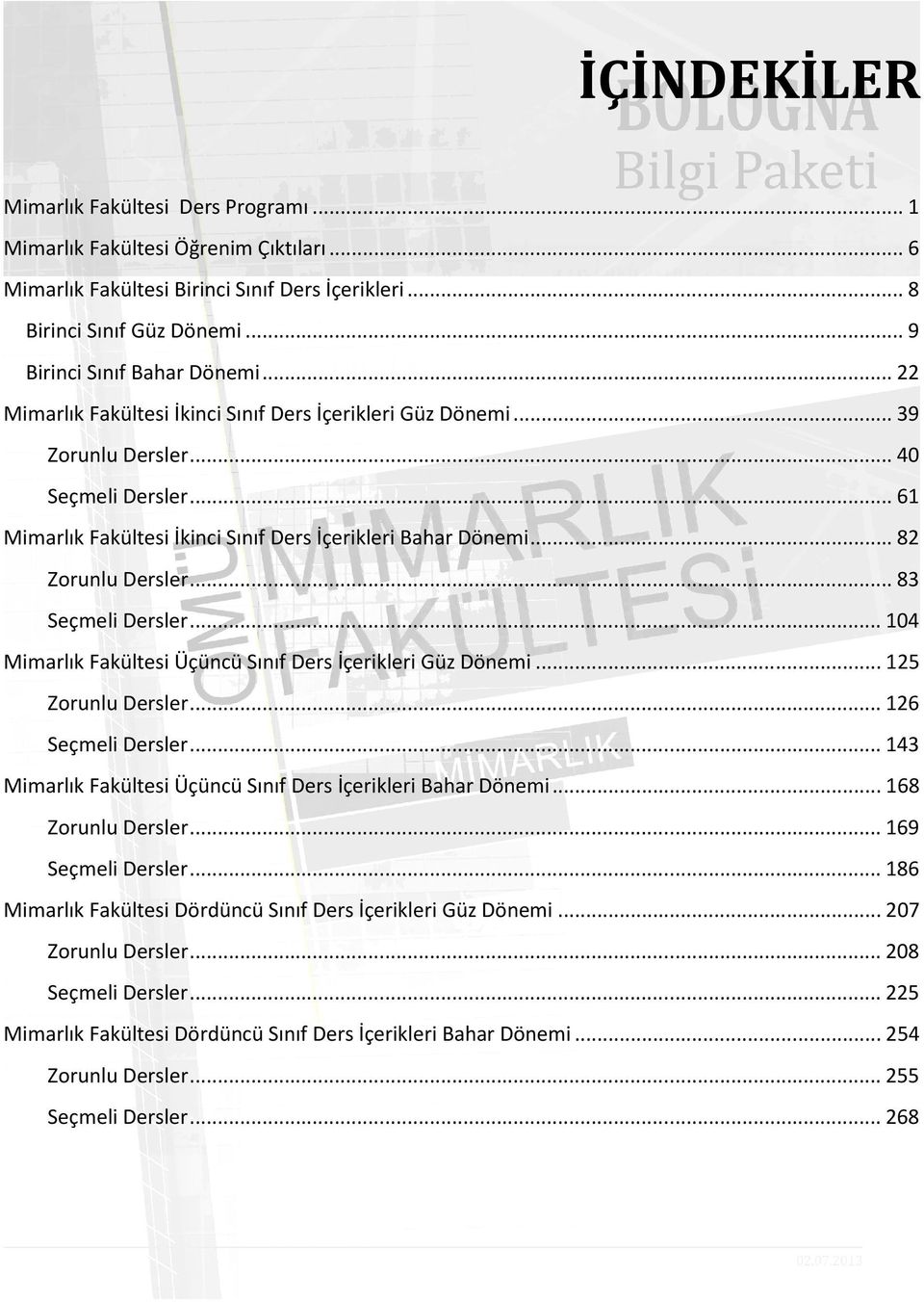
2 İÇİNDEKİLER Mimarlık Fakültesi Ders Programı... 1 Mimarlık Fakültesi Öğrenim Çıktıları... 6 Mimarlık Fakültesi Birinci Sınıf Ders İçerikleri... 8 Birinci Sınıf Güz Dönemi... 9 Birinci Sınıf Bahar Dönemi... Mimarlık Fakültesi İkinci Sınıf Ders İçerikleri Güz Dönemi Zorunlu Dersler Seçmeli Dersler Mimarlık Fakültesi İkinci Sınıf Ders İçerikleri Bahar Dönemi... 8 Zorunlu Dersler Seçmeli Dersler Mimarlık Fakültesi Üçüncü Sınıf Ders İçerikleri Güz Dönemi Zorunlu Dersler Seçmeli Dersler Mimarlık Fakültesi Üçüncü Sınıf Ders İçerikleri Bahar Dönemi Zorunlu Dersler Seçmeli Dersler Mimarlık Fakültesi Dördüncü Sınıf Ders İçerikleri Güz Dönemi Zorunlu Dersler Seçmeli Dersler... 5 Mimarlık Fakültesi Dördüncü Sınıf Ders İçerikleri Bahar Dönemi Zorunlu Dersler Seçmeli Dersler... 68
3 Mimarlık FakültesiDers Programı 1

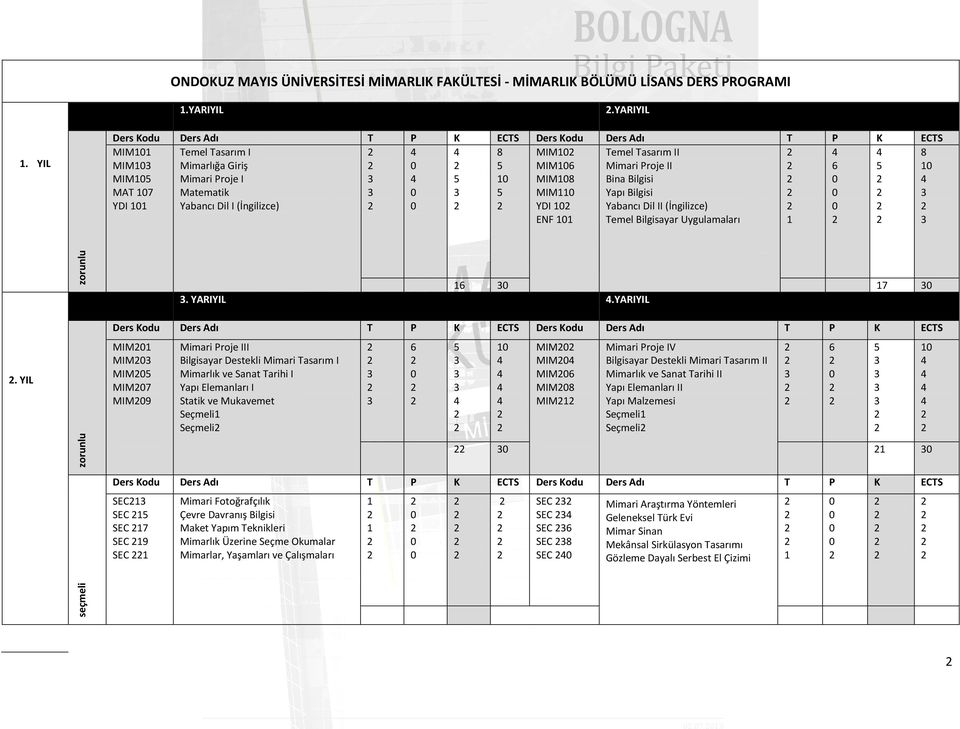
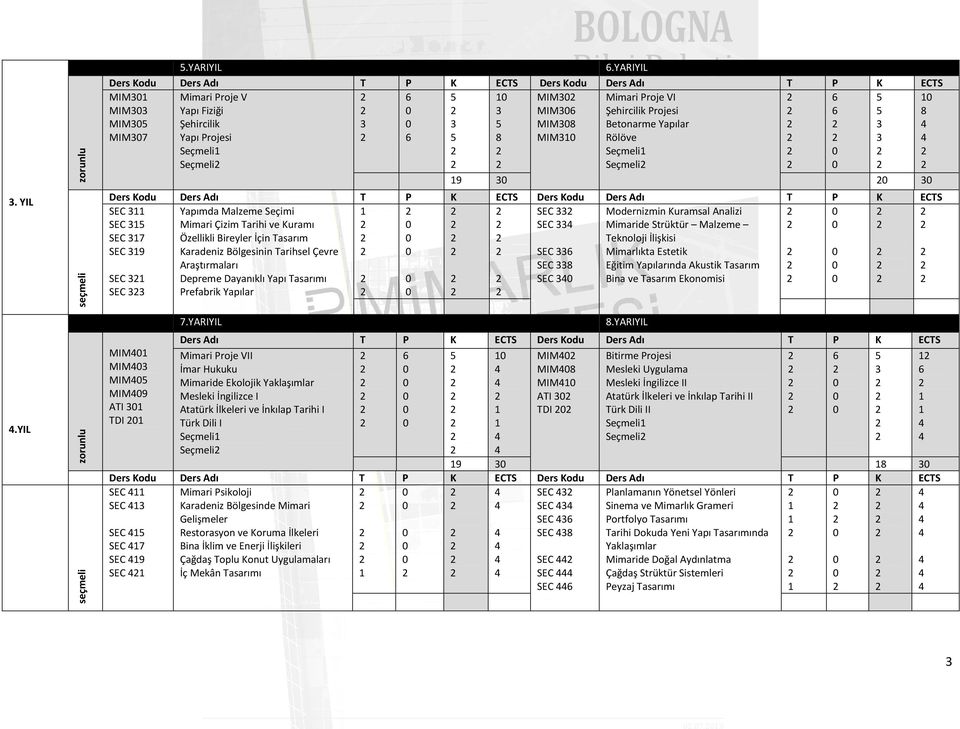
4 ONDOKUZ MAYIS ÜNİVERSİTESİ MİMARLIK FAKÜLTESİ - MİMARLIK BÖLÜMÜ LİSANS DERS PROGRAMI 1.YARIYIL.YARIYIL 1. YIL Ders Kodu Ders Adı T P K ECTS Ders Kodu Ders Adı T P K ECTS MIM101 MIM103 MIM105 MAT 107 YDI 101 Temel Tasarım I Mimarlığa Giriş Mimari Proje I Matematik Yabancı Dil I (İngilizce) MIM10 MIM106 MIM108 MIM110 YDI 10 ENF 101 Temel Tasarım II Mimari Proje II Bina Bilgisi Yapı Bilgisi Yabancı Dil II (İngilizce) Temel Bilgisayar Uygulamaları zorunlu YARIYIL 4.YARIYIL. YIL zorunlu Ders Kodu Ders Adı T P K ECTS Ders Kodu Ders Adı T P K ECTS MIM01 MIM03 MIM05 MIM07 MIM09 Mimari Proje III Bilgisayar Destekli Mimari Tasarım I Mimarlık ve Sanat Tarihi I Yapı Elemanları I Statik ve Mukavemet Seçmeli1 Seçmeli MIM0 MIM04 MIM06 MIM08 MIM1 Mimari Proje IV Bilgisayar Destekli Mimari Tasarım II Mimarlık ve Sanat Tarihi II Yapı Elemanları II Yapı Malzemesi Seçmeli1 Seçmeli Ders Kodu Ders Adı T P K ECTS Ders Kodu Ders Adı T P K ECTS SEC13 SEC 15 SEC 17 SEC 19 SEC 1 Mimari Fotoğrafçılık Çevre Davranış Bilgisi Maket Yapım Teknikleri Mimarlık Üzerine Seçme Okumalar Mimarlar, Yaşamları ve Çalışmaları SEC 3 SEC 34 SEC 36 SEC 38 SEC 40 Mimari Araştırma Yöntemleri Geleneksel Türk Evi Mimar Sinan Mekânsal Sirkülasyon Tasarımı Gözleme Dayalı Serbest El Çizimi seçmeli
5 3. YIL 4.YIL seçmeli zorunlu seçmeli zorunlu 5.YARIYIL 6.YARIYIL Ders Kodu Ders Adı T P K ECTS Ders Kodu Ders Adı T P K ECTS MIM301 6 MIM30 MIM303 0 MIM306 MIM MIM308 MIM307 6 MIM310 Mimari Proje V Yapı Fiziği Şehircilik Yapı Projesi Seçmeli1 Seçmeli Mimari Proje VI Şehircilik Projesi Betonarme Yapılar Rölöve Seçmeli1 Seçmeli Ders Kodu Ders Adı T P K ECTS Ders Kodu Ders Adı T P K ECTS SEC 311 SEC 315 SEC 317 SEC SEC 33 SEC SEC 31 SEC 33 MIM401 MIM403 MIM405 MIM409 ATI 301 TDI 01 Yapımda Malzeme Seçimi Mimari Çizim Tarihi ve Kuramı Özellikli Bireyler İçin Tasarım Karadeniz Bölgesinin Tarihsel Çevre Araştırmaları Depreme Dayanıklı Yapı Tasarımı Prefabrik Yapılar 0 0 SEC 336 SEC 338 SEC YARIYIL 8.YARIYIL Modernizmin Kuramsal Analizi Mimaride Strüktür Malzeme Teknoloji İlişkisi Mimarlıkta Estetik Eğitim Yapılarında Akustik Tasarım Bina ve Tasarım Ekonomisi Ders Adı T P K ECTS Ders Kodu Ders Adı T P K ECTS Mimari Proje VII İmar Hukuku Mimaride Ekolojik Yaklaşımlar Mesleki İngilizce I Atatürk İlkeleri ve İnkılap Tarihi I Türk Dili I Seçmeli1 Seçmeli MIM40 MIM408 MIM410 ATI 30 TDI 0 Bitirme Projesi Mesleki Uygulama Mesleki İngilizce II Atatürk İlkeleri ve İnkılap Tarihi II Türk Dili II Seçmeli1 Seçmeli Ders Kodu Ders Adı T P K ECTS Ders Kodu Ders Adı T P K ECTS SEC SEC SEC 415 SEC 417 SEC 419 SEC 41 Mimari Psikoloji Karadeniz Bölgesinde Mimari Gelişmeler Restorasyon ve Koruma İlkeleri Bina İklim ve Enerji İlişkileri Çağdaş Toplu Konut Uygulamaları İç Mekân Tasarımı SEC 43 SEC 434 SEC 436 SEC 438 SEC 44 SEC 444 SEC 446 Planlamanın Yönetsel Yönleri Sinema ve Mimarlık Grameri Portfolyo Tasarımı Tarihi Dokuda Yeni Yapı Tasarımında Yaklaşımlar Mimaride Doğal Aydınlatma Çağdaş Strüktür Sistemleri Peyzaj Tasarımı
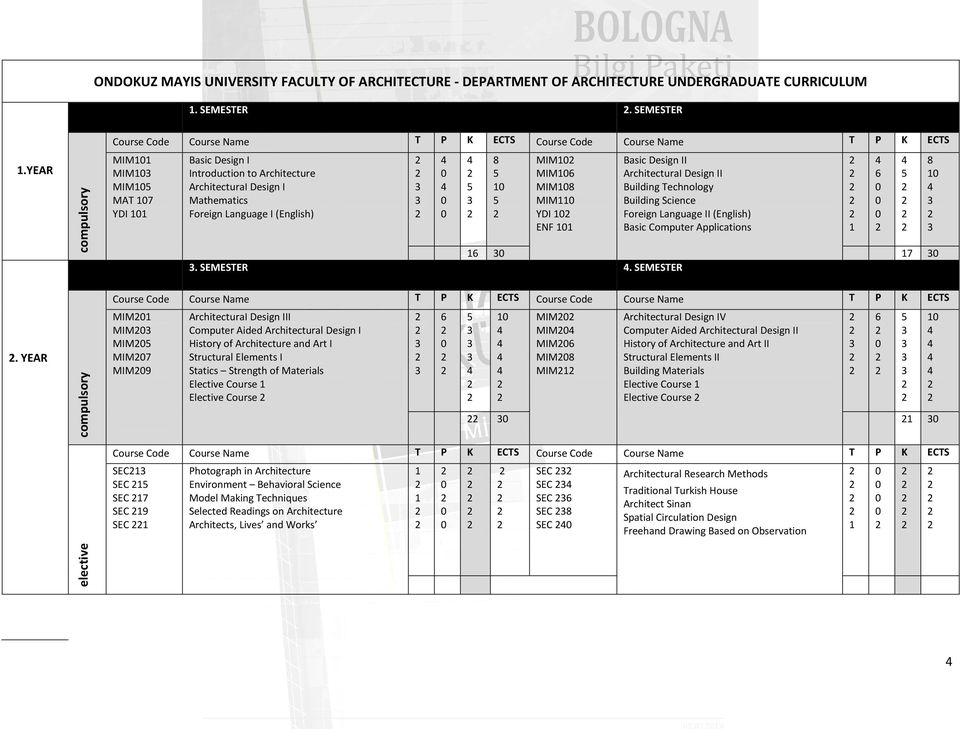
6 ONDOKUZ MAYIS UNIVERSITY FACULTY OF ARCHITECTURE - DEPARTMENT OF ARCHITECTURE UNDERGRADUATE CURRICULUM 1. SEMESTER. SEMESTER 1.YEAR. YEAR compulsory compulsory Course Code Course Name T P K ECTS Course Code Course Name T P K ECTS MIM101 MIM103 MIM105 MAT 107 YDI 101 Basic Design I Introduction to Architecture ArchitecturaI Design I Mathematics Foreign Language I (English) MIM10 MIM106 MIM108 MIM110 YDI 10 ENF 101 Basic Design II ArchitecturaI Design II Building Technology Building Science Foreign Language II (English) Basic Computer Applications SEMESTER 4. SEMESTER Course Code Course Name T P K ECTS Course Code Course Name T P K ECTS MIM01 MIM03 MIM05 MIM07 MIM09 ArchitecturaI Design III Computer Aided Architectural Design I History of Architecture and Art I Structural Elements I Statics Strength of Materials Elective Course 1 Elective Course MIM0 MIM04 MIM06 MIM08 MIM1 ArchitecturaI Design IV Computer Aided Architectural Design II History of Architecture and Art II Structural Elements II Building Materials Elective Course 1 Elective Course Course Code Course Name T P K ECTS Course Code Course Name T P K ECTS SEC13 SEC 15 SEC 17 SEC 19 SEC 1 Photograph in Architecture Environment Behavioral Science Model Making Techniques Selected Readings on Architecture Architects, Lives and Works SEC 3 SEC 34 SEC 36 SEC 38 SEC 40 Architectural Research Methods Traditional Turkish House Architect Sinan Spatial Circulation Design Freehand Drawing Based on Observation elective 4
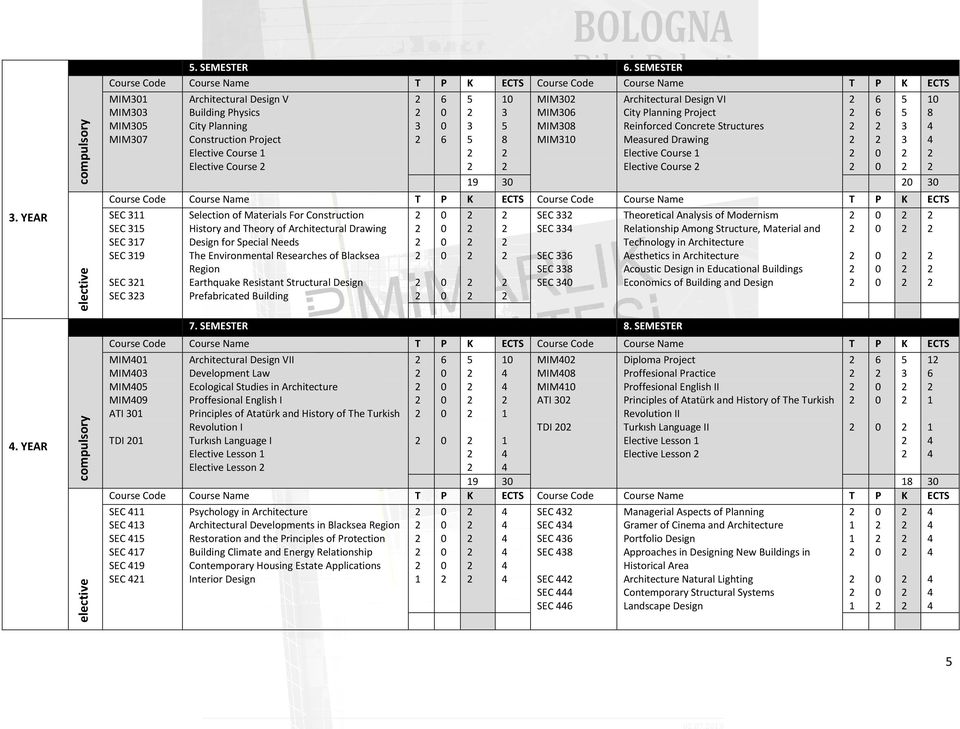
7 3. YEAR 4. YEAR elective compulsory elective compulsory 5. SEMESTER 6. SEMESTER Course Code Course Name T P K ECTS Course Code Course Name T P K ECTS MIM301 MIM303 MIM305 MIM307 ArchitecturaI Design V Building Physics City Planning Construction Project Elective Course 1 Elective Course MIM30 MIM306 MIM308 MIM310 ArchitecturaI Design VI City Planning Project Reinforced Concrete Structures Measured Drawing Elective Course 1 Elective Course Course Code Course Name T P K ECTS Course Code Course Name T P K ECTS SEC 311 SEC 315 SEC 317 SEC 319 SEC 31 SEC 33 Selection of Materials For Construction History and Theory of Architectural Drawing Design for Special Needs The Environmental Researches of Blacksea Region Earthquake Resistant Structural Design Prefabricated Building SEC 33 SEC 334 SEC 336 SEC 338 SEC SEMESTER 8. SEMESTER Theoretical Analysis of Modernism Relationship Among Structure, Material and Technology in Architecture Aesthetics in Architecture Acoustic Design in Educational Buildings Economics of Building and Design Course Code Course Name T P K ECTS Course Code Course Name T P K ECTS MIM401 MIM403 MIM405 MIM409 ATI 301 TDI 01 ArchitecturaI Design VII Development Law Ecological Studies in Architecture Proffesional English I Principles of Atatürk and History of The Turkish Revolution I Turkısh Language I Elective Lesson 1 Elective Lesson MIM40 MIM408 MIM410 ATI 30 TDI 0 Diploma Project Proffesional Practice Proffesional English II Principles of Atatürk and History of The Turkish Revolution II Turkısh Language II Elective Lesson 1 Elective Lesson Course Code Course Name T P K ECTS Course Code Course Name T P K ECTS SEC 411 SEC 413 SEC 415 SEC 417 SEC 419 SEC 41 Psychology in Architecture Architectural Developments in Blacksea Region Restoration and the Principles of Protection Building Climate and Energy Relationship Contemporary Housing Estate Applications Interior Design SEC 43 SEC 434 SEC 436 SEC 438 SEC 44 SEC 444 SEC 446 Managerial Aspects of Planning Gramer of Cinema and Architecture Portfolio Design Approaches in Designing New Buildings in Historical Area Architecture Natural Lighting Contemporary Structural Systems Landscape Design
8 Mimarlık Fakültesi Öğrenim Çıktıları 6
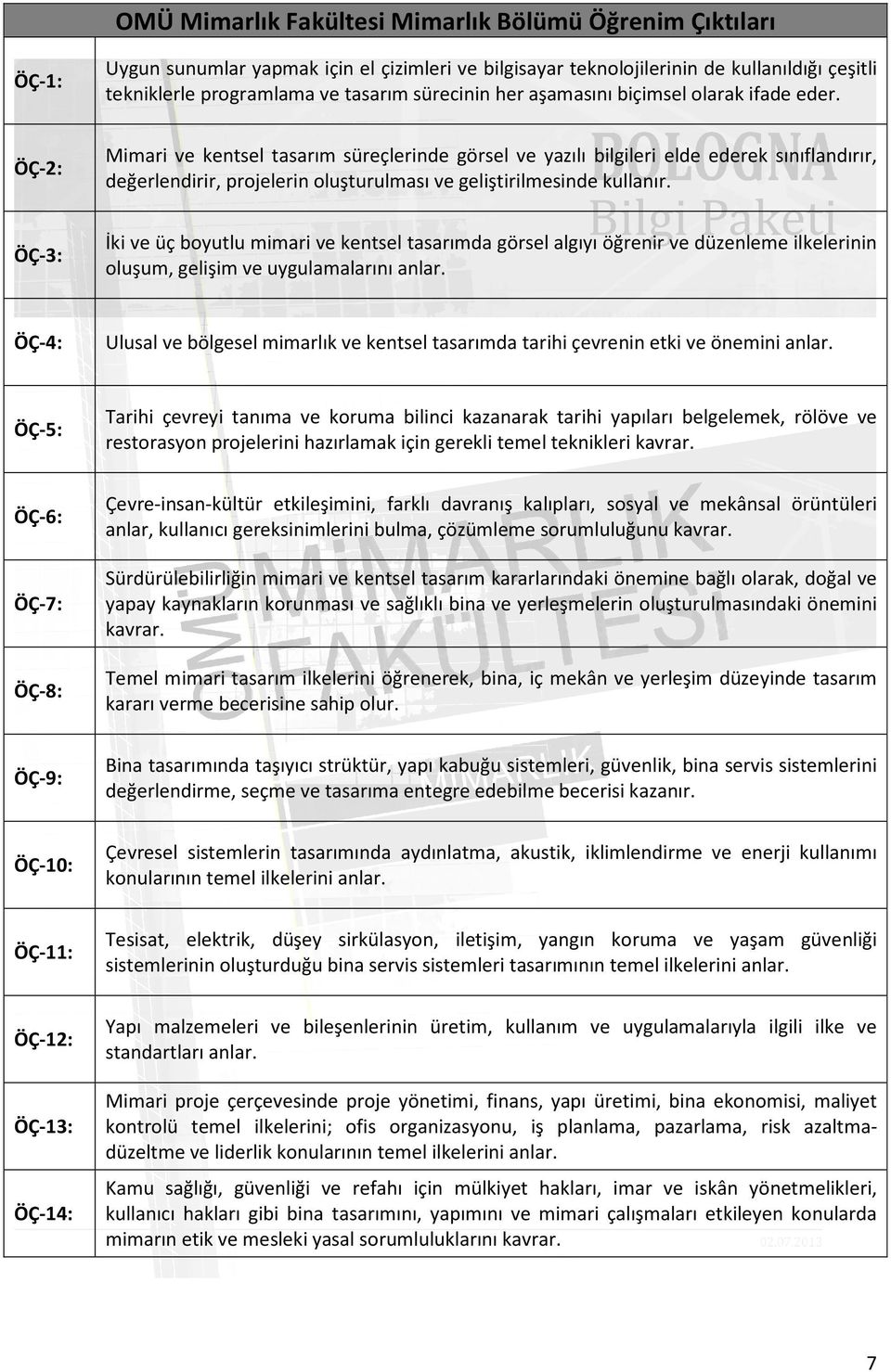
9 OMÜ Mimarlık Fakültesi Mimarlık Bölümü Öğrenim Çıktıları ÖÇ-1: Uygun sunumlar yapmak için el çizimleri ve bilgisayar teknolojilerinin de kullanıldığı çeşitli tekniklerle programlama ve tasarım sürecinin her aşamasını biçimsel olarak ifade eder. ÖÇ-: Mimari ve kentsel tasarım süreçlerinde görsel ve yazılı bilgileri elde ederek sınıflandırır, değerlendirir, projelerin oluşturulması ve geliştirilmesinde kullanır. ÖÇ-3: İki ve üç boyutlu mimari ve kentsel tasarımda görsel algıyı öğrenir ve düzenleme ilkelerinin oluşum, gelişim ve uygulamalarını anlar. ÖÇ-4: Ulusal ve bölgesel mimarlık ve kentsel tasarımda tarihi çevrenin etki ve önemini anlar. ÖÇ-5: Tarihi çevreyi tanıma ve koruma bilinci kazanarak tarihi yapıları belgelemek, rölöve ve restorasyon projelerini hazırlamak için gerekli temel teknikleri kavrar. ÖÇ-6: ÖÇ-7: ÖÇ-8: Çevre-insan-kültür etkileşimini, farklı davranış kalıpları, sosyal ve mekânsal örüntüleri anlar, kullanıcı gereksinimlerini bulma, çözümleme sorumluluğunu kavrar. Sürdürülebilirliğin mimari ve kentsel tasarım kararlarındaki önemine bağlı olarak, doğal ve yapay kaynakların korunması ve sağlıklı bina ve yerleşmelerin oluşturulmasındaki önemini kavrar. Temel mimari tasarım ilkelerini öğrenerek, bina, iç mekân ve yerleşim düzeyinde tasarım kararı verme becerisine sahip olur. ÖÇ-9: Bina tasarımında taşıyıcı strüktür, yapı kabuğu sistemleri, güvenlik, bina servis sistemlerini değerlendirme, seçme ve tasarıma entegre edebilme becerisi kazanır. ÖÇ-10: Çevresel sistemlerin tasarımında aydınlatma, akustik, iklimlendirme ve enerji kullanımı konularının temel ilkelerini anlar. ÖÇ-11: Tesisat, elektrik, düşey sirkülasyon, iletişim, yangın koruma ve yaşam güvenliği sistemlerinin oluşturduğu bina servis sistemleri tasarımının temel ilkelerini anlar. ÖÇ-1: ÖÇ-13: ÖÇ-14: Yapı malzemeleri ve bileşenlerinin üretim, kullanım ve uygulamalarıyla ilgili ilke ve standartları anlar. Mimari proje çerçevesinde proje yönetimi, finans, yapı üretimi, bina ekonomisi, maliyet kontrolü temel ilkelerini; ofis organizasyonu, iş planlama, pazarlama, risk azaltmadüzeltme ve liderlik konularının temel ilkelerini anlar. Kamu sağlığı, güvenliği ve refahı için mülkiyet hakları, imar ve iskân yönetmelikleri, kullanıcı hakları gibi bina tasarımını, yapımını ve mimari çalışmaları etkileyen konularda mimarın etik ve mesleki yasal sorumluluklarını kavrar. 7
10 Mimarlık Fakültesi Birinci Sınıf Ders İçerikleri 8
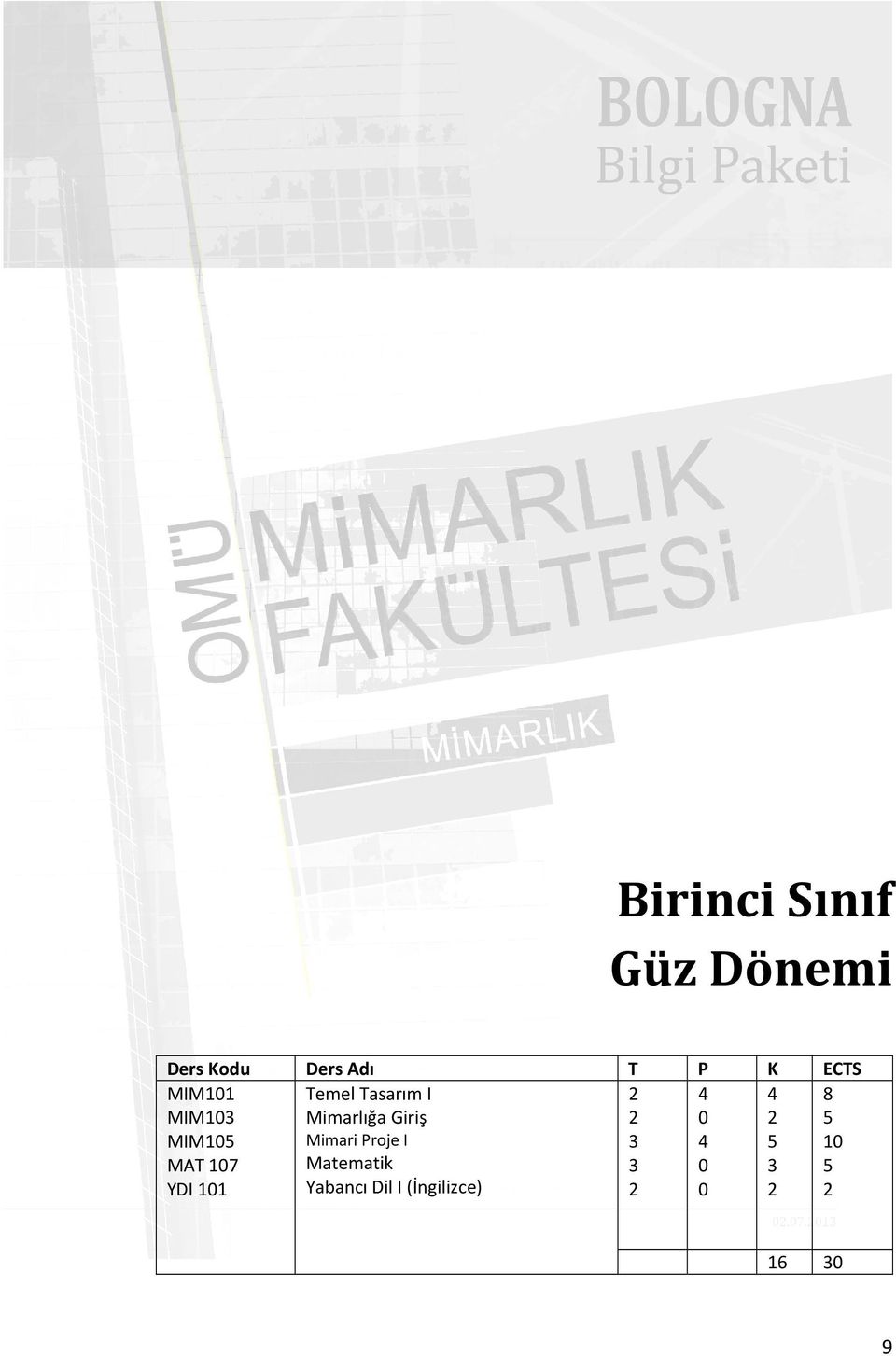
11 Birinci Sınıf Güz Dönemi Ders Kodu Ders Adı T P K ECTS MIM101 MIM103 MIM105 MAT 107 YDI 101 Temel Tasarım I Mimarlığa Giriş Mimari Proje I Matematik Yabancı Dil I (İngilizce)
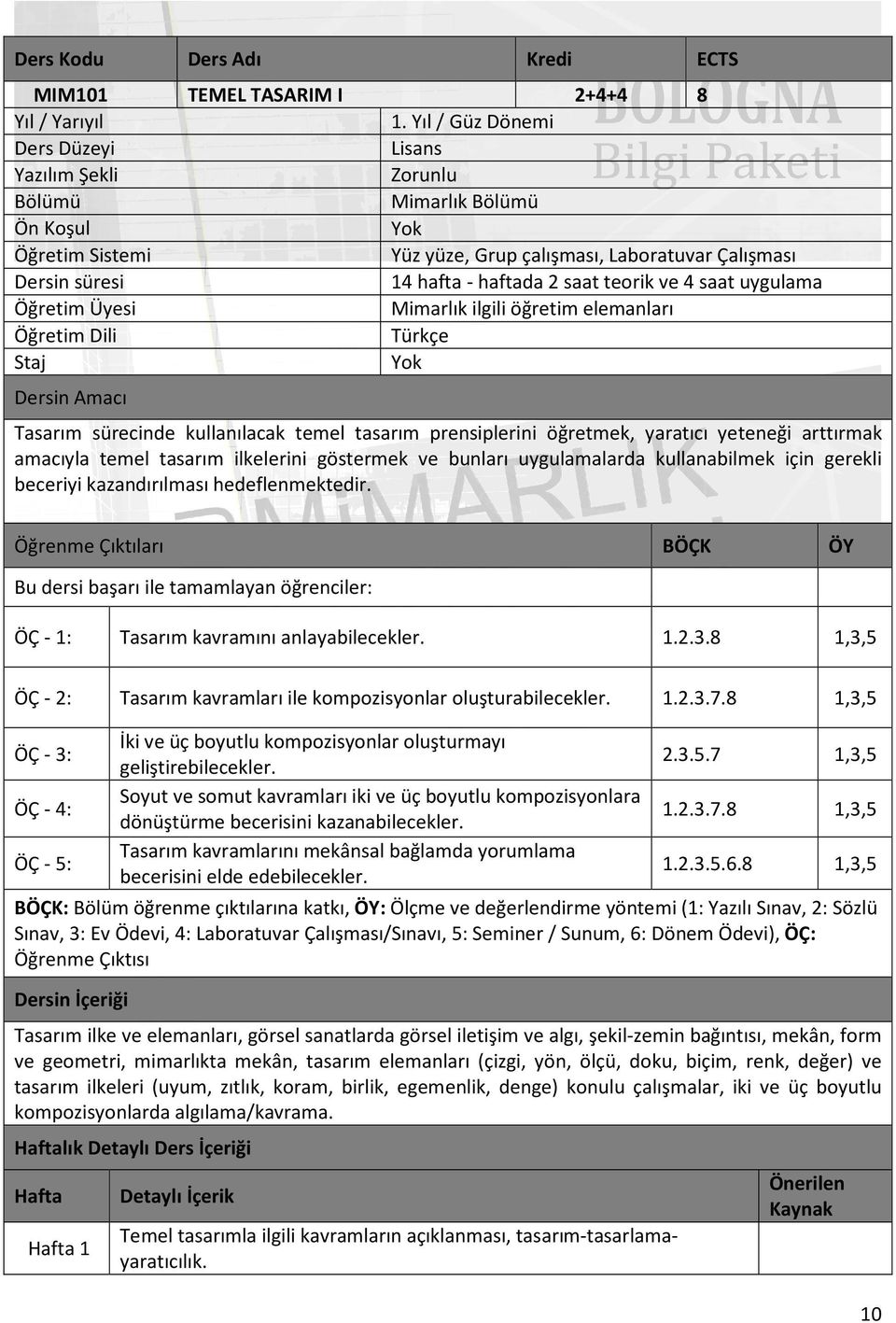
12 Ders Kodu Ders Adı Kredi ECTS MIM101 TEMEL TASARIM I Yıl / Yarıyıl 1. Yıl / Güz Dönemi Ders Düzeyi Lisans Yazılım Şekli Zorunlu Bölümü Mimarlık Bölümü Ön Koşul Yok Öğretim Sistemi Yüz yüze, Grup çalışması, Laboratuvar Çalışması Dersin süresi 14 hafta - haftada saat teorik ve 4 saat uygulama Öğretim Üyesi Mimarlık ilgili öğretim elemanları Öğretim Dili Türkçe Staj Yok Dersin Amacı Tasarım sürecinde kullanılacak temel tasarım prensiplerini öğretmek, yaratıcı yeteneği arttırmak amacıyla temel tasarım ilkelerini göstermek ve bunları uygulamalarda kullanabilmek için gerekli beceriyi kazandırılması hedeflenmektedir. Öğrenme Çıktıları BÖÇK ÖY Bu dersi başarı ile tamamlayan öğrenciler: ÖÇ - 1: Tasarım kavramını anlayabilecekler ,3,5 ÖÇ - : Tasarım kavramları ile kompozisyonlar oluşturabilecekler ,3,5 ÖÇ - 3: ÖÇ - 4: ÖÇ - 5: İki ve üç boyutlu kompozisyonlar oluşturmayı geliştirebilecekler. Soyut ve somut kavramları iki ve üç boyutlu kompozisyonlara dönüştürme becerisini kazanabilecekler. Tasarım kavramlarını mekânsal bağlamda yorumlama becerisini elde edebilecekler ,3, ,3, ,3,5 BÖÇK: Bölüm öğrenme çıktılarına katkı, ÖY: Ölçme ve değerlendirme yöntemi (1: Yazılı Sınav, : Sözlü Sınav, 3: Ev Ödevi, 4: Laboratuvar Çalışması/Sınavı, 5: Seminer / Sunum, 6: Dönem Ödevi), ÖÇ: Öğrenme Çıktısı Dersin İçeriği Tasarım ilke ve elemanları, görsel sanatlarda görsel iletişim ve algı, şekil-zemin bağıntısı, mekân, form ve geometri, mimarlıkta mekân, tasarım elemanları (çizgi, yön, ölçü, doku, biçim, renk, değer) ve tasarım ilkeleri (uyum, zıtlık, koram, birlik, egemenlik, denge) konulu çalışmalar, iki ve üç boyutlu kompozisyonlarda algılama/kavrama. Haftalık Detaylı Ders İçeriği Hafta Hafta 1 Detaylı İçerik Temel tasarımla ilgili kavramların açıklanması, tasarım-tasarlamayaratıcılık. Önerilen Kaynak 10
13 Hafta Tasarım elemanlarından nokta-çizgi-yön konularının işlenmesi. Uygulama. Hafta 3 Hafta 4 Hafta 5 Hafta 6 Tasarım elemanlarından ölçü-biçim-oran-aralık konularının işlenmesi. Uygulama. Tasarım elemanlarından doku konusunun işlenmesi. Doku tasarımı uygulaması Değer-renk konusunun işlenmesi; sıcak-soğuk renkler, bütünleyici renk çiftleri. Uygulama. Görsel sanatlarda görsel iletişim ve görsel algı, kompozisyonda belirlilik oluşturma yolları. Kompozisyonda belirlilik sağlama-simetri yoluyla, uygulama. Hafta 7 Derinlik anlatımları; örtme, saydamlık, çizgisellik. Uygulama. Hafta 8 Hafta 9 Ara sınav Tasarım ilkeleri; Tekrar, armoni, Kontrast konularının işlenmesi Uygulama. Hafta 10 Tasarım ilkelerinden koram konusunun işlenmesi. Uygulama. Hafta 11 Birlik- denge- egemenlik konularının işlenmesi. Uygulama. Hafta 1 Mekân-form-geometri konularının işlenmesi. Üç boyutlu form yaratma uygulaması. Hafta 13 Düzlem-örüntü-modülasyon konularının işlenmesi uygulama. Hafta 14 Soyut üç boyutlu form uygulamaları. Ders Kitabı / Malzemesi [1] Gürer, L. 1990,Temel Tasarım, İTÜ Matbaası, İstanbul. [] Gürer, L. 199,Görsel Sanat Eğitimi ve Mekân-Form, İTÜ Baskı Atölyesi, İstanbul. İlave Kaynak [1] İpsiroglu, N. İpsiroglu, M. 1970,Sanatta Devrim, Remzi Kitabevi, İstanbul, 1991 Denel, B. Tasarım Üzerine-Bir Deneme, Yükselen Matbaacılık, İstanbul. [] Denel, B. Temel Tasarım ve Yaratıcılık, ODTÜ Mimarlık Fak. Başım işbirliği, Ankara, 1981 [3] Denel, B.1981, Temel Tasarım ve Yaratıcılık, ODTÜ Mimarlık Fak. Başım işbirliği, Ankara. [4] Graves, M.1951, The Art of Color and Design, Mc Graw-Hill Book Company Inc. Newyork. [5] Güngör, H. 1987,Temel Tasar (Basic Design), Afa Matbaacılık, İstanbul. [6] Danalıoğlu, D.1997, Temel Tasar-Tasar' in Öge ve İlkeleri, Birsen Yayınevi, İstanbul. Öğrenci İş Yükü İşlem adı Haftalık süre (saat) Hafta sayısı Dönem toplamı Derse katılım Bireysel çalışma Ara sınav için bireysel çalışma Ara sınav Uygulama Ev Ödevi Final sınavı için bireysel çalışma 1 Final sınavı Toplam iş yükü 09 11

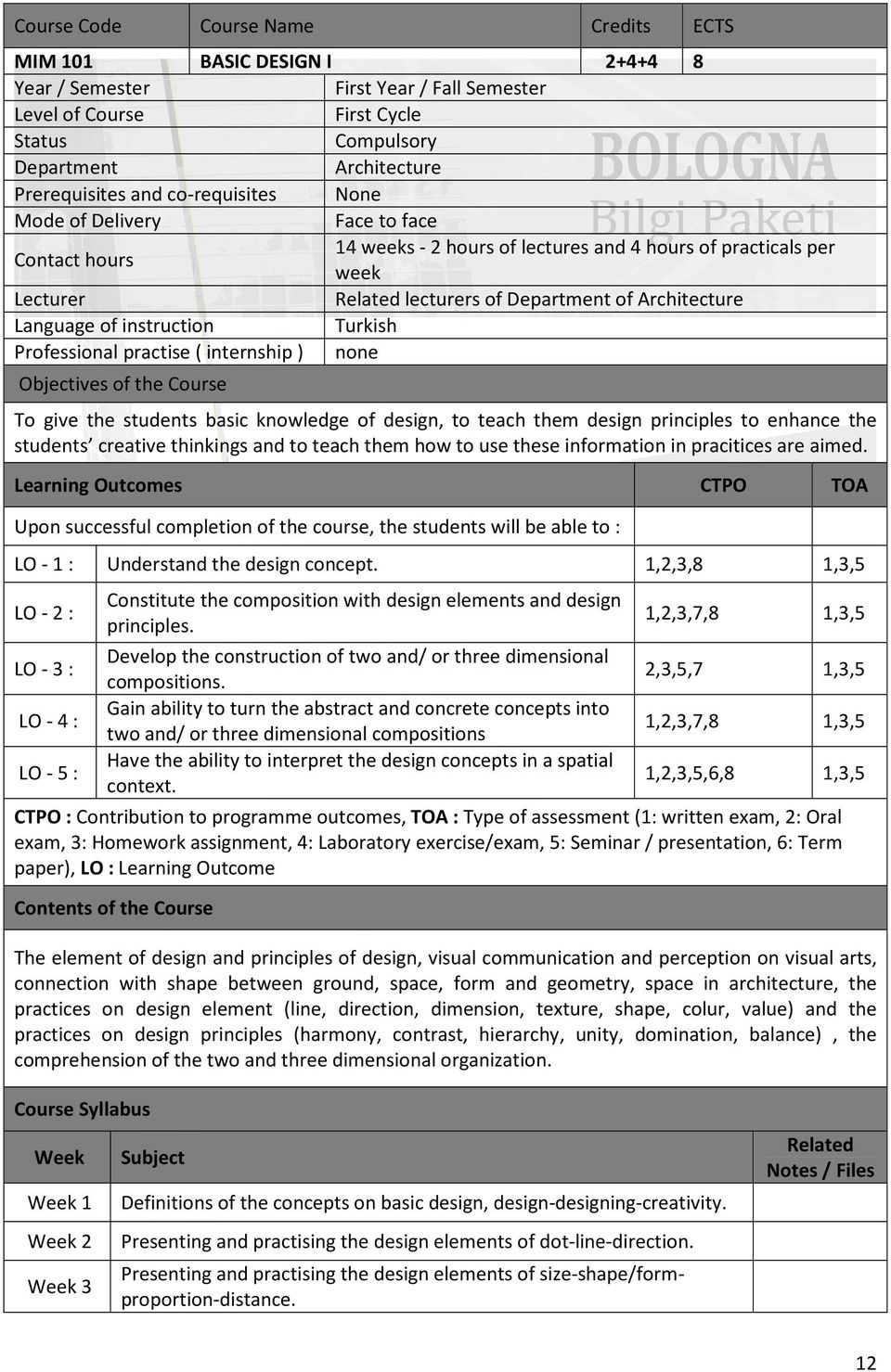
14 Course Code Course Name Credits ECTS MIM 101 BASIC DESIGN I Year / Semester First Year / Fall Semester Level of Course First Cycle Status Compulsory Department Architecture Prerequisites and co-requisites None Mode of Delivery Face to face Contact hours 14 weeks - hours of lectures and 4 hours of practicals per week Lecturer Related lecturers of Department of Architecture Language of instruction Turkish Professional practise ( internship ) none Objectives of the Course To give the students basic knowledge of design, to teach them design principles to enhance the students creative thinkings and to teach them how to use these information in pracitices are aimed. Learning Outcomes CTPO TOA Upon successful completion of the course, the students will be able to : LO - 1 : Understand the design concept. 1,,3,8 1,3,5 LO - : LO - 3 : LO - 4 : LO - 5 : Constitute the composition with design elements and design principles. Develop the construction of two and/ or three dimensional compositions. Gain ability to turn the abstract and concrete concepts into two and/ or three dimensional compositions Have the ability to interpret the design concepts in a spatial context. 1,,3,7,8 1,3,5,3,5,7 1,3,5 1,,3,7,8 1,3,5 1,,3,5,6,8 1,3,5 CTPO : Contribution to programme outcomes, TOA : Type of assessment (1: written exam, : Oral exam, 3: Homework assignment, 4: Laboratory exercise/exam, 5: Seminar / presentation, 6: Term paper), LO : Learning Outcome Contents of the Course The element of design and principles of design, visual communication and perception on visual arts, connection with shape between ground, space, form and geometry, space in architecture, the practices on design element (line, direction, dimension, texture, shape, colur, value) and the practices on design principles (harmony, contrast, hierarchy, unity, domination, balance), the comprehension of the two and three dimensional organization. Course Syllabus Week Subject Week 1 Definitions of the concepts on basic design, design-designing-creativity. Week Presenting and practising the design elements of dot-line-direction. Week 3 Presenting and practising the design elements of size-shape/formproportion-distance. Related Notes / Files 1
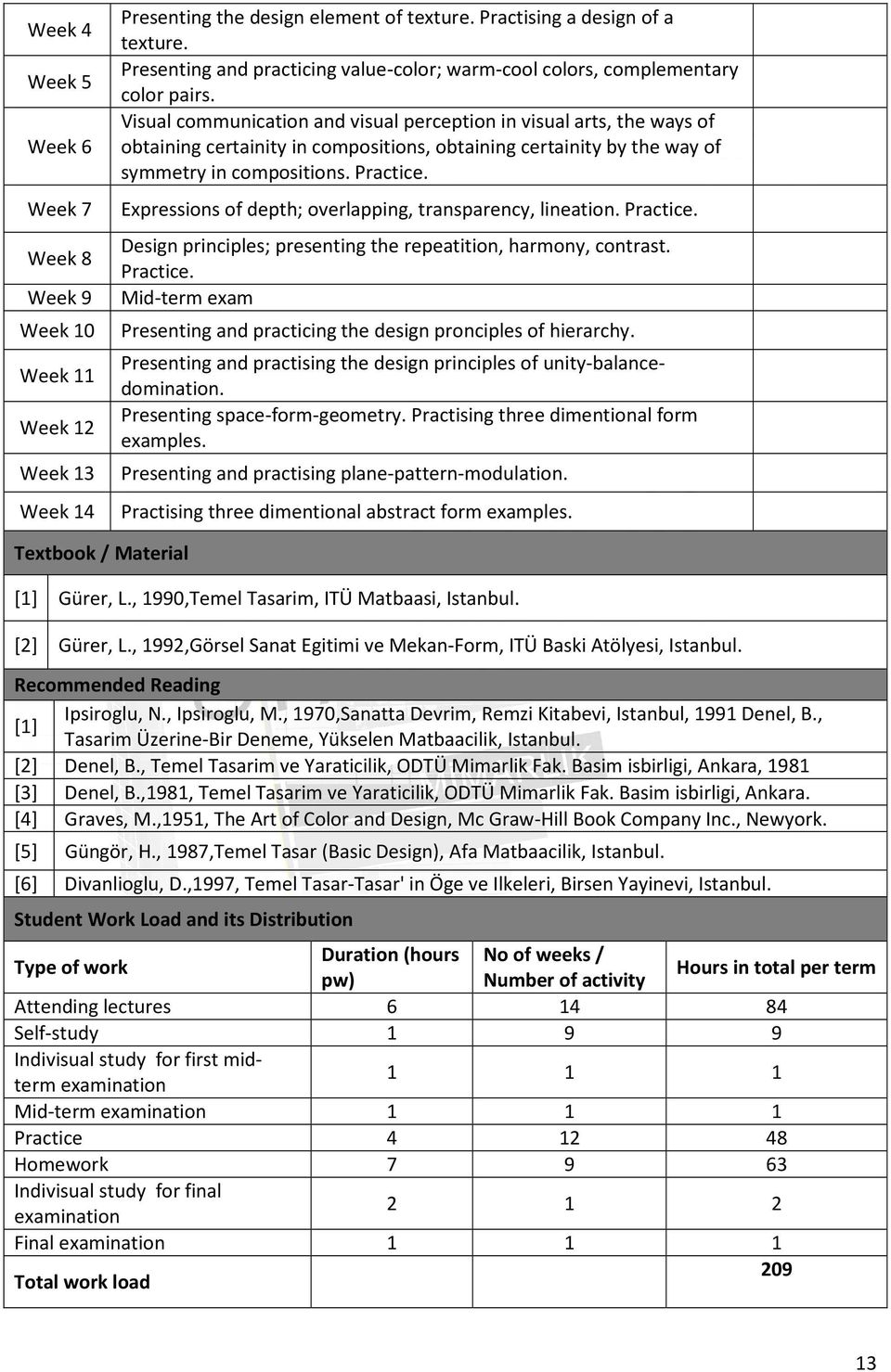
15 Week 4 Week 5 Week 6 Presenting the design element of texture. Practising a design of a texture. Presenting and practicing value-color; warm-cool colors, complementary color pairs. Visual communication and visual perception in visual arts, the ways of obtaining certainity in compositions, obtaining certainity by the way of symmetry in compositions. Practice. Week 7 Expressions of depth; overlapping, transparency, lineation. Practice. Design principles; presenting the repeatition, harmony, contrast. Week 8 Practice. Week 9 Mid-term exam Week 10 Presenting and practicing the design pronciples of hierarchy. Week 11 Week 1 Presenting and practising the design principles of unity-balancedomination. Presenting space-form-geometry. Practising three dimentional form examples. Week 13 Presenting and practising plane-pattern-modulation. Week 14 Practising three dimentional abstract form examples. Textbook / Material [1] Gürer, L., 1990,Temel Tasarim, ITÜ Matbaasi, Istanbul. [] Gürer, L., 199,Görsel Sanat Egitimi ve Mekan-Form, ITÜ Baski Atölyesi, Istanbul. Recommended Reading Ipsiroglu, N., Ipsiroglu, M., 1970,Sanatta Devrim, Remzi Kitabevi, Istanbul, 1991 Denel, B., [1] Tasarim Üzerine-Bir Deneme, Yükselen Matbaacilik, Istanbul. [] Denel, B., Temel Tasarim ve Yaraticilik, ODTÜ Mimarlik Fak. Basim isbirligi, Ankara, 1981 [3] Denel, B.,1981, Temel Tasarim ve Yaraticilik, ODTÜ Mimarlik Fak. Basim isbirligi, Ankara. [4] Graves, M.,1951, The Art of Color and Design, Mc Graw-Hill Book Company Inc., Newyork. [5] Güngör, H., 1987,Temel Tasar (Basic Design), Afa Matbaacilik, Istanbul. [6] Divanlioglu, D.,1997, Temel Tasar-Tasar' in Öge ve Ilkeleri, Birsen Yayinevi, Istanbul. Student Work Load and its Distribution Type of work Duration (hours No of weeks / pw) Number of activity Hours in total per term Attending lectures Self-study Indivisual study for first midterm examination Mid-term examination Practice Homework Indivisual study for final examination 1 Final examination Total work load 09 13
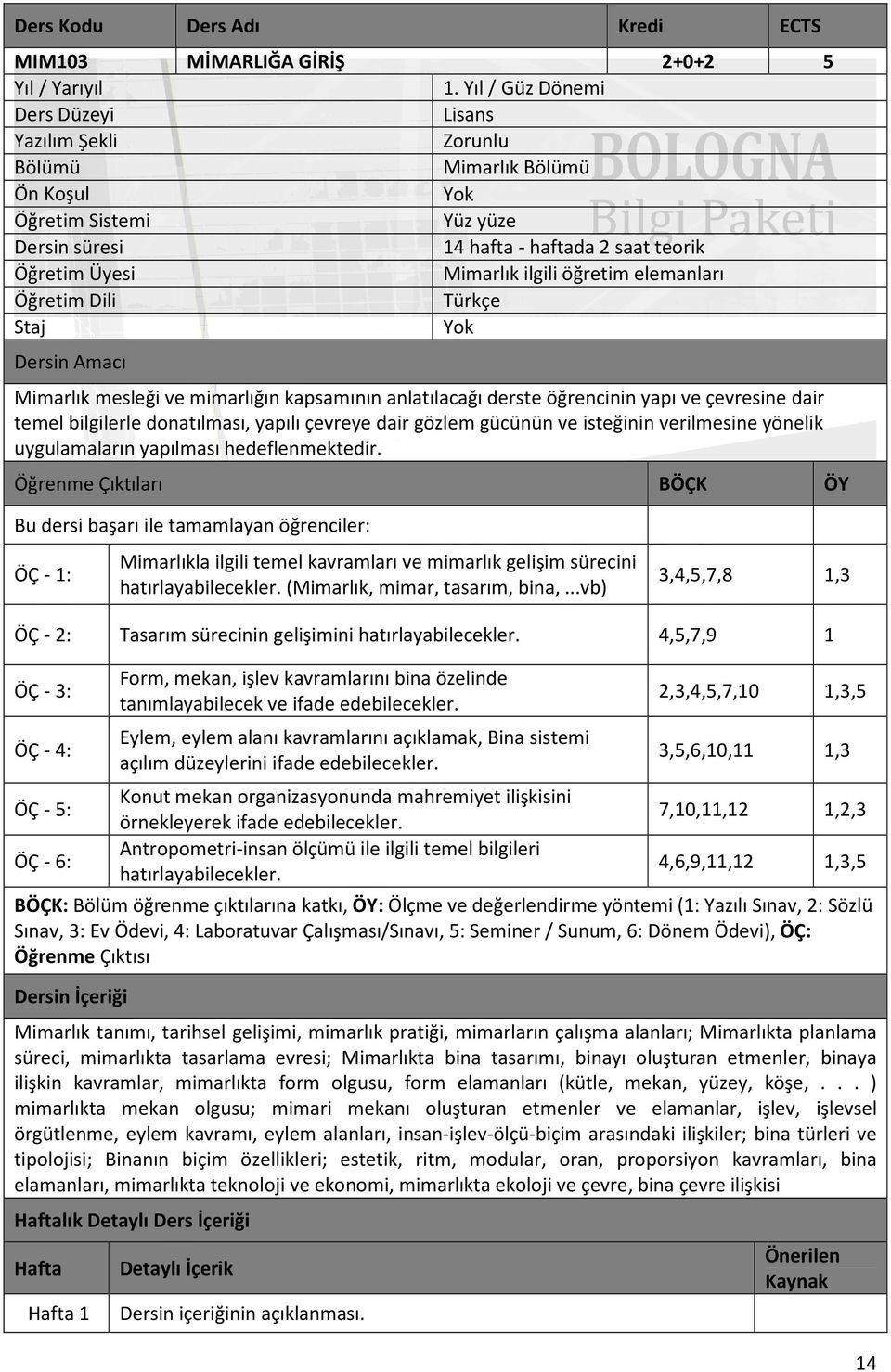
16 Ders Kodu Ders Adı Kredi ECTS MIM103 MİMARLIĞA GİRİŞ Yıl / Yarıyıl 1. Yıl / Güz Dönemi Ders Düzeyi Lisans Yazılım Şekli Zorunlu Bölümü Mimarlık Bölümü Ön Koşul Yok Öğretim Sistemi Yüz yüze Dersin süresi 14 hafta - haftada saat teorik Öğretim Üyesi Mimarlık ilgili öğretim elemanları Öğretim Dili Türkçe Staj Yok Dersin Amacı Mimarlık mesleği ve mimarlığın kapsamının anlatılacağı derste öğrencinin yapı ve çevresine dair temel bilgilerle donatılması, yapılı çevreye dair gözlem gücünün ve isteğinin verilmesine yönelik uygulamaların yapılması hedeflenmektedir. Öğrenme Çıktıları BÖÇK ÖY Bu dersi başarı ile tamamlayan öğrenciler: ÖÇ - 1: Mimarlıkla ilgili temel kavramları ve mimarlık gelişim sürecini hatırlayabilecekler. (Mimarlık, mimar, tasarım, bina,...vb) 3,4,5,7,8 1,3 ÖÇ - : Tasarım sürecinin gelişimini hatırlayabilecekler. 4,5,7,9 1 ÖÇ - 3: ÖÇ - 4: ÖÇ - 5: ÖÇ - 6: Form, mekan, işlev kavramlarını bina özelinde tanımlayabilecek ve ifade edebilecekler. Eylem, eylem alanı kavramlarını açıklamak, Bina sistemi açılım düzeylerini ifade edebilecekler. Konut mekan organizasyonunda mahremiyet ilişkisini örnekleyerek ifade edebilecekler. Antropometri-insan ölçümü ile ilgili temel bilgileri hatırlayabilecekler.,3,4,5,7,10 1,3,5 3,5,6,10,11 1,3 7,10,11,1 1,,3 4,6,9,11,1 1,3,5 BÖÇK: Bölüm öğrenme çıktılarına katkı, ÖY: Ölçme ve değerlendirme yöntemi (1: Yazılı Sınav, : Sözlü Sınav, 3: Ev Ödevi, 4: Laboratuvar Çalışması/Sınavı, 5: Seminer / Sunum, 6: Dönem Ödevi), ÖÇ: Öğrenme Çıktısı Dersin İçeriği Mimarlık tanımı, tarihsel gelişimi, mimarlık pratiği, mimarların çalışma alanları; Mimarlıkta planlama süreci, mimarlıkta tasarlama evresi; Mimarlıkta bina tasarımı, binayı oluşturan etmenler, binaya ilişkin kavramlar, mimarlıkta form olgusu, form elamanları (kütle, mekan, yüzey, köşe,... ) mimarlıkta mekan olgusu; mimari mekanı oluşturan etmenler ve elamanlar, işlev, işlevsel örgütlenme, eylem kavramı, eylem alanları, insan-işlev-ölçü-biçim arasındaki ilişkiler; bina türleri ve tipolojisi; Binanın biçim özellikleri; estetik, ritm, modular, oran, proporsiyon kavramları, bina elamanları, mimarlıkta teknoloji ve ekonomi, mimarlıkta ekoloji ve çevre, bina çevre ilişkisi Haftalık Detaylı Ders İçeriği Hafta Detaylı İçerik Hafta 1 Dersin içeriğinin açıklanması. Önerilen Kaynak 14
17 Hafta Hafta 3 Hafta 4 Hafta 5 Hafta 6 Hafta 7 Hafta 8 Mimarlık nedir? Mimar kimdir? Mimarlık meslek pratiği, diğer disiplinlerle ilişkiler. Tasarımın tanımı, Tasarım süreci, tasarım süreci ile ilgili tanımlar yaklaşımlar. Mimari tasarım yaklaşımları, Düşünme biçimleri, Farklı tasarlama teknikleri. Mimarlıkta Form olgusu, Form elemanları, Form oluşturma biçimleri. Ünlü mimarların uygulamalarından örnekler. Mimarlıkta mekan olgusu, farklı tanımlar, mekanı oluşturan etmenler, mekan türleri. örneklerin irdelenmesi. Ünlü mimarların mekan anlayışları Fonksiyon- işlev kavramları, İşlev şeması oluşturma, Konutta işlevsel dağılım. Eylem- eylem alanı kavramları, Bina sistemi açılım düzeyleri, işlevsel düzeyler. Farklı işlevlerde açılım düzeyleri. Hafta 9 Ara sınav Hafta 10 Hafta 11 Eylem- eylem alanı kavramları, Bina sistemi açılım düzeyleri, işlevsel düzeyler. Farklı işlevlerde açılım düzeyleri. Konutta işlevsel dağılım, işlev şemaları örnekleri, Konutun bölümleri, Gizlilik- mahremiyet kavramı. Hafta 1 İnsan- ölçü- biçim ilişkisi, insanın statik ve dinamik ölçüleri. Hafta 13 Bina ögeleri, iç-dış mekan ilişkisi, örneklerin irdelenmesi. Hafta 14 Ünlü mimarların mimarlık anlayışlarının görsel sunumlarla irdelenmesi. Ders Kitabı / Malzemesi [1] Kuban, D.,1984,Mimarlık Kavramları;Mimarlığın Kuramsal sözlüğüne giriş,çevre yayınları, İstanbul. İlave Kaynak [1] Bolak, O. 1967; Bina Bilgisi Temel Bilgiler, İTÜ Mimarlık Fak. Yayını,İstanbul [] Mutlu, A.,1973,Bina Bilgisi, Dizer Kanca Matbaası, İstanbul. [3] Arcan, E. F., Evci, F., 199, Mimari Tasarıma Yaklaşım, İki K yayınevi,istanbul. [4] Krier, R.,1988, Architectural Composition, Academy Editions, London. [5] Usta, A.,1994, Anadolu Türk Mimarlığında Form Analizi, Basılmamış Doktora tezi, KTÜ Fen Bilimleri Enstitüsü, Trabzon. [6] Usta, G.,1994, Anadolu Osmanlı Mimarisinde Mekan Analizi- Han ve Kervansaray Yapılarında Uygulama,, Basılmamış Doktora tezi, KTÜ Fen Bilimleri Enstitüsü, Trabzon. Öğrenci İş Yükü İşlem adı Haftalık süre (saat) Hafta sayısı Dönem toplamı Derse katılım Bireysel çalışma Ara sınav için bireysel çalışma Ara sınav 1 Uygulama 4 Ev Ödevi Final sınavı için bireysel çalışma Final sınavı Toplam iş yükü 19 15

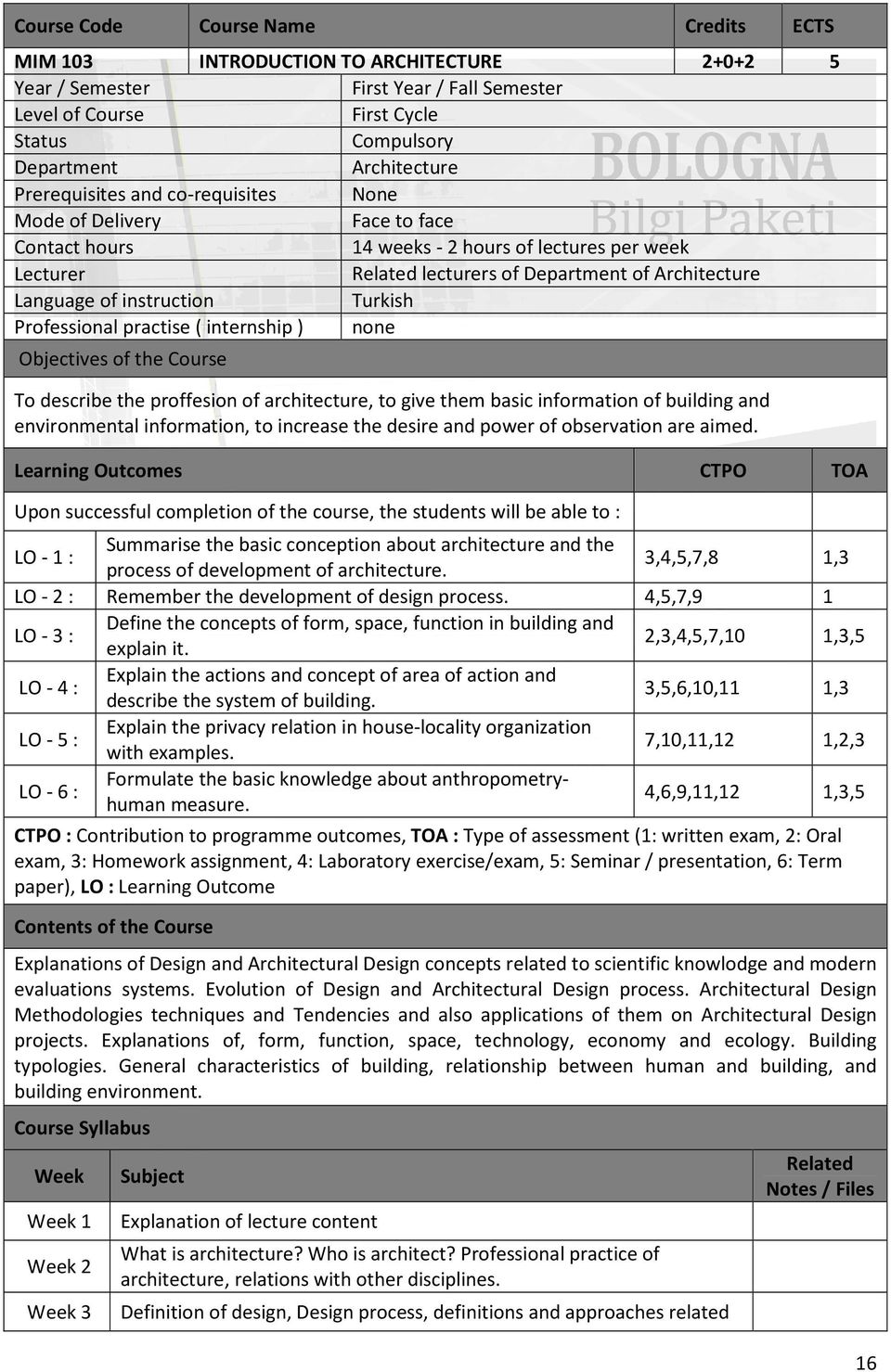
18 Course Code Course Name Credits ECTS MIM 103 INTRODUCTION TO ARCHITECTURE Year / Semester First Year / Fall Semester Level of Course First Cycle Status Compulsory Department Architecture Prerequisites and co-requisites None Mode of Delivery Face to face Contact hours 14 weeks - hours of lectures per week Lecturer Related lecturers of Department of Architecture Language of instruction Turkish Professional practise ( internship ) none Objectives of the Course To describe the proffesion of architecture, to give them basic information of building and environmental information, to increase the desire and power of observation are aimed. Learning Outcomes CTPO TOA Upon successful completion of the course, the students will be able to : LO - 1 : Summarise the basic conception about architecture and the process of development of architecture. 3,4,5,7,8 1,3 LO - : Remember the development of design process. 4,5,7,9 1 LO - 3 : Define the concepts of form, space, function in building and explain it.,3,4,5,7,10 1,3,5 LO - 4 : Explain the actions and concept of area of action and describe the system of building. 3,5,6,10,11 1,3 LO - 5 : Explain the privacy relation in house-locality organization with examples. 7,10,11,1 1,,3 LO - 6 : Formulate the basic knowledge about anthropometryhuman measure. 4,6,9,11,1 1,3,5 CTPO : Contribution to programme outcomes, TOA : Type of assessment (1: written exam, : Oral exam, 3: Homework assignment, 4: Laboratory exercise/exam, 5: Seminar / presentation, 6: Term paper), LO : Learning Outcome Contents of the Course Explanations of Design and Architectural Design concepts related to scientific knowlodge and modern evaluations systems. Evolution of Design and Architectural Design process. Architectural Design Methodologies techniques and Tendencies and also applications of them on Architectural Design projects. Explanations of, form, function, space, technology, economy and ecology. Building typologies. General characteristics of building, relationship between human and building, and building environment. Course Syllabus Week Subject Week 1 Explanation of lecture content Week What is architecture? Who is architect? Professional practice of architecture, relations with other disciplines. Week 3 Definition of design, Design process, definitions and approaches related Related Notes / Files 16
19 Week 4 Week 5 Week 6 to the design process. Architectural design approaches, Thinking styles, Different design techniques. The form phenomenon, Form elements, Creating forms formats. Famous architects practices examples. The space phenomenon, different definitions, creates space factors, space types in Architecture. Analyzing examples. Week 7 Function concept, Forming functional diagram, Function in house Week 8 Activity-Space concepts, Development levels of building system, Different functional buildings and development levels Week 9 Mid-term exam Week 10 Week 11 Week 1 Activity-Space concepts, Development levels of building system, Different functional buildings and development levels Function in house, Examples of function diagrams, Parts of house, Privacy concept. Relations between Man- measure- form, Man's dynamic and static measures. Week 13 Second exam Week 14 Building components, interior-exterior relationship, Analyzing examples. Textbook / Material Kuban, D.,1984,Mimarlık Kavramları;Mimarlığın Kuramsal sözlüğüne giriş,çevre yayınları, [1] İstanbul. Recommended Reading [1] Bolak, O. 1967; Bina Bilgisi Temel Bilgiler, İTÜ Mimarlık Fak. Yayını,İstanbul [] Mutlu, A.,1973,Bina Bilgisi, Dizer Kanca Matbaası, İstanbul. [3] Arcan, E. F., Evci, F., 199, Mimari Tasarıma Yaklaşım, İki K yayınevi,istanbul. [4] Krier, R.,1988, Architectural Composition, Academy Editions, London. Usta, A.,1994, Anadolu Türk Mimarlığında Form Analizi, Basılmamış Doktora tezi, KTÜ Fen [5] Bilimleri Enstitüsü, Trabzon. Usta, G.,1994, Anadolu Osmanlı Mimarisinde Mekan Analizi- Han ve Kervansaray Yapılarında [6] Uygulama,, Basılmamış Doktora tezi, KTÜ Fen Bilimleri Enstitüsü, Trabzon. Student Work Load and its Distribution Type of work Duration No of weeks / Hours in total per (hours pw) Number of activity term Attending lectures Self study Individual study for mid-term examination Mid-term examination 1 4 Practice 4 Homework Individual study for final examination Final examination Total work load 19 17

20 Ders Kodu Ders Adı Kredi ECTS MIM 105 MİMARİ PROJE - I Yıl / Yarıyıl 1. Yıl / Güz Dönemi Ders Düzeyi Lisans Yazılım Şekli Zorunlu Bölümü Mimarlık Bölümü Ön Koşul Yok Öğretim Sistemi Yüz yüze Dersin süresi 14 hafta - haftada 3 saat teorik ve 4 saat uygulama Öğretim Üyesi Mimarlık ilgili öğretim elemanları Öğretim Dili Türkçe Staj Yok Dersin Amacı Mimarlığın mekansallığının ve temel paradigmalarının kavramlar aracılığıyla ve deneme-yanılma yoluyla öğrencilere aktarılması, öğrencilerin mekan ve kütleyi yarar beklentisi içinde tecrübe etmelerinin sağlanması hedeflenmektedir. Öğrenme Çıktıları BÖÇK ÖY Bu dersi başarı ile tamamlayan öğrenciler: ÖÇ - 1: ÖÇ - : ÖÇ - 3: ÖÇ - 4: Herhangi bir tasarım problemi karşısında görsel ve mekansal kavramlar aracılığıyla düşünme becerisini geliştirebilecekler. Zihinsel yaratıcılık konusunda deneyimlerini yorumlayabilecek ve aktarabilecekler. Tasarlama, anlatma ve iletme becerilerini bir tasarım problemi bağlamında sınayabilecekler ve geliştirebilecekler. Bir tasarım problemine ait basit strüktürel ve/veya elementer çözümler üretebilecekler.,3,8 3,6 1,,3,8 3,6,3,8 3,6 1,,3,8,9 3,6 BÖÇK: Bölüm öğrenme çıktılarına katkı, ÖY: Ölçme ve değerlendirme yöntemi (1: Yazılı Sınav, : Sözlü Sınav, 3: Ev Ödevi, 4: Laboratuvar Çalışması/Sınavı, 5: Seminer / Sunum, 6: Dönem Ödevi), ÖÇ: Öğrenme Çıktısı Dersin İçeriği Görsel-mekânsal kavramlarla düşünme alışkanlığı edindirme amacı taşıyan ilk projede, öğrencilerin bir yandan zihinsel yaratıcılık konusundaki deneyimlerini arttırmak diğer yandan tasarlama, anlatma ve iletme becerilerini geliştirmek uygun pedagojik araçlarla sağlanır. Problemlerin bu erek doğrultusunda verilmesi, kavramların aktarılmasında yaratıcı yolların denenmesi ve öğrencide zihinsel olguları el ile düşünme alışkanlığının pekiştirilmesi esastır. Bu projede basit strüktürel ve elementer çözümler hedeflenir. Haftalık Detaylı Ders İçeriği Hafta Detaylı İçerik Hafta 1 Konunun Duyurulması ve etraflıca açıklanması Hafta Konu hakkında bilgi toplama ve paylaşma; programın elde edilmesi Hafta 3 Yer görme; yerin anlatımı ve analizlerinin yapılması Hafta 4 İlk eskizler, fikirler ve kavramlar üzerinde tartışmalar Önerilen Kaynak 18
21 Hafta 5 Alternatif çözümlerin üretilmesi Hafta 6 Çeştli ölçütler çerçevesinde bir alternatifin geliştirilmek üzere seçilmesi Hafta 7 Geliştirme aşaması Hafta 8 Geliştirme aşaması Hafta 9 Yapısal sorunların aşılması Hafta 10 Tesisat (su, elektrik, ısıtma, havalandırma, pis su açısından ve güvenlik açısından projenin gözden geçirilmesi Hafta 11 Projenin kesitlerinin ve cephelerinin geliştirilmesi Hafta 1 Projenin ölçeğini değiştirilmesi ve tüm işlevsel,yapısal ve diğer sorunların daha büyük ölçekte gözden geçirilmesi Hafta 13 Malzeme, renk ve doku tashileri Hafta 14 Sunum yöntem ve teknikleri üzerinde bilgilendirme ve tartışmalar Ders Kitabı / Malzemesi [1] Aksoy, E., Mimarlıkta Tasarım Bilgisi, Habiboğlu Yay., Ankara, İlave Kaynak Öğrenci İş Yükü İşlem adı Haftalık süre (saat) Hafta sayısı Dönem toplamı Derse katılım Proje hazırlama Proje sunma Toplam iş yükü 55 19
22 Course Code Course Name Credits ECTS MIM105 ARCHITECTURAL DESIGN I Year / Semester First Year / Fall Semester Level of Course First Cycle Status Compulsory Department Architecture Prerequisites and co-requisites None Mode of Delivery Face to face Contact hours 14 weeks - 3 hours of lectures and 4 hours of practicals per week Lecturer Related lecturers of Department of Architecture Language of instruction Turkish Professional practise ( internship ) none Objectives of the Course The main objective of this course is to enable the students to make spatial organizations with due concern for structural and functional requirements, environmental conditions (orientation, topograhy, neighbouring built, natural elements, etc) and formal qualities. Learning Outcomes CTPO TOA Upon successful completion of the course, the students will be able to : LO - 1 : LO - : LO - 3 : develop the habit of architectural thinking by visio-spatial concepts for a design problem. interpret and express their experiences about their creative thoughts. test and develop their abilities of designing, expressing and communicating in the context of a simple design problem.,3,8 3,6 1,,3,8 3,6,3,8 3,6 LO - 4 : propose simple structural and/or elementary solutions to certain uses for a design problem. 1,,3,8,9 3,6 CTPO : Contribution to programme outcomes, TOA : Type of assessment (1: written exam, : Oral exam, 3: Homework assignment, 4: Laboratory exercise/exam, 5: Seminar / presentation, 6: Term paper), LO : Learning Outcome Contents of the Course In the first design studio that aims at establishing a habit of architectural thinking by visio-spatial concepts, experimentation with creative thoughts on the one hand and improvement of skills in designing, expressing and communicating architectural intentions on the other, are obtained by appropriate pedagogical tools. Design problems are so defined as to lead students to experiment with creative concepts and ways to arrive at solutions, thereby building a habit of thinking and contemplating with hands. Simple structural and elementary solutions to certain uses are intended in this studio. Course Syllabus Week Subject Week 1 Disclosing the term project theme and elaborations on it. Week Information gathering and sharing with the orther participants; Related Notes / Files 0
23 determining the program Week 3 Site seeing; modeling the site and submission of analysis Week 4 First sketches; expounding on ideas and concepts Week 5 Producing alternative solutions Week 6 Choise among the alternatives based on the criteia suggested by the dialogue between the master and the students. Week 7 Developments phase Week 8 Developments phase Week 9 Solution of structural problems Week 10 Revision of the project due to the water & electric distribution, heating, air conditioning, the sewage system and security measures. Week 11 Development of sections and elevations. Week 1 Changing the scale of project to have a closer look at functional, structural and other problems. Week 13 Materials, colors and texture revisions. Week 14 Information on presentation techniques and methods. Textbook / Material [1] Aksoy, E., Mimarlıkta Tasarım Bilgisi, Habiboğlu Yay., Ankara, Recommended Reading Student Work Load and its Distribution Type of work Duration No of weeks / (hours pw) Number of activity Hours in total per term Attending lectures Project preparation Project presentation Total work load 55 1
24 Birinci Sınıf Bahar Dönemi Ders Kodu Ders Adı T P K ECTS MIM10 MIM106 MIM108 MIM110 YDI 10 ENF 101 Temel Tasarım II Mimari Proje II Bina Bilgisi Yapı Bilgisi Yabancı Dil II (İngilizce) Temel Bilgisayar Uygulamaları
25 Ders Kodu Ders Adı Kredi ECTS MIM10 TEMEL TASARIM II Yıl / Yarıyıl 1. Yıl /Bahar Dönemi Ders Düzeyi Lisans Yazılım Şekli Zorunlu Bölümü Mimarlık Bölümü Ön Koşul MIM 101 Temel Tasarım 1 Öğretim Sistemi Yüz yüze Dersin süresi 14 hafta - haftada saat teorik, 4 saat pratik Öğretim Üyesi Mimarlık Bölümü ilgili öğretim elemanları Öğretim Dili Türkçe Staj Yok Dersin Amacı Temel Tasarım 1 dersinin devamlılığını sağlayan bu dersin amacı, öğrencinin üç boyutlu düşünme ve tasarım problemi çözme becerilerini kazanmasını sağlamaktır. Mimari tasarım sürecinde gerekli biçimsel kompozisyon ilkelerinin üç boyutlu kullanımı için gerekli kuramsal bilgi ve becerilerin aktarılması dersin hedeflerindendir. Öğrenme Çıktıları BÖÇK ÖY Bu dersi başarı ile tamamlayan öğrenciler: ÖÇ - 1: Tasarım süreç yaklaşımlarını tanımak ve tanımlayabilmek 1,,3,8 1,3,5 ÖÇ - : Tasarım prensiplerini ve kavramlarını öğrenmek ve uygulayabilmek 1,,3,7,8 1,3,5 ÖÇ - 3: Yaratıcı problem çözebilme becerisini kazanmak,3,5,7 1,3,5 ÖÇ - 4: Üç boyutlu tasarım ilkelerini bilmek ve uygulamak 1,,3,7,8 1,3,5 ÖÇ - 5: Çok boyutlu / yönlü düşünebilmek ve açık fikirli ve empatik yaklaşmak 1,,3,5,6,8 1,3,5 ÖÇ - 6: Soyut ve somut kavramları iki ve üç boyutlu kompozisyonlara dönüştürme becerisini kazanabilecekler. 1,,3,5,6,8 1,3,5 BÖÇK: Bölüm öğrenme çıktılarına katkı, ÖY: Ölçme ve değerlendirme yöntemi (1: Yazılı Sınav, : Sözlü Sınav, 3: Ev Ödevi, 4: Laboratuvar Çalışması/Sınavı, 5: Seminer / Sunum, 6: Dönem Ödevi), ÖÇ: Öğrenme Çıktısı Dersin İçeriği Temel Tasarım 1 dersinin devamında Mimar kimdir? Ne iş yapar? Mimarlık eğitimi ve Temel Tasarım Dersleri ilişkisinin anlatılması ve tartışılması. Haftalık Detaylı Ders İçeriği Hafta Hafta 1 Hafta Hafta 3 Detaylı İçerik Dersin içeriğinin, hedeflerinin, kullanılacak yöntemlerin, ödev ve uygulamaların aktarılması, Temel Tasarım 1 in değerlendirilmesi Leonardo Vinci, Tasarım Süreci Birbirini Takip Eden Düzlemler / kontrast-zıtlık (3 Boyutlu) (Farklı malzemelerden oluşan düzlemlerle kontrast bir tasarım oluşturmak) uygulama Önerilen Kaynak 3
26 Hafta 4 Hafta 5 Hafta 6 Hafta 7 Hafta 8 Hafta 9 Hafta 10 Hafta 11 Hafta 1 Hafta 13 Hafta 14 Ders Kitabı / Malzemesi İlave Kaynak Denge-Asimetrik Denge / Dengede Çerçevede Denge (1 M3 bir hacimde dengede bir çerçeve içinde denge oluşturmak) uygulama Dinamik Geçirgen Geçirgenlik ve Mimarlık uygulama Hareket eden Işık ve Değişen Mekân uygulama Renk ve Mekân- Siyah ve Beyaz ve ara tonları kullanarak mekan yaratmak uygulama Zaman ve Mekân-Farklı bir zaman dilimi ve mekan uygulama Ara Sınav Proje grup çalışması Kuş Evi Tasarımı (Beyin fırtınası) Proje Kuş Evi Tasarımı Proje Kuş Evi Tasarımı Proje Kuş Evi Tasarımı Proje Kuş Evi Tasarımı [1] Arnheim R Görsel Algıda Zeka, Görsel Düşünme, Metis Y., İst. [] Gelb M. J Leonardo Da Vinci gibi Düşünmek Beyaz Yayınları. [3] Buzan T Aklın Gücü, Epsilon Yayıncılık, İstanbul [4] Güvenç B Mimarlık: Zaman, Mekan ve Değişim. Şentürer A, Ural Ş, Berber Ö, Sönmez F (ed), Zaman-Mekan, YEM, İstanbul [5] Kahvecioğlu H Mekanın Üreticisi veya Tüketicisi Olarak Zaman, Şentürer A, Ural Ş, Berber Ö, Sönmez F (ed), Zaman-Mekan, YEM, İstanbul [6] Köksal A Sinema Mimarlık İlişkisinde Mekan ve Boyut 1, Zorunlu Çoğulluk, ATT Yayınları, İstanbul [7] Lauer D. A., Pentak S Design Basics. Wadsworth Publishing. [8] Öğrenci İş Yükü Lidwell W., Holden K., Butler J. 010 Universal Principles of Design. Rockport Publishers. İşlem adı Haftalık süre (saat) Hafta sayısı Dönem toplamı Derse Katılım Bireysel Çalışma Beyin Fırtınası 1 Ara Sınav için Bireysel Çalışma Ara sınav Uygulama/Pratik Ev Ödevi FinalSınavı için Bireysel Çalışma Final Sınavı Toplam iş yükü 04 4
27 Course Code Course Name Credits ECTS MIM10 BASIC DESIGN II Year / Semester First Year/ Spring Semester Level of Course First Cycle Status Compulsory Department Architecture Prerequisites and co-requisites MIM 101 Basic Design Mode of Delivery Face to face Contact hours 14 weeks - hours of lectures and 4 hour of practical s per week Lecturer Related lecturers of Department of Architecture Language of instruction Turkish Professional practise ( internship ) none Objectives of the Course The objective of the course is for the students to attain 3 dimensional thinking and design problem solving skills. Using these skills in the process of architectural design is also fundamental for this course. Learning Outcomes CTPO TOA Upon successful completion of the course, the students will be able to : LO - 1 : Knowing the design process and identifying the methods of design ,3,5 Learning the design principles and concepts and using them in the LO - : ,3,5 architectural design process. LO - 3 : Gaining the ability of creative problem solving ,3,5 LO - 4 : LO - 5: LO - 6 : Understanding the principles of 3 dimensional design and using them in the architectural design process. Multi-dimensional thinking, open minded and epithetical approach. Gain ability to turn the abstract and concrete concepts into two and/ or three dimensional compositions ,3, ,3, ,3,5 CTPO : Contribution to programme outcomes, TOA : Type of assessment (1: written exam, : Oral exam, 3: Homework assignment, 4: Laboratory exercise/exam, 5: Seminar / presentation, 6: Term paper), LO : Learning Outcome Contents of the Course In the continuation of Basic Design I course, explanation and discussion of relationship between who is the architect? What does he do? Architecture education and basic design courses. Course Syllabus Week Subject Course content, concept, methods and materials. Evaluation of the first Week 1 semester. Week Leonardo Da vinci, Design Process Week 3 Balance / asymmetrical Balance - practice Week 4 Dynamic - transparent and architecture- practice Related Notes / Files 5
28 Week 5 Dynamic-typography - practice Week 6 Space and Light- practice Week 7 A monochrome Space- practice Week 8 A different time and a different scenario - practice Week 9 Mid term exam Week 10 Project- group Working Bird house Design Week 11 Project- group Working Bird house Design Week 1 Project- group Working Bird house Design Week 13 Project- group Working Bird house Design Week 14 Project- group Working Bird house Design Textbook / Material Recommended Reading [1] Arnheim R Görsel Algıda Zeka, Görsel Düşünme, Metis Y., İst. [] Gelb M. J Leonardo Da Vinci gibi Düşünmek Beyaz Yayınları. [3] Buzan T Aklın Gücü, Epsilon Yayıncılık, İstanbul [4] Güvenç B Mimarlık: Zaman, Mekan ve Değişim. Şentürer A, Ural Ş, Berber Ö, Sönmez F (ed), Zaman-Mekan, YEM, İstanbul [5] Kahvecioğlu H Mekanın Üreticisi veya Tüketicisi Olarak Zaman, Şentürer A, Ural Ş, Berber Ö, Sönmez F (ed), Zaman-Mekan, YEM, İstanbul [6] Köksal A Sinema Mimarlık İlişkisinde Mekan ve Boyut 1, Zorunlu Çoğulluk, ATT Yayınları, İstanbul [7] Lauer D. A., Pentak S Design Basics. Wadsworth Publishing. [8] Lidwell W., Holden K., Butler J. 010 Universal Principles of Design. Rockport Publishers. Student Work Load and its Distribution Type of work Duration (hours pw) No of weeks / Number of activity Hours in total per term Attending Lectures Self- study Brain Storming 1 Individual study for mid-term examination Mid-term examination Practice Homework Individual study for final examination Final examination Total work load 04 6
29 Ders Kodu Ders Adı Kredi ECTS MIM 106 MİMARİ PROJE - II Yıl / Yarıyıl 1. Yıl / Bahar Dönemi Ders Düzeyi Lisans Yazılım Şekli Zorunlu Bölümü Mimarlık Bölümü Ön Koşul MIM105 - Mimari Anlatım Ve Proje - I dersini geçmiş olmalı Öğretim Sistemi Yüz yüze Dersin süresi 14 hafta - haftada saat teorik ve 6 saat uygulama Öğretim Üyesi Mimarlık ilgili öğretim elemanları Öğretim Dili Türkçe Staj Yok Dersin Amacı Mimarlığın işlevsel, anlamsal ve yararsal boyutları ile mimarlık öğrencilerini tanıştırmak. Öğrenme Çıktıları BÖÇK ÖY Bu dersi başarı ile tamamlayan öğrenciler: ÖÇ - 1: temel mimari terminolojiyi; form, yapım ve fonksiyon kavramlarını tanımlayabilecekler.,3,8,9 5,6 ÖÇ - : tasarlama ve ifade etme aşamalarını deneyimleyecekler. 1,,3,8 5,6 ÖÇ - 3: ÖÇ - 4: mimari bilgilerini kullanarak bir mimari proje geliştirme sürecini değerlendirecekler. eskiz yapma, taslak oluşturma, çizim ve model yapma gibi becerilerini geliştirecekler. 1,,3,8 5,6 1,,3 5,6 BÖÇK: Bölüm öğrenme çıktılarına katkı, ÖY: Ölçme ve değerlendirme yöntemi (1: Yazılı Sınav, : Sözlü Sınav, 3: Ev Ödevi, 4: Laboratuvar Çalışması/Sınavı, 5: Seminer / Sunum, 6: Dönem Ödevi), ÖÇ: Öğrenme Çıktısı Dersin İçeriği Yapı, mimari yapı, sistem, yapı malzemesi, bileşeni, elemanı, birimi, teknik-teknoloji kavramları. Yapı oluşturma. Yapıların gereçlerine, konstrüksiyonlarına ve strüktürlerine göre sınıflandırılması. Yapı ögelerinin tanıtılması. Yapı-zemin ilişkisi. Şantiye tekniği. Kazı sırasında yapı çukurunun ve yapının desteklenmesi. Drenaj ve yapı çukurunda su sorunu, kullanıcı-çevre-yapı sistemi etkileşimi. Yapı sağlığı. Geleceğin yapıları. Haftalık Detaylı Ders İçeriği Hafta Detaylı İçerik Hafta 1 Konunun Duyurulması ve etraflıca açıklanması Hafta Konu hakkında bilgi toplama ve paylaşma; programın elde edilmesi Hafta 3 Yer görme; yerin anlatımı ve analizlerinin yapılması Hafta 4 İlk eskizler, fikirler ve kavramlar üzerinde tartışmalar Hafta 5 Alternatif çözümlerin üretilmesi Hafta 6 Çeşitli ölçütler çerçevesinde bir alternatifin geliştirilmek üzere seçilmesi Önerilen Kaynak 7
30 Hafta 7 Geliştirme aşaması Hafta 8 Geliştirme aşaması Hafta 9 Yapısal sorunların aşılması Hafta 10 Tesisat (su, elektrik, ısıtma, havalandırma, pis su açısından ve güvenlik açısından projenin gözden geçirilmesi Hafta 11 Projenin kesitlerinin ve cephelerinin geliştirilmesi Hafta 1 Projenin ölçeğini değiştirilmesi ve tüm işlevsel, yapısal ve diğer sorunların daha büyük ölçekte gözden geçirilmesi Hafta 13 Malzeme, renk ve doku tashileri Hafta 14 Sunum yöntem ve teknikleri üzerinde bilgilendirme ve tartışmalar Ders Kitabı / Malzemesi [1] Aksoy, Ö., Uyum Sürecinin Mimarlık Süreci İçinde Örneklenmesi, KTÜ yay, Trabzon, İlave Kaynak Öğrenci İş Yükü İşlem adı Haftalık süre (saat) Hafta sayısı Dönem toplamı Derse Katılım Proje hazırlama Proje sunum Toplam iş yükü 55 8
31 Course Code Course Name Credits ECTS MIM106 ARCHITECTURAL DESIGN - II Year / Semester First Year / Spring Semester Level of Course First Cycle Status Compulsory Department Architecture Prerequisites and co-requisites MIM105-Architectural Design I must have been passed Mode of Delivery Face to face Contact hours 14 weeks - hours of lectures and 6 hours of practicals per week Lecturer Related lecturers of Department of Architecture Language of instruction Turkish Professional practise ( internship ) none Objectives of the Course To introduce students to the problems of function, use, formal aesthetics and meaning is the goal of this workshop. Learning Outcomes CTPO TOA Upon successful completion of the course, the students will be able to : LO - 1 : define the basic architectural terminology about form, construction and function.,3,8,9 5,6 LO - : experience thinking, designing and expression. 1,,3,8 5,6 LO - 3 : LO - 4 : evaluate a developing process of architectural project using their architectural knowledge. develop their ability of making draft, sketch, drawing and model. 1,,3,8 5,6 1,,3 5,6 CTPO : Contribution to programme outcomes, TOA : Type of assessment (1: written exam, : Oral exam, 3: Homework assignment, 4: Laboratory exercise/exam, 5: Seminar / presentation, 6: Term paper), LO : Learning Outcome Contents of the Course Importance of ergonomics, anthropometrics and proxemics and all sorts of socially and culturally valuable stances and sensations are rendered to students through reviews. Social interaction modes and models, proper spatial dimensions are expounded; concepts such as climatic and physical comfort, significance of physical and psychological security are underlined through problems where these issues are most sought. In this workshop function bubbles, graphs of accessibility, work flow diagrams and other tools of syntactic and semantic analyses are passed on to students Course Syllabus Week Subject Week 1 Disclosing the term project theme and elaborations on it. Week Information gathering and sharing with the orther participants; determining the program Week 3 Site seeing; modeling the site and submission of analysis Related Notes / Files 9
32 Week 4 First sketches; expounding on ideas and concepts Week 5 Producing alternative solutions Week 6 Choise among the alternatives based on the criteia suggested by the dialogue between the master and the students. Week 7 Developments phase Week 8 Developments phase Week 9 Solution of structural problems Week 10 Revision of the project due to the water & electric distribution, heating, air conditioning, the sewage system and security measures. Week 11 Development of sections and elevations. Week 1 Changing the scale of project to have a closer look at functional, structural and other problems. Week 13 Materials, colors and texture revisions. Week 14 Information on presentation techniques and methods. Textbook / Material [1] Aksoy, Ö., Uyum Sürecinin Mimarlık Süreci İçinde Örneklenmesi, KTÜ yay, Trabzon, Recommended Reading Student Work Load and its Distribution Type of work Duration (hours pw) No of weeks / Number of activity Hours in total per term Attending Lectures Project Preparation Project Presentation Total work load 55 30
33 Ders Kodu Ders Adı Kredi ECTS MIM108 BİNA BİLGİSİ Yıl / Yarıyıl 1. Yıl / Bahar Dönemi Ders Düzeyi Lisans Yazılım Şekli Zorunlu Bölümü Mimarlık Bölümü Ön Koşul Yok Öğretim Sistemi Yüz yüze Dersin süresi 14 hafta - haftada saat teorik Öğretim Üyesi Mimarlık ilgili öğretim elemanları Öğretim Dili Türkçe Staj Yok Dersin Amacı Öğrencinin meslek, bina ve çevresi konusunda temel bilgilerle donatılması, gözlem gücünün ve isteğinin yerleştirilmesi. Öğrenme Çıktıları BÖÇK ÖY Bu dersi başarı ile tamamlayan öğrenciler: ÖÇ - 1: mimarlıkla ilgili temel kavramları ve mimarlık gelişim sürecini 1,,7,8 hatırlayabilecekler, (Mimarlık, mimar, tasarım, bina,.vb) 1 ÖÇ - : tasarım sürecinin gelişimini hatırlayabilecekler. 1,,7,8,14 1 ÖÇ - 3: form, mekan, işlev kavramları bina özelinde tanımlayabilecek 1,,7,8,14 ve ifade edebilecekler. 1, ÖÇ - 4: eylem, eylem alanı kavramlarını açıklayabilecek ve bina sistemi açılım düzeylerini ifade edebilecekler.,8 1 ÖÇ - 5: konut mekan organizasyonunda mahremiyet ilişkisini örnekleyerek ifade edebilecekler. 6,7,8,14 1, ÖÇ - 6: antropometri-insan ölçümü ile ilgili temel bilgileri hatırlayabilecekler. 6,8 1, BÖÇK: Bölüm öğrenme çıktılarına katkı, ÖY: Ölçme ve değerlendirme yöntemi (1: Yazılı Sınav, : Sözlü Sınav, 3: Ev Ödevi, 4: Laboratuvar Çalışması/Sınavı, 5: Seminer / Sunum, 6: Dönem Ödevi), ÖÇ: Öğrenme Çıktısı Dersin İçeriği Binaya ilişkin temel bileşenler, kavramlar ve süreçler. Mimari bütün kapsamında binayı oluşturan elemanlar. İşlev, biçim, teknoloji, ekonomi, ekoloji boyutları ve açılımları. Bina tipolojileri. Tüm bina özellikleri, bina-çevre ilişkileri, binanın elemanlar düzeyinde irdelenmesi. Haftalık Detaylı Ders İçeriği Hafta Detaylı İçerik Hafta 1 Derse giriş, dersin içeriğinin açıklanması Hafta Mimarlık nedir? Mimar kimdir? ilgi alanları,tarihsel süreçte mimarlığın gelişimi. Hafta 3 Mimarlıkta planlama olgusu, mimarlıkta tasarlama olgusu. Hafta 4 Bina İhtiyaç Programı. Önerilen Kaynak 31
34 Hafta 5 Bina Ögeleri. Yapı örnekleri üzerinde irdeleme. Hafta 6 Ekoloji- Çevre- Mimarlık ilişkisi Hafta 7 Hafta 8 Mimarlıkta Form Kavramı, Form elemanları, Form Oluşturma biçimleri. Örnek yapılar üzerinde irdeleme. Mimarlıkta Mekan kavramı, Tanımlamalar, Mekanı oluşturan etmenler, Mekan Türleri, Farklı mimarların mekan anlayışları. Hafta 9 Yarıyıl içi değerlendirme Hafta 10 Hafta 11 Hafta 1 Hafta 13 Fonksiyon- işlev kavramı, İşlevsel organizasyon, konutta işlev dağılımı, işlev şeması oluşturma, konutun bölümleri. Eylem- eylem alanı kavramları, Bina sistemi açılım düzeyleri, Farklı işlevsel yapılar ve açılım düzeyleri. İnsan- ölçü- biçim ilişkileri, antropometri, insanın dinamik ve statik ölçüleri. Çevre- mekan- kamusal mekan kavramları, ilişkisi, örnekler üzerinde irdeleme. Hafta 14 Ünlü mimarların mimarlık anlayışlarının görsel sunumlarla irdelenmesi. Ders Kitabı / Malzemesi [1] Bolak, O. 1967; Bina Bilgisi Temel Bilgiler, İTÜ Mimarlık Fak. Yayını,İstanbul. [] Kuban, D.,1984, Mimarlık Kavramları; Mimarlığın Kuramsal Sözlüğüne giriş, Çevre yayınları, İstanbul. [3] Mutlu, A.,1973,Bina Bilgisi, Dizer Kanca Matbaası, İstanbul. İlave Kaynak [1] Arcan, E. F., Evci, F., 199, Mimari Tasarıma Yaklaşım, İki K yayınevi,istanbul. [] Krier, R.,1988, Architectural Composition, Academy Editions, London. [3] Usta, A.,1994, Anadolu Türk Mimarlığında Form Analizi, Basılmamış Doktora tezi, KTÜ Fen Bilimleri Enstitüsü, Trabzon. [4] Usta, G.,1994, Anadolu Osmanlı Mimarisinde Mekan Analizi- Han ve Kervansaray Yapılarında Uygulama, Basılmamış Doktora tezi, KTÜ Fen Bilimleri Enstitüsü, Trabzon. Öğrenci İş Yükü İşlem adı Haftalık süre (saat) Hafta sayısı Dönem toplamı Derse Katılım 14 8 Bireysel Çalışma Ara Sınav için Bireysel Çalışma Ara sınav Final Sınavı için Bireysel Çalışma Final Sınavı Toplam iş yükü 100 3
35 Course Code Course Name Credits ECTS MIM108 BUILDING TECHNOLOGY Year / Semester First Year / Spring Semester Level of Course First Cycle Status Compulsory Department Architecture Prerequisites and co-requisites None Mode of Delivery Face to face Contact hours 14 weeks - hours of lectures per week Lecturer Related lecturers of Department of Architecture Language of instruction Turkish Professional practise ( internship ) none Objectives of the Course To furnish the students with the information about professional building and environment. To enable students to acquire observation and enthusiasm. Learning Outcomes CTPO TOA Upon successful completion of the course, the students will be able to : LO - 1 : summarise the basic conception about architecture and the process of development of architecture 1,,7,8 1 LO - : remember the development of design process 1,,7,8,14 1 LO - 3 : define the concepts of form, space, function in building and explain them 1,,7,8,14 1, LO 4: explain the actions and concept of area of action and describe the system of building,8 1 LO - 5 : relate the privacy relation in house-locality organization with 6,7,8,14 examples 1, LO - 6 : remember the basic knowledge about anthropometryhuman measure. 6,8 1, CTPO : Contribution to programme outcomes, TOA : Type of assessment (1: written exam, : Oral exam, 3: Homework assignment, 4: Laboratory exercise/exam, 5: Seminar / presentation, 6: Term paper), LO : Learning Outcome Contents of the Course Basic elements, concepts and processes of building. Components of elements forming the building in architecture. Dimensions of Function, Form, Technology, Economy and Ecology. Building Typologies General characteristics of buildings. Relationships of Human/Building, Building/Environment. Course Syllabus Week Subject Week 1 Introduction and explanation of lecture contents Week Week 3 What is architecture? Who is architect? Interests of architecture and architect, evolution of architecture in the historical processes. Planning phenomenon in architecture, Design phenomenon in architecture. Week 4 Building requirement program. Related Notes / Files 33
36 Week 5 Building components. Analyzing building examples. Week 6 Relations between ecology-environment-architecture. Week 7 Week 8 Form concept in architecture, Form elements, Form creating methods. Analyzing building examples. Space concept in architecture, Definitions, Factors that create space, Space Types, Space styles of different architects. Week 9 Mid-term exam Week 10 Week 11 Week 1 Week 13 Function concept, Functional organization, Function in house, Forming functional diagram, divisions of house. Activity-Space concepts, Development levels of building system, Different functional buildings and development levels Relations between Man- measure- form, anthropometry, Man's dynamic and static measures. Environment- space- social space concepts and their relations, Analyzing examples. Week 14 Analyzing architectural styles of famous architects with presentations. Textbook / Material [1] Bolak, O. 1967; Bina Bilgisi Temel Bilgiler, İTÜ Mimarlık Fak. Yayını,İstanbul. [] Kuban, D.,1984, Mimarlık Kavramları; Mimarlığın Kuramsal Sözlüğüne giriş, Çevre yayınları, İstanbul. Mutlu, A.,1973,Bina Bilgisi, Dizer Kanca Matbaası, İstanbul. [3] Recommended Reading [1] Arcan, E. F., Evci, F., 199, Mimari Tasarıma Yaklaşım, İki K yayınevi,istanbul. [] Krier, R.,1988, Architectural Composition, Academy Editions, London. [3] [4] Usta, A.,1994, Anadolu Türk Mimarlığında Form Analizi, Basılmamış Doktora tezi, KTÜ Fen Bilimleri Enstitüsü, Trabzon. Usta, G.,1994, Anadolu Osmanlı Mimarisinde Mekan Analizi- Han ve Kervansaray Yapılarında Uygulama,, Basılmamış Doktora tezi, KTÜ Fen Bilimleri Enstitüsü, Trabzon. Student Work Load and its Distribution Type of work Duration (hours pw) No of weeks / Number of activity Hours in total per term Attending Lectures 14 8 Self- study Individual study for midterm examination Mid-term examination Individual study for final examination Final examination Total work load
37 Ders Kodu Ders Adı Kredi ECTS MIM 110 YAPI BİLGİSİ Yıl / Yarıyıl 1. Yıl / Bahar Dönemi Ders Düzeyi Lisans Yazılım Şekli Zorunlu Bölümü Mimarlık Bölümü Ön Koşul Yok Öğretim Sistemi Yüz yüze Dersin süresi 14 hafta - haftada saat teorik Öğretim Üyesi Mimarlık ilgili öğretim elemanları Öğretim Dili Türkçe Staj Yok Dersin Amacı Bir mimari yapıyı oluşturan öğeler, yapı, mimari yapı, yapıda taşıyıcı sistem, yapım ve yapım sistemleri, altyapı, yapı-zemin ilişkisi, kullanıcı-çevre-yapı sistemi etkileşimi konularında bilgi sağlama, düzenleme ve bu bilgileri tasarım ve uygulamaya dönüştürme yeteneğinin kazandırılması. Öğrenme Çıktıları BÖÇK ÖY Bu dersi başarı ile tamamlayan öğrenciler: ÖÇ - 1: Bir yapının oluşum aşamalarını özetleyebilecekler. 3 1, ÖÇ - : ÖÇ - 3: Yapıyı oluşturan elemanları tanımlayabilecekler. Yapı bileşenlerini ve elemanlarını tanıyabilecekler. 1,,7,8,9,10,11,1 1,,7,8,9,10,11,1 1, 1, ÖÇ - 4: Yapı zemin ilişkisini planlayabilecekler. 9 1, ÖÇ - 5: Yapıları malzemelerine, sistemlerine ve strüktürlerine göre ayırt edebilecek ve sınıflandırabilecekler. 9,1 1, ÖÇ - 6: Yapı ekoloji ilişkisini değerlendirebilecek ve tartışabilecekler. 7 1, BÖÇK: Bölüm öğrenme çıktılarına katkı, ÖY: Ölçme ve değerlendirme yöntemi (1: Yazılı Sınav, : Sözlü Sınav, 3: Ev Ödevi, 4: Laboratuvar Çalışması/Sınavı, 5: Seminer / Sunum, 6: Dönem Ödevi), ÖÇ: Öğrenme Çıktısı Dersin İçeriği Yapı, mimari yapı, sistem, yapı malzemesi, bileşeni, elemanı, birimi, teknik-teknoloji kavramları. Yapı oluşturma. Yapıların gereçlerine, konstrüksiyonlarına ve strüktürlerine göre sınıflandırılması. Yapı ögelerinin tanıtılması. Yapı-zemin ilişkisi. Şantiye tekniği. Kazı sırasında yapı çukurunun ve yapının desteklenmesi. Drenaj ve yapı çukurunda su sorunu, kullanıcı-çevre-yapı sistemi etkileşimi. Yapı sağlığı. Geleceğin yapıları. Haftalık Detaylı Ders İçeriği Hafta Detaylı İçerik Hafta 1 Dersin amacı, içeriği, kaynaklar Hafta Kavramlar,yapı oluşturma Önerilen Kaynak 35
38 Hafta 3 Yapı ögelerinin tanıtımı Hafta 4 Yapı ögelerinin tanıtımı(uygulama) Hafta 5 Teknik gezi Hafta 6 Yapıların sınıflandırılması Hafta 7 Yapıların sınıflandırılması Hafta 8 Yapıların sınıflandırılması(uygulama) Hafta 9 Yarıyıl içi değerlendirme Hafta 10 Yapı-Zemin ilişkisi Hafta 11 Şantiye Tekniği Hafta 1 Kazı çukuru Hafta 13 Drenaj Hafta 14 Çevre-ekoloji,yapı Ders Kitabı / Malzemesi Özdeniz, M., Erten. E., Pehlevan. A., Yaşar, Y., Sümerkan, M., 1996, Yapı Bilgisi, KTÜ [1] Basımevi, Trabzon İlave Kaynak [1] Türkçü, Ç., 1997, Yapım, Mimarlar Odası İzmir Şubesi, İzmir. [] Kuban, D., Mimarlık Kavramları, İTÜ Matbaası, İstanbul [3] Chudley, R., Greeno, R., 1998, Building Construction Handbook [4] Cziesielski, E., 1993, Lehrbuch der Hochbav Konstruktionen, B. G. Teubner, Stuttgart Öğrenci İş Yükü İşlem adı Haftalık süre (saat) Hafta sayısı Dönem toplamı Derse Katılım 14 8 Bireysel Çalışma 14 8 Alan Gezisi 1 Ara Sınav için Bireysel Çalışma Ara Sınav Uygulama/Pratik 4 Final sonu sınavı için bireysel Çalışma Final Sınavı Toplam iş yükü 78 36
39 Course Code Course Name Credits ECTS MIM110 BUILDING SCIENCE Year / Semester First Year / Spring Semester Level of Course First Cycle Status Compulsory Department Architecture Prerequisites and co-requisites None Mode of Delivery Face to face Contact hours 14 weeks - hours of lectures Lecturer Related lecturers of Department of Architecture Language of instruction Turkish Professional practise ( internship ) none Objectives of the Course To get the ability on components forming an architectural building, building, architectural building, structural system in building, construction and construction systems, substructure, relations between building-ground, to give information about influence user-environment-building system and to gain the ability to change design and practice the information. Learning Outcomes CTPO TOA Upon successful completion of the course, the students will be able to : LO - 1 : summarize the formation stage of a building 3 1, LO - : define the components which compose the building. 1,,7,8,9,10,11,1 1, LO - 3 : recognize the building components. 1,,7,8,9,10,11,1 1, LO - 4 : plan the relation of building-ground 9 1, distinguish and categorize the buildings according to their LO - 5 : 9,1 1, materials, constructions and structures. LO - 6 : evaluate and debate connection of building-ecology. 7 1, CTPO : Contribution to programme outcomes, TOA : Type of assessment (1: written exam, : Oral exam, 3: Homework assignment, 4: Laboratory exercise/exam, 5: Seminar / presentation, 6: Term paper), LO : Learning Outcome Contents of the Course Building, architecture structures, system, building materials, elements, unit, technique and technologic concepts. Constituting Building. Classification of buildings according to material, construction and structure. Definition of building component. Relation between Building-Ground. Site (work site) technique. During digging process supporting building and building hole. Drainage and water problem in building hole. Interaction between user-environment-building system. Building durability. Buildings of the future. Course Syllabus Week Subject Week 1 Objective, contents, textbook and recommended reading of the course Related Notes / Files 37
40 Week Description, building constitution Week 3 Defination of building component Week 4 Defination of building component(application) Week 5 Tecnical study at outside Week 6 Be classed of buildings Week 7 Classification of buildings Week 8 Classification of buildings(application) Week 9 Mid-term exam Week 10 Soil examination Week 11 Building Site Week 1 Excavate work Week 13 Drainage Week 14 Environment-Ecology, Building Textbook / Material Özdeniz, M., Erten. E., Pehlevan. A., Yaşar, Y., Sümerkan, M., 1996, Yapı Bilgisi, KTÜ Basımevi, [1] Trabzon Recommended Reading [1] Türkçü, Ç., 1997, Yapım, Mimarlar Odası İzmir Şubesi, İzmir. [] Kuban, D., Mimarlık Kavramları, İTÜ Matbaası, İstanbul [3] Chudley, R., Greeno, R., 1998, Building Construction Handbook [4] Cziesielski, E., 1993, Lehrbuch der Hochbav Konstruktionen, B. G. Teubner, Stuttgart Student Work Load and its Distribution Type of work Duration (hours pw) No of weeks / Number of activity Hours in total per term Attending Lectures 14 8 Self- study 14 8 Field Trip 1 Individual study for mid-term examination Mid-term examination Practice 4 Individual study for final examination Final examination Total work load 78 38
41 Mimarlık Fakültesi İkinci Sınıf Ders İçerikleri Güz Dönemi 39
42 İkinci Sınıf Güz Dönemi Zorunlu Dersler Ders Kodu Ders Adı T P K ECTS MIM01 MIM03 MIM05 MIM07 MIM09 Mimari Proje III Bilgisayar Destekli Mimari Tasarım I Mimarlık ve Sanat Tarihi I Yapı Elemanları I Statik ve Mukavemet Seçmeli1 Seçmeli
43 Ders Kodu Ders Adı Kredi ECTS MIM01 MİMARİ PROJE - III Yıl / Yarıyıl. Yıl / Güz Dönemi Ders Düzeyi Lisans Yazılım Şekli Zorunlu Bölümü Mimarlık Bölümü Ön Koşul MIM106 - Mimari Proje - II dersini geçmiş olmalı Öğretim Sistemi Yüz yüze Dersin süresi 14 hafta - haftada saat teorik ve 6 saat uygulama Öğretim Üyesi Mimarlık ilgili öğretim elemanları Öğretim Dili Türkçe Staj Yok Dersin Amacı Mekanın yapısallığının öğrenciye aktarılması, yapı ve yapım sistemleri, ekonomik ve sağlam sistem seçimleri konusunda öğrencinin bilinçlendirilmesidir. Öğrenme Çıktıları BÖÇK ÖY Bu dersi başarı ile tamamlayan öğrenciler: ÖÇ - 1: Mimari tasarım kavramı hakkında bilgi sahibi olabilecekler. 1 3,5,6 ÖÇ - : ÖÇ - 3: ÖÇ - 4: ÖÇ - 5: Mekân ve mimari strüktür kavramları hakkında fikir sahibi olabilecekler. Tasarımlarında sağlam ve ekonomik strüktür seçimleri konusunda bilgi sahibi olabilecekler. Mimari tasarımda form ve fonksiyon kavramlarını geliştirmiş olabilecekler. Mimari tasarım, mimari tasarım teknikleri, mimari strüktür, şehircilik ve mimarlık tarihi hakkında bilgi edinmiş olabilecekler. 8,9 3,5,6 9,1 3,5,6 3,6,9,13 3,5,6 3,4,5,8,9 3,5,6 ÖÇ - 6: Mimari çizim ve maket tekniklerini öğrenmiş olabilecekler. 1 3,5,6 BÖÇK: Bölüm öğrenme çıktılarına katkı, ÖY: Ölçme ve değerlendirme yöntemi (1: Yazılı Sınav, : Sözlü Sınav, 3: Ev Ödevi, 4: Laboratuvar Çalışması/Sınavı, 5: Seminer / Sunum, 6: Dönem Ödevi), ÖÇ: Öğrenme Çıktısı Dersin İçeriği Sorunun tanımlanmasına bağlı olarak ortaya çıkan çözüm önerilerinde işlev, kullanışlılık ve anlam boyutlarının yanı sıra bu projede tasarımın yapısallığı etraflıca işlenir. Yapı konusundaki bilgilerinin stüdyo uygulamalarında özümsenmesi desteklenir ve tasarlanan objenin gerçek yaşamda uygulanabilirliği doğrultusunda tüm yapı elemanları gerçekçi bir biçimde sorgulanır. Yapı ayrıntılarının ve malzeme bilgilerinin de arandığı küçük çaplı konularla tasarım gerçekleşir. Haftalık Detaylı Ders İçeriği Hafta Detaylı İçerik Hafta 1 Proje konularının duyurulması; ön bilgiler ve tartışmalar Hafta Konu hakkında bilgi toplama ve paylaşma Önerilen Kaynak 41
44 Hafta 3 Konu hakkında bilgi toplama ve paylaşma; programın elde edilmesi Hafta 4 Yer Görme; yerin anlatımı ve analizlerinin yapılması Hafta 5 İlk eskizler; fikirler ve kavramlar üzerinde tartışmalar Hafta 6 Alternatif çözümlerin üretilmesi Hafta 7 Çeşitli ölçütler çerçevesinde bir alternatifin geliştirilmek üzere seçilmesi Hafta 8 Geliştirme aşaması Hafta 9 Yarıyıl içi çalışması Hafta 10 Yapısal sorunların aşılması Hafta 11 Tesisat (su elektrik, ısıtma, havalandırma, pis su açısından ve güvenlik açısından projenin gözden geçirilmesi Hafta 1 Projenin kesitlerinin ve cephelerinin geliştirilmesi Hafta 13 Hafta 14 Projenin ölçeğini değiştirilmesi ve tüm işlevsel, yapısal ve diğer sorunların daha büyük ölçekte gözden geçirilmesi Malzeme, renk ve doku tashileri Sunum yöntem ve teknikelri üzerinde bilgilendirme ve tartışmalar Ders Kitabı / Malzemesi [1] Kuban, D., Mimarlık Kavramları, Yem Yayın, İstanbul, [] [3] Lang, J., "Theoris of Perception and Formal Design", Designing For Human Behavior, Lang, J., Burnette,C., Molesk, W., Vachon, D. (Der.), Dowden,Hutchinson and Ross, Pa., 1974, pp: Appleyard, D., "Why Buildings are Known: A Predictive Tool for Architects and Planners", Environment and Behavior, Vol. 1, No:, pp: [4] Grassi, G., An Opinion on Architectural Education, A.C.S.A Conference, Hollanda, 199, pp:13-4 İlave Kaynak Öğrenci İş Yükü Haftalık Hafta İşlem adı Dönem toplamı süre (saat) sayısı Derse katılım Proje hazırlama Proje sunma Toplam iş yükü 55 4
45 Course Code Course Name Credits ECTS MIM01 ARCHITECTURAL DESIGN - III Year / Semester Second Year / Fall Semester Level of Course First Cycle Status Compulsory Department Architecture Prerequisites and co-requisites MIM106-Architectural Design - II must have been passed Mode of Delivery Face to face Contact hours 14 weeks - hours of lectures and 6 hours of practicals per week Lecturer Related lecturers of Department of Architecture Language of instruction Turkish Professional practise ( internship ) none Objectives of the Course Primary skills in structural approach and in handling space/structure relations are enhanced. Further attention is given to the choice of solid, stable and economic structural systems and appropriate materials. Learning Outcomes CTPO TOA Upon successful completion of the course, the students will be able to : LO - 1 : gain knowledge on design context 1 3,5,6 LO - : gain knowledge on space context and architectural structure 8,9 3,5,6 LO - 3 : learn stable and economic structural systems 9,1 3,5,6 LO - 4 : develop form and function concepts at the architectural design. 3,6,9,13 3,5,6 LO - 5 : gain knowledge on architectural design and architectural design theories, architectural structure urban design and architecture history. 3,4,5,8,9 3,5,6 LO - 6 : learn model and architectural draw techniques 1 3,5,6 CTPO : Contribution to programme outcomes, TOA : Type of assessment (1: written exam, : Oral exam, 3: Homework assignment, 4: Laboratory exercise/exam, 5: Seminar / presentation, 6: Term paper), LO : Learning Outcome Contents of the Course Student-generated solutions for a building situation are primarily explored in terms of structural characteristics in addition to the functional, symbolical and utilitarian aspects. Structural knowledge gained hitherto is anticipated to corroborate in the studio work. Viability and feasibility of design and its structural elements are examined in a realistic manner. Building details are diligently studied and materials are carefully employed in relatively small projects. Course Syllabus Week Subject Week 1 Acknowledgement of the subject of the term project, pre-design phase knowledge and discussions. Week Information gathering and sharing with the other participants Related Notes / Files 43
46 Week 3 Information gathering and sharing with the other participants; determining the program Week 4 Site seeing; modeling the site and submission of analysis Week 5 First sketches; ewpounding on ideas and concepts Week 6 Producing alternative solutions Week 7 Choise among the alternatives based on the criteria suggested by the dialogue between the master and the students. Week 8 Development phase Week 9 Mid-term exam Week 10 Solution of structural problems Week 11 Revision of the project due to the water & electric distribution, heating, air conditioning,the sewage system and security measures. Week 1 Development of sections and elevations. Week 13 Week 14 Textbook / Material [1 ] [ ] [3 ] [4 ] Changing the scale of project to have a closer look at functional, structural and other problems. Materials, colors and texture revisions. Information on presentation techniques and methods. Kuban, D., Mimarlık Kavramları, Yem Yayın, İstanbul, Lang, J., "Theoris of Perception and Formal Design", Designing For Human Behavior, Lang, J., Burnette,C., Molesk, W., Vachon, D. (Der.), Dowden,Hutchinson and Ross, Pa., 1974, pp: Appleyard, D., "Why Buildings are Known: A Predictive Tool for Architects and Planners", Environment and Behavior, Vol. 1, No:, pp: Grassi, G., An Opinion on Architectural Education, A.C.S.A Conference, Hollanda, 199, pp:13-4 Recommended Reading Student Work Load and its Distribution Type of work No of weeks / Hours in total per Duration (hours pw) Number of activity term Attending lectures Project preparation Project presentation Total work load 55 44
47 Ders Kodu Ders Adı Kredi ECTS MIM03 BİLGİSAYAR DESTEKLİ MİMARİ TASARIM I Yıl / Yarıyıl. Yıl / Güz Dönemi Ders Düzeyi Lisans Yazılım Şekli Zorunlu Bölümü Mimarlık Bölümü Ön Koşul Yok Öğretim Sistemi Yüz yüze Dersin süresi 14 hafta - haftada saat teorik ve saat uygulama Öğretim Üyesi Mimarlık ilgili öğretim elemanları Öğretim Dili Türkçe Staj Yok Dersin Amacı Mimari projelerde Bilgisayar Destekli Tasarım (BDT) programlarını kullanmak ve öğrencilere kullandırtmak. Öğrenme Çıktıları BÖÇK ÖY Bu dersi başarı ile tamamlayan öğrenciler: ÖÇ - 1: bir BDT (Bilgisayar Destekli Tasarım) yazılımı kullanarak nasıl tasarım ve çizim yapacaklarını öğrenecekler 1,,3,8,9,11,13 1,4 ÖÇ - : kendi çizimlerinin çıktısının nasıl alındığını öğrenecekler 1,,3,8,9,11,13 1,4 ÖÇ - 3: tasarımlarının sonucunu ve çizimlerini sunacaklar 1,,3,8,9,11,13 1,4 BÖÇK: Bölüm öğrenme çıktılarına katkı, ÖY: Ölçme ve değerlendirme yöntemi (1: Yazılı Sınav, : Sözlü Sınav, 3: Ev Ödevi, 4: Laboratuvar Çalışması/Sınavı, 5: Seminer / Sunum, 6: Dönem Ödevi), ÖÇ: Öğrenme Çıktısı Dersin İçeriği Dersin konusunu bilgisayar desteği ile mimari proje tasarım ve üretimi teşkil etmektedir. Temel bilgisayar öğrenimi almış olan öğrencilerle, mimarlık dünyasında geçerli olan CAD programlarından birisi (AutoCAD veya ArchiCAD) öğretilmektedir; Eskiz yapma (sketching), tasarım (designing), çizim (drawing) ve sunum (rendering) süreçlerinin bilgisayar ortamına/ortamından aktarımı işlenmektedir. Haftalık Detaylı Ders İçeriği Hafta Hafta 1 Detaylı İçerik dersin tanıtımı. bilgisayar destekli tasarım, bilgisayar destekli üretim tanıtımı. Hafta temel BDT komutlarının tanıtımı. Hafta 3 temel BDT yazılımı komutlarının tanıtımı ve uygulaması. Hafta 4 temel BDT yazılımı komutlarının tanıtımı ve uygulaması. Hafta 5 temel BDT yazılımı komutlarının tanıtımı ve uygulaması. Hafta 6 öğrenilen komutlarla basit plan şemaları çizimi. Hafta 7 öğrenilen komutlarla basit plan şemaları çizimi. Önerilen Kaynak 45
48 Hafta 8 ileri düzey komutların tanıtımı ve uygulaması. Hafta 9 Ara sınav Hafta 10 ileri düzey komutların tanıtımı ve uygulaması. Hafta 11 ileri düzey komutların tanıtımı ve uygulaması. Hafta 1 küçük ölçekli bir mimari proje çizimi. Hafta 13 küçük ölçekli bir mimari proje çizimi. Hafta 14 küçük ölçekli bir mimari proje çizimi. Ders Kitabı / Malzemesi [1] Baykal, G. 009; Autocad 009, Alfa Yayınları, İstanbul İlave Kaynak Öğrenci İş Yükü İşlem adı Haftalık süre (saat) Hafta sayısı Dönem toplamı Derse katılım Bireysel çalışma 10 0 Ara sınav için bireysel çalışma 1 Ara sınav Uygulama 9 18 Final sınavı için bireysel çalışma Final sınavı Toplam iş yükü 11 46
49 Course Code Course Name Credits ECTS MIM03 COMPUTER AIDED ARCHITECTURAL DESIGN I Year / Semester Second Year / Fall Semester Level of Course First Cycle Status Compulsory Department Architecture Prerequisites and co-requisites None Mode of Delivery Face to face Contact hours 14 weeks - hours of lectures and hours of practicals per week Lecturer Related lecturers of Department of Architecture Language of instruction Turkish Professional practise ( internship ) none Objectives of the Course Computers are part of our daily life and architecture is no exception. The main aim of the course is to furnish students with proper computer drafting and design knowledge. Learning Outcomes CTPO TOA Upon successful completion of the course, the students will be able to : LO - 1 : learn how to design and draft by using a CAD software 1,,3,8,9,11,13 1,4 LO - : learn how to get plots of their drawings 1,,3,8,9,11,13 1,4 LO - 3 : present their final design and draftings 1,,3,8,9,11,13 1,4 CTPO : Contribution to programme outcomes, TOA : Type of assessment (1: written exam, : Oral exam, 3: Homework assignment, 4: Laboratory exercise/exam, 5: Seminar / presentation, 6: Term paper), LO : Learning Outcome Contents of the Course The class is divided into or 3 groups. Group A and C: The course has two softwares that are called ArchiCAD and Artlantis. One of them is a drawing program and the other one is a rendering program which is used in application projects in architecture. Group B: AutoCAD 008 and related software is taught in this group. Course Syllabus Week Subject Week 1 introduction to course. computer aided design, computer aided manufacturing introduction. Week introduction of basic commands of CAD software. Week 3 introduction and application of basic commands of CAD software. Week 4 introduction and application of basic commands of CAD software. Week 5 introduction and application of basic commands of CAD software. Related Notes / Files 47
50 Week 6 simple plan drawing by using commands that are shown. Week 7 simple plan drawing by using commands that are shown. Week 8 introduction and application of advanced commands. Week 9 Mid-term exam Week 10 introduction and application of advanced commands. Week 11 introduction and application of advanced commands. Week 1 homework / hands-on experience. Week 13 drawing a small size architectural project. Week 14 drawing a small size architectural project. Textbook / Material [1] Baykal, G. 009; Autocad 009, Alfa Yayınları, İstanbul Recommended Reading Student Work Load and its Distribution Type of work Duration (hours pw) No of weeks / Number of activity Hours in total per term Atending lectures Self study 10 0 Individual stufy for mid-term examination 1 Mid-term examination Practice 9 18 Indıvıdual study for final examination Final examination Total work load 11 48
51 Ders Kodu Ders Adı Kredi ECTS MIM05 MİMARLIK VE SANAT TARİHİ - I Yıl / Yarıyıl. Yıl / Güz Dönemi Ders Düzeyi Lisans Yazılım Şekli Zorunlu Bölümü Mimarlık Bölümü Ön Koşul Yok Öğretim Sistemi Yüz yüze Dersin süresi 14 hafta - haftada 3 saat teorik Öğretim Üyesi Mimarlık ilgili öğretim elemanları Öğretim Dili Türkçe Staj Yok Dersin Amacı öğrencilere mimarlık tarihinin gelişimine ilişkin genel bilgiler vermek ve tarihsel dönemlere göre bunun nedenleri araştırmaktır. Öğrenme Çıktıları BÖÇK ÖY Bu dersi başarı ile tamamlayan öğrenciler: ÖÇ - 1: ÖÇ - : ÖÇ - 3: farklı tarihsel dönemlerin genel mimari özelliklerini özetleyebilecekler. dünya mimarlık tarihinin belli başlı dönemlerini genel özellikleri ile tanımlayabilecekler. Anadolu uygarlıklarının mimari karakterlerini tanımlayabilecekler. 5,6 1,3 5,6 1,3 5,6 1,3 ÖÇ - 4: 16. yüzyıl Osmanlı dönemi mimari üslubunu ve özellikle de Mimar Sinan'ın yapılarını tanımlayabilecekler. 5,6 1,3 BÖÇK: Bölüm öğrenme çıktılarına katkı, ÖY: Ölçme ve değerlendirme yöntemi (1: Yazılı Sınav, : Sözlü Sınav, 3: Ev Ödevi, 4: Laboratuvar Çalışması/Sınavı, 5: Seminer / Sunum, 6: Dönem Ödevi), ÖÇ: Öğrenme Çıktısı Dersin İçeriği Tarihöncesi dönem sanat ve mimarlık eyleminden başlayarak Mezopotamya, Mısır, Yunan, Roma, Bizans, Gotik, Rönesans, Barok dönemi mimarlığı ile Anadolu'daki Selçuklu ve Osmanlı dönemi mimarlığı. Haftalık Detaylı Ders İçeriği Hafta Detaylı İçerik Hafta 1 Sanatın tanımı, Prehistorik sanat ve mimarlık. Hafta Mezopotamya ve Mısır dönemi mimarlığı. Hafta 3 Hitit ve Yunan dönemi mimarlığı. Hafta 4 Yunan ve Roma dönemi mimarlığı. Hafta 5 Bizans dönemi mimarlığı. Önerilen Kaynak 49
52 Hafta 6 Gotik dönem mimarlığı. Hafta 7 Rönesans ve Barok dönem mimarlığı. Hafta 8 Türk sanatının kökenleri ve Anadolu Selçuklu dönemi mimarlığı. Hafta 9 Ara sınav. Hafta 10 Anadolu Selçuklu dönemi mimarlığı. Hafta 11 Beylikler dönemi mimarlığı. Hafta 1 Erken dönem Osmanlı mimarlığı ve ödev teslimi. Hafta 13 Klasik dönem Osmanlı mimarlığı. Hafta 14 Mimar Sinan. Geç Dönem Osmanlı mimarlığı Ders Kitabı / Malzemesi [1] Turani, A. 199; Dünya Sanat Tarihi, Remzi Kitabevi, İstanbul [] Roth M., L. 000; Mimarlığın Öyküsü, Kabalcı Yayınevi, İstanbul İlave Kaynak [1] Öğrenci İş Yükü İşlem adı Haftalık süre (saat) Hafta sayısı Dönem toplamı Derse katılım Bireysel çalışma 14 8 Ara sınav için bireysel çalışma Ara sınav Ev ödevi Final sınavı için bireysel çalışma Final sınavı Toplam iş yükü
53 Course Code Course Name Credits ECTS MIM05 HISTORY OF ARCHITECTURE AND ART - I Year / Semester Second Year / Fall Semester Level of Course First Cycle Status Compulsory Department Architecture Prerequisites and co-requisites None Mode of Delivery Face to face Contact hours 14 weeks - 3 hours of lectures per week Lecturer Related lecturers of Department of Architecture Language of instruction Turkish Professional practise ( internship ) none Objectives of the Course to furnish students with a general knowledge on historical development of architecture and to research reasons of it according to the historical periods. Learning Outcomes CTPO TOA Upon successful completion of the course, the students will be able to : LO - 1 : summarise the general architectural characteristics of various historical periods. 5,6 1,3 LO - : define various main architectural periods in the world. 5,6 1,3 LO - 3 : define the architectural characteristics of Anatolian civilizitions. 5,6 1,3 LO - 4 : define the general architectural characteristics of 16th Century and especially Mimar Sinan's works in Ottoman architectural period. 5,6 1,3 CTPO : Contribution to programme outcomes, TOA : Type of assessment (1: written exam, : Oral exam, 3: Homework assignment, 4: Laboratory exercise/exam, 5: Seminar / presentation, 6: Term paper), LO : Learning Outcome Contents of the Course Architecture of pre-historic period, Mesopotamia architecture, Egypt erchitecture, Greek architecture, Roma architecture, Byzantine architecture, Gothic rachitecture, Renaissance architecture, Barok architecture, Seljuk and Ottoman architectural periods in Anatolia. Course Syllabus Week Subject Week 1 The defination of art, Prehistoric art and architecture. Week Mesopotamia and Egypt period architecture. Week 3 Hittite and Greek period architecture. Week 4 Greek and Roman period architecture. Related Notes / Files 51
54 Week 5 Byzantion period architecture. Week 6 Gothic period architecture. Week 7 Renaissance and Baroque period architecture. Week 8 The origins of Turkish art and Anatolian Seljuk period architecture. Week 9 Mid-term study. Week 10 Anatolian Seljuk period architecture. Week 11 Beyliks period architecture. Week 1 Early Ottoman architecture and delivery of homework. Week 13 Classical Ottoman architecture. Week 14 Architect Sinan. Late Ottoman period architecture. Textbook / Material [1] Turani, A. 199; Dünya Sanat Tarihi, Remzi Kitabevi, İstanbul [] Roth M., L. 000; Mimarlığın Öyküsü, Kabalcı Yayınevi, İstanbul Recommended Reading [1] Student Work Load and its Distribution Type of work Duration (hours pw) No of weeks / Number of activity Hours in total per term Attending lectures Self-study 14 8 Individual for first midterm examination Mid-term examination Homework Individual for final examination Final examination Total work load 101 5
55 Ders Kodu Ders Adı Kredi ECTS MIM07 YAPI ELEMANLARI - I Yıl / Yarıyıl. Yıl / Güz Dönemi Ders Düzeyi Lisans Yazılım Şekli Zorunlu Bölümü Mimarlık Bölümü Ön Koşul Yok Öğretim Sistemi Yüz yüze, Grup çalışması Dersin süresi 14 hafta - haftada saat teorik ve saat uygulama Öğretim Üyesi Mimarlık ilgili öğretim elemanları Öğretim Dili Türkçe Staj Yok Dersin Amacı Yapı ve ince yapı elemanlarının teorik dersler ve yapılan uygulamalar aracılığı ile öğrencilere aktarılması. Öğrenme Çıktıları BÖÇK ÖY Bu dersi başarı ile tamamlayan öğrenciler: ÖÇ - 1: ÖÇ - : ÖÇ - 3: ÖÇ - 4: ÖÇ - 5: temeller, duvarlar, doğramalar, döşemeler ve bacalar ile ilgili temel kavramları, boyutsal koşulları ve yapım ilkelerini kavrayabilecekler. yapı elemanlarının düzenlenmesini belirleyen etmen ve gereksinmeleri belirleyebilecekler. yapı elemanlarını alt sistem ve malzemeleri, taşıyıcı sistem ve malzemeleri ile ilişkilendirebilecekler. yapı elemanlarının tasarımı ve yapımı ile ilgili kuralları dikkate alarak bu elemanların konstrüksiyonunu kurabilecekler. yapı elemanlarını, mimari yapı ile ilişkilendirebilecekler. 9,11,1 1, 8,9,10,11,14 1, 8,9,10,11 1, 8,9,11,1 1, 8,9,10 1, BÖÇK: Bölüm öğrenme çıktılarına katkı, ÖY: Ölçme ve değerlendirme yöntemi (1: Yazılı Sınav, : Sözlü Sınav, 3: Ev Ödevi, 4: Laboratuvar Çalışması/Sınavı, 5: Seminer / Sunum, 6: Dönem Ödevi), ÖÇ: Öğrenme Çıktısı Dersin İçeriği Genel kavramlar. Yüzeysel ve derin temeller, taşıyıcı ve bölücü duvarlar. Hafif bölme sistemleri, giydirme cephe sistemleri. Duvar kaplamaları, bacalar, döşeme kaplamaları, asma tavanlar, yükseltilmiş döşeme sistemleri. Duvar boşlukları/doğramalar (pencere ve kapılar vd. ). Bina yalıtımı ve derzler ile ilgili genel bilgiler, tanımlamalar, sınıflandırmalar, özellikler, yapım kuralları ve genel bağlantı sorunları. Haftalık Detaylı Ders İçeriği Hafta Detaylı İçerik Hafta 1 Genel kavramlar, yapı elemanlarının sınıflandırılması Önerilen Kaynak 53
56 Hafta Temeller, genel kurallar, sınıflandırmalar, basit temeller Hafta 3 Tekil temeller, sürekli temeller, diğer temeller Hafta 4 Duvarlar, genel kurallar, sınıflandırmalar, taşıyıcı duvarlar Hafta 5 Bölme duvarları, hafif bölme sistemleri, diğer duvarlar Duvar kaplamaları Hafta 6 Döşemeler, genel kurallar, sınıflandırmalar, ahşap ve çelik döşemeler Hafta 7 Yerinde dökme betonarme döşemeler, ön dökümlü döşemeler Hafta 8 Döşeme kaplamaları, asma tavanlar, yükseltilmiş döşemeler Hafta 9 Ara sınav Hafta 10 Duvar boşlukları/doğramalar, genel kurallar, sınıflandırmalar Hafta 11 Pencereler Hafta 1 Kapılar Hafta 13 Hafta 14 Bacalar (ateş bacaları, havalandırma bacaları, çöp bacaları, tesisat bacaları) Bina yalıtımı (ısı, su, nem, diğer yalıtımlar), derzler, derz dolgu malzemeleri, derz yapımı Ders Kitabı / Malzemesi İlave Kaynak [1] Pehlevan, A., Sümerkan, M. R., Yaşar, Y. Vd., 1996,Yapı Bilgisi, KTÜ Basımevi, Trabzon [] Çelebi, M. R.,1983. Yapı Elemanları I-II, Repar Matbaacılık, İstanbul [3] İzgi, U.,1983, Pencere: Hafif Cepheler-Yardımcı Koruyucular, Yay Yayıncılık, İstanbul Öğrenci İş Yükü İşlem adı Haftalık süre (saat) Hafta sayısı Dönem toplamı Derse katılım Bireysel çalışma 14 8 Arasınav için bireysel çalışma Ara sınav 1 Final sınavı için bireysel çalışma Final sınavı 1 Toplam iş yükü
57 Course Code Course Name Credits ECTS MIM07 STRUCTURAL ELEMENTS - I Year / Semester Second Year / Fall Semester Level of Course First Cycle Status Compulsory Department Architecture Prerequisites and co-requisites None Mode of Delivery Face to face Contact hours 14 weeks - hours of lectures and hours of practicals per week Lecturer Related lecturers of Department of Architecture Language of instruction Turkish Professional practise ( internship ) none Objectives of the Course To teach building and fine structure elements through theoretical courses and practical applications Learning Outcomes CTPO TOA Upon successful completion of the course, the students will be able to : learn basic principles dimensional conditions LO - 1 : and construction principles related to bases, walls, woodworks, floors and chimneys. LO - : LO - 3 : LO - 4 : LO - 5 : define factors and requirements determining arrangement of those structural elements. associate those structural elements, subsystem and its materials with bearing system and its materials. establish construction of those elements by taking rules about design and construction of structure elements into consideration. correlate those structure elements with architectural construction. 9,11,1 1, 8,9,10,11,14 1, 8,9,10,11 1, 8,9,11,1 1, 8,9,10 1, CTPO : Contribution to programme outcomes, TOA : Type of assessment (1: written exam, : Oral exam, 3: Homework assignment, 4: Laboratory exercise/exam, 5: Seminar / presentation, 6: Term paper), LO : Learning Outcome Contents of the Course General concepts. Shallow and deep foundations. Carrier and divisive walls. Lightweight panel systems. Coating systems. Wallcoverings. Chimneys. Flooring. Suspended ceilings. Raised floor systems. Wall cavities. Carpentry. General knowledge on building insulation, grouting, descriptions, classifications, features, construction rules, joint problems. 55
58 Course Syllabus Week Subject Week 1 General concepts, be classed of building components Week Foundations, general rules, classifications,basic foundations Week 3 Individual footing, continuous footing, the other foundations Week 4 Walls, general rules, classifications, load-bearing walls Week 5 Interior wall, light dividing wall systems, the other walls Wall coverings Week 6 Floors, general rules, classification,wood and steel floors Week 7 Mid-term exam Cast in-situ concrete floors, precast concrete floors Week 8 Floor coverings, suspended ceiling, raised flooring system Week 9 Mid-term exam Week 10 Wall hollows/joineries, general rules, classifications Week 11 Windows Week 1 Doors Week 13 Week 14 Textbook / Material Chimneys(fire chimneys, ventilation chimneys, waste chimneys, installation chimneys) Building insulation (thermal, water, moisture and the other insulations), joints, joint filler materials, joint construction Recommended Reading [1] Pehlevan, A., Sümerkan, M. R., Yaşar, Y. Vd., 1996,Yapı Bilgisi, KTÜ Basımevi, Trabzon [] Çelebi, M. R.,1983. Yapı Elemanları I-II, Repar Matbaacılık, İstanbul [3] İzgi, U.,1983, Pencere: Hafif Cepheler-Yardımcı Koruyucular, Yay Yayıncılık, İstanbul Student Work Load and its Distribution Related Notes / Files Type of work No of weeks / Hours in total per Duration (hours pw) Number of activity term Attending lectures Self-study 14 8 Individual study for mid-term examination Mid-term examination 1 Individual study for final examination Final examination 1 Total work load
59 Ders Kodu Ders Adı Kredi ECTS MIM09 STATİK-MUKAVEMET Yıl / Yarıyıl. Yıl / Bahar Dönemi Ders Düzeyi Lisans Yazılım Şekli Zorunlu Bölümü Mimarlık Bölümü Ön Koşul Yok Öğretim Sistemi Yüz yüze Dersin süresi 14 hafta - haftada 3 saat teorik, saat pratik Öğretim Üyesi Mimarlık ilgili öğretim elemanları Öğretim Dili Türkçe Staj Yok Dersin Amacı Temel mühendislik prensiplerinin öğrencilere öğretilmesi Öğrenme Çıktıları BÖÇK ÖY Bu dersi başarı ile tamamlayan öğrenciler: ÖÇ - 1: verilen bir tanım ya da formülü mühendislik mekaniğinin kanunları çerçevesinde değerlendirebilecek. 9 1, ÖÇ - : farklı yükleme çeşitlerini ve çeşitli mesnet tiplerinin bunlara karşı gösterdiği direnci tanıyıp, anlayıp değerlendirebilecek. 9 1, ÖÇ - 3: statik dengenin temellerini kavrayacak. 9 1, ÖÇ - 4: kafes ve mafsallı sistemlerin davranışını anlayabilecek. 9 1, ÖÇ - 5: bir, iki veya üç boyutlu cisimlerin ağırlık merkezlerini belirleyebilecek. 9 1, asal normal gerilmeler ile en büyük ve en küçük kayma ÖÇ - 6: gerilmelerinin değerlerini belirleyebilecek ve iki boyutlu gerilme 9 1, halinde doğrultularını bulabilecek. ÖÇ - 7: normal kuvvet, kesme kuvveti, eğilme ve burulma momentinin yapı elemanı boyunca değişimini belirliyebilecek. 9 1, ÖÇ - 8: farklı yük kombinasyonlarında yapı elemanını boyutlandırabilecek. 9 1, ÖÇ - 9: elastik eğrinin fonksiyonunu bulup yapı elemanında meydana gelen en büyük çökme veya dönmeyi belirliyebilecek. 9 1, ÖÇ - 10: elastik ve elatik olmayan burkulma durumunda yapı elemanın kritik yükünü bulabilecek. 9 1, BÖÇK: Bölüm öğrenme çıktılarına katkı, ÖY: Ölçme ve değerlendirme yöntemi (1: Yazılı Sınav, : Sözlü Sınav, 3: Ev Ödevi, 4: Laboratuvar Çalışması/Sınavı, 5: Seminer / Sunum, 6: Dönem Ödevi), ÖÇ: Öğrenme Çıktısı Dersin İçeriği Temel ilke ve kavramlar (statik-mukavemet). Düzlemde kuvvetler; bileşke ve denge. Moment kavramı, kuvvet çifti. Rijit Cisimler. Alanların ağırlık merkezi. Düzlem çubuk taşıyıcı sistemler. Düzlem kafes sistemler. Atalet momenti. Çubuk mukavemetinin esasları. İç kuvvet diyagramları. Basit ve bileşik mukavemet halleri. Burkulma. 57
60 Haftalık Detaylı Ders İçeriği Hafta Detaylı İçerik Hafta 1 Giriş, düzlem kuvvetler Hafta Kuvvetlerin bileşkesi, denge Hafta 3 Moment kavramı Hafta 4 Taşıyıcı sistemlerin mesnetlenme şekilleri Hafta 5 Yükler, Rijit cisimler Hafta 6 Düzlem çerçeveler ve kafes sistemler Hafta 7 Ağırlık merkezi Hafta 8 Atalet momentleri Hafta 9 Ara sınav Hafta 10 Malzemelerin mekanik özellikleri Hafta 11 Kesit tesir diyagramları Hafta 1 Basit mukavemet halleri Hafta 13 Elastik eğri Hafta 14 Burkulma Önerilen Kaynak Ders Kitabı / Malzemesi [1] Omurtag, M.H. 003; Mühendisler için Mekanik-Statik, Beta Basım A. Ş., İstanbul İlave Kaynak [1] Bakioğlu, M., Kadıoğlu, N. 1999; Statik Problemleri, Beta Basım A. Ş., İstanbul [] Aköz, A.Y., Eratlı, N. 000; Statik-Mukavemet, Beta Basım A. Ş., İstanbul [3] Bakioğlu, M. 001; Cisimlerin Mukavemeti, Beta Basım A. Ş., İstanbul Öğrenci İş Yükü İşlem adı Haftalık süre Hafta sayısı Dönem toplamı (saat) Derse katılım Bireysel çalışma Ara sınav için bireysel çalışma Ara sınav 1 Final sınavı için bireysel çalışma Final sınavı 1 Toplam iş yükü 11 58
61 Course Code Course Name Credits ECTS MIM09 STATICS-STRENGTH OF MATERIALS Year / Semester Second Year / Spring Semester Level of Course First Cycle Status Compulsory Department Architecture Prerequisites and co-requisites None Mode of Delivery Face to face Contact hours 14 weeks 3 hours of lectures and hour of practical s per week Lecturer Related lecturers of Department of Architecture Language of instruction Turkish Professional practise ( internship ) none Objectives of the Course To provide a clear and thorough presentation of both the theory and application of the important fundamental concepts of engineering mechanics. Learning Outcomes Upon successful completion of the course, the students will be able to : CTPO TOA LO - 1 : understand the laws of engineering mechanics as evidence by the ability to identify a given description or formulation. 9 1, LO - : recognize, understand and appreciate the different load types the structural response of simple, pinned, roller and fixed support types. 9 1, LO - 3 : understand the fundamentals of static equilibrium. 9 1, LO - 4 : understand the structural behaviour of truss frames and three pin frames. 9 1, LO - 5 : determine coordinates of centers of gravity for volumes, areas and lines. 9 1, calculate maximum and minimum normal and shear stresses and the LO - 6 : orientations at which they occur for an arbitrary two-dimensional stress 9 1, / strain state. LO - 7 : draw axial, torsional, bending, and shear loading diagrams. 9 1, LO - 8 : give dimension to structural elements under combined loading conditions. 9 1, LO - 9 : compute the equation of elastic curve and maximum deflection by using double integration, moment area and superposition methods. 9 1, LO - 10: calculate the critical stress of a structure using theories relating to elastic and inelastic buckling. 9 1, CTPO : Contribution to programme outcomes, TOA : Type of assessment (1: written exam, : Oral exam, 3: Homework assignment, 4: Laboratory exercise/exam, 5: Seminar / presentation, 6: Term paper), LO : Learning Outcome Contents of the Course Introduction, plane forces, resultant of forces, equilibrium, Moment, couples, reactions at the joint and support, loads, Rigid bodies, plane trusses and frame, Plane trusses, Centroids and center of gravity, Second moments of area and moments of inertia, Mechanical properties of materials and axial, shear forces and bending moment diagram, Axial loading, Shearing force, torsion, pure bending, Elastic curve, buckling. 59
62 Course Syllabus Week Subject Week 1 Introduction, plane forces Week Resultant of forces, equilibrium Week 3 Moment Week 4 Reactions at the joint and support Week 5 Loads, Rigid bodies Week 6 Plane trusses and frame Week 7 Centroids and center of gravity Week 8 Second moments of area and moments of inertia Week 9 Mid-term exam Week 10 Mechanical properties of materials Week 11 Axial, shear forces and bending moment diagram Week 1 Axial loading, Shearing force, torsion, pure bending Week 13 Elastic curve Week 14 Buckling Related Notes / Files Textbook / Material [1] Omurtag, M.H. 003; Mühendisler için Mekanik-Statik, Beta Basım A. Ş., İstanbul Recommended Reading [1] Bakioğlu, M., Kadıoğlu, N. 1999; Statik Problemleri, Beta Basım A. Ş., İstanbul [] Aköz, A.Y., Eratlı, N. 000; Statik-Mukavemet, Beta Basım A. Ş., İstanbul [3] Bakioğlu, M. 001; Cisimlerin Mukavemeti, Beta Basım A. Ş., İstanbul Student Work Load and its Distribution Duration No of weeks / Hours in total per Type of work (hours pw) Number of activity term Attending lectures Self-study Inividual study for mid-term examination Mid-term examination Inividual study for final examination Final examination 1 Total work load 11 60
63 İkinci Sınıf Güz Dönemi Seçmeli Dersler Ders Kodu Ders Adı T P K ECTS SEC13 SEC 15 SEC 17 SEC 19 SEC 1 Mimari Fotoğrafçılık Çevre Davranış Bilgisi Maket Yapım Teknikleri Mimarlık Üzerine Seçme Okumalar Mimarlar, Yaşamları ve Çalışmaları
64 Ders Kodu Ders Adı Kredi ECTS SEC13 MİMARİ FOTOĞRAFÇILIK 1++ Yıl / Yarıyıl Yıl / Güz Dönemi Ders Düzeyi Lisans Yazılım Şekli Seçmeli Bölümü Mimarlık Bölümü Ön Koşul Yok Öğretim Sistemi Yüz yüze Dersin süresi 14 hafta - haftada 1 saat teorik, saat pratik Öğretim Üyesi Mimarlık Bölümü ilgili öğretim elemanları Öğretim Dili Türkçe Staj Yok Dersin Amacı Fotoğraf makinesini kullanmayı öğrenerek, güzel kompozisyon anlatımlarıyla birlikte sanatsal ve mesleki fotoğraflar çekebilecek bilgi düzeyine ulaşmak. Öğrenme Çıktıları BÖÇK ÖY Bu dersi başarı ile tamamlayan öğrenciler: ÖÇ - 1: Fotoğraf makinesini başarıyla kullanabilecekler 4,1 1,3 ÖÇ - : Çekim konularını sanatsal gözle yorumlayabilecekler 4,1 3 ÖÇ - 3: Güzel ve estetik fotoğraf yapıtları üretebilecekler 4,1 3 ÖÇ - 4: Her türlü fotoğrafı anlatım açısından yorumlayabilecekler 4,1 1,3 ÖÇ - 5: İç mimarlık alanındaki uygulamalarını başarıyla fotoğraflayarak kendi katalog ve broşürlerinde kullanabilecekler 4,1 3 BÖÇK: Bölüm öğrenme çıktılarına katkı, ÖY: Ölçme ve değerlendirme yöntemi (1: Yazılı Sınav, : Sözlü Sınav, 3: Ev Ödevi, 4: Laboratuvar Çalışması/Sınavı, 5: Seminer / Sunum, 6: Dönem Ödevi), ÖÇ: Öğrenme Çıktısı Dersin İçeriği Fotoğraf makinesini, üzerindeki parçaları ve eklentileri işlevleriyle birlikte öğrenmek, Çekim teknik ve yöntemleri konusunda bilgilenmek. Çekimleri estetik kılmak için sanatsal kompozisyon yaklaşımları üzerine bilgi edinmek. Tüm bu bilgileri mesleki alanda kullanabilmek için gerekli yol ve yöntemleri öğrenmek. Haftalık Detaylı Ders İçeriği Hafta Hafta 1 Hafta Hafta 3 Hafta 4 Detaylı İçerik Sanat dalı olarak fotoğraf. Fotoğrafın sanatlar içindeki yeri. Öteki sanatlarla ilişkileri. Fotoğrafın bulunuşu, kısa tarihi. Fotoğraf makinesinin gövde yapısı, bölümleri, çalışma prensibi. Objektif. Yapısı, türleri ve çalışma prensibi Işık, ışık kaynakları, ışık ölçümü, ışık ayar sistemleri Önerilen Kaynak 6
65 Hafta 5 Hafta 6 Hafta 7 Hafta 8 Hafta 9 Örtücü ve diyaframlar Görüntü kayıt yüzeyleri, sensörler ve çeşitleri. Fotoğraf çekimlerinde yardımcı aksesuarlar, kullanım şekilleri Fotoğraf çekimlerinde yardımcı aksesuarlar, kullanım şekilleri Ara sınav Hafta 10 Fotoğraf kompozisyonu Hafta 11 Fotoğraf kompozisyonu Hafta 1 Fotoğraf sanatında ana konu başlıkları ve mimari fotoğraf Hafta 13 Mimari çekim teknikleri ve konu yaklaşımları Hafta 14 Mimari çekim teknikleri ve konu yaklaşımları Ders Kitabı / Malzemesi [1] AKBAS, F.IKIZLER, E. 009, FOTOGRAF TEKNIK OKUMALARI, Say yayınları, ISTANBUL [] KAFAGIL, S, 007, FOTOGRAFIN YAPISAL ÖGELERI VE FOTOGRAF SANATINDA KOMPOZISYON, Fotoğraf evi yayınları, ISTANBUL İlave Kaynak [1] Öğrenci İş Yükü İşlem adı Haftalık süre (saat) Hafta sayısı Dönem toplamı Derse katılım Bireysel çalışma Ara sınav için bireysel çalışma Ara sınav Final sınavı için bireysel çalışma Final sınavı Toplam iş yükü 5 63
66 Course Code Course Name Credits ECTS SEC13 PHOTOGRAPH IN ARCHITECTURE 1++ Year / Semester Second / Fall Semester Level of Course First Cycle Status Elective Department Architecture Prerequisites and co-requisites none Mode of Delivery Face to face Contact hours 14 weeks -1 hours of lectures and hour of practical s per week Lecturer Related lecturers of Department of Architecture Language of instruction Turkish Professional practice ( internship ) none Objectives of the Course By learning to use the camera, to be able to become highly informative in taking architectural photographs with beautifully furnished compositions. Learning Outcomes CTPO TOA Upon successful completion of the course, the students will be able to : LO - 1 : LO - : LO - 3 : LO - 4 : LO - 5 : use the camera successfully. 4,1 1,3 interpret photographing objects with an artistic point of view. 4,1 3 produce aesthetic and beautiful photograph works. 4,1 3 make interpretations about every kind of photograph considering their narration. photograph their studies in the field of interior design and use them in their catalogs and brochures. 4,1 1,3 4,1 3 CTPO : Contribution to programme outcomes, TOA : Type of assessment (1: written exam, : Oral exam, 3: Homework assignment, 4: Laboratory exercise/exam, 5: Seminar / presentation, 6: Term paper), LO : Learning Outcome Contents of the Course Learning the camera, its pieces and its supplements with their functions. Having being informed about photographing techniques and methods. To get information about artistic composition approaches to make the shootings aesthetic. To learn necessary methods and techniques in order to be able to use all of them in the occupational areas chosen. Course Syllabus Week Week 1 Subject Photgraph as a branch of art. The place of photograph among arts. Its relations with other arts. The invention of photograph and its brief history. Related Notes / Files 64
67 Week The main body of the camera, its pieces and its working mechanism. Week 3 Camera lens. Their structures, types and its working mechanism. Week 4 Light, the sources of light, the measure of the light and its tuning systems. Week 5 Cover and diaframs Week 6 The surfaces of vision record, sensors and their types. Week 7 Midterm exam Week 8 The accessories of photographing and their usage. Week 9 Mid-term exam Week 10 The composition of photograph. Week 11 The composition of photograph. Week 1 The main topics of photographs and architectural photograph. Week 13 Architectural photographing techniques and approaches to the topic. Week 14 Architectural photographing techniques and approaches to the topic. Textbook / Material [1] AKBAS, F.,IKIZLER, E., 009, FOTOGRAF TEKNIK OKUMALARI, Say yayınlari, ISTANBUL [] KAFAGIL, S, 007, FOTOGRAFIN YAPISAL ÖGELERI VE FOTOGRAF SANATINDA KOMPOZISYON, Fotograf evi yayınlari, ISTANBUL Recommended Reading Student Work Load and its Distribution Type of work Duration (hours pw) No of weeks / Hours in total per term Number of activity Attending lectures Self study Indıvıdual study for mid term examination Mid-term examination Indıvıdual study for final examination Final examination Total work load 5 65
68 Ders Kodu Ders Adı Kredi ECTS SEC15 ÇEVRE DAVRANIŞ BİLGİSİ +0+ Yıl / Yarıyıl. Yıl / Güz Dönemi Ders Düzeyi Lisans Yazılım Şekli Seçmeli Bölümü Mimarlık Bölümü Ön Koşul Yok Öğretim Sistemi Yüz yüze Dersin süresi 14 hafta - haftada saat teorik Öğretim Üyesi Mimarlık Bölümü ilgili öğretim elemanları Öğretim Dili Türkçe Staj Yok Dersin Amacı Mimarlık öğrencisinin tasarım sürecinde insan, kültür ve doğaya karşı duyarlılığını arttırmak, bu verilerden hareketle tasarım kaygıları ortaya koymak ve bu kaygıların örgütlenme ilkeleriyle nasıl denetlenebileceğini göstermek. Öğrenme Çıktıları BÖÇK ÖY Bu dersi başarı ile tamamlayan öğrenciler: ÖÇ - 1: insan ve topluma karşı sorumlulukların bilincine varacaklar. 6 1, ÖÇ - : insan-çevre ilişkilerine dair kavramları içselleştirecekler. 5,8 1, ÖÇ - 3: insan-çevre ilişkileri konusunda tasarımın niteliğinin yükseltilmesinin mimarın önemli bir sorumluluğu olduğunu anlayacaklar. 8 1, BÖÇK: Bölüm öğrenme çıktılarına katkı, ÖY: Ölçme ve değerlendirme yöntemi (1: Yazılı Sınav, : Sözlü Sınav, 3: Ev Ödevi, 4: Laboratuvar Çalışması/Sınavı, 5: Seminer / Sunum, 6: Dönem Ödevi), ÖÇ: Öğrenme Çıktısı Dersin İçeriği İnsan ve çevre uyumu. Algılama, bilme ve davranma biçimleri. Mekânsal davranış ve kalıpları. Bina görevi, güvenlik, simgesellik, biçimsel estetik, toplumsal ilişki gibi tasarım parametrelerinin aktarılması. Yer kimliği olarak mimarinin ele alınması. Mimarinin diğer sanatlardan önemli farklarının belirtilmesi. Mimarinin gerçek yaşamı barındırma özelliğinin vurgulanması. Toplumların dünya görüşüne göre farklılaşması. Mimarinin temel ögeleri: zemin ve özellikleri, belirleyiciler, işaretler, odaklar, engeller, çatılar, geçişler, boşluklar, köprüler. Mimarinin dönüştüren ögeleri. Işık (doğal/yapay), havalandırma, ses, koku, doku, ölçek ve zaman. Mimaride birden çok şey yapan ögeler: duvarlar, çatılar, döşemeler, sütunlar, merdivenler. Mimaride eğim kullanımları ve açılandırmalar. Mimaride vaziyet planları: olanı kullanma oyuklar, tepeler, ağaçlar, kayalar, doğal nişler, diğer binalar, yıkıntılar/kalıntılar ve semboller. İlkel yer tipleri. Ateş/şömine, yatak, sunak ve sahne. Mimarinin çevreleme özelliği. Mimarlıkta geometri, görüş açıları (içine alma/öteleme), antropometri, 6 yön ve merkez. Mimaride ideal geometri kavramı. Mimaride sosyal mekân, üretim süreci ve biçimi. Haftalık Detaylı Ders İçeriği Hafta Hafta 1 Detaylı İçerik Kültür olarak Mimari Önerilen Kaynak 66
69 Hafta Hafta 3 Hafta 4 Hafta 5 Hafta 6 Hafta 7 Hafta 8 Hafta 9 Hafta 10 Hafta 11 Hafta 1 Hafta 13 Hafta 14 Yer ve bağlam kavramları Mekân Kavramları Mimari Tasarım elemanları Mimaride birden çok şey yapan ögeler ve sosyal davranış biçimlerinin desteklenmesi. Vaziyet planları neyi denetler. Mimaride geometri ve estetik Kültür form ilişkileri ve uluslararası örneklenmesi Güvenlik Ara sınav Ders Kitabı / Malzemesi [1] Sosyal etkileşim. Sosyal etkileşim mekânları Fonksiyon ve çok amaçlı durumlar, Donatı ve gereç düzenleri Katılım: Tasarlayarak öğrenmek. Ödev teslimi Açık mekân sınıflamaları. Açık mekânlarda sosyal etkileşimi destekleyen tasarımlar. Çağdaş tasarımlar ve dönüşüm projelerinde insanın yeri-ödev konusu ve açıklanması Gür, Şengül Öymen (1996) Mekân Örgütlenmesi, Trabzon: Gür yayıncılık. [] [3] Gür, Şengül Öymen (000) Konut Kültürü, İstanbul: YEM. Unwin, Simon (1997) Analysing Architecture, London: Routledge. [4] Smithies, K.W. (1981) Principles of Design in Architeture, London: Van Nostrand and Reinhold. İlave Kaynak [1] Öğrenci İş Yükü İşlem adı Haftalık süre (saat) Hafta sayısı Dönem toplamı Derse katılım 14 8 Bireysel çalışma Ara sınav için bireysel çalışma Ara sınav Final sınavı için bireysel çalışma Final sınavı Toplam iş yükü 55 67
70 Course Code Course Name Credits ECTS SEC15 ENVIRONMENT-BEHAVIORAL SCIENCE +0+ Year / Semester Second Year / Fall Semester Level of Course First Cycle Status Elective Department Architecture Prerequisites and co-requisites None Mode of Delivery Face to face Contact hours 14 weeks - hours of lectures per week Lecturer Related lecturers of Department of Architecture Language of instruction Turkish Professional practise ( internship ) None Objectives of the Course To increase sensitivity of architectural students to man-environment, man-culture interrelationships, to increase concern for issues stemming from these relations, and to teach and demonstrate how such concerns can be manipulated by design. Learning Outcomes CTPO TOA Upon successful completion of the course, the students will be able to : LO - 1 : adopt the responsibilities towards man and society. 6 1, LO - : internalize concepts about relationships of man and environment. 5,8 1, LO - 3 : improve design qualities as a major responsibility of architect designer. 8 1, CTPO : Contribution to programme outcomes, TOA : Type of assessment (1: written exam, : Oral exam, 3: Homework assignment, 4: Laboratory exercise/exam, 5: Seminar / presentation, 6: Term paper), LO : Learning Outcome Contents of the Course Architecture is identified as "place". Basic elements and the modifying elements of architecture are identified and defined. Fundamental precedents of architecture such as "elements doing more than one thing", "using things that are there", "primitive place types" are introduced. Architecture as "making frames" is expounded. Geometry, aesthetics, space and structure as major dimensions of architecture are explained and discussed in detail. In the second part major paradigm of architecture, namely Man-Environment relations are propounded. Perception, cognition and behavior patterns are discussed and spatial behavior and its modes and models are rendered. Architectural design parameters such as function, security, symbolism, aesthetics, and social interaction are revised with respect to environment and behavior concepts and principles transpiring from recent research. Course Syllabus Week Subject Week 1 Architecture as Culture Week Concepts of context and place Week 3 Concepts of space Related Notes / Files 68
71 Week 4 Elements of architectural design Week 5 Elements for functional multiplicity and their eliciting social and psychological behaviour. What layout plans control. Week 6 Geometry and aesthetics in architecture Week 7 Culture and Form relationships and international examples Week 8 Security Week 9 Mid-term exam Week 10 Social Interaction. Spaces of social interaction Week 11 Function and multiplicity of functions, Design with furniture Week 1 Participation: Learning through design Homework studies Week 13 Categories of open spaces. Design for interaction in the open spaces. Week 14 Textbook / Material [1] Place of users in contemporary designs and transformation projects- Subject of assignment. Gür, Şengül Öymen (1996) Mekan Örgütlenmesi, Trabzon: Gür yayıncılık. [] [3] [4] Gür, Şengül Öymen (000) Konut Kültürü, İstanbul: YEM. Unwin, Simon (1997) Analysing Architecture, London: Routledge. Smithies, K.W. (1981) Principles of Design in Architeture, London: Van Nostrand and Reinhold. Recommended Reading Student Work Load and its Distribution Type of work Duration (hours No of weeks / Number Hours in total per term pw) of activity Attending lectures 14 8 Self study Indıvıdual study for mid term examination Mid-term examination Indıvıdual study for final examination final examination Total work load 55 69
72 Ders Kodu Ders Adı Kredi ECTS SEC17 MAKET YAPIM TEKNİKLERİ 1++ Yıl / Yarıyıl. Yıl /Güz Dönemi Ders Düzeyi Lisans Yazılım Şekli Seçmeli Bölümü Mimarlık Bölümü Ön Koşul Yok Öğretim Sistemi Yüz yüze Dersin süresi 14 hafta - haftada 1 saat teorik, saat pratik Öğretim Üyesi Mimarlık Bölümü ilgili öğretim elemanları Öğretim Dili Türkçe Staj Yok Dersin Amacı Mimarlık projelerinin sunum tekniklerinden biri olan maket anlatımıyla ilgili beceri kazandırılması, maket yapımlarında kullanılabilecek yöntem ve tekniklerin geliştirilmesi. Öğrenme Çıktıları BÖÇK ÖY Bu dersi başarı ile tamamlayan öğrenciler: ÖÇ - 1: maketlerin kullanım alanları hakkında bilgi edinecekler. 1 1,6 ÖÇ - : maket yapabilme becerisi kazanacaklar. 1 1,3,6 ÖÇ - 3 : ÖÇ - 4: maket ile anlatacakları tasarımlarında, maket için doğru yöntem, ölçek ve malzeme seçimi yapabilecekler. maket yapımında kurgulamayı öğrenecek, zamanlamayı doğru ayarlayabilecek, temiz ve hatasız maketler yapabilecekler. 1 1,3,6 1 1,6 BÖÇK: Bölüm öğrenme çıktılarına katkı, ÖY: Ölçme ve değerlendirme yöntemi (1: Yazılı Sınav, : Sözlü Sınav, 3: Ev Ödevi, 4: Laboratuvar Çalışması/Sınavı, 5: Seminer / Sunum, 6: Dönem Ödevi), ÖÇ: Öğrenme Çıktısı Dersin İçeriği Maket tanımı, sınıflaması ve kullanım alanları. Maket yapım teknikleri, maket yapımında kullanılan araç, gereç ve malzemelerin anlatımı. Maketin kurgulanması, ölçeğe ve malzeme seçimleri ve yöntemin belirlenmesi. Makette renk, doku ve detaylandırma teknikleri. Uygulanmış örneklerin yöntem ve tekniklerinin incelenmesi, eleştiri ve yorumlar yapılması. Çeşitli maket tekniklerinin, farklı örnekler üzerinde kurgulanarak uygulanması. Haftalık Detaylı Ders İçeriği Hafta Hafta 1 Hafta Hafta 3 Hafta 4 Detaylı İçerik Maket tanımı, sınıflaması ve kullanım alanları. Maket yapım teknikleri, maket yapımında kullanılan araç, gereç ve malzemelerin anlatımı. Maketin kurgulanması, ölçek ve malzeme seçimleri ile yapım yöntemlerinin belirlenmesi. Makette renk, doku ve detaylandırma teknikleri. Önerilen Kaynak 70
73 Hafta 5 Hafta 6 Hafta 7 Hafta 8 Hafta 9 Hafta 10 Hafta 11 Hafta 1 Hafta 13 Hafta 14 Uygulanmış örneklerin yöntem ve tekniklerinin incelenmesi, eleştiri ve yorumlar yapılması. Maket tekniklerinin, basit geometrik kütle örnekleri üzerinde kurgulanarak uygulanması. Maket tekniklerinin, piramidal kütle örnekleri üzerinde kurgulanarak uygulanması. Maket tekniklerinin, silindirik kütle örnekleri üzerinde kurgulanarak uygulanması. Ara sınav Ders Kitabı / Malzemesi [1] İlave Kaynak [1] Öğrenci İş Yükü Maket tekniklerinin, konik kütle örnekleri üzerinde kurgulanarak uygulanması. Maket tekniklerinin, mimari eleman örnekleri üzerinde kurgulanarak uygulanması. Maket tekniklerinin, çeşitli donatı örnekleri üzerinde kurgulanarak uygulanması. Maket tekniklerinin, çeşitli donatı örnekleri üzerinde kurgulanarak uygulanması. Maket tekniklerinin, çeşitli donatı örnekleri üzerinde kurgulanarak uygulanması. Akgün, M. 00; Mimari maketler, Birsen yayınevi, İstanbul İşlem adı Haftalık süre (saat) Hafta sayısı Dönem toplamı Derse katılım Ara sınav için bireysel çalışma Ara sınav 1 Uygulama Final sınavı için bireysel çalışma Final sınavı 1 Toplam iş yükü 56 71
74 Course Code Course Name Credits ECTS SEC15 MODEL MAKING TECHNIQUES 1++ Year / Semester Second year / Fall Semester Level of Course First Cycle Status Elective Department ARCHITECTURE Prerequisites and co-requisites None Mode of Delivery Face to face Contact hours 14 weeks - 1 hours of lectures and hour of practical s per week Lecturer Related lecturers of Department of Architecture Language of instruction Turkish Professional practice ( internship ) None Objectives of the Course To increase sensitivity of architectural students to man-environment, man-culture interrelationships, to increase concern for issues stemming from these relations, and to teach and demonstrate how such concerns can be manipulated by design. Learning Outcomes CTPO TOA Upon successful completion of the course, the students will be able to : LO - 1 : learn about casts area' of usage. 1 1,6 LO - : gain skills on cast construction. 1 1,3,6 LO - 3 : LO - 4 : select the appropriate method, scale and material for designs they will explain with casts. learn to build casts, make appropriate timing, clean and exact casts. 1 1,3,6 1 1,6 CTPO : Contribution to programme outcomes, TOA : Type of assessment (1: written exam, : Oral exam, 3: Homework assignment, 4: Laboratory exercise/exam, 5: Seminar / presentation, 6: Term paper), LO : Learning Outcome Contents of the Course Definition of cast, classification and its usage areas. Cast construction techniques, explaining the supplies, tools and materials used in cast construction. Building the cast, selecting the scale, material and method. Color, tissue and detailing techniques in the cast. Analyzing, criticizing and commenting the methods and techniques of the applied samples. Building and applying various cast techniques on different samples. Course Syllabus Week Week 1 Week Subject Definition of cast, classification and its usage areas. Cast construction techniques, explaining the supplies, tools and materials used in cast construction. Week 3 Building the cast, selecting the scale, material and method. Related Notes / Files 7
75 Week 4 Color, tissue and detailing techniques in the cast. Week 5 Week 6 Week 7 Week 8 Analyzing, criticizing and commenting the methods and techniques of the applied samples. Application of mock up techniques by organizing on simple geometrical mass samples. Application of mock up techniques by organizing on pyramidal mass samples. Application of mock up techniques by organizing on cylindrical mass samples Week 9 Mid-term exam Week 10 Application of mock up techniques by organizing on conical mass samples Week 11 Application of mock up techniques by organizing on architectural element samples. Week 1 Application of mock up techniques by organizing on furniture samples. Week 13 Application of mock up techniques by organizing on furniture samples. Week 14 Application of mock up techniques by organizing on furniture samples. Textbook / Material [1] Akgün, M. 00; Mimari maketler, Birsen yayınevi, İstanbul Recommended Reading Student Work Load and its Distribution Type of work Duration No of weeks / (hours pw) Number of activity Hours in total per term Attending lectures Individual study for mid-term examination Mid-term examination 1 Practice Individual study for final examination Final examination 1 Total work load 56 73
76 Ders Kodu Ders Adı Kredi ECTS SEC19 MİMARLIK ÜZERİNE SEÇME OKUMALAR +0+ Yıl / Yarıyıl.Yıl /Güz Dönemi Ders Düzeyi Lisans Yazılım Şekli Seçmeli Bölümü Mimarlık Bölümü Ön Koşul Yok Öğretim Sistemi Yüz yüze Dersin süresi 14 hafta - haftada saat teorik Öğretim Üyesi Mimarlık Bölümü ilgili öğretim elemanları Öğretim Dili Türkçe Staj Yok Dersin Amacı Sürekli yeniden ama yeniliklerle işlenen belli başlı fikirlerin biçimlenmesi olarak kabul edilen mimari üretim, zamansal değişimlerin kronolojik dizisine bağlı kalmadan bazı çok temel fikirleri anlatmaya yönelik seçilen konu başlıkları altında ve tarihin değişik zamanlarında ele alınacaktır. Öğrenme Çıktıları BÖÇK ÖY Bu dersi başarı ile tamamlayan öğrenciler: ÖÇ - 1: ÖÇ - : ÖÇ - 3: ÖÇ - 4: Mimarlık alanında bilimsel araştırma yapabilmek, eleştirel düşünmek Bölgesel ve ulusal mimari sorunlara akılcı çözümler üretebilmek Fiziksel çevre ve insan davranışları bağlamında ihtiyaçları ve kültürel farklılıkları tanımak Literatür takibi, proje sunumu ve makale yazımı için grafik teknikleri ve akıcı İngilizce kullanmak 1,,3,4,5,6,7,8,9,10,11,1 1,3 1,,3,4,5,6,7,8,9,10,11,1 1,3 1,,3,4,5,6,7,8,9,10,11,1 1,3 1,,3,4,5,6,7,8,9,10,11,1 1,3 ÖÇ - 5: Mesleki alanda bağımsız ve eleştirel düşünmek 1,,3,4,5,6,7,8,9,10,11,1 1,3 BÖÇK: Bölüm öğrenme çıktılarına katkı, ÖY: Ölçme ve değerlendirme yöntemi (1: Yazılı Sınav, : Sözlü Sınav, 3: Ev Ödevi, 4: Laboratuvar Çalışması/Sınavı, 5: Seminer / Sunum, 6: Dönem Ödevi), ÖÇ: Öğrenme Çıktısı Dersin İçeriği Topografya, madde, uyguluk, düzen, yüzey, bezeme, temsil, icat, hacim konuları dersin içeriğini oluşturmaktadır. Haftalık Detaylı Ders İçeriği Hafta Hafta 1 Hafta Hafta 3 Detaylı İçerik Topoğrafya: Mimarinin insanın doğal topoğrafyaya müdahalesinin bir parçası olduğu işlenecektir. Madde: Mimari biçimin ve estetiğin maddenin doğasıyla olan doğrudan ilişkisi işlenecektir. Uygunluk: İşlevi, biçimi ve maddeyi ahlaki ilkelerin ve göreneklerin belirlemesi incelenecektir. Önerilen Kaynak 74
77 Hafta 4 Hafta 5 Hafta 6 Hafta 7 Hafta 8 Hafta 9 Düzen: Görsel olan ile aklî olan arasındaki geometrik ilişki incelenecektir. Yüzey: Mimari bedenin dışının şeklî önemi meselesi incelenecektir. Bezeme: Yüzeyleri olduğundan başka gösterme meselesi işlenecektir. Temsil: Mimari biçim ve şekillerin anlam meselesi işlenecektir. İcat: Kanıksanmış, meydana gelmekte olan ve öngörülen mimari unsurlar, mekânlar ve her türden kurgular işlenecektir. Ara Sınav Hafta 10 Hacim: Mimari mekânın boşlukla olan ilişkisi işlenecektir. Hafta 11 Hafta 1 Hafta 13 Tarih I: Mimarinin kendi tarihinin bilincinde olmasıyla değişimi meselesi işlenecektir. Tarih II: Mimarinin kendi tarihinin bilincinde olmasıyla değişimi meselesi işlenecektir. Gelecek: Mimaride tarihsel gelişim fikrinin baskısıyla geleceğe yönelik değişim arayışları işlenecektir. Hafta 14 Genel Değerlendirme Ders Kitabı / Malzemesi [1] D. Kuban, Mimarlık Kavramları [] T. Cansever, Kubbeyi Yere Koymamak [3] Le Corbusier, Bir Mimariye Doğru; Şark Seyehati; M.Mostafavi&D.Leatherbarrow, [4] Zaman İçinde Mimari; K. Frampton, Studies in Tectonic Culture; Modern Architecture; L.B.Alberti, Ten Books on Architecture [5] Eski Anadolu Mimarlığı; R. E. Wycherley, Antik Çağda Kentler Nasıl Kuruldu? İlave Kaynak [1] Öğrenci İş Yükü İşlem adı Haftalık süre (saat) Hafta sayısı Dönem toplamı Derse katılım 14 8 Bireysel çalışma Ara sınav için 4 8 bireysel çalışma Ara sınav 1 Final sınavı için 4 bireysel çalışma Final sınavı 1 Toplam iş yükü 50 75
78 Course Code Course Name Credits ECTS SEC19 SELECTED READINGSON ARCHITECTURE +0+ Year / Semester Second Year / Fall Semester Level of Course First Cycle Status Elective Department Architecture Prerequisites and co-requisites None Mode of Delivery Face to face Contact hours 14 weeks - hours of lectures per week Lecturer Related lecturers of Department of Architecture Language of instruction Turkish Professional practice ( internship ) None Objectives of the Course It aims to give the student the ability to create links between the ideas he/she is given throughout his/her education under different disciplinary fields, and make the students start to see architecture from a theoretical perspective. Learning Outcomes CTPO TOA Upon successful completion of the course, the students will be able to : LO - Perform academic research in the field of architecture 1 : and the skill of critical thinking. LO - : LO - 3 : LO - 4 : LO - 5 : Generate rational solutions for vernacular and national architectural problems. Recognize cultural differences and the needs in the context of physical environment and human behaviors. Use fluent English and graphical techniques for Literature survey, presentation of project and writing article Think independently and critically in the area of profession. 1,,3,4,5,6,7,8,9,10,11,1 1,3 1,,3,4,5,6,7,8,9,10,11,1 1,3 1,,3,4,5,6,7,8,9,10,11,1 1,3 1,,3,4,5,6,7,8,9,10,11,1 1,3 1,,3,4,5,6,7,8,9,10,11,1 1,3 CTPO : Contribution to programme outcomes, TOA : Type of assessment (1: written exam, : Oral exam, 3: Homework assignment, 4: Laboratory exercise/exam, 5: Seminar / presentation, 6: Term paper), LO : Learning Outcome Contents of the Course Course content is about toppography, material, propriety, order, surface, ornamentation, representation,invention, space, etc. Course Syllabus Week Subject Week 1: Topography: Human settlements are topographical elements Related Notes / Files 76
79 Week : Week 3: Week 4: Material: Architectural form and aesthetics derive from the nature of materials Propriety: Ethics of propriety governs architectural function, form and materials. Order: Theory of aesthetics is born from the link between the perceptual and the intellectual Week 5: Surface: Architectural body appears as surface form Week 6: Ornamentation: is creating new surfaces over the material surfaces Week 7: Representation: Architecture represents more than its function Week 8: Invention: Architectural history is a history of inventions Week 9: Mid-term Exam Week 10: Space: Architectural spaces are made from surfaces out of voids. Week 11: Week 1: Week 13: History I: Architectural thinking has changed as a result of the selfconsciousness of architecture of its own history. History II: Architectural thinking has changed as a result of the selfconsciousness of architecture of its own history. Future: The idea of historical change compelled architecture to project its constant future change Week 14: General evaluation Textbook / Material [1] D. Kuban, Mimarlık Kavramları [] T. Cansever, Kubbeyi Yere Koymamak [3] Le Corbusier, Bir Mimariye Doğru; Şark Seyehati; M.Mostafavi&D.Leatherbarrow, [4] Zaman İçinde Mimari; K. Frampton, Studies in Tectonic Culture; Modern Architecture; L.B.Alberti, Ten Books on Architecture [5] Eski Anadolu Mimarlığı; R. E. Wycherley, Antik Çağda Kentler Nasıl Kuruldu? Recommended Reading Student Work Load and its Distribution Type of work Duration (hours pw) No of weeks / Number Hours in total per term of activity Attending lectures 14 8 Self study Indıvıdual study for 4 8 mid term examination Mid-term examination 1 Indıvıdual study for 4 final examination Final examination 1 Total work load 50 77
80 Ders Kodu Ders Adı Kredi ECTS SEC1 MİMARLAR, YAŞAMLARI VE ÇALIŞMALARI +0+ Yıl / Yarıyıl.Yıl / Güz Dönemi Ders Düzeyi Lisans Yazılım Şekli Seçmeli Bölümü Mimarlık Bölümü Ön Koşul Yok Öğretim Sistemi Yüz yüze Dersin süresi 14 hafta - haftada saat teorik Öğretim Üyesi Mimarlık Bölümü ilgili öğretim elemanları Öğretim Dili Türkçe Staj Yok Dersin Amacı Mimarlığın gelişimine ve giderek mimarlık tarihine katkıda bulunmuş ve bulunmakta olan meslek adamları olarak mimarların yaşamlarının ve eserlerinin incelenmesi, temsilcisi oldukları dönem, üslup veya akımla olan bağlantılarının belirlenmesi, mesleğe olan kuramsal katkılarının ortaya konması. Öğrenme Çıktıları BÖÇK ÖY Bu dersi başarı ile tamamlayan öğrenciler: ÖÇ - 1: ÖÇ - : Mimarlık tarihine şekil veren mimarları ve hayatları hakkında bilgi sahibi olurlar gelişimini nasıl etkilediğini örnekler üzerinden inceleyerek bu konulara ilişkin eleştirel bir bakış açısı ve düşünme becerisi geliştirmek 4,5,6,7,8,9,10,11,1 1,3,5 4,5,6,7,8,9,10,11,1 1,3,5 BÖÇK: Bölüm öğrenme çıktılarına katkı, ÖY: Ölçme ve değerlendirme yöntemi (1: Yazılı Sınav, : Sözlü Sınav, 3: Ev Ödevi, 4: Laboratuvar Çalışması/Sınavı, 5: Seminer / Sunum, 6: Dönem Ödevi), ÖÇ: Öğrenme Çıktısı Dersin İçeriği Mimarlar, yaşamları, çalışmaları, çalışma biçimleri ile eserlerinin arasındaki ilişki, mimarlığı nasıl ve ne şekilde etkilediği ve yön verdiği dersin içeriğini oluşturmaktadır. Haftalık Detaylı Ders İçeriği Hafta Detaylı İçerik Hafta 1 Tanışma, dersin tanıtılması Hafta Mimar Sinan ın Yaşamı ve Çalışmaları Hafta 3 Frank Gehry in Yaşamı ve Çalışmaları Hafta 4 Le Corbusier in Yaşamı ve Çalışmaları Hafta 5 Zaha Hadid in Yaşamı ve Çalışmaları Hafta 6 Hans Hollein in Yaşamı ve Çalışmaları Hafta 7 Antoni Gaudi in Yaşamı ve Çalışmaları Hafta 8 Mario Botta in Yaşamı ve Çalışmaları Hafta 9 Frank Lloyd Wright in Yaşamı ve Çalışmaları Önerilen Kaynak 78
81 Hafta 10 Tadao Ando un Yaşamı ve Çalışmaları Hafta 11 Kenzo Tange in Yaşamı ve Çalışmaları Hafta 1 Sunum Hafta 13 Sunum Hafta 14 Sunum Ders Kitabı / Malzemesi [1] Refik, A. 1933; Türk Mimarları, İstanbul. [] Mimarlığın Öyküsü-Leland Roth-Kabalcı Yayınevi [3] A History of Architecture Spiro Kostof Oxford Press [4] Kültür Sanat Mimarlık / Yorumlar-Bülent Özer-Yem Yayınevi İlave Kaynak [1] Öğrenci İş Yükü İşlem adı Haftalık süre (saat) Hafta sayısı Dönem toplamı Derse katılım 14 8 Bireysel çalışma Seminer 3 6 Ara sınav için bireysel çalışma 1 Ara sınav 1 Final sınavı için bireysel çalışma 4 Final sınavı 1 Toplam iş yükü 50 79
82 Course Code Course Name Credits ECTS SEC1 ARCHITECTECTS, LIVES AND WORKS +0+ Year / Semester Second Year / Fall Semester Level of Course First Cycle Status Elective Department Architecture Prerequisites and co-requisites none Mode of Delivery Face to face Contact hours 14 weeks - hours of lectures per week Lecturer Related lecturers of Department of Architecture Language of instruction Turkish Professional practise ( internship ) none Objectives of the Course Have contributed to the development of architecture and architectural history, and there are increasingly the lives and works of architects as professionals investigation, they are representative of the period, style, or current connections to the determination of the theoretical contributions of the profession to reveal. Learning Outcomes CTPO TOA Upon successful completion of the course, the students will be able to : LO - 1 : LO - : Learn about Architects who shaped the history of architecture Through examples of how they affect the development of architecture and other architects from different cultures on these issues by examining the ability to think critically and to develop 4,5,6,7,8,9,10,11,1 1,3,5 4,5,6,7,8,9,10,11,1 1,3,5 CTPO : Contribution to programme outcomes, TOA : Type of assessment (1: written exam, : Oral exam, 3: Homework assignment, 4: Laboratory exercise/exam, 5: Seminar / presentation, 6: Term paper), LO : Learning Outcome Contents of the Course The course content is about Architects, their lives, their works, the relationship between the works of forms, how they affect the architecture. Course Syllabus Week Subject Week 1 Introduction to the course Week Mimar Sinan s life and works Week 3 Frank Gehry s life and works Week 4 Le Corbusier s life and works Week 5 Zaha Hadid s life and works Week 6 Hans Hollein s life and works Related Notes / Files 80
83 Week 7 Antoni Gaudi s life and works Week 8 Mario Botta s life and works Week 9 Frank Lloyd Wright s life and works Week 10 Week 11 Week 1 Week 13 Week 14 Tadao Ando s life and works Kenzo Tange s life and works Presentations Presentations Presentations Textbook / Material [1] Refik, A. 1933; Türk Mimarları, İstanbul. [] Mimarlığın Öyküsü-Leland Roth-Kabalcı Yayınevi [3] A History of Architecture Spiro Kostof Oxford Press [4] Kültür Sanat Mimarlık / Yorumlar-Bülent Özer-Yem Yayınevi Recommended Reading Student Work Load and its Distribution Type of work Duration No of weeks / (hours pw) Number of activity Hours in total per term Attending lectures 14 8 Self study Seminar 3 6 Indıvıdual study for mid 1 term examination Mid-term examination 1 Indıvıdual study for final 4 examination Final examination 1 Total work load 50 81
84 Mimarlık Fakültesi İkinci Sınıf Ders İçerikleri Bahar Dönemi 8
85 İkinci Sınıf Bahar Dönemi Zorunlu Dersler Ders Kodu Ders Adı T P K ECTS MIM0 MIM04 MIM06 MIM08 MIM1 Mimari Proje IV Bilgisayar Destekli Mimari Tasarım II Mimarlık ve Sanat Tarihi II Yapı Elemanları II Yapı Malzemesi Seçmeli1 Seçmeli
86 Ders Kodu Ders Adı Kredi ECTS MIM0 MİMARİ PROJE - IV Yıl / Yarıyıl. Yıl / Bahar Dönemi Ders Düzeyi Lisans Yazılım Şekli Zorunlu Bölümü Mimarlık Bölümü Ön Koşul MIM01 - Mimari Proje - III dersini geçmiş olmalı Öğretim Sistemi Yüz yüze Dersin süresi 14 hafta - haftada saat teorik ve 6 saat uygulama Öğretim Üyesi Mimarlık ilgili öğretim elemanları Öğretim Dili Türkçe Staj Yok Dersin Amacı Fiziksel çevre ile ve iklimsel faktörlerle öğrenciyi tanıştırmak ve binalar arası ilişkileri kavramasını sağlamak. Öğrenme Çıktıları BÖÇK ÖY Bu dersi başarı ile tamamlayan öğrenciler: ÖÇ - 1: bağlam ve çevre konusunda bilgilenecekler. 4,6 5,6 ÖÇ - : ÖÇ - 3: ÖÇ - 3: konunun işlenmesi ve ifadesi kapsamında kentsel analiz teknikleriyle ilgili bilgilerle donatılacaklar. iklimsel faktörlerin tasarımlarında dikkate alınması konusunda bilgilenecekler. aldıkları bilgileri ağırlıklı olarak verilen proje alanında-proje konusu ve amacı doğrultusunda- kullanabilecek ve uygulayabilecekler. 4,5 5,6 7,10 5,6 1,,3,4,5,6,7,8 5,6 BÖÇK: Bölüm öğrenme çıktılarına katkı, ÖY: Ölçme ve değerlendirme yöntemi (1: Yazılı Sınav, : Sözlü Sınav, 3: Ev Ödevi, 4: Laboratuvar Çalışması/Sınavı, 5: Seminer / Sunum, 6: Dönem Ödevi), ÖÇ: Öğrenme Çıktısı Dersin İçeriği Mevcut binalarla ilişki kurularak veya birden fazla kütle ile yapılan daha karmaşık örgütlenmelerle öğrencinin yapılar arası ilişkileri kavramasını sağlamak ana hedeftir. Öğrenci işlev ve yapıyı dengeleme problemlerine alıştırılmaya çalışılır. Alt-yapı ve tesisat bilgileri, ulaşım ağları ile bağlantılar, iklimle dengelenme gibi konuları tasarımda göz önünde bulundurur; bazı imar koşulları ve koruma kurulları kararlarına uyum gibi gerçek yaşamı taklit eden sorularla öğrenci uygulama ortamına hazırlanır. Haftalık Detaylı Ders İçeriği Hafta Detaylı İçerik Hafta 1 Konunun Duyurulması ve etraflıca açıklanması Önerilen Kaynak 84
87 Hafta Konu hakkında bilgi toplama ve paylaşma; programın elde edilmesi Hafta 3 Yer görme; yerin anlatımı ve analizlerinin yapılması Hafta 4 İlk eskizler, fikirler ve kavramlar üzerinde tartışmalar Hafta 5 Alternatif çözümlerin üretilmesi Hafta 6 Çeşitli ölçütler çerçevesinde bir alternatifin geliştirilmek üzere seçilmesi Hafta 7 Geliştirme aşaması Hafta 8 Geliştirme aşaması Hafta 9 Yapısal sorunların aşılması Hafta 10 Tesisat (su, elektrik, ısıtma, havalandırma, pis su açısından ve güvenlik açısından projenin gözden geçirilmesi Hafta 11 Projenin kesitlerinin ve cephelerinin geliştirilmesi Hafta 1 Projenin ölçeğini değiştirilmesi ve tüm işlevsel, yapısal ve diğer sorunların daha büyük ölçekte gözden geçirilmesi Hafta 13 Malzeme, renk ve doku tashileri Hafta 14 Sunum yöntem ve teknikleri üzerinde bilgilendirme ve tartışmalar Ders Kitabı / Malzemesi [1] Arnheim, R., Art and Visual Perception, California Press, Los Angeles, [] Aksoy, Ö., Biçimlendirme, KTÜ, Yay. Trabzon, [3] Aksoy, E., Mimarlıkta Tasarım Bilgisi, Habiboğlu Yay., Ankara, [4] İlave Kaynak Öğrenci İş Yükü Burnette, C., "The Mental Image and Design", Lang, J., ve diğ. (der.) Dowden, Hutchinson and Ross, 1974, s İşlem adı Haftalık Hafta süre (saat) sayısı Dönem toplamı Derse Katılım Proje hazırlama Proje sunum Toplam iş yükü 55 85
88 Course Code Course Name Credits ECTS MIM0 ARCHITECTURAL DESIGN - IV Year / Semester Second Year / Spring Semester Level of Course First Cycle Status Compulsory Department Architecture Prerequisites and co-requisites MIM01-Architectural Design - III must have been passed Mode of Delivery Face to face Contact hours 14 weeks - hours of lectures and 6 hours of practicals per week Lecturer Related lecturers of Department of Architecture Language of instruction Turkish Professional practise ( None internship ) Objectives of the Course Introduction to physical surroundings of the building and to the climatic factors confluent in the environment. To enhance concern for building to building relations. Learning Outcomes CTPO TOA Upon successful completion of the course, the students will be able to : LO - 1 : be informed about context and environment. 4,6 5,6 LO - : LO - 3 : LO - 4 : be equipped with information about urban analyze techniques in scope of subject teaching and expression. be informed about climate factors that should be taken notice in their design. be able to use and perform obtaining information-direction of project theme and goal- mostly in project area. 4,5 5,6 7,10 5,6 1,,3,4,5,6,7,8 5,6 CTPO : Contribution to programme outcomes, TOA : Type of assessment (1: written exam, : Oral exam, 3: Homework assignment, 4: Laboratory exercise/exam, 5: Seminar / presentation, 6: Term paper), LO : Learning Outcome Contents of the Course Students will fulfill complete designs for relatively more complex sites in order to sense building to building relations. Exercise with balancing space and structure; be concerned with surroundings, relations with vehicle and pedestrian traffic, safe and desirable accessibility, and existing climatic conditions. They will be encouraged to comply with certain building codes or building protection and preservation codes to develop a flavor for real life situations. Course Syllabus 86
89 Week Subject Week 1 Disclosing the term project theme and elaborations on it. Week Information gathering and sharing with the orther participants; determining the program Week 3 Site seeing; modeling the site and submission of analysis Week 4 First sketches; expounding on ideas and concepts Week 5 Producing alternative solutions Week 6 Choise among the alternatives based on the criteia suggested by the dialogue between the master and the students. Week 7 Developments phase Week 8 Developments phase Week 9 Solution of structural problems Week 10 Revision of the project due to the water & electric distribution, heating, air conditioning, the sewage system and security measures. Week 11 Development of sections and elevations. Week 1 Changing the scale of project to have a closer look at functional, structural and other problems. Week 13 Materials, colors and texture revisions. Week 14 Information on presentation techniques and methods. Related Notes / Files Textbook / Material [1] Arnheim, R., Art and Visual Perception, California Press, Los Angeles, [] Aksoy, Ö., Biçimlendirme, KTÜ, Yay. Trabzon, [3] Aksoy, E., Mimarlıkta Tasarım Bilgisi, Habiboğlu Yay., Ankara, Burnette, C., "The Mental Image and Design", Lang, J., ve diğ. (der.) Dowden, Hutchinson and [4] Ross, 1974, s Recommended Reading Student Work Load and its Distribution Type of work Duratio n (hours pw) No of weeks / Number of activity Hours in total per term Attending Lectures Project Preparation Project Presentation Total work load 55 87
90 Ders Kodu Ders Adı Kredi ECTS MIM04 BİLGİSAYAR DESTEKLİ MİMARİ TASARIMI II Yıl / Yarıyıl. Yıl / Bahar Dönemi Ders Düzeyi Lisans Yazılım Şekli Zorunlu Bölümü Mimarlık Bölümü Ön Koşul MIM03 BİLGİSAYAR DESTEKLİ TASARIMI I geçmiş olmalı Öğretim Sistemi Yüz yüze Dersin süresi 14 hafta - haftada saat teorik, saat pratik Öğretim Üyesi Mimarlık Bölümü ilgili öğretim elemanları Öğretim Dili Türkçe Staj Yok Dersin Amacı Dijital ortamda 3 boyutlu çizim yapabilme tekniğini kazandırmak Öğrenme Çıktıları BÖÇK ÖY Bu dersi başarı ile tamamlayan öğrenciler: ÖÇ - 1: ÖÇ - : (Bilgisayar Destekli Tasarım) yazılımı kullanarak nasıl mimari görselleştirme yapabileceklerini öğrenecekler tasarımlarının sonucunu ve çizimlerini sunacaklar 1,,3,8,9,11,13 4 1,,3,8,9,11,13 4 ÖÇ - 3: kendi çizimlerinin çıktısının nasıl alındığını öğrenecekler 1,,3,8,9,11,13 4 BÖÇK: Bölüm öğrenme çıktılarına katkı, ÖY: Ölçme ve değerlendirme yöntemi (1: Yazılı Sınav, : Sözlü Sınav, 3: Ev Ödevi, 4: Laboratuvar Çalışması/Sınavı, 5: Seminer / Sunum, 6: Dönem Ödevi), ÖÇ: Öğrenme Çıktısı Dersin İçeriği Günümüz mimarlık ürünlerinin oluşturulmasında farklı tasarım yaklaşımları kullanılmaktadır. Bu yaklaşımlar arasında bilgisayar destekli tasarımın yeri ve tasarım sürecindeki rolü ele alınacak çeşitli örneklerle uygulamalar yapılacaktır. Haftalık Detaylı Ders İçeriği Hafta Hafta 1 Hafta Hafta 3 Detaylı İçerik Bilgisayar destekli tasarım programları, programın kurulumu ve çalıştırılması ve dosya formatları Tasarım/çizim programı çalışma ekranının tanıtımı ve yeni çalışma dosyası oluşturulması Çizim araç çubuğunun kullanımı ve görevlerinin anlaşılması Önerilen Kaynak 88
91 Hafta 4 Düzenleme araç çubuğunun kullanımı ve görevlerinin anlaşılması Hafta 5 Nesne yakalama ve nesne özelliklerini düzenleme işlevlerinin anlaşılması Hafta 6 Ölçülendirme araçlarının kullanımı ve işlevlerinin anlaşılması Hafta 7 Sorgu araçlarının kullanımı ve işlevlerinin anlaşılması Hafta 8 Boyutlu şekiller Hafta 9 Ara Sınav Hafta 10 3 boyutlu kütle oluşturma Hafta 11 Gölgelendirme ve malzeme atamanın öğrenilmesi Hafta 1 Render Ayarları Hafta 13 Tek katlı ev projesi çizimi Hafta 14 Tek katlı ev projesi çizimi Ders Kitabı / Malzemesi [1] Rhinoceros ve 3DMAX yazılımlarına ait kullanıcı kılavuzu kitapları İlave Kaynak Öğrenci İş Yükü İşlem adı Haftalık süre (saat) Hafta sayısı Dönem toplamı Derse Katılım Bireysel Çalışma 10 0 Ara Sınav için Bireysel Çalışma 1 Ara Sınav Uygulama 9 18 Final Sınavı için Bireysel Çalışma Final Sınavı Toplam İş Yükü 11 89
92 Course Code Course Name Credits ECTS MIM04 COMPUTER AIDED ARCHITECTURAL DESIGN II Year / Semester Second Year/ Spring Semester Level of Course First Cycle Status Compulsory Department Architecture Prerequisites and co-requisites MIM 03 Computer aided architectural design Imust have been passed Mode of Delivery Face to face Contact hours 14 weeks hours of lectures and hour of practical s perweek Lecturer Related lecturers of Department of Architecture Language of instruction Turkish Professional practise ( internship ) none Objectives of the Course To teach the methods of 3 dimension drawing in digital ways Learning Outcomes CTPO TOA Upon successful completion of the course, the students will be able to : LO - 1 : LO - : LO - 3 : learn how to design and draft by using a software 1,,3,8,9,11,13 4 learn how to get plots of their drawings 1,,3,8,9,11,13 4 present their final design and draftings 1,,3,8,9,11,13 4 CTPO : Contribution to programme outcomes, TOA : Type of assessment (1: written exam, : Oral exam, 3: Homework assignment, 4: Laboratory exercise/exam, 5: Seminar / presentation, 6: Term paper), LO : Learning Outcome Contents of the Course This course aims to introduce to use computer aided design in architectural design phases. Architectural design process Systemmatic approaches to modelling architectural design characteristics of the digital media as medium of communuication, representation and design; Theoretical fundamentals of computer-supported architectural design; Approaches to computer supported architectural design models; linguistic approaches, morphological approaches, cognitive approaches, mathematical models, logical approaches, computer sciences based approaches; Decision support systems in computer aided architectural design. Course Syllabus Week Subject Week 1 Computer aided design programs, setup and running Related Notes / Files 90
93 Week Week 3 Week 4 Week 5 Week 6 Week 7 Week 8 Week 9 File formats Presenting program display and creating new file Drawing toolbar using and understanding tasks Editing toolbar using and understanding tasks, Object holding and editing object features Using and understanding dimensioning tools, Using and understanding query tools Dimensioning D- creating a two-dimensional mass Mid-term Exam Week 10 3D- creating a three-dimensional mass Week 11 Shading and materials found on the assignmnet Week 1 Render settings Week 13 House project Week 14 House project Textbook / Material [1] User manuals for 3DMAX and Rhinocreous Recommended Reading Student Work Load and its Distribution Type of work Duration (hours pw) No of weeks / Number of activity Hours in total per term Attending Lectures Self- study 10 0 Individual study for mid-term examination 1 Mid-term examination Practice 9 18 Individual study for final examination Final examination Total work load 11 91
94 Ders Kodu Ders Adı Kredi ECTS MIM06 MİMARLIK VE SANAT TARİHİ - II Yıl / Yarıyıl. Yıl / Bahar Dönemi Ders Düzeyi Lisans Yazılım Şekli Zorunlu Bölümü Mimarlık Bölümü Ön Koşul Yok Öğretim Sistemi Yüz yüze Dersin süresi 14 hafta - haftada 3 saat teorik Öğretim Üyesi Mimarlık ilgili öğretim elemanları Öğretim Dili Türkçe Staj Yok Dersin Amacı Mimarlık tarihi öğretilerine bağlı olarak tasarım kuramlarını anlamak, zengin mimari mirası tanıtmak, böylece günümüz mimarisi ve tasarımı için daha iyi değerlendirmeler yapılabilmesini sağlamak, öğrenciler için güçlü bir tarihsel arka plan oluşturmak. Öğrenme Çıktıları BÖÇK ÖY Bu dersi başarı ile tamamlayan öğrenciler: ÖÇ - 1: ÖÇ - : ÖÇ - 3: ÖÇ - 4: ÖÇ - 5: mimari mirasın eski gramer ve anlamına karşı hassasiyet kazanacaklar. zihinlerinde toplum, kültür, coğrafya ve mimari arasındaki ilişkileri netleştirecekler. değişen tasarım ilkelerine karşı ilgi duyacaklar; zaman öğesinin bina inşa etme olgusuyla ilişkisini kuracaklar. eski tasarımların eleştirel yorumlarından yeni duruş ve vizyonlar kurgulayacaklar. tarzların karmaşık yapısı ve ülkeler arasında seyahat ederken uğradıkları değişikler ve nedenlerini anlayacaklar. 5,6 1,,6 4,6 1,,6,4 1,,6,4 1,,6,4 1,,6 ÖÇ - 6: açısından "Yer" ve "lokal" kavramları su yüzüne çıkacaktır.,4 1,,6 BÖÇK: Bölüm öğrenme çıktılarına katkı, ÖY: Ölçme ve değerlendirme yöntemi (1: Yazılı Sınav, : Sözlü Sınav, 3: Ev Ödevi, 4: Laboratuvar Çalışması/Sınavı, 5: Seminer / Sunum, 6: Dönem Ödevi), ÖÇ: Öğrenme Çıktısı Dersin İçeriği Çağdaş mimarlık tarihini hazırlayan süreç; devrimler ve mimarlık üzerindeki etkileri; yeni malzemelerin mimaride kullanımı; Arts and Crafts Hareketi, Eklektik Akımlar, Eklektik akıma tepkiler/art Nouveau, Fütürizm, Konstrüktivizm, De Stijl, Ekspresyonizm; Modern mimarlık kuramları; Modernizmin kentsel ölçeğe yansımaları; çeşitlilik ve çoğulculuk arayışının ifadesi olarak Postmodernizm, Batıda ve Türk mimarisinde Modernizm, Postmodernizm, Dekonstrüktvizm ve güncel tartışmalar. Haftalık Detaylı Ders İçeriği Hafta Detaylı İçerik Hafta 1 Modern öncesi mimarlık tarihi ve kuramları Hafta Modern mimariye yol açan nedenler: Rönesans, Aydınlanma çağı, Önerilen Kaynak 9
95 Hafta 3 Modernleşme devrimleri Çağ dönümündeki mimari akımlar: Arts & Crafts, Eklektik Akımlar, Art Nouveau, De Stijl Hafta 4 Avangard mimari akımlar: Fütürizm, Ekspresyonizm, Konstrüktivizm Hafta 5 Modern mimarlık kuramları: Bauhaus, Rasyonalizm, Fonksiyonalizm Hafta 6 Modern mimarlık kuramları: Kübizm, Pürizm Hafta 7 Kentsel tasarım kuramları: CIAM Kongreleri, Modernlik ve kent ölçeği Hafta 8 Modern akımlar: Art Deco, International Style Hafta 9 Ara sınav Hafta 10 Modern akımlar: Brütalizm, High Tech Hafta 11 Modern mimarlar ve uygulamaları Hafta 1 Sunum Hafta 13 Postmodern söylemler Hafta 14 Dekonstrüktivist söylemler Ders Kitabı / Malzemesi [1] Roth, L. M., 000; Mimarlığın Öyküsü, 1. Baskı, Kabalcı Yayınevi, İstanbul. [] Curtis, William J.R., 005; Modern Architecture Since 1900, Phaidon, Hong Kong [3] Ragon, M., 010; Modern Mimarlık ve Şehircilik Tarihi, Kabalcı Yayınevi, İstanbul İlave Kaynak [1] Berman, M., 1999; Katı Olan Herşey Buharlaşıyor, İletişim Yayınları, İstanbul [] Conrads, U., 1991; 0. Yüzyıl Mimarisinde Program ve Manifestolar, çev. S. Yavuz, 1. Baskı Şevki Vanlı Mimarlık Vakfı Yayınları, Ankara. [3] Kortan, E., 1986; XX. Yüzyıl Mimarlığına Estetik Açıdan Bakış, Yaprak Yayınevi, İstanbul [4] Melvin, J.,009;...izmler Mimarlığı Anlamak, Yem Yayınları, II. Baskı, İstanbul [5] Venturi, R., Brown, D.S. ve Izenour, S., 1993; çev. S. M. Özaloğlu, Şevki Vanlı Mimarlık Vakfı Yayınları, Ankara Öğrenci İş Yükü İşlem adı Haftalık süre (saat) Hafta sayısı Dönem toplamı Derse Katılım Bireysel Çalışma Ara sınav için Bireysel Çalışma Ara sınav Seminer Final Sonu Sınavı için Bireysel Çalışma Final Sınavı Toplam iş yükü
96 Course Code Course Name Credits ECTS MIM06 HISTORY OF ARCHITECTURE AND ART - II Year / Semester Second Year / Spring Semester Level of Course First Cycle Status Compulsory Department Architecture Prerequisites and co-requisites None Mode of Delivery Face to face Contact hours 14 weeks - 3 hours of lectures per week Lecturer Related lecturers of Department of Architecture Language of instruction Turkish Professional practise ( internship ) None Objectives of the Course Since architectural theory is closely related to architectural history the course attempts to build a strong historical background for students in order to introduce them to the rich heritage of design thoughts, so that they can make better assessments for today's architecture and design. Learning Outcomes CTPO TOA Upon successful completion of the course, the students will be able to : LO - 1 : LO - : LO - 3 : LO - 4 : have consciousness towards past syntaxes and semantics of architectural heritage is enhanced. clear in their mind the relations between society, culture, geography and architecture. gain interest in changing design principles is aroused; a sense of time as a crucial element with respect to building process. have new standpoints, visions are drawn from the critical analyses of past designs- ("Modern") 5,6 1,,6 4,6 1,,6,4 1,,6,4 1,,6 understand complex nature of styles, their travel through LO - 5 :,4 1,,6 different countries is clarified and causes for differences. LO - 6 : have sense of "place"; sense of "local" surface.,4 1,,6 CTPO : Contribution to programme outcomes, TOA : Type of assessment (1: written exam, : Oral exam, 3: Homework assignment, 4: Laboratory exercise/exam, 5: Seminar / presentation, 6: Term paper), LO : Learning Outcome Contents of the Course Process of preparing the history of contemporary architecture, architectural breakthroughs, and on the effects of the use of new materials in architecture, Arts and Crafts Movement, Eclectic Streams, eclectic current responses / Art Nouveau, Futurism, Constructivism, De Stijl, Expressionism, Modern architectural theories of modernism, reflections on the urban scale; Postmodernism as an expression of the quest for diversity and pluralism in the West, and Turkish architecture, Modernism, Postmodernism, and the current debate Dekonstrüktvizm. Course Syllabus Week Subject Week 1 Pre-modern history and theory of architecture Related Notes / Files 94
97 Week Week 3 Week 4 The causes of modern architecture: the Renaissance, the Enlightenment, modernization reforms The turn of the era architectural styles: Arts&crafts, Art Nouveau, De Stijl Architectural avant-garde movements: Futurism, Expressionism, Constructivism Week 5 Theories of modern architecture: Bauhaus, rationalism, functionalism Week 6 Theories of modern architecture: Cubism, Pürism Week 7 Theories of urban design: CIAM congresses, modernity and urban scale Week 8 Modern movements: Art Deco, International Style Week 9 Mid-term study. Week 10 Modern movements: Brütalism, High Tech Week 11 Modern architects and their works Week 1 Presentation Week 13 Postmodern discourse Week 14 Deconstructıve discourse Textbook / Material [1] Roth, L. M., 000; Mimarlığın Öyküsü, 1. Baskı, Kabalcı Yayınevi, İstanbul. [] Curtis, William J.R., 005; Modern Architecture Since 1900, Phaidon, Hong Kong [3] Ragon, M., 010; Modern Mimarlık ve Şehircilik Tarihi, Kabalcı Yayınevi, İstanbul Recommended Reading [1] Berman, M., 1999; Katı Olan Herşey Buharlaşıyor, İletişim Yayınları, İstanbul [] Conrads, U., 1991; 0. Yüzyıl Mimarisinde Program ve Manifestolar, çev. S. Yavuz, 1. Baskı Şevki Vanlı Mimarlık Vakfı Yayınları, Ankara. [3] Kortan, E., 1986; XX. Yüzyıl Mimarlığına Estetik Açıdan Bakış, Yaprak Yayınevi, İstanbul [4] Melvin, J.,009;...izmler Mimarlığı Anlamak, Yem Yayınları, II. Baskı, İstanbul [5] Venturi, R., Brown, D.S. ve Izenour, S., 1993; çev. S. M. Özaloğlu, Şevki Vanlı Mimarlık Vakfı Yayınları, Ankara Student Work Load and its Distribution Type of work Duration (hours pw) No of weeks / Number of activity Hours in total per term Attending Lectures Self- study Individual study for mid-term examination Mid-term examination Seminar Individual study for final examination Final examination Total work load
98 Ders Kodu Ders Adı Kredi ECTS MIM08 YAPI ELEMANLARI - II Yıl / Yarıyıl. Yıl / Bahar Dönemi Ders Düzeyi Lisans Yazılım Şekli Zorunlu Bölümü Mimarlık Bölümü Ön Koşul Yok Öğretim Sistemi Yüz yüze, Grup çalışması Dersin süresi 14 hafta - haftada saat teorik ve saat uygulama Öğretim Üyesi Mimarlık ilgili öğretim elemanları Öğretim Dili Türkçe Staj Yok Dersin Amacı Çatı ve merdiven analizi, tasarımı ve yapımı için gerekli bilgilerin ve detaylandırma ilkelerinin verilmesi Öğrenme Çıktıları BÖÇK ÖY Bu dersi başarı ile tamamlayan öğrenciler: ÖÇ - 1: ÖÇ - : ÖÇ - 3: ÖÇ - 4: çatılar ve düşey sirkülasyon araçları ile ilgili temel kavramları, boyutsal koşulları ve yapım ilkelerini öğrenebilecektir. Bu elemanların taşıyıcı sistemini ve malzemelerini, alt sistemini ve malzemelerini tanıyabilecekler. çatılar ve düşey sirkülasyon araçlarının düzenlenmesini belirleyen etmen ve gereksinmeleri belirleyebilecekler. çatılar ve düşey sirkülasyon araçlarının konstrüksiyonunu kurabilecekler. çatılar ve düşey sirkülasyon araçlarını, mimari yapı ile ilişkilendirebilecekler. 9,11,1 1,,4 8,9,10,11 1,,4 8,9,10,11 1,,4 8,9,11,1 1,,4 BÖÇK: Bölüm öğrenme çıktılarına katkı, ÖY: Ölçme ve değerlendirme yöntemi (1: Yazılı Sınav, : Sözlü Sınav, 3: Ev Ödevi, 4: Laboratuvar Çalışması/Sınavı, 5: Seminer / Sunum, 6: Dönem Ödevi), ÖÇ: Öğrenme Çıktısı Dersin İçeriği Çatılar (az eğimli ve eğimli) ile düşey sirkülasyon elemanları (rampa, merdiven, yürüyen merdiven, asansör) konularını içeren kavramlar, tanımlamalar, sınıflandırmalar, özellikler, yapım kuralları ve genel bağlantı sorunları. Merdiven, korkuluk ve basamak konstrüksiyonları, çatı konstrüksiyon türleri, örtü malzemeleri, uygulama ve stüdyo çalışması. Her bir yapı bileşeni ve elemanının analizi ve tasarım Haftalık Detaylı Ders İçeriği Hafta Hafta 1 Hafta Detaylı İçerik Dersin amacı, içeriği, çatılar ile ilgili genel kavramlar ve sınıflandırma. Eğimli çatılar, oturtma ahşap çatılar ve çatı makası kavramı. Ahşap çatı konstrüksiyonları ve bağlantılar Asma ahşap çatılar ve konstrüksiyonlar, Destekli sistemler, karma sistemler ve bağlantıları. Ahşap kafes sistemler. Önerilen Kaynak 96
99 Hafta 3 Çelik çatılar, eğimli betonarme çatılar, soğuk ve sıcak çatı kavramları. Çatılarda örtü konstrüksiyonları. Tenekecilik işleri. Hafta 4 Çatıların plandaki geometrik şeklinin bulunması. (Kırma çatı çözümleri). Hafta 5 Hafta 6 Az eğimli çatılar ile ilgili genel kavramlar ve sızdırmazlık kavramı. Sınıflandırma. Az eğimli çatılarda eğimli yüzeylerin oluşturulması ve su alma yerleri. İşlev ve gereksinmelere bağlı olarak çatı konstrüksiyonu. Hafta 7 Az eğimli çatıyı oluşturan yapısal katmanlar ve malzemeleri. Hafta 8 Spesifik, geleneksel, ters konumlu, geliştirilmiş çatı çözümleri. Bitki çatı. Hafta 9 Yarıyıl içi değerlendirme Hafta 10 Hafta 11 Çağdaş çatı sistemleri. Yüzeysel, uzay-kafes, asma-germe, şişirme örtü strüktürleri. Düşey sirkülasyon araçları ile ilgili genel kavramlar ve sınıflandırmalar. Merdivenler. Merdivenlerin sınıflandırılması ve bölümleri. Hafta 1 Merdivenlerde boyutsal ilişkiler Merdivenlerin dengelenmesi Hafta 13 Merdivenlerin düzenlenmesi ve çizimsel anlatımı. Merdiven konstrüksiyonları. Kaplama, korkuluk ve küpeşte konstrüksiyonları. Hafta 14 Rampalar, yürüyen merdivenler ve asansörler. Ders Kitabı / Malzemesi İlave Kaynak [1] Toydemir, N., 006, Bulut, Ü, Çatılar, YEM Yayınları, İstanbul [] Sarı, A., 000, Merdivenler, YEM Yayınları, İstanbul [3] Schunk, E., Oster, H.J., Barthel, R., Kiessl, K.,003, Roof Construction Manual, Birkhauser- Publishers for Architecture, Basel. Boston. Berlin [4] Cziesielhi, E., 1993, Lehrbuch der Hochbau Konstruktionen, B. G. Teubner, Stuttgart Öğrenci İş Yükü İşlem adı Haftalık süre (saat) Hafta sayısı Dönem toplamı Derse Katılım Bireysel Çalışma 14 8 Ara sınav için Bireysel Çalışma Ara sınav 1 Final sınavı için Bireysel Çalışma Final sınavı 1 Toplam iş yükü
100 Course Code Course Name Credits ECTS MIM08 STRUCTURAL ELEMENTS - II Year / Semester Second Year / Spring Semester Level of Course First Cycle Status Compulsory Department Architecture Prerequisites and co-requisites None Mode of Delivery Face to face, Group study Contact hours 14 weeks - hours of lectures and hours of practicals per week Lecturer Related lecturers of Department of Architecture Language of instruction Turkish Professional practise ( internship ) none Objectives of the Course To give the necessary information and detailing principles about analysis, design and construction of the roof and the stairs. Learning Outcomes CTPO TOA Upon successful completion of the course, the students will be able to : LO - 1 : LO - : Learn the basic concepts of roofs and vertical circulation elements, dimensional conditions and construction principles. To recognize these elements structural system and materials. Determine the factors and requirements of the roof and vertical circulation elements organization 9,11,1 1,,4 8,9,10,11 1,,4 LO - 3 : Establish construction of roofs and the means of vertical circulation. 8,9,10,11 1,,4 LO - 4 : Relate roofs and vertical circulation elements to the architecture 8,9,11,1 1,,4 CTPO : Contribution to programme outcomes, TOA : Type of assessment (1: written exam, : Oral exam, 3: Homework assignment, 4: Laboratory exercise/exam, 5: Seminar / presentation, 6: Term paper), LO : Learning Outcome Contents of the Course Concepts incluiding roofs and vertical circulation elements (ramps, stairs, escalators, elevators), definitions, classifications, specifications, construction rules and general connectivity issues. Stairs, railings and stairs, roof construction types, covering materials, application and studio work. Each construction element analysis and design. Course Syllabus Week Week 1 Week Week 3 Subject The aim of the course content, the general concepts and classification roofs. Pitched roofs, hipped roofs and wooden roof truss concept. Wooden roof structures and connections Wood roofs and structures, supporting systems, hybrid systems and connections. Wood trusses. Steel roofs, reinforced concrete roofs, cold and hot roof concepts. Construction of roofs cover. Plumbering. Related Notes / Files 98
101 Week 4 Geometric forms of roofs on the scheme. Week 5 Week 6 General concepts related to low-pitched roofs and sealing concept. Classification. Low-pitched roofs and water intake locations create curved surfaces. the roof construction depending on functions and requirements. Week 7 Low-pitched roof structural layers and materials Week 8 Specifically, traditional, inverted, improved roof solutions. Plant on the roof. Week 9 Mid-term exam. Week 10 Week 11 Modern roofing systems. Superficially, the space-lattice, tensile, blowing cover structures The general concepts and classifications about vertical circulation. Stairs. Classifications of the stairs and partitions. Week 1 Dimensional relations of stairs and balancing stairs. Week 13 Graphical expression and regulation of the stairs. Stairs constructions. Coating, rails, handrail constructions. Week 14 Ramps, escalators and elevators. Textbook / Material Recommended Reading [1] Toydemir, N., 006, Bulut, Ü, Çatılar, YEM Yayınları, İstanbul [] Sarı, A., 000, Merdivenler, YEM Yayınları, İstanbul [3] Schunk, E., Oster, H.J., Barthel, R., Kiessl, K.,003, Roof Construction Manual, Birkhauser- Publishers for Architecture, Basel. Boston. Berlin [4] Cziesielhi, E., 1993, Lehrbuch der Hochbau Konstruktionen, B. G. Teubner, Stuttgart Student Work Load and its Distribution Type of work Duration (hours pw) No of weeks / Number of activity Hours in total per term Attending Lectures Self- study 14 8 Individual study for midterm examination Mid-term examination 1 Individual study for final examination Final examination 1 Total work load
102 Ders Kodu Ders Adı Kredi ECTS MIM1 YAPI MALZEMESİ Yıl / Yarıyıl. Yıl / Bahar Dönemi Ders Düzeyi Lisans Yazılım Şekli Zorunlu Bölümü Mimarlık Bölümü Ön Koşul Yok Öğretim Sistemi Yüz yüze Dersin süresi 14 hafta - haftada saat teorik ve saat uygulama Öğretim Üyesi Mimarlık ilgili öğretim elemanları Öğretim Dili Türkçe Staj Yok Dersin Amacı Mimarlık eğitimi için gerekli olan malzeme genel özellikleri, kavramları. Yapı malzemelerinin tanıtılması ve yapıdaki rasyonel kullanma şekilleri hakkında bilgi verilmesi. Araştırma etkinliğinin kazandırılması. Öğrenme Çıktıları BÖÇK ÖY Bu dersi başarı ile tamamlayan öğrenciler: ÖÇ - 1: mimari yapıda kullanılacak malzemeleri tanıyabilecekler. 9,10 1, ÖÇ - : malzemeleri farklı yönlerden karşılaştırabilecekler. 9,1 1 ÖÇ - 3: mimari projesinde farklı malzemeler önerebilecekler. 7,9,11,1 1 BÖÇK: Bölüm öğrenme çıktılarına katkı, ÖY: Ölçme ve değerlendirme yöntemi (1: Yazılı Sınav, : Sözlü Sınav, 3: Ev Ödevi, 4: Laboratuvar Çalışması/Sınavı, 5: Seminer / Sunum, 6: Dönem Ödevi), ÖÇ: Öğrenme Çıktısı Dersin İçeriği Yapı malzemesi kavramı. Mimarlık ve malzeme ilişkisi. Yapı malzemelerinin temel özellik ve davranışları. Mimaride kullanılan geleneksel ve çağdaş yapı malzemeleri. Doğal taş, pişmiş toprak, cam, ahşap, metal, plastik, beton yapı malzemeleri, boyalar, alçı, kireç, çimento, agregalar, beton ve harç katkılarının tanıtılması, sınıflandırılması, özellikleri, üretimi, türleri, kullanım amaçları ve alanları, uygulaması, uygulama örnekleri. Malzeme seçimi. Haftalık Detaylı Ders İçeriği Hafta Detaylı İçerik Hafta 1 Yapı-malzeme-tasarım ilişkisi, malzeme seçimi Hafta Yapı malzemelerinin temel özellikleri Hafta 3 Doğal taş yapı malzemeleri Hafta 4 Pişmiş toprak yapı malzemeleri Hafta 5 Pişmiş toprak yapı malzemeleri Hafta 6 Ahşap yapı malzemeleri Önerilen Kaynak 100
103 Hafta 7 Ahşap yapı malzemeleri Hafta 8 Cam yapı malzemeleri Hafta 9 Yarıyıl içi değerlendirme Hafta 10 Bağlayıcı yapı malzemeleri (Çimento, alçı, kireç, diğer bağlayıcılar, alçı ve kireç esaslı yapı malzemeleri) Hafta 11 Beton yapı malzemeleri Hafta 1 Plastik yapı malzemeleri Hafta 13 Metal yapı malzemeleri Hafta 14 Bitüm esaslı yapı malzemeleri. Boyalar ve koruyucu malzemeler Ders Kitabı / Malzemesi [1] Any kind of resources on material description, application, choice (catalogues, magazines, booklets, standards, etc ) [] Toydemir, N., Gürdal, E., Tanaçan, E.,000, Yapı Elemanı Tasarımında Malzeme, Literatür Yayıncılık, İstanbul [3] Eriç, M., 1994, Yapı Fiziği ve Malzemesşi, Literatür Yay., İstanbul İlave Kaynak [1] Rıba, A. E.,1996, Materials, Longman, Harlow [] Öğrenci İş Yükü İşlem adı Bell, V. B., Rand, P.,006, Materials for Architectural Design, Laurence King Publishing, London Haftalık süre (saat) Hafta sayısı Dönem toplamı Derse Katılım Bireysel Çalışma 14 8 Ara sınav için Bireysel Çalışma Ara sınav Final Sınavı için Bireysel Çalışma Final sınavı Toplam iş yükü
104 Course Code Course Name Credits ECTS MIM1 BUILDING MATERIALS Year / Semester Second Year / Spring Semester Level of Course First Cycle Status Compulsory Department Architecture Prerequisites and co-requisites None Mode of Delivery Face to face Contact hours 14 weeks - hours of lectures per week and hours of practicals per week Lecturer Related lecturers of Department of Architecture Language of instruction Turkish Professional practise ( internship ) none Objectives of the Course Introduction to features and concepts of building materials required for architecture education. Introduction of building materials and to teach efficient use of them. To enable students to research. Learning Outcomes CTPO TOA Upon successful completion of the course, the students will be able to : LO - 1 : recognize the materials that will be used on buildings. 9,10 1, LO - : compare the materials with various criteria. 9,1 1 LO - 3 : propose various materials on design project. 7,9,11,1 1 CTPO : Contribution to programme outcomes, TOA : Type of assessment (1: written exam, : Oral exam, 3: Homework assignment, 4: Laboratory exercise/exam, 5: Seminar / presentation, 6: Term paper), LO : Learning Outcome Contents of the Course Concept of building material. Relationship Architecture-building. Principal characteristic of the building material and behavior. Usage of traditional and modern material in architecture. Mixture, classification, characteristic, production, type, usage purpose and areas, practice and practice examples of natural stone, ceramic, glass, wood, metal, plastic, concrete material, paint, plaster, lime, cement, aggregates, mixture of concrete and mortar. Course Syllabus Week Subject Week 1 Relationship Building-material-design, choise of the building material Week Principle characteristic of the building material Week 3 Natural Stones based materials Week 4 Burnt clay based materials Week 5 Burnt clay based materials Week 6 Wood based materials Related Notes / Files 10
105 Week 7 Wood based materials Week 8 Glass based materials Week 9 Mid-term exam Week 10 Binding building materials(cement,gypsum plaster, lime,and the other binding materials) Week 11 Concrete based materials Week 1 Plastic based materials Week 13 Metal based materials Bituminous based materials Week 14 Relationship Building-material-design, choise of the building material Textbook / Material [1] [] Any kind of resources on material description, application, choice (catalogues, magazines, booklets, standards, etc ) Toydemir, N., Gürdal, E., Tanaçan, E.,000, Yapı Elemanı Tasarımında Malzeme, Literatür Yayıncılık, İstanbul [3] Eriç, M., 1994, Yapı Fiziği ve Malzemesşi, Literatür Yay., İstanbul Recommended Reading [1] Rıba, A. E.,1996, Materials, Longman, Harlow [] Bell, V. B., Rand, P.,006, Materials for Architectural Design, Laurence King Publishing, London Student Work Load and its Distribution Type of work Duration (hours pw) No of weeks / Number of activity Hours in total per term Attending Lectures Self- study 14 8 Individual study for mid-term examination Mid-term examination Individual study for final examination Final examination Total work load
106 İkinci Sınıf Bahar Dönemi Seçmeli Dersler Ders Kodu Ders Adı T P K ECTS SEC 3 SEC 34 SEC 36 SEC 38 SEC 40 Mimari Araştırma Yöntemleri Geleneksel Türk Evi Mimar Sinan Mekânsal Sirkülasyon Tasarımı Gözleme Dayalı Serbest El Çizimi
107 Ders Kodu Ders Adı Kredi ECTS SEC 3 MİMARİ ARAŞTIRMA YÖNTEMLERİ +0+ Yıl / Yarıyıl. Yıl / Bahar Dönemi Ders Düzeyi Lisans Yazılım Şekli Seçmeli Bölümü Mimarlık Bölümü Ön Koşul Yok Öğretim Sistemi Yüz yüze Dersin süresi 14 hafta - haftada saat teorik Öğretim Üyesi Mimarlık ilgili öğretim elemanları Öğretim Dili Türkçe Staj Yok Dersin Amacı Mimarlık alanına yönelik araştırma becerilerini arttırmak, bu konudaki kuram ve yöntemleri öğretmek Öğrenme Çıktıları BÖÇK ÖY Bu dersi başarı ile tamamlayan öğrenciler: ÖÇ - 1: ÖÇ - : ÖÇ - 3: ÖÇ - 4: ÖÇ - 5: Mimarlık konusundaki farklı araştırma yöntemlerinin tanımlanabilmesi Problem kurma, geliştirme ve detaylandırma konusundaki yönelimlerin açıklanabilmesi Araştırmanın raporlanmasına ve sunulmasına ilişkin ilkelerin uygulanabilmesi Tekil ve ortak çalışma süreçlerinin tartışma ve sonuç çıkarmaya yönelik biçimde deneyimlenebilmesi Mimarlık kültürüne yönelik birikimin araştırmalar çerçevesinde değerlendirilebilmesi BÖÇK: Bölüm öğrenme çıktılarına katkı, ÖY: Ölçme ve değerlendirme yöntemi (1: Yazılı Sınav, : Sözlü Sınav, 3: Ev Ödevi, 4: Laboratuvar Çalışması/Sınavı, 5: Seminer / Sunum, 6: Dönem Ödevi), ÖÇ: Öğrenme Çıktısı Dersin İçeriği Mimarlık alanına yönelik bir araştırma yapılırken izlenecek yollar, raporlama ve sunum yöntemleri. Haftalık Detaylı Ders İçeriği Hafta Detaylı İçerik Hafta 1 Ders içeriğinin ve yöntemlerinin takdimi Hafta Mimarlık alanının genel problematiklerinin gözden geçirilmesi Mimarlık alanına yönelik bir araştırma için bir problematik kurma Hafta 3 deneyimi Hafta 4 Seçilen konuda ön araştırmaların yapılması Hafta 5 Araştırmanın içeriğini kurgulama deneyimi Hafta 6 Literatür araştırmasına yönelik yöntemlerin ve öneri araştırmaların tartışılması Hafta 7 Çevre ve yapı araştırmasına yönelik yöntemlerin ve öneri araştırmaların tartışılması Önerilen Kaynak 105
108 Hafta 8 Literatürel, gözlemsel ve istatistiki veri dökümleriyle ilgili çalışmalar Hafta 9 Ara sınav Hafta 10 Raporlama teknikleriyle ilgili çalışmalar Sunum tekniklerinin ders kapsamındaki araştırmalar üzerinden Hafta 11 deneyimlenmesi ve sonuçlarının tartışılması Sunum tekniklerinin ders kapsamındaki araştırmalar üzerinden Hafta 1 deneyimlenmesi ve sonuçlarının tartışılması Sunum tekniklerinin ders kapsamındaki araştırmalar üzerinden Hafta 13 deneyimlenmesi ve sonuçların tartışılması Hafta 14 Genel Değerlendirme Ders Kitabı / Malzemesi İlave Kaynak [1] Cemal Yıldırım, Bilim Felsefesi, İstanbul:Remzi Kitabevi, 1979 [] [3] Niyazi, Karasar, Bilimsel Araştırma Yöntemi: Kavramlar, İlkeler, Teknikler, Ankara, Matbaş Matbaacılık ve Ambalaj Sanayi, 198 Saim, Kaptan, Bilimsel Araştırma ve İstatistik Teknikleri, Ankara, Tekışık Web Ofset Teknikleri, 1991 Öğrenci İş Yükü İşlem adı Haftalık süre (saat) Hafta sayısı Dönem toplamı Derse Katılım 14 8 Bireysel Çalışma Seminer 3 6 Ara Sınav için Bireysel Çalışma 1 Ara Sınav Final Sınavı için Bireysel Çalışma Final sınavı Toplam iş yükü
109 Course Code Course Name Credits ECTS SEC 3 ARCHITECTURAL RESEARCH METHODS +0+ Year / Semester Second Year / Spring Semester Level of Course First Cycle Status Elective Department Architecture Prerequisites and co-requisites None Mode of Delivery Face to face Contact hours 14 weeks - hours of lectures per week Lecturer Related lecturers of Department of Architecture Language of instruction Turkish Professional practise ( internship ) none Objectives of the Course The aim of the course is to improve the qualification of participants in architectural research and to teach the theories and methods related to this subject. Learning Outcomes CTPO TOA Upon successful completion of the course, the students will be able to : LO - 1 : LO - : LO - 3 : LO - 4 : LO - 5 : Define different research methods related to architecture Explaine the approaches for the creating problem, developing of the research matter and studying of details Apply the principles related to writing report and presentation Become experienced working process as alonely or with a team by discussing researh matter and the results Evaluate the konowledge related to architectural culture CTPO : Contribution to programme outcomes, TOA : Type of assessment (1: written exam, : Oral exam, 3: Homework assignment, 4: Laboratory exercise/exam, 5: Seminar / presentation, 6: Term paper), LO : Learning Outcome Contents of the Course Walkthroughs during an investigation into the field of architecture, reporting and presentation methods. Course Syllabus Week Subject Week 1 Introduction to the contents and methods of the course Week Evaluation of the general problematics of architecture Week 3 Experience to create a problematic for architecture Week 4 Collecting of the primary data related to research matter Week 5 Experience to create the content of the research matter Week 6 Discussing of the research methods related to literature and the suggestions related to research matter Week 7 Discussing of the research methods related to environment/building and the suggestions related to reserach matter Related Notes / Files 107
110 Week 8 Studying of data related to literatüre, observation and statistic Week 9 Studying of the methods related to writing report Week 10 Mid term exam Week 11 Experience of the presentation methods by presenting of research matters and discussing of the results Week 1 Experience of the presentation methods by presenting of the research matters and discussing of the results Week 13 Experience of the presentation methods by presenting of the research matters and discussing of the results Week 14 General evaluation Textbook / Material Recommended Reading [1] Cemal Yıldırım, Bilim Felsefesi, İstanbul:Remzi Kitabevi, 1979 [] Niyazi, Karasar, Bilimsel Araştırma Yöntemi: Kavramlar, İlkeler, Teknikler, Ankara, Matbaş Matbaacılık ve Ambalaj Sanayi, 198 [3] Saim, Kaptan, Bilimsel Araştırma ve İstatistik Teknikleri, Ankara, Tekışık Web Ofset Teknikleri, 1991 Student Work Load and its Distribution Type of work Duration (hours pw) No of weeks / Number of activity Hours in total per term Attending Lectures 14 8 Self- study Seminar 3 6 Individual study for mid-term examination 1 Mid-term examination Individual study for final examination Final examination Total work load
111 Ders Kodu Ders Adı Kredi ECTS SEC34 GELENEKSEL TÜRK EVİ +0+ Yıl / Yarıyıl. Yıl / Bahar Dönemi Ders Düzeyi Lisans Yazılım Şekli Seçmeli Bölümü Mimarlık Bölümü Ön Koşul Yok Öğretim Sistemi Yüz yüze Dersin süresi 14 hafta - haftada saat teorik Öğretim Üyesi Mimarlık ilgili öğretim elemanları Öğretim Dili Türkçe Staj Yok Dersin Amacı Geleneksel Türk Evinin tarihsel gelişimine, mekânsal kurgusuna, yapım teknikleri ve malzeme kullanımına dair bilgilerin öğretilmesi ve farklı coğrafyalardaki çeşitlenmenin analizlerinin yaptırılması. Öğrenme Çıktıları BÖÇK ÖY Bu dersi başarı ile tamamlayan öğrenciler: ÖÇ - 1: Geleneksel Türk Evinin Tarihsel Gelişimini açıklayabilecektir. 4,5 1 ÖÇ - : ÖÇ - 3: ÖÇ - 4: Geleneksel Türk Evinin mekânsal kurgusunu oluşturan elemanları tanımlayabilecektir. Geleneksel Türk Evi Yapım Teknikleri ve Malzeme Kullanımını açıklayabilecektir. Farklı yörelere göre Geleneksel Türk Evinin çeşitlenmesinin analizini yapabilecektir. 4,5,6 1,5 4 1,5 4,6 1 BÖÇK: Bölüm öğrenme çıktılarına katkı, ÖY: Ölçme ve değerlendirme yöntemi (1: Yazılı Sınav, : Sözlü Sınav, 3: Ev Ödevi, 4: Laboratuvar Çalışması/Sınavı, 5: Seminer / Sunum, 6: Dönem Ödevi), ÖÇ: Öğrenme Çıktısı Dersin İçeriği Geleneksel Türk Evi olgusu, tarihsel ve tipolojik analiz, Geleneksel konutta biçimlenme, bölgelere göre mekan analizleri, Geleneksel- Çağdaş Türk konutlarının karşılaştırılması. Haftalık Detaylı Ders İçeriği Hafta Detaylı İçerik Hafta 1 Geleneksel Türk Evi Hafta Geleneksel Türk Evi Hafta 3 Geleneksel Türk Evi Olgusu, tarihsel ve tipolojik analiz Hafta 4 Geleneksel Türk Evinin kültürel özü Hafta 5 Geleneksel konutta biçimlenme, Sofasız Dış Sofalı İç Sofalı Plan Tipi Hafta 6 Geleneksel konutta biçimlenme, Sofasız Dış Sofalı İç Sofalı Plan Tipi Hafta 7 Geleneksel Konut Bölgesel Dağılım ; Karadeniz Bölgesi Önerilen Kaynak 109
112 Hafta 8 Geleneksel Konut Bölgesel Dağılım ; Karadeniz Bölgesi Hafta 9 Yarıyıl içi değerlendirme Hafta 10 Geleneksel Konut Bölgesel Dağılım ; Doğu - Güneydoğu Anadolu Bölgesi Hafta 11 Geleneksel Konut Bölgesel Dağılım ; Akdeniz - Ege Bölgesi Hafta 1 Geleneksel Konut Bölgesel Dağılım ; Marmara Bölgesi Hafta 13 Geleneksel Konut Bölgesel Dağılım ; İç Anadolu Bölgesi Hafta 14 Geleneksel Türk Evi ve Çağdaş Türk Konutunun Karşılaştırılması Ders Kitabı / Malzemesi [1] Rapoport, A., Kültür, Mimarlık, tasarım, Yapı Endüstri Merkezi Yayınları, Eylül 004, İst., Yürekli [] Ferhan, Yürekli, Hülya, Türk Evi Gözlemler ve Yorumlar, Yapı Endüstri Merkezi Yayınları,Mayıs 005, İst İlave Kaynak [1] Aran, K., 000, Barınaktan Öte, Anadolu Kır Yapıları, Tepe Yayınları Öğrenci İş Yükü İşlem adı Haftalık süre (saat) Hafta sayısı Dönem toplamı Derse Katılım 14 8 Bireysel Çalışma Ara Sınav için Bireysel Çalışma Ara sınav Seminer 6 1 Toplam iş yükü
113 Course Code Course Name Credits ECTS SEC34 TRADITIONAL TURKISH HOUSE +0+ Year / Semester Second Year / Spring Semester Level of Course First Cycle Status Elective Department Architecture Prerequisites and co-requisites None Mode of Delivery Face to face Contact hours 14 weeks - hours of lectures per week Lecturer Related lecturers of Department of Architecture Language of instruction Turkish Professional practise ( internship ) none Objectives of the Course To give information about Traditional Turkish Houses historical development, spatial fiction, construction techniques and the use of materials and to analyze variation in different geographies. Learning Outcomes CTPO TOA Upon successful completion of the course, the students will be able to : LO - 1 : Explain Traditional Turkish Houses historical development. 4,5 1 LO - : Define the elements of a traditional Turkish House spatial fiction. 4,5,6 1,5 LO - 3 : LO - 4 : Explain Traditional Turkish Houses costruction techniques and the use of materials. Analyze the variation of Traditional Turkish House according to different regions. 4 1,5 4,6 1 CTPO : Contribution to programme outcomes, TOA : Type of assessment (1: written exam, : Oral exam, 3: Homework assignment, 4: Laboratory exercise/exam, 5: Seminar / presentation, 6: Term paper), LO : Learning Outcome Contents of the Course Case of traditional Turkish house, historical and typological analysis, traditional Turkish house formation, spatial analyses by region, comparison of the traditional-modern Turkish houses. Course Syllabus Week Subject Week 1 Traditional Turkish house Week Traditional Turkish house Week 3 Case of traditional Turkish house, historical and typological analysis Week 4 Cultural essence of Traditional Turkish Houses Week 5 Traditional housing remodeling Related Notes / Files 111
114 Week 6 Traditional housing remodeling Week 7 Traditional House-Regional Distribution: Blacksea Region Week 8 Traditional House-Regional Distribution: Blacksea Region Week 9 Mid-term study. Week 10 Week 11 Traditional House-Regional Distribution; East - South East Anatolia Region Traditional House-Regional Distribution of the Mediterranean - Aegean Region Week 1 Traditional House-Regional Distribution; Marmara Region Week 13 Traditional House-Regional Distribution; Central Anatolia Region Week 14 Comparison of Traditional Turkish House and Modern Turkish Residence Textbook / Material [1] Rapoport, A., Kültür, Mimarlık, tasarım, Yapı Endüstri Merkezi Yayınları, Eylül 004, İst., Yürekli [] Ferhan, Yürekli, Hülya, Türk Evi Gözlemler ve Yorumlar, Yapı Endüstri Merkezi Yayınları,Mayıs 005, İst Recommended Reading [1] Aran, K., 000, Barınaktan Öte, Anadolu Kır Yapıları, Tepe Yayınları Student Work Load and its Distribution Type of work Duration (hours pw) No of weeks / Number of activity Hours in total per term Attending Lectures 14 8 Self- study Individual study for midterm examination Mid-term examination Seminar 6 1 Total work load 50 11
115 Ders Kodu Ders Adı Kredi ECTS SEC36 MİMAR SİNAN +0+ Yıl / Yarıyıl. Yıl / Bahar Dönemi Ders Düzeyi Lisans Yazılım Şekli Seçmeli Bölümü Mimarlık Bölümü Ön Koşul Yok Öğretim Sistemi Yüz yüze Dersin süresi 14 hafta - haftada saat teorik Öğretim Üyesi Mimarlık ilgili öğretim elemanları Öğretim Dili Türkçe Staj Yok Dersin Amacı Mimar Sinan hakkında temel bilgiler vermek. Öğrenme Çıktıları BÖÇK ÖY Bu dersi başarı ile tamamlayan öğrenciler: ÖÇ - 1: ÖÇ - : ÖÇ - 3: Mimar Sinan'ın hayatı hakkında doğru bilgilere sahip olabilecekler. Osmanlı'nın 16. yüzyıl siyasi, kültürel vb. ortamı hakkında bilgilenecekler. Mimar Sinan'ın yetiştiği ve çalıştığı ortam hakkında bilgi edinecekler BÖÇK: Bölüm öğrenme çıktılarına katkı, ÖY: Ölçme ve değerlendirme yöntemi (1: Yazılı Sınav, : Sözlü Sınav, 3: Ev Ödevi, 4: Laboratuvar Çalışması/Sınavı, 5: Seminer / Sunum, 6: Dönem Ödevi), ÖÇ: Öğrenme Çıktısı Dersin İçeriği Mimar Sinan'ın hayatı, yetiştiği / çalıştığı ortam ve yapıları. Haftalık Detaylı Ders İçeriği Hafta Detaylı İçerik Hafta 1 Dersin tanımı, kapsamı ve kaynakça. Hafta Mimar Sinan'ın hayatı. Hafta yüzyıl Osmanlı siyasal, kültürel, iktisadi ve kurumsal ortamı. Hafta 4 Osmanlı dışı sanatsal ortam. Hafta 5 Mimar Sinan'ın Avrupalı çağdaşları. Hafta 6 Patronaj olarak Yavuz Sultan Selim, Kanuni Sultan Süleyman, II. Selim ve III. Murad. Hafta 7 Mimar Sinan'ın öncülü Acem Ali ve halefi Davud Ağa. Hafta 8 Mimar Sinan Kronolojisi-1 Hafta 9 Yarıyıl içi çalışma. Önerilen Kaynak 113
116 Hafta 10 Mimar Sinan Kronolojisi- Hafta 11 Devralınan miras olarak Selçuklu ve Erken Osmanlı mimarisi. Hafta 1 Klasik Osmanlı mimarisi. Hafta 13 Mimar Sinan'ın önemli yapıları. Hafta 14 Mimar Sinan'ın önemli yapıları. Ders Kitabı / Malzemesi [1] Mülayim, S. 010; Sinan bin Abdülmennan, İsam Yayınları, İstanbul [] Sönmez, Z. 1988; Mimar Sinan İle İlgili Tarihi Yazmalar-Belgeler, Mimar Sinan Üniversitesi Yayınları, İstanbul İlave Kaynak [1] Kuban, D. 1997; Sinan'ın Sanatı ve Selimiye, Türkiye Ekonomik ve Toplumsal Tarih Vakfı, İstanbul [] Kuban, D. 007; Osmanlı Mimarisi, Yem Yayın, İstanbul Öğrenci İş Yükü İşlem adı Haftalık süre (saat) Hafta sayısı Dönem toplamı Derse Katılım 14 8 Bireysel Çalışma Ara Sınav için Bireysel Çalışma Ara sınav 1 Final Sınavı için Bireysel Çalışma Final Sınavı Toplam iş yükü
117 Course Code Course Name Credits ECTS SEC36 ARCHITECT SINAN +0+ Year / Semester Second Year / Spring Semester Level of Course First Cycle Status Elective Department Architecture Prerequisites and co-requisites None Mode of Delivery Face to face Contact hours 14 weeks - hours of lectures per week Lecturer Related lecturers of Department of Architecture Language of instruction Turkish Professional practise ( internship ) none Objectives of the Course to furnish students with a general knowledge on the architect Sinan. Learning Outcomes CTPO TOA Upon successful completion of the course, the students will be able to : LO - 1 : become the owner of true knowledge abouth the Architect Sinan. 6 1 LO - : LO - 3 : become the owner of knowledge abouth Ottoman's cultural, political etc. atmosphere in 16th century. become the owner of knowledge abouth the Architect Sinan's educated and worked atmoshere CTPO : Contribution to programme outcomes, TOA : Type of assessment (1: written exam, : Oral exam, 3: Homework assignment, 4: Laboratory exercise/exam, 5: Seminar / presentation, 6: Term paper), LO : Learning Outcome Contents of the Course The Architect Sinan's life; his educated, worked atmoshere and buildings. Course Syllabus Week Subject Week 1 The aim and scope of lesson. The defination of general bibliography. Week Architect Sinan's life. Week 3 Ottoman's cultural, economical and political atmosphere in 16th Century. Week 4 Artistic atmosphere in outside of Ottoman. Week 5 Architect Sinan's the European same periods. Week 6 As a patronage of Yavuz Sultan Selim, Kanuni Sultan Süleyman, II. Selim and III. Murad. Week 7 Architect Sinan's predecessor and successor: Acem Ali and Davud Aga. Week 8 The chronology of Architect Sinan-1 Related Notes / Files 115
118 Week 9 Mid-term study. Week 10 The chronology of Architect Sinan- Week 11 The heritage: Seljuks and Early Ottoman Architecture. Week 1 Classical Ottoman Architecture. Week 13 Sinan's master buildings. Week 14 Sinan's master buildings. Textbook / Material [1] Mülayim, S. 010; Sinan bin Abdülmennan, İsam Yayınları, İstanbul [] Sönmez, Z. 1988; Mimar Sinan İle İlgili Tarihi Yazmalar-Belgeler, Mimar Sinan Üniversitesi Yayınları, İstanbul Recommended Reading [1] Kuban, D. 1997; Sinan'ın Sanatı ve Selimiye, Türkiye Ekonomik ve Toplumsal Tarih Vakfı, İstanbul [] Kuban, D. 007; Osmanlı Mimarisi, Yem Yayın, İstanbul Student Work Load and its Distribution Type of work Duration (hours pw) No of weeks / Number of activity Hours in total per term Attending Lectures 14 8 Self- study Individual study for mid-term examination 3 6 Mid-term examination 1 Individual study for final examination Final examination Total work load
119 Ders Kodu Ders Adı Kredi ECTS SEC38 MEKÂNSAL SİRKÜLASYON TASARIMI +0+ Yıl / Yarıyıl. Yıl / Bahar Dönemi Ders Düzeyi Lisans Yazılım Şekli Seçmeli Bölümü Mimarlık Bölümü Ön Koşul Yok Öğretim Sistemi Yüz yüze Dersin süresi 14 hafta - haftada saat teorik Öğretim Üyesi Mimarlık ilgili öğretim elemanları Öğretim Dili Türkçe Staj Yok Dersin Amacı Günümüz mimari tasarımında sirkülasyon alanlarının biçimsel ve algısal analizini yaparak sirkülasyon alanlarını tanımlayan elemanları ve sirkülasyon alanının fiziksel, sosyo-kültürel ve psikolojik belirleyicilerini tanımlamak. Sirkülasyon alanlarının tasarımın tarihsel süreçteki evrimini irdelemek. Öğrenme Çıktıları BÖÇK ÖY Bu dersi başarı ile tamamlayan öğrenciler: ÖÇ - 1: sirkülasyon alanlarını analiz edip öğelerini tanımlayabilecekler 6,8 1,3 ÖÇ - : sirkülasyon alanları tasarımının sürecini öğrenecekler 6,8 1,3 ÖÇ - 3: günümüz iç mekanında farklı oluşumları açıklayabilecekler 6 1 ÖÇ - 4: sirkülasyon alanı analizlerini yorumlayarak mimari tasarımda değerlendirebilecekler 8 1 ÖÇ - 5: sirkülasyon alanında çağdaş biçimlenmeleri öğrenecekler 8 1 BÖÇK: Bölüm öğrenme çıktılarına katkı, ÖY: Ölçme ve değerlendirme yöntemi (1: Yazılı Sınav, : Sözlü Sınav, 3: Ev Ödevi, 4: Laboratuvar Çalışması/Sınavı, 5: Seminer / Sunum, 6: Dönem Ödevi), ÖÇ: Öğrenme Çıktısı Dersin İçeriği Sirkülasyon alanının fiziksel, sosyo-kültürel ve psikolojik belirleyicileri. Binalarda sirkülasyon şemaları gelişimine bağlı olarak mekan örgütlenmeleri. Sirkülasyon alanları tasarımının tarihsel gelişimi. Günümüz iç mekanında sirkülasyon alanları tasarımında mekansal senaryo kavramı. Haftalık Detaylı Ders İçeriği Hafta Detaylı İçerik Hafta 1 Sirkülasyon alanı ve geçiş mekanı tanımları Hafta Mekan tanımlayan elemanlar ve sirkülasyon alanının fiziksel, sosyokültürel ve psikolojik belirleyicileri Hafta 3 Sirkülasyon elamanları (merdiven, rampa vb.) Hafta 4 Binalarda servis çekirdek çözümleri Önerilen Kaynak 117
120 Hafta 5 Kütle biçimlenmesinde sirkülasyon elemanlarının etkisi Hafta 6 Binalarda sirkülasyon şemaları gelişimine bağlı olarak iç mekan örgütlenmeleri Hafta 7 Mekansal sirkülasyon tasarımının tarihsel gelişimi Hafta 8 Modern öncesi dönemde sirkülasyon alanları tasarımı Hafta 9 Arasınav Hafta 10 Hafta 11 Hafta 1 Hafta 13 Modern mimari dönemde sirkülasyon alanları tasarımı ve modern mimarların sirkülasyon alanları tasarımında çağdaş mimariye katkıları (Le Corbusier, Wrigt, Mies van der Rohe, Louis Kahn, Alvar Aalto) Modern sonrası dönemde mekansal sirkülasyon tasarımı ve sirkülasyon alanı analizleri Günümüz iç mekanında sirkülasyon alanları tasarımında mekansal senaryo kavramı ve örnek projeler Günümüz iç mekanında sirkülasyon alanları tasarımında mekansal senaryo kavramı ve örnek projeler Hafta 14 Genel değerlendirme ve öğrenci sunumları Ders Kitabı / Malzemesi [1] Ching, F. D. K., 00; Mimarlık, Biçim, Mekan ve Düzen, YEM Yayın, İstanbul İlave Kaynak Öğrenci İş Yükü İşlem adı Haftalık süre (saat) Hafta sayısı Dönem toplamı Derse Katılım 14 8 Bireysel Çalışma 9 18 Ara Sınav için Hazırlık Ara sınav Final sınavı için hazırlık Final Sınavı Toplam iş yükü
121 Course Code Course Name Credits ECTS SEC38 SPATIAL CIRCULATION DESIGN +0+ Year / Semester Second Year / Spring Semester Level of Course First Cycle Status Elective Department Architecture Prerequisites and co-requisites None Mode of Delivery Face to face Contact hours 14 weeks - hours of lectures per week Lecturer Related lecturers of Department of Architecture Language of instruction Turkish Professional practise ( internship ) none Objectives of the Course Through formal and perceptual analysis of contemporary architectural design, the circulation areas of circulation and circulation elements that define the physical, socio-cultural and psychological determinants to identify. To examine the historical evolution of the design process of circulation. Learning Outcomes CTPO TOA Upon successful completion of the course, the students will be able to : LO - 1 : analyze and describe the elements of the circulation areas 6,8 1,3 LO - : learn the design process of the circulation areas 6,8 1,3 LO - 3 : explain the different formations of present interior design 6 1 LO - 4 : evaluate the architectural design, interpreting the analysis of the circulation area 8 1 LO - 5 : learn contemporary forms in the circulation area 8 1 CTPO : Contribution to programme outcomes, TOA : Type of assessment (1: written exam, : Oral exam, 3: Homework assignment, 4: Laboratory exercise/exam, 5: Seminar / presentation, 6: Term paper), LO : Learning Outcome Contents of the Course Circulation of the physical, socio-cultural and psychological determinants. Depending on the organization of the development of the interior buildings circulation schemes. The historical development of the design of the circulation areas. In today's scenario, the concept of spatial design of interior circulation areas. Course Syllabus Week Subject Week 1 Definitions of the circulation area and transition area Related Notes / Files 119
122 Week Physical, socio-cultural and psychological determinants of circulation area and elements that define the space Week 3 Circulation elements (stairs, ramps,etc) Week 4 Services and core solutions in the buildings Week 5 The effects of circulation elements on forms. Week 6 Depending on the development of circulation schemes interior organizations in the buildings. Week 7 The historical development of spatial circulation design Week 8 The pre-modern circulation areas design Week 9 Mid-term exam. Week 10 Week 11 Week 1 Week 13 circulation areas design in the modern architectural period and Contributions to the circulation areas of the architects of modern contemporary architecture design(le Corbusier, Wrigt, Mies van der Rohe, Louis Kahn, Alvar Aalto) Spatial circulation design in the post-modern and period analysis of spatial circulation In today's scenario, the concept of spatial design of interior circulation areas and sample projects In today's scenario, the concept of spatial design of interior circulation areas and sample projects Week 14 Overview and student presentations Textbook / Material [1] Ching, F. D. K., 00; Mimarlık, Biçim, Mekan ve Düzen, YEM Yayın, İstanbul Recommended Reading Student Work Load and its Distribution Type of work Duration (hours pw) No of weeks / Number of activity Hours in total per term Attending Lectures 14 8 Self- study 9 18 Individual study for midterm examination Mid-term examination Individual study for final examination Final examination Total work load 60 10
123 Ders Kodu Ders Adı Kredi ECTS SEC40 GÖZLEME DAYALI SERBEST EL ÇİZİMİ 1++ Yıl / Yarıyıl. Yıl / Bahar Dönemi Ders Düzeyi Lisans Yazılım Şekli Seçmeli Bölümü Mimarlık Bölümü Ön Koşul Yok Öğretim Sistemi Yüz yüze Dersin süresi 14 hafta - haftada 1 saat teorik, saat pratik Öğretim Üyesi Mimarlık Bölümü ilgili öğretim elemanları Öğretim Dili Türkçe Staj Yok Dersin Amacı Nesne, insan figürü, iç ve dış mekân çizim alıştırmaları. Perspektif çizim, renkle çizim, çizgisel çizim, tonal çizim ve oranlama. Kurşunkalem, mürekkep, karakalem, boya kalem ve sulu boya gibi ortamlarla gerçek hayattan serbest el çizimler. Öğrenme Çıktıları BÖÇK ÖY Bu dersi başarı ile tamamlayan öğrenciler: ÖÇ - 1: ÖÇ - : Mimari çizimde kullanılan yöntemler hakkında temel ilke ve prensipleri kavrayabilme. Mimari öğeleri stil, form, bezeme ve stil özellikleri ile tanımlayabilme. ÖÇ - 3: Eleştirel, analitik, orantısal ve farklı boyutlarda düşünebilme, BÖÇK: Bölüm öğrenme çıktılarına katkı, ÖY: Ölçme ve değerlendirme yöntemi (1: Yazılı Sınav, : Sözlü Sınav, 3: Ev Ödevi, 4: Laboratuvar Çalışması/Sınavı, 5: Seminer / Sunum, 6: Dönem Ödevi), ÖÇ: Öğrenme Çıktısı Dersin İçeriği Mimari sunumlar yapmak ve tasarım sürecinin her aşamasını biçimsel olarak ifade edebilmek için çeşitli tekniklerin aktarılması. Haftalık Detaylı Ders İçeriği Hafta Hafta 1 Hafta Hafta 3 Hafta 4 Hafta 5 Hafta 6 Hafta 7 Detaylı İçerik Tanışma ve Ders hakkında genel bilgiler, mimari Görselleştirme ile ilgili videolar mimari çizim malzeme ve aletlerinin tanıtımı serbest el ile obje çizimi serbest el ile obje çizimi Dış Mekanda serbest el eskiz çalışması Mimari çizim malzeme ve aletlerinin kullanımının örnek üzerinde öğretilmesi Düzgün yazı yazma ve çizgi çizme, çizgi türleri, Önerilen Kaynak 11
124 Hafta 8 Hafta 9 Hafta 10 Hafta 11 Hafta 1 Tarama teknikleri, doğru parçasının eşit parçaya bölünmesi, dairesel çizimler, İzdüşümsel çizimler (İzdüşüm düzlemleri) Tasarı Geometri Ölçek ve ölçülendirme kavramları, İzdüşümsel çizimler (plan, kesit, görünüş), Geometrik cisimlerle oluşturulan kompozisyonun ölçeklendirerek izdüşümsel çizimleri Perspektif Renk (boya kalemleri, keçeli kalemler, sulu boya, etc. Hafta 13 Çizgisel çizim (rapido, mürekkep,etc. ) Hafta 14 Ders Kitabı / Malzemesi İlave Kaynak Proje gözleme dayalı serbest el çizimi- Mimarlık Fakültesi Mimarlık Bölümü Serbest El çizim Sergisi [1] Şahinler O Kızıl F. (005) Mimarlık ta Teknik Resim. İstanbul DGSA Yayınları [] Hotan, H. (). Mimari Perspektif ve Gölge. Yem Yayınları [3] Ching, F.D.K., (010), Mimarlık ve Sanatta Yaratıcı Bir Süreç, 3. baskı, YEM Yayınları, İstanbul. [4] Ching, F.D.K., (010), Mimarlık, Biçim, Mekan ve Düzen, Yem Yayınları, 4. baskı, İstanbul. [5] Türkçü, Ç., (005), Mimaride İzdüşüm Çizim Yöntemleri, 1.baskı, Birsen Yayınevi, İstanbul. [6] Yee, R., (007), Architectural Drawing, A Visual Compendium of Types and Methods, Third Edition, John Wiley & Sons, Inc. Öğrenci İş Yükü İşlem adı Haftalık süre (saat) Hafta sayısı Dönem toplamı Derse Katılım 14 8 Bireysel Çalışma Uygulama Alan Gezisi 1 Final Sınavı için Bireysel Çalışma 1 Final Sınavı 1 Toplam iş yükü 5 1
125 Course Code Course Name Credits ECTS SEC40 FREEHAND DRAWING BASED ON OBSERVATION 1++ Year / Semester Second year/ Spring Semester Level of Course First Cycle Status Elective Department Architecture Prerequisites and co-requisites None Mode of Delivery Face to face Contact hours 14 weeks 1 hours of lectures and hour of practical s week Lecturer Related lecturers of Department of Architecture Language of instruction Turkish Professional practise ( internship ) none Objectives of the Course Drawing studies based on objects, local interior and exterior spaces, and the human figure. Perspective drawing, proportioning, line drawing, tone drawing, and drawing with color. Freehand drawing from life, using a pencil, ink, charcoal, crayon, and watercolor media. Learning Outcomes CTPO TOA Upon successful completion of the course, the students will be able to : LO - 1 : LO - : LO - 3 : Understand the basic rules and principles of the methods and tools used in architectural drawing Recognize form, decoration and style features of the architectural elements. Think of critical, analytical, proportionally and different dimentions. CTPO : Contribution to programme outcomes, TOA : Type of assessment (1: written exam, : Oral exam, 3: Homework assignment, 4: Laboratory exercise/exam, 5: Seminar / presentation, 6: Term paper), LO : Learning Outcome Contents of the Course Introduction of architectural drawing requirements, technical writing and drawing, scale and measurement concepts, projection drawings (plan, cross-section, view), three dimensional drawings and model. Course Syllabus Week Subject Week 1 Introduction and the general information about the course, Week Videos about architectural visualization Week 3 Architectural drawing techniques Week 4 Introduction of architectural drawing requirements. Week 5 Introduction of architectural drawing requirements. Week 6 Outdoor freehand scetching. Related Notes / Files 13
126 Week 7 Instructing the usage of architectural drawing tools with samples. Week 8 Technical writing and drawing, Drawing types, Hatching techniques. Week 9 Projection drawings, Isometric projection (projection planes). Week 10 Projection drawings (plan, cross-section, elevation), Scale and measurement concepts (projection drawings of the geometrical object compositions by scaling). Week 11 Perspective Week 1 Color Week 13 Linear Drawing Week 14 Textbook / Material Recommended Reading Project about FREEHAND DRAWING FROM OBSERVATION Department of Architecture freehand drawing exhibition [1] Şahinler O Kızıl F. (005) Mimarlık ta Teknik Resim. İstanbul DGSA Yayınları [] Hotan, H. (). Mimari Perspektif ve Gölge. Yem Yayınları [3] Ching, F.D.K., (010), Mimarlık ve Sanatta Yaratıcı Bir Süreç, 3. baskı, YEM Yayınları, İstanbul. [4] Ching, F.D.K., (010), Mimarlık, Biçim, Mekan ve Düzen, Yem Yayınları, 4. baskı, İstanbul. [5] Türkçü, Ç., (005), Mimaride İzdüşüm Çizim Yöntemleri, 1.baskı, Birsen Yayınevi, İstanbul. [6] Yee, R., (007), Architectural Drawing, A Visual Compendium of Types and Methods, Third Edition, John Wiley & Sons, Inc. Student Work Load and its Distribution Type of work Duration (hours pw) No of weeks / Number of activity Hours in total per term Attending Lectures 14 8 Self- study Practice Field Trip 1 Individual study for final examination 1 Final examination 1 Total work load 5 14
127 Mimarlık Fakültesi Üçüncü Sınıf Ders İçerikleri Güz Dönemi 15
128 Üçüncü Sınıf Güz Dönemi Zorunlu Dersler Ders Kodu Ders Adı T P K ECTS MIM301 MIM303 MIM305 MIM307 Mimari Proje V Yapı Fiziği Şehircilik Yapı Projesi Seçmeli1 Seçmeli
129 Ders Kodu Ders Adı Kredi ECTS MIM301 MİMARİ PROJE - V Yıl / Yarıyıl 3. Yıl / Güz Dönemi Ders Düzeyi Lisans Yazılım Şekli Zorunlu Bölümü Mimarlık Bölümü Ön Koşul MIM0 - Mimari Proje - IV dersini geçmiş olmalı Öğretim Sistemi Yüz yüze Dersin süresi 14 hafta - haftada saat teorik ve 6 saat uygulama Öğretim Üyesi Mimarlık ilgili öğretim elemanları Öğretim Dili Türkçe Staj Yok Dersin Amacı Mimari tasarımın kültür ve coğrafya ile bağlı bir olgu olduğunu vurgulamak. Mimari proje konusuyla kentsel bağlam ve çevre faktörlerinin karmaşık ilişkilerinin altını çizmek. Öğrenme Çıktıları BÖÇK ÖY Bu dersi başarı ile tamamlayan öğrenciler: ÖÇ - 1: ÖÇ - : Kültürel ve coğrafyasal gerçekliklere bağlı olarak mimari bir tasarım yapabilecekler. Kent coğrafyası, kent tipolojileri ve topoloji konuları hakkında çözümleme yapabilecekler.,3,4,5,6,7,8 5,6,3,4,5,6,7,8 5,6 ÖÇ - 3: Sosyal ve fiziksel bağlamda mimari çevreyi eleştirebilecekler. 6 5,6 ÖÇ - 4: ÖÇ - 5: Kent imar yönetmelikleri ile kendi projeleri arasında ilişki kurabilecekler. Bağlamı değerlendirme yoluyla bir projeyi tasarlamada yetkinleşmiş olabilecekler. 14 5,6,3 5,6 BÖÇK: Bölüm öğrenme çıktılarına katkı, ÖY: Ölçme ve değerlendirme yöntemi (1: Yazılı Sınav, : Sözlü Sınav, 3: Ev Ödevi, 4: Laboratuvar Çalışması/Sınavı, 5: Seminer / Sunum, 6: Dönem Ödevi), ÖÇ: Öğrenme Çıktısı Dersin İçeriği Kuramsal donanıma ek olarak stüdyolarda kentsel analiz teknikleri; coğrafyasal ve kentsel topografya, topoloji ve tipolojiler konusunda bilgiler önem kazanır. Hologramlar, skeçler, ölçekli maketler gerek programın gerekse arsanın sosyal, ve fiziksel bağlamının çözümlenmesinde başvurulan gereçlerdir. Eleştirilerde kentsel dönüşüm fikri ve sosyal, kültürel ve kentsel yönetim etmenlerinin karşılıklı etkileşimleri, öğrencinin gerçek yaşamı anlaması, imar durumları ve bina yönetmelikleri konusunda bilgi sahibi olması için ana gündemi oluşturur. Haftalık Detaylı Ders İçeriği Hafta Detaylı İçerik Hafta 1 Proje konularının duyurulması; örnek bilgiler ve tartışmalar. Hafta Konu hakkında bilgi toplama ve paylaşma; programın elde edilmesi Hafta 3 Yer Görme; yerin anlatımı ve analizlerinin yapılması Önerilen Kaynak 17
130 Hafta 4 İlk eskizler; fikirler ve kavramlar üzerinde tartışmalar Hafta 5 Alternatif çözümlerin üretilmesi Hafta 6 Çeşitli ölçütler çerçevesinde bir alternatifin geliştirilmek üzere seçilmesi Hafta 7 Geliştirme aşaması Hafta 8 Yapısal sorunların aşılması Hafta 9 Yarıyıl içi çalışması Hafta 10 Tesisat (su, elektrik, ısıtma, havalandırma, pis su açısından ve güvenlik açısından projenin gözden geçirilmesi Hafta 11 Projenin kesitlerin ve cephelerin geliştirilmesi Hafta 1 Projenin ölçeğinin değiştirilmesi ve tüm işlevsel, yapısal ve diğer sorunların daha büyük ölçekte gözden geçirilmesi Hafta 13 Malzeme, renk ve doku Hafta 14 Sunum yöntem ve teknikleri üzerinde bilgilendirme ve tartışmalar Ders Kitabı / Malzemesi [1] Steadman, P., The Geometry of Environment, An Introduction to Spatial Organization in Design, RIBA, Londra, İlave Kaynak Öğrenci İş Yükü İşlem adı Haftalık süre (saat) Hafta sayısı Dönem toplamı Derse katılım Proje hazırlama Proje sunma Toplam iş yükü 55 18
131 Course Code Course Name Credits ECTS MIM 301 ARCHITECTURAL DESIGN - V Year / Semester Third Year / Fall Semester Level of Course First Cycle Status Compulsory Department Architecture Prerequisites and co-requisites MIM0-Architectural Design - IV must have been passed Mode of Delivery Face to face Contact hours 14 weeks - hours of lectures and 6 hours of practicals per week Lecturer Related lecturers of Department of Architecture Language of instruction Turkish Professional practise ( internship ) none Objectives of the Course To demonstrate that architectural design is a culturally and geographically bound phenomenon. To underline the interrelationships and interplay of architectural object, urban context and environmental forces. Learning Outcomes CTPO TOA Upon successful completion of the course, the students will be able to : LO - 1 : LO - : LO - 3 : design a concept project as a cultural and geographical fact. analyze urban geography, urban typologies and topologies. criticize the architectural environment in social and physical context.,3,4,5,6,7,8 5,6,3,4,5,6,7,8 5,6 6 5,6 LO - 4 : relate the public improvements with their projects. 14 5,6 LO - 5 : confident to design a project in contextual conditions.,3 5,6 CTPO : Contribution to programme outcomes, TOA : Type of assessment (1: written exam, : Oral exam, 3: Homework assignment, 4: Laboratory exercise/exam, 5: Seminar / presentation, 6: Term paper), LO : Learning Outcome Contents of the Course In addition to the theoretical support provided by some urban analyses, techniques knowledge in urban geography, urban typologies and topologies are rendered. Holograms, sketches, scale models, are the analyzing tools for the program and surrounding social and physical context. Also the idea of transformation and the interplay of social, cultural and urban management concerns are expounded during reviews to enhance students understanding of real life situations and dealing with building codes and specifications. Course Syllabus Week Subject Week 1 Acknowledgement of the subject of the term project, pre-design phase knowledge and discussions. Related Notes / Files 19
132 Week Information gathering and sharing with the other participants; determining the program. Week 3 Site seeing; modeling the site and submission of analysis. Week 4 First skeches; expounding on ideas and concepts. Week 5 Producing alternative solutions. Week 6 Choise among the alternatives based on the criteria suggested by the dialogue between the master and the students. Week 7 Development phase Week 8 Solution of structural problems. Week 9 Mid-term exam Week 10 Revision of the project due to the water &electric distribution, heating, air conditioning, the sewage system and security measures. Week 11 Development of sections and elevations. Week 1 Changing the scale of project to have a closer look at functional, structural and other problems. Week 13 Materials, colors and texture revisions. Week 14 Information on presentation techniques and methods. Textbook / Material [1] Steadman, P., The Geometry of Environment, An Introduction to Spatial Organization in Design, RIBA, Londra, Recommended Reading Student Work Load and its Distribution Type of work Duration (hours pw) No of weeks / Hours in total per term Number of activity Attending lectures Project preparation Project presentation Total work load
133 Ders Kodu Ders Adı Kredi ECTS MIM303 YAPI FİZİĞİ Yıl / Yarıyıl 3. Yıl / Güz Dönemi Ders Düzeyi Lisans Yazılım Şekli Zorunlu Bölümü Mimarlık Bölümü Ön Koşul Yok Öğretim Sistemi Yüz yüze Dersin süresi 14 hafta - haftada saat teorik Öğretim Üyesi Mimarlık ilgili öğretim elemanları Öğretim Dili Türkçe Staj Yok Dersin Amacı Yapı fiziği kavramı, binalarda meydana gelen yapı fiziği olayları, alınacak yalıtım önlemleri, ısı yalıtım hesaplamaları ve yalıtım detayı geliştirmeye ilişkin bilgi ve becerileri kazandırmak Öğrenme Çıktıları BÖÇK ÖY Bu dersi başarı ile tamamlayan öğrenciler: ÖÇ - 1: ÖÇ - : ÖÇ - 3: ÖÇ - 4: ÖÇ - 5: Binalardaki yapı fiziği kavramlarını açıklayabilir. Binalardaki yapı fiziği olaylarının fiziksel-kimyasal sebeplerini açıklayabilir. Binalarda meydana gelen yapı fiziği olaylarını açıklayabilir. Yapı fiziği olaylarına karşı alınacak yalıtım önlemlerini açıklayabilir. Binalardaki ısı yalıtım hesaplamalarını yapabilir. ÖÇ - 6: Hesaplama esaslarına uygun detaylar geliştirebilir. BÖÇK: Bölüm öğrenme çıktılarına katkı, ÖY: Ölçme ve değerlendirme yöntemi (1: Yazılı Sınav, : Sözlü Sınav, 3: Ev Ödevi, 4: Laboratuvar Çalışması/Sınavı, 5: Seminer / Sunum, 6: Dönem Ödevi), ÖÇ: Öğrenme Çıktısı Dersin İçeriği Yapı fiziği kavramları, Yapı fiziği olaylarının fiziksel-kimyasal sebepleri, Binalarda meydana gelen yapı fiziği olayları, Yapı fiziği olaylarına karşı alınacak yalıtım önlemleri, Binalardaki ısı yalıtım hesaplamaları, Hesaplama esaslarına uygun malzeme seçimini öğretmek. Haftalık Detaylı Ders İçeriği Hafta Detaylı İçerik Hafta 1 Giriş ve genel tanımlar Hafta Binalardaki yapı fiziği kavramları Hafta 3 Binalardaki yapı fiziği kavramları Önerilen Kaynak 131
134 Hafta 4 Hafta 5 Binalardaki yapı fiziği olaylarının fiziksel-kimyasal sebeplerinin incelenmesi Binalardaki yapı fiziği olaylarının fiziksel-kimyasal sebeplerinin incelenmesi Hafta 6 Binalarda meydana gelen yapı fiziği olaylarının incelenmesi Hafta 7 Binalarda meydana gelen yapı fiziği olaylarının incelenmesi Hafta 8 Yapı fiziği olaylarına karşı alınacak yalıtım önlemleri Hafta 9 Ara sınav Hafta 10 Yapı fiziği olaylarına karşı alınacak yalıtım önlemleri Hafta 11 Binalardaki ısı yalıtım hesaplamaları Hafta 1 Binalardaki ısı yalıtım hesaplamaları Hafta 13 Hesaplama esaslarına uygun detaylar Hafta 14 Hesaplama esaslarına uygun detaylar Ders Kitabı / Malzemesi İlave Kaynak [1] Eriç, M., Yapı Fiziği ve Malzemesi, Literatür Yayıncılık, İstanbul, 00. [] Lechner, N., 1990, Heating, cooling, lighting : design methods for architects,wiley, New York Öğrenci İş Yükü İşlem adı Haftalık süre (saat) Hafta sayısı Dönem toplamı Derse katılım 14 8 Bireysel çalışma 4 8 Ara sınav için bireysel çalışma Ara sınav Final sınavı için bireysel çalışma Final sınavı 1 Toplam iş yükü 50 13
135 Course Code Course Name Credits ECTS MIM303 BUILDING PHYSICS Year / Semester Third Year / Fall Semester Level of Course First Cycle Status Compulsory Department Architecture Prerequisites and co-requisites None Mode of Delivery Face to face Contact hours 14 weeks - hours of lectures per week Lecturer Related lecturers of Department of Architecture Language of instruction Turkish Professional practise ( internship ) none Objectives of the Course To have knowledge and skills about the concepts of building physics, building pyhsics events that ocur in the buildings, insulations measures to be taken, calculations of thermal insulation and developing insulation details. Learning Outcomes CTPO TOA Upon successful completion of the course, the students will be able to : LO - 1 : LO - : LO - 3 : LO - 4 : LO - 5 : Explain the concepts of building pyhsics in the buildings. Explain physical and chemical causes of building pyhsics events in the buildings. Explain the building pyhsic events that ocur in the buildings Explain protection measures to be taken against to building pyhsics. Make calculations of thermal insulation in buildings. LO - 6 : Develop accordance with the principles detailed calculation. CTPO : Contribution to programme outcomes, TOA : Type of assessment (1: written exam, : Oral exam, 3: Homework assignment, 4: Laboratory exercise/exam, 5: Seminar / presentation, 6: Term paper), LO : Learning Outcome Contents of the Course Building physics concepts, events, physical-chemical reasons for building physics, building physics phenomena occurring in buildings, Building insulation measures to be taken against the events of physics, calculations of thermal insulation in buildings, the selection of appropriate materials to teach the principles of calculation. Course Syllabus Week Subject Week 1 Introduction and basic definitions Week The concepts of building physics Week 3 The concepts of building physics Related Notes / Files 133
136 Week 4 Week 5 Examine physical and chemical causes of building pyhsics events in the buildings. Examine physical and chemical causes of building pyhsics events in the buildings. Week 6 Examine the building physics events occuring in buildings. Week 7 Examine the building physics events occuring in buildings. Week 8 Insulation measures to be taken against the events of building physics Week 9 Mid-term exam. Week 10 Insulation measures to be taken against the events of building physics Week 11 Calculations of thermal insulation in buildings Week 1 Calculations of thermal insulation in buildings Week 13 Details accordance with the calculation principles Week 14 Details accordance with the calculation principles Textbook / Material Recommended Reading [1] Eriç, M., Yapı Fiziği ve Malzemesi, Literatür Yayıncılık, İstanbul, 00. [] Lechner, N., 1990, Heating, cooling, lighting : design methods for architects,wiley, New York Student Work Load and its Distribution Type of work No of weeks / Hours in total per Duration (hours pw) Number of activity term Attending lectures 14 8 Self-study 4 8 Individual for first mid-term examination Mid-term examination Individual for final examination Final examination 1 Total work load
137 Ders Kodu Ders Adı Kredi ECTS MIM305 ŞEHİRCİLİK Yıl / Yarıyıl 3. Yıl / Güz Dönemi Ders Düzeyi Lisans Yazılım Şekli Zorunlu Bölümü Mimarlık Bölümü Ön Koşul Yok Öğretim Sistemi Yüz yüze Dersin süresi 14 hafta - haftada 3 saat teorik Öğretim Üyesi Mimarlık ilgili öğretim elemanları Öğretim Dili Türkçe Staj Yok Dersin Amacı Kentin tüm boyutları ile algılanabilmesi ve okunabilmesi; Planlama kültürünün kazandırılması; Kentlerin nasıl geliştiğinin, kent gelişmesini yönlendiren etmenlerin/aktörlerin neler olduğunun ve ilişkilerinin tanınması, günümüz kentsel sorunlarının gerisindeki nedenlerin kavranması; Mimari ürünlerin kent toprağı ile ilişkisini tanımlayan imar planlarının okunması ve değerlendirmesine yönelik anahtar bilgilerin edinilmesi; Kent kimliğinin oluşturulmasında ve korunmasında kentli ve meslek insani olarak rolleri konusunda bilinçlendirme. Öğrenme Çıktıları BÖÇK ÖY Bu dersi başarı ile tamamlayan öğrenciler: ÖÇ - 1: kenti oluşturan ögelerin neler olduğunu tanımlayabilecekler.,3,4,6,7,8 1,3,5 ÖÇ - : kentin gelişmesini yönlendiren etmenlerin ve aktörlerin neler olduğunu kavrayabilecekler.,3,4,6,7,8,14 1,5,6 ÖÇ - 3: kentsel sorunların nedenlerini anlayabilecekler.,3,4,6,8,14 1,5,6 ÖÇ - 4: imar planlarının okunmasını ve değerlendirmesini yapabilecek, mimarlık ile kent ilişkisini tasarım ve planlama ölçekleri arasındaki fark üzerinden kavrayabilecekler.,3,4,7,8,14 1,6 BÖÇK: Bölüm öğrenme çıktılarına katkı, ÖY: Ölçme ve değerlendirme yöntemi (1: Yazılı Sınav, : Sözlü Sınav, 3: Ev Ödevi, 4: Laboratuvar Çalışması/Sınavı, 5: Seminer / Sunum, 6: Dönem Ödevi), ÖÇ: Öğrenme Çıktısı Dersin İçeriği Kent, kentleşme, tarihçesi, kentleşme iyilikleri ve sorunları; Kent fiziksel formları ve kent öğeleri (barınma, çalışma, insan kaynağını geliştirme ve ulaşım işlevleri) ; Kent fiziksel formu-kent öğeleri ilişkisi; Kent planlamanın ve kentsel tasarımın tanıtımı, tarihsel gelişimleri; Arazi kullanım planlaması (fiziksel planlama) ve diğer planlama türleri; Planlamayı etkileyen etmenler; Ülkemizde planlama hiyerarşisi; Ülkemizde kent planlamanın yönetsel ve yasal boyutları (planlama süreci, uygulama araçları, vb.) ; Planlama sorunları. Haftalık Detaylı Ders İçeriği Hafta Hafta 1 Detaylı İçerik Dersle ilgili genel bilgi verilmesi ve derse giriş, Kent, kentleşme tarihçesi, kentlileşme, kentleşme iyilikleri ve sorunları Önerilen Kaynak 135
138 Hafta Hafta 3 Kent, kentleşme tarihçesi, kentlileşme, kentleşme iyilikleri ve sorunları (devam)*uygulama 1: Bir kentin bellek haritasının çizimi (1), Kentin Sosyal Ekolojisi (Temel uygulama konusunun tanıtılması) Kent fiziksel formları, kent öğeleri-kent fiziksel form ilişkisi, Kent öğeleri- Ulaşım Hafta 4 Kent öğeleri- Ulaşım (devam), **UYGULAMA : Ulaşım; Hafta 5 Kent öğeleri- Kent merkezi, Kent öğeleri- Dinlenme alanları Hafta 6 Kent öğeleri- Konut Alanları, Mekan örgütlenme Hafta 7 Mekan örgütlenme(devam) Kent planlama-kentsel tasarım, kent imajı, kent kimliği, ***UYGULAMA 3: Mekan Örgütlenme Hafta 8 Kent planlama-kentsel tasarımın tarihsel gelişimi, Hafta 9 Arasınav Hafta 10 Temel uygulama ön görüşmesi. Hafta 11 Hafta 1 Türkiye'de kent planlama kurumu: Planlamada hiyararşi, Planlama ilkeleri ve toplum yararı, Planlamayı etkileyen etmenler ve aktörler. Türkiye'de kent planlama kurumu (devam): İmar planı uygulama sorunları, planlamada yargı denetimi Kentsel Koruma Hafta 13 ****UYGULAMA 4: Bellek haritası Temel uygulamaya başlama Hafta 14 Temel uygulama Ders Kitabı / Malzemesi [1] Aydemir, S., Aydemir, S., Öksüz, A., M., Özyaba, M., Sancar, C., Beyazlı, D., Ş., Türk, Y., A., 004; Kentsel Alanların Planlanması ve Tasarımı, Akademi Yayınevi, Trabzon. İlave Kaynak [1] Tekeli, İ., 001; Modernite Aşılırken Kent Planlaması,TMMOB Yayınları [] Bumin, K., 1990; Demokrasi Arayışında Kent, Ayrıntı Yay., İstanbul. [3] Keleş, R., 000; Kentleşme Politikaları, 000, İmge Yayınları, Ankara. [4] Kartal, K., 199; Türkiye'de Kentleşme, Adim Yay., İstanbul. [5] Benevelo, L., 1995; Avrupa Tarihinde Kentler, Afa Yay., Istanbul Öğrenci İş Yükü İşlem adı Haftalık süre (saat) Hafta sayısı Dönem toplamı Derse katılım Bireysel çalışma Ara sınav için bireysel çalışma Ara sınav Uygulama Final sınavı için bireysel çalışma Final sınavı Toplam iş yükü
139 Course Code Course Name Credits ECTS MIM 305 CITY PLANNING Year / Semester Third Year / Fall Semester Level of Course First Cycle Status Compulsory Department Architecture Prerequisites and co-requisites None Mode of Delivery Face to face Contact hours 14 weeks - 3 hours of lectures Lecturer Related lecturers of Department of Architecture Language of instruction Turkish Professional practise ( internship ) none Objectives of the Course To perceive and comprehend the city in all dimensions; to settle planning culture; to recognise how the cities develop and what the factors/actors are, which influence the development and the relationship among these factors/actors; To comprehend what lies beneath todays urban problems; To acquire the key information in order to analyse and evaluate the master plans which define the relationships between the architectural works and the urban land; To form the roles of people both as a citizen and professional to shape and to protect the urban identity. Learning Outcomes CTPO TOA Upon successful completion of the course, the students will be able to : LO - 1 : Describe comprehend the city in all dimensions.,3,4,6,7,8 1,3,5 LO - : Describe what the factors/actors which influence the development are.,3,4,6,7,8,14 1,5,6 LO - 3 : Describe because of todays urban problems.,3,4,6,8,14 1,5,6 LO - 4 : Apply various techniques in search of analyse and evaluate the master plans which define the relationships between the architectural works and the urban land.,3,4,7,8,14 1,6 CTPO : Contribution to programme outcomes, TOA : Type of assessment (1: written exam, : Oral exam, 3: Homework assignment, 4: Laboratory exercise/exam, 5: Seminar / presentation, 6: Term paper), LO : Learning Outcome Contents of the Course Urbanisation, history of urbanisation and problems/advantages of urbanisation; Urban social structure; Urban forms, land use activities (sheltering, working, transportation, etc. ), and the relationship between form and activities; Introduction of planning and urban design in historical perspective; Planning and its types; The factors/ actors that effect land use planning; Planning procedure in Türkiye; Planning problems. Course Syllabus Week Subject Week 1 Week Giving general information about courses and entry issues, city, urban history, urbanize, favor of urbanization and its problems City, urban history, urbanize, favor of urbanization and its problems (More) * APPLICATION 1:Drawing of a memory map of the city The city's Social Related Notes / Files 137
140 Week 3 Ecology (Introduction of the basic implement) Urban physical forms, urban elements-the relationship between urban and physical form, urban elements-transportation Week 4 Urban elements-transportation (More), **APPLICATION :Transportation Week 5 Urban elements-city centre Urban elements-recreational areas Week 6 Urban elements-housing areas Space organization(outdoor organization) Week 7 Space organization (More) City planning-urban design, urban image, urban identity ***APPLICATION 3: Space organization Week 8 City planning-historical development of urban design Week 9 Mid-term exam Week 10 Basic application of pre-interview Week 11 Week 1 Week 13 In Turkey, city planning agency:planning hieararchy, Planning principles and community benefit, Factors affecting planning and actors. In Turkey, city planning agency (More): Development plan application problems, in planning judicial control. Urban Conservation ***APPLICATION 4: Drawing of a memory map of the city (), The basic application to start Week 14 The basic application (More) Textbook / Material [1] Aydemir, S., Aydemir, S., Öksüz, A., M., Özyaba, M., Sancar, C., Beyazlı, D., Ş., Türk, Y., A., 004; Kentsel Alanların Planlanması ve Tasarımı, Akademi Yayınevi, Trabzon. Recommended Reading [1] Tekeli, İ., 001; Modernite Aşılırken Kent Planlaması,TMMOB Yayınları [] Bumin, K., 1990; Demokrasi Arayışında Kent, Ayrıntı Yay., İstanbul. [3] Keleş, R., 000; Kentleşme Politikaları, 000, İmge Yayınları, Ankara. [4] Kartal, K., 199; Türkiye'de Kentleşme, Adim Yay., İstanbul. [5] Benevelo, L., 1995; Avrupa Tarihinde Kentler, Afa Yay., Istanbul Student Work Load and its Distribution No of weeks / Number Type of work Duration (hours pw) Hours in total per term of activity Attending lectures Self-study Individual study for mid-term examination Mid-term examination Practice Individual study for final examination Final examination Total work load
141 Ders Kodu Ders Adı Kredi ECTS MIM 307 YAPI PROJESİ Yıl / Yarıyıl 3. Yıl / Güz Dönemi Ders Düzeyi Lisans Yazılım Şekli Zorunlu Bölümü Mimarlık Bölümü Ön Koşul Yok Öğretim Sistemi Yüz yüze Dersin süresi 14 hafta - haftada saat teorik ve 6 saat uygulama Öğretim Üyesi Mimarlık ilgili öğretim elemanları Öğretim Dili Türkçe Staj Yok Dersin Amacı En az iki katlı ve bodrumlu geleneksel ve/veya endüstrileşmiş yapım yöntemleri ile gerçekleştirilmiş veya gerçekleştirilebilecek bir yapının uygulama projesinin hazırlanması. Öğrenme Çıktıları BÖÇK ÖY Bu dersi başarı ile tamamlayan öğrenciler: ÖÇ - 1: ÖÇ - : ÖÇ - 3: ÖÇ - 4: Ön proje ve uygulama projesi kapsamında mekânsal düzenlemeler yapabilmeyi ve taşıyıcı sistem alternatiflerini öğrenebilecekler. Yapı malzemelerini ve konstrüksiyon sistemlerini tanıyacaklar. Yapı yönetmelikleri(deprem, ısı, ses, yangın vb. ) çerçevesinde uygulama projesi hazırlamayı öğrenecekler. Uygulama projesinde yer alan anlatım tekniklerini ve proje düzenleme esaslarını öğrenecekler.,9,10,11,1 3,6 8,9,10,11,1 3,6,9,10,11,1 3,6 1,,3,5,6,7,8,9,10,11 3,6 BÖÇK: Bölüm öğrenme çıktılarına katkı, ÖY: Ölçme ve değerlendirme yöntemi (1: Yazılı Sınav, : Sözlü Sınav, 3: Ev Ödevi, 4: Laboratuvar Çalışması/Sınavı, 5: Seminer / Sunum, 6: Dönem Ödevi), ÖÇ: Öğrenme Çıktısı Dersin İçeriği Ön proje, kesin proje ve uygulama projesi kapsamında mekânsal düzenleme ve taşıyıcı sistem alternatifleri. Malzeme ve konstrüksiyon sistemleri. Tasarımın yapılabilirliğinin geçerli yapı mevzuatına göre oluşturulması (deprem, ısı korunumu, gürültü, yangın vb. yönetmelikler). Yapı alt sistemleri ile ilgili statik sıhhi tesisat, mekanik ve elektrik donatımı sistemlerinin mimari proje ile bütünleştirilmesi. Uygulama projesinin uygun anlatım teknikleri ve proje düzenleme esaslarına uygun olarak hazırlanması. Haftalık Detaylı Ders İçeriği Hafta Detaylı İçerik Hafta 1 Yapı projesi dersinin amacı ve içeriği Hafta Proje konusunun seçimi - Seçilen konunun analizi Hafta 3 Taşıyıcı sistem ve konstrüksiyon sistemlerinin belirlenmesi, malzeme seçimi - 1/50 veya 1/100 bodrum ve zemin kat planları Önerilen Kaynak 139
142 Hafta 4 Hafta 5 Hafta 6 Hafta 7 1/50 veya 1/100 temel planı ve kesitleri - 1/50 veya 1/100 normal kat ve çatı katı planları 1/50 veya 1/100 normal kat ve çatı katı planları (Devam)- 1/00 veya 1/500 vaziyet planı 1/50 ya da 1/100 temel planı ve kesitler (devam)- 1/50 ya da 1/100 kalıp planı ve kesitleri 1/50 veya 1/100 çatı planı, kesitler ve nokta detayları - 1/50 veya 1/100 kesitler Hafta 8 1/50 veya 1/100 kesitler (devam)- 1/50 veya 1/100 görünüşler (en az ) Hafta 9 Ara sınav Hafta 10 Hafta 11 Hafta 1 1/0 sistem detayı (plan- kesit - görünüş)- 1/1, 1/, 1/5 veya 1/10 sistem detayına ait nokta detayları 1/0 merdiven detayı (plan-kesit-görünüş) - 1/1, 1/, 1/5, 1/10 merdiven detayına ait nokta detayları - 1/, 1/5 çatıya, saçaklara, eşiklere ait nokta detayları 1/, 1/5 doğramalara (kapı-pencre), bacalara vs ait nokta detayları - Tesisat projesi (plan-kesit-görünüş) Hafta 13 Tesisat projesi (plan-kesit-görünüş) Hafta 14 Fiziksel çevre düzenlemeleriyle ilgili hesaplamalar ve teknik çizimler Ders Kitabı / Malzemesi [1] Ching, Francis, D., K., Adams, Cassandra, 006, Çizimlerle Bina Yapım Rehberi, Yapı Yayın, İstanbul. [] Engel, Heino, 004, Strüktür Sistemleri, Tasarım Yayın Grubu, İstanbul. İlave Kaynak Öğrenci İş Yükü İşlem adı Haftalık süre (saat) Hafta sayısı Dönem toplamı Derse katılım Proje hazırlama Proje sunma 3 6 Toplam iş yükü 0 140
143 Course Code Course Name Credits ECTS MIM 307 CONSTRUCTION PROJECT Year / Semester Third Year / Fall Semester Level of Course First Cycle Status Compulsory Department Architecture Prerequisites and co-requisites None Mode of Delivery Face to face Contact hours 14 weeks - hours of lectures and 6 hours of practicals per week Lecturer Related lecturers of Department of Architecture Language of instruction Turkish Professional practise ( internship ) none Objectives of the Course At the end of the course it is expected that every student prepares a construction project of the building that consists of minimum two floors with basement. Traditional or industrialized construction techniques are used. Learning Outcomes CTPO TOA Upon successful completion of the course, the students will be able to : LO - 1 : Learn to design and present spatial compositions within application project and different structure types,9,10,11,1 3,6 LO - : Learn building material and construction systems 8,9,10,11,1 3,6 LO - 3 : LO - 4 : Learn preparation of application project in terms of different building codes (earthquake, heat, noise, fire etc.) Learn preparation of an entire construction documents as an application project according to proper techniques and project preparation principles.,9,10,11,1 3,6 1,,3,5,6,7,8,9,10,11 3,6 CTPO : Contribution to programme outcomes, TOA : Type of assessment (1: written exam, : Oral exam, 3: Homework assignment, 4: Laboratory exercise/exam, 5: Seminar / presentation, 6: Term paper), LO : Learning Outcome Contents of the Course Within the frame of schematic design, construction documents, it includes load-bearing systems. Materials and construction systems. It includes the feasibility study of the design in terms of different building codes (earthquake, noise, heat conversation, fire etc. ). Completion of architectural design with the HVAC systems. Finally, preparation of an entire construction documents as an application project according to proper techniques and project preparation principles. Course Syllabus Week Subject Week 1 Purposes and contens of lesson Related Notes / Files 141
144 Week Selection of project subject - Analysis of selected subject Week 3 Week 4 Week 5 Week 6 Determination of structure and consturction systems, selection of materials - 1/50 or 1/100 basement and grounfloor plans 1/50 or 1/100 ground plan and sections - 1/50 or 1/100 normal floor and roof floor plans 1/50 or 1/100 normal floor and roof floor plans (continued) - 1/00 or 1/500 plan of site 1/50 or 1/100 ground plan and sections (devam)- 1/50 or 1/100 moulding plan an secitons Week 7 1/50 or 1/100 roof plan, sections and point detail - 1/50 or 1/100 sections Week 8 1/50 or 1/100 sections (continued)- 1/50 or 1/100 elevations (at least ) Week 9 Mid-term exam Week 10 Week 11 Week 1 1/0 system detail (plan- selection - elevation)- 1/1, 1/, 1/5 or 1/10 point details from seystem detail 1/0 stair detail (plan-selection-elevation) 1/1, 1/, 1/5, 1/10 point details from stair detail - 1/, 1/5 details from roof, eaves and threshold 1/, 1/5 point details from windows, doors, chimneys etc - installations project (plan-selection-elevation) Week 13 Installations project (pla-selection-elevation) Week 14 Calculations for physical environment organizations and thecnical drawing Textbook / Material [1] Ching, Francis, D., K., Adams, Cassandra, 006, Çizimlerle Bina Yapım Rehberi, Yapı Yayın, İstanbul. [] Engel, Heino, 004, Strüktür Sistemleri, Tasarım Yayın Grubu, İstanbul. Recommended Reading Student Work Load and its Distribution Type of work Duration (hours pw) No of weeks / Number of activity Hours in total per term Attending lectures Project preparation Project presentation 3 6 Total work load 0 14
145 Üçüncü Sınıf Güz Dönemi Seçmeli Dersler Ders Kodu Ders Adı T P K ECTS SEC 311 SEC 315 SEC 317 SEC 319 SEC 31 SEC 33 Yapımda Malzeme Seçimi Mimari Çizim Tarihi ve Kuramı Özellikli Bireyler İçin Tasarım Karadeniz Bölgesinin Tarihsel Çevre Araştırmaları Depreme Dayanıklı Yapı Tasarımı Prefabrik Yapılar
146 Ders Kodu Ders Adı Kredi ECTS SEC311 YAPIMDA MALZEME SECIMI +0+ Yıl / Yarıyıl 3. Yıl / Güz Dönemi Ders Düzeyi Lisans Yazılım Şekli Seçmeli Bölümü Mimarlık Bölümü Ön Koşul Yok Öğretim Sistemi Yüz yüze, Grup çalışması Dersin süresi 14 hafta - haftada saat teorik Öğretim Üyesi Mimarlık ilgili öğretim elemanları Öğretim Dili Türkçe Staj Yok Dersin Amacı Yapı elemanlarını doğru tasarlamayı sağlayacak temel bilgilerin ve uygulama olanaklarının verilmesi, elemanlarda uygun nitelikte malzeme kullanımı için malzeme seçimi yollarının gösterilmesi. Öğrenme Çıktıları BÖÇK ÖY Bu dersi başarı ile tamamlayan öğrenciler: ÖÇ - 1: ÖÇ - : ÖÇ - 3: ÖÇ - 4: ÖÇ - 5: ÖÇ - 6: yapısal tasarımı etkileyen etmenler ve yapı malzemeleri arasındaki ilişkiyi kurabilecekler. yapı malzemesinin yapı elemanı içindeki yeri, davranışı, türleri ve uygulama olanaklarını yorumlayabilecekler. yalıtım malzemelerini tanıyabilecek ve bu malzemelerin uygulanmasını öğrenebilecekler. çeşitli etken ve gereksinmelere göre yapı elemanı tasarlayabilecekler. çeşitli etken ve gereksinmeler göre uygun olan yapı malzemelerini gösterebilecekler. yapı elemanlarında kullanılacak malzemeleri belirleyebilecekler. 1,3,4,6,7,8,9 1 1,3,4,6,7,8,9 1,3 1,3,4,6,7,8,9 1,3 1,3,4,6,7,8,9 1,3,6 1,3,4,6,7,8,9 1,3,6 1,3,4,6,7,8,9 1,3,6 BÖÇK: Bölüm öğrenme çıktılarına katkı, ÖY: Ölçme ve değerlendirme yöntemi (1: Yazılı Sınav, : Sözlü Sınav, 3: Ev Ödevi, 4: Laboratuvar Çalışması/Sınavı, 5: Seminer / Sunum, 6: Dönem Ödevi), ÖÇ: Öğrenme Çıktısı Dersin İçeriği Yeri, çevresi ve işlevi belli yapılar. Yapı elemanlarının fonksiyonel açıdan değerlendirilmesi. Yapıyı oluşturan bileşenler, elemanları etkileyen etkenler ve bu etkenler nedeniyle oluşan sorunlar, etkenleri karşılayacak malzemeler. Yalıtım malzemelerinin diğer malzemelerle birlikte kullanılma koşulları, eleman bünyesinin özellikleri, elemanın işlevi, elemanı oluşturan malzemelerin incelenmesi, elemanın kompozisyonu, malzeme seçimi ve bu seçimi etkileyen etkenler. Haftalık Detaylı Ders İçeriği Hafta Detaylı İçerik Hafta 1 Yapısal tasarımı etkileyen etkenler Hafta Yapısal tasarımı etkileyen fiziksel sorunlar Hafta 3 Yapıda kullanılan yalıtım malzemeleri, ısı tutucu malzemeler ve uygulamaları Önerilen Kaynak 144
147 Hafta 4 Su ve buhar yalıtımında kullanılan malzemeler ve uygulamaları Hafta 5 Ses yalıtım malzemeleri ve uygulamaları Hafta 6 Yapısal bağlantı malzemeleri ve uygulamaları Hafta 7 Duvarlar, duvar katmanlarının işlevleri Hafta 8 Duvar kompozisyonu olanakları ve kesit düzenlemeleri Hafta 9 Arasınav Hafta 10 Duvar kaplamaları Hafta 11 Döşemeler, döşemelerin sınıflandırılması Döşemelerin türleri. Döşeme kaplamaları Hafta 1 Tavan ve asma tavan malzemeleri Hafta 13 Çatılar, çatı konstrüksiyonları Çatılarda katmanlaşma Hafta 14 Malzeme seçim yöntemleri Ders Kitabı / Malzemesi [1] Toydemir, N., Gürdal, E., Tanaçan, L., 000, Yapı Elemanı Tasarımında Malzeme, Literatür Yayıncılık, İstanbul İlave Kaynak [1] Holzapfel, W., 1978, Werkstoffknde für Dach-, Wand- und Abdichtungstechnik, Verlagsgesellschaft Rudolf Müller, Köln-Braunsfeld Öğrenci İş Yükü Haftalık Hafta İşlem adı Dönem toplamı süre (saat) sayısı Derse katılım 14 8 Bireysel çalışma 6 1 Ara sınav için bireysel 4 çalışma Ara sınav Final sınavı için bireysel 4 çalışma Final sınavı Toplam iş yükü
148 Course Code Course Name Credits ECTS SEC311 SELECTION OF MATERIALS FOR CONSTRUCTION +0+ Year / Semester Third Year / Fall Semester Level of Course First Cycle Status Elective Department Architecture Prerequisites and co-requisites None Mode of Delivery Face to face, Group study Contact hours 14 weeks - hours of lectures per week Lecturer Related lecturers of Department of Architecture Language of instruction Turkish Professional practise ( internship ) none Objectives of the Course Giving the basic information, showing application opportunities for designing the structure components and teaching the material selection techniques to use proper materials in structure components. Learning Outcomes CTPO TOA Upon successful completion of the course, the students will be able to : LO - 1 : LO - : LO - 3 : correlate factors affecting structural design with tructure materials. interpret the place of structure material in structure element, its attitude, types and application possibilities recognize insulation materials and will be able to learn how to perform these materials. 1,3,4,6,7,8,9 1 1,3,4,6,7,8,9 1,3 1,3,4,6,7,8,9 1,3 LO - 4 : design structure elements for various factors and requirements. 1,3,4,6,7,8,9 1,3,6 LO - 5 : point appropriate structure materials for various factors and requirements. 1,3,4,6,7,8,9 1,3,6 LO - 6 : define materials that will be used in structure elements. 1,3,4,6,7,8,9 1,3,6 CTPO : Contribution to programme outcomes, TOA : Type of assessment (1: written exam, : Oral exam, 3: Homework assignment, 4: Laboratory exercise/exam, 5: Seminar / presentation, 6: Term paper), LO : Learning Outcome Contents of the Course Evaluation of the structural elements from functional point of view at buildings which have certain place, environment and function. Factors that effect the structural compenenets and elements. Materials that resist to these factors. Application conditions of insulation materials. Characteristics of the elements structure, function of the element, examine the materials of element composition of the elements, selection of materials, factors that effect the materials selection. Course Syllabus Week Subject Week 1 Factors affecting structural design Related Notes / Files 146
149 Week Physical problems affecting structural design Week 3 Insulation materials, heat absorbent materials using building and their applications Week 4 Water and vapour insulation materials and their applications Week 5 Sound insulation materials and their applications Week 6 Structural joint materials and their applications Week 7 Walls, functions of wall layers Week 8 Possibilities of wall compositions and cross-section arrangements Week 9 Mid-term exam Week 10 Wall Coatings Week 11 Floors, classification of floors,floor types Floor coatings Week 1 Ceiling and suspended ceiling materials Week 13 Roofs, roof constructions, Roof layering Week 14 Selecting material methods Textbook / Material [1] Toydemir, N., Gürdal, E., Tanaçan, L., 000, Yapı Elemanı Tasarımında Malzeme, Literatür Yayıncılık, İstanbul Recommended Reading [1] Holzapfel, W., 1978, Werkstoffknde für Dach-, Wand- und Abdichtungstechnik, Verlagsgesellschaft Rudolf Müller, Köln-Braunsfeld Student Work Load and its Distribution Duration No of weeks / Type of work Hours in total per term (hours pw) Number of activity Attending lectures 14 8 Self-study 6 1 Individual study for midterm 4 examination Mid-term examination Individual study for final 4 examination Final examination Total work load
150 Ders Kodu Ders Adı Kredi ECTS SEC315 MİMARİ ÇİZİM TARİHİ VE KURAMI +0+ Yıl / Yarıyıl 3. Yıl / Güz Dönemi Ders Düzeyi Lisans Yazılım Şekli Seçmeli Bölümü Mimarlık Bölümü Ön Koşul Yok Öğretim Sistemi Yüz yüze Dersin süresi 14 hafta - haftada saat teorik Öğretim Üyesi Mimarlık Bölümü ilgili öğretim elemanları Öğretim Dili Türkçe Staj Yok Dersin Amacı Bu dersin amacı çizim tekniklerinin farklı dönemlerde Mimarlık üzerinde etkisini araştırmaktır. BÖÇK ÖY Bu dersi başarı ile tamamlayan öğrenciler: ÖÇ - 1: Mimari çizim tekniklerinin antik dönemden bugüne kadar devrimsel değişiklikleri 1, 1 ÖÇ - : Çizim tekniklerinin mimarlık üzerindeki etkilerini belirlemek 1, 1 ÖÇ - 3: Çizimin teknik olduğu kadar kültürel bir olgu olduğunu saptamak 1, 1 ÖÇ - 4: ÖÇ - 5: Farklı dönemlerde mimarın konumu, tasarım yöntemleri ve çizimin rolünü yorumlamak Perspektifin icadı, aksonometrinin mimaride kullanımı, bilgisayar destekli çizim gibi gelişmeleri tanımak 1, 1 1, 1 BÖÇK: Bölüm öğrenme çıktılarına katkı, ÖY: Ölçme ve değerlendirme yöntemi (1: Yazılı Sınav, : Sözlü Sınav, 3: Ev Ödevi, 4: Laboratuvar Çalışması/Sınavı, 5: Seminer / Sunum, 6: Dönem Ödevi), ÖÇ: Öğrenme Çıktısı Dersin İçeriği Bu derste mimari çizim tekniklerinin antik dönemden bugüne kadar devrimsel değişiklikleri incelenecektir. Farklı dönemlerde mimarın konumu, tasarım yöntemleri ve çizimin rolü incelenip, çizim tekniklerinin mimarlık üzerindeki etkileri tartışılacaktır. Perspektifin icadı, aksonometrinin mimaride kullanımı, bilgisayar destekli çizim gibi gelişmelerin tarihi seyirde anlatılması ve kritiğinin yapılması amaçlanmaktadır. Konuyla ilgili literatürün tanıtımı ve kritiği, çizimin teknik olduğu kadar kültürel bir olgu olduğu bilincinin öğrenciye verilmesi hedeflenmektedir. Ders daha çok batı kültürünün mimari ürünleri üzerinde odaklanmaktadır. Haftalık Detaylı Ders İçeriği Hafta Hafta 1 Hafta Detaylı İçerik Tanışma, dersin işleyişinin anlatılması Antikitede çizim teknolojisi ve tasarım yaklaşımı Önerilen Kaynak 148
151 Hafta 3 Hafta 4 Hafta 5 Hafta 6 Hafta 7 Hafta 8 Hafta 9 Hafta 10 Hafta 11 Hafta 1 Hafta 13 Hafta 14 1:1 ölçekli çizimler Ortaçağda çizim ve geometri bilgisi Günümüze kalan çizim odaları Villard'ın eskiz defteri ve gölge kavramı Ara Sınav Erken Rönesans ve perspektifin keşfi Erken Rönesans ve perspektifin keşfi Brunelleschi'nin perspektif deneyi Anamorphosis Ortografik set Retorik amaçlı çizimler ve mimarlık üzerindeki etkileri Retorik amaçlı çizimler ve mimarlık üzerindeki etkileri Ders Kitabı / Malzemesi [1] [] [3] Tan Kamil Gürer, Atilla Yücel, 'Bir paradigma olarak mimari temsilin incelenmesi', İTÜdergisi/a Mimarlık, Planlama, Tasarım, Cilt:4, Sayı:1, Mart 005, Ayşen Savaş, 'Mimarlık ve onun imgesi: Temsil ve Mimarinin Özerkliği Üzerine Notlar', Tol Mimarlık Kültürü Dergisi, yıl 3, sayı 4, yaz 004, Açalya Allmer, 'Mimari Yaratıda Amaç ve Araç Sorunu Üzerine bir Deneme', Yapı Dergisi 99, Ekim 006, ss [4] Victor I. Stoichita, Gölgenin Kısa Tarihi, Çeviren: Bilge Aydın, Dost Kitabevi, 006 İlave Kaynak [1] Öğrenci İş Yükü İşlem adı Haftalık süre (saat) Hafta sayısı Dönem toplamı Derse katılım 14 8 Bireysel çalışma 6 1 Ara sınav için bireysel çalışma 4 Ara sınav Final sınavı için bireysel çalışma 4 Final sınavı Toplam iş yükü 5 149
152 Course Code Course Name Credits ECTS SEC315 HISTORY AND THEORY OF ARCHITECTURAL DRAWING +0+ Year / Semester Third Year / Fall Semester Level of Course First Cycle Status Elective Department Architecture Prerequisites and co-requisites None Mode of Delivery Face to face Contact hours 14 weeks - hours of lectures per week Lecturer Related lecturers of Department of Architecture Language of instruction Turkish Professional practice ( internship ) None Objectives of the Course The shifting techniques of architectural drawing from antiquity till today will be examined. The special status of the architect in different eras, his/her design methods, the role of drawing, and the effects of drawing techniques on architecture will be discussed. On completion of this course the student will be able to be familiar with the literature on the topic and understand that architectural drawing is not only a technical phenomenon, but also a cultural one. Turning points like the invention of perspective, the use of axonometric in architecture or the employment of computer aided drawing in the history of architecture will be explained and criticized. Learning Outcomes CTPO TOA Upon successful completion of the course, the students will be able to : LO - 1 : To identify the revolutionary changes of the architectural drawing techniques from antiquity until today 1, 1 LO - : To identify the effects of drawing techniques on architecture 1, 1 LO - 3 : LO - 4 : LO - 5 : To understand that architectural drawing is not only a technical phenomenon, but also a cultural one. To interpret the role of architect, his design methods and the role of drawing in different eras. To recognize the turning points like invention of perspective, the use of axonometric in architecture or the employment of computer aided. 1, 1 1, 1 1, 1 CTPO : Contribution to programme outcomes, TOA : Type of assessment (1: written exam, : Oral exam, 3: Homework assignment, 4: Laboratory exercise/exam, 5: Seminar / presentation, 6: Term paper), LO : Learning Outcome Contents of the Course The aim of this course is to investigate the effect of drawing techniques on different architectural periods. Course Syllabus Week Subject Related Notes / Files 150
153 Week 1 Week Week 3 Week 4 Week 5 Week 6 Week 7 Week 8 Week 9 Week 10 Week 11 Week 1 Week 13 Week 14 Introduction Drawing techniques in antiquity 1:1 Scale Drawings Drawing and geometry knowledge in Middle Ages Villard s sketch book and tracing rooms Concept of shadow Mid-Term Early renaissance and invention of perspective Early renaissance and invention of perspective Brunelleschi s perspective experiment Anamorphosis Ortographic Set Architectural Section Architectural Section Textbook / Material [1] [] [3] Tan Kamil Gürer, Atilla Yücel, 'Bir paradigma olarak mimari temsilin incelenmesi', İTÜdergisi/a Mimarlık, Planlama, Tasarım, Cilt:4, Sayı:1, Mart 005, Ayşen Savaş, 'Mimarlık ve onun imgesi: Temsil ve Mimarinin Özerkliği Üzerine Notlar', Tol Mimarlık Kültürü Dergisi, yıl 3, sayı 4, yaz 004, Açalya Allmer, 'Mimari Yaratıda Amaç ve Araç Sorunu Üzerine bir Deneme', Yapı Dergisi 99, Ekim 006, ss [4] Victor I. Stoichita, Gölgenin Kısa Tarihi, Çeviren: Bilge Aydın, Dost Kitabevi, 006 Recommended Reading Student Work Load and its Distribution Type of work Duration (hours No of weeks / Number Hours in total per pw) of activity term Attending lectures 14 8 Self-study 6 1 Individual study for mid-term 4 examination Mid-term examination Individual study for final 4 examination Final examination Total work load 5 151
154 Ders Kodu Ders Adı Kredi ECTS SEC317 ÖZELLİKLİ BİREYLER İÇİN TASARIM +0+ Yıl / Yarıyıl 3. Yıl / Güz Dönemi Ders Düzeyi Lisans Yazılım Şekli Seçmeli Bölümü Mimarlık Bölümü Ön Koşul Yok Öğretim Sistemi Yüz yüze Dersin süresi 14 hafta - haftada saat teorik Öğretim Üyesi Mimarlık Bölümü ilgili öğretim elemanları Öğretim Dili Türkçe Staj Yok Dersin Amacı Özellikli bireyler tarafından kullanılan, çeşitli bina tiplerinin niteliklerini ve engelsiz tasarım prensiplerini analiz etmek, incelemek ve mimarları bilgilendirmek amacını taşımaktadır. Öğrenme Çıktıları BÖÇK ÖY Bu dersi başarı ile tamamlayan öğrenciler: ÖÇ - 1: Engelsiz tasarım olgusunu tanımlayabilme ÖÇ - : Engelsiz tasarım kriterlerini örnekler üzerinde yorumlayabilme ÖÇ - 3: Engelsiz tasarım ilkelerini farklı bina tipleri üzerinde uyarlayabilme ÖÇ - 4: ÖÇ - 5: Örnek binaları engelsiz tasarım kriterleri çerçevesinde irdelayabilme Yasal düzenlemeleri ve uygulamaları engelsiz tasarım kriterleri doğrultusunda eleştirebilme BÖÇK: Bölüm öğrenme çıktılarına katkı, ÖY: Ölçme ve değerlendirme yöntemi (1: Yazılı Sınav, : Sözlü Sınav, 3: Ev Ödevi, 4: Laboratuvar Çalışması/Sınavı, 5: Seminer / Sunum, 6: Dönem Ödevi), ÖÇ: Öğrenme Çıktısı Dersin İçeriği Dersin içeriği, engelli bireyler, yaşlılar, çocuklar, suçlular ve evsizler için mimari çevre tasarım kriterleri hakkında bilgilendirmektir.. Engelliler için Tasarım dersi kapsamında Evrensel Tasarım prensipleri ve uygulama yöntemleri aktarılır. Bedensel Engelli insanlar için erişilebilir çevreler tasarlamayı becerisi kazanırlar. Haftalık Detaylı Ders İçeriği Hafta Detaylı İçerik Hafta 1 Dersin tanımı Hafta Özellikli bireyler ve mekan ilişkisi Hafta 3 Özellikli bireyler ve çevre arasındaki ilişki Hafta 4 Özellikli bireyler için tasarımda oran - orantının önemi Önerilen Kaynak 15
155 Hafta 5 Görme, işitme, fiziksel engelliler için tasarım Hafta 6 Çocuk, yaşlı, evsizler, suçlular için tasarım Hafta 7 Özellikli bireyler in karşılaştığı sorunlar Hafta 8 Geçmişte ve günümüzde çözüm amaçlı yapılan uygulamalar. Hafta 9 Anket-röpörtaj Hafta 10 Yeni tasarım önerileri. Hafta 11 Yeni tasarım önerileri. Hafta 1 Yeni tasarım önerileri. Hafta 13 Yeni tasarım önerileri. Hafta 14 Yeni tasarım önerileri. Ders Kitabı / Malzemesi [1] [] Lifchez, R. (1986). Rethinking Architecture: Design Students and Physically Disabled People. University of California Press Goldsmith, S. (1997). Designing for the Disabled: The New Paradigm. Architectural Press [3] Statham R, Korczak J, Monaghan P.A guidance manual for practitioners. Department of the environment, house adaptations for people with disabilities Toronto. [4] Kaplan E. Uyarlanabilir konutlarda mimari düzenlemeler: Uyarlanabilir konut-mekan örnekleri İzmir, Dokuz Eylül Üniversitesi, 00 İlave Kaynak [1] Azınlık Gruplar İçin Tasarım; Çocuklar, yaşlılar ve engelliler [] Mimari Erişilebilirlik Kılavuzu - Özürlüler Vakfı [3] Engelsiz Hayat Merkezleri [4] Engelliler için Evrensel Standartlar Klavuzu [5] Aydemir I. Özürlüler için fiziksel çevre düzenlemesi ve özel binalar. MEB semineri. Ankara 10/14 Ekim1993 Öğrenci İş Yükü İşlem adı Haftalık süre (saat) Hafta sayısı Dönem toplamı Derse katılım 14 8 Bireysel çalışma 6 1 Alan çalışması 1 Uygulama 5 10 Final sınavı için bireysel çalışma Final sınavı Toplam iş yükü
156 Course Code Course Name Credits ECTS SEC317 DESIGN FOR SPECIAL NEEDS +0+ Year / Semester Third Year / Fall Semester Level of Course First Cycle Status Elective Department Architecture Prerequisites and co-requisites None Mode of Delivery Face to face Contact hours 14 weeks - hours of lectures per week Lecturer Related lecturers of Department of Architecture Language of instruction Turkish Professional practise ( internship ) None Objectives of the Course This course aims to analyze/examine and teach the architects principles of barrier free design and features of various types of buildings or institutions especially used or inhabited by the individual with disabilities. Learning Outcomes CTPO TOA Upon successful completion of the course, the students will be able to : LO - 1 : LO - : LO - 3 : LO - 4 : LO - 5 : Describing the barrier-free design; To comment on barrier-free design criteria over some buildings; Adapting the barrier-free design criteria on various building types; To consider some buildings over barrier-free design; To criticise acts and practices due to barrier-free design criteria. CTPO : Contribution to programme outcomes, TOA : Type of assessment (1: written exam, : Oral exam, 3: Homework assignment, 4: Laboratory exercise/exam, 5: Seminar / presentation, 6: Term paper), LO : Learning Outcome Contents of the Course The contet of the course, individuals with disabilities, the elderly, children, architecture, environmental design criteria for the homeless, criminals, and to produce an alternative to discussing. Course Syllabus Week Subject Week 1 Course definition Week Individuals with disabilites and place relation Week 3 Individuals with disabilites and environment relation Week 4 Importance of the ratio in designing for Individuals with disabilites Week 5 Designing for Sight, hearing, physically Related Notes / Files 154
157 Week 6 Week 7 Week 8 Week 9 Problems that Individuals with disabilites run across Solution intended practices that were done in the past and being conducted in the present Solution intended practices that were done in the past and being conducted in the present Survey, interview about Getting information from the impaired individuals about their needs and wishes by interviewing them Week 10 New design suggestions Week 11 New design suggestions Week 1 New design suggestions Week 13 New design suggestions Week 14 New design suggestions Textbook / Material [1] [] Lifchez, R. (1986). Rethinking Architecture: Design Students and Physically Disabled People. University of California Press Goldsmith, S. (1997). Designing for the Disabled: The New Paradigm. Architectural Press [3] Statham R, Korczak J, Monaghan P.A guidance manual for practitioners. Department of the environment, house adaptations for people with disabilities Toronto. [4] Kaplan E. Uyarlanabilir konutlarda mimari düzenlemeler: Uyarlanabilir konut-mekan örnekleri İzmir, Dokuz Eylül Üniversitesi, 00 Recommended Reading [1] Azınlık Gruplar İçin Tasarım; Çocuklar, yaşlılar ve engelliler [] Mimari Erişilebilirlik Kılavuzu - Özürlüler Vakfı [3] Engelsiz Hayat Merkezleri [4] Engelliler için Evrensel Standartlar Klavuzu [5] Aydemir I. Özürlüler için fiziksel çevre düzenlemesi ve özel binalar. MEB semineri. Ankara 10/14 Ekim1993 Student Work Load and its Distribution Duration No of weeks / Number Hours in total per Type of work (hours pw) of activity term Attending lectures 14 8 Self-study 6 1 Individual study for mid-term 1 examination Mid-term examination 5 10 Individual study for final examination Final examination Total work load
158 Ders Kodu Ders Adı Kredi ECTS SEC319 KARADENİZ BÖLGESİNİN TARİHSEL ÇEVRE ARAŞTIRMALARI +0+ Yıl / Yarıyıl 3.Yıl / Güz Dönemi Ders Düzeyi Lisans Yazılım Şekli Seçmeli Bölümü Mimarlık Bölümü Ön Koşul Yok Öğretim Sistemi Yüz yüze Dersin süresi 14 hafta - haftada saat teorik Öğretim Üyesi Mimarlık Bölümü ilgili öğretim elemanları Öğretim Dili Türkçe Staj Yok Dersin Amacı Bu dersin amacı Karadeniz Bölgesinin tarihsel çevre dokusu araştırılarak geleceğin mimarlarına tanıtmak, onlara sahip çıkılması ve yaşatılarak değerlendirilmesi konusunda bilinçlendirmektir. Öğrenme Çıktıları BÖÇK ÖY Bu dersi başarı ile tamamlayan öğrenciler: ÖÇ - 1: ÖÇ - : ÖÇ - 3: ÖÇ - 4: ÖÇ - 5: ÖÇ - 6: Karadeniz Bölgesinin tarihsel gelişim sürecini anlatabilme. Günümüze ulaşan farklı dönem eserlerini belirtebilme. Bölgedeki farklı dönem eserlerini açıklayabilme. Bölgedeki tarihi anıtların koruma sorunlarını örneklerle açıklayabilme. Bölgedeki tarihi nitelikteki aynı tür yapıları karşılaştırabilme. Bölgedeki tarihi değerleri yorumlayabilme. ÖÇ - 7: Bölgenin tarihsel dokusuna ilişkin bir araştırmayı görsel, yazılı ve sözlü olarak aktarabilme. BÖÇK: Bölüm öğrenme çıktılarına katkı, ÖY: Ölçme ve değerlendirme yöntemi (1: Yazılı Sınav, : Sözlü Sınav, 3: Ev Ödevi, 4: Laboratuvar Çalışması/Sınavı, 5: Seminer / Sunum, 6: Dönem Ödevi), ÖÇ: Öğrenme Çıktısı Dersin İçeriği Karadeniz Mimarisinin tarihsel gelişim süreci, geleneksel konut mimarisi, günümüze ulaşan eserler Haftalık Detaylı Ders İçeriği Hafta Detaylı İçerik Hafta 1 Giriş, Dersin amaç, içerik ve işleniş yönteminin tanıtılması Hafta Karadeniz'in konumu, tarihsel gelişim süreci Önerilen Kaynak 156
159 Hafta 3 Hafta 4 Hafta 5 Hafta 6 Hafta 7 Hafta 8 Hafta 9 Hafta 10 Hafta 11 Hafta 1 Hafta 13 Hafta 14 Her devirden günümüze ulaşan eserler Karadeniz Mimarisini etkileyen etkenler Teknik Gezi Osmanlı - Türk Dönemi Eserlerine Genel Bakış Gar ve İstasyon Yapıları Ticaret Yapıları Ara Sınav Su yapıları (Hamamlar, Çeşme ve Sebiller), Sağlık Yapıları Kültür Yapıları Dini Yapılar Ders Kitabı / Malzemesi [1] İlave Kaynak Öğrenci İş Yükü Karadeniz de de geleneksel konut mimarisi Karadeniz Kentinin Tarihsel Değerlerinin Koruma Sorunları ve Çözüm Önerileri Genel değerlendirme İşlem adı Haftalık süre (saat) Hafta sayısı Dönem toplamı Derse katılım 14 8 Bireysel çalışma Ara sınav için bireysel 1 çalışma Ara sınav 1 Final sınavı için 3 1 bireysel çalışma Final sınavı 1 Toplam iş yükü
160 Course Code Course Name Credits ECTS SEC319 THE ENVIRONMENTAL RESEARCHES OF BLACKSEA REGION +0+ Year / Semester Third year / Fall Semester Level of Course First Cycle Status Elective Department Architecture Prerequisites and co-requisites None Mode of Delivery Face to face Contact hours 14 weeks - hours of lectures per week Lecturer Related lecturers of Department of Architecture Language of instruction Turkish Professional practise ( internship ) None Objectives of the Course The aim of this course is to introduce future architects to investigate tissue historical environment of the Black Sea, to lay claim to them, and on the evaluation of yaşatılarak conscious. Learning Outcomes CTPO TOA Upon successful completion of the course, the students will be able to : LO - 1 : Ability to explain the historical development of Blacksea city. LO - : Ability to specify the works of art from different eras which live up to our time. LO - 3 : Ability to explain the works of art in the city from different eras. LO - 4 : LO - 5 : Ability to discuss the issues of protection of the historical monuments located in the city. Ability to compare the historical structures of the same type located in the city. LO - 6 : Ability to interpret the historical values in the city. LO - 7 : Ability to communicate a research about the historical fabric of İzmir city in visual, written and oral form. CTPO : Contribution to programme outcomes, TOA : Type of assessment (1: written exam, : Oral exam, 3: Homework assignment, 4: Laboratory exercise/exam, 5: Seminar / presentation, 6: Term paper), LO : Learning Outcome Contents of the Course The objective is to introduce the historical assets with a rich historical past, but which lost these values considerably, constituting the identity of Blacksea to the future architects and to raise consciousness about protecting them and surviving and making use of them. 158
161 Course Syllabus Week Subject Week 1 Introduction to the course, aim, method and contents of the course. Week The location of Blacksea, the origin of its name and its historical development process. Week 3 Works surviving up to the present from every period. Week 4 Works of Prehistoric-Aiolian-Ionian Periods. Week 5 Works of Hellenistic-Roman-Byzantine Periods. Week 6 General View of Ottoman - Turkish Periods. Week 7 Station Buildings. Week 8 Commercial Buildings. Week 9 Mid-Term Exam Week 10 Water buildings (Baths, Fountains and Sebils), Health Buildings. Week 11 Cultural Buildings Collection of Take-homes. Week 1 Religious Buildings. Week 13 Traditional housing architecture in Blacksea. Week 14 Textbook / Material [1] Conservation Problems of Historical Assets in Blacksea and Recommendations of Solutions. General evaluation. Related Notes / Files Recommended Reading Student Work Load and its Distribution No of weeks / Hours in total per Type of work Duration (hours pw) Number of activity term Attending lectures 14 8 Self-study Individual study for midterm 1 examination Mid-term examination 1 Individual study for final 3 1 examination Final examination 1 Total work load
162 Ders Kodu Ders Adı Kredi ECTS SEC31 DEPREME DAYANIKLI YAPI TASARIMI +0+ Yıl / Yarıyıl 3. Yıl / Güz Dönemi Ders Düzeyi Lisans Yazılım Şekli Seçmeli Bölümü Mimarlık Bölümü Ön Koşul Yok Öğretim Sistemi Yüz yüze Dersin süresi 14 hafta - haftada saat teorik Öğretim Üyesi Mimarlık Bölümü ilgili öğretim elemanları Öğretim Dili Türkçe Staj Yok Dersin Amacı Depremin oluş nedenleri ve mekanizması, yapılar üzerindeki etkileri, deprem ölçüm sistem ve yöntemleri, depremi önceden tahmin etme yöntemleri ve teorileri üzerine bilgi verilecektir. Çeşitli strüktür sistemlerinde deprem etkilerine karşı alınacak tedbirler, hesap yöntemleri, deprem yönetmelikleri, sismik izolasyon sistemleri ve deprem bölgelerinde kent planlaması kavramları gibi konular ele alınacak ve tartışılacaktır. Öğrenme Çıktıları BÖÇK ÖY Bu dersi başarı ile tamamlayan öğrenciler: ÖÇ - 1: ÖÇ - : ÖÇ - 3: ÖÇ - 4: Deprem ve özelliklerini tanıma Depremle ilgili ölçü sistemlerini tanıma Tarihsel süreçte, dünyada ve ülkemizde depremler ve buna ilişkin şartnameleri tanıma Deprem hesap yöntemlerini tanıma BÖÇK: Bölüm öğrenme çıktılarına katkı, ÖY: Ölçme ve değerlendirme yöntemi (1: Yazılı Sınav, : Sözlü Sınav, 3: Ev Ödevi, 4: Laboratuvar Çalışması/Sınavı, 5: Seminer / Sunum, 6: Dönem Ödevi), ÖÇ: Öğrenme Çıktısı Dersin İçeriği Deprem oluşumuna ilişkin tanım, deprem etkileri ve ölçüme ilişkin kuram ve kurallar, mühendisliği ve yönetmeliği, depreme karşı mimarlık anlayışı dersin içeriğini oluşturmaktadır. Haftalık Detaylı Ders İçeriği Hafta Hafta 1 Hafta Hafta 3 Hafta 4 Hafta 5 Detaylı İçerik Programın açıklanması ve dersin tanıtılması Deprem olgusu 1.1. Deprem nedir Deprem oluşumuna ilişkin tanım ve kuramlar.1. Deprem olayına giriş ve tanımlar.. Yer kabuğu iç yapısı ve levha tektoniği kuramı.3. Sismik kaynaklar ve jeolojik faylar.4. Depremin oluşması ve deprem dalgaları Deprem etkileri ve ölçüme ilişkin kuram ve kurallar 3.1. Depremin oluşturduğu etkiler 3.. Deprem kuvvetlerinin ölçülmesine ilişkin yöntemler Deprem zamanlaması ile ilgili olasılıklar 4.1. Depremlerin önceden tahmin edilmesine ilişkin çeşitli kuram ve yaklaşımlar. Yapıların deprem karşısındaki davranışları 5.1. İvme ve tepkime Önerilen Kaynak 160
163 parametreleri 5.. Dinamik ve statik denge kavramı Hafta 6 Hafta 7 Hafta 8 Hafta 9 Hafta 10 Hafta 11 Hafta 1 Hafta 13 Hafta 14 Deprem mühendisliği 6.1. Deprem mühendisliği nedir 6.. Yapılara etkiyen deprem kuvvetlerinin hesaplanmasında inşaat mühendisliği yöntemleri 6.3. Dinamik analiz nedir 6.4. Yarı dinamik analiz nedir Deprem yönetmeliği 7.1. Çeşitli ülkelerde deprem yönetmelikleri 7.. Ulusal ve uluslararası anlamda yönetmelik ilkelerinin değerlendirilmesi Depreme karşı mimarlık anlayışı 8.1. Bina biçimlenmesi-deprem etkileri ilişkisi Ara Sınav Depreme karşı mimarlık anlayışı 9.1. Binaların biçimlenmesi 9.. Yapı düzensizliklerinin açıklanması Yapı düzensizlikleri Düşeyde olanlar 10.. Yatayda olanlar Depreme karşı mimarlık anlayışı Deprem derzleri ve yapısal önemi 11.. Deprem derzlerinde taşıyıcı yapıda alınacak tedbirler.. Yapı temellerinin tasarımı 1.1. Zemin-yapı etkileşimi 1. Yapı temellerinde depreme karşı alınacak önlemler 1.3. Yapı temellerinde depreme karşı yalıtım teori ve uygulamaları Deprem bölgelerinde yapılaşma sorunları Ders Kitabı / Malzemesi [1] [] [3] [4] [5] İlave Kaynak Büyükköse, N. (1986). Deprem, Bayındırlık ve İskan Bakanlığı Teknik Araştırma ve Uygulama Genel Müdürlüğü Yayınları, Ankara. Celep, Z. & Kumbasar, N. (1993). Deprem Mühendisliğine Giriş ve Depreme Dayanıklı Yapı Tasarımı, Sema Matbaacılık, İstanbul. İzmir Büyükşehir Belediyesi (1999). Deprem Hasar Senaryoları ve İzmir Radius Projesi, Rapor, İzmir. T.C. Bayındırlık ve İskan Bakanlığı (006). Afet Bölgelerinde Yapılacak Yapılar Hakkında Yönetmelik, tarih ve 3098 sayılı Resmi Gazete, Ankara. Zacek, M. (Kısaltılmış Çeviri Arısoy, E.) (1988). Depreme Karşı Yapılaşma, TMMOB Mimarlar Odası ve ULA yayını, Ankara. Öğrenci İş Yükü İşlem adı Haftalık süre (saat) Hafta sayısı Dönem toplamı Derse katılım 14 8 Bireysel çalışma 6 1 Ara sınav için bireysel çalışma 4 Ara sınav Uygulama 1 Final sınavı için bireysel çalışma 4 Final sınavı Toplam iş yükü 5 161
164 Course Code Course Name Credits ECTS SEC31 EARTHQUAKE RESISTANT STRUCTURAL DESIGN +0+ Year / Semester Third Year / Fall Semester Level of Course First Cycle Status Elective Department Architecture Prerequisites and co-requisites None Mode of Delivery Face to face Contact hours 14 weeks - hours of lectures per week Lecturer Related lecturers of Department of Architecture Language of instruction Turkish Professional practise ( internship ) None Objectives of the Course Students will learn about the reasons and mechanism of earthquake, its impacts on buildings, measurement methods, theories of earthquake estimation. Taking precaution of earthquake effects to design various structural systems, calculation methods, earthquake codes, seismic isolation systems and concepts of urban design in earthquake regions will be handled and discussed during the course. Learning Outcomes CTPO TOA Upon successful completion of the course, the students will be able to : LO - 1 : Recognizing the earthquakes and their specifications LO - : Recognizing various methods of earthquake measurement Recognizing earthquake codes in Turkey and various countries on LO - 3 : the world in historical account Recognizing calculations methods of buildings subjected to LO - 4 : earthquake ground CTPO : Contribution to programme outcomes, TOA : Type of assessment (1: written exam, : Oral exam, 3: Homework assignment, 4: Laboratory exercise/exam, 5: Seminar / presentation, 6: Term paper), LO : Learning Outcome Contents of the Course Introduction. Explanations about course program,theories and definitions about earthquake, Effects of earthquakes and various methods of earthquake measurement Course Syllabus Week Week 1 Week Week 3 Week 4 Subject Introduction. Explanations about course program 1.1. The meaning of earthquake Theories and definitions about earthquake 1.1. Definitions 1.. The interior structure of earth. The theory of plate tectonics 1.3. Seismicity and geological faults. Earthquakes mechanism 1.4. Seismic waves Effects of earthquakes and various methods of earthquake measurement Effects of earthquakes 3.. methods of earthquake measurement Possibilities regarding the timing of the earthquake The various theories and approaches to predict earthquakes Week 5 Behavior of structures against earthquake impact 5.1. The parameters of Related Notes / Files 16
165 earthquake acceleration spectrum and reaction of buildings 5.. Main concepts of dynamic and static equilibrium What is earthquake engineering 6.1. Calculations methods of buildings subjected to earthquake ground motion in civil engineering profession Week What is the calculation methods of analyses 6.3. What is the calculation methods of semi-dynamic analyses Earthquake codes 7.1. Earthquake codes in various countries 7.. National Week 7 and international level, the analyzes of the regulation Architectural perceptiveness of earthquake event 8.1. The interrelation Week 8 between architectural design and earthquake impact Week 9 Mid-term Architectural perceptiveness of earthquake event 9.1. Formation of the Week 10 buildings 9.. Building design and structural irregularities Week 11 Structural irregularities vertical ones 10.. horizontal ones Week 1 Week 13 Architectural perceptiveness of earthquake event Expansion joints and structural importance 11.. Seismic joints, carrier structure, measures to be taken Building foundations design Soil-structure interaction. 1. Build the foundations of measures to be taken against earthquakes Building the foundations of the theory and applications of seismic insulation against earthquakes Week 14 Urban design problems in earthquake regions Textbook / Material [1] [] Büyükköse, N. (1986). Deprem, Bayındırlık ve İskan Bakanlığı Teknik Araştırma ve Uygulama Genel Müdürlüğü Yayınları, Ankara. Celep, Z. & Kumbasar, N. (1993). Deprem Mühendisliğine Giriş ve Depreme Dayanıklı Yapı Tasarımı, Sema Matbaacılık, İstanbul. [3] İzmir Büyükşehir Belediyesi (1999). Deprem Hasar Senaryoları ve İzmir Radius Projesi, Rapor, İzmir. [4] [5] T.C. Bayındırlık ve İskan Bakanlığı (006). Afet Bölgelerinde Yapılacak Yapılar Hakkında Yönetmelik, tarih ve 3098 sayılı Resmi Gazete, Ankara. Zacek, M. (Kısaltılmış Çeviri Arısoy, E.) (1988). Depreme Karşı Yapılaşma, TMMOB Mimarlar Odası ve ULA yayını, Ankara. Recommended Reading Student Work Load and its Distribution Type of work Duration No of weeks / (hours pw) Number of activity Hours in total per term Attending lectures 14 8 Self-study 6 1 Individual study for mid-term 4 examination Mid-term examination Practice 1 Individual study for final 4 examination Final examination Total work load 5 163
166 Ders Kodu Ders Adı Kredi ECTS SEC33 PREFABRİK YAPILAR +0+ Yıl / Yarıyıl 3. Yıl / Güz Dönemi Ders Düzeyi Lisans Yazılım Şekli Seçmeli Bölümü Mimarlık Bölümü Ön Koşul Yok Öğretim Sistemi Yüz yüze Dersin süresi 14 hafta - haftada saat teorik Öğretim Üyesi Mimarlık Bölümü ilgili öğretim elemanları Öğretim Dili Türkçe Staj Yok Dersin Amacı Prefabrik yapı ve elemanlarını tanıyabilme, montaj detay çizim ilkelerini uygulayabilme, temel detay çizim ilkelerini uygulayabilme. Öğrenme Çıktıları BÖÇK ÖY Bu dersi başarı ile tamamlayan öğrenciler: ÖÇ - 1: ÖÇ - : Ahşap ve çelik prefabrik yapıların detaysal oluşumlarını, malzemelerini tanıtmak Montaj detaylarını kavratmak böylece ahşap, çelik yapı proje sunumlarını öğretebilmek. 8,9,11 1 8,9,11 1 BÖÇK: Bölüm öğrenme çıktılarına katkı, ÖY: Ölçme ve değerlendirme yöntemi (1: Yazılı Sınav, : Sözlü Sınav, 3: Ev Ödevi, 4: Laboratuvar Çalışması/Sınavı, 5: Seminer / Sunum, 6: Dönem Ödevi), ÖÇ: Öğrenme Çıktısı Dersin İçeriği Ahşap prefabrik yapılar, çelik prefabrik yapılar dersin içeriğini oluşturmaktadır. Haftalık Detaylı Ders İçeriği Hafta Hafta 1 Hafta Hafta 3 Hafta 4 Hafta 5 Hafta 6 Hafta 7 Hafta 8 Hafta 9 Detaylı İçerik Ahşap prefabrik yapı elemanlarının kavranması. Ahşap prefabrik yapılarda, modüler sisteme göre mimari tasarım, elemanların birleşim detayları. Montaj aşamaları ve yalıtımlar. Ahşap prefabrik yapı elemanlarını tanıyabilme. Çelik prefabrik yapı elemanlarını tanıyabilme. Modüler sisteme göre mimari detay çizimleri. Modüler sisteme göre mimari detay çizimleri. Çelik prefabrik yapı çeşitleri. Ara sınav Önerilen Kaynak 164
167 Hafta 10 Hafta 11 Hafta 1 Hafta 13 Hafta 14 Çelik yapı elemanlarının birleşim detayları. Çelik yapılarda montaj ilkeleri. Temel birleşim detayları ve yalıtımın amaçları Yalıtım malzemelerinin montaj detayları. Tesisat projelerinin detaylarının çizilmesi ve izahı. Ders Kitabı / Malzemesi [1] Yapı bilgisi 1/Haydar TAYMAZ [] İlave Kaynak [1] [] Yapı bilgisi 3 /Haydar TAYMAZ Ahşap prefabrike sistemler ve uygulama örnekleri/y.emre PARLAR/Y.Lisans tezi/gazi üniversitesi/mimarlık bölümü Prefabrikasyona giris (Endüstrilesmis yapı üretimi)/tihamer KONCZ/Yapı merkezi Prefabrikasyon (Ana hatları) /Lami ESER/Mimarlık yapı arastırma kurumu teknik yayınlar [3] Ahşap yapılar /Niyazi DUMAN/_st.teknik üniv. Mimarlık fakültesi [4] [5] amerika.htm. [6] vicaevleri.com 10- [7] vadisi. Com/ Öğrenci İş Yükü İşlem adı Haftalık süre (saat) Hafta sayısı Dönem toplamı Derse katılım 14 8 Bireysel çalışma 6 1 Ara sınav için bireysel 1 çalışma Ara sınav 1 Final sınavı için bireysel çalışma Final sınavı Toplam iş yükü
168 Course Code Course Name Credits ECTS SEC33 PREFABRICATED BUILDING +0+ Year / Semester Third Year / Fall Semester Level of Course First Cycle Status Elective Department Architecture Prerequisites and co-requisites None Mode of Delivery Face to face Contact hours 14 weeks - hours of lectures per week Lecturer Related lecturers of Department of Architecture Language of instruction Turkish Professional practice ( internship ) None Objectives of the Course Recognizing prefabricated structures and components, practicing principles of montage detailed drawing, practicing principles of basic detailed drawing Learning Outcomes CTPO TOA Upon successful completion of the course, the students will be able to : LO - 1 : LO - : Introducing detailed formation of wooden and steel prefabric structures Teaching steel structure presentations by getting students comprehend on montage details 8,9,11 1 8,9,11 1 CTPO : Contribution to programme outcomes, TOA : Type of assessment (1: written exam, : Oral exam, 3: Homework assignment, 4: Laboratory exercise/exam, 5: Seminar / presentation, 6: Term paper), LO : Learning Outcome Contents of the Course Wooden prefabric structures, steel prefabric structures Course Syllabus Week Subject Week 1 Comprehension of wooden prefabric structure components Week Architectural design based on modular system at wooden prefabric structures and combination details of components Week 3 Montage phases and insulation Week 4 Recognising components of wooden prefabricated structures Week 5 Recognising components of steel prefabricated structures Week 6 Drawings of architectural detail based on modular system Week 7 Drawings of architectural detail based on modular system Week 8 Varieties of steel prefabric structures Week 9 Continue / Midterm Exam Related Notes / Files 166
169 Week 10 Combination details of steel structure components Week 11 Montage principles at steel structures Week 1 Basic combination details and aims of insulation Week 13 Montage details of insulation equipments Week 14 Drawing and explanation of details of installment projects Textbook / Material [1] Yapı bilgisi 1/Haydar TAYMAZ [] Yapı bilgisi 3 /Haydar TAYMAZ Ahşap prefabrike sistemler ve uygulama örnekleri/y.emre PARLAR/Y.Lisans tezi/gazi üniversitesi/mimarlık bölümü Recommended Reading [1] [] Prefabrikasyona giris (Endüstrilesmis yapı üretimi)/tihamer KONCZ/Yapı merkezi Prefabrikasyon (Ana hatları) /Lami ESER/Mimarlık yapı arastırma kurumu teknik yayınlar [3] Ahşap yapılar /Niyazi DUMAN/_st.teknik üniv. Mimarlık fakültesi [4] [5] amerika.htm. [6] vicaevleri.com 10- [7] vadisi. Com/ [8] Özmen G. Zorbozan M.?Prefabrike Yapı Tasarım Örnekleri? TS9967 [9] A.B.Y.Y.H.Y(Deprem Yönetmeliği -98) Student Work Load and its Distribution Type of work Duration No of weeks / Hours in total per term (hours pw) Number of activity Attending lectures 14 8 Self-study 6 1 Individual study for mid-term 1 examination Mid-term examination 5 10 Individual study for final examination Final examination Total work load
170 Mimarlık Fakültesi Üçüncü Sınıf Ders İçerikleri Bahar Dönemi 168
171 Üçüncü Sınıf Bahar Dönemi Zorunlu Dersler Ders Kodu Ders Adı T P K ECTS MIM30 MIM306 MIM308 MIM310 Mimari Proje VI Şehircilik Projesi Betonarme Yapılar Rölöve Seçmeli1 Seçmeli
172 Ders Kodu Ders Adı Kredi ECTS MIM30 MİMARİ PROJE - VI Yıl / Yarıyıl 3. Yıl / Bahar Dönemi Ders Düzeyi Lisans Yazılım Şekli Zorunlu Bölümü Mimarlık Bölümü Ön Koşul MIM301 - Mimari Proje V dersini geçmiş olmalı Öğretim Sistemi Yüz yüze Dersin süresi 14 hafta - haftada saat teorik ve 6 saat uygulama Öğretim Üyesi Mimarlık ilgili öğretim elemanları Öğretim Dili Türkçe Staj Yok Dersin Amacı Kentsel sorunlar, enerji sorunları, ekonomik sorunlar ve sürdürülebilirlik kavramları proje kritiği ve kurgulanışında önemli bir yer tutar. Öğrenme Çıktıları BÖÇK ÖY Bu dersi başarı ile tamamlayan öğrenciler: ÖÇ - 1: ÖÇ - : ÖÇ - 3: Kentsel bağlamı irdelemeleri ve tasarımlarını gerçekleştirebilecekler. Kentsel dokuya müdahalede mahalle, sokak, kütle,mekan, dizilimlerine dikkat etmeyi öğrenecekler. Kentsel estetik oluşuma kendi tasarımları ile nasıl müdahale edeceklerini öğrenecekler.,3,4 3,6 4,5,6 3,6 6 3,6 Bir tasarımın form, fonksiyon kurgusunu mimari ÖÇ - 4: bir mekan yaratacak biçimde hangi strüktürle,8,9,1 3,6 çözümleyeceklerini öğrenecekler. BÖÇK: Bölüm öğrenme çıktılarına katkı, ÖY: Ölçme ve değerlendirme yöntemi (1: Yazılı Sınav, : Sözlü Sınav, 3: Ev Ödevi, 4: Laboratuvar Çalışması/Sınavı, 5: Seminer / Sunum, 6: Dönem Ödevi), ÖÇ: Öğrenme Çıktısı Dersin İçeriği Karmaşık kentsel arsa problemleriyle uğraşılan bu projede öğrencinin belediye ve işveren kavramına aşina olması ancak diğer yandan da yaratıcılık isteyen problemlerle öğrencinin gerek kendi sınırlarını ve gerekse gerçekliğin sınırlarını zorlaması beklenmektedir. Haftalık Detaylı Ders İçeriği Hafta Detaylı İçerik Hafta 1 Konunun Duyurulması ve etraflıca açıklanması Hafta Konu hakkında bilgi toplama ve paylaşma; programın elde edilmesi Hafta 3 Yer görme; yerin anlatımı ve analizlerinin yapılması Hafta 4 İlk eskizler, fikirler ve kavramlar üzerinde tartışmalar Hafta 5 Alternatif çözümlerin üretilmesi Önerilen Kaynak 170
173 Hafta 6 Çeşitli ölçütler çerçevesinde bir alternatifin geliştirilmek üzere seçilmesi Hafta 7 Geliştirme aşaması Hafta 8 Geliştirme aşaması Hafta 9 Yapısal sorunların aşılması Hafta 10 Tesisat (su, elektrik, ısıtma, havalandırma, pis su açısından ve güvenlik açısından projenin gözden geçirilmesi Hafta 11 Projenin kesitlerinin ve cephelerinin geliştirilmesi Hafta 1 Projenin ölçeğini değiştirilmesi ve tüm işlevsel, yapısal ve diğer sorunların daha büyük ölçekte gözden geçirilmesi Hafta 13 Malzeme, renk ve doku tashileri Hafta 14 Sunum yöntem ve teknikleri üzerinde bilgilendirme ve tartışmalar Ders Kitabı / Malzemesi [1] [] Antoniades, A., Architecture and Allied Design: An Environmental Design Perspective, Kendal, Dubuque, lowa, Lang, J., Creating Architectural Theory: The Role of The Behavioral Sciences in Environmental Design, Van Nostrand Reinhold, N.Y., [3] Smithies, K. W., Principles of Design in Architecture, Van Nostrand Reinhold, Londra, 1981 [4] Scruton, R., The Aesthetics of Architecture, Methuen Books, Londra, İlave Kaynak Öğrenci İş Yükü İşlem adı Haftalık süre (saat) Hafta sayısı Dönem toplamı Derse Katılım Proje hazırlama Proje sunum Toplam iş yükü
174 Course Code Course Name Credits ECTS MIM 30 ARCHITECTURAL DESIGN - VI Year / Semester Third Year / Spring Semester Level of Course First Cycle Status Compulsory Department Architecture Prerequisites and co-requisites MIM301-Architectural Design - V must have been passed Mode of Delivery Face to face Contact hours 14 weeks - hours of lectures and 6 hours of practicals per week Lecturer Related lecturers of Department of Architecture Language of instruction Turkish Professional practise ( internship ) none Objectives of the Course Introduction to major urban discourses, global issues, natural energy sources, sustainability. Learning Outcomes CTPO TOA Upon successful completion of the course, the students will be able to : LO - 1 : LO - : LO - 3 : LO - 4 : Analyze the urban context and make their designs. Take into consideration the syntax of quarter, street, mass, space in an interference to the urban. structure Learn how to be participated in the urban aesthetic form with their designs. Learn of which structure can be solved to build the form, function of their designs.,3,4 3,6 4,5,6 3,6 6 3,6,8,9,1 3,6 CTPO : Contribution to programme outcomes, TOA : Type of assessment (1: written exam, : Oral exam, 3: Homework assignment, 4: Laboratory exercise/exam, 5: Seminar / presentation, 6: Term paper), LO : Learning Outcome Contents of the Course Students are introduced to major global issues such as economy, dwindling energy sources and are intended to design for relatively complex urban sites with a concern for sustainability. They are expected to set free their creativity in order to push the limits of reality, while at the same time exercising to deal with owners, users, sponsors and municipalities. Course Syllabus Week Subject Week 1 Disclosing the term project theme and elaborations on it. Week Information gathering and sharing with the orther participants; determining the program Week 3 Site seeing; modeling the site and submission of analysis Week 4 First sketches; expounding on ideas and concepts Related Notes / Files 17
175 Week 5 Producing alternative solutions Week 6 Choise among the alternatives based on the criteia suggested by the dialogue between the master and the students. Week 7 Developments phase Week 8 Developments phase Week 9 Solution of structural problems Week 10 Revision of the project due to the water & electric distribution, heating, air conditioning, the sewage system and security measures. Week 11 Development of sections and elevations. Week 1 Changing the scale of project to have a closer look at functional, structural and other problems. Week 13 Materials, colors and texture revisions. Week 14 Information on presentation techniques and methods. Textbook / Material [1] [] Antoniades, A., Architecture and Allied Design: An Environmental Design Perspective, Kendal, Dubuque, lowa, Lang, J., Creating Architectural Theory: The Role of The Behavioral Sciences in Environmental Design, Van Nostrand Reinhold, N.Y., [3] Smithies, K. W., Principles of Design in Architecture, Van Nostrand Reinhold, Londra, 1981 [4] Scruton, R., The Aesthetics of Architecture, Methuen Books, Londra, Recommended Reading Student Work Load and its Distribution Type of work Duration (hours pw) No of weeks / Number of activity Hours in total per term Attending Lectures Project Preparation Project Presentation Total work load
176 Ders Kodu Ders Adı Kredi ECTS MIM306 ŞEHİRCİLİK PROJESİ Yıl / Yarıyıl 3. Yıl / Bahar Dönemi Ders Düzeyi Lisans Yazılım Şekli Zorunlu Bölümü Mimarlık Bölümü Ön Koşul Yok Öğretim Sistemi Yüz yüze Dersin süresi 14 hafta - haftada saat teorik ve 6 saat uygulama Öğretim Üyesi Mimarlık ilgili öğretim elemanları Öğretim Dili Türkçe Staj Yok Dersin Amacı Kentsel mekanların ve birimlerin düzenlenme ilkeleri ve kent öğelerinin teknik doğruları konularında bilgilenmeleri; Büyük ölçekli mimarlık uygulamalarında doğal ve çevresel etmenlerin tasarımcıya sunduğu olanaklar ve kısıtlar ile bunların fiziksel ve toplumsal yönde olumlu değerlendirilme yolları, konularında beceri kazanmaları; Yaşanabilir (sağlıklı, yeterli büyüklük, erişebilirlik ve çeşitliliğe sahip donatıları barındıran), kimlikli, çevre değerlerine ve koşullarına duyarlı konut alanları tasarımında deneyim edinmeleri olarak sıralanabilir. Öğrenme Çıktıları BÖÇK ÖY Bu dersi başarı ile tamamlayan öğrenciler: ÖÇ - 1: ÖÇ - : ÖÇ - 3: ÖÇ - 4: Kentsel mekan düzenlenmesinin temel ilkelerini kavrayabilecek. Çevre koşullarına duyarlı tasarım yapabilme yeteneği kazanabilecek. Kaliteli kentsel çevreler tasarlayabilme bilgi ve becerisi kazanabilecek. Büyük ölçekli mimarlık uygulamaları konusunda beceri kazanabilecek.,3,4,6,7,8,11,14 3,6,4,7,14 3,6,3,4,7,8,11,14 3,6,3,4,6,7,8,11,14 3,6 BÖÇK: Bölüm öğrenme çıktılarına katkı, ÖY: Ölçme ve değerlendirme yöntemi (1: Yazılı Sınav, : Sözlü Sınav, 3: Ev Ödevi, 4: Laboratuvar Çalışması/Sınavı, 5: Seminer / Sunum, 6: Dönem Ödevi), ÖÇ: Öğrenme Çıktısı Dersin İçeriği Ders, proje destek dersi (PDD) ve projeden oluşmaktadır. PDD: Makro-mikro ölçekte kent tasarımının yapısal özellikleri, kent imaji, kent morfolojisi, kentsel mekan düzenleme ilkeleri, teknik ve normatif sınırlamalar, kent öğelerinin tasarımı. Proje: Konu kentsel sorunlardan (toplu konut, kent iyileştirmecanlandırma, yenileme-büyük kentsel projeler) seçilecek, sürdürülebilirlik, katılım, ütopya gibi ana temalar çerçevesinde işlenecek ve proje değerlendirme teknikleri ile değerlendirilecektir. Haftalık Detaylı Ders İçeriği Hafta Hafta 1 Detaylı İçerik Konunun verilmesi, çalışma gruplarının oluşturulması, çalışma alanı dağıtımı. Önerilen Kaynak 174
177 Hafta Hafta 3 Hafta 4 Hafta 5 Hafta 6 Çalışma alanının analizi, hedeflerin belirlenmesi, gerekli alan hesaplamalarının yapılması. Alan analizi (alan içi-alan dışı), ilgili kavram ve ilkeler(teorik sunum). Genel yerleşim kararlarına ilişkin seçeneklerin üretilmesi, çalışma alanına inceleme gezisi Çalışma maketlerinin getirilmesi, Genel yerleşim kararlarının üretilmesi (devam). Genel yerleşim kararlarının üretilmesi (devam), Konut dokusu araştırmasının getirilmesi, genel eleştiri (jüri 1). Genel eleştirinin düzeltilmesi, Konut alanı tasarımına başlama (1/1000), Mekan örgütlenme ilkeleri (teorik sunum). Hafta 7 Konut alanı tasarımı (devam). Hafta 8 Konut alanı tasarımı (devam). Hafta 9 Ara sınav Hafta 10 Konut alanı tasarımı (devam). Genel eleştiri (Jüri ) Hafta 11 Hafta 1 Genel eleştirinin düzeltilmesi, Konut grubu bireysel çalışmaya başlama (1/500), Teknik altyapı (yol, çöp, su elektrik vb)-panel, 1/500 ölçekli konut grubu tasarımı Hafta 13 Konut grubu tasarım (devam). Hafta 14 Proje değerlendirme teknikleri, Maliyet analizleri (yol ve yapım maliyetleri), Projelerin ekonomik karşılaştırmaları Ders Kitabı / Malzemesi [1] [] Aydemir, S., Aydemir, S., Beyazlı, D., Ökten, N., Öksüz, A., M., Sancar, C., Özyaba, M., Türk, Y., 004; Kentsel Alanlarin Planlanmasi ve Tasarimi, IBER Matbaacilik, Trabzon. Bentley, I., Alcock, A., Murrain, P., McGlynn, S., Smith, G., 1985; Responsive Environments: A Manual for Designers, Oxford. İlave Kaynak [1] Bakan, K., Konuk, G., 1987; Türkiye'de Mekan Düzenleme (Space Organisation in Turkey), TÜBITAK, Ankara. [] Kuntay,O., 1994; Yaya Mekani (Pedestrian Spaces), Ayintap Yay., Ankara. [3] Öğrenci İş Yükü İşlem adı Görer, N., 1989;?Konut Alanlarinda Yaya Agirlikli Trafik Düzenlemeleri? (Shared Roads in Housing Areas-Woonerf), Planlama (Planning), No Haftalık süre (saat) Hafta sayısı Dönem toplamı Derse Katılım Proje Hazırlama Proje Sunumu Toplam iş yükü
178 Course Code Course Name Credits ECTS MIM306 CITY PLANNING PROJECT Year / Semester Third Year / Spring Semester Level of Course First Cycle Status Compulsory Department Architecture Prerequisites and co-requisites None Mode of Delivery Face to face Contact hours 14 weeks - hours of lectures and 6 hours of practicals per week Lecturer Related lecturers of Department of Architecture Language of instruction Turkish Professional practise ( internship ) None Objectives of the Course To inform the students about the principles of designing urban spaces and the space standards of specific functional areas; to make the students aware to environmental and natural factors that provide advantages/disadvantages for designers on the large scale architectural applications. Also, to equip students with skill of analysing such factors and evaluate positively in their design processes. To experience a design of neighbourhood that is liveable, has identity, and sensitive to the environmental values and conditions. Learning Outcomes CTPO TOA Upon successful completion of the course, the students will be able to : LO - 1 : Comprehend about the principles of urban space organization.,3,4,6,7,8,11,14 3,6 LO - : Gain ability to design that is sensitive to the environmental values and conditions.,4,7,14 3,6 LO - 3 : Gain ability to design qualified urban spaces.,3,4,7,8,11,14 3,6 LO - 4 : Gain ability to design the large scale architectural applications.,3,4,6,7,8,11,14 3,6 CTPO : Contribution to programme outcomes, TOA : Type of assessment (1: written exam, : Oral exam, 3: Homework assignment, 4: Laboratory exercise/exam, 5: Seminar / presentation, 6: Term paper), LO : Learning Outcome Contents of the Course The studio introduces practical problems based on real urban cases. Creative process of studio works covers data collection and analysis, goal setting, problem solving and project evaluation. In this process the students are asked to use all the knowledge and skill they acquire in all the courses related to planning, design, and social and physical environment. Course Syllabus Week Week 1 Week Subject Given subject, the creation of working groups, working space distribution. Analysis of the study area, Determining targets, necessary to make the field calculations. Field analysis (field inside-out of area), related concepts Related Notes / Files 176
179 and principles (theoretical presentations). Week 3 Week 4 Week 5 Week 6 Week 7 Week 8 Week 9 General layout of the options to produce decisions, field trip to study working. Working to bring their models, General layout of the production decision (More). General layout of the production decision (More), Housing tissue research to bring, general criticism (Jury 1). Public criticism of the correction, Housing area design start (1/1000), Urban space organizational principles (theoretical presentation). Housing area design (More). Housing area design (More). Mid-term exam Week 10 Housing area design (More). General criticism (Jury ). Week 11 Week 1 Week 13 Week 14 Textbook / Material Public criticism of the correction, With housing starting to work individually (1/500). Technical infrastructure (roads, garbage, water, electricity, etc.)-panel, 1 / 500 scale residential design group Housing area design (More). Project evaluation techniques, Cost analysis (roads and construction costs), Project's economic comparisons [1] [] Aydemir, S., Aydemir, S., Beyazlı, D., Ökten, N., Öksüz, A., M., Sancar, C., Özyaba, M., Türk, Y., 004; Kentsel Alanlarin Planlanmasi ve Tasarimi, IBER Matbaacilik, Trabzon. Bentley, I., Alcock, A., Murrain, P., McGlynn, S., Smith, G., 1985; Responsive Environments: A Manual for Designers, Oxford. Recommended Reading [1] Bakan, K., Konuk, G., 1987; Türkiye'de Mekan Düzenleme (Space Organisation in Turkey), TÜBITAK, Ankara. [] Kuntay,O., 1994; Yaya Mekani (Pedestrian Spaces), Ayintap Yay., Ankara. [3] Görer, N., 1989;?Konut Alanlarinda Yaya Agirlikli Trafik Düzenlemeleri? (Shared Roads in Housing Areas-Woonerf), Planlama (Planning), No Student Work Load and its Distribution Type of work Duration (hours pw) No of weeks / Number of activity Hours in total per term Attending Lectures Project Preparation Project Presentation Total work load
180 Ders Kodu Ders Adı Kredi ECTS MIM308 BETONARME YAPILAR Yıl / Yarıyıl 3. Yıl / Bahar Dönemi Ders Düzeyi Lisans Yazılım Şekli Zorunlu Bölümü Mimarlık Bölümü Ön Koşul Yok Öğretim Sistemi Yüz yüze Dersin süresi 14 hafta - haftada saat teorik ve saat uygulama Öğretim Üyesi Mimarlık ilgili öğretim elemanları Öğretim Dili Türkçe Staj Yok Dersin Amacı Büro çalışmaları için taşıyıcı sistem tasarımını, şantiye çalışmaları için betonun önemli özelliklerini öğretmektir. Öğrenme Çıktıları BÖÇK ÖY Bu dersi başarı ile tamamlayan öğrenciler: ÖÇ - 1: ÖÇ - : ÖÇ - 3: ÖÇ - 4: İstenilen dayanıma sahip beton üretimi için gerekli bilgiye sahip olacaklar. Betonarme yapılarda uygulanan donatıları tanımlayabilirler ve sınıflandırmasını yapabilecekler Taşıyıcı sitemleri karşılaştırmalı olarak bilecekler Bir binanın genel olarak taşıyıcı elemanlarını yerleştirebilecekler 8,9 1,3 10,1 1,3 6,9 1,3 6,9 1,3 ÖÇ - 5: Bina projesini uygulatabilecek bilgi ve donanıma sahip olacaklar 9,1 1,3 BÖÇK: Bölüm öğrenme çıktılarına katkı, ÖY: Ölçme ve değerlendirme yöntemi (1: Yazılı Sınav, : Sözlü Sınav, 3: Ev Ödevi, 4: Laboratuvar Çalışması/Sınavı, 5: Seminer / Sunum, 6: Dönem Ödevi), ÖÇ: Öğrenme Çıktısı Dersin İçeriği Genel bilgiler, Beton ve donatı, Yapılara etkiyen yük ya da yük etkileri, Taşıyıcı sistemler, Düzensizlik durumları, Döşemeler, Kirişler, Kolonlar, Temeller Haftalık Detaylı Ders İçeriği Hafta Detaylı İçerik Hafta 1 Beton ve betonarme hakkında temel bilgiler Önerilen Kaynak Hafta Beton ve Donatının özellikleri Hafta 3 Kenetlenme, donatıların eklenmesi ve bunlara ilişkin yönetmelik koşulları 178
181 Hafta 4 Hafta 5 Yapılara etkiyen yükler, Yönetmeliklere uygun yapı güvenliğinin sağlanması Taşıyıcı sistem çeşitleri ve bunların çeşitli yükleme durumları için davranışları Hafta 6 Yapılarda planda oluşabilen planda düzensizlik durumları Hafta 7 Yapılarda planda oluşabilen düşeyde düzensizlik durumları Hafta 8 Ara sınav Hafta 9 Hafta 10 Döşemeler: Çeşitleri, yönetmeliklerde kirişli döşemeler için öngörülen koşullar.ödev Döşemeler: Yönetmeliklerde kirişsiz ve dişli döşemeler için öngörülen koşullar. Hafta 11 Kirişler: Yönetmeliklerde kirişler için öngörülen koşullar. Hafta 1 Kirişler: Kirişlerin çeşitli yükleme ve donatı düzenleri için davranışları, ödev Hafta 13 Kolonlar: Yönetmeliklerde kolonlar için öngörülen koşullar. Hafta 14 Temeller: Yönetmeliklerde temeller için öngörülen koşullar ve bunların çeşitli zemin durumlarında davranışları. Ders Kitabı / Malzemesi [1] Doğangün A, (009), Betonarme Yapıların Hesap ve Tasarımı, Birsen Yayinevi, 856 sayfa. İlave Kaynak [1] Celep Z, Kumbasar N, (005), Betonarme Yapılar, Dördüncü baskı, Beta dağıtım, 861 [] Orbay A, (005), Betonarme-1, Birsen Yayınevi Öğrenci İş Yükü İşlem adı Haftalık süre (saat) Hafta sayısı Dönem toplamı Derse Katılım Bireysel Çalışma 10 0 Ara Sınav için Bireysel Çalışma Ara Sınav 1 Ödev 4 Final Sınavı için Bireysel Çalışma Final Sınavı 1 Toplam iş yükü
182 Course Code Course Name Credits ECTS MIM 308 REINFORCED CONCRETE STRUCTURES Year / Semester Third Year / Spring Semester Level of Course First Cycle Status Compulsory Department Architecture Prerequisites and co-requisites None Mode of Delivery Face to face Contact hours 14 weeks - hours of lectures and hours of practicals per week Lecturer Related lecturers of Department of Architecture Language of instruction Turkish Professional practise ( internship ) none Objectives of the Course To teach design of structures for bureau studies and behavior of concrete for work site studies. Learning Outcomes CTPO TOA Upon successful completion of the course, the students will be able to : LO - 1 : have enough knowledge to mix concrete 8,9 1,3 LO - : LO - 3 : define reinforcement used in reinforced concrete structures compare structural systems with comparatively. 10,1 1,3 6,9 1,3 LO - 4 : design structural members basically 6,9 1,3 LO - 5 : enforcement to project in the construction site 9,1 1,3 CTPO : Contribution to programme outcomes, TOA : Type of assessment (1: written exam, : Oral exam, 3: Homework assignment, 4: Laboratory exercise/exam, 5: Seminar / presentation, 6: Term paper), LO : Learning Outcome Contents of the Course Introduction, Concrete and steel, Loads and loads effects, Structural systems, Structural irregularities, Slabs, Beams, Columns, Footings Course Syllabus Week Subject Week 1 general information about concrete and reinforced concrete Week properties of concrete and stell Week 3 Anchorage, lap of bars, code requirements Related Notes / Files 180
183 Week 4 Design loads,structural safety of buildings based on design codes Week 5 types of structural systems, behavior of these systems under different load conditions Week 6 Irregularities in plan Week 7 Irregularities in vertical Week 8 Mid-term exam Week 9 Slabs: types, requirements for slabs with beam homework Week 10 Slabs: flat plate slabs, ribbed slabs Week 11 Beams: code requirements Week 1 Beams: behavior of beams for different load conditions, homework Week 13 Columns: code requirements Week 14 Foundations: code requirements, behaviors of foundations for different soil conditions Textbook / Material [1] Doğangün A, (009), Betonarme Yapıların Hesap ve Tasarımı, Birsen Yayinevi, 856 sayfa. Recommended Reading [1] Celep Z, Kumbasar N, (005), Betonarme Yapılar, Dördüncü baskı, Beta dağıtım, 861 [] Orbay A, (005), Betonarme-1, Birsen Yayınevi Student Work Load and its Distribution Type of work Duration (hours pw) No of weeks / Number of activity Hours in total per term Attending Lectures Self-study 10 0 Individual study for mid-term examination Mid-term examination 1 Homework 4 Individual study for final examination Final examination 1 Total work load
184 Ders Kodu Ders Adı Kredi ECTS MIM310 RÖLÖVE Yıl / Yarıyıl 3. Yıl / Bahar Dönemi Ders Düzeyi Lisans Yazılım Şekli Zorunlu Bölümü Mimarlık Bölümü Ön Koşul Yok Öğretim Sistemi Yüz yüze, Grup çalışması Dersin süresi 14 hafta - haftada saat teorik ve saat uygulama Öğretim Üyesi Mimarlık ilgili öğretim elemanları Öğretim Dili Türkçe Staj Yok Dersin Amacı Tarihi çevre ve binaların toplumsal ve fiziki mekanlar için değerine genel bir bakış açısında sonra ölçme tekniklerinin ve araç-gereçlerinin geleneksel ve çağdaş bilgilerin öğrencilere tanıtılması hedeflenmektedir. Öğrenme Çıktıları BÖÇK ÖY Bu dersi başarı ile tamamlayan öğrenciler: ÖÇ - 1: ÖÇ - : ÖÇ - 3: ÖÇ - 4: Rölöve çalışması hazırlamayı ve bunu uygulamayı öğrenebilecekler. Alan ölçümlerinin çizime aktarımını yapabilecekler. Alan çalışmaları sunum teknikleriyle tartışabilecekler. Rölöve çalışmasını mimari tekniklerle sunup, gerekli raporları hazırlayabilecekler. 1,,3,4,5,6,7 1,,3,4,5,6,13,14 1,,3,4,5,7,8 1,4 1,,3,4,5,6,7,10,1,4 BÖÇK: Bölüm öğrenme çıktılarına katkı, ÖY: Ölçme ve değerlendirme yöntemi (1: Yazılı Sınav, : Sözlü Sınav, 3: Ev Ödevi, 4: Laboratuvar Çalışması/Sınavı, 5: Seminer / Sunum, 6: Dönem Ödevi), ÖÇ: Öğrenme Çıktısı Dersin İçeriği Ölçme bilgisinin mimarlıktaki yeri. Geleneksel ve çağdaş ölçme tekniklerinin tanıtılması ve uygulama örneklerinin incelenmesi. Ölçme araç ve gereçlerinin tanıtılması. Plan, kesit, görünüş, cephe, detay ve vaziyet planlarını ölçme yöntemleri. Rölöve çalışması çizimlerini hazırlanması. Ölçüm ve çizim aşamasında karşılaşılan sorunlar ve çözüm yolları. Farklı ölçeklerde rölöve çalışmaları. Rölöve çalışmasında farklı sunum ve çizim tekniklerinin öne Haftalık Detaylı Ders İçeriği Hafta Detaylı İçerik Hafta 1 Rölöve, restorasyon ve restitüsyon kavramlarına giriş Önerilen Kaynak Hafta Koruma, tarihi çevre kavramı ve bilinci Hafta 3 Restorasyon süreci, etkileyen faktörler ve önemi. Hafta 4 Çağdaş ölçme teknikleri 18
185 Hafta 5 Rölöve çalışması, ölçme teknikler, araçların tanıtılması ve ön tespit çalışmaları Hafta 6 Vaziyet ve kat planları ölçme teknikleri ve uygulama Hafta 7 Çizim teknikleri ve ölçümlerin kontrolü Hafta 8 Kesit, görünüş ve detayların ölçme teknikleri ve uygulama Hafta 9 Ara sınav Hafta 10 Çizim tekniği ve ölçümlerin kontrolü Hafta 11 Rölöve çizim teknikleri, hasar-malzeme ve farklı dönemlerin gösterilmesi, rölöve raporunun hazırlanması Hafta 1 Ödev teslimi Hafta 13 Dönem çalışma alanına gidiş. Alanda ölçme çalışmalarının başlaması Hafta 14 Ölçümlere devam edilmesi (uygulama) Ders Kitabı / Malzemesi [1] Uluengin, M., 00, Rölöve, YEM Yayınları, İstanbul. İlave Kaynak [1] Ahunbay, Z., 1996, Tarihi Çevre Koruma ve Restorasyon, YEM Yayın, İstanbul. [] Kuban, D., 000, Tarihi Çevre Korumanın Mimarlık Boyutu, YEM Yayın, İstanbul. Öğrenci İş Yükü İşlem adı Haftalık süre (saat) Hafta sayısı Dönem toplamı Derse Katılım Grup çalışması Uygulama Alan Çalışması 4 8 Toplam iş yükü
186 Course Code Course Name Credits ECTS MIM 310 MEASURED DRAWING Year / Semester Third Year / Spring Semester Level of Course First Cycle Status Compulsory Department Architecture Prerequisites and co-requisites None Mode of Delivery Face to face, Group study Contact hours 14 weeks - hours of lectures and hours of practicals per week Lecturer Related lecturers of Department of Architecture Language of instruction Turkish Professional practise ( internship ) None Objectives of the Course After giving an overall view on the value of historic environment and building on social life and physical spaces, the goal is introducing information on the measurement instruments and techniques both traditional and contemporary information. Learning Outcomes CTPO TOA Upon successful completion of the course, the students will be able to : LO - 1 : They can learn to prepare architectural survey and to practice it. 1,,3,4,5,6,7 LO - : LO - 3 : LO - 4 : They can transfer area measurements to drawings. They can argue fieldworks by presentation techniques. They can present the survey by architectural techniques and prepare necessary reports. 1,,3,4,5,6,13,14 1,,3,4,5,7,8 1,4 1,,3,4,5,6,7,10,1,4 CTPO : Contribution to programme outcomes, TOA : Type of assessment (1: written exam, : Oral exam, 3: Homework assignment, 4: Laboratory exercise/exam, 5: Seminar / presentation, 6: Term paper), LO : Learning Outcome Contents of the Course The role of measured drawing knowledge is in architecture. Evaluation and introducing the traditional and contemporary measured drawing techniques. Introducing tools and equipments. Measured drawing measurement phase methods are plan, section, elevation, and detail and site plan. Preparation of measured drawing work drawing. The problems are facing during the drawing and preventing these problems. Important of the different presentation and drawing techniques are for the preparation of measure Course Syllabus Week Week 1 Week Subject Introduction to the concept of measured drawing, restitution and restoration The history of preservation and its knowledge Related Notes / Files Week 3 Effective factors and importance and the process of restoration. 184
187 Week 4 Week 5 Week 6 Week 7 Week 8 Week 9 Week 10 Week 11 Week 1 Week 13 Week 14 Contemporary measuring techniques. Measured Drawing work, measuring techniques, introduction the tools and pre-documentation phase Measurement technique of site and floor plans and application Checking drawing technique and measurement Measurement technique of section, elevations and details and application Mid-term exam Checking drawing technique and measurement Measure Drawing techniques, showing deteritaion of material and different periods assigment turn in Visiting term work site Starting measurement in the site) Contuniue the measurement in the site Textbook / Material [1] Uluengin, M., 00, Rölöve, YEM Yayınları, İstanbul. Recommended Reading [1] Ahunbay, Z., 1996, Tarihi Çevre Koruma ve Restorasyon, YEM Yayın, İstanbul. [] Kuban, D., 000, Tarihi Çevre Korumanın Mimarlık Boyutu, YEM Yayın, İstanbul. Student Work Load and its Distribution Type of work Duration (hours pw) No of weeks / Number of activity Hours in total per term Attending Lectures Team/Group Work Practice Field Work 4 8 Total work load
188 Üçüncü Sınıf Bahar Dönemi Seçmeli Dersler Ders Kodu Ders Adı T P K ECTS SEC 33 SEC 334 SEC 336 Modernizmin Kuramsal Analizi Mimaride Strüktür Malzeme Teknoloji İlişkisi Mimarlıkta Estetik SEC 338 Eğitim Yapılarında Akustik Tasarım 0 SEC 340 Bina ve Tasarım Ekonomisi 0 186
189 Ders Kodu Ders Adı Kredi ECTS SEC33 MODERNİZMİN KURAMSAL ANALİZİ +0+ Yıl / Yarıyıl 3. Yıl / Bahar Dönemi Ders Düzeyi Lisans Yazılım Şekli Seçmeli Bölümü Mimarlık Bölümü Ön Koşul Yok Öğretim Sistemi Yüz yüze Dersin süresi 14 hafta - haftada saat teorik Öğretim Üyesi Mimarlık ilgili öğretim elemanları Öğretim Dili Türkçe Staj Yok Dersin Amacı İçinde yaşanılan modern dünyanın dinamiklerini ve düşünsel kökenlerini irdelemek ve bunların mimarlık ve kentleşme tarihindeki yansımalarını incelemek Öğrenme Çıktıları BÖÇK ÖY Bu dersi başarı ile tamamlayan öğrenciler: ÖÇ - 1: ÖÇ - : ÖÇ - 3: ÖÇ - 4: ÖÇ - 5: Günümüz mimarlığına etki eden toplumsal, sosyo-ekonomik ve kültürel girdileri tanımlama Avrupa ve Amerikan modernizminin öncülleri, örnekleri ve angajmanlarını hatırlayabilme Modern, modernite (modernlik hali), modernleşme süreci ve modernizm gibi olguları betimleyebilme Modernitenin hayatımızı, düşüncelerimizi, zihniyet yapımızı ve yapılı çevremizi şekillendiren etkilerini yorumlayabilme Felsefi, ekonomik, sosyal ve tarihsel paradigmaları mimarlık alanı ile ilişkilendirebilme BÖÇK: Bölüm öğrenme çıktılarına katkı, ÖY: Ölçme ve değerlendirme yöntemi (1: Yazılı Sınav, : Sözlü Sınav, 3: Ev Ödevi, 4: Laboratuvar Çalışması/Sınavı, 5: Seminer / Sunum, 6: Dönem Ödevi), ÖÇ: Öğrenme Çıktısı Dersin İçeriği Modern, modernizm, modernleşme süreci gibi kavramlar. Modernizmin insan ve çevre üzerindeki etkileri, mimarlıkla ilişkilendirilmesi. Haftalık Detaylı Ders İçeriği Hafta Hafta 1 Hafta Detaylı İçerik Dersin amaç, yöntem ve referans kaynaklarına ilişkin açıklayıcı bilgilerin verilmesi Kavram ve olgular arasındaki fark ve benzerliklerin açıklanması Bir Nitelik: Modern / Bir Durum: Modernite / Bir Süreç: Modernleşme / Bir Tepki: Modernizm Hafta 3 Düşünsel Kökenler: Özgürleşme İdeali Hafta 4 Düşünsel Kökenler: Rasyonelleşme Önerilen Kaynak 187
190 Hafta 5 Düşünsel Kökenler: Yabancılaşma Hafta 6 Modeller: Temsilin Yükselişi; Göz-Akıl-Beden Hafta 7 Ara sınav Hafta 8 Modeller: Maddi Dünya ve Endüstri Devrimi Hafta 9 Hafta 10 Modeller: Modern Kentin Doğuşu; Manchester, Londra, Paris, Barselona, Berlin, Viyana, Chicago Modeller: Mimarlıkta Modern Hareket (Arts& Crafts, Art Nouveau, Futurism, Modernism, International Style...vd) Hafta 11 Öğrenci Sunumu Hafta 1 Öğrenci Sunumu Hafta 13 Öğrenci Sunumu Hafta 14 Öğrenci Sunumu Ders Kitabı / Malzemesi İlave Kaynak [1] [] Berman, M. (1988). All That Is Solid Melts into Air: The Experience of Modernity. Penguin Books; Reissue edition. Heynen, H. (00). Architecture and Modernity: A Critique. Cambridge: MIT Press; Reissue edition. [3] Sennett, R. (199). The Fall of Public Man. W. W. Norton & Company; Reissue edition. [4] Tournikiotis, P. (1999). The Historiography of Modern Architecture. Cambridge: MIT Press Öğrenci İş Yükü İşlem adı Haftalık süre (saat) Hafta sayısı Dönem toplamı Derse Katılım 14 8 Bireysel Çalışma Ara Sınav için Bireysel Çalışma Ara Sınav Seminer 4 8 Toplam iş yükü
191 Course Code Course Name Credits ECTS SEC33 THEORETICAL ANALYSIS OF MODERNISM +0+ Year / Semester Third Year / Spring Semester Level of Course First Cycle Status Elective Department Architecture Prerequisites and co-requisites None Mode of Delivery Face to face Contact hours 14 weeks - hours of lectures per week Lecturer Related lecturers of Department of Architecture Language of instruction Turkish Professional practise ( internship ) none Objectives of the Course Examining the dynamics of modern world and its intellectual sources, as well as the reflections of these impetuses onto the praxis of architecture, city planning and urban design. Learning Outcomes CTPO TOA Upon successful completion of the course, the students will be able to : LO - 1 : LO - : LO - 3 : LO - 4 : LO - 5 : Ability to define the social, economic, political, cultural aspects affecting the contemporary architecture Recalling both design ideas and concepts through the examples of European and American modernisms Gaining the ability to describe the differentiations among the phenomenon of modern, modernities, modernization process, and modernism Interpreting the effects of modernity which shape our lives, ideas, mentalities and man-made environments Associating the philosophical, social and historical paradigms with the realm of architecture CTPO : Contribution to programme outcomes, TOA : Type of assessment (1: written exam, : Oral exam, 3: Homework assignment, 4: Laboratory exercise/exam, 5: Seminar / presentation, 6: Term paper), LO : Learning Outcome Contents of the Course Concepts such as modern, modernism, modernization process. Modernism effects on humans and the environment, relating architecture. Course Syllabus Week Week 1 Week Subject Explanatory information about the objectives, methods, and the sources of references will be given in the course. Introduction to the similarities and dissimilarities of the concepts and phenomena: An Attribute: Modern / A Condition: Modernity / A Process: Modernization / A Reaction: Modernism Week 3 Intellectual Roots: The Ideal of Liberation Related Notes / Files Week 4 Intellectual Roots: Rationalization 189
192 Week 5 Intellectual Roots: Alienation Week 6 Models: The Rise of the Representation; Vision-Ratio-Body Week 7 Mid-term Exam Week 8 Models: Materialistic World and Industrial Revolution Week 9 Models: The Birth of Modern Cities: Manchester, London, Paris, Barcelona, Berlin, Vienna, Chicago Week 10 Models: Modern Movement in Architecture (Arts& Crafts, Art Nouveau, Futurism, Modernism, International Style etc.) Week 11 Seminar given by students Week 1 Seminar given by students Week 13 Seminar given by students Week 14 Seminar given by students Textbook / Material Recommended Reading [1] [] Berman, M. (1988). All That Is Solid Melts into Air: The Experience of Modernity. Penguin Books; Reissue edition. Heynen, H. (00). Architecture and Modernity: A Critique. Cambridge: MIT Press; Reissue edition. [3] Sennett, R. (199). The Fall of Public Man. W. W. Norton & Company; Reissue edition. [4] Tournikiotis, P. (1999). The Historiography of Modern Architecture. Cambridge: MIT Press. Student Work Load and its Distribution Type of work Duration (hours pw) No of weeks / Number of activity Hours in total per term Attending Lectures 14 8 Self-study Individual study for mid-term examination Mid-term examination Seminar 4 8 Total work load
193 Ders Kodu Ders Adı Kredi ECTS SEC 334 MİMARLIKTA STRÜKTÜR-MALZEME-TEKNOLOJİ İLİŞKİSİ +0+ Yıl / Yarıyıl 3. Yıl / Bahar Dönemi Ders Düzeyi Lisans Yazılım Şekli Seçmeli Bölümü Mimarlık Bölümü Ön Koşul Yok Öğretim Sistemi Yüz yüze Dersin süresi 14 hafta - haftada saat teorik Öğretim Üyesi Mimarlık ilgili öğretim elemanları Öğretim Dili Türkçe Staj Yok Dersin Amacı Ders, mimarlıkta strüktür, malzeme ve teknoloji arasındaki ilişkiyi, teknolojik gelişmelerin mimarlığa yansımalarını ve önemli etkilerini açıklamayı amaçlamaktadır. Öğrenme Çıktıları BÖÇK ÖY Bu dersi başarı ile tamamlayan öğrenciler: ÖÇ - 1: ÖÇ - : ÖÇ - 3: ÖÇ - 4: ÖÇ - 5: Teknolojik gelişmelerin bina tasarım ve yapımına yansımalarını ve önemli etkilerini anlama Binalarda strüktür-malzeme-teknoloji ilişkisini analiz etme Teknolojik gelişmelerin mimarlığa etkilerini anlama Mimarlıkta teknolojik gelişmeleri izleme becerisine sahip olma Teknolojik gelişmelerin biçim, işlev, strüktür ilişkilerine etkilerini anlama ve binaları analiz etme becerisini kazanma BÖÇK: Bölüm öğrenme çıktılarına katkı, ÖY: Ölçme ve değerlendirme yöntemi (1: Yazılı Sınav, : Sözlü Sınav, 3: Ev Ödevi, 4: Laboratuvar Çalışması/Sınavı, 5: Seminer / Sunum, 6: Dönem Ödevi), ÖÇ: Öğrenme Çıktısı Dersin İçeriği Ders mimarlıkta teknolojiye ilişkin teknolojik gelişme süreci, teknolojik gelişmenin mimarlığa yansımaları ve önemli etkileri, ürün ve süreç yenilikleri, yapı malzemelerinde ve strüktürde teknolojik gelişme, strüktür-malzeme-teknoloji ilişkisinin irdelenmesi gibi anahtar konuları içermektedir. Haftalık Detaylı Ders İçeriği Hafta Hafta 1 Detaylı İçerik Dersin amaç, yöntem ve kaynaklarına ilişkin açıklayıcı bilgilerin verilmesi - Araştırma ödevleri ile ilgili açıklamanın yapılması Hafta Teknolojinin tanımı - Mimarlıkta teknolojik gelişme süreci Önerilen Kaynak Hafta 3 Mimarlıkta teknolojik gelişmelerin önemi Hafta 4 Mimarlıkta ürün ve süreç yenilikleri Hafta 5 Strüktür ve malzemede teknolojik gelişmeler Hafta 6 Strüktür ve malzemede teknolojik gelişmeler 191
194 Hafta 7 Hafta 8 Teknolojik gelişmelerin bina tasarım ve yapımına yansımaları ve önemli etkileri Teknolojik gelişmelerin bina tasarım ve yapımına yansımaları ve önemli etkileri Hafta 9 Ara sınav Hafta 10 Binalarda strüktür-malzeme-teknoloji ilişkisinin analizi Hafta 11 Binalarda strüktür-malzeme-teknoloji ilişkisinin analizi Hafta 1 Seminer (Araştırma ödevlerinin sunumu) Hafta 13 Seminer (Araştırma ödevlerinin sunumu) Seminer (Araştırma ödevlerinin sunumu) - Araştırma ödevlerinin teslim Hafta 14 edilmesi Ders Kitabı / Malzemesi İlave Kaynak [1] Davies, C., High Tech Architecture, Tahmes and Hudson, London,1991. Halıcıoğlu, F. H., (003), Yapı Malzemelerinin Teknolojik Gelişim Sürecinin Mimari Biçimlenişe [] Etkisi, Yapı Malzemesi Kurultayı, Aralık, İstanbul Howells,J. & Michie, J., (1997), Technology, Innovation and Competitiveness, Cheltenham, [3] UK, Lyme, US: Edward Elgar Koskela, L., (199), Application of the new production philosophy to production, techlical [4] report 7, center for integrated facility engineering, department of civil engineering, Stanford university. Mars, G. J. M., (000), The performance concept stimulates innovation, Technology watch [5] and innovation in the construction industry, CIB; Brussels, PP: [6] Orton A., "The Way We Build Now, Form, Scale and Technique", Spon and Press, 001. Öğrenci İş Yükü İşlem adı Haftalık süre (saat) Hafta sayısı Dönem toplamı Derse Katılım 14 8 Ara Sınav için Hazırlık Ara Sınav Ev Ödevi Seminer 3 6 Toplam iş yükü 5 19
195 Course Code Course Name Credits ECTS SEC 334 RELATIONSHIP AMONG STRUCTURE, MATERIAL AND TECHNOLOGY IN ARCHITECTURE +0+ Year / Semester Third Year / Spring Semester Level of Course First Cycle Status Elective Department Architecture Prerequisites and co-requisites None Mode of Delivery Face to face Contact hours 14 weeks - hours of lectures per week Lecturer Related lecturers of Department of Architecture Language of instruction Turkish Professional practise ( internship ) none Objectives of the Course The course aims to explain the relationship among structure, material, and technology in architecture, and the reflections and important effects of technological developments on architecture. Learning Outcomes CTPO TOA Upon successful completion of the course, the students will be able to : LO - 1 : LO - : LO - 3 : LO - 4 : LO - 5 : Understanding the reflections and important effects of technological developments on building design and construction Analyzing the relationship among structure, material, and technology in buildings Understanding the effects of technological developments to architecture Being capable of monitoring technological developments in architecture Understanding the effects of technological developments on form, function, and structure relationships, and having skills to analyze buildings CTPO : Contribution to programme outcomes, TOA : Type of assessment (1: written exam, : Oral exam, 3: Homework assignment, 4: Laboratory exercise/exam, 5: Seminar / presentation, 6: Term paper), LO : Learning Outcome Contents of the Course The course includes key topics with respect to technology in architecture such as technological development process in architecture, the reflections and important effects of technological development to architecture, product and process innovations, technological development in building materials and structure, searching the relationship among structure, material, and technology. Course Syllabus Week Week 1 Week Subject Introduction 1.1. Information about the aims, methods and references of the course 1.. Information about research assignments Definition of technology.1.technological development process in architecture Related Notes / Files 193
196 Week 3 The important of technological developments in architecture Week 4 Product and process innovations in architecture Week 5 Technological developments in building structure and materials Week 6 Technological developments in building structure and materials Week 7 The reflections and important effects of technological developments on architecture Week 8 The reflections and important effects of technological developments on architecture Week 9 Mid-term exam Week 10 Analysis of the relationship among structure, materials and technology Week 11 Analysis of the relationship among structure, materials and technology Week 1 Student seminars on research topics Week 13 Student seminars on research topics Student seminars on research topics Submission of the research Week 14 assignment Textbook / Material Recommended Reading [1] Davies, C., High Tech Architecture, Tahmes and Hudson, London,1991. Halıcıoğlu, F. H., (003), Yapı Malzemelerinin Teknolojik Gelişim Sürecinin Mimari Biçimlenişe [] Etkisi, Yapı Malzemesi Kurultayı, Aralık, İstanbul Howells,J. & Michie, J., (1997), Technology, Innovation and Competitiveness, Cheltenham, UK, [3] Lyme, US: Edward Elgar Koskela, L., (199), Application of the new production philosophy to production, techlical [4] report 7, center for integrated facility engineering, department of civil engineering, Stanford university. Mars, G. J. M., (000), The performance concept stimulates innovation, Technology watch and [5] innovation in the construction industry, CIB; Brussels, PP: [6] Orton A., "The Way We Build Now, Form, Scale and Technique", Spon and Press, 001. Student Work Load and its Distribution Type of work Duration (hours pw) No of weeks / Number of activity Hours in total per term Attending Lectures 14 8 Individual study for midterm examination Mid-term examination Homework Seminar 3 6 Total work load 5 194
197 Ders Kodu Ders Adı Kredi ECTS SEC 336 MİMARLIKTA ESTETİK +0+ Yıl / Yarıyıl 3. Yıl / Bahar Dönemi Ders Düzeyi Lisans Yazılım Şekli Seçmeli Bölümü Mimarlık Bölümü Ön Koşul Yok Öğretim Sistemi Yüz yüze Dersin süresi 14 hafta - haftada saat teorik Öğretim Üyesi Mimarlık ilgili öğretim elemanları Öğretim Dili Türkçe Staj Yok Dersin Amacı Mimarlık, temel tasar ve Gestalt teorisi açısından estetik değerlendirme ilkelerinin öğrenmek ve yorumlamak. Öğrenme Çıktıları BÖÇK ÖY Bu dersi başarı ile tamamlayan öğrenciler: ÖÇ - 1: ÖÇ - : ÖÇ - 3: ÖÇ - 4: ÖÇ - 5: estetiğin tarihsel gelişim-değişim sürecini öğrenecek ve mimarlıkta estetikle ilişkisini kurabilecekler. temel tasar ilkeleri ve Gestalt teorisini ve amaçlarını öğrenebilecekler. mimari tasarımda biçimlendirme yaklaşımlarını; düşünme ve görselleştirme ve estetik analiz tekniklerini öğrenebilecekler. biçimlendirme yaklaşımlarına bağlı olarak mimari örnekleri değerlendirip, yorumlayabilecekler. mimari tasarımda estetiği etkileyen faktörlerin neler olduğunu kavrayıp, sonuçlar çıkartabilecekler ,3 1 3,6,8 1,5 3,8 1 BÖÇK: Bölüm öğrenme çıktılarına katkı, ÖY: Ölçme ve değerlendirme yöntemi (1: Yazılı Sınav, : Sözlü Sınav, 3: Ev Ödevi, 4: Laboratuvar Çalışması/Sınavı, 5: Seminer / Sunum, 6: Dönem Ödevi), ÖÇ: Öğrenme Çıktısı Dersin İçeriği Estetik kavramı, tarihsel gelişim-değişim sürecinde estetik kavramı tanımının kronolojik düzende tartışılması, günümüz estetiğinde yeni boyutlar. Bilgi-iletimi estetiği ve sayısal estetik, formel estetik (biçim, renk, doku, ışık/gölge), biçim ve biçimlendirme yaklaşımları; düşünme ve görselleştirme, biçimlerin estetik analizi, mimari bütünde estetik faktörü. Haftalık Detaylı Ders İçeriği Hafta Detaylı İçerik Hafta 1 Estetik kavramı, estetik bilimi ve problem alanları. Hafta Estetik doktrinler, çevresel estetik, çevresel psikoloji, çevresel tasarım. Hafta 3 Çevresel ölçme/değerlendirme; deneysel estetik, estetik algılama, algılamada Gestalt teorisi, Hafta 4 Estetik yargılama, bilgi işleme süreci, estetik deneyim. Önerilen Kaynak 195
198 Hafta 5 Hafta 6 Mimarlıkta bir değerlendirme ölçütü olarak estetik, mimarlıkta biçimsel estetik. Mimarlıkta biçimin ifade kazanması ve Gestalt ilkeleri; mimarlıkta?düzen? kavramı, oransal düzenlemeler/sayısal estetik, mimari formun devinimi. Hafta 7 Mimarlıkta görsel denge, mimarlıkta ritm, mimarlıkta birlik/bütünlük. Hafta 8 Hafta 9 Arasınav Mimari formun olgusal karakteri, mimarlıkta simgesel estetik, simgesel anlam. Mimarlıkta analojiler/benzetmeler, semiloloji ve mimarlık, simgesel Hafta 10 anlam taşıyan mimari değişkenler. Mimarlıkta estetik değerlendirme boyutları; kültürel boyut, algısal Hafta 11 davranışsal boyut, çevresel imaj boyutu, anlamsal boyut. Yapılı çevredeki görsel kirliliğin insan psikolojisi üzerindeki etkilerinin Hafta 1 örneklenmesi ve yorumlanması. Estetik kalitenin yapılı çevrede örneklenmesi ve kalitenin artırılması için Hafta 13 alınması gerekli önlemlerin tartışılması, örnekler üzerinde irdelenmesi. Temel tasar ve Gestalt ilkelerinin mimari örnekler üzerinde irdelenmesi Hafta 14 ve yorumlanması. Ders Kitabı / Malzemesi [1] Semra Aydınlı, 1993; Mimarlıkta Estetik Değerler, İTÜ Mimarlık Fakültesi,İstanbul [] Semra Aydınlı, 199; Mimarlıkta Görsel Analiz, İTÜ Mimarlık Fakültesi Yayını, İstanbul. [3] İsmail Tunalı,1979; Estetik, Bahar Matbaası, İstanbul. [4] İlave Kaynak Kutsal Öztürk, 1978; Mimarlıkta Tasarım Sürecinde Cephelerin Estetik Ağırlıklı Sayısal/Nesnel Değerlendirilmesi İçin Bir Yöntem Araştırması, Doktora Tezi, KTÜ, Trabzon. [1] George Lucas, 1978; Estetik I-II (çeviren: Ahmet Cemal), Payel Yayınevi, İstanbul. Öğrenci İş Yükü İşlem adı Haftalık süre (saat) Hafta sayısı Dönem toplamı Derse Katılım 14 8 Bireysel Çalışma Ara Sınav için Bireysel Çalışma Ara Sınav Final Sınavı için Bireysel Çalışma Final Sınavı Toplam iş yükü
199 Course Code Course Name Credits ECTS SEC336 AESTHETICS IN ARCHITECTURE +0+ Year / Semester Third Year / Spring Semester Level of Course First Cycle Status Elective Department Architecture Prerequisites and co-requisites None Mode of Delivery Face to face Contact hours 14 weeks - hours of lectures per week Lecturer Related lecturers of Department of Architecture Language of instruction Turkish Professional practise ( internship ) none Objectives of the Course Interpretation and learning principles of aesthetic evaluation from the point of Architectural, basic design and Gestalt theory. Learning Outcomes CTPO TOA Upon successful completion of the course, the students will be able to : LO - 1 : LO - : LO - 3 : LO - 4 : LO - 5 : learn the process of historical development-change and make contact with aesthetic in architecture. learn the basic design principles and the Gestalt theory and also their aims. learn forming approaches in architectural design, considering and making them visual and techniques of aesthetic analysis evaulate and interpret architectural examples related to forming approaches. grasp what the factors affecting aesthetic in architectural design are and can make conclusions ,3 1 3,6,8 1,5 3,8 1 CTPO : Contribution to programme outcomes, TOA : Type of assessment (1: written exam, : Oral exam, 3: Homework assignment, 4: Laboratory exercise/exam, 5: Seminar / presentation, 6: Term paper), LO : Learning Outcome Contents of the Course Definition of aesthetics, beauty, art and architecture, aesthetics and its problem areas, aesthetical doctrines, environmental aesthetics, Gestalt theory in perception, capacities aesthetics in architecture, visual balance, concepts related to form features; unit dimension (module), concept of union, measurement and proportion, rhythm, symmetry, basic design elements and design principles, formation approaches; envision of form, visualization and imaginary, real form, imagination, realization, construction of form, developing idea and concept. Course Syllabus Week Subject Week 1 Aesthetics concept, aesthetics science and aesthetics problems. Aesthetics doctrines, environmental aesthetics, environmental Week psychology, environmental design. Week 3 Environmental measurement / assessment; experimental aesthetics, Related Notes / Files 197
200 aesthetic perception, Gestalt theory in perception. Week 4 Aesthetic judgement, data processing, aesthetic experience. Aesthetics as an assessment criteria in architecture, formal aesthetics in Week 5 architecture. Expression gain of the form and Gestalt principles in architecture, Week 6?arrangement? concept in architecture, proportional arrangements / quantitative aesthetics, the movement of architectural form. Visual stability in architecture, rhythm in architecture, unidity / Week 7 wholeness in architecture The factual characters of architectural form, symbolic aesthetics in Week 8 architecture, symbolic meaning. Week 9 Mid-term exam. Analogy / simulation in architecture, semilogy and architecture, Week 10 architectural variables that bears symbolic meaning. Aesthetic assessment criterias in architecture; cultural criteria, Week 11 perceptual behavioral criteria, environmental image criteria, semantic criteria. The illustration and interpretation of the effects of visual pollution in Week 1 built environment on human psychology. The illustration of aesthetic quality in built environment and the Week 13 discussion of the preventions that are handled to improve the quality and the examination on the examples. The investigation and the interpretation of basic design and Gestalt Week 14 principles on architectural examples. Textbook / Material [1] Semra Aydınlı, 1993; Mimarlıkta Estetik Değerler, İTÜ Mimarlık Fakültesi,İstanbul [] Semra Aydınlı, 199; Mimarlıkta Görsel Analiz, İTÜ Mimarlık Fakültesi Yayını, İstanbul. [3] İsmail Tunalı,1979; Estetik, Bahar Matbaası, İstanbul. Kutsal Öztürk, 1978; Mimarlıkta Tasarım Sürecinde Cephelerin Estetik Ağırlıklı Sayısal/Nesnel [4] Değerlendirilmesi İçin Bir Yöntem Araştırması, Doktora Tezi, KTÜ, Trabzon. Recommended Reading [1] George Lucas, 1978; Estetik I-II (çeviren: Ahmet Cemal), Payel Yayınevi, İstanbul. Student Work Load and its Distribution Type of work Duration No of weeks / (hours pw) Number of activity Hours in total per term Attending Lectures 14 8 Self Study Individual study for mid-term examination Mid-term examination Individual study for final examination Final examination Total work load
201 Ders Kodu Ders Adı Kredi ECTS SEC338 EĞİTİM YAPILARINDA AKUSTİK TASARIM +0+ Yıl / Yarıyıl 3. Yıl / Bahar Dönemi Ders Düzeyi Lisans Yazılım Şekli Seçmeli Bölümü Mimarlık Bölümü Ön Koşul Yok Öğretim Sistemi Yüz yüze Dersin süresi 14 hafta - haftada saat teorik Öğretim Üyesi Mimarlık ilgili öğretim elemanları Öğretim Dili Türkçe Staj Yok Dersin Amacı Önceki yarıyıllarda oda akustiği ve gürültü kontrolü ile ilgili temel bilgileri alan öğrencilere daha kapsamlı bir teorik bilgi aktarımından sonra, eğitim yapılarının değişik amaçlı kullanılan mekanları için akustik tasarımlar yapmak ve gürültü kontrolünü sağlamak. Öğrenme Çıktıları BÖÇK ÖY Bu dersi başarı ile tamamlayan öğrenciler: ÖÇ - 1: ÖÇ - : ÖÇ - 3: ÖÇ - 4: ÖÇ - 5: Eğitim yapılarındaki farklı amaçlara hizmet eden mekanların akustik tasarımlarını gerçekleştirebilecekler Bu mekanları sesin nesnel parametreleri açısından değerlendirebilecekler Eğitim yapılarındaki iç ve dış duvar elemanlarının gürültü kontrolü açısından değerlendirilmesini yapabilecekler Gürültü kontrolü için hesap yöntemlerini kullanarak yapı elemanlarında önlemler alabilecekler Yapı malzemelerinin akustik açıdan mekanlarda nasıl kullanılacağı hakkında bilgi sahibi olacaklar 1,,3,6,7,8,9,10,11,1,13 1,3 1,,3,6,7,8,9,10,11,1,13 1,3 1,,3,6,7,8,9,10,11,1,13 1,3 1,,3,6,7,8,9,10,11,1,13 1,3 1,,3,6,7,8,9,10,11,1,13 1,3 BÖÇK: Bölüm öğrenme çıktılarına katkı, ÖY: Ölçme ve değerlendirme yöntemi (1: Yazılı Sınav, : Sözlü Sınav, 3: Ev Ödevi, 4: Laboratuvar Çalışması/Sınavı, 5: Seminer / Sunum, 6: Dönem Ödevi), ÖÇ: Öğrenme Çıktısı Dersin İçeriği Oda akustiği ile ilgili bilgiler. Gürültü kontrolü ile ilgili bilgiler. Eğitim yapılarının iç ve dış mekanlarında gürültü kontrolü ilkeleri ve uygulamaları. Bu yapıların farklı amaçlı kullanılan iç mekanlarında (sınıf, laboratuar, konferans salonu, spor salonu, koridor, vb.) akustik tasarım ilkeleri ve uygulamaları. Mekanlarda malzeme kullanımı. Akustik tasarımda ve gürültü kontrolünde kullanılan malzeme ve elemanların bağlantı detayları. Haftalık Detaylı Ders İçeriği Hafta Detaylı İçerik Hafta 1 Oda akustiği ile ilgili temel bilgiler Hafta Okul yapılarının farklı amaçlı kullanılan mekanlarında farklı fiziksel koşulların birbiri üzerindeki etkileri ve akustik tasarımda diğer fiziki Önerilen Kaynak 199
202 koşulların etkisi Hafta 3 Eğitim yapılarının farklı mekanlarının akustik açıdan tasarım ilkeleri, oda akustiğinin değerlendirilmesinde kullanılan sesin nesnel parametreleri ve okul yapıları Hafta 4 Parametrelerin elde edilme ve değerlendirilme süreçleri Hafta 5 Oda akustiğinde kullanılan yapı malzeme ve elemanları Hafta 6 Gürültü kontrolü ile ilgili bilgiler Hafta 7 Gürültü kontrolü ile ilgili hesap yöntemleri Hafta 8 Eğitim yapılarının iç ve dış duvar elemanlarının tasarım ilkeleri Hafta 9 Ara sınav Hafta 10 Gürültü kontrolü amacıyla, eğitim yapılarının iç ve dış duvarlarında malzeme seçimi Hafta 11 Akustik proje görüşme Hafta 1 Akustik proje görüşme Hafta 13 Akustik proje görüşme Hafta 14 Akustik proje görüşme Ders Kitabı / Malzemesi [1] Abdülrahimov, R., 003, Salonların Akustiği ve Tasarımı, Ankara İlave Kaynak [1] Beranek, L., 199, Noise and Vibration Control Engineeering Principles and Applications, John Willey and Sons, Inc., New York [] Kuttruff, H., 009, Room Acoustics, Spon Press, Oxon Öğrenci İş Yükü İşlem adı Haftalık süre (saat) Hafta sayısı Dönem toplamı Derse Katılım 14 8 Bireysel Çalışma Ara Sınav için Bireysel Çalışma Ara Sınav Uygulama 4 8 Final Sınavı için Bireysel Çalışma Final Sınavı Toplam iş yükü 6 00
203 Course Code Course Name Credits ECTS SEC338 ACOUSTIC DESIGN IN EDUCATIONAL BUILDINGS +0+ Year / Semester Third Year / Spring Semester Level of Course First Cycle Status Elective Department Architecture Prerequisites and co-requisites None Mode of Delivery Face to face Contact hours 14 weeks - hours of lectures per week Lecturer Related lecturers of Department of Architecture Language of instruction Turkish Professional practise ( internship ) none Objectives of the Course To give comprehensive teorical information about room acoustic and noise control. Acoustic design and noise control for classrooms and the other rooms serving to different functions of educational buildings. Learning Outcomes CTPO TOA Upon successful completion of the course, the students will be able to : LO - 1 : LO - : LO - 3 : LO - 4 : practice to acoustic design to rooms serving to different functions of educational buildings evaluate to the rooms in terms of subjective parameters of sound evaluate to interior and exterior walls of educational buildings in terms of noise control design to multilayer building elements using calculation methods for noise control 1,,3,6,7,8,9,10,11,1,13 1,3 1,,3,6,7,8,9,10,11,1,13 1,3 1,,3,6,7,8,9,10,11,1,13 1,3 1,,3,6,7,8,9,10,11,1,13 1,3 LO - 5 : have information about usage of building materials in terms of acoustic 1,,3,6,7,8,9,10,11,1,13 1,3 CTPO : Contribution to programme outcomes, TOA : Type of assessment (1: written exam, : Oral exam, 3: Homework assignment, 4: Laboratory exercise/exam, 5: Seminar / presentation, 6: Term paper), LO : Learning Outcome Contents of the Course Information about room acoustic. Information about noise control. Noise control principles and applications in rooms and exterior places of educational buildings. Acoustic design principles and applications in rooms serving different functions of the buildings (classroom, laboratory, conferance hall, sport hall, corridor, etc.). Use of materials in rooms. Connection details of building elements and materials using for acoustic design and noise control. Course Syllabus Week Subject Week 1 General information about room acoustic Related Notes / Files 01
204 Week Week 3 Effects on each other of different physical conditions in rooms serving different functions of educational buildings. Effect of other physical conditions on acoustic design Acoustic design principles of rooms serving different functions in educational buildings, subjective parameters of sound using for evaluate of room acoustic Week 4 To obtaine to the parameters, to evaluate to results Week 5 Building materials and elements for room acoustic Week 6 Information about noise control Week 7 Calculation methods related to noise control Week 8 Acoustic design principles of wall elements of educational buildings Week 9 Mid-term exam Week 10 Material selection for wall elements of educational buildings on noise control Week 11 Acoustic project meeting Week 1 Acoustic project meeting Week 13 Acoustic project meeting Week 14 Acoustic project meeting Textbook / Material [1] Abdülrahimov, R., 003, Salonların Akustiği ve Tasarımı, Ankara Recommended Reading [1] Beranek, L., 199, Noise and Vibration Control Engineeering Principles and Applications, John Willey and Sons, Inc., New York [] Kuttruff, H., 009, Room Acoustics, Spon Press, Oxon Student Work Load and its Distribution Type of work Duration (hours pw) No of weeks / Number of activity Hours in total per term Attending Lectures 14 8 Self- study Individual study for midterm examination Mid-term examination Practice 4 8 Individual study for final examination Final examination Total work load 6 0
205 Ders Kodu Ders Adı Kredi ECTS SEC340 BİNA VE TASARIM EKONOMİSİ +0+ Yıl / Yarıyıl 3. Yıl / Bahar Dönemi Ders Düzeyi Lisans Yazılım Şekli Seçmeli Bölümü Mimarlık Bölümü Ön Koşul Yok Öğretim Sistemi Yüz yüze Dersin süresi 14 hafta - haftada saat teorik Öğretim Üyesi Mimarlık ilgili öğretim elemanları Öğretim Dili Türkçe Staj Yok Dersin Amacı Bu dersin amacı, programlama ve tasarım aşamasında bina ekonomisinin öneminin tanıtımı. Öğrenme Çıktıları BÖÇK ÖY Bu dersi başarı ile tamamlayan öğrenciler: ÖÇ - 1: ÖÇ - : ÖÇ - 3: ÖÇ - 4: ÖÇ - 5: Bina ekonomisini tarif edebilme Bina maliyetini etkileyen faktörleri listeleme Binanın planlama programlama aşamasındaki maliyet kriterlerini tanımak Binanın tasarım aşamasındaki maliyet kriterlerini tanımak Fayda maliyet analizini anlamak. BÖÇK: Bölüm öğrenme çıktılarına katkı, ÖY: Ölçme ve değerlendirme yöntemi (1: Yazılı Sınav, : Sözlü Sınav, 3: Ev Ödevi, 4: Laboratuvar Çalışması/Sınavı, 5: Seminer / Sunum, 6: Dönem Ödevi), ÖÇ: Öğrenme Çıktısı Dersin İçeriği Maliyete ilişkin kavramlar, tasarım evresi nicelik nitelik kararları, bina maliyetinin hesaplanması, fayda değer analizi. Haftalık Detaylı Ders İçeriği Hafta Detaylı İçerik Hafta 1 Giriş, dersin ve içeriğinin açıklanması Önerilen Kaynak Hafta Maliyete ilişkin kavramlar. Hafta 3 Bina üretiminde maliyeti etkileyen karar değişkenleri. Hafta 4 Tasarım evresi. Tasarım ve nicelik kararları Hafta 5 Tasarım evresi. Tasarım ve nicelik kararları. Hafta 6 Tasarım evresi. Nitelik kararları. Hafta 7 İhale ve Gerçekleştirme kararları. Hafta 8 Bina maliyetinin hesaplanması 03
206 Hafta 9 Ara sınav Hafta 10 Mimarlıkta değerlendirme Hafta 11 Fayda- Değer analizi Hafta 1 Fayda- Değer analizi Hafta 13 Fayda- Değer analizi Hafta 14 Konuların genel tekrarı Ders Kitabı / Malzemesi İlave Kaynak [1] [] Sey, Y. (1986). Bina Maliyeti (Ders notları). Kitap Yayın no:10. İTÜ, Gemi İnşaat Fakültesi, Ofset atölyesi Tapan, Mete (010) Mimarlıkta Estetik Değerlendirme Üzerine. Cemre Basın Yayın Hizmetleri Ltd. [3] Tapan, Mete(004) Mimarlıkta Değerlendirme. İTÜ Yayınevi, Başvuru Kaynakları Dizisi No:1 Öğrenci İş Yükü İşlem adı Haftalık süre (saat) Hafta sayısı Dönem toplamı Derse Katılım 14 8 Bireysel Çalışma Ara Sınav için Bireysel Çalışma Ara Sınav Final Sınavı için Bireysel Çalışma Final Sınavı Toplam iş yükü 56 04
207 Course Code Course Name Credits ECTS SEC340 ECONOMICS OF BUILDING AND DESIGN +0+ Year / Semester Third Year / Spring Semester Level of Course First Cycle Status Elective Department Architecture Prerequisites and co-requisites None Mode of Delivery Face to face Contact hours 14 weeks - hours of lectures per week Lecturer Related lecturers of Department of Architecture Language of instruction Turkish Professional practise ( internship ) none Objectives of the Course The aim of the course is to introduce the significance of building economy in the programming and design phase. Learning Outcomes CTPO TOA Upon successful completion of the course, the students will be able to : LO - 1 : LO - : LO - 3 : LO - 4 : LO - 5 : Defining building economy. Listing the factors that affect building cost. Recognizing the cost criteria of building in the planning and programming phases. Examination of the Cost-Benefit samples Analyse cost and benefit on a sample CTPO : Contribution to programme outcomes, TOA : Type of assessment (1: written exam, : Oral exam, 3: Homework assignment, 4: Laboratory exercise/exam, 5: Seminar / presentation, 6: Term paper), LO : Learning Outcome Contents of the Course Concepts about cost,design phase: design quantity - qualification decisions, Calculating the cost of building, cost and benefit analysis in construction. Course Syllabus Week Subject Week 1 Introduction, explanation of the course and its content Related Notes / Files Week Concepts about cost. Week 3 Decision variables that affect the cost of production of building Week 4 Design phase: design and quantity decisions Week 5 Design phase: design and quantity decisions Week 6 Design phase: qualification decisions 05
208 Week 7 Tender and implementation decisions Week 8 Calculating the cost of building Week 9 Midterm exam Week 10 Architectural evaluation Week 11 Cost and benefit analysis in construction Week 1 Cost and benefit analysis in construction Week 13 Cost and benefit analysis in construction Week 14 A general discussion of the all topics Textbook / Material Recommended Reading [1] Sey, Y. (1986). Bina Maliyeti (Ders notları). Kitap Yayın no:10. İTÜ, Gemi İnşaat Fakültesi, Ofset atölyesi [] Tapan, Mete (010) Mimarlıkta Estetik Değerlendirme Üzerine. Cemre Basın Yayın Hizmetleri Ltd. [3] Tapan, Mete(004) Mimarlıkta Değerlendirme. İTÜ Yayınevi, Başvuru Kaynakları Dizisi No:1 Student Work Load and its Distribution Type of work Duration (hours pw) No of weeks / Number of activity Hours in total per term Attending Lectures 14 8 Self- study Individual study for mid-term examination Midtermexamination Individual study for final examination Final examination Total work load 56 06
209 Mimarlık Fakültesi Dördüncü Sınıf Ders İçerikleri Güz Dönemi 07
210 Dördüncü Sınıf Güz Dönemi Zorunlu Dersler Ders Kodu Ders Adı T P K ECTS MIM401 MIM403 MIM405 ATI 301 TDI 01 MIM409 Mimari Proje VII İmar Hukuku Mimaride Ekolojik Yaklaşımlar Atatürk İlkeleri ve İnkılap Tarihi I Türk Dili I Mesleki İngilizce I Seçmeli1 Seçmeli
211 Ders Kodu Ders Adı Kredi ECTS MIM401 MİMARİ PROJE - VII Yıl / Yarıyıl Ders Düzeyi Yazılım Şekli Bölümü Ön Koşul Öğretim Sistemi Dersin süresi Öğretim Üyesi Öğretim Dili Staj Dersin Amacı 4. Yıl / Güz Dönemi Lisans Zorunlu Mimarlık Bölümü MIM30 - Mimari Proje - VI dersini geçmiş olmalı Yüz yüze, Grup çalışması 14 hafta - haftada saat teorik ve 6 saat uygulama Mimarlık ilgili öğretim elemanları Türkçe Yok Mimari tasarımın yarı-otonom bir disiplin olduğunu ortaya konur, tasarım genel kent tasarımının tamamlayıcı bir parçası olarak çözümlenir, ülke siyasalarına ve arsanın özelliklerine bağımlıdır. Öğrenme Çıktıları Bu dersi başarı ile tamamlayan öğrenciler: BÖÇK ÖY ÖÇ - 1: ÖÇ - : ÖÇ - 3: ÖÇ - 4: ÖÇ - 5: Mimarlık üzerine farklı düşünsel ve sanatsal argümanlar yapabilecekler. Ülke gerçekliklerini sorgulayabilecek ve Post-modern uyum politikaları konusunda bilgi sahibi olarak sorgulama yeteneği elde edecekler. Kentsel bağlamlarda yapı yapmanın gerektirdiği donanıma sahip olacak ve uygulamaya hazırlanmış olacaklar. En geniş tasarım bağlamından olan enerji, çevrebilim ve sürdürülebilirlik kavramlarıyla tasarlamaya alışkanlık kazanmış olacaklar. Koruma ve onarma kavramları konusunda bilgilenmiş olacak ve bu durumlara karşı uygulamada hazırlıklı olacaklar. 3,6 13,14 3,6,3,4,7,14 3,6 7,10 3,6 4,5 3,6 ÖÇ - 6: Kentsel dönüşüm projelerine hazırlıklı olacaklar. 4,6,14 3,6 BÖÇK: Bölüm öğrenme çıktılarına katkı, ÖY: Ölçme ve değerlendirme yöntemi (1: Yazılı Sınav, : Sözlü Sınav, 3: Ev Ödevi, 4: Laboratuvar Çalışması/Sınavı, 5: Seminer / Sunum, 6: Dönem Ödevi), ÖÇ: Öğrenme Çıktısı Dersin İçeriği Öğrencinin artık belli bir yetkinlik düzeyinde olduğu kabul edilerek küresel düşünsel ve sanatsal tartışmalar, ülke gerçeklikleri, modern sonrası direniş politikaları ve bölgeci mimari tavırları tartışır düzeyde stüdyoya katılımları beklenir, projelerin bu kavramlar çerçevesinde ve kentsel bütünün bir parçası olduğu gerçeğiyle geliştirilmesi hedeftir. Bölge özelliklerine göre doğal enerji kaynaklarının denenmesi, sürdürülebilirlik esaslı özel projelerin geliştirilmesi, koruma imar planları kapsamında konuların ele alınması ve kentsel dönüşüm projeleri bu yarıyılın konusudur. Haftalık Detaylı Ders İçeriği 09
212 Hafta Detaylı İçerik Önerilen Kaynak Hafta 1 Hafta Hafta 3 Hafta 4 Hafta 5 Hafta 6 Hafta 7 Hafta 8 Hafta 9 Hafta 10 Hafta 11 Hafta 1 Hafta 13 Hafta 14 Proje konularının duyurulması; örnek bilgiler ve tartışmalar. Konu hakkında bilgi toplama ve paylaşma; programın elde edilmesi Yer Görme; yerin anlatımı ve analizlerinin yapılması İlk eskizler; fikirler ve kavramlar üzerinde tartışmalar Alternatif çözümlerin üretilmesi, Çeşitli ölçütler çerçevesinde bir alternatifin geliştirilmek üzere seçilmesi Geliştirme aşaması Yarıyıl içi çalışması Yapısal sorunların aşılması Tesisat (su, elektrik, ısıtma, havalandırma, pis su açısından ve güvenlik açısından projenin gözden geçirilmesi Projenin kesitlerin ve cephelerin geliştirilmesi Projenin ölçeğinin değiştirilmesi ve tüm işlevsel, yapısal ve diğer sorunların daha büyük ölçekte gözden geçirilmesi Malzeme, renk ve doku Sunum yöntem ve teknikleri üzerinde bilgilendirme ve tartışmalar Dönem sonu sınavı Ders Kitabı / Malzemesi [1] [] Lawson, Bryan How designers think-the design process demystified. Oxford: Oxford UP Rowe, Peter G. Design Thinking. Cambridge: MIT Press [3] Schön, Donald A. (1983) The Reflective Practitioner: How Professionals Think in Action. London: Temple Smith. [4] Hiller, B., Leaman, A., The Architecture and Architecture", The Models and Systems in Architecture and Building, RIBA, Londra, İlave Kaynak Öğrenci İş Yükü İşlem adı Haftalık süre (saat) Hafta sayısı Dönem toplamı Derse katılım Proje hazırlama Proje sunma Toplam iş yükü 55 10
213 Course Code Course Name Credits ECTS MIM401 ARCHITECTURAL DESIGN VII Year / Semester Fourth Year / Fall Semester Level of Course First Cycle Status Compulsory Department Architecture Prerequisites and co-requisites None Mode of Delivery Face to face Contact hours hours of lectures and 6 hour of practical s per week Lecturer Related lecturers of Department of Architecture Language of instruction Turkish Professional practice ( internship ) None Objectives of the Course Demonstrate that architectural design is a semi-autonomous discipline, and designing task takes place as an integral part of general town planning and is dependent on site and societal properties. Learning Outcomes Upon successful completion of the course, the students will be able to : CTPO TOA LO - 1 : Render philosophical and artistic discussions on architecture. 3,6 LO - : Developed a view of national realities, postmodern deregulation policies and regional stances. 13,14 3,6 LO - 3 : Test their proposals against existing urban context.,3,4,7,14 3,6 LO - 4 : Opinionated in larger design context, principles of energy saving, ecology and sustainability. 7,10 3,6 LO - 5 : LO - 6 : Surefooted in protection and preservation principles. 4,5 3,6 Confident in urban transformation projects. 4,6,14 3,6 CTPO : Contribution to programme outcomes, TOA : Type of assessment (1: written exam, : Oral exam, 3: Homework assignment, 4: Laboratory exercise/exam, 5: Seminar / presentation, 6: Term paper), LO : Learning Outcome Contents of the Course Global philosophical and artistic discussions, national realities, postmodern deregulation policies and regional stances are incorporated into workshop. Architectural studio work takes over the options of town planning in relation to specified site; mutual relations of proposals and the existing town are reflectively brought to the design board. According to regional properties sources of natural energy with respect to sustainability, protection and preservation qualities and principles of approach to such specific sites, urban transformation projects can be issues to attack in this workshop. 11
214 Course Syllabus Week Week 1 Week Week 3 Week 4 Week 5 Week 6 Week 7 Week 8 Week 9 Week 10 Week 11 Week 1 Week 13 Week 14 Subject Textbook / Material Acknowledgement of the subject of the term project, pre-design phase knowledge and discussions. Information gathering and sharing with the other participants; determining the program. Site seeing; modeling the sit and submission of analysis. First sketches; expounding on ideas and concepts. Producing alternative solutions. Choose among the alternatives based on the criteria suggested by the dialogue between the master and the students. Development phase Mid-term exam Solution of structural problems. Revision of the project due to the water & electric distribution, heating, air conditioning, the sewage system and security measures. Development of sections and elevations. Changing the scale of project to have a closer look at functional, structural and other problems. Materials, colors and texture revisions. Information on presentation techniques and methods. End-of-term exam Related Notes / Files [1] [] Lawson, Bryan How designers think-the design process demystified. Oxford: Oxford UP Rowe, Peter G. Design Thinking. Cambridge: MIT Press [3] Schön, Donald A. (1983) The Reflective Practitioner: How Professionals Think in Action. London: Temple Smith. [4] Hiller, B., Leaman, A., The Architecture and Architecture", The Models and Systems in Architecture and Building, RIBA, Londra, Recommended Reading Student Work Load and its Distribution Type of work Duration (hours pw) No of weeks / Number of activity Hours in total per term Attending lectures Project preparation Project presentation Total work load 55 1
215 Ders Kodu Ders Adı Kredi ECTS MIM403 İMAR HUKUKU Yıl / Yarıyıl 4. Yıl / Güz Dönemi Ders Düzeyi Lisans Yazılım Şekli Zorunlu Bölümü Mimarlık Bölümü Ön Koşul Yok Öğretim Sistemi Yüz yüze Dersin süresi 14 hafta - haftada saat teorik Öğretim Üyesi Mimarlık ilgili öğretim elemanları Öğretim Dili Türkçe Staj Yok Dersin Amacı Kent planlama ve mimari uygulamaların yasal araçları olan mevzuatın tanıtımı ve uygulama sorunlarının irdelenmesi, değerlendirilmesi. Öğrenme Çıktıları Bu dersi başarı ile tamamlayan öğrenciler: BÖÇK ÖY ÖÇ - 1: ÖÇ - : ÖÇ - 3: ÖÇ - 4: ÖÇ - 5: Kent planı türlerini ve planlama birimleri ile planlamanın temel kavramlarını listeleyebilecekler. Plan türleri ile planlama birimleri arasındaki bağı gösterebilecekler. Mahkeme kararlılarını planlamanın dayandığı temel kavramlar yönünden yorumlayabilecekler. Her plan türünde planlamayı yapan birimler, planlamaya temel teşkil eden kavramlar ve plan ilişkisini şekil ve grafiklerle ayrıntılı bir şekilde gösterebilecekler. 6,13,4 1,4,13,14,16 1 1, 1,3 1 Başarılı bir planlama için bir çerçeve tasarlayabilecekler. 3,6 1 BÖÇK: Bölüm öğrenme çıktılarına katkı, ÖY: Ölçme ve değerlendirme yöntemi (1: Yazılı Sınav, : Sözlü Sınav, 3: Ev Ödevi, 4: Laboratuvar Çalışması/Sınavı, 5: Seminer / Sunum, 6: Dönem Ödevi), ÖÇ: Öğrenme Çıktısı Dersin İçeriği İmar hukukunun tanımı ve dalları, imar hukukunun kaynakları, Türkiye'de planlamanın hukuksal çerçevesi, planlama kademeleri, ilgili merkezi ve yerel birimler, Türkiye'de imar mevzuatının gelişimi, İmar Yasasının önemli maddeleri, diğer önemli yasalar (Çevre Kanunu, Kıyı Kanunu, Kültür ve Tabiat Varlıklarını Koruma Kanunu, Turizm Kanunu, vs.), Türkiye'de imar mevzuatının eleştirisi, mahkeme kararlarından örnekler. Haftalık Detaylı Ders İçeriği Hafta Hafta 1 Detaylı İçerik İmar hukukunun tanımı Önerilen Kaynak 13
216 Hafta Hafta 3 Hafta 4 Hafta 5 Hafta 6 Hafta 7 Hafta 8 Hafta 9 Hafta 10 Hafta 11 Hafta 1 Hafta 13 Hafta 14 İmar hukukunun kaynakları İmar hukukunun yeri Türkiye'de plânlama kademeleri Plânlamadan sorumlu olan kamusal kurumlar İmar hukukunun tarihi 3194 sayılı İmar Kanunu 3194 sayılı İmar Kanunu Ara sınav Ders Kitabı / Malzemesi 3194 sayılı İmar Kanunu 3194 sayılı İmar Kanunu Diğer kanunlar (Çevre Kanunu, Kültür ve Tabiat Varlıklarını Koruma Kanunu, vs.) Mahkeme kararları incelemeleri Mahkeme kararları incelemeleri [1] Mengi, A. Keleş, R. 003; İmar Hukukuna Giriş, İmge Kitabevi, Ankara. İlave Kaynak [1] Kalabalık, H. 009; İmar Hukuku Dersleri, Seçkin Yayınevi, Ankara. Öğrenci İş Yükü İşlem adı Haftalık süre (saat) Hafta sayısı Dönem toplamı Derse katılım 14 8 Bireysel çalışma Ara sınav için bireysel çalışma Ara sınav 1 Final sınavı için bireysel çalışma 1 Final sınavı 1 Toplam iş yükü
217 Course Code Course Name Credits ECTS MIM 403 CONSTRUCTION LAW Year / Semester Level of Course Status Department Prerequisites and co-requisites Mode of Delivery Contact hours Lecturer Language of instruction Professional practice ( internship ) Objectives of the Course Fourth Year / Fall Semester First Cycle Compulsory Architecture None Face to face 14 weeks - hours of lectures per week Related lecturers of Department of Architecture Turkish None To introduce the regulations that are legal content of urban planning and architectural practices; To analyses and to evaluate the legal problems arise in the processes of applications. Learning Outcomes Upon successful completion of the course, the students will be able to : CTPO TOA LO - 1 : List types of plans, related basic concepts and managerial units. 6,13,4 1 LO - : Summarize the relations between types of plans and planning units. LO - 3 : Interpret the decision of a court in terms of basic concepts on which planning is based. LO - 4 : Analyze connections among planning units, basic planning principles and plan by using figures and graphics. LO - 5 :,4,13,14,16 1 1, 1,3 1 Design a framework for successful planning. 3,6 1 LO - 1 : List types of plans, related basic concepts and managerial units. 6,13,4 1 CTPO : Contribution to programme outcomes, TOA : Type of assessment (1: written exam, : Oral exam, 3: Homework assignment, 4: Laboratory exercise/exam, 5: Seminar / presentation, 6: Term paper), LO : Learning Outcome Contents of the Course The definition of development law, resources of development law, general framework of development law in Turkey, the levels of planning, public institutions responsible for planning, history of development law, Development Law (1985), Environmental Law (1983), Law for Protection of Cultural and Natural Heritage (1983), Tourism Incentives Law (198), Coastal Law (199) and other related laws, critics of development legislations, evaluations of court decisions Course Syllabus 15
218 Week Subject Week 1 The definition of development law Related Notes / Files Week Resources of development law Week 3 General framework of development law in Turkey Week 4 The levels of planning in Turkey Week 5 Public institutions responsible for planning Week 6 The history of development law Week 7 Development Law (coded 3194) Week 8 Mid-term exam Week 9 Development Law (coded 3194) Week 10 Development Law (coded 3194) Week 11 Other laws (Environmental Law, Law for Protection of Cultural and Natural Heritage, etc.) Week 1 Evaluations of court decisions Week 13 Evaluations of court decisions Week 14 End-of-term exam Textbook / Material [1] Mengi, A., Keleş, R. 003; İmar Hukukuna Giriş, İmge Kitabevi, Ankara. Recommended Reading [1] Kalabalık, H. 009; İmar Hukuku Dersleri, Seçkin Yayınevi, Ankara. Student Work Load and its Distribution Type of work Duration (hours pw) No of weeks / Number of activity Hours in total per term Attending lectures 14 8 Self-study Individual study for mid-term examination Mid-term examination Individual study for final examination Final examination 1 Total work load
219 Ders Kodu Ders Adı Kredi ECTS MIM405 MİMARİDE EKOLOJİK YAKLAŞIMLAR Yıl / Yarıyıl Ders Düzeyi Yazılım Şekli Bölümü Ön Koşul Öğretim Sistemi Dersin süresi Öğretim Üyesi Öğretim Dili Staj Dersin Amacı 4. Yıl / Güz Dönemi Lisans Zorunlu Mimarlık Bölümü Yok Yüz yüze 14 hafta - haftada saat teorik Mimarlık ilgili öğretim elemanları Türkçe Yok Ekoloji kavramı ve mimariye yansımaları üzerine teorik yaklaşım; yeşil ve sürdürülebilir mimari kavramları; mimaride çevreyle ilgili tasarımın gelişimi; Türkiye ve diğer ülkelerde çevreyle ilgili bakış açısı ile yapılmış farklı örneklerin incelenmesi. Öğrenme Çıktıları Bu dersi başarı ile tamamlayan öğrenciler: BÖÇK ÖY ÖÇ - 1: Sürdürülebilirlik kavramını ve sürdürülebilir mimarlık ilkelerini öğrenebilecekler 7 1,3,5 BÖÇK: Bölüm öğrenme çıktılarına katkı, ÖY: Ölçme ve değerlendirme yöntemi (1: Yazılı Sınav, : Sözlü Sınav, 3: Ev Ödevi, 4: Laboratuvar Çalışması/Sınavı, 5: Seminer / Sunum, 6: Dönem Ödevi), ÖÇ: Öğrenme Çıktısı Dersin İçeriği Sürdürülebilir yapılarda, yapı teknolojilerinin ele alınması ve irdelenmesi. Haftalık Detaylı Ders İçeriği Hafta Hafta 1 Hafta Hafta 3 Hafta 4 Hafta 5 Hafta 6 Hafta 7 Hafta 8 Detaylı İçerik Giriş, dersin amacı ve içeriği. Sürdürülebilirlik kavramı ve sürdürülebilir yapı ilkeleri İklim ve Sürdürülebilir yapı ilişkisi Sürdürülebilir yapılarda yapı kabuğunun biçimlenişi ve yapı kabuğunun özellikleri Sürdürülebilir yapılarda pasif enerji kullanımı Sürdürülebilir yapılarda aktif enerji kullanımı Sürdürülebilir yapılarda doğal ve yapay iklimlendirme Sürdürülebilir yapılarda aydınlatma özellikleri Önerilen Kaynak 17
220 Hafta 9 Hafta 10 Hafta 11 Hafta 1 Hafta 13 Hafta 14 Ara sınav Sürdürülebilir yapı malzemesi Sürdürülebilir yapılarda yağmur suyu kullanımı Çeşitli ülkelerde yapıların sürdürülebilirlik düzeylerinin değerlendirilmesi için uygulanan çeşitli metodların ve puanlama yöntemleri tanıtılması Örnekler-Değerlendirme Örnekler-Değerlendirme Ders Kitabı / Malzemesi [1] [] Sev, A., Sürdürülebilir Mimarlık, YEM Yayınevi, İstanbul KBİERT, Charles J., Sustainable Construction: Green Building Design and Delivery,007 [3] BAİNBRİDGE, D., HAGGARD K., A.,Passive Solar Architecture: Heating, Cooling, Ventilation, Daylighting and More Using Natural Flows,011 [4] SPENCE, W.P.,KULTERMANN, E., Construction Materials, Methods and Techniques: Building for a Sustainable Future,010. İlave Kaynak Öğrenci İş Yükü İşlem adı Haftalık süre (saat) Hafta sayısı Dönem toplamı Derse katılım 14 8 Bireysel çalışma Ara sınav için bireysel çalışma Ara sınav Final sınavı için bireysel çalışma Final sınavı Toplam iş yükü
221 Course Code Course Name Credits ECTS MIM405 ECOLOGICAL STUDIES IN ARCHITECTURE Year / Semester Level of Course Status Department Prerequisites and co-requisites Mode of Delivery Contact hours Lecturer Language of instruction Professional practice ( internship ) Objectives of the Course Fourth Year /Fall Semester First Cycle Compulsory Architecture None Face to face 14 weeks - hours of lectures per week Related lectures of Department of Architecture Turkish None This lecture aims to represent the technological opportunities and advances when design energy efficient buildings. Learning Outcomes Upon successful completion of the course, the students will be able to : CTPO TOA LO - 1 : learn terms of sustainable and design parameters of sustainable architecture 7 1,3,5 CTPO : Contribution to programme outcomes, TOA : Type of assessment (1: written exam, : Oral exam, 3: Homework assignment, 4: Laboratory exercise/exam, 5: Seminar / presentation, 6: Term paper), LO : Learning Outcome Contents of the Course This lecture aims to represent the technological opportunities and advances when design energy efficient buildings. Theoretical framework of ecological approach and its reflection to architecture; The concepts of green and sustainable architecture; Historical evolution of ecological design in architecture; The examples of different approaches in ecological point of view from Turkey and the other countries. Course Syllabus Week Week 1 Week Week 3 Week 4 Week 5 Week 6 Subject Objective, contents of the course Sustainable Architecture Climate and Sustainable Architecture Form and Sustainable Architecture Passive Energy System in Sustainable Architecture Active Energy System in Sustainable Architecture Natural Ventilation in Sustainable Architecture Related Notes / Files 19
222 Week 7 Natural Light in Sustainable Architecture Week 8 Mid-term exam Week 9 Building Materials in Sustainable Architecture Week 10 Rain water using in Sustainable Architecture Week 11 Energy Certificated Programs Week 1 Analyzing cases in and of Turkey Week 13 Analyzing cases in and of Turkey Week 14 Final Exams Textbook / Material [1] [] Sev, A., Sürdürülebilir Mimarlık, YEM Yayınevi, İstanbul KBİERT, Charles J., Sustainable Construction: Green Building Design and Delivery,007 [3] BAİNBRİDGE, D., HAGGARD K., A.,Passive Solar Architecture: Heating, Cooling, Ventilation, Daylighting and More Using Natural Flows,011 [4] SPENCE, W.P.,KULTERMANN, E., Construction Materials, Methods and Techniques: Building for a Sustainable Future,010. Recommended Reading Student Work Load and its Distribution Type of work Duration (hours No of weeks / pw) Number of activity Hours in total per term Attending lectures 14 8 Self-study Individual study for midterm examination Mid-term examination Individual study for final examination Final examination Total work load 100 0
223 Ders Kodu Ders Adı Kredi ECTS MIM409 MESLEKİ İNGİLİZCE I +0+ Yıl / Yarıyıl Ders Düzeyi Yazılım Şekli Bölümü Ön Koşul Öğretim Sistemi Dersin süresi Öğretim Üyesi Öğretim Dili Staj Dersin Amacı 4. Yıl / Güz Dönemi Lisans Zorunlu Mimarlık Bölümü Yok Yüz yüze 14 hafta - haftada saat teorik Mimarlık Bölümü ilgili öğretim elemanları Türkçe Yok Mimarlık terminolojisinin temelini anlamak, mimarlığın ilkelerini ve tarihini, ve teoriyi tanıtıcı konularını, İngilizce olarak, kavramak ve okumak, bu konuların İngilizce tartışılabilmesini sağlamak, mimari konular hakkındaki İngilizce tanıtıcı konuları çevirebilme kabiliyetini geliştirmek bu dersin amaçları arasındadır Öğrenme Çıktıları Bu dersi başarı ile tamamlayan öğrenciler: BÖÇK ÖY ÖÇ - 1: ÖÇ - : ÖÇ - 3: mimari terminoloji ile ilgili temel kavramları anlayabilecekler. 1,3 mimari ile ilgili metinleri okuyup anlayabilecekler. 1,3 mimari metinlerin çevirisini yapabilecekler. 1,3 BÖÇK: Bölüm öğrenme çıktılarına katkı, ÖY: Ölçme ve değerlendirme yöntemi (1: Yazılı Sınav, : Sözlü Sınav, 3: Ev Ödevi, 4: Laboratuvar Çalışması/Sınavı, 5: Seminer / Sunum, 6: Dönem Ödevi), ÖÇ: Öğrenme Çıktısı Dersin İçeriği Bu ders kapsamında, mimarinin uygulanması ve ilkeleri, tarihi, çalışma teorisi hakkındaki tanıtıcı konular okunur ve Türkçe'ye çevrilir. Haftalık Detaylı Ders İçeriği Hafta Hafta 1 Hafta Hafta 3 Detaylı İçerik Verili kitap bölümünün çeviri kuralları çerçevesinde bireysel olarak çeviri çalışması yapılır. Verili kitap bölümünün çeviri kuralları çerçevesinde bireysel olarak çeviri çalışması yapılır. Verili kitap bölümünün çeviri kuralları çerçevesinde bireysel olarak çeviri Önerilen Kaynak 1
224 Hafta 4 Hafta 5 Hafta 6 Hafta 7 Hafta 8 Hafta 9 Hafta 10 Hafta 11 Hafta 1 Hafta 13 Hafta 14 çalışması yapılır. Verili kitap bölümünün çeviri kuralları çerçevesinde bireysel olarak çeviri çalışması yapılır. Verili kitap bölümünün çeviri kuralları çerçevesinde bireysel olarak çeviri çalışması yapılır. Verili kitap bölümünün çeviri kuralları çerçevesinde bireysel olarak çeviri çalışması yapılır. Verili kitap bölümünün çeviri kuralları çerçevesinde bireysel olarak çeviri çalışması yapılır. Verili kitap bölümünün çeviri kuralları çerçevesinde bireysel olarak çeviri çalışması yapılır. Arasınav Verili kitap bölümünün çeviri kuralları çerçevesinde bireysel olarak çeviri çalışması yapılır. Verili kitap bölümünün çeviri kuralları çerçevesinde bireysel olarak çeviri çalışması yapılır. Verili kitap bölümünün çeviri kuralları çerçevesinde bireysel olarak çeviri çalışması yapılır. Verili kitap bölümünün çeviri kuralları çerçevesinde bireysel olarak çeviri çalışması yapılır. Verili kitap bölümünün çeviri kuralları çerçevesinde bireysel olarak çeviri çalışması yapılır. Ders Kitabı / Malzemesi [1] Moneo, Rafael (004) Theoretical Anxiety and Design Strategies in the work of eight contemporary architects. Camb., Mass: The MIT Press, pp: [] Moneo, Rafael (004) Theoretical Anxiety and Design Strategies in the work of eight contemporary architects. Camb., Mass: The MIT Press, pp: İlave Kaynak Öğrenci İş Yükü İşlem adı Haftalık süre (saat) Hafta sayısı Dönem toplamı Derse katılım 14 8 Bireysel çalışma Ara sınav için bireysel çalışma Ara sınav 1 Final sınavı için bireysel çalışma Final sınavı 1 Toplam iş yükü 50
225 Course Code Course Name Credits ECTS MIM409 PROFESSIONAL ENGLISH I +0+ Year / Semester Level of Course Status Department Prerequisites and co-requisites Mode of Delivery Contact hours Lecturer Language of instruction Professional practice ( internship ) Objectives of the Course Fourth Year / Fall Semester First Cycle Compulsory Architecture None Face to face 14 weeks - hours of lectures per week Related lecturers of Department of Architecture Turkish None The student will have the opportunity to develop strategies and knowledge to: Recognize basic architectural terminology, read and comprehend introductory texts about theory, history and principles of architecture in English and discuss these issues in English. Translate introductory English texts about architectural issues Learning Outcomes Upon successful completion of the course, the students will be able to : CTPO TOA LO - 1 : Understand the basic concepts of the terminology in architecture. 1,3 LO - : Read and comprehend architectural passages in English. 1,3 LO - 3 : Translate texts on architecture. 1,3 LO - 1 : Understand the basic concepts of the terminology in architecture. 1,3 CTPO : Contribution to programme outcomes, TOA : Type of assessment (1: written exam, : Oral exam, 3: Homework assignment, 4: Laboratory exercise/exam, 5: Seminar / presentation, 6: Term paper), LO : Learning Outcome Contents of the Course Reading and translating texts about the introductory study of the theory, history, principles and practice of architecture. Course Syllabus Week Subject Week 1 Translation of the book chapter proceeds with the application of the rules of translation. Week Translation of the book chapter proceeds with the application of the rules of translation. Week 3 Translation of the book chapter proceeds with the application of the rules of translation. Week 4 Translation of the book chapter proceeds with the application of the rules of translation. Related Notes / Files 3
226 Week 5 Translation of the book chapter proceeds with the application of the rules of translation. Week 6 Translation of the book chapter proceeds with the application of the rules of translation. Week 7 Translation of the book chapter proceeds with the application of the rules of translation. Week 8 Translation of the book chapter proceeds with the application of the rules of translation. Week 9 Mid-term exam. Week 10 Translation of the book chapter proceeds with the application of the rules of translation. Week 11 Translation of the book chapter proceeds with the application of the rules of translation. Week 1 Translation of the book chapter proceeds with the application of the rules of translation. Week 13 Translation of the book chapter proceeds with the application of the rules of translation. Week 14 Translation of the book chapter proceeds with the application of the rules of translation. Textbook / Material [1] Moneo, Rafael (004) Theoretical Anxiety and Design Strategies in the work of eight contemporary architects. Camb., Mass: The MIT Press, pp: [] Moneo, Rafael (004) Theoretical Anxiety and Design Strategies in the work of eight contemporary architects. Camb., Mass: The MIT Press, pp: Recommended Reading Student Work Load and its Distribution Type of work Duration (hours pw) No of weeks / Number of activity Hours in total per term Attending lectures 14 8 Self-study Individual study for midterm examination Mid-term examination 1 Individual study for final examination Final examination 1 Total work load 50 4
227 Dördüncü Sınıf Güz Dönemi Seçmeli Dersler Ders Kodu Ders Adı T P K ECTS SEC 411 SEC 413 SEC 415 SEC 417 SEC 419 SEC 41 Mimari Psikoloji Karadeniz Bölgesinde Mimari Gelişmeler Restorasyon ve Koruma İlkeleri Bina İklim ve Enerji İlişkileri Çağdaş Toplu Konut Uygulamaları İç Mekân Tasarımı
228 Ders Kodu Ders Adı Kredi ECTS SEC411 MİMARİ PSİKOLOJİ Yıl / Yarıyıl Ders Düzeyi Yazılım Şekli Bölümü Ön Koşul Öğretim Sistemi Dersin süresi Öğretim Üyesi Öğretim Dili Staj Dersin Amacı 4. Yıl / Güz Dönemi Lisans Seçmeli Mimarlık Bölümü Yok Yüz yüze 14 hafta - haftada saat teorik Mimarlık Bölümü ilgili öğretim elemanları Türkçe Yok Bu derste fiziksel çevre ile onu yaratan ve kullanan birey arasındaki ilişkiler ele alınmakta; çevredavranış etkileşimi ve insan-mekân ilişkisinin kavranmasına çalışılmaktadır. Ders, çevre-davranış etkileşiminin mekân oluşumuna ve mekânın insan üzerindeki etkilerini örnekler üzerinden kavratmayı amaçlamaktadır. Öğrenme Çıktıları Bu dersi başarı ile tamamlayan öğrenciler: BÖÇK ÖY ÖÇ - 1: Mimari psikolojideki çalışma alanlarını listeleyebilecek 6 3,6 ÖÇ - : İnsan-çevre çalışmalarında yapılmış temel araştırma ve uygulamaları betimleyebilecek 4,5,6,10 3,6 ÖÇ - 3: İnsan ve yapılı çevre arasındaki ilişkinin bilgisini tanımlayabilecek 4,5,6,10 3,6 ÖÇ - 4: İnsan-mekân ilişkileri açısından ortaya çıkan farklı mekânsal sorunlara çözümler üretebilecek 6,8 3,6 ÖÇ - 5: İnsan-çevre çalışmalarını örneklerle analiz edebilecek 4,5,6,10 3,6 BÖÇK: Bölüm öğrenme çıktılarına katkı, ÖY: Ölçme ve değerlendirme yöntemi (1: Yazılı Sınav, : Sözlü Sınav, 3: Ev Ödevi, 4: Laboratuvar Çalışması/Sınavı, 5: Seminer / Sunum, 6: Dönem Ödevi), ÖÇ: Öğrenme Çıktısı Dersin İçeriği Problem çözme, yaratıcılık, düşünüş ve davranışa ilişkin tasarım teorisi, tasarım sürecinin aktörleri arasındaki işbirliği, iletişim, etkileşim konularının yanı sıra, çevresel ve mekânsal algı, insan-çevre ilişkisi ve mekânın psikolojik anlamı bu dersin ana hatlarını oluşturmaktadır. Haftalık Detaylı Ders İçeriği Hafta Detaylı İçerik Önerilen Kaynak 6
229 Hafta 1 Hafta Hafta 3 Hafta 4 Hafta 5 Hafta 6 Hafta 7 Hafta 8 Hafta 9 Hafta 10 Hafta 11 Hafta 1 Hafta 13 Tanışma, dersin tanıtılması, Mimari psikolojinin bakış açısı ve tarihsel gelişimi İnsan-toplum bilimlerinde kuramsal gelişmeler İnsan-çevre disiplinine ait araştırma yöntemleri İnsan-çevre disiplinine ilişkin kuramlar İnsan-çevre disiplinine ait araştırma yöntemleri İnsan-çevre disiplinine ait araştırma yöntemleri Temel kavramların tanıtılması: Mahremiyet, Kişisel Mekân Temel kavramlara devam: Alansal davranış ve yoğunluk Kentsel yaşam ve kentsel yaşam çevresinin özellikleri Ara Sınav Yapısal çevre- konut, sosyal kurumlar, okullar, vb.-de insan-çevre ilişkilerinin irdelenmesi konusunda öğrencilerin hazırladıkları ödevlerin sunumu Sunum Sunum Sunum Sunum Hafta 14 Ders Kitabı / Malzemesi Sunum + Ödev Teslimi [1] [] Zeisel, J., Inquiry By Design : Environment/Behavior/Neuroscience In Architecture, Interiors, Landscape, And Planning, New York : W.W. Norton & Company,006 Mitchell, Thomas C., "Redefining Designing: From Form To Experience", Newyork:Van Nostrand Reinhold [3] Rowe,Peter G. "Design Thinking", The Mit Press, [4] Carr, S., Francis, M., Rivlin, L.G., Stone, A.M., "Public Space", Cambridge: Cambridge University Press, 199. [5] Lang, J., "Creating Architectural Theory", New York: Van Nostrand Reinhold, [6] İlave Kaynak Walmsley, D.J., Lewis, G.J., "People & Environment", New York: Longman Scientific & Technical, [1] GÖREGENLİ, M. (010): Çevre Psikolojisi: İnsan-Mekân İlişkileri, Bilgi Üniversitesi Yayınları, İstanbul. [] LEE, T. (1976): Psychology and the Environment, Metheun, London. [3] STOKOLS, D. and I. ALTMAN (1991): Handbook of Environmental Psychology, Vol:1 -, Krieger, Pub. Co. [4] TUAN, Y. F. (1977): Space and Place: The Perspective of Experience, Edward Arnold. 7
230 [5] EDRA-Environmental Design Research Association- Konferans Kitapları,1969- IAPS- Konferans Kitapları, Çeşitli periyodikler: [6] Journal of Environmental Psychology; Environment and Behavior, Built Environment, Journal of Architectural and Planning Research Öğrenci İş Yükü İşlem adı Haftalık süre (saat) Hafta sayısı Dönem toplamı Derse katılım 14 8 Bireysel çalışma Ara sınav için bireysel çalışma Ara sınav Seminer 5 10 Final sınavı için bireysel çalışma Final sınavı 1 Toplam iş yükü 110 8
231 Course Code Course Name Credits ECTS SEC 411 PSYCHOLOGY IN ARCHITECTURE Year / Semester Level of Course Status Department Prerequisites and co-requisites Mode of Delivery Contact hours Lecturer Language of instruction Professional practice ( internship ) Objectives of the Course Fourth Year / Fall Semester First Cycle Elective Architecture None Face to face 14 weeks - hours of lectures per week Related lecturers of Department of Architecture Turkish None In this lesson, the subject is the relationships between the physical environment and he human being that creates and lives in this environment. The relationships between the human behavior and physical environment, human and space relationships, the interactions between behaviorenvironment and its reflections to the architectural space, the psychological effects of architectural space to human are the other subtitles. Learning Outcomes Upon successful completion of the course, the students will be able to : CTPO TOA LO - 1 : be able to list the study areas in architectural psychology 6 3,6 LO - : be able to explain the researches and applications about humanenvironment studies LO - 3 : be able to define the relationship between the human and the built environment LO - 4 : be able to solve the spatial problems about human-space relations LO - 5 : be able to analysis the human-environment studies by related examples 4,5,6,10 3,6 4,5,6,10 3,6 6,8 3,6 4,5,6,10 3,6 CTPO : Contribution to programme outcomes, TOA : Type of assessment (1: written exam, : Oral exam, 3: Homework assignment, 4: Laboratory exercise/exam, 5: Seminar / presentation, 6: Term paper), LO : Learning Outcome Contents of the Course Problem-solving, creativity, design thinking and behavior of the theory of the relationship between the actors of the design process, communication, interaction, as well as issues of environmental and spatial perception, the psychological meaning of the human-environment relationship and space are the main points of the course Course Syllabus 9
232 Week Week 1 Subject Introduction to the course, the definition and historical development of architectural psychology Week Theoretical development in the human-social sciences Related Notes / Files Week 3 Theories about human and environment Week 4 Research methods about human-environment disciplines Week 5 The definition of main concepts: privacy, personal space Week 6 The definition of main concepts: behavior-space relationship and density Week 7 Urban life and properties of urban texture Week 8 Mid-term exam Week 9 Presentations about analyzing the human-environment relationships in constructed area- residential area, social associations and schools Week 10 Presentations Week 11 Presentations Week 1 Presentations Week 13 Presentations Week 14 Presentations and homework deadline Textbook / Material [1] [] Geisel, J., Inquiry By Design : Environment/Behavior/Neuroscience In Architecture, Interiors, Landscape, And Planning, New York : W.W. Norton & Company,006 Mitchell, Thomas C., "Redefining Designing: From Form To Experience", Newyork:Van Nostrand Reinhold [3] Rowe,Peter G. "Design Thinking", The Mit Press, [4] Carr, S., Francis, M., Rivlin, L.G., Stone, A.M., "Public Space", Cambridge: Cambridge University Press, 199. [5] Lang, J., "Creating Architectural Theory", New York: Van Nostrand Reinhold, [6] Walmsley, D.J., Lewis, G.J., "People & Environment", New York: Longman Scientific & Technical, Recommended Reading [1] GÖREGENLİ, M. (010): Çevre Psikolojisi: İnsan-Mekân İlişkileri, Bilgi Üniversitesi Yayınları, İstanbul. [] LEE, T. (1976): Psychology and the Environment, Metheun, London. [3] STOKOLS, D. and I. ALTMAN (1991): Handbook of Environmental Psychology, Vol:1 -, Krieger, Pub. Co. [4] TUAN, Y. F. (1977): Space and Place: The Perspective of Experience, Edward Arnold. 30
233 [5] EDRA-Environmental Design Research Association- Konferans Kitapları,1969- IAPS- Konferans Kitapları, Çeşitli periyodikler: [6] Journal of Environmental Psychology; Environment and Behavior, Built Environment, Journal of Architectural and Planning Research Student Work Load and its Distribution Type of work Duration (hours pw) No of weeks / Number of activity Hours in total per term Attending lectures 14 8 Self-study Individual study for mid-term examination Mid-term examination Seminar 5 10 Individual study for final examination Final examination 1 Total work load
234 Ders Kodu Ders Adı Kredi ECTS SEC 413 KARADENİZ BÖLGESİNDE MİMARİ GELİŞMELER Yıl / Yarıyıl 4. Yıl / Güz Dönemi Ders Düzeyi Lisans Yazılım Şekli Seçmeli Bölümü Mimarlık Bölümü Ön Koşul Yok Öğretim Sistemi Yüz yüze Dersin süresi 14 hafta - haftada saat teorik Öğretim Üyesi Mimarlık Bölümü ilgili öğretim elemanları Öğretim Dili Türkçe Staj Yok Dersin Amacı Karadeniz Bölgesi mimarlığına ilişkin tarihsel ve çağdaş verileri öğretmek. Öğrenme Çıktıları Bu dersi başarı ile tamamlayan öğrenciler: BÖÇK ÖY ÖÇ - 1: ÖÇ - : ÖÇ - 3: Karadeniz Bölgesi mimarlığı konusundaki tarihsel-kültürün sürecin ve çağdaş gelişmelerin anlatılabilmesi 6,4,5 1,3 Karadeniz Bölgesi mimarlığı konusundaki gelişmelerin tartışılabilmesi,4,5,6 1,3 Karadeniz Bölgesi mimarlığı konusunda edinilen bilginin uygulama alanındaki karşılıklarının izlenebilmesi,4,5,6 1,3 ÖÇ - 4: Karadeniz Bölgesinde ortaya çıkan mimarlığı oluşturan farklı parametrelerin ve diğer disiplinlerle ilişkili girdilerin analiz edilmesi,4,5,6 1,3 ÖÇ - 5: Karadeniz Bölgesinin mimarlığı konusunda edinilen bilginin değerlendirilmesi,4,5,6 1,3 BÖÇK: Bölüm öğrenme çıktılarına katkı, ÖY: Ölçme ve değerlendirme yöntemi (1: Yazılı Sınav, : Sözlü Sınav, 3: Ev Ödevi, 4: Laboratuvar Çalışması/Sınavı, 5: Seminer / Sunum, 6: Dönem Ödevi), ÖÇ: Öğrenme Çıktısı Dersin İçeriği Karadeniz Bölgesi mimarlığıyla ilişkin genel problemler, sos yo-ekonomik, Karadenizin tarihsel mimarlığı konusundaki irdelemeler, Karadenizin çağdaş mimarlığı konusundaki irdelemeler Haftalık Detaylı Ders İçeriği Hafta Detaylı İçerik Önerilen Kaynak 3
235 Hafta 1 Hafta Hafta 3 Hafta 4 Hafta 5 Hafta 6 Hafta 7 Hafta 8 Hafta 9 Hafta 10 Hafta 11 Hafta 1 Hafta 13 Ders içeriğinin ve yöntemlerinin takdimi Karadeniz mimarlığına ilişkin genel problematiklerin gözden geçirilmesi Karadeniz mimarlığının temellendiği sos yo-ekonomik, kültürel, tarihsel ve kentsel çerçeve Karadeniz mimarlığının temellendiği sos yo-ekonomik, kültürel, tarihsel ve kentsel çerçeve Konuya ilişkin araştırma içeriklerinin kurgulanması Karadenizin tarihsel mimarlığı konusundaki irdelemeler Karadenizin tarihsel mimarlığı konusundaki irdelemeler Karadenizin çağdaş mimarlığı konusundaki irdelemeler Ara sınav-ödev ara teslimi Karadenizin çağdaş mimarlığı konusundaki irdelemeler Karadenizdeki mimarlığın araştırmalar üzerinden tartışılması Karadenizdeki mimarlığın araştırmalar üzerinden irdelenmesi Karadenizdeki mimarlığın araştırmalar üzerinden tartışılması Hafta 14 Ders Kitabı / Malzemesi Karadenizdeki mimarlığın araştırmalar üzerinden tartışılması [1] İlave Kaynak Öğrenci İş Yükü İşlem adı Haftalık süre (saat) Hafta sayısı Dönem toplamı Derse katılım 14 8 Bireysel çalışma Ara sınav için bireysel çalışma Ara sınav Ödev 1 Final sınavı için bireysel çalışma Final sınavı Toplam iş yükü
236 Course Code Course Name Credits ECTS SEC413 ARCHITECTURAL DEVELOPMENTS IN BLACKSEA REGION Year / Semester Fourth Year / Fall Semester Level of Course First Cycle Status Elective Department Architecture Prerequisites and co-requisites None Mode of Delivery Face to face Contact hours 14 weeks - hours of lectures per week Lecturer Related lecturers of Department of Architecture Language of instruction Turkish Professional practice ( internship ) None Objectives of the Course To prepare and communicate a design work holistically within realistic measures. Viability and feasibility. Learning Outcomes Upon successful completion of the course, the students will be able to : CTPO TOA LO - 1 : Define the historical-cultural and contemporary developments related to the architecture of Blacksea 6,4,5 1,3 LO - : Discuss the developments related to the architecture of Blacksea,4,5,6 1,3 LO - 3 : LO - 4 : Examine the data related to the architecture of Blacksea city by comparing with knowledge and practice Analyzing of different parameters which is related to the architecture of Blacksea and the inter-discipliner data,4,5,6 1,3,4,5,6 1,3 LO - 5 : Evaluation of the knowledge related to architecture of Blacksea,4,5,6 1,3 CTPO : Contribution to programmer outcomes, TOA : Type of assessment (1: written exam, : Oral exam, 3: Homework assignment, 4: Laboratory exercise/exam, 5: Seminar / presentation, 6: Term paper), LO : Learning Outcome Contents of the Course Examining of the general problematics of the architecture of Blacksea, Investigating of the historical architecture of Blacksea, Investigating of the contemporary architecture of Blacksea. Course Syllabus Week Week 1 Week Subject Introduction of the contents and methods of the course Examining of the general problematic of the architecture of Blacksea Related Notes / Files 34
237 Week 3 Week 4 Week 5 Week 6 Week 7 Week 8 Week 9 Week 10 Week 11 Week 1 Week 13 Week 14 Textbook / Material [1] Social, economic, cultural, historical, spatial aspects related to the architecture of Blacksea Social, economic, cultural, historical, spatial aspects related to the architecture of Blacksea Creating of the content of the research matter Investigating of the historical architecture of Blacksea Investigating of the historical architecture of Blacksea Investigating of the contemporary architecture of Blacksea Mid-term exam Investigating of the contemporary architecture of Blacksea Discussing of the architecture of Blacksea by focusing the research matter Discussing of the architecture of Blacksea by focusing the research matters Discussing of the architecture of Blacksea by focusing to the research matters General evaluation Recommended Reading Student Work Load and its Distribution Type of work Duration (hours pw) No of weeks / Number of activity Hours in total per term Attending lectures 14 8 Self-study Individual study for midterm examination Mid-term examination Homework 1 Individual study for final examination Final examination Total work load
238 Ders Kodu Ders Adı Kredi ECTS SEC 415 RESTORASYON VE KORUMA İLKELERİ Yıl / Yarıyıl Ders Düzeyi Yazılım Şekli Bölümü Ön Koşul Öğretim Sistemi Dersin süresi Öğretim Üyesi Öğretim Dili Staj Dersin Amacı 4. Yıl / Güz Dönemi Lisans Seçmeli Mimarlık Bölümü Yok Yüz yüze 14 hafta - haftada saat teorik Mimarlık Bölümü ilgili öğretim elemanları Türkçe Yok Geleceğin mimarlarını tarihi çevre ve restorasyon olgusu, Anadolu nun tarihi değerleri konularında bilgilendirmek, tarihi çevrede yeni yapı yapılması konusuna yaklaşımda eskiye uyum ve saygı duyarlılığı kazandırmaktır. Öğrenme Çıktıları Bu dersi başarı ile tamamlayan öğrenciler: BÖÇK ÖY ÖÇ - 1: ÖÇ - : ÖÇ - 3: ÖÇ - 4: Tarihi çevre, koruma, restorasyon konusundaki temel kavramları anlatabilme. Anadolu'nun tarihsel değerlerini örneklerle açıklayabilme. Türkiye'de tarihi çevrenin koruma sorunlarını yorumlayabilme. Ülkenin koruma tarihini irdeleyerek, tarihi değerlerin korunmasındaki sorunların çözümüne yönelik yaklaşımlar öngörebilme. 4,5,6 1 4,5,6 1 4,5,6 1 4,5,6 1 ÖÇ - 5: Tarihi çevrenin ögeleri olarak sit ve anıtları kendi içlerinde karşılaştırabilme. 4,5,6 1 ÖÇ - 6: Koruma kanun ve ilke kararlarını tartışabilme. 4,5,6 1 ÖÇ - 7: ÖÇ - 8: Korunacak eserin belirlenmesine yönelik değerler sistemi bağlamında eseri değerlendirebilme. 4,5,6 1 Tarihi çevreye ilişkin bir araştırma yaparak, bunu görsel, yazılı ve sözlü olarak aktarabilme. 4,5,6 1 BÖÇK: Bölüm öğrenme çıktılarına katkı, ÖY: Ölçme ve değerlendirme yöntemi (1: Yazılı Sınav, : Sözlü Sınav, 3: Ev Ödevi, 4: Laboratuvar Çalışması/Sınavı, 5: Seminer / Sunum, 6: Dönem Ödevi), ÖÇ: Öğrenme Çıktısı 36
239 Dersin İçeriği Tarihi çevre ve koruma kavramı,korumanın amacı, tarihi çevrenin korunma nedenleri dersin içeriğini oluşturmaktadır. Haftalık Detaylı Ders İçeriği Hafta Hafta 1 Hafta Hafta 3 Hafta 4 Hafta 5 Hafta 6 Hafta 7 Hafta 8 Hafta 9 Hafta 10 Hafta 11 Hafta 1 Hafta 13 Hafta 14 Detaylı İçerik Giriş, Dersin amaç, içerik ve işleniş yönteminin tanıtılması. Tarihi çevre ve Koruma Kavramı..1 Çevre ve Tarihi Çevre kavramı. Anadolu'dan tarihi çevreye ilişkin çarpıcı örnekler.. Koruma Kavramı...1 Koruma olgusunun tarihsel gelişimi. Korumanın amacı, tarihi çevrenin korunma nedenleri. 3.1 Korumada temel yaklaşımlar. 3. Tarihi Çevrenin Ögeleri Ödev konularının verilmesi. Karadeniz tarihsel kent dokusu inceleme gezisi. Korunacak eserlerin belirlenmesine yönelik değerler sistemi 5.1.Tesbit, tescil 5.. Belgeleme Restorasyon kavramı. 6.1 Restorasyon yöntemleri. 6.. Restorasyon İlkeleri 6.3 Koruma-Restorasyon konusunda öneri niteliğindeki uluslararası tüzüklerin genel tanıtımı. Dünya Kültür Mirası listesi ve bu kapsamdaki eserler üzerine tartışma 7.1. Antik Dünyanın ve Yeni Dünyanın harikaları Yaşadığımız bölge olarak Karadeniz'in tarihsel değerlerine bakış, koruma yaklaşım ve sorunları Ara sınav Karadeniz Bölgesi'nin diğer tarihi yerleşimlerine ilişkin örnekler Anadolu'nun tarihi yerlerine ilişkin örnekler İstanbul 10.. Bursa Edirne Anadolu'nun tarihi yerlerine ilişkin örnekler Kapadokya 11.. Antalya Safranbolu Mardin Yurtdışından tarihi çevreye ilişkin örnekler ( İtalya, Yunanistan, Fransa, İsviçre...) Türkiye'de Koruma ve Restorasyon Olgusuna Bakış Osmanlı İmparatorluğunda koruma kanun ve nizamnamelerine genel bakış 14.. Türkiye'de koruma kanunları ve ilke kararları hakkında genel bilgiler Türkiye'de koruma konusundaki sorunlar ve çözüm önerilerinin tartışılması. Ödevlerin toplanması Önerilen Kaynak 37
240 Ders Kitabı / Malzemesi [1] [] [3] [4] Ahunbay, Zeynep, Tarihi Çevre Koruma ve Restorasyon, İstanbul, Altınoluk, Ülkü, Binaların Yeniden Kullanımı, İstanbul, Erder, Cevat, Tarihi Çevre Bilinci, Ankara, Taç, Egemimarlık, Mimarlık, Yapı, Vakıflar dergilerinden çeşitli makaleler. İlave Kaynak Öğrenci İş Yükü İşlem adı Haftalık süre (saat) Hafta sayısı Dönem toplamı Derse katılım 14 8 Bireysel çalışma Ara sınav için bireysel çalışma Ara sınav 1 Ödev 1 Alan Gezisi Final sınavı için bireysel çalışma Final sınavı 1 Toplam iş yükü
241 Course Code Course Name Credits ECTS SEC415 RESTORATION AND THE PRINCIPLES OF PROTECTION Year / Semester Level of Course Status Department Prerequisites and co-requisites Mode of Delivery Contact hours Lecturer Language of instruction Professional practise ( internship ) Objectives of the Course Fourth Year / Fall Semester First Cycle Elective Architecture None Face to face 14 weeks - hours of lectures per week Related lecturers of Department of Architecture Turkish None The objective is to inform the future architects about the historical environment and the phenomenon of restoration as well as about the historical assets in Anatolia, to enable them acquire sensitivity to adaptation and respect to the old in approaching the issue of constructing new buildings in the historical environment. Learning Outcomes CTPO TOA Upon successful completion of the course, the students will be able to : LO - 1 : Ability to explain the basic concepts about historical environment, protection and restoration. 4,5,6 1 LO - : Ability to explain the historical values of Anatolia. 4,5,6 1 LO - 3 : Ability to comment upon the protection issues regarding historical environment. 4,5,6 1 LO - 4 : Ability to criticize the protection history of the country and to envision the approaches towards the solutions of the problems of protecting the historical values. 4,5,6 1 LO - 5 : Ability to interrelate and compare archeological sites and monuments as elements of historical environment. 4,5,6 1 LO - 6 : Ability to discuss protection laws and decisions on principles. 4,5,6 1 LO - 7 : LO - 8 : Ability to evaluate the work of art within the frame of system of values regarding the detection of the work of art to be protected. 4,5,6 1 Making research about historical environment and ability to communicate this in visual, written and oral form. 4,5,6 1 39
242 4,5,6 1 CTPO : Contribution to programme outcomes, TOA : Type of assessment (1: written exam, : Oral exam, 3: Homework assignment, 4: Laboratory exercise/exam, 5: Seminar / presentation, 6: Term paper), LO : Learning Outcome Contents of the Course Introduction to the course, aim, method and contents of the course. Historical Environment and Concept of Conservation.1. Environment and Concept of Historical environment. Aim of conservation, reasons for conservation of historical environment. Course Syllabus Week Subject Week 1 Introduction to the course, aim, method and contents of the course. Week Week 3 Historical Environment and Concept of Conservation.1. Environment and Concept of Historical environment. Interesting samples of historical environments in Anatolia... Concept of conservation...1. Historical development of the phenomenon of Conservation. Aim of conservation, reasons for conservation of historical environment Basic approaches in conservation. 3.. Elements of Historical Environment. Assignment of take-home subjects. Week 4 Technical visit concerning historical urban fabric in Izmir. Week 5 Week 6 Week 7 Week 8 System of values of specifying the works to be conserved Specification, registration 5.. Documentation Concept of Restoration 6.1. Restoration methods 6.. Restoration principles 6.3. General Introduction of international rules and regulations as recommendations about Conservation-Restoration Discussion about the World Cultural Heritage list and the works within this scope 7.1. Wonders of the Ancient World and the New World View of the historical assets of Izmir as the city we live in and the approaches to and problems of conservation. Week 9 Mid-term Exam Week 10 Week 11 Week 1 Samples of other historical settlements in the Aegean Region Ephesus, Pergamon, Priene, Miletos, Didyma 10.. Kula, Buldan, Şirince, Muğla, Ayvalık Samples of historical places in Anatolia Istanbul 11.. Bursa Edirne Samples of the historical places in Anatolia 1.1. Cappadocia 11.. Antalya 1.3. Safranbolu 1.4. Mardin Week Samples of the historical environment abroad ( Italy, Greece, France, Related Notes / Files 40
243 Week 14 Switzerland) Textbook / Material View of the Phenomena of Conservation and Restoration in Turkey General View of conservation laws and regulations in the Ottoman Empire 14.. General information about conservation laws and resolutions in Turkey Discussion of problems about conservation in Turkey and recommendation of solutions. Collection of take-homes. [1] [] [3] [4] Ahunbay, Zeynep, Tarihi Çevre Koruma ve Restorasyon, İstanbul, Altınoluk, Ülkü, Binaların Yeniden Kullanımı, İstanbul, Erder, Cevat, Tarihi Çevre Bilinci, Ankara, Various articles from journals entitled Taç, Egemimarlık, Mimarlık, Yapı, Vakıflar. Recommended Reading Student Work Load and its Distribution Type of work Duration (hours pw) No of weeks / Number of activity Hours in total per term Attending lectures 14 8 Self-study Individual study for mid-term examination Mid-term examination 1 Homework 1 Field Trip Individual study for final examination Final examination 1 Total work load
244 Ders Kodu Ders Adı Kredi ECTS SEC417 BİNA - İKLİM VE ENERJİ İLİŞKİLERİ Yıl / Yarıyıl Ders Düzeyi Yazılım Şekli Bölümü Ön Koşul Öğretim Sistemi Dersin süresi Öğretim Üyesi Öğretim Dili Staj Dersin Amacı 4. Yıl / Güz Dönemi Lisans Seçmeli Mimarlık Bölümü Yok Yüz yüze, Grup çalışması 14 hafta - haftada saat teorik Mimarlık ilgili öğretim elemanları Türkçe Yok Bina iklim çevre ilişkilerini açıklayarak iklim verilerine göre yapı tasarımı ilkelerini öğretmek, alternatif enerji kaynaklarıyla ilgili bilgileri vermek hedeflenmektedir. Öğrenme Çıktıları Bu dersi başarı ile tamamlayan öğrenciler: BÖÇK ÖY ÖÇ - 1: Bina-iklim-çevre ilişkilerini irdeleyerek ortaya çıkan çevre sorunlarını tartışmak ve mimari çözüm yaklaşımlarını açıklamak 1,,7,8 1,3 ÖÇ - : Bina-iklim ilişkisini açıklayarak iklim verilerine göre yapı tasarımı ilkelerini öğretmek, 1,,7,8,14 1 ÖÇ - 3: Binaların enerji gereksinimini karşılamak amacıyla yenilenebilir/alternatif enerji kaynaklarından yararlanma yöntem ve tekniklerini kavratmak 1,,7,8,14 1,3,5 BÖÇK: Bölüm öğrenme çıktılarına katkı, ÖY: Ölçme ve değerlendirme yöntemi (1: Yazılı Sınav, : Sözlü Sınav, 3: Ev Ödevi, 4: Laboratuvar Çalışması/Sınavı, 5: Seminer / Sunum, 6: Dönem Ödevi), ÖÇ: Öğrenme Çıktısı Dersin İçeriği Bina iklim ilişkisi, iklimsel tasarım, binanın ısıl süreci ve ısı denetimi, güneş denetimi ve gölgeleme elemanlarının tasarımı, rüzgar denetimi, doğal havalandırma, enerji etkin tasarım kavramı ve ısıl konfor Haftalık Detaylı Ders İçeriği Hafta Detaylı İçerik Hafta 1 Tanışma (Dersin Amacı, Kapsamı ve Yöntemi) Hafta Giriş (İklim Ve İklim Elemanları-Sıcaklık-Nem-Yağış-Rüzgar-Güneş Işınımı- Gökyüzü Koşulları) Önerilen Kaynak 4
245 Hafta 3 Bina İklim İlişkisi İklimsel Tasarım Binanın Isıl Süreci Ve Isı Denetimi - Uygulama Hafta 4 Yoğuşma Denetimi - Uygulama Hafta 5 Güneş Denetimi Ve Gölgeleme Elemanlarının Tasarımı Hafta 6 Rüzgar Denetimi Doğal Havalandırma Hafta 7 Hafta 8 Türkiye deki İklimsel Veriler Bağlamında Şekillenen Yerel Mimari Ve Öğretileri Enerji-Enerji Kaynakları-Tüketimi Ve Enerji Kullanımına Bağlı Çevre Sorunları Hafta 9 Binaların Geometrik Özellikleri Ve Enerji Kullanımı Arasındaki İlişki Hafta 10 Enerji Etkin Tasarım Kavramı Ve Isıl Konfor Hafta 11 Hafta 1 Hafta 13 Alternatif/Yenilenebilir/Temiz Enerji Kaynakları (Aktif Güneş Enerjisi Sistemleri) Alternatif/Yenilenebilir/Temiz Enerji Kaynakları (Pasif Güneş Enerjisi Sistemleri-Doğrudan Kazanç Sistemleri-Dolaylı Kazanç Sistemleri) Alternatif/Yenilenebilir/Temiz Enerji Kaynakları (Pasif Güneş Enerjisi Sistemleri-İzole Edilmiş/Yalıtılmış Kazanç Sistemleri-Ayrılmış Kazanç Sistemler Hafta 14 Öğrenci Araştırmalarının Sunumları Ders Kitabı / Malzemesi İlave Kaynak C. SCHITTICH, In detail Solar Architecture/Strategies, Visions, Co, Birkhauser Verlag Press., [1] 003 [] Demirbilek, N.F., Eryıldız, D.E., 001. Güneş Mimarlığı, Temiz Enerji Vakfı Yayınları, Ankara. [3] Edwards, B., Green Buildings Pay, E. And F.N. Span Ltd., London. [4] Meltzer, M., Passive Active Solar Heating Technology, Prentice Hall Inc., New Jersey [5] Odum, E. P., Fundamentals of Ecology, 3.Basım, W.B. Saunders Comp., London, Toronto Öğrenci İş Yükü İşlem adı Haftalık süre (saat) Hafta sayısı Dönem toplamı Derse katılım 14 8 Bireysel çalışma Uygulama 5 10 Seminer Final sınavı için bireysel çalışma Final sınavı 1 Toplam iş yükü
246 Course Code Course Name Credits ECTS SEC417 BUILDING - CLIMATE AND ENERGY RELATIONSHIP Year / Semester Level of Course Status Department Prerequisites and co-requisites Mode of Delivery Contact hours Lecturer Language of instruction Professional practise ( internship ) Objectives of the Course Fourth Year / Spring Semester First Cycle Elective Architecture None Face to face, group study 14 weeks - hours of lectures per week Related lecturers of Department of Architecture Turkish none To teach the principles of structural designaccording to the climate by explaining building - climate - environment relationships, to give information on alternative energy sources Learning Outcomes Upon successful completion of the course, the students will be able to : LO - 1 : To discuss environments problem with investigating interactions between building-climate and environment and to explane architectural solution approa CTPO TOA LO - : LO - 3 : To teach building design according to climate conditions with to explane interaction between building and climate To describe methods and techniques taking advantage of renewable7alternative energy sources because of providing building energy requirements CTPO : Contribution to programme outcomes, TOA : Type of assessment (1: written exam, : Oral exam, 3: Homework assignment, 4: Laboratory exercise/exam, 5: Seminar / presentation, 6: Term paper), LO : Learning Outcome Contents of the Course Building - climate relationship, climatic design, thermal process of the building and temperature control, solar control and shading design elements, wind control, natural ventilation, thermal comfort and energy- efficient design concept Course Syllabus Week Week 1 Week Subject Acquaintance (Aim, Contents, And Method Of Course) Introduction (Climate and Climatic Data-Temperature-Humidity-Falling- Wind-Solar Radiation-Sky Conditions) Related Notes / Files 44
247 Week 3 Week 4 Week 5 Week 6 Week 7 Week 8 Week 9 Week 10 Week 11 Week 1 Week 13 Week 14 Interaction between Building and Climate-Climatically Design-Thermal Process of Building and Thermal Control-Practice Moisture Control-Practice Solar Control and Design of Shading Components Wind Control-Natural Ventilating Vernacular Architecture Taken Form by Climate Conditions in Turkey and Principles Energy-Energy Sources-Consumption and Environmental Problems because of Energy Consumption Interactions Between Geometric Characteristic of Buildings and Energy Using The Concept of Energy Efficiency Design and Thermal Comforts Alternative/Renewable/Clean Energy Sources (Active Solar Energy Systems) Alternative/Renewable/Clean Energy Sources (Passive Solar Energy Systems-Direct Gain Systems-Indirect Gain Systems) Alternative/Renewable/Clean Energy Sources (Passive Solar Energy Systems-Isolated Gain Systems-Separated Gain Systems) Seminars Textbook / Material Recommended Reading C. SCHITTICH, In detail Solar Architecture/Strategies, Visions, Co, Birkhauser Verlag Press., [1] 003 [] Demirbilek, N.F., Eryıldız, D.E., 001. Güneş Mimarlığı, Temiz Enerji Vakfı Yayınları, Ankara. [3] Edwards, B., Green Buildings Pay, E. And F.N. Span Ltd., London. [4] Meltzer, M., Passive Active Solar Heating Technology, Prentice Hall Inc., New Jersey [5] Odum, E. P., Fundamentals of Ecology, 3.Basım, W.B. Saunders Comp., London, Toronto Student Work Load and its Distribution Type of work Duration (hours pw) No of weeks / Number of activity Hours in total per term Attending lectures 14 8 Self-study Practise 5 10 Seminar Individual study for final examination Final examination 1 Total work load
248 Ders Kodu Ders Adı Kredi ECTS SEC419 ÇAĞDAŞ TOPLU KONUT UYGULAMALARI Yıl / Yarıyıl Ders Düzeyi Yazılım Şekli Bölümü Ön Koşul Öğretim Sistemi Dersin süresi Öğretim Üyesi Öğretim Dili Staj Dersin Amacı 4. Yıl / Güz Dönemi Lisans Seçmeli Mimarlık Bölümü Yok Yüz yüze 14 hafta - haftada saat teorik Mimarlık Bölümü ilgili öğretim elemanları Türkçe Yok Bir yandan dünya nüfusundaki doğal artış, bir yandan kırdan kente göç kentsel konut gereksiniminin artışına neden olmaktadır. Bu gereksinim, gecekondudan apartmana, tek konuttan bir arada üretilen çok sayıda konuta değin değişen çözümlerle karşılanmaktadır. Çok sayıda konutun kısa sürede bir arada yapılması ile oluşturulan toplu konutlar ise, artan gereksinim sonucu gelecekte de geniş uygulama alanı bulacaktır. Bu nedenle, bu derste, gerçekleşmiş toplu konut çözümlerinin irdelenmesi ile gelecekte daha sağlıklı yaşanabilir toplu konut çevrelerinin mekânsal tasarımı için gereklilikler konusunda öğrenciye geniş bir perspektif sunmak amaçlanmaktadır. Öğrenme Çıktıları BÖÇK ÖY Bu dersi başarı ile tamamlayan öğrenciler: ÖÇ - 1: Farklı konut tiplerini listeleyebilecek 1,5 ÖÇ - : Değişen sosyo-kültürel ve sosyo-ekonomik yapıya bağlı olarak toplu konut oluşum süreci ilişkisini açıklayabilecek 6 1,5 ÖÇ - 3: Konut elde etme biçimlerini betimleyebilecek 8 1,5 ÖÇ - 4: ÖÇ - 5: Konut ve yakın çevresi düzenlemelerindeki ilkeleri tanımlayabilecek Farklı ülkelerdeki ve ülkemizdeki toplu konut örneklerini analiz edebilecek 9 1,5 6,8 1,5 BÖÇK: Bölüm öğrenme çıktılarına katkı, ÖY: Ölçme ve değerlendirme yöntemi (1: Yazılı Sınav, : Sözlü Sınav, 3: Ev Ödevi, 4: Laboratuvar Çalışması/Sınavı, 5: Seminer / Sunum, 6: Dönem Ödevi), ÖÇ: Öğrenme Çıktısı Dersin İçeriği Temel dersin tanıtılması, toplu konut kavramı,toplu Konut Kavramının Ortaya Çıkışı,Türkiye'de Toplu Konutun Gelişimi dersin içeriğini oluşturmaktadır. Haftalık Detaylı Ders İçeriği Hafta Hafta 1 Detaylı İçerik Tanışma, dersin tanıtılması Temel kavramların tanıtılması Konut, kentselkırsal/geleneksel-modern Kentsel konut/apartman, gecekondu. Konut Toplu konut Önerilen Kaynak 46
249 Hafta Hafta 3 Hafta 4 Hafta 5 Hafta 6 Hafta 7 Hafta 8 Hafta 9 Hafta 10 Hafta 11 Hafta 1 Hafta 13 Hafta 14 Toplu Konut Kavramının Ortaya Çıkışı Endüstri Devrimi ve Endüstri Kentlerinin Ortaya Çıkışı Değişen Sosyo-ekonomik Yapı ve Konut Kavramının Değişimi 19. yüzyıl ütopyaları Owen, Saint-Simon, Fourier, Godin, Değişen Kent Strüktürleri ve konut çözümleri Ebenezer Howard, Unwin I. Dünya savaşı sonrası konut sorunu ve toplu konut Modernizm ve toplu konut Modernistlerin konuta bakışı II. Dünya savaşı sonrası konut açığı ve toplu konut II. Dünya savaşı sonrası toplu konutların sorunları Pruitt-Igoe ve Modernizmin Tükenişi Çağdaş Çözümler Habraken, Yona Friedman, Kroll, Keller, Tunner IBA Ara Sınav Türkiye'de Toplu Konutun Gelişimi Türkiye'de ilk örnekler (Akaretler, Tayyare Apartmanları) Türkiye de sanayileşmeye bağlı Toplu Konut Çağdaş Çözümler Örneklerin sunulması ve tartışılması (Türkiye'deki toplu Konut Çözümlerinin sayısal /Dokusal ve Mekansal özellikleri ile ele alınarak öğrenciler tarafından sunulması) Sunum Sunum Sunum Sunum + Ödev Teslimi Ders Kitabı / Malzemesi [1] Benevelo, L. (198): The Origins of Modern Town Planning, Great Britain: Routledge and Kogan Raul [] Benevelo, L. (1977): History of Modern Architecture, Cambridge Mass.: The MIT Pres [3] Burnett, J. (1980): A Social History of Housing , London: Methuen and Co. Ltd. [4] Frampton, K. (1980): Modern Architecture, London: Thames and Hudson Ltd. [1] İlave Kaynak Benevelo, L. (198): The Origins of Modern Town Planning, Great Britain: Routledge and Kogan Raul Öğrenci İş Yükü İşlem adı Haftalık süre (saat) Hafta sayısı Dönem toplamı Attending lectures 14 8 Self-study Individual study for mid-term examination Mid-term examination 1 Homework 1 Seminar 4 8 Individual study for final examination 1 Final examination 1 Total work load
250 Course Code Course Name Credits ECTS SEC419 CONTEMPORARY HOUSING ESTATE APPLICATIONS Year / Semester Level of Course Status Department Prerequisites and co-requisites Mode of Delivery Contact hours Lecturer Language of instruction Professional practise ( internship ) Objectives of the Course Fourth Year / Fall Semester First Cycle Elective Architecture None Face to face 14 weeks - hours of lectures per week Related lecturers of Department of Architecture Turkish None With the increasing population and migrations to cities from rural areas, need for residential space increased. Residential areas are formed as rural houses, apartment blocks or public residential sites. Because advantage of fast and easy building of the public residential sites, nowadays, their importance increases. So in this lesson firstly, the existent public residential sites will be analyzed and then new design criteria and needs of people in these sites will be discussed. Learning Outcomes CTPO TOA Upon successful completion of the course, the students will be able to : LO - 1 : be able to list different house typologies. 1,5 LO - : be able to explain process of social housing generation according to the changing socio-cultural and socio-economic structure. 6 1,5 LO - 3 : be able to define ways of house design process. 8 1,5 be able to explain the principles about the house and LO - 4 : neighbourhood design. 9 1,5 be able to analysis the social housing in our country and in other LO - 5 : 6,8 1,5 countries. CTPO : Contribution to programme outcomes, TOA : Type of assessment (1: written exam, : Oral exam, 3: Homework assignment, 4: Laboratory exercise/exam, 5: Seminar / presentation, 6: Term paper), LO : Learning Outcome Contents of the Course The course content is about Introduction to the contemporary approaches in housing design, Existence of the public housing areas, Residential area development process in Turkey Preliminary examples from Turkey. Course Syllabus Related Week Subject Notes / Files Week 1 Introduction to the course, Information about the main concepts Residence, urban -rural, traditional-modern Urban residence/apartment, slum. residence Public housing area Week Existence of the public housing areas Industry revolution, and industry cities Changing social- economic structure and residence concepts 48
251 Week 3 19.century utopias Owen,Sain-Simon,Fourier,Godin Week 4 The changing urban structures and residence solutions Ebenezer Howard,Unwin Week 5 Week 6 Residential area problems after the 1.World War, public housing areas Modernism and public housing area View of modernists The lack of residential area after the.world War, public housing areas The problems of public housing areas after the.world War Pruitt-Igoe and the end of modernism Week 7 Contemporary solutions Habraken, Yona Friedman. Kroll,Keller,Turner, IBA Week 8 Midterm Examination Week 9 Week 10 Residential area development process in Turkey Preliminary examples from Turkey (Akaretler, Tayyare apartments) Public housing areas in Turkey and the industrial revolution Contemporary solutions (Yeni Mahalle, Batıkent, Mesa, Oyak, Emlakbank residences) Seminar (Presentations of examples, discussions, examples from Turkey, Analyzing different public housing areas from Turkey, by their texture, spatial and numeral properties.) Week 11 Presentations Week 1 Presentations Week 13 Presentations Week 14 Presentations and Deadline of Homework Textbook / Material [1] Benevelo, L. (198): The Origins of Modern Town Planning, Great Britain: Routledge and Kogan Raul [] Benevelo, L. (1977): History of Modern Architecture, Cambridge Mass.: The MIT Pres [3] Burnett, J. (1980): A Social History of Housing , London: Methuen and Co. Ltd. [4] Frampton, K. (1980): Modern Architecture, London: Thames and Hudson Ltd. Recommended Reading Student Work Load and its Distribution Type of work Duration (hours pw) No of weeks / Number of activity Hours in total per term Attending lectures 14 8 Self-study Individual study for midterm examination Mid-term examination 1 Homework 1 Seminar 4 8 Individual study for final examination 1 Final examination 1 Total work load
252 Ders Kodu Ders Adı Kredi ECTS SEC41 İÇ MEKÂN TASARIMI Yıl / Yarıyıl Ders Düzeyi Yazılım Şekli Bölümü Ön Koşul Öğretim Sistemi Dersin süresi Öğretim Üyesi Öğretim Dili Staj Dersin Amacı 4. Yıl / Güz Dönemi Lisans Seçmeli Mimarlık Bölümü Yok Yüz yüze 14 hafta - haftada 1 saat teorik saat uygulama Mimarlık Bölümü ilgili öğretim elemanları Türkçe Yok Mimarlık eğitiminde çok önemli yeri olan fakat çoğunlukla da ikinci plana bırakılmış olduğu düşünülen içi mekân ve örgütlenmesi bu ders kapsamında vurgulanmak istenmektedir. Bu amaç doğrultusunda öğrencilerin mekânı, özellikle de donatı düzeyinde algılamalarını sağlayacak gerekli teorik bilgilerin verilmesi (donatı tarihi, renk, doku, ergonomi, örgütlenme, bileşen ve öğeler v. b. ) hedeflenmektedir. Öğrenme Çıktıları BÖÇK ÖY Bu dersi başarı ile tamamlayan öğrenciler: ÖÇ - 1: Mekân, iç mekân, mobilya, renk, doku ve ergonomi kavramları hakkında bilgi edinebilecekler. 8 1,6 ÖÇ - : İç mekân organizasyonundaki problemleri tanımlayabilecekler.,3,6,8,10,11 1,5 ÖÇ - 3: Mobilya tarihi öğrenilebilecekler. 5 1 ÖÇ - 4: Mekân bileşen ve öğelerinin mekân üzerindeki etkilerini öğrenebilecekler 7 1,6 BÖÇK: Bölüm öğrenme çıktılarına katkı, ÖY: Ölçme ve değerlendirme yöntemi (1: Yazılı Sınav, : Sözlü Sınav, 3: Ev Ödevi, 4: Laboratuvar Çalışması/Sınavı, 5: Seminer / Sunum, 6: Dönem Ödevi), ÖÇ: Öğrenme Çıktısı Dersin İçeriği Mekânın düzenlenmesinde çok etkili olduğu bilinen donatı ve tarihçesi irdelenecek, renk, doku, ergonomi,.. Vs. kavramları üzerinde durulacaktır. Farklı kültürlerdeki yasam biçimlerine bağlı olarak değişen farklı mekân anlayışları ele alınacak özellikle de Geleneksel ve Günümüz Türk Konutu'ndaki iç mekân anlayışı bu ders kapsamı içinde yer alacaktır. Haftalık Detaylı Ders İçeriği Hafta Detaylı İçerik Hafta 1 İç mekân ve örgütlenme kavramı. Hafta İç mekânda donatı kavramı. Hafta 3 0. yy öncesi donatı tarihi; İlkçağ. Hafta 4 0.yy öncesi donatı tarihi; Ortaçağ. Hafta 5 0.yy öncesi donatı tarihi; Yakınçağ. Önerilen Kaynak 50
253 Hafta 6 Hafta 7 Hafta 8 Hafta 9 0. yy Donatı tarihi; Savaş öncesi. 0. yy Donatı tarihi; Savaş sonrası. İç mekânda renk kullanımı. İç mekânda malzeme ve doku. Ara sınav. Hafta 10 İç mekân bileşen ve öğeleri. Hafta 11 Ödev. Hafta 1 Geleneksel Türk konutunda iç mekân anlayışı. Hafta 13 Günümüz konutunda iç mekân anlayışı. Hafta 14 Ergonomi kavramı. Ders Kitabı / Malzemesi [1] Bilgin, N. 1991; Eşya ve İnsan, Gündoğan Yayınları, Ankara. [] Aytuğ, A. 1987; Mimaride Doku Kullanımının Psikolojik Etkileri Üzerine Bir Araştırma, Doktora Tezi, Yıldız Üniversitesi Fen Bilimleri Enstitüsü, İstanbul. [3] Özdemir, İ. 1994, Mimari Mekânın Değerlendirilmesinde Mekân Örgütlenme Kavramı: Konutta Yaşama Mekânları, Doktora Tezi, KTÜ Fen Bilimleri Enstitüsü, Trabzon. [4] Ching, F.D.K. 1987; İç Mekân Tasarımı Resimli, Yapı Yayın-95, İstanbul. İlave Kaynak [1] Açıcı, F. K. 005; İç Mekân Örgütlenmesinde Sınır Öğeleri: Post Modern ve Minimal Mekânlar, KTÜ Fen Bilimleri Enstitüsü, İç Mimarlık Anabilim Dalı, Trabzon. [] Botton, A. 007; Mutluluğun Mimarisi, Çev. Banu Tellioğlu Altuğ, Sel Yayıncılık, İstanbul. [3] İnceoğlu,M., İnceoğlu,N. 004; Mimarlıkta Söylem Kuram ve Uygulama, Tasarım Yayın Grubu, İstanbul. [4] Aydıntan, E.,Sağsöz, A. 008; Grafik Tasrım ve İç Mekân, Mimarlar Odası Trabzon Şubesi Yayınları. Öğrenci İş Yükü İşlem adı Haftalık süre (saat) Hafta sayısı Dönem toplamı Derse katılım Bireysel çalışma Ara sınav için bireysel çalışma 5 10 Ara sınav Ödev Final sınavı için bireysel çalışma 4 Final sınavı 1 Toplam iş yükü
254 Course Code Course Name Credits ECTS SEC41 INTERIOR DESIGN Year / Semester Fourth Year /Fall Semester Level of Course First Cycle Status Elective Department Architecture Prerequisites and co-requisites None Mode of Delivery Face to face Contact hours 1 hours of lectures and hour of practical s per week Lecturer Related lecturers of Department of Architecture Language of instruction Turkish Professional practice ( internship ) none Objectives of the Course To prepare and communicate a design work holistically within realistic measures. Viability and feasibility. Learning Outcomes CTPO TOA Upon successful completion of the course, the students will be able to : LO - 1 : Summaries the concept of space, interior design, furniture, color, texture, ergonomics. 8 1,6 LO - : Describe the problem of interiors spaces organization.,3,6,8,10,11 1,5 LO - 3 : Learn furniture history. 5 1 LO - 4 : Learn the roles of spaces components and spaces element in the interior design. 7 1,6 CTPO : Contribution to programmer outcomes, TOA : Type of assessment (1: written exam, : Oral exam, 3: Homework assignment, 4: Laboratory exercise/exam, 5: Seminar / presentation, 6: Term paper), LO : Learning Outcome Contents of the Course The concept of spaces, interior design, furniture, color, texture and ergonomics will be examined. Various space compounds according to different cultures and especially traditional and contemporary Turkish dwellings are within the contents of this course. Course Syllabus Week Subject Week 1 Interior space and organization concept. Week Furniture concept in the interior space. Week 3 Furniture history before 0th century; Antiquity. Week 4 Furniture history before 0th century; Medieval. Related Notes / Files 5
255 Week 5 Furniture history before 0th century; To the present. 0th Century Furniture history; Pre-war. 0th Century furniture history; Week 6 Post-war. Week 7 The use of color in the interior space. Week 8 Material and texture in the interior space. Week 9 Mid-term exam Week 10 Interior space concept and elements. Week 11 Homework. Week 1 Interior space concept in traditional Turkish house. Week 13 Interior space concept in the contemporary house. Week 14 Ergonomi concept. Textbook / Material [1] Bilgin, N. 1991; Eşya ve İnsan, Gündoğan Yayınları, Ankara. [] Aytuğ, A. 1987; Mimaride Doku Kullanımının Psikolojik Etkileri Üzerine Bir Araştırma, Doktora Tezi, Yıldız Üniversitesi Fen Bilimleri Enstitüsü, İstanbul. [3] Özdemir, İ. 1994, Mimari Mekanın Değerlendirilmesinde Mekan Örgütlenme Kavramı: Konutta Yaşama Mekanları, Doktora Tezi, KTÜ Fen Bilimleri Enstitüsü, Trabzon. [4] Ching,F.,D.,K. 1987; İç Mekan Tasarımı Resimli, Yapı Yayın-95, İstanbul. Recommended Reading [1] Açıcı, F. K. 005; İç Mekan Örgütlenmesinde Sınır Öğeleri: Post Modern ve Minimal Mekanlar, KTÜ Fen Bilimleri Enstitüsü, İç Mimarlık Anabilim Dalı, Trabzon. [] Botton, A. 007; Mutluluğun Mimarisi, Çev. Banu Tellioğlu Altuğ, Sel Yayıncılık, İstanbul. [3] İnceoğlu,M., İnceoğlu,N. 004; Mimarlıkta Söylem Kuram ve Uygulama, Tasarım Yayın Grubu, İstanbul. [4] Aydıntan,E.,Sağsöz, A. 008; Grafik Tasrım ve İç Mekan, Mimarlar Odası Trabzon Şubesi Yayınları. Student Work Load and its Distribution Type of work Duration (hours pw) No of weeks / Number of activity Hours in total per term Attending lectures Self-study Individual study for mid-term examination Mid-term examination Homework Individual study for final examination 4 Final examination 1 Total work load
256 Mimarlık Fakültesi Dördüncü Sınıf Ders İçerikleri Bahar Dönemi 54
257 Dördüncü Sınıf Bahar Dönemi Zorunlu Dersler Ders Kodu Ders Adı T P K ECTS MIM40 MIM408 ATI 30 MIM410 TDI Bitirme Projesi Mesleki Uygulama Atatürk İlkeleri ve İnkılap Tarihi II Mesleki İngilizce II Türk Dili II Seçmeli1 Seçmeli
258 Ders Kodu Ders Adı Kredi ECTS MIM40 BİTİRME PROJESİ Yıl / Yarıyıl Ders Düzeyi Yazılım Şekli Bölümü Ön Koşul Öğretim Sistemi Dersin süresi Öğretim Üyesi Öğretim Dili Staj Dersin Amacı 4. Yıl / Bahar Dönemi Lisans Zorunlu Mimarlık Bölümü Yok Yüz yüze 14 hafta - haftada saat teorik, 6 saat pratik Mimarlık Bölümü ilgili öğretim elemanları Türkçe Yok Bir mimari projeyi her yönü ile gerçekçi ölçütler çerçevesinde hazırlayıp sunmak. Olabilirlik, gerçekleştirile bilirlik. Öğrenme Çıktıları BÖÇK ÖY Bu dersi başarı ile tamamlayan öğrenciler: ÖÇ - 1: Bir mimari proje hazırlamak için yapılması gereken araştırma ve analizler hakkında deneyim kazanacaklar. 1, 3,4,6 ÖÇ - : Proje hazırlamak için yapılan araştırmaların değerlendirmesi konusunda yetkinlik kazanacaklar.,3 3,4,6 ÖÇ - 3: Yapısal, mekânsal, sosyal, kültürel, bağlamsal ve coğrafyasal gerçekliklere bağlı olarak bir tasarım projesi gerçekleştirecekler. 4,5,6,7,8 3,4,6 ÖÇ - 4 : Eğitmenden bağımsız bir proje üretme becerisi kazanacaklar. 3,4,6 BÖÇK: Bölüm öğrenme çıktılarına katkı, ÖY: Ölçme ve değerlendirme yöntemi (1: Yazılı Sınav, : Sözlü Sınav, 3: Ev Ödevi, 4: Laboratuvar Çalışması/Sınavı, 5: Seminer / Sunum, 6: Dönem Ödevi), ÖÇ: Öğrenme Çıktısı Dersin İçeriği Bitirme projesi esaslarına göre önceden belirlenen bir konuda öğrenci bağımsız bir proje yapar. Proje düzey ve içerik olarak daha önce öğrenciye aktarılan bilgilerin harmanlanması ve değerlendirilmesi gibi bir amaca hizmet edebilecek biçimde formüle edilir ve bunları aktarabilme yeteneğinin değerlendirilmesi amaçlanır. Haftalık Detaylı Ders İçeriği Hafta Hafta 1 Hafta Hafta 3 Hafta 4 Hafta 5 Hafta 6 Detaylı İçerik Proje konularının duyurulması; ön bilgiler ve tartışmalar Öğrenci sorularının alınması ve toplu açıklamalar Bağımsız çalışma: Konu hakkında bilgi toplama ve paylaşma; programın elde edilmesi Bağımsız çalışma Bağımsız çalışma I. Ara jüri değerlendirmesi Önerilen Kaynak 56
259 Hafta 7 Bağımsız çalışma Hafta 8 Bağımsız çalışma Hafta 9 Yarıyıl içi çalışması Hafta 10 II. Ara jüri değerlendirmesi Hafta 11 Bağımsız çalışma Hafta 1 Bağımsız çalışma Hafta 13 Bağımsız çalışma Hafta 14 Bağımsız çalışma Ders Kitabı / Malzemesi İlave Kaynak İşlem adı Haftalık süre (saat) Hafta sayısı Dönem toplamı Derse Katılım Proje Hazırlama Proje Sunma Toplam iş yükü 88 57
260 Course Code Course Name Credits ECTS MIM40 DIPLOMA PROJECT Year / Semester Level of Course Status Department Prerequisites and co-requisites Mode of Delivery Contact hours Lecturer Language of instruction Professional practice ( internship ) Objectives of the Course Fourth Year / Spring Semester First Cycle Compulsory Architecture MIMB401-Architectural Design - VII must have been passed Face to face hours of lectures and 6 hour of practical s per week Related lecturers of Department of Architecture Turkish none To prepare and communicate a design work holistically within realistic measures. Viability and feasibility. Learning Outcomes CTPO TOA Upon successful completion of the course, the students will be able to : LO - 1 : LO - : LO - 3 : Gain the experience about the research and analyses for preparing the project. Will gain the competence the evaluation of the research about the project. Realized to design a project according to the spatial, social, cultural, contextual and geographical realities. 1, 3,4,6,3 3,4,6 4,5,6,7,8 3,4,6 LO - 4 : Finalize a project without the instructor's critics. 3,4,6 CTPO : Contribution to programme outcomes, TOA : Type of assessment (1: written exam, : Oral exam, 3: Homework assignment, 4: Laboratory exercise/exam, 5: Seminar / presentation, 6: Term paper), LO : Learning Outcome Contents of the Course In order to graduate from the school of architecture with a bachelor degree the student is to present an independent full project for a wanted building on a specific site according to the graduate project specifications. Student is enhanced to synthesize and betray all knowledge and skill conveyed throughout education. He is given suggestions and evocations during jury conventions open to public. Course Syllabus Week Week 1 Subject Acknowledgement of the subject of the final project, pre-design phase knowledge and discussions. Week Students questions and responses upon consensus Week 3 Independent study: Information gathering and sharing with the other participants; determining the program Related Notes / Files 58
261 Week 4 Independent study Week 5 Independent study Week 6 I. mid-jury Week 7 Independent study Week 8 Independent study Week 9 Mid-term exam Week 10 II. mid-jury Week 11 Independent study Week 1 Independent study Week 13 Independent study Week 14 Independent study Textbook / Material Recommended Reading Student Work Load and its Distribution Type of work Duration (hours pw) No of weeks / Number of activity Hours in total per term Attending Lectures Project Preparation Project Presentation Total work load 88 59
262 Ders Kodu Ders Adı Kredi ECTS MIM408 MESLEKİ UYGULAMA Yıl / Yarıyıl Ders Düzeyi Yazılım Şekli Bölümü Ön Koşul Öğretim Sistemi Dersin süresi Öğretim Üyesi Öğretim Dili Staj Dersin Amacı 4. Yıl / Bahar Dönemi Lisans Zorunlu Mimarlık Bölümü Yok Yüz yüze 14 hafta - haftada saat teorik, saat pratik Mimarlık Bölümü ilgili öğretim elemanları Türkçe Yok Mimarlık eğitimi alan öğrencilere 3194 sayılı İmar Kanunu ve buna dayalı olarak çıkartılan yönetmelik hükümleri çerçevesinde, yapacakları tasarıma arsa boyutunda nasıl sınırlamalar getirildiği öğretilmektedir. Bu kanun ve yönetmeliklerin okunabilirliği ve uygulanmasında ortaya çıkan sorunlar ve sorunun çözümlenmesinde uyulacak yöntemler, inşaat sürecinde uygulamaların kente, kent yaşayanlarına ve işverenin yararları gözetilerek birlikte nasıl çözüleceği bu toplam süreçte yapılaşma ile ilgili mevzuat hükümleri ve mimari hizmetlerin statüsünü düzenleyen mevzuatla ilgili bilgiler verilmesi; kamu, müşteri ve mimar üçlüsü arasındaki ilişkiler, kurum ve kuruluşlarla olan yazışmalar ve ilişkiler, yapıya ilişkin kesif, metraj çıkarılması, yeni ihale yasası ve müteahit ile işveren ilişkisi öğretilmektedir. Öğrenme Çıktıları Bu dersi başarı ile tamamlayan öğrenciler: BÖÇK ÖY ÖÇ - 1: ÖÇ - : ÖÇ - 3: ÖÇ - 4: Mesleki yaşamlarında planlama kuralları ve ilgili yasalar arasındaki ilişkiyi kurabilecekler. Kavrama ve uygulama aşamalarında ortaya çıkan bu sorunları çözme becerisine sahip olacaklar. Belediye ve diğer kurumlar arasındaki ilişkiyi tanımlama becerisine sahip olacaklar. Bugün ki kurallar çerçevesinde bir yapının değerlendirme ve metrajını çıkarabilecekler. 14 1,3,4 14 1,4 6,14 1 6,14 1,3,5 BÖÇK: Bölüm öğrenme çıktılarına katkı, ÖY: Ölçme ve değerlendirme yöntemi (1: Yazılı Sınav, : Sözlü Sınav, 3: Ev Ödevi, 4: Laboratuvar Çalışması/Sınavı, 5: Seminer / Sunum, 6: Dönem Ödevi), ÖÇ: Öğrenme Çıktısı Dersin İçeriği Meslek uygulama çalışmalarının aşamaları, projelendirme çalışmaları, proje dosyası ve onayı, imar yasası ve yönetmelikleri, yerel yönetim ve diğer kamu kurumları ile olan ilişkiler, koruma yasası, koruma kurullarının çalışma yöntemleri, kurullar ile olan ilişkiler, ihale yasası, işveren-yüklenici kuruluşlar arası ilişkiler. Metraj, kesif ve hak ediş düzenlenmesi. Kontrollük ve şantiye çalışmaları. İnşaat sürecinde mimarın yeri ve bağlı olduğu meslek kuruluşuna karşı sorumlulukları. 60
263 Haftalık Detaylı Ders İçeriği Hafta Hafta 1 Hafta Hafta 3 Hafta 4 Hafta 5 Hafta 6 Hafta 7 Hafta 8 Hafta 9 Hafta 10 Hafta 11 Hafta 1 Hafta 13 Hafta 14 Detaylı İçerik 3194 sayılı İmar Kanunu ve Mimarlık uygulamalarında kullanılan maddeleri sayılı yasaya ek Tip İmar Yönetmeliği ve diğer ek yönetmelikler, uygulamada tereddütler, yorum farklılıkları. Birleştirme-ayırma, yapı nizamları, emsal uygulamaları, asansör, sığınak, yangından korunma, otopark vb. Ruhsat işlemleri, fenni mesuliyet(tus), mimarın görev ve sorumlulukları sayılı fikir sanat eserleri kanunu ve mimarlıkla ilgili hükümleri. 863 sayılı yasa ve eki yönetmelikler, KVTVK Kurullarının kuruluş, görev ve yetkileri. İhale yasası ve mimarlık mesleğiyle ilgileri. Ara sınav. İhaledeki hesaplama, keşif, metraj. Birim fiyat tarifleri, analizler, fiyatlar. Mimari Proje düzenleme esasları. Mimari Proje yarışmaları. Mimarlık-mühendislik hakkındaki kanun sayılı yasalar ve odaların statüsü sayılı yasalar ve odaların statüsü. Önerilen Kaynak Ders Kitabı / Malzemesi [1] 3194 Sayılı İmar Kanu ve Yönetmelikleri İlave Kaynak [1] Öğrenci İş Yükü İşlem adı Aydemir, Ş. ve diğer., 004; Kentsel Alanların Planlanması ve Tasarımı, Akademi kitapevi, Trabzon Haftalık süre (saat) Hafta sayısı Dönem toplamı Derse Katılım Bireysel Çalışma Beyin Fırtınası Ara sınav için Bireysel Çalışma Ara sınav Final sınavı için Bireysel Çalışma Final sınavı Toplam iş yükü
264 Course Code Course Name Credits ECTS MIM408 PROFESSIONAL PRACTICE Year / Semester Level of Course Status Department Prerequisites and co-requisites Mode of Delivery Contact hours Lecturer Language of instruction Professional practise ( internship ) Objectives of the Course Fourth Year / Spring Semester First Cycle Compulsory Architecture None Face to face, Group study, Lab work hours of lectures and hour of practical s per week Related lecturers of Department of Architecture Turkish None The student who receive architectural education are taught what kind of legal limitations they can come across in professional practices related to building-parcel and ground relations within the frame of current Planning Law and related regulations. The problems which emerge in the comprehension and application stages of these laws and regulations, and the methods which should be used in order to solve them. The inter-relations among municipality, client and architect in free market conditions. The relations and correspondences with enterprises and institutions. The valuation and metrage of the building, current adjudication regulations, and the contractoremployer relationships are taught as well. Learning Outcomes Upon successful completion of the course, the students will be able to : LO - 1 : establish relation within the frame of planning Law and related regulation in professional practices. LO - : solve problems which emerge in the comprehension and application stages these laws. LO - 3 : CTPO TOA 14 1,3,4 14 1,4 describe relations with enterprises and institutions. 6,14 1 LO - 4 : exclude the valuation and metrage of the building, current adjudication regulations. 6,14 1,3,5 CTPO : Contribution to programme outcomes, TOA : Type of assessment (1: written exam, : Oral exam, 3: Homework assignment, 4: Laboratory exercise/exam, 5: Seminar / presentation, 6: Term paper), LO : Learning Outcome Contents of the Course The aim of the Planning Law and regulations, the planning stages, the directions-regulations which are legislated in connection to Planning Law, plot and ground organisation, the rules to be obeyed while changing the urban development plans, the building and related design and application normsstandards, the expiry of licence, the permission to use the building. Coding of the buildings in application. The authority and responsibilities of Board of Monuments and their relations with reconstruction. The current adjudication regulations. Course Syllabus 6
265 Week Subject Week number Reconstruction law and regulations. Week Week 3 Week 4 Additional Type Building Regulations 3194 and other supplementary regulations to the law, in practice, doubts, review the differences. Merge-sorting, building regimes that peer applications, elevator, shelter, fire protection, parking and so on. Licensing procedures, scientific responsibility (TUS), the duties and responsibilities of the architect. Week 5 The idea and works of art law of 5846 the relevant provisions. Week 6 The law of 863 and regulations, Boards establishment KVTVK, The duties and powers. Week 7 Tender law and the interests of the profession of architecture. Week 8 Calculation of bid, exploration, Meter. Unit price definitions, analyzes, prices Week 9 Mid- term exam Related Notes / Files Week 10 Architectural principles of editing. Week 11 Architectural competitions. Week 1 The law of architecture and engineering. Week 13 The status of the law and the rooms are dated Week 14 The status of the law and the rooms are dated Textbook / Material [1] 3194 Sayılı İmar Kanu ve Yönetmelikleri Recommended Reading [1] Aydemir, Ş. ve diğer., 004; Kentsel Alanların Planlanması ve Tasarımı, Akademi kitapevi, Trabzon Student Work Load and its Distribution Type of work Duration (hours pw) No of weeks / Number of activity Hours in total per term Attending Lectures Self Study Brain Storming Individual study for midterm examination Mid-term examination Individual study for final examination Final examination Total work load
266 Ders Kodu Ders Adı Kredi ECTS MIM410 MESLEKİ İNGİLİZCE II +0+ Yıl / Yarıyıl Ders Düzeyi Yazılım Şekli Bölümü Ön Koşul 4. Yıl / Bahar Dönemi Lisans Zorunlu Mimarlık Bölümü Yok Öğretim Sistemi Yüz yüze Dersin süresi Öğretim Üyesi Öğretim Dili Staj Dersin Amacı 14 hafta - haftada saat teorik Mimarlık ilgili öğretim elemanları Türkçe Yok Öğrencinin, özenle seçilmiş İngilizce konulardan, mimari tasarımda mekansal kavramlar hakkındaki konuları okuması ve kavramasının sağlanması, uyum, renk, form, elemanların ilişkisi gibi İngilizce konuları Türkçe'ye çevirme ve kavramları yorumlayabilme yeteneğinin geliştirilmesi bu dersin amaçları arasındadır. Öğrenme Çıktıları BÖÇK ÖY Bu dersi başarı ile tamamlayan öğrenciler: ÖÇ - 1: ÖÇ - : Mimari ile ilgili araştırma yaparken hangi konu ve kaynakların daha yararlı olduğuna karar verebilecekler. Mimarideki uyum, renk, form ve donatılar gibi temel kavramları anlayabilecekler. 1,,3,4,5,6,7,8,9,10,11,1,13,14 1,,3,4,5,6,7,8,9,10,11,1,13,14 ÖÇ - 3: Mimari konularla ilgili görüş üretebilecekler. 1,,3,4,5,6,7,8,9,10,11,1,13,14 1 ÖÇ - 4: Konularıyla ilgili İngilizceden Türkçe ye çeviri yapabilecekler. 1,,3,4,5,6,7,8,9,10,11,1,13,14 1,4 BÖÇK: Bölüm öğrenme çıktılarına katkı, ÖY: Ölçme ve değerlendirme yöntemi (1: Yazılı Sınav, : Sözlü Sınav, 3: Ev Ödevi, 4: Laboratuvar Çalışması/Sınavı, 5: Seminer / Sunum, 6: Dönem Ödevi), ÖÇ: Öğrenme Çıktısı Dersin İçeriği Tasarım teorileri ve stratejileri üzerine zenginleştirilmiş kelime egzersizleri, uyum, renk, form, elemanların ilişkisi, iki boyutlu ve üç boyutlu tasarım projelerinin gelişimini içeren mimari tasarımda mekansal kavramların gelişimiyle ilgili temel tasarım teorileri ve stratejileri hakkındaki İngilizce konuların tartışılması ve okunması bu ders içeriği içerisindedir. Haftalık Detaylı Ders İçeriği Hafta Detaylı İçerik Hafta 1 Mimari ve tasarım Önerilen Kaynak Hafta Mimari ve tasarım Hafta 3 Mimari, form ve renk 64
267 Hafta 4 Mimari ve mekan Hafta 5 Mimari akımlar Hafta 6 Mimari akımlar Hafta 7 Ünlü mimarlar ve yapıları Hafta 8 Ünlü mimarlar ve yapıları Hafta 9 Ara sınav Hafta 10 Tarihi binalar ve çevreler Hafta 11 Çağdaş malzemeler Hafta 1 Enerji etkin tasarımları Hafta 13 Sürdürülebilir tasarımlar Hafta 14 Mimarlık ve toplum Ders Kitabı / Malzemesi [1] Boztaş, İ. 000, İngilizce Çeviri Kılavuzu, Hacettepe Taş Yayınları, Ankara İlave Kaynak Öğrenci İş Yükü İşlem adı Haftalık süre (saat) Hafta sayısı Dönem toplamı Derse Katılım 14 8 Bireysel Çalışma Ara Sınav için Bireysel Çalışma Ara sınav Final Sınavı için Bireysel Çalışma Final Sınavı Toplam iş yükü 56 65
268 Course Code Course Name Credits ECTS MIM 410 PROFESSIONAL ENGLISH - II Year / Semester Level of Course Status Department Prerequisites and co-requisites Mode of Delivery Contact hours Lecturer Language of instruction Professional practise ( internship ) Objectives of the Course Fourth Year / Spring Semester First Cycle Compulsory Architecture None Face to face 14 weeks - hours of lectures Related lecturers of Department of Architecture Turkish none The student will have the opportunity to develop strategies and knowledge to: Read and comprehend texts about spatial consepts in architectural design from authentic English texts. Recognise consepts and translate English texts about subjects such as composition, color, form, relationship of elements. Learning Outcomes CTPO TOA Upon successful completion of the course, the students will be able to : LO - 1 : LO - : Decide which subject or book is useful for them in architectural research. Understand the basic concepts such as harmony, colors, forms and elements in architecture. 1,,3,4,5,6,7,8,9,10,11,1,13,14 1,,3,4,5,6,7,8,9,10,11,1,13,14 LO - 3 : Develop comments on architectural subjects. 1,,3,4,5,6,7,8,9,10,11,1,13,14 1 LO - 4 : Translate the topics from English in to Turkish. 1,,3,4,5,6,7,8,9,10,11,1,13,14 1,4 CTPO : Contribution to programme outcomes, TOA : Type of assessment (1: written exam, : Oral exam, 3: Homework assignment, 4: Laboratory exercise/exam, 5: Seminar / presentation, 6: Term paper), LO : Learning Outcome Contents of the Course Vocabulary enrichment exercises on design theories and strategies. Reading and discussion of English texts about basic theories and strategies related to the development of spatial consepts in architectural design, including composition, color, form, relationship of elements and development of -D and 3-D design projects. Translation activities on these text. Course Syllabus Week Subject Week 1 Architecture and design Related Notes / Files 66
269 Week Architecture and design Week 3 Architecture, form and color Week 4 Architecture and space Week 5 Architecture syles Week 6 Architecture syles Week 7 Famous architects and their buildings Week 8 Famous architects and their buildings Week 9 Mid-term exam Week 10 Historic buildings and their environments Week 11 Contemporary architecture materials Week 1 Energy effective designs Week 13 Sustainable design Week 14 Architecture and society Textbook / Material [1] Boztaş, İ. 000, İngilizce Çeviri Kılavuzu, Hacettepe Taş Yayınları, Ankara Recommended Reading Student Work Load and its Distribution Type of work Duration (hours pw) No of weeks / Number of activity Hours in total per term Attending Lectures 14 8 Practice Individual study for midterm examination Mid-term examination Individual study for final examination Final examination Total work load 56 67
270 Dördüncü Sınıf Bahar Dönemi Seçmeli Dersler Ders Kodu Ders Adı T P K ECTS SEC 43 SEC 434 SEC 436 SEC 438 SEC 44 SEC 444 SEC 446 Planlamanın Yönetsel Yönleri Sinema ve Mimarlık Grameri Portfolyo Tasarımı Tarihi Dokuda Yeni Yapı Tasarımında Yaklaşımlar Mimaride Doğal Aydınlatma Çağdaş Strüktür Sistemleri Peyzaj Tasarımı
271 Ders Kodu Ders Adı Kredi ECTS SEC43 PLANLAMANIN YÖNETSEL YÖNLERİ Yıl / Yarıyıl Ders Düzeyi Yazılım Şekli Bölümü Ön Koşul 4. Yıl / Bahar Dönemi Lisans Seçmeli Mimarlık Bölümü Yok Öğretim Sistemi Yüz yüze Dersin süresi Öğretim Üyesi Öğretim Dili Staj Dersin Amacı 14 hafta - haftada saat teorik Mimarlık ilgili öğretim elemanları Türkçe Yok Kent yönetim yapısına dair bilgilerin verilmesi, örneklerin incelenmesi ve ortaya çıkan sorunların analiz edilmesi hedeflenmektedir. Öğrenme Çıktıları BÖÇK ÖY Bu dersi başarı ile tamamlayan öğrenciler: ÖÇ - 1: ÖÇ - : ÖÇ - 3: Kent yönetim yapısı ve kent planlama uygulaması hakkında genel bilgi verir. Türkiye'de ve dünyada kent yönetim yapısı örnekleri verir. Ülkede karşılaşılan kent yönetim yapısına ilişkin sorunları analiz eder. BÖÇK: Bölüm öğrenme çıktılarına katkı, ÖY: Ölçme ve değerlendirme yöntemi (1: Yazılı Sınav, : Sözlü Sınav, 3: Ev Ödevi, 4: Laboratuvar Çalışması/Sınavı, 5: Seminer / Sunum, 6: Dönem Ödevi), ÖÇ: Öğrenme Çıktısı Dersin İçeriği Kentsel alanlarda yönetim, kent yönetim yapısı ve işleyişi, ülke bütünündeki kent yönetimi, planlama yönetim uygulama sorunları. Haftalık Detaylı Ders İçeriği Hafta Detaylı İçerik Hafta 1 Kentleşme Yönetim İlişkileri Hafta Kentleşme Yönetim İlişkileri Hafta 3 Kentsel Alanlarda Yönetim Hafta 4 Kent Yönetim Yapısı ve İşleyişi Hafta 5 Kent Yönetim Yapısı ve İşleyişi Hafta 6 Kent Yönetim Yapısı ve İşleyişi Hafta 7 Ülke Bütünündeki Kent Yönetimi Önerilen Kaynak 69
272 Hafta 8 Metropoliten Yönetim Sorunu Hafta 9 Ara sınav Hafta 10 Planlama Yönetim Uygulama Sorunları Hafta 11 Planlama Uygulama Yönetim Hafta 1 Planlama Uygulama Yönetim Hafta 13 Kamu Yönetim Disiplininde Yöntem Sorunları Hafta 14 Kentleşme Yönetim İlişkileri Ders Kitabı / Malzemesi İlave Kaynak Öğrenci İş Yükü İşlem adı Haftalık süre (saat) Hafta sayısı Dönem toplamı Derse Katılım 14 8 Bireysel Çalışma Ara sınav için Bireysel Çalışma Ara sınav Final sınavı için Bireysel Çalışma Final sınavı Toplam iş yükü
273 Course Code Course Name Credits ECTS SEC43 MANAGERIAL ASPECTS OF PLANNING Year / Semester Fourth Year / Spring Semester Level of Course First Cycle Status Elective Department Architecture Prerequisites and co-requisites None Mode of Delivery Face to face Contact hours 14 weeks - hours of lectures per week Lecturer Related lecturers of Department of Architecture Language of instruction Turkish Professional practise ( internship ) none Objectives of the Course To provide information related to structure of urban management, examination of samples, and to analyze the problems that arise. Learning Outcomes CTPO TOA Upon successful completion of the course, the students will be able to : LO - 1 : LO - : LO - 3 : give general knowledge about urban mamagement structure and urban planning give examples of urban mamagement structure in Turkey and around world analyze problems of urban mamagement structurein the country CTPO : Contribution to programme outcomes, TOA : Type of assessment (1: written exam, : Oral exam, 3: Homework assignment, 4: Laboratory exercise/exam, 5: Seminar / presentation, 6: Term paper), LO : Learning Outcome Contents of the Course The management in urban areas,urban management structure and functioning, urban managementof the entire country, planning, implementation issues management Course Syllabus Week Subject Week 1 Administration Relations in Urbanization Week Administration Relations in Urbanization Week 3 Administration in Urban Areas Week 4 Administrative Structure and Functioning of City Week 5 Administrative Structure and Functioning of City Week 6 Administrative Structure and Functioning of City Week 7 City Administration in Country Scale Week 8 Problems of Administration in Metropolitan Areas Related Notes / Files 71
274 Week 9 Midterm Week 10 Adminstration of Planning Implementation Week 11 Planning Practice Management Week 1 Planning Practice Management Week 13 Problems of Public Administration Discipline Methods Week 14 Urbanization Government Relations Textbook / Material Recommended Reading Student Work Load and its Distribution Type of work Duration (hours pw) No of weeks / Number of activity Hours in total per term Attending Lectures 14 8 Self-study Individual study for midterm examination Mid-term examination Individual study for final examination Final examination Total work load 100 7
275 Ders Kodu Ders Adı Kredi ECTS SEC434 SİNEMA VE MİMARLIK GRAMERİ Yıl / Yarıyıl Ders Düzeyi Yazılım Şekli Bölümü Ön Koşul 4. Yıl / Bahar Dönemi Lisans Seçmeli Mimarlık Bölümü Yok Öğretim Sistemi Yüz yüze, Grup çalışması Dersin süresi Öğretim Üyesi Öğretim Dili Staj Dersin Amacı 14 hafta - haftada 1 saat teorik saat uygulama Mimarlık ilgili öğretim elemanları Türkçe Yok Sinema sanatının anlaşılması, bir filmin okunabilirliğinin tartışılması, kavranması, sinema tarihinde yeri olan filmlerin izlenmesi, filmlerin mimari ölçekte analizi ve tasarım kavramlarıyla yeniden yorumu. Öğrenme Çıktıları BÖÇK ÖY Bu dersi başarı ile tamamlayan öğrenciler: ÖÇ - 1: ÖÇ - : ÖÇ - 3: ÖÇ - 4: ÖÇ - 5: sinema terminolojisine ait temel ve genel kavramları özetleyebilecekler. sinema tarihinin başlangıcından günümüze kadarki sinematik süreci özetleyebilecekler. bir filmin okunma yöntemlerini özetleyebilecekler. sinema ve mimarlık arasındaki etkileşimi ilişkilendirebilecekler. sinema ve mimarlık ilişkisi hakkındaki kendi özgün fikirlerini, bir filmin nasıl okunduğunu ve konuyla ilgili yorumlarını bir izleyici kitlesi karşısında ifade edebileceklerdir. BÖÇK: Bölüm öğrenme çıktılarına katkı, ÖY: Ölçme ve değerlendirme yöntemi (1: Yazılı Sınav, : Sözlü Sınav, 3: Ev Ödevi, 4: Laboratuvar Çalışması/Sınavı, 5: Seminer / Sunum, 6: Dönem Ödevi), ÖÇ: Öğrenme Çıktısı Dersin İçeriği Sinema dili ve kavramları. Sinema tarihi. Bir filmin okunma yöntemleri. Sinema ve Mimarlık İlişkisi- Etkileşimi. Haftalık Detaylı Ders İçeriği Hafta Detaylı İçerik Hafta 1 Derse giriş: Amaç, kapsam ve işleyişin tartışılması. Hafta Genel sinema ve mimarlık kavramları. Hafta 3 Sinema tarihi. Önerilen Kaynak 73
276 Hafta 4 Mimarlık tarihi. Hafta 5 Sinema-mimarlık ilişkisi-etkileşimi. Hafta 6 Sinema ve mimarlıkta mekan. Hafta 7 Sinemada mekanın kullanım biçimleri. Hafta 8 İlk ders döneminin değerlendirilmesi ve tartışmalar. Hafta 9 Ara sınav Hafta 10 Sinema tarihinden seçilen filmlerin izlenmesi, okunması, analizi. Hafta 11 Sinema tarihinden seçilen filmlerin izlenmesi, okunması, analizi. Hafta 1 Sinema tarihinden seçilen filmlerin izlenmesi, okunması, analizi. Hafta 13 Sinema tarihinden seçilen filmlerin izlenmesi, okunması, analizi. Hafta 14 Sinema tarihinden seçilen filmlerin izlenmesi, okunması, analizi. Ders Kitabı / Malzemesi [1] Monaco, J. 00; Bir Film Nasıl Okunur?, Oğlak Yayıncılık, İstanbul. İlave Kaynak [1] Allmer, A. 010; Sinemekan, Varlık Yayınları, İstanbul. [] Pallasma, J. 011; Tenin Gözleri: Mimarlık ve Duyular, Yem Yayınları, İstanbul. Öğrenci İş Yükü İşlem adı Haftalık süre (saat) Hafta sayısı Dönem toplamı Derse Katılım Beyin Fırtınası 4 Grup Çalışması Ara Sınav için Bireysel Çalışma Ara sınav Uygulama 5 10 Toplam iş yükü
277 Course Code Course Name Credits ECTS SEC434 GRAMER OF CINEMA AND ARCHITECTURE Year / Semester Level of Course Status Department Prerequisites and co-requisites Mode of Delivery Contact hours Lecturer Language of instruction Professional practise ( internship ) Objectives of the Course Fourth Year / Spring Semester First Cycle Elective Architecture None Face to face, Group study 14 weeks - 1 hours of lectures and hours practice per week Related lecturers of Department of Architecture Turkish none To understand the art of cinema, to discuss and cemprehend the methods of reading a film, to watch the films chosen from the history of cinema, to analyse the films in architectural scale and to reinterpret the films by design concepts. Learning Outcomes CTPO TOA Upon successful completion of the course, the students will be able to : LO - 1 : summarise the general concepts of the terminology of cinema and architecture. LO - : LO - 3 : summarise the historical process of cinema. summarise the methods of reading a film. LO - 4 : LO - 5 : associate the interaction between cinema and architecture. express their own original ideas about reading films in front of an audience. CTPO : Contribution to programme outcomes, TOA : Type of assessment (1: written exam, : Oral exam, 3: Homework assignment, 4: Laboratory exercise/exam, 5: Seminar / presentation, 6: Term paper), LO : Learning Outcome Contents of the Course The language and the concepts of cinema. The history of cinema. The methods of reading a film. The relationship-interaction of cinema and architecture. Course Syllabus Week Week 1 Subject Introduction to the Course: Discussions on the aim, content and the process of the course. Week General concepts of cinema and architecture. Week 3 The history of cinema. Related Notes / Files 75
278 Week 4 The history of architecture. Week 5 The relationship-interaction between cinema and architecture. Week 6 Space in cinema and architecture. Week 7 The ways of using space in cinema and architecture. Week 8 Evaluation of the first term course and discussions. Week 9 Mid-term exam. Week 10 Week 11 Week 1 Week 13 Week 14 Textbook / Material Watching, reading and analysing the films chosen from the history of cinema. Watching, reading and analysing the films chosen from the history of cinema. Watching, reading and analysing the films chosen from the history of cinema. Watching, reading and analysing the films chosen from the history of cinema. Watching, reading and analysing the films chosen from the history of cinema. [1] Monaco, J. 00; Bir Film Nasıl Okunur?, Oğlak Yayıncılık, İstanbul. Recommended Reading [1] Allmer, A. 010; Sinemekan, Varlık Yayınları, İstanbul. [] Pallasma, J. 011; Tenin Gözleri: Mimarlık ve Duyular, Yem Yayınları, İstanbul. Student Work Load and its Distribution Type of work Duration (hours pw) No of weeks / Number of activity Hours in total per term Attending Lectures Brain Storming 4 Team / Group Work Individual study for mid term examination Mid-term examination Practice 5 10 Total work load
279 Ders Kodu Ders Adı Kredi ECTS SEC436 PORTFOLYO TASARIMI Yıl / Yarıyıl Ders Düzeyi Yazılım Şekli Bölümü Ön Koşul Öğretim Sistemi Dersin süresi Öğretim Üyesi Öğretim Dili Staj Dersin Amacı 4. Yıl / Bahar Dönemi Lisans Seçmeli Mimarlık Bölümü Yok Yüz yüze 14 hafta - haftada 1 saat teorik ve saat uygulama Mimarlık Bölümü ilgili öğretim elemanları Türkçe Yok Bu dersin ana amacı, öğrencilere ya da profesyonel çalışma hayatında ihtiyaç duyacakları, yaptıkları iş, proje ve yeteneklerini içeren bir mimari portfolyo hazırlamayı öğretmektir. Portfolyo öğrencinin kendi stilini yansıtabileceği şekilde profesyonel bir sunum halinde olacaktır Öğrenme Çıktıları BÖÇK ÖY Bu dersi başarı ile tamamlayan öğrenciler: ÖÇ - 1: Kendi projelerini sistemsel olarak düzenler 1,,3 3,5 ÖÇ - : Pratikte portfolyo tasarımını öğrenir 1,,3 3,5 ÖÇ - 3: ÖÇ - 4: ÖÇ - 5: Etkili sunum teknikleri ve düzenlenmiş projeleri göz önünde bulundurarak teorik tasarım ve uygulama yapmayı öğrenir Kendi ürettikleri ya da seçtikleri malzemeler ile kendi portfolyolarını hazırlar Portfolyolarını CD/DVD/ web sitesi ya da blog formatlarında ve basılı olarak hazırlamış olur, 1,,3 3,5 1,,3 3,5 1,,3 3,5 ÖÇ - 6: Jüri karşısında kendi portfolyalarını sunabilir 1,,3 3,5 BÖÇK: Bölüm öğrenme çıktılarına katkı, ÖY: Ölçme ve değerlendirme yöntemi (1: Yazılı Sınav, : Sözlü Sınav, 3: Ev Ödevi, 4: Laboratuvar Çalışması/Sınavı, 5: Seminer / Sunum, 6: Dönem Ödevi), ÖÇ: Öğrenme Çıktısı Dersin İçeriği Bu ders tasarım atölyesi şeklinde sürer ve fotoğraflama teknikleri, sayfa düzenleme temelleri ve grafik anlatım yöntem bilgilerini kapsar. Sunumlar ve verilecek ödevler öğrencinin süreci anlaması açısından yardımcı olur. Portfolyo geliştirme yöntemleri açısından fikir geliştirmeye yardımcı olacak farklı düzenler, kapak tasarımları ve grafikler gösterilir. Haftalık Detaylı Ders İçeriği Hafta Detaylı İçerik Hafta 1 Derse Giriş Katalog ve portfolyo örnekleri Hafta Portfolyoya Giriş İlk taslaklar Önerilen Kaynak 77
280 Hafta 3 İki boyutlu kompozisyon kuralları İkinci taslaklar Hafta 4 İki boyutlu kompozisyon analizi Üçüncü taslaklar Hafta 5 İki boyutlu kompozisyon analizi Üçüncü taslaklar Hafta 6 İki boyutlu kompozisyon analizi Dijital taslaklar Hafta 7 Dönem Projesi Hafta 8 Dijital ve basılı portfolyo Broşür ve kartvizit örnekleri Hafta 9 Hafta 10 Hafta 11 Hafta 1 Ara Sınav Broşürler ve Kartvizitler Broşürler ve Kartvizitler Dönem Projesi Dijital ve basılı portfolyonun geliştirilmesi Dijital ve basılı portfolyonun geliştirilmesi Hafta 13 Portfolyo Tasarımı Proje çalışmaları Hafta 14 Portfolyo Tasarımı Proje çalışmaları Ders Kitabı / Malzemesi İlave Kaynak [1] Eggert M., (1999). The Perfect CV. London, Arrow. [] [3] Sara Eisenman (006). Building Design Portfolios: Innovative Concepts for Presenting Your Work. Massachusetts, Rockport Publishers. Ruedi Ray K., Naa Norle L.L., Marjanovic I. (003). The Portfolio: An Architectural Student's Handbook. Oxford, Architectural Press. [4] Linton, H. and S. Rost (003). Portfolio Design. New York, W.W. Norton & Company. Öğrenci İş Yükü İşlem adı Haftalık süre (saat) Hafta sayısı Dönem toplamı Derse Katılım Bireysel Çalışma 8 16 Ara Sınav için Bireysel Çalışma Ara sınav 1 Uygulama 10 0 Proje Hazırlama 5 10 Proje Sunma 3 6 Toplam iş yükü
281 Course Code Course Name Credits ECTS SEC436 PORTFOLIO DESIGN Year / Semester Level of Course Status Department Prerequisites and co-requisites Mode of Delivery Contact hours Lecturer Language of instruction Professional practice ( internship ) Objectives of the Course Fourth Year / Spring Semester First Cycle Elective Architecture None Face to face 1 hours of lectures and hour of practical s per week Related lecturers of Department of Architecture Turkish None The main objective of the course is to help students design an architecture portfolio which will include their work and skills for graduate and/or practice applications. The portfolios will be professionally presented reflecting the student s own style. Learning Outcomes CTPO TOA Upon successful completion of the course, the students will be able to : LO - 1 : Organized their own projects systematically 1,,3 3,5 LO - : Learn portfolio design process practical 1,,3 3,5 LO - 3 : LO - 4 : Learn theoretical design and application methods regarding the efficient representation of the organized projects Create their own portfolios with the materials they produced and of their own choosing 1,,3 3,5 1,,3 3,5 Create their own portfolios as a CD ROM/DVD/web site/blog etc. LO - 5 : and hardcopy format 1,,3 3,5 LO - 6 : Represent their own portfolios at the jury 1,,3 3,5 CTPO : Contribution to programme outcomes, TOA : Type of assessment (1: written exam, : Oral exam, 3: Homework assignment, 4: Laboratory exercise/exam, 5: Seminar / presentation, 6: Term paper), LO : Learning Outcome Contents of the Course The course will work as a design workshop and it will include tips on model photography techniques, basic instruction in page formatting and graphic design methods. The lectures and assignments are designed to help you structure the process. Examples of various layouts, covers, graphics and outlines will be shown, with the purpose of providing ideas on how to individually develop a portfolio. Course Syllabus Week Subject Week 1 Introduction to course Week Introduction to portfolio Examples of portfolios and catalogues Review and development of students' first draft works. Related Notes / Files 79
282 Week 3 Week 4 Week 5 Week 6 Week 7 Two dimensional composition rules Analyzing two dimensional composition Analyzing two dimensional composition Analyzing two dimensional composition Portfolio design Week 8 digital and hardcopy portfolios Week 9 Mid term exam Week 10 Week 11 Brochures and business cards Brochures and business cards Week 1 Term Project Week 13 Portfolio design Week 14 Portfolio design Review and development of students' second draft works. Review and development of students' third draft works. Review and development of students' third draft works. Review and development of students' draft digital portfolios. Examples of brochures and business cards Review and development of students' draft digital and hardcopy portfolios. Review and development of first draft brochures, business cards and business card holders. Project rehearsals Project rehearsals Textbook / Material Recommended Reading [1] Eggert M., (1999). The Perfect CV. London, Arrow. [] [3] Sara Eisenman (006). Building Design Portfolios: Innovative Concepts for Presenting Your Work. Massachusetts, Rockport Publishers. Ruedi Ray K., Naa Norle L.L., Marjanovic I. (003). The Portfolio: An Architectural Student's Handbook. Oxford, Architectural Press. [4] Linton, H. and S. Rost (003). Portfolio Design. New York, W.W. Norton & Company. Student Work Load and its Distribution Type of work Duration (hours pw) No of weeks / Number of activity Hours in total per term Attending Lectures Self - study 8 16 Individual study for mid-term examination Mid-term examination 1 Practice 10 0 Project Preparation 5 10 Project Presentation 3 6 Total work load
283 Ders Kodu Ders Adı Kredi ECTS SEC438 TARİHİ DOKUDA YENİ YAPI TASARIMINDA YAKLAŞIMLAR Yıl / Yarıyıl Ders Düzeyi Yazılım Şekli Bölümü Ön Koşul 4. Yıl / Bahar Dönemi Lisans Seçmeli Mimarlık Bölümü Yok Öğretim Sistemi Yüz yüze Dersin süresi Öğretim Üyesi Öğretim Dili Staj Dersin Amacı 14 hafta - haftada saat teorik Mimarlık ilgili öğretim elemanları Türkçe Yok Dersin amacı kültürel birer zenginlik olan tarihi dokularda yapılacak yeni tasarımlardaki mimari yaklaşımların incelenmesi ve bu bağlamda nasıl bir tutumun izlenebileceğinin vurgulamasıdır. Öğrenme Çıktıları BÖÇK ÖY Bu dersi başarı ile tamamlayan öğrenciler: ÖÇ - 1: ÖÇ - : ÖÇ - 3: ÖÇ - 4: ÖÇ - 5: Tarihi çevre/doku, kimlik ve sürdürülebilirlik kavramlarını tanıtma Tarihi dokuların oluşum süreçlerini ve temel bileşenlerini ilişkilendirebilme Tarihi dokuların yeni tasarımlara veri oluşturmak amaçlı okunmasında/çözümlenmesinde kullanılan yöntemleri kullanabilme Tarihi dokularda yeni yapı tasarımında kullanılan temel yaklaşımları sınıf içi sunumlar aracılıyla tartışabilme Konuya ilişkin özgün tasarım geliştirebilme becerisi kazanması BÖÇK: Bölüm öğrenme çıktılarına katkı, ÖY: Ölçme ve değerlendirme yöntemi (1: Yazılı Sınav, : Sözlü Sınav, 3: Ev Ödevi, 4: Laboratuvar Çalışması/Sınavı, 5: Seminer / Sunum, 6: Dönem Ödevi), ÖÇ: Öğrenme Çıktısı Dersin İçeriği Tarihi doku, kentsel kimlik kavramları, tarihi dokuların oluşum süreçleri ve temel bileşenleri. Tarihi dokuda yeni yapı tasarımında temel yaklaşımlar. Haftalık Detaylı Ders İçeriği Hafta Detaylı İçerik Hafta 1 Dersin amaç ve kapsamının aktarılması Önerilen Kaynak Hafta Tarihi doku, kentsel kimlik kavramlarının tartışılması Hafta 3 Tarihi dokuların oluşum süreçleri ve temel bileşenleri 81
284 Hafta 4 Hafta 5 Tarihi dokuların karakteristik özelliklerinin çözümlenmesinde/okunmasında kullanılan yöntemler Tarihi dokuların karakteristik özelliklerinin çözümlenmesinde/okunmasında kullanılan yöntemler-devamı Hafta 6 Ara Sınav Hafta 7 Yeni yapılaşmada sürdürülebilirlik kavramının tartışılması Hafta 8 Tarihi dokuda yeni yapı tasarımında temel yaklaşımlar Hafta 9 Hafta 10 Hafta 11 Temel yaklaşımların tarihi dokuda yapı/yapı grubu örnekleri üzerinden tartışılması (Dünya dan ve Türkiye den örnekler) Temel yaklaşımların tarihi dokuda yapı/yapı grubu örnekleri üzerinden tartışılması (Dünya dan ve Türkiye den örnekler)-devamı Temel yaklaşımların tarihi yapılarda çağdaş ek örnekleri üzerinden tartışılması Hafta 1 Öğrenci sunumları Hafta 13 Öğrenci sunumları Hafta 14 Öğrenci sunumları Ders Kitabı / Malzemesi İlave Kaynak [1] Broin, B., 1980 `Architecture in Context, Van Nostrand Reinhold Book Company, New York [] Loew, S., 1998 `Modern Architecture in Historic Cities, London Öğrenci İş Yükü İşlem adı Haftalık süre (saat) Hafta sayısı Dönem toplamı Derse Katılım 14 8 Bireysel Çalışma Beyin Fırtınası Ara sınav için Bireysel Çalışma Ara sınav Seminer 3 6 Final Sınavı için Bireysel Çalışma Final Sınavı 1 Toplam iş yükü 100 8
285 Course Code Course Name Credits ECTS SEC438 APPROACHES IN DESIGNING NEW BUILDINGS IN HISTORICAL AREA Year / Semester Level of Course Status Department Prerequisites and co-requisites Mode of Delivery Contact hours Lecturer Language of instruction Professional practise ( internship ) Objectives of the Course Fourth Year / Spring Semester First Cycle Elective Architecture None Face to face 14 weeks - hours of lectures per week Related lecturers of Department of Architecture Turkish none The main objective of the course is to examine the architectural approaches in the design of new buildings which will be constructed in historical pattern, each being a cultural prosperity and to emphasize the method, which can be pursued within this context. Learning Outcomes CTPO TOA Upon successful completion of the course, the students will be able to : LO - 1 : LO - : LO - 3 : LO - 4 : LO - 5 : Describing the concepts of historical setting/pattern and sustainability Correlating formation processes and basic components of historical patterns Using current analysis/reading aimed methods aiming data production for new design approaches in historical patterns Discussing main design approaches of new buildings in historical settings by means of in-class presentations Developing original design ideas on the subject CTPO : Contribution to programme outcomes, TOA : Type of assessment (1: written exam, : Oral exam, 3: Homework assignment, 4: Laboratory exercise/exam, 5: Seminar / presentation, 6: Term paper), LO : Learning Outcome Contents of the Course History texture, urban identity concepts, processess of historical area and basic components. The basic approaches of new building design in the historical area. Course Syllabus Week Subject Week 1 Introduction of the aim and scope of the course Week Discussion on the concepts of historical pattern and urban identity Week 3 Formation processes and basic components of historical patterns Week 4 Analysis/reading methods of the historical pattern characteristics Related Notes / Files 83
286 Week 5 Week 6 Week 7 Week 8 Week 9 Week 10 Week 11 Week 1 Week 13 Week 14 Analysis/reading methods of the historical pattern characteristics Mid-Term Exam Discussion on sustainability concept in new building formation Main design approaches of new buildings in historical settings Discussion on the main approaches by means of examples subject to the new buildings/group of buildings in historical settings (case studies from World and Turkey) Discussion on the main approaches by means of examples subject to the new buildings/group of buildings in historical settings (case studies from World and Turkey) Discussion on the main approaches by means of examples on contemporary addition Student presentations Student presentations Student presentations Textbook / Material Recommended Reading [1] Broin, B., 1980 `Architecture in Context, Van Nostrand Reinhold Book Company, New York [] Loew, S., 1998 `Modern Architecture in Historic Cities, London Student Work Load and its Distribution Type of work Duration (hours pw) No of weeks / Number of activity Hours in total per term Attending Lectures 14 8 Self - study Brain storming Individual study for mid-term examination Mid-term examination Seminar 3 6 Individual study for final examination Final examination 1 Total work load
287 Ders Kodu Ders Adı Kredi ECTS SEC44 MİMARİDE DOĞAL AYDINLATMA Yıl / Yarıyıl Ders Düzeyi Yazılım Şekli Bölümü Ön Koşul Öğretim Sistemi Dersin süresi Öğretim Üyesi Öğretim Dili Staj Dersin Amacı 4. Yıl / Bahar Dönemi Lisans Seçmeli Mimarlık Bölümü Yok Yüz yüze 14 hafta - haftada saat teorik Mimarlık Bölümü ilgili öğretim elemanları Türkçe Yok Bu ders, doğal aydınlatma ve yapay aydınlatma sistemlerini, gerekli hesaplamaları yapmayı, mekâna ve işleve bağlı olarak doğru aydınlatma seçiminin temellerini açıklamayı amaçlamaktadır. Öğrenme Çıktıları BÖÇK ÖY Bu dersi başarı ile tamamlayan öğrenciler: ÖÇ - 1: ÖÇ - : Öğrenci günışığına bağlı olarak bina yönlendirimi ve tasarımı konusunda bilgi sahibi olacak, günışığını hesaplayabilecek ve bina analizi yapabilecektir. Öğrenci yapay aydınlatma sistemleri konusunda bilgi sahibi olacak, mekana ve işleve bağlı olarak doğru aydınlatma sistemini seçip,uygulayabilecektir. 10 1,5 10 1,5 ÖÇ - 3: Ögrenci, ısıgın fiziksel özelliklerini tanımlayabilecektir. 10 1,5 BÖÇK: Bölüm öğrenme çıktılarına katkı, ÖY: Ölçme ve değerlendirme yöntemi (1: Yazılı Sınav, : Sözlü Sınav, 3: Ev Ödevi, 4: Laboratuvar Çalışması/Sınavı, 5: Seminer / Sunum, 6: Dönem Ödevi), ÖÇ: Öğrenme Çıktısı Dersin İçeriği Ders kapsamında mimaride dogal ve yapay aydınlatma ve uygulamaları incelenecektir. Dogal aydınlatma bölümünde, bina yönlendiriminde ve tasarımında günısıgının rolü, günes açıları, günısıgını hesaplama yöntemleri konuları ele alınacaktır. Bunlara ek olarak, yapay aydınlatma sistemleri, mekana ve isleve göre dogru aydınlatma sisteminin seçilmesi konuları islenecektir. Konut mekanlarında dogru aydınlatma sisteminin seçilmesi, tarihi binalarda, müzelerde, galerilerde ve ofislerde dogru aydınlatma konuları ele alınacak ve örneklerle analiz edilecektir. Haftalık Detaylı Ders İçeriği Hafta Hafta 1 Hafta Detaylı İçerik Giris - Isıgın Temel Özellikleri Günısıgı: Günes Geometrisi -Günısıgının Dogası ve Ölçülmesi - Bina Arazisi ve Yönelimi Önerilen Kaynak 85
288 Hafta 3 Hafta 4 Hafta 5 Hafta 6 Hafta 7 Hafta 8 Hafta 9 Hafta 10 Hafta 11 Hafta 1 Hafta 13 Hafta 14 Günısıgı: Dogal Isıgın Temel Amaçları - Geleneksel ve Akıllı Pencere ve Cephe Sistemleri Günısıgı: Fiziksel Modelleme - Temel Tasarım Prensipleri Günısıgı: Örnekler Yapay Aydınlatma: Isık Kaynakları Yapay Aydınlatma: Aydınlatma Armatürleri Aydınlatma Tasarımı: İlkeler - Dogal/Yapay Aydınlatma Birlesimi - Amaçlar Vize Sınavı Aydınlatma Tasarımı: Konut ve Ofis Yapılarının Aydınlatması Ayınlatma Tasarımı: Okul, Müze, Ticaret Yapılarının Aydınlatması Aydınlatma Tasarımı: Saglık Yapılarının ve Dıs Mekanların Aydınlatması Ögrenci Sunumları Ögrenci Sunumları Ders Kitabı / Malzemesi İlave Kaynak [1] Egan, M. D., Olgyay, V., 001. Architectural Lighting, nd. ed., McGraw-Hill Science/Engineering/Math. [] Descottes, H., Ramos, C., 011. Architectural Lighting: Designing with Light and Space (Architecture Briefs), Princeton Architectural Press. [3] Russell, S., 008. The Architecture of Light, Conceptnine. [4] Karlen, M., Benya, J. R., 01. Lighting Design Basics, nd ed., John Wiley & Sons [5] Lechner, N., 009. Heating, Cooling, Lighting: Sustainable Design Methods for Architects, 3rd ed., John Wiley & Sons. Öğrenci İş Yükü İşlem adı Haftalık süre (saat) Hafta sayısı Dönem toplamı Derse Katılım 14 8 Bireysel Çalışma Ev Ödevi Ara Sınav için Bireysel Çalışma Ara Sınav Seminer 4 Final Sınavı İçin Bireysel Çalışma Final Sınavı Toplam iş yükü
289 Course Code Course Name Credits ECTS SEC44 ARCHITECTURE NATURAL LIGHTING Year / Semester Level of Course Status Department Prerequisites and co-requisites Mode of Delivery Contact hours Lecturer Language of instruction Professional practise ( internship ) Objectives of the Course Fourth Year/ Spring Semester First Cycle Elective Architecture None Face to face 14 weeks - hours of lectures per week Related lecturers of Department of Architecture Turkish None This course, natural lighting and artificial lighting systems to make the necessary calculations, depending on the function space and aims to explain the basics of the selection of the correct lighting. Learning Outcomes CTPO TOA Upon successful completion of the course, the students will be able to : And redirecting daylight-dependent on the design of the building LO - 1 : as students will learn to calculate daylight and be able to analyze 10 1,5 the building. The student will be familiar with artificial lighting systems, LO - : depending on the function space and selecting the right lighting 10 1,5 system, and apply it. LO - 3 : Student define the physical characteristics of the light. 10 1,5 CTPO : Contribution to programme outcomes, TOA : Type of assessment (1: written exam, : Oral exam, 3: Homework assignment, 4: Laboratory exercise/exam, 5: Seminar / presentation, 6: Term paper), LO : Learning Outcome Contents of the Course The course architecture and applications of natural and artificial lighting. Natural lighting section, the role of daylight in building design, sun angles, daylight calculation methods will be discussed. In addition, the artificial lighting systems, depending on the function space, and selecting the right lighting system will be discussed. Choosing the right lighting system for living areas, historic buildings, museums, galleries and offices topics will be discussed and examples will be analyzed in the right lighting. Course Syllabus Week Subject Week 1 Principles of light Week Week 3 Daylight: Solar Geometry-sunlight nature and Measurement - Building Land and Orientation Daylight: Main Objectives of natural light - Traditional and Smart Window and Wall Systems Related Notes / Files 87
290 Week 4 Daylight: Physical Modeling-Basic Design Principles Week 5 Daylight: Examples,samples Week 6 Artifical Lighting: light sources Week 7 Artifical Lighting: luminaires Week 8 Lighting Design: Principle - Natural / Artificial Lighting Unification Objectives Week 9 Mid term Exam Week 10 Lightining Design: Residential and office building lighting Week 11 Lightining Design: School, Museum, Commercial Lighting Structures Week 1 Lightining Design: health structures, outdoor ligtining Week 13 Presentations Week 14 Presentations Textbook / Material Recommended Reading [1] [] Egan, M. D., Olgyay, V., 001. Architectural Lighting, nd. ed., McGraw-Hill Science/Engineering/Math. Descottes, H., Ramos, C., 011. Architectural Lighting: Designing with Light and Space (Architecture Briefs), Princeton Architectural Press. [3] Russell, S., 008. The Architecture of Light, Conceptnine. [4] Karlen, M., Benya, J. R., 01. Lighting Design Basics, nd ed., John Wiley & Sons [5] Lechner, N., 009. Heating, Cooling, Lighting: Sustainable Design Methods for Architects, 3rd ed., John Wiley & Sons. Student Work Load and its Distribution Type of work Duration (hours pw) No of weeks / Number of activity Hours in total per term Attending Lectures 14 8 Self - study Homework Individual study for mid term examination Mid term examination Seminar 4 Individual study for final examination Final examination Total work load
291 Ders Kodu Ders Adı Kredi ECTS SEC444 ÇAĞDAŞ STRÜKTÜR SİSTEMLERİ Yıl / Yarıyıl Ders Düzeyi Yazılım Şekli Bölümü Ön Koşul Öğretim Sistemi Dersin süresi Öğretim Üyesi Öğretim Dili Staj Dersin Amacı 4. Yıl / Bahar Dönemi Lisans Seçmeli Mimarlık Bölümü Yok Yüz yüze 14 hafta - haftada saat teorik Mimarlık Bölümü ilgili öğretim elemanları Türkçe Yok Büyük açıklıkların geçilmesinde kullanılan taşıyıcı sistemlerin ilkeleri, yapım özellikleri, malzemeleri, geometrisi, uygulama örnekleri vb gibi konularda bilgi aktarımı Öğrenme Çıktıları BÖÇK ÖY Bu dersi başarı ile tamamlayan öğrenciler: ÖÇ - 1: Çağdaş strüktür sistemlerinin taşıyıcı sistem ilkelerini, sistem bileşen ve malzemelerini ve yapım sistemlerini kavrayabilecekler. 9,1 1,5,6 ÖÇ - : Çağdaş strüktür sistemini geçilen açıklık ile ilişkilendirecekler. 8,9,1 1,5,6 ÖÇ - 3: Plan geometrisi ve strüktür geometrisi ilişkisini kurabilecekler. 8,9,11 1,5,6 ÖÇ - 4: Mimari tasarıma en uygun strüktür türünü ve strüktürel formu tasarlayabilecekler. 8,9,1 1,5,6 BÖÇK: Bölüm öğrenme çıktılarına katkı, ÖY: Ölçme ve değerlendirme yöntemi (1: Yazılı Sınav, : Sözlü Sınav, 3: Ev Ödevi, 4: Laboratuvar Çalışması/Sınavı, 5: Seminer / Sunum, 6: Dönem Ödevi), ÖÇ: Öğrenme Çıktısı Dersin İçeriği Strüktür kavramı, tarihsel süreç içerisinde strüktür, strüktür sistemleri ve sınıflandırılması, doğadan strüktür örnekleri, büyük açıklık geçen yeni strüktür sistemleri, çağdaş strüktürlerin oluşum nedenleri, yüzeysel strüktürler, uzay-kafes strüktürler, asma-germe strüktürler, şişirme (pnömatik) strüktürlerin tanımı, önemi, öğeleri, türleri, malzemeleri, geometrileri, uygulamaları. Çağdaş strüktürlerin uygulama örnekler Haftalık Detaylı Ders İçeriği Hafta Hafta 1 Hafta Hafta 3 Hafta 4 Detaylı İçerik Dersin amacı ve içeriği. Strüktür kavramı Tarihsel süreç içerisinde strüktür. Strüktür sistemleri ve sınıflandırılması. Doğadan strüktür örnekleri. Yeni strüktür sistemlerinin gelişmesi. Çağdaş strüktürlere duyulan gereksinme ve çağdaş strüktürlerin oluşumu. Yüzeysel strüktür sistemleri, tanımı, önemi, sınıflandırılması, ögeleri, malzemeleri, sistemin avantaj ve dezavantajları. Önerilen Kaynak 89
292 Hafta 5 Hafta 6 Hafta 7 Hafta 8 Hafta 9 Hafta 10 Hafta 11 Hafta 1 Hafta 13 Hafta 14 Ders Kitabı / Malzemesi Düzlem yüzeysel strüktür sistemleri, sınıflandırılması, Prizmatik ve pramidal katlanmış plaklar, örnekler. Eğrilikli yüzeysel strüktür sistemleri (kabuklar) sınıflandırılması. Tek eğrilikli ve çift eğrilikli yüzeysel strüktür sistemleri. Küresel kabuk (kubbe), hiperbolik paraboloid, konoid kabuk ve torus kabuk. Örnekler Uzay-kafes strüktür sistemleri, tanımı, önemi, sınıflandırılması, ögeleri, malzemeleri, sistemin avantaj ve dezavantajları, sistemin oluşum ilkeleri Düz yüzeysel uzay-kafes strüktür sistemleri. Örnekler. Tonozsal ve kubbesel uzay-kafes strüktür sistemleri. Örnekler Yarıyıl içi değerlendirme Asma-germe strüktür sistemleri, tanımı, önemi, sınıflandırılması, ögeleri, malzemeleri, sistemin avantaj ve dezavantajları, sistemin oluşumu. Kablolu asma-germe strüktür sistemleri paralel, ışınsal kablolu sistemler. Kablo ağı sistemler ve askılı sistemler. Çadır sistemler. Yüksek noktaları doğrudan ve dolaylı desteklenen çadır sistemler. Asma-germe strüktür sistemlerinde çeşitli biçimlenişler. Örnekler. Şişirme strüktür sistemleri, tanımı, önemi, sınıflandırılması, ögeleri, malzemeleri. Sistemin avantaj ve dezavantajları. Alçak basınçlı sistemler. Örnekler. Örnekler-Değerlendirme Örnekler-Değerlendirme [1] Özşen, G., Yamantürk, E., 1991,Taşıyıcı Sistem Tasarımı, Birsen Yayınevi, İstanbul [] Gerçek, C., Yapıda Taşıyıcı Sistemler, Yaprak Kitabevi, Ankara [3] Bayülgen, C., 1999, Çağdaş Strüktür Sistemleri, YTÜ basım Yayım Merkesi, İstanbul [4] Engel, H.,1977, Tragsysteme/Structure System, Deutsche Verlags, Anstalt, Stuttgart [5] Engel, H., 004, Strüktür Sistemleri, Tasarım Yayın Grubu, İstanbul [6] Sungur, İ. İ., 005, Taşıyıcı Sistemler ve Yapı Statiği, Birsen Yayınevi, İstanbul [7] Türkçü, Ç.,1997, Çekmeye Çalışan Taşıyıcı Sistemler, Eylül Yayınları, İzmir İlave Kaynak Öğrenci İş Yükü İşlem adı Haftalık süre (saat) Hafta sayısı Dönem toplamı Derse Katılım 14 8 Bireysel Çalışma Ev Ödevi Ara sınav için Bireysel Çalışma Ara sınav Final Sınavı için Bireysel Çalışma Final Sınavı Toplam İş Yükü
293 Course Code Course Name Credits ECTS SEC444 CONTEMPORARY STRUCTURALSYSTEMS Year / Semester Level of Course Status Department Prerequisites and co-requisites Mode of Delivery Contact hours Lecturer Language of instruction Professional practice ( internship ) Objectives of the Course Fourth Year / Spring Semester First Cycle Elective Architecture None Face to face 14 weeks - hours of lectures per week Related lecturers of Department of Architecture Turkish None Significance and place of structure in architectural design and the principles-construction featuresmaterials-geometry-application samples of structures used for great span. Learning Outcomes CTPO TOA Upon successful completion of the course, the students will be able to : LO - 1 : Perceive bearing system principles, system components and materials and structure systems of contemporary structural systems. 9,1 1,5,6 LO - : associate contemporary structural system with span 8,9,1 1,5,6 LO - 3 : Correlate plan geometry with structure geometry. 8,9,11 1,5,6 LO - 4 : Design the most appropriate structure type and structural form for architectural design. 8,9,1 1,5,6 CTPO : Contribution to programmer outcomes, TOA : Type of assessment (1: written exam, : Oral exam, 3: Homework assignment, 4: Laboratory exercise/exam, 5: Seminar / presentation, 6: Term paper), LO : Learning Outcome Contents of the Course. The concept of structure, structure in historical process, structure systems and their classification, structure samples from the nature, new structure systems with great span, formation causes of contemporary structures, plate and folded plates, space-lattice structures, hanging-straining structures, definition-significance-components-species-materials-geometry-application and samples of pneumatic structures Course Syllabus Week Subject Week 1 The aim and content of course. The concept of structure Week Structure within the historical period. Structural systems and classification Related Notes / Files 91
294 Week 3 Week 4 Week 5 Week 6 Week 7 Natural structure samples. Development of new structural systems. Requirements of contemporary structural systems and their formations. Shallow structural systems; definition, significance, classification, components, materials. Advantages and disadvantages of the system. Planar shallow structural systems; classification, prismatic and pyramidal folded plates, samples. Curved planar shallow structural systems (skins); classification. Mono and dual curved planar shallow structural systems Space-frame structural systems; definition, significance, classification, components, materials. Advantages and disadvantages of the system and formation of the system. Week 8 Planar shallow space-frame structural systems. Samples. Week 9 Mid-term exam Week 10 Vault and dome space-frame structural systems. Samples. Week 11 Week 1 Cable-tensile structural systems; definition, significance, classification, components, materials. Advantages and disadvantages of the system and formation of the system. Cable-tensile structural systems with cable. Parallel, radiation cable system. Week 13 Cable network systems and smart systems. Tent systems. Week 14 Textbook / Material Pneumatic structural systems; definition, significance, classification, components, materials. Advantages and disadvantages of the system. [1] Özşen, G., Yamantürk, E., 1991,Taşıyıcı Sistem Tasarımı, Birsen Yayınevi, İstanbul [] Gerçek, C., Yapıda Taşıyıcı Sistemler, Yaprak Kitabevi, Ankara [3] Bayülgen, C., 1999, Çağdaş Strüktür Sistemleri, YTÜ basım Yayım Merkesi, İstanbul [4] Engel, H.,1977, Tragsysteme/Structure System, Deutsche Verlags, Anstalt, Stuttgart [5] Engel, H., 004, Strüktür Sistemleri, Tasarım Yayın Grubu, İstanbul [6] Sungur, İ. İ., 005, Taşıyıcı Sistemler ve Yapı Statiği, Birsen Yayınevi, İstanbul [7] Türkçü, Ç.,1997, Çekmeye Çalışan Taşıyıcı Sistemler, Eylül Yayınları, İzmir Recommended Reading Student Work Load and its Distribution Type of work Duration (hours No of weeks / pw) Number of activity Hours in total per term Attending Lectures 14 8 Self Study Homework Individual study for mid-term examination Mid term examination Individual study for final examination final examination Total work load 100 9
295 Ders Kodu Ders Adı Kredi ECTS SEC446 PEYZAJ TASARIM Yıl / Yarıyıl Ders Düzeyi Yazılım Şekli Bölümü Ön Koşul Öğretim Sistemi Dersin süresi Öğretim Üyesi Öğretim Dili Staj Dersin Amacı 4. Yıl / Bahar Dönemi Lisans Seçmeli Mimarlık Bölümü Yok Yüz yüze 14 hafta - haftada 1 saat teorik, saat pratik Mimarlık Bölümü ilgili öğretim elemanları Türkçe Yok Mimari çevrelerin oluşturulmasında peyzaj tasarımı ve planlaması, yöntemleri ve kuramlarını anlatmak. Öğrenme Çıktıları BÖÇK ÖY Bu dersi başarı ile tamamlayan öğrenciler: ÖÇ - 1: Peyzaj tasarım amaçlarını öğrenecekler.,7 1,3,6 ÖÇ - : mimari ile ilişkili açık mekân tasarımını kavrayacaklar. 1,,3,4,6,7 1,3,6 ÖÇ - 3: Farklı peyzaj tasarım tekniklerini mimari tasarım yaklaşımları ile ilişkilendirecekler. 1,,3,6,7,10 1,3,6 ÖÇ - 4: Uygulama için önemli tasarım yaklaşımlarını geliştirecekler. 1,,3,6,7,8 1,3,6 ÖÇ - 5: Elde edecekleri bilgi ve sonuçları mimari tasarım projelerine aktaracaklar. 1,,3,4,6,7,8,10 1,3,6 BÖÇK: Bölüm öğrenme çıktılarına katkı, ÖY: Ölçme ve değerlendirme yöntemi (1: Yazılı Sınav, : Sözlü Sınav, 3: Ev Ödevi, 4: Laboratuvar Çalışması/Sınavı, 5: Seminer / Sunum, 6: Dönem Ödevi), ÖÇ: Öğrenme Çıktısı Dersin İçeriği Peyzaj tasarımının kuramsal temeli, çevre tasarımında peyzaj; anlamı ve kapsamı, mimari çevre için peyzajın önemi, tasarımı etkileyen mimari ve çevre faktörleri, peyzaj tasarımı sürecinin mimari çevrelerle entegrasyonu, peyzaj teorileri, antik çağdan günümüze peyzaj tasarımını etkileyen etmenler ve örnekler, çağdaş peyzaj tasarımı ve mimarlık, kentsel ve kırsal peyzajda tasarım örnekleri ile mimari çevre ve peyzaj ilişkileri, önemli mimari akim ve proje örneklerinde mimari çevrenin peyzaj kurgusu, yapısal çevrede alan plastiği, peyzajın canlı öğeleri olarak bitkiler ve peyzaj tasarımı için değerlendirilmesi. Haftalık Detaylı Ders İçeriği Hafta Hafta 1 Hafta Hafta 3 Detaylı İçerik Peyzaj tasarımının kuramsal temeli, çevre tasarımında peyzaj; anlamı ve kapsamı Çevre için peyzajın önemi, tasarımı etkileyen mimari ve çevre faktörleri Peyzaj tasarımı sürecinin mimari çevrelerle entegrasyonu, Peyzaj teorileri Önerilen Kaynak 93
296 Hafta 4 Hafta 5 Hafta 6 Hafta 7 Hafta 8 Hafta 9 Hafta 10 Antik çağdan günümüze peyzaj tasarımını etkileyen etmenler ve örnekler Çağdaş peyzaj tasarımı ve mimarlık Kentsel ve kırsal peyzajda tasarım örnekleri ile mimari çevre ve peyzaj ilişkileri Önemli mimari akim ve proje örneklerinde mimari çevrenin peyzaj kurgusu Yapısal çevrede ve peyzajda alan plastiği Ara Sınav Peyzajın canlı öğeleri olarak bitkiler ve peyzaj tasarımı için değerlendirilmesi Hafta 11 Peyzaj tasarımında yapısal elemanlar ve strüktürler Hafta 1 Peyzaj tasarımında su elemanları ve kullanımı Hafta 13 Kentsel peyzajda sert ve yumuşak peyzajın değerlendirilmesi Hafta 14 Peyzaj projelerine ait örnekler Ders Kitabı / Malzemesi [1] Hannebaum, LG, 001. Landscape Design: A Practical Approach (5th Edition), Prentice Hall. İlave Kaynak [1] [] Austin, RL. 198; Designing with plants, Van Nostrand Reinhold, New York. Booth, NK Basic elements of landscape architectural design, Waveland Pres, p: 315. [3] Booth, NK and James E. Hiss. 004, Residential Landscape Architecture: Design Process for the Private Residence (4 th Edition), Prentice Hall. [4] Evyapan, GA, Tokol, AS, 000. Peyzaj Tasarimi Ders Notlari, METU Faculty of Architecture Pres, Ankara. Öğrenci İş Yükü İşlem adı Haftalık süre (saat) Hafta sayısı Dönem toplamı Derse Katılım Bireysel Çalışma 8 16 Ev Ödevi Ara sınav için Bireysel Çalışma Ara sınav Final sınavı için Bireysel Çalışma Final sınavı Toplam iş yükü
297 Course Code Course Name Credits ECTS SEC446 LANDSCAPE DESIGN Year / Semester Level of Course Status Department Prerequisites and co-requisites Mode of Delivery Contact hours Lecturer Language of instruction Professional practice ( internship ) Objectives of the Course Fourth Year /Spring Semester First Cycle Elective Architecture None Face to face 1 hours of lectures and hour of practical s per week Related lecturers of Department of Architecture Turkish none The course aims to provide students with knowledge on landscape design and planning, methods and theories in designing architectural environments. Learning Outcomes CTPO TOA Upon successful completion of the course, the students will be able to : LO - 1 : Summaries the aims the landscape design.,7 1,3,6 LO - : Design open space in relation to building context. 1,,3,4,6,7 1,3,6 Apply various landscape design techniques in architectural LO - 3 : 1,,3,6,7,10 1,3,6 design applications. LO - 4 : Evaluate the results of design approaches in practices. 1,,3,6,7,8 1,3,6 LO 5: Adapt the results and outcome of any design practices to architectural design process. 1,,3,4,6,7,8,10 1,3,6 CTPO : Contribution to programme outcomes, TOA : Type of assessment (1: written exam, : Oral exam, 3: Homework assignment, 4: Laboratory exercise/exam, 5: Seminar / presentation, 6: Term paper), LO : Learning Outcome Contents of the Course The theoretical background of landscape design, landscape in environmental design; meaning and context, the significance of landscape for architectural environments, the architectural and environmental factors on design, the integration of the process of landscape design to architectural environments, landscape theories, the factors and examples of landscape design from antique era to present, contemporary landscape design and architecture, the relations between architecture and landscape with the design examples in urban and rural areas, the landscape configuration of architectural environments in important architectural trends and projects, landform, the plants as living materials in landscape and implications for design. Course Syllabus Week Subject Week 1 Theory context of landscape design Week Importance of landscape, Architectural and environmental factors Related Notes / Files 95
298 Week 3 Integration landscape to architecture Week 4 Landscape theories Week 5 Factors effecting design from antique to modern ages Week 6 Contemporary landscape design and architecture Week 7 The relations between landscape and architecture. Landscape pattern in architectural setting Week 8 Land topography Week 9 Mid-term exam Week 10 Plants as design elements Week 11 Hardscapes in landscape design Week 1 Water in design Week 13 Hard and soft cape in design Week 14 Project examples Textbook / Material [1] Hannebaum, LG, 001. Landscape Design: A Practical Approach (5th Edition), Prentice Hall. Recommended Reading [1] Austin, RL. 198; Designing with plants, Van Nostrand Reinhold, New York. [] Booth, NK Basic elements of landscape architectural design, Waveland Press, p: 315. [3] Booth, NK and James E. Hiss. 004, Residential Landscape Architecture: Design Process for the Private Residence (4 the Edition), Prentice Hall. [4] Evyapan, GA, Tokol, AS, 000. Peyzaj Tasarimi Ders Notlari, METU Faculty of Architecture Press, Ankara. [5] Reid, GW, 1993, From Concept to Form: In Landscape Design, John Wiley Sons. Student Work Load and its Distribution Type of work Duration (hours pw) No of weeks / Number of activity Hours in total per term Attending Lectures Self - study 8 16 Homework Individual study for mid-term examination Mid-term examination Individual study for final examination Final examination Total work load
299 97
Dersin Kodu Dersin Adı Dersin Türü Yıl Yarıyıl AKTS. BUHAR KAZANLARI Seçmeli 4 7 3
 Ders Öğretim Planı Dersin Kodu Dersin Adı Dersin Türü Yıl Yarıyıl AKTS 507004472007 BUHAR KAZANLARI Seçmeli 4 7 3 Dersin Seviyesi Lisans Dersin Amacı Bu dersin amacı, öğrencilerin buhar kazanları ile ilgili
Öğrencilere bilgisayar destekli titreşim analizi yeteğinin kazandırılması
 Ders Öğretim Planı Dersin Kodu 50700 4222007 Dersin Seviyesi Lisans Dersin Adı BİLGİSAYAR DESTEKLİ TİTREŞİM SİMÜLASYONU Dersin Türü Yıl Yarıyıl AKTS Seçmeli 4 8 3 Dersin Amacı Öğrencilere bilgisayar destekli
Isıtma hesapları Soğutma Hesapları Isıl yük hesabı Dağıtım sistemi hesabı Boyutlandırma Tasarım ilkeleri Standartlar
 Ders Öğretim Planı Dersin Kodu 507004602007 Dersin Seviyesi Lisans Dersin Adı BİLGİSAYAR DESTEKLİ TESİSAT Dersin Türü Yıl Yarıyıl AKTS Seçmeli 4 8 3 Dersin Amacı Dersin amacı, öğrenciye Isıtma hesaplarını,
Öğrenciler analiz programları hakkında bilgi sahibi olurlar
 Ders Öğretim Planı Dersin Kodu 0000 Dersin Seviyesi Lisans Dersin Adı Bilgisayar Destekli Tasarım ve İmalat Dersin Türü Yıl Yarıyıl AKTS Seçmeli Dersin Amacı İmalat amaçlı bir endüstriyel tasarımda, tasarım
Dersin Kodu Dersin Adı Dersin Türü Yıl Yarıyıl AKTS. YAPI TESİSATI Seçmeli 4 7 3
 Ders Öğretim Planı Dersin Kodu Dersin Adı Dersin Türü Yıl Yarıyıl AKTS 507004412007 YAPI TESİSATI Seçmeli 4 7 3 Dersin Seviyesi Lisans Dersin Amacı Sıhhi tesisatı izah etmek, kapsadığı konuları belirtmek,
DERS BİLGİLERİ Haftalık Dersin Adı Kodu Yıl Yarıyıl TUL Saati Kredi AKTS
 DERS BİLGİLERİ Haftalık Dersin Adı Kodu Yıl Yarıyıl TUL Saati Kredi AKTS Temel Bilgisayar Bilimleri 0009 0509 1.Yıl Yaz +0+ x 4 Bölümü Dersin Seviyesi Ders Dili Ders Türü Öğretim Sistemi Dersin Ön Koşulu
Öğrencilere, endüstriyel fanları ve kullanım alanlarını tanıtmak, endüstriyel fan teknolojisini öğretmektir.
 Ders Öğretim Planı Dersin Kodu Dersin Adı Dersin Türü Yıl Yarıyıl AKTS 507004962014 ENDÜSTRİYEL FANLAR Seçmeli 4 8 3 Dersin Amacı Öğrencilere, endüstriyel fanları ve kullanım alanlarını tanıtmak, endüstriyel
Dersin Kodu Dersin Adı Dersin Türü Yıl Yarıyıl AKTS 507004092007 MAKİNA PROJESİ II Zorunlu 4 7 4
 Ders Öğretim Planı Dersin Kodu Dersin Adı Dersin Türü Yıl Yarıyıl AKTS 507004092007 MAKİNA PROJESİ II Zorunlu 4 7 4 Dersin Seviyesi Lisans Dersin Amacı Dersin amacı Makina Mühendisliği bölümü Lisans öğrencilerine
MİM310 Rölöve-Restorasyon Stüdyosu
 MİM310 Rölöve-Restorasyon Stüdyosu (Teorik + Uygulama) Kredi : (2+2)3 - AKTS : 3 Ders Koordinatörü : Yrd.Doç.Dr. Tülay Karadayı Ön Şartlı Dersler : yok Ders Dili : tr Dersi Verenler: - Dersin Yardımcıları:
DERS PLANI VE AKTS FORMU
 DERS PLANI VE AKTS FORMU DERS BİLGİLERİ Ders Kodu Yarıyıl Saat (T-U) Kredi AKTS TÜRK EĞİTİM SİSTEMİ VE SORUNLARI 3+0 3 6 Dersin Dili Dersin Seviyesi Dersin Türü Dersin Koordinatörü Türkçe Doktora Seçmeli
1. YARIYIL / SEMESTER 1 T+U / T+A KREDİ / CREDITS Z / C Introduction touniversity Life TOPLAM / TOTAL YARIYIL / SEMESTER 2
 T.C. NECMETTİN ERBAKAN ÜNİVERSİTESİ MÜHENDİSLİK VE MİMARLIK FAKÜLTESİ, ŞEHİR VE BÖLGE PLANLAMA BÖLÜMÜ, 2017-2018 AKADEMİK YILI ÖĞRETİM PLANI / T.C. NECMETTIN ERBAKAN UNIVERSITY ENGINEERING AND ARCHITECTURE
Ders Tanıtım Formu (Türkçe) Form 2a: Ders Adı Kodu Yarıyıl T+U Saat Kredi AKTS
 Ders Tanıtım Formu (Türkçe) Form 2a: Müfredat Yılı 2013-2014 Temel Bilgi Teknolojisi Kullanımı DERS BİLGİLERİ Ders Adı Kodu Yarıyıl T+U Saat Kredi AKTS UNV13107 Güz 1+1 1,5 2 Ön Koşul Dersleri Dersin Dili
DERS BİLGİ FORMU DERS BİLGİLERİ. Türü Zorunlu/ Seçmeli DERS PLANI
 EK1 DERS BİLGİ FORMU ENSTİTÜ/FAKÜLTE/YÜKSEKOKUL ve PROGRAM: MÜHENDİSLİK PROJE YÖNETİMİ Ön Koşul Dersleri Ders Sorumluları Ders Sorumlu Yardımcıları Dersin Amacı Dersin Öğrenme Çıktıları DERS BİLGİLERİ
1. YARIYIL / SEMESTER 1
 T.C. NECMETTİN ERBAKAN ÜNİVERSİTESİ MÜHENDİSLİK VE MİMARLIK FAKÜLTESİ, İNŞAAT MÜHENDİSLİĞİ BÖLÜMÜ, 2017-2018 AKADEMİK YILI ÖĞRETİM PLANI / T.C. NECMETTIN ERBAKAN UNIVERSITY ENGINEERING AND ARCHITECTURE
ONDOKUZ MAYIS ÜNİVERSİTESİ MİMARLIK FAKÜLTESİ MİMARLIK BÖLÜMÜ ÖĞRETİM PLANI
 1. YIL. YIL. YIL.YIL ONDOKUZ MAYIS ÜNİVERSİTESİ MİMARLIK FAKÜLTESİ MİMARLIK BÖLÜMÜ ÖĞRETİM PLANI 1.YARIYIL.YARIYIL MIM 11 MIM 1 MIM 1 MAT 17 YDI 11 Temel Tasar Mimari Anlatım Teknikleri I Mimarlık Kavramları
Dersin Kodu Dersin Adı Dersin Türü Yıl Yarıyıl AKTS
 Dersin Kodu Dersin Adı Dersin Türü Yıl Yarıyıl AKTS 507004352007 PROJE YÖNETİMİ Seçmeli 4 7 3 Dersin Amacı Bu ders, öğrencilere, teknik ve idari kapsamdaki sorunlara yönelik işlevsel çözüm önerileri geliştirmeyi,
Dersin Amaçları Dersin İçeriği. Öğrenim Kazanımları Bu programı başarı ile tamamlayan öğrenci; Hafta Konu Ön Hazırlık Öğretme Metodu
 Image not found http://bologna.konya.edu.tr/panel/images/pdflogo.png Ders Adı : YAPI BİLGİSİNE GİRİŞ Ders No : 0010120012 Teorik : 2 Pratik : 2 Kredi : 3 ECTS : 5 Ders Bilgileri Ders Türü - Seçiniz - Öğretim
INDIVIDUAL COURSE DESCRIPTION
 INDIVIDUAL COURSE DESCRIPTION Course Unit Title INTERNATIONAL TRADE I Course Unit Code 821 Type of Course Unit (Compulsory, Optional) Level of Course Unit (Short Cyle, First Cycle, Second Cycle, Third
ONDOKUZ MAYIS ÜNİVERSİTESİ MİMARLIK FAKÜLTESİ MİMARLIK BÖLÜMÜ ÖĞRETİM PLANI [04 Haziran 2018]
![ONDOKUZ MAYIS ÜNİVERSİTESİ MİMARLIK FAKÜLTESİ MİMARLIK BÖLÜMÜ ÖĞRETİM PLANI [04 Haziran 2018]](/thumbs/93/112862717.jpg "ONDOKUZ MAYIS ÜNİVERSİTESİ MİMARLIK FAKÜLTESİ MİMARLIK BÖLÜMÜ ÖĞRETİM PLANI [04 Haziran 2018]") ONDOKUZ MAYIS ÜNİVERSİTESİ MİMARLIK FAKÜLTESİ MİMARLIK BÖLÜMÜ ÖĞRETİM PLANI [ Haziran 1] 1. YIL. YIL. YIL 1.YARIYIL.YARIYIL MIM 11 MIM 1 MIM 1 MAT 17 YDI 11 Temel Tasar Mimari Anlatım Teknikleri I Mimarlık
ONDOKUZ MAYIS ÜNİVERSİTESİ MİMARLIK FAKÜLTESİ MİMARLIK BÖLÜMÜ ÖĞRETİM PLANI [ Haziran 1] 1. YIL. YIL. YIL 1.YARIYIL.YARIYIL MIM 11 MIM 1 MIM 1 MAT 17 YDI 11 Temel Tasar Mimari Anlatım Teknikleri I Mimarlık
Ders Tanıtım Formu (Türkçe) Form 2a: Ders Adı Kodu Yarıyıl T+U Saat Kredi AKTS
 Ders Tanıtım Formu (Türkçe) Form 2a: DERS BİLGİLERİ Müfredat Yılı Ders Adı Kodu Yarıyıl T+U Saat Kredi AKTS 2013-2014 Elektronik Ticaret DTP13253 Güz 3+0 3 4 Ön Koşul Dersleri Temel Bilgisayar Bilimleri
Ders Adı Kodu Yarıyıl T+U Saat Kredi AKTS
 Ders Tanıtım Formu (Türkçe) Form 2a: Müfredat Yılı DERS BİLGİLERİ Ders Adı Kodu Yarıyıl T+U Saat Kredi AKTS 2013-14 Işletme Becerileri Grup Çalışması IYP13212 Bahar 2+0 2 2 Ön Koşul Dersleri Dersin Dili
BOLOGNA PROJESİ HACETTEPE ÜNİVERSİTESİ SAĞLIK BİLİMLERİ FAKÜLTESİ ERGOTERAPİ LİSANS PROGRAMI
 BOLOGNA PROJESİ HACETTEPE ÜNİVERSİTESİ SAĞLIK BİLİMLERİ FAKÜLTESİ ERGOTERAPİ LİSANS PROGRAMI DERS TANITIM BİLGİLERİ Dersin Adı Kodu Yarıyıl Teori (saat/hafta) Uygulama (saat/hafta) Laboratuar (saat/hafta)
Dersin Kodu Dersin Adı Dersin Türü Yıl Yarıyıl AKTS
 Ders Öğretim Planı Dersin Kodu Dersin Adı Dersin Türü Yıl Yarıyıl AKTS 507004922012 Dersin Seviyesi Lisans ÖZEL İMALAT YÖNTEMLERİ Seçmeli 4 8 3 Dersin Amacı Ders sonunda öğrencilerin; 1. Özel (alışılmadık)
INDIVIDUAL COURSE DESCRIPTION
 INDIVIDUAL COURSE DESCRIPTION Course Unit Title HUMAN RIGHTS LAW Course Unit Code 1303393 Type of Course Unit (Compulsory, Optional) Level of Course Unit (Short Cyle, First Cycle, Second Cycle, Third Cycle)
DOKUZ EYLUL UNIVERSITY FACULTY OF ENGINEERING OFFICE OF THE DEAN COURSE / MODULE / BLOCK DETAILS ACADEMIC YEAR / SEMESTER. Course Code: IND 4912
 Offered by: Endüstri Mühendisliği Course Title: PRINCIPLES OF SUSTAINABILITY Course Org. Title: PRINCIPLES OF SUSTAINABILITY Course Level: Lisans Course Code: IND 9 Language of Instruction: İngilizce Form
POLİMER KOMPOZİT TEST YÖNTEMLERİ
 Ders Öğretim Planı Dersin Kodu 50700902012 Dersin Seviyesi Lisans Dersin Adı LİMER KOMZİT TEST YÖNTEMLERİ Dersin Türü Yıl Yarıyıl AKTS Seçmeli 8 3 Dersin Amacı Dersin amacı, öğrenciye günümüzde kullanımı
Dersin Amacı Dersin Öğrenme Çıktıları
 DERS BİLGİ FORMU ENSTİTÜ/FAKÜLTE/YÜKSEKOKUL ve PROGRAM: DERS BİLGİLERİ Adı Kodu Dili Türü Zorunlu/Meslek/ Seçmeli Yarıyılı T+U Saati Kredisi AKTS Hidrolik ve Pnömatik MM448 Türkçe Seçmeli +0 4 Ön Koşul
ÖĞRETİM YILI MİMARLIK BÖLÜMÜ ÖĞRETİM PLANI 1. SINIF GÜZ DÖNEMİ1
 2018-2019 ÖĞRETİM YILI MİMARLIK BÖLÜMÜ ÖĞRETİM PLANI MIM101 - Bina Bilgisi-I (**) 1. SINIF GÜZ DEMİ1 Zorunlu Dersler ADI İNGİLİZCE ADI T* U* AKTS Building Design, Theory and Methodology I 2 2 4 MIM103
Dersin Kodu Dersin Adı Dersin Türü Yıl Yarıyıl AKTS. 507001112001 MATEMATİK II Zorunlu 1 2 5
 Ders Öğretim Planı Dersin Kodu Dersin Adı Dersin Türü Yıl Yarıyıl AKTS 507001112001 MATEMATİK II Zorunlu 1 2 5 Dersin Seviyesi Lisans Dersin Amacı Matematik bilgisini mühendislik problemlerini çözmede
INDIVIDUAL COURSE DESCRIPTION. İktisadi Büyüme Teorileri
 Course Unit Title Course Unit Code Eco 803 Type of Course Unit (Compulsory, Optional) Level of Course Unit (Short Cyle, First Cycle, Second Cycle, Third Cycle) Number of ECTS Credits Allocated Theoretical
IŞIK UNIVERSITESİ MİMARLIK VE TASARIM FAKÜLTESİ MİMARLIK BÖLÜMÜ
 IŞIK UNIVERSITESİ MİMARLIK VE TASARIM FAKÜLTESİ MİMARLIK BÖLÜMÜ DERS PROFİLİ (SYLLABUS) Ders adı Kod Yarıyıl Ders Yükü Kredi ECTS TAŞIYICI SİSTEMLER ARCH 206T 4 (2+0+2) 3 5 Ön koşul dersler ARCH102,ARCH205,ARCH209,ARCH112
Anlatım, Tartışma, Soru-Yanıt, Literatür İncelemesi, Beyin Fırtınası
 DERS TANITIM BİLGİLERİ Dersin Adı Kodu Yarıyıl Teori Tezle ilgili Araştırma Çalışmaları-1 Önkoşullar Dersin dili Dersin türü Dersin veriliş şekli Dersin öğrenme ve öğretme teknikleri Dersin sorumlusu Dersin
Ders Tanıtım Formu (Türkçe) Form 2a: Ders Adı Kodu Yarıyıl T+U Saat Kredi AKTS
 Ders Tanıtım Formu (Türkçe) Form 2a: Müfredat Yılı 2013-2014 Temel Bilgi Teknolojisi Kullanımı DERS BİLGİLERİ Ders Adı Kodu Yarıyıl T+U Saat Kredi AKTS UNV13107 Güz 1+1 1,5 2 Ön Koşul Dersleri Dersin Dili
lt. C. MALTEPE ÜNİVERSİTESİ GÜZEL SANATLAR FAKÜLTESİ ÇİZGİ FİLM ANİMASYON LİSANS PROGRAMI Güz Yarıyılı
 lt. C. MALTEPE ÜNİVERSİTESİ GÜZEL SANATLAR FAKÜLTESİ ÇİZGİ FİLM ANİMASYON LİSANS PROGRAMI 2010-11 Güz Yarıyılı Dersin adı Çizgi Roman Sanatı Dersin Kodu ÇFA 351 AKTS Kredisi: 2 2. yıl 3.yarıyıl Lisans
Dersin Adı. Bilimsel Araştırma Yaklaşımı ve Etik Dersin Kodu Dersin Türü. Seçmeli Dersin Seviyesi
 Dersin Adı Bilimsel Araştırma Yaklaşımı ve Etik Dersin Kodu 9105035992016 Dersin Türü Seçmeli Dersin Seviyesi Yüksek Lisans Dersin AKTS Kredisi 6 Haftalık Ders Saati (Kuramsal) 2 Haftalık Uygulama Saati
İTÜ DERS KATALOG FORMU (COURSE CATALOGUE FORM)
 İTÜ DERS KATALOG FORMU (COURSE CATALOGUE FORM) DERSİN ADI COURSE NAME GELENEKSEL TAKI VE AKSESUARLAR TRADITIONAL ORNAMENTS AND ACCESSORIES AKTS Ders Uygulaması, Saat/Hafta Kredisi Kredisi (Course Implementation,
Dersin Türü (Course Type) Zorunlu (Compulsory)[Χ] Seçmeli (Elective) [ ]
![Dersin Türü (Course Type) Zorunlu (Compulsory)[Χ] Seçmeli (Elective) [ ]](/thumbs/39/18241663.jpg "Dersin Türü (Course Type) Zorunlu (Compulsory)[Χ] Seçmeli (Elective) [ ]") Programın Adı (Program Name) Kodu (Course Code) CS 102 Molecüler Biyoloji ve Genetik (Molecular Biology and Genetics) Adı (Course Name) Türü (Course Type) Zorunlu (Compulsory)[Χ] Seçmeli (Elective) [ ]
Programın Adı (Program Name) Kodu (Course Code) CS 102 Molecüler Biyoloji ve Genetik (Molecular Biology and Genetics) Adı (Course Name) Türü (Course Type) Zorunlu (Compulsory)[Χ] Seçmeli (Elective) [ ]
2nd SEMESTER REQUIRED COURSES. Prerequisite Name of the course in Turkish Name of the course T* S* AKTS
 MIMAR SINAN FINE ARTS UNIVERSITY FACULTY of ARCHITECTURE DEPARTMENT OF URBAN AND REGIONAL PLANNING 2017-2018 CURRICULUM 2nd SEMESTER REQUIRED COURSES Code Prerequisite Name of the course in Turkish Name
İTÜ DERS KATALOG FORMU (COURSE CATALOGUE FORM)
 Dersin Adı Havayolu İşletmeciliği İTÜ DERS KATALOG FORMU (COURSE CATALOGUE FORM) Course Name Airline Management Ders Uygulaması, Saat/Hafta (Course Implementation, Hours/Week) Kodu Yarıyılı Kredisi AKTS
Dersin Kodu Dersin Adı Dersin Türü Yıl Yarıyıl AKTS
 Dersin Kodu Dersin Adı Dersin Türü Yıl Yarıyıl AKTS 507004832007 KALİTE KONTROLÜ Seçmeli 4 7 3 Dersin Amacı Günümüz sanayisinin rekabet ortamında kalite kontrol gittikçe önem kazanan alanlardan birisi
I.YIL HAFTALIK DERS AKTS
 I.YIL SOS 101 Z Sosyal Bilgilerin Temelleri Basics of Social Sciences 2-0-2 4 I SOS 103 Z Sosyal Psikoloji Social Psychology 2-0-2 4 SOS 105 Z Arkeoloji Archeology SOS 107 Z Sosyoloji Sociology SOS 109
Ders Tanıtım Formu (Türkçe) Form 2a: Ders Adı Kodu Yarıyıl T+U Saat Kredi AKTS
 Ders Tanıtım Formu (Türkçe) Form 2a: DERS BİLGİLERİ Müfredat Yılı Ders Adı Kodu Yarıyıl T+U Saat Kredi AKTS 2013 Mali Tablolar Analizi MYO13256 Bahar 4+0 4 4 Ön Koşul Dersleri Dersin Dili Türkçe Dersin
DERS BİLGİ FORMU DERS BİLGİLERİ. Öğrenciye ısıtma ve havalandırma bilgisi vermek DERS PLANI
 EK-1 DERS BİLGİ FORMU ENSTİTÜ/FAKÜLTE/YÜKSEKOKUL ve PROGRAM:MAKİNE MÜHENDİSLİĞİ DERS BİLGİLERİ Adı Kodu Dili Türü Zorunlu/ Seçmeli Yarıyılı T+U Saati Kredisi AKTS ISITMA VE HAVALANDIRMA SİSTEMLERİ MM50
Öğrenim Kazanımları Bu programı başarı ile tamamlayan öğrenci;
 Image not found http://bologna.konya.edu.tr/panel/images/pdflogo.png Ders Adı : MİMARLIK KAVRAMLARI Ders No : 0010120005 Teorik : 2 Pratik : 0 Kredi : 2 ECTS : 2 Ders Bilgileri Ders Türü Öğretim Dili Öğretim
İTÜ DERS KATALOG FORMU (COURSE CATALOGUE FORM)
 DERSİN ADI İTÜ DERS KATALOG FORMU (COURSE CATALOGUE FORM) COURSE NAME SAHNE MAKYAJI 2 STAGE MAKEUP 2 AKTS Ders Uygulaması, Saat/Hafta Kredisi Kredisi (Course Implementation, Hours/Week) Kodu Yarıyılı (Local
ENES YAŞA, HATİCE DERYA ARSLAN, YAVUZ ARAT,
 Image not found http://bologna.konya.edu.tr/panel/images/pdflogo.png Ders Adı : TEMEL TASARIM VE PLASTİK SANATLAR Ders No : 0010120002 Teorik : 4 Pratik : 4 Kredi : 6 ECTS : 7 Ders Bilgileri Ders Türü
SCB SANATTA YETERLİK DERS İÇERİKLERİ
 SCB SANATTA YETERLİK DERS İÇERİKLERİ Enstitü: Anasanat adı: Program adı: GÜZEL SANATLAR SERAMİK VE CAM SERAMİK TASARIMI BAHAR DEMİ Zorunlu Dersler ve Ders Programı ADI İNGİLİZCE ADI T* U* AKTS SCB 600
BANAZ MESLEK YÜKSEKOKULU El Sanatları Bölümü Mimari Dekoratif Sanatlar NÖ. Haftalık Ders Saati PTİK KOD
 Yarıyıl: I BANAZ MESLEK YÜKSEKOKULU El Sanatları Bölümü Mimari Dekoratif Sanatlar NÖ. Haftalık Ders Saati Kredi PTİK DERS KODU DERSLER KOD Teo. Uyg. Top ULUSAL ECTS Z/S MDS101 0113091012017 TÜRK DİLİ -
Course Information. Course name Code Term T+P Hours National Credit ECTS
 Course Information Course name Code Term T+P Hours National Credit ECTS Reading And Speaking In English BIL221 3 4+0 4 4 Prerequisite Courses None Language Level Type English First Cycle Required / Face
INDIVIDUAL COURSE DESCRIPTION
 INDIVIDUAL COURSE DESCRIPTION Course Unit Title INTERNATIONAL TRADE II Course Unit Code Type of Course Unit (Compulsory, Optional) Level of Course Unit (Short Cyle, First Cycle, Second Cycle, Third Cycle)
Dersin Kodu Dersin Adı Dersin Türü Yıl Yarıyıl AKTS 507004332007 MÜHENDİSLİK EKONOMİSİ Seçmeli 4 7 3
 Ders Öğretim Planı Dersin Kodu Dersin Adı Dersin Türü Yıl Yarıyıl AKTS 507004332007 MÜHENDİSLİK EKONOMİSİ Seçmeli 4 7 3 Dersin Seviyesi Lisans Dersin Amacı Projelerin ekonomik analizinin yapılması ile
DOKUZ EYLÜL ÜNİVERSİTESİ MİMARLIK FAKÜLTESİ - MİMARLIK BÖLÜMÜ EĞİTİM VE ÖĞRETİM PROGRAMI
 DOKUZ EYLÜL ÜNİVERSİTESİ MİMARLIK FAKÜLTESİ - MİMARLIK BÖLÜMÜ EĞİTİM VE ÖĞRETİM PROGRAMI 1.YARIYIL GÜZ DÖNEMİ MİM 1501 TEMEL TASARIM (*)(+) 4 4 6 10 MİM 1601 YAPIM BİLGİSİNE GİRİŞ I (+) 2 2 3 5 MİM 1503
Akdeniz Üniversitesi
 F. Ders Tanıtım Formu Dersin Adı Öğretim Dili AĞIZ DİŞ VE ÇENE RADYOLOJİSİ TÜRKÇE Dersin Verildiği Düzey Ön Lisans ( ) Lisans ( x) Yüksek Lisans( ) Doktora( ) Eğitim Öğretim Sistemi Örgün Öğretim ( x)
Akdeniz Üniversitesi
 F. Ders Tanıtım Formu Dersin Adı Öğretim Dili Anatomi Türkçe Dersin Verildiği Düzey Ön Lisans ( ) Lisans (X) Yüksek Lisans( ) Doktora( ) Eğitim Öğretim Sistemi Örgün Öğretim (X) Uzaktan Öğretim( ) Diğer
OTOMOTİV MÜHENDİSLİĞİNDE YAPISAL ANALİZ
 Ders Öğretim Planı Dersin Kodu 507004662007 Dersin Seviyesi Lisans Dersin Adı OTOMOTİV MÜHENDİSLİĞİNDE YAPISAL ANALİZ Dersin Türü Yıl Yarıyıl AKTS Seçmeli 4 8 3 Dersin Amacı Dersin amacı, öğrenciye Taşıtlarda
Dersin Kodu Dersin Adı Dersin Türü Yıl Yarıyıl AKTS 507001222014 ATELYE EĞİTİMİ 2 Zorunlu 1 1 2
 Ders Öğretim Planı Dersin Kodu Dersin Adı Dersin Türü Yıl Yarıyıl AKTS 5070022204 ATELYE EĞİTİMİ 2 Zorunlu 2 Dersin Seviyesi Lisans Dersin Amacı Bu dersin sonunda öğrencilere; Talaşlı imalat bilgisi ve
İÇ MİMARLIK VE ÇEVRE TASARIMI BÖLÜMÜNDE ÇAP YAPACAK TÜM BÖLÜMLERİN ÖĞRENCİLERİ İÇİN ÇAP DERS PLANI
 TÜM BÖLÜMLER İÇİN ORTAK DERS PLANI İÇ MİMARLIK VE ÇEVRE TASARIMI BÖLÜMÜNDE ÇAP YAPACAK TÜM BÖLÜMLERİN ÖĞRENCİLERİ İÇİN ÇAP DERS PLANI (MİMARLIK, İNŞAAT MÜHENDİSLİĞİ, İLETİŞİM TASARIMI, İLETİŞİM SANATLARI,
DERS BİLGİ FORMU DERS BİLGİLERİ. Türü Zorunlu/ Seçmeli. MÜHENDİSLİK EKONOMİSİ MM430 Türkçe Seçmeli DERS PLANI
 EK- DERS BİLGİ FORMU ENSTİTÜ/FAKÜLTE/YÜKSEKOKUL ve PROGRAM: MÜHENDİSLİK FAKÜLTESİ DERS BİLGİLERİ Adı Kodu Dili Türü Zorunlu/ Seçmeli Yarıyılı T+U Saati Kredisi AKTS MÜHENDİSLİK EKONOMİSİ MM0 Türkçe Seçmeli
Ön Koşul Dersleri Mimari Projeye Giriş ve Anlatım Teknikleri 1
 Image not found http://bologna.konya.edu.tr/panel/images/pdflogo.png Ders Adı : MİMARİ PROJEYE GİRİŞ II & İLERİ ANLATIM TEKNİKLERİ Ders No : 0010120009 Teorik : 4 Pratik : 8 Kredi : 8 ECTS : 11 Ders Bilgileri
DEĞERLENDİRME SİSTEMİ
 YENİ DERS ÖNERİ FORMU MYO PROGRAM ADI ANABİLİM DALI/PROGRAM Dersin Adı: DÖNEMİ DİL DERSİN AMACI 3 Dersin Kodu: GÜZ TÜRKÇE Zorunlu Seçmeli Kredisi 1 : ECTS 2 : Teori/ Uygulama: İNGİLİZCE BAHAR DERSİN KATKISI
NECMETTİN ERBAKAN ÜNİVERSİTESİ MÜHENDİSLİK ve MİMARLIK FAKÜLTESİ MİMARLIK BÖLÜMÜ AKADEMİK YILI ÖĞRETİM PLANI
 T.C NECMETTİN ERBAKAN ÜNİVERSİTESİ MÜHENDİSLİK ve MİMARLIK FAKÜLTESİ MİMARLIK BÖLÜMÜ 2017 2018 AKADEMİK YILI ÖĞRETİM PLANI NECMETTIN ERBAKAN UNIVERSITY FACULTY OF ENGINEERING AND ARCHITECTURE, DEPARTMENT
MIM113 Tasarımcılar için Matematik / Mathematics for Designers Tr AZ. ING101E Advanced English I / İleri İngilizce I En ÜZ
 1. Yıl / I. Dönem (First Year First Semester) MIM101E Basic Design / Temel Tasarım 4 4 9 En AZ MIM103 Mimari Anlatım Dili / Architectural Communication Skills 2 2 4 Tr AZ MIM111 Mimarlığa Giriş / Introduction
Öğrenim Kazanımları Bu programı başarı ile tamamlayan öğrenci;
 Image not found http://bologna.konya.edu.tr/panel/images/pdflogo.png Ders Adı : MİMARLIK İÇİN MATEMATİK Ders No : 0010120004 Teorik : 2 Pratik : 0 Kredi : 2 ECTS : 3 Ders Bilgileri Ders Türü Öğretim Dili
Ders Öğretim Planı. Dersin Kodu Dersin Adı Dersin Türü Yıl Yarıyıl AKTS 507002132003 DİNAMİK Zorunlu 2 3 4
 Ders Öğretim Planı Dersin Kodu Dersin Adı Dersin Türü Yıl Yarıyıl AKTS 507002132003 DİNAMİK Zorunlu 2 3 4 Dersin Seviyesi Lisans Dersin Amacı Dersin amacı, cisimlerin ve sistemlerin hareketlerini tahmin
Mimari Anlatım Teknikleri II (MMR 104) Ders Detayları
 Mimari Anlatım Teknikleri II (MMR 104) Ders Detayları Ders Adı Ders Kodu Dönemi Ders Saati Uygulama Saati Laboratuar Saati Kredi AKTS Mimari Anlatım Teknikleri II MMR 104 Bahar 2 2 0 3 6 Ön Koşul Ders(ler)i
EK: SENATO ONAYI ALMIŞ MEVCUT EKDAL PROGRAMLARI A) GENEL EKDALLAR Genel ekdallar tüm öğrencilere açıktır.
 EK: SENATO ONAYI ALMIŞ MEVCUT EKDAL PROGRAMLARI A) GENEL EKDALLAR Genel ekdallar tüm öğrencilere açıktır. HUKUK EKDALI (Aşağıdaki derslerden 4/5 adet) LAW250 Main Concepts of Turkish Law/IR 263 Fundamental
SAĞLIK BİLİMLERİ FAKÜLTESİ DERS KATALOG FORMU (COURSE CATALOGUE FORM)
 Dersin Adı Course Name SAĞLIK BİLİMLERİ FAKÜLTESİ DERS KATALOG FORMU (COURSE CATALOGUE FORM) Hemşirelikte temel kavram ve ilkeler Basic concepts and principles in nursing Kodu (Code) Yarıyılı (Semester)
Principles of Atatürk & History of the Turkish Atatürk İlkeleri ve İnkılâp Tarihi I revolution I
 I I. YIL HAFTALIK DERS SAATI FBÖ 101 Z Genel Fizik I General Physics I (4+0) -4 6 FBÖ 151 Z Genel Fizik Lab. I General Physics Lab. I (0+2) -1 2 FBÖ 103 Z Genel Kimya I General Chemistry I (4+0) -4 6 FBÖ
İTÜ DERS KATALOG FORMU (COURSE CATALOGUE FORM) Dersin Türü (Course Type)
 Dersin Adı Futsal Temel Beceri Eğitim Kodu (Code) Yarıyılı (Semester) Kredisi (Local Credits) İTÜ DERS KATALOG FORMU (COURSE CATALOGUE FORM) AKTS Kredisi (ECTS Credits) Course Name Basic Futsal Skill Education
AVRASYA ÜNİVERSİTESİ
 Ders Tanıtım Formu Dersin Adı Öğretim Dili Tasarımda İnsan-Mekan İlişkisi Türkçe Dersin Verildiği Düzey Ön Lisans ( ) Lisans (X) Yüksek Lisans( ) Doktora( ) Eğitim Öğretim Sistemi Örgün Öğretim (X) Uzaktan
DERS BİLGİ FORMU DERS BİLGİLERİ. Türü Zorunlu/ Seçmeli DERS PLANI. Hafta Ön Hazırlık Konular/Uygulamalar Metot. Malzeme ve malzeme muayenesinin tanımı
 EK-1 DERS BİLGİ FORMU ENSTİTÜ/FAKÜLTE/YÜKSEKOKUL ve PROGRAM: DERS BİLGİLERİ Adı Kodu Dili Türü Zorunlu/ Seçmeli Yarıyılı T+U Saati Kredisi AKTS Tahribatsız Muayene Yöntemleri MM447 Türkçe Seçmeli 3 3 4
Ders Tanıtım Formu (Türkçe) Form 2a: Ders Adı Kodu Yarıyıl T+U Saat Kredi AKTS
 Ders Tanıtım Formu (Türkçe) Form 2a: DERS BİLGİLERİ Müfredat Yılı Ders Adı Kodu Yarıyıl T+U Saat Kredi AKTS 2013-2014 MESLEK ETİĞİ UNV13003 4 2+0 2 2 Ön Koşul Dersleri Dersin Dili Türkçe Dersin Seviyesi
DERS BİLGİ FORMU DERS BİLGİLERİ. Türü Zorunlu/ Seçmeli. İMALAT YÖNETİMİ MM437 Türkçe Seçmeli DERS PLANI
 EK-1 DERS BİLGİ FORMU ENSTİTÜ/FAKÜLTE/YÜKSEKOKUL ve PROGRAM: DERS BİLGİLERİ Adı Kodu Dili Türü Zorunlu/ Seçmeli Yarıyılı T+U Saati Kredisi AKTS İMALAT YÖNETİMİ MM47 Türkçe Seçmeli 4 Ön Koşul Dersleri Ders
İTÜ DERS KATALOG FORMU (COURSE CATALOGUE FORM)
 Dersin Adı İTÜ DERS KATALOG FORMU (COURSE CATALOGUE FORM) Course Name Bilimde Önemli Anlar Great Moments in Science Ders Uygulaması, Saat/Hafta (Course Implementation, Hours/Week) Kodu Yarıyılı Kredisi
DOKUZ EYLUL UNIVERSITY FACULTY OF ENGINEERING OFFICE OF THE DEAN COURSE / MODULE / BLOCK DETAILS ACADEMIC YEAR / SEMESTER. Course Code: END 3933
 Offered by: Endüstri Mühendisliği Course Title: CONTROL SYSTEMS TECHNOLOGY Course Org. Title: KONTROL SİSTEMİ TEKNOLOJİLERİ Course Level: Lisans Course Code: END 9 Language of Instruction: Türkçe Form
IŞIK UNIVERSITESİ MİMARLIK VE TASARIM FAKÜLTESİ MİMARLIK BÖLÜMÜ
 IŞIK UNIVERSITESİ MİMARLIK VE TASARIM FAKÜLTESİ MİMARLIK BÖLÜMÜ DERS PROFİLİ (SYLLABUS) Ders adı Kod Yarıyıl Ders Yükü Kredi ECTS YAPI BİLGİSİ 1 ARCH 102T 2 (2+0+2) 3 5 Ön koşul dersler ARCH105 Eğitim
KTO Karatay Üniversitesi DERS KATALOG FORMU (COURSE CATALOGUE FORM)
 KTO Karatay Üniversitesi DERS KATALOG FORMU (COURSE CATALOGUE FORM) Dersin Adı Sanat Edebiyatı I Course Name Literature of Art I Kodu (Code) Yarıyılı (Semester) Kredisi (Local Credits) AKTS Kredisi (ECTS
English for Academic Reading & Speaking I İngilizce Akademik Okuma ve Konuşma I. Introduction to Civil Engineering İnşaat Mühendisliğine Giriş
 T.C. İZMİR KÂTİP ÇELEBİ ÜNİVERSİTESİ MÜHENDİSLİK VE MİMARLIK FAKÜLTESİ İNŞAAT MÜHENDİSLİĞİ BÖLÜMÜ 2015-16 GÜZ YARIYILI VE SONRASINDA UYGULANACAK LİSANS PROGRAMI (%100 İNGİLİZCE) BİRİNCİ YIL 1. DÖNEM Ön
DERS BİLGİ FORMU DERS BİLGİLERİ. Türü Zorunlu/ Seçmeli DERS PLANI
 EK-1 DERS BİLGİ FORMU ENSTİTÜ/FAKÜLTE/YÜKSEKOKUL ve PROGRAM: DERS BİLGİLERİ Adı Kodu Dili Türü Zorunlu/ Seçmeli Yarıyılı T+U Saati Kredisi AKTS BİTİRME PROJESİ MM410 Türkçe Zorunlu 8 0+2 1 4 Ön Koşul Dersleri
Anlatım, Tartışma, Gözlem, Uygulama Alıştırma,
 Tablo 2:DERS TANITIM BİLGİLERİ Dersin Adı Kodu Yarıyıl Teori (saat/hafta) Uygulama (saat/hafta) Laboratuar (saat/hafta) Yerel Kredi AKTS WEB DE ANİMASYON Önkoşullar Dersin dili Dersin Türü Dersin öğrenme
T. C. MALTEPE ÜNİVERSİTESİ GÜZEL SANATLAR FAKÜLTESİ ÇİZGİ FİLM ANİMASYON LİSANS PROGRAMI Güz Yarıyılı
 T. C. MALTEPE ÜNİVERSİTESİ GÜZEL SANATLAR FAKÜLTESİ ÇİZGİ FİLM ANİMASYON LİSANS PROGRAMI 2010-2011 Güz Yarıyılı Dersin adı Çizgi Filmde Bilgisayar Uygulamaları Dersin Kodu ÇFA 217 AKTS Kredisi 3 2. yıl
Ders Tanıtım Formu (Türkçe) Form 2a: Ders Adı Kodu Yarıyıl T+U Saat Kredi AKTS
 Ders Tanıtım Formu (Türkçe) Form 2a: DERS BİLGİLERİ Müfredat Yılı Ders Adı Kodu Yarıyıl T+U Saat Kredi AKTS 2013 PAZARLAMA İLKELERİ PZR13251 Güz 3+0 3 Ön Koşul Dersleri Yok Dersin Dili Türkçe Dersin Seviyesi
Dersin Kodu Dersin Adı Dersin Türü Yıl Yarıyıl AKTS 507001212014 ATELYE EĞİTİMİ 1 Zorunlu 1 1 2
 Ders Öğretim Planı Dersin Kodu Dersin Adı Dersin Türü Yıl Yarıyıl AKTS 507001212014 ATELYE EĞİTİMİ 1 Zorunlu 1 1 2 Dersin Seviyesi Lisans Dersin Amacı Bu dersin sonunda öğrencilere; Talaşlı imalat bilgisi
Kaynak, döküm ve plastik şekil verme gibi üretim aşamalarında meydana gelen hataları kavrayabilme.
 Ders Öğretim Planı Dersin Kodu 507004322007 Dersin Seviyesi Lisans Dersin Adı MALZEME MUAYENE YÖNTEMLERİ Dersin Türü Yıl Yarıyıl AKTS Seçmeli 4 8 3 Dersin Amacı Bu derste öğrencilere, metal ve alaşımlarında
Course Information. Course name Code Term T+P Hours National Credit ECTS KUR AN A ÇAĞDAŞ YAKLAŞIMLAR. Face to face / Selective
 Course Information Course name Code Term T+P Hours National Credit ECTS KUR AN A ÇAĞDAŞ YAKLAŞIMLAR DKB224 4 2+0 2 3 Prerequisite Courses Language Level Type Türkçe First Cycle Face to face / Selective
Tarih Boyunca Kent, Ticaret, Mekan (MMR 446) Ders Detayları
 Tarih Boyunca Kent, Ticaret, Mekan (MMR 446) Ders Detayları Ders Adı Ders Kodu Dönemi Ders Saati Uygulama Saati Laboratuar Saati Kredi AKTS Tarih Boyunca Kent, Ticaret, Mekan MMR 446 Seçmeli 2 0 0 2 3
T.C. İZMİR KÂTİP ÇELEBİ UNIVERSITY FACULTY OF ENGINEERING AND ARCHITECTURE DEPARTMENT OF CIVIL ENGINEERING. Course Name T P L ECTS
 FIRST YEAR 1st semesr T.C. İZMİR KÂTİP ÇELEBİ UNIVERSITY FACULTY OF ENGINEERING AND ARCHITECTURE DEPARTMENT OF CIVIL ENGINEERING MAT101 Calculus I Mamatik I PHY101 Physics I Fizik I 3 0 2 7 CHE101 Chemistry
DERS BİLGİ FORMU. Dersin Adı / Course Name. Ders. Laboratuvar Local Credit. (saat/hafta) / (hour/week)
 DERS BİLGİ FORMU Dersin Adı / Course Name Kodu/Code Normal Yarıyılı / Regular Semester Yapı Statiği I / Structural Analysis I 0423511 GÜZ / FALL Yerel Kredisi / AKTS Kredisi / Ders Uygulama Laboratuvar
IŞIK UNIVERSITESİ MİMARLIK VE TASARIM FAKÜLTESİ MİMARLIK BÖLÜMÜ
 IŞIK UNIVERSITESİ MİMARLIK VE TASARIM FAKÜLTESİ MİMARLIK BÖLÜMÜ DERS PROFİLİ (SYLLABUS) Ders adı Kod Yarıyıl Ders Yükü Kredi ECTS MİMARLIĞA GİRİŞ ARCH 101T 1 (3+0+0) 3 5 Ön koşul dersler - Eğitim Dili
İzmit Meslek Yüksekokulu Muhasebe ve Vergi Uygulamaları Programı
 İzmit Meslek Yüksekokulu Muhasebe ve ergi Uygulamaları Programı Listesi 1. YARIYIL Adı T L U 9905005 AIT105 Atatürk İlkeleri ve İnkılap Tarihi I Zorunlu Türkçe 2 0 0 2 2 9903309 YDB103 İngilizce I Zorunlu
Ders Tanıtım Formu (Türkçe) Form 2a: Ders Adı Kodu Yarıyıl T+U Saat Kredi AKTS
 Ders Tanıtım Formu (Türkçe) Form 2a: DERS BİLGİLERİ Müfredat Yılı Ders Adı Kodu Yarıyıl T+U Saat Kredi AKTS 2013-2014 Mali Tablolar Analizi MYO13256 IV 4+0 4 4 Ön Koşul Dersleri Genel Muhasebe I ve II
Ders Tanıtım Formu (Türkçe) Form 2a: Ders Adı Kodu Yarıyıl T+U Saat Kredi AKTS
 Ders Tanıtım Formu (Türkçe) Form 2a: DERS BİLGİLERİ Müfredat Yılı Ders Adı Kodu Yarıyıl T+U Saat Kredi AKTS 2013-2014 Banka Yönetimi BSD13204 Bahar 3 3 4 Ön Koşul Dersleri Dersin Dili Türkçe Dersin Seviyesi
ESKİŞEHİR OSMANGAZİ ÜNİVERSİTESİ Eskişehir Meslek Yüksek Okulu
 MAKİNE PROGRAMI 1.SINIF GÜZ DÖNEMİ DERS PROGRAMI 241311001 Türk Dili I 2 0 0 2 241011001 AİİT- I 2 0 2 2 241311003 İngilizce I 2 0 0 2 241311004 Matematik I 3 0 3 3 241311014 Temel Bilgi Teknolojileri
Ders Tanıtım Formu (Türkçe) Form 2a:
 Ders Tanıtım Formu (Türkçe) Form 2a: DERS BİLGİLERİ Müfredat Yılı Ders Adı Kodu Yarıyıl T+U Saat Kredi AKTS 2013-2014 BANKACILIKTA KREDİLENDİRME VE KREDİ ANALİZİ BSD13209 3 3+0 3 3 4 Ön Koşul Dersleri
DOKUZ EYLUL UNIVERSITY FACULTY OF ENGINEERING OFFICE OF THE DEAN COURSE / MODULE / BLOCK DETAILS ACADEMIC YEAR / SEMESTER. Course Code: MMM 4039
 Offered by: Metalurji ve Malzeme Mühendisliği Course Title: STRUCTURAL CERAMICS Course Org. Title: YAPI SERAMİKLERİ Course Level: Lisans Course Code: MMM 09 Language of Instruction: Türkçe Form Submitting/Renewal
İTÜ DERS KATALOG FORMU (COURSE CATALOGUE FORM)
 Dersin Adı Fizik II İTÜ DERS KATALOG FORMU (COURSE CATALOGUE FORM) Course Name Physics II Ders Uygulaması, Saat/Hafta (Course Implementation, Hours/Week) Kodu Yarıyılı Kredisi AKTS Kredisi Ders Uygulama