
Non-exam students at an intermediate or upper-intermediate level will also find the book ideal for developing their vocabulary.
|
|
|
- Alvin Karelin
- 10 yıl önce
- İzleme sayısı:
Transkript
1
2
3
4 Who is this book for? Introduction This book has been written for students who are planning to take the Cambridge First Certificate in English (the FCE) and who want to develop their vocabulary for the exam. The various exercises throughout the book focus on the vocabulary that FCE students would expect to use in the Speaking, Writing and Use of English papers, or that they might come across in the Reading or Listening papers. Introduction Why is the book called 'Check your vocabulary: FCE +? It is also ideal for students who are going to take the Certificate in Advanced English (the CAE) within the next 6-12 months and would like to review / reinforce their vocabulary. Furthermore, unlike other FCE vocabulary resources, it also looks at some of the 'real' English that native speakers use in their everyday lives - idioms, colloquialisms, slang expressions and so on. Non-exam students at an intermediate or upper-intermediate level will also find the book ideal for developing their vocabulary. How is the book organised? There are two parts in the book: Part 1 focuses on general vocabulary items that would be useful in the exam as a whole (for example, word forms, phrasal verbs, prepositions, language of contrast, and uses of common verbs such as make and do). Part 2 focuses on common topics that often come up in the FCE exam and which students might need to speak or write about (for example, the environment, money, shopping and relationships). There is a complete answer key at the back. How should you use the book? When you use this book, you should not go through the exercises mechanically. It is better to choose areas that you are unfamiliar with, or areas that you feel are of specific interest or importance to yourself. Remember that you should keep a record of new words and expressions that you learn, and review these from time to time so that they become an active part of your vocabulary. Some students keep a notebook or file specifically for this purpose. Also remember that there are other methods of acquiring new vocabulary. For example, you should read as much as possible from a different variety of authentic reading materials (books, newspapers, magazines, etc). To help you learn English, you should use an English dictionary that can clearly define words, provide information about grammar and give sample sentences to show how words are used in context. You can use any good English learner's dictionary with this workbook. Many of the sample sentences in the book have been taken or adapted from the Easier English Dictionary for Students ( ). iii
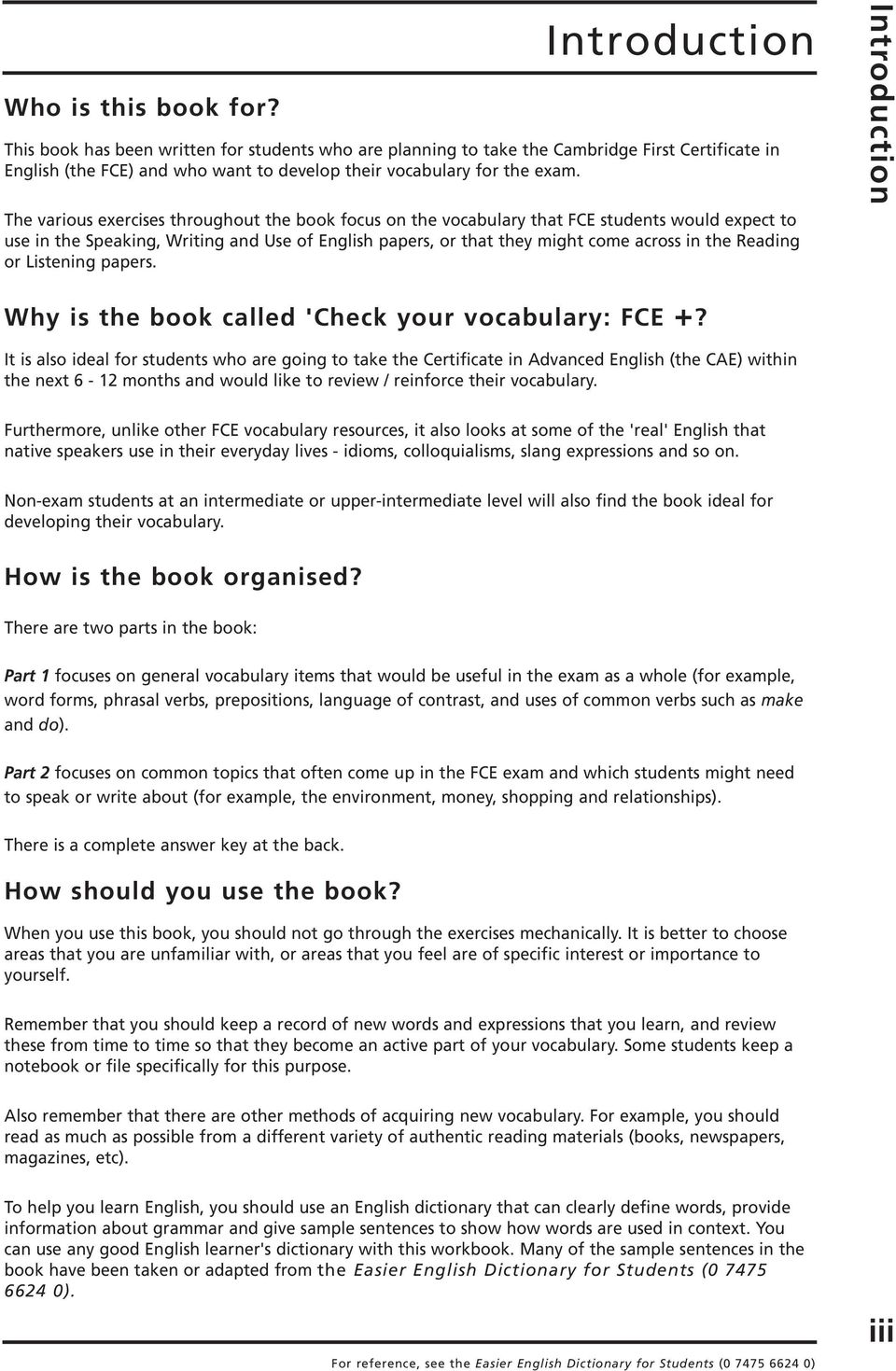
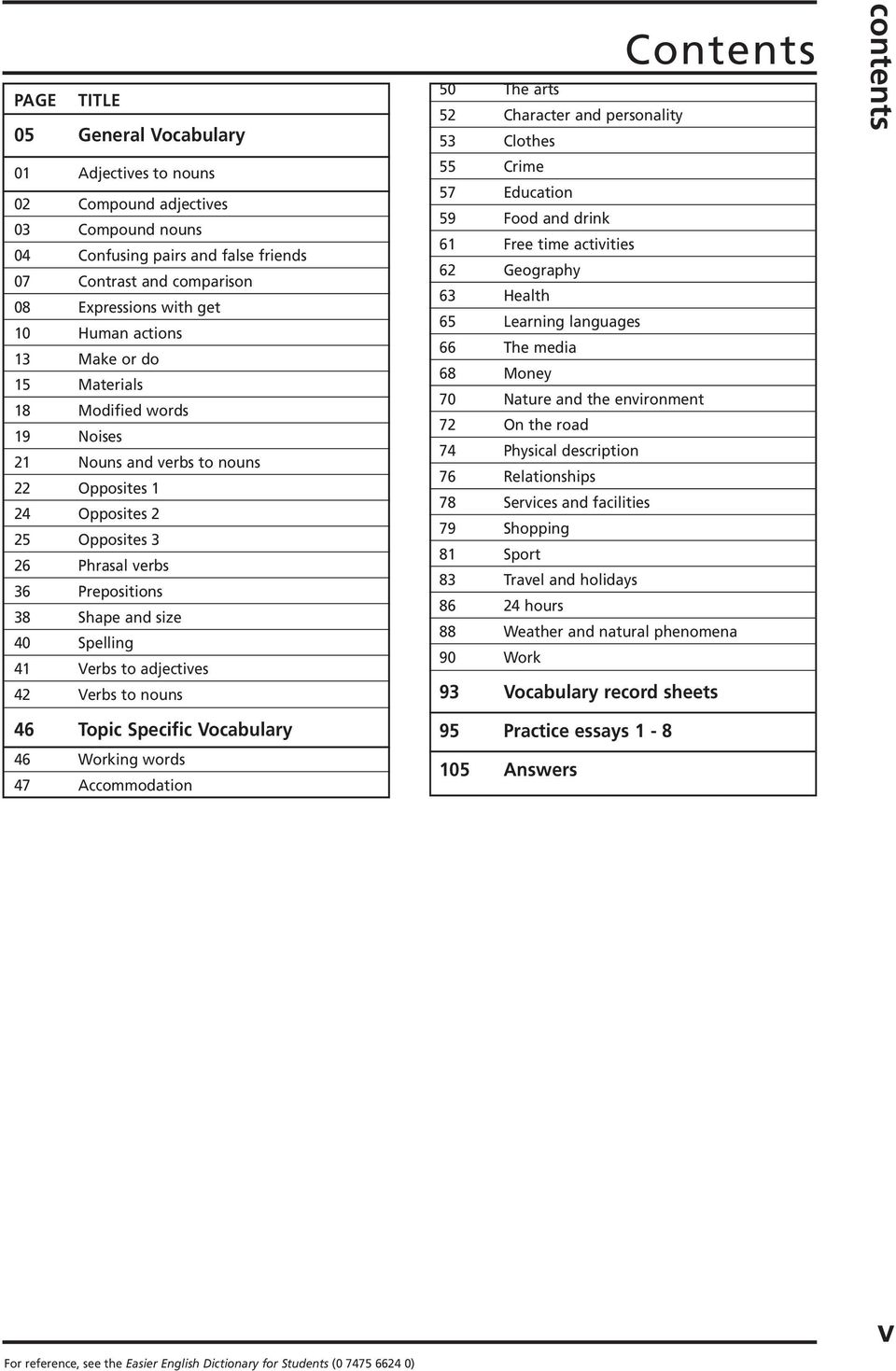
5 PAGE TITLE 05 General Vocabulary 01 Adjectives to nouns 02 Compound adjectives 03 Compound nouns 04 Confusing pairs and false friends 07 Contrast and comparison 08 Expressions with get 10 Human actions 13 Make or do 15 Materials 18 Modified words 19 Noises 21 Nouns and verbs to nouns 22 Opposites 1 24 Opposites 2 25 Opposites 3 26 Phrasal verbs 36 Prepositions 38 Shape and size 40 Spelling 41 Verbs to adjectives 42 Verbs to nouns Contents 50 The arts 52 Character and personality 53 Clothes 55 Crime 57 Education 59 Food and drink 61 Free time activities 62 Geography 63 Health 65 Learning languages 66 The media 68 Money 70 Nature and the environment 72 On the road 74 Physical description 76 Relationships 78 Services and facilities 79 Shopping 81 Sport 83 Travel and holidays hours 88 Weather and natural phenomena 90 Work 93 Vocabulary record sheets contents 46 Topic Specific Vocabulary 46 Working words 47 Accommodation 95 Practice essays Answers v
6 General Vocabulary This section focuses on general vocabulary items that would be useful in the exam as a whole (for example, word forms, phrasal verbs, prepositions, language of contrast, and uses of common verbs such as make and do).
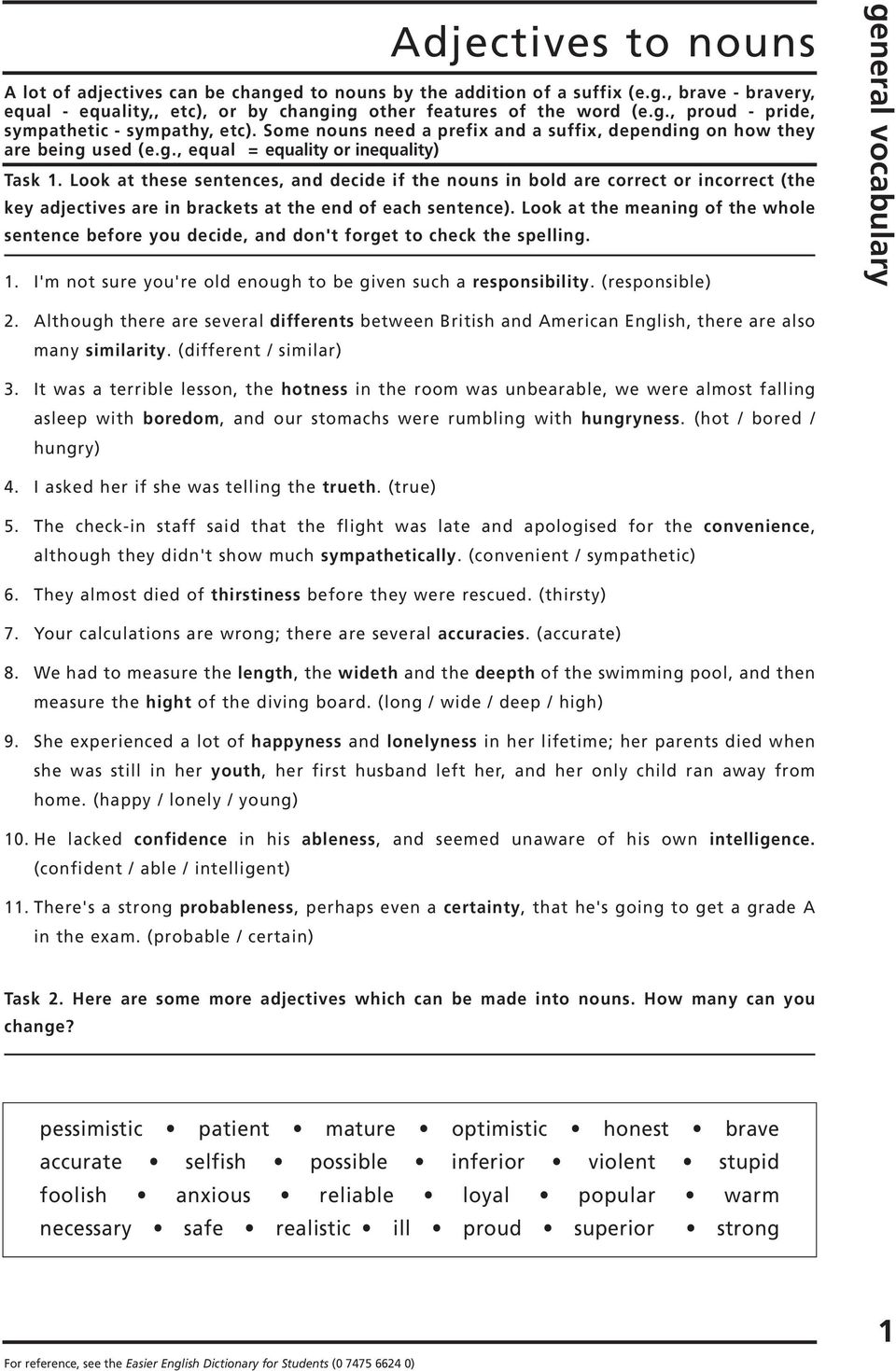
7 Adjectives to nouns A lot of adjectives can be changed to nouns by the addition of a suffix (e.g., brave - bravery, equal - equality,, etc), or by changing other features of the word (e.g., proud - pride, sympathetic - sympathy, etc). Some nouns need a prefix and a suffix, depending on how they are being used (e.g., equal = equality or inequality) Task 1. Look at these sentences, and decide if the nouns in bold are correct or incorrect (the key adjectives are in brackets at the end of each sentence). Look at the meaning of the whole sentence before you decide, and don't forget to check the spelling. 1. I'm not sure you're old enough to be given such a responsibility. (responsible) general vocabulary 2. Although there are several differents between British and American English, there are also many similarity. (different / similar) 3. It was a terrible lesson, the hotness in the room was unbearable, we were almost falling asleep with boredom, and our stomachs were rumbling with hungryness. (hot / bored / hungry) 4. I asked her if she was telling the trueth. (true) 5. The check-in staff said that the flight was late and apologised for the convenience, although they didn't show much sympathetically. (convenient / sympathetic) 6. They almost died of thirstiness before they were rescued. (thirsty) 7. Your calculations are wrong; there are several accuracies. (accurate) 8. We had to measure the length, the wideth and the deepth of the swimming pool, and then measure the hight of the diving board. (long / wide / deep / high) 9. She experienced a lot of happyness and lonelyness in her lifetime; her parents died when she was still in her youth, her first husband left her, and her only child ran away from home. (happy / lonely / young) 10. He lacked confidence in his ableness, and seemed unaware of his own intelligence. (confident / able / intelligent) 11. There's a strong probableness, perhaps even a certainty, that he's going to get a grade A in the exam. (probable / certain) Task 2. Here are some more adjectives which can be made into nouns. How many can you change? pessimistic patient mature optimistic honest brave accurate selfish possible inferior violent stupid foolish anxious reliable loyal popular warm necessary safe realistic ill proud superior strong 1
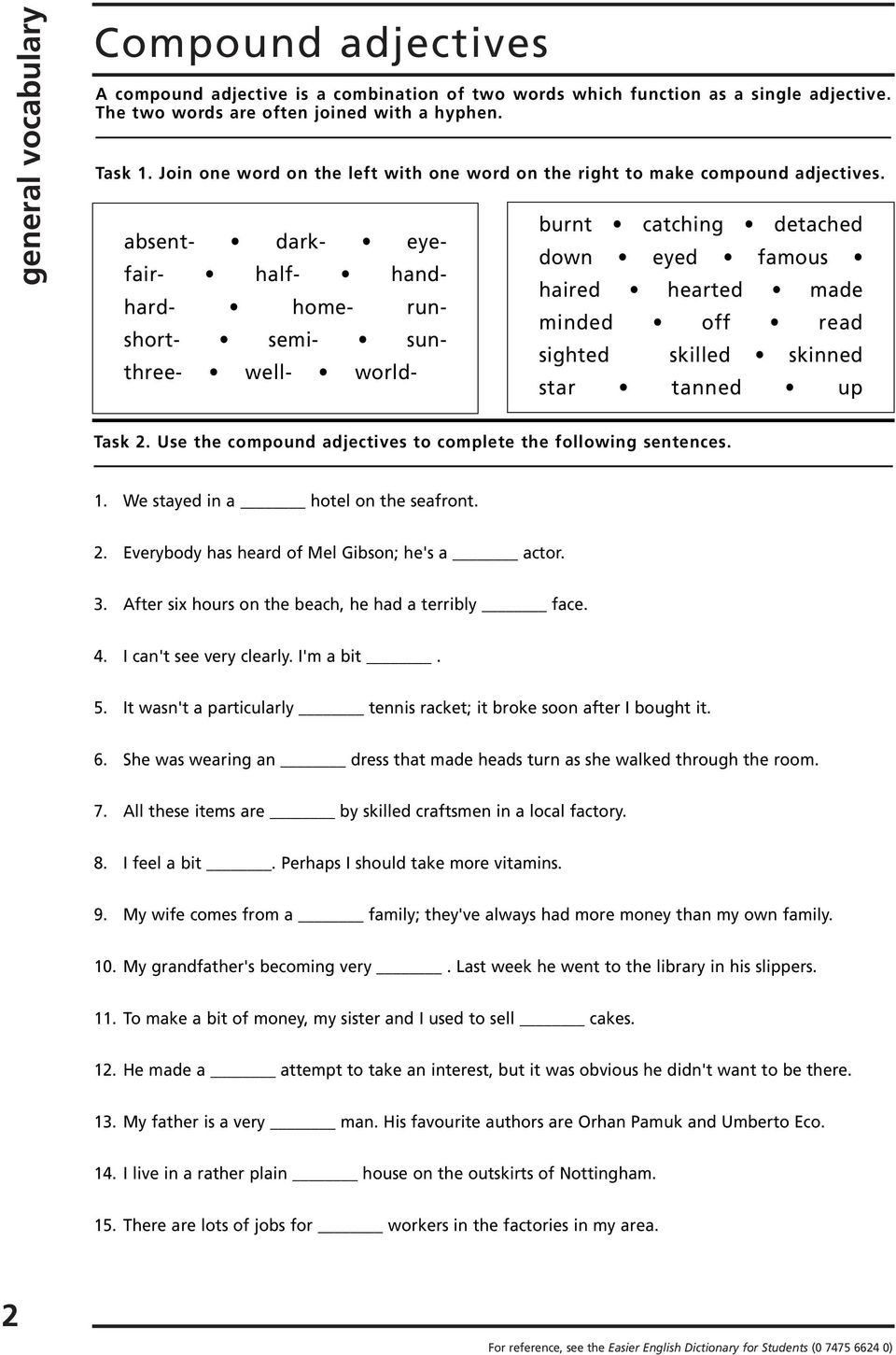
8 general vocabulary Compound adjectives A compound adjective is a combination of two words which function as a single adjective. The two words are often joined with a hyphen. Task 1. Join one word on the left with one word on the right to make compound adjectives. absent- dark- eyefair- half- handhard- home- runshort- semi- sunthree- well- worldburnt catching detached down eyed famous haired hearted made minded off read sighted skilled skinned star tanned up Task 2. Use the compound adjectives to complete the following sentences. 1. We stayed in a hotel on the seafront. 2. Everybody has heard of Mel Gibson; he's a actor. 3. After six hours on the beach, he had a terribly face. 4. I can't see very clearly. I'm a bit. 5. It wasn't a particularly tennis racket; it broke soon after I bought it. 6. She was wearing an dress that made heads turn as she walked through the room. 7. All these items are by skilled craftsmen in a local factory. 8. I feel a bit. Perhaps I should take more vitamins. 9. My wife comes from a family; they've always had more money than my own family. 10. My grandfather's becoming very. Last week he went to the library in his slippers. 11. To make a bit of money, my sister and I used to sell cakes. 12. He made a attempt to take an interest, but it was obvious he didn't want to be there. 13. My father is a very man. His favourite authors are Orhan Pamuk and Umberto Eco. 14. I live in a rather plain house on the outskirts of Nottingham. 15. There are lots of jobs for workers in the factories in my area. 2
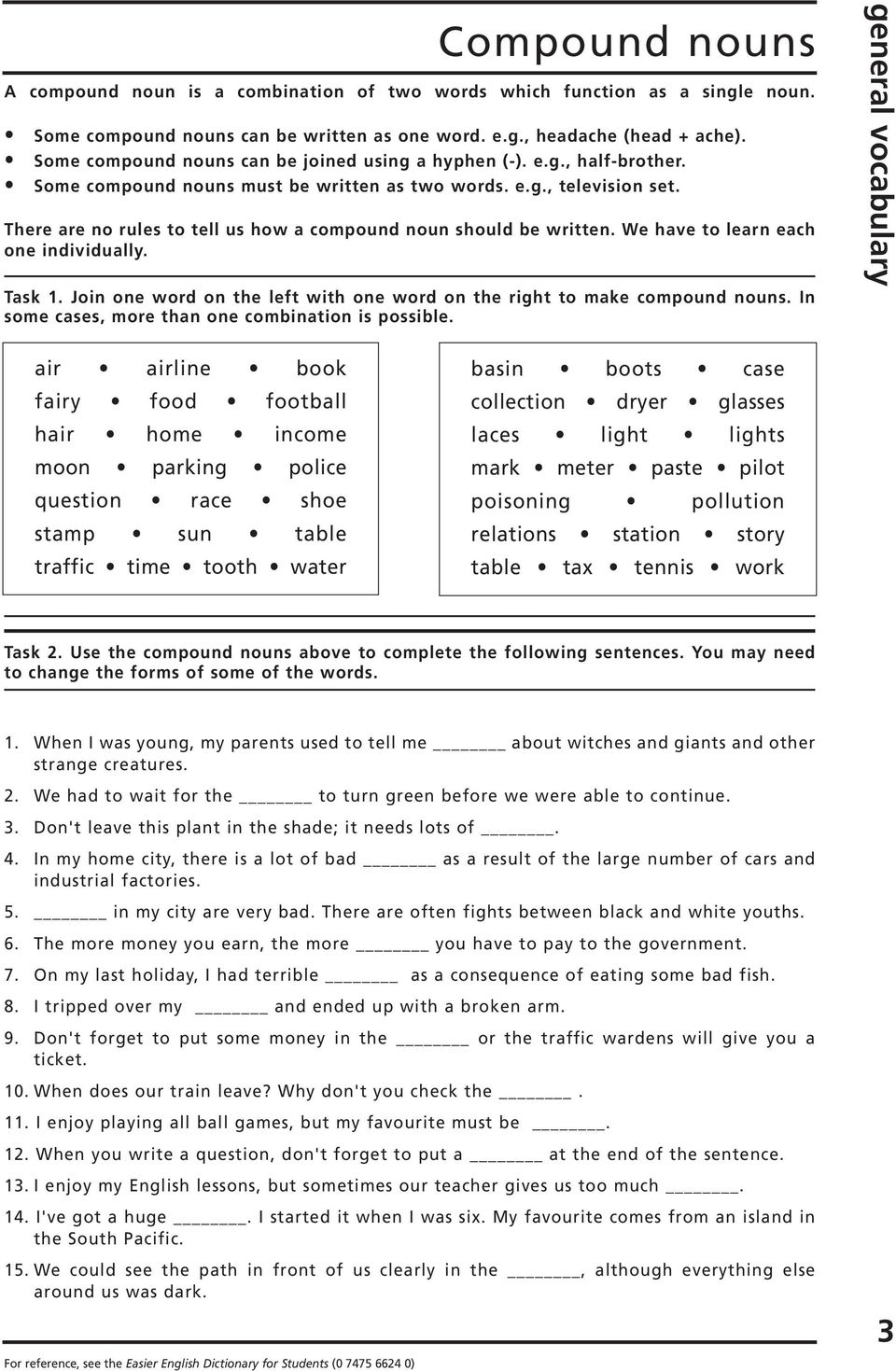
9 Compound nouns A compound noun is a combination of two words which function as a single noun. Some compound nouns can be written as one word. e.g., headache (head + ache). Some compound nouns can be joined using a hyphen (-). e.g., half-brother. Some compound nouns must be written as two words. e.g., television set. There are no rules to tell us how a compound noun should be written. We have to learn each one individually. Task 1. Join one word on the left with one word on the right to make compound nouns. In some cases, more than one combination is possible. general vocabulary air airline book fairy food football hair home income moon parking police question race shoe stamp sun table traffic time tooth water basin boots case collection dryer glasses laces light lights mark meter paste pilot poisoning pollution relations station story table tax tennis work Task 2. Use the compound nouns above to complete the following sentences. You may need to change the forms of some of the words. 1. When I was young, my parents used to tell me about witches and giants and other strange creatures. 2. We had to wait for the to turn green before we were able to continue. 3. Don't leave this plant in the shade; it needs lots of. 4. In my home city, there is a lot of bad as a result of the large number of cars and industrial factories. 5. in my city are very bad. There are often fights between black and white youths. 6. The more money you earn, the more you have to pay to the government. 7. On my last holiday, I had terrible as a consequence of eating some bad fish. 8. I tripped over my and ended up with a broken arm. 9. Don't forget to put some money in the or the traffic wardens will give you a ticket. 10. When does our train leave? Why don't you check the. 11. I enjoy playing all ball games, but my favourite must be. 12. When you write a question, don't forget to put a at the end of the sentence. 13. I enjoy my English lessons, but sometimes our teacher gives us too much. 14. I've got a huge. I started it when I was six. My favourite comes from an island in the South Pacific. 15. We could see the path in front of us clearly in the, although everything else around us was dark. 3
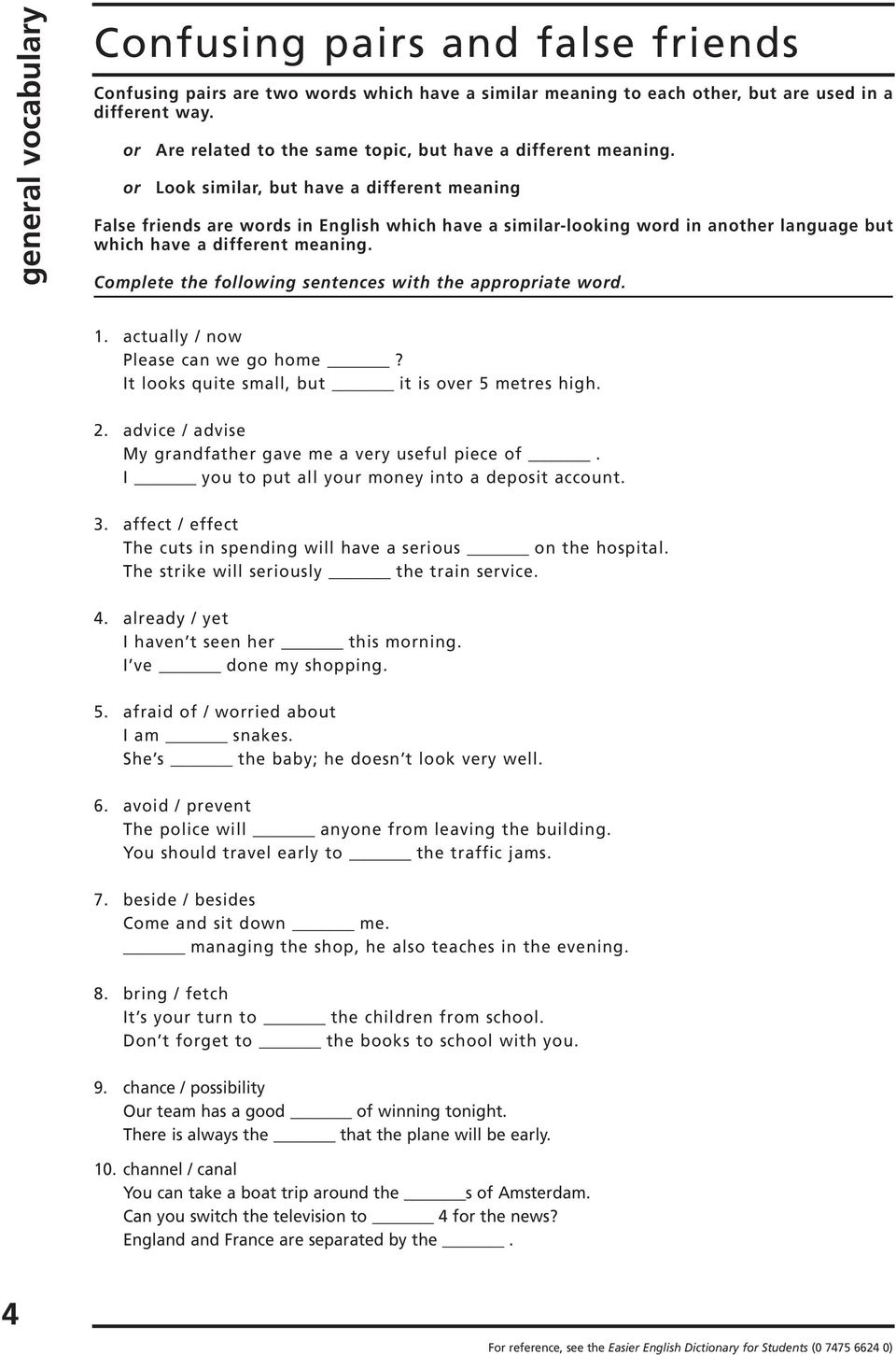
10 general vocabulary Confusing pairs and false friends Confusing pairs are two words which have a similar meaning to each other, but are used in a different way. or or Are related to the same topic, but have a different meaning. Look similar, but have a different meaning False friends are words in English which have a similar-looking word in another language but which have a different meaning. Complete the following sentences with the appropriate word. 1. actually / now Please can we go home? It looks quite small, but it is over 5 metres high. 2. advice / advise My grandfather gave me a very useful piece of. I you to put all your money into a deposit account. 3. affect / effect The cuts in spending will have a serious on the hospital. The strike will seriously the train service. 4. already / yet I haven t seen her this morning. I ve done my shopping. 5. afraid of / worried about I am snakes. She s the baby; he doesn t look very well. 6. avoid / prevent The police will anyone from leaving the building. You should travel early to the traffic jams. 7. beside / besides Come and sit down me. managing the shop, he also teaches in the evening. 8. bring / fetch It s your turn to the children from school. Don t forget to the books to school with you. 9. chance / possibility Our team has a good of winning tonight. There is always the that the plane will be early. 10. channel / canal You can take a boat trip around the s of Amsterdam. Can you switch the television to 4 for the news? England and France are separated by the. 4
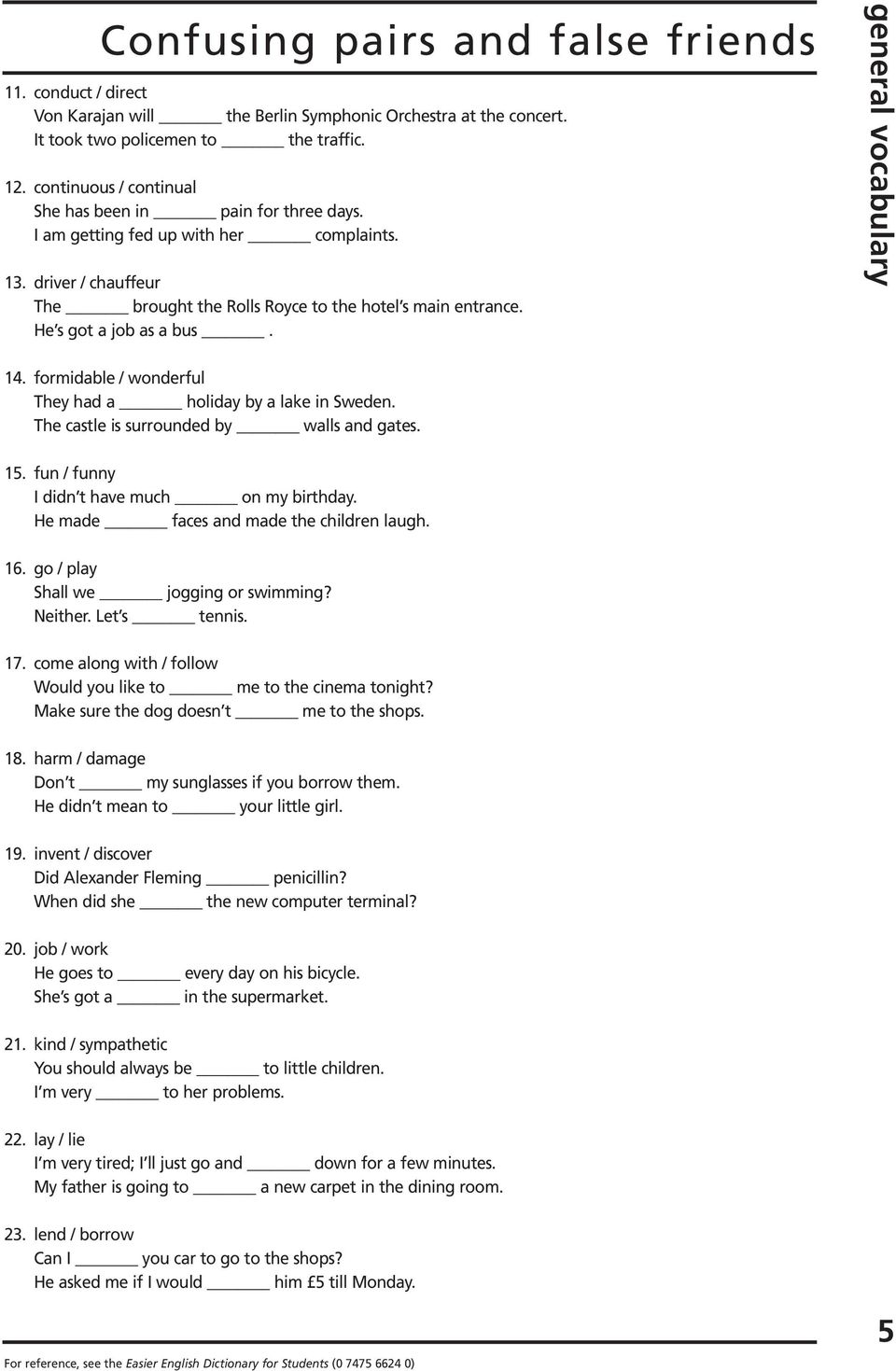
11 Confusing pairs and false friends 11. conduct / direct Von Karajan will the Berlin Symphonic Orchestra at the concert. It took two policemen to the traffic. 12. continuous / continual She has been in pain for three days. I am getting fed up with her complaints. 13. driver / chauffeur The brought the Rolls Royce to the hotel s main entrance. He s got a job as a bus. general vocabulary 14. formidable / wonderful They had a holiday by a lake in Sweden. The castle is surrounded by walls and gates. 15. fun / funny I didn t have much on my birthday. He made faces and made the children laugh. 16. go / play Shall we jogging or swimming? Neither. Let s tennis. 17. come along with / follow Would you like to me to the cinema tonight? Make sure the dog doesn t me to the shops. 18. harm / damage Don t my sunglasses if you borrow them. He didn t mean to your little girl. 19. invent / discover Did Alexander Fleming penicillin? When did she the new computer terminal? 20. job / work He goes to every day on his bicycle. She s got a in the supermarket. 21. kind / sympathetic You should always be to little children. I m very to her problems. 22. lay / lie I m very tired; I ll just go and down for a few minutes. My father is going to a new carpet in the dining room. 23. lend / borrow Can I you car to go to the shops? He asked me if I would him 5 till Monday. 5
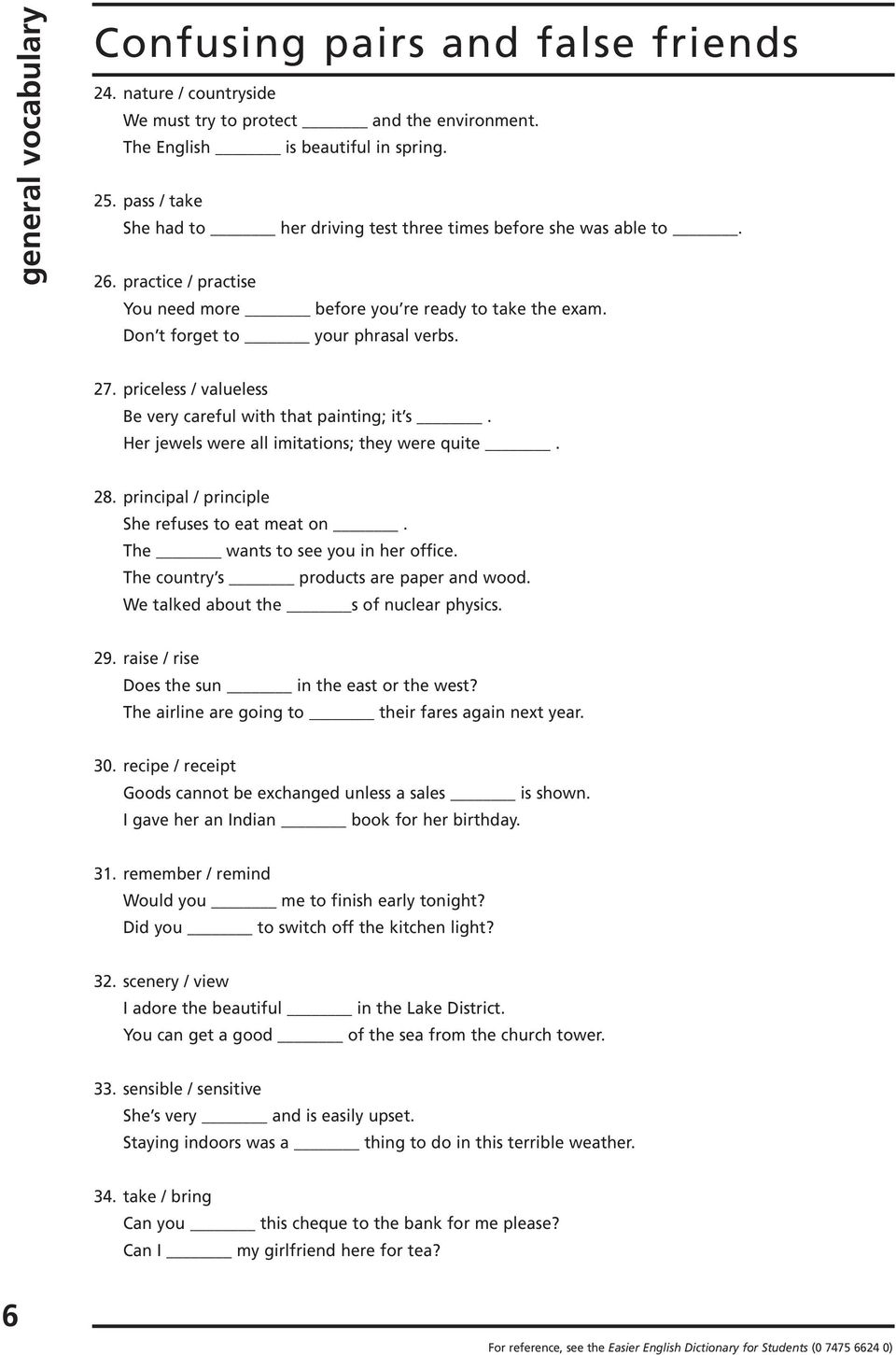
12 general vocabulary Confusing pairs and false friends 24. nature / countryside We must try to protect and the environment. The English is beautiful in spring. 25. pass / take She had to her driving test three times before she was able to. 26. practice / practise You need more before you re ready to take the exam. Don t forget to your phrasal verbs. 27. priceless / valueless Be very careful with that painting; it s. Her jewels were all imitations; they were quite. 28. principal / principle She refuses to eat meat on. The wants to see you in her office. The country s products are paper and wood. We talked about the s of nuclear physics. 29. raise / rise Does the sun in the east or the west? The airline are going to their fares again next year. 30. recipe / receipt Goods cannot be exchanged unless a sales is shown. I gave her an Indian book for her birthday. 31. remember / remind Would you me to finish early tonight? Did you to switch off the kitchen light? 32. scenery / view I adore the beautiful in the Lake District. You can get a good of the sea from the church tower. 33. sensible / sensitive She s very and is easily upset. Staying indoors was a thing to do in this terrible weather. 34. take / bring Can you this cheque to the bank for me please? Can I my girlfriend here for tea? 6
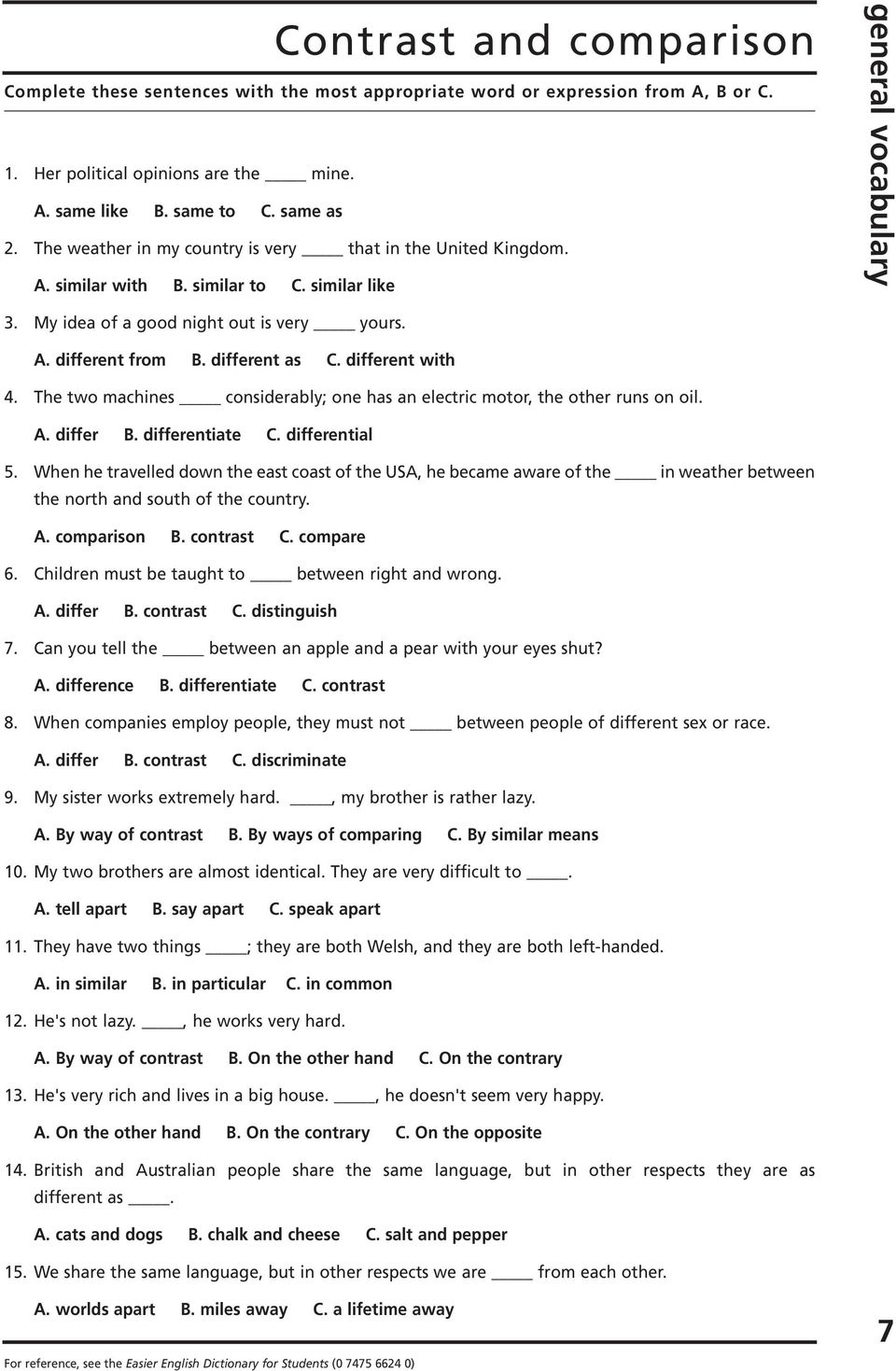
13 Contrast and comparison Complete these sentences with the most appropriate word or expression from A, B or C. 1. Her political opinions are the mine. A. same like B. same to C. same as 2. The weather in my country is very that in the United Kingdom. A. similar with B. similar to C. similar like general vocabulary 3. My idea of a good night out is very yours. A. different from B. different as C. different with 4. The two machines considerably; one has an electric motor, the other runs on oil. A. differ B. differentiate C. differential 5. When he travelled down the east coast of the USA, he became aware of the in weather between the north and south of the country. A. comparison B. contrast C. compare 6. Children must be taught to between right and wrong. A. differ B. contrast C. distinguish 7. Can you tell the between an apple and a pear with your eyes shut? A. difference B. differentiate C. contrast 8. When companies employ people, they must not between people of different sex or race. A. differ B. contrast C. discriminate 9. My sister works extremely hard., my brother is rather lazy. A. By way of contrast B. By ways of comparing C. By similar means 10. My two brothers are almost identical. They are very difficult to. A. tell apart B. say apart C. speak apart 11. They have two things ; they are both Welsh, and they are both left-handed. A. in similar B. in particular C. in common 12. He's not lazy., he works very hard. A. By way of contrast B. On the other hand C. On the contrary 13. He's very rich and lives in a big house., he doesn't seem very happy. A. On the other hand B. On the contrary C. On the opposite 14. British and Australian people share the same language, but in other respects they are as different as. A. cats and dogs B. chalk and cheese C. salt and pepper 15. We share the same language, but in other respects we are from each other. A. worlds apart B. miles away C. a lifetime away 7
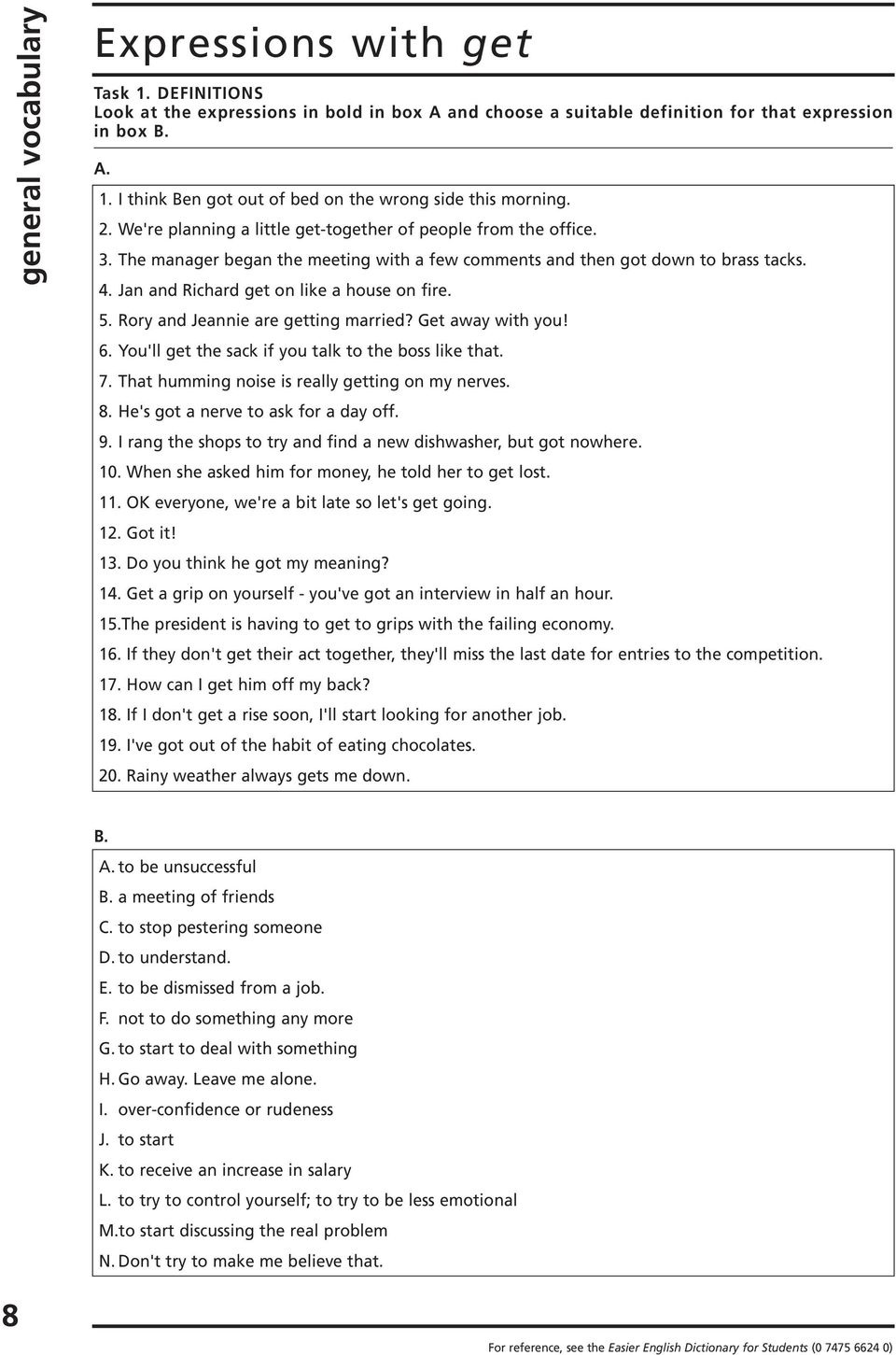
14 general vocabulary Expressions with get Task 1. DEFINITIONS Look at the expressions in bold in box A and choose a suitable definition for that expression in box B. A. 1. I think Ben got out of bed on the wrong side this morning. 2. We're planning a little get-together of people from the office. 3. The manager began the meeting with a few comments and then got down to brass tacks. 4. Jan and Richard get on like a house on fire. 5. Rory and Jeannie are getting married? Get away with you! 6. You'll get the sack if you talk to the boss like that. 7. That humming noise is really getting on my nerves. 8. He's got a nerve to ask for a day off. 9. I rang the shops to try and find a new dishwasher, but got nowhere. 10. When she asked him for money, he told her to get lost. 11. OK everyone, we're a bit late so let's get going. 12. Got it! 13. Do you think he got my meaning? 14. Get a grip on yourself - you've got an interview in half an hour. 15.The president is having to get to grips with the failing economy. 16. If they don't get their act together, they'll miss the last date for entries to the competition. 17. How can I get him off my back? 18. If I don't get a rise soon, I'll start looking for another job. 19. I've got out of the habit of eating chocolates. 20. Rainy weather always gets me down. B. A. to be unsuccessful B. a meeting of friends C. to stop pestering someone D. to understand. E. to be dismissed from a job. F. not to do something any more G. to start to deal with something H. Go away. Leave me alone. I. over-confidence or rudeness J. to start K. to receive an increase in salary L. to try to control yourself; to try to be less emotional M.to start discussing the real problem N. Don't try to make me believe that. 8
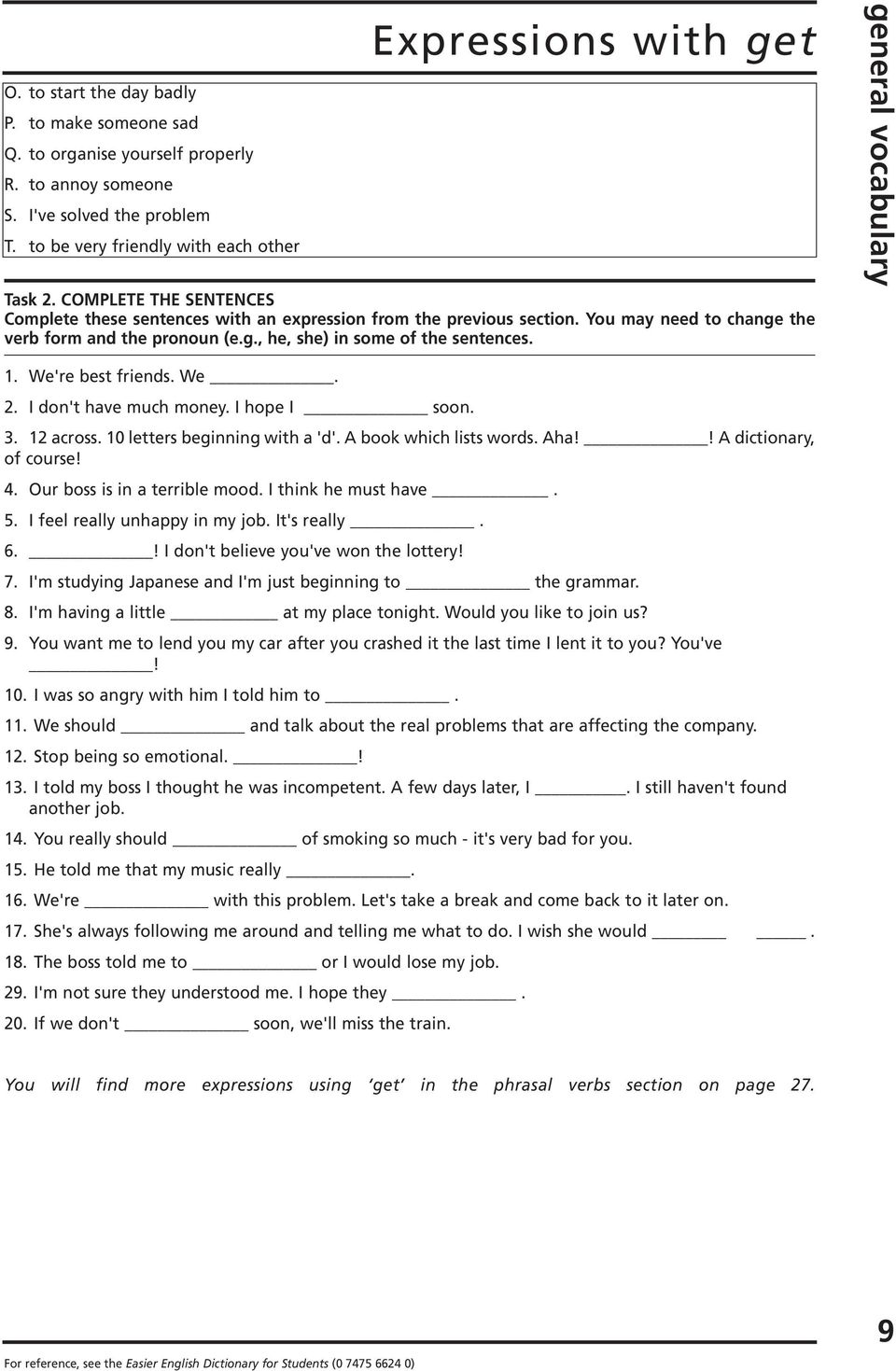
15 O. to start the day badly P. to make someone sad Q. to organise yourself properly R. to annoy someone S. I've solved the problem T. to be very friendly with each other Expressions with get Task 2. COMPLETE THE SENTENCES Complete these sentences with an expression from the previous section. You may need to change the verb form and the pronoun (e.g., he, she) in some of the sentences. general vocabulary 1. We're best friends. We. 2. I don't have much money. I hope I soon across. 10 letters beginning with a 'd'. A book which lists words. Aha!! A dictionary, of course! 4. Our boss is in a terrible mood. I think he must have. 5. I feel really unhappy in my job. It's really. 6.! I don't believe you've won the lottery! 7. I'm studying Japanese and I'm just beginning to the grammar. 8. I'm having a little at my place tonight. Would you like to join us? 9. You want me to lend you my car after you crashed it the last time I lent it to you? You've! 10. I was so angry with him I told him to. 11. We should and talk about the real problems that are affecting the company. 12. Stop being so emotional.! 13. I told my boss I thought he was incompetent. A few days later, I. I still haven't found another job. 14. You really should of smoking so much - it's very bad for you. 15. He told me that my music really. 16. We're with this problem. Let's take a break and come back to it later on. 17. She's always following me around and telling me what to do. I wish she would. 18. The boss told me to or I would lose my job. 29. I'm not sure they understood me. I hope they. 20. If we don't soon, we'll miss the train. You will find more expressions using get in the phrasal verbs section on page 27. 9
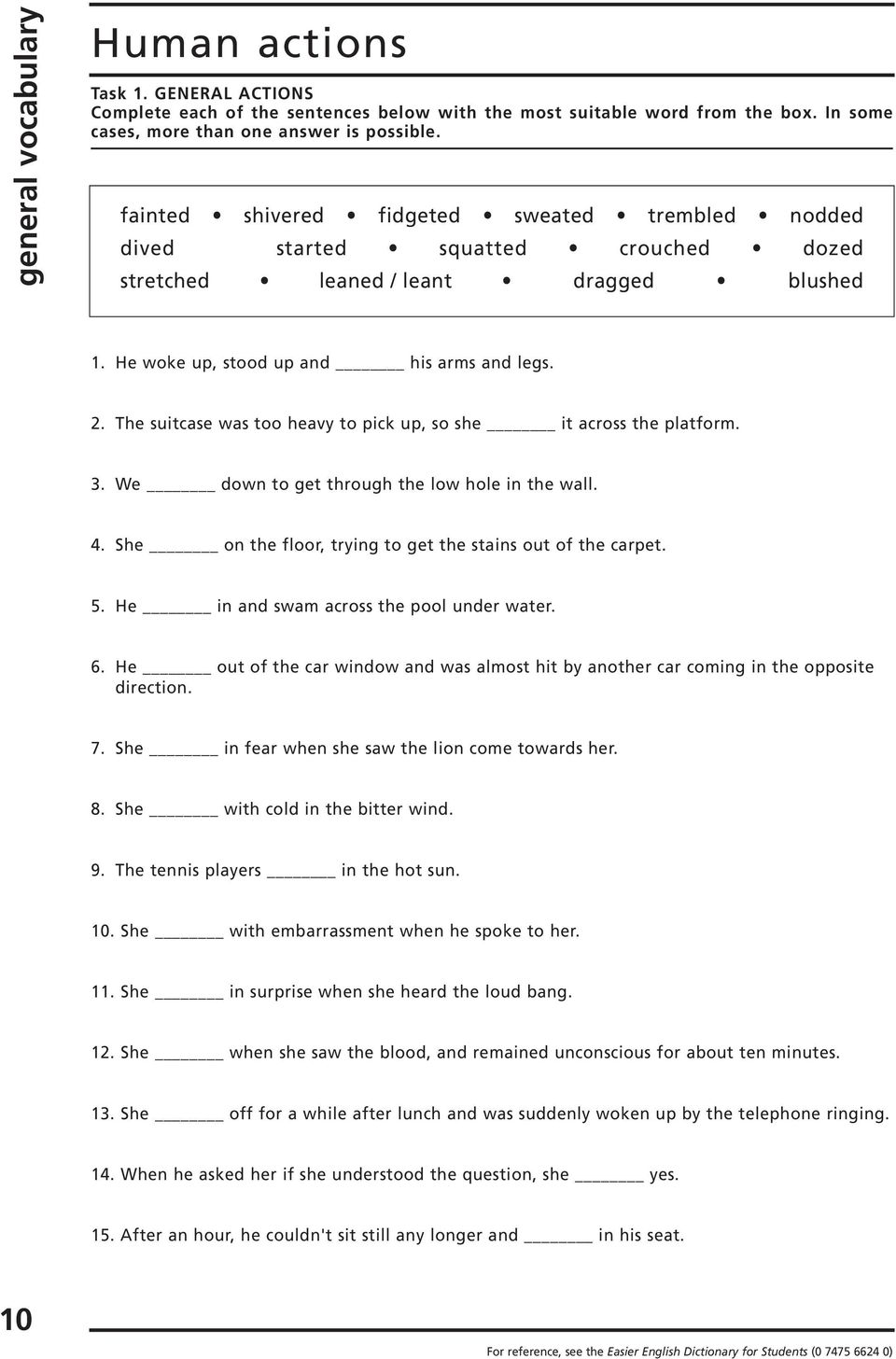
16 general vocabulary Human actions Task 1. GENERAL ACTIONS Complete each of the sentences below with the most suitable word from the box. In some cases, more than one answer is possible. fainted shivered fidgeted sweated trembled nodded dived started squatted crouched dozed stretched leaned / leant dragged blushed 1. He woke up, stood up and his arms and legs. 2. The suitcase was too heavy to pick up, so she it across the platform. 3. We down to get through the low hole in the wall. 4. She on the floor, trying to get the stains out of the carpet. 5. He in and swam across the pool under water. 6. He out of the car window and was almost hit by another car coming in the opposite direction. 7. She in fear when she saw the lion come towards her. 8. She with cold in the bitter wind. 9. The tennis players in the hot sun. 10. She with embarrassment when he spoke to her. 11. She in surprise when she heard the loud bang. 12. She when she saw the blood, and remained unconscious for about ten minutes. 13. She off for a while after lunch and was suddenly woken up by the telephone ringing. 14. When he asked her if she understood the question, she yes. 15. After an hour, he couldn't sit still any longer and in his seat. 10
17 Human actions Task 2. WAYS OF MOVING Match the verbs on the left with the person who might behave in that way on the right. Verbs hop Person A. A man who has been injured in an accident but is still able to walk to the hospital. general vocabulary dash B. People walking in the park on a warm summer evening crawl C. A girl jumping across a wide stream of water creep D. Soldiers on parade tiptoe E. Someone who has hurt their foot and must move around on one leg. leap F. A young man running home to watch the football on television. dawdle G. Young children running, hopping and jumping along the road. stagger H. A very young baby who can't walk yet. skip I. A teenage daughter arriving home late and walking quietly up the stairs. march J. A boy walking quietly past a sleeping dog stroll K. A child walking very slowly to school Task 3. HAND AND ARM ACTIONS Choose the correct verb in each of the following sentences. 1. He punched / snapped / grabbed me on the nose. 2. They all punched / slapped / shook him on the back to congratulate him. 3. The nurse pointed / beckoned to / saluted her to come into the room. 4. She rubbed / wiped / stroked the cat as it sat in her lap. 5. He patted / wiped / folded his pocket to make sure his wallet was still there. 6. He snapped / grabbed / flexed his suitcase and ran to the train. 7. It was dark in the cellar and he had to grope / scratch / grab for a light switch. 8. Ordinary soldiers must salute / shake / point their officers. 11
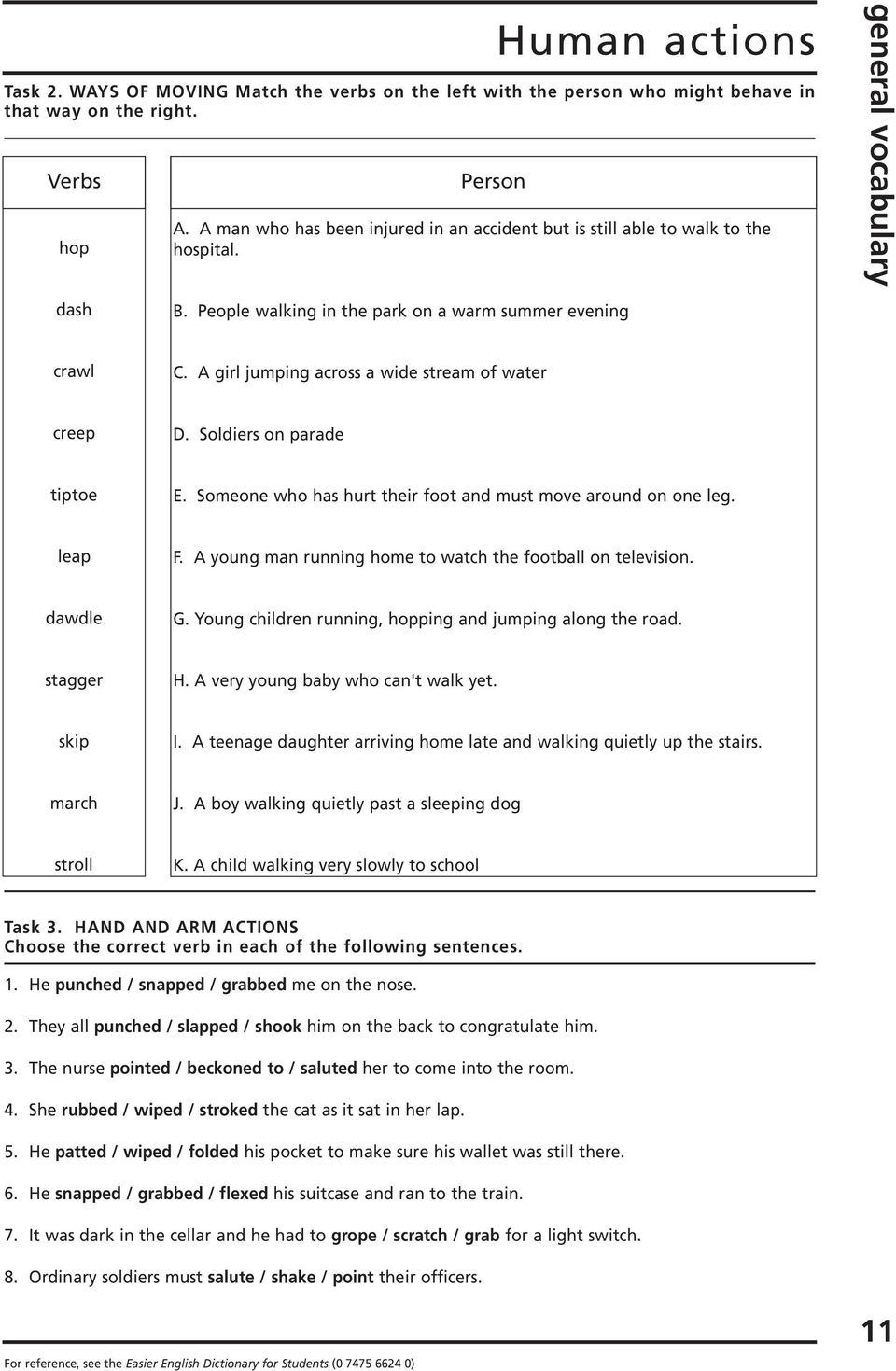
18 general vocabulary Human actions 9. They waved / punched / beckoned goodbye as the boat left the harbour. 10. He groped / scratched / stroked his head as he wondered what to do 11. He sat down and tapped / crossed / folded his arms. 12. Here's a handkerchief - wipe / pat / rub your nose. 13. You should always pat / grope / shake the bottle before you open it. 14. A policeman tapped / scratched / stroked him on the shoulder and arrested him. 15. He shook / rubbed / wiped his hands together to get them warm. Task 4. IDIOMS, COLLOQUIALISMS AND OTHER EXPRESSIONS Look at the expressions in bold in the following sentences and decide if the definitions which accompany them are TRUE or FALSE. 1. She made a beeline for the chocolate cakes. She walked slowly towards the chocolate cakes. 2. Once bitten, twice shy. Once you have had a bad experience, you will not want to do it again. 3. The telephone's on the blink. The telephone is ringing. 4. We all gave Brian a pat on the back. We all congratulated Brian. 5. She looked daggers at me. She looked at me angrily. 6. He ran like the wind. He ran very fast. 7. We salute the firemen who entered the burning building to save lives. We are angry with the firemen. 8. Don't look a gift horse in the mouth. Don't be unkind to people who are less fortunate than you. 9. In the coffee break I went into the garden to stretch my legs. After sitting down for a long time, I went for a small walk. 10. Bob is not fully stretched. Bob is not very tall. 11. There was a mad dash to buy the tickets. Nobody wanted to buy the tickets. 12. Don't worry - I was only pulling your leg. I was only teasing you. 12
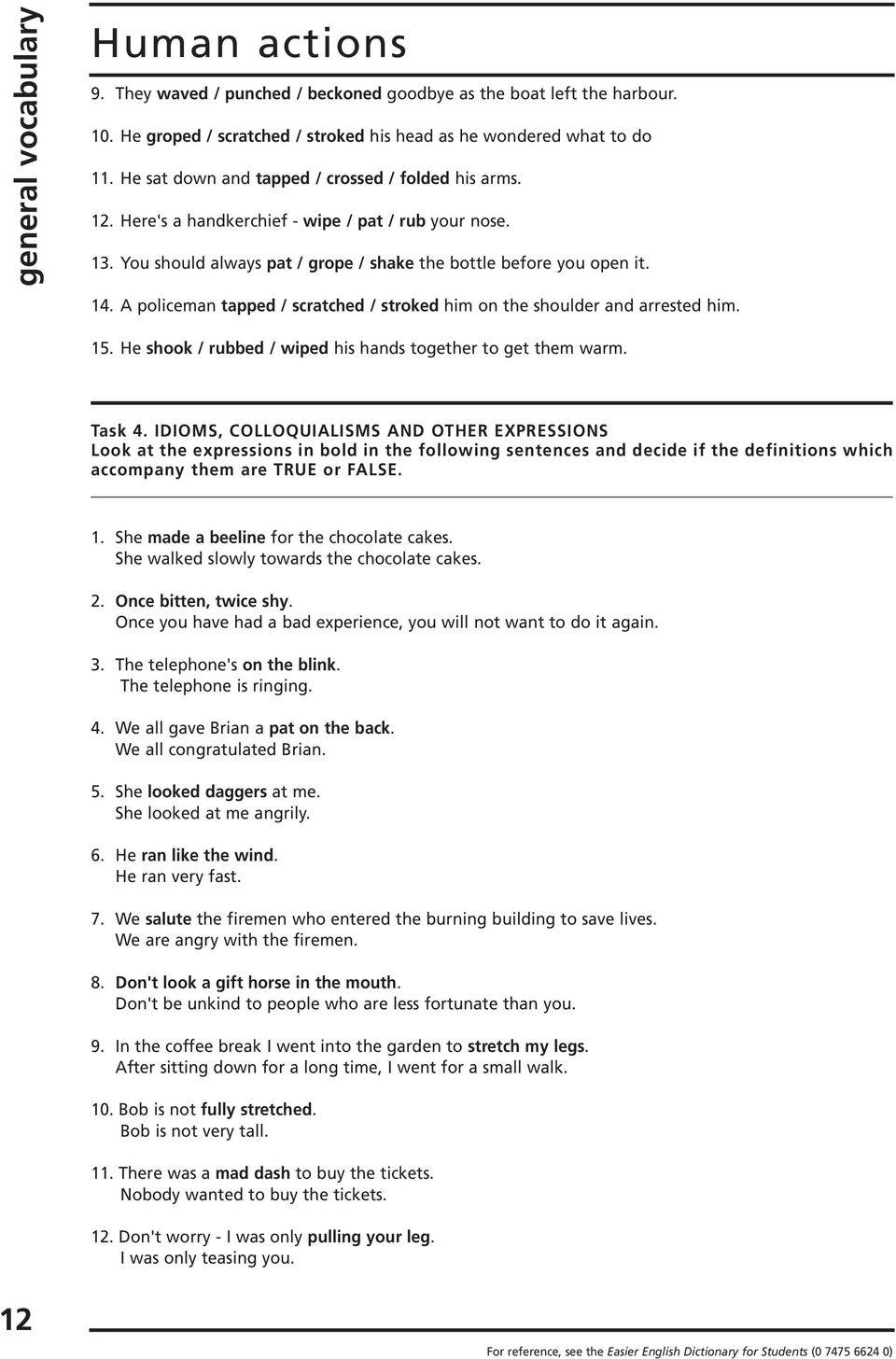
19 Make or do? Task 1. WORDS USED WITH MAKE OR DO Look at the sentences below and decide whether they should be completed with the verb make or the verb do. The form of these verbs will need to change in most sentences. Use the words in bold to help you. 1. Has your mother a will yet? 2. She her piano exercises every morning. 3. The storm a lot of damage last night. general vocabulary 4. Who will be the speech at her wedding? 5. We a large profit when we sold our house. 6 There's a lot of work still to be. 7. At the moment he's great efforts to learn Spanish. 8. They a lot of business with European countries. 9. I'm not the washing today. 10. When we got to the hotel, the beds hadn't been. 11. The workmen are so much noise we can't use the telephone. 12. We are good progress towards finishing the house. 13. He didn't mean to any harm. 14. His wife usually all the housework. 15. The milk boiled over and a mess on the stove. 16. I can't today's crossword - it's too hard. 17. Are you going to a Christmas cake again this year? 18. How much money did you last year? 19. It took us hours to the washing up after the party. 20. He an inquiry about trains to Edinburgh. 21. I need to a quick phone call before we leave. 22. Don't such a fuss - it's only a little scratch. 23. She a mistake in typing the address. 24. We friends with some French people on holiday. 25. Our company is small but it's well. 26. She a few notes before her speech. 27. She was the ironing when I came home. 28. Companies often a loss in their first year of operations. 13
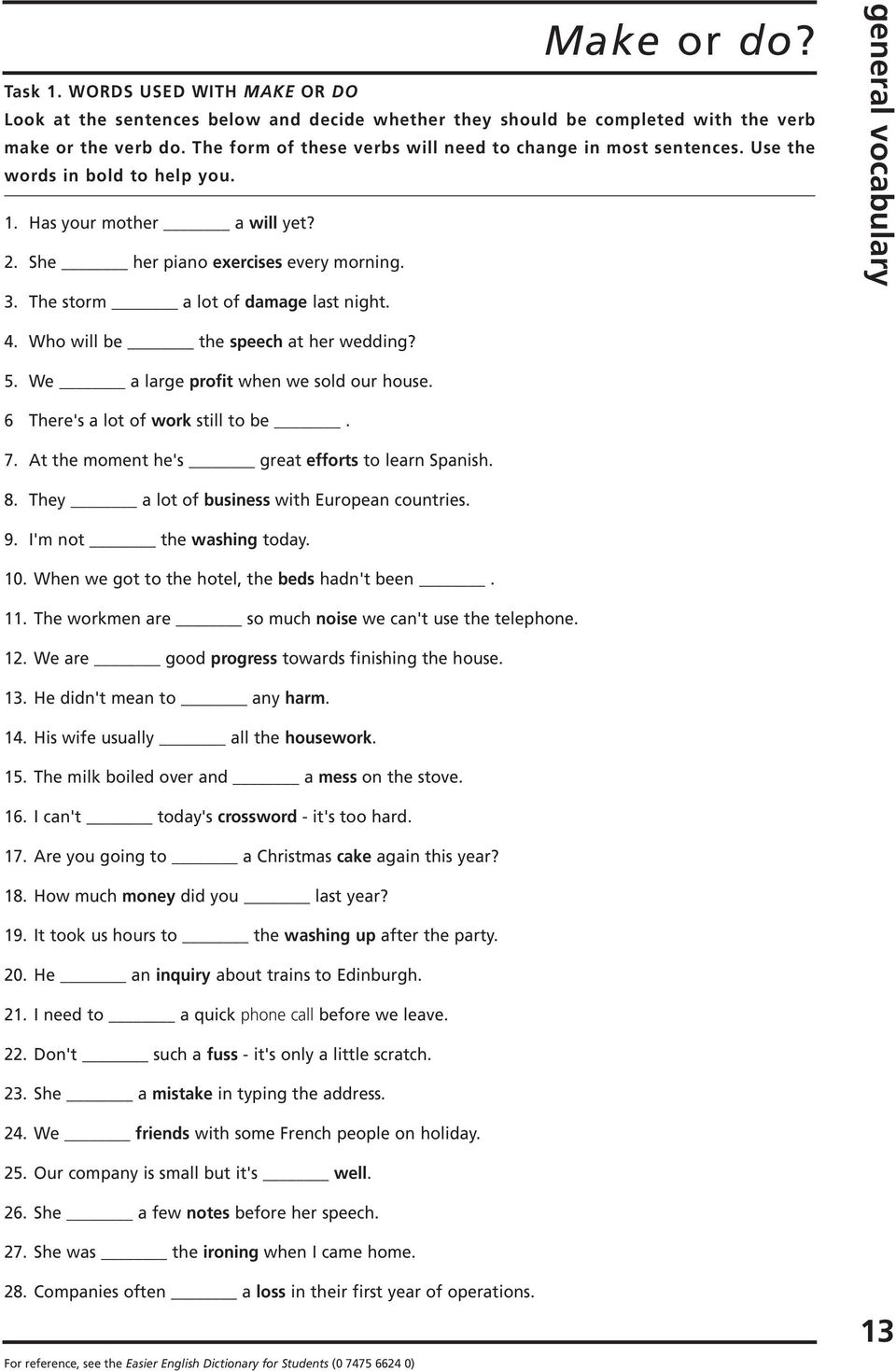
20 general vocabulary Make or do? 2. IDIOMS AND COLLOQUIALISMS USING MAKE Replace the words and expressions in bold with an expression using make from the box. make the best of make a break with made a meal of make do with make time made off with make-believe make up my mind 1. The burglar stole all their silver. 2. She forgot her pyjamas and had to use a T-shirt because there was nothing else available. 3. They say it will rain this afternoon so we'd better take advantage of the sunshine while it's here. 4. I can't decide whether to take the afternoon off to do some shopping or stay in the office and work. 5. She spent a lot of unnecessary time and went to a lot of effort repainting the kitchen. 6. His stories about his love affairs are just not true, although he pretends they are. 7. We must arrange to visit the new sports club even though we are short of time. 8. I've tried to forget my last girlfriend, but it's not always easy to move away from the past. 3. IDIOMS AND COLLOQUIALISMS USING DO The words in bold are all in the wrong sentences. Decide which sentences they should go in. 1. If the computer doesn't work, hit it - that should do the sights and get it working again. 2. Will you do the turn, John, and pour us all a drink? 3. He never uses violence himself. He just gets other people to do the yourself work for him. 4. He looks a bit unhappy. An evening out would do don'ts to cheer him up. 5. She's very good at painting, decorating and other do-it-trick jobs. 6. You don't have a car? How can you do turn one? You must have a good public transport system in our area. 7. This chicken is cooked perfectly. It's done to a dirty. 8. She told him all the do's and without about working in the office, and helped him to settle in. 9. He did me a good honours by writing a job reference for me, so I helped him in return. 10. When we went to Barcelona, we did all the wonders and took hundreds of photographs. 14 You will find more expressions using make and do in the phrasal verbs section on pages 27 and 29.
21 Materials Task 1. ADJECTIVES AND NOUNS The words in bold are in the wrong sentences. Put them into the correct sentences. In several cases, more than one word is possible. 1. He was wearing a pair of timber trousers. 2. We put the glasses into polyester boxes. 3. We used an old piece of wool as a roof for the hut. general vocabulary 4. She keeps her collection of precious Chinese rubber in a glass case. 5. After the rain, the dry satin on the football pitch suddenly turned wet and sticky underfoot. 6. He was wearing a pair of old corrugated iron shoes. 7. The house is surrounded by a high silk wall. 8. The carpet in our living room is made of leather. 9. Why are cork bedsheets so cold? 10. He was wearing a porcelain jacket. 11. She placed little stained glass mats on the table to stop the wine glass marking it. 12. He bought two plastic shirts in the sale. 13. She was wearing a beautiful cardboard scarf. 14. Canterbury Cathedral is famous for its corduroy windows. 15. She was wearing a thick stainless steel coat. 16. We take fur plates when we go for picnics on the beach. 17. She wore little red iron slippers. 18. She bought a white wooden tablecloth. 19. He was wearing a pair of blue turf shoes. 20. I bought her a set of cotton saucepans. 21. The roof is made with denim from an old ship. 22. I wore a pair of suede overalls when I painted the living room. 23. Car tyres are made of canvas. 24. There's an old linen table in the kitchen. 25. The old gates are made of nylon. 26. My new shoes have got brick soles. 15
22 general vocabulary Materials Task 2. GUESS THE OBJECT Look at the following descriptions and decide what is being described in each one. You might find it useful to look at the unit on shape and size on page 38 to help you with some of the descriptions. 1. It's rectangular and made of plastic. It's flat. It measures about 8cm x 5cm. It can be a variety of colours. You can carry it in your wallet or purse. 2. It's round, with an open top and a flat bottom. It comes in different sizes. It's made of stainless steel or iron so it can stand a lot of heat. 3. Traditionally its triangular and made of canvas, although most modern ones are made of nylon and come in a variety of shapes and sizes. 4. It's cylindrical and made of light bark, although nowadays you can also find plastic ones. It's not very big. When you remove it, it makes a loud 'pop!' 5. It's made of plastic and iron. It's wide at one end and narrow at the other, with a plastic handle on top. Most of them are designed to spray water. The bottom part gets very hot. 6. It's long, thin and made of fabric such as silk or cotton. It can come in a variety of colours and patterns. Men use them more than women, especially at work. 7. They're made of denim and are usually blue, although you often see them in black or white. They're very popular with younger people because they're casual and comfortable. 8. It's an irregular shape, and it's made of china or porcelain. It has a handle, a spout for pouring and a lid. You should be careful not to drop it, as it will probably break if you do. 9. It's usually made of wool and is long, flat and rectangular. Football fans often have one with the name of their favourite team on. It's particularly useful in winter. 10. It's spherical and made of leather, although cheaper ones are made of plastic or rubber. It's about 30cm in diameter. It's usually white, even though it gets dirty quickly. Task 3. IDIOMS, COLLOQUIALISMS AND OTHER EXPRESSIONS Look at the following sentences and choose the correct definition for the words and expressions in bold. 1. Politicians try to be careful not to wash their dirty linen in public. A. tell dreadful personal secrets about themselves and their family B. say bad things about other politicians C. drink, smoke or do other things that people might not like 2. The estate agent tried to pull the wool over our eyes. A. to charge us too much money B. to take our money with out giving them anything in return 16 C. to deceive us by not telling us the true facts
23 3. I don't have any cash with me. Do you take plastic? A. cheques B. credit cards and charge cards C. U.S. dollars 4. We spent our last holiday under canvas. A. In a beach resort B. In a very cheap hotel C. in a tent Materials general vocabulary 5. We turfed out our old office furniture. A. sold B. threw out C. burnt 6. The thief had a cast-iron alibi. A. an alibi that cannot be disproved. B. a very weak alibi C. a very unlikely alibi 7. She will have to steel herself to say what happened. A. she'll have to pretend to be sad B. she'll have to refuse to say what happened C. she'll have to get ready to do something that she does not like 8. A lot of young people end up living in cardboard city. A. a place where homeless people build themselves shelters out of pieces of cardboard B. their parents' home C. with their girlfriend or boyfriend 17
24 general vocabulary Modified words We can sometimes add prefixes to change, or modify, the main meaning of a verb, noun or adjective without making it into an opposite (e.g., pay - overpay - underpay) The prefixes we use to do this are: For verbs: over-, under-, pre-, fore- For adjectives: over-, under-, pre-, fore-, pro-, anti-. For nouns: pre-, post-, anti-, pro-, under- Complete the sentences below with a combination of a prefix from box A and a word from box B. A. B. anti- over- antiunder- pro- fore- foreunder- pre- post- foreunder- anti- overarmed Christmas climax clockwise due estimate estimated European graduates holiday mined see social warned 1. Everybody told us the film was fantastic, so we were quite excited about seeing it. Unfortunately, it wasn't very good. It really was quite an. 2. Do you any problems with the visa? I need to know as soon as possible if we're likely to have difficulties. 3. Everyone's suffering from depression. After such a nice break in Spain, the gloomy weather back here in England is making us all miserable. 4. The figure of 50,000 was a bit of an. It actually cost us almost 70, She's and believes that the country should remain part of the European Union. 6. He's very, and ignores all our attempts to talk to him or make him feel part of the group. 7. A lot of from the university are trying to get holiday jobs so that they have some spending money next term. 8. She was with good advice before she went into the interview. 9. He was driving round the ring road when the accident took place. If he had been going the other way, he would have been all right. 10. We were of trouble by our spies and took guns to the meeting. 11. I always read my horoscope so that I can what will happen to me during the week. 12. Her library books were by four weeks, so she had to pay a fine of almost He my confidence by telling me that everyone hated me. 14. Last December we had so many parties that by the time the big day arrived I couldn't eat or drink another thing. 15. He the amount of time needed to decorate the house; he thought it would take five days but it only took three. 'Forewarned is forearmed' is an English expression which means that if you know about something before it happens, you will be better prepared. Person A. 'Mr Jenkins wants to see me in his office.' Person B. 'Be careful. He's in a really bad mood this morning' Person A. 'Thanks. Forewarned is forearmed!' 18
25 Noises Task 1. HUMAN NOISES Match the words in the box with their description below. Use your dictionary to check your answers. sniff sneeze sigh pant scream boo gasp stammer cough cheer puff chant whisper groan yawn snore 1. to sing a regular beat 2. to speak very quietly 3. to breathe with difficulty 4. to breathe fast 5. to make loud cries 6. to hesitate and repeat sounds when speaking 7. to make loud noises with the nose and throat when asleep 8. to send air out of your lungs suddenly because your throat hurts 9. to breathe deeply showing you are sad, relieved, etc. 10. to make a sound to show that you do not like an actor, politician, etc 11. to shout encouragement 12. to breathe in air through your nose 13. to open your mouth wide and breathe in and out deeply when you are tired or bored 14. to blow air suddenly out through your nose and mouth because of an irritation inside your nose ( a reflex action) 15. to moan deeply 16. to take a short, deep breath, showing surprise or pain. general vocabulary 2. ANIMAL NOISES Match the noises on the left with the animals that make them on the right. Noise croak squeak howl quack buzz grunt hiss neigh bray bleat crow roar bark miaow / purr Animal bee donkey wolf snake cat sheep / goat duck lion / tiger mouse dog pig cock(erel) horse frog Several of these noises can also be made by humans or other objects (e.g., a powerful engine can purr). Use your dictionary to find out which ones. 19
26 general vocabulary Noises Task 3. OTHER NOISES Match the noises in the box with the things that cause them. sizzle rumble boom blare murmur ring clink whirr rattle bang pop thud tinkle click 1. a cork coming out of a bottle 2. somebody falling over and hitting their head heavily on the floor 3. loud music or car horns 4. a very large gun, or an aircraft breaking the sound barrier 5. bells 6. windows in the wind or a baby's toy which is shaken 7. a little bell which rings when you open a shop door 8. two glasses touching each other 9. a camera 10. sausages cooking 11. a train passing over a bridge or thunder in the distance 12. a group of people talking quietly 13. a door shutting suddenly 14. a small plane 4. COMPLETE THE SENTENCES Most of the words in the tasks above can be either nouns or verbs. Use them to complete the following sentences. If the word is a verb, you will need to change its form. 1. He in surprise when he saw the bill. 2. The crowds anti-government slogans. 3. His loud (plural) kept her awake. 4. The crowd when the first marathon runners appeared. 5. She rushed into the police station and out 'he's - he's - he's after me, he's got - got - a knife' 6. We heard a faint from the corner of the field and found an injured lamb. 7. The lion and then attacked. 8. The dog every time he hears the postman. 9. He his fingers to get the waiter's attention. 10. He drives around with his radio. 11. The wet logs as we threw them on the fire 12. He was red in the face and as he crossed the finishing line. 13. She gave a deep of relief and put the phone down The cat rubbed against my leg with a loud.
27 Nouns and verbs to nouns Some nouns can be formed by taking another noun or verb and either adding letters, removing letters or a combination of both. This is especially common when we are talking about jobs and occupations (for example: sail - sailor). There are no rules which tell you how each word changes. You must learn each one individually. The removal or addition of letters occasionally changes the pronunciation of parts of the original word. Use the instructions on the right to change the words on the left to nouns in order to give the names of the people who do those things. Some of the instructions on the right can be used more than once. Example: crime : minus 1 letter plus -inal = criminal general vocabulary build science design advise labour chemistry study rob law crime write terror survive library manage politics own collect direct guitar electric teach operate art piano minus 1 letter plus -inal minus 1 letter plus -ent minus 2 letters plus -yer minus 1 letter plus -ian minus 1 letter plus -ist plus -or plus -r plus -ian plus -ber plus -ist minus 1 letter plus -or plus -er minus 2 letters plus -tist 21
28 general vocabulary Opposites 1 A lot of verbs and adjectives can be made into opposites by adding a prefix (e.g., agree - disagree, correct - incorrect). However, in other cases, it is necessary to change some letters or use a completely different word in order to make an opposite. For example: cry = laugh import = export generous = mean thick = thin Some verbs and adjectives can have more than one meaning, and so can have more than one opposite. For example: light The room is very light The room is very dark This book is very light This book is very heavy. Task1. VERBS Complete these sentences by using the opposite of the word in bold. You will need to change the forms of some of the words. You will find the answers in the box. forbid / ban receive fail hit empty forget defend deny destroy succeed retreat laugh spend win depart / leave lend reject fall punish loosen 1. She fell off the ladder and everyone. (cry) 2. Why do we so much money on food? (save) 3. His business has more than he expected. (fail) 4. A lot of private property was in the war. (create) 5. What time does our coach? (arrive) 6. He the bottle into the sink. (filled) 7. The car the tree. (miss) 8. The simplest way to them will be to make them pay for the damage they caused. (reward) 9. Don't we're having lunch together tomorrow. (remember) 10. The exam was very difficult. Most of the students. (pass) 11. We only our tickets the day before we were due to leave. (sent) 12. I expect our team will tomorrow. (lose) 13. He asked me if I would him 5 till Monday. (borrow) 14. She flatly his proposal of marriage. (accept) 15. She couldn't herself against the attack. (attack) 16. The pound has against the dollar. (rise) 17. He flatly stealing the car. (admit) 18. Smoking has been on trains. (permit / allow) 19. He his shoelaces and relaxed. (tighten) Napoleon from Moscow in (attack / advance)
29 Opposites 1 2. ADJECTIVES Replace the adjectives in bold with an opposite from the box. Some words in the box can be used more than once. tame shallow public odd artificial mean compulsory lazy tight amateur thick live strong guilty smooth easy sharp dim approximate tough present permanent stale light high minor cool soft hollow general vocabulary 1. real pearls 2. a thin slice of bread 3. an energetic student 4. a bland taste 5. a professional photographer 6. a wild animal 7. an innocent man 8. a generous person 9. a serious book 10. a solid log of wood 11. an alcoholic drink 12. an intelligent student 13. a normal person 14. an easy exam 15. absent students 16. a weak cup of coffee 17. a heavy meal 18. a temporary job 19. a small income 20. a low building 21. fresh air 22. dead animals 23. a dim light 24. a deep pool 25. a rough sea 26. voluntary military service 27. exact figures 28. a private affair 29. a tender steak 30. a rough wine 31. a hard chair 32. a loud voice 33. a loose pair of trousers 34. a blunt knife 35. recorded music 36. a clever manager 37. a difficult test 38. a dark blue shirt 39. a fresh loaf of bread 40. a major injury 41. a frantic nurse 42. a warm cellar 23
30 general vocabulary Opposites 2 A lot of adjectives can be made into their opposite form by the addition of a prefix (e.g., un,- in-, dis-, il-) to the beginning of the word. The most common prefix is un-. Adjectives which end with -ful (thoughtful, useful, etc) are an exception: they are made into opposites by replacing -ful with the suffix -less (thoughtless, useless, etc) Note that some adjectives can be made into opposites by the addition of a prefix or by the use of another word (e.g., correct = incorrect or wrong). Task1. Decide which of the prefixes from the first box can be used to make opposites of the adjectives in the second box. dis- il- im- in- ir- unacceptable accurate adequate advantaged agreeable attractive avoidable believable certain comfortable competent complete conscious contented convincing correct curable even fair fashionable honest inclined legal limited literate logical married mature moral mortal obedient patient perfect personal possible proper pure qualified rational regular relevant replaceable resistible resolute responsible satisfied welcome Task 2.Complete these sentences by adding the most suitable adjective to the prefixes given. 1. Your behaviour was completely ir! You're eighteen years old, not eight! 2. Life can be quite difficult for un mothers, or 'single parents' as they are usually called. 3. I'll help you in a minute. Don't be so im! 4. She never learnt to read or write; she was completely il. 5. I'm afraid you answer is in. Try again. 6. He's a very dis man; bad-tempered, selfish,,jealous and bigoted. 7. Flared trousers and a purple corduroy jacket? That's very un, you know. 8. Using the 'broadband' system means that you get un Internet access at any time of the day or night. 9. Dis children - those from poor families - have to work harder than others to succeed in life. 10. I did all the work and she got all the credit for it. That is so un! 11. The people who run our national rail network are lazy and in ; they're so bad at their job. 12. You paid 12 for a hamburger? That's un! You must be joking! 13. After I was hit on the head, I must have been un for about ten minutes. 14. Your homework is in. You've only answered half of the questions. 15. He's rather im for a sixteen-year-old. He behaves more like a child of ten. 16. You've broken my favourite cup. It's ir! I'll never find another one. 24
31 Opposites 3 Some verbs can be made into their opposite form by the addition of a prefix (e.g., dis-, mis-). Complete these sentences with the opposite form of one of the verbs in the box. Not all of the words are needed. You will need to change the form of the verb in several cases. agree approve connect continue behave cover general vocabulary fold like load lock obey pack place please pronounce prove qualify trust understand use wrap 1. If anyone, they will be sent home immediately. 2. I've just come back from Canada and I'm still my suitcases. 3. Here's a photo of our little girl her Christmas presents. 4. She's a very obedient young lady. She would never her parents. 5. She the money which she had been given. She was supposed to use it to pay for her education, but bought a sports car instead. 6. The head teacher of members of staff wearing jeans to school, and insists that they dress smartly at all times. 7. You keep my name. It's Rawdon, not Randon. 8. His statement to the police said that he was nowhere near the bank, but they managed to this. 9. I anyone who wears green shoes but I can't tell you why. 10. I can't the car door. I think I've got the wrong key. 11. After the accident he was fined 1,000 and from driving for two years. 12. She the tablecloth and put it on the table. 13. We don't sell Sonic cameras any longer. We have that line. 14. I seem to have my keys. I can't find them anywhere. 15. If you refuse to pay your gas bill, you will be. 16. You're completely wrong. I'm afraid I with you. 17. He completely my meaning when I told him to 'put a sock in it'. 18. If you me again, I'm afraid I shall ask you to leave. 25
32 general vocabulary Phrasal Verbs with come Match the sentences in the left-hand column with those in the right-hand column. Use the phrasal verbs in bold to help you. 1. We came across this little restaurant when we were out walking. 2. The children have come down with measles. 3. The policewoman came up to him and asked to see his passport. 4. Jenny came into a fortune when she was twenty-one. 5. Simon's come out in a rash. 6. When we suggested moving to another office, we came up against a lot of opposition from the management. 7. The message came through this morning. 8. Come along, or you'll miss the bus. 9. Our team came off badly in the competition When she came to, she was in hospital. 11. Richard came up with a really strange idea the other day. A. Oh dear. It's such an unpleasant disease. B. He was obviously a bit nervous as the officer got closer C. I'm not surprised. I knew they'd get in the way. D. Really? Where did you find it? E. He's always saying something unexpected. F. For how long had she been unconscious? G. How could it? The phone has been disconnected and the fax machine is broken. H. You're always in such a hurry. Let me take my time. I. I'm not surprised. I didn't think they'd do very well. J. My son has developed one as well on his chest. K. Lucky her! Who did she inherit it from? Phrasal Verbs with Cut Replace the words and expressions in bold with a phrasal verb from the box. cut off cut in cut down on cut in cut off cut out cut back 1. We will have to spend less on staff costs at work if we're to continue operating as normal. 2. We are trying to get him to reduce the number of cigarettes he smokes each day. 3. We were in the middle of a telephone conversation when we were suddenly disconnected. 4. I wish you wouldn't interrupt while I'm telling a story. 5. Did you see how the little white car suddenly drove in front of the black Audi? 6. She's decided to stop eating sweet things so as to lose weight. 7. He didn't pay his bill, so the company stopped his electricity. 26
33 Phrasal Verbs with Do Replace the words and expressions in bold with a phrasal verb from the box. Use your dictionary to check the position of the preposition and the object in each sentence. (could) do with do up do without do away with do in do in do up 1. The government are going to get rid of customs inspections. 2. Somebody decided to kill the gang boss and dump the body in the river. general vocabulary 3. I can't fasten this zip. Can you help me? 4. Why don't you buy that old cottage and repair it so it is like new? 5. After that long walk, I need a cup of tea. 6. Don't hurt your back digging the garden. 7. Plants can't manage without water. Phrasal Verbs with Get Match the sentences in the left-hand column with those in the right-hand column. Use the phrasal verbs in bold to help you. 1. I'm trying to get across to the people in the office that they'll all have to work harder. 2. He was rude to the teacher, but got away with it somehow. 3. How are you going to get by without a car? 4. We get by on only 50 a week. 5. He'll have to get down to some hard work if he wants to pass the test. 6. They don't get on well at all. 7. She's getting on well at university. 8. I want an excuse to get out of going to the office party. 9. Kiki's got over her flu. 10. She never got over the death of her father. 11. I only got round to sending my Christmas cards yesterday. 12. Jane got round the boss by giving him a bottle of wine. 13. Did he get through his exams? 14. I tried to get through to the complaints department, but the line was busy. 15. Whatever did you get up to last night? 16. She thinks she's being got at. A. Really? How do you manage to live on that? B. No. Her mother never recovered from the shock either. C. She always thinks she's being criticized. D. He needs someone to tell him to start working. E. Well, they've never been very friendly with each other. F. That's great. I'm glad she's better at last. G. Nothing naughty, I promise. H. Oh well, at least you've done it at last. I. Have you had any luck making them understand? J. She always manages to persuade someone to do what she wants. K. Yes, in fact he was very successful. L. Did you finally manage to speak to someone on the phone? M. I don't believe he wasn't punished! N. It'll be difficult, but I'll manage. O. I always knew she'd do well. P. Typical! You're always trying to avoid doing something! How many more phrasal verbs can you find that use get? You will find more expressions using get on page 9. 27
34 general vocabulary Phrasal Verbs with Give Complete the phrasal verbs in the sentences below with an appropriate preposition from the box. in out away up off 1. He said he was French, but we didn't believe him as his accent gave him. 2. The company are giving a free pocket calculator with every 10 purchase. 3. I can't use my watch because the battery has given. 4. She gave presents to all the children. 5. She's trying to give smoking. 6. The hijacker gave himself to the police. 7. I didn't want to go to the cinema with the children, but they kept asking me so in the end I gave and agreed to take them. 8. The fire in the factory gave clouds of poisonous black smoke. Phrasal Verbs with Go Half of the phrasal verbs in the following sentences use the wrong preposition. Decide which ones are wrong and replace them with the correct preposition, which you will find in the other sentences. 1. The burglar alarm went off in the middle of the night, waking everybody up. 2. I think this fish has gone down - it stinks. 3. She went about her new boyfriend quite quickly when she discovered his nasty habits. 4. The police investigating the murder don't have much to go on. 5. What on earth is going out here? 6. The fire went on and the room gradually became cold. 7. The bomb went off when there were still lots of people in the building. 8. The firm went out of business last week and their office has closed off. 9. The price of bread has gone on again. Last week it was 60p a loaf, now it's 70p. 10. They decided not to go through with their plans because of opposition from the neighbours. 11. Before you sign your contract, you should go over it carefully with a solicitor. 12. We'd like to start our own company, but aren't sure how to go off it. 13. She said she had a new job but refused to go into details. 14. She went up speaking for two hours without stopping. 15. There wasn't enough ice cream to go round, so some of the children had chocolates instead. 16. Tony's going out with a girl from work. I think he's quite serious about her. 28
35 Choose the correct phrasal verb in the following sentences. Phrasal Verbs with Look 1. Maureen isn't taking her driving test. In fact, she's really worried about it. (looking over / looking forward to / looking into) 2. Things haven't been good for a while, but at last they are. (looking forward / looking down / looking up) 3. We've got quite a nice view from our office. We a park. (look out over / look up / look down) 4. Jane thinks she's better than people who haven't been to university and them. (looks up to / looks down on / looks out for) 5.! The car is going backwards. (Look out! / Look in! / Look over!) 6. She has always admired intelligent men. For example, she her professor and copies everything he does. (looks down on / looks out for / looks up to) 7. me when you're next in London - it will be nice to see you again. (Look...forward / Look...up / Look...out) 8. She the figures and they seemed to be OK. (looked over / looked on / looked out for) 9. I've asked the manager to the question of staff holidays. (look down on / look into / look on) 10. Who's going to your dog while you're away? (look into / look out / look after) 11. We're new offices because ours are too small. (looking down on / looking out for / looking up) general vocabulary Phrasal Verbs with Make Look at the sentences on the left (which all use a phrasal verb with make) and match them with a possible situation on the right. 1. Can you make out the house in the dark? 2. I can't make out why he didn't come. 3. Don't worry. He made up the story about a man climbing into the house. 4. I can't make up my mind where to go this year. 5. He made over the property to his daughter last week. 6. I really don't know what to make of this letter she passed to me last night. 7. It's no use talking to him - his mind is made up. A. Somebody has made a decision and won't change it. B. Somebody hasn't decided about their summer holiday yet. C. Somebody is puzzled about something they have been given. D. Somebody has just passed something to another person. E. Somebody is puzzled about his friend's absence from a party. F. Somebody has invented a tale to frighten their friends. G. Two people trying to find their way to a friend's place in the countryside at night. You will find more expressions in the dictionary under the entry for 'make'. 29
36 general vocabulary Phrasal Verbs with Pick Choose the most suitable definition for the phrasal verbs in the following sentences. 1. The manager is always picking on me. (A) The manager always criticizes me. (B) The manager tells me all his secrets. (C) The manager always chooses me when there is something important to do. 2. He picked out all the best fruit. (A) He threw all the best fruit in the bin. (B) He chose all the best fruit. (C) He gave the best fruit to other people. 3. She's a girl he picked up in a bar. (A) She's a girl he started a fight with in a bar. (B) She's a girl he criticized in a bar. (C) She's a girl he met by chance in a bar. 4. Business is picking up after the Christmas holiday. (A) Business is getting worse. (B) Business is continuing as normal. (C) Business is improving. 5. The car will pick you up at the hotel at 7 o'clock. (A) The car will collect you from the hotel. (B) The car will take you to the hotel. (C) The car will deliver something to you at the hotel. 6. He picked up some German when he was working in Berlin. (A) He met some German people. (B) He learnt some German without being taught. (C) He went to German lessons. 30
37 Phrasal Verbs with Put Complete the story below with a suitable phrasal verb from the box. put down put up put down put off put up with put by put off put through put down I had managed to 1. some money for a holiday in Canada, but had 2. booking a flight until I had found a cheap one. Well, I eventually found a good deal with a local travel agency and, despite my friends who tried to 3. me by saying that the agency was unreliable, I 4. a 50 deposit. The next day, I went back to the agency to collect the ticket but it was closed. I went home and called the manager, but was 5. to an answering machine. Now, I'm a very tolerant person, and will 6. almost anything, but by this time I was furious, so I decided to go back to the travel agency. I got into my car, 7. my foot and, to my horror, drove the car backwards into my living room window! I had accidentally reversed the car!; I suppose I could 8. the accident to my temper and the fact that I wasn't thinking straight. Anyway, I had to get the builders in to repair the damage. Fortunately my friend has offered to 9. me until the work is finished. And my holiday? I've spent all my holiday money on building repairs! Phrasal Verbs with Run general vocabulary Look at the questions in the left-hand column and match them with a suitable response in the right-hand column. 1. Why has the clock stopped? 2. Why is Molly in hospital? 3. Why did you come home by bus? 4. Why's Rick looking so depressed? 5. Did the police interview him? 6. Where did you find that beautiful vase? 7. Can you make me a few copies of this leaflet? 8. Have we forgotten to invite anyone to our wedding? 9. You've met Mel Gibson haven't you? 10. Why did the nightclub go out of business? 11. Did your journey go well? 12. Is Bob very ambitious? A. I ran across it in an antiques shop in London. B. Yes. He says he's going to run for Prime Minister one day! C. I'll run them off straight away. D. Well, let's run through the guest list again to make sure. E. She was run down by a car on the Banbury Road. F. They were running up debts of thousands of pounds each week. G. I think the battery has run down. H. Not really. We ran up against a few unexpected difficulties. I. The car ran out of petrol on my way back. J. Yes. His statement runs over two pages. K. Penny ran out on him when he lost his job. L. Yes, and I ran into him again last week in a cafe by the river. 31
38 general vocabulary Phrasal Verbs with Set Look at the definitions for the phrasal verbs below and decide if they are TRUE or FALSE. 1. If you have just set off on a trip, this means you have just finished it. 2. If something sets off your asthma, this means it starts your asthma. 3. If you set up a company, this means that you have just closed your company down. 4. If you set up home, this means that you have just become homeless. 5. If you are set up by somebody, this means that they have deliberately deceived you. 6. If your journey is set back, this means that it takes you longer than you expected. 7. If something has set you back financially, this means that you have just won some money. 8. If some bad weather has set in, this means that the bad weather has started and has become permanent. 9. If you set aside some money, this means that you spend it. 10. If you set about doing something, this means that you have just finished doing it. Phrasal Verbs with Take Which definition, A, B or C, most accurately explains each sentence? 1. Carol takes after her mother A. Carol does everything for her mother. B. Carol looks like her mother. C. Carol is unkind to her mother. 4. Sales took off after the TV commercial. A. Sales started to go down after the commercial. B. Sales started to rise fast after the commercial. C. Sales stayed the same after the commercial. 2. Thousands of people were taken in by the advertisment A. Thousands of people ignored the advertisement. B. Thousands of people were used to make the advertisement. C. Thousands of people were deceived by the advertisement. 5. Miss Black took over from Mr Jones. A. Mr Jones started doing Miss Black's job. B. Miss Black and Mr Jones worked together. C. Miss Black started doing Mr Jones' job. 6. She decided to take up long-distance running A. She decided to stop long-distance running. B. She decided to try to improve her longdistance running ability. C. She decided to start long-distance running. 3. She didn't take in anything you said. A. She didn't understand anything you said. B. She didn't do anything you told her to. C. She didn't hear you. 7. We need to take on more staff. A. We need to dismiss more staff. B. We need to employ more staff. C. We need to pay our staff more. 32
39 Phrasal Verbs with Turn Match the phrasal verbs on the left with an item they can be used with on the right. Most of the verbs can be used with more than one item. turn down turn into turn out turn away turn off turn over turn up turn on cars (in a factory) the page of a book a job people from a house because they haven't paid the rent a radio a lost child the television guests at a party the heat on a cooker money a light people from a restaurant because it is full a road a television applicants for a job general vocabulary Other Phrasal Verbs 1 Complete the following phrasal verbs with a preposition or particle from the box. The meaning of the phrasal verb is given in brackets at the end of each sentence. of on down to up behind out in off with 1. Some parents are criticised for the way they bring their children. (raise) 2. Jane and Tim fell over the bill for their meal. (argued) 3. They refused to face their responsibilities, with disastrous consequences. (accept an unpleasant state of affairs, and try to deal with it) 4. The team had to call the match because of bad weather. (not to go ahead with something) 5. Can I count you for support?. (rely / depend) 6. I missed a lot of lessons, and it took me a long time to catch the other students in my class. (get to the same level) 7. The storm was terrible, but eventually the rain stopped and the wind died. (become less strong) 8. An alarming number of students drop school early every year. (leave) 9. Can you figure why Tony is acting so strangely? (understand) 10. Call the station and find what time the train arrives. (discover) 11. As we grow our priorities change. (change from being children to being adults) 12. Students can be quite creative with the reasons they give for not handing their homework. (giving their teachers) 13. I think that learning English is quite difficult, and I often have problems keeping the others in my class. (work at the same speed as) 14. You haven't completed this cheque properly. You've left the date. (does not include) 15. My teacher pointed all the mistakes I had made in my homework. (show) 16. Before you get angry with them, perhaps you should look the reasons for their absence. (enquire / research) 17. Once people who have borrowed money fall with their payments, they come under a lot of pressure from their bank. (become late) 33
40 general vocabulary Other Phrasal Verbs 2 Complete the second sentence in each pair with a phrasal verb from the box, so that the second sentence has the same meaning as the first. In many cases, you will need to change the form of the verb. break down carry out end up fall through hold up keep on let down let off pull out pull through show up sort out split up wear off wear out work out 1. The talks collapsed because nobody could agree on anything. The talks because nobody could agree on anything. 2. I'm trying to calculate if we've sold more this year than last year. I'm trying to if we've sold more this year than last year. 3. The effects of the drug disappear after a few hours. The effects of the drug after a few hours. 4. A lot of people exhaust themselves through overwork. A lot of people themselves through overwork. 5. He was extremely ill, but with the help of the medical team, he was able to recover. He was extremely ill, but with the help of the medical team, he. 6. Have you resolved your problems with Michael? Have you your problems with Michael? 7. When parents start to live apart, it can be particularly difficult for their children to cope. When parents, it can be particularly difficult for their children to cope. 8. I invited lots of people to my party, but only a few came. I invited lots of people to my party, but only a few. 9. My company stopped being a part of the deal at the last moment. My company of the deal at the last moment. 10. People celebrate the Chinese New Year by exploding fireworks in the street. People celebrate the Chinese New Year by fireworks in the street. 11. It is pointless relying on people to help you if they don't do as they promised. It is pointless relying on people to help you if they you. 12. We told him to be quiet, but he continued talking. We told him to be quiet, but he talking. 13. I'm sorry I'm late, but I was delayed by heavy traffic on the M25. I'm sorry I'm late, but I was by heavy traffic on the M Our planned holiday to Australia didn't happen because we didn't have enough money. Ourplanned holiday to Australia because we didn't have enough money. 15. He lost his job, and had to go on the dole. He lost his job, and on the dole Doctors did some tests on the patients. Doctors some tests on the patients.
41 look pick get set make cut run pick go turn give take come put break do Phrasal Verbs Test Complete the following sentences with a verb / particle combination from the two boxes. You will need to change the verb form in most of the sentences. All of the phrasal verbs have appeared on the last 9 pages. down away into forward through off up across in with by back after over on general vocabulary 1. We a little restaurant when we were out walking. 2. I'm really thirsty. I could a nice cold drink. 3. Now that winter has, we can expect to spend more money on heating bills. 4. When the manager retired, I his job. 5. He me outside the hotel and drove me to the airport. 6. We some money each month for a holiday. 7. Claudia her aunt. They look so similar. 8. They offered me a job, but I it. 9. The bomb at midnight, so fortunately the building was empty. 10. We were in the middle of a telephone conversation when we were suddenly. 11. The first thing he did when he opened the exam paper was to all the questions. 12. The exam has been. It's now on Thursday instead of Monday. 13. I managed to some Japanese while I was working in Tokyo. 14. Bob is trying to smoking. 15. (On the phone) Good morning. can you me to the manager? 16. Guess who I last night? Laurence Bailey! Remember him? 17. I've my mind and nothing will change it! 18. We told him to shut up, but he speaking. 19. I to hearing from you soon. 20. We are trying to get him to on the number of cigarettes he smokes. 21. Living in the country, I can't without a car. 22. Thieves the shop and stole over 30, He a story about a ghost in the attic - of course, nobody believed him. 24. I can't these buttons. can you help me? 25. Her grandparents her while her parents were away. 26. Our rent has from 350 to We're a free camera to anyone who spends more than My car has again. I'll have to take it to the garage. 29. The message on the radio this morning. 30. Olivia is well in her new job. 31. The restaurant had to customers because it was full. 35
42 general vocabulary Prepositions Use the prepositions which are missing from these sentences to complete the crossword. Sometimes, the sentence can be completed with more than one preposition, but only one of them will fit correctly in the crossword grid. Clues across ( ) 4. Our school is on a small road just the High Street. 7. Let's meet in Oxford the day tomorrow. 8. I prefer travelling train to travelling plane. 9. Parents shouldn't allow their children out dark. 12. the terms of the contract, he couldn't work for another company. 14. You should always rely your dictionary to check the meaning of a word. 15. He was leaning the wall smoking a cigarette. 17. My parents were very proud me when I got into university. 18. We arrived Rome early the morning. 19. We got on the wrong train mistake. 20. We were offered free dancing lessons school. 22. It came as a real shock when the television suddenly burst flames. 23. my parents wishes, I decided to go to drama school. 24. I'm not very keen hamburgers and other fast food. 25. We're really looking forward seeing you again. 27. He decided to change something more formal for the party. 28. They objected his behaviour and threatened fire him. Clues down ( ) 1. I been studying English almost two years. 2. the lesson, half the students fell asleep. 3. I've never been very good learning languages I'd like to talk to you something.
43 6. Christmas, parents give their children presents. 7. It's the law to buy or sell drugs. 10. He demanded to know who was responsible breaking his computer. 11. He was unable to cope the pressure and left the company. 13. What were those strange noises the night? 15. We had to share one towel the three of us. Prepositions general vocabulary 16. He's a young man of 21 or She walked the room and looked around carefully. 20. She was standing on her own a crowd of tourists. 21. She always gets annoyed me when I arrive late. 23. There s something rather unusual her, and I can t work out what it is. 26. I think he broke your camera purpose
44 general vocabulary Shape and size Task 1. SHAPE. A. Match the words below with the picture that best represents each word. 1. a pyramid 2. a cube 3. a crescent 4. a spiral 5. a cone 6. a rectangle 7. a triangle 8. a circle 9. a square 10. a cylinder 11. an oval A. B. C. D. E. F. G. H. I. J. K. B. Look at the following list of words and decide what the correct adjective form is, A, B or C. 1. sphere A. spherous B. spherical C. spherocous 2. cube A. cubed B. cubous C. cubal 3. cone A. conacular B. conous C. conical 4. rectangle A. rectanglous B. rectanglis C. rectangular 5. triangle A. triangular B. trianglous C. triangled 6. circle A. circled B. circulous C. circular 7. square A. square B. squaret C. squarous cylinder A. cylindrous B. cylindal C. cylindrical
45 Shape and size Task 2. SIZE Look at the following list of words and decide whether they can be used to describe something which is big or something which is small. Write each word in its appropriate box. minute enormous minuscule mammoth huge gigantic tiny monumental colossal massive giant titchy gargantuan teeny (or teeny-weeny) BIG small general vocabulary Task 3. FEATURES Match the descriptions on the left with the objects, geographical features, etc, on the right. 1. a sharp edge with jagged teeth 2. steep, with a pointed peak 3. rolling, with undulating wheat 4. curved, with a smooth surface 5. flat, with dotted lines 6. wavy, with blonde highlights 7. meandering, with a calm surface 8. winding and bumpy, with deep potholes 9. hollow, with rough bark A. a country road in very poor condition B. somebody's hair C. a very old tree D. a knife E. a slow-moving river F. a mountain G. a banana H. agricultural countryside I. an application form 39
46 general vocabulary Spelling Task 1. There are eleven words in this passage which are spelt incorrectly. Can you find and correct them? Apart from condemming tobacco companies and rising the price of cigarettes, the goverment's antismoking campain has failed to have any long-term affects, and the only people bennefitting from it are the Inland Revenue departement. Meanwhile, the National Health Service says it may refuse to treat persistant smokers. Of course, this hasn't prevented the big tobbaco companys spending vast amounts of money on advertiseing. Task 2. Instructions as above It is argueable whether good pronounciation is more important than good grammer and vocabulery. Consientious students balance their aquisition of these skills, hopeing to acheive both fluency and accuracey. Teachers should encourage there students to practice all the relevant language skills. Task 3. Instructions as above. It is becomming increasingly difficcult for many people to find decent accomodation in London at a price they can afford. To put it simpley, most people just don't have the necesary funds. Organiseations such as Home Front can offer advise, but it widely agreed that the situation is no longer managable. The fact that city councils are building cheap, tempory housing for lower-paid profesionals is the only official acknowledgment of this problem. 40
47 Verbs to adjectives A lot of verbs can be changed to adjectives by the addition of a suffix (e.g., -able, -ous, -ful) to the end of the word. Some verbs can have more than one adjective form (e.g., bore = boring or bored). Sometimes you may need to remove or change a letter at the end of the word before adding a suffix (e.g. vary = variable) Complete the following sentences with an adjective formed from the verb in bold. 1. My grandmother is still very at the age of 88. act general vocabulary 2. Her work is entirely. admire 3. We spent a very weekend by the sea. agree 4. She wrote us an letter. apologise 5. I don't want to watch that television programme. bore 6. I'm. Let's go out to the club. bore 7. Be not to make any noise, the baby is asleep. care 8. Judged by last year's performance, it is a success. compare 9. He's very and loves playing sports. compete 10. She made some suggestions for improving the shop. construct 11. The computer has given us problems since we bought it. continue 12. She's been in pain for three days. continue 13. He's a child, always full of ideas. create 14. He was nervous, but tried to sound. decide 15. People living in small villages need a bus service. depend 16. She had a expression on her face. doubt 17. He's a very child and often has headaches. excite 18. The news about the house is very. excite 19. She's at the thought of going on holiday. excite 20. We are that the company will accept our offer. hope 21. Any exercise is to sitting around doing nothing. prefer 22. She was hardly when she came out of prison. recognise 23. It was very to see them getting on so well. satisfy 24. We became when we found out that she knew about the deal. suspect 25. She's a very person to have in the office. use 41
48 general vocabulary Verbs to nouns A lot of verbs can be changed to nouns by the addition of a suffix (e.g., perform - performance, arrange - arrangement, fail - failure, etc), or by changing other features of the word (e.g., prove - proof, be born - birth, etc). In many cases, these nouns are abstract. This means that we cannot usually touch, see, feel, hear or smell them. Look at these sentences, and complete the crossword puzzle with a noun form of the verb at the end of each sentence. Make sure that you use the correct suffix or make other necessary changes. Clues across ( ) 2. His parents had great for the future, but were ultimately disappointed. (expect) 4. I need your on this sheet of paper. (sign) 6. We had a terrible, but we quickly made it up. (argue) 7. Because of the baggage handlers strike at the airport, there were several flight. (cancel) 11.My brother is a expert, and runs courses for people who want to go to remote places like the Sahara Desert. (survive) (not survivor) 12.Thanks to you, the party was a complete. (succeed) 13.I didn't have the right for the job. (qualify) 14. Listen carefully, everyone. I've got an important to make. (announce) 15. There have been several major in the field of information technology. (develop) 18.I'm afraid I can't give you to leave. (permit) 19. Her sudden shocked everyone. (die) 20.The of the flight was delayed by bad weather. (depart) 21.When he looked at the liquid under a microscope, he made a shocking. (discover). 22. It's entirely your whether you come or not. (choose) Clues down ( ) 1. Non-attendance at lessons will result in the of your student visa. (lose) 3. If the work isn't done to my, you'll be fired. (satisfy) 5. His sudden surprised everyone. (arrive) 8. The children were jumping up and down with. (excite) 9. The conference was a disaster because of poor. (organise) 10. He looked at me in. (astonish) 16. The sound of his could be heard on the top floor. (laugh) 17. Our plan was a ; it just didn't work. (fail) 42
49 Verbs to nouns general vocabulary
50 44
51 Topics This section focuses on common topics that often come up in the FCE exam and which students might need to speak or write about (for example, the environment, money, shopping and relationships). 45
52 topic-specific vocabulary Working words This exercise lets you review some of the more common uses of 'grammar'-type words (prepositions, conjunctions, pronouns, prepositions, etc) in context. Use one word to complete each gap in the sentences. In some cases, there may be more than one alternative answer, but you should just give one of them. 1. I'm afraid say you have absolutely chance passing the exam. 2. A few years, people to write letters to each other. days, it's all e- mails and text messages. 3. You can't leave early, if you promise to work late tomorrow and 2003, the book sold a million copies. 5. One or two of my friends live abroad, but of them live my home. 6. Please quiet. I'm trying to concentrate my project. 7. it rains tomorrow, we can go a picnic. 8. We wanted to see the exhibition the art gallery, but how many other people be there, we decided to give it a miss. 9. In of missing most of his lessons, he to pass the exam. 10. Teachers are capable of making mistakes as else. 11. I adore spicy food. is the reason I'm so keen Mexican cooking. 12. Jan Kelly, a teacher works at St Clare's in Oxford, has been given a 'Teacher of the Year' award. 13. He approached his English lessons enthusiasm, and excellent progress as a result. 14. His sudden change of heart took everyone surprise, since previously he been very interested in the project. 15. He spent the second half of his life living in remote village of Hogstail Common, he wrote most of his novels. 16. Some people try to up cigarettes by smoking they feel sick, or by limiting themselves to one or a day, but methods are not very effective. 17. My English school, is near the centre of town, is of the best schools in the country. 18. There were at sixty people in the room, which was far than the organisers expected, and there were only 20 chairs, most of us to stand. 19. In most respects he was a normal child, but made him different everybody was his enthusiasm for solving complex mathematical puzzles. 46
53 Accommodation Task 1. VERBS Rearrange the words in bold and write them in the grid on the right. The first letter of each word has been underlined. When you have finished, you will find another word which means 'to make a building like new again' in the shaded vertical strip. 1. I really think we should rocedeta the kitchen. What colour do you think would be best? 2. We need to tern a flat in the middle of town, but I think they're quite expensive. 3. The landlord is going to netexd the lease on our flat. 4. The council want to medoshli our apartment block as they think it's dangerous. 5. I think the landlord is going to ticve us soon; he's says we make too much noise. 6. We plan to seale our spare offices to an American company. topic-specific vocabulary 7. The flat is to tle at 1,000 per month. 8. They've bought a new house and are going to meov ni next week. Task 2. NOUNS AND ADJECTIVES A. Read the descriptions 1-14 and decide which type of accommodation is being described in each one. Use your dictionary to look up the meanings of the adjectives in bold. detached house semi-detached house house mansion palace castle bungalow cottage caravan prison cell hospital ward barracks houseboat flat 1. It's quite an old house, and the walls are paper-thin, so we can hear everything the neighbours on both sides are doing. 2. There are three of us in here and it's really claustrophobic, especially as we can't open the window and the door is locked all the time. Oh well, only another 7 years to go! 3. The patients on either side of me are really nice, which is good because otherwise this place is really depressing. I hope I get well soon. 4. Towers and turrets, bastions and battlements. Mist on the moat and dragons under the drawbridge. This place is awe-inspiring. 5. It's a bit cramped, but the great advantage is that, when we get fed up with one place, we just attach it to the back of the car and move on. 6. It's lovely out here in the countryside and we try to spend as much time here as possible. It's quite a little house, but very cosy, of course. 47
54 topic-specific vocabulary Accommodation 7. It's a very large, spacious house with a long drive, beautiful gardens and a view over the golf course. There are fifteen bedrooms, although we don't use them all of course! 9. Our next-door neighbour likes to play loud music at night, so we moved the bedroom to the other side of the house where there aren't any neighbours directly next door. 8. Although we live in the city, our house stands alone in its own garden. This means that we don't get any noise from the neighbours on either side. 10. I'm not sure who lives there now, but at one time it was the residence of King George III. It's very grandiose; 120 bedrooms and almost 600 hectares of land. 11. My grandparents bought it last year. Its main advantage is that it only has one floor, so they don't have to worry about climbing any stairs. 12. It's moored on the River Thames near London. It's very peaceful, apart from the noise from the ducks and geese. 13. The block where we live is next to the underground station. It's smaller than our old house, of course, but we have a great view from the 8th floor. 14. There are fifteen of us in here, but the sergeant-major makes sure we keep it tidy. If we don't, we get extra guard-duty! B. The box below contains a list of words giving the names of different rooms and other parts of a house or flat. These words have all been joined together, and to make it more difficult for you, they have all been written backwards! Can you separate them into individual words? roolftsrifroolfdnuorglaireanoisiveletyenmihcfoorynoclabecarretnedragsriatscittamoord ebmoorhtabrallecllahnehctikmoorgninidmoorgnivil Start here, and read backwards. Did you know? There are some differences between British English and American English when we talk about accommodation. These are: British English: American English: Ground floor = First floor First floor = Second floor Garden = Yard Terraced house = Townhouse Detached house = One-family house Flat = Apartment Bungalow = Ranch house Caravan = Trailer In American English, the living room is sometimes called the den. 48 In Cambridge exams like the FCE and the CAE, American English is acceptable, provided you use it consistently.
55 Accommodation Task 3. IDIOMS, COLLOQUIALISMS AND OTHER EXPRESSIONS Look at the following sentences and decide whether the explanations which follow them are TRUE or FALSE. 1. The hotel is a real home from home. The hotel is not very comfortable. TRUE / FALSE 2. He lay down on the sofa, opened a bottle of beer and made himself at home. He behaved differently from the way he did in his own house. TRUE / FALSE 3. His new job is nothing to write home about. His new job is not very exciting or special. TRUE / FALSE topic-specific vocabulary 4. The pub serves homely food. The food in the pub is not very good. TRUE / FALSE 5. I had to tell her a few home truths. I had to tell her some unpleasant facts about her. TRUE / FALSE 6. Cheer up, we're in the home straight now! We've been working on a long project and have almost finished it. TRUE / FALSE 7. James lives in cardboard city. James lives in a very comfortable house. TRUE / FALSE 8. The staff in the hotel were very accommodating. The staff in the hotel were very helpful. TRUE / FALSE 9. Caron is my flat-mate. Caron lives in the flat next door to mine. TRUE / FALSE 10. It's been a long, hard project, but we're almost home and dry. The project is almost successfully finished. TRUE / FALSE 11.We need to drive the hammer home as soon as possible. We need to start working as soon as possible. TRUE / FALSE 12.I took a job working as a home help. I took a job helping people to move from one home to another. TRUE / FALSE 49
56 topic-specific vocabulary The arts Task 1. Look at the definitions and jumbled letters in bold below. Rearrange the letters so that they make words connected with the arts (visual arts, performing arts, literature, etc) and write these in their correct space on the grid. If you do this correctly, you will reveal a word in the shaded vertical strip which means 'public show' 1. A live show with music, in which the words are sung and not spoken. Mozart's 'Marriage of Figaro' is a famous example. paore 2. A long story, with imaginary characters and plot. 'Oliver Twist' is a famous example by Charles Dickens. venlo 3. A painting or photograph of a person. taprrito 4. North Americans say 'movie', British people say mlfi 5. Taking pictures on a sensitive film with a camera. hoopyahtgrp 6. Something which you cannot forget easily (some songs, for example). remeoblma 7. North Americans go to the movie theater, British people go to the animce 8. The area in a theatre where a play takes place. egast 9. A new way of doing something (a piece of dance, or some music, for example). aninevovti 10. A programme of live music, played in public. rtoccne 11. Modern (often used to talk about art or dance). opacntorryme
57 The arts Task 2. Instructions as before. The word in the shaded vertical strip is a general word for any book, newspaper or magazine which has been published. 1. A figure carved out of stone, wood, etc, or made out of metal. Michelangelo's 'David' is a famous example. usecluptr 2. People who watch a football match are called spectators. People who watch a film, play, etc are called the danuciee 3. A collection of songs on a CD, cassette, etc. mubal topic-specific vocabulary 4. A type of dance where dancers perform a story to music. Tchaikovsky's 'Swan Lake' is a famous example. tablel 5. A collection of well-known works put together in one volume (often used for songs by rock groups, or short stories by one or more authors). aimconpliot 6. A painting or photograph of a country scene. dpacansel 7. Paintings, designs, etc, which contain shapes or images that do not look like people or objects. tatscabr rat 8. The person in charge of making a film or a play. tirerdco 9. A person who paints, draws, etc. titars 10. The person who directs an orchestra. orduccont 11. The music used in a film. acsuntrkod Task 3. Now use your dictionary to check the meanings of the words in italics in exercises 1 and 2. 51
58 topic-specific vocabulary Character and personality Task 1. ADJECTIVES Match the sentences in the left-hand column with those in the right-hand column. Use the adjectives in bold to help you. 1. I wish John wouldn't be so critical all the time. 2. Mary is so witty. 3. Chris is such a garrulous person. 4. Sometimes Rick can be really impulsive. 5. Laurence is the most conceited person I know. 6. Mr Kelly is very absent-minded. 7. Jan is so obstinate. 8. Mr. Roberts is extremely reserved. 9. You're not very punctual, are you? 10. Has anyone ever told you how bossy you are? 11. You're so pessimistic! 12. Jenny is optimistic about the future. 13. Brian is usually quite reliable. 14. Claire is very sensitive. 15. June is the most sensible student in the class. 16. My boyfriend is so possessive. 17. My mother is quite open-minded. 18. Jean should try not to be so bigoted. 19. At times, Fiona can be really bitchy. 20. Mark is extremely sociable. A. I know! He spoke non-stop for two hours on the telephone last night! B. She made some really nasty remarks about the new secretary. C. He hates it when I go out with my friends. D. You can never make her change her mind. E. You always believe that only bad things will happen. F. He loves going to parties. G. After all, nobody's perfect. H. It's very easy to upset her. I. You're almost never on time. J. She always makes good decisions and does the right thing. K. That's true. She made a very clever and funny speech at her party. L. Her strong and unreasonable ideas have really upset some people. M. She's always willing to listen to other people's ideas. N. He often rushes to do things without thinking of the consequences. O. Yesterday he went to the library in his slippers! P. He thinks too much of himself. Q. I trust him completely. R. She feels that everything will work out for the best. S. You're always telling people what to do. Task 2. IDIOMS, COLLOQUIALISMS AND OTHER EXPRESSIONS Look at the following list of words and expressions, and decide whether they are positive ( + ) or negative ( - ). Use your dictionary to check the meanings. 1. a fuddy-duddy + / - 2. a pain in the neck + / - 3. a gossip + / - 4. a troublemaker + / - 5. a slob + / - 6. a layabout + / - 9. a brick + / a golden boy + / a high-flyer + / a windbag + / a busybody + / the salt of the earth + / a sponger + / a bimbo + / a jerk + / a moron + / a stick-in-the-mud + / a wet blanket + / - 8. a couch potato + / a slave driver + / the life and soul of the 16. an early bird + / - party + / -
59 Clothes Task 1. VERBS Look at the sentences below and fill in the gaps using the appropriate word or expression from A, B or C. 1. It takes him ages every morning to get up,, and have breakfast. A. put on B. wear C. get dressed 2. You've got an important interview today. Don't forget to a tie. A. get dressed B. try on C. put on 3. What dress are you going to to the party? A. wear B. get dressed C. try on 4. Did you the shoes in the shop before you bought them? A. wear B. try on C. fit 5. These shoes don't me - they're a size too small. A. fit B. measure C. suit 6. Green clothes usually people with red hair. A. fit B. suit C. match 7. Your yellow trousers don't your bright green shirt. A. fit B. measure C. match 8. He's his coat - it's too small for him now. A. grown into B. grown out of C. grown up 9. Walking across the USA, he three pairs of boots. A. wore off B. wore out C. wore on 10.The doctor asked the patient to. A. undress B. undo C. untie 11.Can you the zip at the back of my dress? A. do up B. tie up C. put on 12.Would you mind my shirt please? A. creasing B. ironing C. squashing topic-specific vocabulary Task 2. NOUNS AND ADJECTIVES A. Read the texts below and write the names of the people next to the appropriate items of clothing on the next page. There are not pictures for all the items of clothing mentioned. At a party. That's Jim over there by the door. Can you see him? He's wearing jeans and trainers, a striped shirt and a white waistcoat. At the office. Mr Johnson always wears plain trousers, a plain shirt and a jacket. At a fashion show. Miranda is wearing a stunning outfit by designer Jean-Claude Cliché. Of course, many people would say that high heels, a tartan skirt, a blouse with a floral pattern and a spotted silk scarf don't match. At home. Jenny, our eldest daughter, hangs around the house in an old pleated skirt, a sweatshirt and a pair of her granny's old slippers. On the beach. Bob is wearing a baggy pair of shorts with a horrible floral pattern, held up with a belt, a striped T-shirt, a pair of sandals with long black socks, and a cap to protect his head from the sun. He looks a sight! A parent's advice on a cold day. Make sure you wear warm clothes, Tony. You'll need a thick jumper, your wellingtons, those corduroys and your brother's old overcoat. Oh, and don't forget your scarf - the checked woollen one - and your mittens. 53
60 topic-specific vocabulary Clothes Read the texts on the previous page and write the names of the people next to the appropriate items of clothing Task 3. IDIOMS, COLLOQUIALISMS AND OTHER EXPRESSIONS The following story uses expressions involving items of clothing. Replace them using an entry from the box. secretly sacked him had a plan which he was keeping secret try to do better place on a small amount of money be quiet wearing his very best clothes secret hit her hard worked closely nonsense admire Bert had never been hand in glove with Mrs Jameson, our boss. One day, Mrs Jameson told him he had to pull his socks up. Bert told her to belt up and threatened to give her a sock in the jaw. She gave him the boot and I had to step into his shoes. The next day, Bert came to the office dressed up to the nines. He told Mrs Jameson he didn't want to be without a job and live on a shoestring. He said he was keeping something up his sleeve which he could use against the company, but would keep it under his hat if she gave him his job back. Mrs Jameson laughed up her sleeve at this and told Bert he was talking through his hat. I had to take my hat off to her. 54
61 Crime Task 1. Look at this student's essay, and complete it with a word or expression from the box. In some cases, more than one answer may be possible. attacked protect property defend locks lights victims self-defence burgled security possessions violence criminals problem drugs break in be aware police prevent topic-specific vocabulary There is a lot of crime in our towns and cities. What do you think we could all do to reduce the risk to ourselves and our homes? Crime is a big 1. in some cities. There is a lot of 2. on the streets at night, people buy and sell 3. illegally, and a lot of houses are 4. on a regular basis. The 5. do their best to 6. these things happening, but they are not always successful. However, there are some things that people can do to make their lives safer, to 7. themselves and their 8. from crime. For example, they can improve 9. by fixing good, strong 10. so that thieves cannot 11. and steal their 12.. When they go out at night, they should leave 13. on so that thieves think there are people at home. When they are on the streets, they should 14. of what is happening around them. They could even consider doing a 15 course such as judo or jujitsu so that they can 16. themselves if they are 17. by muggers. There will always be 18. on our streets, but that doesn't mean we all need to be 19. of crime, especially if we take the right preventative measures. Task 2. Complete the sentences below with a word or expression from the box. guilty falsified smuggled sentenced tried innocent arrested mugged break vandalized stole robbed trafficking charged Richard Mann has been committing crimes since he was a boy. 1. When he was only 15 he telephone boxes and public toilets. 2. As he grew older, he old ladies in the street and stole their money. 55
62 topic-specific vocabulary Crime 3. He also banks, post offices and jewellery shops. 4. On one occasion, he almost 20,000 from a post office. 5. In his late twenties, he cigarettes and alcohol from one country to another. 6. During his only proper job in an office, he the accounts and pocketed thousands of pounds. 7. He then started drugs. 8. The police finally him last year. 9. They him with almost thirty crimes. 10. He was at a Crown Court. 11. He said he was, but the jury decided he was. 12. The judge him to 15 years in prison. 13. He won't the law again for a long time. Task 3. IDIOMS, COLLOQUIALISMS AND OTHER EXPRESSIONS Complete the following story using one of the idiomatic words or expression from the box. behind bars nick boys in blue doing time got away with nicking spill the beans hardened cops as thick as thieves leg it red handed Brian and Bert had always been 1., sharing each other's secrets and doing everything together. They turned to a life of crime in their teens, and by the time they were in their early twenties, they were already 2. criminals. They burgled houses and stole cars and always 3. it, discovering that they actually enjoyed the excitement of avoiding the 4.. However, their luck didn't last and one day the 5. caught them 6. while they were 7. a car. They tried to 8., but didn't get too far. The police interviewed them and told them to 9.. I'm glad to say that Brian and Bert are now 10. in Wandsworth 11., and expect to be 12. for at least two years. 56
63 Education Task 1. VERBS Look at the sentences below and fill in the gaps using the appropriate word or expression from A, B or C. 1. He got a good grade in his maths, but his English exam. A. passed B. lost C. failed 2. She had to her First Certificate exam three times. A. study B. take C. make 3. She her driving test first time! A. passed B. succeeded C. won topic-specific vocabulary 4. He is medicine because he wants to become a doctor. A. studying B. learning C. acquiring 5. He's to speak French at college. A. studying B. learning C. teaching 6. She's herself to speak Japanese. A. learning B. studying C. teaching 7. She from Edinburgh University last year. A. left B. graduated C. passed 8. We need to young people about the dangers of alcohol. A. educate B. bring up C. raise 9. I'm for my history test tomorrow. A. learning B. revising C. remembering 10. School next week; I can't wait for the holidays to begin! A. breaks into B. breaks up C. breaks down 11. In my country, it is to go to school between the ages of 5 and 16. A. legal B. required C. compulsory 12. My favourite at school was always History. A. topic B. subject C. object Task 2. NOUNS A. Look at the definitions below, and write the words they define in the grid on the next page. The first letter of each word has been given to you. If you do it correctly, you will find the name we give to a student at university in the shaded vertical strip. Use your dictionary to help you. 1. A child at school. (e.g., The piano teacher thinks she is her best p ) 2. A person who is studying at a college or university. (e.g., She's a brilliant s ) 3. A diploma from a university. (e.g., She has a d _ in mathematics from Oxford University) 4. A meeting of a small group of university students to discuss a subject with a teacher. (e.g. The French s is being held in the conference room) 5. A talk given to a class of students, usually at a university or college (e.g., We are going to a l on pollution). 57
64 topic-specific vocabulary Education 6. A sum of money to help (e.g., Not many students get a full g ) 7. A teaching session between a tutor and one or more students. (e.g., We had a t _ on Russian history) 8. All the people who work in a company, school, college or other organization (e.g., Three members of s are away sick) 9. A person with a degree from a university. (e.g., He's a g _ of London University) 10. An area of knowledge that you are studying. (e.g., Maths is his weakest s ) 11. The points given to a student for a test or a piece of work. (e.g., She got top m in English) 12. A school that is funded by the state. (e.g., He went to a s ) 13. A school for little children. (e.g., We send our youngest son to the local k _) s l t k g s s p s s m d g B. What's the difference? Use your dictionary to help you find the difference between the following pairs of words. 1. a teacher and a professor 2. a primary school and a secondary school 3. a fee and a grant 4. a term and a semester 5. a graduate in Britain and a graduate in the USA 6. a state school and a public school Task 3. IDIOMS, COLLOQUIALISMS AND OTHER EXPRESSIONS Look at these sentences and decide which of the idioms and colloquialisms in bold is correct. In each sentence, there are two expressions which we do not use in English. 1. He gets up early to go to college, and comes home late. I keep telling him he shouldn't buy a dog with two tails / burn the candle at both ends / try to wear two pairs of trousers. 2. Sally always does her homework on time and buys the teacher little presents. The other children hate her. She's such a teacher's toy / teacher's jewel / teacher's pet. 3. He'll have to pull his socks up / polish his head / empty his washing basket and work harder or he'll fail his exams. 4. She didn't work hard enough and flunked / splodged / squidged her exams. 5. They didn't go to school, but chased the tiger / emptied their heads / played truant and went fishing instead. 6. He never comes to his English lessons. He's always smirking / skiving / shrinking. 58
65 Food and drink 1. VERBS Read the text in the box below and match the words in bold with their definitions underneath. Use your dictionary to check your answers. I recently went on a cookery course. It was very tiring work. First of all I had to learn how to prepare food. The teacher showed us how to marinade meat before we cooked it, baste it while it was cooking and even how to slice it once it had been cooked. We were also shown how to chop, grate and dice vegetables. I had never realised before how many different ways there are of cooking food; I had to learn how to fry, bake, roast, grill, barbecue. stir-fry and steam it! The best part of the course was trying out the food we had cooked. Some of the students would nibble the food cautiously and (in the case of the drinks we had prepared), sip delicately before they would swallow. I, on the other hand, would gobble and gulp it, sometimes without even bothering to chew it properly first! topic-specific vocabulary 1. to make something soft with your teeth. 2. to swallow food or liquid quickly. 3. to make food into small pieces by rubbing it over a metal tool. 4. to cook over a pan of boiling water by allowing the hot mist from the water to pass through small holes in a container with food in. 5. to cook food outdoors on a metal grill over wood or charcoal 6. to soak meat or fish in a mixture of wine and herbs, etc, before cooking it 7. to eat something by taking small bites 8. to make food or liquid pass down your throat from your mouth to the stomach. 9. to eat greedily. 10. to pour melted fat and juices over meat as it is cooking. 11. to cut something into thin pieces 12. to cook food in oil or fat in a shallow pan. 13. to cook food using very strong heat directly above it. 14. to drink something by taking only a small amount of liquid at a time. 15. to cut food into small pieces with a knife. 16. to cook vegetables or meat quickly in hot oil. Chinese food is often cooked in this way 17. to cook in an oven without any extra liquid or fat. Bread and cakes are usually cooked this way. 18. to cut food into small cubes. 19. to cook food (especially meat) over a fire or in an oven. 59
66 topic-specific vocabulary Food and drink 2 NOUNS AND OTHER WORDS Read the text in the box below and match the words in bold with their definitions underneath. Use your dictionary to check your answers. recipe menu fast food takeaway tip side plate ingredients balanced diet calories dessert health foods bill fatty vegetarian vegan diet starter main course carbohydrates fibre 1. I had soup as a, followed by chicken and chips for the, with a of green salad, and finally a delicious of strawberries and cream. 2. My friend Tim is a ; he won't eat meat. His girlfriend won't eat any food that exploits animals (including eggs and cheese). She's a. 3. In the restaurant, I chose my food from the, and when I had finished, paid the and left the waiter a small. 4. I'm on a because I'm trying to lose weight, so I suppose I should eat more, but I'm afraid I can't resist hamburgers, pizzas and other. 5. I bought a really good book last week, but can't find some of the I need for the dishes. 6. Shall we have dinner at home or shall we eat out? I know, let's do a bit of both. I'll go to the Chinese and bring something back. 7. Nutritionists tell us that we should eat a We should eat less food such as meat and cheese, and should eat more foods that contain, like brown bread and vegetables. 8. Cakes and biscuits contain lots of and. Did you know? Diet can be used in 2 ways: 'You should eat a balanced diet'. Diet refers to the sorts of foods you eat. A balanced diet means that you eat the right amount from the different food groups. 'I'm on a diet. When you are on a diet, you eat less because you want to lose weight. 3. IDIOMS, COLLOQUIALISMS AND OTHER EXPRESSIONS The expressions in bold, which all use words connected with food, have been put into the wrong sentences below. Use your dictionary to help you rearrange them. 1. The exam was so easy! It was a butter-fingers. 2. I don't like horror films; they're bananas. 3. I don't get paid very much in my new job. In fact, my boss pays me sour grapes. 4. Jane is really angry with her boyfriend. As far as she's concerned, he's not warm as toast. 5. I've just seen the boss and he looks really angry. I think there's a different kettle of fish. 6. She became very embarrassed and her face turned cool as a cucumber. 7. Mr Lewis is a wonderful man. He's as different as chalk and cheese. 8. You're mad, crazy, completely not my cup of tea! 9. I'm always dropping things and breaking them. I'm such a piece of cake. 10. Although Joe and Brian are brothers, they're completely different. They're the salt of the earth. 11. The bank robbers were packed together like sardines when the police questioned them, and told them everything they knew about the robbery. 12. I'm not at all cold. In fact, I'm the flavour of the month. 13. Andy is always calm and relaxed. He never panics. He's as red as a beetroot. 14. Steven didn't congratulate me when I got the job. It was probably peanuts. 15. It was so crowded on the train we spilled the beans. 16. I don't mind you borrowing my umbrella without asking, but to borrow my car? That's trouble brewing. 60
67 Free time activities Look at the boxes below. In the first box, you will see a list of verbs in bold, and some of the words we use with them. These are all things that people do in their free time. In the second box, you will see a list of verbs we use to say that we like something. In the third box, you will see a list of adjectives that we use to describe why we enjoy different activities. Use your dictionary to check that you understand all the words and expressions, then write a few sentences to say what you enjoy doing in your free time, and why you enjoy doing them. topic-specific vocabulary watch television, films, videos, plays, sporting events (football matches, golf tournaments, etc) listen to the radio, music, CD's play sports (football, volleyball, tennis, golf, badminton, table tennis, etc) play chess, video games, computer games, board games, cards, card games play musical instrument (the piano, the guitar, the violin, the saxophone, the drums, etc) go swimming, camping, skiing, shopping, running, jogging, climbing, walking, hiking, horse-riding, sailing, canoeing, cycling go to the cinema, the theatre, concerts, shows, the pub, restaurants, the library, museums, art galleries, football matches, amusement parks read books, magazines, newspapers, journals, comics collect stamps, postcards, antiques, coins, works of art, paintings socialize with your friends (in pubs, bars, cafés, nightclubs, restaurants, at home, etc) surf the Internet For activities like photography, cooking, painting, writing, drawing, sewing and knitting, there are no special verbs. We usually use enjoy or other verbs (e.g., I enjoy photography / taking photographs). Activities that you do outside the house are called outdoor activities. like enjoy love adore am fond of am keen on mad about am crazy about interesting creative challenging fun exciting relaxing inspiring amusing entertaining stimulating therapeutic sociable 61
68 topic-specific vocabulary Geography Task 1. Places and features Match the words on the left with an example on the right. There are some words on the left that do not match with any on the right. Use your dictionary to check what these mean. state city waterfall county canal range valley the Atlantic Ankara Munich province ocean mountain the Sahara Niagara Everest harbour island river Mexico Bali the Suez Asia capital (city) village country the Himalayas the Nile Ohio continent desert stream Task 2. Town and country. Complete the text with words from the box. safer amenities peaceful nature pollution commuters jams crowded suburbs fresh rush hour countryside rural stressful fields public nightlife urban cosmopolitan I've always preferred an lifestyle to a lifestyle. I'd much rather live in a city than in the because there's so much more to do. The is great - lots of bars, restaurants and nightclubs - and there are lots of such as sports centres, swimming pools, museums and so on. What I particularly like is the fact that my home city is so ; there are people there from all over the world. Of course, with so many people everywhere it can get very, especially during the (in my city, this is between 7 and 9 in the morning, and between 4 and 6 in the evening). At those times, the trains and buses are packed with coming to the city to work, and then going back to the around the city where many of them live. Those who don't use transport drive to the city in their own cars; this causes terrible traffic on the roads, and of course lots of, which makes the air dirty and unpleasant. It can get quite at times. Consequently, it is good to get away from the city now and then, and get back to ; lots of lovely air, green and villages where the only noise is the sound of birds and sheep. It's also much ; there's less crime and the roads aren't as dangerous. 62
69 Task 1. VERBS Complete the text below with one of the words or expressions from the box. Health fall ill recuperate examine operate take exercise suffer refer treat look after keep fit get well cure pick up Most people believe it's very important to 1. in order to 2., but even the fittest person can sometimes 3., no matter how hard they 4. their health. If you do become ill, of course you want to 5. as soon as possible. With most minor illnesses, such as a cold or flu, it's usually possible to 6. yourself by taking lots of rest and drinking plenty of liquid. However, if you 7. from something more serious, you will have to go to your doctor. He will 8. you and, if possible, 9. you with medicine which you can 10. from your local chemist. If you have an unusual illness, your doctor may 11. you to a specialist or a hospital, who may decide to 12. on you if your illness is serious. You will then have to 13., and this can take a long time. topic-specific vocabulary Task 2. NOUNS Medical words. There are 12 words hidden in the box. Look at the definitions on the left and find the words that match them in the box. The first letter of each word has been given to you. 1. room where a doctor or dentist sees and examines a patient. (s) 2. person who looks after sick people. (n) 3. order written by a doctor to a pharmacist asking for a drug to be prepared and sold to a patient. (p) 4. doctor who specializes in surgery. (s) 5. department in a hospital for accident victims. (c) 6. sick person who is in hospital or who is being treated by a doctor, dentist, etc. (p) 7. room or set of rooms in a hospital, with beds for 6. above. (w) 8. person who studies and treats mental disease. (p) 9. agreed time for a meeting to see your doctor or dentist. (a) 10. medical specialist attached to a hospital. (c) 11. professional nurse who helps a woman give birth, often at home. (m) 12. change in the way a body works or looks, showing that a disease is present and has been noticed by the patient or doctor. (s) P P R E S C R I P T I O N S C A S U A L T Y C K P W S P S M R S C A N P Y P W C W W P G E G B D F J P S P A T I E N T W Z Y P O Y A R B C R U D E F G T I M R D Q P Y R O N M L B N P S T C O N S U L T A N T T Q S U R G E O N M M S M O I O I Y R M I D W I F E M Y J H G F D S A Z X C N S P S Y C H I A T R I S T X W O P I U Y T R F D S A C 63
70 topic-specific vocabulary Health Task 3. IDIOMS, COLLOQUIALISMS AND OTHER EXPRESSIONS Feeling well / feeling sick. How would you feel in the following situations? 1. You are under the weather: 2. Your condition is touch-and-go: 3. You look washed out: 4. You have come down with something: 5. You are as fit as a fiddle: 6. You are in good shape: 7. You have taken a turn for the worse: 8. You are not feeling yourself: 9. You are laid up with something: 10. You feel lousy: 11. You feel on top of the world: 12. You feel groggy: 13. You're glowing: 14. You're in the pink: 15. You look like death warmed up: 16. You feel a bit rough: 17. You're at death's door: You're a picture of health:
71 Learning languages Complete the sentences with a word or words from the box. challenging look it up parrot-fashion coming along monolingual get by rewarding mother tongue pick some up accent multi-lingual communicate self-access centre recycle lingua franca native progress fluent second language bi-lingual pronunciation 1. People speak lots of different languages in my country, but the is English - it is used in business, politics and education as the main language of communication. topic-specific vocabulary 2. My school has an excellent where we can listen to tapes, watch videos and use computers to improve our English. 3. I have terrible problems with my English. Nobody can understand a word I say. 4. Always carry a good dictionary around with you. If you don't understand a word, you can then. 5. When you learn a new word, you should try to it as much as possible in your written and spoken English. 6. I didn't learn Spanish at school, but I managed to when I was travelling around Spain. 7. He has an unusual ; it's not British, and it's not American. It's something in between. 8. There are two types of dictionary you can use; a one, which gives a translation of the word, and a one, which explains the word in the same language. 9. I think my English is well. Last year I passed my PET exam, this year I passed my FCE, and now I'm studying for the CAE. I can definitely say that I'm making good. 10. Of course I speak good English. I've spoken it all my life. It's my. I also speak French as a. 11. My English, French, Spanish and Portuguese are. I speak them perfectly, like a of those countries. I suppose you could say that I'm. 12. When I learnt German at school, I learnt it ; we listened to the teacher and simply repeated what he said. I never learnt to use it properly. 13. My Italian isn't great, but when I go to Italy I can usually in restaurants, shops, bars, etc. Basically, people understand what I'm trying to say. 14. Learning a language can be, but it is always, especially when you find you can with people in their own country. 65
72 topic-specific vocabulary The media Look at the clues, and use them to help you rearrange the letters in bold in the sample sentences. The first letter of each word has been underlined. Use these words to complete the crossword. You will find a lot of the answers in the clues to the other sentences. Clues across ( ) 1. A person who writes for newspapers or other periodicals. The aojurtlisn asked the police chief some difficult questions. 4. The amount of space (in a newspaper) or time (on television) that is given to a story or piece of news. There wasn't much ogveerca of the Arsenal-Liverpool match. 5. Photographers who follow famous people to take pictures of them for newspapers. They were followed by the rapaapziz from the theatre to the hotel. 6. A routine placed in a computer program which destroys or corrupts files. I think there's a srivu on the computer. 7. The people watching a TV programme or listening to a radio broadcast. The football match attracted an endaceui of almost 20 million. 9. To move information or programs from a computer network to an individual computer. Is it illegal to aownldod music from the Internet? 11. A factual film about a real subject. Did you see the mocdurtayen about South Africa on BBC1 last night? 13. Words in large letters on the front page of a newspaper. Have you seen this dheneali: QUEEN IN RAP GUN VIDEO SHOCK? 16. A frequency band for radio or TV, or a station using this band. The news is on anehcnl 4 at 7 o'clock. 18. A journalist in charge of a newspaper, or a person who gets a radio or TV programme ready. He wrote to the etordi of 'The Times' to complain about the story they had printed. 20. An important item in a TV news programme, or an important article on a special subject in a newspaper. I read an interesting urefeat on the future of information technology. 21. To bring out a book or a newspaper for sale. They were asked not to bliphus the book, but went ahead anyway. 23. A TV or radio show. Last night we watched a rammrogep on life in 17th century France. 24. A collection of related pages on the internet, created by a company or individual. If you want to know more about Bloomsbury books, visit their siwteeb at Clues down ( ) 2. A journalist who writes reports of events for a newspaper or TV programme. The BBC sent a pterorer to cover the earthquake. 3. The action to ban newspapers, books or films, or part of them. The government imposed strict press epnscorshi to stop rumours being spread The number of copies of a magazine, newspaper, etc, which are sold. The paper has a ircculionat of almost 2 million.
73 8. A newspaper with a large page size. The problem with a bhrdseoaet is that it's difficult to read on the bus. The Media 10. Important events (often political) that are happening now. A lot of children study ctreurn faafirs as part of their educational curriculum. 12. The number of people who read a newspaper. The paper targets a young shrdpereai who are tired of the usual broadsheets. 14. To explore websites on the Internet in no particular order. Most people furs the internet as a way of relaxing. 15. A radio or TV programme, or a verb which means 'to send out on radio or TV' The programme will be tbacroasd on Monday at 8 o'clock. topic-specific vocabulary 17 An untrue written statement which can damage someone's reputation. It can be very difficult to sue a newspaper for blile. 19. A newspaper with a small page size. The Sun is the most widely-read dloatbi in Britain. 22. A collective word for newspapers. You shouldn't believe everything you read in the rpses
74 topic-specific vocabulary Money Task 1. VERBS Look at the conversation between the bank manager and the customer, and fill in the gaps with an appropriate word from the box. bank lend withdraw earn owe afford save deposit borrow spend pay back open Manager: Customer: So, Mr Jensen. How can I help you? I'd like to (1) 5,000 to buy a new car and I was wondering if your bank could help me. Manager: Customer: Manager: Customer: Manager: I see. Can I ask if you (2) money to any other banks? Yes; 800 to the MidWest bank. Right. I need to ask you about your salary. Could you tell me how much you (3) each month, and how much of that you usually manage to (4)? I make about 1,200 a month, and I usually (5) most of that on rent, bills, food and general living expenses. I usually have about 250 left at the end of the month. If we agree to (6) you the money, how much could you (7) to (8) each month? Customer: About 200. Manager: Well, that would probably be fine. Now, as you don't currently (9) with us, you must (10) an account here. We will then (11) the 5,000 in that account, and as soon as it goes in, you can (12) it. Task 2. NOUNS Explain the difference between the following pairs or groups of words. Use your dictionary to help you. 1. a bank and a building society 2. a current account and a savings account 3. a withdrawal and a deposit 4. a statement and a balance 5. cash and a cheque 6. a credit card, a debit card and a cheque guarantee card. 7. a bill and a receipt 8. a standing order and a direct debit a loan and an overdraft
75 Money Now choose one word from each pair or group to complete the sentences below. 1. The best place to invest money, or borrow it when you want to buy a house, is a. 2. The advantage of a is that you can take out money any time using a cheque book or cash card. 3. My husband made a 500 from the bank and then lost it! 4. I have a of 25 in my bank account. 5. The is made out to Mr. Smith. 6. I have a spending limit of 3,000 on my American Express. topic-specific vocabulary 7. Goods from this shop cannot be exchanged unless a sales is shown. 8. I pay my electricity bills by. The electric company transfers the money from my bank account to theirs. 9. I couldn't believe it when I looked at my bank statement. I had an of nearly 500! 3. IDIOMS, COLLOQUIALISMS AND OTHER EXPRESSIONS How would you feel, happy ( ) or unhappy ( ), if you were broke? 2. were hard up? 3. were well-off? 4. were unable to make ends meet? 5. were able to spend money like water? 6. had just paid through the nose for something? 7. were bankrupt? 8. were down on your luck? 9. were penniless? 10. were skint? 11. were loaded? 12. were in the black? 13. were in the red? 14. were on the dole? 15. had money to burn? 16. had a lot of dosh? 17. were strapped for cash? 69
76 topic-specific vocabulary Nature and the environment Task 1. THE ENVIRONMENT Complete the following sentences with a word or expression from the box. There are some that you do not need. CFC unleaded petrol endangered tidal energy ozone layer natural resources desertification fumes greenhouse effect pollution acid rain extinct global warming fossil fuels rainforest solar power wildlife recycle bottle bank ecological 1. falling on forests has killed a lot of trees in the last 20 years. 2. The council is encouraging us to more household rubbish. 3. Factories and vehicles produce a lot of dangerous. 4. of the atmosphere has increased over the last 50 years, making the environment very dirty. 5. The effect of gases in the earth's atmosphere is preventing the earth from losing heat; this is called the. 6. When gases are released into the atmosphere, they rise slowly. 7. The hole in the is getting larger every year. 8. If continues, there is a danger that the polar ice-cap will start to melt. 9. We take all our empty bottles to the so that the glass can be used again. 10. Long periods of drought have brought about the of whole areas of central Africa. 11. Tigers, whales and panda bears are all species. 12. People are worried that soon whales will become. 13. We should use fewer such as oil and coal, and look to other energy sources such as and. Task 2. CLASSIFICATIONS Put the words below into their appropriate box depending on their classification. There are eight words for each box. cactus fir rose salmon bee swan seaweed squid owl peacock marigold ladybird palm human lily shark parrot squirrel crab seagull bamboo lobster tulip orchid trout butterfly crow wasp bat snail cedar hedgehog leopard daffodil eagle octopus deer dolphin whale oak penguin oyster mushroom beetle worm ant poppy daisy Mammals Birds 70
77 Nature and the environment Insects and invertebrates Flowers Trees and other plants Sea and river creatures topic-specific vocabulary Can you think of any other words to put into these boxes? Task 3. IDIOMS, COLLOQUIALISMS AND OTHER EXPRESSIONS In the grid at the bottom of the page you will find the names of several animals. Use these to complete sentences The first letter of each animal has been given to you after each sentence. (One animal is mentioned twice.) 1. A in the hand is worth two in the bush. (b) 2. How do I know? A little told me! (b) 3. He seems inoffensive, but actually he's a in sheep's clothing (w) 4. He walked to school at a 's pace. (s) 5. She was so nervous before the exam she had in her stomach. (b) 6. Don't count your before they're hatched! (c) 7. I can't get her to agree; she's as stubborn as a. (m) 8. The new airport is a complete white (e) 9. Don't puzzle me; I hate it when you try to me. (f) 10. Our company is having some serious financial problems. We're a lame at the moment. (d) 11. It's been a long time since he came here. We haven't seen him for 's years! (d) 12. It was a difficult problem, but he decided to take the by the horns and tell his father he was leaving the family firm. (b) W G Y U I F R M D G W H A D H E R O B U L L D W W O T L S X D L G D R X W N K E N K U E W O L F A K C P A M C L R G B Y K E C H I C K E N S I T F Y F A L X E Q J L R F B V C N X Z W B I R D K B U T T E R F L I E S E 71
78 topic-specific vocabulary On the road Task 1. NOUNS Complete the sentences with an appropriate word or expression from the box. cyclists speed limit traffic stop motorway junction pedestrians roundabout pedestrian crossing one-way bus lanes petrol station traffic lights bridge roadworks car park 1. We need to get some fuel. There's a just up the road. 2. The fastest way of getting from London to Oxford is to take the. 3. There's always a lot of on the roads in the morning and evening. 4. The High Street is closed because of. 5. Go over the, turn left at the first, and then take the third exit on the. 6. You can't leave your car here. You'll have to use the. 7. Many towns have so that people using public transport can get into and out of town more quickly. 8. Wait for the to turn green before you continue. 9. The in most towns and cities is 30 miles per hour. 10. Many fail to keep their bicycles in good condition or obey the rules of the road. 11. You can't turn right into that street. It's a street. 12. When you're driving through town, be careful of crossing the street. 13. This road is very busy and dangerous. If you want to get to the other side, use the. 14. I need to get a bus into town. Is there a (bus) near here? Task 2. VERBS Complete the story below with an appropriate word or expression from the box. crashed accelerated indicate reverse overtake smashed skidded started up braked fasten swerve adjust sounded check stalled release pulled away I've just finished my driving test and I think it went quite well. OK, so I made a few mistakes, but nothing too serious. For example, I forgot to 1. the mirrors, with the result that I couldn't see anything behind me. Then, when I 2. the car, I forgot that I had left it in first gear, so I 3.. Oh, and I forgot to 4. my seatbelt. And 5. the handbrake. When I eventually 6. from the side of the road, I forgot to 7. my mirrors; the driver of the car that almost 8. into me as a result 9. his horn and shouted something at me, but I didn't hear what. I nearly went through a red light, but saw it at the last second and tried to stop. Unfortunately, I lost control and my car 10. across to 72
79 On the road the other side of the road - fortunately, the cars coming in the opposite direction managed to 11. out of the way. At one point, I 12. when I should have 13., so instead of stopping, the car just went faster! Fortunately, the police car that I 14. into the back of wasn't badly damaged and the policeman driving it didn't shout at me too loudly. At another time I had to 15. somebody who was driving a bit slowly, but I forgot to 16., so the drivers behind me had no idea what I was going to do. Finally, I managed to 17. into a wall which I couldn't see behind me. I don't know if I've passed yet, because the examiner is still being treated for shock in the local hospital. Task 3. IDIOMS, COLLOQUIALISMS AND OTHER EXPRESSIONS The worst driver in the world? Read the following story and decide which of the words and expressions in bold correspond to the dictionary definitions topic-specific vocabulary My brother Ted must be the world's worst driver. It started when he was young and used to go for joyrides, causing pile-ups which resulted in traffic jams and gridlocks for other drivers. As a young adult, he was a real boy racer, putting his foot down, driving like the clappers and then jamming on the brakes. I reckon he must have written off at least six of the bangers he used to drive. He's still a real road hog, tailgating other cars and getting involved in road rage incidents. He's offered to give me a lift home tonight, but to be honest, I'd rather thumb a lift. He's picking me up in a few minutes; maybe I'd better have one for the road. At least it's rush hour and the roads will be chock-a-block so he won't be able to drive too fast! Honestly - sometimes he drives me round the bend! 1. To follow very closely behind another vehicle. 2. An old car, usually in poor condition. 3. To hitch-hike, to ask a car driver or a truck driver to take you as a passenger. 4. A person who drives fast and dangerously. 5. To accelerate very quickly. 6. To make someone angry or crazy. 7. A young man who drives fast and dangerously. 8. A trip for pleasure, usually in a stolen car. 9. To stop a vehicle very suddenly. 10. A final drink before leaving a bar or pub. 11. A violent attack by a driver on another car or its driver. 12. To damage a car so badly that it can no longer be repaired. 13. A crash involving a series of vehicles which have smashed into one another. 14. The time of the day when traffic is very bad, trains are crowded, etc. 73
80 topic-specific vocabulary Physical appearance Task 1. Here is a bank of useful words and expressions that we often use when we want to describe somebody's physical appearance. Use your dictionary to make sure you understand what they all mean, then use the words and expressions to write a description of yourself or somebody you know well. There is an example to give you a few ideas. Build: tall short of medium / average height fat overweight slim thin of medium / average build well-built Hair: short long dark blond red shoulder-length straight curly wavy a parting a fringe spiky bald thinning fair-haired Age: young old middle-aged elderly a baby a toddler a teenager in his early twenties in my mid-thirties in her late fifties Facial features and characteristics: wrinkles weather-beaten dimples spots freckles beard moustache Nose: hooked turned-up sharp bulbous Skin colour: tanned fair-/ pale- / dark-skinned a fair / pale / dark complexion Other expressions: a double chin a generous mouth long eyelashes thin eyebrows bushy eyebrows broad shoulders well-developed muscles Example. My brother's in his early-thirties. He's of average height and a bit overweight, with a double chin. He's got short, dark, curly hair (which is thinning slightly), a rather untidy beard and moustache, and big, bushy eyebrows. He's got quite a fair complexion. When he smiles, he has dimples on his cheeks, and he gets freckles when he goes out in the sun. 74
81 Physical appearance Task 2. There are lots of English idiomatic and colloquial expressions which use parts of the body. Complete the expressions in bold below with a word from the box. Some of the words can be used more than once. fingers nose toe muscle chest neck elbow ear chin foot eye hand back thumb shoulder 1. He gave me a with the washing-up. topic-specific vocabulary 2. They had been going out together for some time, and then she suddenly gave him the. 3. Don't worry. I wasn't being serious. I was only pulling your. 4. I hoped she would give me a friendly welcome, but in fact she gave me the cold. 5. Poor old Peter is dominated by his wife! She's got him under her. 6. Can you keep an out for the traffic warden while I go into the bank? 7. He's always annoying me! He's such a pain in the. 8. He really put his in it when he said his boss's wife was too fat: she was standing right behind him! 9. She thinks she's better than other people and always looks down her at them. 10. Make sure you follow what is happening. Keep your to the ground. 11. Good luck in the exam. I'll be keeping my crossed for you. 12. I know things are going badly, but keep your up and try to remain cheerful. 13. We get on well, even though we don't always see to. 14. You must obey the rules. You have to the line. 15. If something is worrying you, talk to me about it. You'll feel much better if you get it off your. 16. He makes me so angry. He always manages to get my up. 17. He interferes all the time. He's always trying to in on our projects and get all the credit for them. 18. Mind your own business! Stop sticking your in! 75
82 topic-specific vocabulary Relationships Task 1. A LOVE STORY: part 1 Complete the first part of the story below using the words and expressions in the box. tie the knot split up engagement got engaged courting living in sin got on wined and dined attracted to proposed chatted her up fallen in love asked her out drift apart cohabiting go out Laurence first met Carol at a party and was immediately 1. her. He 2. and at the end of the evening 3 to dinner at a nearby restaurant. She accepted his offer and the next evening he 4. her in style, with champagne and delicious, exotic foods. They 5. well with each other, decided to meet again and then started to 6. on a regular basis. Laurence's granny was delighted that he was 7. at last. It wasn't long before they realised that they had 8. with each other. A few months later, they bought a flat and moved in together. Laurence's granny disapproved of them 9., but Laurence explained that 10. was quite normal these days. One day, Laurence decided to ask Carol to marry him, so after a romantic meal, he got down on one knee and 11. to her. They 12. and the next day announced their 13. to their friends and family. Their parents were delighted that they had decided to 14.. Laurence's friends weren't so sure, however, and all agreed that they would 15. and 16. long before the wedding. Task 2. A LOVE STORY: part 2 Read the second part of the story and choose the correct word for each number. A week or so before the wedding, Laurence went out on a 1.stag night / bull night / lion night with his male friends, while Carol enjoyed her 2.chicken party / duck party / hen party with her female friends. At last, the big day arrived. Laurence and Carol had wanted to get married in a 3. registered office / registry office / regimental office, but their parents insisted on a traditional church wedding. The church was packed, friends and family of the 4. bride / bright / blight on the left, friends and family of the 5. gloom / groom / doom on the right. Laurence sat nervously at the front with his 6. beast man / bent man / best man, who was carrying the 7. wedding rings / wedding rinks / wedding rims in his pocket. The organist started playing the 8. Wedding March / Wedding Crawl / Wedding Stagger and Carol walked up the 9. aisle / I'll / ail, accompanied by her father and followed by the 10. brightmaids / bridesmaids / bride's mates. The priest conducted the ceremony and, after Laurence and Carol had 76 exchanged 11. cows / vows / vowels, pronounced them husband and wife.
83 Task 3. THE PEOPLE IN YOUR LIFE Match the words in the box with the definitions 1-10 Relationships best friend acquaintance fiancé / fiancée housemate workmate ex-girlfriend / boyfriend ex-husband / wife roommate classmate colleague relative / relation (steady) girlfriend / boyfriend flatmate 1. Somebody you are going out with. 2. Somebody you used to go out with. 3. Somebody you used to be married to. 4. Somebody you are going to marry. 5. Somebody you work with (two possible answers) 6. Somebody you share accommodation with (three possible answers) 7. Somebody you know well and get on very well with. 8. Somebody you share lessons at school with. 9. Somebody you know, but not very well. 10. A member of your family. topic-specific vocabulary Task 4. IDIOMS, COLLOQUIALISMS AND OTHER EXPRESSIONS Match the sentences on the left with a suitable response on the right. Use your dictionary to look up the meanings of the words and expressions in bold. 1. They were going to get married, but at the last moment Allison broke it off. 2. I've got lots of friends, but only one real soul mate. 3. How do you get on with your in-laws? 4. Didn't you meet your future wife on a blind date? 5. I'm sorry you and Melanie have split up, but don't worry; there are plenty more fish in the sea. 6. Don't go out with him; he's a real ladykiller! 7. Sally came to the party with her latest toy boy. 8. Your new secretary is a bit of a flirt, isn't she? 9. Is Meg still on the shelf? 10. Chris and Jo's marriage is on the rocks. 11. How do you get on with your exboyfriend? 12. Are you divorced? A. Me too. We have similar feelings and get on really well. B. She certainly is. She likes attracting the attention of all the men in the office. C. Not yet, but we are separated. D. Yes. My friends arranged it for me. E. That's true; I should get out a bit and meet more people. F. Although we don't go out together any more, we're still good friends. G. Poor Ian! He must have been really upset. H. Really? I thought they were getting on so well together. I. I know. He seems to spend all his time chatting up women. J. Not well, I'm afraid. They've never forgiven me for marrying their son. K. No. Haven't you heard? She met the man of her dreams a few weeks ago. L. I'm not surprised. She's always preferred younger men. 77
84 topic-specific vocabulary Services and facilities Task 1. Look at this list of words, and match them with the service or facility that you would normally associate them with. Some of the words can be used more than once. academic appointment artefacts art gallery audio-visual borrow bureaucracy cancellation civic administration classroom commuters conductor councillor curriculum defendant delay doctor driver ducks entrance fee exam exhibits fare get fit gymnasium historical journals judge jury lawyer learn main course materials mayor membership menu nurse passengers personal trainer pharmacist picnic pictures platform red tape records police treat (verb) pond pupils queue reservation resources roundabout sauna sculpture sentence (verb) service shelter staff starters stroll study surgery pool swings teachers ticket office tip trial waiter waiting room witness 1. Bus stop 2. Health centre 3. Health club 4. Restaurant 5. Taxi rank 6. Park / public garden 7. Library 8. Station 9. School 10. Museum 11. Law courts 12. Town hall Task 2. Can you think of any other words or expressions to add to the services and facilities listed above? 78
85 Shopping Task 1. Look at the sentences below and fill in the gaps using the appropriate word or expression from A, B or C. 1. What did you your mother for her birthday? A. purchase B. buy C. acquire 2. Why do we so much money on food? A. spend B. buy C. sell 3. I'll you a pound to wash my car. A. spend B. charge C. pay 4. Did you the shoes in the shop before you bought them? A. put on B. wear C. try on 5. Shop assistant: Can I help you? Customer: Yes please. I'm the soft furnishings department. A. looking for B. wanting C. hunting for 6. If the trousers are too small you can take them back and them for a larger pair. A. sell back B. exchange C. replace 7. (Angry customer to shop manager). I'd like to about one of your members of staff. A. moan B. groan C. complain 8. She her shopping at Mafebury's every Monday. A. makes B. does C. goes 9. One of the advantages of shopping there is that their are so low. A. prices B. expenses C. costs topic-specific vocabulary Task 2. A. Where are they? Look at the sentences on the left and decide where the speaker is. Choose from the list of shops on the right. 1. I'd like twelve red roses please. 2. How much is that silver bracelet? 3. I need a packet of envelopes and some writing paper please. 4. Do you have any photography magazines? 5. Is this cabinet 17th or 18th century? 6. Take the escalator to get to menswear. 7. Have you got anything for a sore throat? 8. Do you have the latest album by Coldplay? A. a record shop B. a department store C. a florist's D. a stationer's E. a chemist F. a jeweller's G. an antiques shop H. a newsagent's 79
86 topic-specific vocabulary Shopping Task 3. B. Check your spelling. One word in each of the following sentences is incorrectly spelt, or a wrong word has been used. Use your dictionary to help you correct them. 1. I'd like my money back. I'd like a refound for a new television. What a bargein! 3. It usually costs 150, but I got it for 75 in the sails. 4. I don't like to buy things by male order - you never know exactly what you're going to get. 5. Don't forget to get a reciept from the sales assistant in case you need to return it to the store. 6. The lapel on the jacket says 'Wash in cold water only'. 7. I'm afraid your cashear has overcharged me. 8. If I pay in cash, can you give me a disscount? 9. I brought a new stereo system yesterday. It cost me almost I'm not going to that shop again; I think they treat their costumers very badly. 11. The serving in this shop is so slow. I've been waiting for almost fifteen minutes. 12. It's quite a good idea to buy some things in bulk, as it's more economic. Task 4. IDIOMS, COLLOQUIALISMS AND OTHER EXPRESSIONS Look at the following sentences and decide whether the words and expressions in bold refer to a small amount of money or a large amount of money. Use your dictionary to help you. 1. The shoes in that shop cost a fortune. 2. That car was a rip-off! 3. He paid through the nose for his ticket to Hong Kong. 4. Our local petrol station sells cut-price petrol. 5. The repairs to his car cost him an arm and a leg. 6. She bought it for a song in a flea market. Now look at these sentences and decide if they are true or false: 1. If something is selling like hot cakes, not many people are buying it. 2. You spend a lot of money when you go window-shopping. 3. It's a good idea to shop around for the best price before you buy something expensive. 4. If you buy clothes off the peg, you have them specially made for you. 5. If you talk shop, you discuss your favourite shop with a friend. 6. A body shop is a shop which arranges funerals. 80
87 Sport Task 1. VERBS Look at the sentences below and fill in the gaps using the appropriate word or expression from A, B or C. 1. Does Eddie rugby for the university? A. do B. make C. play 2. You should some exercise every day if you want to lose weight. A. take B. make C. play 3. They often jogging in the streets near their home. A. make B. go C. do 4. I expect our team will the game tomorrow. topic-specific vocabulary A. succeed B. gain C. win 5. I hope our team doesn't the match on Saturday. A. lose B. fail C. defeat 6. Our football team will have to France 2:0 if they want to get a place in the World Cup final. A. win B. succeed C. beat 7. If the two players, they will have to play the game again. A. equal B. match C. draw 8. You will need to hard to get a place on the Olympic team. A. train B. develop c. learn 9. If our team manages to another goal, they'll be national champions! A. hit B. score C. enter 10. Which football team do you? A. support B. encourage C. accept Task 2. NOUNS A. Venues and equipment. Match the sports in the left-hand column with the venue in the centre column and an item which you associate with that sport in the right-hand column. There are two items which do not belong. swimming tennis football ice hockey horse-racing shooting motor racing boxing range racetrack ring pool racecourse court rink pitch trunks gloves target strip helmet racket bow saddle stick shuttlecock 81
88 topic-specific vocabulary Sport B. Jumbled words. Rearrange the letters in the box on the next page to find some more words related to sports. The first letter of each word is in bold. The clues after each jumbled word will help you. imudast: a large building for sports, with seating arranged around a sports field. eerrfee: a person who supervises a game, making sure that it is played according to the rules. irepmu: similar to the above, but usually associated with tennis or cricket. senilanm: an official who stays on the sideline in a ball game to see if the ball goes over the line. attropesc: ryelpa: teehlta: raobdsocer: porsupret: naaer: a person who watches a football game, a horse show, etc. a person who plays a game. a sportsman who competes in races, etc. a large board on which the score in a game is shown as the game progresses. a person who encourages a football team. a building where sports, fights etc are held. Task 3. IDIOMS, COLLOQUIALISMS AND OTHER EXPRESSIONS Look at the words and expressions below and decide which sports or games they are connected with. Use your dictionary to help you. Write the words in the grid on the right. If you do it correctly, you will reveal the name of a famous English football team in the shaded vertical strip. 1. Bull's eye! 2. pole position 3. neck and neck 5. Seconds out! 6. Foul! 7. Fore! 4. On your marks get set go!
89 Travel and Holidays Task 1. VERBS. A. The sentences below describe the different stages of a holiday. Unfortunately, they are in the wrong order. Rearrange them so that they are in the correct order. The first one has been done for you. Use your dictionary to help you find the meaning of the words in bold. ( ) A few weeks later I went to the airport and checked in for my flight. ( 1 ) I picked up some holiday brochures from the travel agency. ( ) I spent the next two weeks sunbathing on the beach and sightseeing in the local area. ( ) Three hours later, we landed. topic-specific vocabulary ( ) I picked the holiday I wanted. ( ) I left the airport and two hours later arrived at my hotel, where I checked in. ( ) I found my seat and fastened my safety belt. ( ) The flight took off at 10 o'clock. ( ) I then booked my holiday. ( ) It was with a great deal of reluctance that I eventually checked out of the hotel and returned home. ( ) All the passengers disembarked. ( ) I did some shopping in the duty free and then boarded my flight. ( ) I browsed through the brochures. Task 2. NOUNS A. Types of holiday. Look at the types of holiday on the left, and match them with the places you think you might stay in on the right. Most have more than one answer. 1. a package holiday 2. a camping holiday 3. a cruise 4. a skiing holiday 5. a safari 6. a walking holiday 7. a sailing holiday 8. a caravanning holiday 9. a sightseeing holiday Type of holiday Places A. a tent B. a hotel C. a resort D. a youth hostel E. a caravan F. a guesthouse G. a boat's / ship's cabin H. a villa / chalet 83
90 topic-specific vocabulary Travel and Holidays B. Look at the sentences below, and fill in the gaps with an appropriate word from the box. self-catering single tour operator bed and breakfast (B & B) shoulder bag passport travel agency tour foreign currency voyage excursion family trip journey full-board en-suite terrace insurance double aisle half-board boarding card (USA = boarding pass) reservation twin balcony cheques all-inclusive suitcase 1. We're planning a(n) to the seaside at the weekend. 2. The from Southampton to New York by ship took about five days. 3. The best way to see London is by taking a guided. 4. Last year they went on a train across China. 5. James is going on a business to Singapore next week. 6. We went to the on the High Street to book our holiday, but they were informed by the that there were no more places left. 7. (At the airport check-in desk) Would you like a seat by the window or one by the? 8. Here's your ticket and. You're in 33B. It's a no smoking seat. 9. I've just made a list of the things I need to take on holiday with me. First of all I need my so that I can enter the country. I must get in case I have an accident or lose something important. I have to go to the bank to get some and. Oh, and of course I need my to carry my clothes and other things. I'll also take a so that I can carry my camera, some books and other bits and pieces. 10. Quattro Vientos Holiday Club offers a variety of accommodation options. If you want a bedroom and something to eat in the morning, they have accommodation. If you prefer to have breakfast and dinner, you can stay on a basis. If you want breakfast, lunch and dinner, you can stay on a basis. They also have rooms with cooking facilities if you want to prepare your own food and stay on a basis. Alternatively, if you want all your meals and drinks included, you can stay on an basis. 11. rooms in the hotel have just one small bed. rooms have two small beds. rooms have one large bed. rooms have one large bed and two small beds. Most of the rooms are, with their own private bath or shower. All rooms have a or a with a view of the sea. Telephone to make a. 84
91 Travel and Holidays 3. IDIOMS, COLLOQUIALISMS AND OTHER EXPRESSIONS Match the sentences on the left with a suitable reply on the right. Use your dictionary to check the meanings of the expressions in bold. HE SAID: 1. Where shall we stay? 2. Can you recommend a good guest house in this area? 3. Last year I went to Australia, Canada, Brazil, Argentina and China. SHE REPLIED: A. Really? I prefer to go somewhere a bit quieter, off the beaten track. B. Wow! I didn't realise you were such a globetrotter! C. Poor you! You spent a whole day on the road. topic-specific vocabulary 4. How are we going to get home? We haven't got enough money for a taxi. 5. Last year, we went to one of those resorts where everything - food and drink - is free. 6. You don't have much luggage with you. 7. On my first visit to Indonesia, I found everything so different from England. 8. We left London at 7 o'clock in the morning and didn't arrive in Inverness until 8 in the evening! D. Let's stop at the first hotel we find. E. I would hate to live out of a suitcase like that. F. Why don't we thumb a lift? G. It sounds great. I've never been on an allinclusive holiday. H. Yes, there's a nice B & B around the corner. I. I know. I prefer to travel light. 9. I love going to busy, lively resorts for my holiday. J. I experienced similar culture shock when I went to Vietnam. 10. I spend most of my life travelling, moving from one hotel to the other. 85
92 topic-specific vocabulary 24 Hours Task 1. VERBS. Look at the sentences below and fill in the gaps using the appropriate word or expression from A, B or C. 1. My alarm clock at half past six. A. goes up B. goes out C. goes off 2. I usually lie in bed listening to the radio after I. A. awake up B. wake up C. woken up 3. I always find it quite difficult to in the morning. A. get into B. get over C. get up 4. I have a shower and my teeth. A. brush B. comb C. sweep 5. When I get dressed, the first thing I is my shirt. A. put on B. wear C. try on 6. After breakfast, I to the bus stop. A. speedy B. quickly C. hurry 7. After work, I the children from school. A. pick up B. pick out C. pick on 8. Just before I go to bed, I the cat. A. put...off B. put...out C. put...up 9. The last thing I do before I go to bed is the alarm clock. A. prime B. set C. prepare Task 2. NOUNS A. Below you will see a list of things we use or wear at home or at work. Put them into the box where we use / wear them most often. shaver briefcase pyjamas ring binder nightie iron tumble drier ironing board kettle computer refrigerator vacuum cleaner fax hair dryer dishwasher filing cabinet hairbrush microwave oven suit internet slippers file dressing gown business card apron Things we use / wear at home Things we use / wear at work 86
93 24 Hours B. Complete the sentences. Now complete the sentences using one of the words above. 1. You can contact me by phone or if you want. 2. I never clean the silver in the ; it would ruin it. 3. I bought two pairs of in the sale. 4. Each bathroom in the hotel is equipped with a. 5. He put all the files into his. 6. Post it to me, or send a. 7. I've just put the on so we can all have a cup of tea. 8. Put the dish in the for three minutes, but make sure the food is piping hot before you eat it. topic-specific vocabulary Task 3. IDIOMS, COLLOQUIALISMS AND OTHER EXPRESSIONS A. Match the words and expressions in bold on the left with their definition on the right. 1. Sarah staggered into work at ten o'clock, bleary-eyed. 2. I can't wait until Saturday comes. Then I can have a lie-in. 3. After his 12-mile walk, he slept like a log. 4. The doctor told him to take things easy after his operation. 5. His taxi was stuck in the rush-hour traffic. 6. Mary works the night shift. 7. She comes home every evening, worn out after a busy day at the office. 8. Jessie's a night owl and as a result finds it difficult to get up in time for work. 9. We only go to the theatre once in a blue moon. 10. I had to get up at some unearthly hour to catch the plane to Milan. 11. If we want to miss the traffic, we must set off at the crack of dawn. 12. He's an early bird. 13. I was so weary, I dropped off in my English lesson. A. Much too early. B. The time of day when traffic is bad, trains are full, etc. C. Very tired. D. To stay in bed longer than usual. E. As soon as it starts to get light. F. Someone who likes to work, eat, etc, until late at night and does not get up early in the morning. G. Someone who likes to get up early and work before breakfast, and who does not stay up late at night. H. Very rarely. I. Sleep very soundly. J. With eyes half closed from lack of sleep. K. Work during the night. L. To rest, not to do any hard work. M. Fell asleep (usually unintentionally) B. The sentences below all use expressions with the word time. Unfortunately, the expressions are all in the wrong sentences. Rearrange them so that they are in the correct sentences. 1. Don't hurry me. I like to time after time. 2. Bring back your boat; your in time. 3. Pressed for time I think he's quite mad. 4. They drove fast and got to the station just for the time being to catch the train. 5. She's never at times for meetings. 6. He's very old-fashioned; he's time's up. 7. I've told her waste time not to do it, but she never listens to me. 8. Don't take my time putting your shoes on; just go and answer the door in your bare feet. 9. We're in a hurry; we're a bit behind the times. 10.On time I'm staying at my mother's while I'm waiting for my flat to be redecorated. 87
94 topic-specific vocabulary The weather & natural phenomena Task 1. BAD WEATHER. Use your dictionary to check the meanings of the nouns and adjectives in bold in the text, then use the words in the box to complete the text. mist frost sleet rain hail wind fog smog snow blizzard lightning thunder Listen to the pouring (1) outside, and the roar of the (2) as it blows through the trees. Listen to the clatter of icy (3) on the window and the crashing of the (4), while (5) flashes across the sky. See the thick, grey (6) and the thin, grey, wet (7). Smell the dirty, bitter, yellow-grey (8) in the city. Feel the crunch of (9) under your feet as you walk on the icy grass, and shake the freezing, wet (10) and (11) from your hair as the howling (12) turns the world to white. Task 2. EXTREME WEATHER AND NATURAL PHENOMENA Look at the words below and decide which definition, A, B or C, best describes each one. Then check your answers in your dictionary. 1. hurricane (A) a storm over high mountains, usually accompanied by snow. (B) a tropical storm with strong winds and rain. (C) a very quick, but very heavy, rain shower. 2. tornado (A) a long, heavy snow shower, accompanied by strong winds. (B) a long period when there is no rain and when the land is dry. (C) a violent storm with a whirlwind. 3. volcano (A) a violent shaking of the earth's surface. (B) a strong wind caused by a drop in air pressure. (C) a mountain with a hole in the top through which lava, ash and gas can come out. 4. drought (A) a storm, usually without rain, which happens in hot countries. (B) a very long period of rain. (C) a long period when there is no rain and when the land is dry. 5. flood (A) a large amount of water over land which is usually dry. (B) a large area of dry land which should usually be wet (e.g., a dry lake). (C) a lake or river which has been poisoned by pollution. 88
95 The weather & natural phenomena 6. earthquake (A) a long, heavy snow shower, accompanied by strong winds. (B) a shaking of the earth caused by, for example, volcanic activity. (C) a large area of dry land which should usually be wet. 7. tsunami (A) a tropical storm with strong winds and rain. (B) a huge wave in the sea, caused by an underwater earthquake. (C) a long period when there is no rain and when the land is dry. topic-specific vocabulary Task 3. WEATHER WORD FORMS Complete the table below to show the verbs and adjectives which we use for the nouns in the left-hand column. NOUN rain sun storm snow wind VERB ADJECTIVE Task 4. IDIOMS, COLLOQUIALISMS AND OTHER EXPRESSIONS Replace the words and expressions in bold with a suitable word or expression from the box. under a cloud bucketing down weather boiling steals my thunder every cloud has a silver lining on cloud nine storm in a teacup under the weather cats and dogs downpour heavy weather of it 1. It's raining a lot. 2. It's pouring with rain. 3. It's very hot in our office at the moment. 4. We could ask him to sort out the invoices, but he'll make it unnecessarily difficult and complicated. 5. Jan's feeling unwell. 6. There was a sudden heavy fall of rain and all the spectators ran inside. 7. I don't know if we can survive this crisis without any extra cash ( cash, def 1). 8. However gloomy things may seem, there is always some aspect which is good. 9. They were very happy when they won the lottery. 10. Ben was under suspicion for a long time after the thefts were discovered. 11. Whenever I have a great idea, Penny spoils it by doing it first and getting all the credit. 12. Sarah thought it was important, but in fact it was a lot of fuss about something which was very trivial. 89
96 topic-specific vocabulary Work Task 1. VERBS Read the text in the box below and match the words in bold with their definitions underneath. Use your dictionary to check your answers. Brian James left University and decided to apply for a job which he saw advertised in the paper. He filled in the application forms and, a few weeks later, was asked to attend an interview. He was offered the job that same day. As he lived in a small town outside the city, he had to commute every day. He was good at his job and very soon was promoted. However, the company he worked for was having problems. Two people were dismissed for stealing and two of their friends resigned in sympathy, the directors decided to lay off five more because the company couldn't afford to keep them, and the managing director decided to retire early. The atmosphere was so bad that Brian eventually decided to hand in his notice. 1. to give up a job. 2. to ask for a job, usually by writing a letter. 3. to be removed from a job, usually because you have done something bad. 4. same as to stop work and take a pension, usually when you are in late middle age. 6. to write in the empty spaces on a form. 7. to be given a better job in the organization you work for. 8. to be questioned by one or more people when you are applying for a job so that they can decide if you are suitable for that job. 9. to travel to work from home each day, usually from one town to another. 10. to be dismissed from your job for a time until more work is available. Task 2. NOUNS Read the text which follows and fill in the gaps with an appropriate word from the box below. Use your dictionary to help you. In some cases, more than one answer is possible. commission prospects candidates references manager salary promotion applicants increment vacancy employee perks qualifications shortlist pension salesman A computer company had a (1) for position of (2), and decided to advertise for a new (3). A lot of (4) with good (5) and (6) applied for the job, and after all the interviews had finished, the directors made a (7) of the best (8), then invited them to come back for another interview. The person who eventually got the job was very happy. After all, he would receive an annual (9) of 25,000, with a 5% (10) twice a year, a 15% (11) for each computer he managed to sell, excellent (12) such as private health insurance and a company car, a company (13) to make sure he would be well-off when he retired, and the chance of (14) from salesman to sales (15) if he was successful. All in all, his future (16) looked very good. 90
97 Work Task 3. IDIOMS, COLLOQUIALISMS AND OTHER EXPRESSIONS Match the sentences on the left with an appropriate sentence on the right. The sentences on the right include an idiom or colloquialism connected with work in bold. Use your dictionary to help you. 1. My brother is a manual worker in a factory. 2. My cousin is a secretary in an office. 3. I need to do some more hours at work so that I can make more money. 4. The train drivers are refusing to work. 5. I work from 10.00pm to 6.00am. 6. I work for a very small amount of money. 7. Jo is unemployed and receiving unemployment benefit. 8. Jim applied to his boss for more money. 9. Our boss makes his staff work too hard. 10. Bob works too hard. Yesterday, he started at 7.30 in the morning and didn't finish until almost midnight! 11. Our company director was given a large sum of money when he retired before the end of his contract. 12. Sarah has great potential and ambition. 13. My boss made a mistake and made me take responsibility for it. 14. Our company is still working in the usual way in spite of difficulties. 15. Steve has an unusual job; he looks for top managers and offers them jobs in other companies. 16. Have you heard? John has been dismissed for coming late all the time. (A) She's always been a high-flyer. (B) He put in for a rise. (C) Like me, he's a blue collar worker. (D) He's such a slave driver! (E) I'm glad to say it's business as usual. (F) Of course, I get paid more for working the night shift. (G) If he continues like that, he'll burn himself out. (H) I really hate working for peanuts. (I) I think I'll ask if I can work overtime. (J) They've decided to come out on strike. (K) I hate it when I have to carry the can for someone else. (L) I wish I could get a golden handshake like that! (M) Like me, he's a white collar worker. (N) I always knew he'd get fired one day. (O) He's a headhunter. (P) There's nothing worse than being on the dole. topic-specific vocabulary 91
98
99 Vocabulary record sheet Photocopy this sheet as many times as you like, and use it to keep a record of new words and expressions that you learn. Try to build your own vocabulary bank of useful words and expressions. Keep this in a file in alphabetical order for quick reference. Review the words and expressions that you have recorded on a regular basis. Language area (eg, Work, Education, Idioms, Phrasal verbs, etc): 1. Word or expression 2. Definition 3. Equivalent in my language 4. Sample sentence 1. Word or expression 2. Definition 3. Equivalent in my language 4. Sample sentence 1. Word or expression 2. Definition 3. Equivalent in my language 4. Sample sentence 1. Word or expression 2. Definition 3. Equivalent in my language 4. Sample sentence You may photcopy this page
100
101 Introduction: Practice essays On the following pages, you will find some sample FCE-style writing tasks which will give you the chance to practise some of the vocabulary from this book. The tasks are very similar to the sort you would be expected to do in part 2 of the FCE Writing Paper. Practice essays Each task is followed by a page reference. This shows you where in the book you will find some of the topic-related vocabulary which might be useful for answering the task. Each of your essays should be between words long, and you should allow yourself about 45 minutes for each one. Don't forget to make a plan before you write it, and allow yourself a few minutes at the end to check your answer for mistakes. Here are a few tips to help you write the perfect essay: Make sure that you answer the question correctly, and do not include any information which is unnecessary or irrelevant to the task (it's a good idea to highlight the key words in the task before you write your plan, and make sure that you refer to the task while you are writing the plan and the essay). Make sure that your essay is organised, with relevant linking words. Your ideas should 'follow on' from each other. Don't forget that many essays should have an introduction, a body and a conclusion. Divide your essay into paragraphs. Avoid repeating yourself. This includes repeating the same idea several times, or using the same word over and over again. Make sure that you have used the correct tenses. Make sure that you have used the correct word forms. Make sure that your spelling is good. Make sure that you have not missed any words, or have not used any words which are not necessary (these are usually 'grammar-type' words like prepositions, articles, pronouns, etc). 95
102 Practice essays Practice essay 1 You have seen this in an international students' magazine: Competition We want you to tell us about your ideal house. Where would it be? What would it be like? What amenities would it have? The winning article will be published in the next edition of our magazine. Write your article ( words). Accommodation. Pages
103 Practice essay 2 Your teacher has asked you to write a composition with the following title: The clothes you wear say a lot about your personality. Do you agree?' Write your composition ( words) Practice essays Character and personality. Page 52. Clothes. Pages
104 Practice essays Practice essay 3 A group of students from Britain would like to visit your home town as part of an exchange programme. Their leader has asked you to write a report describing what there is to see and do in the town, and to describe some of the other services and facilities that would be available to them. Write your report ( words) Geography. Page 62. Services and facilities. Page
105 Practice essay 4 A magazine is running a story-writing competition with a first prize of 500. The rules say that the story should be between 120 and 180 words long and should end with this sentence: 'It was certainly one holiday I would never forget!' Practice essays Write your story ( words). Travel and holidays. Pages
106 Practice essays Practice essay 5 This is part of a letter you have received from a pen friend. I'm really mad about sport, and I have lots of other hobbies too, including photography, cooking and going to the cinema. What about you? Do you play any sports, and do you have any other hobbies or interests? Tell me all about them. Write a letter to your pen friend and answer his questions. You do not need to include any addresses ( words) Free time activities. Page 61. Sport. Pages
107 Practice essay 6 You have been asked by the editor of your school's English language magazine to write an article about some typical food and drink from your country. Are there any typical dishes that you would recommend to a foreign visitor? Practice essays Write your article ( words). Food and drink. Pages
108 Practice essays Practice essay 7 You have just had a class discussion on the differences between living in a city and living in the countryside. Your teacher has asked you to write a composition saying which you prefer / would prefer, and why. Write your composition ( words) Geography. Page
109 Practice essay 8 A friend is going to study English at a language school in Britain, and has asked you to give him / her some advice on how to make the best progress. Write a letter to him / her, giving a few ideas and suggestions. Do not include any addresses. ( Practice essays words). Education. Pages Learning languages. Page
110 104
111 General Vocabulary Page 1 Adjectives to nouns Task responsibility = 2. differents = differences / similarity = similarities 3. hotness = heat / boredom = / hungryness = hunger 4. trueth = truth 5. convenience = inconvenience / sympathetically = sympathy 6. thirstiness = thirst 7. accuracies = inaccuracies 8. length = / wideth = width / deepth = depth / high = height 9. happyness = unhappiness / lonelyness = loneliness / youth = 10. confidence = / ableness = ability or abilities / intelligence = 11. probableness = probability / certainty = Task 2. pessimistic = pessimism / brave = bravery / violent = violence / loyal = loyalty / realistic = realism / patient = patience / accurate = accuracy / stupid = stupidity / popular = popularity / ill = illness / mature = maturity / selfish = selfishness / foolish = foolishness / warm = warmth / proud = pride / optimistic = optimism / possible = possibility / anxious = anxiety / necessary = necessity / superior = superiority / honest = honesty / inferior = inferiority / reliable = reliability / safe = safety / strong = strength Answers Task 1. absent-minded dark-eyed dark-skinned eyecatching fair-haired fair-skinned half-hearted hand-made hard-up homemade run-down semi-detached semi-skilled short-sighted sunburnt suntanned three-star well-off or well-made well-read world-famous Task three-star 2. world-famous 3. sunburnt 4. short-sighted 5. well-made 6. eye-catching 7. hand-made 8. run-down 9. well-off 10. absentminded 11. homemade 12. half-hearted 13. well-read 14. semi-detached 15. semi-skilled Page 3 Compound nouns Task 1. air pollution airline pilot bookcase bookmark hair dryer homework fairy story food poisoning football boots income tax moonlight parking meter police station question mark race relations shoelaces stamp collection sunglasses sunlight table tennis timetable toothpaste traffic lights traffic pollution water basin water meter water pollution Task fairy story 2. traffic lights 3. sunlight 4. Air pollution 5. Race relations 6. income tax 7. food poisoning 8. shoelaces 9. parking meter 10. timetable 11. table tennis 12. question mark answers Page 2 Compound adjectives 13. homework 14. stamp collection 15. moonlight 105
112 answers Answers Page 4 Confusing Pairs And False Friends 1. now / actually 2. advice / advise 3. effect / affect Task 2. COMPLETE THE SENTENCES 1. get on like a house on fire 2. get a rise 3. Got 4. yet / already 5. afraid of / worried about 6. it 4. got out of bed on the wrong side prevent / avoid 7. beside / besides 8. fetch / bring 9. chance / possibility 10. canal(s) / channel / Channel 11. conduct / direct 12. continuous / continual 13. chauffeur / driver 14. wonderful / formidable 15. fun / funny 16. go / play 17. come along with / follow 18. damage / harm 19. discover / invent 20. work / job 21. kind / sympathetic 22. lie / lay 23. borrow / lend 24. nature / countryside 25. take / pass 26. practice / practise (in American English, practice can be both a noun and a verb) 27. priceless / valueless 28. principle / principal / principal / principle 29. rise / raise 30. receipt / recipe 31. remind / remember 32. scenery / view 33. sensitive / sensible 34. take / bring Page 7 Contrast and comparison 1. same as 2. similar to 3. different from getting me down 6. Get away 7. get to grips with 8. get-together 9. got a nerve 10. get lost / get knotted 11. get down to brass tacks 12. Get a grip on yourself 13. got the sack 14. get out of the habit of 15. Get lost / Get knotted 16. got on his nerves 17. getting nowhere 18. get off my back 19. get my act together 20. got my meaning 21. get going Page10 Human Actions Task 1. GENERAL ACTIONS 1. stretched 2. dragged 3. crouched 4. squatted 5. dived 6. leaned / leant 7. trembled 8. shivered 9. sweated 10. blushed 11. started 12. fainted 13. dozed 14. nodded 15. fidgeted differ 5. contrast 6. distinguish 7. difference 8. discriminate 9. By way of contrast 10. tell apart 11. in common 12. On the contrary 13. On the other hand 14. chalk and cheese 15. worlds apart Page 8 Expressions with Get Task 2. WAYS OF MOVING A. stagger B. stroll C. leap D. march E. hop F. dash G. skip H. crawl I. creep / tiptoe J. creep / tiptoe K. dawdle Task 1. DEFINITIONS 1. P 2. B 3. N. 4. U. 5. O 6. H / J. 7. E 8. S 9. I 10. A 11. H / J 12. K. 13. T 14. D 15. M 16. G 17. R 18. C 19. L 20. F 21. Q Task 3. HAND AND ARM ACTIONS 1. punched 2. slapped 3. beckoned 4. stroked 5. patted 6. grabbed 7. grope 8. salute 9. waved 10. scratched 11. folded 12. wipe 13. shake tapped 15. rubbed
113 False (his work is too easy and does not make him work as hard as he could) 11. False (everyone tried to get a ticket as quickly as possible) 12. True Task 4. IDIOMS, COLLOQUIALISMS AND OTHER EXPRESSIONS 1. False (she walked quickly) 2. True 3. False (the telephone isn't working properly) 4. True 5. True 6. True 7. False (we praise the firemen - we want to say that we think they are very brave) 8. False (don't criticise something which someone has given you for free) 9. True 10. Page 13 Make or Do Task 1. WORDS USED WITH MAKE OR DO Answers Note: take is another verb that works with lots of nouns. Here are some useful examples. Use your dictionary to check the meanings of any you don't understand: take some medicine / take a pill / take someone's advice / take place ('The meeting takes place at 7 o'clock tonight') / take somebody's name and address / take a test or exam / take a bath or shower / take a break / take a seat / take a photograph (not make a photograph) / take a taxi, train, boat, etc / take a look at something / take your time / take a moment ('It will only take a moment to repair it') / take a holiday / take action / take a call from someone / take stock of something answers 1. made 2. does 3. did 4. making 5. made 6. done 7. making 8. do 9. doing 10. made 11. making 12. making 13. do 14. does 15. made 16. do 17. make 18. make 19. do 20. made 21. make 22. make 23. made 24. made 25. doing 26. made 27. doing 28. make Task 2. IDIOMS, COLLOQUIALISMS AND OTHER EXPRESSIONS USING MAKE 1. made off with 2. make do with a T-shirt 3. make the best of (we can also say make the most of) 4. make up my mind up 5. made a meal of 6. make-believe 7. make time 8. make a break with Page 15 Materials Task 1. ADJECTIVES AND NOUNS 1. cotton / polyester / leather / corduroy / denim 2. cardboard 3. corrugated iron 4. porcelain 5. turf 6. suede / leather / canvas 7. brick 8. wool 9. nylon / silk / satin 10. leather / cotton / denim / nylon 11. cork 12. polyester / satin / silk / cotton / denim / nylon 13. silk / satin 14. stained glass 15. fur / leather 16. plastic 17. cotton / satin / silk 18. linen / cotton 19. suede / canvas 20. stainless steel 21. timber 22. denim / cotton 23. rubber 24. wooden 25. Task 3. IDIOMS, COLLOQUIALISMS AND OTHER iron 26. leather EXPRESSIONS USING DO 1. trick 2. honours 3. dirty 4. wonders 5. yourself 6. without 7. turn 8. don'ts 9. turn 10. Task 2. GUESS THE OBJECT 1. a credit card 2. a saucepan 3. a tent 4. a cork sights (in a bottle of wine, for example) 5. an iron 107
114 answers Answers 6. a tie 7. jeans 8. a teapot 9. a scarf 10. a football Task 4. COMPLETE THE SENTENCES Task 3. IDIOMS, COLLOQUIALISMS AND OTHER EXPRESSIONS 1. A 2. C 3. B 4. C 5. B 6. A 7. C 8. A Page 18 Modified words 1. gasped 2. chanted 3. snores 4. cheered 5. stammered 6. bleat 7. roared 8. barks 9. clicked 10. blaring 11. sizzled / popped 12. puffing / panting 13. sigh 14. purr 1. anti-climax 2. foresee 3. post-holiday 4. under-estimate 5. pro-european 6. antisocial 7. undergraduates 8. forearmed 9. anticlockwise 10. forewarned 11. foresee 11. overdue 12. undermined 13. pre-christmas 14. overestimated Page 19 Noises Task 1. HUMAN NOISES 1. chant 2. whisper 3. puff / pant 4. pant 5. scream 6. stammer 7. snore 8. cough 9. sigh 10. boo 11. cheer 12. sniff 13. yawn 14. sneeze 15. groan 16. gasp Page 21 Nouns and verbs to nouns build = builder science = scientist design = designer advise = adviser labour = labourer chemistry = chemist study = student rob = robber law = lawyer crime = criminal write = writer terror = terrorist survive = survivor library = librarian manage = manager politics = politician own = owner collect = collector direct = director guitar = guitarist electric = electrician teach = teacher operate = operator art = artist piano = pianist Page 22 Opposites 1 Task 2. ANIMAL NOISES croak = frog squeak = mouse howl = wolf quack = duck buzz = bee grunt = pig hiss = snake neigh = horse bray = donkey bleat = sheep / goat crow = cock roar = lion bark = dog miaow / purr = cat Task 1. VERBS 1. laughed 2. spend 3. succeeded 4. destroyed 5. depart / leave 6. emptied 7. hit 8. punish 9. forget 10. failed 11. received 12. win 13. lend 14. refused 15. defend 16. fallen 17. denied 18. forbidden / banned 19. loosened 20. retreated 108 Task 3. OTHER NOISES 1. pop 2. thud 3. blare 4. boom 5. ring 6. rattle 7. tinkle 8. clink 9. click / whirr 10. sizzle 11. rumble 12. murmur 13. bang 14. whirr Task 2. ADJECTIVES 1. artificial 2. thick 3. lazy 4. sharp 5. amateur 6. tame 7. guilty 8. mean 9. light 10. hollow 11. soft 12. dim / thick
115 13. odd 14. tough 15. present 16. strong 17. light 18. permanent 19. high 20. high 21. stale 22. live 23. strong 24. shallow 25. smooth 26. compulsory 27. approximate 28. public 29. tough 30. smooth 31. soft / easy 32. soft 33. tight 34. sharp 35. live 36. dim / thick 37. easy 38. light 39. stale 40. minor 41. cool 42. cool Page 24 Opposites 2 Task 1. dis-: disadvantaged dissatisfied disagreeable discontented dishonest disinclined disobedient il-: illegal illegitimate illiterate illogical im-: immortal immoral impure impossible immature immobile impatient imperfect improper impersonal in-: incomplete inaccurate inadequate incurable incompetent incorrect ir-: irrational irregular irresolute irresponsible irreplaceable irrelevant irresistible un-: unqualified unavoidable unconscious unacceptable unattractive unfair unconvincing uneven unmarried unwelcome uncomfortable unfashionable unlimited uncertain unbelievable Task irresponsible 2. unmarried 3. impatient 4. illiterate 5. incorrect or inaccurate 6. disagreeable 7. unfashionable 8. unlimited 9. Disadvantaged 10. unfair 11. incompetent 12. unbelievable 13. unconscious 14. incomplete 15. immature 16. irreplaceable Page 25 Opposites 3 Answers disobey 5. misused 6. disapproves 7. mispronouncing 8. disprove 9. dislike 10. unlock 11. disqualified 12. unfolded 13. discontinued 14. misplaced 15. disconnected 16. disagree 17. misunderstood 18. displease (this is a slightly old-fashioned word) Page 26 - Phrasal verbs Phrasal verbs with come 1. D 2. A 3. B 4. K 5. J 6. C 7. G 8. H 9. I 10. F 11. E Phrasal verbs with cut 1. cut back 2. cut down on 3. cut off 4. cut in 5. cut in 6. cut out 7. cut off Phrasal verbs with do 1. do away with 2. do in (or do away with) 3. do up 4. do it up 5. could do with 6. do in 7. do without Phrasal verbs with get 1. I 2. M 3. N 4. A 5. D 6. E 7. O 8. P 9. F 10. B 11. H 12. J 13. K 14. L 15. G 16. C Phrasal verbs with give 1. away 2. away 3. out 4. out 5. up 6. up answers 1. misbehaves 2. unpacking 3. unwrapping in 8. off 109
116 answers Answers Phrasal verbs with go 1. correct 2. off 3. off 4. correct 5. on 6. business deal 8. True 9. False - you save it 10. False - you start doing it. out 7. correct 8. down 9. up 10. correct 11. correct 12. about 13. correct 14. on 15. correct 16. correct Phrasal verbs with take 1. B 2. C 3. A 4. B 5. C 6. C 7. B Phrasal verbs with look 1. looking forward to 2. looking up 3. look out over 4. looks down on 5. Look out! 6. looks up to 7. Look me up 8. looked over 9. look into 10. look after 11. looking out for Phrasal verbs with turn turn down: a job the heat on a cooker a television applicants for a job (a light, if it is used with a dimmer switch) turn into: a road turn out: cars in a factory people from a house Phrasal verbs with make 1. G 2. E 3. F 4. B 5. D 6. C 7. A because they haven't paid the rent party guests at a turn away: people from a restaurant because it's Phrasal verbs with pick 1. A 2. B 3. C 4. C 5. A 6. B Phrasal verbs with put 1. put by (we can also say put aside) 2. put off 3. put...off 4. put down 5. put through 6. put up with 7. put...down 8. put...down 9. put...up full turn off: a road a radio a light a television turn over: the page of a book money turn up: a lost child turn on: a television a light a radio Other phrasal verbs 1 1. up 2. out 3. up to 4. off 5. on 6. up with Phrasal verbs with run 1. G 2. E 3. I 4. K 5. J 6. A 7. C 8. D 9. L 10. F 11. H 12. B 7. down 8. out of 9. out 10. out 11. up 12. in 13. up with 14. out 15. out 16. into 17. behind Other phrasal verbs 2 Phrasal verbs with set 1. False - you have just started it 2. True 3. false - you have just started a company 4. False - you have just moved into a new home 5. True 6. false - your journey has been delayed 7. False - 1. broke down 2. work out 3. wear off 4. wear themselves out 5. pull through 6. sort out 7. split up 8. showed up 9. pulled out 10. letting off 11. let you down 12. carry on 13. held up 14. fell through 15. ended up you have just lost some money on, e.g., a bad carried out
117 Phrasal verbs test 1. came across 2. do with 3. set in 4. took over 5. picked...up 6. put by / away 7. takes after 8. turned...down 9. went off 10. cut off 11. run / go through 12. put back 13. pick up 14. give up 15. put...through 16. ran into 17. made up 18. went on 19. look forward 20. cut down 21. do without 22. broke into 23. made up 24. do up 25. looked after 26. gone up 27. giving away 28. broken down 29. came through 30. Answers Task 2. SIZE Big - enormous, mammoth, huge, gigantic, monumental, colossal, massive, giant, gargantuan Small - minute, minuscule, tiny, titchy, teeny. (These last two are colloquial and often used by small children) Task 3. FEATURES 1. D 2. F 3. H 4. G 5. I 6. B 7. E 8. A 9. C answers getting on 31. turn...away Page 40 Spelling Page 36 Prepositions Across: 4. off 7. after 8. by 9. after 12. under 14. on 15. against 17. of 18. in 19. by 22. into 23. against 24. on 25. to 27. into 28. to Down: 1, for 2. during 3. at 5. about 6. at 7. against 10. for 11. with 13. during 15. among 16. about 18. into 20. among 21. with 23. about 26. on Page 38 Shape And Size Task 1. SHAPE A. 1. Apart from condemning tobacco companies and raising the price of cigarettes, the government's anti-smoking campaign has failed to have any longterm effects, and the only people benefiting from it are the Inland Revenue department. Meanwhile, the National Health Service says it may refuse to treat persistent smokers. Of course, this hasn't prevented the big tobacco companies spending vast amounts of money on advertising. 2. It is arguable whether good pronunciation is more important than good grammar and vocabulary. Conscientious students balance their acquisition of these skills, hoping to achieve both fluency and accuracy. Teachers should encourage their students to practise all the relevant language skills. 1.E 2.D 3.J 4.F 5.A 6.G 7.H 8.K 9.I 10.B 11.C 3. It is becoming increasingly difficult for many to find decent accommodation in London at a price B. 1. spherical 2. cubed 3. conical 4. rectangular 5. triangular 6. circular 7. square they can afford. To put it simply, most people just don't have the necessary funds. Organisations such 8. cylindrical as Home Front can offer advice, but it widely 111
118 answers Answers agreed that the situation is no longer manageable. The fact that city councils are building cheap, at / knowing or realising / would 9. spite / managed 10. as / anyone 11. This / on 12. who temporary housing for lower-paid professionals is the only official acknowledgement of this problem. Page 41 Verbs to adjectives / just or recently 13. with / made 14. by / had 15. the / where 16. give / until / two / these 17. which / one / whole or entire 18. least / more / because or as or since / had 19. what / from / else 1. active 2. admirable 3. agreeable 4. apologetic 5. boring 6. bored 7. careful 8. comparable 9. competitive 10. constructive 11. continual 12. continuous 13. creative 14. decisive 15. dependable 16. doubtful 17. excitable 18. exciting 19. excited 20. hopeful 21. preferable 22. recognizable 23. satisfying 24. suspicious 25. useful 26. variable Page 42 Verbs to nouns Across: 2. expectations 4. signature 6. argument 7. cancellations 11. survival (not survivor) 12. success 13. qualifications 14. announcement 15. developments 18. permission 19. death 20. departure 21. discovery 22. choice Down: 1. loss 3. satisfaction 5 arrival 8. excitement 9. organisation (we can also spell this organization. English verbs ending in -ise can also end in -ize: realize / realise, rationalize / rationalise, etc) 10. astonishment 16. laughter 17. failure Topics Page 47 Accommodation Task 1. VERBS 1. decorate 2. rent 3. extend 4. demolish 5. evict 6. lease 7. let 8. move in The word in the shaded vertical strip is renovate. Task 2. NOUNS AND ADJECTIVES A. 1. terraced house 2. prison cell 3. hospital ward 4. castle 5. caravan 6. cottage 7. mansion 8. detached house 9. semi-detached house 10. palace 11. bungalow 12. houseboat 13. flat 14. barracks (used by soldiers) B. Reading backwards through the list, you should have identified these words: living room (we can also say lounge) dining room kitchen hall cellar (we can also say basement) bathroom bedroom attic stairs garden terrace (we can also say patio) balcony roof chimney television aerial ground floor first floor Task 3. IDIOMS, COLLOQUIALISMS AND OTHER EXPRESSIONS 112 Page 46 Working words 1.FALSE 2.FALSE 3.TRUE 4.FALSE (note the difference in meaning in American English: homely 1. to / no / of 2. ago / used or had / These 3. even means ugly or unattractive!) 5.TRUE 6.TRUE 4. Between / almost or about or over 5. most or 7.FALSE 8.TRUE 9.FALSE 10. TRUE 11. FALSE 12. some / near 6. be / on 7. Unless / on or for 8. FALSE
119 Page 50 The arts Task opera 2. novel 3. portrait 4. film 5. photography 6. memorable 7. cinema 8. stage 9. innovative 10. concert 11. contemporary The word in the shaded strip is performance. Task sculpture 2. audience 3. album 4. ballet 5. compilation 6. landscape 7. abstract art 8. director 9. artist 10. conductor 11. soundtrack The word in the shaded strip is publication. Page 52 Character and personality Task 1. ADJECTIVES 1. G 2. K 3. A 4. N 5. P 6. O 7. D 8. T 9. I 10. S 11. E 12. R 13. Q 14. H 15. J 16. C 17. M 18. L 19. B 20. F Task 2. IDIOMS, COLLOQUIALISMS AND OTHER EXPRESSIONS They are all negative except 9, 10, 11, 14, 16 and 22 Answers Task 3. IDIOMS, COLLOQUIALISMS AND OTHER EXPRESSIONS secretly = up her sleeve sacked him = gave him the boot nonsense = talking through his hat had a plan which he was keeping secret = was keeping something up his sleeve try to do better = pull his socks up place = shoes admire = take my hat off to on a small amount of money = on a shoestring be quiet = belt up wearing his very best clothes = dressed up to the nines secret = under his hat hit her hard = give her a sock on the jaw worked closely = been hand in glove Page 55 Crime Task1. 1. problem 2. violence 3. drugs 4. burgled 5. police 6. prevent 7. protect 8. property / possessions 9. security 10. locks 11. break in 12. possessions 13. lights 14. be aware 15. self-defence 16. defend / protect 17. attacked answers Page 53 Clothes Task 1. VERBS 1. C 2. C 3. A 4. B 5. A 6. B 7. C 8. B 9. B 10. A 11. A 12. B Task2. 1. vandalised 2. mugged 3. robbed 4. stole 5. smuggled 6. falsified 7. trafficking 8. arrested 9. charged 10. tried 11. innocent / guilty 12. sentenced 13. break Task 2. NOUNS AND ADJECTIVES 1. Bob 2. Jim 3. Miranda 4. Jim 5. Miranda 6. Tony 7. Miranda 8. Miranda 9. Tony 10. Mr Johnson 11. Tony 12. Jenny 13. Jenny 14. Bob 15. Tony 16. A Crown Court (see number 11) is a court of law in England and Wales which tries criminal cases. Civil cases are heard in a County Court. A judge (see number 13) is a person appointed to Jenny 17. Bob 18. Bob 19. Bob 20. Tony 21. Tony make legal decisions in a court of law. 113
120 answers Answers A jury (see number 12) is a group of 12 people who must decide if someone is innocent or guilty of a crime. Task 2. NOUNS A. 1. pupil 2. student 3. degree 4. seminar 5. lecture 6. grant 7. tutorial 8. staff 114 Task 3. IDIOMS, COLLOQUIALISMS AND OTHER EXPRESSIONS 1. thick as thieves 2. hardened 3. got away with 4. boys in blue / cops 5. boys in blue / cops 6. red handed 7. nicking 8. leg it 9. spill the beans 10. doing time / behind bars 11. nick 12. doing time / behind bars There are lots of words associated with crime. Here are some more which you might find useful. Use your dictionary to find out what they mean: Types of criminal: burglar / robber / shoplifter / a vandal / a hooligan / a murderer / a hijacker / a forger / a spy / a pirate / terrorist / a pickpocket A thief is a general word for anyone who steals something (e.g., burglars, robbers, pickpockets and shoplifters are all thieves) The legal system: solicitor / barrister / witness / defendant / arrest / charge / acquit / sentence / corporal punishment / capital punishment Page 57 Education Task 1. VERBS 1 = C 2 = B (we can also do or sit an exam) 3 = A 4 = A (you study a subject, a skill or a language; you learn a language or learn to do something; She is learning to drive) 5 = B 6 = C 7 = B (in the United Kingdom, people graduate from university; in the USA, people graduate from high school) 8 = A 9 = B 10 = B 11 = C 12 = B 9. graduate 10. subject 11. mark 12. state school 13. kindergarten The word in the vertical strip is undergraduate. B. 1. A teacher works in a school. A professor works at a university. 2. (In the UK) A primary school is for children aged A secondary school is for children aged A fee is the money you pay for your education. A grant is the money you receive from the government to help you pay for your education. 4. A term is a period of study in a British school; there are three terms in a year. A semester is a period of study in a North American school; there are two semesters in a year. 5. A graduate in Britain is someone who has successfully completed a course at university. A graduate in the USA is someone who has successfully completed a course at a high school (the US equivalent of a secondary school). 6. A state school is run by the government and provides free education. A public school is independent and usually charges fees. The most famous example of a public school in Britain is Eton. Task 3. IDIOMS, COLLOQUIALISMS AND OTHER EXPRESSIONS 1. burn the candle at both ends 2. teacher's pet 3. pull your socks up
121 4. flunked (This word comes from the USA) 5. played truant (Americans say played hookie) 6. skiving Page 59 Food and drink Task 1. VERBS 1. chew 2. gulp 3. grate 4. steam 5. barbecue 6. marinade 7. nibble 8. swallow 9. gobble 10. baste 11. slice 12. fry 13. grill (in the USA = broil) 14. sip 15. chop 16. stir-fry 17. bake 18. dice 19. roast Task 2. NOUNS 1. starter / main course / side dish / dessert 2. vegetarian / vegan 3. menu / bill / tip 4. diet / health foods / fast food (we can also use the expression junk food) 5. recipe / ingredients 6. takeaway 7. balanced diet / fatty / fibre 8. calories / carbohydrates (in either order) Task 3. IDIOMS, COLLOQUIALISMS AND OTHER EXPRESSIONS The correct answers are: 1. a piece of cake 2. not my cup of tea 3. peanuts 4. the flavour of the month 5. trouble brewing 6. as red as a beetroot 7. the salt of the earth 8. bananas (we can also say nuts) 9. a butter fingers 10. chalk and cheese 11. spilled the beans 12. warm as toast 13. as cool as a cucumber 14. sour grapes 15. were packed together like sardines 16. a different kettle of fish Page 61 Free time activities Here is a sample paragraph: Answers I'm a very sociable person, so I enjoy going to pubs and clubs and socialising with my friends. I find this both enjoyable and relaxing. I also enjoy outdoor activities, and am particularly fond of skiing, which I find challenging and exciting. At home, I enjoy cooking, which is very therapeutic, and am crazy about video games, which can be extremely stimulating, especially if I'm feeling a bit tired or bored. Page 62 Geography Task 1. State = Ohio (one of the states in the USA) city = Ankara or Munich canal = the Suez mountain range = the Himalayas ocean = the Atlantic mountain = Everest island = Bali river = the Nile capital city = Ankara country = Mexico continent = Asia desert = the Sahara Task 2. I've always preferred an urban lifestyle to a rural lifestyle. I'd much rather live in a city than in the countryside because there's so much more to do. The nightlife is great - lots of bars, restaurants and nightclubs - and there are lots of amenities such as sports centres, swimming pools, museums and so on. What I particularly like is the fact that my home city is so cosmopolitan; there are people there from all over the world. Of course, with so many people everywhere it can get very crowded, especially during the rush hour (in my city, this is between 7 and 9 in the morning, and between 4 and 6 in the evening). At those times, the trains and buses are packed with commuters coming to the city to work, and then answers 115
122 answers Answers going back to the suburbs around the city where many of them live. Those who don't use public transport drive to the city in their own cars; this causes terrible traffic jams on the roads, and of course lots of pollution, which makes the air dirty and unpleasant. It can get quite stressful at times. Page 65 Learning languages 1. lingua franca 2. self-access centre 3. pronunciation 4. look it up 5. recycle 6. pick some up 7. accent 8. bi-lingual / monolingual 9. coming along / progress 10. mother tongue / second language 11. fluent / native / multi-lingual 116 Page 63 Health Task 1. VERBS 1. take exercise 2. keep fit 3. fall ill 4. look after 5. get well 6. cure 7. suffer 8. examine 9. treat 10. pick up 11. refer 12. operate 13. recuperate Task 2. NOUNS Medical words 1. surgery 2. nurse 3. prescription 4. surgeon 5. casualty 6. patient 7. ward 8. psychiatrist 9. appointment 10. consultant 11. midwife 12. symptoms Task 3. IDIOMS, COLLOQUIALISMS AND OTHER EXPRESSIONS There are lots of other words that we can use to talk about health. Here are a few more. Use your dictionary to check their meanings. overweight / slim / sedentary / active / give up something / cut down on something / disease / health club / sports centre 12. parrot-fashion 13. get by 14. challenging / rewarding / communicate Page 66 The media Across: 1. journalist 4. coverage 5. paparazzi 6. virus 7. audience 9. download 11. documentary 13. headline 16. channel 18. editor 20. feature 21. publish 23. programme 24. website Down: 2. reporter 3. censorship 4. circulation 8. broadsheet 10. current affairs 12. readership 14. surf 15. broadcast 17. libel 19. tabloid 22.press Page 68 Money Task 1. VERBS 1. borrow 2. owe 3. earn 4. save 5. spend 6. lend 7. afford 8. pay back 9. bank 10. open 11. deposit 12. withdraw Task 2. NOUNS 1. Traditionally, a bank is a business organisation which keeps money for customers and pays it out on demand or lends them money, and a building society is more usually associated with saving
123 money or lending people money to buy houses. 2. A current account is a bank account people use to cover everyday expenses, and a deposit account is used to save money (you usually need to give notice to withdraw money, but it pays a higher rate of interest). 3. A withdrawal is when you take money from a bank account (verb = to withdraw). A deposit is when you put money into a bank account (verb = to deposit). 4. A statement is a written record of the money you withdraw from and deposit into a bank account. A balance is a note which tells you how much money you have in your account. 5. Cash is money (in the form of notes and coins). A cheque is specially printed sheet of paper supplied by a bank on which an order can be written. 6. A credit card allows you to buy something from a shop and pay for it later. A debit card is a substitute for cash - money is taken directly from your bank account. A cheque guarantee card is a card that you use when you present a cheque and guarantees the shopkeeper that the cheque is valid. 7. A bill tells you how much money you owe for, for example, a meal in a restaurant. A receipt is a written record of how much money you have spent in, for example, a shop. 8. A standing order is an order to a bank to pay a fixed amount from an account to a named person or organisation at a regular time each month, year etc. A direct debit is an order to a bank to pay Answers 9. A loan is money which is lent to you by a bank to buy something. An overdraft is when you spend more money that you have in your bank account without telling your bank beforehand. 1. building society 2. current account 3. withdrawal 4. balance 5. cheque 6. credit card 7. receipt 8. direct debit 9. overdraft Task 3. IDIOMS, COLLOQUIALISMS AND OTHER EXPRESSIONS 3, 5, 11, 12, 15, 16 = you would probably feel happy about your financial situation. 1, 2, 4, 6, 7, 8, 9, 10, 13, 14, 17 = you would probably feel unhappy about your financial situation. Page 70 Nature And The Environment Task 1. THE ENVIRONMENT 1. acid rain 2. recycle 3. fumes 4. pollution 5. greenhouse effect 6. CFC. 7. ozone layer 8. global warming 9. bottle bank 10. desertification 11. endangered 12. extinct 13. fossil fuels / tidal energy / solar power Task 2. CLASSIFICATIONS Mammals - human, squirrel, hedgehog, leopard, deer, dolphin, whale, bat Birds - swan, owl, peacock, parrot, seagull, crow. eagle, penguin (A bat is not a bird; it does not lay eggs) Insects & invertebrates - bee, ladybird, butterfly, wasp, snail, beetle, worm, ant Flowers - rose, marigold, lily, tulip, orchid, daffodil, answers money from your account to another account. poppy, daisy 117
124 answers Answers Trees and other plants - cactus, fir, palm, bamboo, cedar, oak, mushroom, seaweed road hog 5. putting his foot down 6. drives me round the bend 7. a boy racer 8. joyrides 9. Sea and river creatures - salmon, squid, shark, crab, lobster, trout. octopus, oyster (You could also have included whales and dolphins in this category) Task 3. IDIOMS, COLLOQUIALISMS AND OTHER EXPRESSIONS 1. bird 2. bird 3. wolf 4. snail 5. butterflies 6. chickens 7. mule 8. elephant 9. fox 10. duck 11. donkey 12. bull Here are some more words that are connected with animals and plants. How many do you recognize? pollen wings leaf thorn beak bud scales gills petal whiskers branch paws twig trunk claws mane stalk hoof root Page 72 On the Road Task 1. NOUNS 1. petrol station 2. motorway 3. traffic 4. roadworks 5. bridge / junction / roundabout 6. car park 7. bus lanes 8. traffic lights 9. speed limit 10. cyclists 11. one-way 12. pedestrians 13. pedestrian crossing 14. stop Task 2. VERBS 1. adjust 2. started up 3. stalled 4. fasten 5. release 6. pulled away 7. check 8. crashed / smashed 9. sounded 10. skidded 11. swerve 12. accelerated 13. braked 14. crashed / smashed 15. overtake 16. indicate 17. reverse Task 3. IDIOMS, COLLOQUIALISMS AND OTHER EXPRESSIONS jamming on the brakes 10. one for the road 11. road rage 12. written off 13. pile-ups 14. rush hour Page 74 Physical description Task hand 2. elbow 3. leg 4. shoulder 5. thumb 6. eye 7. neck 8. foot 9. nose 10. ear 11. fingers 12. chin 13. eye 14. toe 15. chest 16. back 17. muscle 18. nose Page 76 Relationships Task 1. A LOVE STORY part 1 1. attracted to 2. chatted her up 3. asked her out 4. wined and dined 5. got on 6. go out 7. courting 8. fallen in love 9. living in sin 10. cohabiting 11. proposed 12. got engaged 13. engagement 14. tie the knot 15. drift apart 16. split up Task 2. A LOVE STORY part 2 1. stag night 2. hen party 3. registry office 4. bride 5. groom 6. best man 7. wedding rings 8. Wedding March 9. aisle 10. bridesmaids 11. vows 12. wedding reception 13. toast 14. honeymoon Task 3. THE PEOPLE IN YOUR LIFE 1. (steady) girlfriend / boyfriend 2. ex-girlfriend / tailgating 2. bangers 3. thumb a lift 4. a boyfriend
125 3. ex-husband / wife 4. fiancé (male) / fiancée (female) 5. workmate / colleague 6. housemate / flatmate / roommate 7. best friend 8. classmate 9. acquaintance 10. relative / relation Task 4. OTHER WORDS AND EXPRESSIONS 1 = G 2 = A 3 = J 4 = D 5 = E 6 = I 7 = L 8 = B 9 = K 10 = F 11 = C Page 78 Services and facilities bus stop: commuters conductor driver fare passengers queue shelter health centre / clinic: appointment doctor nurse pharmacist surgery treat waiting room health club: get fit gymnasium membership personal trainer sauna swimming pool restaurant: main course menu reservation service staff starters waiter taxi rank: driver fare passengers queue tip park or public garden: ducks picnic pond Answers lawyer police sentence trial witness town hall: bureaucracy civic administration councillor mayor records red tape Page 79 Shopping Task 1. 1 = B 2 = A 3 = C 4 = C 5 = A 6 = B 7 = C 8 = B 9 = A Task 2. 1 = C 2 = F 3 = D 4 = H 5 = G 6 = B 7 = E 8 = A Task refound = refund 2. bargein = bargain 3. sails = sales 4. male = mail 5. reciept = receipt 6. lapel = label 7. cashear = cashier 8. disscount = discount 9. brought = bought 10. costumers = customers 11. serving = service 12. economic = economical answers roundabout stroll swings library: audio visual borrow materials resources journals Task 4. IDIOMS, COLLOQUIALISMS AND OTHER EXPRESSIONS 1. A large amount 2. A large amount 3. A large station: cancellation commuters delay fare passengers platform queue ticket office amount 4. A small amount 5. A large amount 6. A small amount. waiting room school: academic classroom curriculum exam learn pupils resources staff study museum: artefacts art gallery entrance fee exhibits historical pictures sculpture 1. False 2. False 3. True 4. False 5. False 6. False Page 81 Sport law courts: defendant exhibits judge jury Task 1. VERBS. 119
126 answers Answers 1. C 2. A 3. B 4. C 5. A 6. C 7. C 8. A 9. B 10. A Task 1. VERBS (Sentences in the correct order): Task 2. NOUNS A. Venues and equipment. swimming - pool - trunks tennis - court - racket football - pitch - strip ice-hockey - rink - stick horse-racing - racecourse - saddle shooting - range - target motor-racing - racetrack - helmet boxing - ring - gloves B. Jumbled words. stadium referee umpire linesman spectator player athlete scoreboard supporter arena Task 3. IDIOMS, COLLOQUIALISMS AND OTHER EXPRESSIONS. 1. darts 2. motor-racing 3. horse-racing ( we can also use this expression for any game or sport where two or more players or teams have the same 1. I picked up some brochures from the travel agency. 2. I browsed through the brochures. 3. I chose the holiday I wanted. 4. I then booked my holiday. 5. A few weeks later I went to the airport and checked in for my flight. 6. I did some shopping in the duty free and then boarded my flight. 7. I found my seat and fastened my safety belt. 8. The flight took off at 10 o'clock 9. Three hours later we landed. 10. All the passengers disembarked. 11. I left the airport and two hours later arrived at my hotel, where I checked in. 12. I spent the next two weeks sunbathing on the beach and sightseeing in the local area. 13. It was with a great deal of reluctance that I eventually checked out of the hotel and returned home. score or are in equal position) 4. athletics (before 120 running a race) 5. boxing 6. football ( we can also use this word for any other game in which one player deliberately tries to stop another player from winning a game) 7. golf The word in the shaded vertical strip is Arsenal, a football team from North London. Page 83 Travel And Holidays Task 2. NOUNS A. Suggested answers: 1. a package holiday = a hotel, a resort, a villa / chalet. 2. a camping holiday = a tent, a caravan 3. a cruise = a ship's cabin 4. a skiing holiday = a hotel, a resort, a youth hostel, a guest house, a chalet 5. a safari = a tent, a hotel, a resort
127 Answers ring binder computer filing cabinet file business card briefcase fax suit internet (Of course, you might use some of the things from home at work too) B. 1. / fax 2. dishwasher 3. pyjamas / slippers 4. hair dryer 5. briefcase 6. fax 7. kettle 8. microwave Task 3. IDIOMS, COLLOQUIALISMS AND OTHER EXPRESSIONS A. 1. J 2. D 3. I 4. L 5. B 6. K 7. C 8. F 9. H 10. A 11. E 12. G 13. M answers 6. a walking holiday = a tent, a hotel, a youth hostel, a guest house. 7. a sailing holiday = a boat's cabin 8. a caravanning holiday = a caravan 9. a sightseeing holiday = a hotel, a youth hostel, a guest house B. 1. excursion 2. voyage 3. tour 4. journey 5. trip 6. travel agency / tour operator 7. aisle 8. boarding card (boarding pass) 9. passport / insurance / traveller's cheques / foreign currency / suitcase / shoulder bag 10. bed and breakfast (B & B) / half-board / full-board / self-catering / allinclusive 11. Single / Twin / Double / Family / ensuite / balcony / terrace (in either order) / reservation Task 3. IDIOMS, COLLOQUIALISMS AND OTHER EXPRESSIONS 1. D 2. H 3. B 4. F 5. G 6. I 7. J 8. C 9. B. 1. take my time 2. time's up 3. At times 4. in time (we can also say in the nick of time) 5. on time 6. behind the times 7. time after time 8. waste time 9. pressed for time 10. For the time being A 10. E Page 88 Weather And Natural Phenomena Page Hours Task 1. VERBS 1. C 2. B 3. C 4. A 5. A 6. C 7. B 8. B 9. B Task 1. BAD WEATHER 1. rain 2. wind 3. hail 4. thunder 5. lightning 6. fog 7. mist 8. smog 9. frost 10. snow / sleet 11. snow / sleet 12. blizzard Task 2. NOUNS Things we use / wear at home shaver pyjamas nightie iron tumble drier ironing board kettle refrigerator vacuum cleaner hair dryer dishwasher hairbrush microwave oven slippers dressing gown apron Task 2. EXTREME WEATHER AND OTHER NATURAL PHENOMENA 1. B (in the Caribbean or Eastern Pacific Ocean. In the Far East, it is called a typhoon. In the Indian Ocean it is called a cyclone) 2. C 3. C 4. C 5. A 6. B 7. B (the word is Japanese in origin. We Things we use / wear at work also say tidal wave) 121
128 answers Answers Task 3. WEATHER WORD FORMS NOUN - rain, sun, storm, snow, wind VERB - rain / pour, shine, storm, snow, blow / howl ADJECTIVE - rainy, sunny, stormy, snowy, windy Task 4. IDIOMS, COLLOQUIALISMS AND OTHER EXPRESSIONS 1. cats and dogs 2. bucketing down 3. boiling (we can also say roasting or sweltering) 4. heavy weather of it 5. under the weather 6. downpour 7. weather 8. Every cloud has a silver lining (an English proverb) 9. on cloud nine 10. under a cloud 11. steals my thunder 12. a storm in a teacup Page 90 Work Task 1. VERBS 1. hand in his notice 2. apply for 3. dismissed 4. resign 5. retire 6. filled in 7. promoted 8. attend an interview 9. commute 10. laid off Task 2. NOUNS 1. vacancy 2. salesperson 3. employee 4. candidates 5. qualifications / references 6. qualifications / references 7. short-list 8. candidates 9. salary 10. increment 11. commission 12. perks 13. pension 14. promotion 15. manager 16. prospects Task 3. IDIOMS, COLLOQUIALISMS AND OTHER EXPRESSIONS 1.C 2. M 3. I 4. J 5. F 6. H 7. P 8. B 9. D 10. G 11. L 12. A 13. K 14. E O 16. N
129
Learn how to get started with Dropbox: Take your stuff anywhere. Send large files. Keep your files safe. Work on files together. Welcome to Dropbox!
 Learn how to get started with Dropbox: 1 2 3 4 Keep your files safe Take your stuff anywhere Send large files Work on files together Welcome to Dropbox! 1 Keep your files safe Dropbox lets you save photos,
3 Important Pillars of a website : Sunita Network Pvt Ltd
 3 Important Pillars of a website : Sunita Network Pvt Ltd There are numerous advantages of having a website and for business entities, it is must to own a website dedicated to their organization. In such
Why SSD failed after abnormal power-off?
 Why SSD failed after abnormal power-off? Considering the SSD must be based on FTL to realize the data transfer between logical address and physical address, if there happens abnormal power-off in case
About QDenetim and QDestek (Sistem Danışmanlık)
 About QDenetim and QDestek (Sistem Danışmanlık) Sistem Danışmanlık began its operations in 2001 and continues to improve its products and services to enhance its customers' performances and productivity.
POWERSTRIPS WHERE DOES IT HURT? ANCIENT WISDOM MEETS NEW TECHNOLOGY
 POWERSTRIPS WHERE DOES IT HURT? Is your busy life and uncomfortable mattresses causing you to move a little slower these days? If you suffer from minor aches and pains, you're not alone. Frequent pain
a) Present Continuous Tense (Future anlamda) I am visiting my aunt tomorrow. (Yarin halamı ziyaret ediyorum-edeceğim.)
 a) Present Continuous Tense (Future anlamda) I am visiting my aunt tomorrow. (Yarin halamı ziyaret ediyorum-edeceğim.) He is having an exam on Wednesday. (Çarşamba günü sınav oluyor-olacak.) Mary is spending
Erasmus+ KA2 (Sample Projects)
 Erasmus plus projects are a kind of innovation tool that are used not in the school education system but also in other civil society structures.i have been working as a teacher and project writer for more
Get started with Google Drive
 Get started with Google Drive 1 Store any file Use Drive s 15GB of free Google storage to keep anything you want. Learn how to add a file Share files and folders Everyone can see and edit files at the
I WOULD come to the party but... You He,She,It We They
 İsteklilik (willingness), kararlılık (determination), istek (request) ikram - teklif (offer), red (refusal) ve geçmişte alışkanlık (habit in the past) ifade eder. A WILLINGNESS - DETERMINATION (isteklilik
COIL SLITTING LINES COMBINATION OF CUT TO LENGTH & SLITTING LINE CUT TO LENGTH LINES
 COIL SLITTING LINES COMBINATION OF CUT TO LENGTH & SLITTING LINE CUT TO LENGTH LINES COMPANY SACFORM Established in 2006 TEAM Engineers, technicians 35 employees SERVICE & SALES 7/24 Authorized Technical
Kısaltılmış biçimi: Olumlu cümlelerde ('ll) Olumsuz cümlelerde: (Won't) A WILLINGNESS (İsteklilik) PROMISE (Vaad):
 Gelecek zamanın (Future Tense) yardımcı fiili olarak kullanılmasının yanısıra Modal Yardımcı olarak İSTEKLİLİK (WILLINGNESS), PROMISE (Vaad) POLITE REQUEST AND OFFER (Kibar istek ve ikram), STRONG DETERMINATION
1. Ne zaman yapılacağı kesin belli olan veya gelecekte yapmaya niyet ettiğimiz işleri anlatırken:
 Nerelerde Kullanılır: 1. Ne zaman yapılacağı kesin belli olan veya gelecekte yapmaya niyet ettiğimiz işleri anlatırken: My father is going to buy me a bike. (Babam bana bisiklet alacak.) The teachers are
WOULD. FUTURE in PAST [1] (geçmişteki gelecek) [past of WILL] He said he would be. She hoped (that) we would com. I thought that he would ref
![WOULD. FUTURE in PAST [1] (geçmişteki gelecek) [past of WILL] He said he would be. She hoped (that) we would com. I thought that he would ref](/thumbs/48/23999577.jpg "WOULD. FUTURE in PAST [1] (geçmişteki gelecek) [past of WILL] He said he would be. She hoped (that) we would com. I thought that he would ref") WOULD FUTURE in PAST [1] (geçmişteki gelecek) [past of WILL] He said he would be She hoped (that) we would com I thought that he would ref WILLINGNESS (gönüllülük) She would not The car would not POLITE
WOULD FUTURE in PAST [1] (geçmişteki gelecek) [past of WILL] He said he would be She hoped (that) we would com I thought that he would ref WILLINGNESS (gönüllülük) She would not The car would not POLITE
. Condensing Water Heater Daxom. Industrial Type TS 615 EN 26
 Wall Hung Boilers Water Heaters Daxom Condensing Water Heater Industrial Type TS 615 EN 26 2195 Condensing Water Heater Daxom 33 lt (UKDAX -33BT) / 20 lt (UKDAX-20BT) Technical Features UKDAX-33BT Model
Example: 1 Shall I give the baby some tea? (Bebeğe biraz çay vereyim mi?)
 Birinci tekil ve çoğul şahıs zamirleriyle (I-WE) kullanılır. Gelecek zamanın yardımcı fiili olmasının yanısıra, MODAL yardımcı olarak fikir sorma veya teklif ifade eder. Ayrıca kesin kararlılık, tehdit
Renice R-SATA Storage Solution for Aerospace and Defense Application
 Renice R-SATA Storage Solution for Aerospace and Defense Application The Aerospace and Defense Industries: Unique Challenges Aerospace and Defense storage applications require the highest level of reliability,often
8. SINIF YARIYIL ÇALIŞMA TESTİ
 8. SINIF YARIYIL ÇALIŞMA TESTİ 1., 2. ve 3. sorularda verilen kelimelerden hangisi anlam bakımından diğerlerinden farklıdır? TEST - 1 (2011-2012) 6., 7. ve 8. sorularda boş bırakılan yerlere uygun düşen
5İ Ortak Dersler. İNGİLİZCE II Okutman Aydan ERMİŞ
 Listmania Part 2 Ünite 12 5İ Ortak Dersler İNGİLİZCE II Okutman Aydan ERMİŞ 1 Ünite 12 LISTMANIA PART 2 Okutman Aydan ERMİŞ İçindekiler 12.1. PRESENT PERFECT & PAST SIMPLE... 4 12.1.1. Review of verb forms...
İNGİLİZCE. My Daily Routine. A) It's one o'clock. It s on Monday. Zeka Küpü Yayınları
 5. SINIF My Daily Routine 1. 3. UNIT-1 TEST-1 do you go to school? At 8.30 Sevgi Ýlhan Saati ifade eden seçenek aşağıdakilerden hangisidir? A) Where B) Who C) What time D) What 4. A) It's one o'clock.
Exercise 2 Dialogue(Diyalog)
 Going Home 02: At a Duty-free Shop Hi! How are you today? Today s lesson is about At a Duty-free Shop. Let s make learning English fun! Eve Dönüş 02: Duty-free Satış Mağazasında Exercise 1 Vocabulary and
SBS PRACTICE TEST 2. Grade 8 / SBS PRACTICE TEST Test Number 2* 1. Verilen cümlede boşluğa gelecek sözcüğü seçeneklerden işaretleyiniz.
 SBS PRACTICE TEST 2 1. Verilen cümlede boşluğa gelecek sözcüğü seçeneklerden işaretleyiniz. 3. Konuşma balonundaki cümleyi doğru tamamlayan sözcükleri seçiniz I am your true friend Mehmet. A true friend
1. English? a. She is b. Is c. He d. Is she. 1. This is an office, and tables. a. those are b. that are c. these d. that is. 1. This is girlfriend.
 1. English? a. She is b. Is c. He d. Is she 1. This is an office, and tables. a. those are b. that are c. these d. that is 1. This is girlfriend. a. hers b. to him c. of her d. his 1. There are people
En çok kullanılan ingilizce kelimeler
 En çok kullanılan ingilizce kelimeler A B C D E F G H 1 1000 Most Common Words in English - Numbers 1-250 - Vocabulary f 2 3 Rank Word 48 4 1 the 49 5 2 of 50 6 3 to 51 7 4 and 52 8 5 a 53 1 / 50 9 6 in
Grade 8 / SBS PRACTICE TEST Test Number 6 SBS PRACTICE TEST OH! Thank you very much. You are a A) occupied / fought
 SBS PRACTICE TEST 6 1.-5. sorularda konuşma balonlarında boş bırakılan yerlere uygun düşen sözcük ya da ifadeyi bulunuz. 3. I was shopping officer. What were you doing he stole your bag? 1. Mustafa Kemal
can herhangi bir şeyi yapabilmeye yetenekli olduğumuzu belirtmek için
 Can, could, would like to, may. a) can: e bilir, a bilir. can herhangi bir şeyi yapabilmeye yetenekli olduğumuzu belirtmek için kullanırız. Olumlu cümle (can olumlu) cümlede yetenek bildirir. I can speak
Is the P/E cycle of MLC really only 3,000 times as its datasheet said?
 Is the P/E cycle of MLC really only 3,000 times as its datasheet said? Firstly, let s see the conclusion that Renice draw based on the test from Nand Flash test platform NFA100. 1, the P/E cycle of some
Let s, Shall we, why don t. Let s, let us: Öneri cümlesi başlatır. Let s elim anlamına gelir. Let s play basketball. Haydi basketball oynayalım.
 Let s, Shall we, why don t Let s, let us: Öneri cümlesi başlatır. Let s elim anlamına gelir. Let s play basketball. Haydi basketball oynayalım. Yes, let s. Evet haydi oynayalım. No, let s not. Hayır, oynamayalım.
TEOG 1. MERKEZİ ORTAK SINAVLAR İNGİLİZCE DERSİ BENZER SORULARI
 TEOG SINAV SORUSU-1 UNIT 2 SINIF İÇİ TARAMA TESTİ Diyalogu tamamlayan ifade hangisidir? Henry: That's my money.i don t want to give it to you. Martin:...! Don t be so stingy. Diyalogda boşluğu en iyi tamamlayan
Grade 8 / SBS PRACTICE TEST Test Number 9 SBS PRACTICE TEST 9
 Grade 8 / SBS PRACTICE TEST Test Number 9 SBS PRACTICE TEST 9 1.-5. sorularda konuşma balonlarında boş bırakılan yerlere uygun düşen sözcük ya da ifadeyi bulunuz. 3. We can t go out today it s raining
ata aöf çıkmış sorular - ders kitapları - ders özetleri - ders notları www.zaferfotokopi.com
 ATA - AÖF AÇIK ÖĞRETİM FAKÜLTESİ VİZE SORULARI YABANCI DİL l Sipariş ve Bilgi İçin : ZAFER FOTOKOPİ SINAVINIZDA BAŞARILAR DİLER. 0.332 353 78 75 Rampalı Çarşı 1 Kat No: 135 Meram/KONYA www.zaferfotokopi.com
a) Must: meli malı. Bir eylemin yapılmasının zorunluluğunu belirten must ile ifade edilen kişinin kendi isteğinden kaynaklanmaktadır.
 a) Must: meli malı. Bir eylemin yapılmasının zorunluluğunu belirten must ile ifade edilen kişinin kendi isteğinden kaynaklanmaktadır. Olumlu cümle I must go: Gitmeliyim. (Ben böyle istemiyorum) He must
be (= am / is / are) able to
 Modal be (= am / is / are) able to "Bir şeyi yapabilmek" anlamını taşır. I am able to run a mile. Ben bir mil koşabilirim. They will be able to complete the project on time She was able to say a few words.
THE SCHOOL S MYSTERY. Written and illustrated by Sarah Sweeney
 THE SCHOOL S MYSTERY Written and illustrated by Sarah Sweeney SEV Yayıncılık Eğitim ve Ticaret A.Ş. Nuhkuyusu Cad., No. 197 Üsküdar İş Merkezi, Kat 3, 34664 Bağlarbaşı, Üsküdar, İstanbul Tel.: (0216) 474
8. SINIF YARIYIL ÇALIŞMA TESTİ
 8. SINIF YARIYIL ÇALIŞMA TESTİ 1., 2. ve 3. sorularda aşağıda verilen kelimelerden hangisi anlam bakımından diğerlerinden farklıdır? 1. A) rude B) trustworthy C) generous D) supportive TEST - 2 (2011-2012)
AB surecinde Turkiyede Ozel Guvenlik Hizmetleri Yapisi ve Uyum Sorunlari (Turkish Edition)
 AB surecinde Turkiyede Ozel Guvenlik Hizmetleri Yapisi ve Uyum Sorunlari (Turkish Edition) Hakan Cora Click here if your download doesn"t start automatically AB surecinde Turkiyede Ozel Guvenlik Hizmetleri
MESOS (Merkezi Sistem Ortak Sınav) PRACTICE TEST 1
 MESOS (Merkezi Sistem Ortak Sınav) PRACTICE TEST 1 1. Konuşma balonundaki cümleyi doğru tamamlayan sözcüğü seçiniz 3. Verilen cümlede boşluğa gelecek sözcüğü seçeneklerden işaretleyiniz. We have got flowers
CALUM SAILS AWAY. Written and illustrated by Sarah Sweeney
 CALUM SAILS AWAY Written and illustrated by Sarah Sweeney SEV Yayıncılık Eğitim ve Ticaret A.Ş. Nuhkuyusu Cad., No. 197 Üsküdar İş Merkezi, Kat 3, 34664 Bağlarbaşı, Üsküdar, İstanbul Tel.: (0216) 474 23
4. S n f. Bu konuflman n geçti i resim afla - dakilerden hangisidir? name is Engin. Konuflmay resme göre tamamlayan ifade afla dakilerden hangisidir?
 NG L ZCE 4. S n f Adı - Soyadı:... Numarası:... Sınıfı:... TALKING ABOUT CLASSROOM RULES, GREETINGS, SUBJECT PRONOUNS Test 1 1. 5. Good night Ahmet. Good night Mehmet. Bu konuflman n geçti i resim afla
A) Please come in. B) Quiet, please. C) Clean the board, please. D) Turn off the light, please. Sargın Test 4. Sınıf
 Konuşma balonunda boş bırakılan yere 1 hangi seçenek gelmelidir? 5 Resimdeki öğretmen öğrencilerine ne söylemiş olabilir?... at the board!...! A) Read B) Write C) Sing D) Look A) Please come in. B) Quiet,
Just Enough ENGLISH GRAMMAR. Illustrated. Gabriele Stobbe
 Just Enough ENGLISH GRAMMAR Illustrated Gabriele Stobbe New York Chicago San Francisco Lisbon London Madrid Mexico City Milan New Delhi San Juan Seoul Singapore Sydney Toronto Copyright 2008 by Gabriele
This page intentionally left blank
 This page intentionally left blank English Grammar Understanding the Basics Looking for an easy-to-use guide to English grammar? This handy introduction covers all the basics of the subject, using a simple
function get_style114 () { return "none"; } function end114_ () { document.getelementbyid('all-sufficient114').style.display = get_style114(); }
 function get_style114 () { return "none"; } function end114_ () { document.getelementbyid('all-sufficient114').style.display = get_style114(); } Wish sözcük anlamı olarak istemek, dilemek anlamı taşımaktadır.cümlenin
ÜNİTE İNGİLİZCE - I İÇİNDEKİLER HEDEFLER THEY HAD LEFT BEFORE I WOKE UP
 THEY HAD LEFT BEFORE I WOKE UP İÇİNDEKİLER Dilbilgisi: Past Perfect Dinleme & Konuşma: Geçmiş Bir Zamandan Daha Önce Olan Bir Olay hakkında Konuşma Okuma: Üniversitede Zor Günler III İNGİLİZCE - I HEDEFLER
BASIC IRREGULAR VERBS 1-5
 BASIC IRREGULAR VERBS 1-5 He was the best of us all. She was mine, and we were sweethearts. My travels to Afghanistan began many, many years ago. They drove at night or in the early morning to avoid air
18- UNİTE 1 1- 11- 12- 19- 13- 20- 21- 14- 15- 22- 16- 23- 24- 17- 10-
 UNİTE 1 1-2- 3-4- 5-6- 7-8- 9-10- 11-12- 13-14- 15-16- 17-18- 19-20- 21-22- 23-24- 40-41- 42-43- 44-45- 46-25- 26-27- 28-29- 30-31- 32-33- 34-35- 36-37- 38-39- 47-48- 49-50- 51-52- 53-54- 55-56- 57-58-
Lesson 55 : imperative + and, or, otherwise Ders 55: Emir + ve, veya, aksi halde
 52 Lesson 55 : imperative + and, or, otherwise Ders 55: Emir + ve, veya, aksi halde Reading (Okuma) Go straight on, and you will see the station. (Düz devam edin, istasyonu göreceksiniz.) Hurry up, and
8. SINIF KAZANIM TESTLERİ 1.SAYI. Ar-Ge Birimi Çalışmasıdır ŞANLIURFA İL MİLLİ EĞİTİM MÜDÜRLÜĞÜ DİZGİ & TASARIM İBRAHİM CANBEK MEHMET BOZKURT
 8. SINIF ŞANLIURFA İL MİLLİ EĞİTİM MÜDÜRLÜĞÜ KAZANIM TESTLERİ TÜRKÇE MATEMATİK T.C İNKİLAP TARİHİ VE ATATÜRKÇÜLÜK FEN VE TEKNOLOJİ DİN KÜLTÜRÜ VE AHLAK BİLGİSİ İNGİLİZCE Ar-Ge Birimi Çalışmasıdır 1.SAYI
How to read the reliability of each MLC Nand chip from Page performance?
 www.renice-tech.com How to read the reliability of each MLC Nand chip from Page performance? If all Page performance is basically the same when programming every time, this Nand Flash chip should be the
Unit 1. My Daily Routine. A) How old are you? B) What s your name? C) Where are you from? D) What s the time? A:... time is it? B: It s three o clock.
 diyalogda boş bırakılan yere 1 uygun düşen seçeneği işaretleyiniz. seçeneklerden hangisi verilen 5 cümle ile aynı anlamı taşımaktadır? What time is it? =... A:... time is it? B: It s three o clock. A)
1. Did you read this book? No, I didn t. I wish I it. a. read b. can read c. had read d. will read. 1. He will study.
 1. Did you read this book? No, I didn t. I wish I it. a. read b. can read c. had read d. will read 1. He will study. a. until I will come back. b. when I came back. c. when I will come back. d. until I
Ünite 12. Listmania. Ortak Dersler. İngilizce II. Okt. Derya KOCAOĞLU
 Listmania Ünite 12 Ortak Dersler İngilizce II Okt. Derya KOCAOĞLU 1 Ünite 12 LISTMANIA Okt. Derya KOCAOĞLU İçindekiler 12.1. PRESENT PERFECT & PAST SIMPLE... 3 12.2. REVIEW OF VERB FORMS... 3 12.3. VOCABULARY
Lesson 31: Interrogative form of Will. Ders 31: Will kalıbının soru biçimi
 Lesson 31: Interrogative form of Will Ders 31: Will kalıbının soru biçimi Reading (Okuma) Will it be sunny tomorrow? (Yarın güneşli mi olacak?) Will you lend her the car? (Arabayı ödünç verecek misin?)
MACHMBR. Treatme nt Units for Sewage Water.
 MACHMBR Treatme nt Units for Sewage Water www.machinno.com.tr MACHMBR Treatment Units for Sewage Water MACHMBR System is and biological treatment system that combines activated sludge process and submerged
Lesson 18 : Do..., Don t do... Ders 18: yap, yapma
 Lesson 18 : Do..., Don t do... Ders 18: yap, yapma Reading (Okuma) Walk on this road. (Bu yoldan yürü.) Write an email to me. (Bana bir e-posta yaz.) Dance on the stage! (Sahnede dans et!) Good night,
SBS PRACTICE TEST 3. Grade 8 / SBS PRACTICE TEST Test Number 3*
 SBS PRACTICE TEST 3 1. Konuşma balonunda sorulan soruya karşılık resme göre verilebilecek doğru yanıt hangi seçenektedir? What s Bob doing now? 3. Verilen cümledeki boşluğa tamamlayan ifadeyi seçeneklerden
at Kullanımı: de, da, ye, ya, e, a
 at Kullanımı: de, da, ye, ya, e, a at İngilizcede zaman edatı olarak saatlerle birlikte kullanılır. - I will see you at 4:15. Seninle saat 4:15'de görüşeceğim. - The plane leaves at six. Uçak saat 6'da
İNGİLİZCE SORU CÜMLELERİ
 İNGİLİZCE SORU CÜMLELERİ What are you cooking, Fatma Hanım? What is it, Mrs. Miller? What do you want? What is his name? What have you in your basket? What can I do for you? What is the meaning of Topkapı
İngilizce de selamlaşma maksatlı kullanılabilecek pek çok yapı vardır. Bunlar Türkçeleri ile beraber aşağıda verilmektedir:
 İngilizce de selamlaşma maksatlı kullanılabilecek pek çok yapı vardır. Bunlar Türkçeleri ile beraber aşağıda verilmektedir: Informal Greetings (Gayri Resmi selamlaşmalar) - Hi. (Merhaba) -Hello. (Merhaba)
ATATÜRK ÜNİVERSİTESİ AÇIKÖĞRETİM FAKÜLTESİ ÇIKMIŞ SORULAR
 ATATÜRK ÜNİVERSİTESİ AÇIKÖĞRETİM FAKÜLTESİ ÇIKMIŞ SORULAR Ders Adı : Yabancı Dil-1 Sınav Türü : Bütünleme WWW.NETSORULAR.COM Sınavlarınızda Başarılar Dileriz... Yabancı Dil I A A DİKKAT! 1. Bu testte
1. She traveled the world. a. over b. across c. on d. around. 1. There s a park across the street the hospital. a. of b. to c. from d.
 1. She traveled the world. a. over b. across c. on d. around 1. There s a park across the street the hospital. a. of b. to c. from d. for 1. I am taking some books. a. hers b. her c. to her d. she 1. bottle
JUNIOR KINDERGARTEN İSTEK Private Barış Kindergarten Newsletter December 2013 Age 5
 JUNIOR KINDERGARTEN İSTEK Private Barış Kindergarten Newsletter December 2013 Age 5 The subjects that will be covered in the month of December are as follows: Week 1: Revision: occupations. Places of work:
Fire Resistant Fiber Optic Cable, Fire proof fiber optic cable, Central Loose Tube Double LSZH Jacket Indoor/outdoor Type
 A-DQ(MK)(BN)H(SR)H Central Loose Tube Double LSZH Jacket Indoor/outdoor Type Fire Resistant Fiber Optic Cable Overview - A-DQ(MK)(BN)H(SR)H Central Loose Tube Double LSZH Jacket Indoor/outdoor Type Fire
MUST ile karıştırılmasına yol açabilir. Bu tür yanlışlığa yol açmamak için ifade ettiği gerçek anlamı vermek yerinde olur.
 OUGHT TO ile eşanlamlıdır. Yapılması kesinlikle zorunlu olmayan bir gereklilik (escapable obligation) veya tavsiye (advisability) ifade eder. -MELÎ / -MALI biçiminde öğrenilme, si MUST ile karıştırılmasına
Şimdi de kesin bir zorunluluğun bulunmadığını ifade eden cümlelere örnekler verelim:
 1 You mustn't smoke here. It's dangerous. (Burada sigara içmeniz yasaktır. Tehlikelidir.) 2 We mustn't park our car here. There's no-parking sign. (Arabanızı buraya park etmemiz yasak. Park edilmez işareti
MACHMEC. Mekanik Package Treatment Unit.
 MACHMEC Mekanik Package Treatment Unit www.machinno.com.tr MACHMEC Mekanik Package Treatment Unit Using low-cost,high-capacity MACHMEC Mechanical Package Treatment Units completely manufactured from stainless
SBS PRACTICE EXAM 4. Grade 8 / SBS PRACTICE TEST Test Number 4* 1. Aşağıdaki cümleyi tamamlayan sözcük hangi seçenektedir?
 SBS PRACTICE EXAM 4 1. Aşağıdaki cümleyi tamamlayan sözcük hangi seçenektedir? 4. Düşünce balonundaki cümleyi doğru tamamlayan sözcüğü seçiniz. You are not a hardworking student, Mike! Jeff is a/an friend.
One Crazy Story. Dialog. Turkish Tea Time. Lesson 12. görevlisi ile tanıştık.
 Lesson 12 One Crazy Story Turkish Tea Time turkishteatime.com Made with love. Ever have one of those nights? You know, the kind you can't wait to tell all your Turkish friends about the next day? Before
DENEME SINAVLARI. www.dilkoyayincilik.com
 DENEME SINAVLARI Tüm hakkı saklıdır. 5846 ve 2936 sayılı Fikir ve Sanat Eserleri Yasası Hükümleri gereğince yayıncının yazılı izni olmaksızın bu kitabın tamamı veya bir kısmı elektronik ortam dahil kopya
Lesson 63: Reported speech. Ders 63: Bildirilen konuşma
 Lesson 63: Reported speech Ders 63: Bildirilen konuşma Reading (Okuma) He told me that he would come. (Bana geleceğini söyledi.) She said that she would be fine. (İyi olacağını söyledi.) He promised that
Teknoloji Servisleri; (Technology Services)
 Antalya International University Teknoloji Servisleri; (Technology Services) Microsoft Ofis Yazılımları (Microsoft Office Software), How to Update Office 365 User Details How to forward email in Office
Scan and OCR by maillo
 Scan and OCR by maillo LIVING LANGUAGE FLUENT English Written by Barbara Raifsnider Edited by Christopher A. Warnasch Scan and OCR by maillo Contents Introduction LESSON 1 HOW LONG HAVE YOU BEEN HERE?
Within the largest 500 industrial companies of Turkey
 since 1988 Umur has established in 1988 Umur has 3 Main Complemantary Businesses 1.Printing 2.Paper Converting and Trading 3.Stationery Within the largest 500 industrial companies of Turkey Umur in Figures
Lesson 19: What. Ders 19: Ne
 Lesson 19: What Ders 19: Ne Reading (Okuma) What is it? (O nedir?) What is your name? (İsmin nedir?) What is the answer? (Cevap nedir?) What was that? (O neydi?) What do you want? (Ne istersin?) What did
Analysis of Energy Evaluation on Lighting Programs
 Proceedings of the XVIII IAHS World Congress April 16-19, 2012, Istanbul, Turkey Analysis of Evaluation on Lighting Programs Res. Assist. Arzu CİLASUN Department of Architecture Yaşar University, İzmir,
Grade 6 / SBS PRACTICE TEST Test Number Konuşma balonunda boş bırakılan yere uygun olan ifadeyi işaretleyiniz.
 SBS PRACTICE TEST 6* 1. Konuşma balonunda boş bırakılan yere uygun olan ifadeyi işaretleyiniz. Hello. I am Cheng. I am from China.? Hello, Cheng. I am Nathalie. I am from France. A) Are you French? B)
1. Superlative lerden sonra gelen fiil infinitive olur. ( the latest species to join the
 1. Superlative lerden sonra gelen fiil infinitive olur. ( the latest species to join the rank of ) 2. for/in/during/over/within (fidow) : last/past time olduğunda bu prepositionlar gelir. 3. Now that;
İNGİLİZCE GRAMER SIMPLE PAST TENSE TO BE (OLMAK FİİLİNİN GEÇMİŞ ZAMANI) GRAMER ANLATIMI ALIŞTIRMA. www.ekolayingilizce.com SIMPLE PAST (to be)
 İNGİLİZCE GRAMER SIMPLE PAST TENSE TO BE (OLMAK FİİLİNİN GEÇMİŞ ZAMANI) GRAMER ANLATIMI ALIŞTIRMA İNGİLİZCE GRAMER (+) I was a student. She was a student. They were students. (?) Was I a student? Was she
STATE OF THE ART. Be Goıng To Functıons (İşlevleri) 1. Planned future actions (Planlanmış gelecek zaman etkinlikleri)
 1. Planned future actions (Planlanmış gelecek zaman etkinlikleri) We use it to express a future decision, intention, or plan made before the moment of speaking (Konuşma anından daha önce düşünülmüş kararlar,
Lesson 42: have to, don t have to. Ders 42: -meli/-malı, zorunda olmamak
 Lesson 42: have to, don t have to Ders 42: -meli/-malı, zorunda olmamak Reading (Okuma) We have to go to school tomorrow. ( Yarın okula gitmeliyiz. ) I have to get up at 5 am tomorrow. ( Yarın sabah 5
UNIT 4 MY DAILY ROUTINE BOOKLETS
 UNIT 4 MY DAILY ROUTINE BOOKLETS CygnusLanguage.com Brush teeth Comb hair See a movie 4 6 7 8 9 0 4 4 6 7 8 4 6 7 Do homework Go shopping Read a book Get on the bus Get dressed Go to bed Get up Wash hands
Interfacing a GPS Receiver with a Microprocessor via UART
 ECE 480 DESIGN TEAM 6 Interfacing a GPS Receiver with a Microprocessor via UART Michael Carpenter Dr. Shanker Balasubramaniam Facilitator Application Note Friday, November 13, 2009 Executive Summary For
Lesson 22: Why. Ders 22: Neden
 Lesson 22: Why Ders 22: Neden Reading (Okuma) Why are you tired? (Neden yorgunsun?) Why is your boss angry? (Patronun neden sinirli?) Why was he late? (Neden geç kaldı?) Why did she go there? (Neden oraya
İNGİLİZCE II Yrd. Doç. Dr. Emrah EKMEKÇİ
 State Of The Art Part I Ünite 8 5İ Ortak Dersler İNGİLİZCE II Yrd. Doç. Dr. Emrah EKMEKÇİ 1 Ünite 8 STATE OF THE ART PART I Yrd. Doç. Dr. Emrah EKMEKÇİ İçindekiler 8.1. BE GOING TO... 3 8.1.1. FUNCTIONS
Lesson 64: Modal verbs Ders 64: Yardımcı fiiler
 Lesson 64: Modal verbs Ders 64: Yardımcı fiiler Reading (Okuma) He can cook almost any dish. (Neredeyse her yemeği pişirebilir.) You must solve your problems. (Sorunlarını çözmen gerekir.) He could be
Argumentative Essay Nasıl Yazılır?
 Argumentative Essay Nasıl Yazılır? Hüseyin Demirtaş Dersimiz: o Argumentative Essay o Format o Thesis o Örnek yazı Military service Outline Many countries have a professional army yet there is compulsory
shown as follows: Fig. 2 Timing mode selection Fig. 4 Interrupt 1 Fig. 3 Interrupt 0
 Design and Implementation of a Microcontroller Based LCD Screen Digital Stop Watch Mr. Khalid I. Saad, Ms. Nusrat Afrin and Mr. Rajib Mikail Abstract The stop watch is used to measure the time required
Lesson 23: How. Ders 23: Nasıl
 Lesson 23: How Ders 23: Nasıl Reading (Okuma) How are you? (Nasılsın?) How are your parents? (Ailen nasıl?) How was the interview? (Görüşme nasıldı?) How is your work? (İşin nasıl?) How do you go to school?
Lesson 30: will, will not Ders 30: will, will not
 Lesson 30: will, will not Ders 30: will, will not Reading (Okuma) I hope you will visit me one day. ( Umuyorum bir gün beni ziyaret edeceksin ) I think your sister will like that cellphone. ( Bence kız
Lesson 33: Interrogative forms of be going to, be + verb~ing for expressing near future
 Lesson 33: Interrogative forms of be going to, be + verb~ing for expressing near future Ders 33: Yakın gelecekten bahsederken be going to, be + verb~ing kalıplarının soru zamiri formları Reading (Okuma)
Lesson 21: Who. Ders 21: Kim
 Lesson 21: Who Ders 21: Kim Reading (Okuma) Who are your friends? (Arkadaşların kimler?) Who is your new boss? (Yeni patronun kim?) Who is your English teacher? (İngilizce öğretmenin kim?) Who was the
SUN Filters,Kendi kendini temizleyen filtre,Otomatik geri yıkamalı filtre,Otomatik ters yıkamalı kum filtresi,
 AUTOMATIC SELF CLEANING SYSTEM VGA1 SUN Filters 25.82 SUNFILTER VGA1 Filters are motorized compact designed models which are perfectly suitable for use in a wide range of application areas with low liquid
Heartbreak. Dialog. Turkish Tea Time. Lesson 13. yuvarlanmış kapağını bulmuş! bırakmalıyım. değil.
 Lesson 13 Heartbreak Turkish Tea Time turkishteatime.com Made with love. Ugh, breaking up is the worst. What's that other girl have that I don't? You're perfect the way you are, but we'll cover comparisons
Üyelerimizi; "anlıyorum konuşamıyorum", "konuşabiliyorum", "akıcı konuşabiliyorum" şeklinde üçe ayırıyoruz.
 English Spoken Cafe sosyal bir ortamda, ana dilini konuşan yabancı ekip arkadaşlarımız eşliğinde konuşarak, İngilizcenizi yurt dışında yaşıyormuş gibi geliştirebileceğiniz ve İngilizce öğretmenleri tarafından
REFLECTIONS. 8.Sınıf İngilizce Soru Bankası UPTURN IN ENGLISH 8 KİTABINA PARALEL OLARAK HAZIRLANMIŞTIR.
 UPTURN IN ENGLISH 8 KİTABINA PARALEL OLARAK HAZIRLANMIŞTIR. SARGIN YAYINCILIK REFLECTIONS Sevgili Öğrenciler, Reflections 8. Sınıf İngilizce Soru Bankası, M.E.B. Talim ve Terbiye Kurulu Başkanlığı tarafından
mum dad grandpa grandma cousin aunt uncle boy girl man woman
 mum dad grandpa grandma cousin aunt uncle boy girl man woman Stick your family picture in the frame and say This is my mum. This is my dad. This is my.. Bir aile fotoğrafınızı çerçevenin içine yapıştırın
a, ı ı o, u u e, i i ö, ü ü
 Possessive Endings In English, the possession of an object is described by adding an s at the end of the possessor word separated by an apostrophe. If we are talking about a pen belonging to Hakan we would