
POSTER OLGU SUNUMLARI / POSTER CASE PRESENTATIONS
|
|
|
- Berkant Zarakolu
- 10 yıl önce
- İzleme sayısı:
Transkript
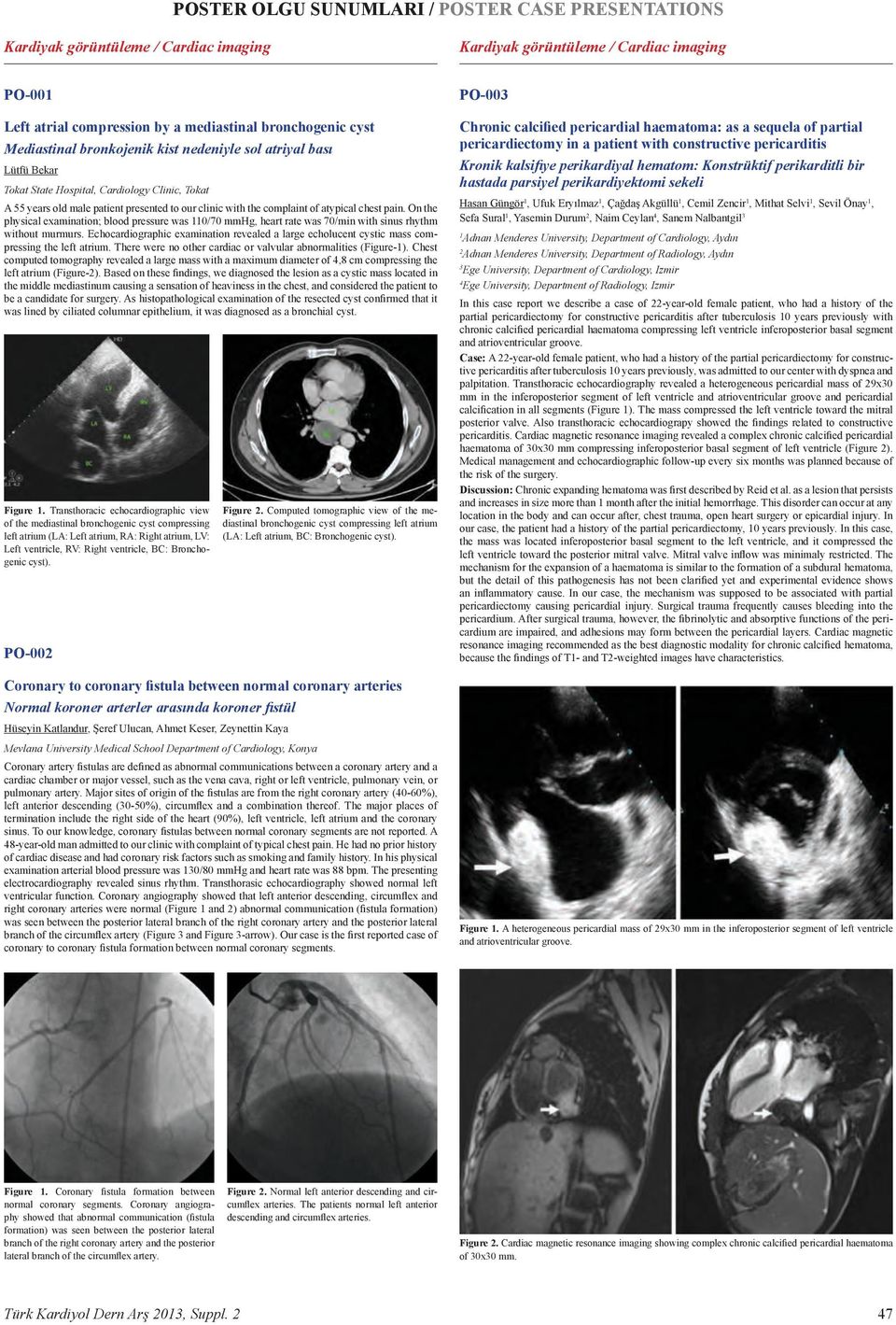
1 POSTER OLGU SUNUMLARI / POSTER CASE PRESENTATIONS Kardiyak görüntüleme / Cardiac imaging Kardiyak görüntüleme / Cardiac imaging PO-00 Left atrial compression by a mediastinal bronchogenic cyst Mediastinal bronkojenik kist nedeniyle sol atriyal bası Lütfü Bekar Tokat State Hospital, Cardiology Clinic, Tokat A 55 years old male patient presented to our clinic with the complaint of atypical chest pain. On the physical examination; blood pressure was 0/70 mmhg, heart rate was 70/min with sinus rhythm without murmurs. Echocardiographic examination revealed a large echolucent cystic mass compressing the left atrium. There were no other cardiac or valvular abnormalities (Figure-). Chest computed tomography revealed a large mass with a maximum diameter of 4,8 cm compressing the left atrium (Figure-). Based on these findings, we diagnosed the lesion as a cystic mass located in the middle mediastinum causing a sensation of heaviness in the chest, and considered the patient to be a candidate for surgery. As histopathological examination of the resected cyst confirmed that it was lined by ciliated columnar epithelium, it was diagnosed as a bronchial cyst. Figure. Transthoracic echocardiographic view of the mediastinal bronchogenic cyst compressing left atrium (LA: Left atrium, RA: Right atrium, LV: Left ventricle, RV: Right ventricle, BC: Bronchogenic cyst). PO-00 Figure. Computed tomographic view of the mediastinal bronchogenic cyst compressing left atrium (LA: Left atrium, BC: Bronchogenic cyst). PO-003 Chronic calcified pericardial haematoma: as a sequela of partial pericardiectomy in a patient with constructive pericarditis Kronik kalsifiye perikardiyal hematom: Konstrüktif perikarditli bir hastada parsiyel perikardiyektomi sekeli Hasan Güngör, Ufuk Eryılmaz, Çağdaş Akgüllü, Cemil Zencir, Mithat Selvi, Sevil Önay, Sefa Sural, Yasemin Durum, Naim Ceylan 4, Sanem Nalbantgil 3 Adnan Menderes University, Department of Cardiology, Aydın Adnan Menderes University, Department of Radiology, Aydın 3 Ege University, Department of Cardiology, Izmir 4 Ege University, Department of Radiology, Izmir In this case report we describe a case of -year-old female patient, who had a history of the partial pericardiectomy for constructive pericarditis after tuberculosis 0 years previously with chronic calcified pericardial haematoma compressing left ventricle inferoposterior basal segment and atrioventricular groove. Case: A -year-old female patient, who had a history of the partial pericardiectomy for constructive pericarditis after tuberculosis 0 years previously, was admitted to our center with dyspnea and palpitation. Transthoracic echocardiography revealed a heterogeneous pericardial mass of 9x30 mm in the inferoposterior segment of left ventricle and atrioventricular groove and pericardial calcification in all segments (Figure ). The mass compressed the left ventricle toward the mitral posterior valve. Also transthoracic echocardiograpy showed the findings related to constructive pericarditis. Cardiac magnetic resonance imaging revealed a complex chronic calcified pericardial haematoma of 30x30 mm compressing inferoposterior basal segment of left ventricle (Figure ). Medical management and echocardiographic follow-up every six months was planned because of the risk of the surgery. Discussion: Chronic expanding hematoma was first described by Reid et al. as a lesion that persists and increases in size more than month after the initial hemorrhage. This disorder can occur at any location in the body and can occur after, chest trauma, open heart surgery or epicardial injury. In our case, the patient had a history of the partial pericardiectomy, 0 years previously. In this case, the mass was located inferoposterior basal segment to the left ventricle, and it compressed the left ventricle toward the posterior mitral valve. Mitral valve inflow was minimaly restricted. The mechanism for the expansion of a haematoma is similar to the formation of a subdural hematoma, but the detail of this pathogenesis has not been clarified yet and experimental evidence shows an inflammatory cause. In our case, the mechanism was supposed to be associated with partial pericardiectomy causing pericardial injury. Surgical trauma frequently causes bleeding into the pericardium. After surgical trauma, however, the fibrinolytic and absorptive functions of the pericardium are impaired, and adhesions may form between the pericardial layers. Cardiac magnetic resonance imaging recommended as the best diagnostic modality for chronic calcified hematoma, because the findings of T- and T-weighted images have characteristics. Coronary to coronary fistula between normal coronary arteries Normal koroner arterler arasında koroner fistül Hüseyin Katlandur, Şeref Ulucan, Ahmet Keser, Zeynettin Kaya Mevlana University Medical School Department of Cardiology, Konya Coronary artery fistulas are defined as abnormal communications between a coronary artery and a cardiac chamber or major vessel, such as the vena cava, right or left ventricle, pulmonary vein, or pulmonary artery. Major sites of origin of the fistulas are from the right coronary artery (40-60%), left anterior descending (30-50%), circumflex and a combination thereof. The major places of termination include the right side of the heart (90%), left ventricle, left atrium and the coronary sinus. To our knowledge, coronary fistulas between normal coronary segments are not reported. A 48-year-old man admitted to our clinic with complaint of typical chest pain. He had no prior history of cardiac disease and had coronary risk factors such as smoking and family history. In his physical examination arterial blood pressure was 30/80 mmhg and heart rate was 88 bpm. The presenting electrocardiography revealed sinus rhythm. Transthorasic echocardiography showed normal left ventricular function. Coronary angiography showed that left anterior descending, circumflex and right coronary arteries were normal (Figure and ) abnormal communication (fistula formation) was seen between the posterior lateral branch of the right coronary artery and the posterior lateral branch of the circumflex artery (Figure 3 and Figure 3-arrow). Our case is the first reported case of coronary to coronary fistula formation between normal coronary segments. Figure. A heterogeneous pericardial mass of 9x30 mm in the inferoposterior segment of left ventricle and atrioventricular groove. Figure. Coronary fistula formation between normal coronary segments. Coronary angiography showed that abnormal communication (fistula formation) was seen between the posterior lateral branch of the right coronary artery and the posterior lateral branch of the circumflex artery. Figure. Normal left anterior descending and circumflex arteries. The patients normal left anterior descending and circumflex arteries. Figure. Cardiac magnetic resonance imaging showing complex chronic calcified pericardial haematoma of 30x30 mm. Türk Kardiyol Dern Arş 03, Suppl. 47
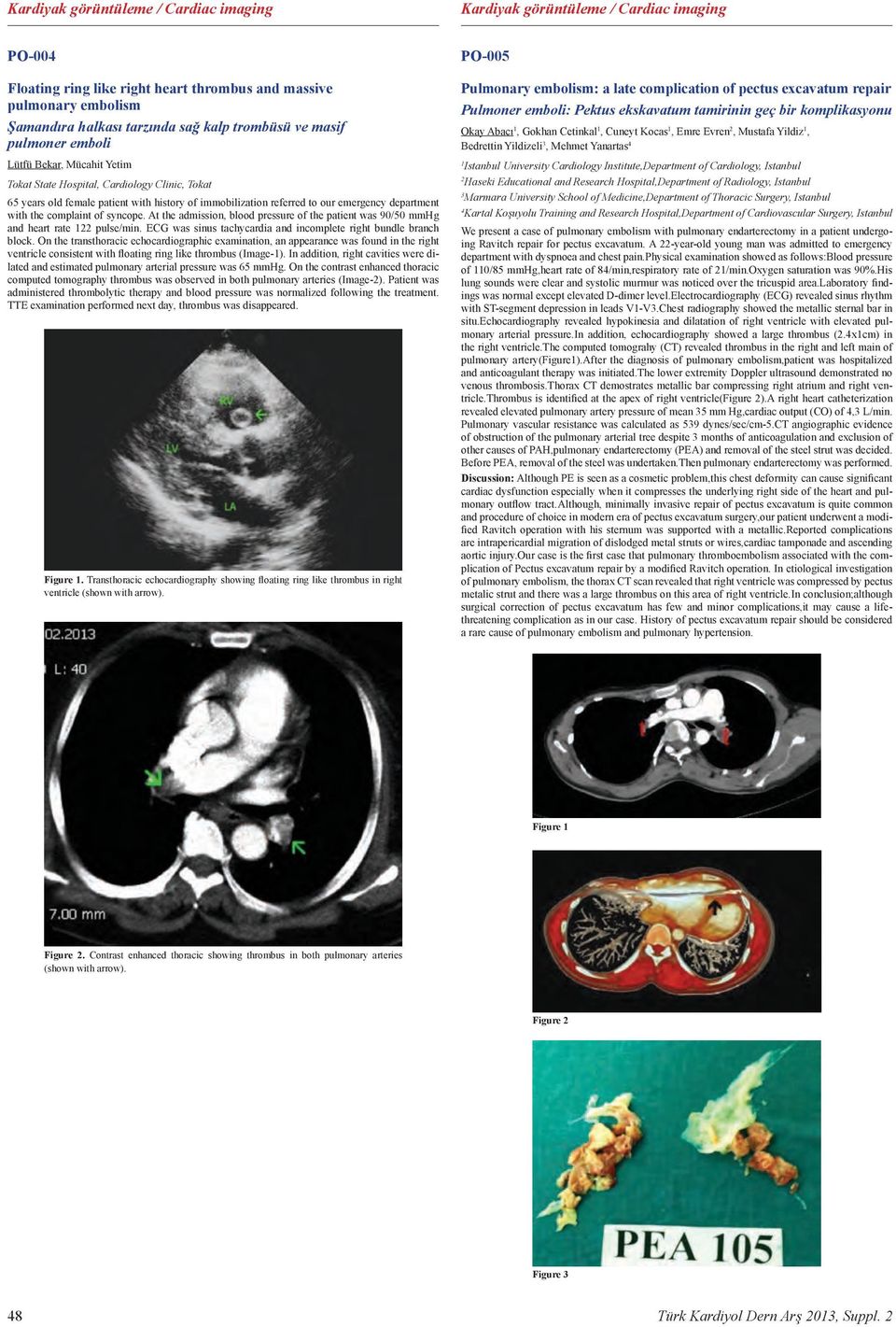
2 Kardiyak görüntüleme / Cardiac imaging Kardiyak görüntüleme / Cardiac imaging PO-004 Floating ring like right heart thrombus and massive pulmonary embolism Şamandıra halkası tarzında sağ kalp trombüsü ve masif pulmoner emboli Lütfü Bekar, Mücahit Yetim Tokat State Hospital, Cardiology Clinic, Tokat 65 years old female patient with history of immobilization referred to our emergency department with the complaint of syncope. At the admission, blood pressure of the patient was 90/50 mmhg and heart rate pulse/min. ECG was sinus tachycardia and incomplete right bundle branch block. On the transthoracic echocardiographic examination, an appearance was found in the right ventricle consistent with floating ring like thrombus (Image-). In addition, right cavities were dilated and estimated pulmonary arterial pressure was 65 mmhg. On the contrast enhanced thoracic computed tomography thrombus was observed in both pulmonary arteries (Image-). Patient was administered thrombolytic therapy and blood pressure was normalized following the treatment. TTE examination performed next day, thrombus was disappeared. Figure. Transthoracic echocardiography showing floating ring like thrombus in right ventricle (shown with arrow). PO-005 Pulmonary embolism: a late complication of pectus excavatum repair Pulmoner emboli: Pektus ekskavatum tamirinin geç bir komplikasyonu Okay Abacı, Gokhan Cetinkal, Cuneyt Kocas, Emre Evren, Mustafa Yildiz, Bedrettin Yildizeli 3, Mehmet Yanartas 4 Istanbul University Cardiology Institute,Department of Cardiology, Istanbul Haseki Educational and Research Hospital,Department of Radiology, Istanbul 3 Marmara University School of Medicine,Department of Thoracic Surgery, Istanbul 4 Kartal Koşuyolu Training and Research Hospital,Department of Cardiovascular Surgery, Istanbul We present a case of pulmonary embolism with pulmonary endarterectomy in a patient undergoing Ravitch repair for pectus excavatum. A -year-old young man was admitted to emergency department with dyspnoea and chest pain.physical examination showed as follows:blood pressure of 0/85 mmhg,heart rate of 84/min,respiratory rate of /min.oxygen saturation was 90%.His lung sounds were clear and systolic murmur was noticed over the tricuspid area.laboratory findings was normal except elevated D-dimer level.electrocardiography (ECG) revealed sinus rhythm with ST-segment depression in leads V-V3.Chest radiography showed the metallic sternal bar in situ.echocardiography revealed hypokinesia and dilatation of right ventricle with elevated pulmonary arterial pressure.in addition, echocardiography showed a large thrombus (.4xcm) in the right ventricle.the computed tomograhy (CT) revealed thrombus in the right and left main of pulmonary artery(figure).after the diagnosis of pulmonary embolism,patient was hospitalized and anticoagulant therapy was initiated.the lower extremity Doppler ultrasound demonstrated no venous thrombosis.thorax CT demostrates metallic bar compressing right atrium and right ventricle.thrombus is identified at the apex of right ventricle(figure ).A right heart catheterization revealed elevated pulmonary artery pressure of mean 35 mm Hg,cardiac output (CO) of 4,3 L/min. Pulmonary vascular resistance was calculated as 539 dynes/sec/cm-5.ct angiographic evidence of obstruction of the pulmonary arterial tree despite 3 months of anticoagulation and exclusion of other causes of PAH,pulmonary endarterectomy (PEA) and removal of the steel strut was decided. Before PEA, removal of the steel was undertaken.then pulmonary endarterectomy was performed. Discussion: Although PE is seen as a cosmetic problem,this chest deformity can cause significant cardiac dysfunction especially when it compresses the underlying right side of the heart and pulmonary outflow tract.although, minimally invasive repair of pectus excavatum is quite common and procedure of choice in modern era of pectus excavatum surgery,our patient underwent a modified Ravitch operation with his sternum was supported with a metallic.reported complications are intrapericardial migration of dislodged metal struts or wires,cardiac tamponade and ascending aortic injury.our case is the first case that pulmonary thromboembolism associated with the complication of Pectus excavatum repair by a modified Ravitch operation. In etiological investigation of pulmonary embolism, the thorax CT scan revealed that right ventricle was compressed by pectus metalic strut and there was a large thrombus on this area of right ventricle.in conclusion;although surgical correction of pectus excavatum has few and minor complications,it may cause a lifethreatening complication as in our case. History of pectus excavatum repair should be considered a rare cause of pulmonary embolism and pulmonary hypertension. Figure Figure. Contrast enhanced thoracic showing thrombus in both pulmonary arteries (shown with arrow). Figure Figure 3 48 Türk Kardiyol Dern Arş 03, Suppl.
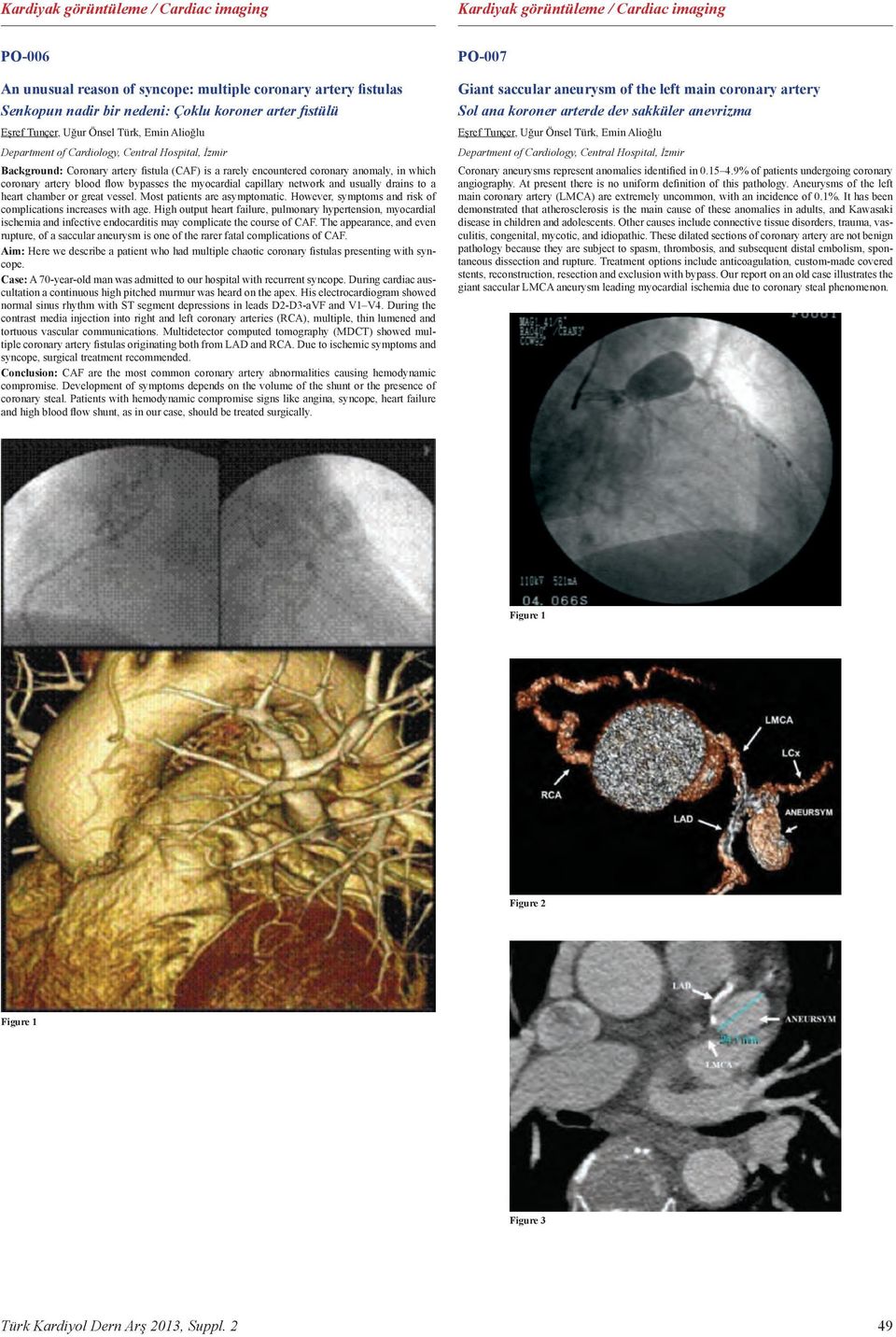
3 Kardiyak görüntüleme / Cardiac imaging Kardiyak görüntüleme / Cardiac imaging PO-006 An unusual reason of syncope: multiple coronary artery fistulas Senkopun nadir bir nedeni: Çoklu koroner arter fistülü Eşref Tunçer, Uğur Önsel Türk, Emin Alioğlu Department of Cardiology, Central Hospital, İzmir Background: Coronary artery fistula (CAF) is a rarely encountered coronary anomaly, in which coronary artery blood flow bypasses the myocardial capillary network and usually drains to a heart chamber or great vessel. Most patients are asymptomatic. However, symptoms and risk of complications increases with age. High output heart failure, pulmonary hypertension, myocardial ischemia and infective endocarditis may complicate the course of CAF. The appearance, and even rupture, of a saccular aneurysm is one of the rarer fatal complications of CAF. Aim: Here we describe a patient who had multiple chaotic coronary fistulas presenting with syncope. Case: A 70-year-old man was admitted to our hospital with recurrent syncope. During cardiac auscultation a continuous high pitched murmur was heard on the apex. His electrocardiogram showed normal sinus rhythm with ST segment depressions in leads D-D3-aVF and V V4. During the contrast media injection into right and left coronary arteries (RCA), multiple, thin lumened and tortuous vascular communications. Multidetector computed tomography (MDCT) showed multiple coronary artery fistulas originating both from LAD and RCA. Due to ischemic symptoms and syncope, surgical treatment recommended. Conclusion: CAF are the most common coronary artery abnormalities causing hemodynamic compromise. Development of symptoms depends on the volume of the shunt or the presence of coronary steal. Patients with hemodynamic compromise signs like angina, syncope, heart failure and high blood flow shunt, as in our case, should be treated surgically. PO-007 Giant saccular aneurysm of the left main coronary artery Sol ana koroner arterde dev sakküler anevrizma Eşref Tunçer, Uğur Önsel Türk, Emin Alioğlu Department of Cardiology, Central Hospital, İzmir Coronary aneurysms represent anomalies identified in % of patients undergoing coronary angiography. At present there is no uniform definition of this pathology. Aneurysms of the left main coronary artery (LMCA) are extremely uncommon, with an incidence of 0.%. It has been demonstrated that atherosclerosis is the main cause of these anomalies in adults, and Kawasaki disease in children and adolescents. Other causes include connective tissue disorders, trauma, vasculitis, congenital, mycotic, and idiopathic. These dilated sections of coronary artery are not benign pathology because they are subject to spasm, thrombosis, and subsequent distal embolism, spontaneous dissection and rupture. Treatment options include anticoagulation, custom-made covered stents, reconstruction, resection and exclusion with bypass. Our report on an old case illustrates the giant saccular LMCA aneurysm leading myocardial ischemia due to coronary steal phenomenon. Figure Figure Figure Figure 3 Türk Kardiyol Dern Arş 03, Suppl. 49
4 Kardiyak görüntüleme / Cardiac imaging Kardiyak görüntüleme / Cardiac imaging PO-008 A rare cause of dyspnea; left atrial myxoma mimicking pulmonary embolism Dispnenin nadir bir nedeni; pulmoner emboliyi taklit eden sol atriyal miksoma Altuğ Ösken, Yasemin Gündüz, Mehmet Bülent Vatan, Hüseyin Gündüz Sakarya University Medical Faculty, Department of Cardiology, Sakarya Sakarya University Medical Faculty, Department of Radiology, Sakarya Introduction: Atrial myxomas are the most common primary heart tumors. Symptoms are produced by mechanical interference with cardiac function or embolization. Signs and symptoms of mitral stenosis, endocarditis, mitral regurgitation, and collagen vascular disease can simulate those of atrial myxoma. However; until now, to our knowledge, there is no case study has been published that admitted to emergency department with profound dyspnea mimicking pulmonary embolism. We reported a case of a 76-year-old woman who presented with heart failure symptoms, and was found to have left atrial myxoma mimicking pulmonary embolism. Case Report: A 76-year-old woman admitted to the emergency department with a three weeks history of progressive dyspnea and moderate extremity edema. The patient had history of type diabetes mellitus and lumbar fracture operation two months ago. The diagnosis of pulmonary embolism was considered because of the patient s limited mobility and predisposing factors. Her pressure was 0/70 mmhg, pulse rate 0 bpm/regular, respiratory rate 6 per minute and temperature 37. C. An apical /6 holosystolic murmur and bilateral crackles on the middle and lower zones of lung was audible in oscultation. Hypocarbia and hypoxemia was observed in arterial blood gas analysis and D-dimer level was mildly high, so pulmonary CT angiography was performed in the emergency department. There was no consistent view of thrombus on the branches of the pulmonary artery, but incidentally myxoma view in the left atrium connected with handle to interatrial septum were detected in CT (Figure ). Transthoracic echocardiography is compatible with myxoma invading the left atrium with a size of 30x0 mm (Figure -3). Moderate mitral insufficiency was detected, left ventricular systolic and diastolic functions were normal. Therefore, the patient was admitted to the cardiology service with a diagnosis of decompensated heart failure and she was held the optimal medical treatment. In the follow up, the patient s cardiac symptoms were decreased so she was referred to the cardiovascular surgery for the removal of myxoma. Conclusion: We described the clinical features and imaging characteristics in an unusual case of atrial myxoma. It will be useful to keep in mind pulmonary embolism in the differential diagnosis of atrial myxomas. PO-009 Hypertrophic cardiomyopathy associated with abnormal origin of right coronary artery Sağ koroner arterin anormal kökü ile ilişkilendirilmiş hipertrofik kardiyomiyopati Murat Yalçın, Murat Atalay, Zafer Işılak, Ersin Öztürk 3 GATA Haydarpaşa Training Hospital Department of Cardiology, Üsküdar, İstanbul Merzifon Military Hospital, Merzifon, Amasya 3 GATA Haydarpaşa Training Hospital Department of Radiology, Üsküdar, İstanbul A 0-year-old man was admitted to our clinic with prolonged chest pain and shortness of breath. His physical examination was normal and myocardial enzymes were not elevated. Electrocardiography showed T-wave inversion in precordial leads. His transthoracic echocardiography (TTE) demonstrated the hypertropy of interventricular septum and left ventricle posterior wall (Figure A). There were no detectable gradient with Doppler echocardiography on left ventricular outflow tract, neither at rest nor with provocation. There were no other pathological finding on TTE. Syncope or family history of sudden cardiac death were not identified. 4 hours holter ECG monitoring was normal. He underwent multidetector computed tomography coronary anjiography (MCTCA) to exclude obstructive coronary artery disease. MCTCA revealed normal left coronary arteries and abnormal origin of right coronary artery (RCA) with an interarterial course between the aorta and pulmonary artery (Figures B, C,D). There were no luminal stenosis in coronary arteries. Myocardial perfusion scintigraphy (MPS) with 99 mtc sestamibi was performed to invastigate any effect of the interarterial course of RCA. After MPS no myocardial perfusion defect and ischemia was detected. Beta blocker therapy was initiated and patient was discharged. The association of hypertrophic cardiomyopathy and interarterial course of RCA is not common in literature. Theoratically myocardial ischemia can develop in these patients due to abnormal supply-demand balance. Figure. CT scan view of left atrial myxoma connected with handle to interatrial septum (arrowheads). Figure. (A) Transthoracic echocardiography (Parasternal long axis view) showed non-obstructive hypertrophic cardiomyopathy. (B) MCTCA volume rendering wiew showed RCA from left sinus valsalva. (C) MCTCA showed RCA from left sinus valsalva and it had an interarterial course (between the pulmonary trunk and aorta) (arrow). (D) MCTCA showed anomalous origin and interarterial course of RCA. Ao: Aorta, LV: Left Ventricle, LA: Left Atrium, PA: Pulmonary Artery, RCA: Right Coronary Artery, LAD: Left Descending Artery, LCX: Left Circumflex Artery, MCTCA: Multidetector computed tomography coronary anjiography. Figure. Echocardiographic parasternal long axis view of left atrial myxoma (arrowhead). Figure 3. Echocardiographic apical four chamber view of left atrial myxoma (arrowhead). 50 Türk Kardiyol Dern Arş 03, Suppl.

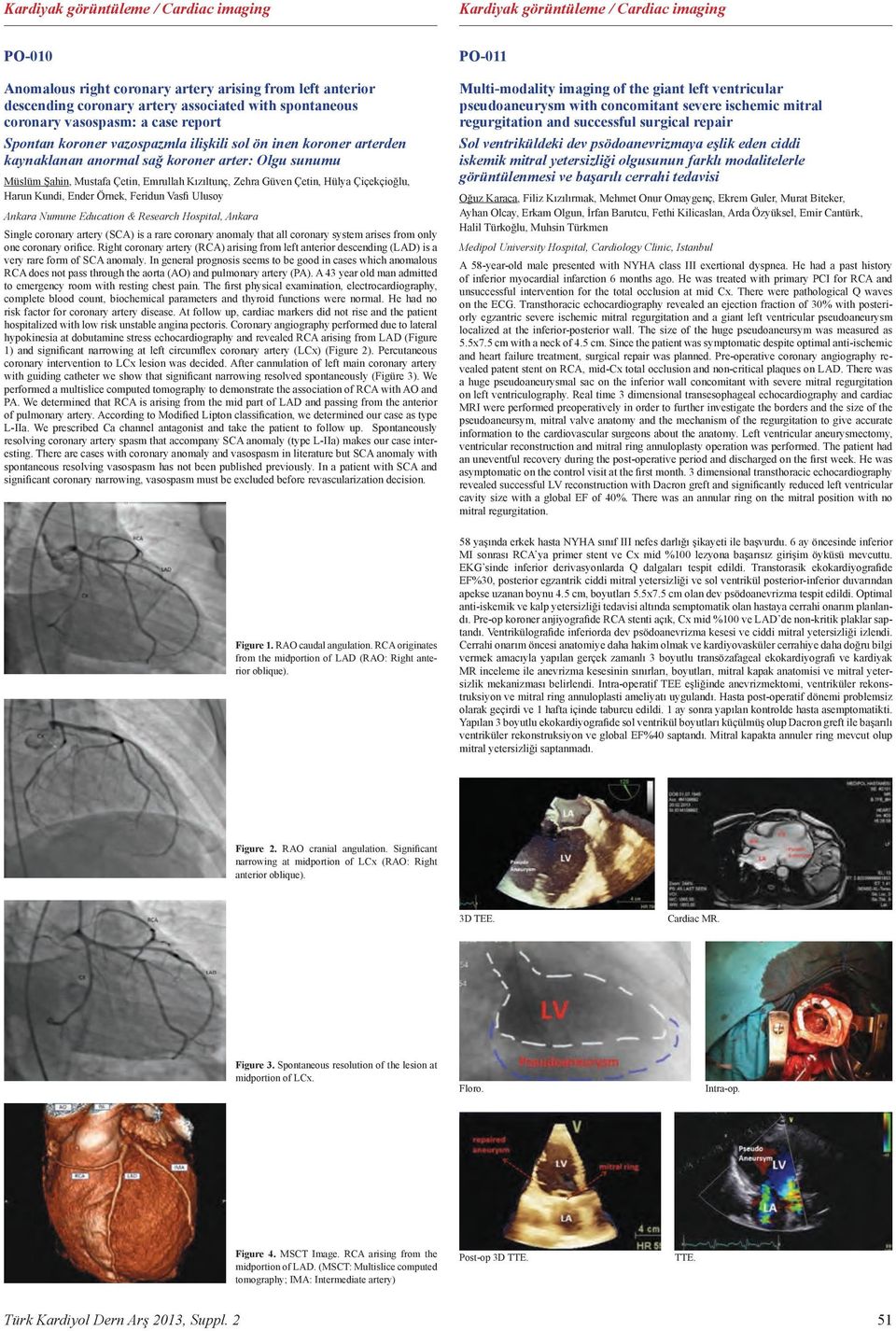
5 Kardiyak görüntüleme / Cardiac imaging Kardiyak görüntüleme / Cardiac imaging PO-00 Anomalous right coronary artery arising from left anterior descending coronary artery associated with spontaneous coronary vasospasm: a case report Spontan koroner vazospazmla ilişkili sol ön inen koroner arterden kaynaklanan anormal sağ koroner arter: Olgu sunumu Müslüm Şahin, Mustafa Çetin, Emrullah Kızıltunç, Zehra Güven Çetin, Hülya Çiçekçioğlu, Harun Kundi, Ender Örnek, Feridun Vasfi Ulusoy Ankara Numune Education & Research Hospital, Ankara Single coronary artery (SCA) is a rare coronary anomaly that all coronary system arises from only one coronary orifice. Right coronary artery (RCA) arising from left anterior descending (LAD) is a very rare form of SCA anomaly. In general prognosis seems to be good in cases which anomalous RCA does not pass through the aorta (AO) and pulmonary artery (PA). A 43 year old man admitted to emergency room with resting chest pain. The first physical examination, electrocardiography, complete blood count, biochemical parameters and thyroid functions were normal. He had no risk factor for coronary artery disease. At follow up, cardiac markers did not rise and the patient hospitalized with low risk unstable angina pectoris. Coronary angiography performed due to lateral hypokinesia at dobutamine stress echocardiography and revealed RCA arising from LAD (Figure ) and significant narrowing at left circumflex coronary artery (LCx) (Figure ). Percutaneous coronary intervention to LCx lesion was decided. After cannulation of left main coronary artery with guiding catheter we show that significant narrowing resolved spontaneously (Figüre 3). We performed a multislice computed tomography to demonstrate the association of RCA with AO and PA. We determined that RCA is arising from the mid part of LAD and passing from the anterior of pulmonary artery. According to Modified Lipton classification, we determined our case as type L-IIa. We prescribed Ca channel antagonist and take the patient to follow up. Spontaneously resolving coronary artery spasm that accompany SCA anomaly (type L-IIa) makes our case interesting. There are cases with coronary anomaly and vasospasm in literature but SCA anomaly with spontaneous resolving vasospasm has not been published previously. In a patient with SCA and significant coronary narrowing, vasospasm must be excluded before revascularization decision. PO-0 Multi-modality imaging of the giant left ventricular pseudoaneurysm with concomitant severe ischemic mitral regurgitation and successful surgical repair Sol ventriküldeki dev psödoanevrizmaya eşlik eden ciddi iskemik mitral yetersizliği olgusunun farklı modalitelerle görüntülenmesi ve başarılı cerrahi tedavisi Oğuz Karaca, Filiz Kızılırmak, Mehmet Onur Omaygenç, Ekrem Guler, Murat Biteker, Ayhan Olcay, Erkam Olgun, İrfan Barutcu, Fethi Kilicaslan, Arda Özyüksel, Emir Cantürk, Halil Türkoğlu, Muhsin Türkmen Medipol University Hospital, Cardiology Clinic, Istanbul A 58-year-old male presented with NYHA class III exertional dyspnea. He had a past history of inferior myocardial infarction 6 months ago. He was treated with primary PCI for RCA and unsuccessful intervention for the total occlusion at mid Cx. There were pathological Q waves on the ECG. Transthoracic echocardiography revealed an ejection fraction of 30% with posteriorly egzantric severe ischemic mitral regurgitation and a giant left ventricular pseudoaneurysm localized at the inferior-posterior wall. The size of the huge pseudoaneursym was measured as 5.5x7.5 cm with a neck of 4.5 cm. Since the patient was symptomatic despite optimal anti-ischemic and heart failure treatment, surgical repair was planned. Pre-operative coronary angiography revealed patent stent on RCA, mid-cx total occlusion and non-critical plaques on LAD. There was a huge pseudoaneurysmal sac on the inferior wall concomitant with severe mitral regurgitation on left ventriculography. Real time 3 dimensional transesophageal echocardiography and cardiac MRI were performed preoperatively in order to further investigate the borders and the size of the pseudoaneursym, mitral valve anatomy and the mechanism of the regurgitation to give accurate information to the cardiovascular surgeons about the anatomy. Left ventricular aneurysmectomy, ventricular reconstruction and mitral ring annuloplasty operation was performed. The patient had an uneventful recovery during the post-operative period and discharged on the first week. He was asymptomatic on the control visit at the first month. 3 dimensional transthoracic echocardiography revealed successful LV reconstruction with Dacron greft and significantly reduced left ventricular cavity size with a global EF of 40%. There was an annular ring on the mitral position with no mitral regurgitation. Figure. RAO caudal angulation. RCA originates from the midportion of LAD (RAO: Right anterior oblique). 58 yaşında erkek hasta NYHA sınıf III nefes darlığı şikayeti ile başvurdu. 6 ay öncesinde inferior MI sonrası RCA ya primer stent ve Cx mid %00 lezyona başarısız girişim öyküsü mevcuttu. EKG sinde inferior derivasyonlarda Q dalgaları tespit edildi. Transtorasik ekokardiyografide EF%30, posterior egzantrik ciddi mitral yetersizliği ve sol ventrikül posterior-inferior duvarından apekse uzanan boynu 4.5 cm, boyutları 5.5x7.5 cm olan dev psödoanevrizma tespit edildi. Optimal anti-iskemik ve kalp yetersizliği tedavisi altında semptomatik olan hastaya cerrahi onarım planlandı. Pre-op koroner anjiyografide RCA stenti açık, Cx mid %00 ve LAD de non-kritik plaklar saptandı. Ventrikülografide inferiorda dev psödoanevrizma kesesi ve ciddi mitral yetersizliği izlendi. Cerrahi onarım öncesi anatomiye daha hakim olmak ve kardiyovasküler cerrahiye daha doğru bilgi vermek amacıyla yapılan gerçek zamanlı 3 boyutlu transözafageal ekokardiyografi ve kardiyak MR inceleme ile anevrizma kesesinin sınırları, boyutları, mitral kapak anatomisi ve mitral yetersizlik mekanizması belirlendi. Intra-operatif TEE eşliğinde anevrizmektomi, ventriküler rekonstruksiyon ve mitral ring annuloplasti ameliyatı uygulandı. Hasta post-operatif dönemi problemsiz olarak geçirdi ve hafta içinde taburcu edildi. ay sonra yapılan kontrolde hasta asemptomatikti. Yapılan 3 boyutlu ekokardiyografide sol ventrikül boyutları küçülmüş olup Dacron greft ile başarılı ventriküler rekonstruksiyon ve global EF%40 saptandı. Mitral kapakta annuler ring mevcut olup mitral yetersizliği saptanmadı. Figure. RAO cranial angulation. Significant narrowing at midportion of LCx (RAO: Right anterior oblique). 3D TEE. Cardiac MR. Figure 3. Spontaneous resolution of the lesion at midportion of LCx. Floro. Intra-op. Figure 4. MSCT Image. RCA arising from the midportion of LAD. (MSCT: Multislice computed tomography; IMA: Intermediate artery) Post-op 3D TTE. TTE. Türk Kardiyol Dern Arş 03, Suppl. 5
6 Kardiyak görüntüleme / Cardiac imaging Kardiyak görüntüleme / Cardiac imaging PO-0 Isolated interrupted aortic arch in adulthood: a case report Erişkinlikte izole aortik ark interrupsiyonu: Olgu sunumu İbrahim Rencüzoğulları, Ismail Turkay Ozcan, Abdullah Cirit, Selcuk Ayhan Division of Cardiology, Mugla Sitki Kocman University Education and Research Hospital, Mugla Division of Cardiology, Department of Medicine, Mersin University School of Medicine, Mersin Introduction: Interrupted aortic arch (IAA) is a rare congenital malformation that occurs in 3 per million live births. This anomaly is defined as a loss of luminal continuity between the ascending and descending portions of the aorta. Prognosis of this anomaly depends on the associated congenital anomalies and it has very poor prognosis unless surgical treatment. Case Report: A 56-year-old man presented at our hospital because of dyspnea and chest pain. He had a history of hypertension. Also two years ago he had a hemorrhagic stroke but he had no limitations. On physical examination, peripheral pulses were palpable over the carotid arteries and in the upper limbs. Bounding pulses in the neck were also detected. The blood pressure was 35/70 mmhg in the right arm and 95/60 mmhg in the left arm. Lowerlimb pulses were not palpable. Chest X-ray showed increased vascularity and cardiomegaly. Transthoracic echocardiography showed concentric hypertrophy and moderate aortic regurgitation. Through cardiac catheterization guide wire did not go beyond the proximal part of descending aorta. Aortography via femoral artery showed a complete interruption of the aortic arch just distal to the origin of the left subclavian artery (Fig. a). We pushed pigtail distal to the subclavian artery via right brachial artery and we could clearly demonstrate interruption and collaterals (Fig. b). Computed tomography angiography revealed severe hypoplasia of the transverse aortic arch proximal to the origin of the left subclavian artery (Fig. c-d). Both common carotid arteries were dilated. The descending thoracic aorta was supplied by extensive collateral vessels from the vertebrobasilar system down to the posterior chest wall and the spine (Fig. e-f). In accordance with the results of cardiac catheterization, retrograde flow could be seen in the proximal left subclavian artery and the left vertebral artery. A singlestage extra-anatomic repair was performed by placing a 6-mm Dacron graft between the ascending and descending portions of the thoracic aorta. The patient recovered uneventfully and was doing well at his st month visit. Discussion: Several methods can be used for the diagnosis of IAA. Two-dimensional echocardiography plays an important role in the delineation of IAA. This technique is also necessary for ruling out associated intracardiac anomalies that were not detailed at cardiac catheterization. Cardiac catheterization is usually necessary for definitive anatomical evaluation in patients with IAA. Treatment of the IAA is definitely surgical correction. IAA is rarely encountered in an adult patient and the malformation may be repaired in a singlestage procedure by means of extra anatomic approach with a low risk of morbidity and mortality. In conclusion, interrupted aortic arch is rarely encountered in an adult patient. When it does occur, the malformation may be repaired in a single-stage procedure with a low risk of morbidity and mortality. PO-03 Chronic papillary muscle rupture: 4 years survival without surgical treatment Kronik papiller kas rüptürü: Cerrahi tedavi olmaksızın 4 yıllık sağkalım Selcen Yakar Tuluce, Cahide Soydas Cinar, Kamil Tuluce 3, Alper Yuksel 4, Oguz Yavuzgil, Cemil Gurgun Izmir Ataturk Research and Training Hospital, Department of Cardiology, Izmir Ege University Medicine Faculty, Department of Cardiology, Izmir 3 Karsiyaka State Hospital, Department of Cardiology, Izmir 4 Kent Hospital, Department of Radiology, Izmir A 68-year-old woman complained of chest pain and diagnosed with myocardial infarction in 997. Transthoracic echocardiography (TTE) visualised a cardiac mass with systolic left ventricular dysfunction. Transesophageal echocardiography recordings in 997 showed a.9 x.4 cm echodense multilobular mass (arrow) attached to the mitral valve (Figure A). Coronary angiogram revealed multivessel coronary artery disease. She refused surgery. She presented with severe dyspnea in 006. Physical examination revealed a 3/6 systolic murmur best heard at the apex. Bibasillary rales and bilateral mild pretibial edema were detected. Electrocardiogram displayed sinus rhythm with a left bundle branch block. For further evaluation of the mass, she was investigated by true- FISP sequence cardiac magnetic resonance (MR) imaging which clearly showed rupture of the two heads of posteromedial papillary muscle (PM) (Figure B, arrow) and an aneurysm formation (asterisk) at the apex. She again rejected surgical treatment. In 009 and 00 TTE demonstrated swinging of the ruptured PM and a moderate to severe eccentric mitral regurgitation (Figure C). She died due to heart failure in 0. Papillary muscle rupture is a rare but life-threatening complication of myocardial infarction. The prognosis was poor, with 33% of patients dying immediately, 50% dying within 4 hours, and only 6% surviving longer than two months before surgery. However, we presented a case with posteromedial PM rupture who managed to survive 4 years without surgical treatment. Figure. A: TEE imaging in 997 showing multilobular mass attached to mitral valve B: Cardiac MR image in 006 showing ruptured heads of posteromedial papillary muscle C: TTE image in 00 showing ruptured posteromedial papillary muscle and moderate to severe mitral regurgitation. PO-04 Acute myocarditis or Kounis Syndrome? Role of cardiac MRI and speckle-tracking echocardiography for differential diagnosis Akut miyokardit mi? Kounis Sendromu mu? Ayırıcı tanıda kardiyak MR ve speckle-tracking ekokardiyografinin rolü Oğuz Karaca, Ekrem Guler, Mehmet Onur Omaygenç, Filiz Kızılırmak, Murat Biteker, Ayhan Olcay, Erkam Olgun, İrfan Barutcu, Fethi Kılıçaslan, Muhsin Türkmen Medipol University Hospital, Cardiology Clinic, Istanbul Figure Introduction: In approximately 0% of coronary angiographies performed for acute chest pain and increased cardiac enzymes, normal coronary arteries are detected. We report cases in which differential diagnoses and diagnostic imaging modalities are discussed in such clinical conditions. Case : A 39-year-old male presented with acute chest pain lasting for hour. He was on amoxicilin therapy because of pharyngitis for week. On the ECG, there were ST elevations at the inferolateral leads. Coronary angiography revealed non-critical plaques without ant thrombotic occlusion. On transthoracic echocardiography (TTE), there was hypokinesis at the posterolateral walls with an EF of 45%. Troponin I value was 3.95 ng/ml (N: <0.0) on admission and rised to a peak value of 0.44 ng/ml. Acute myocarditis and Kounis Syndrome (allergic myocardial infarction) due to amoxicilin were considered as differential diagnoses. Left ventricular (LV) strain analysis with dimensional speckle-tracking echocardiography (D-STE) showed reduced LV global longitudinal strain (GLS) values and regional analysis revealed reduced local strain values at the apical, anterolateral and posterolateral walls incompatible with any coronary artery area. Cardiac MRI showed anterolateral and posterolateral hypokinesis and edema with late Gadolinium enhancement at the subepicardial regions. Heterogeneous and subepicardial involvement of the myocardium excluded Kounis Syndrome while supporting acute myocarditis. On routine heart failure therapy, the patient was discharged after 5 days without any complications. month later he was asymptomatic and LV functions were normal. Case : A 9-year-old male with chest pain lasting for week presented with diffuse (D-D-aVL- V4-5-6) ST elevations > mm on the ECG. He was on sefuroxim therapy because of tonsillitis for 0 days. Troponin I was >5 ng/ml on admission. Coronary angiography revealed normal coronary arteries. On TTE, EF was 40% with hypokinesis of the anterior and lateral walls. Acute myocarditis and Kounis Syndrome (allergic myocardial infarction) due to sefuroxim were considered as differential diagnoses. D-STE showed reduced LV-GLS values and regional analysis revealed reduced local strain values at the apical, anterior and inferoseptal walls. Cardiac MRI showed anterolateral and inferior hypokinesis and edema with late Gadolinium enhancement at the subepicardial regions. These findings supported the diagnosis of acute myocarditis and excluded Kounis Syndrome. The patient was discharged after week without any complications on routine heart failure therapy. 3 months later he was asymptomatic and LV functions were normal. Conclusion: Acute myocarditis and Kounis Syndrome should always be remembered in cases presenting with acute chest pain and increased cardiac enzymes with normal coronary arteries. STE and cardiac MRI are important imaging modalities for differential diagnosis. 5 Türk Kardiyol Dern Arş 03, Suppl.
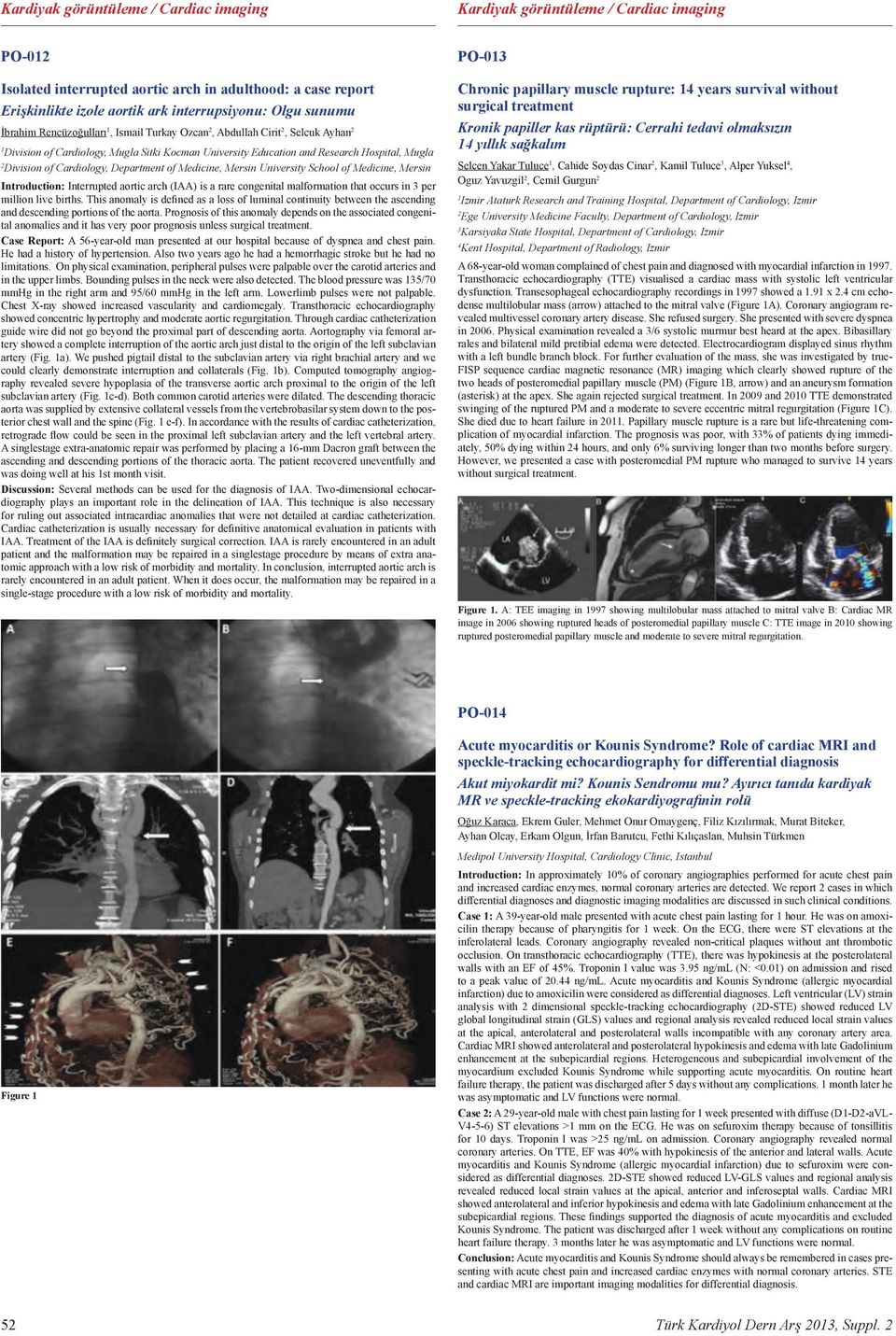
7 Kardiyak görüntüleme / Cardiac imaging Kardiyak görüntüleme / Cardiac imaging Giriş: Akut göğüs ağrısı ve kardiyak enzim yüksekliği ile koroner anjiyografi yapılan hastaların yaklaşık %0 unda koroner arterler normal saptanmaktadır. Bu klinik tabloda düşünülecek ayırıcı tanılar ve tanısal görüntüleme yöntemleri olgu sunumu olarak irdelenmiştir. Olgu : 39 yaşında erkek hasta acil servise saatlik göğüs ağrısı ile başvurdu. Hastanın haftadır ÜSYE tablosunda olduğu amoksisilin kullanmakta olduğu öğrenildi. EKG sinde inferolateral derivasyonlarda mm ST elevasyonu saptandı. STEMI ön tanısı ile yapılan koroner anjiyografide koroner arterlerde plaklar mevcut olup trombotik lezyon saptanmadı ve medikal izlem kararı alındı. Transtorasik ekokardiyografide EF%45 ve posterolateral hipokinezi saptandı. Başvuruda bakılan Troponin I: 3.95 ng/ml (N: <0.0) olup takiplerinde maksimum 0.44 ng/ml değerlerine yükseldi. Hastada ayırıcı tanıda akut miyokardit ile ÜSYE nedeniyle kullandığı antibiyotik ile tetiklenen allerjik miyokard enfarktüsü (Kounis Sendromu) tanıları düşünüldü. boyutlu speckle-tracking yöntemi (D-STE) ile yapılan strain analizinde sol ventrikül global longitudinal strain (LV-GLS) değerinin azalmış olduğu ve bölgesel analizde koroner arter trasesine uymayacak şekilde apekste, posterolateral ve anterolateral duvarlarda strain değerlerinin azaldığı gözlendi. Kardiyak MR incelemesinde anterolateral ve posterolateral duvarlarda hipokinezi ile birlikte ödem ve subepikardiyal bölgede geç Gadolinyum tutulumu tespit edildi. Miyokardın heterojen ve subepikardiyal tutulumu ile hastada Kounis Sendromu dışlandı ve akut miyokardit tanısı konuldu. Hasta destek tedavisi ile 5 gün içinde problemsiz taburcu edildi. ay sonraki kontrolünde asemptomatik ve LV fonksiyonları normaldi. Olgu : 9 yaşında erkek hasta haftadır devam eden göğüs ağrısı ile başvurdu. Öyküsünde 0 gün önce boğaz enfeksiyonu nedeniyle sefuroksim başlandığı öğrenildi. EKG sinde D-D-aVL- V4-5-6 derivasyonlarında mm ST elevasyonu saptandı. Troponin I değeri > 5 ng/ml saptandı. Koroner anjiyografisi yapıldı ve normal koroner arterler tespit edilerek medikal izlem kararı alındı. TTE de EF%40 olup anterior ve lateral hipokinezi saptandı. Hastada ön tanı olarak akut miyokardit ve sefuroksim ile tetiklenen Kounis Sendromu düşünüldü. Yapılan D-STE incelemede LV- GLS değerinin azalmış olduğu ve bölgesel analizde apekste, anteriorda ve inferoseptal duvarda bölgesel strain değerlerinde azalma tespit edildi. Kardiyak MR incelemesinde anterolateral ve inferior duvarlarda hipokinezi ve ödem ile subepikardiyal geç kontrast tutulumu tespit edildi. Mevcut bulgularla akut miyokardit tanısı kesinleştirildi. Kalp yetersizliği tedavisi ile hasta hafta sonra taburcu edildi. 3. ay kontrolünde asemptomatik ve LV fonksiyonları normaldi. Sonuç: Akut göğüs ağrısı ve enzim yüksekliği olup normal koronerler saptanan hastalarda Kounis Sendromu ve miyokardit unutulmamalıdır. Sunulan olgular ayırıcı tanıda ilk kez STE ve kardiyak MR ın kullanılması açısından önemlidir. Case angiography Case ECG Case ECHO / strain PO-05 case MRI Multiple cardiovascular involvement of Behcet s disease; a rare presentation of behcet s disease with bilateral venous, right ventricle and pulmonary artery thrombosis without pulmonary embolism Behçet hastalığında çoklu kardiyak tutulum; Behçet hastalığının pulmoner emboli olmaksızın bilateral venöz, sağ ventrikül ve pulmoner arer trombozu ile nadir prezentasyonu Hakan Ozkan, Tekin Yildiz, Nurullah Dogan 3, Ahmet Seckin Cetinkaya, Tahsin Bozat Medicalpark Hospital, Department of Cardiology, Bursa Medicalpark Hospital, Department of Respiratory Disease, Bursa 3 Bahar Hospital, Department of Radiology, Bursa Introduction: Behcet s disease (BD) is a chronic, relapsing multisystem autoinflammatory disease. Recurrent oral and/or genital aphthosis, mucocutaneous lesions, central nervous system manifestation, and ocular, vascular, articular, gastrointestinal, and inflammatory eye lesions are typical involvement for diagnosis.it has been increasingly recognized that cardiac involvement and arterial complications are important part of BD. Pericarditis, myocardial (diastolic and/or systolic dysfunction), valvular and coronary (thrombosis, aneurysms, rupture) involvement, intracardiac thrombi (predominantly right-sided) are the most frequent cardiac manifestations. Deep vein thrombosis of the lower extremities is the most frequent site for thrombosis in BD without pulmonary embolism. Treatment of cardiovascular involvement in BD is largely empirical and aimed at suppression of vasculitis. Case Presentation: A 37-year-old man presented with a 3-month history of intermittan leg pain on walking and dyspnea with back pain. He had diagnosis of BD. He discontinued cholcicine therapy for two years. He had a history of deep venous thrombosis 4 years ago. On his initial evaluation, the examination findings were as follows: blood pressure was 0/70 mmhg, pulse 76 beats/min,respiratory rate 4,O saturation97%. Chest auscultation revealed bibasilar diminished respiratory sounds with rhonci. On cardiac examination, no murmur was audible. An echocardiogram showed normal left and right ventricle cavity size with ejection fraction of 7%. A suspected thrombus image located at the right ventricle outflow tract(rvot)(figure ). Therefore, transesophageal echocardiogram(tee) performed. TEE revelead x mm thrombus attached on the RVOT(Figure ). Bilateral venous Doppler ultrasonography and venography revelaed deep vein thrombi with significant collaterals. Computerized tomography demonstrated pulmonary infarct with entire thrombus through the right pulmonary artery tree(figure 3) with intracardiac thrombus(figure 4,5). The presence of chronic deep vein thrombi, the characteristics and localization of intracardiac and pulmonary artery thrombus were typical findings of BD. Pulmonary embolism was the most important disease for differential diagnosis. Normal size of right ventricular cavity with normal pulmonary artery pressure, slowly progression history, development of venous collaterals, attachment of a large thrombi at the RVOT, characteristics of thrombus through the entire pulmonary artery tree with normal oxygen saturation and history of BD exculeded pulmonary embolism. The case was interesting with multiple cardiovascular involvement of BD. Immunosuppressive and oral steroid therapy with 300 mg aspirin daily started. Discussion: Cardiovascular manifestations may coincide in one patient. Cardiovascular involvement is among the most life-threatening complications in BD. Therefore, cardiologists should keep in mind potential threats of cardiovascular involvement in BD. Case ECHO / strain Case MRI Case angiography Figure. Transthoracic echocardiogram with parasternal short axis view, arrow indicates suspected mass at right ventricular outflow. Figure. Transesophageal echocardiography demonstrating a thrombus attached at the right ventricular outflow tract RV: right ventricle, PA: pulmonary artery. Case ECG Figure 3. Pulmonary artery thrombosis with pulmonary infarct, a reconstructed image from multislice computerized tomography. Figure 4. Multislice computerized tomograhy demonstrating a thrombus attached at the right ventricular outflow tract. Figure 5. Computerized tomography indicates filling defect localized in the right ventricle. Türk Kardiyol Dern Arş 03, Suppl. 53
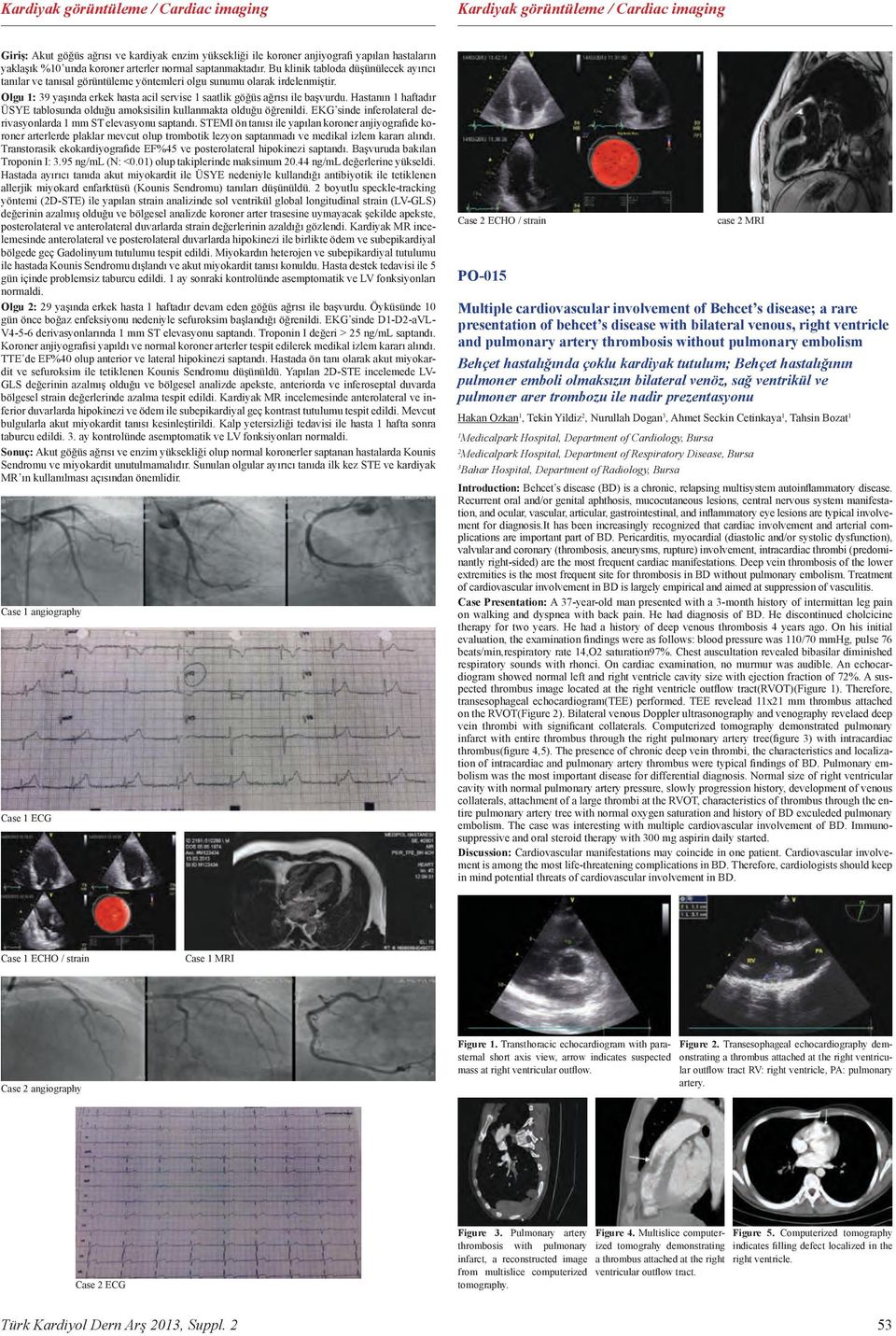
8 Kardiyak görüntüleme / Cardiac imaging Kardiyak görüntüleme / Cardiac imaging PO-06 Cauliflower shaped membranous ventricular septal aneurysm, Chiari s network, prominent eustachian valve and patent foramen ovale: a case report Karnabahar şekilli membranöz ventriküler septal anevrizma, Chiari ağı, belirgn eustachian kapakçık ve patetnt foramen ovale: Olgu sunumu Mutlu Cagan Sumerkan, Turgun Hamit, Ahmet Gurdal, Fusun Helvaci Department of Cardiology, Sisli Hamidiye Etfal Education and Research Hospital, Istanbul Introduction: Ventricular septal aneurysm (VSA) is an extremely rare abnormality of the heart and usually detected incidentally. VSA occurs with the spontaneous closure of a small membranous ventricular septal defect in childhood. The clinical presentation can range from endocarditis, left or right ventricular outflow tract obstruction, coronary compression, systemic embolism, cardiac arrhythmias, aortic insufficiency and even right-to-left shunts induced by cardiac rupture. Despite some publications showed VSA, very few of them had cauliflower like shape and associated with other cardiac abnormalities. Herein, we present a case of cauliflower shaped perimembranous ventricular septal aneurysm with patent foramen ovale, Chiari s network and prominent eustachian valve, which is incidentally detected by echocardiography. Case Details: A 4-year-old Caucasian female admitted to the emergency service with syncope after carried of heavy load. She did not have cardiovascular or systemic disease. However, she smoked /3 pack/day for 4 years. Physical examination, blood biochemistry values and cardiac markers were normal. Her blood pressure on admission was 0/70 mmhg. Electrocardiography showed 67 beats/minute, normal sinus rhythm with incomplete right bundle branch block. Echocardiography was performed for further evaluation. Transthoracic echocardiography showed; elongated and flail mitral chordae, mitral valve prolapse, mild mitral regurgitation, Chiari s network, prominent eustachian valve, normal systolic function and an abnormal sac structure extending into the right ventricle under the aortic annulus (Figure B, C, A). Addition to these, transesophageal echocardiography showed atrial septal aneurysm and patent foramen ovale (Figure B, C). A subsequent 8-slice multidetector cardiac computed tomography showed a cauliflower shaped membranous interventricular aneurysm under the right-coroner sinus of the aortic annulus, which is bulging to the right ventricle (Figure A). On rhythm holter monitoring normal sinus rhythm with sporadic premature atrial and ventricular complexes was seen. In our case, aneurysm is not associated with complications, the patient is asymptomatic, and aneurysm growth is not very important. Hereby conservative approach adopted, with a close surveillance. Conclusion: Identification of an interventricular aneurysm with imaging modalities is important. If this kind of malformation was bypassed, may lead to serious health problems or mortality. Especially it shall be kept in mind in cases with abnormal structure neighborhood to the aortic valve. PO-07 Intracardiac extension of intravenous leiomyoma originated from uterine Uterustan kaynaklanan intravenöz leiyomiyomun kardiyak uzanımı Erkan Kaya, Kubilay Karabacak, Gökhan Erol, Murat Çelik, Uygar Çağdaş Yüksel, Yalçın Gökoğlan, Emre Yalçınkaya, Barış Buğan, Erkan Yıldırım, Salim Yaşar Gulhane Military Medical Academy, Department of Cardiovascular Surgery, Ankara Gulhane Military Medical Academy, Department of Cardiology, Ankara Introduction: Intravenous leiomyoma is a benign neoplasm of smooth muscle cell of the uterine, which characterized without invasion of surrounding tissues. However, it can be characterized by a proliferation in the pelvic veins and the inferior vena cava. Up to now, 300 cases of intravenous leiomyoma have been reported in literature, and only 00 of these cases showed intracardiac extension. We herein present a case of intravenous leiomyoma originated from the uterine and extended through the inferior vena cava into the right atrium. Case report: Oral warfarin treatment had initiated 9 months ago in a 49-year-old female patient because of intravenous thrombus originated from right internal iliac vein and extended into the inferior vena cava in another institute. The patient was admitted to our institute for the continuation of the existing complaints. A computed tomography angiography was performed and revealed an intraluminal-filling defect starting from the right internal iliac vein and extending into the inferior vena cava, including the right renal vein. Also, there was mass located in the right paraovarian area, and boundaries were not clearly distinguished from the uterine. Transthoracic and transesophageal echocardiography revealed a large mass in the right atrium and the para-cardiac portion of the inferior vena cava. The patient was referred to cardiac surgery after consulted with the obstetric and gynecology consultant. Discussion: Because of the rarity and unusual growth potential of the intravenous leiomyoma, imaging techniques are more important to determine the accurate placement of the tumor clearly, Therefore, as much as possible imaging techniques such as computed tomography angiography, venography, echocardiography and magnetic resonance imaging should be used in order to prevent delay in correct diagnosis. After the determination of the complete and accurate placement of the tumor, the patient s complaints should be the priority and surgical planning should be performed without any delay. A B Figure. (A) CT scan of the thorax shows the intracardiac extension of the intravenous leiomyoma. (B) CT scan of the thorax shows the intracardiac extension of the intravenous leiomyoma. A B Figure. Perimembranous ventricular septal aneurysm. (A) A still frame of a partial sagittal image of cardiac computed tomography shows cauliflower shaped membranous ventricular septal aneurysm with moderate contrast. It has originated just beneath the right coronary sinus of valsalva and protruding into the right ventricle. The ascending aorta and ventricular septal aneurysm are opacified with iodinated contrast medium (white arrow). (B) Partial two chamber parasternal view of transthoracic echocardiography shows a fibrotic, non-contractile right ventricle lobulated, space-occupying structure under aortic annulus (white arrow). (C) Apical four chamber echocardiographic view depicting a prominent eustachian valve (black arrow). Ao= Ascending aorta; LA= Left atrium; LV= Left ventricle; RA= Right atrium; RV= Right ventricle. Figure. (A) D and 3D TEE images show the intracardiac extension of the intravenous leiomyoma. (B) D and 3D TEE images show the intracardiac extension of the intravenous leiomyoma. Figure. Perimembranous ventricular septal aneurysm. (A) Apical four chamber echocardiography shows a Chiari s network (white arrow). (B) The transesophageal echocardiography imaging shows the passage of flow through patent foramen ovale from right atrium to the left atrium (white arrow). Right atrium is filled with contrast agent (agitated saline). (C) Midesophageal echocardiographic examination shows the bulging of the interatrial septum to the left atrium which indicates atrial septal aneurysm (white arrow). LA= Left atrium; LV= Left ventricle; RA= Right atrium; RV= Right ventricle. 54 Türk Kardiyol Dern Arş 03, Suppl.
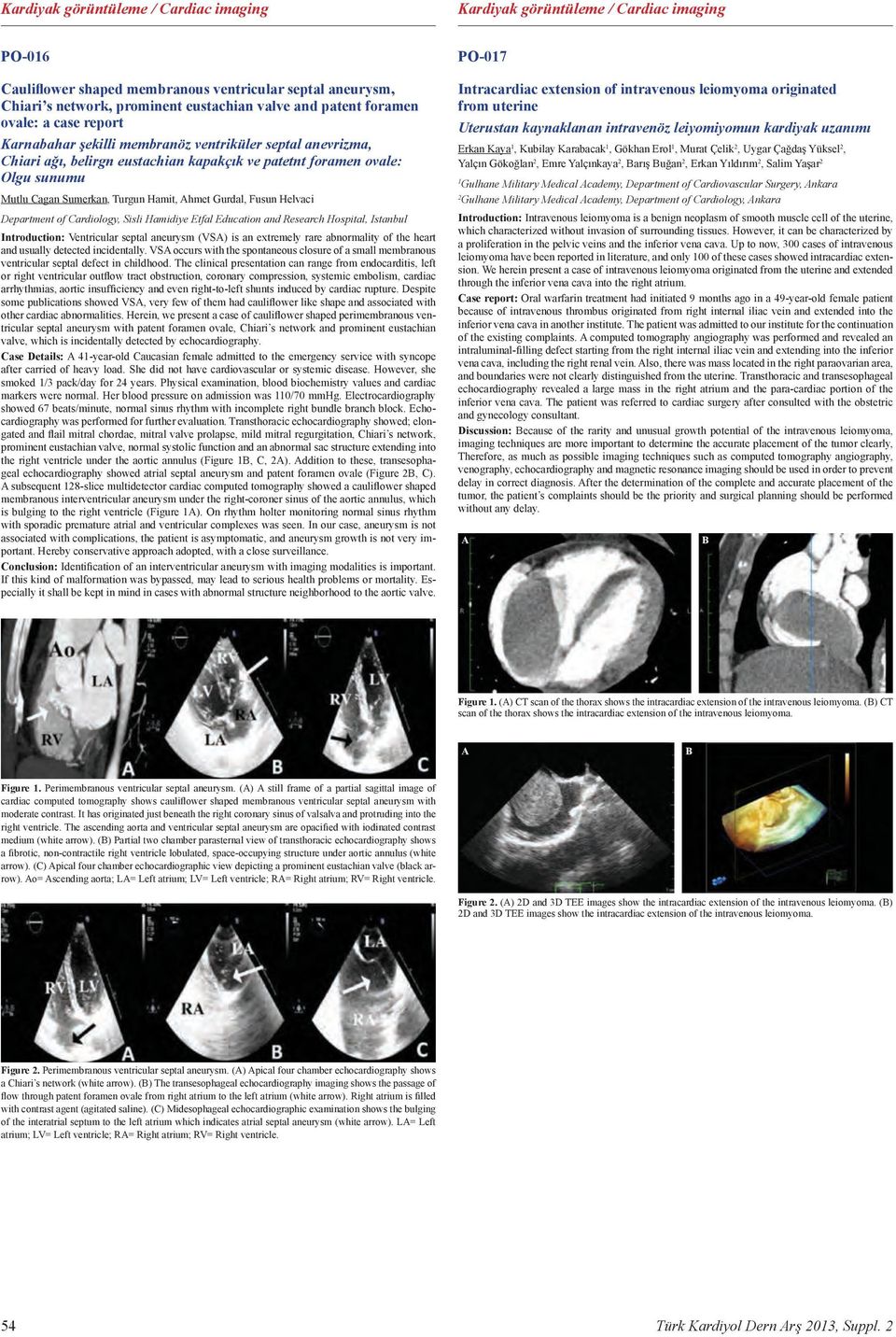
9 Kardiyak görüntüleme / Cardiac imaging Kalp damar cerrahisi / Coronary heart diseases PO-08 A serpentine free-floating right atrial thrombus which elongate from right ventricle to vena cava inferior Sağ ventrikülden vena kava inferiyora uzanan yılan biçimli serbest yüzen sağ atriyal trombüs Adnan Kaya, Elif Ijlal Cekirdekci, Servet Altay, Aycan Zencirci, Mehmet Eren Dr. Siyami Ersek Thoracic and Cardiovascular Surgery Training and Research Center, Department of Cardiology, Istanbul Free-Floating thrombi in the right cardiac chambers is rare, being found almost exclusively in patients with suspected or confirmed pulmonary thromboembolism. Floating Right Heart Thrombus (FRHTh) which is classified into two groups according to their origin, type A orginates from deep peripheral veins while type B orginates from intracardiac, can be defined as free moving mobile masses inside the right heart, and not attached to an intracardiac structure. FRHThs are well diagnosed by transthoracic echocardiograpy(tte) in patients suspected to have pulmonary tromboembolism. Mortality rates in pulmonary thromboembolism in patients with FRHTh are more higher than pulmonary thromboembolism alone and exceeds %40. Herein we present a woman with a giant free-floating thrombi in right atrium which was complicated with massive pulmonary embolism and right heart failure. Case: A 75-year-old female with antecedant hypertension, diabetes mellitus (DM), obesity (BMI>= 33) and smoking ( pack/year) admitted to our hospital with complaints of chest pain and dyspnea. On admission heart rate was 09/min, saturation with pulse oximetry was %75, temperature 37. C and systolic blood pressure was at average of cardiogenic shock 85 mmhg. Sinusal tachycardia and incomplet RBBB elektrocardiogram were existed.chest radiogram detected nothing serious while arterial blood gas showed hypoxia and hypocarbia. Transthorasic echocardiography revealed a free floating thin fibriller mass in the right atrium which protruding to the right ventricle through the tricuspid valve in atrial systole (Figure,,3). Right ventricle was enlarged, paradoxal septal motion was present and the systolic tricuspid pressure was 39mmHg with moderate tricuspid regurgitation. After the diagnosis of FRHTh, intravenous (i.v.) dose adjusted heparin and isotonic saline infusion were started. An immadiate cardiopulmonary bypass (CPB) was established with bicaval drainage and ascendan aortic perfusion. Hypokinetic and dilated right ventricle and right atrium were detected. Right atriotomy and extraction of the trombus which elongating from right atrium to the vena cava inferior was followed by pulmonary artery incision and trombus extraction. Weaning from CPB effort was failed and patient died. Histopatolojical examination of the material confirmed trombus. Conclusion: In patients with FRHTh, surgical embolectomy has own set of potential complications including genaral anesthesia, duration and inabilty to remove the coexisting pulmonary embolus beyond the central pulmonary artery (6). Early administration of fibrinolitic therapy provides resolution of thrombus in right heart, pulmonary artery and in deep lower extremities veins together.the benefit of thrombolysis is debated because of attendant risk of bleeding or stroke which may be occured by fargmentation of thrombus and obstrucion of the pulmonary arteries leading sudden cardiac death. PO-09 Surgical treatment of tetralogy of fallot with giant pulmonary artery aneurysm in adult Yetişkinde dev pulmoner arter anevrizması ile fallot tetralojisinin cerrahi tedavisi Bekir Serhad Yıldız, Vefa Ozcan, Fatma Esin 3, Aybala Tongut, Yusuf Izzettin Alihanoglu, Ismail Dogu Kılıc, Ihsan Alur, Harun Evrengul Pamukkale University Medical Faculty Department of Cardiology, Denizli Pamukkale University Medical Faculty Department of Cardiovascular Surgery, Denizli 3 Denizli State Hospital Department of Cardiology, Denizli Background: Tetralogy of fallot (TOF) is the most common cyanotic congenital heart defect(cchd) with a prevalence of 0.5 per 000 live births,and represents approximately 9% of all congenital heart defects.with the advent of intracardiac repair,survival of patients with TOF into adulthood has become routine with a good long-term prognosis.exceptional cases among TOF are able to survive if arterial oxygen saturation is enough for life.surgical intervention is vital in TOF for the patient s recovery.we report a successful surgical management of TOF with giant pulmonary artery aneurysm. Case: A 6 year-old male with no known history of cardiac disease presented dyspnea and cough. Symptoms aggravated while last one mount of his life. Physical examination revealed a blood pressure of 0/60 mmhg, pulse rate 0/min,and saturation in room air was 78%. The lead ECG showed sinus rythm, right bundle branch block and right ventricle hypertrophy. In family history there were any congenital heart disease. In auscultation,the first and the second heart sounds were revealed normal with blowing systolic murmurs (4/6) and thrill.he has clubbing and cyanosis.his physical condition assessed as NYHA Class III. Hematocrit was 56%. In chest X-ray, coeur en sabot (boot-shaped) configuration of the cardiac silhouette and enlargement of left pulmonary artery was shown (Figure I). On transthoracic echocardiography (TTE) examination, the classic components of the tetrad were demonstrated;a ventricular septal defect (VSD) with 7 mm diameter, right ventricular outflow tract obstruction (RVOTO), aortic override and right ventricular hypertrophy, consequently he was diagnosed as TOF. LVEF was 65%, ascending aort(aa) was 5cm and there was severe tricuspid regurgitation. RV and LV pressure are equal about 0/30 mmhg.there was no shunt. Mean gradient between RV and main PA measured 70 mmhg. Main pulmonary artery (MPA), right and left pulmonary artery(rpa, LPA) were extremely dilated (Figure II). Right heart angiography revealed that there were any main aortopulmonary collateral arteries. MPA pressure was measured mmhg by right catheter. CT angiography imagings also demonstrated dilated left pulmonary artery as x0 mm (Figure III). In surgical treatment;pulmonary valve was seen rudimentary. Ventriculotomy approach is preferred for VSD closure by using Dacron patch. AA had aneurysmatic dilatation. Therefore, making a remodelling of AA was decided with aortic linear plication and wrapping technique (Figure IV-V). Postoperatively TTE examination confirmed a minimal pulmonary valve insufficiency and stenosis,no residual VSD with a LVEF of 65%. AA was measured 6 mm. His physical condition appeared to be very healthy (NYHA class I-II). Conclusion: This case has clearly uttered that for most adults with CCHD, definitive repair may be feasible and transplantation is not the only surgical option.patients can survive when they are diagnosed and underwent surgery (in appropriate cases) independent of age. Figure. Transthoracic echocardiography (TTE) reveales a free-floating right atrial (RA) thrombus of 0 cm in length with right ventricular (RV) dilatation (arrow). Figure. Arrow shows a free-floating thrombus which is protruding to the right ventricle through the tricuspid valve in atrial systole. Figure. Chest X- ray of patient. Enlargement of left pulmonary artery and boot-shaped configuration of the cardiac silhouette can be seen. (black arrow shows dilated left pulmonary artery). Figure. MRI image of dilated left pulmonary artery. Figure 3. Computer tomography image of dilated left pulmonary artery (Approximately x0 cm). Figure 3. Subcostal TTE view demonstrates that thrombus in right atrium is reaching to the inferior vena cava. Figure 4. Openning of pulmonary artery. Figure 5. VSD clousure, linear plication and wrapping of ascending aorta. Türk Kardiyol Dern Arş 03, Suppl. 55
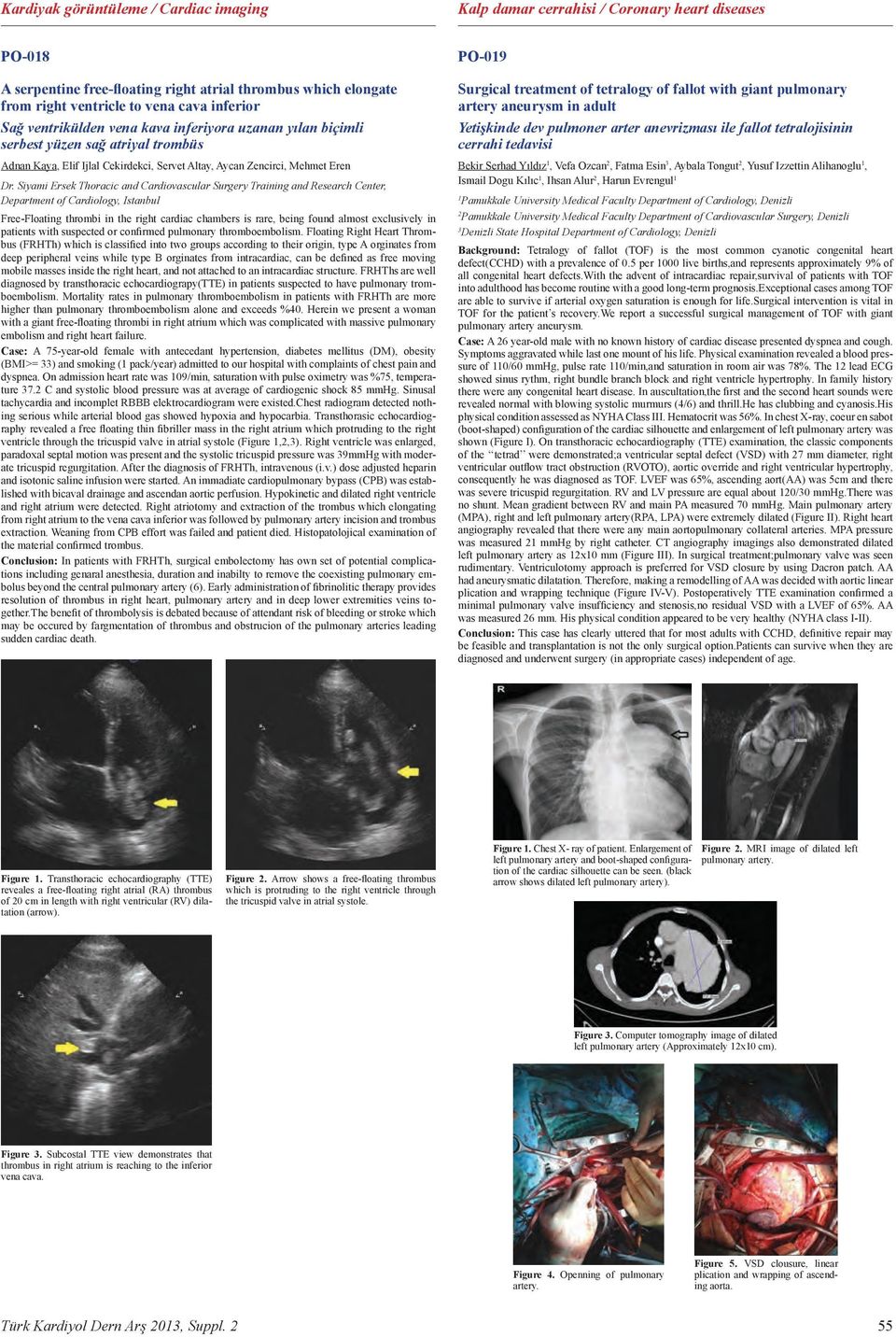
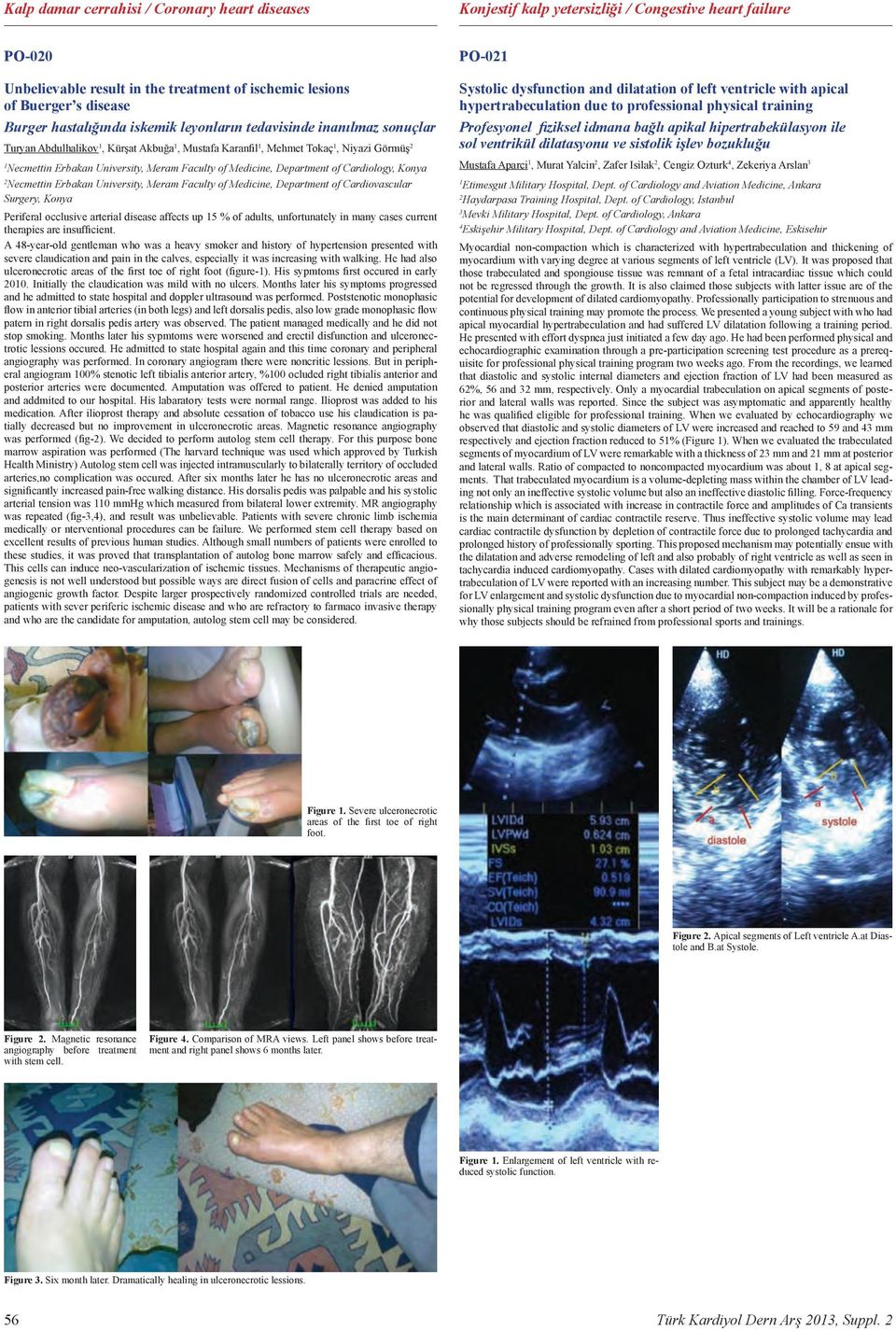
10 Kalp damar cerrahisi / Coronary heart diseases Konjestif kalp yetersizliği / Congestive heart failure PO-00 Unbelievable result in the treatment of ischemic lesions of Buerger s disease Burger hastalığında iskemik leyonların tedavisinde inanılmaz sonuçlar Turyan Abdulhalikov, Kürşat Akbuğa, Mustafa Karanfil, Mehmet Tokaç, Niyazi Görmüş Necmettin Erbakan University, Meram Faculty of Medicine, Department of Cardiology, Konya Necmettin Erbakan University, Meram Faculty of Medicine, Department of Cardiovascular Surgery, Konya Periferal occlusive arterial disease affects up 5 % of adults, unfortunately in many cases current therapies are insufficient. A 48-year-old gentleman who was a heavy smoker and history of hypertension presented with severe claudication and pain in the calves, especially it was increasing with walking. He had also ulceronecrotic areas of the first toe of right foot (figure-). His sypmtoms first occured in early 00. Initially the claudication was mild with no ulcers. Months later his symptoms progressed and he admitted to state hospital and doppler ultrasound was performed. Poststenotic monophasic flow in anterior tibial arteries (in both legs) and left dorsalis pedis, also low grade monophasic flow patern in right dorsalis pedis artery was observed. The patient managed medically and he did not stop smoking. Months later his sypmtoms were worsened and erectil disfunction and ulceronectrotic lessions occured. He admitted to state hospital again and this time coronary and peripheral angiography was performed. In coronary angiogram there were noncritic lessions. But in peripheral angiogram 00% stenotic left tibialis anterior artery, %00 ocluded right tibialis anterior and posterior arteries were documented. Amputation was offered to patient. He denied amputation and addmited to our hospital. His labaratory tests were normal range. Ilioprost was added to his medication. After ilioprost therapy and absolute cessation of tobacco use his claudication is patially decreased but no improvement in ulceronecrotic areas. Magnetic resonance angiography was performed (fig-). We decided to perform autolog stem cell therapy. For this purpose bone marrow aspiration was performed (The harvard technique was used which approved by Turkish Health Ministry) Autolog stem cell was injected intramuscularly to bilaterally territory of occluded arteries,no complication was occured. After six months later he has no ulceronecrotic areas and significantly increased pain-free walking distance. His dorsalis pedis was palpable and his systolic arterial tension was 0 mmhg which measured from bilateral lower extremity. MR angiography was repeated (fig-3,4), and result was unbelievable. Patients with severe chronic limb ischemia medically or nterventional procedures can be failure. We performed stem cell therapy based on excellent results of previous human studies. Although small numbers of patients were enrolled to these studies, it was proved that transplantation of autolog bone marrow safely and efficacious. This cells can induce neo-vascularization of ischemic tissues. Mechanisms of therapeutic angiogenesis is not well understood but possible ways are direct fusion of cells and paracrine effect of angiogenic growth factor. Despite larger prospectively randomized controlled trials are needed, patients with sever periferic ischemic disease and who are refractory to farmaco invasive therapy and who are the candidate for amputation, autolog stem cell may be considered. PO-0 Systolic dysfunction and dilatation of left ventricle with apical hypertrabeculation due to professional physical training Profesyonel fiziksel idmana bağlı apikal hipertrabekülasyon ile sol ventrikül dilatasyonu ve sistolik işlev bozukluğu Mustafa Aparci, Murat Yalcin, Zafer Isilak, Cengiz Ozturk 4, Zekeriya Arslan 3 Etimesgut Military Hospital, Dept. of Cardiology and Aviation Medicine, Ankara Haydarpasa Training Hospital, Dept. of Cardiology, Istanbul 3 Mevki Military Hospital, Dept. of Cardiology, Ankara 4 Eskişehir Military Hospital, Dept. of Cardiology and Aviation Medicine, Eskisehir Myocardial non-compaction which is characterized with hypertrabeculation and thickening of myocardium with varying degree at various segments of left ventricle (LV). It was proposed that those trabeculated and spongiouse tissue was remnant of a fetal intracardiac tissue which could not be regressed through the growth. It is also claimed those subjects with latter issue are of the potential for development of dilated cardiomyopathy. Professionally participation to strenuous and continuous physical training may promote the process. We presented a young subject with who had apical myocardial hypertrabeculation and had suffered LV dilatation following a training period. He presented with effort dyspnea just initiated a few day ago. He had been performed physical and echocardiographic examination through a pre-participation screening test procedure as a prerequisite for professional physical training program two weeks ago. From the recordings, we learned that diastolic and systolic internal diameters and ejection fraction of LV had been measured as 6%, 56 and 3 mm, respectively. Only a myocardial trabeculation on apical segments of posterior and lateral walls was reported. Since the subject was asymptomatic and apparently healthy he was qualified eligible for professional training. When we evaluated by echocardiography we observed that diastolic and systolic diameters of LV were increased and reached to 59 and 43 mm respectively and ejection fraction reduced to 5% (Figure ). When we evaluated the trabeculated segments of myocardium of LV were remarkable with a thickness of 3 mm and mm at posterior and lateral walls. Ratio of compacted to noncompacted myocardium was about, 8 at apical segments. That trabeculated myocardium is a volume-depleting mass within the chamber of LV leading not only an ineffective systolic volume but also an ineffective diastolic filling. Force-frequency relationship which is associated with increase in contractile force and amplitudes of Ca transients is the main determinant of cardiac contractile reserve. Thus ineffective systolic volume may lead cardiac contractile dysfunction by depletion of contractile force due to prolonged tachycardia and prolonged history of professionally sporting. This proposed mechanism may potentially ensue with the dilatation and adverse remodeling of left and also probably of right ventricle as well as seen in tachycardia induced cardiomyopathy. Cases with dilated cardiomyopathy with remarkably hypertrabeculation of LV were reported with an increasing number. This subject may be a demonstrative for LV enlargement and systolic dysfunction due to myocardial non-compaction induced by professionally physical training program even after a short period of two weeks. It will be a rationale for why those subjects should be refrained from professional sports and trainings. Figure. Severe ulceronecrotic areas of the first toe of right foot. Figure. Apical segments of Left ventricle A.at Diastole and B.at Systole. Figure. Magnetic resonance angiography before treatment with stem cell. Figure 4. Comparison of MRA views. Left panel shows before treatment and right panel shows 6 months later. Figure. Enlargement of left ventricle with reduced systolic function. Figure 3. Six month later. Dramatically healing in ulceronecrotic lessions. 56 Türk Kardiyol Dern Arş 03, Suppl.
11 Konjestif kalp yetersizliği / Congestive heart failure Genel / General PO-0 Constrictive pericarditis in a young patient with very thick pericardium initially diagnosed as cirrhosis Genç bir hastada ilk olarak siroz olarak tanı almış çok kalın perikard ile konstriktif perikardit Erdal Durmus, Murat Sunbul, Tarik Kivrak, Ibrahim Sari, Bulent Mutlu Marmara University Faculty of Medicine, Department of Cardiology, Istanbul A years-old male patient was sent to our hospital from Afghanistan for liver transplantation due to cirrhosis. On admimmission, his complaints were fatique, dyspnea, pretibial edema and abdominal distension which started two years ago and progressively increased over the last two months. He had no any other known disease history. Physical examination revealed hepatomegaly, massive abdominal ascites, bilateral pretibial edema, jugular venous distention, blood pressure of 4/64 mmhg and heart rate of 78/min. Rest of the physical examination were within normal limits. Electrocardiography revealed sinus rhythm, low QRS amplitudes in all leads and T wave inversion in inferior derivations with a heart rate of 86/min. Hepatobiliary ultrasonography, hepatitis serology, autoimmune markers and routine biochemistry were not consistent with liver cirrhosis. He was then referred to our cardiology department to investigate any potential cause to explain his condition. We performed transthoracic echocardiography which revealed normal left ventricular systolic and diastolic function, septal bounce with inspiration, respiratory variance of mitral inflow velocities, thickened pericardium (Figure A) and pericardial effusion in the posterior area. Respiratory variability of inferior vena cava diameter was less than 50%. After echocardiographic examination, our pre-diagnosis was CP. To confirm the diagnosis, we performed left and right heart catheterization. Simultaneous right and left ventricular end diastolic pressures were equalized and increased, and also respiratory ventricular interdependence (Figure B) was observed in heart catheterization. After the echocardiography and catheterization, most probable diagnosis was CP. Before surgery to evaluate the pericardial anatomy and calcification, thorax computed tomography (CT) was performed. In thorax CT, visceral and parietal pericardial thickening and localized calcification was detected (Figure A). Globalized marked thickening of visceral and parietal pericardium approximately mm were observed after the total pericardioectomy operation (Figure B). Investigations to reveal the possible cause of CP including mycobacterium culture, sputum acid fast bacilli, connective tissue disease test, HIV antibody were negative. Pericardial tissue culture was negative for mycobacterium tuberculosis. The patient had no history of cardiac surgery and radiation exposure. After surgery, he recovered quickly and jugular venous distention, pretibial edema and abdominal distension disappeared. Constrictive pericarditis (CP) is a disease of pericardium that restricts filling of the heart. Patients with CP generally admit to hospitals with exertional dyspnea, pretibial edema and abdominal ascites and it is sometimes mistakenly diagnosed as liver or renal disease. In the present paper, we describe a case of CP with a pericardial thickness of mm who was initially diagnosed as cirrhosis. PO-03 Relation of angiographic thrombus burden with electrocardiographic grade-iii ischemia in patients with ST-elevation myocardial infarction ST segment yükselmeli miyokard enfarktüsü hastalarında anjiyografik trombüs yaygınlığının elektrokardiyografik evre III iskemi ile ilişkisi Mustafa Kurt, Mehmet Fatih Karakaş, Eyup Buyukkaya, Adnan Burak Akçay, Nihat Sen Mustafa Kemal University Medical School, Department of Cardiology, Hatay Background: We aimed to investigate the association between electrocardiographic grade III ischemia and angiographic thrombus burden in patients with acute ST segment elevation myocardial infarction (STEMI) who underwent primary percutaneous intervention (ppci). Methods: The study population consisted of 307 STEMI patients. Baseline electrocardiograms of the patients were analyzed for grade III ischemia, angiographic thrombus burden was assessed by Thrombolysis in Myocardial Infarction (TIMI) thrombus classification. Results: One hundred and eight (35%) patients had low thrombus burden whereas 99 (65%) patients had high thrombus burden. Grade-III ischemia was more prevalent in patients with high thrombus burden (5.% vs.%, p=0.004). Only Grade-III ischemia (OR:.59, 95% CI , p=0.0) and history of coronary artery disease (CAD) were found to be independent predictors of high thrombus burden. Conclusion: Grade-III ischemia on electrocardiography and previous history of CAD were independent predictors of coronary thrombus burden in STEMI patients who underwent primary percutaneous intervention. Grade-III ischemia according to TIMI thrombus burden groups PO-04 Figure. A) Thickened pericardium with a diameter of mm, B) Respiratory ventricular interdependence of right (red line) and left (blue line) ventricle. Figure. A) Visceral and parietal pericardial thickening and localized calcification, B) Surgery specimen, total diameter of pericardium was approximately mm. Relation of red cell distribution width with CHADS-VASc score in patients with non-valvular atrial fibrillation Valvuler olmayan atriyal fibrilasyon hastalarında kırmızı hücre dağılım genişliğinin (RDW) CHADS-VASc skoru ile ilişkisi Mustafa Kurt, Ibrahim Halil Tanboga, Eyup Buyukkaya, Mehmet Fatih Karakaş, Adnan Burak Akçay, Nihat Sen Mustafa Kemal University Medical School, Department of Cardiology, Hatay Atatürk University Medical School, Department of Cardiology, Erzurum Background: Red cell distribution width (RDW) has been shown to be helpful in predicting adverse long-term events in patients with cardiovascular diseases. However, to date, no study has been conducted on the relationship between RDW and thromboembolism risk in atrial fibrillation (AF). Therefore, we aimed to investigate the relationship between RDW and CHADS-VASc score used for the evaluation of thromboembolism risk in patients with AF. Methods: The study population consisted of 30 AF patients. We calculated CHADS-VASc risk score for each patient and baseline hemoglobin, white blood cell, RDW, mean platelet volume, platelet counts, estimated glomerular filtration rate (egfr), left ventricular ejection fraction (LV- EF), left atrial volume index (LAVi) were measured. Results: High CHADS-VASc score group had higher RDW, lower LV-EF, higher LAVi and lower egfr values as compared with the low CHADS-VASc score group. The multivariate logistic regression analysis performed to predict high CHADS-VASc scores revealed that RDW egfr, LV-EF and LAVi were independent predictors. The area under the ROC curve of RDW was 0.65 ( , p<0.00) to predict high CHADS-VASc score. Conclusion: Our study results indicate that RDW values are significantly correlated with CHADS-VASc score in non-anemic atrial fibrillation patients, while also being independent predictor of high CHADS-VASc score. Türk Kardiyol Dern Arş 03, Suppl. 57
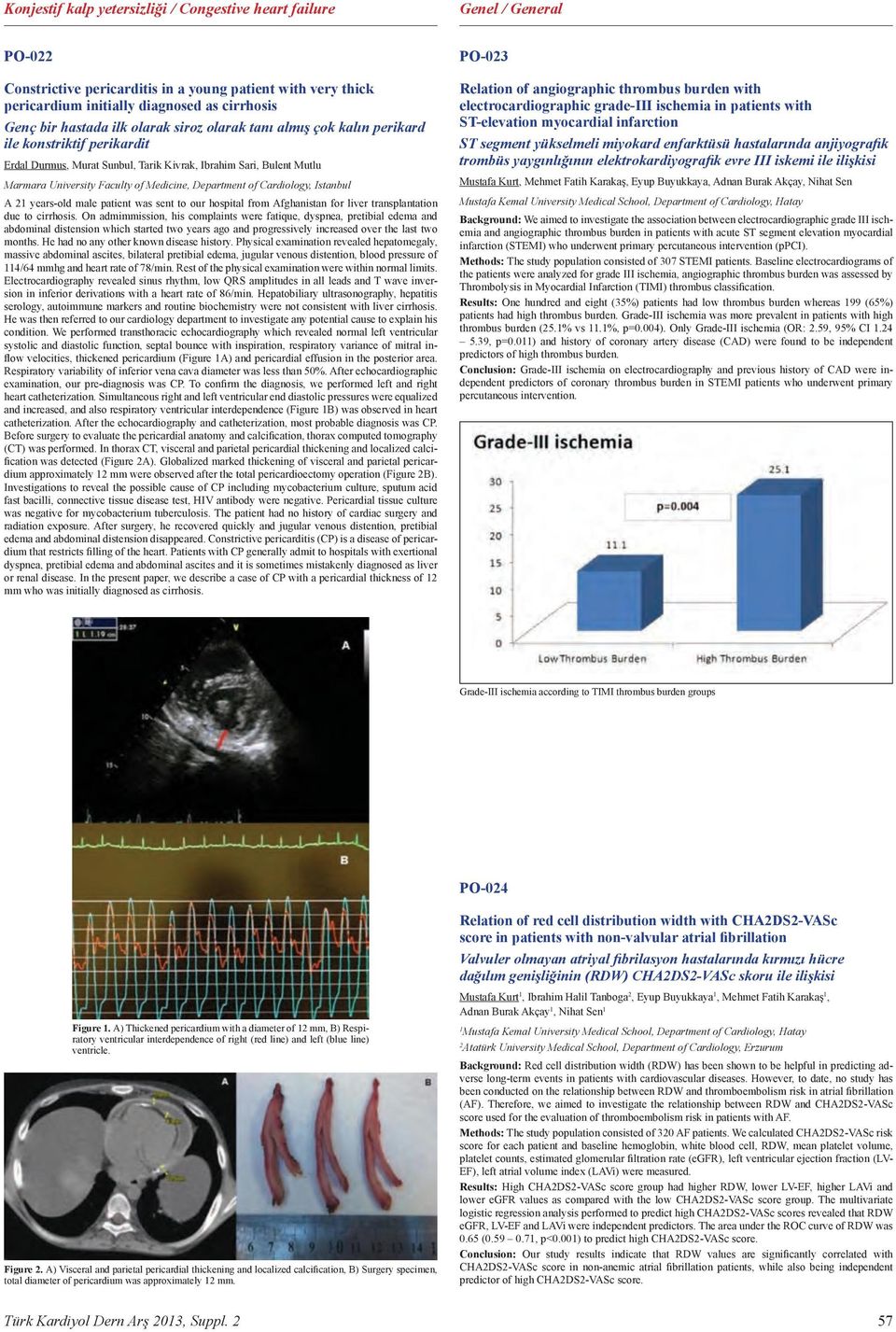
12 Genel / General Genel / General PO-05 A case of aortopulmonary window: asymptomatic until the first pregnancy Aortopulmoner pencere olgusu: İlk gebeliğe kadar asemptomatik Ayşe Serra Uçar, Timur Selçuk Akpınar, Samim Emet, Zeynep Gözde Özkan 3, Hüseyin Oflaz, Aytaç Öncül Istanbul University Medical Faculty, Department of Internal Medicine, Istanbul Istanbul University Medical Faculty, Department of Cardiology, Istanbul 3 Istanbul University Medical Faculty, Department of Nuclear Medicine, Istanbul Introduction: Herein we report a very rare case of a patient with unrepaired aorto-pulmonary window (APW) causing Eisenmenger syndrome and pulmonary hypertension who was asymptomatic until her first pregnancy. Case Presentation: A 7-year-old female admitted to the emergency unit with severe dyspnea at the postoperative third day of the cesarean section. Physical examination on admission revealed tachypnea, tachycardia, and loud second heart sound. In room air,she had hypoxemia (PaO: 5mmHg) and hypocarbia (PaCO: 8mmHg) with oxygen saturation (SaO) of 85%. D-dimer was 8μg/L. Transthoracic echocardiography showed dilated right atrium and ventricle, tricuspid regurgitation and normal left ventricular function with ejection fraction of 6%. Pulmonary artery pressure was 4 mmhg. Thorax computed tomography (CT) scan showed bilateral dilated pulmonary arteries and no sign of pulmonary thromboembolism. Oxygen and low molecular weight heparin was promptly started. On the third day of the treatment, SaO was 93% in room air. Hemoglobin was 6.g/dl, and hematocrit was 50.5% Chest X-ray showed normal cardiothoracic index and bilateral dilated pulmonary arteries. No evidence of rheumatologic diseases could be found in her medical history. Rheumatologic markers were negative except speckled positive antinuclear antibody (ANA) with a titer of /60. Pulmonary perfusion scintigraphy was not diagnostic for pulmonary thromboembolism, but showed systemic extrapulmonary accumulation of Tc99m-MAA in kidneys, spleen and cranium which indicates right to left shunt (Figure ). Right heart catheterization and aortic root injection showed a large APW and Eisenmenger syndrome with severe pulmonary hypertension with a pulmonary artery pressure of 3/3/97mmHg (Figure,3,4). Vasoreactivity test with adenosine was negative. Because of the presence of Eisenmenger syndrome, closure of the APW was contraindicated. Endothelin receptor antagonist and warfarin were started. At follow-up, she was asymptomatic and SaO was 95% at rest, however she had dyspnea and became desaturated at exertion. Discussion: However our patient had an isolated APW. Patients with APW usually become symptomatic in the first month of life and the signs and symptoms show progression. Echocardiography is an important technique for the diagnosis. In the literature, APW diagnosis is usually made by echocardiography and confirmed by catheterization (,6). In our patient, both transthoracic and transesophagial echocardiography could not detect APW. The diagnosis was established by right heart catheterization and aortic root injection. The median survival of uncorrected APW is 33 years.(9) An asymptomatic adult case has not been reported in literature. Conclusion: APW is a very rare congenital anomaly. To our knowladge, asymptomatic adult case has not been reported until now. APW should be considered in the differential diagnosis of the severe pulmonary hypertension also in adult patients. PO-06 Mean patelet volume is ındependently associated with renal dysfunction in stable coronary artery disease Kararlı koroner arter hastalarında ortalama trombosit hacmi böbrek işlev bozukluğu ile bağımsız olarak ilişkilidir Hakan Uçar, Mustafa Gür, Nermin Yıldız Koyunsever, Taner Şeker, Caner Türkoğlu, Onur Kaypaklı, Durmuş Yıldıray Şahin, Zafer Elbasan, Murat Çaylı Adana Numıune Training and Research Hospital, Adana Background: It has been suggested that athero-thrombotic risk progressively increases as the glomerular filtration rate (GFR) declines. Mean platelet volume (MPV) is used measure of platelet size, and higher MPV value is independent risk factor for athero-thrombotic disease such as myocardial infarction. We aimed to evaluate the association between estimated GFR and MPV in patients with stable coronary artery disease showing normal to mildly impaired renal function. Methods: A total of 47 patients (88 males and 83 females; mean age: years) with angiographically proven CAD were included. The patients were divided into groups according to the estimated GFR value (GFRlow group: GFR <60 ml/min per.73 m and GFRhigh group: GFR>=60, ml/min per.73 m). Estimated GFR was calculated according to Cockcroft-Gault formula. MPV, high sensitive C-reactive protein (hscrp) and other biochemical markers were measured in all patients. Prevalent of CAD was determined by the SYNTAX score. Results: Patients with GFRlow group were of older age, had higher incidence of female gender, current smoker, diabetes, hypertension and hyperlipidemia, lower values of total cholesterol, LDL cholesterol, hemoglobin and platelet count and higher values of BMI, SYNTAX score, hs-crp and MPV compared with patients with GFRhigh group. Multivariate linear regression analysis showed that the MPV was independently related with diabetes (β=0.89, p<0.00), egfr (β=- 0.67, p<0.00), hs-crp level (β=0.58, p<0.00) and platelet count (β=-0.6, p=0.00). Conclusion: MPV is independently associated with GFR as well as hscrp, platelet count and diabetes. These findings may explain, in part, the increase in athero-thrombotic risk in with slightly impaired renal function. Figure. Images of pulmonary perfusion scintigraphy. Normal uptake in lungs was observed together with extrapulmonary uptake in cranium (a), spleen and kidneys (a,b,c) caused by systemic accumulation of Tc99m-MAA due to right to left shunt. Figure. Aortic root injections, APW. Figure 3. Aortic root injections, APW Figure 4. Aortic root injections, APW. 58 Türk Kardiyol Dern Arş 03, Suppl.
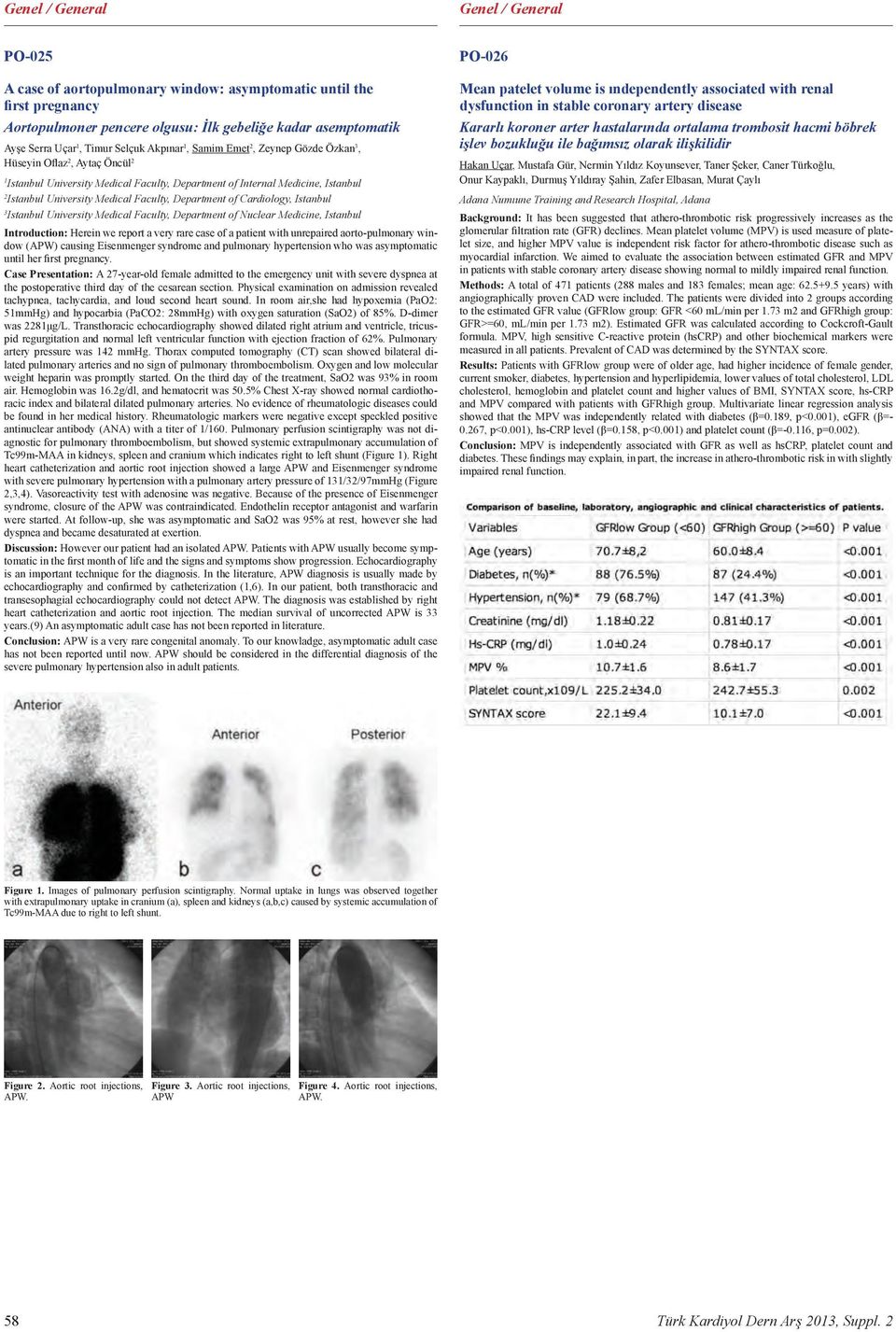
13 Genel / General Genel / General PO-07 Successful thrombolytic treatment of right sided massive intracardiac thrombus and pulmonary embolism Sağ taraf intrakardiyak trombüs ve pulmoner embolinin başarılı trombolitik tedavisi Taner Sen, Mehmet Ali Astarcioglu, Mehmet Yaymaci, Mesut Pinar, Afsin Parspur, Basri Amasyali Dumlupinar University Kutahya Celebi Education and Research Hospital, Cardiology, Kutahya 67-year-old male patient was admitted to emergency room with progressive dyspnea. Blood gas analysis revealed hypoxia and hypocarbia. D-dimer was high. He was hemodynamically stable. Transthoracic echocardiography showed massive right ventricular and mobile atrial thrombi and also right sided enlargement and flattening of interventricular septum. Systolic pulmonary artery pressure calculated as 70 mmhg (figure a and b). Transesophageal echocardiographic examination was performed for the detailed examination of the trombi (figure a and b). Thorax computerized tomography showed thrombus in the right segmentary pulmonary arteries. Intravenous heparin treatment was started immediately. No deep venous thrombus detected in lower extremity venous Doppler examination. Malignancy evaluation revealed nothing. The patient consultated with cardiovascular surgery for the removal of the massive right sided cardiac thrombus. Cardiovascular surgeons did not accept the operation. We decided thrombolytic treatment for this patient. The patient and his relatives were informed about the disease and the risk of the thrombolysis. 5 mg tissue plasminogen activator (TPA) was administered within 6 hours as slow infusion in every other day up to total 00 mg TPA. Heparin infusion was stopped during the thrombolysis but started after the thrombolysis to decrease the bleeding complications. Transthoracic echocardiogarphy was repeated after every thrombolytic therapy. Progressive decrease in size of thrombus was detected in serial echocardiographic examinations. After termination of the last dose of the thrombolytic regimen, transesophageal echocardiography was repeated. Tranesophageal echocardiographic examination showed that the thrombus in right ventricular apex and mobile thrombus in right atrium were totally disappeared. The right side of the heart became normal in size and pulmonary systolic pressure decreased to 30 mmhg. The patient was discharged after coumadinization. There is no consensus regarding the optimal treatment for patients with right sided heart thrombi. The presence of right heart thrombus with pulmonary thromboemboli carries increased mortality rate compared to pulmonary thromboemboli alone, but there is no optimal medical treatment for this difficult clinical situation. Our case showed that thrombolysis with low dose infusion with longer duration may be a treatment option for the massive right sided cardiac thrombi. PO-08 Achromobacter prosthetic mitral valve infective endocarditis Achromobacter protez mitral kapak infektif endokarditi Arzu Er, Ali Rıza Gülcan, Mustafa Serkan Karakaş 3, İbrahim Başarıcı 4 Ministry of Health Tokat Government Hospital, Department of Cardiology, Tokat Şanlıurfa Education and Resarch Hospital, Departmant of Cardiology, Şanlıurfa 3 Ministry of Health Niğde Government Hospital, Department of Cardiology, Niğde 4 Akdeniz University School of Medicine, Department of Cardiology, Antalya Introduction: All infections at endocardial surfaces of heart and cardiovascular system is described as infective endocarditis (IE). Affected structures at infective endocarditis are cardiac valves at most of the cases but congenital cardiac defects, prosthetic cardiac valves, wires of cardiac pacemakers or vascular grafts may sometimes be infected. Achromobacter is a Gram negative, oxidase positive, nonfermentary bacillus, with many subspecies, which is hard to isolate. A case of let prothetic valve endocarditis where Achromobacter is responsible will be presented. Case presentation: The patient who had mechanical valve replacement.5 years ago for mitral stenosis applied with complaints of malaise, dyspnea, cough and high fever. At cardiac examination, pansystolic murmur was heard from all foci, most apparently at apex besides mechanic valve sound. At transthorasic echocardiography (TTE) paravalvular mitral leak and an increase at prosthetic valve gradients were found. At transoesophagial echocardiography (TOE), echodense mass coherent with vegetation at ventricular surface of prosthetic valve and mild mitral leak due to separation from mitral annulus were observed. Blood samples were taken for culture and empirical antibiotic treatment was started. At laboratory evaluation, erythrocyte sedimentation rate (ESR) (6 mm/hour) and C-reaktive protein (4.9 mg/dl) levels were high, hemoglobin level was low (. gr/dl), white cells (8300/mm3) were normal. No agent was isolated at first blood cultures. Fever was observed at the third day of empirical antibiotic treatment and Achromobacter species was isolated at successive blood cultures for 3 days. Antibiotic treatment was switched to intravenous meropenem with regard to the antibiogram. But despite the treatment, the patient had fever, so TOE was repeated on the 7th day of the hospitalization. Seperation at the mitral prosthetic valve was going on and paravalvular leak and size of the vegetation increased, so the patient underwent mechanical valve replacement again. Postoperative antibiotic treatment continued as before and fever was taken under control. There was no bacterial growth at postoperative blood cultures and antibiotherapy was completed to 6 weeks. As clinical anf laboratory findings improved and new prosthetic valve functions were observed as normal at echocardiography, the patient was discharged. Discussion: IE is an emergent condition caused by various microorganisms which can be fatal if left untreated. Besides well known agents such as Stafilococci and viridans group streptococci, there are many bacteria which rarely cause infective endocarditis such as Achromobacter sp. Conclusively, at patients with prosthetic material who are suspected to have infective endocarditis, Achromobacter sp. should be kept in mind among rare microorganisms and treatment should be started immediately. Figure. Transthoracic echocardiographic views show thrombus in the right ventricle and atrium. right chambers of the heart are dilated. Figure. Transesophageal echocardiographic views show thrombus in the right ventricle and right atrium. Giriş: Kalp endokardiyal yüzünün ve kardiyovasküler sistemin endotelyal yüzünün her türlü enfeksiyonu infektif endokardit (İE) olarak tanımlanmaktadır. İnfektif endokarditte etkilenen yapı çoğu olguda kalp kapakları olmakla birlikte, bazı olgularda doğumsal kalp defektleri, protez kalp kapakları, kalp pili kabloları veya damar greftleri de infekte olabilmektedir. Birçok alttürü olan gram negatif, oksidaz pozitif, nonfermenter bir basil olan Achromobacter zor üreyen mikroorganizmalardandır. Achromobacterin sorumlu olduğu bir geç protez kapak endokarditi sunulacaktır. Olgu: Mitral stenoz nedeniyle,5 yıl önce mekanik kapak replasmanı yapılmış olan hasta halsizlik, nefes darlığı, öksürük ve ateş yüksekliği şikayetleri ile başvuruyor. Hastanın kardiyovasküler bakısında mekanik kapak sesiyle birlikte apekste belirgin olmak üzere tüm odaklardan duyulan pansistolik üfürüm mevcuttu. Transtorasik ekokardiyografisinde (TTE) paravalvüler mitral kaçak ve protez kapak gradyentlerinde artış saptanandı. Transözofageal ekokardiyografide (TÖE) protez kapak ventriküler yüzünde vejetasyon ile uyumlu ekojen görünüm ve mitral annulustan ayrışmaya bağlı orta derece mitral kaçak olduğu saptandı. Hastanın kan örnekleri alınarak İE tanısıyla ampirik antibiyotik tedavisine başlandı. Kan tetkiklerinde eritrosit sedimentasyon hızı (6 mm/saat) ve C-reaktif protein (4.9 mg/dl) yüksek, hemoglobin düşük (. gr/dl), beyaz küre (8300/mm3) normal olarak saptandı. İlk kan kültürlerde üreme olmadı. Ampirik antibiyotik tedavisinin 3. günü ateş yüksekliği başlayan hastanın bu dönemde 3 gün boyunca alınan ardışık kan kültürlerinde Achromobacter species üretildi. Antibiyogramında sonucuna göre antibiyotik tedavisi intravenöz meropenem ile değiştirildi. Ancak tedaviye rağmen ateş yükseklikleri olan hastaya yatışının 7 gününde TÖE tekrarlandı. Mitral protez kapaktaki ayrışması devam eden hastanın paravalvüler kaçağında ve vejetasyon boyutunda artış saptanması üzerine hasta operasyona alınarak yeniden mekanik mitral kapak replasmanı uygulandı. Postoperatif antibiyotik tedavisine aynen devam edilen hastanın ateşi kontrol altına alındı. Postoperatif alınan kan kültürlerinde üreme olmadı ve antibiyotik tedavisi 6 haftaya tamamlanan hastanın klinik ve laboratuvar bulgularının düzelmesi, ekokardiyografisinde yeni protez kapak fonksiyonlarının normal saptanması üzerine taburcu edildi. Tartışma: İE çok sayıda farklı mikroorganizmaların neden olduğu tedavi edilemediğinde fatal seyredebilen tıbbı bir acildir. Stafilokok ve viridans grubu streptokoklar gibi bilinen bakterilerin dışında Achromobacter sp. grubu gibi çok az görülen ve çok nadiren de enfektif endokardite neden olan bir çok bakteri mevcuttur. Sonuç olarak protez materyal bulunduran ve infektif endokardit düşünülen hastalarda tabloya neden olan mikroorganizmalar arasında çok nadir görülse de Achromobacter sp. grubu da akılda tutulmalı ve tedavide hızlı davranılmalıdır. Figure 3. After completion of thrombolytic regimen, thrombus was dissolved completely and the right chambers of the heart decreased in size and became normal. Türk Kardiyol Dern Arş 03, Suppl. 59
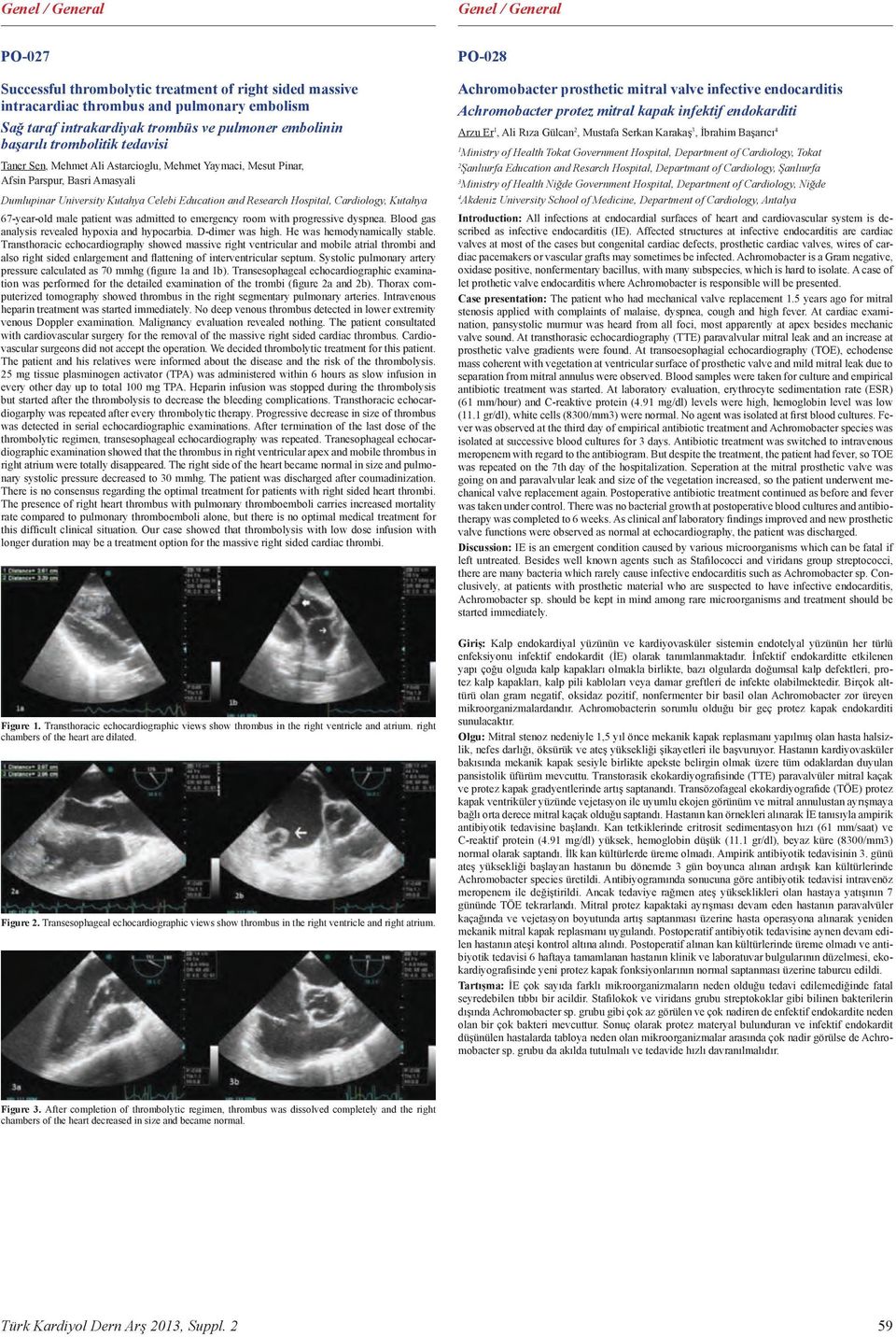
14 Genel / General Genel / General PO-09 Interpretation of cardiac imaging in an adult with isolated interrupted aortic arch İzole aortik ark interrupsiyonu olan bir hastadakardiyak görüntülemenin yorumlanması Nurcan Arat Koç, Gültekin Mehmet Ercan, Serkan Kahraman, Mehmet Ezelsoy, Ahmet Ozkara Medical School of Istanbul Bilim University, Department of Cardiology, Istanbul Medical School of Istanbul Bilim University, Department of Cardiovascular Surgery, Istanbul A 5-year-old man admitted to the hospital with complaining of chest and lower extremity pain during exercise had no remarkable medical history. Physical examination revealed a well developed upper part of the body and weak femoral arterial pulse and arterial blood pressure was 60/90 mmhg. On cardiac auscultation, mild diastolic murmur was heard at the left parasternal border. A -lead electrocardiogram showed normal sinus rhythm at heart rate 7 /min. Chest radiographs revealed bilateral notching of the ribs (Figure ). Two-dimensional echocardiography showed mildly left ventricular hypertrophy, mild aortic regurgitation and normal left ventricular systolic function and ascending aortic dilatation with no descending aortic D or color flow imaging 5 cm distally to the left subclavian artery in suprasternal view (Figure ). Myocardial perfusion imaging showed perfusion abnormality as left ventricular inferoseptal ischemia and cardiac angiograms showed a type A aortic interruption and aortagraphy reveals a hypoplastic distal arch and significant collateral flow from internal mammarial arteries through to the descending aorta and non significant coronary artery stenosis (Figure 3). Additionally right coronary artery was arising anomalously from the non coronary sinus. Contrast-enhanced computed tomography demonstrated type A interrupted aorta just before sub-clavian artery (Figure 4). Surgical repairment of interrupted aortic arch was successfully done and patient dischared from hospital one week after surgery without complication.. Bicuspid aortic valve with interrupted aortic arch is very rarely reported in adults. A comprehensive echocardiographic imaging including suprasternal viewing may provides a suspicion of aortic interruption and computed tomography or magnetic resonance imaging can confirms the diagnosis. PO-030 Constrictive pericarditis related with localized annular calcified pericardial band around the atrioventricular groove causing heart failure and atrial fibrillation Kalp yetmezliği ve atriyal fibrilasyona neden olan atriyoventrikuler bileşke etrafında lokalize annüler kalsifik perikardiyal bandla ilişkili konstriktif perikardit Münevver Sarı, Süleyman Ercan, Ayse Rengin Türkgüler 3 Sanliurfa Birecik State Hospital, Cardiology Department, Sanliurfa Gaziantep University School of Medicine, Cardiology Department, Gaziantep 3 Sanliurfa Birecik State Hospital, Radiology Department, Sanliurfa Introduction: Constrictive pericarditis is characterized by a fibrotic, thickened and/ or calcified pericardium restricting the diastolic filling of the heart and leading to increase both pulmonary and systemic venous pressure. Thus it is result in left and predominantly right heart failure. Although constrictive pericarditis is a relatively uncommon cause of heart failure, recognition of this is important. Calcification of the pericardium is detected in up to 50 % of patients and most commonly occurs along the inferior diaphragmatic surface of the pericardium surrounding the ventricles and in the atrioventricular groove. The presence of pericardial calcification is associated with a higher incidence of atrial fibrillation. Although lateral chest film, echocardiography and computed tomography are useful in assessment of pericard, the diagnosis shoul be confirmed by cardiac catheterization. Surgical treatment usually improves symptoms but the diagnosis is often missed. Case Report: A 54 years old man who previously suffered progressive right heart failure of unknown aetiology and atrial fibrillation presented with worsening exertional dyspnea, palpitation and ankle oedema. On examination, blood pressure was 00/60 mmhg, heart sounds were arrhythmic and tachycardic, ascites and ankle oedema were noted. Atrial fibrillation with high heart rate was a finding (7 bpm) and transthoracic echocardiography revealed normal right and left ventricle size and function, dilated left atrium and mild - moderate mitral valve regurgitation, mild tricuspid valve regurgitation and calcification of pericard or space-occupying lesion around the basal of the posterior wall of left ventricle and atrioventricular groove. Telecardiography and computed tomography with contrast agent demostrated that localized annular calcification of pericard restricting of the heart around the basal of both ventricle and atrioventrıcular groove. When symptomatic improvement with medical treatment was seen, he was referred to a tertiary centre where he received cardiac catheterization showed the classic dip and plateau sign with equalization of end diastolic pressures in all four cardiac chamber. Then he transferred to department of cardiovascular surgery for pericardectomy. Result: Although there are many causes of heart failure and atrial fibrillation, constrictive pericarditis is a comparatively rare and commonly missed cause of heart failure. This case reminds us to consider constrictive pericarditis in patients with unexplained heart failure and/ or atrial fibrillation. Figure. Chest X Ray shows the bilateral notching on the ribs. Figure 3. Aortagraphy shows the localization of the aortic interruption. Figure. Transthoracic color flow Doppler echocardiograpy in suprasternal view shows the interruption of the flows in the ascending aorta with collateral vessels flow. Figure 4. Contrast-enhanced computed tomography demonstrated type A interrupted aorta in sequential slices (). Giriş: Perikardın fibröz kalınlaşması ve genelde kalsifikasyonu ile karakterize olan konstriktif perikardit kalbin diyastolik doluşunda azalma, hem sistemik hem de pulmoner venöz basınçta artışa neden olur. Konstriktif perikardit nadir ancak önemli bir kalp yetmezliği nedenidir. Perikardiyal kalsifikasyon hastaların %50 kadarında ve genellikle kalbin diyafragmatik yüzeyinde veya atriyoventriküler bileşke bölgesinde görülmektedir. Perikardiyal kalsifikasyon ile atriyal fibrilasyon gelişimi arasında yakın bir ilişki olduğu bilinmektedir. Lateral grafi, ekokardiyografi ve bilgisayarlı tomografi tanıda yardımcı olsa da tanı kalp kateterizasyonu ile doğrulanmalıdır. Cerrahi tedavi ile semptomlarda belirgin iyileşme sağlanmasına rağmen tanı sıklıkla atlanmaktadır. Olgu: Daha önce kalp yetmezliği ve atriyal fibrilasyon nedeniyle tedavi altında olan 54 yaşında erkek hasta eforla nefes darlığı, çarpıntı ve bacaklarda şişlik şikayeti ile başvurdu. Fizik muayenede TA: 00/60 mmhg, aritmik ve taşikardik, asit ve pretibial ödem mevcuttu. Elektrokardiyografide yüksek ventrikül yanıtlı atriyal fibrilasyon, (7/dk) olup yapılan ekokardiyografik incelemede sol ve sağ ventrikül sistolik fonksiyon ve boyutu normal, sol atriyum dilate, hafif-orta mitral yetmezliği, hafif triküspid kapak yetmezliği ve sol ventrikül posterior duvar bazali ve atriyoventrikuler bileşke komşuluğunda, ventrikül diyastolik doluşunu kısıtlayan kalsifik perikart veya bası yapan kitle izlenimi veren görüntü izlendi. Telekardiyografi ve kontrastlı toraks tomografisi ile değerlendirilen hastada her iki ventrikül bazal kesim komşuluğunda sol ventrikülü daraltan, annüler yerleşimli perikardiyal kalsifikasyon dikkati çekmiştir. Hastanın atriyal fibrilasyon hız kontrolü ve kalp yetmezliği tedavisi düzenlendikten sonra kardiyak kateterizasyon için ileri merkeze yönlendirildi. Kalp kateterizasyonunda sol ventrikül ve sağ ventrikül diyastol sonu basınçlarının eşitlendiği ve karakteristik erken diyastolik dip ve onu takip eden plato bulgusu izlenen hasta cerrahi tedavi için kalp damar cerrahi kliniğine yönlendirilmiş. Sonuç: Kalp yetmezliği ve atriyal fibrilasyonun birçok nedeni vardır ancak konstriktif perikardit nadir ve genelde tanısı atlanan bir kalp yetmezliği nedenidir. Konstriktif perikardit, venoz konjesyon ile başvuran ve/veya atriyal fibrilasyonu olan hastalarda ayırıcı tanıda akılda tutulmalıdır. A B Figure. (A) Calcification of pericard, leading to a decrease in diastolic filling, around the basal ventricle and atrioventricular groove at the parasternal long axis view of the heart. (B) Calcific pericard in the apical four chamber view. Figure 5. Contrast-enhanced computed tomography demonstrated type A interrupted aorta in sequential slices (). Figure 6. Contrast-enhanced computed tomography demonstrated type A interrupted aorta in sequential slices (3). Figure. Calcification of pericard on the chest radiography. A B Figure 3. (A) Calcification of pericard around the basal ventricle and atrioventricular groove on thorax computed tomography. (B) Localized annular calcification of pericard around the basal ventricle and atrioventricular groove on thorax computed tomography. 60 Türk Kardiyol Dern Arş 03, Suppl.
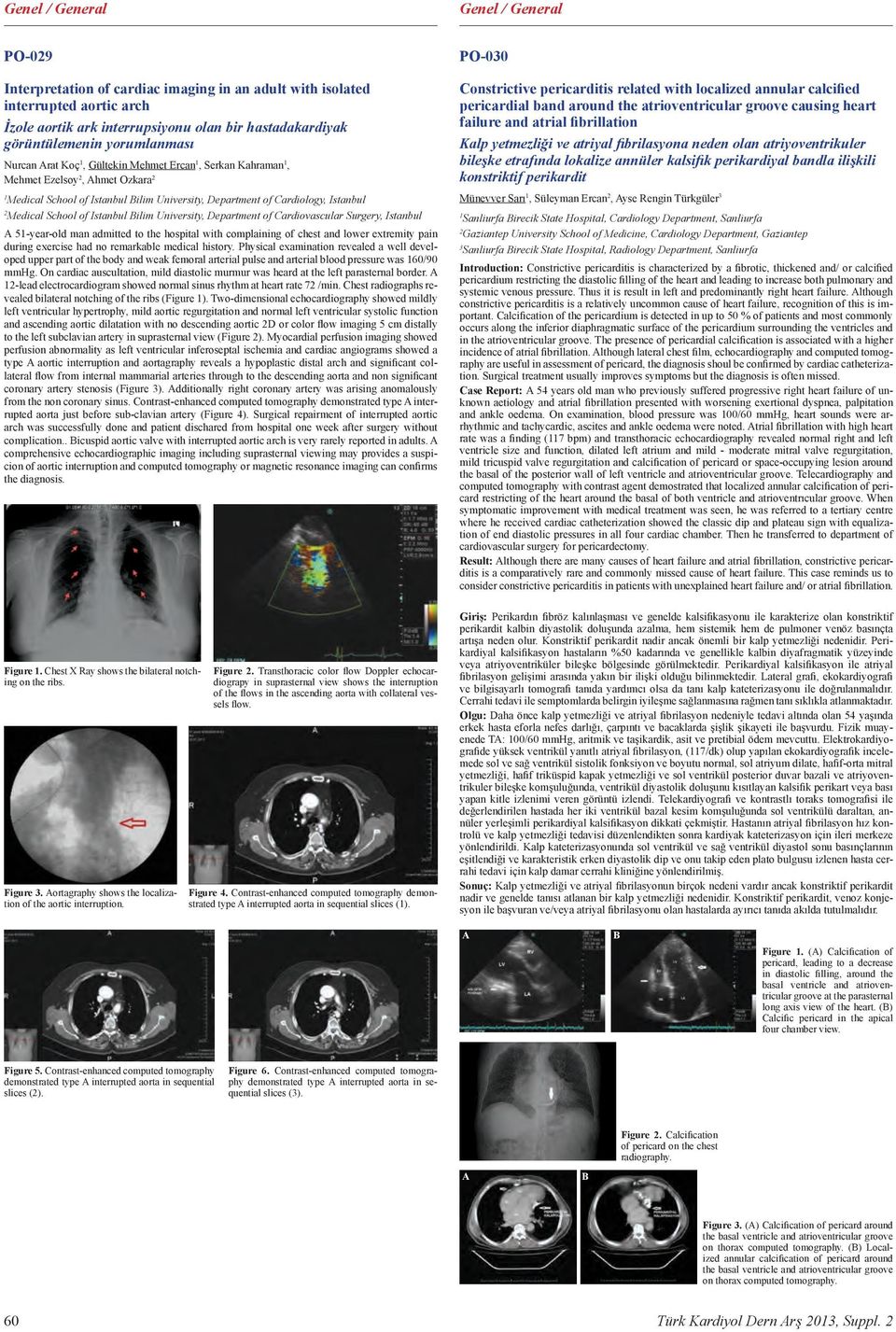
15 Genel / General Genel / General PO-03 Drug-induced skin reaction İlaç ile indüklenen deri reaksiyonu Sibel Akbilek, Zeynep Gunes Ozunal, Selcuk Sen, Nermin Gurel, Aykan Canberk, Ali Yagiz Uresin Istanbul Faculty of Medicine, Pharmacology Department, Istanbul Ms D, a 47-year-old woman, presented to Istanbul Faculty of Medicine Rational Drug Use Hypertension Policlinic with a generalized rash prominent on her arms and legs. The rush had begun within 3 months of drug use. Arthralgia and fever was accompanied to skin lesions. Her only prescribed medication was ramipril. She declared that she have used mixed herbal tea sold to lose weight. Medical history included hypertension, asthma and cerebrovascular accident. The patient is suspected to have drug induced reaction and ramipril therapy was stopped. Patient submitted to dermatology, both oral and topical steroid is commenced. Quinin therapy is added while steroid therapy is reduced. Complete blood count, plasma IgE levels and skin biopsy performed. Microcytic anemia but not eosinophilia and elevated IgE are detected. In skin biopsy report, inflammatory infiltration and granulom annulare possibility is mentioned. After discontinuation of ramipril and start of steroid therapy the erythematous lesions had begun to heal. Rheumatology consultation is considered. ACE inhibitors are known to induce skin rashes that mimic a broad variety of skin diseases, and these drugs should be considered when unexplainable skin eruptions occur. Vasculitis is one of the drug induced skin reactions that the exact mechanism is unknown; however, it appears to be a type III hypersensitivity reaction with immune complex deposition in postcapillary blood vessels. We can also suggest ACE inhibitors could have triggered granulom annulare. Drug induced skin reactions are very difficult to distinguish from the natural occurring eruptions. Adverse drug reactions (ADRs) are recognized as an important cause of hospital admissions. Cutaneous drug eruptions are one of the most common types of adverse reaction to drug therapy. As with other types of drug reaction, the pathogenesis of these eruptions may be either immunological or non-immunological. Healthcare professionals should carefully evaluate all drug-associated rashes. A cutaneous drug reaction should be suspected in any patient who develops a rash during a course of drug therapy. Management points when a patient may have experienced a drug eruption; -The medication history should be taken including proprietary names of the medicines, herbal preperations and contrast media. -Patient should be asked for drug sensitivity history and atopic disease as asthma or eczema. -ADR should be reported to pharmacovigilance center. Rational drug use is recognized to be important. Drug use should be individualized as considering drug interactions, predisposing risk factors, pharmacogenetics for significant drugs and monitoring adverse drug reactions. PO-03 Acute massive pulmonary embolism following compression sclerotherapy of varicose veins Varikoz venlere kompresyon skleroterapisini takiben akut masif pulmoner emboli Deniz Demirci, Duygu Ersan Demirci, Erkan Köklü, Murat Esin, Şakir Arslan, Raif Umut Ayoğlu Departmants of cardiology, Antalya Training and Research Hospital, Antalya Departmants of cardiovascular surgery, Antalya Training and Research Hospital, Antalya Introduction: Pulmonary embolism (PE) is a blockage of the main artery of the lung or one of its branches by a substance that has travelled from elsewhere in the body through the bloodstream (embolism). Usually this is due to embolism of a thrombus (blood clot) from the deep veins in the legs, a process termed venous thromboembolism. The frequency of pulmonary embolism after sclerotherapy of varicose veins has been reported to be rare. So we described a case of acute massive pulmonary embolism (AMPE) following high ligation combined with compression sclerotherapy of varicose veins. Case Report: A 39- year- old woman was admitted to emergency department for two syncopal episodes. On admission the vital signs recorded were blood pressure 90/50 mmhg, heart rate 0 beats/min, respiratory rate 4 breaths /min. Anaysis of blood gases showed marked hypoxia and hypocapnia. Her blood test revealed high plasma D-Dimer and troponin levels. Ecocardiogram revealed a dilated right ventricle, right heart overload, severe tricuspit regurgitation, severe pulmonary hypertension and trombüs image in both left and right pulmonary arteries (Figure 3-4). Computer tomography angiography of chest revealed pulmonary embolism (Figure -). She was a smoker and taking cantraceptive pills. And high ligation combined with compression sclerotherapy was performed for her varicose veins in her left leg days ago. Injections were made with % aethoxyclerol. The patient was diagnosed with pulmonary embolism and underwent systematic thrombolytic therapy with t-pa. After the thrombolytic therapy hemodynamic and ecocardiographyic findings were better. Color duplex scanning demonstrated deep venous trombosis in the calf vein. The patient was discharged home on oral warfarin therapy. Discussion: The most common complications of sclerotherapy occur at the site of injection. These include hyperpigmentation, pain, and localized thrombosis On the other hand, vascular and general complications are uncommon. Of these complications, DVT and subsequent PE are rare, but they are potentially serious. The incidence of PE after sclerotherapy reported in the literature ranges from to 0.3%. There are two main causes of DVT following compression sclerotherapy. One of main causes that might have caused pulmonary embolism was the sclerosing solution and the operative technique. A hypercoagulable state is another cause of DVT. Women taking contraceptive pills are at risk of DVT and PE. After a diagnosis of AMPE has been established, aggressive thrombolytic and anticoagulant therapy or embolectomy are mandatory. Early recognition and investigation of tromboembolism is imperative because accurate diagnosis and early treatment with anticoagulants and thrombolysis may be life saving for these patients. Figure. Pulmonary embolism in right pulmonary artery. Figure. Pulmonary embolism in left pulmonary artery. Figure. Erythematous lesions on arms. Figure 3. Dilated main pulmoner artery, Thrombus in the right pulmonary artery, Total occulsion of the left pulmonary artery. Figure. Erythematous lesions on legs. Figure 4. In the left pannel ( Before tpa), D-shaped left ventricle due to dilated right ventricle In the right panel ( After tpa) right ventricle s size and shape is normal. Türk Kardiyol Dern Arş 03, Suppl. 6
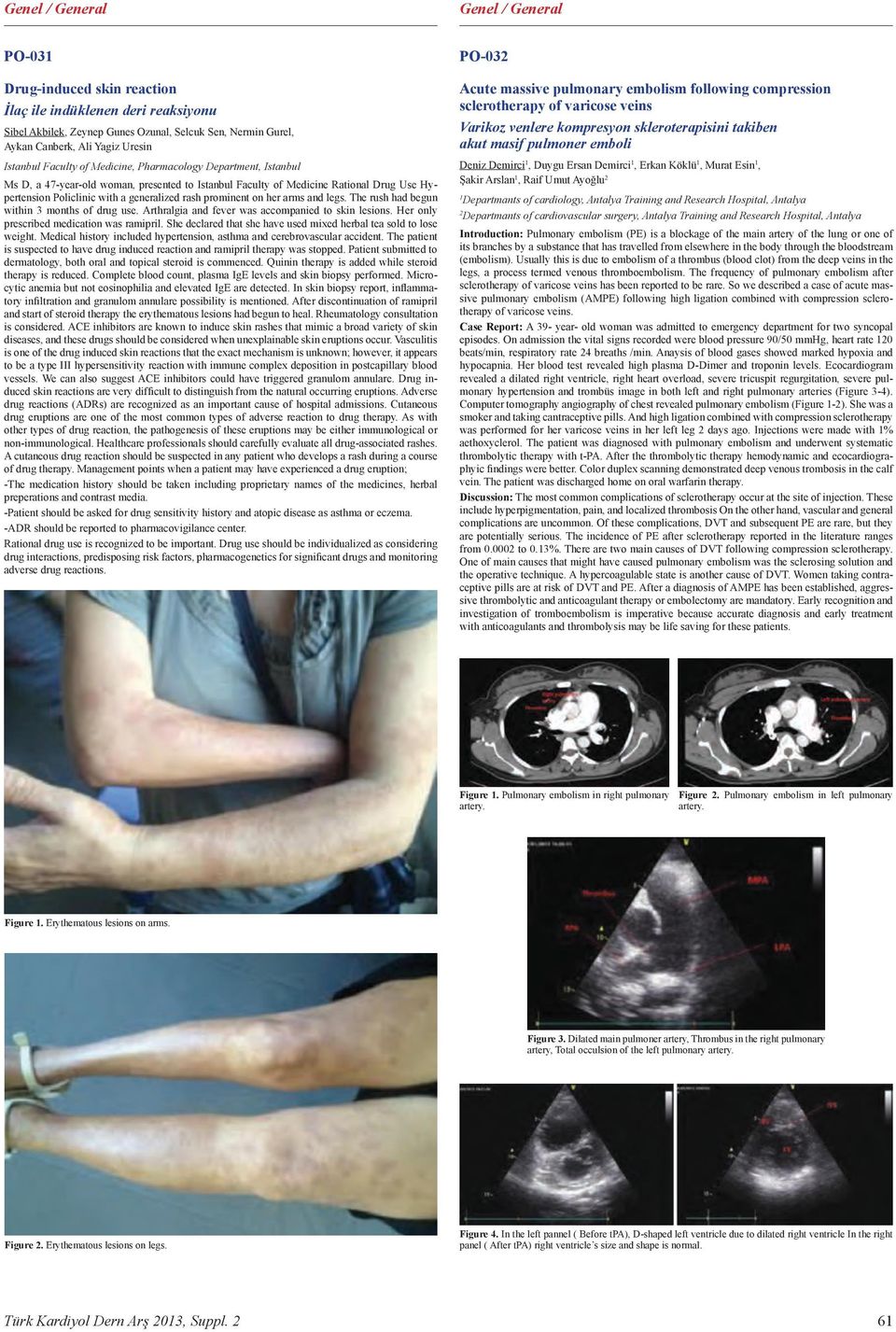
16 Genel / General Non-invazif aritmi / Non-invasive arrhythmia PO-033 A huge cardiac mass: benign or malignant? Caseous calcification of the mitral annulus Dev kardiyak kitle Habis mi selim mi? Mitral anülüsün kazeöz kalsifikasyonu Nihat Pekel, Mehmet Emre Özpelit, Serkan Yakan, Ferhat Özyurtlu, İstemihan Tengiz, Ertugrul Ercan Izmir University Medical Park Hospital, Department of Cardiology, Izmir Special Vatan Hospital, Department of Cardiology Case: A 7 year-old female patient was admitted to our outpatient clinics with the complaint of shortness of breath. On her echocardiographic examination an hyperechogenic oval lobulated mass was seen sizing 39*5 millimeters located at close neighborhood of posterior mitral leaflet protruding into left atrium partially (Figure a-b). On transesophagial echocardiography a vegetative mass appearance was seen around mitral annulus propagating radially, protruding into left atrium posteriorly (Figure c-d). Moderate mitral regurgitation and mild aortic regurgitation were noted. On magnetic resonance imaging (MRI), an hypointense non-contrast dying mass which is more appearant on series with contrast is seen sizing 40x39 millimeters located at posterolateral region of the atrioventricular groove propagating to mitral valve (Figure e). On computed tomographic examination of thorax, a high density mass lesion indicating calcification located at left atrioventricular groove posterolaterally sizing 36 millimeters in diameter propagating to atrioventricular valve is seen (Figure f). At 5th month control, echocardiography and MRI revealed no difference in size and nature of the mass. Discussion: Although mitral annulary calcification is a frequently seen echocardiographic antity (0%), caseous calcification of the mitral annulus is an extremely rare condition. Its incidence is estimated 0.07% in echocardiography series. Its echocardiographic appearance is an hyperechogenic calcified big round mass with a central echolucent area. It is important to differentiate it from malignant intracardiac tumors. It is mostly a benign condition, although rarely causing embolic events or severe valvular dysfunction. In this case report,we present a patient having a big tumor-like mass diagnosed as mitral annular caseous calcification with imaging techniques which is diagnosed at our clinics and followed conservatively. PO-034 Grayanotoxin blocked both the AV node and the accessory pathway Grayanotoksin hem AV nodu hem de aksesuar yolağı bloke etti Adem Atıcı, Nail Güven Serbest, Remzi Sarıkaya, Cafer Panç, Ali Elitok, İmran Önür, Aytaç Öncül, Ahmet Kaya Bilge İstanbul University İstanbul Faculty of Medicine Cardiology Department, İstanbul A man, aged 60, admitted to emergency because of dizziness and asthenia. The man had dizzy spell and asthenia 4 hours before applying to the emergency. It is known that the patient had eaten 4 or 5 soup spoons of honey, which had been produced in east blacksea region, 3 hours before his complaints started. in his physical examination; blood pressure: 87/44 mmhg, heart rate: 39/min, respiration rate: 6/min, peripheral fever: 36.8 c and nothing detected in other system examination. The hemogram and the biochemistry of the patient were normal. In the electrocardiography (ecg) the patient was in av complete block rhythm (see picture ). The heart rate was 37/min. Our diagnosis was mad honey poisoning. In the control ecg, the rhythm was : inherited av block (see picture ). Qrs complex which comes after p wave, was narrow, pr distance was short and delta wave was recognized. the hemodynamics of the patient was stable. The patient was monitorized and 4 hours later the patient was in sinus rhythm with typical wpw pattern. (see picture 3). The patient was externed without medication due to the fact that his complaints were finished. Increase in the degree of preexcication under the accessory pathway which has antegrade conduction capability can be seen when the depression characteristics of gyranotoxin s on av node is considered. On the contrary, with the effect of grayanotoxin both the av node and accessory pathway were : inherited blocked. It is arguable that the above described situation about grayanotoxin, in which the grayanotoxin blocks the accessory pathway which doesn t have decrimental conduction capability, is not known in literature. Figure. AV complete block. Figure. : inherited AV block. Figure Figure 3. Sinus rythtm with typical wpw pattern. 6 Türk Kardiyol Dern Arş 03, Suppl.
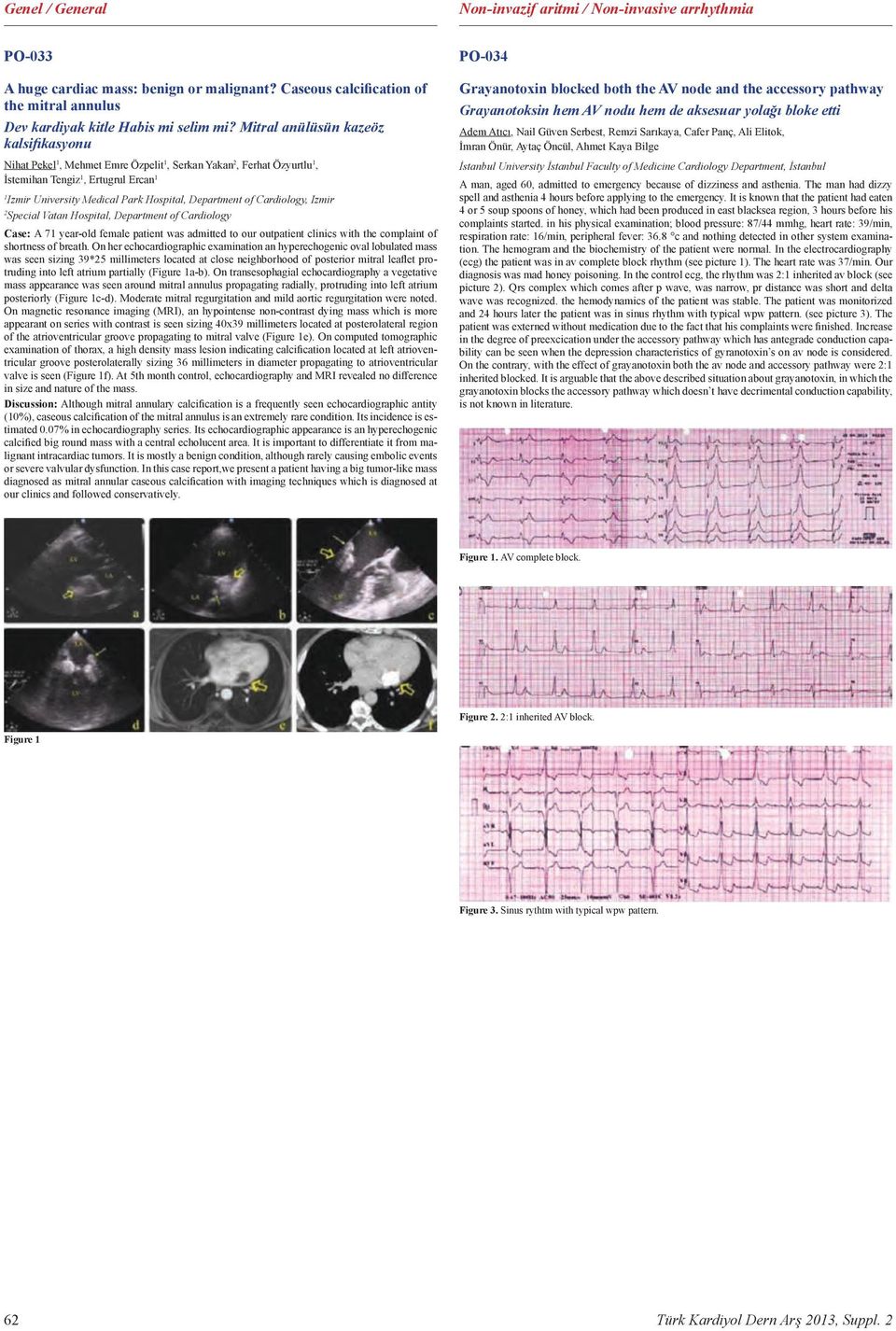
17 Non-invazif aritmi / Non-invasive arrhythmia Non-invazif aritmi / Non-invasive arrhythmia PO-035 Prolonged asystole occured just before head-up tilt testing Eğik masa testinden hemen önce gerçekleşen uzamış asistoli Murat Yalçın, Mehmet Doğan, Ömer Uz, Zafer Işılak GATA Haydarpasa Training Hospital, Department of Cardiology, Istanbul Head-up tilt testing is a very helpful diagnostic procedure to determine vasovagal syncopes as neurocardiogenic or vasodepressor syncope. It was introduced into clinic evaluation in 986. It has reported that %8 of the patients experienced prolonged asystole longer than 3 seconds and %9, longer than 5 seconds during tilt table testing. In medical database there are very few cases that asystole occurs longer than 30 seconds. In our case, we determined a 4 seconds asystole period. However presented case is interesting because of syncope and asystole had occured just before head-up tilt test. A years old male patient was admitted to our department because of frequent syncope and pre-syncope episodes for 3 years. Symptoms mostly occur at prolonged standing position but sometimes patient complaints similar episodes with anxiety, excisement and scaring situations. His medical history was unremarkable, there was no history of drug or alcohol abusement. Phisical examination -including detailed neurological findings- was normal. Diagnostic tests such as ECG, transthoracic echocardiography, laboratory tests (including thyroid function tests) and 4 hours rhytym holter were also normal. Neurological tests including cranial magnetic resonance imaging (MRI) and electroencephalography (EEG) resulted as normal. Afterwards head-up tilt testing planned. He was monitored with rhythm recording, blood pressure measurement (in every minutes) and capillary pulse oximeter. On sitting position, during vascular access establishing on antecubital vein, his heart rate began to fall. He sweated, felt weak, lost consciousness and than went into asystole. He got lied down to supine position and mg IV atropine sulphate administered. Approximately 5 seconds later external cardiac massage started. After 4 seconds, sinus rhythm returned and patient regained consciousness again (Figure ). We recommended and planned permanent pacemaker implantation. Head-up tilt testing is a very useful test to explain syncope etiology and it is almost gold standart for the diagnosis of neurocardiogenic syncope. It is a simple and safe test that no death have been reported associated with it. Although its low complication rates, medical team should be aware of its complications. Asystole and ventricle arrhythmias are most serious complications and equipment should be well prepared for these emergency situations. The longest asystole period is reported as 70 seconds. But in our case asystole occured during iv cannulation. Vicious procedures such as establishing vascular access can cause bradycardia but we could not find any case similar to prolonged asystole. Therefore when performing or preparing to tilt table test, prolonged asystole should be kept in mind. Test should be applied in well equipped laboratories and should be performed by experienced medical team. PO-036 A rare cause of syncope in severe aortic stenosis: torsade de pointes İleri aort darlığında nadir bir senkop nedeni; Torsade de pointes Murat Sunbul, Okan Erdogan, Bulent Mutlu Marmara University Faculty of Medicine, Department of Cardiology, Istanbul The evaluation of syncope in severe aortic stenosis usually requires intense work-up. Mechanical obstruction should not always be implicated as the underlying cause of syncope. Syncope at rest may be rarely associated with ventricular arrhythmias. We present here a case with severe aortic stenosis who experienced syncopal events due to torsade de pointes. Case presentation: A 79-year-old lady was admitted to our clinic for further evaluation of two syncopal events at rest within the last two months. Her physical examination revealed a 3/6 latepeaking systolic ejection murmur at the right upper sternal area radiating into her right neck and clavicle. Blood pressure and heart rate were 45/75 mmhg and 53 bpm, respectively. Surface ECG showed second degree Mobitz type atrioventricular block and pronounced U waves in almost all leads. The corrected QT (QTc) interval was 444 msec. Chest X-ray showed bilateral pleural effusion. Echocardiography revealed hypokinesis of the anteroseptal segment, left ventricular hypertrophy (LVH), ejection fraction 50%, maximal aortic valve velocity 4.74 m/s, mean transaortic pressure gradient 45 mmhg and aortic valve area 0,8 cm (Figure ). Laboratory findings on admission were as follows: Blood urea nitrogen 4 mg/dl, creatinine. mg/dl, Sodium 37 mg/dl, Potassium 3.5 mg/dl, Magnesium.3 mg/dl, Calcium 8.8 mg/dl. Clinical and echocardiographic findings were consistent with severe aortic stenosis (AS). Since the patient was symptomatic because of syncopal events, aortic valve surgery was tentatively planned. On the next day of admission she suddenly developed another syncopal event at rest that was surprisingly related to a Torsade de Pointes (TdP) attack detected on telemetry recording (Figure ). She was immediately cardioverted with 360 joules. Electrolytes on the same day were as follows: Sodium 35 mg/dl, Potassium 3. mg/dl, Magnesium.5 mg/dl, Calcium 8.5 mg/dl. Depleted levels of magnesium and potassium were replaced by intravenous route and temporary pace maker wire was inserted for underlying bradycardia. The pacing rate was set at 80 bpm. On the third day of admission coronary angiography demonstrated severe stenosis of the proximal left anterior descending coronary artery that was subsequently dilated with stenting. Although electrolyte levels were normalized, every time when the pacing rate was lowered to less than the intrinsic heart rate non-sustained episodes of TdP recurred. ECG taken at that time revealed normal QTc interval and apparent U waves that were always present during all ECG recordings. On the fifth day of admission, while the patient was on the list and waiting for aortic valve surgery, she suddenly lost consciousness because of respiratory arrest. The monitored rhythm was paced rhythm at that time and no ventricular arrhythmia was detected. Although cardiopulmonary resuscitation was immediately performed, she unfortunately died of electromechanical dissociation. Figure. Rhythm record during asystole. CPR: Cardiopulmonary resuscitation. Figure. a) Doppler echocardiographic measurements of stenosed aortic valve. b) Transesophageal short axis view of stenosed aortic valve. Aortic valve area: 0.8 cm. Figure. a) Rhythm strip showing Mobitz type type second degree atrioventricular block and bradycardia. Note prominent U waves after the pauses (arrows). b) Rhythm strip showing macro T wave alternans preceding torsade depointes episode. Note inverted deep T wave (arrows) after the pause and upright T wave (arrow head). c) Telemetry recording of torsade de pointes and underlying bradycardia when the patient experienced syncope at rest. d) Surface ECG showing normal QTc and small U waves after the electrolytes were replaced. e) Telemetry recording of nonsustained torsade de pointes episodes when the pacing rate was lowered less than the intrinsic heart rate. Note initiation of TdP with typical short-long-short sequence. Türk Kardiyol Dern Arş 03, Suppl. 63
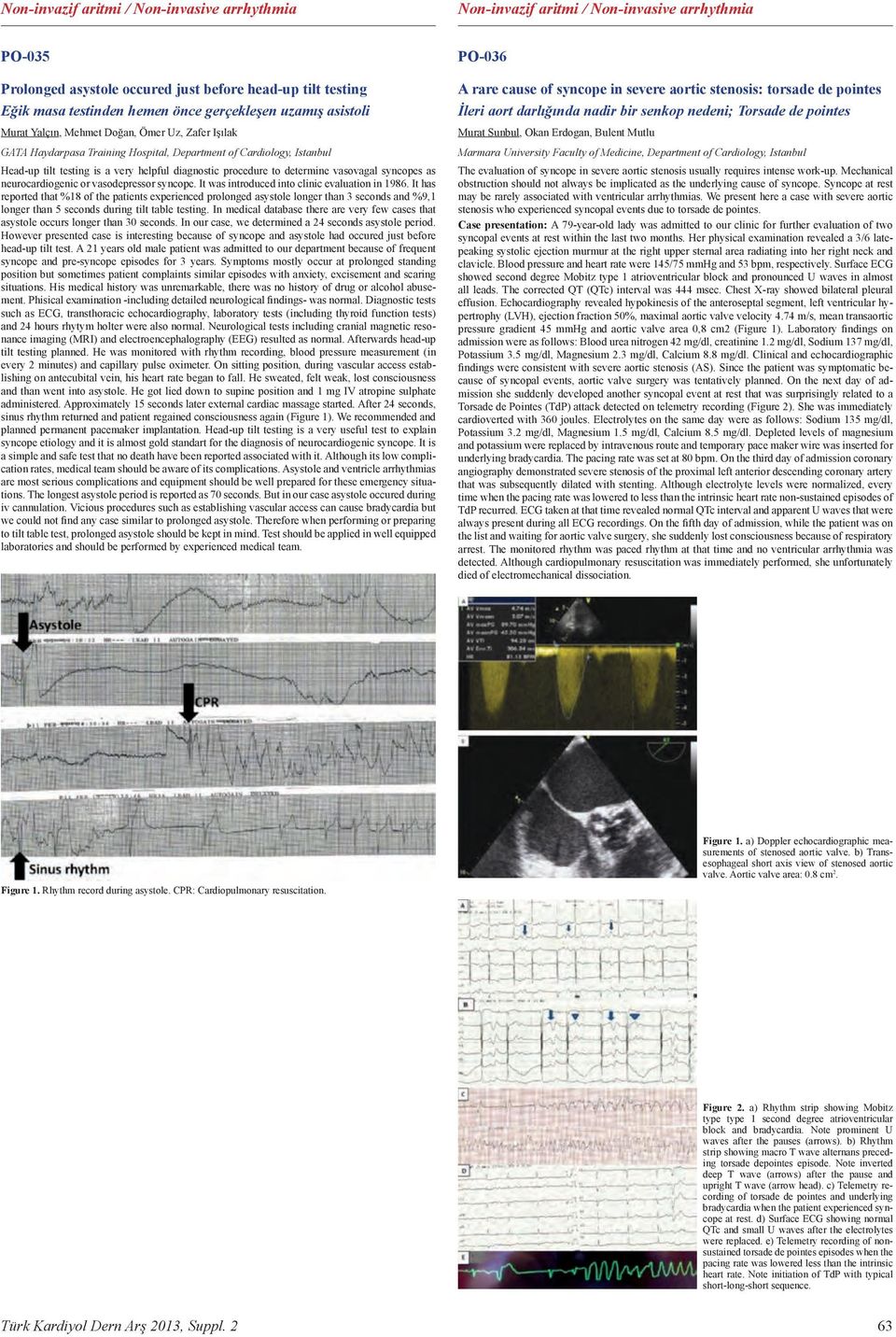
18 Non-invazif aritmi / Non-invasive arrhythmia Ekokardiyografi / Echocardiography PO-037 Ventricular repolarization in neurocardiogenic syncope patients Nörokardiyojenik senkop hastalarında ventriküler repolarizasyon Mehmet Murat Sucu, Vedat Davutoğlu, Süleyman Ercan, Fuat Başanalan, Murat Yüce, Orhan Özer Department of Cardiology, Gaziantep University Faculty of Medicine, Gaziantep Background: Prolongation of the peak and the end of T wave (Tp-e) and corrected QT interval (QTc) has been reported to be associated with ventricular arrhythmias. The QTc interval index (QTcI), JT interval dispersion (JTcd), Tp-e/QT ratio, Tp-e/QTc ratio are used as an index of ventricular arrhythmogenesis. The aim of this study was to analyze ventricular repolarization in Neurucardiogenic syncope(ncs) patients by using Tp-e interval, Tp-e/QT ratio, Tp-e/QTc ratio and QTc, and QTcI and to compare it with the JTcd, and the JT interval index (JTcI) in NCS, by inspecting the ventricular activation until the termination of repolarization. Methods: We have studied 66 patients between the years 0 03 at our institution. Patients with NCS (33 patients; mean age:8± years), included the study group. Patients with normal (33 patients; mean age: 30± years) were used as the control group. In all patients, Tp-e interval, Tp-e/ QT ratio,tp-e/qtc ratio, QTc,QTcI, JTcd, JTc as well as some other electrocardiogram intervals were measured. Independent samples t-tests were used for comparison. Results: Mean QTc intervals (44±33msn; 403±38 msn; respectively; P<0.0), QTcI(00±7msn; 97,6 msn;respectively; P<0.0), JTcd(34±4 msn;306±3 msn;respectively; P>= 0.05) and JTcI(03±9msn; 95,4±0, msn;respectively; P<0.03)were different between the groups. Mean Tp-e interval (93,7 ± 0, msn; 8,6±6,7 msn; respectively; P< 0.03), Tp-e/QT ratio (0.4 ± 0.04; 0. ± 0.04;respectively; P<0.0), and Tp-e/QTc ratio (0. ± 0.04; 0.0,0± 0.03; respectively; P<0.05), (98±3 msn; 8±8;respectively; P<0.03) were prolonged in the study group compared to the control group. Conclusions: Tp-e interval, Tp-e/QT ratio,tp-e/qtc ratio,qtc,qtci,and JTcl are prolonged in neurocardiogenic syncope patients. PO-039 Giant pseudoaneurysm of ascending aorta after left ventricular aneurysm surgery Sol ventrikül anevrizma cerrahisi sonrası asendan aortada dev psödoanevrizma Eftal Murat Bakırcı, Hakan Duman, Husnu Degirmenci, Enbiya Aksakal Department of Cardiology, Faculty of Medicine, Ataturk University, Erzurum Giant pseudoaneurysm of the ascending aorta after cardiac surgical procedures is a rare and dreadful complication, which may occur several months or years after cardiac surgery. Pseudoaneurysms of the aorta have multiple etiologies including trauma, infection, connective tissue diseases, vasculitis, and prior aortic or cardiac surgery. Pseudoaneurysms of the ascending aorta usually originate from the clamping site, graft anastomosis, needle site and cannulation site. Despite the recent reports of percutaneously excluding aortic psudoaneurysms, surgery is still necessary for most cases. A 45-year-old man was admitted to our hospital with a few days history of progressive dyspnea and chest pain. Coexistence of idiopathic left ventricular aneurysm and aneurysm of right coronary artery had been identified previously. He had undergone the left ventricle aneurysmorrhaphy two months ago. Physical examination revealed blood pressure of 70/50 mm Hg, a pulse rate of 6/ min and, respiratory rate of 30/min. On cardiac auscultation, heart sounds were soft and /6 diastolic murmur was heard at the left sternal border. An electrocardiogram showed normal sinus rhythm. Chest x-ray showed enlargement of the mediastinum (Fig. ). The transthoracic echocardiogram (TTE) revealed a flow pattern into a giant pseudoaneurysm sac from ascending aorta, which arose from the cannulation site of the previous surgery, (Fig. ), and an intraventricular flow pattern into left ventricular aneurysm through the ventricular graft attachment site. (Fig. 3). Mild aortic regurgitation, mild mitral regurgitation, moderate tricuspid regurgitation and, left ventricular ejection fraction of 45% were also detected during TTE. The pseudoaneurysm was 9,5 8,cm at its greatest anteroposterior and transverse diameters. The patient developed cardiogenic shock was transferred to the operating room. He collapsed due to massive bleeding from rupture during performance of resternotomy and cardiopulmonary resuscitation (CPR) was started immadiately. The patient did not respond to 45 minutes of CPR, and passed away. The present case is intended to emphasize that postoperative period should be managed carefully in terms of developing aortic pseudoaneurysm after cardiac surgery in patients having the propensity to develop aneurysm formation. Figure. Chest x-ray revealed enlargement of mediastinum. PO-038 Ventricular repolarization in patients with Behcet disease s Behçet hastalığına sahip hastalarda ventriküler polarizasyon Mehmet Murat Sucu, Bünyamin Kısacık, Yavuz Pehlivan, Vedat Davutoğlu, Mehmet Kaplan, Süleyman Ercan Gaziantep University Medical Faculty Department Of Cardiology, Gaziantep Gaziantep University Medical Faculty Department Of Rheumatology, Gaziantep Background: Prolongation of the peak and the end of T wave (Tp-e) and corrected QT interval (QTc) has been reported to be associated with ventricular arrhythmias. The QTc interval index (QTcI), JT interval dispersion (JTcd), Tp-e/QT ratio, Tp-e/QTc ratio are used as an index of ventricular arrhythmogenesis. The aim of this study was to analyze ventricular repolarization in patients with Behcet disease s(bd) by using Tp-e interval, Tp-e/QT ratio, Tp-e/QTc ratio and QTc, and QTcI and to compare it with the JTcd, and the JT interval index (JTcI) in BD, by inspecting the ventricular activation until the termination of repolarization. Methods: We have studied 70 patients between the years 0 03 at our institution. Patients with BD (45 patients; mean age:35±7 years), included the study group. Patients with normal (5 patients; mean age: 3±8 years) were used as the control group. In all patients, Tp-e interval, Tp-e/ QT ratio,tp-e/qtc ratio, T wave duration, QTc,QTcI, JTcd, JTc as well as some other electrocardiogram intervals were measured. Independent samples t-tests were used for comparison. Results: Mean QTc intervals (49±3msn; 380±8 msn; respectively; P<0.00), QTcI(00±6msn; 9±7 msn;respectively; P<0.00), JTcd(304±34 msn;68±3 msn;respectively; P< 0.00) and JTcI(96±msn; 89±6 msn;respectively; P<0.00)were different between the groups. Mean Tp-e interval (93,7 ± 6,9 msn; 7,6 ± 6,7 msn; respectively; P< 0.00), Tp-e/QT ratio (0.5 ± 0.04; 0.0 ± 0.04;respectively; P<0.00), and Tp-e/QTc ratio (0. ± 0.04; 0.8± 0.03; respectively; P < 0.00),T wave durations (98±3 msn; 8±8;respectively; P<0.003) were prolonged in the study group compared to the control group. Conclusions: Tp-e interval, Tp-e/QT ratio,tp-e/qtc ratio,qtc,qtci,jtcd,jtcl and T wave durations are prolonged in patients Behcet disease s patients. Figure. TTE demonstrated a pseudoaneurysm of the ascending aorta at the previous aortic cannulation site and the flow pattern into a pseudoaneurysm from ascending aorta (arrow) (Ao: ascending aorta, AV: aortic valve, LA: left atrium, LV: left ventricle, PA: pseudoaneurysm). Figure 3. Intraventricular flow pattern into left ventricular aneurysm (arrow) (LA: left atrium, LV: left ventricle, RA: right atrium, RV: right ventricle). 64 Türk Kardiyol Dern Arş 03, Suppl.
19 Ekokardiyografi / Echocardiography Ekokardiyografi / Echocardiography PO-040 Aortic dissection with prolapse of flap into the ventricle Ventriküle flap prolapsusu ile aort diseksiyonu Kadriye Gayretli Yayla, Sadık Açıkel, Çağrı Yayla, Ekrem Yeter Diskapi Yildirim Beyazit Research Hospital, Cardiology Department, Ankara Gazi University Medical Faculty, Cardiology Department, Ankara A 74 year old male, who had been treated for hypertension, was admitted to the emergency department with chest pain of four hours duration radiating to his back. The initial electrocardiogram showed signs of myocardial ischemia with ST segment depression in anterolateral and inferior leads. Blood pressure was 85/55 mmhg, heart rate was 05 bpm on his physical examination. Minimal (grade /6) decrescendo diastolic murmur was audible on the left sternal edge. In addition, bibasilar crackles were detected on pulmonary auscultation. Emergency two-dimensional echocardiography showed that severe ascending aortic dissection with an intimal flap prolapsing into the left ventricular despite normal left ventricle size and systolic function. Transesophageal echocardiography demonstrated circumferential intimal disruption that started just above the aortic root and extended distally through the aortic arch and into the carotid artery. The circumferential intimal flap was prolapsing into the left ventricle during diastolic phase, causing severe aortic regurgitation and resulting in diastolic occlusion of both coronary arterial ostia (Figure A, Figure B, Figure C). The patient underwent a combined coronary artery bypass grafting and replacement of the aortic valve, ascending aorta and aortic arch. PO-04 Gaint right atrial mass: extention of follicular thyroid carsinoma into the great cervical veins and right atrium Dev sağ atriyal kitle: Folliküler tiroid karsinomunun büyük servikal venlere ve sağ atriyuma uzanımı Mustafa Tarık Ağaç, Turhan Turan, Levent Korkmaz, Hakan Erkan Ahi Evren Cardiovascular and Thoracic Surgery Training and Research Hospital, Trabzon Akçaabat Haçkalı Baba State Hospital, Trabzon A 3-year-old man with history of follicular thyroid carsinoma was admitted to our hospital with dyspnea and swelling of face and upper extremity. Six months ago, he was operated due to enlarged thyroid gland and pathologic examination revealed poorly differentiated follicular thyroid carsinoma. The patient was given radioiodine theraphy and he did well until a month ago when progressive swelling of upper extremity developed. Physical examination showed dilated veins in the anterior chest wall and edema of face, neck and bilateral arms suggesting superior vena cava syndrome. CT scanning of neck and chest confirmed recurrence of thyroid tumor and obstruction of bilateral brachiocephalic veins and the superior vena cava with tumor thrombus extending into the right atrium. Echocardiograhy showed a gaint right atrial mass almost filling the entire chamber volume with a small, mobile -stalk attached- portion protruding into the right ventricle through tricuspid valve (Figure ). Since the patient was thought to be at high risk for life-threathening tumor thromboembolism, he was transferred for urgent surgery. Follicular thyroid carsinoma is frequently reported in the literature with regard to intraluminal vascular propagation. Superior vena cava syndrome caused by intravascular invasion of thyroid cancer is an uncommon complication. In particular, the extention of tumor into right atrium through superior vena cava has rarely been reported. Figure. Apical four chamber view showing gaint right atrial mass. Note that the mobile -stalk attachedportion is protruding into the right ventricle through tricuspid valve. RV, right ventricle, LV, left ventricle, LA, left atrium. Figure. (A) Transesophageal echocardiography midesophageal aortic valve long-axis view of type A aortic dissection,the intimal flap prolapsing into the aortic root during systole. (B) Transesophageal echocardiography midesophageal aortic valve long-axis view of type A aortic dissection,the intimal flap prolapsing into the left ventricle during diastole. (C) Transesophageal echocardiography midesophageal aortic valve short-axis view showing the intimal flap. Türk Kardiyol Dern Arş 03, Suppl. 65
20 Ekokardiyografi / Echocardiography Ekokardiyografi / Echocardiography PO-04 Isolated pulmonary-valve endocarditis in a patient with Systemic Lupus Erythematosus Sistemik Lupus Eritematozus hastasında izole pulmoner kapak tutulumlu infektif endokardit olgusu Pelin Karaca Özer, Samim Emet, Derya Baykız, Ekrem Bilal Karaayvaz, İmran Önür, Berrin Umman, Zehra Buğra Istanbul University, Faculty of Medicine, Department of Cardiology, Istanbul 47 years old female patient with known Systemic Lupus Erytematosus refered to emergency department with complaints of fever,fatigue and worsening of general condition. On the patient s cardiac and systemic physical examination, there was no serious property and laboratory tests were found as Leukocyte: 3600, CRP: 55 and Sedimentation:5. Transthoracic ecocardiography revealed a view of 9 mm size moving mass compatible with fibrillary vegetation or thrombus on the pulmonary valve (Fig,). Transeusophagial echocardiography confirmed that mobile mass on pulmonary valve (Fig 3,4). Cardiac MRI was performed for differantial diagnosis of infective endocarditis and thrombus. According to the cardiac MR, the mass on the pulmonary valve was compatible with vegetation (Fig 5). Streptoccoccus pneumoniae was detected in blood culture. Treatment with intravenosus seftriaxon for 6 weeks improved clinically and the infection markers were negative on follow up. In serial echocardiography, ıt was seen that the vegetation diminished. 47 yaşında, bilinen Sistemik Lupus Eritematosus tanılı kadın hasta acil polikliniğine ateş, halsizlik, genel durumunda kötüleşme şikâyeti ile başvurdu. Kardiyak ve sistemik muayenesinde belirgin özellik bulunmayan hastanın laboratuar tetkiklerinde Lökosit: 3600, CRP:55, Sedimentasyon:5 bulundu. Yapılan transtorasik ekokardiyografide pulmoner kapakta 9 mm boyutunda, hareketli ve fibriler yapıda vejetasyon veya trombüs ile uyumlu olabilecek kitle imajı görüldü (Fig, ). Transözefagiyal Eko ile de belirgin olarak hareketli, fibriler kitle imaji doğrulandı (Fig3,4). Hastanın infektif endokardit ve olası trombüs ayırıcı tanısına yönelik olarak yapılan kardiyak MR ında, pulmoner kapaktaki yapının vejetasyonla uyumlu olduğu belirtildi (Fig 5). Hastanın ateşli olduğu dönemde ilk başvuruda alınan kan kültüründe Streptococus Pneumoniae üredi. 6 hafta boyunca intravenöz seftriakson tedavisi alan hastanın kliniği düzeldi. Enfeksiyon parametrelerinde gerileme görüldü. Seri transtorasik ekokardiyografi takiplerinde vejetasyonun küçüldüğü görüldü. Figure. Transthoracic ecocardiography revealed a view of 9 mm size moving mass compatible with fibrillary vegetation or thrombus on the pulmonary valve. Figure. Transthoracic ecocardiography revealed a view of 9 mm size moving mass compatible with fibrillary vegetation or thrombus on the pulmonary valve. PO-043 Primer cardiac undifferentiated pleomorphic sarcoma Primer kardiyak indiferansiye pleomorfik sarkom Ekrem Bilal Karaayvaz, Pelin Karaca, Samim Emet, Tuğba Öbekli, Berrin Umman, Memduh Dursun 3, Zehra Buğra Istanbul University, Faculty of Medicine, Department of Cardiology, Istanbul Istanbul University, Faculty of Medicine, Department of Internal Medicine, Istanbul 3 Istanbul University, Faculty of Medicine, Department of Radiology, Istanbul As we have learned from her history, one year ago 4 year old woman was admitted to a public hospital with dyspnea and in her follow- up pulmonary edema developed, after intubation she was admitted to intermediary care unit. While screening for the etiology of the pulmonary edema a cardiac mass was detected on transthoracicechocardiography and she was admitted to a cardiovascular surgery center. She was operated with the initial diagnosis of atrial myxoma. During surgery it was realized that the cardiac mass had already infiltrated the mitral valve and the ventricular wall and therefore mitral valve replacement, atrial and ventricular excision was performed. The histo-pathological examination of the cardiac mass was consistent with undifferentiated pleomorphic sarcoma and immunohistochemical characteristics were; desmin, S-00, DSK, EMA was negative; Vimentin positive; SMA was focal positive; Ki-67 proliferation index was 40 %. The control PET-CT months after the operation revealed no metastatic lesions of the primary disease. After 7 months she was admitted to the university hospital with dyspnea and fatigue, on transthoracic and transesophageal echocardiography all the heart chambers and the atrial and ventricular walls were infiltrated with lobular masses, and left ventricular chamber was filled with the same mass with a lobular part mobile and going to-and-fro through the aorta during systole and diastole (figure,,3,4). On PET-CT lobular intracardiac mass was seen infiltrating left ventricular and right atrial chambers and extending to left atrial and right ventricular recurrence,including ascending aort, left lung upper lobe and apicoposterior segment. On cardiac MRI mid-necrotic tumor mass was irregular edges seen having their origin from the apical inferior wall, infiltrating chambers all the heart, the aorta extending (figure 5,6). The cardiovascular surgeons evaluated the patient and they concluded with a very high risk of surgery, administration of chemotherapy and radiotherapy was planned and the patient was transferred to the medical oncology department. On the third day of the treatment she was lost with sudden death. Anamnezinden öğrenildiği kadarıyla 4 yaşında kadın hasta yıl önce, nefes darlığı şikayeti ile bir eğitim ve araştırma hastanesine başvurmuş, takipleri sırasında akciğer ödemi gelişmiş, entübe edilerek yoğun bakım ünitesine alınmış. Akciğer ödemi etyolojisi araştırılırken yapılan transtorasik ekokardiyografide kardiak kitle görülmüş ve kalp ve damar cerrahisine gönderilmiş.hasta atrial miksoma ön tanısıyla operasyona alınmış. Operasyonda tümörün sol ventrikül duvarını ve mitral kapağı infiltre ettiği görülmüş, sol ventrikül, atriyum ve mitral kapak eksizyonunun ardından mitral kapak replasmanı yapılmış. Kitlenin histopatolojik incelemesinde indiferansiye pleomorfik sarkomla uyumlu bulgular elde edilmiş. İmmunohistokimyasal belirteçlerden; desmin, S-00, DSK, EMA negatif; Vimentin pozitif; SMA fokal pozitif; Ki- 67 proliferasyon indeksi %40 bulunmuş. Operasyondan ay sonra yapılan PET-CT de nüks veya metastatik lezyon görülmemiş. Operasyondan 7 ay sonra hasta dispne ve halsizlik yakınmaları ile üniversite hastanemize başvurdu. Transtorasik ve transözofajiyal ekokardiyografide tüm kalp boşlukları ile kalp duvarlarının lobüler tümör kitleleri ile infiltre olduğu, sol ventrikül kavitesinin aynı tümör kitleleri tarafından doldurulduğu, lobüler kitlenin uzantısının sistol ve diyastolde aorta girip çıktığı görüldü (şekil,,3,4). PET-CT de assendan aorta ve sol akciğer üst apikoposterior segmentine uzanan, tüm kalp boşluklarını infiltre eden tümör rekürrensi görüldü. Yapılan kardiak MRI da apikal inferior duvardan kaynaklanıp tüm kalp boşluklarını infiltre eden, çıkan aortaya uzanan, ortası nekrotik, düzensiz kenarlı tümör kitlesi görüldü (şekil 5,6). Kalp ve damar cerrahisi tarafından ikinci operasyon için değerlendirilen hasta çok yüksek riskli bulundu, kemoterapi ve radyoterapi yapılmak üzere medikal onkoloji birimine yönlendirildi. Tedavinin 3. gününde hasta ani ölüm ile kaybedildi. Figure. Tumor is extending to the aorta in parasternal long axis view of transthoracic echocardiography. Figure. A paratsternal long axis view of transthoracic echocardiography: Tumor is filling a large portion of the left ventricular cavity. Figure 3. Transeusophagial echocardiography confirmed that mobile mass on pulmonary valve. Figure 4. Transeusophagial echocardiography confirmed that mobile mass on pulmonary valve. Figure 3. Apical four chamber view of the tumor in transthoracic echocardiography. Figure 4 Figure 5. According to the cardiac MR, the mass on the pulmonary valve was compatible with vegetation. Figure 5. Cardiac MRI view of the midnecrotic tumor mass, irregular edges seen, originating from the apical inferior wall, infiltrating chambers all the heart, the aorta extending. Figure 6. Cardiac MRI view of the midnecrotic tumor mass, irregular edges seen, originating from the apical inferior wall, infiltrating chambers all the heart, the aorta extending. 66 Türk Kardiyol Dern Arş 03, Suppl.
21 Ekokardiyografi / Echocardiography Ekokardiyografi / Echocardiography PO-044 Tricuspid pseudostenosis with presantation of acute hepatitis due to pericardial hematoma after MVR Akut hepatite neden olan MVR sonrası perikardiyal hematoma bağlı gelişen yalancı triküspid darlığı Deniz Demirci, Duygu Ersan Demirci, Görkem Kuş, Selçuk Küçükseymen, Cem Yunus Baş, Murat Esin, Şakir Arslan Departmants of cardiology, Antalya Training and Research Hospital, Antalya Introduction: Organized pericardial hematoma compressing the heart chambers after open heart surgery is a very rare complication. tricuspid valve pseudostenosis and acute hepatitis secondary to the press on the right heart due to Pericardial hematoma described for first time. Case Reports: 53 year old man with history of mitral valve replacement a month ago admitted to our emergency service with general malaise and ankle swelling. Patients had Jugular venous distention,giant A waves, significant pretibial edema, 3/6 diastolic murmur increased with inspiration on tricuspid valve (Riverro-Carvallo sign). Echocardiography was performed on the patient with elevated liver enzymes.transthoracic echocardiography showed us intrapericardial mass which compressing the right atrium and ventricle and occuring gradient on tricuspid valve. Another cause could not be identified to explain the differential diagnosis of acute hepatitis clinic. Contrast-enhanced chest computed tomography demonstrate to us a mass is compatible with pericardial hematoma which compressing the right heart. Organized calcified pericardial hematoma was removed surgically.(fig,,3) Conclusions: Compression of the right heart due to pericardial hematoma after open heart surgery is a very rare complication and in the literature there are a few cases reported. In the late period. Our case is the first in the literature to identify st month after the operation. Isolated tricuspid stenosis (TS) is uncommon in patients and usually accompanied by mitral and aortic valve disease. Rheumatic heart disease is the most common cause of TS (table ). Tricuspid valve (TV) pseudostenosis defined as preventing valve flow intermitantly or progressively due to trombus, tumour without TV pathology. TS due to pericardial hematoma did not defined previously in the literature. TS produces pressure gradient between right atrium and right ventricle,which is augmented when transvalvular flow increases.pressure gradient occurs once the valve area falls below.5 cm.tv gradient is less than mm hg normally. A mean pressure gradient >5 mm hg using continuous wave (CW) doppler is generally diagnostic of tricuspid stenosis. In our case,mean pressure gradient was 8 mm hg.there was no significant gradient on the right ventricular outflow tract. Increased gradient only on the tricuspid valve was appropriate the definition of tricuspid pseudostenosis. Postoperative gradient was under mm hg.(figure ). Salt restriction and diuretic drugs are the mainstay of treatment of tricuspid stenosis. In our case, intravenous furosemide treatment with salt restriction provided a dramatic improvement,elevated liver enzymes returned to normal levels.organized pericardial hematoma was removed surgically. TV gradient which is returning to normal after the operation has reduced the need for diuretic therapy. Our case is being followed by furosemide 0 mg / day tablet without symptoms. Figure. Subcostal view Figure 3. Thorax computed tomography with contrast, transverse cross-sectional (Sağ A: Right Atrium Sağ V: Right ventricul, SA:Left Atrium, SV: Left Ventricul. Giriş: Açak kalp cerrahi sonrası kalp boşluklarına bası yapan organize perikardial hematom oldukça seyrek görülen bir konplikasyondur. Perikardial hemotom bağlı sağ kalp basına ikincil gelişen triküspit yalancı darlığı ve onun neden akut hepatit tablosu ilk kez tanımlanmıştır. Olgu: Bir ay önce mitral kapak replasmanı yapılan 75 yaşında erkek hasta, acil servise ciddi halsizlik bacaklarda şişlik yakınması ile başvurdu. Boyun venöz dolgunluğu, dev a dalgaları belirgin pretibial ödem, triküspit odakta inspiryum ile artan ( Riverro Carvallo işareti ) 3/6 diastolik üfürüm mevcuttu Karaciğer hücre hasarını gösteren değerler ileri dercede artmış olan hastaya yapılan ekokardiyografik incelemede sağ atriyuma ve ventriküle bası yapan triküspit kapakta ciddi gradient oluşturan intraperikardiyal kitle saptandı.(şekil-3). Akut hepatit ayırıcı tanısında kliniği açıklayacak bir başka etken tanımlanamadı. Kontrastlı torakal bilgisayarlı tomografi incelemesinde sağ kalp koşluğunda perikard içi hematom ile uyumlu dansitede sağ kalbe bası yapan kitle izlendi. Hastaya yapılan cerrahi operasyon ile perikard içinde organize kalsifiye hematom basıyı kaldırabilecek ölçüde kısmi çıkartılabildi. (şkl) Tartışma: Triküspit kapak darlığı genellikle mitral yada aorta kapak hastalıklarına eşilk eder ve etiyolojiyi sıklıkla romatizmal kalp hastalığı oluşturur.(tablo ) Tek başına Triküspit kapak darlığı nadir görülen bir durumdur. TK yalancı (psödo) darlığı tümör trombüs gibi nedenlerle TK patolojisi olmaksızın kapak akımının aralıklı yada progresif olarak engellenmesi olarak tanımlanmıştır. Literatürde perikardiyal hematoma bağlı TKD daha önce tanımlanmamıştır. Trisküspit darlığı transvalvüler akım hızı artışı ile birlikte sağ atriyum ve sağ ventrikül arasında diastolik basınç gradiyenti artışına neden olur. Basınç gradiyenti kapak alanının.5 cm nin altına inmesi ile başlar. Triküspit kapakta normalde gradient mmhg dan azdır. Triküspit darlığı tanısı konulabilmesi için en az mmhg gradient saptaması gerekir. (3) Ortalama diastolik basınçta hafif bir artış (> 5 mmhg) sağ atriyal basınçta artışa (> 0 mmhg) neden olur bu da asit, ödem gibi sistemik venöz konjesyon bulgularının oluşumu için yeterlidir. Ekokardiyorgafik olarak kapak gradientinin 5 mmhg nın üzerinde olması triküspit kapak darlığı (TKD) tanısını koydurur. Olgumuzda ortalama triküspit kapak (TK) gradienti 8 mmhg idi. Sağ ventrikül çıkışında anlamlı bir gradient artışı yoktu. Operasyon sonrası kontrolde TK gradienti mmhg ın altında idi. (şekil) TKD de tuz kısıtlaması ve diüretik ilaçlar tedavinin temelini oluştur. Olgumuzda tuz kısıtlaması ile birlikte intarvenöz furosemid tedavisi dramatik olarak iyileşme sağladı, karaciğer enzim yükseklikleri tamamen normale döndü. Operatif olarak perikard içindeki organize olmuş hematom büyük ölçüde çıkarıldı. Operasyan sonrası normale dönen TK gradienti diüretik tedavi ihtiyacını azalttı. Olgumuz furosemid 0 mg /gün tablet tedavisi ile asemptomatik takip ediliyor. Figure 4. Thorax computed tomography with contrast, sagittal section. Sağ V: Right ventricul, SV: Left Ventricul. Figure 5. Tricuspit valve transvalvular gradient (In the left panel,preoperative: in the right panel, post operative). Figure. Pericardial hematoma. Türk Kardiyol Dern Arş 03, Suppl. 67
22 Ekokardiyografi / Echocardiography Ekokardiyografi / Echocardiography PO-045 Successful dissolution of giant apical thrombus occupying half of the left ventricle with heparin infusion Sol ventrikülün yarısını kaplayan apikal dev trombüsün heparin infüzyonu ile başarılı bir şekilde tedavi edilmesi Mustafa Yurtdaş, Mahmut Özdemir, Nesim Aladağ, Gültekin Günhan Demir 3 Van Education and Research Hospital, Department of Cardiology, Van Yüzüncü Yıl University, Faculty of Medicine, Department of Cardiology, Van 3 Istanbul Medipol University, Department of Cardiology, Istanbul Treatment of intracardiac mural thrombi is an area of debate and there is no established consensus about it. Mortality rate is reported as 6 percent with thrombolytic therapy whereas surgical treatment is percent. History of stroke is a contraindication for thrombolytic therapy. In this case, we aimed to present successful treatment of a giant apical thrombus which occupied half of the left ventricle with heparin infusion in a 8 year-old man considered high-risk for surgical treatment and having a recent stroke history within months. A 8-year-old man presented to our outpatient clinic with shortness of breath and swelling of feet. He had a history of heart failure for years. Besides he suffered ischemic stroke two months ago. At presentation he was taking no medication and his functional status was Class III of New York Heart Association (NYHA) classification. Physical exam revealed irregular heart rhytm at 00 beat per minute and a blood pressure of 00/70 mm Hg. Atrial fibrillation was noted on electrocardiogram and chest ray depicted cardiomegaly. Transthoracic echocardiography showed severe left ventricular systolic dysfunction ( ejection fraction 0%), apical akynesia, severe hypokinesia in anterior and septal walls and a giant thrombus occupying half of the left ventricle (Figure ). Due to high-risk of surgery, patient s refusal of surgery and presence of contraindication for thrombolytic therapy, heparin infusion and warfarin treatment were initiated. Serial echocardiographic follow-up demonstrated progressive shrinkage of thrombus and largely dissolution after 3 days of treatment (Figure ). No clinical signs of systemic embolisation were recorded during or after infusion. The patient remained on infusion therapy until INR level of.0-.5 was achieved with warfarin treatment. Patient was discharged on treatment of warfarin, acetylsalicylic acid, angiotensin-converting enzyme inhibitor, digoxin, furosemid and spironolactone. Thrombus development in cases of severe left ventricle systolic dysfunction is associated with significant morbidity and mortality. Therefore early diagnosis and treatment of left ventricular thrombi is essential. Heparin infusion may be an important option for left ventricular thrombus in patients considered high-risk for surgery and having contraindication for thrombolytic therapy. PO-046 Left ventricular, right atrial and pericardial thrombus in a patient with myocarditis: successful treatment with warfarin Miyokardit hastaşında sol ventriküler, sağ atriyal ve perikardiyal trombüs: Varfarin ile başarılı tedavi Murat Sunbul, Kursat Tigen, Ibrahim Sarı, Altug Cincin, Halil Atas Marmara University Faculty of Medicine, Department of Cardiology, Istanbul A 6-year-old male presented with fatigue and shortness of breath on minimal exertion for the last weeks after a flu like infection. His physical examination revealed sinus tachycardia with a heart rate of 0/min, blood pressure 00/50 mmhg, elevated jugular venous pressure, bilateral rales in the lower lung fields, mild hepatomegaly and bilateral pretibial edema. Electrocardiogram showed sinus rhythm and left bundle branch block. Transthoracic and transesophageal echocardiographies revealed left ventricular systolic dysfunction (ejection fraction: 0%) with global hypokinesia, giant, multiple, mural thrombus in left ventricular apical region adherent to wall and multiple cystic mobile thrombi in the right atrium and posterior pericardial space within the effusion (Figure and Movies). His creatinine was.5 mg/dl (0.5-.), AST was 00 U/L (0-37), ALT was 66 U/L (0-40), CRP was 3 mg/l (0-5), WBC was 3600 ul, hemoglobin 3.4 g/dl, CK-MB was mg/l (0-5), Troponin T was 345 mg/l (0-4) and NT-proBNP was pg/ml (0-400). Rest of the laboratory examination were within normal limits. Screening for hypercoagulability states was negative. Because of recent infection history, markedly decreased ejection fraction, increased inflammatory markers and cardiac enzymes we considered myocarditis as the most logical explanation for the clinical scenario. The patient was treated with warfarin, ramipril, carvedilol and furosemide. Within few days his clinical condition improved quickly and all laboratory parameters return to normal limits (NT-proBNP decreased to.340 pg/ml). One month later, his control transthoracic echocardiography showed complete lysis of the right atrial and left ventricular thrombi, marked regression in the pericardial fluid and intrapericardial thrombus size and significant improvement in the left ventricular systolic function (ejection fraction: 40%) ( Figure and Movie). To our knowledge simultaneous left ventricular, right atrial and pericardial thrombus in the same patient has not been reported previously. İntrakardiyak mural trombüslerin tedavisi konusunda görüş birliği bulunmamaktadır. Trombolitik tedavi ile ölüm oranları %6, cerrahi tedavi ile ölüm oranları %37-54 olarak bildirilmiştir. İnme öyküsünün bulunması trombolitik tedavi için bir engel teşkil etmektedir. Biz bu vakada, cerrahi tedavi için yüksek riskli ve son ay içerisinde inme öyküsü olan 8 yaşında bir erkek hastada sol ventrikülün yarısını dolduran dev apikal trombüsün heparin infüzyonu ile başarılı bir şekilde tedavisini sunmayı amaçladık. Seksen iki yaşındaki erkek hasta kliniğimize nefes darlığı ve ayaklarda şişlik şikayetleriyle başvurdu. Özgeçmişinde yıldır kalp yetmezliği öyküsü mevcut idi. Ayrıca hasta iki ay önce iskemik inme geçirmişti. Hasta hiçbir tedavi almıyordu ve fonksiyonel kapasitesi New York Kalp Cemiyeti (NYHA) sınıflamasına göre sınıf III idi. Fizik muayanede kalp ritmi düzensiz, kalp hızı 00/dk ve kan basıncı 00/70 mmhg idi. Elektrokardiyografide atriyal fibrilasyon gözlendi. Teleradyografide kardiyomegali, transtorasik ekokardiyografide ciddi sol ventrikül sistolik disfonksiyonu (ejeksiyon fraksiyonu %0), apikal akinezi, anteriyor ve septal duvarlarda ağır hipokinezi ile sol ventrikül yarısını kaplayan dev trombüs saptandı (Resim ). Cerrahi riskin yüksek olması, hastanın ameliyatı kabul etmemesi ve trombolitik tedavi için kontrendikasyon bulunması nedeniyle hastaya heparin infüzyonu + oral antikoagulan olarak varfarin tedavisi başlandı. Seri ekokardiyografik takipte, heparin infüzyonuna başlanmasından sonraki ilk günden itibaren trombüs büyüklüğünün giderek küçüldüğü ve üç gün sonra büyük oranda kaybolduğu görüldü (Resim ). İnfüzyon süresince veya sonrasında sistemik embolizasyonu düşündürecek herhangi bir klinik olay yaşanmadı. Varfarin ile INR düzeyi -.5 oluncaya kadar heparin infüzyonuna devam edildi. Hasta varfarin, aspirin 00 mg, anjiyotensin dönüştürücü enzim inhibitörü, digoksin, furosemid ve spironolakton içeren tedavi ile taburcu edildi. İleri sol ventrikül disfonksiyonu gelişen olgularda hızla ilerleme gösterebilen trombüsler yüksek ölüm oranları ile ilişkilidir. Bu nedenle sol ventrikül trombüslerinin erken dönemde tespit edilip uygun bir şekilde tedavi edilmesi önemlidir. Cerrahi riski yüksek ve trombolitik tedavi kontrendikasyonu bulunan hastalarda sol ventriküldeki trombüslerin tedavisi için heparin infüzyonu önemli bir seçenek olabilir. Figure. A to D; giant, multiple, mural thrombus in left ventricular apical region adherent to wall and multiple cystic mobile thrombi in the right atrium and posterior pericardial space within the effusion. RAT; right arrial thrombus, PE; pericardial effusion, *;pericardial thrombus, LVT; left ventricular thrombus. Figure. Giant apical thrombus occupying half of the left ventricle. Figure. A to D; complete lysis of the right atrial and left ventricular thrombi, marked regression in the pericardial fluid and intrapericardial thrombus size. RV; right ventricle, LV; left ventricle, RA; right atrium, LA; left atrium. Figure. Largely dissolution of giant apical thrombus with heparin infusion. 68 Türk Kardiyol Dern Arş 03, Suppl.
23 Ekokardiyografi / Echocardiography Koroner kalp hastalıkları / Coronary heart diseases PO-047 Incidentally diagnosed accessory papillary muscle İnsidental olarak saptanan aksesuar papiller kas Mehmet Doğan, Tolga Çimen, Ahmet Akyel, Ekrem Yeter Ministry of Health Dışkapı Yıldırım Beyazıt Research and Educational Hospital, Department of Cardiology, Ankara Primary and secondary abnormalities of the ventricular papillary muscles has already been described. Anomalous papillary muscles or chordae, commonly attached to directly into the mitral leaflets, which can play a role in augmentation of left ventricular outflow obstruction by restricting mobility of the leaflets and/or tethering them toward the septum, thus narrowing the left ventricular outflow tract. A 57-year old female was admitted to our hospital for atypical chest pain. He was taking perindopril 0 mg per day for uncomplicated hypertension. His clinical evaluation did not reveal any abnormalities and his electrocardiogram was normal. A routine, transthoracic echocardiogram (TTE) was performed to assess left ventricular global functions and to exclude presence of left ventricular hypertrophy. The TTE revealed an accessory papillary muscle with the chordae tendineae extending to the left ventricular apex in parasternal short and long axis. The X-plane of three-dimensional transthoracic echocardiography (3D TTE) system was very helpful in showing accessory papillary muscles. Afterwards these findings were confirmed by real time 3D TTE. Accessory papillary muscle in this patient didn t result in any clinical consequences, didn t cause any ECG changes and specifically didn t cause mid-ventricular dynamic obstruction. Currently known clinical implications of papillary muscle anomalies are malfunction of mitral valvular apparatus which causes valvular incompetence and/or dynamic mid-ventricular obstruction. Because there was no functional abnormality of mitral apparatus, we suggested clinical and echocardiographic follow-up for our patient. PO-048 A 4 years old women with Bland-White-Garland syndrome: medically follow up Bland-White-Garlan senromlu 4 yaşında kadın hasta: Tıbbi takip Şeref Ulucan, Hüseyin Katlandur, Zeynettin Kaya, Ahmet Keser, Mehmet Sıddık Ülgen Mevlana University Medical School Department of Cardiology, Konya Abnormal originating left coronary arteries from pulmonary artery as described Bland White Garland Syndrome is rare seen coronary anomalies. Most patient is symptomatic in the childhood but only 5 % of patients survive to adulthood. Aortography thpically shows right coronary artery originating, right sinus with absence of a left coronary ostium in the left aortic sinus. Anomalous left anterior descending or left circumflex artery fill by collateral circulation from right coronary artery during selective coronary angiography. Most patient has angina, cardiac arrhythmias and death occurs suddenly. Surgical correction of the abnormal coronary arteries was only treatment options for this patients. A 4 years old woman was admitted to our clinic has a typical chest pain with family history of sudden cardiac death. In her physical examination arterial blood pressure was 50/90 mmhg and heart rate was 88 bpm. The presenting electrocardiography revealed sinus rhythm with right bundle branch block. The patient s echocardiography showed that normal findings. Any electrocardiographic changes were not recorded during exercise testing. Any arrhythmic changes were recorded during 4 hours holter monitoring. Coronary angiography was performed because of typical chest pain and strong family history. The ostium of the left main coronary artery was not seen in the coronary angiography. Left anterior descending artery was visualized during right coronary angiography. The circumflex artery is small and filling by extensive collateral source from right coronary, left coronary artery and drains into an unknown vessel (Figure ). The multislice CT was performed for investigating where the draining of the circumflex artery. Multislice CT showed that the circumflex artery drained into a left pulmonary artery (Figure ). We choose medical therapy including beta blocker and acetyl salicylic acid because of any ischemic changes during exercise testing and any arrhythmic record during 4 hours holter monitoring. Also, any arrhythmia could not be induced during electrophysiological study. The first choice is surgical treatment for this syndrome, but decision of medical follow-up was made due to small ischemic area and the patient s electrophysiological study results. Figure. X-plane images of real time 3D TTE system. Right panel demonstrates cross section of accessory papillary muscle in a short axis view at the level of the mitral subvalvular position; left panel demonstrates long axis view of accessory papill. Figure. The patients coronary angiography. Figure. 3D TTE showing accessory pappilary muscle (arrow). Figure. The patients multislice tomography. Türk Kardiyol Dern Arş 03, Suppl. 69
24 Koroner kalp hastalıkları / Coronary heart diseases Koroner kalp hastalıkları / Coronary heart disease PO-049 Takotsubo cardiomyopathy mimicking multi-vessel coronary artery Çoklu koroner arter hastalığını taklit edn Takotsubo kardiyomiyopati Zeynettin Kaya, Abdullah Tuncez, Mustafa Karanfil 3, Süleyman Kanyılmaz 4, Mehmet Tekinalp 4 Department of Cardiology, Mevlana University, Konya Konya Numune State Hospital, Konya 3 Department of Cardiology, Necmettin Erbakan University, Konya 4 Konya Beyhekim State Hospital, Konya A 8-year old female patient who had already hypertension referred to our hospital with the diagnosis of anterior myocardial infarction. There was atrial fibrillation and subacute anterior myocardial infarction pattern on electrocardiogram (Poor R-wave proggression in the leadsv to V4, T-wave inversions and minimal STelevations in the precordial leads)(figure ). Mild mitral insufficiency, biatrial dilatation, akinesia in mid and apical segments of the left ventricle was detected on transthoracic echocardiography and left ventricular ejection fraction was %40. Because of elapsed 48 hours after the beginning of chest pain,which already resolved, we planned an submaximal exercise stres test. Due to the development of chest pain and marked ST segment elevation, especially in inferior leads during submaximal exercise stress test, the patient was taken to the catheterization lab with the prediagnosis of multivessel coronary artery disease. (figure ). But there was normal coronary anatomy on coronary angiography. The patient was diagnosed as Takotsubo syndrome. The Takotsubo cardiomyopathy was firstly described by Hikaru Sato and colleagues in 990. Patients with this syndrome usually refer to an hospital with angina or an angina equivalent symptom and there is transient acute left ventricular apical ballooning in the absence of significant coronary artery disease(). Although stress factors, increased adrenergic activity, small vessel heart disease and cardiac fatty acide metabolism disorders considered as the underlying pathological factors, exact mechanism of this syndrome have not been fully understood. ST-segment elevation is the most common finding on the electrocardiogram. ST-segment elevation usually seen in the precordial leads and less frequently in inferior and lateral leads(). There is only one case report in the literature which mention about a patient presenting as multivessel-disease and who had ST-segment elevations in the precordial and inferior leads at different times(3). With the increased awareness, more patients have been diagnosed as Takotsubo cardiomyopathy and we have to take into account this disease in the differential diagnosis of the acute coronary syndromes. PO-050 Iatrogenic coronary artery and right atrial rupture during percutaneous coronary intervention Perkütan koroner girişim sırasında iyatrojenik koroner arter ve sağ atriyal rüptür Mustafa Oylumlu, Nihat Polat, Mehmet Ali Elbey, Serdar Soydinç, İsmail Başyiğit Dicle University School of Medicine, Department of Cardiology, Diyarbakır Dicle University School of Medicine, Department of Cardiovascular Surgery, Diyarbakır Case: A 85-year-old man chronic smoker with hypertension was referred to our hospital for the treatment of a subacute anterior myocardial infarction. ECG showed ST-segment elevation V-6 leads. Coronary angiography was performed demonstrating critical stenosis of the proximal and middle portion of the left anterior descending (LAD) coronary artery (Figure-). The LAD lesions were predilated with a.0-0 mm balloon and two stents were implanted in LAD artery (Liberte 3.5x0 mm stent for proximal and sirolimus-eluting stent,75x4 mm for middle) (Figure-). Residual 30% stenosis was obtained in the distally placed stent which was dilated with a 3.5 x 0 mm non-compliant balloon at high pressure. A type 3 perforation of the vessel was detected (Figure-3). A 3.5x9 mm covered stent was implanted immediately to the rupture site. Further injection showed a trivial extravasation of contrast agent. Transthoracic echocardiography revealed pericardial effusion, a collapsed right ventricle. Later, hemodynamic instability with hypotension and increase of the pericardial effusion occurred. A pericardiocentesis yielded 750 cc of fresh blood with immediate clinical improvement. TTE guided pericardiocentesis was performed immediately and hemodynamic condition was stable and no further treatment was adopted. An hour later patient s condition were deteriorated and taken to the catheterization room. Control angiography showed no evidence of stent restenosis or extravasations from the perforated site (Figure-4). Contrast agent was administered from the sheet in pericardial space and it was detected that the tip of the sheet was inside the right atrium. (Figure-5). Patient was reconsidered by heart team and surgical withdrawal of the sheet from the cardiac space was decided. However, control echocardiographic examination showed no change of pericardial effusion and conservative follow up was concluded. The patient was discharged from hospital in good condition four days later. Coronary perforation is a rare but serious complication of PTCA and requiring immediate treatment. Post-dilation of stent should be made consciously in these patients since there is a high risk of coronary perforation. Even a stent with a high radial force such as a sirolimus-eluting stent can cause a perforation via rupture of struts after poststent-dilatation, and this can be life-threatening. Presence of calcification on the arterial wall and use of a high balloon-to-artery ratio were important predisposing risks as both were present in our patient. This case is a good example of survival from coronary artery perforation which should always be maintained with great caution and faster evaluation. Figure Figure Figure. Twelve-lead resting electrocardiography showing poor R-wave proggression in the leadsv to V4, T-wave inversions and minimal STelevations in the precordial leads. Figure 3 Figure 4 Figure. Submaximal exercise stress test demonstrating marked ST segment elevation, especially in inferior leads. Figure 5 70 Türk Kardiyol Dern Arş 03, Suppl.
25 Koroner kalp hastalıkları / Coronary heart disease Koroner kalp hastalıkları / Coronary heart disease PO-05 Chlorpheniramine and phenylephrine induced coronary vasospasm, a type of allergic angina Klorfeniramin ve fenilefrin ile tetiklenen koroner vazospazma, bir alerjik angina tipi Altuğ Ösken, Ercan Aydın, İbrahim Kocayiğit, Ramazan Akdemir, Hüseyin Gündüz Siyami Ersek Thoracic and Cardiovascular Surgery Center, Training and Research Hospital, Department of Cardiology, Istanbul Sakarya University Medical Faculty, Department of Cardiology, Sakarya Introduction: Chlorpheniramine and phenylephrine are commonly used drugs for the relief of symptoms in patients with upper respiratory tract infections. Due to these drugs, cardiac side effects especially arrhythmias have been reported previously. The simultaneous occurrence of chest pain and allergic reaction caused by inflammatory mediators such as histamine or leukotrienes released during allergic insult can mimic the diagnosis of acute coronary syndrome. We wish to present a case of coronary vasospasm induced by drugs. Case Report: 50 year old male patient admitted to emergency department with typical retrosternal chest pain beginning after hour use of a single dose of the drug (650 mg paracetamol, phenylephrine hydrochloride 0 mg, chlorpheniramine maleate 4 mg) for reducing influenza-like symptoms. On his history, he had no risk factors other than smoking. mm ST elevation in leads V-V4 was seen in arrival electrocardiogram (Figure ). He admitted to the coronary care unit diagnosed as acute anteroseptal myocardial infarction and immediately taken to catheterization laboratory for primary percutaneous coronary intervention. Coronary angiography revealed normal coronary arteries (Figure,3). Echocardiography showed normal systolic functions, left atrial enlargement and moderate rheumatic mitral stenosis with mitral valve area of.3 cm². There was no increase in troponin levels at follow up. He was enrolled again to the coronary care unit and nitroglycerin infusion was started. Chest pain resolved completely after 30 minutes. As a result, patient was considered as drug-induced transient coronary vasospasm. Conclusion: When there is no underlying coronary heart disease, cardiac symptoms due to druginduced alergic reactions should be kept in mind. PO-05 Coronary muscular bridges leading ventricular arrhytmias; are myocardial bridges innocent? Ventrikler aritmiye sebep olan koroner musküler köprüler; miyokardiyal köprüler masum mu? Zekeriya Arslan, Mustafa Aparcı, Sait Demirkol 3, Şevket Balta 3, Uğur Bozlar 4, Uğur Küçük 5 Ankara Mevki Military Hospital, Ankara Etimesgut Military Hospital, Ankara 3 Department of Cardiology, Gülhane Military Faculty of Medicine, Ankara 4 Department of Radiology, Gülhane Military Faculty of Medicine, Ankara 5 Van Military Hospital, Van Background: Muscular bridges have been considered as benign conditions and their significance for myocardial ischemia is stil debatable. However, some recent studies revealed that MB could cause myocardial events, such as angina pectoris, life-threatening arrhythmias an deven sudden cardiac death. Here we report a patient with nonsustained ventricular tachycardia most probably due to a muscular bridge. Case: A 3 year-old female patient with no history of any cardiovascular risk factors applied for our outpatient clinic with complaining of palpitation and exertional dyspnea. Blood pressure was 5/65 mmhg, the heart rate was 7 beats/min. The baseline electrocardiogram (ECG) and chest radiograph were normal. Echocardiography showed no any ventricular wall motion abnormalities, except for minimal mitral valvular regurgitation. Both ventricular systolic and diastolic functions and the pulmonary acceleration time were normal. Serum biochemistry also revealed normal levels of CBC, fasting glucose, creatinine, creatine kinase (including MB isoform) and transaminases. Exercise test (with Bruce protocol) was performed for evaluating the ischaemic aetiology for exertional dyspnea. While the patient was in stage II, repetetive nonsustained ventricular tachycardias were seen, though there was no any ischaemic ST-T changes or chest pain (Figure and ). Because of that the patient was a young women with low cardiovascular risk, coronary computed tomography (CT) angiography was preferred for evaluating ischaemic coronary diseases. CT angiography revealed two superficial coronary muscular bridges, one was in the mid segment of left anterior descending artery, and the other was in the mid segment of well developed first optus branch of left circumflex artery. There was a mild narrowing at systole in both muscular bridges. Right coronary artery was normal. We conservatively treated the patient with beta-blokers and aspirin, which resolved the symptoms partially. No any significant arrhythmia existed in control Holter ECG performed 0 days later. Conclusion: Although coronary muscular bridges are comparatively benign and considered as innocent, sometimes they can cause significant arrhythmias such as ventricular tachycardia even in young healthy patients. Physicians should be alert for the fact that congenital variants may cause critical events. Figure. ST elevation in V-V4 precordials leads. Figure. Ventricular tachycardia in stage II of exercise stress test. Figure. Normal right coronary artery in urgent coronary angiography. Figure. Repetetive ventricular tachycardia events. Figure 3. Normal left coronary system in urgent coronary anjiography. Türk Kardiyol Dern Arş 03, Suppl. 7
26 Koroner kalp hastalıkları / Coronary heart disease Koroner kalp hastalıkları / Coronary heart disease PO-053 Myacardial ischemia due to multiple coronary cameral fistula Çoklu koroner kameral fistüle bağlı miyokard iskemisi Mustafa Oylumlu, Abdulkadir Yildiz, Murat Yuksel, Abdurrahman Akyuz, Mehmet Ata Akil, Mehmet Zihni Bilik, Nihat Polat Dicle University Faculty of Medicine, Department of Cardiology, Diyarbakir A 75-year-old female patient was referred to cardiology department with a diagnosis of acute coronary syndrome. She had chest pain and palpitations over the past several months. Besides age she had no additional risk factors for coronary artery disease. Electrocardiogram showed normal sinus rhythm and symmetric T wave negativity (Figure ). Cardiac enzyme levels and troponin levels were normal. Physical examination was unremarkable. Transthoracic echocardiography revealed slight left atrial enlargement, mild mitral and aortic regurgitation with a normal left ventricular systolic function. We performed dobutamin stress echocardiography since the patient could not tolerated exercise, which revealed ischemia at the anterior and lateral wall regions of the left ventricle. Coronary angiography revealed normal epicardial coronaries with a widespread passage of the contrast agent from left anterior descending and circumflex arteries to the left ventricular cavity (Figure A-B-C). The diagnosis of multiple coronary cameral fistulas (CCF) was considered and the patient was treated conservatively with β-blockers. Coronary-cameral fistula (CCF) is a scarce clinical entity, which is defined as an anomalous communication between any epicardial coronary artery and cardiac chambers or large vessels. Major sites of fistula origin are the right coronary artery, left coronary artery, and both coronary arteries, respectively. Major termination sites are the right ventricle, right atrium, pulmonary arteries and less frequently the left atrium and left ventricle. The functional significance and treatment of these fistulas remain unclear. However, large or small multiple fistulae can cause myocardial ischaemia or symptoms related to volume overload. On account of the multiplicity and small calibre of the fistula, other treatment options weren t considered in our case. The patient s angina reduce with medical therapy. PO-054 Acute anterolateral myocardial infarction secondary to carbonmonoxide poisoning Karbonmonoksit zehirlenmesine ikincil akut anterolateral miyokard enfarktüsü Tolga Kunak, Ayşegül Ülgen, Burak Sezenöz 3, Yusuf Tavil 3, Adnan Abacı 3 Department of Cardiology, Develi State Hospital, Kayseri Department of Cardiology, Kayseri Education and Research Hospital, Kayseri 3 Department of Cardiology, Gazi University Faculty of Medicine, Ankara Carbon monoxide (CO) is one of the most important cause of fatal or non-fatal poisonings throughout the world. The clinical findings of CO poisoning are highly variable, but the most susceptible systems are cardiovascular and neurological systems (). CO can affect cardiovascular system by several mechanisms in patients with or without coronary artery disease (CAD). Here we report a rare case of acute CO poisoning complicated with acute anterolateral ST segment elevation myocardial infarction without obvious CAD. A 47 year old female patient was admitted to emergency department with general status disturbance, squeezing chest pain and nausea. She was found unconscious in the bathroom by her husband. Vital signs showed a heart rate of 98 beats/min, a respiratory rate of 0 breaths/min, blood pressure was 30/80 mmhg and Glaskow Coma Score was 0 at the admission. ECG revealed ST segment elevation in the precordial leads and DI-aVL, resiprocal ST depression in the inferior leads. (Figure ) İnitial laboratory data revealed carboxyhemoglobin (COHb) of 38%, Creatine kinase-mb of 7 IU/L, hs-troponin T level of 0,0 ng/ml. Echocardiography revealed hypokinesia of the anterolateral wall. After high-flow oxygen therapy and intravenous nitrate infusion chest pain was relieved and ECG findings were normalized. At our coronary care unit, her consciousness level improved with high-flow oxygen therapy. Emergency coronary angiography postponed because of clinical amelioration and ECG normalization. On the follow up hs-troponin T level elevated to, ng/ml and creatinkinase-mb level to 57 IU/L. Hyperbaric oxygen therapy was palanned fort he patient. After hyperbaric oxygen therapy her COHb levels decreased to,8%. The next day coronary angiography was performed and revealed a very distal 99% stenosis of left anterior descending artery (LAD) (Figure ). Because the thrombotic occlusive lesion was at the distal site of the LAD, we decided to closely observe the patient in the coronary care unit and administer anti-thrombotic medications including heparin, aspirin, and clopidogrel. After a 4 day cardiac care unit stay, she was discharged in a stable condition. CO poisoning can cause cardiovascular damage as well as neurological damage. First of all physicians should suspect CO poisoning and investigate cardiovascular system. Acute coronary syndrome should be treated according to current guidelines. Coronary spasm due to CO should be keep in mind and nitrate infusion should be administer as a starting therapy if there is no contraindication. Figure Figure. Patient s ECG at adminstration. Figure Figure. Coronary angiographic image of the patient shows distal LAD stenosis. 7 Türk Kardiyol Dern Arş 03, Suppl.
27 Koroner kalp hastalıkları / Coronary heart disease Koroner kalp hastalıkları / Coronary heart disease PO-055 Ecstasy induced myocardial infarction: a case report Ektazinin tetiklediği miyokard enfarktüsü: Olgu sunumu Bahtiyar Aralov, Ahmet Göktuğ Ertem, Sadık Açıkel, Tolga Han Efe Department of Cardiology, Diskapi Yildirim Beyazit Education and Research Hospital, Ankara Department of Cardiology, Ankara Penal Instution Campus State Hospital, Ankara Introduction: Recreational use of MDMA, also known as Ecstasy is one of the most common abused drug in the world among young adults. Underlying mechanisms or management of cardiac complications were debated. In this paper, we reported that a young man presents with acute MI after taking a single dose of Ecstasy. Case presentation: A -year-old man, who took a single dose of Ecstasy and 6 cigarettes in hours before admission, was admitted to emergency department with crushing right sided chest pain on going one and half hours. Electrocardiography (ECG) revealed ST elevation in inferior derivations (D-3, avf) and lateral derivations (V5-6) on admission (Figure ). Echocardiography showed normal ejection fraction (EF) (50%, normal range: >45%), and mild anteroapical hipokinesia. Cardiac catheterization revealed total occlusion at the distal left anterior descending (LAD) artery, and normal right coronary artery (RCA) and left circumflex artery (LCx). (Figure A-B). His chest pain resolved on the second hour of infusion of glyceryl trinitrate. Discussion: In the literature, Ecstasy-induced MI has reported rarely. Underlying mechanisms or management of cardiac complications were debated. Accused mechanisms for Ecstasy-induced MI were such trombus formation and coronary vasospasm with normal coronary arteries. Alpha adrenergic stimulation suspected for vasoconstriction and trombus formation, similar to cocaine. Coronary angiography should perform for clarify underlying mechanisms of Ecstasy-induced MI, and would guide for better treatment with antiplatelet agents, percutaneous intervention, or drugs for treatment of coronary artery spasm. Conclusion: Coronary artery disease is the most common cause of death and urgent treatment is needed. When a young individual admit to hospital with acute myocardial infarction, the usage of sympathomimetic recreational drugs should be questioned. If there is chance to perform early angiography, it could be favorable to clarify the etiology and would guide for the treatment. PO-056 Multivessel spontaneous coronary dissection a case report Çoklu damar spontan koroner diseksiyon olgu sunumu Aslı Tanındı, Aycan Fahri Erkan, Berkay Ekici, Hasan Fehmi Töre Ufuk University Faculty of Medicine, Department of Cardiology, Ankara Spontaneous coronary artery dissection, a rare condition which occurs in the absence of cardiac catheterization, trauma or surgery may be prezented within a wide spectrum of clinics ranging from stable chest pain to ST elevation myocardial infarction. Spontaneous dissection can be isolated or associated with atherosclerotic coronary artery disease. Hormonal status, immunologic and inflammatory milieu, vascular structural factors and genetics play role in the absence of atherosclerosis. We report a 45 year-old male who had undergone coronary angiography for crescendo angina pectoris and was found to have spontaneous coronary dissection in right coronary artery, circumflex coronary artery and obtuse margin branch. In addition to multivessel dissection, this patient had some atherosclerotic lesions without critical narrowing which were far from causing chest pain. He was searched for Marfan, Ehler Danlos and other connective tissue diseases and vasculitic syndromes but none of them existed. Conservative strategy, percutaneous intervention and coronary artery bypass surgery are all possible therapautic options; however, we preferred a watchful strategy in this patient. Figure. (A) Coronary angiography demonstrating spontaneous coronary dissection in right coronary artery. (B) Coronary angiography demonstrating spontaneous coronary dissection in right coronary artery. Figure. Electrocardiography (ECG) showed ST elevation in inferior derivations (D-3, avf) and lateral derivations (v5-6) on admission. Figure. Coronary angiography demonstrating spontaneous coronary dissection in circumflex coronary artery and obtuse margin branch. PO-057 The impact of non-cardiac surgery on electrocardiograph changes, troponin levels in patients with intermediate and high risk according to framingham general cardiovascular disease risk score Framingham genel kardiyovasküler hastalık risk skoruna göre orta ve yüksek riskli hastalarda kardiyak olmayan cerrahinin elektrokardiyografik değişiklikler ve troponin düzeyleri üzerine etkisi Miraç Vural, Serkan Bulur, Osman Köstek, Berrin Erok 3, Orçun Can, Yavuz Onur Danacıoğlu 4, Aytekin Oğuz Istanbul Medeniyet University, Deparment of Internal Medicine, Kadıköy, Istanbul Istanbul Medeniyet University, Deparment of Cardiology, Kadıköy, İstanbul 3 Yeditepe University, Faculty of Medicine, Kozyatağı, Istanbul 4 Istanbul Medeniyet University, Deparment of Urology, Kadıköy, Istanbul Figure. A. Left coronary angiography revealed trombus and occlusion (asteriks) at the distal part of left anterior descending artery (LAD) and normal left circumflex artery (LCx). B. Right coronary angiography revealed normal right coronary artery (RCA). Introduction: Perioperative myocardial infarction (MI) is associated with high mortality rates in patients undergoing non cardiac surgery. It is difficult to diagnose perioperative MI that often can not be described because of typical analgesics. Therefore, the diagnosis of perioperative MI can be detected by changes in ECG and troponin. Material-Method: One hundred and one patients (39 female; mean age 7± years) whose Framingham General Cardiovascular Disease Risk Score between 0% and 47% were included. ECG records and troponin measurements were performed in preoperative assessment and repeated at the second postoperative day. Troponin levels above 0,04 ng/ml were considered to be significant. Results: Postoperative ECG changes were detected in 39 patients and also significantly elevated troponin levels were measured in 9 patients. Both ischemic ECG changes (>0.5 mm ST depression or negative T wave) and significantly elevated troponin (>0.04 ng/dl) levels were detected together in 6 patients. There was no postoperative typical angina. The most common postoperative ECG changes were ST depression ( patients). Then, atrial extra systole (7 patients), sinus tachycardia (6 patients), negative T wave (6 patients), ventricular extra systole (4 patients), new-onset atrial fibrillation ( patients) and left bundle branch block ( patient) and right bundle branch block ( patient), supraventricular tachycardia ( patient) were detected respectively. Conclusion: According to the Framingham risk scores in patients with intermediate to high risk groups, have frequently ischemic changes during postoperative period of non cardiac surgery. This condition may be associated with perioperative cardiac morbidity and mortality. Türk Kardiyol Dern Arş 03, Suppl. 73
28 Koroner kalp hastalıkları / Coronary heart disease Koroner kalp hastalıkları / Coronary heart disease PO-058 A printz metal angina pectoris causing myocardial infarction in a pregnant woman Gebe kadında miyokard enfarktüsüne neden olan printzmetal angina Ahmet Gündeş, Ahmet Çelik, İsmail Türkay Özcan, Ahmet Çamsarı Department of Cardiology, Mersin University Medical Faculty, Mersin Variant angina, which is also referred to as Prinzmetal or coronary vasospastic angina, is a clinical entity characterized by episodes of angina pectoris, usually at rest and often between midnight and early morning, in association with ST-segment elevation on the electrocardiogram. Angina is usually caused by focal spasm of a major coronary artery resulting in a high-grade obstruction and myocardial infarction may develop in some. We report a prinzmetal angina which caused malign arrytmia and cardiac arrest in a pregnant woman with ST Segment elevation on precordial derivations whom coronary angiography was normal. A 3 years old, 8 weeks pregnant woman brought to the emergency department with shortness of breath and tightness in the chest after the emotional stress. Anterior ST segment elevation was seen on electrocardiogram (Figure ). After taken in the ambulance in a few minutes,cardiac arrest developed due to ventricular fibrillation, cardiopulmonary ressuciation was started and she was intubated. After succesfull cardiopulmonary ressuciation performed about 5 minutes, sinus rhythm was seen (Figure A) and primary coronary angiography was performed. Her coronery arteries were seen normal (Figure 3). CK-MB and troponin levels were increased typically. days later she was extubated. Low dose asetil-salycilic acid. and nitrate was started and after six days she was discharged without any complication about her and her baby. At discharge, the electrocardiogram showed negative T waves on precordial derivations (Figure B). PO-059 Kounis syndrome due to the oral lornoxicam use Oral lornoksikam kullanımına bağlı Kounis sendromu Yusuf Can, İbrahim Kocayiğit, Ercan Aydın, Salih Şahinkuş, Mehmet Bülent Vatan, Harun Kılıç, Hüseyin Gündüz University of Sakarya, Department of Cardiology, Sakarya Kounis syndrome is the coincidental occurrence of acute coronary syndromes with hypersensitivity reactions. This condition is triggered by the release of inflammatory mediators following an allergic, hypersensitivity or anaphylactic insult and manifests as unstable vasospastic or nonvasospastic angina and even as acute myocardial infarction. Here we report a case of Kounis syndrome presented with acute coronary syndrome due to the oral lornoxicam use. A 59 year-old female admitted to our emergency department with complaints of chest pain, dispnea and generalized erythema. The patient reported that her symptoms started after she took 8 mg lornoxicam for knee pain. On admission her blood pressure was 80/50 mm Hg and her heart rate was 05/min. Treatment was started with 45,5 mg feniramin intravenously, and intravenous administration of fluids was continued. After initial evaluation, electrocardiography showed ST-segment elevations in leads II, III,aVF and V5-V6 (figure-). After an acute inferolateral myocardial infarction was diagnosed, the patient was transported to the catheter laboratory for coronary angiography. The coronary angiography showed normal coronary arteries (figure-). After coronary angiography, the patient s blood pressure was 0/70 mm Hg; the rash disappeared within hours and the electrocardiographic findings returned to normal (figure-3). Her complete blood count and results of a coagulation screening were within normal limits. The level of peak troponin I became 5,7 ng/ ml. Total levels of immunoglobulin E measured after hours was 0 IU/mL. By the next day, the patient was hemodynamically stabilized and was discharged without any complication after four days. Acute myocardial infarction is a rare complication of anaphylactic reactions, but can occur even in patients with angiographically normal coronary arteries. In our patient, according to the temporal relationship with lornoxicam intake and the exclusion of coronary stenosis, it is probable that lornoxicam caused the symptoms. Figure Figure Figure Figure Figure 3 Figure3 74 Türk Kardiyol Dern Arş 03, Suppl.
29 Koroner kalp hastalıkları / Coronary heart disease Koroner kalp hastalıkları / Coronary heart disease PO-060 Multivessel coronary artery vasospasm due to excessive inguinal pain in a patient with variant angina pectoris Varyant angina pektorisli hastada aşırı inguinal ağrıya bağlı çoklu damar koroner vazospasm Erdal Durmus, Murat Sunbul, Tarik Kivrak, Ibrahim Sari Department of Cardiology, Marmara University Faculty of Medicine, Istanbul A 58-years-old male patient admitted to our clinic with the complaint of chest pain. His chest pain was like a sensation of numbness, usually beginning after mild exertion, localized to retrosternal area, radiated to interscapular region, left arm and lasting - min. Physical examination revealed normal findings. Electrocardiogram was in sinus rhythm with low QRS amplitudes in extremity leads (<=0,5 mv) and a heart rate was 93 bpmin. Transthoracic echocardiography revealed normal left ventricular function (EF: 65%). To evaluate the coronary artery disease (CAD), non-invasive exercise stress test was performed. At the first stage of the test, patient complained of chest pain like a numbness sensation on retrosternal area, radiating to the back and left arm. Because chest pain was disturbing, exercise test stopped at 6th minute. Chest pain relieved within the first minute of recovery phase and was not accompanied by ischemic electrocardiographic changes. The patient underwent coronary angiography examination due to typical chest pain and cardiovascular risk factors. Our patient had lower pain threshold, so before femoral cannulation higher than normal dose of local anesthetic was administered to the right femoral region. However despite intense local analgesic administration, he complained of excessive pain. During coronary angiography, critical stenosis was detected in the mid level of intermediate artery (Figure A) and proximal portion of right coronary artery (Figure B). There was a non critical lesion in the proximal part of left anterior descending artery (Figure C). Then, percutaneous coronary intervention was planned for critical coronary lesions. Oral 300 mg loading dose of clopidogrel was given to the patient. After six hours, patient was taken to the coronary angiography laboratory again. Initially we aimed to exclude possible coronary spasm and when we engaged diagnostic catheter into the right coronary ostium, we saw that right coronary artery was completely normal confirming the presence of coronary spasm (Figure A). Then we displayed left coronary circulation and again we observed that both intermediate artery and left antetior descending arteries were normal (Figure B). We confirmed that the lesions in the left anterior descending, intermediate and right coronary artery lesions were all spasm. We switched the B-blocker with a Ca-canal blocker (amlodipin) and added nitroglycerin to the patient. Coronary artery vasospasm is frequent cause of chest pain. Multivessel coronary artery spasm increases risk of severe ischemia, myocardial infarction, ventricular arrhythmia and cardiogenic shock compared with single vessel coronary spasm. The exact reasons for coronary artery vasospasm are uncertain. In this case, we present a patient with multi-vessel coronary vasospasm which we believe occurred due to excessive inguinal pain. PO-06 A rare case of congenital anomalous origin of the coronary arteries: all in one Nadir bir konjenital koroner arter çıkış anormalliği olgusu: Hepsi bir hastada Murat Sunbul, Erdal Durmus, Ibrahim Sari, Feyyaz Baltacıoglu, Kursat Tigen Marmara University Faculty of Medicine, Department of Cardiology, Istanbul Marmara University Faculty of Medicine, Department of Radiology, Istanbul Congenital anomalous origin of the coronary arteries is a rare but well-described cause of myocardial ischemia and sudden death. Previous studies are shown that the incidence of congenital anomalous origin of the coronary arteries is 0.6.3% in angiographic series and 0.3% in autopsy series. Coronary arteries with anomalous origins can result in episodic or obligatory myocardial ischemia and have been implicated in chest pain, syncope, myocardial ischemia, malignant ventricular arrhythmia, and sudden cardiac death. In this case, we present a 64 years-old male patient who applied to our clinic with complaint s of dyspnea, ortopnea, and pretibial edema for months. His exercise capacity was NYHA class 3. He had history of diabetes mellitus, atrial fibrillation and 0 pack-years smoking. On physical examination, bilateral respiratory rales, + bilateral pitting pretibial edema and irregular pulse were evaluated. On ECG, atrial fibrillation with a rate of 40 per minute was detected. Moderate depression of left ventricle systolic function and dilatation of left ventricle were revealed on echocardiography. Coronary angiography was performed to determine the etiology of left ventricle systolic dysfunction. Left sided coronary arteries were not visualized in the left coronary sinus. During the visualization of the right coronary artery, both right coronary artery and left main coronary artery were found to arise from the right coronary sinus and single ostium. This was confirmed by aortagraphy (Figure ). Upon further investigation, multislice coronary computer tomography demonstrated that both left and right coronary artery originated from the right coronary sinus and a single ostium with no compression by the great arteries (Figure A-D). Figure. Arrows show critical lesion in A and B, non critical lesion in C in the diagnostic angiography procedure. Figure. Aortagraphy showed that right and left coronary artery originated from the right coronary sinus. Figure. Six hours later from the diagnostic angiography, arrows show the spontaneous resolution of critical and non critical coronary lesions. Figure. Multislice coronary computer tomography demonstrated that both left and right coronary artery originated from the right coronary sinus and a single ostium with no compression by the great arteries. (LMCA: left main coronary artery, LAD: left anterior descending, RCA: right coronary artery, LV: left ventricle, LA: left atrium, AO: Aorta). Türk Kardiyol Dern Arş 03, Suppl. 75
30 Koroner kalp hastalıkları / Coronary heart disease Koroner kalp hastalıkları / Coronary heart disease PO-06 A case of right coronary artery with chronic spiral dissection high take-off branching to left anterior descending artery Yüksek çıkışlı sol ön inen koroner arter veren kronik spiral disseksiyonlu sağ koroner arter olgusu Aydın Akyüz, Şeref Alpsoy, Dursun Çayan Akkoyun, Ertan Şahin Namık Kemal University, Medicine Faculty, Cardiology,T ekirdag Namık Kemal University, Medicine Faculty, Department of Nuclear Medicine, Tekirdag Chronic spiral dissections are characterized by the multiple thin channels along the vessel in any coronary artery and rarely seen with a TIMI III flow distally for long period. Here, we reported a male case who had atypical angina pectoris, 48 years old, with left anterior descending artery high take-off arising from right coronary artery with chronic spiral dissection for four years. (Figure, ) His myocardial perfusion scintigraphy revealed normal perfusion even though chronic dissection of four years and coronary anomaly (Figure 3). Kronik spiral disseksiyonlar bazen TIMI III distal akım ile birlikte herhangi bir koroner arterde çoklu ince kanalların seyretmesiyle karekterize olup, nadir olarak uzun süreli tıkanıklığa yol açmadan kalabilirler. Biz bu bildiride atipik göğüs ağrısı olan 48 yaşında erkek bir sağ koroner arter de kronik disseksiyon yanısıra sağ koroner arter ostiumundan yüksek çıkışlı sol ön inen koroner arter anomalisi olan olguyu rapor ettik. Dört yıl önce koroner angiogramında kronik disseksiyon ve çıkış anomalisi saptanan hastanın 4 yıl sonra da aynı koroner anjiografi bulguları (Resim, ) vardı. Ayrıca talyum myokardiyal perfüzyon sintigrafisinde iskemi yoktu (Resim 3). Figure. Right coronary angiogram shows chronic spiral dissection of the right coronary artery and high take-off of left anterior descending artery from the right coronary artery. PO-063 Whom need to be underwent screening of subclavian artery? Subklavyen arter görüntüleme kimlere gerkli? Yalçın Boduroğlu, Barbaros Dokumacı, Salih Eryılmaz, Yusuf Erzurum Eskisehir Private Sakarya Hospital, Eskisehir Kutahya Private Kent Hospital, Kutahya Introduction: The use of the left internal mammary artery (LIMA) during coronary artery bypass graft (CABG) surgery has become the gold standart. However, stenosis within the proximal left subclavian artery (SCA) may cause reduction and even reversal, of flow within LIMA and vertebral artery. This phenomen has been termed subclavian steal syndrome and coronary-subclavian steal syndrome (CSSS). CSSS is thought to occur in 0,4% of post-cabg patients and stenosis of SCA 0.7% in whom referred for CABG. Atherosclerosis, Takayasu s arteritis, congenital aortic abnormalities and thoracic outlet syndrome have been described causes. SCA stenosis may be present at the time of CABG or may occur post-cabg following the progression of SCA disease. In order to detec the presence of a SCA stenosis prior to cardiac surgery, many authors advocate bilateral upper limb blood pressure measurement and subclavian auscultation. Typical manifestations of CSSS include angina, lightheadedness, left arm numbness, weakness, claudication and at least 0 mmhg difference in blood pressure between two arms. SCA arteriography is the gold standart for diagnosis. Alternative procedures are doppler, duplex ultrasonography, computed tomography (CT) angiography, magnetic resonance imaging. (MRI)The treatment of choices for CSSS are surgical bypass, percutaneous transluminal angioplasty and stenting.(pci) We aimed to describe three post-cabg patients with SCA disease and to discuss whom SCA screening is important. First patient had pre-lima proximal SCA stenosis. Second one had post-lima middle SCA stenosis and last one had ostial LIMA-LAD grafting stenosis. Case : 55 year-old male patient who underwent CABG operation in two years ago. He had angina for 4-5 months in mild activities.he had left arm weakness and claudication. There was difference of blood pressure measurement between two arms with more than 5 mmhg.his grafts were found to be patent, there was a severe pre- LIMA graft proximal SCA stenosis.(figure ) After successful PCI to SCA stenosis his symptoms disappeared.(figure ) Case : 59 year-old woman patient with CABG operation 5 years ago.she had angina for two months and complaint of bilaterally arm numbness and weakness.her blood pressure couldn t be measured. Her grafts were patent but there were bilaterally middle SCA stenosis.(figure 3) A successful PCI to left SCA stenosis was performed (Figure 4) Her symptoms disappeared.case 3: This was very interesting and rare case. Sixtynine years old male patient with successful CABG operation in one month before. His chest pain recurred later operation. Angiography revealed ostial LIMA-LAD graft stenosis.(figure 5) A successful PCI performed.(figure 6) He didn t have any symptoms later. Conclusions: Typical symptoms should rise suspicion on the SCA stenosis. Althugh screening of SCA before CABG is well-known procedure formerley. Whom need to be underwent routine screening angiography of SCA or LIMA is a still current issue. Figure. There was a severe pre-lima graft proximal SCA stenosis. Figure. A successful percutaneous transluminal stenting of SCA stenosis. Figure. Right coronary angiogram of the patient 4 years ago. Figure 3. The severe middle SCA stenosis. Figure 4. A successful percutaneous transluminal stenting of SCA stenosis. Figure 3. An image of the thallium myocardial perfusion spect Figure 5. Ostial LIMA-LAD graft stenosis. Figure 6. A successful stenting performed to stenosis. 76 Türk Kardiyol Dern Arş 03, Suppl.
31 Koroner kalp hastalıkları / Coronary heart disease Koroner kalp hastalıkları / Coronary heart disease PO-064 Exercise induced syncope and ST elevation in a young patient with anomalous origin of left main coronary artery Anormal orijinli sol ana koroner arter olan genç bir hastada egzersizin tetiklediği senkop ve ST segment yükselmesi Murat Sunbul, Fuad Samadov, Ibrahim Sari, Beste Ozben Marmara University Faculty of Medicine, Department of Cardiology, Istanbul A previously healthy 9-year-old man experienced syncope during heavy exercise. He recovered 0 minutes later and complained of chest pain with burning sensation. Immediate electrocardiogram taken during syncope showed prominent ST segment elevation in D, avl and V-V6 derivations with reciprocal changes in the inferior leads (Figure A). On admission, he did not have chest pain, his physical examination was completely normal and repeat ECG revealed a normal sinus rhythm without any signs of ischemia. High sensitive Troponin T was elevated (50 ng/l (normal range: 0-4 ng/l) while creatinine kinase MB level was normal (3.5 ng/ml (normal range: 0-5 ng/ml). Transthoracic echocardiography revealed a normal left ventricular ejection fraction without any regional wall motion abnormality. As the ECG during syncope revealed remarkable ST segment elevation and the patient suffered chest pain and had elevated Troponin level, we speculated that syncope might be associated with ischemia and due to the young age of the patient, he might have a coronary artery anomaly rather than coronary atherosclerosis. The patient underwent coronary angiography which showed a normal right coronary artery (RCA). However, selective cannulation of the left main coronary artery (LMCA) was not possible. Multislice coronary CT angiography demonstrated that LMCA was originated from right coronary sinus and it was passing between aorta and pulmonary trunk (Figure B). We agreed that the external compression of the LMCA by the great arteries due to the expansion of the aortic root and pulmonary trunk during exercise caused ischemia and syncope. The patient underwent a successful coronary artery bypass grafting operation with bilateral internal mammarian arteries (IMA) to left anterior descending artery (LAD) and circumflex artery (Cx). Timely diagnosis of the malignant coronary anomalies are crucial as they are most often diagnosed post mortem. This case was lucky enough for an ECG that could be obtained during the syncope episode. The prominent ST segment elevations during syncope clearly indicated that syncope was associated with myocardial ischemia and this should raise the suspicion of an anomalous coronary artery in such a young healthy individual. PO-065 Ventricular arrhythmias triggered by huge coronary ectasia Dev koroner ektazi ile tetiklenen ventriküler aritmiler Turyan Abdulhalikov, Mehmet Kayrak, Ramazan Aslan, Kurtuluş Özdemir Necmettin Erbakan University, Meram School of Medicine,Department of Cardiology, Konya Coronary arterial ectasia (CAE) is a kind of coronary atherosclerosis and it has been observed in 3-8 % of patients during coronary angiography. CAE is frequently associated with a high risk of cardiovascular events and also related with electrical instability and malign rhythm disturbances. A 7 years old male with a history of hypertension was transferred to our hospital for coronary angiography with complaints of recurrent chest discomfort and palpitations. He did not have any history of previous cardiovascular disease, and other major risk factors. 4-hour Holter monitoring records show frequently ventricular bigeminy, ventricular couplets, (n=0 ) ventricular triplets (n=6) and isolated ventricular premature beats (n=994). Also, in the 4-hour Holter records, short-run ventricular tachycardia episodes were documented(figure-). Despite medical therapy he had recurrent angina pectoris class-3 and accompanying symptomatic ventricular rhythm disturbance. Coronary angiography was performed. The right coronary arter (RCA) was the dominant vessel marked, dilatated with non-significant stenosis. Left system also had severe ectatic segments and non-ciritical stenosis in the circumflex artery (LCx). Diameter of ectatic segments are, 0 and 8 mm in RCA, LCx and LAD respectively (figure-). There was also severe slow flow in RCA and LAD(TIMI frame count was 69 and 60 respectively).the patient was managed medically, included aspirin 00 mg, diltiazem 0 mg SR capsules twice a day, warfarin 5mg, atorvastatin 0 mg, ramipril 0mg once a day. month later his symptoms were significantly regressed. His angina score was class- and palpitations also improved considerable. 4-hour Holter monitoring was repeated at the post-discharge day-30. No ventricular couplet, ventricular triplets and no shortrun ventricular tachycardia was revealed. The number of ventricular premature contractions was dramatically decreased (n=305). CAE may cause coronary slow flow (CSF), and turbulence. Due to severe turbulent and stagnant coronary flow, patients may have angina pectoris, ischemia and also myocardial infarction. Based on current literature, CSF may be cause to severe life-threatening cardiac arrhythmias, especially ventricular arrhythmias such as ventricular tachycardia, and also sudden cardiac death. Both CSF and CAE are associated with prolonged QT interval and increased QT dispersion. In -lead surface ECG, duration of corrected QT was normal (44,9 milliseconds), but corrected QT dispersion was increased (67, milliseconds). These numbers are in the same range with the ectatic group of previous study population. Treatment of CAE is still challenging due to lack of the randomized controlled trials. All data is derived from personal experiences and observational studies. The relationship between CAE and life threatening arrythmias was proved and well documented, CAE is not innocent variant of coronary artery disease. Figure. Short run VT episodes and frequenly ventricular beats were demonstrated. Figure. Left panel was showed coronary artery ectasia in the LAD and LCx. Right coronary artery was demonstrated in the right panel. PO-066 Figure. (A) Electrocardiogram during syncope episode revealing prominent ST segment elevations in the DI, avl and V-V6 derivations with reciprocal ST segment depression in the inferior derivations. (B) Multislice coronary CT angiography showing left main coronary artery originating from right coronary sinus and its course between aorta and pulmonary trunk (LMCA: left main coronary artery; AO: aorta; PT: pulmonary trunk). Ultrastructure changes in hibernating myocardium in acute forms of coronary artery disease Koroner arter hastalığının akut formlarında hiberne miyokarda ultrayapısal değişiklikler Gayane Vachikivna Tshngryan Lviv National Medical University N.A. Danylo Halytsky Diastolic and systolic dysfunction of both cardiac ventricles in patients with coronary artery disease may be related to irreversible necrotic and sclerotic changes of myocardium as well as to potentially irreversible forms by myocardial dysfunction according to resent data dormant or hibernating and stunned myocardium. Hibernation of myocardium belongs to the new ischemic syndromes, not well-known in practical cardiology due to available methods of assessment. The purpose of our study: to reveal patterns of ischemic myocardial lesions on ultrastructural level in myocardial infarction (MI) and unstable angina (UA) in comparison with data of electrocardiography (ECG) and echocardiography (EchoCG). Methods. Ultrastructural assessment of express-necropsies of myocardium of 4 persons (7 males and 7 females aged years) which died of MI, complicated by cardiogenic shock or pulmonary edema, was performed. Specimens for the evaluation were obtained by means of transthoracic express-necropsy of the heart 0-5 minutes after the statement of biological death of the patient. Obtained results were compared with lifetime values of the cardiovascular system, ECG, EchoCG data. Myocardium from 5 persons who died from extracardial causes was taken for control. Results. Different zones of left ventricle (LV) were assessed: intact, peri-infarction and zone of necrosis. Study of the intact zones of LV myocardium revealed predominantly hypertrophied cardiomyocyted (CMC) with signs of degenerative lesions of myofibrils (MF) and mitochondria s (MT). Architectonics of the CMC has changed as a result of MF fragmentation, non-uniform accumulation of MT in the areas deprived of contractile elements was registered contributing to contractile weakness of the CMC, that clinically was revealed by signs of heart failure and decrease LV ejection fraction on EchoCG. Extensive number of granules of glycogen evidenced the presence of hibernation in remodulated CMC. In case of continuous hypoperfusion hibernated CMC in peri-infarction zone died due to progressing degeneration or apoptosis vacuolization of sarcoplasm, changes of cariolemma typical for apoptosis of the core. Fibrosis was registered in CMC s interstitium. In long-standing hibernation CMC preserve accumulations of granules of glycogen as a marker of cell viability, for the renovation of their function in adequate treatment tactics with provision of optimal coronary perfusion. Patients who had degenerative changes in the myocardium had negative dynamics on ECG and EchoCG. Conclusions. Comparison of the myocardial changes on the cellular level with results of clinical studies and ECG, EchoCG data gives ability to reveal the pathophysiology of the hibernating myocardium thus permits to substantiate treatment approach to LV systolic dysfunction caused by acute coronary syndrome. Türk Kardiyol Dern Arş 03, Suppl. 77
32 Koroner kalp hastalıkları / Coronary heart disease Koroner kalp hastalıkları / Coronary heart disease PO-067 Spontaneous coronary artery dissection incoming the case of syncope Senkopla gelen spontan koroner arter diseksiyonu vakası Ahmet Avcı, Kenan Demir, Recep Karataş, Bülent Behlül Altunkeser Selcuk University Faculty of Medicine, Konya Spontaneous coronary artery dissection is between.% to 0.8% in the incidence of angiographic series and important cause of acute coronary syndrome. Women comprise 70% of the cases. Clinical presentation ranges from asymptomatic to unstable angina pectoris, acute myocardial infarction, ventricular arrhythmias, and sudden death. The diagnosis of coronary dissection is usually made by coronary angiography. Therapeutic options include medical therapy, percutaneous coronary intervention, and bypass surgery. Overall, the left anterior descending is affected in 75% of cases, the RCA in 0% of cases, the left circumflex artery in about 4% of cases, and left main coronary artery in <% of cases. A 59-year-old woman presented with syncope. Coronary angiography was performed and found to have long segment spontaneous coronary artery dissection in the right coronary artery. She was stented with 3 bare-metal stents; TIMI 3 flow was restored. Spontan koroner arter diseksiyonu görülme sıklığı anjiografik serilerde %0.8 ile %. arasındadır ve akut koroner sendromların önemli sebeblerindendir. Vakaların %70 ini kadınlar oluşturur. Klinik asemptomatik olabileceği gibi kararsız anjina pektoris, akut miyokart infarktüsü, ventriküler aritmiler ve ani ölüme kadar çok değişkendir. Koroner diseksiyon teşhisi genellikle koroner anjiografi ile konur. Tedavi seçenekleri ilaç tedavisi, perkütan koroner girişim ve cerrahi tedavidir. Bütün vakaların %75 i sol inen koroner arter, %0 si sağ koroner arter, %4 ü sol sirkumfleks arter ve % nden azı sol ana koronerdir. Bizde 59 yaşında senkop nedeniyle müracaat eden kadın hastada oldukça nadir görülen spontan koroner arter diseksiyou ve stent ile başarılı tedavisini sunmayı amaçladık. Vaka Takdimi: Defekasyon sırasında ani başlayan göğüs ağrısı ve yaklaşık 5 dakikaya yakın tam bilinç kaybının eşlik ettiği bayılması olan elli dokuz yaşındaki kadın hastanın acil serviste çekilen elektrokardiyografisinde sık ventriküler erken atım, non-spesifik ST-T değişikliği tespit edildi. Aort diseksiyonu şüphesiyle çekilen Toraks Bilgisayarlı Tomografi(BT) normal olarak değerlendirildi. Ağır sigara kullanımı hikayesi olması ve yapılan transtorasik ekokardiyografide apikal segmentlerde duvar hareket kusuru izlenmesi üzerine akut koroner sendrom ön teşhisiyle servisimize yatırıldı. KAG de sağ koroner arterin nodal dal sonrasından başlayıp, marjinal dal öncesine kadar spiral tarzda uzanan spontan diseksiyon hattı izlendi (Resim ). Yaklaşık 55 mm uzunluğundaki diseksiyon hattına ardışık olarak 3,5 x 30, 3,5 x 0 ve 3,5 x 9 mm.lik 3 adet stent yerleştirildi. Tama yakın açıklık sağlandı (Resim ). ve 6 ay sonra yapılan kontrollerde, nefes darlığı ve göğüs ağrısı tariflemeyen hastanın fonksiyonel kapasitesi NYHA class olarak değerlendirildi ve mevcut tedavisine devam önerildi. PO-068 Left ventricular posterobazal pseudoaneurysm in a patient with anterior myocardial infarction: case report Anteriyor miyokard enfarktüslü bir hastada sol ventrikül posterobazal psödoanevrizma: Olgu sunumu Hızır Okuyan, Sadık Kadri Açıkgöz, İrfan Taşoğlu Gazi University, Faculty of Medicine, Deparment of Cardiology, Ankara Gazi University, Faculty of Medicine, Depatment of Cardiovascular Surgery, Ankara Backgraund: Ventricular wall rupture develops rarely after myocardial infarction and in case of limiting of rupture by pericard pseudoaneurysm can develope more rarely. In this report we present a 54 year-old female with diagnosis of acute anterior myocardial infarction, who subsequently diagnosed with a pseudoanevrysm in left ventricular posterior wall. Case: 54 year old female patient was admitted to our clinic with complaints of shortness of breath and retrosternal pain radiating to neck. Her medical history was remarkable for diabetes mellitus, hypertension, hyperlipidemia, peripheral artery disease, and chronic renal failure. On physical examination, her blood pressure was 50/00 mmhg and heart rate was 95 per minute and regular. Respiratory sounds were rough, coarse crackles were audible in bilateral basilar lung fields. The electrocardiogram showed normal sinus rhythm, ST elevations in leads V to V5, ST-segment depression in DI-aVL, and ST elevation and Q waves in inferior derivations concordant with previous inferior myocardial infarction. Tissue plasminogen activator was given to patient with a diagnosis of acute anterior wall myocardial infarction in the second hour of her pain. Transthorasic echocardiography showed normal left ventricle anterior wall motion, but a 5.5x5 cm pseudoaneurysm filled with thrombus in the basal region of the left ventricular posterior wall (Fig. ). A coronary angiography revealed insignificant stenosis in the left anterior descending coronary artery and severe stenosis in the circumflex and the right coronary artery. There were inferior wall hypokinesia and posterobasal pseudoaneurysm in left ventriculography. Then the patient underwent coronary artery by-pass surgery and pseudoaneurysm repair. Saphenous vein grafts were placed to right coronary and circumflex arteries. Meanwhile, repairment of pseudoanevrism was performed (Fig. -4). Discussion: The left ventricular free wall rupture occurs in approximately 4% of patients with acute myocardial infarction. Pseudoaneurysm may develop very rarely, in case of limiting of tear by pericardium. Wall of the pseudoaneurysm is composed of pericardium only, does not include myocardial elements and can contain organized thrombus. Left ventricular pseudoaneurysms are generally observed in inferior, posterior or lateral wall of the left ventricle. Rupture of the anterior wall of left ventricul is a catastrophic occasion. Because pericardial tissue does not limit that rupture, hemopericardium and cardiac tamponade rapidly develop and cause high rates of mortality. In our case, the patient was diagnosed as acute anterior myocardial infarction, but subsequently an echocardiography revealed normal left ventricle anterior wall motion and a large pseudoaneurysm in the basal region of the left ventricular posterior wall. This case suggested that patients must be evaluated as a whole, but not only based on initial clinical or electrocardiographic findings. Figure. The appearance of the pseudoaneurysm on a transthoracic echocardiogram. Figure. Intraoperative appearance of the pseudoaneurysm at the basal part of the left ventricle. Figure. Spontaneous right coronary artery dissection. Figure 3. Intraoperative appearance of the pseudoaneurysm at the basal part of the left ventricle. Figure 4. Intraoperative view of pseudoaneurysm sac and organised hematoma. Figure. The right coronary artery after successful stent procedures. 78 Türk Kardiyol Dern Arş 03, Suppl.
33 Koroner kalp hastalıkları / Coronary heart disease Hipertansiyon / Hypertension PO-069 The combined use of Impella assist device and extracorporeal membrane oxygenation as a bridge to decision with subsequent implantation of the Levitronix CentriMag device in a patient with severe heart failure Ciddi kalp yetersizliği olan bir hastada sonrasında Levitronix CentriMag cihazı takma kararına köprü olarak Impella destek cihazı ve ekstrakorporeal membran oksijenizasyonunun birlikte kullanımı Aylin Hatice Yamac Bezmialem University Hospital, Istanbul A 56-year-old male patient was transferred to our hospital with severe heart failure due to acute myocardial infarction after stent thrombosis of the left anterior descending artery. He progressed to multiorgan failure requiring intubation and maximal doses of multiple inotropic agents and vasopressors. Invasive cardiac output monitoring was implemented using the Swan Ganz pulmonalis catheter system. In addition circulatory support was first provided by intraaortic balloon pump, which had to be replaced by an extracorporeal membrane oxygenation (ECMO) system due to subsequent right ventricular failure. The clinical situation was also complicated by concomitant development of pneumonia and sepsis caused by acinetobacter baumannii. Five days after ECMO implantation the patient was partially weaned from the ventilator, being completely awake and speaking with the help of a tracheostomy tube. The initially highly elevated pulmonary artery pressure declined to normal levels with an average systemic arterial mean pressure of 70 mmhg under low-dose dobutamin and a ECMO flow of l/min. The first weaning attempt from the ECMO device, one week after implantation failed. Cardiac index parameters, determined by the Fick principle, were very low between a rate of,5 to,8 l/min/m. Echocardiographic findings revealed a severely reduced systolic cardiac function with a left ventricular ejection fraction of 5-0%. At day the patient developed pulmonary edema due to fluid overload yielding right ventricular decompensation and subsequent left ventricular compression after required increasing of the ECMO flow. Thereafter a second assist device, the Impella system, was implanted in order to decompress the left ventricle and optimize the hemodynamic situation. The patient was observed with biventricular support until admission to a heart center, where a Levitronix CentriMag system was implanted. Unfortunately he died two days after implantation due to diffuse haemorrhage. This is the only case reported of the contemporary use of Impella and ECMO as a bridge to decision using the Levitronix CentriMag device in an adult who had little chance for recovery. It also presents a novel use of the Impella device in decompressing the left ventricle of an adult patient on ECMO. PO-07 The features of pathogenesis of reproductive dysfunction of men with arterial hypertension B.H. Annayev Hospital with Scientific and Clinical Centre of Cardiology Arteriyel hipertansiyon hastası erkeklerde üreme işlevlerinde bozukluk patogenezinin özellikleri B.H. Annayev Üniversitesi Kardiyoloji Bilim ve Klinik Merkezi Begench Hummedowich Annayev Begench Annayev, Scientific-klinikal Cardiolijy Center Arterial hypertension (AH) of males is a serious problem of modern medicine. It is connected with the increase in incidence of disease, and with the tendencies of its development at young people. The clinical course of this illness of males has some special features. During the last time there is paid great attention to the researching of the functional state of hypophysis-gonad system of men with arterial hypertension and of the pathogenesis of detected abnormalities. However, no matter if there is obvious importance of changes in the state of hypophysis-gonad system of men with arterial hypertension now the mechanism of development of androgenic deficiency is not studied. Research aim: The researching of the pathogenesis of reproductive dysfunction of men with arterial hypertension. Materials and methods: For decision of the assigned tasks we had examined 46 men, suffering from essential arterial hypertension of I-II stage of the disease and 0 healthy men at the age of years. The clinical trial of the patients with AH was done according to the recommendations of European Society of Arterial Hypertension (003). For analyzing the state of reproductive function of men with arterial hypertension we used the international index scale of erectile function. The studying of content of lyutropin, follitropin, free testosterone, hydrocortisone, estradiol and prolactin in blood was done with the standardize reagents of World Health Organization on radioimmunoassay and enzymoimmunoassay technique. Results: The research showed that 59,8% of examined men with arterial hypertension have erectile dysfunction of different stages. Libido level and quotient of coitus satisfaction in the group of men with AH was decreased as compared to healthy men (0,6 points against 3,4 points of healthy men). In the course of the research there was detected significant decrease of content of basic androgenic hormones of testicular origin in blood of patients with AH as compared to the tested group. Conclusion: So, at the men with AH dysfunction of gonadostat shows that AH is a risk factor of reproductive dysfunction. PO-07 PO-070 Life saving collaterals in an old man Yaşlı bir adamda hayat kurtaran kollateraller Mehmet Doğan, Ahmet Akyel, Murat Bilgin, Hamza Sunman, Ekrem Yeter Ministry of Health Dışkapı Yıldırım Beyazıt Educational and Research Hospital, Department of Cardiology, Ankara Eighty five year old male patient presented to our emergency department with complaints of chest pain, nausea and vomiting. His nausea and vomiting was lasting for couple of hours but his chest pain was lasting for one week. Physical examination revealed normal heart sounds with a blood pressure of mmhg. His pulse rate was 5/min. The ECG revealed significant ST segment depression in all leads except avr. Afterwards patient was immediately transferred to coronary angiography unit. Coronary angiography revealed that left main coronary artery (LMCA) was totally occluded (Figure ) and there were good collaterals to both left coronary artery and left circumflex artery (Figure ). Urgent coronary artery bypass surgery was suggested for patient, but patient and his relatives declined any invasive procedure including any percutanous coronary intervention. This is why, an intraaortic balloon pump was introduced and patient was transmitted to coronary care unit. After 5 days of medical treatmet patient was stabilized. Because he and his relatives wanted to be discharged, the patient was planned to be followed up with medical treatment. Total occlusion of LMCA without any bypass graft in an alive man is very unusual. Herein, we saw the importance of coronary collaterals and how they are crucial for life. Mid-aortic syndrome Mid-aortik sendrom İsmail Doğu Kılıç, Yusuf İzzettin Alihanoğlu, Burcu Uludağ, Harun Evrengül, Havane Asuman Kaftan Pamukkale University, Medical Faculty, Department of Cardiology, Denizli Introduction: Hypertension is a challenging and the most common medical problem in pregnancy. It is a leading cause of maternal and fetal morbidity and mortality and complicates up to 5% of pregnancies. Mid-aortic syndrome (MAS) is a very rare cause of secondary hypertension. Herein, we report a case with mid-aortic syndrome. Case Report: A 7 years-old, primigravida in 30th gestational week, without regular pregnancy follow-up, was referred to our institution with an initial diagnosis of preeclampsia. Her blood pressure was found to be 0/0 mmhg on admission. Since her blood pressure could not be dropped with magnesium sulfate, an emergency caesarean section was performed. However, her blood pressure remained high, even after delivery. On physical examination, an apical /6 systolic murmur was heard in addition to an abdominal systolic bruit. Femoral pulses were weak. Laboratory results were unremarkable. An echocardiogram showed preserved systolic function, left ventricular hypertrophy and mild regurgutations in aortic, mitral and tricuspid valves. Kidney ultrasound with color Doppler study showed bilateral evidence for narrowing in the abdominal aorta. A computed tomography (CT) was performed. In the CT, ascending aorta diameter 43mm; abdominal aorta narrowed starting from the level of diaphragmatic crux and to the diameter of 3 mm at its narrowest segment ( figure,). Origins of renal arteries were also stenotic with poststenotic dilatations reaching to mms. Superior mesenteric artery was compensatorily enlarged; celiac artery was occluded, while inferior mesenteric artery was not involved. Also, well developed collaterals noted. Alfa metyl dopa and calcium channel blockers were administered. Blood pressure dropped to 50 mmhg systolic. Since aorta was not amenable for endovascular therapy surgical therapy offered, however, she strictly denied the surgery and discharged. Discussion: MAS is a very rare cause of secondary hypertension and is characterized by narrowing of the abdominal aorta which commonly involves the visceral and renal arteries. It is usually diagnosed in children or in young adults. Hypertension is the most common presentation; however, manifestations of congestive heart failure, oliguric renal failure, claudication, and intestinal ischemia are also possible. Magnetic resonance or CT angiography or angiography can be used in diagnosis. Treatment options include percutenaous techniques, if feasible and surgery. In patients with chronic hypertension, pre-pregnancy counseling and close follow-up during pregnancy is essential. However, although the patient in this report had a long standing hypertension which is clear from well developed collaterals in CT, lack of routine follow-up misled the diagnosis. This case is a rare example that reminds clinicians the importance of follow-up during pregnancy and to be aware of secondary hypertension in patients with resistance to drug therapy. Figure. Coronary angiogram showing totally occluded left main coronary artery. Figure. Coronary angiogram showing coronary collaterals from right coronary artery. LAD: Left anterior descending artery, LCX: Left circumflex artery. Figure. Narrowed segment of the abdominal aorta. Figure. Narrowed segment of the abdominal aorta. Türk Kardiyol Dern Arş 03, Suppl. 79
34 Pacemaker / Pacemaker Pacemaker / Pacemaker PO-073 The use of needle s eye snare to extract a retained pacemaker electrode fragment by femoral approach Femoral yaklaşımla kalp pili elektrodu parçasını çıkarmak için iğne gözü snare kullanımı Ümit Güray, Esra Gücük İpek, Yesim Guray, Gizem Cabuk Turkiye Yuksek Ihtisas Hospital, Cardiology Department, Ankara Polatli Hospital, Cardiology Department, Ankara A 50 year old male patient presented to our hospital with erythema and swelling on device pocket with total erosion of the skin upon the battery field. His had single chamber pace maker implantation in 989 due to congenital atrioventricular block. Three years ago, his pacemaker was upgraded to cardiac resynchronization therapy with a defibrillator to treat his refractory heart failure caused by dilated cardiomyopathy. A year ago, he had device infection which was treated with device removal and antibiotherapy. On physical examination, his heart rate was 00 bpm and body temperature was 38.0 C. There was no image of vegetation attached to the leads or tricuspid valve in both transthoracic and transeosophageal echocardiographic examination. The patient underwent percutaneous pacemaker removal. The generator was removed, a temporary wire was placed and the coronary sinus lead was tracted manually with a standard stylet without complication. Right atrial lead was successfully extracted with the Evolution TM Mechanical Dilator Sheath. Right ventricular lead extraction was failed when outer insulation material over the lead was peeled off and lead fragments were left behind (Figure A). Then Needle s Eye Snare extraction was performed via right femoral vein and remnants of the right ventricular lead was grasped and pulled (Figure B- C). A small remnant of right ventricular lead remained at the right ventricular apex (Figure D). At the second week of antibiotic therapy, a new pace maker was implanted from the contralateral side. The patient was discharged without any complication. Six months follow-up was uneventful. PO-074 The removal of a proximal portion of a fractured lead with the utility of a bulldog lead extender in a patient with recurrent septicaemia following incomplete removal of pacemaker leads Kalp pili elektrodlarının tam olmayan çıkarılmasına bağlı rekürren septisemi gelişen hastada kırılmış lidin proksimal kısmının bulldog lid genişletici ile çıkarılması Mehmet Ali Astarcıoglu, Taner Şen, Halil İbrahim Durmuş, Ozan Gursoy 3, Celal Kilit, Mehmet Yaymacı, Mesut Pınar, Adnan Doğan, Afşin Parspur, Basri Amasyalı Dumlupınar University Evliya Çelebi Training and Research Hospital, Kütahya Mustafa Kalemli State Hospital, Kütahya 3 Koşuyolu Kartal Heart Training and Research Hospital, Istanbul Pacemaker (PM)-lead infection is a rare but serious complication of permanent transvenous pacing and may be associated with infective endocarditis if all the implanted materiel is not completely removed. The transvenous extraction of endocardial leads may be challenging and may cause complications. We, herein, aimed to describe the management of a fractured pacemaker lead caused by extraction procedure using bulldog lead extender. Case Report: A 73-year old patient, who had history of DDD-ICD pacemaker implantation with a bipolar active fixation lead 7 years ago, was admitted to hospital with persisting high fever (39.6 C), chills, raised white blood cell count and sedimentation rate. In his medical history, he suffered several episodes of Staphylococcus epidermidis and aureus septicaemia without concomitant infective endocarditis and infection of the generator pocket three years ago, after incomplete removal of the pacing system (Figure ). The atrial lead and generator was then successfully removed whereas the ventricular lead could not be rectracted due to severe adhesions. Meanwhile, the blood cultures were negative and the battery was sterilized and reimplanted but local infection persisted. TTE and TEE studies did not reveal any vegetation or mass. At current admission, the patient had a blood culture positive for methicilline-sensitive S. aureus. He was treated initially with high dose intravenous antibiotics. Manual traction was attempted at this point by using the normal stylet; however the lead could not be pulled through adhesions in the brachiocephalic vein. The bulldog lead extender (Cook Medical, Bloomington, IN) was used to extract the right ventricular ICD lead bacause the proximal tip of the lead was broken (Figure ). Permanent cure was finally obtained after complete removal of the pacemaker material (Figure 3). After two weeks of antibiotic treatment a new transvenous DDD-ICD pacemaker was implanted via the right subclavian vein. Follow up of one year was uneventful. Discussion: The incidence of infection of the permanent pacemaker system is between 0.3% and.6%. This may include infection of the battery pocket or infection of the electrodes and may be related with bacteraemia, with or without accompanying infective endocarditis. Documented septicaemia is rare ( 3%). Pacemaker lead infection is a life threatening situation. Haematogenous dissemination can produce relapsing septic episodes, pulmonary symptoms from emboli and involvement of the tricuspid valve leading to regurgitation or, rarely, stenosis. Most pacemaker lead infections are caused by staphylococci; other microorganisms may also be responsible. Early infections after implantation tend to be caused by Staphylococcus aureus, whereas late infections are caused by S epidermidis. Conclusion: Septicaemia on endocardial pacemaker leads is very rare but the presentation is insidious and the prognosis very bad if all the implanted materiel is not completely removed. Figure Figure Figure Figure 3 80 Türk Kardiyol Dern Arş 03, Suppl.
35 Pacemaker / Pacemaker Pacemaker / Pacemaker PO-075 Succesfull implantation of coronary sinus electrode after stenting severe coronary ven stenosis Ciddi koroner ven darlığında başarılı stent implantasyon sonrasında koroner sinus elektrodunun yerleştirilmesi Ahmet Avcı, Kenan Demir, Ahmet Yılmaz, Bülent Behlül Altunkeser Selcuk University, Faculty of Medicine, Cardiology Clinic, Konya Biventricular pacing for the treatment of congestive heart failure has been shown to improve symptoms, improve ventricular contractile function, diminish secondary mitral regurgitation, reverse ventricular remodeling, and sustain improvement in LVEF and reduce mortality. To pace the left ventricle, the lead is implanted in the tributaries of the coronary sinus. However, 8% to 0% of the procedures result in failure to implant the coronary sinus leads. %.8 of patients needs reoperations. Left ventricular pacing could be possible after successful elimination of coronary vein stenosis by balon or cutting balloon angioplasty or stent implantation. Biventricular pacemaker implantation was planned in a 65-year-old male patient who were taking optimal medical therapy with NYHA class 3 symptoms of heart failure and left bundle-branch block with QRS duration 90 msn. His echocardiography shows ejection fraction %8 and left ventricule end diastolic diameter 65 mm. After implantation of right ventricule electrode, coronary sinus electrode can not be inserted. Coronary sinus angiography revealed % 90 stenosis in the lateral branch. First balon dilatation performed with 3,0 x 5 mm diameter balon but the electrode can not be inserted. Stent dilatation was performed for coronary ven stenosis with 3,0 x mm diameter stent, which enabled easy insertion of the lead in the lateral branch, resulting in successful cardiac resynchronization. After implantation the pacemaker the QRS duration was 0 msn. And 3 months later QRS duration was 0 msn, functional capacity was NYHA class and ejection fraction was measured %30. Konjestif kalp yetersizliği tedavisinde optimal medikal tedavi alan, NYHA sınıf ve üzerinde olan ve QRS geniş olan hastalarda biventriküler kalıcı kalp pili uygulamasının semptomları azalttığı, ventrikül kontraksiyonunu arttırdığı, remodellingi düzenlediği, sekonder mitral yetmezliği azalttığı ve hastaneye tekrar yatışları %30 ve mortaliteyi %4 ile 36 oranında azalttığı gösterilmiştir. Biventriküler kalıcı kalp pilinin sol ventrikülü uyarabilmesi için bir elektrod koroner sinüsün dallarına yerleştirilmelidir. Ancak, hastaların %8-0 unda koroner sinus elektrodunu yerleştirm mümkün olmamaktadır. Bu yüzden %.8 hastanın tekrar işleme alınması gerekebilmektedir. Koroner sinüsün darlık nedeniyle geçilemediği durumlarda balon veya cutting balon anjiyoplasti, stent yerleştirilesi gibi işlemler önerilmektedir. Biz bu vakada; 65 yaşında güncel kılavuzların önerdiği optimal medikal tedaviye rağmen fonksiyonel kapasitesi NHYA sınıf 3 olan, ejeksiyon fraksiyonu %8 olarak hesaplanan, EKG sinde sol dal bloğu olan ve QRS mesafesi 90 msn olarak ölçülen erkek hastaya biventriküler kalıcı kalp pili takılırken koroner sinüs darlığının saptanması, sonrasında başarılı stentleme ile kalıcı biventriküler kalp pili takılmasını takdim ettik. Vaka: 65 yaşında erkek hasta yıl önce akut anterior miyokart enfarktüsü geçirmiş. Sonrasında gelişen kalp yetmezliği nedeniyle optimal medikal tedavi almakta iken fonksiyonel kapasitesinde kötüleşme nedeniyle polikliniğimizde değerledirildi. Yapılan ekokardiyografisinde ejeksiyon fraksiyonu %8, sol ventrikül diyastol sonu çapı 65 mm olarak ölçüldü. EKG sinin sinüs ritminde olduğu ve QRS mesafesi 90 msn olan sol dal bloğu görüldü. Fonksiyonel kapasitesi NYHA klas 3 olarak değerlendirildi. Ciddi kalp yetersizliği bulguları olan hastaya biventriküler kalıcı kalp pili yerleşltirilmesi planlandı. Önce sağ ventrikül elektrodu başarıyla yerleştirildi. Sonrasında koroner sinüs elektrodunun ilerlemediği görüldü. Yapılan koroner sinüs anjiyografisinde lateral dalda %90 darlık yapan lezyon görüldü. Önce darlık kılavuz tel ile geçilerek 3,0 x 5 mm balon ile dilate edildi. Elektrod yine ilerletilemedi. Ardından 3,0 x mm lik stent konularak darlık genişletildi. Elektrod kolaylıkla lateral dal distaline ilerletildi ve başarıyla yerleştirildi. İşlem sonrasında hastanın çekilen EKG sinde QRS mesafesinin 0 msn ye gerilediği görüldü. 3 ay sonrasındaki poliklinik kontrolünde fonksiyonel kapasitesi NYHA klas ye gerilemişti. EKG sinde QRS süresi 0 msn olarak ölçüldü ve yapılan ekokardiyografide ejeksiyon fraksiyonu %30 olarak hesaplandı. PO-076 Technical problems arising from venous obstruction during implantation of pacing leads Kalp pili lidi implantasyonu sırasında venöz tıkanıklıktan kaynaklanan teknik sorunlar Mehmet Ali Astarcıoglu, Taner Şen, Halil İbrahim Durmuş, Basri Amasyalı Dumlupınar University Evliya Çelebi Training and Research Hospital, Kutahya Mustafa Kalemli State Hospital, Kutahya Introduction: Superior vena cava (SVC) obstruction is an uncommon, but serious, making the transvenous device implantation complicated. We present a case for implantation a DDD pacemaker with significant SVC stenosis. Passing the SVC with non-standard technique followed by insertion of pacing leads was carried out as a single procedure with no complications. Case Report: An 80 year-old male was referred to our center due to complet atrioventricular block. The patient was in good overall status with laboratory findings within normal limits. After the patient was prepared, we opened the pacemaker pocket, and started with the ventricular lead, which was introduced easily. Next, the atrial lead was introduced in the same way, with obstacle when passing the lead through the SVC. Contrast injection revealed obstruction of left brachiocephalic and SVC veins. We decided to use coronary sinus cannulation catheter (Medtronic Attain, 7 F diameter), allowing the introducing of pacing lead. A cathater was passed over the hydrophilic guidewire behind the obstruction. As the introducer sheath was longer than the pacing lead, we had to simultaneously cut along the sheath during the introducing of the pacing lead. The right atrial active screw-in lead was inserted via the left subclavian vein. This maneuver was successful, and we avoided unintented damage to the lead and vessel endothelium. The subsequent course of the procedure was uncomplicated. Discussion: Alternative access to the right atrium in patients with an occluded SVC have also been described and might be an attractive option if guidewires cannot cross the occlusion or in the absence of pacing leads that can be used to institute patency with extraction techniques. The described case demostrates difficulties we often come across during implantation of pacing leads. In our patient, occlusion of the SVC was extensive, making the implantation procedure more complicated. It displays the necessity for non-standard, dedicated tools, like introducers with a long, peel-away sheath. Conclusion: The extensive obstruction of the venous system forces us to reach for non-standard techniques. This maneuver will help to accomplish trouble while insertion of pacing leads in the lab. Figure. (A) Contrast injection demonstrating stenosis at the junction of the superior vena cava and left brachiocephalic vein (B) Implantation of the atrial pacing lead with coronary sinus cannulation catheter (C) Final position of right ventricular and atrial leads. Türk Kardiyol Dern Arş 03, Suppl. 8
36 Epidemiyoloji / Epidemiology Lipit / Lipid PO-077 Clinical, epidemiologic and angiographic characteristics of coronary artery ectasia patients Koroner arter ektazisi olan hastaların klinik, epidemiyolojik ve anjiyografik özellikleri Çağrı Yayla, Ahmet Akyel, Kadriye Gayretli Yayla, Azmi Eyiol, Bülent Boyacı Gazi University Medical Faculty, Cardiology Department, Ankara Diskapi Yildirim Beyazit Research Hospital, Cardiology Department, Ankara Aim: General clinical and epidemiologic characteristics of coronary artery ectasia (CAE) patients are still completely not known. In present study, we aimed to look for clinical, epidemiologic and angiographic characteristics of CAE patients. Method: We evaluated the clinical, laboratory and angiographic datas of CAE patients who underwent coronary angiography between January 00-January 0. Results: There were 6 patients with CAE. Mean age was 6.6 ± years. Coronary artery ectasia was mostly seen in male patients (75.8% male, 4.% female). Isolated CAE ratio was 50%. Of CAE patients 54.8% were hypertensive,.6% were diabetic and 53.% were smoker. At laboratoy datas, mean haemoglobin was 4. g/dl, mean creatinin was 0.9 mg/dl, mean LDL was 5 mg/dl, mean HDL was 40.8 mg/dl and mean triglyceride was 43.9 mg/dl. Coronary artery ectasia was mostly seen in right coronary artery (58.% right coronary artery, 50% circumflex coronary artery, 48.4% left anterior descending coronary artery). Coronary artery ectasia was mostly seen in only one coronary artery (54%), less commonly in two coronary arteries (3.3%) and least in all three coronary arteries (.9%). Conclusion: According to our datas, CAE is mostly seen in males. Substantial number of patients are hypertensive and smoker. Most affected coronary artery from ectasia is right coronary artery. Amaç: Koroner arter ektazili (KAE) hastaların genel klinik ve epidemiyolojik özellikleri hala tam olarak bilinmemektedir. Bu çalışmada, KAE hastalarının klinik, epidemiyolojik ve anjiyografik özellikerini incelemeyi amaçladık. Metod: Ocak 00-Ocak 0 arasında koroner anjiyografi yapılan KAE hastalarının klinik, epidemiyolojik ve anjiyografik özelliklerini değerlendirdik. Bulgular: Koroner arter ektazisi olan 6 hasta vardı. Ortalama yaş 6.6 ± idi. Koroner arter ektazisi en çok erkeklerde görülüyordu (%75.8 erkek, %4. kadın). İzole KAE oranı %50 idi. KAE hastalarının %54.8 i hipertansif, %.6 sı diyabetik ve %53. si sigara içicisiydi. Laboratuvarda, ortalama hemoglobin 4. g/dl, ortalama kreatinin 0.9 mg/dl, ortalama LDL 5 mg/dl, ortalama HDL 40.8 mg/dl ve ortalama trigliserid 43.9 mg/dl idi. Koroner arter ektazisi en çok sağ koroner arterde görülüyordu (%58. sağ koroner arter, %50 sirkumfleks arter, %48.4 sol anteriyor inen koroner arter). Koroner arter ektazisi en sık sadece tek koroner arterde (%54), daha az sıklıkla iki koroner arterde (%3.3) ve en az her üç koroner arterde (%.9) görülür. Sonuç: Bizim verilerimize göre, KAE en sık erkeklerde görülür. Hastaların azımsanamayacak bölümü hipertansif ve sigara içicisidir. Ektaziden en çok etkilenen koroner arter sağ koroner arterdir. Lipit / Lipid PO-079 Leukopenia and skin eruptions as a very rare complication of fenofibrate Fenofibrat kullanımının çok nadir görülen komplikasyonu: Lökopeni ve deri döküntüsü birlikteliği Kenan Sönmez, Nazım Yavaş, Hüseyin Anasız, Aykut Demirkıran Reyap Hospital Cardiology Departement, Çorlu Çorlu State Hospital, Tekirdag Fenofibrate is accepted as a safe treatment method of hypertriglyceridemia. The most common side effects are the liver dysfunction and muscle-joint system side effects. dermatologic side effects are generally pruritus and erythema. Hematologic side effects are verya raraely reported. In this article we reported the association of severe leucopenia and skin eruptions in a 47 years old male patients, who presented with non-st MI and recieved fenofibrate for hypertrglyceridemia. A 47 year old male patient who presented with chest pain and non-st angiography was admitted to our clinic. Coronary angiography revealed a 90%stenosis of the LAD. The Taxus Liberte Paclitaxel-eluting stent.75x3mm was implanted. Before angiography routine biochemical values, hepatitis markers, and complete blood count were measured. The patents discharget on the third day of hospitalisation. Treatment of discharge was atorvastatin, beta-blocker, angiotensin receptor blocker, aspirin, clopidogrel, pantoprazol. Two weeks after his discharge triglyceride levels found excessively high, statin was discontinued and fenofibrate 50 mg SR form started. One week of this treatment the patient admitted to hospital with severe leucopenia and maculopapulare skin eruptions. Other biochemical examination, liver function tests and CK levels were normal. Fenofibrate was discontinued, diet, and lifestyle changes proposed. Intravenous and after the oral antihistamine wa sgiven. The skin rashes decreased progressively in the first week. A month later, blood count, and all parameters were within the normal range. İn conclusion; Therapy with fenofibrate may induce leucopenia. This may have vital importance in some patients group. Giriş: Hipertrigliseridemi tedavisinde fenofibrat kullanımı sıklıkla uygulanan ve güvenli olarak kabul edilen bir tedavi yöntemidir. Tüm ilaçlarda olduğu gibi fenofibrat kullanımının da yan etkileri vardır. En sık karşılaşılan yan etkiler karaciğer fonksiyon bozukluğu ve kas-eklem sistemine bağlı yan etkilerdir. Dermatolojik yan etkilerle hematolojik yan etkilerin birlikteliğine ait yayınlara bizim literatür incelememizde rastlanmamıştır. Olgu: Bu yazımızda koroner arter hastalığı bulunan ve hipertrigliserdemi tedavisi için fenofibrat başlanan 47 yaşında erkek olguda tedaviden sonra ortaya çıkan deri döküntüsü ile beraber ciddi lökopeni bildirilmiştir. Göğüs ağrısı şikayeti ile polikliniğimize başvuran 47 yaşında erkek hasta non ST MI tanısıyla kliniğimize yatırılıp anjiyografi yapıldı. LAD % 90 darlığa.75x3mm Taxus Liberte paklitaxel kaplı stent implante edildi. Anjiografi öncesi rutin biyokimyasal kan değerleri, hepatit markerleri ve hemogram ölçüldü. Hastanın kan şekeri normal düzeydeydi. İşlem sonrası komplikasyonsuz seyreden hasta yatışının 3. Günü atorvastatin, beta bloker, anjiyotensin reseptör blokeri, aspirin, klopidogrel, GIS koruyucu verilerek eksterne edildi. İki hafa sonra yapılan kontrol muayenesinde trigliserd düzeylerinde aşırı yükseklik saptanması üzerine statin kesilerek Fenofibrat 50 mg SR formu başlandı. Diğer tedavilerine çıkışta olduğu gibi devam edildi. Bu tedaviden hafta sonra deri döküntüsü ve kaşıntı nedeniyle tekrar polikliniğimize başvuran hastanın fizik muayenede gövdesinde özellikle sırt ve omuz bölgesinde çok sayıda hiperemik makülo- papüler karakterde deri döküntüleri saptandı, kas ağrısı yoktu, başka anormal fiziksel muyene bulgusuna rastlanmadı. Biyokimyasal incelemede karaciğer fonksiyon testleri ve CK değerleri normal bulundu. Hemogramında belirgin lökopeni saptandı, eritrosit, trombosit ve hematokrit değerleri normal saptandı. Fenofibrat kesildi, diyet ve sıkı yaşam tarzı değişikliği önerilerek takip edildi. Antihistaminik Iv ve sonrasında oral verildi, Kaşıntısı gün içerisinde, deri döküntüleri progresif olarak azaldı hafta içerisinde geriledi. Bir ay sonra hemogram bakıldı, tüm parametreler normal sınırlarda bulundu. Sonuç: Fenofibrat kesildikten sonra hastamızda lökopeninin kısa sürede gerilemiş olması bu komplikasyonun benign karakterini göstermekle beraber, fark edilmeden daha yüksek dozlarda ve daha uzun süreli kullanım halinde ciddi lökopeniye yol açabileceği de akılda tutulmalıdır. Özellikle bilinen kemik iliği depresyonu olanlar, immün sistem yetersizliği bulunan bireylerde rutin kontrollerden daha sık ve yakından izlemek gerekli olabilir. Böylece bu tür riskli hastalarda olası hematolojik yan etkilerin daha erken tanınması ve ilacın erken kesilmesi sağlanmış olur. PO-078 Atorvastatin induced myopathy in asymptomatic hypothyroidism Asemptomatik hipotroidide atorvastatin ile tetiklenen miyopati Esra Gucuk Ipek Polatli Hospital, Department of Cardiology, Ankara A 46-year-old man admitted to our clinic complaining of muscle pain that had began two weeks prior to his admission. He was experiencing upper and lower proximal extremity muscle pain and cramping during mild to moderate exertion. He had a history of myocardial infarction which was eventually treated by percutaneous coronary intervention two months ago and he was discharged with medications of 00 mg acetylsalicylic acid, 5 mg ramipril, 50 mg metoprolol, 75 mg clopidogrel and 0 mg atorvastatin daily. His physical examination was normal except mild diminished muscle strength and reflexes over his lower extremities. He had no symptom other than myalgia. Serum creatine kinase levels were elevated (3756 U/L, normal range 0-70 U/L). Statin-induced myopathy was suspected, and atorvastatin was discontinued. His thyroid function tests revealed an elevated thyroid stimulating hormone level of 75 miu /ml (normal range, miu /ml) and a reduced free T3 level of pg/ml (normal range, pg/ml). The patient was subsequently given thyroxine replacement therapy and intavenous saline infusion to prevent renal dysfunction. His liver and kidney function tests were within normal ranges. On historical review, the patient denied experiencing any of the classic symptoms of hypothyroidism but after commencing thyroxine treatment, he reported improvement in his daily life energy and attention. His muscle pain was resolved within two weeks. His thyroid status was markedly improved within 8 weeks. We initiated fluvastatin which is a a low-potency statin, at a dose of 0 mg daily after 8 weeks of statin free interval. He did not report any muscle cramp or pain and the creatine kinase level was normal on his follow up visits. This case illustrates the importance of establishing thyroid functions before initating lipid lowering therapy to explore a possible seconder hyperlipidemia cause and to identify susceptible individuals for exaggerated side affects of the treatment. 8 Türk Kardiyol Dern Arş 03, Suppl.
37 Elektrofizyoloji-ablasyon / Elektrophysiology-ablation Elektrofizyoloji-ablasyon / Elektrophysiology-ablation PO-080 Near-zero fluoroscopic exposure during successful catheter ablation of atrial tachycardia from the non-coronary aortic cusp by using 3-Dimentional cardiac mapping system Koroner olmayan aort küspisinden kaynaklanan atriyal taşikardinin 3 boyutlu kardiyak haritalama sistemi kullanarak neredeyse sıfır floroskopik maruziyet ile başarılı ablasyonu Ekrem Güler, Oğuz Karaca, Filiz Kızılırmak, Mehmet Onur Omaygenç, Murat Biteker, Ayhan Olcay, Fatih Erkam Olgun, Gamze Güler, İrfan Barurçu, Mehmet Muhsin Türkmen, Fethi Kılıçaslan Medipol University, Cardiology Department, Istanbul Focal atrial tachycardia (AT) rarely originates from the parahisian region. Catheter ablation of parahisian AT has a substantial risk of atrioventricular (AV) block. Ablation of parahisian AT from the non-coronary aortic cusp is an option in these patients. We reported a patient with parahisian AT that was ablated from the non-coronary cusp. A 6 year-old woman, without any structural heart disease, was referred to our institution for management of symptomatic supra-ventricular tachycardia. She had undergone parahisian AT ablation from right atrium at another hospital, one year ago. She had recurrence of AT after 3 months. At the time of admission, ECG during tachycardia revealed AT. Echocardiogram showed mild mitral regurgitation and normal left ventricular function. An EP study was undertaken. Multielectrode catheters were positioned into his bundle region, and coronary sinus under fluoroscopic guidance. Supraventricular tachycardia was induced by programmed atrial stimulation and AT originating from parahisian region was diagnosed using EP maneuvers. After construction of 3-D geometry of the right atrium by En-Site system, tachycardia was mapped. Cryoablation catheter was advanced to the His region. Cryoablation could not be performed due to transient AV block during cryomapping of the tachycardia at the point of earliest activation. There was AV block even during manuplation of cryoablation catheter. Then noncoronary aortic cusp was mapped by radiofrequency (RF) catheter. The earliest local activation was detected within the non-coronary aortic cusp during the tachycardia. 3-D geometry of aorta was constructed by En-Site system. (figure) Local atrial activity preceded onset of the P wave by 53 msec.(figure ) Location of the RF catheter was confirmed using fluoroscopy, En-Site map and coronary angiography.(figure 3) Total fluoroscopy time was,38 minutes. A single application of RF energy (power: 30 Watts, tissue temperature: maximum 55 degree) completely terminated the tachycardia. The patient was asymptomatic during follow-up period. ECG and holter monitorization showed no recurrence of AT. As a conclusion, AT s originating from non-coronary aortic cusp seems rarely and ablation of parahisian AT is feasible from the non-coronary cusp with near-zero fluoroscopy exposure during ablation. PO-08 Inappropriate ICD shocks due to T wave oversensing in a patient with hypertrophic cardiomyopathy: successful treatment by changing ICD generator Hipertrofik kardiyomiyopati hastasında T dalga oversense bağlı uygunsuz ICD şoklamaları: ICD jeneratörünün değiştirilmesi ile başarılı tedavi Filiz Kızılırmak, Ekrem Güler, Oğuz Karaca, Mehmet Onur Omaygenç, Ayhan Olcay, Murat Biteker, Erkam Olgun, İrfan Barutcu, Mehmet Muhsin Türkmen, Fethi Kılıçaslan Medipol University Mega Hospital Complex, İstanbul Inappropriate ICD shocks are common clinical problems in patients with ICD.T wave oversensing is a rare cause of inappropriate ICD shocks and generally seen in patients with hypertrophic cardiomyopathy (HCM). In this case we present a patient with HCM who had several inappropriate ICD shocks due to T wave oversensing. A 9-year-old female patient was admitted to our department with palpitation and painful ICD shocks. She had previously undergone implantation of a dual chamber ICD for prevention of sudden cardiac death. (SCD). She had five ICD shocks during the last two months. Inappropriate ICD shocks due to T wave oversensing were diagnosed during ICD interrogation (figure). Interrogation also revealed that T waves were not sensed during sinus rhythm and T wave oversensing was present during tachycardia episodes. Reprogramming of the ICD (changing polarity of sensing, changing ICD tachicardia sensing parameters, etc.) did not solve the problem of T wave oversensing. Also implantation of the ICD lead to a different position did not work. Then we decided to change the present ICD generator with a new one that has a dedicated detection algorithm to prevent inappropriate shocks due to T wave oversensing. The old ICD generator explanted (Medtronic Maximo II DR) and the new ICD generator (Medtronic Protecta DR) implanted. This ICD has an automatic sensivity control (ASC) algorithm that enhances T wave supression. After a follow up period of 3 months post revision, the patient had no further shocks. ICD interrogation revealed that; T waves were present and they were not counted as ventricular activity. Rather, all T waves were sensed (and marked) as T waves by the ICD (figure ). In this case, the reason of inappropriate shocks is T wave oversensing during tachicardia episodes. Our patient has hypertrophic cardiomyopathy and increase in T wave amlitude may be during tachicardia induced ischemia. By using digital sensing tecnology, the ICD automatically detected T wave oversensing and prevented inappropriate ICD shocks. Elimination of the inappropriate shocks improved the patient s quality of life. Figure Figure. 3-D geometry of aorta was constructed by En-Site system. NCC (Non-coronary cusp), RA (Right atrium), IVC (Inferior vena cava), SVC (Superior vena cava), HB (His bundle). Figure Figure. Local atrial activity preceded onset of the P wave by 53 msec. Figure 3. Location of the RF catheter was confirmed using fluoroscopy and coronary angiography. Türk Kardiyol Dern Arş 03, Suppl. 83
38 Elektrofizyoloji-ablasyon / Elektrophysiology-ablation Girişimsel kardiyoloji / Interventional cardiology PO-08 Successful cryoballoon ablation patients with accessory pulmonary veins Aksesuar pulmoner ven olan hastalarda başarılı kriyobalon ablasyon Ekrem Güler, Mehmet Onur Omaygenç, Oğuz Karaca, Filiz Kızılırmak, Murat Biteker, Ayhan Olcay, Fatih Erkam Olgun, Gamze Güler, İrfan Barutçu, Mehmet Muhsin Türkmen, Fethi Kılıçaslan Medipol University, Cardiology Department, Istanbul Istinye State Hospital, Cardiology, Istanbul Pulmonary vein (PV) isolation is the mainstay of catheter ablation for atrial fibrillation (AF). Instead of a point-by-point ablation approach using radiofrequency current, balloon-based cryoballoon ablation (CBA) offers isolation of the PVs with a single application. The contact of the cryoballoon to the PV ostia is essential to produce complete PV isolation. However, it may be difficult and sometimes impossible to isolate the PVs in patients with anatomic variations of the PVs. Here, we present successful PV isolation by CBA in 3 patients with accessory PVs. All patients had paroxysmal AF, normal left ventricular function and normal left atrial size. For each patient, computer tomographic angiography of left atrium and the PVs was performed and their threedimensional anatomy was constructed pre-procedurally(figure). Other than four anatomic PVs ( right, left), all patients had right-sided accessory PVs. Our ablation technique was same for all patients is as follows: Under conscious sedation and analgesia, a decapolar diagnostic catheter was advanced from the right femoral artery to the coronary sinus. A single transseptal puncture was performed under transesophageal echocardiography guidance. Cryobaloon was advanced to the PV ostia over a guidewire. To assess the position and stability of the inflated balloon, contrast medium (Iomeron) was injected from the distal lumen of the cryoballoon catheter(figure). Two cryoaplications of 40 miliseconds were applied for each PV. After CBA was done for all PVs, isolation of the PVs was checked with a circular mapping catheter. A bolus of 0000 heparin was given right after transseptal puncture and anticoagulation was maintained with additional heparin boluses. The activated coagulation time was maintained between 300 ms. The 8 mm balloon was used for all PVs in 3 patients. Mean procedure and fluoroscopy times were 70 and 9 minutes, respectively. We were able to isolate all PVs in our patients. As a conclusion, CBA is possible in patients with accessory PVs. PO-083 Refractory hypertension and rapidly progressive renal failure due to renal artery total occlusion and successful treatment using renal stent Renal arter tam tıkanıklığa bağlı refrakter hipertansiyon ve hızlı ilerleyen böbrek yetersizliği ve renal stent kullanarak başarılı tedavi Turhan Turan, Mustafa Tarik Agac, Ali Riza Akyuz, Levent Korkmaz, Selim Kul 4, İlker Gül 3, Ahmet Cagri Aykan Akcaabat Hackali Baba State Hospital, Trabzon Ahi Evren Chest and Cardiovascular Surgery Education and Research Hospital, Trabzon 3 İzmir Şifa Hospital, İzmir 4 Trabzon Kanuni Education and Research Hospital, Trabzon A 73-year old man with clinical history of hypertension was admitted to our emergency department with altered consciousness and nausea and vomitus. He has been followed with diagnosis of chronic renal failure for five years and was currently been considered for hemodialysis. Physical examination revealed an arterial blood pressure of 40/30 mmhg. The patient was lethargic. Neurological examination did not reveal any sign of focal neurological deficit. Fundoscopic examination was positive for grade 3 hypertensive retinopathy. Blood urea nitrogen was 45 mg/dl and serum creatinine was 4.6 mg/dl. The patient was internalized with diagnosis of hypertensive encephalopathy. Arterial pressure remained >90/00 mmhg despite treatment with iv Na nitroprusside. Oral 0 mg amilodipin, 5 mg carvedilol and 8 mg doxazosine were added to iv treatment due to poor controlled hypertension. However, it was not possible to lower blood pressure to <70/90 mmhg despite combination therapy. Urine output was 600 cc during first 4 hour. Renal USG showed an atrophic right kidney. Parenchymal echogenicity of left kidney was increased to grade 3. Renal Doppler and MR angiography with gadolinium was not conclusive, due to poor image quality and patient s poor cooperation. The patient became anuric and serum creatinine was increased to 6. mg/dl two days after MRA. The patient underwent tree hemodialysis seance on alternate days. Serum creatinine was lowered to 4.6 mg/dl. However control of hypertension was not achieved, and hypertensive pulmonary edema was developed despite iv therapy and dialysis. The patient was taken into cath lab and conventional renal angiography was performed. Renal angiography showed proximal total occlusion of right renal artery (Figure A). Left renal artery was occluded at its mid segment with an irregular intraluminal filling defect compatible with fresh thrombus ( Figure B). This occluded segment was crossed with 0.04 floppy wire and dilated with a 4.0x0mm coronary angioplasty balloon (Figure A). A 6x80 mm renal stent (PALMAZ Balloon-Expandable Stent, Cordis) was implanted following angioplasty with excellent angiographic result (Figure B, C). The patient underwent one séance of hemodialysis after stent implantation. On the nd day of stent implantation serum creatinine was lowered to. mg/dl and blood pressure control was achieved. No additional dialysis séance was required during follow up days. A month after discharge the patient s serum creatinine was. mg/dl and mean arterial pressure was less than 0/80 mmhg on ambulatory blood pressure monitoring. Figure. Three-dimensional anatomy of the pulmonary and accessory veins was constructed by using computed tomography. Figure. A. Total occluded right renal artery, B. Occluded left renal artery and its mid segment with an irregular intraluminal filling defect compatible with fresh thrombus (yellow arrow). Figure. A. Dilatation of the occluded segment with a 4.0x0mm coronary angioplasty balloon B. Renal stent implantation C. Successful angiographic result. Figure. Ablation PVs and accessory vein. Due to complete occlusion, retention of the contrast medium with absence of atrial drainage. a:occlusion of right superior pulmonary vein b:occlusion of accessory vein c:occlusion of right inferior pulmonary vein d:occlusion of left superior pulmonary vein e:occlusion of left inferior pulmonary vein. 84 Türk Kardiyol Dern Arş 03, Suppl.
39 Girişimsel kardiyoloji / Interventional cardiology Girişimsel kardiyoloji / Interventional cardiology PO-084 Rupture of balloon angioplasty catheter after successfull stent deployment Başarılı stent yerleştirilmesi sonrası balon anjiyoplasti kateter rüptürü Hakan Ozkan, Ahmet Seckin Cetinkaya, Tahsin Bozat, Hasan Ari Medicalpark Hospital, Bursa, Department of Cardiology, Bursa Yuksek Ihtisas Hospital, Bursa, Department of Cardiology, Bursa A 79-year-old women was admitted to our clinic with typically chest pain. On physical examination /6 pansistolic murmur at the apex with bibasilar fine crackles. ECG demonstrated T wave inversion in the anterior leads. Coronary angiogram showed percent stenosis in the proximal LAD(Fig). 4.5x mm stent deployed at 7 atm successfully(fig ). After balloon deflation coronary angiogram revealed the rupture of the mid-shaft of balloon angioplasty catheter(fig 3). Sudden chest pain and ST elevation occurred. We did not have snare catheter in the lab. Therefore, we crossed a new 0.04 mm guide-wire near the ruptured balloon catheter. A new 3.0x0 mm balloon advanced through the guide-wire and inflated to 6 atm at the distal of the ruptured balloon catheter. Ruptured balloon was compressed with the 3.0x0 mm balloon through the guiding catheter(fig 4). The whole system pulled out via femoral artery(fig 5). Figure showed the fragment of the catheter. When angiogram re-evaluated after pulling out for the cause of rupture, we saw the residual air in the balloon when deploying the stent which mimicked complete balloon deflation. Coronary angiography from the left femoral artery showed the final result(fig 6). Fragment of balloon angioplasty catheter shown in figure 7. Residual air may imitate complete balloon defletion which results unexpected complications. In addition we have to keep snare catheter in angiography laboratory for unexpected complication. However, when you don t have snare catheter, second balloon inflation may be useful in such these conditions. PO-085 Anomalous origin of the left coronary artery from the right sinus of valsalva with an unusual course: interarterial left anterior descending coronary artery and retroaortic circumflex coronary artery Sol koroner arterin sağ sinüs valsalvadan anormal çıkışı ve tipik olmayan seyri: İnteratriyal sol ön inen koroner arter ve retroaortik sirkumfleks arter Muhammet Raşit Sayın, Sait Mesut Doğan, İbrahim Akpınar, Emrah Küçük, Abdullah Orhan Demirtaş, Nesimi Yavuz Bulent Ecevit University, School of Medicine, Department of Cardiology, Zonguldak A 6-year-old male patient was admitted to the emergency department with the preliminary diagnosis of acute coronary syndrome. It was learned that the patient suddenly fell to the ground when doing jogging in the morning and stopped breathing and subsequently, resuscitation was performed by a bystander doing exercise. He was intubated and cardiac rhythm was restored after resuscitation for about 45 minutes by the emergency staff. He had no known cardiovascular risk factors and no family history of sudden cardiac death. An electrocardiography showed 3 mm ST segment elevation in lead avr suggested to left main coronary lesion and ventricular tachycardia secondary to R on T phenomenon (Figure ). Left main artery could not be selectively canulated in the left sinus of valsalva. The dominant right coronary artery was correctly localized in the right sinus of valsalva (Figure ). It was found that a short coronary artery was originating from just near the right coronary ostium and divided into two branches, the left anterior descending artery and the left circumflex artery (Figure 3). Further evaluation revealed that the left anterior descending artery had an interarterial course and that the left circumflex artery had a retroaortic course (Figure 4). No atherosclerotic lesions were observed. The patient was transferred to the intensive care unit to receive supportive care. Five hours after transfer to the intensive care unit, the patient who developed asystole did not respond to resuscitation and died. The left main coronary artery originating from the right sinus of valsalva is a very rare but an important coronary anomaly. An interesting feature of this anomaly is that it has a wide clinical spectrum from a benign course to sudden death. The most important factor that determines the clinical course and prognosis is the relationship of the arterial course to the aorta and pulmonary artery. Four possible pathways exist for the anomalous left coronary artery; between the aortic root and the pulmonary artery (interarterial course), a trans-septal (intraseptal or subpulmonic) course, anterior to the right ventricular outflow tract (anterior or prepulmonic course), and posterior to the aortic root (retroaortic course). The most important determinant of the prognosis is the interarterial course. In the case presented here, only the left anterior descending artery followed an interarterial course. Different courses of the left anterior descending artery and the left circumflex artery arteries in the left coronary artery originating from the right sinus of valsalva have not been reported previously. As far as we are aware, the case described here is the first in the literature. Figure. Coronary angiogram showing LAD stenosis. Figure. Stent deployment. Figure 3. Ruptured balloon catheter in the coronary system. Figure 4. Balloon cath.compressed through the guiding catheter. Figure. Electrocardiogram. Figure 5. Pulling out the system. Figure 6. Final angiogram. Figure. Left anterior view of right coronary angiography. Figure 3. Left anterior oblique Figure 4. Left lateral view of left cranial view, left coronary artery coronary angiography. was originating from just near the right coronary ostium. Figure 7. Fragment of balloon angioplasty catheter. Türk Kardiyol Dern Arş 03, Suppl. 85
40 Girişimsel kardiyoloji / Interventional cardiology Girişimsel kardiyoloji / Interventional cardiology PO-086 High sensitive cardiac troponin T are associated with Syntax score and diabetes mellitus in patients with stable coronary artery disease Kararlı koroner arter hastalarında yüksek duyarlı kardiyak troponin T yntax skoru ve diyabetes mellitus ile ilişkili Hakan Uçar, Mustafa Gür, Taner Şeker, Zafer Elbasan, Betül Özaltun, Durmuş Yıldıray Şahin, Murat Çaylı Adana Numune Training and Research Hospital, Department of Cardiology, Adana Background: High sensitive cardiac troponin T (hs-ctnt) and SYNTAX score are emerging as important prognostic markers in stable coronary artery disease (CAD). We aimed to investigate the relationship between hs-ctnt and extent and complexity of CAD assessed with STNTAX score. Methods: Measurements were obtained from 4 patients with stable CAD (Mean age = 6.7 ± 9.9 years, male/female= 47/64). The patients were divided into two groups according to the median hs-tnt value (hs-ctntlow group < 9.65 pg/ml and hs-ctnthigh group>= 9.65 pg/ml). Results: SYNTAX score values were higher in hs-ctnthigh group compared with hs-ctntlow group (p<0.05). Hs-cTnT was independently associated with SYNTAX score (β=0.66, p<0.00) and diabetes (β=0.07, p=0.03) in multiple linear regression analysis. Conclusion: Despite very low circulating concentrations, changes in hs-ctnt concentrations are associated with extent and complexity of CAD and presence of diabetes in patients with stable CAD. PO-087 Management of a subclavian artery thrombosis in a patient with prior coronary artery bypass, causing acute anterior wall infarction and concurrent left arm ischemia Geçirilmiş koroner arter baypas cerrahisi olan bir hastada akut anteriyor duvar enfarktüsüne ve eş zamanlı sol kol iskemisine neden olan subklavyen arter trombozunun yönetimi Çağdaş Akgüllü, Cemil Zencir, Hasan Güngör, Ufuk Eryılmaz, Mithat Selvi, Sevil Önay, Tarkan Tekten, Osman Alper Onbaşılı, Ceyhun Ceyhan Adnan Menderes University, Faculty of Medicine, Department of Cardiology, Aydin Subclavian steal syndrome (SSS) is characterized by stenosis of the proximal subclavian artery (SA) causing reversal of vertebral and left internal mammary artery blood flows which leads to dizziness and stable angina pectoris after coronary artery bypass grafting (CABG). We report a 57 year old male patient with acute anterior wall infarction and severe left arm ischemia secondary to proximal SA thrombosis. Case: A 57-year-old man with a history of hypertension underwent CABG in 007. A LIMA graft was anastomosed to the LAD, while one vein graft was anastomosed to the obtuse marginal branch of the CX artery. One month ago he was diagnosed with pancreatic adenocarcinoma and one week ago first dose of chemotherapy (gemcitabine and 5-fluorouracil) was given. This time, the patient presented to the emergency room with ongoing severe angina pectoris and left arm cyanosis and pain. The electro-cardiogram revealed a sinus rhythm and ST segment elevations in the precordial leads between V-6. An emergent angiography was performed, which disclosed patent vein graft and no sign of acute thrombosis in native coronary arteries. However, a huge thrombus in the proximal left SA rendered severe obstruction of the distal left SA and restricted the LIMA blood flow (Figure ). An echocardiogram showed no intracardiac thrombus or mass. Laboratory work up showed severe thrombocytopenia (5.000mm3 ). The patient underwent successful stenting of the proximal SA (9x40 mm self expandable stent)and then extraction of the left brachial thrombus with a Fogarty catheter. During the revascularization procedure of the SA (Figure ), LIMA was canulated and baloon dilatation (,5x mm baloon) of the distal part of the LAD was performed but poor distal flow was achieved (Figure 3). During the follow up, continuous intravenous (IV) infusion of unfractionated heparin (UFH) was administered, the patient did not experience any bleeeding. However, he was lost due to sepsis after seven days from he was admitted to our hospital. Discussion: SA thrombosis may develop because of rheumatic disorders, radiation therapy, chronic extra arterial compressions, expanding aortic dissections, trauma, and concomitant diseases that may lead to hypercoagulopathy. In patients with prior CABG, accompanying angina pectoris even myocardial infarction may occur if the left SA thrombosis develop proximal to a LIMA graft. There are different treatment choices that should be prefferred individually. Percutaneous stent implantation is a good choice for appropriate patients. For the total occlusions, if the clinic is acute, thrombolytic therapy may be preferred as an alternative approach for the surgical thrombectomy and in selected cases, extrathoracic surgical revascularization with a bypass yields high success. Conclusion: Subclavian artery disorders like acute thrombosis should be kept in mind for the patients with prior LIMA to coronary artery bypass grafting. PO-088 Coronary and systemic stent embolizations left uncrushed during percutaneous coronary intervention; three case reports Perkütan koroner girişim esnasında gelişen crush yapılmayan koroner ve sistemik stent embolizasyonları; üç olgu sunumu İbrahim Kocayigit, Sabiye Yılmaz, Harun Kılıç, Mehmet Aytürk, Ahmet Kasapkara, Hüseyin Gündüz, Ramazan Akdemir Sakarya University, Department of Cardiology, Sakarya Yıldırım Beyazıt University, Department of Cardiology, Ankara Systemic and coronary embolizations of stent is a rare and devastating complication of percutaneous coronary intervention (PCI). Stent embolization or misplacement has been reported in 0.3% to.% of PCIs in the literature. This unexpected complication can lead to serious complications such as acute occlusion of affected artery, coronary thrombosis and myocardial infarction (MI). Several urgent retrieval methods and surgical management have been described but short and long term outcomes remain unknown. Three cases of coronary stent embolization during PCI are presented in this report. Embolizations are systemic in two cases and coronary in one case. All embolized stents were balloon-mounted, one of them was drug eluting stent. All three embolizations occured during PCI of circumflex artery (LCX). Case : A 6-year-old male was undergone PCI and stenting to LCX and right coronary artery (RCA) because of unstable angina. During intervention to LCX, coronary stent embolized to proximal region of left descending coronary artery (LAD). The patient was asymptomatic thus the embolized stent left uncrushed. He had been treated with dual antiplatelet therapy for one month after PCI then clopidogrel therapy was withheld and asetylsalycylic asid therapy continued. Coronary angiography after four years showed uncrushed stent in the LAD. Distal coronary flow was normal and there was no critical stenosis (figure a-b). Case : A 5 year-old man was undergone primary PCI due to the acute inferolateral MI. Coronary angiography showed total occlusion of LCX. The lesion was crossed with guidewire and predilatated. Coronary stent was embolized to aorta then perforating branch of right deep femoral artery while passing LCX lesion (figure a-b). The stent was left uncrushed because the patient was asymptomatic. Case 3: A 56 year-old man was diagnosed with non-st segment elevation MI and was taken to cardiac catheterization laboratory for further evaluation. Drug eluting stent was embolized to aorta then right posterior tibial artery while passing LCX lesion (figure 3a-b). There was no flow lost in the embolized artery and the patient was asymptomatic. For this reason the stent left uncrushed. Coronary and systemic stent embolizations are infrequent situations. Despite the infrequent situations, the consequences are severe and may be fatal. Coronary anatomy and the type of the coronary lesion may affect the success of stent deployment. Several retrieval methods and crushing techniques can be applied depending on clinical course. Conservative treatment of the embolized stent to RCA after unsuccessful crushing was also reported in the literature. Sistemik ve koroner stent embolizasyonları perkütan koroner girişimler (PKG) esnasında görülebilen ender fakat yıkıcı komplikasyonlardır. Literatürde PKG lerin %0.3 ile %. inde stent embolizasyonu veya yanlış yerleşmenin gerçekleştiği bildirilmiştir. Bu beklenmeyen komplikasyon akut arter tıkanmasına, koroner tromboza ve miyokard infarktüsüne (Mİ) yol açarak ciddi komplikasyonlara yolaçabilir. Bazı acil geri çekme yöntemleri ve cerrahi yöntemler belirtilse de, kısa ve uzun dönem sonuçları bilinmemektedir. Bu yazıda perkütan koroner girişim esnasında embolize olan üç stent olgusu sunulmuştur. İki vakada sistemik, bir vakada ise koroner embolizasyon izlenmiştir. Stentlerin tümü balon monteli, biri ilaç kaplı idi. Tüm embolizasyonlar sirkumfleks artere girişim esnasında meydana geldi. Vaka : 6 yaşında erkek hastaya kararsız angina nedeniyle sağ koroner artere ve sirkumfleks artere stentleme planlandı. Sirkumfleks artere girişim esnasında koroner stent sol ön inen arterin (LAD) proksimaline embolize oldu. Hasta asemptomatik olduğu için stente crush yapılmadı. PKG den bir ay sonra ikili antiplatelet tedavi aldı, daha sonra klopidogrel kesildi, asetilsalisilik asit ile devam edildi. Dört yıl sonra yapılan koroner anjiografide LAD deki crush yapılmayan stent görüntülendi. Distal koroner akım normaldi ve kritik darlık saptanmadı (figür a-b). Vaka : 5 yaşında erkek hastaya akut inferolateral Mİ nedeniyle primer PKG yapıldı. Koroner anjiografide sirkumfleks arterin total tıkalı olduğu görüldü. Lezyon kılavuz tel ile geçildi ve predilate edildi. Lezyonu geçiş esnasında stent önce aortaya daha sonra sağ derin femoral arterin perforan dalına embolize oldu (figüre a-b). Hasta asemptomatik olduğu için stent crush yapılmadan bırakıldı. Vaka 3: 5 yaşında erkek hasta ST elevasyonsuz Mİ nedeniyle katater laboratuvarına alındı. Sirkumfleks arterdeki lezyonu geçerken ilaç kaplı stent önce aortaya daha sonra sağ posterior tibial artere embolize oldu (figür 3a-b). Hasta asemptomatik olduğu için ve akımda bozulma olmadığı için stente crush yapılmadı. Koroner ve sistemik stent embolizasyonları sık görülmeyen durumlardır. Seyrek olarak görülmelerine rağmen ciddi sonuçlar doğurabilir ve ölüme neden olabilir. Koroner anatomi ve lezyonun tipi stentin başarılı yerleştirilmesini etkileyebilir. Bazı geri çekme metodları ve cerrahi teknikler klinik duruma bağlı olarak kullanılabilir. Literatürde sağ koroner artere embolize olan crush yapılamayan bu nedenle konservatif takip edilen vaka rapor edilmiştir. Figure. Arrows show the undeployed and uncrushed coronary stent in the proximal region of the LAD. Figure. Arrows show the undeployed coronary stent in the perforating branch of right deep femoral artery. Figure. Image depicting a huge thrombus in the proximal left subclavian artery. Figure. Image showing the successful revascularization of left subclavian artery with the implantation of self expandable stent (9x40 mm). Figure 3. Image demonstrating the poor distal flow of LAD after the percutaneous coronary angioplasty (,5x mm baloon) of distal LAD over the LIMA graft. Figure 3. Arrows show the undeployed coronary stent in the right posterior tibial artery. 86 Türk Kardiyol Dern Arş 03, Suppl.
41 Kapak hastalıkları / Vulvular heart diseases Kapak hastalıkları / Vulvular heart diseases PO-089 Open heart surgery for fourth time or percutaneous balloon pulmonary valvuloplasty? Dördüncü kez açık kalp cerrahisi veya perkütan balon pulmoner valvuloplasti? Hasan Güngör, Ufuk Eryılmaz, Çağdaş Akgüllü, Cemil Zencir, Mithat Selvi, Sevil Önay, Ceyhun Ceyhan, Tarkan Tekten, Yasemin Durum, Alper Onbaşılı Adnan Menderes University, Department of Cardiology, Aydın Adnan Menderes University, Department of Radiology, Aydın In this case report we describe a case of 45-year-old male patient treated with balloon pulmonary valvuloplasty for pulmonary valve stenosis, who had a history of ventricular septal defect operation during childhood and subsequent aortic valve replacement and ascending aort aneurysm operation years ago. Case: A 45-year-old male patient, was admitted to our center with dyspnea and palpitation during last 6 months. He had a history of ventricular septal defect operation during childhood and aortic valve replacement years ago. After one year of aortic valve replacement, he was operated for ascending aortic aneurysm. Since then he has been followed by cardiologist due to mild pulmonary valve stenosis (PS). On examination he had raised jugular venous pressure, 4/6 ejection systolic murmur at the left sternal edge and metalic valve sound in the aortic area. Transthoracic and later transoesophageal echocardiography revealed severe pulmonary valvular stenosis with a minimum diameter of mm and a maximum gradient across the pulmonary valve of 88 mmhg and a mean gradient of 58 mmhg. Mild pulmonary regurgitation was also present. Pulmonary CT angiography also showed annulus diameter of 0 mm and poststenotic dilatation of 30 mm (Figure ). We decided to perform cardiac catheterization and it showed PS with a transpulmonic systolic pressure gradient of 60 mmhg. The right ventricular angiogram showed systolic doming of the pulmonary valve and valvular stenosis. On angiography the size of the pulmonary valve annulus was measured as 8 mm. An extra-stiff guidewire was placed in the left pulmonary artery and a VACS II balloon (X40 mm) was passed across the pulmonary valve. The balloon was inflated manually with contrast material to a pressure of atmosphere (Figure ). After PBV the transpulmonic systolic pressure gradient decreased to 30 mmhg. Discussion: Percutaneous treatment of PS has undergone significant development over the last 0 years. Since the first description of balloon pulmonary valvuloplasty in 98 by Kan, the procedure has been extensively utilized for pulmonary valve stenosis. It is generally recommended that the procedure be performed for peak-to-peak gradients in excess of 50 mmhg. The technique involves positioning one or more balloon catheters across the stenotic valve, usually over an extra-stiff guide wire and inflating the balloons with diluted contrast material, thus producing valvotomy. In our case, to avoid for fourth open heart surgery we have succesfully performed the balloon pulmonary valvuloplasty. Conclusion: Balloon pulmonary valvuloplasty is the best treatment of choice for relief of pulmonary valve stenosis and it can be used instead of surgery. PO-090 Acute ST elevation myocardial infarction in a patient with prosthetic mitral and aortic valve Aort ve mitral kapak protezi olan hastada akut ST yükselmeli miyokard enfarktüsü Burak Açar, Yeşim Güray Ankara Turkey Yuksek Ihtisas Hospital, Cardiology Department, Ankara Annual embolisation risk in the patients with prosthetic heart valve and under chronic anticoagulant treatment is about 0.5 %-.7%. The risk increases with heart failure, multiple prosthetic valve, atrial fibrillation and aortic valve prosthesis. In autopsy series, coronary embolism incidence in the cases with mechanical mitral valve and atrial fibrillation is about 4 %; cases with only prosthetic valve are about 8 %. Coronary embolism mostly occurs at left coronary artery distribution because of the hemodynamic effect of diastolic blood flow and generally affects anterior wall. In this case; a 37-year-old man was admitted to the hospital emergency room with cardiogenic shock and chest pain. During clinical investigations we established he had mechanical mitral and aortic valve replacement at 6 year-old. He had no coronary artery risk factor such as smoking, hypertension, family history or hyperlipidemia. For the nose operation his warfarin treatment interrupted by his doctor to decrease bleeding risk and subcutaneous enoxaparin was given daily in twice dose. He followed up three weeks with enoxaparin treatment because of the intermittent epistaxis. The electrocardiogram showed ST elevation in leads V-V6, DI-aVL and reciprocal changes in inferior leads (Figure ). Echocardiography showed functional mechanical aortic and mitral valve, segmental wall motion abnormalities. It showed no thrombus or vegetation. Coronary angiography revealed occlusion of left anterior descending artery (Figure ) and primary percutaneous intervention was made with stent implantation (Figure 3). Later, transesophageal echocardiography revealed no thrombus or vegetation. Thinking of the patient s history, other normal vessels and long bridging therapy we diagnosed type acute myocardial infarction. Coronary embolism occurs mostly in elderly patients with functional mechanical valves and no visible thrombus. Bridging therapy is very important for the patient with prosthetic heart valve and most of the noncardiac procedures could made by under the warfarin treatment, so communication between cardiologist and surgeon very important. Protez kalp kapağı olan ve antikoagulan tedavi alan hastalarda yıllık embolizasyon oranı %0,5- %,7 arasında olmaktadır. Birden çok protez kapağın olması, kalp yetmezliği, atrial fibrilasyon ve aort kapağı protezleri emboli riskini arttırmaktadır. Otopsi serilerinde koroner emboli insidansı mitral kapak protezi ve atrial fibrilasyonu olan vakalarda % 4; sadece protez kapağı olanlarda ise % 8 seviyelerindedir. Diyastolik kan akımının hemodinamik etkisi sebebi ile emboli genelde sol koroner arter dağılım bölgesinde olmakta ve ön duvarı etkilemektedir. 37 yaşında erkek hasta acil servise saat önce başlayan göğüs ağrısı ve kardiyojenik şok tablosunda başvurdu. Hastanın hikayesinden 6 yaşında iken mekanik aort ve mitral kapak replasmanı yapıldığı öğrenildi. Sigara, hipertansiyon, aile öyküsü veya hiperlipidemi gibi koroner arter hastalığı için majör risk faktörü bulunmuyordu. Burun operasyonu nedeni ile kanama riskini azaltmak için doktoru tarafından warfarin tedavisi kesilmiş, günlük doz şeklinde cilt altı enoksaparine geçilmiş. Takiplerinde ara ara burun kanamaları olması sebebi ile 3 hafta boyunca enoksaparin ile devam edilmiş. Hastanın çekilen EKG sinde V-V6, DI-aVL ST yükselmesi ve inferior derivasyonlarda da resiprokal değişiklikler saptandı (Figür ). Transtorasik ekokardiyografisinde fonksiyonel mitral ve aort kapak protezi, segmental duvar hareket bozukluğu saptandı; vejetasyona ya da trombüs ile uyumlu bulguya rastlanmadı. Koroner anjiyografisinde sol ön inen arterin orta bölgede tıkanıklık saptandı (Figür ) ve stent implantasyonu ile primer perkutan girişim uygulandı (Figür 3). Daha sonra yapılan transözefageal ekokardiyografisinde trombus ya da vejetasyon saptanmadı. Hastanın diğer damarlarının normal olması, uzun süreli köprü tedavisi almış olması ve hikayesini de göz önüne alarak tip akut koroner sendrom tanısı koyduk. Koroner emboli gelişen hastalar genelde yaşlı hastalar olmaktadır ve bunların kapak fonksiyonlarında bozukluk gözlenmemektedir ve görünen bir trombüs olmamaktadır. Köprü tedavisi mekanik kalp kapağı olan hastalarda son derece önemlidir ve birçok kardiyak olmayan cerrahi warfarin tedavisi altında yapılabilmektedir; bu yüzden kardiyolog ve operatör arasındaki iletişim çok önemlidir. Figure. Pulmonary CT angiography showing a poststenotic dilatation of 30 mm. Figure. Electrocardiogram shows V-V6, D-aVL ST elevation, reciprocal changes at inferior derivations. Figure. Coronary angiography revealing occlusion of left anterior descending artery (arrow). Figure. VACS II balloon (X40 mm) inflated manually with contrast material to a pressure of atmosphere. Figure 3. Coronary angiography after percutaneous coronary intervention shows TIMI-3 flow of left anterior descending artery (arrow). Türk Kardiyol Dern Arş 03, Suppl. 87
42 Kapak hastalıkları / Vulvular heart diseases Kapak hastalıkları / Vulvular heart diseases PO-09 A very rare primary cardiac malignancy: Myxofibrosarcoma of the mitral valve resulting in severe functional mitral stenosis and pulmonary hypertension Çok nadir bir primer kardiyak malign tümör: Şiddetli fonksiyonel mitral kapak darlığı ve pulmoner hipertansiyona yol açan mitral kapak miksofibrosarkomu Barış İkitimur, Deniz Göksedef, Serkan Aslan, Büge Öz 3, Suat Nail Ömeroğlu, Hakan Karpuz Istanbul University Cerrahpasa Medical Faculty Department of Cardiology, Istanbul Istanbul University Cerrahpasa Medical Faculty Department of Cardiovascular Surgery, Istanbul 3 Istanbul University Cerrahpasa Medical Faculty Department of Pathology, Istanbul Introduction: The primary myxofibrosarcoma of the heart is a very rare tumor with few cases reported in the literature. Survival is poor with a mean duration of about months. Case: A 35-year-old male patient complained of exertional dyspnea and cough for three months and orthopnea, for one week. The patient had hemoptysis after intense exercise weeks ago. His pulse rate was 04 beats/min, blood pressure was 0/70 mmhg. A mild (/6) diastolic murmur was audible at the mitral area together with bilateral basillary rales. Transthoracic and transesophageal echocardiography showed a mobile mass, attached to the atrial side of the anterior mitral leaflet and the junction of atrial appendix with anterior mitral annulus, approximately 58x45 mm in size and cystic structures attached to its upper portion (figure). Doppler study revealed functional severe mitral valve stenosis (peak/mean gradient 30/0 mmhg). Peak pulmonary artery systolic pressure was estimated to be 0mmHg. Follow-Up: Patient was operated on the same day of echocardiography. After median thoracotomy, a mass firmly attached to the anterior mitral leaflet was discovered. Because the mass couldn t be excised from the leaflet, mitral valve replacement with a mechanical St.Jude valve was carried out. The patient recovered uneventfully and was discharged one week after the operation. Pathological examination of the mass was later reported to be consistent with high grade myxofibrosarcoma.the patient was referred for adjuvant chemotherapy. Conclusion: Malignant primary tumors of the heart may sometimes be considered benign until results of histopathological examination become available. Quick progression of the symptoms and the nature of the mass during removal may provide clues. PO-09 Both sided native valve endocarditis in intravenous drug abuser İntravenöz madde bağımlısında iki taraflı nativ kapak endokarditi Muhammed Oylumlu, Süleyman Ercan, Fuat Basanalan, Mehmet Kaplan, Vedat Davutoglu Dumlupinar University School of Medicine Department of Cardiology, Kutahya Gaziantep University School of Medicine Department of Cardiology, Guziantep A 6-year-old male presented to emergency service with complaints of dyspnea, chest pain, cough, malaise for 4 weeks and fever for a week. Body temperature was 38.7 C, and he had sinusal tachycardia with a pulse rate of 0 bpm. Physical examination revealed crepitating rales heard over bilateral basal and middle lung fields. Among laboratory findings white blood cell count and C-reactive protein were elevated (9800 K/uL and 69 mg/dl, respectively). Chest X-ray revealed infiltrative changes in both lung fields and the patient was hospitalized to Chest Diseases Clinic with the diagnosis of pneumonia. Vancomycin treatment was initiated. Thoracic computed tomography revealed widespread, peripherally located irregular consolidated areas with air bronchograms which tend to coalesce and more prominent on the basal segments of the lower lobe of the right lung (Figure ). Detailed medical history showed that the patient was on IV drug abuse for almost a year. After this stage, the patient is referred to cardiology clinic with the diagnosis of IE. On auscultation, a grade 3/6 sistolic murmur was heard over the left lower sternal border and mezocardiac area. Transthoracic echocardiography showed a mobile mass on tricuspid valve compatible with vegetation, severe eccentric tricuspid regurgitation and chordal rupture of anterior leaflet of tricuspid valve (Figure a-b). Estimated pulmonary arterial pressure was 65 mmhg. There was no vegetation observed in the left heart structures. Patient was transferred to cardiology clinic with the diagnosis of IE. Three sets of blood cultures were taken. As the most common cause of IE in patients with IV drug abusers is Staphylococcus aureus vancomycin and gentamicin treatment was initiated. The patient showed no evidence of peripheral stigmatas of IE. On the follow-up Staphylococcus aureus was isolated from blood cultures and current treatment was continued. Control echocardiogram at the 0th day revealed a vegetation on mitral valve in addition to unchanged tricuspid valve vegetation (Figure 3a-3b). The patient was scheduled for double-valve surgery. However the patient refused it. IE can be a rapidly progressive disease despite the medical treatment in IV drug abusers. Generally right-sided IE is common in IV drug abusers however as in our case, it may involve left heart chambers additionally. For this reason, in right-sided IE serial echocardiographic examination of both heart chambers is strictly recommended. Giriş: Kalbin primer miksofibrosarkomu literatürde bir kaç adet olgu bildirimi yapılmış olan çok nadir bir tümördür. Prognoz kötü olup medyan sağ kalım süresi yaklaşık aydır. Olgu: 35 yaşındaki bir erkek hasta üç aydır olan eforla soluk darlığı ve öksürük ile bir haftadır başlamış sırt üstü yatarken olan soluk darlığı yakınmaları ile başvurmuştur. Hastanın başvurudan iki hafta önce, ağır bir egzersiz sonrası hemoptizisi olduğu öğrenilmiştir. Muayenede nabız 04 atım/dakika, kan basıncı 0/70 mmhg olarak bulunan hastada mitral odakta hafif (/6) diyastolik bir üfürüm ile bilateral bazal raller duyulmuştur. Transtorasik ve transözofajiyel ekokardiyografide anterior mitral yaprakçığın atrial yüzüne, atrial apendiks ile anterior mitral anulus arasında tutunmuş olan yaklaşık 58 x 45 mm boyutlarında, üst kısmında kistik yapılar bulunan hareketli bir kitle tespit edilmiştir (şekil). Doppler ile şiddetli fonksiyonel mitral kapak darlığı (zirve/ortalama gradyan 30/0 mmhg) tespit edilmiş olup pulmoner arter zirve sistolik basıncı 0 mmhg olarak hesaplanmıştır. Seyir: Hasta ekokardiyografi ile aynı gün opere edilmiştir. Medyan torakotomi sonrası anterior mitral yaprakçığa sıkıca tutunmuş bir kitleye rastlanmıştır. Kitle kapaktan eksize edilemediği için mekanik bir St.Jude mitral kapak ile replasman yapılmıştır. Hasta opersyon sonrası sorunsuz olarak seyretmiş ve operasyondan bir hafta sonra taburcu edilmiştir. Daha sonra öğrenilen kitlenin patolojik incelemesinde, yüksek grade miksofibrosarkomla uyumlu bulgular rapor edilmesi üzerine hasta adjuvan kemoterapiye gönderilmiştir. Sonuç: Kalbin primer malign tümörleri bazen, histo-patolojik inceleme sonuçlanana kadar benign olarak düşünülebilirler. Semptomların hızlı ilerlemesi ve operasyon esnasındaki kitle özellikleri gerçek patoloji hakkında ipuçları sağlayabilir. Figure Figure Figure. Myxofibrosarcoma of mitral valve: LA-left atrium; LV-left ventricle; M-mass; arrow-cyst on top of the mass. Figure 88 Türk Kardiyol Dern Arş 03, Suppl.
43 Kapak hastalıkları / Vulvular heart diseases Kapak hastalıkları / Vulvular heart diseases PO-093 The oldest case of congenital pulmonary stenosis underwent successfully treatment with percutaneous balloon valvuloplasty Perkütan balon valvuloplasti ile başarılı şekilde tedavi edilen en yaşlı konjenital pulmoner darlık olgusu Güneş Hüseynova, İmran Önür, Mübariz Dadaşov, Fehmi Mercanoğlu Faculty of Medicine, Istanbul University, Istanbul Introduction: The etiology of pulmonic stenosis (PS) is mostly congenital. It is usually diagnosed and treated in childhood. Congenital PS is rarely seen in patients over the age of 55 years. Progression of the transvalvular gradient is usually slow and mild in isolated pulmonary stenosis. For this reason, a patient with isolated pulmonary stenosis could grow up without treatment. Balloon valvuloplasty has become the procedure of choice for congenital PS, especially in children and young adults. There are rare reports of its use in older adults. Significant valve calcification is believed to limit its success. We present a case of a 86-year-old woman with symptomatic congenital PS who underwent successful balloon valvuloplasty. To our knowledge, our case represent the oldest patient ever reported to undergo balloon valvuloplasty for congenital PS. Case: An 86-year-old woman was admitted with hypertension complained of exertional dyspnea last 8 years. Five years ago she has been diagnosed congenital pulmonic stenosis, but was not operated considering her age. Last 6 months she had dyspnea at rest. In physical examination the pulse rate was 80/min and regular. The blood pressure was 40/90 mmhg. There was 3/6 midsystolic murmur all over the precordium, loudest in the second left intercostal space near the sternum. There were no diastolic murmurs. The lungs, abdomen and the remainder of the physical examination were negative. There was no edema of the extremities. Electrocardiography showed normal sinus rhythm, right axis deviation, complete right bundle branch block, hypertrophy of the right ventricle, prominent P waves. Echocardiography showed severe valvular pulmonary stenosis with mild regurgitation (peak velocity 6 m/sec, transvalvular peak-to-peak gradient 44 mmhg). Biventricular hypertrophy and moderate tricuspid regurgitation were also recognized. No interatrial communication was seen by color-flow Doppler. The coronary angiography and left ventriculography findings were normal. Computed tomography showed calcification of the pulmonary valve and poststenotic dilatation of the pulmonary arteries. A 30-mm balloon was successfully used for pulmonic valvuloplasty. After the procedure the peak-to-peak transvalvular gradient reduced to 70 mmhg. The second day of the procedure the peak transvalvular gradient was measured 45 mmhg by echocardiography. Conclusion: PS rarely seen elderly. Balloon valvuloplasty can be used successfully to treat PS. To our knowledge, the oldest patient ever reported to undergo balloon valvuloplasty for congenital PS was 80 years old. So our case represent the oldest one. PO-094 Transcatheter aortic valve implantation saves the patients s life for two times Transkateter aort kapak implantasyonu hastanın hayatını iki kez kurtardı Cenk Sarı, Abdullah Nabi Aslan, Tahir Durmaz, Telat Keleş, Nihal Akar Bayram, Serdal Baştuğ, Emine Bilen, Hüseyin Ayhan, Murat Akçay, Ömer Faruk Çiçek, Mehmet Burak Özen, Bilge Duran Karaduman, Engin Bozkurt Department of Cardiology, Ataturk Education and Research Hospital, Ankara Yıldırım Beyazıt University, Cardiology Department, Ankara Introduction: Transcatheter aortic valve implantation (TAVI) has emerged as an acceptable treatment modality for patients with severe aortic stenosis(as) who are deemed inoperable by conventional surgical aortic valve replacement. It not only provides the treatment of AS, but also make some other diseases treatable by relieving hemodynamic distress resulting from AS. In this case report we presented a 74 years old patient with Hogkin s lymphoma that is left untreated due to the development of acute pulmonary edema caused by severe degenerative AS during chemoterapy. This is also the first case of TAVI performed in a patient with Hodgkin s lymphoma in the world. Case: A 74 years old female patient was consulted with our clinic due to the complaint of sudden dyspnea during hospitalization in oncology clinic.patient was diagnosed as stage IV Hodgkin s lymphoma two months ago. Transthoracic echocardiography revealed severe aortic stenosis (mean gradient: 44 mmhg), moderate aortic regurgitation, mild tricuspid regurgitation, systolic pulmonary arterial pressure: 35 mmhg, left ventricular concentric hypertrophy and normal(65%) left ventricular ejection fraction. At the end of all investigations, severe degenerative aortic stenosis was detected as being responsible for acute pulmonary edema. Because the patient wouldn t take chemoterapy in this condition, she was transferred to our clinic to treat both of acute pulmonary edema and AS. After stabilizing patient, it was time for treating severe sypmtomatic AS. After council of cardiology and cardiovascular surgery, due to the high surgical risk and necessity of patient to take chemoterapy expeditiously as soon as possible it was decided to perform percutaneous aortic valve replacement. After that, under general anesthesia, Edwards Sapien XT No. 3 balloon expandable bioprothesis valve was successfully implanted into the patient. There was no any complications after procedure. Discussion: Hodgkin s lymphoma is considered one of the most curable forms of cancer, especially if it is diagnosed and treated early. Our patient had stage IV Hodgkin s disease and the only treatment in this stage was chemoterapy. However, due to the hemodynamic instability caused by severe AS, the patient couldn t take the only curable teratment of Hodgkin s lymphoma named chemoterapy. Therefore we took the patient over our coronary care unit and after stabilizing with medication we performed TAVI under general anesthesia. After that, patient was transferred to oncology service for taking chemoterapy. Now the patient s quality of life is very good and after taking chemoterapy she gets remission for Hodgkin s lymphoma. In summary she gets her life for two times thanks to TAVI. Conclusion: In this case we wanted to point out the importance of TAVI not only for treatment of severe symptomatic aortic stenosis but also for other curable diseases which are left untreated due to severe aortic stenosis. Figure Figure Figure 3 Figure 4. Peak gradient of pulmonic valve. Figure 5. PG after PBV. Figure 6. Pulmonic valve. Figure 7. Pulmonic valve. Türk Kardiyol Dern Arş 03, Suppl. 89
44 Girişimsel kardiyoloji / Interventional cardiology Girişimsel kardiyoloji / Interventional cardiology PO-095 Bilateral renal artery stenosis after renal denervation Renal denervasyon sonrası görülen bilateral renal arter darlığı Mehmet Akbulut, Mustafa Ferzeyn Yavuzkır, Tolga Çakmak, Ahmet Cihangiroğlu, Çetin Mirzaoğlu, Hasan Korkmaz Fırat University Cardiyovasculer Departmant, Elazığ Fırat University Clinic of Internal Medicine, Elazığ Hypertension is a major risk factor among the preventable deaths all over the world. Today, blood pressure levels for patients with hypertension cannot be reached due to various reasons, and new treatment options needed regarding that problem. One of the treatments is renal sympathetic denervation, a method targeting ablation of renal sympathetic nerves. It is the fact that the method is new and not clearly established. Hence, some complications cannot be exactly predicted. Our case is 58 years old female patient. In 0, renal sympathetic denervation was applied to the patient in our clinic because of resistant hypertension. The patient admitted to our clinic due to uncontrolled arterial blood pressure values despite of the triple antihypertensive therapy including diuretics. In check with the patient s renal angiography, although there was no bilateral renal artery stenosis before the renal denervation, atherosclerotic 0% stenosis emerged after application. In this paper, renal artery stenosis may occur as a complication of renal denervation, shown as an alternative treatment option in the treatment of resistant hypertension. This complication is intended to be kept in mind in terms of re-increases in arterial values after the treatment. PO-096 Descendign septal artery: a rare anomalous branch Desendan septal arter: Nadir bir anormal dal Cüneyt Koçaş, Veysel Oktay, Okay Abaci, Alev Arat Ozkan, Tevfik Gurmen Cardiology Institute of Istanbul University, Istanbul We present a case report of a 55-year-old male who underwent coronary angiography secondary to NSTMI. Diagnostic catheterization revealed subtotal oclusion of OM stent and total oclusion of RCA from proximal segment. While engaging RCA a rarely described descending septal artery (Bonapace s branch) originating from a separate ostium in the right aortic sinus was shown. This artery was supplying interventricular septum and giving collaterals to the RCA. Although postmortem studies report more frequently, our case is the third described case in vivo. Hipertansiyon, dünyada önlenebilir ölüm nedenleri içerisinde en önemli risk faktörüdür. Günümüzde hipertansif hastaların yaklaşık %50 sinde değişik nedenlerle hedef kan basıncı değerlerine ulaşılamamakta ve bu konuda yeni tedavi seçeneklerine ihtiyaç duyulmaktadır. Bu tedavi seçeneklerinden biride renal sempatik sinirlerin ablasyonunu hedefleyen, renal sempatik denervasyondur. Bu tedavi yönteminin yeni olması ve az sayıda klinik tecrübenin olmasından ötürü komplikasyonlarının tam tespit edilmemesine neden olmuştur. 0 yılında dirençli hipertansiyon nedeniyle renal sempatik denervasyon uygulanan 58 yaşında kadın hasta; biri diüretik olmak üzere üçlü antihipertansif tedavi almasına rağmen tansiyon arteryal değerlerinin tekrar kontrol altına alınamaması üzerine kliniğimize başvurdu. Yapılan kontrol renal anjiografide, renal denervasyon öncesi herhangi bir darlığa rastlanmayan hastanın bilateral renal arterlerinde %0 darlıkların olduğu tespit edildi. Bu darlıkların aterosklerotik sürecin bir sonucumu, yoksa renal denarvasyonun bir komplikasyonu mu olduğu konusu tartışmaya açık olmakla birlikte; dirençli hipertansiyon tedavisinde alternatif bir tedavi seçeneği olarak gösterilen renal denervasyon sonrası renal arterlerde darlık oluşabileceği ve denervasyon sonrası tansiyon arteriyel değerlerinde tekrardan yükselmeler olduğunda bu komplikasyonunda akılda tutulması gerektiği amaçlanmaktadır. PO-097 Figure. Descending septal artery. Transradial closure of coronary artery-pulmonary artery fistula Koroner arter-pulmoner arter fistülünün transradial kapatılması Şeref Ulucan, Zeynettin Kaya, Hüseyin Katlandur, Ahmet Keser, Abdullah Tuncez Department of Cardiology, Mevlana University, Konya Konya Numune State Hospital, Konya Figure. Before renal denervation of the renal angiography. Figure. Bilateral renal artery stenosis after renal denervation. Coronary artery fistula (CAF) is a rare coronary anomaly. Studies have been reported the prevelance of CAFs as 0.-0.% []. CAFs are usually asymptomatic and often detected incidentally during cardiac catheterization. Symptoms are the result of hemodynamic changes, such as coronary steal syndrome and complications []. CAFs are draining the right ventricle (4%), right atrium (6%) and pulmonary artery (7%), in order of frequency []. Percutaneous closure and surgical ligation are the treatment options []. Although there are many case reports of percutaneous closure of CAFs, transradial (TRA) approach reported in one case [3]. TRA percutaneous closure of a CAF is discussed in this report. 74 years old female patient with known hypertension was admitted to the cardiology outpatient clinic due to complaint of typical chest pain. Exercise stress test was abnormal and coronary angiography was decided. Coronary angiography showed a fistula originating from the circumflex coronary artery (Cx) draining to the left upper pulmonary artery and was confirmed by multislice computed tomography (Figure A). The patient s symptoms attributed to coronary steal syndrome. The decision was made to perform percutaneous closure. Extra backup 6F guiding catheter was advanced through the right radial artery. First 0.0 terumo gold (Terumo Interventional Systems, Japan) wire was used. However, due to two right angles between the left main artery and ostium of the Cx and between the Cx and the ostium of the CAF, wire could not be advanced. Therefore 0.04 PT wire (Boston Scientific, USA) was advanced with the support of Echolon 0 microcatheter (ev3 Endovascular, USA). Than microcatheter was advanced over the wire until a stable position (up to prevent coil embolization) achieved. Two micro-coils (Mıcrusphere, Cordis, USA) with a diameter of.5mm and one with a diameter of 3mm were placed with rapid thermoelectrical release. Final angiograms showed complete absence of flow in the fistula (Figure B). We learned that from this case; TRA approach can be used safely in closure of fistula; once again, the importance of selection and support of guiding catheter and selection the appropriate wire; microcatheter could be used to support wire; using the appropriate coil size and waiting a while until coil thrombosis can reduce the amount of coil used. Figure. Coronary angiography showes a fistula originating from the circumflex coronary artery (Cx) draining to the left upper pulmonary artery (A). Final angiogram demonstrates complete absence of flow in the fistula (B). 90 Türk Kardiyol Dern Arş 03, Suppl.
45 Girişimsel kardiyoloji / Interventional cardiology Girişimsel kardiyoloji / Interventional cardiology PO-098 Primary percutaneous coronary intervention via transradial approach in a patient with dextrocardia Dekstrokardi olan bir hastada transradial yolla birincil perkütan koroner girişim Ahmet Keser, Şeref Ulucan, Hüseyin Katlandur, Zeynettin Kaya, Abdullah Tuncez, Mustafa Karanfil 3 Department of Cardiology, Mevlana University, Konya Konya Numune State Hospital, Konya 3 Department of Cardiology, Necmettin Erbakan University, Konya Dextrocardia is a rare congenital anomaly, life expectancy is similar to the normal population and these patients had the same risk as the general population for development of atherosclerotic heart disease. There are only two cases of dextrocardia have been reported with acute myocardial infarction treated by primary percutaneous intervention via transradial approach (). Here we present a case of acute myocardial infarction in a patient with dextrocardia treated by primary percutaneous intervention via transradial approach. 64 year-old male patient admitted to emergency department with a complaint of chest pain. The electrocardiography showed inverted T waves in leads D, D3, avf, poor progression of R waves in the precordial leads, inverted P waves in leads I and avl and an upright P wave and R wave in lead avr (Figure ). In physical examination the patient s apical heartbeat was noted on right side. The diagnosis of dextrocardia was confirmed with echocardiographic examination. The patient was transferred to the catheter lab after prescription of loading dose of clopidogrel, aspirin and intravenous unfractionated heparine. The patient underwent cardiac catheterization via the right radial artery. The right coronary ostium was engaged with a 5-Fr right Judkins catheter by counter-clockwise rotation. The right anterior oblique view demonstrated non-critical stenosis at right coronary artery which lies left of the patient (Figure A). The left coronary ostium was engaged with a 5 Fr left Judkins catheter with ease and demonstrated a normal left anterior descending artery with total thrombotic occlusion after the major obtuse marginal branch of circumflex artery (Figure B). Than a 5 Fr left guiding Judkins catheter was engaged easily and the 0.04-inch guide wire was placed. We performed angioplasty with a.0 5 mm balloon at 8 atmospheres, and a.5 9 mm drug eluting stent was implanted at 6 atmospheres (Figure 3A), and TIMI 3 flow was achieved (Figure 3B). Total fluoroscopy time was 4 minutes 35 seconds and total procedure time was 6 minutes. The patient was discharged without complications. It is wellknown that the radial percutaneous intervention is a safe method for patients with anatomically normal heart. Also we can say that the radial percutaneous intervention is as reliable and feasible technique as the femoral approach in acute myocardial infarction patients with dextrocardia. PO-099 Severe aortic coarctation incidentally diagnosed at breastfeeding women presenting with acute coronary syndrome Akut koroner sendromla prezente olan emzirme dönemindeki bir kadına rastlantısal olarak saptanan ciddi aort koarktasyonu Zeynettin Kaya, Abdullah Tuncez, Zekeriya Kaplan, Enes Elvin Gül 3, Süleyman Kanyılmaz 4, Mehmet Tekinalp 4 Department of Cardiology, Mevlana University, Konya Konya Numune State Hospital, Konya 3 Malkara State Hospital, Tekirdağ 4 Konya Beyhekim State Hospital, Konya This paper reports a very rare case of a severe aortic coarctation that incidentally diagnosed at breastfeeding young women who presented with acute coronary syndrome. Aortic coarctation is a complex congenital malformation and accounts for %5-0 of all congenital heart disease (). It is usually diagnosed in childhood with significant symptoms but many asymptomatic patients remain undiagnosed to the adulthood. Also aortic coarctation is one of the reasons of secondary hypertension and premature coronary artery disease (). A 9-year-old breastfeeding woman referred to our hospital with the suspicion of acute coronary syndrome. She has been on antihypertensive treatment for 0 years. During this time she suffered two pregnancies. Systemic hypertension was the only cardiovascular risc factor for coronary artery disease. She had retrosternal chest pain for nearly 8 hours. Her admission blood pressure was 0/0 mmhg on both arms. Bilateral femoral pulsations were diminished. Cardiac physical examination was unremarkable. Twelvelead resting electrocardiography (ECG) revealed inverted T-waves in the inferior leads (II, III, and avf). Admission cardiac marker was abnormal (Troponin I: 5.ng/dl (referrence value:0,and 0,60 ng/ml)). Coronary angiography could not be perfromed via the femoral route because of pulseless femoral artery. Therefore left radial artery was preffered. Coronary angiography revealed significant stenosis in the distal part of left circumflex artery (Figure A Selective arcus aortography and perfromed and showed severe coarctation of the aorta distal to the left subclavian artery (Figure B). Magnetic resonance angiography supported the diagnosis of severe aortic dissection localized distal to the left subclavian artery (Figure ). Patient was referred to a tertiary medical center for corrective therapy of aortic coarctation and coronary artery disease. Yesilay et al. have reported similar case report and to the best of knowledge and search literature, this is the second case of breastfeeding woman presenting with coexistent acute myocardial infarction and aortic dissection(3). Figure. The electrocardiography shows inverted T waves in leads D, D3, avf, poor progression of R waves in the precordial leads, inverted P waves in leads I and avl and an upright P wave and R wave in lead avr which are consistent with ongoing ischemia and dextrocardia. Figure. A: Coronary angiography showing significant left circumflex lesion; B: arcus aortography showing severe coarctation of the aorta. Figure. Coronary angiography demonstrates non-critical stenosis at right coronary artery (A) and a normal left anterior descending artery with total thrombotic occlusion after the major obtuse marginal branch of circumflex artery. Figure 3. Coronary angiography shows successful stent implantation (A) and TIMI III flow after stent implantation at circumflex artery (B). Figure. Magnetic resonance angiography demonstaring severe coarctation of the aorta distal to the left subclavian artery and also marked enlarged collateral arteries. Türk Kardiyol Dern Arş 03, Suppl. 9
46 Girişimsel kardiyoloji / Interventional cardiology Girişimsel kardiyoloji / Interventional cardiology PO-00 Entrapment syndrome: consultant goes hypotension and tachycardia! Tuzak sendromu: Danışman hipotansiyon ve taşikardiye gider Muhamad Ali SK. Abdul Kader Penang Hospital, Malaysia Introduction: 6 years old Malay female with type diabetes mellitus, hypertension, dyslipidemia and bronchial asthma for 0 years, presented with progressively CCSII for the past 5 months. She underwent twice percutaneous coronary intervention to LAD and RCA artery in 005. Description of problem: Very tight (90%) Instent restenosis at ostial RCA with 75% ISR at proximal RCA. Her previous LAD stents revealed only minimal intimal hyperplasia. Procedure, Technique and Equipments Used: PCI to ISR Ostial and Mid RCA Right femoral artery punctured and a 6Fr Sheath inserted. AL guide tried to engage the ostium but failed. JR4 guide engaged. Whisper wire inserted to RCA however due to poor guide support Fielder FC wire used as a buddy-wire. ISR predilated with Pantera balloon.0*5 then NC Sprinter 3.0*. Then cutting ballong Flextome 3.0*0 used. Due to poor guide support Fielder FC wire was kept throughout the subsequent stenting procedures. Lesion stented with Endeavor Resolute 3.0*4 overlapped with Endeavor Resolute 3.5*4 proximally covering the ostial RCA. Postdilated with DuraStar ballon 4.0*0 at 0atm. After the final shot taken. The Fielder FC wire unable to be removed as it was entrapped. Forceful manual removal of the wire failed and caused the proximal stent deformed and buckled. Finecross microcatheter inserted close to the stent strut and tried to release the wire but failed. Then Falcon CTO balloon.0*0 inserted and dilated to remove the strut and the wire was successfully released. However rewiring the crumbled stent strut was difficult as poor guide support. Multiple guides were tried: AL diagnostic 5F / AL0.75 6F/ JR4 6F/ JR3.5 5F/ JR4 diagnostic 5F. Then XBRCA guide 6F able to give better support. However very difficult to cross the deformed stent. Various wires used: Runthrough floppy / Whisper / Rinato/ Miracle 3/ Whisper XS/ Coice PT and Conquest Pro. Only Rinato wire able to cross distally. Conquest Pro only cross till mid RCA. Guide keep getting kicked out during wiring and attempting to insert balloon. Try to cross ostial stent strut with various smallest balloons but failed (guide unstable): Sapphire.5*5 / Falcon CTO.0*0 (*). Finally the only balloon able to cross the lesion was Sprinter Legend.5*6 on the single Rinato wire. Thereafter sequential balloon dilatation done with Sprinter Legend.0*0, NC Sprinter 4.0* and NC Sprinter 4.5*5 (0atm). Ostial RCA stent flared with 4.5 *5 at 6atm (4.68). After almost 5 hours of procedure. Good final result was obtained with TIMI 3 result. Results: During post procedure up to years follow up, she was asymptomatic with functional class I. Wire entrapment in ostial stenting can result in difficult management. However it can be handled with the availability of proper equipment and a patient interventionist.. Olgu: 79 yaşında koroner arter hastalığı (KAH), atriyal fibrilasyon (AF), kronik böbrek yetmezliği tanıları ile takipte olan bayan hasta New York Kalp Cemiyeti (NYHA) sınıf 3 nefes darlığı şikayeti ile kliniğimize başvurdu. Yapılan ekokardiyografide EF %30, kalsifik ciddi aort darlığı (gradientler 77/50 mmhg, aort kapak alanı (AKA): 0.8 cm²) saptandı. STS skoru 3.5 hesaplanan hastaya TAVI kararı alındı. Hastaya aort kapağı 0 x 40 mm balon ile 80/dk pace altında predilate edilirken kardiyak arrest gelişti. Göğüs masajı yapılmaya başlanan hastada kısa süre sonra spontan kalp atımları görüldü.. kez aynı balon ile dilatasyon yapıldı. Hasta tekrar arrest oldu. CPR altında 3 mm Edwards SAPİENT XT kapak uygun pozisyonda aorta yerleştirildi (Resim ). Göğüs masajına devam edildi (Resim ). 4-5 dakika sonra spontan kardiyak atımlar izlendi ve hemodinami düzeldi (Resim 3). 7 gün kardiyoloji kliniğinde takibin ardından taburcu edilen hasta, halen kardiyak açıdan sorunsuz olarak takip edilmektedir.. Olgu: 68 yaşında KAH, kronik obstrüktif akciğer hastalığı, AF, karaciğer yetmezliği tanıları olan erkek hasta NYHA klas 3 nefes darlığı şikayeti ile başvurdu. Ekokardiyografide EF % 35, kalsifik ciddi aort darlığı (gradientler 79/46, AKA: 0.6 cm²) saptandı. STS skoru saptanan hastaya TAVI kararı alındı. Hastaya 0 x 40 sizing balonu ile hızlı pacing altında aort kapağa predilatasyon işlemi yapılırken balon rüptüre oldu, hastada kardiyak arrest gelişti. 0 dakika göğüs masajı sonrası spontan atımlar görüldü. Pozitif ionotrop desteği altında tekrar aynı çapta balon ile dilatasyon yapıldı. Hasta ventriküler fibrilasyona girdi, 300 joule ile defibrile edildi, asistol olan hastada göğüs masajına geçildi (Resim 4). Bradikardi ile dönen hastaya sağ ventrikülden pacing altında 3 mm Edwards SAPİENT XT kapak yerleştirildi. Kapak yerleştirilirken hasta yine arrest oldu. Göğüs masajına geçildi. 6 dakika sonra spontan kardiyak atımları izlenen hastanın kontrol aortagrafisinde üçüncü derece aort yetmezliği izlendi. Paravalvüler leak, kapakta deformite izlenmeyen hastada işlem sonlandırıldı. Hastanın halen genel durumu iyi şikayetleri NYHA klas düzeyindedir. Literatürde göğüs masajı uygulanan TAVI hastalarında, kompresyonuna bağlı kapakta ciddi deformiteler olduğu bildirilmiştir. Kapağı deforme etmeden ve yeterli kan dolaşımı sağlayarak uygulanan göğüs masajı işlemi olgularımzda sonuç vermiştir. PO-0 The transcatheter aortic valve implantation (TAVI) cases, under cardiopulmonary resuscitation (CPR) Kardiyopulmoner resüsitasyon (CPR) altında transkateter aort kapak implantasyonu (TAVI) olgularımız Erkan Köklü, Şakir Arslan, İsa Öner Yüksel, Nermin Bayar, Akar Yılmaz, Zehra Erkal, Deniz Demirci, Selçuk Küçükseymen, Görkem Kuş Department of Cardiology, Antalya Education and Research Hospital, Antalya Cardiac arrest is the most serious complication that may occur during TAVI, is a special case to be fast and careful intervention.. Case report: 78-year-old female patient, follow-up with diagnosis of coronary artery disease (CAD), atrial fibrillation and chronic renal failure, was admitted to our clinic with New York Heart Association (NYHA) class III dyspnea. Transthoracic echocardiography revealed ejection fraction of %30 and a calcific severe aortic stenosis with a peak transvalvular gradient of 77 mmhg and a mean transvalvular gradient of 50 mm Hg, aortic valve area (AVA): 0.8 cm². STS score was calculated 3.5 pts. The cardiac arrest has occurred while performing an aortic valve pre-dilation with a 0 x 40 mm balloon, under pacing 80 beats per minute. Cardiac massage was started, spontaneous heart rate was observed after a short period of time. nd time, it was dilated with same balloon. The patient was re-arrest. Under the CPR, 3 mm Edwards Sapient XT valve, was placed to aorta in the proper position (Figure.). Chest compressions were continued (Figure.). 4-5 minutes later, have observed spontaneous cardiac contractions and improved hemodynamics (Figure.3). After 7 days of follow-up in the cardiology clinic, the patient was discharged. Patient is still being followed without cardiac trouble.. Case report: 68-year-old male patient, follow-up with diagnosis of CAD, chronic obstructive pulmonary disease, atrial fibrillation and liver disease, was admitted to our clinic with NYHA class III dyspnea. Transthoracic echocardiography revealed ejection fraction of %35 and a calcific severe aortic stenosis with a peak transvalvular gradient of 79 mmhg and a mean transvalvular gradient of 46 mmhg, AVA: 0.6 cm². STS score was calculated pts. The balloon has ruptured, then cardiac arrest has occurred, while performing an aortic valve pre-dilation with a 0 x 40 mm balloon, under rapidly pacing. Cardiac massage was started, spontaneous heart rate was observed after ten minutes. Under positive inotropic support, again with the same diameter balloon dilation was performed. The electrocardiogram showed ventricular fibrillation, patient was defibrillated with 300 joules, then asystole in a patient with chest compression was started (Figure.4). 3 mm Edwards Sapient XT valve, was placed to aorta under the CPR. After 6 minutes, the patient s which showed spontaneous cardiac pulses, third degree of aortic insufficiency was observed on control aortography. There were no paravalvular leak and valve deformity, the process is terminated. The patient s general condition is still good, the level of complaints NYHA class. In the literature, applied cardiac massage in TAVI patients, severe valve deformities were reported to be due to compression. Providing adequate blood circulation without causing any deformation to valve by cardiac massage process, has better results in our cases. Figure. Asystole patient, prosthetic valve adjusts for level. Figure 3. After transcatheter aortic valve implantation (TAVI), presenting of spontaneous heart beats. Figure. After prosthetic valve implantation, chest compressions are being continued. Figure 4. After balloon dilation, patients with cardiac arrest, chest compressions are being continued. TAVI esnasında olabilecek en ciddi komplikasyon olan kardiyak arrest hızlı ve çok dikkatli müdahale edilmesi gereken özel bir durumdur. 9 Türk Kardiyol Dern Arş 03, Suppl.
47 Girişimsel kardiyoloji / Interventional cardiology Girişimsel kardiyoloji / Interventional cardiology PO-0 Complete resolution of hoarseness after successful percutaneous closure of patent ductus arteriosus aneurysm Patent duktus arteriozus anevrizmasının başarılı perkütan kapatılması sonrası ses kısıklığının tamamen iyileşmesi Mustafa Demirtaş, Onur Sinan Deveci, Abdi Bozkurt, Ali Deniz, Nazan Özbarlas, Caglar Emre Cağlıyan, Rabia Eker Akıllıv Cukurova University Faculty of Medicine, Balcalı Hospital, Department of Cardiology, Adana Cukurova University Faculty of Medicine, Balcalı Hospital, Department of Pediatric Cardiology, Adana A-66-year old man presented to the otorhinolaryngology clinic with the complaint of hoarseness since one year. Patient s blood pressure was 30/80 mmhg and his pulse was 80/min and rhythmic. Cardiac examination revealed grade 3/6 continuous murmur at the left upper sternal border. Twelve-lead ECG demonstrated left ventricular hypertrophy. The chest X-ray showed mild mediastinal widening with no other cardiac or pulmonary pathology. A chest computed tomography demonstrated a patent ductus arteriosus (PDA) with aneurysmal dilatation with the size of 34X7 mm (Figure A). The PDA aneurysm was thought as the cause of hoarseness by compressing on the recurrent larygeal nerve causing Ortner syndrome. The patient was referred to cardiology clinic for both evaluation and the possible closure of the PDA. Further evaluation with echocardiography and selective angiography confirmed the diagnosis. A 6F pigtail catheter was advanced through the femoral arterial sheath into the descending thoracic aorta, and an angiogram obtained in a lateral projection delineating the ductus (Figure B-C). An aortogram revealed the maximum transverse diameter of the aneurysm to be 35 millimetres at the level of the aortic ampulla. The diameters of the duct itself was 7x 4,5 mm. An (8/6) mm size Amplatzer PDA occluder device was deployed across the ductus resulting in a small residual shunt which subsided completely in the 6-month follow-up CT (Figure D). Hoaseness was completely resolved in the follow-up. After 6 month of follow-up, computed tomographic angiography showed the aneurysm to have a diameter of 0x0 millimetres, with no residual flow into it. The patient was being free from complications and his hoarseness had ameliorated dramatically. PO-03 Successful percutaneous coronary intervention for chronic total via left internal mammary artery and the left internal mammary arterial dissection Kronik total için sol internal mammarian arter yoluyla başarılı perkütan koroner girişim ve sol internal mammarian arter diseksiyonu Cemil Zencir, Ekrem Aksu, Mustafa Çetin 3, Hasan Güngör, Bekir Dağlı 4, Ünal Öztürk, Sami Özgül 3 Adnan Menderes University Medical Faculty, Department of Cardiology, Aydın Necip Fazil State Hospital, Department of Cardiology, Kahramanmaras 3 Adiyaman University Medical Faculty, Department of Cardiology, Adiyaman 4 Adnan Menderes University Medical Faculty, Department of Emergency, Aydın We report a case in which a left internal mammarian artery (LIMA) graft was used for retrograde PCI of a LAD CTO and succesfull treatment of LIMA osteal dissection. Introduction: Recanalization of chronic total occlusions (CTO) is one of the most technically challenging areas in interventional cardiology. Success rate of percutaneous coronary intervention (PCI) in CTO varies between 50-70% and the risk of dissection remains higher in these patients. The role of internal mammary artery grafts to facilitate antegrade CTO interventions is controversial. We herein report a case in which a left internal mammarian artery (LIMA) graft was used for antegrade PCI of a LAD CTO and succesfull treatment of LIMA osteal dissection. Case: Fifty-five-year-old male patient with previous CABG operation was admitted to our clinic with a complaint of chest pain. After exercise stres testing diagnostic coronary angiography (CAG) was planned. Diagnostic CAG revealed a CTO of the LIMA-LAD anastomosis region (Figure ). A decision was made to proceed with PCI to this CTO. Bilatereal femoral access was obtained with 7 Fr sheaths and anticoagulation was achieved with unfractionated heparin, acetylsalicylic acid and clopidogrel. The LMCA was engaged with a 7 F extrabackup guide catheter. A Corsair catheter (Asahi Intecc Co Ltd) could not be advanced to the distal part with A Sion blue guidewire (Asahi Intecc Co Ltd). The LIMA was engaged with a 7 F JR4 guide catheter. We were able to successfully cross the lesion with Corsair catheter (Asahi Intecc Co Ltd) and Conquest pro guidewire. Dilatation was performed with.5x0 mm Summint CTO balon (BlueMedical, Netherland),.0x30 mm and.5x30 mm Protégé Paclitaxel coated-balloons (Stron Medical, Winsen, Germany) (Figure ) and TIMI 3 flow was observed. Catheter induced dissection was detected in the ostial segment of LIMA (Figure 3) and a.75x38 mm paclitaxel eluting coronary Avior stent (Stron Medical, Winsen, Germany) was placed at the ostial segment of LIMA. The final angiogram showed successful revascularization with TIMI 3 flow (Figure 4). The patient had an uneventful recovery and marked any angina. Conclusion: The internal mammary artery grafts can be used for retrograde CTO interventions, but this technique should be used with caution to minimize the risk of dissection. Figure. A chronic total occlusions of the LIMA-LAD anastomosis region. Figure. Succesfull dilatation of CTO with.5x0 mm Summint CTO balon after.0x30 mm and.5x30 mm Protégé Paclitaxel coated-balloons. Figure. (A) A chest CT demonstrated a PDA with aneurysmal dilatation with the size of 34X7 mm. (B) Lateral projection baseline aortography revealed PDA with aneurysmal dilatation. (C) Direct injection of contrast material into the PDA aneurysm. (D) Lateral angiography after detachment of the device. Figure 3. Catheter induced dissection in the ostial segment of LIMA. Figure 4. A.75x38 mm paclitaxel eluting coronary stent implantation at the ostial segment of LIMA. Türk Kardiyol Dern Arş 03, Suppl. 93
48 Girişimsel kardiyoloji / Interventional cardiology Girişimsel kardiyoloji / Interventional cardiology PO-04 Isolated right ventricular infarction presenting mimicking anterior ST-segment elevation Anterior ST segment yükselmeli miyokard enfarktüsünü taklit eden izole sağ ventrikül enfarktüsü Onur Baydar, Veysel Oktay, Ümit Yaşar Sinan, Uğur Coşkun, İsmail Polat Canbolat, Okay Abacı, Ahmet Yıldız Istanbul University Institute of Cardiology, Istanbul We present 60 year old man with chest pain and ST-segment elevation in the anterior precordial leads (V-V4) due to proximal occlusion of a nondominant right coronary artery. Primary coronary angioplasty and stenting of this artery was performed resulting in resolution of the chest pain and ST- segment elevation. Acute coronary syndromes in patients with presence of ST-segment elevation in the anterior precordial leads indicates left anterior descending coronary artery occlusion. However, anterior ST-segment elevation has also been described in right ventricular myocardial infarction and is thought to right coronary artery (RCA) occlusion. We present a rare case of isolated RVMI presenting with anterior ST-segment elevation due to proximal occlusion of a right coronary artery that was treated by primary coronary angioplasty. A 60-year-old man with no history of cardiac disease admitted to our hospital reporting typical chest pain hours in duration. The initial standard -lead electrocardiogram (ECG) showed ST-segment elevation in leads V-V4 (Figuer ). On physical examination general health situation was moderate. His heart rate was 98 bpm and blood pressure was 60/80 mmhg. First and second heart sound was normal. There was no additional heart sound or murmur. Other system examination was unremarkable. The patient was given 5500 U of unfractionated heparin IV, 600 mg clopidogrel oral loading dose and 300 mg oral aspirin, and was transferred to catheterization lab. Coronary angiography showed that patent LMCA, CX and LAD (Figure ). Proximal occlusion of a nondominant right coronary was detected (Figure 3). Primer percutaneus coronary intervention was performed to proximal segment of the RCA using a Judkins right (7F JR 4 Cordis Europe, Roden, Holland) guiding catheter and tle lession crossed with a balanced middle weight wire. After thrombus aspiration(diver C.E.MAX ), followed by implantation of 3,5 x mm (Ephesos) at 0 atm with exellent angiographic result. (Figure 4). The patient s chest pain was resolved after procedure and transthoracic echocardiogram showed RV dilation and paradoxical interventricular septal wall motion (tapse:.mm), but no wall-motion abnormalities in the left ventricle.two days later control transthoracic echocardiogram was performed and RV function was detected recovered.(tapse:.8 mm). The patient discharged 5 days after coronary stenting in good health status without any cardiac adverse event and currently is followed without any problems. Our case of isolated RVMI as an uncommon but important differential diagnosis of anterior ST-segment elevation and highlights the value of careful review of angiographic images. Primary percutaneous intervention of this vessel is possible and enables complete resolution of chest pain and ST-segment changes, minimization of the damage to the RV myocardium, and avoidance of malignant arrhythmias. PO-05 A rare case of anomalous origin of the left coronary artery from the pulmonary artery in an adult patient Erişkin hastada sol koroner arterin pulmoner arterden orijin aldığı nadir bir olgu Hakan Bahadır, Kivanc Yalin Bursa State Hospital, Cardiology Clinic, Bursa Anomalous left coronary artery from the pulmonary artery (ALCAPA) syndrome is a rare congenital abnormality that presents as left-sided heart failure and mitral valve regurgitation during infanthood period. Due to colleteral blood supply from the right coronary artery some of the cases may remain asymtomatic or slightly symptomatic even to advanced ages. In this report we present a 48 year old woman, presenting with mild angina and exercise intolerance. Physical examination was unremarkable and echocardiography showed normal left ventricular functions with no valvular abnormalities. Large anterior ischemia was detected on myocardial perfusion scan. She underwent a diagnostic coronary angiography procedure which many left orriented coronary catheters could not engage to the left main coronary artery and aortography could not show left coronary system. Selective right coronary angiogram showed enlarged right coronary artery and rich colleterals to the left coronary artery. Negative contrast was demonstrated on pulmonary angiography. The left anterior descending artery and left main were filling the pulmonary artery through a retrograde flow and ALCAPA diagnosis was confirmed. The patient underwent ligation of the anomalous origin of the left coronary from the pulmonary artery and coronary bypass surgery. PO-06 Figure. Selective right coronary angiography. A case of a ventricular tachycardia related implanted a catheter of central venous port embolism Santral venöz port kateteri embolisine bağlı bir ventriküler taşikardi olgusu Zekeriya Kaya, Alper Aksoy, Emre Erkus 3, Özgür Günebakmaz, Ali Yıldız Harran University School of Medicine, Department of Cardiology, Sanliurfa Sanliurfa Education and Resource Hospital, Department of Cardiology, Sanliurfa 3 Balikligol State Hospital, Department of Cardiology, Sanliurfa Forty-one year-old male patient was admitted to the emergency room with complaints of palpitations and dizziness for half an hour. Sustained monomorphic ventricular tachycardia was detected on electrocardiography and the patient returned to normal sinus rhythm with amiodarone infusion (Figure ). Since patient had history of venous port implantation for chemotherapy, patient was evaluated under scope which revealed dislodged port catheter extending from the right atrium to the pulmonary artery (Figure ). Port catheter was extracted with snare catheter after liberalization of the proximal end with pigtail catheter (Figure 3). Figure. ECG showed V-V4 st segment elevation. Kırkbir yaşında erkek hasta acil servise yaklaşık bir buçuk saattir devam eden çarpıntı ve baş dönmesi şikayetleri ile kabul edildi. Elektrokardiyografide sürekli monomorfik ventriküler taşikardi saptandı ve amiodaron infüzyonu sonrası normal sinüs ritmi sağlandı (Şekil ). Kemoterapi uygulanması için kullanılmak üzere venöz port kateteri takılma öyküsü olan hasta skopi altında değerlendirildi ve sağ atriyumdan pulmoner artere uzanan port kateteri görüldü (Şekil ). Port kateteri proksimal ucu pigtail kateter ile serbestleştirildikten sonra snare kateter yardımıyla çıkarıldı (Şekil 3). Figure. Coronary angiography Figure 3, 4. Proximal occlusion of a nondominant right coronary was showed that patent LMCA, CX detected and primer percutaneus coronary intervention was performed and LAD. to proximal segment of the RCA. Figure. Port catheter extending from the right atrium to the pulmonary artery. Figure. The samples of EKG before and after amiodarone infusion. Figure 3. Extracted port catheter and vascular snare. 94 Türk Kardiyol Dern Arş 03, Suppl.
49 Girişimsel kardiyoloji / Interventional cardiology Girişimsel kardiyoloji / Interventional cardiology PO-07 A rare case of acute pulmonary embolism after coronary angiography due to sand bag compression Koroner anjiyografi sonrası kum torbası basısına bağlı nadir bir pulmoner emboli olgusu Tarik Kivrak, Erdal Durmus, Halil Atas, Murat Sunbul, Ibrahim Sari Department of Cardiology, Faculty of Medicine, Marmara University, Istanbul Pulmonary embolism is very rare after coronary angiography. We present here a case of acute pulmonary embolism after coronary angiography due to sand bag compression which has not been reported previously. After the femoral sheath removal, patient was immobilized for 6 hours with a sandbag on his right femoral artery area. At the end of the bed rest after the removal of sand bag, patient was mobilized with help of a nurse. Immediately after mobilization, patient complained sudden onset of dyspnea, lost his consciousness and suddenly fell on the ground while hitting left occipital region of his head. Clinical, laboratory and tomographic findings were compatible with massive pulmonary embolism and we decided to give thrombolytic agent. On the other hand, because he had cranial trauma during syncope and oozing type hemorrhage in his right inguinal region, we administered a total dose of 50 mg alteplase (tpa) within hours (normal recommended dose is 00 mg). Just after finishing alteplase, clinical, laboratory and echocardiographic paramerters of the patient returned to normal without any complication. Patient was discharged with warfarin treatment 5 days after the event. PO-08 Thrombus entrapment in the hemostasis valve during thrombus aspiration: an octogenarian with inferior myocardial infarction and complete flow restoration without any additional angioplasty Trombüs aspirasyonu sırasında hemostaz kapağında trombüs tuzağı: İnferior miyokard enfarktüslü ve ek anjiyoplasti gerektirmeden tam akım sağalanan hasta Nurdan Papila Topal, Altug Cincin, Ibrahim Sari, Murat Sunbul, Kursat Tigen Kartal Dr. Lutfi Kırdar Education and Research Hospital, Istanbul Marmara University Faculty of Medicine, Istanbul Published reports demonstrate improved myocardial reperfusion with anjunctive thrombus aspiration in ST-elevation myocardial infarction (STEMI). However, implementation of this procedure without angioplasty or stent implantation is not clear. In this report, we present an octogenarian with inferior STEMI who was treated with thrombus aspiration alone. Another important feature of our case is trapped thrombus material in the guiding catheter during thrombus aspiration. Operators should avoid thrombus re-injection by controlling the system carefully after aspiration procedure. Figure. (A) LAO 30 coronary angiogram before thrombus aspiration shows filling defect at the distal part of the RCA, (B): AP Cranial 30 coronary angiogram after thtombus aspiration shows any obstructive plaque or trace of thrombus. Figure. A: Transthoracic echocardiography showed normal cardiac chambers. B: Right caudal view of left anterior descending arteries showed critical stenosis at the proximal segment. Figure. (A) Trapped trombus in y connector, (B): trombus extracted from y connector. Figure. A: Transthoracic echocardiography showed dilatation of the right cardiac chambers and increased pulmonary artery pressure (spab: 50 mmhhg). B: Pulmonary computed tomography (CT) angiography showed an image compatible with thrombus in pulmonary arteries. Türk Kardiyol Dern Arş 03, Suppl. 95
50 Girişimsel kardiyoloji / Interventional cardiology Girişimsel kardiyoloji / Interventional cardiology PO-09 Isolated absent of coronary sinus: two cases report İzole koroner sinüs yokluğu: İki olgu raporu Mustafa Yolcu, Serdar Türkmen, Alper Sertçelik, Canan Yolcu 3, Barabaros Dokumacı, Talant Batyraliev Erzurum Region Training and Research Hospital, Department of Cardiology, Erzurum Sani Konukoğlu Medical Center, Department of Cardiology, Gaziantep 3 Ataturk University School of Medicine, Department of Pediatric Cardiology, Erzurum Case report : In April 007, a 40 years old female patient was admitted to our cardiology clinic with a complaint of squeezing chest pain with five to ten minutes duration, aggravating by exercise, for one year. Her electrocardiography (ECG) was in sinus rhythm and there was not any ST-T segment changes. In the transthorasic echocardiography, left ventricular functions were normal and a mild mitral regurgitation was detected. In the exercise stress test, mm ST segment depression in inferior derivations were seen and diagnostic coronary angiography was planned. Coronary arteries were found to be normal but contrast material fallowed an uncommon route in its venous return phase without forming coronary sinus (CS) and draining into left ventricle directly via Thebesian veins. Case report : In January 03, a 40 years old female patient was admitted to outpatient clinic with the complaint of angina of five to six minutes duration during exercise for six months. The ECG was in sinus rhythm and there was not any pathologic ST-T changes. The transthorasic echocardiography revealed normal left ventricular functions and valvular structures. In exercise stress test, 3 mm ST segment depressions were detected in lateral derivations and coronary angiography was planned. Coronary arteries were found to be normal, however, contrast material fallowed an uncommon route in its venous return phase without forming CS and draining into left ventricle directly via Thebesian veins, as in the first case. Discussion: CS is the venous drainage system of the heart. CS anomalies are rare congenital cardiac malformations and our knowledge so far mostly depend on a few case reports. Congenital absence of CS usually is found together with other cardiac malformations, however, isolated congenital absence of CS is very rare. Multiple coronary-cameral fistulous connections, through which the blood drains into one of the cardiac chambers, are commonly seen in patients with CS abnormalities. Herein we present a case two cases of total absence of CS with a venous system draining directly into the left ventricle through Thebesian veins. As a result, isolated absence of CS is an extremely rare entity and was demonstrated in a few case reports, previously. It should be kept in mind that this clinical situation may lead to anginal symptoms since the cardiac venous system drains into a higher pressure chamber than the right atrium, directly by the Thebesian veins. PO-0 A giant air embolism during CRT-D pacemaker implantation KRT-D kalp pili implantasyonu sırasında dev hava embolisi Şenol Coşkun, Selma Kenar Tiryakioğlu, Kıvanç Yalın Bursa State Hospital Department of Cardiology, Bursa We present a case of a massive pulmonary air embolism during implantation of a permanent pacemaker lead under mild sedation in a 7-year-old man. The air embolism occurred after deep inspiration associated with loud snoring sounds. Air embolism that was shown in cinefluorograms. Cinefluorograms demonstrated air in the right ventricle and the main pulmonary artery with direct visualization of the opening and closing of the pulmonary valve. Pulmonary air embolism is a rarely seen but a fatal complication. Especially massive air embolism can cause death by resulting in development of acute cor pulmonale and cardiovascular collapse. In our case the use of a big sheath because of the nature of the procedure and the patient s sedation become prominent as the facilitating factors of air embolism during the procedure. Figure. Air embolisim during pacemaker implantation. PO- Coronary rupture of left anterior descending artery during diagnostic angiography Tanısal anjiyografi sırasında sol ön inen arterde koroner rüptür Fatih Uzun, Mehmet Ertürk, İbrahim Faruk Aktürk, Ahmet Arif Yalçın, Çetin Sarıkamış, Ender Öner, Nevzat Uslu Istanbul Mehmet Akif Ersoy Thoracic and Cardiovascular Surgery Training and Research Hospital, Istanbul Figure. A-B. The coronary angiographic view of case (90 LAO 4 CAU, 8 RAO 38 CRA), C-D. The coronary angiographic view of case (90 LAO 5 CAU, 3 RAO 7 CAU). 50 year-old female patient was refered to our emergency clinic with anterior ST elevation myocardial infarction. She was observed in intensive coronary care unit after succesful primary percutenous coronary intervention to left anterior descending artery (LAD) (Fig. ). The day after PCI she had ischemic symptoms unresponsive to medical theraphy and taken to catheterisation laboratory again.diagnostic angiography with left Judkins 4 (JL4) catheterization was complicated with deep intubation of LAD. Severe extravasation of contrast agent was noticed and Ellis- classification type 3 vessel rupture with myocardial and pericardial staining was seen (Fig. ). Diagnostic catheter was changed with guiding cathether EBU 3,5 and ruptured segment was passed with intermediate guidewire. After wire passage 3,5x6 mm covered (JOSTENT GraftMaster AbbotVasc Inc.) stent was implated at 6 ATM pressure to the ruptured area. Post stenting angiography showed complete sealing of perforation (Fig. 3). Echocardiography showed minimal pericardial effusion. Coronary perforation is one of the most feared complication of coronary intervention and invasive imaging. Figure. Left coronary angiogram showing after stent implantation revealed complete opening of the left anterior descending artery. Figure. Left coronary angiogram showing Type III perforation of left anterior descending artery with extensive myocardial and pericardial blushing. Figure 3. Left coronary angiogram post-deployment of a covered stent showing complete sealing of left anterior descending artery perforation. 96 Türk Kardiyol Dern Arş 03, Suppl.
51 Girişimsel kardiyoloji / Interventional cardiology Girişimsel kardiyoloji / Interventional cardiology PO- Two-stage revascularization treatment of symptomatic bilateral severe internal carotid artery stenosis consecutive application of carotid artery stenting and carotid endarterectomy in same patient Semptomatik iki taraflı ciddi iç karotis atardamarı darlığında iki aşamalı revaskülarizasyon tedavisi karotis atardamar stentleme ve karotis endarterektominin aynı hastada ardışık uygulaması Celal Kilit, Ahmet Aksoy, Adnan Doğan Dumlupınar University, Faculty of Medicine, Department of Cardiology, Kütahya Introduction: Because of carotid artery atherosclerosis is the main physiopathological mechanism underlying stroke; treatment strategy is focused on resolving carotid artery stenosis. Today, carotid artery endarterectomy and carotid artery stenting are applying as treatment options in carotid artery diseases. Case: As a result of cardiovascular surgery, cardiology and neurology joint council, two-stage revascularization procedure was decided to perform to a 6-year-old male patient who had transient ischemic attack two weeks ago and had stenosis over 90% in both two internal carotid arteries (Figure ). Because of high mortality risk due to carotid artery endarterectomy, carotid artery stenting is primarily performed to symptomatic left internal carotid artery (Figure ). Mo.Ma was preferred as the embolic protection device (Figure 3). Four weeks after stent implantation to left internal carotid artery, carotid endarterectomy was performed to right internal carotid artery by applying ultrasound-guided deep and superficial cervical plexus blockade. No permanent neurological damage was occured during both two procedures. Not any new neurologic deficit was observed in postoperative st and 6th month controls. Discussion: We treated bilateral internal carotid artery stenosis effectively and safely by performing two-stage revascularization treatment in our high operative risk case that had bilateral severe internal carotid artery stenosis. Giriş: Karotis arterinin aterosklerozu, inmenin temelindeki asıl fizyopatolojik mekanizmayı oluşturduğundan tedavi stratejisi karotis atardamar darlığını gidermeye odaklanmıştır. Günümüzde karotis endarterektomi ve karotis atardamar stentlemesi, karotis atardamar hastalıklarında tedavi seçenekleri olarak uygulanmaktadır. Olgu: İki hafta önce geçici iskemik atak geçiren ve her iki iç karotis atardamarında %90 nın üzerinde darlık saptanan 6 yaşındaki erkek hastaya Kalp Damar Cerrahisi, Kardiyoloji ve Nöroloji orta konseyi sonucu iki aşamalı revaskülarizasyon işlemi uygulanmasına karar verildi (Resim ). Karotis endarterektomiye bağlı mortalite riskinin yüksek olarak değerlendirilmesi üzerine öncelikli olarak semptomatik sol iç karotis atardamarına karotis atardamar stentlemesi uygulandı (Resim ). Emboli koruma cihazı olarak Mo.Ma tercih edildi (Resim 3). Sol iç karotis atardamarına stent yerleştirilmesinden 4 hafta sonra sağ iç karotis atardamarına ultrason eşliğinde derin ve yüzeyel servikal ağ blokajı uygulanarak karotis endarterektomi operasyonu yapıldı. Her iki işlem esnasında kalıcı nörolojik hasar oluşmadı. Operasyon sonrası. ve 6. ay kontrollerinde de hastada yeni nörolojik hasar izlenmedi. Tartışma: Biz operasyon riski yüksek iki taraflı ciddi iç karotis atardamar darlığı olan olgumuzda iki aşamalı revaskülarizasyon tedavisi uygulayarak etkin ve güvenli bir şekilde iki taraflı iç karotis atardamar darlıklarının tedavisini gerçekleştirdik. PO-3 Acute inferior myocardial infartion in a patient with prosthetic aortic valve and high international normalized ratio Prodtetik aort kapağı olan ve uluslararası normalize oranı (INR) yüksek olan bir hastada akut inferiyor miyokard enfarktüsü Halil Ataş, Fuad Samadov, Kenan Delil, Murat Sünbül, İbrahim Sarı Department of Cardiology, Marmara University Pendik Training and Research Hospital, Istanbul Department of Genetic, Marmara University Pendik Training and Research Hospital, Istanbul Introduction: ST elevation acute myocardial infarction (STEMI) in patients with a mechanical prosthetic valve is rare and usually due to inadequate warfarin therapy. We present a case of acute inferior myocardial infartion in a patient with prosthetic aortic valve and high international normalized ratio (INR) which has not been reported previously. Case Presentation: A 69-years-oldman was admitted to emergency service with retrosternal chest pain of hours duration. His past medical history revealed aortic valve replacement (AVR) and single vessel by-pass surgery 4 years ago. His ECG was compatible with acute inferior STEMI. He was on warfarin (5 mg/day), aspirin (00mg/day) and metoprolol (50mg/day) therapy. His immediate coronary angiography showed critical lesion in the proximal left anterior descending artery with a patent left internal mammary artery to left anterior descending greft flow. Circumflex artery was normal however, right coronary artery flow was impaired with a giant thrombus in the proximal segment of the vessel (figure ). We tried to aspirate thrombus with export catheter which resulted in suboptimal thrombus aspiration. Therefore we deployed 3,5X0 mm bare metal stent which resulted in complete flow restoration (figure ). After the procedure his chest pain resolved and ECG normalized. His admission INR level was reported as 5.. On transesophageal echocardiography prosthetic aortic valve and cardiac chambers were free of thrombus. Trombosis panel revealed factor V leiden mutation heterozygous for 69 GA and homozygous MTHFR-A 98 mutation (98CC). Five days after the procedure he was discharged with clopidogrel 75 mg, aspirin 00 mg, warfarin, metoprolol, atorvastatin and pantoprazole. Discussion: STEMI in patients with a mechanical prosthetic valve is rare and usually reported to be due to inadequate anticoagulation. In the present case, admission INR was 5. and the patient was on aspirin treatment therefore mutations of factor V leiden for 69 GA and MTHFR-A 98 might have contributed to the clinical scenario. Figure. A giant thrombus in the proximal segment of the right coronary artery. Figure. Severe stenosis in the left and right internal carotid arteries are seen as angiographically (White arrows). Figure. The right coronary artery after the stent deployed. Figure. The left internal carotid artery after carotid stenting. Figure 3. MO.MA protection device. Türk Kardiyol Dern Arş 03, Suppl. 97
52 Girişimsel kardiyoloji / Interventional cardiology Girişimsel kardiyoloji / Interventional cardiology PO-4 An omitted but important cause of acute coronary syndrome in patients with coronary bypass surgery: left subclavian artery stenosis Koroner baypas cerrahisi geçirmiş hastalarda atlanan fakat önemli bir akut koroner sendrom nedeni: Sol subklavyen arter stenozu Mehmet Erat, Hamza Sunman, Engin Algül, Mehmet Ali Felekoğlu, Tolga Han Efe, Murat Bilgin, Tolga Çimen, Ahmet Akyel, Sadık Açıkel, Mehmet Doğan, Ekrem Yeter Department Of Cardiology, Dışkapı Yıldırım Beyazıt Education And Training Hospital, Ankara A 75-year-old man was admitted to emergency department with chest pain and dispne. She underwent coronary artery bypass surgery including left anterior descending artery-left internal mammary artery (LIMA) five years ago. On physical examination, pulse rate was regular at 80 beats/min, the left arm pulses were palpable but feeble and there was a significant blood pressure difference between the right and the left arm (40/70 mm Hg and 00/60 mm Hg, respectively). The -lead electrocardiogram showed sinus rhythm with ST-segment depression in anterolateral derivations. The results of transthoracic echocardiography were within normal limits except minimal valvular regurgitation. Serial cardiac markers showed a significant rise; troponin I rise from 0,0 to 3,63 (normal range<0,06 ng/dl), creatinine kinase-mb fraction rise from 7 to 38 (normal range<5 U/L). Complete blood count, electrolytes, liver and renal function were all within the normal range. The initial diagnosis of the emergency physician was non-st elevation myocardial infarction, and the patient was admitted to our cardiology department for further evaluation. Her coronary angiography demonstrated patent saphenous vein grafts. However, aortography showed that severe stenosis of the left subclavian artery before the LIMA branch (Figure, Video ). A 8F JR4 guiding catheter was advanced into the left subclavian artery ostium. A 0.04 inch floppy guidewire was passed through the lesion and we performed Protage RX-0 7 x 40 mm stent implantation (figure ) and poststent dilatation with Invatec 9 x 0 mm balloon (figure 3, Video ). The patient was discharged after days with optimal medication. PO-5 Renal stenet implantation to the right coronary and left anterior descending arteries at the same session Aynı seansta sağ koroner ve sol ön inen artere enal stent implantasyonu Mehmet Bilge, Mustafa Duran, Recai Alemdar, Ayse Saatci Yasar, Sina Ali, Özgür Kırbas, Büşra Çolak, Turgay Aslan, Özge Kurmus, Cemal Köseoglu, Bilge Duran, Mehmet Erdogan, Serkan Sivri Yildirim Beyazit University, Faculty of Medicine, Division of Cardiology, Ankara Ataturk Education and Research Hospital, Division of Cardiology, Ankara Introduction: Coronary ectasia may accompany coronary artery disease. When patients with coronary ectasia apply to hospital with acute coronary syndrome, we may have to perform percutaneous coronary intervention (PCI) for these lesions. Lacking of coronary stents which are compatible for ectasic coronary arteries is a major problem for interventional cardiologists. There are several case reports about renal stents for coronary arteries which are greater than 4.5 in diameter. In this case report, we discussed binary renal stent implantation to left anterior descending (LAD) and right coronary arteries (RCA) at the same session. To the best of our knowledge, this is the first case in the literature. Case: A 48 year old man was admitted to our hospital with acute inferior myocardial infarction. His coronary angiography revealed that his proximal LAD, left main coronary artery and RCA were ectasic. There was a total occlusion at the distal portion of the RCA and thrombus image at the proximal LAD at the level of diagonal artery (Figure ). We decided to perform PCI. Thrombus aspiration from the region of RCA lesion was performed using thrombus aspiration catheter. Lacking of appropriate size of stent and balloon, we implanted a 4.5x8 mm coronary stent to his RCA after tirofiban administration. Although complete expansion of the stent was observed, stent diameter was smaller compared with vessel diameter (Figure ). At the ectasic segment which was distal to the implanted stent, thrombus formation was observed. After observing TIMI II-III flow during procedure, iv tirofiban infusion was administered. Because of the suboptimal result of coronary stenting of RCA and presence of LAD lession, we recommended the patient CABG as an option but patient and his family refused the surgery. Next day, we referred him to catheter laboratory for evaluation of LAD lesion and ectasic segment of RCA with IVUS. After IVUS, the LAD lesion was judged to be criticial and thrombotic. LAD diameter was measured 6 mm in size. We implanted a 5.0x8 mm renal stent and was postdilated using 6 mm balloon (Figure 3). The stented region and in segment ectasic RCA were evaluated with IVUS and the diameter was measured 6 mm in size with IVUS. Then, encompassing within stented area and distal segment, a 5.0x0 mm renal stent was implanted because of inadequate size of renal stent. After stent implantation, lesion was postdilated using 6.0x 0 mm in size balloon and the procedure accomplished with optimal results (Figure 4). Discussion: There must be renal stents in catheter laboratories for patients whose coronary arteries are ectasic and planned for percutaneous coronary intervention. It is reasonable to use dual antiplatelet therapy longer than conventional therapies because of endothelial dysfunction on ectasic areas. Figure. Angiography shows that severe stenosis of the left subclavian artery. Figure. An angiography shows total occlusion at the distal portion of the RCA and thrombus image at the proximal LAD at the level of diagonal artery. Figure. Subclavian artery after stent implantation. Figure. After RCA stenting, stent diameter is smaller compared with vessel diameter. At the ectasic segment which is distal to the implanted stent, thrombus formation is observed. Figure 3. After balloon postdilatation an angiography shows good result in the LAD artery. Figure 4. An angiography shows good result in the RCA artery after balloon postdilatation. Figure 3. View of the left subclavian artery after the stent implantation. 98 Türk Kardiyol Dern Arş 03, Suppl.
53 Girişimsel kardiyoloji / Interventional cardiology Girişimsel kardiyoloji / Interventional cardiology PO-6 Successful combined stenting and operative treatment of catheter-induced left main coronary dissection Kateter nedenli sol ana koroner arter diseksiyonunun başarılı kombine stentleme ve cerrahi tedavisi Adil Bayramoğlu, Yılmaz Ömür Otlu, Şıho Hidayet, Fuat Kurt, Ramazan Özdemir Department of Cardiology, Inonu University Faculty of Medicine, Malatya A 5-year-old woman was admitted with chest pain and electrocardiographic changes. Troponin I was slightly increased.her cardiovascular risk factors were dyslipidemia and hypertension. She was admitted in the coronary care unit with suspicion of acute coronary syndrome without ST segment elevation,and coronary angiography(cag) was indicated.cag performed by the femoral aproach revelated total occlusion of the first marginal branch of left circumflex(cx) artery (Fig ). No other significant lesions were seen. Percutaneous coronary intervention (PCI) was planned for occluded marginal branch. Left main coronary artery(lmca) cannulated with a 7F 4.0 Left Judkin s guiding catheter.after that,acute occlusion of the LMCA due to iatrogenic dissection was observed during the procedure(fig ). The patient presented marked ST elevation, severe hypotension and hemodynamic instability.due to catheter-induced LMCA dissection and haemodynamic deterioration,urgent PCI was planned.after insertion of two 0.04 guidewires into both LAD and Cx arteries,a mm bare-metal stent(integrity, Medtronic, USA) was implanted in the LMCA towards the LAD (Fig 3).After stent placement, flow to the Cx artery was restored,but still there was no flow in the distal LAD because of the dissection.a second 4.0x4 mm bare metal stent (Integrity) was implanted to LAD, overlapping with the first stent. TIMI 3 flow was obtained (Fig 4). After PCI,the patient s chest pain resolved and the blood pressure rose to normal. After the procedure, the patient was followed in coronary care unit for 5 days without any complaint. On the fifth day, the patient had suffered typical chest pain, then planned a CAG again. CAG revealed dissection after stent on mid LAD (Fig 5). Surgical treatment planned for the patient. After coronary artery by-pass greft (CABG) operation, there was no complicated in hospital course and she was discharged from the hospital on seventh day. Three months after procedure, she has no complaints and clinically well. Catheter induced LMCA dissection is an uncommon complication during coronary angiography. The dissection may lead to progressive retrograde dissection, to complete coronary occlusion, or ascending aortic dissection. Numerous factors can be associated with increased risk for coronary artery dissection. These includes atherosclerotic LMCA disease, the use of Amplatz-shaped catheters, catheterization for acute myocardial infarction, unskilled catheter manipulations, vigorous contrast injection, deep intubation of the catheter within the coronary artery and variant anatomy of the coronary ostia. Iatrogenic coronary artery dissection has been treated successfully with conservative treatment, stenting, or surgery. Catheter-induced LMCA dissection was concluded and because of the haemodynamic deterioration, urgent percutaneous coronary intervention was performed. In our case, the acute phase of dissection treated successfully by PCI, then CABG operation performed. PO-7 Ticagrelor related dyspnea with severe epigastric pain Ciddi epigastrik ağrı ile birlikte tikagrelorün tetiklediği dispne Deniz Demirci, Duygu Ersan Demirci, Selçuk Küçükseymen, Murat Esin, Şakir Arslan Departmants of cardiology, Antalya Training and Research Hospital, Antalya Introduction: Ticagrelor, an oral, reversibly binding platelet PY receptor inhibitor, yields greater inhibition of platelet aggregation than clopidogrel. Ticagrelor therapy is, however, associated with an increased incidence of episodes of dyspnea. The mechanism of ticagrelor related dyspnea hasn t been completely elucidated yet. In our case, development of severe epigastric pain with dyspnea is a side effect of ticagrelor treatment which hasn t been defined in the literature before. Case Report: A 55- year-old man was treated with a bare metal stent and double antiplatelet therapy (ASA00 mg, clopidogrel 75 mg) because of LAD stenosis. After weeks balloon angioplasti was performed due to stent thrombosis. Ticagrelor was started because he was found to be hyporesponsive to clopidogrel. After 5 days he developed severe epigastric pain and dyspnea. Physical examination and laboratory test results were all normal. Ticagrelor therapy was switched to prasugrel. At 48 hours after cessation of ticagrelor therapy all symptoms were improved and the patient was discharged home on prasugrel therapy. Discussion: According to DISPERSE trial dyspnea was more common in ticagrelor group(6%) when compared with clopidogrel group (%)(fig.). Storey et al. found that the episodes of dyspnea were transient and of mild or moderate severity in ticagrelor-treated patients, the discontinuation rate of drug therapy due to ticagrelor-related dyspnea was low and there were no changes of pulmonary or cardiac function measurements in PLATO study patients. Cattaneo et al. submitted that the inhibition of PY on C fibers of sensory neurons is responsible for the observed insidence of dyspne in patients treated with antiplatelet drugs that target PY (fig ) and the much higher incidence of dyspnea that has been observed in patients treated with ticagrelor, than in patients treated with the irreversible inhibitör clopidogrel, is likely explained by differences in pharmacokinetic properties of these drugs. For reversible antagonists, maintaining adequate blood levels of the drug will not only inhibit the PY receptors on platelets, but also those that are expressed on other cells, like, neurons (fig 3). Therefore they could constantly inhibit PY receptors on sensory neurons and increase the dyspnea sensation. Malin et al. examined the Gi-coupled receptor PY in sensory neurons to determine their contribution to nociception. Activation of Gi-coupled PY receptors in sensory neurons is often associated with inhibition of N-type Ca++ channels and attenuation of neurotransmitter release, which is the principle mechanism for the inhibition of peripheral nociceptive signaling by mu opioid receptor agonists. In conclusion, development of both dyspnea and pain with ticagrelor treatment in our case could be explained by the reversible and continuous antagonism of neuronal PY receptor and this side effect hasn t been described in the literature before. Figure. Crude incidence rates of investigator-reported adverse events. Figure. The coronary angiography revealed total occlusion of the first marginal branch. Figure. Acute occlusion of left main coronary artery. Figure 3. A bare metal stent implanted to left main coronary towards LAD. Figure 4. TIMI 3 flow on LAD after PCI. Figure. Schematic representation of afferent pathways of dyspnea from vagal receptors and peripheral chemoreceptors to the CNS. Figure 5. Angiogram revealed LAD dissection. Figure 3. Differences in the pharmacokinetics (PK) and pharmacodynamics (PD) of thienopyridines, which irreversibly inhibit the PY receptors, and reversible inhibitors of PY. Türk Kardiyol Dern Arş 03, Suppl. 99
54 Girişimsel kardiyoloji / Interventional cardiology Girişimsel kardiyoloji / Interventional cardiology PO-8 Improved pulmonary function tests after mitral balloon valvuloplasty in a patient with severe COPD and mitral stenosis İleri KOAH ve mitral darlık olan bir hastada mitral balon valvuloplasti sonrası akciğer işlev testlerinde iyileşme Uygar Çağdaş Yüksel, Atila İyisoy, Turgay Çelik, Murat Çelik, Emre Yalçınkaya, Serdar Fırtına, Yalçın Gökoğlan, Barış Bugan 3, Erkan Yıldırım, Salim Yaşar Gulhane Military Medical Faculty, Deparment of Cardiology, Ankara Erzincan Army Hospital, Erzincan 3 Malatya Army Hospital, Malatya Introduction: In patients with mitral stenosis, detorioration in pulmonary function tests is detected due to increased pulmonary arterial and venous pressures. In this paper we reported a patient who was refused from mitral valve surgery due to advanced COPD. Material-Method: 6-year-old male patient with the diagnosis of Phase-3 COPD, coronary artery disease, hypertension, diabetes and mitral stenosis experienced frequent hospitalizations in last 6-months due to heart failure and exacerbation of COPD.His echocardiographic assessment revealed LVEF:58%, left atrium:44x54mm, calcified mitral valve and subvalvular apparatus(wilkin s score:0), mitral valve stenosis(mitral valve area:.3cm) (PGmax/mean:8/mmHg), mild to moderate degrees of mitral and tricuspid insufficiency(spab:80mmhg). Mitral stenosis was considered to be responsible for the deterioration in the patient s clinical condition, in order to evaluate for surgical therapy cardiovascular surgery and chest disease consultaions were taken.because of advanced obstructive lung disease patient was considereded unsuitable for surgery and decided for mitral balloon valvuloplasty as palliative therapy. Conclusion: After percutaneus mitral balloon valvuloplasty patients clinical condition showed significant improvement.control echocardiography showed mitral valve area:.9 cm (Pgmax/ mean:/4mmhg), spab:4mmhg, respectively. There was not a significant increase in the degree of mitral regurgitation. When pulmonary function test values after procedure compared to results before the procedure, it is detected that forced vital capacity (FVC), forced expiratory volume in one second (FEV), peak expiratory flow (PEF), FEV/FVC, forced mid-expiratory flow (FEF 5% - 75) and maximum expiratory flow (MEF) % values were significantly increased. Discussion: In mitral stenosis causes of abnormal pulmonary function tests are; reduction in static and dynamic lung compliance and pulmonary diffusion capacity, detorioration in ventilation and perfusion balance and peripheral airway obstruction. When pulmonary function tests are evaluated for the timing of mitral balloon valvuloplasty there is not a determined cutt off value, but there is a consensus that the procedure should be performed before the patient become symptomatic and irreversible period started. It should be noted that percutaneous mitral balloon valvuloplasty in patients with calcific mitral stenosis is not the first choice for treatment. But may be preferred in patients who are not suitable for surgery because of comorbidities, for the palliation of symptoms, and also in preparing the patients to surgery whose pulmonary function tests are increasingly detoriorated. PO-9 Brachial artery perforation during transradial coronary angiography: be gentle move careful Transradial anjiyografi sırasında brakiar arter perforasyonu: Nazik ol, dikkatli hareket et Abdullah Tunçez, Zekeriya Kaplan, Gürhan Hacıbeyoğlu, Zeynettin Kaya 3, Murat Sizer 3, Hüseyin Özdil, Alparslan Küçük Department of Cardiology, Konya Numune Hospital, Konya Department of Cardiovascular Surgery, Konya Numune Hospital, Konya 3 Department of Cardiology, Mevlana University Faculty of Medicine, Konya Vascular and access site related complications are the major problems after diagnostic and interventional coronary angiography(ca) procedures.transradial catheterization is associated with lower incidence of major access site related complications.radial artery occlusion,radial artery spasm,non-occlusive radial artery injury are the common complications of this procedure.radial and brachial artery perforation is a rare but serious complication and it s prevalance reported as %0,- in different series.in this report we present a case of brachial artery perforation which occurs during transradial coronary angiography. Case: A 7-year-old male patient known to be dyslipidemic, hypertensive and currently smoking, presented with stable angina pectoris. Treadmill exercise test was not diagnostic but he has chest pain during exercise stress test. Elective CA was performed via left radial artery. Cannulation of LRA was accomplished at first attempt with insertion of a 6-Fr radial sheath. A cocktail of 5,000 units unfractionated heparin and 00 μg NTG followed by.5 mg verapamil was given through the radial sheath. Left CA was performed using 6-Fr Judkin s Left diagnostic catheter and standart inch diagnostic guidewire without any problem. And then we left the wire in situ in the radial artery to exchange over the wire for a 6-Fr Judkin s Right diagnostic catheter. While passing the catheter there was a moderate resistance at the level of brachial artery. With the manipulation of the cathater we passed this point but the patient complained of significant left arm and forearm pain. We successfully completed the right CA with using inch standart guidewire but the patient s arm pain increased. CA showed non-obstructive coronary artery disease. While removing the catheter we performed pull-back angiography in the brachial artery which shows brachial artery perforation and extravasation of contrast (fig-). We performed prolonged balloon inflation across the perforated segment but this wasn t sufficient to seal the perforated segment. Although we planned implanting a covered graft-stent to the perforated segment, we couldn t implant graft-stent because of the lack of appropriate size of graft-stent. Despite prolonged balloon inflation we couldn t be able to control the perforation and extravasation. A large, gradually growing hematoma developed on the left arm. The patient was immediately taken to the operating room and perforated segment of the brachial artery was repaired. Doppler ultrasound reported normal left radial and ulnar artery flow. The patient was discharged after 5-days follow without any problem. Result: Radial artery catheterization is associated with lower incidence of access site related complications but serious complications may develop if you move carelessly. In this case we think that this complication was a result of uncontrolled forcing of diagnostic catheter. During transradial procedures we must be so gentle and we must move more carefully. The changes in pulmonary function tests after mitral balloon valvuloplasty. Figure. Brachial artery perforation. Angiographic view of brachial artery perforation. Figure. Brachial artery perforation. Angiographic view of brachial artery perforation. 00 Türk Kardiyol Dern Arş 03, Suppl.
55 Girişimsel kardiyoloji / Interventional cardiology PO-0 Mitral balloon valvuloplasty in a patient with high Wilkins Score Yüksek Wilkins skoru olan bir hastada mitral balon valvuloplasti Atila İyisoy, Turgay Çelik, Uygar Çağdaş Yüksel, Murat Çelik, Emre Yalçınkaya, Erkan Yıldırım, Barış Bugan, Suat Görmel, Serdar Fırtına 3, Yalçın Gökoğlan Gulhane Military Medical Faculty, Deparment of Cardiology, Ankara Malatya Army Hospital, Malatya 3 Erzincan Army Hospital, Erzincan Introduction: Mitral balloon valvuloplasty is considered as the treament of choice in fibrotic mitral stenosis. Calcified valves with high Wilkins score is generally considered unsuitable for the percutaneous procedure. In this report we described a case of mitral stenosis with high wilkins score treated with balloon valvuloplasty. Equipment and Method: 6 years old male withcoronary artery disease (three vessel disease), hypertension, diabetes mellitus, COPD (stage III), and mitral stenosis has been hospitalised to our clinic 4 times in the last six months with diastolic heart failure and exacerbation of COPD. Ehocardiographic examination revealed LVEF: %58, LA:44x54 mm, limited mitral valve movements, calcific distal mitral valve cusps and subvalvuler aparatus, (Wilkin s score:0(mobility:3, calcification:3, thickening:, subvalvuler invasion:)), mitral valve stenosis (mitral valve area:.3 cm) (PG max/mean:8/mmhg), mild-moderate tricuspid regurgitation (spab:80 mmhg). Due to his poor pulmonary functions surgery was considered as high risk. Since he had NYHA class IV symptoms and poor quality of life, we decided to go with percutaneous mitral balloon valvuloplasty despite high Wilkin s score. Result: We performed the percutaneous mitral balloon valvuloplasty. In the echocardiographic examination after the procedure mitral valve area was increased to,9 cm (Pgmax/mean:/4 mmhg) without any increase in mitral regurgitation. The patient was discharged on the next day with marked symptomatic relief. Discussion: Because of low success and high complication rates; mitral balloon valvuloplasty is not preferred in the treatment of mitral valve stenosis with high Wilkins scores. But in the group of patients in which surgery is not an option because of their comorbidities, it may be performed for palliation. Figure. Mitral balloon valvuloplasty. Türk Kardiyol Dern Arş 03, Suppl. 0
İatrojenik Bilateral İliak Arter Komplikasyonunda Başarılı Hibrit Tedavi
 İatrojenik Bilateral İliak Arter Komplikasyonunda Başarılı Hibrit Tedavi Successful Hybrid Therapy In Iatrogenic Complication of Bilateral Iliac Artery Özcan Gür1, Havva Nur Alparslan Yümün2, Selami Gürkan1,
A Rare Late Complication of Port Catheter Implantation: Embolization of the catheter
 Image TJH-2017-0134.R2 Submitted: 30 March 2017 Accepted: 20 April 2017 A Rare Late Complication of Port Catheter Implantation: Embolization of the catheter Nadir Görülen Bir Port Kateter Geç Komplikasyonu:
T.C. İZMİR KÂTİP ÇELEBİ ÜNİVERSİTESİ ATATÜRK EĞİTİM VE ARAŞTIRMA HASTANESİ KADIN HASTALIKLARI VE DOĞUM KLİNİĞİ
 T.C. İZMİR KÂTİP ÇELEBİ ÜNİVERSİTESİ ATATÜRK EĞİTİM VE ARAŞTIRMA HASTANESİ KADIN HASTALIKLARI VE DOĞUM KLİNİĞİ KORONER ARTER HASTALIĞI BELİRTİLERİ OLAN POPULASYONDA ARKUAT ARTER KALSİFİKASYONU İLE ANJİOGRAFİK
Cardiovascular Surgery and Interventions Official Electronic Journal of the Turkish Society of Cardiovascular Surgery
 E-ISSN 2148-9211 Cardiovascular Surgery and Interventions Official Electronic Journal of the Turkish Society of Cardiovascular Surgery Volume: 1 / Number: 3 / November 2014 E-ISSN 2148-9211 CARDIOVASCULAR
TIBBİ TERMİNOLOJİ 2. KARDİYOVASKÜLER SİSTEM Yrd. Doç. Dr. Perihan ŞENEL TEKİN PERİHAN Ş. TEKİN 1
 TIBBİ TERMİNOLOJİ 2 KARDİYOVASKÜLER SİSTEM Yrd. Doç. Dr. Perihan ŞENEL TEKİN PERİHAN Ş. TEKİN 1 1. ANATOMİK TERİMLER 1. KALP VE KAN DOLAŞIMI Kalp, orta mediastinumda akciğerlerin ortasında, diyafragma
Erişkin Pulmoner Hipertansiyonun Nadir Bir Sebebi Olarak İzole Pulmoner Venöz Dönüş Anomalisi
 Erişkin Pulmoner Hipertansiyonun Nadir Bir Sebebi Olarak İzole Pulmoner Venöz Dönüş Anomalisi Müge Bilge 1, Remzi Sarıkaya 2, Züleyha Kaya 3, Cafer Panç 2, Ahmet Kaya Bilge 2, Gülfer Okumuş 3 1 İstanbul
ÖZGEÇMİŞ. ESERLER A. Uluslararası hakemli dergilerde yayımlanan makaleler :
 ÖZGEÇMİŞ Adı Soyadı:İbrahim AKPINAR Doğum Tarihi: 19.08.1980 Öğrenim Durumu: Derece Bölüm/Program Üniversite Yıl Yüksek lisans Tıp fakültesi Ankara Üniversitesi Tıp Fakültesi 2004 Tıpta Uzmanlık Kardiyoloji
Dr. Semih Demir. Tez Danışmanı. Doç.Dr.Barış Önder Pamuk
 T.C. İZMİR KATİP ÇELEBİ ÜNİVERSİTESİ ATATÜRK EĞİTİM VE ARAŞTIRMA HASTANESİ İÇ HASTALIKLARI KLİNİĞİ GEÇİRİLMİŞ GESTASYONEL DİYABETES MELLİTUS ÖYKÜSÜ OLAN BİREYLERDE ANJİOPOETİN BENZERİ PROTEİN-2 ( ANGPTL-2
Doç. Dr. Ahmet ALACACIOĞLU
 T.C. SAĞLIK BAKANLIĞI ĠZMĠR KATĠP ÇELEBĠ ÜNĠVERSĠTESĠ ATATÜRK EĞĠTĠM VE ARAġTIRMA HASTANESĠ Ġç Hastalıkları Kliniği Eğitim Sorumlusu: Prof. Dr. Servet AKAR GASTROĠNTESTĠNAL STROMAL TÜMÖRLERDE NÖTROFĠL/LENFOSĠT
Doğumsal kalp hastalığı ve PAH. Dr. Gülten TAÇOY Gazi Üniversitesi Tıp Fakültesi Kardiyoloji Anabilim Dalı
 Doğumsal kalp hastalığı ve PAH Dr. Gülten TAÇOY Gazi Üniversitesi Tıp Fakültesi Kardiyoloji Anabilim Dalı 39 y kadın hasta Nefes darlığı, morarma ile başvurdu. 22 y iken (17 sene önce 1998) gebeliğin 3.
3D ve 4D USG Jinekolojik Uygulamalar
 3D/4D USG nin Üstünlükleri 1. Objenin aynı anda 3 düzlemde görüntülenmesini sağlar. 3D ve 4D USG Jinekolojik Uygulamalar Prof. Dr. Fuat Demirkıran İ.Ü Cerrahpaşa Tıp Fak. Kadın Hast. ve Doğum ABD, Jinekolojik
Tam revaskülarizasyonda CABG standart tedavidir
 Tam revaskülarizasyonda CABG standart tedavidir Dr. Cem Alhan XVI. Ulusal Kongre, 19-22 Mayıs, Eskişehir Changing patterns of initial treatment selection among medical therapy (MED, yellow line), percutaneous
AF ABLASYON KOMPLİKASYONLARI PROF.DR.OKAN ERDOĞAN MARMARA ÜNİVERSİTESİ TIP FAKÜLTESİ KARDİYOLOJİ ABD,İSTANBUL
 AF ABLASYON KOMPLİKASYONLARI PROF.DR.OKAN ERDOĞAN MARMARA ÜNİVERSİTESİ TIP FAKÜLTESİ KARDİYOLOJİ ABD,İSTANBUL AF ABLASYONUNDA CEVAP BEKLEYEN SORULAR Plasebo etkisi? İnme, KKY ve ölüm üzerine etkinlik?
P01 Echocardiographic comparison of the coronary sinus in patients with and without atrioventricular nodal tachycardia
 BİLDİRİLER P01 Echocardiographic comparison of the coronary sinus in patients with and without atrioventricular nodal tachycardia Sadık Volkan Emren 1, Ersin Çağrı Şimşek 2, Uğur Kocabaş 2, Eser Varış
Her kronik tam tıkalı lezyon açılmalı mı? Prof. Dr. Murat ÇAYLI Özel Adana Medline Hastanesi
 Her kronik tam tıkalı lezyon açılmalı mı? Prof. Dr. Murat ÇAYLI Özel Adana Medline Hastanesi Tanım Anjiyografik veya klinik olarak bir oklüzyonun süresinin 3 ay olmasıdır. Kesin (anjiyografik ispat): 3
9 th Volume Index 9. Cilt Dizini
 The Anatolian Journal of Cardiology 527 9 th Volume Index 9. Cilt Dizini KONU DİZİNİ-SUBJECT INDEX Şubat 2009-Aralık 2009 February 2009 - December 2009 Adaptif Servo-Ventilasyon/Adaptive Servo-Ventilation
KOMPLİKASYONLAR & İLGİNÇ OLGULAR
 KOMPLİKASYONLAR & İLGİNÇ OLGULAR Prof. Dr. Ender SEMİZ Medical Park Gebze Hastanesi 49 yaşında, erkek hasta Dışarda gezerken senkop atağı, kafa travması Götürüldüğü hastanede EKG değişikliği ve TR: 0.14
KANSER HASTALARINDA ANKSİYETE VE DEPRESYON BELİRTİLERİNİN DEĞERLENDİRİLMESİ UZMANLIK TEZİ. Dr. Levent ŞAHİN
 T.C. SAĞLIK BAKANLIĞI İZMİR KATİP ÇELEBİ ÜNİVERSİTESİ ATATÜRK EĞİTİM VE ARAŞTIRMA HASTANESİ AİLE HEKİMLİĞİ KLİNİĞİ KANSER HASTALARINDA ANKSİYETE VE DEPRESYON BELİRTİLERİNİN DEĞERLENDİRİLMESİ UZMANLIK TEZİ
T.C. İZMİR KATİP ÇELEBİ ÜNİVERSİTESİ ATATÜRK EĞİTİM VE ARAŞTIRMA HASTANESİ İÇ HASTALIKLARI KLİNİĞİ
 T.C. İZMİR KATİP ÇELEBİ ÜNİVERSİTESİ ATATÜRK EĞİTİM VE ARAŞTIRMA HASTANESİ İÇ HASTALIKLARI KLİNİĞİ AnkilozanSpondilitli hastalarda sigara kullanımı ve radyografik progresyon arasındaki ilişkinin gözden
1. Gölbaþý, Z., Ö. Uçar, A.G. Yüksel, O. Gülel, S. Aydoğdu ve V. Ulusoy, Plasma brain
 1 ULUSLARARASI İNDEKSLERE GİREN YAYINLAR: 1. Gölbaþý, Z., Ö. Uçar, A.G. Yüksel, O. Gülel, S. Aydoğdu ve V. Ulusoy, Plasma brain natriuretic peptide levels in patients with rheumatic heart disease, Eur
MİYOKARD İNFAKTÜSÜNE BAĞLI ÇOKLU DUVAR RÜPTÜRÜ: KALBUR KALP MULTIPLE WALL RUPTURE OWING TO MYOCARDIAL INFARCTION: SIEVE HEART
 İzmir Eğitim ve Araştırma Hastanesi Tıp Dergisi,2014;18(3):76-80 OLGU SUNUMU --------------------------------------------------------------------------------------------- MİYOKARD İNFAKTÜSÜNE BAĞLI ÇOKLU
KARACİĞER METASTAZLARINDA ROBOTİK STEREOTAKTİK BEDEN RADYOTERAPİSİ
 KARACİĞER METASTAZLARINDA ROBOTİK STEREOTAKTİK BEDEN RADYOTERAPİSİ K.Engin, N.Küçük, T. Enünlü, H. Ayata, C.Ceylan, A.Kılıç, M.Güden Özel Anadolu Sağlık Merkezi Urok-2012 AMAÇ Karaciğer metastazlarında
Miyokard. Miyokard infarküsünde (Mİ) EKG değişim süreçlerini öğrenmek. Ayırıcı tanıları yapmak. Spesififik patolojilerde EKG ile Mİ yi tanımak
 Miyokard İnfarktüsünde nde EKG İpuçları Amaçlar Miyokard infarküsünde (Mİ) EKG değişim süreçlerini öğrenmek Ayırıcı tanıları yapmak Spesififik patolojilerde EKG ile Mİ yi tanımak Dr. Cenker EKEN AÜTF Acil
Pulmoner Embolide Evde Tedavi Mümkün mü? Son rehberler. Dr. Nuri Tutar Erciyes Üniversitesi Tıp Fakültesi Göğüs Hastalıkları Anabilim Dalı
 Pulmoner Embolide Evde Tedavi Mümkün mü? Son rehberler Dr. Nuri Tutar Erciyes Üniversitesi Tıp Fakültesi Göğüs Hastalıkları Anabilim Dalı Sunum Planı Akut Pulmoner Emboli hastaların yatış süreleri Akut
Sepsis Hastalarının Yoğun Bakımdan Servise Taburculukta ph, LDH ve Kalp Hızının Sistematik Değerlendirilmesi
 Sepsis Hastalarının Yoğun Bakımdan Servise Taburculukta ph, LDH ve Kalp Hızının Sistematik Değerlendirilmesi Yrd.Doç.Dr. Kenan Ahmet TÜRKDOĞAN Adnan Menderes Üniversitesi Tıp Fakültesi Hastanesi Acil Servisi
Olgu sunumu. Dr. Gülten AYDOĞDU TAÇOY Gazi Üniversitesi Tıp Fakültesi Kardiyoloji Anabilim Dalı
 Olgu sunumu Dr. Gülten AYDOĞDU TAÇOY Gazi Üniversitesi Tıp Fakültesi Kardiyoloji Anabilim Dalı Ventriküler septal defekt İlk tanımlanma 1879 yılında En sık gözlenen doğumsal kalp anomalisi Embriyolojik
Successful Percutaneous Coronary Intervention in Coronary Artery Originating Anomaly
 Successful Percutaneous Coronary Intervention in Coronary Artery Originating Anomaly Hüseyin Ayhan1, Hacı Ahmet Kasapkara1, Abdullah Nabi Aslan2, Tahir Durmaz1, Telat Keleş1, Engin Bozkurt1 1 Yıldırım
ÖZGEÇMİŞ. : r_
 1. Adı Soyadı : Can Ramazan Öncel ÖZGEÇMİŞ Mail : r_ [email protected] 2. Doğum Tarihi : 10.05.1983 3. Unvanı : 4. Öğrenim Durumu : Derece Alan Üniversite Yıl Lisans Yüksek Lisans Doktora Tıp Kardiyoloji
B6. Yuksel S, Demir S, Sahin M. Total extrusion of a normally functioning pacemaker. Tex Heart Inst J. 2012;39(1):156-7. (SCI-İndeks Expanded C)
 ESERLER A. Uluslararası hakemli dergilerde yayımlanan makaleler : A1. Yazici M, Demircan S, Aksakal E, Sahin M, Meriç M, Dursun I, Yüksel S, Sağkan O. Plasma insulin, glucose and lipid levels, and their
SERVİKAL YETMEZİĞİNDE MCDONALDS VE MODDIFIYE ŞIRODKAR SERKLAJ YÖNTEMLERININ KARŞILAŞTIRILMASI
 İZMİR KATİP ÇELEBİ ÜNİVERSİTESİ ATATÜRK EĞİTİM ARAŞTIRMA HASTANESİ KADIN HASTALIKLARI VE DOĞUM ANABİLİM DALI EĞİTİM SORUMLUSU:PROF.DR.SEFA KELEKÇİ SERVİKAL YETMEZİĞİNDE MCDONALDS VE MODDIFIYE ŞIRODKAR
Burçin Abud. Izmir Tepecik Research And Education Hospital, Izmir, Turkey
 Successful Surgery of a Combined Anomalous Origin Right Coronary Artery-Left Circumflex Artery Case with Symptoms Due Its Interarterial Course and Compression Burçin Abud Izmir Tepecik Research And Education
Periferik Vasküler Hastalıklarda Kanıta Dayalı Yaklaşım
 Periferik Vasküler Hastalıklarda Kanıta Dayalı Yaklaşım Dr. Cenker EKEN AÜTF Acil Tıp AnabilimDalı Cochrane Veritabanı MEDLINE Tarama Yöntemi thrombosis thrombosism Amaç: DVT de thrombolizisin etkinliğini
karşıt görüş Atriyal fibrilasyonun doğal seyrini durdurmak için erken dönemde ablasyon gerekir
 karşıt görüş Atriyal fibrilasyonun doğal seyrini durdurmak için erken dönemde ablasyon gerekir Özgür Aslan Dokuz Eylül Üniversitesi Tıp Fakültesi Kardiyoloji A.D. İzmir AF Zirvesi 2013, K.K.T.C AF için
Uz.Dr. Mehmet Levent ALKAN
 Uz.Dr. Mehmet Levent ALKAN Doğum Tarihi: 12/05/1958 Doğum Yeri: İzmit 1976-1982 Ankara Üniversitesi Tıp Fakültesi 1985-1993 Gazi Üniversitesi Tıp Fakültesi İç hastalıkları ve Kardiyoloji Asistanı 1993-1994
Spinal Tumors. Başar Atalay M.D. Yeditepe University Faculty of Medicine Department of Neurosurgery. Tuesday, April 3, 12
 Spinal Tumors Başar Atalay M.D. Yeditepe University Faculty of Medicine Department of Neurosurgery Spinal tumor localisation Extradural Intradural extramedullary Intradural intramedullary Age By aging
Olgu Sunuları. Prof.Dr.Yaşar Özgök GATA Üroloji AD: Öğ.. Üyesi ANKARA
 Olgu Sunuları Prof.Dr.Yaşar Özgök GATA Üroloji AD: Öğ.. Üyesi ANKARA FM - Normal görünümlü erkek - Testisler normal hacim ve kıvamda - Vasdeferensler bilateral palpabl - DRM de anormal bulgu saptanmadı
CEMAL LEVENT BİRİNCİOĞLU Prof. Dr.
 CEMAL LEVENT BİRİNCİOĞLU Prof. Dr. [email protected] Öğrenim Bilgisi Lisans-Yandal DİĞER(KURUMLAR,HASTANELER VB.) 2011-2011 HASTANELER/ ANKARA TÜRKİYE YÜKSEK İHTİSAS EĞİTİM VE ARAŞTIRMA
42. Cilt Dizininin İzlenmesinde Kullanılmak Üzere 2014 Yılında Türk Kardiyoloji Derneği Arşivi nde Yayımlanan Yazıların Listesi
 Türk Kardiyoloji Derneği Arşivi 2014 yılı 42. ciltte yer alan yazıların listesi 793 42. Cilt Dizininin İzlenmesinde Kullanılmak Üzere 2014 Yılında Türk Kardiyoloji Derneği Arşivi nde Yayımlanan Yazıların
MEZUN OLDUĞU OKUL: GAZİ ÜNİVERSİTESİ TIP FAKÜLTESİ-1999 TIPTA UZMANLIK TEZİ BAŞLIĞI-DANIŞMANI: KORONER BY-PASS
 ADI SOYADI: HÜSEYİN BAYRAM DOĞUM YERİ TARİHİ: ANKARA-1975 UZMANLIK ALANI: KALP VE DAMAR CERRAHİSİ ÜNVANI : UZMAN DOKTOR ÇALIŞTIĞI KLİNİK-BİRİM: KALP DAMAR CERRAHİSİ KLİNİĞİ MEZUN OLDUĞU OKUL: GAZİ ÜNİVERSİTESİ
ÖZGEÇMİŞ. 1. Adı Soyadı : Suzan BAYER. : Adnan Menderes Bulvarı (Vatan Cad.) P.K.: 34093 Fatih / İstanbul : (212) 523 22 88 - Dahili 1139 :
 ÖZGEÇMİŞ 1. Adı Soyadı : Suzan BAYER İletişim Bilgileri Adres Telefon Mail : Adnan Menderes Bulvarı (Vatan Cad.) P.K.: 34093 Fatih / İstanbul : (212) 523 22 88 - Dahili 1139 : : : 2. Doğum Tarihi : 3.
Invitation. Prof. Dr. A. Nail İzgi - Ass. Prof. Altay Sencer Director of the Department of Neurosurgery Medical School of Istanbul Istanbul University
 Invitation Dear Colleaques, Lumbar disc disease is an important cause of disabilty affecting millions of people world wide being a financial an social burden to community, new treatment options and surgical
ST SEGMENT YÜKSELMELİ MİYOKART ENFARKTÜSÜ (STEMI)
 ST SEGMENT YÜKSELMELİ MİYOKART ENFARKTÜSÜ (STEMI) ÖLÜMLERİN EN BAŞTA GELEN NEDENİ Doç. Dr. Ekrem Yeter Dışkapı Yıldırım Beyazıt Eğitim ve Araştırma Hastanesi 2010, American Heart Association, www.heart.org,
Koroner Anjiyografi Darlık Derecesinin Değerlendirilmesi
 Koroner Anjiyografi Darlık Derecesinin Değerlendirilmesi Prof. Dr. Bülent Mutlu Marmara Üniversitesi, Kardiyoloji AbD İstanbul İstanbul Girişimsel Kardiyoloji Kursu, 2011 Koroner Değerlendirme Anatomik
ALT EKSTREMİTEDEKİ FLEP UYGULAMALARI
 T.C. SAĞLIK BAKANLIĞI İZMİR ATATÜRK EĞİTİM ARAŞTIRMA HASTANESİ ORTOPEDİ VE TRAVMATOLOJİ KLİNİĞİ ALT EKSTREMİTEDEKİ FLEP UYGULAMALARI UZMANLIK TEZİ Dr. Kaya TURAN TEZ DANIŞMANI Prof. Dr. Muhittin ŞENER
(1971-1985) ARASI KONUSUNU TÜRK TARİHİNDEN ALAN TİYATROLAR
 ANABİLİM DALI ADI SOYADI DANIŞMANI TARİHİ :TÜRK DİLİ VE EDEBİYATI : Yasemin YABUZ : Yrd. Doç. Dr. Abdullah ŞENGÜL : 16.06.2003 (1971-1985) ARASI KONUSUNU TÜRK TARİHİNDEN ALAN TİYATROLAR Kökeni Antik Yunan
T.C. SÜLEYMAN DEMİREL ÜNİVERSİTESİ FEN BİLİMLERİ ENSTİTÜSÜ ISPARTA İLİ KİRAZ İHRACATININ ANALİZİ
 T.C. SÜLEYMAN DEMİREL ÜNİVERSİTESİ FEN BİLİMLERİ ENSTİTÜSÜ ISPARTA İLİ KİRAZ İHRACATININ ANALİZİ Danışman Doç. Dr. Tufan BAL YÜKSEK LİSANS TEZİ TARIM EKONOMİSİ ANABİLİM DALI ISPARTA - 2016 2016 [] TEZ
ÇOK DAMAR HASTALARINDA PERKÜTAN GİRİŞİM YAPALIM MI?
 ÇOK DAMAR HASTALARINDA PERKÜTAN GİRİŞİM YAPALIM MI? Prof. Dr. Ömer Göktekin Eskişehir Osmangazi Üniversitesi Tıp Fakültesi Kardiyoloji Anabilim Dalı Eskişehir Tanım Tek damar hastalığı: LAD, Cx veya RCA
Yoğun bakımda ekokardiyografi ile hemodinamik değerlendirme
 Yoğun bakımda ekokardiyografi ile hemodinamik değerlendirme Dr Zuhal Karakurt Göğüs Hastalıkları Uzmanı Süreyyapaşa Göğüs Hastalıkları ve Göğüs Cerrahisi Eğitim ve Araştırma Hastanesi Yoğun Bakım Ünitesi
OLGU SUNUMLARI CASE PRESENTATIONS. Sözlü Olgu Sunumları Oral Case Presentations Poster Olgu Sunumları Poster Case Presentations
 OLGU SUNUMLARI CASE PRESENTATIONS Sözlü Olgu Sunumları Oral Case Presentations Poster Olgu Sunumları Poster Case Presentations 34. TÜRK ULUSLARARASI KATILIMLI KARDİYOLOJİ KONGRESİ TÜRK KARDİYOLOJİ DERNEĞİ
Argumentative Essay Nasıl Yazılır?
 Argumentative Essay Nasıl Yazılır? Hüseyin Demirtaş Dersimiz: o Argumentative Essay o Format o Thesis o Örnek yazı Military service Outline Many countries have a professional army yet there is compulsory
Yüz Tanımaya Dayalı Uygulamalar. (Özet)
 4 Yüz Tanımaya Dayalı Uygulamalar (Özet) Günümüzde, teknolojinin gelişmesi ile yüz tanımaya dayalı bir çok yöntem artık uygulama alanı bulabilmekte ve gittikçe de önem kazanmaktadır. Bir çok farklı uygulama
EGE UNIVERSITY ELECTRICAL AND ELECTRONICS ENGINEERING COMMUNICATION SYSTEM LABORATORY
 EGE UNIVERSITY ELECTRICAL AND ELECTRONICS ENGINEERING COMMUNICATION SYSTEM LABORATORY INTRODUCTION TO COMMUNICATION SYSTEM EXPERIMENT 4: AMPLITUDE MODULATION Objectives Definition and modulating of Amplitude
T.C. İZMİR KÂTİP ÇELEBİ ÜNİVERSİTESİ ATATÜRK EĞİTİM VE ARAŞTIRMA HASTANESİ
 T.C. İZMİR KÂTİP ÇELEBİ ÜNİVERSİTESİ ATATÜRK EĞİTİM VE ARAŞTIRMA HASTANESİ ABDOMİNAL YOLLA YAPILAN WEDGE KOLPEKTOMİNİN ÖN KOMPARTMAN DEFEKTİ VE STRES ÜRİNER İNKONTİNANS ÜZERİNE ETKİLERİ UZMANLIK TEZİ Dr.
ÖZGEÇMiş ve ESERLER listesi
 ÖZGEÇMiş ve ESERLER listesi Adı Soyadı: MEHMET EZELSOY Doğum Tarihi: 27 Kasım 1982 Öğrenim Durumu: Derece Bölüm/Program Üniversite Yıl Lisans Tıp Fakültesi istanbul Bilim Üniversitesi 2000-2007 Doktora/
TEŞEKKÜR. Araştırmacı bu çalışmanın gerçekleşmesinde katkılarından dolayı aşağıda adı geçen kişi ve kuruluşlara içtenlikle teşekkür eder.
 IV TEŞEKKÜR Araştırmacı bu çalışmanın gerçekleşmesinde katkılarından dolayı aşağıda adı geçen kişi ve kuruluşlara içtenlikle teşekkür eder. Sayın Prof.Dr. Sevilay Şenol Çelik tez danışmanım olarak araştırmanın
Doç.Dr. AHMET COŞKUN ÖZDEMİR
 Doç.Dr. AHMET COŞKUN ÖZDEMİR ÖZGEÇMİŞ DOSYASI KİŞİSEL BİLGİLER Doğum Yılı : Doğum Yeri : Sabit Telefon : Faks : E-Posta Adresi : Web Adresi : Posta Adresi : 1975 YURT DIŞI - DIŞ ÜLKELER T: 04623775055
İzole Bilateral İliak Anevrizmanın Cerrahi Tedavisi Surgical Management of Isolated Bilateral Iliac Aneurysm Kalp ve Damar Cerahisi
 İzole Bilateral İliak Anevrizmanın Cerrahi Tedavisi Surgical Management of Isolated Bilateral Iliac Aneurysm Kalp ve Damar Cerahisi Başvuru: 15.06.2013 Kabul: 04.07.2013 Yayın: 06.08.2013 Bekir İnan1,
Derece Bölüm/Program Üniversite Yıl. Doktora Tezi/S.Yeterlik Çalışması/Tıpta Uzmanlık Tezi Başlığı ve Danışman(lar)ı:
 ÖZGEÇMiş VE ESERLER LisTESi ÖZGEÇMiş Adı Soyadı: Şükrü Taylan Şahin Doğum Tarihi: 02/01/ 1979 Öğrenim Durumu: Derece Bölüm/Program Üniversite Yıl Lisans /V.Lisans Tıp Fakültesi Ankara Üniversitesi 1996-2002
HANDS-ON COURSE ON DIAGNOSTIC AND PALLIATIVE PROCEDURES IN PLEURAL DISEASES March 30 - April 1, 2017, Osmangazi University, Eskişehir
 HANDS-ON COURSE ON DIAGNOSTIC AND PALLIATIVE PROCEDURES IN PLEURAL DISEASES March 30 - April 1, 2017, Osmangazi University, Eskişehir With the cooperation of Turkish Respiratory Society (TRS), European
YÜKSEK RİSKLİ EKG PATERNLERİ S İ VA S
 YÜKSEK RİSKLİ EKG PATERNLERİ D R. S E V G İ S A R Z E P Ç AT L A K S İ VA S N U M U N E H A S TA N E S İ S İ VA S - 2017 o Elektrokardiyografi(EKG), akut koroner sendrom(aks) ların ve bazı diğer kardiyak
Aort Koarktasyonunun Stent Implantasyonu ile Tedavisini Takiben Gelişen Alt Ekstremite Arteryel Trombotik Oklüzyonu Thrombotic Occlusion Of Lower
 Aort Koarktasyonunun Stent Implantasyonu ile Tedavisini Takiben Gelişen Alt Ekstremite Arteryel Trombotik Oklüzyonu Thrombotic Occlusion Of Lower Extermity Following Transcatheter Aortic Stent Implantation
ÖZGEÇMİŞ EGİTİM İŞDENEYİMİ MESLEKİ ÜYELİKLER. Uzm. Dr. Özgür Kaplan Doğum yeri: Elazığ Doğum tarihi: 9 Haziran 1978 E-mail: drozgurkaplan@yahoo.
 ÖZGEÇMİŞ Uzm. Dr. Özgür Kaplan Doğum yeri: Elazığ Doğum tarihi: 9 Haziran 1978 E-mail: [email protected] EGİTİM 1989-1996: Elazığ Anadolu Lisesi 1996-2002: Ege Üniversitesi Tıp Fakültesi 2004-2009:
KARACİĞER NAKLİ SONRASI VASKULER HASAR MI, İSKEMİ
 KARACİĞER NAKLİ SONRASI ENZİM DEĞİŞİKLİKLERİ VASKULER HASAR MI, İSKEMİ REPERFÜZYON HASARI MI? Prof.Dr.Yaman Tokat Florence Nightingale Hastanesi Karaciğer ğ Transplantasyonu ve Hepatobilier Cerrahi Bölümü
Postmenopozal Kadınlarda Vücut Kitle İndeksinin Kemik Mineral Yoğunluğuna Etkisi
 Özgün Araştırma / Original Investigation Postmenopozal Kadınlarda Vücut Kitle İndeksinin Kemik Mineral Yoğunluğuna Etkisi Effect of Body Mass Index on the Determination of Bone Mineral Density in Postmenopausal
Akut Koroner Sendromlar ve Güncel Yaklaşım. Yrd.Doç.Dr. Hasan Büyükaslan Harran üniversitesi Tıp Fakültesi Acil Tıp A.D.
 Akut Koroner Sendromlar ve Güncel Yaklaşım Yrd.Doç.Dr. Hasan Büyükaslan Harran üniversitesi Tıp Fakültesi Acil Tıp A.D. Kılavuzlar 2011 Israrcı ST-segment yükselmesi belirtileri göstermeyen hastalarda
Kalp Kateterizasyonu-Koroner Anjiyografi Öncesi Hasta Risk Değerlendirmesi
 Kalp Kateterizasyonu-Koroner Anjiyografi Öncesi Hasta Risk Değerlendirmesi Dr. Armağan Altun, Trakya Universitesi, Tıp Fakültesi, Kardiyoloji A.D., Edirne 1350g.1 Hastanın Öyküsü Geçirilmiş MI Geçirilmiş
GÖĞÜS AĞRISI 03.11.2010 EPİDEMİYOLOJİ
 EPİDEMİYOLOJİ GÖĞÜS AĞRISI Dr. Özlem Güler Göğüs ağrısına sebep olabilecek önemli tanılar: AKS Aort disseksiyonu Pulmoner emboli Pnömotoraks Kardiak tamponad Özefagial rüptür EPİDEMİYOLOJİ ABD de ölümlerin
AF KONUSUNDA BİZİM İÇİN ZOR KONULAR AF ABLASYONU ÖNCESI GÖRÜNTÜLEME VE FIBROZIS TESPIT TEKNIKLERI TÜRKIYE DE DURUM NE?
 AF KONUSUNDA BİZİM İÇİN ZOR KONULAR AF ABLASYONU ÖNCESI GÖRÜNTÜLEME VE FIBROZIS TESPIT TEKNIKLERI TÜRKIYE DE DURUM NE? Dr. İlyas ATAR Güven Hastanesi Kardiyoloji Ankara AF ablasyonu görüntüleme Ekokardiyografi
KORONER ANJİYOGRAFİNİN DEĞERLENDİRİLMESİ:
 KORONER ANJİYOGRAFİNİN DEĞERLENDİRİLMESİ: Klasik ve Özel Açılarda Değerlendirme Dr. Mustafa ÖZCAN İst. Tıp Fak. Kardiyoloji AD Koroner Arter Hastalığının Değerlendirilmesi Noninvazif Katetertabanlı MRA*
ÖZGEÇMİŞ. 4. Öğrenim Durumu: Derece Alan Üniversite Yıl
 ÖZGEÇMİŞ 1. Adı Soyadı : Mustafa YOLCU 2. Doğum tarihi : 02.04.1979 3. Unvanı : Yardımcı doçent 4. Öğrenim Durumu: Derece Alan Üniversite Yıl Lisans Tıp Fakültesi Çukurova 2003 Lisansüstü PhD Doktora Kardiyoloji
KORONER SİNÜS DİLATASYONU: RETROGRAD KARDİYOPLEJİ İLE ÖPERE EDİLECEK OLAN HASTALARDA FARKEDİLMESİ ÖNEMLİ OLAN BİR EKOKARDİYOGRAFİK BULGU
 ANKARA ÜNİVERSİTESİ TIP FAKÜLTESİ MECMUASI Cilt 54. Sayı 3. 2001 393-356 KORONER SİNÜS DİLATASYONU: RETROGRAD KARDİYOPLEJİ İLE ÖPERE EDİLECEK OLAN HASTALARDA FARKEDİLMESİ ÖNEMLİ OLAN BİR Mete Alpaslan,
Aort Diseksiyonları. Dr. Bilgin Emrecan Pamukkale Üniversitesi Tıp Fakültesi Kalp ve Damar Cerrahisi AD
 Aort Diseksiyonları Dr. Bilgin Emrecan Pamukkale Üniversitesi Tıp Fakültesi Kalp ve Damar Cerrahisi AD Tanım Aort intima ve media tabakasındaki bir yırtılmadan dolayı medianın dış 1/3 tabakası arasında
A UNIFIED APPROACH IN GPS ACCURACY DETERMINATION STUDIES
 A UNIFIED APPROACH IN GPS ACCURACY DETERMINATION STUDIES by Didem Öztürk B.S., Geodesy and Photogrammetry Department Yildiz Technical University, 2005 Submitted to the Kandilli Observatory and Earthquake
Derece Bölüm/Program Üniversite Yıl. Lisans Tıp Selçuk Üniversitesi Tıp Fakültesi Dönemi 2. olarak tamamladım.
 Adı Soyadı: Osman SÖNMEZ Doğum Tarihi:11/07/1980 Öğrenim durumu Derece Bölüm/Program Üniversite Yıl Lisans Tıp Selçuk Üniversitesi Tıp Fakültesi Dönemi 2. olarak tamamladım. 2004 Tıpta Uzmanlık Kardiyoloji
ÖZGEÇMİŞ DİL ADI SINAV ADI PUAN SEVİYE YIL DÖNEM. İngilizce KPDS 70 İYİ 1993 Güz. İngilizce TOEFL PBT 513 İYİ 1996 Bahar
 ÖZGEÇMİŞ TC KİMLİK NO: PERSONEL AD: SOYAD: DOĞUM TARİHİ: SİCİL NO: UYRUK: EHLİYET: 47311352152 MURAT ÖZEREN 1/26/66 12:00 AM A90939 TÜRKİYE B DİL ADI SINAV ADI PUAN SEVİYE YIL DÖNEM İngilizce KPDS 70 İYİ
ÖZGEÇMİŞ. Derece Alan Üniversite Yıl
 ÖZGEÇMİŞ 1. Adı Soyadı: Tufan Şener 2. Doğum Tarihi: 21.03.1969 3. Unvanı: Operatör Doktor 4. Öğrenim Durumu: Derece Alan Üniversite Yıl Lisans Tıp Fakültesi Marmara Üniversitesi Tıp Fakültesi 1993 Y.
ÖZGEÇMİŞ. 1. Adı Soyadı: Bahar TEMUR 2. Doğum Tarihi: Unvanı: Kalp ve Damar Cerrahisi Uzmanı 4. Öğrenim Durumu: Üniversite
 ÖZGEÇMİŞ 1. Adı Soyadı: Bahar TEMUR 2. Doğum Tarihi: 25.10.1982 3. Unvanı: Kalp ve Damar Cerrahisi Uzmanı 4. Öğrenim Durumu: Üniversite Derece Alan Üniversite Yıl Lisans Cerrahpaşa Tıp Fakültesi İstanbul
THE IMPACT OF AUTONOMOUS LEARNING ON GRADUATE STUDENTS PROFICIENCY LEVEL IN FOREIGN LANGUAGE LEARNING ABSTRACT
 THE IMPACT OF AUTONOMOUS LEARNING ON GRADUATE STUDENTS PROFICIENCY LEVEL IN FOREIGN LANGUAGE LEARNING ABSTRACT The purpose of the study is to investigate the impact of autonomous learning on graduate students
Prof. Dr. Binali MAVİTAŞ Dicle Üniverstiesi Tıp Fakültesi Kalp ve Damar Cerrahisi A.D.
 Prof. Dr. Binali MAVİTAŞ Dicle Üniverstiesi Tıp Fakültesi Kalp ve Damar Cerrahisi A.D. Endotel zedelenmesi ATEROSKLEROZ Monositlerin intimaya göçü Lipid yüklü makrofajlar Sitokinler İntimaya kas h. göçü
University : Ankara University, School of Medicine, 1982. Residency : Ankara Numune Hospital, 1989
 Yavuz MAŞRABACI, MD Internal Medicine Specialist Place and Date of Birth : Amasya, 12.12.1958 EDUCATION University : Ankara University, School of Medicine, 1982 Residency : Ankara Numune Hospital, 1989
Is Surgical Approchment To A Retained and Fractured Guide Wire Inside Coronary Artery Neccessary Following coronary Angiography?
 Is Surgical Approchment To A Retained and Fractured Guide Wire Inside Coronary Artery Neccessary Following coronary Angiography? Ismail Koramaz1, Macit Bitargil1, Helin El Kılıç1, Fatih Gökalp1 1 Şişli
AKUT KORONER SENDROMU TAKLİT EDEN APİKAL HİPERTROFİK KARDİYOMYOPATİ OLGUSU. Mehmet KAPLAN 1 Süleyman ERCAN 2 Muhammed OYLUMLU 3 Vedat DAVUTOĞLU 4
 AKUT KORONER SENDROMU TAKLİT EDEN APİKAL HİPERTROFİK KARDİYOMYOPATİ OLGUSU Mehmet KAPLAN 1 Süleyman ERCAN 2 Muhammed OYLUMLU 3 Vedat DAVUTOĞLU 4 ÖZET Apikal hipertrofik kardiyomyopati, hipertrofik kardiyomyopatinin
Random Biopsilerin Kolposkopi Uygulamasında Yeri Vardır / Yoktur
 Random Biopsilerin Kolposkopi Uygulamasında Yeri Vardır / Yoktur SERVİKSİN PREİNVAZİV LEZYONLARI YÖNETİM İzlem Servikal sitoloji HPV testi Kolposkopi ile SERVİKSİN PREİNVAZİV LEZYONLARI YÖNETİM Tedavi
NADİR HASTALIKLAR VE ORPHANET-TÜRKİYE. 2007- sonrası. Prof.Dr. Uğur Özbek Orphanet-Türkiye Koordinatörü İstanbul Üniversitesi, DETAE
 NADİR HASTALIKLAR VE ORPHANET-TÜRKİYE 2007- sonrası Prof.Dr. Uğur Özbek Orphanet-Türkiye Koordinatörü İstanbul Üniversitesi, DETAE Nadir hastalık ve yetim ilaç tanımı Ülkemizdeki durum Nadir hastalıkların
BOĞAZİÇİ UNIVERSITY KANDİLLİ OBSERVATORY and EARTHQUAKE RESEARCH INSTITUTE GEOMAGNETISM LABORATORY
 Monthly Magnetic Bulletin May 2015 BOĞAZİÇİ UNIVERSITY KANDİLLİ OBSERVATORY and EARTHQUAKE RESEARCH INSTITUTE GEOMAGNETISM LABORATORY http://www.koeri.boun.edu.tr/jeomanyetizma/ Magnetic Results from İznik
Koroner Mikrosirkülasyonun Fonksiyonel Açıdan Değerlendirilmesinde Kullanılan İnvazif Yöntemler. Dr. Murat Sezer İstanbul Tıp Fakültesi
 Koroner Mikrosirkülasyonun Fonksiyonel Açıdan Değerlendirilmesinde Kullanılan İnvazif Yöntemler Dr. Murat Sezer İstanbul Tıp Fakültesi Miyokard infarktüsü sonrası koroner mikrosirkülasyonun önemi Erken
KANSER HASTALARINDA PALYATİF BAKIM VE DESTEK SERVİSİNDE NARKOTİK ANALJEZİK KULLANIMI
 T.C. SAĞLIK BAKANLIĞI İZMİR KATİP ÇELEBİ ÜNİVERSİTESİ ATATÜRK EĞİTİM VE ARAŞTIRMA HASTANESİ AİLE HEKİMLİĞİ KLİNİĞİ KANSER HASTALARINDA PALYATİF BAKIM VE DESTEK SERVİSİNDE NARKOTİK ANALJEZİK KULLANIMI UZMANLIK
İŞLETMELERDE KURUMSAL İMAJ VE OLUŞUMUNDAKİ ANA ETKENLER
 ANKARA ÜNİVERSİTESİ SOSYAL BİLİMLER ENSTİTÜSÜ HALKLA İLİŞKİLER VE TANITIM ANA BİLİM DALI İŞLETMELERDE KURUMSAL İMAJ VE OLUŞUMUNDAKİ ANA ETKENLER BİR ÖRNEK OLAY İNCELEMESİ: SHERATON ANKARA HOTEL & TOWERS
Koroner Bypass Ameliyatında Mortalite ve Morbiditeye Etki Eden Risk Faktörlerinin Belirlenmesi ve Değerlendirilmesi
 Koroner Bypass Ameliyatında Mortalite ve Morbiditeye Etki Eden Risk Faktörlerinin Belirlenmesi ve Değerlendirilmesi A. HAMULU, M. ÖZBARAN, Y. ATAY, H. POSACIOĞLU, İ. ARAS, Suat BÜKET, Alp ALAYUNT, Ö. BİLKAY,
Uterus Myomu Tarafından Basıya Uğrayan Sol iliac Venin Neden Olduğu Derin Ven Trombozunda Venöz Stent Uygulaması
 Uterus Myomu Tarafından Basıya Uğrayan Sol iliac Venin Neden Olduğu Derin Ven Trombozunda Venöz Stent Uygulaması Dr. Seda TANYERİ Sağlık Bilimleri Üniversitesi Kartal Koşuyolu Y.İ.E.A.H Kardiyoloji Asistanı
Kardiyak Resenkronizasyon Tedavisi (CRT)
 Kardiyak Resenkronizasyon Tedavisi (CRT) Dr. Sabri Demircan Ondokuz Mayıs Üniversitesi Tıp Fakültesi Kardiyoloji ABD September 20, 2014 Kardiyoloji Semineri 2009 1 Kalp Yetersizliğinin Ciddiyeti Ölüm Nedenleri
Dr. Sabri DEMİRCAN İstanbul Bilim Üniversitesi Kardiyoloji Anabilim Dalı
 Dr. Sabri DEMİRCAN İstanbul Bilim Üniversitesi Kardiyoloji Anabilim Dalı Aritmini başlamasını veya devamını sağlayan lokalize kardiyak dokunun tahrip edilmesi Odak İleti yolları Anatomik substrat Direk
ÖZGEÇMiş. Ümit Yaşar Sinan. 1. Adı Soyadı: 17/12/1983. 2. D. Tarihi: Uzman Doktor. 3. Ünvanı: 4. Öğrenim Durumu: 5. Akademik Ünvanıar:
 ÖZGEÇMiş 1. Adı Soyadı: 2. D. Tarihi: 3. Ünvanı: Ümit Yaşar Sinan 17/12/1983 Uzman Doktor 4. Öğrenim Durumu: DERECE LisANS YÜKSEK LisANS DOKTORA ALAN TIP FAKÜLTESI KAROIYOLOJi ÜNivERSiTE YIL I.Ü. CERRAHPAŞA
CURRICULUM VITAE. Degree Faculty/Department University Year
 1 CURRICULUM VITAE Refik ERDIM, M.D Date of Birth: May 21, 1975 Place of Birth: Keşan/EDIRNE Mobile Phone: 0532 7635748 Education Degree Faculty/Department University Year University School of Medicine
T.C. BAŞKENT ÜNĐVERSĐTESĐ TIP FAKÜLTESĐ ÇOCUK SAĞLIĞI VE HASTALIKLARI ANABĐLĐM DALI PEDĐATRĐK KARDĐYOLOJĐ BĐLĐM DALI
 T.C. BAŞKENT ÜNĐVERSĐTESĐ TIP FAKÜLTESĐ ÇOCUK SAĞLIĞI VE HASTALIKLARI ANABĐLĐM DALI PEDĐATRĐK KARDĐYOLOJĐ BĐLĐM DALI ÇOCUKLARDA AÇIK KALP AMELĐYATI SONRASI ERKEN DÖNEMDE GELĐŞEN RĐTĐM BOZUKLUKLARININ DEĞERLENDĐRĐLMESĐ
ÖZGEÇMİŞ VE ESERLER LİSTESİ ÖZGEÇMİŞ
 ÖZGEÇMİŞ VE ESERLER LİSTESİ ÖZGEÇMİŞ Adı Soyadı: OSMAN AKDEMİR Doğum Tarihi: 18 Kasım 1966 Öğrenim Durumu: Derece Bölüm/Program Üniversite Yıl Lisans Tıp Fakültesi Ege Üniversitesi 1990 Tıpta Uzmanlık