
THE NEGATIVE EFFECTS OF TECHNOLOGY-DRIVEN PRODUCT DESIGN ON USER-PRODUCT INTERACTION AND PRODUCT USABILITY
|
|
|
- Yağmur Altıntop
- 10 yıl önce
- İzleme sayısı:
Transkript
1 THE NEGATIVE EFFECTS OF TECHNOLOGY-DRIVEN PRODUCT DESIGN ON USER-PRODUCT INTERACTION AND PRODUCT USABILITY A THESIS SUBMITTED TO THE GRADUATE SCHOOL OF NATURAL AND APPLIED SCIENCES OF MIDDLE EAST TECHNICAL UNIVERSITY BY PELN GÜLTEKN IN PARTIAL FULFILLMENT OF THE REQUIREMENTS FOR THE DEGREE OF MASTER OF SCIENCE IN THE DEPARTMENT OF INDUSTRIAL DESIGN APRIL 2004
2 Approval of the Graduate School of Natural and Applied Sciences Prof. Dr. Canan ÖZGEN Director I certify that this thesis satisfies all the requirements as a thesis for the degree of Master of Science of Industrial Design. Assoc. Prof. Dr. Gülay Hasdoan Head of Department This is to certify that we have read this thesis and in our opinion it is fully adequate, in scope and quality, as a thesis for the degree of Master of Science of Industrial Design. Assoc. Prof. Dr. Çidem Erbu Supervisor Examining Committee Members Assoc. Prof. Dr. Çidem Erbu Assoc. Prof. Dr. Mehmet Asatekin Assoc. Prof. Dr. Erol Sayın Dr. Hakan Gürsu Dr. Aren Kurtgözü
3 ABSTRACT THE NEGATIVE EFFECTS OF TECHNOLOGY-DRIVEN PRODUCT DESIGN ON USER-PRODUCT INTERACTION AND PRODUCT USABILITY Gültekin, Pelin M. Sc., Department of Industrial Design Supervisor: Assoc. Prof. Dr. Çidem Erbu April 2004, 156 pages In the last decades, the rapid change and prevalent use of technology are concerning, as they induced effects which mainly altered various encompassing contexts like consumer market dynamics and product development processes. Evidently, these transformations also affect the way users interact with products. It is observed that, technological novelties are applied in the competitive market as a tool for product differentiation. In addition, the rapid development of these technologies is a dominating factor on shortening product lifecycles. Resulting from these two factors, implementing latest technologies in new products is interpreted by producers as an absolute way of achieving market success. Consequently, most of the products in everyday life are designed with a primary aim to implement latest technological advances, without appropriate consideration of user requirements and characteristics. The phenomenon has negative consequences on product usability. iii
4 This study basically examines the usability problems that are related with digital technology impelementations in consumer products. The evaluations are based on the contexts such as: changes in contemporary market conditions with the effects of the recent technological developments, technology-driven approaches in product development processes and the transformative consequences of digital technology applications on user-product interaction. Literature surveys are employed as method. Finally, interaction characteristics of digital products and the contexts in which they are used are evaluated and it is argued that, the usability problems are due to the deficiency in evaluations of user characteristics and requirements during the product development processes, in general terms. Keywords: Product design, user-product interaction, product usability, technology-driven design, user-centered design, digital technology. iv
5 ÖZ TEKNOLOJ MERKEZL TASARIMIN KULLANICI-ÜRÜN ETKLEM VE ÜRÜN KULLANILABLRL ÜZERNE ETKLER Gültekin, Pelin Yüksek Lisans, Endüstri Ürünleri Tasarımı Bölümü Tez Yöneticisi: Doç. Dr. Çidem Erbu Nisan 2004, 156 sayfa Teknolojik geliimlerin ürün tasarımı üzerinde belirleyici etkileri olduu bilinmektedir. Bununla beraber, günümüzde teknolojinin hızlı deiimi ve yaygın kullanımı dikkat çekicidir. Özellikle sayısal teknoloji alanındaki ilerleme, yaamın her alanında olduu gibi, tüketici ürünleri pazar yapısında ve ürün gelitirme süreçlerinde de temel deiimlerle sonuçlanmıtır. Teknolojik ilerlemeyle gelen yeniliklerin, rekabetin youn olduu pazar koullarında, ürün farklılamasını destekleyici bir araç olarak kullanıldıı gözlemlenmitir. Öte yandan, teknolojinin hızlı geliimi, ürün hayat döngüsünün giderek kısalmasında etkili olmaktadır. Bu iki genel deiimle birlikte, yeni ürünlerde son teknolojiyi kullanmak, üreticiler tarafından piyasa baarısı elde etmenin kesin yolu olarak yorumlanmaktadır. Bu olgunun sonucunda, günlük kullanımdaki birçok ürünün öncelikli olarak teknolojik yenilikleri uygulamak amacıyla, kullanıcı ihtiyaç ve özelliklerinin gözardı edilerek tasarlanması, kullanım zorluklarına sebep olan bir etken olarak karımıza çıkmaktadır. v
6 Bu çalıma, sayısal teknolojilerin tüketici ürünlerine uygulanmasının bir sonucu olarak ortaya çıkan kullanılabilirlik sorunlarını incelemeyi amaçlamaktadır. Konu, yakın dönemdeki teknolojik gelimelerin piyasa koullarına etkileri, ürün gelitirme sürecindeki teknoloji merkezli yaklaımlar, sayısal teknolojinin tüketici ürünlerinde kullanılmasıyla gelen ürünkullanıcı etkileimindeki deiimler kapsamında, ürün kullanılabilirlii kriter alınarak tartıılmıtır. Yöntem olarak literatür aratırmalarına bavurulmutur. Sayısal teknoloji kullanan ürünlerin etkileim özellikleri ve kullanım balamlarına dayandırılarak yapılan deerlendirmeler sonucunda, kullanılabilirlik sorunlarının, temelde, kullanıcı ihtiyaç ve yeteneklerinin ürün gelitirme sürecinde öncelikli olarak ele alınmamasından kaynaklandıı savunulmutur. Anahtar kelimeler: Ürün tasarımı, ürün-kullanıcı etkileimi, ürün kullanılabilirlii, teknoloji merkezli tasarım, kullanıcı merkezli tasarım, sayısal teknoloji. vi
7 To my family, for their confidence in my success and endless support. vii

8 ACKNOWLEDGEMENTS This study, beyond all, is a product which is matured with the contributions of a number of precious people. I present my thanks and regards to Assoc. Prof. Dr. Çidem Erbu for her guidance and objective critics with her deep academic experience, for providing optimum conditions for an academic study and for her continuous belief in the quality of this thesis. I learned many from her, which will be useful in the rest of my life. Ali Berkman, with his invaluable substantive comments at every step of the research, helped me to develop my perspective to the research subject and examine the bases of my arguments more deeply. I also appreciate him for his master s thesis which had always been an examplar for this study. This masters programme presented me a valuable person, Zeynep Karapars, whom I want to thank for her kindness, for being with me all through this study and for being me a true friend at many contexts. My family, as had allways been, provided me the strength to accomplish this study. Their support for my decisions and belief in my succession were vital for the accomplishment of this study. And finally, my gratefulness to Berke Atasoy, who provided invaluable support and advice both as a friend and as an academician. His exceptional answers to problems and his matured perspective helped me to develop my world view and gave me courage to handle the difficulties throughout this research. Without the efforts of these people, this study would not be that much valuable for me. x
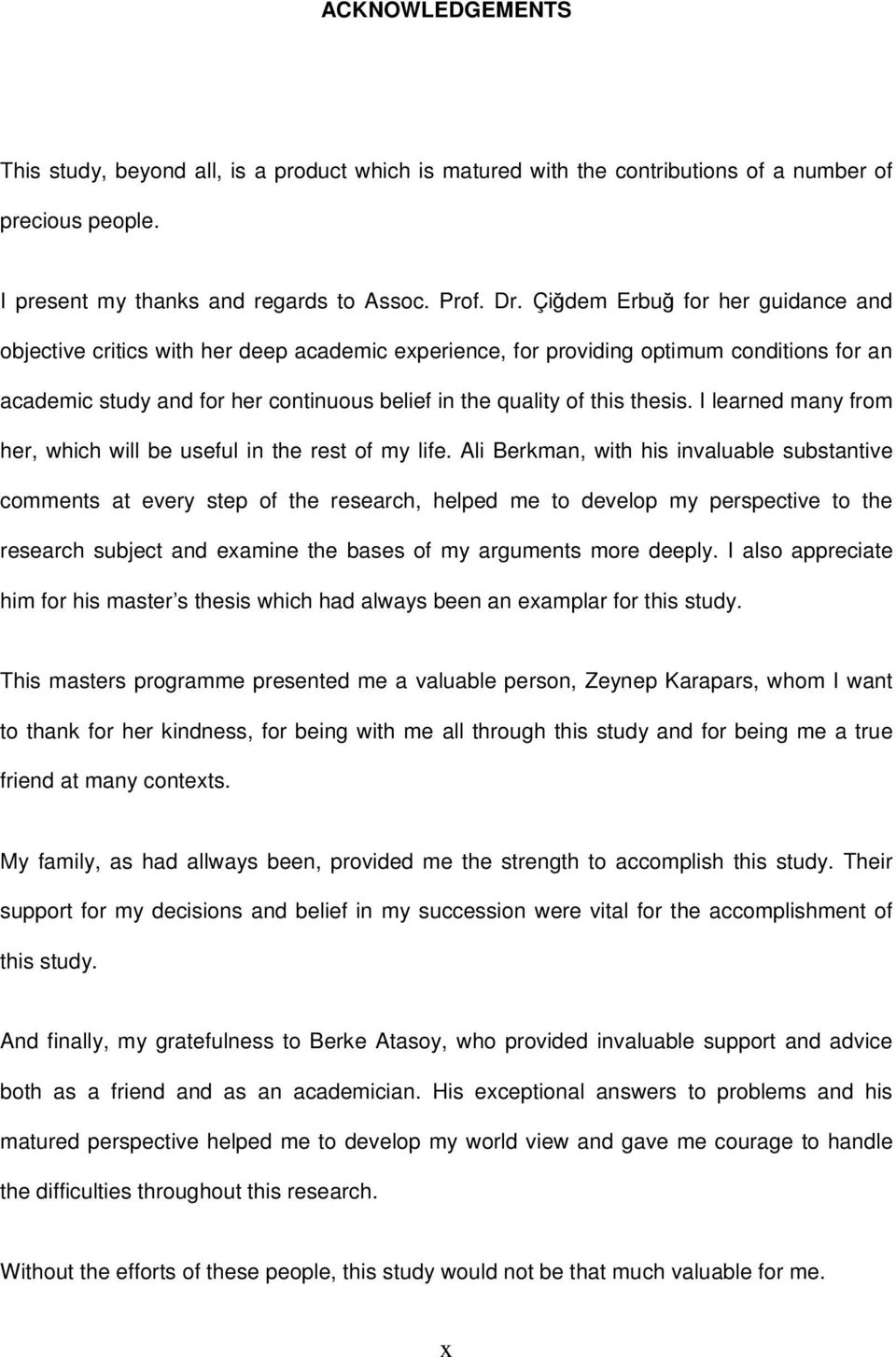
9 TABLE OF CONTENTS ABSTRACT ÖZ DEDICATION. ACKNOWLEDGEMENTS... TABLE OF CONTENTS... iii v vii viii ix CHAPTER 1. INTRODUCTION Problem Definition The scope of the study Structure of the thesis TECHNOLOGY AS A COMPETITIVE TOOL IN CONTEMPORARY MARKET DYNAMICS Changing market conditions Technology as a tool for product differentiation Conclusion AN EVALUATION OF MARKET TRANSFORMATIONS ON USABILITY CONTEXT Product quality vs. quality in use Diverse approaches to product quality Quality in use as a determinant of product quality Approach to product quality in high-tech consumer market 19 xi
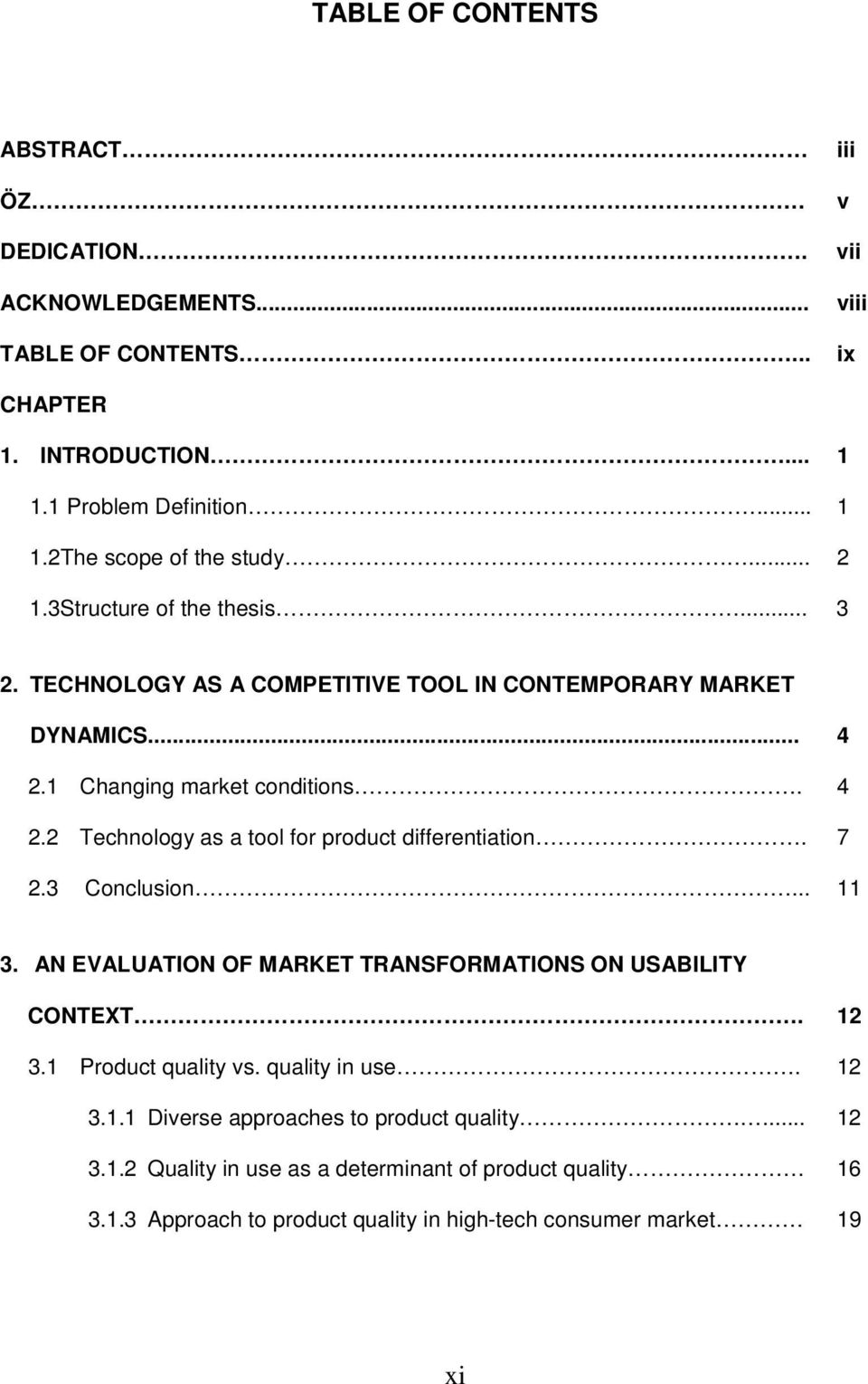
10 3.2 Changing context of use Definition of context of use Overall factors that affect context change Maturization of the high-tech market Prevalent use of digital technology The knowledge gap between users and designers Emergence of the knowledge gap The negative outcomes of user-designer difference on product usability Technology-centred approach in the product development process Main causes of technology-driven approach in development processes Technically oriented designers Blurred definitions for products function content Time as a determinant of product Number of features as a determinant of product Low costs of added features The benefits of user-centered design TRANSFORMATION OF USER-PRODUCT INTERACTION WITH DIGITAL TECHNOLOGY IMPLEMENTATIONS User-product interaction process The factors that represent product s functioning to users Common usability problems and general design guidelines General transformations in user-product interaction and their consequences Transformations in the form-function relationship Changes in products function content Function complexity.. 64 x
11 Unclear product identity FIELD STUDY Aim of the study and hypotheses Material and method Results and findings Participant characteristics The level of utilization from the product features User expectations from a digital broadcasting service General usability problems during product use Discussion CONCLUSION The general conditions that effect the emergence of the problem The contexts that define the problem Evaluation of the problem.. 97 REFERENCES APPENDICES A MAIN INTERFACE ELEMENTS OF THE SAMPLE PRODUCT B FIELD STUDY QUESTIONNAIRE AND THINK ALOUD TASKS 114 C THE DATA RELATIVE TO THINK ALOUD SESSIONS IN THE FIELD STUDY xi
12 CHAPTER 1 INTRODUCTION 1.1 Problem Definition Technology had always been a powerful tool of human being to rule over his environment and to meet his needs in the most effective way. Although the two-way relationship between the technological advances and social life had been existent for decades, it was with the mass production and consumption of industrial products that this transformation process had been accelerated. Industrial production techniques required the prevalent use of technological knowledge and enabled the integration of technological advances into various products that reach large amounts of people. In the contemporary market conditions dominated by competition, product differentiation plays a vital role for the firms to attain product success. Also, different qualities and various functions are implemented in consumer products via technological advances. Therefore, technological novelty is utilized by the producers as an important tool to cerate product differentiation. In other words, technological novelties are imposed by producers in the market as a mark of high quality and superiority of products. This phenomenon has it s reflections on the user-product interaction from several aspects. In the attempt to implement latest technologies in consumer products, integration of excessive features turns out to be right with the excuse of being novel. With the effects of the overall transformations in technology in the last decades, rate of technological obsolescence 1
13 shortens and new forms of interactions are integrated into products. Many products that are designed with a technology driven approach, surpass the needs and requirements of users and simple products began to accommodate added and often unnecessary functions. As a result, these rapid changes towards complexity in interfaces require users to involve in a continuous learning process to use everyday products, leading to the adaptation difficulties and deficiencies in product use. 1.2 The scope of the study This study aims to elaborate the negative effects of technology driven product design approach on user-product interaction and quality in use in particular. In this study, literature surveys on related domains will be utilized. In the later phase of the thesis, a case study will be presented for further exploration of the problem. It should also be noted that, this study covers the main dynamics of the aforementioned transformations. The major problems resulting from the phenomenon will be evaluated; however, putting forward some exact design considerations as a solution to these problems is not within the scope of this study. 1.3 Structure of the thesis From the next chapter onwards, the problem will be defined, by firstly stating the overall conditions that cause the problem and then by evaluating the effects of these factors on certain contexts. The study then will continue by the exploration of the problem with its main dynamics and consequences. So it can be said tat, the general structure of the study consists of two main parts, referring to the definition of the problem and investigation of the problem, respectively. 2
14 In the following chapter, the basic factors that affect the emergence of the problem will be stated. The evaluations will be based on the effects of developments in digital technology on the major alterations in the consumer market dynamics. Use of technological novelty as a tool to increase market success will be discussed within this context. In the third chapter, the bases which define the problem will be evaluated. The factors that are stated in the second chapter will be related to certain contexts, through the discussions based on product usability. The definitions of quality in use, context of use, technologydriven design and user-centered design will be presented. As these concepts are in close relation with product usability, the effects of the aforementioned transformations on these contexts are found to be vital in order to explore the problem. Fourth chapter will be about the effects of digital technology implementations on userproduct interaction process, in consumer products. The discussions will be initiated by stating the dynamics of user-product interaction process from the findings of literature survey. Then the guidelines for an ideal user-product interaction will be broadly classified and the major usability problems will be presented. A further exploration is going to be done by evaluating negative consequences of these alterations on user-product interaction process and increasing function variety of products. In the fifth chapter, the issues discussed throughout the study will be exemplified with a sample product and the findings will be discussed within the context defined in the previous parts of the study. Finally, conclusions that are drawn throughout the study will be evaluated and potentials for the further studies will be investigated. 3
15 CHAPTER 2 TECHNOLOGY AS A COMPETITIVE TOOL IN CONTEMPORARY MARKET DYNAMICS 2.1 Changing market conditions It is widely accepted that, contemporary developments in information and communication technologies, lead to fundamental changes in production processes and market conditions. These changes are stated as revolutionary, resulting in a transition from industrial to postindustrial stage (Miles, 1998; Nahm and Vonderembse, 2002). According to Manzini (1998), we are witnessing the birth of an economy based on information (p. 45). Tapscott (1995) adds that, there is a shift from industrial economy which was based on automotive industry, to a new economy, driven by computing, communications and networks. As Schmid (2001) also expresses, digitization of information and availability of new media such as Internet, personal computers and digital communication devices, lead to highly flexible technologies and fast flow of knowledge, thus altered production and design processes. Owing to these overall changes, market conditions are also transformed. The vital characteristics of the new environment are stated to be expanding competition, rapidly changing markets and technology (Nahm et al., 2002, p. 2067). In this arduous environment, firms aim to utilize technology in novel ways to achieve competitive advantage. Under contemporary market conditions, being first to enter the market is crucial to obtain greater market share and brings high profits. Evidently, firms compete with their rivals in a 4
16 time-based context, as competition mostly relies on fast development of novel products (Norman, 1988; 1999). Thackara (1997) claims the issue with the following: Innovative firms are known to collect and assimilate technological information enthusiastically but the key to their success is in their capacity to exploit it immediately in new products. Speed is the God; Time is the Devil, goes Hitachi s company slogan. (p. 19) One of the preliminary outcomes of the increased competition and rapidly changing market structure is the shortening of product life cycles and development processes (Lorenz, 1990). Tapscott (1995) exemplifies the issue with following: In 1990, automobiles took six years from concept to production. Today they take two years [T]hese days most of HP s revenues come from products that didn t exist a year ago. In the old economy, an invention (like the Polaroid camera, xerography) ensured a revenue stream for decades. Today, consumer electronics products have a typical lifespan of two months Most medium- or large-sized companies in North America introduce more than one new product per day. Last year Sony introduced 5000 new products. Microsoft group vice president Nathan Myhrvold says No matter how good your product, you are only 18 months away from failure Even something as seemingly stable and low-tech as beer requires innovation; 90% of Miller s revenues come from beers that didn t exist 24 months ago. (pp ) While speed of technological change and flow of information through digital networks enable firms to develop and market their products in a shorter time; changing customer demands and competitive strategies lead products to obsolete more rapidly (Nahm et al., 2002; Schmid, 2001). Similarly, Norman (1999) states that time is the main drive for competition, resulting in novel products to supersede old ones in shorter time: Nobody has time to think, nobody has time to plan. New products are due every six months. If you slow down, your competition will leap ahead of you. The computer industry thinks that the way to escape is to swim even harder, to bring out more and more products that push the technology envelope that are cheaper, faster, more powerful. (p. 241) Another fundamental determinant of a company s success in the contemporary market is innovativeness. The time pressure on production processes force companies to find new ways to increase their market share through introducing novel products and services. 5
17 Innovativeness is turned out to be a target for companies to increase their sales, for it is a lucrative business (Quiroga, 2001, p. 7). Also, according to Tapscott (1995): The new economy is all about competing for the future, the capacity to create new products and services, and the ability to transform businesses into new entities that yesterday couldn t be imagined and that the day after tomorrow may be obsolete. (p. 43) As firms are urged to introduce novel products repetitively to stay in the market, they aim to direct consumer demands for their continuous innovativeness. Therefore, a product s obsolescence is mostly reliant on the introduction of goods with novel features, rather than its inadequacy to achieve a certain task. The speed of technological change is stated as a dominant factor on the length of product life-cycles, as newly introduced technologies fade current ones (Quiroga, 2001). Firms use this transformative effect as a provider to increase their innovative potential. For instance, Obsolete your own products is the motto applied by Microsoft like many other leader firms, to keep their market share, as cited by Tapscott (1995, p.59). He explains the idea with the following words: If you ve just developed a great product, your goal is to develop a better one that will make the first one obsolete. If you don t make it obsolete, someone else will. (Tapscott, 1995, p.59) The fore mentioned factors have their impacts on firms innovative activities. Quiroga (2001) states that, the innovation models differ from that of the traditional one, especially in hightech markets. In these industries, as competition is mostly reliant on the rapidity in product implementation, innovation may be realized as an act of organizing existent technologies in a different way, which is a more rapid and less costly process (p.10). Therefore, many products bring competitive success for they appear to be innovative, although their novelty is minimal. For instance, Personal Digital Assistant (PDA) is specified as a small and compact device, which executes similar features of a personal computer, phone, radio and MP3 player, as well as providing wireless communication. Moreover, with shortening product life cycles and increasing competition, solely inventing technologies remain insufficient for success. Thus, producers choose to overcome 6
18 competition barriers by creating new markets simultaneously, for their continuous inventions (Jamison and Hard, 2003). Digital TV Broadcasting can be given as an example. This service promises a new way of interaction with long-familiar TV, by combining several features of a personal computer, with a broadcasting service that gives the opportunity to customize programs. The idea is promising in terms of competitiveness, not only for its being a fresh market but also for its being a flexible digital service that is easy to develop. Hence, it can be said that, diverse technologies are converged, to create various combinations of features, for a differentiated choice for customers. 2.2 Technology as a tool for product differentiation Today, technology is utilized as a source for innovativeness in the consumer market. The overall technology shift from analog to digital increased flexibility of technologies and enabled its prevalent use (Tapscott, 1995). It can be said that, it is this peculiar characteristic that makes digital technology the basic element of innovative processes. In addition, the maturing of multimedia technologies created a demand; thus, provoked producers to use technological developments to introduce new types of services and products (Nicoll, 2000). Therefore, technological change is seen as a potential to increase competitiveness of product in the market. Norman (1999) argues that, each successive new product boasts of improved technology: faster, more powerful, better this, better that. Technology rules the day, guided by feature-driven marketing (p. ix). The issue is also considered by Jamison and Hard: In our contemporary world, technology is primarily seen as the source of marketable commodities and new products What is at issue here is not whether science and technology satisfy any particularly basic human needs or, for that matter, whether they help solve any particularly pressing social, environmental or human problem; the overriding, and more or less exclusive, concern is rather whether a market can be found for new innovations, and if so, how shares in that market can be increased for the purposes of corporate expansion and growth. In this perspective-what we might call the dominant technology discourse-scientific and technological change is seen as a key factor of economic competitiveness and successful business performance. The discourse is especially dominant in relation to firms that are 7
19 actively promoting the so-called advanced, or high technologies, but its influence is much more general and all-encompassing. It is as commercial goods and services that technology and technological changes are most understandable and meaningful in the contemporary world. (p ) The flexible use of digital technologies and increasing importance of communications are mostly utilized in saturated markets. As Lorenz (1990) states, the saturation of markets like radio and TV, is a factor that supports development of complex systems. It is observable that, such products are differentiated in the market by incorporating some other technologies. They either became a part of a system of converged features (like hometheatre systems) or they gathered some other technologies and designed as hybrid products (like digital TV or cellular phone). Thus, new markets are created from the saturated ones by flexible implementation potential of digital technologies. On the other hand, Quiroga (2001) states that, hi-tech markets are permanently immature markets (p. 11) as they are dependent on technological change. Therefore, firms that compete in the matured markets may choose to shift their products to these markets by adding high-tech features. By this way, systematic innovativeness can be achieved, utilizing high-tech market characteristics. Therefore, computing and information technologies pervaded daily life. Developments in microchip technologies; in terms of their decreasing costs, reducing sizes and increasing availability; opened way to implementations of these systems in many fields (Thackara, 2001). Technological diffusion is not only observed through ordinary products having digital controls and displays rather than mechanical, but also through increasing number of novel products that utilize digital technologies in the consumer market (Bonner, 1999). Progressively, computing systems entered into everyday use, both by software companies that went into consumer market and by the existing firms, which integrated novel technologies into their products in widespread use (Hennemann, 1997; Mok, 1996; Norman, 1999). 8
20 On the other hand, the prospects of having competitive success through implementing novel technologies changed the way technology is utilized in generating product ideas. Firms search for ways to integrate novel technologies in their products long before there occurs enough demand from customers. Cockburn (1997) explains the issue with the following: In the West, the household is served by a free market. Materials, processes and devices are developed for profit. Often they are brought into existence first in response to large and wealthy markets of military or industrial production. Subsequently their developers seek to maximise sales by adapting them to domestic and individual consumption. Microwave cooking for instance was a serendipitous product of radar. One of the engineers described the thoughtprocess in technological development. The technological potential comes first, applications second. The designers say to themselves, we know we have this technology that can do this: now where s the market for it? (p.366) It can be said that, products are designed as solutions in search of problems, pushed by companies onto the market and marketed through great commercialization to create demand (Jamison and Hard, 2003, p.83). Technological change is faster than consumer demand, so, market change operates as a supply-driven process rather than demand-driven as also explained by Bauman and May (2001): New technologies are not simply a response to a need: in no way has it s appearance been determined by popular demand. It is rather the demand that has been determined by the availability of new technology. Whether the need did or did not exist before, the demand for new product comes after their introduction. In this way the presumption that demand creates supply is reversed by the suppliers actively creating demand via their marketing strategies. (p. 150) Also Norman (1999) states that, the competitive advantage brought by novel technologies result in integration of technologies into products beyond the speed of customer demand: The high-technology industry is driven by engineers, by technology itself. It has flourished through a period of phenomenal growth accompanied by high profits. As a result, the industry has succumbed to a technology fever, to the disease of featuristis [emphasis added], to pushing new technologies at the customer faster than even the most compliant customer can absorb. (p. x) The phenomenon can be observed in the consumer market, by various products integrating novel communication technologies. Recent smart product concepts are examples to allencompassing implementation of information and communication technologies into everyday activities. 9
21 Smart houses: burglar and fire alarms, appliances, and lighting can be controlled from a handy keypad or by dialing up the system from an outside phone. You can check on the room temperature, get supper started in the oven, feed the dog, and monitor goings-on to ensure that your teenagers aren t breaking too much pieces of furniture at the party they re not supposed to be having while you re on vacation. Soon, the pantry will keep the track of items you re running out of and automatically issue food and beverage replenishment orders for food that is delivered to your door. (Tapscott, 1995, p. 45) However, after five years of this definition, in 2000, a study on the market potential for smart home indicated that, in England, 65% of consumers were concerned about things going wrong in technical terms and 51% were concerned about the system complexity. The utmost demand (70%) was for safety and security aspects, which can be stated as features that are more familiar and applied in contemporary systems. ( accessed ) In the supply-driven market conditions, product marketing and market research becomes increasingly important elements of the product development processes. Marketing phase is initialized as soon as a new product idea is generated and long before the product is on the market (Lorenz, 1990; Schmid 2001). According to Schmid (2001), In digital economy, the scarce resource shifts from production to communication, in a novel way: While the implementation of a given design in the manufacturing process is mastered in less and less time by more and more suppliers in a state-ofthe-art quality, its implementation in the customers brains remains as costly as ever, or becomes even more expensive. (p. 44) By this way, demand is created and manipulated by companies. During the marketing process, users are aimed to be educated to be aware of new needs and accept solutions that products offer (Solomon, 1999). Accordingly, new features are integrated in products for they promise: [I]ncreased choice, greater access to information, active rather than passive use, more personal freedom, and (in the case of portable items of personal media hardware like the Walkman, Gameboy and cell phone) enhanced mobility (Forgacs, 2001, p.134). Consequently, the capability that producers have for directing their innovative actions, also direct the way technology is integrated in products, thus shape user-product interaction. 10
22 2.3 Conclusion These factors have great impacts on the ways technology is integrated into everyday products and their impacts on users interactions with products are prevalent. This part of the study can be concluded by suggesting that, three main issues may have vital effects on user-product interaction. Shortening product life cycles cause current technologies to fade out with the rapid development of novel ones. The ways to accomplish a certain task undergoes changes, thus, may force users to learn new forms of interactions continuously and harden the adaptation process. Convergence of various features into one system increases the number of functions that are accomplished through a single interface. This may lead to complex interactions, as well as diminishing efficiency during use. In addition, convergence of features results in hybrid products that embody diverse functions at the same time. Consequently, product identity gets lost and standardization of interfaces becomes harder. Type-based experience shifts to a product-based experience, which may force users to learn a different interaction pattern for every product he uses. The issues will be discussed in detail in the forthcoming parts of the study. 11
23 CHAPTER 3 AN EVALUATION OF MARKET TRANSFORMATIONS IN USABILITY CONTEXT 3.1 Product quality vs. quality in use Within the increasing competition that dominates the aforementioned market conditions, companies aim to derive higher ranks in the market through adding value to their products. In this sense, it has been known for long that product quality is increasingly being expected in both professional and consumer markets and most of the firms achieved eminence in the market for they offered high quality products (Garvin, 1984a; 1984b; Day, 1986; Bevan, 1999). Therefore, it is an important issue to determine what product quality is and how it is achieved in the product development process Diverse approaches to product quality Although it appears that the term quality is clear in everyday usage, there are different approaches to quality in practice (Bevan, 1995a). The term conveys diverse definitions depending on its area of use. A comprehensive identification of five overall approaches to defining quality is made by Garvin (1984a): 12
24 Table 3.1 Structure of chapter Product quality vs. quality in use Diverse approaches to product quality Quality in use as a determinant of product quality Approach to product quality in high-tech consumer market 3.2 Changing context of use Definition of context of use Overall factors that affect context change Maturization of the high-tech market Prevalent use of digital technology The knowledge gap between users and designers Emergence of the knowledge gap The negative outcomes of user-designer difference on product usability 3.3 Technology-centred vs. User-centered design approach in the product development process Main causes of technology-driven approach in development processes Technically oriented designers Blurred definitions for products function content Time as a determinant of product Number of features as a determinant of product Low costs of added features The benefits of user-centered design 13
25 1. The Transcendent Approach: This traditional view defines quality as a simple, unanalyzable property, which is both absolute and universal, and can only be accepted through experience. 2. The Product-based Approach: According to this approach, quality is a precise and measurable variable, which represents quantity of some desired ingredient or attribute possessed by a product. This view approaches quality as an inherent characteristic of goods, rather than as something ascribed to them. 3. The User-based Approach: Quality is precise combinations of product attributes that provide greatest satisfaction to the user, which lies in the eyes of the beholder. 4. The Manufacturing-based Approach: Defines quality as conformance to specified requirements. The major issue is whether a product meets design and performance standards set for it (Garvin, 1984b). 5. The Value-based Approach: Quality is defined as the level of providing performance at an acceptable price or conformance at an acceptable cost. (Garvin, 1984a, pp ) The definitions of product quality based on different approaches, which are considered by Garvin (1984a) are represented in detail in Table 3.2. However, he also emphasizes that, each of these approaches remains inaccurate and vague in defining the basic elements of product quality. This results in the potential for conflict, which leads companies to employ different definitions of quality. To give an example, while marketing people approach to quality with a user-based view, manufacturing departments accept manufacturing-based definitions (Garvin, 1984a). Therefore, there occurs a language difference between professionals as a common source of problem in the market, which avoids the successful introduction of high-quality products. Another important issue that determines the appropriateness of the product quality definitions is how the interrelationships between product attributes and quality are set. Bevan (1995a) states that, 14
26 Table 3.2 Five Definitions of Quality (from Garvin, 1984a, p. 26). Five Definitions of Quality I. Transcendent Definition: - Quality is neither mind nor matter, but a third entity independent of the two...even though Quality cannot be defined, you know what it is. (R. M. Pirsig. Zen and the Art of Motorcycle Maintenance, pp. 185,213) -... a condition of excellence implying fine quality as distinct from poor quality... Quality is achieving or reaching for the highest standard as against being satisfied with the sloppy or fraudulent. (B.W.Tuchman. The Decline of Quality. New York Times Magazine, 2 November 1980, p. 38) II. Product-based Definition: - Differences in quality amount to differences in the quantity of some desired ingredient or attribute. (L. Abbolt. Quality and Competition, pp ) - Quality refers to the amounts of the unpriced attributes contained in each unit of the priced attribute. (K. B. Leffler, Ambiguous Changes in Product Quality.. American Economic Review, December 1982, p. 956) III. User-based Definition: - Quality consists of the capacity to satisfy wants... (C. D. Edwards, The Meaning of Quality. Quality Progress, October 1968, p. 37) - Quality is the degree to wich a specific product satisfies the wants of a specific consumer. (H. L. Gilmore. Product Conformance Cost. Quality Progress, June 1974, p. 16) - Quality is any aspect of a product, including the services included in the contract of sales, wich influences the demand curve. (R. Dorfman and P. O. Steiner, Optimal Advertising and Optimal Quality. American Economic Review, December 1954, p. 831) - In the final analysis of the marketplace, the quality of a product depends on how well it fits patterns of consumer preferences. (A. A. Kuehn and R. L. Day, Strategy of Product Quality. Horward Business Review, Nowember-December 1962, p. 101) - Quality consists of the extent to wich a specimen (a product-brand-model-seller combination) possesses the service characteristics you desire. (E. S. Maynes, The Concept and Measurement of Product Quality. in Household Production and Consumption, p. 542) - Quality is fitness for use. (J. M. Juran, ed., Quality Control Handbook, p. 2-2) IV. Manufacturing-based Definition: - Quality [means] conformance to requirements. (P. B. Crosby, Quality is Free, p. 15) - Quality is the degree to wich a specific product conforms to a design or specification. (Gilmore, June 1974, p. 16) V. Value-based Definition: - Quality is the degree of excellence at an acceptable price and the control of variability at an acceptable cost. (R. A. Broh. Managing Quality for Higher Profits, 1982, p. 3) - Quality means best for certain customer conditions. These conditions are (a) the actual use and (b) the selling price of the product. (A. V. Felgenbaum, Total Quality Control, p. 1) 15
27 generally quality is approached as an intrinsic property of a product. For instance, ISO 9126 identifies the attributes that can be designed in a product by taking product-based approach, and categorizes these as functionality, efficiency, usability, reliability, maintainability and portability. ISO 9001 standards carry a manufacturing-based approach to set required steps in manufacturing to derive a specified quality of end product. ISO 8402 defines quality with economic approach [synonymous with value-based approach by Garvin (1984a)] as the totality of characteristics of an entity that bear on its ability to satisfy stated and implied needs (Bevan, 1999, p.90). Like other examples, this definition also determines quality with the presence or absence of specific attributes, which can be designed into the product (Bevan, 1999). However, the inherent characteristics of products can only be valid if the attributes of a product are considered preferable by virtually all buyers (Garvin, 1984a, p.26) and acceptable to the extent that user needs are well-defined and common to the intended users (Bevan, 1995a). Therefore, it can be said that, there is no universal assessment for quality but it is evident that goals should be set by approaching product quality from different perspectives as well Quality in use as a determinant of product quality The attempt to evaluate product quality through specifying inherent product attributes remain indeterminate, if it is examined that, user characteristics and conditions under which the product is used are highly variable. User-perceived quality has not been regarded as an indicator of product quality to a sufficient degree (Bevan, 1995a). This is mostly because user-based approach to quality is assessed as a highly subjective for evaluation, for it is idiosyncratic and personal view of quality (Garvin, 1984a, p. 27). In addition, it is conceived as a costly and time-taking process that negatively affects the competitive abilities in the short term (Bias, 1994; Norman, 1999). 16
28 However, there is a more fundamental issue, which affects the quality of a product: That is, the quality of a product cannot be thought independently of the product s use by users with different characteristics and in varying contexts. As stated by Bevan (1995a): The conventional assumption that quality is an attribute of a product is misleading, as the attributes required for quality will depend on how the product is used. if different groups of users have different needs, then they may require different characteristics for a product to have quality, so that the assessment of quality becomes dependent on the perception of the user. Products can only have quality in relation to their intended purpose. (Pp ) In addition, competitive market environment leaves technical perfection insufficient for product success and forces companies to consider product s usability and compatibility with user characteristics, tasks and the usage environment as determinants of quality (Bevan, 1999). Products that have a closer fit with user requirements arrive at a higher quality; therefore, understanding user needs are closely interrelated with total quality management (Wiklund, 1994). Similarly, according to Cooper (1999), for a product to achieve market success, an objective of user satisfaction and specification of minimum level of quality for that objective is necessary, as well as the consideration of criteria such as performance, learnability, error rate and usability. Also, as Donoghue (2002) states, As hardware becomes a commodity, it will be the software and services, and their associated user experiences, that add value for customers (p.25). Hence, usability and meeting user requirements are determinant factors on market success. Especially in software development processes, usability is closely related with product quality and serving for customer requirements have evident long-term benefits (Karat, 1994). A study on customer purchase decisions conducted in 1985 showed that, of the purchasers who search for alternative products, 40% stated the reason as; their being unsatisfied with their existing software package, for it does not meet their needs. 52% of the participants mentioned performance and ease of use as the major factor affecting their purchase decision. In 1992, another study indicated that, the first time purchasers utilize an advice of a colleague as the most important information source. In the study, the first and 17
29 second key purchase decision criteria were stated as meeting requirements and being easy to use, respectively (Harrison et al., 1994) Therefore, product usability should be examined as a decisive element of product quality. Bevan (1995a) identifies two complementary roles of usability in design: as an attribute which must be designed into a product, and as the highest quality objective which should be the overall objective of design (p.116). He adds that, usability studies induced a broader approach to product quality, which emphasizes user perceived quality through relating quality with the needs of the user. In this sense, ISO/IEC distinguishes two approaches to quality: quality as an inherent attribute of a product and the quality as a result of the user-product interaction under stated contexts. The definition of quality of use is given as The extent to which a product can be used by specified users to meet their needs to achieve specified goals with effectiveness, task efficiency and satisfaction in a specified context of use [ISO 13407:1999(E), p.15]. Another ISO definition is: the user s view of the quality of a system containing software, and is measured in terms of the result of using software, rather than the properties of the software itself. Quality in use is the combined effect of internal and external quality for the user (ISO/IEC :2001, p.15). These definitions accept the term quality as it is perceived and accepted by the user at the result of the interaction between the product and the user (Bevan, 1999). Bevan (1995b) also adds that: Quality of use should be the major design objective for an interactive product: does the product enable the intended users to achieve the intended tasks? This relates usability to business objectives and elevates usability from the optional extra to the prime design goal. (p.1) Therefore, quality in use should be involved in the product quality objectives, as a measure of product quality from the user s point of view. 18
30 3.1.3 Approach to product quality in the high-tech consumer market A company s approach to quality is an importantly affective factor on the end product s quality as much as the extent that the quality standards are applied in the development process. In high-tech markets, firms mostly focus on shortening the product development process and differentiating their products in the market. In this sense, there is a general tendency to attain market success by adding new features to products. Norman (1999) remarks that, in saturated markets, a product s minor differences are marketed as the features that increase the quality of that product. This attempt of high-tech companies is stated as the effort to improve their products by merely adding complicating and unwanted features to them (Cooper, 1999, p.8). Similarly, according to Asatekin (1997) the main reason for the increase in the number of functions in electronic products is that, the multi-functional characteristics of electronic devices are regarded as a criterion of superiority. Products using latest technology are valued as a sign for social aspiration (translated). Therefore, technical qualities are differentiating factors for these devices. He exemplifies the phenomenon with music sets, emphasizing the innumerable buttons which are doubtable of performing any function, and states that such an approach can only be valid if there exists a direct relationship between the concepts of technical quality and technical complexity. However, as there are not any widely accepted descriptions that identify the quality of products containing software yet [ISO/IEC :2001(E)], generally customers truly evaluate quality of a product after its purchase or use (Day, 1986). Especially when the users are inexperienced with these features, usually they cannot judge these features necessity for serving their needs before the purchase. Therefore, users would prefer products with more features in the case of any need, although they would not feel any requirements in the latter periods of usage (Norman, 1999). However, this may result in unsatisfying user experience (Donoghue, 2002). 19
31 According to Garvin (1984b), product quality is usually misinterpreted in the market. Customer requirements should be regarded to increase product quality, however generally undervalued: Many firms think they know what quality means in their industry; few have taken the time to survey customers to actually find out. If a company hopes to compete effectively on the quality of its products, a deeper understanding of the consumer s perspective is a necessary first step. (Garvin, 1984b, p.43) Donoghue (2002) also states the issue by emphasizing that, superiority of product features may not always meet with user requirements and may conduct lower adoption rate, thus, business goals should be set by considering product s usability. The approach to product quality that excludes quality in use, also conduct problems in userproduct interaction. The consequences will be examined in detail in the next chapter of the study. 3.2 Changing context of use Owing to the prevalent use of digital technology in consumer products, the context that these technologies are used altered mainly. The phenomenon has considerable effects on product usability Definition of context of use The determinative role that the context of use has on product usability was emphasized broadly when defining quality in use. The definition of usability in ISO also implies that usability of a product or system is dependent upon the context of use: The extent to which a product can be used by specified user to achieve specified goals with effectiveness, efficiency and satisfaction in a specified context of use [ISO :1998(E)]. Although prepared for software products, this standard applies to all consumer goods. 20
32 Therefore, usability of a product is evaluated by considering the context of the overall system, which lies in the user s interaction with the product and assessed by the user (Bevan et al., 1991, p.4; Bevan, 1995b; Thomas and Bevan, 1996). Similarly, according to Brooke (1996): Usability does not exist in absolute sense; it can only be defined with reference to particular contexts. This, in turn, means that there are no absolute measures of usability, since, if the usability of an artefact is defined by the context in which that artefact is used, measures of usability must of necessity be defined by that context too. (p.189) Hence, a product cannot be stated as usable without considering the context: It is not meaningful to talk simply about the usability of a product, as usability is a function of the context in which the product is used. The characteristics of the context (the users, tasks and environment) may be as important in determining usability as the characteristics of the product itself. Changing any relevant aspect of the context of use may change the usability of the product. (Bevan and McLeod, 1994, p.137) The definition of the term context of use is given in ISO as the users, tasks, equipment (hardware, software and materials), and the physical and social environments in which a product is used [ISO :1998(E)]. Therefore, the characteristics of context of use may vitally influence usability. These are stated as: a) The characteristics of the intended users like knowledge, skill, experience, education, training, physical attributes, habits, preferences, motor and sensory capabilities. b) The characteristics of the tasks the users are to perform such as the frequency and the duration of performance c) The environment in which the users are to use the system including hardware, software and the materials to be used and relevant characteristics of the physical (e.g., workplace, furniture, lighting, humidity) and social (e.g., work practices, attitudes) environment [ISO 13407:1999(E)]. Context of use have a vital role on the user s perception of the product quality and market success, as well as usability of that product. Bevan et al.(1991) state that, for a product to 21
33 be usable under real conditions, it should be acceptable by the user. They also emphasize the effects of the factors determined by context and user characteristics on acceptability; like cost, convenience, pre-requisite training and dislike. Similarly, Thomas and Bevan (1996) emphasize the importance of the product s compatibility with the context by giving the following example:...adding extra features to a word processor may make it more usable for the professional secretary who has sophisticated requirements, (e.g. producing long documents with complex page layouts - multiple columns, headers, footers, etc.), who also has time to learn how to use the new features. However, the new features may reduce the usability of the product for executives who have very limited requirements, (e.g. production of short memos), who have no time to invest in relearning how to use the product after long periods without use. (p.83) In addition, considerable research show that the effects of demographic variables such as income, education level and standard of living are turned out to be particularly important in determining market-introduction success of technology-related products (Sincovics et al., 2002, p. 478). The assessment of the context of use in the product development process is important for product quality. As stated in ISO 13407:1999(E), details of the context of use should be identified in order to guide the early design decisions. These details are important for the specification of product requirements, thus, considering the context characteristics throughout the development process is decisive for a product to be appropriate and usable for its intended users (Thomas and Bevan, 1996). However, manufacturers lack of concentration on intended user, intended tasks and usage, leads to usability problems Overall factors that affect context change It can be said that, two main factors affected the user characteristics, tasks and the use environment. In the following part, these factors will be evaluated broadly under two headings. 22
34 Maturization of the high-tech market The developments in the computer technology lead it to have an increasingly flexible nature, and therefore it progressively became applicable to many fields. Owing to its ability to serve for prevalent and diverse purposes, computer technology market is reached to a maturity, which bears new market characteristics (Norman, 1999). The issue is also valued in ISO/IEC 9126 : The software industry is entering a period of maturity, while at the same time software is becoming a critical component of many of today s products. This pervasive aspect of software makes it a major new factor in trade. (2001, p.23) Figure 3.1 The change from technology-driven products to customer driven, human centred ones (from Norman, 1999, p.35) 23
35 Therefore, according to Norman (1999), a prevailing outcome of this development is the changing characteristics of the digital technology users. He differentiates the type of the customers in two different stages of technology lifecycles (Figure 3.1). He states that, at the early stages of digital market development, the purchasers of these technologies were technology enthusiasts, who were mainly interested in the novelties that these products offer and naturally were not considering ease of use as a purchase criterion. At the later phases of the development, late adopters were the customers, who waited for these products to get cheaper and prevalent in many fields. These purchasers show different characteristics from the earlier ones, not only for they have a lower level of knowledge and motivation to deal with novel technology, but also for they mainly look for reliability and the quality of the experience as the main criteria of purchase. On the other hand, as the market reaches to a state of maturization, number of competitors who can meet customers technical requirements increases. In this respect, the criteria such as ease of use, style and cost are starting to be vitalities that add value to products, rather than technical features. Hence, it is crucial to consider the main factors that dominate the context of use within this new frame Prevalent use of digital technology It has been stated in the previous part of the study that one primary outcome of the digital technology developments was the changing areas of implementations and prevalent use of digital technology. One reason for the pervasive use of digital technologies in domestic consumer products is that it is a potential market both for its being profitable and for its high level of specialization that enables product differentiation (Cockburn, 1997; Lorenz, 1990). Therefore, most of the products that are in daily use incorporated digital properties in the last decades: 24
36 Computer technology and its various applications have become an integral part of everyday life. Not only is this evident by the large number of automatic teller machines but also by the integration of computer chips and programmable features into domestic consumer products such as video cassette recorders, microwave ovens, and washing machines. (Hall et al., 1999, p.101) Owing to this change, the circumstances related to the context in which these devices are used, altered considerably as well. As Buurman (1997) sates, casual users entered into interaction with these products in home environment. Thackara (2001) claims the issue with the following numbers: Today s computing is everywhere but nowhere to be seen. The world is already filled with 30 computer chips for every man, woman, and child on the planet. In 1998 some 4.8 billion microprocessors were sold; only 2,5 percent of those were for personal computers. (p. 48) These changes resulted in alterations in context of use, from a number of aspects. Firstly, owing to the specific nature of the consumer market, characteristics of the users of these products highly varied. Sade (1999) states that, the groups of users of electronic devices became heterogeneous for they highly alter in terms of level of experience, motivation, and skills. In this sense, these type of consumer products have users with different backgrounds and expectations, thus, they will want to accomplish similar tasks in many different ways (Smith, 1998, p. 298) Secondly, everyday activities which are evidently different from the tasks in the work environment, started to include computing technology. As these activities are generally done relatively quickly, often simultaneously with other activities the level of difficulty is higher, so they require conscious mental activity to be kept at the minimum level (Norman, 1988 p. 125; Sade, 1999). Therefore, it can be said that, the nature of the tasks that digital devices are used for altered as well. As a third factor, the nature of the tasks accomplished with these products changed in a way that increases the importance of the differences among users. As digital products incorporate electronic interfaces, the effort required to interact with these products became 25
37 less physical and more mental (Adler and Winograd, 1992, p. 4). The issue is also regarded by product standards as [m]any machine requirements have now changed from biomechanical work to control work only, where psychological factors dominate For the design of modern interfaces, average human thinking is very important (ISO/CD draft, 2003, p.16-17). Therefore, rather than physiological and lower-order cognitive usability, higher-order cognitive usability gains importance during product use (Salvo, 2001). However, owing to the changing nature of user-product interaction, differences in user characteristics affect the quality of interaction at a higher level. Although perceptive and cognitive processes proceed in the same way in all humans, the interpretation of received information may vary in detail, mainly depending on the individual s background and training (ISO/CD draft, 2003). In addition, users combine their previous knowledge about that product and their process of learning and problem solving experiences, and further develop their intended way of use in order to adapt to the situations that the context presents (Teeravarunyou and Sato, 2001). Furthermore, commonly, mental capacities such as speed of recognition, reaction time, data memorization and short-term memory decrease with age. Therefore, individuals may vary in their understanding of everyday objects both in terms of the functionality they offer and the ways in which they are operated (ISO/CD draft, 2003, pp.7-8). These alterations evidently show that, the context in which the digital products are used is mostly altered, as the characteristics of the users, the tasks that are accomplished with computing technology and the environment in which these products are used are changed. Buurman (1997) overviews the effects of the differences between the professional and domestic contexts on product use: Different from the professional users, users of consumer products do not have extensive training for the product use. Moreover, it is not realistic to expect the user to read the user manual and act according to that information. 26
38 In opposition to work environment, there are no specified users, goals and contexts of use. These characteristics are highly variable. For the consumer products, effectiveness and efficiency are of secondary importance when compared to professional use. Therefore, pleasure and early success that motivate users are necessary for further exploration of functionality and interaction. He also states that, these criteria are of vital importance when it is considered that the consumers have the choice of purchasing the product or not. Moreover, with the changing nature of the interaction, these differences convey great importance on the quality of use. Therefore, it can be said that, these alterations increased the importance of the knowledge derived from users, and accordingly, user s participation became a necessary component of the design process The knowledge gap between users and designers In user product interaction, user s proper interpretation of the product s functioning has a vital affect on the quality in use. There is no doubt that, one primary responsibility of a designer is, to represent the necessary codes for the product s functioning in a way that requires minimum effort of the user. Kanis et al. (2000) state that, product characteristics can be viewed as mediators of a communication process between the user and designer: A combination of product characteristics, supposed by designers to have a particular meaning, are encoded in a design, subsequently to be decoded by users communication primarily consists of the exchange of mental representations in a perceptive/cognitive process, which somehow thrives on experience and learning. (p. 366) Therefore, the quality of the interaction between the product and the user is dependent upon the designer s understanding of the relationships between users, products and the environment in which they interact, to an extent (Asatekin, 1997). 27
39 However, representing the functioning of a product in the way that the user easily understands poses some difficulties. The issue may appear as a problem for the designer for mainly two reasons. Firstly, users highly vary with respect to their requirements and cognitive and perceptual capabilities, owing to their expectations and experiences in differing situations; therefore, it is hard to define the user (Kanis et al., 2000). Secondly, Designer s cognitive capabilities may not be in accordance with the user s (Teeravarunyou and Sato, 2001), thus, requires the designer to consider an extraneous way of thinking for the design of the product. As the issues related with user requirements are explained in the previous part of the study, the following part will mainly focus on the causes of emerging differences between the user and designer in terms of the capabilities required to operate a product. The results of the phenomenon will be evaluated in detail in the fourth chapter Emergence of knowledge gap Due to the effects of technological advances, the perceptual and cognitive differences between designers and users of computing technologies became more evident. According to Kanis et al., whatever the effort of designers, the intended communication frequently fails; that is, meanings in product characteristics preconceived by designers, are not properly recognised by users (2000, p.365). Norman (1988) points out that, the communication problems lie in the difference between the designer s and the user s way of thinking. While designers become experts with the devices they design, users are experts on the tasks that they perform with that product: Designers have become so proficient with the product that they can no longer perceive or understand the areas that are apt to cause difficulties. Even when designers become users, their deep understanding and close contact with the device they are designing means that they operate it almost entirely from knowledge in the head. The user, especially the first-time or infrequent user, must rely almost entirely on knowledge in the world. That is a big difference, fundamental to the design. (p. 157) 28
40 This difference of expertise and motivation to use, which is emergent between the designer and user, became even more evident with the pervasive use of digital technology. As the development process of the products with computing technologies requires high level of technical knowledge, the designers of these systems were hired for their technical qualities. Nevertheless, owing to the specified use of these technologies for professional purposes, former users of these systems were like designers as well; who had sufficient level of computer knowledge, were interested in novel technologies, feeling enthusiastic about using technological devices and capable of coping with any technical problem (Rubin, 1994). Moreover, digital technology was limited to the use of these expert users (Norman, 1999). Therefore, the designers and users of these systems used to have the same characteristics, thus, were not having many problems in communicating (Rubin, 1994). This equilibrium got lost with the implementation of digital technology in consumer products. As previously stated, many of the daily tasks required use of products with microprocessors, so, users with no expertise or familiarity with computers encountered these products in everyday life (Norman, 1999; Rubin, 1994; Sade, 1999). Therefore, users that confront with computing technologies today, have neither much knowledge on computing systems, nor enough motivation to learn to operate. They rather have different expectations from technology, as they want a tool, not a hobby, thus, today s user is no longer even remotely comparable to the designer in skill set, aptitude, expectation, or in almost any attribute that is relevant to the design process (Rubin, 1994, p.6) The negative outcomes of user-designer difference on product usability Nevertheless, this factor became a cause of usability problems for it is not regarded by designers in the product development process. Cooper (1999) states that, programmers and engineers who develop software-based products have adequate knowledge to operate these products, however users do not. He adds that, although the experts claim that usability problems exist owing to the insufficient level of technological development to help 29
41 the user during the interaction process, the main reason is that technological artefacts have interactions, which are expressed in terms in which they are constructed. Hall (1997) points out to the same problem, by arguing that despite designers are entirely different from users, they believe that they think in the same way with the users and not have many different characteristics. As a result, they expect additional training and knowledge for using software-based products as a simple and natural requirement: We industry insiders toss around the term computer literacy, assuming that in order to use computers, people must acquire some fundamental level of training. We see this as a simple demand that isn t hard and is only simple and proper. We imagine that it isn t much to ask of users that they grasp the rudiments of how the machines work in order to enjoy their benefits. But it is too much to ask Users should not have to acquire computer literacy to use for common rudimentary tasks in everyday life. Users should not have to possess a digital sensitivity to work their VCR, microwave oven, or to get . (Cooper, 1999, p.37) On the other hand, as stated by Rubin (1994), designers approach to usability requirements of a system with common sense rather than with a scientific evaluation, therefore, let usability problems appear. Therefore, it can be said that, aforementioned alterations in the context of use and user characteristics with the effects of digital technology implementations require new approaches to product design to be developed. Owing to this fact, designer s role and his/her approach to the product development process also needs changing within these dynamics. As will be discussed in the fourth chapter of the study, electronic interfaces have abstract form-function relationships; therefore, require representation of the functioning of the product into the surface forms by the designer, artificially. This affects the design process in two terms. On the one hand, designer is provided with unlimited alternatives to express any information and he picks the solution which serves the user best. However, on the other hand, with this situation, the designer has the responsibility to have sufficient knowledge on the artefact s technology, human psychology and social interaction of the product with user groups. Similarly, Asatekin (1997) states that, the conditions that are brought by the developments in digital technology, provided freedom to the designer to decide on the form of the products as he envisions, free of limitations that are set by the 30
42 relationships between the form and the function. He adds that, this situation also brings responsibility to designers, as this flexibility on the product s appearance can be used for other purposes, like promoting and marketing the product. Moreover, if not considered attentively, the issue may negatively influence interaction process. It can be concluded that, the evident difference between user and designer in terms of knowledge level and experience, results in usability problems unless not considered in product development processes. Jordan et al. (1996) assert the issue with following: As the products that we use at home and in our workplaces become even more complex in terms of features and functionality, it becomes vital that those involved in the design of these products consider the needs and limitations of those who will be using them. If these are not taken into account, products that are created with the intention of delivering some benefit can end up being more trouble than they are worth. (p. 1) Therefore, a critical approach to design which involve users as essential components of the design process is required, to overcome the obstacles in designer-user communication. 3.3 Technology-centred approach in the product development process The aforementioned developments in digital technology and the way it is utilised by companies in the consumer market to increase their sales, evidently altered content and use of everyday products. However, the issue may impose negative influence on the quality of interaction, depending on the approaches in product development. The problem of complexity caused by the uncontrollable development of digital technology has been a matter of subject in recent years: We -all of us- are living through a media revolution as computing technology changes everything around us. It s chaotic, it s complicated, and many people find it uncomfortable. No one truly understands where computing is taking us; experts and trustworthy guides don t exist, and no one can find their way alone. (Mok, 1996, p.xii) 31
43 Also Norman (1999) states that, people feel frustration and estrangement towards technology, because technology is evolving by pushing ever harder to newer, faster, and more powerful systems, with nary a moment to rest, contemplate, and reflect upon why, how and for whom all this energy has been expanded (p. 229). As discussed in the first chapter of the study, the main dynamics that rule consumer market has been shifted to a supply-driven character. In high-tech markets, the main drive that directs novelties is stated as technology-push. Thus, the firm begins the product development process with a new proprietary technology and looks for an appropriate market in which to apply this technology (Ulrich and Eppinger, 2000, p.20). Nevertheless, the phenomenon has evident effects on the way technology is integrated in products, which may be an overriding cause to complexity of products. The main reason for the problems that users experience with electronic products are stated to be the utilization of technological advances to develop superior products without considering users requirements and limitations in use (Hennemann, 1999). According to Norman (1999), the prevailing complexity of high-tech products is a consequence of the developments with technology for technology s sake approach by which the real needs of consumers are ignored (p.4). The issue is also considered by Thackara (2001), remarking that it is rarely questioned if the computing technologies are developed for the real needs of people and if they result with better products. He adds that: When it comes to innovation, we are looking down the wrong end of the telescope: away from people, toward technology. Industry suffers from a kind of global autism. Autism, as you may know, is a psychological disorder that is characterised by detachment from other human beings The result is a divergence in technological complexity and perceived value. We re sitting uneasily between an infatuation with technology on the one hand and unease about its actual value to us on the other. (pp ) Similarly, Sugar (2001) refers Norman, stating that depending on how technology is designed, it can either be enabling (human centered) or disabling (machine centered) (p.236). Therefore, it can be said that, technology-driven design approach has an important 32
44 affect on the emergence of usability problems. In the following part, the main context that assists technology-driven approach will be stated Main causes of technology-driven approach in development processes The primary factor on the dominancy of technology in product development processes is stated as the system-centred view of the last decades, which also led to impressive developments. As demonstrated by Johnson (1998), modern technology has a system- or artifact- centered nature. He explains the perspective of the term in product development as: The system-centered view is based upon models of technology that focus on the artefact or the system as primary, and on the notion that the inventors or developers of the technology know best its design, dissemination, and intended use This system-centered approach to artefacts and systems has dominated technological development at least since the advent of the Industrial Age, and only recently have significant critiques of this view been offered. (p.25) He also states that, according to this view, users are inevitably ancillary, or, in some cases, nonexistent, as the system or artefact is the hegemonic determiner of all (Figure 3.2). System / Artifact Artisan(s) Designer(s) Image User(s) Interface Figure 3.2 The System-Centered Model of Technology (from Johnson, 1998, p.27) 33
45 He continues explaining the model as: There is no need for the user to be involved with system or artifact development, this perspective suggests, because the system is too complex and therefore should be designed and developed by experts who know what is most appropriate in the system design. The system is created through a process of prototyping and iterative redesigning that is primarily controlled by the designers or artisans. From this process emerges a technological artifact that embodies the designer s image of the system From this follows the system interfacethe covering of the internal system through which the user sees and operates. (Johnson, 1998, p.p ) Similar arguments are put forward, which emphasize the dominancy of technology-driven approach in product development. For instance, Hennemann (1999) states that, in a typical product development process, technology-driven view is admitted, thus, users are not considered as components of the system. According to Sade (1999, p.65), In spite of today s user-centered design philosophy, it is obvious that many products are designed in a machine-centered atmosphere. The reasons that assist the firms favouring the technologydriven approach in development processes can be discussed under three main points Technically oriented designers Designers and technical people who work in product development generally have a systemcentred approach to technology. They are assigned for their ability to solve technical problems; rather than to deal with the human side of the process. Thus, they focus mainly on increasing the machine and task performance without considering user and context as components of the system (Rubin, 1994). The phenomenon also asserted by Sade (1996): The participants in the product development process are technically oriented, which leads to designs less suitable for non-technical users. The users are required to think in a way which is not natural for them. (p.65) On the other hand, a common assumption is that, humans are adaptable and flexible by their nature, therefore, in the product development process, technology is used with a 34
46 primary aim to increase the machine performance and user is expected to adapt to the product features (Rubin, 1994; Norman, 1997; Sugar, 2001). Therefore, many people encounter problems in using products because they are forced to conform to an unfamiliar way of thinking Blurred definitions for products function content Owing to the flexible nature of digital technology, especially software-based products have indefinite content definitions. In other words, the limits they conform to are very flexible. Therefore, as the definition of the finished product is crucial for the communication between the marketing departments and programmers during the development process, firms choose to define the final product either in terms of deadline of the development process, or with the number of features that the product will include (Cooper, 1999). Hence, these two factors constitute firms main drives for competition Time as a determinant of product As also stated in the first chapter, time is an important factor on success in the digital product market. As Norman (1999) states, it is better to be first than best in the market, therefore, after a product idea is developed, common sense disappears and firms do not give extra time to decide on its appropriateness for users (p.p. 1-2). Easy to use, simple products are hard to develop and require research. Therefore, producers believe that usability tests and user researches postpone product s introduction to market (Martin, 2001). Rather, they prefer to develop products with more features in a shorter time, which is apparently a more profitable way (Lardner et al, 2000; Norman, 1999). In addition, programmers attempt to increase the perfection of the product by adding more features, until the deadline for the product development is over (Cooper, 1999). 35
47 Consequently, the main determinants of interaction are shaped by time limitations, not by the user requirements and characteristics. Bauman and May (2001) emphasize the difficulties brought with fast technological developments, by stating that, while software products need to be updated within short periods of time, they also require new learning process. However, it is hard to adapt such a fast and continuous learning process. Moreover, when a product fails, a new version of it comes out and for most of the time, the newer one costs much less than to fix the old one. Therefore, this factor also forces users to adapt new ways of interaction continuously Number of features as a determinant of product The number and variety of functions that a product contains are used as a differentiator factor in the market. Therefore, many firms use shopping list of features to define and differentiate their products (Cooper, 1999, p.42). This is a motivator of increased number of functions as product contents. Hennemann (1999) states that, in a typical product development process, the features that will be integrated in a product- in other words functional requirements - are decided on first (p. 135). Then, how these features will be integrated in a product is questioned and how successful the product performs these functions is tested before introducing the product in the market. Another important factor that affects the product content is the overall approach of the firms towards the market research studies and the way that the results are evaluated in the product development processes to provide market success. Many different features that are stated by various consumers in market research studies are integrated into a single product to have a larger market share (Lardner et al., 2001). Cooper (1999) explains the phenomenon by stating that companies choose to cope with the unpredictable nature of the market by adding each function that customers state and expecting to gain success with one which might be the magic feature (p.224). According to Hall (1997), a problem in 36
48 specifying user requirements is that, it is difficult for users to define their needs truly. Moreover, when a novel technology is considered, users are unaware of their expectations, as they do not have any experiences with it yet. The issue is also pointed out by Norman (1999): If you ask, people usually focus on what they have and ask for it to be better: cheaper, faster, smaller. A good observer might discover that the task is unnecessary, that it is possible to restructure things or provide a new technology that eliminates the painstaking parts of their procedures. If you just follow what people ask for, you could end up making their lives even more complicated. That s one of the reasons our computer applications have so many confusing features: Every one was requested by a user. (p. 193) He adds that, although marketing people ask customers what their expectations are, technologists decide on the content of the product and firms market their products by promoting their technological superiority. Therefore, the process develops with technologydriven approach. Nevertheless, this result in complex products that no one expects to have, as Lardner et al. (2001) quote Cooper s following words: Still, people want the cool stuff. Call it the consumer-driven death spiral You interview a thousand people, and each one says, I want these 10 general features plus this specific feature, so you build a device with 1, 1010 features. But no one wants 1, 1010 features. (p. 36) Similarly, according to Thomas and Bevan (1996), contrary to many manufacturer s beliefs, adding extra features to a product does not necessarily make a product more usable (p.81). Nevertheless, these added features cause to usability problems for most of the people: Even after 20 years on the market, VCRs remain too complicated for many ordinary folks program. So most people use them only to record shows in progress or play movies. The DVD is almost troublesome to set up. That s probably because design engineers focus on adding the next cool function rather than simplifying its use When they finally do think about how these gadgets work, maybe we ll be able to relax in front of the TV without worrying about which button to push or not. (Aston and Keenan, 2001, p.93) 37
49 Also Bauman and May (2001) points out that, although many versions of products have an assertion that they provide advantage by including various features which broaden the tasks handled with that product, most of these features remain useless Low costs of added features Another dominant factor on the product content is that, the cost of adding microprocessors into products is increasingly getting cheaper, especially when compared to older, mechanical systems; therefore, it is advantageous for manufacturers to use computing systems in wide range of products and services: Because functions and features are added in intangible code and not in tangible steel, copper or plastic, it appears to traditional manufacturing executives that additional features are nearly cost-free. It seems to them that software is easy to add, change, and improve It is cheaper to put an entire microprocessor in your car key, microwave, or cell phone than it is to put in discrete chips and electronic components. Thus a new technical economy drives the design of the product... so any proposed feature is assumed to be a good investment until proven otherwise. (Cooper, 1999, p.28) On the other hand, the firms aim to integrate various features in products, for it is a less costly way to differentiate their product in the market. Sade (1999) suggests that, the designers implement more and more functionality, making the product too complex for users to access and enjoy the functions, because increasing the number of features by programming is less expensive than it used to be by hardware design (p. 65). Wiklund (1994) exemplifies the phenomenon: In the past, adding functions to a product required a great deal of mechanical and electrical engineering. For example, if designers wanted to add a clock to an oven s control panel, they had to buy clock parts and bolt them into the faceplate of the oven. Today, the clock feature is a veritable freebie on more advanced ovens that employ a microprocessor and associated display to set the oven temperature, set the timer, and perform myriad other functions. The intoxicating effect of cheap-to-produce features has led some clever (if frustrating for consumers) merchandising approaches. (p.10) 38
50 For this reason, increasing the number of features in a product is used as a tool in the consumer market for often questionable commercial reasons (Buurman, 1997, p.1159). It can be concluded that, in the digital product market, the interpretation that equates market success with increased number of features of a product is supported by a technologycentred approach to product design. However, as Johnson (1998) states, even in less complex technologies interfaces can be problematic if they represent an image of the system that fails to meet user s expectations (p.27). The following words of Buurman (1997) also emphasize the importance of taking into account of user characteristics in product development, rather than the technology, for usable products: What is badly needed are better designed products where functionality has been substantially reduced in accordance with the user needs, and where user interfaces are clear, coherent and consistent. This would allow users to interact more naturally again, and focus on their goals and tasks instead of on the underlying technology and the interaction it requires. (p.1161) Therefore, as will be discussed in the following part, technology-driven design needs to be replaced by user-centered design aprroach in development processes, as to meet real customer requirements is what adds value to consumer products in the contemporary market The benefits of user-centered design The increasing value of usability is emphasized especially in the last decades, with the pervasive use of digital technology in everyday life. Nevertheless, in the overall market, usercentered design approach contradicts with technology-driven approach and generally, it is hard for firms to get a balance between the two: Technological innovation is important, but it tends to dazzle people with what s possible instead of lighting the way toward products that people can understand and use. Making things understandable and usable isn t particularly glamorous, but it s good business. For every silicon valley company, numerous others met quick deaths because they ignored that principle. Businesses recently have begun to recognize 39
51 the importance of usability in their products, but now there s a catch: products have to be developed at a breakneck pace. (Mok, 1996, p.xiii) However, it is also stated that, firms should shift their technology-driven design pocesses into user-centered ones, to attain success within the maturing market conditions. To be innovative and fast in the market is important but not sufficient as to specify the consumer needs is started to be vital for success (Leonard and Jeffrey, 1997; Norman, 1999) Also, D souza et al. (1998) states the importance of the issue with a similar perspective: In a competitive marketplace, it is not sufficient that organizations focus mainly on the innovative technology aspects when developing a product, because this technology is available to other organizations, too. There is very little separating the products of these organizations if they are only technology-driven. They need to focus on combining these technology-related features with user-centered design, giving the products a more human look and making them more appealing. (p.992) Therefore, the importance of user-centered design for continuous competitive success in the long term is started to be valued by firms, as Lardner et al (2001) suggest:...an industry that has historically equated complicated with cool is starting to change. A few companies tuned into the waves of consumers tuning out, are beginning to rethink things. Simple, they believe, may now be the ticket that sells (p. 30). Interface Artifact/ system User User(s) Situation Designer(s) / Artisan(s) Image Figure 3.3 Johnson s user centered model (from Johnson, 1998, p. 30). 40
52 As stated by Johnson (1998), user centered view is just the opposite of system-centered view, as user-centered theory argues for the user as an integral, participatory force in the process (p.30). The model has the user at the central point and includes user s situation as an important dimension to the system (Figure 3.3). The user s situation also takes into account the tasks and actions he or she will be performing as a result of a particular situation or activity. This focus on tasks and actions within the user s context is clearly counter to the system-centered approach. Because in user-centred approach, the use of technology is seen from the user s view of interaction with technology, as opposed to a system-centered view that would describe these activities in terms of system features and functions (Johnson 1998). He also adds that, the problems that emerge between the system and users do not owe to the faults of the users, but results from the development process which does not include users as components. The view states that, user needs should be assessed before the initiation of the development process and system should be designed according to those needs. Therefore, the early assessment of user needs turns much of the designing planning toward a collaborative effort of designers and users (Johnson, 1998, p. 73) A definition of user-centered design, adapted from ISO 13407, is given by Bevan (1996), through emphasizing its benefits: User-centered design is an approach to interactive system development which focuses specifically on making systems usable and safe for their users. Usercentered systems empower users and motivate users to learn and explore new system solutions. The benefits include increased productivity, enhanced quality of work, reductions in support and training costs and improved user health and safety. (p.11) Another definition by Norman (1999) is: It is a process of product development that starts with the users and their needs rather than with technology. The goal is the technology that serves user, where the technology fits the task and the complexity is that of the task, not of the tool (p.185). He also adds that, it requires developers who understand users and tasks they wish to achieve, hence, it is necessary to start with observing and working with users 41
53 and evaluating whether the product meets user requirements. Therefore, this process means completely reversing today s technology-centered process (Norman, 1999, p. 185) The basic principles of user-centered design is suggested by Rubin (1994): 1. Early assessment of users and tasks 2. To derive evaluated knowledge about the product usage through the observation of real users when using prototypes 3. Development of product concepts and ideas through iterative design methods. Rubin (1994, p.10) states that, as importantly as stating the techniques, processes, methods and procedures, user-centered design has the philosophy which places user at the center of the development process. Similarly, according to Wood (1996), the main focus of usercentered design is on users in terms of their characteristics, tasks and environment and therefore, functional requirements of the system are developed from the user s perspective, and referred as user requirements (p. 2). The benefits of user-centered design are also suggested in the literature. D souza et al. (1998) state that, user-centered design process aims an optimization of product according to the benefits of both user and manufacturer and add that, depending on its central role in the development process, user-centered design provides firms important knowledge about users, which also posivitely affects consumer evaluation of the product. Similarly, according to Salvo (2001), user-participatory approaches rely upon the user to provide information that the designer may not have even considered (p.275). However, although it has long been stated in the literature that user-centered design approaches provide benefits both for companies and for users, there are barriers which avoid the overall application of the process in the market. For instance, one of the most common problems is that, the investments required for user-centered design activities are considered as additional cost to product development (Bevan, 1999). Another problem is, user-centered design activities are not properly applied. Generally, a set of product versions 42
54 are offered for the user to select, rather than making the necesssary changes that the user pointed out in the product development process. This is assumed as a less time-consuming way (Hall, 1997). Nevertheless, the benefits of the user-centered design approach can only be evaluated by considering the whole product lifecycle. According to Bevan (1996), user-centered design avoid the penalties and expensive reworking caused by problems of unmet usability objectives of the later phase of product development. Therefore, cost of user-centered design balance the costs of unsuccessful product, as well as providing a better company image. According to Bevan (1996), user centered design avoids the penalties and expensive reworking caused by the problems of unmet usability objectives at the later phase of the product development. Therefore, costs of user-centered design balance the costs of unsuccessful product as well as providing a better company image. Therefore, it can be concluded that, although it appears that implementing newest technological developments in products in the shortest time creates competitive advantage, it is the user-centered design approach which brings long-term success, by adding value to the product from the user s perspective. 43
55 CHAPTER 4 TRANSFORMATION OF USER-PRODUCT INTERACTION WITH DIGITAL TECHNOLOGY IMPLEMENTATIONS The role of technology in consumer market as a provider for competitive success has its effects, not only on product development processes but also on user-product interaction patterns. In this section, how digital technology implementations in consumer products altered user-product interaction processes will be examined, with an aim to inquire about the major usability problems during interaction with digital products. Table 4.1 The structure of Chapter User-product interaction process 4.2 The factors that represent product s functioning to users 4.3 Common usability problems and general design 4.4 General transformations in user-product interaction and Transformations in the form-function relationship Changes in products function content Function complexity Unclear product identity 44
56 It is widely argued that, overall transformations that have been discussed in the previous parts of this study resulted in usability problems comprehensively for consumer products. According to Cooper (1999), high-tech products that utilize latest computer technology are extensively powerful and sophisticated to perform various tasks, however, most of them are also hard to use and complicated. A similar statement is put forward by Hall et al. (1999) that, generally users are unable to operate many of the functions in these devices owing to their complexity. The issue is also considered in ISO standard related to ease of operation of everyday products: The ongoing technological revolution computerizes ever more products, thereby complicating their use. People often do not understand how to operate a product, and as a result, they often cannot profit from the functionality that a product offers. (ISO/CD draft, 2003, p. v) Therefore, it can be said that, the emergence of usability problems are related with certain transformations in user-product interaction processes, to an extent. The following part of the study will consider the effects of these transformations on user-product interaction processes and their negative influences on product usability. 4.1 User-product interaction process Evaluation of how people encounter difficulties in product use inevitably requires investigating the nature of people activities in the world. Norman (1988) explains the process with seven stages of action. He states that, there needs to be a goal as a notion of what is to be wanted, preliminary of people taking an action. The action comprises two main aspects, that are, execution (doing something) and evaluation (checking the appropriateness of the situation to the intended goal) (Figure 4.1). The execution stage starts with the goal. The goal is translated into an intention to achieve that goal. This follows action sequence in terms of internal commands, which is still a mental event until the action sequence is executed in the world. Evaluation stage initializes with the perception of the 45
57 world and this follows the interpretation of these perceptions according to the expectations. Then these interpretations are evaluated with respect to intentions and goal (Figure 4.2). These seven stages form an approximate model, not a complete psychological theory. Goals What we want to happen Intention to act Goals Evaluation of interpretations Execution What we do to the world Evaluation Comparing what happened with what we wanted to happen Sequence of actions Interpreting the perception Execution of the action sequence Perceiving the state of the world THE WORLD THE WORLD Figure 4.1 The action cycle Figure 4.2 Seven stages of action (from Norman, 1988, p.47) He adds that the same goal can be satisfied with alternative action sequences. In addition, the preliminary intentions can be decided to be changed depending on the perceptions and interpretations of the world throughout the process. The stages are almost certainly not discrete entities There are activities in which goals are forgotten, discarded, or reformulated (Norman, 1988, p.48). Especially everyday tasks include not well-specified intentions and goals, and are less precise, hence require less mental effort. These processes are also applicable to user-product interaction processes, as interacting with a product embodies the execution of these stages in a similar pattern. 46
58 For instance, Stanton and Baber (1998), assume that The user and product interacts with an input-conversion-output cycle (Figure 4.3): Conversion Input HUMAN Output Input MACHINE Conversion Output Figure 4.3 Input-conversion-output cycle of human/machine interaction (from Stanton and Barber, 1998, p.77) The human and the device are subcomponents of a system consisting of structures and functions, which have hierarchical and interdependent relations. They explain the interaction process similar to Norman. Humans perceive the state of the machine through sensual and perceptual processes and with this information take a physical action in the form of input to the machine. The machine s internal state is modified with this input and the machine gives feedback to the user in the form of output. Taking account of previous traditions, Stanton and Baber (1998) propose a blended approach to explain this system as a problem-solving process: General goals and expectations enable plans to be developed in advance of interaction. These plans may be modified as interaction progresses, as performance is influenced by feedback. However, there may be situations in which an entirely new course of action is taken, where the original plans are hijacked and new courses of action take over We offer this account as a unified problem-solving approach, where the planning process is modified by the context in which it operates. (p.78) Accepting Newell and Simon s assertions on problem-solving behaviour, they add that, a person interacting with a product acts as a problem solver with an attempt of reducing the difference between the initial state and goal state. For doing this, he breaks the problem down into subgoals (intermediary states) and selects state-transforming operations 47
59 (operators) to achieve these subgoals and the usage of different operators result in different states (Figure 4.4). Throughout the process, user involves in a production of knowledge states and user s knowledge changes while moving towards the end goal, from one intermediary state to another. Operators 1 States Figure 4.4 States and operators (from Stanton and Baber, 1998, p.79) Next State Action Rewritable Routines Current State Comparator Goal State Possible States Relevant States Figure 4.5 Simple schematic of rewritable routines. The possible states (interpreted by the user from the product) are compared against states which could lead to goal. The comparator has a two-way connection to the rewritable routines (with the routines both influencing the comparator, i.e. by definig relevance, and taking the output to define action) ( from Stanton and Baber, 1998, p.80). 48
60 Stanton and Baber also emphasize that, exploration of the device as well as user perceptions is important in the development of this knowledge throughout the interaction. Users hold knowledge states in working memory and operators in long-term memory (1998, p.78). By breaking the goals into subgoals, users substantially reduce the cognitive demand of the task. Therefore, users move from current state to a relevant one by eliminating other possible states. Thus, they need to to retain some record of the interaction to make some elimination. At each state, the user needs to modify the record of the interaction. An explanation of distinct relationships among the elements of user-product interaction is given by Bonner (1998), as illustrated in Figure 4.6. In this representation, user-product interaction is defined as the dialogue between the user and product and it constitutes a system taking place in the context of a task being performed in certain environmental conditions. In this process, user interface refers to the control, display and feedback mechanism that exist on a product but not necessarily physically located together on the product (1998, p.241). Control and Display Interface Environment Tasks System Interaction Product Control User Display and Feedback Figure 4.6 Interaction design in context (from Bonner, 1998, p.241). 49
61 Another representation, which is derived from observational studies into the usage of different products, brings an insight to the user activities during the functioning of a product operated by a user (Kanis, 1998) (Figure 4.7). Figure 4.7: The functioning of a product operated by a user in order to achieve some goal (from Kanis, 1999, p.37) As explained within the representation, perception and cognition precede use-actions. These use-actions result in the functioning of the product with user's effort. The functioning of the product provides feedback to the user to initiate the cognitive process. The environment, through temporary conditions, can affect this interaction process. In the figure, the layered representation of perception/cognition puts an emphasis on the various levels of involvement (i.e. distinction between skill-based, rule based and knowledge based product operation by Rasmussen s study in 1986). Kanis (1999) notes that, particularly usage of everyday products becomes automated with the continuous update of experience. Hence, the interaction occurs at a skill-based level and the cognitive involvement tends to be low, as far as the user does not attend to these activities. 50
62 4.2 The factors that represent product s functioning to users In the user-product interaction process, an important factor that supplies guidance to the user to achieve goal tasks, through the intended usage is the output supplied by the machine (Norman, 1988; Stanton and Baber, 1998). Therefore, Kanis et al. (2000) states that, two major aspects of product functioning, which should be expressed by the designers are the functionalities of a product and how these functionalities can be activated. For a product to be usable, these should be provided in a way that accords with user s way of thinking in an intuitive and natural way (Wood, 1996). A widely accepted approach to describe the elements that provide cues about products functioning is made by Norman. He accepts that, there are three dimensions of representing knowledge about how to operate a product. These are, conceptual models, constraints and affordances, and have a mixed interpretation (Norman, 1988; 1999b). A significant concept that is vital for users interpretation of product usage as well as other things in the world is mental model. Norman (1988) describes the concept as: The models people have of themselves, others, the environment, and the things with which they interact. People form mental models through experience, training and instruction. The mental model of a device is formed largely by interpreting its perceived actions and its visible structure. (p. 17) A similar definition of the term is given by Freudenthal (2000): A mental model is built up of internal information, most of which has the form of a representation in the user s mind, which consciously or unconsciously describes, explains and predicts the whole product, or parts of it. This internal information: can concern the structure of a product; can include the main functions and subfunctions of the product; generally includes information about procedures required to activate functions; generally includes the (meaning of the) feed forward and feedback provided; can be detailed or vague; can be (partly) correct or incorrect (when compared to the actual properties of the product). (pp ) Mental models are closely related with the conceptual models of products. The term is defined by Norman (1988) as the ability to derive the knowledge necessary to operate a 51
63 product through simulating its functioning. A good conceptual model of a product is necessary for the user to learn using a product successfully and to be able to overcome the problems during use. Therefore, the designer should build principles of operation that are observable, and consistent with the conceptual model in user s mind. Norman (1988) explains the issue by differentiating three aspects of mental models, which are, the design model, the user s model and the system image (Figure 4.8): DESIGN MODEL USER S MODEL DESIGNER USER SYSTEM SYSTEM IMAGE Figure 4.8 Conceptual models (from Norman, 1988, p.16) The design model is the conceptualization that the designer has in mind. The user s model is what the user develops to explain the operation of the system. Ideally, the user s model and the design model are equivalent. The user and the designer communicate only through the system itself: its physical appearance, its operation, the way it responds, and the manuals and instructions that accompany it. Thus, the system image is critical: the designer must ensure that everything about the product is consistent with user s conceptual model; in such a way that user can clearly get the proper information about the product s state and its operation, from the visible parts of it (Norman, 1988). Referring to Norman s explorations, Bonner (1998) adds that, another definition of the process is given by Van der Veer et al. in 1985 as metacommunication, which refers to all activities which communicate the 52
64 underlying conceptual model of the product (Bonner, 1998, p.245). The description of this communication process is also agreed by Mok (1996), by further stating that it should be tested whether these three images for a product overlaps and these areas of overlap can guide the designer in creating a natural and intuitive system for the user. Similarly, Asatekin (1997) defines a conceptual communication criterion, which is related with the products image in the users mind, in terms of the form-function relationship. Product s communicating its functions to the user is vital for a reliable user-product interaction. Any product, which is produced to perform a certain function, reaches to a formal unity with time and this concept of form is captured by the user to comprehend the relationships of that product with its function. Therefore, a product should conform to an appearance that conceptualizes itself in the user s mind, by having similar formal characteristics that of the product's performing the same function and within predetermined formal relationships. Mental models play a vital role on the user s understanding of and control over the product. According to Bonner (1998), the development of correct mental model is vital in the learning process and further in the retention of the product s functions, adding that, users can understand the functioning of the device easier when the device matches with users prior knowledge and experience. He also states that, one common failure is to assume that most people have similar experiences. Thus, the incompatibility between the designer s and users mental models is chiefly a cause to usability problems. The determinative effect of the appropriateness of mental models on product usability, also debated in ISO standards: Ease of operation is a result of the complete chain of mental and psychomotoric processing stages necessary for the operation of a product and every element of the chain may be a weak point in the overall interaction. While the problems of user interface design normally relate to inadequate matches with the users mental models, in some cases inappropriate biomechanical design may be the cause Careful consideration should be given to user expectations and existing mental models. (ISO TC 159/SC 1N, p.4-8) 53
65 The second element, affordances, is closely related with mental models. Norman explains the concept introduced by the perceptual psychologist Gibson, as the actionable properties between the world and an actor (a person or animal) (Norman, 1999b, p. 39). These are naturally existing relationships deriving from the perceived and actual properties that determine just how the thing could possibly used (Norman, 1999b, p. 39). He further states that, these provide strong clues about how a product can be operated, if used properly by the designer. Examples can be given as, the holes of scissors afford placing fingers in them or the blinking cursor that emerge on a text document affords typing. Stanton and Baber (1998) utilize Norman s definition of affordances in explaining userproduct interaction process. They assert that interaction takes place with step by step processing of the states and planning at each state as the interaction with technology needs prediction (p. 80). The user defines available actions and compares these with end user goals, therefore, the options presented to the user via affordances. They accept Gaver s suggestions, which assume that affordances have sequential relationships. The third element, constraints, can be defined as the limitations that guide the user to prevent taking wrong actions or limit the usage to provide fit between the actual and intended usage (Norman, 1988). Three types of constraints can be identified: Physical constraints limit the actions with physical relations; like the frame of the screen limits the movement of the cursor. Logical constraints use reasoning; like users expect to use left arrow on the keyboard to move the cursor left and right to move it right. Cultural constraints, which can also be termed as conventions, are shared among a cultural group, developed over time and learned by individuals. For instance, using a scroll bar by clicking on it and dragging is a learned action (Norman, 1999b). Another approach to classify the knowledge of product use is asserted by Shneiderman. The differentiation is made at two levels, as explained by Bonner (1998). Syntactic knowledge is dependent on the particular properties of a product such as, which button conducts which specific function. Semantic knowledge refers to the concepts that provide 54
66 the information to the user to build up necessary mental representation of a product s functioning and can also be referred as user s mental model of a system. A similar statement is also given by Asatekin (1997), stating that, for a reliable user-product interaction, a product should communicate itself to the user with its shape as a whole and with its smaller parts. He adds that, the form of the product should carry necessary codes related with its functioning and a product should be clear so that the user could understand how it will perform its function by looking at it. Therefore, it is evident that, the compatibility between the means of users understanding of a device with the product s form and functioning deserves particular emphasis in product design process. The content of this study under the following heading will bring a general inquiry about the overall usability problems in user-product interaction, which are mainly related to the difficulties that users have in understanding and controlling product s functioning as a result of this incompatibility. 4.3 Common usability problems and general design guidelines According to Norman (1988), the three main causes of people feeling uncomfortable are being out of control, not knowing how to respond and experiencing unexpected results of actions (Norman, 1999). He states that general problems that users encounter in product usage can be due to the following: Invisible relations of operation and lack of feedback Arbitrary or unnatural mappings between the user s intention and the action required to accomplish a task, unclear names for operations. Inconsistency of the way operations are accomplished Incomprehensible of uninformative message about the operations or errors Unintelligible verbiage making the user feels responsible of the errors Dangerous operations that cannot be fixed if not wanted 55
67 Referring to Norman s classifications, Hall (1997) states that these design defects may cause users to have difficulties in understanding the product s functioning be unaware of the possible actions at a certain point of interaction be unable to comprehend the situation or mode of the device be unable to figure out the results of the actions taken or face with unexpected task outcomes Human errors are closely related with the defects in user-product interaction. Hence, they may also provide clues to explain user thinking during the interaction process. For instance, according to Stanton and Baber (1998) errors can occur when there is an incompatibility between operators suggested by a device and its actual properties. They differentiate two types of incompatibility as when the device does not actually allow an action that it appears to afford or when a device allows an action but results in an unexpected outcome (Stanton and Baber, 1998, p.79). In this respect, machine output should provide sufficient guidance to user in selecting the right actions and decrease the mental workload. Another differentiation is presented by Bonner, referring to Verhoef s study on ticket vending machines. In the study, human errors during product usage are classified as; Information presented by the system may not be noticed by the user; users may not have all the information to hand to complete a transaction; the system may not clearly explain the tasks; or the user perform the tasks in the correct order (Bonner, 1998, p. 249). Due to these general problems, various design guidelines are emphasized to maintain user s clear understanding of the functioning process. The following headings are stated to make a broad categorization of these guidelines, which are mostly related with the discussions undertaken throughout this study, hence, do not cover all principles of product usability. 56
68 Consistency: A way of accomplishing a task should be consistent with those of similar tasks (Jordan, 1998). Therefore, when a user learns to accomplish a particular task, this knowledge should provide him the ability to accomplish similar tasks, not only with the same product, but also with the products belonging to the same product group. Bonner(1998) approaches the concept with a more broad term as the consistency with user expectations. He further classifies the necessary considerations that should be taken into account: Ensure compatibility with other products that users may have experience of or would expect to function in a similar way. Ensure that the product does not counteract other tasks that may be associated with the product. Consistency with the user s mental model of the product, task or relevant experiences. Consistency with user stereotypes. (Bonner, 1998, p. 244) An example related to the appropriate use of the concept can be given as; when a person learns to drive a car, he gains the ability to drive cars in general. This is due to the necessary qualities that are added into car interface, providing consistency among various car models although their designs may be of utmost variability (Jordan, 1998). Compatibility: The functioning of a product should be compatible with the user s experiences of the world in general, and also should accommodate user s expectations from the results of the actions taken throughout the interaction (Jordan, 1998). Bonner (1998) names this criterion as a product s fit to normal behavioural patterns. He states that, it is of vital importance that user interface is comprehensible, with the user knowing what to do, when to do it and how to do it by having accordance with users prior knowledge and experience (Bonner, 1998, p.244). In addition, Norman (1988) states that, the actions and results, controls and their effects, represented and actual system state should embody appropriate mappings that are natural for users. Therefore, as stated by Jordan (1998), a product s operation should be made explicit. This can be made by making use of affordances and constraints to guide the user throughout the interaction (Norman, 1988; Jordan, 1998) 57
69 Visibility: A product should be visible so that, by looking at the device, user can be able to tell the state of the device and be aware of the alternatives of action (Norman, 1988). As Jordan (1998) states, the information provided by the device should be easily and clearly understandable by the user, thus it would not cause any misinterpretation. Therefore, the necessary points of consideration includes visual clarity of both information feedback provided by the product and the labelling of interface elements like switches, buttons or commands. Another point related to the criterion is pointed out by Mok (1996) as; the necessary elements of the interface should be visible and known by the user. He emphasizes that; this would not mean exhibiting any available feature that can be operated, but means, to make the user find the necessary feature when needed. This requires differentiating the mostly used functionalities and information from the ones that are rarely used, and considering this difference when designing an interface (Jordan, 1998). Evidently, this should be supported by appropriate relationships between the features: by building an appropriate conceptual model and simplifying the structure of the tasks (Norman, 1988). Feedback: For an appropriate understanding of the operation of a product, it is important for the user to know the result of each action, by receiving immediate, continuous and meaningful feedback (Jordan, 1998; Mok, 1996; Norman, 1988). Bonner (1998) refers Norman and Shneiderman, stating that user can be informed by giving confirmations on the act itself, intermediate results and the outcome. Therefore, knowledge should be provided to the users about how an action can be started, if the product is processing the information and how the action is resulted, at each step of the interaction. Norman(1988) points out to the importance of this criterion, stating that the main reason of problems with VCR s are due to lack of visual feedback, as users: (1) have trouble remembering their place in the lengthy sequence of required steps; (2) have trouble remembering what next needs to be done; (3) cannot easily check the information just entered to see if it is what was intended, and then cannot easily change it, if they decide it is wrong (p.101). 58
70 User control: For a satisfactory and easy usage, user control on product operation is vital. According to Jordan (1998), user control on the actions taken by product should be set at maximum level, by providing adjustability for customization, default settings for easy and fast usage and appropriate flexibility for user s interaction speed. Issues related to the user control are stated in ISO/CD (2003, draft) as, speed of interaction should be determined by the user rather than by the machine and if there are no technical constraints on the sequence, user should be free to begin with any step (p. 7). Similarly, Mok (1996) states that, designer should not decide on what users can do or cannot do. User should be able to customize the product according to his needs and characteristics. Error prevention and recovery: It is inevitable for users to make errors during product usage; however, products can be designed to minimize the probability of users making errors (Jordan, 1998). According to Norman (1988), products should be designed for errors. This means that, the device should contain necessary properties to prevent the user to take wrong actions which could lead errors and further notify him, together with making it possible to correct probable errors (Mok, 1996; Jordan, 1998). These criteria are also important for satisfactory usage. Shneiderman (1997), states that, mastery of the interface, competence in performing tasks, ease in learning the system, confidence in the capacity to retain mastery over time are the positive feelings stated by the users which related to interfaces. 4.4 General transformations in user-product interaction and their consequences The principles of the user-product interaction inevitably transform with the effects of the aforementioned factors. These factors can be differentiated in two main contexts, which both have vital influences on the way users interact with products and on the emergence of common difficulties in use. 59
71 The first alteration is due to the products inner functioning mechanisms. In general terms, as previously stated, there existed a shift from mechanical to electronic and computational product mechanisms. Owing to these changes, form-function relationships within products are also mainly altered, therefore, the supplements of representing products functioning to users changed. The second alteration relies on the function content of products. The two outcomes of this change, can be evaluated as, the increase in the number of features and the increase in the variety of features that a product contains. These sub-alterations mainly influence the development of users conceptual models of a product, which is highly related with the learning and control processes in user-product interaction. As the first overall transformation is more related to the products general functioning principles, it can be accepted that, the second group of change is due to the previous one. The following part of the study presents an evaluation of how the aforementioned technological and market changes altered the interrelationships within the user-product interaction processes and the main outcomes of these changes, in terms of product usability will be discussed Transformations in the form-function relationship It is evident that, as a consequence of the technological developments, the elements that define the products formal and functional characteristics, gradually alter, disappear or replaced by novel ones (Asatekin, 1997). Therefore, in general terms, interrelations between form and function of products also undergo changes, which as a result affect the dynamics of user-product interaction. The phenomenon can also be observed with the overall transition from mechanical to electronic operating systems in products. The rule Form Follows Function was the allencompassing idea of the modern design, which assumed that the formal harmony that is 60
72 derived through an effective functional analysis was necessary both to increase the system performance and to inform the user about the system structure. Therefore, functional interrelations within the product components reflected on the case and guided the design decisions (Asatekin, 1997). In other words, the mechanical characteristics of a system could be used as the determinative component of the products appearance and as a communicative element of the products functioning to the user. Nevertheless today, technological developments resulted in the replacement of the products mechanical structures by single sheets of microprocessors and electronic operating systems (Norman, 1993). As a consequence of these changes, products operating systems became miniaturized, the spatial characteristic of the functioning process disappeared (Asatekin, 1997; Sade, 1999), and the formal characteristics of products became no more guidable by the mechanical interrelations of the operating system (Norman, 1993). Thus, it is no longer possible to apply a direct form-function relationship that the Modern design proposes to many of the devices in everyday use (Asatekin, 1997; Thackara, 1997). Owing to these transformations, the way that the internal functioning processes reflected to the form of the product also mainly altered. Norman (1988) exemplifies how the differences between mechanical and electronic interfaces affect user-product interaction with an illustration of strange bicycle (Figure 4.9). Figure 4.9 Jacque Carelman s Tandem Convergent Bicycle (Model for Fianés). (from Norman, 1988, p. 13). 61
73 He states that, what makes people to know that this bicycle will not work is the appropriate conceptual model and visibility of the parts, making it possible to mentally simulate its functioning. On the contrary, electronic devices are internal artefacts that require transforming the information related to the products inner functioning into surface forms. Therefore, as the condition of the system cannot be readable through the operating mechanism (Norman, 1993), the functional interrelations within the product became invisible to the user (Sade, 1999, p. 65). Similarly, according to Buurman (1997), many of the daily products already equipped with interfaces in which processors and memory chips do their works invisibly, obscuring functionality and causing the great axiom of more traditional design form follows function to lose much of its significance (p. 1160). Therefore, as the relationship between the form and the functioning of the product is not direct and natural, electronic interfaces require designer to build arbitrary relationships between the appearance of a product and its internal state (Norman, 1993, p. 79). One common view is, the problems in user s understanding of the device are due to the invisibility of product s functioning processes to the user, in general terms. According to Cooper (1999), as the functioning of mechanical devices is based on physical principles and their interactions consist relatively limited functionality, even if they would be hard to use, they rarely cause misinterpretations (or as he names, cognitive friction). However, for instance, when using a microwave oven, user may wrongly cook one hour instead of one minute, or activate the wrong feature, and still may not recognize (Cooper, 1999). Similarly, Buurman (1997) states that, these products cause users to face difficulties in use, as they may include interfaces that do not foster a coherent conceptual model and do not make the functionality apparent and comprehensible (p.1159). Norman (1999) brings an explanation to the issue, by making a differentiation between real and perceived affordances. He states that, in physical products, there can be both real and perceived affordances that provide clues about the functioning of the product. However, in 62
74 the interaction between digital products, physical affordances only represent how user can interact with the hardware of the product, like its keyboard, pointing device or display screen. He continues by exemplifying the process: Now consider the traditional computer screen where the user can move the cursor to any location on the screen and click the mouse button at anytime. In this circumstance, the affordance exists independently of what is visible on the screen. Those displays are not affordances; they are visual feedback that advertise the affordances: they are the perceived affordances. The difference is important because they are independent design concepts: the affordances, the feedback, and the perceived affordances can all be manipulated independently of one another. (p ) The problem also exists for providing feedback. Buurman (1997) asserts that, these products have a low a priori guessability as they lack most of the intrinsic feedback (movements, noise) and the characteristic form elements of conventional products (p. 1159). Therefore, for casual users of these products, the interaction is potentially difficult as intuitive use and further exploration is limited (Buurman, 1997, p. 1159). Similarly, Bonner (1998) states that, in products with electronically based control and display mechanisms, as user interactions are more abstract and independent of the physical actions, feedback is required to be designed into the interaction process. However, he also points out to a problem, referring to Thimbleby and Norman: At a low level, designer may recognise that providing meaningful and appropriate prompt messages is important but, on the other hand, not recognise that feedback is important when mistakes are made, for example some VCRs do not even beep when a mistake is made At a high level, the designer s understanding of how the product may be used can often be different from users or, put another way, the designer s conceptual model of a product may be at variance with the users. (ibid., p.240) Bauman and May (2001) approach to the issue with another but similar perspective, stating that, understanding the inner workings of these devices requires expert knowledge. Therefore, regular users mostly do not understand product s mode of operations fully and thus remain impotent if anything goes wrong. 63
75 Consequently, it can be said that, at the result of digital technology implementations, the dynamics of the way products communicate its functioning to the user also altered so that, it makes harder for a user to understand the internal state of a regular product. The level of user s interaction with digital products is not sufficient for him to interpret this process without any arranged feedback. The issue may pose negative influences on user-product interaction, as there may be some cases that designers are not fully aware of the users mental models Transformations in the product s function content Implementation of electronic operation systems into consumer products altered userproduct interaction patterns also through its impacts on product s function content. As previously stated, digital technology provided system flexibility which opened way to the integration of more features into a single product. However, this is stated as inducing problems in use, as it increases complexity of the interaction. The two dominant outcomes of the increasing extent of the number and variety of functions, which are included in the scope of this study, are function complexity and undefined product identity Function complexity Integration of unnecessarily increased number of features in a single product, result in usability problems and users feel frustration towards technology. Norman (1988) terms the tendency in the market to increase the number of features in a device as creeping featurism. Bonner(1999) claims that the pervasive use of microprocessors resulted conventional products like microwaves and video cassette recorders to have additional features and become more complex and difficult for users to learn. Cooper (1999) agrees the issue by making a general comparison between the mechanical and digital devices, stating that although each computerized device has more features and options than its 64
76 manual counterpart we often wield the manual devices with more flexibility, subtlety, and awareness than we do the modern versions (p.7). It is also stated that, in general, the enriched content of these products does not merit the difficult usage. According to Norman (1999), although these products integrate multipurpose functionality, most of these features do not meet with user requirements. Therefore, as Sinkovics et al. (2002) states, they mostly do not provide additional satisfaction and utility to users, but rather result in frustration: Many consumers feel overwhelmed by the technological complexity of new products. This renders consumers less open to innovative technology-related products and may even lead to negative attitude toward these products. Indeed, most consumers are unaware of all features and applications that a given technology-related product offers. (p.477) A market-research study conducted in America indicates that, 43 percent of the time Americans spend with electronic appliances when they first get them is devoted to fiddling or figuring out how they work; even then, hardly anyone figures out all the functions. Moreover, according to the same study, these people only utilize the 35 % of the technology integrated in these appliances (Lardner et al., 2001, p. 31). Johnson (1998) also exemplifies the issue with a study. A manufacturer of fax-machines conducted a survey about the three novel features that had been added into a device, to state if these features were satisfactory to the users. The result was that, the newly added features had never been used by 95 % of the purchasers. On the other hand, limited usage of these extra features is also due to the overall complexity of these devices, as it obstructs users full control of the features. Cooper (1999) claims how users respond to complicated products that include multiple features as, They take the minimum they need from it and ignore the rest. Each user learns the smallest set of features that needs to get his work done, and he abandons the rest (p.33). He further represents his personal experience related to the issue. He mentions that, when bought his new TV, he had found picture in picture PIP feature (which enables the user to view a channel in a smaller frame while watching another channel in the main frame) very useful. 65
77 However, owing to the complexity of the device, he later dropped using the feature. A study conducted in United States verifies the example. According to the study, 1/3 of the people who own VCRs had never used the one of the basic features of the device, recording films while the consumer is not at home, because they find it hard to use (Sinkovics et al.). Moreover, studies show that, these extra features are not considered by users as a utility. A research on usability of a digital TV broadcasting demonstrates that, extra features of the service affect positive user evaluation to a small degree. Rather, users are generally uninterested in these features or do not find them useful (Maguire, 2003). As Cooper (1999) sates, users only care about achieving their goals, not about features. He adds, Sometimes features are needed to reach goals, but more often than not, they merely confuse users and get in the way of allowing them to get their work done. Ineffective features make users feel stupid (p ). The form of device and its interface elements are evidently affected by the extended functionality as well. The extra features beyond needed, results in efficiency problems in use and decreased quality in interaction, as each added feature requires a new control, display, button or a new instruction on the device, thus complicating its use. (Norman, 1999). Buurman (1997) agrees the issue and emphasizes that these devices become harder to use, especially when used in home environment, simultaneously with other devices (Figure 4.10): Even with the manual at hand, only a minority of the owners can set their videorecorders for delayed recording. Users experience major problems when they have to re-set the channels on their TV sets and for remote control devices only a few basic functions are used regularly and with difficulty. It is no great surprise as these small devices, usually different ones for TV, video-recorder and audio system, often feature more then 30 tiny push buttons each. These buttons have to be located and operated in dimly lit environments where people can t identify the minuscule, lowcontrast pictograms and inscriptions, even if they wear their reading glasses. What are your own experiences with your new office telephone with extended functionality? Do you profit from it fully yourself? (p.1160) 66
78 Figure 4.10 The complexity of interaction with products integrating increased functionality is even higher, when it is considered that these devices are used simultaneously in the same environment. A stalwart consumer faces-off with consumer electronics (courtesy of American Institutes for Research) (from Wiklund, 1994, p.10) Therefore, an important point of consideration becomes the visual clarity of the product (Figure 4.11). According to Norman (1988): When the number of controls equal to the number of functions, each control can be specialized, each can be labelled. The possible functions are visible, for each corresponds to a control. If the user forgets the functions the controls serve as reminders. When there are more functions than controls, labelling becomes more difficult or impossible. There is nothing to remind the user. Functions are invisible, hidden from sight. (p. 22) It is also stated by Johnson (1998) that, to hide innumerable features behind simple interfaces like digital wristwatches can cause to usability problems, as the user will be unable to see how to access these features (p.70). However, it can also be a problem of complexity for the user, if the number of buttons or icons exceeds the perceptible degree, therefore, some rarely used features should be identified and hided (Lardner et al., 2001). It can be said that, with increasing number of features, providing visual clarity becomes not only critical, but also harder. 67
79 Figure 4.11 Example of an office telephone set with an extended functionality; courtesy of Tiptel b.v., Almere, The Netherlands. (from Buurman, 1997, p.1160) On the other hand, as the number of functions embodied in a device increases, the conceptual model of the device becomes more complicated, too. As the number of steps to achieve an end goal in the interaction process increases, the amount of information required to be remembered by the user increases as well, which hinders easy interpretation of the conceptual model of the product (Figure 4.10). As discussed by Bonner (1998), providing the right type and level of functionality is crucial to reduce cognitive loading. He continues by referring studies of Lee and Thimbleby, stating that, although many products offer a wide range of functions which are perceived as being useful by buyers very few of these functions are used because they are difficult to use or remember (p. 245). In addition, increase in the number of features requires careful allocation of function between the user and the device. Recent technological developments are stated as bringing a solution to interaction complexity, with the introduction of intelligent systems. 68
80 However, this may also bring another problem of usability, as the issues of how, when, who or what activates or controls a function become increasingly difficult to specify (Bonner, 1998, p.242). If the task functions are not matched correctly between the user and the product, the smartness integrated in daily-used products like microwaves or video-recorders lead ambiguous conceptual model of a product, as it becomes unclear for the user to know which function to be accomplished by the device and which by the user (Buurman, 1997). An example related to the issue is given by Bonner (1998): For example, the advanced photocopiers take some of the copying decisions away from the user by preventing copying if the original overlaps the designated format size. In this example the system function has been increased by the machine to make copying decisions. This function can be overridden by keeping the copy button depressed. Many users, however, are unaware of this because the communication concerning the transfer of function between the machine and the user has been poorly considered by the designer. (pp ) It can be summed up by saying that, although novel features are integrated in products to utilise the latest technology for improved user experience, most of these functionalities not only remain unnecessary for the user, but also result in usability problems even when using simplest functions. The main reason of complexity is that, extended functionality increases the overall system complexity. However, the problem can be mastered by considering real user requirements and providing optimum task hierarchy that is consistent with user s mental models Unclear product identity The determinative importance of the user s understanding of the product s identity for the quality of the use process was previously stated in this chapter. With digital technology implementations, a trend towards combining several products in a single novel product emerged in the market. The phenomenon claimed by Smith (1998) as, new products will often integrate or replace the features supported by several older products. Tasks in the past which might have been accomplished using a diverse array of products might be done 69
81 with a single new product (p. 284). According to Mok (1996), multipurpose hybrid objects and tools such as combination scanner/faxes, phone/message machines are becoming familiar products of everyday life, and also define new contexts for human activities, like watching television on computer or shopping on-line from TV (p ). Consequently, users encounter with products that are not clear about the diversity of functions they perform and this results in indefinite product concepts in the users mind. Tapscott (1995) emphasizes that, the integration of information technologies into consumer products is a dominant factor for the emergence products with mixed identity: Set-top boxes for the TV will initially provide intelligence and enable initial interactivity. Eventually, microprocessor technology will transform television into something unrecognizable, a multimedia information work-learn-play station. Ditto for the telephone. (p. 105) Similarly, according to Mok (1996), In the consumer market, the shift to the computing medium is resulting in products and services that are neither fish nor fowl. Consumers are being offered more choices all the time, but not all of them are meaningful ones (p. 40). However, this may cause to usability problems, as interaction process may combine few interaction schemes belonging to different product concepts. As stated previously, users mostly utilize their previous experiences with similar products to understand a device. Hence, combinative product identities require users the mental representation of a product s functioning to be completely rebuilt (Stanton and Baber, 1998, p.80). Further, the previously built conceptual models of the well-known devices may negatively affect the adoption process. Users generally prefer to use the new product combination in a limited but familiar range, rather than changing their predictions of available actions, therefore, it will be difficult to plan the use process. The issue is also debated in ISO standards for ease of operation of everyday products. It is stated that, especially when designing new products, it should be of particular importance to develop interactions that are compatible with widely known interaction concepts because the users may have got used to an interaction style that have a negative transfer effect (ISO/CD draft, 2003). 70
82 The increasing diversity in the product types in terms of various functions that they combine also necessitates different types of interaction modes to be integrated in products. Bonner (1999), states that the phenomenon is an influential factor on increasing complexity of userproduct interaction, as the product combinations integrate not only the features, but also the interface characteristics of these products. As an example, developments in the interactive television technologies generated new types of remote control devices that combine analog and digital features, LCD screens, alternatives to pushbutton controls like joysticks and novel software interaction modes, which may also provide a game interface (Wichansky, 2000). However, the trend in the market towards integrating different features into a single device may result in difficulties in use as they require an adaptation process. Donoghue (2002) discusses the phenomenon by exemplifying with two devices that combine cell phone and PDA features: many of these features are hard to use because they force users to relearn familiar things. Some wireless devices, for instance, require users to adapt to an unfamiliar user interface when dialling a phone number or listening to a call (p. 24) On the other hand, as the diversity resulting from the combinations of different products increases, the standardization of interfaces for these products also becomes difficult. According to Norman (1993), these devices are hard to learn because each one uses its own arbitrary choice of operations and methods (p. 79) Bonner (1998) states that, the retention of the knowledge about device dependent information such as which button controls which feature is becoming increasingly difficult: Users may experience confusion when, for example, the remote control of a VCR is different in terms of key layout and symbols from a functionally similar product such as music centre control. Many products lack explicitness in conveying the purpose and consequence of control and display devices. (p.247) In other words, products that have diverse combinations of features require different modes of interactions and diverse interface elements. However, this is an obstacle for the user to 71
83 adapt the interaction modes and further learn and use efficiently, as each product would have different ways of operation. Therefore, it can be concluded that, with integration of various functions into a single device, users encounter difficulties in use, not only for the product s identity would be unclear in user s mind, but also for users would have trouble in adapting the use process. However, these problems can be mastered by indepth exploration of user characteristics and use experiences (Bonner, 1998). The products that are designed until last decades, were mechanical and had an interaction based on physical principles, therefore, there is appropriate knowledge on physical limitations of people (Raskin, 2000). However, many products in everyday life today, have totally different functioning rules, requiring mental effort. They also integrate much more complex interactions, which makes it hard for the designer to predict the use process. Most of the usability problems related with the interfaces are not due to the complexity of the tasks that these products are used (Raskin, 2000), but because they are designed without appropriate knowledge and consideration of users mental processes. Therefore, knowledge related to the users interaction processes with these devices are required to be produced and integrated into designs. This can only be possible by conducting humanfactors activities process and user involvement in the design process. 72
84 CHAPTER 5 FIELD STUDY In order to exemplify the previously discussed subjects throughout the research, a field study was conducted Aim of the study and Hypotheses The aim of the study was to demonstrate that some of the novel features that are integrated into the products in everyday use are excessive as they are not required and utilized by users. Another aim was to inquire whether these additional features raise some issues of usability as they increase the complexity of systems and tasks that users interact in the home context. The evaluations were made within the previously presented arguments of this research to discuss the research problem on a clearer basis. It should be noted that, to make specific statements related with the design of the product investigated in this research was not within the scope of the study. The findings of the study were discussed to derive general conclusions related with the thesis subject, not specifically related with the product. Within this context, the hypotheses of the field study were set as the following: H1 Some of the functionalities integrated into the products in everyday use do not conform to requirements and expectations of the real users. H2 If the 1st hypothesis is true, then these excessive features remain unused by the users. 73
85 H3 The excessive and unused features increase the complexity level of the interaction, thus lead to usability problems and decreased level of user satisfaction. Regarding the hypotheses, the following research questions were set: H 1 : 1. What are the features of the product? 2. Are the users satisfied with the existent features of the product? 3. What are the user expectations from the product? H 2: 4. To what extent are the users aware of the product features? 5. To what extent do the users utilize the product s features? 6. Which product features remain unused? Why? (Not known / not needed / could not be used) H 3: 7. What problems do the users experience with the product? 8. What are the users opinions about the additional features of the product? 9. Do these additional features affect the use process? How? 5.2 Material and method: The research was conducted with a sample product that exemplifies the products which are subject to the discussions within this thesis. The product chosen was a digital television broadcasting service which is widely used in Turkey. The system connection is made with a cable connection and a decoder which is connected to the TV set. Users receive the broadcast via the AV channel of the TV. The system has another remote control. If it is compatible, it is possible to control the TV set with that remote control. It also contains a number of buttons to control VCR if compatible. The digital TV broadcast provides some interactive services and film purchasing as well as standard and specialized TV channels. 5 different pocket memberships are provided by the broadcasting service, varying on their content. A more detailed data related with the broadcasting service can be found in Appendix A. 74
86 The following criteria were considered when choosing the sample product: 1. The context in which the product is used: Television has long been a widely used product in daily life. Depending on its context of use, different user groups with highly varied characteristics (age, education, economic level etc.) are consecutively interact with the product. Also, as it is used in the home environment, the factors that determine the nature of interaction diverge highly, depending on the physical conditions (like lighting, distance from the screen, noise etc.) as well as on the product s inherent characteristics (like screen dimensions and picture-sound quality). 2. The characteristics of the interaction with the product: Television is a device which embodies various technologies and different kinds of interfaces like remote control, menudriven and on-screen interfaces, as well as various functionalities provided by digital broadcasting offered in the last decades. Therefore, it can be said that, it is a device which has diverse kinds of interactions. 3. The variety of features added into television with the digital broadcasting service: With the digital broadcasting services offered around the world in recent decades, televisions started to integrate a different kind of technology, which has a second level of interaction with the user. Digital TV broadcasting services usually contain diverged functionalities that are made available by the digital technology, like mail services, access to local information and on-line shopping. As previously discussed in the study, these functionalities also require different types of interfaces to be adapted into existing TV systems. Thus, user s familiarity with these type of interaction may be a factor that affects the quality of interaction. Questionnaire and observation with think aloud sessions applied as the method. Therefore the study composed of two main parts aiming to collect data about issues as explained below: 75
87 The first part of the study was designed as a questionnaire composed of 19 questions. The questionnaire was mainly focused on deriving data about the following: 1. Data about user characteristics like age, gender, experience with computer and cellular phone usage were collected with multiple choice questions. Data related with the attitudes toward technology and confidence in using these types of products were collected with 7-point Likert scale. To collect data related with users experiences with the product, time of use and approximate daily time of watching TV were collected with multiple choice questions. The criteria considered in purchase and general problems encountered during use were asked with open-ended questions. 2. To gather the data about the utilization of product features, first respondents were asked to fill out a questionnaire which asks the functions of the buttons they know on the remote and mark the ones they use. The opinions related with the features of the service were collected with a 7-point Likert scale. The reasons for not using features were also asked. 3. Users expectations from this kind of service were asked with a 7-point Likert scale. In the second part of the study, usage of the broadcasting service was observed and they were asked to think loudly. The aim was to derive data about: 4. Common problems that users encounter during product use and if these are related with the excessive functions integrated into the product. It was asked from each participant to accomplish six tasks that are provided by the broadcasting service. Following each task, open-ended questions were asked to get users opinions about the features and the interaction process. The sessions were recorded using a digital video camera. Analysis was based on the translations of video cassettes (available in Appendix C). The observed problems were grouped according to their type, the tasks and participants. The conclusions were drawn out considering the groupings of usability criteria made in the 4 th chapter of the study. 76
88 5.3 Results and findings The findings of the study can be presented under the sections below: Participant characteristics The following table represents the data collected through the first 7 questions of the questionnaire conducted with the test participants. Table 5.1 Characteristics and interest in technology of the participants attended in the field study Participant P1 P2 P3 P4 P5 P6 P7 P8 Age Gender F M F M F M F M Computer experience (Multiple choice) Internet Office Programs Specialized Programs Total Cellular phone usage (Multiple choice) Talk Message Additional features Wap services Personal interest in technology (7 point Likert scale) Total Interest in electronic products Utilization of features in a product Number and variety of features imp Way of learning product usage* Self confidence in product usage* Internet usage Interest to technological novelties Office programs usage Specialized program usage Electronic device usage Total Average 33,4 / 70 * The values are reversed depending on the negative meaning of the question 77
89 Age and gender: The participants attended the study were chosen above 30 and below 61 years of age. The numbers of participants from different genders were equal. Computer and cellular phone usage: Out of 8 participants, 2 of them stated that they have very limited/no computer experience, 3 stated they use PC s to use internet and office programs, and 3 stated that they utilize specialized programs as well as internet and office programs. None of the participants was using WAP services, while 6 of them stated that they utilize additional features in their cellular phones. 1 participant stated that she utilizes messaging feature in her cellular phone, and 1 participant stated that she uses cellular phone just to make and get calls. Personal interest in technology: The results of the Likert scale questionnaire represented that the participants of the study had an average interest in technology at a rate close to %50 (33,4 / 70). 3 participants were significantly above and 4 of the participants were significantly below the average value, while 1 of the participants was very close to the average. It was seen that, the 2 participants who have limited/no computer experience also had low interest rates with the technology. It is also observed that, these two participants had high error rates and significant difficulties during product use. Product experience: Of the 8 participants, 6 can be expected to have sufficient level of experience with product use, as they stated that they have been using the product for more than 6 months. 2 of the participants had experience close to 6 months. 1 of these two participants mentioned that she doesn t have much knowledge about product s different features because she had not been informed when the system installed. 5 participants mentioned that they watch TV 2 to 5 hours everyday, while 3 mentioned that they watch TV less that 2 hours a day. Nearly all (7/8) participants stated that they preferred to purchase the service mainly for the films shown in the special movie channels of the broadcasting service. Sports channels and picture-sound quality were given as other reasons as purchase criteria. 78
90 Table 5.2 Raw data representing participants experiences with the product Participant P P2 P3 P4 P5 P6 P7 P8 Kind of service süper süper sinema sinema süper süper Service usage time > 6 months >6 months 2-6 months 2-6 months > 6 months > 6 months > 6 months > 6 months Approximate daily TV watching(hours) 2-5 < < 2 < 2 Issues considered when purchasing service films films lig TV and films films and original language films sports and film channels started with 6 m. payless service. Continued for films and picturesound quality started with 6 m. Payless service If initial infornation has taken and how he learned to use explanation + manual. Customer service for problems with the box explanation no info, learned by herself info given, learned new functions by reading the manual no info, learned by herself no info, learned by himself info and manual. Had read before using Gave info and manual Help during use - - during 1st month called customer service when problems occured if it requires calls customer service - - at first she were reading manual while using. - Problems in system use Problems in decoder box use Repeating problems during use - cable unplugged. Called customer service. connection fails in rainy days problems in channel use. Does not use services because not given any info. occured problems in TVbox connection a time ago but not exists any more connection fails in windy days remote control device and TV set are unadaptable, thus encounter problems during use cable gets unplugged from the device when moved gets mixed up between TV and Service remotes, closes programs accidentally browsing some channels are slow problems when connection failed sometimes the service locks and connection cuts off service locks off because of the double remote controls - - signal level decreases from time to time
91 Common problems related with the service use were stated as the service breakdown because of the weather conditions or cable unplugged from the decoder box. Another problem mentioned by 2 participants was related with service breakdown caused by the incompatibility of the remote control of the service with the TV set. It observed that 7 participants were using 2 remote controls to interact with the TV set and the service separately because of the incompatibility problem The level of utilization from the product features The features of the buttons of the remote control device are shown in Appendix A. The table below represents the data related with participants level of usage of the buttons. Table 5.3 Participants knowledge and level of usage of remote control buttons Button P1 P2 P3 P4 P5 P6 P7 P8 TOTAL # function know use know use know use know use know use know use know use know use know use 1 standby sat tv* vcr* aux* favourites info themes guide options ok ch page back PP volume* mute* tv/av txt* language video k.* total wrongly knows the function 0 0 Buttons not known and used 1 partially knows the function 1 0 Buttons known but not used buttons used less than half of the participants * the buttons incompatible with the TV 80
92 It was seen that, out of the 21 buttons/groups of buttons on the remote control device, 7 were not active when the remote control is not compatible with the TV set. Of these 21, the functions of 9 buttons were not known by users. Also, the users were not using 3 of the active buttons as they did not know the feature related with that buttons. The functions of these buttons were specific to the broadcasting service and did not exist in other common TV remote control device panels. Table 5.4 represents the data regarding to the utilization of the services. The participants were asked about their level of satisfaction and utilization of 11 interactive services and 6 functionalities related with program access. If the service/functionality is used by the participant, the level of satisfaction was asked. If it is not used, the participant was asked to state the reason for not using the service/functionality. As can be seen from Table 5.4, 8 out of 11 interactive services were not utilized by most of the participants. The mostly utilized services were relevantly more basic services like film purchasing, on-line news and weather forecast. 4 services were not used by the participants mostly for they were not needed. 2 services were used by 2 participants and 2 were used by 3 participants. Being unpractical or hard to use was stated as the reason for not using the service by 2 participants for two distinct interactive services. On the other hand, the feature that enables users to see program information in another channel while watching a program was not utilized by the users mostly for it was not known. On the other hand, one participant (having 6 months experience with the product), did not experienced the interactive services as she did know they were provided by the broadcasting. She mentioned that, it was because she was not informed during the installation. However, she also mentioned that she once noticed a warning on the screen related to promotions given by the service and tried to explore the feature, but could not managed to understand how it was used and did not try again later. 81
93 Table 5.4 Level of satisfaction and reason for not using the services!"#$%& "#!()'*& ' ' ' +%!,-./& ' ")!0*1& ' ' ' 23!"#$1& ' ' ' +1!4& ' ' ' ' 5 (6'!"#6'7 '1'& ' 5 $"# ' ' ' ' 5,7!& ' ' ' ' ' ' 9) 8 33 ' ' ' ' ' ' ' ' ' ' % :% ; % User expectations from a digital broadcasting service When the participants were asked about their expectations from a digital broadcasting service, it was seen that the most expected services were the basic features of the service (Table 5.5). It was also observed that 4 of the 5 least expected services are the services that are mostly accessed via internet. 82
94 Table 5.5 User expectations from a digital broadcasting service Participant Expectation level/use Online tv news and weather forecast TV listing and program info exp P1 use exp P2 use exp P3 use exp use exp use Picture and sound quality Digital radio P4 P5 exp P6 use exp P7 use exp P8 use total total use Buying films Access to local service information Sending and getting pictures * TV games Order food via tv * Sending/getting mailmessage Access to city traffic info * Access to real estate billboards * Online finance * Online information about product costs * Online banking Online shopping * Spacialized commercials * * * Access to discussion groups * * Not stated by the participant total
95 5.3.4 General usability problems during product use In the second part of the study, the participants were observed while using six of the services provided by the digital broadcasting. The tasks were defined as given in table 5.6: Table 5.6 Tasks for the think aloud session Task Explanation Open the television and go to the channel CNBC-e. While watching the program 1 on this channel, access to the information related with this program. Make the necessary settings for Digitürk to remind you the time of the program 2 that you want to watch this evening. Learn what program is shown in TRT 1 at this moment, while watching this 3 program. Send an through your TV to the address [email protected], having a title 4 as deneme. 5 Get the necessary information about the weather forecast of Ankara tomorrow. 6 You want to rent a car. Find a useful address from Digitürk. Table 5.7 shows participants successes (S) and failures (F) at the end of each task. Some of the participants did not want to try some tasks because they stated that they did not know the service or that they would not use the service, and just stated some opinions related with the feature. Thus, success or failure evaluations of these participants are not stated in the table. Some other users completed the tasks with the help given by the observer, when the participant dropped trying to take the next step, or when he stated that he would not come through at a certain step. Nevertheless, help was given by the observer to derive data on the use process at the remaining steps of the tasks. The first two tasks did not pose a dominant usability problem; however, the users who are unfamiliar with the feature could not succeed because they could not access it. Task 3 was not tried by 4 participants because they could not guess how to access the feature and just 84
96 told their opinions related to it. 4 participants said that they reach the same goal (getting program information on another channel while watching a program) by alternative ways (going to that channel and seeing the program), thus found the task useless. Table 5.7 success and failures according to participants and tasks TASKS P1 S Does not know feature F Does not know feature F Does not know feature F Does not know feature S Does not know feature S with help P2 S S Knows but Doesn t use S used once (hard to use) S with help S Does not know feature S P3 Does not know feature F Does not know feature F Does not know feature did not try Used once (hard to use) S with help Does not know feature S Does not know feature S P4 Does not know feature did not try Does not know feature did not try Does not know feature did not try Does not know feature F Does not know feature S Does not know feature F P5 S S Does not know feature F P6 S S S P7 S S P8 S S Does not know feature Did not try Does not know feature Did not try Does not know feature-no need S Tried once Did not want to complete the task Tried once- Doesn t usehard to use F Used once. Slow and hard. S S S knows feature but not use S S Does not know feature S Does not know feature S Does not know feature S Does not know feature S It was observed that participants significantly encountered problems in using the messaging service provided by the broadcasting service. None of the participants succeeded to send e- mail with the service. Apart from several problems commonly observed through all the participants, the system failure at the last step prevented the accomplishment of the task, thus, the participants who approved to send mail were accepted as successful. However, it was also observed that none but one of the participants wrote their real user names, because they got bored to use the keyboard at that step and typed accidental letters on the screen. 5 users stated that they tried the service once, but did not use it because they found it hard to use. These participants also did not remember how use the service and 2 of them 85
97 needed help to accomplish the task. 1 participant who had tried the service before did not succeed to finish the task even she was helped by the observer. 1 of the 2 users who tried the service before stated that he did not want to try the task because it is like dying and other refused to try the task because of being superfluously slow and unpractical. The fifth task was accomplished by all participants. However, two users stated that they reach the weather forecast from the news programs in regular channels, thus thought that the feature was not that much necessary. 1 participant stated that he does not trust the information given at the channel as he believes that it is not updated regularly. The sixth task accomplished by 6 participants with minor problems. It was observed that, the two participants who encountered difficulties during the task had problems related with low computer literacy. On the other hand, a general observation during the sessions was that, computer literacy and product familiarity were two dominant factors that affected the level of success among the participants. Table 5.8 represents information that is more detailed relative to the problems in product use. 86
98 Table 5.8 Observed problems during think aloud sessions This problem was encountered by user number Error prevention and recovery Presses 2 buttons at a time x x x x Presses a button 2 consequent times x x x x x Decided to press wrong button x x x Mixed up between two remotes - accidentally pressed button on the TV remote to change the program and locked or left the broadcast Visibility / clarity x x x x x Could not identify a specific button on the remote x x Wasn't sure how to type letters on the screen x x x x x Was unable to understand the icon on the screen-stands up and have a closer look Could not understand that the icons on the screen were representing the buttons on the remote x x x x x x x x x Mixed up with the commands on different screens x x Could not clearly understand the abbreviated words on the screen Lack of / Slow feedback Was unsure about the system status and could not decide which action to take because of the slow transfer rate - made error x x x x x x x x Could not intervene in the system during the channel download process x x x x x Had doubt on which command was active on the command screen x x x x Could not understand wording in the warning screen x Was unable to understand the system status so could not take any action x x x Compatibility (experience) Wanted to select the icon on the screen by moving on it x x x x Was unable to guess how to type letters - wants to write message as it is in cellular phone Consistency Was unsure which button to press to leave the channel (OK/Back-changes from task to task) User control x x x x x x x x x x x Was unable to take an action during the interactive channel download x x x x System proceeded faster than the user while entering channel numbers - could not understand where he was Lost data/got afraid of losing the data that was typed on the screen x x (-) opinion Incompatibility between TV and broadcast remote controls Not comfortable to carry two remotes x x x x x x x x Two remotes are not similar to each other so problems in adapting to both x x Unreliability Did not trust the information given about program hours x x x x Found program information not detailed enough x x x Did not trust that the online information given in the channels were updated regularly Miscellaneous x x x x x Found the feature long /complex to use (mail sending feature) x x x x x x x Found the feature long compared to computer/conventional ways (telephone/address directory) x x x Increased function number x x Difficulty in finding channels x x x x Complained about waiting time x x x x x x 87
99 5.4 Discussion Regarding the hypotheses defined and the research questions set at the beginning of this chapter, the following evaluations can be made: The participants generally stated that they were satisfied with the services they use in the broadcasting service. It was also seen that participants do not use most of the interactive services for they did not feel any need. When the ratings made for the expectations from a digital broadcasting service were evaluated, it was seen that the services that can be accessed via internet got lower ratings. This may indicate that, users are inclined to approach TV within the limits of its conventional concept (getting information), rather than as a device, that has a two-way interaction like computer and/or Internet. However, it was also a noteworthy result that, although some participants stated that they did not utilize some of the interactive services provided because they did not feel the need, they stated that they expect these features to be integrated in a digital broadcasting service and use if exists; but gave lower ratings. 1 of the 4 services which were not used by any of the participants was investigated with think-aloud observations. It was seen that, most of the participants encountered difficulties in using the service and stated they would not prefer to use the service for mail and message purposes for it was unpractical and hard to use. Generally, the services related with easy and customizable access to TV programs were highly utilized by the participants. However, when the data related with remote control device was considered, it was seen that, users did not know and use some specialized buttons related with program and service customization. Although some optional features were presented to the users to enrich the interaction, it was seen that users interact with the product within the habitual limits, like a conventional TV broadcast 88
100 As a matter of fact, most of the problems observed were originated from the design of the sample product; however, it is found meaningful to analyze these by considering their relationships with the issues stated at the earlier phases of this research. Although it is hard to evaluate the problems in the use process independently of other factors, the discussions related with the product use can be made considering the usability criteria presented in the fourth chapter of the study. It was seen that users had problems with the increased number of buttons on the remote control, as everything is located on a single device to combine several features, e.g. some buttons were for additional features, and some of them were for compatible TV and VCRs. It was observed that, all but one TV sets were not compatible with the remote control of the service. Furthermore, none of the users owned a VCR. Therefore, nearly half of the buttons could not be utilized by the users because of technical incompatibility. On the other hand there were also a number of buttons which were not used because the feature was not known. Those unused buttons seem to increase the complexity of the interface and pose problems for visibility and clarity. Especially while dealing with an unfamiliar feature, it was observed that users tried the buttons which they were not sure of their functions. This was confusing for most of the users. Another cause was that some novel buttons which were specialized for the type of interaction (like navigation buttons, and OK Back buttons which have dominant functionalities to control the product) were new for the users and caused hesitation. On the other hand, increased number of buttons decreased the space requirements and buttons had a smaller size than those on a standard TV remote. This was observed as a problem in remote control usage as users made errors because they pressed two buttons at a time. However, it can be said that these issues were mainly related with the design of the remote control. Although increased number of buttons caused some problems of visibility, the hardware design could be enhanced by making right groupings on the remote control 89
101 display, or some design solutions could be developed to minimize usability problems derived from visual complexity or small button dimensions. Users also complained about two remote control device usage. They stated that they usually make errors as they got confused between two remote controls. As error prevention and recovery of the system was low, such cases usually result in system failure or leaving the broadcast. Obviously, this results with low user satisfaction. Some features that were integrated into the system required different kinds of interactions and caused problems of consistency and feedback. For instance, mail sending feature required the users to type letters on the TV screen by using the remote control device. This kind of interaction was unfamiliar for nearly all participants. It was observed that at first all participants had difficulty to figure out how to type letters on the screen. Then they expected to see a computer keyboard on the screen, or a clue about writing the letters with the number buttons on the remote control similar to an interaction with a cellular phone. None of the participants noticed that icons on the screen represented the buttons on the remote, although it was written on the screen that they could use the number buttons on the remote control to type letters. Only one user -by trial-error- discovered that she could write letters with the number buttons, because the letters were not written on the number buttons like the way in the cellular phones. The other users first tried to understand the meanings of the icons on the screen. 5 of the users stood up to see the icons clearly. Then the next common action was to try to move on the icons and select them, similar with the objectcursor relationship available in computer interfaces. However, as the system interface did not support that kind of interaction, icons were used only to help the users. It can be said that the cause of the problem was inconsistency because the users are not familiar with interaction style that requires matching the icons on the screen with the buttons on the remote. 90
102 After trying a number of buttons, users realized that one icon was representing the TXT button on the remote which opens an on-screen keyboard and continued with writing the mail address. However, a problem of clarity observed when the users tried to delete the letters on the address bar. As the icon on the screen and the button were not similar to each other, they could not find the delete button. Again, it was observed that some users stood up to see the icon clearly. These problems indicate that, the novel mailing feature forced users to adapt to a new way of interaction which requires the usage of TV screen and remote control together. Although some characteristics similar to cellular phone and computer interaction were integrated into the interface, these were not visible and clear for most of the participants, mainly because the nature of the task was complicated when compared to a conventional use of the TV with a remote control. This emerged as a problem because the interface of a standard TV set was not providing necessary elements to interact with the system at an acceptable level of ease. Hybridization of multiple products required new types of interaction to be presented to the users. Nevertheless, as there was an inconsistency between the interaction style of the task (sending ) and the interface elements (remote control), the interaction was not natural for many of the users. Another problem of clarity was observed in the program listing feature. Some users had difficulties to understand the abbreviated expressions on the screen. The feature was integrated into the service for providing easy access to increased number of channels. Although nearly all users found the program guide service useful, the complexity caused by high amount of information on the screen was a problem for some of the users. Some conditions related with the use context, like screen dimensions and distance from the screen, could be the factors that cause the problem to emerge. Slow data transfer rate of the system was another problem. The participants complained about waiting during interactive channel download. Apart from being a vital cause of decreased user satisfaction, the issue also resulted in problems of user control. 91
103 It was observed that, the lack of feed back during the slow transfer rate caused most of the users to be unsure about the system status. In program guide feature, when the users wanted to scroll down through the channel numbers, the yellow cursor and program names disappeared on the screen since the system was slow. At this point, some users waited a response from the system without taking an action. However, after a while -thinking that the system did not receive the feed forward-, they repeated the action several times. Nevertheless, meanwhile the actions also processed and the system jumped to another status out of the user s control, or continued to proceed slowly without any user action. Consequently, most users interpreted the result of their action as a system breakdown or as an error, and continued with a wrong step. In some other cases, users kept waiting for a meaningful feedback, trying to figure out the system status. At the result of those series of actions, users either told that they do not know how to use the system or they dropped struggling with the system saying that the system is very slow to use, especially when compared to conventional TV broadcast. A similar problem occurred during the channel download process because the system did not give any feedback about its status and the name of the channel downloaded. During this period, it was observed that users got bored of waiting without being informed. Some participants also complained about seeing the same advertisement every time they log on to a channel. The main origin of the problem may be that, the possible penalties depending on real use conditions, like low connection speed at peak usage hours or bad weather conditions, was not considered in the design process. The interaction under ideal conditions might not require feedback. However, when the system works slower, feed back about system status is required for the user to understand the product and be sure about the steps of the interaction. Another problem of user control was observed when entering channel numbers. Especially when the user was writing a three digit number, the system received only the first/first two 92
104 digits because it responded faster than the user. Users could not figure out what happened at the result of their action as they were focused on number buttons on the remote control at that time. This was a main cause for decreased level of perceived control. In addition, when the users entered a wrong channel number, they were unable to correct it because the system gave no response during channel download. Users had to wait the wrong channel to appear on the screen, and then they had to leave that channel by selecting the exit option and then giving approval. Only then, they could enter the number of the channel they wanted. Naturally, the problem of error recovery caused by system inflexibility was a disturbing experience for most of the users as they were unable to control the system. One other case was that, some users lost/were afraid of losing the data they typed on the screen thus doubted to take an action. This also indicates that users experience with the system was not clear enough to build a good conceptual model of the system and as a result, caused a feeling of frustration by low level of control. The system also had inconsistency problems. Although these problems were mainly specific to the product s design, the variety of functions increased the probability of inconsistency among different features. Complex system with various functions required some buttons to be multifunctional- like OK and Back buttons. It was seen that buttons functioned differently for TV watching features and for interactive tasks, so, users were confused about which button to press when leaving a channel. In some other cases, users were confused with the commands on different screens. It was observed that, especially the users with low computer literacy have difficulties in understanding the 'window'metaphor, thus could not decided if it could be possible to take an action with the command on the backward window. Another problem was that, users could not understand which command was active (yes/no) in the approval screen for leaving the channel and made error because of the coding in the feedback. However, it was observed that, while users who had experiences with computer programs figured out the cause of the problem after one failure, users with low computer literacy got frustrated and 93
105 was not sure if they made a mistake. These examples indicate that, the level of computer literacy became a discriminating factor in the interaction with daily used products. It is seen that, the results of the field study are in accordance with the arguments presented throughout the research. The points discussed above will be put in the framework of the study in Chapter 6, which presents the conclusions made at the end of the study. 94
106 CHAPTER 6 CONCLUSION In this chapter, a brief overview of the subjects discussed throughout the research will be made, by evaluating the findings of the field study in the context of the arguments put forward. The main conclusions arrived at will be presented. The research can be reviewed in three main parts, that are, the general conditions that effect the emergence of the problem, the context on which the problem is defined and the evaluation of the problem. 6.1 The general conditions that effect the emergence of the problem In the first part of the study, the main conditions which affected the emergence of the problem were stated through a general review of the competition-based market dynamics. It was pointed out that, the main drives of contemporary market are product differentiation, innovativeness, rapid rate of change and supply-driven characteristic. With the effects of these dominant factors, technological novelties are utilized by firms to increase their competitive potential in the consumer market. This first part of the study was concluded by putting forward that, the product development processes that are mainly driven by technological novelties rather than user requirements may cause difficulties in use (see part 2.3 of chapter 2). Therefore, the research problem of this study was mainly defined on this general basis, and was formulated as the negative effects of technology-driven design on user-product interaction and product usability. 95
107 6.2 The contexts that define the problem In the second phase of the study, the problem was stated through a number of discussions held on the contexts which determine the basis of the issue. It was concluded that, the transformations in the market had a number of outcomes, which as a result caused to the emergence of the problem, when the effects are considered on the related contexts. These can be reviewed as: Divergent approaches to product quality: Technological novelty and complexity of a product are approached as means of higher product quality in the market. Also the field study indicated that, sample product was embodying a number of excess functionalities which the users were not felt the need to use. While some buttons and functions remain unused because they were not known by the users, some others were considered as unpractical or useless. However, these features affected the use process, by making the interface more complicated. Changing context of use: With the full development of high-tech product market and prevalent use of computing technology, digital technologies are integrated into the products in everyday use. Hence, the users, tasks and environment; in other words, the context of use related to these technologies also mainly altered. On the other hand, depending to the different characteristics of home and work contexts, the knowledge gap between the users and the designers of these technologies increased. Therefore, for instance, while the level of computer literacy required to use a simple product was not a concern for the designers, this may create problems for a regular user during interaction. As also observed in the study, users tried to use the TV set with their past computer experience. However, users with low computer literacy had difficulties in understanding the system status and deciding on which action to take, and rather unmotivated for struggling with the system. Technology driven design approach in the market: These transformations, in particular, necessitate careful consideration of user characteristics and requirements from the product 96
108 usability perspective. However, under the effects of aforementioned factors related to market conditions, generally, these issues are not valued in design process and the design decisions are taken with a technology-driven approach. However, as also stated at the final of this part, the way of interaction with digital products and the contexts in which they are used necessitates user-centered design as a counterperspective of technology-driven design. 6.3 Evaluation of the problem The fourth chapter of the research mainly considered the influences of the problem on userproduct interaction and product usability. Based on the general analysis of user-product interaction process, the research problem was evaluated with a usability perspective. As previously stated, an appropriate user-product interaction mostly depends on how well the user understands the product s functioning. The main usability problems that users encounter with digital products were overviewed and it was concluded that, the qualities, consistency, compatibility, visibility, feedback, user control and error prevention and recovery are crucial for a product to be usable. The effects of the aforementioned transformations on user-product interaction were analyzed with respect to these qualities, under two main headings: Transformations in the form-function relationships: The computing-based operating systems have arbitrary relationships with their inner functioning, in contrast with the direct relations in mechanical systems. Therefore, the mechanism structure, function relationships and the condition of the device are invisible to the user, if the necessary cues are not provided by the designer. The issue may pose usability problems related with visibility and feedback criteria. It is also indirectly related with user control, as information related to the functioning of the device is of vital importance for the user to have the feeling of control. The results of the problems related with these criteria were also observed in the field study. The 97
109 lack of consideration of real use conditions was a cause for the system to proceed slower than it was planned in the design process. This resulted in lack of/slow feedback during interaction. It was seen that most of the users could not understand the system status and were unsure if they took a wrong action. In addition, users occasionally tried other actions or repeated the last action several times, thus the system proceed in an unwanted way. It was a noteworthy result that, especially the users with low computer experience thought the problem emerged because they did not know how to use the system. Transformations in the product s function: The issue was discussed under two sub-headings: Function complexity: An increase in the number of features in a product brings difficulty in use, as the conceptual model of a product gets complex. The user can not differentiate the necessary function and interpret the appropriate way of using it. It was observed in the field study that, the increased number of functions and complicated interaction required some additional buttons on a standard remote control. This created both physical and cognitive problems: difficulty in choosing the right control (cognitive) and errors by mistakenly pressing two buttons at a time (physical). Unclear product identity: Products that integrate different features which were previously a part of various other products may harden user s full understanding of a product s function, owing to product s unclear conceptual model. On the other hand, different combinations of features makes it harder to standardize product interaction, thus requires a continuous learning process for users. For instance, the novel mailing feature integrated in the sample product, required a different type of product interaction. The act of writing letters was a totally novel task for the users in their interaction with a TV set and, as the TV interface did not provide the necessary tools to interact at a higher level of task complexity, there needed another type of interaction to accomplish the task. The process required the users to learn a new way of interaction. 98
110 Unclear product identity and function complexity mainly result in inefficiency and difficulty in use. Therefore, although there is an observable trend in the market to achieve product differentiation by integrating increased number and diversity of features into single devices, most of these functionalities remain unutilized, either for their being unnecessary for the user, or due to the increased complexity of the product. However, as it is presented in this thesis, product quality is dependent on the quality in use, which is, the quality of a product from the users perspective. Thus, user centered design is required as a vital approach to product design process, for the utilization of novel technologies in the most effective way, by everyone. 99
111 REFERENCES Adler, P. S. and Winograd, T. A. (1992). The usability challenge. In Adler, P. S. and Winograd, T. A. (Eds.), Usability: Turning technologies into tools (pp. 3-14). New York: Oxford University Press. Aston, A. And Keenan, F. (2001, March, 12). Building easy into technology. Business Week, 3760, Asatekin, M. (1997). Endüstri tasarımında ürün-kullanıcı ilikileri. Ankara: Publications Committee of METU Faculty of Architecture. Bauman, Z. and May, T. (2001). The business in everyday life: consumption, technology and lifestyles. In Bauman, Z. and May, T. (Eds.), Thinking Sociologically (pp ). Oxford: Blackwell. Berkman. A. E. (2002). The influence of ergonomics on marketing and product styling. Unpublished MSc. Dissertation, METU, Ankara. (not cited) Bevan, N. (1995a). Measuring usability as quality of use. Software Quality Journal. 4, Bevan, N. (1995b). Usability is quality of use. In Proceedings of the 6th international conference on human computer interaction, Yokohama, July Anzai and Ogawa (Eds.), Elsevier. Bevan, N. (1999). Quality in use: Meeting user needs for quality. Journal of System and Software. 49 (1), Bevan N. and Macleod, M. (1994). Usability measurement in context. Behaviour and Information Technology, 13,
112 Bevan, N. Kirakowski, J. And Maissel, J. (1991). What is usability? In: Proceedings of the 4th International Conference on HCI, Stuttgart, September Bias, R.G. (1994). Wherefore cost-justification of usability: Pay me now or pay me later- But how much? In. Bias, R.G. and Mayhew D.J. (eds.), Cost-justifying usability. (pp. 3-8). California: Morgan Kaufmann. Bonner, J. V. H. (1998). Towards consumer product interface design guidelines. In Stanton N. (Ed.), Human factors in consumer products. (p.p ) London: Taylor and Francis. Bonner, J. V. H. (1999). Implications for using intelligence in consumer products. In Green W.S. and Jordan P.W. (Eds.), Human factors in product design: Current practice and future trends (p.p ). London: Taylor and Francis. Brooke, J. (1994). SUS: A Quick and dirty usability scale. In Jordan, P.W., Thomas, B. And McClelland, I.L. (Eds.), Usability evaluation in industry, (p.p ). London: Taylor and Francis. Buurman, R.D. (1997). User-centred design of smart products. Ergonomics, 40 (10), Cockburn, C. (1997). Domestic technologies: Cindrealla and the engineers. Women s Studies International Forum. 20 (3), Cooper, A. (1999). The inmates are running the asylum: Why high-tech products drive us crazy and how to restore the sanity. Indiana: Macmillan. Day, E. (1986). Defining and evaluating quality: the consumer s view. Advances In Consumer Research. 13 (1), Donoghue, K. (2002). An equilibrium of value: Linking business decisions and user benefits. Interactions. 9 (6), Draper, S.W. and Norman, D.A. (1984). Software engineering for user interfaces. In Proceedings of the 7th international conference on Software engineering. Orlando, Florida, United States. (p.p ). Piscataway: EEE Press D Souza, M. E., Dykstra, D. and Poole, A. (1998). Integrating user-centered design within a virtual product development organization: Observations from the field. In Proceedings of the Human Factors and Ergonomics Society. Annual Meeting. Santa Monica. Forgacs, D. (2001). Scenarios for the digital age: Convergence, personalization, exclusion. Modern Italy 6(2),
113 Freudenthal, A. (2000). Improving home appliances to support the learning phase. In Proceedings of the IEA 2000/ HFES 2000 Congress. (p.p ) Garvin, D.A. (1984a). What does product quality really mean? Sloan Management Review. 26 (1), Garvin, D.A. (1984b). Product quality: An important strategic weapon. Business Horizons. 27 (3), Hall, R.R. (1997). Ergonomics, design and new technology. Papers presented at the productivity ergonomics and safety. [On-line]. Available: Hall, R.R., Zinser, S., Keller, P. (1999). The Usability of Time-Setting Functions on Small Electronic Consumer Products: A Test. International Journal of Cognitive Ergonomics, 3 (2), Harrison, M.C., Henneman, R.L. and Blatt, L.A.(1994). Design of a human factors costjustification tool.. In. Bias, R.G. and Mayhew D.J. (eds.), Cost-justifying usability. (pp ). California: Morgan Kaufmann. Hennemann, R.L. (1999). Design for usability: Process, skills and tools. Information, Knowledge and Systems Management, 1 (2), ISO :1998 Ergonomic Requirements for Office Work With Visual Display Terminals (VDTs) Part 11: Guidance on usability ISO/IEC :2001 Software Engineering Product Quality Part 1: Quality Model ISO/CD :2003. Ease of operation of everyday products Part 1: Context of use and user chateristics. ISO 13407:1999(E). Human-centred Design Processes for Interactive Systems Jamison, A. & Hard, M. (2003). The story-lines of technological change: Innovation, construction and appropriation. Technology Analysis & Strategic Management, 15 (1), Jordan, Thomas, Weeredmeester and McClelland. (1996). Usability Evaluation in industry. London: Taylor & Francis. Kanis, H. (1998). Usage centered research for everyday product design. Applied Ergonomics, 29 (1), pp
114 Kanis, H. (1999). Design centered research into user activities. In Green W.S. and Jordan P.W. (Eds.), Human factors in product design: Current practice and future trends (pp ). London: Taylor and Francis. Kanis, H., Rooden, M. J. and Green, W. S. (2000). Usecues in the Delft design course. In McCabe, P.T., Hanson, M.A. and Robertson, S.A. (Eds.), Contemporary Ergonomics London: Taylor and Francis. Karat, C.M. (1994). A Business case approach to usability cost justification. In. Bias, R.G. and Mayhew D.J. (eds.), Cost-justifying usability. (pp ). California: Morgan Kaufmann. Lardner, J., LaGesse, D., Rae-Dupree, J. and Roane, K.R. (2001) Overwhelmed by tech. U.S. News and World Report, 130 (2), Leonard, D. and Rayport, J.F. (1997). Spark innovation through empathic design. Harvard Business Review, 75 (6), Lorenz, C. (1990). The design dimension: The new competitive weapon for product strategy and global marketing. Oxford: Basil Blackwell. Macleod, M. (1994). Usability in context: Improving quality of use. In Bradley, G. And Hendricks, H.W. (Eds.) Proceedings of the International Ergonamics Association 4th International Symposium on Human Factors in Organizational Design and Management, Stockholm, May 29-June 1. Amsterdam:Elsevier. Manzini, E. (1998). Products in a period of transition: Products, services and interactions for a sustainable society. In T. Balcıolu (Ed.) The role of product design in postindustrial society. Ankara: METU Press. Martin, M. (2001). What s wrong with high tech?. Intercom, 48 (6), 3. Mok, C. (1996). Designing business: Multiple media, multiple disciplines. California: Adobe Press. Norman, D. A. (1999). The invisible computer: Why good products can fail, the personal computer is so complex, and information appliances are the solution., Cambridge: MIT Press. Nahm, A. Y. And. Vonderembse, M. A. (2002) Theory development: An industrial/postindustrial perspective on manufacturing. International Journal of Product Research 40 (9), Nicoll, D. W. (2000). Users as currency: Technology and marketing trials as naturalistic environments, The Information Society, 16,
115 Norman, D.A. (1988). The psychology of everyday things. New York: Basic Books. Norman, D. A., (1993). Things that make us smart: Defending human attributes in the age of the machine. Massachusetts: Perseus Books. Norman, D.A. (1997). Toward human-centered design. Technology Review, 96 (5), Norman, D.A. (1999). Affordances, constraints and design. Interactions, 6(3), Norman, D. A. (1999). The invisible computer: Why good products can fail, the personal computer is so complex, and information appliances are the solution., Cambridge: MIT Press. Quiroga, C. A. (2001) Predatory innovation: A step beyond? (Understanding competition in High-technology markets). International Review Of Law Computers &Technology, 15 (1), Raskin, J. (2000). The humane interface: New directions for designing interactive systems. Boston, Addison Wesley. Rubin, J. (1994). Handbook of usability testing: How to plan, design and conduct effective tests. New York: John Wiley and Sons. Sade, S. (1999). Representations of smart product concepts in user interface design. In Green W.S. and Jordan P.W. (Eds.), Human factors in product design: Current practice and future trends (pp ). London: Taylor and Francis. Salvo, M.J. (2001). Ethics of engagement: user-centered design and rhetorical methodology. Technical Communication Quarterly, 10 (3), Schmid, B. F. (2001). What is new about the digital economy? Electronic Markets, 11 (1), Shneiderman, B. (1997) Direct manipulation for comprehensible, predictable and controllable user interfaces. In Proceedings of the 2nd international conference on Intelligent user interfaces. Orlando, Florida, United States. (p.p ) New York: ACM Press Sinkovics, R.R., Stöttinger, B., Schlegelmich, B.B., and Ram, S. (2002). Reluctance to use technology related products: Development of a technophobia scale. Thunderbird International Business Review, 44 (4),
116 Smith, C. (1998, February). Usability and user requirements. European Journal of Engineering for Information Society Applications [On-line], 1. Available: Smith, C.D. (1998). Tansforming user-centered analysis into user interface: The design of new generation products. In : Wood, L.E. (Ed.), User Interface Design: Bridging the gap from user requirements to design. Boca Radon: CRC. Solomon, M. R. (1999). Consumer behavior. New Jersey, Prentice Hall. Stanton, N. and Baber, C. (1998). A Systems analysis of consumer products. In Stanton N. (Ed.), Human factors in consumer products. (p.p ) London: Taylor and Francis. Steven, M. (1998). Consumerism: As a way of life. London: Sage Publications. Sugar, W.A. (2001) What is so good about user centered design? Documenting the effects of usability sessions on novice software designers. Journal of Research on Computing in Education, 33 (3), p Tapscott, D. (1995). The digital economy: Promise and peril in the age of networked intelligence. New York: Mcgraw Hill. Teeravarunyou, S. and Sato, K. (2001). User process based product architecture. In The Proceedings of World Congress on Mass Customization and Personalization, October 1-2. pp Hong Kong Thackara, J. (2001). The design challenge of prevasive computing. Interactions, 8 (3) Thomas, C. And Bevan, N. (1996). Usability context analysis: A Practical guide. Version Middlesex: National Physical Laboratory. Ulrich and Eppinger, (2000). Product design and development. Boston: Irwin and McGraw Hill. Wichansky, A.M. (2000). Usability testing in 2000 and beyond. Ergonomics, 43 (7), p Wiklund, M.E. (1994). Introduction. In Wiklund, M.E. (ed.), Usability in practice (pp. 1-20). London: Academic Press. 105
117 APPENDIX A MAIN INTERFACE ELEMENTS OF THE SAMPLE PRODUCT Figure 1 The receiver box of the digital broadcasting service Table 1 Functions of the buttons on the receiver box Button Function Main menu appears on the screen Info page appears on the screen System returns to the previous menu Accepts the active option Red light) Shows Digibox is in standby pozition Enables navigation in options to left Enables navigation in options to right Enables navigation in options upwards Enables navigation in options downwards Digibox shifts to standby position 106
118 Table 2 Functions of the buttons on the remote control device no Button Function 1 standby Brings Digibox to standby position 2 sat Takes the remote contol to Digbox position 3 tv* Takes the remote contol to TV position in compatible TV s 4 vcr* Takes the remote contol to VCR position in compatible VCR s 5 aux* Takes the remote contol to stereo system position in compatible stereos 6 favourites Enables easy access to favourite channels set by the user 7 info Brings the information page 8 themes Arranges program guide according to program type 9 guide Brings program guide on the screen 10 options Opens the main menu 11 ok Activates the seleted options 12 direction-ch Enables transition between the channels and options 13 page Opens info screen of a program on another channel 14 back Returns to the previous menu 15 PP Returns to the last program 16 volume* Controls volume in compatible TV s 17 mute* In compatible TV s turns off the voice, when pressed again, turns on 18 tv/av Enables the transition between TV and AV positions 19 txt* Opens teletext in compatible TV s 20 language Shifts the program language to original 21 VCR controls* Controls compatible VCR s * Active only in compatible systems 107
119 Figure 2 The remote control of the digital broadcasting service (One-to-one proportion) 108
120 Figure 3 Program info (Task 1) Figure 6 Main page for interactivechannels (Tasks 4,5 and 6) Figure 4 Program Guide (Task 2) Figure 6 Main page for interactivechannels (Tasks 4,5 and 6) Figure 5 Program info of another channel Figure 8 Weather forecast information page for Ankara (Task 5) 109
121 Figure 9 Main page of the mailing service - Digiposta (Task 4) Figure 12 2nd on-screen keyboard of the mailing service (Task 4) Figure 10 Mail writing screen - Digiposta (Task 4) Figure 13 User name and password window - Digiposta (Task 4) Figure 11 1st on-screen keyboard -Digiposta Figure 14 Approval window for leaving the mailing service - Digiposta (Task 4) 110
122 Figure 17 category search page of Altınrehber (Task 6) Figure 16 Alphabetical search page of Altınrehber (Task 6 Figure 15 Main page for the telephone - address directory service Altınrehber (Task 6) 111 Figure 19 Approval window for leaving Altınrehber Figure 18 Address page of Altınrehber (Task 6)
123 Figure 20 Screen during channel download (appears for a few seconds) Figure 21 Empty screen during channel download Figure A1.21 Advertisement screen during channel download 112
124 Table 3 List of Channels integrated in the sample product Kind/name of the channel Digitürk advertising channel about novel programs and services 1 Channel number Conventional TV channels Film purchasing channels 201, 202, 203 Digiturk channels , 333 Digital radio channels Interactive service channels Digiactive (Main axcess channel) 500 Altın Rehber (Telephone / address directory) 505 Pamukbank (TV banking) 510 TV Banka (TV banking) 515 Digiposta (Mailing and messaging) 521 Turkcell 532 (Cellular phone service information and billing) 532 TV Haber (News) 540 TV Hava (Weather forecast) 545 Customer services 555 Oyun Parkı (TV games) 565 Hipodrom itv (virtual horce race)
125 APPENDIX B FIELD STUDY QUESTIONNAIRE AND THINK ALOUD TASKS Bu anket, ODTÜ Endüstri Ürünleri Tasarımı Bölümü nde yürütülmekte olan bir tez çalıması kapsamnda hazırlanmıtır. Ankette amaçlanan, kullanıcıların dijital televizyon yayını hizmetleri hakkındaki düünceleri, bu hizmetlerden beklentileri ve kullanım sırasında karılatıkları zorluklar konusunda bilgi toplamaktır. Verdiiniz cevaplar, sadece akademik amaçlı yürütülecek çalımalarda kullanıcak, hakkınızda herhangi bir kiisel bilgi bu çalımalarda yer almayacak, ilgili eitmen dıındaki ahıslarla paylaılmayacaktır. Verdiiniz bilgiler doru veya yanlı olarak deerlendirilmeyeceinden düüncelerinize en yakın cevapları vermeniz, çalımanın baarısı açısından önemlidir. Zaman ayırdıınız ve çalımaya katkıda bulunduunuz için teekkür ederim. Pelin Gültekin ODTÜ Endüstri Ürünleri Tasarımı Bölümü Yüksek Lisans Örencisi 114
126 KULLANICIYA AT BLGLER 1. Yaınız: 2. Cinsiyetiniz: K E 3. Bilgisayar kullanıyor musunuz? Evet Hayır (cevabınız hayır ise 5. soruya geçiniz) 4. Hangi amaçlarla bilgisayar kullanıyorsunuz? nternet eriimi Office programları (Word, Excel...vb.) Özellemi programlar 5. Cep telefonu kullanıyor musunuz? Evet Hayır (cevabınız hayır ise 7. soruya geçiniz) 6. Cep telefonunuzun sesli iletiim dıındaki fonksiyonlarını kullanıyor musunuz? Hangi fonksiyonlar? Mesaj göndermek Hatırlatmalar, oyun, Wap Kullanmıyorum fotoraf çekme...vb. yan fonksiyonlar 7. Lütfen aaıdaki cümlelere ne kadar katıldıınızı iaretleyin. Katılıyorum Katılmıyorum Elektronik ve teknolojik ürünlere karı ilgiliyim. Kullandıım elektronik ürünlerdeki fonksiyonların hepsini kefetmeye ve kullanmaya çalıırım. Elektronik ürünleri seçerken fonksiyonlarının çok ve çeitli olması benim için en önemli bir kriterdir. Elektronik ürünleri kullanmadan önce mutlaka kullanım kılavuzunu okurum. Özellikle fazla hakim olmadıım elektronik aletleri kullanırken bozmaktan çekiniyorum. nternet kullanımı konusunda tecrübeliyim, sorun yaamıyorum. Teknolojik yenilikleri takip ederim. Office programlarını sorunlarla karılamadan ve yardım istemeden kullanabiliyorum. Kullandıım, belli bir amaca özellemi programları sorunlarla karılamadan ve yardım istemeden kullanabiliyorum. Elektronik ürünleri genellikle zorlanmadan kullanabiliyorum. 115
127 DJTAL YAYIN KULLANIMIYLA LGL BLGLER 8. Kullandıınız Digitürk paketi: 9. Digitürk ü ne kadar zamandır kullanıyorsunuz? 2 aydan az 2-6 ay 6 aydan fazla 10. Günde ortalama ne kadar süre Digitürk seyrediyorsunuz? 2 saatten az 2-5 saat 5 saatten fazla 11. Digitürk e abone olurken öncelikli olarak hangi hizmetlerini dikkate aldınız? 12. Digitürk ü kurarken, sistemi ve kumandayı nasıl kullanacaınız konusunda bilgi veren bir açıklama/doküman verdiler mi? Kullanmayı nasıl örendiniz? 13. Digitürk ü kullanırken bir bakasından yardım alıyor musunuz? Ne konuda? 14. Digitürk ü kullanırken servis ya da kanallara balanmakta sorun yaadınız mı? Nasıl sorunlar? 15. Digikutu kullanımıyla ilgili sorunlarla karılatınız mı? Nasıl sorunlar? 16. Digitürk kullanımında, genelde tekrarlanan bir ekilde karılatıınız herhangi bir problem var mı? Nedir? 116
128 17. Digitürk ile beraber kullandıınız uzaktan kumandada bulunan dümelerin fonksiyonlarını biliyorsanız, dümelerle ilikili olan yerlere fonksiyonunu yazınız. Bilmiyorsanız bo bırakınız. Kullandıınız dümeleri X koyarak iaretleyiniz. 117
129 18. Aaıda listelenmi Digitürk hizmetlerini kullanıp kullanmadıınızı, en yakın cevaba ait bölümü iaretleyerek belirtiniz. Kullanıyorum Kullanmıyorum Film satın alma Memnunum Memnun deilim Hizmetten haberim yok htiyaç duymuyorum Pratik ve kolay deil Dier (belirtiniz) Radyo kanalları Müteri hizmetleri Oyun Parkı Altın rehber Digiposta TV Hava TV Haber Kanal 532 TV Banka / Pamukbank Hipodrom itv Program içerikleri hakkında bilgi zlenen programın dilini deitirme E-rehber (Guide) Program hatırlatma Seçtiiniz programlara kolay ulama Bir kanaldayken dier kanaldaki program bilgisine ulama 118
130 19. Aaıda dijital televizyon yayını ile verilebilecek servislerin bir kısmı bulunmaktadır. Bu servislerin kullandıınız dijital televizyon yayını kapsamında bulunması sizce gerekli mi? Bulunursa kullanır mısınız? Gerekli Gereksiz Dijital Televizyon Yayını Hizmetleri Film satın alma Güncellenmi televizyon programı bilgilerine ulama Yüksek kalitede ses ve görüntü Dijital radyo kanallarına ulama Televizyon oyunları Televizyondan e-posta ve mesaj alma-gönderme Televizyondan yakınlarınızın fotoraflarını alabilme Televizyondan bankacılık / ödeme hizmetlerine erime ehirde trafik akıı hakkındaki son durumu kontrol edebilme Haber-hava durumu bilgilerine ulama Sizin ilgi ve ihtiyaçlarınıza özellemi reklamlar Marketteki ürünlerin fiyatlarına ulama Yerel hizmet bilgilerine (yakın restoranlar, önemli telefonlar, otobüs, tren, uçak saatleri...vb.) ulama Online alıveri Televizyondan borsa ve yatırım bilgilerine ulama Emlak ve vasıta ilanları verme / ilanlara ulama Yakın bir restorandan yemek siparii verme On-line tartıma forumlarına ulama Kullanırım Kullanmam 119
131 SENARYOLAR 1. Televizyonu açın ve CNBC-E kanalına ulaın. Bu kanalı seyrederken u an gösterilmekte olan programın içeriine ulaın. SORU: 2. kumanda kullanmak konusunda ne düünüyorsunuz? Digitürk te istediiniz kanala ulama konusunda problem yaıyor musunuz? Program içeriklerine ait bilgilerden yararlanıyor musunuz? 2. Bu akam seyretmeyi düündüünüz bir program baladıı zaman Digitürk ün hatırlatması için gerekli ayarlamaları yapın. SORU: Bu özellikten haberiniz var mıydı? Daha önce kullandınız mı? Kullanılı mı? 3. u anda seyretmekte olduunuz programı seyretmeye devam ederken TRT1 de gösterilen programın ne olduunu örenin. SORU: Bu özellikten haberiniz var mıydı? Daha önce kullandınız mı? Genel Soru: Digitürk ün televizyon programları ile ilgili bilgilere ulamak için sunduu servisleri kullanmakta zorluklarla karılaıyor musunuz? 4. Televizyonunuzdan [email protected] adresine deneme balıında bir e-posta atın. SORU: Televizyonunuzdan baka bir televizyona, cep telefonuna veya bilgisayara mesaj göndermeyi faydalı buluyor musunuz? Sizce pratik ve kolay bir yöntem mi? Daha önce kullandınız mı? Kullanırken yardım istediniz mi? 5. Havanın yarın Ankara da kaç derece olduunu örenin. SORU: Bu servisi daha önce kullandınız mı? 6. Bir araba kiralamak istiyorsunuz. Digitürk ten iinize yarayacak bir telefon bulun. SORU: Daha önce bu servisten yararlandınız mı? Pratik ve kolay buluyor musunuz? 120
132 This page that was prepared to give to the participant during think aloud sessions. SENARYOLAR 1. Televizyonu açın ve CNBC-E kanalına ulaın. Bu kanalı seyrederken u an gösterilmekte olan programın içeriine ulaın. 2. Bu akam seyretmeyi düündüünüz bir program baladıı zaman Digitürk ün hatırlatması için gerekli ayarlamaları yapın. 3. u anda seyretmekte olduunuz programı seyretmeye devam ederken TRT1 de gösterilen programın ne olduunu örenin. 4. Televizyonunuzdan [email protected] adresine deneme balıında bir e-posta atın. 5. Havanın yarın Ankara da kaç derece olduunu örenin. 6. Bir araba kiralamak istiyorsunuz. Digitürk ten iinize yarayacak bir telefon bulun. Çalıma sona ermitir. Katıldıınız için teekkür ederim. 121
133 APPENDIX C THE DATA RELATIVE TO THINK ALOUD SESSIONS IN THE FIELD STUDY 122
134 123
135 P1: Pınar A. T1: 0:31:36>0:33:30 2 kumanda >stediiniz kanala ulamada sorun yaıyor musunuz? T2: 0:35:13 > X >Nereden yapılıyor olabilir? Önce televizyonu televizyon kumandasıyla açıyorum. Oradan AV kanalıyla, arkadan Digitürk te bir kanala basarak Digitürk e geçiyorum. Ondan sonra istediim bir programı belirleyerek ya sırayla devam ederek... Ya da bildiim bazı kanallar var, örnein 15 TRT1, (yazarken hata yapıyor, tekrar 15 yazarak teker teker artırıyor.) CNBC-e kanalına bu yolla geliyorum. CNBC-e kanalını çok fazla seyretmediim için kanal numarasını bilmiyorum ama günlük seyrettiim kanalların program numaralarını biliyorum. Dierlerini kanallarda yukarı-aaı kullanarak ulaıyorum. Program içeriine ulamak için üzerinde i yazılı tuu kullanarak konu hakkında bilgi ediniyorum. 2 kumanda birden kullanmak sevimsiz. Çünkü zaman zaman bunu kullanırken bir anda ses için yanılıp basıyorsun, o zaman kaybediyorsun veya program deiiyor. Çünkü devamlı ya ses için biri elinde olacak öbüründe de kanalları ayarlamak için olacak Kullanılı deil. Ama alıtım. Böyle kullanıldıı için kullanıyoruz. Çok yaamıyorum.çok da fazla iyi bir Digitürk izleyicisi deilim belki, çok iyi bir TV izleyicisi de deilim. zlediim belli programlar var, onları da ezberlemi durumdayım biliyorum. Ben onu bilmiyorum. Guide dan örenebilirim belki (Guide ı açıyor. Yanlılıkla 2 kere bastıı için tekrar çıkıyor.) Yine bu çıktı... (tekrar giriyor.) Mesela Starda ana haber... (aaı-yukarı oklara basarak ilerlemeye çalııyor. Page tuunu da deniyor. Yukarıdaki pencerede program ismi deiiyor ama bunu anlayamıyor. Sarı iaretleyici gözükmedii için nerede olduunu anlayamıyor.) Yani kullanmasını bilmiyorum. Yan taraftan o ini hangisinden.. Hiç kullanmadıım için... Aaı doru gitmek istiyorum, Star ı bulup, Star ana haber i bulup... onun için de ne diyor... (kumandayı inceliyor) Hiç ilgi alanımda olmadıı için de bilmiyorum. Bunlardan birinden kullanacaım, devam edeceim öyle mi... tema... (themes tuundan bahsediyor. Teker teker dümelerin ne ie yarayabileceini düünüyor. Oklarla ilemi yapamayınca ayrı bir tu arıyor) u mu oluyor: language... yok deil (aslında bu dümenin dil deitirme için olduunu biliyor ama bir kez daha deniyor. Page tuuna 4 kere daha basıyor. Ekranda bazı deiiklikler olsa da anlam veremiyor.) Hayır... Ben bu kullanımı bulamadım (guide dan çıkıyor). 123
136 >Bu özellikten haberiniz var mıydı? Kolay mı? T3: 0:37:58> X!HATA! fonksiyon gösterilmedi GS: T4: 0:39:41 > X >Nereden yapılıyor olabilir? Hiç rastladınız mı? Açıklama:500 Genel görü Bunu biliyorum. Ama hiç kullanmadım. htiyaç duymadım daha dorusu. Eer kullanımını biliyorsanız ve ilgi duyuyorsanız tabi kolay. Yani bunu seyrederken ben TRT de ne olduunu görmek istiyorsam TRT1 in program sayısını bildiim için basıyor ve TRT1 e geçiyorum. Bu ekilde. Kullanmadıım için net cevap veremeyeceim. Ben bunların hiçbirini kullanmıyorum. Kullanmadıım için de öyle bir zorluk yaar mıyım yaamaz mıyım... lgi duyduum zaman, demin yaptıımız eyi örenmek istiyorsam okurum ve örenerek yaparım. Ama u anda böyle bir eye ihtiyaç duymadıım için... Ama ihtiyaç duyduumu hissettiimde kitapçıı kullanarak istediim eye ulaabilirim. Böyle bir eyi yapma ansım yok. Çünkü bilmiyorum. Hiç rastlamadım, hem de hiç ilgi alanıma girmedii için hiç ilgilenmiyorum. Dolayısıyla imdi buradan nereden yaparım diye (kumandayı inceliyor) bilmeden bunun üzerinde uramak yanlı olur. Ama yine yapmak istiyorsam böyle bireyi kitapçıı alıp örenirim. Çok zorlanıyorsam da servisine telefon ederim, onlar çok güzel anlatıyorlar adım adım yapıyorsunuz. Çok ihtiyaç duyarsam bu yolları denerim. (500 kanalını tuluyor) Yalnız bu bilmiyorum nedir, biraz geç ulaıyor. Bu sıkıntılı oluyor. (biraz bekledikten sonra ekran yükleniyor) >Görüyor musunuz imdi buradan nereden ulaabileceinizi? (teker teker balıkları geçiyor. Ama bulamıyor. Digiposta olduu söyleniyor. Gidip seçiyor. Beklemeden sonra sayfa geliyor. Fonksiyon hakkında genel bir açıklama yapılıyor. Kullanıcı dier seçeneine giriyor.) Tebrik kartı... Ne alaka? Gönderiyor mu? (gülüyor) imdi tabi ben tebrik kartını da kendi elimle yazıp göndermeyi tercih ederim. Ben mektubu da kalemle kaıtla yazıp göndermeyi tercih edenlerdenim. Ben kendi adıma faydalı bulmuyorum ama bu teknikle 21. yy.da yaayan insanların da bunu bilmesi ve kullanması gerekli olduuna da inanıyorum. Ama ben kullanmıyorum. Buradan çıkıyorum imdi. 124
137 (çıkmak için back e basıyor. Çıkmak istiyor musunuz? Evet- Hayır penceresi geliyor. Seçenek için ayrım belirgin olmadıı için hayır dayken OK e basıyor. Geri dönüyor.) Çıkı... Evet deil mi? (tekrar aynı ey oluyor. Seçilen seçenein kırmızı olduu açıklanıyor. Çıkıyor.) T5: 0:44:18>0:46:00 Yardım: feedback >Sizce kullanılı bir fonksiyon mu? T6: 0:47:20>0:55:33 (Yardım ile) Hava durumuna gideceiz o zaman öyle mi? Ben onun da numarasını bilmiyorum. (Guide ı açıyor) TV Hava... Deil mi? 545. imdi ben böyle gitmektense 545 ten bularak gitsem daha kolay olmaz mı? Çünkü demin öbür türlü demin kullanamadım. (Guide da iken 545 yazıyor. OK e basmadıı için Guide da sarı iaretleyicinin 545 kanalında olduu ekran geliyor.) 545 deil mi? (Tekrar 545 yazıyor ve bekliyor. Guide dan çıkmazsa kanalın gelmeyecei söyleniyor. Guide dan çıkıyor, kanal numarası olarak 545 yazıyor.) Ne kadar ilgisiz olduumu görüyorsun. Hiç hazzetmediim birey. Ama zaten yaımı verdiin zaman anlaılır. (Sayfa geliyor. Ankara sayfası açık, task tamamlanıyor.) Haftalık bir meteoroloji bilgisine ben ne derece ihitiyaç duyuyorum o soru iareti. Günlük hava raporunu zaten haberlerde alıyoruz, gazetelerde alıyoruz. Doayısıyla çok ekstra, ancak bir yurtdıına ya da seyahate gideceksem, bir üç günlük hava raporunu almak istersem o zaman gerekli. Onun dıında gerek duyduum bir kanal deil. Digitürk ün böyle bir hizmeti var mı? > bu bilgiye ulaabiliyorsunuz. Hmm.. Bu vesileyle ilk defa duymu oldum. imdi devamlı araba kiralayacaım o zaman. (gülüyor) imdi o zaman nereden kiralayacaız... Yine Guide a gideceiz o zaman. Oradan bilgi alacaız. Baka yolla ulamasını bilmiyorum. (Guide tuuna basıyor. Ekran gelmekte gecikince bulunduu ekrandan çıkmadıı için olduunu düünerek back e basıyor. Tekrar Guide basıyor. Feedback geç olduu için guide ekranı gelip-gidip tekrar geliyor. Sırayla kanalları okuyor) M.Hizmet... Bu olabilir mi acaba? (Yukarı çıkmak için CH+ ya basıyor. Ama feedback yava olduu için sarı iaretleyici gözükmüyor.) Niye gitmiyor bu? ununla gidiyorum deil mi? (Page+ tuunu denemesi söyleniyor. Ona basıyor. Ekran deimeyince birçok defa basıyor ve ilk sayfalara geliyor.) >Geçtiniz... (arka arkaya page- tuuna basıyor. Çok iniyor. Her seferinde 1 sayfa geçtii ve 2 sayfa geride kaldıı söyleniyor. Sayfaya geliyor.) >Bu sayfada bununla ilgili bir bilgi var görebiliyor musunuz? 125
138 Hayır. >505 AltınR. Yazıyor. Altınrehber in kısaltılmıı. Guide dan çıkıp 505 ten (Çıkıp 505 yazıyor. Kanal yüklemeye balıyor.) Çok bekliyorsun. Özellikle oyun kanalına girmek istediim zaman, oyun kanalına giriyorsun bir miktar bekliyorsun. Kanalınız yükleniyor 26sn. diyor. Ondan sonra OK veriyorsun oynayacaın oyunla ilgili. Bu sefer de ondan sonra bekliyorsun. O oyundan çıktım baka oyuna geçeceim, 1 eye basıp aktarmalıyım ben onu. Hayır. Yine aynı yolla geri dönüyor, kanalınız yükleniyor diyor 26 sn., tekrar oyunu seçiyorsun, tekrar bekliyorsun. Zaman kaybı tabi. Ama bunları yapan insanlar da bo insanlar tabi bekleyebilirler. Onun karısına oturup oyun oynuyorsan öyle bir bo vaktin var demektir. Çok sorun deil ama ho birey de deil. (Sayfa geliyor) Herhalde aaıya ilerliyorum deil mi... (balıkları geçiyor) Bilgi den girebilirim herhalde. (bakıyor, olmadıını görüyor.) çıkalım. (aaıda açıklamalarda çıkı için gerekli olan tuu görüyor. Back yerine çıkı tuuna basıyor. Kanaldan çıkıyor. Kanal gözükmezken OK e basıyor ancak belli bir amacı yok. Yanlılıkla da olabilir.) Hadi bakalım buraya geldi... Programdan çıktım. Geri dönü-back yapmadım. (Haber kanalı yüklenmeye baladı. Kanala geri dönmek istiyor ama yüklendii için dönemiyor. ) Dönemiyorum bu yükleniyor. Niye yükleniyor bilmiyorum. Belki aynı kanalı yüklüyordur...(sayfa geliyor) Peki biz burayı istemiyoruz. imdi burada çıkı dedii zaman baka ansımız yok. >Kanaldan çıkıyorsunuz. Ama o zaman tümünden çıkacaım yine. (çıkıyor. 505 altın rehberi buluyor, OK e basıyor.) (Sayfa geliyor. Tekrar bilgi ekranına geliyor. Back ile ana menüye dönüyor.) Hizmet alanlarında olabilir mi acaba (giriyor, araba kiralama balıı arıyor) Öyle birey yok galiba (devam ediyor) otomotiv... Bunun alt kategorilerine geçmek için OK diyeceiz galiba (buluyor). >Bu servis hakkında ne düünüyorsunuz Ben yine demin söylediimi savunacaım. Bilfiil kendim giderek, veya telefonla bildiim yoldan ulamayı tercih ederim. Ben iin aslında benimle konumayan, açıklama yapmayan makinalara muhatap olmaktan hiç holanmıyorum. Bu dünyada yaıyorsam insanlarla muhatap olmak istiyorum. Bunlar benim hiç houma gitmiyor. Sevmiyorum, sevmediim için de kullanmamayı tercih ediyorum, belki doru deil ama sevmiyorum. 126
139 P2:Demokan A. T10:56:56>0:57 :18 2. kumanda: Program bilgileri: T2: 0:59:08>0:59:22 T3: 0:59:39>0:59:45 GS: T:41:01:01>1:0 7: kanalına gitsen..(yardım) nternet kullanımı alıkanlıından hereyi tek tula yapma beklentisi var. TV kumandası ile açıp kenara koyuyor. Digikumanda ile yayını açıyor. Kanalı açıp info ya ulaıyor. Keke uyumlu olsa da...hiç kullanmıyorum dierinin yerini bilmiyorum. Kumandanın kullanımı kolay, sorun yaamıyorum. Bir tek film kanallarında ie yarıyor. Öbürlerinde zaten ya geç kalıyor. Çounlukla yanılıyor. Bir de bir tek kendi kanalında doru dürüst bilgi veriyor. Derlerinde simpsons her c.tesi CNBCe de gibi lüzumsuz eyler yazıyor. levsiz kalıyor. Kullanıyor, kullanılı. Yapıyor. Lüzumsuz. Kullanmıyorum. Burada ne olduuna bakıp oraya gitmek yerine orada bakıp buraya geri dönmek daha mantıklı. çeriinin lüzumsuz olması dıında karılamıyorum. Bu da gereksiz birey. Tvde 1sn. kaçırılmayacak hiçbirey yok. Bu kabus bunu yapmak bile istemiyorum. (Kumandayı inceliyor. Opts dan menüye giriyor.) Mesaj di mi... yok unutmuum bunu (menüden çıkıyor. Guide a giriyor. Düme arıyor kumandada.) Hiçbir fikrim yok ya.. ben çünkü bir kere kullandım irençti. Hiçbirey yapamıyorsun, böyle saatlerce oklarla harflere gelip basmaya çalııyorsun. (Guide dan çıkıyor) favourites...themes... bir daha optionsa dönelim... yok ben bulamadım (gidiyor) Hiç kullanmadıım için hiç bilmiyorum. (Ekran geliyor ) Digiposta... Baka bakalım birey var mıymı... Yok. (kanal yükleniyor, TV mesaj at ı seçip giriyor) (Adres satırını silmek istiyor. Sol ok ile sola gidiyor. Kumandada tu arıyor.) >Silmek mi istiyorsun? Sileceim tabi. Ama hiçbir fikrim yok. (Aaıdaki ikonlara gelmek için aaı okuna basıyor. Olmayınca geri çıkıyor. Kumandaya tekrar bakıyor. Page- dümesi olduunu anlıyor.) Sil uymu hah! Deil miymi?! (kumanda bir an için almıyor. siliyor) (alttaki ikonların kumandadaki dümeleri gösterdii mantıını aldıktan sonra TXT klavye tuunu buluyor. )Klavyeyi çıkardım ama u an kefederek aaıya bakarak buluyorum. Ama yanlı yere yazdım(adres satırına deil CC:ye yazıyor. Yukarı ok ile adres satırına geçmeye çalııyor ancak klavyenin satırları arasında geçiyor.) Niye o sonda? (geri yazısına gelmeye çalııyor. Back tuu ile balantısını çözünce back e basıyor) 127
140 hasta ettin adamı haaa! Yani illa... >Faydalı buluyor musun? T5:1:08:29>1:0 9:07 T6: 1:09:23>1:11:18 >Biliyor muydun, yararlandın mı? (Klavyeyi kapatıp geri dönüp bir üst satıra çıkıp klavyeyi açıyor.)illa sileceiz hepsini üfff..(siliyor) tam bir burdan yani lüzumsuz. (adresi yazıyor) Çok sıkılıyorum! (geri dönüp metin kısmına rastgele harfler yazıyor.) >Tamam konu yazmana gerek yok. (Göndermek için OK e gelip ok dümesine basıyor. Ancak birey olmuyor çünkü OK karesi kumandadaki OK dümesi ile aynı fonksiyona sahip) OK demiyor muyduk göndermek için... (bekliyor. Basıyor. Tekrar basıyor. Çaresizlik gösteren bir ekilde elini sallıyor) >O OK aslında kumandadaki ile aynı fonksiyonda. (gülüyor) >Nereden çıkabilirsin? Back ile çıkabilirim ama yazdıklarımın silinmesinden korkuyorum. (gülüyor. Back ile klavyeden çıkıyor. OK e basıyor. Kullanıcı adı penceresi geliyor. Sıkılmı olduu için rastgele harflere basıyor. Pin kodunu yazıyor. lem tamamlanıyor.) Tamamen ilevsiz. Çok gereksiz. nternet gibi, bilgisayar gibi birey var. Bu kadar saatlerce sürmüyor, böyle harflerle boumuyorsun. Ve de kim alır da bakar böyle bir eye. Çok lüzumsuz. Ne yazabilirsin? Merhaba yazmak için bile ne kadar uraıyorsun. Abijikzs yazdım o bile ne kadar sürdü. (Çıkmak istiyor. Back e basınca çıkmak istediinizden emin misiniz? penceresi geliyor) evet kesinlikle eminim! (evet-hayır arasından dorusunu seçemiyor. Tekrar deniyor) çıkmak istediinizden emin misiniz?! Hah. Evet yanlı basmıım. Öreneceiz açılırsa. (Ankara sayfası açık çabuk bir ekilde ilemi tamamlıyor.) Kullandım e yarıyor. Hem yola çıkarken hem de dıarıda çalıtıımda çok ie yarıyor.(dıarıda film çekiminde çalıtıı için 5 günlük rapor iine yarıyor.) Bulurum ama nasıl bulurum demin örendim. 500 ü örettin bana yoksa bulamazdım. 500 den Altınrehber i gördüm. (500 kanalından girip altınrehber i seçiyor.) Servisten haberim var ama hiç kullanmadım. Tamamen bireysel sebeplerden (tanıdıı içeriini hazırlamı) 128
141 (ekran geliyor.) Hizmet alanları herhalde.(aaı iniyor.) Otomotiv olabilir mi acaba?...taımacılık.. iki tane zorlu seçenek. Biz otomotiveden balayalım da yine..(buluyor. lem bitiyor) >Pratik mi? Kullanır mısın? Olabilir ama Bilgisayar varken kimse yüzüne bakmaz herhalde. Yani unla kimse uramaz. Yani 500 e git... dersin;mousunla tık yaparsın. Burada da mousumla tık yapsam kullanırım. Ama bu haliyle deil. Ben digitürkten sadece müzik dinliyorum film seyrediyorum, tek faydası o bence. 129
142 U3: Hülya D. T1: 0:00:15>Bitire medi Tahmin etmesi sorulmadı 0:02:44 2 kumanda kullanımı Benim Sony, ayrı bir kumanda olduu için 1 e basıp TV yi açıyorum, sonra Digitürk kumandasında 1 e basarak Digiturk e ulaıyorum. > CNBC-E kanalına ulaırmısınız. Hepsini bilmiyorum, öyle bir gideyim... (8 e basıyor) Bundan önce olmadıını biliyorum en azından. 18. bundan sonra olmalı (+ tuu ile iki kere ilerliyor ve ulaıyor. (Dier kumanda sol elinde sesi kısıyor.) > Bu kanalda imdi veya biraz sonra yayınlanacak program bilgisine ulaırmısınız. O bilgiye ulaamıyorum... bu kanalla mı ilgili? Onu bilmiyorum (ve bırakıyor.) > i tuu var, fonksiyununu biliyormusunuz? ona bir basarmısınız? Ne tuu? >i Göremiyorum. (Uzaktan bakıyor, kumandada ki tular için yakın gözlüünü kullanıyor)(ben gösteriyorum. 1 kere basıyor... bir süre ekrana bakıyor...) önemli bir tu mu? Hiç kullanmadım daha. > Bakın kalan süre, programın ismi... Hımm... o ilk açıldıında gelen. > Bir daha basarsanız (basıyor) filmlerle ilgili bilgiler de yazıyor burada. Ama birey söyleyeyim, hani u ilk açtıımda geliyor ya, bu genelde çok doru olmuyor. Yani mesela, orada bilmemne dizisi balamı oluyor. Yani televizyonla birebir gitmiyor. Bu dikkatimi çekti geçilerde. > Tamam Tekrar i ile mi çıkıyorum? > Evet Zor tabii, ben arada alıtım da mesela Mekan (ei)alıamadı. Arada direkt buna (TV kumandası kapama dümesi) basarak kapatıyor. Bir terslik olurmu diye düünüyorum, 1-2 kere de oldu. Halbuki bana öretilen önce bunun (digiturk kumandası kapama dümesi) sonra bunun (TV kapama dümesi) kapatılmasıydı ama Philips televizyonu olanlar bunu kullanıyor. Ama bizimki Sony olduu için, farklı bir marka olduu için çift kullanmak zorunda kalıyorum, ama tek olsa tercih ederim, Yani çift kumanda taımak zor geliyor. > Peki bu yüzden yanlılıkla kumandadaki tua basıp hata yaptıınız oldu mu? Mekan yaptıında karılatık, Yani bunla...(tv kumandası) kapattı, açmakta zorlandık, balantısında bir bozukluk oldu, arkasındaki aparatları çıkardım, taktım, tekrar yaptım, tekrar, tv yi bir dinlendirdim, çektim fiten, 10 dakika,öyle birey örenmitim Müteri Temsilcisi (Hizmetleri) nden, tekrar koyup en büyük 130
143 ihtimalle tekrar set yapıyorsun bir daha o hafızayı tekrar kurabilmek için, uratım oldu. > stediiniz kanala ulaırken sorun yaıyor musunuz? T2. 0:07:17 Kanala ulaırken yok, yani bir süre sonra seyrettiin kanalların numarasını iyi kötü öreniyorsun, Yani bir süre sonra çok kullanmaktan öreniyorum. Mesela 22 Star. Rahatlıkla örenebiliyorum. Ama kendi isteinle dizemiyorsun. Batan eski tv ye göre gittiin için zorluk yaıyorsun. > Ona özel bir özen gösteriyordunuz yani. Tabii! Ben belli bir kullanım dizisine onları ayarlamıtım, ilk bir ay bir buçuk ay kullanım zorluum oldu. Hep eski rakam urdadır diye aklımda, fakat 1 ay sonra buna alıtım, imdi çok rahat, bilmediimi de arayarak buluyorum, çok az seyrettiim kanalıda. > Bu program içeriklerine ait bilgilere güvenmediiniz söylüyorsunuz. Kullanmıyor musunuz? Açılıta onu görüyorum tabii, sık sık kontrol ediyorum. Bir ey izleyeceim diyelim, kaçırmak da istemiyorum. Açıyorum balamı görünüyor. Örnein bir 90 dakikalık kurtlar vadisi. Kalan süre 80 dak diyor, esasında kurtlar vadisinden bir önceki program hala devam ediyor. Yani reklam balamı orada 10 dak. Bazen orada 60 dak. kaldı dediinde benim istediim dizi balamı oluyor. O çok bire bir tutmuyor. O önemli mesela. Ben açtıımda onu gerçekten u kadar süre kaldı dediinde benim için önemli. O yüzden imdi ona hiç dikkat etmiyorum. Normal TV kullanımı gibi, açıyorum, o balamı mı balamamı mı... yani bana doru bilgi vermiyor. Bundan haberim yok. te bu çok önemli esasında. Önemsediim bir fonksiyon ama bunu bana verirken hiçbir ekilde açıklama yapmadıkları için bundan benim haberim olmadı. > Nereden olabilir? Teletex ten olabilir mi? (TXT tuunu kastediyor) Guide dan olabilir. Olsa olsa GUDE dan olur. > Guide ı daha önce kullandınız mı? Hiç kullanmadım. (Basıyor ve giriyor. Oklarla navigate ediyor.) Saatleriyle mi veriyorlar burada bunları? Ama aaı yukarı alamadım... hah indi... (feedback geç olduu için sorun oldu) Peki bu sadece programın saati yönünden öyle deil mi? > Evet peki burdan hatırlatma ilemini nasıl yapabilirsiniz sizce? Herhalde tahmin yürütüyorum yani, istediim kanala gitmem lazım önce. Ama biraz zorladı bu. (söyleniyor, alçak sesle) Yani u üst tula gidebilmem lazım deil mi? imdi En Son Babalar Duyar var mesela ( o programın üzerine gitmeye çalııyor ama sarı iaret kayboluyor) Deiiyor, kendi kendine deiiyor. (Yava feedback ten dolayı önceki bastıkları process ediyor.) 131
144 0:09:44 - Biti T3 0:12:49>13:39 Tahmin sorulmadı. >Bu Fonksiyon Hakkında ne düünüyorsunuz? > O galiba biraz gecikmeden. Ondan mı oluyor? imdi mesela ATV nin üzerine gelip, sanıyorum yani, benim o kanalın üstüne gelip, istediim programın üstünde bu sarı ııı görünce, muhtemelen, fikir yürütüyorum, ortada bir OK tuu var, orada bir Ok lemem lazım gibi birey düünüyorum. ( Bu arada istedii programa gelmeye çalııyor ancak, sarı ııı ve program isimlerini göremiyor.) Sarıyla bir göstermesi lazım, onu alt-üstten. ( okları kastederek)...gelemedim. ( bu arada daha sert basıyor) mesela 10 numara SHOW diyor... (sarının durduu yeri seçti) ( sarı seçisi yer deitiriyor) (basmayı bırakıp kumandaya bakıyor) kendi kendine geçti sanki?! imdi u an durduu yerde OK liyim. Hah! Evet! Tik attı! Doru! Yani OK yazısını görünce onu tahmin ettim zaten. > imdi siz anladınız mı oraya tik attıı zaman Yani imdi bunu hafızaya mı almı oluyor? imdi size ne düündürdü? Ne yapmı olabilir? Yani ben bunu istiyorum ite tik ile onaylamı oluyorum. > Sizce kullanılı mı ne düünüyorsunuz? Peki imdi ben bu tiki attıktan sonra bana gerçekten baladıı saatte mi yoksa gene o gösterdii saatte mi ikaz ediyor beni? Bu önemli. Öyle bir gecikme oluyor çünkü o çıkan ekranda. O durumda bir de nasıl ikaz ediyor beni? Otomatik mi dönüyor? Onu bilmiyorum? Herhalde bir ikaz yazısı bir ey çıkması lazım. > Bu fonksiyonu örendiniz, bundan sonra kullanır mısınız? Bunu kullanırım çünkü takip ettiim programlar var. Çevirip, çevirip bakmaktansa seyrettiim ekranda baladı diye ikaz edecekse bu güzel birey... Yani benim için önemli(program) ama buradakini de o zamana kadar seyretmek istiyorum. kide bir gelip gitmektense bana bu ikazın çıkması güzel. > Tamam teekkürler. Çıkabiliriz. Bunu da BACK le çıkacaım deil mi? Yani hereyden BACK le çıkıyordum ama? Evet... Yani bu biraz ingilizce bilgisinden kaynaklanıyor tabii tahmin yürüterek. Bunu bilmiyorum, direkt orayı açıp öreniyorum. Hemen basıyorum, TRT1 in kaçta olduunu biliyorum, dönüp bakıyorum. Ama onun nasıl örenileceini bilmiyorum. > Burada açıkken page +,- tularıyla. Hiç kullanmadıım birey...hımmm, seyrederken u bilgiyi alabiliyorum. Gene o sıkıntı...onun (saat-program uyumazlıı) düzelmesi lazım... Artık program akıına göre otomatik mi ayarlanır bilmiyorum. Öyle bir sistem olmalı ki ben doru bilgi alabileyim. imdi açsam ben ona da güvenemem. Hiç doru yakalayamadıım için muhakkak kanalı açar bakarım. 132
145 GS: >Bilgilere ulamak için zorlanır mısınız, aklınıza gelir mi? T4.0:16:36 > Hata! Burada Tahmin sorulacaktı. T5 giriyor:0:19:10 Visibility snapshot! 0:20:22 Hiç rastlamadım bire bir doru eletiini. Bir Lig TV... maçlar tabi saatinde baladıı için, kesinlikle bir olay yoksa balıyor maç. Movie max bu anlamda daha düzgün dier kanallardan. > MovieMax ta film bilgisine ulaıyor muydunuz? Kitapçıı geliyor, oradan bir film seçip o günün saatini ayarlayıp açıp seyrediyorum. Gelir tekrarlarsam yani, 2-3 kere tekrarlarsam, çok kolay yaparım, ama gerek vakitsizlikten, biraz da ondan oluyor yani. Bütün gün, çalııyorsun, eve geliyorsun. Ben bütün gün evde olsam çok rahat bir günde çözerim hepsini, daha çok ilgilenirim. imdi iten geldin iki günde hemen haberi açıyorsun. Haberlerden sonra belirlediin birkaç program var saatini beklediin, programlar var izlemek istediim, onların da yaklaık saatlerini bildikten sonra u an çok ihtiyaç hissetmiyorum. Ama daha uzun süreli evde olsam, TV seyretsem hissederim onu. te onu hiç bilmiyorum! > Acaba nasıl bir sistem olabilir bu? Bir kere ben birey seyrederken ekranda bir yazı çıktı. Hediye puanınızı örenmek istiyorsanız 555 e girin gibi birey...yanlı hatırlamıyorsam öyle bireydi... Girdim ite uratım biraz, yapamadım, dönüp tekrar okuyum dedim, okumadan hızlı gittim yaptım söylenenleri, o sırada baka bir program baladı, vazgeçtim yapamayınca da döndüm. Baka birey yapmadım. Ama u programlar var shwroom da veriliyor ya (alıveri kanalı) bütün gün çıkıyor alıveri eyleri, program arasında bazen bakıyorum o satılan eyler nedir diye. > Peki o zaman. 500 numaralı kanala gider misiniz? (Sayfa açılıyor) 500 numaralı kanaldan gidiyorum hep öyle mi? Tv hava Tv haber hep buradaymı... TV hava mesela (seçiyor) >lginizi mi çekti? Çekti tabi merak ediyorum. >Normalde baka kanallardan, teletextten takip ediyor musunuz? Teletextten deil de normal kanallarda hemen haberlerden önce hava durumu olduu için onlara bakıyorum. Bu çok iyiymi mesela. Bunu çok sık kullanacaıma eminim. (kanaldan nasıl çıkılacaına bakıyor) Önceki yine back le mi olacak? Ya da çıkı... (ekrana yaklaıp bakıyor. Hangi düme olduunu anlayamıyor.) tabi gözlük olmayınca... >Normalde kumanda kullanırken gözlük takıyor musunuz? Yok yazıları okuyamadıımda bir tek. Yoksa kanal kullanımında 133
146 falan kullanmıyorum. Rakamlar büyük olduunda okuyorum rahatlıkla da, uradaki çıkıın ne olduunu, ona benzer dümeyi arıyorum. u herhalde, deil... hah uymu, backin altındaki. >ama back le mi çıkmayı düündünüz? Hereyden backle çıkıp veya ekrandaki bireyi backle sildiim için esasında yanıldım çünkü o teletext olacaktı. >Sizce kolay mı hava durumunu örenmek? T4 (devam) 0:21:53>33:11 >Ne düünüyorsunuz bunun hakkında? lginizi çekti mi? Kayıt olma süreci kullanıcının fikir deitirmesinde etkili olmu olabilir. Kolaymı. Yani 500 e girince bir sürü eye ulaabileceim esasında. Tüm interaktif kanallara buradan ulaabiliyormuuz. (ekrandaki yazıyı okudu. Sırayla seçenekleri okuyor). Digiposta gireceim herhalde (seçiyor). Kullanırım esasında. Peki bu mailim ille digitürk balı birisine mi gidebilir? Yani bilgisayardan mail atar gibi atacaım. >evet. Maili olan da nereden alabiliyorsa alacak herhalde. Tamam o zaman. (sayfa geliyor. Bir süre inceliyor.) Gelenleri de görebiliyorum. Bana da gelebilir. Yani buna önce bir kayıt olacaız herhalde... Yani imdi mesaj da, bütün gün bilgisayar kullandıım için buna çok ihtiyaç duymam, akamları, ama diyelim ki ileride tam gün evdeyim, bilgisayarım yok, buradan göndermek isteyebilirim. Ama u anda bunlara çok ihtiyaç hissetmeyebilirim. (TV mesaj at bölümüne giriyor) Kime diye zaten üstte var. uraya adres yazacaım herhalde. uraya (cc: satırı) kendimi mi yazacaım? > Bu ekranı ve elinizdeki kumandayı kullanarak bütün bilgilere ulaabilirsiniz. Öyle düünün. O zaman... harflerden mi peki... yazmak için birey... (ekranın altındaki ikonları ve yazıları okuyor). Menü, geri, çıkı, gönder, OK, sil... Allah allah... (kumandaya bakıyor) enteresan. Buradan ne yapıyormu bakayım (sayı tularını kastediyor. 1 e basıyor.. areti çıkıyor.) Hmmm.. uradan... Üzerinde yazmıyor ama cepteki gibi... sanki... (sayı tularına basmaya devam ediyor) 1 tane basınca G iki tane basınca H... unun mesela M olması lazım. Cep telefonu hafızamdan tabi gidiyorum. >Cep telefonunda çok kullanıyor musunuz mesaj atma özelliini? Çok deil ama kullanıyorum. Oradan mantık yürüterek böyle olması gerekli diye düündüm ama harflere ihtiyaç duyan biri için 134
147 zor. Ben cep telefonunu gözlük kullanmadan ezbere yazdıım için harflerin yerini hafızama iletip böyle ezbere yazıyorum hiç görmeden. Biraz da ondan kaynaklandı burada harf yazmamasına ramen. Ama harfe ihtiyaç duyan biri zorlanır. >Peki üstteki adres satırına benim mailimi yazsaniz... O satırı düzeltmeniz gerekiyor. Onu sil yapacaız o zaman (tekrar yakın gözlüünü takıyor) uradan u sil iaretiyle sanıyorum... (televizyona yaklaıyor görmek için) Page deil mi o? Üzerinde page yazmıyor... Ha buymu canım(dümeye basınca silmeye balıyor). Üzerinde page yazmayınca iaretinden anladım. (yazmaya i nasıl yapacaız burada? Bilgisayar mantııyla düünsem ama onda çift tua basıp F ye basıyorum tabi ben (gülüyor). Onu burada tespit etmem iaretini koymam lazım neyle koyacaım? >Normalde bunu yapıyorsunuz mesela bir arkadaınıza mail atmak için. Bu noktada ne yaparsınız mesela devam eder misiniz bir ekilde dener misiniz? Bireyleri denerim. >Deneyin o zaman... 1 olabilir mi burada harf olmadıına göre (cep tel tularını kastediyor) burada olabilir mi? Yok... (basınca. Çıktı tekrar basmadı.) u yapabilir. (baka tuu denedi) yok... iareti... öyle birey yok. (sırayla kumandadaki üzerinde farklı iaretler olan, fonksiyonunu bilmedii dümelere basarak deniyor.) Bulamadım... Visibility snapshot! 0:30:59 >Size yardım edeyim. Ekranda sa altta bir düme var bakın... Hıı.. teletext klavye diyor... >Bu ne olabilir sizce? Basıp bakalım... Hmmm.. (gülüyor) Klavye iareti ayrı bir yerde mi var? Basmadan ben bunu nasıl yapayım? Birtakım tulara basıp yapıyorum ben. (oklarla hareket edebileceini i buluyor, OK e basıyor) koydum. >mail.com diye devam edin. Bu klavyeyi de kullanabilirsiniz. Buradan bir çıkacaım koyduktan sonra. (çıkı tuu ile çıkıyor) imdi mail yazıyorum. >Niye klavyeyi kullanmadınız? E öbürü daha kolay tek tek harflerin üzerine gelmektense. (yazıyor, aaı iniyor. Göndermek için OK e basıyor) imdi kullanıcı adı. En az 6 karakter. (yine sayıları kullanarak yazıyor. Göndermek için tekrar onay a basıp bekliyor) 135
148 Geç oluyor ama deil mi? Bunun da böyle maildaki gibi hatların doluluuyla ilgisi var mı? >Olabilir. Çok mu yava? E tabi yava. Biz tabi dairede çok hızlı bir balantıya alıtıımız için biraz ondan da olabilir. Yoksa evde internete balanınca daha yava oluyor. >Fikriniz? >Sizce kolay mı? Güzel birey. Benim houma gidiyor teknolojik eyler. Birisiyle de beraber yaparsam öreniyorum houma gidiyor. Kolay. Ama bekletme fazla. >Bu sebepten dolayı vazgeçer misiniz? Vazgeçerim. (Mesajı uzun bir süre gönderemedi. Çıkmak için back e bastı, feedback biraz daha geç geldi.) Çıkmıyor. Back deil mi çıkı ite? (o sırada balantı kurulamıyor tekrar denemek ister misiniz? ekranı çıktı.) Hayır. Hayırda kırmızı deil mi? Yoksa ben mi alacaım aaıya? (yukarı-aaı oklara basarak deitiini görüyor) Hayır dedik, Back (backe basıyor, birey olmuyor.) >Back e mi basıyorsunuz? Hayır dedikten sonra OK o zaman... mı? (basıyor ve mesaj ekranına geri dönüyor) Çıkı imdi de (PP tuuna basıyor) emin misiniz... OK (Evet i ok e basarak seçiyor ve çıkıyor.) T6: 0:37:28 Yine Digiaktif ten olduunu sanıyorum. (ekran açılıyor) Altınrehber dir. Eskiden adı öyleydi yani. PTT nin vardı Altınrehber orada bulurduk böyle eyleri. (sayfa açılıyor, balıkları sırayla okuyor) Önce hizmet alanı mı kendi ili mi? (il/ilçe deitir e gelip Ankara yı seçiyor.)kaydetmek için 1 tuuna basınız (yazıyı okuyor, basıyor). imdi hizmet alanlarına gideceim muhtemelen (Girip sırayla sektörleri aaı doru geçiyor.) Otomotiv e mi geleceiz (giriyor ve buluyor. Task bitiyor.) >Ne düünüyorsunuz? >Kolay mı kullanır mısınız? Bu önemliymi. Bir yeri, bir eyi arayıp örenmek için iyi. Bence iyi oldu. Kolay, bir zorluu yok. Kullanırım bunu. 136
149 P4: Mekan D. T1: 0:40:51> X Yardım 2 kumanda kullanımı! Kumanda dümelerinin çok küçük ve yakın olması 0:45:55 snapshot çift kumanda >Peki karıtırıyor musunuz ikisini? 1 e basacaız. (televizyonu açıyor, AV ye gidiyor, Digitürk kumandasında 1 e basıyor.) tahmini olarak 20 lerde falandı. (açıyor) > Programın bilgisine ulaır mısınız? Biliyor musunuz bu fonksiyonu? Hayır. Bir alta sonra bir üste geçerim, üzerinde yazıyor ite. Ben bulmuyorum kendi kendine veriyor. > Bu ekilde buluyorsunuz. Peki o zaman size fonksiyonu tanıtayım. Kumandanın üzerinde harfi olan tu (bulamıyor, gösteriliyor ve açıklama veriliyor.) O zaman bunu aynı programdayken yapabiliyorsun bunu. Bir ileri bir geri gitmeyle olmuyor. Fonksiyonu bu mu? >Evet Tam bir rezalet tabi. Bu hakikaten çok aırtıyor. Bu ikisinin dümeleri de farklı yapıları da farklı, konulandırmaları da farklı... TV kumandasını zaten sadece ses için kullanıyorum ama arada bir aırıyorum. Herhalde kumandayla televizyon arasında bir teknik uyumsuzluk var. Sony e göre yapmamı. Sanırım bu baka. Zaten çok da kullanılı deil. Ortopedik bir hava vermiler ama. Kullanımı da iyi deil. Dümeler birbirine çok sokulmu mesela. Üzerindeki iaretler de yetersiz. Bit gibi eyler filan da koymu yani u grinin üzerinde u siyahtan ne anlaılıyor? Hiç bir ey anlaılmıyor yani. Bunu ancak kitabına filan bakacaksında oradan göreceksin. Kırmızının üzerinde niye beyaz mesela? (Rec tuu için söylüyor) Böyle bir iaret mi var? u(açma-kapama dümesi) hadi kapatma iareti, anlıyorum. Dier iaretler... mesela bir language var. Tamam ngilizcesi ama Türkçe de yazılabilirdi. Page, veya guide... yani yaygınlamasını istiyorsan. urada TV yi biliyorum. Noluyor TV de... herhalde TVye geçiyor... Uuuuu... hem de kaç defa. Kapatıyorum... Heyecanlanıyorum mesela aman dur unun sesini açayım diyorum... Uzanmıım mesela... Zaten ikisi de yanyana durmak zorunda. Ne yer var, ne kucaımda tutabiliyorum ve cebime sokabiliyorum... Karıtırıyorum yani. Karıtıyorum da o zaman yani. Ya da baka bir yere geçiyor, program geçiyor o arada heyecanlı yerinde. En güzel yaptıım ey kapatmak! Çünkü masanın üzerinde durduu için elimi uzatıyorum, burada artırayım derken öbür tarafta kapatıyorum. Zaten tular da belirgin deil. Bunu da birbirine karıtırıyorum. Uyumlu da olsa sıkıntı var. Karanlıkta mesela iyi bir film seyrederken bunları (navigasyon tuları) da karıtırıyorum. Bunları 137
150 Çok fonksiyonlulukdüme >stediiniz kanala nasıl ulaıyorsunuz? >Bu size zor geliyor mu? >Peki bu program açıklamalarına dikkat ediyor musunuz? T2: 0:51:25> X >Nereden yapılıyor olabilir? el yordamıyla bulmaya çalııyorum. Bir belirginlik yok yani. OK e basabiliyorum bilmem page e basabiliyorum falan... çok araya koymular yani baka birey de yapabilirlerdi. Bir dümeyi bulmak için dier üçünü yokluyorum falan. Herhalde fazla yer kaplamasın mantıında yaptılar... Çok fonksiyonu varmı gibi yapıyorlar ama dümelere deiik bir fonksiyon yapılabilir diye. Sırasıyla takip ediyorum. Tahmini birey var kafamda, bir sırası var kabaca, yakinen buluyorum. Bazı kanalları ezberledim. urada bir program varmı bakayım derken buluyorum. Baka bir kanala geçtikten sonra aramaya çalııyorum ama üzerine bakarak buluyorum. Arada vakit kaybediyorum. Mesela national geography i buldum ama bunun 81 de kayıtlı olduunu bilmiyorum. Bakıyorum tabi bence digitürkün güzel bir özellii. Gerçi onun reklamın arasında imdiki program mı yoksa bundan sonraki program mı belli deil. O da ayrılırsa iyi olur. Bir iaret koyabilir. Bundan sonraki program diyebilir, devam eden diyebilir... Fonksiyonunu bilmiyorum. Heralde bu kumanda aletiyle yapacaız. Bir memory si filan mı olması lazım? Programı gireceiz sonra orayı fiksleyeceiz... saatini koyacaız... öyle olabilir... Memory gibi o tür programı sabitleme bir yeri olması lazım saati ayarlama gibi yani. Kanalı sabitleyecek en sonunda da OK diyeceksin. (kumandanın üzerinde gösteriyor. Orada bir tu vasıtasıyla yapılacaını düünüyor.)ama bilmiyorum imdiye kadar kullanmadım. >Bilseniz kullanır mısınız? Yo, bir programı öyle bana hatırlatsın diye beklemem. Eer bir programı kafama koyduysam gelir oturur o saatte o programı seyrederim. Baka bir program seyrediyorsam da o program o kadar mühim deilmi demekki... >Guide tuundan... Evet rehber yani. Ne program varsa gösteriyor. Dönüte de bir sürü problem yaıyoruz (Guide ı açıyor) Burada açıklamalar biraz karıık... haaa.. (kısaltmaların yukarıda açık ekilde verildiini farketti.) daha dorusu biraz daha bakmak lazım. Burası kullanıma yönelik birey de. imdi bakıyorum... daha önce biliyordum baktım da hiç kullanmadım. evet iyiymi. O sarısı eyi (?) gösteriyor mesela aaıda tular falan var... (inceliyor ancak ilgili deil) imdi buradan çıkmak istiyorum mesela çıkamıyorum. Back e basıyorum yok (basıyor ve oluyor) imdi buldum mesela... ama benim teknik zekamla oluyor. Gerçi kitabı var ama kalın oluyor. Okudum gerçi ama... (kitapçıktan okuduu halde hatırlayamadı) 138
151 T3: 0:54:43> X Yardım: açıklama >Kullanılı bir fonksiyon mu? GS: Aesthetic expectation T4: 1:01:42 > X >Bilseniz kullanmak ister misiniz? Yardım: 521 Hata: 500 Yani program devam ederken... bu fonksiyonu bilmiyorum... onu duydum, hakikaten o hep aklımdan geçiyor ama uzun zamandan beri de kullanıyoruz ama onu hiç yapmadım. Bozarım diye mi yapmadım acaba veya da imdi bilemiyorum. Programın bir köesinde filan çıkıyor zannediyorum, yani aynı anda 2 tane program aynı ekranda görünüyor diye düünüyorum. >Öyle deil O zaman bilmiyorum. Hmm. Evet tamam doru. Ama bu sırayla gidiyor deil mi? Ben soruyu yanlı anlamıım o zaman. Yani bu programı seyrederken acaba hangi program var... evet, konsantrasyonu bozmadan... Örenmi olduk tabi bu arada... Tabi canım evet. Hereyi birarada vermeye çalımaları sıkıntı yaratıyor. Her fonksiyonu yükleyince aırlık da kalkıyor. Bütün fonksiyonları zayıf oluyor. Mesela elli tane kanal yapacaına, radyo kanalı mesela, seçimi de güçletiriyor. Üzerindeki görüntü de yok mesela (tuluyor ve kanallar arasında dolamaya balıyor.) Radyo kanallarında bir sıkıntımız var. Bütün kanalları geçmen gerekiyor orada böyle bekliyorsun. Ya kapasitesindan dolayı ya yüklenmesinden dolayı beklemek sıkıntı yaratıyor. Buraya uçan bir kız koymular.. yani digitürk deyince böyle digi lafıyla teknolojiyle pek uyumuyor. Burası da reklamdan geçilmiyor yani sözde jazz kanalı... Bütün kanallarda önce uçan bir kadın sonra arkasından aynı reklam... hiç deimiyor. En azından kırk tane eye aynı reklamı koymasınlar. (o sırada TV hava kanalı yükleniyor) ükür kavuturana! Yoksa hizmetleri güzel yani. Mesela u aaıdakileri de bilmiyorum: onay, önceki, bilgi, çıkı... mesela çıkı için uraya mı basacaım? Zaten o iaretle bu iareti(kumandanın üzerindeki) bilinceye kadar bakıyorsun. (çıkı tuuna basıyor) Çıkmak için OK e mi basıyoruz? Evet... (Çıkıyor.) Mümkün deil atamam çünkü bilmiyorum. Böyle bir fonksiyon olduunu da bilmiyorum, posta atmayı da bilmiyorum. Bilgisayar e mail adresi filan yaparsam atarım tabi. (?) (521 kodladıktan sonra 500 e gitmesi söyleniyor. Ancak kanal yüklenirken sistem feedback vermedii için kanala girip çıkmak zorunda kalıyor. 500 yazıyor. Feedback gelmeyince: ) Gidemeyiz 139
152 çıkacaız herhalde... ite sıkıntı burada, hiçbirey yapamıyorsun! Bekleyeceksin, o oradan çıkacak, reklamı güzel seyredeceiz... (Kanal geliyor) Hah imdi buradan bakacaım. Çıkı... Hepsi de farklı. Back e mi basacaım (basıyor. Çıkmak istiyor musunuz penceresi çıkıyor) Evet Hayır... OK e mi basacaım burada? (mavi-kırmızı ayrımını anlayamıyor. Seçenek hayır da iken OK e basıyor. Geri dönüyor.)evet diyeceim hangi dümeyle demem gerekiyor? OK dedim o da olmadı yani. >Birini seçmeniz gerekiyor. te seçtim yine aynı yere geldim. >Hayır ı seçtiiniz için oldu. imdi bakın çıkı back diyor. Seçim OK... (basıyor ve tekrar çıkı penceresi açılıyor.) >Yukarı tuuyla Evet i seçmeniz gerekiyor. Hayır oradaki seçme... seçim için... cep posta gönder, TV mesaj gönder onun için... Ben bu eyden çıkacaım çıkamıyorum. >tamam ben sizi çıkarayım. Lütfen iyi olur. (Biraz sinirleniyor. Gösterdikten sonra: ) Ha o kırmızı mı oluyor, haaa... Ben maviye evet deyince oradan çıkıyorsun zannettim. T4 yeniden balıyor >Siz kullanır mısınız böyle bir fonksiyonu? (Söylenen üzerine 500 tulamak istiyor ancak hata yaparak TV Banka kanalına gidiyor.) 500 kanalı mı bu? >Yok... Burası Yapı Kredi diye geldim... Burayı ben istemedim ki... >buradan da çıkar mısınız?... Tamam. Nereden çıkıyoruz... backle çıkıyoruz. (basıyor, çıkmak istediinize emin misiniz penceresinde her iki seçenek de mavi ile gösterilmi, etrafında beyaz çerçeve var ) Evet hayır ikisi de mavi imdi ne yapıyoruz? öyle mi? Hayır yok ikisi de beyazmı. öyle mi? (sa-sol okla deniyor ve çıkıyor.) Onu atamayacaım. Onun için kendime mahsus bir bilgisayarım yok ya da kanalım yok yani... (kanal yükleniyor) Müteri hizmetlerinden mi gidiyoruz buraya? >Nereden yapabilirsiniz sizce? (Sırayla balıkları geçiyor) Digiposta olabilir. (o kanalı seçiyor) Yoo bilgisayarda yaparım. Ancak bilgisayarımda yapamam, bir sıkıntı olur, bu da önemli birey. Bilgisayarımı ite bıraksam gerekli olabilir. (ekran geliyor) >imdi ileme devam etmek için ne yaparsınız? 140
153 Orada seçenekler yazıyor zaten. Orada örnein bana geldiyse gelenlere bakacaız. (Gelenler seçeneini seçiyor) Yeni kullanıcı adı... Herhalde isim misim... Ama burada isimleri yazarken harf fonksiyonlarını bilmiyorum. Orada soyadı diyor mesela... Nasıl yazacaım soyadını? Sorun var yani... imdi çıkmak istiyorum, back diyorum... Birey olmuyor (üstüste açılan pencerelerdeki komutların hangi pencere için geçerli olduunu anlayamadıı için sorun çıkıyor. Bu noktada yardım alarak seçenekten çıkıyor. Fonksiyondan çıkıyor.) >Sizce kullanılı mı? Genel interface sorunları... T5:1:13:48 >1:18:33 Bu fonksiyonu beendiniz mi? Basitçe anlaılabilecek, kullanılabilecek bir yöntem deil tabi... O siteler farklı kullanılıyor, dümeler farklı kullanılıyor, birisinde OK kullanıyorsun birisinde baka birey kullanıyorsun... Karıık yani. Opsiyonlar arasında bir balantı yok. Birinde yazı kullanıyorsun evet hayır, birisinde renk farklı... Bu takip hikayesinde bir mantık olması lazım. Bunu kullanmak istiyorsanız buna basın, unu kullanmak istiyorsanız una basın eklinde. Evet hayır deil de... Ne yapmak istiyorsan una basın diyecek. Kanal mı deitirmek istiyorsun una basın, uraya mı gitmek istiyorsun u tua basın... Çıkmak mı istiyorsunuz... Hayır...diye bir cevap olmaz. Çıkmak isteyen var, çıkmak istiyen olursa una basın. Girmek istiyorsanız una basın demeli. Neyse, pek kullanılı deil. Bunun bir guide kısmı var herhalde. Hava durumu nerede diye bakacak mıyız... (guide a giriyor) Tv hava diyor mi (tuluyor, ama OK e basmıyor, bekliyor.) imdi ne yapıyoruz buna mesela... OK diyoruz (OK e basıyor. Kanal bekleme ekranı gelince: ) gördün mü, baka yere geçti... (oysa doru kanalda ama feedback gelmedii için anlamıyor.) yani buldum ben, hava durumunu da buldum, tamam OK demem lazımdı. Ya da onu mu bekleyecek onu da bilmiyorum... sarı duruyor, onu bekleyip hava durumunu mu getiriyor onu da bilmiyorum. Bir daha deneyelim (tekrar guide a giriyor, yukarı 545 yazıyor, yine OK e basmıyor. Bekliyor, program bilgisi mevcut deil yazısı geliyor. Guide dan çıkıyor. Guide a girdiinde kanal TV hava da olduu için tekrar kanal yükleniyor. stanbul sayfası açılıyor. Ankara ya ulamak için Bilgi seçeneine giriyor.) O makinanın kullanımı ile ilgili bilgi. bilgiye ulamak için bilgi deil... (back ile pencereden çıkıyor.) imdi Ankara ya bir türlü ulaamıyorum. imdi öyle iç anadolu bölgesine gelip onay verelim... Evet (ilemi tamamlıyor). Öbüründen daha iyi. Ona giremedik ama bu güzel. 141
154 T6: 1:19:07> X Yardım (Kanal numaralarını tek tek geçerek benzer isimli bir kanal arıyor. Altınrehber i atlıyor ve bulamıyor. 500 kanalına gidip bakması için yönlendiriliyor. ) Müteri hizmetleri olabilir mesela. (araba kiralama ilemi olarak arıyor. Balıkları teker teker geçiyor.) burada öyle birey yok alım satım gibi... (Müteri hizmetleri ne giriyor.) Yani her dümeye bastıımda bu pikap çıkıyor. Yani bir takip yok. Batan gösterdin tamam yani. Hiç olmazsa aynı sistem içinde ver mesela. Bekleme süresini bu ekilde deerlendiriyor yani. Bunu koyduu için mi bu gecikiyor yoksa o geciktii için mi bunu koyuyor onu bilmiyorum. (Ekran geliyor) Oo demek ki bununla hiçbir alakası yok müteri hizmetlerinin. Bu sefer çıkı yine ayrı bir eyden, sanırım uradan (çıkı dmesi ve OK ile çıkıyor. Radyo kanalı açılıyor.) Kontrol problemi Jazza geçti gördün mü imdi hopladı oraya. Ne alakası var imdi 444 le 500 ün.. Böyle yapıyor ite sürprizler oluyor bazen. Tekrar 500 e girelim. (Bir ekilde digitürk ün ana sayfasını açıyor-1 numaralı kanal) Allah allaah.. Digitürk e geçti (500 yazarken sıfırları geç tuladıı için 5 te Hallmark kanalına geçiyor.) Sen bireyle mi oynuyorsun!(dıarıdan müdahale olduunu düünüyor!! Durum hakkında açıklama yapılınca tekrar 500 yazıyor) Müteri hizmetleri deilmi. O zaman araba kiralayamıyoruz kusura bakma... Bu kadar süre içinde ben giderdim uradan rent a car dan hallederdim... >tamam o zaman fikrinizi sormak için kanalı göstereyim size... Altınrehber e gider misiniz... (kanal açılıyor) Ana menü... Neymi bakalım... (Hizmet alanları seçili iken OK e basıyor ve buraya giriyor.) >siz imdi nereyi seçmek istemitiniz? Ana menüye (back ile çıkıyor) Hizmet alanları... ana menü bu mu olmu oluyor?.. seçelim bakalım (OK e basarken yanlılıkla alt ok a da basıyor, o yüzden Bilgi sayfasına giriyor) >u anda bilgi sayfasındasınız... O zaman bu bilgi yaramaz bana, bu altınrehber hakkında bilgi. (Back ile geri dönüyor. Teker teker balıkları inerek bilgi balıına giriyor. Aynı sayfayla karılaınca bir an duraksıyor. Back ile geri dönmek istiyor ama 2 kere bastıı için kanaldan da çıkarak 1 no lu kanala geliyor. lem tamamlanmıyor.) 142
155 P5: Gülden B. T1: 0:00:15> 0:00:50 2. kumanda >yanlı tua bastıınız oluyor mu? >stediiniz kanala ulamak zor oluyor mu? >Nasıl ulaıyorsunuz? 0:02:55snapshot Kumandanın geç feedbacki kullanıcı tarafından tv setinin sinyali almaması olarak yorumlanıyor. Kumanda tutuu. 0:03:44 snapshot ikonu göremedii için ayaa kalkıyor. imdi bunu böyle 56ya getiriyoruz gölge çıkmasın diye. (yayını net almak için o evde uygulanan özel bir ayarlama) 20de cnbc-e. Ne oynuyor ona bakacaım, i ye basıyorum information a. Önce yadırgamıtım, imdi alıtım 2 kumanda olmasına. Yok hayır. Tuların karıtıı oluyor da iki kumandayı birbirine karıtırmıyorum. Olmadı. Ezbere biliyorum zaten. te film kanalları 301, pepee, 200de bilgi veriyor satın alınan kanalların bilgilerini (1. ileme örnek olarak film kanallarındaki filmler hakkında bilgi almayı gösteriyor, yanlı tua basarak bir geri kanala giderek yayından çıkıyor. Tekrar giriyor. Uraıyor ama geç feedbackten dolayı amacına ulaamıyor. Vazgeçiyor.) Neyse sen söyle ben baka birey yapayım. (Bu arada çıkmaya çalııyor. Ancak çıkmak için back tuuna basıyor çıkı için ayrı bir tu var. Bunun ne olduunu göremedii için yerinden kalkıyor.) T2: 0:04:04>0:04:26 >Kullanıyor musunuz bu fonksiyonu? >Kullanılı mı? T3:0:05:22> X >Nereden ulaabilirsiniz sizce? (Fonksiyon anlatılıyor) Sizce kullanılı mı? GS: T4: 0:07:34>0:20:36 Mesela 301de bir film var. Guide a basıyorum, yüksek ökçeleregeliyorum böyle (sa ok), ok diyorum çek atıyorum. Yok, kullandık ama Necip(Ei) daha çok seviyor unuturuz diye bireyi. Ben bazen kullanıyorum mutfakta bir iim falan varsa. Tabii ki. Onu bilmiyorum... Yani bunu seyrederken. Teletexti falan herhalde ama (TXT tuu) hiç kullanmadım. (Basıyor, hiçbirey olmuyor. Kumandaya bakıyor...) Bilemeyeceim. (back in altındaki çıkı tuunu deniyor, olmuyor) ki kanal arasında gidip gelmeyi biliyorum ama... Evet, kullanırım... (Bu arada kumandaki inceliyor) Kolay... Eyvaaah... (Gülüyor) Onu hiç bilmiyorum. Hiç kullanmıyorum. (Yan taraftan Digitürk rehberini alıyor) Hangi kanaldı bakayım
156 Bu fonksiyondan haberiniz var mıydı? Daha önce bildiiniz halde kullanmadınız? Var da... digiposta! (rehberden buldu) 521 Bilgisayar ya da cep telefonu olduu için ihtiyaç duymadım. (ekran geldi) TV mesaj gönder... OK... (ekran geldi) (adres satırı dolu olduu için CC satırına indi) Nasıl yazacaım imdi bunu? (kumanda tularına bakıyor) Cepteki gibi olsa yazardı abc diye... öyle mi? (denemiyor, sorusuna cevap gelmeyince kumandanın arkasını çevirip kısa bir süre bakıyor, önünü çevirip tekrar bakıyor, TXT tuunu görüp basıyor, klavye çıkıyor. Oklarla harflere gelerek yazıyor) Daha kolay bir yolu var mı bunun? > Bir klavyesi daha var aslında. Var mı? (bu klavyeyi kullanmaya devam ediyor) (yazma ilemi bitince göndermek için ekranın altındaki tulara bakıyor, isimlerini mırıldanıyor.) > imdi neyi arıyorsunuz mesela? E çıkı deil sil deil klavye deitir deil... (alt oka basıyor, o sırada page tuuna bastıı için 1 harf siliyor) Ay sildim... Aaıdakilere(ikonları kastediyor) gelmek istiyorum ama... (gelemeyince kumandayı inceliyor) Bilseydim çalıırdım... zormu... informationa basıyorum yok... (back e basıyor ekrana geri dönüyor. Alt satıra iniyor) tabi tekrar texte gireceiz deil mi? (deneme yazıyor, tekrar ekrana geliyor) Gönder (OK e basıyor, kullanıcı kayıt sayfası çıkıyor) Yeni kullanıcı adı... hııı... (txt den klavyeyi açıp geri dönerek satırları yazıyor. Yazması bitince göndermek için OK e basıyor, ancak kullanıcı adında türkçe harf geçtii için kabul etmiyor. Yalnız uyarı açık olmadıı için harfler ve rakamlar dıındaki iaretleri kullanmayınız gibi bir uyarı- kullanıcı sebebini anlamıyor.) E ite abcçde yazdım? Niye uyarı verdiini anlamadım. (klavyeyi açıyor ve bakıyor çünkü harfleri silemiyor) Var orada sil ama oraya gidemiyorum... (kumandayı inceliyor, page tuunu buluyor ve siliyor, yeni kullanıcı adı yazıyor, geri dönüp onay veriyor ama sistem kabul etmiyor çünkü 6 karakterden az) (syan ederek baırıyor) AAA en az diyor (gülüyor) Bu da olmadı (tekrar yazıyor, onaylayınca balantı kuruluyor yazısı çıkıyor, ancak balantı kurulmuyor.) Kurulmayacak herhalde... Benim adıma olmadıı için... neyse... (rahatlayıp hemen sigara yakıyor!) 144
157 >Sizce kullanılı mı bu fonksiyon? Kolay mı? T5: 0:22:28>0:23:33 >Bu özellii sık sık kullanıyor musunuz? >Bekleme konusunda ne düünüyorsunuz? T6: 0:24:22>0:31:15 Yani ite cep telefonu kullanılmıyorsa, bozuksa, bilgisayarın yoksa olabilir. Pratik, kolay deil. Mesaj çıktı: bu kullanıcı adını almak istediinizden emin misiniz? Hayır diyelim de... (kanaldan çıkıyor) 545 ti. Kullanıyorum. (kanal yüklemesi sırasında çıkan reklamı kastederek) a hep bu mu çıkıyor beklerken? Eskiden bu kadar deildi. (sayfa geliyor) a imdi kolaylatırmılar... Önce baka eyler çıkıyordu, birkaç tutan sonra geliyordu hava durumu... Eyvaah... Hmm...altınrehber mi... (digitürk rehberini açıyor altınrehber i arıyor, içeriini okuyor) Digiaktif olabilir... Biz de kullanıyoruz zannediyorduk ama... bir 505e bakalım... (kanalı yanlı kodluyor, baka bir interaktif kanala giriyor. Kanal yüklenmeden çıkmak istiyor ama baaramıyor. Ekranın gelmesini bekliyor.) > Böyle yanlı kodladıınız oluyor mu Oluyor tabi böylede oturmadıım için, bazen almıyor. Tabi o herhalde televizyonun konumuyla ilgili. (ekran geliyor)! kumanda dümelerinin çok küçük ve yakın olması (Sırayla seçenekleri okuyor, alfabetik eriime giriyor) Telefon istiyordun deil mi? (buradan vazgeçiyor. Geri dönmek için back e basıyor ama yanlılıkla 2 kere basıp kanaldan çıkıyor) AA tamamen çıktı! (tekrar giriyor. Ancak girerken yanlı kanala giri yapıyor. Ekranın üzerinde kısa bir an için kanal numarası gözükse de kullanıcı bunu farketmiyor. Tekrar deneyerek Altınrehber e giriyor. Beklerken: ) Fonksiyonu arttıkça bekleme süreleri de artıyor. (Ekran tekrar geliyor) hizmet alanlarına bakacaız. (seçiyor ve balıkları aaı doru okuyarak geçiyor. Taımacılık sektörünü seçerek taskı tamamlıyor.) >Bu servisten haberiniz var mıydı? Ne düünüyorsunuz? Tabi görüyordum dergiden bireyler. Bu Altınrehber güzelmi fena deil ama mesaj güzel deil. 145
158 P6: Necmi B. T1:0:33:43>0:3 4:00 2 kumanda: >Yanlılıkla bu kumandada bir tua bastıınız oluyor mu >Digitürkte istediiniz bir kanala gelirken bu kolay ya da zor oluyor mu? >Program içeriklerine ait bilgiden yararlanıyor musunuz? T2: 0:35:40>0:36:56 >Bu özellii daha önce kullandınız mı? Kullanılı mı? T3:0:38:39>0:3 8:52 >Bu özellii kullandınız mı? Kullanılı mı? Önce TVu açıyoruz.bizim tv kabloya da balı olduu için digitürke geçince görüntü kayması yapıyor. onun için bo bir kanal ayarladık oraya getiriyoruz. CNBC-e 20ydi galiba.(taskı bitiriyor) Televizyon maalesef bu kumandanın yayınına uygun deil. Dolayısıyla bunun volume ve bazı kontrolleri televizyonun kontrollerıyle yapılabiliyor o pratik deil tabi. imdi 2 kumandayla birlikte çalııyoruz. Oluyor. öyle oluyor en fazla: bunun kumandasıyla yayını deitireceime televizyonunkiyle deitiriyorum, o zaman alakasız bir kanala atlıyor. Kanalın numarasını biliyorsam kolay geliyor. Ama tabi bilmiyorsam biraz daha zor oluyor. O zaman bu arayıcıdan veya guide a gidip oradan arayıp buluyorum. Tabi. Mesela TRT3te bir program (Guide ı açıp o kanalı arıyor. Sarı gösterici kayboluyor) Bazen bir de bunları yapıyor. >bu neden kaynaklanıyor sizce? Son 1 haftadır kontrollerinden kaynaklanan birey var. Mesela Anadolu Üniversitesini seyretmek istiyorum, Anadolu Üniversitesine sarıyı getirip sa-sol tuları ile oraya gelip OK tuuna basıp orada çek iaretinin çıkmasını salıyorum. Evet. öyle kullanısız: Guide a bastıınız zaman program çok geç geliyor. Bir de son 5 gündür bir karııklık var. Sarı seçme bandı sayfanın içinde kayboluyor. Ama bu bizim kumandadan mı kaynaklanıyor yayından mı kaynaklanıyor onu bilemiyorum. (Task ı yapıyor) Beenirsem Ok e basıyorum TRT1e gidiyor beenmezsem back yapıyorum hallmarka geri dönüyor. Evet. Tabi kullanılı. Tabi öyle köede resim olsa daha iyi. Sadece isim ve içerik gösteriyor. Kendi kanalları dıındakiler hiçbir zaman isim ve program tutmuyor. GS: Saatleri tutmadıı için o açıdan problem var. 146
159 T4:0:40:42> X Kullandınız mı? >Sonuna kadar bu ilemleri yapmı mıydınız? T5:0:44:01>0:4 4:40 >Bundan yararlanıyor musunuz?kolay mı T6: 0:45:16>0:47:33 Bu fonksiyondan haberiniz var mıydı? >Bu fonksiyon hakkında ne düünüyorsunuz? (Kumandaya bakıyor.) e-posta hangi kanaldaydı onu bilemiyorum ama öyle bir arayalım bakalım. (page + ile kanalları tek tek geçmaya balıyor.) 500lü kanallarda olması lazım. 500den aramaya balarsak... (500den sonra page + ile devam ediyor. Digipostayı bulunca OK e basıyor. ) Kullanmadım çünkü hiç pratik deil. Tu takımı olmadıından dolayı oklarla harflerin üzerinden dolaıp OK diyerek falan... Bir de tabi u ekran çıktıktan sonra... mesaj mı demitiniz... (seçiyor ve mail sayfasına geliyor. lk satırdaki adresi silmeden sol okla ilerliyor. Nasıl sileceini düünürken ekrana yaklaıp alttaki açıklamaları görmeye çalııyor. Klavyeyi nasıl açacaını bulamıyor. OK e basıyor. ) Kullanıcı adımı bilmiyorum. Bir yerde yazıyor da... Necip Kemal Berkman dı galiba. Söylemilerdi ama... Burada zaten yeni eyi soruyor.yani pratik birey deil. Yaptım ama kalvyede 1-2 kelime yazdıktan sonra sıkıldım. >Tamam teekkürler o zaman sıkmayalım sizi. Ama o son kullandıımdan beri ekranı deitirmi. 545 miydi... (açıyor) Evet bizim hanım havaya meraklı olduu için... Evet. Onu denemedim hiç. >Bir dener misiniz nereden olabilir? 500lü kanallarda olabilir bir dolaalım bakalım... Digiaktif... Altınrehber de olabilir. (giriyor.) Altınrehber yeni çıktıında Digitürk te okumutum. Hiç kullanmadım. Yani o da herhalde ey diye tahmin ediyorum Sarı Sayfalar var ya Amerika da var Cdde veriyorlar. (sayfa geliyor. Balıkları okuyor. ) Bizim Ankara da olduumuzu biliyor... (Hizmet alanları na giriyor. Otomotiv balıında bir süre durup devam ediyor. Araba kiralama, ulaım gibi bir balık arıyor. Bulamayınca hizmet alanlarından çıkıp alfabetik erim e giriyor. Teker teker firmaların verdikleri servislerin açılımlarına bakarak tarıyor ve buluyor. ) Böyle birey pratik deil ve çou zaman doru da deil. Çünkü güncellemiyorlar gibi geliyor. En basitinden hava raporu bile kendi içinde tutarlı deil. u anda Ankara daki hava durumu ile bir ekran evvelki Ankara daki hava durumu bile birbirini tutmuyor. Böyle bir lakayt davranıyorlar. 147
160 P7: Aye D. T1: 0:48:37>0:48:41 2 kumanda: >stediiniz kanala ulama konusunda ne düünüyorsunuz? Programlar için verilen bilgiden yararlanıyor musunuz? T2: 0:53:22>0:53:49 >Bu özellii kullanıyor musunuz? Önce televizyonumuzu açıyorum.(digitürk ü de açıyor) Ben kanalların numralarını bilmediim için önce Guide a basıp bakıyorum. Burada unu söyleyebilirim: bazen çok yava ilerliyor.o zaman da sıkılıyorum. (feedback çok yava ve sarı gösterge yok oluyor. O yüzden pepee basıyor) Ne oluyor buna ya... CNBC-e ye geçiremiyorum. Çünkü bak ite böyle gördün mü... anlatabildi mi derdimi çok bekletiyor... (bu arada kanal numarasını görüp guidedan çıkıyor. Taskı tamamlıyor.) Beni aslında sıkıyor. Özellikle televizyonu bir kumandayla açıp AV tuuna basıp digitürke geçmek... Ondan sonra dier kumandayı kaldırabiliyorum ama genelde kaldırmadıım için unutuyorum digitürkte olduumu ve bununla gidiyorum o zaman da kilitleniyor program. O beni etkiliyor. Aslında tek kumandadan olsa daha rahat Digitürk kullanabileceim ve daha fazla seyredebileceim. Sırf bunun yüzünden ben çounlukla digitürkü açmıyorum. Ha o kolay Guide a girdiim zaman bana dökümü vermesi kolay. Tek onda sıkıntı telefon hatlarından veya teknik bir arızadan bazen çok aır iliyor o zaman da sıkılıyorum. Gitmiyor saatlerce. Çünkü ezberlemeyi fazla sevmeyen bir insanım kanalların kaçta olduunu, bilmediim için numaralarını o yüzden guide a girmek zorundayım. Ha sürekli kullandıım kanallarda sorun olmuyor ama mesela CNBC-e yi seyrederken ben genelde kablo Tvden seyrettiim için buradaki numarasını bilmiyorum. Yararlanıyorum, özellikle filmlerde yararlanıyorum ve filmlerin içerikleri iyi oluyor fakat diyelim ki normal Atv, Show TV gibi kanallardaki filmlerin içerikleri çok batan savma. Bazen yok bile, orada yayımlanan bir filmin içeriini ben bilemiyorum. Ama mesela Moviemax te veya satın alacaım kanallardakinde bir sorun yok. Tabi ki, onu biliyorum. Diyelim ki CNBC seyrediyorum ve ben Star da... ama ey gelmiyor (sarı iaret) Monaco- Real Madrid maçını seyretmek istiyorum, OK diyip back le de dönersem CNBC-e ye dönerim herhalde... evet... Evet özellikle izlemek istediim filmi seçip baka programa dönebiliyorum, o kolaylık oluyor benim için. Kumandayla uramadan bir anda gelmesi
161 T3: 0:54:34 Yardım: açıklama yapılıyor. Peki imdi nasıl deerlendiriyorsunuz kullanır mısınız? GS: T4: 0:59:22> X Ulaamam çünkü hiç yapmadım. >Nereden oluyor olabilir bir tahmin yürütseniz? Öyle bir bilgiye ulamak istersem kullanım kılavuzundan bakmam lazım. Ama yani nereden bulurum, açıkçası bilmiyorum. Mesela bu kanalda birey izerken baka bir kanala bakmak istiyorsam o kanala gidiyorum, orada eer balamamısa acele geri dönüyorum. Yani sürekli back le harekete devam ediyorum. Yani bunu izlerken bakmayı bilmiyorum hiç yapmadım, o yüzden fikir de yürütemiyorum. Ben bunu biliyordum biliyor musun... yani bir ara böyle gittiini imdi hatırladım sen page deyince. Ama hiç kullanmadım. Daha çok ey yapıyordum, imdi TRT1de ne var diye deil de, Show a gitmek istiyorum Show un numarasını unuttum. O zaman + - ile gidip Show u gördüüm zaman OK e basıyordum. Ama yani baka kanalda ne var diye hiç kullanmadım ama sen söyleyince imdi hatırladım. Bu da çok fazla kullanmadıımın bir kanıtıdır. Kullanılı ama ille de gerekmiyor. Ben bir kanalda birey seyretmek istiyorsam onu bekliyorsam o iaretlemeyi yaparım zaten bana gelir, zapping yapacaksam da bütün kanalları gezerim zaten. Eer bu program beni ilgilendiriyorsa baka kanalları da izlemem. Ama ben böyle bir izleyiciyim. Benden kaynaklanıyor. Guide da verdikleri düzenli gidiyor ama bazen takılıyor. Yani mesela bir film oynuyor infosuna bakıyorum, 10 daki filmin infosu hala kalmı oluyor. Yani böyle takılmalar oluyor. Teknik arıza olabilir. Genelde dergilerinden ikayetçiyim bazen geliyor bazen gelmiyor. Daha dorusu önceden geliyordu, sonradan satın alın dediler... Yani yazılı yayın organları doru dürüst çalımıyor. Eksiklii oluyor. Ben sürekli Digitürk seyreden takip eden bir izleyici dellim. Benim zamanım kısıtlı, elimde bir dergim olursa seyretmek isteyeceim filmin en azından yayınlanacaı tarihleri aklımda tutar o günümü o anımı bo bırakmaya çalıırım. Çocuum da olduu için yapacaım eyleri ona göre ayarlarım. Yüzüklerin Efendisi ni bir türlü denk getirip seyredemedim mesela. Eer bir dergi olursa çünkü o dergide tarih, saat falan veriyor. Ona bakarak program yapabilirim bence eksiklik. Buradaki infolardan memnunum takılmadıı zamanlarda. Hııı... imdi onu ben 1 kere yapmıtım ilk bata. Daha dorusu mail atarak deil de baka televizyona mesaj yolladım... ama u anda net hatırladıımı söyleyemeyeceim. Önce digiposta yı bulalım da.. Bakmam lazım yani, öyle bir kanal var mı yok mu onu bile hatırlamıyorum... Bu tür bir ilemi ben çok fazla yapmam. 149
162 1:02:02 >Bu fonksiyonu denemenizin sebebi neydi? Bilgisayardan yapmayı tercih ediyorum, televizyondan çok mühim deil. Kullanımı çok zor, buradan harflere okla gitmek bana sıkıcı geliyor. Ben bir de çok hızlı yazı yazmaya alımı bir insan olarak hakikaten yava geliyor ve sıkılıveriyorum. Mesela oyun parkında bu kumandayla oynanan oyunlar da sıkıyor. Yeterince hıza ulaamıyorsun. Senin hızına ulaamıyor kumanda doal olarak. Bunu beklemiyorum hızlı olmasını ama o zaman da içinden gelmiyor. Yapacaım ey ya bilgisayardan, bilgisyarım yoksa cep telefonumdan geçmeyi tercih ediyorum... mesela bunu bulamıyorum kullanıcısı olmadıım için... bir aaıya gidersek digitürk dimi... ama gidemiyorum. Gördün mü ne kadar aır çalıtıını! te bu da beni öldürüyor. Biraz da eyden kaynaklanıyor. Normal televizyonda çok rahat geçi yaptıımız için, o alıkanlıın var çocukluundan beri. E üzerine böyle bekleyince... Biraz da benim gibi sabırsız bir insansan sıkılıveriyorsun. O oyun parkına üyelikte de, 3 kere denedim, 3ünde de o kadar bekletti ki lanet olsun dedim oynamam, çıktım... E hadi artık hadi (çıkmak için daha önce bastıını algılamadıı için o ekilde bekliyordu. Digitürk kanalındayken OK e tekrar bastı, Guidedan çıkarak digitürk e girdi.) Meraktan. O zaman tabi mail atma yoktu televizyondan televizyona kart atabiliyordun. Haber yazabiliyordun ilk bata. te böyle tv mesajdan. E peki mail nerede? > O da aynı ekilde oradan atılıyor. (bunun üzerine oraya giriyor.) (sol okla adres satırında baa geliyor. Silinmediini farkediyor) Peki ey nerede(klavye arıyor. Kumandaya yakından bakıyor. Themes tuuna basıyor. Bir feedback gelmeyince: )...bir dakika eyi bulmam lazım... (TXT tuuna basıyor, klavye çıkıyor) (kalvyede ilerlerken: ) Yani u hareketler... bir daha söyler misin?(adresi soruyor, yazmaya balıyor, yazdıı zaman adres satırındaki kelimenin üzerinden düzelteceini bekliyor ama düzeltmeden yazıyor... ) Ama silmedi bir dakika... nasıl siliyoruz?.. (sol okla tekrar geri gidiyor) Bir dakika... ha sil yazıyor (gördüü iareti tularda arıyor. Alt oka basıyor. Kumandaya yakından bakıyor) Onu bulursam eer... (page olduunu anlıyor ve siliyor. Harflere gelerek yazmaya devam görmem lazım önce... (kısa sürede buluyor) Ay hep yazacakmıım gibi gidiyor elim kumandaya! Rakamların olduu yerden çıkacakmı gibi de... tamam bu kadar deil mi... eee? (nasıl geri dönüleceini bulamıyor) Gönder i yok burada. Çıkıa mı basacaktım yoksa? Ay burada bilmiyorum. OK e mi basacaktım yoksa? (Klavyede OK karesine gidiyor) Bilmiyorum... (seçiyor) OK e bastıım zaman birey olmuyor. (alt satırdaki 150
163 Yardım >Peki sizce bu daha kolay olsa faydalı bir fonksiyon olarak kullanır mısınız? T5: 1:09:24>1:10:14 >Bunu daha önceden biliyor ve kullanıyor muydunuz? T6: 1:10:40> 1:13:20 yazılanları okuyor) Kumandanızdaki sayı tularını kullanabilirsiniz... (birine basıyor sonra siliyor) Sen biliyor musun? > ben biliyorum ama... E söyle o zaman! (Gülüyor ama biraz sabrı tükenmi...) > Peki. Back le çıkıyorsunuz (yapıyor) Konu satırına birey yazacak olsanız, örnein de yazsanız... tekrar klavyeye girmem gerekecek... te bunların hepsi... >Tamam çok uzatmayalım isterseniz... Gönderin imdi (OK e basıyor. Kullanıcı adı ve ismiyle ilgili ekran geliyor.) Benim kullanıcı adım yok ki... Klavyeyi bulursam yeniden...(txt basıyor. Rastgele harflere basıyor. Geri dönüyor. Alt satırı yazmak için aaı iniyor.) tekrar klavyeye gidiyorum... te bak bu benim için ölüm! Birey yazacaım varsa da vazgeçiyorum. (tek harfe basarak satırları dolduruyor. Onay için OK e basıyor ama aynı sayfa bo olarak tekrar geliyor) eee? Sil e mi bastım ne yaptım? Tekrar mı yapıcam yani! > Tamam mühim deil bitirebiliriz. Yani iyi bilmiyorum belki ama sonuçta tahmin yürüterek yapılabilir. >lk denediinizde yardım almı mıydınız? Yok yardım almadım ama Hakan la beraber ite nereden çıkılır ne olur... diye öyle mesaj yolladık. Kesinlikle! Yani hakikaten daha fonksiyonlu olsa... Yani daha kolay yapabileceim... Bu çok bayıyor beni! O zaman kullanabilirim belki. Yani bilgisayar kadar kolay yapabilirsem televizyonda da o zaman evet... (guide a giriyor, kanal numarasına bakıyor, seçip OKliyor) Arada sırada. Yani bir havaya bakayım diye açmıyorum ama arada guidedayken gözüme çarparsa, yarın hava nasıl olacak diye bakıyorum ama hergün aman hava durumuna bakayım deil. Onu zaten haberleri izlerken görüyorum. Yani çok fazla kullanmıyorum. (ekran açılıyor ve kolaylıkla bilgiye ulaıyor. Çıkmak için gerekli tuun hangisi olduunu anlayamıyor. Kumandaya yakından bakıyor. Buluyor) lk defa gireceim. Yani Altınrehber e mi gireceim neye gireceimi net olarak onu da bilmiyorum ama... (guide ı açıp bakıyor) 700lü numaralar mı? Biliyorsan yazayım... (aramaya devam ediyor. Son sayfalara gelmek için sayıları kullanıyor. Hata ile Back e basınca ilk sayfaya gidiyor.) AA! 151
164 >Kanal numaralarına basarken hata yapıyor musunuz? Bu fonksiyondan haberdar mıydınız? Yapıyorum tabi! (kanalı bulup giriyor. ) Evet bir kere Hakan girdiinde gördüm ama özellikle açıp bakmadım. Bireye ihtiyacım olmadı ama ulaabileceim yakın hastane telefonu falan olması lazım, onu anketinde iaretledim. Hiç baıma gelmedi ama öyle bir acil durumda ihtiyaç duyabilirim. (Sayfa geliyor ve hemen hizmet alanları na giriyor. Sırayla aaı iniyor. Otomotivde bir an durup düünüyor, sonra hepsine bakmak için devam ediyor. Sona gelince tekrar geri dönüp otomotiv i seçiyor, taskı tamamlıyor. >Ne düünüyorsunuz? Kullanılı tabi yani gerçekten full bir ekilde girerlerse, yani araba kiralama çok gerekli olmayabilir ama diyelim ki evimin yakınındaki restoranları, acil bir durumda ulaabileceim hastane, veya açık, nöbetçi eczane gibi hayatı kolaylatırabilecek bu tür bilgiler girerlerse kullanırım, ama araba kiralamaya çok acil ihtiyacım olabileceini zannetmiyorum, zaten araba kiralama yerinden gider kiralarım. Bunun için kullanmam. Yani gündüz deil de gece saatlerinde ulaabileceim yerlerin bilgisini verirse kullanırım. 152
165 P8: Hakan D. T1: 0:00:04>0:01:11 2 kumanda >Yanlılıkla bir dümeye basıp yayından çıkmak gibi durumlarla karılatınız mı? >Peki bu kanalın numarasını biliyor muydunuz? >Bu size zor geliyor mu? >Kanallardaki bilgiden yararanıyor musunuz? T2: 0:05:00> 0:05:25 (Televizyonu açıyor ve digitürke giriyor. nteraktif bir kanal yüklenmeye balıyor. Kanaldan çıkmak istiyor ama yükleme sırasında sistem feedback vermiyor.) Back yaparak kanaldan çıkmaya çalııyorum ama olmuyor. (TV Hava kanalı açılıyor. Buradan back ile çıkıyor. 20ye yakın bir kanala gelip ileri doru birkaç kanal geçiyor) 20ymi. Kanalın içeriine ulaıyorum (Tamamlıyor.) Zor. Daha önce ikisini birden kullanıyordum. Ama son zamanlarda ayarı bozuldu herhalde ya da bir ekilde yanlı bir eye bastık. Dolayısıyla önce bu kumandayla açıyoruz televizyonu sonra yine tv kumandasıyla Avye geliyoruz ve daha sonra digitürke geçiyoruz. Muhtemelen bu kumandanın içinde var ama biz o kadar konuya hakim deiliz. nteraktif kanallarda oluyordu tabi. OK di, Back ti, u, bu... ve o kanallarda çok bekliyor tabi. O çok bunaltıyor. Yani klasik televizyonun bir teletext hızına bile ulaamadı daha. O tür bilgiler bu kadar görsel, detaylı deil ama normal televizyonun teletext eyleri de var. Özellikle son zamanlarda çok daha süratlendi. Özellikle TRT1 inki çok içerikli, kapsamlı, birçok eye ulaabiliyorsunuz. Ama tabi bir görsel estetik yok onda renkler falan. Amaç orada bilgiye süratli ulamak. > Birtakım eyler için Teletext i tercih ettiiniz oluyor mu? E tabi daha süratli. Özellikle Borsa daki kaıt fiyatlarını kesinkes televizyondan. Ama mesela bilgisayar varsa internetten bakmıyorum, teletextten bakıyorum. Hayır tahmini olarak. Bildiklerim ite Eurosport, 11 Show tv ile balıyor ondan sonra tıktıktık yukarı-aaı giderken tahmini ortalarda birey seçtim. 20 deymi CNBC. Klasik televizyondaki zapping hastalıına yakalanmı biri olarak, onunla bunun arasında çok büyük fark var. Bu çok yava. Öbürüyle tıktıktıktık kanal geçtiinde, çok daha fazla. Evet özellikle filmlerde. Düzenli seyrettiimiz ve hakim olduumuz kanalların dıındaki kanallarda kullanıyoruz. Guidea basıyorum. Önce istediim programa bakıyorum. Mesela Akademi Türkiye yi geçtim, geldim ve Monaco-Real M. Maçına... (aynı program seçildii için uyarı çıkıyor. Back ile çıkıp baka 153
166 programa geliyor. Onu onaylamak için OK demek isterken Back e yanlılıkla basıp yayından çıkıyor. Tekrar dönmek için tekrar back yapıyor... bekliyor..) te bu öldürüyor beni. Belki kumandanın pilinden bilmiyorum. Yani bütün televizyonların kumandalarını saa tut,sola tut, bir yansıtma yoluyla alıyor. Bunda o sıkıntı var yalnız. Hala çıkmaya çalııyor. (guide a tekrar dönüp iaret koyuyor.) >Bu özellii kullandınız mı? Kullanılı mı? T3: 0:08:26> X Nereden olabilir Yardım (açıklama) >Sizce nasıl bir fonksiyon? GS: T4: 0:12:36> X Evet bu özelliini seviyorum. Daldık birey kaçırdık olgusunu ortadan kaldırıyor. Burada tek sıkıntı guide ın yava ilemesi. Özellikle bu page down a falan bastın mı... Yani insan bunu ıkıkıkık gitmek istiyor ve bu kumandanın daha efektif olmasını istiyoruz yani. Normal televizyon kumandasında teletexti usu busu kısa sürede deiiyor. Bunda öyle deil. Bak mesela bastım, hala geçemedi. En az 4 kanal bastım. Hiç bilmiyorum. Themes deno labilir (basıyor feedback gelmiyor) Favourites den olabilir mi?... (basıyor) yok... options dan olabilir mi (basıyor, pencere açılıyor, vazgeçip kapatıyor.) urada ne olduunu bilmediim bireye bastım... (görüntü bir saniyeliine gidip tekrar geliyor) u anda bulamadım. Ooo... çok güzel E bu güzel birey, hatta normal tvlerde de olsa evdeki zapping kavgalarını azaltır. Programa bakmakta fayda var öbür türlü böyle tıktıktıktık geziyoruz habire. Bu tamamen zapping hastalııyla ilgili birey, yoksa... Benim iime öyle yarayabilir, ben 4 tane kanal takip ediyorum, ama çok hakim de deilim, düzenli seyredemiyorum. Ama burada çok cazip title lar oluyor. Onları yakalamak adına evet. Birçok eyde yeterli bilgi yok. Detaylı bilgi de deil, bazılarında hiç bilgi yok. Arayarak bulabilirim ancak. öyle yaparım:711 futbol kanalı. Bunların akabinde eyler var (Guide a giriyor. Digitürk 1 numaralı kanaldan çıkıyor) Doru yerde miyim? Burası mı? >Siz imdi genel bir bilgi mi almak istiyorsunuz? Yoyoyo hayır... (1 numaralı kanal tekrar geliyor, digiaktif-test kanalına giriyor, sonra oradan çıkıp guide a tekrar giriyor. Kanalları page- ile arıyor.) imdiye normal televizyon kanallarından 20 tane geçmitik. (521 numaralı kanal olduunu öreniyor. Kanal sayısını yazarken yalnızca 5 sayısı algılanıyor. Sistem o kanala geçiyor.) Yani saçmasapan yerlere atlıyor. Yani ben 5 falan yazmadım imdi. Yani bunlar ister istemez soutuyor. 154
167 >Bu fonksiyonu daha önce denediniz mi? (521 yazarak kanalın yüklenmesini bekliyor.) Bir kere kullandım merakımdan ama bu yava hızıyla yani... daha bak imdi kanal yüklenecek... O ifremi falan da bilmiyorum yani... nereden yüklenir ne yapılır... (Sayfa açılıyor ve mesaj gönder seçeneine giriyor) Kime... (adres satırındaki harfleri siliyor.) > Oraya yeni birey yazmak için ne yapıyorsunuz? Text e basıp klavyeyi kullanıyoruz. Burada mesela bir cep telefonu mantıını buraya ekleyebilir. >Aslında böyle bir ey var ama farketmemitiniz herhalde... (Deniyor.) Ama burada tuların üzerinde harf olmadıı için... (bazı harfleri sırayla sayarak hangi tua basacaına karar vererek kullanıyor.) yi bir cep telefonu kullanıcısı olarak... (Geri çıkmak istiyor. Back e basıyor. Karar ekranı geliyor.) Burada çok fazla anlaılmıyor. Yani bizde yetki verdiin ey kırmızıdır... Hah öyleymi zaten... (kanalın ana sayfasına geliyor.) >Pratik ve kolay buluyor musunuz? T5: 0:20:46 > 0:22:11 >Daha önce kullandınız mı? Kolay, kullanılı buluyor musunuz? Çok fazla deil... (gülüyor) Ama acil bir durumda birine mesaj atmak istiyorsunuz... bizim evde bilgisayar yok mesela. Veya ite, fantazi de, birinin cep telefonuna mesaj atacaksın, cebin de arızalı, elektrik... elektrik kesilse bu da çalımaz tabi (gülüyor), kontürün yok bireyin yok, telefonun arabada kalmı, telefon da etmek istemiyorsun mesaj atmak istiyorsun, onun için kullanılabilir. Ben buradan kendi kullanıcı adımı örenebiliyor muyum peki? (açıklama yapılıyor) Ben kendiminkini örenemiyorum buradan öyle mi? Yani hotmail a ulaıp okuyamıyorum... >Hayır. Bak ite öyle olsaydı çok sevinirim. Kullanmaya balardım yani Bu deilmi.. (Guide a girip numarasına bakıyor, kanala giriyor.) Tabi. Mesela stanbul da faciada kaldıımızda 1gün kaldım, 2 gün kaldım, yola çıkıp Ankara ya gelmem gerekiyor. Ve de bana tavsiye de etmilerdi tahminleri çok doru gidiyor diye, dolayısıyla buradan yararlandım. Yani meraklısı deilim yani hergün kalkıp acaba diye. Ama böyle çok ekstrem durumlarda özellikle kı aylarında yola çıkacakken... Dier kanallarla kıyasladıım zaman, bu altınrehber falan çok daha süratli. te bireye bastım, bitti. Ama kendi kanallarında sıkıntı var. Ama bunların ikisi süratlı. 155
168 T6: 0:22:46 >0:25:23 >Bu özellii daha önce kullandınız mı? >Peki bunu kolay buluyor musunuz? (Guide dan kanala bakıp giriyor.) Kullanmadım ama çok faydalı birey olduunu biliyorum. Destekliyorum. Çünkü bu posta kutusuna atılan el ilanlarından nefret ederim ben. Evde bunları bulundurmaktan da nefret ederim, ama ihtiyaç da duyduum oluyor. A tüh niye attım diyorum. Ki ben bunu cep telefonunda bile kullanıyorum... te Ankara, gece hayatı,... ite GPRS ten buluyorum. Cafeler barlar falan. Çünkü ey bana artık çok bes geliyor. Açıp uranın numarası, kapat, tekrar ara falan... bunların hepsinin nakavt olduu bir koul mevcut. Hizmet alanları- a pardon... l/ilçe deitir... Ankara, tüm ilçeler, OK. (Hizmet alanları na giriyor) Buna Otomotivden de ulaabiliriz, taımacılıktan da ulaabiliriz, ama en salıklısı turizmden ulamak. (Taskı tamamlıyor.) Tabi. Bazen sektörlerde çakıma olabiliyor ama normalde bulunuyor. Dier kanallarla kıyasladıımda çok daha süratli. 156
Yüz Tanımaya Dayalı Uygulamalar. (Özet)
 4 Yüz Tanımaya Dayalı Uygulamalar (Özet) Günümüzde, teknolojinin gelişmesi ile yüz tanımaya dayalı bir çok yöntem artık uygulama alanı bulabilmekte ve gittikçe de önem kazanmaktadır. Bir çok farklı uygulama
T.C. SÜLEYMAN DEMİREL ÜNİVERSİTESİ FEN BİLİMLERİ ENSTİTÜSÜ ISPARTA İLİ KİRAZ İHRACATININ ANALİZİ
 T.C. SÜLEYMAN DEMİREL ÜNİVERSİTESİ FEN BİLİMLERİ ENSTİTÜSÜ ISPARTA İLİ KİRAZ İHRACATININ ANALİZİ Danışman Doç. Dr. Tufan BAL YÜKSEK LİSANS TEZİ TARIM EKONOMİSİ ANABİLİM DALI ISPARTA - 2016 2016 [] TEZ
AB surecinde Turkiyede Ozel Guvenlik Hizmetleri Yapisi ve Uyum Sorunlari (Turkish Edition)
 AB surecinde Turkiyede Ozel Guvenlik Hizmetleri Yapisi ve Uyum Sorunlari (Turkish Edition) Hakan Cora Click here if your download doesn"t start automatically AB surecinde Turkiyede Ozel Guvenlik Hizmetleri
A UNIFIED APPROACH IN GPS ACCURACY DETERMINATION STUDIES
 A UNIFIED APPROACH IN GPS ACCURACY DETERMINATION STUDIES by Didem Öztürk B.S., Geodesy and Photogrammetry Department Yildiz Technical University, 2005 Submitted to the Kandilli Observatory and Earthquake
First Stage of an Automated Content-Based Citation Analysis Study: Detection of Citation Sentences
 First Stage of an Automated Content-Based Citation Analysis Study: Detection of Citation Sentences Zehra Taşkın, Umut Al & Umut Sezen {ztaskin, umutal, u.sezen}@hacettepe.edu.tr - 1 Plan Need for content-based
THE DESIGN AND USE OF CONTINUOUS GNSS REFERENCE NETWORKS. by Özgür Avcı B.S., Istanbul Technical University, 2003
 THE DESIGN AND USE OF CONTINUOUS GNSS REFERENCE NETWORKS by Özgür Avcı B.S., Istanbul Technical University, 2003 Submitted to the Kandilli Observatory and Earthquake Research Institute in partial fulfillment
THE IMPACT OF AUTONOMOUS LEARNING ON GRADUATE STUDENTS PROFICIENCY LEVEL IN FOREIGN LANGUAGE LEARNING ABSTRACT
 THE IMPACT OF AUTONOMOUS LEARNING ON GRADUATE STUDENTS PROFICIENCY LEVEL IN FOREIGN LANGUAGE LEARNING ABSTRACT The purpose of the study is to investigate the impact of autonomous learning on graduate students
WEEK 11 CME323 NUMERIC ANALYSIS. Lect. Yasin ORTAKCI.
 WEEK 11 CME323 NUMERIC ANALYSIS Lect. Yasin ORTAKCI [email protected] 2 INTERPOLATION Introduction A census of the population of the United States is taken every 10 years. The following table
YEDİTEPE ÜNİVERSİTESİ MÜHENDİSLİK VE MİMARLIK FAKÜLTESİ
 MÜHENDİSLİK VE MİMARLIK FAKÜLTESİ STAJ DEFTERİ TRAINING DIARY Adı, Soyadı Name, Lastname : ÖĞRENCİ NİN STUDENT S No ID Bölümü Department : : Fotoğraf Photo Öğretim Yılı Academic Year : Academic Honesty
YEDİTEPE ÜNİVERSİTESİ MÜHENDİSLİK VE MİMARLIK FAKÜLTESİ
 ÖĞRENCİ NİN STUDENT S YEDİTEPE ÜNİVERSİTESİ STAJ DEFTERİ TRAINING DIARY Adı, Soyadı Name, Lastname : No ID Bölümü Department : : Fotoğraf Photo Öğretim Yılı Academic Year : Academic Honesty Pledge I pledge
a, ı ı o, u u e, i i ö, ü ü
 Possessive Endings In English, the possession of an object is described by adding an s at the end of the possessor word separated by an apostrophe. If we are talking about a pen belonging to Hakan we would
HAKKIMIZDA ABOUT US. kuruluşundan bugüne PVC granül sektöründe küresel ve etkin bir oyuncu olmaktır.
 ABOUT US HAKKIMIZDA FORPLAS ın temel amacı, kuruluşundan bugüne PVC granül sektöründe küresel ve etkin bir oyuncu olmaktır. 25 yılı aşkın üretim deneyimine sahip olan FORPLAS, geniş ve nitelikli ürün yelpazesiyle
.. ÜNİVERSİTESİ UNIVERSITY ÖĞRENCİ NİHAİ RAPORU STUDENT FINAL REPORT
 .. ÜNİVERSİTESİ UNIVERSITY... /... AKADEMİK YILI... DÖNEMİ... /... ACADEMIC YEAR... TERM ÖĞRENCİ NİHAİ RAPORU STUDENT FINAL REPORT Deneyimleriniz hakkındaki bu rapor, Mevlana Değişim Programı nın amacına
Grade 8 / SBS PRACTICE TEST Test Number 9 SBS PRACTICE TEST 9
 Grade 8 / SBS PRACTICE TEST Test Number 9 SBS PRACTICE TEST 9 1.-5. sorularda konuşma balonlarında boş bırakılan yerlere uygun düşen sözcük ya da ifadeyi bulunuz. 3. We can t go out today it s raining
İŞLETMELERDE KURUMSAL İMAJ VE OLUŞUMUNDAKİ ANA ETKENLER
 ANKARA ÜNİVERSİTESİ SOSYAL BİLİMLER ENSTİTÜSÜ HALKLA İLİŞKİLER VE TANITIM ANA BİLİM DALI İŞLETMELERDE KURUMSAL İMAJ VE OLUŞUMUNDAKİ ANA ETKENLER BİR ÖRNEK OLAY İNCELEMESİ: SHERATON ANKARA HOTEL & TOWERS
T.C. Hitit Üniversitesi. Sosyal Bilimler Enstitüsü. İşletme Anabilim Dalı
 T.C. Hitit Üniversitesi Sosyal Bilimler Enstitüsü İşletme Anabilim Dalı X, Y, Z KUŞAĞI TÜKETİCİLERİNİN YENİDEN SATIN ALMA KARARI ÜZERİNDE ALGILANAN MARKA DENKLİĞİ ÖĞELERİNİN ETKİ DÜZEYİ FARKLILIKLARININ
NOVAPAC Ambalaj San. Tic. A.Ş
 Ambalaj San. Tic. A.Ş 2014 yılında İstanbul'da 5.000 m2 lik alanda kurulan tek kullanımlık plastik ürünleri araştırıp, geliştirip, tasarlayıp üretmektedir. Uzun yılların deneyimi ile pazara yenilikçi,
Prof. Dr. N. Lerzan ÖZKALE
 ERASMUS + YÜKSEKÖĞRETİM YIL SONU DEĞERLENDİRME TOPLANTISI Akdeniz Üniversitesi, Antalya AKADEMİK TANINMA Prof. Dr. N. Lerzan ÖZKALE İstanbul Teknik Üniversitesi ve Kadir Has Üniversitesi 21 Aralık 2017
HAZIRLAYANLAR: K. ALBAYRAK, E. CİĞEROĞLU, M. İ. GÖKLER
 HAZIRLAYANLAR: K. ALBAYRAK, E. CİĞEROĞLU, M. İ. GÖKLER PROGRAM OUTCOME 13 Ability to Take Societal, Environmental and Economical Considerations into Account in Professional Activities Program outcome 13
(1971-1985) ARASI KONUSUNU TÜRK TARİHİNDEN ALAN TİYATROLAR
 ANABİLİM DALI ADI SOYADI DANIŞMANI TARİHİ :TÜRK DİLİ VE EDEBİYATI : Yasemin YABUZ : Yrd. Doç. Dr. Abdullah ŞENGÜL : 16.06.2003 (1971-1985) ARASI KONUSUNU TÜRK TARİHİNDEN ALAN TİYATROLAR Kökeni Antik Yunan
Unlike analytical solutions, numerical methods have an error range. In addition to this
 ERROR Unlike analytical solutions, numerical methods have an error range. In addition to this input data may have errors. There are 5 basis source of error: The Source of Error 1. Measuring Errors Data
Argumentative Essay Nasıl Yazılır?
 Argumentative Essay Nasıl Yazılır? Hüseyin Demirtaş Dersimiz: o Argumentative Essay o Format o Thesis o Örnek yazı Military service Outline Many countries have a professional army yet there is compulsory
AKDENİZ ÜNİVERSİTESİ MÜHENDİSLİK FAKÜLTESİ ÇEVRE MÜHENDİSLİĞİ BÖLÜMÜ ÇEV181 TEKNİK İNGİLİZCE I
 AKDENİZ ÜNİVERSİTESİ MÜHENDİSLİK FAKÜLTESİ ÇEVRE MÜHENDİSLİĞİ BÖLÜMÜ ÇEV181 TEKNİK İNGİLİZCE I Dr. Öğr. Üyesi Firdes YENİLMEZ KTS Kredisi 3 (Kurumsal Saat: 2 Uygulama Saat: 1) Ders Programı Pazartesi 09:30-12:20
econn (Supplier Portal) of the MANN+HUMMEL Group
 econn (Supplier Portal) of the MANN+HUMMEL Group October 2016 1 econn CONNECTED FOR SUCCESS Support If you have any questions or technical issues during the registration please contact: Teknik sorularınız
Sustainable Collecting Strategies of MAPs
 Sustainable Collecting Strategies of MAPs Nazım ŞEKEROĞLU Kilis 7 Aralık University, Vocational School, Medicinal and Aromatic Plants Programme, 79000, Kilis-TURKEY [email protected] Main resources
THE EUROPEAN NEIGHBOURHOOD POLICY: AN EFFECTIVE FOREIGN POLICY TOOL FOR THE EUROPEAN UNION?
 THE EUROPEAN NEIGHBOURHOOD POLICY: AN EFFECTIVE FOREIGN POLICY TOOL FOR THE EUROPEAN UNION? A THESIS SUBMITTED TO THE GRADUATE SCHOOL OF SOCIAL SCIENCES OF MIDDLE EAST TECHNICAL UNIVERSITY BY BURCU MAZLUM
Determinants of Education-Job Mismatch among University Graduates
 EMLT Project Determinants of Education-Job Mismatch among University Graduates Yılmaz Kılıçaslan Anadolu University [email protected] Nilgün Çağlarırmak Uslu Anadolu University [email protected]
T.C. İSTANBUL AYDIN ÜNİVERSİTESİ SOSYAL BİLİMLER ENSTİTÜSÜ BİREYSEL DEĞERLER İLE GİRİŞİMCİLİK EĞİLİMİ İLİŞKİSİ: İSTANBUL İLİNDE BİR ARAŞTIRMA
 T.C. İSTANBUL AYDIN ÜNİVERSİTESİ SOSYAL BİLİMLER ENSTİTÜSÜ BİREYSEL DEĞERLER İLE GİRİŞİMCİLİK EĞİLİMİ İLİŞKİSİ: İSTANBUL İLİNDE BİR ARAŞTIRMA DOKTORA TEZİ Cafer Şafak EYEL İşletme Ana Bilim Dalı İşletme
1 I S L U Y G U L A M A L I İ K T İ S A T _ U Y G U L A M A ( 5 ) _ 3 0 K a s ı m
 1 I S L 8 0 5 U Y G U L A M A L I İ K T İ S A T _ U Y G U L A M A ( 5 ) _ 3 0 K a s ı m 2 0 1 2 CEVAPLAR 1. Tekelci bir firmanın sabit bir ortalama ve marjinal maliyet ( = =$5) ile ürettiğini ve =53 şeklinde
A.Ş. ÖZEL / FASON ÜRETİM
 ÖZEL / FASON ÜRETİM Private Label www.jeomed.com Private / Contract Manufacturing How is it performed? 01 New Products Market Research 02 Product R & D 03 Ministry of Health Operations 04 GMP Norms Production
ÖZGEÇMİŞ VE ESERLER LİSTESİ
 ÖZGEÇMİŞ VE ESERLER LİSTESİ ÖZGEÇMİŞ Adı Soyadı: Gonca Reyhan Akkartal Doğum Tarihi: 03/08/1984 Öğrenim Durumu: Derece Bölüm/Program Üniversite Yıl Doktora Lojistik ve Tedarik Zinciri Yönetimi Maltepe
Student (Trainee) Evaluation [To be filled by the Supervisor] Öğrencinin (Stajyerin) Değerlendirilmesi [Stajyer Amiri tarafından doldurulacaktır]
![Student (Trainee) Evaluation [To be filled by the Supervisor] Öğrencinin (Stajyerin) Değerlendirilmesi [Stajyer Amiri tarafından doldurulacaktır]](/thumbs/96/129280451.jpg "Student (Trainee) Evaluation [To be filled by the Supervisor] Öğrencinin (Stajyerin) Değerlendirilmesi [Stajyer Amiri tarafından doldurulacaktır]") Student (Trainee) Evaluation [To be filled by the Supervisor] Öğrencinin (Stajyerin) Değerlendirilmesi [Stajyer Amiri tarafından doldurulacaktır] Student s Name & Surname (Öğrencinin Adı & Soyadı): PERSONALITY
Student (Trainee) Evaluation [To be filled by the Supervisor] Öğrencinin (Stajyerin) Değerlendirilmesi [Stajyer Amiri tarafından doldurulacaktır] Student s Name & Surname (Öğrencinin Adı & Soyadı): PERSONALITY
IDENTITY MANAGEMENT FOR EXTERNAL USERS
 1/11 Sürüm Numarası Değişiklik Tarihi Değişikliği Yapan Erman Ulusoy Açıklama İlk Sürüm IDENTITY MANAGEMENT FOR EXTERNAL USERS You can connect EXTERNAL Identity Management System (IDM) with https://selfservice.tai.com.tr/
 www.yorukhidrolik.com www.bombe.gen.tr BİZ KİMİZ? WHO ARE WE? Firmamız hidrolik pres konusunda Türk sanayisine hizmet etmek için 1980 yılında şahıs firması olarak kurulmuştur. Hidrolik Pres imalatına o
Profiling the Urban Social Classes in Turkey: Economic Occupations, Political Orientations, Social Life-Styles, Moral Values
 Profiling the Urban Social Classes in Turkey: Economic Occupations, Political Orientations, Social Life-Styles, Moral Values Presentation of the Basic Findings of a Public Opinion Survey Supported with
Exercise 2 Dialogue(Diyalog)
 Going Home 02: At a Duty-free Shop Hi! How are you today? Today s lesson is about At a Duty-free Shop. Let s make learning English fun! Eve Dönüş 02: Duty-free Satış Mağazasında Exercise 1 Vocabulary and
THE ROLE OF GENDER AND LANGUAGE LEARNING STRATEGIES IN LEARNING ENGLISH
 THE ROLE OF GENDER AND LANGUAGE LEARNING STRATEGIES IN LEARNING ENGLISH THESIS SUBMITTED TO THE GRADUATE SCHOOL OF SOCIAL SCIENCES OF MIDDLE EAST TECHNICAL UNIVERSITY BY OKTAY ASLAN IN PARTIAL FULFILLMENT
Turizm Pazarlaması. Tourism Marketing
 Turizm Pazarlaması Tourism Marketing 1980 li yılların başında dünya üzerinde seyahat eden turist sayısı 285 milyon ve toplam gelir 92 milyar dolar iken, 2000 yılında bu rakam, 698 milyona ulaşmış ve bu
Educational On-line Programmes for Teachers and Students
 Educational On-line Programmes for Teachers and Students Hamit İVGİN - İstanbul Provincial Directorate of National Education ICT Coordinator & Fatih Project Coordinator in İstanbul Kasım 2014 - İSTANBUL
PROFESSIONAL DEVELOPMENT POLICY OPTIONS
 PROFESSIONAL DEVELOPMENT POLICY OPTIONS INTRODUCTION AND POLICY EXPLORATION IN RELATION TO PROFESSIONAL DEVELOPMENT FOR VET TEACHERS AND TRAINERS IN TURKEY JULIAN STANLEY, ETF ISTANBUL, FEBRUARY 2016 INTRODUCE
Y KUŞAĞI ARAŞTIRMASI. TÜRKİYE BULGULARI: 17 Ocak 2014
 Y KUŞAĞI ARAŞTIRMASI TÜRKİYE BULGULARI: 17 Ocak 2014 Yönetici Özeti Bu araştırma, 2025 yılında iş dünyasının yüzde 25 ini oluşturacak olan Y Kuşağı nın iş dünyasından, hükümetten ve geleceğin iş ortamından
ENG ACADEMIC YEAR SPRING SEMESTER FRESHMAN PROGRAM EXEMPTION EXAM
 ENG111 2016-2017 ACADEMIC YEAR SPRING SEMESTER FRESHMAN PROGRAM EXEMPTION EXAM Exam Type Date / Classes / Time Written Thursday, September 22 nd, 2016 Classes & Time to be announced on September 20th.
Mobilya kulpları konusunda Türkiye nin önde gelen üreticilerinden olan Marca, 2000 yılında İstanbul da kuruldu. Meydan Mobilya Aksesuarları Sanayi ve
 2012 Mobilya kulpları konusunda Türkiye nin önde gelen üreticilerinden olan Marca, 2000 yılında İstanbul da kuruldu. Meydan Mobilya Aksesuarları Sanayi ve Ticaret Limited Șirketi unvanıyla kurulan firma,
Dr. Aysın Yeltekin. EST Enerji
 Dr. Aysın Yeltekin EUREKA PROJELERİMİZ EUREKA, E!1770 St. Joseph 2000, EUREKA E!2007, Pack 2000 EUREKA E! 2659 ONE ECOPOWER, EUROSTARS EUREKA E!4720 PLUG and PACK St. Joseph 2000, EUREKA project, E!1770,
PROFESYONEL HİJYEN EKİPMANLARI PROFESSIONAL HYGIENE PRODUCTS
 PROFESYONEL HİJYEN EKİPMANLARI PROFESSIONAL HYGIENE PRODUCTS 2018 İçindekiler YENİ SIVI SABUN / KÖPÜK VERİCİ NEW SOAP / FOAM DISPENSER 3 1 YENİ SIVI SABUN / KÖPÜK VERİCİ 2 MAKSİ JUMBO TUVALET KAĞIT DİSPENSERİ
Konforun Üç Bilinmeyenli Denklemi 2016
 Mimari olmadan akustik, akustik olmadan da mimarlık olmaz! Mimari ve akustik el ele gider ve ben genellikle iyi akustik görülmek için orada değildir, mimarinin bir parçası olmalı derim. x: akustik There
Cases in the Turkish Language
 Fluentinturkish.com Cases in the Turkish Language Grammar Cases Postpositions, circumpositions and prepositions are the words or morphemes that express location to some kind of reference. They are all
AİLE İRŞAT VE REHBERLİK BÜROLARINDA YAPILAN DİNİ DANIŞMANLIK - ÇORUM ÖRNEĞİ -
 T.C. Hitit Üniversitesi Sosyal Bilimler Enstitüsü Felsefe ve Din Bilimleri Anabilim Dalı AİLE İRŞAT VE REHBERLİK BÜROLARINDA YAPILAN DİNİ DANIŞMANLIK - ÇORUM ÖRNEĞİ - Necla YILMAZ Yüksek Lisans Tezi Çorum
Sasmazer Endüstriyel Ürünler ve Ambalaj Paz. San. Tic.
 Sasmazer Endüstriyel Ürünler ve Ambalaj Paz. San. Tic. Şaşmazer Design müşterilerinin beklentilerine ve pazar dinamiklerine göre gereksinimleri belirleyen, üretim ve teknoloji çatısı altında çalışmalarını
Proje ve Spor Genel Müdürlüğü Bundan sonraki yapılacak işler ve projenin başka bir şekilde evrilmesi
 Welcome Proje Arka Planı Partners Türkiye BIT ihtiyaçları 2011-2016 Science Technology and Inovation Strategy 2023 Vizyonu FATIH Projesi 10. Kalkınma Planı Proje ve Spor Genel Müdürlüğü Bundan sonraki
Dersin Kodu Dersin Adı Dersin Türü Yıl Yarıyıl AKTS
 Dersin Kodu Dersin Adı Dersin Türü Yıl Yarıyıl AKTS 507004832007 KALİTE KONTROLÜ Seçmeli 4 7 3 Dersin Amacı Günümüz sanayisinin rekabet ortamında kalite kontrol gittikçe önem kazanan alanlardan birisi
KIMSE KIZMASIN KENDIMI YAZDIM BY HASAN CEMAL
 KIMSE KIZMASIN KENDIMI YAZDIM BY HASAN CEMAL DOWNLOAD EBOOK : KIMSE KIZMASIN KENDIMI YAZDIM BY HASAN CEMAL Click link bellow and free register to download ebook: KIMSE KIZMASIN KENDIMI YAZDIM BY HASAN
Sample IELTS Task 2 scoring band 6
 Merhaba, Aşağıda ortalama 6 seviyesinde bir öğrencinin IELTS Academic Writing Task 2 için yazdığı Essay i ve her paragraph ile ilgili yorumları bulacaksınız. IELTS WRITING TASK 2 You should spend about
YAPI ATÖLYESİ. make difference.. DESIGN & CONSTRUCTION ENGINEERING ARCHITECTURE CONTRACTING. Design & Construction
 ENGINEERING ARCHITECTURE CONTRACTING Design & Construction DESIGN & CONSTRUCTION make difference.. ABOUT US Our company is specialized in four main subjects; CONSTRUCTION, INTERNATIONAL TRADE, NATURAL
BMH-405 YAZILIM MÜHENDİSLİĞİ
 BMH-405 YAZILIM MÜHENDİSLİĞİ Yazılım Mühendisliği Yöntembilimleri (Methodologies) veya Yazılım Geliştirme Süreç Modelleri Dr. Musa ATAŞ Siirt Üniversitesi Bilgisayar Mühendisliği musa.ataş@siirt.edu.tr
Proceedings/Bildiriler Kitabı I. G G. kurumlardan ve devletten hizmet beklentileri de. 20-21 September /Eylül 2013 Ankara / TURKEY 111 6.
 ,, and Elif Kartal Özet Yeni teknolojiler her geçen gün organizasyonlara el. Bugün, elektronik imza (e-imza) e-imza kullanan e- ; e-imza e- im olabilmektir. Bu kapsamda, -imza konulu bir anket Ankete toplamda
Turkish Vessel Monitoring System. Turkish VMS
 Turkish Vessel Monitoring System BSGM Balıkçılık ve Su Ürünleri Genel Balıkçılık Müdürlüğü ve Su Ürünleri Genel Müdürlüğü İstatistik ve Bilgi Sistemleri İstatistik Daire Başkanlığı ve Bilgi Sistemleri
YABANCI DİL I Zorunlu 1 1 4
 Ders Öğretim Planı Dersin Kodu Dersin Adı Dersin Türü Yıl Yarıyıl AKTS 200001212010 YABANCI DİL I Zorunlu 1 1 4 Dersin Seviyesi Lisans Dersin Amacı After attending the Foreign Language I, students will
ŞİRKET TANITIM DOSYASI COMPANY İNTRODUCTİON FİLE
 ŞİRKET TANITIM DOSYASI COMPANY İNTRODUCTİON FİLE ŞİRKET BİLGİLERİ VE İLETİŞİM COMPANY İNFORMATİON AND COMMUNİCATİON NİTRO TEKNOLOJİ LTD. ŞTİ. ADRES: ADİL YAŞAR CAD. ZİLAN AP. NO: 2A YENİMAHALLE / SİİRT
ALANYA HALK EĞİTİMİ MERKEZİ BAĞIMSIZ YAŞAM İÇİN YENİ YAKLAŞIMLAR ADLI GRUNDTVIG PROJEMİZ İN DÖNEM SONU BİLGİLENDİRME TOPLANTISI
 ALANYA HALK EĞİTİMİ MERKEZİ BAĞIMSIZ YAŞAM İÇİN YENİ YAKLAŞIMLAR ADLI GRUNDTVIG PROJEMİZ İN DÖNEM SONU BİLGİLENDİRME TOPLANTISI ALANYA PUBLIC EDUCATION CENTRE S FINAL INFORMATIVE MEETING OF THE GRUNDTVIG
Statik Kod Analizi. Proceedings/Bildiriler Kitabı. SSE-CMM[3], ISO/IEC 15408 [3] gibi standartlarla. gereklidir.
![Statik Kod Analizi. Proceedings/Bildiriler Kitabı. SSE-CMM[3], ISO/IEC 15408 [3] gibi standartlarla. gereklidir.](/thumbs/24/2841661.jpg "Statik Kod Analizi. Proceedings/Bildiriler Kitabı. SSE-CMM[3], ISO/IEC 15408 [3] gibi standartlarla. gereklidir.") Statik Kod Analizi, Özet, teknolojik cihazlardaki son zamanlarda g, tehdit kolay k -YGYD) ve Anahtar Kelimeler Abstract The use of technological devices in developed software has been increasing in recent
Statik Kod Analizi, Özet, teknolojik cihazlardaki son zamanlarda g, tehdit kolay k -YGYD) ve Anahtar Kelimeler Abstract The use of technological devices in developed software has been increasing in recent
BİR BASKI GRUBU OLARAK TÜSİADTN TÜRKİYE'NİN AVRUPA BİRLİĞl'NE TAM ÜYELİK SÜRECİNDEKİ ROLÜNÜN YAZILI BASINDA SUNUMU
 T.C. ANKARA ÜNİVERSİTESİ SOSYAL BİLİMLER ENSTİTÜSÜ HALKLA İLİŞKİLER VE TANITIM ANABİLİM DALI BİR BASKI GRUBU OLARAK TÜSİADTN TÜRKİYE'NİN AVRUPA BİRLİĞl'NE TAM ÜYELİK SÜRECİNDEKİ ROLÜNÜN YAZILI BASINDA
MOZAİK SANATI ANTAKYA VE ZEUGMA MOZAİKLERİNİN RESİM ANALİZLERİ MEHMET ŞAHİN. YÜKSEK LİSANS TEZİ Resim Ana Sanat Dalı Danışman: Doç.
 MOZAİK SANATI ANTAKYA VE ZEUGMA MOZAİKLERİNİN RESİM ANALİZLERİ MEHMET ŞAHİN Yüksek Lisans Tezi Eskişehir 2010 MOZAİK SANATI ANTAKYA VE ZEUGMA MOZAİKLERİNİN RESİM ANALİZLERİ MEHMET ŞAHİN YÜKSEK LİSANS TEZİ
TÜRKİYE DE BİREYLERİN AVRUPA BİRLİĞİ ÜYELİĞİNE BAKIŞI Attitudes of Individuals towards European Union Membership in Turkey
 T.C. BAŞBAKANLIK DEVLET İSTATİSTİK ENSTİTÜSÜ State Institute of Statistics Prime Ministry Republic of Turkey TÜRKİYE DE BİREYLERİN AVRUPA BİRLİĞİ ÜYELİĞİNE BAKIŞI Attitudes of Individuals towards European
Start Streamin. now! MiniPod Bluetooth Streamin speakers
 Start Streamin now! MiniPod Bluetooth Streamin speakers Streamin PodSpeakers True stereo great design P3-4 P5-6 P7-8 MicroPod Bluetooth Great sounding stereo streamed from your Bluetooth device SmallPod
d h k d t s a t
 1 t d h k d, t t s a t 2 TS EN ISO / IEC 17065 Uygunluk Değerlendirmesi standardına uygun olarak ve akreditasyon kapsamında gerçekleştirilen kalite yönetim sistemi ve ürün belgelendirme programına bağlı
daha çok göz önünde bulundurulabilir. Öğrencilerin dile karşı daha olumlu bir tutum geliştirmeleri ve daha homojen gruplar ile dersler yürütülebilir.
 ÖZET Üniversite Öğrencilerinin Yabancı Dil Seviyelerinin ve Yabancı Dil Eğitim Programına Karşı Tutumlarının İncelenmesi (Aksaray Üniversitesi Örneği) Çağan YILDIRAN Niğde Üniversitesi, Sosyal Bilimler
SBS PRACTICE TEST 2. Grade 8 / SBS PRACTICE TEST Test Number 2* 1. Verilen cümlede boşluğa gelecek sözcüğü seçeneklerden işaretleyiniz.
 SBS PRACTICE TEST 2 1. Verilen cümlede boşluğa gelecek sözcüğü seçeneklerden işaretleyiniz. 3. Konuşma balonundaki cümleyi doğru tamamlayan sözcükleri seçiniz I am your true friend Mehmet. A true friend
Araştırma Enstitusu Mudurlugu, Tekirdag (Sorumlu Yazar)
 VII. Bahçe Ürünlerinde Muhafaza ve Pazarlama Sempozyumu, 04-07 Ekim 2016 ISSN: 2148-0036 Yıl /Year: 2017 Cilt(Sayı)/Vol.(Issue): 1(Özel) Sayfa/Page: 161-167 Derleme Review 1Bagcılık Araştırma Enstitusu
IT Economics: Managed Services Business Model
 IBM BusinessConnect IT Economics: Managed Services Business Model Burçak Soydan GTS Türkiye Ülke Müdürü 2016 IBM Corporation 1 Whenever an individual or a business decides that success has been attained,
Arýza Giderme. Troubleshooting
 Arýza Giderme Sorun Olasý Nedenler Giriþ Gerilimi düþük hata mesajý Þebeke giriþ gerilimi alt seviyenin altýnda geliyor Þebeke giriþ gerilimi tehlikeli derecede Yüksek geliyor Regülatör kontrol kartý hatasý
TÜRKiYE'DEKi ÖZEL SAGLIK VE SPOR MERKEZLERiNDE ÇALIŞAN PERSONELiN
 Spor Bilimleri Dergisi Hacettepe]. ofsport Sciences 2004 1 15 (3J 125-136 TÜRKiYE'DEKi ÖZEL SAGLIK VE SPOR MERKEZLERiNDE ÇALIŞAN PERSONELiN ış TATMiN SEViYELERi Ünal KARlı, Settar KOÇAK Ortadoğu Teknik
Günay Deniz D : 70 Ekim finansal se krizler, idir. Sinyal yakl. temi. olarak kabul edilebilir. Anahtar Kelimeler:
 finansal se krizler, idir. Sinyal yakl olarak kabul edilebilir. temi Anahtar Kelimeler: 63 THE PREDICTABILITY OF CRISES: THE CASE OF THE CRISIS OF 2008 ABSTRACT The economic crises in the World, especially
STAJ DEĞERLENDİRME FORMU (ÖĞRENCİ) Internship Evaluation Form (Student)
 STAJ DEĞERLENDİRME FORMU (ÖĞRENCİ) Internship Evaluation Form (Student) İTÜ, Tekstil Mühendisliği Bölümü Tarih Date :././ Değerli öğrencilerimiz, Stajınızın tarafımızdan kapsamlı bir şekilde değerlendirilmesi
STAJ DEĞERLENDİRME FORMU (ÖĞRENCİ) Internship Evaluation Form (Student)
 Tarih Date :././ STAJ DEĞERLENDİRME FORMU (ÖĞRENCİ) Internship Evaluation Form (Student) Değerli öğrencilerimiz, Stajınızın tarafımızdan kapsamlı bir şekilde değerlendirilmesi için stajınız hakkındaki
CORPORATE PRESENTATION FILE. Marble, Granite, Travertine, Project, Design, Manufacturing. Dealer Technistone Aegean region
 CORPORATE PRESENTATION FILE Marble, Granite, Travertine, Project, Design, Manufacturing. Dealer Technistone Aegean region Asiye KURT Coordinator Mehmet AVCI Foreign Trade Manager INDEX ABOUT US SHOWRROM,
Innovative Solutions. ETGi Introduction. ETGi: Eğitim Teknolojileri Ve Görüntülü İletişim. www.etgigrup.com
 Innovative Solutions ETGi Introduction About ETGi ETGi, founded on providing solutions and products to educational, IT and Telco markets. ETGi aims to satisfy customers with innovative solutions and products
NOKTA VE ÇİZGİNİN RESİMSEL ANLATIMDA KULLANIMI Semih KAPLAN SANATTA YETERLİK TEZİ Resim Ana Sanat Dalı Danışman: Doç. Leyla VARLIK ŞENTÜRK Eylül 2009
 NOKTA VE ÇİZGİNİN RESİMSEL ANLATIMDA KULLANIMI SANATTA YETERLİK TEZİ Resim Ana Sanat Dalı Danışman: Doç. Leyla VARLIK ŞENTÜRK Eylül 2009 Anadolu Üniversitesi Güzel Sanatlar Enstitüsü Eskişehir RESİMSEL
PRODUCT CATALOGUE ÜRÜN KATALOĞU
 PRODUCT CATALOGUE ÜRÜN KATALOĞU 2019 www.basakdeterjan.com [email protected] HAKKIMIZDA / ABOUT US BSK Grup 1989 yilindan itibaren deterjan, temizlik urunleri ve kozmetik sektörünün içinde olan 2000
Mehmet MARANGOZ * ** *** stratejileri ve ekonomik yenilikleri ile. ecindeki. alternatif g. Anahtar Kelimeler:
 Mehmet MARANGOZ * ** *** stratejileri ve ekonomik yenilikleri ile ecindeki alternatif g e Anahtar Kelimeler: ENTREPRENEUR CITY GAZIANTEP AND BORDER TRADE ABSTRACT A society's economic, political and cultural
Güce Odaklanın.
 Güce Odaklanın www.gucluhidrolik.com.tr HAKKIMIZDA GÜÇLÜ HİDROLİK olarak 2005 yılından beri hidrolikli mobil vinç sektöründe faaliyet göstermekteyiz. Yılların verdiği ziraat makinaları yapım tecrübe ve
YÜKLENİCİ FİRMALARDA İNTERNET TABANLI YÖNETİM ENFORMASYON SİSTEMLERİ ÖRNEK BİR ÇALIŞMA
 YÜKLENİCİ FİRMALARDA İNTERNET TABANLI YÖNETİM ENFORMASYON SİSTEMLERİ ÖRNEK BİR ÇALIŞMA ÖZET Bu çalışmada, Türk inşaat sektöründe faaliyet göstermekte olan örnek bir yüklenici firmanın İnternet tabanlı
Helping you to live more independently. Insanlari ve bagimsiz yasami destekleme. Daha bagimsiz yasamak için size yardim ediyor
 The Supporting People Logo Insanlari ve bagimsiz yasami destekleme The Supporting People Door in Watermark The Supporting People Introduction Helping you to live more independently Daha bagimsiz yasamak
CmpE 320 Spring 2008 Project #2 Evaluation Criteria
 CmpE 320 Spring 2008 Project #2 Evaluation Criteria General The project was evaluated in terms of the following criteria: Correctness (55 points) See Correctness Evaluation below. Document (15 points)
Kamuran Özlem Sarnıç (Sanatta Yeterlik Tezi)
 OPTİK YANILSAMA ve SERAMİK SANATINDA KULLANIMI-UYGULAMALARI Kamuran Özlem Sarnıç (Sanatta Yeterlik Tezi) Eskişehir, Ağustos 2011 OPTİK YANILSAMA ve SERAMİK SANATINDA KULLANIMI- UYGULAMALARI Kamuran Özlem
PACKAGE STITCHING SYSTEMS KOLİ DİKİŞ SİSTEMLERİ. MAKİNA SAN.TİC.LTD.ŞTİ KOLİ DİKİŞ MAKİNALARI ve DİKİŞ TELİ İMALATI GÜVENİLİR ÜRETİMDE DOĞRU TERCİH
 MAKİNA SAN.TİC.LTD.ŞTİ KOLİ DİKİŞ MAKİNALARI ve DİKİŞ TELİ İMALATI GÜVENİLİR ÜRETİMDE DOĞRU TERCİH RIGHT CHOICE IN SAFE PRODUCTION PACKAGE STITCHING SYSTEMS Esas Olan Bize Olan Güveniniz What is Essential
PUBLIC EMPLOYMENT POLICY-4 Emergence and Development of Public Employment Policies in Turkey-2
 PUBLIC EMPLOYMENT POLICY-4 Emergence and Development of Public Employment Policies in Turkey-2 Borrowed from Esen Çağlar s presentation at TEPAV in 2007. Prof. Dr. Doğan Nadi Leblebici http://yunus.hacettepe.edu.tr/~nadi
TÜRKÇE ÖRNEK-1 KARAALİ KÖYÜ NÜN MONOGRAFYASI ÖZET
 TÜRKÇE ÖRNEK-1 KARAALİ KÖYÜ NÜN MONOGRAFYASI ÖZET Bu çalışmada, Karaali Köyü nün fiziki, beşeri, ekonomik coğrafya özellikleri ve coğrafi yapısının orada yaşayan insanlarla olan etkileşimi incelenmiştir.
KANSER HASTALARINDA ANKSİYETE VE DEPRESYON BELİRTİLERİNİN DEĞERLENDİRİLMESİ UZMANLIK TEZİ. Dr. Levent ŞAHİN
 T.C. SAĞLIK BAKANLIĞI İZMİR KATİP ÇELEBİ ÜNİVERSİTESİ ATATÜRK EĞİTİM VE ARAŞTIRMA HASTANESİ AİLE HEKİMLİĞİ KLİNİĞİ KANSER HASTALARINDA ANKSİYETE VE DEPRESYON BELİRTİLERİNİN DEĞERLENDİRİLMESİ UZMANLIK TEZİ
S u G e ç i r m e z.
 Hakkımızda Otomotiv aydınlatma sektöründe geçirilen 5 yıllık tecrübenin birikimi ile kurulan ThocAUTO, kurulduğu günden bu yana izlemiş olduğu yenilikçi stratejiler ve müşteri odaklı satış politikası sayesinde
DOKUZ EYLUL UNIVERSITY FACULTY OF ENGINEERING OFFICE OF THE DEAN COURSE / MODULE / BLOCK DETAILS ACADEMIC YEAR / SEMESTER
 Offered by: Bilgisayar Mühendisliği Course Title: COMPUTER PROGRAMMING Course Org. Title: COMPUTER PROGRAMMING Course Level: Course Code: CME 0 Language of Instruction: İngilizce Form Submitting/Renewal
Takım Çalışması ve Liderlik Kuralları
 Vision and Values Takım Çalışması ve Liderlik Kuralları Code of Teamwork and Leadership 1 Takım Çalışması ve Liderlik Kuralları Vizyon ve değerlerimiz, Henkel çatısı altındaki davranışlarımızın ve hareketlerimizin
Tuğra Makina bu katalogtaki tüm bilgiler üzerinde değișiklik yapma hakkı saklıdır. Tugra Makina all rights reserved to change all information in this
 Tuğra Makina bu katalogtaki tüm bilgiler üzerinde değișiklik yapma hakkı saklıdır. Tugra Makina all rights reserved to change all information in this catalog. 1997 yılında muhtelif metal eșya, sac metal,
nareks is an Electrical Contracting and Automation Engineering company. nareks Elektrik Taahhüt ve Otomasyon Mühendislik firmasıdır.
 About Us Hakkımızda nareks is an Electrical Contracting and Automation Engineering company. It was founded at 2012. From its beginning, with local presence and international expert team, the company is
Atıksu Arıtma Tesislerinde Hava Dağıtımının Optimize Edilmesi ve Enerji Tasarrufu
 Optimization of Air Distribution in Waste Water Treatment Plants to Save Energy Atıksu Arıtma Tesislerinde Hava Dağıtımının Optimize Edilmesi ve Enerji Tasarrufu Jan Talkenberger, Binder Group, Ulm, Germany
AKTS Başvurumuz. Bologna Süreci Uzmanlarının Değerlendirmesi
 AKTS Başvurumuz Bologna Süreci Uzmanlarının Değerlendirmesi Bologna Süreci Uzmanlarının Değerlendirme Sistemi Her bir bölüm için verilen skorlar Kabul edilebilir: 3 Çok iyi : 4 Örnek çalışma : 5 Part 1.
Inventory of LCPs in Turkey LCP Database explained and explored
 Inventory of LCPs in Turkey LCP Database explained and explored Hakan Hatipoglu Antalya, 9 October 2015 Requirements and specifications (TOR) Web based database application that will: Support Inventory
YÜKSELİŞ ASANSÖR. www.yukselisasansor.com.tr YÜKSELİŞ ASANSÖR. Hedefiniz Yükselmek İse Yükselmenin Yolu YÜKSELİŞ tir.
 Hedefiniz Yükselmek İse Yükselmenin Yolu tir. SANAYİ VE TİCARET LİMİTED ŞİRKETİ Sektöre uzun yıllar hizmet vermiş olan Yükseliş Asansör, kararlı ve prensipli yönetim anlayışı ile, kaliteli üretim için
HEARTS PROJESİ YAYGINLAŞTIRMA RAPORU
 HEARTS PROJESİ YAYGINLAŞTIRMA RAPORU BOLU HALKIN EGITIMINI GELISTIRME VE DESTEKLEME DERNEGI TARAFINDAN ORGANİZE EDİLEN YAYGINLAŞTIRMA FAALİYETLERİ - TURKİYE Bolu Halkın Egitimini Gelistirme ve Destekleme
1. English? a. She is b. Is c. He d. Is she. 1. This is an office, and tables. a. those are b. that are c. these d. that is. 1. This is girlfriend.
 1. English? a. She is b. Is c. He d. Is she 1. This is an office, and tables. a. those are b. that are c. these d. that is 1. This is girlfriend. a. hers b. to him c. of her d. his 1. There are people