
KOBİ STRATEJİSİ ve EYLEM PLANI. SME STRATEGY and ACTION PLAN
|
|
|
- Ilkin Sabancı
- 10 yıl önce
- İzleme sayısı:
Transkript
1 TÜRKİYE CUMHURİYETİ BAŞBAKANLIK DEVLET PLANLAMA TEŞKİLATI KOBİ STRATEJİSİ ve EYLEM PLANI SME STRATEGY and ACTION PLAN REPUBLIC OF TURKEY PRIME MINISTRY STATE PLANNING ORGANIZATION Ocak January 2004
2

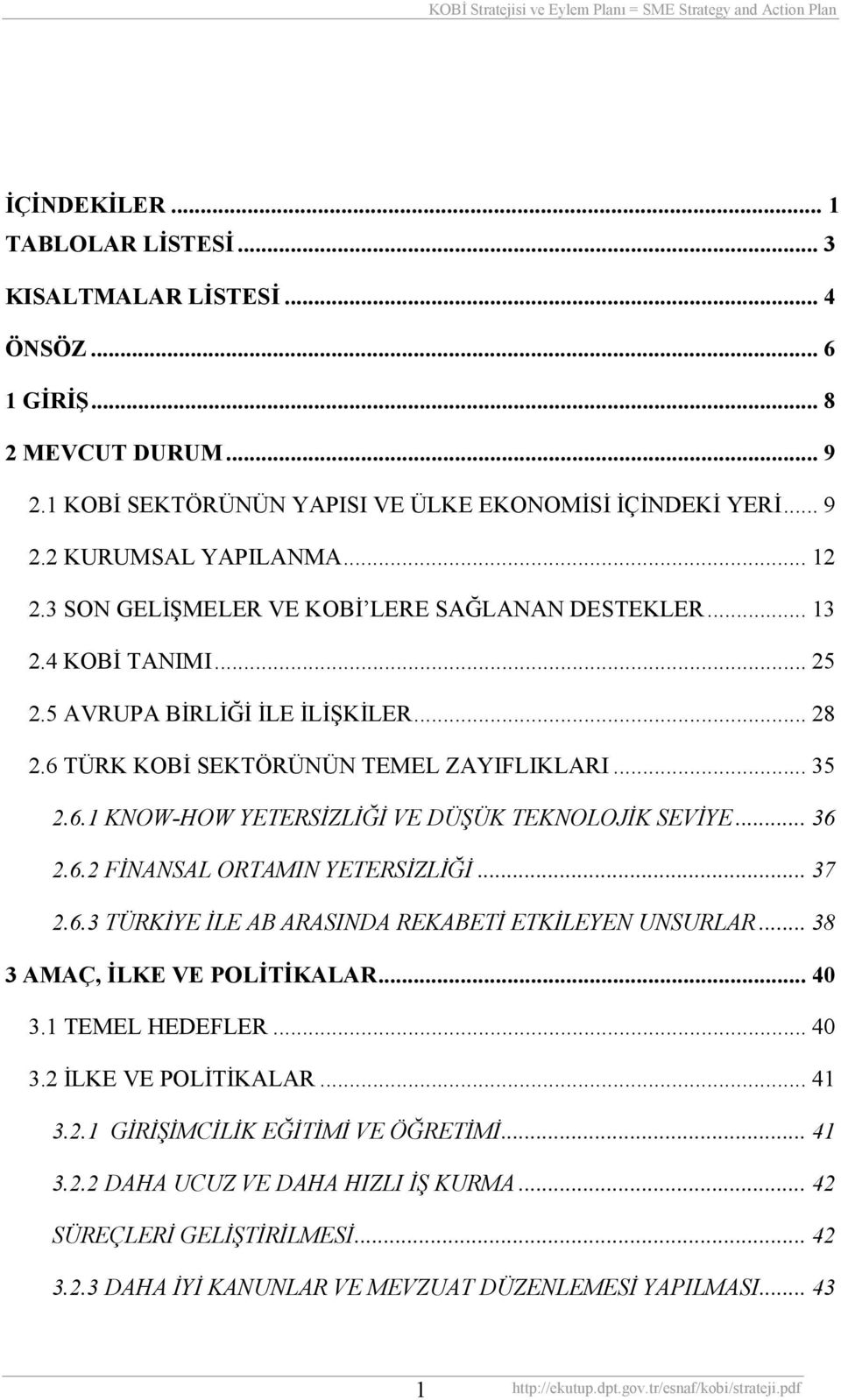
3 İÇİNDEKİLER... 1 TABLOLAR LİSTESİ... 3 KISALTMALAR LİSTESİ... 4 ÖNSÖZ GİRİŞ MEVCUT DURUM KOBİ SEKTÖRÜNÜN YAPISI VE ÜLKE EKONOMİSİ İÇİNDEKİ YERİ KURUMSAL YAPILANMA SON GELİŞMELER VE KOBİ LERE SAĞLANAN DESTEKLER KOBİ TANIMI AVRUPA BİRLİĞİ İLE İLİŞKİLER TÜRK KOBİ SEKTÖRÜNÜN TEMEL ZAYIFLIKLARI KNOW-HOW YETERSİZLİĞİ VE DÜŞÜK TEKNOLOJİK SEVİYE FİNANSAL ORTAMIN YETERSİZLİĞİ TÜRKİYE İLE AB ARASINDA REKABETİ ETKİLEYEN UNSURLAR AMAÇ, İLKE VE POLİTİKALAR TEMEL HEDEFLER İLKE VE POLİTİKALAR GİRİŞİMCİLİK EĞİTİMİ VE ÖĞRETİMİ DAHA UCUZ VE DAHA HIZLI İŞ KURMA SÜREÇLERİ GELİŞTİRİLMESİ DAHA İYİ KANUNLAR VE MEVZUAT DÜZENLEMESİ YAPILMASI
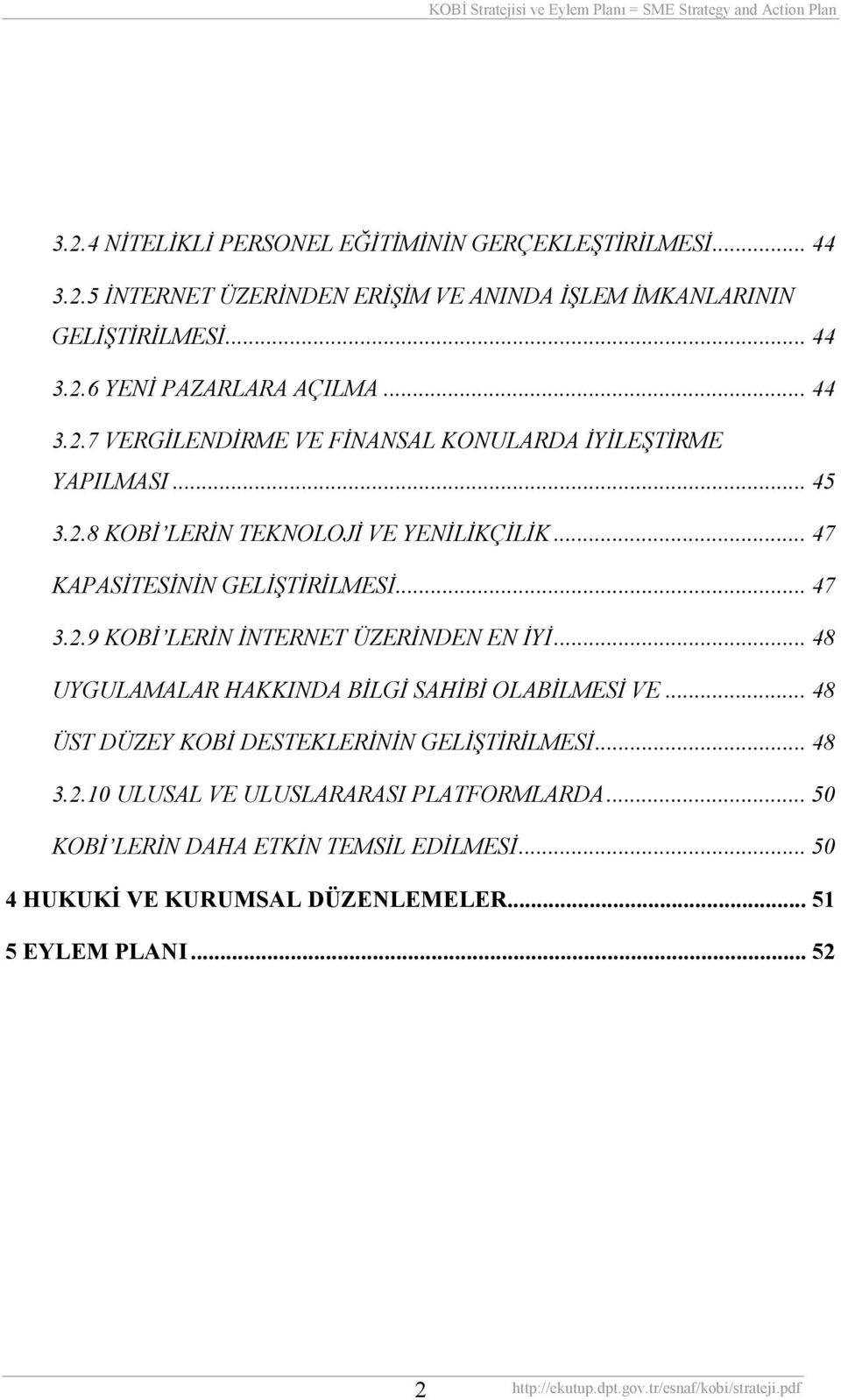
4 3.2.4 NİTELİKLİ PERSONEL EĞİTİMİNİN GERÇEKLEŞTİRİLMESİ İNTERNET ÜZERİNDEN ERİŞİM VE ANINDA İŞLEM İMKANLARININ GELİŞTİRİLMESİ YENİ PAZARLARA AÇILMA VERGİLENDİRME VE FİNANSAL KONULARDA İYİLEŞTİRME YAPILMASI KOBİ LERİN TEKNOLOJİ VE YENİLİKÇİLİK KAPASİTESİNİN GELİŞTİRİLMESİ KOBİ LERİN İNTERNET ÜZERİNDEN EN İYİ UYGULAMALAR HAKKINDA BİLGİ SAHİBİ OLABİLMESİ VE ÜST DÜZEY KOBİ DESTEKLERİNİN GELİŞTİRİLMESİ ULUSAL VE ULUSLARARASI PLATFORMLARDA KOBİ LERİN DAHA ETKİN TEMSİL EDİLMESİ HUKUKİ VE KURUMSAL DÜZENLEMELER EYLEM PLANI
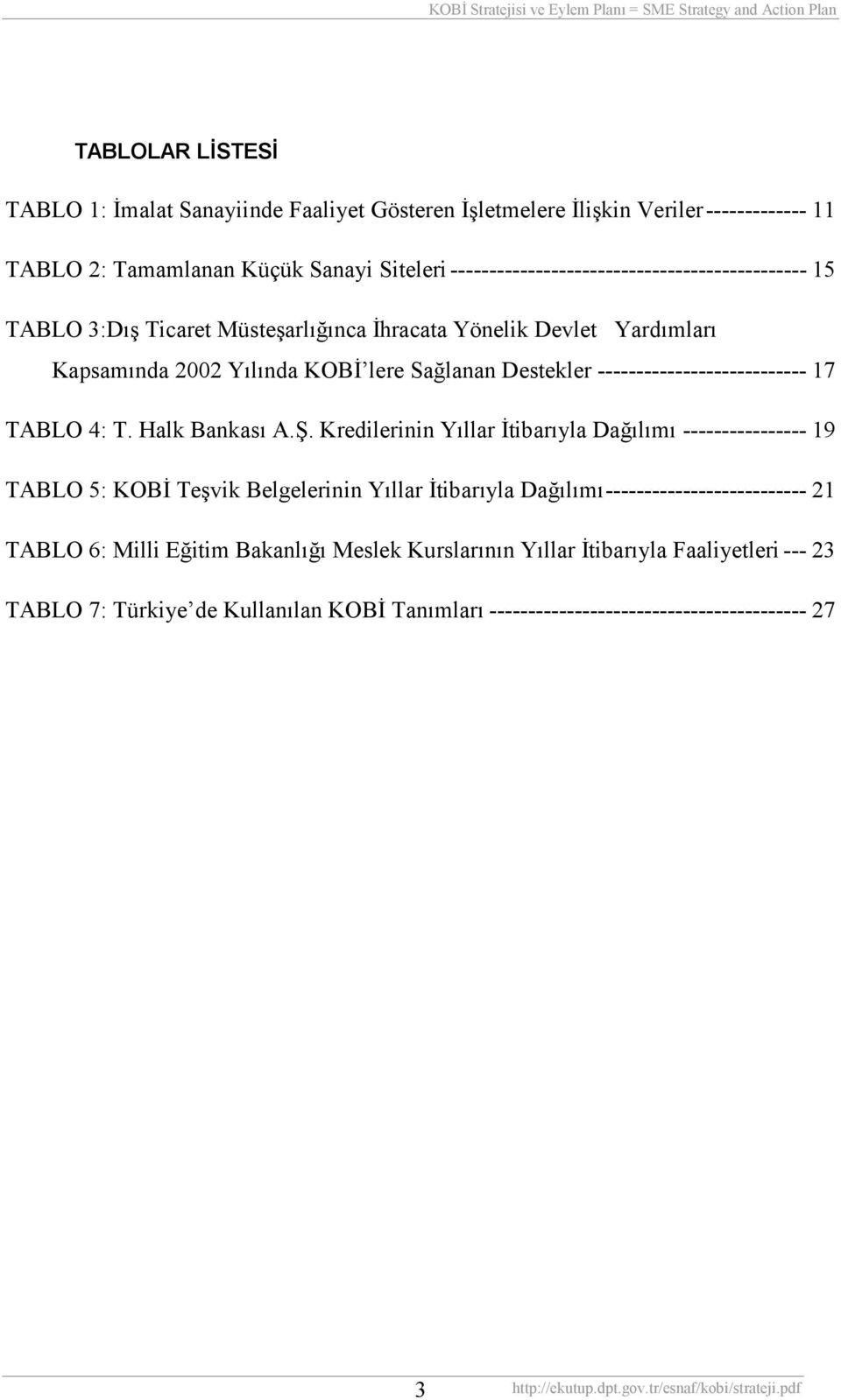
5 TABLOLAR LİSTESİ TABLO 1: İmalat Sanayiinde Faaliyet Gösteren İşletmelere İlişkin Veriler TABLO 2: Tamamlanan Küçük Sanayi Siteleri TABLO 3:Dõş Ticaret Müsteşarlõğõnca İhracata Yönelik Devlet Yardõmlarõ Kapsamõnda 2002 Yõlõnda KOBİ lere Sağlanan Destekler TABLO 4: T. Halk Bankasõ A.Ş. Kredilerinin Yõllar İtibarõyla Dağõlõmõ TABLO 5: KOBİ Teşvik Belgelerinin Yõllar İtibarõyla Dağõlõmõ TABLO 6: Milli Eğitim Bakanlõğõ Meslek Kurslarõnõn Yõllar İtibarõyla Faaliyetleri TABLO 7: Türkiye de Kullanõlan KOBİ Tanõmlarõ
6 KISALTMALAR LİSTESİ AB ABGS AT DİE DPT DTM EIC EUROSTAT Gebze YTE HM İBBS İGEME İŞKUR İTKİB KDV KGF KOBİ KOBİNET KOSGEB KSS KÜGEM Avrupa Birliği Avrupa Birliği Genel Sekreterliği Avrupa Topluluğu Devlet İstatistik Enstitüsü Devlet Planlama Teşkilatõ Müsteşarlõğõ Dõş Ticaret Müsteşarlõğõ Avrupa Bilgi Merkezi Avrupa İstatistik Ofisi Gebze Yüksek Teknoloji Enstitüsü Hazine Müsteşarlõğõ İstatistiki Bölge Birimleri Sõnõflandõrmasõ İhracatõ Geliştirme Etüd Merkezi Türkiye İş Kurumu İstanbul Tekstil ve Konfeksiyon İhracatçõ Birlikleri Katma Değer Vergisi Kredi Garanti Fonu A.Ş Küçük ve Orta Boy İşletme KOSGEB bünyesinde Küçük ve Orta Boy İşletmeler Bilgi Ağõ Küçük ve Orta Ölçekli Sanayi Geliştirme ve Destekleme İdaresi Başkanlõğõ Küçük Sanayi Sitesi Küçük İşletmeleri Geliştirme Merkezi 4
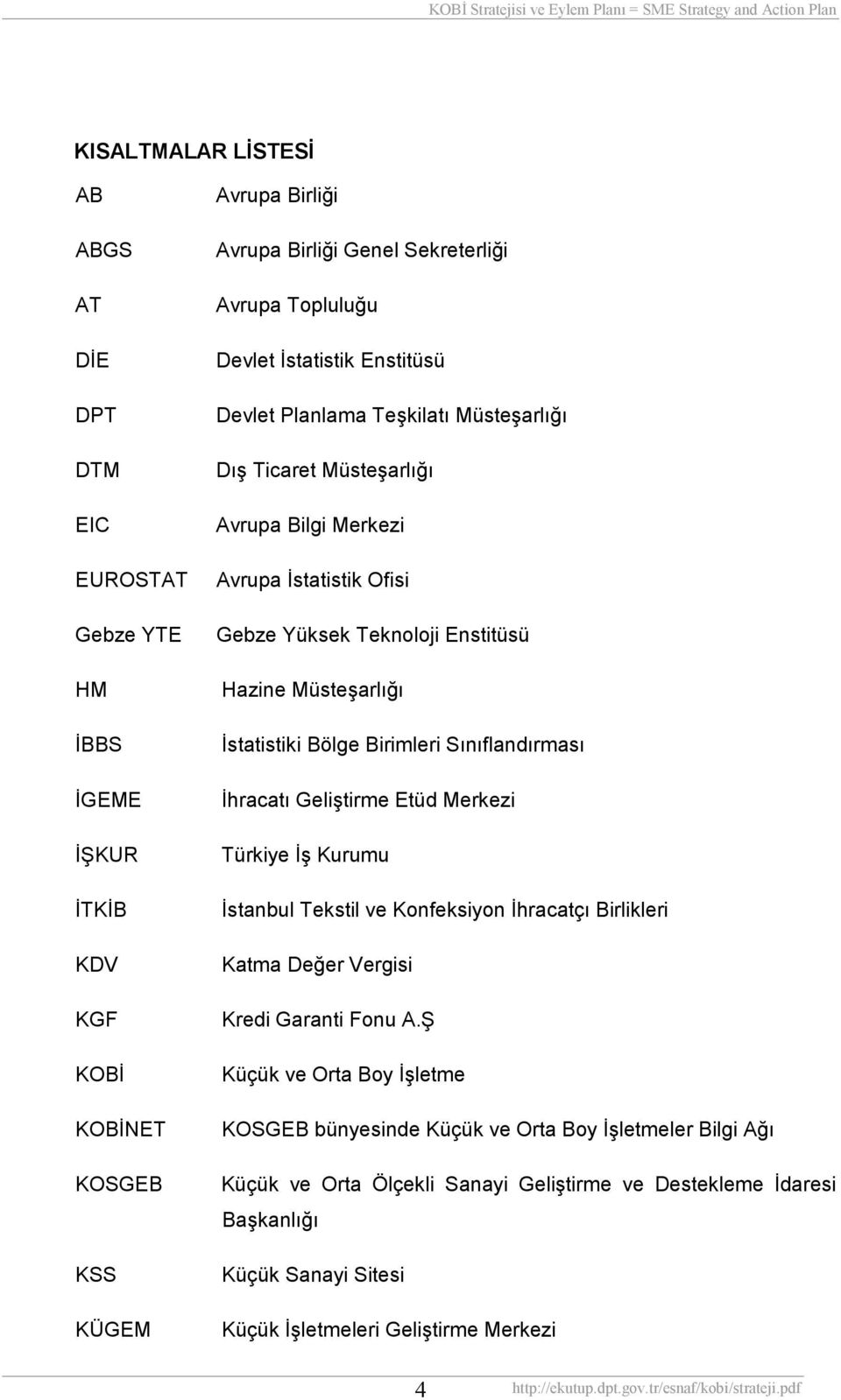
7 MEKSA ORTKA ORTLAB OSB SDTŞ STB TASEV TEKMER TESK TİSK TOBB Mesleki Eğitim ve Küçük Sanayii Destekleme Vakfõ Ortak Kullanõm Atölyeleri Ortak Kullanõm Laboratuvarlarõ Organize Sanayi Bölgesi Sektörel Dõş Ticaret Şirketleri Sanayi ve Ticaret Bakanlõğõ Türkiye Ayakkabõ Sektörü Araştõrma Geliştirme ve Eğitim Vakfõ Teknoloji Geliştirme Merkezi Türkiye Esnaf ve Sanatkarlar Konfederasyonu Türkiye İşveren Sendikalarõ Konfederasyonu Türkiye Ticaret, Sanayi, Deniz Ticaret Odalarõ ve Ticaret Borsalarõ Birliği TSE TTGV TÜBİTAK TÜRK-İŞ YOİKK Türk Standardlarõ Enstitüsü Türkiye Teknoloji Geliştirme Vakfõ Türkiye Bilimsel ve Teknik Araştõrma Kurumu Türkiye İşçi Sendikalarõ Konfederasyonu Yatõrõm Ortamõnõn İyileştirilmesi Koordinasyon Kurulu 5
8 ÖNSÖZ KOBİ lerin dengeli ekonomik ve sosyal kalkõnmanõn sağlanmasõ ve sürdürülmesine yaptõklarõ olumlu katkõlarõ, işsizliğin azaltõlmasõ ve yeni istihdam alanlarõnõn yaratõlmasõnda oynadõklarõ rolleri ve piyasa koşullarõnda meydana gelen değişmelere hõzlõ uyum sağlayabilen esnek bir üretim yapõsõna sahip olmalarõ, onlarõ günümüz dünyasõnda daha önemli bir konuma getirmektedir. Taşõdõklarõ önem dolayõsõyla başta gelişmiş ülkeler olmak üzere bütün ülkeler KOBİ lerin doğmasõ, büyümesi, gelişmesi ve korunmasõ için uygun ortamõ hazõrlayacak politikalar geliştirmekte ve uygulamaktadõrlar. Bu süreç içerisinde ulusal düzeyde belirlenen KOBİ politikalarõ uluslararasõ bir nitelik de kazanmaktadõr. KOBİ lerin dünyadaki artan önemine koşut olarak ülkemizde de 80 li yõllarõn sonundan itibaren KOBİ lere yönelik bir destek sisteminin oluşturulmasõ çalõşmalarõ başlatõlmõştõr. Özellikle Gümrük Birliğine girişle birlikte başlatõlan bu çalõşmalarõn etkili bir şekilde sürdürülmesi ve geliştirilmesi önem taşõmaktadõr. KOBİ lere ilişkin ulusal düzeyde oluşturulan politikalarõn uygulanmasõnõ ve AB ye uyum sürecinde KOBİ lerin rekabet güçlerinin artõrõlmasõnõ sağlamak amacõyla bir KOBİ Stratejisi ve Eylem Planõ hazõrlanmõştõr. KOBİ ler için bir yol haritasõ belirleyen Kobi Stratejisi ve Eylem Planõ, Sanayi ve Ticaret Bakanlõğõ, Devlet Planlama Teşkilatõ Müsteşarlõğõ (DPT), Hazine Müsteşarlõğõ, Dõş Ticaret Müsteşarlõğõ, Devlet İstatistik Enstitüsü Başkanlõğõ (DİE), Avrupa Birliği Genel Sekreterliği, Küçük ve Orta Ölçekli Sanayi Geliştirme ve Destekleme İdaresi Başkanlõğõ (KOSGEB), Türkiye Ticaret Sanayi Deniz Ticaret Odalarõ ve Ticaret Borsalarõ Birliği (TOBB), Türkiye Esnaf ve Sanatkarlarõ Konfederasyonu ndan (TESK) oluşan KOBİ Çalõşma Grubu tarafõndan hazõrlanmõş ve Yüksek Planlama Kurulunun tarih ve 2003/57 sayõlõ kararõ ile onaylanmõştõr. KOBİ Stratejisi ve Eylem Planõ nõn uygulanmasõ, izlenmesi ve değerlendirilmesi amacõyla geniş katõlõmlõ bir KOBİ Danõşma Kurulu oluşturulacak ve KOBİ Stratejisi ve Eylem Planõ ihtiyaç halinde revize edilebilecektir. 6
9 KOBİ Stratejisi ve Eylem Planõnõn uygulanmasõ ile; Ülkemizde tüm işletmelerin yüzde 99,8 ini, toplam istihdamõn yüzde 76,7 sini ve toplam katma değerin yüzde 26,5 ini oluşturan KOBİ lerin verimliliklerinin, katma değer içindeki paylarõnõn ve rekabet güçlerinin artmasõ beklenmektedir. 7
10 1 GİRİŞ VIII. Beş Yõllõk Kalkõnma Planõnda, küçük ve orta boy işletme (KOBİ) lere yönelik olarak geliştirilen temel strateji, KOBİ lerin verimliliklerinin, katma değer içindeki paylarõnõn ve uluslararasõ rekabet güçlerinin artõrõlmasõ esasõna dayanmaktadõr. Bu hedeflere ulaşmak için, piyasa koşullarõ ve uluslararasõ anlaşmalar kapsamõndaki yükümlülüklerimiz dahilinde, KOBİ lere daha elverişli bir yatõrõm ortamõ yaratõlmasõnõ hedefleyen politika ve programlar geliştirilmekte, kamunun piyasa yapõcõ rolü ile müdahale alanlarõ belirlenmekte, bu politika ve programlarõn etkinliğinin artõrõlmasõnda özel sektörün oynamasõ gerekli rolü belirleyen tavsiye kararlarõ oluşturulmaktadõr. Bu çalõşmada, VIII. Beş Yõllõk Kalkõnma Planõ, Yõllõk Programlar ve Ulusal Programda belirtilen ilke ve esaslar çerçevesinde, KOBİ lerin mevcut durumu ortaya konulmakta ve söz konusu temel strateji belgeleri õşõğõnda, yukarõda belirtilen hedeflere ulaşmak için alõnmasõ gerekli tedbirler belirlenmektedir. Bu çalõşma, Türkiye de, KOBİ lere yönelik temel stratejileri belirleyen ve bu kesime yönelik faaliyetlerde bulunan Sanayi ve Ticaret Bakanlõğõ, Devlet Planlama Teşkilatõ Müsteşarlõğõ, Hazine Müsteşarlõğõ, Dõş Ticaret Müsteşarlõğõ, Devlet İstatistik Enstitüsü Başkanlõğõ, Küçük ve Orta Ölçekli Sanayi Geliştirme ve Destekleme İdaresi Başkanlõğõ, Türkiye Ticaret Sanayi Deniz Ticaret Odalarõ ve Ticaret Borsalarõ Birliği, Türkiye Esnaf ve Sanatkarlarõ Konfederasyonun oluşan KOBİ Çalõşma Grubu tarafõndan, mevcut politika ve programlarõn kapsamõnõ ve bu kapsam dahilinde belirlenen faaliyetleri detaylõ bir şekilde ortaya koymak, arzu edilen hedeflere ulaşma yolunda kamu ve özel sektör kuruluşlarõna düşen görevleri açõk bir şekilde ifade etmek ve gerekli eylem ve projeler demetini oluşturmak amacõyla hazõrlanmõştõr. 8. Beş Yõllõk Kalkõnma Planõ, Yõllõk Program, Hükümet Programõ ve Acil Eylem Planõ ile uygunluğu DPT tarafõndan sağlanmõş olan taslak çalõşmanõn, hazõrlõk sürecinde AB ile koordinasyonu ABGS tarafõndan gerçekleştirilmiş olup, Türkiye adõna resmileştirilmesi Yüksek Planlama Kurulu kararõ ile sağlanmõştõr. Ulusal KOBİ Stratejisi ve Eylem Planõnõn uygulamasõ DPT Müsteşarlõğõ tarafõndan koordine edilecek olup; izleme ve değerlendirmesi bu 8
11 alanda en fazla ilgili kamu ve özel sektör kuruluşlarõndan oluşan KOBİ Danõşma Kurulu tarafõndan gerçekleştirilecektir. KOBİ Stratejisi ve Eylem Planõnda yer alan hedeflerin gerçekleşmesine ait bilgiler ve zaman içinde ortaya çõkan gelişmelere göre Strateji ve Eylem Planõna getirilecek değerlendirme ve değişiklik önerileri, ilgili kurum ve kuruluşlar tarafõndan KOBİ Danõşma Kuruluna bildirilecektir. DPT, Danõşma Kurulunun görüşlerini alarak KOBİ Stratejisi ve Eylem Planõnõ ihtiyaç halinde revize edecektir. 2 MEVCUT DURUM 2.1 KOBİ SEKTÖRÜNÜN YAPISI VE ÜLKE EKONOMİSİ İÇİNDEKİ YERİ Ülkemizde KOBİ lerin sayõsõ hizmet sektörü de dahil olmak üzere, tüm işletmelerin sayõsõnõn % 99,8 ini ve bu işletmeler de toplam istihdamõn % 76,7 sini oluşturmaktadõr. KOBİ yatõrõmlarõnõn, toplam yatõrõmlar içindeki payõ % 38 e ulaşmakta ve toplam katma değerin % 26,5 i yine bu işletmelerce yaratõlmaktadõr. KOBİ lerin toplam ihracat içindeki paylarõ, yõllar itibarõyla değişiklik göstermekle beraber, ortalama % 10 oranõnda gerçekleşmekte ve bu kesimin toplam banka kredileri içindeki payõ % 5 in altõnda seyretmektedir 1). Esnaf ve sanatkarlar ile tüccar ve sanayici KOBİ ler, Türkiye Esnaf ve Sanatkarlarõ Konfederasyonu (TESK) ve Türkiye Ticaret, Sanayi, Deniz Ticaret Odalarõ ve Ticaret Borsalarõ Birliği (TOBB) tarafõndan temsil edilmektedir. Esnaf ve sanatkarlar, TESK bünyesinde faaliyet gösteren 12 adet mesleki federasyon, 82 adet esnaf ve sanatkarlar odalarõ birliği ve adet esnaf ve sanatkar odasõ şeklinde örgütlenmiş olup, 31 Ocak 2003 tarihi itibarõyla esnaf ve sanatkarlar sicili kayõtlarõna göre adet işletme bulunmaktadõr. Sicile kayõtlõ esnaf ve sanatkarlarõn sayõsõ yõllar itibarõyla artõş göstermekle birlikte özellikle ekonomik kriz sonrasõ dönemde tescil/terkin oranõnda büyük bir artõş gözlenmektedir yõlõnda adet tescil işlemine karşõlõk adet terkin işlemi (% 26) gerçekleşirken, 2001 yõlõ 1) Sarõaslan,H.; Türkiye Ekonomisinde KOBİ ler (Ankara, TOBB, 1996) s.9. 9
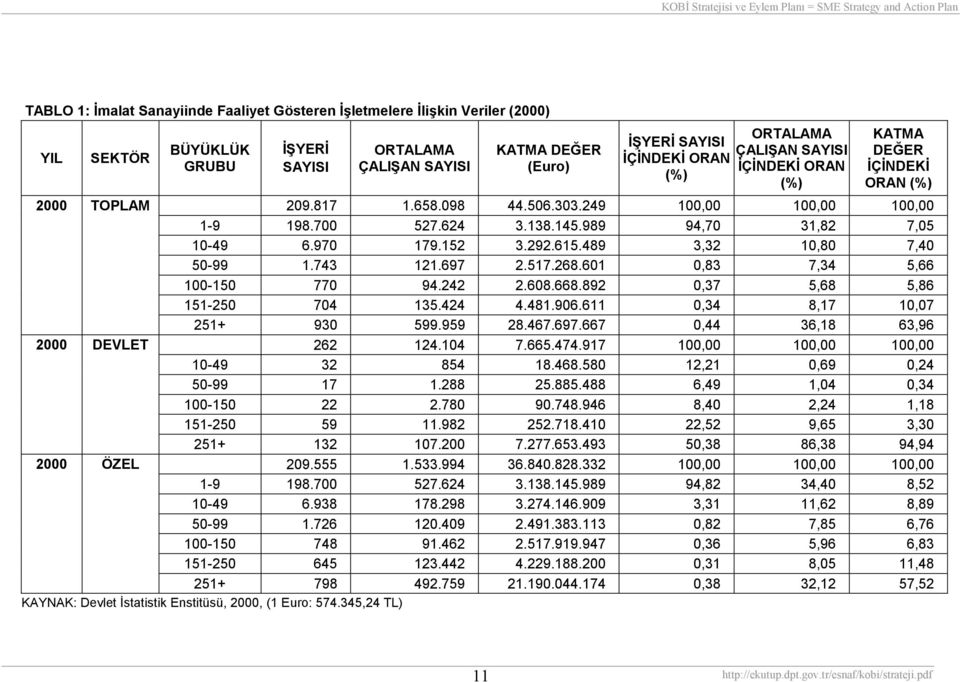
12 içerisinde tescil işlemi adet, terkin işlemi ise adet olmuştur (% 84) yõlõnda tescil e, terkin ise e yükselmiştir (% 95). Tüccar ve sanayicilerin yasal düzeydeki üst kuruluşu olan TOBB, 11 adet sanayi odasõ, 2 adet deniz ticaret odasõ, 175 adet ticaret ve sanayi odasõ ile 108 adet ticaret borsasõ şeklinde örgütlenmiştir ve 2000 yõlõ verilerine göre kayõtlõ üye sayõsõ dir. TOBB geçtiğimiz yõl, oda ve borsalara üye tüm işyerlerini, sektörel ayrõmlarõ da kapsayacak şekilde, kendi internet sitesinde yayõmlamaya imkan verecek TOBB-NET projesini başlatmõştõr. Yakõn gelecekte veriler güncellenebilir bir şekilde bu sistem kapsamõnda takip edilebilecektir. KOBİ lere yönelik destek programlarõnõn temel hedef kitlesi imalat sanayii sektöründeki KOBİ lerdir. Devlet İstatistik Enstitüsünün (DİE) 2000 yõlõ değerlendirmelerine göre (1-150 işçi çalõştõran işletmeler KOBİ kabul edildiğinde) imalat sanayiinde toplam KOBİ faaliyet göstermekte ve bu işletmelerde kişi istihdam edilmektedir. KOBİ ler tüm imalat sanayii işletmelerinin % 99,2 sini oluşturmakta ve bu sektördeki istihdamõn % 55,65 ini karşõlamaktadõr 2). İmalat sanayii sektörü, kamu özel sektör ayrõmõ ve büyüklük gruplarõna göre incelendiğinde toplam iş yeri sayõsõnõn % 0,1 inin devlet işletmesi, % 99,9 unun özel işletme niteliğinde olduğu görülmektedir. Kamuya ait işyerlerinde tüm çalõşanlarõn % 7,5 i istihdam edilerek, katma değerin % 17,2 si yaratõlmaktadõr. Özel sektör işyerlerinde ise toplam istihdamõn % 92,5 si ile % 82,8 oranõnda katma değer yaratõlmaktadõr. DİE nin 2000 yõlõ değerlendirmelerine göre, imalat sanayii sektörüne ilişkin veriler Tablo 1 de sunulmaktadõr. 2) Devlet İstatistik Enstitüsü,
13 TABLO 1: İmalat Sanayiinde Faaliyet Gösteren İşletmelere İlişkin Veriler (2000) YIL SEKTÖR BÜYÜKLÜK GRUBU İŞYERİ SAYISI ORTALAMA ÇALIŞAN SAYISI KATMA DEĞER (Euro) ORTALAMA İŞYERİ SAYISI ÇALIŞAN SAYISI İÇİNDEKİ ORAN İÇİNDEKİ ORAN (%) (%) KATMA DEĞER İÇİNDEKİ ORAN (%) 2000 TOPLAM ,00 100,00 100, ,70 31,82 7, ,32 10,80 7, ,83 7,34 5, ,37 5,68 5, ,34 8,17 10, ,44 36,18 63, DEVLET ,00 100,00 100, ,21 0,69 0, ,49 1,04 0, ,40 2,24 1, ,52 9,65 3, ,38 86,38 94, ÖZEL ,00 100,00 100, ,82 34,40 8, ,31 11,62 8, ,82 7,85 6, ,36 5,96 6, ,31 8,05 11, ,38 32,12 57,52 KAYNAK: Devlet İstatistik Enstitüsü, 2000, (1 Euro: ,24 TL) 11
14 Ancak, 1999 deprem felaketi ile 2000 Kasõm ve 2001 Şubat krizleri neticesinde işletme sayõsõnda değişiklikler meydana geldiği bilinmektedir yõlõnda, 2002 yõlõ bilgilerini de kapsayacak şekilde 8. Genel Sanayi ve İşyerleri Sayõmõ yapõlacaktõr. Ayrõca, İdari İş Kayõt Sistemi ve İstatistik İş Kayõt Sistemi oluşturularak tüm sektörlerde Avrupa Birliği (AB) normlarõna uygun sağlõklõ ve güncel istatistiksel bilgiye erişim imkanõ sağlanacaktõr. Avrupa firma ölçekleri esas alõndõğõnda, Türk sanayii AB sanayiine göre daha çok KOBİ ağõrlõklõ bir yapõya sahip bulunmaktadõr. Ekonominin bütünü AB ekonomisi ile kõyaslandõğõnda ise, Türkiye de tarõm sektörü payõnõn ve tarõm sektöründe istihdam edilen kõrsal alan nüfusunun AB ortalamalarõndan çok yüksek olduğu görülmektedir. Ancak, bu durum kentleşme hareketine paralel olarak gelişmiş ülke normallerine doğru hõzlõ bir değişim içindedir. Öte yandan, Türkiye nin sermaye birikimi kalkõnma ihtiyaçlarõ karşõsõnda yetersiz kalmakta, ülkeye yabancõ sermaye girişi de çok düşük bir düzeyde bulunmaktadõr. Bu durumda, kentlerde ortaya çõkan ve büyük işletmelerin istihdam kapasitesinin üzerindeki işgücü fazlasõ karşõsõnda en ekonomik istihdam yaratma alanõ olan KOBİ lerin geliştirilmesi, ülke için kaçõnõlamaz bir kalkõnma seçeneğini oluşturmaktadõr. 2.2 KURUMSAL YAPILANMA KOBİ politikalarõnõn oluşturulmasõ ve uygulanmasõ sürecinde bir çok kamu kuruluşu görev almaktadõr. Devlet Planlama Teşkilatõ Müsteşarlõğõ (DPT), KOBİ politikalarõnõ da kapsayan uzun vadeli kalkõnma planlarõ ve yõllõk programlarõn hazõrlanmasõndan sorumludur. DPT, Kalkõnma Planlarõnõn hazõrlanmasõ sürecinde ilgili tüm kamu ve özel sektör kuruluşlarõnõn da görüşlerini alarak KOBİ lere dair makro politikalarõ belirlemekte ve bu politikalarõn uygulanmasõnõn etkinliğini artõrmak amacõyla kamu kurum ve kuruluşlarõ arasõnda koordinasyonu sağlamaktadõr. Buna ilaveten, gelişmeleri değerlendirerek, gerekirse, politikalar üzerinde gerekli değişiklikleri önermektedir. 12
15 Sanayi ve Ticaret Bakanlõğõ ve ilgili kuruluşu Küçük ve Orta Ölçekli Sanayi Geliştirme ve Destekleme İdaresi Başkanlõğõ (KOSGEB), KOBİ politikalarõnõn temel uygulayõcõsõ konumundaki kamu kuruluşudur. Hazine Müsteşarlõğõ ve Dõş Ticaret Müsteşarlõğõ da bu kesime yönelik teşvik programlarõnõn uygulayõcõsõ olan kuruluşlardõr. KOBİ politikalarõnõn uygulanmasõnda, TOBB ve TESK de ana meslek kuruluşlarõ olarak önemli bir rol oynamaktadõr. Ayrõca, KOBİ lere finansman ve teminat konularõnda T.Halk Bankasõ A.Ş., Türkiye Esnaf ve Sanatkarlar Kredi ve Kefalet Kooperatifleri Birlikleri Merkez Birliği (TESKOMB) ve Kredi Garanti Fonu A.Ş (KGF) aracõlõğõyla destek olunmaktadõr. Faaliyet alanlarõ kapsamõnda KOBİ lere hizmet veren diğer kuruluşlar ise Türkiye Bilimsel ve Teknik Araştõrma Kurumu (TÜBİTAK), Türkiye Teknoloji Geliştirme Vakfõ (TTGV), Türk Standardlarõ Enstitüsü (TSE), Türk Patent Enstitüsü (TPE) ve Türk Akreditasyon Kurumudur (TÜRKAK). 2.3 SON GELİŞMELER VE KOBİ LERE SAĞLANAN DESTEKLER 2002 yõlõ itibarõyla, ülkemiz KOBİ lerinin, gelişmiş ülkeler standartlarõnda bir finansman piyasasõna, kuruluş aşamasõndan başlayan modern destek imkanlarõna ve faaliyetlerini kolaylaştõracak çalõşma ortamõnõ sağlayacak mevzuata kavuşturulmasõ mümkün olmamõştõr. Girişimci bilgilendirme ve eğitim çalõşmalarõ istenen düzeye ulaşamamõş, üniversitesanayi iş birliği beklenen sonuçlarõ vermemiştir. Ülkemizin makroekonomik dengelerindeki olumsuz değişmelere ve istikrar sağlanmasõnda karşõlaşõlan güçlüklere bağlõ olarak teşvik politikasõnõn yönlendirme gücü azalmõş ve teşvik sisteminin hedefleri öngörülenlerin altõnda gerçekleşmiştir. Bu şartlar altõnda faaliyetlerini sürdüren KOBİ ler, ekonomik krizlerden en olumsuz etkilenen kesim olmuşlardõr. Ekonomik krizler sonucunda, Türk parasõ aşõrõ değer kaybetmiş, ithal girdi fiyatlarõnõn yükselmesi ve iç talebin azalmasõ sonucu üretim düşmüş, ihracatõ destekleyici önlemler zamanõnda alõnamamõş ve ekonomide güven sorunu oluşmuştur. 13
16 Kamu bankalarõnõn sübvansiyonlu kredi kullandõrmalarõ sonucunda oluşan görev zararlarõnõn Hazine tarafõndan karşõlanamaz boyutlara gelmesi nedeniyle, T.C. Ziraat Bankasõ A.Ş. ve Türkiye Halk Bankasõ A.Ş. tarafõndan KOBİ lere, esnaf ve sanatkarlara ve genç girişimciler ile kadõn girişimcilere kullandõrõlan sübvansiyonlu krediler sonucunda oluşacak gelir kaybõnõn bütçeden avans olarak ödeneceği ve bankalara görev zararõna yol açacak hiçbir görev verilemeyeceği hükme bağlanmõştõr. Bu kararõn ardõndan, Bankalarõn kredi faizlerini geriye dönük ve tek taraflõ olarak yükseltmeleri neticesinde işletmeler ödeme güçlüğüne girmiş, kredi imkanlarõnda ciddi bir daralma gözlenmiş, kredi kullanõm oranõ düşmüş, KOBİ teşvik kredileri de geçen yõllarla kõyaslanmayacak oranda azalmõştõr. Kamu bankalarõnõn geriye dönük alacaklarda reel sektörle yaşadõğõ sorunlarõ aşmak amacõyla esnaf ve sanatkarlara kullandõrõlan kooperatif kredilerine % 55 faiz oranõ uygulanacağõ belirtilmiş, kredi borçlarõnõ % 97 faiz oranõ ile ödeyen esnaf ve sanatkarlara, faiz farkõnõn gereken aidatlandõrma yapõlarak talep doğrultusunda kendilerine ödenebilmesi ve mahsup işlemlerinde de kullanõlabilmesi imkanõ getirilmiştir. Sigorta primlerinde ortaya çõkan artõş özellikle net ücret politikasõ izleyen işletmeleri zor durumda bõrakmõş, işçi çõkarma, ücret azaltma uygulamalarõna gidilmiş, yerli ve yabancõ kaçak işçi çalõştõrma eğilimi artmõştõr. Buna karşõlõk, işletmelerin birikmiş Sosyal Sigortalar Kurumu ve Bağ-Kur borçlarõnõn % 3 faiz ile 18 aya kadar vadelendirilmesi kolaylõğõ getirilmiştir. Bu dönemde, KOBİ lere alt yapõ, finansman, teminat, Ar-Ge, eğitim, danõşmanlõk, pazarlama ve tanõtma alanlarõnda destekler sağlanmaya devam edilmiştir. Küçük ve orta ölçekli sanayicilerin modern ve sağlõklõ ortamlarda, verimli üretim yapmalarõna olanak sağlanmasõ ve çevre kirliliğinin kontrol altõna alõnmasõ amacõyla Sanayi ve Ticaret Bakanlõğõ bünyesindeki Küçük Sanatlar, Sanayi Bölgeleri ve Siteleri Genel Müdürlüğünce Küçük Sanayi Siteleri (KSS) ve Organize Sanayi Bölgelerinin (OSB) kurulmasõ desteklenmektedir. 14
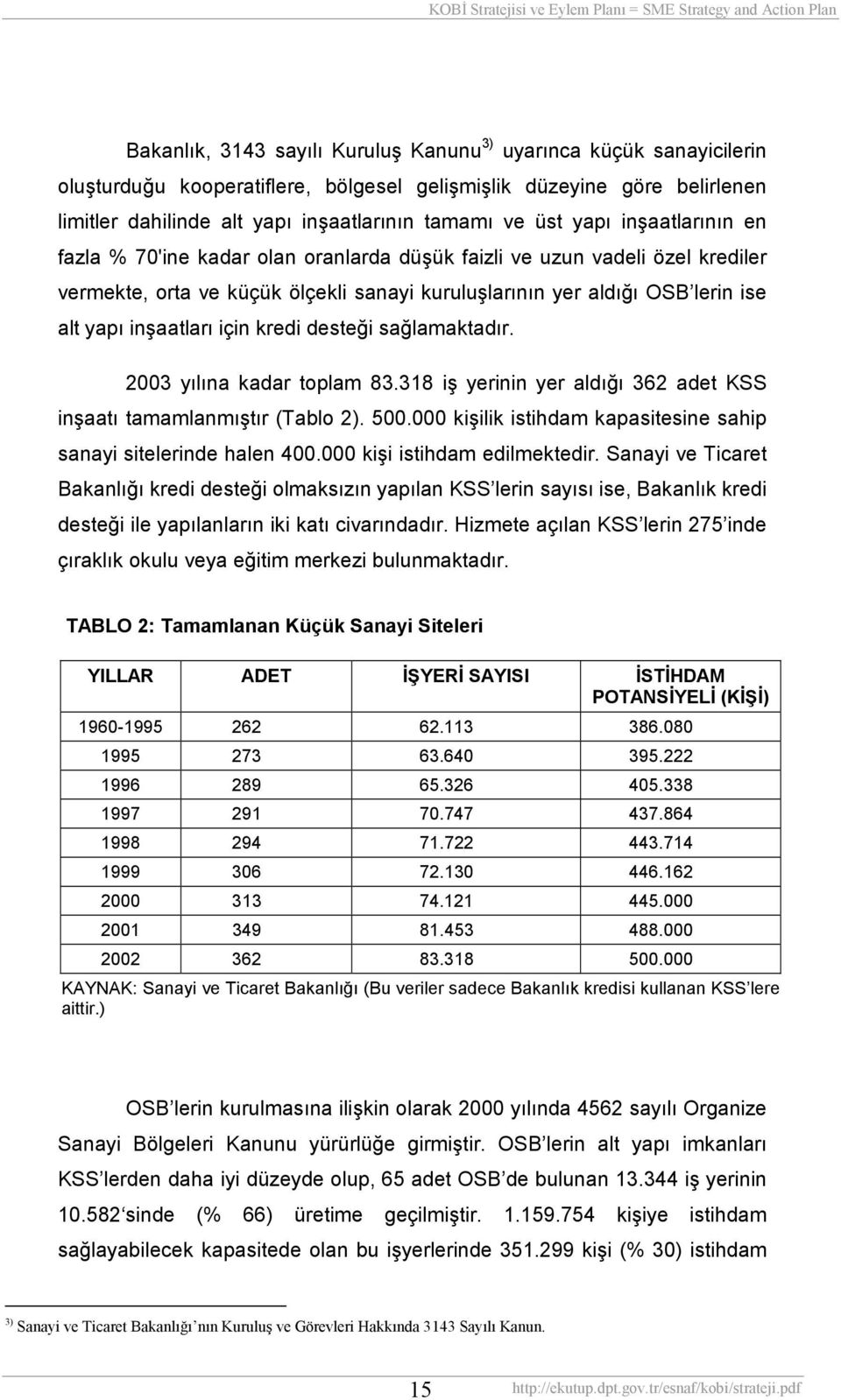
17 Bakanlõk, 3143 sayõlõ Kuruluş Kanunu 3) uyarõnca küçük sanayicilerin oluşturduğu kooperatiflere, bölgesel gelişmişlik düzeyine göre belirlenen limitler dahilinde alt yapõ inşaatlarõnõn tamamõ ve üst yapõ inşaatlarõnõn en fazla % 70'ine kadar olan oranlarda düşük faizli ve uzun vadeli özel krediler vermekte, orta ve küçük ölçekli sanayi kuruluşlarõnõn yer aldõğõ OSB lerin ise alt yapõ inşaatlarõ için kredi desteği sağlamaktadõr yõlõna kadar toplam iş yerinin yer aldõğõ 362 adet KSS inşaatõ tamamlanmõştõr (Tablo 2) kişilik istihdam kapasitesine sahip sanayi sitelerinde halen kişi istihdam edilmektedir. Sanayi ve Ticaret Bakanlõğõ kredi desteği olmaksõzõn yapõlan KSS lerin sayõsõ ise, Bakanlõk kredi desteği ile yapõlanlarõn iki katõ civarõndadõr. Hizmete açõlan KSS lerin 275 inde çõraklõk okulu veya eğitim merkezi bulunmaktadõr. TABLO 2: Tamamlanan Küçük Sanayi Siteleri YILLAR ADET İŞYERİ SAYISI İSTİHDAM POTANSİYELİ (KİŞİ) KAYNAK: Sanayi ve Ticaret Bakanlõğõ (Bu veriler sadece Bakanlõk kredisi kullanan KSS lere aittir.) OSB lerin kurulmasõna ilişkin olarak 2000 yõlõnda 4562 sayõlõ Organize Sanayi Bölgeleri Kanunu yürürlüğe girmiştir. OSB lerin alt yapõ imkanlarõ KSS lerden daha iyi düzeyde olup, 65 adet OSB de bulunan iş yerinin sinde (% 66) üretime geçilmiştir kişiye istihdam sağlayabilecek kapasitede olan bu işyerlerinde kişi (% 30) istihdam 3) Sanayi ve Ticaret Bakanlõğõ nõn Kuruluş ve Görevleri Hakkõnda 3143 Sayõlõ Kanun. 15
18 edilmiş durumdadõr. Yapõmõ devam eden 118 OSB de ise iş yeri bulunmakta olup, bu işyerlerinde kişiye daha istihdam alanõ sağlanacaktõr. 93 OSB ise etüt ve planlama aşamasõndadõr. OSB lerde bulunan işletmelerin tamamõna yakõnõ KOBİ ölçeğindeki işletmelerdir. DPT tarafõndan sürdürülen kamu yatõrõmlarõnõn etkinliğinin artõrõlmasõ çalõşmalarõ çerçevesinde, Yatõrõm Programõnda yer alan OSB ve KSS inşaatlarõnõn daha kõsa sürede tamamlanabilmesi için, ödenekler, birinci derece öncelikli olarak belirlenen ve gerçekleşme oranõ yüksek projelere aktarõlmakta, önceliklerini kaybetmiş projeler iz bedelle takip edilmekte, ihale edilmemiş ve yapõlabilirliğini yitirmiş projeler programdan çõkarõlmakta, böylelikle ödeneklerin rasyonel bir şekilde kullanõmõna çalõşõlmaktadõr. Teknoloji tabanlõ işletmelerin desteklenmesi, üniversite-sanayi iş birliğinin geliştirilmesi ve teknolojinin yayõnõmõnõn kolaylaştõrõlmasõ amacõyla, 2001 yõlõnda 4691 sayõlõ Teknoloji Geliştirme Bölgeleri Kanunu yürürlüğe girmiştir. Kanun hükümleri çerçevesinde, Ortadoğu Teknoparkõ (ODTÜ- Ankara) ve TÜBİTAK-Marmara Araştõrma Merkezi Teknoparkõ Kanunun yayõmõnda ilan edilmiştir. Bunu takip eden dönemde 12 Kasõm 2002 tarih ve sayõlõ Resmi Gazetede ilan edilerek İzmir Teknoloji Geliştirme Bölgesi, Ankara (Bilkent) ve Gebze OSB Teknopark; 10 Ocak 2003 tarih ve sayõlõ Resmi Gazetede ilan edilerek İstanbul Teknik Üniversitesi, Arõ Teknokent ve Hacettepe Üniversitesi; 10 Nisan 2003 tarih ve sayõlõ Resmi Gazetede ilan edilerek Yõldõz Teknik Üniversitesi, Eskişehir ve Kocaeli Üniversitesi, 8 Ağustos 2003 tarih ve sayõlõ Resmi Gazetede ilan edilerek Selçuk ve İstanbul Üniversiteleri olmak üzere toplam on iki adet Teknoloji Geliştirme Bölgesi kurulmuştur. Teknoloji Geliştirme Bölgelerinde bulunan işletmelerin tamamõ KOBİ ölçeğindedir ve bu işletmelerin özellikle bilişim, savunma sanayii ve elektronik sektöründe faaliyet gösterdikleri görülmektedir. Yatõrõmlarõn teşviki, yurt dõşõnda çalõşan Türk işçilerinin tasarruflarõnõn Türkiye de yatõrõma yönlendirilmesi ve yabancõ sermaye girişinin artõrõlmasõ amacõyla 19 Ocak 2002 tarih ve sayõlõ Resmi Gazetede yayõnlanan, 4737 sayõlõ Endüstri Bölgeleri Kanunu ve Organize Sanayi Bölgeleri 16
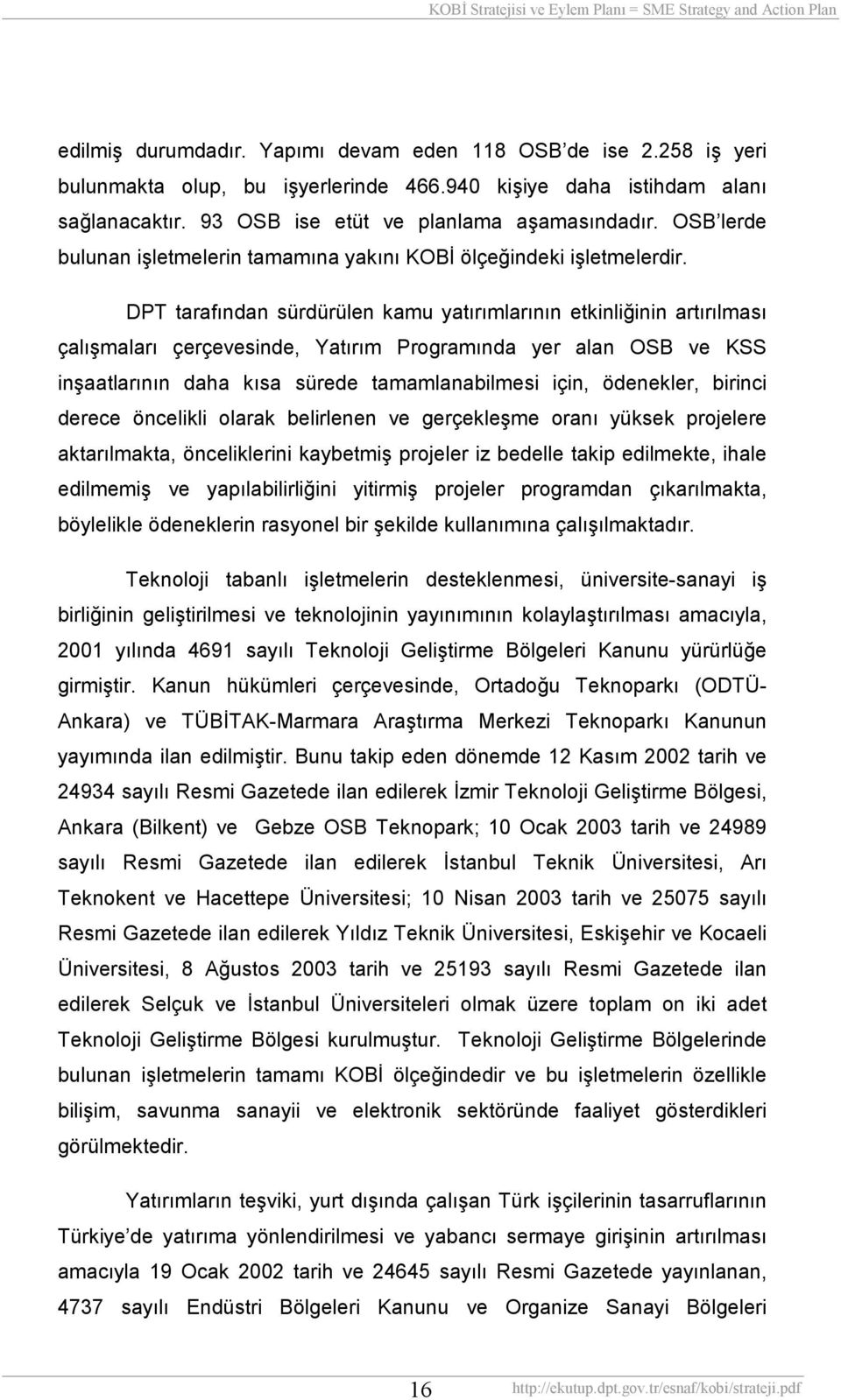
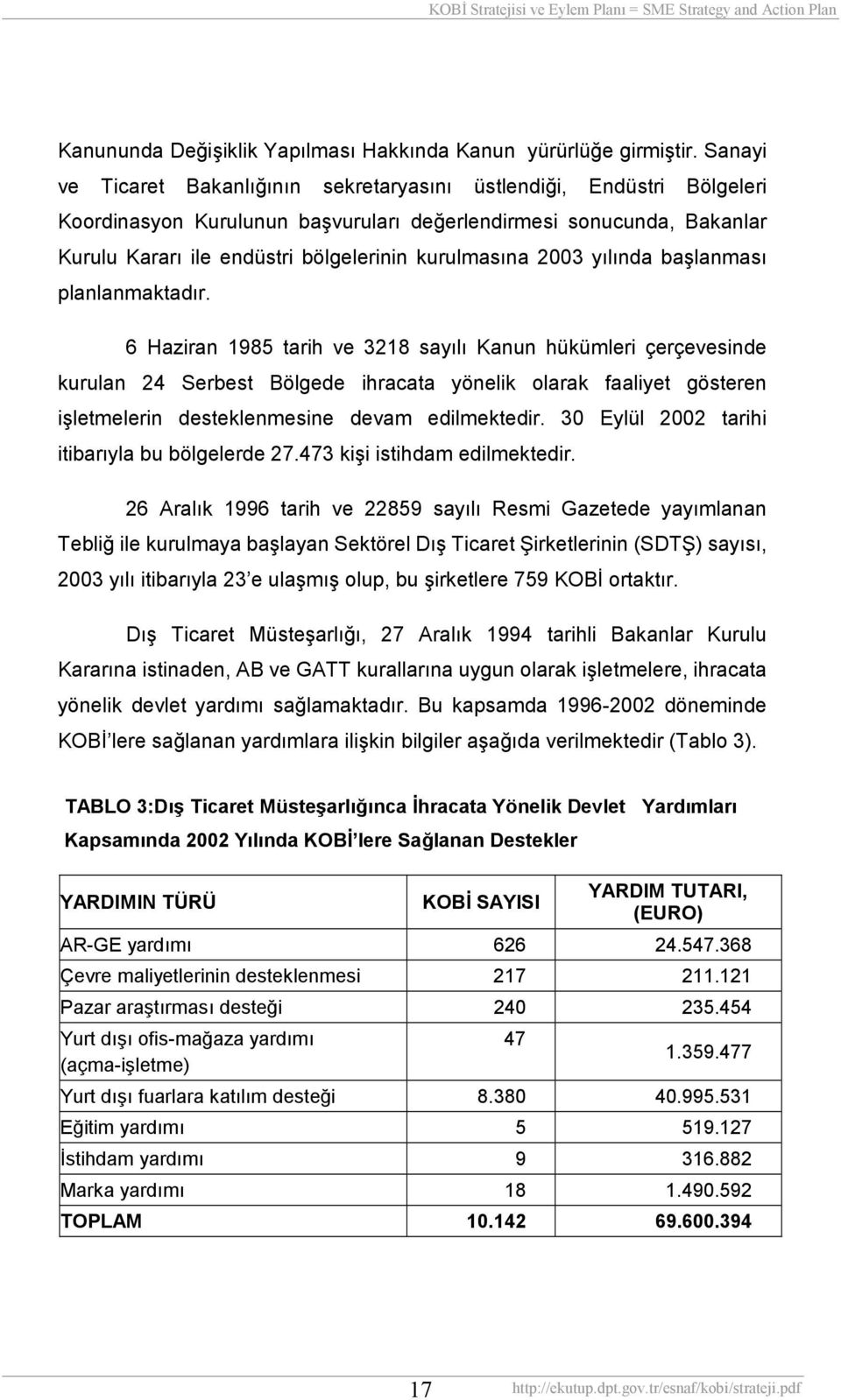
19 Kanununda Değişiklik Yapõlmasõ Hakkõnda Kanun yürürlüğe girmiştir. Sanayi ve Ticaret Bakanlõğõnõn sekretaryasõnõ üstlendiği, Endüstri Bölgeleri Koordinasyon Kurulunun başvurularõ değerlendirmesi sonucunda, Bakanlar Kurulu Kararõ ile endüstri bölgelerinin kurulmasõna 2003 yõlõnda başlanmasõ planlanmaktadõr. 6 Haziran 1985 tarih ve 3218 sayõlõ Kanun hükümleri çerçevesinde kurulan 24 Serbest Bölgede ihracata yönelik olarak faaliyet gösteren işletmelerin desteklenmesine devam edilmektedir. 30 Eylül 2002 tarihi itibarõyla bu bölgelerde kişi istihdam edilmektedir. 26 Aralõk 1996 tarih ve sayõlõ Resmi Gazetede yayõmlanan Tebliğ ile kurulmaya başlayan Sektörel Dõş Ticaret Şirketlerinin (SDTŞ) sayõsõ, 2003 yõlõ itibarõyla 23 e ulaşmõş olup, bu şirketlere 759 KOBİ ortaktõr. Dõş Ticaret Müsteşarlõğõ, 27 Aralõk 1994 tarihli Bakanlar Kurulu Kararõna istinaden, AB ve GATT kurallarõna uygun olarak işletmelere, ihracata yönelik devlet yardõmõ sağlamaktadõr. Bu kapsamda döneminde KOBİ lere sağlanan yardõmlara ilişkin bilgiler aşağõda verilmektedir (Tablo 3). TABLO 3:Dõş Ticaret Müsteşarlõğõnca İhracata Yönelik Devlet Yardõmlarõ Kapsamõnda 2002 Yõlõnda KOBİ lere Sağlanan Destekler YARDIMIN TÜRÜ KOBİ SAYISI YARDIM TUTARI, (EURO) AR-GE yardõmõ Çevre maliyetlerinin desteklenmesi Pazar araştõrmasõ desteği Yurt dõşõ ofis-mağaza yardõmõ (açma-işletme) Yurt dõşõ fuarlara katõlõm desteği Eğitim yardõmõ İstihdam yardõmõ Marka yardõmõ TOPLAM
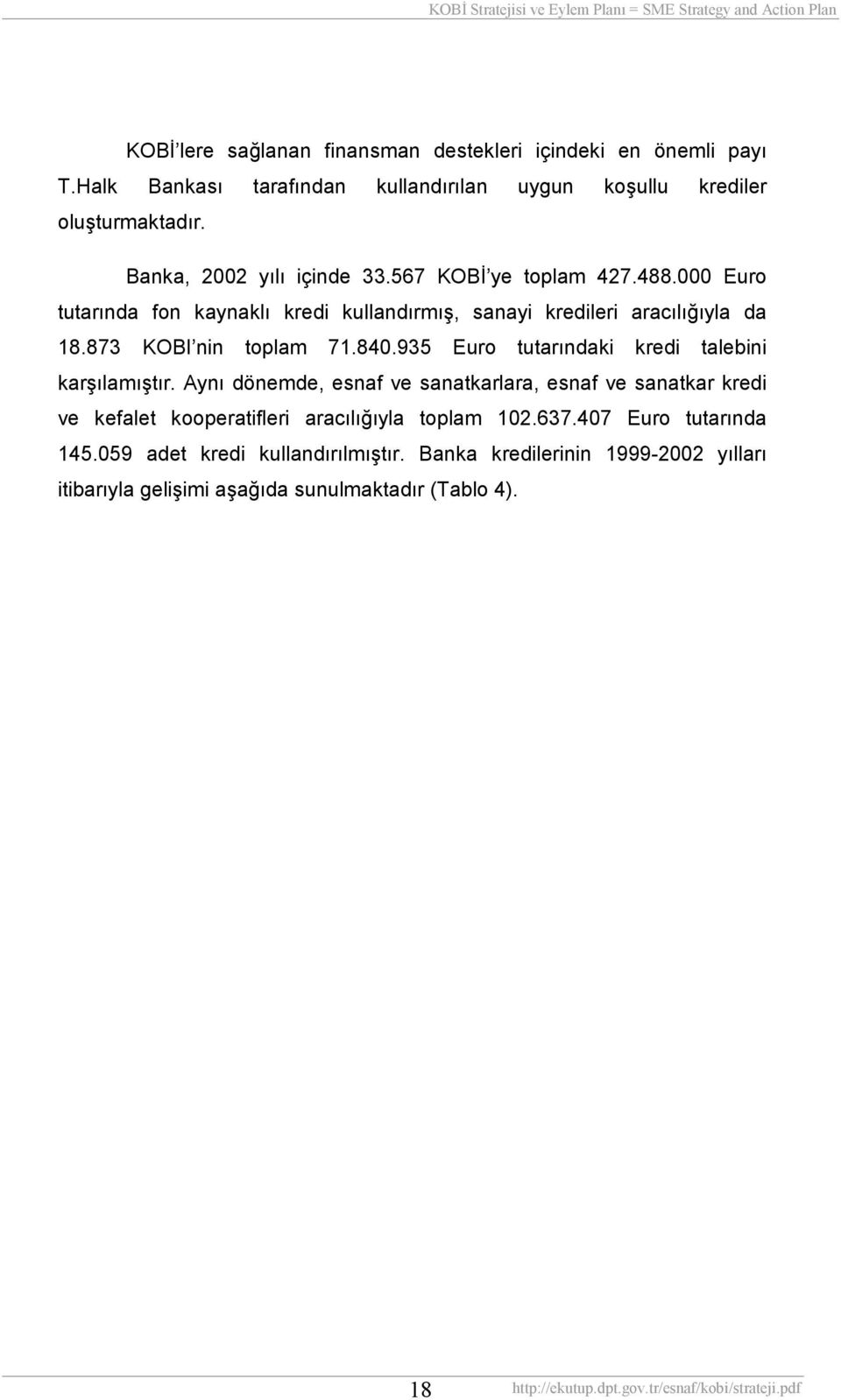
20 KOBİ lere sağlanan finansman destekleri içindeki en önemli payõ T.Halk Bankasõ tarafõndan kullandõrõlan uygun koşullu krediler oluşturmaktadõr. Banka, 2002 yõlõ içinde KOBİ ye toplam Euro tutarõnda fon kaynaklõ kredi kullandõrmõş, sanayi kredileri aracõlõğõyla da KOBI nin toplam Euro tutarõndaki kredi talebini karşõlamõştõr. Aynõ dönemde, esnaf ve sanatkarlara, esnaf ve sanatkar kredi ve kefalet kooperatifleri aracõlõğõyla toplam Euro tutarõnda adet kredi kullandõrõlmõştõr. Banka kredilerinin yõllarõ itibarõyla gelişimi aşağõda sunulmaktadõr (Tablo 4). 18
21 TABLO 4: T. Halk Bankasõ A.Ş. Kredilerinin Yõllar İtibarõyla Dağõlõmõ (EURO) KOBİ KREDİLERİ KOOPERATİF KREDİLERİ YIL FON KAYNAKLI KREDİLERİ SANAYİ KREDİLERİ ESNAF VE SANATKAR KREDİLERİ GİRİŞİMCİ KREDİLERİ SAYI TUTAR SAYI TUTAR SAYI TUTAR SAYI TUTAR KAYNAK: T. Halk Bankasõ A.Ş. (İlgili yõlõn ortalama Euro kuru kullanõlmõştõr.) 19
22 2001 yõlõ ekonomik krizinin etkileri bankanõn sağladõğõ kredi miktarõnda da ortaya çõkmakta, KOBİ kredilerinde sayõ olarak, kooperatif kredilerinde ise tutar olarak önemli oranda azalma görülmekte, en ciddi düşüşün ise girişimci kredilerinde yaşandõğõ tespit edilmektedir. KOBİ lerin Türkiye Halk Bankasõ A.Ş. den kullandõklarõ kredilere teminat desteği sağlamak üzere kurulan Kredi Garanti Fonu A.Ş. aracõlõğõyla, 2001 yõlõ sonu itibarõyla, 631firmanõn toplam Euro tutarõndaki 1079 adet kredisi için Euro teminat desteği sağlanmõştõr. Finansal piyasalarda başlayarak ekonomide önemli bir daralmaya sebep olan ekonomik kriz ve KGF nin KOBİ kredilerine teminat desteği sağladõğõ T. Halk Bankasõndaki yeniden yapõlanma süreci, KGF faaliyetlerinde önemli bir gerilemeye yol açmõştõr yõlõ faaliyetleri bir önceki yõla göre sayõ itibarõyla % 72, tutar olarak ise % 48 lik bir azalma göstermiştir. KGF nin faaliyetleri imalat sektöründe yoğunlaşmakta (% 94), alt sektörler itibarõyla da en fazla teminat desteği gõda ve içki sektörüne sağlanmakta, bunu sõrasõyla dokuma ve giyim, sağlõk, makine, imalat ve orman ürünleri sektörleri izlemektedir. Teminat desteği sağlanan krediler içinde teşvik belgeli kredilerin payõnda düşme eğilimi devam etmektedir yõlõnda % 75 ve 2000 yõlõnda % 54 olan bu oran 2001 yõlõnda toplamõn % 43'ünü oluşturmuştur. KGF nin KOBİ lere kredi kullandõran diğer bankalarla iş birliğine girmesine yönelik çalõşmalar sonucunda 2002 yõlõnda Türkiye Garanti Bankasõ A.Ş. ile de bir protokol imzalanmõştõr. Hazine Müsteşarlõğõ Teşvik ve Uygulama Genel Müdürlüğü tarafõndan uygulanmakta olan KOBİ Yatõrõmlarõnda Devlet Yardõmlarõ Hakkõnda Karar çerçevesinde teşvik belgesi verilen yatõrõmcõlara yatõrõm ve işletme kredileri kullandõrõlmaktadõr. Ayrõca, KOBİ ler teşvik belgesi kapsamõnda gümrük 20
23 vergisi ve Toplu Konut Fonu İstisnasõ, KDV istisnasõ, yatõrõm indirimi 4) ile vergi resim ve harç istisnasõndan da faydalandõrõlmaktadõr. (Tablo 5). TABLO 5: KOBİ Teşvik Belgelerinin Yõllar İtibarõyla Dağõlõmõ (EURO) YIL KOBİ SAYISI YATIRIM KREDİSİ İŞLETME KREDİSİ TOPLAM KREDİ SABİT YATIRIM İSTİHDAM TOPLAM KAYNAK: Hazine Müsteşarlõğõ (İlgili yõlõn ortalama Euro kuru kullanõlmõştõr.) Nisan 2003 Söz konusu Karar hükümleri çerçevesinde, 2000 yõlõndan itibaren, mevcut kredi garanti kuruluşlarõnõn faaliyetlerinde devlet desteği sağlanmasõna ve yeni kredi garanti kuruluşlarõnõn kurulmasõnõn desteklenmesi uygulamalarõna başlanmõştõr. KOSGEB tarafõndan yürütülen faaliyetler çerçevesinde, 28 adet Küçük İşletmeleri Geliştirme Merkezi (KÜGEM) aracõlõğõyla 2002 yõlõnda firmaya danõşmanlõk, firmaya laboratuvar, firmaya eğitim, 224 firmaya kalite ve firmaya proje kapsamlõ destek hizmetleri sunulmuştur. Bilgi yoğun ve ileri teknoloji alanõnda faaliyet gösterebilecek KOBİ lerin Ar-Ge bazlõ faaliyetlerinin desteklenerek geliştirilebilmesi ve uzun vadede ekonomiye kazandõrõlabilmesi için toplam 11 adet Teknoloji Geliştirme Merkezi (TEKMER) aracõlõğõ ile 2001 yõlõ içinde toplam 140 işletmenin Ar-Ge projesi desteklenmiş, bu projelerde 784 kişi istihdam edilmiştir. Bölgesel ve Yöresel Sanayi Geliştirme Programõ çerçevesinde uygulanmakta olan Ortak 4) Bu destek unsuru, 9 Nisan 2003 tarih ve 4842 sayõlõ Kanunun Resmi Gazetede yayõm tarihi olan 24 Nisan 2003 tarihinden itibaren teşvik belgesi kapsamõ dõşõna çõkarõlarak genel nitelikli mali düzenleme haline dönüştürülmüştür. 21
24 Kullanõm Atölyeleri (ORTKA) ve Ortak Kullanõm Laboratuvarlarõ (ORTLAB) çalõşmalarõ kapsamõnda KOBİ lere 2001 yõlõnda Euro destek sağlanmõştõr. KOBİ lerin yurt dõşõna açõlmalarõnõ teminen, 2001 yõlõnda 18 uluslararasõ fuarda toplam 88 firma 925 m² alanda desteklenmiştir. Yurt içinde düzenlenen toplam 25 fuarda 369 firmanõn ürünleri toplam m² de desteklenmiştir. Ayrõca, 2001 yõlõ içinde, toplam 103 firma için Euro tutarõnda destek sağlanarak 7 ayrõ ülkeye İhracat Amaçlõ Pazar Araştõrma KOBİ Yurt Dõşõ İşbirliği Gezisi (İPAG) organize edilmiştir. KOSGEB tarafõndan işletilen Küçük ve Orta Boy İşletmeler Bilgi Ağõna (KOBİ-NET) üye olan işletmelerin sayõsõ e ulaşmõştõr. Özel sektör tarafõndan işletilen ve KOBİ lere internet üzerinden bilgilendirme hizmetleri veren internet sitelerinin sayõsõnda da önemli oranda artõş gözlenmektedir. 20 Haziran 2001 tarihinde kabul edilen 4684 sayõlõ Kanunla bütçe dõşõ fonlarõn tasfiyesi uygulamasõna gidilmesiyle KOSGEB fonu genel bütçeye dahil edilerek kuruluşun gelir kaynaklarõ yeniden belirlenmiş, 2002 yõlõ ikinci yarõsõ içinde önemli miktarda gelir sağlanmasõ sayesinde kuruluş yatõrõm ihtiyacõnõ kendi kaynaklarõndan karşõlayabilecek düzeye erişmiştir. DPT koordinatörlüğünde AB MEDA Programõ kaynaklarõ kullanõlarak Van, Muş, Bitlis ve Hakkari illerinde gerçekleştirilecek olan Doğu Anadolu Kalkõnma Programõ kapsamõnda yer alan KOBİ lerin Geliştirilmesi ve Desteklenmesi Projesine yönelik çalõşmalar son aşamaya gelmiştir. Proje kapsamõnda bölgede yer alan küçük ve orta ölçekli sanayi işletmelerinin makine ekipman alt yapõsõnõn geliştirilmesi, mevcut KSS lerin yönetim yapõlarõnõn güçlendirilerek eğitim, danõşmanlõk ve bilgilendirme hizmetlerinin yoğunlaştõrõlmasõ, yöresel ürünlerin (el sanatlarõ dahil) bölge dõşõna satõşõna destek sağlanmasõ için tanõtõm ve pazarlama programlarõ yapõlmasõ ve KOBİ lere yönelik finansman uygulamalarõna başlanõlmasõ planlanmaktadõr. Ayrõca, proje kapsamõnda KOSGEB in taşra teşkilatõ ve hizmet alt yapõsõnõn da geliştirilmesi sağlanacaktõr. Üç yõlda tamamlanacak olan proje kapsamõnda 4 ilde planlanan faaliyetlerin müteakip projelerle orta vadede tüm bölge illerinde uygulanmasõ amaçlanmaktadõr. 22
25 Geliştirilecek bölge kalkõnma programlarõ bünyesinde, yörenin doğal kaynaklarõ, işgücü alt yapõsõ ve potansiyeli, pazar koşullarõ ve işletme yapõsõna uygun KOBİ yaklaşõm ve uygulamalarõnõn oluşturulmasõna çalõşõlmakta, az gelişmiş bölgeler için gelişmiş teşvik programlarõ kapsamõnda daha yüksek oranda destekler sağlanmasõ hedeflenmektedir. Milli Eğitim Bakanlõğõnõn 81 ilde yer alan toplam 345 Meslek Eğitim Merkezi aracõlõğõyla öğrenci ve kursiyerlere 109 ayrõ konuda meslek eğitimi verilmektedir yõlõnda adet meslek kursu açõlmõş olup, ü kadõn ve si erkek olmak üzere toplam kişi bu kurslarda eğitilmiştir. Meslek eğitim merkezlerinde uygulanan programlar kapsamõnda eğitilen öğrenci ve kursiyerlere ilişkin verilerin yõllar itibarõyla gelişimi Tablo 6 da sunulmaktadõr. TABLO 6: Milli Eğitim Bakanlõğõ Meslek Kurslarõnõn Yõllar İtibarõyla Faaliyetleri ÖĞRETİM YILI İL SAYISI MESLEK EĞİTİM MERKEZİ SAYISI MESLEK SAYISI ÖĞRENCİ VE KURSİYER SAYISI ÖĞRETMEN SAYISI KAYNAK: Milli Eğitim Bakanlõğõ 58. Hükümetin Acil Eylem Planõ kapsamõnda reel sektörün desteklenmesine özel önem verilmiş, KOBİ leri desteklemek amacõyla geliştirilen politika ve programlarõn etkinliğini artõrmak, yeni uygulamalarõ hayata geçirmek ve gerekliliği üzerinde mutabakata varõlmõş, ancak bugüne kadar herhangi bir gelişme kaydedilememiş konulara kararlõlõkla yaklaşabilmek amacõyla; -Teşvik tedbirlerinin yeniden düzenlenmesi, 23
26 -Devlet yardõmlarõnõn İzlenmesi ve Denetlenmesi Hakkõnda Kanunun çõkarõlmasõ, devlet yardõmlarõnõn izlenmesi konusunda bir otoritenin oluşturulmasõ, -Yatõrõmcõlara bedelsiz arsa tahsis edilmesi, -Doğrudan yabancõ yatõrõmlarõn özendirilmesi için gerekli düzenlemelerin yapõlmasõ, -Devlet yardõmlarõnõn envanterinin çõkarõlmasõ, etkinliğinin araştõrõlmasõ ve öneriler getirilmesi amacõyla bir özel ihtisas komisyonunun oluşturulmasõ, -Yatõrõmlarda devlet yardõmlarõ bakõmõndan bölgesel ayrõmlarõn yeniden yapõlmasõ, -Kriz ve sermaye yetersizliği nedeniyle kapanan veya düşük kapasite ile çalõşan tesislerin ekonomiye kazandõrõlmasõ ve yeni yatõrõmlarõn gerçekleştirilmesinin sağlanmasõ ve -KOBİ yatõrõmlarõnõn desteklenmesine ilişkin tedbirler geliştirilmiştir. Bu çalõşmalar çerçevesinde Temmuz 2003 tarihine kadar kaydedilen gelişmeler şunlardõr: 24 Nisan 2003 tarih ve sayõlõ Resmi Gazetede yayõmlanarak yürürlüğe giren 4842 sayõlõ Bazõ Kanunlarda Değişiklik Yapõlmasõ Hakkõnda Kanunda yatõrõm indiriminin, yatõrõm teşvik belgesi olmaksõzõn, otomatik olarak yatõrõmcõya sunulmasõna ilişkin düzenlemeler getirilmiştir sayõlõ Doğrudan Yabancõ Yatõrõmlar Kanunu 17 Haziran 2003 tarih ve sayõlõ Resmi Gazetede yayõmlanarak yürürlüğe girmiştir. Şirket sözleşme ve ana sözleşme değişikliklerine ilişkin işlemlerin, Odalarõn bünyesinde yer alan Ticaret Sicil Memurluklarõnca ve tek adõm ilkesine uygun olacak şekilde gerçekleştirilmesini düzenleyen 4884 sayõlõ Türk Ticaret Kanunu, Vergi Usul Kanunu, Damga Vergisi Kanunu, İş Kanunu ve Sosyal Sigortalar Kanununda Değişiklik Yapõlmasõ Hakkõnda Kanun 17 24
27 Haziran 2003 tarih ve sayõlõ Resmi Gazetede yayõmlanarak yürürlüğe girmiştir. Devlet yardõmlarõnõn izlenmesi ve denetlenmesi için gerekli görülen mevzuata ilişkin çalõşmalar ilgili kurum ve kuruluşlarca sürdürülmektedir. Yatõrõmcõlara bedelsiz arsa tahsis edilmesine imkan verecek mevzuat düzenlemesi hazõrlanarak ilgili kurum ve kuruluşlarõn görüşüne açõlmõştõr. Devlet yardõmlarõnõn envanterinin çõkarõlmasõ, etkinliğinin araştõrõlmasõ ve öneriler getirilmesi amacõyla bir özel ihtisas komisyonu kurulmuş ve komisyon çalõşmalarõna başlamõştõr. Borsa Dõşõ Teşkilatlanmõş Menkul Kõymetler Piyasalarõnõn Kuruluş ve Çalõşma Esaslarõ Hakkõnda Yönetmelik, 18 Mart 2003 tarihli Resmi Gazetede yayõmlanarak yürürlüğe girmiştir. Halihazõrda devam eden uygulamalar ve KOBİ ler alanõnda son dönemde hayata geçirilmesi öngörülen politika ve programlar, AB ve gelişmiş ülke uygulamalarõ ile karşõlaştõrõldõğõnda, Türkiye nin KOBİ destek sisteminin işletmelerin taleplerini karşõlayacak kapasiteye sahip olmadõğõ, kaynak yetersizliği ve kurumsal kapasite eksikliğinin KOBİ leri geliştirmek ve desteklemek amacõyla hazõrlanan politika ve programlar aracõlõğõyla kõsa ve orta vadede somut sonuçlar alõnmasõnõn önünde önemli bir engel teşkil ettiği görülmektedir. KOBİ'lere yönelik hizmetlerin nitelik ve nicelik açõsõndan geliştirilmesi ve kurumlar arasõnda etkin bir koordinasyon sağlanmasõ ihtiyacõ devam etmektedir. Bu amaçla öncelikle tüm kuruluşlarõn faaliyetlerinin çerçevesini belirleyen bir KOBİ tanõmõnõn geliştirilmesi gerekmektedir. 2.4 KOBİ TANIMI Ülkemizde, KOBİ lere yönelik faaliyetlerde bulunan kurum ve kuruluşlarõn; görev tanõmlarõ, hedef kitleleri ve faaliyetlerine ayõrdõklarõ kaynaklarõ çerçevesinde, hizmet götürdükleri gruplarõ belirleyen farklõ KOBİ tanõmlarõ kullandõklarõ görülmektedir. Kullanõlan tanõmlar, gerek tanõmõ 25
28 belirlemede seçilen ölçütler gerek bu ölçütlerin çerçevesinde belirlenen limitler itibarõyla farklõlõklar göstermektedir(tablo 7). KOBİ lere yönelik politikalarõn geliştirilmesi, politikalar çerçevesinde uygulanacak programlarõn planlanmasõ ve bu konudaki araştõrmalarõn yürütülmesinde bir standardõn oluşturulmasõ amacõyla ortak bir KOBİ tanõmõ belirlenmesine ihtiyaç duyulmaktadõr. Tanõmlardaki ayrõlõk, işletmelerin farklõ kuruluşlardan hizmet talep etmeleri halinde farklõ değerlendirmelere tabi tutulmalarõ sonucunu doğurmakta, bu durum hizmet sunucularla hizmet talep edenler arasõnda anlayõş farklõlõğõna yol açmakta, uygulamalarõn etkinliğini azaltmakta ve hizmetlerde şeffaflõğõn sağlanmasõnõn önünde önemli bir engel teşkil etmektedir. AB nin KOBİ tanõmõna uyumun sağlanmasõ hususu, Türkiye nin, AB ye adaylõk sürecinde Avrupa Komisyonu tarafõndan hazõrlanarak ülkemize sunulan İlerleme Raporlarõnda ve 2003 yõlõnda Türkiye için hazõrlanan Katõlõm Ortaklõğõ Belgesinin kõsa vadeli tedbirleri arasõnda da vurgulanmaktadõr. 26
29 TABLO 7: Türkiye de Kullanõlan KOBİ Tanõmlarõ KURULUŞ TANIM KAPSAMI TANIM KRİTERİ MİKRO ÖLÇEKLİ İŞLETME KÜÇÜK ÖLÇEKLİ İŞLETME ORTA ÖLÇEKLİ İŞLETME KOSGEB İmalat Sanayii İşçi sayõsõ işçi işçi HALKBANK HAZİNE MÜSTEŞARLIĞI DIŞ TİCARET MÜSTEŞARLIĞI İmalat Sanayii, Turizm, Yazõlõm Geliştirme İmalat Sanayii, Turizm, Tarõmsal Sanayi, Eğitim, Sağlõk, Yazõlõm Geliştirme İmalat Sanayii İşçi Sayõsõ işçi Sabit Yatõrõm Tutarõ (Euro) İşçi Sayõsõ, 1-9 işçi işçi işçi Yatõrõm Tutarõ, KOBİ Teşvik Belgesine Konu Yatõrõm Tutarõ (Euro) İşçi Sayõsõ, işçi Sabit Yatõrõm Tutarõ (Euro) EXİMBANK İmalat Sanayii İşçi Sayõsõ işçi KAYNAK: Hazine Müsteşarlõğõ, Dõş Ticaret Müsteşarlõğõ, KOSGEB, EXIMBANK, T.HALK BANKASI. 27
30 2.5 AVRUPA BİRLİĞİ İLE İLİŞKİLER a) Ortaklõk İlişkisi ve Gümrük Birliği Türkiye ile AB (o dönemdeki adõyla Avrupa Ekonomik Topluluğu) arasõndaki ilişkiler, 1 Aralõk 1964 tarihinde yürürlüğe giren Ankara Anlaşmasõnõn çerçevesini çizdiği Ortaklõk Rejimi ile başlamõştõr. Ortaklõk Rejiminin işleyiş kurallarõ 1 Ocak 1973 tarihinde yürürlüğe giren Katma Protokol uyarõnca ayrõca düzenlenmiştir. Bu Protokolle, Topluluğun Türkiye den ithal ettiği sanayi mallarõna uyguladõğõ gümrük vergileri ve miktar kõsõtlamalarõnõ Protokolün ticari hükümlerinin yürürlüğe girdiği tarihte (1971) sõfõra indirmesi öngörülürken, Türkiye nin Topluluk çõkõşlõ sanayi ürünlerinde uyguladõğõ gümrük vergileri ile eş etkili vergi veya resimleri, tedricen kaldõrmasõ öngörülmüştür. Bu sürece paralel olarak Topluluk, ortaklõk ilişkisi çerçevesinde, Türkiye ekonomisinin hõzlõ kalkõnmasõna katkõda bulunmak ve Türkiye nin ortaklõk ilişkisinden doğan yükümlülüklerini yerine getirmesine destek olmak amacõyla 1963 yõlõndan itibaren Türkiye ye, 78 milyon ECU lük hibe ile 637 milyon ECU lük kolaylõklõ ve 115 milyon ECU lük piyasa şartlõ krediden oluşan, toplam 827 milyon ECU tutarõnda mali yardõm sağlamõştõr li yõllarda Türkiye-AT ortaklõk ilişkileri beklendiği gibi gelişmemiş ve 1980 li yõllarda donma noktasõna gelmiş olup, bazõ istisnai unsurlar dõşõnda mali işbirliği 1995 yõlõna kadar çalõştõrõlamamõştõr. 1 Aralõk 1986 tarihinde başlamasõ gereken işçilerin serbest dolaşõmõ Topluluk tarafõndan uygulamaya geçirilmemiştir. Türkiye 14 Nisan 1987 tarihinde, tüm Avrupa ülkelerine tanõnmõş haktan yararlanarak AT ye tam üyelik başvurusunda bulunmuş; fakat 1990 yõlõnda AT Bakanlar Konseyi, Avrupa Komisyonu tarafõndan yapõlan değerlendirmeye dayanarak o dönem itibarõyla Türkiye nin üyeliğine ilişkin olarak verilecek kararõn ertelenmesinin uygun olacağõ sonucuna varmõştõr. Türkiye ve AT arasõnda sanayi ürünlerini alanõnda bir gümrük birliği oluşturulmasõ sürecini tamamlayan 6 Mart 1995 tarihli ve 1/95 Sayõlõ Ortaklõk Konseyi Kararõ ile Türkiye ile AB arasõndaki ilişkiler ivme kazanmõştõr. Bu kararõn beraberinde yer alan Ortaklõk İlişkilerinin Geliştirilmesine İlişkin İlke 28
31 Kararõ nda bazõ sektörlerde işbirliğinin ilerletilmesi konularõ kapsanõrken; AB nin tek taraflõ sunduğu bildirim ile de mali işbirliği yeniden başlatõlmõştõr. Çeşitli nedenlerden dolayõ, bu bildirim kapsamõnda, gümrük birliği süreci için Türkiye ye verilmesi öngörülmüş olan ve o zaman için toplam tutarõnõn 2,2 milyar ECU ye ulaşacağõ tahmin edilen hibe ve kredilerin çok sõnõrlõ bir bölümü (% 33 civarõnda) Türkiye ye sağlanabilmiştir. Gümrük birliğinin tesisiyle birlikte Türkiye de KOBİ lerin durumunu desteklemek üzere, geniş katõlõmlõ bir çalõşma sürecini müteakip, KOBİ Eylem Planõ hazõrlanmõştõr. Ancak yeterli kaynak bulunamadõğõ için bu plan uygulamaya geçirilememiştir. AB, Haziran 1998 deki Cardiff Zirvesinde Türkiye için Avrupa Stratejisi ni yürürlüğe koymuştur. Bu strateji çerçevesinde, Türkiye sanayisi ve KOBİ lerin gümrük birliği ve uyum hususlarõndaki durumlarõnõ kapsamaya yönelik bir Sanayi Stratejisi, karşõlõklõ çalõşmalar çerçevesinde geliştirilmiş ve Türkiye ile AB arasõnda bir Sanayi İşbirliği Temas Grubu oluşturulmuştur. Ancak bu strateji de AB tarafõndan işleme konmamõştõr. b) Helsinki Zirvesi Sonrasõ Adaylõk Süreci Aralõk 1999 tarihinde gerçekleşen Helsinki Zirvesinde Türkiye, AB ye aday ülke olarak kabul edilmiştir. Bu zirve kararõnda Türkiye için diğer aday ülkelerde olduğu gibi bir Katõlõm Ortaklõğõ nõn tesis edilmesi ve bu çerçevede katõlõm öncesi yardõmlar dan Türkiye nin de yararlandõrõlmasõ gündeme gelmiştir. Merkezi ve Doğu Avrupalõ (MDA) aday ülkelerin uyumu için PHARE, ISPA ve SAPARD geliştirilirken, Türkiye bu kapsama dahil edilmemiştir. Bu dönemde Türkiye için düzenlenen mali yardõm MEDA-II den ayrõlan pay ile Avrupa Stratejisi çerçevesinde sağlanan kaynaklardan oluşmuştur. Bu süreçte, Türkiye ye yõlda 177 milyon Euro luk destek sağlanmõştõr. Bu destek miktarõnõn 2004 yõlõnda 250, 2005 yõlõnda 300 ve 2006 yõlõnda 500 milyon Euro ya ulaşacak şekilde artõrõlmasõ öngörülmüş olup bu kaynaklardan Türkiye nin çeşitli alanlardaki AB ye uyum çalõşmalarõnõn yanõsõra KOBİ Stratejisi ve Eylem Planõ da desteklenecektir. 29
32 Helsinki Zirvesinde ayrõca, Binyõl Bildirgesi kabul edilerek genişleme sürecinde yeni bir aşamaya işaret eden kararlar alõnmõştõr. Bu çerçevede; AB genişleme sürecinde ; -bilim-araştõrma-teknoloji üretiminin artõrõlmasõ, -mesleki eğitimin hõzla geliştirilerek, yenilenmesi ve yaygõnlaştõrõlmasõ, -KOBİ lerin geliştirilmesi ve desteklenmesi, -bölgesel kalkõnmaya önem verilmesi hususlarõna öncelik verilmesi öngörülmüştür. Türkiye nin AB ye aday ülke olarak kabulünü takiben, Türk KOBİ lerinin AB üye Devletleri ve diğer aday ülkelerin işletmeleri ile rekabet edebilmeleri için AB politikalarõyla ülkemiz politikalarõnõn koordinasyonu yönünde çalõşmalar başlatõlmõştõr. Bu çerçevede yürütülen çalõşmalar şu şekildedir: CC BEST Sürecine Katõlõm Haziran 1997 tarihli Amsterdam Zirvesi önerileri doğrultusunda KOBİ ler için iş ortamõnõn iyileştirilmesi ve mevzuatõn basitleştirilmesi konusunda bir rapor hazõrlamak üzere BEST (İş Ortamõnõn Basitleştirilmesi Görev Gücü) Çalõşma Grubu oluşturulmuştur. BEST çalõşmalarõnõn amacõ; ülkelerin en iyi uygulama örneklerinin değişimini sağlamak ve ülkelerin birbirlerinin tecrübelerinden istifade edebilecekleri bir ortam yaratmaktõr. BEST çalõşma grubu raporuna dayanõlarak Avrupa Komisyonu tarafõndan girişimcilik ve rekabet edebilirliğin desteklenmesine yönelik eylem planõ hazõrlanmõştõr. Bu eylem planõ; - eğitim ve staj, - finansmana erişim, - araştõrma ve yenilik, - destek hizmetlerinin şeffaflõğõ, 30
33 - kamu yönetimi, - istihdam ve çalõşma şartlarõ alanlarõnõ kapsamaktadõr. KOBİ leri desteklemek ve mümkün olan en iyi iş ortamõnõ sağlamak amacõyla üye ülkelerin yukarõda belirtilen altõ alanda yaptõklarõ çalõşma ve ilerlemeler Avrupa Birliği-Girişimciliği ve Rekabet Edebilirliği Desteklemeye Yönelik Eylem Planõnõn Yürütülmesi Raporu başlõğõ altõnda 27 Ekim 2000 tarihinde yayõmlanmõştõr. BEST çalõşmasõnõn aday ülkelere de yansõtõlmasõna yönelik Avrupa Komisyonu kararõ doğrultusunda Sanayi ve Ticaret Bakanlõğõnõn liderliğinde, KOSGEB in sekretaryasõnda ve KOBİ lerle ilgili tüm kurum ve kuruluşlarõn katõlõmõyla CC BEST Türkiye Raporu hazõrlanarak 13 Temmuz 2001 tarihinde Ankara da, 28 Eylül 2001 tarihinde Brüksel de Komisyona sunulmuştur. Türkiye Raporu, diğer aday ülkelerin raporlarõyla birlikte 20 Aralõk 2001 tarihinde yayõmlanmõştõr. Küçük İşletmeler İçin Avrupa Şartõ AB üyesi ülkelerin KOBİ politikalarõnda birliktelik sağlamak amacõyla başlattõklarõ CC BEST çalõşmasõ, Haziran 2000 tarihli Feira Zirvesinde yayõmlanan AB KOBİ Şartõ ile daha somut bir nitelik kazanmõşböylece CC BEST süreci sona erip, AB KOBİ Şartõ raporlarõnõn hazõrlanmasõ süreci başlatõlmõştõr. Türkiye nin, 23 Nisan 2002 tarihinde Slovenya nõn Maribor şehrinde düzenlenen konferansta diğer aday ülkelerle birlikte teyit ettiği Şart, aşağõda belirtilen 10 temel unsuru içermektedir; - Girişimcilerin eğitimi ve öğretimi. - Daha ucuz ve daha hõzlõ iş kurma süreçleri geliştirilmesi. - Daha iyi kanunlar ve mevzuat düzenlemesi yapõlmasõ. - Nitelikli personel eğitiminin gerçekleştirilmesi. - İnternette anõnda işlem imkanlarõnõn yaygõnlaştõrõlmasõ. 31
34 -Tek pazardan daha çok yararlanõlmasõ -Vergilendirme ve finansal konularda iyileştirmeler yapõlmasõ. - KOBİ lerin teknoloji ve yenilikçilik kapasitesinin geliştirilmesi. - E-ticaretin ve teknoloji tabanlõ işletmelerin desteklenmesi. - Ulusal ve uluslar arasõ platformlarda KOBİ lerin daha etkin ve daha güçlü temsil edilmesi. Türkiye, bu Şartõ onaylamakla tüm kurum ve kuruluşlarõyla yukarõda belirtilen 10 temel alanda somut adõmlar atmaya, program ve projeler üretmeye, gerekli kaynaklarõ tahsis etmeye söz vermiş bulunmaktadõr. Bu nedenle, AB KOBİ Şartõ bir anlamda Türkiye nin uzun vadeli KOBİ Stratejisi dokümanõ ve ev ödevidir. AB KOBİ Şartõna ilişkin Türkiye 2002 yõlõ Raporu KOSGEB koordinasyonunda ilgili kurum ve kuruluşlarõn katkõlarõyla hazõrlanmõş ve 2003 yõlõ Şubatõnda Avrupa Birliği Konsey toplantõsõnda sunulmuştur yõlõ raporunun hazõrlanmasõ ile ilgili çalõşmalar sürdürülmektedir. Avrupa Topluluğu İşletme ve Girişimcilik ve Özellikle Küçük ve Orta Ölçekli İşletmeler İçin Çok Yõllõ Programõ Yukarõda belirtilen stratejilerin ve KOBİ politikalarõnõn Avrupa Topluluğu İşletme ve Girişimcilik ve Özellikle Küçük ve Orta Ölçekli İşletmeler İçin Çok Yõllõ Program õnda proje ve eylemlere dönüştüğü görülmektedir. Türkiye, Topluluğun Resmi Gazetesinde 20 Aralõk 2000 tarihinde yayõmlanan 2000/819/EC sayõlõ Kararla başlayan ve yõllarõnõ kapsayan Çok Yõllõ Programa KOSGEB koordinasyonunda katõlmaktadõr. Türkiye nin katõlmakta olduğu ilk Topluluk programõ olma özelliği taşõyan Çok Yõllõ Programa ilişkin Türkiye-AB Mutabakat Zaptõ 23 Ekim 2002 tarihinde imzalanmõştõr. Türkiye nin Program bütçesine katkõ payõ yaklaşõk 4,5 milyon Euro olup, Mali İşbirliği Programlamasõ ve KOSGEB bütçesinden karşõlanmaktadõr. 32
35 Program kapsamõnda, halen bir adet olan Avrupa Bilgi Merkezi (European Information Center-EIC) sayõsõ kõsa sürede 12 ye çõkartõlacaktõr. İstanbul da 2 adet olmak üzere Adana, Ankara, Bursa, Denizli, Gaziantep, İzmir, Kayseri, Konya, Samsun, Trabzon İllerinde de Avrupa Bilgi Merkezleri açõlacaktõr yõlõnda ihalesi yapõlacak 23 AB Bilgi Merkezi nin 12 sinin Türkiye de açõlacak olmasõ önemli bir başarõ olarak değerlendirilirken halen Avrupa da 300 den fazla Avrupa Bilgi Merkezi nin faaliyette bulunduğu bilgisi göz önünde bulundurulmalõdõr. Türkiye nin Çok Yõllõ İşletmeler Programõ ile ilgili ulusal yaklaşõmõ aşağõdaki şekilde özetlenebilir; - Paylaşõmcõ olmak; KOBİ lere hizmet ve destek veren kurumlar arasõnda sinerji oluşturmak, kurumlar arasõnda iş birliğini geliştirmek, atõl duran kaynaklarõ harekete geçirerek ihtiyaç alanlarõna yönlendirmek, - AB den mali destek almanõn ötesinde, AB nin KOBİ politika ve stratejilerini özümsemeye önem vermek, - AB nin KOBİ politikalarõnõ, projelerini, en iyi uygulama örneklerini ve başarõlõ çözümlerini öğrenerek, know-how kazanmak. Bu süreçte Türkiye, özellikle teknoloji ve bilgi tabanlõ, yenilikçi KOBİ lerin desteklenmesinde AB nin geliştirdiği; - başlangõç sermayesi, - risk sermayesi, - kredi garantisi, - iş melekleri 5) vb. finansal araçlarõ ve mekanizmalarõ süratle öğrenmeyi ve uygulamaya geçirmeyi amaçlamaktadõr. 5) İş Melekleri, (Business Angels): girişimcilere banka dõşõ finansman araçlarõ sağlayan özel finans kuruluşlarõ. 33
36 Mart 2000 tarihli Lizbon Zirvesi AB ülkeleri, Mart 2000 tarihinde gerçekleşen Lizbon Zirvesinde, 2010 yõlõna kadar izlenecek politikalar neticesinde AB nin dünyanõn rekabet gücü en yüksek, dinamik, bilgi tabanlõ ekonomisi olmasõnõ ve sürdürülebilir kalkõnmayõ sağlamaya, daha çok iş imkanõ ve daha iyi iş ortamõ oluşturarak sosyal kaynaşmayõ temin etmeye yönelik, Lizbon Stratejisi dokümanõnda ifade bulan, önemli kararlar almõşlardõr. Bu amaçla kişi başõna düşen gayri safi milli hasõlanõn artõrõlmasõ, verimliliğin yükseltilmesi, çalõşabilir nüfusun asgari % 70 ine iş imkanõ sağlanmasõ, Ar-Ge çalõşmalarõna daha çok kaynak ayrõlmasõ, eğitim düzeyinin yükseltilmesi, internet kullanõmõnõn yaygõnlaştõrõlmasõ, devlet yardõmlarõ azaltõlõrken risk sermayesi kullanõmõnõn artõrõlmasõ, sosyal kaynaşmanõn sağlanmasõ hedeflenmektedir. Lizbon stratejisi hedefleri Küçük İşletmeler için Avrupa Şartõnda daha somut ifadelerle belirtilirken, üye ülkeler arasõndaki ticaretin geliştirilmesinde ortamõn iyileştirilmesi, mevzuatõn basitleştirilmesi ihtiyacõ da vurgulanmaktadõr. Bologna Sözleşmesi AB de yukarõda belirtilen çalõşma ve gelişmeler devam ederken, OECD üyesi ülkelerin Sanayi ve KOBİ lerden sorumlu Bakanlarõ, İtalya nõn Bologna kentinde 15 Haziran 2000 tarihinde toplanarak KOBİ politikalarõna yönelik Bologna Sözleşmesini imzalamõşlardõr. Bologna Zirvesinden sonra meydana gelen gelişmeler Haziran 2004 tarihinde KOSGEB in ev sahipliğinde, İstanbul da gerçekleştirilecek olan Bakanlar Toplantõsõnda gözden geçirilecektir. Alt Komite Toplantõlarõ KOBİ lere ilişkin hususlar, AB-Türkiye Ortaklõk Komitesinin alt komitelerinden olan 3 No lu Ticaret, Sanayi ve Avrupa Kömür ve Çelik Topluluğu Ürünleri Komitesi gündeminde ele alõnmaktadõr. Komite, bugüne kadar, 7 Aralõk 2000 tarihinde Brüksel de, 16 Mayõs 2001 tarihinde İstanbul da 34
37 ve 17 Temmuz 2002 tarihinde Brüksel de olmak üzere üç kez toplanmõş olup, önümüzdeki dönemde de çalõşmalarõnõ sürdürecektir Yõlõ İlerleme Raporu Avrupa Komisyonunun her yõl aday ülkeler için yayõnladõğõ Düzenli İlerleme Raporlarõndan Türkiye için hazõrlanan 2002 yõlõ İlerleme Raporunda, Türkiye nin AB ye uyumlu KOBİ tanõmõna ilişkin mevzuat düzenlemesi yapmasõ konusunda gelişme kaydedilmediği, KOBİ lere ayrõlan kredi vb. kaynaklarda azalma meydana geldiği, Türkiye nin KOBİ Stratejisi ve Eylem Planõ hazõrlamasõ gerektiği vurgulanarak, 1 Eylül 2002 tarih ve sayõlõ T.C. Resmi Gazetesinde yayõmlanan kanunla Türkiye nin tüm AT programlarõna ve böylelikle 6. Ar-Ge Çerçeve Programõna katõlõmõnõn uygun bulunulduğu belirtilmiştir. 2.6 TÜRK KOBİ SEKTÖRÜNÜN TEMEL ZAYIFLIKLARI Türkiye nin özel koşullarõ kalkõnma seçenekleri üzerinde belirleyici olmakta, bu kapsamda KOBİ lerin geliştirilmesi kaçõnõlamaz bir politika alanõnõ oluşturmaktadõr. Bunun sonucu olarak, AB ile entegrasyon sürecinde KOBİ leri geliştirmeye ve desteklemeye yönelik politika ve programlar geliştirilmesi önem arzetmektedir. AB ile ileriye dönük işbirliğini temellendirmek üzere, Birliğin politika ve programlarõ ile uyumlu bir KOBİ stratejisi oluştururken, ülkemiz koşullarõnõ yansõtmanõn gereği olarak esas alõnmasõ gereken bazõ temel zayõflõklarõn mevcudiyeti söz konusudur. Türk KOBİ lerinin maruz kaldõklarõ muhtelif problemler arasõnda aşağõda ele alõnanlar, KOBİ lerin gelişebilmeleri ve gerek dünya gerek AB iç pazarõnda rekabet gücü kazanabilmeleri önündeki temel darboğazlarõ oluşturmaktadõr. Aynõ zamanda Türkiye nin yapõsal sorunlarõna tekabül eden bu problemler, halen uygulanmakta olan politika ve programlarõn başarõsõnõn önünde de ciddi engeller oluşturmaktadõr. Bu itibarla, ulusal bazda geliştirilen 35
38 strateji belgelerinde bu problemlerin çözümüne yönelik önlemler geliştirilmektedir KNOW-HOW YETERSİZLİĞİ VE DÜŞÜK TEKNOLOJİK SEVİYE Tipik Türk KOBİ si geleneksel üretim metotlarõ ile Türkiye pazarõ için üretim yapmakta; ancak, bir çok alanda yerel pazarda da başta AB firmalarõ olmak üzere yabancõ firmalar ile rekabet etmek zorunda kalmaktadõr. Türk KOBİ lerinin teknolojik düzeyi Avrupalõ firmalara göre çok düşük kalmakta, KOBİ lerimiz genellikle modasõ geçmiş tasarõmlar, verimsiz üretim metotlarõ ve eski makine-ekipman kullanarak katma değeri düşük olan alt kalitede ürünlerin üretimiyle meşgul olmaktadõrlar. Ayrõca, KOBİ lerde danõşmanlõk kullanma ve Ar-Ge siparişi geleneği de bulunmamaktadõr. Ülkede mühendislik-müşavirlik, tasarõm teknoloji transferi ve eğitim hizmetlerinin kullanõlmasõnõn düşük bir düzeyde kalmasõ ve sõnai mülkiyete konu olan ürünlerin ticaretinin yetersizliği nedeniyle know-how ile ilgili hizmet sektörleri de gelişememiştir. Oysa sabit sermayeden ziyade insan sermayesine ihtiyaç duyan bu alanlarda kapasite geliştirebilmek için Türkiye nin tabii bir potansiyeli bulunmaktadõr. Gümrük birliğinin yarattõğõ rekabet ve AB İç Pazarõnõn imkanlarõ karşõsõnda yeniden yapõlanmanõn gereği olarak, ülkemizde işletmelerin teknoloji seviyelerinin yaygõn bir şekilde yükseltilmesi ve bu çerçevede büyük miktarlarda know-how õn KOBİ lere transferi gerekmiştir. Ancak rekabet baskõsõ ve yeni pazar arayõşõ nedenleri ile hissedilen teknolojik ihtiyaçlar, ülkenin mevcut yapõsal koşullarõnda ekonomik talebe dönüşemediğinden ve bu ihtiyaçlarõ karşõlayõcõ hizmetleri sunan kesim (örneğin mühendislik, tasarõm ve teknoloji transferi danõşmanlõklarõ) ile tüketecek kesim (imalat sanayii KOBİ leri) arasõnda ticari bağlar gelişmediğinden, Türkiye de piyasa mekanizmasõnõn sonucu olarak teknoloji düzeyinin yükseltilmesi yoluyla rekabet gücü kazanõmõ ortaya çõkmamõştõr. Kamu mali imkanlarõnõn sõnõrlõ kalmasõ nedeniyle KOBİ lere yeterli destek sağlanamamõş ve teknolojinin yayõnõmõnõ engelleyen yapõsal sorunlarõn da etkisiyle, bu dönemde ne gümrük birliğinin doğurduğu rekabet baskõsõ ne 36
39 de ekonomik krizler sonucunda Türkiye pazarõnõn daralmasõ karşõsõnda duyulan yeni pazar gereksinimi bile ülke KOBİ leri genelinde bir teknolojik düzey yükseltilmesini sağlayamamõştõr. Türk KOBİ lerinin genelinin AB tüketicisine hitap edecek çeşit ve kalitede ürün üretebilecek durumda olmamalarõ nedeniyle, Şubat 2001 krizinin getirdiği kur avantajõ ihracat için üretime yönelme imkanõ sağlayamamõş ve bu dönemde kapanan işletme sayõsõnda artõş gözlenmiştir. Halen KOBİ lerin know-how yetersizliği sorunu, fiyata dayalõ piyasa güçlerinin devreye girmesini engellediği gibi, Türk ekonomisinin de gümrük birliğinden yeterli faydayõ sağlayabilmesi önündeki en önemli darboğazõ oluşturmaktadõr. Yapõsal sorunlarõn temelinde, gelişmekte olan bütün ülkelerdeki gibi, KOBİ lerin teknolojik ihtiyaçlarõnõn kendiliğinden ekonomik talebe dönüşememesi, know-how ile ilgili çeşitli hizmet sunucularõ ile aralarõnda ticari bağlarõn gelişmemesi ve bu durumun hizmet üreticisi olmasõ gereken KOBİ lerin de gelişmesine imkan tanõmamasõ olgusu yatmaktadõr. Bu yapõsal sorundan çõkõş sağlayacak, iki tarafõ buluşturan yeterli bir piyasa mekanizmasõnõn oluşabilmesi, kültürel gelişmeleri, bazõ kamusal destek ve düzenlemeler ile özellikle piyasa yapmaya yönelik organizasyonlarõ gerekli kõlmaktadõr FİNANSAL ORTAMIN YETERSİZLİĞİ Türkiye de KOBİ lerin kredi hacminden yararlanma oranlarõ, istihdama ve ülke katma değerine sağladõklarõ katkõlarõ ile karşõlaştõrõlamayacak seviyelerde düşük kalmaktadõr (% 5 ler civarõnda). KOBİ lere hizmet verecek sermaye piyasasõ imkanlarõ da geliştirilememiştir. Kamu kesiminin piyasalardaki yüksek borçlanma düzeyi, özel sektörün kredi imkanlarõnõ daraltmakta ve faizlerin aşõrõ yükselmesine yol açmakta olup, bu koşullar kamunun sağladõğõ desteklerin kõsõtlõlõğõ ile birleşerek KOBİ lerin kredi piyasasõndan neredeyse tamamen dõşlanmasõna neden olmaktadõr. 37
40 Türkiye de uzun bir süredir yürütülen kamunun yüksek borçlanma politikasõ nedeniyle, bankalarõn KOBİ leri finanse etme kapasitesi aşõnmõş, yatõrõm/proje finansmanõ hizmetleri çok daralmõş ve ekonomik krizler neticesinde bankalarõn iflas etmesi ve işletmelerin bankalara borçlu kalmasõ gibi nedenler yüzünden bu alandaki piyasa mekanizmasõ tahrip olmuştur. Mali sektör krizi neticesinde, birçok bankanõn piyasadan veya işletmelere hizmet sunmaktan çekilmesiyle, finansal sektörde KOBİ lerin yararlanabileceği kredi hacmi ve kurumsal kapasitenin azalmõş olmasõ, ekonomik kriz ortamõnda faaliyetini sürdürebilecek KOBİ leri de olumsuz etkilemiştir. Mali sektör bünyesinde KOBİ lerle çalõşacak kurumsal kapasite eksikliği nedenleriyle, KOBİ lerin kredi darboğazõnõ rahatlatmak için AB deki para ve sermaye piyasalarõndan yararlanõlamamakta, Türkiye ye sağlanan finansman imkanlarõnõn bile KOBİ lere aktarõlmasõnda sõkõntõlar yaşanmaktadõr. Geleneksel olarak KOBİ lere finansal hizmet sunan Halk Bankasõ fonksiyonunu icra edemez duruma düşmüş olup, bankanõn özelleştirilmesi planlanmõştõr. Türkiye de KOBİ lere yönelik kredi garantisi, risk sermayesi yatõrõm ortaklõğõ, gayri menkul yatõrõm ortaklõğõ, KOBİ finans şirketleri, KOBİ lere yönelik faktoring ve leasing şirketleri, KOBİ lerin menkul kõymet piyasalarõndan yararlanmasõnõ sağlayan KOBİ borsasõ gibi bazõ finansman kurumlarõ ya çok sembolik düzeyde gerçekleşmiş ya da kavramsal düzeyde kalmõştõr TÜRKİYE İLE AB ARASINDA REKABETİ ETKİLEYEN UNSURLAR Gümrük birliğinin bazõ unsurlarõ, AB ile Türkiye arasõndaki rekabet koşullarõ üzerinde olumsuz etkilere neden olabilmektedir. Bölgesel gelişmişlik farklarõnõ gidermek, alt yapõyõ geliştirmek, çevre problemlerine çözüm getirmek, Ar-Ge kapasitesi geliştirmek, istihdam yaratmak ve bazõ sektörel problemlerin çözümü için kullanõlan çeşitli AB 38
41 fonlarõ, AB deki üreticilerinin sabit sermaye, Ar-Ge ve çevre yatõrõmõ maliyetleri ile istihdam harcamalarõnõ azaltmaktadõr. Ancak, aynõ pazarda ve aynõ koşullar altõnda rekabet etmek durumunda olan Türk üreticiler bu kaynaklardan yararlanma olanağõna sahip bulunmamaktadõrlar. Türkiye de KOBİ lere sağlanan devlet yardõmlarõnõn nitelikleri, çeşitlilikleri ve mali büyüklükleri, KOBİ lerin sağladõğõ istihdam, katma değer, ödedikleri vergi miktarõ vb. gibi değerlerle orantõlõ olarak da ele alõndõğõnda, AB üyesi ülkelerdeki destek ve hizmetler karşõsõnda göreli olarak yetersiz kalmaktadõr. Türkiye-AB gümrük birliğinin, KOBİ ler üzerindeki olumsuz etkilerini telafi edecek etkili sistemler de bulunmamaktadõr. Öte yandan, Kuzey Afrika ülkeleri, Meksika ve Güney Amerika ülkeleri başta olmak üzere, AB nin Serbest Ticaret Anlaşmasõ (STA) akdettiği bazõ ülkeler Türk ürünleri ile rekabet endişesi nedeniyle ülkemizle STA imzalamaktan kaçõnmaktadõr. Bu durum, bir taraftan Türk ürünlerini söz konusu pazarlarda rekabet açõsõndan AB menşeli ürünler karşõsõnda dezavantajlõ bir konumda bõrakõrken, diğer taraftan AB de serbest dolaşõm hakkõnõ kazanan anõlan ülke menşeli ürünlerin ülkemiz piyasasõna son derece avantajlõ bir şekilde girişine imkan tanõmakta olup, özellikle KOBİ leri olumsuz yönde etkilemekte ve haksõz rekabete yol açmaktadõr. Yukarõda belirtilen temel yapõsal sorunlara ilaveten, ülkemizin, sahip olduğu ekonomik potansiyele, insan gücüne ve son yõllarda gerçekleştirilen hukuki ve kurumsal alt yapõya rağmen, yabancõ sermaye girişi açõsõndan da yetersiz durumda olduğu görülmektedir. Ayrõca, KOBİ lere sunulan finansman dõşõ desteklerin de yeterince gelişmediği, kamu sektörünün talebi karşõlamada yetersiz kaldõğõ, özel sektörün ise bu alanda aktif bir şekilde rol alacak kurumsal kapasiteye sahip olmadõğõ görülmektedir. Bu çerçevede, KOBİ leri geliştirmek ve desteklemek amacõyla aşağõda belirtilen amaç ilke ve politikalar çerçevesinde hareket edilmesi öngörülmektedir. 39
42 3 AMAÇ, İLKE VE POLİTİKALAR Uzun vadeli makroekonomik politikalarõn ana hedefi, sürdürülebilir bir ekonomik büyümeyi sağlamak, enflasyon oranõnõ Avrupa Birliği ortalamasõna düşürmek ve ekonominin rekabet gücünü artõrmak olarak belirlenmiştir. Bu amaçla makroekonomik dengeyi sağlamaya ve yapõsal reformlarõ gerçekleştirmeye özel önem verilmektedir. Aynõ bağlamda kamunun yeniden yapõlandõrõlmasõ ve mevcut mekanizmalarõn etkinliğinin artõrõlmasõ yönünde önemli tedbirler öngörülmektedir. Bu çerçevede, KOBİ lerin desteklenmesi ve geliştirilmesi ile ilgili olarak belirlenen hedef, ilke ve politikalar aşağõda belirtilmektedir. 3.1 TEMEL HEDEFLER VIII. Beş Yõllõk Kalkõnma Planõnda da belirtildiği üzere, KOBİ lere yönelik politikalarõn temel hedefleri, bu kesimin verimliliğinin, katma değer içindeki payõnõn ve uluslararasõ rekabet gücünün artõrõlmasõdõr. Bu amaçla öncelikle bankacõlõk sisteminin toplam kredi hacmi içinde KOBİ kredilerinin artõrõlmasõ ve risk sermayesi, finansman yatõrõm ortaklõğõ, gayrimenkul yatõrõm ortaklõğõ gibi modern finansman araçlarõndan KOBİ lerin daha etkili düzeyde yararlandõrõlmasõ amacõyla bu alanlarda kurumsal kapasitelerin güçlendirilmesi öngörülmektedir. Finansman dõşõ destekler alanõnda ise, hizmet vericilerle KOBİ ler ve KOBİ leri temsil eden meslek kuruluşlarõ arasõndaki iletişim ve etkileşimin geliştirilerek hizmetlerin etkinliğinin artõrõlmasõ öngörülmekte, ayrõca, daha çok KOBİ ye daha nitelikli hizmet verilebilmesini teminen başta kamu kurum ve kuruluşlarõ ile meslek kuruluşlarõ olmak üzere tüm hizmet vericilerin kurumsal kapasitelerinin ve ortak iş yapabilme yeteneklerinin geliştirilmesinin önemi vurgulanmaktadõr. KOBİ lerin düşük teknoloji seviyelerinin uluslararasõ pazarlardaki rekabet edebilirliklerinin önündeki en önemli engeli oluşturduğu gerçeğinden 40
43 hareketle, teknolojinin yayõnõmõnõ hõzlandõrabilmek için transfer kapasitesinin geliştirilmesi ve kalite yükseltilmesine yönelinmesi amaçlanmakta ve bu kapsamda işletmelerin teknoloji alt yapõlarõnõn geliştirilmesine yönelik eğitim, danõşmanlõk, Ar-Ge desteklerinin yoğunlaştõrõlmasõ öngörülmektedir. 3.2 İLKE VE POLİTİKALAR Türkiye de KOBİ lere yönelik temel strateji alanlarõ Küçük İşletmeler için Avrupa Şartõnda yer alan öncelik alanlarõ ile ülkemiz öncelikleri dikkate alõnarak oluşturulmuştur. Bu strateji alanlarõ kapsamõnda uygulanacak faaliyetler, öncelikle ülkemiz KOBİ lerinin zayõf yanlarõ olarak belirtilen; finansman ve teknoloji sorunlarõ ile rekabet gücü kapsamõnda ele alõnan diğer sorunlarõ çözmeyi hedeflemektedir GİRİŞİMCİLİK EĞİTİMİ VE ÖĞRETİMİ Girişimci ruhun geliştirilmesi amacõyla eğitimin her kademesinde girişimcilik eğitimi ve öğretimine yönelik programlar geliştirilecektir. KOBİ lere yönelik eğitim ve öğretim programlarõnõn uygulanmasõnda kamu ve özel sektör arasõnda etkin koordinasyon sağlanacak, meslek kuruluşlarõnõn bu alanda hizmet verme kapasiteleri artõrõlacak ve özellikle çalõşan sayõsõ az olan KOBİ ler için uzaktan bilgilendirme bilişim alt yapõsõ oluşturulacaktõr. KOBİ lerde organizasyon kültürünün yerleştirilmesi amacõyla yöneticiler seviyesinde eğitim programlarõ düzenlenecektir. KOBİ çalõşanlarõnõn işletme içi karar alma sürecinde aktif rol almalarõnõ sağlamak amacõyla sektör bazlõ eğitim programlarõ düzenlenecektir. KOBİ lerde insan kaynaklarõ yönetimi olgusunun yerleştirilmesine yönelik bilgilendirme programlarõ düzenlenecektir. Meslek standartlarõ, sõnav ve belge sisteminin kurulmasõna ilişkin mevzuat düzenlemesi yapõlacaktõr. 41
44 Yeni işyerleri açacaklarõn faaliyet sahalarõna yönelik mesleki eğitim aldõklarõnõn belgelendirilmesini gerektirecek mevzuat düzenlemesi yapõlacaktõr. Kalkõnma düzeyi düşük olan bölgelerdeki girişimci ve sanayicilerin bilimsel ve piyasa koşullarõna uygun üretim ve işletme yapõsõna kavuşmalarõ için meslek liseleri ve üniversitelerin bu kesimlerle iş birliği içinde çalõşmalarõ geliştirilecektir. KOBİ ler, başarõlõ fikir ve uygulamalarõn en kõsa sürede hayata geçirilmesi amacõyla gelişmiş ve gelişmekte olan ülkelerin başarõlõ örnekleri hakkõnda bilgilendirilecektir. KOBİ ler proje ve teknoloji yönetimi konularõnda bilgilendirilecektir. KOBİ lerin üniversitelerin ve büyük ölçekli firmalarõn bilgi kapasitesinden yararlanmalarõ amacõyla ortak programlar geliştirilecek, anayan sanayii ilişkileri artõrõlarak yan sanayi firmalarõnõn personelinin eğitim seviyelerinin geliştirilmesine imkan verecek projeler desteklenecektir DAHA UCUZ VE DAHA HIZLI İŞ KURMA SÜREÇLERİ GELİŞTİRİLMESİ İş kurma süreci ile ilgili mevzuat bürokrasiyi azaltacak şekilde basitleştirilecek, KOBİ lerin iş kurma sürecinde bilgilendirilmesi için meslek kuruluşlarõ ve hizmet kuruluşlarõ tarafõndan koordineli bir şekilde eğitim programlarõ düzenlenecek, bu amaçla bilgilendirme ofisleri kurulacak ve mevcut ofisler arasõndaki iş birliği geliştirilecektir. Girişimciler iş kurma sürecinin başõndan itibaren yatõrõm ortamõ hakkõnda bilgilendirilecek, sektör bazlõ gelişme planlarõ ve pazar araştõrmalarõ hazõrlanarak girişimcilerin bilgisine sunulacak, KOBİ ler kuruluş aşamasõndan itibaren stratejik planlama kavramõ çerçevesinde hareket edebilmelerini sağlayacak şekilde bilgilendirilecektir. Girişimcilerin istihdam artõrõcõ faaliyetleri desteklenecek, nitelikli işgücü istihdamõna yönelik programlara ayrõlan bütçe artõrõlacaktõr. 42
45 3.2.3 DAHA İYİ KANUNLAR VE MEVZUAT DÜZENLEMESİ YAPILMASI KOBİ lerin tanõmlanmasõnda AB Tavsiye Kararõ ile uyumun sağlanmasõnõ teminen gerekli yasal düzenleme/düzenlemeler yapõlacaktõr. KOBİ tanõmõnõn AB tanõmõ ile uyumlu hale getirilmesi neticesinde, istatistik sistematiği de, yeni tanõm kapsamõnda belirlenecek politikalara ve uygulanacak programlara uygun veriler üretebilecek şekilde, EUROSTAT normlarõnõ da dikkate alarak geliştirilecek, KOBİ lerle ilgili istatistiklerin sürekli ve güncellenebilir bir veri tabanõ dahilinde takip edilmesi sağlanacaktõr. KOBİ lerin faaliyetlerinde etkinliği azaltõcõ düzenlemeler gözden geçirilerek yatõrõm ortamõnõn iyileştirilmesine yönelik çalõşmalar tamamlanacak, basitleştirilmesi ve/veya geliştirilmesi öngörülen mevzuata ilişkin düzenlemeler yapõlacaktõr. KOBİ politikalarõnõn belirleyicisi ve uygulayõcõsõ kuruluşlar arasõndaki koordinasyon artõrõlacak, uygulanan politika ve programlar rasyonel kriterler çerçevesinde sürekli olarak takip edilecek ve güncellenecek, kurum ve kuruluşlar hizmet verdikleri kesimlerden alõnacak performans kriterleri çerçevesinde değerlendirilecektir. KOBİ lerin serbest piyasa ekonomisi koşullarõnda faaliyet göstermelerinin sağlanmasõ amacõyla, kamunun bu kesimle aynõ alanda verdiği hizmetler gözden geçirilecek, haksõz rekabet ortamõ yaratõlmasõ engellenecektir. KOBİ lerle ilgili sivil toplum kuruluşlarõ desteklenecek, bu kuruluşlarõn planlama ve uygulama sürecinde daha etkin rol alabilmeleri için gerekli eğitim ve bilgilendirme çalõşmalarõ düzenlenecektir. Mali sõkõntõ içinde bulunan ve yeniden yapõlandõrõlmalarõ halinde faaliyetlerini sürdürmeleri mümkün olan işletmelere gerekli desteğin verilmesini sağlayacak mekanizmalar oluşturulacak ve icra, iflas ve tasfiye işlemleri ile ilgili mevzuat geliştirilecektir. 43
46 KOBİ lere yönelik devlet yardõmlarõ ile ilgili mevzuat, oluşturulacak bölgesel gelişmişlik haritalarõnõ da dikkate alarak geliştirilecek, devlet yardõmlarõndan yararlanma sürecindeki bürokratik işlemler azaltõlacaktõr. Şirket bölünmelerinin engellenip, birleşmelerin teşvik edilmesini sağlayacak mevzuat düzenleme çalõşmalarõ yapõlacaktõr NİTELİKLİ PERSONEL EĞİTİMİNİN GERÇEKLEŞTİRİLMESİ KOBİ lerin nitelikli personel ihtiyacõnõ karşõlamak üzere eğitim kurumlarõnõn belirlenecek meslek standartlarõ dahilinde eğitim vermesi sağlanacak, mevcut eğitim programlarõnõn kalitesi yükseltilecek, kapasitesi artõrõlacaktõr. Hayat boyu eğitim ve öğretim kavramlarõnõn yerleşmesini sağlayacak eğitim programlarõ geliştirilerek, aktif işgücünün niteliklerinin, gelişen ve değişen ürün ve üretim süreçleri çerçevesinde şekillenen piyasalarõn taleplerini karşõlayacak şekilde sürekli olarak geliştirilmesi sağlanacaktõr İNTERNET ÜZERİNDEN ERİŞİM VE ANINDA İŞLEM İMKANLARININ GELİŞTİRİLMESİ KOBİ lerle kamu birimleri arasõndaki iletişimin artõrõlmasõnõ teminen, kamunun KOBİ lere yönelik verdiği hizmetlerin tanõtõmõnõ sağlamak üzere internet üzerinden gerçekleştirilen bilgilendirme faaliyetleri geliştirilecektir. Bu sürecin etkinliğinin artõrõlmasõ için, işletmelerin internet kullanõmõ aracõlõğõyla sağlayabilecekleri faydalarõ anlatan bilgilendirme çalõşmalarõ yapõlarak bilgisayar ve internet kullanõmõnõn yaygõnlaştõrõlmasõ sağlanacaktõr. İnternet üzerinden anõnda işlem yapabilme imkanlarõnõn geliştirilmesi amacõyla çalõşmalar yapõlacaktõr YENİ PAZARLARA AÇILMA Küreselleşmenin olumsuz etkilerinden korunmak, sektörel ve bölgesel bağõmlõlõktan kurtulmak ve rekabet edilebilecek alanlarõ belirlemek amacõyla, özel sektör katõlõmõ ile ihracata yönelik stratejik planlama yapõlacaktõr. İhracat teşvik mevzuatõ uzun dönemli stratejiye göre ilgili tüm kuruluşlarõn koordinasyonu sağlanarak yenilenecektir. 44
47 KOBİ lerin ihracata yönlendirilmesi için bilgilendirilmeleri sağlanacak, aynõ alanda faaliyet gösteren işletmelerin ihracata yönelik örgütlenmeleri yaygõnlaştõrõlacak, sektörel dõş ticaret şirketleri modeli, diğer ülkelerin başarõlõ örnekleri de dikkate alõnarak geliştirilecek, uygulamanõn etkinliğini artõrmak üzere ilave destekler sağlanacaktõr. KOBİ lerin uluslararasõ pazarlarda rekabet edebilmelerini sağlamak amacõyla ürün ve üretim süreçlerinin kalitesi artõrõlacak, uluslararasõ standartlar hakkõnda bilgilendirilmeleri sağlanacaktõr. Yerel ve ulusal markalarõn, tüm dõş pazarlarda rekabet edebilecek seviyeye ulaşmasõ desteklenecektir. İhracatçõ firmalarõn enerji, istihdam ve haberleşme alanlarõndaki girdi maliyetlerinin bu alandaki vergi oranlarõnõn azaltõlmasõ yolu ile düşürülmesini sağlayacak önlemler alõnacaktõr. Eximbank õn kaynak yapõsõ güçlendirilecek, bürokratik işlemler azaltõlarak basitleştirilecek, özellikle teminat sorununu kolaylaştõrõcõ önlemler alõnacaktõr VERGİLENDİRME VE FİNANSAL KONULARDA İYİLEŞTİRME YAPILMASI Yatõrõmlarda devlet yardõmlarõyla ilgili olarak vergisel destek unsurlarõ kapsamõnda teşvik belgesiz sisteme geçilmesi uygulamasõ izlenerek geliştirilecek, özel amaçlõ vergisel destekler ile nakit destek sisteminin ise AB ve diğer uluslararasõ anlaşmalarda öngörülen düzenlemeler çerçevesinde bölge, ölçek ve yatay yardõmlar esas alõnarak yeniden düzenlenmesi amacõyla çalõşmalar yapõlacaktõr. Yatõrõmlarda devlet yardõmlarõ bakõmõndan bölgesel ayrõmlar, AB ye uyum çerçevesinde çalõşmalarõ tamamlanan İstatistiki Bölge Birimleri Sõnõflandõrmasõna (İBBS) göre yeniden belirlenecektir. Teşvikler; alt bölge, il ve gerektiğinde belli sorunlara sahip ve desteklenmesi gereken özel alanlar için tekrar gözden geçirilecektir. 45
48 Kriz ve sermaye yetersizliği nedeniyle kapanan veya düşük kapasite ile çalõşan tesislerin ekonomiye kazandõrõlmasõ ve yeni yatõrõmlarõn gerçekleştirilmesi sağlanacaktõr. KOBİ lerin bankalarla olan problemlerinin çözümü için yeni bir yaklaşõm (Anadolu Yaklaşõmõ) geliştirilecektir. KOBİ lerle ilgili vergi mevzuatõnõn basitleştirilmesi için çalõşmalar yapõlacaktõr. Bankalarõn KOBİ kredisi kullandõrmasõ özendirilecektir. Genç ve kadõn girişimcilere yönelik olarak uygulanan özel kredi programlarõ etkinleştirilecek ve yaygõnlaştõrõlacaktõr. Uygulanabilir projeleri olanlar ile sermayesi olanlarõn buluşturulmasõnõ sağlayacak çalõşmalar yapõlacaktõr. KOBİ'ler sermaye piyasasõ ve mali piyasalarla düzenli çalõşan bir ortamda modern finansman araçlarõ ve kurumlarõ ile desteklenecektir. Risk sermayesi, finansman yatõrõm ortaklõğõ, gayrimenkul yatõrõm ortaklõğõ gibi finansman sağlama uygulamalarõna yönelik araştõrmalar yaygõnlaştõrõlacak, bu uygulamalara kaynak teşkil edebilecek fonlar harekete geçirilecektir. KOBİ lerin finansman hizmetleri hakkõnda bilgilendirilmesi sağlanacak, finans kuruluşlarõ, meslek kuruluşlarõ ve kamu hizmet birimlerinin iş birliği ile bilgilendirme programlarõ hazõrlanacak, finansmana yönelik bilgi sistemi oluşturulacaktõr. KGF nin kaynaklarõ artõrõlacak, teminat sorumluluk fonunun daha etkin kullanõlmasõ için fon çarpanõnõn yükseltilmesine çalõşõlacaktõr. KGF nin daha çok banka ile iş birliği içinde çalõşabilmesi için gerekli çalõşmalar yapõlacaktõr. Yeni kredi garanti kuruluşlarõnõn kurulmasõ desteklenecektir. 46
49 Uluslararasõ mali işbirliği programlarõ çerçevesinde sağlanacak kaynaklarõn, modern finansman uygulamalarõna yönelik pilot projelerin hayata geçirilmesinde kullanõlabilmesine yönelik çalõşmalar yapõlacaktõr KOBİ LERİN TEKNOLOJİ VE YENİLİKÇİLİK KAPASİTESİNİN GELİŞTİRİLMESİ Topluluğun 6. Ar-Ge Çerçeve Programõ kapsamõnda KOBİ lerin teknoloji ve yenilikçilik kapasitelerinin geliştirilmesine yönelik stratejiler geliştirilecek ve projeler hazõrlanacaktõr. Ülkedeki know-how yayõnõmõ ile ilgili hizmetler güçlendirilecek, transfer ve danõşmanlõk kapasitesi geliştirilecektir. Mühendislik, teknoloji transferi, AR-GE, tasarõm ve teknoloji ile ilgili her türlü diğer hizmet üreticilerinin kapasitelerinin artõrõlmasõ sağlanacak, bu hizmetlerin alõcõsõ konumundaki KOBİ ler ile aralarõndaki ticari bağlar güçlendirilecek, piyasa oluşturmaya yönelik politikalar geliştirilerek bu etkileşimi artõracak aracõ kuruluşlarõn kurulmasõna yönelik çalõşmalar yapõlacaktõr. Teknolojiyle ilgili hizmet üreticileri ile küçük ve orta ölçekli sanayi arasõnda piyasa mekanizmasõnõn geliştirilmesi sürecinde, ülkenin teknoloji üretim kapasitesini güçlendirebilmek için, ortaya çõkan talep doğrultusunda ihtiyaç duyulan alanlarda, küçük ve orta ölçekli sanayi işletmelerinin iç bünyesinde ya da ayrõ hizmet üreticileri olarak Ar-Ge kapasitelerinin oluşturulmasõ ve siparişe dayalõ araştõrma kuruluşlarõ kurulmasõnõn desteklenmesi yolunda çalõşmalar yapõlacaktõr. Bu çerçevede, Üniversite-sanayi iş birliği desteklenecek, KOBİ ler Ar- Ge çalõşmalarõna yöneltilecek, KOBİ lerin üniversitelerle teknoparklar içinde buluşmalarõ sağlanacaktõr. Teknoloji Geliştirme Bölgeleri kurulmasõ desteklenecektir. KOBİ lerin Teknik Mevzuata uyumunun, CE işareti edinimlerinin, metroloji, standardizasyon, test ve kalite sistemlerinden yararlanmalarõnõn yaygõnlaştõrõlmasõ doğrultusunda, kalite bilinci oluşturulmasõna ve teknoloji alt 47
50 yapõlarõnõn geliştirilmesine yönelik eğitim, danõşmanlõk, Ar-Ge destekleri yoğunlaştõrõlacak ve özel kalite ve sertifikasyon sistemleri geliştirilmesine yönelik çalõşmalar yapõlacaktõr. Yerel ve bölgesel iş birliği kümelerinin ve iletişim ağlarõnõn oluşturulmasõ desteklenecek, bu uygulamalara baz teşkil edecek saha araştõrmalarõ yapõlacak, işletmeler arasõ iş birliğinin geliştirilmesi yoluyla teknolojinin yayõnõmõnõn sağlanmasõna çalõşõlacaktõr. İşletmeler arasõ bilgi ağlarõ güçlendirilecek, tüm işletmelerin aktif bir şekilde bu sistemlere katõlmalarõ sağlanacaktõr. KSS lerin küme yaklaşõmõ çerçevesinde örgütlenmesinin desteklenmesi amacõyla sektör bazlõ mevcut durum analizleri ve saha araştõrmalarõ yapõlacak, bu çalõşmalar sonucunda belirlenecek KSS lerde pilot projeler uygulanacaktõr. KSS inşaatlarõnõn kredilendirilmesi ile ilgili mevzuat gözden geçirilecek ve inşaatlarõn zamanõnda tamamlanmasõ sağlanacaktõr. Mevcut uygulamanõn iş kümelerinin kurulmasõnõ ve iş birliği kapasitesinin artõrõlmasõnõ destekleyecek şekilde etkinleştirilmesi için model geliştirme çalõşmalarõ yapõlacaktõr KOBİ LERİN İNTERNET ÜZERİNDEN EN İYİ UYGULAMALAR HAKKINDA BİLGİ SAHİBİ OLABİLMESİ VE ÜST DÜZEY KOBİ DESTEKLERİNİN GELİŞTİRİLMESİ KOBİ destek hizmetlerinin çeşitliliği artõrõlacak ve kalitesi uluslararasõ standartlara ulaştõrõlacaktõr. KOBİ ler ve hizmet sağlayõcõlar arasõndaki etkileşim artõrõlacak, arz ve talebin daha kolay bir araya getirilmesi ve arzõn sektörün ihtiyaçlarõna göre şekillendirilmesi için hizmet sağlayõcõlarõn irtibat bürolarõ artõrõlacak, faaliyet programlarõ daha esnek bir yapõya kavuşturulacaktõr. KOBİ ler ulusal ve uluslararasõ düzeydeki başarõlõ KOBİ faaliyetleri hakkõnda bilgi ve iletişim teknolojilerinin sunduğu imkanlardan da 48
51 faydalanõlarak bilgilendirilecek, KOBİ lerin başarõlõ işletmelerin deneyimlerinden yararlanmalarõna imkan sağlanacaktõr. Kurumsallaşmanõn işletme faaliyetleri üzerindeki olumlu etkileri hakkõnda bilgilendirme çalõşmalarõ yapõlacak, değişik sektörlerde faaliyet gösteren KOBİ ler için yönetim ve organizasyon modelleri oluşturularak bu modellerin tanõtõmõ yapõlacaktõr. Bölgeler arasõndaki iletişim seviyesi başarõlõ uygulamalarõn yayõnõmõnõ sağlayacak şekilde artõrõlacaktõr. KOBİ lerin desteklenmesi amacõyla diğer ülkelerde uygulanan politika ve programlar hakkõnda kamu ve özel sektör kurum ve kuruluşlarõnõn bilgilendirilerek, başarõlõ ülke örnekleri çerçevesinde kendi faaliyetlerini geliştirmelerine imkan sağlayacak çalõşmalar yapõlacak, bu alanda sürdürülen uluslararasõ çalõşmalara etkin katõlõm sağlanacaktõr. KOSGEB in hizmet merkezlerinin sayõsõ hazõrlanacak bir teşkilatlanma programõ kapsamõnda artõrõlacak, mevcut hizmet merkezlerinde yeterli sayõda personelin istihdamõ sağlanacak, bu merkezlerin hizmet kalitesi yükseltilecek, uygulamada standardizasyona gidilecek ve merkezler performans kriterleri çerçevesinde değerlendirilecektir. KOSGEB faaliyet programõ, farklõ bölge ve sektörler için özel destek programlarõ geliştirilerek zenginleştirilecek, ortak kullanõm laboratuvarlarõ ve ortak kullanõm atölyeleri uygulamalarõ yaygõnlaştõrõlacak, istihdam desteğine ayrõlan bütçe genişletilerek bu uygulamanõn kapsamõ ve sürdürülebilirliği artõrõlacaktõr. KOSGEB gelir kaynaklarõ, kuruluşun düzenli gelir yapõsõna kavuşturulmasõ amacõyla daha etkin bir şekilde programlanacak, kuruluş, hedef kitlesinin tamamõna hizmet götürebilecek finansal kapasiteye ulaştõrõlacak, üst düzey KOBİ destek hizmetlerinin geliştirilmesi amacõyla gerekli kurumsal kapasite oluşturulacaktõr. KOBİ lere yönelik danõşmanlõk hizmetlerinde standardizasyona gidilecek, serbest danõşmanlõk kuruluşlarõna yönelik eğitim faaliyetleri 49
52 düzenlenerek bu kuruluşlarõn akredite edilmesine yönelik çalõşmalar yapõlacak ve hizmetler sürekli olarak denetlenecektir. Destek hizmetlerinin uygulanmasõnda, meslek kuruluşlarõ ile iş birliği içinde hareket edilecek, kamunun uygulamakta olduğu bazõ desteklerin meslek kuruluşlarõ aracõlõğõyla verilmesi için gerekli eğitim ve bilgilendirme çalõşmalarõ yapõlacaktõr. Bölgesel gelişme projeleri kapsamõnda yöre potansiyeli dikkate alõnarak özel KOBİ destek projeleri geliştirilecektir. KOBİ lere yönelik tüm desteklerin tanõtõmõ çalõşmalarõ yaygõnlaştõrõlacak, uluslararasõ kaynaklarõn kullanõmõ yolunda KOBİ ler bilgilendirilecektir. Küçük sanayi ihtisas siteleri kurulmasõ özendirilecek, bu sitelerde sektörel dõş ticaret şirketleri kurulmasõ desteklenecektir. Tarõmda istihdam edilen nüfusun sanayiye aktarõlmasõ sürecinde inşasõ gereken sanayi alt yapõsõ için planlama yapõlacak, az gelişmiş bölgelerde yer alan yapõlaşmalarõn kõsa zamanda tamamlanabilmesi amacõyla yapõm süreci kademelendirilecek, bu bölgelerde yer alan OSB ve KSS lere daha uygun düşük faizli ve uzun geri ödeme dönemli krediler kullandõrõlmasõna devam edilecektir. Yine bu kapsamda olmak üzere kõrsal sanayiinin oluşumu ve gelişimi için kõrsal alanda girişimci üreticiler tarafõndan kurulan küçük ve orta ölçekli işletme niteliğinde olan tarõmsal kooperatiflerin ve birliklerin teşvik edilmesi sürdürülecektir ULUSAL VE ULUSLARARASI PLATFORMLARDA KOBİ LERİN DAHA ETKİN TEMSİL EDİLMESİ KOBİ politikalarõ ve programlarõnõn geliştirilmesinde, KOBİ leri temsil eden kurum ve kuruluşlarõn daha etkin rol almasõ sağlanacak, KOBİ lere özel politika ve programlar geliştirmesinin yanõnda, geliştirilen tüm politika ve programlarda KOBİ boyutunun dikkate alõnmasõnõn sağlanmasõna çalõşõlacaktõr. 50
53 KOBİ leri temsil eden meslek kuruluşlarõ ve sivil toplum kuruluşlarõnõn, üyeleri ile etkileşimlerini artõrmaya yönelik kurumsal kapasite geliştirme çalõşmalarõ desteklenecektir. Söz konusu oluşumlarõn, ulusal ve uluslararasõ kaynaklardan karşõlanacak projelerde bir araya getirilmesi sağlanarak aralarõndaki iş birliği düzeyi yükseltilmeye çalõşõlacak, bu şekilde KOBİ lerin daha güçlü ve etkin temsiline imkan verecek ortak görüş oluşturma süreci desteklenecektir. 4 HUKUKİ VE KURUMSAL DÜZENLEMELER Yukarõda belirtilen hedeflere ulaşõlmasõ için gerekli görülen hukuki ve kurumsal düzenlemeler listesi aşağõda sunulmaktadõr. 507 sayõlõ Esnaf ve Küçük Sanatkarlar Kanununun günün ihtiyaçlarõna göre yeniden düzenlenmesi amacõyla çalõşmalar yapõlacaktõr sayõlõ Küçük ve Orta Ölçekli Sanayi Geliştirme ve Destekleme İdaresi Başkanlõğõ Kurulmasõ Hakkõnda Kanun günün ihtiyaçlarõna göre yeniden düzenlenecektir sayõlõ Ticaret Odalarõ, Sanayi Odalarõ, Ticaret Borsalarõ ve Ticaret ve Sanayi Odalarõ Birliği Kanununun günün ihtiyaçlarõna göre yeniden düzenlenmesi amacõyla çalõşmalar yapõlacaktõr. KOBİ tanõmõ konusunda mevzuat düzenlemesi çalõşmalarõ yapõlacaktõr. Gõda mevzuatõ AB ile uyumlu hale getirilecektir. Meslek standartlarõ sõnav ve belge sisteminin kurulmasõna ilişkin mevzuat düzenlemesi çalõşmalarõ yapõlacaktõr. Yeni iş yeri açacaklardan o konuda mesleki eğitim aldõğõnõn belgelendirilmesini isteyecek mevzuat düzenlemesi çalõşmalarõ yapõlacaktõr. 51
54 5 EYLEM PLANI KOBİ lere yönelik politikalarõn belirlendiği bu strateji dokümanõ kapsamõnda, kamu ve özel sektör kuruluşlarõna düşen görevlerin açõk bir şekilde ifade edilmesi, ana strateji unsurlarõ ve tespit edilen temel sorunlar çerçevesinde, yerel ve uluslararasõ kaynaklar kullanõlarak uygulanmasõ gerekli görülen projelerin belirlenmesi amacõyla bir Eylem Planõ oluşturulmuştur. 52
55 EYLEM PLANI STRATEJİ ALANI ALAN KONULARI HEDEFLER EYLEMLER PROJELER SORUMLU KURULUŞ İLGİLİ KURULUŞLAR TAKVİM 1. GİRİŞİMCİLİK EĞİTİMİ VE ÖĞRETİMİ 1.1. Girişimcilik eğitiminin sağlanmasõ Girişimcilik ruhunun desteklenmesini hedefleyen eğitim ve öğretimin tüm eğitim kademelerinde verilmesi Girişimcilerin, mevcut veya kurmak istediği iş alanõnda bilgi ve danõşmanlõk hizmeti almalarõnõn kolaylaştõrõlmasõ -Yasal Eylem: Genel Liselerde ve üniversite müfredat programlarõna girişimcilik konularõnõn ilave edilmesi -İdari Eylem: AB Girişimcilik Bilincinin Artõrõlmasõ Kampanyasõ etkinliklerinin takip edilmesi -KOSGEB Girişimcilik Enstitüsü Faaliyetlerinin yaygõnlaştõrõlmasõ -Milli Eğitim Bakanlõğõ -Yüksek Öğretim Kurumu -KOSGEB -İŞKUR -Çalõşma ve Sosyal Güvenlik Bakanlõğõ -Tarõm ve Köyişleri Bakanlõğõ -Kültür ve Turizm Bakanlõğõ -Sanayi ve Ticaret Bakanlõğõ -DPT -KOSGEB -İŞKUR -TOBB -TESK -Sanayi ve Ticaret Bakanlõğõ -DPT 2004-Sürekli 2003-Sürekli 53
56 STRATEJİ ALANI ALAN KONULARI HEDEFLER EYLEMLER PROJELER SORUMLU KURULUŞ İLGİLİ KURULUŞLAR TAKVİM 1. GİRİŞİMCİLİK EĞİTİMİ VE ÖĞRETİMİ (DEVAMI) 1.2. Mesleki eğitim, öğretim ve danõşmanlõk hizmetlerinin desteklenmesi KOBİ lerin teknik, mali ve yönetim konularõnda bilgi ve tecrübe eksikliklerinin giderilmesi, danõşmanlõk hizmetleri verilmesi Haziran 1986 tarihli ve 3308 sayõlõ Kanun ve 4702 sayõlõ Kanunun uygulanmasõ ile ilgili Mesleki ve Teknik Eğitim Yönetmeliği çerçevesinde KOBİ lerin eğitimli işgücü ihtiyacõnõ karşõlamaya yönelik destek hizmetlerin sağlanmasõ - KOSGEB Eğitim Yönetmeliği ve Danõşman Kullanõm Yönetmeliği kapsamõnda KOBİ lere verilen desteklerin geliştirilmesi -Yeni işyeri açacak girişimciler ve mevcut işletmeler için eğitim programlarõnõn düzenlenmesi -KOSGEB -Milli Eğitim Bakanlõğõ -Sanayi ve Ticaret Bakanlõğõ -TOBB -TESK -KOSGEB -TESK -TOBB -MEKSA -TİSK -TÜRKİŞ Sürekli 54
57 STRATEJİ ALANI ALAN KONULARI HEDEFLER EYLEMLER PROJELER SORUMLU KURULUŞ İLGİLİ KURULUŞLAR TAKVİM 1. GİRİŞİMCİLİK EĞİTİMİ VE ÖĞRETİMİ (DEVAMI) 1.2. Mesleki eğitim, öğretim ve danõşmanlõk hizmetlerinin desteklenmesi (devam) Özellikle çalõşan sayõsõ az olan KOBİ ler için işletmenin dõşõnda gerçekleştirilen personel eğitimi ve öğretiminin işletmeciye olan maliyetini azaltmak amacõyla, uzaktan bilgilendirme bilişim alt yapõsõnõn oluşturulmasõ -Uzaktan bilgilendirme bilişim alt yapõsõnõn oluşturulmasõ ve geliştirilmesi -KOSGEB -DPT -DTM -TOBB -TESK -TASEV -MEKSA -İlgili diğer meslek kuruluşlarõ
58 STRATEJİ ALANI ALAN KONULARI HEDEFLER EYLEMLER PROJELER SORUMLU KURULUŞ İLGİLİ KURULUŞLAR TAKVİM 2.DAHA UCUZ VE DAHA HIZLI İŞ KURMA SÜREÇLERİ GELİŞTİRİLMESİ 2.1.İşletmelerin kamu kurum ve kuruluşlarõ ile ilgili işlemlerinin tek bir merkezden yürütülmesinin sağlanmasõ İşe başlama veya işyerini geliştirmede bürokratik işlemlerin dünyadaki en iyi uygulamalar dikkate alõnarak iyileştirilmesi -İş kuracak veya işyerini geliştirecek girişimcilerin gerekli bilgileri alabilecekleri tek adõm merkezlerinin kurulmasõ amaçlõ çalõşmalarõn yapõlmasõ -Sanayi ve Ticaret Bakanlõğõ -KOSGEB -TOBB -TESK -TİSK 2003-Sürekli 56
59 STRATEJİ ALANI ALAN KONULARI HEDEFLER EYLEMLER PROJELER SORUMLU KURULUŞ İLGİLİ KURULUŞLAR TAKVİM 3.DAHA İYİ KANUNLAR VE MEVZUAT DÜZENLEMESİ YAPILMASI 3.1. KOBİ lerle ilgili mevzuattaki farklõ ve uyumsuz tanõmlarõn giderilmesi KOBİ tanõmõnõn ülke şartlarõ ve AB tavsiye kararlarõ dikkate alõnarak yapõlmasõ -Yasal Eylem: KOBİ lerin tanõmlanmasõnda AB tavsiye kararõ ile uyumun sağlanmasõnõ teminen gerekli yasal düzenlemelerin yapõlmasõ -İdari Eylem: KOBİ leri temsil eden meslek kuruluşlarõ ve KOBİ lere hizmet sunan diğer kuruluşlar tarafõndan KOBİ Tanõmõ hakkõnda bilgilendirme çalõşmalarõnõn gerçekleştirilmesi -Sanayi ve Ticaret Bakanlõğõ -Maliye Bakanlõğõ -DPT -HM -DİE -KOSGEB -TOBB -TESK 2003-Sürekli 57
60 STRATEJİ ALANI ALAN KONULARI HEDEFLER EYLEMLER PROJELER SORUMLU KURULUŞ İLGİLİ KURULUŞLAR TAKVİM 3.DAHA İYİ KANUNLAR VE MEVZUAT DÜZENLEMESİ YAPILMASI (DEVAM) 3.2. KOBİ lerle ilgili mevzuatõn basitleştirilmesi 3.3. KOBİ lere ilişkin istatistiksel veri tabanõnõn geliştirilmesi KOBİ lerin faaliyetlerinde etkinliği azaltõcõ düzenlemelerin ayõklanarak mevzuatõn basitleştirilmesi. Bilgilendirme ve uygulamaya yönelik tek adõm merkezleri oluşturulmasõ Politikalarda karar alma yapõsõnõn sağlõklõ veri tabanõyla geliştirilmesi -Yasal Eylem: Basitleştirilmesi gereken mevzuatõn tespiti ve iyileştirilmesi -İdari Eylem: Kurumlarõn gerekli idari düzenlemeleri yapmalarõ (Bu konuda, YOİKK çalõşmalarõ sürmektedir.) -KOBİ istatistiklerinin AB ile uyumlaştõrõlmasõ -KOBİ envanterinin hazõrlanmasõna yönelik çalõşmalar yapõlmasõ KOBİ lerle ilgili istatistiklerin tutulduğu güncellenebilir bir veri tabanõ oluşturulmasõ -Hazine Müsteşarlõğõ -Sanayi ve Ticaret Bakanlõğõ -DİE - Sanayi ve Ticaret Bakanlõğõ - İlgili kurum ve kuruluşlar -DPT -KOSGEB -TÜBİTAK -TOBB -TESK 2003-Sürekli
61 STRATEJİ ALANI ALAN KONULARI HEDEFLER EYLEMLER PROJELER SORUMLU KURULUŞ İLGİLİ KURULUŞLAR TAKVİM 3.DAHA İYİ KANUNLAR VE MEVZUAT DÜZENLEMESİ YAPILMASI (DEVAMI) 3.4. İflas Kanunlarõnõn iyileştirilmesi 3.5. Mali sõkõntõ içinde bulunan işletmelerin faaliyetlerine devam etmelerinin sağlanmasõ Mali sõkõntõ içinde olan ancak yeniden yapõlandõrõlmalarõ halinde faaliyetlerini sürdürebilecek işletmelere verimli bir şekilde faaliyet gösterebilmelerini teminen destek sağlanmasõ -Yasal: İcra ve İflas Kanununda iyileştirme yapõlmasõna dair kanun tasarõsõ çalõşmalarõnõn tamamlanmasõ - İdari: Kuruluşlarõn ve işletmelerin bilgilendirilmesi -Anadolu Yaklaşõmõ geliştirilmesi -Adalet Bakanlõğõ -Uygulamada yer alan ilgili kurum ve kuruluşlar - HM -Maliye Bakanlõğõ -DPT -Bankalar Sürekli 59
62 STRATEJİ ALANI ALAN KONULARI HEDEFLER EYLEMLER PROJELER SORUMLU KURULUŞ İLGİLİ KURULUŞLAR TAKVİM 3.DAHA İYİ KANUNLAR VE MEVZUAT DÜZENLEMESİ YAPILMASI (DEVAMI) 3.6. Türk Ticaret Kanununda iyileştirme yapõlmasõ 3.7. KOBİ lere yönelik devlet yardõmlarõ mevzuatõnõn geliştirilmesi, uygulamanõn etkinleştirilmesi Ticaret kanununda şirketlere yönelik işlemlerin kolaylaştõrõlmasõ Yatõrõm ortamõnõn iyileştirilmesi ve yatõrõmcõlar için öngörülen teşviklerden daha kolay yararlanõlmasõnõn sağlanmasõ -Türk Ticaret Kanununda Şirketlerin tasfiyesi işlemlerinin kolaylaştõrõlmasõ için gerekli değişikliklerin yapõlmasõ -Kuruluşlarõn ve işletmelerin bilgilendirilmesi -Özel amaçlõ vergisel destekler ile nakit destek sisteminin AB ve diğer uluslararasõ anlaşmalarda öngörülen düzenlemeler çerçevesinde bölge, ölçek ve yatay yardõmlar esas alõnarak yeniden düzenlenmesi - Adalet Bakanlõğõ -Maliye Bakanlõğõ -DPT -HM - Sanayi ve Ticaret Bakanlõğõ 2003-Sürekli
63 STRATEJİ ALANI ALAN KONULARI HEDEFLER EYLEMLER PROJELER SORUMLU KURULUŞ İLGİLİ KURULUŞLAR TAKVİM 3.DAHA İYİ KANUNLAR VE MEVZUAT DÜZENLEMESİ YAPILMASI (DEVAMI) 3.7. KOBİ lere yönelik devlet yardõmlarõ mevzuatõnõn geliştirilmesi, uygulamanõn etkinleştirilmesi (devam) DİE ve DPT tarafõndan oluşturulan istatistiki bölge birimleri bazõnda veri toplanarak, bölgesel gelişmişlik düzeyi haritalarõ oluşturulmasõ, Devlet yardõmõ uygulamalarõ yapan kuruluşlar tarafõndan söz konusu haritalar kullanõlarak, bölgeler için belirlenecek yardõm yoğunluklarõ çerçevesinde yardõm programlarõnõn oluşturulmasõ -Yatõrõmlarda devlet yardõmlarõ bakõmõndan bölgesel ayrõmlarõn, İstatistiki Bölge Düzeylerine (NUTS) göre yeniden belirlenmesi -Maliye Bakanlõğõ -DPT -HM -Sanayi ve Ticaret Bakanlõğõ -DTM -DİE -KOSGEB
64 STRATEJİ ALANI ALAN KONULARI HEDEFLER EYLEMLER PROJELER SORUMLU KURULUŞ İLGİLİ KURULUŞLAR TAKVİM 4.NİTELİKLİ PERSONEL EĞİTİMİNİN GERÇEKLEŞTİRİLMESİ 4.1. Nitelikli insan kaynağõ oluşturulmasõnõn desteklenmesi KOBİ lerin nitelikli insan kaynağõna ulaşmalarõ, mesleki beceri ve yönetim kapasitesinin geliştirilmesi -Ulusal Meslek Standartlarõ Kurumunun oluşturulmasõ -Meslek standartlarõna dayalõ sõnav ve belgelendirme sisteminin oluşturulmasõ -Nitelikli iş gücünün yetiştirilmesine ilişkin çağdaş uygulamalarõn planlanmasõ ve yürütülmesi -Hayat boyu eğitim ve öğretim kavramlarõnõn yerleşmesini sağlayacak eğitim programlarõ geliştirilerek aktif işgücünün niteliklerinin, geliştirilmesi Türkiye de Mesleki ve Teknik Eğitimin Güçlendirilmesi Projesi ve Entegre Projeler -Milli Eğitim Bakanlõğõ -Milli Eğitim Bakanlõğõ -KOBİ lere yönelik eğitim faaliyetinde bulunan tüm kurum ve kuruluşlar -DPT -KOBİ lere yönelik eğitim faaliyetinde bulunan tüm kurum ve kuruluşlar Sürekli 62
65 STRATEJİ ALANI ALAN KONULARI HEDEFLER EYLEMLER PROJELER SORUMLU KURULUŞ İLGİLİ KURULUŞLAR TAKVİM 5.İNTERNET ÜZERİNDEN ERİŞİM VE ANINDA İŞLEM İMKANLARININ GELİŞTİRİLMESİ 5.1. KOBİ lerle kamu birimleri arasõndaki iletişimin artõrõlmasõ Kamu faaliyetlerinden daha çok KOBİ nin haberdar edilmesi, internet kullanõmõnõn yaygõnlaştõrõlma sõ -Kamunun KOBİ lere yönelik verdiği hizmetlerin tanõtõmõnõ sağlamak üzere internet üzerinden gerçekleştirilen bilgilendirme faaliyetlerinin geliştirilmesi -İşletmelerin internet kullanõmõ aracõlõğõyla sağlayabilecekler i faydalarõ anlatan bilgilendirme çalõşmalarõ yapõlarak bilgisayar ve internet kullanõmõnõn yaygõnlaştõrõlmasõ İnternet üzerinden anõnda işlem yapabilme imkanlarõnõn geliştirilmesi -OSGEB -DPT -KOBİ lere hizmet götüren tüm kuruluşlar Sürekli 63
66 STRATEJİ ALANI ALAN KONULARI HEDEFLER EYLEMLER PROJELER SORUMLU KURULUŞ İLGİLİ KURULUŞLAR TAKVİM 6. YENİ PAZARLARA AÇILMA 6.1. Uluslararasõ pazarlarda rekabet edebilirliği sağlamak için ulusal politikalarõn oluşturulmasõ Uluslararasõ pazarlarda rekabet edebilirliği sağlamak için ulusal ve sektörel ölçekte politikalarõn geliştirilmesi Pazar çeşitlendirerek ulusal ve uluslararasõ krizlere karşõ KOBİ lerin dayanõklõlõğõnõn artõrõlmasõ -DTM tarafõndan hazõrlanan ve KOBİ lere ilişkin özel stratejiler kapsayan İhracat Stratejik Planõ nõn bağlayõcõ ve ulusal bir politika metni haline getirilmesi -Komşu ülkelere yönelik ticari ilişkilerin artõrõlmasõ faaliyetleriyle sõnõrlõ sayõda pazara bağõmlõlõğõn azaltõlmasõ ve büyümekte olan yeni pazarlara yönelik ulusal politikalar üretilmesi -DPT -DTM -DPT -DTM -KOSGEB -TESK -TOBB -KOSGEB -TESK -TOBB
67 STRATEJİ ALANI ALAN KONULARI HEDEFLER EYLEMLER PROJELER SORUMLU KURULUŞ İLGİLİ KURULUŞLAR TAKVİM 6.2. KOBİ leri ihracatçõ yapmak veya ihracatçõ KOBİ lere yeni pazarlar bulmak amacõyla geliştirilen SDTŞ sisteminin etkinleştirilmesi Türkiye de yeni ihracatçõ KOBİ ler yaratmayõ amaçlayan bu sistemin etkin hale getirilmesi -Sistemin başarõ ile uygulandõğõ ülkelerdeki modellerin incelenmesi ve çeşitli sektörlerde örnek SDTŞ ler oluşturulmasõ Sektörel Dõş Ticaret Şirketleri (SDTŞ) Sistemini Geliştirme Projesi -DTM -DPT -KOSGEB -İGEME -TOBB YENİ PAZARLARA AÇILMA (DEVAMI) 6.3. Uluslararasõ ticaret kurallarõ ile ürün ve hizmetlerin kalitesi ve standartlarõ konusunda bilgi ve bilinç düzeyinin artõrõlmasõ Uluslararasõ rekabet koşullarõ dikkate alõnarak, dõş pazarlardaki kalite ve standartlar hususlarõndaki bilginin yaygõnlaştõrõlarak uyum sağlanmasõ konusunda desteklerin genişletilmesi -KOSGEB Ortak Kullanõm Laboratuvarlarõ desteği modelinin yanõ sõra, diğer kurumlar ile üretici birliklerinin bu kapsamda verdikleri desteklere ilişkin bilgilendirme faaliyetlerinin eşgüdüm içinde yaygõnlaştõrõlmasõ ve İhracat Stratejik Planõ nda yer alan Bilgi Merkezlerinin kurulmasõ -Sanayi ve Ticaret Bakanlõğõ -DTM -KOSGEB -TESK -TOBB
68 STRATEJİ ALANI ALAN KONULARI HEDEFLER EYLEMLER PROJELER SORUMLU KURULUŞ İLGİLİ KURULUŞLAR TAKVİM 6. YENİ PAZARLARA AÇILMA (DEVAMI) 6.4. Hizmet kalitesi ve yönetim olanaklarõnõn ihracatta sürdürebilirliği sağlamak amacõyla gözlenmesi /kontrol edilmesi 6.5. Yerel ve ulusal markalarõn desteklenmesi Uluslararasõ standartlara uygunluğun kontrol ve teşvik edilmesi Yerel ve ulusal markalarõn uluslararasõ pazarlarda rekabet edebilmeleri amacõyla desteklenmesi -Uluslararasõ standartlara uygun kalite sertifikasyonunun ve -Ar-Ge faaliyetleri ve harcamalarõnõn uluslararasõ ticari kurallar çerçevesinde desteklenmesi -Moda-Marka desteklerinin güçlendirilmesi -KOBİ lere yönelik Pazar Araştõrmasõ desteğinin etkinleştirilmesi SDTŞ Sistemini Geliştirme Projesi -Moda ve Tekstil İşbirliği Kümesi Projesi -DTM -DTM -İTKİB -KOSGEB -İGEME -TOBB -Proje yönetim komitesinde yer alacak kuruluşlar -Otomotiv -KOSGEB -Proje yönetim komitesinde yer alacak kuruluşlar
69 STRATEJİ ALANI ALAN KONULARI HEDEFLER EYLEMLER PROJELER SORUMLU KURULUŞ İLGİLİ KURULUŞLAR TAKVİM 7.VERGİLENDİRME VE FİNANS KONULARDA İYİLEŞTİRME YAPILMASI 7.1. Vergi oranlarõnõn ve uygulamalarõnõn özellikle yeni kuruluş ve büyüme aşamalarõnda destekleyici etkinliğinin artõrõlmasõ 7.2. Mevcut finans mekanizmalarõnõn desteklenmesi ve yeni mekanizmalarõn oluşturulmasõ Başarõyõ ödüllendiren, iş kurmayõ özendiren, küçük işletmelerin büyümesini ve istihdam yaratmalarõ ve sürdürebilmelerin i teşvik eden etkin vergi sistemlerinin oluşturulmasõ KGF sermaye yapõsõnõn güçlendirilmesi ve KGF faaliyetlerinin yaygõnlaştõrõlmasõ -Yapõlabilecek yasal düzenlemeleri tespit edebilmek amacõyla çalõşma grubu oluşturulmasõ -Teminat sorumluluk fonu mevcudunun sermayeye aktarõlmasõ -KGF nin diğer bankalarla işbirliğinin geliştirilmesi -Maliye Bakanlõğõ -KGF AŞ. -DPT -İlgili tüm kurum ve kuruluşlar -KGF Yönetim Kurulu nda temsil edilen kurum ve kuruluşlar
70 STRATEJİ ALANI ALAN KONULARI HEDEFLER EYLEMLER PROJELER SORUMLU KURULUŞ İLGİLİ KURULUŞLAR TAKVİM 7.VERGİLENDİRME VE FİNANS KONULARDA İYİLEŞTİRME YAPILMASI (DEVAM) 7.2. Mevcut finans mekanizmalarõnõn desteklenmesi ve yeni mekanizmalarõn oluşturulmasõ (devam) KOBİ finansman sisteminin kaynaklarõnõn artõrõlmasõ Proje fikri olanlar ile sermayesi olanlarõn buluşturulmasõ -AB fonlarõndan faydalanabilmek için ilgili programlara başvurulmasõ, -KOBİ lerin bu konuda bilgilendirilmesi -Sanal İş Geliştirme Ağõ kurulmasõ -Teknoloji Pazarlarõ kurulmasõ -DPT -ABGS -TUBİTAK -KOSGEB - KOSGEB - TTGV -KOBİ lere finansman desteği sağlayan kurum ve kuruluşlar Sürekli 68
71 STRATEJİ ALANI ALAN KONULARI HEDEFLER EYLEMLER PROJELER SORUMLU KURULUŞ İLGİLİ KURULUŞLAR TAKVİM 7.VERGİLENDİRME VE FİNANS KONULARDA İYİLEŞTİRME YAPILMASI (DEVAM) 7.2. Mevcut finans mekanizmalarõnõn desteklenmesi ve yeni mekanizmalarõn oluşturulmasõ (devam) KOBİ lerin mali yapõsõnõn ve finansman olanaklarõnõn araştõrõlmasõ KOBİ yatõrõmlarõnda sağlanan devlet yardõmlarõnõn geliştirilmesi -KOBİ lerin mali yapõsõnõn ve finansman olanaklarõnõn araştõrõlmasõna yönelik çalõşmalarõn yapõlmasõ, Türkiye ye uygun finansman modelleri geliştirilmesi -KOBİ yatõrõmlarõnda sağlanan devlet yardõmlarõnõn çeşitlendirilmesi, uygulamaya ayrõlan kaynağõn artõrõlmasõ -Sanayi ve Ticaret Bakanlõğõ -HM -KOSGEB -Finans Kuruluşlarõ -Maliye Bakanlõğõ -Sanayi ve Ticaret Bakanlõğõ -DPT -Halk Bankasõ -Kalkõnma Bankasõ
72 STRATEJİ ALANI ALAN KONULARI HEDEFLER EYLEMLER PROJELER SORUMLU KURULUŞ İLGİLİ KURULUŞLAR TAKVİM 7.3. İstihdam yaratõlmasõnõn teşviki Kadõn ve genç girişimcilerin istihdam yaratõcõ faaliyetlerinin teşvik edilmesi -Bu kesimlere yönelik özel projeler, eğitim ve kredi programlarõ geliştirilmesi Kadõn Girişimciliğin in Desteklenm esi Projesi -TESK -Halk Bank -KOSGEB Sürekli 7.VERGİLENDİRME VE FİNANS KONULARDA İYİLEŞTİRME YAPILMASI (DEVAMI) Çalõşma hayatõnda maksimum esnekliğin sağlanmasõ, alternatif çalõşma modellerinin ve sözleşme şekillerinin geliştirilmesi ile işverenler üzerindeki vergilerin ve iş gücü maliyetini artõran diğer sosyal katkõlarõn azaltõlmasõ imkanlarõnõn araştõrõlarak, işverene özellikle istihdamõ teşvik edici nitelikte belirli süreli destek sistemlerinin geliştirilmesi -İstihdam Stratejisi çalõşmalarõnõn geliştirilmesi -KOSGEB İstihdam desteğinin yaygõnlaştõrõlmasõ Aktif İşgücü Piyasasõ Stratejisi Projesi ve Entegre Projeler -İŞKUR -KOSGEB -Çalõşma ve Sosyal Güvenlik Bakanlõğõ -Sanayi ve Ticaret Bakanlõğõ -Maliye Bakanlõğõ -DPT -HM
73 STRATEJİ ALANI ALAN KONULARI HEDEFLER EYLEMLER PROJELER SORUMLU KURULUŞ İLGİLİ KURULUŞLAR TAKVİM 8.KOBİ LERİN TEKNOLOJİ VE YENİLİKÇİLİK KAPASİTESİNİN GELİŞTİRİLMESİ 8.1. Teknoloji transferi ve yayõnõmõnõn artõrõlmasõ KOBİ lerin rekabet gücü kazanmalarõnõ teminen teknolojik düzeylerinin yükseltilmesi, Ülkedeki know-how ile ilgili hizmetlerin güçlendirilmesi, transfer ve danõşmanlõk kapasitesinin geliştirilmesi, -KOBİ lerin endüstriyel sorunlarõnõn teşhisine ve çözümlerle buluşturulmasõna yönelik faaliyetlerin desteklenmesi -KOBİ lerin satõn alacaklarõ mühendislikdanõşmanlõk, tasarõm ve knowhow transferi ile ilgili hizmetlerin piyasa standartlarõna kavuşturulmasõ, -KOBİ lere knowhow transferinde yardõmcõ olacak hizmet sunucularõnõn piyasasõnõn ve KOBİ lerle ilişkilerinin geliştirilmesi Teknoloji Transfer ve Yayõnõm Projesi -DPT -GEBZE YTE -Sanayi ve Ticaret Bakanlõğõ -KOSGEB
74 STRATEJİ ALANI ALAN KONULARI HEDEFLER EYLEMLER PROJELER SORUMLU KURULUŞ İLGİLİ KURULUŞLAR TAKVİM 8.KOBİ LERİN TEKNOLOJİ VE YENİLİKÇİLİK KAPASİTESİNİN GELİŞTİRİLMESİ (DEVAMI) 8.1. Teknoloji transferi ve yayõnõmõnõn artõrõlmasõ. (devam) KOBİ lerin rekabet gücü kazanmalarõnõ teminen teknolojik düzeylerinin yükseltilmesi, Ülkedeki knowhow ile ilgili hizmetlerin güçlendirilmesi, transfer ve danõşmanlõk kapasitesinin geliştirilmesi -KOBİ lerin hizmet satõn almalarõnõn mali yönden desteklenmesi -Know-how tüketicisi KOBİ ler ile hizmet sunucusu KOBİ ler arasõ ticaretin geliştirilmesi için arz tarafõnõ talebe dayalõ geliştirici piyasa yapma faaliyetlerinin desteklenmesi, -Ülkenin teknoloji üretim kapasitesini güçlendirebilmek için, ihtiyaç duyulan alanlarda KOBİ lerin iç bünyesinde ya da ayrõ hizmet üreticileri olarak AR-GE kapasiteleri ve siparişe dayalõ araştõrma kuruluşlarõ oluşturulmasõnõn desteklenmesine yönelik çalõşmalarõn yapõlmasõ Teknoloji Transfer ve Yayõnõm Projesi -DPT -GEBZE YTE -Sanayi ve Ticaret Bakanlõğõ -KOSGEB
75 STRATEJİ ALANI ALAN KONULARI HEDEFLER EYLEMLER PROJELER SORUMLU KURULUŞ İLGİLİ KURULUŞLAR TAKVİM 8.KOBİ LERİN TEKNOLOJİ VE YENİLİKÇİLİK KAPASİTESİNİN GELİŞTİRİLMESİ (DEVAMI) 8.2. KOBİ lerde araştõrma, teknolojik gelişme ve yenilik hakkõnda bilgi düzeyinin yükseltilmesi KOBİ lere rekabet üstünlüğünün kazandõrõlmasõ ve devamlõlõğõ için araştõrma, teknolojik gelişme ve yeniliğe yatõrõmõn faydalarõnõn gösterilerek yatõrõma özendirilmesi Yenilikçi KOBİ lerin yaratõlmasõ -KOSGEB koordinasyonunda ilgili katõlõmcõ kuruluşlarla ulusal bir kampanya geliştirilip uygulanmasõ -VI. Ar-Ge Çerçeve Programõndan KOBİ lerin yararlanmasõ için strateji belirlenmesi, eylem planõ hazõrlanmasõ ve uygulamaya geçirilmesi -KOSGEB -KOSGEB -TÜBİTAK -Üniversiteler -TTGV 2004-Sürekli -TÜBİTAK -TOBB -TOBB
76 STRATEJİ ALANI ALAN KONULARI HEDEFLER EYLEMLER PROJELER SORUMLU KURULUŞ İLGİLİ KURULUŞL AR TAKVİM 8.KOBİ LERİN TEKNOLOJİ VE YENİLİKÇİLİK KAPASİTESİNİN GELİŞTİRİLMESİ (DEVAMI) 8.2. KOBİ lerde araştõrma, teknolojik gelişme ve yenilik hakkõnda bilgi düzeyinin yükseltilmesi (devam) 8.3. Yeni teknolojilerin takip edilmesi, aktarõlmasõ ve yaygõnlaşmasõ amacõnõ güden mekanizmalarõn oluşturulmasõ Yenilikçi KOBİ lerin yaratõlmasõ (devam) Entegre servis sunumunun bir parçasõ olarak teknoloji ve yenilik için özel danõşmanlõk hizmetleri içeren tek adõm merkezi niteliğinde yapõlar oluşturulmasõ -Üniversite/araştõrma merkezleri ile KOBİ lerin araştõrma, teknoloji geliştirme ve inovasyon projelerinde işbirliği yapmalarõnõn sağlanmasõ -Gerekli kurumsal kapasitenin oluşturulmasõ Yenilik Aktarõm Merkezlerinin (Innovation Relay Centres) kurulup, AB- IRC Ağõna dahil edilmesi -KOSGEB -TOBB -Üniversiteler -KOSGEB -TOBB -TÜBİTAK -Sanayi ve Ticaret Bakanlõğõ -TÜBITAK -TTGV TTGV
77 STRATEJİ ALANI ALAN KONULARI HEDEFLER EYLEMLER PROJELER SORUMLU KURULUŞ İLGİLİ KURULUŞLAR TAKVİM 8.KOBİ LERİN TEKNOLOJİ VE YENİLİKÇİLİK KAPASİTESİNİN GELİŞTİRİLMESİ (DEVAMI) 8.4. KOBİ ler, büyük ölçekli işletmeler, üniversiteler, meslek kuruluşlarõ ve kamu kurum/ kuruluşlarõ arasõnda işbirliğinin artõrõlmasõ 8.5. Yerel ve bölgesel işbirliği kümelerinin (cluster) oluşturulmasõ KOBİ ler, büyük ölçekli işletmeler, üniversiteler ve meslek kuruluşlarõ arasõndaki işbirliği ile danõşmanlõk hizmetlerinin geliştirilmesi yönünde kapasitenin desteklenmesi OSB lerde, Endüstri Bölgelerinde ve Küçük Sanayi Sitelerinde işbirliği kümelerinin oluşturulmasõ -Üniversitelerin bilgi ve deneyiminden KOBİ lerin yararlanmasõnõ sağlayan teşvik mekanizmalarõnõn ve araçlarõnõn geliştirilmesi -Teknoloji Geliştirme Merkezi (TEKMER) ve Duvarsõz Teknoloji İnkübatörü (DTİ) uygulamalarõnõn Sanayi Odalarõnõn devreye alõnarak geliştirilip yaygõnlaştõrõlmasõ -Yerel ve bölgesel işbirliği kümelerinin oluşturulmasõna yönelik modelleme ve fizibilite çalõşmalarõnõn yürütülmesi TEKMER ve DTİ uygulamalarõnõn yaygõnlaştõrõlmasõ Etüd ve pilot uygulama projelerinin oluşturulmasõ -KOSGEB -TOBB -Üniversiteler -Sanayi ve Ticaret Bakanlõğõ -KOSGEB -TESK -Üniversiteler
78 STRATEJİ ALANI ALAN KONULARI HEDEFLER EYLEMLER PROJELER SORUMLU KURULUŞ İLGİLİ KURULUŞLAR TAKVİM 8.KOBİ LERİN TEKNOLOJİ VE YENİLİKÇİLİK KAPASİTESİNİN GELİŞTİRİLMESİ (DEVAMI) 8.5. Yerel ve bölgesel işbirliği kümelerinin (cluster) oluşturulmasõ (devam) Sektörel kümelerin oluşturulmasõ Yöresel el sanatlarõyla uğraşan KOBİ ler arasõnda İşbirliği Kümelerinin oluşturulmasõ -Kümelerinin yaygõnlaştõrõlmasõ için örnek projeler geliştirilmesi -Ülke genelinde yöresel el sanatlarõyla uğraşan zanaatkarlarõn envanterinin çõkarõlarak, küme modelleriyle desteklenmesine dair bir modelleme çalõşmasõ yapõlmasõ Moda ve Tekstil İşbirliği Kümesi Mükemmeliyet Merkezleri oluşturulmasõ Otomotiv Ayakkabõcõlõk Deri/Moda Mobilya Yöresel El Sanatlarõ Projesi -İTKİB -DTM -KOSGEB -DPT Yönlendirme Komitesinde temsil edilen kurum/kuruluşlar -TOBB -TESK -İlgili Meslek Odalarõ -Sanayi ve Ticaret Bakanlõğõ -Milli Eğitim Bakanlõğõ -Kültür ve Turizm Bakanlõğõ -Tarõm ve Köyişleri Bakanlõğõ -KOSGEB -TESK -Üniversiteler
79 STRATEJİ ALANI ALAN KONULARI HEDEFLER EYLEMLER PROJELER SORUMLU KURULUŞ İLGİLİ KURULUŞLAR TAKVİM 9. KOBİ LERİN İNTERNET ÜZERİNDEN EN İYİ UYGULAMALAR HAKKINDA BİLGİ SAHİBİ OLABİLMESİ VE ÜST DÜZEY KOBİ DESTEKLERİNİN GELİŞTİRİLMESİ 9.1. KOBİ lerin başarõ düzeyini yükseltmek için en iyi uygulamalardan yararlanmalarõnõn sağlanmasõ En iyi uygulamalarõn yaygõnlaşmasõ için KOBİ lerin bilgilendirilmesi -En iyi uygulamalara yönelik tanõtõm faaliyetlerinin yaygõnlaştõrõlmasõ, internet üzerinden bilgilendirme hizmetlerinin geliştirilmesi -Odalarda KOSGEB Bilgi Bürolarõ açõlmasõ uygulamasõnõn yaygõnlaştõrõlmasõ -KOBİ Pazarlarõ Projesi -Ulusal başarõlõ uygulamalar projesi (En iyi uygulama örneklerinin incelenmesi) -Business support programõ ve projelerinin Türkiye ye açõlmasõ -KOBİ Gözlemevi, Yenilik Skorbord çalõşmalarõna Türkiye de başlanmasõ -Türk KOBİ lerinin AB KOBİ leri ile ekonomik değerler açõsõndan karşõlaştõrma çalõşmalarõnõn yapõlmasõ -KOSGEB -TOBB -DPT Sürekli 77
80 STRATEJİ ALANI ALAN KONULARI HEDEFLER EYLEMLER PROJELER SORUMLU KURULUŞ İLGİLİ KURULUŞLAR TAKVİM 9. KOBİ LLERİN İNTERNET ÜZERİNDEN EN İYİ UYGULAMALAR HAKKINDA BİLGİ SAHİBİ OLABİLMESİ VE ÜST DÜZEY KOBİ DESTEKLERİNİN GELİŞTİRİLMESİ (DEVAMI) 9.2. Bilgiye ulaşõmõn kolaylaştõrõlmasõ İşletmeler arasõ iletişim ağlarõnõn kurulmasõnõ ve etkin işlemesine olanak sağlayan politikalarõn oluşturulmasõ; iletişim ağlarõnõn oluşturulmasõ ile hizmet sunucu ve alõcõlarõnõn iletişimlerinde, teknoloji transferinde, Ar- Ge işbirliğinde, bilgi paylaşõmõnda ve rekabet piyasalarõnda işbirliğinde kolaylõk ve olumlu bir ortam sağlanmasõ Bilinçlendirme, eğitim ve danõşmanlõk programlarõnõn uygulanmasõ Avrupa Bilgi Merkezlerinin yaygõnlaştõrõlmasõ 12 adet AB Bilgi Merkezi Kurulmasõ -KOSGEB -KOSGEB -TOBB -DPT -DTM -TOBB -TESK Sürekli -TESK
81 STRATEJİ ALANI ALAN KONULARI HEDEFLER EYLEMLER PROJELER SORUMLU KURULUŞ İLGİLİ KURULUŞLAR TAKVİM 9. KOBİ LLERİN İNTERNET ÜZERİNDEN EN İYİ UYGULAMALAR HAKKINDA BİLGİ SAHİBİ OLABİLMESİ VE ÜST DÜZEY KOBİ DESTEKLERİNİN GELİŞTİRİLMESİ (DEVAMI) 9.3. Finansman dõşõ desteklerin kalitesi ve kapsamõnõn artõrõlmasõ 9.4. KOBİ lerin temsilcisi olan kurum/ kuruluşlarõn KOBİ lere destek kapasitelerinin artõrõlmasõ Finansman dõşõ desteklerin tüm hizmet sunucular tarafõndan aynõ kalitede verilmesinin sağlanmasõ KOBİ lerin temsilcisi olan kurum/ kuruluşlarõn, üyelerinin gelişimlerine destek olma kapasitelerinin artõrõlmasõ, internet üzerinden bilgilendirme faaliyetlerinin yoğunlaştõrõlmasõ -KOSGEB hizmet merkezlerinin sayõsõnõn artõrõlmasõ -Hizmet sunucular için faaliyet standartlarõ geliştirilmesi, akreditasyon çalõşmalarõ yapõlmasõ -Türkiye-AB İş Geliştirme Merkezleri Projesinin Yaygõnlaştõrõlmasõ -KOSGEB -TOBB -KOSGEB -TOBB -TESK -TSE Sürekli -TESK
82 STRATEJİ ALANI ALAN KONULARI HEDEFLER EYLEMLER PROJELER SORUMLU KURULUŞ İLGİLİ KURULUŞLAR TAKVİM 9. KOBİ LLERİN İNTERNET ÜZERİNDEN EN İYİ UYGULAMALAR HAKKINDA BİLGİ SAHİBİ OLABİLMESİ VE ÜST DÜZEY KOBİ DESTEKLERİNİN GELİŞTİRİLMESİ (DEVAMI) 9.5. KOBİ lerin çevre mevzuatõna uyumunun desteklenmesi İşletmelerin çevre mevzuatõna uyumunun geliştirilmesi -KOBİ lerin çevre mevzuatõna uyumu için AB programlarõndan faydalandõrõlmasõna yönelik girişimlerde bulunulmasõ - Mevzuata uyum konusunda denetim sisteminin geliştirilmesi Çevre Mevzuatõnõ Tanõtõm Projesi -Sanayi ve Ticaret Bakanlõğõ -Çevre ve Orman Bakanlõğõ -DPT
83 STRATEJİ ALANI ALAN KONULARI HEDEFLER EYLEMLER PROJELER SORUMLU KURULUŞ İLGİLİ KURULUŞLAR TAKVİM 9. KOBİ LLERİN İNTERNET ÜZERİNDEN EN İYİ UYGULAMALAR HAKKINDA BİLG SAHİBİ OLABİLMESİ VE ÜST DÜZEY KOBİ DESTEKLERİNİN GELİŞTİRİLMESİ (DEVAMI) 9.5. KOBİ lerin çevre mevzuatõna uyumunun desteklenmesi (devam) Çevre dostu teknolojilerin kullanõmõnõn desteklenmesi -Çevre dostu teknolojileri kullanan yatõrõmlarõn desteklenmesi, enerji maliyetini düşüren ve alternatif veya dönüşümlü enerji kaynaklarõ yaratan üretim metotlarõnõn geliştirilmesi Soğutma sektörüne yönelik 11 ilde 12 adet eğitim merkezi oluşturulmasõ ve geliştirilecek diğer projeler sanayicinin eğitimi -Soğutucu gazlarõn geri kazanõmõ ve tekrara kullanõmõ için 24 ilde geri kazanõm 3 ilde tekrar kullanõm merkezi kurulmasõ -Çevre ve Orman Bakanlõğõ -KOSGEB -TOBB -DPT -HM -TTGV
84 STRATEJİ ALANI ALAN KONULARI HEDEFLER EYLEMLER PROJELER SORUMLU KURULUŞ İLGİLİ KURULUŞLAR TAKVİM 10. ULUSAL VE ULUSLAR ARASI PLATFORMLARDA KOBİ LERİN DAHA ETKİN TEMSİL EDİLMESİ KOBİ politikalarõ ve uygulamalarõnõn eşgüdümünü sağlamak amacõyla ilgili bakanlõklar ve kurum/kuruluşlar arasõndaki koordinasyonun geliştirilmesi KOBİ lere yönelik mevzuat hazõrlama sürecinde meslek kuruluşlarõnõn katõlõmõnõn artõrõlmasõ İlgili bakanlõklar ve kurum/kuruluşlar arasõndaki koordinasyonun geliştirilmesi, KOBİ politika ve uygulamalarõnõn uyum ve sürekliliğinin kolaylaştõrõlmasõ Kamu ile sosyal diyalogun güçlendirilmesi amacõyla KOBİ ler ile ilgili mevzuat oluşturma sürecinde meslek kuruluşlarõnõn katõlõmõnõn geliştirilmesi -KOSGEB Genel Kurulu nun daha aktif çalõşmasõ -12 Nisan 1990 tarihli ve 3624 sayõlõ Kanun hedef kitlesinin AB KOBİ tanõmõna uygun olarak genişletilmesi konusunun incelenmesi tarih ve sayõlõ Resmi Gazetede yayõmlanan Kanun, Kanun Hükmünde Kararname, Tüzük ve Yönetmelik Tasarõlarõnõn Hazõrlanmasõna İlişkin Esaslar mevzuatõnda iyileştirme yapõlmasõ -Sanayi ve Ticaret Bakanlõğõ -Sanayi ve Ticaret Bakanlõğõ -DPT -HM -DTM -KOSGEB -TOBB -TESK -Ilgili Sivil Toplum Örgütleri -TOBB -TESK Sürekli
85 STRATEJİ ALANI ALAN KONULARI HEDEFLER EYLEMLER PROJELER SORUMLU KURULUŞ İLGİLİ KURULUŞLAR TAKVİM 10. ULUSAL VE ULSULAR ARASI PLATFORMLARDA KOBİ LERİN DAHA ETKİN TEMSİL EDİLMESİ (DEVAMI) KOBİ lerle ilgili meslek kuruluşlarõ ve sivil toplum örgütlerinin geliştirilmesi ve faaliyetlerinin etkinleştirilmesi KOBİ lerle ilgili meslek kuruluşlarõ ve sivil toplum örgütlerinin kamu ile etkileşimlerinin artõrõlarak hizmet verme kapasitelerinin geliştirilmesi -Sivil Toplum Örgütlerinin etkinliğini ve verimliliğini artõrmak amacõyla ihtiyaçlarõn tespiti -Bilgiye erişimin kolaylaştõrõlmasõ için kamu kuruluşlarõnõn faaliyetleri hakkõnda bilgilendirici çalõşmalar yapõlmasõ -KOSGEB -DPT -TESK -TOBB -İlgili diğer kurum ve kuruluşlar 2003-Sürekli 83
86
87 TABLE OF CONTENTS LIST OF TABLES LIST OF ABBREVIATIONS PREFACE INTRODUCTION CURRENT SITUATION STRUCTURE OF THE SME SECTOR AND ITS POSITION WITHIN THE NATIONAL ECONOMY INSTITUTIONAL STRUCTURE RECENT DEVELOPMENTS AND SUPPORTS PROVIDED TO SMES DEFINITION OF SME RELATIONS WITH THE EUROPEAN UNION BASIC WEAKNESSES OF THE TURKISH SME SECTOR INSUFFICIENT KNOW-HOW AND LOW LEVEL OF TECHNOLOGY DISADVANTAGED FINANCIAL ENVIRONMENT FACTORS WHICH HAVE ANIMPACT ON THE COMPETITION BETWEEN TURKEY AND THE EU OBJECTIVES, PRINCIPLES AND POLICIES MAIN OBJECTIVES PRINCIPLES AND POLICIES
88 3.2.1 EDUCATION AND TRAINING FOR ENTREPRENEURSHIP DEVELOPMENT OF CHEAPER AND FASTER PROCESSESS FOR BUSINESS START-UPS ENACTMENT OF BETTER LAWS AND LEGISLATION TRAINING TO PROVIDE QUALIFIED PERSONNEL IMPROVING ON-LINE ACCESS AND TRANSACTOINS VIA THE INTERNET OPENING UP TO NEW MARKETS IMPROVEMENTS TO BE MADE IN TAXATION AND FINANCIAL MATTERS DEVELOPMENT OF TECHNOLOGICAL AND INNOVATION CAPACITY OF SMEs INFORMING SMEs ABOUT BEST PRACTICES VIA THE INTERNET AND DEVELOPMENT OF HIGH LEVEL SME SUPPORT MORE EFFECTIVE REPRESENTATION OF SMEs ON NATIONAL AND INTERNATIONAL PLATFORMS LEGAL AND INSTITUTIONAL ARRANGEMENTS ACTION PLAN
89 LIST OF TABLES TABLE 1: Data Pertaining to Enterprises Operating in the Manufacturing Industry TABLE 2: Small Industrial Estates Completed TABLE 3: Support Provided for SMEs by the Undersecretariat of Foreign Trade within the Scope of Public Aid for Exports TABLE 4: Distribution of T. Halk Bank Inc. Loans by Year TABLE 5: Distribution of SME Incentive Certificates by Year TABLE 6: Operations of the Vocational Courses of the Ministry of National Education by Year TABLE 7: SME Definitions Used in Turkey
90 LIST OF ABBREVIATIONS DTM EC EIC EU EUGS Undersecretariat of Foreign Trade European Community European Information Centre European Union Secretariat General for the European Union Affairs EUROSTAT European Statistics Office GIT İŞKUR İTKİB KGF KOBİNET KOSGEB KÜGEM MEKSA NUTS OIZ ORTKA ORTLAB SDTŞ SIE SIS Gebze Institute of Technology Turkish Employment Organisation İstanbul Textile and Apparel Exporters Associations Credit Guarantee Fund Inc. Information Network for Small and Medium Sized Enterprises under KOSGEB Small and Medium Industry Development Organisation Centre for the Development of Small Enterprises Foundation for the Promotion of Vocational Training and Small Industry Nomenclature of Territorial Units for Statistics Organized Industrial Zone Common Facility Workshops Common Facility Laboratories Sectoral Foreign Trade Company Small Industrial Estate State Institute of Statistics 4
91 SME SPO STB TASEV TEKMER TESK TİSK TOBB TSI TTGV TÜBİTAK TÜRK-İŞ VAT YOIKK Small and Medium Sized Enterprise Undersecretariat of State Planning Organisation Ministry of Industry and Trade Foundation for Research, Development and Training of Turkish Footwear Industry Centre for the Development of Technology Confederation of Tradesmen and Artisans of Turkey Confederation of Employer Associations of Turkey Turkish Union of Chambers of Commerce, Industry, Maritime Trade and Commodity Exchanges Turkish Standards Institute Technology Development Foundation of Turkey Scientific and Technical Research Council of Turkey Confederation of Trade Unions of Turkey Value Added Tax Coordination Committee for Improvement of Investment Environment 5
92 PREFACE SMEs have positive contributions in providing and maintaining balanced economic and social development. They also play an important role in decreasing the level of unemployment and creating new employment opportunities and with their flexible production structure they can follow the changes in the market conditions more effectively. Due to their importance almost all the countries, especially the developed ones, are developing and implementing new policies which will encourage establishing, expanding, developing and protecting the SMEs. In this process, SME policies determined at the national level necessarily come to possess an international dimension as well. Because of the increasing importance of SMEs, studies have been carried out since 1980s to establish a support system for SMEs. It is crucial to consider and improve these studies especially in the aftermath of the accession to the Customs Union. SME Strategy and Action Plan has been prepared with the aim of applying the policies on SMEs at the national level and enhancing competitive power of SMEs in the process of harmonization with the EU. SME Strategy and Action Plan, which formulates a road map for SMEs has been prepared by the SME Study Group composed of Ministry of Industry and Trade, Undersecretariat of State Planning Organisation (SPO), Undersecretariat of Treasury, Undersecretariat of Foreign Trade (DTM), State Institute of Statistics (SIS), Small and Medium Industry Development Organisation (KOSGEB), Turkish Union of Chambers of Commerce, Industry, Maritime Trade and Commodity Exchanges (TOBB), Confederation of Tradesmen and Artisans of Turkey (TESK) and has been approved by the High Planning Council by its decision dated 10 November SME Advisory Committee will be formulated for implementation, monitoring and assesment of the SME Strategy and Action Plan, which can be revised in case of necessity. We aim and hope to increase the efficiency, competitiveness and shares in value added of SMEs forming 98.8 % of all enterprises, 76.7 % of total employment and 26.5 % of total value added. 6
93 1 INTRODUCTION The fundamental strategy developed for small and medium sized enterprises (SMEs) in the 8 th Five Year Development Plan is based on increasing their efficiency, their share in the value added as well as their international competitiveness. With a view to accomplish these aims and in accordance with market conditions together with our obligations within the scope of international agreements, policies and programmes are being developed to create a more favourable investment environment for SMEs, the market-making role and areas of intervention of the state are being identified, and recommendations are adopted in order to define the role that the private sector should play in increasing the effectiveness of these policies and programmes. In this document, the current situation of SMEs is elaborated inline with principles and guidelines laid out in the 8 th Five Year Development Plan, Annual Programmes and the National Programme, while at the same time measures that need to be taken in order to achieve the abovementioned objectives in light of the basic strategy documents are identified. This study has been prepared by SME Study Group which determines the essential strategies for SMEs and carry out activities geared towards them. SME Study Group composed of Ministry of Industry and Trade, Undersecretariat of State Planning Organisation (SPO), Undersecretariat of Treasury, Undersecretariat of Foreign Trade (DTM), State Institute of Statistics (SIS), Small and Medium Industry Development Organisation (KOSGEB), Turkish Union of Chambers of Commerce, Industry, Maritime Trade and Commodity Exchanges (TOBB), Confederation of Tradesmen and Artisans of Turkey (TESK). The aim of this study is to determine the scope of existing policies and programmes as well as the activities within this scope in detailed way; to express clearly the responsibilities of public and private organisations for achieving the desired objectives; and to formulate all of the required actions and projects. This draft that has been aligned with the 8 th Five Year Development Plan, Annual Programmes, Government Programme and Urgent Action Plan by SPO and in which coordination with the EU ensured by EUGS during the preparation phase, was officially approved by the decision of High Planning Council in the name of Turkey. 7
94 The execution of National SME Strategy and Action Plan shall be coordinated by SPO. Monitoring and evaluation of the Plan shall be realised by the SME Advisory Committee composed of the most relevant public and private sector organisations in this area. Information regarding the realisation of targets indicated in SME Strategy and Action Plan, as well as the evaluation and the revision proposals brought into the SME Strategy and Action Plan based on the developments arising over time shall be submitted to the SME Advisory Committee by the relevant institutions and organisations. When it is considered necessary, the SPO shall revise the SME Strategy and Action Plan taking opinions of the Advisory Council into account. 2 CURRENT SITUATION 2.1 STRUCTURE OF THE SME SECTOR AND ITS POSITION WITHIN THE NATIONAL ECONOMY In Turkey, the number of SMEs including those in the service sector constitutes 99.8% of total enterprises and 76.7% of total employment. The share of SME investments within total investments reaches 38% and 26.5% of total value added is also created by these enterprises. Although the share of SMEs in total exports fluctuates on an annual basis, on the average, it is 10% and their share in total bank loans is below 5% 1). Those SMEs that are tradesmen and artisans as well as merchants and industrialists are represented by the Confederation of Tradesmen and Artisans of Turkey and the Union of Chambers of Commerce, Industry, Maritime Trade and Commodity Exchanges of Turkey. Tradesmen and artisans are organized within the scope of 12 professional federations, 82 unions of chambers of tradesmen and artisans and 3496 chambers of tradesmen and artisans functioning under TESK. As of 31 January 2003 there are 2,761,513 enterprises according to the register records of tradesmen and artisans. Although the number of tradesmen and artisans that are registered has shown an increase through the years, a tremendous 1) Sarõaslan,H.; Türkiye Ekonomisinde KOBİ ler (SMEs in Turkish Economy) (Ankara, TOBB, 1996) p.9. 8
95 decrease in the registry/closure ratio has been observed especially following the periods of economic crises. In 1999, 225,224 companies were officially registrated while 59,058 (26%) were closed down. In 2001, the number of registrations was 120,295 and that of closures was 101,999 (84%). In 2002, the number of new registries rose to 122,091 while that of closures increased to 116,100 (95%). TOBB, which is the legal high-level organisation of merchants and industrialists- comprises 11 chambers of industry, 2 chambers of maritime trade, 175 chambers of commerce and industry and 108 commodity exchanges. According to data for the year 2000, the number of registered members is 995,647. Last year, TOBB initiated the TOBB-NET project that will provide an opportunity for publishing information about all enterprises that are members of the chambers and commodity exchanges on its Web site based on industrial classifications. In the near future, these data will be able to be followed as opening to updates on this system. The main target group of the SME support programmes is the manufacturing industry SMEs. According to 2000 figures of the State Institute of Statistics, (those enterprises with workers are considered as SMEs) there are a total of 208,183 SMEs operating in the manufacturing industry employing 922,715 people. SMEs constitute 99.2% of all the enterprises in the manufacturing industry and they account for 55.65% of employment in this sector 2). When manufacturing industry is analysed in terms of distinction of publicprivate sector and sizes of enterprises, it is observed that 0.1% of the businesses are state enterprises, whereas, 99.9% are private enterprises. State enterprises employ 7.5% of the employees in all the work places and produce 17.2% of the value added. Private enterprises, on the other hand, employ 92.5% of the work force and create 82.8% of the value added. According to the 2000 figures of SIS, data regarding the manufacturing industry are presented in Table1. 9
96 TABLE 1: Data Pertaining to Enterprises Operating in the Manufacturing Industry (2000) YEAR SECTOR SIZE GROUP 2000 TOTAL 2000 PUBLIC 2000 PRIVATE WORK PLACES AVERAGE NUMBER OF EMPLOYEES VALUE ADDED (Euro) RATIO TO NUMBER OF WORK PLACES (%) RATIO TO AVERAGE NUMBER OF EMPLOYEES (%) RATIO TO VALUE ADDED (%) 209,817 1,658,098 44,506,303, , ,624 3,138,145, , ,152 3,292,615, , ,697 2,517,268, ,242 2,608,668, ,424 4,481,906, ,959 28,467,697, ,104 7,665,474, ,468, ,288 25,885, ,780 90,748, , ,718, ,200 7,277,653, ,555 1,533,994 36,840,828, , ,624 3,138,145, , ,298 3,274,146, , ,409 2,491,383, ,462 2,517,919, ,442 4,229,188, ,759 21,190,044, ) SOURCE: State Institute of Statistics, 2000, (1 Euro: TL) 10
97 However, as a result of the earthquake in 1999 and the crises of November 2000 and February 2001, it is known that there have been changes in the number of enterprises. In 2003, the 8 th General Census of Industry and Work Places shall be conducted covering the data for the year 2002 as well. Furthermore, forming an Administrative Business Registration System and a Statistical Business Registration System in all the sectors, opportunity for accessing sound and up to date statistical data in line with the European Union (EU) norms shall be provided. Turkish industry is much more SME-based than the EU industry when the European scales of enterprises are taken into account as a comparison base. When comparing the economy as a whole with that of the EU economy, however, it is seen that the agricultural sector and the rural population employed in the agricultural sector have considerably higher proportions in Turkey than corresponding average figures in the EU. However, this situation is in a process of rapid change towards the normal standards of developed countries in line with the movement of urbanisation. On the other hand, capital accumulation of Turkey remains insufficient in relation to the country s development needs and foreign capital inflow to the country stays at a very low level as well. In this situation, considering the surplus manpower that exceeds the capacity of the large enterprise sector, arising in cities, it is an inevitable development option for Turkey to promote SMEs, which is the most economic employment creation field. 2.2 INSTITUTIONAL STRUCTURE There are a number of public organisations responsible in the formulation and implementation of SME policies. The Undersecretariat of State Planning Organisation is responsible for preparing long-term development plans and annual programmes that also cover SME policies. SPO takes the opinions of all the relevant public and private organisations during the preparation process of the Development Plans, determines macro policies for SMEs and ensures coordination among public and private organisations with the aim of increasing the effectiveness of implementation of these policies. Moreover, SPO evaluates the developments, proposes revisions to the policies, if required. 11
98 The main public organisations in charge of the implementation of SME policies is the Ministry of Industry and Trade together with its affiliated organisation of Small and Medium Industry Development Organisation. The Undersecretariat of Treasury and Undersecretariat of Foreign Trade are also the institutions that implement incentive programmes for SMEs. In implementing the SME policies, TOBB and TESK also play an important role as two main professional organisations. In addition, SMEs are supported in the areas of loans and guarantees through T. Halk Bank Inc., Tradesmen and Artisans Credit and Security Cooperatives Union Central Association of Turkey (TESKOMB) and Credit Guarantee Fund Inc. (KGF). Other organisations that render services to SMEs within the scope of their operational domain are Scientific and Technical Research Council of Turkey (TÜBİTAK), Technology Development Foundation of Turkey (TTGV), Turkish Standards Institute (TSE), Turkish Patent Institute (TPE) and Turkish Accreditation Agency (TÜRKAK). 2.3 RECENT DEVELOPMENTS AND SUPPORTS PROVIDED TO SMES As of 2002, it was not possible to provide Turkish SMEs with a financial market up to the standards of developed countries with modern support facilities beginning at the start-up phase of the SMEs and legislation that would ensure a working environment facilitating their operations. Efforts for informing and training entrepreneurs did not reach the desired level and cooperation between universities and the industry did not bring the expected outcomes, either. Based on adverse changes in the macroeconomic balances of the country and the difficulties encountered in establishing stability, the guidance power of incentive policy has declined and the targets of the incentive system have been realised at the level below what was initially envisioned. SMEs operating under these circumstances have been the sector that is most adversely affected by economic crises. As a result of the economic crises, the Turkish lira depreciated excessively, production dropped due to the rise in prices of imported input and the decline in domestic demand, supportive measures to support exports could not be taken on time and confidence problem arose in the economy. 12
99 As a result of reaching of the duty loss of state banks incurred from subsidized credits to the level high figures that could not be compensated by the Treasury, a provision that was the loss of income to arise from the subsidized credits extended by Ziraat Bank Inc. and Halk Bank of Turkey Inc. to tradesmen, artisans, young entrepreneurs and female entrepreneurs would be paid as advance payment from the budget and that state banks could not be given any duty that would cause them to incur duty losses, was put into effect. Following this decision, banks increased their loan interest rates in a retroactive and unilateral manner, and as a result, enterprises have had difficulties in repayments, a serious contraction has been observed in credit facilities, rate of credit use has gone down, and SME incentive credits have decreased to a level incomparable with previous years as well. With the aim of overcoming the problems of the state banks with the real sector in retroactive receivables, it is announced that 55% interest rate would be applied to cooperative loans extended to tradesmen and artisans. Those tradesmen and artisans who paid their debts with an interest rate of 97% were allowed to withdraw the interest difference in instalments or use these payments in set-off transactions. The increase in social security premiums put especially those enterprises that follow a net wage policy in a difficult position. While some of them dismissed workers or lowered wages, tendency to use domestic and foreign illegal work force has increased. On the other hand, a facility was introduced for enterprises to pay their accumulated debts to the Social Securities Organisation and Bağ-Kur with 3% of interest and with payment terms of up to 18 months. In this period, supports for SMEs in the areas of infrastructure, financing, guarantees, R&D, training, consulting, marketing and promotions were continued. With the aim of having small and medium sized industrialists produce in modern and healthy conditions and of taking environmental pollution under control, establishment of Small Industrial Estates (SIE) and Organized Industrial Zones (OIZ) is being promoted by the General Directorate of Small Arts, Industrial Zones and Estates under the Ministry of Industry and Trade. 13
100 In accordance with the Law of Establishment 3) No. 3143, the Ministry provides special loans with low interest rates and long terms for cooperatives of small industrialists within limits determined according to the degree of regional development. These credits are given for the entirety of infrastructure construction and up to 70% of superstructure construction. Ministry also provides credit facilities for the infrastructure construction of OIZs where small and medium sized industries are located. Until the year 2003, construction of 362 SIEs was completed including a total of 83,318 work places (Table 2). Currently, 400,000 people are employed at industrial estates, which have an employment capacity of 500,000 people. The number of SIEs completed without the credit support of the Ministry of Industry and Trade is around twice the number of those finalized with the support of the Ministry. There are apprenticeship schools or training centres in 275 of the SIEs that have been opened for servicing. TABLE 2: Small Industrial Estates Completed NUMBER OF EMPLOYMENT YEARS NUMBER WORK PLACES CAPACITY (PERSONS) , , , , , , , , , , , , , , , , , ,000 SOURCE: Ministry of Industry and Trade (These data are only for those small industrial estates that have used loans from the Ministry.) In the year 2000, the Law on Organized Industrial Zones No: 4562 was put into effect regarding the establishment of OIZs. The infrastructure facilities of OIZs are in a better level than SIEs and production has started in 10,582 (66%) of the total 13,344 work places in 65 SIEs. 351,299 people (30%) are 3) Law No on the Establishment and Duties of the Ministry of Industry and Trade. 14
101 currently employed in these work places which have an employment capacity of 1,159,754 people. There are 2,258 work places in 118 OIZs, which are under construction, and these work places shall provide employment opportunities for extra people. Meanwhile, 93 OIZs are at the feasibility and planning phase. Almost all of the enterprises at the OIZs are in the SME scale. Within the process of increasing effectiveness of public investments carried out by SPO, in order to allow for more rapid completion of the OIZ and SIE constructions that are in the Investment Programme, only the projects which have been identified as first degree priority and which have high feasibility are funded. Projects that have lost their priority are followed up with trace allowance, and those projects which have not yet been granted a tender and which have lost their feasibility are taken out of the programme, thus ensuring rational use of appropriations. In 2001, the Law on Technology Development Zones No: 4691 was put into effect with the aim of supporting technology-based enterprises, developing cooperation between universities and the industry, and facilitating the spread of technology. Within the framework of the provisions of this law, the Ortadoğu Techno Park (METU-Ankara) and TÜBİTAK-Marmara Research Centre Techno Park were introduced with the publishment of the Law. Subsequently, the following twelve Technology Development Zones were established: İzmir Technology Development Zone, Ankara (Bilkent) and Gebze OIZ Techno-park were announced in the Official Gazette No: dated 12 November 2002; İstanbul Technical University Arõ Techno-city and Hacettepe University were announced in the Official Gazette No: dated 10 January 2003; Yõldõz Technical University, Eskişehir and Kocaeli Universities were announced in the Official Gazette No: dated 10 April 2003; Selçuk and İstanbul Universities were announced in the Official Gazette No: dated 8 August All of the enterprises in the Technology Development Zones are in SME scale and it is seen that these businesses operate in the IT, defence and electronic industries in particular. With the aim of encouraging investments, directing the savings of Turkish workers abroad into investments in the country, and making foreign capital inflow increase, the Law Amending the Law of Industrial Zones and the Law of Organized Industrial Zones No: 4737 was put into effect after being 15
102 published in the Official Gazette No: dated 19 January, As a result of the evaluations of applications by the Industrial Zones Coordination Board, the secretariat of which is run by the Ministry of Industry and Trade, it is planned that the establishment of industrial zones will be started in 2003 with a Decision of Council of Ministers. Support for the enterprises that operate on export-oriented basis in 24 Free Zones which had been established within the framework of the provisions of Law No: 3218 dated 06 June, 1985 has been continuing. As of 30 September 2002, 27,473 people were employed in these zones. As of 2003, there are 759 SMEs that are partners of 23 Sectoral Foreign Trade Companies (SDTŞs) established by the Communiqué published in the Official Gazette No: dated 26 December, According to the Decision of Council of Ministers dated 27 December, 1994, the Undersecretariat of Foreign Trade provides state aid for exports for enterprises in line with the rules of the EU and GATT. In this context, information regarding the aids provided for SMEs in the period of is given below (Table 3). TABLE 3: Support Provided for SMEs by the Undersecretariat of Foreign Trade within the Scope of Public Aid for Exports in 2002 TYPE OF AID NUMBER OF SMEs AMOUNT OF AID (EURO) R&D aid ,547,368 Support for environmental costs ,121 Support for market research ,454 Aid for offices/stores abroad (for opening/operating) Support for participation in exhibitions abroad 47 8,380 1,359,477 40,995,531 Aid for training 5 519,127 Aid for employment 9 316,882 Aid for brands 18 1,490,592 TOTAL 10,142 69,600,394 16
103 The most important share within financial aids provided for SMEs is constituted by the loans offered by T. Halk Bank with convenient terms. Within the year 2002, the bank made a total 427,488,000 Euros credit used from the Fund to 33,567 SMEs and via industrial credits, met the credit demands of 18,873 SMEs with a total of 71,840,935 Euro worth. In the same period, tradesmen and artisans used 145,059 loans amounting to 102,637,407 Euros through tradesmen and artisans credit and security cooperatives. Breakdown of the Bank s loans between the years is presented below(table4). 17
104 TABLE 4: Distribution of T. Halk Bank Inc. Loans by Year (EURO) SME LOANS YEAR COOPERATIVE LOANS FUND LOANS INDUSTRIAL LOANS LOANS for TRADESMEN & ARTISANS ENTREPRENEURSHIP LOANS NUMBER AMOUNT NUMBER AMOUNT NUMBER AMOUNT NUMBER AMOUNT ,738,733 26, ,854, , ,238,08 29,614 16,294, ,286,453 26, ,551, , ,797, , ,376,085 14,191 26,462, , ,777, , ,488,443 18,873 71,841, , , 637,787 SOURCE: T. Halk Bank Inc. (The average exchange rate for Euro was used for each respective year.) 4,536 5,284,076 2, , ,834 18
105 Impact of the 2001 economic crisis had become apparent in the amount of loans provided by the bank. A considerable decline was seen in the number of SME loans and the volume of cooperative loans while the most serious decline occurred in the entrepreneurship loans. As of the end of 2001, 40,300,000 Euros of credit guarantee support was provided for 1079 credits in the amount of 55,000,000 Euros used by 631 companies through Credit Guarantee Fund Inc., which had been founded for the purpose of providing guarantee support for the credits of the SMEs taken from Halk Bank of Turkey. Reorganisation process at T. Halk Bank of which SME credits guarantee support is provided by KGF, as well as the economic crisis which began in the financial markets resulting in a significant contraction within the economy had caused considerable cutback in the activities of KGF. Their activities in 2001 declined by 72% in numbers and by 48% in volume as compared to the previous year. KGF s activities are mainly concentrated in the manufacturing industry (94%) while with respect to the sub-sectors, most of the guarantee support is given to the food and beverages industry which are followed by the weaving and apparel, health, machine building and forestry products industries. Trend of the decline in the share of credits with incentive certificates within the total of credits with guarantee support has been continuing. This rate, which was 75% in 1999 and 54% in 2000 constituted 43% of the total in As a result of KGF s efforts for cooperating with other banks that extend credits to SMEs, a protocol was signed with Garanti Bank of Turkey Inc. in Investment and working capital credits are provided for investors to whom incentive certificates are given within the framework of the Resolution on State Aid for SME Investments which is implemented by the Undersecretariat of Treasury s General Directorate of Incentive and Implementation. Furthermore, within the scope of incentive certificates, SMEs are also entitled to make use of exemptions from customs duty and Mass Housing Fund; 19
106 investment allowance 4) ; VAT exclusion; and taxes, duties and fees exemption. (Table 5). TABLE 5: Distribution of SME Incentive Certificates by Year (EURO) YEAR NUMBER of SMEs INVESTMENT LOANS WORKING CAPITAL LOANS TOTAL LOANS FIXED INVESTMENT EMPLOYMENT ,550 91,647,059 18,375, ,022, ,770,308 14, ,171 53,588,566 13,270,729 66,859, ,159,916 12, ,695 57,786,553 37,786,549 95,573, ,681,864 10, ,229 37,757,778 26,242,056 63,999,834 85,479,946 5, ,253,903 3,223,375 7,477,278 14,026, ,188,452 5,552,338 19,740,789 46,418,326 1, ,918,707 2,041,980 7,961,259 19,681, TOTAL 6, ,141, ,492, ,633, ,218,209 45,589 SOURCE: Undersecretariat of Treasury (The average Euro exchange rate was used for each respective year,) April 2003 Within the framework of the provisions of the abovementioned resolution, as of 2000, provision of state supports for the activities of the existing credit guarantee institutions and the practises of supporting establishment of new credit guarantee organisations have been started. Within the scope of KOSGEB s activities, in 2002, support services were provided for 2928 companies in the area of consultancy, 6472 companies in the area of laboratories, 5870 in training, 224 companies in quality and 4175 in the area of preparation of construction projects through 28 Centres for the Development of Small Enterprises (KÜGEMs). In order to develop the kind of SMEs which may operate information intensively and in the field of high technology through supporting their R&D based activities and to incorporate them into the economy in the long-term, in 2001, R&D activities of a total of 140 enterprises were supported through 11 Centres for the Development of Technology (TEKMERs) and 784 people were 4) This support factor was taken out of the scope of incentives and transformed into a general financial regulation as of 24 April, 2003 which is the date on which law no dated 9 April, 2003 was published in the Official Gazette. 20
107 employed in these projects. In 2001, SMEs were provided with 277,161 Euros of support as part of the operations of Common Facility Workshops (ORTKAs) and Common Facility Laboratories (ORTLABs), which are implemented within the framework of the Regional and Local Industry Development Programme. In order to ensure SMEs opening up to international markets, 88 companies were supported in 18 international fairs with a total area of 925 m² in the year companies were also promoted in 25 domestic fairs with a total area of 4687 m². Furthermore, providing 31,326 Euros of aid for 103 companies in 2001, Export-oriented Market Research SME Overseas Cooperation Travel (İPAGs) to 7 different countries were organised. The number of member enterprises of the Information Network for Small and Medium Enterprises (KOBİ-NET) operated by KOSGEB has reached 12,000. A significant increase was observed in the number of internet sites, which are run by the private sector, and rendering informative services for the SMEs over the Internet. Following the liquidation of extra-budgetary funds with the Law No: 4684 dated 20 June, 2001, the KOSGEB Fund were taken into the general budget and KOSGEB s source of income was re-identified. During the second half of 2002, owing to the generation of a considerable amount of income, KOSGEB has reached to the level that can now meet its investment needs from its own resources. Preparations towards the Project for the Development and Support of SMEs within the scope of Eastern Anatolian Development Programme to be implemented in the provinces of Van, Muş, Bitlis, Hakkari, and which will be coordinated by SPO and use of EU MEDA resources, are in its final stage. Activities planned under the scope of this project are: Improving the machinery infrastructure of the small and medium sized enterprises in the region; intensification of training, consultancy and information services reinforcing the management structures of the existing SIEs; implementing promotion and marketing programmes to support the sales of local products (including handicrafts) to outside of the region; and initiating finance schemes for SMEs. Development of the provincial organisation of KOSGEB and its service infrastructure shall also be provided within the scope of the project. Activities planned in the four provinces within the frame of this project which covers three 21
108 years, are aimed to be implemented in all of the provinces of the region in the medium term by subsequent projects. Within the structure of the regional development programmes to be developed, efforts has being made to develop SME support approaches and practices that are suitable for the local natural resources, labour infrastructure and potential, market conditions and corporate structure of the region, while at the same time it is aimed to provide more support for the less developed regions within the scope of improved incentive programmes. At 345 Vocational Training Centres of the Ministry of National Education in 81 provinces, vocational training in 109 different subjects has being given to students and trainees. In the year 2001, 37,239 vocational courses were opened and a total of 725,711 people were trained in these courses. 503,494 of the trainees were females and 221,217 of them were males. Yearly development of the data pertaining to the students and trainees trained within the programmes implemented at vocational training centres is presented in the Table 6. TABLE 6: Operations of the Vocational Courses of the Ministry of National Education by Year ACADEMIC YEAR NUMBER OF PROVINCES NUMBER OF VOCATIONAL TRAINING CENTRES NUMBER OF VOCATIONS NUMBER OF STUDENTS & TRAINEES NUMBER OF INSTRUCTORS ,951 4, ,074 4, ,644 4, ,576 5, ,496 4, ,000 5,165 SOURCE: Ministry of National Education The Urgent Action Plan of the 58 th Government had put a lot of emphasis on promotion of the real sector and the following measures have been adopted: - Reorganizing incentive measures, 22
109 - Issuing the Law on Monitoring and Supervising of State Aid, establishing an authority for monitoring state aid, - Allocating free land for investors, - Taking measures for the necessary arrangements required to encourage direct foreign investments, - Creating a Special Ad Hoc Committee to provide an inventory of state aids, to investigate their effectiveness and to come up with suggestions, - Reclassifying regions in terms of state aid for investments, - Incorporating into the economy those facilities that were closed down due to the crisis or insufficient capital and those facilities that have been working with a low capacity, ensuring new investments, - Supporting SME investments; in order to increase effectiveness of policies and programmes developed for supporting SMEs, to realise new type of actions and to approach decisively the subjects on which a consensus was reached on previous rounds, however, no concrete development has been made so far. Within this framework, developments that have been realised until June 2003 are as follows: Within the Law on the Amendment of Certain Laws No: 4842 which was published in the Official Gazette No: dated 24 April 2003, arrangements have been made to ensure that investment allowance is automatically granted to investor without the need for an investment incentive certificate. Law on Foreign Direct Investments No: 4875 was put into effect after having been published in the Official Gazette No: dated 17 June Law No: 4884 amending Turkish Commercial Code, Tax Procedure Law, Stamp Tax Law, Labour Code and Social Insurance Law, laying down provisions for transactions related to articles of incorporation being carried out by the Commercial Registrar s Offices within the Chambers, in line with the One 23
110 Stop Shop principle, put into force after having been published in the Official Gazette no: dated 17 June Studies on the legislation required for the monitoring and supervision of state aid have being continued by relevant institutions. Legislative regulations regarding the free allocation of land to investors have been prepared and submitted for the opinion of the relevant institutions and organisations. A Special Ad Hoc Committee has been formed with the aim of providing an inventory of state aids and examining their effectiveness as well as presenting proposals in this area. The commission has already started to function. The Implementing regulation on the Establishment and Working Principles of Securities Markets Organized Outside of the Stock Exchange was put into effect after being published on the Official Gazette dated 18 March When the current practices as well as the policies and programmes that are envisioned in the last period for SMEs are compared with the norms of the EU and developed countries, it is seen that Turkey s SME support system does not have the capacity to meet the needs of enterprises, and that insufficient resources and lack of sufficient institutional capacity constitute a significant obstacle in terms of obtaining short and medium-term results from the policies and programmes that are designed to develop and support SMEs. The need to improve SME-oriented services both quantitatively and qualitatively, and to ensure effective coordination among institutions still continues. For this purpose, development of an SME definition that determines, the framework of activities of all relevant institutions is primarily required. 24
111 2.4 DEFINITION OF SME In Turkey, it is observed that different organisations with activities related to SMEs use different SME definitions within the framework of their job descriptions, target groups and resources allocated for their operations. These definitions reflect differences both in terms of the criteria selected for the identification of the definitions and of the limits determined within the frame of these criteria (Table 7). Formulation a common SME definition is needed in order to establish a standard in developing policies for SMEs, planning the programmes to be implemented within the framework of these policies, and in conducting research in this field. Due to discrepancy of SME definitions, companies are exposed to different assessments by institutions when demanding services. This situation causes gaps between the perspectives of service providers and of those who demand services, reduces the effectiveness of implementations, and constitutes an important obstacle in providing transparency of services. The issue of Turkey s compliance with the SME definition of the EU is a point that is emphasized in the Progress Reports prepared by the European Commission regarding Turkey s candidacy to the EU, as well as among the short-term measures of the Accession Partnership prepared for Turkey in
112 TABLE 7: SME Definitions Used in Turkey ORGANISATION KOSGEB HALKBANK UNDERSECRETARIA T OF TREASURY UNDERSECRETARIA T OF FOREIGN TRADE EXIMBANK SCOPE OF DEFINITION Manufacturing Industry Manufacturing Industry, Tourism, Software Development Manufacturing Industry, Tourism, Agricultural Industry, Education, Health, Software Development Manufacturing Industry Manufacturing Industry CRITERION FOR DEFINITION MICRO SIZED ENTERPRISE SMALL SIZED ENTERPRISE MEDIUM SIZED ENTERPRISE Number of Workers workers workers Number of Workers workers Fixed Investment Amount (Euro) 230, , ,000 Number of Workers 1-9 workers workers workers Investment Amount, Amount of Investment Subject to SME Incentive Certificate (Euro) 350, , ,000 Number of Workers workers Fixed Investment Amount (Euro) - - 1,830,000 Number of Workers workers SOURCE: Undersecretariat of Treasury, Undersecretariat of Foreign Trade, KOSGEB, EXIMBANK, T.HALK BANK. 26
113 2.5 RELATIONS WITH THE EUROPEAN UNION a) Association Relation and the Customs Union Relations between Turkey and the EU (the European Economic Community as it was then called) commenced with the Association Regime, the framework of which was drawn by Ankara Agreement that took effect on 1 December The working principles of the Association Regime were separately laid out in the Additional Protocol that took effect on 1 January With this Protocol, the Community was envisioned to nullify the customs duties and volume restrictions on industrial goods to be imported from Turkey as of the date of the commercial provisions of the Protocol taking effect (1971), whereas, Turkey was to gradually eliminate the customs duties and taxes or fees having equivalent effect that were imposed on industrial goods originating in the Community. Parallel to this process, within the framework of partnership, since 1963, the Community has provided financial aid to Turkey in the amount of a total of 827 million ECU, 78 million ECUs of which were in the form of grants, 637 million ECUs were soft loans and 115 ECUs were credits with market conditions with the aim of contributing to the rapid development of the Turkish economy and of supporting Turkey in fulfilling her obligations arising from the association relation. In 1970s, Turkish-EC association relations did not prove to be fruitful and came to a point of halt in 1980s, as a result of which, financial cooperation was not functional until 1995 except for some exceptional cases. On 14 April 1987, with reference to the right granted to all European countries, Turkey applied for membership to the EC. However, in 1990, the Council of Ministers of the EC concluded that it would be appropriate to postpone the decision to determine Turkey s membership, based on the evaluation of the European Commission. Relations between Turkey and the EU gained impetus with the Association Council Decision No: 1/95 dated 6 March 1995 which finalized the process of forming a customs union between Turkey and the EU in the area of industrial products. With the Resolution concerning Development of Association Relations accompanying the Council Decision, improvement of cooperation in some sectors was anticipated while financial cooperation was initiated again 27
114 with a unilateral statement issued by the EU. Within the scope of this statement, an expected total of 2,2 billion ECUs worth of grants and credits were envisioned for Turkey in the scope of the Customs Union. However, due to certain reasons, only a limited portion of this financial aid (around 33%) has been provided to Turkey With the foundation of the Customs Union, following a process of study with extensive participation, the SME Action Plan was prepared in order to support the SMEs in Turkey. However, this plan could not be realised, as sufficient resources were not available. At the Cardiff Summit of June 1998, EUs European Strategy for Turkey was enacted. Within the framework of this strategy, an Industrial Strategy was also formulated with the efforts of both parties to cover the issues related to the Turkish industry s and SMEs situation in respect of the Customs Union and harmonisation with the EU. This was followed by the establishment of a Contact Group for Industrial Cooperation between Turkey and the EU, but this strategy was not put into action by the EU. b) Helsinki Summit Candidacy Process At the Helsinki Summit of December 1999, Turkey was accepted as a candidate to the EU. The decisions of this Summit envisaged the establishment of an Accession Partnership like in the case of the other candidate countries and having Turkey benefit from pre-accession aid within this framework. While PHARE, ISPA and SAPARD were developed for supporting the harmonisation of Central and Eastern European candidates, Turkey was not included in this scope. In this period, the financial aid for Turkey came from the allocation from MEDA-II and from the funds of the European Strategy where Turkey was provided with 177 million Euros of annual support. This support is anticipated to go up to 250 million Euros in 2004, 300 millions in 2005 and 500 million Euros in Besides Turkey s harmonisation efforts in a number of fields, SME Strategy and Action Plan shall also be supported by these resources. At the Helsinki Summit, decisions were also taken that point to a new phase in the enlargement process as the Millennium Declaration was adopted. 28
115 In this framework, it was envisioned to give priority to the following areas in the enlargement of the EU: Increasing scientific and research activities and production of technology, Improving, renewing and spreading vocational training, Developing and supporting SMEs, Placing emphasis on regional development Following Turkey s acceptance as a candidate to the EU, work commenced to coordinate the Turkish policies with those of EU with the purpose of enabling Turkish SMEs to compete with those of the EU member states and of the candidate countries. This work includes the following: Participation in the CC BEST Process In line with the recommendations of the Amsterdam Summit of June 1997, BEST (The Business Environment Simplification Task Force) was established to prepare a report on the improvement of the business environment for SMEs and the simplification of legislation. The goal of BEST s work is to ensure an exchange of best practices among countries and to create an environment where countries can benefit from one another s experience. Based on the report of the BEST working group, the European Commission prepared an action plan to promote entrepreneurship and competitiveness. This action plan covers the following areas; Training and internships, Access to finance, Research and innovation, Transparency of support services, Public administration, Employment and working conditions. 29
116 With the aim of promoting SMEs and creating the best possible business environment, efforts and improvements of member countries in the abovementioned six areas were published on 27 October 2000 under the heading European Union Report on the Implementation of the Action Plan to Promote Entrepreneurship and Competitiveness. In line with the resolution of the European Commission regarding involvement of the candidate countries in BEST s activities under the leadership of the Ministry of Industry and Trade and the secretariat of KOSGEB, and with the participation of all the institutions related to SMEs, the CC BEST Turkey Report was prepared. The report was submitted to the Commission in Ankara on 13 July 2001 and in Brussels on 28 September 2001 and was published on 20 December 2001 together with the reports of the other candidate countries. European Charter for Small Enterprises The work of CC BEST that had been designed for provision of unity among the SME policies of the member states gained more substance with the EU SME Charter adopted at the Feira Summit of June With this development, the CC BEST process came to an end and process of preparation of the EU SME Charter Reports were initiated. The Charter was endorsed by Turkey together with the other candidate countries on 23 April 2002 at the conference held in Maribor of Slovenia and it includes the following ten main areas: Education and training for entrepreneurship, Developing cheaper and faster processes for business start-up, Better legislation and regulation, Training to provide qualified personnel, Improving on-line access, Benefiting More out of the Single Market, Improving taxation and financial issues, 30
117 Improving the technological and innovative capacity of SMEs, Supporting e-commerce and technology-based enterprises, More effective and stronger representation of SMEs on national and international platforms. By endorsing this Charter, Turkey has committed with all her institutions and bodies to take concrete steps in the ten above-mentioned areas, to develop programmes and projects, and to allocate the required resources. Therefore, the EU SME Charter is in a way Turkey s long-term SME strategy document and homework. Turkey s report for 2002 in relation to the EU SME Charter was prepared under the coordination of KOSGEB and with the participation of relevant institutions and was submitted at the European Council meeting in February of Work is in progress for the preparation of the report for European Community Multiannual Programme for Enterprise and Entrepreneurship, and in particular for Small and Medium-sized Enterprises The abovementioned strategies and SME policies are transformed into projects and actions especially in the Multiannual Programme for Enterprise and Entrepreneurship, and in particular for Small and Medium-sized Enterprises. Turkey has been participating in the Multiannual Programme under KOSGEB s coordination, which covers the period of and which was initiated with decision no: 2000/819/EC published in the Community s Official Gazette dated 20 December, This programme is the first Community programme that Turkey is taking part and the Turkey-EU Memorandum of Understanding Regarding the Multiannual Programme was signed on 23 October Turkey s share of contribution to the Programme is approximately 4,5 million Euros which is provided from Financial Cooperation Programming and KOSGEB s budget. 31
118 Within the scope of the programme, in a short period of time, the number of European Information Centres (EICs) will be increased to 12 from one. Two European Information Centres will be opened in İstanbul and one will be opened in the provinces of Adana, Ankara, Bursa, Denizli, Gaziantep, İzmir, Kayseri, Konya, Samsun, and Trabzon each. Out of the 23 EU Information Centres to be tendered in 2002, 12 will be located in Turkey. Although this is regarded as a significant success, it must be kept in mind that there are currently more than 300 European Information Centres active in Europe. Turkey s national approach regarding the Multiannual Programme can be summarized as follows: Placing emphasis on sharing and exchange; creating synergy among the organisations that serve and support SMEs, developing cooperation among institutions, mobilising dormant resources and directing them towards areas of need, Beyond solely receiving financial aid, placing emphasis on internalising EU s SME policies and strategies, Acquiring know-how, learning EU s SME policies, projects, best practice examples and successful solutions. In this process, Turkey aims at rapidly learning and implementing the financial tools and mechanisms such as; Start-up capital, Venture capital, Credit guarantee, Business angels 5) that the EU has developed to support technology and knowledge-based innovative SMEs in particular. 5) İş Melekleri, (Business Angels): private financial enterprises that provide financing instruments to entrepreneurs other than banks. 32
119 Lisbon Summit of March 2000 At the Lisbon Summit of March 2000, EU countries took important decisions as articulated on the Lisbon Strategy document. These decisions include furnishing the EU with the highest competitiveness in the world, making it a dynamic and knowledge-based economy, and ensuring sustainable development as well as creating more job opportunities and a better work environment aimed at ensuring social cohesion, with the policies to be maintained until For this purpose, it is intended to increase gross national income per capita, to increase productivity, to provide job opportunities for at least 70% of the active population, to allocate more resources for R&D activities, to elevate the level of education, to spread the use of internet, to increase the use of venture capital while reducing state aids, and to obtain social cohesion. The gaols of the Lisbon strategy are expressed in a more concrete manner in the European Charter for Small Enterprises while the need to improve the environment for trade among member states and to simplify the legislation are underlined. Bologna Agreement As the abovementioned work and developments continued in the EU, OECD countries ministers responsible for industry and SMEs met in Bologna, Italy on 15 June 2000 and signed the Bologna Agreement on SME policies. Developments taking place after the Bologna Summit will be reviewed at the Ministerial Meeting to be hosted by KOSGEB in İstanbul in June Sub-Committee Meetings Issues pertaining to SMEs are dealt with by Committee No: 3 for Trade, Industry and European Coal and Steel Community Products that is one of the Sub-committees of EU-Turkey Association Committee. So far, the Committee convened on 7 December 2000 in Brussels, on 16 May 2001 in İstanbul and on 17 July 2002 in Brussels and will continue its activities in the coming future. 33
120 2002 Progress Report It is emphasized in the 2002 Progress Report for Turkey which is one of the regular progress reports issued annually by the European Commission for the candidate countries that there has been no development regarding the legislation on SME definition in line with the acquis, and that there has been a decline in the financial resources such as credits etc. allocated to SMEs. The report also underlines the fact that Turkey needs to prepare an SME strategy and action plan. Meanwhile, it is stated that the Law that was published in the Official Gazette no: of the Republic of Turkey dated 1 September, 2002 confirmed Turkey s participation in all Community programmes thus the participation in the EC 6 th R&D Framework Programme. 2.6 BASIC WEAKNESSES OF THE TURKISH SME SECTOR Special conditions of Turkey become determinant factors upon the development options; within this context the growth of SMEs constitutes an indispensable policy domain. As a consequence, it is of importance to formulate policies and programs for developing and supporting SMEs during the process of integration with the EU. While developing an SME strategy that conforms to the policies and programs of the Union, there exist certain basic weaknesses that need to be taken into consideration as a necessity of reflecting the current conditions of our country for providing a basis for future cooperation. The problems of the Turkish SMEs tackled below constitute the basic bottlenecks regarding their development and gaining competitiveness both in the world and in the Single Market of the EU. These problems, which correspond to Turkey s structural obstacles, pose serious barriers to the success of current policies and programmes. Therefore, measures toward solution of these problems are being developed in strategy documents on the national scale. 34
121 2.6.1 INSUFFICIENT KNOW-HOW AND LOW LEVEL OF TECHNOLOGY A typical Turkish SME produces for the Turkish market using traditional production methods; however, in a number of fields, it has to compete with foreign firms, primarily with the EU firms, in the domestic market. The technological level of Turkish SMEs is much lower than that of European companies and Turkish SMEs engage themselves in producing low quality goods with low value added, often using outdated designs, ineffective production methods and older machinery and equipment. Furthermore, SMEs have no tradition of using consultancy services and giving R&D orders. Know-how related service sectors could not develop because of the low level use of engineering-consultancy, design, technology transfer and educational services and insufficiency of the trade of products and services in the country, which are subject to industrial property. In fact, Turkey has a natural potential to develop capacity in these fields requiring human capital rather than fixed capital. As a requirement of restructuring in the face of the competition created by the Customs Union and the opportunities of the EU s Single Market, technology level of Turkish SMEs had to be increased extensively and within this context, bulk amount of know-how has been required to be transferred to SMEs. Nevertheless, competitiveness has not been obtained through upgrading technology level as a result of market mechanism in Turkey; since the technological needs that have risen because of the competition pressures and search for new markets, could not be transformed into economic demand under current structural conditions of the country; and because of the trade links between the service providers (e.g.; engineering, design and technology transfer consultancies) to these needs and the consumer side (e.g. SMEs of manufacturing industry) have not developed. During this period, adequate support could not be provided for the SMEs due to limited public funds; and together with the impact of structural problems impeding the spread of technology, neither the competition pressure brought about by the Customs Union nor the need for new markets felt as a result of the shrinkage of the Turkish market as a consequence of economic 35
122 crises succeeded to cause upgrading technology level of the SMEs of the country in general. Because of the inability of Turkish SMEs in producing products at the quality and variety demanded by the EU consumers in general, the exchange rate advantage brought by the crisis of February 2001 did not create an opportunity to produce for export and an increase in the number of closed enterprises was observed in this period. At present, the problem of insufficiency of know-how in SMEs prevents price-based market forces from functioning and also constitutes the most significant bottleneck in front of Turkey in gaining adequate benefits from the Customs Union. As in all developing countries, what lie in the basis of this kind of structural problems are such issues as inability to transform technological needs of SMEs to economic demand automatically; lack of development of commercial links between the SMEs and know-how related service providers which, in turn, gives no opportunity for the growth of SMEs that are supposed to be producers of services. The creation of an adequate market mechanism, which would provide a breakthrough from this structural problem and which would enable both sides to come together requires cultural developments, certain public support schemes and regulations and especially market-making organisations DISADVANTAGED FINANCIAL ENVIRONMENT The credit share used by SMEs out of total credit volume (about 5 %) in Turkey is quite low when compared with their contribution to the country s employment and value added. Capital market instruments to serve SMEs couldn t be developed either. The high level of public borrowing in the money markets restricts the credit volume available to the private sector and drives interest rates extremely high. This situation combined with the scarcity of governmental supports has caused the SMEs to be almost totally excluded from the credit market. As a result of the longstanding high-level public borrowing policy in Turkey, banks funding capacity for SMEs has declined; investment/project finance services have been narrowed to a large extent. Further more the market 36
123 mechanism in this field has been destroyed mainly due to the economic crises that brought about a wave of bankruptcies for banks and many enterprises staying in debt to banks. As a consequence of the crisis in the financial sector, many banks withdrew from the market or from serving companies. Reduced the credit volume and institutional capacity available for SMEs in the financial sector negatively affected even t the SMEs that could survive in the crisis conditions. Due to short of institutional capacity available for SMEs in the financial sector, it is not possible to make use of the money and capital markets of the EU to ease credit bottleneck for SMEs. There have being experienced problems even in transferring already available funds for Turkey to the SMEs. Halk Bank, which has traditionally rendered financial services to SMEs, has now become dysfunctional and privatisation of the bank has been planned. In Turkey, financing instruments such as credit guarantees for SMEs, venture capital investment partnerships, real estate investment partnerships, SME finance companies, factoring and leasing companies for SMEs, an SME stock exchange enabling SMEs to make use of equity markets have either remained as mere theory or have only had symbolic value FACTORS WHICH HAVE ANIMPACT ON THE COMPETITION BETWEEN TURKEY AND THE EU Some elements of the Customs Union may have negative repercussions on the conditions of competition between Turkey and the EU. Certain EU funds, which are used for overcoming regional developmental disparities, developing infrastructure, introducing solutions to environmental problems, developing R&D capacity, generating employment and solving some sectoral problems, reduce fixed capital, R&D and environmental investment costs and employment expenditures of producers in the EU. However, Turkish producers who need to compete in the same market and under the same conditions are not able to enjoy these resources. Vis a vis the support and services offered to small and medium sized enterprises in the member countries of the EU, the quality, variety and size of state aids to SMEs in Turkey are relatively inadequate even when their 37
124 proportional contribution to the employment, value added and tax earnings are taken into account. Moreover, there are no effective systems to compensate for the negative impacts of the Turkish-EU Customs Union on the SMEs. On the other hand, some countries, which have made Free Trade Agreements (FTA) with the EU, primarily North African countries, Mexico and South American countries eschew from signing FTAs with Turkey due to their hesitation about entering into competition with Turkish goods. This situation, firstly, puts Turkish goods in a disadvantaged position in these markets vis a vis the goods originating from the EU and secondly, provide an opportunity for the goods originating from the abovementioned countries to enter the Turkish market with a very advantageous position enjoying the right of being in free circulation within the EU. This affects SMEs negatively and causes unfair competition. In addition to the basic structural problems explained above, Turkey is in an insufficient position in receiving foreign capital despite its economic potential, human resources and the recently introduced legal and institutional infrastructure. It is further observed that non-financial supports offered to the SMEs have not developed adequately; in this field the public sector is unable to meet the demand and the private sector lacks the institutional capacity to play an active role. Therefore, actions are envisaged in order to develop and support SMEs within the framework of following principles and policies. 3 OBJECTIVES, PRINCIPLES AND POLICIES The main goal of long-term macroeconomic policies has been defined as providing sustainable economic growth, reducing the inflation rate to the EU average and increasing the competitiveness of the economy. Therefore, establishing the macroeconomic balance and realizing structural reforms are of utmost importance. Within the same context, substantial measures are foreseen in order to restructure the public sector and to increase the effectiveness of existing mechanisms. 38
125 Within this framework, the objectives, principles and policies pertaining to supporting and developing SMEs are indicated below. 3.1 MAIN OBJECTIVES As indicated in the 8 th Five Year Development Plan, the basic targets of SME policies are to increase the productivity of the sector, its share in total value added and its international competitiveness. For this aim, it is primarily envisaged to increase the share of SME credits within the total credit volume of the banking system and to strengthen institutional capacity in the field of venture capital, finance investment partnerships and real estate investment partnerships in order to enable SMEs to use these modern financial instruments in a more effective manner, In the field of non-financial support, it is envisaged to increase the effectiveness of support by means of developing communication and interaction between service providers and SMEs and professional organisations representing SMEs. Furthermore, greatest importance lies in strengthening of the institutional capacities and partnership skills of all service providers, public institutions and organisations and professional organisations, in order to deliver higher quality services to a higher number of SMEs. Starting from the fact that the low technological levels of SMEs constitute the most important obstacle in front of their international competitiveness, the development of transfer capacity and quality improvement are aimed at accelerating diffusion of technology. In this context, it is foreseen to concentrate supports in the areas of training, consultancy and R&D directed to the development of the technological infrastructure of companies. 3.2 PRINCIPLES AND POLICIES The basic strategy areas for SMEs have been determined taking national priorities into consideration, based on the priority areas listed in the European Charter for Small Enterprises. The activities to be carried out within the scope of these strategy areas aim first to solve problems of finance and 39
126 technology that have been identified as basic weaknesses of Turkish SMEs and the other relevant problems in the context of competitiveness EDUCATION AND TRAINING FOR ENTREPRENEURSHIP Programmes will be developed in all educational levels for teaching entrepreneurial skills in order to foster the entrepreneurial spirit. In the implementation of training and educational programmes for SMEs, activities of the public and private sectors shall be effectively coordinated while the service capacity of professional organisations shall be strengthened and the IT infrastructure for distance learning shall be set up especially for those SMEs with fewer workers. Training programmes shall be held at the managerial level in order to establish organisational culture in the SMEs. Sectoral training programmes shall be held in order to enable SME employees to take active role in the institutional decision-making process. Informative programmes will be organised in order to establish the concept of human resources management system in SMEs. Legislative regulations shall be made in order to create professional standards and the system of testing and certification. A legislative regulation which will require all entrepreneurs starting-up businesses to document their related vocational training shall be made. Cooperation of vocational high schools and universities with entrepreneurs and industrialists in less developed regions shall be develop in order to ensure that they build production bases and organisational structures scientific and suitable for specific market conditions. SMEs shall be informed about best practices in the developed and developing countries in order to realisation of successful ideas and applications as soon as possible. SMEs shall be informed about project and technology management. 40
127 Joint programmes shall be developed in order to ensure that SMEs make use of the information capacity of universities and large firms. The relations between producer and supplier industries shall be strengthened and projects developing the training level of staff working for the supplier industry shall be supported DEVELOPMENT OF CHEAPER AND FASTER PROCESSESS FOR BUSINESS START-UPS The legislation pertaining to process of establishing businesses shall be simplified so as to reduce bureaucracy. Coordinated training programmes shall be held by professional and service organisations in order to inform SMEs in the processes of business start-up. For this purpose, information offices shall be set up and the cooperation among existing offices shall be further strengthened. Entrepreneurs shall be informed about the investment environment starting from the beginning of the establishment phase, sector-based development plans and market research shall be prepared and submitted to the attention of entrepreneurs, and SMEs shall be kept informed so as to ensure that they act in line with the concept of strategic planning starting from the establishment phase. Employment-generating activities by entrepreneurs shall be encouraged and the budget allocated for programmes geared towards the employment of skilled labour shall be increased ENACTMENT OF BETTER LAWS AND LEGISLATION The necessary legal adjustment/adjustments shall be made in order to introduce an SME definition that complies with the EU Recommendation. Once the definition of an SME is harmonised with the EU definition, the statistical system shall also be developed with due consideration of the EUROSTAT norms. The new system will be able to generate data that are appropriate for the policies and programmes determined within the scope of the new definition and thus statistics on SMEs will be monitored on a continuous and renewable database. 41
128 Regulations that have an adverse effect on SME activities shall be reviewed and the efforts for improving the investment environment shall be completed. Amendments shall be made to pieces of legislation that need to be simplified and/or developed. Coordination among institutions which make and implement SME policies shall be improved, policies and programmes shall be continuously monitored according to rational criteria and be updated, institutions and bodies shall be evaluated in the light of performance criteria to be developed according to the sectors they serve. In order to ensure that SMEs work within conditions of a free market economy, public services delivered in the same sectors together with private business shall be assessed and it shall be prevented from creating unfair competition environment. Non-governmental organisations pertaining to SMEs shall be supported and training and informative activities shall be organised in order to grant these organisations a more active role in the planning and implementation phase. Mechanisms that will provide support for enterprises suffering from financial problems that are likely to survive if they are restructured shall be created. Legislation on execution, bankruptcy and liquidation procedures shall be improved. The legislation on state aid to SMEs shall be improved by taking regional development maps to be created into consideration. Bureaucratic procedures on applications for state aid shall be simplified. Legislation shall be prepared in order to prevent splitting of companies and to encourage mergers TRAINING TO PROVIDE QUALIFIED PERSONNEL Education and training institutions shall offer training according to professional standards in order to meet SME demand for skilled labour; the quality of existing training programmes shall be upgraded and their capacity shall be increased. 42
129 Training programmes shall be developed in order to establish the concept of life-long education and training so as to develop the skills of the active work force in line with the market demand shaped by growing and changing products and production processes IMPROVING ON-LINE ACCESS AND TRANSACTOINS VIA THE INTERNET Informative activities via Internet shall be improved in order to promote public services for SMEs to ensure to expand communication between SMEs and government agencies. In order to increase the effectiveness of this processes, special informatory efforts to explain the benefits to be obtained by SMEs by using the Internet shall be made, thus use of computer and the Internet shall be spread out. Efforts shall be made in order to develop on-line transaction facilities on the Internet OPENING UP TO NEW MARKETS Strategic planning towards exporting will be realised with the participation of the private sector in order to protect SMEs from the negative impact of globalisation, to release from sectoral and regional dependencies and to identify areas for potential competitiveness. The legislation of export incentives shall be renewed according to the long-term strategy providing coordination of all relevant bodies. SMEs shall be informed for channelling them to exporting. Sectoral export organisations shall be expanded. The sectoral foreign trade company model shall be improved according to international best practices. Additional support shall be provided in order to increase the efficacy of this implementation. The quality of products and production process shall be improved in order to make SMEs more competitive in international markets, while also informing them about international standards. Local and national brands shall be supported in order to make them competitive in all foreign markets. 43
130 Measures shall be taken in order to decrease the cost of energy, employment and communication inputs for export companies by decreasing tax rates in these fields. The resource structure of Eximbank shall be strengthened; bureaucratic procedures shall be reduced and simplified. Especially measures to lessen the credit guarantee problem shall be taken IMPROVEMENTS TO BE MADE IN TAXATION AND FINANCIAL MATTERS Pertaining to the state aids on investments, within the frame of tax incentives, the process of transformation to the system without incentive certificate shall be monitored and improved. Studies shall be made with the aim of revising special-purpose tax supports and the cash support system as based on region, scale and horizontal assistance in accordance with the foreseen regulations in the EU and other international agreements. Regional differences in state aid for investments shall be redetermined according to the concluded Nomenclature of Territorial Units for Statistics (NUTS) within the framework of EU harmonisation efforts. Incentives shall be reviewed for sub-regions, provinces and where there are relevant, special regions with problems requiring support. Plants closed down due to the crisis or lack of capital or those operating with low capacity shall be regained into the economy and provisions shall be made for realisation of new investments. A new approach (The Anatolian Approach) shall be developed in order to solve SMEs problems with banks. SMEs. Efforts shall be made in order to simplify tax legislation pertaining to Banks shall be encouraged to give SME credits. Special credit programmes for young and female entrepreneurs shall be made more effective and widespread. 44
131 Efforts shall be made in order to bring those with feasible projects together with capital holders. SMEs shall be supported with modern financial instruments and by modern institutions in a well functioning environment complete with capital markets and money markets. Search on financing applications such as venture capital, finance investment partnerships and real estate investment partnerships shall be expanded and funds that can constitute a resource for such implementations shall be mobilised. SMEs shall be informed about financing services; informative programmes shall be prepared with cooperation of finance organisations, professional bodies and public service companies. An information system on finance shall be created. KGF s resources shall be increased and efforts shall be made in order to increase the fund multiplier for a more effective use of collateral responsibility fund. The required work shall be undertaken in order to ensure that KGF operates in cooperation with more banks. The founding of new credit guarantee organisations shall be supported. Steps shall be taken in order to ensure that resources acquired through international cooperation programmes are used for realising pilot projects for modern finance practices DEVELOPMENT OF TECHNOLOGICAL AND INNOVATION CAPACITY OF SMEs Strategies shall be developed and projects shall be prepared for fostering SMEs capacity for technology and innovation within the scope of the Community s 6 th R&D Framework Programme. Services geared towards the dissemination of know-how in Turkey shall be strengthened. Capacity for know-how transfer and consultancy shall be developed. 45
132 Increase in the capacities in engineering, technology transfer, R&D, design and of service producers all other related to technology shall be provided. Their trade links with the client (e.g. manufacturing) SMEs shall be strengthened. Through developing market-making policies, efforts regarding setting up intermediary organisations to increase this interaction shall be made. In the process of developing market mechanism between producers of technological services and small and medium sized industry, efforts shall be made to promote the creation of R&D capacities either inside of companies or as separate service companies and setting up of contracted research organisations, in line with the arising demand in required areas, in order to strengthen the capacity for generation of technology of the country. In this context, cooperation between universities and industry shall be supported, SMEs shall be leaded towards R&D activities and meeting of SMEs with universities in the techno parks shall be ensured. Establishment of Technology Development Zones shall be supported. Training, consultancy, and R&D supports related to the creation of quality awareness and the development of techno-infrastructure in line with the dissemination of the harmonisation of SMEs with the Technical Legislation, their acquisition of the CE mark and making use of metrology, standardisation, testing and quality systems (MSTQ) shall be increased. Efforts regarding development of private quality and certification systems shall be made. The creation of local and regional clusters and communication networks shall be promoted. Fieldwork studies shall be carried out in order to provide a basis for these implementations. Efforts shall be made to disseminate technology through developing cooperation among companies. Information networks among companies shall be strengthened and active participation of all enterprises to take part in these systems shall be ensured. With the aim of supporting organisation of SIEs within cluster approach, analysis of existing conditions on sectoral basis and field studies shall be carried out. Pilot projects shall be conducted in the SIEs to be determined as a result of these activities. 46
133 The legislation on crediting of construction of SIEs shall be revised and completion of constructions on time shall be ensured. Modelling studies shall be made in order to strengthen the existing practises in a way that supports the establishment of business clusters and to increase the capacity of cooperation INFORMING SMEs ABOUT BEST PRACTICES VIA THE INTERNET AND DEVELOPMENT OF HIGH LEVEL SME SUPPORT The variety of SME support services shall be increased and their quality shall be raised to catch up with international standards. The interaction between the SMEs and service providers shall be increased. The number of service provider contact offices shall be increased in order to match supply and demand more easily and to ensure that supply is shaped according to the needs of the sector. The structure of action programmes shall be made more flexible. SMEs shall be informed about successful SME activities on a national or international level also by making use of information and communication technologies. SMEs will be facilitated to benefit from the experience of successful companies Informative activities about the positive impact of institutionalisation on company operations shall be executed. Management and organisational models shall be created and promoted for SMEs active in different sectors. The level of communication among regions shall be enhanced in order to make possible the spread of best practices. Public and private sector institutions and organisations shall be informed about policies and programmes implemented in other countries in order to support SMEs. Efforts shall be undertaken in order to develop their own activities following the examples of successful countries. Turkey will take active part in relevant international activities. The number of KOSGEB service centres shall be increased according to an organisation programme. Current service centres shall employ an adequate number of staff. The service quality of these centres shall be enhanced to have standard practices and they will be assessed according to various performance criteria. 47
134 The KOSGEB action programme shall be enriched by developing special support programmes for different regions and sectors. The applications of common facility laboratories and workshops shall be spread. Budget allocated for employment support shall be expanded and the scope and sustainability of this service shall be increased. The revenue sources of KOSGEB shall be better programmed in order to ensure that the organisation reaches to a regular income structure. The organisation shall be granted a financial capacity that will enable the provision of services across its target group. The required institutional capacity shall be created in order to develop high-level SME support services. Consulting services for SMEs shall be standardised. Training activities shall be held for independent consultancy firms and actions will be taken for accreditation of these firms while their services shall be continuously supervised. In rendering support services, cooperation with professional organisations shall be observed. Training and information activities shall be carried out in order to delegate the delivery of support to professional organisations. Special SME support projects shall be developed with due consideration of local potentials within the framework of regional development projects. The promotion of all sorts of support directed at the SMEs will be expanded and SMEs shall be informed about the use of international resources. The establishment of small industrial specialty estates shall be encouraged and the setting up of sectoral foreign trade companies in these estates shall be supported. The required infrastructure for transferring the population employed in agricultural into industry shall be planned; in less developed regions, the construction of infrastructure shall be phased in order to complete them in the shortest time possible. It will continue to give the OIZs and SIEs in these regions credits with lower interest rates and longer terms. 48
135 Likewise, agricultural cooperatives and unions having the character of SMEs that have been set up by entrepreneurial producers in the countryside shall continue to be supported in order to create and further develop rural industry MORE EFFECTIVE REPRESENTATION OF SMEs ON NATIONAL AND INTERNATIONAL PLATFORMS Institutions and organisations representing SMEs shall play a larger role in developing SME policies and programmes. Apart from developing SMEspecific policies and programmes, efforts shall also be made to ensure that due attention is paid to the SME dimension in all policies and programmes. Institutional capacity-building activities shall be supported in professional bodies and non-governmental organisations representing SMEs in order to increase their communication with their members. The cooperation level among such organisations shall try to be raised by bringing them together through projects to be funded by national and international sources. Therefore, a process of common opinion building shall be fostered whereby SMEs shall be represented in a better and stronger manner. 4 LEGAL AND INSTITUTIONAL ARRANGEMENTS The legal and institutional arrangements required in order to reach the above mentioned objectives are listed below: Steps will be taken in order to amend Law No. 507 on Craftsmen and Small Artisans in line with current needs. Law No.3624 on the Establishment of Small and Medium Industry Development Organisation shall be amended according to current needs. Actions will be taken in order to amend the Chambers of Commerce and Industry and Commercial Exchanges Law No according to current needs. Legislative regulations shall be made about the SME definition. Food legislation shall be harmonised with the EU acquis. 49
136 Legislation regarding the formation of a testing and certification system about professional standards shall be prepared. Legislation shall be prepared requiring those who open up new businesses to document their vocational training in the relevant field. 5 ACTION PLAN An Action Plan has been formulated in order to clearly outline the roles of public and private bodies and to identify projects that need to be implemented by utilising local and international resources within the framework of main strategic elements and determined basic problems within the scope of this strategy document delineating SME policies. 50
137 ACTION PLAN STRATEGY FIELD TOPICS AIMS ACTIONS PROJECT RESPONSIBLE INSTITUTION(S) RELEVANT INSTITUTIONS TIMELINE 1. EDUCATION AND TRAINING FOR ENTREPRENEURSHIP 1.1.Providing entrepreneurship training Providing training and education that promote entrepreneurial spirit on all educational levels Facilitating access to information and advisory services for entrepreneurs regarding their current or potential area of business -Legal Action: Adding the subject of entrepreneurship to all high school and university curriculums -Administrative Action: Following the activities of the EU Campaign on Awareness Raising for Entrepreneurship -Disseminating the activities of KOSGEB Entrepreneurship Institute -Ministry of National Education -Higher EducationBoard -KOSGEB -İŞKUR -Ministry of Labour and Social Security -Ministry of Agriculture and Rural Affairs -Ministry of Culture and Tourism -Ministry of Industry and Trade -SPO -KOSGEB -İŞKUR -TOBB -TESK -Ministry of Industry and Trade -SPO Continuous Continuous 51
138 STRATEGY FIELD TOPICS AIMS ACTIONS PROJECTS RESPONSIBLE INSTITUTION(S) RELEVANT INSTITUTIONS TIMELINE 1.EDUCATION AND TRAINING FOR ENTREPRENEURSHIP (CONTINUED) 1.2. Promotion of vocational education, training and advisory services Eliminating SMEs lack of information and experience in technical, financial and managerial fields, rendering advisory services Providing support services for meeting SME needs for trained labour within the scope of Vocational and Technical Education Regulation pertaining to the enforcement of laws no dated 5 June 1986 and Developing the support rendered to SMEs within the scope of KOSGEB Training Regulation and the Regulation on the Use of Advisory Services -Organising training programmes for entrepreneurs who will establish new businesses and also for existing companies -KOSGEB -Ministry of National Education -Ministry of Industry and Trade -TOBB -TESK -KOSGEB -TESK -TOBB -MEKSA -TİSK -TÜRKİŞ Continuous 52
139 STRATEGY FIELD TOPICS AIMS ACTIONS PROJECTS RESPONSIBLE INSTITUTION(S) RELEVANT INSTITUTIONS TIMELINE 1. EDUCATION AND TRAINING FOR ENTREPRENEURSHIP (CONTINUED) 1.2. Promotion of vocational education, training and advisory services (Continued) Establishing the communication infrastructure for distance education in order to reduce the staff cost of external training for especially those SMEs with a smaller number of staff -Establishing and developing the distance education and communication infrastructure -KOSGEB -SPO -DTM -TOBB -TESK -TASEV -MEKSA -Other relevant professional organisations
140 STRATEGY FIELD TOPICS AIMS ACTIONS PROJECTS RESPONSIBLE INSTITUTION(S) RELEVANT INSTITUTIONS TIMELINE 2.DEVELOPIMENT OF CHEAPER AND FASTER PROCESSES FOR BUSINESS START-UPS 2.1. Ensuring that transactions between enterprises and public institutions and organisations are executed from a single centre Improving bureaucratic procedures for business start-up or developing taking the best practices in the world into account -Carrying out studies on setting up onestop shop centres where entrepreneurs will establish new businesses or develop existing ones can obtain necessary information. -Ministry of Industry and Trade -KOSGEB -TOBB -TESK -TİSK Continuous 54
141 STRATEGY FIELD TOPICS AIMS ACTIONS PROJECTS RESPONSIBLE INSTITUTION(S) RELEVANT INSTITUTIONS TIMELINE 3. ENACTMENT OF BETTER LAWS AND LEGISLATION 3.1. Eliminating different and incoherent definitions in the SME legislation Introducing an SME definition which takes national conditions and the EU recommendation into consideration -Legal Action: Making the necessary legislative regulations in defining SMEs for providing harmony with the EU recommendation -Administrative Action: Execution of informative activities about the SME definition by professional organisations representing SMEs and other organisations rendering services to SMEs. -Ministry of Industry and Trade -Ministry of Finance -SPO -Undersecretariat of Treasury -SIS -KOSGEB -TOBB -TESK Continuous 55
142 STRATEGY FIELD TOPICS AIMS ACTIONS PROJECTS RESPONSIBLE INSTITUTION(S) RELEVANT INSTITUTIONS TIMELINE 3. ENACTMENT OF BETTER LAWS AND LEGISLATION (CONTINUED) 3.2. Simplifying the SME legislation 3.3. Developing a statistical database for SMEs Simplifying the legislation by purging those aspects reducing effectiveness in SMEs activities. Forming onestop shop centres for information and implementation Developing decision-making structure in policy formulation via an effective database -Legal Action: Identifying and improving the legislation that needs to be simplified -Administrative Action: Administrative arrangements by institutions (Currently YOİKK is working on this subject.) -Harmonising SME statistics with the EU -Carrying out studies to prepare an SME inventory Formation of a updateable database for SME-related statistical data -Undersecretariat of Treasury -Ministry of Industry and Trade -SIS -Ministry of Industry and Trade -Relevant institutions and organisations -SPO -KOSGEB -TÜBİTAK -TOBB -TESK Continuous
143 STRATEGY FIELD TOPICS AIMS ACTIONS PROJECTS RESPONSIBLE INSTITUTION(S) RELEVANT INSTITUTIONS TIMELINE 3. ENACTMENT OF BETTER LAWS AND LEGISLATION (CONTINUED) 3.4.Improving Bankruptcy Laws 3.5. Ensuring the continuity of operations of companies facing financial problems Offering support to companies with financial problems that are likely to be functioning if they are restructured to enable efficient operations -Legal: Completion of the draft law on improving the Execution and Bankruptcy Law -Administrative: Informing the organisations and companies -Developing the Anatolian Approach -Ministry of Justice -Undersecretariat of Treasury -All institutions and organisations taking part in the implementation phase -Ministry of Finance Banks -SPO -Banks Continuous 57
144 STRATEGY FIELD TOPICS AIMS ACTIONS PROJECTS RESPONSIBLE INSTITUTION(S) RELEVANT INSTITUTIONS TIMELINE 3. ENACTMENT OF BETTER LAWS AND LEGISLATION (CONTINUED) 3.6. Making improvements in the Turkish Commercial Code 3.7. Improving the legislation on state aid to SMEs, making its enforcement more effective Facilitating procedures regarding companies in the Commercial Code Improving the investment environment and enabling investors to benefit from the incentives provided more easily -Making the necessary amendments to the Turkish Commercial Code to facilitate the liquidation procedures for companies -Informing institutions and enterprises -Rearranging special purpose tax supports and the cash support system based on region, scale and horizontal aid in line with EU and other international agreements -Ministry of Justice -Ministry of Finance -SPO -Undersecretariat of Treasury -Ministry of Industry and Trade Continuous
145 STRATEGY FIELD TOPICS AIMS ACTIONS PROJECTS RESPONSIBLE INSTITUTION(S) RELEVANT INSTITUTIONS TIMELINE 3. ENACTMENT OF BETTER LAWS AND LEGISLATION (CONTINUED) 3.7. Improving the legislation on state aid to SMEs, making its execution more effective (continued) Collecting data based on statistical regional units established by SIS and SPO, formation of regional development maps, formation of assistance programmes based on these maps and determined regional aid densities by organisations allocating state aids. -Rearranging regional differentiations for state aids to investments according to Nomenclature of Territorial Units for Statistics (NUTS) -Ministry of Finance -SPO -Undersecretariat of Treasury -Ministry of Industry and Trade -DTM -SIS -KOSGEB
146 STRATEGY FIELD TOPICS AIMS ACTIONS PROJECTS RESPONSIBLE INSTITUTION(S) RELEVANT INSTITUTIONS TIMELINE 4.TRAINING TO PROVIDE QUALIFIED PERSONNEL 4.1. Supporting the formation of skilled human resources Developing of SMEs access to skilled human resources and their professional skills and managerial capacity -Establishment of a National Professional Standards Institution -Formation of a testing and certification system based on professional standards -Planning and execution of modern practices regarding raising skilled labour -Improving the skills of active work force by developing education programmes which will help the concepts of life-long education and training to establish. The Project on Strengthening Professional and Technical Education in Turkey and Integrated Projects -Ministry of National Education -Ministry of National Education -All institutions and organisations offering training and education programmes for SMEs -SPO -All institutions and organisations offering training and education programmes for SMEs Continuous 60
147 STRATEGY FIELD TOPICS AIMS ACTIONS PROJECTS RESPONSIBLE INSTITUTION(S) RELEVANT INSTITUTIONS TIMELINE 5.IMPROVING ON-LINE ACCESS AND TRANSACTIONS VIA THE INTERNET 5.1. Increasing communication between SMEs and public organisations Providing more SMEs to be informed about public activities expanding Internet use -Developing information dissemination activities via the Internet in order to provide the announcement of state services rendered for SMEs -Expanding computer and Internet use by informing enterprises about the advantages of the Internet use; developing online transaction facilities via the Internet - KOSGEB -SPO -All organisations offering services for SMEs Continuous 61
148 STRATEGY FIELD TOPICS AIMS ACTIONS PROJECTS RESPONSIBLE INSTITUTION(S) RELEVANT INSTITUTIONS TIMELINE 6. OPENING UP TO NEW MARKETS 6.1. Forming national policies in order to enable competition in international markets Developing policies in national and sectoral scale for providing competitiveness in international markets Increasing the endurance of SMEs against national and international crises by diversifying markets -Making the Exports Strategy Plan prepared by DTM which covers special strategies for SMEs a binding national policy document -Reducing dependence on limited number of markets by increasing trade relations with neighbour countries and formulating national policies for newly emerging markets -SPO -DTM -SPO -DTM -KOSGEB -TESK -TOBB -KOSGEB -TESK -TOBB
149 STRATEGY FIELD TOPICS AIMS ACTIONS PROJECT RESPONSIBLE INSTITUTION(S) RELEVANT INSTITUTIONS TIMELINE 6.OPENING UP TO NEW MARKETS (CONTINUED) 6.2. Making the SDTŞ system developed for encouraging SMEs to export or to find new markets for exporter SMEs more effective 6.3. Increasing the level of knowledge and awareness about the quality and standards of products and services and international trade rules Activating this system aiming to create new exporting SMEs in Turkey Expanding supports in the area of harmonization with the foreign markets by disseminating information on quality and standards in them taking into account international competition conditions -Examining the models in countries which have successfully implemented the system and forming model SDTŞs in various sectors -In addition to the KOSGEB Common Facility Laboratories Support Model expanding informative activities about support offered by other organisations and producer unions on the same topic in a coordinated manner and setting up Information Centres as foreseen by the Strategic Plan of Exports Project on Developing the Sectoral Foreign Trade Companies (SDTŞs) Project -DTM -Ministry of Industry and Trade -DTM -SPO -KOSGEB -İGEME -TOBB -KOSGEB -TESK -TOBB
150 STRATEGY FIELD TOPICS AIMS ACTIONS PROJECTS RESPONSIBLE INSTITUTION(S) RELEVANT INSTITUTIONS TIMELINE 6. OPENING UP TO NEW MARKETS (CONTINUED) 6.4.Monitoring/ supervising service quality and management facilities in order to maintain sustainability in exports 6.5. Supporting local and national brands Supervising and encouraging compliance with international standards Supporting local and national brands for ensuring their competitiven ess in international markets -Quality certification in compliance with international standards, and -Supporting R&D activities and expenditures within the framework of international commercial rules -Strengthening fashion-brand supports -Making the Market Research Support for SMEs more effective The Project on Developing the SDTŞ System Fashion and Textile Cluster Project -DTM -DTM -İTKİB -KOSGEB -İGEME -TOBB -Organisations to take part in the Project Management Committee Automotive -KOSGEB -Organisations to take part in the Project Management C SPO ommittee
151 STRATEGY FIELD TOPICS AIMS ACTIONS PROJECTS RESPONSIBLE INSTITUTION(S) RELEVANT INSTITUTIONS TIMELINE 7.IMPROVEMENTS IN TAXATION AND FINANCIAL MATTERS 7.1. Increasing effectiveness of the supportive role of tax rates and practices for those businesses particularly in the phase of establishment and early growth 7.2. Supporting existing finance mechanisms and creating new mechanisms Forming effective tax systems which reward success, encourage to start business and promote small businesses to grow and generate and sustain employment Strengthening the KGF capital structure and spreading the activities of KGF -Forming a working group in order to determine possible legal arrangements -Transferring the total amount in the Colleteral SPO Responsibility Fund into the KGF s capital -Developing cooperation of KGF with other banks -Ministry of Finance -KGF Inc. -SPO -All relevant organisations and institutions -Institutions and organisations represented in the KGF Board of Directors
152 STRATEGY FIELD TOPICS AIMS ACTIONS PROJECTS RESPONSIBLE INSTITUTION(S) RELEVANT INSTITUTIONS TIMELINE 7.IMPROVEMENTS IN TAXATION AND FINANCIAL MATTERS (CONTINUED) 7.2. Supporting existing finance mechanisms and creating new mechanisms (continued) Expanding the resources of the SME financing system Providing the meeting of those who have project ideas with capital holders. -Applying to the relevant programmes in order to make use of available EU funds, -Informing SMEs on this subject -Establishment of a Virtual Business Development Network -Establishment of Technology Markets -SPO -EUGS -TUBİTAK -KOSGEB -KOSGEB -TTGV -Institutions and organisations offering finance support to SMEs Continuous 66
153 STRATEGY FIELD TOPICS AIMS ACTIONS PROJECTS RESPONSIBLE INSTITUTION(S) RELEVANT INSTITUTIONS TIMELINE 7.IMPROVEMENTS IN TAXATION AND FINANCIAL MATTERS (CONTINUED) 7.2. Supporting existing finance mechanisms and creating new mechanisms (continued) Analyzing the financial structure of SMEs and financing facilities for SMEs Improving state aids to SME investments -Carrying out studies on searching the financial structure of SMEs and available financial opportunities; developing financial models suitable for Turkey -Diversifying state aids to SME investments, increasing the resources allocated for application. -Ministry of Industry and Trade -Undersecretariat of Treasury -KOSGEB -Finance Institutions -Ministry of Finance -Ministry of Industry and Trade -SPO -Halk Bank -Development Bank,
154 STRATEGY FIELD TOPICS AIMS ACTIONS PROJECTS RESPONSIBLE INSTITUTIONS RELEVANT INSTITUTIONS TIMELINE 7. IMPROVEMENTS IN TAXATION AND FINANCIAL MATTERS (CONTINUED) 7.3. Promotion of employment generation Encouraging young and female entrepreneurs in their employmentgenerating activities Searching for ensuring the opportunities of maximum flexibility in working life, developing alternative working models and contract types; searching ways to reduce taxes and other social fees which increase the cost labour upon employers, development of support systems for employers with specified duration particularly in the nature of encouraging employment -Developing special projects, training and credit programmes for these segments of the society -To advance activities on setting an Employment Strategy -Disseminating the KOSGEB Employment support The Project on Supporting of Women Entrepreneur ship The Project on the Active Workforce Market and Integrated Projects -TESK -İŞKUR -KOSGEB -Halk Bank -KOSGEB -Ministry of Labour and Social Security Ministry of Industry and Trade -Ministry of Finance -SPO - Undersecretariat of Treasury Continuous
155 STRATEGY FIELD TOPICS AIMS ACTIONS PROJECTS RESPONSIBLE INSTITUTION(S) RELEVANT INSTITUTIONS TIMELINE 8.DEVELOPMENT OF TECHNOLOGICAL AND INNOVATION CAPACITY OF SMEs 8.1.Increasing technology transfer and dissemination Raising the technological level of the SMEs to gain competitiveness; strengthening know-how related services and developing capacity for transfer and consultancy in the country -Supporting activities towards diagnosing industrial problems of SMEs and matching them with solution providing services -Bringing market standards into engineering, consultancy, design and services related to know-how transfer to be purchased by SMEs, -Developing a market for service providers which will assist SMEs in transfering knowhow and improving their relations with SMEs, -Supporting service purchases of SMEs financially The Project on Technology Transfer and Dissemination -SPO -GIT - Ministry of Industry and Trade(STB) -KOSGEB
156 STRATEGY FIELD TOPICS AIMS ACTIONS PROJECTS RESPONSIBLE INSTITUTION(S) RELEVANT INSTITUTIONS TIMELINE 8.DEVELOPMENT OF TECHNOLOGICAL AND INNOVATION CAPACITY OF SMEs (CONTINUED) 8.1. Increasing technology transfer and dissemination (continued) Raising the technological level of the SMEs to gain competitiveness; strengthening know-how related services and developing capacity for transfer and consultancy in the country (continued) -Supporting marketmaking activities of which develops supply side in a demand driven manner in order to develop trade between know-how related service producing SMEs and those SMEs which consume these services, -Undertaking activities to support the setting up of R&D capacities either inside of SMEs or as seperate service producers and the establishment of contracted research organisations in required areas in order to strengthen the technology production capacity of the country 70
157 STRATEGY FIELD TOPICS AIMS ACTIONS PROJECTS RESPONSIBLE INSTITUTION(S) RELEVANT INSTITUTIONS TIMELINE 8.DEVELOPMENT OF TECHNOLOGICAL AND INNOVATION CAPACITY OF SMEs (CONTINUED) 8.2. Enhancing information about research, technological development and innovation in SMEs Encouraging SMEs to invest in technology by showing them the benefits of research, technological development and innovation in order to make them to gain a sustainable competitive edge Creation of innovative SMEs -Developing and executing a national campaign with relevant participating organisations under the coordination of KOSGEB -Determining a strategy, preparing and implementing an action plan in order to ensure that SMEs make use of the 6th R&D Framework Programme -KOSGEB -KOSGEB -TÜBİTAK -Universities -TTGV -TÜBİTAK -TOBB Continuous -TOBB
158 STRATEGY FIELD TOPICS AIMS ACTIONS PROJECTS RESPONSIBLE INSTITUTION(S) RELEVANT INSTITUTIONS TIMELINE 8.DEVELOPIMENT OF TECHNOLOGICAL AND INNOVATION CAPACITY OF SMEs (CONTINUED) 8.3 Creating mechanisms which aim to follow, transfer and disseminate new technologies The creation of innovative SMEs (continued) Creating one-stop shop centres offering specific advisory services on technology and innovation within the context of integrated service provision -Ensuring cooperation between universities/ research centres and SMEs in research, technological development and innovation projects -Building of the necessary institutional capacity Setting up Innovation Relay Centres and incorporating them in the EU-IRC Network -KOSGEB -TOBB -Universities -KOSGEB - TOBB - TÜBİTAK -Ministry of Industry and Trade -TÜBITAK -TTGV TTGV
159 STRATEGY FIELD TOPICS AIMS ACTIONS PROJECTS RESPONSIBLE INSTITUTION(S) RELEVANT INSTITUTIONS TIMELINE 8. DEVELOPIMENT OF TECHNOLOGICAL AND INNOVATION CAPACITY OF SMEs (CONTINUED) 8.4.Increasing cooperation among SMEs, large scale enterprises, universities, professional organisations and public institutions/ organisations 8.5.Forming local and regional clusters Supporting capacity for developing cooperation among SMEs, large scale enterprises and professional organisations and for developing advisory services Forming clusters in OIZs, Industrial Zones and Small Industrial Estates -Developing incentive mechanisms and instruments providing SMEs with the use of information and experience accumulated by universities -Developing and disseminating the practices of the Centre for the Development of Technology (TEKMER) and Technology Incubator without Wall (DTİ) by involving Chambers of Industry in the process -Conducting modelling and feasibility studies for the establishment of local and regional clusters Spreading TEKMER and DTİ implementations Formulating study and pilot application projects -KOSGEB -TOBB -Universities -Ministry of Industry and Trade -KOSGEB -TESK -Universities
160 STRATEGY FIELD TOPICS AIMS ACTIONS PROJECTS RESPONSIBLE INSTITUTION(S) RELEVANT INSTITUTIONS TIMELINE 8. DEVELOPIMENT OF TECHNOLOGICAL AND INNOVATION CAPACITY OF SMEs (CONTINUED) 8.5. Forming local and regional clusters (continued) Forming sectoral clusters Forming clusters among SMEs working on local handicrafts -Developing model projects for spreading clusters -Preparing an inventory of all craftsmen working with local handicrafts in the country and carrying out a modelling study on supporting them with cluster models Fashion and Textile Cluster Project Establishing Centres of Excellence -Automotive -Footwear -Leatherwear/ Fashion -Furniture The Local Handicrafts Project - İTKİB - DTM Organisations represented in the steering committee - KOSGEB -TOBB -TESK -Related Professional Chambers -SPO -Ministry of Industry and Trade -Ministry of National Education -Ministry of Culture and Tourism -Ministry of Agriculture and Rural Affairs -KOSGEB -TESK -Universities
161 STRATEGY FIELD TOPICS AIMS ACTIONS PROJECTS RESPONSIBLE INSTITUTION(S) RELEVANT INSTITUTIONS TIMELINE 9.INFORMING SMEs ON BEST PRACTICES VIA THE INTERNET AND DEVELOPING HIGH LEVEL SME SUPPORT SCHEMES 9.1. Providing SMEs to benefit from the best practices to raise their level of success Informing SMEs in order to spread the best practices -Spreading promotional activities on the best practices, developing information services through the Internet -Expanding the application of KOSGEB Information Offices at local chambers -The SME Markets Project -National successful implementations project (Studying examples of the best practices) -Opening up the business support programme and its projects for Turkey -Launching SME Observatory and Innovation Scoreboard in Turkey -Comparing Turkish SMEs with their counterparts in the EU in terms of economic values -KOSGEB -TOBB -SPO Continuous 75
162 STRATEGY FIELD TOPICS AIMS ACTIONS PROJECTS RESPONSIBLE INSTITUTION(S) RELEVANT INSTITUTIONS TIMELINE 9. INFORMING SMEs ON BEST PRACTICES VIA THE INTERNET AND DEVELOPING HIGH LEVEL SME SUPPORT SCHEMES (CONTINUED) 9.2.Facilitating access to information Forming policies enabling establishment and effective operation of communication networks among enterprises; providing a conducive and favourable environment for cooperation in the communication between service providers and purchasers, technology transfer, R&D, information exchange and cooperation in competitive markets via establishment of communication networks Executing awarenessraising, training and advisory programmes Spreading the European Information Centres Setting up 12 EU Information Centres -KOSGEB -KOSGEB -TOBB -SPO -DTM -TOBB -TESK Continuous -TESK
163 STRATEGY FIELD TOPICS AIMS ACTIONS PROJECTS RESPONSIBLE INSTITUTION(S) RELEVANT INSTITUTIONS TIMELINE 9.INFORMING SMEs ON BEST PRACTICES VIA THE INTERNET AND DEVELOPING HIGH LEVEL SME SUPPORT SCHEMES CONTINUED) 9.3. Increasing the quality and scope of nonfinancial services 9.4. Increasing the support capacity of institutions/ organisations that are representative of SMEs Ensuring that nonfinancial supports given are of the same quality by all service providers Increasing the capacity of institutions/ organisations that are representatives of SMEs to support the development of their members, concentrating on informative activities via the Internet -Increasing the number of KOSGEB service centres -Developing activity standards for service providers, implementing accreditation practicies -Expanding Turkey-EU Business Development Centres -KOSGEB -TOBB -KOSGEB -TOBB -TESK -TSE Continuous -TESK
164 STRATEGY FIELD TOPICS AIMS ACTIONS PROJECTS RESPONSIBLE INSTITUTION(S) RELEVANT INSTITUTIONS TIMELINE 9. INFORMING SMEs ON BEST PRACTICES VIA THE INTERNET AND DEVELOPING HIGH LEVEL SME SUPPORT SCHEMES (CONTINUED) 9.5. Supporting compliance of SMEs with the environmental legislation Developing and facilitating the process of harmonisation of enterprises with the environmental legislation -Taking initiatives to provide SMEs to benefit from EU programmes for their harmonisation with the environmental legislation -Developing a control system for compliance with legislation Environmental Legislation Promotion Project -Ministry of Industry and Trade -Ministry of Environment and Forestry -SPO
165 STRATEGY FIELD TOPICS AIMS ACTIONS PROJECTS RESPONSIBLE INSTITUTION(S) RELEVANT INSTITUTIONS TIMELINE 9. INFORMING SMEs ON BEST PRACTICES VIA THE INTERNET AND DEVELOPING HIGH LEVEL SME SUPPORT SCHEMES (CONTINUED) 9.5. Supporting compliance of SMEs with the environment al legislation (continued) Supporting the use of environmentfriendly technologies -Supporting investments using environmentfriendly technologies and developing production methods which reduce energy costs or create alternative or renewable energy sources Establishing 12 training centres in 11 cities for the cooling sector and other projects to be developed in the future -Training 2500 industrialists -Setting up recycling centres of cooling gases in 24 provinces and reuse centres in 3 provinces -Ministry of Environment and Forestry -KOSGEB -TOBB -SPO -Undersecretariat of Treasury -TTGV
166 STRATEGY FIELD TOPICS AIMS ACTIONS PROJECT RESPONSIBLE INSTITUTION(S) RELEVANT INSTITUTIONS TIMELİNE 10. MORE EFFECTIVE REPRESENTATION OF SMEs ON NATIONAL AND INTERNATIONAL PLATFORMS Developing coordination among relevant ministries and institutions/ organisations in order to provide cooperation of SME policies and implementations Increasing the participation of professional organisations in the preparation phase of SME legislation Improving coordination among relevant ministries and institutions/ organisations, facilitating the coherence and continuity of SME policies and implementations Enhancing participation of professional organisations in the preparation of legislation concerning the SMEs in order to strengthen social dialogue with the society -Ensuring a more active functioning of KOSGEB General Assembly -Considering a potential broadening of the target group covered by Law No dated 12 April 1999 in line with EU s SME definition -Making improvements on the legislation titled Principles on Preparing Drafts of Laws, Decree-laws, Regulations and By-laws published in the Official Gazette No dated Ministry of Industry and Trade -Ministry of Industry and Trade -SPO -Undersecretariat of Treasury -DTM -KOSGEB -TOBB -TESK -Relevant Non- Governmental Organisations -TOBB -TESK Continuous
167 STRATEGY FIELD TOPICS AIMS ACTIONS PROJECTS RESPONSIBLE INSTITUTION(S) RELEVANT INSTITUTIONS TIMELINE 10. MORE EFFECTIVE REPRESENTATION OF SMEs ON NATIONAL AND INTERNATIONAL PLATFORMS (CONTINUED) Developing professional organisations and nongovernmental organisations related to SMEs and making their activities more effective Developing the service capacity of professional organisations and nongovernmental organisations pertaining to SMEs through increasing their interaction with the goverment organisations -Identifying the needs of Non- Governmental Organisations in order to increase their effectiveness and efficiency -Carrying out informative activities about the operations of public organisations in order to facilitate access to information -KOSGEB -SPO -TESK -TOBB -Other relevant institutions and organisations Continuous 81
Endüstri Bölgeleri Kanununda Değişiklik Yapõlmasõ Hakkõnda Kanun
 Endüstri Bölgeleri Kanununda Değişiklik Yapõlmasõ Hakkõnda Kanun Kanun No. 5195 Kabul Tarihi: 22.6.2004 MADDE 1.- 9.1.2002 tarihli ve 4737 sayõlõ Endüstri Bölgeleri Kanununa 1 inci maddeden sonra gelmek
BİLGİ TOPLUMUNA DÖNÜŞÜM POLİTİKASI
 BİLGİ TOPLUMUNA DÖNÜŞÜM POLİTİKASI I Gİ R İŞ Bilgi, geleneksel faktörlerin yanõ sõra üretimin en temel girdisi haline gelmiştir. Dünya ekonomisindeki küreselleşme ile bilgi ve iletişim teknolojilerindeki
İSTANBUL TİCARET ODASI NA KAYITLI FİRMA KURULUŞLARINDA YABANCI ORTAK ve SERMAYE DURUMU 2007 OCAK - HAZİRAN
 İSTANBUL TİCARET ODASI NA KAYITLI FİRMA KURULUŞLARINDA YABANCI ve SERMAYE DURUMU 2007 OCAK - HAZİRAN Yabancõ sermaye yatõrõmlarõ için Hazine Müsteşarlõğõ ndan ön izin alma mecburiyetinin 2003 Haziran ayõnda
DPT Bünyesindeki Kurullar:
 DPT Bünyesindeki Kurullar: Yüksek Planlama Kurulu ve Para-Kredi ve Koordinasyon Kurulu Mustafa Ateş Nisan 2001 Sayfada yer alan bilgiler Kurullar Sekreteryasõ Uzmanõ Mustafa Ateş in, 1999 yõlõnda Teşkilatça
Makina İmalatõ Sektöründe İş Mükemmelliği ve Elektronik İş Stratejileri
 Makina İmalatõ Sektöründe İş Mükemmelliği ve Elektronik İş Stratejileri Özet Bulgular 09 Ekim 2002 TS/BAS/02-83 TÜSİAD tarafõndan hazõrlanan Makina İmalatõ Sektöründe İş Mükemmelliği ve Elektronik İş Stratejileri
TÜRK SANAYİCİLERİ VE İŞADAMLARI DERNEĞİ BASIN BÜROSU
 11 Mart 2004 TS/BAS-BÜL/04-30 TÜSİAD: İstihdamdaki artõş yeterli değil Türk Sanayicileri ve İşadamlarõ Derneği (TÜSİAD), DİE tarafõndan açõklanan 2003 yõlõ 4. dönem Hanehalkõ İşgücü Anketi geçici sonuçlarõ
KOBİ LERDE İŞ SAĞLIĞI ve GÜVENLİĞİ
 KOBİ LERDE İŞ SAĞLIĞI ve GÜVENLİĞİ II. İŞ SAĞLIĞI ve GÜVENLİĞİ KONGRESİ 2-3 Mayıs 2003 ADANA Mehmet Atilla SÖĞÜT BAŞKAN DANIŞMANI Ülkemizde İstihdam (2000 yılı Sivil Kesim) İstihdam Durumu Ücretli Çalışanlar
DEVLET YARDIMLARINI DEĞERLENDİRME
 YAYIN NO. DPT: 2681 DEVLET YARDIMLARINI DEĞERLENDİRME ÖZEL İHTİSAS KOMİSYONU RAPORU İKTİSADİ SEKTÖRLER VE KOORDİNASYON GENEL MÜDÜRLÜĞÜ MAYIS 2004 ISBN 975-19-3571-7 Bu çalõşma, Devlet Planlama Teşkilatõnõn
YÖNETİM KURULU BAŞKANI TUNCAY ÖZİLHAN IN TÜRKİYE'DE GİRİŞİMCİLİK RAPORU TANITIM TOPLANTISI KONUŞMASI
 TÜSİAD YÖNETİM KURULU BAŞKANI TUNCAY ÖZİLHAN IN TÜRKİYE'DE GİRİŞİMCİLİK RAPORU TANITIM TOPLANTISI KONUŞMASI 27 ŞUBAT BEYLİKDÜZÜ FUAR VE KONGRE MERKEZİ Sayõn konuklar, değerli basõn mensuplarõ, Türk Sanayicileri
KOSGEB STRATEJİK PLANI ( 2008 2012 )
 KOSGEB Stratejik Planı KOSGEB STRATEJİK PLANI ( 2008 2012 ) KOSGEB Stratejik Planı BAKAN SUNUŞU Ülke ekonomisinin can damarõ olan küçük ve orta ölçekli işletmeler; işsizliğe getirdiği çözümler ve bölgesel
İSTANBUL TİCARET ODASI NA KAYITLI FİRMALARIN KURULUŞUNDA YABANCI ORTAK ve SERMAYE DURUMU 2006 YILI DEĞERLENDİRMESİ
 İSTANBUL TİCARET ODASI NA KAYITLI FİRMALARIN KURULUŞUNDA YABANCI ve SERMAYE DURUMU 2006 YILI DEĞERLENDİRMESİ Yabancõ sermaye yatõrõmlarõ için Hazine Müsteşarlõğõ ndan ön izin alma mecburiyetinin 2003 Haziran
21- BÖLGESEL POLİTİKA VE YAPISAL ARAÇLARIN KOORDİNASYONU
 21- BÖLGESEL POLİTİKA VE YAPISAL ARAÇLARIN KOORDİNASYONU I- ÖNCELİKLER LİSTESİ ÖNCELİK 21.1 Topluluk standartlarına uygun hukuki ve idari çerçeve ile bölgesel politikaların programlanması, yürütülmesi,
Tebliğ. Sermaye Piyasasõnda Bağõmsõz Denetim Hakkõnda Tebliğde Değişiklik Yapõlmasõna Dair Tebliğ (Seri: X, No:20)
 Tebliğ Sermaye Piyasasõ Kurulu ndan: Sermaye Piyasasõnda Bağõmsõz Denetim Hakkõnda Tebliğde Değişiklik Yapõlmasõna Dair Tebliğ (Seri: X, No:20) Madde 1 4/3/1996 tarihli ve 22570 sayõlõ Resmi Gazete de
DOĞU KARADENİZ BÖLGESEL GELİŞME PLANI (DOKAP)
 No. Türkiye Cumhuriyeti Başbakanlõk Devlet Planlama Teşkilatõ Müsteşarlõğõ Japonya Uluslararasõ İşbirliği Ajansõ JICA DOĞU KARADENİZ BÖLGESEL GELİŞME PLANI (DOKAP) Nihai Rapor CİLT II: ANA PLAN Ağustos
SEKİZİNCİ BEŞ YILLIK KALKINMA PLANI DPT: 2582 ÖİK: 594 ULAŞTIRMA ÖZEL İHTİSAS KOMİSYONU RAPORU KENTİÇİ ULAŞIM ALT KOMİSYONU RAPORU
 SEKİZİNCİ BEŞ YILLIK KALKINMA PLANI DPT: 2582 ÖİK: 594 ULAŞTIRMA ÖZEL İHTİSAS KOMİSYONU RAPORU KENTİÇİ ULAŞIM ALT KOMİSYONU RAPORU ANKARA 2001 ISBN 975 19 2729-3 (basõlõ nüsha) Bu Çalõşma Devlet Planlama
Tahsilat Genel Tebliği. Seri No: 434
 04 Mart 2005 Tarihli Resmi Gazete Sayõ: 25745 Maliye Bakanlõğõndan; Tahsilat Genel Tebliği Seri No: 434 6183 sayõlõ Amme Alacaklarõnõn Tahsil Usulü Hakkõnda Kanunun (1) 48 inci maddesine göre tecil ve
YEDİNCİ BEŞ YILLIK KALKINMA PLANI (1996-2000) 1997 YILI PROGRAMI
 YEDİNCİ BEŞ YILLIK KALKINMA PLANI (1996-2000) YILI PROGRAMI 18 Ekim 1996 Gün ve 22791 Sayõlõ Resmi Gazete de Yayõmlanan 14 Ekim 1996 Gün ve 96/8629 Sayõlõ Yõlõ Programõnõn Uygulanmasõ, Koordinasyonu ve
ALAN YATIRIM. Migros 1Ç 2006 Sonuçları. 18 Temmuz 2006. Cirodaki Yüksek Artõş Karlõlõğõ Olumlu Etkiliyor
 ALAN YATIRIM 18 Temmuz 2006 Migros 1Ç 2006 Sonuçları AL Cirodaki Yüksek Artõş Karlõlõğõ Olumlu Etkiliyor Migros un 1Ç 2006 net satõşlarõ 719 milyon US$ olarak gerçekleşmiş ve şirketin cirosu geçen senenin
Teminatlandõrma ve Kar/Zarar Hesaplama
 Giriş Borsada kullanõlan elektronik alõm satõm sisteminde (VOBİS) tüm emirler hesap bazõnda girilmekte, dolayõsõyla işlemler hesap bazõnda gerçekleşmektedir. Buna paralel olarak teminatlandõrma da hesap
YEDİNCİ BEŞ YILLIK KALKINMA PLANI (1996-2000) 1996 YILI PROGRAMI. 15 Ekim 1995 Gün ve 22434 Sayõlõ Resmi Gazete de Yayõmlanan
 YEDİNCİ BEŞ YILLIK KALKINMA PLANI (1996-2000) 1996 YILI PROGRAMI 15 Ekim 1995 Gün ve 22434 Sayõlõ Resmi Gazete de Yayõmlanan 14 Ekim 1995 Gün ve 95/7376 Sayõlõ nõn Uygulanmasõ, Koordinasyonu ve İzlenmesine
2002 YILI KATILIM ÖNCESİ EKONOMİK PROGRAMI
 TÜRKİYE CUMHURİYETİ 2002 YILI KATILIM ÖNCESİ EKONOMİK PROGRAMI ANKARA AĞUSTOS 2002 (Yüksek Planlama Kurulu nun 14 Ağustos 2002 tarih ve 2002/76 sayõlõ Kararõyla kabul edilmiştir) 2002 Yõlõ Katõlõm Öncesi
SU OLMAZSA HAYAT OLMAZ!!! SU OLMAZSA HAYAT OLMAZ!!!
 SU OLMAZSA HAYAT OLMAZ!!! TEMMUZ 2007 İÇİNDEKİLER! Bilgi Merkezimize Gelen Yeni Yayõnlar 1! Yeni Çõkan İTO Yayõnlarõ Özet Bilgileri 2! Bilgi Kaynaklarõnõn Tanõtõmõ 3! Veri Tabanlarõ 4! Süreli Yayõnlar
KOBİ GERÇEĞİ MEHMET ATİLLA SÖĞÜT BAŞKAN DANIŞMANI.
 KOBİ GERÇEĞİ MEHMET ATİLLA SÖĞÜT BAŞKAN DANIŞMANI http://atillasogut.8k.com [email protected] REKABET GÜCÜ YÜKSEK BİR TÜRKİYE İÇİN GÜÇLÜ KOBİ LER 1 Ülkemizde İstihdam (2000 yılı Sivil Kesim) İstihdam
1. MERMER. Mermerin bilimsel ve ticari olmak üzere iki ayrõ tanõmõ bulunmaktadõr.
 1. MERMER 1.1 Giriş Doğaltaşlar sõnõfõna giren mermer yüzyõllardan beri insanõn yaşadõğõ alanlarda, sanatsal amaçlarla ve yapõsõ itibariyle sağlam olmasõ sebepleriyle kullanõlmõştõr. Günümüzde de inşaat
TEMEL YAPISAL DEĞİŞİM PROJELERİ
 Yõlõ Programõ Birinci Bölüm İÇİNDEKİLER Yõlõ Programõnõn Uygulanmasõ, Koordinasyonu ve İzlenmesine Dair Karar BİRİNCİ BÖLÜM I. GENEL DURUM DEĞERLENDİRMESİ, YILI PROGRAMININ TEMEL AMAÇLARI VE MAKROEKONOMİK
Hazine Müsteşarlõğõndan:
 Hazine Müsteşarlõğõndan: Emeklilik Şirketlerindeki Birikimli Hayat Sigortalarõndan Bireysel Emeklilik Sistemine Aktarõmlara İlişkin Tebliğ (Tebliğ No:2004/2) Amaç ve Kapsam Madde 1 Bu Tebliğin amacõ, 7.4.2001
Türkiye Cumhuriyeti KATILIM ÖNCESİ EKONOMİK PROGRAM
 Türkiye Cumhuriyeti KATILIM ÖNCESİ EKONOMİK PROGRAM ANKARA EKİM 2001 İÇİNDEKİLER GİRİŞ... 1 1. EKONOMİK GELİŞMELER... 3 1.1. Reel Ekonomi... 4 1.2. Enflasyon ve Ücretler... 5 1.3. Cari İşlemler Dengesi...
DOĞRUDAN YABANCI SERMAYE YATIRIMLARI ÖZEL İHTİSAS KOMİSYONU RAPORU
 SEKİZİNCİ BEŞ YILLIK KALKINMA PLANI DPT: 2514 ÖİK: 532 DOĞRUDAN YABANCI SERMAYE YATIRIMLARI ÖZEL İHTİSAS KOMİSYONU RAPORU ANKARA Mayõs 2000 Ö N S Ö Z Devlet Planlama Teşkilatõ nõn Kuruluş ve Görevleri
SAYILARLA TÜRKİYE EKONOMİSİ
 T.C. BAŞBAKANLIK DEVLET PLANLAMA TEŞKİLATI MÜSTEŞARLIĞI SAYILARLA TÜRKİYE EKONOMİSİ GELİŞMELER (1980-2001) TAHMİNLER (2002-2005) AĞUSTOS 2002 Yayõn ve referans olarak kullanõlmasõ Devlet Planlama Teşkilatõnõn
GENEL BİLGİ. KOBİ ler ve KOSGEB
 GENEL BİLGİ KOBİ ler ve KOSGEB 1 Türkiye de KOBİ tanımı KOBİ tanımı 250 den az çalışan istihdam eden, Yıllık bilanço toplamı veya net satış hasılatı 40 milyon TL yi geçmeyen işletmeler Ölçek Çalışan Sayısı
T.C. BİLİM, SANAYİ VE TEKNOLOJİ BAKANLIĞI BİLİM VE TEKNOLOJİ GENEL MÜDÜRLÜĞÜ
 T.C. BİLİM, SANAYİ VE TEKNOLOJİ BAKANLIĞI BİLİM VE TEKNOLOJİ GENEL MÜDÜRLÜĞÜ AR-GE VE YENİLİK DESTEK PROGRAMLARI Serdar İMAMOĞLU Şube Müdürü 29.04.2014 BAŞKENT Ünv. Bilim ve Teknoloji Genel Müdürlüğünce
27 Şubat 2003 TS/BAS/03-018 TÜRKİYE DE GİRİŞİMCİLİK ÖZET BULGULAR
 27 Şubat 2003 TS/BAS/03-018 TÜRKİYE DE GİRİŞİMCİLİK ÖZET BULGULAR Türk Sanayicileri ve İşadamlarõ Derneği (TÜSİAD) nin Türkiye de Girişimcilik raporu Sabancõ Üniversitesi öğretim üyesi Doç. Dr. Dilek Çetindamar
SAĞLIK TESİSLERİNDE HASTA HAKLARI UYGULAMALARINA İLİŞKİN YÖNERGE
 SAĞLIK TESİSLERİNDE HASTA HAKLARI UYGULAMALARINA İLİŞKİN YÖNERGE BİRİNCİ BÖLÜM Amaç, Kapsam, Hukukî Dayanak ve Tanõmlar Amaç Madde 1- Bu Yönergenin amacõ; sağlõk tesislerinde yaşanan, hasta haklarõ ihlalleri
ANKARA BÜLTENİ İ Ç İ NDEKİ LER
 TÜRK SANAYİCİLERİ VE İŞADAMLARI DERNEĞİ ANKARA TEMSİLCİLİĞİ ANKARA BÜLTENİ [Hizmete Özel] TS-ANK-05-014 17 Ocak 2005 Sayõ : 2005-01-A İ stanbul Meşrutiyet Caddesi No: 74 Tepebaşõ 80050 İstanbul - Türkiye
T.C. BAŞBAKANLIK. Herkes için Bilgi Toplumu. e-türkiye Girişimi Eylem Planõ (TASLAK) (Ağustos 2002)
 1 T.C. BAŞBAKANLIK Herkes için Bilgi Toplumu e-türkiye Girişimi Eylem Planõ (TASLAK) (Ağustos 2002) 2 e-türkiye Eylem Planõnõ Yayõma Hazõrlayanlar KOORDİNATÖRLER Ahmet AYVALI Rahmi AKTEPE EDİTÖRLER Ahmet
Nitelikli Elektronik Sertifikanõn İptal Edilmesi EİK m.9 f.1 e göre,
 15 Ocak 2004 tarihinde T.B.M.M. tarafõndan kabul edilerek yasalaşan ve 23 Ocak 2004 tarihli ve 25355 sayõlõ Resmi Gazete de yayõnlanan 5070 sayõlõ Elektronik İmza Kanunu ( Kanun veya EİK ) -25. maddesinde
TEKSTİL, HAZIR GİYİM, DERİ VE DERİ ÜRÜNLERİ SEKTÖRLERİNE YÖNELİK STRATEJİK EYLEM PLANI
 TEKSTİL, HAZIR GİYİM, DERİ VE DERİ ÜRÜNLERİ SEKTÖRLERİNE YÖNELİK STRATEJİK EYLEM PLANI BİLGİ NOTU Tekstil, Hazır Giyim ve Deri Sektörü Strateji Eylem Planı kamu ve özel kesimin geniş katılımı ve mutabakatıyla
Daha yeşil bir gelecek için suyun
 Daha yeşil bir gelecek için suyun dönüşümü Yağmur sularõ, sel sularõ, arõndõrõlmõş sularõn tamamõ, istenildiği şekilde arõtõldõğõ durumda, sulama, meracõlõk, sebze ve meyvecilik, endüstriyel üretim alanõ
-----------------------------------------------------------------------------------------------------------------
 Kurumsal Yatõrõmcõ Yöneticileri Derneği K u r u l u ş u : 1 9 9 9 www.kyd.org.tr [email protected] KYD Aylõk Bülten Ağustos 2003 -----------------------------------------------------------------------------------------------------------------
ORTA ÖLÇEKLİ BANKALAR Finansbank, TEB, Dõşbank
 Şirket Raporu 17 Nisan 2003 ORTA ÖLÇEKLİ BANKALAR Finansbank, TEB, Dõşbank TUT Bir alanda uzman olmak ya da büyük oyunculuğa sõçramak Geçmiş krizler dönemini başarõyla atlatan Finansbank, TEB ve Dõşbank
KOBİ LERE YÖNELİK KOSGEB DESTEKLERİ
 KOBİ LERE YÖNELİK KOSGEB DESTEKLERİ MEHMET ATİLLA SÖĞÜT BAŞKAN DANIŞMANI REKABET GÜCÜ YÜKSEK BİR TÜRKİYE İÇİN GÜÇLÜ KOBİ LER 1 Minimal Yardımlar Bölgesel Geliştirme Yardımları İşletme Giderlerine Yardım
SANAYİ VE TİCARET BAKANLIĞI ARAŞTIRMA, TEKNOLOJİ GELİŞTİRME VE YENİLİK DESTEK PROGRAMLARI
 SANAYİ VE TİCARET BAKANLIĞI ARAŞTIRMA, TEKNOLOJİ GELİŞTİRME VE YENİLİK DESTEK PROGRAMLARI www.sanayi.gov.tr 1 Bakanlığımız özellikle son 7 yıllık süreçte, Araştırma ve Geliştirme Faaliyetlerinin desteklenmesi,
1. Aşağõdaki üç temel unsur, demokrasi için vazgeçilmez unsurlardõr: - Siyasal katõlõm (Vatandaşlarõn yönetime katõlõmõ, serbest seçimler, partiler)
 Walter Bajohr 1. Aşağõdaki üç temel unsur, demokrasi için vazgeçilmez unsurlardõr: - Düşünce özgürlüğü, basõn-yayõn özgürlüğü - Hukuk devleti (İnsan haklarõ, bağõmsõz yargõ) - Siyasal katõlõm (Vatandaşlarõn
SERMAYE PİYASASI KURULU
 SERMAYE PİYASASI KURULU 2003/48 HAFTALIK BÜLTEN 29/09/2003 03/10/2003 A. 1.1.2003 03.10.2003 TARİHLERİ ARASINDA KAYDA ALMA KARARI VERİLEN İHRAÇ TALEPLERİ: 01.01.2003 03.10.2003 tarihleri arasõnda Sermaye
24 OCAK 1980 ve 5 NİSAN 1994 İSTİKRAR PROGRAMLARININ KARŞILAŞTIRILMASI
 24 OCAK 1980 ve 5 NİSAN 1994 İSTİKRAR PROGRAMLARININ KARŞILAŞTIRILMASI Salih KÖSE(*) Özet: 24 Ocak 1980 ile 5 Nisan 1994 İstikrar Programlarõ öncesinde ekonomik yapõnõn birbirine benzememesi gerek ekonomik
SERMAYE PİYASASI KURULU
 SERMAYE PİYASASI KURULU 2003/27 HAFTALIK BÜLTEN 02.06.2003 06.06.2003 A. 1.1.2003 06.06.2003 TARİHLERİ ARASINDA KAYDA ALMA KARARI VERİLEN İHRAÇ TALEPLERİ: 01.01.2003 06.06.2003 tarihleri arasõnda Sermaye
KOSGEB Destekleri Yönetmeliği Resmi Gazete: 30.06.2003 tarih ve 25154 sayı
 KOSGEB Destekleri Yönetmeliği Resmi Gazete: 30.06.2003 tarih ve 25154 sayı Madde 0004: Kısaltmalar ve Tanımlar Sanayi ve Ticaret Bakanlığından Dayandığı Kanun:12.04.1990-3624 BİRİNCİ BÖLÜM Amaç, Kapsam,
KALKINMA AJANSLARI ve
 KALKINMA AJANSLARI ve 13 MART 2012 ANKARA Mustafa Zati Uzman Sunum Planı Neden Kalkınma Ajansları Dünya da Kalkınma Ajansları Türkiye de Kalkınma Ajansları Ankara Kalkınma Ajansı Kalkınma Ajansları Destekleri
BİTKİSEL ÜRETİM ÖZEL İHTİSAS KOMİSYONU SÜS BİTKİLERİ ALT KOMİSYON RAPORU
 SEKİZİNCİ BEŞ YILLIK KALKINMA PLANI DPT: 2645 - ÖİK: 653 BİTKİSEL ÜRETİM ÖZEL İHTİSAS KOMİSYONU SÜS BİTKİLERİ ALT KOMİSYON RAPORU ANKARA 2001 ISBN 975 19 2909-1 (basõlõ nüsha) Bu Çalõşma Devlet Planlama
GPS İLE HAREKET HALİNDEKİ ARAÇLARDAN ELDE EDİLEN GERÇEK ZAMANLI VERİLERİN ORTA ÖLÇEKLİ CBS ÇALIŞMALARINDA KULLANILABİLİRLİĞİ
 Selçuk Üniversitesi Jeodezi ve Fotogrametri Mühendisliği Öğretiminde 30. Yõl Sempozyumu,16-18 Ekim 2002, Konya SUNULMUŞ BİLDİRİ GPS İLE HAREKET HALİNDEKİ ARAÇLARDAN ELDE EDİLEN GERÇEK ZAMANLI VERİLERİN
BAŞLANGICINDAN BUGÜNE TÜRKİYE'DE ÖZELLEŞTİRME UYGULAMALARI
 T.C. BAŞBAKANLIK DEVLET PLANLAMA TEŞKİLATI BAŞLANGICINDAN BUGÜNE TÜRKİYE'DE ÖZELLEŞTİRME UYGULAMALARI (1984-1994) Metin Kilci Yõllõk Programlar ve Konjonktür Değerlendirme Genel Müdürlüğü Temmuz 1994 ISBN
YELKEN YARIŞMA YÖNETMELİĞİ BİRİNCİ BÖLÜM. Amaç,Kapsam,Dayanak ve Tanõmlar
 YELKEN YARIŞMA YÖNETMELİĞİ BİRİNCİ BÖLÜM Amaç,Kapsam,Dayanak ve Tanõmlar Amaç Madde 1- Bu Yönetmeliğin amacõ,uluslararasõ Yelken Federasyonu Yelken Yarõş Kurallarõ uyarõnca yurt içinde düzenlenecek yelken
YAZICILAR HOLDİNG A.Ş.
 31.03.2008 Tarihinde Sona Eren Üç Aylõk Döneme İlişkin Yönetim Kurulu Faaliyet Raporu Sayfa No: 1 İÇİNDEKİLER 1. Giriş 2. Kurumsal Yapõ 2.1. Ortaklõk Yapõsõ 2.2. Yönetim Kurulu 2.3. İdari Yapõ 2.4. Başlõca
Yerel yönetimler (belediye, il özel idaresi, köy tüzel kişiliği, muhtarlıklar),
 Teşvik Yatırım Teşvikleri AB HİBE DESTEKLERİ 1. Hibe Programı Nedir? AB-Türkiye Mali İşbirliği kapsamında yürütülen bölgesel kalkınma programlarında belirlenen öncelik alanlarında hibe programı uygulamasıyla
İSTANBUL BOĞAZI NDAKİ KÖPRÜLERİN ETKİLERİ
 İSTANBUL BOĞAZI NDAKİ KÖPRÜLERİN ETKİLERİ ÜZERİNE İsmail ŞAHİN 1 ve Demet ERSOY 2 SUMMARY (On the Effects of Bridges Crossing the Bosporus Strait in İstanbul) The Bosporus strait in İstanbul is a natural
YÖNETİM KURULU BAŞKANI TUNCAY ÖZİLHAN IN TÜRKİYE SİAD PLATFORMU 7. SİAD ZİRVESİ AÇILIŞ KONUŞMASI
 TÜRK SANAYİCİLERİ VE İŞADAMLARI DERNEĞİ TÜSİAD YÖNETİM KURULU BAŞKANI TUNCAY ÖZİLHAN IN TÜRKİYE SİAD PLATFORMU 7. SİAD ZİRVESİ AÇILIŞ KONUŞMASI 19 Aralõk 2003 İzmir Sayõn Bakan, sayõn milletvekilleri,
YATIRIM TEŞVİK SİSTEMİ
 T.C. EKONOMİ BAKANLIĞI Teşvik Uygulama ve Yabancı Sermaye Genel Müdürlüğü YATIRIM TEŞVİK SİSTEMİ Ahmet GÜNEŞ Dış Ticaret Uzmanı BURSA 21/05/2015 1 SUNUM PLANI 1. Yeni Teşvik Sisteminin Hazırlık Süreci
ELEKTRİK ENERJİSİ SEKTÖRÜ REFORMU ve ÖZELLEŞTİRME STRATEJİ BELGESİ
 17.3.2004 Tarih ve 2004/3 Sayõlõ YPK Kararõ ELEKTRİK ENERJİSİ SEKTÖRÜ REFORMU ve ÖZELLEŞTİRME STRATEJİ BELGESİ I. AMAÇ VE ESASLAR Ekonomik ve sosyal hayatõmõzdaki yeri tartõşõlmaz olan elektrik enerjisinin
Sermaye Piyasasõ Araçlarõnõn Halka Arzõnda Satõş Yöntemlerine İlişkin Esaslar Tebliğinin Bazõ Maddelerinde Değişiklik Yapõlmasõna Dair Tebliğ
 Sermaye Piyasasõ Kurulu ndan : Sermaye Piyasasõ Araçlarõnõn Halka Arzõnda Satõş Yöntemlerine İlişkin Esaslar Tebliğinin Bazõ Maddelerinde Değişiklik Yapõlmasõna Dair Tebliğ Madde 1 27/10/1993 tarihli ve
YAPI DENETİMİ HAKKINDA KANUN
 YAPI DENETİMİ HAKKINDA KANUN Resmi Gazete Tarihi : 13.07.2001 Resmi Gazete Sayõsõ : 24461 Kanun No : 4708 Kabul Tarihi : 29.6.2001 Amaç, kapsam ve tanõmlar MADDE 1.- Bu Kanunun amacõ; can ve mal güvenliğini
BİLGİ VE DOKÜMAN YÖNETİMİ ŞUBESİ BİLGİ BÜLTENİ. Nisna 2007 MERKEZİMİZE GELEN YENİ YAYINLAR
 BİLGİ VE DOKÜMAN YÖNETİMİ ŞUBESİ BİLGİ BÜLTENİ Sayõ -45 Nisna 2007 Hazõrlayan: Makbule Demirkan İÇİNDEKİLER * İTO Bilgi Merkezi Yeni Yayõnlar * Yeni Çõkan İTO Yayõnlarõ Özet Bilgileri * Bilgi Kaynaklarõnõn
-----------------------------------------------------------------------------------------------------------------
 Kurumsal Yatõrõmcõ Yöneticileri Derneği K u r u l u ş u : 1 9 9 9 www.kyd.org.tr [email protected] KYD Aylõk Bülten Eylül 2003 -----------------------------------------------------------------------------------------------------------------
08 Kasım 2012. Ankara
 08 Kasım 2012 Ankara KOBİ ler ve KOSGEB Türkiye de KOBİ tanımı KOBİ tanımı 250 den az çalışan istihdam eden, Yıllık bilanço veya net satış hasılatı 25 milyon TL yi geçmeyen işletmeler Ölçek Çalışan Sayısı
GİRİŞ... 1 REHBERİN AMACI VE KAPSAMI... 3 TANIMLAR... 5. A- STRATEJİK PLAN, PERFORMANS PROGRAMI ve BÜTÇE... 9
 1 içindekiler GİRİŞ... 1 REHBERİN AMACI VE KAPSAMI... 3 TANIMLAR... 5 A- STRATEJİK PLAN, PERFORMANS PROGRAMI ve BÜTÇE... 9 B- PERFORMANS PROGRAMI HAZIRLAMA SÜRECİ... 10 1- Program Dönemi Stratejisinin
ANKARA BÜLTENİ İ Ç İ NDEKİ LER. Ankara Bülteni TÜSİ AD Ankara Temsilciliğ i Tarafõ ndan I. ANKARA NIN EKONOMİK VE SİYASİ GÜNDEMİNE YÖNELİK
 T Ü R K S A N A Y İ C İ L E R İ V E İ Ş A D A M L A R I D E R N E Ğ İ TÜRK SANAYİCİLERİ VE İŞADAMLARI DERNEĞİ ANKARA TEMSİLCİLİĞİ ANKARA BÜLTENİ [Hizmete Özel] TS-ANK-05-047 01 Şubat 2005 Sayõ : 2005-02
Küçük ve Orta Ölçekli Sanayi Geliştirme ve Destekleme İdaresi Başkanlığı Bütçesinin Gelir, Gider ve Muhasebesine İlişkin Yönetmelik
 Küçük ve Orta Ölçekli Sanayi Geliştirme ve Destekleme İdaresi Başkanlığı Bütçesinin Gelir, Gider ve Muhasebesine İlişkin Yönetmelik Resmi Gazete :20.09.2002 tarih ve 24882 sayılı Sanayi ve Ticaret Bakanlığından
Bilim, Sanayi ve Teknoloji Bakanlığınca Yürütülen Ar-Ge Destek Programları. MURAT YILDIZ Kurumsal Ar-Ge Destekleri Şube Müdürü
 Bilim, Sanayi ve Teknoloji Bakanlığınca Yürütülen Ar-Ge Destek Programları MURAT YILDIZ Kurumsal Ar-Ge Destekleri Şube Müdürü Vizyonumuz Ülkemizin bilim, teknoloji, Ar-Ge ve yenilikçilik hedefleri doğrultusunda
İstanbul Havacılık Sektörü Yenilikçi İşbirliği Platformu
 İstanbul Havacılık Sektörü Yenilikçi İşbirliği Platformu Destek ve Teşvik Programları Ürün ve Üretim Geliştirme Destekleri Ticarileştirme ve Pazarlama Destekleri Araştırma-Geliştirme Destekleri Destek
KOBİ ler. Küçük ve Orta Büyüklükteki İşletmeler. KOBİ ler Önemlidir! Çünkü:
 KOBİ ler OECD ülkelerindeki KOBİ ler işletmelerin % 85 lik kısmını, istihdamın ise %70 ini oluşturmaktadır. Güçlü ve sürdürülebilir kalkınmanın yolu, KOBİ lerin güçlendirilmesinden geçmektedir. OECD Kalkınma
PROGRAM YÖNETİMİ BİRİMİ 2009 YILI FAALİYET RAPORU
 T. C. DİYARBAKIR-ŞANLIURFA KALKINMA AJANSI PROGRAM YÖNETİMİ BİRİMİ 2009 YILI FAALİYET RAPORU Diyarbakır 2010 GİRİŞ TRC2 (Diyarbakır-Şanlıurfa) Düzey 2 Bölgesi Kalkınma Ajansı, 25.02.2006 tarih ve 5449
DOĞU KARADENİZ BÖLGESEL GELİŞME PLANI (DOKAP)
 No. Türkiye Cumhuriyeti Başbakanlõk Devlet Planlama Teşkilatõ Müsteşarlõğõ Japonya Uluslararasõ İşbirliği Ajansõ JICA DOĞU KARADENİZ BÖLGESEL GELİŞME PLANI (DOKAP) Nihai Rapor CİLT VI: MEKANSAL GELİŞME
ALAN YATIRIM. 07 Aralık Hedef PD: 3,703 Mn US$ Cari PD: 3,016 Mn US$
 ALAN YATIRIM 07 Aralık 2006 Ereğli Demir Çelik 3Ç 2006 Sonuçlarõ AL Hedef PD: 3,703 Mn US$ Cari PD: 3,016 Mn US$ Marjlardaki Düzelme Karlõlõğõ Arttõrdõ Ereğli Demir Çelik in Oyak a devri sonrasõnda yeniden
KENTSEL ULAŞIM SORUNLARI VE ÇÖZÜMLERİ ÜZERİNE BİR ARAŞTIRMA (BALIKESİR ÖRNEĞİ)
 KENTSEL ULAŞIM SORUNLARI VE ÇÖZÜMLERİ ÜZERİNE BİR ARAŞTIRMA (BALIKESİR ÖRNEĞİ) Turgut ÖZDEMİR 1, Ayşe TURABİ 2, Füsun ÜÇER 3, Ayhan ARIK 4 SUMMARY The present transportation infrastructures couldn t enough
YAZICILAR HOLDİNG A.Ş.
 30.06.2008 Tarihinde Sona Eren Altõ Aylõk Döneme İlişkin Yönetim Kurulu Faaliyet Raporu Sayfa No: 1 İÇİNDEKİLER 1. Giriş 2. Kurumsal Yapõ 2.1. Ortaklõk Yapõsõ 2.2. Yönetim Kurulu 2.3. Denetleme Kurulu
81221- Seramikten musluk taşõ, lavabo, küvet, bide, pisuar vb. porselenden 81229- Seramikten musluk taşõ, lavabo, küvet, bide, pisuar vb. diğer.
 I. ÜRÜN TANIMI VE ÇEŞİTLERİ Sõhhi Tesisat ürünleri genellikle banyo ve mutfaklarda kullanõlan ve hijyenik yönüyle öne çõkan küvvet, lavabo, klozet, rezervuar, musluk gibi sürekli suyla temas halindeki
Program Koordinatörü Bilim, Sanayi ve Teknoloji Bakanlığı
 Onuncu Kalkınma Planı (2014-2018) KAMU ALIMLARI YOLUYLA TEKNOLOJİ GELİŞTİRME VE YERLİ ÜRETİM PROGRAMI EYLEM PLANI Program Koordinatörü Bilim, Sanayi ve Teknoloji KASIM 2014 KAMU ALIMLARI YOLUYLA TEKNOLOJİ
İMAR VE ŞEHİRLEŞME KANUN TASARISI ÜZERİNE BİR İNCELEME
 Selçuk Üniversitesi Jeodezi ve Fotogrametri Mühendisliği Öğretiminde 30. Yõl Sempozyumu,16-18 Ekim 2002, Konya SUNULMUŞ BİLDİRİ İMAR VE ŞEHİRLEŞME KANUN TASARISI ÜZERİNE BİR İNCELEME Şaban İNAM, Tayfun
DOĞU KARADENİZ BÖLGESEL GELİŞME PLANI (DOKAP) Nihai Rapor CİLT VII: KURUMSAL GELİŞME
 No. Türkiye Cumhuriyeti Başbakanlõk Devlet Planlama Teşkilatõ Müsteşarlõğõ Japonya Uluslararasõ İşbirliği Ajansõ JICA DOĞU KARADENİZ BÖLGESEL GELİŞME PLANI (DOKAP) Nihai Rapor CİLT VII: KURUMSAL GELİŞME
Türk Akreditasyon Kurumu. LABORATUVARLARARASI KARŞILAŞTIRMA PROGRAMLARI PROSEDÜRÜ Doküman No.: P704 Revizyon No: 03. Hazõrlayan Kontrol Onay
 Doküman Adõ: YETERLİLİK DENEYLERİ VE LABORATUVARLARARASI KARŞILAŞTIRMA PROGRAMLARI PROSEDÜRÜ Doküman No.: Revizyon No: 03 5.2,5.3 03 5.2 ve 5.3 maddeleri değiştirildi 3, 4 02 5.2. Karşõlaştõrma Ölçümleri
ELEKTRONİK SANAYİİ ÖZEL İHTİSAS KOMİSYONU RAPORU
 SEKİZİNCİ BEŞ YILLIK KALKINMA PLANI DPT: 2559 ÖİK: 575 ELEKTRONİK SANAYİİ ÖZEL İHTİSAS KOMİSYONU RAPORU ANKARA 2001 Ö N S Ö Z Devlet Planlama Teşkilatõ nõn Kuruluş ve Görevleri Hakkõnda 540 Sayõlõ Kanun
7. İŞ GÜVENLİĞİ YÖNETİMİ
 7. İŞ GÜVENLİĞİ YÖNETİMİ 74 7.1 GİRİŞ Bu bölüm, iş güvenliği yönetiminin malsahibine sağladõğõ hizmetleri kapsamaktadõr. Proje yöneticisinin iş güvenliği ile ilgili hizmetlere yönelik yükümlülüğü, büyük
KAHRAMANMARAŞ STRATEJİK PLAN (2008-2012)
 KAHRAMANMARAŞ SÜTÇÜ İMAM ÜNİVERSİTESİ STRATEJİK PLAN (2008-2012) T.C. KAHRAMANMARAŞ SÜTÇÜ İMAM ÜNİVERSİTESİ STRATEJİK PLAN 2008-2012 2007 İ Ç İ N D E K İ L E R Sayfa 1. GENEL BİLGİLER... 1 1.1. Tarihçe......
BULUNULAN YAŞA GÖRE HAYATTA KALMA İHTİMALLERİ
 BULUNULAN YAŞA GÖRE HAYATTA KALMA İHTİMALLERİ Tuncer KOCAMAN (*) Özet: Türkiye de Planlõ dönemin başõndan bu yana sosyal ve ekonomik alanda sağlanan gelişmelere paralel olarak doğuşta ortalama hayatta
ALARKO GAYRİMENKUL YATIRIM ORTAKLIĞI A.Ş.
 ALARKO GAYRİMENKUL YATIRIM ORTAKLIĞI A.Ş. (Tutarlar YTL olarak 31.12.2004 tarihindeki alõm gücü ile ifade edilmiştir) Enflasyona Göre Düzeltilmiş (Seri XI No:20) Bağõmsõz Denetim'den GENEL KURUL'A SUNULACAK
GELİŞİM PLANI ÇALIŞMALARI
 T.C. ULUDAĞ ÜNİVERSİTESİ REKTÖRLÜĞÜ GELİŞİM PLANLAMA KURULU SEKRETERLİĞİ GELİŞİM PLANI ÇALIŞMALARI ARALIK 2002 BURSA İÇİNDEKİLER Araştõrma Geliştirme Alt Kurulu Raporu ve Güçlülük Zayõflõk Analizi...1
EKİNCİLER YATIRIM MENKUL DEĞERLER ANONİM ŞİRKETİ B TİPİ DEĞİŞKEN FONU
 EKİNCİLER YATIRIM MENKUL DEĞERLER ANONİM ŞİRKETİ 01 OCAK 2006 30 HAZİRAN 2006 ARA HESAP DÖNEMİNE AİT BAĞIMSIZ SINIRLI DENETİM RAPORU Ekinciler Yatõrõm Menkul Değerler Anonim Şirketi B Tipi Değişken Fonu
DOĞU KARADENİZ BÖLGESEL GELİŞME PLANI (DOKAP)
 No. Türkiye Cumhuriyeti Başbakanlõk Devlet Planlama Teşkilatõ Müsteşarlõğõ Japonya Uluslararasõ İşbirliği Ajansõ JICA DOĞU KARADENİZ BÖLGESEL GELİŞME PLANI (DOKAP) Nihai Rapor CİLT III: EKONOMİK SEKTÖRLER
EKİNCİLER YATIRIM MENKUL DEĞERLER A.Ş. (B) TİPİ LİKİT FONU
 EKİNCİLER YATIRIM MENKUL DEĞERLER A.Ş. (B) TİPİ LİKİT FONU İÇTÜZÜĞÜ MADDE 1- FONUN KURULUŞ AMACI: 1.1. Ekinciler Yatõrõm Menkul Değerler A.Ş. tarafõndan 2499 sayõlõ Sermaye Piyasasõ Kanunu.nun 37 ve 38
T.C. BAŞBAKANLIK HAZİNE MÜSTEŞARLIĞI BASIN DUYURUSU
 HAZİNE MÜSTEŞARLIĞI Sayı: 2016/65 03/05/2016 BASIN DUYURUSU 6015 sayılı Devlet Desteklerinin İzlenmesi ve Denetlenmesi Hakkında Kanunun Ek 1 inci maddesi uyarınca hazırlanan ve 30/05/2014 tarihli ve 29015
2011 de KOBİ ye BAKK. 2011'de
 2011'de 2011 de KOBİ ye BAKK Bilindiği üzere, Avrupa Birliği ve Ülkemiz arasındaki mali işbirliği kapsamında, Bakanlığımızın IPA Katılım Öncesi Yardım Aracı altında sorumlu olduğu Bölgesel Rekabet Edebilirlik